Part V
Rosa Newmarch translation
I 1878-1879
WHEN in 1877 Tchaikovsky declined to act as delegate for the Paris Exhibition, the office was accepted by Nicholas Rubinstein, who, in September, 1878, gave four important concerts at the Trocadéro, the programmes of which were drawn exclusively from the works of Russian composers.
Tchaikovsky was represented by the following works: the Pianoforte Concerto (B♭ minor), The Tempest, Chant sans Paroles (played by Nicholas Rubinstein), and “Serenade and Valse” for violin (played by Bartzevich). The success of these compositions, especially of the Concerto, thanks to Rubinstein’s artistic interpretation, was so great that, judging by the opinions of Tchaikovsky’s friends and opponents, the chief interest of all four concerts centred in them. Eye-witnesses declare they never saw such enthusiasm in any concert-room as was displayed on the first evening after the performance of the B♭ minor Concerto. The work was repeated with equal success at the fourth concert.
The Paris Press accorded the warmest greeting to Tchaikovsky, whose name was as yet almost unknown to them, the most appreciative criticisms being expended upon the Concerto. The Tempest came in for its share of applause, while the violin pieces were not so well received.
The importance of Tchaikovsky’s success was, however, greatly overrated, both by himself and all his friends, including N. Rubinstein. They none of them realised that Paris forgets as lightly as it warms to enthusiasm. Scarcely six months elapsed before The Tempest, which had delighted the Parisian public at the Trocadéro, was received with suspicion and curiosity, as the unknown work of an unknown composer of queer Russian music.
About the same time, Bilse brought forward Francesca da Rimini in Berlin. Here, where Russian music had such propagandists as Hans von Bülow and Klindworth, Tchaikovsky was not altogether unknown; but although some of his works, like the Andante from the first quartet, were almost popular, yet the composer had been regarded with a certain disdain, and almost ignored by the majority of the German critics. This time it was different. On the same evening as Francesca, Bilse also conducted Brahms’s Second Symphony, which, being a novelty, drew all the musical lights of Berlin to the concert. It was only thanks to these circumstances that Francesca was not entirely passed over by the critics. The Press split into two camps: one stood up for Brahms and attacked Tchaikovsky, the other took the opposite view. The hostile party was the stronger. Richard Würst called the work “a musical monstrosity.”[64] “We know,” he continued, “a few songs, pianoforte pieces, and a Cossack fantasia (?) by this composer; these compositions bear the stamp of an original talent, but are not pleasing on the whole. In the Symphonic Fantasia (Francesca) this unpleasantness is so obvious as to make us forget the originality of the composer. The first and last allegros, which depict the whirlwinds of hell, have neither subjects nor ideas, but only a mass of sounds, and these earsplitting effects seem to us, from an artistic point of view, too much even for hell itself. The middle section, which describes the unhappy fate of Francesca, Paolo, and myself, shows—in spite of its endless length—at least some trace of catching melody.” Another critic, O. Lumprecht (National Zeitung, September 17th, 1878), applies to Francesca such terms as “madness,” “musical contortions,” etc.
Among the friendly party Francesca was favourably compared to the Brahms Symphony, especially by Moszkowski. Among private opinions should be mentioned that of Hans von Bülow, who wrote to Tchaikovsky shortly after the performance that he was far more charmed with Francesca than with Romeo and Juliet. Kotek says that Joachim was pleased with the work in spite of his prepossession in favour of his friend Brahms, while Max Bruch when asked his opinion of Francesca replied: “I am far too stupid to criticise such music.” In spite of the over-ruling of unfavourable criticism, and its mediocre success with the public, Bilse had the courage to repeat Francesca da Rimini in the course of the same season.
Early in September Tchaikovsky returned to Moscow to take up his duties at the Conservatoire. His quarters were already prepared for him. Nevertheless, before returning to the town he had once loved and believed to be a necessary part of his happiness, he had already resolved “to leave it again at the earliest opportunity.”
This curious discrepancy between his actions and his intentions, this external submission to, and inward protest against, the compelling circumstances of life, so characteristic of Tchaikovsky, has already become familiar to us. He was incapable of clearing a direct way for himself to some definite goal; he could only desire intensely and await with patience the course of events, until the obstacles gave way of themselves and the path was open to him at last.
After the mental collapse he had suffered, and during the pause in his creative activity in November and December, 1877, he thought of the return to his old life in Moscow with fear and trembling, while still regarding it as an inevitable necessity. The great distance which lay between himself and Moscow softened all its sharpness of outline, and veiled all the unpleasant side of life in that city. From far-away Italy and Switzerland he no longer looked back upon everyday Moscow, but saw rather the white City of the Tsars, with its flashing golden cupolas, which was so dear to his patriotic soul. He no longer saw the Conservatoire, with its tiresome classes and petty commonplace interests, but a little group of true friends for whom he yearned. All this drowned the resolve which already existed in his inmost heart, never to return to his old way of life. He attributed this dislike of his former existence to his ill_health, and cherished the hope that the ideal conditions of his life abroad would restore his nerves and soothe his irritability; he was convinced that he would completely recover, and take up his professorship once more with a stout heart.
But it proved otherwise. From the month of January, when he was able to arrange his life as he pleased, when, with improved health, the desire to compose awoke once more—from the moment, in fact, in which his real recovery began—life in Moscow seemed to him to be more dreadful and impossible; his connection with the Conservatoire, and with the social life of the capital, more and more unbearable; while the free, untrammelled existence in which nothing hindered his creative activity grew more attractive in his eyes. Never had Tchaikovsky been so lastingly happy as during the period dating from 1878. Never had “the calm, peaceful existence in solitude” appeared so alluring, nor his imagination so quick and so varied. Consequently everything which disturbed his existence at that happy time seemed hostile and unfavourable to its continuance.
Only the weak bond of his promise to return to the Conservatoire remained to be broken.
At the moment in which Tchaikovsky left the train in which he arrived and set foot on Moscow soil, he was possessed with “the idea” of leaving again as soon as possible. This thought gradually grew into a fixed idea, under the influence of which everything that had once been dear to him—his faithful friends included—stirred in him an exaggerated feeling of resentment and, by way of reaction, caused everything which reminded him of his freedom to appear in a rosy light. In his first letters from Moscow he scarcely speaks on any other topic but the irksomeness of life there, and the delight with which he looks back to every detail of his visits to Italy, Switzerland and Brailov.
There was nothing to be done, however, until Rubinstein’s return from the Paris Exhibition, which would not be before the end of September.
“I had been anxiously awaiting his coming,” wrote Tchaikovsky to Nadejda von Meck, “because I wanted to tell him, as soon as possible, of my intention to retire from the Conservatoire. He was received with great rejoicings, and a dinner in his honour was given at ‘The Hermitage,’[65] at which I was present. In his reply to the first toast to his health, Rubinstein said he had been greatly gratified by the success of my works at his concerts, that the Conservatoire had reason to be proud of its connection with so famous a man, etc. The speech ended in an ovation to me. I need hardly tell you how painful this speech and ovation were.
“The next day I informed him of my future plans. I expected Nicholas Rubinstein to burst forth with indignation, and try to convince me that it was better for me to stay where I was. On the contrary, he listened to me laughingly, as one might to a tiresome child, and expressed his regret. He merely remarked that the Conservatoire would lose a great deal of its prestige with the withdrawal of my name, which was as good as saying that the pupils would not really suffer much by my resignation. Probably he is right, for I am a poor and inexperienced teacher—yet I anticipated greater opposition to my resignation.”
It was decided that Tchaikovsky should stay on for a month or two at the Conservatoire, in order to give his successor Taneiev time to prepare for his classes; but when it was announced that Hubert, not Taneiev, was to succeed him, he “hastened the course of events” and informed Rubinstein that he should leave Moscow early in October.
From Moscow Tchaikovsky went to St. Petersburg, which was equally unsuited to his condition of mind. The invitations to dinners, suppers, and evening parties, fatigued him and wore him out. The bad impression which Petersburg left upon him on this occasion was increased by the disappointment he experienced as regards his favourite opera, Vakoula the Smith, which was just being given at the Maryinsky Theatre.
To N. F. von Meck.
“Petersburg, October 30th (November 11th), 1878.
“Vakoula the Smith went quite smoothly and well, just as it did at the first performance; but it was very stereotyped and colourless. All the while I felt angry with one man: that was myself. Good Lord! what heaps of unpardonable mistakes there are in this opera which I alone could have made! I have done my best to neutralise the effect of all those situations which were calculated to please. If only I had held the purely musical inspiration in check, and kept the scenic and decorative effects more in view! The entire opera suffers from a plethora of details and the tiresome use of chromatic harmonies. C’est un menu surchargé de mets épicés. It contains too many delicacies and not enough simple, wholesome fare. The recent production of the opera has been a lesson to me for the future. I think Eugene Oniegin is a step in advance.”
II
At the beginning of November Tchaikovsky went to Kamenka, and here for the first time he began to breathe freely after two anxious and depressing months.
“I feel very well here,” he wrote in November. To “feel well” was the equivalent with him of “being equal to hard work.” As a matter of fact he composed more at Kamenka in a fortnight than during the two months he had spent in Moscow and Petersburg. On November 13th (25th) he wrote to his brother Modeste:—
“Inspiration has come to me, so the sketch of the Suite is almost finished. But I am anxious because I left the manuscript of the first three movements in Petersburg, and it may get lost. I wrote the last two movements here. This short and—if I am not mistaken—excellent Suite is in five movements: (1) Introduction and Fugue, (2) Scherzo, (3) Andante, (4) March Miniature, (5) Giant’s Dance.”
To A. Tchaikovsky.
“Florence, November 21st (December 3rd), 1878.
“ ... I came here yesterday, direct from Vienna, without visiting Venice. I was met by Pakhulsky (Kotek’s successor with N. F. von Meck), who took me to my quarters, which were warm and bright, and all ready for their admiring tenant.
“The apartment Nadejda Filaretovna has taken for me consists of a suite of five rooms: drawing-room, dining-room, bedroom, dressing-room, and a room for Alexis.
“In the drawing-room there is a splendid grand piano, on the writing-table every kind of stationery, and two big bouquets. The furniture is luxurious. I am delighted that the house stands outside the town, and that I have such a beautiful view from my windows!
“On the journey here I was troubled with the thought that Nadejda Filaretovna would be living so close to me; that we might meet. I even had a momentary suspicion that she might invite me. But a letter from her, which I found upon my writing-table yesterday, completely set my mind at rest. She will be leaving in three weeks, and during that time probably we shall not see each other once.”
To N. F. von Meck.
“Florence, November 20th (December 2nd), 1878.
“ ... If you knew what a blessing this quiet, regular, and solitary life is, especially in such sympathetic surroundings! I shall begin the instrumentation of the Suite with ardour, because I am strongly attracted to a new subject for an opera: Schiller’s Maid of Orleans.... This idea came to me at Kamenka, while turning over the pages of Joukovsky. The subject offers much musical material. Verdi’s opera, Giovanna d’Arco, is not taken from Schiller in the first place, and secondly it is extremely poor. But I am glad I bought it. It will be very useful to compare the libretto with the French.”
“November 22nd (December 4th), 1878.
“I have never thanked you, my good fairy, for the fine instrument. I often reproach myself for not being sufficiently grateful. On the other hand I am afraid of wearying you with my reiterated assurance of gratitude.”
To P. I. Jurgenson.
“Florence, November 24th (December 6th), 1878.
“In the evening I often pace my verandah and enjoy the utter stillness. That strikes you as peculiar: how can anyone enjoy the absence of all sound, you will ask? If you were a musician, perhaps you, too, would have the gift of hearing, when all is still in the dead silence of night, the deep bass note which seems to come from the earth in its flight through space. But this is nonsense!”
To N. F. von Meck.
“Florence, November 26th (December 8th), 1878.
“Please send me the Lalo Concerto again. I only looked through the first movement attentively, and found it rather insipid. After what you have written I should like to run through the work again.
“I read Italian pretty well, but speak it badly. Once upon a time I studied it and could speak fluently. That was in the days of my admiration for Ristori.
“I place Massenet lower than Bizet, Délibes, or even Saint-Saëns, but he, too, has—like all our French contemporaries—that element of freshness which is lacking in the Germans.
8 p.m.
“Modeste’s telegram was a pleasant surprise. I had no idea the Symphony (No. 4) was going to be played yet. His news of its success is entirely trustworthy. First, because Modeste knows that I am not pleased when people send me exaggerated reports of such events; and secondly because the Scherzo was encored—an undoubted proof of success. After this news I am entirely lost in our Symphony. All day long I keep humming it, and trying to recall how, where, and under what impression this or that part of it was composed. I go back to two years ago, and return to the present with joy! What a change! What has not happened during these years! When I began to work at the Symphony I hardly knew you at all. I remember very well, however, that I dedicated my work to you. Some instinct told me that no one had such a fine insight into my music as yourself, that our natures had much in common, and that you would understand the contents of this Symphony better than any other human being. I love this child of my fancy very dearly. It is one of the things which will never disappoint me.”
The success of the Fourth Symphony, at a concert of the Russian Musical Society in St. Petersburg, on November 25th (December 7th), was most brilliant, and the Press was almost unanimous in its acknowledgment of the fact.
To N. F. von Meck.
“Florence, November 27th (December 9th), 1878.
“Permit me, dear friend, to give you my opinion of Lalo’s Concerto, which I have played through several times, and begin to know pretty thoroughly. Lalo is very talented, there is no doubt about it, but he is either a very young man—because all his deficiencies may be referred to a certain immaturity of style—or he will not go far, since, in a man of ripe age, these deficiencies point to an organic, incurable fault. I do not consider the Concerto as good as the ‘Spanish Symphony.’ All that was wild, lawless, and rhapsodical in the latter—which I attributed to the oriental and Moorish character of the Spanish melodies—is to be found also in the Concerto, which, however, is not at all Spanish. Let us analyse the first movement. It does not consist of two themes, as is usually the case, but of several—of five, in fact.

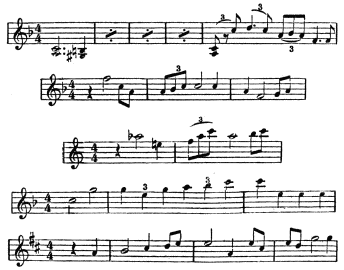
“This is too much. A musical work must be digestible, and should not consist of too many ingredients. Then, of these themes, only the fifth can be considered successful. The rest are colourless, or, like the second, made up of scraps, which have no organic unity and lack definite outline. Thirdly, every one of these themes, except the fifth, shows a monotonous method, which occurs only too often in the ‘Spanish Symphony’: the alternation of rhythms of 3 and 2. If a man cannot keep his inspiration within the limits of balanced form, then he should strive, at least, to vary the rhythms of his themes; in this Concerto the rhythmical treatment is monotonous. I will say nothing about the laboured way in which the various episodes follow one another; it would take us too far afield. Then as to harmony. The Concerto is full of queer, wild harmonies. In a modest violin Concerto such spicy condiments are out of place; but apart from that, I must say they have a kind of crude character, because they are not the outcome of the essential musical idea, but are forced upon it, like a schoolboy’s bravado put on for his teacher’s benefit. Other passages—also in the schoolboy style—are really rather slovenly, so to speak. For instance, this ‘smudge’ à la Moussorgsky, which occurs twice over:
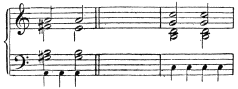
“If we play this horrible combination in quavers we get the following:—
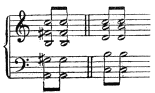
“This is repulsive, and quite unnecessary, because it is based upon nothing, and at first I took it for a misprint. Do not imagine, my friend, that it is the pedantic harmony master who speaks thus. I myself am very partial to dissonant combinations, when they have a motive, and are rightly used. But there are limits which must not be overstepped. Now, to enter into technical details, let me say that no breach of the laws of harmony, no matter whether it is harsh or not, really sounds well unless it has been made under the influence of the melodic origin. In other words, a dissonance should only be resolved harmonically, or melodically. If neither of these courses is adopted, we merely get abominations à la Moussorgsky. In the example cited above I might possibly be reconciled to the painful dissonance if, in the next bar, each part followed the melodic plan. But this is not the case with Lalo. With him abomination follows abomination. Now that I have done scolding, I will say something good. The various movements, although disconnected, show warmth and many beautiful details of harmony. On the whole the music has a piquant character peculiarly French, although not nearly so elegant as Bizet’s work.”
To N. F. von Meck.
“Florence, November 28th (December 10th), 1878.
“Yesterday’s performance at Pergola left a sad impression upon me. What a deterioration Italian music has suffered! What commonplace, yet pretentious stuff! What an incredibly poor performance as regards orchestra and chorus! The staging, too, was wretched. Such scenery in the town where Raphael and Michael Angelo once lived!”
To N. F. von Meck.
“Florence, December 5th (17th), 1878.
“A great number of my works I regard as weak. Several of these (the minority) have been published. Of those unpublished, many no longer exist, such as the operas Undine and The Voyevode (which were never performed), the symphonic fantasia Fatum, a Festival overture on the Danish National Hymn, and a cantata; but you are welcome to those I have kept, in order to complete your collection. They are very poor, although they contain some episodes and details I should be sorry to see disappear for ever.
“Laroche does not call me the enemy of programme music, but thinks I have no gift for this kind of work; therefore he describes me as an anti-programme composer. He takes every opportunity of expressing his regret that I so frequently compose programme music. What is programme music? Since for you and me a mere pattern of sounds has long since ceased to be music at all, all music is programme music from our point of view. In the limited sense of the word, however, it means symphonic, or, more generally, instrumental music which illustrates a definite subject, and bears the title of this subject. Beethoven partly invented programme music in the ‘Eroica’ symphony, but the idea is still more evident in the ‘Pastoral’. The true founder of programme music, however, was Berlioz, every one of whose works not only bears a definite title, but appears with a detailed explanation. Laroche is entirely opposed to a programme. He thinks the composer should leave the hearer to interpret the meaning of the work as he pleases; that the programme limits his freedom; that music is incapable of expressing the concrete phenomena of the physical and mental world. Nevertheless, he ranks Berlioz very highly, declares him to be an altogether rare genius and his music exemplary; but, all the same, he considers his programmes superfluous. If you care to hear my opinion on the subject, I will give it in a few words. I think the inspiration of a symphonic work can be of two kinds: subjective or objective. In the first instance it expresses the personal emotion of joy or sorrow, as when the lyric poet lets his soul flow out in verse. Here a programme is not only unnecessary, but impossible. It is very different when the composer’s inspiration is stirred by the perusal of some poem, or by the sight of a fine landscape, and he endeavours to express his impressions in musical forms. In this case a programme is indispensable, and it is a pity Beethoven did not affix one to the sonata you mention. To my mind, both kinds of music have their raison d’être, and I cannot understand those who will only admit one of these styles. Of course, every subject is not equally suitable for a symphony, any more than for an opera; but, all the same, programme music can and must exist. Who would insist in literature upon ignoring the epic and admitting only the lyric element?”
III
Shortly after writing the above letter Tchaikovsky left Florence for Paris. He did not remain there any length of time, but went to Clarens on December 28th in order to work at The Maid of Orleans in the quiet atmosphere of the Villa Richelieu.
To N. F. von Meck.
“Clarens, December 31st (January 12th), 1878.
“To-day I began to work, and wrote out the first chorus of the first act. The composition of this work is rendered more difficult because I have no ready-made libretto, and have not yet come to any definite plan as to the general outline. Meanwhile, only the text for the first act is complete. This I have written myself, keeping as far as possible to Joukovsky’s version, although I have drawn upon other sources: Barbier, for instance, whose tragedy has many good points. I find the versification very difficult.”
To N. F. von Meck.
“Clarens, January 8th (20th), 1879.
“I am very well pleased with my musical work. As regards the literary side of it, I believe it will cost me some days of my life. I cannot describe how it exhausts me. How many penholders I gnaw to pieces before a few lines grow perfect! How often I jump up in sheer despair because I cannot find a rhyme, or the metre goes wrong, or because I have absolutely no notion what this or that character would say at a particular moment! As regards rhyme, I think it would be a blessing if someone would publish a rhyming dictionary. If I am not mistaken, there is one in German, and perhaps in Russian too, but I am not sure of it.”
To P. I. Jurgenson.
“Clarens, January 14th (26th), 1879.
“There exist, as you are aware, three remarkable personages, whom you know intimately: the feeble poetaster N. N.,[66] who has written a few verses for your editions of Russian songs; B. L.,[67] formerly musical critic of the Russky Viedomosti, and the composer and ex-professor, Mr. Tchaikovsky.
“An hour or two ago Mr. Tchaikovsky invited the two other gentlemen—who live with him—to follow him to the piano, and played them the second act of his new opera The Maid of Orleans. Mr. Tchaikovsky, who is on very intimate terms with Messrs. N. N. and B. L., conquered his timidity without much difficulty, and played his new work with great skill and inspiration. You should have seen the enthusiasm of these two gentlemen! Anyone might have supposed they had some share in the composition of the opera, to see how they strutted about the room and admired the music. Finally, the composer, who had long tried to preserve his modesty intact, was infected by their enthusiasm, and all three rushed on to the balcony, as though possessed, to cool their disordered nerves and control their wild desire to hear the rest of the opera as soon as possible. In vain Messrs. N. N. and B. L. endeavoured to persuade Mr. Tchaikovsky that operas could not be tossed out like pancakes, the latter began to despair over the weakness of human nature and the impossibility of transferring to paper in a single night all that had long been seething in his brain. Finally, the good folks induced the insane composer to calm himself, and he sat down to write to a certain publisher in Moscow....”
To N. F. von Meck.
“January 20th (February 1st), 1879.
“Of the music you sent me, I have only played, as yet, through the pieces by Grieg and two acts of Goldmark’s opera, The Queen of Sheba. I do not know if I ever told you that I bought Le Roi de Lahore in Paris. Thus I possess two operas of the most modern French school. Let me tell you, dear friend, that I have no hesitation in giving the preference to Le Roi de Lahore. I know you do not care very much for Massenet, and hitherto I, too, have not felt drawn to him. His opera, however, has captivated me by its rare beauty of form, its simplicity and freshness of ideas and style, as well by its wealth of melody and distinction of harmony. Goldmark’s opera does not greatly please me—just enough to interest me in playing it through. Yet it is the work of a good German master. But all the German composers of the present day write laboriously, with pretensions to depth of thought, and strive to atone for their extraordinary poverty of invention by exaggerated colouring. For instance, the duet in the second act. How unvocal! How little freedom it gives to the singer! What insipid melodies! Massenet’s love duet, on the contrary, is far simpler, but a thousand times fresher, more beautiful, more melodious....
“Learn to know this opera, dear friend, and give me your opinion upon it.
“My work progresses. I am composing the first scene of Act III.”
To Modeste Tchaikovsky.
“Clarens, January 24th (February 5th), 1879.
“Do not be surprised if my letter is somewhat incoherent. I am very tired after my day’s work. To-day I wrote the love duet in the second act, and it is very complicated, so that at the present moment my brain works with difficulty. I jumped from the first scene of the third act to the fourth, because it is not so easy, and I wanted to get the most difficult scene—between Lionel and Joan—off my mind. On the whole I am pleased with myself, but feel rather exhausted. In Paris, I will rest by returning to my Suite and leaving the two remaining scenes of the opera until my return to Russia.
“I have added a new joy to life. In Geneva I bought the pianoforte arrangements of several Mozart and Beethoven quartets, and I play one every evening. You have no idea how I enjoy this, and how it refreshes me! I would give anything for my Maid of Orleans to turn out as good as Le Roi de Lahore.”
To N. F. von Meck.
“January 25th (February 6th), 1879.
“I will gladly follow your advice and write to Jurgenson to send a copy of Eugene Oniegin to Bülow. Generally speaking, I never send my works on my own initiative to musical celebrities, but Bülow is an exception, because he is really interested in Russian music and in me personally. He is the sole German musician who admits the possibility of the Russians rivalling the Germans as composers. Speaking of the German view of our compatriots, I do not think I ever told you about the fiasco of my Francesca in Berlin this winter. Bilse gave it twice. The second performance was a daring act on his part, since after the first hearing the entire Press was unanimous in damning my unfortunate fantasia....”
IV
To P. I. Jurgenson.
“Paris, February 6th (18th), 1879.
“Do you imagine I am going to dish you up my impressions of Paris? ‘You are mistaken, friend,’ as Kashkin is always saying. I only arrived early this morning. My departure from Clarens was highly dramatic. The landlady wept; the landlord shook me warmly by the hand; the maid (a very nice creature) also wept, so that I, too, was reduced to tears. I assure you I have never been so comfortable anywhere abroad as there. If circumstances permit, and no untoward changes occur in my life, I intend henceforth to spend a considerable part of each winter in Clarens....”
To N. F. von Meck.
“February 10th (22nd), 1879.
“At the present moment I am engaged upon the great ensemble in the third act (septet and chorus), which presents many technical difficulties. The first part of the septet is finished, and very successful, if I am not mistaken. The brilliance and bustle of Paris have their advantages. The variety of circumstances and impressions distract my thoughts from the musical work. Perhaps this is the reason why the number which I expected to find most fatiguing has proved comparatively easy. For the books and music I am very grateful to you....”
To P. I. Jurgenson.
“Paris, February 13th (25th), 1879.
“Here I live the life of an anchorite, and only emerge twice a day to satisfy the cravings of my stomach and take a little exercise.
“Last Sunday, however, I had a real musical treat. Colonne conducted one of my favourite works—Berlioz’s Faust. The performance was excellent. It was so long since I had heard any good music that I was steeped in bliss, all the more because I was alone, with no acquaintances sitting by my side. What a work!! Poor Berlioz! As long as he was alive no one wanted to hear about him. Now the newspapers call him ‘the mighty Hector....’ O God, how happy I am now! Did I ever dream that I should enjoy life so much?...”
To N. F. von Meck.
“Paris, February 19th (March 3rd), 1879.
“My whole life long I have been a martyr to my enforced relations with society. By nature I am a savage. Every new acquaintance, every fresh contact with strangers, has been the source of acute moral suffering. It is difficult to say what is the nature of this suffering. Perhaps it springs from a shyness which has become a mania, perhaps from absolute indifference to the society of my fellows, or perhaps the difficulty of saying, without effort, things about oneself that one does not really think (for social intercourse involves this)—in short, I do not really know what it is. So long as I was not in a position to avoid such intercourse, I went into society, pretended to enjoy myself, played a certain part (since it is absolutely indispensable to social existence), and suffered horribly all the time. I could wax eloquent on the subject.... To cut a long story short, however, I will merely tell you that two years ago Count Leo Tolstoi, the writer, expressed a wish to make my acquaintance. He takes a great interest in music. Of course, I made a feeble attempt to escape from him, but without success. He came to the Conservatoire and told Rubinstein he had not left the town because he wanted to meet me. Tolstoi is very sympathetic towards my musical gifts. It was impossible to avoid his acquaintance, which was obviously flattering and agreeable. We met, and I, assuming the part of a man who is immensely gratified, said I was very happy—most grateful—a whole series of indispensable but insincere phrases. ‘I want to know you better,’ he said; ‘I should like to talk to you about music.’ Then and there, after we had shaken hands, he began to give me his musical views. He considers Beethoven lacks inspiration. We started with this. Thus this writer of genius, this searcher of human hearts, began by asserting, in a tone of complete assurance, what was most offensive to the stupidity of the musician. What is to be done under such circumstances? Discuss? Yes, I discussed. But could such a discussion be regarded as serious? Properly speaking, I ought to have felt honoured by his notice. Probably another would have been. I merely felt uncomfortable, and continued to enact the comedy—pretending to be grateful and in earnest. Afterwards he called upon me several times, and although after this meeting I came to the conclusion that Tolstoi, if somewhat paradoxical, was straightforward, good, and in his way had even a fine taste for music, yet, at the same time, I had no more to gain from his acquaintance than from that of any other man.
“The society of another fellow-creature is only pleasant when a long-standing intimacy, or common interests, make it possible to dispense with all effort. Unless this is the case, society is a burden which I was never intended by nature to endure.
“This is the reason, dear friend, why I have not called upon Tourgeniev. There are numbers of people I might visit here. Saint-Saëns, for instance, on whom I promised to call whenever I was in Paris. Anyone else in my place would make the acquaintance of the local musicians. It is a pity I cannot, for I lose a good deal by my misanthropy. Oh, if you only knew how I have struggled against this weakness, how hard I have contended with my strange temperament in this respect!
“Now I am at rest. I am finally convinced that at my age it is useless to continue my education. I assure you I have been very happy since I drew into my shell, and since music and books became my faithful and inseparable companions. As to intercourse with famous people, I know from experience that their works, musical or literary, are far more interesting than their personalities.”
To Modeste Tchaikovsky.
“Paris, February 22nd (March 6th), 1879.
“Dear Modi,—Yesterday was a very important day for me. Quite unexpectedly I finished the opera. When you have written the last word of a novel you will understand what a joy it is to feel such a weight off your mind. To squeeze music out of one’s brain every day for ten weeks is indeed an exhausting process. Now I can breathe freely!
“Yesterday evening I walked about Paris feeling quite another man. I even sauntered, and perhaps that is why my old love for the place is reawakened. Perhaps, too, the fact that Colonne intends to give my Tempest at the next Sunday concert has something to do with it. Now I see my name on all the hoardings and posters I feel quite at home. I will confess that although I am pleased, yet I am also rather anxious. I know beforehand that it will not be well played, and will be hissed by the public—the invariable fate of all my compositions abroad. Therefore it would be better if the performance took place after I have left Paris. It cannot be helped, however. I shall have to endure some misery on Sunday, but not much, because I am only here as a bird of passage, and I know that the time is coming when I need not endure any more.
“In any case, yesterday and to-day I have strutted through the streets of Paris like a cock, and comforted myself with the feeling that I need not work. You would never have recognised your brother in a new overcoat, silk hat, and elegant gloves....”
To N. F. von Meck.
“Paris, February 24th (March 8th), 1879.
“Yesterday I saw L’Assomoir. It is interesting to sit through this piece, for it is highly entertaining to see washer-women getting up linen in the second scene, all the characters dead drunk in the sixth, and in the eighth, the death of a confirmed toper in an attack of delirium tremens. The play deals a double blow at that feeling for beauty which exists in us all. First, it is adapted from a novel written by a talented, but cynical, man who chooses to wallow in human filth, moral and physical. Secondly, to make it more effective and pander to the taste of the Boulevard public, a melodramatic element has been brought into the play which is not in keeping with the rest of it. In this way L’Assomoir loses on the stage its chief merit—the wonderfully realistic presentment of everyday life.
“But what do you think of Monsieur Zola, the high priest of the realistic cult, the austere critic who recognises no literary art but his own, when he allows perfectly unreal and improbable episodes and characters to be tacked on to his play—all for the sake of a royalty?”
To Modeste Tchaikovsky.
“Paris, February 26th (March 10th), 1879.
“Yesterday was a very exciting day. In the morning at the Châtelet Concert the performance of my Tempest took place. The agonies I endured are the best proof that a country life is the most tolerable for me. What used to be a pleasure—the hearing of one of my own works—has now become a source of misery. The evening before I began to suffer from colic and nausea. My agitation continued to grow crescendo until the opening chords, and while the work was proceeding I felt I should die of the pain in my heart. It was not the fear of failure with the public, but because lately the first hearing of all my works has brought me the sharpest disappointment. Mendelssohn’s Reformation symphony preceded The Tempest, and all the time I was admiring this fine masterpiece. I have not attained to the rank of a master. I still write like a gifted young man from whom much is to be expected. What surprised me chiefly was the fact that my orchestration sounded so poor. Of course, my reason told me I was exaggerating my own defects, but this was no great consolation. The Tempest was not badly played. The orchestra took pains, but showed no warmth of enthusiasm. One member of the band (a ‘cellist) kept staring, smiling, and nodding his head, as much as to say: ‘Excuse our playing such an extraordinary work; it is not our fault; we are ordered to play it, and we obey.’ After the last bars had died away, there followed some feeble applause, mingled with two or three audible hisses, at which the whole room broke out into exclamations of ‘O! O!’ which were intended as a kindly protest against the hisses. Then came silence. The whole business passed over me without leaving any special bitterness. I was only vexed to feel that The Tempest, which I have hitherto regarded as one of my most brilliant works, is in reality so unimportant. I left the room and, as the weather was very fine, took a two hours’ stroll. On returning home I wrote a card to Colonne, telling him that I could only remain another day in Paris, and could not therefore call to thank him personally.
“I must soon leave Paris. I am reconciled to the failure of The Tempest. I speak of it as a failure to myself, but I console myself with the thought that after the opera and the Suite I shall at last compose a fine symphonic work. And so, in all probability, I shall strive for mastery until my last breath, without ever attaining it. Something is lacking in me—I can feel it—but there is nothing to be done.”
The Gazette Musicale published Tchaikovsky’s letter to Colonne, which ran as follows:—
“Sir,—As luck would have it, I came to Paris for one day only, the very one upon which you presented my Tempest to the public. I was at the Châtelet. I heard it, and hasten to thank you for the kind and flattering attention bestowed on my music, and for your fine interpretation of my difficult and ungrateful work. I also send my hearty thanks to the members of your splendid orchestra for the trouble they took to interpret every detail of the score in the most artistic way.
“As to the feeble applause and somewhat energetic hisses with which the public greeted my unlucky Tempest, they affected me deeply, but did not surprise me—I expected them. If a certain degree of prejudice against our Muscovite barbarity had something to do with this, the intrinsic defects of the work itself are also to blame. The form is diffuse and lacking in proportion. In any case the performance which, as I have said, was excellent, has nothing to do with the failure of the work.
“I should certainly have gone round to shake hands with you and express my gratitude in person, had not the state of my health prevented my doing so. I am only passing through Paris. I am obliged therefore, dear sir, to have recourse to my pen, in order to convey to you my thanks. Rest assured that my gratitude will not be effaced from my heart.
“Your devoted “P. T.”
In publishing this letter, the Gazette Musicale preceded it by a few lines in praise of “this rare witness to the noble and sincere modesty of a composer.”
To N. F. von Meck.
“Paris, February 27th (March 11th), 1879.
“For the first time in my life I have read Rousseau’s Confessions. I do not know if I ought to recommend the book to you, supposing you have never read it, for side by side with passages of genius, it contains much cynical information which makes it almost unfit for a woman to read. Nevertheless I cannot help admiring the astonishing strength and beauty of style, as well as the true and profound analysis of the human soul. Apart from this, I find an indescribable delight in recognising features in my own character which I have never met with before in any literary work, and which are here described with extraordinary subtlety. For instance, he explains why, being a clever man, he never succeeds in giving any impression of his cleverness when in society. He speaks of his misanthropical tendencies, and of the unbearable necessity of keeping up forced conversations, when, in order to keep the ball rolling, one is obliged to pour forth empty words which in no way express the result of intellectual work, or spiritual impulse. How subtle and true are his remarks upon the scourge of social life.”
At the beginning of March Tchaikovsky returned to St. Petersburg. As invariably happened when his solitude was interrupted and a break in his work occurred, he now passed through a period of depression and discontent with his surroundings, which were actually in no way to blame for his frame of mind.
To N. F. von Meck.
“March 13th (25th), 1879.
“ ... On Friday I go to Moscow with my brothers to attend the first performance of Eugene Oniegin, after which I shall return to Petersburg, where I remain until Easter.”
To N. F. von Meck.
“Petersburg, March 19th (31st), 1879.
“I have just returned from Moscow. Instead of leaving on Friday, I went on Wednesday, because Jurgenson telegraphed that my presence was required at the last rehearsal. I arrived just before the costume rehearsal took place. The stage was fully lighted, but the hall itself was quite dark, which gave me the opportunity of concealing myself in a corner and listening to the opera undisturbed. On the whole the performance was very satisfactory. The orchestra and chorus got through their business splendidly. The soloists, on the other hand, left much to be desired....
“These hours, spent in a dark corner of the theatre, were the only pleasant ones during my visit to Moscow. Between the acts I saw all my former colleagues once more. I observed with delight that the music of Oniegin seemed to win their favour. Nicholas Rubinstein, who is so parsimonious in praise, told me that he had ‘fallen in love’ with it. After the first act Taneiev wanted to express his sympathy, instead of which he burst into tears. I cannot really tell you how this touched me.... On Saturday (the day of the performance) my brothers and a few other Petersburgers, among them Anton Rubinstein, arrived early.
“Throughout the day I was greatly excited, especially as I had yielded to Nicholas Rubinstein’s entreaty and declared my willingness to come before the curtain in case I should be called for.
“During the performance my excitement reached its zenith. Before it began, Nicholas Rubinstein invited me behind the scenes, where, to my horror, I found myself confronted by the whole Conservatoire. At the head of the professors stood. Nicholas Grigorievich himself, who handed me a wreath, amid the hearty applause of the bystanders. Of course I had to say a few words in answer to Rubinstein’s speech. God knows what it cost me! Between the acts I was recalled several times. I have never seen such an enthusiastic audience. I draw this conclusion from the fact that it was invariably myself—not the performers—who received a recall.
“After the performance there was a supper at ‘The Hermitage,’ at which even Anton Rubinstein was present. I have absolutely no idea whether my Oniegin pleased him or not. He never said a word to me on the subject. It was 4 a.m. before I returned home with a splitting headache, and spent a wretched night. I recovered during the return journey to Petersburg, and to-day I feel quite refreshed. I shall try not to go out during the next fortnight, but to give myself up in earnest to the instrumentation of my Suite.”
To Tchaikovsky’s account of the first performance, I can only add my personal impression that the actual success of the opera was poor, and the ovation given to my brother was rather in consideration of former services than in honour of the music itself, which had only a moderate success.
This cool reception of a work, afterwards to become one of Tchaikovsky’s most popular operas, can be accounted for in the first place by its indifferent interpretation. It had been carefully prepared, but was entrusted to inexperienced students of the Conservatoire, instead of mature artists; consequently the work was not represented in its best light. The comparatively recent period of the tale, and the audacity of the librettist in representing upon the stage the almost canonised personality of Tatiana, and, what was still worse, the additions made to Poushkin’s incomparable poem—all contributed to set public taste against the opera. Besides which, both libretto and music lacked those dramatic incidents which generally evoke the public enthusiasm.
Respecting Anton Rubinstein’s judgment of Eugene Oniegin, the widow of the great pianist said that her husband was not at all pleased with the opera at the first hearing. On his return to Petersburg he criticised the work from beginning to end, and declared it to be utterly wanting in the “grand opera style.” Some years later he altered his opinion, and when his wife reminded him of the first failure of the work, replied: “What do you know about it? No one who has been brought up upon gipsy songs and Italian opera has any right to criticise such a composition.”
With the exception of Laroche, most of the critics praised Eugene Oniegin, although without much enthusiasm.
V
Early in April Tchaikovsky left Petersburg for Kamenka.
To N. F. von Meck.
“Kamenka, April 14th (26th), 1879.
“My opera reposes for the time being in my portfolio. I am working at the Suite. To-day I finished the score, and to-morrow I shall start upon the arrangement for four hands....
“I have another fortnight’s work to bestow upon the Suite. At Brailov I shall be able to give myself up entirely to my increasing love of nature. There is no other spot in the world which can offer me so much in this respect. To live in your house, to feel myself free and alone, to be able to visit the forests every day and wander all day among the flowers, to listen to the nightingale at night, to read your books, play upon your instruments and think of you—these are joys I cannot find elsewhere.”
To P. Jurgenson.
“Kamenka, April 22nd (May 4th), 1879.
“I am beginning to be proud of my works, now that I see what an extraordinary effect some of them make. Everyone here is crazy over the Andante, and when I played it with my brother as a pianoforte duet, one girl fainted away (this is a fact!!). To make the fair sex faint is the highest triumph to which any composer can attain.”
To N. F. von Meck.
“Brailov, May 5th (17th), 1879.
“Yesterday I began to study the score of Lohengrin. I know you are no great admirer of Wagner, and I, too, am far from being a desperate Wagnerite. I am not very sympathetic to Wagnerism as a principle. Wagner’s personality arouses my antipathy, yet I must do justice to his great musical gift. This reaches its climax in Lohengrin, which will always remain the crown of all his works. After Lohengrin, began the deterioration of his talent, which was ruined by his diabolical vanity. He lost all sense of proportion, and began to overstep all limits, so that everything he composed after Lohengrin became incomprehensible, impossible music which has no future. What chiefly interests me in Lohengrin at present is the orchestration. In view of the work which lies before me, I want to study this score very closely, and decide whether to adopt some of his methods of instrumentation. His mastery is extraordinary, but, for reasons which would necessitate technical explanations, I have not borrowed anything from him. Wagner’s orchestration is too symphonic, too overloaded and heavy for vocal music. The older I grow, the more convinced I am that symphony and opera are in every respect at the opposite poles of music. Therefore the study of Lohengrin will not lead me to change my style, although it has been interesting and of negative value.”
To N. F. von Meck.
“Brailov, May 7th (19th), 1879.
“Yesterday I was talking to Marcel about the completion of the Catholic chapel, started long ago, but interrupted by order of the Government. Now the necessary permission has been obtained, and the priest has funds for the work; but another difficulty exists which you alone can overcome. One of your offices just touches the wall of the church, and could easily be transported to another spot. Last year I went into the chapel in which the service is held, and I must honestly say that I was sorry to see this obvious proof of Catholic persecution ... it is not large enough to hold a tenth part of the congregation. I am an energetic champion of religious freedom. Marcel tells me the priest did not like to trouble you with his requests, therefore I am animated with a desire to come to his assistance. I take the liberty of telling you that the Catholics of Brailov are hoping for your kind permission to have your building removed. If this should prove to be impossible, at least forgive me, dear friend, for my untimely interference on their behalf.”
To N. F. von Meck.
“Brailov, May 9th (21st), 1879.
“I have just been in the church attached to the monastery. There were many people, both in the church and in the courtyard of the building. I heard the blind ‘lyre singer.’ He calls himself ‘lyre singer’ on account of the instrument with which he accompanies himself, which, however, has nothing in common with the lyre of antiquity. It is curious that in Little Russia every blind beggar sings exactly the same tune with the same refrain. I have used part of this refrain in my Pianoforte Concerto.

“At the present moment I am writing on the balcony. Before me is the bunch of lilies of the valley from Simakov. I am never tired of looking at these enchanting creations of nature.”
To N. F. von Meck.
“Kamenka, May 29th (June 10th), 1879.
“To-day I finished the first act of my opera (The Maid of Orleans). It has grown into a somewhat bulky score. What a delight to look through a newly finished score! To a musician a score means something more than a collection of all kinds of notes and pauses. It is a complete picture, in which the central figures stand out clearly from the accessories and the background.
“To me every orchestral score is not merely a foretaste of oral delight, but also a joy to look upon. For this reason I am painfully particular about my scores, and cannot bear corrections, erasures, or blots.”[68]
To N. F. von Meck.
“Kamenka, June 13th (25th), 1879.
“Early this morning I had a telegram from Jurgenson, to say he had won his case against Bachmetiev, the Director of the Imperial Chapel. I think I told you that early last year my Liturgy (of St. John Chrysostom) was confiscated from Jurgenson’s by order of Bachmetiev.... Only those works which have been recognised by the Chapel can be publicly sold or performed. This is the reason why, until now, no Russian musicians have written Church music. After the confiscation of my composition, Jurgenson brought an action for damages against Bachmetiev, and has won his case.... This does not matter so much for my Liturgy, as for the principle involved.
“Twenty-five years ago to-day my mother died. It was the first profound sorrow of my life. Her death had a great influence on the fate of myself and our entire family. She was carried off by cholera, quite unexpectedly, in the prime of life. Every moment of that terrible day is still as clear in my remembrances as though it had happened yesterday.”
On June 20th Tchaikovsky wrote to N. F. von Meck that he had received three very agreeable letters from abroad. In one Colonne expressed his respect in the kindliest manner, and assured Tchaikovsky that, in spite of the cold reception of The Tempest, his name should figure again in the programmes of the Châtelet. A second communication came from the ‘cellist Fitzenhagen (professor at the Moscow Conservatoire), telling him of the impression he had created with the “Variations on a Rococo theme” at the Wiesbaden Festival. Liszt remarked on this occasion, “At last here is music again.” The third letter—from Hans von Bülow—announced the great success of Tchaikovsky’s first Pianoforte Concerto at the same festival. Von Bülow had already played it with even greater success in London.
Almost on the same day Tchaikovsky also heard the good news that his Liturgy had been performed in the University Church at Kiev.
VI
On August 7th Tchaikovsky finished the third act of The Maid of Orleans and, suffering from physical and nervous exhaustion, left Kamenka for Simaki,[69] as Nadejda von Meck was occupying her house at Brailov.
To N. F. von Meck.
“I am enchanted. I could not imagine more beautiful surroundings. The garden in which I have just been walking with Pakhulsky has surpassed all my expectations. The house is a splendid retreat! If you only realised how much I am in need just now of all the comforts which I get as your guest in this delightful spot!
“I intend to finish the orchestration of the last act of my opera while I am here, and shall begin work to-morrow. I shall get this heavy burden off my shoulders, and then I can draw breath and enjoy the incomparable sensation of having completed a long work.”
To Modeste Tchaikovsky.
“Simaki, August 9th (21st), 1879.
“I hasten to send you my first impressions of this place. A very, very old house, a shady garden with ancient oaks and lime trees; it is very secluded, but therein lies its charm. At the end of the garden flows a stream. From the verandah there is a fine view over the village and the forests. The absolute quiet and comfort of the place exactly suit my taste and requirements. I have at my disposal an old manservant called Leon, a cook whom I never see, and a coachman with a phaeton and four horses. I could gladly dispense with the last, since it necessitates my driving occasionally, while in reality I prefer to walk. The proximity of Nadejda Filaretovna troubles me somewhat, although it is really folly. I know my seclusion will not be disturbed. I am so accustomed to regard her as a kind of remote and invisible genius that the consciousness of her mortal presence in my neighbourhood is rather disconcerting. Yesterday I met Pakhulsky, who spent part of the evening with me. But I told him plainly that I wanted to be left quite alone for a few days.”
To N. F. von Meck.
“August 11th (23rd), 1879.
“Pakhulsky told me that next time he came he was to bring Milochka[70] with him. I am very fond of Milochka; it is a pleasure to look at the photograph of her charming face. I am sure she is a dear, sweet, sympathetic child. I love children, and could only say ‘yes’ to such a proposal. But what I could not say to Pakhulsky I can say to you.
“Forgive me, dear friend, and make fun of my mania if you like—but I am not going to invite Milochka here, for this reason: my relations towards you—as they exist at present—are my chief happiness, and of the greatest importance to my well-being. I do not want them altered by a hair’s breadth. The whole charm and poetry of our friendship lies in your being so near and so dear to me, while at the same time I do not know you at all in the ordinary sense of the word. This condition of things must extend to your nearest belongings. I will love Milochka as I have hitherto loved you. If she appeared before me—le charme serait rompu!
“Every member of your family is dear to me—particularly Milochka—yet for God’s sake let everything remain as it has been. What could I say if she asked me why I never went to see her mother? I should have to open our acquaintance with a lie. This would be a grief to me, even though it were a trifling falsehood. Pardon my frankness, dear and noble friend....
“If you have Beethoven’s Sonatas, be so kind as to send them to me.”
To Anatol Tchaikovsky.
“Simaki, August 18th (30th), 1879.
“Time slips away unobserved. Yesterday something very painful happened. About four o’clock in the afternoon I was walking in the woods, feeling sure I should not meet Nadejda Filaretovna, because it was her dinner-hour. It chanced, however, that I went out a little earlier, and she was dining somewhat later, so we ran against each other quite by chance. It was an awkward predicament. Although we were only face to face for a moment, I felt horribly confused. However, I raised my hat politely. She seemed to lose her head entirely and did not know what to do. She was in one carriage with Milochka, and the whole family followed in two others. I wandered into the forest in search of mushrooms, and when I returned to the little table where tea was prepared for me, I found my letters and newspapers awaiting me. It appears she sent a man on horseback to look for me, so that I might get my post at tea-time.”
To N. F. von Meck.
“Simaki, August 27th (September 8th), 1879.
“Now I can almost say finished! I have worked at The Maid of Orleans from the end of November (Florence) to the end of August (Simaki), just nine months. It is remarkable that I began and finished this opera as the guest of my dear friend.”
To N. F. von Meck.
“August 31st (September 12th), 1879.
“Do you not like such grey days as to-day? I love them. The beginning of autumn can only be compared to spring as regards beauty. It seems to me September, with its tender, melancholy colouring, has a special power to fill me with calm and happy feelings. Around Simaki there are many delightful spots which I like best to frequent at sunset, or on sunless days like to-day. For instance, if you turn to the right, past the kitchen garden, and take the lower path (parallel to the village) by the fen where the reeds grow. I am very fond of that spot. But by day the sun spoils the picturesque view of the village.
“At evening, too, or on a cloudy day, it is delightful to sit on some high-lying spot, and look over the old willows, or poplars, across to the village, with its modest church (what a charm is given to every rural landscape by these churches), and far away to the distant forests. I often spend an hour in this way....”
To Modeste Tchaikovsky.
“August 31st (September 12th), 1879.
“I have just received a telegram from Anatol: ‘Have just been dismissed in consequence of an unpleasantness in my department. Most anxious to speak to you.’ I am starting for Petersburg at once. A great fear of the future possesses me. In spite of the many delightful moments spent here, I have had a continual foreboding of something unlucky, and always about Toly.”
VII 1879-1880
To P. I. Jurgenson.
(Early in September.)
“You will be very much astonished to hear of my being in Petersburg. I was summoned by a telegram from my brother Anatol, announcing that in consequence of some unpleasantness he had to resign his position in the Government service.... I think the matter can be so arranged that he can keep his place....
“I do not know how long I shall stay here. It depends upon the progress of my brother’s affairs. O detested Petersburg!”
To N. F. von Meck.
“Petersburg, September 13th (25th), 1879.
“I received your letter yesterday, dear friend. How I envied you when I read your account of the lovely autumn weather you were enjoying! The weather is not bad here, but what is the use of it to me?
“I often go to the opera, but I do not enjoy it much. The impossibility of escaping from innumerable acquaintances bores me dreadfully. No matter where I hide myself, there are always idle people who poison my pleasure in the music by their kind attentions. They will worry me with the usual commonplace questions: ‘How are you?’ ‘What are you composing now?’ etc. But the invitations are the most intolerable. It requires so much courage to refuse them.
“In one of your letters you asked me to tell you the whole method of procedure in order to get an opera accepted for performance. One has to send the score and pianoforte arrangement, with a written request for its performance, to the Direction of the Imperial Opera House. Then, in order to be successful, one must set in motion the whole machinery of solicitation and entreaty. This is just what I do not understand. My first two operas were performed, thanks to the assistance of the Grand Duke Constantine Nicholaevich who likes my music. How things will go this time I cannot say. I shall impress upon Jurgenson to do all that is necessary. Two days ago I was talking to Napravnik (one of the worthiest members of the musical world), who takes a lively interest in the fate of my opera. He told me it could not be performed this season, but advised me to send in the score as soon as possible.”
To Anatol Tchaikovsky.
“Moscow, September 20th (October 2nd), 1879.
“Forgive me for not having written before to-day. Yesterday it was impossible.... Rubinstein and Jurgenson soon put in an appearance, and compelled me to leave the tea, upon which I had just started, and go out to breakfast with them. O Moscow! Scarcely has one set foot in it before one must needs begin to drink! At five o’clock I was invited to dinner at the Jurgensons’, where we began again. I cannot tell you how strange and repugnant to me is this Moscow atmosphere of swilling.”
To N. F. von Meck.
“Grankino, September 25th (October 7th), 1879.
“I left Moscow on the 22nd. No sooner did the train begin to move, and I saw the outskirts of the town, than the black curtain, which had hung before my eyes during the whole of my time in the two capitals, suddenly vanished. I was once more free and happy.
“Here I found both your letters. I cannot tell you how glad I was to read your dear words. It was a surprise to hear our symphony was at last published, for the distracted Jurgenson forgot to mention this....
“I owe you everything: my life, the possibility of going forward to distant goals, freedom, and that complete happiness which formerly I believed to be unattainable.
“I read your letters with such a sense of eternal gratitude and affection that I cannot put it into words....”
To N. F. von Meck.
“Kamenka, October 5th (17th), 1879.
“At the present moment—I do not know why—I am going through an intense Italian craze. I feel so delighted, so happy, at the mere thought that before long I, too, shall be in Italy. Naples, Pompeii, Vesuvius ... enchanting, lovely!
“I found the proofs of the Suite here. In three days I corrected and sent them back, so that I can now take a holiday—read, walk, play, dream—to my heart’s desire. For how long? I do not know. At any rate, I will not undertake any work during my first days in Naples. Do you not think that in the land of lazzarone one must be lazy too?”
To Anatol Tchaikovsky.
“Kamenka, October 7th (19th) 1879.
“No news. I feel very well, only a little misanthropical now and then. To-day there are visitors. When there are none I feel quite at ease. We all sit and sew. I have hemmed and marked a pocket-handkerchief.”[71]
To N. F. von Meck.
“Kamenka, October 9th (21st), 1879.
“How can I thank you for the trouble you have taken about our symphony? I am delighted Colonne will play it. At the same time there is no doubt it will have no success whatever with the public. Perhaps it might rouse a spark of sympathy in the hearts of ten or twelve people—and that would be a great step in advance.... Only one thing troubles me. Does Colonne really want to be paid for doing the work? It would gratify me to know that his readiness to perform the symphony was not based upon pecuniary considerations.”
To N. F. von Meck.
“Kamenka, October 12th (24th), 1879.
“The last few days I have felt a secret dissatisfaction with myself, which has degenerated into boredom. I realised that I wanted work and began to occupy myself. The boredom immediately vanished and I felt relieved. I have begun a pianoforte concerto and intend to work at it without haste and over-fatigue.
“Have you read V. Soloviev’s philosophical articles? They are admirably written; very popular in form, so that they do not overstep the intelligence of the ordinary reader, yet very clever. I do not know to what conclusions the writer will eventually come. In the last number he proves very effectively the untenableness of positivism, which denies metaphysics, yet cannot get along without philosophy. Soloviev speaks in a very striking way of the delusion of the materialists who, because they deny metaphysics, believe they are only dealing with what actually exists, that is, with the material; whereas the material has no objective existence, and is only a phenomenon, the result of the activity of our sense and intellect. I express his ideas very indifferently, but I advise you to read this book for yourself.
“Yesterday I heard from Anatol about the performance of Vakoula the Smith, which took place the previous week. The theatre was full, but the public cool, just as on former occasions. Anatol attributes this to the indifferent performance. But I can see with startling clearness that this attitude of reserve is the outcome of my own stupid mistakes. I am glad to know that The Maid of Orleans is free from the faults of my earlier pseudo-opera style, in which I wearied my listeners with a superfluity of details, and made my harmony too complicated, so that there was no moderation in my orchestral effects. Besides which, I gave the audience no repose. I set too many heavy dishes before them. Opera style should be broad, simple, and decorative. Vakoula is not in true opera style, but is far more like symphonic or chamber music. It is only surprising that it has not proved a complete failure. It is possible that it may find favour with the public in course of time. I place it in the front rank of my works, although I see all its defects. It was a labour of love, an enjoyment, like Oniegin, the Fourth Symphony, and the Second Quartet.”
To N. F. von Meck.
“Kamenka, October 15th (27th), 1879.
“Only a month—and I shall be at Naples! I look forward to this as a child to his birthday, and the presents it will bring. Meanwhile things are going well with me. My latest musical creation begins to grow and display more characteristic features. I work with greater pleasure and try to curb my habitual haste, which has often been injurious to my work.”
On October 21st Nicholas Rubinstein played Tchaikovsky’s Pianoforte Sonata at a concert of the Musical Society in Moscow. The success was so great that the famous pianist repeated it at his own concert in the course of the same season.
On November 11th the composer’s First Suite had a decided success, judging by the newspapers. The short number which Tchaikovsky once thought of cutting out of the work was encored.
To Anatol Tchaikovsky.
“Berlin, November 11th (23rd), 1879.
“My dear Anatol,—I have had an ideal journey. I arrived in Berlin early this morning. After breakfast I went to see Kotek. The good man seemed wild with delight at seeing me again, and even I was glad. But at the end of two hours of musical tittle-tattle I was tired, and thankful he had to attend a rehearsal. Strange! The longer I live, the less I care for the society of my fellow-creatures. There is no doubt that I am fond of Kotek, but his chatter wearies me more than the severest physical exertion.”
To N. F. von Meck.
“Paris, November 18th (30th), 1879.
“I know the Variations by Rimsky-Korsakov & Co.[72] very well. The work is original in its way and shows some remarkable talent for harmony in its authors. At the same time I do not care for it. It is too heavy and spun-out for a joke, and the everlasting repetition of the theme is—clumsy. As a work of art it is a mere nonentity. It is not surprising that a few clever men should have amused themselves by inventing all kinds of variations upon a commonplace theme; the surprising thing is their having published them. Only amateurs can suppose that every piquant harmony is worthy to be given to the public. Liszt, the old Jesuit, speaks in terms of exaggerated praise of every work which is submitted to his inspection. He is at heart a good man, one of the very few great artists who have never known envy (Wagner and in some measure Anton Rubinstein owe their success to him; he also did much for Berlioz); but he is too much of a Jesuit to be frank and sincere.”
To P. Jurgenson.
“Paris, November 19th (December 1st), 1879.
“Dear Friend,—What happiness to get right away from one’s own country! Not until I had passed the frontiers, did I breathe freely and feel at ease. On the journey I came across Joseph Wieniawsky, who was in the same corridor train. I immediately told him I was not alone, but travelling with a lady, upon which he winked at me slyly, as much as to say, ‘Of course, we know, shocking dog!’
“At present I want to work slowly at my Concerto; later I mean to look through my old works, especially the Second Symphony, which I intend to revise thoroughly.”
To N. F. von Meck.
“Paris, November 21st (December 3rd), 1879.
“To-day, being a Saint’s Day, Alexis went to church, and told me the Grand Duke Nicholas Nicholaevich, with all his suite in full uniform, had attended the service. I could not account for this until I took up the Gaulois at breakfast, and read of an attempt made in Moscow on the Tsar’s life.... The Emperor escaped unharmed.
“I do not believe, dear friend, that we are in immediate danger of a war with Prussia. Such a war, although inevitable, is improbable during the lives of the present emperors. How can it be possible to think of war, when such horrors are taking place in our midst?... I think the Tsar would do well to assemble representatives throughout all Russia, and take counsel with them how to prevent the recurrence of such terrible actions on the part of mad revolutionaries. So long as all of us—the Russian citizens—are not called to take part in the government of the country, there is no hope of a better future.”
To N. F. von Meck.
“Paris, November 26th (December 8th), 1879.
“I am not altogether at one with you as regards Cui. I do not recognise in him any great creative power, although his music has a certain elegance, agreeable harmonies, and shows good taste, in which he is distinguished from the other members of ‘the band,’ especially Moussorgsky. By nature Cui is more drawn towards light and piquantly rhythmic French music; but the demands of ‘the band’ which he has joined compel him to do violence to his natural gifts and to follow those paths of would-be original harmony which do not suit him. Cui is now forty-four years of age and has only composed two operas and two or three dozen songs. He was engaged for ten years upon his opera Ratcliff. It is evident that the work was composed piecemeal, hence the lack of any unity of style.”
To N. F. von Meck.
“Paris, November 27th (December 9th), 1879.
“Now I will answer your question. My Voyevode is undoubtedly a very poor opera. I do not speak of the music only, but of all that goes to the making of a good opera. The subject is lacking in dramatic interest and movement, and the work was written hastily and carelessly. I wrote music to the words without troubling to consider the difference between operatic and symphonic style. In composing an opera the stage should be the musician’s first thought, he must not abuse the confidence of the theatre-goer who comes to see as well as to hear. Finally, the style of music written for the stage should be the same as the decorative style in painting, clear, simple, and highly coloured. A picture by Meissonier would lose half its charm if exhibited on the stage; and subtle, delicately harmonised music would be equally inappropriate, since the public demands sharply defined melodies on a background of subdued harmony. In my Voyevode I have been chiefly concerned with filigree work, and have forgotten the requirements of the stage.
“The stage often paralyses a composer’s inspiration, that is why symphonic and chamber music are so far superior to opera. A symphony or sonata imposes no limitations, but in opera, the first necessity is to speak the musical language of the great public.... The final defect of The Voyevode lies in the heaviness of its orchestration, which overpowers the soloists. These are all the faults of inexperience; we must leave a whole series of failures behind us before we can attain to perfection. This is the reason why I am not ashamed of my first opera. It has taught me useful lessons. And you see, dear friend, how strenuously I have endeavoured to correct my errors. Even Undine (the opera I burnt), The Oprichnik, and Vakoula are not what they should be. I find this branch of art very difficult! I think The Maid of Orleans at last fulfils every requirement, but perhaps I deceive myself. If it is so, if it turns out that I have failed to grasp the true opera style, even in this work, then I shall be convinced of the justice of the opinion that I am by nature only a symphonic composer and should not attempt dramatic music. In that case, I shall abandon all attempts at opera.”
To N. F. von Meck.
“Paris, December 1879.
“I have read the proclamation you mention. It is impossible to conceive anything more astounding and cynical. How will such revolutionary proceedings forward the reforms with which, sooner or later, the Tsar will crown his reign? That which the Socialists are doing in the name of Russia is foolish and insolent. But equally false is their pretence of readiness to shake hands with all parties and to leave the Emperor in peace as soon as he summons a Parliament. This is not what they really aim at, for they mean to go further—to a socialist-republic, or to anarchy. But no one will swallow this bait. Even were a constitution granted to Russia in the remote future, the first act of the Zemstvo should be extermination of this band of murderers who hope to become the leaders of the country.”
To N. F. von Meck.
“Paris, December 3rd (15th), 1879.
“The sketch of my Concerto is finished and I am very pleased with it, especially with the Andante. Now I shall take in hand the revision of my Second Symphony, of which only the last movement can be left intact. I published this work through Bessel in 1872, as a return for the trouble he took over the performance of The Oprichnik.... For seven years he has led me a dance over the engraving of the score—always putting me off with the assurance that it would soon be ready. I was sometimes furious with him, but his lack of conscience has proved itself a blessing in disguise!... If I succeed in working steadily in Rome, I shall make a good work out of my immature, mediocre symphony.”
VIII
After spending a few days in Turin, Tchaikovsky reached Rome on December 8th (20th), 1879. From thence he wrote, on the 12th (24th), to Frau von Meck:—
“Yesterday we made a pilgrimage to S. Pietro in Montorio. Probably you know the place, therefore I need not describe the beauty of the view from the terrace below the church. To-day I visited San Giovanni in Laterano and carried away some profound artistic impressions. I also went to Scala Santa. High Mass was being celebrated in the church. The choir sang a Mass a capella and also with the organ. Quite modern music, utterly unsuitable in church, but beautifully sung. What voices there are in Italy! The tenor gave a solo, in the style of a wretched operatic aria, in such a magnificent voice that I was quite carried away. But the Mass itself lacks that solemn, poetical atmosphere with which our liturgy is surrounded.”
To N. F. von Meck.
“Rome, December 13th (25th), 1879.
“It is Christmas here to-day. We went to Mass at St. Peter’s. What a colossal edifice—this cathedral!”
To N. F. von Meck.
“Rome, December 15th (27th), 1879.
“Yesterday we went up Monte Testaccio, with its lovely view of Rome and the Campagna. From there we visited S. Paolo Fuori le Mura, a basilica of huge proportions and vast wealth. To-day I am going for the first time to ‘do’ the Forum thoroughly. This has a three-fold interest for me because I am just reading Ampère’s Histoire romaine à Rome, in which all that has taken place in this building is minutely described.
“I have a very good piano now. I got a few volumes of Bach’s works from Ricordi, and play a number of them, alone, or four-handed, with my brother Modeste. But work will not come back to me. Rome and Roman life are too characteristic, too exciting and full of variety, to permit of my sticking to my writing-table. However, I hope the power of work will gradually return. Yesterday I heard a charming popular song, of which I shall certainly make use some future day.”
To P. I. Jurgenson.
“Rome, December 19th (31st), 1879.
“Dear Friend,— ... Nicholas Rubinstein’s opinion that my Suite is so difficult that it is impossible, has surprised and annoyed me very much. Either Rubinstein is mistaken, or I must give up composing; one or the other. Why, it is my chief anxiety to write more easily and simply as time goes on, and the more I try—the worse I succeed! It is dreadful!
“I asked Taneiev to write and tell me what actually constituted these terrible difficulties. I feel a little hurt that none of my friends telegraphed to me after the performance. I am forgotten. The one interest which binds me to life is centred in my compositions. Every first performance marks an epoch for me. Can no one realise that it would have been a joy to receive a few words of appreciation, by which I should have known that my new work had been performed and had given pleasure to my friends?
“I do not understand what you say about the ‘Marche Miniature.’ We never cut it out. The March was to be kept, but as it was not suitable as No. 5 it was to be published at the end of the Suite.... For God’s sake answer my letters quicker. Your communication has upset my nerves and I feel as ill as a dog.”
To N. F. von Meck.
Rome, December 22nd (January 3rd, 1880), 1879.
“To-day I went to the Capitol with Modeste. We spent an hour and a half in the Hall of the Emperors. The busts are highly characteristic! What a revolting, sensual, animal face Nero has! How sympathetic is Marcus Aurelius! How fine the old Agrippina! How repulsive Caracalla! Some of these countenances in no way bear out one’s idea of the originals. For instance, Julius Cæsar altogether lacks power and greatness; he looks like a Russian Councillor of State. And Trajan? Who could guess from his narrow forehead, prominent chin, and commonplace expression, that the original of the portrait was a great man?...”
A few days later, Tchaikovsky recounted to Nadejda von Meck his impressions of the treasures of the Vatican:—
“The frescoes of Michel Angelo now appear less incomprehensible to me, although I do not share Modeste’s enthusiasm for them. His athletic, muscular figures, and the gloomy vastness of his pictures, are gradually becoming more intelligible. His art now interests and overcomes me, but it does not delight me, or touch my heart. Raphael is still my favourite—the Mozart of painters. Guercino’s pictures please me very much, some of his Madonnas are so angelically beautiful, they fill me with silent ecstasy. However, I must confess that I am not gifted by nature with a fine appreciation of the plastic arts, for very few pictures make an impression upon me.... To study all the art treasures of Rome conscientiously would need a whole lifetime. To-day I discovered once more how important it is to look long and carefully at a picture. I sat before Raphael’s ‘Annunciation,’ and at first I did not see much in the picture, but the longer I looked the more profoundly was I penetrated with its beauty as a whole, and the wonder of its details. Alas! I had only just begun to really enjoy the work, when Modeste came to tell me it was three o’clock and time to go on to the Sistine Chapel.... I do not think I could live long in Rome. There are too many interests; it leaves no time for reflection, no time to deepen one’s own nature. I should prefer Florence as a permanent place of residence; it is quieter, more peaceful. Rome is richer and grander; Florence more sympathetic.
“I agree with Goethe’s characteristic opinion of Rome.... ‘It would be a fine thing to spend a few centuries there in Pythagorean silence.’”
S.I. Taneiev to Tchaikovsky.
“Moscow.
“N. Rubinstein has pointed out to me all those parts in the score of your Suite which he considers awkward.
“The difficulties are chiefly centred in the wind instruments, especially in the wood-wind. They are as follows:—
“(1) Too few pauses; the wood-wind have to play for too long at a time without opportunities for breathing. In those places where you have doubled the strings (as in the Fugue) it does not matter so much, they can make a slight break without its being observable. But it is very different when they are playing alone. For instance, in the newly added movement there is a part for three flutes which have to play triplets for twenty-two bars, without a break.
“(2) Difficult passages: these occur very often in the wood-wind and demand virtuosi to execute them properly. In the Andante the passages leading to the second theme are extremely difficult (where oboe and clarinet, and the second time flute and clarinet, have triplets of semi-quavers). This part went very badly at the rehearsals, and even at the concert, although the musicians had practised their parts at home. It offers such difficulties that it is impossible to render it with the expression marks indicated, for the musicians have enough to do to get their right note (the double flat for clarinet is particularly awkward).
“(3) The compass of all the wood-wind instruments is too extended. The first bassoon usually plays in the tenor register, while the second takes the lower notes. Not only the musicians, but also their instruments, have got accustomed to this; the lower notes of the first bassoon are not quite in tune; the same thing applies to the upper notes of the second bassoon. But your Suite opens with a unison passage for both fagotti, which employs almost the entire range of these instruments: from
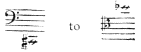
In the march the oboes have the following notes:—
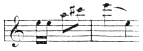
which Z. played at the first rehearsal as:—
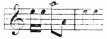
When Rubinstein asked him why he did not play the notes as they were written, he replied that he could do so, but it would be very bad for his lips, because they lay too high. The French oboe players, he continued, could bring out these high notes better, because they had different and finer mouthpieces; but with these mouthpieces the middle and lower notes suffered.
“(4) Difficult rhythms which make the execution irregular. The absence, too, of what the Germans call “Anhaltspunkt” (punctuation)—the absence of notes on the strong beats of the bar. Take this rhythm in the Scherzo for instance:—
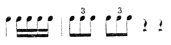
the last notes come on the second crotchet, and the pause on the third beat. In consequence, it is very difficult to play these notes equally, they always sound a little one on the top of the other. The same with the following passage:—
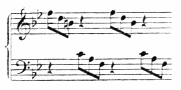
Altogether the Scherzo requires enormous virtuosity, which most members of the orchestra do not possess.
“Apparently some passages do not sound as you thought they would. At the beginning of the Scherzo (where the wood-wind enters) there is a modulation to B♭ major through the dominant chord on F.
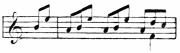
The superfluity of chromatic harmonies, as well as the difficulty of executing clearly all that is written for the wind, causes these passages to sound unintelligible and to have the effect of a series of wrong notes....”
To S. I. Taneiev.
“Rome, January 4th (16th), 1880.
“Nicholas Rubinstein’s explanation is not at all satisfactory. From all he says, I can plainly see that he was out of temper and visited it upon the Suite. No one will induce me to believe this passage
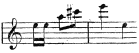
is difficult to play on the oboe or clarinet, or that the flutes cannot play twenty-two bars of triplets in a rapid tempo. They could easily manage to play such a passage for 220 bars. It would be very innocent to imagine that this must be done in one breath. They can breathe every time. I play the flute a little myself and am certain of it. Difficulty is a relative matter: for a beginner it would not only be difficult, but impossible, but for an averagely good orchestral player it is not hard. I do not lay myself out to write easy things; I know my instrumentation is almost always rather difficult. But you must admit that compared with Francesca, or the Fourth Symphony, the Suite is child’s play. Altogether Rubinstein’s criticisms are such that—were they accurate—I should have to lay down my pen for ever. What? For ten years I have taught instrumentation at the Conservatoire (not remarkably well perhaps, but without compromising myself), and two years later remarks are made to me which could only be addressed to a very backward pupil! One of two things: either I never understood anything about the orchestra, or this criticism of my Suite is on a par with N. R.’s remarks upon my Pianoforte Concerto in 1875: that it was impracticable. What was impossible in 1875 was proved quite possible in 1878.
“I explain the whole affair thus: the oboist Herr Z. was in a bad temper—which not infrequently happens with him—and this infected Rubinstein. I like the idea that the high notes are ruination to Herr Z.’s lips!!! It is a thousand pities these precious lips, from which Frau Z. has stolen so many kisses, should be spoilt for ever by the E in alt. But this will not hinder me from injuring these sacred lips by writing high notes—notes moreover that every oboist can easily play, even without a French mouthpiece!”
IX
To N. F. von Meck.
“Rome, January 2nd (14th), 1880.
“When I look back upon the year that has flown, I feel I must sing a hymn of thanksgiving to fate which has brought me so many beautiful days in Russia and abroad. I can say that throughout the whole year I have led a calm and cheerful life, and have been happy, so far as happiness is possible.”
To P. I. Jurgenson.
“Rome, January 11th (23rd), 1880.
“My health is bad, and my mental condition not very good. I have had sad news from Petersburg: my sister is ill and also her daughter. Yesterday I heard of my father’s death. He was eighty-five, so this news did not altogether take me by surprise. But he was such a wonderful, angelic old soul. I loved him so much, it is a bitter grief to feel I shall never see him again.”
On hearing this news, Tchaikovsky burst into tears. Afterwards he became quiet and resigned. But the peaceful end of this venerable old man could not make a great gap in the busy life of his son, to whom, notwithstanding, he had been very dear.
To N. F. von Meck.
“Rome, January 12th (24th), 1880.
“This morning I received an amiable letter from Colonne, telling me my symphony[73] would be given to-morrow at the Châtelet. This has vexed me. If he had written a day earlier, I might have reached Paris in time. But Colonne is not to blame because, in order to preserve my incognito, I told him I could not be present at the performance of my symphony, on account of my health.
“How am I to thank you for this kindness, dear friend? I know the symphony will not have any success, but it will interest many people, and this is very important for the propaganda of my works.”
Although Colonne sent a telegram of congratulation immediately after the concert, the letter which followed announced, in the politest manner, the partial failure of the symphony. La Gazette Musicale says the first and last movements were received with “icy coldness,” and the public only showed enthusiasm for the Scherzo, and portions of the Andante.
Almost simultaneously with the performance of the Fourth Symphony in Paris, Tchaikovsky’s Quartet No. 3, Op. 30, and the Serenade for violin and pianoforte were given by the Société de S. Cécile. All the newspapers were unanimously agreed as to the success of these works.
From this time Tchaikovsky’s works began to make their way abroad. From New York, Leopold Damrosch sent him tidings of the great success of his First Suite; while Jurgenson wrote to tell him of the triumph of his Pianoforte Concerto in B♭ minor, which had been played twice by Bülow and once by Friedenthal in Berlin, by Breitner in Buda-Pesth, and by Rummel in New York.
To N. F. von Meck.
“Rome, January 16th (28th), 1880.
“What a superb work is Michel Angelo’s ‘Moses’! It is indeed conceived and executed by a genius of the highest order. It is said the work has some defects. This reminds me of old Fétis, who was always on the look-out for errors in Beethoven’s works, and once boasted in triumph of having discovered in the Eroica symphony an inversion which was not in good taste.
“Do you not think Beethoven and Michel Angelo are allied by nature?”
To N. F. von Meck.
“February 5th (17th), 1880.
“Just now we are at the very height of the Carnival. At first, as I have told you, this wild folly did not suit me at all, but now I am growing used to it. Of course the character of the festival here is conditioned by climate and custom. Probably if a Roman was set down among us in our Carnival week, the crowd of tipsy people swinging and toboganning would seem to him even more barbarous!