Part III (continued 2)
Rosa Newmarch translation
Merten’s concert took place on March 16th (28th). Kashkin says it gave further proof how hardly Tchaikovsky conquered the public sympathy.
“In the orchestration of the aria from Undine,” he says, “the pianoforte plays an important and really beautiful part. Nicholas Rubinstein undertook to play it; yet, in spite of the wonderful rendering of the piece, it had very little success. After the adagio from the First Symphony—also included in the programme—even a slight hissing was heard. The Italian craze was still predominant at the Opera House, so that it was very difficult for a Russian work to find recognition.”
Romeo and Juliet, given at the Musical Society’s Concert on March 4th (16th), had no success.
On the previous day the decision in the case of “Schebalsky v. Rubinstein” had been made public, and the Director of the Conservatoire had been ordered to pay 25 roubles, damages for the summary and wrongful dismissal of this female student. Rubinstein refused to pay, and gave notice of appeal, but the master’s admirers immediately collected the small sum, in order to spare him the few hours’ detention which his refusal involved. This event gave rise to a noisy demonstration when he appeared in public. Kashkin says:—
“From the moment Nicholas Rubinstein came on the platform, until the end of the concert, he was made the subject of an extraordinary ovation. No one thought of the concert or the music, and I felt indignant that the first performance of Romeo and Juliet should have taken place under such conditions.”
So it came about that the long-desired evening, which he hoped would bring him a great success, brought only another disillusionment for Tchaikovsky. The composer’s melancholy became a shade darker. “I just idle away the time cruelly,” he writes, “and my opera, The Oprichnik, has come to a standstill at the first chorus.”
To Modeste Tchaikovsky.
“March 25th (April 6th).
“I congratulate you on leaving school. Looking back over the years that have passed since I left the School of Jurisprudence, I observe with some satisfaction that the time has not been lost. I wish the same for you....”
To Anatol Tchaikovsky.
“April 23rd (May 5th).
“Rioumin[21] wants to convert me at any price. He has given me a number of religious books, and I have promised to read them all. In any case, I now walk in ways of godliness. In Passion week I fasted with Rubinstein.
“About the middle of May I shall probably go abroad. I am partly pleased at the prospect and partly sorry, because I shall not see you.”
To I. A. Klimenko.
“May 1st (13th), 1870.
“ ... First I must tell you that I am sitting at the open window (at four a.m.) and breathing the lovely air of a spring morning. It is remarkable that in my present amiable mood I am suddenly seized with a desire to talk to you—to you of all people, you ungrateful creature! I want to tell you that life is still good, and that it is worth living on a May morning; and so, at four o’clock in the morning, I am pouring out my heart to you, while you, O empoisoned and lifeless being, will only laugh at me. Well, laugh away; all the same, I assert that life is beautiful in spite of everything! This ‘everything’ includes the following items: 1. Illness; I am getting much too stout, and my nerves are all to pieces. 2. The Conservatoire oppresses me to extinction; I am more and more convinced that I am absolutely unfitted to teach the theory of music. 3. My pecuniary situation is very bad. 4. I am very doubtful if Undine will be performed. I have heard that they are likely to throw me over. In a word, there are many thorns, but the roses are there too....
“As regards ambition, I must tell you that I have certainly not been flattered of late. My songs were praised by Laroche, although Cui has ‘slated’ them, and Balakirev thinks them so bad that he persuaded Khvostova—who wanted to sing the one I had dedicated to her—not to ruin with its presence a programme graced by the names of Moussorgsky & Co.
“My overture, Romeo and Juliet, had hardly any success here, and has remained quite unnoticed. I thought a great deal about you that night. After the concert we supped, a large party, at Gourin’s (a famous restaurant). No one said a single word about the overture during the evening. And yet I yearned so for appreciation and kindness! Yes, I thought a great deal about you, and of your encouraging sympathy. I do not know whether the slow progress of my opera, The Oprichnik is due to the fact that no one takes any interest in what I write; I am very doubtful if I shall get it finished for at least two years.”
Tchaikovsky spent only a few days in St. Petersburg before going abroad. There he heard the final verdict upon his opera Undine. The conference of the Capellmeisters of the Imperial Opera, with Constantine Liadov at their head, did not consider the work worthy of production. How the composer took this decision, what he felt and thought of it, we can only guess from our knowledge of his susceptible artistic amour propre. At the time, he never referred to the matter, either in letters or in conversation. Eight years afterwards he wrote as follows:—
“The Direction put aside my Undine in 1870. At the time I felt much embittered, and it seemed to me an injustice; but in the end I was not pleased with the work myself, and I burnt the score about three years ago.”
Tchaikovsky travelled from St. Petersburg to Paris without a break, being anxious to reach his friend Shilovsky with all possible speed. He half feared to find him already on his death-bed. The young man was extremely weak, but able to travel to Soden at the end of three days. The atmosphere of ill_health in which Tchaikovsky found himself—Soden is a resort for consumptive patients—was very depressing, but he determined to endure it for his friend’s sake.
“The care of Volodya,”[22] he wrote, “is a matter of conscience with me, for his life hangs by a thread ... his affection for me, and his delight on my arrival, touched me so deeply that I am glad to take upon myself the rôle of an Argus, and be the saviour of his life.”
But by coming abroad he sacrificed all opportunity of seeing the twins and his sister Alexandra during the summer vacation.
To Modeste Tchaikovsky.
“Soden, June 24th (July 6th).
“We lead a monotonous existence, and are dreadfully bored, but for this very reason my health is first-rate. The saline baths do me a great deal of good, and, apart from them, the way of living is excellent. I am very lazy, and have not the least desire to work. A few days ago a great festival took place at Mannheim, on the occasion of the hundredth anniversary of Beethoven’s birth. This festival, to which we went, lasted three days. The programme was very interesting, and the performance superb. The orchestra consisted of various bands from the different Rhenish towns. The chorus numbered 400. I have never heard such a fine and powerful choir in my life. The well-known composer, Lachner, conducted. Among other things I heard for the first time the difficult Missa Solennis. It is one of the most inspired musical creations.
“I have been to Wiesbaden to see Nicholas Rubinstein. I found him in the act of losing his last rouble at roulette, which did not prevent our spending a very pleasant day together. He is quite convinced he will break the bank before he leaves Wiesbaden. I long to be with you all.”
The outbreak of the Franco-Prussian war drove all the visitors at Soden into the neutral territory of Switzerland. It was little less than a stampede, and Tchaikovsky describes their experiences in a letter to his brother Modeste, dated July 12th (24th), 1870:—
“Interlaken.
“We have been here three days, and shall probably remain a whole month.... The crush in the railway carriages was indescribable, and it was very difficult to get anything to eat and drink. Thank God, however, here we are in Switzerland, where everything goes on in its normal course. Dear Modi, I cannot tell you what I feel in the presence of these sublime beauties of Nature, which no one can imagine without beholding them. My astonishment, my admiration, pass all bounds. I rush about like one possessed, and never feel tired. Volodi, who takes no delight in Nature, and is only interested in the Swiss cheeses, laughs heartily at me. What will it be like a few days hence, when I shall scramble through the passes and over glaciers by myself! I return to Russia at the end of August.”
Tchaikovsky spent six weeks in Switzerland, and then went on to Munich, where he stayed two days with his old friend Prince Galitsin. From thence he returned to St. Petersburg by Vienna, which delighted him more than any other town in the world. From Petersburg he went direct to Moscow in order to take up his work at the Conservatoire.
During the whole of his trip abroad Tchaikovsky, according to his own account, did no serious work beyond revising his overture Romeo and Juliet. Thanks to the exertions of N. Rubinstein and Professor Klindworth, the overture, in its new form, was published in Berlin the following season, and soon found its way into the programmes of many musical societies in Germany.
“Karl Klindworth came from London to Moscow in 1868,” says Laroche. “He was then thirty-eight, and at the zenith of his physical and artistic powers. He was tall and strongly built, with fair hair and bright blue eyes. His appearance accorded with our ideas of the Vikings of old; he was, in fact, of Norwegian descent. He cordially detested London, where he had lived many years, although he spoke English fluently. London was at that time quite unprepared for the Wagnerian propaganda, and, apart from this, life had neither meaning nor charm for Klindworth. As a pupil of Bülow and Liszt, he had been devoted to the Wagnerian cult from his youth. He was invited by Nicholas Rubinstein to come to Moscow as teacher of the pianoforte; but he was not popular, either as a pianist, or in society.... It would seem as though there could be no common meeting-ground between this Wagnerian fanatic and Tchaikovsky. If one desired to be logical, it would further appear that, as a composer, Tchaikovsky would not only fail to interest Klindworth, but must seem to him quite in the wrong, since Wagner has written that concert and chamber music have long since had their day. But luckily men are devoid of the sense of logical sequence, and Klindworth proved a man of far more heart than one would have thought at first sight. Tchaikovsky charmed him from the first, not merely as a man, but as a composer. Klindworth was one of the first to spread Tchaikovsky’s works abroad. It was owing to him that they became known in London and New York; and it was through him also that Liszt made acquaintance with some of them. In Klindworth, Tchaikovsky found a faithful but despotic friend. Speaking picturesquely, Peter Ilich trembled before him like an aspen-leaf, did not dare openly to give his real opinions upon the composer of the Nibelungen Ring, and I believe he embellished as far as possible the views expressed in his articles from Bayreuth in order not to irritate Klindworth.”
While I am mentioning the important event of Tchaikovsky’s earliest introduction to Western Europe, I must recall the prophetic words of a young critic, then at the outset of his career. Five years before the appearance of the overture Romeo and Juliet, in 1866, Laroche had written to his friend:—
“Your creative work will not really begin for another five years; but these mature and classic works will surpass all that we have produced since Glinka’s time.”
Being no musical critic, it is not for me to say whether, in truth, in all Russian musical literature nothing so remarkable as Romeo and Juliet had appeared since Glinka. I can only repeat what has been said by many musical authorities—that my brother’s higher significance in the world of art dates from this work. His individuality is here displayed for the first time in its fulness, and all that he had hitherto produced seems—as in Laroche’s prophecy—to have been really preparatory work.
VII 1870-1871
During this period Tchaikovsky’s spirits were, generally speaking, fairly bright. Only occasionally they were damped by anxiety about the twins, of whom the younger had left the School of Jurisprudence and obtained a post in Simbirsk.[23] His lack of experience led him into many blunders and mistakes, which gave trouble to his elder brother Peter. His affection and over-anxiety caused the latter to exaggerate the importance of these small errors of judgment, and he concerned himself greatly about the future of his precious charge.
To I. A. Klimenko.
“October 26th (November 7th), 1870.
“ ... Anton Rubinstein is staying here. He opened the season, playing the Schumann Concerto at the first concert (not very well), and also Mendelssohn’s Variations and some Schumann Studies (splendidly). At the Quartet evening he played in his own Trio, which I do not much like. At an orchestral rehearsal, held specially for him, he conducted his new Don Quixote Fantasia. Very interesting; first-rate in places. Besides this he has composed a violin concerto and a number of smaller pieces. Extraordinary fertility! Nicholas Rubinstein lost all his money at roulette during the summer. At the present moment he is working, as usual, with unflagging energy.
“I have written three new pieces,[24] and a song,[25] as well as going on with my opera and revising Romeo and Juliet.”
To Anatol Tchaikovsky.
(About the beginning of November.)
“ ... My time is very much occupied. I have foolishly undertaken to write music for a ballet Cinderella, at a very small fee. The ballet has to be performed in December, and I have only just begun it; but I cannot get out of the work, for the contract is already signed. Romeo and Juliet will be published in Berlin and performed in several German towns....”
To his sister, A. I. Davidov.
“December 20th, 1870 (January 1st, 1871).
“Dearest,—Your letter touched me deeply, and at the same time made me feel ashamed. I wonder that you could doubt, even for an instant, the constancy of my affection for you! My silence proceeds partly from idleness, and partly from the fact that I need great peace of mind to write satisfactorily, and I hardly ever attain it. Either I am at the Conservatoire, or I am seizing a free hour for composition in feverish haste, or someone wants me to go out, or I have visitors at home, or I am so tired out I can only fall asleep.... I have already told you what an important part you play in my life—although you do not live near me. In dark hours my thoughts fly to you. ‘If things go very badly with me, I shall go to Sasha,’ I say to myself; or, ‘I think I will do this, I am sure Sasha would advise it’; or, ‘Shall I write to her? What would she think of this ...?’ What a joy to think that if I could get away from these surroundings into another atmosphere I should sun myself in your kindly heart! Next summer I will not fail to come to you. I shall not go abroad.”
To his father.
“February 14th (26th).
“My Very Dear Father,—You say it would not be a bad thing if I wrote to you at least once a month.
“No, not once a month, but at least once a week I ought to send you news of all I am doing, and I wonder you have not given me a good scolding before this! But I will never again leave you so long without a letter. The news of the death of uncle Peter Petrovich[26] came to me several days ago. God give him everlasting peace, for his honest and pure soul deserved it! I hope, dear, you are bearing this trouble bravely. Remember that poor uncle, with his indifferent health and his many old wounds, had enjoyed a fairly long life.”
This letter closes Tchaikovsky’s correspondence for the year 1870-1. It is very probable that some of his letters may have been lost, but undoubtedly after February, 1871, he corresponded less frequently than before.
Being very short of funds, he decided to act upon Rubinstein’s advice to give a concert. To add to the interest of the programme he thought it well to include some new and important work of his own. He could not expect to fill the room, and an expensive orchestral concert was therefore out of the question. This led to the composition of the first String Quartet (D major). Tchaikovsky was engaged upon this work during the whole of February.
The concert took place on March 16th (28th) in the small hall of the Nobles’ Assembly Rooms. Thanks to the services of the Musical Society’s quartet, with F. Laub as leader, Nicholas Rubinstein at the piano, and Madame Lavrovsky—then at the height of her popularity—as vocalist, Tchaikovsky had a good, although not a crowded, house.
In his reminiscences Kashkin says that among those who attended this concert was the celebrated novelist, I. S. Tourgeniev, who was staying in Moscow at the time, and was interested in the young composer, about whom he had heard abroad. This attention on the part of the great writer did not pass unnoticed, and was decidedly advantageous for the musician. Tourgeniev expressed great appreciation of Tchaikovsky’s works, although he arrived too late to hear the chief item on the programme, the Quartet in D major.
At the end of May Tchaikovsky went to Konotop, where his eldest brother Nicholas Ilich was residing, and from thence to visit Anatol in Kiev. Afterwards the two brothers travelled to Kamenka, where they spent most of the summer. Tchaikovsky, however, devoted part of his holidays to his intimate friends Kondratiev and Shilovsky.
Kondratiev’s property (the village of Nizy, in the Government of Kharkov) was beautifully situated on the prettiest river of Little Russia, the Psiol, and united all the natural charms of South Russia with the light green colouring of the northern landscape so dear to Tchaikovsky. Here in the hottest weather, instead of the oppressive and parched surroundings of Kamenka, he looked upon luxuriant pastures, enclosed and shaded by ancient oaks. But what delighted him most was the river Psiol with its refreshing crystal waters.
The place pleased Tchaikovsky, but his friend’s style of living was not to his taste. It was too much like town life, with its guests and festivities, and he preferred Shilovsky’s home at Ussovo, which was not so beautifully situated, but possessed the greater charms of simplicity, solitude, and quiet. Here he spent the last days of his vacation very happily, and for many years to come Ussovo was his ideal of a summer residence, for which he longed as soon as the trees and fields began to show the first signs of green.
VIII 1871-1872
As I have already remarked, it was not Tchaikovsky’s nature to force the circumstances of life to his own will. He could wait long and patiently—and hope still longer. As in his early youth he had kept his yearning for music hidden in his heart, until the strength of his desire was such that nothing could shake his firm hold upon his chosen vocation, so now, from the beginning of his musical career, he was possessed by an intense longing to break away from all ties which withheld him from the chief aim of his existence—to compose.
Just as a few years earlier he continued his work in the Ministry of Justice in spite of its monotony, and kept up his social ties as though he were waiting until a complete disgust for his empty and aimless life should bring about a revulsion, so it was with him now. Although his duties at the Conservatoire were repugnant to him, and he often complained of the drawbacks of town life, which interfered with his creative work, he went on in his usual course, as though afraid that his need of excitement and pleasure was not quite satisfied, and might break out anew.
The time for the realisation of his dream of complete freedom was not yet come. Moscow was still necessary to his everyday life, and was not altogether unpleasant to him. He was still dependent on his surroundings. To break with them involved many considerations. Above all, he must have emancipated himself, although in a friendly way, from the influence of Nicholas Rubinstein. This was the first step to take in the direction of liberty. With all his affection and gratitude, with all his respect for Rubinstein as a man and an artist, he suffered a good deal under the despotism of this truest and kindest of friends. From morning till night he had to conform to his will in all the trifling details of daily existence, and this was the more unbearable because their ideas with regard to hours and occupations differed in most respects.
Tchaikovsky had already made two attempts to leave Rubinstein and take rooms of his own. But only now was he able to carry out his wish. Nicholas Rubinstein absolutely stood in need of companionship, and Tchaikovsky was fortunate in finding someone, in the person of N. A. Hubert, ready and willing to take his place.
So it chanced that Tchaikovsky reached his thirty-second year before he began to lead an entirely independent existence. His delight at finding himself the sole master of his little flat of three rooms was indescribable. He took the greatest pains to make his new home as comfortable as possible with the small means at his disposal. His decorations were not sumptuous: a portrait of Anton Rubinstein, given to him by the painter Madame Bonné in 1865; a picture of Louis XVII. in the house of the shoemaker Simon, given to him by Begichev in Paris; a large sofa and a few cheap chairs, comprised the composer’s entire worldly goods.
He now engaged a servant, named Michael Sofronov. Tchaikovsky never lost sight of this man, although he was afterwards replaced by his brother Alexis, who played rather an important part in his master’s life.
At this time the composer’s income was slightly increased. His salary at the Conservatoire rose to 1,500 roubles a year (£150), while from the sale of his works, and from the Russian Musical Society,[27] he received about 500 roubles more.
Besides these 2,000 roubles, Tchaikovsky had another small source of income, namely, his earnings as a musical critic. His employment in this capacity came about thus. In 1871, Laroche, who wrote for the Moscow Viedomosti, was offered a post at the St. Petersburg Conservatoire, and passed on his journalistic work to N. A. Hubert, who, partly from ill_health and partly from indolence, neglected the duties he had undertaken. Fearing that Katkov, who edited the paper, might appoint some amateur as critic, and so undo the progress in musical matters which had been made during the past years, Tchaikovsky and Kashkin came to Hubert’s aid and “devilled” for him as long as he remained on the staff. Tchaikovsky continued to write for the Viedomosti until the winter of 1876.
To Anatol Tchaikovsky.
“December 2nd (14th).
“I must tell you that at Shilovsky’s urgent desire I am going abroad for a month. I shall start in about ten days’ time, but no one—except Rubinstein—is to know anything about it; everyone is to think I have gone to see our sister.”
To Anatol Tchaikovsky.
“Nice, January 1st (13th), 1872.
“I have been a week at Nice. It is most curious to come straight from the depths of a Russian winter to a climate where one can walk out without an overcoat, where orange trees, roses, and syringas are in full bloom, and the trees are in leaf. Nice is lovely. But the gay life is killing.... However, I have many pleasant hours; those, for instance, in the early morning, when I sit alone by the sea in the glowing—but not scorching—sunshine. But even these moments are not without a shade of melancholy. What comes of it all? I am old, and can enjoy nothing more. I live on my memories and my hopes. But what is there to hope for?
“Yet without hope in the future life is impossible. So I dream of coming to Kiev at Easter, and of spending part of the summer with you at Kamenka.”
By the end of January Tchaikovsky was back in Moscow.
In 1871 a great Polytechnic Exhibition was organised in this town in celebration of the two hundredth anniversary of the birth of Peter the Great. The direction of the musical section was confided to Nicholas Rubinstein, but when he resigned, because his scheme was too costly to be sanctioned by the committee, the celebrated ‘cellist, K. Davidov, was invited to take his place. He accepted, and named Laroche and Balakirev as his coadjutors. Balakirev was not immediately disposed to undertake these duties, saying that he would first like to hear the opinion of Nicholas Rubinstein as to the part which the Petersburg musicians were to take in the matter. After two months of uncertainty, the committee decided to dispense with his reply, and invited Rimsky-Korsakov to take his place. At the same time Asantchevsky (then Director of the Petersburg Conservatoire), Wurm, and Leschetitzky were added to the musical committee.
This originally Muscovite committee, which ended in being made up of Petersburgers, decided among other projects to commission from Tchaikovsky a Festival Cantata, the text of which was to be specially written for the occasion by the poet Polonsky.
By the end of December, or the beginning of January, the libretto was finished. When Tchaikovsky undertook to do any work within a fixed limit of time, he always tried to complete it before the date of contract expired. On this occasion he was well beforehand with the work, and sent in the cantata to the committee by the 1st of April. As he had only received the words towards the end of January, after his return from Nice, he could not have had more than two months in which to complete this lengthy and complicated score.
In April he was at work again upon The Oprichnik, and must have finished it early in May.
This, however, is a matter of conjecture, as between January 31st (February 12th) and May 4th (16th), there does not exist a single one of his letters.
On May 4th (16th), 1872, the score of The Oprichnik was sent to Napravnik in Petersburg.
The Festival Cantata was performed on May 31st (June 12th) at the opening of the Polytechnic Exhibition, and shortly afterwards Tchaikovsky left Moscow for Kamenka, where he spent the whole of June. Here he began his Second Symphony in C minor. Early in July he went to Kiev, and from thence to Kondratiev at Nizy, accompanied by his brother Modeste. A part of this journey had to be accomplished by diligence. On the return journey the two brothers were to travel together as far as Voroshba, where Peter Ilich branched off for Shilovsky’s house at Ussovo, and Modeste went on to Kiev. Between Sumy and Voroshba was a post-house, at which the horses were generally changed.
We were in the best of spirits—it is Modeste who recounts the adventure—and partook of a luxurious lunch, with wine and liqueurs. These stimulants had a considerable effect upon our empty stomachs, so that when we were informed of the fact that there were no fresh post-horses at our disposal, we lost our tempers and gave the overseer a good talking to. Peter Ilich quite lost his head, and could not avoid using the customary phrase: “Are you aware to whom you are talking?” The post-master was not in the least impressed by this worn-out phraseology, and Peter Ilich, beside himself with wrath, demanded the report-book. It was brought, and thinking that the unknown name of Tchaikovsky would carry no weight, Peter Ilich signed his complaint: “Prince Volkonsky, Page-in-Waiting.” The result was brilliant. In less than a quarter of an hour the horses were harnessed, and the head-ostler had been severely reprimanded for not having told the post-master that a pair had unexpectedly returned from a journey.
Arrived at Voroshba, Peter Ilich hurried to the ticket-office and discovered with horror that he had left his pocket-book, containing all his money and papers, at the post-station. What was to be done? He could not catch the train, and must therefore wait till the next day. This was tiresome; but far worse was the thought that the post-master had only to look inside the pocket-book to see Peter Ilich’s real name on his passport and visiting-cards. While we sat there, feeling crushed, and debating what was to be done, my train came in. I was forced to steam off to Kiev, after bestowing the greater part of my available cash—some five or six roubles—upon the unhappy pseudo-Prince.
Poor Peter Ilich spent a terrible night at the inn. Mice and rats—of which he had a mortal terror—left him no peace. He waged war all night with these pests, which ran over his bed and made a hideous noise. The next morning came the news that the post-master would not entrust the pocket-book to the driver of the post-waggon; Peter Ilich must go back for it himself. This was a worse ordeal than even the rats and the sleepless night.... As soon as he arrived he saw at once that the post-master had never opened the pocket-book, for his manner was as respectful and apologetic as before. Peter Ilich was so pleased with this man’s strict sense of honour that before leaving he inquired his name. Great was his astonishment when the post-master replied, “Tchaikovsky”! At first he thought he was the victim of a joke, but afterwards he heard from his friend Kondratiev that the man’s name was actually the same as his own.
Tchaikovsky spent the rest of the summer at Ussovo, where he completed the symphony commenced at Kamenka.
IX 1872-1873
Immediately after his return to Moscow, Tchaikovsky moved into new quarters, which were far more comfortable than his first habitation.
We have already seen the motives which first induced him to take up journalism. Now he felt it not only a matter of honour and duty towards the interests of the Conservatoire to continue this work, but found it also a welcome means of adding to his income, seeing that he lived entirely upon his own resources. His literary efforts had been very successful during the past year, and had attracted the attention of all who were interested in music. Nevertheless his journalistic work, like his lessons at the Conservatoire, was burdensome. He told himself “it must be done,” and did it with the capability that was characteristic of him, but without a gleam of enthusiasm or liking for the work. His writing was interesting and showed considerable literary style; the general character of his articles bespoke the cultivated and serious musician, who is disinterested and just, and has a complete insight into his art—but nothing more. We cannot describe him as a preacher of profound convictions, who has power to carry home his ideas; or as a critic capable of describing a work, or a composer, in a few delicate or striking words. Reading his articles, we seem to be conversing with a clever and gifted man, who knows how to express himself clearly; we sympathise with him, earnestly wish him success in his campaign against ignorance and charlatanism, and share his desire for the victory of wholesome art over the public taste for “the Italians,” “American valses,” and the rest. In these respects we may say that Tchaikovsky’s labours were not lost.
To Modeste Tchaikovsky.
“Moscow, November 2nd (14th).
“Modi, my conscience pricks me. This is the punishment for not having written to you for so long. What can I do when the symphony, which is nearing completion, occupies me so entirely that I can think of nothing else? This work of genius (as Kondratiev calls it) will be performed as soon as I can get the parts copied. It seems to me to be my best work, at least as regards correctness of form, a quality for which I have not so far distinguished myself.... My quartet has created a sensation in Petersburg.”
To I. A. Klimenko.
“Moscow, November 15th (27th).
“ ... Since last year nothing particular has happened in our lives here. We go to the Conservatoire as formerly, and occasionally meet for a general ‘boose,’ and are just as much bored as last year. Boredom consumes us all, and the reason is that we are growing old. Yes, it is useless to conceal that every moment brings us nearer to the grave....
“As regards myself, I must honestly confess that I have but one interest in life: my success as a composer. But it is impossible to say that I am much spoilt in this respect. For instance, two composers, Famitzin and myself, send in our works at the same time. Famitzin is universally regarded as devoid of talent, while I, on the contrary, am said to be highly gifted. Nevertheless, Sardanapalus is to be given almost immediately, whereas so far nothing has been settled as to the fate of The Oprichnik. This looks as though it were going to fall ‘into the water’[28] like Undine. For an Undine to fall into the water is not so disastrous; it is her element. But imagine a drowning Oprichnik, how he would battle with the waves! He would certainly perish. But if I went to his rescue I should be drowned too; therefore I have taken my oath never to dip pen in ink again if my Oprichnik is refused.”
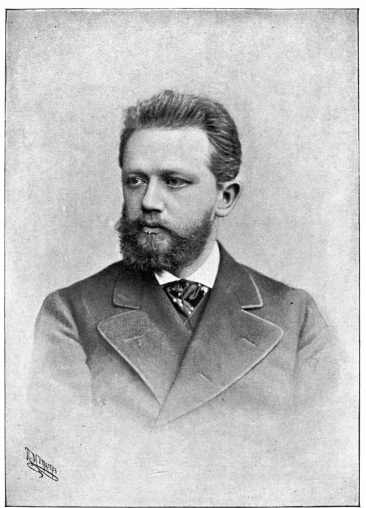
TCHAIKOVSKY IN 1873

To Ilia Petrovich Tchaikovsky.
“November 22nd (December 4th).
“My dear, good Father,— ... As regards marriage, I must confess that I have often thought of finding myself a suitable wife, but I am afraid I might afterwards regret doing so. I earn almost enough (3,000 roubles a year), but I know so little about the management of money that I am always in debt and dilemma. So long as a man is alone, this does not much signify. But how would it be if I had to keep a wife and family?
“My health is good: only one thing troubles me a little—my eyesight, which is tried by my work. It is so much weaker than formerly that I have been obliged to get a pair of eyeglasses, which I am told are very becoming to me. My nerves are poor, but this cannot be helped, and is not of much consequence. Whose nerves are not disordered in our generation—especially among artists?”
To Modeste Tchaikovsky.
“December 10th (22nd).
“You say that Anatol has told you about my depression. It is not a question of depression, only now and then a kind of misanthropical feeling comes over me which has often happened before. It comes partly from my nerves, which sometimes get out of gear for no particular reason, and partly from the rather uncertain fate of my compositions. The symphony, on which I build great hopes, will not be performed apparently before the middle of January, at the earliest.
“Christine Nilsson is having a great triumph here. I have seen her twice, and I must own she has made great progress as an actress since I heard her for the first time in Paris. As regards singing, Nilsson stands alone. When she opens her mouth one does not hear anything remarkable at first; then suddenly she takes a high C, or holds a sustained note pianissimo, and the whole house thunders its applause. But with all her good qualities she does not please me nearly so well as Artôt. If the latter would only return to Moscow I should jump for joy.”
During the Christmas holidays Tchaikovsky was called unexpectedly to St. Petersburg to hear the verdict of the committee upon his opera, The Oprichnik. The committee consisted of the various Capellmeisters of the Imperial Theatre and Opera: Napravnik (Russian opera), Bevignani (Italian opera), Rybassov (Russian plays), Silvain Mangen (French plays), Ed. Betz (German plays), and Babkov (ballet). With the exception of Napravnik, Tchaikovsky had no great opinion of these men, and considered them much inferior to himself as judges of music. It seemed to him particularly derogatory to have to appear before this Areopagus in person. He did his best to avoid this formality, but in vain.
The meeting which he dreaded so much passed off quite satisfactorily. The Oprichnik was unanimously accepted.
During this visit to St. Petersburg Tchaikovsky was frequently in the society of his friends of the “Invincible Band”; and it was evidently under their influence that he took a Little Russian folksong as the subject of the Finale of the Second Symphony. “At an evening at the Rimsky-Korsakovs the whole party nearly tore me to pieces,” he wrote, “and Madame Korsakov implored me to arrange the Finale for four hands.” On this same occasion Tchaikovsky begged Vladimir Stassov to suggest a subject for a symphonic fantasia. A week had hardly passed before Stassov wrote the following letter:—
“St. Petersburg, “December 30th, 1872 (January 11th, 1873).
“Dear Peter Ilich,—An hour after we had parted at the Rimsky-Korsakovs’—that is to say, the moment I was alone and could collect my thoughts—I hit upon the right subject for you. I have not written the last three days because I had not absolutely made up my mind. Now listen, please, to my suggestion. I have not only thought of one suitable subject—I have three. I began by looking at Shakespeare, because you said you would prefer a Shakesperean theme. Here I came at once upon the poetical Tempest, so well adapted for musical illustration, upon which Berlioz has already drawn for his fine choruses in Lelio. To my mind you might write a splendid overture on this subject. Every element of it is so full of poetry, so grateful. First the Ocean, the Desert Island, the striking and rugged figure of the enchanter Prospero, and, in contrast, the incarnation of womanly grace—Miranda, like an Eve who has not as yet looked upon any man (save Prospero), and who is charmed and fascinated by the first glimpse of the handsome youth Ferdinand, thrown ashore during the tempest. They fall in love with each other; and here I think you have the material for a wonderfully poetical picture. In the first half of the overture Miranda awakens gradually from her childish innocence to a maidenly love; in the second half, both she and Ferdinand have passed through ‘the fires of passion’—it is a fine subject. Around these leading characters others might be grouped (in the middle section of the work): the monstrous Caliban, the sprite Ariel, with his elfin chorus. The close of the overture should describe how Prospero renounces his spells, blesses the lovers, and returns to his country.”
Besides The Tempest Stassov suggested two alternative subjects—Scott’s Ivanhoe and Gogol’s Tarass Boulba. Tchaikovsky, however, decided upon the Shakespearean subject, and after informing Stassov of his decision, received the following letter:—
“St. Petersburg, “January 21st (February 2nd), 1873.
“I now hasten to go into further details, and rejoice in the prospect of your work, which should prove a worthy pendant to your Romeo and Juliet. You ask whether it is necessary to introduce the tempest itself. Most certainly. Undoubtedly, most undoubtedly. Without it the overture would cease to be an overture; without it the entire programme would fall through.
“I have carefully weighed every incident, with all their pros and cons, and it would be a pity to upset the whole business. I think the sea should be depicted twice—at the opening and close of the work. In the introduction I picture it to myself as calm, until Prospero works his spell and the storm begins. But I think this storm should be different from all others, in that it breaks out at once in all its fury, and does not, as generally happens, work itself up to a climax by degrees. I suggest this original treatment because this particular tempest is brought about by enchantment and not, as in most operas, oratorios, and symphonies, by natural agencies. When the storm has abated, when its roaring, screeching, booming and raging have subsided, the Enchanted Island appears in all its beauty and, still more lovely, the maiden Miranda, who flits like a sunbeam over the island. Her conversation with Prospero, and immediately afterwards with Ferdinand, who fascinates her, and with whom she falls in love. The love theme (crescendo) must resemble the expanding and blooming of a flower; Shakespeare has thus depicted her at the close of the first act, and I think this would be something well suited to your muse. Then I would suggest the appearance of Caliban, the half-animal slave; and then Ariel, whose motto you may find in Shakespeare’s lyric (at the end of the first act), ‘Come unto these yellow sands.’ After Ariel, Ferdinand and Miranda should reappear; this time in a phase of glowing passion. Then the imposing figure of Prospero, who relinquishes his magic arts and takes farewell of his past; and finally the sea, calm and peaceful, which washes the shores of the desert island, while the happy inhabitants are borne away in a ship to distant Italy.
“As I have planned all this in the order described, it seems to me impossible to leave out the sea in the opening and close of the work, and to call the overture “Miranda.” In your first overture you have unfortunately omitted all reference to Juliet’s nurse, that inspired Shakespearean creation, and also the picture of dawn, on which the love-scene is built up. Your overture is beautiful, but it might have been still more so. And now, please note that I want your new work to be wider, deeper, more mature. That it will have beauty and passion, I think I am safe in predicting. So I wish you all luck and—vogue la galère!”
To V. Stassov.
“January 27th (February 8th), 1873.
“Honoured Vladimir Vassilievich,—I scarcely know how to thank you for your excellent, and at the same time most attractive, programme. Whether I shall be successful I cannot say, but in any case I intend to carry out every detail of your plan. I must warn you, however, that my overture will not see the light for some time to come: at least, I have no intention of hurrying over it. A number of tiresome, prosaic occupations, among them the pianoforte arrangement of my opera, will, in the immediate future, take up the quiet time I should need for so delicate a work. The subject of The Tempest is so poetical, its programme demands such perfection and beauty of workmanship, that I am resolved to suppress my impatience and await a more favourable moment for its commencement.
“My symphony was performed yesterday, and met with great success; so great in fact that N. Rubinstein is repeating it at the tenth concert ‘by general request.’ To confess the truth, I am not altogether satisfied with the first two movements, but the finale on The Crane[29] theme has turned out admirably. I will speak to Rubinstein about sending the score; I must find out the date of the tenth concert. I should like to make a few improvements in the orchestration, and I must consider how long this will take, and whether it will be better to send the score to Nadejda Nicholaevna,[30] or to wait until after the concert.
“Laroche paid me the compliment of coming to Moscow on purpose to hear my symphony. He left to-day.”
The Second Symphony appeared in the programme of the Musical Society’s concert of January 6th (18th), 1873, and was very well received. Laroche spoke very appreciatively of the new work.
The symphony was repeated at the tenth concert, when the composer was recalled after each movement and presented with a laurel-wreath and a silver goblet.
To his father, I. P. Tchaikovsky.
“February 5th (17th).
“Time flies, for I am very busy. I am working at the pianoforte arrangement of my opera (The Oprichnik), writing musical articles, and contributing a biography of Beethoven to The Grajdanin.[31] I spend all my evenings at home, and lead the life of a peaceable and well-disposed citizen of Moscow. At last a very cold winter has set in. To-day the frost is so intense that the noses of the Muscovites risk becoming swollen and frost-bitten. But as I keep indoors, I am very snug and warm in my rooms.”
To the same.
“April 7th (19th).
“For nearly a whole month have I been sitting diligently at work. I am writing music to Ostrovsky’s fairy tale, Sniegourotchka (‘Little Snow White’), and consequently my correspondence has been somewhat neglected. In addition to this, I cut my hand so severely the day before yesterday that it was two hours before the doctor could stop the bleeding and apply a bandage. Consequently I can only write with difficulty, so do not be surprised, my angel, at my writing so seldom.”
To the same.
“May 24th (June 5th).
“I have been feverishly busy lately with the preparations for the first performance of Sniegourotchka, the pianoforte arrangement of my symphony, the examinations at the Conservatoire, the reception of the Grand Duke Constantine Nicholaevich, etc. The latter was enthusiastic over my symphony, and paid me many compliments.”
I have already said that life was precious to Tchaikovsky. This was noticeable in many ways, among others his passion for keeping a diary. Every day had its great value for him, and the thought that he must bid eternal farewell to it, and lose all trace of its experiences, depressed him exceedingly. It was a consolation to save something from the limbo of forgetfulness, so that in time to come he might recall to mind the events through which he had lived. In old age he believed it would be a great pleasure to reconstruct the joys of the past from these short sketches and fragmentary jottings which no one else would be able to understand. He preferred the system of brief and imperfect notes, because in reading through the diaries of his childhood and youth, in which he had gone more fully into his thoughts and emotions, he had felt somewhat ashamed. The sentiments and ideas which he found so interesting, and which once seemed to him so great and important, now appeared empty, unmeaning and ridiculous, and he resolved in future only to commit facts to paper, without any commentary.[32] Disillusioned by their contents, he destroyed all his early diaries. About the close of the seventies Tchaikovsky started a new diary, which he kept for about ten years. He never showed it to anyone, and I had to give him my word of honour to burn it after his death. After all, he did so himself, and only spared what might be seen by strangers.
His first attempt at a diary dates from 1873. He began it in expectation of many impressions during his tour abroad, the very day he left Nizy.
Extracts from the diary kept during the summer of 1873.
“Kiev, June 11th (23rd), 1873.
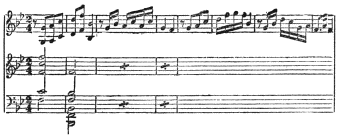
“Yesterday, on the road from Voroshba to Kiev, music came singing and echoing through my head after a long interval of silence. A theme in embryo, in B major, took possession of my mind and almost led me on to attempt a symphony. Suddenly the thought came over me to cast aside Stassov’s not too successful Tempest and devote the summer to composing a symphony which should throw all my previous works into the shade. Here is the embryo:—
“On the road to ...
“What is more wearisome than a railway journey and tiresome companions? An Italian, an indescribable fool, has tacked himself on to me, and I hardly know how to get rid of him. He does not even know where he is going, nor where to change his money. I changed mine at a Jew’s in Cracow. What a bore it all is! Sometimes I think of Sasha and Modi, and my heart is fit to break. At Volochisk great agitation, and my nerves upset. With the exception of the Italian, my fellow-travellers are bearable. I scarcely slept all night. The old man is a retired officer with the old, original whiskers. At the present moment the Italian is boring a lady. Lord, what an ass! I must get rid of him by some kind of dodge.”
“June 29th (July 11th).
“I had four long hours to wait in Myslovitz; at last I am on the road to Breslau. The Italian is enchanted to think I shall travel with him to Liggia. He bores me to extinction. Oh, what an idiot! At Myslovitz I had an indifferent meal, and afterwards went for a walk through the pretty town. I can imagine my Italian’s face, and what he will say, when I suddenly vanish at Breslau! He will be left sitting there! My money goes like water!”
“Jean Prosco, Constantinople, “Breslau.
“After all I had not the heart to deceive my Italian. I told him beforehand I intended to stop in Breslau. He almost dissolved into tears, and gave me his name, which I have put down above.”
“3 a.m.
“How I love solitude sometimes! I must confess I am only staying here in order to put off my arrival in Dresden and the society of the Jurgensons. To sit like this—alone, to be silent, and to think!...”
“Not far from Dresden.
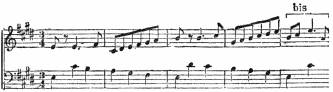
“Theme for the first allegro, introduction from the same, but in 4/4 time.”
“Dresden, July 2nd (14th).
“I arrived here yesterday at six o’clock. As soon as I had secured a room I hurried to the theatre. Die Jüdin (The Jewess) was being played—very fine. My nerves are terrible. Without waiting for the end, I went to find the Jurgensons at the hotel. Supper. Took tea with the Jurgensons. To-day I took a bath. Sauntered about the town with Jurgenson. Midday dinner at the table d’hôte. Very shortly we start for Saxon Switzerland. My frame of mind is not unbearable.”
“Dresden.
“The weather has broken up, and we have decided to turn back from our trip. We made the descent from the Bastei by another road between colossal rocks. We halted at a restaurant in the midst of the most sublime scenery. Breakfasted on the banks of the Elbe (omelette aux confitures) and returned to Dresden by boat. Our rooms were no longer to be had, and they have given me a wretched one.”
Throughout the whole of his tour through Switzerland we find similar brief entries, recording very little beyond the state of the weather, the names of the hotels at which they stayed, and the quality of the meals provided.
At Cadenabbia (Como) the diary comes to an end with the following entry:—
“The journey (from Milan) was not long, and it was very pleasant on the steamer. We are staying at the lovely Hotel Bellevue.”
After Tchaikovsky’s return to Russia, early in August, he went straight to his favourite summer resort Ussovo. The fortnight which he spent there in complete solitude seemed to Tchaikovsky, in after days, one of the happiest periods in his existence. Life abroad, under similar circumstances, he found painful and unbearable, whereas in his own country the presence even of a servant sufficed to spoil his solitude, and the sense of increased energy and strength, which always came to him in the lonely life of the country, was unknown in the bustle and stress of the city. In a letter written in 1878 he recalls this visit to Ussovo in the following words:—
To N. F. M. (von Meck).
“April 22nd (March 4th), 1878.
“I know no greater happiness than to spend a few days quite alone in the country. I have only experienced this delight once in my life. This was in 1873. I came straight from Paris—it was early in August—to stay with a bachelor friend in the country, in the Government of Tambov. My friend, however, was obliged to go to Moscow for a few days, so I was left all alone in that lovely oasis amid the steppes of South Russia. I was in a highly strung, emotional mood; wandered for whole days together in the forest, spent the evenings on the low-lying steppe, and at night, sitting at my open window, I listened to the solemn stillness, which was only broken at rare intervals by some vague, indefinable sound. During this fortnight, without the least effort—just as though I were under the influence of some supernatural force—I sketched out the whole of The Tempest overture. What an unpleasant and tiresome awakening from my dreams I experienced on my friend’s return! All the delights of direct intercourse with the sublimities and indescribable beauties of nature vanished in a trice! My corner of Paradise was transformed into the prosaic house of a well-to-do country gentleman. After two or three days of boredom I went back to Moscow.”
Tchaikovsky went to Ussovo about the 5th or 6th of August, and by the 7th (19th) had already set to work upon The Tempest. By August 17th (29th) this symphonic poem was completely sketched out in all its details, so that the composer could go straight on with the orchestration on his return to Moscow. The Countess Vassilieva-Shilovsky made me a present of this manuscript, upon which are inscribed the dates I have just mentioned. At the present time the manuscript is in the Imperial Public Library, St. Petersburg.
X 1873-1874
As soon as Tchaikovsky returned to Moscow, on September 1st, he set to work upon the orchestration of The Tempest.
In the second half of the month he moved into new quarters in the Nikitskaya (House Vishnevsky).
Nothing particularly eventful had happened since last year, either in his career as professor or musical critic. His daily life ran in the same grooves as before, with this difference only: the things which once seemed to him new and interesting now appeared more and more wearisome and unprofitable, and his moods of depression became more frequent, more intense, and of longer duration.
To V. Bessel.
“September, 1873.
“Be so kind as to do something for The Oprichnik. Yesterday they told me at the Opera House that the Direction had quite decided to produce it in Moscow during the spring. Although, with the exception of Kadmina, I have no strong forces to reckon upon here, yet I think we had better not raise any objections. Let them do it if they like. The repétiteur has assured me that no expense shall be spared in mounting the opera brilliantly. The rehearsals will be carried on throughout the season. As regards The Oprichnik, I think it would be best to dedicate it to the Grand Duke Constantine Nicholaevich.”
To the same.
“October 10th (22nd).
“Dear Friend,—I have written to Gedeonov and told him that you are my representative as regards everything pertaining to the production of The Oprichnik. As to the pianoforte arrangement, you must wait patiently for a little while. When you meet Stassov, please tell him I have quite finished The Tempest, according to his programme, but I shall not send him the work until I have heard it performed in Moscow.”
To the same.
“October 18th (30th).
“Dear Friend,—Although I expected your bad news, I cannot conceal the fact that I am very much annoyed by it. It seems to be a foregone conclusion that I shall never hear a good performance of one of my operas. It is useless for you to hope that The Oprichnik will be mounted next year. It will never be given at all, for the simple reason that I am not personally known to any of the ‘great people’ of the world in general, or to those of the Petersburg Opera in particular. Is it not ridiculous that Moussorgsky’s Boris Godounov, although refused by the Committee, should have been chosen by Kondratiev[33] for his benefit? Madame Platonova, too, interests herself in this work, while no one wants to hear anything about mine, which has been accepted by the authorities. It goes without saying that I will not consent to have the opera performed in Moscow unless it is produced in Petersburg too. My conscience pricks me that the work will involve you in some expense, but I hope I may have some opportunity of compensating you.
“As to the dedication to the Grand Duke, would it not look strange to dedicate it to him now that the fate of the work is so uncertain? An unperformed opera seems to me like a book in manuscript. Would it not be better to wait? I am impatiently expecting the corrections of the symphony.”
To the same.
“October 30th (November 11th).
“Dear Friend,—Hubert has given me the good news that luck has turned for the opera. I am so glad! Keep it a complete secret that I want to be in Petersburg for the first symphony concert, in order to hear my symphony.... Let me know the date and secure me a ticket for the gallery. But not a word, for Heaven’s sake, or my little joke will be turned into something quite unpleasant.”
To Modeste Tchaikovsky.
“November 28th (December 10th).
“ ... My pecuniary situation will shortly be improved. The Tempest is to be performed next week, when I shall receive the customary 300 roubles from the Musical Society. This sum will put me in good heart again. I am very curious to hear my new work, from which I hope so much. It is a pity you cannot hear it too, for I think a great deal of your wise opinion.
“This year, for the first time, I have begun to realise that I am rather lonely here, in spite of many friends. There is no one to whom I can open my heart—like Kondratiev, for instance.”
At the third concert of the Moscow Musical Society The Tempest was given with great success, and repeated during the same season at an extra concert.
From E. Napravnik to Peter Ilich Tchaikovsky.
“December 16th (28th).
“Although we shall probably not begin the rehearsals of your opera before the second week in Lent, may I ask you to lighten the work somewhat for the soloists and chorus by making a few cuts, i.e. all those repetitions in words and music which are not essential to the development of the drama? I assure you the work will only gain by it. Besides this, I advise you to alter the orchestration, which is too heavy, and over-brilliant in places; it overwhelms the singers and puts them completely in the shade. I hope you will take my remarks in good part, as coming from one who for eleven years has been exclusively occupied with operatic art.”
To E. Napravnik.
“December 18th (30th).
“Honoured Sir,—Your remarks have not hurt my feelings: on the contrary, I am much obliged to you. Above all I am glad that your letter has given me the opportunity of making your acquaintance, and talking things over personally with you. I will do everything you think necessary as regards the distribution of the parts, the shortening of the scenes, and the changes in the orchestration. In order to discuss things in detail, I will go to Petersburg next Sunday and call upon you.... Pray do not mention my coming to anyone, as my visit will be short, and I do not want to see anyone but yourself.”
To A. Tchaikovsky.
“January 26th (February 7th), 1874.
“The difficulties with the Censor are happily settled; in fact, I am at peace as regards the opera, and convinced that Napravnik will take the greatest pains with it. I have written a new quartet, and it is to be played at a soirée given by Nicholas Rubinstein.”
The new quartet mentioned in this letter was begun about the end of December, or beginning of January. In his reminiscences, Kashkin gives the following account of its first performance at N. Rubinstein’s:—
“Early in 1874 the Second Quartet (F major) was played at a musical evening at Nicholas Rubinstein’s. I believe the host himself was not present, but his brother Anton was there. The executants were Laub, Grijimal, and Gerber. All the time the music was going on Rubinstein listened with a lowering, discontented expression, and, at the end, declared with his customary brutal frankness that it was not at all in the style of chamber music; that he himself could not understand the work, etc. The rest of the audience, as well as the players, were charmed with it.”
On March 10th (22nd) the Quartet was played at one of the Musical Society’s chamber concerts, and according to The Musical Leaflet, had a well-deserved success.
On February 25th (March 9th), the Second Symphony was performed for the first time in Petersburg, under Napravnik’s direction. It was greatly applauded, especially the finale; but, in the absence of the composer, its success was not so remarkable, nor so brilliant, as it had been a year earlier in Moscow. The symphony won the approval of the “Invincible Band,” with the exception of Cæsar Cui, who expressed himself in the St. Petersburg Viedomosti as follows:—
“The Introduction and first Allegro are very weak; the poverty of Tchaikovsky’s invention displays itself every moment. The March in the second movement is rough and commonplace. The Scherzo is neither good nor bad; the trio is so innocent that it would be almost too infantile for a ‘Sniegourotchka.’ The best movement is the Finale, and even then the opening is as pompously trivial as the introduction to a pas de deux, and the end is beneath all criticism.”
Towards the end of March, Tchaikovsky went to St. Petersburg to attend the rehearsals of The Oprichnik, and took up his abode with his father. During his first interviews with Napravnik his pride suffered many blows to which he was not accustomed. Somewhat spoilt by Nicholas Rubinstein’s flattering attitude towards every note of his recent orchestral works, he was rather hurt by the number of cuts Napravnik considered it necessary to make in the score of his opera. Afterwards he approved of them all, but at the moment he felt affronted.
From the very first rehearsal Tchaikovsky was dissatisfied with his work. On March 25th he wrote to Albrecht:—
“Kindly inform all my friends that the first performance takes place on Friday in Easter week, and let me know in good time whether they intend to come and hear it, so that I may secure tickets for them. Frankly speaking, I would rather none of you came. There is nothing really fine in the work.”
To his pupil, Serge Taneiev, he writes in the same strain:—
“Serioja,[34] if you really seriously intend to come here on purpose to hear my opera, I implore you to abandon the idea, for there is nothing good in it, and it would be a pity if you travelled to Petersburg on that account.”
The more the opera was studied, the gloomier grew Tchaikovsky’s mood. One day, unsuspicious of the true reason of his depression, I ventured to criticise The Oprichnik rather severely, and made fun of the scene in which Andrew appears in Jemchoujny’s garden, merely to “draw” him for some money. My brother lost his temper and flew out at me fiercely. I was almost reduced to tears, for at the time I could not guess the real reason for his anger. It was not until long after that I realised my criticism had wounded his artistic feelings in the most sensitive spot.
Against Tchaikovsky’s wish, almost the entire teaching staff of the Moscow Conservatoire, with N. Rubinstein at their head, appeared in Petersburg for the first night of The Oprichnik, April 12th (24th), 1874.
Although none of the singers were remarkable, yet no individual artist marred the ensemble. The chorus and orchestra were the best part of it. The performance ran smoothly. The scenery and costumes were rather old, for the authorities did not care to risk the expense of a very luxurious setting for a new work by a composer whose name was not as yet a guarantee for a brilliant success.
On the face of it, the work seemed to have a great success. After the second act the composer was unanimously called before the curtain. The public seemed to be in that enthusiastic mood which is the true criterion of the success of a work.
In a box on the second tier sat the composer’s old father with his family. He beamed with happiness. But when I asked him which he thought best for Peter, this artistic success or the Empress Anne’s Order, which he might have gained as an official, he replied: “The decoration would certainly have been better.” This answer shows that in his heart of hearts he still regretted that his son had ceased to be an official. Not that this feeling sprang from petty ambition, or from any other prosaic or egotistical reason, but because he believed that the life of the ordinary man is safer and happier than that of the artist.
After the performance the directors of the Moscow and Petersburg sections of the Russian Musical Society gave a supper in honour of Tchaikovsky at the Restaurant Borcille.
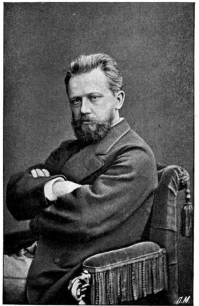
TCHAIKOVSKY IN 1874
In the course of the evening, Asantchevsky, then principal of the St. Petersburg Conservatoire, delivered an address, in which he informed the composer in flattering terms that the directors of the Petersburg section of the Musical Society had decided to award him the sum of 300 roubles, being a portion of the Kondratiev Bequest for the benefit of Russian composers.
The Press notices of The Oprichnik were as contradictory as they were numerous. The opinions of Cæsar Cui and Laroche represented as usual the two opposite poles of criticism. The former declared that while
“the text might have been the work of a schoolboy, the music is equally immature and undeveloped. Poor in conception, and feeble throughout, it is such as might have been expected from a beginner, but not from a composer who has already covered so many sheets of paper. Tchaikovsky’s creative talents, which are occasionally apparent in his symphonic works, are completely lacking in The Oprichnik. The choruses are rather better than the rest, but this is only because of the folksong element which forms their thematic material.... Not only will The Oprichnik not bear comparison with other operas of the Russian school, such as Boris Godounov,[35] for instance, but it is even inferior to examples of Italian opera.”
In these words Cui apparently believed he had given the death-blow to the composer of The Oprichnik.
Laroche’s view (in The Musical Leaflet) is quite opposed to that of Cæsar Cui. He says:—
“While our modern composers of opera contend with each other in their negation of music, Tchaikovsky’s opera does not bear the stamp of this doubtful progress, but shows the work of a gifted temperament. The wealth of musical beauties in The Oprichnik is so great that this opera takes a significant place not only among Tchaikovsky’s own works, but among all the examples of Russian dramatic music. When to this rare melodic gift we add a fine harmonic style, the wonderful, free, and often daring progression of the parts, the genuinely Russian art of inventing chromatic harmonies for diatonic melodies, the frequent employment of pedal-points (which the composer uses almost too freely), the skilful manner in which he unites the various scenes into an organic whole, and finally the sonorous and brilliant orchestration, we have a score which displays many of the best features of modern operatic music, while at the same time it is free from most of the worst faults of contemporary composition.”
The most harsh and pitiless of critics, however, was the composer himself, who wrote a fortnight after the first performance as follows:—
“The Oprichnik torments me. This opera is so bad that I always ran away from the rehearsals (especially of Acts iii. and iv.) to avoid hearing another note.... It has neither action, style, nor inspiration. I am sure it will not survive half a dozen performances, which is mortally vexatious.”
This prediction was not fulfilled, for by March 1st (13th), 1881, The Oprichnik was given fourteen times. This does not amount to a great deal; but when we remember that not a single new opera of the Russian school—Boris Godounov,[36] The Stone Guest, William Ratcliff, Angelo—had exceeded sixteen performances, and many had only reached eight, we must admit that The Oprichnik had more than the average success.
The third day after the performance of his opera Tchaikovsky started for Italy. Besides wishing to rest after the excitement of the last few days, he went as correspondent for the Russky Viedomosti to attend the first performance in Italy of Glinka’s A Life for the Tsar. The opera was translated into Italian by Madame Santagano-Gortshakov and, thanks to her initiative, was brought out at the Teatro dal Verme in Milan.
To M. Tchaikovsky.
“Venice, April 17th (29th), 1874.
“All day long I have been walking up and down the Piazza San Marco.... My soul was very downcast. Why? For many reasons, one of which is that I am ashamed of myself. Instead of going abroad and spending money, I ought really to have paid your debts and Anatol’s—and yet I am hurrying off to enjoy the beautiful South. The thought of my wrong-doing and selfishness has so tormented me that only now, in putting my feelings on paper, does my conscience begin to feel somewhat lighter. So forgive me, dear Modi, for loving myself better than you and the rest of mankind.
“Perhaps you will think I am posing as a benefactor. Not in the least. I know my egotism is limitless, or I should not have gone off on my trip while you had to remain at home.... Now I will tell you about Venice. It is a place in which—had I to remain for long—I should hang myself on the fifth day from sheer despair. The entire life of the place centres in the Piazza San Marco. To venture further in any direction is to find yourself in a labyrinth of stinking corridors which end in some cul-de-sac, so that you have no idea where you are, or where to go, unless you are in a gondola. A trip through the Canale Grande is well worth making, for one passes marble palaces, each one more beautiful and more dilapidated than the last. In fact, you might suppose yourself to be gazing upon the ruined scenery in the first act of Lucrezia. But the Doge’s Palace is beauty and elegance itself; and then the romantic atmosphere of the Council of Ten, the Inquisition, the torture chambers, and other fascinating things. I have thoroughly ‘done’ this palace within and without, and dutifully visited two others, and also three churches, in which were many pictures by Titian and Tintoretto, statues by Canova, and other treasures. Venice, however—I repeat it—is very gloomy, and like a dead city. There are no horses here, and I have not even come across a dog.
“I have just received a telegram from Milan. A Life for the Tsar will not be performed before May 12th (new style), so I have decided to leave to-morrow for Rome, and afterwards go on to Naples, where I shall expect to find a letter from you.”
To Anatol Tchaikovsky.
“Rome, April 20th (May 2nd), 1874.
“Dear Toly,— ... Solitude is a very good thing, and I like it—in moderation. To-day is the eighth day since I left Russia, and during the whole of this time I have not exchanged a friendly word with anyone. Except the hotel servants and railway officials, no human being has heard a word from my lips. I saunter through the city all the morning and have certainly seen most glorious things: the Colosseum, the Capitol, the Vatican, the Pantheon, and, finally—the loftiest triumph of human genius—St. Peter’s. Since the midday meal I have been to the Corso, but here I was overcome by such ‘spleen’ that I am striving to shake it off by writing letters and drinking tea.... Except for certain historical and artistic sights, Rome itself, with its narrow streets, is not interesting, and I cannot understand spending one’s whole life here, as many Russians do. I have sufficient funds to travel all over Italy. As regards money, from the moment I left Russia I have not ceased to reproach myself for my unfeeling egotism. If you only knew how my conscience has pricked me! But I had made up my mind to travel through Italy. It is too foolish; if I had wanted distraction I might just as well have gone to Kiev or the Crimea—it would have been cheap and as good. Dear Toly, I embrace you heartily. What would I give to see you suddenly appear on the scene!”
To Modeste Tchaikovsky.
“Florence, April 27th (May 9th), 1874.
“You are thinking: ‘Lucky fellow, first he writes from Venice and then from Florence.’ Yet all the while, Modi, you cannot imagine anyone who suffers more than I do. At Naples it came to such a pass that every day I shed tears from sheer home-sickness and longing for my dear folk.... But the chief ground of all my misery is The Oprichnik. Finally, the same terrible weather has followed me here. The Italians cannot remember a similar spring. At Naples, where I spent six days, I saw nothing, because in bad weather the town is impassable. The last two days it was impossible to go out. I fled post-haste, and shall go straight to Sasha[37] without stopping at Milan. I have very good grounds for avoiding Milan, for I hear from a certain Stchurovsky that the performance of A Life for the Tsar will be bungled.... In Florence I only had time to go through the principal streets, which pleased me very much. I hate Rome, and Naples too; the devil take them both! There is only one town in the world for me—Moscow, and perhaps I might add Paris.”
Without waiting for the performance of A Life for the Tsar at Milan, which did not take place until May 8th (20th), Tchaikovsky returned to Moscow early in this month.
For a short time his dissatisfaction with The Oprichnik filled him with such doubt of his powers that his spirits flagged. But his energy quickly recovered itself. No sooner had he returned to Moscow, than he was possessed by an intense desire to prove to himself and others that he was equal to better things than The Oprichnik. The score of this work seemed like a sin, for which he must make reparation at all costs. There was but one way of atonement—to compose a new opera which should have no resemblance to The Oprichnik, and should wipe out the memory of that unhappy work.
In the course of this season, the Russian Musical Society organised a prize competition for the best setting of the opera, Vakoula the Smith.
While Serov was still engaged upon his opera, The Power of the Evil One, he was suddenly seized with a desire to compose a Russian comic opera, and chose a fantastic poem by Gogol. When he informed his patroness, the Grand Duchess Helena Pavlovna, of his project, she declared herself willing to have a libretto prepared by the poet Polonsky at her own cost. Serov died before he had time to begin the opera, and the Grand Duchess resolved to honour his memory by offering two prizes for the best setting of the libretto he had been unable to use. In January, 1873, the Grand Duchess Helena died, and the directors of the Imperial Musical Society proceeded to carry out her wishes with regard to the libretto of Vakoula the Smith.
The latest date at which the competitors might send in their scores to the jury was fixed for August 1st (13th) 1875. The successful opera was afterwards to be performed at the Imperial Opera House in Petersburg.
At first Tchaikovsky hesitated to take part in the competition, lest he should be unsuccessful. But having read Polonsky’s libretto, he was fascinated. The originality and captivating local colour, as well as the really poetical lyrics with which the book is interspersed, commended it to Tchaikovsky’s imagination, so that he could no longer resist the impulse to set it to music. At the same time he feared the competition, not so much because he desired the prize, as because, in the event of failure, he could not hope to see his version of the libretto produced at the Imperial Opera. This was his actual motive in trying to discover, before finally deciding the matter, whether Anton Rubinstein, Balakirev, or Rimsky-Korsakov were intending to compete. As soon as he had ascertained that these rivals were not going to meet him in the field, he threw himself into the task with ardour.
At the beginning of the summer vacation Tchaikovsky went to stay with Kondratiev at Nizy, and set to work without loss of time. He was under the misapprehension that the score had to be ready by August 1st of that year (1874), besides which he felt a burning desire to wipe out the memory of The Oprichnik as soon as possible. By the middle of July, when he left Nizy for Ussovo, he had all but finished the sketch of the opera, and was ready to begin the orchestration. At Ussovo he redoubled his efforts, and the work was actually completed by the end of August. The entire opera had occupied him barely three months. He wrote no other dramatic work under such a long and unbroken spell of inspiration. To the end of his days Tchaikovsky had a great weakness for this particular opera. In 1885 he made some not very important changes in the score. It has been twice renamed; once as Cherevichek (“The Little Shoes”), and later as Les Caprices d’Oxane, under which title it now appears in foreign editions.
During this season Tchaikovsky’s reputation greatly increased. The success of his Second Symphony, and the performance of The Oprichnik, made his name as well known in Petersburg as it had now become in Moscow.
In his account of the first performance of A Life for the Tsar, at Milan, Hans von Bülow, referring to Tchaikovsky, says:—[38]
“At the present moment we know but one other who, like Glinka, strives and aspires, and whose works—although they have not yet attained to full maturity—give the complete assurance that such maturity will not fail to come. I refer to the young professor of composition at the Moscow Conservatoire—Tchaikovsky. A beautiful string quartet by him has won its way in many German towns. Many of his works deserve equal recognition—his pianoforte compositions, two symphonies, and an uncommonly interesting overture to Romeo and Juliet, which commends itself by its originality and luxuriant flow of melody. Thanks to his many-sidedness, this composer will not run the danger of being neglected abroad, as was the case with Glinka.”
XI 1874-1875
It was not until his return to Moscow that Tchaikovsky found out his mistake as to the date of the competition. This discovery annoyed him exceedingly. Like all composers, he burned with impatience to hear his work performed as soon as possible. In his case such impatience was all the greater, because he was not accustomed to delay; hitherto Nicholas Rubinstein had brought out his works almost before the ink was dry on the paper. Besides which Tchaikovsky had never before been so pleased with any offspring of his genius as with this new opera. The desire to see Vakoula mounted, and thus to wipe out the bad impression left by The Oprichnik, became almost a fixed idea, and led him to a course of action which in calmer moments would have seemed to him reprehensible.
Tchaikovsky never had the art of keeping a secret, especially when it was a question of the rehabilitation of his artistic reputation, such as it seemed to him at present, for he believed it to have been damaged by “the detestable Oprichnik.” Consequently he never took the least trouble to conceal the fact that he was taking part in this competition. For a man of his age he showed an inconceivable degree of naïveté, and went so far as to try to induce the directors of the Opera in Petersburg to have Vakoula performed before the result of the competition was decided. From the letter which I give below, it is easy to see how little he thought at the moment of the injustice he was inflicting upon the other competitors, and how imperfectly he realised the importance of silence in such an affair as a competition, in which anonymity is the first condition of impartial judgment.
To E. Napravnik.
“October 19th (31st), 1874.
“I have learnt to-day that you and the Grand Duke are much displeased at my efforts to get my opera performed independently of the decision of the jury. I very much regret that my strictly private communication to you and Kondratiev should have been brought before the notice of the Grand Duke, who may now think I am unwilling to submit to the terms of the competition. The matter can be very simply explained. I had erroneously supposed that August 1st (13th), 1874, was the last day upon which the compositions could be sent in to the jury, and I hurried over the completion of my work. Only on my return to Moscow did I discover my mistake, and that I must wait more than a year for the decision of the judges. In my impatience to have my work performed (which is far more to me than any money) I inquired, in reply to a letter of Kondratiev’s—whether it might not be possible to get my work brought out independently of the prize competition. I asked him to talk it over with you and give me a reply. Now I see that I have made a stupid mistake, because I have no rights over the libretto of the opera. You need only have told Kondratiev to write and say I was a fool, instead of imputing to me some ulterior motive which I have never had. I beg you to put aside all such suspicions, and to reassure the Grand Duke, who is very much annoyed, so Rubinstein tells me.
“Let me express my thanks for having included The Tempest in your repertory. I must take this opportunity of setting right a little mistake in the instrumentation. I noticed in the introduction, where all the strings are divided into three, and each part has its own rhythm, that the first violins sounded too loud—first, because they are more powerful than the others, and secondly, because they are playing higher notes. As it is desirable that no distinct rhythm should be heard in these particular passages, please be so kind as to make the first violins play ppp and the others simply p.”
To Modeste Tchaikovsky.
“October 29th (November 10th).
“Just imagine, Modi, that up to the present moment I am still slaving at the pianoforte arrangement of my opera.... I have no time for answering all my letters. Many thanks for both yours; I am delighted to find that you write with the elegance of a Sévigné. Joking apart, you have a literary vein, and I should be very glad if it proved strong enough to make an author of you. Then, at last, I might obtain a good libretto, for it seems a hopeless business; one seeks and seeks, and finds nothing suitable. Berg, the poet, (editor of the Grajdanin, the Niva, and other Russian publications), suggested to me a subject from the period of the Hussites and Taborites. I inquired if he had any decided plan. Not in the least; he liked the idea of their singing hymns!!! I would give anything just now to get a good historical libretto—not Russian.
“ ... I sit at home a good deal, but unfortunately I do not get much time for reading. I work or play. I have studied Boris Godounov and The Demon thoroughly. As to Moussorgsky’s music, it may go to the devil for all I care: it is the commonest, lowest parody of music. In The Demon I have found some beautiful things, but a good deal of padding, too. On Sunday the Russian Quartet, that has brought out my quartet in D, is playing here.
“I am glad my second quartet finds favour with you and Mademoiselle Maloziomov.[39] It is my best work; not one of them has come to me so easily and fluently as this. I completed it as it were at one sitting. I am surprised the public do not care for it, for I have always thought, among this class of works, it had the best chance of success.”
I cannot understand how my brother can have inferred from my letter that the quartet had no success. It must have pleased, since it was repeated at least once during the season. Cui spoke of it as a “beautiful, talented, fluent work, which showed originality and invention.” Laroche considered it “more serious and important than the first quartet”; and Famitzin thought it showed “marked progress. The first movement displayed as much style as Beethoven’s A minor quartet.”
On November 1st (13th) Napravnik conducted the first performance of The Tempest in St. Petersburg.
From V. V. Stassov to Tchaikovsky.
“November 13th (25th), 10 a.m.
“I have just come from the rehearsal for Saturday’s concert. Your Tempest was played for the first time. Rimsky-Korsakov and I sat alone in the empty hall and overflowed with delight.
“Your Tempest is fascinating! Unlike any other work! The tempest itself is not remarkable, or new; Prospero, too, is nothing out of the way, and at the close you have made a very commonplace cadenza, such as one might find in the finale of an Italian opera—these are three blemishes. But all the rest is a marvel of marvels! Caliban, Ariel, the love-scene—all belong to the highest creations of art. In both love-scenes, what passion, what languor, what beauty! I know nothing to compare with it. The wild, uncouth Caliban, the wonderful flights of Ariel—these are creations of the first order.
“In this scene the orchestration is enchanting.
“Rimsky and I send you our homage and heartiest congratulations upon the completion of such a fine piece of workmanship. The day after to-morrow (Friday) we shall attend the rehearsal again. We could not keep away....”
The Tempest not only pleased Stassov and “The Band,” but won recognition even in the hostile camp. Laroche alone was dissatisfied. He considered that in his programme music Tchaikovsky approached Litolff as regards form and instrumentation, and Schumann and Glinka as regards harmony. The Tempest would not bear criticism as an organic whole. “Beautiful, very beautiful, are the details,” he continues, “but even these are not all on a level; for instance, the tempest itself is not nearly so impressive as in Berlioz’s fantasia on the same subject. Tchaikovsky’s storm is chiefly remarkable for noisy orchestration, which is, indeed, of so deafening a character that the specialist becomes curious to discover by what technical means the composer has succeeded in concocting such a pandemonium.”
To Anatol Tchaikovsky.
“November 21st (December 3rd).
“Toly, your general silence makes me uneasy. I begin to think something serious has happened, or one of you is ill. I am particularly puzzled about Modeste. I am aware that my Tempest was performed a few days ago. Why does no one write a word about it? After my quartet, Modeste wrote at considerable length, and also Mademoiselle Maloziomov. Now—not a soul, except Stassov. Most strange!
“I am now completely absorbed in the composition of a pianoforte concerto. I am very anxious Rubinstein should play it at his concert. The work progresses very slowly, and does not turn out well. However, I stick to my intentions, and hammer pianoforte passages out of my brain: the result is nervous irritability. For this reason I should like to take a trip to Kiev for the sake of the rest, although this city has lost nine-tenths of its charms for me now Toly does not live there. For this reason, too, I hate The Oprichnik with all my heart....[40]
“To-morrow the overture to my ‘unfinished opera’ will be given here.”
The “unfinished opera” is none other than Vakoula the Smith. The overture had no success, but Tchaikovsky received the customary fee of 300 roubles from the Musical Society.
To Modeste Tchaikovsky.
“November 26th (December 8th).
“ ... You do not write a word (about The Tempest), and Maloziomova is silent too. Laroche’s criticism has enraged me. With what schadenfreude he points out that I imitate Litolff, Schumann, Berlioz, Glinka, and God knows whom besides. As though I could do nothing but compile! I am not hurt that he does not like The Tempest. I expected as much, and I am quite contented that he should merely praise the details of the work. It is the general tone of his remarks that annoys me; the insinuation that I have borrowed everything from other composers and have nothing of my own....”
The hyper-sensitiveness which Tchaikovsky shows in this letter is a symptom of that morbid condition of mind, of which more will be said as the book advances.
On December 9th Tchaikovsky attended the first performance of The Oprichnik at Kiev, and wrote an account of the event for the Russky Viedomosti. The opera had a great success, and remained in the repertory of the Kiev Opera House throughout the entire season.
To Modeste Tchaikovsky.
“January 6th (18th) 1875.
“I am very pleased with your newspaper article. You complain that writing comes to you with difficulty, and that you have to search for every phrase. But do you really suppose anything can be accomplished without trouble and discipline? I often sit for hours pen in hand, and have no idea how to begin my articles. I think I shall never hammer anything out; and afterwards people praise the fluency and ease of the writing! Remember what pains Zaremba’s exercises cost me. Do you forget how in the summer of ‘66 I worked my nerves to pieces over my First Symphony? And even now I often gnaw my nails to the quick, smoke any number of cigarettes, and pace up and down my room for long, before I can evolve a particular motive or theme. At other times writing comes easily, thoughts seem to flow and chase each other as they go. All depends upon one’s mood and condition of mind. But even when we are not disposed for it we must force ourselves to work. Otherwise nothing can be accomplished.
“You write of being out of spirits. Believe me, I am the same.”
To Anatol Tchaikovsky.
“January 9th (21st).
“I cannot endure holidays. On ordinary days I work at fixed hours, and everything goes on like a machine. On holidays the pen falls from my hand of its own accord—I want to be with those who are dear to me, to pour out my heart to them; and then I am overcome by a sense of loneliness, of desolation.... It is not merely that there is no one here I can really call my friend (like Laroche or Kondratiev), but also during these holidays I cannot shake off the effects of a cruel blow to my self-esteem—which comes from none others than Nicholas Rubinstein and Hubert. When you consider that these two are my best friends, and in all Moscow no one should feel more interest in my compositions than they, you will understand how I have suffered. A remarkable fact! Messrs. Cui, Stassov, and Co. have shown, on many occasions, that they take far more interest in me than my so-called friends! Cui wrote me a very nice letter a few days ago. From Korsakov, too, I have received a letter which touched me deeply.... Yes, I feel very desolate here, and if it were not for my work, I should become altogether depressed. In my character lurk such timidity of other people, so much shyness and distrust—in short, so many characteristics which make me more and more misanthropical. Imagine, nowadays, I am often drawn towards the monastic life, or something similar. Do not fancy I am physically out of health. I am quite well, sleep well, eat even better; I am only in rather a sentimental frame of mind—nothing more.”
Tchaikovsky has told so well the tale of Rubinstein’s injury to his self-esteem in one of his subsequent letters to Frau von Meck, that I think it advisable to publish the entire letter in this particular chapter of the book.
To N. F. von Meck.
“San Remo, January 21st (February 2nd), 1878.
“ ... In December, 1874, I had written a pianoforte concerto. As I am not a pianist, it was necessary to consult some virtuoso as to what might be ineffective, impracticable, and ungrateful in my technique. I needed a severe, but at the same time friendly, critic to point out in my work these external blemishes only. Without going into details, I must mention the fact that some inward voice warned me against the choice of Nicholas Rubinstein as a judge of the technical side of my composition. However, as he was not only the best pianist in Moscow, but also a first-rate all-round musician, and, knowing that he would be deeply offended if he heard I had taken my concerto to anyone else, I decided to ask him to hear the work and give me his opinion upon the solo parts. It was on Christmas Eve, 1874. We were invited to Albrecht’s house, and, before we went, Nicholas Rubinstein proposed I should meet him in one of the class-rooms at the Conservatoire to go through the concerto. I arrived with my manuscript, and Rubinstein and Hubert soon appeared. The latter is a very worthy, clever man, but without the least self-assertion. Moreover, he is exceedingly garrulous, and needs a string of words to say ‘yes’ or ‘no.’ He is incapable of giving his opinion in any decisive form, and generally lets himself be pulled over to the strongest side. I must add, however, that this is not from cowardice, but merely from lack of character.
“I played the first movement. Never a word, never a single remark. Do you know the awkward and ridiculous sensation of putting before a friend a meal which you have cooked yourself, which he eats—and holds his tongue? Oh, for a single word, for friendly abuse, for anything to break the silence! For God’s sake say something! But Rubinstein never opened his lips. He was preparing his thunderbolt, and Hubert was waiting to see which way the wind would blow. I did not require a judgment of my work from the artistic side; simply from the technical point of view. Rubinstein’s silence was eloquent. ‘My dear friend,’ he seemed to be saying to himself, ‘how can I speak of the details, when the work itself goes entirely against the grain?” I gathered patience, and played the concerto straight through to the end. Still silence.