Part V (continued 2)
Rosa Newmarch translation
“I am working at the sketch of an Italian Fantasia based upon folksongs. Thanks to the charming themes, some of which I have taken from collections and some of which I have heard in the streets, this work will be effective.”
To N. F. von Meck.
“February 4th (16th), 1880.
“Yesterday we made the most of glorious weather and went to Tivoli. It is the loveliest spot I ever beheld. As soon as we arrived we went to lunch at the Albergo della Sybilla. Our table was near the edge of a ravine, where a waterfall splashed in the depths below; on all sides the steep banks and rocks were covered with pines and olive trees. The sun was hot as in June. After breakfast we took a long walk and visited the celebrated Villa d’Este, where Liszt spends three months every year. It is magnificent, and from the park there is a fine view over the Campagna.
“To-day we went to the gallery of the Palazzo Borghese, in which there are some masterpieces. I was most impressed by Correggio’s superb picture ‘Danae.’[74]
“Dear friend, leading such a life, amid all these beautiful impressions of nature and art, ought not a man to be happy? And yet a worm continually gnaws in secret at my heart. I sleep badly, and do not feel that courage and freshness which I might expect under the present conditions. Only for a moment can I conquer my mental depression. My God! What an incomprehensible and complicated machine the human organism is! We shall never solve the various phenomena of our spiritual and material existence. And how can we draw the line between the intellectual and physiological phenomena of our life? At times it seems to me as though I suffered from a mysterious, but purely physical, malady which influences my mental phases. Lately I have thought my heart was out of order; but then I remembered that last summer the doctor who examined it declared my heart to be absolutely sound. So I must lay the blame on my nerves—but what are nerves? Why, on one and the same day, without any apparent reason, do they act quite normally for a time, and then lose their elasticity and energy, and leave one incapable of work and insensible to artistic impressions? These are riddles.
“There is a lovely bunch of violets in front of me. There are quantities here. Spring is coming in to her own.”
To P. I. Jurgenson.
“Rome, February 5th (17th), 1880.
“Good Lord, what a stupid idea to go and print that score!!![75] It is not profitable, is no use to anyone, nor satisfactory in any respect—simply absurd. The moral is: when you want to prepare a little surprise for me, ask my advice first. I assure you, in spite of my well-known naïveté, I have more sound common sense than many clever, worthy, but too enthusiastic people—such as the person for example who suggested you should engrave this score. All the same, my unfavourable view does not prevent my being grateful—even in this case—for your friendship, which I value tremendously.
“Is it not time to lay the score of The Maid of Orleans before the Opera Direction? I think it is just the right moment....”
To N. F. von Meck.
“Rome, February 6th (18th), 1880.
“The more I look at Michel Angelo’s works the more wonderful they seem to me. Just now I was contemplating his ‘Moses.’ The church was empty, and there was nothing to disturb my meditations. I assure you I was filled with terror. You will remember that Moses is standing with his head slightly turned towards the sacrifice which is to be offered to Baal. His expression is angry and menacing; his figure majestic and commanding. One feels he has only to speak a word, for erring mortals to fall on their knees before him. It is impossible to conceive anything more perfect than this great statue. With this genius the form expresses his entire thought, there is nothing forced, no pose, such as we see, for instance, in Bernini’s statues, of which Rome unfortunately possesses so many examples.
“I am so pleased with a book that has come into my hands, I cannot put it down. It is nothing less than an excellent rendering of Tacitus into French. He is a great artist.”
About this time the performance of Tchaikovsky’s opera The Oprichnik was forbidden, because the subject was considered too revolutionary in that moment of political agitation. “Je n’ai qu’à m’en féliciter,” wrote the composer on receiving the news, “for I am glad of any hindrance to the performance of this ill_starred opera.”
To N. F. von Meck.
“Rome, February 16th (28th), 1880.
“I chose the title of Divertimento for the second movement of my Suite, because it was the first which occurred to me. I wrote the movement without attaching any great importance to it, and only interpolated it in the Suite to avoid rhythmical monotony. I wrote it actually at one sitting, and spent much less time upon it than upon any other movement. As it turns out, this has not hindered it from giving more pleasure than all the rest. You are not the only one who thinks so. It proves for the thousandth time that an author never judges his own works with justice.
“I am most grateful to you for calling Colonne’s attention to my new works, but I must tell you frankly: it would be very disagreeable to me if you were again to repay him in a material form for his attention.... The first time it was very painful that you should have spent a considerable sum of money, although I was glad to feel that, thanks to your devoted friendship, our symphony should be made known to the Paris public. I was grateful for this new proof of your sympathy. But now it would be painful and disgraceful to me to know that Colonne could only see the worth of my compositions by the flashlight of gold. All the same, I am grateful for your recommendation.”
To N. F. von Meck.
“Rome, February 18th (March 1st), 1880.
“The Concerto[76] of Brahms does not please me better than any other of his works. He is certainly a great musician, even a Master, but, in his case, his mastery overwhelms his inspiration. So many preparations and circumlocutions for something which ought to come and charm us at once—and nothing does come, but boredom. His music is not warmed by any genuine emotion. It lacks poetry, but makes great pretensions to profundity. These depths contain nothing: they are void. Take the opening of the Concerto, for instance. It is an introduction, a preparation for something fine; an admirable pedestal for a statue; but the statue is lacking, we only get a second pedestal piled upon the first. I do not know whether I have properly expressed the thoughts, or rather feelings, which Brahms’s music awakens in me. I mean to say that he never expresses anything, or, when he does, he fails to express it fully. His music is made up of fragments of some indefinable something, skilfully welded together. The design lacks definite contour, colour, life.
“But I must simply confess that, independent of any definite accusation, Brahms, as a musical personality, is antipathetic to me. I cannot abide him. Whatever he does—I remain unmoved and cold. It is a purely instinctive feeling.”
To Modeste Tchaikovsky.
“Rome, February 26th (March 9th), 1880.
“To-day I went on foot to the Vatican and sat a long while in the Sistine Chapel. Here a miracle was worked. I felt—almost for the first time in my life—an artistic ecstasy for painting. What it means to become gradually accustomed to the painter’s art! I remember the time when all this seemed to me absurd and meaningless....”
To Modeste Tchaikovsky.
“Berlin, March 4th (16th), 1880.
“In Paris I went to the ‘Comédie Francaise,’ and fell in love with Racine or Corneille (which of them wrote Polyeucte?). The beauty and strength of these verses and, still more, the lofty artistic truth! At the first glance this tragedy seems so unreal and impossible. The last act, however, in which Felix, conscience-stricken and illumined by Christ, suddenly becomes a Christian, touched me profoundly....
“After reading Toly’s letter I went to Bilse’s concert. The large, luxuriously decorated hall, with its smell of indifferent cigars and food, its stocking-knitting ladies and beer-drinking men, made a curious impression upon me. After Italy, where we were constantly out in the beautiful, pure air, it was quite repugnant. But the orchestra was excellent, the acoustic splendid, and the programme good. I heard Schumann’s ‘Genoveva,’ the ‘Mignon’ overture, and a very sparkling pot-pourri, and I was very pleased with it all. How glad I shall be to hear the Flying Dutchman to-day!”
To Modeste Tchaikovsky.
“Berlin, March 5th (17th), 1880.
“To-day I went to the Aquarium, where I went into ecstasies over the chimpanzee. He lives in intimate friendship with a dog. It is delightful to see the two play together, and the chimpanzee laughs in the drollest way when he takes refuge in some place where the dog cannot get at him!
“I notice that I am making great progress in my appreciation of painting. I take the greatest delight in many things, especially in the Flemish school. Teniers, Wouvermans, and Ruysdael please me far more than the renowned Rubens, who represents even Christ as healthily robust, with unnaturally pink cheeks. One fact makes me begin to see myself as a great connoisseur. I recognise Correggio’s brush before I see his name in the catalogue! But then Correggio has his own manner, and all his male figures and heads resemble the Christ in the Vatican, and his women the Danae in the Borghese Palace.”
To N. F. von Meck.
“St. Petersburg, March 10th (22nd), 1880.
“Your benevolence to poor, dying Henry Wieniawsky touches me deeply.[77] ... I pity him greatly. In him we shall lose an incomparable violinist and a gifted composer. In this respect I think Wieniawsky very talented ... the beautiful Légende and parts of the A minor Concerto show a true creative gift.”
To N. F. von Meck.
“St. Petersburg, March 20th (April 1st), 1880.
“Yesterday I suffered a good deal. The Grand Duke Constantine Nicholaevich has a son Constantine. This young man of two-and-twenty is passionately fond of music, and is very partial to mine. He expressed a wish to become more closely acquainted with me, and asked a relative of mine, the wife of Admiral Butakov, to arrange an evening party at which we might meet.
“As he knows my misanthropical habits, this evening was to be of an informal nature, without dress coats and white ties. It was impossible to escape. The young man is very pleasant and has musical ability. We talked music from 9 p.m. until 2 a.m. He composes very nicely, but unfortunately has no time to devote himself to it seriously.”
On March 25th several of Tchaikovsky’s works were performed at a concert given by two singers, well known in Petersburg, V. Issakov and Madame Panaev. The First Suite and the Romeo and Juliet overture were played by the orchestra of the Russian Opera under Napravnik. The Suite had the greatest success, especially the “Marche Miniature.” The great novelist Tourgeniev was present on this occasion.
To N. F. von Meck.
“Moscow, April 2nd (14th), 1880.
“I have come here with the intention of spending three days incognito and finishing my work. Besides, I need the rest. Imagine, my dear friend, for the last few days I have hardly ever been out of a tail coat and white tie and associating with the most august personages. It is all very flattering, sometimes touching; but fatiguing to the last degree. I feel so happy and comfortable in my room in the hotel, not being obliged to go anywhere, or do anything!”
X
To N. F. von Meck.
“Kamenka, April 18th (30th), 1880.
“To-day a cold north wind is blowing. Spring has not yet entered into possession of her own, and the nightingale is not singing yet. Still, it is beautiful in the forest.
“During the last few days I have read through two new operas: Anton Rubinstein’s Kalashnikov and Jean de Nivelles by Délibes. The former is weak all through. Rubinstein is like a singer who has lost her voice, but still believes she sings charmingly. His talent has long since lost its charm. He really ought to give up composing and to be contented with his earlier works. I pray that I may never fall into the same error. Délibes makes just the opposite impression. His work is fresh, graceful, and very clever.”
About the end of April the director of the Kiev branch of the Russian Musical Society offered to make Tchaikovsky the principal of this section, and of the musical school connected with it. Although on account of its proximity to the home of the Davidovs at Kamenka, the neighbourhood of Kiev offered many attractions to him, he declined the offer without hesitation. He had tasted the fruits of liberty and was more than ever convinced that teaching was not his vocation.
During his stay at Kamenka, Tchaikovsky finished the orchestration of his “Italian Fantasia,” which he considered, apart from its musical worth, one of his most effective and brilliant orchestral works.
To P. I. Jurgenson.
“Kamenka, June 23rd (July 5th), 1880.
“Dear Soul,—I believe you imagine I have no greater happiness than to compose occasional pieces to be played at forthcoming exhibitions, and that I ought to put my inspirations down post-haste upon paper, without knowing how, when, or where. I shall not stir a finger until I get a positive commission. If something vocal is required of me, I must be supplied with a suitable text (when it is a question of an order I am ready to set an advertisement of corn-plasters to music); if it is to be an instrumental work, I must have some idea of the form it should take, and what it is intended to illustrate. At the same time a definite fee must be offered, with a definite agreement as to who is responsible for it, and when I shall receive it. I do not make all these demands from caprice, but because I am not in a position to write these festival works without having some positive instructions as to what is required of me. There are two kinds of inspiration: one comes direct from the soul, by freedom of choice, or other creative impulse; the other comes to order.... Matters of business must be put very clearly and distinctly. Fancy if I had already been inspired to write a Festival Overture for the opening of the Exhibition! What would have come of it? It might have happened that the great Anton had also (An-)toned something of his own. Where should I have been with my scribblings?
“I shall finish the corrections of the fourth act to-day. The opera (The Maid of Orleans) has become a long affair. My poor publisher! Well, we must live in hope!”
Early in July Tchaikovsky visited Nadejda von Meck’s estate at Brailov, for the sake of repose. At this time a feeling of dissatisfaction with his work seems to have taken possession of him. “I have written much that is beautiful,” he wrote to his brother Modeste, “but how weak, how lacking in mastery!... I have made up my mind to write nothing new for a time, but to devote myself to the correcting and re-editing of my earlier works.”
A letter to Nadejda von Meck, dated Brailov, July 5th (17th), 1880, contains some interesting comments upon Glinka and his work.
“ ... Glinka is quite an unusual phenomenon! Reading his Memoirs, which reveal a nice, amiable, but rather commonplace man, we can hardly realise that the same mind created that wonderful ‘Slavsia,’[78] which is worthy to rank with the work of the greatest geniuses. And how many more fine things there are in his other opera (Russlan) and the overtures! How astonishingly original is his Komarinskaya, from which all the Russian composers who followed him (including myself) continue to this day to borrow contrapuntal and harmonic combinations directly they have to develop a Russian dance-tune! This is done unconsciously; but the fact is, Glinka managed to concentrate in one short work what a dozen second-rate talents would only have invented with the whole expenditure of their powers.
“And it was this same Glinka who, at the height of his maturity, composed such a weak, trivial thing as the Polonaise for the Coronation (written a year before his death), or the children’s polka, of which he speaks in his Memoirs at such length, and with such self-satisfaction, as though it had been a masterpiece.
“Mozart, too, expresses himself with great naïveté in his letters to his father and, in fact, all through his life. But this was a different kind of simplicity. Mozart is a genius whose childlike innocence, gentleness of spirit and virginal modesty are scarcely of this earth. He was devoid of self-satisfaction and boastfulness; he seems hardly to have been conscious of the greatness of his genius. Glinka, on the contrary, is imbued with a spirit of self-glorification; he is ready to become garrulous over the most trivial events in his life, or the appearance of his least important works, and is convinced it is all of historical importance. Glinka is a gifted Russian aristocrat of his time, and has the faults of his type: petty vanity, limited culture, intolerance, ostentatiousness and a morbid sensibility to, and impatience of, all criticism. These are generally the characteristics of mediocrity; how they come to exist in a man who ought—so it seems—to dwell in calm and modest pride, conscious of his power, is beyond my comprehension! In one page of his Memoirs Glinka says he had a bulldog whose conduct was not irreproachable, and his servant had to be continually cleaning the room. Kukolnik, to whom Glinka entrusted his Memoirs for revision, remarked in the margin, ‘Why put in this?’ Glinka pencilled underneath, ‘Why not?’ Is not this highly characteristic? Yet, all the same, he composed the ‘Slavsia’!”
To N. F. von Meck.
“Brailov, July 6th (18th), 1880.
“To-day I went to the Orthodox, the new Catholic, and the monastery churches. There is something about the monastic singing here, as in all Russian churches, which enrages me to the last degree. It is the chord of the dominant seventh in its original position, which we misuse so terribly. There is nothing so unmusical, or so unsuitable to the Orthodox Church as this commonplace chord, which was introduced during the eighteenth century by Messrs. Galuppi, Sarti, Bortniansky and Co., and has since become so much a part of our church music that the Gospodi pomilui[79] cannot be sung without it. This chord reminds me of the accordion, which only gives out two harmonies: the tonic and dominant. It disfigures the natural progression of the parts and weakens and vulgarises our church music. To make you clearly understand what it is that annoys me I will give you an example:—


instead of this they ought to sing

“The new Catholic church makes a pleasant impression. I much prefer our Orthodox liturgy to the Mass, especially to the so-called ‘Low Mass,’ which seems to me devoid of all solemnity.”
To N. F. von Meck.
“Brailov, July 8th (20th), 1880.
“Yesterday I went an expedition in the forest, where formerly there used to be wild goats, of which now only one specimen is left. They say the others were all devoured by the wolves in winter. It is a great pity! But I was consoled by the beauty of the evening and a wonderful walk. At sunset I had tea, and then wandered alone by the steep bank of the stream behind the deer-park, and drank in all the deep delight of the forest at sundown, and freshness of the evening air. Such moments, I thought, helped us to bear with patience the many minor grievances of existence. They make us in love with life. We are promised eternal happiness, immortal existence, but we do not realise this, nor shall we perhaps attain to it. But if we are worthy of it, and if it is really eternal, we shall soon learn to enjoy it. Meanwhile, one wishes to live, in order to experience again such moments as those of yesterday.
“To-day I intended to leave for Simaki, but while I am writing to you a terrific storm is raging, and it is evidently going to be a wet day; so perhaps I shall remain here. I am drawn to Simaki, and yet I regret leaving Brailov. Dear friend, to-day I have committed a kind of burglary in your house, and I will confess my crime. There was no key to the bookcase in the drawing-room next to your bedroom, but I saw it contained some new books which interested me greatly. Even Marcel could not find the key, so it occurred to me to try the one belonging to the cupboard near my room, and it opened the bookcase at once. I took out Byron and Martinov’s Moscow. Make your mind easy, all your books and music remain untouched. To quiet Marcel’s conscience I gave him, when about to leave for Simaki, a memorandum of what I had taken, and before I actually depart I will return him the books and music to replace in their proper order. Pray forgive my self-justification.”
To Modeste Tchaikovsky.
“Simaki, July 8th (20th), 1880.
“ ... I expected a great deal from Simaki, but the reality far surpasses my expectations. What a wonderful spot this is, and how poor Brailov seems now I am here! The small house is just the same as when I saw it last year, only it has been done up a little; the furniture and upholstery are partly new; the arrangements are the ideal of comfort. But the surroundings are enchanting! The garden is a mass of flowers. I simply swim in an ocean of delightful impressions. An hour ago I was in the millet-field which lies beyond the garden, and so great was my ecstasy that I fell upon my knees and thanked God for the profound joy I experienced. I stood on rising ground; nothing was visible in the distance but the dense green which surrounds my little house; on every side the forest spreads to the hills; across the stream lay the hamlet, whence came various pleasant rural sounds; the voices of children, the bleating of sheep and the lowing of cattle, driven home from pasture. In the west the sun was setting in splendour; while in the east the crescent moon was already up. Everywhere beauty and space! What moments life holds! Thanks to these intervals, it is possible to forget everything!”
To N. F. von Meck.
“Simaki, July 9th (21st), 1880.
“ ... The night has been glorious! At 2 a.m. I reluctantly left my place by the window. The moon shone brightly. The stillness, the perfume of the flowers, and those wondrous indefinable sounds that belong to the night—ah God, how beautiful it all is! Dear friend, I am glad you are at Interlaken, of which I am very fond; but all the same I do not envy you. It would be hard to find a place in which the conditions of life would conform better to my ideal than Simaki. All day long I feel as though I were lost in some wonderful, fantastic dream.”
To N. F. von Meck.
“Simaki, July 14th (26th), 1880.
“I have just been playing the first act of The Maid of Orleans, which is now ready for the printer. Either I am mistaken, or it is not in vain, dear friend, that you have had the clock you gave me decorated with the figure of my latest operatic heroine. I do not think The Maid of Orleans my finest, or the most emotional, of my works, but it seems to me to be the one most likely to make my name popular. I believe Oniegin and one or two of my instrumental works are far more closely allied to my individual temperament. I was less absorbed in The Maid of Orleans than in our Symphony, for instance, or the second Quartet; but I gave more consideration to the scenic and musical effects—and these are the most important things in opera.”
To N. F. von Meck.
“Simaki, July 18th (30th), 1880.
“Yesterday evening—to take a rest from my own work—I played through Bizet’s Carmen from cover to cover. I consider it a chef d’œuvre in the fullest sense of the word: one of those rare compositions which seems to reflect most strongly in itself the musical tendencies of a whole generation. It seems to me that our own period differs from earlier ones in this one characteristic: that contemporary composers are engaged in the pursuit of charming and piquant effects, unlike Mozart, Beethoven, Schubert, and Schumann. What is the so-called New Russian School but the cult of varied and pungent harmonies, of original orchestral combinations and every kind of purely external effect? Musical ideas give place to this or that union of sounds. Formerly there was composition, creation; now (with few exceptions) there is only research and invention. This development of musical thought is naturally purely intellectual, consequently contemporary music is clever, piquant, and eccentric; but cold and lacking the glow of true emotion. And behold, a Frenchman comes on the scene, in whom these qualities of piquancy and pungency are not the outcome of effort and reflection, but flow from his pen as in a free stream, flattering the ear, but touching us also. It is as though he said to us: ‘You ask nothing great, superb, or grandiose—you want something pretty, here is a pretty opera;’ and truly I know of nothing in music which is more representative of that element which I call the pretty (le joli).... I cannot play the last scene without tears in my eyes; the gross rejoicings of the crowd who look on at the bull-fight, and, side by side with this, the poignant tragedy and death of the two principal characters, pursued by an evil fate, who come to their inevitable end through a long series of sufferings.
“I am convinced that ten years hence Carmen will be the most popular opera in the world. But no one is a prophet in his own land. In Paris Carmen has had no real success.”
To Modeste Tchaikovsky.
“Simaki, July 18th (30th), 1880.
“My dear Modi,—How worried I am by my Maid of Orleans, and how glad I am to have done with her! Now she has flown to Moscow and, until the time of performance comes, I need not bother about her any more....
“Thanks (in an ironical sense) for your suggestion that I should read L’homme qui rit. Do you not know the story of my relations to Victor Hugo? Anyhow, I will tell you what came of them. I took up Les travailleurs de la Mer; I read, and read, and grew more and more irritated by his grimaces and buffoonery. Finally, after a whole series of short, unmeaning phrases, consisting of exclamations, antitheses, and asterisks, I lost my temper, spat upon the book, tore it to pieces, stamped upon it, and wound up by throwing it out of the window. From that moment I cannot bear the mention of Victor Hugo! Believe me, your Zola is just such another mountebank, but more modern in spirit. I do not dislike him quite so much as Hugo, but very nearly. He disgusts me, as a girl would disgust me who pretended to be simple and natural, while all the time she was essentially a flirt and coquette.
“In proportion as I like modern French music, their literature and journalism seem to me revolting.
“Yesterday I wrote to you about Bizet, to-day I am enthusiastic about Massenet. I found his oratorio, Mary Magdalene, at N. F.’s. After I had read the text, which treats not only of the relations between Christ, the Magdalene, and Judas, but also of Golgotha and the Resurrection, I felt a certain prejudice against the work, because it seemed too audacious. When I began to play it, however, I was soon convinced that it was no commonplace composition. The duet between Christ and the Magdalene is a masterpiece. I was so touched by the emotionalism of the music, in which Massenet has reflected the eternal compassion of Christ, that I shed many tears. Wonderful tears! All praise to the Frenchman who had the art of calling them forth.... The French are really first in contemporary music. All day long this duet has been running in my head, and under its influence I have written a song, the melody of which is very reminiscent of Massenet.”
To N. F. von Meck.
“Simaki, July 24th (August 5th), 1880.
“Have I told you, dear friend, that I am studying English? Here I work very regularly, and with good results. I hope in six months I shall be able to read English easily. That is my sole aim; I know that at my age it is impossible to speak it well. But to read Shakespeare, Dickens, and Thackeray in the original would be the consolation of my old age.”[80]
To Modeste Tchaikovsky.
“Kamenka, July 31st (August 12th), 1880.
“It is two days since I came to Kamenka. I was glad, very glad, to see all our people again, but I am not in high spirits. A kind of apathy has come over me; a dislike to work, to reading, and particularly to exercise, although I dutifully do my two hours a day. Apart from the people, everything here seems to me stuffy and frowsy, beginning with the air. When I think of the intoxicating charm of the gardens, the air perfumed by field and forest, at Simaki; when I look at the poor, dusty trees, and the arid, barren soil of this place; when instead of the clear, cold stream I have to content myself with my sitz-bath—I am overcome with a sickening sense of regret.”
To P. I. Jurgenson.
“Kamenka, August 12th (24th), 1880.
“If I should ever become famous, and anyone should collect materials for my biography, your letter to-day would give a very false impression of me. Anyone would suppose I had been in the habit of flattering influential people and making advances to them with the object of getting my works performed. This would be entirely untrue. I have never in my life raised a finger to win the favour of Bilse, or another. This is a sort of ‘passive’ pride. It is another matter if the advances are made from the other side....
“As regards your advice to imitate Anton Rubinstein, I must tell you that our positions are so different that no comparison can be made between us. Take away Rubinstein’s virtuosity, and he immediately falls from his greatness to the level of my nothingness. Well, I should like to see which of us has the most composer’s pride! In any case I am not such a grandee that at the advances of so profitable and influential a personage as Bilse I can reply: ‘this is no business of mine; apply to Jurgenson.’
“The corrected manuscripts are ready, and shall be sent to-morrow. The Italian Capriccio can be printed, but I should like to look through the concerto once more, and beg you to send me another revise. When I sent it to Nicholas Rubinstein in the spring, I asked him to make his criticisms to Taneiev, and to request the latter to make the necessary alterations in the piano part without changing the musical intention, of which I will not alter a single line. Taneiev replied that there were no alterations required. Consequently this must have been Rubinstein’s opinion. But we can hardly assume that he will study the work.”
From a letter to Jurgenson, dated some days later than the above, we see that Tchaikovsky had resolved to devote part of the current year to revising all his works published by this firm “from Opus I. to the Third Symphony.”
To N. F. von Meck.
“Kamenka, August 13th (25th), 1880.
“You ask me if I share your feelings when thinking of the possibility of monumental fame? Fame! What contradictory sentiments the word awakes in me! On the one hand I desire and strive for it; on the other I detest it. If the chief thought of my life is concentrated upon my creative work, I cannot do otherwise than wish for fame. If I feel a continual impulse to express myself in the language of music, it follows that I need to be heard; and the larger my circle of sympathetic hearers, the better. I desire with all my soul that my music should become more widely known, and that the number of those people who derive comfort and support from their love of it should increase. In this sense not only do I love fame, but it becomes the aim of all that is most earnest in my work. But, alas! when I begin to reflect that with an increasing audience will come also an increase of interest in my personality, in the more intimate sense; that there will be inquisitive people among the public who will tear aside the curtain behind which I have striven to conceal my private life; then I am filled with pain and disgust, so that I half wish to keep silence for ever, in order to be left in peace. I am not afraid of the world, for I can say that my conscience is clear, and I have nothing to be ashamed of; but the thought that someone may try to force the inner world of my thoughts and feelings, which all my life I have guarded so carefully from outsiders—this is sad and terrible. There is a tragic element, dear friend, in this conflict between the desire for fame and the fear of its consequences. I am attracted to it like the moth to the candle, and I, too, burn my wings. Sometimes I am possessed by a mad desire to disappear for ever, to be buried alive, to ignore all that is going on, and be forgotten by everybody. Then, alas! the creative inspiration returns.... I fly to the flame and burn my wings once more!
“Do you know my wings will soon have to bear the weight of my opera? I shall be up to my neck in theatrical and official mire, and be suffocated in an atmosphere of petty intrigue, of microscopical, but poisonous, ambitions, and every kind of dense stupidity. What is to be done? Either do not write operas, or be prepared for all this! I believe I never shall compose another opera. When I look back upon all I went through last spring, when I was occupied with the performance of my last one, I lose all desire to write for the stage.”
XI 1880-1881
To N. F. von Meck.
“Kamenka, September 4th (16th) 1880.
“I am doing nothing whatever, only wandering through the forests and fields all day long. I want to take a change from my own work, with its eternal proof-correcting, and to play as much as possible of other people’s music; so I have begun to study Mozart’s Zauberflöte. Never was so senselessly stupid a subject set to such captivating music. How thankful I am that the circumstances of my musical career have not changed by a hair’s breadth the charm Mozart exercises for me! You would not believe, dear friend, what wonderful feelings come over me when I give myself up to his music. It is something quite different from the stressful delight awakened in me by Beethoven, Schumann, or Chopin.... My contemporaries were imbued with the spirit of modern music from their childhood, and came to know Mozart in later years, after they had made acquaintance with Chopin, who reflects so clearly the Byronic despair and disillusionment. Fortunately, fate decreed that I should grow up in an unmusical family, so that in childhood I was not nourished on the poisonous food of the post-Beethoven music. The same kind fate brought me early in life in contact with Mozart, and thus opened up to me unsuspected horizons. These early impressions can never be effaced. Do you know that when I play Mozart, I feel brighter and younger, almost a youth again? But enough. I know that we do not agree in our appreciation of Mozart, and that my dithyramb does not interest you in the least.”
To N. F. von Meck.
“Kamenka, September 9th (21st), 1880.
“How fleeting were my hopes of a prolonged rest! Scarcely had I begun to enjoy a few days’ leisure than an indefinable mood of boredom, even a sense of not being in health, came over me. To-day I began to occupy my mind with projects for a new symphony, and immediately I felt well and cheerful. It appears as though I could not spend a couple of days in idleness, unless I am travelling. I dread lest I should become a composer of Anton Rubinstein’s type, who considers it his bounden duty to present a new work to the public every day in the week. In this way he has dissipated his great creative talent, and has only small change to offer instead of the sterling gold which he could have given us had he written in moderation. Lately I have been seeking some kind of occupation that would take me completely away from music for a time, and would seriously interest me. Alas, I have not discovered it! There is no guide to the history of music in Russian, and it would be a good thing if I could occupy myself with a book of this kind; I often think of it. But then I should have to give up composing for at least two years, and that would be too much. To start upon a translation—that is not very interesting work. Write a monograph upon some artist? So much has already been written about the great musicians of Western Europe. For Glinka, Dargomijsky, and Serov I cannot feel any enthusiasm, for, highly as I value their works, I cannot admire them as men. I have told you what I think of Glinka. Dargomijsky was even less cultured. As to Serov, he was a clever man of encyclopedic learning, but I knew him personally, and could not admire his moral character. As far as I understood him, he was not good-hearted, and that is sufficient reason why I do not care to devote my leisure to him. It would have been a delight to write the biography of Mozart, but it is impossible to do so after Otto Jahn, who devoted his life to the task.
“So there is no other occupation open to me but composition. I am planning a symphony or a string quartet. I do not know which I shall decide upon.”
To N. F. von Meck.
“Kamenka, September 12th (24th), 1880.
“I venture to approach you, dear friend, with the following request. An employé in a counting-house, here in Kamenka, has a son who is remarkably gifted for painting. It seemed to me cruel not to give him the means of studying, so I sent him to Moscow and asked Anatol to take him to the School of Painting and Sculpture. All this was arranged, and then it turned out that the boy’s maintenance would cost far more than I expected. And so I thought I would ask you whether in your house there was any corner in which this lad might live? Not, of course, without some kind of supervision. He would only need a tiny room with a bed, a cupboard, and a table where he could sleep and work. Perhaps your servants would look after him, and give him a little advice? The boy is of irreproachable character: industrious, good, obedient, clean in his person—in short, exemplary. I would undertake his meals....[81]
“I have also unearthed a musical talent here, in the daughter of the local priest, and have been successful in placing her at the Conservatoire.”
To N. F. von Meck.
“Kamenka, September 19th (October 1st), 1880.
“Yesterday I received an official intimation from the Imperial Opera to the effect that my opera has been accepted and will be produced in January. The libretto has been passed by the censor with one or two exceptions: the Archbishop must be called the Wanderer(?); ‘every allusion to the Cross must be omitted, and no cross may be seen upon the stage.’ There is nothing for it but to submit.”
To N. F. von Meck.
“Kamenka, September 28th (October 10th), 1880.
“Nicholas Rubinstein has requested me to write an important work for chorus and orchestra, to be produced at the Moscow Exhibition. Nothing is more unpleasant to me than the manufacturing of music for such occasions.... But I have not courage to refuse....”
To N, F. von Meck.
“Kamenka, October 10th (22nd), 1880.
“You can imagine, dear friend, that recently my Muse has been very benevolent, when I tell you that I have written two long works very rapidly: a Festival Overture for the Exhibition and a Serenade in four movements for string orchestra. The overture[82] will be very noisy. I wrote it without much warmth of enthusiasm; therefore it has no great artistic value. The Serenade, on the contrary, I wrote from an inward impulse; I felt it, and venture to hope that this work is not without artistic qualities.”
To N. F. von Meck.
“Kamenka, October 14th (26th), 1880.
“ ... How glad I am that my opera pleases you! I am delighted you find no ‘Russianisms’ in it, for I dreaded this and had striven in this work to be as objective as possible.”
To N. F. von Meck.
“Kamenka, October 14th (26th), 1880.
“Of course I am no judge of my own works, but I can truthfully say that—with very few exceptions—they have all been felt and lived by me, and have come straight from my heart. It is the greatest happiness to know that there is another kindred soul in the world who has such a true and delicate appreciation of my music. The thought that she will discern all that I have felt, while writing this or that work, invariably warms and inspires me. There are few such souls; among those who surround me I can only point to my brothers. Modeste is very near to me in mind and sentiment. Among professional musicians I have met with the least congenial sympathy....
“You ask why I have never written a trio. Forgive me, dear friend, I would do anything to give you pleasure—but this is beyond me! My acoustic apparatus is so ordered that I simply cannot endure the combination of pianoforte with violin or violoncello. To my mind the timbre of these instruments will not blend, and I assure you it is a torture to me to have to listen to a trio or sonata of any kind for piano and strings. I cannot explain this physiological peculiarity; I simply state it as a fact. Piano and orchestra—that is quite another matter. Here again there is no blending of tone; the piano by its elastic tone differs from all other instruments in timbre; but we are now dealing with two equal opponents: the orchestra, with its power and inexhaustible variety of colour, opposed by the small, unimposing, but high-mettled pianoforte, which often comes off victorious in the hands of a gifted executant. Much poetry is contained in this conflict, and endless seductive combinations for the composer. On the other hand, how unnatural is the union of three such individualities as the pianoforte, the violin and the violoncello! Each loses something of its value. The warm and singing tone of the violin and the ‘cello sounds limited beside that king of instruments, the pianoforte; while the latter strives in vain to prove that it can sing like its rivals. I consider the piano should only be employed under these conditions: (1) As a solo instrument; (2) opposed to the orchestra; (3) for accompaniment, as the background to a picture. But a trio implies equality and relationship, and do these exist between stringed solo instruments and the piano? They do not; and this is the reason why there is always something artificial about a pianoforte trio, each of the three instruments being continually called upon to express what the composer imposes upon it, rather than what lies within its characteristic utterance; while the musician meets with perpetual difficulties in the distribution of the voices and grouping of the parts. I do full justice to the inspired art with which Beethoven, Schumann, and Mendelssohn have conquered these difficulties. I know there exist many trios containing music of admirable quality; but personally I do not care for the trio as a form, therefore I shall never produce anything sincerely inspired through the medium of this combination of sounds. I know, dear friend, that we disagree on this point, and that you, on the contrary, are fond of a trio; but in spite of all the similarity between our artistic temperaments, we remain two separate individualities; therefore it is not surprising that we should not agree in every particular.”
During the autumn of 1880 Tchaikovsky suffered greatly from neuralgic headaches. He remained at Kamenka until early in November, when he returned to Moscow for a short time, in order to correct proofs and settle other business matters. Towards the end of the month he wrote to Nadejda von Meck from St. Petersburg:—
“November 27th (December 9th), 1880.
“The directors of the Moscow Musical Society are greatly interested in my Liturgy (St. John Chrysostom). One of their number, named Alexeiev, gave a good fee to have it studied by one of the best choirs. This resulted in a performance of the work in the concert-room of the Moscow Conservatoire. The choir sang wonderfully well, and it was altogether one of the happiest moments in my musical career. It was decided to give the Liturgy at an extra concert of the Musical Society. On the same evening my Serenade for strings was played, in order to give me an agreeable surprise. For the moment I regard it as my best work....
“Have I told you already that Eugene Oniegin is to be splendidly mounted at the Opera in Moscow? I am very pleased, because it will decide the important question whether the work will become part of the repertory or not, that is to say, whether it will keep its place on the stage. As I never intended it for this purpose, I did nothing on my own initiative to get it produced.”
While in St. Petersburg, Tchaikovsky undertook to make some changes in his new opera, The Maid of Orleans. This was in order that the part of Joan of Arc herself might be taken by Madame Kamensky, a mezzo-soprano of unusual range and quality.
To N. F. von Meck.
“Moscow, December 14th (26th), 1880.
“One newspaper blames me for having dedicated my opera, The Maid of Orleans, to Napravnik, and considers it an unworthy action on my part to win his good graces in this way. Napravnik—one of the few thoroughly honest musicians in Petersburg—will be very much upset. They also find fault with me because my opera is not on sale.
“All this is very galling and vexatious, but I do not let it trouble me much.
“I have sworn to myself to avoid Moscow and Petersburg in future.”
To N. F. von Meck.
“Moscow, December 17th (29th), 1880.
“I have been very much upset the last few days. Last year I received a letter from a young man, unknown to me, of the name of Tkachenko, containing the curious proposal that I should take him as my servant and give him music lessons in return. The letter was so clever and original, and showed such a real love of music, that it affected me very sympathetically. A correspondence between us followed, from which I learnt that he was already twenty-three, and had no musical knowledge. I wrote frankly to him that at his age it was too late to begin to study music. After this, I heard no more of him for nine months. The day before yesterday I received another letter from him, returning all my previous correspondence, in order that it might not fall into strange hands after his death. He took leave of me and said he had resolved to commit suicide. The letter was evidently written in a moment of great despair, and touched me profoundly. I saw from the postmark that it was written from Voronezh, and decided to telegraph to someone there, asking them to seek Tkachenko with the help of the police and tell him—if it were not already too late—he might expect a letter from me. Fortunately, Anatol had a friend at Voronezh, to whom we telegraphed at once. Last night I heard from him that Tkachenko had been discovered in time. He was in a terrible condition.
“I immediately sent him some money and invited him to come to Moscow. How it will end I do not know, but I am glad to have saved him from self-destruction.”
At this time Tchaikovsky’s valet, Alexis, was compelled to fulfil his military service, and master and servant were equally affected at the moment of separation.
On December 6th (18th) the Italian Capriccio was performed for the first time under the conductorship of Nicholas Rubinstein. Its success was incontestable, although criticism varied greatly as to its merits, and the least favourable described it as being marred by “coarse and cheap” effects. In St. Petersburg, where it was given a few weeks later by Napravnik, it met with scant appreciation; Cui pronounced it to be “no work of art, but a valuable gift to the programmes of open-air concerts.”
The performance of the Liturgy took place in Moscow on December 18th (30th). Thanks to the stir which had been made by the confiscation of Tchaikovsky’s first sacred work, the concert was unusually crowded. At the close the composer was frequently recalled. Nevertheless, there was considerable difference of opinion as to the success of the work.
Tchaikovsky was not much affected by the views of the professional critics; but he was deeply hurt by a letter emanating from the venerable Ambrose, vicar of Moscow, which appeared in the Rouss. This letter complained that the Liturgy was the most sacred possession of the people, and should only be heard in church; that to use the service as a libretto was a profanation of the holy words. It concluded by congratulating the orthodox that the text had at least been treated by a worthy musician, but what would happen if some day a “Rosenthal” or a “Rosenbluhm” should lay hands upon it? Inevitably then “our most sacred words would be mocked at and hissed.”
Fatigued by the excitement of these weeks, Tchaikovsky returned to Kamenka to spend Christmas in the restful quiet of the country.
The first performance of Eugene Oniegin at the Opera House in Moscow took place on January 11th (23rd), 1881. The scenery was not new and left much to be desired. The singers, with the exception of Madame Kroutikov, who took the part of Madame Larina, and Bartsal, who appeared as the Frenchman Triquet, were lacking in experience. The costumes, however, were perfectly true to history. The performance evoked much applause, but more for the composer than for the opera itself. The great public allowed the best situations in the work to pass unnoticed, but the opera found an echo in the hearts of the minority, so that gradually the work gained the appreciation of the crowd and won a lasting success.
To N. F. von Meck.
“Moscow, January 12th (24th), 1881.
“Yesterday was the first night of Eugene Oniegin. I was oppressed by varied emotions, both at the rehearsals and on the night itself. At first the public was very reserved; by degrees, however, the applause grew and at the last all went well. The performance and mounting of the opera were satisfactory....
“Tkachenko (the young man who wanted to commit suicide) has arrived. I have seen him. On the whole he made a sympathetic impression upon me. His sufferings are the outcome of the internal conflict which exists between his aspirations and stern reality. He is intelligent and cultivated, yet in order to earn his bread he has had to be a railway guard. He is very anxious to become a musician. He is nervous, and morbidly modest, and seems to be broken in spirit. Poverty and solitude have made him misanthropical. His views are rather strange, but he is by no means stupid. I am sorry for him and have agreed to look after him. I have decided that he shall go to the Conservatoire, and then it will be seen whether he can take up music, or some other career. It will not be difficult to make a useful and contented man of him.”
To N. F. von Meck.
“Moscow, January 19th (31st), 1881.
“Dear, kind friend, it has come to this: I take up my pen to write to you unwillingly, because I feel the immediate need to pour out all the suffering and bitterness which is heaped up in me. You will wonder how a man who is successful in his work can still complain and rail at fate? But my successes are not so important as they seem; besides they do not compensate me for the intolerable sufferings I undergo when I mix in the society of my fellow-creatures; when I have to be constantly posing before them; when I cannot live as I wish, and as I am accustomed to do, but am tossed to and fro like a ball in the round of city life....
“Eugene Oniegin does not progress. The prima donna is seriously ill, so that the opera cannot be performed again for some time.... The criticisms upon it are peculiar. Some critics find the ‘couplets’ for Triquet the best thing in the work and think Tatiana’s part dry and colourless. Others think I have no inspiration, but great cleverness. The Petersburg papers write in chorus to rend my Italian Capriccio, declaring it to be vulgar; and Cui prophesies that The Maid of Orleans will turn out a commonplace affair.”
To N. F. von Meck.
“Petersburg, January 27th (February 8th), 1881.
“I will tell you something about Tkachenko. He is an extraordinary being! I had looked after him in every respect, and he began his studies with great zeal. The day before I left Moscow he came to ‘talk to me on serious business,’ and the longer he talked, the more convinced I became that he is mentally and morally deranged. He has taken it into his head that I am not keeping him for his own sake, but in order to acquire the reputation of a benefactor. He added that he was not disposed to be the victim of my desire for popularity, and absolutely refused to recognise me as his benefactor, so I was not to reckon upon his gratitude.
“I replied coldly, and advised him to devote himself to his work, without troubling himself as to my motives for assisting him. I assured him I was quite indifferent as to his gratitude, that I was just leaving the town, and begged him not to waste his thoughts on me, but to fix them exclusively upon his work.
“I have entrusted him to the supervision of Albrecht, the Inspector of the Conservatoire.
“Have you heard of Nicholas Rubinstein’s illness? His condition is serious, but in spite of it he goes about and does his work. The doctors insist upon his going away and taking rest; but he declares he could not live without the work he is used to....”
On January 21st (February 2nd) Tchaikovsky’s Second Symphony was given in its revised form at the Musical Society in St. Petersburg, and, according to the newspapers, met with a great success. Not a single critic, however, observed the changes in the work, nor that the first movement was entirely new.
To N. F. von Meck.
“Petersburg, February 1st (13th), 1881.
“ ... The mounting of The Maid of Orleans will be very beggarly. The Direction, which has spent 10,000 (roubles) upon a new ballet, refuses to sacrifice a kopeck for the opera.”
To the same.
“Petersburg, February 7th (19th), 1881.
“The opera has been postponed until February 13th. I shall set off the very next day. The plan of my journey is: Vienna, Venice, Rome. The rehearsals are in progress. Most of the artists show great sympathy for my music, of which I am very proud. But the officials are doing all in their power to spoil the success of the opera. A certain Loukashevich is trying by every kind of intrigue to prevent Madame Kamensky from taking the part of Joan of Arc. When at yesterday’s rehearsal—for scenic and vocal reasons—I transferred a melody from Joan’s part to that of Agnes Sorel, he declared I had no right to do such a thing without permission. Sometimes I feel inclined to withdraw the score and leave the theatre.”
The production of The Maid of Orleans at the Maryinsky Theatre left a very unpleasant memory in Tchaikovsky’s mind. The intrigues between the prima donnas, the hostile attitude of the Direction, his dissatisfaction with some of the singers—all embittered the composer in the highest degree. His artistic vanity was exceedingly sensitive, even when his best friends told him “the plain truth.” He submitted to the criticisms of Napravnik, and followed his advice regarding many details, because he was convinced of this musician’s goodwill and great experience. If he got through this trying time fairly well, it was thanks to the fact that he himself, as well as the artists who were taking part in the work, did not doubt that the opera would eventually have a great success.
On the day following the performance, Tchaikovsky wrote:—
“The success of the opera was certain, even after the first act ... the second scene of the third act was least applauded, but the fourth act was very well received. Altogether I was recalled twenty-four times. Kamenskaya was admirable; she even acted well, which she seldom does. Prianichnikov was the best among the other singers.”
Tchaikovsky started for Italy under this favourable impression, and first became aware through a telegram from Petersburg in the Neue Freie Presse that, in spite of an ovation from the public, The Maid of Orleans was “poor in inspiration, wearisome, and monotonous.” This was his first intimation of the attacks upon the opera which were made by the Press, and which caused the opera to be hastily withdrawn from the repertory of the Maryinsky Theatre.
Cui, as usual, led the chorus of unfavourable opinion, but all the other critics were more or less in agreement with his views.
XII
Impatient for the sunshine, Tchaikovsky broke his journey at Florence, whence he wrote to Nadejda von Meck on February 19th (March 3rd), 1881:—
“What light! What sunshine! What a delight to sit at the open window with a bunch of violets before me, and to drink in the fresh air! I am full of sensations. I feel so well, and yet so sad—I could weep. Yet I know not why. Only music can express these feelings.”
To N. F. von Meck.
“Rome, February 22nd (March 6th), 1881.
“I have just been lunching with the Grand Dukes Serge and Paul Alexandrovich. The invitation came early this morning, and I had to go out in search of a dress-coat. It was no easy matter to procure one, for, being Sunday, nearly all the shops were closed. It was with difficulty that I arrived at the Villa Sciarra in proper time. The Grand Duke Constantine introduced me to his cousins, who showed me much kindness and attention. All three are very sympathetic; but you can imagine, with my misanthropical shyness, how trying I find such meetings with strangers, especially with men of that aristocratic world. On Tuesday there is a dinner at Countess Brobinsky’s, and I have also been invited to a soirée by Countess Sollogoub. I did not expect to have to lead this kind of life in Rome. I shall have to leave, for no doubt other invitations await me which I cannot refuse. Lest I should offend somebody, I am weak enough invariably to accept. I have not strength of mind to decline all such engagements.”
To Modeste Tchaikovsky.
“Rome, February 26th (March 10th), 1881.
“I can just imagine how you are making fun of my worldliness! I cannot understand where I get strength to endure this senseless existence! Naturally, I am annoyed, and my visit to Rome is spoilt—but I have not altogether lost heart, and find occasional opportunities of enjoying the place. O society! What can be more appalling, duller, more intolerable? Yesterday I was dreadfully bored at Countess X.’s, but so heroically did I conceal my feelings that my hostess in bidding me good-bye said: ‘I cannot understand why you have not come to me before. I am sure that after to-night you will repent not having made my acquaintance sooner.’ This is word for word! She really pities me! May the devil take them all!”
To Modeste Tchaikovsky.
“Naples, March 3rd (15th), 1881.
“Yesterday I was about to write to you when Prince Stcherbatiov came to tell me of the Emperor’s death,[83] which was a great shock to me. At such moments it is very miserable to be abroad. I long to be in Russia, nearer to the source of information, and to take part in the demonstrations accorded to the new Tsar ... in short, to be living in touch with one’s own people. It seems so strange after receiving such news to hear them chattering at table d’hôte about the beauties of Sorrento, etc.
“The Grand Dukes wanted to take me with them to Athens and Jerusalem, which they intended to visit a few days hence. But this has fallen through, for all three are on their way to Petersburg by now.”
To Modeste Tchaikovsky.
“March 13th (25th), 1881.
“Dear Modi,—In Nice I heard by telegram from Jurgenson that Nicholai Grigorievich (Rubinstein) was very ill. Then two telegrams followed from the Grand Hotel (1) that his state was hopeless, (2) that he had already passed away. I left Nice at once. Mentally, I endured the torments of the damned during my journey. I must confess, to my shame, I suffered less from the sense of my irreparable loss, than from the horror of seeing in Paris—in the Grand Hotel too—the body of poor Rubinstein. I was afraid I should not be able to bear the shock, although I exerted all my will_power to conquer this shameful cowardice. My fears were in vain. The body had been taken to the Russian church at six o’clock this morning. At the Hotel I found only Madame Tretiakov,[84] who never left Nicholas Rubinstein during the last six days of his life. She gave me all details.”[85]
To N. F. von Meck.
“Paris, March 16th (28th), 1881.
“You regret having written me the letter in which you gave expression to your anger against those who have embittered your life. But I never for an instant believed that you could really hate and never forgive, whatever might happen. It is possible to be a Christian in life and deed without clinging closely to dogma, and I am sure that un-Christian feelings could only dwell in you for a brief moment, as an involuntary protest against human wickedness. Such really good people as you do not know what hate means in the true sense of the word. What can be more aimless and unprofitable than hate? According to Christ’s words, our enemies only injure us from ignorance. O, if only men could only be Christians in truth as well as in form! If only everyone was penetrated by the simple truths of Christian morality! That can never be, for then eternal and perfect happiness would reign on earth; and we are imperfect creations, who only understand goodness and happiness as the opposites of evil. We are, as it were, specially created to be eternally reverting to evil, to perpetually seek the ideal, to aspire to everlasting truth—and never to reach the goal. At least we should be indulgent to those who, in their blindness, are attracted to evil by some inborn instinct. Are they to be blamed because they exist only to bring the chosen people into stronger relief? No, we can only say with Christ, ‘Lord, forgive them, they know not what they do.’ I feel I am expressing vague thoughts vaguely—thoughts which are wandering through my mind, because a man who was good and dear to me has just vanished from this earth. But if I think and speak vaguely, I feel it all clearly enough. My brain is obscured to-day. How could it be otherwise in face of those enigmas—Death, the aim and meaning of life, its finality or immortality? Therefore the light of faith penetrates my soul more and more. Yes, dear friend, I feel myself increasingly drawn towards this, the one and only shield against every calamity. I am learning to love God, as formerly I did not know how to do. Now and then doubts come back to me; I still strive at times to conceive the inconceivable with my feeble intellect; but the voice of divine truth speaks louder within me. I sometimes find an indescribable joy in bowing before the Inscrutable, Omniscient God. I often pray to Him with tears in my eyes (where He is, what He is, I know not; but I know He exists), and implore Him to grant me love and peace, to pardon and enlighten me; and it is sweet to say to Him, ‘Lord, Thy will be done,’ because I know His will is holy. Let me also tell you that I see clearly the finger of God in my own life, showing me the way and upholding me in all danger. Why it has been God’s will to shield me I cannot say. I wish to be humble, and not to regard myself as one of the elect, for God loves all His creatures equally. I only know He really cares for me, and I shed tears of gratitude for His eternal goodness. That is not enough. I want to accustom myself to the thought that all trials are good in the end. I want to love God always, not only when He sends me good, but when He proves me; for somewhere there must exist that kingdom of eternal happiness, which we seek so vainly upon earth. The time will come when all the questionings of our intellects will be answered, and we shall know why God sends us these trials. I want to believe that there is another life. When this desire becomes a fact, I shall be happy, in so far as happiness is possible in this world.
“To-day I attended the funeral service in the church, and afterwards I accompanied the remains to the Gare du Nord, and saw that the leaden coffin was packed in a wooden case and placed in a luggage van. It was painful and horrible to think that our poor Nicholai Grigorievich should return thus to Moscow. Yes, it was intensely painful. But faith has now taken root in me, and I took comfort from the thought that it was God’s inscrutable and holy will.”
To Modeste Tchaikovsky.
“Paris, March 17th (29th), 1881.
“Modi, we shall soon meet again, so I will say nothing now about the last sad days. My present trip has been altogether unfortunate and calculated to weaken my love of going abroad. Once more I am face to face with changes which will affect my whole future life. First, the death of Nicholas Rubinstein, which is of great importance to me, and, secondly, the fact that Nadejda von Meck is on the verge of bankruptcy. I heard this talked about in Moscow, and begged her to tell me the truth. From her reply I see it is actually so. She writes that the sum I receive from her is nothing as compared to the millions that have been lost, and that she wishes to continue to pay it as before, but begs me not to mention it to anyone. But you see that this allowance is no longer a certainty, and therefore sooner or later I must return to my teaching. All this is far from cheerful.”
To Nadejda von Meck.
“Kamenka, April 29th (May 11th), 1881.
“I only stayed a few days in Moscow, where I was forced to collect all my strength in order to decline most emphatically the directorship of the Conservatoire. I arrived here to-day.”
To P. Jurgenson.
“Kamenka, May 7th (19th), 1881.
“As my sister is ill and has gone away with her husband, I am playing the part of the head of the family and spend most of my time with the children. This would be a nuisance if I did not care for them as though they were my own.... I have no inclination to compose. I wish you would commission something. Is there really nothing you want? Some external impulse might perhaps reawaken my suspended activity. Perhaps I am getting old and all my songs are sung.”
To Nadejda von Meck.
“Kamenka, May 8th (20th), 1881.
“I think I have now found a temporary occupation. In my present religious frame of mind it will do me good to dip into Russian church music. At present I am studying the ‘rites,’ that is to say, the root of our church tunes, and I want to try to harmonise them.
“Every day I pray that God may preserve and uphold you for the sake of so many people.”
To P. Jurgenson.
“Kamenka, May 9th (21st), 1881.
“I beg you to send me the following:—
“(1) I want to write a Vesper service and require the words in full. If there is a book on sale, a kind of ‘short guide to the Liturgy for laymen,’ please send it to me.
“(2) I have begun to study the rites and ceremonials of the Church, but to acquire sufficient information on the subject I need Razoumovsky’s History of Church Music.
I send thanks in anticipation.”
Tchaikovsky describes his condition at this time as “grey, without inspiration or joy,” but “physically sound.” He often felt that the spring of inspiration had run dry, but consoled himself with the remembrance that he had passed through other periods “equally devoid of creative impulse.”
To E. Napravnik.
“Kamenka, June 17th (29th), 1881.
“Last winter, at N. Rubinstein’s request, I wrote a Festival Overture for the concerts of the Exhibition, entitled The Year 1812. Could you possibly manage to have this played? If you like I will send the score for you to see. It is not of any great value, and I shall not be at all surprised or hurt if you consider the style of the music unsuitable to a symphony concert.”
To Modeste Tchaikovsky.
“Kamenka, June 21st (July 3rd), 1881.
“My Vesper music compels me to look into many service books, with and without music. If you only knew how difficult it is to understand it all! Every service contains some chants that may be modified and others that may not. The latter—such as Khvalitey and Velikoe slavoslovie—do not present any great difficulties; but those that change—such as the canonical verses to Gospodi vozzvakh—are a science in themselves, for which a lifetime of study would hardly suffice. I should like at least to succeed in one Canon, the one relating to the Virgin. Imagine that, in spite of all assistance, I can arrive neither at the words nor the music. I went to ask our priest to explain it to me, but he assured me that he himself did not know anything about it and went through the routine of his office without referring to the Typikon. I am swallowed up in this sea of Graduals, Hymns, Canticles, Tropaires, Exapostelaires, etc., etc. I asked our priest how his assistant managed, and how he knew how, when, and where, to sing or read (for the Church prescribes to the smallest detail on what days, with what voice, and how many times things have to be read). He replied: ‘I do not know; before every service he has to look out something for himself.’ If the initiated do not know, what can a poor sinner like myself expect?”
To P. Jurgenson.
“Kamenka, June 21st (July 3rd), 1881.
“I have received Bortniansky’s works and looked them through. To edit them would be a somewhat finicking and wearisome task, because the greater number of his compositions are dull and worthless. Why do you want to issue a ‘Complete Edition’? Let me advise you to give up this plan and only bring out a ‘Selection from the works of Bortniansky.’ ... ‘Complete Edition’? An imposing word, but out of place in connection with a man of no great talent, who has written a mass of rubbish, and only about a dozen good things. I am doubtful whether I should lend my name to such a publication ... on the other hand I am a musician, and live by my work; consequently there is nothing derogatory in my editing this rubbish for the sake of what I can earn. My pride, however, suffers from it. Think it over and send me a reply.”
OPENING BARS FROM THE OVERTURE “1812” From the MS. in the possession of P. Jurgenson, Moscow
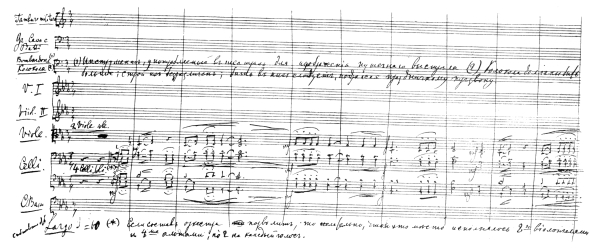
To N. F. von Meck.
“Kamenka, July 3rd (15th), 1881.
“I am very glad, my dear, you like my songs and duets. I will take this opportunity of telling you which of these vocal compositions I care for most. Among the duets I prefer ‘Thränen’ (‘Tears’), and among the songs: (1) the one to Tolstoi’s words, (2) the verses of Mickievicz, and (3) ‘War ich nicht der Halm.’ The ‘Schottische Ballade’ is also one of my favourites, but I am convinced it will never be so popular as I fancied it would. It should not be so much sung, as declaimed, but with the most impassioned feeling.
To P. Jurgenson.
“Kamenka, July 31st (August 12th), 1881.
“I am working intensely hard at Bortniansky to get this dreadful work done as soon as possible. His works as a rule are quite antipathetic to me. I shall finish the job, for I always complete anything I have begun. But some day I shall actually burst with rage....”
To N. F. von Meck.
“Kamenka, August 24th (September 5th), 1881.
“I wish with all my heart you could hear my Serenade properly performed. It loses so much on the piano, and I think the middle movements—played by the violins—would win your sympathy. As regards the first and last movements you are right. They are merely a play of sounds, and do not touch the heart. The first movement is my homage to Mozart; it is intended to be an imitation of his style, and I should be delighted if I thought I had in any way approached my model. Do not laugh, dear, at my zeal in standing up for my latest creation. Perhaps my paternal feelings are so warm because it is the youngest child of my fancy....
“As regards Balakirev’s songs, I am quite of your opinion. They are actually little masterpieces, and I am passionately fond of some of them. There was a time when I could not listen to ‘Selim’s Song’ without tears in my eyes, and now I rank ‘The Song of the Golden Fish’ very highly.”
To S. I. Taneiev.
“August 25th (September 6th), 1881.
“I am almost certain my Vespers will not please you. I see nothing in them which would win your approval. Do you know, Sergei Ivanovich, I believe I shall never write anything good again, I am no longer in a condition to compose. What form should I choose?—none of them appeal to me. Always the same indispensable remplissage, the same routine, the same revolting methods, the same conventions and shams. If I were young, this aversion from composition might be explained by the fact that I was gathering my forces, and would suddenly strike out some new path of my own making. But, alas! the years are beginning to tell. To write in a naïve way, as the bird sings, is no longer possible, and I lack energy to invent something new. I do not tell you this because I hope for your encouraging denial, but simply as a fact. I do not regret it. I have worked much in my time, in a desultory way, and now I am tired. It is time to rest....
“Do not speak to me of coming back to the Conservatoire; at present this is impossible. I cannot answer for the future. You, on the contrary, seem made to carry on Rubinstein’s work.”
XIII 1881-1882
In one of his letters to Nadejda von Meck, written in 1876, Tchaikovsky says: “I no longer compose anything—a sure indication of an agitated mind.”
From November, 1880, until September, 1881, Tchaikovsky wrote nothing—from which we may conclude that during this time he again underwent a period of spiritual and mental disturbance.
It is not surprising that during the time he spent in Moscow and Petersburg (November to February) he should not have written a note. We know that town life—to which was added at this time the anxieties attendant upon the production of two operas—stifled all his inclination for composing. His visit to Rome, with its many social obligations, was also unfavourable to creative work.
That Tchaikovsky continued to be silent even after his return to Kamenka cannot, however, be attributed to unsuitable surroundings or external hindrances. It points rather to a restless and unhappy frame of mind.
There were numerous reasons to account for this condition.
In the first place he was touched to the quick by the loss of Nicholas Rubinstein. In spite of their many differences he had loved him with all his heart, and valued him as “one of the greatest virtuosi of his day.” He had also grown to regard him as one of the chief props of his artistic life. Nicholas Rubinstein was always the first, and best, interpreter of his works for pianoforte and orchestra. Whenever Tchaikovsky wrote a symphonic work, he already heard it in imagination as it would sound in the concert-room in Moscow, and knew beforehand that under Rubinstein’s direction he would experience no disappointment. The great artist had the gift of discovering in Tchaikovsky’s works beauties of which the composer himself was hardly conscious. There was the sonata, for instance, which Tchaikovsky “did not recognise” when he heard it played by N. Rubinstein. And now this sure and subtle interpreter of all his new works was gone for ever.
Apart from personal relations, Rubinstein’s intimate connection with the Conservatoire had its influence upon Tchaikovsky. Although the latter had resigned his position there, he had not ceased to take an interest in the musical life of Moscow. After his friend’s death Tchaikovsky was aware that everyone was waiting for him to decide whether he would take over Rubinstein’s work. To accept this duty meant to abandon his career as a composer. There was no mental conflict, because he never hesitated for a moment in deciding that nothing in the world would make him give up his creative work. At the same time he felt so keenly the helpless position of the Conservatoire that he could not avoid some self-reproach; and thus the calm so needful for composition was constantly disturbed.
Another reason for his sadness was of a more intimate character. After many years of unclouded happiness, a time of severe trial had come to the numerous Davidov family, which was not without its influence upon Tchaikovsky. Kamenka, formerly his refuge from all the tempests of life, was no longer so peaceful a harbour, because his ever-increasing attachment to his sister’s family made him more sensible of their joys and sorrows. At this time the shadows prevailed, for Alexandra Ilinichna was confined to bed by a long and painful illness, which eventually ended in her death.
Finally, Tchaikovsky suffered much at this time from the loss of his faithful servant Alexis Safronov, who had been in his service from 1873 to 1880, when he was called upon to serve his time in the army.
Tchaikovsky spent most of September, 1881, in Moscow, in the society of his brother Anatol. This visit was comparatively agreeable to him, because the greater part of Moscow society had not yet returned from their summer holidays, and he felt free.
He left Moscow on October 1st (13th).
To P. Jurgenson.
“Kamenka, October 8th (20th), 1881.
“I inhabit the large house where my sister’s family used to live, but at present there are no other human beings but myself and the woman who looks after me. I have laid myself out to complete the arrangements of Bortniansky’s works for double chorus in a month. Good Lord, how I loathe Bortniansky! Not himself, poor wretch, but his wishy-washy music! Yet if I had not undertaken this work I should find myself in a bad way financially. Were I to tell you how much money I got through in Moscow, without knowing why or wherefore, you would be horrified and give me a good scolding....”
To P. Jurgenson.
“Kamenka, October 11th (23rd), 1881.
“Dear Friend,—I know you will laugh at me when you read this letter.... There is a young man here of eighteen or nineteen who is very clever and capable, but dislikes his present occupation because his domestic circumstances are miserable, and he longs for a wider sphere and experience of life. He has the reputation of being honest and industrious, and knows something of the book-trade.... Could you make him useful in your publishing house, or in the country? Dear friend, do look after him! What can I do for him? This is ‘my fate’ over again. In any case I shall not abandon him, for I am sure he would come to grief here.
“Laugh if you like, but have compassion and answer me.”[86]
To Nadejda von Meck.
“Kiev, November 9th (21st), 1881.
“Because I am deeply interested in Church music just now, I go to the churches here very frequently, especially to the ‘Lavra.’[87] On Sunday the bishop celebrated services in the monasteries of Michael and the Brotherhood. The singing in these churches is celebrated, but I thought it very poor, and pretentious, with a repertory of commonplace concert pieces. It is quite different in the ‘Lavra,’ where they sing in their own old style, following the traditions of a thousand years, without notes and without any attempts at concert-music. Nevertheless it is an original and grand style of sacred singing. The public think the music of the ‘Lavra’ is bad, and are delighted with the sickly-sweet singing of other churches. This vexes and enrages me. It is difficult to be indifferent to the matter. My efforts to help our church music have been misunderstood. My Liturgy is forbidden. Two months ago the ecclesiastical authorities in Moscow refused to let it be sung at the memorial service for Nicholas Rubinstein. The Archbishop Ambrose pronounced it to be a Catholic service.... The authorities are pig-headed enough to keep every ray of light out of this sphere of darkness and ignorance.
“To-morrow I hope to leave for Rome, where I expect to meet my brother Modeste.”
To N. F. von Meck.
“Rome, November 26th (December 8th), 1881.
“The day before yesterday I was at the concert in honour of Liszt’s seventieth birthday. The programme consisted exclusively of his works. The performance was worse than mediocre. Liszt himself was present. It was touching to witness the ovation which the enthusiastic Italians accorded to the venerable genius, but Liszt’s works leave me cold. They have more poetical intention than actual creative power, more colour than form—in short, in spite of being externally effective, they are lacking in the deeper qualities. Liszt is just the opposite of Schumann, whose vast creative force is not in harmony with his colourless style of expression. At this concert an Italian celebrity played; Sgambati is a very good pianist, but exceedingly cold.”
To N. F. von Meck.
“Rome, November 27th (December 9th), 1881.
“I cannot take your advice to publish my opera with a French title-page. Such advances to foreign nations are repugnant to me. Do not let us go to them, let them rather come to us. If they want our operas then—not the title-page only, but the full text can be translated, as in the case of the proposed performance at Prague. So long as an opera has not crossed the Russian frontier, it is not necessary—to my mind—that it should be translated into the language of those who take no interest in it.”
To N. F. von Meck.
“Rome, December 4th (16th), 1881.
“Yesterday I received sad news from Kamenka. In the neighbourhood lies a little wood, the goal of my daily walk. In the heart of the wood lives a forester with a large and lovable family. I never saw more beautiful children. I was particularly devoted to a little girl of four, who was very shy at first, but afterwards grew so friendly that she would caress me prettily, and chatter delightful nonsense, which was a great pleasure to me. Now my brother-in-law writes that this child and one of the others have died of diphtheria. The remaining children were removed to the village by his orders, but, he adds, ‘I fear it is too late.’ Poor Russia! Everything there is so depressing, and then this terrible scourge which carries off children by the thousand.”
The violin concerto was the only one of Tchaikovsky’s works which received its first performance outside Russia. This exceptional occurrence took place in Vienna. The originality and difficulty of this composition prevented Leopold Auer, to whom it was originally dedicated, from appreciating its true worth, and he declined to produce it in St. Petersburg.[88] Two years passed after its publication, and still no one ventured to play it in public. The first to recognise its importance, and to conquer its difficulties, was Adolf Brodsky. A pupil of Hellmesberger’s, he held a post at the Moscow Conservatoire for a time, but relinquished it in the seventies in order to tour in Europe. For two years he considered the concerto without, as he himself says, being able to summon courage to learn it. Finally, he threw himself into the work with fiery energy, and resolved to try his luck with it in Vienna. Hans Richter expressed a wish to make acquaintance with the new concerto, and finally it was included in the programme of one of the Philharmonic Concerts, December 4th, 1881. According to the critics, and Brodsky’s own account, there was a noisy demonstration at the close of the performance, in which energetic applause mingled with equally forcible protest. The former sentiment prevailed, and Brodsky was recalled three times. From this it is evident that the ill_feeling was not directed against the executant, but against the work. The Press notices were very hostile. Out of ten criticisms, two only spoke quite sympathetically of the concerto. The rest, which emanated from the pens of the best-known musical critics, were extremely slashing. Hanslick, the author of the well-known book, On the Beautiful in Music, passed the following judgment upon this work:—
“Mozart’s youthful work (the Divertimento) would have had a more favourable position had it been played after, instead of before, Tchaikovsky’s Violin Concerto; a drink of cold water is welcome to those who have just swallowed brandy. The violinist, A. Brodsky, was ill_advised to make his first appearance before the Viennese public with this work. The Russian composer, Tchaikovsky, certainly possesses no commonplace talent, but rather one which is forced, and which, labouring after genius, produces results which are tasteless and lacking in discrimination. Such examples as we have heard of his music (with the exception of the flowing and piquant Quartet in D) offer a curious combination of originality and crudeness, of happy ideas and wretched affectations. This is also the case as regards his latest long and pretentious Violin Concerto. For a time it proceeds in a regular fashion, it is musical and not without inspiration, then crudeness gains the upper hand and reigns to the end of the first movement. The violin is no longer played, but rent asunder, beaten black and blue. Whether it is actually possible to give clear effect to these hair-raising difficulties I do not know, but I am sure Herr Brodsky in trying to do so made us suffer martyrdom as well as himself. The Adagio, with its tender Slavonic sadness, calmed and charmed us once more, but it breaks off suddenly, only to be followed by a finale which plunges us into the brutal, deplorable merriment of a Russian holiday carousal. We see savages, vulgar faces, hear coarse oaths and smell fusel-oil. Friedrich Fischer, describing lascivious paintings, once said there were pictures ‘one could see stink.’ Tchaikovsky’s Violin Concerto brings us face to face for the first time with the revolting idea: May there not also be musical compositions which we can hear stink?”
Hanslick’s criticism hurt Tchaikovsky’s feelings very deeply. To his life’s end he never forgot it, and knew it by heart, just as he remembered word for word one of Cui’s criticisms dating from 1866. All the deeper and more intense therefore was his gratitude to Brodsky. This sentiment he expressed in a letter to the artist, and in the dedication of the Concerto he replaced Auer’s name by that of Brodsky.
While Tchaikovsky was touched by Brodsky’s courage in bringing forward the Concerto, he was unable to suppress his sense of injury at the attitude of his intimate friend Kotek, who weakly relinquished his original intention of introducing the work in St. Petersburg. Still more did he resent the conduct of Auer, who, he had reason to believe, not only declined to produce the Concerto himself, but advised Sauret not to play it in the Russian capital.
To N. F. von Meck.
Rome, 1881.
“Do you know what I am writing just now? You will be very much astonished. Do you remember how you once advised me to compose a trio for pianoforte, violin, and violoncello, and my reply, in which I frankly told you that I disliked this combination? Suddenly, in spite of this antipathy, I made up my mind to experiment in this form, which so far I have never attempted. The beginning of the trio is finished. Whether I shall carry it through, whether it will sound well, I do not know, but I should like to bring it to a happy termination. I hope you will believe me, when I say that I have only reconciled myself to the combination of piano and strings in the hope of giving you pleasure by this work. I will not conceal from you that I have had to do some violence to my feelings before I could bring myself to express my musical ideas in a new and unaccustomed form. I wish to conquer all difficulties, however; and the thought of pleasing you impels me and encourages my efforts.”
To N. F. von Meck.
“Rome, December 22nd, 1881 (January 3rd, 1882).
“Things are well with me in the fullest sense of the word.... If everything were well in Russia, and I received good news from home, it would be impossible to conceive a better mode of life. But unhappily it is not so. Our dear, but pitiable, country is passing through a dark hour. A vague sense of unrest and dissatisfaction prevails throughout the land; all seem to be walking at the edge of a volcanic crater, which may break forth at any moment....
“According to my ideas, now or never is the time to turn to the people for counsel and support; to summon us all together and to let us consider in common such ways and means as may strengthen our hands. The Zemsky Sobor—this is what Russia needs. From us the Tsar could learn the truth of things; we could help him to suppress rebellion and make Russia a happy and united country. Perhaps I am a poor politician, and my remarks are very naïve and inconsequential, but whenever I think the matter over, I see no other issue, and cannot understand why the same thought does not occur to him, in whose hands our salvation lies. Katkov, who describes all parliamentary discussions as talkee-talkee, and hates the words popular representation and constitution, confuses the idea of the Zemsky Sobor, which was frequently summoned in old days when the Tsar stood in need of counsel, with the Parliaments and Chambers of Western Europe. A Zemsky Sobor is probably quite opposed to a constitution in the European sense; it is not so much a question of giving us at once a responsible Ministry, and the whole routine of English parliamentary procedure, as of revealing the true state of things, giving the Government the confidence of the people, and showing us some indication of where and how we are being led.
“I had no intention of turning a letter to you into a political dissertation. Forgive me, dear friend, if I have bored you with it. I only meant to tell you the Italian sun is beautiful, and I am enjoying the glory of the South; but I live the life of my country, and cannot be completely at rest here so long as things are not right with us. Nor is the news I receive from my family in Russia very cheerful just now.”
To P Jurgenson.
“Rome, January 4th (16th), 1882.
“This season I have no luck. The Maid of Orleans will not be given again; Oniegin ditto; Auer intrigues against the Violin Concerto; no one plays the Pianoforte Concerto (the second); in short, things are bad. But what makes me furious, and hurts and mortifies me most, is the fact that the Direction, which would not spend a penny upon The Maid of Orleans, has granted 30,000 roubles for the mounting of Rimsky-Korsakov’s Sniegourochka. Is it not equally unpleasant to you to feel that ‘our subject’ has been taken from us, and that Lel will now sing new music to the old words? It is as though someone had forcibly torn away a piece of myself and offered it to the public in a new and brilliant setting. I could cry with mortification.”
To N. F. von Meck.
“Rome, January 13th (25th), 1882.
“The trio is finished.... Now I can say with some conviction that the work is not bad. But I am afraid, having written all my life for the orchestra, and only taken late in life to chamber music, I may have failed to adapt the instrumental combinations to my musical thoughts. In short, I fear I may have arranged music of a symphonic character as a trio, instead of writing directly for my instruments. I have tried to avoid this, but I am not sure whether I have been successful.”