Part IV (continued 3)
Rosa Newmarch translation
But the rhythm appears too often and becomes wearisome.

“The Andante is charming (the middle does not particularly please me). The Scherzo is exquisite, and goes splendidly. The Trio I cannot bear: it sounds like a ballet movement.
“Nicholas Grigorievich (Rubinstein) likes the Finale best, but I do not altogether agree with him. The variations on a folksong do not strike me as very important or interesting.
“In my opinion the Symphony has one defect, to which I shall never be reconciled: in every movement there are phrases which sound like ballet music: the middle section of the Andante, the Trio of the Scherzo, and a kind of march in the Finale. Hearing the Symphony, my inner eye sees involuntarily ‘our prima ballerina,’ which puts me out of humour and spoils my pleasure in the many beauties of the work.
“This is my candid opinion. Perhaps I have expressed it somewhat freely, but do not be hurt. It is not surprising that the Symphony does not entirely please me. Had you not sent Eugene Oniegin at the same time, perhaps it might have satisfied me. It is your own fault. Why have you composed such an opera, which has no parallel in the world? Oniegin has given me such pleasure that I cannot find words to express it. A splendid opera! And yet you say you want to give up composing. You have never done so well. Rejoice that you have attained such perfection, and profit by it.”
Tchaikovsky to Taneiev.
“Clarens, March 27th (April 8th), 1878.
“Dear Serge,—I have read your letter with the greatest pleasure and interest.... You need not be afraid that your criticism of my Fourth Symphony is too severe. You have simply given me your frank opinion, for which I am grateful. I want these kind of opinions, not choruses of praise. At the same time many things in your letter astonished me. I have no idea what you consider ‘ballet music,’ or why you should object to it. Do you regard every melody in a lively dance-rhythm as ‘ballet music’? In that case how can you reconcile yourself to the majority of Beethoven’s symphonies, for in them you will find similar melodies on every page? Or do you mean to say that the Trio of my Scherzo is in the style of Minkus, Gerber, or Pugni? It does not, to my mind, deserve such criticism. I never can understand why ‘ballet music’ should be used as a contemptuous epithet. The music of a ballet is not invariably bad, there are good works of this class—Délibes’ Sylvia, for instance. And when the music is good, what difference does it make whether the Sobiesichanskaya[61] dances to it or not? I can only say that certain portions of my Symphony do not please you because they recall the ballet, not because they are intrinsically bad. You may be right, but I do not see why dance tunes should not be employed episodically in a symphony, even with the avowed intention of giving a touch of coarse, everyday humour. Again I appeal to Beethoven, who frequently had recourse to similar effects. I must add that I have racked my brains in vain to recall in what part of the Allegro you can possibly have discovered ‘ballet music.’ It remains an enigma. With all that you say as to my Symphony having a programme, I am quite in agreement. But I do not see why this should be a mistake. I am far more afraid of the contrary; I do not wish any symphonic work to emanate from me which has nothing to express, and consists merely of harmonies and a purposeless design of rhythms and modulations. Of course, my Symphony is programme music, but it would be impossible to give the programme in words; it would appear ludicrous and only raise a smile. Ought not this to be the case with a symphony which is the most lyrical of all musical forms? Ought it not to express all those things for which words cannot be found, which nevertheless arise in the heart and clamour for expression? Besides, I must tell you that in my simplicity I imagined the plan of my Symphony to be so obvious that everyone would understand its meaning, or at least its leading ideas, without any definite programme. Pray do not imagine I want to swagger before you with profound emotions and lofty ideas. Throughout the work I have made no effort to express any new thought. In reality my work is a reflection of Beethoven’s Fifth Symphony; I have not copied his musical contents, only borrowed the central idea. What kind of a programme has this Fifth Symphony, do you think? Not only has it a programme, but it is so clear that there cannot be the smallest difference of opinion as to what it means. Much the same lies at the root of my Symphony, and if you have failed to grasp it, it simply proves that I am no Beethoven—on which point I have no doubt whatever. Let me add that there is not a single bar in this Fourth Symphony of mine which I have not truly felt, and which is not an echo of my most intimate spiritual life. The only exception occurs perhaps in the middle section of the first movement, in which there are some forced passages, some things which are laboured and artificial. I know you will laugh as you read these lines. You are a sceptic and a mocking-bird. In spite of your great love of music you do not seem to believe that a man can compose from his inner impulses. Wait awhile, you too will join the ranks! Some day, perhaps very soon, you will compose, not because others ask you to do so, but because it is your own desire. Only then will the seed which can bring forth a splendid harvest fall upon the rich soil of your gifted nature. I speak the truth, if somewhat grandiloquently. Meanwhile your fields are waiting for the sower. I will write more about this in my next. There were beautiful details in your score, it only lacks ... but I will not forestall matters. In my next letter I will talk exclusively of yourself.
“There have been great changes in my life since I wrote that I had lost all hope of composing any more. The devil of authorship has awoke in me again in the most unexpected way.
“Please, dear Serge, do not see any shadow of annoyance in my defence of the Symphony; of course I should like you to be pleased with everything I write, but I am quite satisfied with the interest you always show me. You cannot think how delighted I am with your approval of Oniegin. I value your opinion very highly, and the more frankly you express it, the more I feel its worth. And so I cordially thank you, and beg you not to be afraid of over-severity. I want just those stinging criticisms from you. So long as you give me the truth, what does it matter whether it is favourable or not?”
To N. F. von Meck.
“April 1st (13th), 1878.
“ ... It is very early. I slept badly, and after an unsuccessful attempt to doze off again, I got up and came to sit near the window, where I am now writing to you. What a wonderful morning! The sky is absolutely clear. A few little harmless clouds are floating over the mountains on either side the lake. From the garden comes the twitter of innumerable birds. The Dent du Midi is clear of mist, and glitters in the sunlight which catches its snow-clad peaks. The lake is smooth as a mirror. How beautiful it all is! Does it not seem hard that the fine weather should have come just as I am on the point of departure?
“As regards Mozart, let me add these words. You say my worship for him is quite contrary to my musical nature. But perhaps it is just because—being a child of my day—I feel broken and spiritually out of joint, that I find consolation and rest in the music of Mozart, wherein he gives expression to that joy of life which was part of his sane and wholesome temperament, not yet undermined by reflection. It seems to me that an artist’s creative power is something quite apart from his sympathy with this or that great master. For instance, a man may admire Beethoven, and yet by temperament be more akin to Mendelssohn. Could there be a more glaring instance of inconsistency, for instance, than Berlioz the composer and champion of ultra-romanticism in music, and Berlioz the critic and adorer of Glück? Perhaps this is just an example of the attraction which makes extremes meet, and causes a big, strong man to fall in love with a tiny, delicate woman, and vice versâ. Do you know that Chopin did not care for Beethoven, and could hardly bear to hear some of his works? I was told this by a man who knew him personally. At any rate, I will conclude by saying that dissimilarity of temperament between two artists is no hindrance to their mutual sympathy.”
To N. F. von Meek.
“Vienna, April 8th (20th), 1878.
“ ... My next letter will reach you from Russia.
“I was surprised to find the spring so much further advanced in Vienna than at Clarens. The trees there had scarcely begun to show green, while here there is a look of summer already. Vienna is so bright and sunny to-day, it would certainly have made a pleasant impression upon me had I not read the morning papers, which are full of poisonous, malicious, and abominable slanders about Russia. The Neue Freie Presse takes pains to inform its readers that the action of the girl who fired at Trepov has created a revolution in Russia, that the Emperor is in peril, and must flee from the country, etc., etc.
“Now, on the point of taking leave of foreign lands and turning my face homewards, a sound, sane man, full of renewed strength and energy—let me thank you once again, my dear and invaluable friend, for all I owe you, which I can never, never forget.”
To N. F. von Meck.
“Kamenka, April 12th (24th).
“At last we have arrived. The journey was long and tedious and my expectations were disappointed. I had always thought my home-coming would fill me with such sweet and profound sentiments. Nothing of the kind! A tipsy policeman who would hardly let us pass because he could not grasp that the number of passengers on my passport corresponded to the figure on his own; an officer of customs who demanded duty to the amount of fourteen gold roubles upon a dress I had bought for my sister for seventy francs; a conversation with a very importunate gentleman, bent on convincing me that the policy of England was the most humane in the world; the crowd of dirty Jews with their accompanying odours; the numbers of young conscripts who travelled in our train, and the farewell scenes with their wives and mothers at every station—all these things spoilt my pleasure in returning to my beloved native land. At Shmerinka we had to wait a few hours; unfortunately, as it was night, I could not see Brailov,[62] although I knew in which direction to look for it.... As my sister’s house is rather crowded, she has taken a nice, quiet room near at hand for me. I have also a garden, well stocked with flowers, which will soon begin to exhale their lovely perfumes. My little home is very cosy and comfortable. There is even a piano in the tiny parlour next to my bedroom. I shall be able to work undisturbed.
“ ... How glad I am, dear Nadejda Filaretovna, that you take such a just and sensible view of the agitating events which have been taking place in Petersburg and Moscow! I did not expect you to think differently, although I feared lest your pity for Sassoulich personally—in any case a very diluted and involuntary sympathy—might possibly have influenced your opinion. It is one thing, however, to feel sorry for her, and to detest the arrogant and brutal conduct of the arbitrary Prefect of Petersburg, and quite another thing to approve of that display of unpatriotic sentiment by which her acquittal has been signalised, and with the Moscow riots. It seems to me that both these events are most disquieting at the present moment, and I am exceedingly glad that the Russian lower classes have shown the crazy leaders of our younger generation how little their orders are in accord with sound sense and the spirit of the nation. I am glad to feel once again that, in spite of a few differences as to details, we are in agreement on most important matters.”
A few days after receiving this letter, N. F. von Meck invited Tchaikovsky to spend some weeks in the restful solitude of her estate at Brailov. “Of course she herself will not be there,” he wrote to his brother on April 27th (May 9th). “I am delighted to accept her invitation.” Meanwhile his days at Kamenka were fully occupied, as may be seen from the following extract from a letter to Nadejda von Meck, dated April 30th, 1878:—
“I am working very hard. The sonata is already finished, as are also twelve pieces—of moderate difficulty—for pianoforte. Of course all this is only sketched out. To-morrow I shall begin a collection of miniature pieces for children. I thought long ago it would not be a bad thing to do all in my power to enrich the children’s musical literature, which is rather scanty. I want to write a whole series of perfectly easy pieces, and to find titles for them which would interest children, as Schumann has done. I have planned songs and violin pieces for later on, and then, if the favourable mood lasts long enough, I want to do something in the way of Church music. A vast and almost untrodden field of activity lies open to composers here. I appreciate certain merits in Bortniansky, Berezovsky, and others; but how little their music is in keeping with the Byzantine architecture, the ikons, and the whole spirit of the Orthodox liturgy! Perhaps you are aware that the Imperial Chapels have the monopoly of Church music, and that it is forbidden to print, or to sing in church, any sacred compositions which are not included in the published collections of these Chapels. Moreover, they guard this monopoly very jealously, and will not permit new settings of any portions of the liturgy under any circumstances whatever. My publisher, Jurgenson, has discovered a way of evading this curious prohibition, and if I write anything of this kind, he will publish it abroad. It is not improbable that I shall decide to set the entire liturgy of St. John Chrysostom. I shall arrange all this by July. I intend to rest absolutely during the whole of that month, and to start upon some important work in August. I should like to write an opera. Turning over books in my sister’s library, I came upon Joukovsky’s Undine, and re-read the tale which I loved as a child. In 1869 I wrote an opera on this subject, and submitted it to the Opera Direction. It was rejected. Although at the time I thought this very unjust, yet afterwards I became disillusioned with my own work, and was very glad it had not had the chance of being damned. Now I am again attracted to the subject.”
To N. F. von Meck.
“Kiev, May 14th (26th), 1878.
“My telegram to-day, sent from Kiev, must have astonished you, dear friend. I left quite suddenly, as my sister had to come here sooner than she expected.... I could not wait at Kamenka for your letter containing directions for my journey to Brailov; but, in any case, I shall leave here on Tuesday, and arrive at Shmerinka at 7 a.m. on Wednesday.”
To Modeste Tchaikovsky.
“Brailov, May 17th (29th), 1878.
“Seated in the carriage, after you left me, of course I dissolved in tears. The recollection of our meeting in Milan came back to me. How jolly it was! The journey to Genoa and afterwards! How beautiful it all seemed to me—and it was nearly six months ago! Here followed a fresh burst of tears.
“One of my fellow-travellers, who seemed to know this neighbourhood, told us that Brailov belonged to the banker Meck, had cost three million roubles, and brought the owner a yearly income of 700,000 roubles, and other nonsense. I was very much excited on the journey. In the waiting-room at Shmerinka I was greeted by the same waiter—you remember him—who served our supper; I told him to inquire whether any horses had been sent from Brailov. Two minutes later Marcel appeared. He is not a Frenchman, but a native. He was very attentive and amiable. His coat and hat were infinitely superior to mine, so that I felt quite embarrassed as I took my seat in the luxuriously appointed carriage, while he mounted the box beside the coachman. The house is really a palace. At Marcel’s invitation I entered the dining-room, where a huge silver samovar steamed on the table, together with a coffee-pot upon a spirit-lamp, cups of rare china, eggs, butter, etc. I observed that Marcel had received his instructions; he did not attempt to converse, nor to stand behind my chair, but just served what was necessary and went away. He inquired how I desired to arrange my day. I ordered my midday meal at one o’clock, tea at nine, and a cold supper. After coffee I explored the house, which contains a series of separate suites of rooms. A large wing, built in stone for the accommodation of guests, is arranged like a kind of hotel; a long corridor with rooms on each side, which are always kept exactly as though they were inhabited. The first floor, which I occupy, is furnished with the utmost comfort. There are many bookcases containing very interesting illustrated publications. In the music-room, a grand piano, a very fine harmonium, and plenty of music. In Nadejda Filaretovna’s study there are a few pictures. At one o’clock I had dinner, a very exquisite, but rather slight, repast. The Zakouska (hors d’œuvre) excellent, the wine ditto. After dinner I looked through the music and strolled in the garden. At four o’clock I ordered the carriage and took a drive. The neighbourhood of Brailov is not very pretty. There is no view from the windows. The garden is extensive and well stocked, especially with lilacs and roses, but it is not picturesque, nor sufficiently shady. On the whole I like the house best....”
To N. F. von Meck.
“Brailov, May 18th (30th), 1878.
“How lovely, how free, it is in your country home! The sun has set, and over the wide fields in front of the main entrance the heat is already giving way to the cool evening breeze. The lilacs scent the air, and the cockchafers break the stillness with their bass note. The nightingale is singing in the distance. How glorious it is!”
To N. F. von Meck.
“Brailov, May 21st (June 2nd), 1878.
“My life at Brailov flows tranquilly on. In the early morning after coffee I stroll in the garden, and then slip out through the little wooden door in the wall near the stable, and, jumping the ditch, find myself in the old, forsaken garden of the monastery, where the monks used to wander of old, but which is now tenanted by all kinds of birds. Not infrequently the oriole and the nightingale are seen there. This garden is apparently deserted, for the paths are so overgrown and the greenery so fresh that one could fancy oneself in the heart of the forest. First I wander through it, then sit down in a shady place for an hour or so. Such moments of solitude amid the flowers and green branches are incomparable; then I can watch every form of organic life which manifests itself silently, without a sound, yet speaks more forcibly of the illimitable and the eternal than the rumbling of bridges and all the turmoil of the streets. In one of your letters you say I shall not find a Gorge de Chaudière at Brailov. I do not want it! Such places satisfy one’s curiosity rather than one’s heart and imagination; one sees more English tourists than birds and flowers; they bring more fatigue than enjoyment.
“After my walk I work at the violin pieces, one of which is quite finished. If I am not mistaken, it will please you, although the accompaniment is rather difficult in places, and this, I fear, will make you angry.
“Punctually at 1 p.m. Marcel summons me to the dining-room, where, in the middle of the elegantly appointed table, two big bouquets are arranged, which give me fresh cause for delight. Then follows a real Balthazar’s feast. Each time I feel a little ashamed to sit down alone to such a liberal and sumptuous table.
“After dinner I walk in the garden, read, or write letters until 4.30, when I go for a drive.
“Yesterday the rain prevented me from taking my usual constitutional in the meadows facing the house. At sunset I like a more open space, and these meadows enclosed by trees, lilac bushes, and the stream, offer a charming evening walk.
“Then I generally spend half an hour at your splendid harmonium. I like to observe all its curious acoustic properties, which are called aliquot tones. No doubt you have observed that when you play chords on the organ, besides the sound which comes from the notes struck, another sound is heard in the bass, which sometimes harmonises with the chord and sometimes results in a harsh discord. Occasionally the most curious combinations are produced. This is what I discovered yesterday.

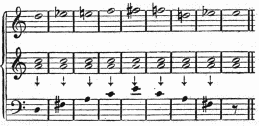
Try this acoustic experiment by drawing out register No. 1, that is to say Flute and Cor Anglais. D and F sharp, A and C are perfectly in tune, but the E sounds rather sharp.
“At 9 p.m. the second Balthazar’s feast takes place. Then I play and make myself acquainted with your musical library. Yesterday I played through a serenade for strings by Volkmann with great pleasure. A sympathetic composer. He has many simple and natural charms.
“Do you know that Volkmann is quite an old man and lives in the greatest poverty at Pesth? Once the musicians in Moscow got up a small fund for him, amounting to 300 roubles, in gratitude for which he dedicated his Second Symphony to the Moscow Musical Society. I never could discover why he was so poor.
“At 11 p.m. I go to my room and undress. Marcel, the good-natured soldier-porter, and Alexis go to bed. I am left alone to read, dream, or recall the past; to think of those near and dear to me; to open the window and gaze out on the stars; to listen to the sounds of night; and finally—to go to bed.
“A wonderful life! Like a vision, a dream! Kind and beloved Nadejda Filaretovna, how grateful I am to you for everything! Sometimes my sense of gratitude is so keen I feel I must proclaim it aloud.”
To N. F. von Meck.
“Brailov, May 23rd (June 4th), 1878.
“As I walked through the woods yesterday I found a quantity of mushrooms. Mushrooming is my greatest delight in summer. The moment in which one first sees a plump, white mushroom is simply fascinating! Passionate card-lovers may experience the same feeling when they see the ace of trumps in their hand. All night long I dreamed of large, fat, pink mushrooms. When I awoke I reflected that these mushroomy dreams were very childish. And, in truth, one would become a child again if one lived long all alone with Nature. One would become far more receptive to the simple, artless joys which she offers us.
“Do you know what I am preoccupied with at present? When I was sitting alone one evening at Kiev, while my sister and Modeste had gone to the theatre to see Rossi in Romeo and Juliet, I read the play through once more. Immediately I was possessed with the idea of composing an opera on the subject. The existing operas of Bellini and Gounod do not frighten me. In both of them Shakespeare is mutilated and distorted until he is hardly recognisable. Do you not think that this great work of the arch-genius is well adapted to inspire a musician? I have already talked it over with Modeste; but he shrank from the magnitude of the task. Nothing venture, nothing have. I shall think over the plan of this opera and throw all my energies into the work for which I am reserving them.”
To Modeste Tchaikovsky.
“Brailov, May 25th (June 6th), 1878.
“Modi, ever since I re-read Romeo and Juliet, Undine, Berthalde, Gulbrand, and the rest seem to me a pack of childish nonsense. Of course, I shall compose an opera on Romeo and Juliet. All your objections will vanish before the vast enthusiasm which possesses me. It shall be my finest work. It seems absurd that I have only just found out that fate has to some extent ordained me for this task. Nothing could be better suited to my musical temperament. No kings, no marches—in a word, none of the usual accessories of Grand Opera. Nothing but love, love, love. And then how delightful are the minor characters: Friar Lawrence, Tybalt, Mercutio! You need not be afraid of monotony. The first love duet will be very different from the second. In the first, brightness and serenity; in the second, a tragic element. From children, happily and carelessly in love, Romeo and Juliet have become passionate and suffering beings, placed in a tragic and inextricable dilemma. How I long to get to work on it!”
To Modeste Tchaikovsky.
“Brailov, May 27th (June 8th), 1878.
“Yesterday I played the whole of Eugene Oniegin, from beginning to end. The author was the sole listener. I am half ashamed of what I am going to confide to you in secret: the listener was moved to tears, and paid the composer a thousand compliments. If only the audiences of the future will feel towards this music as the composer himself does!”
To N. F. von Meck.
“Brailov, May 29th (June 10th), 1878.
“I am spending my last days here. I need hardly tell you why I cannot accept your hospitality any longer, although I might remain until June 10th (22nd). I have spent many unforgettable days here; I have experienced the purest and most tranquil enjoyment. I have drunk in the beauties and sympathetic surroundings of Brailov, so that my visit will remain one of the most beautiful memories of my life. I thank you. Nevertheless it is time I went away.”
To N. F. von Meck.
“Brailov, May 30th (June 11th), 1878.
“I have given my pieces (which are dedicated to Brailov) to Marcel, so that he may deliver them to you. The first is the best, I think, but also the most difficult; it is called Meditation. The second is a very quick Scherzo, and the third a ‘Chant sans Paroles.’ It was very hard to part with them to Marcel. Just recently I had started copying them! Then the lilacs were still in full bloom, the grass uncut, and the roses had hardly begun to bud!”
VIII
To N. F. Meck.
“Village of Nizi, June 6th (18th) 1878.
“Forgive me, my friend, for not having written to you from Petersburg. In the first place, I was afraid my letter might not reach you in time, and secondly, you cannot imagine what a hell my three days’ sojourn in Moscow proved to be. They seemed more like three centuries. I experienced the same joy when I found myself in the train once more that I might have felt on being released from a narrow prison cell. I have come here in answer to the invitation of a hospitable old friend, Kondratiev, whom I formerly used to visit almost every summer. Here I composed Vakoula and many other works.”
To N. F. von Meck.
“Kamenka, June 24th (July 6th), 1878.
“You want to know my methods of composing? Do you know, dear friend, that it is very difficult to give a satisfactory answer to your question, because the circumstances under which a new work comes into the world vary considerably in each case.
“First, I must divide my works into two categories, for this is important in trying to explain my methods.
“(1) Works which I compose on my own initiative—that is to say, from an invincible inward impulse.
“(2) Works which are inspired by external circumstances: the wish of a friend, or a publisher, and commissioned works.
“Here I should add experience has taught me that the intrinsic value of a work has nothing to do with its place in one or the other of these categories. It frequently happens that a composition which owes its existence to external influences proves very successful; while one that proceeds entirely from my own initiative may, for various indirect reasons, turn out far less well. These indirect circumstances, upon which depends the mood in which a work is written, are of the very greatest importance. During the actual time of creative activity complete quiet is absolutely necessary to the artist. In this sense every work of art, even a musical composition, is objective. Those who imagine that a creative artist can—through the medium of his art—express his feelings at the moment when he is moved, make the greatest mistake. Emotions—sad or joyful—can only be expressed retrospectively, so to speak. Without any special reason for rejoicing, I may be moved by the most cheerful creative mood, and, vice versâ, a work composed under the happiest surroundings may be touched with dark and gloomy colours.
“In a word, an artist lives a double life: an everyday human life, and an artistic life, and the two do not always go hand in hand.
“In any case, it is absolutely necessary for a composer to shake off all the cares of daily existence, at least for a time, and give himself up entirely to his art-life.
“Works belonging to the first category do not require the least effort of will. It is only necessary to obey our inward promptings, and if our material life does not crush our artistic life under its weight of depressing circumstances, the work progresses with inconceivable rapidity. Everything else is forgotten, the soul throbs with an incomprehensible and indescribable excitement, so that, almost before we can follow this swift flight of inspiration, time passes literally unreckoned and unobserved.
“There is something somnambulistic about this condition. On ne s’entend pas vivre. It is impossible to describe such moments. Everything that flows from one’s pen, or merely passes through one’s brain (for such moments often come at a time when writing is an impossibility) under these circumstances is invariably good, and if no external obstacle comes to hinder the creative glow, the result will be an artist’s best and most perfect work. Unfortunately such external hindrances are inevitable. A duty has to be performed, dinner is announced, a letter arrives, and so on. This is the reason why there exist so few compositions which are of equal quality throughout. Hence the joins, patches, inequalities and discrepancies.
“For the works in my second category it is necessary to get into the mood. To do so we are often obliged to fight with indolence and disinclination. Besides this, there are many other fortuitous circumstances. Sometimes the victory is easily gained. At other times inspiration eludes us, and cannot be recaptured. I consider it, however, the duty of an artist not to be conquered by circumstances. He must not wait. Inspiration is a guest who does not care to visit those who are indolent. The reproaches heaped upon the Russian nation because of its deficiency in original works of art are not without foundation, for the Russians are lazy. A Russian is always glad to procrastinate: he is gifted by nature, but at the same time nature has withheld from him the power of will. A man must learn to conquer himself, lest he should degenerate into dilettantism, from which even so colossal a talent as Glinka’s was not free. This man, endowed with an extraordinary and special creative talent, achieved astonishingly little, although he attained a fairly ripe age. Read his Memoirs. You will see that he worked like a dilettante—on and off, when he was in the mood. However proud we may be of Glinka, we must acknowledge that he did not entirely fulfil his task, if we take into consideration the magnitude of his gifts. Both his operas, in spite of their astonishing and original beauty, suffer from glaring inequalities of style. Side by side with touches of genius and passages of imperishable beauty we find childish and weak numbers. What might not Glinka have accomplished had he lived amid different surroundings, had he worked like an artist who, fully alive to his power and his duty, develops his gifts to the ultimate limit of perfection, rather than as an amateur who makes music his pastime!
“I have explained that I compose either from an inward impulse, winged by a lofty and undefinable inspiration, or I simply work, invoking all my powers, which sometimes answer and sometimes remain deaf to my invocation. In the latter case the work created will always remain the mere product of labour, without any glow of genuine musical feeling.
“I hope you will not think I am boasting, if I say that my appeal to inspiration is very rarely in vain. In other words, that power which I have already described as a capricious guest has long since become fast friends with me, so that we are inseparable, and it only deserts me when my material existence is beset by untoward circumstances and its presence is of no avail. Under normal conditions I may say there is no hour of the day in which I cannot compose. Sometimes I observe with curiosity that uninterrupted activity, which—independent of the subject of any conversation I may be carrying on—continues its course in that department of my brain which is devoted to music. Sometimes it takes a preparatory form—that is, the consideration of all details that concern the elaboration of some projected work; another time it may be an entirely new and independent musical idea, and I make an effort to hold it fast in my memory. Whence does it come? It is an inscrutable mystery.
“Now I will try to describe my actual procedure in composition. But not until after dinner. Au revoir. If you only knew how difficult, yet at the same time how pleasant it is to talk to you about all this!
“Two o’clock.
“I usually write my sketches on the first piece of paper to hand. I jot them down in the most abbreviated form. A melody never stands alone, but invariably with the harmonies which belong to it. These two elements of music, together with the rhythm, must never be separated; every melodic idea brings its own inevitable harmony and its suitable rhythm. If the harmony is very intricate, I set down in the sketch a few details as to the working out of the parts; when the harmony is quite simple, I only put in the bass, or a figured bass, and sometimes not even this. If the sketch is intended for an orchestral work, the ideas appear ready-coloured by some special instrumental combination. The original plan of instrumentation often undergoes some modifications.
“The text must never be written after the music, for if music is written to given words only, these words invoke a suitable musical expression. It is quite possible to fit words to a short melody, but in treating a serious work such adaptation is not permissible. It is equally impossible to compose a symphonic work and afterwards to attach to it a programme, since every episode of the chosen programme should evoke its corresponding musical presentment. This stage of composition—the sketch—is remarkably pleasant and interesting. It brings an indescribable delight, accompanied, however, by a kind of unrest and nervous agitation. Sleep is disturbed and meals forgotten. Nevertheless, the development of the project proceeds tranquilly. The instrumentation of a work which is completely thought out and matured is a most enjoyable task.
“The same does not apply to the bare sketch of a work for pianoforte or voice, or little pieces in general, which are sometimes very tiresome. Just now I am occupied with this kind of work. You ask: do I confine myself to established forms? Yes, and no. Some compositions imply the use of traditional forms; but only as regards their general features—the sequence of the various movements. The details permit of considerable freedom of treatment, if the development of the ideas require it. For example, the first movement of our Symphony is written in a very informal style. The second subject, which ought, properly speaking, to be in the major, is in a somewhat remote minor key. In the recapitulation of the principal part the second subject is entirely left out, etc. In the finale, too, there are many deviations from traditional form. In vocal music, in which everything depends on the text, and in fantasias (like The Tempest and Francesca) the form is quite free. You ask me about melodies built upon the notes of the harmony. I can assure you, and prove it by many examples, that it is quite possible, by means of rhythm and the transposition of these notes, to evolve millions of new and beautiful melodic combinations. But this only applies to homophonic music. With polyphonic music such a method of building up a melody would interfere with the independence of the parts. In the music of Beethoven, Weber, Mendelssohn, Schumann, and especially Wagner, we frequently find melodies which consist of the notes of the common chord; a gifted musician will always be able to invent a new and interesting fanfare. Do you remember the beautiful Sword-motive in the Nibelungen?

“I am very fond of a melody by Verdi (a very gifted man):

“How glorious and how fresh the chief theme of the first movement of Rubinstein’s Ocean symphony:

“If I racked my brains a little, I should find countless examples to support my assertion. Talent is the sole secret. It knows no limitations: it creates the most beautiful music out of nothing. Could there be anything more trivial than the following melody?
Beethoven, Seventh Symphony:

or Glinka, Jota aragonesa:
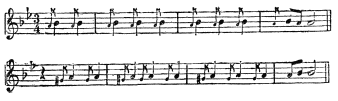
“And yet what splendid musical structures Beethoven and Glinka have raised on these themes!”
To N. F. von Meck.
“Kamenka, June 25th (July 7th), 1878.
“Yesterday, when I wrote to you about my methods of composing, I did not sufficiently enter into that phase of work which relates to the working out of the sketch. This phase is of primary importance. What has been set down in a moment of ardour must now be critically examined, improved, extended, or condensed, as the form requires. Sometimes one must do oneself violence, must sternly and pitilessly take part against oneself, before one can mercilessly erase things thought out with love and enthusiasm. I cannot complain of poverty of imagination, or lack of inventive power; but, on the other hand, I have always suffered from my want of skill in the management of form. Only after strenuous labour have I at last succeeded in making the form of my compositions correspond, more or less, with their contents. Formerly I was careless and did not give sufficient attention to the critical overhauling of my sketches. Consequently my seams showed, and there was no organic union between my individual episodes. This was a very serious defect, and I only improved gradually as time went on; but the form of my works will never be exemplary, because, although I can modify, I cannot radically alter the essential qualities of my musical temperament. But I am far from believing that my gifts have yet reached their ultimate development. I can affirm with joy that I make continual progress on the way of self-development, and am passionately desirous of attaining the highest degree of perfection of which my talents are capable. Therefore I expressed myself badly when I told you yesterday that I transcribed my works direct from the first sketches. The process is something more than copying; it is actually a critical examination, leading to corrections, occasional additions, and frequent curtailments.
“In your letter you express a wish to see my sketches. Will you accept the original sketch for my opera Eugene Oniegin? As the pianoforte score will be published in the autumn, it might interest you to compare the autograph sketches with the completed work. If so, I will send you the manuscript as soon as I return to Moscow. I suggest Oniegin because none of my works has been written with such fluency; therefore the manuscript is easy to read, as it contains few corrections.”
To N. F. von Meck.
“Verbovka, July 4th (16th), 1878.
“ ... My work progresses slowly. The sonata is finished, however, and to-day I have begun to write out some songs, composed partly abroad and partly at Kamenka, in April. I have heard from Jurgenson that four great Russian concerts, conducted by N. Rubinstein, are to take place in Paris. My Pianoforte Concerto, The Tempest, Francesca, and two movements from our Symphony are to be given. I will let you have further particulars, in case you care to time your visit to Paris so that it coincides with the concerts. Among those engaged to take part in them is Lavrovsky.”
To N. F. von Meck.
“July 25th (August 6th), 1878.
“I write to you, dear friend, with a light heart, happy in the consciousness of having finished a work (the Liturgy).... People who go to work in feverish haste (like myself) are really the laziest folk. They get through their work as fast as possible in order to enjoy idleness. Now I can indulge to the full my secret delight in doing nothing.”
To P. I. Jurgenson.
“Verbovka, July 29th (August 10th), 1878.
“Dear Friend,—My manuscripts will have been taken to you. You will find plenty of material for your engravers. I send you five pieces, and besides these I shall shortly despatch three pieces for violin.
“I should like to receive the following fees:—[63]
£s.d.
“1.Sonata (50 roubles)500
2.Twelve pieces (at 25 roubles each)3000
3.The Children’s Album (240 roubles)2400
4.Six songs (at 25 roubles)1500
5.Violin pieces (at 25 roubles each)7100
6.The Liturgy1000
91 10 0
“In a round sum 900 roubles; but having regard to the fact that I have written such a quantity at once, I will let you have the lot for 800 roubles.”
To N. F. von Meck.
“August 4th (16th), 1878.
“With my usual habit of worrying and upsetting myself about things, I am now troubled because I did not get to Brailov in time—immediately after your departure. I am afraid this may have caused some inconvenience to your servants. But what could I do? I wish someone could explain to me the origin of that curious exhaustion which comes upon me almost every evening, about which I have already written to you. I cannot say it is altogether disagreeable, because it usually ends in a heavy, almost lethargic sleep, and such repose is bliss. Nevertheless the attacks are tiresome and unpleasant, because of the vague anxiety, the undefinable yearning, which take an inconceivably strong hold upon my spirit, and end in a positive longing for Nirvana—la soif du néant. Probably the cause of this psychological phenomenon is of quite a prosaic nature; I think it is not so much a mental ailment as a result of bad digestion, a sequel of my catarrh of the stomach. Unluckily we cannot get over the fact that the material influences the spiritual! Too often, alas! a pickled gherkin too much has played the most important part in the highest functions of the human intellect. Forgive me, dear friend, for boring you with these continual complaints about my health, which are out of place, for in reality I am a perfectly sound man, and the little ailments about which I grumble are not serious. I only want repose, and I shall certainly find it in Brailov. Good Lord! how I long for the dear house and the dear neighbourhood!”
To N. F. von Meck.
“Brailov, August 14th (26th), 1878.
“I have brought a great many interesting books with me, among them Histoire de ma vie, by George Sand. The book is rather carelessly written—without logical sequence, like a clever gossip relating his own reminiscences, but with many digressions. But it has much sincerity, a complete absence of pose, and remarkably clever portraiture of the people among whom she moved in her youth. Your library, too, contains many books I cannot put down when I have once opened them. Among these is a superb edition of de Musset, one of my favourite authors. To-day, looking through this volume, I became so absorbed in Andrea del Sarto that—seated upon the floor—I was compelled to read the whole work to the end. I am passionately fond of all de Musset’s dramatic works. How often have I thought of using one of his comedies or plays as an opera libretto! Unfortunately they are all too French, and not to be thought of in a translation; for instance, Le Chandelier, or On ne badine pas avec l’amour. Some, less local in character, are lacking in dramatic movement, such as Lorenzaccio, or Andrea del Sarto. Others, again, contain too much philosophising, like Les caprices de Marianne.
“I cannot understand why French composers have hitherto neglected this rich source of inspiration.”
To N. F. von Meck.
“Brailov, August 16th (28th), 1878.
“I return once more to Alfred de Musset. You must read his Proverbes Dramatiques from end to end. I recommend you especially Les caprices de Marianne, On ne badine pas avec l’amour, and Le Chandelier. Do not these things cry aloud for music? What thought! what wit! How profoundly felt and fascinating in their elegance! Yet in reading his works we feel that all is written with a light hand, not for the sake of the ideas; that is, we never feel that these ideas have been forcibly obtruded upon the artistic material, thereby paralysing the free development of the characters and situations. Then I delight in his truly Shakespearean anachronisms: for instance, when an imaginary King of Bavaria discusses the art of Grisi with some fantastic Duke of Mantua. Like Shakespeare, de Musset does not keep to the verities of place, yet all the same we find among his characters, as among those of Shakespeare, many of those universal human presentments who, independent of time and locality, belong to the eternal truth. Only with de Musset the frame is narrower and the flight less lofty. Nevertheless, no other dramatic writer approaches Shakespeare so closely. Les Caprices de Marianne has made a peculiarly strong impression upon me, and I have thought of nothing else all day long but the possibility of turning it into an opera. I feel the necessity of considering a libretto. My enthusiasm for Undine has cooled. I am still captivated by Romeo and Juliet, but—first it is very difficult, and secondly, I am rather frightened of Gounod, who has already written a mediocre opera on this subject.”
To N. F. Von Meck.
“Verbovka, August 25th (September 6th), 1878.
“ ... I have already told you that at Brailov I jotted down the sketch of a scherzo for orchestra. Afterwards the idea came to me of composing a series of orchestral pieces out of which I could put together a Suite, in the style of Lachner. Arrived at Verbovka, I felt I could not restrain my impulse, and hastened to work out on paper my sketches for this Suite. I worked at it with such delight and enthusiasm that I literally lost count of time. At the present moment three movements are finished, the fourth is sketched out, and the fifth sits waiting in my head.... The Suite will consist of five movements: (1) Introduction and Fugue, (2) Scherzo, (3) Andante, (4) Intermezzo (Echo du bal), (5) Rondo. While engaged upon this work my thoughts were perpetually with you; every moment I asked myself if such and such passages would please, or such and such melodies touch you? Therefore my new work can only be dedicated to my best friend.
“To-morrow I travel straight to Petersburg to see my father and Anatol again, and shall remain there two or three days. Then I go to Moscow. I look to the future with a little apprehension, a little sadness, and a trifle of disgust.”
To Modeste Tchaikovsky.
“Kiev, August 29th (September 10th), 1878.
“In to-day’s paper (the Novoe Vremya) I found an article containing a mean, base and vulgar attack upon the Moscow Conservatoire. Very little is said about me personally; it simply states that I occupy myself exclusively with music and take no part in the intrigues.
“Going along in the train, with this paper in my hand, I resolved to resign my professorship. I should have done so immediately, and not returned to Moscow at all, if my rooms had not been already engaged, and if I had not been definitely expected at the Conservatoire. I have made up my mind to wait until December, then I will go to Kamenka for the holidays and write from there that I am indisposed. Of course I shall give private information of my intentions to Rubinstein, so that he may have time to engage another professor. So vive la liberté, and especially Nadejda Filaretovna! There is no doubt whatever that she will approve of my decision—consequently I shall be able to lead a glorious, wandering life, sometimes in Kamenka, sometimes in Verbovka, sometimes in Petersburg or abroad....
“For God’s sake go on with your novel! Work is the sole cure for les misères de la vie humaine. Besides, it gives you independence.
“You will say you have no time for writing because you are occupied all day with Kolya. All the same, I repeat: Write, write, write! I might offer myself as an example. I used to have six hours’ exhausting teaching at the Conservatoire, besides living with Rubinstein—whose ways hindered me exceedingly—in a house next door to the Conservatoire, whence was borne the sound of unceasing scales and exercises which made it difficult to compose. Your occupations with Kolya may be somewhat heavier than my theory classes, but still I say, Write! Meanwhile I embrace you, dear Modi! What does anything matter when people love as I love you and you love me (forgive my self-assurance)!”