Part VII (continued 4)
Rosa Newmarch translation
The words Tchaikovsky addressed to Jurgenson with reference to the Third Suite—“If all my best works were published in this style I might depart in peace”—offer some justification for my simile.
In the autumn of 1892 he undertook the entire correction of the orchestral parts of Iolanthe and the Nut-cracker Ballet; the improvements and corrections of the pianoforte arrangement (two hands) of Iolanthe; the corrections of the pianoforte score of the Opera and Ballet, and a simplified pianoforte arrangement of the latter.
Tchaikovsky so often speaks in his letters of his dislike to this kind of work that he must have needed extraordinary self-abnegation to take this heavy burden upon his shoulders.
As with the spirits in Dante’s Inferno, the dread of their torments by the will of divine justice “si volge in disio,”[183] so the energy with which Tchaikovsky attacked his task turned to a morbid, passionate excitement. “Corrections, corrections! More, more! For Heaven’s sake, corrections!” he cries in his letters to Jurgenson, so that the casual reader might take for an intense desire that which was, in reality, only a worry to him, as the following letter shows.
To S. Taneiev.
“Klin, July 13th (25th), 1892.
“Just now I am busy looking through the pianoforte score of Iolanthe. It bothers and annoys me indescribably. Before I went abroad in May I had sketched the first movement and finale of a Symphony. Abroad it did not progress in the least, and now I have no time for it.”
To Anna Merkling.
“Klin, July 17th (29th), 1892.
“Dearest Anna,—I have received your letter with the little additional note from dear Katy.[184] What extraordinary people you are! How can you imagine it would be a great pleasure for you if I were to come on a visit? If I were cheerful and pleasant company that would be a different matter. But I am no use for conversational purposes, and am often out of spirits, nor have I any resources in myself. I cannot help thinking that if I came you might afterwards say to yourselves: ‘This old fool, we awaited him with such impatience, and he is not a bit nice after all!’ Anna, I really do want to come to the Oboukhovs’, but I cannot positively say ‘yes’ at present.... It will be sad to part from Bob, who is dearer to me than ever, since we have been inseparable companions for the last six weeks.”
To Modeste Tchaikovsky.
“Klin, July 17th (29th), 1892.
“ ... I am sorry your comedy is ineffective and not suitable for the stage. Why do you think so? Authors are never good judges of their own work. Flaubert’s letters—which I enjoy very much at present—are very curious in this respect. I think there is no more sympathetic personality in all the world of literature. A hero and martyr to his art. And so wise! I have found some astonishing answers to my questionings as to God and religion in his book.”
At the end of July Russian art suffered a great loss in the death of the connoisseur and wealthy patron, S. M. Tretiakov, who had been Nicholas Rubinstein’s right hand in the founding of the Moscow Conservatoire. To Tchaikovsky, Tretiakov’s somewhat sudden end came as a severe blow, and he immediately travelled to Moscow to be present at the funeral of his friend.
A pleasanter incident during this summer of hard work came in the form of an invitation to conduct a concert at the Vienna Exhibition. “It is an advantage,” he wrote to his brother Modeste, “because so far—on account of Hanslick—Vienna has been hostile to me. I should like to overcome this unfriendly opinion.”
At last, at the very end of August, the vast accumulation of proof-correcting was finished, which, as he himself said, would have almost driven him out of his mind, but for his regular and healthy way of life. “Even in dreams,” he wrote to Vladimir Davidov, “I see corrections, and flats and sharps that refuse to do what they are ordered.... I should like to see you at Verbovka after Vienna, but Sophie Menter, who is coming to my concert there, has given me a pressing invitation to her castle. Three times already I have broken my promise to go to Itter. I am really interested to see this ‘marvel,’ as everyone calls the castle.”
In the course of this year, at the suggestion of the Grand Duke Constantine Constantinovich, President of the Academy of Sciences, Tchaikovsky was invited by the academician Y. K. Grote to contribute to the new Dictionary of the Russian Language, then appearing in a second edition. Tchaikovsky’s duties were limited to the superintendence of musical words, but he was flattered by his connection with such an important scientific work.
XVI 1892-1893
Tchaikovsky never travelled so much as during the foregoing season. It is true he was always fond of moving about. He could not remain long in one spot; but this was chiefly because it always seemed to him that “every place is better than the one in which we are.” Paris, Kamenka, Clarens, Rome, Brailov, Simaki, Tiflis—all in turn were his favourite resorts, which he was delighted to visit and equally pleased to quit. But apart from the ultimate goal, travelling in itself was an enjoyment rather than a dread to Tchaikovsky.
From 1885, when he resolved “no longer to avoid mankind, but to keep myself before the world so long as it needs me,” his journeys became more frequent. When he began to conduct his own compositions in 1887, his journeys were undertaken with a fresh object: the propagation of his works abroad. As his fame increased, so also did the number of those who wished to hear him interpret his own music, and thus it was natural that by 1892 the number of his journeys was far greater than it had been ten years earlier.
When Tchaikovsky started upon his first concert tour he undoubtedly did violence to his “actual self,” and did not look forward with pleasure, but rather with dread, to what lay before him. At the same time he was full of the expectation of happy impressions and brilliant results, and was firmly convinced of the importance of his undertaking, both for his own fame and for the cause of Russian art in general.
The events of his first tour would not have disappointed even a man less modest than Tchaikovsky. He had many consoling experiences, beginning with the discovery that he was better known abroad than he had hitherto suspected. His reception in Prague, with its “moment of absolute happiness,” the sensation in Paris, the attention and respect with which he was received in Germany, all far surpassed his expectations. Nevertheless, he returned disillusioned, not by what had taken place, but by the price he had paid for his happiness.
But no sooner home again, than he forgot all he had gone through, and was planning his second tour with evident enjoyment.
This inexplicable discontent and disenchantment may, he thought, have been the result of a passing mood. The worst of his fears—the appearance before a crowd of foreigners—was over. He believed his second appearance would be far less painful, and expected even happier impressions than on his first tour. He was mistaken. He merely awoke to the “uselessness” of the sacrifice he was making for popularity’s sake, and he asked himself whether it would not be better to stay at home and work. His belief in the importance of the undertaking vanished, and with it the whole reason for doing violence to his nature. In the early part of 1890 he declined all engagements to travel, and devoted himself to composition. But by the end of the year Tchaikovsky seems to have forgotten all the lessons of his two concert tours, for he began once more to conduct in Russia and abroad. Every journey cost him keener pangs of home-sickness, and each time he vowed it should be the last. Yet no sooner had he reached home again, than he began planning yet another tour. It seemed as though he had become the victim of some blind force which drove him hither and thither at will. This power was not merely complaisance to the demands of others, nor his old passion for travelling, nor the fulfilment of a duty, nor yet the pursuit of applause; still less was it the outcome of a desire for material gain. This mysterious force had its source in an inexplicable, restless, despondent condition of mind, which sought appeasement in any kind of distraction. I cannot explain it as a premonition of his approaching death; there are no grounds whatever for such a supposition. Nor will I, in any case, take upon myself to solve the problem of my brother’s last psychological development. I will only call attention to the fact that he passed through a similar phase before every decisive change in his life. As at the beginning of the sixties, when he chose a musical career, and in 1885, when he resolved to “show himself in the eyes of the world,” so also at this juncture, we are conscious of a feeling that things could not have gone on much longer; we feel on the brink of a change, as though something had come to an end, and was giving place to a new and unknown presence.
His death, which came to solve the problem, seemed fortuitous. Yet it is clear to me that it came at a moment when things could not have gone on much longer; nor can I shake off the impression that the years 1892 and 1893 were the dark harbingers of a new and serene epoch.
An unpleasant surprise awaited Tchaikovsky in Vienna. The concert, in connection with the Exhibition, which he had been engaged to conduct was to be given, so he discovered, in what was practically a large restaurant, reeking of cookery and the fumes of beer and tobacco. The composer immediately declined to fulfil his contract, unless the tables were removed and the room converted into something approaching a concert-hall. Moreover, the orchestra, though not very bad, was ridiculously small. Tchaikovsky’s friends—Door, Sophie Menter, and Sapellnikov—were indignant at the whole proceeding, and realising the unpleasantness of his position, he decided to disregard his contract, and started with Mme. Menter for her castle at Itter.
Professor Door has related his reminiscences of Tchaikovsky’s unlucky visit to Vienna,[185] when he met his old friend again after a long separation. “I was shocked at his appearance,” he writes, “for he had aged so much that I only recognised him by his wonderful blue eyes. A man old at fifty! His delicate constitution had suffered terribly from his incessant creative work. We spoke of old days, and I asked him how he now got on in Petersburg. He replied that he was so overwhelmed with all kinds of attentions that he was perpetually embarrassed by them, and had but one trouble, which was that he never saw anything of Rubinstein, whom he had loved and respected from his student days. ‘Do what I will,’ he said, ‘I can get no hold on him; he escapes me like an eel.’ I laughed and said: ‘Do not take the great man’s ways too much to heart; he has his weaknesses like other mortals. Rubinstein, a distinctly lyrical temperament, has never had any great success in dramatic music, and avoids everyone who has made a name in this sphere of art. Comfort yourself, dear friend; he cut Richard Wagner and many others besides.’ ‘But,’ he broke in with indignation, ‘how can you compare me with Wagner and many others who have created immortal works?’ ‘Oh, as to immortality,’ I replied, ‘I will tell you a good story about Brahms. Once when this question was being discussed, Brahms said to me: ‘Yes, immortality is a fine thing, if only one knew how long it would last.’ Tchaikovsky laughed heartily over this ‘bull,’ and his cheerfulness seemed quite restored.... After three hours’ rehearsal he was greatly exhausted. He descended with great difficulty from the conductor’s desk, the perspiration stood in beads on his forehead, and he hurried into his fur-lined coat, although it was as warm as a summer’s day. He rested for a quarter of an hour, and then left with Sophie Menter and Sapellnikov.”
During this short visit to Vienna, Tchaikovsky stayed in the same hotel as Pietro Mascagni, and their rooms actually adjoined. The Italian composer was then the most fêted and popular man in Vienna. As we have already mentioned, Tchaikovsky admired Cavalleria Rusticana. The libretto appealed to him in the first place, but he recognised much promising talent in the music. The rapidity with which the young musician had become the idol of the Western musical world did not in the least provoke Tchaikovsky’s envy; on the contrary, he was interested in the Italian composer, and drawn to him. Accident having brought him into such near neighbourhood, it occurred to him to make the acquaintance of his young colleague. But when he found himself confronted in the passage with a whole row of admirers, all awaiting an audience with the maestro, he resolved to spare him at least one superfluous visitor.
The Castle of Itter, which belongs to Madame Sophie Menter, is situated in Tyrol, a few hours from Munich. Besides its wonderfully picturesque situation, it has acquired a kind of reflected glory, not only from the reputation of its owner, but because Liszt often stayed there.
To Modeste Tchaikovsky.
“Itter, September 15th (27th), 1892.
“ ... Itter deserves its reputation. It is a devilish pretty nest. My rooms—I occupy a whole floor—are very fine, but a curious mixture of grandeur and bad taste: luxurious furniture, a wonderful inlaid bedstead and—some vile oleographs. But this does not affect me much. The great thing is the exquisite, picturesque neighbourhood. Peace and stillness, and not a trace of any other visitors. I am fond of Sapellnikov and Menter, and, altogether, I have not felt more comfortable for a long while. I shall stay five days longer and return to ‘Peter’ by Salzburg (where I want to see the Mozart Museum) and Prague (where I stay for the performance of Pique Dame). On the 25th (October 7th) I hope to put in an appearance upon the Quay Fontanka. The chief drawback here is that I get neither letters nor papers and hear nothing about Russia or any of you.”
The performance of Pique Dame in Prague did not take place until October 8th. The opera, judging from the accounts of those present, had a brilliant success, and the composer was repeatedly recalled. Between 1892-1902 Pique Dame was given on forty-one occasions. When we bear in mind that opera is only given three times a week at the National Theatre in Prague, and that the chief object of this enterprise is to forward the interests of Czechish art, this number of performances points to the fact that the success of Pique Dame has proved as lasting as it was enthusiastic.
TCHAIKOVSKY’S BEDROOM AT KLIN

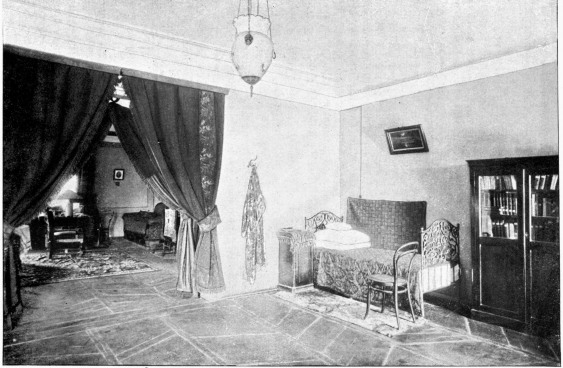
Tchaikovsky returned to Klin about the first week in October (Russian style), and was soon busy with preparations for the performance of Iolanthe in St. Petersburg. On the 28th (November 9th) he left home for the capital, in order to superintend the rehearsals of the new opera. Soon after his arrival he received two interesting communications. The first informed him that he had been elected a Corresponding Member of the French Academy; the second, from the University of Cambridge, invited him to accept the title of Doctor of Music, honoris causa, on condition that he attended in person to receive the degree at the hands of the Vice-Chancellor.
Tchaikovsky acknowledged the first honour, and expressed his readiness to conform to the conditions of the second.
At the same time he had a further cause for congratulation in the success of his Sextet, Souvenir de Florence, which was played for the first time in public at the St. Petersburg Chamber Music Union, on November 25th (December 7th). The players were: E. Albrecht, Hille, Hildebrandt, Heine, Wierzbilowiez, and A. Kouznietsov. This time all were delighted: the performers, the audience, and the composer himself. The medal of the Union was presented to Tchaikovsky amid unanimous applause. During this visit the composer sat to the well-known sculptor, E. Günsburg, for a statuette which, in spite of its artistic value, is not successful as a likeness.
To Anatol Tchaikovsky.
“Petersburg, November 24th (December 6th), 1892.
“ ... Modeste’s play was given yesterday.[186] It was a complete failure, which does not surprise me in the least, for it is much too subtle for the public at the Alexander Theatre. It does not matter: may it be a lesson to Modeste. The pursuit of the unattainable hinders him from his real business—to write plays in the accepted form. The rehearsals for Iolanthe and the Ballet are endlessly dragged out. The Emperor will be present on the 5th, and the first public performance will take place the following day.”
During this visit to the capital Tchaikovsky did his utmost to forward the interests of his friends, Taneiev and Arensky, as will be seen from the following extract from a letter to the former, respecting the performance of his Orestes:—
“Vsievolojsky (Director of the Opera) took Napravnik aside and consulted him as to the advisability of proposing Orestes to the Emperor for next season.... I suggested that you should be sent for, in order to play over the work in their presence. Vsievolojsky was afraid if you were put to this trouble you might feel hurt should the matter fall through. I ventured to say that, as a true philosopher, you would not lose heart if nothing came of it.... I spoke not less eloquently of Arensky, but so far without success.”
On December 5th (17th) Iolanthe and the Nut-cracker Ballet were given in the presence of the Imperial Court. The opera was conducted by Napravnik. The Figners distinguished themselves by their admirable interpretations of the parts of Vaudemont and Iolanthe. The scenery and costumes were beautiful. Nevertheless the work was only accorded a succès d’estime. The chief reason for this—according to Modeste Tchaikovsky—was the prolixity of the libretto and its lack of scenic interest.
The Ballet—admirably conducted by Drigo—was brilliantly staged, and received with considerable applause; yet the impression left by the first night was not wholly favourable. The subject, which differed greatly from the conventional ballet programme, was not entirely to blame. The illness of the talented ballet-master, Petipa, and the substitution of a man of far less skill and imagination, probably accounted for the comparative failure of the work. The delicate beauty of the music did not appeal to the public on a first hearing, and some time elapsed before the Nut-cracker became a favourite item in the repertory.
The attitude of the Press appears from the following letter from the composer to Anatol, dated Petersburg, December 10th (22nd), 1892:—
“This is the fourth day on which all the papers have been cutting up both my latest creations.... It is not the first time. The abuse does not annoy me in the least, and yet—as always under these circumstances—I am in a hateful frame of mind. When one has lived in expectation of an important event, as soon as it is over there comes a kind of apathy and disinclination for work, while the emptiness and futility of all our efforts becomes so evident.... The day after to-morrow I leave for Berlin. There I shall decide where to go for a rest (most probably to Nice). On December 29th I shall be in Brussels. From thence I shall go to Paris, and afterwards to see Mlle. Fanny at Montbeillard. About the 10th January I have to conduct the concerts at Odessa. At the end of the month I shall be in Petersburg. Later I shall spend some time in Klin, and go to you in Lent.”
To Vladimir Davidov.
“Berlin, December 16th (28th), 1892.
“Here I am, still in Berlin. To-day I have given myself up to serious reflections, which will have important results. I have been carefully, and as it were objectively, analysing my Symphony, which luckily I have not yet orchestrated and given to the world. The impression was not flattering: the work is written for the sake of writing, and is not interesting or moving. I ought to put it aside and forget it.... Am I done for and dried up? Perhaps there is yet some subject which could inspire me; but I ought to compose no more absolute music, symphony or chamber works. To live without work would weary me. What am I to do? Fold my hands as far as composition is concerned and try to forget it? It is difficult to decide. I think, and think, and do not know how to settle the question. In any case, the outlook has not been cheerful the last three days.”
To Modeste Tchaikovsky.
“Bâle, December 19th (31st), 1902.
“ ... I have nothing to write about but fits of weeping. Really it is surprising that this phenomenal, deadly home-sickness does not drive me mad. Since this psychological phase grows stronger with every journey abroad, in future I shall never travel alone, even for a short time. To-morrow this feeling will give place to another (scarcely?) less painful emotion. I am going to Montbeillard, and I must confess to a morbid fear and horror, as though I were entering the kingdom of the dead and the world of those who had long since vanished.”
To his brother, Nicholas Ilich Tchaikovsky.
“Paris, December 22nd (January 3rd), 1892.
“ ... I wrote to Mlle. Fanny from Bâle to let her know the time of my arrival, so that she should not be upset by my unexpected appearance. I reached Montbeillard at 3 p.m. on January 1st (new style), and went straight to her house. She lives in a quiet street in this little town, which is so quiet that it might be compared to one of our own Russian ‘district’ towns. The house contains but six rooms—two on each floor—and belongs to Fanny and her sister. Here they were born, and have spent their whole lives. Mlle. Fanny came to the door, and I knew her at once. She does not look her seventy years, and, curiously enough, has altered very little on the whole. The same high-coloured complexion and brown eyes, and her hair is not very grey. She has grown much stouter. I had dreaded tears and an affecting scene, but there was nothing of the sort. She greeted me as though we had not met for a year—joyfully and tenderly, but quite simply. It soon became clear to me why our parents, and we ourselves, were so fond of her. She is a remarkably clever, sympathetic creature, who seems to breathe an atmosphere of kindliness and integrity. Naturally we started upon reminiscences, and she recalled a number of interesting details from our childhood. Then she showed me our copybooks, my exercises, your letters and mine, and—what was of the greatest interest to me—a few dear, kind letters from our mother. I cannot tell you what a strange and wonderful feeling came over me while listening to her recollections and looking over these letters and books. The past rose up so clearly before me that I seemed to inhale the air of Votinsk and hear my mother’s voice distinctly.... When she asked me which of my brothers I loved best, I replied evasively that I was equally fond of them all. At which she was a little indignant, and said that, as my playmate in childhood, I ought to care most for you. And truly at that moment I felt I loved you intensely, because you had shared all my youthful joys. I stayed with her from three until eight o’clock, without noticing how time went. I spent the whole of the next day in her society....
“She gave me a beautiful letter from my mother, in which she writes of you with special tenderness. I will show it to you. The two sisters do not live luxuriously—but comfortably. Fanny’s sister also lived a long time in Russia, and does not speak the language badly. Both of them still teach. They are known to the whole town, for they have taught all the educated people there, and are universally loved and respected. In the evening I embraced Fanny when I took leave of her, and promised to return some day....”
To Modeste Tchaikovsky.
“Paris, January 4th (16th), 1892.
“ ... After my brilliant concert in Brussels I returned here yesterday. The orchestra was very good, but not highly disciplined. I was very cordially received, but this did not make things any easier for me. I suffered equally from agitation and the anguish of home-sickness. During the interval Gevaert, as President of the Artists’ Benevolent Association, made a speech before the assembled orchestra, in which he thanked me on behalf of this society. As the concert was given in aid of a charity, I declined to accept any fee, which touched the artists very deeply.”
The programme of the Brussels concert included, among other compositions by Tchaikovsky, the Pianoforte Concerto, op. 23 (Rummel as soloist), the Nut-cracker Suite, and the Overture “1812.”
On January 12th (24th), 1893, Tchaikovsky arrived in Odessa, where for nearly a fortnight he was fêted with such enthusiasm that even the Prague festivities of 1888 dwindled into insignificance compared with these experiences.
The ovations began the day after his arrival, when, on his appearance at the rehearsal of Pique Dame, he was welcomed by the theatrical direction and the entire opera company. Not contented with vociferous cheering, he was “chaired” and borne around in triumph, much to his discomfort. On the 16th he conducted the following works at the concert of the Musical Society: The Tempest, the Andante cantabile from the Quartet, op. 11, and the Nut-cracker Suite. The local section of the Musical Society presented him with a bâton, and the musicians gave him a laurel wreath. Some numbers on the programme had to be repeated three times in response to the vociferous applause.
This triumph was followed by a series of others: the first performance of Pique Dame, a soirée in his honour at the English Club, a charity concert, given by the Slavonic Association, and a second concert of the Musical Society, at which the Overture “1812” had to be repeated da capo.
Tchaikovsky left Odessa on January 25th (February 6th), and returned to Klin to recover from the strain and fatigue of his visit.
SITTING-ROOM AT KLIN
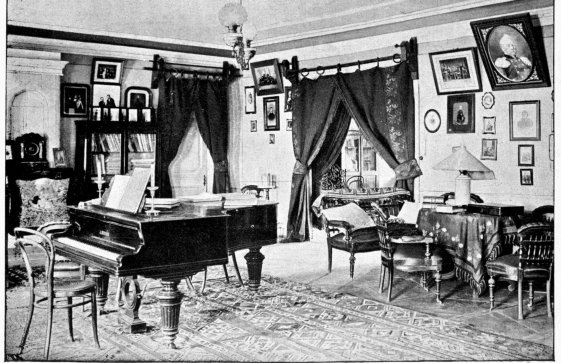
Among the many occupations which overwhelmed him there, he found time to sit to Kouznietsov for his portrait. “Although the artist knew nothing of Tchaikovsky’s inner life,” says Modeste, “he has succeeded, thanks to the promptings of inspiration, in divining all the tragedy of that mental and spiritual phase through which the composer was passing at that time, and has rendered it with profound actuality. Knowing my brother as I do, I can affirm that no truer, more living likeness of him exists. There are a few slight deviations from strict truth in the delineation of the features; but they do not detract from the portrait as a whole, and I would not on any account have them corrected. Perhaps the vitality which breathes from the picture has been purchased at the price of these small defects.”
Kouznietsov presented the portrait to Tchaikovsky, who, however, declined to accept it, partly because he could not endure a picture of himself upon his own walls, but chiefly because he did not consider himself justified in preventing the artist from making something out of his work. The portrait is now in the Tretiakov Gallery, Moscow.
To Modeste Tchaikovsky.
“Klin, February 5th (17th), 1893.
“ ... My journey from Kamenka here was not very propitious. I was taken so ill in the carriage that I frightened my fellow-passengers by becoming delirious, and had to stop at Kharkov. After taking my usual remedies, and a long sleep, I awoke quite well in the morning....
“Next week I must pay a visit to Vladimir Shilovsky. The prospect fills me with fear and agitation. Tell me, has he greatly changed? How is the dropsy? I am afraid of a scene, and altogether dread our meeting. Is there really no hope for him? Answer these questions.”
Vladimir Shilovsky, who had played an important part in my brother’s life some twenty years earlier, had very rarely come in contact with his old teacher since his marriage with the only remaining child of Count Vassiliev. There had been no breach between them, but their lives had run in opposite directions. In January, 1893, I heard that Vladimir Shilovsky was seriously ill. I informed Peter Ilich, who visited his old pupil in Moscow, and was touched by the joy he showed at their reunion, and by the calm self-control with which he spoke of his hopeless condition. The old intimacy was renewed, and only ended with the Count’s death in June, 1893.
XVII
Tchaikovsky’s life moved in spiral convolutions. At every turn his way seemed to lie through the same spiritual phases. The alternations of light and shade succeeded each other with a corresponding regularity. When speaking of the depression which darkened his last years, I emphasised the fact that he had gone through a similar condition of mind before every decisive change in his existence. The acute moral tension which preceded his retirement from the Ministry of Justice was followed by the calm and happy summer of 1862. To his glad and hopeful mood at the beginning of 1877 succeeded the crisis which compelled him to go abroad for rest and change. So, too, this year, 1893, opened with a period of serene content, for which the creation of his Sixth, or so-called “Pathetic,” Symphony was mainly accountable. The composition of this work seems to have been an act of exorcism, whereby he cast out all the dark spirits which had possessed him in the preceding years.
The first mention of this Symphony occurs in a letter to his brother Anatol, dated February 10th (22nd), 1893, in which he speaks of being completely absorbed in his new project. The following day, writing to Vladimir Davidov, he enters into fuller particulars:—
“I must tell you how happy I am about my work. As you know, I destroyed a Symphony which I had partly composed and orchestrated in the autumn. I did wisely, for it contained little that was really fine—an empty pattern of sounds without any inspiration. Just as I was starting on my journey (the visit to Paris in December, 1892) the idea came to me for a new Symphony. This time with a programme; but a programme of a kind which remains an enigma to all—let them guess it who can. The work will be entitled “A Programme Symphony” (No. 6). This programme is penetrated by subjective sentiment. During my journey, while composing it in my mind, I frequently shed tears. Now I am home again I have settled down to sketch out the work, and it goes with such ardour that in less than four days I have completed the first movement, while the rest of the Symphony is clearly outlined in my head. There will be much that is novel as regards form in this work. For instance, the Finale will not be a great Allegro, but an Adagio of considerable dimensions. You cannot imagine what joy I feel at the conviction that my day is not yet over, and that I may still accomplish much. Perhaps I may be mistaken, but it does not seem likely. Do not speak of this to anyone but Modeste.”
After an interval of three years Tchaikovsky once more conducted a concert of the Moscow Musical Society on February 14th (26th). This was in response to a letter from Safonov begging him to make up their former personal differences and to take part again in the work of Nicholas Rubinstein, of imperishable memory. The Overture-Fantasia Hamlet was played at this concert for the first time in Moscow.
About the end of February Tchaikovsky again returned to Moscow to hear a new Suite From Childhood’s Days, by George Konius, which pleased him very much. Through the influence of the Grand Duke Constantine, Tchaikovsky succeeded in getting an annual pension of 1,200 roubles (£120) for the struggling young composer.
At this time he suffered from a terrible attack of headache, which never left him, and threatened to become a chronic ailment. It departed, however, with extraordinary suddenness on the fourteenth day after the first paroxysm.
On March 11th (23rd) he visited Kharkov, where he remained till the 16th (28th), and enjoyed a series of triumphs similar to those he had experienced in Odessa earlier in the year.
By March 18th (30th) Tchaikovsky was back in Klin. Here he received news that Ippolitov-Ivanov was leaving Tiflis to join the Moscow Conservatoire. In his answer, which is hardly a letter of congratulation, Tchaikovsky refers to his last Symphony, which he does not intend to tear up, to the sketch of a new Pianoforte Concerto, and to several pieces for piano which he hopes to compose in the near future.
He spent the Easter holidays in the society of his relatives and intimate friends in Petersburg, and, but for the hopeless illness of his oldest friend, the poet Apukhtin, this visit would have been a very quiet and cheerful interlude in his life.
To Vladimir Davidov.
“Klin, April 15th (27th), 1893.
“I am engaged in making musical pancakes.[187] To-day I have tossed the tenth. It is remarkable; the more I do, the easier and pleasanter the occupation grows. At first it was uphill work, and the first two pieces are the outcome of a great effort of will; but now I can scarcely fix the ideas in my mind, they succeed each other with such rapidity. If I could spend a whole year in the country, and my publisher was prepared to take all I composed, I might—if I chose to work à la Leikin—make about 36,000 roubles a year!”
To Modeste Tchaikovsky.
“Moscow, April 22nd (May 4th), 1893.
“Ah, dear Modi, I do not believe I shall get the thirty pieces written! I have finished eighteen in fifteen days and brought them with me to Moscow. But now I must stay here four days (the performance at the Conservatoire, one morning with the Synodal singers, and my birthday with old friends), then go on to Nijny and return here in time for the first performance of Rakhmaninov’s Aleko. I shall not be home before the 30th (May 12th), and I start on the 10th (22nd) of May, ... but perhaps I may knock off a few songs very quickly.”
To P. Jurgenson.
“Klin, May 2nd, 1893.
“I intended to ask my old fee—100 roubles for each number. Now, in consequence of the number of paying propositions made to me (I swear it is true), I must put up my prices a little. But I will not forget that you have also published my greater works, from which you will not derive any profit for a long time to come. So let it stand at the old fee.... It is a pity I had not more time for writing.
“Should anything happen to Karl,[188] and the family be in need, do not hesitate to help them out of my present, or future, funds....”
To P. Jurgenson.
“Petersburg, May 6th (18th), 1893.
“ ... As regards my fee, I must tell you that Gutheil has never made me any proposals, because all Russian publishers know that I am not to be caught by any bait they may offer. But abroad my relations with you are not understood, therefore I often receive advances from other countries. Many of them (André of Offenbach) have offered me far higher fees than I get from you (of course, I am only speaking of short compositions).... I cannot lose sight of the fact that many of my symphonies and operas have cost you more than they bring in. Of course, they will sell better some day, but at present I do not like to bleed you. You are not as rich as an Abraham, a Schott, or a Simrock.... If (on your honour) you do not consider it too much to give me another fifty, I will agree to it. Naturally I shall be very glad, for this has been a heavy year.
“I want nothing for the Mozart,[189] because I have not put much of myself into it.”
To Vladimir Davidov.
“Berlin, May 15th (27th), 1893.
“ ... This time I wept and suffered more than ever, perhaps because I let my thoughts dwell too much on our last year’s journey. It is purely a psychophysical phenomenon! And how I loathe trains, the atmosphere of railway carriages, and fellow-travellers!... I travel too much, that is why I dislike it more and more. It is quite green here, and flowers blooming everywhere—but it does not give me any pleasure, and I am only conscious of an incredible and overwhelming home-sickness.”
To Modeste Tchaikovsky.
“London, May 17th (29th), 1893.
“I arrived here early this morning. I had some difficulty to find a room—all the hotels are packed. The concert takes place on May 20th (June 1st), after which I must rush around for about a week, for the Cambridge ceremony does not come off until the 11th or 12th, and on the 13th—our 1st of June—I begin my homeward journey. I am continually thinking of you all. I never realise all my affection for you so much as when away from home, and oppressed with loneliness and nostalgia.”
To Vladimir Davidov.
“London, May 17th (29th), 1893.
“Is it not strange that of my own free will I have elected to undergo this torture? What fiend can have suggested it to me? Several times during my journey yesterday I resolved to throw up the whole thing and turn tail. But what a disgrace to turn back for no good reason! Yesterday I suffered so much that I could neither sleep nor eat, which is very unusual for me. I suffer not only from torments which cannot be put into words (there is one place in my new Symphony—the Sixth—where they seem to me adequately expressed), but from a dislike to strangers, and an indefinable terror—though of what the devil only knows. This state makes itself felt by internal pains and loss of power in my legs. However, it is for the last time in my life. Only for a heap of money will I ever go anywhere again, and never for more than three days at a time. And to think I must kick my heels here for another fortnight!! It seems like eternity. I arrived early this morning, viâ Cologne and Ostend. The crossing took three hours, but it was not rough.... On the steps of my hotel I met the French pianist Diemer, and to my great astonishment found myself delighted to see him. He is an old acquaintance, and very well disposed towards me. In consequence of our meeting I had to go to his ‘Recital.’ Saint-Saëns also takes part in the concert at which I am conducting.”
Profiting by the presence in England of the composers who were about to receive the honorary degree at Cambridge, the Philharmonic Society gave two concerts in which they took part. At the first of these Tchaikovsky conducted his Fourth Symphony with brilliant success. According to the Press notices, none of his works previously performed had pleased so well, or added so much to his reputation in England.
To Modeste Tchaikovsky.
“London, May 22nd (June 3rd), 1893.
“ ... The concert was brilliant. It was unanimously agreed that I had a real triumph, so that Saint-Saëns, who followed me, suffered somewhat from my unusual success. Of course, this is pleasant enough, but what an infliction London life is during the ‘season’! Luncheons and dinners which last an interminable time. Yesterday the directors of the Philharmonic gave a dinner at the Westminster Club in honour of Saint-Saëns and myself. It was very smart and luxurious; we sat down to table at seven and rose at 11.30 p.m. (I am not exaggerating). Besides this I am invited to concerts daily and cannot refuse to go. To-day, for instance, I went to Sarasate’s concert. He is most kind and amiable to me. Last time I was here in the winter and in bad weather, so that I got no idea of what the town is really like. The devil knows Paris is a mere village compared to London! Walking in Regent Street and Hyde Park, one sees so many carriages, so much splendid and luxurious equipment, that the eye is fairly dazzled. I have been to afternoon tea at the Embassy. Our secretary at the Embassy here, Sazonov, is a charming man. What a number of people I see, and how tired I get! In the morning I suffer a great deal from depression, and later I feel in a kind of daze. I have but one thought: to get it all over.... At Cambridge I will keep a full diary. It seems to me it will be a very droll business. Grieg is ill. All the other recipients will come....”
To Modeste Tchaikovsky.
“London, May 29th (June 10th), 1893.
“This letter will not be in time to reach you in ‘Peter.’ ... I have not had a chance of writing. This is an infernal life. Not a moment’s peace: perpetual agitation, dread, home-sickness, fatigue. However, the hour of escape is at hand. Besides which, I must say I find many excellent folks here, who show me every kind of attention. All the doctors designate have now arrived except Grieg, who is too ill. Next to Saint-Saëns, Boïto appeals most to me. Bruch is an unsympathetic, inflated sort of personage. I go to Cambridge the day after to-morrow, and do not stay at an hotel, but in the house of Dr. Maitland, who has written me a very kind letter of invitation. I shall only be there one night. On the day of our arrival there will be a concert and dinner, and on the following day—the ceremony. By four o’clock it will be all over.”
In 1893, in consequence of the fiftieth anniversary of the Cambridge University Musical Society, the list of those who received the Doctor’s degree, honoris causa, was distinguished by an unusual number of musicians: Tchaikovsky, Saint-Saëns, Boïto, Max Bruch and Edvard Grieg.
TCHAIKOVSKY IN 1893 (From a photograph taken in London)
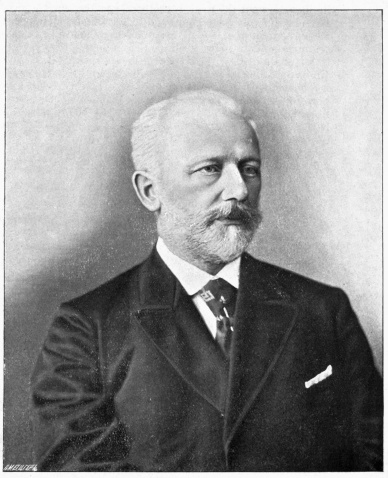
The festivities at Cambridge began on June 12th (new style) with a concert, the programme of which included a work by each of the five recipients of the musical degree, and one by Dr. Stanford,[190] the director of the society.
The programme was as follows: (1) Fragment from Odysseus for soli, chorus, and orchestra (Max Bruch); (2) Fantasia for pianoforte and orchestra, Africa, the composer at the piano (Saint-Saëns); (3) Prologue from Mefistofele for solo, chorus, and orchestra (Boïto); (4) Symphonic poem, Francesco, da Rimini (op. 32), (Tchaikovsky); (5) Peer Gynt Suite (op. 46) (Grieg); (6) Ode, The East to the West, for chorus and orchestra (op. 52) (Stanford).
The various numbers were conducted by the respective composers, with the exception of Grieg’s Suite and the Fantasia Africa, which were given under the bâton of Dr. Stanford.
The singers were Mr. and Mrs. Henschel, Mme. Marie Brema, and Plunket Green.
In his Portraits et Souvenirs Saint-Saëns has given the following description of this concert, and I cannot refrain from interrupting my narrative in order to quote what the French composer says of my brother’s Francesca.
“Piquant charms and dazzling fireworks abound in Tchaikovsky’s Francesca da Rimini, which bristles with difficulties, and shrinks from no violence of effect. The gentlest and kindest of men has let loose a whirlwind in this work, and shows as little pity for his interpreters and hearers as Satan for sinners. But the composer’s talent and astounding technique are so great that the critic can only feel pleasure in the work. A long melodic phrase, the love-song of Paola and Francesca, soars above this tempest, this bufera infernale, which attracted Liszt before Tchaikovsky, and engendered his Dante Symphony. Liszt’s Francesca is more touching and more Italian in character than that of the great Slavonic composer; the whole work is so typical that we seem to see the profile of Dante projected in it. Tchaikovsky’s art is more subtle, the outlines clearer, the material more attractive; from a purely musical point of view the work is better. Liszt’s version is perhaps more to the taste of the poet or painter. On the whole, they can fitly stand side by side; either of them is worthy of Dante, and as regards noise, both leave nothing to be desired.”[191]
The concert was followed by a banquet in the hall of King’s College, at which a hundred guests sat down to table. As it was purely a musical festivity, only those who were to receive the honorary musical degree were invited to this banquet. The place of honour, next to the chairman, was given to Saint-Saëns, the eldest of the guests. Never had Tchaikovsky greater reason to congratulate himself upon his comparative youth, for, together with the honour, the difficult task of replying to a toast on behalf of his colleagues fell to the lot of Saint-Saëns.
After the dinner came a brilliant reception to the composers in the hall of the Museum.
Besides the musicians, there were several other recipients of the honorary degree, including the Maharajah of Bohonager, Lord Herschel, Lord Roberts, Dr. Julius Stupitza, Professor of English Philology in the University of Berlin, and the Irish scholar, Standish O’Grady.
On the morning of June 13th all the future doctors assembled in the Arts School and attired themselves in their splendid doctors’ robes of red and white; after which they took up their positions, and the procession started. Saint-Saëns, in the volume already quoted, says:
“We were attired in ample robes of silk, parti-coloured scarlet and white, with full sleeves, and on our heads college-caps of black velvet with gold tassels. Thus decked out, we walked in procession through the town, under a tropical sun. At the head of the group of doctors went the King of Bohonager in a turban of cloth of gold, sparkling with fabulous jewels and a diamond necklace. Dare I confess that, as the enemy of the commonplace, and of the neuter tints of our modern garb, I was enchanted with the adventure?
“The people stood on each side of the railings, and cheered us with some enthusiasm, especially Lord Roberts.”
“Meanwhile the Senate House, in which the degrees were conferred, had become crowded with undergraduates and guests. The former were not merely spectators, but—as we afterwards discovered—participated in the event. When the Vice-Chancellor and other members of the Senate had taken their places, the ceremony began. Each recipient rises in turn from his seat, while the public orator recounts his claims to recognition in a Latin oration. Here the undergraduates begin to play their part. According to ancient tradition, they are allowed to hiss, cheer, and make jokes at the expense of the new doctors. At every joke the orator waits until the noise and laughter has subsided, then continues to read aloud. When this is done, the recipient is led up to the Vice-Chancellor, who greets him as doctor in nomine Patri, Filii et Spiritus Sancti. This formula was not used in the case of the Maharajah.”
The oration delivered in honour of Tchaikovsky ran as follows:—
“Russorum ex imperio immenso hodie ad nos delatus est viri illustris, Rubinsteinii, discipulus insignis, qui neque Italiam neque Helvetiam inexploratam reliquit, sed patriae carmina popularia ante omnia dilexit. Ingenii Slavonici et ardorem fervidum et languorem subtristem quam feliciter interpretatur! Musicorum modorum in argumentis animo concipiendis quam amplus est! in numeris modulandis quam distinctus! in flexionibus variandis quam subtilis! in orchestrae (ut aiunt) partibus inter se diversis una componendis quam splendidus! Talium virorum animo grato admiramur ingenium illud facile et promptum, quod, velut ipsa rerum natura, nulla, necessitate coactum sed quasi sua sponte pulcherrimum quidque in luminis oras quotannis submittit.
“Audiamus Propertium:
“‘aspice quot submittit humus formosa colores; et veniunt hederae sponte sua melius.’
“Etiam nosmet ipsi hodie fronti tam felici hederae nostrae corollam sponte imponimus.
“Duco ad vos Petrum Tchaikovsky.”
After the ceremony there was a breakfast given by the Vice-Chancellor, at which all attended in their robes. At the end of the meal, in obedience to the tradition of centuries, a loving-cup was passed round.
The breakfast was followed by a garden-party, the hostess being the wife of the Vice-Chancellor.
By evening Tchaikovsky was back in London, where he gave a farewell dinner to some of his new friends. Among these I must mention the fine baritone, Eugene Oudin. Tchaikovsky was soon very sincerely attached to him, both as a man and an artist. Upon his initiative Oudin was invited to sing at the Symphony Concerts in Moscow and Petersburg.
The following day Tchaikovsky left for Paris.
To P. Jurgenson.
“Paris, June 3rd (15th), 1893.
“Cambridge, with its peculiar customs which retain much that is medieval, with its colleges that resemble monasteries, and its buildings recalling a remote past, made a very agreeable impression upon me.”
To N. Konradi.
“Paris, June 3rd (15th), 1893.
“At Cambridge I stayed with Professor Maitland. This would have been dreadfully embarrassing for me, if he and his wife had not proved to be some of the most charming people I ever met; and Russophiles into the bargain, which is the greatest rarity in England. Now all is over, it is pleasant to look back upon my visit to England, and to remember the extraordinary cordiality shown to me everywhere, although, in consequence of my peculiar temperament, while there, I tormented and worried myself to fiddle-strings.”
XVIII
Tchaikovsky’s home-coming was by no means joyful. The shadow of death was all around him. Hardly had he heard of the death of his old friend Karl Albrecht than a letter from the Countess Vassiliev-Shilovsky informed him that her husband had passed away. Besides this, Apukhtin lay dying in Petersburg, and in Moscow another valued friend, Zvierev, was in an equally hopeless condition.
A few years earlier one such grief would have affected Tchaikovsky more keenly than all of them taken together seemed to do at this juncture. Now death appeared to him less enigmatical and fearful. Whether his feelings were less acute, or whether the mental sufferings of later years had taught him that death was often a deliverance, I cannot say. I merely lay emphasis on the fact that, in spite of the discomforting news which met him in all directions, from the time of his return from England to the end of his life, Tchaikovsky was as serene and cheerful as at any period in his existence.
He looked forward with joy to meeting his nephew Vladimir Davidov at Grankino, in the government of Poltava. He always felt well in the glorious air of the steppes.
From Grankino he went to stay with his brother Nicholas at Oukolovo.
To Vladimir Davidov.
“July 19th (31st), 1893.
“I spent two very pleasant days in Moscow. Tell Modi I was very ill the day after he left. They said it was from drinking too much cold water at dinner and supper.... The day after to-morrow I start upon the Symphony again. I must write letters for the next two days.”
To Modeste Tchaikovsky.
“July 22nd (August 3rd), 1893.
“I am up to my eyes in the Symphony. The further I go, the more difficult the orchestration becomes. Twenty years ago I should have rushed it through without a second thought, and it would have turned out all right. Now I am turning coward, and have lost my self-confidence. I have been sitting all day over two pages, yet they will not come out as I wish. In spite of this, the work makes progress, and I should not have done so much anywhere else but at home.
“Thanks to Alexis’ exertions, my house has a very coquettish appearance. All is in order; a mass of flowers in the garden, good paths, and a new fence with gates. I am well cared for. And yet I get terribly bored unless I am working....”
To Vladimir Davidov.
“August 3rd (15th), 1893.
“The Symphony which I intended to dedicate to you—although I have now changed my mind[192]—is progressing. I am very well pleased with its contents, but not quite so satisfied with the orchestration. It does not realise my dreams. To me, it will seem quite natural, and not in the least astonishing, if this Symphony meets with abuse, or scant appreciation at first. I certainly regard it as quite the best—and especially the ‘most sincere’—of all my works. I love it as I never loved any one of my musical offspring before.”
To P. Jurgenson.
“Klin, August 12th (24th), 1893.
“Dear Friend,—I have finished the orchestration of the new Symphony.... I have made the arrangement for four hands myself, and must play it through, so I have asked the youngest Konius to come here, that we may try it together. As regards the score and parts, I cannot put them in order before the first performance, which takes place in Petersburg on October 16th (28th).... On my word of honour, I have never felt such self-satisfaction, such pride, such happiness, as in the consciousness that I am really the creator of this beautiful work.”
To the same.
“Klin, August 20th (September 1st), 1893.
“I shall take the Symphony with me to Petersburg to-day. I promise not to give away the score. The arrangement for four hands needs a thorough revision. I have entrusted this to Leo Konius. I wished him to receive a fee of at least 100 roubles, but he refused....”
Tchaikovsky spent two days with Laroche in Petersburg. Even the prospect of his journey to Hamburg did not suffice to damp his cheerful frame of mind. He does not appear to have written any letters during his absence from Russia, which was of very brief duration.
“On his return from Hamburg he met me in St. Petersburg,” says Modeste, “and stayed with me a day or two. I had not seen him so bright for a long time past. He was keenly interested in the forthcoming season of the Musical Society, and was preparing the programme of the fourth concert, which he was to conduct.
“At this time there was a change in the circumstances of my own life. Having finished the education of N. Konradi, I decided to set up housekeeping with my nephew Vladimir Davidov, who had completed his course at the School of Jurisprudence and was now an independent man. My brother was naturally very much interested in all the arrangements of our new home.
“At this time we discussed subjects for a new opera. Peter Ilich’s favourite author in later life was George Eliot. Once during his travels abroad he had come across her finest book, The Mill on the Floss, and from that time he considered she had no rival but Tolstoi as a writer of fiction. Adam Bede, Silas Marner, and Middlemarch stirred him to the greatest enthusiasm, and he read them over and over again. He cared less for Romola, but was particularly fond of Scenes from Clerical Life. For a time he seriously contemplated founding the libretto of his next opera upon The Sad Fortunes of the Rev. Amos Barton. He wished me to read the tale and give him my opinion: I must confess that, from his own account of it, I persuaded him to give up the idea.
“I do not know if I actually convinced him, or whether he lost interest in it himself, but he never referred to this tale again when he spoke of other subjects for a libretto.
“We separated early in September, and he went to our brother Anatol, who was spending the summer and autumn with his family at Mikhailovskoe.”
Here he enjoyed a very happy visit. “It is indescribably beautiful,” he wrote to Modeste. “It is altogether pleasant and successful. The weather is wonderful. All day long I wander in the forest and bring home quantities of mushrooms.”
His high opinion of the new Symphony was still unchanged, for he wrote to the Grand Duke Constantine Constantinovich on September 21st (October 3rd), “Without exaggeration I have put my whole soul into this work.” Yet in spite of his cheerful attitude, a momentary cloud of depression passed over him at this time. Writing to Modeste from Moscow, a few days later, he says: “Just lately I have been dreadfully bored and misanthropical. 1 do not know why. I sit in my room and see no one but the waiter. I long for home, work, and my normal existence.”
On September 25th he returned to Klin for the last time.
To Anna Merkling.
“September 29th (October 11th), 1893.
“I am now very busy with the orchestration of the Pianoforte Concerto. I shall soon appear on the banks of the Neva. You will see me about the 10th.”
On October 7th (19th) Tchaikovsky left Klin never to return. The following day he intended to be present at the memorial service for his friend Zvierev and then to go on to Petersburg. As the train passed the village of Frolovskoe, he pointed to the churchyard, remarking to his fellow-travellers: “I shall be buried there, and people will point out my grave as they go by.” He repeated this wish to be buried at Frolovskoe while talking to Taneiev at the memorial service for Zvierev. Beyond these two references to his death, prompted no doubt by the sad ceremony with which he was preoccupied, Tchaikovsky does not appear to have shown any symptoms of depression or foreboding.
Kashkin has given the following account of his friend’s last visit to Moscow:—
“We met at the memorial service in the church, and afterwards Peter Ilich went to Zvierev’s grave. On October 9th (21st) he had promised to go to the Conservatoire to hear the vocal quartet (‘Night’) which he had arranged from Mozart’s pianoforte Fantasia. The master’s music had not been altered, Tchaikovsky had only written words to it.... Madame Lavrovsky had promised that her pupils should learn the work. We assembled in the concert hall of the Conservatoire, and I sat with Tchaikovsky. The quartet was beautifully sung ... Tchaikovsky afterwards told me this music had the most indescribable charm for him, but he could not explain, even to himself, why this simple melody gave him such pleasure....
“At that time Pollini, the Director of the Hamburg Opera, was staying in Moscow. He was an ardent admirer of Tchaikovsky, and had given some of his operas in Hamburg. When—as invited—I went to supper with Tchaikovsky at the Moscow Restaurant, I met Pollini, Safonov, and two foreign guests. We talked over Pollini’s idea of making a great concert tour through Russia, with a German orchestra under a Russian conductor ... Tchaikovsky was to conduct his own works and Safonov the rest of the programme.... After the others had gone, and Peter Ilich and I were left to ourselves, he told me all about Cambridge, and spoke very warmly of the Professor in whose house he had stayed, and of one of the other recipients of the honorary degree—Arrigo Boïto, who had charmed him with his intellect and culture.... Unconsciously the talk turned to our recent losses: to the death of Albrecht and Zvierev. We thought of the gaps time had made in our circle of old friends and how few now remained. Involuntarily the question arose: Who will be the next to take the road from which there is no return? With complete assurance of its truth, I declared that Tchaikovsky would outlive us all. He disputed the probability, but ended by saying he had never felt better or happier in his life. He had to catch the night mail to Petersburg, where he was going to conduct his Sixth Symphony, which was still unknown to me. He said he had no doubt as to the first three movements, but the last was still a problem, and perhaps after the performance in Petersburg he should destroy the Finale and replace it by another. The concert of the Musical Society in Moscow was fixed for October 23rd (November 4th). We arranged, if we should not see each other there, to meet at the Moscow Restaurant, for Tchaikovsky was anxious to introduce the singer Eugene Oudin to the musical circle in Moscow. Here our conversation ended. Tchaikovsky went to the station. It never occurred to me to see him off, for neither of us cared for that kind of thing; besides, we should meet again in a fortnight. We parted without the least presentiment that it was for the last time.”
XIX
Tchaikovsky arrived in Petersburg on October 10th (22nd). He was met by his brother Modeste and his favourite nephew. He was delighted with their new abode and his spirits were excellent—so long as his arrival remained unknown and he was master of his time.
One thing only depressed him: at the rehearsals the Sixth Symphony made no impression upon the orchestra. He always set store by the opinion of the musicians. Moreover, he feared lest the interpretation of the Symphony might suffer from their coldness. Tchaikovsky only conducted his works well when he knew they appealed to the players. To obtain delicate nuances and a good balance of tone he needed his surroundings to be sympathetic and appreciative. A look of indifference, a coolness on the part of any of the band, seemed to paralyse him; he lost his head, went through the work perfunctorily, and cut the rehearsal as short as possible, so as to release the musicians from a wearisome task. Whenever he conducted a work of his own for the first time, a kind of uncertainty—almost carelessness—in the execution of details was apparent, and the whole interpretation lacked force and definite expression. The Fifth Symphony and Hamlet were so long making their way merely because the composer had failed to make them effective. The same reason accounts for the failure of the orchestral ballade, The Voyevode.
Tchaikovsky was easily disenchanted with his work by the adverse opinion of others. But on this occasion his judgment remained unshaken, and even the indifference of the orchestra did not alter his opinion that this Symphony was “the best thing I ever composed or ever shall compose.” He did not, however, succeed in convincing the public or the performers. At the concert on the 16th (28th) the work fell rather flat. It was applauded and the composer was recalled; but the enthusiasm did not surpass what was usually shown for one of Tchaikovsky’s new works. The Symphony produced nothing approaching to that powerful and thrilling impression it made shortly afterwards (November 6th (18th), 1893) under Napravnik, which has since been repeated in so many other cities.
The Press did not speak of the new Symphony with as much admiration as Tchaikovsky had expected, but on the whole the notices were appreciative. The St. Petersburg Viedomosti thought “the thematic material of the work was not very original, the leading subjects were neither new nor significant. The last movement, Adagio Lamentoso, was the best.” The Syn Otechestva discovered a phrase in the first movement which recalled Gounod’s Romeo and Juliet, while Grieg was reflected in the Finale. The Novoe Vremya said: “The new Symphony is evidently the outcome of a journey abroad; it contains much that is clever and resourceful as regards orchestral colour, besides grace and delicacy (in the two middle movements), but as far as inspiration is concerned it stands far below Tchaikovsky’s other Symphonies. Only one newspaper, The Birjevya Viedomosti, spoke of the work in terms of unqualified praise, while finding fault with the composer’s conducting of the work.
The morning after the concert I found my brother sitting at the breakfast-table with the score of the Symphony before him. He had agreed to send it to Jurgenson in Moscow that very day, and could not decide upon a title. He did not wish to designate it merely by a number, and had abandoned his original intention of calling it “a programme Symphony.” “Why programme,” he said, “since I do not intend to expound any meaning?” I suggested “tragic Symphony” as an appropriate title. But this did not please him either. I left the room while Peter Ilich was still in a state of indecision. Suddenly the word “pathetic” occurred to me, and I returned to suggest it. I remember, as though it were yesterday, how my brother exclaimed: “Bravo, Modeste, splendid! Pathetic!” Then and there, in my presence, he added to the score the title by which the Symphony has always been known.[193]
I do not relate this incident in order to connect my name with this work. Probably I should never have mentioned it but for the fact that it serves to illustrate in a simple way how far the conjectures of the most enlightened commentators may wander from the truth.
Hugo Riemann, in his thematic analysis of the Sixth Symphony, sees the solution of this title in “the striking resemblance between the fundamental idea of this work and the chief subject of Beethoven’s Sonata Pathétique,” of which Tchaikovsky never dreamed:
Tchaikovsky. Beethoven.

After having despatched the score to Moscow with this title, Tchaikovsky changed his mind, as may be seen from the following letter to Jurgenson:—
“October 18th, 1893.
“Be so kind as to put on the title page what stands below.
To Vladimir Lvovich Davidov (No. 6) Composed by P. T.
“I hope it is not too late.
“It is very strange about this Symphony. It was not exactly a failure, but was received with some hesitation. As far as I am concerned, I am prouder of it than of any of my previous works. However, we can soon talk it over together, for I shall be in Moscow on Saturday.”
At this time he talked a great deal about the remodelling of The Oprichnik and The Maid of Orleans, which he had in view for the immediate future. He did not confide to me his intentions as to the former opera; but as regards The Maid of Orleans, we discussed the alteration of the last scene, and I made a point of his arranging this, like so many other parts of the opera, from Schiller’s poem. The idea seemed to interest him, but it was not permitted to him to come to a definite conclusion on the subject.
During these last days he was neither very cheerful, nor yet depressed. In the circle of his intimate friends he was contented and jovial; among strangers he was, as usual, nervous and excited and, as time went on, tired out and dull. But nothing gave the smallest hint of his approaching end.
On Tuesday, October 19th (31st), he went to a private performance of Rubinstein’s The Maccabees. On the 20th (November 1st) he was still in good health and dined with his old friend Vera Boutakov (née Davidov). Afterwards he went to see Ostrovsky’s play, A Warm Heart, at the Alexander Theatre. During the interval he went with me to see the actor Varlamov in his dressing-room. The conversation turned upon spiritualism. Varlamov described in his own humorous style—which cannot be transferred to paper—his loathing for “all those abominations” which reminded one of death. Peter Ilich laughed at Varlamov’s quaint way of expressing himself.
“There is plenty of time,” said Tchaikovsky, “before we need reckon with this snub-nosed horror; it will not come to snatch us off just yet! I feel I shall live a long time.” From the theatre, Tchaikovsky went with his nephews, Count Litke and Baron Buxhövden, to the Restaurant Leiner. I joined them an hour later, and found one or two other visitors—of whom Glazounov was one. They had already had their supper, and I was afterwards told my brother had eaten macaroni and drunk, as usual, white wine and soda water. We went home about two a.m. Peter Ilich was perfectly well and serene.
On the morning of Thursday, October 21st (November 2nd), Tchaikovsky did not appear as usual at the early breakfast-table. His brother went to his room and found him slightly indisposed. He complained of his digestion being upset and of a bad night. About eleven a.m. he dressed and went out to see Napravnik. Half an hour later he returned, still feeling unwell. He absolutely declined to send for a doctor. His condition gave no anxiety to Modeste, who had often seen him suffer from similar derangements.
He joined his brother and nephew at lunch, although he ate nothing. But this was probably the fatal moment in his indisposition for, while talking, he poured out a glass of water and drank a long draught. The water had not been boiled, and they were dismayed at his imprudence. But he was not in the least alarmed, and tried to calm their fears. He dreaded cholera less than any other illness. After this his condition grew worse; but he attributed all his discomfort to a copious dose of Hunyadi which he had taken earlier in the day, and still declined to send for his favourite doctor, Bertenson. Towards evening Modeste grew so anxious that he sent for the doctor on his own account. Meanwhile Tchaikovsky was tended by his brother’s servant Nazar, who had once travelled with him to Italy.
About eight p.m. Bertenson arrived. He saw at once that the illness was serious, and sent for his brother in consultation. The sufferer had grown very weak, and complained of terrible oppression on his chest. More than once he said, “I believe this is death.”
After a short consultation the brothers Bertenson, the two leading physicians in Petersburg, pronounced it to be a case of cholera.
All night long those who nursed him in turn fought against the cramps; towards morning with some hope of success. His courage was wonderful, and in the intervals between the paroxysms of pain he made little jokes with those around him. He constantly begged his nurses to take some rest, and was grateful for the smallest service.
On Friday his condition seemed more hopeful, and he himself believed he had been “snatched from the jaws of death.” But on the following day his mental depression returned. “Leave me,” he said to his doctors, “you can do no good. I shall never recover.”
Gradually he passed into the second stage of the cholera, with its most dangerous symptom—complete inactivity of the kidneys. He slept more, but his sleep was restless, and sometimes he wandered in his mind. At these times he continually repeated the name of Nadejda Filaretovna von Meck in an indignant, or reproachful, tone. Consciousness returned at longer intervals, and when his servant Alexis arrived from Klin he was no longer able to recognise him. A warm bath was tried as a last resource, but without avail, and soon afterwards his pulse grew so weak that the end seemed imminent. At the desire of his brother Nicholas, a priest was sent for from the Isaac Cathedral. He did not administer the sacrament, as Tchaikovsky was now quite unconscious, but prayed in clear and distinct tones, which, however, did not seem to reach the ears of the dying man.
At three o’clock on the morning of October 25th (November 6th) Tchaikovsky passed away in the presence of his brothers Nicholas and Modeste, his nephews Litke, Buxhövden, and Vladimir Davidov, the three doctors, and his faithful servant Alexis Safronov. At the last moment an indescribable look of clear recognition lit up his face—a gleam which only died away with his last breath.
My work is finished. With this account of Tchaikovsky’s last moments my task, which was to express the man, is accomplished.
To characterise the artist in every phase of his development, and to determine his position in the history of music, is beyond my powers. If all the documental and authentic evidence I have collected in this book should serve as fundamental material for another writer capable of fulfilling such a task, the most cherished aim of all my efforts will have been attained.
MODESTE TCHAIKOVSKY
Rome, 1902