Part VI (continued 2)
Rosa Newmarch translation
“I love everything in Mozart, for we love everything in the man to whom we are truly devoted. Above all, Don Juan, for through that work I have learnt to know what music is. Till then (my seventeenth year) I knew nothing except the enjoyable semi-music of the Italians. Although I love everything in Mozart, I will not assert that every one of his works, even the most insignificant, should be considered a masterpiece. I know quite well that no single example of his Sonatas is a great creation, and yet I like each one, because it is his, because he has breathed into it his sacred breath.
“As to the forerunner of both these artists, I like to play Bach, because it is interesting to play a good fugue; but I do not regard him, in common with many others, as a great genius. Handel is only fourth-rate, he is not even interesting. I sympathise with Glück in spite of his poor creative gift. I also like some things of Haydn. These four great masters have been surpassed by Mozart. They are rays which are extinguished by Mozart’s sun.”
To the Grand Duke Constantine Constantinovich.
“September, 1886.
“Your Imperial Highness,—Permit me to thank you cordially for your valued present and your sympathetic letter. Very highly do I esteem the attention of which you have thought me worthy.
“I only regret, your Highness, that while looking for poems for my songs which are to be dedicated to her Majesty, I had not as yet the pleasure of possessing that charming little book which, thanks to your flattering attention, is now in my hands. How many of your poems glow with that warm and sincere feeling which makes them suitable for musical setting! When I read your collection of verses I determined at once to select some for my next song-cycle, and to dedicate them, with your gracious permission, to your Highness. I should be much pleased if you would accept this dedication as the expression of my sincere devotion.”
To N. F. von Meck.
“Maidanovo, October 5th (17th), 1886.
“ ... What you say about my conducting is as balm to my wounded heart. The consciousness of my inability to conduct has been a torment and a martyrdom to me all my life. I think it is contemptible and shameful to have so little self-control that the mere thought of stepping into the conductor’s desk makes me tremble with fright This time too—although I have already promised to conduct myself—I feel when the time comes my courage will vanish and I shall refuse.”
Diary.
“Maidanovo, October 7th (19th), 1886.
“Played Brahms. It irritates me that this self-conscious mediocrity should be recognised as a genius. In comparison with him, Raff was a giant, not to speak of Rubinstein, who was a much greater man. And Brahms is so chaotic, so dry and meaningless!”
XI
At the end of October Tchaikovsky went to Petersburg, to be present at the first performance of Napravnik’s opera, Harold. But as the performance was constantly postponed, he finally returned to Maidanovo without waiting for it. Nevertheless, the journey was not without results, for Vsievolojsky, Director of the Imperial Opera, commissioned Tchaikovsky for the first time to compose a ballet. Joukovsky’s Undine was chosen as a subject.
Judging from all accounts, this visit to Petersburg must have convinced Tchaikovsky of his great popularity there. Not only did he meet with a very friendly reception from the composers, with Rimsky-Korsakov at their head, but he received from an anonymous well-wisher, through the medium of Stassov, a premium of 500 roubles, usually bestowed on the best musical novelty of the season, judged in this instance to be Manfred. He was also honoured by a brilliant gathering on the occasion of his election as honorary member of the St. Petersburg Chamber Music Society.
To Rimsky-Korsakov.
“October 30th (November 11th), 1886.
“Dear Nicholas Andreievich,—I have a favour to ask. Arensky is now quite recovered, although I find him somewhat depressed and agitated. I like him so much and wish you would sometimes take an interest in him, for, as regards music, he venerates you more than anyone else. The best way of doing this would be to give one of his works at one of your next concerts. There, where all Russian composers find a place, should be a little room for Arensky, who, at any rate, is as good as the rest. But as you would not like to offend anyone, I propose that you should put one of Arensky’s works in the programme of your fourth concert instead of my Romeo overture. He needs stirring up; and such an impulse given by you would count for so much with him, because he loves and respects you. Please think it over and grant my wish. Thereby you will make your deeply devoted pupil (Arensky) very happy.
“In conclusion, I must add that your ‘Spanish Capriccio’ is a colossal masterpiece of instrumentation, and you may regard yourself as the greatest master of the present day.”
To M. Tchaikovsky.
“Moscow, November 19th (December 1st), 1886.
“ ... I arrived in Moscow early to-day. There has already been a rehearsal. I was ill again after my last letter to you. This time I was so bad that I decided to send for the doctor. It seemed to me that I was about to have a strange illness. Suddenly I received a telegram saying that I must be at the rehearsal.[116] I answered that the rehearsal was not to be thought of, for I could not travel. But at the end of half an hour I suddenly felt so well that—in spite of terrible disinclination—I went to Moscow. Every trace of headache, which for ten days had so affected me, vanished. Is not this a curious pathological case?”
To A. S. Arensky.
“November 24th (December 6th), 1886.
“Dear Friend Anton Stepanovich,—I only received your welcome letter yesterday; I knew already from Taneiev that you had composed Marguerite Gautier and dedicated it to me. Thank you cordially for this dedication. The attention and honour you have shown me touch me deeply. Marguerite lies beside me on the table, and—in my free moments, which are not many—I cast a glance at it here and there, with much interest and pleasure. Please do not feel hurt that I did not write you my impressions at once. At the first glance I found the work very interesting, because you have entirely departed from your accustomed style. Marguerite has so little resemblance to the Suite and the Symphony that one could easily suppose it came from the pen of a different man. The elegance of form, harmony, and orchestration are the same, but the character of the theme and its working out are quite different. Naturally the question arises: Is it better than the Symphony and the Suite? At present I cannot answer.”
Although somewhat anticipating my narrative, I will insert here an extract from a later letter of Tchaikovsky’s, in which he gives Arensky his opinion of Marguerite Gautier.
To A. Arensky.
“Maidanovo, April 2nd (14th), 1887.
“Dear Anton Stepanovich,—I wrote to you in August that I would pronounce judgment on Marguerite Gautier as soon as I had heard the work and had leisure to study the score. I held it all the more my duty to wait because, although I value your talent very highly, I do not like your Fantasia. It is very easy to praise a man who is highly esteemed. But to say to him: ‘Not beautiful; I do not like it,’ without basing one’s judgment on a full explanation, is very difficult....
“I must state my opinion briefly. First the choice of subject. It was very painful and mortifying to me, and to all your friends, that you had chosen La Dame aux Camelias as the subject of your Fantasia. How can an educated musician—when there are Homer, Shakespeare, Gogol, Poushkin, Dante, Tolstoi, Lermontov, and others—feel any interest in the production of Dumas fils, which has for its theme the history of a demi-mondaine adventuress which, even if written with French cleverness, is in truth false, sentimental, and vulgar? Such a choice might be intelligible in Verdi, who employed subjects which could excite people’s nerves at a period of artistic decadence; but it is quite incomprehensible in a young and gifted Russian musician, who has enjoyed a good education, and is, moreover, a pupil of Rimsky-Korsakov and a friend of S. Taneiev.
“Now for the music: (1) The Orgies.—If we are to realise in these orgies a supper after a ball at the house of a light woman, in which a crowd of people participate, eat mayonnaise with truffles, and afterwards dance the cancan, the music is not wanting in realism, fire, and brilliancy. It is, moreover, saturated with Liszt, as is the whole Fantasia. Its beauty—if one looks at it closely—is purely on the surface; there are no enthralling passages. Such beauty is not true beauty, but only a forced imitation, which is rather a fault than a merit. We find this superficial beauty in Rossini, Donizetti, Bellini, Mendelssohn, Massenet, Liszt, and others. But they were also masters in their own way, though their chief characteristic was not the Ideal, after which we ought to strive. For neither Beethoven, nor Bach (who is wearisome, but still a genius), nor Glinka, nor Mozart, ever strove after this surface beauty, but rather the ideal, often veiled under a form which at first sight is unattractive.
“(2) Pastorale in Bougival.—Oh God! If you could only understand how unpoetical and unpastoral this Bougival is, with its boats, its inns, and its cancans! This movement is as good as most conventional pastoral ballets that are composed by musicians of some talent.
“(3) The Love Melody

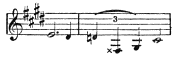
is altogether beautiful. It reminds me of Liszt. Not of any particular melody, but it is in his style, after the manner of his semi-Italian melodies, which are wanting in the plasticity and simplicity of the true Italian folk airs. Moreover, the continuation of your theme:
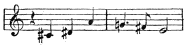
is not only beautiful, but wonderful; it captivates both the ear and the heart.
“No one can ever reproach you with regard to the technical part of your work, which deserves unqualified praise.”
To Modeste Tchaikovsky.
“Moscow, December 4th (16th), 1886.
“My dear Modi,—Something very important happened to-day. I conducted the first orchestral rehearsal in such style that all were astonished (unless it were mere flattery), for they had expected I should make a fool of myself. The nearer came the terrible day, the more unbearable was my nervousness. I was often on the point of giving up the idea of conducting. In the end I mastered myself, was enthusiastically received by the orchestra, found courage to make a little speech, and raised the bâton. Now I know I can conduct, I shall not be nervous at the performance.”
To N. F. von Meck.
“Moscow, January 14th (26th), 1887.
“My very dear Friend,—I have been enjoying your hospitality for a week.[117] I live in your house as if under the wing of Christ. Your servants are so careful of my welfare that I cannot praise them enough. I only regret that I can be so little at home. Daily rehearsals. I take a walk every morning, and by eleven o’clock I am waiting in the conductor’s desk. The rehearsal is not over till four o’clock, and then I am so tired that when I return home I have to lie down for a while. Towards evening I feel better and take some food.
“The conducting gives me great anxiety and exhausts my whole nervous system. But I must say it also affords me great satisfaction. First of all, I am very glad to have conquered my innate, morbid shyness; secondly, it is a good thing for a composer to conduct his own work, instead of having constantly to interrupt the conductor to draw his attention to this, or that, mistake; thirdly, all my colleagues have shown me such genuine sympathy that I am quite touched by it, and very pleased. Do you know I feel much less agitation than when I sit at the rehearsal doing nothing. If all goes well, I believe that not only will my nerves be none the worse, but it will have a beneficial effect on them.”
The first performance of Les Caprices d’Oxane took place at Moscow on January 19th (31st), 1887, and had a far-reaching influence on Tchaikovsky’s future, because he then made his first successful attempt at conducting. The great interest which the production of a new opera always awakens was thereby doubled, and all the places were taken before the opening night. The singers did their work conscientiously; there was no fault to be found, but no one made a memorable “creation” of any part. The mounting and costumes were irreproachable.
The public greeted the composer-conductor with great enthusiasm. Gifts of all kinds showed plainly that it was Tchaikovsky himself who was honoured, not the new conductor and composer of Les Caprices d’Oxane. The opera was a success; four numbers had to be repeated da capo.
The Press criticisms on this occasion were all favourable, even the Sovremenny Izvesty, in which Krouglikov, as we know, generally criticised Tchaikovsky’s works so severely. In short, the opera really had a brilliant success; far greater than that achieved by Eugene Oniegin in Petersburg. Nevertheless this opera only remained in the repertory for two seasons.
But little can be said about that which interests us most—the impression made by Tchaikovsky’s conducting. The severest judge and critic, Tchaikovsky himself, was satisfied. We know in what an objective spirit he criticised the success of his works, so we can safely believe him when he says he fulfilled his task satisfactorily. He describes this memorable evening as follows:—
To E. K. Pavlovskaya.
“Moscow, January 20th (February 1st), 1887.
“I did not expect to be very excited on the day of the performance, but when I awoke, quite early, I felt really ill, and could only think of the approaching ordeal as of a horrible nightmare. I cannot describe what mental agonies I suffered during the course of the day. Consequently, at the appointed hour, I appeared half dead at the theatre. Altani accompanied me to the orchestra. Immediately the curtain went up and, amid great applause, I was presented with many wreaths from the chorus, orchestra, etc. While this took place, I somewhat recovered my composure, began the Overture well, and by the end felt quite master of myself. There was great applause after the Overture. The first Act went successfully, and afterwards I was presented with more wreaths, among them yours, for which many thanks. I was now quite calm, and conducted the rest of the opera with undivided attention. It is difficult to say if the work really pleased. The theatre was at least half-full of my friends. Time and future performances will show if the applause was for me personally (for the sake of past services), or for my work. Now the question is, how did I conduct? I feel some constraint in speaking about it. Everyone praised me; they said they had no idea I possessed such a gift for conducting. But is it true? Or is it only flattery? I shall conduct twice more, and after the third time I ought to know for certain how much truth there is in all this.”
I have seldom seen Tchaikovsky in such a cheerful frame of mind as on that evening. We did not reach home till after five o’clock in the morning, and he immediately sank into a deep sleep. After so many days of anxiety and excitement he really needed rest! No one was more unprepared than he for the sad news which reached us next morning.
About seven o’clock I was aroused by a telegram which announced the death of our niece Tatiana, the eldest daughter of Alexandra Davidov. She had died quite suddenly at a masked ball in Petersburg. Not only was she a near relative, but also a highly gifted girl of great beauty. It required considerable resolution on my part to break the sad news to my brother when he awoke at eleven o’clock, happy and contented, and still under the pleasant impressions of the previous evening.
In spite of this heavy blow, Tchaikovsky did not alter his decision to conduct Les Caprices d’Oxane for two nights longer. The constant activity, and anxiety of a different nature, helped to assuage the violence of his grief.
XII
To N. F. von Meck.
“Maidanovo, February 2nd (14th), 1887.
“I have now been at home five days, yet there is no question of rest; on the contrary, I am working with such feverish haste at The Enchantress that I feel quite exhausted. I cannot live without work, but why do circumstances always compel me to be in a hurry, to have to overtax my strength? I see such an endless pile of work before me to which I am pledged that I dare not look into the future. How short life is! Now that I have probably reached that last step which means the full maturity of my talent, I look back involuntarily and, seeing so many years behind me, glance timidly at the path ahead and ask: Shall I succeed? Is it worth while? And yet it is only now that I begin to be able to compose without self-doubt, and to believe in my own powers and knowledge.”
To N. F. von Meck.
“Maidanovo, February 9th (21st), 1887.
“I am already dreaming of a time when I shall give concerts abroad. But of what does one not dream? If only I were twenty years younger!!! One thing is certain: my nerves are much stronger, and things which formerly were not to be thought of are now quite possible. Undoubtedly I owe this to my free life, relieved from all anxiety of earning my daily bread. And who but you, dear friend, is the author of all the good things fate has brought me?
“The concert will take place in Petersburg on March 5th.”
On February 23rd (March 7th) Tchaikovsky went to Petersburg to attend the rehearsals for the Philharmonic Concert, at which the St. Petersburg public was to make his acquaintance as a conductor, from which dated the commencement of a whole series of similar concerts which made his name known in Russia, Europe and America.
On February 28th (March 12th) the first rehearsal took place, and Tchaikovsky writes in his diary in his customary laconic style: “Excitement and dread.” Henceforth, to the very end of his life, it was not the concert itself so much as the first rehearsal which alarmed him. By the second rehearsal he had usually recovered himself. Abroad, he found it particularly painful to stand up for the first time before an unknown orchestra.
All the important musical circles in Petersburg showed a lively interest in Tchaikovsky’s début as a concert conductor. The three rehearsals attracted a number of the first musicians, who encouraged him by their warm words of sympathy. No début could have been made under more favourable conditions.
The concert itself, which took place on March 5th (17th), in the hall of the Nobles’ Club, went off admirably. The programme consisted of: (1) Suite No. 2 (first performance in St. Petersburg), (2) Aria from the opera The Enchantress, (3) the “Mummers’ Dance” from the same opera, (4) Andante and Valse from the Serenade for strings, (5) Francesca da Rimini, (6) Pianoforte solos, (7) Overture “1812.”
The hall was full to overflowing, and the ovations endless. The Press criticisms of the music, as well as of Tchaikovsky’s conducting, proved colourless and commonplace, but on the whole laudatory. Even Cui expressed some approbation for Tchaikovsky as a conductor, although he again found fault with him as a composer.
Tchaikovsky’s diary contains the following brief account of the concert: “My concert. Complete success. Great enjoyment—but still, why this drop of gall in my honeypot?”
In this question lie the germs of that weariness and suffering which had their growth in Tchaikovsky’s soul simultaneously with his pursuit of fame, and reached their greatest intensity in the moment of the composer’s greatest triumphs.
To N. F. von Meck.
“Maidanovo, March 12th (24th), 1887.
“The Empress has sent me her autograph picture in a beautiful frame.[118] This attention has touched me deeply, especially at a time when she and the Emperor have so many other things to think about.”
Diary.
“Ippolitov-Ivanov and his wife came very late, about ten o’clock. I met them out walking. At first I felt annoyed to see them, and vexed at my work being interrupted; but afterwards these good people (she is extremely sympathetic) made me forget everything, except that it is the greatest pleasure to be in the society of congenial friends. Ivanov played, and she sang beautiful fragments from his opera Ruth (the duet especially charmed me). They left at six. Worked before and after supper.”
To Modeste Tchaikovsky.
“Maidanovo, March 15th (27th), 1887.
“Ruth pleases me more and more. I believe Ippolitov-Ivanov will come to the front, if only because he has something original about him, and this ‘something’ is also very attractive.”
Diary.
“March 16th (28th), 1887.
“I will not conceal it: all the poetry of country life and solitude has vanished. I do not know why. Nowhere do I feel so miserable as at home. If I do not work, I torment myself, am afraid of the future, etc. Is solitude really necessary to me? When I am in town, country life seems a paradise; when I am here, I feel no delight whatever. To-day, in particular, I am quite out of tune.”
“March 19th (31st).
“Have just read through my diary for the last two years. Good heavens! how could my imagination have been so deceived by the melancholy bareness of Maidanovo? How everything used to please me!”
“March 26th (April 7th).
“Read through Korsakov’s ‘Snow-Maiden,’ and was astonished at his mastery. I envy him and ought to be ashamed of it.”
“March 30th (April 11th).
“After supper I read the score of A Life for the Tsar. What a master! How did Glinka manage to do it? It is incomprehensible how such a colossal work could have been created by an amateur and—judging by his diary—a rather limited and trivial nature.”
“April 16th (28th).
“Played through The Power of the Evil One.[119] An almost repulsive musical monstrosity; yet, at the same time, talent, intuition, and imagination.”
To N. F. von Meck.
“Maidanovo, April 24th (May 6th), 1887.
“My very dear Friend,—I wished to leave Maidanovo a month ago, and yet I am still here. My work (the orchestration of the opera) detains me. This work is not really difficult, but it takes time. I notice that the older I grow, the more trouble my orchestration gives me. I judge myself more severely, am more careful, more critical with regard to light and shade. In such a case the country is a real boon. Saint-Saëns has invited me to be present at both his concerts at Moscow, but I have courteously refused. Poor Saint-Saëns had to play to an empty room. I knew it would be so, and that the poor Frenchman would take it deeply to heart, so I did not wish to be a witness of his disappointment. But also I did not want to interrupt my work.”
Tchaikovsky stayed at Maidanovo to complete the instrumentation of the whole score of The Enchantress, and left on May 9th to visit his sick friend, Kondratiev, before starting on his journey to the Caucasus.
XIII
To N. F. von Meck.
“The Caspian Sea, May 28th (June 9th), 1887.
“I left Moscow on the 20th. At Nijni-Novogorod I had great trouble in securing a second-class ticket for the steamer, Alexander II. This steamer is considered the best, and is therefore always full. My quarters were very small and uncomfortable, but I enjoyed the journey down the Volga. It was almost high tide, and therefore the banks were so far away that one could almost imagine oneself at sea. Mother Volga is sublimely poetical. The right bank is hilly, and there are many beautiful bits of scenery, but in this respect the Volga cannot compare with the Rhine, nor even with the Danube and Rhône. Its beauty does not lie in its banks, but in its unbounded width and in the extraordinary volume of its waters, which roll down to the sea without any motion. We stopped at the towns on the way just long enough to get an idea of them. Samara and the little town of Volsk pleased me best, the latter having the most beautiful gardens I have ever seen. We reached Astrakhan on the fifth day. Here we boarded a little steamer, which brought us to the spot where the mouth of the Volga debouches into the open sea, where we embarked on a schooner, on board which we have been for the last two days. The Caspian Sea has been very treacherous. It was so stormy during the night that I was quite frightened. Every moment it seemed as if the trembling ship must break up beneath the force of the waves; so much so that I could not close an eye all night. But in spite of this I was not sea-sick. We reached Baku to-day. The storm has abated. I shall not be able to start for Tiflis until to-morrow morning, for we cannot catch the train to-day.”
On the journey between Tsaritsin and Astrakhan, Tchaikovsky had a very droll experience. He had managed so cleverly that no one on board knew who he was. One day a little musical entertainment was got up, and Tchaikovsky offered to undertake the accompanying. It so happened that a lady amateur placed one of his own songs before him and explained to him the manner in which he was to accompany it. On his timidly objecting, the lady answered that she must know best, as Tchaikovsky himself had gone through the song in question with her music mistress. The same evening a passenger related how Tchaikovsky had been so delighted with the tenor Lody in the rôle of Orlik in Mazeppa[120] that after the performance “he fell on Lody’s neck and wept tears of emotion.”
To N. F. von Meck.
“Tiflis, May 30th (June 11th), 1887.
“Baku, in the most unexpected fashion, has turned out to be an altogether beautiful place, well planned and well built, clean and very characteristic. The Oriental (especially the Persian) character is very prevalent, so that one could almost imagine oneself to be on the other side of the Caspian Sea. It has but one drawback: the complete lack of verdure....
“On the day after my arrival I visited the neighbourhood of the naphtha wells, where some hundred boring-towers throw up a hundred thousand pouds of naphtha every minute. The picture is grand but gloomy....
“The road between Baku and Tiflis runs through a stony, desolate country.”
The end of this journey was Borjom, where he intended to pass the whole summer in the family of his brother Anatol. He reached there on June 11th. He only learnt to appreciate by degrees the enchanting beauty of the neighbourhood. The horizon, shut in by lofty mountains, the sombre flora, their luxuriance, and the depth of the shadows, made an unpleasant impression upon him at first. Only after he had learnt to know the inexhaustible number and variety of the walks did he begin to like this country more and more. When, ten days later, his brother Modeste arrived at Borjom he was already full of enthusiasm and ready to initiate him into all the beauties of the place.
Tchaikovsky worked very little while at Borjom, only spending an hour a day at the instrumentation of the “Mozartiana” Suite.
At the commencement of July Tchaikovsky left Borjom in response to a telegram from his friend Kondratiev, who had been removed to Aix-la-Chapelle, in the hopes that the baths might prolong his life for a few months. Kondratiev’s condition was so critical that Tchaikovsky could not do less than interrupt his own cure and join his friend as soon as possible.
To Modeste Tchaikovsky.
“Aix-la-Chapelle, July 16th (28th), 1887.
“I do not dislike Aix—that is all I can say. What is really bad here is the atmosphere, saturated as it is with smells of cooking, cinnamon, and other spices. I think sorrowfully of the air in Borjom, but I try to dwell upon it as little as possible. However, I feel more cheerful here than I did on the journey. I see that my arrival has given much pleasure to Kondratiev and Legoshin, and that I shall be of use to them.”
Diary.
“Aix, July 22nd (August 3rd), 1887.
“I sit at home full of remorse. The cause of my remorse is this: life is passing away and draws near to its end, and yet I have not fathomed it. Rather do I drive away those disquieting questions of our destiny when they intrude themselves upon me, and try to hide from them. Do I live truly? Do I act rightly? For example, I am now sitting here, and everyone admires my sacrifice. Now there is no question of sacrifice. I lead a life of ease, gormandise at the table d’hôte, do nothing, and spend my money on luxuries, while others want it for absolute necessities. Is not that the veriest egoism? I do not act towards my neighbours as I ought.”
To P. Jurgenson.
“Aix, July 29th (August 10th), 1887.
“Dear Friend,—To-day I am sending you my Mozart Suite, registered. Three of the borrowed numbers in the Suite are pianoforte pieces (Nos. 1, 2, 4); one (No. 3) is the chorus ‘Ave Verum.’ Of course, I should be glad if the Suite could be played next season. That is all.”
Tchaikovsky’s “heroic act” of friendship consumed more than a month of his time. While paying full tribute to the generosity of his undertaking, we must confess that he failed to grasp the relation between wishing and doing. Tchaikovsky, filled with real and self-denying compassion for the sufferings of his neighbour, was wanting—as in all practical questions of life—in the necessary ability, self-control, and purpose. In the abstract, no one had more sympathy for his neighbour than he; but in reality no one was less able to do much for him. Anyone who could ask the trivial question: “Where wadding, needles, and thread could be bought?” would naturally lose his head at the bedside of a dying man. The consciousness of his helplessness and incapacity to lessen his friend’s suffering in the least, his irresolution in face of the slightest difficulty, rendered Tchaikovsky’s useless visit to Aix all the more painful. He suffered for the dying man and for himself. The result was that he did “too much” for friendship and “too little” for his sick friend; at least, in comparison to the extraordinary sacrifice of strength which his generous action demanded. When, at the end of August, the dying man’s nephew came to relieve him, Tchaikovsky fled from Aix, deeply grieved at parting from his friend “for ever,” humbled at his own mental condition, and angry at his inability “to see the sad business through to the end.” Exhausted, and wrathful with himself, he arrived at Maidanovo on August 30th (September 11th), where the news of Kondratiev’s death reached him a fortnight later.
Diary.
“September 21st (October 3rd), 1887.
“How short is life! How much I have still to do, to think, and to say! We keep putting things off, and meanwhile death lurks round the corner. It is just a year since I touched this book, and so much has changed since then. How strange! Just 365 days ago I was afraid to confess that, in spite of the glow of sympathetic feeling which Christ awoke in me, I dared to doubt His divinity. Since then my religion has become more clearly defined, for during this time I have thought a great deal about God, life, and death. In Aix especially I meditated on the fatal questions: why, how, for what end? I should like to define my religion in detail, if only I might be quite clear, once for all, as to my faith, and as to the boundary which divides it from speculation. But life and its vanities are passing, and I do not know whether I shall succeed in expressing the symbol of that faith which has arisen in me of late. It has very definite forms, but I do not use them when I pray. I pray just as before; as I was taught. Moreover, God can hardly require to know how and why we pray. God has no need of prayers. But we have.”
On October 20th (November 1st) The Enchantress was produced under the bâton of the composer, and the performance was altogether most brilliant and artistic.
On this first night Tchaikovsky does not appear to have observed that the opera was a failure. He thought, on the contrary, that it pleased the public. After the second performance (on October 23rd), which—notwithstanding that it went better than the first—still failed to move the audience to applause, he first felt doubts as to its success. The indifference of the public was clearly apparent after the third and fourth representations, when his appearance in the conductor’s desk was received in chilling silence. It was only then that he realised that The Enchantress was a failure. On the fifth night the house was empty.
Tchaikovsky, as we shall see, ascribed this failure to the ill_will of the critics. After I had read through all the notices—says Modeste—it seemed to me that, in the present instance, my brother had done them too much honour. In none of the eleven criticisms did I trace that tone of contempt and malicious enjoyment with which his other operas had been received. No one called The Enchantress a “still_born nonentity,” as Cui had said of Eugene Oniegin; no one attempted to count up the deliberate thefts in The Enchantress, as Galler had done with Mazeppa. The reason for the failure of The Enchantress must be sought elsewhere: possibly in the defective interpretation of both the chief parts; but more probably in the qualities of the music, which still awaits its just evaluation at the hands of a competent critic.
To N. F. von Meck.
“Moscow, November 13th (25th), 1887.
“My dear Friend,—Please forgive me for so seldom writing. I am passing through a very stirring period of my life, and am always in such a state of agitation that it is impossible to speak to you from my heart as I should wish. After conducting my opera four times, I returned here, about five days ago, in a very melancholy frame of mind. In spite of the ovation I received on the opening night, my opera has not taken with the public, and practically met with no success. From the Press I have encountered such hatred and hostility that, even now, I cannot account for it. On no other opera have I expended so much labour and sacrifice; yet never before have I been so persecuted by the critics. I have given up the journey to Tiflis, for I shall scarcely have time to get sufficient rest in Maidanovo before I have to start on my concert tour abroad. I conduct first in Leipzig, and afterwards in Dresden, Hamburg, Copenhagen, Berlin, and Prague. In March I give my own concert in Paris, and from there I go to London, as I have received an invitation from the Philharmonic Society. In short, a whole crowd of new and strong impressions are awaiting me.”
The Symphony Concert of the Russian Musical Society, November 14th (26th), was the first concert ever conducted by Tchaikovsky in Moscow. The programme consisted exclusively of his own works, including “Mozartiana” (first time), Francesca da Rimini, the Fantasia for pianoforte, op. 56 (Taneiev as soloist), and the Arioso from The Enchantress. On the following day the same programme was repeated by the Russian Musical Society at a popular concert. The “Mozartiana” Suite was a great success (the “Ave Verum” was encored), and the Press—in contradistinction to that of St. Petersburg—spoke with great warmth and cordiality of the composer and conductor.
To P. Jurgenson.
“November 24th (December 6th) 1887.
“In to-day’s paper I accidentally saw that the eighth performance of The Enchantress was given before a half-empty house. It is an undoubted fiasco. This failure has wounded me in my inmost soul, for I never worked with greater ardour than at The Enchantress. Besides, I feel ashamed when I think of you, for you must have sustained a terrible loss. I know well enough that some day the opera will be reinstated, but when? Meanwhile it makes me very bitter. So far I have always maintained that the Press could not influence one’s success or failure; but now I am inclined to think that it is only the united attack of these hounds of critics which has ruined my opera. The devil take them! Why this spite? Just now, for example, in to-day’s number of the Novosti, see how they rail at our Musical Society and at me, because of this Popular Concert! Incomprehensible!”