Part III
Rosa Newmarch translation
I
TCHAIKOVSKY’S first impressions of Moscow practically resolve themselves into his association with a few Muscovites, with whom he was destined to be linked to the end of his days. His subsequent life is so inseparably connected with the narrow circle of his friends in the old capital, that the reader needs to be introduced to some of them individually, before I pass on to my brother’s career as a teacher and composer.
At the head of these musical friends stands Nicholas Rubinstein, of whom it is no exaggeration to say that he was the greatest influence throughout Tchaikovsky’s after career. No one, artist or friend, did so much for the advancement of his fame, gave him greater support and appreciation, or helped him more to conquer his first nervousness and timidity, than the Director of the Moscow Conservatoire. Nicholas Rubinstein is intimately associated with every event in Tchaikovsky’s private and public life. Everywhere we shall come upon traces of his helpful influence. It is not too much to assert that, during the first years of Tchaikovsky’s life there, all Moscow was personified in Nicholas Rubinstein.
Laroche, in his Reminiscences, gives the following sketch of the director:—
“Nicholas Rubinstein was born June 2nd (14th), 1835. Like his celebrated brother, he showed a remarkable and precocious talent for music. It is said he learnt quicker, and was considered to have more genius than Anton. But while the latter devoted himself entirely to music and studied in Berlin, Nicholas elected for a university education.... As a student at the Moscow University, and even later—until the establishment of the Russian Musical Society—he earned his living by teaching the pianoforte. He had a number of pupils, and, as he himself told me, earned at one time as much as 7,000 roubles (over £700) a year. On his marriage he was compelled to give up playing in public, on account of the objections raised by his wife’s relations. His domestic life was not happy, and the differences of opinion between himself and his wife’s family led to a rupture two years later. His unusual powers were first recognised when he succeeded in founding the Moscow Conservatoire. Besides being a most gifted pianist, he had great talent as a conductor, and organiser of many schemes. He could represent all branches of musical society in his own person. Although he spent all his nights at the ‘English Club,’ playing cards for high stakes, he managed to take part in every social event, and was acquainted with all circles of Moscow society, commercial, official, artistic, scientific, and aristocratic.”
“As regards art,” says Kashkin, “Nicholas Rubinstein was purely an idealist; he admitted no compromise, and was entirely above personal likes or dislikes. He was always ready to help a fellow-artist, especially a Russian, and, without stopping to consider his means, simply gave whatever he had by him at the moment.
“Externally he differed greatly from his brother Anton. Nicholas Rubinstein was short and stoutly built; fair-complexioned, with curly hair. He had a dreamy expression, a languor of speech, and an air of aristocratic weariness, which was contradicted by the indefatigable energy of his temperament. Probably this languor proceeded from the fact that he scarcely ever slept.
“He was Tchaikovsky’s senior by five years only; but in these early days of their intercourse the difference between their ages seemed much greater. This was partly accounted for by the fact that Tchaikovsky came to Moscow in a somewhat subordinate position, whereas the name of Rubinstein was one of the most popular in the town; but the difference in character was also very great. Rubinstein belonged to the class of dominating and ruling personalities; his was a forceful character which impressed all who came in contact with him. Tchaikovsky, on the contrary, was yielding and submissive in matters of daily existence, although inwardly he protested against all attempts to influence and coerce him, and generally preserved his freedom of opinion, at least as regards music. This self-assertion did not, however, come naturally to him, and for that reason he loved solitude. He avoided his fellow-men, because he did not know how to hold his own among them; while at the same time he disliked submitting to the will of others, but this was not his attitude in 1866. At this time he was grateful for Nicholas Rubinstein’s almost paternal care, and bowed to his decision, even in the matter of dress.
“Their friendly relations were sometimes strained, but never broken, although Peter Ilich was occasionally irritated by Rubinstein’s masterful guidance, and was scolded in return for not being sufficiently docile.”
“Rubinstein’s right hand,” says Laroche, “was Constantine Albrecht, the Inspector of the Conservatoire. He was about five years older than Tchaikovsky, and had held the post of ‘cellist at the Opera House since the age of fifteen. Albrecht was a very capable and, in many respects, a very interesting man, although he was not popular with the public. Tchaikovsky was strongly attracted to him, and soon after his arrival in Moscow arranged to take his meals daily at his house. Albrecht’s views, or rather convictions, were extraordinarily paradoxical.
“In politics he took the Conservative side, but as regards music he was probably the most advanced radical in Moscow. Wagner, Liszt, Beethoven in his last period, and certain things of Schumann, were all he would acknowledge. I must add, by way of an eccentricity, his admiration for Dargomijsky’s Roussalka. He was an admirable choral conductor, and did good work in this branch of his art, for many of the pupils trained by him turned out excellent teachers. Besides music, Albrecht took great interest in natural science and mathematics. In summer he was an enthusiastic hunter of beetles and butterflies. But for the subjects in which a musician should be interested—history, poetry, belles-lettres he showed the most complete indifference. I doubt if he had ever read a novel....”
Tchaikovsky had a very high opinion of Albrecht as a composer, and often regretted that so much talent should be wasted. But it was his kindliness of heart, and above all his innate sense of humour, which appealed most to Peter Ilich.
Very different, and far more important, were Tchaikovsky’s relations with P. I. Jurgenson, the first—and always the chief—publisher of his works.
Peter Ivanovich Jurgenson was born at Reval in 1836, and his childhood was spent in very poor and depressing circumstances. At nineteen he entered a music warehouse in Petersburg, where he soon won his employer’s confidence, and rose to be manager to the firm of Schildbach, in Moscow. Two years later, in 1861, he made a daring venture and set up business on his own account. In Nicholas Rubinstein he found a powerful friend and ally, who supported his enterprise for twenty years with unfailing energy. By 1866 Jurgenson had passed through his worst experiences, and began to play a prominent part in the musical life of Moscow. Courageous and enterprising, he was one of the most active adherents of Nicholas Rubinstein, that “Peter the Great” of musical Moscow, to whom he rendered valuable assistance in founding the Conservatoire. Jurgenson was the first Russian publisher to bring out the works of the classical school in cheap editions, and also the compositions of young native composers, including those of Tchaikovsky.
Although he came from the Baltic provinces, Jurgenson was an ardent Russian patriot, and soon won the affection of Peter Ilich, who was always a welcome guest in his house.
At the present moment the firm of Jurgenson is almost the sole possessor of Tchaikovsky’s compositions. Among the 200,000 engraving-plates which are preserved in their fireproof safes more than 70,000 belong to the works of this composer.
The fourth of Tchaikovsky’s intimate friends, Nicholas Kashkin, received him on his arrival with the cordiality of an old comrade, for he already knew him from Laroche’s enthusiastic description.
“ ... Nicholas Dmitrievich Kashkin was the son of a well-known and respected bookseller in the town of Voronejh,” says Laroche in his reminiscences. From childhood he displayed great aptitude for the piano, and by dint of self-teaching, made such progress that he could execute difficult music, and was highly thought of in his native place. Yet he was conscious that he lacked proper training, and at twenty-two went to study with Dubuque, in Moscow.
Although Kashkin had no influence on Tchaikovsky’s development, their relations were very friendly. When the latter came to Moscow, Kashkin was already married and a professor at the Conservatoire. He and his young wife took a great liking to the lonely composer, and the intimacy ripened very quickly. All the teachers at the Conservatoire, including Nicholas Rubinstein, valued Kashkin’s advice. All his friends regarded him as a critic par excellence. Many years later he gave up teaching at the Conservatoire, and became a professional critic. But even in this difficult calling, which so often leads to misunderstanding and bitter enmities, he managed to keep all his old friends, and even to make new ones.
If I add to the names of N. Rubinstein, Albrecht, Jurgenson, and Kashkin, two fellow-students already mentioned—Laroche and Hubert—the list of Tchaikovsky’s intimate friends is complete. This little circle was destined to give unfailing support to the growing reputation of the composer, and to remain in the closest personal relations with him to the end of his life. Amid these friends he found encouragement and sympathy at the time when he stood most in need of them.
II
Tchaikovsky left St. Petersburg early in January, 1866.
At this time his letters show his depth of tenderness for his own people, his first feelings of loneliness in the strange city, his indifference to his surroundings, and finally his gradual attachment to Moscow, which ended in being “the dearest town in the world.”
To Anatol and Modeste Tchaikovsky.
“3.30 p.m., January 6th (18th).
“My dear Brothers,—My journey, although sad, is safely over. I thought about you the whole way, and it grieved me to think that lately I had overshadowed you with my own depression, although I fought hard against it. Do not, however, doubt my affection, even if I do not always show it outwardly. I am staying at the Hotel Kokorev. I have already seen Rubinstein and been introduced to two directors of the Musical Society. Rubinstein was so pressing in his invitation to me to live with him that I could not refuse, and shall go there to-morrow.... I hug you both. Do not cease to love me. Give my remembrances to everyone. Write! I will write again soon. I have just written to Dad. You must also do so.”
To the same.
“Moscow, January 10th (22nd).
“Dear Brothers,—I am now living with Nicholas Rubinstein. He is a very kind and sympathetic man. He has none of his brother’s unapproachable manner, but in other respects he is not to be compared with Anton—as an artist. I have a little room next to his bedroom, and, truth to tell, I am afraid the scratching of my pen must disturb him after he goes to bed, for our rooms are only divided by a thin partition. I am very busy (upon the orchestration of the C minor overture composed during the summer). I sit at home nearly all day, and Rubinstein, who leads rather an excitable life, cannot sufficiently marvel at my industry. I have been to both theatres. The opera was very bad, so for once I did not get as much artistic enjoyment from it as from the play.... I have hardly made any new acquaintances except Kashkin, a friend of Laroche’s and a first-rate musician, whom I have got to know very well indeed.
“Sometimes I feel rather melancholy, but as a rule I am possessed by an insatiable craving for work, which is my greatest consolation.... I have promised Rubinstein my overture shall be performed here before I send it to Petersburg. Yesterday at bedtime I thought a great deal about you both. I pictured to myself all the horrors of the first night after the holidays, and fancied how Modi would hide his nose under the bed-clothes and cry bitterly. How I wish I could have comforted him! It is not a meaningless phrase, Modi, when I tell you to grind and grind and grind, and to make friends with your respectable companions, but not with that crazy fellow X.... I am afraid you will be left behind in your class and be one of those who get into the master’s black books. I have no fears for Toly, so I send him no advice. Toly, my dear, conquer your indolence as a correspondent and write to me. Hearty kisses!”
The overture in C minor, referred to in this letter, was submitted to Nicholas Rubinstein a few days later. His opinion, however, was unfavourable, and he declared the work unsuitable for performance by the Musical Society. Tchaikovsky then sent the work to Petersburg, in order that Laroche might ask Anton Rubinstein to perform it there. “I have left your overture with Rubinstein,” Laroche wrote in reply, “and repeated your request verbatim. He replied by a low, ironical bow. But this is just his way.” The overture was not approved by Anton Rubinstein, nor did it meet with a happier fate when Laroche tried to persuade Liadov to give it a place at one of the opera concerts. Long afterwards Tchaikovsky himself shared this adverse opinion of the work, and wrote upon the cover of the manuscript, “Awful rubbish.”
To his sister, Alexandra Davidov.
“January 15th (27th).
“ ... I have nothing particular to tell you about my life and work. I am to teach the theory of music, and yesterday I held the preliminary examination. Many pretty girls presented themselves.... I like Moscow very well, but I doubt if I shall ever get accustomed to it; I have been too long rooted in Petersburg.”
To A. and M. Tchaikovsky.
“January 15th (27th).
“My dear Brothers,—Do not waste your money on stamps. It would be better to write only once a week, a long letter in the form of a diary....
“I get on very well with everyone, especially with Rubinstein, Kashkin, Albrecht, and Osberg.[12] I have also made friends with a family of the name Tchaikovsky.[13] I have eaten a great deal at their house, but I did not take part in the dancing, although I was attired in Rubinstein’s dress-coat. The latter looks after me like a nurse, and insists upon doing so. To-day he forced me to accept half a dozen new shirts (you need not mention this to the Davidovs or anyone else), and to-morrow he will carry me off to his tailor to order me a frock-coat. He is a wonderfully kind man, but I cannot understand how he has won his great reputation as a musician. He is rather ordinary in this respect, not to be compared to his brother.[14]
“In mentioning my friends here, I must not omit Rubinstein’s servant Alexander. He is a worthy old man, and possesses a splendid white cat which is now sitting on my lap, while I stroke it gently. My pleasantest pastime is to think of the summer. Lately I have felt drawn to Sasha, Leo, and their children, and have now decided to spend the summer with you at their house.”
To A. and M. Tchaikovsky.
“Sunday, January 30th (February 11th).
“ ... I laugh heartily over Dickens’s Pickwick Papers, with no one to share my mirth; but sometimes this thought incites me to even wilder hilarity. I recommend you to read this book; when one wants to read fiction it is best to begin with such an author as Dickens. He has much in common with Gogol; the same inimitable and innate humour and the same masterly power of depicting an entire character in a few strokes. But he has not Gogol’s depth....
“The idea of an opera begins to occupy my attention. All the libretti Rubinstein has given me are utterly bad. I have found a subject, and intend to write words myself. It will simply be the adaptation of a tragedy. The poet Plestcheiev is living here, and has promised to help me.”
To his sister, Alexandra Davidov.
“February 7th (19th).
“I am gradually becoming accustomed to Moscow, although sometimes I feel very lonely. My classes are very successful, to my great astonishment; my nervousness is vanishing completely, and I am gradually assuming the airs of a professor. My home-sickness is also wearing off, but still Moscow is a strange place, and it will be long before I can contemplate without horror the thought of remaining here for years—perhaps for ever....”
To Modeste Tchaikovsky.
(The middle of February.)
“My Dear Friend Modi,—I have been very busy lately, and therefore have not written for a long while. Rubinstein has entrusted me with some important work which has to be finished by the third week in Lent....
“Life glides on quietly and monotonously, so that I have hardly anything to tell you. I often visit the Tarnovskys, whose niece is the loveliest girl I ever saw in my life. I am very much taken with her, which causes Rubinstein to be a perfect nuisance. The moment we arrive at the house the others begin to tease us and leave us together. At home she is called ‘Mufka,’ and just now I am wondering whether I dare use this name for her too. I only need to know her a little better. Rubinstein has also been in love with her, but his sentiments have now grown cooler.
“My nerves are in good condition; I am very calm and even cheerful. I often console myself with thoughts of Easter, spring, and the summer holidays.”
The work to which Tchaikovsky refers at the beginning of this letter was the instrumentation of his overture in F major, which had been originally scored for the small orchestra of the Petersburg Conservatoire. In later years the composer must have destroyed the fuller arrangement of the work, although at this time he seems to have been satisfied with the result.
To A. and M. Tchaikovsky.
“March 6th (18th).
“ ... My overture was performed on Friday, and had a good success. I was unanimously recalled, and—to be grandiloquent—received with applause that made the welkin ring. More flattering still was the ovation I met with at the supper which Rubinstein gave after the concert.... After supper he proposed my health amid renewed applause. I go into these details because it is my first public success, and consequently very gratifying.”
At the end of March Tchaikovsky, eager as a schoolboy at the beginning of his holidays, left Moscow for Petersburg, where he stayed until April 4th (16th).
To A. and M. Tchaikovsky.
“Moscow, April 7th (19th).
“Brothers! Forgive me for not having written before. The journey was safely accomplished. The news of the attempt upon the Emperor’s life reached us at the station where we stopped for tea, but only in a very vague form.[15] We pictured to ourselves that he was actually dead, and one lady wept bitterly, while another began to extol all the virtues of the new sovereign. Only at Moscow I learnt the true account. The rejoicings here were beyond belief; yesterday at the Opera, where I went to hear A Life for the Tsar, when the Poles appeared on the stage the entire public began to shout, ‘Down with the Poles!’ In the last scene of the fourth act, in which the Poles put Sousanin to death, the singer who was taking this part resisted with such realistic violence that he knocked down several of the ‘Polish’ chorus-singers. When the rest of the ‘Poles’ saw that this outrage to art and to the truth delighted the public, they promptly fell down of their own accord, and the triumphant Sousanin walked away, shaking his fists at them, amid the vociferous applause of the Muscovites. At the end of the opera the Emperor’s portrait was brought on the stage, and an indescribable tumult followed.”
To Alexandra Davidov.
“April 18th (20th).
“I am going to act as advocate for two mortals who are just crazy about Kamenka. You write that Toly and Modi might be left in Petersburg, but I am determined not to tell them your point of view. They would utterly lose heart—especially Toly. One of my chief reasons for caring to spend the summer at Kamenka is to be with them, and your house is the only place where we can be together for a time. If you only knew how these little fellows cling to me (and I return their love a hundredfold), you would not find it in your heart to separate us. Arrange, my dear, for this visit to come off. Very likely I shall be able to take part of the expense off your hands.”
Before the summer holidays came, Tchaikovsky’s health was in an unsatisfactory condition. He complains in his letters of insomnia, nervousness, and the throbbing sensations in his head, to which he often refers as “my apoplectic symptoms.” At the end of April his depression became very apparent, and he wrote to his brother Anatol:—
“My nerves are altogether shaken. The causes are: (1) the symphony, which does not sound satisfactory; (2) Rubinstein and Tarnovsky have discovered that I am easily startled, and amuse themselves by giving me all manner of shocks all day long; (3) I cannot shake off the conviction that I shall not live long, and shall leave my symphony unfinished. I long for the summer and for Kamenka as for the Promised Land, and hope to find rest and peace, and to forget all my troubles there. Yesterday I determined to touch no more wine, spirits, or strong tea.
“I hate mankind in the mass, and I should be delighted to retire into some wilderness with very few inhabitants. I have already secured my ticket in the diligence for May 10th (22nd).”
The visit to Kamenka, to which he had looked forward through the winter and spring, did not actually come to pass. In consequence of the state of the high-roads, the diligence was unable to run beyond Dovsk; the remainder of the journey had to be undertaken, at the traveller’s own risk and expense, in a private post-chaise. Tchaikovsky’s funds did not permit of this extra strain, and the visit to his sister was abandoned. With the assistance of his father, Anatol was sent to Kamenka, while Peter Ilich, with Modeste, went for a time to his sister’s mother-in-law at Miatlev, near Petersburg.
In spite of the beauty of scenery and his pleasure in being with his excellent friends, Elizabeth and Vera Davidov, in spite of being near his father and the poetical impression derived from a trip to Lake Ladoga, Tchaikovsky did not altogether enjoy his holiday at Miatlev. The cause of this was his G minor symphony, afterwards known as Winter Day Dreams. Not one of his compositions gave him so much trouble as this symphony.
He began this work in Moscow during the spring, and it was the cause of his nervous disorders and numerous sleepless nights. These difficulties were partly caused by his want of experience in composition, and partly by his habit of working by night as well as by day. At the end of June he had a terrible nervous breakdown, and the doctor who was called in to see him declared he had narrowly escaped madness, and that his condition was very serious. The most alarming symptoms of the illness were his hallucinations and a constant feeling of dread. That he suffered intensely is evident from the fact that he never again attempted to work through the night.
In consequence of his illness, Tchaikovsky was unable to finish the symphony during the summer. Nevertheless, before his return to Moscow he resolved to submit it to his former masters, Anton Rubinstein and Zaremba, hoping they might offer to let it be heard at the Musical Society.
Once more he was doomed to disappointment. His symphony was severely criticised, rejected, and pronounced unworthy of performance. It was the first completely independent work which he had composed after leaving the Petersburg Conservatoire. The only other work upon which he was engaged at this time was the orchestration of his F major and C minor overtures, which still remain unpublished.
III 1866-1867
At the end of August Tchaikovsky returned to Moscow without any trace of the hostile feeling with which he had gone there in the previous January. In this change of attitude his artistic sensibility unquestionably played a part. After the severe judgment of the authorities in Petersburg upon his symphony, he could not fail to contrast this reception unfavourably with the acknowledgments of the Moscow musical world. He had learnt, too, the value of his colleagues, N. Rubinstein, Albrecht and Kashkin, and looked forward to meeting them again. Finally, he had the pleasant prospect of an increased salary, commencing from September. He must have rejoiced to feel his extreme poverty had touched its limits, and an income of over £120 a year seemed almost wealth to him. “I have money enough and to spare,” he wrote to his brothers in November.
The ties which bound him to Petersburg were slackening. His attachment to his father remained unchanged, but he was growing accustomed to his separation; moreover, the twins stood less in need of his tender solicitude, since they were once more living at home with their father.
And yet he still hankered after the recognition of St. Petersburg; Moscow was still “a strange city”; a provincial town, the appreciation of which was hardly worth the conquest.
In 1866 the Conservatoire outgrew its quarters in Rubinstein’s house, and it became necessary to locate it in a larger building. Rubinstein now moved into quarters nearer the new Conservatoire, and Tchaikovsky continued to live with him.
The opening of the buildings took place on September 1st (13th), and was attended by most of the leaders of Moscow society. The consecration service was followed by a banquet at which many toasts were given, and even Tchaikovsky himself drank to the health of Rubinstein, after making a cordial and eloquent speech in his honour. Kashkin, the only witness of the event now living, writes:—
“The banquet was followed by music, and Tchaikovsky, who was determined that the first music to be heard in the hall of the Conservatoire should be Glinka’s, opened the impromptu concert by playing the overture to Russlan and Lieudmilla from memory.”
The influx of new colleagues which followed the enlargement of the Conservatoire made very little difference to Tchaikovsky’s intimate circle. He admired Laub’s incomparable playing without entering into closer relations with him. He had more in common with Kossmann, an excellent musician and a man of culture. His acquaintance with the violinist Wieniawsky was of short duration, since at the end of six months the latter resigned his post as teacher, and they never met again. He often spent the evening with Dubuque, a most hospitable man, and a famous pianist, who was considered the finest interpreter of Field’s Nocturnes and other works which were accounted modern in those days. To these acquaintances we may add Anton Door, the well-known pianist, now residing in Vienna.
Among such of Tchaikovsky’s friends as did not belong to the musical profession, the generous art patron Prince Vladimir Odoevsky takes the first place. Peter Ilich was grateful for the interest which this enlightened man took in him and his work. In 1878 he says in one of his letters:—
TCHAIKOVSKY (IN WINTER DRESS), 1867

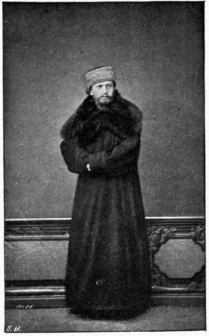
“He was the personification of kindness, and combined the most all-embracing knowledge, including the art of music.... Four days before his death he came to the concert to hear my orchestral fantasia, Fatum. How jovial he was when during the interval he came to give me his opinion! The cymbals which he unearthed and presented to me are still kept at the Conservatoire. He did not like the instruments himself, but thought I had a talent for introducing them at the right moment. So the charming old fellow searched all Moscow until he discovered a pair of good ‘piatti,’ and sent them to me with a precious letter.”
In the literary and dramatic world Tchaikovsky had two good friends—the dramatist Ostrovsky and Sadovsky. He won the sympathy of these distinguished men entirely by his own personality, since neither of them cared greatly for music.
During the season 1866-7 the composer made another friendship which was of great importance to his future career. Vladimir Petrovich Begichev, Intendant of the Imperial Opera, Moscow, enjoyed a considerable reputation—first as an elderly Adonis, secondly as the hero of many romantic episodes in the past, and thirdly as the husband of his wife, a lady once renowned for her singing and for her somewhat sensational past. By her first husband Madame Begichev had two sons—Constantine and Vladimir Shilovsky. These young men were strongly attracted to art and literature, and played a considerable part in Tchaikovsky’s subsequent career.
Soon after his arrival in Moscow Tchaikovsky began to compose an overture on the Danish National Hymn, which N. Rubinstein had requested him to have ready for the approaching marriage of the Tsarevitch with the Princess Dagmar, to be played in the presence of the royal pair during their visit to Moscow.
As with all his commissioned works, Tchaikovsky had completed this overture before the appointed day, although he had to compose under the most unfavourable conditions. Rubinstein’s house was beset all day long by professors from the Conservatoire and other visitors, who did not hesitate to intrude into Tchaikovsky’s room, so that he found no peace at home, and had to take refuge in a neighbouring inn, “The Great Britain,” which was very little frequented during the daytime. When finished, he dedicated the overture to the Tsarevitch, and received in return a pair of jewelled sleeve-links, which he immediately sold to Dubuque. Tchaikovsky, who generally judged his early works very severely, kept a favourable recollection of this overture, and wrote to Jurgenson, in 1892:—
“My Danish Overture may become a popular concert work, for, as far as I can remember, it is effective and, from a musical standpoint, far superior to ‘1812.’”
After making some alterations in his symphony—undertaken at the desire of Anton Rubinstein and Zaremba—Tchaikovsky, setting aside N. Rubinstein, desired to hear the judgments of his old teachers, so greatly was he still under the influence of Petersburg opinion. He only permitted the least important movement to be heard at a Moscow Symphony Concert in December—the scherzo, which had very little success. In Petersburg the work was once more refused, but afterwards the two middle movements (adagio and scherzo) were performed in February, 1867. The reception was not encouraging, only one anonymous critic speaking warmly in praise of the music.
In Tchaikovsky’s nature, side by side with his gentle and benevolent attitude towards his fellow-men, there existed an extraordinary memory for any injury; not in the ordinary sense of a desire for revenge, but in the more literal meaning of unforgetfulness. He hardly ever forgot a slight to his artistic pride. If it was offered by one whom he had hitherto loved, he grew suddenly cold to him—and for ever. Not only for months or years, but for decades, he would bear such a wound unhealed in his heart, and it took a great deal to make him forget an inconsiderate word, or an unfriendly action. It was no doubt the result of having been spoilt as a child. From his earliest infancy he had been kept from all unpleasantness, or even indifference, so that what would have appeared a pin-prick to many seemed to him a mortal blow.
Not only the episode of the symphony—which afterwards won a fair measure of success in St. Petersburg—but many other events contributed to estrange Tchaikovsky from the city of his first affections. Gradually the circle of his friends there decreased, and the most intimate of them all, Laroche, was appointed Professor at the Moscow Conservatoire in December, 1867. Besides which that little school of gifted “young Russians,” under the leadership of Balakirev, and the protection of Dargomijsky, which included Moussorgsky, Cui, Borodin and Rimsky-Korsakov, were gaining more and more acknowledgment and weight in Petersburg. This circle, supported by the pens of Cui and Stassov, who held extremely modern views and were opposed to the Conservatoire and Anton Rubinstein, made a very unsympathetic impression upon Tchaikovsky.
The hostility with which he regarded this group of composers had its origin in his distrustful attitude towards society generally. He met all strangers with dislike, but at the first friendly advance, or kind word, he forgave them, and even thought them sympathetic.
So it was with his intercourse with the members of the New School in St. Petersburg. Until 1868 none of them were known to him personally, but all the same he was hostile to them. This was sufficient to awaken in him the notion that they were all disposed to be his enemies, and when in 1867 Anton Rubinstein resigned the conductorship of the Symphony Concerts, and it passed into the hands of this school, he decided that Petersburg was now a hostile camp, whereas in reality they were simply neutral, or indifferent, to him.
Meanwhile, by closer acquaintance with Nicholas Rubinstein, Tchaikovsky had begun to recognise his worth as an executant, a conductor, and an indefatigable worker; while the presence of such musicians as Laub and Kossmann, and such intimate friends as Kashkin, Albrecht and Laroche, reconciled him to Moscow as a musical centre where it was worth while to be appreciated.
The earliest of Tchaikovsky’s letters in 1867 is dated May 2nd (14th); therefore it is difficult to fix the precise date at which he began to compose his opera, The Voyevode. In any case he received the first part of the libretto from Ostrovsky in March or April. I remember that in the summer the first act was not even finished. At the very outset he was delayed in his work because he lost the manuscript, and Ostrovsky had to rewrite it from memory.
To Anatol Tchaikovsky.
“May 2nd(14th), 1867.
“All last week I was out of humour; first, because of the bad weather; secondly, from shortness of money; and thirdly, from despair of ever again finding the libretto.... Recently I made the acquaintance of Professor Bougaiev at his house. He is an extraordinarily learned man. He talked until late into the night about astronomy and its latest discoveries. Good God! How ignorant we are when we leave school! I shudder when I chance to come across a really well-read and enlightened man!...”
In the summer of 1867 Tchaikovsky decided to visit Finland with one of the twins, his funds not being sufficient to allow of his taking both of them. With his usual naïveté as regards money matters, he set off with Anatol, taking about £10 in his pocket, which he believed would suffice for the trip. At the end of a few days in Viborg, finding themselves nearly penniless, they took the first boat back to Petersburg. There a great disappointment awaited them. Their father, from whom they hoped to obtain some assistance, had already left for a summer holiday in the Ural Mountains. The brothers then spent their last remaining shillings in reaching Hapsal by steamer, where they were certain of finding their faithful friends the Davidovs. They travelled as “between deck” passengers and suffered terribly from the cold. But notwithstanding these misadventures, out of which they derived more amusement than discomfort, Peter Ilich enjoyed the summer holidays. His spirits were excellent, and he worked hard at The Voyevode, while his leisure was spent in the society of his dear friends. The evenings were devoted to reading, and they were particularly interested in the dramatic works of Alfred de Musset. This kind of life entirely satisfied Tchaikovsky’s simple and steadfast nature, and his happy frame of mind is reflected in the Chant sans paroles, which he composed at this time and dedicated—with two additional pieces for piano—to Vera Vassilievna Davidov, under the title of Souvenir de Hapsal.
On August 15th (27th), Tchaikovsky left Hapsal for Moscow, spending a week in Petersburg on his way.
IV 1867-1868
“Perhaps you may have observed”—writes Tchaikovsky to his sister—“that I long intensely for a quiet, peaceful life, such as one lives in the country. Vera Davidov may have told you how we often spoke in fun of our future farm, where we intended to end our days. As regards myself it is no joke. I am really attracted to this idea because, although I am far from being old, I am already very tired of life. Do not laugh; if you always lived with me you would see it for yourself. The people around me often wonder at my taciturnity and my apparent ill_temper, while actually I do not lead an unhappy existence. What more can a man want whose prospects are good, who is liked, and whose artistic work meets with appreciation? And yet, in spite of these favourable circumstances, I shrink from every social engagement, do not care to make acquaintances, love solitude and silence. All this is explained by my weariness of life. In those moments when I am not merely too lazy to talk, but too indolent even to think, I dream of a calm, heavenly, serene existence, and only realise this life in your immediate neighbourhood. Be sure of this: you will have to devote some of your maternal devotion to your tired old brother. Perhaps you may think such a frame of mind naturally leads a man to the consideration of matrimony. No, my dear future companion! My weariness has made me too indolent to form new ties, too indolent to found a family, too indolent to take upon myself the responsibility of wife and children. In short, marriage is to me inconceivable. How I shall come to be united with your family I know not as yet; whether I shall become the owner of a plot of ground in your neighbourhood, or simply your boarder, only the future can decide. One thing is clear: my future happiness is impossible apart from you.”
Tchaikovsky never gives the true reason for his yearning after solitude and a life of “heavenly quiet and serenity,” but it certainly did not proceed from “misanthropy,” “indolence,” or weariness of life.
He was no misanthropist, for, as everyone who knew him must agree, it would be difficult to find any man who gave out more sympathy than he did. Laroche says:—
“The number of people who made a good impression on him, who pleased him, and of whom he spoke in their absence as ‘good’ and ‘sympathetic,’ sometimes astounded me. The power of seeing the best side of people and of things was a gift inherited from his father, and it was precisely this love of his fellow-creatures which made him so beloved in return. He was no misanthropist, rather a philanthropist in the true sense of the word. Neither is there greater justice in his self-accusation of ‘indolence.’ Those who have followed him through his school-life, his official career, and his student days at the Conservatoire, will be of my opinion. But a glance at the number of his works, which reaches seventy-six, including ten operas and three ballets; at his letters (I possess, in all, four thousand); at his literary work (sixty-one articles); at his translations and arrangements, and his ten years’ teaching, will suffice to convince the most sceptical that his nature knew no moods of dolce far niente.”
As regards his “weariness of life,” he himself disposes of it in the same letter, when he speaks of yearning for a calm and happy existence. Those who are really world-weary have no longing for any kind of existence. Neither misanthropy, indolence, nor weariness were his permanent moods. His indefinite craving for an easier life was caused by his creative impulse, which, waxing ever stronger and stronger, awoke the desire for more leisure to devote to it. This longing for freedom reached a climax in 1877, and brought about a complete change in his life.
For the time being it was useless to think of solitude or freedom. All he could hope for was the comparative liberty of his summer vacation. Town life was a necessity to him from the material and moral point of view, and although he complained of its being oppressive, I believe that had he been compelled by fate to reside in the country—as he did some years later—he would, at this earlier period of his career, have had much more cause for complaint.
To Anatol Tchaikovsky.
“August 31st, 1867 (September 12th).
“ ... At present I have nothing to do, and loaf about the town all day.... Ostrovsky still keeps me on the trot. I read in the Petersburg papers that he had completed my libretto, but it is not so. I had some difficulty in dragging the first half of the lost act out of him. I am wandering about with the intention of buying a large writing-table to make my room more comfortable, so that I can work at my opera at home. I am determined to finish it during the winter. Last night we celebrated Dubuque’s birthday, and I came back rather the worse for liquor.
“I have spent two evenings running at the ‘English Club.’ What a delightful club! It would be jolly to belong to it, but it costs too much....”
To Anatol Tchaikovsky.
(About the end of October.)
“I am getting along all right. On Saturday our first concert takes place, to which I look forward, for, generally speaking, the people here prefer carnal to spiritual entertainments, and eat and drink an incredible amount. The concert will supply me with a little musical food, of which I am badly in need, for I live like a bear in his cave, upon my own substance, that is to say, upon my compositions, which are always running in my head. Try as I may, it is impossible to lead a quiet life in Moscow, where one must over-eat and drink. This is the fifth day in succession that I have come home late with an overloaded stomach. But you must not imagine I am idle: from breakfast till the midday meal I work without a break.”
To Modeste Tchaikovsky.
“November 25th (December 7th).
“Our mutual friend Klimenko is in Moscow, and visits us almost daily.
“The Opera is progressing fairly well. The whole of the third act is finished, and the dances from it—which I orchestrated at Hapsal—will be given at the next concert.”
Ivan Alexandrovich Klimenko, whose name will often occur in the course of this book, had previously made Laroche’s acquaintance at one of Serov’s “Tuesday evenings.” An architect by profession, Kashkin describes him as a very gifted amateur. He was devotedly attached to Tchaikovsky, and one of the first to prophesy his significance for Russian music.
At the second symphony concert, which took place early in December, “The Dances of the Serving Maids,” from The Voyevode, were given. They had an undeniable success, and were twice repeated in Moscow during the season.
On December 12th (24th) Tchaikovsky wrote to his brother Anatol as follows:—
“You ask if I am coming to Petersburg. Wisdom compels me to say no. In the first place I have not money for the journey, and secondly, Berlioz is coming here at Christmas, and will give two concerts—one popular, and another in the place of our fourth symphony evening. I shall put off my visit until the Carnival or Lent....”
Berlioz went to Moscow about the end of December, 1867, direct from St. Petersburg, where he had been invited by the directors of the Musical Society—chiefly at the instigation of Dargomijsky and Balakirev—to conduct a series of six concerts.
This was not his first visit to Russia. As early as 1847 he had been welcomed in Petersburg, Moscow and Riga, by the instrumentality of Glinka, who regarded him as “the greatest of contemporary musicians.” He then met with an enthusiastic reception from the leaders of the Russian musical world, Prince Odoevsky and Count Vielgorsky, and not only made a large sum, but was equally fêted by the public. It is interesting to note that not only Berlioz himself, but his Russian admirers seem to have deluded themselves into the belief that he was “understood” and “appreciated” in Russia. Prince Odoevsky, who published an article extolling Berlioz’s genius the very day before his first concert in Petersburg, exclaims in one of his letters to Glinka:—
“Where are you, friend? Why are you not with us? Why are you not sharing our joy and pleasure? Berlioz has been ‘understood’ in St. Petersburg!! Here, in spite of the scourge of Italian cavatina, which has well-nigh ruined Slavonic taste, we showed that we could still appreciate the most complicated contrapuntal music in the world. There must be a secret sympathy between his music and our intimate Russian sentiment. How else can this public enthusiasm be explained?”
I am of opinion that it is more easily explicable by the fact that Berlioz was a gifted conductor, and that the public had been prepossessed in his favour by the laudatory articles of Prince Odoevsky himself. Judging from the neglect of this famous composer in the present day (Faust is the only one of his works which is still popular), this is surely the right point of view.
Twenty years later, in 1867, the enthusiastic welcome he received here was chiefly due to his attraction as a conductor, and to the enthusiasm of that small group of Russian musicians to whom he owed his invitation to our country.
Tchaikovsky, whose views were entirely opposed to those of this circle, held “his own opinions” in this, as in other matters. Although he fully appreciated the important place which Berlioz filled in modern music, and recognised him as a great reformer of the orchestra, he felt no enthusiasm for his music. On the other hand, he had the warmest admiration for the man, in whom he saw “the personification of disinterested industry, of ardent love for art, of a noble and energetic combatant against ignorance, stupidity, vulgarity, and routine....” He also regarded him as “an old and broken man, persecuted alike by fate and his fellow-creatures,” whom he cordially desired to console and cheer—if only for the moment—by the expression of an ungrudging sympathy.
On February 3rd (15th) Tchaikovsky’s G minor symphony was given at the Musical Society, when its success surpassed all expectations. “The adagio pleased best,” Tchaikovsky wrote to his brothers. The composer was vociferously recalled, and, according to Countess Kapnist, appeared upon the platform in rather untidy clothes, hat in hand, and bowed awkwardly.
On February 19th (March 2nd) a charity concert was given in the Opera House in aid of the Famine Fund. This was an event in Tchaikovsky’s life, for he made his first public appearance as a conductor, the “Dances” from The Voyevode, being played under his bâton. On this occasion, too, he first became acquainted with the work of Rimsky-Korsakov, whose “Serbian Fantasia” was included in the programme.
Tchaikovsky’s opinion of himself as a conductor we have learnt already from Laroche. Kashkin gives the following account of this concert:—
“When I went behind the scenes to see how the débutant was feeling, he told me that to his great surprise he was not in the least nervous. Before it came to his turn I returned to my place. When Tchaikovsky actually appeared on the platform, I noticed that he was quite distracted; he came on timidly, as though he would have been glad to hide, or run away, and, on mounting to the conductor’s desk, looked like a man who finds himself in some desperate situation. Apparently his composition was blotted out from his mind; he did not see the score before him, and gave all the leads at the wrong moment, or to the wrong instruments. Fortunately the band knew the music so well that they paid no attention whatever to Tchaikovsky’s beat, but laughing in their sleeves, got through the dances very creditably in spite of him. Afterwards Peter Ilich told me that in his terror he had a feeling that his head would fall off his shoulders unless he held it tightly in position.”
That he had no faith in his powers of conducting is evident from the fact that ten years elapsed before he ventured to take up the bâton again.
In a notice of the concert, which appeared in The Entr’acte, Tchaikovsky was spoken of as a “mature” musician, whose work was remarkable for “loftiness of aim and masterly thematic treatment”; while Rimsky-Korsakov’s “Serbian Fantasia” was dismissed as “colourless and inanimate.”
Had such a judgment been pronounced a few months earlier, at a time when Tchaikovsky knew nothing of the composer, and regarded the entire Petersburg School as his enemies, who knows whether he would not have felt a certain satisfaction—a kind of “Schadenfreude”—at its appearance? Now, however, circumstances were altered. Not only had he become well acquainted with the “Serbian Fantasia” at rehearsal, and learnt to regard both the work and its composer with respect, but during the last two or three months he had been more closely associated with the leader of the New School, Mily Balakirev, and had become convinced that, far from being his enemies, the Petersburg set were all interested in his career.
The result of this pleasing discovery was a burning desire to show his sympathy for a gifted colleague, and he wrote an article in direct contradiction to the criticism of the Entr’acte. This was the beginning of his literary activity. The article aroused considerable attention in Moscow, and was warmly approved. Nor did it escape observation in St. Petersburg. Consequently, when Tchaikovsky visited his father at Easter, he was received in a very friendly spirit by “The Invincible Band.”[16]
The rallying-point of “The Band” was Dargomijsky’s house. The composer, although confined to his bed by a mortal illness, was working with fire and inspiration at his opera, The Stone Guest. His young friends regarded this work as the foundation-stone of the great temple of “The Music of the Future,” and frequently assembled at the “Master’s” to note the progress of the new creation and show him their own works. Even Tchaikovsky, who had already met Dargomijsky at Begichev’s in Moscow, found himself more than once among the guests, and made many new acquaintances on these occasions.
At Balakirev’s, too, he met many musicians who held the views of the New Russian School. Although Tchaikovsky entered into friendly relations with the members of “The Invincibles,” he could not accept their tenets, and with great tact and skill remained entirely independent of them. While he made friends individually with Balakirev, Rimsky-Korsakov, Cui and Vladimir Stassov, he still regarded their union with some hostility.
He laughed at their ultra-progressive tendencies and regarded with contempt the naïve and crude efforts of some members of “The Band” (especially Moussorgsky). But while making fun of these “unheard-of works of genius,” which “throw all others into the shade,” and indignant at their daring attacks upon his idol Mozart, Tchaikovsky was also impressed by the force and vitality displayed in some of their compositions, as well as by their freshness of inspiration and honourable intentions, so that far from being repulsed, he learnt to feel a certain degree of sympathy and a very great respect for this school.
This dual relationship reacted in two different ways. Tchaikovsky never hesitated to express quite openly his antipathy to the tendencies of these innovators, while he refused to recognise the dilettante extravagances of Moussorgsky as masterpieces, and always made it evident that it would be distasteful to him to win the praise of Stassov and Cui, and with it the title of “genius,” by seeking originality at the expense of artistic beauty. At the same time he acted as the propagandist of “The Band” in Moscow, was their intermediary with the Moscow section of the Musical Society, and busied himself with the performance or publication of their works. When in 1869 the Grand Duchess Helena Paulovna desired to carry out a change in the management of the symphony concerts, and Balakirev retired from the conductorship, Tchaikovsky appeared for the second time as the champion of “The Band,” and protested against the proceedings of the Grand Duchess in an energetic article, in which he displayed also his sympathy with the leader of the New Russian School. During the period when he was engaged in musical criticism, he lost no opportunity of giving public expression to his respect and enthusiasm for the works of Balakirev and Rimsky-Korsakov.
But the most obvious sign of his sympathy with “The Band” is the fact that he dedicated three of his best works to individual members—Fatum and Romeo and Juliet to Balakirev and The Tempest to Vladimir Stassov. Here undoubtedly we may see the indirect influence which the New School exercised upon Tchaikovsky. He would not amalgamate with them; nor would he adopt their principles. But to win their sympathy, without actually having recourse to a compromise; to accept their advice (Romeo and Juliet was suggested by Balakirev and The Tempest by Stassov); to triumph over the tasks they set him and to show his solidarity with “The Band,” only in so far as they both aimed at being earnest in matters of art—all this seemed to him not only interesting, but worthy of his vocation.
“The Invincible Band” repaid Tchaikovsky in his own coin. They criticised some of his works as pedantic, “behind the times,” and routinier, but at the outset of his career they took the greatest interest in him, respected him as a worthy rival, strove to win him over to their views, and continued to consider him “among the elect,” even after the failure of their efforts at conversion.
The relations between Tchaikovsky and “The Band” may be compared to those existing between two friendly neighbouring states, each leading its independent existence, meeting on common grounds, but keeping their individual interests strictly apart.
During the summer of this year Tchaikovsky went abroad with his favourite pupil Vladimir Shilovsky, accompanied by the lad’s guardian, V. Begichev, and a friend named De Lazary. In spite of a lingering wish to spend his holidays with his own people in some quiet spot, the opportunity seemed too good to be lost. His travelling companions were congenial, and his duties of the lightest—merely to give music lessons to young Shilovsky.
From Paris he wrote to his sister on July 20th (August 1st), 1868:—
“Originally we intended to visit the most beautiful places in Europe, but Shilovsky’s illness, and the need of consulting a certain great doctor with all possible speed, brought us here, and has kept us against our will.... The theatres are splendid, not externally, but as regards the staging of pieces and the skill with which effects are produced by the simplest means. They know how to mount and act a play here in such a way that, without any remarkable display of histrionic talent, it is more effective than it would be with us, since it would probably lack rehearsal and ensemble.
“As regards music, too, in the operas I have heard I remarked no singer with an exceptional voice, and yet what a splendid performance! How carefully everything is studied and thought out! What earnest attention is given to every detail, no matter how insignificant, which goes to make up the general effect! We have no conception of such performances.... The noise and bustle of Paris is far less suited to a composer than the quiet of such a lake as the Thuner See, not to mention the stinking, but beloved, Tiasmin,[17] which is happy in flowing by the house that holds some of my nearest and dearest. How have they passed this summer?”
Tchaikovsky returned to his duties at Moscow about the end of August.
V
1868-1869
Externally, Tchaikovsky’s life had remained unchanged during this period. His lessons at the Conservatoire slightly increased, and his salary consequently rose to over 1,400 roubles (£140). Under these circumstances he began to think of finding separate quarters, since his life with Nicholas Rubinstein was unfavourable to his creative work. The latter, however, would not consent to this, and Tchaikovsky himself had doubts as to whether his income would suffice for a separate establishment.
To Modeste Tchaikovsky.
“September 3rd (15th).
“I have been working like a slave to-day. The day before yesterday I received an unexpected summons to attend at the theatre. To my great surprise I found two choral rehearsals of my opera (The Voyevode) had already been given, and the first solo rehearsal was about to take place. I have undertaken the pianoforte accompaniment myself. I doubt the possibility of getting up such a difficult work in a month, and already I shiver with apprehension at all the hurry-skurry and confusion which lie before me. The rehearsals will take place almost daily. The singers are all pleased with the opera....”
To Anatol Tchaikovsky.
“September 25th (October 7th).
“ ... When I saw that it was impossible to study my opera in so short a time, I informed the directors that so long as the Italian company remained in Moscow and absorbed the time of both chorus and orchestra, I would not send in the score of my work. I wrote to Gedeonov to this effect. In consequence, the performance is postponed until the Italians leave Moscow. I have a little more leisure now. Besides, Menshikova already knows the greater part of her rôle by heart. I lunched with her to-day, and she sang me several numbers from the opera, by no means badly. Time, on the whole, goes quickly and pleasantly.
“I have some good news to give you about my future work. A few days ago I was lunching with Ostrovsky, and he proposed, entirely of his own accord, to write a libretto for me. The subject has been in his mind for the last twenty years, but he has never spoken of it to anyone before; now his choice has fallen upon me.
“The scene is laid in Babylon and Greece, in the time of Alexander of Macedon, who is introduced as one of the characters. We have representatives of two great races of antiquity: the Hebrews and the Greeks. The hero is a young Hebrew, in love with one of his own race, who, actuated by ambitious motives, betrays him for the sake of Alexander. In the end the young Hebrew becomes a prophet. You have no idea what a fine plot it is! Just now I am writing a symphonic sketch, Fatum.[18] The Italian opera is creating a furore. Artôt is a splendid creature. She and I are good friends.”
“Early in 1868,” says Laroche, “an Italian opera company visited Moscow for a few weeks, at the head of which was the impresario Merelli. Their performances at the Opera drew crowded houses. The company consisted of fifth-rate singers, who had neither voices nor talent; the one exception was a woman of thirty, not good-looking, but with a passionate and expressive face, who had just reached the climax of her art, and soon afterwards began to go off, both in voice and appearance.
“Désirée Artôt, a daughter of the celebrated horn-player Artôt, and a niece of the still more renowned violinist, had been trained by Pauline Viardot-Garcia. Her voice was powerful, and adapted to express intense dramatic pathos, but unfortunately it had no reserve force, and began to deteriorate comparatively early, so that six or seven years after the time of which I am speaking it had completely lost its charm. Besides its dramatic quality, her voice was suitable for florid vocalisation, and her lower notes were so good that she could take many mezzo-soprano parts; consequently her repertory was almost unlimited.... It is not too much to say that in the whole world of music, in the entire range of lyrical emotion, there was not a single idea, or a single form, of which this admirable artist could not give a poetical interpretation. The timbre of her voice was more like the oboe than the flute, and was penetrated by such indescribable beauty, warmth, and passion, that everyone who heard it was fascinated and carried away. I have said that Désirée Artôt was not good-looking. At the same time, without recourse to artificial aids, her charm was so great that she won all hearts and turned all heads, as though she had been the loveliest of women. The delicate texture and pallor of her skin, the plastic grace of her movements, the beauty of her neck and arms, were not her only weapons; under the irregularity of her features lay some wonderful charm of attraction, and of all the many ‘Gretchens’ I have seen in my day, Artôt was by far the most ideal, the most fascinating.
“This was chiefly due to her talent as an actress. I have never seen anyone so perfectly at home on the stage as she was. From the first entrance, to the last cry of triumph or despair, the illusion was perfect. Not a single movement betrayed intention or pre-consideration. She was equally herself in a tragic, comic, or comedy part.”
To Anatol Tchaikovsky.
“October 21st (November 2nd).
“I am very busy writing choruses and recitatives to Auber’s Domino Noir, which is to be given for Artôt’s benefit. Merelli will pay me for the work. I have become very friendly with Artôt, and am glad to know something of her remarkable character. I have never met a kinder, a better, or a cleverer woman.
“Anton Rubinstein has been here. He played divinely, and created an indescribable sensation. He has not altered, and is as nice as ever.
“My orchestral fantasia Fatum is finished.”
To Modeste Tchaikovsky.
(November.)
“Oh, Moding, I long to pour my impressions into your artistic soul. If only you knew what a singer and actress Artôt is!! I have never experienced such powerful artistic impressions as just recently. How delighted you would be with the grace of her movements and poses!”
To Modeste Tchaikovsky.
(December.)
“ ... I have not written to you for a long while, but many things now make it impossible for me to write letters, for all my leisure is given to one—of whom you have already heard—whom I love dearly.
“My musical situation is as follows: Two of my pianoforte pieces are to be published in a day or two. I have arranged twenty-five Russian folksongs for four hands, which will be published immediately, and I have orchestrated my fantasia Fatum for the fifth concert of the Musical Society.
“Recently a concert was given here for the benefit of poor students, in which ‘the one being’ sang for the last time before her departure, and Nicholas Rubinstein played my pianoforte piece dedicated to Artôt.”
To his father.
“December 26th (January 7th, 1869).
“My Dear, Kind Dad!—To my great annoyance, circumstances have prevented my going to Petersburg. This journey would have cost me at least a hundred roubles, and just now I do not possess them. Consequently I must send my New Year’s wishes by letter. I wish you happiness and all good things. As rumours of my engagement will doubtless have reached you, and you may feel hurt at my silence upon the subject, I will tell you the whole story. I made the acquaintance of Artôt in the spring, but only visited her once, when I went to a supper given after her benefit performance. After she returned here in autumn I did not call on her for a whole month. Then we met by chance at a musical evening. She expressed surprise that I had not called, and I promised to do so, a promise I should never have kept (because of my shyness with new friends) if Anton Rubinstein, in passing through Moscow, had not dragged me there. Afterwards I received constant invitations, and got into the way of going to her house daily. Soon we began to experience a mutual glow of tenderness, and an understanding followed immediately. Naturally the question of marriage arose at once, and, if nothing hinders it, our wedding is to take place in the summer. But the worst is that there are several obstacles. First, there is her mother, who always lives with her, and has considerable influence upon her daughter. She is not in favour of the match, because she considers me too young, and probably fears lest I should expect her daughter to live permanently in Russia. Secondly, my friends, especially N. Rubinstein, are trying might and main to prevent my marriage. They declare that, married to a famous singer, I should play the pitiable part of ‘husband of my wife’; that I should live at her expense and accompany her all over Europe; finally, that I should lose all opportunities of working, and that when my first love had cooled, I should know nothing but disenchantment and depression. The risk of such a catastrophe might perhaps be avoided, if she would consent to leave the stage and live entirely in Russia. But she declares that in spite of all her love for me, she cannot make up her mind to give up the profession which brings her in so much money, and to which she has grown accustomed. At present she is on her way to Moscow. Meanwhile we have agreed that I am to visit her in summer at her country house (near Paris), when our fate will be decided.
“If she will not consent to give up the stage, I, on my part, hesitate to sacrifice my future; for it is clear that I shall lose all opportunity of making my own way, if I blindly follow in her train. You see, Dad, my situation is a very difficult one. On the one hand, I love her heart and soul, and feel I cannot live any longer without her; on the other hand, calm reason bids me to consider more closely all the misfortunes with which my friends threaten me. I shall wait, my dear, for your views on the subject.
“I am quite well, and my life goes on as usual—only I am unhappy now she is not here.”
Tchaikovsky received the following letter in reply:—
“December 29th, 1868 (January 10th, 1869).
“My Dear Peter,—You ask my advice upon the most momentous event in your life.... You are both artists, both make capital out of your talents; but while she has made both money and fame, you have hardly begun to make your way, and God knows whether you will ever attain to what she has acquired. Your friends know your gifts, and fear they may suffer by your marriage—I think otherwise. You, who gave up your official appointment for the sake of your talent, are not likely to forsake your art, even if you are not altogether happy at first, as is the fate of nearly all musicians. You are proud, and therefore you find it unpleasant not to be earning sufficient to keep a wife and be independent of her purse. Yes, dear fellow, I understand you well enough. It is bitter and unpleasant. But if you are both working and earning together there can be no question of reproach; go your way, let her go hers, and help each other side by side. It would not be wise for either of you to give up your chosen vocations until you have saved enough to say: ‘This is ours, we have earned it in common.’
“Let us analyse these words: ‘In marrying a famous singer you will be playing the pitiable part of attendant upon her journeys; you will live on her money and lose your own chances of work.’ If your love is not a fleeting, but solid sentiment, as it ought to be in people of your age; if your vows are sincere and unalterable, then all these misgivings are nonsense. Married happiness is based upon mutual respect, and you would no more permit your wife to be a kind of servant, than she would ask you to be her lackey. The travelling is not a matter of any importance, so long as it does not prevent your composing—it will even give you opportunities of getting your operas or symphonies performed in various places. A devoted friend will help to inspire you. When all is set down in black and white, with such a companion as your chosen one, your talent is more likely to progress than to deteriorate. (2) Even if your first passion for her does cool somewhat, will ‘nothing remain but disenchantment and depression’? But why should love grow cold? I lived twenty-one years with your mother, and during all that time I loved her just the same, with the ardour of a young man, and respected and worshipped her as a saint.... There is only one question I would ask you; have you proved each other? Do you love each other truly, and for all time? I know your character, my dear son, and I have confidence in you, but I have not as yet the happiness of knowing the dear woman of your choice. I only know her lovely heart and soul through you. It would be no bad thing if you proved each other, not by jealousy—God forbid—but by time....
“Describe her character to me in full, my dear. Does she translate that tender word ‘Désirée’? A mother’s wish counts for nothing in love affairs, but give it your consideration.”
Tchaikovsky to his brother Anatol.
(January.)
“Just now I am very much excited. The Voyevode is about to be performed. Everyone is taking the greatest pains, so I can hope for a good performance. Menshikova will do very well; she sings the ‘Nightingale’ song in the second act beautifully. The tenor is not amiss, but the bass is bad. If the work goes well I shall try to arrange for you both to come here in the Carnival Week, so that you may hear it.
“I have already begun upon a second opera, but I must not tell you about the subject, because I want to keep it a secret that I have anything in hand. How astonished they will be to find in summer that half the opera is already put together! (I hope in summer I shall have some chance of working)....
“With regard to the love affair I had early in the winter, I may tell you that it is very doubtful whether I shall enter Hymen’s bonds or not. Things are beginning to go rather awry. I will tell you more about it later on. I have not time now.”
During this month (January) Désirée Artôt, without a word of explanation to her first lover, was married to the baritone singer Padilla at Warsaw.
The news reached Tchaikovsky at a moment when his whole mind, time, and interests were absorbed by the production of his first opera, and, judging from the tone of his letters, it was owing to these circumstances that it affected him less painfully than might have been expected.
In any case, after the first hours of bitterness, Tchaikovsky bore no grudge against the faithless lady. She remained for him the most perfect artist he had ever known. As a woman she was always dear to his memory. A year later he had to meet her again, and wrote of the prospect as follows:—
“I shall have very shortly to meet Artôt. She is coming here, and I cannot avoid a meeting, because immediately after her arrival we begin the rehearsals for Le Domino Noir (for which I have written recitatives and choruses), which I shall be compelled to attend. This woman has caused me to experience many bitter hours, and yet I am drawn to her by such an inexplicable sympathy that I begin to look forward to her coming with feverish impatience.”
They met as friends. All intimate relations were at an end.
“When, in 1869, Artôt reappeared at the Moscow Opera,” says Kashkin, “I sat in the stalls next to Tchaikovsky, who was greatly moved. When the singer came on, he held his opera glasses to his eyes and never lowered them during the entire performance; but he must have seen very little, for tear after tear rolled down his cheeks.”
Twenty years later they met once more. Youthful love and mutual sympathy had then given place to a steady friendship, which lasted the rest of their lives.
On January 30th (February 11th), 1869, The Voyevode was given for the first time for the singer Menshikova’s benefit.
The opera was very well received. The composer was recalled fifteen times and presented with a laurel wreath. The performance, however, was not without mishaps. Rapport, who took the lover’s part, had been kept awake all night by an abscess on his finger, and was nearly fainting. “If Menshikova had not supported him in her arms, the curtain must have been rung down,” wrote Tchaikovsky to his brothers.
Kashkin says the chorus on a folksong, which occurred early in the opera, pleased at once, and the “Nightingale” song became a favourite. The tenor solo, “Glow, O Dawn-light,” based upon the pentatonic scale, and the duet between Olona and Maria, “The moon sails calmly,” and the last quartet all met with great success.
But the stormy ovation at the first performance, the enthusiasm of the composer’s friends, and the appreciation of one or two specialists, could not create a lasting success. The opera was only heard five times, and then disappeared from the repertory for ever.
The first words of disapprobation and harsh criticism came from an unexpected quarter—from Laroche. It was not only his “faint praise” of this work, but the contemptuous attitude which Laroche now assumed towards Tchaikovsky’s talent as a whole, which wounded the composer so deeply that he broke off all connection with his old friend.
TCHAIKOVSKY IN 1868
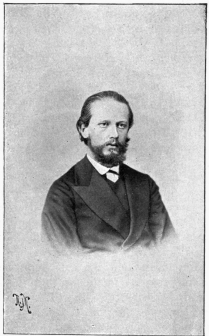
Soon after the production of The Voyevode Tchaikovsky’s symphonic fantasia Fatum (or Destiny) was given for the first time at the eighth concert of the Musical Society. By way of programme for this work, which he dedicated to Balakirev, Tchaikovsky chose the following lines from Batioushkov:—
“Thou knowest what the white-haired Melchisedek Said when he left this life: Man is born a slave, A slave he dies. Will even Death reveal to him Why thus he laboured in this vale of tears, Why thus he suffered, wept, endured—then vanished?”
To the choice of this motto attaches a history in which a certain Sergius Rachinsky played a part. This gentleman, Professor of Botany at the Moscow University, was one of Tchaikovsky’s earliest and most enthusiastic admirers. Rachinsky was a lover of music and literature, but held the most unusual views upon these, as upon all other subjects. For instance, he saw nothing in Ostrovsky, then at the height of his fame, but discerned in Tchaikovsky, who was hardly known to the world, the making of a “great” composer.
When, in 1871, the musician dedicated to Rachinsky his first quartet, the latter exclaimed with enthusiasm: “C’est un brevet d’immortalité que j’ai reçu.”
Originally Fatum had no definite programme.
“When the books for the concert were about to be printed,” relates Rachinsky, “Rubinstein, who was always very careful about such details, considered the bare title Fatum insufficient, and suggested that an appropriate verse should be added. It chanced that I, who had not heard a note of the new work, had dropped in upon Rubinstein, and the verses of Batioushkov flashed across my mind. Rubinstein asked me to write them down at once, and added them to the programme-book with the composer’s consent.”
The quotation, therefore, has not the significance of a programme, but was merely an epigraph added to the score.
The composer declared that Fatum had a “distinct success” with the public, and added that he “considered it the best work he had written so far,” and “others are of my opinion.” From this we may gather that, with the exception of Laroche, Tchaikovsky’s musical friends were pleased with this composition.
Fatum was given almost simultaneously by the Petersburg section of the Musical Society, under Balakirev’s direction. But here the fantasia fell flat, and pleased neither the public nor the musicians.
Nevertheless, Cui did not handle the young composer so severely as on the occasion of his Diploma Cantata. He found fault with a good deal in Fatum, but described the music as being on the whole “agreeable, but not inspired,” the instrumentation “somewhat rough,” and the harmonies “bold and new, if not invariably beautiful.”
Balakirev—to whom the work was dedicated—did not admire it, and his feelings were shared by the rest of the “Invincible Band.” He wrote to Tchaikovsky as follows:—
“Your Fatum has been played, and I venture to hope the performance was not bad—at least everyone seemed satisfied with it. There was not much applause, which I ascribe to the hideous crash at the end. The work itself does not please me; it is not sufficiently thought out, and shows signs of having been written hastily. In many places the joins and tacking-threads are too perceptible. Laroche says it is because you do not study the classics sufficiently. I put it down to another cause: you are too little acquainted with modern music. You will never learn freedom of form from the classical composers. You will find nothing new there. They can only give you what you knew already, when you sat on the students’ benches and listened respectfully to Zaremba’s learned discourses upon ‘The Connection between Rondo-form and Man’s First Fall.’
“At the same concert Les Préludes of Liszt was performed. Observe the wonderful form of this work; how one thing follows another quite naturally. This is no mere motley, haphazard affair. Or take Glinka’s Night in Madrid; in what a masterly fashion the various sections of this overture are fused together! It is just this organic coherence and connection that are lacking in Fatum. I have chosen Glinka as an example because I believe you have studied him a great deal, and I could see all through Fatum you were under the influence of one of his choruses.
“The verse you chose as an epigraph is altogether beneath criticism. It is a frightful specimen of manufactured rhyme. If you are really so attracted to Byronism, why not have chosen a suitable quotation from Lermontov? With the object of making the verse run smoother I left out the first two lines (Melchisedek seemed really too absurd!), but apparently I perpetrated a blunder. Our entire circle dropped upon me and assured me that the whole of the introduction to Fatum was intended to express the awful utterance of Melchisedek himself. Perhaps they are right. If so, you must forgive my excellent intention.... I write to you quite frankly, and feel sure you will not on this account abandon your intention of dedicating Fatum to me. This dedication is very precious, as indicating your regard for me, and on my part I reciprocate your feeling.”
Tchaikovsky did not resent Balakirev’s opinion, although it may have wounded him. That he was grateful for the friendly tone of the letter, in which Balakirev’s confidence in his talent was clearly perceptible, is evident from the fact that three months later he appeared in the press as the champion of the leader of the “Invincible Band.” Moreover, after a short time, he shared Balakirev’s opinion of his work, and destroyed the score of Fatum.
Early in the season Tchaikovsky began to look out for material for a new opera. The chief requisite he asked was that the scene should not be laid in Russia. The discussion with Ostrovsky of a plot from the period of Alexander the Great, mentioned in his letter of September 25th, had come to nothing. Without applying to another librettist, he began to search for a ready-made text. Great was his joy to discover a book among the works of Count Sollogoub, based upon his favourite poem, Joukovsky’s “Undine.”
Without reflection, or closer inspection of the libretto, he began to compose with fervour, even in the midst of the rehearsals for The Voyevode; that is in January, 1869. By February he had already written most of the first act. The two following acts he wrote in April, and began the orchestration in the course of the same month. He hoped to complete the first act in May, and the remainder during the summer, and to send the whole score to the Direction of the Petersburg Opera by November, when Gedeonov had given him a formal promise to produce it.
This feverish work, the many excitements of the winter season, his anxiety about the elder of the twins, who had to pass his final examination at the School of Jurisprudence, and all the trouble and correspondence involved in trying to find him an opening in Moscow, told upon Tchaikovsky’s nerves. His health was so far impaired that he gradually lost strength, until he became quite exhausted, and the doctor ordered him to the seaside, or to an inland watering-place, enjoining absolute repose.
The summer was spent with his sister at Kamenka, where the whole family was gathered together, with the exception of Nicholas. In June they celebrated the wedding of his brother, Hyppolite, to Sophia Nikonov, and Tchaikovsky, having recovered his spirits, took a leading part in all the festivities.
The score of Undine was finished by the end of July, and the composer returned to Moscow earlier than usual—about the beginning of August.
VI 1869-1870
To Anatol Tchaikovsky.
“August 11th (23rd), 1869.
“ ... We have taken new quarters; my room is upstairs, and there is a place for you too. I made every possible pretext for living alone, but I could not manage it. However, now I shall pay my own expenses and keep my own servant.... Begichev has taken my opera to Petersburg. Whether it is produced or not, I have finished with it and can turn to something else. Balakirev is staying here. We often meet, and I always come to the conclusion that—in spite of his worthiness—his society weighs upon me like a stone. I particularly dislike the narrowness of his views, and the persistence with which he upholds them. At the same time his short visit has been of benefit to me in many respects.”
To Anatol Tchaikovsky.
“August 18th (30th).
“I have no news to give. Balakirev leaves to-day. Although he has sometimes bored me, I must in justice say that he is a good, honourable man, and immeasurably above the average as an artist. We have just taken a touching farewell of each other....
“I gave an evening party not long since. Balakirev, Borodin, Kashkin, Klimenko, Arnold and Plestcheiev were among the guests.
“I met Laroche in The Hermitage and said ‘Good-day,’ but I have no intention of making it up with him.”
Towards the end of September, 1869, Tchaikovsky set to work upon his overture to Romeo and Juliet, to which he had been incited by Balakirev’s suggestions. Indeed, the latter played so important a part in the genesis of this work that it is necessary to speak of it in detail.
Balakirev not only suggested the subject, but took such a lively interest in the work that he kept up a continuous current of good advice and solicitations. In October he wrote:—
“It strikes me that your inactivity proceeds from your lack of concentration, in spite of your ‘snug workshop.’ I do not know your method of composing, mine is as follows: when I wrote my King Lear, having first read the play, I felt inspired to compose an overture (which Stassov had already suggested to me). At first I had no actual material, I only warmed to the project. An Introduction, ‘maestoso,’ followed by something mystical (Kent’s Prediction). The Introduction dies away and gives place to a stormy allegro. This is Lear himself, the discrowned, but still mighty, lion. By way of episodes the characteristic themes of Regan and Goneril, and then—a second subject—Cordelia, calm and tender. The middle section (storm, Lear and the Fool on the heath) and repetition of the allegro: Regan and Goneril finally crush their father, and the overture dies away softly (Lear over Cordelia’s corpse), then the prediction of Kent is heard once more, and finally the peaceful and solemn note of death. You must understand that, so far, I had no definite musical ideas. These came later and took their place within my framework. I believe you will feel the same, if once you are inspired by the project. Then arm yourself with goloshes and a walking-stick and go for a constitutional on the Boulevards, starting with the Nikitsky; let yourself be saturated with your plan, and I am convinced by the time you reach the Sretensky Boulevard some theme or episode will have come to you. Just at this moment, thinking of your overture, an idea has come to me involuntarily, and I seem to see that it should open with a fierce ‘allegro with the clash of swords.’ Something like this:
“I should begin in this style. If I were going to write the overture I should become enthusiastic over this germ, and I should brood over it, or rather turn it over in my mind until something vital came of it.
“If these lines have a good effect upon you I shall be very pleased. I have a certain right to hope for this, because your letters do me good. Your last, for instance, made me so unusually light-hearted that I rushed out into the Nevsky Prospect; I did not walk, I danced along, and composed part of my Tamara as I went.”
When Balakirev heard that Tchaikovsky was actually at work, he wrote in November:—
“I am delighted to hear that the child of your fancy has quickened. God grant it comes to a happy birth. I am very curious to know what you have put into the overture. Do send me what you have done so far, and I promise not to make any remarks—good or bad—until the thing is finished.”
After Tchaikovsky had acceded to Balakirev’s request, and sent him the chief subjects of his overture, he received the following answer, which caused him to make some modifications in the work:—
“ ... As your overture is all but finished, and will soon be played, I will tell you what I think of it quite frankly (I do not use this word in Zaremba’s sense). The first subject does not please me at all. Perhaps it improves in the working out—I cannot say—but in the crude state in which it lies before me it has neither strength nor beauty, and does not sufficiently suggest the character of Father Lawrence. Here something like one of Liszt’s chorales—in the old Catholic Church style—would be very appropriate (The Night Procession, Hunnenschlacht, and St. Elizabeth); your motive is of quite a different order, in the style of a quartet by Haydn, that genius of “burgher” music which induces a fierce thirst for beer. There is nothing of old-world Catholicism about it; it recalls rather the type of Gogol’s Comrade Kunz, who wanted to cut off his nose to save the money he spent on snuff. But possibly in its development your motive may turn out quite differently, in which case I will eat my own words.
“As to the B minor theme, it seems to me less a theme than a lovely introduction to one, and after the agitated movement in C major, something very forcible and energetic should follow. I take it for granted that it will really be so, and that you were too lazy to write out the context.
“The first theme in D flat major is very pretty, although rather colourless. The second, in the same key, is simply fascinating. I often play it, and would like to hug you for it. It has the sweetness of love, its tenderness, its longing, in a word, so much that must appeal to the heart of that immoral German, Albrecht. I have only one thing to say against this theme: it does not sufficiently express a mystic, inward, spiritual love, but rather a fantastic passionate glow which has hardly any nuance of Italian sentiment. Romeo and Juliet were not Persian lovers, but Europeans. I do not know if you will understand what I am driving at—I always feel the lack of appropriate words when I speak of music, and I am obliged to have recourse to comparison in order to explain myself. One subject in which spiritual love is well expressed—according to my ideas—is the second theme in Schumann’s overture, The Bride of Messina. The subject has its weak side too; it is morbid and somewhat sentimental at the end, but the fundamental emotion is sincere.
“I am impatient to receive the entire score, so that I may get a just impression of your clever overture, which is—so far—your best work; the fact that you have dedicated it to me affords me the greatest pleasure. It is the first of your compositions which contains so many beautiful things that one does not hesitate to pronounce it good as a whole. It cannot be compared with that old Melchisedek, who was so drunk with sorrow that he must needs dance his disgusting trepak in the Arbatsky Square. Send me the score soon; I am longing to see it.”
But even in a somewhat modified form, Balakirev was not quite satisfied with the overture. On January 22nd (February 3rd), 1871, he wrote as follows:—
“I am very pleased with the introduction, but the end is not at all to my taste. It is impossible to write of it in detail. It would be better if you came here, so that I could tell you what I think of it. In the middle section you have done something new and good; the alternating chords above the pedal-point, rather à la Russlan. The close becomes very commonplace, and the whole of the section after the end of the second subject (D major) seems to have been dragged from your brain by main force. The actual ending is not bad, but why those accentuated chords in the very last bars? This seems to contradict the meaning of the play, and is inartistic. Nadejda Nicholaevna[19] has scratched out these chords with her own fair hands, and wants to make the pianoforte arrangement end pianissimo. I do not know whether you will consent to this alteration.”
When this arbitrary treatment of the composer’s intention had been carried through, the indefatigable critic wrote once more:—
“It is a pity that you, or rather Rubinstein, should have hurried the publication of the overture. Although the new introduction is a decided improvement, yet I had still a great desire to see some other alterations made in the work, and hoped it might remain longer in your hands for the sake of your future compositions. However, I hope Jurgenson will not refuse to print a revised and improved version of the overture at some future time.”
To Anatol Tchaikovsky.
“October 7th (19th).
“The Conservatoire begins already to be repugnant to me, and the lessons I am obliged to give fatigue me as they did last year. Just now I am not working at all. Romeo and Juliet is finished. Yesterday I received a commission from Bessel. He asked me to arrange Rubinstein’s overture to Ivan the Terrible. I have had a letter from Balakirev scolding me because I am doing nothing. I hear nothing definite about my opera: they say it will be performed, but the date is uncertain. I often go to the opera. The sisters Marchisio are good, especially in Semiramide. Yet when I hear them I am more and more convinced that Artôt is the greatest artist in the world.”
To Modeste Tchaikovsky.
“November 18th (30th).
“Yesterday I received very sad news from Petersburg. My opera is to wait until next season, because there is not sufficient time to study the two operas which stand before mine in the repertory: Moniuszko’s Halka and Dütsch’s Croat. I am not likely therefore to come to Petersburg. From the pecuniary point of view the postponement of my opera is undesirable. Morally, too, it is bad for me; that is to say, I shall be incapable of any work for two or three weeks to come.”
To Modeste Tchaikovsky.
“January 13th (25th), 1870.
“Balakirev and Rimsky-Korsakov have been here. We saw each other every day. Balakirev begins to respect me more and more. Korsakov has dedicated a charming song to me. My overture pleased them both, and I like it myself. Besides the overture, I have recently composed a chorus from the opera Mandragora, the text of which, by Rachinsky, is already known to you. I intended to write music to this libretto, but my friends dissuaded me, because they considered the opera gave too little scope for stage effects. Now Rachinsky is writing another book for me, called Raymond Lully.”
Kashkin was one of the friends who dissuaded Tchaikovsky from composing Mandragora. The latter played him a ‘Chorus of Insects’ from the unfinished work, which pleased him very much. But he thought the subject more suitable for a ballet than an opera. A fierce argument took place which lasted a long time. Finally, with tears in his eyes, Tchaikovsky came round to Kashkin’s view, and relinquished his intention of writing this opera. It made him very unhappy and more chary in future of confiding his plans to his friends.
Laroche gives the following account of this unpublished chorus:—
“‘The Elves’ Chorus’ is intended for boys’ voices in unison, with accompaniment for mixed chorus and orchestra. The atmosphere of a calm moonlight night (described in the text) and the fantastic character of the scene are admirably reproduced. In this chorus we find not only that silky texture, that softness, distinction, and delicacy which Tchaikovsky shows in all his best work, but far more marked indications of maturity than in any of his earlier compositions. The orchestration is very rich, and on the whole original, although the influence of Berlioz is sometimes noticeable.”
To his sister, A. Davidov.
“February 5th (17th).
“One thing troubles me: there is no one in Moscow with whom I can enter into really intimate, familiar, and homely relations. I often think how happy I should be if you, or someone like you, lived here. I have a great longing for the sound of children’s voices, and for a share in all the trifling interests of a home—in a word, for family life.
“I intend to begin a third opera; this time on a subject borrowed from Lajetnikov’s tragedy, The Oprichnik. My Undine is to be produced at the beginning of next season, if they do not fail me. Although the spring is still far off and the frosts are hardly over yet, I have already begun to think of the summer, and to long for the early spring sunshine, which always has such a good effect upon me.”
To Modeste Tchaikovsky.
“March 3rd (15th), 1870.
“ ... The day after to-morrow my overture Romeo and Juliet will be performed. There has been a rehearsal already: the work does not seem detestable. But the Lord only knows!...
“In the third week of Lent excerpts from my opera Undine will be played at Merten’s[20] concert. I am very curious to hear them. Sietov writes that there is every reason to believe the opera will be given early next season.”