Part VII (continued 3)
Rosa Newmarch translation
Diary.
“April 18th (30th).
“It is becoming more and more difficult to find time for writing. Breakfasted with my French friends. Interview with de Sachs. We went to see the Brooklyn Bridge. From there we went on to see Schirmer, who owns the largest music business in America; the warehouse—especially the metallography—resembles Jurgenson’s in many respects. Schirmer begged to be allowed to publish some of my compositions. On reaching home, I received the journalist, Ivy Ross, who asked me for a contribution for her paper. When she had gone, I sank on the sofa like a log and enjoyed a little rest and solitude. By 8.30 I was already at the Music Hall for the first rehearsal. The chorus greeted me with an ovation. They sang beautifully. As I was about to leave, I met the builder of the hall in the doorway; he presented to me a pleasant, rather stout, man, his chief assistant, whose talent and cleverness he could not sufficiently praise. This man was—as it turned out—a pure-blooded Russian, who had become a naturalised American. The architect told me he was an anarchist and socialist. I had a little conversation with my fellow-countryman, and promised to visit him. After a light supper I took a walk. Read over and over again the letters I had received and, naturally, shed a few tears.
“April 19th (May 1st).
“Awoke late and sat down to write a little article for Miss Ross. Reno appeared, with the news that he had engaged a cabin for me on board the Fürst Bismarck, which sails on May 2nd (14th). Oh God, what a long way off it still seems! I called for my good friend Mayer and breakfasted with him in an excellent little Italian restaurant, after which we went down town. Here I saw for the first time what life means at certain hours on Broadway. So far I had only been able to judge this street from the neighbourhood of the hotel, where there is little traffic. But this is only a very small portion of this street, which is seven versts (over four miles) long. The houses down town are simply colossal; I cannot understand how anyone can live on the thirteenth floor. Mayer and I went out on the roof of one such house. The view was splendid, but I felt quite giddy when I looked down into Broadway. Then Mayer obtained permission for me to visit the cellars of the mint, where hundreds of millions of gold and silver coins, as well as paper money, are kept. Very good-natured, but fussy and important, officials conducted us round these cellars, and opened monumental doors with mysterious keys and no less mysterious pressings of various springs and knobs. The sacks of gold, which look just like sacks of corn in a granary, are kept in clean, tidy rooms lit by electric light. I was allowed to hold in my hand a packet of new shining coins worth about 10,000,000 dollars.[163] Then I understood why so little gold and silver are in circulation. The Americans prefer dirty, unpleasant paper notes to metal, because they find them so much more practical and useful. Therefore, these paper notes—quite the reverse to our country—thanks to the vast amount of metals kept in the mint, are valued far more than gold and silver. From the mint we visited the scene of activity of good Mr. Hyde. He is a director of one of the banks, and took me round his strong-rooms, in which mountains of paper money are stored away. We also visited the Exchange, which struck me as quieter than the Paris Bourse. Hyde treated us to lemonade at a café. On my return home I had to finish my newspaper article on Wagner for Miss Ross, and at five o’clock I was ready to visit William de Sachs. He lives in a very large house, where rooms are let to bachelors only. Ladies are only admitted as guests into this curious American monastery. I found a small gathering, which gradually grew larger. It was “five o’clock tea.” The pianist, Miss Wilson (who called on me yesterday, and is a staunch adherent of Russian music), played Borodin’s beautiful Serenade. After refusing several invitations I spent the evening alone. How pleasant it was! Dined in the Restaurant Hoffmann, as usual, without any enjoyment. During my walk further along Broadway I came upon a meeting of Socialists in red caps. Next morning I learnt from the newspapers that about five thousand men had assembled, carrying banners and huge lanterns, on which were inscribed these words: ‘Comrades! We are slaves in free America. We will no longer work more than eight hours!’ The whole demonstration seemed to me a farce; I think the inhabitants also look on it as such, for very few people had the curiosity to stand and watch; the others walked about as usual. I went to bed bodily tired, but mentally refreshed.
“April 20th (May 2nd).
“By 10.30 a.m. I was at the rehearsal in the Music Hall. It was held in the large hall, where several workmen were hammering, shouting, and running hither and thither. The orchestra is placed across the whole breadth of the huge platform; consequently the sound is bad and unequal. This got on my nerves until, in my rage, I was several times on the point of making a scene, leaving everything in the lurch and running away. I played through the Suite and the March very carelessly, and stopped the Pianoforte Concerto at the first movement, as the parts were in confusion and the musicians exhausted. The pianist, Adèle Aus-der-Ohe, came at five o’clock and played over the Concerto, which had gone so badly at rehearsal.
“April 21st (May 3rd).
“Telegram from Jurgenson: ‘Christos vosskresse.’[164] Rain outside. Letters from Modi and Jurgenson. ‘Nur wer die Sehnsucht kennt’—realises what it means to receive letters in a strange country. I have never before experienced similar sensations. Mr. N. and his wife came to call upon me. He—a tall, bearded man, with iron-grey hair, very elegantly dressed, always bewailing his spinal complaint, speaking very good Russian and abusing the Jews (although he himself looks very like one); she—a very plain Englishwoman (not American), who can speak nothing but English. She brought a great pile of newspapers with her, and showed me her articles. I cannot make out what these people want. He asked me if I had composed a fantasia on the Red Sarafan. On my replying in the negative, he was very much astonished, and added: ‘I will send you Thalberg’s fantasia; pray copy his style.’ I had great trouble in politely getting rid of this curious couple. De Sachs came to fetch me at twelve o’clock. We walked into the park. Then we went up by the lift to the fourth floor of an immense house where Schirmer lives. Besides myself and Sachs, there were at table the conductor Seidl, a Wagnerian and well known in this country, his wife, the pianist Adèle Aus-der-Ohe, who is going to play at my concert, her sister, and the Schirmer family. Seidl told me that my Maid of Orleans would be produced next season. I had to be at rehearsal by four o’clock. De Sachs accompanied me to the Music Hall in the Schirmers’ carriage. It was lit up and in order for the first time to-day. I sat in Carnegie’s box, while an oratorio, The Shulamite, by the elder Damrosch, was being rehearsed. Before my turn came they sang a wearisome cantata by Schütz, The Seven Words. My choruses[165] went very well. After it was over, I accompanied Sachs very unwillingly to the Schirmers’, as he had made me promise to come back. We found a number of people there who had come merely to see me. Schirmer took us on the roof of his house. This huge, nine-storied house has a roof so arranged that one can take quite a delightful walk on it and enjoy a splendid view from all sides. The sunset was indescribably beautiful. When we went downstairs we found only a few intimate friends left, with whom I enjoyed myself most unexpectedly. Aus-der-Ohe played beautifully. Among other things, we played my Concerto together. We sat down to supper at nine o’clock. About 10.30 we, that is, Sachs, Aus-der-Ohe, her sister, and myself, were presented with the most splendid roses, conveyed downstairs in the lift and sent home in the Schirmers’ carriage. One must do justice to American hospitality; there is nothing like it—except, perhaps, in our own country.
“April 22nd (May 4th).
“Received letters. A visit from Mr. Romeike, the proprietor of the bureau for newspaper cuttings. Apparently, he, too, is one of our Anarchists, like those mysterious Russians who spoke to me yesterday at the rehearsal. Wrote letters and my diary. Called for Mayer, and went with him to see Hyde, who invited us to breakfast at the Down Town Club. After a most excellent breakfast I walked down Broadway, alas—still with Mayer. Then we went to the concert given by the celebrated English singer Santley. The celebrated singer turned out to be an elderly man, who sang arias and songs in a fairly rhythmic manner, but without any tone, and with truly English stiffness. I was greeted by several critics, among them Finck, who had written to me last winter so enthusiastically about Hamlet. I went home without waiting for the end of the concert, as I had to go through my Pianoforte Concerto with Adèle Aus-der-Ohe. She came with her sister, and I showed her various little nuances and delicate details, which—after yesterday’s rehearsal—I considered necessary, in view of her powerful, clean, brilliant, but somewhat rough, style of playing. Reno had told me some interesting facts about Aus-der-Ohe’s American career. Four years ago she obtained an engagement at one of the Symphony Concerts to play a Concerto by Liszt (she was one of his pupils), and came over without a penny in her pocket. Her playing took with the public. She was engaged everywhere, and was a complete success. During these four years she has toured all over America, and now possesses a capital of over £20,000!!! Such is America! After they had left, I hurried into my evening clothes and went to dinner at the Renos’. This time it was quite a small family party. Damrosch came in after dinner. I played duets with charming Alice Reno. The evening passed very pleasantly. Reno saw me to the tramway. It has suddenly turned very cold.
“April 23rd (May 5th).
“The waiter Max, who brings me my tea in the morning, spent all his childhood in Nijni-Novogorod and went to school there. Since his fifteenth year he has lived partly in Germany, partly in New York. He is now twenty-three, and has so completely forgotten his native tongue that he can only mangle it, although he still remembers the most common words. I find it very pleasant to talk a little Russian with him. At eleven a.m. the pianist Rummel (an old acquaintance from Berlin) came to ask me again if I would conduct his concert on the 17th; he has been once before. Next came a very pleasant and friendly journalist, who asked how my wife liked New York. I have been asked this question before. One day, shortly after my arrival, it was announced in some of the newspapers that I had arrived with a young and pretty wife. This arose from the fact that two reporters on the pier had seen me get into a carriage with Alice Reno. At 7.30 Reno’s brother-in-law came. We drove to the Music Hall in a carriage, filled to overflowing. The appearance of the hall in the evening, lit up and crowded with people, was very fine and effective. The ceremony began with a speech by Reno (this had caused the poor fellow much perturbation all the day before). After this the National Anthem was sung. Then a clergyman made a very long and wearisome speech, in which he eulogised the founders of the Hall, especially Carnegie. The Leonore Symphony was then beautifully rendered. Interval. I went downstairs. Great excitement. I appeared, and was greeted with loud applause. The March went splendidly. Great success. I sat in Hyde’s box for the rest of the concert. Berlioz’s Te Deum is somewhat wearisome; only towards the end I began to enjoy it thoroughly. Reno carried me off with him. An improvised supper. Slept like a log.”
“April 24th (May 6th), 1891.
“‘Tchaikovsky is a man of ample proportions, with rather grey hair, well built, of a pleasing appearance, and about sixty years of age (!!!). He seemed rather nervous, and answered the applause with a number of stiff little bows. But as soon as he had taken up the bâton he was quite master of himself.’ I read this to-day in the Herald.[166] It annoys me that, not content with writing about my music, they must also write about my personal appearance. I cannot bear to think that my shyness is noticeable, or that my ‘stiff little bows’ fill them with astonishment. I went to rehearsal at 10.30. I had to get a workman to show me the entrance to the Hall. The rehearsal went very well. After the Suite the musicians called out something which sounded like ‘hoch.’ Simply bathed in perspiration, I had to go and talk to Mme. Reno, her eldest daughter and two other ladies. Went to see Reno. The steamboat ticket. Instructions for the journey to Philadelphia and Boston. Then I hurried over to Mayer’s, where Rummel had already been waiting half an hour to play me the Second Concerto. But we did not play it. I practised my powers of eloquence instead. I tried to prove to him that there was no reason why I should accede to his proposal—to conduct his concert gratuitously on the 17th. Breakfasted with Mayer at the Italian Restaurant. P. Botkin[167] from Washington turned up quite unexpectedly about seven o’clock. He has come on purpose to be at the concert. Hyde and his wife fetched me about 7.30. The second concert. Mendelssohn’s oratorio, Elijah, was given. A splendid work, but rather too long. During the interval, I was dragged the round of the boxes of various local magnates.
“April 25th (May 7th).
“I am fifty-one to-day. I feel very excited. The concert begins at two o’clock, with the Suite. This curious fright I suffer from is very strange. How many times have I already conducted the Suite, and it goes splendidly. Why this anxiety? I suffer horribly, and it gets worse and worse. I never remember feeling so anxious before. Perhaps it is because over here they pay so much attention to my outward appearance, and consequently my shyness is more noticeable. However that may be, after getting over some painful hours (the last was worst of all, for before my appearance I had to speak to several strangers) I stepped into the conductor’s desk, was received most enthusiastically, and made a sensation—according to to-day’s papers. After the Suite I sat in Reno’s private room, and was interviewed by several reporters. (Oh, these reporters!) Among others, the well-known journalist, Jackson. I paid my respects to Mrs. Reno in her box; she had sent me a quantity of flowers in the morning, almost as if she had guessed it was my birthday. I felt I must be alone, so refused Reno’s invitation, pushed my way through a crowd of ladies, who were standing in the corridor to stare at me, and in whose eyes I read with involuntary pleasure signs of enthusiastic sympathy—and hastened home. I wrote Botkin a card, telling him that I could not keep my promise to dine with him. Relieved and—in a measure—happy, I went out to stroll about, to eat my dinner, and lounge in a café, to enjoy silence and solitude.
“April 26th (May 8th).
“I can scarcely find time to keep up my diary and correspondence. I am simply overrun with visitors—reporters, composers, and librettists. Among the latter was one who brought me the text of an opera, Vlasta, and touched me very deeply by the account of the death of his only son. Moreover, from every part of America I receive a heap of letters asking for my autograph; these I answer most conscientiously. Went to the rehearsal of the Pianoforte Concerto. Damrosch annoyed me very much by taking up the best of the time for himself and leaving the rest of the rehearsal to me. However, all went well. Went to Knabe’s to thank him for the beautiful present (a statue of Freedom) which he sent me yesterday. Shall I be allowed to take it into Russia? Then I hastened home. Visitors without end, among others two Russian ladies. One of them was Mrs. MacMahan, widow of the celebrated war correspondent of 1877, and herself the correspondent of the Russky Viedomosti and the Severny Vestnik. This was the first time I had had the pleasure of talking to a Russian lady; consequently I made a fool of myself. Suddenly the tears came into my eyes, my voice broke, and I could not suppress my sobs. I fled into the next room, and could not show myself again for a long time. I blush with shame to think of this unexpected episode.... Rested a little before the concert. The chorus went well, but might have gone better if I had not been so upset. Sat in the box with Reno and Hyde during the beautiful oratorio, The Shulamite. Walked with Reno and Carnegie to sup with Damrosch. This archmillionaire is very kind to me, and constantly talks of an engagement for next year.... A good deal of champagne was drunk. I sat between the host and the conductor, Dannreuther. While I was talking to him about his brother he must have had the impression, for at least two hours, that I was either a madman or an impudent liar. He sat with his mouth open, and looked quite astonished. It seems that I had confused the pianist Dannreuther with the pianist Hartvigson. My absent-mindedness is becoming almost unbearable, and is a sign of advancing age. However, everyone was surprised to learn that I was only fifty-one yesterday. Carnegie especially was very much astonished. They all thought, except those who knew something of my life, that I was much older. Probably I have aged very much in the last few years. I feel I have lost vitality. I returned in Carnegie’s carriage. This talk about my age resulted in dreadful dreams; I thought I slipped down a tremendously steep wall into the sea, and then climbed on to a little rocky projection. Probably this was the result of our conversation yesterday.
“Every day Romeike sends me a heap of newspaper cuttings about myself. All, without exception, are written in terms of the highest praise. The Third Suite is praised to the skies, and, what is more, my conducting also. Am I really such a good conductor, or do the Americans exaggerate?
“April 27th (May 9th).
“The manager of the Composers’ Club called upon me and wished to arrange an evening for my compositions. Mrs. White[168] sent me such a quantity of lovely flowers that, owing to lack of room and vases, I had to give some to Max, who was highly delighted, as his wife is passionately fond of them. Ritzel, the violinist, also called upon me. He would like to have my portrait, and told me that the members of the orchestra were quite delighted with me. This touched me very much. I changed my things, and took Mayer my large portrait. From there I went to Schirmer’s, and then hurried to the Music Hall, where I was to make my last appearance before the public. All these visits made before the concert show how calm I was at this time. Why, I do not know. In the artists’ room I made the acquaintance of a singer who sang one of my songs yesterday. A very fine artist and a charming woman. My Concerto went magnificently, thanks to Aus-der-Ohe’s brilliant interpretation. The enthusiasm was far greater than anything I have met with, even in Russia. I was recalled over and over again; handkerchiefs were waved, cheers resounded—in fact, it is easy to see that I have taken the Americans by storm. But what I valued most of all was the enthusiasm of the orchestra. Owing to the heat and my exertions, I was bathed in perspiration, and could not, unfortunately, listen to the scenes from Parsifal. At the last evening concert of the Festival I sat alternately in the boxes of Carnegie, Hyde, and Reno. The whole of Handel’s oratorio, Israel in Egypt, was given. During the course of the evening the architect of the Hall received an ovation. Afterwards I had supper with Damrosch at the Sachs’....
“April 28th (May 10th).
“This has been a very heavy day. In the morning I was besieged by visitors. The interesting Korbay, the young, good-looking composer Klein, the pianist F.—with gold-stopped teeth—and others I do not remember. I went out at one o’clock to call on the nihilist Starck-Stoleshnikov, but he lives so far away, and the heat was so oppressive, that I gave it up. I hastened instead to Dr. N.’s, and arrived there in good time. Dr. N. is a Russian—at least he was brought up in Russia. His wife, as I finally discovered, is Countess G. They have lived in America since 1860, and often go to Europe, but never visit Russia. I did not like to ask their reason for avoiding it. They are both ardent patriots, and have a genuine love of Russia. In speaking of our country he seems to think that despotism and bureaucracy hinder it from becoming a leading nation. It strikes me that he is a freethinker who has at some time brought down the wrath of the Government on himself, and fled just at the right moment. But his liberalism is not in the least akin to Nihilism or Anarchism. Both frequently asserted that they had nothing to do with the nihilists in this country. I lunched with them about three o’clock, and then rushed off to B. MacMahan’s (owing to a lack of cabs one has to walk everywhere). While the N.s’ house is almost luxuriously furnished, this Russian correspondent lives quite in the student style. Somewhat later the celebrated sculptor Kamensky came in; he has lived in America for the last twenty years, but I do not know why. He is an old, somewhat invalidish-looking man, with a deep scar on his forehead. He confused me very much by asking me to tell him everything that I knew about the Russia of to-day. I did not quite know how to accomplish such a vast undertaking, but Barbara Nikolaevna (Mrs. MacMahan) began to talk about my music, and I soon took my departure, as I had to go home and dress before dining with Carnegie. All the cafés are closed on Sundays. This English Puritanism, which shows itself in such senseless trivialities (for instance, one can only obtain a glass of whisky or beer on Sunday by means of some fraud), irritates me very much. It is said that the men who brought this law into force in the State of New York were themselves heavy drinkers. I had scarcely time to change and drive to Carnegie’s in a carriage, which had to be fetched from some distance, and was very expensive. This millionaire really does not live so luxuriously as many other people. Mr. and Mrs. Reno, Mr. and Mrs. Damrosch, the architect of the Music Hall and his wife, an unknown gentleman and a stout friend of Mrs. Damrosch’s were at dinner. I sat beside this aristocratic and evidently distinguished lady. This singular man, Carnegie, who rapidly rose from a telegraph apprentice to be one of the richest men in America, while still remaining quite simple, inspires me with unusual confidence, perhaps because he shows me so much sympathy. During the evening he expressed his liking for me in a very marked manner. He took both my hands in his, and declared that, though not crowned, I was a genuine king of music. He embraced me (without kissing me: men do not kiss over here), got on tiptoe and stretched his hand up to indicate my greatness, and finally made the whole company laugh by imitating my conducting. This he did so solemnly, so well, and so like me, that I myself was quite delighted. His wife is also an extremely simple and charming young lady, and showed her interest in me in every possible way. All this was very pleasant, but still I was glad to get home again at eleven, as I felt somewhat bored.
“April 29th (May 11th).
“Mayer fetched me at a quarter-past eight. How should I have got on without Mayer? I got a seat in a saloon carriage.... We reached Buffalo at 8.30. I was met by two gentlemen whom Mayer had instructed to look after me, as I had to change here, and it is very difficult to find one’s way in this labyrinth of lines. I reached Niagara fifty minutes after leaving Buffalo, and went to the hotel in which a room—also thanks to Mayer—was reserved for me. The hotel is quite unpretentious—after the style of the small Swiss inns—but very clean and convenient, as German is spoken. I went to bed early. The roaring of the waterfall is very audible in the stillness of the night.
“Niagara, April 30th (May 12th).
“The carriage was here at nine o’clock. There was no guide, which was very pleasant. I will not try to describe the beauties of the Falls; it is hard to find words for these things. In the afternoon I walked again to the Falls and round the town. During this walk—as in the morning—I could not get rid of a curious—probably entirely nervous—lassitude, which prevented my full enjoyment of this beautiful scenery. I started again at a quarter-past six in a special sleeping-carriage.
“New York, May 1st (13th).
“At five o’clock I awoke, my mind full of anxious thoughts about the approaching week, which I dread so much. I was home by 8 a.m., and very glad to see Max again. The news of the attempt on the Tsarevich made me feel very sad. I was also grieved to find that there were no letters from home—and I had hoped to find a number. Many visitors. I hired a carriage from the hotel, on account of the great distances which I had to get over to-day. First I went to say good-bye to Damrosch, as he is going to Europe. He asked me to take him as a pupil. Of course I refused, but am afraid involuntarily I showed far too plainly my horror at the idea of Damrosch arriving at my country home to study with me. From there I hastened to lunch at the Renos’. The coachman was quite drunk, and would not understand where I wanted him to drive. It was lucky I knew the way myself. The Renos received me as cordially as ever. Afterwards I went to Mayer’s. Then the same drunken coachman drove Mayer and myself to the great steam-ferry which conveys carriages, horses, and foot-passengers over the East River. Thence we went by train to Mayer’s summer residence. I felt so tired, so irritable and unhappy, I could hardly restrain my tears. His family is good and kind, but all the same I was bored, and longed to get away. In the afternoon we walked along the shore; the sea was rather rough. The air is so fresh and pure here that my walk really gave me pleasure and did me good. I stayed the night at Mayer’s, but slept badly.
“May 2nd (14th).
“I got up at six o’clock. Went down to the sea, and was delighted. After breakfast we drove into the town. I should have liked to be alone. Miss Ross came to see me. My letter on Wagner has been published, and created quite a sensation. Anton Seidl, the celebrated conductor and Wagnerian, had published a lengthy reply, in which he attacked me, but in quite a friendly tone. Miss Ross came to ask me to write an answer to Seidl’s reply. I set to work upon it, but was interrupted by X., who stayed an endless time, and told me all kinds of uninteresting musical gossip, which I had heard a hundred times before. The next to come was the correspondent of a Philadelphia newspaper, who is one of my most fervent admirers. I had to speak English with him: I have made progress, and can say a few phrases very well. Wrote letters. Breakfasted alone in my hotel. Wandered through the Central Park. According to my promise, I went over to Z.’s to write a testimonial for the * * * pianofortes. Was this the object of all Z.’s attentions? All these presents, all this time and money spent on me, all these unaccountable kindnesses, were these intended as a premium for a future puff? I proposed that Z. himself should write the testimonial. He sat for a long time, but could not think of anything; so we put it off until our next meeting. Then I paid a call on Tretbar, Steinway’s representative, for whom I had a letter of introduction from Jurgenson. He had waited till now without calling upon me because he did not wish to make the first advances. I had purposely delayed my visit from similar motives. Home to pack. Shortly afterwards a messenger from Z. brought me the testimonial to sign. It read as follows: ‘I consider the * * * pianofortes without doubt the best in America.’ Now as I do not think so at all, but value some other makers’ far more highly, I declined to have my opinion expressed in this form. I told Z., that notwithstanding my deep gratitude to him, I could not tell a lie. The reporter from the Herald came to see me—a very interesting man. Drove to Hyde’s. I wish I could find words to describe all the charm and originality of this interesting couple. Hyde greeted me with these words: ‘Kak vasche sdorovie? sidite poschaljust.’[169] Then he laughed like a lunatic, and his wife and I joined in. He had bought a guide to Russian conversation, and learnt a few phrases as a surprise to me. Mrs. Hyde immediately invited me to smoke a cigarette in her drawing-room—the climax of hospitality in America. After the cigarette we went to dinner. The table was most exquisitely decorated with flowers; everyone received a bouquet. Then, quite unexpectedly, Hyde became very solemn, closed his eyes and said the Lord’s Prayer. I did the same as the others: lowered my eyes and gazed on the ground. Then began an endlessly long dinner.... At ten o’clock I withdrew. At home a messenger from Knabe was waiting for me. We drank a glass of beer together, took my trunk, and went down town. We went over the Hudson in the steam-ferry, and finally reached the station. Knabe’s messenger (without whose help I should certainly have been lost) engaged a comfortable coupé for me; the friendly negro made the bed, I threw myself on it just as I was, for I really had not the strength to undress, and sank at once into a deep sleep. I slept soundly, but not for long. The negro woke me an hour before my arrival at Baltimore.
“Baltimore, May 3rd (15th).
“As usual, I was received at the hotel with cool contempt. Sitting alone in my room, I suddenly felt so unhappy, chiefly because everyone around me speaks only English. I slept a little. Then I went into a restaurant for breakfast, and was quite annoyed because the waiter (a negro) would not understand that I wished for tea and bread-and-butter only. I had to go to the desk, where they did not understand me any better. At last a gentleman knowing a little German kindly came to my help. I had hardly sat down when Knabe, a stout man, came in. Very shortly after, Adèle Aus-der-Ohe and her sister joined us, too. I was very glad to see them, for they seem like connections, at least as regards music. We went to the rehearsal together. This was held on the stage of the Lyceum Theatre. The orchestra was small, only four first violins, but not bad. But the Third Suite was not to be thought of. It was decided to put the Serenade for strings in its place. The orchestra did not know this work. The conductor had not even played it through, although Reno had promised that this should be done. The Concerto with Adèle Aus-der-Ohe went very smoothly, but the Serenade needs many rehearsals. The orchestra was impatient. The young leader behaved in rather a tactless way, and made it too clearly evident that he thought it time to stop. It is true—this unhappy touring orchestra must be wearied by their constant travelling. After the rehearsal I went home with Adèle Aus-der-Ohe, dressed, and went immediately to the concert. I conducted in my frock-coat. Happily everything went very well, but there was little enthusiasm in comparison with New York. After the concert we both drove home to change. Half an hour later Knabe called for us. His hospitality is on the same colossal scale as his figure. This beardless giant had arranged a festivity in my honour at his own house. I found a number of people there. The dinner was endlessly long, but very tasteful and good, as were also the wines with which Knabe kept filling up our glasses. During the second half of the dinner I felt quite worn out. A terrible hatred of everything seemed to come over me, especially of my two neighbours. After dinner I conversed a little with everyone, and smoked and drank ceaselessly. At half-past twelve Knabe brought me home, and also the sisters Aus-der-Ohe.
“Washington, 4th (16th).
“I woke early, breakfasted downstairs, wrote my diary, and waited, rather in fear and trembling, for Knabe, who wanted to show me the sights of the town. At last he came and, together with the sisters Aus-der-Ohe, we drove round Baltimore. Weather bad and inclined to rain. Baltimore is a pretty, clean town. Then the good-natured giant helped me to pack my box, invited Aus-der-Ohe and myself to a champagne lunch, and finally put me in the carriage that was to take me to my destination. He himself was travelling to Philadelphia, while I was going to Washington. The journey lasted about three-quarters of an hour. I was met by Botkin, who accompanied me to the hotel, where a room was engaged for me. This was delightfully comfortable, and at the same time tastefully and simply furnished. I declined to receive Rennen, begged Botkin to call for me before the dinner, took a bath, and hurried into my dress clothes. The dinner was given in the Metropolitan Club, of which Botkin and his colleagues are members. The dinner was very gay, and I was so delighted to talk Russian once more, although this happiness was a little dimmed by the sad fact that my ‘s,’ ‘sch,’ ‘tsch,’ are beginning to sound rather indistinct from age. During the dinner we heard, first by telegram and then through the telephone, that the Ambassador Struve had returned from a journey to New York solely on my account. At ten o’clock we all repaired to the Embassy, where Botkin had arranged a musical evening. About a hundred persons were invited. The Ambassador also arrived, an old man, very cordial and also interesting. The company at the Embassy belonged principally to the diplomatic circle. There were ambassadors with their wives and daughters, and personages belonging to the highest class of the diplomatic service. Most of the ladies spoke French, so things were not so difficult for me. The programme consisted of my Trio and a Quartet by Brahms. Hausen, the Secretary to our Embassy, was at the piano, and he proved quite a respectable pianist. My Trio he played decidedly well. The violinist was only middling. I was introduced to everyone. After the music there was an excellent cold supper. When most of the guests had left, ten of us (the Belgian Ambassador and the Secretaries to the Swedish and Austrian Embassies, besides the Russians) sat for some time longer at a large round table, before an excellent flagon. Struve enjoys a glass of wine. He gave me the impression of a broken and unhappy man who finds it a consolation. It was three o’clock before I went home, accompanied by Botkin and Hausen.
“May 5th (17th).
“Awoke with pleasant memories of yesterday. I always feel well in Russian society when I am not obliged to speak a foreign tongue. At twelve o’clock Botkin called for me to lunch with the Ambassador, Struve. Afterwards I went with Botkin and Hausen to see the sights of Washington.
“Philadelphia, May 6th (18th).
“I reached Philadelphia at three o’clock. Breakfasted downstairs. A very importunate Jew from Odessa called and got some money out of me. Went for a walk. The concert at eight p.m. The enormous theatre was filled to overflowing. After the concert, according to long-standing promise, I went to the club. The return journey to New York was very wearisome.
“May 7th (19th).
“Feel quite stupid from exhaustion and constant travelling. I could stand no more, if it were not for the thought of my departure to-morrow, which buoys me up. I am inundated with requests for my autograph. At 12.30 I went over to Z.’s and wrote the testimonial, omitting the phrase which ranks these pianos as the first. Went home and waited for the composer Brummklein. He came and played me some very pretty things.
“May 8th (20th).
“The old librettist came. I was very sorry to have to tell him I could not compose an opera to his libretto. He seemed very sad. Scarcely had he gone before Dannreuther came in to take me to the rehearsal of the Quartets and Trios to be played this evening at the Composers’ Club. It was rather a long distance. The Quartet was indifferently played and the Trio really badly, for the pianist, a shy, nervous man, was no good: he could not even count. I had no time to make any preparations for the journey. Drove to Renos’. They received me with more kindness and cordiality than ever, especially Madame Reno and her three daughters. The eldest (Anna, who is married) gave me a beautiful cigar-case, M. Reno a quantity of scent, and Alice and her sister cakes for the journey. Then I hurried to Hyde’s. Mrs. Hyde was already expecting me. Here too I was received with great kindness and sincere enthusiasm. At last I got home to pack my box. Hateful business, which gave me a dreadful pain in my back. Tired out, I went over to Mayer’s, and invited him to dinner at Martelli’s. At eight o’clock I was taken to the Composers’ Club. This is not a club of composers, as I first thought, but a special musical union which arranges, from time to time, evenings devoted to the works of one composer. Yesterday was devoted to me, and the concert was held in the magnificent Metropolitan House. I sat in the first row. They played the Quartet (E flat minor) and the Trio; some songs were very well sung, but the programme was too long. In the middle of the evening I received an address; I answered shortly, in French; of course an ovation. One lady threw an exquisite bouquet of roses straight in my face. I was introduced to a crowd of people, among others our Consul-General. At the conclusion I had to speak to about a hundred people and distribute a hundred autographs. I reached home half dead with fatigue. As the steamer left at five o’clock in the morning, I had to go on board that night, so I dressed with all speed, and packed my things while Reno and Mayer waited for me. Downstairs we drank two bottles of champagne. I said good-bye to the servants of the hotel and drove off to the steamer. The drive was very long. The steamer is quite as fine as the Bretagne; I have an officer’s cabin. On this ship the officers are allowed to let their cabins, but they ask an exorbitant price. I had to pay 300 dollars (1,500 francs) for mine.... But it is really nice and very roomy. I said good-bye to my dear American friends and went straight to bed. I slept badly and heard all the noise when the steamer started at five o’clock. I came out of my cabin as we passed the statue of Freedom.”
Altogether Tchaikovsky gave six concerts in America: four in New York, one in Baltimore, and one in Philadelphia. The following works were performed: (1) The Coronation March, (2) Third Suite, (3) two Sacred Choruses: the Lord’s Prayer and the Legend, (4) Pianoforte Concerto No. 1, and (5) Serenade for string instruments.
I have before me sixteen American Press notices of Tchaikovsky, and all are written in a tone of unqualified praise; the only difference lies in the degree of enthusiasm expressed. According to some he is “the first of modern composers after Wagner”; according to others, “one of the first.” His talent as a conductor is equally praised. Everywhere he had an unprecedented success, and many spoke of his interesting appearance. The interviews (especially those in The New York Herald) are reproduced with astonishing fidelity. As we read them we can almost fancy we can hear the voice of Tchaikovsky himself.
XIII
“‘Prince Bismarck,’ May 9th (21st).
“On account of the maddening pain in my back, I dressed with great difficulty, went below for my morning tea, and then walked about the ship to make myself better acquainted with the various quarters. A host of passengers, but of totally different appearance to those who travelled with me on the Bretagne. The most perceptible difference lies in the fact that there are no emigrants. At eight a.m. I was called to breakfast. My place had already been allotted to me. I had a middle-aged man for my neighbour, who immediately began to converse. Slept the whole morning. The sight of the sea leaves me indifferent. I think with horror of the rest of the journey, but also with longing: may it soon be over. This is a very fast ship; it is the magnificent new Prince Bismarck, and is making its first passage. Last week it only took six days and fourteen hours from Hamburg to New York. I trust we shall get over the horrible distance as quickly. The motion is not so smooth as that of the Bretagne. The weather is splendid just now. At breakfast I became better acquainted with my vis-à-vis. It is difficult to say to what nationality he belongs, as he speaks all languages wonderfully well; perhaps he is a Jew, so I told him on purpose the story of the importunate Jew. He lives in Dresden, and is a wholesale tobacco dealer. He has already discovered who I am. If he speaks the truth, he heard me conduct in New York; anyway, he improves on acquaintance. I have got so accustomed to talking in New York that, in spite of my preference for silence, I can stand his society without being bored. I am astonished to find I sleep so much. In the evening, soon after dinner, I was so overcome that I went to bed at ten o’clock and slept straight on until seven the next morning. Nothing particular happened during the day. A Mr. Aronson and his young wife introduced themselves to me. He is the proprietor of the Casino Theatre (favoured by Von Bülow), as I discovered by means of an autograph album which was sent to me that I might write my name and a few lines in it. Schröder, the man who attends to my cabin, is a good-natured young German; at table also there are two nice German stewards—this is very important for me. I am pleased with the ship, the cabin, and the food. As there are no emigrants I can walk on the lower deck; this is very pleasant, as I meet no first-class passengers there and can be quiet.
“May 11th (23rd).
“I keep very much to myself and, thanks to my splendid cabin, in which there is plenty of room to move about, I feel much freer than on the Bretagne. I only use the drawing-room in the morning when no one is there. There is a nice Steinway grand, and not at all a bad musical library, including a few of my own productions. The day is divided as follows: Dress, ring my bell, and Schröder brings me a cup of tea; first breakfast, eight o’clock; walk on the lower deck, work, read. By work I mean the sketches for my next Symphony. At twelve o’clock the gong sounds for second breakfast.... I am reading a book by Tatistchev, Alexandre et Napoléon.
“May 11th (23rd).
“In New York they so often assured me that the sea was calm at this time of year that I believed them. But what a disenchantment! Since early morning the weather has been getting worse: rain, wind, and towards evening quite a gale. A dreadful night, could not sleep, so sat on the sofa. Towards morning dozed a little.
“May 12th (24th).
“A detestable day. The weather is frightful. Seasickness, could eat nothing but an orange.
“May (13th) 25th.
“I feel quite unnerved from exhaustion and sickness. Yesterday evening I fell asleep in my clothes on my sofa and slept there the whole night. To-day the motion is less, but the weather is still dreadful. My nerves are inexpressibly strained and irritated by this ceaseless noise and horrible cracking. Shall I ever make up my mind to endure such torment again?
“During the course of the day the motion grew still less and the weather improved. I have taken such a dislike to the society of my fellow-passengers that the very sight of them annoys and irritates me. I constantly sit in my own cabin.
“May 14th (26th).
“The moon was magnificent to-night. I read in my cabin till I was tired, and then went out for a stroll on deck. Everyone, without exception, was asleep, and I was the only one of the 300 first-class passengers who had come out to enjoy the lovely night. It was beautiful beyond all words. It was strange to think of the terrible night on Sunday, when everything in my cabin, even my trunk, was hurled from one side to the other, and the vessel seemed to be fighting for life against the storm; when one was racked with terror, and, added to all, the electric lamp and bell fell with a crash on the floor and was smashed to pieces. That night I vowed never to make another sea-voyage. But Schröder, my steward, says he resolves to give up his place every time the weather is bad, but no sooner is he in harbour than he longs for the sea again. Perhaps it may be the same with me. The passengers are getting up a concert, and want me to play. Quite the worst part of a sea-voyage is having to know all the passengers.
“May 15th (27th).
“As we neared the Channel it became more lively. Hundreds of little ships came in sight. About two o’clock the English coast was visible; sometimes rocky and picturesque, sometimes flat and green with spring grass.... Soon afterwards we entered Southampton.
“May 16th (28th).
“After passing Southampton and the Isle of Wight, I went to sleep and awoke feeling rather chilly.... Enjoyed the views of the English coast and the sight of the many steamers and sailing vessels which enliven the Channel. We saw Folkestone and Dover. The North Sea is very lively. We passed Heligoland in the night
“May 17th (29th).
“Arrived early this morning at Cuxhaven.... At 8 a.m. we went on board a small steamer that took us to the Custom House. Long wait and examination. Arrived at Hamburg by midday.”
Tchaikovsky spent one day in Hamburg and one in Berlin; then travelled direct to Petersburg.
During his short stay there he was in a cheerful frame of mind. This was partly the result of his reunion with his friends and relatives, and partly the delightful impression of the early spring in Petersburg, which he always enjoyed. This time he was so charmed with the city that he had a great wish to settle in the neighbourhood, and commissioned us to look out for a suitable house, or a small country property.
Since Frolovskoe was becoming more and more denuded of its forests, and the demands of the landlord steadily increased, Tchaikovsky decided to leave. After many vain attempts to find a suitable country house, or to acquire a small property, he resolved to return to Maidanovo. While he was abroad, Alexis Safronov had moved all his belongings into the house he formerly occupied, and arranged it just as in 1886. Although Tchaikovsky was fond of this house and its surroundings, and looked forward to working there under the old conditions, his return somewhat depressed him. There was an air of decay about house and park; the walks did not please him; and then there was the prospect of an inroad of summer visitors.
Soon after settling in Maidanovo he was visited by his brother, Modeste Tchaikovsky, and his nephews, Vladimir Davidov and Count A. Litke. All four travelled to Moscow together, where he was greatly interested by the Franco-Russian Exhibition, and enjoyed acting as cicerone to his favourite nephews.
The chief musical works upon which he was engaged at this time were: the second act of the Ballet, The Nut-cracker; the completion of the opera, King René’s Daughter; the remodelling of the Sextet and the instrumentation of a symphonic poem, The Voyevode, composed the previous autumn while he was staying at Tiflis.
To P. Jurgenson.
“Maidanovo, June 3rd (15th), 1891.
“I have discovered a new instrument in Paris, something between a piano and a glockenspiel, with a divinely beautiful tone. I want to introduce this into the ballet and the symphonic poem. The instrument is called the ‘Celesta Mustel,’ and costs 1,200 francs. You can only buy it from the inventor, Mustel, in Paris. I want to ask you to order one of these instruments. You will not lose by it, because you can hire it out to the concerts at which The Voyevode will be played, and afterwards sell it to the Opera when my ballet is put on.... Have it sent direct to Petersburg; but no one there must know about it. I am afraid Rimsky-Korsakov and Glazounov might hear of it and make use of the new effect before I could. I expect the instrument will make a tremendous sensation.”
To J. Konius.
“June 15th (27th), 1891.
“ ... The news that you are engaged (for America) with Brodsky rejoices me. Brodsky is one of the most sympathetic men I ever met. He is also a fine artist and the best quartet player I ever heard, not excepting Laub, who was so great in this line.”
To V. Davidov.
“June 25th (July 7th), 1891.
“According to my promise, I write to let you know that I finished the sketch of the ballet yesterday. You will remember my boasting when you were here that I should get it done in about five days. But I have taken at least a fortnight. Yes, the old fellow is getting worn out. Not only is his hair turning white as snow and beginning to fall, not only is he losing his teeth, not only do his eyes grow weaker and get tired sooner, not only do his feet begin to drag—but he is growing less capable of accomplishing anything. This ballet is far weaker than The Sleeping Beauty—no doubt about it. We shall see how the opera turns out. Once I feel convinced that I can only contribute ‘warmed-up’ dishes to the musical bill of fare, I shall give up composing.”
The following is quoted from a letter to Arensky, who had been consulting Tchaikovsky as to the advisability of taking the post of Director of the Tiflis branch of the Musical Society:—
“I hardly know how to advise you, dear Anton Stepanovich. I would prefer not to do so. If you had some private means, I could only rejoice in the prospect of your going to the Caucasus for a time. But it saddens me to think of you in the provinces, remote from musical centres, overburdened with tiresome work, solitary and unable to hear good music. You cannot imagine how it depresses me to think of men like Rimsky-Korsakov, Liadov, and yourself being obliged to worry with teaching. But how can it be helped? I think if you bear it for another two years, and work hard, little by little, you may manage to live by composition only. I know in my own case this is not impossible. I earn enough now to keep a large family, if need were. I may tell you in conclusion, that Tiflis is a fascinating town, and life there is pleasant.”
To Anatol Tchaikovsky.
“Maidanovo, July 8th (20th), 1891.
“ ... Do not be vexed that I stayed so long in Petersburg without coming to see you in Reval.[170] ... From your letter I gather that you are pretty comfortable there, although you mention many difficulties you have to contend with. I think one must be very politic and tactful in these things, then we can get over most difficulties. In the diplomatic service we must often faire bonne mine au mauvais jeu. There is nothing for it! I think you would find Valoniev’s diary interesting. He was governor of one of the Baltic provinces, and relates a great deal that is interesting. At that time Souvarov, the extreme Liberal, ruled in these provinces. In the long run the spirit of Pobiedonostsiev is better than the spirit of Souvorov.”
Towards the end of July a misfortune befell Tchaikovsky which was the cause of much subsequent anxiety. While he was taking his afternoon constitutional, and Alexis was resting in his room, a thief, who probably entered through the window, carried off the clock which had been given to him by Nadejda von Meck in 1888. This clock, which was beautifully decorated with a figure of Joan of Arc on one side, and on the other with the Apollo of the Grand Opéra, upon a background of black enamel, had been specially made in Paris, and cost 10,000 francs. For years Tchaikovsky had hardly consented to be parted from this gift, even for the necessary cleaning and repairs. It was his chief souvenir of his relations with his friend and benefactress. The police of Moscow and Klin were communicated with at once, but to no purpose: the clock was never recovered.
To V. Davidov.
“August 1st(13th), 1891.
“ ... I am now reading your “Chevrillon on Ceylon,”[171] and thinking of you. I do not altogether share your enthusiasm. These modern French writers are terribly affected; they have a kind of affectation of simplicity which disgusts me almost as much as Victor Hugo’s high-sounding phrases, epithets, and antitheses. Everything that your favourite recounts in such a clever and lively style might be told in very simple and ordinary language, neither in such brief and broken sentences, nor yet in long periods with the subject and predicate in such forced and unnatural positions. It is very easy to parody this gentleman:—
“Une serviette de table négligemment attachée à son cou, il dégustait. Tout autour des mouches, avides, grouillantes, d’un noir inquiétant volaient. Nul bruit sinon un claquement de machoirs énervant. Une odeur moite, fétide, écœurante, lourde, répandait un je ne sais quoi d’animal, de carnacier dans l’air. Point de lumière. Un rayon de soleil couchant, pénétrant comme par hasard dans la chambre nue et basse, éclairait par-ci, par-là tantôt la figure blême du maître engurgitant sa soupe, tantôt celle du valet, moustachue, à traits kalmouks, stupide et rampante. On devinait un idiot servi par un idiot. 9 heures. Un morne silence régnait. Les mouches fatiguées, somnolentes, devenues moins agitées, se dispersaient. Et lá-bas, dans le lointain, par la fenêtre, on voyait une lune, grimaçante, enorme, rouge, surgir sur l’horizon embrasé. Il mangeait, il mangeait toujours. Puis l’estomac bourré, la face écarlate, l’œil hagard, il se leva et sortit, etc., etc., etc. I have described my supper this evening. I think Zola was the discoverer of this mode of expression.”
To A. Alferaki.
“August 1st (13th), 1891.
“ ... I have received your letter and the songs, and played through the latter. I have nothing new to add to what I have already said as to your remarkable creative gifts. It is useless to lament that circumstances have not enabled you to go through a course of strict counterpoint, which you specially needed. This goes without saying. Your resolve to confine yourself entirely to song-writing does not please me. A true artist, even if he possesses only a limited creative capacity, which hinders him from producing great works in certain spheres of art, should still keep the highest aim in view. Neither age, nor any other obstacle, should check his ambition. Why should you suppose one needs less than a complete all-round technique in order to compose a perfect song? With an imperfect technique you may limit your sphere of work as much as you please—you will never get beyond an elegant amateurism.... I dislike the system of putting the date of composition on each song. What is the use of it? What does it matter to the public when and where a work was composed?”
About August 20th Tchaikovsky left home for Kamenka, from whence he went on to stay with his brother Nicholas. Here he met his favourite poet, A. Fet, and became very friendly with him. Fet wrote a poem, “To Peter Ilich Tchaikovsky,” an attention which touched the musician very deeply. At the end of August he returned to Moscow in a very contented frame of mind.
XIV 1891-1892
Through September, and the greater part of October, Tchaikovsky remained at Maidanovo, working uninterruptedly upon the opera Iolanthe and the orchestration of The Voyevode. The work went easily, and his health was good. The evenings, which during the last years of his life brought home to him a sense of his loneliness, were enlivened by the presence of Laroche, who was staying in the house. The friends played arrangements for four hands, or Laroche read aloud. Everything seemed so ordered as to leave no room for dissatisfaction with his lot; and yet his former contentment with his surroundings had vanished.
The theft of his clock was still a matter of anxiety. He might have partially forgotten it, had not the police announced the capture of the criminal. “I am living in the atmosphere of one of Gaboriau’s novels,” he wrote to his brother. “The police have caught the criminal, and he has confessed. But nothing will induce him to reveal where he has hidden the clock. To-day he was brought to me in the hopes that I might persuade him to tell the truth.... He said he would confess all, if he was left alone with me. We went into the next room. There he flung himself at my feet and implored forgiveness. Of course I forgave him, and only begged him to say where the clock was. Then he became very quiet and afterwards declared he had never stolen it at all!... You can imagine how all this has upset me, and how it has set me against Maidanovo.”
Another cause of his passing discontent was wounded pride. So far he believed himself to have scored a great success in America; he was convinced that his return was anxiously waited, and that his popularity had greatly increased. One day, however, he received a letter from Morris Reno, who had originally engaged him, offering him a three months’ tour with twenty concerts at a fee of 4,000 dollars. Seeing that on the first occasion he had received 2,400 dollars for four concerts, Tchaikovsky immediately concluded that he had greatly overrated the importance of his previous visit, and was deeply mortified in consequence. He telegraphed in reply to Reno two words only: “Non. Tchaikovsky.” Afterwards he came to recognise that there was nothing offensive in the proposal made to him, and that it in no way denoted any falling off in the appreciation of the Americans. But the desire to return was no longer so keen; only a very substantial pecuniary advantage would have induced him to undertake the voyage.
Finally, he had another reason for feeling somewhat depressed at this moment. The will which he made in the month of September involuntarily caused him to think of that “flat-nosed horror,” which was sometimes his equivalent for death. He had hitherto been under the impression that the law which existed before the accession of Alexander III. was still in force, and that at his death all his rights in his operas would pass into the hands of the Theatrical Direction. The discovery that he had more than a life interest in them was the reason for making a will. It proves how much attention Tchaikovsky must have given to his contracts for Eugene Oniegin, Mazeppa, and the later operas before signing them, since the clause relating to his hereditary rights was prominent in them all. When his brother Modeste called his attention to the fact, he would not believe him until he had inquired from the Direction, when he found himself agreeably mistaken. He was always anxious as to the fate of certain people whom he supported during his lifetime, and was thankful to feel that this assistance would be continued after his death.
The number of those he assisted continually increased. “I was the most expensive pensioner,” says Modeste Tchaikovsky, “for he allowed me about two thousand roubles a year.” But he always met every request for money half-way. Here are a few specimens of his generosity, quoted from letters to Jurgenson and others:—
“Dear Friend,—I want to help X. in some way. You are selling the tickets for his concert. Should they go badly, take fifteen or twenty places on my behalf and give them to whomsoever you please. Of course, X. must know nothing about it.”
“If you are in pecuniary difficulties,” he wrote to Y., “come to your sincere friend (myself), who now earns so much from his operas and will be delighted to help you. I promise not a soul shall hear of it; but it will be a great pleasure to me.”
“Please write at once to K., that he is to send Y. twenty-five roubles a month. He may pay him three months in advance.”
There would be no difficulty in multiplying such instances. Not only his neighbour’s need, but the mere whim of another person, awoke in Tchaikovsky the desire of fulfilment. He always wished to give all and receive nothing. It is not surprising, therefore, that there were occasionally periods—as in September and October, 1891—when he found himself penniless and felt the shortness of funds, chiefly because he was unable to help others.
His correspondence with concert agents, publishers and all kinds of applicants had become a great burden to him in those days.
All these things conduced to that mood of melancholy which is reflected in the letters written at this time.
At the end of October he went to Moscow, to be present at the first performance of Pique Dame, and to conduct Siloti’s concert, at which his Symphonic Fantasia, The Voyevode, was brought out.
To the Grand Duke Constantine Constantinovich.
“Moscow, October 31st (November 12th), 1891.
“It is difficult to say how deeply your precious lines touched and delighted me. Naturally I felt in my heart of hearts that you had not forgotten me—but it is pleasant to have some clear evidence that amid all your varied and complicated occupations, and while under the impression of a profound family sorrow, you still found time to think of me.
“I was very pleased to make Fet’s acquaintance. From his ‘Reminiscences,’ which were published in the Russky Viestnik, I fancied it would not be very interesting to converse with him. On the contrary, he is most agreeable company, full of humour and originality. If your Highness only knew how enchanting his summer residence is! The house and park—what a cosy retreat for a poet in his old age! Unluckily, as his wife complained to me, the poet does not enjoy life in these poetical surroundings at all. He sits at home all day, dictating verses, or his translation of Martial, to his lady secretary. He read me many new poems, and I was surprised at the freshness and youthfulness of his inspiration. We both regretted your Highness could not devote yourself entirely to poetry. If only you could repose in summer in just such a solitary spot! But, alas! it is not possible....
“When I have finished my opera and ballet I shall give up that kind of work for a time and devote myself to Symphony.... I often think it is time to shut up shop. A composer who has won success and recognition stands in the way of younger men who want to be heard. Time was when no one wanted to listen to my music, and if the Grand Duke, your father, had not been my patron, not one of my operas would ever have been performed. Now I am spoilt and encouraged in every way. It is very pleasant, but I am often tormented by the thought that I ought to make room for others.”
The first performance of Pique Dame in Moscow took place on November 4th (16th), 1891, under Altani’s bâton. It was merely a fair copy of the Petersburg performance, and presented no “special” qualities as regards musical rendering or scenery.
The opera met with a warmer and more genuine welcome than in the northern capital. Nevertheless the Press was not very pleased with the music. The Moscow Viedomosti thought “Tchaikovsky possessed a remarkable talent for imitation, sometimes going so far as to borrow wholesale from the older masters, as in his Suite Mozartiana.” Another newspaper considered the opera “more pleasing than inspired.” The only serious and intelligent criticism of the work appeared in the Russky Viedomosti, from Kashkin’s pen.
Siloti’s concert, two days later, was marked by one of the most painful episodes in the composer’s career. Kashkin, in his ‘Reminiscences,’ says that, even at the rehearsals, Tchaikovsky had shown a kind of careless indifference in conducting his latest orchestral work, the Symphonic Ballade, The Voyevode. After the rehearsal he asked several people for their opinion upon the work, among others Taneiev, who seems to have replied that the chief movement of the Ballade—the love episode—was not equal to similar episodes in The Tempest, Romeo and Juliet, or Francesca. Moreover, he considered that Tchaikovsky had treated it wrongly, and that Poushkin’s words could be sung to this melody, so that it was more in the style of a vocal than an orchestral work.
At the concert The Voyevode made little impression, notwithstanding the enthusiastic reception given to the composer. This was due to some extent to Tchaikovsky’s careless rendering of the work.
Siloti relates that during the interval the composer came into the artists’ room and tore his score to pieces, exclaiming: “Such rubbish should never have been written.” To tear a thick score in pieces is not an easy feat, and possibly Siloti’s memory may have been at fault. It is more probable that Tchaikovsky wished to destroy the score on the spot than that he actually did so. Besides, he himself wrote to V. Napravnik: “The Voyevode turned out such wretched stuff that I tore it up the day after the concert.”
Siloti carefully concealed the parts of The Voyevode, so that after Tchaikovsky’s death the score was restored from these and published by M. Belaiev, of Leipzig. When it was given for the first time in Petersburg, under Nikisch, it made a very different impression upon Taneiev, and he bitterly regretted his hasty verdict delivered in 1891.
Tchaikovsky remained two days longer in Moscow, in order to be present at a dinner given in his honour by the artists who had taken part in Pique Dame, and returned to Maidanovo worn out with the excitement he had experienced.
On December 17th (29th) he started upon his concert tour, which included not only foreign, but Russian towns. He was pledged to conduct in Kiev and Warsaw, as well as at the Hague and in Amsterdam,[172] and to attend the first performance of Oniegin in Hamburg and of Pique Dame in Prague.
At the time of the first performance of Pique Dame in Kiev, Tchaikovsky had become intimately acquainted with Prianichnikov, whose services to art he valued very highly. Not only the attitude of this artist towards him, but that of the entire opera company, had touched him very deeply. He was aware that the affairs of this company—one of the best in Russia—were not very flourishing, and he wanted to show his sympathy in some substantial form. He proposed, therefore, that the first performance of his Iolanthe should be transferred from Petersburg to Kiev, provided the Imperial Direction made no objections to the plan. Naturally they objected very strongly, and Tchaikovsky, by way of compensation, offered to conduct a concert for the benefit of Prianichnikov’s company. The local branch of the Musical Society, which had made overtures to the composer on several occasions, was offended at his preference for the artists of the opera, and immediately engaged him for a concert of their own. In view of his former connection with the Society, Tchaikovsky could not refuse this offer. Both concerts were a great success, and evoked immense enthusiasm from the public and the Press.
From Kiev he went to Kamenka for a few days, but a feeling of sadness came over him at the sight of his old dwelling-place, so inseparably connected with the memory of the sister he had lost.
... At Warsaw, where he arrived on December 29th (January 10th), he was overcome with that terrible, despairing nostalgia, which, towards the close of his life, accompanied him like some sinister travelling companion whenever he left Russia. “I am counting—just as last year—the days, hours, and minutes till my journey is over,” he wrote to Vladimir Davidov. “You are constantly in my thoughts, for at every access of agitation and home-sickness, whenever my spiritual horizon grows dark, the thought that you are there, that I shall see you sooner or later, flashes like a ray of sunlight across my mind. I am not exaggerating, upon my honour! Every moment this sun-ray keeps breaking forth in these or similar words: “Yes, it is bad, but never mind, Bob lives in the world”; “Far away in ‘Peter’[173] sits Bob, drudging at his work”; “In a month’s time I shall see Bob again.”
To N. Konradi.
“Warsaw, December 31st (January 12th).
“I have been three days in Warsaw. I do not find this town as agreeable as many others. It is better in summer. The rehearsals are in progress, but the orchestra here is worse than second-rate. I spend my time with my former pupil, the celebrated violinist Barcewicz, and with the Friede[174] family. I shall stay here over the New Year. In the evening I generally go to the theatre. The opera is not bad here. Yesterday I saw the famous Cavalleria Rusticana. This opera is really very remarkable, chiefly for its successful subject. Perhaps Modi could find a similar libretto. Oh, when will the glad day of return be here!”
To Modeste Tchaikovsky.
“Warsaw, January 3rd (15th), 1892.
“ ... I have only time for a few lines. Yesterday my concert took place in the Opera House, and went off brilliantly in every respect. The orchestra, which took a great liking to me, played admirably. Barcewicz played my Concerto with unusual spirit, and Friede[175] sang beautifully. The day before yesterday Grossmann[176] arranged a grand soirée in my honour. The Polish countesses were fascinatingly amiable to me. I have been fêted everywhere. Gurko[177] is the only person who has not shown me the least attention.... Three weeks hence I go to Hamburg. I shall conduct Oniegin there myself; Pollini has made a point of it.”
To A. Merkling.
“Berlin, January 4th (16th), 1892.
“ ... At Grossman’s grand evening I observed that the Polish ladies (many very aristocratic women were there) are amiable, cultivated, interesting, and sympathetic. The farewell at the station yesterday was very magnificent. There is some talk of giving one of my operas in Polish next season. I am spending a day in Berlin to recover from the exciting existence in Warsaw. To-morrow I leave for Hamburg, where I conduct Oniegin on January 7th (19th). On the 29th (February 10th) my concert takes place in Amsterdam, and on the 30th (February 11th), at the Hague. After that—full steam homewards. I can only look forward with fearful excitement and impatience to the blessed day when I shall return to my adored Mother Russia.”
Tchaikovsky arrived in Hamburg to find Oniegin had been well studied, and the preparations for its staging satisfactory on the whole. “The conductor here,” he wrote to his favourite nephew, “is not merely passable, but actually has genius, and he ardently desires to conduct the first performance. Yesterday I heard a wonderful rendering of Tannhäuser under his direction. The singers, the orchestra, Pollini, the managers, and the conductor—his name is Mahler[178]—are all in love with Oniegin; but I am very doubtful whether the Hamburg public will share their enthusiasm.” Tchaikovsky’s doubts as to the success of Eugene Oniegin were well founded. The opera was not much applauded.
To Vladimir Davidov.
“Paris, January 12th (24th), 1892.
“ ... I am in a very awkward position. I have a fortnight in prospect during which I do not know how to kill time. I thought this would be easier in Paris than anywhere else—but it was only on the first day that I did not feel bored. Since yesterday I have been wondering how I could save myself from idleness and ennui. If Sapellnikov and Menter would not be offended at my not going to Holland, how gladly I should start homewards! If the Silotis had not been here, I do not think I could have stayed. Yesterday I was at the ‘Folies-Bergères,’ and it bored me terribly. The Russian clown Durov brings on 250 dressed-up rats. It is most curious in what forms the Parisians display their Russophile propensities. Neither at the Opera, nor at any of the more serious theatres, is anything Russian performed, and while we are giving Esclarmonde, they show their goodwill towards Russian art by the medium of Durov and his rats! Truly, it enrages me—I say it frankly—partly on account of my own interests. Why cannot Colonne, who is now the head of the Opera, give my Pique Dame, or my new Ballet? In autumn he spoke of doing so, and engaged Petipa with a view to this. But it was all empty talk.... You will say: ‘Are you not ashamed to be so envious and small-minded?’ I am ashamed. Having nothing to do, I am reading Zola’s La bête humaine. I cannot understand how people can seriously accept Zola as a great writer. Could there be anything more false and improbable than the leading idea of this novel? Of course, there are parts in which the truth is set forth with realism and vitality. But, in the main, it is so artificial that one never for a moment feels any sympathy with the actions or sufferings of the characters. It is simply a story of crime à la Gaboriau, larded with obscenities.”
His increasing nostalgia and depression of spirits finally caused Tchaikovsky to abandon the concerts in Holland and return to Petersburg about the end of January. There he spent a week with his relatives, and went back to Maidanovo on the 28th (February 9th).
While in Paris, Tchaikovsky completed the revision of his Sextet, and on his return to Russia devoted himself to the orchestration of the Nut-cracker Ballet. He was in haste to finish those numbers from this work, which, in the form of a Suite, were to be played in St. Petersburg on March 7th (19th), instead of the ill_fated ballade, The Voyevode.
To Anatol Tchaikovsky.
“Maidanovo, February 9th (21st), 1892.
“I am living very pleasantly here and enjoying the most beautiful of all the winter months. I love these clear, rather frosty days, when the sun sometimes begins to feel quite warm. They bring a feeling of spring.... Volodya Napravnik is staying with me just now, and has turned out to be excellent company. He is very musical, and that is a great pleasure. I often play pianoforte duets with him in the evening, or simply listen while he plays my favourite pieces. I have taken a house at Klin which will be my future home.... Later on I may buy it. Thank God, my financial position is excellent. Pique Dame was given nineteen times in Moscow, and the house was always sold out. Besides, there are the other operas. There is a good deal due to me from Petersburg.”
Late in February Tchaikovsky went to St. Petersburg for a short visit. Here he received news which made a startling impression upon him. He had long believed his old governess Fanny to be dead. Suddenly he was informed that not only was she still alive, but had sent him her greetings. The first effect of these glad tidings came upon him as a kind of shock. In his own words, “he felt as though he had been told that his mother had risen from the dead, that the last forty-three years of existence were nothing but a dream, and that he had awakened to find himself in the upstairs rooms of the house at Votinsk.” He dreaded, too, lest his dear teacher should now be only the shadow of her old self, a feeble and senile creature to whom death would be a boon. Nevertheless, he wrote to her at once, a kindly letter in which he asked if he could serve her in any way, and enclosed his photograph. Her reply, written in a firm handwriting, in which he recognised her old clearness of style, and the absence of all complaint, greatly assured him. Thus, between teacher and pupil the old affectionate relations were again renewed.
At the Symphony Concert of the Musical Society, on March 7th (19th), Tchaikovsky conducted his Romeo and Juliet Overture and the Nut-cracker Suite. The new work must have had an unprecedented success, since five out of the six movements had to be repeated.
At a concert given by the School of Jurisprudence, on March 3rd (15th), the composer had the honour of being introduced to the Tsarevich, now the reigning Emperor of Russia.
He returned to Maidanovo on March 9th.
To J. Konius.
“March 9th (21st), 1892.
“In Petersburg I heard a very interesting violinist named (César) Thomson. Do you know him? He has a most remarkable technique; for instance, he plays passages of octaves with a rapidity to which no one has previously attained. I am telling you this on the assumption that you, too, will attempt this artistic feat. It makes a tremendous effect.”
To P. Jurgenson.
“March 18th (30th), 1892.
“ ... I have no recollection of having promised you that I would never give away any of my manuscripts. I should have been very unwilling to make any such promise, because there are cases in which I could only be very pleased to present one of my scores to the Opera Direction—or in a similar instance.[179] ... Your reproach that I give them away ‘right and left’ is without foundation. The Opera Direction, to which I owe my prosperity, is surely worthy to possess one of my scores in its superb library; and the same applies to the Russian Musical Society, from which originated the Conservatoire where I studied, and where I was invariably treated with kindness and indulgence. If you are really going to make it a sine quâ non that all my manuscripts must be your property, we must discuss the question ... and should you convince me that your interests really suffer through the presentation of my scores, I will promise not to do it again. I have so rarely deprived you of the priceless joy of possessing my autograph scrawls! You have so many to the good! I cannot understand why you should be so annoyed!”
At the end of March Tchaikovsky spent a week with his relatives in Petersburg—now a very reduced circle—and afterwards went to Moscow. During the month Tchaikovsky spent in this city Alexis moved all his master’s belongings from Maidanovo to the new house at Klin.
To Anatol Tchaikovsky.
“Moscow, April 23rd (May 5th), 1892.
“Moscow is unbearable, for there is scarcely a human being who does not bother me with visits or invitations; or ask me to look at an opera or songs, or—most unpleasant of all—try to get money out of me in one form or another. I shall look back upon this month spent in Moscow as upon a horrid nightmare. So far, I have conducted Faust and Rubinstein’s Demon; Oniegin has yet to come.[180] But what are all these small inconveniences compared to what you have to do?[181] I have read your last letter with the greatest interest, and felt glad for your sake that you have such a fine opportunity of helping your fellow-creatures. I am sure that you will always cherish the memory of your mission to the famine-stricken Siberians.”
XV
After the month’s uncongenial work in Moscow, Tchaikovsky rested a few days in Petersburg, until Alexis had everything ready for him in the new home—which was destined to be his last. The house at Klin stood at the furthest end of the little town, and was completely surrounded by fields and woods; two-storied and very roomy. It particularly pleased Tchaikovsky, because—quite an unusual thing in a small country house in Russia—the upper rooms were large, and could be turned into an excellent bedroom and study for a guest. This was perhaps the only improvement upon Maidanovo and Frolovskoe. A small garden, the usual outlook across the country, the neighbourhood of endless kitchen-gardens on the one hand, and of the high-road to Moscow on the other, deprived the spot of all poetic beauty, and only Tchaikovsky, with his very modest demands for comfort or luxury, could have been quite satisfied—even enthusiastic—about the place.
After the composer’s death, this house was purchased by his servant, Alexis Safronov, who sold it in 1897 to Modeste Tchaikovsky and his nephew, Vladimir Davidov. At the present moment—in so far as possible—every relic, and all documents connected with the composer, are preserved in the house.
THE HOUSE IN WHICH TCHAIKOVSKY LIVED AT KLIN (HIS LAST HOME)

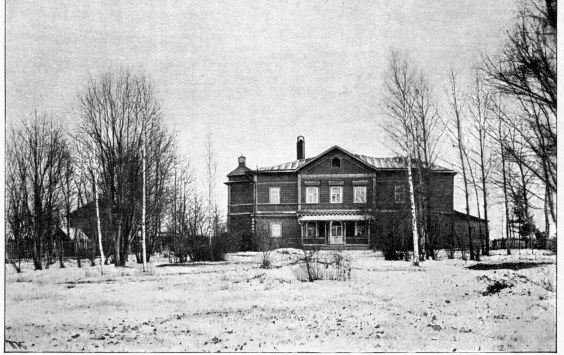
To Modeste Tchaikovsky.
“Klin, May 20th (June 1st), 1892.
“I have spent so much money lately (of course not upon myself alone) that all my hopes of laying aside something for George[182] have vanished.”
To Eugen Zabel.
“Klin, near Moscow, May 24th (June 5th), 1892.
“I have just received your esteemed letter, and feel it a pleasant duty to send you an immediate answer, but as I write German very badly I must have recourse to French. I doubt if you will find anything new, interesting, or of any value for your biography in the following lines; but I promise to say quite frankly all that I know and feel about Rubinstein.
“It was in 1858 that I heard the name of Anton Rubinstein for the first time. I was then eighteen, and I had just entered the higher class of the School of Jurisprudence, and only took up music as an amateur. For several years I had taken lessons on Sundays from a very distinguished pianist, M. Rodolphe Kündinger. In those days, never having heard any other virtuoso than my teacher, I believed him, in all sincerity, to be the greatest in the world. One day Kündinger came to the lesson in a very absent-minded mood, and paid little attention to the scales and exercises I was playing. When I asked this admirable man and artist what was the matter, he replied that, the day before, he had heard the pianist Rubinstein, just come from abroad; this man had impressed him so profoundly that he had not yet recovered from the experience, and everything in the way of virtuosity now seemed to him so poor that it was as unbearable to listen to my scales as to hear himself play the piano.
“I knew what a noble and sincere nature Kündinger possessed. I had a very high opinion of his taste and knowledge—and this caused his words to excite my imagination and my curiosity in the highest degree. In the course of my scholastic year I had the opportunity of hearing Rubinstein—and not only of hearing him, but of seeing him play and conduct. I lay stress upon this first visual impression, because it is my profound conviction that Rubinstein’s prestige is based not only upon his rare talent, but also upon an irresistible charm which emanates from his whole personality; so that it is not sufficient to hear him in order to gain a full impression—one must see him too. I heard and saw him. Like everyone else, I fell under the spell of his charm. All the same, I finished my studies, entered the Government service, and continued to amuse myself with a little music in my leisure hours. But gradually my true vocation made itself felt. I will spare you details which have nothing to do with my subject, but I must tell you that about the time of the foundation of the St. Petersburg Conservatoire, in September, 1862, I was no longer a clerk in the Ministry of Justice, but a young man resolved to devote himself to music, and ready to face all the difficulties which were predicted by my relatives, who were displeased that I should voluntarily abandon a career in which I had made a good start. I entered the Conservatoire. My professors were: Zaremba for counterpoint and fugue, etc., Anton Rubinstein (Director) for form and instrumentation. I remained three and a half years at the Conservatoire, and during this time I saw Rubinstein daily, and sometimes several times a day, except during the vacations. When I joined the Conservatoire I was—as I have already told you—an enthusiastic worshipper of Rubinstein. But when I knew him better, when I became his pupil and we entered into daily relations with each other, my enthusiasm for his personality became even greater. In him I adored not only a great pianist and composer, but a man of rare nobility, frank, loyal, generous, incapable of petty and vulgar sentiments, clear and right-minded, of infinite goodness—in fact, a man who towered far above the common herd. As a teacher, he was of incomparable value. He went to work simply, without grand phrases or long dissertations; but always taking his duty seriously. He was only once angry with me. After the holidays I took him an overture entitled ‘The Storm,’ in which I had been guilty of all kinds of whims of form and orchestration. He was hurt, and said that it was not for the development of imbeciles that he took the trouble to teach the art of composition. I left the Conservatoire full of gratitude and admiration for my professor.
“For over three years I saw him daily. But what were our relations? He was a great and illustrious musician—I a humble pupil, who only saw him fulfilling his duties, and had no idea of his intimate life. A great gulf lay between us. When I left the Conservatoire I hoped that by working courageously, and gradually making my way, I might look forward to the happiness of seeing this gulf bridged over. I dared to aspire to the honour of becoming the friend of Rubinstein.
“It was not to be. Nearly thirty years have passed since then, but the gulf is deeper and wider than before. Through my professorship in Moscow I came to be the intimate friend of Nicholas Rubinstein; I had the pleasure of seeing Anton from time to time; I have always continued to care for him intensely, and to regard him as the greatest of artists and the noblest of men, but I never became, and never shall become, his friend. This great luminary revolves always in my heaven, but while I see its light I feel its remoteness more and more.
“It would be difficult to explain the reason for this. I think, however, that my amour propre as a composer has a great deal to do with it. In my youth I was very impatient to make my way, to win a name and reputation as a gifted composer, and I hoped that Rubinstein—who already enjoyed a high position in the musical world—would help me in my chase for fame. But painful as it is, I must confess that he did nothing, absolutely nothing, to forward my plans or assist my projects. Certainly he never injured me—he is too noble and generous to put a spoke in the wheel of a comrade—but he never departed from his attitude of reserve and kindly indifference towards me. This has always been a profound regret. The most probable explanation of this mortifying luke-warmness is that Rubinstein does not care for my music, that my musical temperament is antipathetic to him. Now I still see him from time to time, and always with pleasure, for this extraordinary man has only to hold out his hand and smile for us to fall at his feet. At the time of his jubilee I had the happiness of going through much trouble and fatigue for him; his attitude to me is always exceedingly correct, exceedingly polite and kind—but we live very much apart, and I can tell you nothing about his way of life, his views and aims—nothing, in fact, that could be of interest to the future readers of your book.
“I have never received letters from Rubinstein, and never wrote to him but twice in my life, to thank him for having, in recent years, included, among other Russian works in his programmes, one or two of my own.
“I have made a point of fulfilling your wish and telling you all I could about Rubinstein. If I have told too little, it is not my fault, nor that of Anton, but of fatality.
“Forgive my blots and smudges. To-morrow I have to leave home, and have no time to copy this.
“Your devoted “P. T.”
The sole object of the journey mentioned in this letter was to take a cure at Vichy. The catarrh of the stomach from which he suffered had been a trouble to Tchaikovsky for the last twenty years. Once, while staying with Kondratiev at Nizy, the local doctor had recommended him natron water. From that time he could not exist without it, and took it in such quantities that he ended by acquiring a kind of taste for it. But it did not cure his complaint, which grew worse and worse, so that in 1876 he had to undergo a course of mineral waters. The catarrhal trouble was not entirely cured, however, but returned at intervals with more or less intensity. About the end of the eighties his condition grew worse. Once during the rehearsals for Pique Dame, while staying at the Hôtel Rossiya in St. Petersburg, he sent for his brother Modeste, and declared he “could not live through the night.” This turned his thoughts more and more to the “hateful but health-giving Vichy.” But the periods of rest after his various tours, and of work in his “hermit’s cave” at Klin, were so dear to him that until 1892 he could not make up his mind to revisit this watering-place. This year he only decided to go because the health of Vladimir Davidov equally demanded a cure at Vichy. He hoped in this congenial company to escape his usual home-sickness, and that it might even prove a pleasure to take his nephew abroad.
To Modeste Tchaikovsky.
“Vichy, June 19th (July 1st), 1892.
“We have been here a week. It seems more like seven months, and I look forward with horror to the fortnight which remains. I dislike Vichy as much as I did sixteen years ago, but I think the waters will do me good. In any case I feel sure Bob will benefit by them.”
To P. Jurgenson.
“Vichy, July 1st (13th), 1892.
“I only possess one short note from Liszt, which is of so little importance that it is not worth your while to send it to La Mara. Liszt was a good fellow, and ready to respond to everyone who paid court to him. But as I never toadied to him, or any other celebrity, we never got into correspondence. I think he really preferred Messrs. Cui and Co., who went on pilgrimages to Weimar, and he was more in sympathy with their music than with mine. As far as I know, Liszt was not particularly interested in my works.”
By July 9th (21st) Tchaikovsky and his nephew were back in Petersburg, from whence he travelled almost immediately to Klin, where he busied himself with the new Symphony (No. 6) which he wished to have ready in August.
At the outset of his career Tchaikovsky was somewhat indifferent as to the manner in which his works were published. He troubled very little about the quality of the pianoforte arrangements of his operas and symphonic works, and still less about printers’ errors. About the end of the seventies, however, he entirely changed his attitude, and henceforth became more and more particular and insistent in his demands respecting the pianoforte arrangements and correction of his compositions. Quite half his correspondence with Jurgenson is taken up with these matters ... His requirements constantly increased. No one could entirely satisfy him. The cleverest arrangers, such as Klindworth, Taneiev, and Siloti did not please him, because they made their arrangements too difficult for amateurs. He was also impatient at the slowness with which they worked.
Now that for a year and a half Tchaikovsky has been in his grave, it is easy to attribute to certain events in his life (which passed unnoticed at the time) a kind of prophetic significance. His special and exclusive care as to the editing and publishing of his works in 1892 may, however, be compared to the preparations which a man makes for a long journey, when he is as much occupied with what lies before him as with what he is leaving behind. He strives to finish what is unfinished, and to leave all in such a condition that he can face the unknown with a quiet conscience.