Part VI
Rosa Newmarch translation
I
STRONG and energetic, fearing neither conflict nor effort, the Tchaikovsky who entered upon this new phase of life in no way resembled the man we knew in 1878.
The duties connected with his public career no longer dismayed him; on the contrary, they proved rather attractive, now he had strength to cope with them. At the same time interests stirred within him such as could not have been satisfied in his former restricted existence. Thanks to the enormous success of Eugene Oniegin, his fame had now reached every class in educated Russia, and he was compelled to accept a certain rôle which—at least, in these first days of success—was not unpleasant to him. He was glad to pay attentions to others, to help everyone who came his way, because by this means he could show his gratitude to the public for the enthusiastic reception accorded to his work. He was no longer a misanthropist, rather he sought those to whom he was dear, not only as a man, but as a personage. Amongst these, his old and faithful friends in Moscow took the first place. These intimacies were now renewed, and every fresh meeting with Laroche, Kashkin, Jurgenson, Albrecht, Hubert, and Taneiev gave him the keenest delight. Although death had separated him from Nicholas Rubinstein, he showed his devotion to the memory of his friend by taking the deepest interest in his orphaned children.
In February, 1885, Tchaikovsky was unanimously elected Director of the Moscow branch of the Russian Musical Society.
As the most popular musician in Russia, he no longer avoided intercourse with his fellow-workers. He was ready with advice, assistance and direction, and regarded it as a duty to answer every question addressed to him. His correspondence with his “colleagues” would fill a book in itself.
He received letters not only from professional musicians, but from amateurs, male and female, students, enthusiastic girls, officers, and even occasionally from priests. To all these letters he replied with astonishing conscientiousness and strove, in so far as he could, to fulfil all their requests, which often led to touching, or sometimes grotesque, expressions of gratitude from the recipients of his favours.
As a composer Tchaikovsky no longer stood aloof, leaving the fate of his compositions to chance; nor did he regard it as infra dig. to make them known through the medium of influential people. After a convalescence which had lasted seven years, Tchaikovsky returned to all these activities with vigour and enjoyment, although after a time his courage flagged, and all his strength of will had to be requisitioned to enable him “to keep up this sort of existence.” Enthusiasm waned, and there succeeded—in his own words—“a life-weariness, and at times an insane depression; something hopeless, despairing, and final—and (as in every Finale) a sense of triviality.”
The new conditions of his life are reflected in his constantly increasing circle of acquaintances. In every town he visited he made new friends, who were drawn to him with whole-hearted affection. With many of them he entered into brisk correspondence. In some cases this was continued until his death; in other instances the exchange of letters ceased after a year or two, to make way for a fresh correspondence.
The most important and interesting of Tchaikovsky’s correspondents during this time are: Julie Spajinsky, wife of the well-known dramatist (1885-1891); Emilie Pavlovskaya, the famous singer, with whom Tchaikovsky became acquainted during the rehearsal for Mazeppa in 1884, and continued to correspond until 1888; the Grand Duke Constantine Constantinovich; the composer Ippolitov-Ivanov and his wife, the well-known singer, Zaroudna; Vladimir Napravnik, son of the conductor; the pianists Sapellnikov and Siloti. With Glazounov, Désirée Artôt, Brodsky, Hubert, his cousin Anna Merkling, and many others, there was an occasional exchange of letters.
The greater part of these communications, notwithstanding the intimate style and frankness of the writer’s nature, bear signs of effort, and give the impression of having been written for duty’s sake. Taken as a whole, they are not so important, or so interesting, as the letters to Nadejda von Meck, and to Tchaikovsky’s own family, belonging to the Moscow period.
The same may be said of the majority of new acquaintances made during the later years of his life, of which no epistolary record remains. These were so numerous that it would be impossible to speak of them individually. They included such personalities as Liadov, Altani, Grieg, Sophie Menter, Emil Sauer, Louis Diemer, Colonne, Carl Halir. Besides these, he was in touch with a vast number of people belonging to the most varied strata of social life. Among them was Legoshin, valet to his friend Kondratiev. Tchaikovsky got to know this man by the death-bed of his master, and valued his purity of heart and integrity more and more as years went by. Another unprofessional friend was the celebrated Russian general, Dragomirov. While travelling to France by sea, he made the acquaintance of an extraordinarily gifted boy, the son of Professor Sklifasskovsy. The friendship was brief as it was touching, for the youth died a year later. Tchaikovsky was deeply affected by his loss, and dedicated to his memory the Chant Elégiaque, op. 72.
All these new friendships served to surround the composer with that atmosphere of affection and appreciation which was as indispensable to him as his daily bread. But none of them were as deep and lasting as the ties of old days, none so close and intimate; nor did they contribute any new element to his inner life....
One word as to the dearest of all his later affections. His sister, A. Davidov, had three sons. The second of these, Vladimir, had always been Tchaikovsky’s favourite from childhood. Up to the age of eighteen, however, these pleasant relations between uncle and nephew had not assumed any deep significance. But as Vladimir Davidov grew up, Tchaikovsky gradually felt for him a sentiment which can only be compared to his love for the twins, Toly and Modi, in their youth. The difference of age was no hindrance to their relations. Tchaikovsky preferred the companionship of his nephew; was always grieved to part with him; confided to him his inmost thoughts, and finally made him his heir, commending to this young man all those whom he still desired to assist and cherish, even after his death.
II
To N. F. von Meck.
“Moscow, January 1st (13th), 1885.
“It is so long since I wrote, dear friend! Two events have interrupted my correspondence with you: on Christmas Eve I received a telegram announcing the death of Kotek. Not only was I much upset by this intelligence, but the sad duty of breaking the news to his parents devolved upon me.... I have also had to make the difficult corrections in my new Suite myself. Hans von Bülow is shortly to conduct in Petersburg, and all must be ready four or five days hence. While I was away nothing was done here. I was furious, rated Jurgenson and the engravers, and worked till I was worn out; therefore I have had no time to lament for poor Kotek.”
To N. F. von Meck.
“Moscow, January 5th (17th), 1885.
“All my thoughts are now directed towards taking up my abode in some village near Moscow. I am no longer satisfied with a nomadic existence, and am determined to have a home of my own somewhere. As I am sure I am not in a position to buy a country house, I have decided to rent one.”
The first performance of the Third Suite, which took place at a symphony concert in Petersburg, on January 12th (24th), 1885, under Von Bülow’s direction, was a veritable triumph for Tchaikovsky. Never before had any of his works been received with such unanimous enthusiasm. Doubtless this was partly owing to the accessible and attractive character of the music, but far more to the admirable way in which it was interpreted.
Hans von Bülow was a great pianist, yet in this sphere he had rivals who almost overshadowed his fame. As a conductor, however, he ranked, after Richard Wagner, as the first man of his day. In spite of his years he was as enthusiastic as a youth, highly strung, receptive, and a fine all-round musician. He knew how to bring out every detail in a work, and thus infused his own virtuoso-inspiration into each individual player. Under him—in spite of his mannerisms and ungraceful movements—the orchestra performed wonders, and threw new light upon the most hackneyed works (such as the overture to Freischütz), holding the attention of the audience from the opening phrase to the last chord.
Quick, restless, and continually under the influence of some inspiration, he was as extreme and pitiless in his dislikes as he was sentimental and enthusiastic in his sympathies. He could not merely like or dislike. He hated or adored.
After having been in turn a passionate partisan of the classical masters, of Wagner and of Brahms, he became in the seventies a great admirer of Russian music, and was devoted to Tchaikovsky’s works. His devotion was then at its zenith, consequently he put into his interpretation of the Third Suite not merely his accustomed experience, but all the fire of his passing enthusiasm. I say “passing,” because some ten years later this enthusiasm had somewhat cooled, and he had begun to rave over the works of Richard Strauss, who at that time had scarcely entered upon his career as a composer.
To N. F. von Meck.
“Moscow, January 18th (30th), 1885.
“Dear, kind Friend,—Forgive me my indolence, and for so seldom writing. To-day I returned from Petersburg, where I spent a week of feverish excitement. The first few days were taken up by the rehearsals for the concert at which my new Suite was to be performed. I had a secret presentiment that it would please the public. I experienced both pleasure and fear. But the reality far surpassed my expectations. I have never had such a triumph; I could see that the greater part of the audience was touched and grateful. Such moments are the best in an artist’s life.... On the 15th (27th) Oniegin was performed in the presence of the Emperor and Empress, and other members of the Tsar’s family. The Emperor desired to see me. We had a long and friendly conversation, in the course of which he asked all about my life and musical work, and then took me to the Empress, who paid me the most touching attention. The following evening I returned to Moscow.”
On January 16th (28th), the new Suite was given in Moscow, under Erdmannsdörfer. It met with considerable success, but not with such appreciation as in Petersburg. Erdmannsdörfer’s interpretation was fine, but lacked the inspiration by means of which Hans von Bülow had electrified his audience. At this time Tchaikovsky was in search of an operatic subject. Just then, says his brother Modeste, “I was in Moscow, and remarked one day that certain scenes from Shpajinsky’s play, The Enchantress, would make an effective opera without using the whole drama as a libretto.” The following day Tchaikovsky wrote to the author, asking permission to use the play for musical setting. Shpajinsky replied that he would be pleased to co-operate with the composer.
When the time came for Tchaikovsky to find a residence in his native land, or to go abroad according to his usual custom, he was seized with an inexplicable fear of the journey, and sent his servant Alexis to take a furnished house, in the village of Maidanovo, near Klin. “The house,” he wrote to Nadejda von Meck, “contains many beautifully furnished rooms, and has a fine view. Apparently it is a pleasant place to live in, but the number of rooms gives me some anxiety, because they must be heated in winter.” Finally he decided to take it for a year, and should it prove beyond his means, to look out for something more suitable in the meanwhile.
The village of Maidanovo lies close to the town of Klin. The manor house stands upon a high bank, overlooking the river Sestra, and is surrounded by a large park. Once it belonged to an aristocratic Russian family, but had gradually fallen into decay. Nevertheless, it bore many traces of its former splendour: the remains of a rosary in front of the façade, arbours, lakes, little bridges, rare trees, an orangery and a marble vase, placed in a shady spot in the park. In 1885 this property was already spoilt by the numerous country houses built by rich owners in the immediate neighbourhood. But Tchaikovsky was so enamoured of the scenery of Great Russia that he was quite satisfied with a birch or pine wood, a marshy field, the dome of a village church and, in the far distance, the dark line of some great forest. The chief motive, however, for his choice of this neighbourhood, where he lived to the end of his days, was not so much the charm of scenery as its situation between the two capitals. Klin lies near Moscow, and is also easily accessible from Petersburg, so that Tchaikovsky was within convenient distance from either city; while at the same time he was beyond the reach of accidental visitors, who now frequently molested him.
The first glimpse of Maidanovo disappointed Tchaikovsky. All that seemed splendid and luxurious to his man Alexis appeared in his eyes tasteless and incongruous. Nevertheless, he felt it would be pleasant as a temporary residence. The view from the windows, the quiet and sense of being at home, delighted him. The cook was good and inexpensive. The only other servants he employed were a moujik and a washerwoman. “In spite of my disappointment,” he writes to his brother, “I am contented, cheerful, and quiet.... I am now receiving the newspapers, which makes life pleasanter. I read a great deal, and am getting on with English, which I enjoy. I eat, walk, and sleep when—and as much as—I please—in fact I live.”
III
To E. Pavlovskaya.
“Maidanovo, February 20th (March 4th), 1888.
“Dear Emilie Karlovna,—I rather long for news of you. Where are you now? I have settled down in a village. My health is not good ... in Carnival week I suffered from the most peculiar nervous headaches.... As I felt sure my accursed and shattered nerves were to blame, and I only wanted rest, I hurried into the country.... My Vakoula will be quite a respectable opera, you can feel sure of that. I always see you as Oxana, and so you dwell in my company without suspecting it. I have made every possible alteration which could retrieve the work from its unmerited oblivion. I hope it will be quite ready by Easter. I intend to begin a new opera in spring, so I shall once more have an opportunity of spending all my time with my ‘benefactress.’”[103]
In February Taneiev played the new Fantasia for pianoforte in Moscow. Its immediate success was very great, but probably the applause was as much for the favourite pianist as for the work itself, for neither in Moscow nor yet in Petersburg—where Taneiev played it a year later—did this composition take any lasting hold upon the public.
To N. F. von Meck.
“Maidanovo, March 5th (17th), 1885.
“Dear Friend,—Your letter gave me food for reflection. You are quite right: property is a burden, and only he who owns nothing is quite free. But, on the other hand, one must have a home. If I could live in Moscow, I should rent a house there. But it is not sufficient to rent a place in the country if one wants to feel at home. Here in Maidanovo, for instance, I have already found it very unpleasant to have my landlady living close by. I cannot plant the flowers I like, nor cut down a tree that obstructs my view. I cannot prevent people from walking in front of my windows, because there are other houses let in the park. I think, with my reserved character and nature, it would be better to have a little house and garden of my own....
“The Russian solitudes of which you speak do not frighten me. One can always take a great store of books and newspapers from town, and, moreover, I am very simple in my tastes.
“I do not at all agree with your idea that in our country it must always be horrid, dark, marshy, etc. Even as the Esquimaux, or the Samoyede, loves his icy northern land, I love our Russian scenery more than any other, and a Russian landscape in winter has an incomparable charm for me. This does not hinder me in the least from liking Switzerland or Italy, in a different way. To-day I find it particularly difficult to agree with you about the poverty of our Russian scenery: it is a bright, sunny day, and the snow glistens like millions of diamonds. A wide vista lies before my window.... No! it is beautiful here in this land of ours, and one breathes so easily under this boundless horizon.
“It seems to me you think too gloomily, too despairingly, of Russia. Undoubtedly there is much to be wished for here, and all kinds of deceit and disorder do still exist. But where will you find perfection? Can you point out any country in Europe where everyone is perfectly contented? There was a time when I was convinced that for the abolishment of autocracy and the introduction of law and order, political institutions, such as parliaments, chambers of deputies, etc., were indispensable, and that it was only necessary to introduce these reforms with great caution, then all would turn out well, and everyone would be quite happy. But now, although I have not yet gone over to the camp of the ultra-conservatives, I am very doubtful as to the actual utility of these reforms. When I observe what goes on in other countries, I see everywhere discontent, party conflict and hatred; everywhere—in a greater or less degree—the same disorder and tyranny prevails. Therefore I am driven to the conclusion that there is no ideal government, and, until the end of the world, men will have to endure in patience many disappointments with regard to these things. From time to time great men—benefactors of mankind—appear, who rule justly and care more for the common welfare than for their own. But these are very exceptional. Therefore I am firmly convinced that the welfare of the great majority is not dependent upon principles and theories, but upon those individuals who, by the accident of their birth, or for some other reason, stand at the head of affairs. In a word, mankind serves man, not a personified principle. Now arises the question: Have we a man upon whom we can stake our hopes? I answer, Yes, and this man is the Emperor. His personality fascinates me; but, apart from personal impressions, I am inclined to think that the Emperor is a good man. I am pleased with the caution with which he introduces the new and does away with the old order. It pleases me, too, that he does not seek popularity; and I take pleasure also in his blameless life, and in the fact that he is an honourable and good man. But perhaps my politics are only the naïveté of a man who stands aloof from everyday life and is unable to see beyond his own profession.”
To E. K. Pavlovskaya.
“Maidanovo, March 14th (26th), 1885.
“I am now arranging the revised score of Vakoula, orchestrating the new numbers and correcting the old. I hope to have finished in a few weeks. The opera will be called Cherevichek,[104] to distinguish it from the numerous other Vakoulas: Soloviev’s and Stchourovsky’s for instance. The authorities have promised to produce the opera in Moscow; it will hardly be possible in Petersburg, as they have already accepted two new operas there.
“As to The Captain’s Daughter,[105] if only I could find a clever librettist, capable of carrying out such a difficult task, I would begin the work with pleasure. Meanwhile I have made a note of The Enchantress, by Shpajinsky. The latter has already started upon the libretto. He will make many alterations and, if I am not mistaken, it will make a splendid background for the music. You will find it your most suitable rôle. If Les Caprices d’Oxane should be produced, you will continue to play the part of my ‘benefactress,’ for you give me incredibly more than I give you. But if, with God’s help, I achieve The Enchantress, I hope I may become your benefactor in some degree. Here you shall have a fine opportunity to display your art.”
To N. F. von Meck.
“Maidanovo, April 3rd (15th), 1885.
“My Dearest Friend,—I am once more back in Maidanovo, after a week and a half of travelling hither and thither. I worked almost without a break through the whole week before Palm Sunday and the whole of Passion Week, in order to be ready for the Easter festival. By Saturday everything was finished, and (although not well) I arrived in Moscow in time for the early service. I did not pass my holidays very pleasantly, and at the end of Easter Week I went to Petersburg, where I had to see Polonsky, author of the libretto of Vakoula, about the printing of the opera in its new form. I stayed four days in Petersburg, and spent them with my relations in the usual running about, which I found as wearisome as it was fatiguing. On Monday I travelled to Moscow in order to attend the reception of the Grand Duke Constantine Nicholaevich, who was to be present at the performance of the opera at the Conservatoire. As a member of the Musical Committee, I could not avoid taking part in the official reception to the Grand Duke, which I found a great bore. The performance went very well. Many thanks for sending me the articles in the Novoe Vremya. I had already seen them, and was very pleased with their warmth of tone. I am never offended at frank criticism, for I am well aware of my faults, but I feel very bitterly the cold and inimical note which pervades Cui’s criticisms. It is not very long since the Russian Press (principally the Petersburg organs) began to notice me in a friendly spirit. Ivanov, the author of the articles in the Novoe Vremya, had formerly no good opinion of me, and used to write in a cold and hostile manner, although in Moscow I taught him theory for three years, and did not in the least deserve his enmity, as everyone knows. I can never forget how deeply his criticism of Vakoula wounded me ten years ago.”
To Rimsky-Korsakov.
“Maidanovo, April 6th (18th), 1885.
“Dear Nicholas Andreievich,—Since I saw you last I have had so much to get through in a hurry that I could not spare time for a thorough revision of your primer. But now and again I cast a glance at it, and jotted down my remarks on some loose sheets. To-day, having finished my revision of the first chapter, I wanted to send you these notes, and read them through again. Then I hesitated: should I send them or not? All through my criticism of your book[106] ran a vein of irritation, a grudging spirit, even an unintentional suspicion of hostility towards you. I was afraid the mordant bitterness of my observations might hurt your feelings. Whence this virulence? I cannot say. I think my old hatred of teaching harmony crops up here; a hatred which partly springs from a consciousness that our present theories are untenable, while at the same time it is impossible to build up new ones; and partly from the peculiarity of my musical temperament, which lacks the power of imparting conscientious instruction. For ten years I taught harmony, and during that time I loathed my classes, my pupils, my text-book, and myself as teacher. The reading of your book reawakened my loathing, and it was this which stirred up all my acrimony and rancour.... Now I am going to lay a serious question before you, which you need not answer at once, only after due consideration and discussion with your wife.
“Dare I hope that you would accept the position of Director of the Moscow Conservatoire should it be offered you? I can promise you beforehand so to arrange matters that you would have sufficient time for composing, and be spared all the drudgery with which N. Rubinstein was overwhelmed. You would only have the supervision of the musical affairs.
“Your upright and ideally honourable character, your distinguished gifts, both as artist and as teacher, warrant my conviction that in you we should find a splendid Director. I should consider myself very fortunate could I realise this ideal.
“So far, I have not ventured to speak of it to anyone, and beg you to keep the matter quiet for the present.
“Think it over, dear friend, and send me your answer....”[107]
To E. K. Pavlovskaya.
“Maidanova, April 12th (24th), 1885.
“My dear Emilie Karlovna,—Your exceedingly malicious criticism of The Enchantress not only failed to annoy me, but awoke my gratitude, for I wanted to know your opinion. I had even thought of asking you if you would go to see the play itself and give me your impressions. My conception and vision of the type of Natasha differs entirely from yours. Of course, she is a licentious woman; but her spell does not consist merely in the fact that she can win people with her fine speeches. This spell might suffice to draw customers to her inn—but would it have power to change her sworn enemy, the Prince, into a lover? Deep hidden in the soul of this light woman lies a certain moral force and beauty which has never had any chance of development. This power is love. Natasha is a strong and womanly nature, who can only love once, and she is capable of sacrificing all and everything to her love. So long as her love has not yet ripened, Natasha dissipates her forces, so to speak, in current coin; it amuses her to make everyone fall in love with her with whom she comes in contact. She is merely a sympathetic, attractive, undisciplined woman; she knows she is captivating, and is quite contented. Lacking the enlightenment of religion and culture—for she is a friendless orphan—she has but one object in life—to live gaily. Then appears the man destined to touch the latent chords of her better nature, and she is transfigured. Life loses all worth for her, so long as she cannot reach her goal; her beauty, which, so far, had only possessed an instinctive and elementary power of attraction, now becomes a strong weapon in her hand, by which, in a single moment, she shatters the opposing forces of the Prince—his hatred. Afterwards they surrender themselves to the mad passion which envelops them and leads to the inevitable catastrophe of their death; but this death leaves in the spectator a sense of peace and reconciliation. I speak of what is going to be in my opera; in the play everything is quite different. Shpajinsky quite understands my requirements, and will carry out my intentions in delineating the principal characters. He will soften down the hardness of Natasha’s manières d’être, and will give prominence to the power of her moral beauty. He and I—you too, later, if only you will be reconciled to this rôle—will so arrange things that in the last act there shall not be a dry eye in the audience. This is my own conception of this part, and I am sure it must please you, and that you will not fail to play it splendidly. My enthusiasm for The Enchantress has not made me unfaithful to the desire, so deeply rooted in my soul, to illustrate in music those words of Goethe’s: ‘The eternal feminine draws us onward.’ The fact that the womanly power and beauty of Natasha’s character remain so long hidden under a cloak of licentiousness, only augments the dramatic interest. Why do you like the part of Traviata or of Carmen? Because power and beauty shine out of these two characters, although in a somewhat coarser form. I assure you, you will also learn to like The Enchantress.”
To M. Tchaikovsky.
“Maidanovo, April 26th (May 8th), 1885.
“The business connected with Cherevichek has ended very well. Vsievolojsky put an end to the irresolution of the so-called management and ordered the opera to be produced in the most sumptuous style. I was present at a committee at which he presided, when the mounting was discussed. They will send Valetz, the scene-painter, to Tsarskoe-Selo, so that he may faithfully reproduce some of the rooms in the palace. I am very pleased.”
FRAGMENT FROM A LETTER IN WHICH TCHAIKOVSKY SKETCHES A THEME FOR “THE ENCHANTRESS”

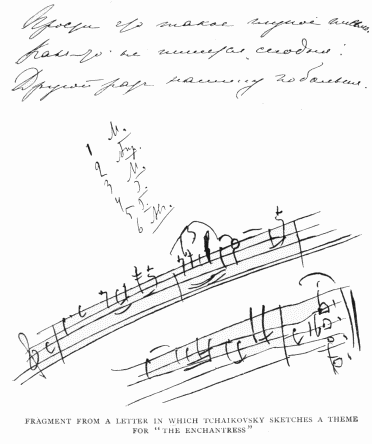
To P. Jurgenson.
“Maidanovo, April 26th (May 8th), 1885.
“The position of my budget is as follows: I possess (together with the Moscow royalty which I have not yet received) 6,000 roubles. From Petersburg and Moscow there must still be about 800 or 1,000 roubles to come in; the honorarium from the church music, 300 roubles; the honorarium from the Moscow Musical Society, 300 roubles.
“Total: 6000 + 800 + 300 + 300 = 7,500 (sic!).
“Up to the present I have not received more than 3,000 roubles from you.
“Consequently the capital which you have in hand amounts to 4,500-5000 roubles. A nice little sum.”
To N. F. von Meck.
“Moscow, May 26th (June 7th), 1885.
“ ... I am completely absorbed in the affairs of the Conservatoire, and have decided that the position of Director shall be offered to Taneiev. If I do not succeed in this, I shall retire from the Committee. Finally, I can tell you what, so far, I have said to no one here: I hate every public office more than ever. Oh, God! how many disappointments have I experienced and how many bitter truths I have learnt! No! next year I must get right away.”
Tchaikovsky actually succeeded in getting Taneiev chosen as Director of the Conservatoire. Through him Hubert, who had long been absent from the Conservatoire, was once more reinstated as a teacher. To support Taneiev’s authority Tchaikovsky determined to resume his place upon the teaching staff, and undertook the gratuitous class for composition. This only necessitated his attendance once a month to supervise the work of the few (two to three) students of which the class was composed.
To S. I. Taneiev.
“Maidanovo, June 13th (25th), 1885.
“Alexeiev has told me that according to the rules of the Conservatoire it is not permissible for me to be both teacher and member of Committee. Of course, I will not go back on my word, and I leave it to you to decide which would be the most useful—to remain on the Committee, or undertake the somewhat honorary post of professor. I think it would be best to remain on the Committee, but just as you like. In any case I will do my duty conscientiously, on the condition that my freedom is not curtailed and that I may travel whenever I please....
“So, my dear chief, my fate lies in your hands.
“After some hesitation I have made up my mind to compose Manfred, because I shall find no rest until I have redeemed my promise, so rashly given to Balakirev in the winter. I do not know how it will turn out, but meantime I am very discontented. No! it is a thousand times pleasanter to compose without any programme. When I write a programme symphony I always feel I am not paying in sterling coin, but in worthless paper money.”
IV
Tchaikovsky began the composition of Manfred in June. The following letter from Balakirev, dated 1882, led him to choose this subject for a symphonic work.
M. Balakirev to P. Tchaikovsky.
“Petersburg, October 28th (November 9th), 1882.
“Forgive me for having left your last letter so long unanswered. I wanted to write to you in perfect peace and quiet, but many things hindered me. You are more fortunate than we are, for you do not need to give lessons, and can devote your whole time to art. I first offered the subject about which I spoke to you to Berlioz, who declined my suggestion on account of age and ill_health. Your Francesca gave me the idea that you were capable of treating this subject most brilliantly, provided you took great pains, subjected your work to stringent self-criticism, let your imagination fully ripen, and did not hurry. This fine subject—Byron’s Manfred—is no use to me, for it does not harmonise with my intimate moods.
“Let me tell you first of all that your Symphony—like the Second Symphony of Berlioz—must have an idée fixe (the Manfred theme), which must be carried through all the movements. Now for the programme:—
“First Movement. Manfred wandering in the Alps. His life is ruined. Many burning questions remain unanswered; nothing is left to him but remembrance. The form of the ideal Astarte floats before his imagination; he calls to her in vain: the echo of the rocks alone repeats her name. Thoughts and memories burn in his brain and prey upon him; he implores the forgetfulness that none can give him (F♯ minor, second theme D major and F♯ minor).
“Second Movement. In complete contrast to the first. Programme: The customs of the Alpine hunters: patriarchal, full of simplicity and good humour. Adagio Pastorale (A major). Manfred drops into this simple life and stands out in strong contrast to it. Naturally at the beginning a little hunting theme must be introduced, but in doing this you must take the greatest care not to descend to the commonplace. For God’s sake avoid copying the common German fanfares and hunting music.
“Third Movement. Scherzo fantastique (D major). Manfred sees an Alpine fairy in the rainbow above a waterfall.
“Fourth Movement. Finale (F♯ minor). A wild Allegro representing the caves of Ariman, whither Manfred has come to try and see Astarte once more. The appearance of Astarte’s wraith will form the contrast to these infernal orgies (the same theme which was employed in the first movement in D major now reappears in D♭ major; in the former it dies away like a fleeting memory, and is immediately lost in Manfred’s phase of suffering—but now it can be developed to its fullest extent). The music must be light, transparent as air, and ideally virginal. Then comes the repetition of Pandemonium, and finally the sunset and Manfred’s death.
“Is it not a splendid programme? I am quite convinced that if you summon up all your powers it will be your chef-d’œuvre.
“The subject is not only very deep, but in accordance with contemporary feeling; for all the troubles of the modern man arise from the fact that he does not know how to preserve his ideals. They crumble away and leave nothing but bitterness in the soul. Hence all the sufferings of our times.”
To N. F. von Meck.
“Maidanovo, June 13th (25th), 1885.
“Dear Friend.—I can at last congratulate you on the beautiful weather. I should enjoy it twice as much if Maidanovo were more congenial to me. But alas! the lovely park, the beautiful views, and the splendid bath, are all alike spoiled by the summer visitors. I cannot take a step in the park without coming across some neighbour. It was beautiful in the winter, but I ought to have thought of the summer and the summer tourist.
“I am deep in the composition of a new symphonic work. Shpajinsky could not send me the first act of The Enchantress at the date agreed upon, so without losing any time, in April I set to work upon the sketches for a programme Symphony, upon the subject of Byron’s Manfred. I am now so deep in the composition of this work that the opera will probably have to be laid aside for some time. The Symphony gives me great trouble. It is a very complicated and serious work. There are times when it seems to me it would be wise to cease from composing for a while; to travel and rest. But an unconquerable desire for work gains the upper hand and chains me to my desk and piano.”
To E. K. Pavlovskya.
“Maidanovo, July 20th (August 1st), 1885.
“ ... I have been playing through some numbers from Harold. A very interesting work and a clever one, well thought out and full of talent. But are you not surprised that Napravnik, who is so against Wagner, should have written a genuine Wagnerian opera? I was filled with astonishment.”
To N. F. von Meck.
“Maidanovo, August 3rd (15th), 1885.
“The horizon has been shrouded for days in thick mist, caused, they say, by forest fires and smouldering peat-mosses. This mist gets thicker and thicker, and I begin to fear we shall be suffocated. It has a very depressing effect. In any case my mental condition has been very gloomy of late. The composition of the Manfred Symphony—a work highly tragic in character—is so difficult and complicated that at times I myself become a Manfred. All the same, I am consumed with the desire to finish it as soon as possible, and am straining every nerve: result—extreme exhaustion. This is the eternal cercle vicieux in which I am for ever turning without finding an issue. If I have no work, I worry and bore myself; when I have it, I work far beyond my strength.”
To N. F. von Meck.
“Maidanovo, August 31st (September 12th), 1885.
“ ... My fate, that is to say the question of my future home, is at last decided. After a long and unsuccessful search I have agreed to my landlady’s proposal to remain at Maidanovo. I shall not stay in the uncomfortable and unsuitable house in which I have been living, but in one which she herself has occupied. This house stands somewhat apart from the others, and a large piece of the garden is to be fenced in and kept for my especial use; the house itself was thoroughly done up last summer. Although the neighbourhood is not what I could wish, yet, taking into consideration the proximity of a large town with station, shops, post, telegraph office, doctor and chemist—and also my dislike for searching further—I have decided to take this place for two years. It is pleasant and comfortable, and I think I shall feel happy there. I am now starting to furnish, and shall enter on my tenancy on September 15th. If during the next two years I feel comfortably settled, I shall not search any more, but remain there to the end of my days. It is indeed time that I had a settled home.”
V 1885-1886
All the important epochs in Tchaikovsky’s life were preceded by a transition period in which he tried, as it were, whether the proposed change would be feasible or not. From 1861-2, before he became a student at the Conservatoire, he was half-musician, half-official; in 1866, before he became a professor at the Conservatoire, and entirely a Muscovite, he was for eight months half-Petersburger and half-Muscovite; in 1877, before he gave up his professorship and started on what he called “the nomadic life” of the last seven years, he was half-professor and half-tourist; now, from February to September, 1885, he was rather a summer visitor than an inhabitant of the village of Maidanovo, but he had proved the firmness of his decision to remain there. It was only in the beginning of September that he became the true “hermit of Klin,” who, alas, was often compelled to leave his hermitage. As he had now decided to settle down in a home of his own, he proceeded to make it comfortable.... With a school-girl’s naïveté in all practical questions of life, Tchaikovsky could not do much himself towards furnishing his little home, and handed over the task to his servant Alexis. He himself only helped by purchasing the most unnecessary things (for example, he bought two horses, which he sold again with great difficulty, also an old English clock, which proved quite useless), or by furnishing his library with books and music. He was as pleased as a child, and was never tired of talking of “my cook,” “my washerwoman,” “my silver,” “my tablecloths,” and “my dog.” He considered all these to be of the very best, and praised them to the skies. With the exception of some portraits and ikons, all the remainder of Tchaikovsky’s movable property dates its existence from this time.
In comparison with the luxurious houses of other men in his position, painters, writers, and artists, Tchaikovsky’s home was very modest. It contained only what was absolutely necessary. He did not possess beautiful or luxurious things, because his means were decidedly smaller than those of his colleagues in Western Europe, and also because he paid but little attention to outward appearances. If tables, cupboards, or curtains fulfilled their purpose fairly well, he was quite content. Workmanship and material were matters of indifference to him. He also troubled very little about “style” (he could not distinguish one style from another); even if a table was shaky, or the door of a cupboard refused to close, he took it all quite calmly. He would not surround himself with luxury, because his money belonged less to himself than to others, and because, even at the close of his life, when his income was 20,000 roubles a year, he remained free from all pretentious notions.
Little as Tchaikovsky troubled about buying furniture, he cared still less about the placing of it. He entrusted the matter entirely to the will of his servant, who, knowing and taking into consideration his little fancies and habits, arranged everything just as “his master liked it,” without paying any heed to beauty or tastefulness. Tchaikovsky preferred that nothing should be altered in his surroundings; he found it most disagreeable to have to accustom himself to anything new, still more to miss any of his old friends. Henceforth a certain tradition which surrounded every piece of furniture was always considered, if possible, at each removal, so that wherever Tchaikovsky might be, the appearance of his room remained the same. The division of his time in Klin was never changed to the end of his life.
Tchaikovsky rose between seven and eight a.m. Took tea (generally without anything to eat) between eight and nine, and then read the Bible. After which he occupied himself with the study of the English language, or with reading such books as provided not only recreation, but instruction. In this way he read Otto Jahn’s Life of Mozart in the original, the philosophical writings of Spinoza, Schopenhauer, and many others. He next took a walk for about three-quarters of an hour. If Tchaikovsky talked while taking his morning tea, or took his walk in company with a visitor, it signified that he did not intend to compose that day, but would be scoring, writing letters, or making corrections. During his life at Klin, when engaged on a new work, he could not endure company, not only in the morning, but also during the day. In earlier days in Moscow, abroad, or in Kamenka, he had to content himself with the solitude of his room during his hours of active work. The presence of his servant Alexis did not in any way disturb him. The latter, the sole witness of the creative process of the majority of his master’s works, did not even appear to hear them, and only once unexpectedly gave expression to his enthusiasm for the Chorus of Maidens in the third scene of Eugene Oniegin, to the great astonishment and perturbation of his master. To his “perturbation,” because he feared in future to be continually overheard and criticised. But this was fortunately the only flash of enlightenment which penetrated Safronov’s musical darkness.
Manfred was the last work Tchaikovsky composed in anything but complete isolation, and this is probably the reason why the task proved so difficult, and cost him such moments of depression. The principal advantage of his new surroundings was the enjoyment of complete solitude during his hours of work.
We may mention that his reserve as to his compositions dates from this time. In the earlier days of his musical life Tchaikovsky had been very communicative about his work; even before his compositions were finished he was ready to discuss them. In the evening he would ask the opinion of those with whom he lived upon what he had composed in the morning, and was always willing to let them hear his work. In course of time, however, the circle of those to whom he communicated the fruits of his inspiration became ever smaller, and when he played any of his compositions he begged his hearers to keep their opinions to themselves. From 1885 he ceased to show his works to anyone. The first to make acquaintance with them was the engraver at Jurgenson’s publishing house.
Tchaikovsky never wasted time between 9.30 and 1 p.m., but busied himself in composing, orchestrating, making corrections, or writing letters. Before he began a pleasant task he always hastened to get rid of the unpleasant ones. On returning from a journey he invariably began with his correspondence, which, next to proof-correcting, he found the most unpleasant work. In the nineties his correspondence had attained such volume that Tchaikovsky was frequently engaged upon it from morning till night, and often answered thirty letters a day.
Tchaikovsky dined punctually at 1 p.m., and, thanks to his excellent appetite, always enjoyed any fare that was set before him, invariably sending a message of thanks to the cook by Safronov. As he was always very abstemious and plain in his meals, it often happened that his guests, instead of complimenting the cook, felt inclined to do just the contrary. Wet or fine, Tchaikovsky always went for a walk after dinner. He had read somewhere that, in order to keep in health, a man ought to walk for two hours daily. He observed this rule with as much conscientiousness and superstition as though some terrible catastrophe would follow should he return five minutes too soon. Solitude was as necessary to him during this walk as during his work. Not only a human being, but even a favourite dog was a bother.
Every witness of his delight in nature spoilt his enjoyment; every expression of rapture destroyed the rapture itself, and in the very moment when he said to his companion, “How beautiful it is here!” it ceased to be beautiful in his eyes.
Most of the time during these walks was spent in composition. He thought out the leading ideas, pondered over the construction of the work, and jotted down fundamental themes. In Klin there are carefully preserved many little exercise books, which he had used for this purpose. If in absence of mind Tchaikovsky had left his note-book at home, he noted down his passing thoughts on any scrap of paper, letter, envelope, or even bill, which he chanced to have with him. The next morning he looked over these notes, and worked them out at the piano. With the exception of two scenes in Eugene Oniegin, some piano pieces, and songs, he always worked out his sketches at the piano, so that he should not trust entirely to his indifferent memory. He always wrote out everything very exactly, and here and there indicated the instrumentation. In these sketches the greater part of a work was generally quite finished. When it came to the orchestration he only copied it out clearly, without essentially altering the first drafts. When he was not busy with music during his walks, he recited aloud or improvised dramatic scenes (almost always in French). Sometimes he occupied himself by observing insects. In the garden at Grankino was an ant-hill, to which he played the part of benefactor, providing it with insects from the steppe.
During the first year of his life at Maidanovo Tchaikovsky himself ruined the charm of these walks. Like every good-hearted summer visitor he had given tips lavishly to the village children. At first it was a pleasure, but afterwards turned into a veritable nuisance. The children waited for him at every corner, and when they noticed that he began to avoid them, they surprised him in the most unexpected places in the forest. This quest of pennies spread from the children to the young people of the village, nay, even to the men and women, so that at last he could hardly take a step without being waylaid by beggars. There was nothing left for Tchaikovsky but to keep within the precincts of his park.
About 4 p.m. Tchaikovsky went home to tea, read the papers if he was alone, but was very pleased to talk if he had visitors. At five he retired once more and worked till seven. Before supper, which was served at 8 p.m., Tchaikovsky always took another constitutional. This time he liked to have company, and generally went into the open fields to watch the sunset. In the autumn and winter he enjoyed playing the piano either alone, or arrangements for four hands if Laroche or Kashkin were there. After supper he sat with his guests till 11 p.m., playing cards or listening while one of them read aloud. Laroche was his favourite reader, not because he showed any particular talent that way, but because at every phrase his face expressed his enjoyment, especially if the author of the book happened to be Gogol or Flaubert. When there were no visitors, Tchaikovsky read a number of historical books dealing with the end of the eighteenth or beginning of the nineteenth century, or played patience—and was a little bored. At 11 p.m. he went to his room, wrote up his diary, and read for a short time. He never composed in the evening after the summer of 1866.
Unexpected guests were treated most inhospitably, but to invited guests he was amiability itself, and often gave himself the pleasure of gathering together his Moscow friends—Kashkin, Hubert, Albrecht, Jurgenson, and Taneiev. But those who stayed with him longest and most frequently were Laroche, Kashkin, and myself.
VI
In the beginning of the eighties Tchaikovsky’s fame greatly increased in Europe and America, not only without any co-operation on his part, but even without his being aware of it. More and more frequently came news of the success of one or other of his works, and letters from various celebrated artists who had played his compositions, or wished to do so. The Committees of the Paris “Sebastian Bach Society” and the Association for the National Edition of Cherubini’s works both elected him an honorary member. Nevertheless it surprised him greatly to learn that a Paris publisher (Félix Mackar) had proposed to P. Jurgenson to buy the right of bringing out his works in France. The sum which Jurgenson received was not indeed excessive, but it testified to the fact that Tchaikovsky’s fame had matured and reached the point when it might bring him some material advantage. Incidentally it may be mentioned that P. Jurgenson, without any legal obligation, handed over to Tchaikovsky half the money he received from F. Mackar, so that the former became quite suddenly and unexpectedly a capitalist, although at the end of the year he was not a single kopek to the good. After F. Mackar had become the representative of Tchaikovsky’s interests in Paris he pushed his works with great zeal. First of all he induced him to become a member of the Society of Composers and Publishers, the aim of which was to enforce a certain fee for every work by one of its members performed in public. The yearly sum which Tchaikovsky now began to draw from France can be taken as an authentic proof of the growth of his popularity in that country. This sum increased every year until 1893. After Tchaikovsky’s death it suddenly decreased in a very marked manner. Elsewhere I will give some explanation of this curious fact.
Mackar also started his gratuitous Auditions of Tchaikovsky’s works. These Auditions, in spite of the free admission, were not very well patronised by the Paris public, who were satiated with music. But they produced one very important result. The best artists (Marsick, Diemer, and others) willingly took part in them, and henceforth Tchaikovsky’s name appeared more often in the programmes of the Paris concerts.
To E. K. Pavlovskaya.
“Maidanovo, September 9th (21st), 1885.
“ ... Manfred is finished, and I have set to work upon the opera without losing an hour.... The first act (the only one in hand) is splendid: life and action in plenty. If nothing prevents me I hope to have the sketch ready by the spring: so that I may devote next year to the instrumentation and working out. The opera can then be produced in the season 1887-8. Dear E. K., do please say a good word on every possible occasion for The Enchantress.”
To A. P. Merkling.
“Maidanovo, September 13th (25th), 1885.
“ ... Annie, first of all I am going to flatter you a little and then ask you to do something for me. After much searching and trouble I have rented a very pretty house here in Maidanovo.... I am now furnishing this house ... now ... some good people ... have promised ... if I am not mistaken ... that is, how shall I express myself?... to sew ... woollen portières ... or curtains ... that is, I would like to know ... perhaps at once ... if you would ... I, in a word ... oh! how ashamed I am ... write please, how what ... now, I hope, I have made myself understood....”[108]
To A. S. Arensky.
“Maidanovo, September 25th (October 7th), 1885.
“Dear Anton Stepanovich,—Pardon me if I force my advice upon you. I have heard that 5/4 time appears twice in your new Suite. It seems to me that the mania for 5/4 time threatens to become a habit with you. I like it well enough if it is indispensable to the musical idea, that is to say if the time signature and rhythmic accent respectively form no hindrance. For example, Glinka, in the chorus of the fourth act of A Life for the Tsar, clearly could not have written in anything else but 5/4 time: here we find an actual 5/4 rhythm that is a continual and uniform change from 2/4 to 3/4:

“It would be curious, and certainly ‘an effort to be original,’ to write a piece with a simple rhythm of 2/4 or 3/4 time in 5/4 time. You will agree with me that it would have been very stupid of Glinka to have written his music thus:

“It would be the same to the ear whether 2/4 or 3/4: it would not be a mathematical blunder, but a very clumsy musical one.
“You have made just such a mistake in your otherwise beautiful Basso ostinato. I made the discovery yesterday that in this instance 5/4 time was not at all necessary. You must own that a series of three bars of 5/4 is mathematically equal to a similar series of 3/4 time;[109] in music, on the contrary, the difference between them is quite as sharp as between 3/4 and 6/8.
“In my opinion, your Basso ostinato should be written in 3/4 or 6/4 time, but not in 5/4.
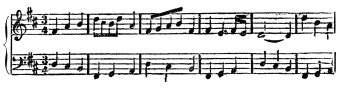
“I cannot imagine a more distinct five-bar rhythm in 3/4 time. What do you think?”
To N. F. von Meck.
“Maidanovo, September 27th (October 9th), 1885.
“The first act of The Enchantress lies finished before me, and I am growing more and more enthusiastic over the task in prospect.
“Dear friend, I like your arrogant views upon my opera. You are quite right to regard this insincere form of art with suspicion. But for a composer opera has some irresistible attraction; it alone offers him the means of getting into touch with the great public. My Manfred will be played once or twice, and then disappear; with the exception of a few people who attend symphony concerts, no one will hear it. Opera, on the contrary—and opera alone—brings us nearer to our fellows, inoculates the public with our music, and makes it the possession, not only of a small circle, but—under favourable circumstances—of the whole nation. I do not think this tendency is to be condemned; that is to say, Schumann, when he wrote Genoveva, and Beethoven, when he wrote Fidelio, were not actuated by ambition, but by a natural desire to increase the circle of their hearers and to penetrate as far as possible into the heart of humanity. Therefore we must not only pursue what is merely effective, but choose subjects of artistic worth which are both interesting and touching.”
To M. Tchaikovsky.
“Maidanovo, October 1st (13th), 1885.
“What a wretch Zola is!! A few weeks ago I accidentally took up his Germinal, began to read it, got interested, and only finished it late at night. I was so upset that I had palpitations, and sleep was impossible. Next day I was quite ill, and now I can only think of the novel as of some fearful nightmare....”
To P. Jurgenson.
“Maidanovo, October 9th (21st), 1885.
“Dear Friend,—Hubert tells me you do not think it possible to publish Manfred this season. Is this true? The question is this, I cannot allow two opportunities to slip: (1) Bülow is conducting in Petersburg; (2) Erdmannsdörfer is conducting in Moscow—perhaps his last season—and, in spite of all, he is one of the few people on whom I can depend. On the other hand, I am not in a position to spend an incredible amount of trouble on a work which I regard as one of my very best, and then wait till it is played some time. As far as I am concerned, it is all the same to me whether it is played from written or printed notes—so long as it is done. I believe it might be ready by February. But if you think that this is quite impossible, then I propose that you decline Manfred altogether (this will not offend me at all, for I know you cannot do the impossible for the sake of my whims). Only understand that I cannot on any account wait till next season, and cost what it may, I will see Manfred produced. Do not take my caprice (if it is a caprice) amiss, and answer me at once.”
To N. F. von Meck.
“Maidanovo, October 11th (23rd), 1885.
“ ... As regards the lofty significance of symphony and chamber music in comparison with opera, let me only add that to refrain from writing operas is the work of a hero, and we have one such hero in our time—Brahms. Cui has justly remarked in one of his recent articles that Brahms, both as man and artist, has only followed the highest ideals—those which were worthy of respect and admiration. Unfortunately his creative gift is poor, and does not correspond to his great aspirations. Nevertheless he is a hero. This heroism does not exist in me, for the stage with all its glitter attracts me irresistibly.”
VII
To N. F. von Meck.
“Maidanovo, November 19th (December 1st), 1885.
“ ... I spent a week in Moscow, and was present at three concerts. The first, given by Siloti, who has just returned from abroad to serve his time in the army. He has made great progress. Then the Musical Society gave a concert and quartet-matinée, at which the celebrated Paris violinist, Marsick, played. All three concerts gave me great pleasure, as I have not heard any good music for so long. For a musician who writes as much as I do it is very necessary and refreshing to hear foreign music from time to time. Nothing inspires me more than listening to a great foreign work: immediately I want to write one equally beautiful.
“I have also been once or twice to the Conservatoire, and was very pleased to notice that Taneiev is just the Director we wanted under the circumstances. His work shows resolution, firmness, energy, and also capability. I hear nothing about Les Caprices d’Oxane, and begin to fear the work will not be produced this season.”
The following letter was written after Ippolitov-Ivanov had communicated the success of Mazeppa in Tiflis.
To M. M. Ippolitov-Ivanov.[110]
“December 6th (18th), 1885.
“ ...As to Mazeppa, accept my warmest thanks. My brother and his wife, who live in Tiflis, and had seen the opera in Moscow and Petersburg, tell me it went splendidly.
“For some time I have been longing to find a subject—not too dramatic—for an opera, and then to write a work suitable to the resources of the provincial stage. Should God grant me a long life, I hope to carry out this plan, and thus to obliterate the unpleasant recollections of the immeasurable trouble which the rehearsals of Mazeppa must have left with you. But the harder your task, the warmer my thanks.”
To Modeste Tchaikovsky.
“Maidanovo, December 9th (21st), 1885.
“I am going to Moscow on December 14th (26th), principally to decide the fate of Les Caprices d’Oxane. I shall make heroic efforts to have my opera produced. I am advised to conduct it myself, and it is possible I may decide to do so. In any case, I shall spend the holidays in Petersburg.... I am working very hard at the corrections of Manfred. I am still convinced it is my best work. Meanwhile The Enchantress is laid aside, but the first act is quite finished. The libretto is splendid. In this I am lucky.”
To N. F. von Meck.
“Maidanovo, December 11th (23rd), 1885.
“ ... My Third Suite was played at the last concert. The public gave me an enthusiastic ovation.... Lately we have had such lovely moonlight nights, without a breath of wind. O God, how beautiful they are! The Russian winter has a particular charm for me, but that does not prevent me from planning a journey to Italy in the spring. I am thinking of going by sea from Naples to Constantinople, then to Batoum, and thence by train to Tiflis to visit my brother Anatol, who is already expecting me.”
To S. I. Taneiev.
“Maidanovo, December 11th (23rd), 1885.
“ ... Imagine! I am rejoicing at the thought of hearing Beethoven’s First Symphony. I had no suspicion that I liked it so much. The reason is perhaps that it is so like my idol, Mozart. Remember that on October 27th, 1887, the centenary of Don Juan will be celebrated.”
To P. Jurgenson.
“December 22nd (January 3rd), 1885.
“ ... I have only just now been able to consider this question of Manfred, of Mackar, and the fee, and this is my decision: Even were Manfred a work of the greatest genius, it would still remain a symphony which, on account of its unusual intricacy and difficulty, would only be played once in ten years. This work cannot therefore bring any profit either to you or Mackar. On the other hand, I value it highly. How is the material value of such a work to be decided? I may be wrong, but it seems to me my best composition, and a few hundred roubles would not repay me for all the work and trouble I have put into it. If you were very rich, I would unhesitatingly demand a very large sum, on the grounds that you could recover your outlay on other things—but you are not at all rich. As for Mackar—to speak frankly—I am greatly touched by his cheerful self-sacrifice, for certainly he can have made very little out of my works in France. After having just received 20,000 francs from him, we must not show ourselves too grasping, especially as we know that there is not much to be made out of Manfred.”
“In short, I have made up my mind to claim nothing from Mackar, or from you, and have already told him this. I tell you also, so that you should not demand the promised thousand francs from him. The demanding of payment for restoration of his copy—is your affair.”
To N. F. von Meck.
“Maidanovo, January 13th (25th), 1886.
“Dear Friend,— ... This time I have not brought back any pleasant impressions with me from Petersburg. My operas—I do not know why—have not been given lately, and I feel this the more bitterly because, owing to the unusual success of Oniegin, it appears that the Direction has been urging that it should be given with greater frequency. The new symphony Manfred is completely ignored, for no preparations for its production are being made. In all this I do not recognise any enmity towards me personally, for in truth I have no enemies, but a kind of contempt which is a little wounding to my artistic vanity. Certainly this is an unfavourable year for me. They have decided not to give Les Caprices d’Oxane in Moscow this season, and I had been expecting it so impatiently!
“I have a piece of news for you to-day, which pleased me very much. I had observed that here in Maidanovo the village children are constantly idle and run about without any occupation, which induced me to consult with the local priest about the founding of a school. This has proved to be possible, so long as I assure them an annual sum. I have consented to do so, and the priest began to take the necessary steps about two months ago. The official permission to open a school has arrived and the instruction can begin this week. I am very glad.”
To N. F. von Meck.
“Maidanovo, January 14th (26th), 1886.
“ ... The priest came to see me to-day, and brought me an invitation to the opening of the school on the 19th. I am proud to have initiated this work. I hope some good will come of it. In spite of the greatest care and moderation, I suffer from dyspepsia. It is not serious, and I have no doubt a cure at Vichy will completely set me up.”
To N. F. von Meck.
“Moscow, February 4th (16th), 1886.
“How difficult it is after receiving your money to say in the baldest way,‘Money received, many thanks!’ If only you had an inkling of all the happiness I owe you, and the whole meaning of that ‘independence and freedom’ which are the result of my liberty. Life is an unbroken chain of little unpleasantnesses and collision with human egoism and pride, and only he can rise above these things who is free and independent. How often do I say to myself: Well that it is so, but how if it were otherwise?
“Just lately I had some very unpleasant frictions which only just fell short of open quarrels, but failed to upset me because I could appear to ignore the wrong inflicted upon me. Yes, in the last few years of my life there have been many occasions on which I have sincerely felt the debt of gratitude I owe to you. And yet I usually send you the receipt as if it were a matter of course. My gratitude has no limits, my dear.”
To N. F. von Meck.
“Maidanovo, February 6th (18th), 1886.
“.... To-day I returned from Moscow, where I have been attending Rubinstein’s concerts once a week. Were it only a question of listening to that marvellous pianist, I should not have found the journeys at all tedious, in spite of my dislike of leaving home. But I had to go to all the dinners and suppers which were held in his honour, which I generally found intolerably wearisome and most injurious to my health. At the last concert Rubinstein played pieces by Henselt, Thalberg, Liszt, and others. There was very little artistic choice, but the performance was indeed astonishing.”
To N. F. von Meck.
“Maidanovo, February 14th (26th), 1886.
“ ... The festival which the town of Moscow held in Rubinstein’s honour was a great success. He was visibly touched by the energy and warmth with which the Muscovites expressed their affection for him. Indeed, everyone must recognise that Rubinstein is worthy of all such honour. He is not only a gifted artist, but also a most honourable and generous man.”
Diary.
“Maidanovo, February 22nd (March 8th), 1886.
“What an unfathomable gulf lies between the Old and the New Testament! Read the psalms of David, and at first it is impossible to understand why they have taken such a high place from an artistic point of view; and, secondly, why they should stand beside the Gospels. David is altogether of this world. He divides the whole of humanity into two unequal portions: sinners (to which belong the greatest number) and the righteous, at whose head he places himself. In every psalm he calls down God’s wrath upon the sinner and His praise upon the righteous; yet the reward and the punishment are both worldly. The sinners shall be undone, and the righteous shall enjoy all the good things of this earthly life. How little that agrees with Christ’s teaching, who prayed for His enemies, and promised the good no earthly wealth, but rather the kingdom of heaven! What touching love and compassion for mankind lies in these words: ‘Come unto Me, all ye that labour and are heavy laden’! In comparison with these simple words all the psalms of David are as nothing.”
Diary.
“February 28th (March 12th), 1886.
“ ... At tea I read through Alexis Tolstoi’s St. John Chrysostom and The Sinner, which reduced me to tears. While in this agitation of spirit, into which any strong artistic enjoyment throws me, I received a telegram from the Conservatoire: ‘The Grand Duke is coming.’ So all plans go to the devil! Despair, irresolution, and even terror at the prospect of the journey. Went in and fed my landlady’s hungry dog. In the twilight I was overcome with insane depression. Played through my Second Suite, and was glad to find it not so bad as I had imagined.”
Diary.
“March 1st (13th), 1886.
“.... Played through Nero, and cannot sufficiently marvel at the audacious coolness of the composer. The very sight of the score makes me fume. However, I only play this abomination because the sense of my superiority—at least, as regards conscientiousness—strengthens my energy. I believe I compose badly, but when I come across such an atrocity, written in all earnestness, I feel a certain relief. I am ashamed to show so much anger over such a publication—but there is no need to disguise one’s feelings in a diary.”
To N. F. von Meck.
“Maidanovo, March 13th (25th), 1886.
“Dear Friend,—I have not written to you for a long time owing to a ten days’ visit to Moscow.... I devoted two days to the rehearsal of Manfred, and attended the concert at which it was played. I am quite satisfied; I am sure it is my best symphonic work. The performance was excellent, but it seemed to me the public were unintelligent and cold, although they gave me quite an ovation at the end....”
The very short and sparse Press notices of Manfred add nothing essential to Tchaikovsky’s words. They merely confirm the fact that the Symphony received an excellent rendering, but the author’s high opinion of his work only held good as regards the first two movements; later on he came to reckon the other movements, the Pastorale, Ariman’s Kingdom, and Manfred’s Death, as being on a level with The Oprichnik, one of the least favoured of his works.
Although out of chronological order, I may mention here that on the occasion of a performance of this work in Petersburg (December, 1886) Cui gave it the most enthusiastic and unreserved praise. Everything pleased him, especially the Scherzo, and his criticism closed with these words: “We must be grateful to Tchaikovsky for having enriched the treasury of our national symphonic music.”
VIII
To M. Tchaikovsky.
“Tiflis, April 1st (13th), 1886.
“ ... I left Moscow on March 23rd (April 4th), and travelled direct to Taganrog to Hyppolite, whose guest I was for two days, so as to arrive in Vladikavkas on the 28th.
“Early on Sunday (30th) I started in a four-horse post-carriage, accompanied by a guard, whose sole duty is to look after the requirements and comforts of the travellers. I had not slept the preceding night on account of the horrible bed and the insects (when I think of the best hotel in Vladikavkas I feel quite sick), and thought therefore that the beauties of the Georgian Road would make but little impression on me. The road is, however, so grand, so astonishingly beautiful, that I never thought of sleeping the whole day long. The variety of impressions did not allow my interest to flag for a moment. At first the approach to the mountains was slow, although they appeared to be quite close to us, and yet we still drove on and on. Then the valley of the Terek became narrower, and we reached the wild and gloomy Darjal Gorge. Afterwards we ascended into the region of snow. Shortly before I started on my journey there had been an avalanche, and hundreds of miserable-looking natives were busy shovelling away the snow. At last we were driving higher and higher between great snow walls, and it was necessary to put on our furs. By six o’clock we were descending into the Aragva Valley, and spent the night in Mlety. I occupied the imperial rooms. After the dirt of the Vladikavkas hotel I found the clean rooms, good beds, and daintily-set table very delightful. I dined, took a little walk by moonlight in the gallery, and went to bed at nine o’clock. Next morning I started off again. Already we could feel the breath of the south in the air; the sides of the mountains were cultivated, and constantly there came in sight picturesque aouli[111] and all kinds of dwellings. The descent was made at a terrific pace, considering the curves of the road. Not far from Dushet such a wonderful view came in sight that I almost wept with delight. The further we descended, the more the influence of the south wind was felt. At last we reached Mtskhet (noted for the ruins of its castle and the celebrated cathedral), and at half-past five we reached Tiflis. Toly and his wife were not there; they had not expected me till later, and had gone to meet me at Mtskhet. They did not arrive till eight o’clock. Meanwhile I had had time to wash, dress, and see something of the town. It is delightful. The trees are not yet all green; the fruit trees are in full blossom; a mass of flowers in the gardens. It is as warm as in June—in a word, really spring—just as it was four years ago when we left Naples. The chief streets are very lively; splendid shops, and quite a European air. But when I came to the native quarters I found myself in entirely new surroundings. The streets mean and narrow, as in Venice; on both sides an endless row of small booths and all kinds of workshops, where the natives squat and work before the eyes of the passers-by....”
To N. F. von Meck.
“Tiflis, April 6th (18th), 1886.
“I begin to know Tiflis quite well already, and have seen the sights. I have been in the baths, built in Oriental style. Visited the celebrated churches, amongst others the Armenian church, where I was not only very much interested in the peculiarities of the service, but also in the singing; I also visited David’s monastery on the hill, where Griboiedov[112] lies buried. One evening I went to a concert given by the Musical Society, where a very poor, thin orchestra played Beethoven’s Third Symphony, Borodin’s Steppes, and my Serenade for strings, to a public which was conspicuous by its absence. Many excellent musicians live in Tiflis; the most prominent are the talented composer Ippolitov-Ivanov and the pianist Eugene Korganov, an Armenian, and a former student of the Moscow Conservatoire. They show me every attention, and although I should much prefer to remain incognito, I am much touched by this proof of the love and sympathy of my fellow-workers. I had certainly not expected to find my music so widely known in Tiflis. My operas are played oftener here than anywhere else, and I am pleased that Mazeppa is such a great favourite.”
Diary.
“Tiflis, April 11th (23rd), 1886.
“While waiting for Korganov I busied myself with looking through his works. He came first, then Ippolitov-Ivanov. The poor Armenian (a very nice man and a good musician) was very grieved at my criticism. Then Ivanov played his things: very good.”
To M. Tchaikovsky.
“Tiflis, April 23rd (May 5th), 1886.
“Modi,—I only remain a few days longer in Tiflis. I could count this month the happiest in my life, if it were not for the visitors, and for my social existence. I do not think I have yet written to you of the honour paid me on the 19th. It was simply splendid. At eight o’clock, accompanied by Pani,[113] I entered the Director’s box, which was decorated with flowers and foliage. The whole theatre rose, and amid great applause I was presented with a silver wreath and many others. A deputation from the Musical Society read an address. Then the concert began, which consisted entirely of my works. There were endless cheers! I have never experienced anything like it before. After the concert, a subscription supper, with many toasts. A most exhausting evening, but a glorious remembrance.”
This was the first great honour in Tchaikovsky’s life, and made a most agreeable impression on him, as proving the recognition of his merit by the Russian nation. Tchaikovsky, in the depths of his heart, was well aware that fame would eventually come, and that he would be worthy of it. He did not realise, however, that what he had already created was as worthy of fame as what he should create in the future. He knew, indeed, that the popularity of his name had greatly increased in the last few years, but he was still far from suspecting the truth. The honour paid him in Tiflis revealed to him his real relation to the Russian public. This revelation was so pleasing to his artistic vanity that it overcame for a moment his characteristic timidity and his dislike of posing before the public.
IX
Just at this time Tchaikovsky had to travel to Paris on important family business. He wished also to take this opportunity of making acquaintance with his Paris publisher, Mackar. To avoid the fatigue of the wearisome railway journey, he thought of taking the steamer from Batoum to Italy, thence by train to France. But owing to cholera at Naples, the French steamer belonging to the Batoum-Marseilles line did not call at the Italian port. Tchaikovsky therefore gave up his idea of visiting Italy, and took a through ticket for Marseilles by one of the steamers of the “Packet Company.”
To A. Tchaikovsky.
“Steamship ‘Armenia,’ May 3rd (15th), 1886.
“ ... I am feeling less home-sick to-day, and better able to enjoy the sea, the mountains, and the sun ... but how stupid it is, that one can only be alone in one’s cabin! On deck, scarcely a quarter of an hour passes without someone beginning a conversation. I know all the passengers already, but have not taken to anyone. The captain talks to me about music, and enrages me by his stupid opinions. A Frenchman, a doctor from Trebizond, also sets up to be a lover of music, and thinks it his duty—now he has discovered I am a musician—to talk to me about this detestable art, which seems to possess the quality of interesting everybody....”
To A. Tchaikovsky.
“Archipelago, May 6th (18th), 1886.
“The day before yesterday, about midday, we reached the Bosphorus in the most glorious weather. It is wonderfully beautiful, and the further one goes the more beautiful it becomes. About three o’clock we arrived at Constantinople. The motion was very great during the passage into the harbour. About five o’clock we got into a boat, and were rowed over to the town. The captain had made up his mind to stay twenty-four hours in Constantinople, so I thought I would spend the night at an hotel. The next day I visited the places of interest. The cathedral of St. Sophia delighted and astonished me. But, on the whole, I do not much care for Constantinople, and the famous Constantinople dogs simply make me feel sick. By 5 p.m. we were once more on board, and started immediately. New passengers had joined the ship. I preferred to remain in my own snug little cabin; the whole evening I watched the water and the moonlight, and absorbed all the poetry of a sea journey. To-day is a little rougher. Many are ill—even men. I am quite well, and find a certain pleasure in the motion, and in watching the foaming blue waves. No trace of fear. I am quite accustomed to my surroundings, and have made friends with everyone, especially a Turkish officer, who is travelling to Paris.”
To M. Tchaikovsky.
“‘Armenia,’ May 8th (20th), 1886.
“ ... To-day the sea is just like a mirror. So far we have been very lucky, and it is impossible to imagine anything more beautiful than such a journey. Of course there are some wearisome moments, especially when they begin to talk of music. The chief offender is an Englishman, who continually bothers me with questions as to whether I like this or that song by Tosti, Denza, etc. Also a French doctor, who has invented a new piano in which every sign for transposition (♯, ♭, x, ♭♭) has its own keynote. He talks incessantly of his awful invention, and gives me long pamphlets on the subject. We have already passed Sicily and the heel of the Italian boot. Etna is smoking a little, and to the left there is a horrible pillar of smoke and fire which excites us all very much. The captain cannot say for certain what it means, and seems somewhat disturbed by it. Consequently I, too, feel a little afraid.”
To A. Tchaikovsky.
“‘Armenia,’ May 9th (21st), 1886.
“The pillar of smoke and fire about which I wrote yesterday proves to be a terrible eruption of Mount Etna, not at the top, but at the side. This eruption was distinctly visible at a distance of three hundred versts, and the nearer we came the more interesting was the sight. Alexis woke me at two in the morning, that I might see this unique spectacle. We were in the Straits of Messina; the sea, which had been quite calm all day, was now very rough; I cannot describe the beauties of the moonlight, the fire from Mount Etna, and the swelling waves. At 3 a.m. I went back to bed and at five the captain sent a sailor to wake me, so that I might see the town of Messina, the sunrise, and the eruption on the other side. Later we passed between the volcano Stromboli and a new little island giving forth smoke; at least, the captain, who knows these parts well, has never suspected a volcano here and thinks it may portend a serious eruption. To-day the weather is splendid and the sea much quieter.”
Diary.
“Paris, May 21st (June 2nd), 1886.
“I decided to go and see Mackar. What I suffered, and how excited I was, passes description. Ten times I tried to go in, and always turned away again—even a large glass of absinthe did not help me. At last I went. He was expecting me. I had pictured him a little man like Wuchs. He is astonishingly like Bessel. We talked a little (someone near me was buying my works), and then I left. Naturally I felt a weight off my heart.”
To P. V. Tchaikovsky.[114]
“Paris, June 1st (13th), 1886.
“ ... Yesterday I had breakfast with old Madam Viardot. She is such a stately and interesting woman; I was quite enchanted. Although seventy, she only looks about forty. She is very lively, amiable, gay, and sociable, and knew how to make me feel at home from the very first moment.”
Later Tchaikovsky wrote the following details to Nadejda von Meck concerning his acquaintance with Madame Viardot:—
“ ... Madame Viardot often speaks about Tourgeniev, and described to me how he and she wrote ‘The Song of Love Triumphant’ together. Have I already told you that I was with her for two hours while we went through the original score of Mozart’s Don Juan, which thirty years ago her husband had picked up very cheaply and quite by accident? I cannot tell you what I felt at the sight of this musical relic. I felt as if I had shaken Mozart by the hand and spoken to him!...”
To Modeste Tchaikovsky.
“June 23rd (11th), 1886.
“Yesterday, at the invitation of Ambrose Thomas, I visited the Conservatoire during the examination of the pianoforte class. He is a very nice, friendly old man. A certain Madame Bohomoletz, a rich lady (half Russian), gave a dinner in my honour, followed by a musical evening, at which my quartet was played (Marsick and Brandoukov) and my songs were sung.... Leo Délibes has visited me; this touched me very deeply. Certainly it seems I am not as unknown in Paris as I thought....”
I will add to this short and disjointed account that Tchaikovsky was received in a most friendly manner by Professor Marmontel, a warm admirer of his works, also by the composers Lalo, Lefèbre, Fauré, and others. The meeting with Colonne and Lamoureux is described by Tchaikovsky himself in a later letter:—
“ ... I saw Colonne several times. He was very friendly, and expressed a wish to give a concert of my compositions. He asked me to send him some of my new scores to Aix-les-Bains, so that he could arrange a programme during the course of the summer. He continually lamented his poverty and the ‘terrible Concurrence Lamoureux.’ As to Lamoureux, he was amiability itself, and made me a thousand promises.”
Tchaikovsky was thrown into close contact with many other artists, several of whom, like the well-known pianist Diemer, for instance, remained his devoted friends to the end.
X
To N. F. von Meck.
“Maidanovo, June 18th (30th), 1886.
“How glad I am to be at home once more! How dear and cosy is my little house which, when I left, lay deep in snow, and is now surrounded by foliage and flowers! The three months I spent abroad were lost time as regards work, but I feel I have gained in strength, and can now devote my whole time to it without exhausting myself.”
Diary.
“July 8th (20th), 1886.
“ ... Worked atrociously again. And yet people say I am a genius! Nonsense!”
To P. Jurgenson.
“Maidanovo, July 19th (31st), 1886.
“Dear Friend,—I completely understand the difficulties of your situation. One of my letters to you is wanted for publication. You possess hundreds of my letters, but not one suitable to the case. Very natural; our correspondence was either too business-like, or too intimate. How can I help you? I cannot commit forgery, even for the pleasure of appearing in Mme. La Mara’s book;[115] I cannot write a letter especially for her collection and take this lucky opportunity of displaying myself in the most favourable light as musician, thinker, and man. Such a sacrifice on the altar of European fame is repugnant to me, although, on the other hand, it would be false to say that Mme. La Mara’s wish to place me among the prominent musicians of our time did not flatter me in the least. On the contrary, I am very deeply touched and pleased by the attention of the well-known authoress, and openly confess I should be very glad to be included in the company of Glinka, Dargomijsky, and Serov. If she were not in such a hurry, it would be better to send to one of my musical friends, such as Laroche, who could not fail to find among all my letters some with detailed effusions about my musical likes and dislikes; in short, a letter in which I speak quite candidly as a musician. But there is no time, and Laroche is away. Is it not curious that it should be difficult to find a suitable letter from a man who has carried on—and still carries on—the widest correspondence, dealing not only with business matters, but with artistic work? I am continually exchanging letters with four brothers, a sister, several cousins, and many friends, besides a quantity of casual correspondence with people often unknown to me. The necessity of sacrificing so much of my time to letter-writing is such a burden to me that, from the bottom of my heart, I curse all the postal arrangements in the world. The post often causes me sad moments, but it also brings me the greatest joy. One person plays the chief part in the story of the last ten years of my life: she is my good genius; to her I owe all my prosperity and the power to devote myself to my beloved work. Yet I have never seen her, never heard her voice; all my intercourse with her is through the post. I can certainly say I flood the world with my correspondence, and yet I am not in a position to help you out of your difficulty.
“There is nothing to be done, but to send this letter itself to Mme. La Mara. If it does not represent me in the least as a musician, it will at any rate give the authoress a chance of satisfying her flattering wish to place me among the prominent musicians of the day.”
Diary.
“August 1st (13th), 1886.
“ ... Played Manon at home. It pleased me better than I expected. I spent moments of longing and loneliness.”
“August 2nd (14th).
“ ... Played Manon. To-day Massenet seems to cloy with sweetness.”
“August 4th (16th).
“ ... Played Massenet at home. How stale he has grown! The worst of it is, that in this staleness I trace a certain affinity to myself.”
To N. F. von Meck.
“Maidanovo, August 4th (16th), 1886.
“ ... I feel at my best when I am alone; when trees, flowers, and books take the place of human society. O God, how short life is! How much I have yet to accomplish before it is time to leave off! How many projects! When I am quite well—as I am at present—I am seized with a feverish thirst for work, but the thought of the shortness of human life paralyses all my energy. It was not always so. I used to believe I could, and must, carry out all my ideas to completion; therefore my impulses towards creative work were then more lasting and more fruitful. In any case I hope to have the outline of the opera (The Enchantress) ready in a month’s time, and then to begin the orchestration.”
Diary.
“August 6th (18th), 1886.
“Played the conclusion of the sickly Manon and Lefèbre’s inanities to the end.”
“August 15th (27th).
“ ... Worked a little before and after supper. Kouma’s Arioso is finished. Read Loti’s Pêcheurs d’Islande. Not very pleased with it. The tone of the descriptions remind me of that ... Zola and....”
“August 18th (30th).
“Walked in the garden. Worked and completely finished the rough sketches for the opera. Thank God!”
To M. Tchaikovsky.
“Maidanova, September, 9th (21st), 1886.
“ ... I have been all through Vietinghov-Scheel’s opera. Good heavens! what a weak piece of work! He is a child, and no mature artist. It is a shame such a work should be given at the Imperial Opera. However, in this way the Direction have done Rubinstein a great service. His Demon appears a masterpiece in comparison with that little Scheel affair. To tell the truth, at present the best operas in the world are composed by P. I. Tchaikovsky, and The Enchantress is the most beautiful of them all. A gem all round. At least so it appears to me at this moment. Probably it appears to Vietinghov that his Tamara is far more beautiful; and God alone knows which of us is right.”
Diary.
“September 20th (October 2nd), 1886.
“Tolstoi never speaks with love and enthusiasm of any prophet of Truth (with the exception of Christ), but rather with contempt and hatred. We do not know how he regards Socrates, Shakespeare, or Gogol. We do not know if he cares for Michael Angelo and Raphael, Tourgeniev, George Sand, Dickens and Flaubert. Perhaps his sympathies and antipathies in the sphere of philosophy and art are known to his intimates, but this inspired talker has never openly let fall a word which could enlighten us as to his attitude towards those great spirits who are on an equality with him. For instance, he has told me that Beethoven had no talent (as compared with Mozart), but he has never expressed himself in writing either on music or any kindred subject. Truly I think this man inclines only before God or the people, before humanity as a whole. There is no individual before whom he would bow down. Suitaiev was not an individual in Tolstoi’s eyes, but the people itself, the personified wisdom of the people. It would be interesting to know what this giant liked or disliked in literature.
“Probably after my death it will be of some interest to the world to hear of my musical predilections and prejudices, the more so that I have never expressed them by word of mouth.
“I will begin by degrees, and when touching upon contemporary musicians I shall also speak of their personalities.
“To begin with Beethoven, whom I praise unconditionally, and to whom I bend as to a god. But what is Beethoven to me? I bow down before the grandeur of some of his creations, but I do not love Beethoven. My relationship to him reminds me of that which I felt in my childhood to the God Jehovah. I feel for him—for my sentiments are still unchanged—great veneration, but also fear. He has created the heaven and the earth, and although I fall down before him, I do not love him. Christ, on the contrary, calls forth exclusively the feeling of love. He is God, but also Man. He has suffered like ourselves. We pity Him and love in Him the ideal side of man’s nature. If Beethoven holds an analogous place in my heart to the God Jehovah, I love Mozart as the musical Christ. I do not think this comparison is blasphemous. Mozart was as pure as an angel, and his music is full of divine beauty.
“While speaking of Beethoven I touch on Mozart. To my mind, Mozart is the culminating point of all beauty in the sphere of music. He alone can make me weep and tremble with delight at the consciousness of the approach of that which we call the ideal. Beethoven makes me tremble too, but rather from a sense of fear and yearning anguish. I do not understand how to analyse music, and cannot go into detail.... Still I must mention two facts. I love Beethoven’s middle period, and sometimes his first; but I really hate his last, especially the latest quartets. They have only brilliancy, nothing more. The rest is chaos, over which floats, veiled in mist, the spirit of this musical Jehovah.