V. The various explanations hitherto given.
Reading edition
I have found the first explanation given about the Sea-Serpent in the Report of the Committee of 1817, where we read an extract from a M. S. journal of the Rev. William Jenks, which he communicated in a letter to the Hon. Judge Davis, and which letter is printed there. It runs as follows:
“A gentleman of intelligence (Rev. Alden Bradford of Wiscasset, now Secretary of the Commonwealth,) inquired of Mr. Cummings, whether the appearance might not be produced by a number of porpoises, following each other in a train.”
This passage from the private journal was written in Sept. 10, 1809; but after having consulted Silliman’s American Journal of Science and the Arts, Vol. II, Boston 1819 (1820), we are convinced that Mr. Bradford’s inquiry of Mr. Cummings took place before Aug. 1803.
Fig. 52 shows my readers a porpoise.
As we read in Schlegel’s Essai sur la physionomie des Serpens, p. 517, note, Peter Ascanius in his Icones rerum naturalium Cahier V, Copenhague, 1805, says:
“In summer porpoises approach the coasts and the fjords. They often meet in the open sea in troops of several scores, and when the weather is calm and fine, they range in a line after each other to play and to tumble: they then have the appearance of a chain of little eminences floating on the surface of the water; some fishermen of the North, seeing them at a great distance, took this resemblance for an immense animal and gave it the name of sea-serpent.”
Again in the letter from Mr. S. Perkins to Mr. E. Everett, dated August 20, 1817, we read:
“All these facts, however, were loose, and from the variety of reports, people had gotten to doubt their foundation, and supposed it was only a number of porpuses following each other in rapid succession.”
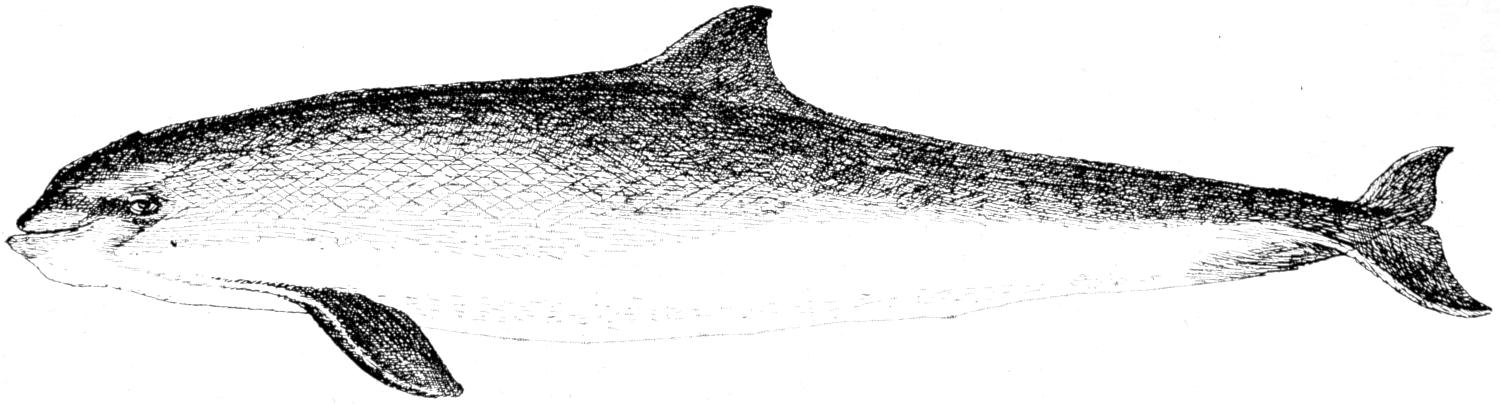
Fig. 52.—Phocaena phocoena (Linné).—
For the fourth time we read in Froriep’s Notizen, Vol. XIX, p. 193:
“Christiania, September 5, 1827. Last week several persons saw large shoals of porpoises, and therefore uttered the supposition that the alleged presence of the sea-serpent was not right.”
Mr. Mitchill’s paper, of 1828, which we have inserted in toto in our Chapter on hoaxes, also ends with the supposition that the “gambols of porpoises” have given rise to all the tales of the sea-serpent.
Schlegel in his Essai sur la physionomie des Serpens, La Haye, 1837, p. 105, in his chapter on Fables respecting snakes says:
“We are surprised to hear of a sea-serpent, monstrous in shape and size”,
and he refers to his chapter on true sea-snakes, the Hydrophidae. There p. 517 he ends his chapter with the following words:
“Before ending the history of the interesting beings of which I have treated, I cannot help saying a few words about an animal, observed through centuries by many people of all ranks, and known to every one from the tales which are spread about it, but which is still ignored by naturalists. I mean the monstrous sea-serpent of the North, which in reality has nothing to do either with the sea-snakes, of which we have treated in the foregoing pages, or with my work. The numerous evidences given by very respectable persons to prove the existence of this enormous sea-animal, have imposed silence upon naturalists; I too should be silent, when the doubt which I always felt had not been turned into certainty by a little observation I made in the spring of 1826. Once when hunting on a stormy day along the coasts of the sea, I suddenly saw a sea-animal of great size swimming before the mouth of the Rhine-river. I was about to fire at this animal which I took for a shark, when I distinguished through the fog several others closely following each other. For the greater part hidden by the water, the upper part of this creature could be distinctly seen only for the short moment, when it was carried on the top of a wave, and plunged down into the precipice formed before it. The illusion caused by the continuous agitation of the waves indeed contributed to make doubtful the appearance of a great number of black objects, appearing together out of the water, disappearing the moment afterwards, and the whole of which deceitfully represented the simultaneous movements of the undulations of one single body. Convinced that the animals were unable to swim in vertical undulations, I kept looking at this spectacle, till I knew this monstrous creature to be composed of a little troop of porpoises.”
In the Archiv für Naturgeschichte, of 1841, Mr. Rathke, who published in it seven accounts of sea-serpents, gathered by him on his journey in Norway, says:
“If we submit the above mentioned evidences to an inquiry, we shall soon observe that they not only contain several contradictory statements, but that each of the evidences itself cannot even pretend to accuracy. Yet we may believe that what those persons took for a long animal, was really such a one. For I should not know, what else could be the cause of the illusion which has created the belief in such an animal. Truly, I know that some believe, that what has been taken for a so-called sea-serpent, to be nothing else but a row of porpoises, swimming in line. But all those persons, by whom the above-mentioned evidences are given were too familiar with the sea, and have too often observed porpoises together, to be deceived by a row of such animals swimming on the surface of the water. If this, however, had been the case, all the observations related to me of the sea-serpent’s holding its head above the surface, and about the size of it, must have been mere fiction, and this I cannot admit. According to all this, it evidently cannot be doubted, that there is a long serpentine animal in the sea of Norway, which may grow to a considerable length.”
Again, as we learn in Froriep’s Neue Notizen, Vol. XXVIII, no. 606, p. 184, Nov. 1843, the Editors of the Christiansand’s Posten after an account of a new appearance of the sea-serpent in the fjord of Christiansand, inserted in their columns, add the following remarks:
“This whole description tallies well with an appearance, which the writer of these lines has witnessed a few times in the North Sea, and if the inhabitants of the coast near Ibbestad, if not withheld by their fear of the supposed sea-monster, had rowed their boats to near the animal, they would undoubtedly have soon observed that the supposed intervals between the coils were nothing else but water. This great sea-serpent in reality consists of a row of porpoises, which in a shoal of from eight to twelve often swim after each other in line. As each of these brown animals, eight or ten feet long, when swimming, appears above the surface of the water at proportionably short intervals, in such a way, as if they were about to tumble head first, so every one, who sees such a row swimming, must at first sight believe to see the coils of an immense snake.”
In a letter from Mr. J. D. Morries Stirling to Captain Hamilton, R. N., Secretary to the Admiralty, we find the passage (see Ill. Lond. News of October 28, 1848, and our no. 113):
“I mention my friend being a porpoise shooter, as many have believed that a shoal of porpoises following each other has given rise to the fable, as they called it, of the sea-serpent.”
In Andrew Wilson’s Leisure Time Studies we read, 1879:
“The instance already alluded to, of a shoal of porpoises swimming in line, with their backs and dorsal fins appearing now and then, with a kind of regular alternating motion above the surface of the water, presents an example of a deceptive appearance brought about by a somewhat unusual habit of familiar animals.”
Mr. Lee in his Sea Monsters Unmasked, 1883, treating of the figure of Mr. Benstrup (see our fig. 24), says:
“The supposed coils of the serpent’s body present exactly the appearance of eight porpoises following each other in line.”
I have treated of his explanation in the right place (no. 10). And on the following page he also asserts:
“I believe that in every case so far cited from Pontoppidan, as well as that given by Olaus Magnus, the supposed coils or protuberances of the serpent’s body were only so many porpoises swimming in line in accordance with their habit before mentioned. If an upraised head, like that of a horse, was seen preceding them, it was either unconnected with them, or it certainly was not that of a snake; for no serpent could throw its body into those vertical undulations.”
I repeat here what I have said above (no. 10): If Mr. Lee wishes to explain the coils by reference to porpoises, he ought to tell me what was the head that resembled a horse’s head.
Again on p. 96 of his work, after having concluded that the great calamaries “have played the part of the sea-serpent in many well-authenticated incidents”, he says: “In other cases, such as some of those mentioned by Pontoppidan, the supposed vertical undulations of the snake seen out of water have been the burly bodies of so many porpoises swimming in line—the connecting undulations beneath the surface have been supplied by the imagination.”
After an alleged appearance of a sea-serpent near Great Orme’s Head (no. 155), Mr. Sidebotham, a correspondent of Nature writes in this journal (1883, Febr. 1):
“I have seen four or five times something like what your correspondent describes and figures, at Llandudno, crossing from the Little Orme’s Head across the bay, and have no doubt whatever that the phenomenon was simply a shoal of porpoises. I never, however, saw the head your correspondent gives, but in other respects what I have seen was exactly the same; the motions of porpoises might easily be taken for those of a serpent; once I saw them from the top of the Little Orme, they came very near the base of the rock, and kept the line nearly half across the bay.”
Here we have a remarkable assertion: “I never, however, saw the head.” I remind here my readers of Mr. Cummings’ question “who ever saw a row of porpoises with a head of a seal?”
I need not say that porpoises swimming in line, do so very irregularly. They are in the habit of continually throwing up their bodies half above the surface of the water, and so their backfin is clearly visible, but nowhere the sea-serpent is said to have on each coil a backfin. Sometimes one porpoise is only visible, a moment afterwards three, eight, or more, but never the whole row is seen at once, while the undulations of the sea-serpent are constantly visible above the surface, moving with the greatest regularity. Every one will feel that this explanation is not satisfactory; it does not even explain a single observation. Besides, how to explain the swan-like neck, so often seen by reference to porpoises? To avoid repetitions, I beg the reader to refer to the testimonies of Mr. Cummings (no. 29) and Mr. Prince (no. 63), in which they clearly bring to light the difference between the appearance of the sea-serpent and that of a row of porpoises.
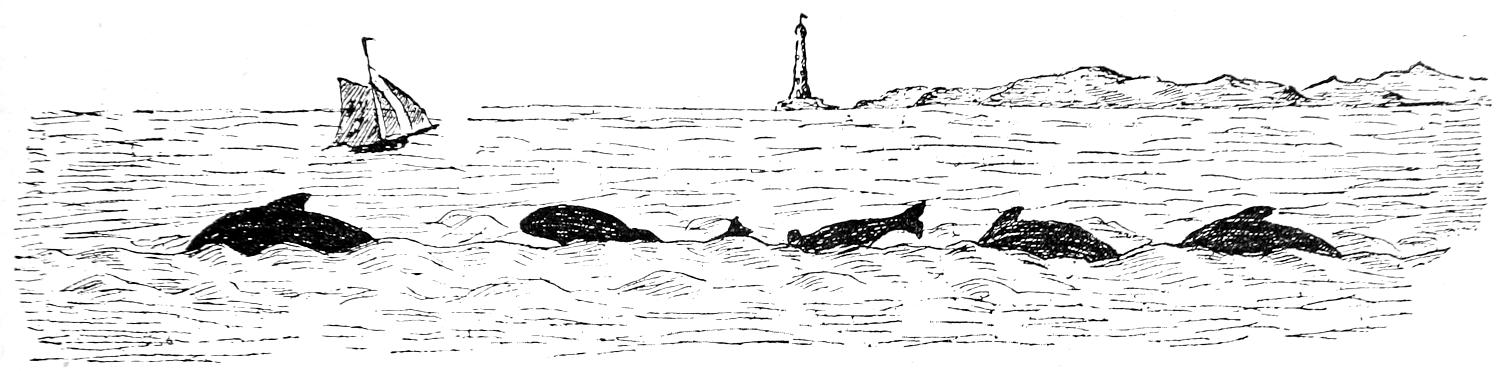
Fig. 53.—A row of porpoises.
And where a naturalist, like Mr. Schlegel, describes the effect caused by a row of porpoises, he has no right to assert that those persons who declare to have seen the sea-serpent, were the dupe of an optical illusion. Mr. Schlegel should have said: “On one occasion I was nearly deceived by a row of porpoises, but alas, I never saw a sea-serpent!”
The second explanation is that of the Committee of the Linnaean Society of New England (Boston). This Committee consisted of the Hon. Judge Davis, Prof. Jacob Bigelow, and Mr. Francis C. Gray. This learned body after having published, 1817, exceedingly interesting reports, was of course morally bound to explain the phenomenon. What kind of beast could it be!? and before they began to feel puzzled, a deus ex machina in the form of a sick, illformed and lame little snake presented itself suddenly in a field near Loblolly Cove. It was killed by a working man at that place, bought by Dr. So and So, and presented to the Committee to examine it, because people believed that this animal was a spawn of the great sea-serpent. The Committee really examined and dissected it and gave a full account of their experience in their Report. They considered the little snake to be new to science, closely allied to the Coluber constrictor or Black Snake, a common species of North-America, and gave it the name of Scoliophis atlanticus. This account is followed by two documents describing how the Scoliophis looked while it was alive, and the circumstance under which it was killed. I present here to my readers the Scoliophis atlanticus reduced to ¹⁄₆ of its size, and a separate full-sized figure of its head, showing the two wounds caused by the pitchfork with which the animal was killed.

Fig. 54.—Scoliophis atlanticus; one sixth of its full-size.
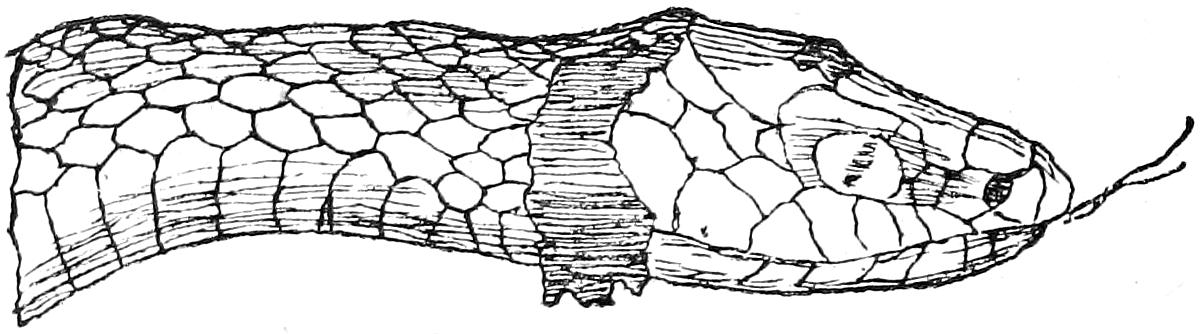
Fig. 55.—Its head; full-size.
Next they gave: “A few remarks on the question” (broached by the public) “whether the great serpent, seen in the Harbour of Gloucester be the Scoliophis Atlanticus.” These “few remarks” fill three pages and a half and end with the words:
“On the whole, as these two animals agree in so many conspicuous, important and peculiar characters, and as no material difference between them has yet been clearly pointed out, excepting that of size, the Society will probably feel justified in considering them individuals of the same species, and entitled to the same name, until a more close examination of the great Serpent shall have disclosed some difference of structure, important enough to constitute a specific distinction.”
It is quite astonishing that scientific men could come to the conclusion that the large animal, that gave rise to the 51 accounts which the Committee could have gathered up to their days, was a full grown individual of the species they called Scoliophis atlanticus! If they had collected all these accounts, if they had seriously compared them, they would have come most probably to the conclusion that they did not know precisely what it was, but that it could never be a snake.
Also from another point of view it is hard to explain that the Committee believed the sea-serpent to be of the same species as the little Scoliophis. Three persons mentioned the tongue, which was not bifid, while the tongue of Scoliophis is so! And the most accurate testimonies agree that the skin was smooth and had no scales!
The newspapers brought the accounts of 1817 to Europe and no doubt drew the attention of many zoologists, but only Mr. H. M. Ducrotay de Blainville dared handle the subject publicly. As soon as the Report of the Committee of 1817 reached him, he made an extract from it in his Journal de Physique, etc., Vol. 86, 1818, Paris. He, however, made much more of the little curious snake, apparently believing too that it was a new species, than of the large marine animal of which he was unable to give any explanation. Mr. de Blainville does not hesitate to express his astonishment that the Committee concluded the sea-serpent to be a real snake and an adult of their Scoliophis atlanticus, and ended his extract:
“If we will now scrutinize severely the existence of the Great Sea-Serpent, we must avow that it would be difficult to deny the appearance in the sea near Cape Anne; of an animal of very great length, very slender, and swimming with rapidity, but that it is a true snake, is doubtful; that it is of the same genus as the Scoliophis, is an assertion still more doubtful; and finally to hold that it is of the same species, reduces the number of probabilities which become null, if one is to believe that such an immense animal as that observed in the sea, goes ashore to lay its eggs!”
For this is firmly believed by the members of the Committee!
For Mr. de Blainville who did not give himself the trouble to collect as many accounts as possible, to read Olaus Magnus, Pontoppidan, Egede, etc., it was of course impossible to conceive what animal had been seen near Cape Ann, nor was he, for the same reason, able to explain the very different declarations of the witnesses concerning the length of the animal.
Mr. A. Lesueur, who was a companion of the celebrated Mr. Péron, and who, in 1818, lived at Boston, wrote to Mr. de Blainville to say that he had not only seen the little snake, but had dissected the same portion of the vertebral column as did the members of the Committee, together with several inches of another portion of the snake, and concluded that the figure of the little snake published by the Committee was very well drawn, but that the figure of the portion of the vertebral column was very badly done; of this he gave another figure, and furthermore asserted that the little snake not only was nothing else but a true snake, closely allied to the Black Snake (Coluber constrictor), but that it was in a state of disease and notably difformed. Of the great Sea-Serpent he said nothing, because he had not seen it himself.
The dissertation of Mr. de Blainville and the extract from Mr. Lesueur’s letter translated into German are in Oken’s Isis, 1819.
Mr. Froriep in his Notizen, Vol. 4, 1823, expresses himself about this explanation in the following manner:
“As long as the Linnaean Society, to prove their explanation, cannot depose an accurate observation or a dissection, we may be allowed to entertain modest doubt about their explanation.”
Of this little Coluber we find also the following passage in Schlegel’s Essai sur la physionomie des Serpens, La Haye, 1837, p. 80:
“In the same country a snake has been found, probably of the species called Coluber constrictor, of which all parts were disfigured by sickness much so, that they believed to recognize in this kind of monster the famous Sea-Serpent of the North, so well-known for its enormous size. The extract from the dissertation, published in Boston, will be found in the Journal de Physique Vol. 86, p. 297.”
Dr. Hamilton, in his Amphibious Carnivora, 1839, apparently believes that the little Scoliophis atlanticus was the spawn of the Great Sea-Serpent, at least he heads his Group III:
“The Great Sea-Serpent.” “Scoliophis atlanticus? Linn. Soc. of Boston”.
We see that he is not quite sure of it, as he puts a note of interrogation after the scientific name.
Without any doubt the Scoliophis atlanticus was a difformed specimen of Coluber constrictor. It was the bunches on its back, which induced the Committee to suppose this little snake to be a spawn of the sea-serpent, which had also bunches on its back. After the discovery that the little snake was a difformed one, the explanation falls to the ground. Moreover the smooth skin and the presence of four flappers of the sea-serpent, are proofs against this supposition.
The third explanation. In the Chapter on Hoaxes I have already inserted the letter from Prof. T. Say, of Philadelphia, to Prof. Leach, of London, in which the former, relying upon a trick of the crew of the vessel commanded by captain Richard Rich, firmly believed and declared the Sea-Serpent to be nothing but a large tunny. Prof. Say’s letter is also printed in Thomson’s Annals of January, 1819. We have inserted a figure of a tunny in the above mentioned Chapter, fig. 1.
Prof. Bigelow’s indignation rose against this explanation; in Silliman’s Am. Journ. Sc. Arts. Vol. II, Boston, 1820, we read:
“In some of the Scientific Journals remarks have been published, in which the testimony of these witnesses” (of Gloucester and elsewhere), “is announced to be an “absurd story”, attributable to a “defective observation connected with an extravagant degree of fear” (See Thomson’s Annals, for January 1819)”.
“In the American Journal of Science Vol. I, p. 260, is a note from the same author, on the identity of Scoliophis with Coluber constrictor. As this gentleman probably received his knowledge on the subject from p. 40th. of the Linnaean Society’s Report, it might have been decorous in him to have noticed the source from which he got his information.”
“As the friends of Science can have no object in view more important than the attainment of truth, it is proper to submit to the public consideration some additional evidence in regard to the size and shape of this marine animal which has come to light since the publication of Captain Rich’s letter on the subject. This evidence is partly the result of observations during the present year, and partly the contents of a communication made to the American Academy of Arts and Sciences fifteen years ago, but which, having been mislaid, has not before been published. The reader will judge whether it is a “defective observation” which has produced a remarkable coincidence between witnesses in different periods and places, unknown to each other; or whether it was “an extravagant degree of fear” which induced the commander of an American frigate to man his boats and go with his mariners in pursuit of this unknown animal. It may be proper to add that the original letters constituting the communication last alluded to, are in the hands of the corresponding Secretary of the Academy, where they may be seen. It is hoped that the unsuccessful termination of Capt. Rich’s cruise will not deter others from improving any future opportunities which may occur for solving what may now perhaps be considered the most interesting problem in the science of Natural History.”
How to make the animal’s head (which is like that of a snake, a seal, a walrus, a sea-lion), its long neck, its four flappers, its enormous long pointed tail, agree with the general outlines of a tunny, even of nine or ten feet in length!?
The fourth explanation. Mr. Constant Samuel Rafinesque Smaltz, in his Dissertation on Water-Snakes, Sea-Snakes, and Sea-Serpents (Philosophical Magazine, Vol. 54, 1819.), is evidently convinced of the fact that there are several kinds of sea-serpents, which are merely sea-snakes of a very large size. (Family Hydrophidae), of which I give a figure representing the Hydrophis pelamidoides, and Mr. Rafinesque classes two different sea-serpents under this head, proposing for them the names of Pelamis megophias (Megophias monstrosus) and Pelamis monstrosus s. chloronotis.
Mr. Gosse, in his Romance of Natural History, after discussing the question whether the sea-serpent may be an optical illusion caused by a huge stem of sea-weed, or a large seal, a cetacean, a basking shark, a ribbon fish, or a large kind of eel, continues his considerations in the following terms:
“To the Reptiles, however, popular opinion has pretty uniformly assigned this denizen of the sea, and his accepted title of “sea-serpent” sufficiently indicates his zoological affinities in the estimation of the majority of those who believe in him. Let us, then, test his claims to be a serpent.”
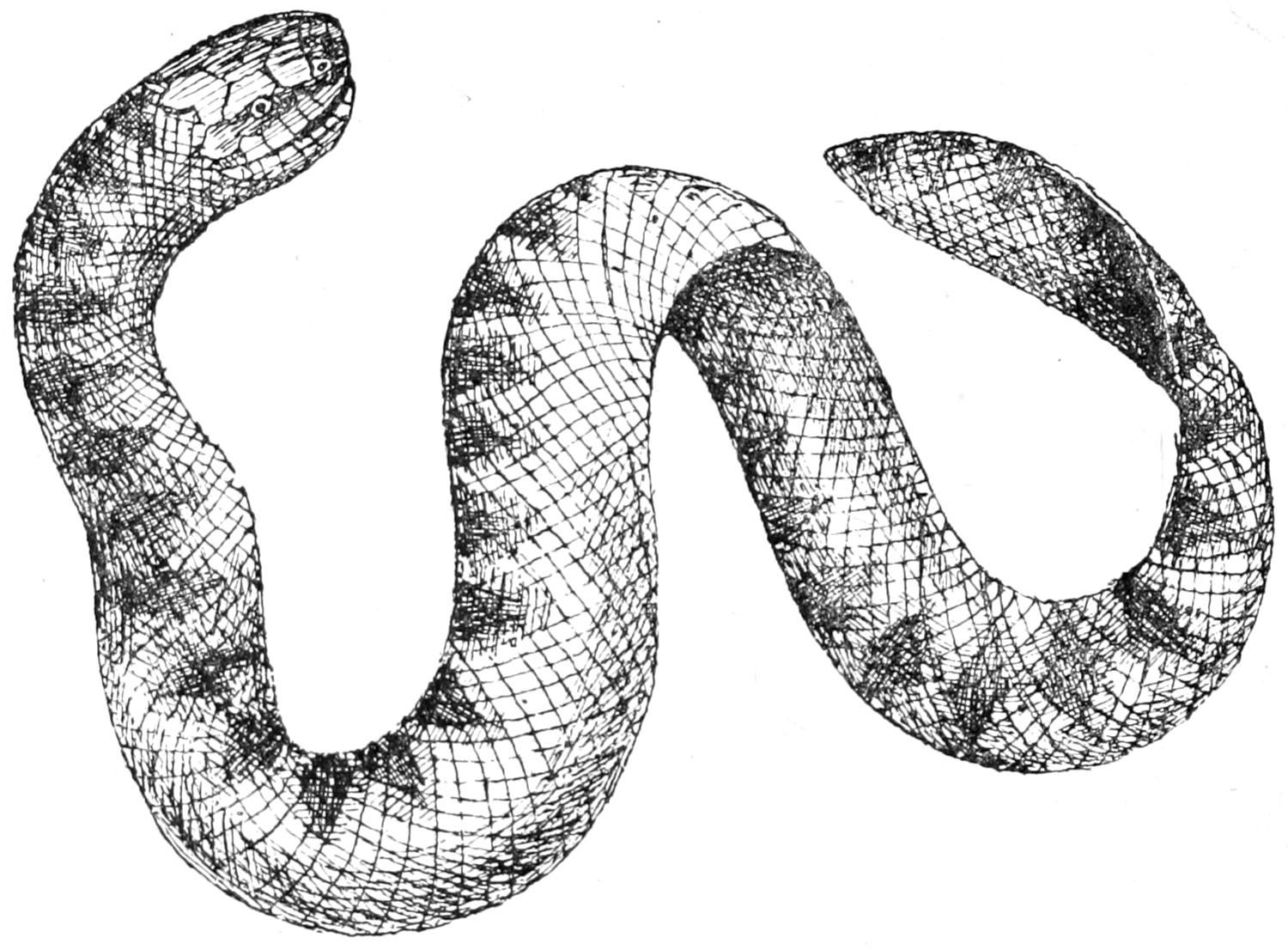
Fig. 56.—Hydrophis pelamidoides.—
“The marine habit presents no difficulty. For, in the Indian and Pacific Oceans, there are numerous species of true snakes (Hydrophidae), which are exclusively inhabitants of the sea. They are reported to remain much at the surface, and even to sleep so soundly there, that the passing of a ship through a group sometimes fails to awaken them.”
“None of these are known to exceed a few feet in length, and, so far as we know, none of them have been found in the Atlantic.”
Mr. Andrew Wilson on the contrary in September, 1878, declares in Nature (Vol. XVIII, Sept. 12) that:
“As a firm believer from the standpoint of Zoology the large development of the marine ophidians of warm seas offers the true explanation of the sea-serpent mystery,....”
But a few lines further on he also tells us:
“I am far from contending that a sea-snake developed in the ratio of a giant “cuttle fish”, presents the only solution of this interesting problem. A long tape fish, or even a basking shark of huge dimensions, might do duty in the eyes of non-zoological observers for a “sea-serpent”.”—
In his Leisure Time Studies, the same writer returns to his favourite idea:
“The only group of animals to which our attention may be specially directed with the view of finding a zoological solution of the problem, is that of the Vertebrata,—the highest group of animals, which possesses the fishes as its lowest, and man and quadrupeds as its highest representatives. Laying aside the class of birds, as including no form at all allied to our present inquiry, we are left with, speaking generally, three groups of animals, from the ranks of which various forms may be selected to aid us in solving the sea-serpent mystery. These three groups are the fishes, reptiles, and mammalia, and it may be shown that from each of these classes, but more notably from among the fishes and reptiles, various animals, corresponding more or less closely with the descriptions given of strange marine monsters, may be obtained. An important consideration, however, must not be overlooked at this stage, namely, that too frequently the attempt to reconcile the sea-serpent with some known animal of serpentine form and nature, has limited the perceptions and foiled the labours of naturalists. Starting with the fixed idea that the unknown form must be a serpent, and not widening their thoughts to admit of the term “serpentine” being extended to groups of animals other than the reptilia, naturalists soon exhausted the scientific aspect of the subject, and the zoological solution of the problem was almost at once given up. Then, also, as far as I have been able to ascertain, zoologists and other writers on this subject have never made allowance for the abnormal and huge development of ordinary marine animals. My own convictions on this matter find in these two considerations, but especially in the last idea, the most reasonable and likely explanation of the personality of the sea-serpent, and also the reconciliation of such discrepancies as the various narrations may be shown to evince. If we thus fail to find in the ranks of ordinary animal life, or amongst the reptiles themselves, the representatives of the “sea-serpents”, I think we may nevertheless build up a most reasonable case both for their existence and for the explanation of their true nature, by taking into account the facts, that the term “sea-serpent”, as ordinarily employed, must be extended to include other forms of vertebrate animals which possess elongated bodies; and that cases of the abnormally large development of ordinary serpents and of serpent-like animals will reasonably account for the occurrence of the animals collectively named sea-serpents.”
“The idea that the animal observed in this instance” (no. 118) “was a huge serpent, seems to have been simply slurred over without that due attention which this hypothesis undoubtedly merits. Whilst to my mind, the only feasible explanation of the narrative of the crew of the Pauline” (no. 144, 145) “must be founded on the idea that the animals observed by them were gigantic snakes. The habits of the animals in attacking the whales, evidently point to a close correspondence with those of terrestrial serpents of large size, such as the boas and pythons; whilst the fact of the animal being described in the various narratives as swimming with the head out of water, would seem to indicate that, like all reptiles, they were air-breathers, and required to come more or less frequently to the surface for the purpose of respiration. The difficulties which appear to stand in the way of reconciling the sea-serpent with a marine snake, in this or in other cases, are two in number. The great majority of intelligent persons are unaware of the existence of serpents of truly and exclusively marine habits; and thus the mere existence of such snakes constitutes an apparent difficulty, which, however, a slight acquaintance with the history of the reptilia would serve at once to remove. Mr. Gosse speaks of these marine snakes,—the Hydrophidae of the naturalist,—which inhabit the warmer seas, possess compressed fin-like tails adapted for swimming, and are frequently met with far out at sea. Whilst, as regards the claims of the “sea-serpent” to belong to the true serpent order, naturalists have dismissed their idea, simply because it has never occurred to them that a gigantic development of an ordinary species of sea-snake would fully correspond with most of the appearances described, and would in the most natural manner explain many of the sea-serpent tales. Suppose that a sea-snake of gigantic size is carried out of its ordinary latitude, and allow for slight variations or inaccuracies in the accounts given by Captain M’Quhae, and I think we have in these ideas the nearest possible approach to a reasonable solution of this interesting problem”.
“It will be asked how I account for the apparent absence of motion of the fore part of the body, and for the existence of a dorsal or back fin. I may suggest, in reply, that the simple movements of the laterally compressed tail, altogether concealed beneath the surface, would serve to propel the animal forward without causing the front portion of the body to exhibit any great or apparent motion; whilst the appearance of a fin may possibly be explained on the presumption that sea-weed may have become attached to the animal, or, that the upper ridge of the vertically compressed tail extended far forward and appeared as a fin-like structure.”
“The most important feature in my theory, however, in which I may be desired to lead evidence, and that which really constitutes the strong points of this explanation, is the probability of the development to a huge or gigantic size of ordinary marine serpents. This point is one in support of which zoology and physiology will offer strong and favourable testimony. There is no single fact, so far as I am aware, which militates in the slightest degree against the supposition that giant members of the sea-serpents may be occasionally developed. The laws which regulate human growth and structure, and in virtue of which veritable “sons of Anak”, like Chang the Chinese giant, and the Russian giant, differing widely in proportions from their fellow-mortals, are developed, must be admitted to hold good for the entire animal kingdom. There is, in fact, no valid reason against the supposition that a giant serpent is occasionally produced, just as we familiarly observe almost every kind of animal to produce now and then a member of the race which mightily exceeds the proportions of its neighbours. But clearer still does our case become when we consider that we have proof of the most absolute and direct kind of the giant development of such forms as cuttle-fishes, which have thus appeared as if in realisation of Victor Hugo’s “devil-fish”, which plays so important a part in that strange weird tale, the “Toilers of the Sea”. At the present time we are in full possession of the details of several undoubted cases of the occurrence of cuttle-fishes of literally gigantic proportions,—developed, in fact, to an extent justly comparable to that of the supposed “sea-serpent”, when the latter is compared with its ordinary representatives of the tropical oceans.”
“Is there anything more improbable, I ask, in the idea of a gigantic development of an ordinary marine snake into a veritable giant of its race—or, for that matter, in the existence of distinct species of monster sea-serpents—than in the production of huge cuttle-fishes, which, until within the past few years, remained unknown to the foremost pioneers of science! In the idea of gigantic developments of snakes or snake-like animals, be they fishes or reptiles, I hold we have at least a feasible and rational explanation of the primary fact of the actual existence of such organisms.”
Mr. Lee in his Sea Monsters Unmasked (1883) also says:
“As marine snakes some feet in length, and having fin-like tails adapted for swimming, abound over an extensive geographical range, and are frequently met with far at sea, I cannot regard it as impossible that some of these also may attain to an abnormal and colossal development. Dr. Andrew Wilson, who has given much attention to this subject, is of the opinion that “in this huge development of ordinary forms we discover the true and natural law of the production of the giant serpent of the sea.” It goes far, at any rate, towards accounting for its supposed appearance”.
But by this supposition the smooth skin, the four flappers, the mane, and the pointed tail of the sea-serpent are not explained. Further, true snakes cannot possibly throw their bodies into vertical undulations. It is moreover very improbable that large Hydrophidae, supposing that they do exist, should visit Great Britain, the United States, the coasts of Norway, the North-Cape, Greenland and the Aleutes, as their geographical distribution only extends over the tropical seas.
The fifth explanation. The same Mr. Rafinesque believed the sea-serpent seen by Capt. Brown to be a fish (no. 56), closely allied to the genera Symbranchus (Fam. Symbranchidae) and Sphagebranchus (Fam. Muraenidae); consequently belonging to the eel tribe.
Mr. Gosse, in his Romance of Natural History, after having shown that in some instances the sea-serpent may have been an optical illusion caused by a huge stem of sea-weed, or a large seal, a cetacean, a basking shark, or a ribbon-fish, says:
“A far greater probability exists, that there may be some oceanic species of the eel tribe, of gigantic dimensions. Our own familiar conger is found ten feet in length. Certainly, Captain M’Quhae’s figures remind me strongly of an eel; supposing the pectorals to be either so small as to be inconspicuous at the distance at which the animal was seen, or to be placed more than commonly far back.”
And Mr. Andrew Wilson in his Leisure Time Studies is also inclined to this hypothesis:
“Amongst the fishes, we may find not a few examples of snake-like animals, which, admitting the fact of the occurrence of gigantic developments, may be supposed to mimic very closely the appearance of marine serpents. Any one who has watched the movements of a large conger-eel, for example, in any of our great aquaria, must have remarked not only its serpentine form, but also the peculiar gliding motion, which seems frequently to be produced independently of the active movements of the tail or pectoral fins. I do not doubt, however, that a giant eel might by most persons be readily enough referred to its proper place in the animal sphere, although, when viewed from some distance, and seen in an imperfect and indistinct manner, the spectators—all unprepared to think of an eel being so largely developed—might report the appearance as that of a marine snake.”
Mr. Lee in his Sea-Monsters Unmasked, too, asserts:
“An enormous conger is not an impossibility.”
As the common eel and the conger or sea-eel are well enough known to all my readers, I have not given a figure of it. The Symbranchus has nearly the same external features, it has, however, no pectoral or ventral fins, and the right and left gill-apertures, or gill-splits, are united together on its throat. The Sphagebranchus has also nearly the same external features; it has no ventral fins and the very end of its tail is destitute of a fin.
The four flappers of the sea-serpent and its vertical flexibility are strong proofs against this hypothesis.
The sixth explanation is that which I have accidentally found mentioned in Dr. Hibbert’s Description of the Shetland Islands, 1822. The passage runs as follows:
“The faith in the Edda of the great Serpent that Thor fished for, did not, as Dr. Percy conceives, give rise to the notion of the sea-snake, but a real sea-snake was the foundation of the fable.”
I am convinced that Dr. Hibbert is right. All fables have their foundation in facts, or in objects of nature, and it is plausible that the Norwegians had met with the sea-serpent before the fable of Thor’s great Serpent was inserted in their Eddas.
Dr. Percy’s explanation that the notion of the Sea-Serpent springs from the faith in the Edda, is repeated by Messrs. H. E. Strickland and A. G. Melville in a note to their dissertation on the Dodo, in the Annals and Magazine of Natural History, 2nd. series, Vol. 2, p. 444, Nov. 15? 1848:
“It has always seemed to us that the fable of the Great Sea-Serpent, which first spread in modern times from Norway, was to be traced to the myth, in the fine Old Northern Mythology, of that fell offspring of Loki, Jormungandr,—the great world surrounding serpent, whom Thor fished up with the bull’s-head bait, and whom, at the great day of Ragnarokr, he shall slay. It is curious by the way, that we are expressly told how Jormungandr rearing his head, poured out fountains of venom upon Thor, very much as old Bishop Egede tells us of the great sea-serpent raising up its head and spouting out water.”
At present every one is convinced of the fact that the reports of the great sea-serpent are no fables.
The seventh explanation, viz. that the “slow motions of basking sharks” evidently caused a deceitful appearance, will be found at the end of Mr. Mitchill’s dissertation, printed in 1828, with which the reader will remember to have been made acquainted in our Chapter on Hoaxes. A basking shark is delineated in our fig. 8, in the Chapter on Would-be Sea-Serpents.
Again this suggestion is made by the well-known palaeontologist Mantell in a P. S. to a letter addressed by him to the Editor of the Illustrated London News, and published there in the number of November 4, 1848:
“P. S. With regard to the existence of the so-called sea-serpent, I would beg to remark, that, although it is highly improbable that an ophidian, or true snake, of the dimensions and marine habits described by our voyagers now exists, yet there is nothing to forbid the supposition that there are unknown living forms of cartilaginous fishes presenting the general configuration and proportions of the animals figured in the last Number of the Illustrated London News.”
Evidently he meant a shark, of which individuals of more than thirty feet are no rarity in the species called basking shark (Squalus maximus of Linné). The figures referred to are those of the sea-serpent seen by Captain M’Quhae, (fig. 28, 29, 30).
In the fifth explanation we have learned that Mr. A. G. Melville was of opinion that there does not exist a sea-serpent in reality, but only in fables, and that these fables originated in the Northern mythology. Now, he seems to have changed his opinion in a fortnight, for in a letter to Dr. Cogswell, part of which is published “with permission of both gentlemen” in the Zoologist, number of November 27th., 1848, he says:
“I have never entertained a doubt regarding the existence of some unknown animal of vast dimensions, whose angel visits have astonished the fortunate observers or excited the incredulous smile of the authorities of science.”
“No one inclined, I believe, to give due importance to the known facts of geology, can entertain the probability of any relationship between “the great sea-serpent” and the extinct Plesiosauri; nor do the recorded phenomena require such a hypothesis.”
“Reasoning from the known occurrence of a huge cartilaginous fish (Squalus) on our Orcadian shores, I am of opinion that when caught the sea-serpent will turn out to be a shark, and I conceive it is just as probable that a shark may carry the head for short periods out of the water, as that the flying fishes should occasionally step aboard to look at us land monsters.”
“It is always unsafe to deny positively any phenomena that may be wholly or in part inexplicable; and hence I am content to believe that one day the question will be satisfactorily solved. Might we not obtain some information from the accurate Sars regarding the Norwegian tradition? Could not the surgeon of the Daedalus throw some light on the subject?”
Mr. Gosse, in his Romance of Natural History, after having treated of the probability of the sea-serpent being an optical illusion caused by huge stems of sea-weed, or being a large seal, or some cetacean, expresses his opinion about the basking-shark theory in the following terms:
“As to its place among fishes, Dr. Mantell and Mr. Melville consider that the Daedalus animal may have been one of the sharks; and there is no doubt that the celebrated Stronsa animal, which was considered by Dr. Barclay as the Norwegian sea-serpent, was really the Selache maxima or basking-shark. But the identification of Captain M’Quhae’s figure and description with a shark is preposterous.”
Mr. Andrew Wilson, however, in Nature (1878, Sept. 12, Vol. XVIII) is of the opinion that:
“A long tape fish, or even a basking shark of huge dimensions, might do duty in the eyes of non zoological observers for a “sea-serpent”.”
Mr. Lee, in his Sea Monsters Unmasked, 1883, also believes that “the dorsal fins of basking sharks, as figured by Mr. Buckland, may have furnished the “ridge of fins”. Here he evidently means the ridge of fins as seen in fig. 44.
None of the observers of the sea-serpent mention fins on its back, so that this explanation is not untenable either.
The eighth explanation is given by Mr. Mitchill in his paper “On Sea-Serpentism”, printed in 1828; (See our Chapter on Hoaxes), at the end of which he supposed that also the appearances of balaenopterous whales may have given rise to reports of the sea-serpent. He says: “which have fins on their back”, and yet he cannot show me one single account of the sea-serpent, in which there is question of backfins. Moreover, who has ever heard of fin-fishes which bend their body in such a manner as to show bunches on their backs, or coils like a string of buoys? Fig. 57 shows the readers a fin-fish (Balaenoptera physalus (Linné)). It is the largest kind of whales, it may obtain a length of 106 feet. An outline of the tail, seen from above, is added above the hindmost part of the main-figure.
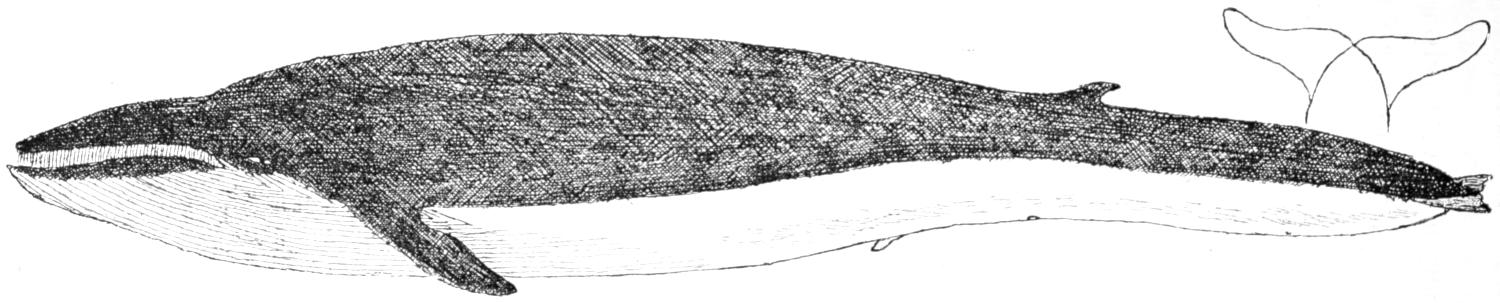
Fig. 57.—Balaenoptera physalus, (Linné).—
Mr. Gosse in his Romance of Natural History, after having considered and upset the sea-weed hypothesis and the seal-theory says:
“It is by no means impossible that the creature may prove to belong to the Cetacea or whale tribe. I know of no reason why a slender and lengthened form should not exist in this order. The testimony of Colonel Steele, who represents his animal as spouting, points in this direction.”
The sea-serpent seen by Colonel Steele, however was not a cetacean, although it was observed spouting, for it had a red back-fin like a saw (see our Chapter on Would-be Sea-Serpents, 1852, Aug. 28).—
The ninth explanation is Mr. R. Bakewell’s. In Froriep’s Notizen, Vol. 40, no. 879, of June, 1834, we read:
“With regard to the often mentioned and much questioned great American Sea-Serpent Mr. R. Bakewell, in the latest edition of his Introduction to Geology, Chapt. 16, p. 312, has expressed the opinion that the great sea-serpent often seen on the coasts of the United States of America probably belonged to a genus of reptiles which may be analogous to the fossil Ichthyosaurus, and that the description, given of the sea-serpent, as having flappers like sea-turtles, and formidable mandibles like a crocodile, was agreeing more with that of a saurian than with that of a snake. Some of the people who saw the sea-serpent state that the body was very long and as thick as a water-cask.”
Though in 1872 the majority apparently believed the sea-serpent to be a living Plesiosaurus, yet we meet with the following suggestion, in the September number of Nature of that same year.
“The following extract from an evening contemporary well illustrates the hazy ideas prevalent as to the extinct Saurian monsters of which the sea-serpent is supposed to be a descendant:—“If the sea-serpent continues in its present sociable state of mind, we may perhaps have an opportunity of deciding the vexed question regarding the formation of that portion of his figure which, according to English observers, he keeps concealed under the water. The legend of the Lambton Worm, a popular tale in the North of England, describes the worm as a serpent of enormous size, who used to coil himself round a hill overhanging the River Wear, just as thread is wound round a reel, but a very ancient stone effigy of the creature which lately existed at Lambton Castle, represents it with ears, legs and a pair of wings. If this effigy was made, as it probably was, from some recollection on recent tradition of the Lambton Worm, these adjuncts would indicate that the beast was one of the winged land monsters which existed at the same time as the Ichthyosaurus, but would naturally become an extinct species far sooner than the fish-lizard, which can conceal itself in the depth of the ocean from the curiosity and violence of man.”
The Ichthyosaurus must have been destitute of scales, or better the scales must have been of a microscopic minuteness, and so I have ventured to sketch my fig. 59, showing the Ichthyosaurus communis, as it most probably looked, and of which fig. 58 represents the skeleton.

Fig. 58.—Skeleton of Ichthyosaurus communis.

Fig. 59.—Ichthyosaurus communis, restored.
Here we have an animal of really huge dimensions. Some may have had a length of from forty to fifty feet. Their skin was smooth, the tail was very long and four flappers resembling the foreflappers of whales, were the organs of locomotion. Most probably, however, the tail was provided with a vertical fin, as I have delineated. The neck was very short, as in whales. Now the sea-serpent has a pointed tail, and a very long neck. Especially this last character is enough to drop the supposition that the sea-serpents are still living Ichthyosauri. Moreover, the Ichthyosaurus was unable to move in vertical undulations.
The tenth explanation.—In Froriep’s Notizen, Vol. 40, (1834), no. 879, p. 328, we read that, in a note to Mr. Bakewell’s latest (1834?) edition of his Introduction to Geology, above mentioned, Prof. Benjamin Silliman adds:
“Mr. Bakewell’s very sensible conjecture that the sea-serpent may be a Saurian, agrees still more with the supposition, that it is a Plesiosaurus, than an Ichthyosaurus, as the short neck of the latter does not agree with the common appearance of the sea-serpent.”
Plesiosaurians, as well as the Ichthyosaurians, are reptiles only known in a fossil state. Only the bones of the skeleton of these animals are found in Europe as well as in America and in Australia in liassic and oolitic formations. Of these remains geologists are able to build up or to “restore” the whole skeleton, of which I show my readers a sketch in fig. 60.—If this is done, it will not be difficult to imagine how the animal must have looked, the more so as it is a well-known fact that these animals must have been destitute or nearly destitute of scales. The figures drawn by Gosse, Figuier and Andrew Wilson, don’t please me, as the necks are delineated too slender, and the head of the animal in Mr. Gosse’s drawing, in my opinion, is wrongly represented. So I venture to present to my readers my fig. 61, showing how I think that the animal must have looked.
Mr. Rathke, in the Archiv für Naturgeschichte, of 1841, after publishing some accounts of the sea-serpent, collected by himself during a journey in Norway, and after declaring that he himself is a firm believer in it, goes on:
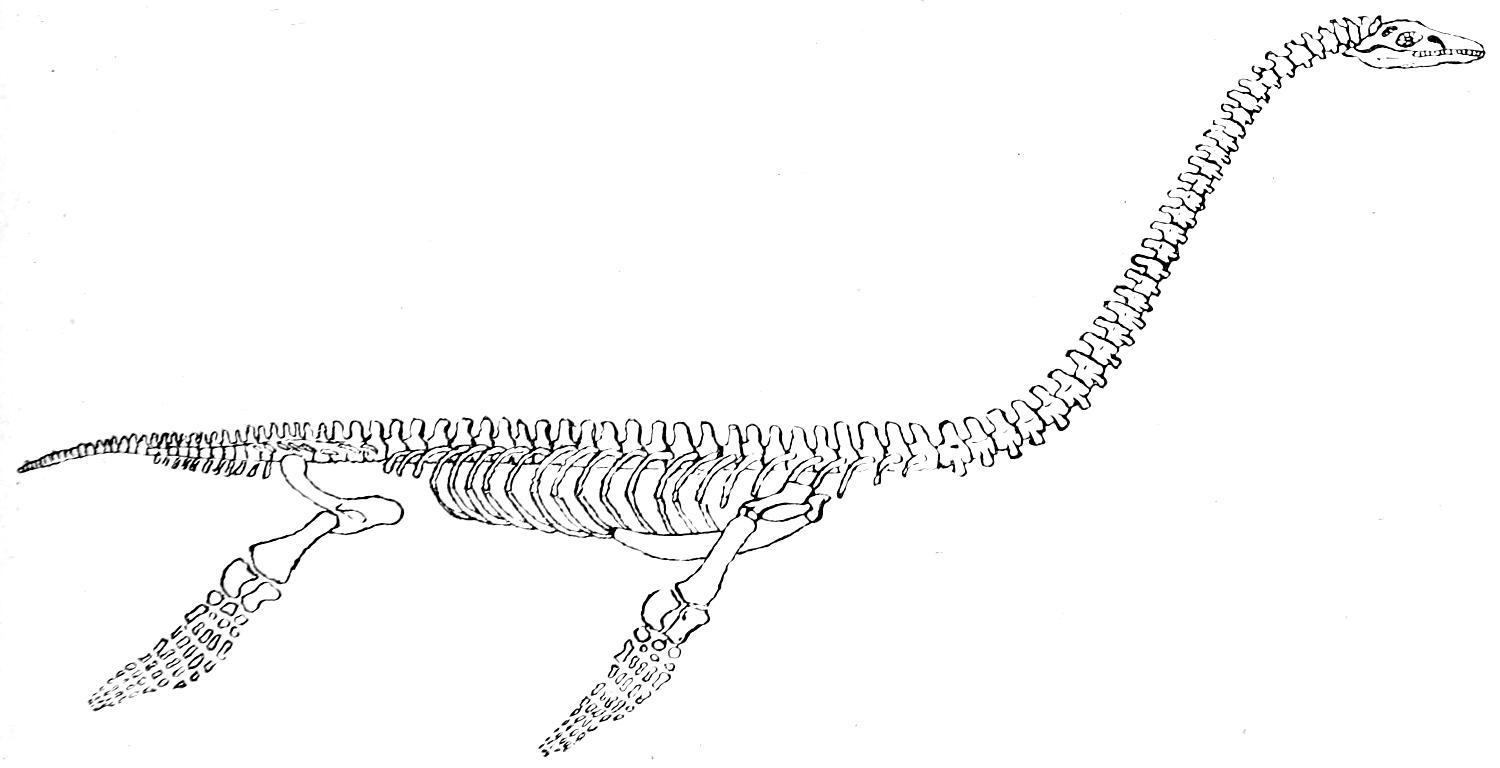
Fig. 60.—Skeleton of Plesiosaurus dolichodeirus.
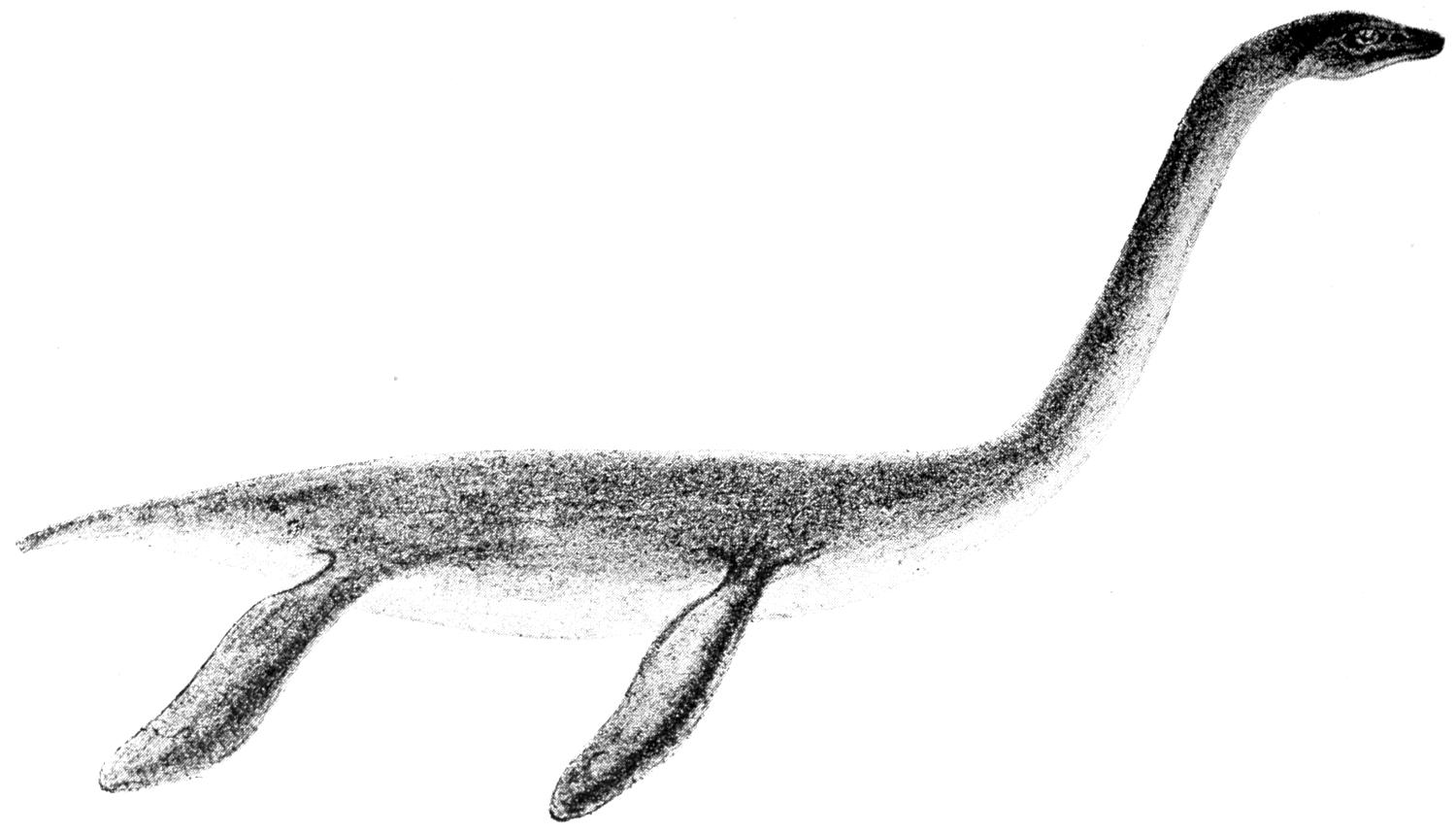
Fig. 61.—Plesiosaurus dolichodeirus, restored.
“To which group of known animals, however, this being belongs, cannot of course be asserted with any certainty. The supposition, however, is very near, that it is closely related to that animal which in 1816” (read 1808) “stranded in Stronsa, one of the Orkney’s,” &c.
After a short description of this animal with which the reader will remember to have been made acquainted in the Chapter on Would-be Sea-Serpents, Mr. Rathke concludes:
“that this animal resembled a Plesiosaurus, and that it thus belonged to the Amphibia, viz. to the Saurians. Now if such were the case, and if the creature found in Stronsa were closely related to the sea-serpent of the Norwegians, and we have every reason to believe this, it is astonishing that the latter has not been more observed, than has been the case. For being an Amphibium, which, according to its organization, can only breathe by lungs, the sea-serpent necessarily must have come very often to the surface of the water, to renew the inhaled air. It is, however, conceivable and probable that stretching out its long neck, it generally comes only with the nose tip and only for a very short time on the surface of the water, remaining under it with the rest of the body, in which circumstances it will not be easy to observe it amongst the beating of the waves.”
We observe that Mr. Rathke, like Prof. Silliman, inclines to believe that the sea-serpent is, or is allied to the Plesiosaurus.
Mr. Edward Newman, the Editor of the Zoologist, in 1847, on the wrapper of the 54th. number of this Journal made the suggestion that sea-serpents may belong to one of the Enaliosaurians.
I have not seen this wrapper so that I am unable to give the words in which this supposition was written.
Most probably Mr. Newman took this suggestion from Mr. Rathke’s above mentioned dissertation, all the accounts of which he inserted (N. B.!) in the same number of the Zoologist; but it is, of course, possible that this supposition really was the product of his own brain. We hope that the latter was the case; but I only ask: why did he insert the accounts of Mr. Rathke in the columns of the issue, and why not the above-mentioned suggestion; what was the reason to communicate it on the wrapper? It makes on me the impression as if Mr. Newman waited to see if some one or other would perhaps find out that both accounts and supposition were already six years old! But, of course, I may be mistaken!
Immediately after reading this suggestion on the above mentioned wrapper, Mr. Charles Cogswell wrote for the same Journal his Plea for the Sea-Serpent. For history’s sake I repeat here his whole paper. It runs as follows:
“A Plea for the North-Atlantic Sea-Serpent. By Charles Cogswell, M. D.”
“Every generation of man is born to stare at something, which so long as it eludes their understanding, is a very African fetish to the many, and a Gordian knot to the few.”
Hawkin’s Memoirs of Ichthyosauri and Plesiosauri.
“Of the numerous contributions supplied through the press to support the cause of the subject of this article, one of the most recent has arrested my attention, because of the particulars having been long since familiar to me by oral communication from the writer in person. I allude to the interesting narrative contained in the “Zoologist” for May last, describing a meeting with such an animal off the coast of one of the British provinces, stretching out into the Atlantic to the north-east of New England. It is worthy of notice that several animals of the Cetaceous kind (sometimes conjectured to have been a source of deception) were seen and scanned in limine, and an opportunity was thus afforded for immediate descrimination. Immediately subjoined is another statement, copied from a foreign newspaper, being the tribute of a French sea-captain to the same object, but qualified with so much of the characteristic national precision in the detail of certain forms and measurements, as rather to display an elaborate view of disjoined parts, than represent them all in harmony together as belonging to one individual. It betrays the caution of a witness, who would fain keep an opening in reserve for escape from a precarious position. The former adventure took place in 1833, the latter in 1840, and now they are related almost simultaneously within the last few months.”
“Nor is this delay to be wondered at, when we consider how much the reserve of unbiassed is the tribunal of public opinion, before which they appear. It will hardly be denied that there is no debateable point in the modern records of observation more complacently devoted to ridicule by all but universal consent, than that of the existence of huge serpent-like animals in the North Atlantic Ocean. The very mention of the name of sea-serpent in the singular number with the definite article prefixed, suggests to most minds an idea of some anomalous monster, without parentage or congeners, feigned to haunt the recesses of the deep, and, like the ghost of vulgar superstition, manifesting itself now and again for the sole conceivable end of adorning some wonderful legend. This impression, favoured by the circumstance of no actual specimen having ever occurred to the observation of a naturalist, much less been obtained for deliberate examination, has caused the subject of our notice to rank with the mermaid, the unicorn, the griffin, and other prodigies of the olden faith. It does not fail to be objected that Norway, a locality most fruitful in accounts of the appearance in question, has been immemorially distinguished for a vivid perception of the marvellous. Nor, after hearing the other side of the Atlantic, are we much better able to divest our minds of suspicion with regard to the trustworthy character of the witnesses; our relative in the West having acquired nearly as much celebrity for the endowment of a grand inventive genius as his Scandinavian ally in the cause of sea-serpents. They defer indeed, in so far as the latter believes and venerates his own creations, while the American indulges his fancy for the purely benevolent purpose of what is called “hoaxing” the unwary public. Not many years since, it may be recollected, one of these pleasant philosophers enlightened his fellow-mortals with a “true and peculiar” description of certain winged inhabitants assumed to have been discovered in the moon by an eminent living astronomer, giving the details with so much simplicity and effected candour with regard to some particulars, in the manner of “Gulliver’s Travels”, that many readers were not aware of its being a fabrication. Such proof of a disposition to practise on the public credulity, too often repeated, necessarily communicate a colouring of insincerity to all other reports of strange events emanating from the same source, and certainly demand the exercise of an unusual amount of circumspection, though they do not justify scepticism, in the case now before us.”
“Making due allowance for these peculiarities in the testimony, we may, nevertheless, proceed in a spirit of induction to examine into the tendency of the collateral evidence. The question after all, when reduced to its simplest form comes to be little more than one of geographical distribution. That is to say, that even if we chose to confine the animal to the true serpents, which has been the ordinary conception heretofore, there is no obvious impediment to oppose it, either on the score of want of analogy, or of structural incapacity. Amphibiousness, to commence with, in its popular acceptation, or the capability of spending a considerable time in the water, is one of the most familiar properties of serpents, as illustrated in the common snake (Coluber natrix) and the viper, the only two species, if we except the blindworm, ascertained to be indigenous to these islands. “Snakes”, observes Professor Bell (“History of British Reptiles”) “are extremely fond of the water, taking to it readily, and swimming with great elegance and ease, holding the head and neck above the surface. It is extremely probable that they resort to the water in search of frogs.” In the learned System of Schlegel, translated by Prof. Traill—“Physiognomy of Serpents”—members of various ophidian-groups are characterised as living near and inhabiting lakes and rivers. Some belong to the genera Tropidonotus (which here includes the first named British species), and Homalopsis, comprised under the head of Fresh Water-Serpents. Of the Boas, this author says: “several species frequent fresh water, and there are some of them essentially aquatic,” among them the Boa murina, the largest of known serpents, and his two species of Acrochordus.”
“Further, and what completely sets at rest the part of the case we are now considering, there are swarms of marine ophidians inhabiting the warm latitudes of the pacific. These appear to have been partly known to the ancients. Aelian informs us that Hydrae with flat tails were found in the Indian Seas, and that they also existed in the marshes. He also tells us that these reptiles had very sharp teeth, and appeared to be venomous. According to Ctesias, the serpents of the river Argada in the province of Sittacene, remain concealed at the bottom of the water during the day, and by night they attack persons who go to bath or wash linnen” (Griffith in Cuvier). Schlegel has no less than seven species collected under the generic name of Hydrophis, constituting his family of Sea-Snake—; they are especially fitted for aquatic life, having the nostrils directed vertically and furnished with valves, and the tail flattened like an oar; they reside in the sea exclusively, never going on land, and are supposed to prey on fishes. Their limits belong to the intertropical regions of the Indian Seas, or of the Great Pacific Ocean.”
“The existence of bona fide sea-serpents being therefore a matter of notoriety, (and preserved specimens are to be seen at any time on the shelves of the British Museum), we have but to address ourselves to the subordinate inquiry, whether there be sufficient reason for assigning to any of the family a habitat in the North Atlantic Ocean. And here it is necessary to put away all that idea of deviation from the common order of Nature, which could connect the evidence heretofore given with some isolated excressence so to speak, of the animal kingdom. The great size attributed to them has doubtless, served very materially to produce an infavourable impression. Schlegel limits the extreme length of the greatest known serpent to twenty-five feet, although such naturalists as Cuvier and Milne-Edwards allow an extension of thirty or forty feet to some of the Boas. These estimates do not fall so far short of those contended for in the present instance as to form an insuperable ground of objection. Many witnesses whose character and station in life command respect, whatever judgment may be formed of their powers of correct observation, profess to be fully persuaded that they have seen immense creatures, resembling serpents, in the vicinity of the European or the American shores. The several depositions from Norway that appeared in the “Zoologist” of February last, comprised the testimony not only of fishermen, drawing their subsistence from the sea, and familiar with the more prevalent forms of the inhabitants, but of a class commonly presumed to be well educated, as merchants, clergymen, and a surgeon. Their observations indeed vary on the subject of length (varying between forty and one hundred feet), and likewise on some of the details of outline, so that they may either relate to different specimens, or to deceptive phenomena producing dissimilar impressions, whichever alternative decretic may be inclined to profer. The first notice transmitted by an English gentleman, holding a responsible appointment under the crown in one of our transatlantic dependencies, is calculated to supply any deficiency on the part of the new hemisphere, so far as a faithful representation of what was submitted to the eye alone may remain a desideration. But for the resolution manifested in this periodical to allow the question a fair hearing on its sterling merits, there can be little doubt that this testimony, would not have been forthcoming; like in all probability, more of the same ingenious stamp, which the unwillingness of the principals to oppose the current of public opinion, directly proportioned to the value of the character they run the risk of compromizing for no obvious use, induces them to withhold.”
“But it may be asked, how it is possible to explain the circumstance of these monstra natantia being encountered no farther South than about the sixtieth or fifty-fifth parallel on the European boundary, while in the American water their domain approaches so much nearer the Equator, as Nova Scotia (or New Scotland) and New England? By a curious and happy coincidence, of like significance to many that are constantly springing up to confirm the results of independent research, such for instance as the print of the piscivorous gavials in a prior leaf of the “Stonebook” to the mammalivorous crocodiles; it happens that precisely a line swerving from Norway in a southerly direction to Massachusetts is the boundary likewise of other marine animals of corresponding types. Among the divisions of the North Atlantic, recently marked out by Professor Edward Forbes as determined by the presence of similar forms of animal life, occurs what is called the “arctic and boreal” province, which “sweeps across the northernmost part of the North Atlantic from Europe, extending down the coast of North America as far as Massachusetts, but nothing like so far on the European side as the American.” (Lecture at the Royal Institution, May 14, 1847).”
“Thus copiously backed by the most affirmative evidence, both positive and circumstantial, all contributing to establish the lawful claim to entity, the “great unknown” of the North Atlantic has still to overcome the strong feeling of discredit so widely associated with his past history, before he can hope to be understood as seriously claiming to be a subject of the animal kingdom. If men of the highest name in science condescend to notice him at all, it is most probably with a smile at the expense of what they consider a crude invention, to which no importance should be attached. But authority, however exalted, has no patent of final adjudication in cases where its means of information are confessedly imperfect, as compared with those enjoyed by the supporters of a disputed position. The learned world was centuries in believing the story of Herodotus about little birds resorting to feed on insects within the “stretched jaws” of the crocodile. Bruce all but ruined his credit for a time by relating that he had seen the Abyssinians eat the raw flesh cut from one of the haunches of a living cow; and there are some who, with no more reason, pretend to doubt the good faith of a contemporary traveller, who declares that he once made a brief excursion on the back of an alligator. The conflicts of discovery and opinion engross indeed no small share of the history of human knowledge. There are cases, no doubt, in which the senses and the judgment of incompetent persons are liable to be imposed upon by irrelevant facts created or qualified for the occasion. But here there is no hypothesis concerned requiring nature to be tortured into its service; physiology can have no latent objections, ready to start up unawares and make a mockery of belief, because some of the serpent kind are indubitably organized for an aquatic medium; the laws of geographical distribution deduced irrespectively, yield their consent, and the integrity of not a few of the narrator is unimpeachable. Are we justified in rejecting the text, because the interpretation may not harmonize with our views; in imputing willful dishonesty to those who merely describe to the best of their hability what their eyes have disclosed to them? We do not despice the mermaid, the triton and siren, as altogether imaginary but endeavour to reconcile at least their physical attributes with those of the seal or oriental dugong. The unicorn is supposed to have original in the narwhal; and the griffin is recognized as a well-known friend in an antiquated garb, being no other than the tapir, somewhat disfigured by travellers, and further indebted to the artist for a pair of wings and an architectural style of tail. Even the ghost-seer is seldom suspected of intentional fraud, however justly we may believe to be the dupe of an imagination acted on by some positive phenomenon. The collateral truths which testify on the affirmative side have been dwelt upon to some extent, and shall again be adverted to presently. On the other hand, surely there must be something peculiar in the economy of a vast air-breathing race, frequenting well-known tracts and yet never visible but by the merest accident; nor is it any sufficient answer to refer to the construction of the breathing apparatus, distinctive of the marine ophidians, enabling them to live long under water, and respire air with an almost imperceptible exposure above the surface, because the like provision does not prevent the Pacific denizens from being abundantly subject to observation. The want of conformity in some of the reported particulars of form and dimensions is of insignificant moment, and may easily be converted into a proof of innocence of design. Above all, the objections, be it understood, are not of the kind which the public at large appear to imagine them. There is nothing ridiculous or abnormal in the idea of a sea-serpent. So far from this the philosopher should rather be required to give a reason why at least the warmer situations of the Atlantic are unprovided with occupants corresponding to those which dwell in the opposite region of the globe.”
“If the diversity of detail be accounted too serious an objection to be so lightly dismissed, is there no other organization within our cognizance which more satisfactorily embodies the several conditions rather loosely intimated than prescribed throughout the problem? The portraits given in authors of the restored Plesiosaurus, albeit conceived to represent beings that “filled up the measure of their years long before Eden was planted, and the dominions of man made of the red earth, acknowledged” (Hawkins), offer several particulars answering to those ascribed in most of the notices on record to the so-named sea-serpent,—the long, over-arched neck, the huge trunk, the protracted tail, and sometimes (see the deposition of Archdeacon Deinbolt, “Zoologist” 1606) an appearance of fins or paddles. This coincidence is the more remarkable, because no one can suppose it to have been preconcerted. Hence the ingenious suggestion of the Editor of the “Zoologist”, that the animals may belong to one of the Enaliosaurian types, seems to supply the only deficient link in the chain of demonstration, before we arrive at the final proof, a spectacle open to all observers. The neck of the Plesiosaurus (presuming this to be the genus indicated) “is composed of upwards of thirty bones, a number far exceeding that of the cervical vertebrae in any other known animal. This reptile combines in its structure the head of a lizard with teeth like those of a crocodile, a neck resembling the body of a serpent, a trunk and tail of the proportions of those of a quadruped, with paddles like those of turtles” (Mantell’s Wonders of Geology). If this seemingly whimsical coaptation of incongruous members, which the dictum of science has consigned to the doom of pre-Adamic extinction, can be suspected without unpardonable heresy to be yet among the living, what is more allowable than to surmise that persons even of cultivated intellect, but quite inconscious that such things had ever existed, may have all honestly striven, more or less, to mould their visual perception into accordance with the familiar notion suggested by its general outline; and thus have given rise to the confusion objected to in their reports. Be this as it may, the discovery of Mr. Darwin of marine saurians, though but three or four feet long, about some of the south sea islands, contradicts any assumption that animals approaching to it in character are no longer extant. To account upon this supposition likewise for the hide-and-seek sort of life which those in question seem to lead, it may be observed that “the breathing holes of the Plesiosaurus differ from those of all other existing reptiles, and resemble those of whales”. They are placed “near the highest part of the head, where they would enable the animal most readily to breathe without exposing anything more than the apertures themselves above the water, corresponding admirably with the marine habits of the animal as indicated by the structure of its extremities.” (Ansted’s Ancient World, 1847).
“Without committing myself to anything more than a belief that the subject is one fairly entitled to be considered an open question—open to the unrestrained testimony of future casual observers, equally with the criticism of the scientific—I feel assured that I cannot better express the opinion which every candid peruser of what has been stated must be prepared to arrive at, than by using the words of a naturalist who has given his attention to these remarks: “The argument appears to me perfectly satisfactory in favour of at least a suspension of judgment on the subject. The question is whether the evidence is such as would induce any man to believe, whose mind was prepossessed with no notions at all respecting it. Should we credit the testimony, if the animal to which it relates were claimed to be a mere variety? I think we should.”—
I am obliged to make a few notes or observations on this paper. The account, namely, of which Mr. Cogswell speaks in the beginning of his “Plea”, which arrested his attention, because of the particulars having been long since familiar to him by oral communication, is that of the party of British officers (no. 97).—That “other statement” is that made by Capt. d’Abnour (no. 106a).—I beg the reader to look over the above-mentioned passages.—Mr. Cogswell had better done to omit his observation, that the account of the French sea-captain “was qualified with so much of the characteristic national precision in the detail of certain forms and measurements”. The reader himself will in most of the accounts of the sea-serpent, which fill this volume, have observed the same “precision in details” indifferently whether the account was recorded by a Norwegian, a German, an English, a French or an American witness.—His observation that the sea-serpent only occurs “in the North Atlantic no farther south than a line swerving from Norway in a southerly direction to Massachusetts” is incorrect, as the reader may already have observed himself. If he had read all the accounts of the sea-serpent up to his days, he would, of course, not have written this. The “deposition of Archdeacon Deinbolt, zool. 1606” is of the 28th. of July, 1845 (no. 115). Mr. Cogswell cites here the passage in which he will find “an appearance of paddles”. The reader will probably remember that there was no question of paddles, but of a boiling of the water, which the witnesses thought to have been caused by a pair of fins nearest the head, and which I have explained in another way.—Mr. Cogswell calls Mr. Newman’s suggestion, that the sea-serpents may belong to the Enaliosaurian type, “ingenious”. I think that the reader, after having read only the accounts of the sea-serpent up to the days of Mr. Newman’s suggestion, i. e. up to 1847, will not be inclined to call this suggestion “ingenious”, with regard to the sea-serpent being so often reported as having a mane and whiskers, and swimming with vertical undulations. Moreover it is the question whether this suggestion was Mr. Newman’s or Mr. Rathke’s.
Mr. J. D. Morries Stirling too, seemed to believe that the sea-serpents are allied to the extinct Plesiosauri, for he writes in a letter to Captain Hamilton, R. N., Secretary to the Admiralty (See Illustrated London News of 28th. October, 1848):
“There are I believe, several varieties of the reptile known as the sea-serpent but almost all the accounts agree as to the existence of a mane, and as to the great size of the eye. In several of the fossil reptiles somewhat approaching the sea-serpent in size and other characteristics, the orbit is very large; and in this respect, as well as having short paws or flappers, the description of the Northern sea-serpents agree with the supposed appearance of some of the antediluvian species. A great part of the disbelief in the existence of the sea-serpent has arisen from its being supposed to be the same animal as the kraken, or rather from the names having been used indiscriminately.”
Another gentleman, who signed his article in the Times of November 2nd., 1848, with the initials F. G. S., came to the same suggestion. His letter will be found in its right place, after the statements of Captain M’Quhae (no. 118).
Dr. Cogswell who perhaps feared that in spite of his “Plea” the story of the sea-serpent was on a fair way to be forgotten, once more took the subject in hand, and sent a second paper to the Zoologist of December 1848. This dissertation is at least better than the first, being partly critical, partly historical. Again, for history’s sake, I am obliged to repeat nearly his whole paper.
“It grows more and more necessary every day to acknowledge the existence of a vast form of marine animal bearing some resemblance to a serpent. The recent letter of Captain M’Quhae to the Admiralty allows of no other alternative than either to admit the evidence, or invent some still more extraordinary hypothesis to explain it away. The forms of bearings of the strangers have been duly reported at head quarters, and no more deserve to be called in question, as regards the fidelity of the narrator, than the existence of any commissioned “Snake” or “Anaconda”, whose station and appointments we find recorded in the daily press. No preternatural messenger in “the shape that tempted Eve”,—he passes by on the other side without manifesting the slightest degree of interest in human affairs; no phantom progeny of light and air, although affecting literally the same haunts as the “Flying Dutchman”,—he steers himself by compass, and is the herald of no signal disaster; no herd of porpoises disporting all in a row, and joined together by some Daedalian process of imagination into the semblance of unity—his head is “decidedly that of a snake”,—he carries it for twenty minutes at a time out of the water; and his body is seen for a continuous length of sixty feet on a level with the surface. From the standard jest of the witty, and the discarded problem of the wise, he has shown himself likely to be “no joke” for his physical powers, and well deserving the gravest scientific inquiry.”
“To show what a formidable and unyielding front has been heretofore opposed to him, I shall quote a passage from the article under the head of “Serpents” in the last edition of the “Encyclopedia Britannica” (1842): “No proper proof has yet been adduced of any of these species (sea-serpents) inhabiting the “American Ferry”, as we see that world of waters now named since the steaming days of the British Queen and the Great Western. Mr. Schlegel characterizes the statement as an assertion que je puis contredire avec certitude: and the author adds: “we shall content ourselves by stating that sea-serpents have not yet been observed in the Atlantic Ocean”. The following notice occurs in a popular compilation of the animal kingdom just issued from the press (1848): “Sea-serpent (or the Kraken). The appearance of this fabulous monster is thus accounted for by Mr. A. Adams. In the Sooloo seas I have often watched the phenomenon which first gave rise to the marvellous stories of the great sea-serpent, viz., lines of rolling porpoises resembling a long string of buoys oftentimes extending seventy, eighty, or one hundred yards. These constitute the so-named protuberances of the monster’s back, keep in close single file progressing rapidly along the calm surface of the water,” &c. Had the fabulous serpent in Aesop, who complained of being “a multis hominibus pessumdatus”, been aware of what laid up in the fates for his aquatic relative, no doubt he would have ceased to repine at his own hard lot.”
“The official corroboration of the fundamental truth of these “marvellous stories” is important, not only because the author under the circumstances must at least receive credit for the most entire sincerity, but from the encouragement thus given to other credible witnesses to bring forward their evidence. There is no reason to suppose that even this would have been readily laid before the public, but for the desire expressed by the Board of Admiralty to learn the truth of an accidental rumour. As regards any additional light thrown on the natural history of the animal, it is not more satisfactory than many of the accounts we already possess. Indeed the paragraphs which precede the captain’s letter in the “Zoologist” viz., the extract from the journal of Lieut. Drummond, and the first public rumour as it appeared in the “Times”, tend rather to confuse the official statement, and will no doubt be used to create suspicions of its accuracy. The communication which follows it, purporting to give a report of another specimen seen by an American captain, is supposed to be “a hoax”, and as such is worthy of preservation from the ingenuity it displays.”
“When a doctrine is assumed to be fanciful, people seldom take the trouble to inquire into its history and merits. This may account for the sea-serpent being commonly confounded with a very different prodigy, too exacting in its claims for the most extravagant credulity of modern days to regard with favour. As seen above, its name and that of Kraken are popularly used as synonymous. And nevertheless, Pontoppidan, Bishop of Bergen, whose “Natural History of Norway” (translated into English in 1755) is the usual standard of authority on both subjects, treats of them separately in appropriate sections of his work. Of the Kraken he says, “I come now to the third, and incontestably the largest sea-monster in the world: it is called Kraken, krasen, or, as some name it, krabben, that word being applied by way of eminence to this creature”. Its back or upper part he described as truly gigantic, being a mile and a half or more in circumference, and it is provided with limbs so strong as to be able to pull boats and the smaller sailing crafts under water. Some deem the original of this story to have been a Sepia or Medusa of enormous size; others set it down for an optical illusion; Pontoppidan himself thinks that “in all probability it may be reckoned of the polypi or of the starfish kind”. One cannot help being reminded, on reading the above, of the passage in Milton where he compares Satan, “prone on the flood”, to “That sea-beast””....... &c.—
“Commentators have been divided in opinion whether Milton supposed the leviathan to be a crocodile or a whale. The former idea derives little support from the text; the whale, which has only lately been divested of its “scaly rind”, puts forward more plausible pretentions: nevertheless, the vast bulk of the creature alluded to, and its position, “slumbring in the Norway foam”, suggest the inquiry whether the poet may not have had in his mind a tradition of the kraken. I may mention here that the Norwegian Bishop believed that the Leviathan of Job and Isaiah had been detected in the sea-serpent. Of the latter animal Pontoppidan says: “The soe-ormen””....... &c.
“It would serve little purpose to occupy these pages with mere copies of the published narratives and depositions tending to prove the existence of the animal under our consideration. Whatever discrepancies may perplex us with regard to subordinate details, it is important to remember that the one ruling form, that of a serpent, is the foundation of all the descriptions. The form may vary—in length, perhaps, from forty to a hundred feet and upwards; in the relative dimensions of the head and different parts of the body; in the presence or absence of a mane or paddles; and more particularly with respect to an appearance of dorsal arches or elevations, rising above the water like a row of casks or buoys. The greater part of the evidence on the subject is contained, I believe, in Pontoppidan’s “Natural History of Norway” (1755), the “Report of a Committee of the Linnaean Society of New England relative to a large Marine Animal, supposed to be a Sea-Serpent, seen near Cape Ann, Massachusetts, in August, 1817” (Boston 1817), and the last volume of “The Zoologist” (1847). In the Scandinavian work the principal witness is Captain L. de Ferry, of the Navy, who thus describes an individual which he saw while in a boat, rowed by eight men, within six miles of Molde, in a calm hot day of August, 1747. “The head of the snake””..... &c.
“The Report of the Linnaean Society of New England contains the result of an inquiry”....... &c.
“The tenor of the late observations in Norway recorded in the “Zoologist” (Zool. 1604) certainly might justify the inference that these so remarkable prominences are not persistent, but depend, as suggested by the American functionary, on the mode of progression practised at the moment. Anybody that had watched the lithe and varied curves of an otter in the water can have no difficulty in recording together the different kinds of undulations to the sea-serpent. There is one particular of rare occurrence worthy of notice, in one of these later accounts, calling to mind a peculiarity in the description of the animal seen by Mr. Egede, a Greenland missionary and furnished to us with a copy of the figure, by Pontoppidan. This creature, of the unusual length of 600 feet, “had under its body two flappers, or perhaps two broad fins”. One of the recent narratives also states of the progressive movement, that it appeared to be produced “by the help of two fins” (Zool. 1607). Thus is offered a possible solution of the difficulty occasioned by captain M’Quhae’s specimen having advanced at a rapid rate, with 60 feet of the body à fleur d’eau, without any visible undulation.” (I, however, refer the reader to the report of 1845, July 28).
“Here I may refer to “The Description of an Animal stranded on the Island of Stronsa, in the year 1808” given in the first Volume of the “Wernerian Transactions” by the late eminent Dr. Barclay. Evidently disposed to believe that this animal was a sea-serpent, Dr. Barclay indignantly repudiates the opinion of Mr. Home, that it was nothing more than a shark (Squalus maximus). Figures of the two are shown in juxtaposition, for the purpose of constrasting them, and to all appearance their respective peculiarities are quite sufficient to distinctive appellations. The Orkney animal, in fact, bears a curious resemblance to a Plesiosaurus, with six legs. Nevertheless, anatomists have decided that a shark it really was, the anomalies being accounted for by the circumstance of the drawing having been taken from hearsay and under the supervision of persons who only saw the original in a very imperfect state. The “Animal of Stronsa” and the “Scoliophis atlanticus” leave us equally in the dark with regard to the physical economy of the sea-serpent; that is, unless the solution offered by Drs. Mantell and Melville (Zool. 2310) shall prove to be correct.” (See our 7th. explanation.)
“From what precedes it is evident, First, that the notion of the sea-serpent is not a mere growth of unlettered and credulous superstition, since it has been repeated and confirmed by parties than whom it would be difficult to select any more worthy of confidence, with this sole objection—that none of them have been naturalists. The critical eye of a Müller or an Owen would determine its true affinities in a moment. Secondly, that if we do the justice of rejecting all extraneous ideas, and confine ourself to what strictly relates to the object in question, there is a consistent tendency in nearly all the different narratives to invest it with the true characters of the reptilian class. Thirdly, that if there be any truth in the idea that the animal spends most of its time under water, only rising to the surface in calm weather during the summer months, this—however difficult to conceive of an air-breathing creature—in a great measure accounts for the infrequency of its occurrence. But are there no other forms, even of the highest stage of organization, which have been able to conceal themselves from the scrutinizing of naturalists? Not to speak of the minor accessions of unknown species, coming in to adorn our collections and extend the limits of science, it deserves to be borne in mind that perhaps the very chief of all the quadrumana (Troglodytes gorilla of Savage), the being that holds the foremost rank in the scale next to man, is one of the most recent contributions of the African Fauna. At the beginning of this century a cetaceous animal (Physeter bidens of Sowerby), sixteen feet long, was cast ashore on the coast of Elginshire, the species has been previously undescribed, and not another example is commonly believed to have since occurred. From the difficulty of assigning it a place, it has been the subject of no fewer than four or five generic appellations, and it is finally referred, by my friend Dr. Melville, to the Delphinorhynchus micropterus of Dumortier, two other specimens of which only exist, the one stranded at Havre, the other at Ostend. Were this animal known only by tradition, it is improbable that naturalists would have refused it their sanction, under an impression that a species of such individual magnitude could not possibly have escaped being captured and subjected of their criticism? And yet the recognition of the great Physeter bidens is purely the result of an accident!”
“If the reptilian nature of this mysterious creature be supposed to have been established, it becomes an interesting speculation to consider how far the stories of terrific dragons, transmitted to us by the ancients, had their origin in realities with which they were more conversant than ourselves. The sea-serpent, if a real existence, is of no modern creation. Our forefathers must have seen it. The utmost length at present allowed to land-snakes is twenty-five feet (Schlegel). Nevertheless, the very important part sustained by the serpent in the old mythologies,—its imposing magnitude and powers, and celebrated by historians and poets,—and its consequence in the romantic animals of the middle ages, will unstill a suspicion that, perhaps, not the biographers of snakes were mendaceous, but their heroes, like those of “the last minstrel”, have changed or disappeared in the progress of civilization. It is without the slightest idea of attaching any overstrained importance to the following passages that I venture to quote them, as proving that the idea of serpents frequenting and traversing the sea was at least not repugnant to ancient prejudices. The avenging ministers of Minerva, crossing the Aegean on their mission to destroy Laocoon, might be vindicated by an ardent classic as the model from which the moderns have often plagiarised their descriptions of the sea-serpent.
“Ecce autem gemini a tenedo tranquilla per alta “(Horresco referens) immensis orbibus angues “Incumbunt pelago, pariterque ad litora tendunt: “Pectora quorum iter fluctus arrecta, jubaeque “Sanguineae exuperant undas; pars caetera pontum “Pone legit, sinuatque immensa volumine terga. “Fit sonitus spumante salo”.—Virgil.—[3].
“The poet, too, is sustained by the naturalist, for here we have Pliny (whose facts by the way deserve to have inspired the apophthegm that “truth is stranger than fiction”) telling how the African dracones were wont to club together and brave the perils of the Red Sea, in quest of the more luxurious diet of Arabia: “Narratur in maritimis eorum quaternos quinosque inter se cratium modo implexos erectis capitibus velificantes, ad meliora pabula Arabiae vehi fluctibus.” (Plin. Hist. Nat. VIII, 13).[4]
“On a former occasion (Zool. 1841) I took advantage of the rare opportunity afforded for the discussion of the subject by the conductor of this journal, for the purpose of showing, first, that sea-serpents as a family have long been perfectly recognized in science, and that therefore the name itself should inspire no sentiment of ridicule; and next, of remarking that strange as are the properties attributed to the great sea-serpent, there are remains of a former world in our museums which in their perfect state united them all or nearly all. Encouraged by the Editor’s referring them to the Enaliosauri [Zool. LIV. Wrapper] I ventured to name the Plesiosaurus as the marine animal of our acquaintance to which they bear the nearest resemblance. This, although admitted at the time to be a daring breach of the Draconic laws of geology,—laws, which, having once consigned an organized form to extinction, have very rarely relaxed their rigour,—seemed to be a necessary result to the argument par voie d’exclusion: if not a Plesiosaurus what else is it likely to be, allowing the descriptions to be at all correct? Is it an anomalous shark? and does the “animal of Stronsa” after all furnish the real key to the problem? The affirmative side of the question is not without at least two very able supporters (see Zool. 2310); and yet how to reconcile the characteristics of any possible shark with the sea-serpent-like head, curved neck, mane, or certainly very equivocal dorsal fin, and the protuberances so often mentioned, it is difficult to imagine. A recent correspondent of the “Times” (Zool. 2311) calls attention to the striking resemblance between the sea-serpent and the Plesiosaurus, and is surprised at its never having occurred to any one before. If the signature F. G. S. implies that the writer is a Fellow of the Geological Society, it is satisfactory to find a member of that particular body, whose favour was least to be expected, so pleased with the idea as to be willing to adopt it for his own. It had, however, been repeated and widely circulated by other periodicals. In the words of an elegant contributor in “Chambers’ Edinburgh Journal who alludes to it” one would almost suppose that among the buried learning of the earlier nations there lurked some knowledge of geology, seeing how their ideas about dragons came to such a conformity in some respects, with the realities of these preadamite reptiles.”
“The determination of a great marine species, however, and even a knowledge of its habits and influence on the other inhabitants of the deep, are not, as I conceive, the most obvious advantages to be desired from the settlement of this question. Let it be admitted that a huge unknown creature of any description, provided its general appearance is such as to redeem the various historians of the great sea-serpent from the charge of wilful deception, does “swim the ocean stream”, and the value of the result cannot be too easily over-estimated. The cui-bono philosopher, the bugbear of naturalists, will no doubt have been highly amused with the recent excitement about a discovery that at first sight appears of no practical consequence to the interests of man. I know of no subject of research he would be likely to seize upon with more secure self-complacency—or of one which, though indirectly, supplies a more triumphal answer. To have our failing confidence in the value of human testimony reassured (and no evidence can be more solemn than that which relates to the sea-serpent), is surely no trifling gain of itself. But more than this: no circumstance has tended so emphatically to stamp the “Yankee” character with the stain of a bold and unscrupulous love of fiction and exaggeration as the story of the sea-serpent. Perhaps, on the principle of Mr. Warren’s “man about town”, who, being called a splendid sinner, made it his pride to deserve the title, the thoughtless portion of our Trans-atlantic family (the generous tribute of an Agassiz is sufficient warrant for the savans) may have thence been led to indulge in a dangerous style of humour, through a spirit of bravads. This source of misunderstanding once removed, the American character may afterwards be regarded with more respect, and the people themselves—no longer excited to defy the ridicule they were not able to escape—may sober down to the legitimate standard of reason.”
Mr. Newman, the Editor of the Zoologist, too, could not forego the pleasure to publish a second time his favourite explanation of the Enaliosaurians. In the Preface to the year 1848 of his Journal, which appeared together with Mr. Cogswell’s above mentioned dissertation, he filled some pages about the subject:
“The communications made to the Admiralty by Captain M’Quhae has turned public attention to the possibility of the existence of a Sea-Serpent (Zool. 2307). My own views on this subject have long been known: two years have elapsed since I expressed an opinion (Zool. 1604), that although the evidence then before the public was perhaps insufficient to convince those who had hypotheses on their own to support, yet that it was far too strong for the fact-naturalist, the inquirer after truth, to dismiss without investigation. To advance such an opinion as this,—to admit the possibility of the existence of a sea-serpent in so enlightened an age as the nineteenth century,—of course led to my being loaded with ridicule; loaded, but not overwhelmed, for I immediately afterwards ventured on expressing a still bolder opinion,—no less than that of suggesting its affinity to a tribe of animals supposed to be extinct. I stated on the wrapper of no. 54 that the Enaliosauri of authors would, if living, present the appearances described. Almost immediately after this I published the statement of Captain Sullivan and five other British officers, who deliberately assert (Zool. 1715) that they saw—while on a fishing excursion on the coast of British America—a sea-serpent, which they supposed to be eighty or a hundred feet in length; its head, six feet in length, and its neck, also six feet in length, were the only part constantly above water, and resembled those of a common snake: the creature passed them with great rapidity, “leaving a regular wake”. Nothing is said of any undulating movement, or of any appearance of portions or coils of the body. The statement of Captain M’Quhae (Zool. 2307), and that obligingly furnished expressly for the “Zoologist” by Lieut. Drummond (Zool. 2306), essentially corroborate the evidence of Captain Sullivan and his companions: the length and position of the head and neck, and their being kept constantly above water, closely correspond; the estimated total length corresponds; the non-observance of any undulation corresponds,—indeed Captain M’Quhae expressly states that no portion of the animal appeared to be used in “propelling it through the water, either by vertical or horizontal undulation”. Thus we have separate statements closely corresponding with each other, and each statement is vouched for by several British officers whose veracity has never been called in question: under these circumstances we may afford to dismiss from this inquiry all those assertions of American captains, which have been treated in this country with such contempt. Resting the evidence solely on the authority of British officers, I then wish to state my unhesitating conviction that a marine animal of enormous size does exist, and that it differs essentially from any living animal described in our systematic works; and here I cannot refrain from expressing my regret that the statement of captain Sullivan should have been so entirely neglected as it has been: it appears to me in all respects equally trustworthy with the official statement of captain M’Quhae.”