IV. The various accounts and reports concerning observations of Sea-Serpents, chronologically arranged and thoroughly discussed; and criticisms of the papers written about the subject. (continued 6)
Reading edition
130.—1857, February 16.—The following letter was forwarded by Dr. Biccard to his friend Mr. Fairbridge, at his request, was then published in the Cape Argus of the 14th. of March, 1857, and reprinted, with the figure, in the Illustrated London News of 1857, June 13.—
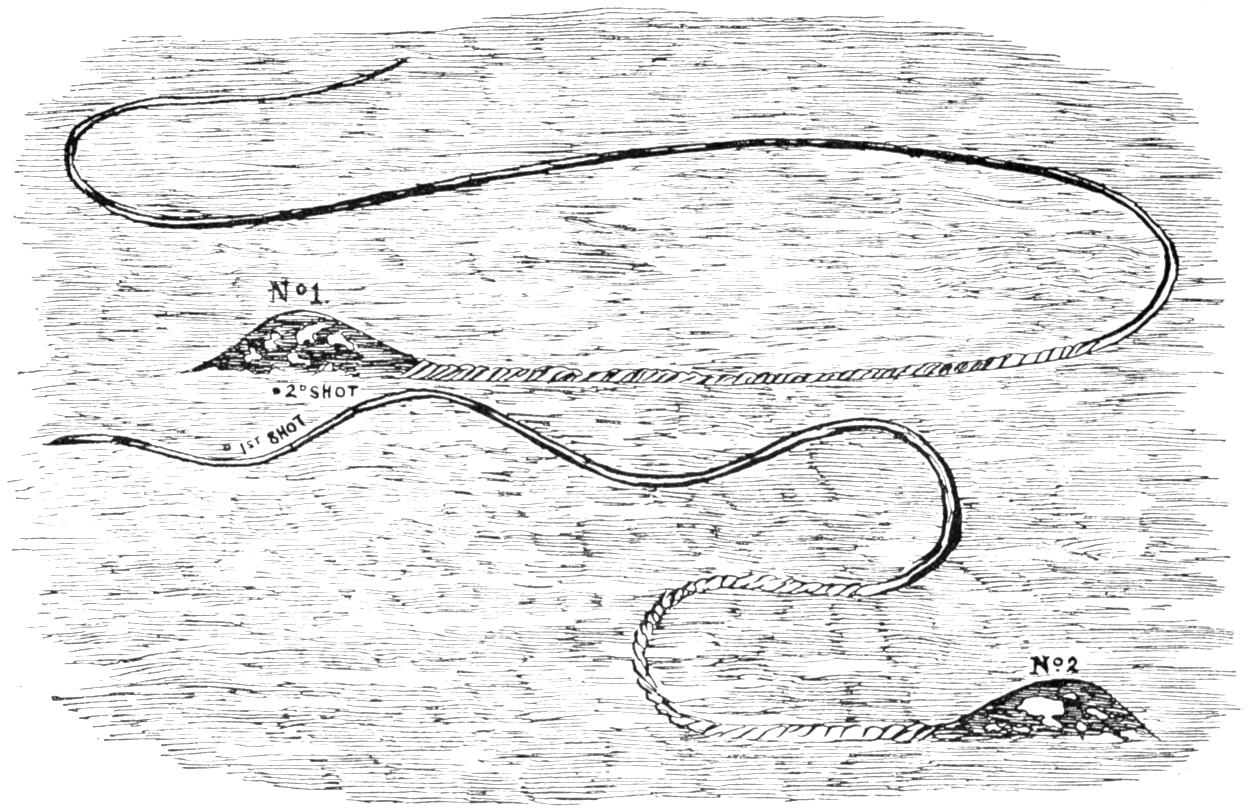
Fig. 37 and 38.—Two Positions of the sea-serpent as seen by Dr. Biccard.
“Cape Town, 11th. March, 1857.
“My dear Fairbridge,—According to your wish, I give you a short description of the Sea-Serpent seen by me and others opposite the old light-house at Green Point.”
“On Monday, the 16th. of February last, I went out to Green Point in the afternoon. At about 5 p. m., or a little after, I was called by Mr. Murray, the light-house-keeper, to “come and see a sea monster”. I proceeded to the light-house, and from thence I saw on the water, about 150 yards from the shore, the serpent, of which some details have already appeared in print. It was lying in the position shown in the accompanying sketch no. 1. I borrowed a rifle from Mr. Flail (Mr. Murray’s father-in-law), and fired at the animal. The ball fell short in front of it by about four yards, as shown in the sketch. The animal did not move, and I then fired a second shot, the ball striking about a foot and a half from it. The serpent, then apparently startled, moved from his position, straightened himself out, and went under water, evidently getting out of the way. He was invisible for about ten minutes, at the expiration of which interval he reappeared at about two hundred yards distance, and I should say about forty yards further off. He then came right on towards the place where I first saw him; but, before arriving there, my son, who had joined me, fired at the animal. Unluckily, the discharge broke the nipple of the rifle, and I was thus prevented from further firing. Upon reaching the place he had first occupied, the serpent formed himself into the position delineated in Sketch no. 2. He then stood right into the bay, and soon afterwards we lost sight of him altogether.”
“As I have stated, the distance the animal kept from shore was not more than 200 yards; its length was about 200 feet, but its thickness I cannot tell, the upper part of the body only being visible. The head could be seen but indistinctly, as he raised it at intervals, as shown in the sketch. I consider the protuberance to be the upper part of the head, but I could not discover the eyes, notwithstanding the short distance, and the telescope which was a pretty good one. The colour of the animal was a dark dull colour, except the head, which was maculated with large white spots. The weather at this time was very calm, with a light northwesterly breeze. Besides myself, the serpent was seen by Mr. Hall, Mr. Murray, Mrs. and Miss Biccard, my two sons, and my coachman, who all saw it distinctly.”
“Yours, &c., “Biccard.”
Nobody can help laughing when he sees this figure, representing something very much like a black buoy, with white streaks and spots, and glittering in the sun, having a long rope attached to it! It is, however, pretty well done for one who cannot draw. As in so many other instances the figures and the text complete each other. The animal appears here nearly in the same position as it did in the Harbour of Gloucester, in 1817. The same astonishing lateral flexibility! “It lay down, in turning, in the form of a staple or horse-shoe” we have learned on that occasion, and “in doing so it nearly touched its head with its tail”, “the tail and the head then appeared only to be a few yards one from another”, once “it lay down in the form of an S”, &c. Though the Doctor does not describe this position, his figures tell it us. As the second ball apparently startled it, it changed its position, straightened itself out, disappeared, and came up after ten minutes, about forty yards further off. It behaved in the same way in the Harbour of Gloucester. The length may again be somewhat exaggerated, though I do not think such to be the case. The white streaks and spots on the head may have been the shining reflexion of day or sunlight, the head being thoroughly wet, as the animal raised and dropped it at intervals, which made the water run down every time, but it is also very possible that the individual was really spotted on its head.
131.—1857, December 12.—(The Times of February 5, 1858; the Zoologist for 1858, p. 5989.).
“I beg to enclose you a copy of an extract from the meteorological journal kept by me on board the ship Castilian, on a voyage from Bombay to Liverpool. I have sent the original to the Board of Trade, for whom the observations have been made during my last voyage. I am glad to confirm a statement made by the commander of Her Majesty’s ship Daedalus, some years ago, as to the existence of such an animal as that described by him.—G. H. Harrington; 14 and 14¹⁄₂, South Castle Street, Liverpool, February 2, 1858.—
“Copy of an Extract from the Board of Trade Meteorological Journal, kept by Captain Harrington, of the ship Castilian, from Bombay to Liverpool.”
“Ship Castilian, December 12, 1857, north-east end of St. Helena, bearing north-west, distance 10 miles.”
“At 6.30 p. m., strong breezes and cloudy, ship sailing about twelve miles per hour. While myself and officers were standing on the lee-side of the poop, looking towards the island, we were startled by the sight of a huge marine animal, which reared its head out of the water within twenty yards of the ship, when it suddenly disappeared for about half a minute, and then made its appearance in the same manner again, showing us distinctly its neck and head about ten or twelve feet out of the water. Its head was shaped like a long nun-buoy, and I suppose the diameter to have been seven or eight feet in the largest part, with a kind of scroll, or tuft of loose skin, encircling it about two feet from the top; the water was discoloured for several hundred feet from its head, so much so that, on its first appearance, my impression was that the ship was in broken water, produced, as I supposed, by some vulcanic agency since the last time I passed the island; but the second appearance completely dispelled those fears, and assured us that it was a monster of extraordinary length, which appeared to be moving slowly towards the land. The ship was going too fast to enable us to reach the mast-head in time to form a correct estimate of its extreme length, but from what we saw from the deck we conclude that it must have been over two hundred feet long. The boatswain and several of the crew who observed it from the top-gallant forecastle, state that it was more than double the length of the ship, in which case it must have been five hundred feet. Be that as it may, I am convinced that it belonged to the serpent tribe; it was of a dark colour about the head, and was covered with several white spots. Having a press of canvas on the ship at the time, I was unable to round to without risk, and therefore was precluded from getting another sight of this leviathan of the deep.”
“George Henry Harrington, Commander.” “William Davies, Chief Officer.” “Edward Wheeler, Second Officer.”
The animal seen by Captain Harrington was no doubt a sea-serpent, of which at first sight, only the head and a small portion of the neck were exposed to the eyes of the spectators. Afterwards, when the animal moved slowly towards the land, its whole length must have been visible, and estimated at about two hundred feet. The head was seen in such a direction that it resembled a “nun-buoy”. The diameter of the head may have been six feet. At a moment that the animal contracted its neck, an annular fold was formed round the neck just behind the head, as may be seen in our sea-lions, and which led Captain Harrington to write “with a kind of scroll, or tuft of loose skin, encircling it about two feet from the top” of the head, i. e. somewhat behind the occiput. The discolouring of the water has of course nothing at all to do with the animal or its appearance.
Some days afterwards (Times of February 13, 1858; Zoologist for 1858, p. 5990) this document was followed by an account of Frederic Smith, who stated that on December 28th., 1848, commanding the ship Pekin, they saw an extraordinary creature, which, when harpooned, and hoisted on board, proved to be a piece of a gigantic sea-weed, twenty feet long. “So like a huge living monster did this appear, that, had circumstances prevented my sending a boat to it, I should certainly have believed I had seen the great sea-snake.” Captain Smith firmly believes that the animals of the Daedalus and of the Castilian were pieces of the same weed.
Hereupon, “An officer of H. M. S. Daedalus” wrote an apology in the Times of 16th. February, which we have inserted in no. 118. This letter was immediately followed in the same paper of the same date by the two following:
“Sir.—A letter appears in the Times of to-day signed “Frederic Smith” on the subject of the sea-serpent.
“The writer has this advantage over others who have reported the occasional appearance of what he fairly calls “this queer fish”—that he has handled as well as seen it. Still there would seem to be a considerable variety in the genus, for, while the specimen obtained by the Pekin in 1848 was 4 inches in diameter and 20 feet in length, that seen from the Circassian is described, if I remember rightly, in your paper of 4th. inst. as 10 feet or 11 feet in diameter, and upwards of 200 feet in length.”
“In this latter instance it was seen only, and but a passing sight; and testimony of this kind is just that which naturalists may be slow to receive as evidence of any new fact; nevertheless the practised vision of the Circassian’s commander should go for something, and as it would appear from the following letter that Captain Harrington is to be in town next week and ready to answer any questions, it might be worth the while of some of our philosophers to examine a little into the question of what Capt. Harrington and his officers really did see.”
“I have the honour to be, Sir, your most obedient servant
“Blackheath, February 12.” “W. A. B. Hamilton.”
For Circassian of course read Castilian.
“14, South Castle Street, Liverpool, February 8.
“Dear Sir,—I am in receipt of your favour of the 6th. of February, and should be glad if my communication to the Times might be instrumental in dispelling many doubts respecting the existence of such a monster as that described by myself and my officers.”
“I communicated it to Capt. Schomberg, R. N., of this place, in the course of conversation, who advised me by all means to send a copy of it to the Times.”
“Notwithstanding the assertions of men of science to the contrary I am now sure that such animals exist. I could no more be deceived than (as a seaman) I could mistake a porpoise for a whale. If it had been at a great distance it would have been different, but it was not above 20 yards from the ship.”
“I am of opinion that this animal makes its appearance at the surface at long intervals only. I am informed by Messrs. Lamport and Holt, shipowners of this place, that one of their captains reported a similar thing about two years ago, off the Island of St. Helena, but they took no further notice of it, supposing, as your friend seems to do, that he might have been deceived.”
“Twenty people, including Mrs. Harrington and my two officers, saw it as distinctly as I now see the gas light which I am writing by. I am well known in London, having commanded a steam transport during the Russian war belonging to the North of Europe Steam Navigation Company.”
“Captain Claxton, R. N., of the Priory, Battersea, is a personal friend of mine. I am also well known to Sir Colin Campbell, who is now in the East. My present ship is 1604 tons new measurement, and a new ship, of which I own a good part myself. There are, therefore, many reasons (in addition to my holding a first-class certificate in the mercantile marine) to hinder me from propagating a report which can do me no good, and, if untrue, do injury to science in the room of assisting it to elicit the truth in so important a matter as the discovery of the inhabitants of the deep.”
“I shall be in town for three or four days in the early part of next week. A letter addressed to me at the Jerusalem Coffee-House will meet with attention, and, if my limited time permit, I should be glad to have an interview with yourself, or any of your friends who might wish to have a verbal explanation in this matter.”
“I have the honour to remain, Sir, your obedient servant
“G. H. Harrington.” “To Rear-Admiral W. A. B. Hamilton”
This letter was again answered in a very witty way in the Times of Febr. 23, 1858; this however, will be inserted in our chapter on Explanations.
In the Zoologist for 1858, p. 6015, Mr. Alfred Charles Smith, an old acquaintance of ours (p. 299) now wrote the following remark:
“To one who firmly believes in the existence of some huge marine monster of the serpent-form, such as the Northmen love to descant upon (and I am not ashamed to own to such credulity, as I have already declared in my Notes on Norway (Zool. 3229)), the clear and minute account of Capt. Harrington, on the sea-monster which he and twenty people saw on the 12th of December last, off the coast of St. Helena, was exceedingly interesting; nor did the subsequent letter of Mr. F. Smith tend to shake my belief in the accuracy of Capt. Harrington’s statement, the particulars of the two alleged appearances being so very different. I am not, however, about to argue the point, the premises before us being far too unsatisfactory and vague to argue from. I merely write to express my hope that as you have admitted the first correspondence on the subject to the pages of the Zoologist, you will give both parties fair play, and insert the remaining letters, which appeared in the Times of February 16th and 23 respectively, copies of which I enclose, so that naturalists may have an opportunity of studying the case in all its bearings, before they form their conclusions.—Alfred Charles Smith; Yatesbury Rectory, Calne, March 5, 1858.”
Of course, it was but natural that also foreign newspapers should take great delight in this polemic. So we find in the Revue Britannique, of 1858, no 2, Febr. p. 496, an article full of erroneous statements:
“Amongst the grave questions of the day, we did not think of meeting again, in the newspapers, with the famous sea-serpent, the problematic existence of which seemed to be banished to the world of apocryphal, or at least antediluvian animals; but no! three new eye-witnesses declare to have seen it, and very well too. Now a Captain Smith, of Newcastle, writes that he is convinced that these witnesses have been illuded, as he himself was on the 28th. of December, 1848, when after believing to see through his telescope an extraordinary monster, and after lowering the great net of the ship, he drew in only a gigantic sea-weed of twenty feet in length, which really had the form, attributed to the fantastic reptile. This indirect refutation, however, does not discourage the Rear-Admiral Harrington (imagine, a Rear-Admiral!) who in a second article in the Times, repeats that he is sure of the fact, that he has seen the sea-serpent twenty fathoms from his ship, that he has recognized it, as if he would have recognized a whale on the side of a porpoise, that his wife, who was on board, has seen it with him, as had his two officers, in short, that he will come to London, as soon as he has terminated his business at Liverpool, and will furnish all evidences demanded by science and scepticism. If he had only brought home the animal’s tail or one of its fins!”
132.—1858, January 26.—The Illustrated London News of March 20, 1858, mentions:
“The following is a report made by Captain Suckling, of the ship Carnatic, of London, of a Sea Serpent seen by him between the Cape of Good Hope and St. Helena:—“On the 26th of January, in latitude 19°10′ S., long 10°6′ W., about 5 minutes after noon, my attention was called by Captain Shuttleworth, a passenger on board the Carnatic to a large spar sticking out of the water one end some thirty feet above the level of the sea. It appeared to me to be the lower mast of some wrecked vessel, and having the glass in my hand, with which I had been looking at an American vessel in sight, I examined it narrowly. It seemed to be passing very rapidly to the eastward, having altered its bearings several points in the course of a few minutes, when it suddenly disappeared, and came up shortly afterwards astern of the ship. It was seen by all those on deck at the time, and it is their opinion, as well as my own, that it was an enormous sea-serpent. The American ship A. B. Thompson from Bombay to London, was in company at the time—wind light and variable, with clear weather”.—We have not space for the Sketch obligingly sent with this account”.
The comparison with a spar, an unwrought spar, or spruce, a log of timber, etc., has been made more than once, as the reader will remember, and when we compare the figures, drawn by an officer of H. M. S. Plumper (fig. 31), and by Major Senior (fig. 46), we can easily imagine, that in this position the animal must have illuded the observers more than once. It is a pity that the sketch has not been published. How many interesting drawings have in this way got into the paper-basket!
In 1860 Mr. P. H. Gosse published his Romance of Natural History, First Series. The last chapter of this volume is entitled “the Great Unknown” and is entirely devoted to the Great Sea-Serpent. His manner of teaching Natural History to his readers was, as the able writer says himself, a poetical one. “In my many years’ wandering through the wide field of Natural History, I have always felt towards it something of a poet’s heart, though destitute of a poet’s genius”. I can recommend every zoologist and botanist to read his work in his leasure hours; I have read it with great interest and pleasure, increasing my knowledge, wandering with the writer from north to south and from east to west, from one pole to the other and from continents to the greatest depths of the ocean!
The sea-serpent’s question was such a favourite one of this romantic naturalist, that in his preface he wrote the following about it:
“If I may venture to point out one subject on which I have bestowed more than usual pains, and which I myself regard with more than common interest, it is that of the last chapter in this volume. An amount of evidence is adduced for the existence of the sub-mythic monster popularly known as “the sea-serpent”, such as has never been brought together before, and such as ought almost to set doubt at rest. But the cloudy uncertainty which has invested the very being of this creature; its home on the lone ocean; the fitful way in which it is seen and lost in its vast solitudes; its dimensions, vaguely gigantic; its dragon-like form; and the possibility of its association with beings considered to be lost in an obsolete antiquity;—all these are attributes which render it peculiarly precious to a romantic naturalist. I hope the statisticians will forgive me if they cannot see it with my spectacles.”
His chapter on the sea-serpent will also be read with great interest. But there are several facts which he seems not to have been able to explain. In describing the animal, seen near Cape Ann, 1817, he writes: “no appearance of mane was seen by any”, without giving any explanation; he has evidently underlined these words to draw the readers’ attention to this evidence, which is so quite contradictory to others, mentioned before and afterwards. On the same page (p. 284) when repeating the expression of one of the eye-witnesses “the mode of progression was like that of a caterpillar”, Mr. Gosse inserts his opinion in the following terms: “probably a looping or geometric caterpillar”. Now my readers will be at one with me, that the motion of the geometric caterpillar is the last with which that of the sea-serpent can be compared! The rapid motion of a common caterpillar of some butterfly, when tickled on its back part, will give the best idea.
The writer further tries to throw discredit on reports of Americans. He says (p. 287):
“Though the position and character of some of these witnesses add weight to their testimony, and seem to preclude the possibility of their being either deceived or deceivers, on a matter which depended on the use of their eyes, yet, owing to a habit prevalent in the United States, of supposing that there is somewhat of wit in gross exaggerations, or hoaxing inventions, we do naturally look with a lurking suspicion on American statements, when they describe unusual or disputed phenomena.”
I, however, am of the contrary opinion, and may turn his words in the following way: Though we generally and naturally look with a lurking suspicion on American statements, when they describe unusual or disputed phenomena, owing to a habit prevalent in the United States, of supposing that there is somewhat of wit in gross exaggerations, or hoaxing inventions, we are bound to admit all that is stated by such persons of unimpeachable character as Col. Perkins and others, whose testimonies we have inserted in our papers. They evidently communicated what they saw, without any exaggeration and without any tendency to crack a joke or to hoax.
Again p. 318 of his work, after having treated of only a few of the different reports, that had come in up to his days (1860) Mr. Gosse goes on in the following terms:
“A large mass of evidence has been accumulated; and I now set myself to examine it. In so doing, I shall eliminate from the inquiry all the testimony of Norwegian eye-witnesses, that obtained in Massachusetts in 1817, and various statements made by French and American captains since. Confining myself to English witnesses of known character and position, most of them being officers under the Crown, I have adduced the following testimonies.”
Here again I must point out that there is not a single reason to exclude all testimonies not coming from British navigators. With such reasoning Mr. Gosse makes himself ridiculous in the eyes of all reasonable persons of his own and of other nations! That it is wrong to exclude reports, because they are of Americans or Norwegians, the reader himself will be ready to admit, I think, after having read the different reports mentioned in this volume.
“The following testimonies” now, alluded to by Mr. Gosse, are:
“1. That of five British officers, who saw the animal at Halifax, N. S., in 1833” (no. 97).
“2. That of Captain M’Quhae and his officers, who saw it from the Daedalus in 1848,” (no. 118).
“3. That of Captain Beechy, who saw something similar from the Blossom” (no. 104).
“4. That of Mr. Morries Stirling, who saw it in a Norwegian fjord” (no. 113).
“5. That of Mr. Davidson, who saw it from the Royal Saxon, in 1829” (no. 93).
“6. That of Captain Steele and others, who saw it from the Barham, in 1852.” (See our Chapter on Would-Be Sea-Serpents, 1852, August 28).
“7. That of Captain Harrington and his officers, who saw it from the Castilian, 1857” (no. 131).
To our great astonishment Mr. Gosse also alludes to no. 6: That of Captain Steele, who saw it from the Barham, in 1852. Some pages before, Mr. Gosse himself throws great doubt on this report, believing that the animal seen by Captain Steele and his officers was a scabbard-fish, (the reader, I hope, will take the trouble to look up the report of 1852, August 28, in my Chapter on Would-Be Sea-Serpents, to read there again Mr. Gosse’s own opinion of this report), and now he uses this report amongst others to examine to which of the recognized classes of created beings this rover of the ocean can be referred!
Now Mr. Gosse passes to this inquiry: first, he asks, is it an animal at all? And he comes to the conclusions that this must be so, for else the being could not move with that astonishing rapidity. Further he examines the sea-weed hypothesis, the seal-hypothesis, &c., and winds up with: “my own confident persuasion, that there exists some oceanic animal of immense proportions, which has not yet been received into the category of scientific zoology; and my strong opinion, that it possesses close affinities with the fossil Enaliosauria of the lias.”
All the above-mentioned views will be considered in Chapter V.
To our great surprise we see that Mr. Newman, the editor of the Zoologist, who ever was a warm defender of the sea-serpent, and like Mr. Gosse firmly believed that there are still living Plesiosauri, is of another opinion in 1860. In this year, a very large riband fish was captured on the Bermuda Isles. Three descriptions of this fish appeared in the Zoologist (p. 6934, p. 6986, p. 6989), the last by Mr. Newman himself, who, thinking that it was a new species, gave it the name of Regalecus Jonesii. The second description was by Mr. Jones, the naturalist on the Bermudas, at whose deposal the fish was placed by Mr. Trimingham, the captor. Mr. Jones, after his description, points out some striking peculiarities, which this riband-fish and the sea-serpent seen by captain M’Quhae, had in common, and concludes that a part of the reports of the great sea-serpent must have been caused by the appearance of riband fishes. Now, Mr. Newman, after the description of his new species Regalecus Jonesii, as I have already said, seems to waver in his opinion, for he adds:
“In reference to the last question mooted by Mr. Jones, the similarity of Regalecus Jonesii to Capt. M’Quhae’s sea-serpent, I do not consider myself competent to express an opinion. I am quite willing for the present to allow every sea-serpent to hold on its own course; hereafter a better opportunity may be afforded on comparing and arranging the conflicting evidence already published in the “Zoologist.”
133, 134.—1861? August.—(Zoologist, 1862, p. 7850).—
“On a Sunday afternoon, in the middle of August, above a hundred persons, at that time in and about the hotel, were called on to observe an extraordinary appearance in the sea, at no great distance from the shore. Large shoals of small fish were rushing landwards in great commotion, leaping from the water, crowding on each other, and showing all the common symptoms of flight from the pursuit of some wicked enemy. I had already more than once remarked this appearance from the rocks, but in a minor degree; and on these occasions I could always distinguish the shark, whose ravages among the “manhaidens” was the cause of such alarm. But the particular case in question was far different from those. The pursuer of the fugiting shoals soon became visible; and that it was a huge marine monster, stretching to a length quite beyond the dimensions of an ordinary fish, was evident to all observers. No one, in short, had any doubt as to its being the sea-serpent, or one of the species to which the animal or animals so frequently before seen belonged. The distance at which this one was, for ten minutes or a quarter of an hour, visible, made it impossible to give a description of its apparent dimensions so accurate as to carry conviction to the sceptical. For us who witnessed it, it was enough to be convinced that the thing was a reality. But one of the spectators, Dr. Amos Binney, a gentleman of scientific attainments, drew up a minute account of it, which is deposited in the archives of one of the Philosophical Societies of Boston. I was and am quite satisfied that on this occasion I had a partial and indistinct but positive view of this celebrated nondescript; but had the least doubt rested on my mind it would have been entirely removed by the event of the day following the one just recorded. On that day, a little before noon, my wife was sitting, as was her wont, reading on the upper piazza of the hotel. She was alone. The gentlemen, including myself and my son, were, as usual, absent at Boston, and the ladies were scattered in various directions. She was startled by a cry from the house of “The sea-serpent! the sea-serpent!” But this had been so frequent, by the way of joke, since the event of the preceding day, and was so like “The wolf! the wolf!” of the fable, that it did not attract her particular attention for a moment or two, until she observed two women belonging to the family of the hotel keeper running along the piazza towards the corner nearest the sea, with wonder in their eyes, and the cry of “The serpent! the serpent! he is turning! he is turning!” spontaneously bursting from their lips. Then my wife did fix her looks in the direction they ran; and sure enough she saw, apparently quite close beyond the line formed by the rising ground above the rocks, a huge serpent, gliding gracefully through the waves, having evidently performed the action of turning round. In an instant it was in a straight line, moving rapidly on; and after coasting for a couple of minutes the north west front of the hotel, and (as accurately as the astonished observer could calculate) looking as it stretched at full-length about the length of the piazza,—that is to say, about ninety feet,—it sank quietly beneath the surface, and was seen no more. The person who was thus so lucky as to get this unobstructed view is one so little liable to be led astray by any imaginary impulse, that I may reckon on her statement with entirely as much confidence as if my own eyes had demonstrated its truth.”—Grattan’s Civilized America, p. 39.—
Mr. Newman, the editor of the Zoologist, ought to have mentioned the writer of the article, the date of it and the locality where the appearance took place. It was most probably Nahant, the well known watering place near Lynn, Mass. I have had no opportunity to consult Grattan’s Civilized America, therefore I have placed the note of interrogation after the above-mentioned year.
In this report only a few words are devoted to the description of the animal, yet the description itself is given as well as possible by the lady who saw it from the upper piazza of the hotel.
135.—1863, May 16th.—(Zoologist, 1863, p. 8727).
“The following is a copy of a letter from an officer of the African mail steamer Athenian, addressed to a gentleman in this town:—“African Royal Mail Screw Steamer Athenian, Cape Palmas, May, 16, 1863.—My dear Sir,—All doubts may now be set at rest about the great sea-serpent. On the 6th. of May the African Royal Mail Steam Ship Athenian on her passage from Teneriffe to Bathurst, fell in with one. At about 7 a. m. John Chapple, quartermaster, at the wheel, saw something floating towards the ship. He called the attention of the Rev. Mr. Smith and another passenger, who were on deck at the time, to it. On nearing the steamer it was discovered to be a large snake about 100 feet long, of a dark brown colour, head and tail out of water, the body slightly under. On its head was something like a mane or sea-weed. The body was about the size of our mainmast. You are at liberty to publish this.”
The reader will observe that this too is a very insignificant description, but it mentions one of the very few cases that the tail of the animal was visible above the surface of the water.
The same report was published in the Illustrated London News of 1863, June, 13.—
136.—1871.—(G. Verschuur, Eene reis om de wereld in vier honderd tachtig dagen).—After an appearance of a would-be sea-serpent on board the Grenada, which caused a dispute between those who saw it and those who were not so fortunate,
“the second officer, who joined in the quarrel, declared to have seen in 1871, near the coast of Australia a sea-serpent, which was several meters in length.”
137, 138, 139, 140.—1872, August 20th., 21st., 23d. and 24th.—In the Zoologist of May 1873, p. 3517, the following statements of high respectable gentlemen are published.
“Appearance of an Animal, believed to be that which is called the Norwegian Sea-Serpent, on the Western Coast of Scotland, in August, 1872. By the Rev. John Macrae, Minister of Glenelg, Invernesshire, and the Rev. David Twopeny, Vicar of Stockbury, Kent.”
“On the 20th. of August, 1872, we started from Glenelg in a small cutter, “the Leda”, for an excursion to Lochourn. Our party consisted, besides ourselves, of two ladies, F. and K., a gentleman G. B., and a Highland lad. Our course lay down the Sound of Sleat, which on that side divides the Isle of Skye from the mainland, the average of breadth of the Channel in that part being two miles. It was calm and sunshiny, not a breath of air, and the sea perfectly smooth. As we were getting the cutter along with oars we perceived a dark mass about two hundred yards astern of us, to the north. While we were looking at it with our glasses (we had three on board) another similar black lump rose to the left of the first, leaving an interval between; then an other and an other followed, all in regular order. We did not doubt its being one living creature: it moved slowly across our wake, and disappeared. Presently the first mass, which was evidently the head, reappeared, and was followed by the rising of the other black lumps, as before. Sometimes three appeared, sometimes four, five, or six, and then sank again. When they rose, the head appeared first, if it had been down, and the lumps rose after it in regular order, beginning always with that, next the head, and rising gently; but when they sank, they sank all together, rather abruptly, sometimes leaving the head visible. It gave the impression of a creature crooking up its back to sun itself. There was no appearance of undulation: when the lumps sank, other lumps did not rise in the intervals between them. The greatest number we counted was seven, making eight with the head, as shown in the sketch no. 1. The parts were separated from each other by intervals of about their own length, the head being rather smaller and flatter than the rest, and the nose being very slightly visible above the water; but we did not see the head raised above the surface either this or the next day, nor could we see the eye. We had no means of measuring the length with any accuracy, but taking the distance from the centre of one lump to the centre of the next to be six feet, and it could scarcely be less, the whole length of the portion visible, including the intervals submerged, would be forty-five feet.”
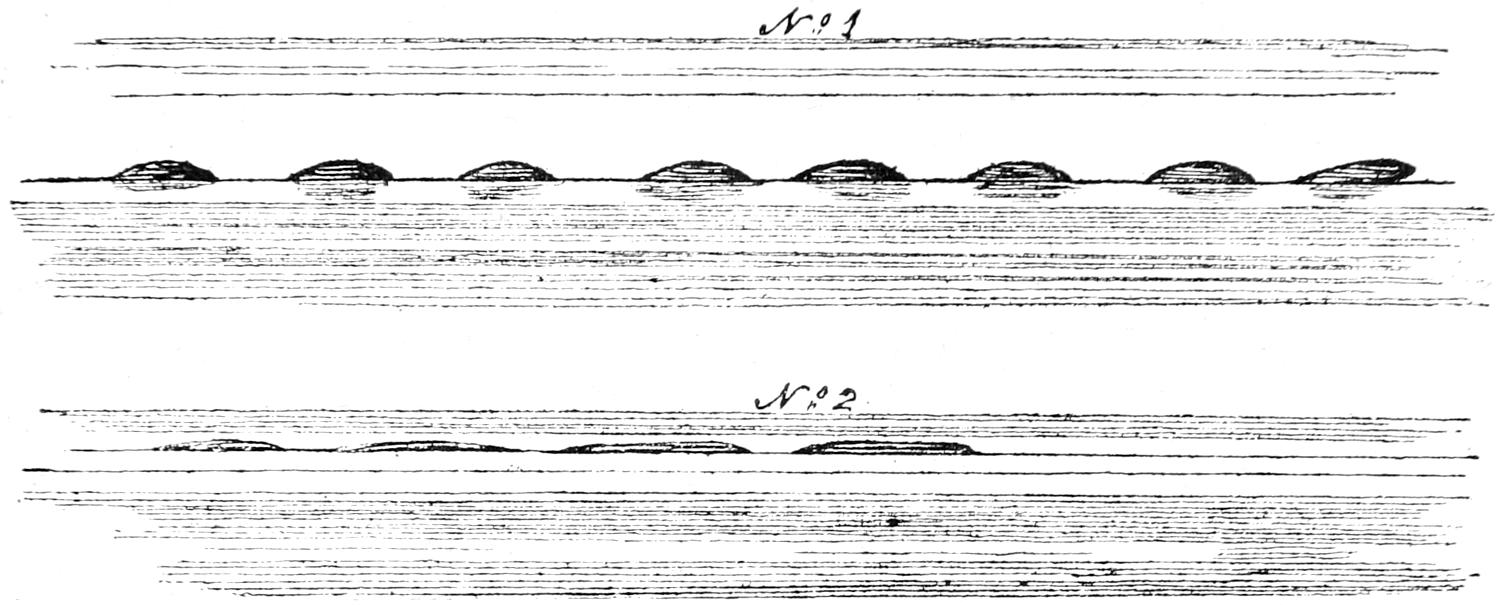
Fig. 39 and 40.—Two positions of the Sea-Serpent as seen by the Rev. John Macrae and the Rev. Twopeny.
“Presently, as we were watching the creature, it began to approach us rapidly, causing a great agitation in the sea. Nearly the whole of the body, if not all of it, had now disappeared, and the head advanced at a great rate in the midst of a shower of fine spray, which was evidently raised in some way by the quick movement of the animal—it did not appear how,—and not by spouting. F. was alarmed and retreated to the cabin, crying out that the creature was coming down upon us. When within about a hundred yards of us it sank and moved away in the direction of Skye, just under the surface of the water, for we could trace its course by the waves it raised on the still sea to the distance of a mile or more. After this it continued at intervals to show itself, careering about at a distance, as long as we were in that part of the Sound, the head and a small part only of the body being visible on the surface; but we did not again on that day see it so near nor so well as at first. At one time F. and K. and G. B. saw a fin striking up at a little distance back from the head, but neither of us were then observing.”
“On our return the next day we were again becalmed on the north side of the opening of Lochourn, where it is about three miles wide, the day warm and sunshiny as before. As we were dragging slowly along in the afternoon the creature again appeared over towards the south side, at a greater distance than we saw it the first day. It now showed itself in three or four rather long lines, as in the sketch No 2, and looked considerably longer than it did the day before: as nearly as we could compute, it looked at least sixty feet in length. Soon it began careering about, showing but a small part of itself, as on the day before, and appeared to be going up Lochourn. Later in the afternoon, when we were still becalmed in the mouth of Lochourn, and by using the oars had nearly reached the Island of Sandaig, it came rushing past us about a hundred and fifty yards to the south, on its return from Lochourn. It went with great rapidity, its black head only being visible through the clear sea, followed by a long trail of agitated water. As it shot along, the noise of its rush through the water could be distinctly heard on board. There were no organs of motion to be seen, nor was there any shower of spray as on the day before, but nearly such a commotion in the sea as its quick passage might be expected to make. Its progress was equable and smooth, like that of a log towed rapidly. For the rest of the day, as we worked our way home northwards through the Sound of Sleat, it was occasionally within sight of us until night fall, rushing about at a distance, as before, and showing only its head and a small part of its body on the surface. It seemed on each day to keep about us, and as we were always then rowing, we were inclined to think it might perhaps be attracted by the measured sound of the oars. Its only exit in this direction to the north was by the narrow Strait of Kylerhea, dividing Skye from the mainland, and only a third of a mile wide, and we left our boat, wondering whether the strange creature had gone that way or turned back again to the south.”—
“We have only to add to this narration of what we saw ourselves the following instances of its being seen by other people, of the correctness of which we have no doubt:
“The ferrymen on each side of Kylerhea saw it pass rapidly through on the evening of the 21st., and heard the rush of the water: they were surprised, and thought it might be a shoal of porpoises, but could not comprehend their going so quickly.”
“Finlay Macrae, of Bundaloch, in the parish of Kintail, was within the mouth of Lochourn on the 21st., with other men in his boat, and saw the creature at about the distance of one hundred and fifty yards.”
“Two days after we saw it, Alexander Macmillan, boat-builder at Dornie, was fishing in a boat in the entrance of Lochduich, halfway between Druidag and Castledonan, when he saw the animal near enough to hear the noise and see the ripple it made in rushing along in the sea. He says, that what seemed its head was followed by four or more lumps, or “half-rounds”, as he calls them, and that they sometimes rose and sometimes sank all together. He estimated its length as not less than sixty and eighty feet. He saw it also in two subsequent days in Lochduich. On all these occasions his brother Farquhar was with him in the boat, and they were both much alarmed and pulled to the shore in great haste.”
“A lady at Duisdale, in Skye, a place overlooking the part of the Sound which is opposite the opening of Lochourn said that she was looking out for the glass when she saw a strange object on the sea which appeared like eight seals in a row. This was just about the time we saw it.”
“We were also informed that about the same time it was seen from the island of Eigg, between Eigg and the mainland about twenty miles to the south-west of the opening of Lochourn.”
“We have not permission to mention the names in these two last instances.”
“John Macrae” “David Twopeny”
“P. S. The writers of the above account scarcely expect the public to believe in the existence of the creature which they saw. Rather than that, they look for the disbelief and ridicule to which the subject always gives rise, partly on account of the animal having been pronounced to be a snake, without any sufficient evidence, but principally because of the exaggerations and fables with which the whole subject is beset. Nevertheless they consider themselves bound to leave a record of what they saw, in order that naturalists may receive it as a piece of evidence, or not, according to what they think it is worth. The animal will very probably turn up on these coasts again, and it will be always in that “dead season”, so convenient to editors of newspapers, for it is never seen but in the still warm days of summer or early autumn. There is a considerable probability that it has visited the same coasts before. In the summer of 1871 some large creature was seen for some time rushing about in Lochduich, but it did not show itself sufficiently for any one to ascertain what it was. Also some years back a well-known gentleman of the west coast, now living, was crossing the Sound of Mull, from Mull to the mainland, “on a very calm afternoon, when”, as he writes, “our attention was attracted to a monster which had come to the surface not more than fifty yards to our boat. It rose without causing the slightest disturbance of the sea, or making the slightest noise, and floated for some time on the surface, but without exhibiting its head or tail, showing only the ridge of the back, which was not that of a whale, or any other sea-animal that I had ever seen. The back appeared sharp and ridgelike, and in colour very dark, indeed black, or almost so. It rested quietly for a few minutes, and then dropped quietly down into the deep, without causing the slightest agitation. I should say that above forty feet of it, certainly not less, appeared on the surface.” It should be noticed that the inhabitants of that western coast are quite familiar with the appearance of whales, seals and porpoises, and when they see them, they recognize them at once. Whether the creature which pursued Mr. Maclean’s boat off the Island of Coll in 1808, and of which there is an account in the Transactions of the Wernerian Society (Vol. I, p. 442), was one of these Norwegian animals, it is not easy to say. Survivors who knew Mr. Maclean say that he could quite be relied upon for truth.”
“The public are not likely to believe in the creature till it is caught, and that does not seem likely to happen just yet, for a variety of reasons,—one reason being that it has, from all the accounts given of it, the power of moving very rapidly. On the 20th., while we were becalmed in the mouth of Lochourn, a steam launch slowly passed us, and, as we watched it, we reckoned its rate at five or six miles an hour. When the animal rushed past us on the next day at about the same distance, and when we were again becalmed nearly in the same place, we agreed that it went quite twice as fast as the steamer, and we thought that its rate could not be less then ten or twelve miles an hour. It might be shot but would probably sink. There are three accounts of its being shot at in Norway; in one instance it sank, and in the other two it pursued the boats, which were near the shore, but disappeared when it found itself getting into shallow water.”
“It should be mentioned that when we saw this creature and made our sketches of it, we had never seen Pontoppidan’s “Natural History”, or his print of the Norwegian sea-serpent, which has a most striking resemblance to the first of our own sketches. Considering the great body of reasonable Norwegian evidence, extending through a number of years, which remains after setting aside fables and exaggerations, it seems surprising that no naturalist of that country has ever applied himself to make out something about the animal. In the meantime, as the public will most probably be dubious about quickly giving credit to our account, the following explanations are open to them, all of which have been proposed to me, viz:—porpoises, lumps of sea-weed, empty herring-barrels, bladders, logs of wood, waves of the sea, and inflated pig-skins; but as all these theories present to our minds greater difficulties than the existence of the animal itself, we feel obliged to decline them.”
“D. Twopeny.”
We observe at a glance that the figures show nearly exactly the same outlines as the figure of Mr. Benstrup (fig. 24). The reappearing and disappearing of the animal is well pictured and evidently recalls to my readers’ mind the “sinking down like a rock” of American reports. The reader will observe that the appearance took place nearly in the same locality as that of 1808, June (no. 31, 32). Moreover we need not add anything to the unvarnished reports. As to the appearances of the large creatures in 1871 and “some years back”, communicated in the post-scriptum, their descriptions, are too vague for me to see in them sea-serpents.—The fin striking up at a little distance from the head, of course, was one of the animal’s fore-flappers.—
Mr. Edward Newman, the Editor of the Zoologist, who first was a firm believer in the sea-serpent, and expressed his opinion that it might be a still living Plesiosaurus or an animal closely allied to it, and who afterwards evidently wavered in his opinion, after his description of the Regalecus Jonesii, a ribband-fish, (see above p. 319), now suddenly adds to the evidences of the Rev. John Macrae and the Rev. David Twopeny, the following note:
“I have long since expressed my firm conviction that there exists a large marine animal unknown to us naturalists; I maintain this belief as firmly as ever. I totally reject the evidence of published representations; but do not allow their imaginary figures to interfere with a firm conviction, although I admit their tendency is always in that direction: the figures and exaggerated descriptions of believers are far more damaging to a faith in such an animal than the arguments, the ridicule on the explanatory guesses of unbelievers. The guess that a little seal was magnified by Captain M’Quhae into a monster several hundred feet in length is simply incredible: we smile at the conceit, and that is all.”
So he is again converted into a firm believer, but he does not now express any supposition as to the kind of animal that it may be.
141, 142, 143.—1873, November 16?, 17?, 18?—I have not been able to get a sight at the Times of Nov. 20th. of this year, but I have found an extract from an account in it, in the Zoologist of December of that year, p. 3804, running as follows:
“Mr. Joass, an eye-witness, writing in the Times of November 20, says, “the ears seemed to be diaphanous and nearly semicircular flaps or valves over-arching the nostrils, which were in front. The cavity of the eye appeared to be considerably further back, and a peculiar glimmer in it, along with the sudden disappearance of the creature, presented, indeed, the only signs of its vitality, as far as I could see, while I watched it for half an hour, apparently drifting with the rising tide, but always keeping about the same distance off shore ..... Dr. Soutar and I are more or less familiar with the forms of the porpoise, seal, halibut, conger, and even shark, both in and out of the water.”
In the same journal and on the same page we read the following “Extract from a letter from Mr. Joass, of Golspie, to the Rev. John Macrae, of Glenelg:”
“On Thuesday afternoon last, lady Florence Leveson Gower and the Hon. Mrs. Coke, driving near the sea, about eight miles east from Dunrobin, saw what seemed to them a large and long marine animal; on Wednesday morning Dr. Soutar, of Golspie, saw a large creature rushing about in the sea. about fifty yards from shore: it frequently raised what seemed a neck seven feet out of the water, and from the length of troubled water behind it appeared to be fifty or sixty feet long. He said to his family on meeting them at breakfast, “If I believed in sea-serpents, I should say I had seen one this morning”. I may mention that this gentleman is a most trustworthy observer and cautious man. On Thursday I saw what seemed some drift sea-weed. When your report was published Dr. Tayler, the author of “Thanatophidia of India” was at the castle; I asked him what he thought of the matter, and he said he was quite prepared to believe in such a monster. Mr. Vernon Harcourt told me that he was in a small yacht off Glenelg on the evening of the day mentioned in your report, and about six miles from the locality and that he and his crew saw what seemed a great moving mass, which, but for some engagement or the lateness of the hour, they would have examined.”
It is evident that the greater part of the account of the Times is not reprinted in the Zoologist.
The above given descriptions are poor, giving no approximative measurements of the diameter of the neck, &c.
This is the only appearance of the animal on the eastern coasts of Great Britain!
Again I am obliged to express my astonishment that Mr. Newman does not mention any date, neither of the appearances, nor of Mr. Joass’ letter.
144.—1875, July 8.—In the Illustrated London News of November 20th., 1875, appeared the following engraving and account:
“Our Engraving is an exact representation of a sketch we have received, with the following letter from the Rev. E. L. Penny, M. A., Chaplain to H. M. S. London, at Zanzibar, Oct. 21:—
“I send you herewith a sketch of the great sea-serpent attacking a spermwhale, which I have made from the descriptions of the captain and crew of the barque Pauline, and they have, after careful examination, pronounced it to be correct. The whale should have been placed deeper in the water, but I should then have been unable to depict so clearly the manner in which the animal was attacked.”
“Captain Drevar, of the barque Pauline, bound with coals for her Majesty’s naval stores at Zanzibar, when in lat. 5 deg. 13 min. S., long. 35 deg. W., on July 8 last, observed three very large sperm whales, and one of them was gripped round the body, with two turns, by what appeared to be a huge serpent. Its back was of a darkish brown and its belly white, with an immense head and mouth, the latter always open; the head and tail had a length beyond the coils about 30 ft.; its girth was about 8 ft. or 9 ft. Using its extremities as levers, the serpent whirled its victim round and round for about fifteen minutes, and then suddenly dragged the whale down to the bottom, head first. The other two whales, after attempting to release their companion, swam away upon its descent, exhibiting signs of the greatest terror.”
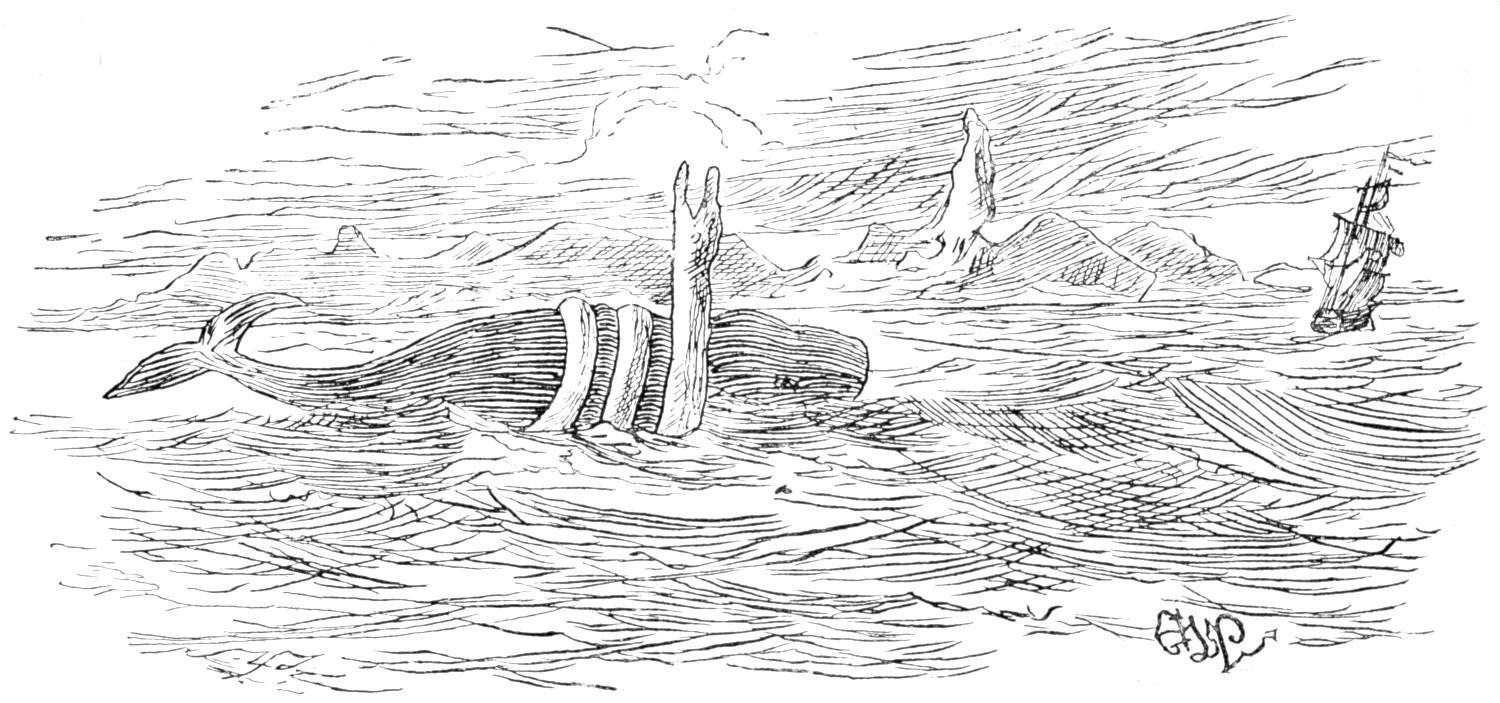
Fig. 41.—The so-called “Fight between a sea-serpent and a spermwhale”.
“On July 13 this or another sea-serpent was again seen, about 200 yards off the stern of the vessel, shooting itself along the surface, 40 ft. of its body being out of the water at a time. Again, on the same day, it was seen once more, with its body standing quite perpendicular out of the water to the height of 60 ft. This time it seemed as if determined to attack the vessel, and the crew and officers armed themselves with axes for self defence.”
“Captain Drevar is a singularly able and observant man, and those of the crew and officers with whom I conversed were singularly intelligent; nor did any of their descriptions vary from one another in the least—there were no discrepancies.”
This report translated into German appeared in the Illustrirte Zeitung of Dec. 4th. 1875.
We observe that the so-called fight between the sea-serpent and the spermwhale took place in 5° 13′ S. lat., 35° W. long, i. e. near Cape San Roque (Eastern coast of Brazil), and that the barque Pauline on October 21 of that year was at Zanzibar, laden with coals. The reports were evidently copied from the Captain’s journal or log-book, and the figure was drawn by the Rev. E. L. Penny, at Zanzibar. The barque did not return directly to England, but steered for Akyab (British Burmah); from where she sailed home, for we read in the Illustrated London News of January 13, 1877 (p. 35, third column):
“The great sea-serpent will not be ignored. He has now appeared, by affidavit, in a police court. The captain and crew of a vessel called the Pauline which has arrived in the Mersey from Akyab, report that in July, 1875, off Cape San Roque, on the north-east coast of Brazil, they saw the great sea-serpent. On Thuesday, the captain, whose name is Drevar, appeared before the stipendiary magistrate of Liverpool, Mr. Raffles, and expressed a wish, on his own behalf and that of his crew, to make a declaration affirming the truth of their statements respecting the serpent. Mr. Raffles desired Captain Drevar to prepare a written declaration and bring it before him. This captain Drevar did, on Wednesday, accompanied by a number of his crew. The declaration is to the effect that he and others on board the Pauline, on July 8, 1875, while in latitude 5 deg. 13 min. S., longitude 35 deg. W., observed three large spermwhales, one of which was gripped round the body with two turns of what appeared to be a huge serpent. The head and tail appeared to have a length, beyond the coils, of about thirty feet, and the girth seemed to be eight or nine feet. The serpent whirled its victim round and round for about fifteen minutes, and then suddenly dragged the whale to the bottom head first. Again, on July 13, a similar serpent was seen about 200 yards off the Pauline, shooting itself along the surface, its head and neck being several feet out of the water. Subsequently the head of the animal was shot sixty feet into the air. The declaration was signed by Captain Drevar, Horatio Thompson (chief officer), John Henderson Landells (second officer), William Lewarn (steward) and Owen Baker (seaman).
1 am so fortunate as to be able to communicate the account as it appeared in the newspapers of the 10th. and 11th. of January, 1877. I have found it in Andrew Wilson’s Leisure Time Studies:
“The story of the mate and crew of the barque Pauline, of London, said to have arrived in port from a twenty months’ voyage to Akyab,—about having seen “a sea-serpent” while on a voyage in the Indian seas, was declared to on oath before Mr. Raffles, the stipendiary magistrate, at the Liverpool Police-Court. The affidavit was made in consequence of the doubtfullness with which anything about the “sea-serpent” has hitherto been received; and to show the genuine character of the story it has been placed judicially on record. The following is a copy of the declaration, which will be regarded as unprecedented in its way:—
“Borough of Liverpool, in the County Palatine of Lancaster, to wit.
“We, the undersigned, captain, officers, and crew of the barque Pauline (of London), of Liverpool, in the county of Lancaster, in the United Kingdom of Great Britain and Ireland, do solemnly and sincerely declare that on July 8, 1875, in lat. 5° 13′ S., long 35° W., we observed three large sperm whales, and one of them was gripped round the body with two turns of what appeared to be a huge serpent. The head and tail appeared to have a length beyond the coils of about thirty feet, and its girth eight or nine feet. The serpent whirled its victim round and round for about fifteen minutes, and then suddenly dragged the whale to the bottom, head first”.
George Drevar, Master. Horatio Thompson. John Henderson Landells. Owen Baker. Wm. Lewarn.
Again, on July 13, a similar serpent was seen about two hundred yards off, shooting itself along the surface, the head and neck being out of the water several feet. This was seen only by the captain and one ordinary seaman, whose signatures are affixed.”
George Drevar, Master. Owen Baker.
“A few moments after it was seen elevated some sixty feet perpendicularly in the air by the chief officer and the following able seamen, whose signatures are also affixed.”
Horatio Thompson. William Lewarn. Owen Baker.
“And we make this solemn declaration conscientiously, believing the same to be true, and by virtue of the provisions of an Act made and passed in the sixth year of the reign of his late Majesty, entitled “An Act to repeal an Act of the present Session of Parliament, entitled an Act for the more effectual abolition of oath and affirmations, taken and made in various departments of the State, and to substitute declarations in lieu thereof, and for the more entire suppression of voluntary and extra-judicial oaths and affidavits, and to make other provisions for the abolition of unnecessary oaths.” Severally declared and subscribed at Liverpool aforesaid the tenth day of January, one thousand eight hundred and seventy-seven.”
George Drevar, Master. William Lewarn, Steward. Horatio Thompson, Chief Officer. J. H. Landells, Second Officer. Owen Baker.
“Severally declared and subscribed at Liverpool aforesaid, the tenth day of January, one thousand eight hundred and seventy-seven, before T. S. Raffles, J. P. for Liverpool.”
In Nature of February 10th., 1881, we read that “Captain Drevar has circulated a printed account of the conflict which he witnessed, and of the subsequent appearance of the animal rearing its long neck out of the water.”
Evidently this circular was a letter addressed by Captain Drevar, when in Chittagong (Bengal), to the Editor of the Calcutta Englishman, in January, 1876. I have had no opportunity to consult this paper, but I have found an extract from it in the Graphic of January 27, 1877, and a partial translation of it in the Illustrirte Zeitung of Febr. 3, 1877. What I have found in the Graphic runs as follows:
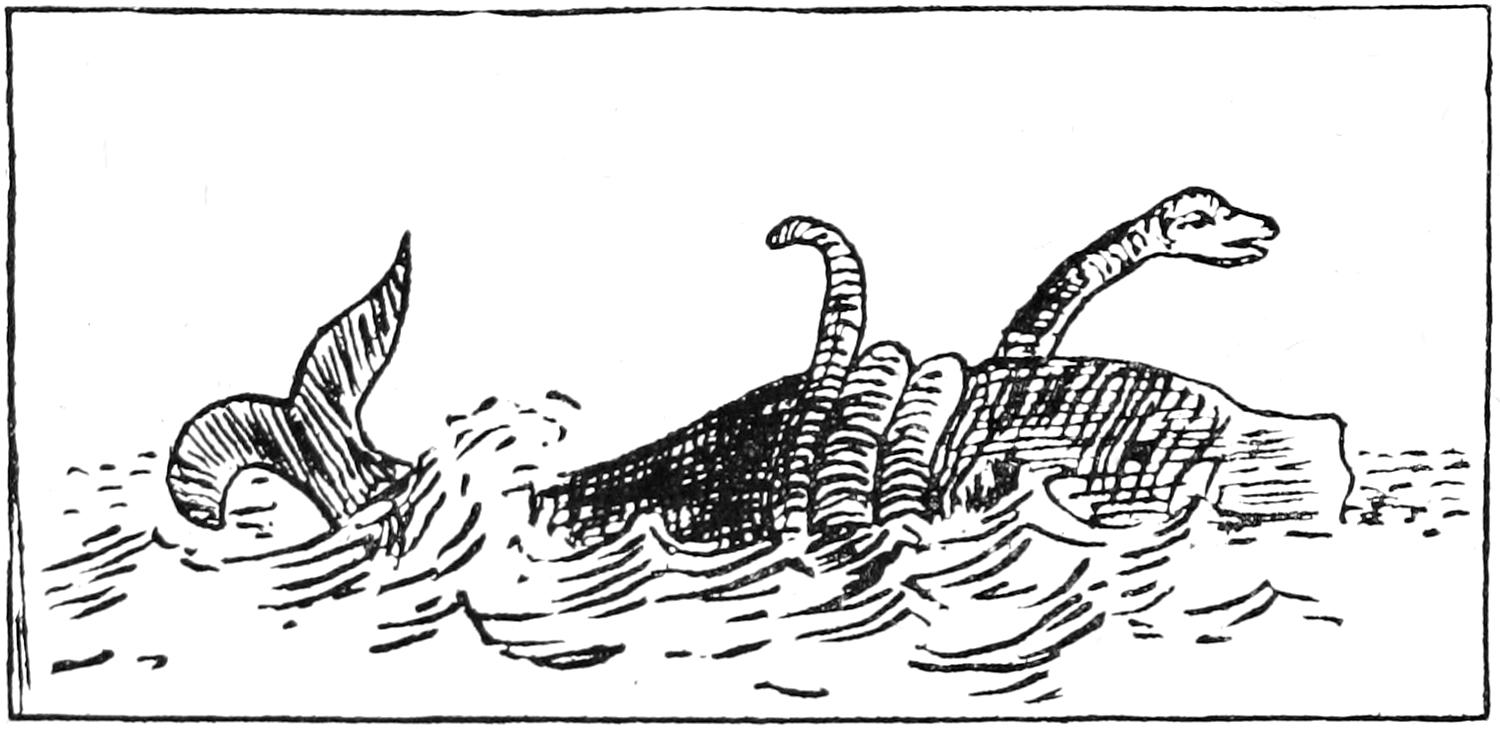
Fig. 42.—Another representation of the so-called “Fight between a sea-serpent and a sperm-whale”.
“Captain George Drevar, master of the barque Pauline, has furnished us a sketch of the Sea-Serpent (from which the annexed engraving is taken), which he encountered off the coast of South America. The occurrence took place on the 8th. July, 1875, at eleven A. M., the Pauline being at that time off Cape San Roque, lat. 5° 13′ N., long 35° W., the north-east coast of Brazil being twenty miles distant. Captain Drevar says:—The weather fine and clear, wind and sea-moderate. Observed some black spots on the water, and a whitish pillar, about thirty feet high above them. At the first glace I took all to be breakers as the sea was splashing up fountain-like about them, and the pillar a pinnacle rock, bleached with the sun; but the pillar fell with a splash, and a similar one rose. They rose and fell alternately in quick succession, and good glasses showed me it was a monstrous sea-serpent coiled twice round a large sperm-whale. The head and tail parts, each about thirty feet long were acting as levers, twisting itself and victim round with great velocity. They sank out of sight about every two minutes, coming to the surface still revolving; and the struggles of the whale and two other whales, that were near, frantic with excitement, made the sea in their vicinity like a boiling cauldron; and a loud and confused noise was distinctly heard. This strange occurrence last some fifteen minutes, and finished with the tail portion of the whale being elevated straight in the air, then waving backwards and forwards, and lashing the water furiously in the last death struggle, when the body disappeared from our view, going down head foremost to the bottom, where no doubt it was gorged at the serpent’s leisure; and that monster of monsters may have been many months in a state of coma, digesting the huge mouthful. Then two of the largest sperm-whales that I have ever seen moved slowly thence towards the vessel, their bodies more than usually elevated out of water, and not spouting or making the least noise, but seeming quite paralized with fear; indeed, a cold shiver went through my own frame on beholding the last agonizing struggle of the poor whale that had seemed as helpless in the coils of the vicious monster as a small bird in the talons of a hawk. Allowing for two coils round the whale, I think the serpent was about 160 or 170 feet long, and 7 or 8 feet in girth. It was in colour much like a conger-eel; and the head, from the mouth being always open, appeared the largest part of its body. I wrote thus far, little thinking I would ever see the serpent again, but at seven A. M., July 13, in the same latitude, and some eighty miles east of San Roque I was astonished to see the same or a similar monster. It was throwing its head and about 40 feet of its body in a horizontal position out of water as it passed onwards by the stern of our vessel.”
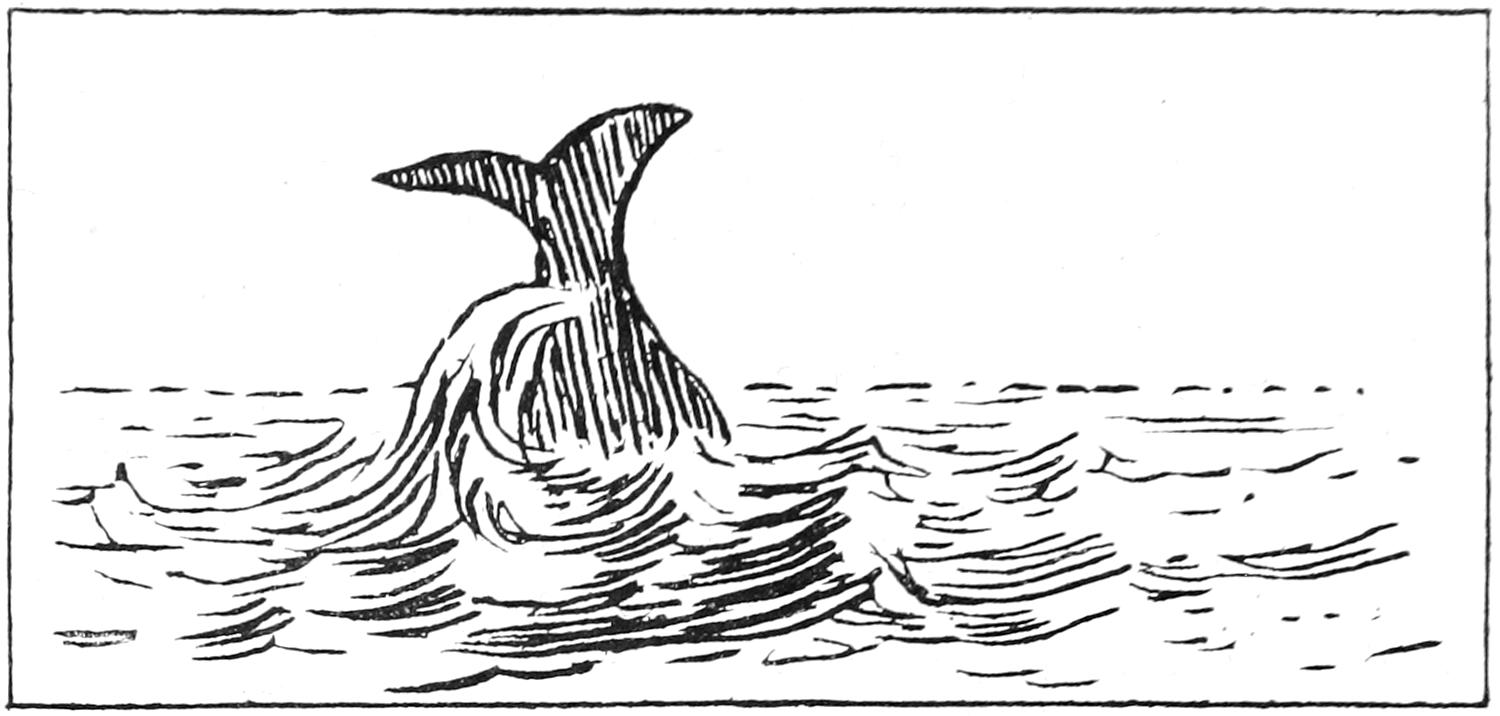
Fig. 43.—The sperm-whale going down head foremost to the bottom.—
“This narrative is extracted from a letter addressed from Chittagong to the editor of the Calcutta Englishman in January 1876. It seems that Captain Drevar’s friends advised him to say nothing about this strange spectacle. “My relatives wrote saying that they would have seen a hundred sea-serpents and never reported it, and a lady also wrote that she pitied any one that was related to any one who had seen the sea-serpent.” On the 10th. of this month Captain Drevar and four of the crew attended before Mr. Raffles, the magistrate at Liverpool, and made a solemn declaration in support of the foregoing narrative.”
The two figures, 42 and 43, are facsimiles of those accompanying the account in the Graphic.
I will try to translate again into English, what the Illustrirte Zeitung has published about this curious case, taken for granted that the German translation was correct, and laying all responsibility on the German writer.
“The Barque Pauline was on July 8th, 1875, about twenty miles distant from the north-eastern coast of Brazil, in lat. 5° 13′ S., long. 35° W., near Cape San Roque. At 11 o’clock a. m., the weather fine and clear”....... etc., word for word as in the Graphic up to the passage....... “head foremost to the bottom, where no doubt it was gorged at the serpent’s leisure”.
“As the serpent was twice wound round the body of the whale, Captain Drevar estimated its length to be 160 or 170 feet; it was about seven or eight in girth. The mouth was always open; the head was very large.”
“On the 13th. of July at 7 o’clock a. m. the barque was still in the same latitude, but about eighty miles from San Roque; then the same or a similar monster raised out of the water. Its head and about forty feet of its body were thrown horizontally out of the water and passed our stern.”
“As I was still reflecting on the cause, why this strange guest so often paid us a visit, and concluded that it was the white stripe of two feet breadth, which went round our ship above the copper work and which the serpent probably thought to be one of its colleagues, the cry of “There he is again” roused me. At a short distance from the ship I really saw the Leviathan, balancing about sixty feet high in the air, looking angrily at our vessel. As I was not sure, whether it was only looking at the white stripe on the ship’s hull, probably thinking to see one of its colleagues, or whether it was preparing to attack the vessel, we kept ready all our axes, to give it a warm reception. But the animal dived and disappeared.”
The German translater is convinced that the story contains truth, but he suggests that the whale was playing with a large tree or with a broken mast, “for it is known that whales like to gambol with violent motions”. The author further presents to his readers a reduced copy of the sketch of the Rev. Penny, (our fig. 41).—
Mr. Lee, who usually explains every sea-serpent after each report quoted by him, says, in his Sea Monsters Unmasked, p. 90, the following about these reports.
“It is impossible to doubt for a moment the genuineness of the statement made by Captain Drevar and his crew, or their honest desire to describe faithfully that which they believed they had seen; but the height to which the snake is said to have upreared itself is evidently greatly exaggerated; for it is impossible that any serpent could “elevate its body some sixty feet perpendicularly in the air”—nearly one third of the height of the Monument of the Great Fire of London. I have no desire to force this narrative of the master and crew of the Pauline into conformity with any preconceived idea. They may have seen a veritable sea-serpent; or they may have witnessed the amours of two whales, and have seen the great creatures rolling over and over that they might breathe alternately by the blow-hole of each coming to the surface of the water; or the supposed coils of the snake may have been the arms of a great calamary, cast over and around the huge cetacean. The other two appearances—1st., the animal “seen shooting itself along the surface with head and neck raised”, and 2nd., the elevation of the body to a considerable height, as in Egede’s sea monster, would certainly accord with this last hypothesis; but taking the statement as it stands, it must be left for further elucidation”.
It is remarkable that Mr. Lee who generally explains sea-serpents by calamaries, cannot give an explanation of this sea-serpent, with which he himself is satisfied. “They may have seen a veritable sea-serpent”. This phrase is very surprising, for Mr. Lee has not yet explained what is a veritable sea-serpent. Or did he mean a veritable sea-snake? This is improbable, for he knows very well that the largest snake which frequents the sea, the Eunectes murina, does not measure above 25 feet, so that it is not able to encircle a spermwhale, whose circumference is about forty feet. “Or they may have witnessed the amours of two whales, and have seen the great creatures rolling over and over that they might breathe alternately by the blow-hole of each coming to the surface of the water”. This phrase, however, does not give any explanation of the long neck, the tail, the mouth being constantly open, the thick coils, which were coloured longitudinally, partly black, partly white, so that the captain spoke of a black back and a white belly!” “Or the supposed coils of the snake may have been the arms of a great calamary, cast over and around the huge cetacean.” This too is impossible, for the circumference of the serpent was estimated at seven or eight feet, and no arm of a calamary has a greater circumference than about sixteen inches, even that of the largest known specimens, which have a total length of eighty feet! For a moment I will leave Mr. Lee in his supposition that the animal, seen on the 13th. of July, was a swimming calamary or a similar individual standing upright with its tail in the air, and pass to his last phrase: “but, taking the statement as it stands, it must be left for further elucidation”. This, now, I will try to do. But first I beg the reader to direct his attention to the sperm-whales.
The sperm-whales may attain a length of 60 to 70 feet, with a circumference of 40 feet at the thickest part. The females are smaller, growing from 30 to 40 feet. It is reported that sometimes, though very seldom, a male measures 90 feet. The head occupies the third part of the body-length, in mass, however, it is larger, for it is quadrangular in shape and in front just as thick and high as behind, whilst the bulky body tapers to the tail. The mouth lies wholly on the under side of the head. It is a terrible cavity when opened and may be up to fourteen feet in depth. The upper-jaw is toothless, but the under-jaw has from forty to fifty four formidable teeth, comparatively as sharp as the canines of a dog.
The sperm-whales live in troops, numbering from a very few to some hundreds, and containing many females and young ones, under the command of some old males. The young males remain in this family till they are strong enough to command their own family. Some old males wander about solitary, wild and angry. To become the sole proprietor of some females, these males fight each other vehemently, and indescribably grand is the sight of two troops meeting! The wild and warlike nature and the untamable muscular strength of the sperm-whale makes its presence even dangerous. The greatest hatred exists between them and the whale-bone-whales, or the fin-fishes, or rorquals, and when a shoal of sperm-whales meets with a shoal of whale-bone-whales, the latter are immediately attacked with the greatest fury and cruelty. The fight between two such squadrons is terrible, but grand, and commonly ends in the flight of the whale-bone-whales, pursued by the sperm-whales, not, however, without leaving many dead and terribly wounded companions, on which the frightful effects are visible of the bites of the sperm-whales, animals that might be called “mouth and teeth”.
Knowing the wild and angry nature of the warlike and pitiless sperm-whale, and the rather harmless character of the sea-serpent, we cannot believe that a sea-serpent has ever or will ever attack such a formidable antagonist. Every one will rather believe that a sperm-whale, when meeting with a sea-serpent, would suddenly attack it. Moreover, if the sea-serpent was the attacker, it would not have had “its mouth always open”,—an unfailable sign of great pain—but would have bitten repeatedly the whale! And so I firmly believe that one of the three spermwhales, had seized with its colossal mouth a sea-serpent by the trunk. The poor defenseless sea-serpent with its enormous flexible body wound round the upper jaw and forepart of the quadrangular head of the sperm-whale. We know that the sea-serpent has a rather dorso-ventral flexibility, for it can swim in vertical undulations, but we know too that its lateral flexibility is astonishing. I refer to the American reports from 1817 to 1819, wherein the animal in turning bent its body in the form of a staple, so that its head nearly touched its tail, and to the figures of Dr. Biccard (fig. 37, 38.).
The sea-serpent, seized by the sperm-whale by the trunk, did not bend itself dorsally round the spermwhale’s head, for if this had been the case, the captain would have seen the underpart of the animal and described its colour as being white. It did not bend itself ventrally, for if this had happened, the colour would have been described as dark, or black. On the contrary the coils are described as longitudinally divided into two sections white and black. Consequently the sea-serpent had bent itself laterally. Captain Drevar was right in his statement that the colour of the belly (under part) was white, and that the back (upper part) of the animal was black.
The sea-serpent in its violent pain raised its long neck high in the air and extended its jaws; it is even probable that it uttered a roaring sound or shriek, this is not mentioned; it may have been drowned by the dreadful noise caused by the fight of these two huge monsters, for we may suppose that the sea-serpent was not destitute of muscular strength, and must have been a formidable antagonist. Though it is not mentioned, I am convinced that the “two turns” of the sea-serpent were not always wound closely round the whale, but from time to time were loosened to be tightened again a moment afterwards. Nor do I set great value on the repeated assertion that there were two turns; it is impossible that this has always been seen clearly through such a “boiling of the water like a cauldron”. The dimensions of the head and tail part being each about thirty feet beyond the coils are certainly not exaggerated, as is the circumference or girth “about eight or nine feet”. The sea-serpent in its agony evidently paddled with its formidable flappers, which caused the water to be thrown like a fountain into the air. They therefore cannot have been visible with the glasses. The rolling over and over is, in my opinion, very natural in animals of such dimension, fighting in the water, and cannot be a result of the serpent “using its extremities as levers”. And so they were rolling for about fifteen(?) minutes and at last the spermwhale (and not the sea-serpent) dragged its victim down to the depths, head foremost. It is a habit of spermwhales, which is to be ascribed to their attachment to members of their family and to their warlike character and hatred of their enemies, to help each other in danger, and so the captain’s statement is quite correct: “the two others attempted to release their companion” and after the disappearance of the combatants “swam away, exhibiting signs of the greatest terror”; here we may safely read “fury”, probably they followed on the surface their companion which was beneath it, perceptible to them, but invisible to the spectators of the Pauline.
It is, however, more probable that the sea-serpent, feeling itself free for a moment, suddenly escaped, dived and was followed by the sperm-whale.
It is now the right moment to say some words about the figures. I will be short, only observing that they are not worth our attention. The sketches were evidently drawn in October and December, consequently more than three and five months after the encounter. It is impossible that they can give an exact representation.
Mr. Andrew Wilson in his Leisure Time Studies is of another opinion than I, as to the fight; for he declares: “..... to my mind, the only feasible explanation of the narrative of the crew of the Pauline must be founded on the idea that the animals observed by them were gigantic snakes. The habits of the animals in attacking the whales, evidently point to a close correspondence with those of terrestrial serpents of large size, such as the boas and pythons”. The reader will understand that I do not wish to contest Mr. Wilson’s opinion.
145.—1875, July 13.—Now we come to the second statement of the same report, viz. the encounter with the animal on the 13th. of July.
On that day another or the same individual was seen again shooting itself along the surface horizontally, forty feet of its body being out of the water at a time. Consequently the animal swam with its body in a straight line, and not with vertical undulations. Again on the same day, it was seen once more, with its body standing quite perpendicular some sixty feet in the air, and evidently taking a survey towards the vessel. This case is nearly the same as that which Egede witnessed in 1734 near Gothaab. As it is often reported that whales and sperm-whales, when coming from the depths, do so with such an astonishing force and rapidity that they leap clear out of the water, I am convinced that the sea-serpent sometimes elevates its fore part to a considerable height as was seen by Egede (no 5), Captain Adams (no 121) and Captain Drevar. If the height of the sea-serpent rising in the air was really sixty feet, Captain Drevar must have seen the animal’s fore-flappers, though he did not mention them. Else I think that he exaggerated, that the height did not surpass forty feet and that the flappers remained under water. See also No 31.—
146.—1876, September 11.—In the number of the 15th. of January, 1877, of the Echo appeared an article by Mr. R. A. Proctor entitled “Strange Sea-Monsters”, wherein he quotes the following report. I have not been able to consult the Echo, but I have found it cited in Mr. Wilson’s Leisure Time Studies. Here no date, except that of September 11th., is given, but as the report appeared in the January number of 1877 of the Echo, I conclude that the appearance took place in September of 1876.
“Soon after the British steamship Nestor anchored at Shanghai, last October, John K. Webster, the captain, and James Anderson, the ship’s surgeon, appeared before Mr. Donald Spence, Acting Law Secretary in the British Supreme Court, and made affidavit to the following effect:
“On September 11, at 10.30 a. m., fifteen miles north-west of North Sand Lighthouse, in the Malacca Straights, the weather being fine and the sea smooth, the captain saw an object which had been pointed out by the third officer as “a shoal!” Surprised at finding a shoal in such a well-known track, I watched the object, and found that it was in motion, keeping up the same speed with the ship, and retaining about the same distance as first seen. The shape of the creature I would compare to that of a gigantic frog. The head, of a pale yellowish colour, was about twenty feet in length, and six feet of the crown were above the water. I tried in vain to make out the eyes and mouth; the mouth may, however, have been below water. The head was immediately connected with the body, without any indication of a neck. The body was about forty-five or fifty feet long, and of an oval shape, perfectly smooth, but there may have been a slight ridge along the spine. The back rose some five feet above the surface. An immense tail, fully one hundred and fifty feet in length, rose a few inches above the water. This tail I saw distinctly from its junction with the body to its extremity; it seemed cylindrical, with a very slight taper, and I estimate its diameter at four feet. The body and tail were marked with alternate bands of stripes, black and pale yellow in colour. The stripes were distinct to the very extremity of the tail. I cannot say whether the tail terminated in a fin or not. The creature possessed no fins or paddles so far as we could perceive. I cannot say if it had legs. It appeared to progress by means of an undulatory motion of the tail in a vertical plane (that is, up and down).
“Mr. Anderson, the surgeon, confirmed the captain’s account in all essential respects. He regarded the creature as an enormous marine salamander. “It was apparently of a gelatinous (that is, flabby) substance. Though keeping up with us, at the rate of nearly ten knots an hour, its movements seemed lethargic. I saw no legs or fins, and am certain that the creature did not blow or spout in the manner of a whale. I should not compare it for a moment to a snake. The only creatures it could be compared with are the newt or frog tribe.””
As the captain asserts that the animal kept up the same speed as the ship, and Mr. Anderson that “though keeping up with us, at the rate of nearly ten knots an hour, its movements seemed lethargic”, we must conclude that the animal moved by paddling with its flappers, and that with this simple mechanism it is able to propel itself at a rate of ten knots an hour, steadily and uniformly. The tail of the animal, which trailed inactively behind the trunk, must of course have been brought in motion by the action of the water, so that it is easy to understand that the captain thought that “it appeared to progress by means of an undulatory motion of the tail in a vertical plane (that is, up and down)”. It is also very natural that the captain declared that “the creature possessed no fins or paddles as far as we could perceive. I cannot say if it had legs”, and that the surgeon Anderson confirmed it: “I saw no fins”; the flappers of the animal being entirely hidden under water.—The captain says: “The shape of the creature I would compare to that of a gigantic frog”. According to his description, however, the shape might have been better compared with that of a gigantic newt. This is done by Mr. Anderson, as we have seen above, who says at the end of his statement, “the only creatures it could be compared with are the newt or frog tribe”; he “should not compare it for a moment to a snake”. This is one of the few reports of the animal having been observed swimming in full length on the surface of the water. This I think very comprehensible. Generally the animal is swimming with the head and a part of the neck raised some feet out of the water, and in this case the trunk and the tail must carry their weight, so that the trunk will be visible only a few inches above the water, and the tail hidden for a greater part under it. But as soon as the animal drops its neck and head so that only the upper part of both remain above the surface, their weight is carried by the water itself, and body and tail will become more visible, lying almost à fleur d’eau (to use Captain M’Quhae’s term). I firmly believe that this is also one of the few occasions that the animal swam with its neck contracted. In this situation it is very difficult to decide whether the animal has a neck or not, and so the captain’s assertion “the head was immediately connected with the body, without any indication of a neck” is very conceivable. From the hind part of the head the contracted neck gradually grows thicker towards the shoulders, where the animal seems to have its largest diameter, and from here it tapers towards the hind flappers, so that seen from the ship, both neck and body, being visible only a few feet above the surface, must have given rise to the description of the captain “the body was of an oval shape”. Again the position was very favourable to observe the exact place where the tail begins, and that the animal has there its pelvis and hind flappers, so that, being there broader than at the tail-root, the captain observed “this tail I saw distinctly from its junction with the body to its extremity”. The colour of the head being described as a pale yellowish one, and that of the body and the tail alternately black and pale yellow, I conclude that the animal having swum for some time in this manner, had been partly dried up in the sun, while “catspaws” washing over it again coloured it black here and there. As to its length I am inclined to believe that Mr. Webster is mistaken. I cannot admit that “the head was twenty feet, and six feet of the crown were above the water”, nor can I set much value upon his assertion that the tail was “fully one hundred and fifty feet in length”. I willingly admit that the head measured eight or nine feet, and the tail about one hundred feet. As the animal swam just at the surface it is clear to me that no mouth was visible, and I think that even the nose tip will only have been a few inches above the water. As no eyes were seen, the distance must have been rather great; but this is not mentioned. The body was perfectly smooth, but there may have been a slight ridge along the spine. Probably this was the mane, not quite discernable on account of the distance. The tail is described as cylindrical, tapering to its end, and estimated at four feet in diameter (at its junction, evidently).—It is clear that the extreme end of the tail was under water, for Mr. Webster “cannot say whether the tail terminated in a fin or not”. As to the supposition of Mr. Anderson that the animal was “apparently of a gelatinous (that is, flabby) substance”, I cannot attach much importance to this, as it is impossible to decide this of an animal swimming at some distance, even of a calamary. The body was smooth, and that’s all. That the creature did not blow or spout like a whale, is very natural, as there was evidently no reason for doing so, the nose being constantly above the surface, and the animal swimming without diving from time to time. A whale, sleeping on the surface, does not spout either, as in that case the spout-holes are above the surface, and the breathing is regular and without puffing. So I think I have shown that all the parts of the statement are correct, except the estimated length.
Mr. Andrew Wilson relying upon the statement of Mr. Anderson, adds in a note:
“It is just possible that the “flabby” or “gelatinous” creature mentioned in this narrative was a giant cuttle-fish, whose manner of swimming, colour, absence of limbs, etc., would correspond with the details of the narrative. The “immense tail” might be the enormous arms of such a creature trailing behind the body as it swam backwards, propelled by jets of water from the breathing “funnel”.”
My objections against this supposition are first, that, as I have already stated above, it is impossible to decide whether an animal is gelatinous or flabby, until we have touched and handled it, and secondly, that the manner of swimming of a calamary is not so as Mr. Wilson believes; for the enormous arms of such a creature are not trailing behind the body, when it is swimming backwards, but are coiled up and retracted into two peculiar arm pockets; and thirdly, that the colour of a calamary does not correspond with the colour stated in the report, but is a very light grey one, mixed with red or crimson, intermixed with purple.
In the number of February 3d, 1877 of the Illustrirte Zeitung, an article entitled “Zur Geschichte der Seeschlange” appeared, written by an anonymous writer. Evidently the report of Captain Drevar, which appeared in the Liverpool newspapers of the 10th. of January of that year, was the stimulus to this essay. The writer superficially treats of several already known accounts and reports of sea-serpents viz: our nos. 144, 145, and 5, the tales of Pontoppidan, the animal of Stronsa (p. 61-88), the appearances quoted by the Boston Linnaean Society (1817), our no. 118, the hoax of the Daphne (1848, Oct. 21), our nos. 129 and 130, the cheat of Dr. Koch (1845), and the true sea-snakes (Hydrophidae). In two of his assertions this anonymous author is incorrect, viz. It was not Captain M’Quhae who asserted that the animal’s mouth was large enough to admit of a tall man standing upright in it, but an anonymous contributor to the Times; Mr. Henderson was master of the ship Mary Ann, and not of the Daphne; the master of this ship was called Trelawney. I consider these four names as Active (see my Chapter on hoaxes p. 34.)
147.—1877, May 21.—In Mr. Andrew Wilson’s Leisure Time Studies we read in a note (p. 111):
“An instance of a large sea-snake being seen in its native seas is afforded by the report of the master of the barque Georgina from Rangoon, which (as reported in the newspapers of September 4, 1877) put into Falmouth for orders on the 1st. September. On May 21, 1877, in latitude 2° N. and longitude 90° 53′ E., a large serpent about forty or fifty feet long, grey and yellow in colour, and ten or eleven inches thick, was seen by the crew. It was visible for twenty minutes, during which time it crossed the bow, and ultimately disappeared under the port-quarter.”
The dimensions are clearly those of the visible part of the animal. The colour being stated as grey and yellow makes me conclude that the animal had swum for a long time with its body in a straight line, without diving and that the part, exposed to the sunbeams, had dried up.
Mr. Andrew Wilson adds: “There can be little doubt that this sea-serpent was simply a largely developed marine snake”. I’ll not contest his opinion.—
148.—1877, June 2.—Not less important than others is the report of the Osborne. In Mr. Lee’s Sea Monsters Unmasked we read p. 93 the following about this occurrence:
“In June, 1877 Commander Pearson reported to the Admiralty that on the 2nd. of that month, he and other officers of the Royal Yacht Osborne, had seen, off Cape Vito, Sicily, a large marine animal, of which the following account and sketches were furnished by Lieutenant Haynes, and were confirmed by Commander Pearson, Mr. Douglas Haynes, Mr. Forsyth, and Mr. Moore, engineer.”
“Lieutenant Haynes writes, under date, “Royal Yacht Osborne, Gibraltar, June 6”: On the evening of that day, the sea being perfectly smooth, my attention was first called by seeing a ridge of fins above the surface of the water, extending about thirty feet, and varying from five to six feet in height. On inspecting it by means of a telescope, at about one and a-half cables’ distance, I distinctly saw a head, two flappers, and about thirty feet of an animal’s shoulder. The head, as nearly as I could judge, was about six feet thick, the neck narrower, about four to five feet, the shoulder about fifteen feet across, and the flappers each about fifteen feet in length. The movements of the flappers were those of a turtle, and the animal resembled a huge seal, the resemblance being strongest about the back of the head. I could not see the length of the head, but from its crown or top to just below the shoulder (where it became immersed), I should reckon about fifty feet. The tail end I did not see, being under water, unless the ridge of fins to which my attention was first attracted, and which had disappeared by the time I got a telescope, were really the continuation of the shoulder to the end of the object’s body. The animal’s head was not always above water, but was thrown upwards, remaining above for a few seconds at a time, and then disappearing; there was an entire absence of “blowing” or “spouting”. I herewith beg to enclose a rough sketch, showing the view of the “ridge of fins”, and also of the animal in the act of propelling itself by its two fins.”
Evidently Mr. Lee has not communicated the whole account as it was in the original periodical, nor did he mention the name of the periodical.
The Times of June 14th., 1877 mentions:
“The Osborne, 2, paddle royal yacht, Commander Hugh L. Pearson, which arrived at Portsmouth from the Mediterranean on Monday, and at once proceeded to her moorings in the harbour, has forwarded an official report to the Admiralty, through the commander-in-chief (Admiral Sir George Elliot, K. C. B.), respecting a sea-monster which she encountered during her homeward voyage. At about five o’clock in the afternoon of the 2nd. instant, the sea being exceptionally calm, while the yacht was proceeding round the north coast of Sicily towards Cape Vito, the officer on the watch observed a long ridge of fins, each about six feet long, moving slowly along. He called for a telescope, and was at once joined by other officers. The Osborne was steaming westward at ten and a half knots an hour, and, having a long passage before her, could not stay to make minute observations. The fins were progressing in an eastwardly direction, and as the vessel more nearly approached them, they were replaced by the foremost part of a gigantic sea-monster. Its skin was, so far as could be seen, altogether devoid of scales, appearing rather to resemble in sleekness that of a seal. The head was bullet-shaped, with an elongated termination, being somewhat similar in form to that of a seal, and was about six feet in diameter. Its features were only seen by one officer, who described them as like those of an alligator. The neck was comparatively narrow, but so much of the body as could be seen, developed in form like that of gigantic turtle, and from each side extended two fins, about fifteen feet in length, by which the monster paddled itself along after the fashion of a turtle. The appearance of the monster is accounted for by a submarine volcano, which occurred north of Galita, in the Gulf of Tunis, about the middle of May, and was reported at the time by a steamer which was struck by a detached fragment of submarine rock. The disturbance below water, it is thought probable, may have driven up the monster from its “native element”, as the site of the eruption is only one hundred miles from where it was reported to have been seen”.