III. Would-be Sea-Serpents.
Reading edition
It is by no means astonishing that in the vast waters of the ocean several objects, totally different from the animal generally known as the Great Sea-Serpent, gave rise to tales of that Great Unknown, such as wrecks, gigantic sea-weeds, or even animal beings. So we meet with an account dated:
1720.—(See Pontoppidan.) “Thorlack Thorlacksen has told me that in 1720 a Sea-Serpent had been shut up a whole week in a little inlet, in which it came with high tide through a narrow entrance of seven or eight fathoms deep, and that eight days afterwards, when it had left the inlet, a skin of a snake or serpent was found. One end of the skin had sunk into the water of the inlet, so that its length could not be made out, as the inlet was several fathoms deep, and the skin partly lay there. The other end of this skin was washed on the shore by the current, where everybody could see it; apparently, however, it could not be used, for it consisted of a soft slimy mass. Thorlacksen was a native of the harbour of Kobbervueg.”
It may be that a real sea-serpent remained a week in the inlet. The Norwegian fishermen know the sea-serpent too well to make mistakes. Another animal would not have been called a sea-serpent, and a short description of it would have been given. But the skin wrongly attributed to the sea-serpent, was certainly nothing else but a putrified long arm or tentacle of a gigantic calamary. The description “soft and slimy mass” proves this sufficiently. The great calamary died in the fjord, or inlet, and its long dead arm was floated ashore by the current, while the body sank. Such great calamaries, the true Krakens, have been measured, and found to have a body of 30 feet in length with long tentacles of 58 feet (see Lee, Sea Monsters Unmasked, London, 1883). I give here a figure of the largest ever found. (See our Fig. 6.)

Fig. 6.—The largest calamary ever found, with a scale of 80 feet.
1808.—The Animal of Stronsa.—Perhaps no stranded animal, even the so-called sea-monks of the seventeenth and the eighteenth century caused such an excitement among the learned as “the animal of Stronsa”.
The oldest report of it is certainly a letter from Mr. Campbell, in which only the following lines refer to it:
“A snake (my friend Telford received a drawing of it) has been found thrown on the Orkney-Isles, a sea-snake with a mane like a horse, 4 feet thick and 55 feet long, this is seriously true. Malcolm Laing, the historian saw it, and sent a drawing of it to my friend.”
The letter was first printed in the work entitled: “Life and Letters of Campbell”, and afterwards the above quoted lines were reprinted in the Zoologist for 1849, p. 2395.
In the Proceedings of the Meeting of the Wernerian Natural History Society on the 19th. of November, 1808, printed in the Philosophical Magazine, Vol. 32, p. 190, we read:
“At this meeting Mr. P. Neill read an account of a great Sea-Snake, lately cast ashore in Orkney. This curious animal, it appears, was stranded in Rothiesholm Bay, in the Island of Stronsa. Malcolm Laing, Esq., M. P. being in Orkney at the time, communicated the circumstance to his brother, Gilbert Laing Esq., advocate at Edinburgh, on whose property the animal had been cast. Through this authentic channel Mr. Neill received his information. The body measured fifty five feet in length, and the circumference of the thickest part might be equal to the girth of an Orkney pony. The head was not larger than that of a seal, and was furnished with two blow holes. From the back a number of filaments (resembling in tecture the fishing-tackle known by the name of silk-worm gut) hung down like a mane. On each side of the body were three large fins, shaped like paws, and jointed. The body was unluckily knocked to pieces by a tempest; but the fragments have been collected by Mr. Laing, and are to be transmitted to the Museum at Edinburgh. Mr. Neill concluded with remarking, that no doubt could be entertained that this was the kind of animal described by Ramus, Egede, and Pontoppidan, but which scientific and systematic naturalists had hitherto rejected as spurious and ideal.”
In the meeting of the same Society on the 14th. of January, 1809, (see Phil. Mag. Vol. 33. p. 90.),
“Dr. John Barclay communicated some highly curious observations which he had made on the caudal vertebrae of the Great Sea-Snake, (formerly mentioned) which exhibit in their structure some beautiful provisions of Nature, not hitherto observed in the vertebrae of any other animal.”
“And Mr. Patric Neill read an ample and interesting account of this new animal, collected from different sources, especially letters of undoubted authority, which he had received from the Orkneys. He stated, however, that owing to the tempestuous season, the head, fin, sternum, and dorsal vertebrae, promised some weeks ago to the University Museum at Edinburgh, had not yet arrived; but that he had received a note from Gilbert Meason, esq., (the gentleman on whose estate in Stronsa the sea-snake was cast,) intimating that they might be expected by the earliest arrivals from Orkney. In the mean time, he submitted to the Society the first sketch of a generic character. The name proposed for this new genus was Halsydrus, (from ἁλς the sea, and ὑδρος a water snake); and as it evidently appeared to be the Soe-Ormen described above half a century ago, by Pontoppidan, in his Natural History of Norway, it was suggested that its specific name should be H. Pontoppidani.”
Mr. Malcolm Laing and Dr. Grant, living on Stronsa, were requested to take down the affidavits of the eye-witnesses, and at the meeting of the Wernerian Society on the 11th. of February, 1809, (see Phil. Mag. Vol. 33. p. 251),
“the Secretary (Mr. P. Neill) laid before the Society copies of those affidavits made before the justices of peace at Kirkwall in Orkney, by several persons who saw and examined the carcass of the great sea snake (Halsydrus Pontoppidani) cast ashore in Stronsa in October last; with remarks illustrative of the meaning of some passages in these affidavits.”
The above-mentioned communication of Dr. John Barclay was printed in 1811 in the first Volume of the Memoirs of the Wernerian Society, and contains a detailed description of some vertebrae of the animal. The figures of these vertebrae are splendid, also those of the dried and shrivelled skull and a portion of one of the pectoral fins, with the cartilages that connect it with the body. As well the descriptions as the figures betray at a glance the shark nature of the animal. We will not trouble our readers with them, and we will also omit the figures, except one; it is a drawing made after the description of one of the eye-witnesses. (See our Fig. 7).

Fig. 7.—The Animal of Stronsa.
The Paper of Dr. Barclay was entitled: Remarks on some parts of the animal that was cast ashore on the island of Stronsa, Sept. 1808. The above-mentioned affidavits were also printed in 1811, in the first Volume of the Memoirs of the Wernerian Natural History Society, and run as follows:
“At Kirkwall, Nov. 10. 1808.
“In presence of Dr. Robert Groat, Physician in Kirkwall, and Malcolm Laing, Esq; M. P. Two of his Majesty’s Justices of the Peace of the County of Orkney.
“Compeared Thomas Fotheringhame, house-carpenter in Kirkwall; who solemnly declared, That being in Stronsa during the gales of wind in October last; he went to see the strange fish that was driven ashore in Rothiesholm Bay: That he measured his length with a foot-rule, which was exactly fifty-five feet, from the junction of the head and neck, where there was the appearance of an ear, to the tail: That the length of the neck, from the ear to the shoulder, was ten feet three inches, as nearly as he recollects. And being shewn a drawing of the animal, he declared, That the neck appeared to him to be too long. That the fins or arms, or, as they were called on the island, the wings of the animal, were jointed to the body nearer the ridge of the back than they appear in the drawing: That the toes were less spread out, and tapering more to a point, unless when purposely lifted up; but were not webbed unless the space of an inch and a half in breadth, where they joined each other; and the length seemed to be about eight inches: That he measured one of the wings next the head, which was four feet and a half in length, and in shape, from the first joint to the extremity, it resembled a goose-wing without the feathers: That the hollow between the snout and the upper part of the skull, appeared to him not to be quite so deep as represented in the drawing: That in every other respect the drawing appears to be so exact, that if the fish had not been mentioned, it would have brought it to his recollection: That from the ridge of the back to the belly, the body appeared to be four feet in depth, and the circumference rather oval than round; but that he did not measure either: That the mane or bristles of the back extended from the shoulder to within two feet and a half of the tail, and were of a shining appearance when wet; but shrunk up, and turned yellow, when dried: That the mane was thin, about two inches and a half in breadth towards the shoulder, and two inches in breadth at the tail: That the skin seemed to be elastic when compressed, and of a greyish colour, without any scales: it was rough to the feeling, on drawing the hand over it, towards the head; but was smooth as velvet when the hand was drawn towards the tail: That the extremity of the tail was about two inches in thickness, and somewhat rounded; and as he saw no part of the bones, he cannot say whether any part of the tail had been broken off or not: That the eyes appeared to be no larger than those of a seal: That there were two spout holes on each side of the neck, about an inch and a fourth in diameter, and at the same distance from the head as appears in the drawing: That he lifted up the snout, and examined the throat, which was too narrow to admit his hand: That a part of the bones of the lower jaw, resembling those of a dog, were remaining at that time, with some appearance of teeth, which were soft, and could be bent by the strength of the hand: That he observed no nipples, or organs of generation; the belly having been burst open by the violence of the sea: That the stomach was about the size of a ten gallon cask; and the bowls about the bulk of those of a cow: That the bristles of the back which had been pulled off through curiosity, were luminous in the dark, while they continued wet. And all this he declares to be truth, &c.
“(Signed)”
“Thomas Fotheringhame.”
“Kirkwall, Nov. 19, 1808.”
“Compeared John Peace, tenant in Dounatoun in Rothiesholm; and being interrogated, solemnly declares, That on the 26th. day of September last, he went a fishing off the east part of Rothiesholm-head, when he perceived as he imagined, a dead whale, on some sunk rocks, about a quarter of a mile from the Head: That his attention was first directed to it by the sea-fowl screaming and flocking about it; and on approach of it, in his boat, he found the middle part of it above the surface of the water: That he then observed it to be different from a whale, particularly in having fins or arms, one of which he raised with his boat-hook above the surface of the water: That this was one of the arms next the head, which was larger and broader than the others nearer the tail; and at that time the fin or arm was edged all around, from the body to the extremity of the toes, with a row of bristles about ten inches long, some of which he pulled off, and examined in the boat: That about ten days afterwards, a gale of south east wind came on, and the surge drove the fish ashore on Rothiesholm-Head: That he measured it by fathoms, and found it about fifty-four or fifty-five feet in length: That he observed the six arms, or wings as they are called on the island; but perceived no part of the bristles then round the edges of the fins or arms, and supposes, that being in a putrid state, they had been beaten off by the sea, or washed away: That a small part of the belly was broken up when he saw it then, from which the stomach, as he now supposes it to have been, had fallen out: That the stomach, which he took at first for the penis, from the one end of it being joined to the body; but on seeing it after it was opened, he concluded it to have been the stomach, as it resembled the second stomach of a cow: That he did not measure the circumference of the animal, but it appeared to be of the thickness of a middle sized horse round the girth, of twelve or thirteen hands high. And being shewn a drawing of the animal, and desired to point out the resemblance or difference, he declared, That the joint of the foremost leg was broader than represented in the drawing, being more rounded from the body to the toes, and narrower at the upper end than at its junction with the toes: That the limb itself was larger than the hinder ones, and the uppermost joint or shoulder was altogether attached to the body: That in all other respects the drawing appears to him to be an exact resemblance of the fish, as it lay on the beach: That the mane came no further than the shoulder, and extended to the tail, part of which appeared to have been broken off: That the length of the neck, the situation of the spout-holes, and of the eye, the shape of the snout, the position and distance of the limbs from each other, appear to him to be exactly preserved in the drawing: That the lower jaw was awanting when he saw it: That the fish was of a greyish colour: That he observed no nipples or organs of generation, unless as above mentioned: That the part of the belly which was burst open, and from which the stomach had fallen out, was between the two limbs that are situated in the middle of the animal. And all this he solemnly declares to be truth. And declares he cannot write.”
“Eodem die”
“Compeared Mr. George Sherar, tacksman of Rothiesholm in the island of Stronsa; who being interrogated, solemnly declared, That on the 20th. of October, being in Rothiesholm-head he saw the crew of John Peace’s boat examining something on the water, which he took to be a dead whale: That about ten days afterwards, a gale of east wind having taken place he went to see if the whale was driven ashore, and found it in a creek, lying on its back, about a foot under water; and from the view which he had of its figure, length and limbs, his curiosity induced him to return a day or two after the gale had abated, when he found it thrown upon the beach, a little below high water mark, and lying on its belly, as represented in the drawing: That he returned next morning, with a foot-rule, purposely to measure it, and found it to be exactly fifty-five feet in length, from the hole in the top of the skull (which he has brought to town with him), to the extremity of the tail: That the length of the neck was exactly fifteen feet, from the same hole to the beginning of the mane: That he measured also the circumference of the animal as accurately as he could, which was about ten feet, more or less; and the whole body, where the limbs were attached to it, was about the same circumference: That the lower jaw or mouth was awanting; but there were some substances or bones of the jaw remaining; when he first examined it, which are now away: That it had two holes on each side of the neck, besides the one on the back of the skull: That the mane or bristles were about fourteen inches in length each, of a silvery colour, and particularly luminous in the dark, before they were dried: That the upper part of the limbs, which answers to the shoulder-blade, was joined to the body like the shoulder-blade of a cow, forming a part of the side: That a part of the tail was awanting, being incidentally broken off at the extremity; where the last joint of it was bare, was an inch and a half in breadth: That the bones were of a gristly nature, like those of a halibut, the back-bone excepted, which was the only solid one in the body: That the tail was quite flexible, turning in every direction, as he lifted it; and he supposes the neck to have been equally so, from its appearance at the time: That he has brought in, to deliver to Mr. Laing, the skull, two joints of one of the largest limbs, next the head, with different parts of the backbone, besides the bones that were formerly sent in: That there were either five or six toes upon each paw, about nine inches long, and of a soft substance: That the toes were separate from each other, and not webbed, as far as he could observe; and that the paw was about half a foot each way, in length and in breadth: That a few days thereafter, a gale of wind came on, and drove it to another part of the shore, where it was broken to pieces by the surge, and when Mr. Petrie came out to take a drawing of it, no part of the body remained entire: That he endeavoured to convey an idea of the animal to Mr. Petrie, by drawing the figure of it as accurately as he could, with chalk, on the table, exactly as it lay on the shore, after which Mr. Petrie made six or seven different sketches or plans of the fish, before he could bring it to correspond, in each minute particular, with the strong idea which he retains of its appearance: That he was the more attentive to its shape, dimensions and figure, in order to be able to give an accurate account of it to any travellers that might come to Rothiesholm, and that he is ready to make oath that the drawing is an exact resemblance of the fish, as it appeared when he measured it; and corresponds in all particulars with the idea which he entertains of the figure, dimensions, and proportions of the fish: That the substance of the body appeared like coarse, ill coloured beef, interlarded with fat or tallow, without the least resemblance or affinity to fish; but when put into a lamp, and the lamp placed on the fire, it neither flamed nor melted, but burned away like a gristly substance: That he perceived no teeth in the upper jaw; the lower jaw and tongue being awanting, and the palate also away: That the aperture of the throat appeared to be so wide, that he might have put his foot down through it: That the joints of the limbs were not united by a ball and socket but were lapped over each other, and united by some means which he does not comprehend: That there were two canals, one above and another below the backbone, large enough to admit one’s finger, and extending from the vertebrae of the neck, to the extremity of the tail, containing two ligaments, which he supposed, enabled the animal to raise itself up, or to bend its body in a spiral form: That a tract of strong easterly wind had prevailed, before the body was discovered upon the shore, and that he saw the body on two or three different occasions, after he had measured it, and before it went to pieces. And all this he declares to be truth, &c.”
“(Signed)”
“Geo. Sherar.”
“Compeared Mr. William Folsatter, tacksman of Whitehall, in the island of Stronsa; who being interrogated, solemnly declared, That having heard that it was a dead whale that had come on shore in Rothiesholm-head, he did not see the body till about the 28th. day of October, when it had gone to pieces: That he saw about nine or ten feet of the back-bone, and some bones of the paws, and what was supposed to be the stomach which last he had the curiosity to open; that it was about four feet long, and as thick as a firkin, but flatter: That the membranes that formed the divisions, extended quite across the supposed stomach, and were about three sixteenth of an inch in thickness, and at the same distance from each other, and of the same substance, with the stomach itself: That the section of the stomach, after it was opened, had the appearance of a weaver’s reed: That he opened about a fourth part of the supposed stomach which contained nothing but a reddish substance, like blood and water, and emitted a fetid smell: That he was very doubtful at the time whether it was really the stomach or not; but that each end of it had the appearance of terminating in a gut. And all this he solemnly declares to be the truth, &c.
“(Signed)”
“Wm. Folsetter.”
“The said Mr. George Sherar being again interrogated, declares, That he examined the supposed stomach, after it had been opened by Mr. Folsitter, and that he laid it open to the farther end: That there was something like a gut at the end which he opened, about two inches long, with a small aperture: That the stomach had the same appearance from end to end, and contained nothing but a substance like blood and water: That the large bone of which a drawing was taken, was considered as the collar-bone; and that it was situated with the broad and thick part downwards and the open part towards the vertebrae of the back: That he observed no appearance of fins about the neck or breast, or other parts of the body, except the six paws already described. And all this he solemnly declares to be truth, &c.”
“(Signed)”
“Geo. Sherar.”
One of the ablest ichthyologists of those days, Mr. Everard Home examined the “sea-snake”, and recognized it for a Basking shark. Immediately after his paper in the Philosophical Transactions of the Royal Society of London, Vol. 98, entitled “An anatomical account of the Squalus maximus (of Linnaeus), which, &c.,” especially of an individual of thirty feet six inches, “entangled in the herring nets, belonging to the fishermen of Hastings, 13 Nov. 1808”, Mr. Home goes further:
“I cannot close the present paper without mentioning, that nearly the same period, two other Squali of large dimensions were thrown upon our coast. The probable cause of this event, is the season being uncommonly boisterous and tempestuous. On the 3d. of January, 1809, a fish was thrown ashore at Penrhyn, in Cornwall. On hearing of it from a person on the spot, I sent down a drawing of the subject of this paper to compare with it, and the fish proves to be of the same species, and a male, measuring thirty-one feet in length.”
“The other was thrown ashore on the 7th. of October, 1808, at Rothiesholm, an estate of Gilbert Meason, Esq. in Stronsay, one of the Orkney isles. It had been seen lying on some sunken rocks, eleven days before, was in a half putrid state, and the sea fowls were in great numbers feeding upon it. Those who saw it, reported that the skin was rough in one direction, and smooth like satin in the other. At the time of its being examined, the skin and a great many other parts of the fish were wanting.”
“Mr. Meason, with a zeal for science which does him infinite credit, upon hearing the strange accounts which were given of this sea-monster, got his brother, Malcolm Laing, Esq. and Dr. Grant, an eminent physician (both justices of the peace), to take depositions on the spot, from those persons who had seen the fish, that its real appearance might be ascertained. This examination, however, did not take place till six weeks after the fish was thrown ashore.”
“These depositions were sent to Sir Joseph Banks, who put them into my hands. (The depositions are very long, and exceedingly minute; they are preserved in the Board-book of the Royal Society). I also received, a short time after, from my friend Mr. Laing, in consequence of a request I made for that purpose, that part of the skull, which contained the brain, the upper jaw having been separated from it, a considerable number of the vertebrae of the back united together by their natural attachments, a portion of one of the pectoral fins, with the cartilages that unite it to the spine, and a long and short cartilage forming the support of one of the gills. On comparing these different parts, with those of the Squalus maximus, they were found to agree, not only in their form, but also in their dimensions. This led to the opinion of the fish being a Squalus, a very different one from what was formed by those who saw it in the mutilated state in which it was thrown ashore, and who called it a sea-snake. In the different depositions, several parts are accurately described, such as the valvular intestine, which was taken for the stomach, and the bristles of the mane, which are described as ligamentous fibres, one of them is in my possession, and is of the same kind with the fibres forming the margin of the fins of the squalus maximus. The drawing that was made from memory, and which I have annexed, will enable me in a few words to point out how much, in some things, those who saw the fish adhered to truth, and in others allowed their imagination to supply deficiencies, for one of them declared, with confidence, that the drawing was so exact a representation of what he had seen, “that he fancied he saw the beast lying before him, at a distance on the beach.”
“The drawing is correct in the representation of the head, and anterior part of the fish, from which the skin, the upper and lower jaw, the gills, and gullet, had been separated by putrification; and when we consider that the liver and the other viscera were all destroyed, except the valvular intestine, which was taken away by the observers, the size of the body that remained would be nearly in proportion with the drawing. The legs are tolerably exact representations of the holders in the male Squalus maximus, described in a former part of this paper, and therefore are not imaginary, only that four have been added which did not exist. This is satisfactorily determined by the pectoral fin, which is preserved, having no resemblance to them. The mane, they said, was composed of ligamentous fibres, one of which was sent to London; this corresponds, in its appearance, with the fibres that form the termination of the fins and tail of the Squalus maximus, such an appearance therefore was seen, but could only be met with in the place of the two dorsal fins, instead of being continued along the back, as in the drawing. The contortions towards the tail are such, as the invertebral joints could not admit of, they are therefore imaginary.”
“It is said, two different persons measured the fish; one by fathoms, the other by a foot-rule, and that it was fifty-five feet long. Their accuracy is at least doubtful, as the parts that are preserved correspond with those of a fish about thirty feet long, and it is rendered still more so, as the person who gives the length in fathoms, says, he saw at that time the six legs, the two foremost being larger than the hinder ones, and the lower joint more rounded from the body to the toes. The pectoral fin, which is preserved, proves this declaration to be incorrect: the person who measured the fish with a foot-rule, declares the length, from the hole in the head to the beginning of the mane, to be exactly fifteen feet, which is probably correct since a Squalus of about thirty-six feet long would measure, from the forepart of the skull to the dorsal fin, about fifteen feet; but the other measurement must be questionable.”
“It is deserving of remark, that there is no one structure represented in this drawing, which was not actually seen. The skeleton of the holders corresponds with the legs in the drawing, the margin of the dorsal fin in a putrid state with the mane; so that the only errors are in the contortions towards the tail, the length of the fish and the number of the holders, which were mistaken for legs. (This mistake of the holders of the male shark for legs, has been frequently made. There is a drawing in Sir Joseph Bank’s library, sent from Ireland, in which the fish is represented walking like a duck, with broad webbed feet. The skin of a male Squalus maximus was exhibited in London, some years ago, distended by means of hoops, and the holders were shown as its legs, on which it occasionably walked). And when we recollect that the drawing was made from memory six weeks after the fish had been seen by those, who describe it, during which interval it had been their principal subject of conversation, we may conclude that so extraordinary an object, as the mutilated fish must appear, when believed to be a perfect one, would, in their different discourses, have every part exaggerated, and it is only remarkable that the depositions kept so close to the truth as they have done.”
“It is of importance to science; that it should be ascertained, that this fish is not a new animal unlike any of the ordinary productions of nature, and we are indebted to the zeal and liberality of Mr. Meason and Mr. Laing, who have collected a sufficient body of evidence to enable me to determine that point, and prove it to be a Squalus, and the orifices behind the eye, which communicate with the mouth met with in the skull, renders it very probable, that it is a Squalus maximus.”
“This opinion is further confirmed by the Squalus maximus, known by the name of the basking shark, being frequently seen upon the coast of Scotland.”
The only remark I have to make is: Mr. Home will never have believed that the animal of Stronsa really measured 56 feet, and so made himself guilty of throwing discredit on the accurate measuring of the eye-witnesses.
I present here to my readers the figure of a Squalus maximus, or Basking-shark, thus enabling them to make this animal’s acquaintance, if they don’t know it yet.
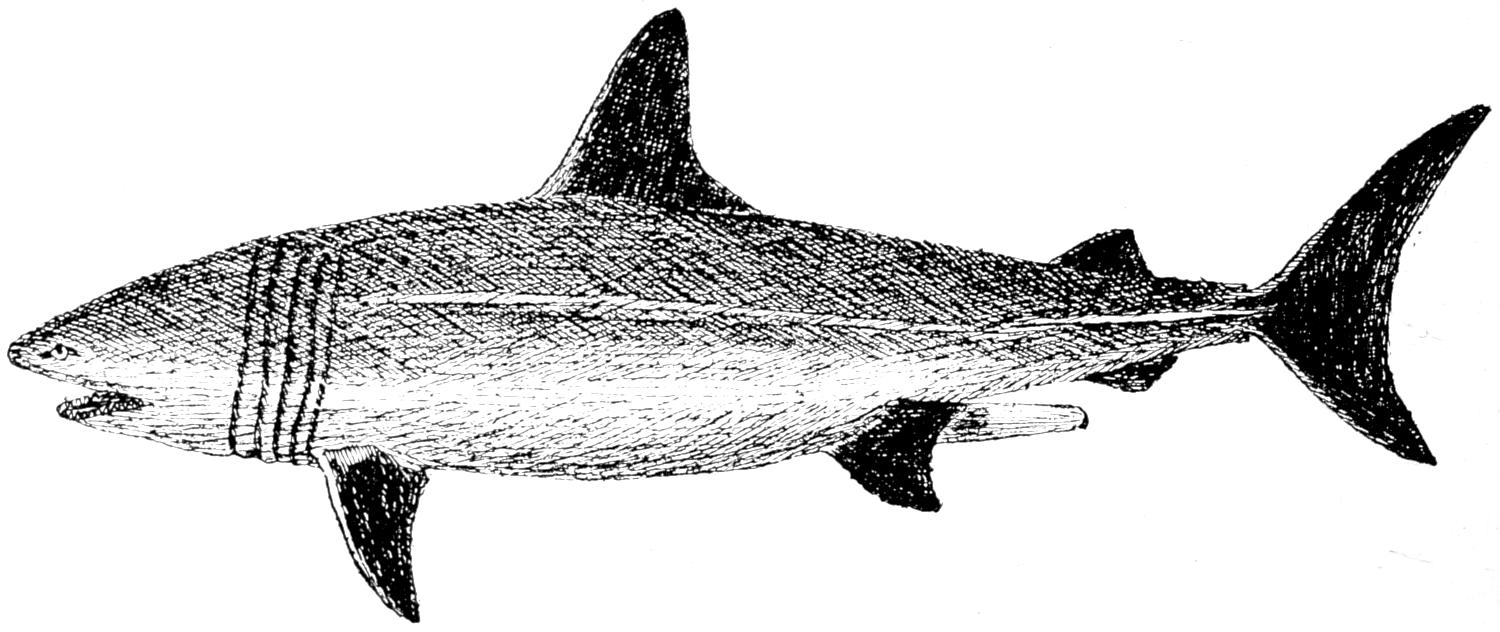
Fig. 8.—Squalus maximus, Linné.
Of course Mr. Barclay rejected Mr. Home’s supposition, and wrote a paper against it, printed in the first volume of the above mentioned Memoirs, running as follows:
“Since reading the first paper of Mr. Home, where he treats of the vertebrae of the Squalus maximus, I have seen another, entitled “An anatomical account of the Squalus maximus”. In this last paper, he seems to be convinced, that the animal of Stronsa is a Squalus maximus. The scale on which he draws his figure of the squalus, is a scale of half an inch to a foot.”
“Measuring by this scale, the head of his squalus is five feet and a half, from the joint of the upper jaw to the gills. The dried and shrivelled head of the animal of Stronsa, measures only twelve inches from the first vertebra to the farthest part that remains of the jaw.”
“The diameter of the head of the squalus maximus, from right to left, at the angle of the mouth, was, according to Mr. Home, five feet. The broadest part of the head of the animal of Stronsa is, in its present state, only seven inches.”
“The diameter of the larger vertebrae, near the head, in the squalus, was, according to Mr. Home, seven inches. The first cervical vertebra in the animal of Stronsa, is still adhering to the head, and is only two inches in diameter.”
“Yet some of the vertebrae of this animal, which are still preserved, are six inches and a half in diameter; and the first vertebrae which I saw, were from four to five and a half inches across.”
“The smallness of the cervical vertebrae, in the animal of Stronsa, confirms the account of those who saw it, that the animal had a neck. But the Squalus maximus, if Mr. Home’s figure be accurate, had nothing resembling a neck. And, indeed, Artedi observes, that “omnes pisces qui pulmonibus destituuntur, collo quoque carent: Ergo soli pisces cetacei collum habent.” The presence of a neck, therefore, as peculiar to cetaceous fishes, confirms likewise the account of the spiracula or ear-holes, ascribed to this animal of Stronsa.”
“The length of Mr. Home’s squalus was thirty feet six inches. The length of the animal of Stronsa, by actual measurement was fifty five feet, or, exclusive of the head, fifty four; and yet a part of the tail was supposed to be wanting. The circumference of the animal of Stronsa was, by actual measurement, about ten feet, meant, I suppose, at the thickest part. If the animal had been cylindrical at that part, the diameter from the dorsal to the sternal aspect must have been about three feet four inches. The diameter of the squalus at the thickest part, measuring from the dorsal to the sternal aspect, is nearly six feet; its circumference, had it been cylindrical nearly eighteen feet.”
“The animal of Stronsa had a mane, extending from the shoulder to near the caudal extremity (i. e. about thirty nine feet), after deducting the length of the head and neck, which, when together were sixteen feet. I have still a specimen of that mane, which I got from Mr. Urquhart; and all the specimens which were brought here, confirm the accounts that were sent of it from the Orkneys. The bristles of that mane are not like the radii of a fin, nor, although they were, has the squalus a fin extending from the shoulder to the tail.”
“A drawing which was sent to me by our very active and obliging Secretary, Mr. Neill, was executed, I am told, from the original, by Mr. Urquhart; and its accuracy is confirmed by the dried specimen now before us. It represents the sternum and two parts corresponding two scapulae, and those organs which are named paws. Mr. Home says, that these organs resemble the pectoral fins of his squalus. But the length of the pectoral fins, measuring along the upper margin, is four feet, the length of the paw cannot be determined, as part of it is wanting; the part that remains, measures seventeen inches.”
“The breadth of the fin, measuring across the radii, is three feet and seven inches; while the greatest breadth of the paw in its dried state, is only five inches and three quarters.”
“Those parts which in form resemble the scapulae and exhibit articular surfaces at each extremity, were probably ribs.”
“Mr. Home concludes by observing, that “it is of importance to science, that it should be ascertained, that this fish is not a new animal, unlike any of the ordinary productions of nature.” Of what importance it is to science to admit no new genera or species into our catalogues of natural history, I cannot conceive. But it is certainly of much importance to science, that the naturalist should be cautious not to determine the species of an animal upon vague evidence. Now what evidence had Mr. Home that this animal was a squalus, and even to suppose that it was a squalus maximus?”
I may be allowed to make the following remark: Mr. Barclay does not seem to make any difference between “a head” of a Squalus and “a skull.” It is true that the “head” of a Squalus maximus of thirty feet and a half measures five feet and a half, but its “skull” has only a length of ten inches. It is true that the diameter of the “head” of such a shark measures from right to left about five feet, but its “skull” would have only a few inches in breadth. It is true that the diameter of the larger vertebrae near the head of such an individual may be about seven inches, but what is indicated by Mr. Barclay in the head of his “animal of Stronsa” to be the “first cervical vertebra”, is (don’t laugh!) the cartilaginous nose tip with its two contorted cartilaginous appendages!—No wonder that the animal of Stronsa had “a neck”, for all the parts between the skull and the pectoral fins, except the vertebral column and some adherent flesh, were washed away, whilst the basking shark of Mr. Home had no neck, because it was entire.—Curious, indeed, is the naive passage in which Artedi is quoted!
In the comparison of Mr. Home’s basking shark and his own stranded animal, Mr. Barclay also wholly overlooks, when he states the dimensions, that they were those of the entirely putrified remains of an animal, and not of an undamaged being.
Dr. Barclay seems to entirely reject Mr. Home’s idea that the “mane” had never extended over the whole back, but what was seen were only fibres of the putrified backfins, in the two places of the foremost and the hindmost backfin, and that the rest of the “mane” only existed in the imagination of the witnesses.
In comparing the dimensions of the pectoral fins and the paws, Mr. Barclay again forgets that he has only before him a totally mutilated specimen.
An extract from the “Remarks” of Dr. Barclay was given by Dr. Hoffmann in Oken’s Isis, II, 1818, p. 2096, where amongst others he says:
“The paper is full of obscurities, which originate as well in the differences of the reports of uneducated eye-witnesses, as in the slubbering and inaccurate mode of describing of the writer himself;” but Mr. Hoffmann himself is not free from inaccuracies! In none of Dr. Barclay’s papers mention is made of a “membranaceous comb extended over bony rays, which was running from the shoulders to the end of the tail, over the back.” He has evidently translated this (if we may use this expression) from the figure (see our fig. 7). But this figure was made for print by Mr. Syme, after a drawing made on one of the islands from the description given there, and Mr. Syme has changed the “mane” (long loose hairs hanging down) into a true backfin of an eel, which he figured exactly as he was accustomed to do. Every one will be convinced of the truth of my assertion, if he will give himself the trouble to compare the figures of eels and muraenas, made by the same Mr. Syme in the same volume, with the engraving of the “animal of Stronsa.”
Immediately after this paper Mr. Oken, the editor of the Isis, wrote another one, in which he begins by saying that the imperfect description of the animal does not allow to prove any relationship with other animals. Further he comes to the conclusion, that, as no animal with a bony skeleton has six feet, it must have been a cartilaginous fish, a male one, of which the two pterygopodia (a pair of additional paring-organs, the so-called “claspers” or “holders”) were regarded as the third pair of feet, whilst the ventral and pectoral fins were the other pairs. “It is, however, no shark,” he goes on, and adduced 7 proofs for this theory; “it is, neither a cetacean,” and for this opinion he gives 4 different reasons. And yet he has the boldness to conclude: “The animal consequently is more related to the sharks, and as it is not a true shark, it must be a Chimaera”; but the reasons given to prove this are of course still more forced and irrelevant. I will add here that he also says: “finally individuals of Chimaera of 30 feet in length, have already been caught”, a manifest untruth, for the largest ever measured were of three feet and a half!—For those readers who never saw a Chimaera, or sea-cat, or a figure of it, I have delineated the Chimaera monstrosa in our fig. 9.
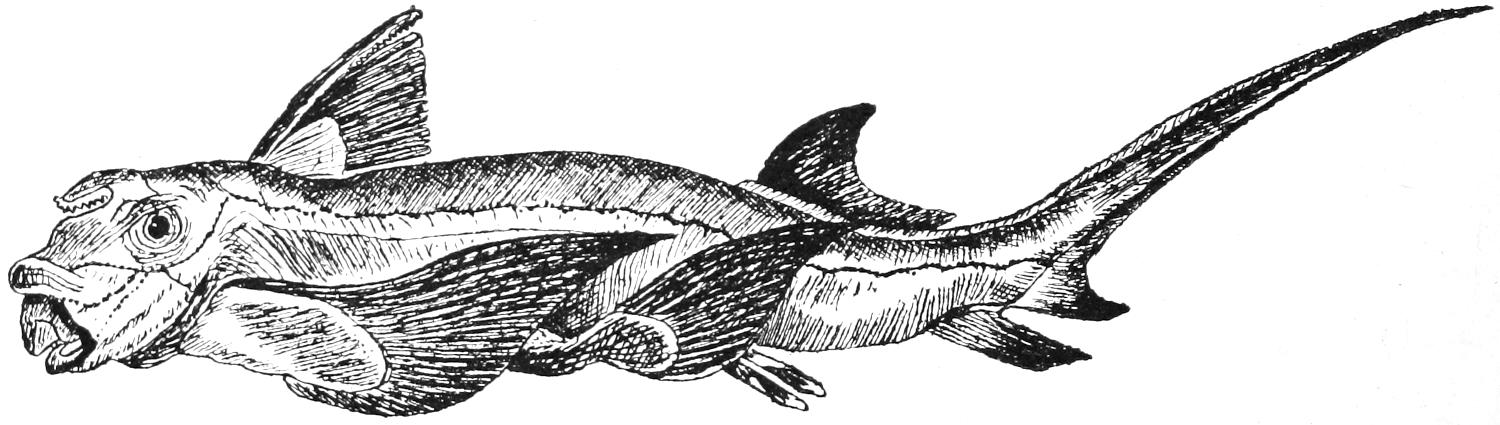
Fig. 9.—Chimaera monstrosa, Linn.
In the Edinb. Philos. Journ. Vol. V, 1821, an analysis is published of one of the vertebrae of the Orkney-Animal. The analysis was made by Dr. John Davy, and communicated “a considerable time ago” by Dr. Leach to the Wernerian Society. To trouble my readers with this analysis would be superfluous.
Dr. Hibbert in his Description of the Shetland Islands, 1822, really believes that:
“The existence of the sea-snake,—a monster of fifty-five feet long, is placed beyond a doubt, by the animal that was thrown on shore in Orkney, the vertebrae of which are to be seen in the Edinburgh Museum.”
Dr. Hamilton too, in his Amphibious Carnivora, 1839, is of the same opinion: “We turn first” he says “to an account of an animal which apparently belonged to this class” (viz. the class of sea-serpents), “which was stranded in the Island of Stronsa, one of the Orkneys, in the year 1808”, and he goes on giving some details of the stranded animal, taken from the Memoirs of the Wernerian Society. Later on we learn from him that:
“Dr. Fleming” in his History of British Animals, 1828, (this work I have not been able to consult), “in his notice of this animal, suggests that these members were probably the remains of pectoral, ventral and caudal fins.”
Mr. Rathke in the Archiv für Naturgeschichte of 1841, after having published some accounts, collected by him in Norway about the sea-serpent, and after having declared that he himself is a firm believer in it, goes on:
“To which group of known animals, however, this being belongs, cannot be asserted with any degree of certainty. The supposition, however, is at hand, that it is closely related to that animal, which in 1816” (read 1808) “stranded in Stronsa, one of the Orkneys, and of which several pieces of the skeleton are said to be preserved in the Museum of the University of Edinburgh, and in the Museum of the Royal College of Surgeons. I have read a note about it in the London Journal the Athenaeum, 1839, p. 902, which note is taken from the work: The Naturalist’s Library, Amphibious Carnivora, including the Walrus and Seals, also of the Herbivorous Cetacea. By B. Hamilton, M. D. (Edinburgh, Lizars). An ample description of the saved rests of the animal is said to have been written by Dr. Barclay in the first Volume of the Memoirs of the Wernerian Society. I had, however, not the means of consulting this dissertation. According to the above-mentioned note or extract the creature stranded in Stronsa measured 56 feet and had (on its thickest part?) a circumference of 12 feet. The head was small and one foot long, the neck slender and 15 feet long. The organs of motion are said to have consisted of three pairs of fins: one pair of which is believed to have been properly a caudal fin. The foremost pair of fins measured 4 feet; these were the longest, and their tops looked like toes, partly, however, webbed together. From the shoulders a kind of bristly mane extended to near the extremity of the tail. The skin was smooth, without scales and of a grey colour. The eye was as large as a seal’s. The throat was too narrow to admit the hand.”
“Judging from these truly incomplete statements, viz. that the head was relatively very small, the neck very long and slender, and the extremeties were like fins, one may suppose that the animal stranded in Stronsa resembled a Plesiosaurus; and that consequently it belonged to the Amphibia, viz. to the Saurians.”
Prof. Dr. W. F. Erichson, the well known Editor of the Archiv für Naturgeschichte, expressed his opinion about the animal of Stronsa, immediately after the appearance of Mr. Rathke’s dissertation. After having given full details of Mr. Barclay’s paper, and an ample description of the saved parts, he says: “All these parts belong undoubtedly to a shark,” and:
“Everard Home already declared the animal to be a shark, and in spite of all that Dr. Barclay asserts to the contrary, it will be so for ever, only it may not have been a Selache maxima, but a Lamna cornubica, which also reaches a considerable length. So the animal of Stronsa has no relation at all with the sea-serpent of the Norwegians.”
I have only to observe that I am surprised that Mr. Erichson could arrive at this conclusion, as the Lamna cornubica, or porbeagle has never attained a length above 18 feet.—Our fig. 10 represents a porbeagle.
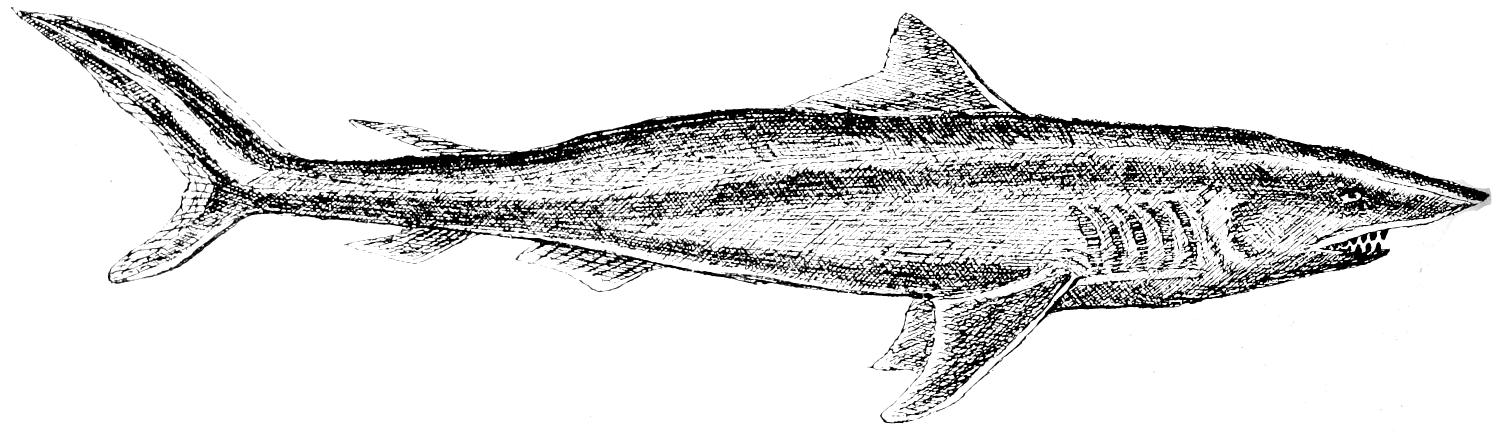
Fig. 10.—Lamna cornubica (Linn.).
It is astonishing, yet it is true, that Mr. Newman, the Editor of the Zoologist, after all that had been written about the animal of Stronsa, was not yet convinced of its being a shark. In his journal of 1849, p. 2358, he asked the following
“Inquiries respecting the bones of a large marine animal cast ashore on the Island of Stronsa in 1808.”
“In the “Memoirs of the Wernerian Natural History Society” (vol. I. p. 418) is a paper by Dr. Barclay, on a large animal cast ashore on the island of Stronsa. In illustration of his paper, the Doctor figures the head with a vertebra attached, four other vertebrae and a sternum with a paddle “and two parts corresponding two scapulae” attached. He speaks of the originals of these figures as specimens then before the audience he was addressing. He gives seven inches as the diameter of the head, and two inches as the diameter of the cervical vertebra then still attached to the head. The total length of the animal is given as fifty-five feet, and this from actual admeasurement. It is now positively asserted that the animal in question was a shark; but the utter impossibility of a shark fifty-five feet in length having a head only seven inches in diameter, and cervical vertebrae only two inches in diameter, is so manifest that further inquiry seems desirable; and I shall esteem it a great kindness if any naturalist who may possess the means of doing so will reply to the following questions:—
“1. How were the bones by Dr. Barclay obtained?
“2. What is the evidence that they belonged to one animal?
“3. Where are these bones preserved?
“4. What is their present state?
“5. Has the skull ever been denuded of skin, muscle, etc.?
“6. Has it ever been examined by a competent comparative anatomist? and if so, what opinion has he pronounced on it?
“Surely there are naturalists in Edinburgh who can answer the questions at once. It seems very irrational to speculate on the genus, order or class, to which a recent animal belongs, while the head and sternum of the creature are still in existence.”—
The following “Reply” to these questions was given, printed in the Zoologist for 1849, p. 2396:
“Reply to Mr. Newman’s Inquiries respecting the Bones of the Stronsa Animal.—Seeing your queries regarding the bones of an animal cast on shore at Stronsa, described by Dr. Barclay in the “Memoirs of the Wernerian Society”,—after some little trouble I have been able to answer most of these questions.”
“1. How were the bones described by Dr. Barclay obtained?—It will be seen in the “Wernerian Memoirs” (Vol. I. p. 438), that George Sherar, one of those who saw the animal, mentions that he brought away, to deliver to Mr. Laing (the Scotch historian), the skull, two joints of one of the largest limbs next the head, with different parts of the back-bone, besides the bones that were formerly sent in. Mr. Laing, I suppose, forwarded them to Dr. Barclay.”
“2. What is the evidence that they belonged to one animal?—The answer to this is simply that the aforesaid George Sherar took them from the same animal.”
“3. Where are these bones preserved? 4. What is their present state?—Three of the vertebrae are in the Museum of the Royal College of Surgeons, Edinburgh, in a dried state, and are 6 inches in diameter; and four in the University Natural History Museum, preserved in spirits, and are still articulated to each other, whereas the other three are separate.”
“5. Has the skull ever been denuded of skin, muscle, &c.?—6. Has it ever been examined by a competent comparative anatomist? if so, what opinion has he pronounced on it?—This is answered by the annoying fact that the skull has not been preserved.”
“On inquiring of Professor Goodsir with regard to the vertebrae, he tells me he has examined them, and that they are undoubtedly those of a Shark (Squalus maximus), as are the skull, sternum and scapulae, figured in the “Wernerian Memoirs”, p. 418.”
“We would naturally suppose that the affidavit of those who saw this extraordinary animal would be of some avail; but on closer inspection even these will be found to have little weight in the argument. In the first place it is infortunate that no well-educated person saw it: they were all ignorant, illiterate men, who most likely knew nothing further of a shark than that it was an animal with a huge mouth, capable of discussing so many seamen at a bite, and whose teeth are peculiarly adapted for amputating limbs. In the next place we find these witnesses agreeing in one most absurd particular, viz., in the animal having six legs: on this point it is needless to expatiate; every one knowing anything of comparative anatomy must see at once the impossibility of such a structure: moreover, even granting its possibility, it is at once cancelled by Mr. Urquhart’s figure of the sternum and scapulae with an ordinary fin thereto attached (Wern. Mem. Vol. I. p. 418); the third pair of appendages Dr. Fleming in his “British Animals”, supposes were claspers. In the last place we may notice one striking contradiction in the evidences: Thomas Fotheringhame seems to have been astonished at such a large animal having such a narrow throat,—so narrow indeed that it would not admit his hand; while George Sherar would have had no difficulty in putting his foot down it: and as there is nothing to prove that Thomas Fotheringhame’s hand was larger than George Sherar’s foot, we are led to the conclusion that one or other must have made a mistake in his calculation.”
“We might further suggest the improbability of any animal sixty feet long having a head only seven inches in diameter, and we might even suspect the carpenter’s footrule of showing a decided taste for the marvellous; but we must now conclude with this single remark, that if the Stronsa Animal was not a shark it was certainly not the great sea-serpent, which, if it does exist, will most likely be allied to the Plesiosauri of by-gone days, and to which the animal seen by the Rev. Mr. Maclean, Eigg-Island (Wern. Mem. I. p. 442), seems to have borne a strong resemblance.—Jas. C. Howden; Musselburgh, February, 1849.”
As to the animal seen by Mr. Maclean, see our report no. 31, in the following chapter.
One would think that the question about the “animal of Stronsa” was now set at rest. Not at all! Dr. Thomas Stewart Traill wrote a paper about it, published in the Proceedings of the Royal Society of Edinburgh, Vol. III, no. 44, 1854, June, comparing it with the animal seen by the Captain, officers and crew of H. M. S. Daedalus (see our report no. 118 in the next chapter). The part of his dissertation, respecting the “animal of Stronsa” runs as follows:
“The discussions which arose about four years ago on the animal reported to have been seen on 6th. August 1848, by Captain M’Quhae, the officers and crew of H. M. S. Daedalus, in the Southern Atlantic, between the Cape of Good Hope and St. Helena, about 300 miles off the African shore, recalled my attention to the materials I had collected respecting the vast animal cast ashore on Stronsey, one of the Orkneys, in 1808.”
“I was not there at the time, but copies of the depositions made by those who had seen and measured it were transmitted to me by order of Malcolm Laing Esq., the historian of Scotland, on whose property it was stranded; and I obtained other notes from several individuals resident in Orkney.”
“The evidence of the most intelligent persons who had seen and measured the animal was carefully collected, and copies of it were transmitted by Mr. Laing to Sir Joseph Bankes, and other naturalists. Soon afterwards Mr. Laing sent, through his brother, the late Gilbert Laing Meason, to the Museum of our University the skull and several vertebrae. The cartilaginous omoplates, to which a portion of the pectoral fin, or wing, as it was termed by the natives, were afterwards sent to Edinburgh, where I saw and examined them.”
“Two of the vertebrae were transmitted to me with portions of what was termed the mane of the animal, which I now exhibit.”
“The dead animal was first observed by some fishermen lying on a sunken rock, about a quarter of a mile from Rothiesholm-Head; but in a few days a violent gale from the S. E. cast it on shore in a creek near the headland, where it remained for some time tolerably entire; and it was subsequently broken up by the fury of the waves. Before it was thus broken into several pieces it was examined, and measured by several intelligent inhabitants of the Island; and their testimony collected as above stated was forwarded to London, Edinburgh, etc. The declarations were, however, accompanied by a very absurd drawing of the animal, which was thus produced. Many days elapsed ere the tempestuous weather allowed any communication with other Islands; and when the storm abated, a young man was sent from Kirkwall by Mr. Laing, to collect what information he could on the subject. But by this time the body of the animal was completely broken up. This lad, who was no draughtsman, and ignorant of Natural History, endeavoured, from the descriptions of those who had seen the animal most entire, to delineate with chalk on a table a figure of the animal. The rude figure so produced was transferred by pencil to paper, and copies of it were handed about as real representations of the animal.”
“That it had a general resemblance to the animal was admitted by those who had seen it; but from the accounts I afterwards obtained, it would appear that the jointed legs, which the lad had attached to it, are creations of his own imagination.”
“The appendages, which gave rise to this strange representation, were never called legs by those who saw the animal, but were denominated by them wings or fins or swimming paws. “That nearest the head was broader than the rest, about four-and-a-half feet in length, and was edged all round with bristles or fibres, about ten inches long”. The “lower jaw was wanting when it was cast ashore, but there remained cartilaginous teeth in portions of the jaws”. Before it was discovered putrefaction had commenced, especially in the fins. The animal had a long and slender neck, on which there were two spiracles on each side.”
“The wings would seem to have been the remains of fins, altered by incipient decomposition. The six may perhaps be remains of pectoral, abdominal, and anal fins, and perhaps they may have been placed, like those of some of the shark family, farther from the centre of the abdomen than in ordinary fishes. Indeed one of the witnesses states that “the wings of the animal were jointed to the body nearer the ridge of the back than they appear in the drawing”.”
“The portion of the anterior fin or wing, which was attached to the omoplates, consisted of cartilaginous rays; and when such a structure of fin is partially separated by commencing decomposition, the rays might easily, to the eyes of the uninitiated in natural science, seem like toes or fingers.”
“Even the great Cuvier admits this resemblance when describing the fins of fishes:”—
“Des rayons plus ou moins nombreux soutenant de nageoires membraneuses representent grossièrement les doigts, des mains, et des pieds.”
“As much of the value of the descriptions of the Orkney animal rests on the character and credibility of the individuals who saw it most entire, I may be permitted to state that I personally knew the three principal witnesses, Thomas Fotheringhame, George Sherar, and William Folsetter, to be men of excellent character, and of remarkable intelligence. They were not ignorant fishermen, as the witnesses were represented to be; but two of them were of the better sort of farmers in that part of Orkney; and the first and the last of them were also very ingenious mechanics, much accustomed to the use of the footrule, the instrument employed in measuring the animal.”
“They were men of such honour, intelligence, and probity, that I can have no doubt of the correctness of any statement they made of their impressions of what they had so carefully observed.”
“It was, therefore, not without surprise, that some months after these accounts were sent to London, I read a paper by Mr. Home (afterwards Sir Everard), in which he recklessly sets aside the evidence of the persons who saw and measured the animal in its most entire condition, as to its dimensions of length and thickness; and maintains that it was nothing but a Basking shark (Selache maximum!), which he supposes the love of the marvellous had magnified so enormously in the eyes of those whom he is pleased to call “ignorant fishermen”. Unfortunately for Home’s hypothesis, the Basking shark was probably far more familiar to those men than to himself; for it is often captured among the Orkney Islands; and its length and proportional thickness are so totally different from the animal in question, that the two could scarcely be confounded, by the most “ignorant fishermen” who had ever seen them.”
“These witnesses assert that the Stronsey animal (though a portion towards the tail was broken off when they took its dimensions) measured no less than fifty five feet in length; whereas that of the largest Basking shark of which we possess any accurate account scarcely exceeds thirty six feet.”
“The circumference of the two animals is no less widely different. My notes states the circumference at the thickest part of the body of the Orkney animal to be about ten feet, when it tapered much towards the head and the tail; whereas the circumference of a large Basking shark, where thickest, is not less than twenty feet. Besides, the shark-like figure of the latter could scarcely be confounded with the eel-like form of the Stronsey animal.”
“(The diameter of the animal is a little differently stated by different witnesses. But as we are told that its contour was more oval than round, we can easily explain the discrepancy. One witness, who had not measured it, speaks of it as equalling a middle-sized horse in thickness. On measuring four horses of from thirteen to fourteen hands in height, I found their greatest circumference to be from seventy-one to seventy-three inches, (or from five feet eleven inches to six feet one inch), or an average of six feet, that is less than the thickest part of our animal, but seemingly near that of its average dimensions.)”
“The mane as it is termed, may perhaps be the remains of a decomposed fin; but the fibres do not seem to be the rays of a fin; and the animal seen from the Daedalus is stated to have had a mane, floating about like sea-weed; and a similar appendage has generally been noticed in some less distinct accounts of a supposed sea-serpent.”
“Supposing this to be a dorsal fin, it extended from the anterior wings, or pectoral fins, towards the tail for thirty seven feet, and differs from the dorsal fin of any species of shark. If the mane consisted of detached fibres extending for thirty seven feet on the back, it is analogous to no appendage of any known marine animal. That its rays or fibres are very peculiar, will appear from the specimen now exhibited. These round fibres are fourteen inches in length; and in the dried state, have a yellow colour and transparency, equal to that of isinglass.”
“The vertebrae, which have been preserved in spirit in our Museum, have been exceedingly well described by Dr. Barclay, in the Wernerian Transactions, Vol. I; and undoubtedly, in their want of processes and cartilaginous structure, have much resemblance to those of chondropterygious fishes. One of the vertebrae adherent to the cranium, measured only two inches across; while that of the Basking-shark, in the same situation, is about seven inches in diameter. Dr. Barclay’s paper is accompanied by an engraving of the omoplates, and upper portion of the pectoral fin, which are accurately given, from a drawing made from the recent remains, by the late Mr. John T. Urquhart, an accomplished draughtsman, and able naturalist. I know the representation to be correct, for I saw and handled the specimen. The substance of this part was a firm, but flexible cartilage, and seemed to have been placed in the muscles; just as Cuvier describes the omoplates of sharks to be: Leurs omoplates sont suspendues dans le chair, en arrière des Branchies, sans s’articuler ni au crâne ni à l’espine. The Orkney animal seems to have had two circular spiracles on each side of its neck, about 1¹⁄₄ inch in diameter; whereas the Basking shark has five linear spiracles on each side, a foot or more in length.”
“The cranium, which I also very carefully examined, was far too small for that of a Basking shark of even one-fourth the usual length of that species. It measured in its dried state no more than twelve inches in length, and its greatest diameter was only seven inches. A Basking shark of thirty-six feet long would have had a head of at least five feet in length; and the diameter of the cranium at the angles of the mouth, would have measured probably five feet. These proportions positively show, that the Orkney animal could not possibly be confounded by intelligent men, accustomed to see the Basking shark, with that fish. There was a hole on the top of the cranium, something similar to the blow-hole of the cetaceans; but its lateral spiracles and cartilaginous bones forbid us to refer it to the order of cetacea”.
“Every thing proves the Orkney animal to have been a chondropterygious fish, different from any described by naturalists; but it has no pretensions to the denomination of Sea Serpent or Sea Snake, although its general form, and probably its mode of progression in the Ocean, may give it some resemblance to the order of Serpentes. Certainly, it cannot be confounded with any known shark; nor does it belong to the family of Squalidae”.
I am obliged to point out some discrepancies in Mr. Traill’s paper. First he asserts that in a few days the dead animal was cast on shore by a violent gale “where it remained for sometime tolerably entire”. This is not true, for the dead animal was already in a very putrified and damaged state, when it floated on the surface of the sea, for the pectoral fin was already putrified and the fibres had become loose.
Again: the teeth of the animal were not called “cartilaginous”, but they were described as “soft, and” that “they could be bent by the strength of the hand”.
Mr. Traill further says that “they would seem to have been the remains of fins, altered by incipient decomposition. The six may be remains of pectoral, abdominal and anal fins”. Now there is no fish known to Zoologists, that has two anal fins. The anal fin is therefore called an unpaired fin!
In comparing the dimensions of the animal of Stronsa with those of Home’s Basking-shark, the writer, like Dr. Barclay, permanently believes that the animal was “in its most entire condition”! Further he asserts that the “length of the largest Basking shark of which we possess any accurate account, scarcely exceeds thirty six feet”. Consulting Prof. H. Schlegel’s De visschen van Nederland, I read, however:
“The largest individual ever observed on the coasts of England, had a length of 36 feet. On the coasts of Norway, individuals are usually observed much larger than the boats fitted out for this capture, which are of about 40 feet. According to earlier intelligences, transmitted by trustworthy witnesses to the Bishop Gunner, sometimes individuals of more than 70, and even of more than 100 feet in length were captured on the coasts of Norway”.
In considering the “mane” he also overlooks the fact that the two dorsal fins and the caudal fin were entirely decomposed, so that their fibres had become quite loose. According to the so called “first cervical vertebra” he made the same mistake as Dr. Barclay!
The two “circular spiracles on each side of the neck” have of course no relation at all with the five linear true gill-splits (not “spiracles” as Mr. Traill says) of the Basking-shark. These “two spiracles on each side of the neck” were in no case “spiracles”. They may have been decomposed stems of the vascular system in the flesh near the skull of the animal.
Dr. Traill, no more than Dr. Barclay, seemed to have known the difference between the “head” of a shark and its “skull” or “cranium”!
The “hole on the top of the cranium” which is also figured in the engraving representing the skull in the Memoirs of the Wernerian Society is evidently the result of putrification and of an external injury.
I need not tell my readers what I think about “the animal of Stronsa”. They may more than once have observed that I agree with Mr. Everard Home’s opinion in all particulars, except in the so-called exaggerated dimensions. I firmly believe that the carcass of the animal measured fifty-five feet from the head to the end of the tail, and as a piece of tail seems to have been broken off, the vertebral column may even have been one of sixty feet. The dried and shrivelled skull measured twelve inches “from the first cervical vertebra to the farthest part that remains of the jaw”. But as I have pointed out that this “first cervical vertebra” was in reality the cartilaginous nose tip with its two contorted cartilaginous appendages, and as this nose tip must have measured (see the drawing of the skull in the Memoirs of the Wernerian Society, Vol. I) two inches, the whole skull measured fourteen inches. But the skull was dried and shrivelled, consequently we may safely admit that it measured in its perfect state about twenty inches. Consequently I conclude that: the largest Basking-shark that ever stranded on the coasts of Great Britain measured upwards of sixty feet, viz. the so-called “Animal of Stronsa”. The putrified body of it was floated ashore, and the putrification had continued so far that the almost black covering of the two backfins and the tail-fin were not only washed away by the waves, but that their yellow fibres had become loose. The eye-witnesses evidently reasoned that these fibres must have been present all along the back between these three parts, now far remote one from another, but were washed away, and they therefore concluded that the animal had “a mane, extending from the shoulders” (the part of the back at the level of the pectoral fins) “to the tail”, i. e. to the end of the tail. Or, according to another witness it extended “to within two feet and a half of the tail”; which may be explained in two ways, viz., either he meant that the mane extended to within two feet and a half beyond the level of the last pair of paws (the claspers), consequently the level where the tail begins, and here is the exact place of the hindmost back-fin, or he meant that the mane did not quite extend to the point of the tail, from which we in our turn may conclude that the last two feet and a half of the tail had already been wholly cleared from the fibres of the putrified tail-fin.
Moreover putrification on one side, and the beating of the waves on the other side, had already removed the animal’s enormous jaws, gills, with adherent muscles and cartilages, and all the entrails, except the valvular intestine. On persons who never saw such a mutilated specimen of a shark, the animal must have made the impression of being a sea-snake!
As to the sketch, made by Mr. Petrie after the descriptions of one of the witnesses, and with regard to the “mane” somewhat altered by Mr. Syme, it will appear at a glance that besides the ridiculous legs, the head (read skull) of it is drawn too large. The carrion was 56 feet long and the drawing only 74 lines, consequently the length of one foot is represented by a space of 1.3 line. A skull of 14 inches should therefore be in this drawing only 1.5 line long, and not 6 lines. Last not least, the “mane” is not delineated on only three different places, as it really was, but from the “shoulders” to the end of the tail, according to the wrong conclusions of those “most intelligent eye-witnesses”! This terrible “mane” was evidently the only cause of all this trouble, and of the whole puzzle!
1816.—Phil. Mag., LIV, 1819.—The third sea-serpent described by Mr. Rafinesque (for he believes there are several species), is called by him:
“3. The Scarlet Sea-Serpent. This was observed in the Atlantic Ocean, by the captain and crew of an American vessel from New-York, while reposing and coiled up, near the surface of the water, in the summer of 1816. It is very likely that it was a fish, and perhaps might belong to the same genus with the foregoing; I shall refer it thereto, with doubt, and name it Octipos? coccineus. Entirely of a bright crimson; head acute. Nothing further descriptive was added in the gazettes where the account was given, except that its length was supposed to be about 40 feet.”

Fig. 11.—A large calamary, swimming on the surface of the Sea.
I am convinced that this “sea-serpent” was a great calamary. As the greatest ever found, measured from the tip of the tail to the tips of the extended shorter arms about 30 feet (a calamary reposing or swimming in the sea always has its long tentacular arms coiled up), the length of 40 feet probably is exaggerated. I give here a figure of a large calamary, swimming on the surface of the water (taken from Mr. Henry Lee’s Sea-Monsters Unmasked, 1883, corrected, however, as to its proportions), and now my readers most probably will agree with me that such an animal has been seen. The hillocks of the short arms make the appearance of a long undulating body. The body of such an animal is quite scarlet or crimson, and the tail (the so-called head) is acute.
1822, June.—In Froriep’s Notizen of 1822, III, we read:
“Some time ago the American newspapers were filled with the reports of a sea-serpent which showed itself in the neighbourhood. Also more than a year ago an animal was caught, supposed to be such a one, which, however, was recognized as a large tunny. It appears by the New-York newspaper of June 15th., that such an animal taken for a great sea-serpent has been caught in a bay near Middleton-Point. This monster measured thirty feet and has a circumference of 18 feet. It had already been seen for some days, floating like a huge trunk. Some persons had fired at it with guns, but without any result. Having got into shallow water it could not regain the high sea, was killed with harpoons, towed aland and flayed. The liver alone produced three barrels of train-oil. It took six men two hours to drag the skin, which will be stuffed, to a distance of about 200 yards off. None of the old whalemen and seamen who saw the animal, knew it. There were no guts (?) and there was no heart (??). In the beak six rows of small sharp teeth were counted and the throat was wide enough for a tall man to pass. The skin was lead coloured and could be used as a stone for sharpening knives (apparently an unusual large shark?)”
About the tunny I allow myself to refer the reader to our fig. 1.—We immediately agree with Mr. Froriep that this animal was a large shark. Evidently it was dead, “floating some days like a huge trunk”. The reason that no whaleman recognized the animal, that neither guts nor heart was found, is of course to be found in the fact that the animal was putrified, irrecognizable, and had already lost its guts and some other entrails. Evidently it was a basking-shark, Squalus maximus (See our fig. 8). The length of 30 feet and girth of 18 feet is normal in this species. Norwegian fishermen harpoon it to procure the train-oil from the liver. The teeth are comparatively small and conical, the skin is lead coloured and can really be used as a whet-stone.—
1849.—In the Zoologist of 1849, p. 2335, we read:
“A young sea-serpent.—On Friday, while some fishermen belonging to Usan were at the out-sea fishing, they drew up what appeared to them a young sea-serpent, and lost no time in bringing the young monster to the secretary of our Museum. The animal, whatever it may be called, is still alive, and we have just been favoured with a sight of it; but whether it really be a young sea-serpent or not, we shall leave those who are better acquainted with Zoology than we are to determine. Be it what it may, it is a living creature, more than 20 feet in length, less than an inch in circumference, and of a dark brown chocolate colour. When at rest its body is round; but when it is handled it contracts upon itself, and assumes a flattish form. When not disturbed its motions are slow; but when taken out of the water and extended, it contracts like what a long cord of caoutchouc would do, and folds itself up in spiral form, and soon begins to secrete a whitish mucous from the skin, which cements the folds together, as for the purpose of binding the creature into the least possible dimensions.”—“Montrose Standard.”—
“[This creature was probably a specimen of Gordius marinus. I am obliged for the extract.—E. Newman.]”
Mr. Newman suggesting this worm to be a Gordius marinus evidently did not mean the Gordius marinus of Linné, but that of Montagu. The former is a little worm of about one half of an inch in length, living parasitically in the entrails of some fishes, especially in herrings, whilst the latter is identical to Lineus longissimus of Sowerby, belonging to the family of Lineidae, to the order of Nemertini, to the class of Platyelminthes or Flat-Worms. Of this species individuals of thirty to forty-five feet in length have occasionally been dredged.
Having the means of consulting the splendid work of the British Nemerteans of Mr. Mc. Intosh, I am able to show my readers in fig. 12 this Lineus longissimus, on a reduced scale.
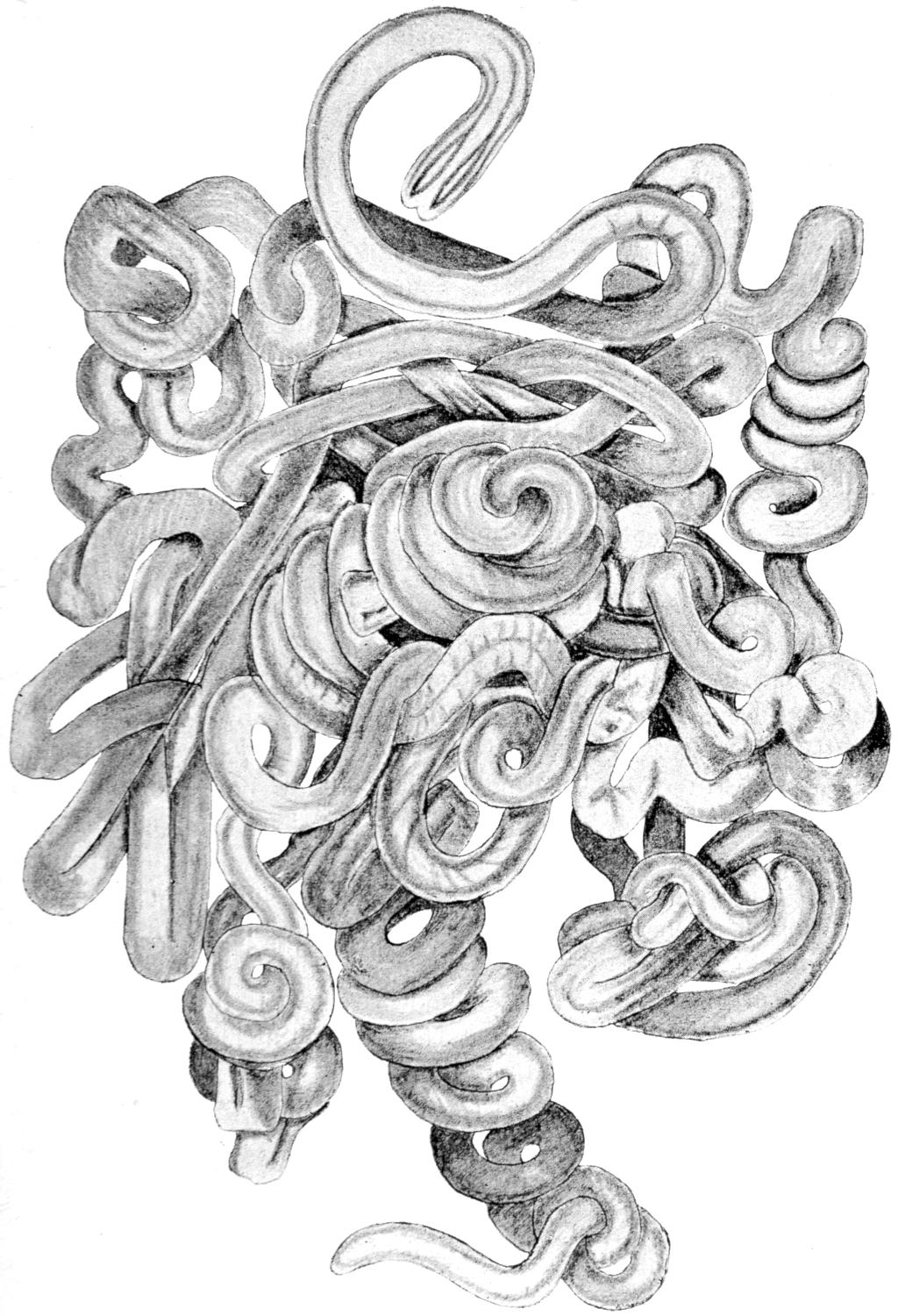
Fig. 12.—Lineus longissimus, Sow.
1849, March 26.—Another would be sea-serpent; (Zoologist p. 2433 for 1849):
“A strange marine animal, of great size and strength, was captured on the 26th. of March off Cullercoats, near Newcastle. By the enclosed handbill, which has been forwarded to me, it appears to be quite unknown to the neighbouring savants. The honest fishermen who drew the struggling monster to land are not, however, overscrupulous about the name, provided it be attractive enough to extract from the pockets of “ladies and gentlemen 6d.; working people 3d. each”: they therefore boldly announce him as “the great sea-serpent caught at last”. My correspondent very judiciously observes, that whatever the animal may be, it adds another to the many evidences constantly occurring that there are more things in heaven and earth, than are dreamt of by the most experienced practical observers. Some thirty five years since, the distinguished anatomist Dr. Barclay, was fain to reproach his contemporaries with the folly of affecting to suppose that they knew every thing. What additions have five and thirty years not given to Science! As the animal in question must be at least a local visitor, may we not hope, that some resident naturalist will favour us with a notice of it?”
“The great Sea-Serpent caught at last, by fourteen fishermen, off Cullercoats, on Monday last, March 26, 1849. This most wonderful monster of the deep was discovered by a crew of fishermen, about six miles from the land, who, after a severe struggle, succeeded in capturing this, the most wonderful production of the mighty deep. This monster has been visited by numbers of the gentry and scientific men of Newcastle, and all declare that nothing hitherto discovered in Natural History affords any resemblance to this. As an object of scientific inquiry, this “great unknown” must prove a subject of peculiar interest. Many surmises as to its habits, native shores, etc., have already been made, but nothing is really known. The general opinion expressed by those that are best able to judge, is, that this is the great sea-serpent, which hitherto has only been believed to have a fabulous existence, but which recent voyagers declare they have seen. Now exhibiting, at the shop, 57, Grey Street, opposite the High Bridge. Admission: ladies and gentlemen 6d., Working people 3d. each.”
In the Illustrated London News of May 19, 1849, we find the following account of this capture:
“The Sea-Serpent.—We observe in the Newcastle papers that a strange and hitherto unknown fish, nearly 13 feet in length, and possessing many of the characteristics which the captain of the Daedalus enumerated in his description of the great Sea-Snake, has really been caught off the Northumbrian coast, by the Cullercoats’ fishermen, and has been exhibited in Newcastle, where it has created the greatest sensation. The members of the National History Society of that town have duly reported upon it, and expressed their opinion, that it is a young specimen of the genus Gymnetrus, only four of which species, and those very rare, are known to ichthyologists, and described by Cuvier and others as inhabiting the Indian, Mediterranean and White Seas. The present specimen has become the property of a Newcastle merchant, who has presented it to the museum of that town; and we understand that, in accordance with a very general wish of most of our distinguished naturalists, it is now exhibiting in the metropolis.”
As we read in the Zoologist for 1849, p. 2460—2462, Mr. Albany Hancock and Dr. Embleton now declared it to be a probably new species of the genus of riband-fish (Gymnetrus).
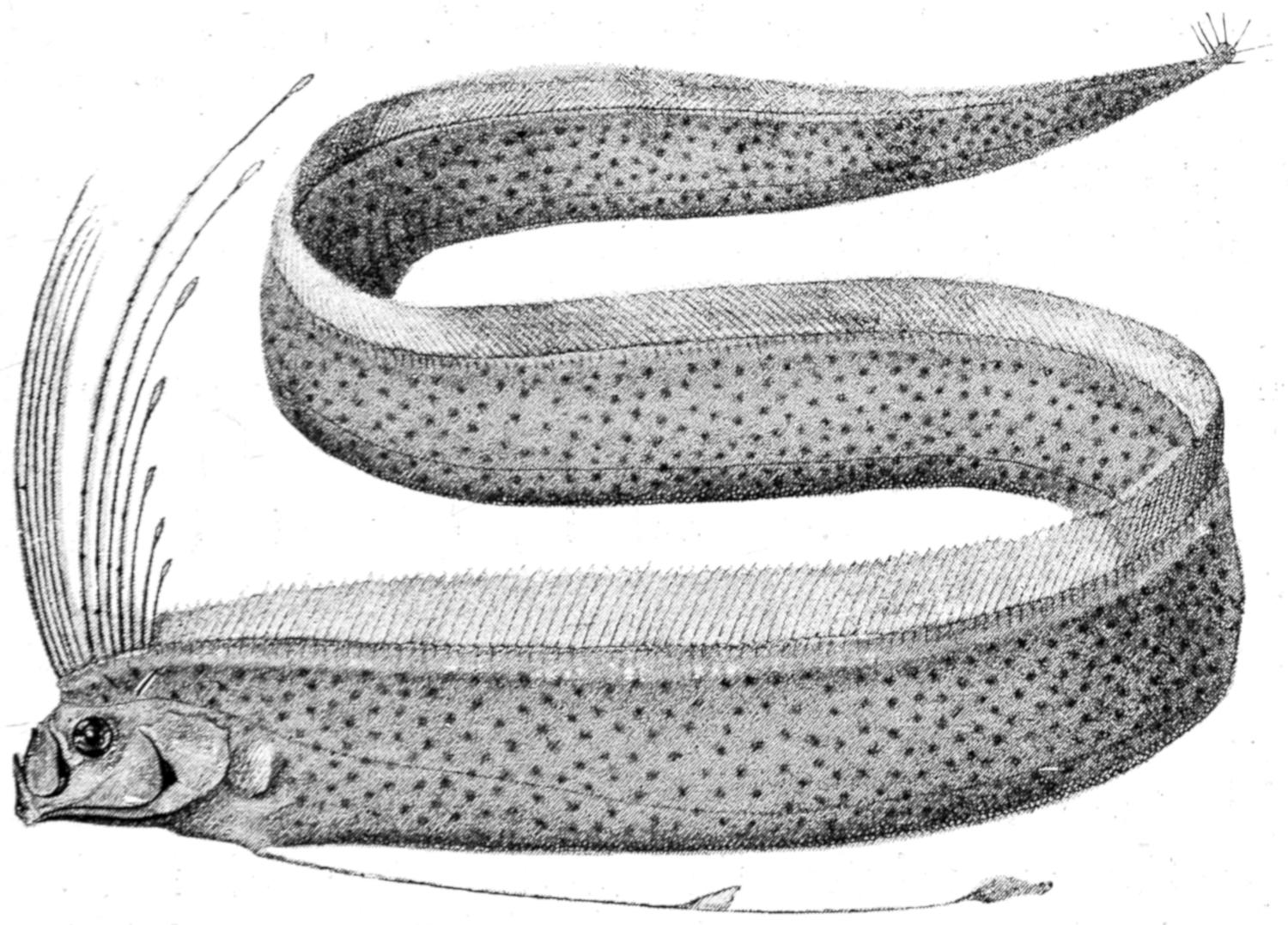
Fig. 13.—Gymnetrus gladius, Cuv. Val.
Fig. 13 shows the readers a kind of riband-fish, the Gymnetrus gladius of Cuvier and Valenciennes, taken from the Règne Animal. This fish is of a silvery colour, except the fins and the peculiar articulated head-ornaments, which are crimson. Its length is about ten feet, its home the Mediterranean. The Gymnetrus Banksii or Regalecus Banksii of Cuvier, closely allied to it, measures about twenty feet, sometimes more, and is, though rarely, hitherto caught only near the British shores. The fish in question therefore most probably belonged to this species.
1852, Aug. 28.—Mr. Alfred Newton, of Elveden Hall, forwarded the following report to the Editor of the Zoologist (see this journal for 1853, p. 3756).
“I have lately received the following account from my brother, Capt. Steele, 9th. Lancers, who on his way out to India in the Barham, saw the sea-serpent. Thinking it might be interesting to you, as corroborating the account of the Daedalus, I have taken the liberty of sending you the extract from my brother’s letter:—“On the 28th. of August, in long. 40° E., lat. 37° 16′ S., about half-past two, we had all gone down below to get ready for dinner, when the first mate called us on deck to see a most extraordinary sight. About five hundred yards from the ship there was the head and neck of an enormous snake; we saw about sixteen or twenty feet out of the water, and he spouted a long way from his head; down his back he had a crest like a cock’s comb, and was going very slowly through the water, but left a wake of about fifty or sixty feet, as if dragging a long body after him. The captain put the ship off her course to run down to him, but as we approached him, he went down. His colour was green, with light spots. He was seen by every one on board.” My brother is no naturalist, and I think this is the first time the monster has ever been seen to spout.”
“I am told by a gentleman whose brother was on board the ship (the Barham) referred in the following extract from “The Times” newspaper of November 17, 1852, that the occurrence there related took place between 35° and 40° S. lat. and 40° and 45° E. long., being about 650 miles due south of Madagascar. I understand that the particulars of the event as there stated closely agree with those furnished to my informant, and further, which is perhaps the most interesting part of the whole circumstance, that the animal was observed to “blow” or “spout” in the same manner that a whale does.”
“Extract from an Officer’s Letter written between the Cape and Madras. You will be surprised to hear that we have actually seen the great sea-serpent, about which there has been so much discussion. Information was given by a sailor to the captain, just as we were going to dinner. I was in my cabin at the time, and from the noise and excitement, I thought the ship was on fire. I rushed on deck, and on looking over the side of the vessel I saw a most wonderful sight, which I shall recollect as long as I live. His head appeared to be about sixteen feet above the water, and he kept moving it up and down, sometimes showing his enormous neck, which was surmounted with a huge crest in the shape of a saw. It was surrounded by hundreds of birds, and we at first thought it was a dead whale. He left a track in the water like the wake of a boat, and from what we could see of the head and part of his body, we were led to think he must be about sixty feet in length, but he might be more. The captain kept the vessel away to get nearer to him, and when we were within a hundred yards he slowly sank into the depths of the sea. While we were at dinner he was seen again, and a midshipman took a sketch of him, of which I will send you a copy.”—The Times.
Mr. Gosse, in his Romance of Natural History, 1st Series, p. 311, says of these rapports:
“The descriptions, however, show great discrepancy with that of the creature, seen from the Daedalus” (see report no. 118 in the next chapter) “and cannot be considered confirmatory of the former account, otherwise than as proving that immense unrecognized creatures of elongate form roam the ocean.”
“Mr. Alfred Newton, of Elveden Hall, an excellent and well-known naturalist, adds the guarantee of his personal acquaintance with one of the recipients of the above letters.”
“I note this, because discredit has been undeservedly cast on the phenomena observed, by foolish fabulous stories having been published under fictitious names, for the purpose of hoaxing.”
“If it were not for the spouting—which is not mentioned by one observer, and may possibly have been an illusion,—I should be inclined to think that this may have been one of the scabbard fishes, specimens of which inhabit the ocean of immense size. They carry a high serrated dorsal fin, and swim with the head out of the water.”
By inserting these reports in the present chapter, I already show my readers, that I agree with Mr. Gosse, that this animal cannot have been a sea-serpent.
I confess that I am unable to give a decisive answer to the question as to what kind of animal it really was. Apparently the most plausible explanation is that given by Mr. Gosse, viz., that it was a riband or scabbard fish. The dorsal fin which in these kind of fishes begins at the occiput, is red or crimson coloured, and serrated, so that it may have given rise to the expressions of “a crest like a cock’s comb”, and “a huge crest in the shape of a saw”. But riband fishes are deep-sea fishes. When floating on the surface they are dying or already dead. They never “swim with their head above the surface”! Moreover the green colour does not agree with the common silvery hue of these animals. A riband fish is delineated in fig. 13, p. 93.
But wonderful it may seem that after having uttered this opinion, a few pages further on Mr. Gosse uses this report amongst others to fix the class of living creatures to which the sea-serpent belongs. And what is the conclusion he arrives at?—that it belongs to the group of Plesiosauri, or at least is related to it!
1858, July 9.—Another Sea-Serpent.—(Zoologist, 1859, p. 6492.)—“The Amsterdamsche Courant of October 6, 1858, inserts the following letter from Captain L. Bijl, of the Dutch bark “Hendrik Ido Ambacht”, to the “Jorn-Bode”:—“Sailing in the South Atlantic, in 27° 27′ N. Lat., and 14° 51,′ E. long., we perceived on July the 9th., between twelve and one o’clock in the afternoon, a dangerous sea monster, which during nine days constantly kept alongside of us to 37° 55′ S. lat., and 42° 9′ E. long. This animal was about 90 feet long and 25 to 30 feet broad, and, most of the time, it struck the ship with such a force as to make it vibrate. The monster blew much water, which spread an unpleasant stench over the deck. The captain, fearing lest the animal might disable the rudder, did his utmost to get rid of his fearful antagonist, but without success. After it had received more than a hundred musket-balls, a harpoon and a long iron bar, blood was seen to flow from various wounds, so that at last from loss of strength, the monster could swim behind our vessel no longer, and we were delivered of it. By its violent blows against the copper the animal’s skin had been damaged in several places.”—J. H. van Lennep, Zeist.”[2]
As to the animal, seen from the Hendrik Ido Ambacht, I think it must have been a sick spermwhale, which was out of temper; why else should it have been so angry that it followed the bark nine days, cuffing it “most of the time”? Moreover the nature of spermwhales is well enough known as angry and war-like.
1860?—In the Zoologist for this year we read p. 6934:
“A sea-serpent in the Bermudas.—I beg to send you the following account of a strange sea-monster captured on these shores, the animal being, in fact, no less than the great sea-serpent which was described as having been seen by Captain M’Quhae, of H. M. S. “Daedalus”, a few years since. Two gentlemen named Trimingham were walking along the shore of Hungary Bay, in Hamilton Island, on Sunday last, about eleven o’clock, when they were attracted by a loud rushing noise in the water, and, on reaching the spot, they found a huge sea-monster, which had thrown itself on the low rocks, and was dying from exhaustion in its efforts to regain the water. They attacked it with large forks which were lying near at hand for gathering in sea-weed, and unfortunately mauled it much, but secured it. The reptile was sixteen feet seven inches in length, tapering from head to tail like a snake, the body being a flatfish oval shape, the greatest depth at about a third of its length from the head, being eleven inches. The colour was bright and silvery; the skin destitute of scales but rough and warty; the head in shape not unlike that of a bull-dog, but it is destitute of teeth; the eyes were large, flat, and extremely brilliant, it had small pectoral fins, and minute ventral fins, and large gills. There were a series of fins running along the back, composed of short, slender rays, united by a transparent membrane, at the interval of something less than an inch from each other. The creature had no bone, but a cartilage running through the body. Across the body at certain intervals were bands, where the skin was of a more flexible nature, evidently intended for the creature’s locomotion, screw like, through the water. But its most remarkable feature was a series of eight long thin spines of a bright red colour springing from the top of the head and following each other at an interval of about an inch; the longest was in the centre: it is now in the possession of Colonel Munro, the acting Governor of the Colony; and I had the opportunity of examining it very closely. It is two feet seven inches long, about three eighth of an inch in circumference at the base, and gradually tapering, but flattened at the extreme end, like the blade of an oar. The shell of these spines is hard, and, on examination by a powerful glass, appeared to be double, some red colouring matter being between the shells; the outside, which to the touch and natural eye was smooth, being rough and much similar to the small claws or feelers of the lobster or crayfish. The centre was a wide pith, like an ordinary quill. The three foremost of these spines were connected for about half their length by a greasy filament; the rest being unconnected; the serpent had the power of elevating or depressing the crest at pleasure. The serpent was carefully examined by several medical and scientific gentlemen; the head, dorsal spine, and greater part of the crest are in the possession of J. M. Jones Esq., an eminent naturalist, who will, doubtless, send home a more learned description of this “wonder of the deep”. I regret that the immediate departure of the mail for England prevents my preparing you any more careful drawing of this great “sea-serpent” than that I enclose.”
Mr. Newman, the Editor of the Zoologist, adds hereto the following note:
“Written by Captain Hawtaigne, of Her Majesty’s 39 Foot. I place implicit reliance on the narrative, except as to the animal being identical with that seen by Capt. M’Quhae, of which I think there is no evidence. Mr. J. M. Jones is an old subscriber to the Zoologist, and a most intelligent; but the query occurs to me, “Is not this sea-serpent a ribband fish?”—
Yes, this sea-serpent was a ribband fish. And the “eminent naturalist”, Mr. J. M. Jones, soon afterwards described this species for the Zoologist, p. 6986. Here we read that the Editor, Mr. Edward Newman has “received the following particulars of this most interesting capture from an old and valued correspondent of the Zoologist. It must be read in connection with a previous note on the same animal in the April number of the Zoologist. (Zool. p. 6934)”.
Now follows the description of the animal, by Mr. J. Mathew Jones, with which we will not trouble our readers, only referring them to our fig. 13, p. 93, of a ribband fish, closely allied to the specimen, captured in the Bermudas.
Mr. Jones adds comparisons of this fish with the great sea-serpent seen by Captain M’Quhae (see report no. 118), and concludes that part of the reports concerning the great sea-serpent originated from the appearance of ribband fishes. His views of the matter, however, will be treated of in our chapter on the various explanations.
Immediately after this article Mr. Newman wrote another, in which he shows that this fish is a new species, giving it the name Regalecus Jonesii, Newman. How far Mr. Newman was right in doing so, I am unable to decide. He gives a full description of his new species, and adds that he is not competent to express an opinion upon the similarity of Regalecus Jonesii to Capt. M’Quhae’s sea-serpent.
1878.—The Scotsman of September 6th. of this year has inserted in its columns the following account.
“A Baby Sea-Serpent.—From Van Diemen’s Land comes news of the capture of a queer fish. It is fourteen feet long, fifteen inches deep from the neck to the belly, tapering two inches to the tail, and eight inches in diameter in the thickest place. There are no scales, but the skin is like polished silver, with eighteen dark lines and rows of spots running from the head to the tail each side. There is a mane on the neck twenty inches long, and continues from the head to the tail; small head, no teeth, protrusive mouth, capable of being extended four inches like a sucker; eyes flat, about the size of a half crown, and like silver, with black pupils. There are two feelers under the chin, thirty-two inches long. The fish was alive when captured.”
Mr. Andrew Wilson who communicated this capture in Nature of the 12th. of September, 1878, Vol. XVIII, thinks that this account “seems explicable only on the tape fish theory.” I think he might have written “is explicable only on the tape fish theory”, or in short: “this was evidently a tape fish.” A tape fish is identical to a ribband fish. Though these fishes are deep-sea fishes, some species evidently don’t live at great depth, and are occasionally cast ashore after a storm, as had also happened, in 1860, on the Bermudas (see hereabove).
1879, December 23.—(G. Verschuur, Eene reis rondom de wereld in 480 dagen, p. 51.)
On the 21st. of December, 1879, Mr. Verschuur on board the Granada, left Mazatlan, a harbour on the western coast of Mexico, for San Francisco. Probably on the 23d. the Granada passed Cape San Lucas at 23° N. lat. Mr. Verschuur says:
“Past Cape San Lucas, one afternoon, as I am gazing at the ocean surface, I see a long neck rising out of the water very close to the ship. I beckon some other passengers who are on deck, and after a few minutes the object in question appears a second time. It is the neck of a snake, one would say, and we estimate the length of the visible part of the animal at about a meter. The thickness is about that of the upper-arm of a full-grown man and the head ends in a point, and is as large as a child’s head”.