IV. The various accounts and reports concerning observations of Sea-Serpents, chronologically arranged and thoroughly discussed; and criticisms of the papers written about the subject. (continued 4)
Reading edition
Fear must have enlarged its length: the diameter, the colour, the calmness of the weather, however, are all correct.
Mr. A. de Capell Brooke in his Travels through Sweden &c., 1823, at p. 403 tells us a remarkable fact, viz. the striking agreement of the fabulous tales of the sea-serpent of those days (1820) with those, related by Pontoppidan. The passage runs as follows:
“The following information, however, which he” (the sexton of Maasöe) “gave me concerning this animal deserves a greater share of attention. It is the practise of the fishermen, he said, when at any time they found themselves suddenly surrounded by the folds of the serpent, and obliged to pass over a part of it, never to attempt making their way between the openings, caused by part of the body of the animal being concealed under water, for fear of its raising and upsetting the boat. On the contrary, they rowed with all their strength against one of the visible folds, as the serpent, as soon as he feels the touch of the boat, naturally sinks down and enables it thus to pass over in safety. It will appear perhaps as a striking circumstance, that looking afterward into Pontoppidan, I found the foregoing particulars the very substance of what is related in his work, which may be said to be unknown in Finmark, and even of his name my informant had never heard.”
Indeed, this is remarkable, but it is only a proof of the scrupulousness with which fables are told unchanged! The passages from Pontoppidan referred to by our traveller have been discussed by me—p. 134.
For history’s sake, as well as to acquaint my readers with all that has been written for or against the subject, I am obliged to insert all that Mr. Brooke further says about it. After having repeated nearly all what Pontoppidan mentioned about it, he goes on:
“Taking upon the whole a fair view of the different accounts related in the foregoing pages respecting the sea-serpent, no reasonable person can doubt the fact of some marine animal of extraordinary dimensions, and in all probability of the serpent tribe, having been repeatedly seen by various persons along the Norway and Finmark coasts. These accounts, for the most part, have been given verbally from the mouths of the fishermen; an honest and artless class of men who, having no motive for misrepresentation, cannot be suspected of a wish to deceive. Could this idea, however, be entertained, the circumstance alone, of their assertions having been so fully confirmed by others in more distant parts, would be sufficient to free them from any imputation of this kind. The simple facts are these: In traversing a space of full 700 miles of coast, extending to the most northern point, accounts have been received from numerous persons respecting the appearance of an animal, called by them a sea-serpent. This of itself would induce some degree of credit to be given to it; but when these several relations as to the general appearance of the animal, its dimensions, the state of the weather, when it has been seen, and other particulars are so fully confirmed, one by the other, at such considerable intervening distances, every reasonable man will feel satisfied of the truth of the main fact. Many of the informants, besides, were of superior rank and education; and the opinions of such men as the Amtmann (Governor) of Finmark, Mr. Steen of Carlsöe, Prösten (Dean) Deinbolt of Vadsöe, and the Bishop of Nordland and Finmark, who was even an eye witness, ought not to be disregarded. There does not appear the least probability, or even possibility, that any other marine animal at present known on the northern coast, could have been confounded with the sea-serpent. The finners, a species of whale already mentioned, are too well known to occasion any mistake; and the total want of similarity in shape, appearance, and size, if they were even rare, would be sufficiently obvious.”
Remarkable is the fact that Mr. de Capell Brooke considers the animal to be “in all probability of the serpent tribe”, with which he of course means snakes.
“The strongest confirmation of the fact appears to be the account received at the island of Otersun. There it will be recollected, the serpent made its appearance in July, 1819, being visible a short distance from the shore, nearly every day, during the greater part of that month, and having been seen during that time by the whole of the population of the island. The information collected, indeed, is scantier than might have been expected, from its remaining so considerable a time; but the talent of observation in fishermen is far from considerable, and their curiosity is easily gratified. To these circumstances, and the general dread entertained of this animal, may be attributed the want of any attempt to take it. At the neighbouring island of Krogöen also, it will be remembered, that its having appeared was confirmed; and this would be sufficient at least to cause a wavering in the minds of those naturalists, who have treated former accounts as the mere offspring of imagination.”
We may add: not only their curiosity is easily gratified, but their fear to approach the animal too closely withholds them from investigating it nearer, or from observing it, as a naturalist or more curious person would do!
Further he discusses the subject historically, first comparing the Leviathan in the Book of Job with it, to which idea evidently Milton’s Paradise Lost led him. I am far from admitting any relation between the story in Holy Writ and the sea-serpents. He further quotes Knud Leems (p. 138), Olaus Magnus (n°. 1, p. 105, 109), Hans Egede (n°. 5), Eric Pontoppidan, and speaks of the letters written to and preserved in the library of Sir Joseph Banks, then president of the Royal Society, by General Hawkins and General Humphreys.
I am also obliged to repeat here in extenso his plea for the sea-serpent (p. 415-419):
“In the belief of the possibility of events, men are too generally guided by the limited knowledge of things they may possess; and there are doubtless many among the more uninformed classes, who, if told of the existence of an animal attaining the height of eighteen feet, such as the giraffe or camelopard, or that the ocean produced one like the whale, more than 100 feet in length, would not only stare with astonishment, but would as much doubt the truth of these assertions, as if informed of the sea-serpent. This is but natural; their knowledge of the world and its productions, deprived as they are of other means of attaining it, must be confined to the narrow sphere they live in; and the ideas they possess of life must necessarily be contracted.”
“The naturalist, however, whose views of creation are bounded by no country, and whose field of inquiry is the globe itself, sees with admiration though without surprise the rich kingdom of nature gradually unfolding itself to the researches of science, and finds his imperfect catalogue almost daily swelled by proofs of the existence of some new and extraordinary animal, which before was unknown to the world, or considered as living in the imagination alone. By the exertions of the present age, he has become acquainted with many creatures, in their forms and habits the most singular and strange; and thus he is taught never to deny the existence of any thing rashly; assured, as he is, by whatever he beholds, of the unlimited power of the great Creator; and conscious, that all which the utmost zeal of man can attain is a knowledge of but a very small portion of his works. When he considers the various discoveries of modern times, and the astonishing effects produced by the ingenuity of man in the united application of chemistry and mechanism, it gives him but a more exalted idea of that great superior force, which not only sets in motion this master machine, and indues it with powers of sense and reflection, but causes it to act in so extraordinary a manner in the creation and reproduction of matter. In fine the philosopher, whether his researches regard the minuteness or magnitude of creation, is equally prepared for the wonders that are displayed to his eye. The aid of the mikroscoop makes known to him the existence of myriads of living creatures, some of such incredible smallness, that the utmost powers of the magnifier can with difficulty render them visible; and of which thousands if put together, would not equal a grain of sand in bulk. He finds even, that the human body itself is filled with them; and that the structure of their own internal parts is equally complex and curious. When, however, he reflects, that each of these beings, diminutive as they are, may perhaps contain a countless number of other, visible but to the minuter tecture of their eyes, he is lost and bewildered, and can only look forward to the period, when his purer existence will be permitted to comprehend the great secrets of nature, and the mysteries of the universe. If, on the other hand, he directs his steps to the deep gnoom of the African forests, tenanted by their various wild inhabitants, he sees, on a sublimely enlarged scale the works of the Creator; whether he meets with the elephant supporting its enormous bulk with peaceful and dignified steps, or views the huge trunk of the stupendous boa serpent, extended to the length of fifty feet, and viing in size with the stately trees, between which it glides, the terror of all, and the sovereign of the forest. The secrets of the great deep alone are veiled from his inquiring eyes; and he regrets, that his structure prevents him from cleaving, like the finny tribe, the watery fluid, and gazing on the wonders below. Phenomena the most extraordinary, nay even a new world, would there be opened to his inspection, did not the grosser materials of his composition obstruct his pursuit. From the marine animal productions, notwithstanding, that come under his observation, he finds, on comparing them with those of the land, that they are larger, proportionably to the vast space allotted them; and he reasonably concludes, that in the existence of unknown regions of the ocean, compared with which the land we inhabit may be deemed but as a spot, and the depth of which is not merely that of some miles, but extends, for any thing that is known to the contrary, even from pole to pole; there may be a variety of animals, greatly exceeding in size even those which, on this account alone, have been deemed fabulous: yet that their bulk may, nevertheless, be fairly proportioned to the space they inhabit; and that living midway in this world of waters, without ever rising even to the surface, or seeing the light of heaven, they may be made, by the hand that fashioned them, and in ways unknown to us, subservient to the use and benefit of man.”
“Here let me pause; for though the subject appears the more interesting and inexhaustible the more it is pursued, yet I feel insensible, that I have wandered very far, and that the thoughts, to which the sea-serpent gave rise, have already comprised the whole globe.”
The most remarkable accounts mentioned by Mr. A. de Capell Brooke are translated in Froriep’s Notizen, 1823, IV, 84, p. 273.
80.—1824 January.—In the American Journal of Science and Arts conducted by Prof. Benjamin Silliman, Vol. 28, July, 1835, we read:
“The following statement having been made by a gentleman of great intelligence and candor, a cool and judicious observer, who has travelled very extensively and traversed the seas in many climates, the editor desired a written notice of the facts which he is permitted to publish without the name of the author; with him he is, however, well-acquainted and reposes full confidence in his integrity and in his freedom from any influence of imagination.”
“Boston, April, 5th., 1835.”
“To Prof. Silliman,—Dear Sir,—On my passage from the River La Plata to this country in January, 1824, latitude 34¹⁄₂° South, and 48° West longitude, I saw what was first supposed to be a fish called an Albicore; but, on further examination it was discovered to be a serpent of which I cannot give a clearer description than to say that a common dark coloured land snake is, in miniature, a perfect representation. A light breeze prevailed at the time and the sea was quite smooth. It first appeared within ten feet of the vessel, its head was, perhaps, two feet above the water and appeared as large as a ten gallons keg; the eye was distinctly seen. The whole length of the serpent was about half the length of the vessel, say 40 feet. The size and circumference of the body, was nearly as large as a barrel; nothing like a fin was seen. I could not make out the distinct appearance of the tail. The serpent remained almost motionless while in sight, the head above water and eyes directed towards the vessel.”
Prof. Benjamin Silliman adds to it a
“Remark of the Editor.—The distance of the place of observation being several hundred miles from the nearest coast, this serpent must have been a denizen of the ocean; for the huge land snake of South America could not navigate so far out to sea if indeed they ever take to the ocean at all. The snake was perfectly quiet, and appeared quite comfortable and at home on the waves. We must therefore consider this case as settling the question of the real existence of a Sea-Serpent. The absence of paddles or arms forbids us from supposing that this was a swimming saurian.”
We may observe here that all the characters of the sea-serpent of Prof. Silliman’s acquaintance agree with those which are already known to us, and that the supposition or negative explanation of Prof. Silliman, that this sea-serpent was not a swimming saurian is at least premature, for the assertion of the eye-witness that “nothing like a fin was seen” does not prove an “absence of paddles or arms”, which of course remained hidden under water!
81.—1824, Summer.—In Froriep’s Notizen of Oct. 1824, Vol. VIII, n°. 168, p. 218, we read:
“The American Sea-Serpent is said to have appeared again this summer. A Mr. Ruggles in Bristol County, has, as is mentioned by the Newburyport Journal, seen it off Plum-Island and in Shad Cove at a distance of about 100 feet. The head was two feet long and of a brown colour. Mr. R. could distinctly observe the teeth in the mouth when opened. He could not discern the tail, but several times, about thirty feet behind the head, he observed parts of the animal in an undulating motion”.
Though this is not the first time that the teeth are mentioned to have been seen, yet now again no description of them is given.
82.—1825?—In a paper by Dr. T. S. Traill, printed in no. 44, May, 1854, of the Proceedings of the Royal Society of Edinburgh, we read:
“That in the ocean such animals do exist, have been affirmed by persons worthy of credit. I shall notice an unpublished instance related to me many years ago by my intelligent friend, the late Mr. Andrew Strang, a gentleman of unblemished honour.” “Once, when on a deep-sea fishing, he saw pass below his boat, at the depth of eight or ten feet, an enormously long fish, of an eel-shape. It was swimming slowly with a vermicular motion, and appeared to be at least sixty feet in length.” It appeared to take no notice of them; but they hastily removed from what they considered a dangerous neighbourhood. He stated that he was shy in mentioning this circumstance, “lest the sceptical public should class him with the fableloving Bishop of Bergen.” There is considerable reason to believe that a similar fish has appeared more than once on the western coasts of Scotland.
Neither date nor locality is mentioned. I don’t hesitate to put the date at nearly thirty years back, and to choose the year 1825, and to fix the locality on the western coasts of Scotland, because of all the coasts of Great Britain only the western ones are frequented by these animals. I know but one occurrence on the eastern coast of Scotland, of which I have three observations (no. 141, 142, 143). I am convinced that the animal seen by Mr. Andrew Strang was a sea-serpent. Its enormous length of at least sixty feet, its vermicular motion, its eel-shape, at once betray it. Evidently the animal moved only by vertical undulations, holding its four flappers pressed against its body, otherwise Mr. Strang would have compared it with “an alligator with flappers like those of a sea-turtle and with a long neck,” as did Captain Hope (no. 119.)
83.—1826, June 16.—(New York Advertiser of June 21, 1826, and American Journal of Science and Arts, Vol. XI, 1826.)
“Capt. Holdrege, of the ship Silas Richards, which arrived yesterday from Liverpool, states that in passing George’s Bank, five days since, he had a fair view of the sea-serpent. It was about ten rods from the ship, the sea perfectly calm, and that part which appeared out of water about sixty feet in length. The head and protuberances were similar to the representations which have frequently been given to him by persons who had seen him near Cape Ann. He was going at a very slow rate, and appeared unmindful of the ship. He was visible about seven minutes to the passengers and crew, who were on deck at the time. A certificate has been drawn up and signed by the passengers, which, with a drawing made by one of the gentlemen, gives a minute description of the serpent as seen by them. The number and credibility of the witnesses, place beyond all doubt the existence of such an animal as a sea-serpent.”
Of this occurrence we learn more in the Edinb. Journ. Sc., Vol. VI, 1827, where we read in a paper by Dr. Hooker:
“That which has been the principal inducement for us to present this imperfect paper to the public, is a letter which we have had the pleasure of seeing addressed to Robert Barclay Esq. of Bury Hall, Surrey, from Mr. Warburton, a gentleman belonging to the house of Barclay, Brothers, and Company, London. That gentleman, proceeding in his passage to America, on board the Silas Richards, New York packet, Captain Holdrege, had an opportunity of beholding this sea-monster on Friday the 16th of June off St. George’s Banks. But his own plain statement must be presumed far more satisfactory to every candid mind than any account extracted from his letter.”
“Pentonville, 20th September 1826”
“Dear Sir,”
“Having been informed by your grandson, Mr. Robert Reynolds, that you were desirous of possessing a sketch of the sea-serpent as seen by me in crossing the Atlantic, and to have some account of the same; in compliance with your wishes, I have inclosed a rough pencil drawing of the monster as it appeared during the time when its head was elevated above the water, and I shall state the particulars attending this novel exhibition.”
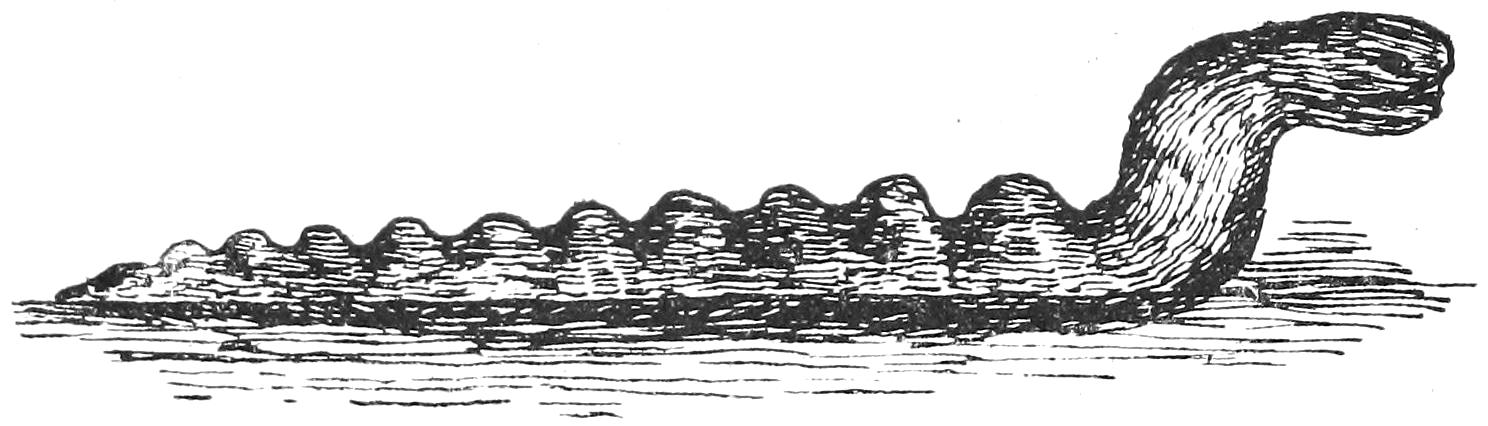
Fig. 27.—The sea-serpent as seen by Mr. Warburton.
“The captain and myself were standing on the starboard side of the vessel, looking over the bulwark, and remarking how perfectly smooth was the surface of the sea. It was about half-past six o’clock P. M., and a cloudless sky. On a sudden we heard a rushing in the water a-head of the ship. At first we imagined it to be a whale spouting, and turning to the quarter whence the sound proceeded, we observed the serpent in the position as it appears in the sketch, slowly approaching at not more than the rate of two miles an hour, in a straight direction. I suppose we were hardly going through the water so fast, for there was scarcely a breath of wind. I must premise that I had never heard of the existence of such an animal. I instantly exclaimed, why, there is a sea-snake! “That is the sea-serpent”, exclaimed the captain, “and I would give my ship and cargo to catch the monster”. I immediately called to the passengers, who were all down below, but only five or six came up, among whom was Miss Magee, the daughter of a merchant in New York. The remainder refused to come up, saying there had been too many hoaxes of that kind already. I was too eager to stand parleying with them, and I returned to the captain. In the same slow style the serpent passed the vessel at about the distance of 50 yards from us, neither turning his head to the right or left. As soon as his head had reached the stern of the vessel, he gradually laid it down in a horizontal position with his body, and floated along like the mast of a vessel. That there was upwards of 60 feet visible, is clearly shown by the circumstance, that the length of the ship was upwards of 120 feet, and at the time his head was off the stern, the other end (as much as was above the surface) had not passed the main mast. The time we saw him, as described in the drawing, was two minutes and a half. After he had declined his head we saw him for about twenty minutes a-head, floating along like an enormous log of timber. His motion in the water was meandering like that of an eel, and the rake he left behind was like that occasioned by the passing of a small craft through the water. We had but one harpoon on board, and the ship’s long-boat was, for the time being converted into a cow-house. We had two guns on board, but no ball..... I dined one day at the Hotel of New York with Sir Isaac Coffin, who discredited the existence of such an animal, which was reported to have been seen by Captain Bennet of Boston about five years back; but as I assured him I had never heard previously even the report of such a monster, and that I was an Englishman, he gave full credit to it. The sketch I gave him also corresponded with the description that was circulated at that time. The humps on the back resembled in size and shape those of the dromedary. I remain, Dear Sir, yours respectfully,
“William Warburton.”
I give in fig. 27 a facsimile of the figure, accompanying the paper of Mr. Hooker (Edinb. Journ. Sc. Vol. VI, 1827, Pl. I. fig. 10).
The description of the sea-serpent given here, may be summed up in the following words: When it came to the surface a rushing of the water was heard. The part which appeared out of water was about sixty feet in length. It held its head some feet above the surface of the water, swimming at a rate of two miles an hour, and showing bunches on its back. After some moments it gradually laid down its head in a horizontal position with its body, and floated along like the mast of a vessel, evidently swimming with its body in a straight line, using its flappers. The wake which it left behind was equal to that of a small vessel. Nothing is said of the skin, which evidently was smooth, otherwise the scales would have been seen and mentioned, for the animal appeared not far from the vessel. Nor does the sketch show any scales. The position of the head in the sketch, making nearly a right angle with its neck, may have led others to say it resembled that of a horse, if we take moreover in consideration that some individuals have a mane. The individual seen by Captain Holdrege and Mr. Warburton evidently had no mane.
84.—1826, June 18.—In the same letter from Mr. Warburton to Robert Barclay there is a passage which we have omitted above and which runs as follows:
“Two days after we saw him he was seen by another vessel off Cape Cod, about 200 miles from where he made his appearance to us. This intelligence reached New York about four days after we arrived there, and the description given exactly corresponds with the foregoing.”
Evidently this was the same individual, or one of the same sex.
In 1827 Dr. Hooker wrote the following paper for the Edinburgh Journal of Science, Vol. VI:
“When we remember the numberless impositions concerning Natural History, which at various periods have been detected, it is not surprising that doubt should be a principal, nay, a necessary, qualification of the student of Nature. Yet we cannot but think that the scientific world in general has been too incredulous concerning the sea-serpent, seeing the mass of concurrent testimony which has been adduced to prove its existence. It is certainly true that vague reports had been spread abroad with regard to this enormous animal long ere any just foundation was afforded for them, and indeed before we had heard of any who professed to have seen it. This may have very far conduced to produce that scepticism which now is perfectly unwarrantable. We are so accustomed, whenever the subject is introduced in conversation, to couple it with the preposterous fables of the Kraken, that it would be extremely difficult to break down the barriers against belief which prejudice has so long assisted to support. The accounts of the most credible witnesses have thus been rejected, although, “to make assurance doubly sure”, the generality of them have been taken upon oath.”
“So many wonderful discoveries, both in the arts and Sciences, have been made within the last century, that it is astonishing how the existence of the sea-serpent has been supposed either so marvellous or impossible. Time has satisfactorily proved the veracity of Bruce, and we must leave it to time to do the same office with regard to the beholders of this “wonder of the deep.” Is this monster more disproportionate to the extent of the sea than the elephant to that of the land? Or, it may be asked, has it a solid bulk, (even according to late most extravagant accounts), nearly approaching in magnitude to that of the whale? Geology has been infinitely more fortunate than zoology in many respects; theories only partially sustained have been received; and while the recent discoveries of the Plesiosaurus and Megalosaurus have made demands upon our powers of credence far greater than the serpent, the descriptions of the latter animal have received very little trust, and even much ridicule and contempt. In general, however, it must be confessed, that people do not object to the extraordinary proportions of such a creature, so much as to what they consider the want of respectable and satisfactory evidence. We trust to advance, in the sequel, such additional evidence to that already presented, and of such respectability, as to confirm entirely the truth of the existence of such an animal,—an animal concerning which so many contradictory opinions have been hazarded as to its more immediate nature and structure; and which, from the mystery in which it has hitherto been wrapped, must be interesting to the most casual admirer of nature:—which must be interesting even from the element in which it lives; so vast, so unexplored in its inmost recesses. We can have so little information with regard to an animal which has so mighty an habitation, that it acquires a grandeur in our estimation far surpassing those which inhabit the earth. The monsters of the deep appear so independent of our influence, and so far removed from any connection with us, that any increase of our knowledge in reference to them must be highly gratifying.”
“It was during the year 1817 that it began to be correctly reported, that in the neighbourhood of Boston and Gloucester in America, an animal, in general construction nearly resembling a serpent, had been frequently seen. These rumours created a good deal of excitement, insomuch that, at a meeting of the Linnaean Society of New England, it was determined more fully to investigate the matter. The Honourable Lonson Nash of Gloucester was appointed by a Committee to gather together all the information which might be obtained.”
“It is unnecessary here to dwell at any length upon the evidence which his unremitting and meritorious exertions procured. From different quarters, individuals of the highest respectability communicated all the information which it was in their power to proffer, and all declared themselves prepared to take an oath upon the accuracy of their narrations. No testimony was received, excepting from those who professed to have been personal witnesses of the monster: no weight was given to their accounts deduced from the reports which were everywhere circulated:—the unadorned and unexaggerated style in which their statements were worded is of itself perfectly sufficient to win over to all unqualified trust. The witnesses for the most part, unite in ascribing a vertical motion to the creature. Fifty or sixty yards was no uncommon distance between it and the spectators, and it was never seen except in weather the most calm and bright. But these facts, along with the various depositions, have been long laid before the public in the “Report of the Committee of the Linnaean Society of New England”, and it is our part now merely to adduce some corroborative circumstances which have lately occurred, and which we think puts the matter for ever beyond the possibility of a doubt;—facts which have already completely satisfied some highly scientific gentlemen, who before were entirely sceptical.”
He next gives the letter from Mr. Warburton, of which we have spoken above, and the letter from Mr. Boott, parts of which we have inserted in no. 63 and 70. After the different passages from various transactions and journals referring to the papers in Sir Joseph Banks’ library (p. 220), Dr. Hooker goes on:
“We sincerely hope that these few bare facts may satisfy all upon this much agitated question; at least we think they must remove the ideal connection between our serpent, and
“That sea-snake, enormous curled, “Whose monstrous circle girds the world.”
“It can now no longer be considered in association with hydras and mermaids, for there has been nothing said with regard to it inconsistent with reason. It may at least be assumed as a sober fact in Natural History quite unconnected with the gigantic exploits of the God Thor, or the fanciful absurdities of the Scandinavian mythology. We cannot suppose, that the most ultra-sceptical can now continue to doubt with regard to facts attested by such highly respectable witnesses.”
It is a deplorable fact that all the endeavours of such an eminent scientist to convince zoologists of the existence of sea-serpents, have been in vain!
German translations of the whole of Dr. Hooker’s paper as well as of the letters from Dr. Boott and Mr. Warburton are in Froriep’s Notizen, of April, 1827, Vol. XVII, no. 356, p. 49.
In the American Journal of Science and Arts, Vol. XII, June 1827, the editor, Prof. Benjamin Silliman, says:
“To us it seems a matter of surprise, that any person who has examined the testimony, can doubt the existence of the Sea-Serpent; the documents communicated by Dr. Bigelow of Boston, and published in the second volume of this Journal, in 1820, were in our judgment alone sufficient, to settle the question: the following letter is an important additional document.”
This is the letter from Mr. Warburton to Mr. Barclay, reprinted evidently from the Edinb. Journal (no. 83, 84).
85.—1827, August 24.—According to Froriep’s Notizen Vol. XIX, no. 409, p. 193,
“the Norwegische Handelszeitung” (apparently of the 3d. or 4th. of September, 1827), “contains fresh intelligence of the Sea-Serpent, which confirms what has been published by Captain de Capell Brooke.”
“In the last days of the last month an animal was seen by several trustworthy men in Christianiafjord, which, according to the description, appears to be a sea-serpent of extraordinary dimensions. On the 1st of this month five eyewitnesses were heard before the justice of peace, and according to their agreeing declarations, the animal held its head, which was dark and black, above the surface of the water, and showed at least ten coils; there was a distance of about twenty ells” (60 feet) “between each two coils, and the coils themselves were about six ells” (18 feet) “so that the total length of the animal may be estimated at 250 ells” (750 feet). “It moved with about the swiftness of a common boat, rowed by a man in still water, and caused a heavy rushing, like a strong motion in the water. The thickness was about that of a large wine-barrel or pipe. No tail, nor fins were observed. The rushing, it is believed, was caused by the head. The coils were movable, i. e. what was above the water one moment, was under it the next. Two eye-witnesses also declared, that what they saw, was one coherent whole and were not several animals. On Friday, the 24th. of August, at 10 o’clock A. M. the animal was seen moving from the Vakkerö-Bay into the Bonnefjord. The animal was seen from a distance of 200 fathoms.”
Although the dimensions are exaggerated, the other features of the animal, viz. the head which is dark and black, and held above the water, the undulating motion of the animal, its visible coils, the rushing sound made by it, the apparent want of fins and the tail, which were hidden under water, are correct and known to us.
86.—1827, August 26.—(The same journal, the same issue).
“And on Sunday, the 26th. of August at 7 o’clock in the evening it came again from the fjord and swam towards the ship-wharf, passing Liob-, and Principal-Islands.—It was then seen from a distance of 120 fathoms. The eye-witnesses declared, that, if asked, they were ready to make oath to those declarations.”
87.—1827, September 3.—(The same journal, the same issue).—
“Christiania, Sept. 5.—The sea-serpent, mentioned in the Monday-number, has been seen again the day before yesterday off Nusodden.”
88.—1827, September 5.—(The same journal, the same issue).
“and to-day, off Lepager, by persons just as trustworthy as those who were heard before the justice. Their affidavit in principal points agrees with that of the former. A reward is offered to whoever will kill it and bring it home.”
89.—1827, September 9.—(The same journal, the same issue).—
“Christiania, September 15.—Sunday last the sea-serpent appeared also off Dröbak. Last week several persons saw large shoals of porpoises, and therefore supposed that the alleged presence of the former could not be true. But as among those who saw the sea-serpent, are many fishermen and seamen, who know very well how to distinguish the several sea-animals, and as it is not at all uncommon, that porpoises and whales of the smaller kind appear here in the fjord, so there is no reason to condemn the judicial concurrent testimonies.”
90, 91.—1828? The well-known Mr. Heinrich Rathke, when on a journey in Norway, noted down the following evidence, which he published in the Archiv für Naturgeschichte of 1841.
“Nils Roe, workman at Mr. William Knutszon’s, an elderly and simple man, relates: I saw the serpent twice, once at noon, and two days afterwards towards the evening, in the fjord” (near Christiansund) “at the back of Mr. Knutszon’s garden. The first time, when it was nearest to me, it was about a hundred feet distant. It swam first along the fjord, afterwards over against the spot, where I stood. I then observed it for more than half an hour. Some strangers, who were on the opposite shore, fired at it, when it disappeared.”
“The second time it was farther from me. It was small, perhaps twice as long as this room (about forty-four feet); while swimming it made serpentine movements, some to left and right, others up and down. I cannot state its correct thickness, but it appeared to be about as a common snake in proportion to its length. It was much thinner towards the tail. Several times it raised its head wholly above the water, but so, that it was just above the surface; the neck, however, and the other part of the body were but partly visible above the surface. The front of the head was rather pointed: the eyes were very large and glistened like those of a cat. I did not see a tongue and did not observe that it opened its mouth. I cannot state that the neck just behind the head is much thinner than the head itself, for from the back of the head commenced a mane like that of a horse, which waved to and fro in the water. Just behind the head the mane was thickest and got thinner further backwards; in general it was not very long. The colour of the animal was a blackish brown.”
Again we meet with no character that is not known to us. All of them have already been stated.
92.—1829?—The following is an evidence given before the same Mr. Rathke, being at Christiansund, and published by him in the journal mentioned above.
“Lars Johnöen, a fisherman at Smölen, about 50 years of age. I have seen the sea-serpent several times, but for the longest time and nearest to me, twelve years ago in the dog-days in the fjord not far from here (Christiansund), when I was alone, one noon, angling in a boat. Then I saw it within two hours three times for a considerable time, quite near to me. It came close to my boat, so that it was only about six feet from me. (He placed himself in the room at a distance of nearly six feet from the wall, and said, this was about the distance between him and the serpent.) I became alarmed; recommended my soul to God, laid myself down in the boat, and only held my head so far over it, that I could observe the serpent. It swam now past the boat, that was vehemently agitated by the ripple caused by its movements in the water, which was previously smooth as a mirror, and afterwards took itself off. After it had swam a considerable distance from me, I wound my angling line round the little instrument commonly used (a frame, moving on an axis) and I began again to fish. Not long afterwards, however, the serpent came again quite close to the boat, which again was violently agitated by the movements made by it in the water. I lay down again, and remained quite still, keeping, however, a watchful eye on the animal. Again it passed me, disappeared far off, and returned, though not so close as before, and at last disappeared, when a light wind rose, and ruffled the water. Notwithstanding my fright I yet observed the animal very accurately. Its length was about five to six fathoms, and the body, which was as round as a snake’s, was about two feet in diameter. (Lars Johnöen measured on a table before him with his hands a space of about two feet). The tail too appeared to me to be round. The head was about as long and as thick as a brandy anker (a ten gallon cask), it was not pointed but bluntly round. The eyes were very large and glistening. Their size (or diameter) was about that of this box here (five inches), and they were as red as my neckerchief (crimson). The animal did not open its mouth, therefore I cannot give its size. It constantly held its head above the surface of the water in an acute angle; not so high, however, that the nose should come over the board of a boat. Close behind the head, a mane like a horse’s commenced, extending rather far down the neck, and spreading on both sides; floated on the water; it was of tolerably long hair. The mane as well as the head and the rest of the body was brown as this looking glass frame (dark brown of old mahogany). I could not observe spots, or stripes of other colours, nor were there any scales; it seemed as if the body was quite smooth. The movements of the serpent were by turns fast and slow; they were also slow when the animal approached my boat. At the moment in which I could observe it best, its movements were serpentine, up and down. The few undulations, made by those parts of the body and the tail that were out of the water, were scarcely a fathom in length. These undulations were not so high, that I could see between them and the water.—When Lars Johnöen had given this declaration, the drawing which Pontoppidan had given of the animal was shown to him. He looked at it with astonishment, smiled and said that he saw a great resemblance between it and the animal he had seen. He likewise said, that some of the other sea-serpents he had seen were a great deal longer than the one described above.”
This unvarnished account describes very well the animal’s general doings, and accurately pictures its curiosity and harmlessness.
93.—1829, July.—We shall soon be acquainted with the appearance of the sea-serpent seen by Captain M’Quhae of the Daedalus, on Aug. 6, 1848. Prof. Richard Owen, questioned whether this animal could be a snake or not, gave his answer in an article published in the Times of Nov. 11, 1848, wherein he expresses his opinion that it must have been a large seal. This article seems to have been reprinted in the Bombay Bi-monthly Times. In the same journal for January, 1849, appeared the following statement and objections against Professor Owen’s suggestions.
“I see, in your paper of the 30th December, a paragraph in which a doubt is expressed of the authenticity of the account given by Captain M’Quhae of the “great sea-serpent”. When returning to India, in the year 1829, I was standing on the poop of the Royal Saxon, in conversation with Captain Petrie, the commander of that ship. We were at a considerable distance south-west of the Cape of Good Hope, in the usual track of vessels to this country, going rapidly along (seven or eight knots) in fine smooth water. It was in the middle of the day, and the other passengers were at luncheon; the man at the wheel, a steerage passenger, and ourselves, being the only persons on the poop. Captain Petrie and myself, at the same instant, were literally fixed in astonishment by the appearance, a short distance ahead, of an animal of which no more generally correct description could be given than that by Captain M’Quhae. It passed within thirty-five yards of the ship, without altering its course in the least; but as it came right abreast of us, it slowly turned its head towards us. Apparently about one third of the upper part of its body was above water, in nearly its whole length; and we could see the water curling up on its breast as it moved along, but by what means it moved we could not perceive. We watched it going astern with intense interest until it had nearly disappeared, when my companion, turning to me with a countenance expressive of the utmost astonishment, exclaimed, “Good heavens! what can that be?” It was strange that we never thought of calling the party engaged at luncheon to witness the extraordinary sight we had seen; but the fact is, we were so absorbed in it ourselves, that we never spoke, and scarcely moved, until it had nearly disappeared. Captain Petrie, a superior and most intelligent man, has since perished in the exercise of his profession. Of the fate of the others then on deck I am ignorant; so the story rests on my own unsupported word, but I pledge that word to its correctness. Professor Owen’s supposition, that the animal seen by the officers of the Daedalus was a gigantic seal, I believe to be incorrect, because we saw this apparently similar creature in its whole length, with the exception of a small portion of the tail, which was under water; and, by comparing its length with that of the Royal Saxon (about six hundred feet), when exactly alongside in passing, we calculated it to be in that, as well as in its other dimensions, greater than the animal described by Captain M’Quhae. Should the foregoing account be of any interest to you, it is at your service; it is an old story, but a true one. I am not quite sure of our latitude and longitude at the time, nor do I exactly remember the date, but it was about the end of July.—R. Davidson, Superintending Surgeon, Nagpore Subsidiary Force, Kamptee, 3d January 1849.”
At present we have only to fix our attention on the animal’s appearance, and not on Mr. Davidson’s objections. As the reader will observe, the whole description agrees with other accounts already given. There is nothing in it that is new or unknown to us.
94.—1830?—The well-known Mr. Heinrich Rathke, on his journey in Norway, being in Christiansund, noted down the following evidence, to publish it in the Archiv für Naturgeschichte of 1841.
“John Johnson, merchant, about 60 years of age, says in German: I saw the animal some years ago in the fjord” (of Christiansund); “it was about a thousand paces distant, when nearest to me; I observed it for more than half an hour. It swam very swiftly, for in the same time that we rowed about a quarter of a mile aside of it, it had swum about one half of a mile. I saw it best when it swam in a semicircle round a tolerable large rock that obstructed its passage, coming to that side of it which was turned towards me; in doing this it partly raised itself above the surface of the water. Its colour was blackish; its length was about that of this house (55 feet). Except the head, I did not observe much of its body, as it appeared but little above the surface. Judging from what I observed now and then, I think its thickness to be that of a stout man’s body. Its head was apparently as large as a hat. It was not pointed, but seemed rather blunt; in general, however, in comparison with its thickness, it was not very long. It was held but little above the surface of the water, making an acute angle with it; and it remained above the surface, as long as I saw it. Owing to the distance I could not discern the eyes. Also on account of the distance or because the neck was seldom elevated above the surface, I could observe nothing of a mane. The agitation which it caused in the water was very strong. The movements of the animal itself were serpentine, up and down, like those of a swimming leech. When the animal had reached a spot, where the water was ruffled by a rising gentle wind, it disappeared. Moreover, I believe, that the animal is not much to be feared and that it would not easily harm men.”
95.—1831?—The same Mr. Rathke also noted down the following declaration (published in the above mentioned journal.)
“Mr. William Knutszon and Candidatus Theologiae Booklune gave the following written account: We together saw the sea-serpent in a narrow fjord, at a distance of about one sixteenth of a mile” (about 515 yards) “for about a quarter of an hour; afterwards it dived, and came up so far from us, that we could not see it plainly. The water was as smooth as a mirror, and the animal had, as it moved on the surface, quite the appearance of a worm, or of a snake. Its motions were in undulations, and so strong, that white foam appeared before it, and waves were caused at its sides, which extended over several fathoms. It did not appear very high above the water, and it was principally its length, which was quite considerable. Once, however, it stretched its head quite erect in the air. The body was somewhat dark, and the head nearly black; the body had nearly the form of an eel or of a snake, a length of about fifty ells” (above one hundred feet) “and in proportion to it an inconsiderable thickness. The breadth diminished considerably from the head to the tail, so that the latter ended in a point. The head was long and narrow in proportion to the throat, as the latter appeared much greater than the former, which probably was the consequence of its being provided with a mane. The details of the head were not to be discerned, as the distance was too great.”
I may observe here that if these eye-witnesses declare that the head seemed to be narrower than the throat, this may probably also be the consequence of the animal’s contracting its neck. This may be often seen in seals and sea-lions. If a common seal has contracted its neck, it appears as if the animal has no neck, as if the head is immediately connected with the body. In reality the neck is shortened, and has become thicker than the head. If stretched, the neck on the contrary is very well visible, and narrower than the head. The same in sea-lions. If contracted, several rings of blubber surround the hind part of the head, which appears smaller than the neck; if stretched, the neck immediately gets much narrower and the head is broader than the neck. The expression “which probably was the consequence of its being provided with a mane” distinctly shows that the eye-witnesses, knowing that others at other times saw a mane, intended to explain the phenomenon they observed by the presence of this mane, which they could impossibly see, “as the distance was too great.”
96.—1832, Summer.—(Froriep’s Notizen, XXXV, no. 756).
“There is again question in Norway of the sea-serpent. It is said to have appeared and remained rather a long time in the Rödö- and Södelöw fjords this summer, and to have been seen by many persons. Distinct traces of it are said to have been found in the fields (??).”
We observe that Mr. Froriep adds two notes of interrogation after the last words. Evidently he is unable to explain them. I am convinced of the truth that the sea-serpent appeared in the fjords above mentioned. As to the traces of it, I must tell my readers that the superstition of the Norwegian people has forged this fable ever since they first became aware that the sea-serpent frequented their fjords. We have already met with this tale in Pontoppidan’s Natural History of Norway, and probably the Norwegians will tell it us again, if we ask them now!
97.—1833, May, 15.—(Zoologist p. 1714, 1847).
“On the 15th. of May, 1833, a party, consisting of Captain Sullivan, Lieutenants Maclachlan and Malcolm of the Rifle Brigade, Lieutenant Lyster of the Artillery, and Mr. Ince of the Ordnance, started from Halifax in a small yacht for Mahone Bay, some forty miles eastward, on a fishing excursion. The morning was cloudy, and the wind at S. S. E., and apparently rising. By the time we reached Chebucto Head, as we had taken no pilot with us, we deliberated whether we should proceed or turn back; but, after a consultation, we determined on the former, having lots of ports on our lee. Previous to our leaving town, an old man-of-war’s-man we had along with us busied himself in inquiries as to our right course; he was told to take his departure from the Bull Rock, off Pennant Point, and that a W. N. W. course would bring us direct on Iron Bound Island, at the entrance of Mahone or Mecklenburgh Bay. He, however, unfortunately told us to steer W. S. W., nor corrected his error for five or six hours; consequently we had gone a long distance off the coast. We had run about half the distance, as we supposed, and were enjoying ourselves on deck, smoking our cigars, and getting our tackle ready for the approaching campaign against the salmon, when we were surprised by the sight of an immense shoal of grampuses, which appeared in an unusual state of excitement, and which in their gambols approached so close to our little craft, that some of the party amused themselves by firing at them with rifles. At this time we were jogging on at about five miles an hour, and must have been crossing Margaret’s Bay. I merely conjecture where we were, as we had not seen land since a short time after leaving Pennant Bay. Our attention was presently diverted from the whales and “such small deer”, by an exclamation from Dowling, our man-of-war’s-man, who was sitting to leeward, of, “Oh sirs, look here!” We were started into a ready compliance, and saw an object which banished all other thoughts, save wonder and surprise.”
“At the distance of from a hundred and fifty to two hundred yards on our starboard bow, we saw the head and neck of some denizen of the deep, precisely like those of a common snake, in the act of swimming, the head so far elevated and thrown forward by the curve of the neck, as to enable us to see the water under and beyond it. The creature rapidly passed, leaving a regular wake, from the commencement of which, to the fore part, which was out of water, we judged its length to be about eighty feet, and this within, rather than beyond the mark. We were, of course, all taken aback at the sight, and, with staring eyes and in speechless wonder, stood gazing at it for full half a minute. There could be no mistake, no delusion, and we were all perfectly satisfied that we had been favoured with a view of the “true and veritable sea-serpent”, which had been generally considered to have existed only in the brain of some Yankee skipper, and treated as a tale not much entitled to belief. Dowling’s exclamation is worthy of record. “Well, I’ve sailed in all parts of the world, and have seen rum sights too in my time, but this is the queerest thing I ever see!” and surely Jack Dowling was right. It is most difficult to give correctly the dimensions of any object in the water. The head of the creature we set down at about six feet in length, and that portion of the neck which we saw at the same; the extreme length, as before stated, at between eighty and one hundred feet. The neck in thickness equalled the bole of a moderate-sized tree. The head and neck of a dark brown or nearly black colour, streaked with white in irregular streaks. I do not recollect seeing any part of the body.”
“Such is the rough account of the sea-serpent, and all the party who saw it are still in the land of the living,—Lyster in England, Malcolm in New South Wales with his regiment, and the remainder still vegetating in Halifax.”
“W. Sullivan, Captain, Rifle Brigade, June 21, 1831.
“A. Maclachlan, Lieutenant, ditto, August 5, 1824.
“G. P. Malcolm, Ensign, ditto, August 13, 1830.
“B. O’Neal Lyster, Lieut. Artillery, June 7, 1816.
“Henry Ince, Ordnance Storekeeper at Halifax.”
Mr. Newman, the editor of the Zoologist adds between parentheses:
“The dates are those on which the gentlemen received their respective Commission, I am not aware of their present rank. I am indebted to Mr. W. H. Ince for this interesting communication: this gentleman received it from his brother, Commander J. M. R. Ince, R. N. It is written by their uncle, Mr. Henry Ince, the Ordnance store-keeper at Halifax, Nova Scotia.”—
We observe that the colour of the head and neck is described as “streaked with white in irregular streaks”, and that evidently the sea-serpent hunted after the grampuses “which appeared in an unusual state of excitement”.
This account translated into German is in Froriep’s Notizen, Third Series, III, no. 54, p. 148.
98, 99.—1833, July.—In Froriep’s Notizen of June 1834 we read that Prof. Benjamin Silliman in a note to Mr. Bakewell’s Introduction to Geology, stated that
“since 1820 nearly each year the mass of evidences has increased, and that the current year 1833 has been particularly fertile in such reports.”
Dr. Hamilton in his Amphibious Carnivora, 1839, says:
“The last notice we have seen of this American animal bears date July 1833. The Boston and New-York papers of that date state, that the Sea-Serpent had again appeared off Nahant. “It was first seen on Saturday afternoon, passing between Egg-Rock and the Promuntory, winding his way into Lynn-Harbour, and again on Sunday morning, heading for South-shores. He was seen by forty or fifty ladies and gentlemen, who insist that they could not have been deceived.”
It is evident that many reports of great sea-serpents have been published here and there, especially in Norwegian and North-American newspapers, which I have had no opportunity to consult, and which probably will never come within my reach. As we learn from Mr. Froriep’s Notizen, Vol. XL, no. 879, p. 328, “Mr. R. Bakewell in the latest edition of his Introduction to Geology (1833?) states: that there are descriptions of the sea-serpent, wherein it is ascertained that it “has flappers like sea-turtles”. I have not been able to consult Mr. Bakewell’s work, but I insert this statement here, because we shall observe afterwards more than once this comparison of the flappers with analogous members of turtles.
100.—1834, Summer.—In Captain Shibbles’ report (no. 101) a passage runs as follows:
“One of the crew told us that his appearance and motion are precisely like that he saw last summer while in the bay” (of Gloucester) “which was said to be a sea-serpent.”
Though no particulars are mentioned, I am convinced that the appearance took place.
101.—1835, March or April.—(Amer. Journ. Sc. Arts Vol. 28, 1835, July.—)
“Captain Shibbles, of the brig Mangehan, of Thomastown, from Boston, for New-Orleans, which arrived here (Gloucester, Mass., March or April, 1835) on Saturday last, states that he saw when about nine or ten miles from Race Point light, what he, as well as the whole crew, supposed to be a sea-serpent,—he could distinctly see it with the naked eye, but to be certain, he took his glass and saw his eyes, neck and head, which was about as large as a barrel—the neck had something that looked like a mane upon the top of it; several times he raised his head seven or eight feet above the water, and for thirty or forty minutes he swam backward and forward with great swiftness. There were two other vessels near, the crews of which were in the rigging looking at the same object. Capt. S. states that it was very long, and that his head, neck and tail and his motion in the water, was exactly like those of a snake; every time he put his head out of water, he made a noise similar to that of steam escaping from the boiler of a steam-boat..... The Captain and crew attest to the correctness of this statement.”
As to the swimming backward and forward, I think that Captain Shibbles meant that the animal swam to and fro, and that he used these expressions in reference to the direction of the brig.
102.—1836?—Mr. Heinrich Rathke published in the Archiv für Naturgeschichte the following evidence, which he noted down when being in Christiansund in Norway:
“The Sorenskriver Gaeschke (a kind of judge of the same rank as the German country-judges, or the British sheriffs) gave me the following evidence: I saw the sea-serpent for a considerable time in a small fjord, first from a boat, afterwards from the beach, and from there during several minutes, at a distance of from thirty to thirty-six feet. In the beginning it swam round the fjord at Torvig, afterwards it went towards the mouth of the fjord. I saw its head stretched considerably out of the water. I noticed as well two or three undulations of the forepart of the body. Its motion was not like that of an eel, but consisted in vertical undulations. They were so strong, that they caused rather large waves; they were largest at the forepart of the animal and gradually lessened towards the back. The traces of them I discerned in a length of eight to ten fathoms, and in a breadth of two or three fathoms. The head, apparently blunt in front, had the size and nearly also the shape of an anker (ten-gallon cask) and the visible coils of the body were round and their thickness was that of a good timber-stock (twelve to fourteen inches square). I could not judge the entire length of the animal, as I could not discern the animal’s hindpart. The colour of the animal seemed to me to be a very dark grey one. What I believed to be the eyes, had according to my estimation the size of the outlines of a tea-cup (3¹⁄₂ inches). At the back of the head there was a mane, which had the same colour as the rest of the body.”
103.—1837, end of July.—(Froriep’s Neue Notizen, Vol. IV, no. 67, p. 7, October, 1837).
“About the much mentioned Sea-Serpent the Drontheim Newspaper contains, as is ascertained, from an enlightened and trustworthy gentleman, the following statement: “Uncommonly early in this Summer our coasts and fjords were blessed with a mass of fat herrings, of which till to-day very few were cleaned and pickled, because the uncommon greasiness of the herrings made it difficult to preserve them in the warm air, which, however, was so beneficient to agriculture. Since the beginning of the dog-days the sea-serpent appeared on different spots in this country; one of these sea-monsters seems to have constantly remained near Storfosen and the Krovaag Isles; several fishermen were terrified in the highest degree, when the sea-serpent suddenly came down so near to them, that they had no time to think, to which side they should fly. It is true this terrible visitor properly has not made an attack, but it has followed the boat for a long distance, when one has tried to fly in a great hurry, so that the men overworked themselves, and some of the runaways fell ill afterwards. It is ascertained by quite trustworthy persons, that the length of the sea-serpent may be estimated from 600 to 800 ells, or perhaps still more, because if one was near its head, the other end of the sea-animal was not to be discerned distinctly. The sea-serpent is thickest just behind the head, apparently as thick as a large horse; its black and dark eyes are as large as an ordinary plate, without being glossy or very movable; the skin is smooth and of a dark colour; on the nose there are thick hairs, as on a seal’s, two or three quarters of an ell long, also on the neck there is something movable, which resembles the mane of a horse; the mouth, as far as the writer knows, has not been seen distinctly, and it is quite uncertain whether the animal is a beast of prey or not. Rarely does the sea-serpent appear but in calm weather; its motions and shape are serpentine. These observations are distinctly made in these days, amongst others by a trustworthy and intelligent gentleman, who with his two sons had reached a small islet, where the sea-serpent, after having followed their boat, passed closely and slowly.”
Those who made the statement that when they were near the head, the tail could not be discerned distinctly, of course, spoke the truth, for the tail is very seldom above water, but they who afterwards thereby imagined that the animal therefore must have a length of from 600 to 800 ells, exaggerated in a most ridiculous manner. Again we observe that the Norwegian fishermen are in great dread of the sea-serpent, and the description of their behaviour is quite the same as told us Pontoppidan a century ago. Again we read of the habit of the sea-serpent of following boats, but never attacking them, which may only be the effect of mere curiosity. The description, moreover, given by the not mentioned trustworthy and intelligent observer is quite correct. All the characters given by him are already known to us, and where he states that the eyes are not glossy, apparently in contradiction with former statements, it is natural that in a certain direction and in certain moments they need not give the impression of being so. Remarkable is the statement of the animal having bristles on its upper-lips, as in seals.
In Dr. Hamilton’s Amphibious Carnivora, 1839, we read:
“The most recent account of this monster we have noticed, appeared in the public Newspapers of Drontheim, in the autumn of 1837, and we confess we cannot regard it as a sheer fabrication”.
And he further cites the above mentioned report and tells us that it was the Adis of Drontheim which contained those particulars. The Krovaag Islands are called by Dr. Hamilton the Kerchvang Islands, and strange enough, the very interesting particulars about the skin, the eyes and the bristles on the upper lips near the nose are omitted.
104.—1838?—The reader will soon be made acquainted with the well known report of Captain M’Quhae, of the Daedalus. As the report was published in the newspapers of Oct., 1848, Captain Beechy, of the Blossom, “one of the most scientific officers and ablest naval surveyors”, wrote a letter to Mr. Francis Beaufort, F. R. S., Admiralty Hydrographer. An extract from this letter appeared in the Illustrated London News of Oct. 28, 1848, and runs as follows:
“What an extraordinary creature the Daedalus seems to have fallen in with! The description recalls to my mind an extraordinary appearance we witnessed in the Blossom, in crossing the South Atlantic: I took it for the trunk of a large tree, and before I could get my glass upon deck it had disappeared, and I could nowhere find it—fresh breezes at the time.”
As Captain Beechy writes “recalls to my mind”, the “extraordinary appearance” must have taken place some time ago, say ten years; so I have chosen the year 1838, as the year in which it happened. If I may ever get the opportunity to learn the exact year or date, I shall be glad to correct my supposition in an eventual second edition. But for the present I am sure that the “trunk of a large tree” which had so suddenly disappeared, really was a sea-serpent.
Repeatedly we have already quoted Dr. Hamilton’s work about the Amphibious Carnivora, which appeared in the year 1839. The writer sums up numerous reports and accounts, which he cited from other works, or from which he gave only short extracts. One would say that Dr. Hamilton is an unbeliever, for he ends his chapter on this animal with the words:
“With these extracts, and without farther comment, we close our account of the Great Sea-Serpent, only remarking, that till favouring circumstances bring the animal under the examination of Naturalists, the satisfaction, which is desiderated respecting it, is scarcely to be expected.”
I only ask, what then was the reason that he spoke of it, and that he published these extracts in a book, which properly treated of Amphibious Carnivora or the Pinnipeds (seals, walrusses, sea-lions and sea-bears)? May it be, that he observed any relation between them and the sea-serpent? I cannot believe it, for after the sea-serpent he treats of the Kraken in the same volume. And why did he end in such a vague way? May it be, because he could not give an explanation, or because he hesitated to show the public that he was really a believer?
105.—1839, August?—According to Froriep’s Neue Notizen, vol. XII, no. 248, of Oct., 1839, the Boston Mercantile mentions that Mr. Bubier, Lieutenant of the U. S. Navy affirms to have seen the sea-serpent on his way from Daims Island to Nahant, near Boston, and estimated its length at 120 to 135 feet.
106.—1839.—In the same periodical on the same page we read that Captain Smith who had been a long time in the whale fishery, asserts in the Kennebek Journal, that he never before saw such a creature, and that if he had had a harpoon and lines on board, he would have harpooned it.
106, A.—1840, April 21.—(Journal du Havre, 1840, Sept. 15, Zoologist, 1847, p. 1716).—As I have not had the opportunity to consult the first paper, I give the account as I have found it in the Zoologist.
“A French captain has just related to us a remarkable circumstance, which he has himself witnessed, and his recital exhibits a degree of cautious reserve, which is well calculated to shake the obstinacy of the most sceptical. We shall preface his narrative by the remark that the sea serpent has been recently alleged to have been seen at different points along the whole line of the American coast. Captain d’Abnour, commander of the Ville de Rochefort, makes the following statements:
“On the 21st. of April, 1840, while we were in 24 deg. 13 min. N. latitude, and 89 deg. 52 min. W. longitude (calculated from the meridian of Paris), in the gulf of Mexico, we were running under a light breeze from E. N. E. with beautiful weather. In a few hours we distinguished something like a long chain of rocks, falling off by a gentle inclination at the two extremities, and elevated at the middle by only a few feet over the level of the sea. Against this object the sea broke softly. As we approached we remarked that its different parts changed their position, and even their form, and we became perfectly certain that it was not a reef. A little later, we distinguished by the assistance of a telescope a long chain of enormous rings, resembling a number of barrels linked together, and in form very like the back of a silk worm. It was a three quarter view of the object which we had first obtained. As the ship approached, these appearances became more distinct, and we presently saw the extremity of an enormous tail, longitudinally divided into two sections, white and black. This tail appeared to wind itself up, and repose on a part of the object itself. Then, at the other extremity, we saw a membrane rising to the height of about two metres from the water, and inclining itself at a considerable angle upon the mass (without leaving it, however); and this led me to conjecture that the monster before us was provided with an apparatus for the purpose of respiration, like the lampreys. At last we perceived something like an antenna rising from the water, to the great height of nearly eight metres, terminated by a crescent of at least five metres from one extremity to the other. We could not approach sufficiently near to acquire any very positive idea as to what we had seen; but everything led us to believe that it was an enormous serpent of at least 100 metres in length.”
Although the editors of the Journal du Havre believed that Captain d’Abnour by his “exhibiting a degree of cautious reserve would shake the obstinacy of the most sceptical”, I think that on the contrary his narrative has had quite another effect. Every sceptic, I think, will smile or even laugh when he reads this report, for who can help laughing when he reads of a “membrane which led me to conjecture that the monster before us was provided with an apparatus for the purpose of respiration, like the lampreys”, and of an “antenna of eight metres, terminated by a crescent of at least five metres from one extremity to the other.” We find here several limbs enumerated, and mentioned by the names of the corresponding limbs of different classes of the animal kingdom. A “membrane” in my opinion is a thin and transparent or nearly transparent planely extended object. If what the captain saw was one, I don’t know what it could be. If not, if untransparent, how could they see from such a great distance, that it was thin; what reason was there to call it a “membrane”?
I am convinced that Captain d’Abnour really saw a sea-serpent. The animal lay extended on the surface of the water, nearly still, showing numerous bunches; head and tail being under water and invisible. Quite the same thing was afterwards witnessed by Captain Weisz, of the Kätie (n°. 154, fig. 50). We know that sea-serpents lying still may show coils or bunches or hillocks. It resembled “a long chain of rocks, falling off by a gentle inclination at the two extremities, and elevated at the middle by only a few feet over the level of the sea”. The sea broke gently against it. As they approached, the animal seen through a telescope had the appearance of “a long chain of numerous rings, resembling a number of barrels linked together”. We remember that this comparison has often been made by different witnesses. The other comparison of the captain, viz.: “in form very like the back of a silk worm” is also tolerably well chosen. “As the ship approached, these appearances became more distinct” and the sea-serpent raised in a playful manner “its enormous tail, longitudinally divided into two sections, white and black”. We know that the animal’s head and neck are longitudinally divided into two sections, dark brown or nearly black above, and white beneath. It is, therefore, probable that also the trunk has a dark back and a light coloured belly. The supposition of this division of colours had already been made by Mr. Matthew Gaffney (no. 41, p. 169). It is, therefore, very remarkable that Captain d’Abnour really saw that the tail too is coloured black above and white beneath! The animal curled its tail and let it for a moment “repose on a part of” its body. Then, “at the other extremity” the animal elevated its foreflapper to the height of about two metres (six feet) from the water. The flapper “inclined itself at a considerable angle upon the” body, consequently the animal made the same movement with its foreflapper as the individual afterwards witnessed by Captain Weisz (no. 154, fig. 50). At last a tail of a spermwhale or of a finwhale elevated above the water, “an antenna terminating in a crescent” “to the height of nearly eight metres” (about 25 feet), which tail of course has nothing at all to do with the sea-serpent. Captain d’Abnour says: that it rose “from the water” and he says nothing as to its relative position to the animal, nor whether it was close to or far from it. The length of at least 100 metres (about 320 feet) is at all events exaggerated. Evidently head and neck remained constantly under the water.
The above mentioned account, translated into German, is in Froriep’s Notizen, Third Series, Vol. III, no. 54, p. 148, 1847.
106 B.—1840, June?—In the Journal du Havre, of 15th September, 1840, (see Zoologist, 1847, p. 1716,) we read:
“Not long since the Boston Daily Advertiser announced a new appearance of this marine monster, about whose existence the world is so naturally incredulous.”
I do not think that I am wrong in fixing this appearance in the month of June of that year.
107.—1840, July?—In his Postscript Mr. Rathke (Archiv für Naturgeschichte, 1841, Vol. I) says:
“According to a letter addressed to me by Dr. Hoffmann, a respectable physician in Molde, which is situated several miles south of Christiansund on one of the largest fjords, the school-inspector Hammer, the adjunct Kraft, and some other persons, who in 1840 made together an excursion in a boat on this fjord, saw very distinctly a so-called sea-serpent of considerable length.”
107 A.—1840, August?—The Editor of the Journal du Havre before publishing Capt. d’Abnour’s report (no. 106 A) says, (see Zoologist, 1847, p. 1715):
“We shall preface his narrative by the remark, that the sea-serpent has been recently alleged to have been seen, at different points along the whole line of the American coast.”
The Editor would have done better if he had published all the reports of the sea-serpent, that had come within his reach. The reader must know that with the terms “the whole line of the American coast” the Editor can only have meant the east coast of British America and of the United States, from Newfoundland to Cape Canaveral, Florida.
108.—1841.—In a Postscript to his paper (Archiv für Naturgeschichte, 1841, Vol. I) Mr. Rathke tells us:
“According to a letter which I received some time ago from Mr. Soern Knutszon, a sea-serpent is again seen there some weeks after I had left Christiansund, by several persons.”
The well known Mr. Heinrich Rathke in 1841 published in the Archiv für Naturgeschichte, 7th year, Vol. I, his dissertation “On the Sea-Serpent of the Norwegians”. I am obliged to give a translation of his paper:
“On a journey which I made through Norway I availed myself of the opportunity of making inquiries after a hitherto problematical and even doubted animal, the so-called sea-serpent (Soe Orm in the language of the Norwegians). The most favourable opportunity offered in Christiansund, in the neighbourhood of which this animal is said to have often been observed. The general notices which I received about the sea-serpent, agree in the following points: It is mostly seen in the larger fjords of Norway, but seldom in the open sea. In the fjord of Christiansund, which has such a considerable extent, manifold ramifications, and in which numerous islets are found, it appears almost every year. It is said to have been especially observed in that part of the fjord on which the village of Lorvig is situated. This only happens in the warmest part of the year, viz. in the dog days, and only then when the weather is quite still and the surface of the water smooth. When after its appearance the water is ruffled, however slightly, it immediately disappears. Great is the dread of it, so that in the dog days many fishermen, otherwise intrepid, don’t go far into the sea, without taking with them asa foetida, which is said to drive away the animal by its smell, when thrown into the water. Moreover the fishermen advise to be very quiet, when a sea-serpent approaches, and therefore rowing must be avoided, because the least noise attracts it still more.”
“To have, however, more accounts than those general ones which are spread amongst the people, I wrote to several persons who were said to have seen it with their own eyes. Some of them who at the request of Soeren and Wilhelm Knudtszon Brothers, two distinguished and very intelligent merchants, paid me a visit, I questioned personally; for others I had put down several questions to which I received a written answer. I will communicate here the result of my inquiry.”
Now Mr. Rathke publishes the affidavits which I have inserted above (no. 90, 91, 92, 94, 95, 102), and his Postscript (see no. 107 and 108).
“If one” Mr. Rathke goes on, “were to submit the above mentioned evidences to an inquiry, one would soon observe, that they not only contain several contradictory statements, but also that each evidence by itself cannot pretend to accuracy. Yet I believe, that we may at least admit so much of them, to be right, that what those persons who bear the evidences, took for a long animal, was really such a one. For I should not know, what could be the cause of the illusion, which had created the belief in such an animal. Some persons, as I know, believe that what has been taken for a so-called sea-serpent, was nothing else but a row of porpoises, swimming in a line. But all those persons by whom the above mentioned evidences are borne were too familiar with the sea, and had observed porpoises together too often to be deceived by a row of such animals swimming on the surface of the water. If this, however, had been the case, all the observations related to me of the sea-serpent holding its head above the surface, and about its size, must have been mere fictions, and this I cannot believe. According to all this, it evidently cannot be doubted that there is a long serpentine animal in the sea of Norway, which may grow to a considerable length.”
Now Mr. Rathke weighs and considers to what kind of animals the sea-serpent may belong. This, however, we omit here, as we have partly discussed these views in our Chapter on Would-be Sea-Serpents, where we spoke of the Animal of Stronsa, and as we shall once more refer to it in our Chapter of Explanations.
Every one, I think, will agree with me, that Mr. Rathke has committed two faults. 1. He criticises the correctness of the statements in question, apparently without having taken the trouble to read all that had been written about the subject. If he had done so, he would never have said that the particulars of the evidences collected by him in Norway were sometimes contradictory; on the contrary, he would have observed that they completed one another! 2. He was the first scientific man and zoologist who had an opportunity to see the sea-serpent, probably even to kill it, and yet he returns to Germany without having made one single effort either to kill or to see it!
Immediately after Mr. Heinrich Rathke’s dissertation, the Editor of the Archiv für Naturgeschichte, the well-known Prof. Dr. W. F. Erichson, wrote a paper, in which he gave full details of the Animal of Stronsa and descriptions of the saved bones. He ends this extract with the words:
“Consequently the Animal of Stronsa has no relation at all with the sea-serpent of the Norwegians; the animal, however, seen by the Rev. Maclean” (no. 31) “might be considered as such an animal.”
These words convince me of the fact that Mr. Erichson, like Mr. Rathke firmly believed that there are in the Norwegian seas animals still unknown to them, which are called “sea-serpents”.
109.—1842?—(Times, Nov. 4, 1848).—
“A parish priest residing on Romsdal fjord, about two days journey south of Drontheim, an intelligent person, whose veracity I have no reason to doubt, gave me a circumstantial account of one, which he had himself seen. It rose within 30 yards of the boat in which he was, and swam parallel with it for a considerable time. Its head he described as equalling a small cask in size, and its mouth, which it repeatedly opened and shut, was furnished with formidable teeth; its neck was smaller, but its body—of which he supposed that he saw about half on the surface of the water—was not less in girth than that of a moderate sized horse.” (Part of a letter from “Oxoniensis”).—
110.—1842?—“Another gentleman, in whose house I stayed, had also seen one, and gave a similar account of it: it also came near his boat upon the fjord, when it was fired at, upon which it turned and pursued them to the shore, which was luckily near, when it disappeared” (Also a part of the letter from Oxoniensis, Times, Nov. 4, 1848).
111.—1843, Summer.—In Froriep’s Neue Notizen, Vol. XXVIII, no. 606, p. 184, Nov. 1843, we read:
“Some months ago the sea-serpent again appeared between the islets and inlets of the fjord of Christiansund.”
111 A.—1843, October?—(Froriep’s Neue Notizen, Vol. 28, no. 606, p. 184).
“The Editors of the Christiansands Posten add the following remarks: “This whole description accurately fits on an appearance, which the writer of these lines has witnessed a few times in the North Sea, and when the inhabitants of the coast near Ibbestad, if not withheld by their fear of the supposed sea-monster, had rowed with their boats towards the animal, they would soon have observed without any doubt that the supposed intervals between the coils were nothing else but water.””
The number of the Christiansands Posten was most probably one of the beginning of November or of the end of October. Consequently the appearance spoken of must have taken place some days before. At all events this is a proof of an appearance of the sea-serpent, swimming in vertical undulations, near Ibbestad, in Norway, at that time.
112, 113.—1845.—The report of Captain M’Quhae, which we shall meet with a little further on, induced Mr. J. D. Morries Stirling to write a letter on the sea-serpent to the Admiralty.
“By the courtesy” says the Editor of the Illustrated London News in his number of Oct., 28, 1848, “of the Secretary to the Admiralty, we have been favoured with the following letter from a gentleman long resident in Norway.”
“13, Great Cumberland Street, October 25, 1848.”
“My dear Sir,—I regret that I have not found the volumes referred to in our conversation respecting the recent authentication of the existence of the sea-serpent by Captain M’Quhae, of H. M. frigate Daedalus, but I will give you that part of the information which I remember best. Several years ago, a museum was established at Bergen, in Norway, the directors of which have, amongst other subjects of interest, turned their study to Natural History in general, and to the elucidation of some of its more doubtful or less known subdivisions. The question of the sea-serpent’s existence had previously attracted the attention of several scientific men in Northern Europe; and my friend, the late Dr. Newmann, Bishop of Bergen—a man much and justly respected for his learning, research and energy—made it the subject of inquiry within the last twenty or twenty-five years among his clergy and those of the adjoining dioceses. The amount of proof thus collected was sufficient to convince any one, however sceptical, as it is not mere hearsay evidence, but the testimony of known and respectable persons in various walks of life. One of the most striking statements is made by some fishermen, who saw the animal quite close to them, and of whom one more hardy than the rest struck it with a boat-hook, upon which it immediately gave them chase; and, had they not been very near a small island or rock, on which they took refuge, in all probability they would have been destroyed.”
“The size of the sea-serpents seen in the Norwegian fjords varies much; and I do not now remember what the dimensions of the largest are said to be. As far as I can tax my memory, none of them lately seen are larger than that described by Capt. M’Quhae. The one seen by the fishermen above alluded to, was, I think, not above 70 feet long. I have written to my colleagues in the direction of the Bergen Museum, and as soon as their answer arrives I will give you a more full account.”
“There are I believe, several varieties of the reptile, known as the sea-serpent, but almost all the accounts agree as to the existence of a mane, and as to the great size of the eye. In several of the fossil reptiles somewhat approaching the sea-serpent in size and other characteristics, the orbit is very large; and in this respect, as well as having short paws or flappers, the descriptions of the northern sea-serpents agree with the supposed appearance of some of the antediluvian species. A great part of the disbelief in the existence of the sea-serpent has arisen from its being supposed to be the same animal as the Kraken, or rather from the names having been used indiscriminately.”
“In concluding this hurried statement, allow me to add my own testimony as to the existence of a large fish or reptile of cylindrical form. (I will not say sea-serpent.) Three years ago, while becalmed in a yacht between Bergen and Sogn in Norway, I saw (at about a quarter of a mile astern) what appeared to be a large fish ruffling the otherwise smooth surface of the fjord, and, on looking attentively, I observed what looked like the convolutions of a snake. I immediately got my glass, and distinctly made out three convolutions, which drew themselves slowly through the water. The greatest diameter was about ten or twelve inches. No head was visible; and from the size of each convolution, I supposed the length to be about thirty feet. The master of my yacht (who, as navigator, seaman, and fisherman, had known the Norwegian coast and North Sea for many years), as well as a friend who was with me, an experienced Norwegian sportsman and porpoise shooter, saw the same appearance at the same time, and formed the same opinion as to form and size. I mention my friend being a porpoise shooter, as many have believed that a shoal of porpoises following each other has given rise to the fable, as they called it, of the sea-serpent.”
114.—1845 or 1846, Summer.—(Copied in the Illustrated London News of June, 13, 1857, from the Cape Argus of March, 14, 1857).
“Sir,—I inclose a letter addressed to me by a friend Dr. Biccard (with a drawing) containing an interesting account of the sea-serpent seen by him and others off the old lighthouse at the entrance of Table Bay on the 16th. of last month. It savours not a little of presumption to maintain that such a marine monster does exist, in the face of the deliberately recorded opinion of the greatest living Zoologist, Professor Owen, yet I venture to do so upon the simple testimony of my own eyes. In the year 1845, or 6, Mr. G. D. Brunette (of St. George’s-street, the conveyancer) and myself were fishing at Camp’s Bay one bright, clear summer day. There was not a breath of air, and the water was as smooth as the surface of a pond. About midday we were leaving the rocks to proceed to the marine villa, when Mr. Brunette suddenly directed my attention to what he at first thought was a whale. A moment’s inspection was sufficient, however, to detect the real nature of the animal. At about a mile from the shore we saw a line of shining black objects, like a string of large casks, floating on the surface of the water, lying parallel with the shore. It kept gently bobbing up and down, and on one occasion we saw the whole length for a few seconds above the water. Judging from the size of an Indiaman, 1000 tons, at a similar distance, I should say the animal’s length was from 150 to 200 feet. Of its girth I can form no estimate; but, from the show it made at so great a distance, it must have been at least three feet above the level of the sea. Nor could we distinguish head from tail, though near one extremity we saw what looked like foam or froth, as though the animal was blowing water in a lateral direction. It seemed to be basking in the warm sun, with no other motion than that I have described, or dipping under occasionally. After watching it for about a quarter of an hour we started for the villa, for the purpose of borrowing a telescope, but we had scarcely walked ten yards when we observed the animal turn slowly round and then made off in a straight line to seawards, towards the N.W. It moved at a rapid rate; so much so that when we got to the house and procured the glass it had reached such a distance that we could not distinguish it better than we had done with our naked eyes while on the rocks. The motion while moving off was undulatory, the cask like substances submerging and emerging from time to time, and glittering in the sun till we lost sight of them altogether, which was about an hour after first seeing the animal. That this animal was a sea-serpent I never had the slightest doubt; yet, knowing the general incredulity on this subject, neither Mr. Brunette nor myself cared much to boast of what we had seen, so we said nothing about it; but as Dr. Biccard has obligingly, at my request, furnished me with particulars, for general information, of the animal seen by him under such favourable circumstances, I am induced to add my own poor testimony to the many facts now on record, proving conclusively the existence of a great marine saurian or some similar animal. I would point out that a gentleman as Dr. Biccard’s well known scientific attainments is not likely to mistake a seal for a serpent; and that the six or seven individuals who witnessed the evolutions of the animal at so short a distance as 200 yards could scarcely have been misled by a piece of seaweed, or by a seal.”
“The narrative of Dr. Biccard will be read with interest, and I beg to refer those who feel any interest in it to an article on the Great Sea-Serpent in the Westminster Review for January 1849.”
“Yours, &c.,” “Chas. A. Fairbridge.”
“Cape Town, 13th. March, 1857.”
The above mentioned letter will be inserted in its right place hereafter, (n°. 130). It is clear enough that we have here an unvarnished account of an appearance of a true sea-serpent. The appearance of a line of shining black objects, like a string of large casks is a common one. Its length, estimated at upwards of 150 feet, is surely not exaggerated, as we shall observe afterwards. As the animal raised itself at least three feet above the level of the sea, its diameter may have been some fifteen feet. The animal evidently lay with its nostrils just at water-level, so that in exhaling it caused “a foam or froth, as though blowing water in a lateral direction”. I think, that the observer was a little mistaken as to the direction, which cannot have been quite a lateral one.
115.—1845, July 28.—(Zoologist, 1847, p. 1606).
“The Rev. Mr. P. W. Deinbolt, Archdeacon of Molde, gives the following account of one, which was seen last summer near Molde. The 28th. of July, 1845, J. C. Lund, bookseller and printer; G. S. Krogh, merchant; Christian Flang, Lund’s apprentice, and John Elgenses, labourer, were out on Romsdale-fjord, fishing. The sea was, after a warm, sunshiny day, quite calm. About seven o’clock in the afternoon, at a little distance from the shore, near the ballast place and Molde Hove, they saw a long marine animal, which slowly moved itself forward, as it appeared to them, with the help of two fins, on the fore-part of the body nearest the head, which they judged by the boiling of the water on both sides of it. The visible part of the body appeared to be between forty and fifty feet in length, and moved in undulations, like a snake. The body was round and of a dark colour, and seemed to be several ells (an ell two feet) in thickness. As they discerned a waving motion in the water behind the animal, they concluded that part of the body was concealed under water. That it was one connected animal they saw plainly from its movement. When the animal was about one hundred yards from the boat, they noticed tolerably correctly its fore-part, which ended in a sharp snout; its colossal head raised itself above the water in the form of a semi-circle; the lower part was not visible. The colour of the head was dark brown and the skin smooth; they did not notice the eyes, or any mane or bristles on the throat. When the serpent came about a musket-shot near, Lund fired at it, and was certain the shots hit it in the head. After the shot it dived, but came up immediately. It raised its neck in the air, like a snake preparing to dart on his prey. After he had turned and got his body in a straight line, which he appeared to do with great difficulty, he darted like an arrow against the boat. They reached the shore, and the animal, perceiving it had come into shallow water, dived immediately and disappeared in the deep. Such is the declaration of these four men, and no one has cause to question their veracity, or imagine that they were so seized with fear that they could not observe what took place so near them. There are not many here, or on other parts of the Norwegian coast, who longer doubt the existence of the sea-serpent. The writer of this narrative was a long time sceptical, as he had not been so fortunate as to see this monster of the deep; but after the many accounts he has read, and the relations he has received from credible witnesses, he does not dare longer to doubt the existence of the sea-serpent.”