V. The various explanations hitherto given. (continued 2)
Reading edition
“The next question which occurs is this—to what class of vertebrate animals must we refer this monster of the deep? Is it a mammal, bird, reptile, or fish? All these classes include animals whose home is the ocean. To commence with placental mammals;—we have otters, seals, walrusses and sea-cows, all of which breathe atmospheric air, and, therefore, when swimming on the surface usually keep their nostrils—often their heads—above the water: they also propel themselves by means of submerged fins or paddles, and, when inclined, can move along the surface with rapid direct and continuous motion. Professor Owen (Zool. 2312), in accordance with these views, declares the animal to be a seal; Phoca proboscidea or P. leonina, but his reasoning on the point appears to me very inconclusive: he assigns the animal a “capacious vaulted cranium”, whereas Lieutenant Drummond (Zool. 2307) declares the head was “long, pointed, and flattened at the top”, adding that it was, “perhaps ten feet in length, the upper jaw projecting considerably.” Captain M’Quhae, also, subsequently to Professor Owen’s paper, repeats (Zool. 2333) that “the head was flat, and not a capacious vaulted cranium”. The captain, who must be annoyed at the insinuation that in an official report he had magnified a seal into a sea-serpent, emphatically declares that “its great length and its totally differing physiognomy preclude the possibility of its being a Phoca of any species.” This idea must therefore be abandoned; the other marine mammals still remaining open for future consideration.”
“Among Birds we have no approach to the animal described.”
“The Enaliosauri next claim our attention, and, for the present purpose, I could wish to separate them from the Reptiles, because I feel doubtful of their Reptilian nature. For this doubt I could urge many reasons in connection with the views I have long since published in the System of Nature, but, waiving all considerations which may be considered speculative, I would invite the intention of naturalists to the figure of Ichthyosaurus as restored by geologists, to the shape of the beak, the situation of the blow-holes, the character of the paddles, the mammalian structure exhibited by a section of the vertebrae, the extraordinary conformation of the sternum, and the smoothness of the skin; and when they have well-considered these important points, I would inquire whether these distinguishing features are not rather mammalian than reptilian? and, again, whether they are not rather marsupial than placental? I have already pointed out the manupedine, ferine, glirine and brutine groups of marsupials; why should we not also have a cetine group? Without making any other use of this suggestion than that of temporarily separating the Enaliosaurians from the Reptiles, I now request the readers’ attention to the arguments of Mr. Morries Stirling (Zool. 2309) and of F. G. S. (Zool. 2311), both of whom support the opinion which I had previously broached as to the Enaliosaurian character of the Sea Serpent,—a view controverted by Dr. Melville (Zool. 2310) and Prof. Owen (Zool. 2316), on the ground that the Enaliosaurians are extinct; but here I may perhaps be permitted to remark that this fact, being only assumed, does not touch the main question.”
“Proceeding to Reptiles proper, and referring to the suggestion of an anonymous contributor to the “Times”, quoted by Dr. Cogswell (Zool. 2321 note), we find it questioned whether the animal may not have been a boa; and I may observe that the evidence concerning the head, which has been repeatedly described as precisely resembling that of a snake or serpent, together with the fact of the animal holding its head clear of the water, are so many points in favour of its belonging to the Ophidia; but, on the other hand, we must place the non-observance of that undulating mode of progression which every snake must employ,—and it amounts to more than non-observance, for Captain M’Quhae, who directed his attention to this point especially, declares that such undulation did not exist. Again, the enormous length—three times that of a boa—militates against this hypothesis. Professor Owen lays great stress on the non-existence of ophidian vertebrae; but as only two Ophidians have yet entered the arena as competitor for the title of sea-serpent,—Saccopharynx flagellum, which I have heard is a bona fide black snake, and Boa constrictor, which is received on all kinds as a veritable serpent,—I think the absence of ophidian vertebrae is of no great moment. The Sauria offer similar coincidences with the Ophidia, and present a similar discrepancy: their heads and necks might readily be described by general observers as those of snakes or serpents, but the undulating motion with which they swim is almost precisely similar to that of snakes, and holds equally good as an objection to our marine monster entering their ranks. The Crocodilia and Chelonia have next to be considered, and these truly possess the submerged limbs requisite for propulsing in a direct course along the surface of the water; moreover, natatorial undulation of the vertebral column in crocodiles is highly improbable, in turtles absolutely impossible; hence: as far as aquatic progression is concerned, these reptiles agree more aptly than any other known living animal with the recently-published descriptions of so-called sea-serpents. Yet the comparatively compact form of both crocodiles and turtles, and especially the orbicular figure of the latter quite preclude the idea of their being described—even by the veriest tyro in observation—as snakes of a hundred feet in length; again in both crocodiles and tortoises floating on the surface of water, the back, and not the head and neck, must be the part most prominently and permanently visible. It is therefore manifest that no existing groups of reptiles answers the conditions required by the recently-recorded descriptions of the sea-serpent.”
“Finally, among fishes, the mind turns very willingly to the sharks as offering a solution of the problem; and the record respecting the sea-serpent of Stronsa (Zool. 2320) has given great weight to this view, adopted as it has been by such eminent naturalists as Drs. Mantell and Melville (Zool. 2310). With regard to the Stronsa animal, I entertain very great doubts of the decision in question; it certainly does not seem to have possessed the vertebrae of an ophidian, but then no naturalist desires to make it one; the boa hypothesis is applied only to the sea-serpent of the Daedalus. Leaving, however, this Orcadian monster to its own merits, I may observe, first, that all analogy contravenes the idea of a shark having a neck, and secondly, I would beg of those gentlemen who advocate this hypothesis, to take their pencils and depict a shark with a head and shoulders clear out of the water, and his body hanging almost perpendicularly below. I think the most brilliant fancy could scarcely imagine a shark maintaining such a position for twenty minutes at the time, and, what is stranger still, while in this position, ploughing the ocean at the rate of twenty miles an hour.”
“After maturely considering these various views, it will be found that the Enaliosaurian hypothesis presents the fewest difficulties,—in fine, one only, the supposition that these wonderful creatures have become extinct. It will be the object of a separate essay, now preparing for the press, to adduce evidence from other sources of the existence—in sea-serpents seen off the Norwegian coast—of two large flappers or paddles, closely corresponding in situation with the anterior paddles of Ichthyosaurus, and also of enormous eyes, exactly as indicated by the fossil remains of that animal; but this, not being deducible from recent observations, may be reserved for a more complete and careful review of the entire history of these enormous creatures which in all probability will eventually be found to constitute several genera and species.”
“In throwing open the pages of the “Zoologist” to communication on a subject so uniformly tabooed by the scientific,—in claiming for that subject a calm and dispassionate investigation,—in expressing my unhesitating belief that the various narratives, although often conflicting, are nevertheless, according to the belief of the narrator, perfectly true,—and in attempting to assign the sea-serpent a place in the System of Nature,—I feel convinced that all true naturalists will approve the course I have taken, and will be willing to abide the result. Discussion must ever have the tendency to dissipate error and establish truth; and he who believes himself right need never shun the ordeal. In this spirit I invite discussion, and shall feel obliged for any communications tending to elicit or establish truth.”
Here again I am obliged to make some remarks.
The communications made by Captain M’Quhae and Lieutenant Drummond are inserted in the foregoing Chapter (no. 118).—The statement of Captain Sullivan and five other British officers is that of 1833, May 15th., inserted above. (no. 97.)
Ever and anon Mr. Newman shows that the statements referred to by him are those of British officers. Why so? Is a British officer more trustworthy than an officer of any other nation?
What zoologist or palaeontologist has ever shared Mr. Newman’s doubt of the reptilian nature of the Enaliosaurians!? Who would like to bring these extinct creatures under a newly founded order of Cetacean Marsupials!! Did not Mr. Newman’s suggestion originate in the two facts 1. That he himself thought the sea-serpent to be an Enaliosaurian, and 2. That Prof. Owen asserted that the sea-serpent of Captain M’Quhae, according to his description and figures, must be a mammal? I think Mr. Newman reasoned further: “well, why should the Enaliosaurians not be mammals?”
“The enormous length of the animal, three times that of a boa, militates against this hypothesis”, viz. of being a boa. This is no argument. In the time that only calamaries were known of 6 or 7 feet length, with arms of 10 or 11 feet, nobody had ever dreamt that there existed really individuals of 30 feet in length with long arms of 50 feet!
It is evident that Mr. Newman was wrongly informed about the Saccopharynx flagellum, for this animal is a kind of fish, belonging to the eel-tribe, however not in the least resembling an eel in its external characters, and not a black snake!
The “separate essay, now preparing for the press” as far as I know has never been published.
The quotation of the Ichthyosaurus shows us that Mr. Newman was unwilling to give up his first suggestion. The evidence, referred to by him, where the sea-serpent had apparently two flappers near the head, is the same as that referred to by Dr. Cogswell, (see pp. 409, 411, and no. 115.).
After observing that other sea-serpents, e. g. that of Captain M’Quhae don’t come up to his Ichthyosaurian suggestion, Mr. Newman concludes that “the enormous creatures in all probability will eventually be found to constitute several genera and species!!!
The favourite Plesiosaurian hypothesis is also spoken of by the writer of the “Reply to Mr. Newman’s Inquiries respecting the bones of the Stronsa Animal” (which I have inserted in my Chapter on Would-be sea-serpents). He says:
“But we must now conclude with the single remark, that if the Stronsa Animal was not a shark, it was certainly not the great sea-serpent, which, if it does exist, will most likely be allied to the Plesiosauri of by-gone days, and to which the animal seen by the Rev. Mr. Maclean, Eigg Island (Wern. Mem. I. p. 442), seems to have borne a strong resemblance.” Jas. C. Howden.
As to the animal of Mr. Maclean, see our no. 31.
Mr. Newman in the Preface to the Zoologist for 1849, wrote the following about the Reptiles mentioned in this volume. The words are worth quoting.
“In British Reptiles nothing remarkable has occurred; but I have been favoured with a communication, published in the February number (Zool. 2356), announcing the present existence of huge marine animals closely related to the Enaliosauri of by-gone ages, that appears to me in all respects the most interesting Natural History-fact of the present century, completely overturning as it does some of the most favourite and fashionable hypotheses of geological science. The published opinion of Mr. Agassiz (Zool. 2395) certainly favours the idea that Enaliosaurians may still exist: he says: it would be in precise conformity with analogy that an animal should exist in the American seas which has long been extinct and fossilized in the Eastern hemisphere: he instances the gar-pike of the western rivers, and says that, in a recent visit to Lake Superior, he has detected several fishes belonging to genera now extinct in Europe.”
The communication mentioned here is that of Captain Hope, who saw the sea-serpent in the Gulf of California (no. 119). In fact, since this opinion was expressed by Agassiz, (where?) numerous animals, even of tolerably large size, have been discovered in Australia as well as in the great depth of the ocean, the allies of which are only found in a fossilized state.
The favourite Plesiosaurus hypothesis is also treated of and finally adopted by Mr. Gosse, in his Romance of Natural History. After rejecting the hypotheses of the sea-serpent being only a deceitful huge stem of sea-weed, or a large seal, a cetacean, a basking shark, a large ribbon-fish, some large kind of the eel tribe, a large specimen of true sea-snakes, a strayed large land-snake as the boas, he goes on in the following manner:
“It yet remains to consider the hypothesis advanced by Mr. E. Newman, Mr. Morries Stirling, and “F. G. S.”, that the so called sea-serpent will find its closest affinities with those extraordinary animals, the Enaliosauria, or Marine Lizards, whose fossil skeletons are found so abundantly scattered through the oolite and the lias. The figure of Plesiosaurus, as restored in Professor Ansted’s Ancient World, has a cranium not less capacious or vaulted than that given in Captain M’Quhae’s figures; to which, indeed, but that the muzzle in the latter is more abbreviate, it bears a close resemblance. The head was fixed at the extremity of a neck composed of thirty to forty vertebrae, which, from its extraordinary length, slenderness, and flexibility, must have been the very counterpart of the body of a serpent. This snake-like neck merged insensibly into a compact and moderately slender body, which carried two pairs of paddles, very much like those of a sea-turtle, and terminated behind in a gradually attenuated tail”.
“Thus, if the Plesiosaur could have been seen alive, you would have discerned nearly its total length at the surface of the water, propelled at a rapid rate, without any undulation, by an apparatus altogether invisible,—the powerful paddles beneath; while the entire serpentine neck would probably be projected obliquely, carrying the reptilian head, with an eye of moderate aperture, and a mouth whose gape did not extend beyond the eye. Add to this a covering of the body not formed of scales, bony plates, or other form of solidified integument, but a yielding, leathery skin, probably black and smooth, like that of a whale; give the creature a length of some sixty feet or more, and you would have before you almost the very counterpart of the apparition that wrought such amazement on board the Daedalus. The position of the nostrils at the summit of the head indicates that on first coming on the surface from the depths of the sea, the animal would spout in the manner of the whales,—a circumstance reported by some observers of the sea-serpent.”
“I must confess that I am myself far more disposed to acquiesce in this hypothesis than in any other that has been mooted. Not that I would identify the animal seen with the actual Plesiosaurs of the lias. None of them yet discovered appear to exceed thirty-five feet in length, which is scarcely half sufficient to meet the exigencies of the case. I should not look for any species, scarcely even any genus, to be perpetuated from the oolitic period to the present. Admitting the actual continuation of the order Enaliosauria, it would be, I think, quite in conformity with general analogy to find important generic modifications, probably combining some salient features of several extinct forms. Thus the little known Pliosaur had many of the peculiarities of the Plesiosaur, without its extraordinarily elongated neck, while it vastly exceeded it in dimensions. What if the existing form should be essentially a Plesiosaur, with the colossal magnitude of a Pliosaur?”
“There seems to be no real structural difficulty in such a supposition except the “mane”, or waving appendage, which has so frequently been described by those who profess to have seen the modern animal. This, however, is a difficulty of ignorance, rather than of contradiction. We do not know that the smooth integument of the Enaliosaurs was destitute of any such appendage, and I do not think there is any insuperable unprobability in the case. The nearest analogy that I can suggest, however, is that of the Chlamydosaur, a large terrestrial lizard of Australia, whose lengthened neck is furnished with a very curious plaited frill of thin membrane, extending like wings or fins to a considerable distance from the animal.”
(Foot-note:) [“It was not till after this paragraph was written that I noticed the very close similarity of the fins with which Hans Egede has adorned his figure of the sea-serpent (copied in the Illustrated London News, Oct. 28, 1848), to the frill of the Chlamydosaurus.”]
“Two strong objections, however, stand in the way of our acceptance of the present existence of Enaliosauria; and these are forcibly presented by Professor Owen. They are,—1. The hypothetical improbability of such forms having been transmitted from the era of the secondary strata to the present time; and 2. The entire absence of any parts of the carcases or unfossilized skeletons of such animals in museums.”
“My ignorance of the details of palaeontology makes me feel very diffident in attempting to touch the former point, especially when so great an authority has pronounced an opinion; still I will modestly express one or two thoughts on it.”
“There does not seem any à priori reason why early forms should not be perpetuated; and examples are by no means rare of animals much anterior, geologically, to the Enaliosaurs, being still extant. The very earliest forms of fishes are of the Placoid type, and it is remarkable that not only is that type still living in considerable numbers, but the most gigantic examples of this class belong to it,—viz. the sharks and rays; and these exhibiting peculiarities which by no means remove them far from ancient types. The genus Chimaera appears in the oolite, the wealden, and the chalk; disappears (or rather is not found) in any of the tertiary formations, but reappears, somewhat rarely, in the modern seas. It is represented by two species inhabiting respectively the Arctic and Antarctic Oceans.”
“Now, this is exactly a parallel case to what is conjectured of the Enaliosaurs. They appear in the oolite and the chalk, are not found in the tertiary strata, but reappear, rarely, in the modern seas, represented by two or more species inhabiting the Northern and Southern Oceans.”
“Among Reptiles, the curious family of river tortoises named Trionychidae, distinguished by their long neck, and a broad cartilaginous margin to the small back-shell, appears first in the wealden. No traces occur of it in any subsequent formation, till the present period, when we find it represented by the large and savage inhabitants of the Mississippi, the Nile, and the Ganges.”
“What is still more to the purpose is, that the Iguanodon, a vast saurian which was contemporary with the Plesiosaur and Ichthyosaur, though transmitting no observed representative of its form through the tertiary era, is yet well represented by the existing Iguanadae of the American tropics.”
“It is true the Iguana is not an Iguanodon; but the forms are closely allied. I do not suppose that the so-called sea-serpent is an actual Plesiosaur, but an animal bearing a similar relation to that ancient type. The Iguanodon has degenerated (I speak of the type, and not of the species) to the small size of the Iguana; the Plesiosaurus may have become developed to the gigantic dimensions of the sea-serpent.”
“A correspondent of the Zoologist (2395) adduces the great authority of Professor Agassiz to the possibility of the present existence of the Enaliosaurian type. That eminent palaeontologist is represented as saying, that “it would be in precise conformity with analogy that such an animal should exist in the American seas, as he had found numerous instances in which the fossil forms of the Old World were represented by living types in the New. He instances the gar pike of the Western rivers, and said he had found several instances in his visit to Lake Superior, where he had detected several fishes belonging to genera now extinct in Europe.””
“On this point, however, an actual testimony exists, to which I cannot but attach a very great value.”
Here Mr. Gosse cites the report of Captain Hope (no. 119), and goes on:
“Now, unless this officer was egregiously deceived, he saw an animal which could have been no other than an Enaliosaur,—a marine reptile of large size, of sauroid figure, with turtle-like paddles. It is a pity that no estimate, even approximate, of the dimensions is given; but as the alligator affords the comparison as to form, it is most probable that there was a general agreement with it in size. This might make it some twelve or fifteen feet in length.”
“I cannot, then, admit that either the general substitution of Cetacea for Enaliosauria in our era, or the absence of remains of the latter in the tertiary deposits, is sufficient evidence of their non-existence in our seas; any more than the general replacement of Placoid and Ganoid fishes by the Cycloids and Ctenoids, or the absence of the former two from the tertiaries, is proof of their present non-existence.”
“It must not be forgotten, as Mr. Darwin has ably insisted, that the specimens we possess of fossil organisms are very far indeed from being a complete series. They are rather fragments accidentally preserved, by favouring circumstances, in an almost total wreck. The Enaliosauria, particularly abundant in the secondary epoch, may have become sufficiently scarce in the tertiary to have no representative in these preserved fragmentary collections, and yet not have been absolutely extinct.”
“But Professor Owen presses also the absence of any recognised recent remains of such animals. Let us test this evidence first by hypothesis, and then by actual fact.”
“It may be that a true serpent, with large vesicular lungs, would float when dead, and be liable to be seen by navigators in that condition, or to be washed ashore, where its peculiar skeleton would be sure to attract notice. But, as I have before said, I do not by any means believe that the unknown creature is a serpent in the zoological sense. Would a Plesiosaurus float when dead? I think not. It is supposed to have had affinities with the whales. Now, a whale sinks like lead as soon as the blubber is removed; the surface-fat alone causes a whale to float. But we have no warrant for assuming that the Plesiosaur was encased in a thick blanket of blubber; no geologist has suggested any such thing, and the long neck forbids it; and if not, doubtless it would sink, and not float, when dead. Therefore the stranding of such a carcase, or the washing ashore of such a skeleton, would most probably be an extremely rare occurrence, even if the animal were as abundant as the sperm whale; but, on the supposition that the species itself is almost extinct, we ought not to expect such an incident, perhaps, in a thousand years. If we add to this the recollection, how small a portion of the border of the ocean is habitually viewed by persons able to discriminate between the vertebrae of an Enaliosaur and those of a Cetacean, we shall not, I think, attach great importance to this objection.”
“The only region of the globe in which the unknown monster is reputed to be in any sense common, is the coast of Norway. Now this, it is true, is fortunately within the ken of civilized and scientific men; and, confessedly, no enormous ophidian or saurian carcases have ever been recognised on that shore. But the shore of Norway is, perhaps, the least favourable in the world for such a jetsam. Such a thing as a sand or shingle beach is scarcely known; the coast is almost exclusively what is called iron-bound; the borders of the deeply indented fjords rise abruptly out of the sea, so that there is generally from fifty to three hundred fathoms’ depth of water within a boat’s length of the shore. How could a carcase or a skeleton be cast up here, even if it floated?”
“But, secondly, as to facts. Is it true, that of all the larger oceanic animals we find the carcases or skeletons cast up on the shore? Is it true even of the Cetacea, whose blubber-covered bodies invariably ensure their floating, and whose bones are so saturated with oil that they are but little heavier than water?”
“In September 1825, a cetacean was stranded on the French coast, which was previously unknown to naturalists. It was so fortunate as to fall under the examination of so eminent a zoologist as De Blainville; and hence its anatomy was well investigated. It has become celebrated as the Toothless Whale of Havre (Aodon Dalei). Yet no other example of this species is on record; and, but for this accident, a whale inhabiting the British Channel would be quite unrecognised.”
“Of another Whale (Diodon Sowerbyi), likewise British, our entire knowledge rests on a single individual which was cast on shore on the Elgin coast, and was seen and described by the naturalist Sowerby.”
“There is a species of sperm whale (Physeter tursio) affirmed to be frequently seen about the Shetland Islands; a vast creature of sixty feet in length, and readily distinguishable from all other Cetacea by its lofty dorsal, and, according to old Sibbald, by other remarkable peculiarities in its anatomy. Yet no specimen of this huge creature has fallen under modern scientific observation; and zoologists are not yet agreed among themselves whether the high-finned Cachelot is a myth or a reality!”
“Mr. Rafinesque Schmaltz, a Sicilian naturalist, described a Cetacean which, he said, he had seen in the Mediterranean, possessing two dorsals. The character was so abnormal that his statement was not received; but the eminent zoologists attached to one of the French exploring expeditions,—MM. Quoy and Gaimard,—saw a school of cetacea around their ship in the South Pacific, having this extraordinary character,—the supernumerary fin being placed on the back of the head. Here is the evidence of competent naturalists to the existence of a most remarkable whale, no carcase of which—no skeleton—has ever been recognised.”
“The last example I shall adduce is from my own experience. During my voyage to Jamaica, when in lat. 19° N., and long. from 46° to 48° W., the ship was surrounded for seventeen continuous hours with a troop of whales, of a species which is certainly undescribed. I had ample opportunity for examination, and found that it was a Delphinorhynchus, thirty feet in length, black above and white beneath, with the swimming paws wide on the upper surface, and isolated by the surrounding black of the upper parts,—a very remarkable character. This could not have been the Toothless Whale of Havre; and there is no other with which it can be confounded. Here, then, is a whale of large size, occurring in great numbers in the North Atlantic, which on no other occasion has fallen under scientific observation.”
“Are not these facts, then, sufficiently weighty to restrain us from rejecting so great an amount of testimony to the so-called sea-serpent, merely on the ground that its dead remains have not come under examination?”
“In conclusion, I express my own confident persuasion, that there exists some oceanic animal of immense proportions, which has not yet been received into the category of scientific zoology; and my strong opinion, that it possesses close affinities with the fossil Enaliosauria of the lias.”
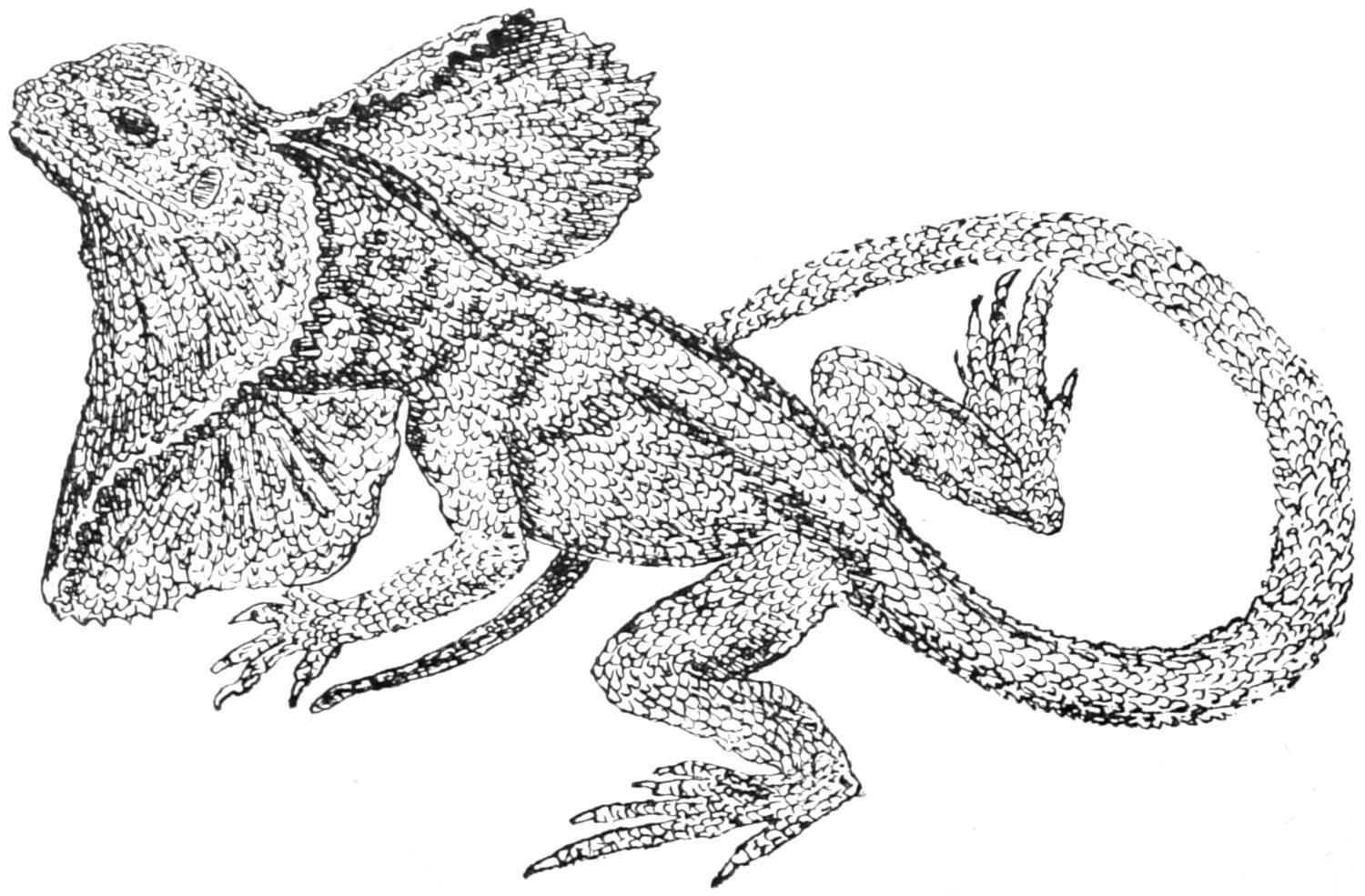
Fig. 62.—Chlamydosaurus.
We only observe that Mr. Gosse is evidently inclined to believe that there are “two or more species inhabiting the Northern and Southern oceans.” It is not at all plain what circumstance has led him to this supposition.
Curious is the comparison of the flappers, figured by Mr. Bing (fig. 19) with the frill of the Chlamydosaurus. I give here a figure of such an animal.
Mr. Gosse gets clearly entangled in his own considerations of the affinity of the sea-serpent with the Plesiosaurus when he comes to the fact of the existence of a mane. It is a pity that he has not mixed up with his considerations the well-known Iguana tuberculata, a lizard belonging to the same family as the Chlamydosaurus, but which has a comb extending over the whole length of the neck, the back and the tail!
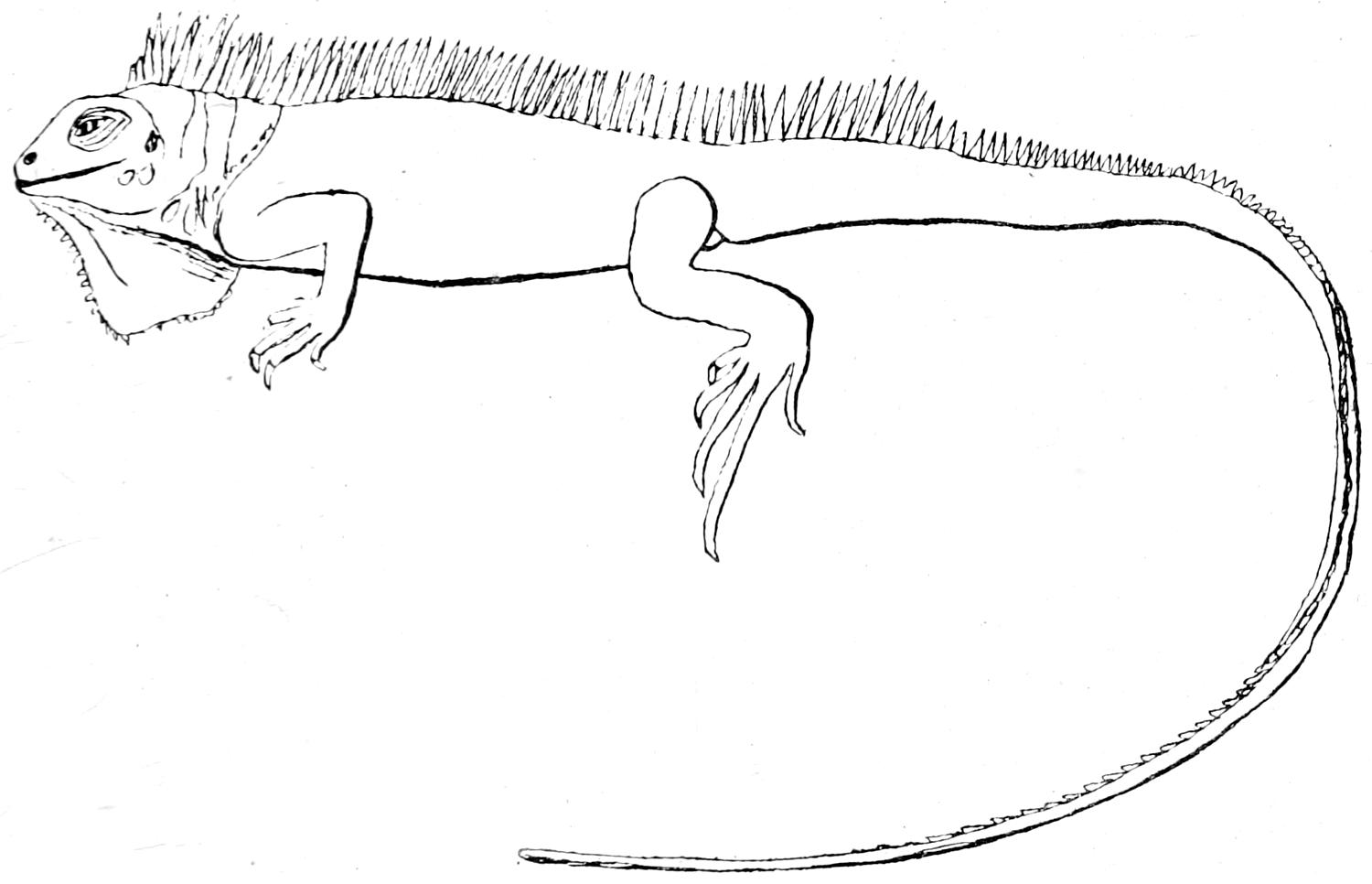
Fig. 63.—Iguana tuberculata.
Mr. Lee in his Sea Monsters Unmasked, considering the Plesiosaurus hypothesis, says:
“I think this theory is not forced upon us.”
Of the probability of living Plesiosauri, however, he says:
“Only a geologist can fully appreciate how enormously the balance of probability is contrary to the supposition that any of the gigantic marine saurians of the secondary deposits should have continued to live up to the present time. And yet I am bound to say, that this does not amount to an impossibility, for the evidence against it is entirely negative. Nor is the conjecture that there may be in existence some congeners of these great reptiles inconsistent with zoological science. Dr. J. E. Gray, late of the British Museum, a strict zoologist, is cited by Mr. Gosse as having long ago expressed his opinion that some undescribed form exists which is intermediate between the tortoises and the serpents.”
“Prof. Agassiz, too, is adduced by a correspondent of the Zoologist (p. 2395), as having said concerning the present existence of the Enaliosaurian type that “it would be in precise conformity with analogy that such an animal should exist in the American Seas, as he had found numerous instances in which the fossil forms of the Old World were represented by living types in the New.”
It is obvious that of all animals, now living or extinct, the outlines of the Plesiosaurus fit best to the descriptions and figures of the great sea-serpent. Abandoning the possibility of still living Plesiosauri, I reply to the question “Why cannot the sea-serpent be a Plesiosaurus?”
Plesiosauri with such an enormous tail as the sea-serpent has, are hitherto unknown to palaeontologists, but, as to me, this cannot be of much importance; for there is no reason why in the course of ages this appendage should not have been developed to gigantic dimensions. The difference between the place of the nostrils in the two animals cannot claim any weight either (the Plesiosaurus had its nostrils both before its eyes and not at the end of its snout, as is the case in the sea-serpent) for this place may have changed in process of time. But there are two other differences which are of very great importance, and settle the question: 1. The neck of the Plesiosaurus must have been fit to be bent in all directions, but I think no palaeontologist will ever admit that its trunk or backbone could be bent in such vertical undulations, as is the case with the sea-serpents. 2. The Plesiosaurus may have been destitute of scales, and may have had a smooth skin, it can never have been provided with a hairy skin as seals have, and at all events it had no mane, and no whiskers.
An eleventh explanation is properly a negative one. In the American Journal of Science and Arts, of 1835, viz: Prof. Benjamin Silliman, the Editor, published a report of one of his acquaintances, wherein the eye-witness declared: “nothing like a fin was seen”. Now Prof. Silliman in a Remark of the Editor says: “The absence of paddles or arms forbids us from supposing that this was a swimming saurian.”
I need not observe that this explanation was premature, and that the assertion “nothing like a fin was seen” does not exclude the presence of flappers, hidden under water. The flappers of a swimming sea-lion or seal are not generally seen either. If not a saurian, what kind of animal could it be then, a fish or a mammal?
The twelfth explanation, viz: a row of spermwhales, which is found in Prof. Schlegel’s Essai sur la physionomie des Serpens, 1837, p. 518, is better than that of a row of porpoises or of basking sharks, with their plainly visible backfins, for there is a species of spermwhales, viz. the Catodon macrocephalus the backfin of which is so small as to be almost invisible. The other species, Physeter tursio has a rather large and erected backfin.
Professor Schlegel, after describing the appearance of a row of porpoises swimming in line, goes on saying: “This habit is also common to the larger cetaceans, which, however, only accidentally frequent our” (the Dutch) “coasts. The coasts of North-America, where the monstrous sea-serpent has so often been observed, swarm with them, and I confess that from a vessel, for instance, the unexpected appearance of a family of spermwhales swimming in line, with the eldest at the head, must offer a spectacle striking enough and fit to call forth at once superstition, imagination and fear.”
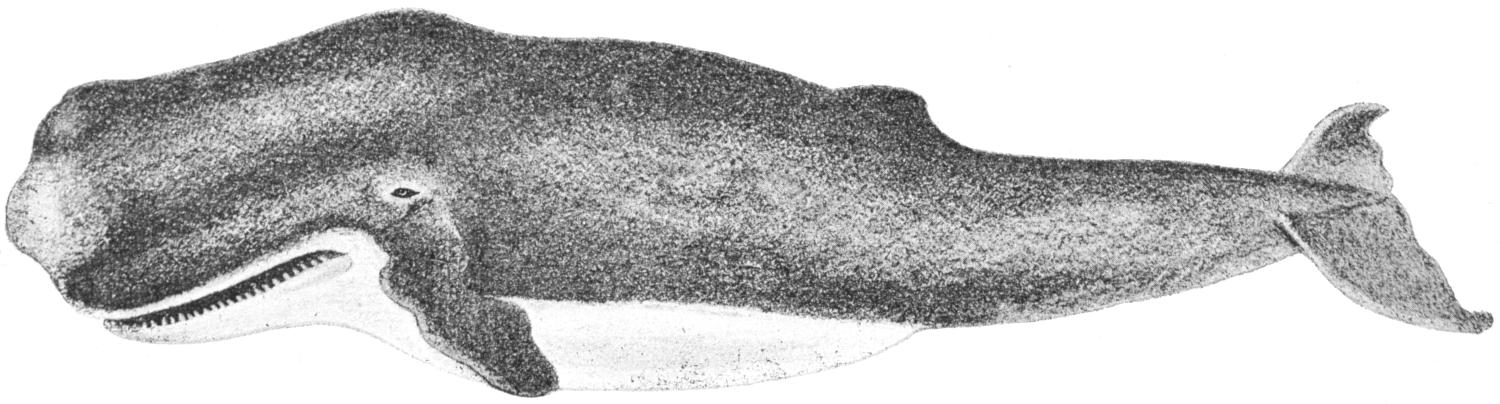
Fig. 64.—Catodon macrocephalus.
It is true that a row of sperm-whales must offer a striking spectacle, but in none of the accounts of the sea-serpent the “bunches” or visible parts of the vertical undulations surpassed the length of a fathom, whilst the visible parts of the backs of spermwhales measure several fathoms, and the distance between two of these backs in a row of spermwhales is enormous. The supposition, moreover, does not explain the head resembling that of a snake, and kept constantly above water, neither the long neck accidentally observed, the long and pointed tail, &c.

Fig. 65.—Skeleton of Basilosaurus.

Fig. 66.—Basilosaurus restored.
The thirteenth explanation supposes that the sea-serpent may be a still living Basilosaurus, an extinct marine mammal, first described by Harlan in the year 1824; afterwards the name was changed to that of Zeuglodon by Prof. Richard Owen. Fig. 65 represents the skeleton of a Basilosaurus. This animal lived in the tertiary periods. Almost all the characters of the skeleton remind us of Pinnipeds, only a few of Cetaceans, and so it is still doubtful to which order it belongs. Professor D’Arcy W. Thompson rejects all association with the Cetacea (Studies from the Museum of Zoology in University College, Dundee, Vol. I. no. 9.) The length of the largest skeletons measured seventy-five feet. The teeth and molars are nearly exactly those of seals. The nostrils were situated at the tip of the nose, as in seals, most probably, however, they were directed upwards. The bones of the rather short fore-extremities resemble those of seals. Most probably these limbs were provided with nails, as in seals. But, on the other hand, of some of the known skulls the remaining part shows an affinity to cetaceans. The vertebrae again are seal-like. Till now it is unknown whether the animal had hind-extremities or not, for the bones of them are not yet discovered. The body must have been rather slender and cylindrical. I venture to represent to my readers in fig. 66, a Basilosaurus restored. As the bones of the fore-extremities closely resemble those of seals, it is probable that small hind-extremities were not wanting. If the former resembled those of dolphins, the existence of hind-flappers would be problematic. Yet I have omitted them, because the bones of them are not yet discovered, as far as I know.
The reader will remember that Dr. Koch (see our Chapter on Hoaxes and Cheats) exhibited a large skeleton in Broadway, New-York, under the name of Hydrarchos Sillimanni. This skeleton was made by him out of several bones of the extinct Basilosaurus. The imposture was soon discovered by Prof. Wyman, and, of course, immediately published in all kinds of newspapers, which also reached Europe. In Froriep’s Neue Notizen, of February, 1846, is one of these articles translated into German. Consequently we may conclude that the translator of this article knew that the Hydrarchos Sillimanni was, in fact, made up of bones of the Basilosaurus. Now we find in Froriep’s Notizen, Third Series, Vol. III, no. 54, p. 148, 1847, a suggestion of a writer who wrote under the initials M. J. S. (evidently the Editor, the well-known Professor Matthias Jacob Schleiden: I have searched the Bibliotheca Zoologica of Carus and Engelmann, and not found another author whose name has these initials):
“Is the sea-serpent perhaps identical with the Hydrarchus, viz. a still living species, a still present remainder, though in a few individuals, of former periods?”
I think that this means: “Are there perhaps still living Basilosauri, and is the sea-serpent perhaps one of these creatures?”
Mr. Searles V. Wood, Jun. wrote in Nature of 18th. of November, 1880, Vol. 23, a paper, entitled: “Order Zeuglodontia”, in which he tries to show that the sea-serpent most probably belongs to this Order. The contents of his paper are as follows:
“In August 1848 H. M. S. Daedalus encountered off St. Helena a marine animal, of which a representation appeared in the Illustrated News of the latter part of that year. It is thirty-two years since I saw this figure, but I recollect that it was one of a blunt-nosed animal with a neck carried about four feet above the water, which was so long as to present the appearance of a serpent; and I remember that Prof. Owen, in combating at the time the idea that this was a sea-serpent, pointed out that the position of the gape in relation to the eye, as shown in the figure in the Illustrated News, was that of a mammal, and not that of a reptile; in consequence of which he argued that the animal seen was probably only a leonine seal, whose track through the water gave an illusory impression of great length. This idea, however, seemed to me untenable in the face of the representation in the Illustrated News; but it was obvious that to afford the buoyancy necessary for the support above the water of so long a neck (estimated on that occasion as sixty feet though only the part near the head was actually out of the water), the submerged portion of the animal could not have had the shape of a serpent.”
“Two or three years after this, on reading the description of Zeuglodon cetoides, from the Tertiary (probably Upper Eocene) formations of Alabama, it struck me that the animal seen from the Daedalus may have been a descendant of the order to which Zeuglodon belonged; and I have ever since watched with interest for reports of the “great sea-serpent”.”
“Three years ago the following appeared in the newspapers.”
Here Mr. Searles Wood copies the whole affidavit of the crew of the Pauline (no. 144), and adds:
“The locality here specified was about thirty miles off the northern coast of Brazil.”
And he goes on:
“In this account I thought that I recognized the grip of the whale by the long neck of the attacking animal, the appearance being confounded into the double coil of a serpent by the distance and motions of the objects; but in face of the general ridicule which has been attached to this subject, and being without any assurance that the declaration so purporting to be made was genuine, I did not venture to ventilate my long-cherished idea. A relative of mine, however, just returned from India, chancing to say that two of the officers to the steamer in which she went out had on the previous voyage witnessed an immense animal rear its neck thirty feet out of the water, and that a sketch of the object had been instantly made, and on reaching port sent to the Graphic. I obtained the number of that paper for July 19, 1879, and I inclose a tracing of the figures in it, which are accompanied by the following statement in the Graphic:—”
The statement of the Kiushiu Maru is further copied, accompanied by the two figures (see no. 151, figg. 48 and 49), and he continues saying:
“As I have not been able to find any description of the skeleton of the Zeuglodon, I venture to draw attention to the subject through your columns, in the hope that among your many readers in America this letter may attract the notice of some one who will tell us whether what is known of the osseous structure of Zeuglodon cetoides is or is not consistent with the representation in the Graphic. The remains of the cetacean, supposed to be extinct, indicate, according to Sir Charles Lyell, that it was at least seventy feet in length, (He observes in the third edition of his “Manual of Elementary Geology”, 1851, p. 208, that he visited the spot where a vertebral column of this length belonging to Zeuglodon had been dug up.) while its great double-faced but knife-edged molars show that it was carnivorous; and as we are not so far removed from the period of the Alabama Tertiaries as to render it improbable that members of what must once have been a great Order of carnivorous cetacea, totally distinct from the orders of cetacea hitherto known as living, may still survive, I have braved the ridicule attaching to this subject so far as to invite attention to it.”
“The second of the two figures in the Graphic shows the long necked animal to possess the cetacean tail, and its head there seems to have been turned from the observer, so that the underside of it only is presented. The first figure shows that the whale had been seized on its flank by the powerful bite of its aggressor, and that to escape from this it had thrown itself out of the water. Having succeeded in this object the second figure shows the aggressor rearing its head and neck out of the water to discover the direction which its prey had taken, in order that it might follow it up; and so far from the charge of curious drawing made by the editor of the Graphic being justified, the representation of the whale can be at once recognized as fairly correct; while that of the tail of the unknown animal (which probably prompted this charge), so far from being curious, forms an important piece of evidence as showing the animal in question to be catacean.”
This paper had already been sent to the Editors of Nature, when Mr. Searles V. Wood, Jun., observed that he was mistaken as to the report, and as soon as possible he sent a Postscript to the Editors, which appeared appended to his paper. The postscript runs as follows:
“P. S. Since sending to you the above I have again seen my relative, and find that the cut in the Graphic of July 19, 1879, is not that of the instance observed from the steamer in which she came home, which was the City of Washington; but of a separate instance which occurred to another ship. I have not been able yet to procure the Graphic containing the figure of the animal seen from the City of Washington, but she tells me that it was pasted up in the saloon and represented only the head and long neck of the animal, which was raised to a great height out of the water, and near to the ship; and had been drawn for the Graphic by a lady passenger immediately after the occurrence. These repeated and independent notices of the same long necked are, however, the more confirmatory of its existence.”
“I find that Prof. Owen in his article on Palaeontology in the Encyclopedia Britannica (Vol. XVII, p. 166), in giving a description of Zeuglodon cetoides, says that “the skull is very long and narrow and the nostril single”, that Dr. Harlan obtained the teeth on which, correcting Harlan’s reptilian reference of them, he founded the order Zeuglodontia, from the Miocene of Malta; and that the teeth discovered by Grateloup in the Miocene beds of the Gironde and Herault, and described by him also to a reptile under the name of Squalodon, are those of a smaller species of Zeuglodon. The remains of Squalodon, along with those of the shark with huge teeth, Carcharodon megalodon, and of numerous cetaceans assigned to orders all still living, and of which some, such as Delphinus, belong to living genera, occur in the “Sables inférieures” of Antwerp; which, though long called Miocene, are by Mr. Van den Broeck regarded as older Pliocene, and as the base of that series of deposits of which the middle and upper divisions are respectively represented by the Coralline and Red Crags of England; and with these “Sables inférieures” the so called Miocene of Malta, in which Zeuglodon is associated with Carcharodon, is probable coeval. Dr. Gibbes (Jour. Acad. Nat. Sc., 2d. ser., vol. I, p. 143), figures and describes teeth of the Antwerp species of Carcharodon from both the Eocene of South Carolina and Miocene of Alabama. These various references bring the Zeuglodonts, with their Carcharodon associates, down to a late geological period during which they co-existed with Delphinian prey; and of this prey the whale in the woodcut (which looks like a Grampus) seems an example”.
“It is most likely that Bishop Pontoppidan, a copy of the English (1755) edition of whose work I possess, concocted his two figures (one of which is that of a huge snake undulating on the waves, and the other that of a serpent-like animal with pectoral flappers or fins, resting almost on the surface of the sea, with head and tail erect out of the water like the letter U, and spouting water or steam from its mouth in a single column), from accounts given him by Norwegian seamen, some of whom had seen the animal in the position in which it was observed from the Daedalus, and others in that in which it is represented in the cut as seen from the Kiushiu-maru; for in the long narrative which he gives of the descriptions received from observers at numerous times, some of these agree with the one, and some with the other, though both of the Bishop’s figures represent only preposterous conceptions of his own.”
“[The animal seen from the Osborne, and figured in the Graphic of June 30, 1877, as the “Sea-Serpent”, is quite a different thing from the one in question, and may have been a manatee.]”
I shall take the liberty to make some remarks on his paper.
The reader will remember (see no. 118) that it was not the long neck of the animal, which caused the comparison of a snake, made by the officers of the Daedalus, but the roundness of its neck, the apparent roundness of the body, and the resemblance of the animal’s head with that of a snake.
In their reports there is not a single estimation of the length of the neck. It is only said that the length of the visible part of the animal was about sixty feet; and now Mr. Searles V. Wood says: “a neck, estimated on that occasion as sixty feet”. I don’t see the reason of such a deduction!
As I have not read the “description of Zeuglodon cetoides” I am not able to discover the reason why it struck Mr. Wood that the animal seen from the Daedalus may have been a descendant of the order to which Zeuglodon belonged.
We observe that Mr. Wood really believes that it was the sea-serpent which attacked “the whale by the long neck, the appearance being confounded into the double coil of a serpent by the distance and motions of the object” (See no. 144). I will not contest his opinion!
I do not know what to think of Mr. Wood, when he speaks of the Kiushiu Maru in connection with a relative of his. I may suppose that his relative had told him she repatriated by the City of Baltimore through the Indian Ocean, and that the “previous voyage” of that vessel was also from India to England; notwithstanding this he cites the account of the Kiushiu Maru reporting the appearance of a sea-serpent near the isle of Kiu Siu (Japan) in the Van Diemen’s Straits. Most probably the City of Baltimore never was there!
In short, the error took place, and Mr. Wood sees clearly in the figures of the Graphic his Zeuglodon pointing out that this figure shows a bifurcated or fan-shaped tail, and that consequently the animal must be a cetacean! It is evident, that Mr. Wood was convinced that the Zeuglodon (read Basilosaurus) had the following outlines!
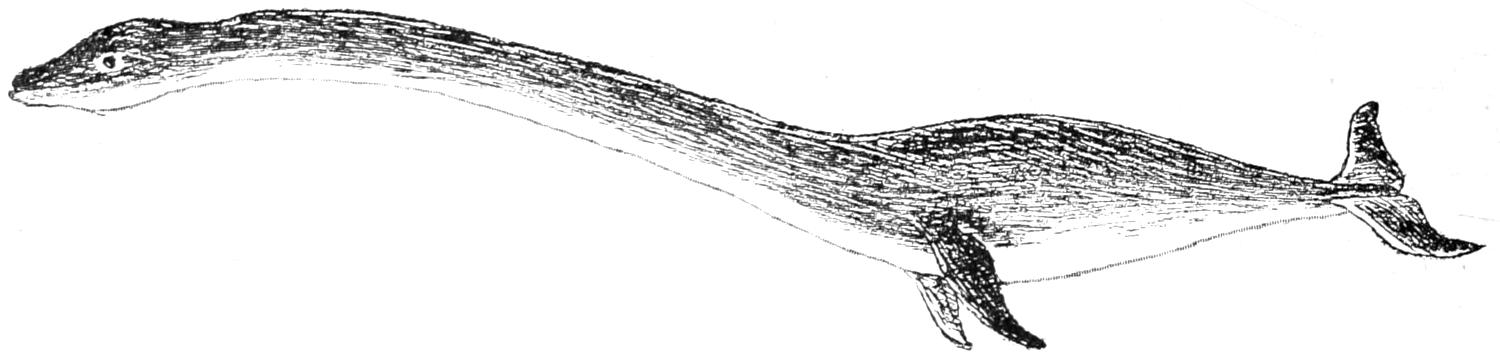
Fig. 67.—Basilosaurus, as imagined by Mr. Searles V. Wood Jun.
It is clear that, before writing his postscript, he had already had the opportunity to read “a description of Zeuglodon cetoides”. Yet he holds to his idea, and does not show the great difference between the extremely short neck of Basilosaurus and the extraordinarily long neck of the Sea-Serpent. This at all events must have struck him.
At last I am obliged to say some words about his considerations of Pontoppidan’s Natural History of Norway. It is clear that he has not read a single word of it! He says: “it is most likely that the Bishop concocted his two figures from accounts given him by Norwegian seamen”, whilst the Bishop clearly states that the first figure is a copy of a sketch of Mr. Benstrup, and the second a copy of the drawing of Mr. Bing. Of the latter figure Mr. Wood says “it is that of a serpent-like animal almost resting on the surface of the sea”. I shall be greatly obliged to any person who can show me a passage either in Pontoppidan’s or in Egede’s work, stating that the animal presented itself in this way “resting on the surface”. I refer my readers to the account itself (no. 5), where it is clear that the animal must have been seen in this position for only the fraction of a second!
Mr. Wood, describing the drawing of Mr. Bing underlines the words: in a single column, speaking of the animal’s “spouting water or steam from its mouth”. Now I ask my readers (drawing their attention to the fact that the figure represents the animal’s head seen from aside), whether a column, spouted from the animal’s nose or mouth, when seen from aside could ever have been decided to be single or double! If we look at the breath of a horse, standing just on one side of him, it will be observed to be single. This optical illusion will be dispelled as soon as we stand in front of the horse. Bing’s figure would have been incorrect, if he had drawn two columns, though in reality—if the animal exhaled through its nostrils,—the column must have been double.—It is remarkable that Mr. Wood does not say anything of the great difference between the figure of the Kiushiu Maru (with a cetacean tail) and that of Mr. Bing, (with a long and pointed one).—Again, he asserts that both the Bishop’s figures represent only preposterous conceptions of his own description!
Finally he compares the animal seen from the Osborne with a manatee! Surely we must be a Mr. Searles V. Wood Jun. to find this conception not preposterous!
In a second paper in Nature of February 10, 1881, Mr. Wood quotes the report of the City of Baltimore, and correcting his second error, writes in parentheses “not City of Washington, as I had misunderstood.”—In treating of this report and of the accompanying figure he is again mistaken, for the figure shows the animal moving at a rapid rate with its neck high in the air, and the two splashes were evidently caused by the animal’s fore-flappers and hind-flappers, whilst the splash “like a pair of wings” described in the report, is caused by the dropping of the immense neck like a log of wood in the act of disappearing suddenly in the water. This act, and consequently this splash too, is not represented in the figure! According to his idea of the sea-serpent being a dolphin or porpoise with a very long neck (called by him Zeuglodon), he ascribes the splash, caused by the hind flappers, to his “cetacean tail” of the animal. Remarkable is his third error; for after having first confounded the foremost splash, drawn in the figure, with that described in the report as caused by the dropping of the neck, he now writes: “the foam around the neck may be due to the splash of the humeroid” (i. e. fore) “paddles which a cetacean should possess.”
Mr. Wood further sees in the figure of the head of the Daedalus animal (fig. 30) the alleged “bulldog appearance of the forehead and eye-brow”. I can only express my opinion that this comparison is far fetched.
Of the report of Captain Cox (no. 152) Mr. Wood says:
“In this account we have almost a duplicate of that of Major Senior in the dropping of the animal with a great splash into the water prior to its darting forward under it; while the boiling of the water around, which is so inconsistent with the motion of a snake in water (which I have more than once seen) evidently resulted from the strokes of the cetacean tail, and possibly also from those of the paddles, as in the case witnessed by Major Senior. The black colour also is described in both cases.”
In treating of this report I have already expressed my opinion that the boiling of the water must have been caused by the four flappers together. It is very natural that Mr. Wood who represents the sea-serpent as a dolphin-shaped animal, without a backfin, and with a long neck, sets much value on the cetacean tail. Finally he says:
“Judging from the figures which accompany this and my previous letter” (figg. 48, 49, 46, and reduced sketches of figg. 28 and 30), “it appears to me that the external form of the animal must resemble the well-known Plesiosaurus, if we imagine the hinder (femuroid) paddles of that Enaliosaurian to be absent, and a cetacean tail (which is their homologue), to be present in their stead. Since in the direction of the Porpesse the cetacean in external form so closely simulates the fish, so it may in another direction simulate this Mesozoic marine saurian, or the gigantic Elasmosaurus of the American cretaceous formation, of which a nearly perfect skeleton is described by Prof. Cope as forty-five feet in length, the neck constituting twenty-two of this length.”
And he expresses his firm opinion:
“There ought, I submit, to remain no longer with naturalists any doubt that a hitherto unknown group of carnivorous cetaceans, with necks of extraordinary length, inhabit the ocean.”
In the middle of November, 1881, appeared the first number of the Album der Natuur for 1882, and in this issue the author of the present Volume treated of the probability of the existence of the great sea-serpent. Unfortunately he, who at that time was only a student of Natural History at the Utrecht University, really believed the animal of Stronsa, of 1808, to be a sea-serpent, and was misled by the hoax of Captain Seabury of which he only knew the last part, found by him in the Illustrated London News. In his firm belief, however, he examined such characters, taken from these tales and from nearly 60 reports then known to him, as were possible from a zoological point of view, and came to the conclusion that the sea-serpent must be a mammal, with four flappers, a long neck and a long and pointed tail, and that the position of this marine mammal is between dolphins and pinnipeds. Was there such an animal known? Yes, the Zeuglodon cetoides of Prof. Richard Owen. Well, as the sea-serpent has the outlines of a Plesiosaurus, with an enormous tail, he called it Zeuglodon plesiosauroides. At that time he was the dupe of the Stronsa animal and of the alleged capture of 1852, because, like so many other writers on the subject, he believed that he could solve the difficult question without reading, if not all that had been written about the animal, at least much more than some few reports!
The fourteenth explanation is that of an anonymous writer in one of the public papers of about the sixth of November, 1848. Amidst the excitement, caused by the reports of Capt. M’Quhae and Lieutenant Drummond, he asks whether or not the animal could be a full grown specimen of Saccopharynx flagelium of Dr. Mitchill or the Ophiognathus ampullaceus of Harwood. I have only to tell my readers that these two names are given to two different species of the same genus, that the former attains a length of about five, the latter of about six feet, and to give the next figure, in order to enable them to judge themselves, whether such an animal could ever have shown itself in the form of a sea-serpent! They belong to the family of the Muraenidae.
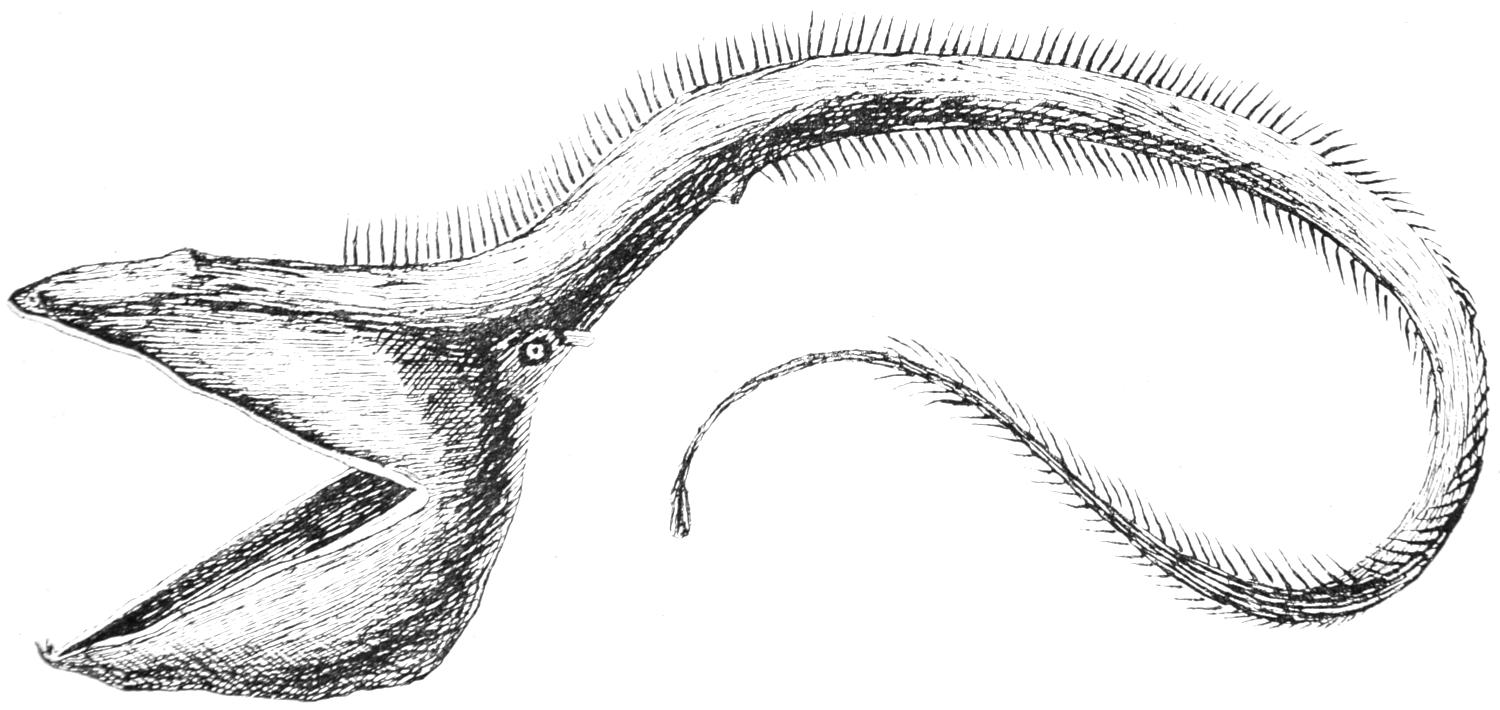
Fig. 68.—Eurypharynx pelecanoides, Vaillant.
The figure represents the Eurypharynx pelecanoides of Vaillant, taken from Filhol’s La vie au fond des mers. Günther, in his Deepsea-fishes of the Challenger says on p. 262 of Saccopharynx Bairdii (synonym with Saccopharynx flagellum): “It is uncertain whether these specimens are specifically distinct from Saccopharynx pelecanoides Vaillant.” I therefore don’t hesitate to put before my readers the above figure as a representation of the general outlines of Saccopharynx flagellum.
The fifteenth explanation is suggested by the same anonymous writer on the same occasion, who wishing to explain the appearance of the sea-serpent near the coasts of Africa, asks whether “some land species, as the boas, among which are individuals of forty feet in length, may not sometimes betake themselves to the sea, or even transport themselves from one continent to another”.
Probably he “adduced” this suggestion “of a large boa constrictor having been conveyed to the island of St. Vincent, twisted round the trunk of a cedar tree, carried away, as is supposed, from the banks of some South-American river. This occurrence is quoted by Sir Charles Lyell from the Zoological Journal of December, 1827. (Principles of Geology.)”
Mr. Gosse in his Romance of Natural History after having shown that the sea-serpent cannot be a kind of true sea-snake (Family Hydrophidae) because “none of these are known to extend a few feet in length and, so far as we know, none of them have been found in the Atlantic”, goes on saying: “It is remarkable, however, that a record exists of a serpent having been seen in the very midst of the North Atlantic”. And instead of relating now the historical fact of the boa constrictor, above mentioned, he quotes the report of the sea-serpent seen from the General Coole, (no. 25) and goes on saying:
“It augments very considerably the value of this incident, that no suggestion of identity with the Norwegian dragon appears to have occurred to the observer; he speaks of it of “a snake”, and nothing more; the dimensions alone appear to have excited surprise, “sixteen or eighteen feet”, and these are by no means extravagant.”
“On the whole I am disposed to accept this case as that of a true serpent—perhaps the Boa Murina, one of the largest known, and of very aquatic habits—carried out to sea by one of the great South American rivers, and brought by the Gulf Stream to the spot where it was seen. If I am warranted in this conclusion it affords us no help in the identification of the great unknown.”
“I do not attach much value to the assertions of observers, that the head of the animal seen by them respectively was “undoubtedly that of a snake.” Such comparisons made by persons unaccustomed to mark the characteristic peculiarities which distinguish one animal from another, are vague and unsatisfactory. Their value, at all events, is rather negative than positive. For example, if a person of liberal education and general information, but no naturalist, were to tell me he had seen a creature with a head “exactly like that of a snake”, I should understand him, that the head was not that of an ordinary beast, nor of a bird, nor that of the generality of fishes; but I should have no confidence at all that it was not as like that of a lizard as of a serpent, and should entertain doubt whether, if I showed him the form of head, even of certain fishes, he would not say, “Yes, it was something like that.”
“There does not seem, then, any sufficient evidence that the colossal animal seen from the Daedalus, and on other occasions, is a serpent, in the sense in which zoologists use that term. A lengthened cylindrical form it seems to have; but, for anything that appears, it may as well be a monstrous eel, or a slender cetacean, as anything. All analogies and probabilities are against its being an ophidian.”
It is remarkable that Mr. Gosse is disposed to believe that the sea-serpent of the General Coole was a boa, because the report speaks of “a snake”, and that he cannot believe that the sea-serpent of the Daedalus was a boa, though the captain, Mr. M’Quhae, clearly tells that he saw “a serpent, the head of which, without any doubt, was that of a snake”. Now I ask what is the difference between “a snake” and “a serpent with a head of a snake”!? What, in short, is the difference between a snake and a serpent? Though he attaches a considerable value to the assertion of the captain of the General Coole who speaks of “a snake, and nothing more”, Mr. Gosse “does not attach much value to the assertions of observers, that the head of the animal seen by them was undoubtedly that of a snake”. How to make this agree?
Mr. Lee in his Sea Monsters Unmasked says: “a marine snake of enormous size may, really, have been seen”. As I think he means in this instance, a land-snake which occasionally frequents the sea, as the Boa murina, I have placed this supposition here, and I have not considered it as identical to the fourth explanation.
As a snake has no paddles or flappers, and is unable to undulate vertically, the sea-serpent cannot be such an animal. Moreover the boas are only inhabitants of tropical America and adjacent seas.
The sixteenth explanation is given by Professor Richard Owen, viz.: that the sea-serpent is a swimming large seal. I refer my readers to his answer to a nobleman’s question, what Captain M’Quhae could have seen, inserted in our foregoing Chapter (no. 118). After having enumerated all the characters of the animal seen by captain M’Quhae, taken from the figures as well as from the descriptions, Professor Owen comes to the conclusion: “All these are the characters of the head of a warm-blooded mammal..... Guided by the above interpretation, of the “mane of a horse, or a bunch of sea-weed”, the animal was not a cetacean mammal, but rather a great seal. But what seal of large size, or indeed of any size, would be encountered in latitude 24° 44′ south, and longitude 9° 22′ east?” Professor Owen further concludes: Phoca proboscidea or Phoca leonina. Very remarkable is the fact that a few lines before, the Professor said of the animal’s length: “This is the only part of the description, however, which seems to me to be so uncertain as to be inadmissable, in an attempt to arrive at a right conclusion as to the nature of the animal”. (The italics are mine).
In fig. 69 I show my readers the Macrorhinus leoninus, Linné, or sea-elephant, of which Phoca leonina, Linné, and Phoca proboscidea, Péron, are synonyms. The adult males have an elongated tubercular proboscis, the young ones and the females, one of which is seen in the background of my drawing, have the common features of seals.
Mr. H. E. Strickland and Mr. A. G. Melville in the note added to their dissertation on the Dodo, in the Annals and Magazine of Natural History, 2d. series, Vol. II, p. 444, Nov. 15? 1848, say of Prof. Owen’s letter that it “gives a simple and clear explanation of the circumstances that have recently attracted attention, and briefly, but conclusively, discusses the question of existence of the Great Sea-Serpent generally.”
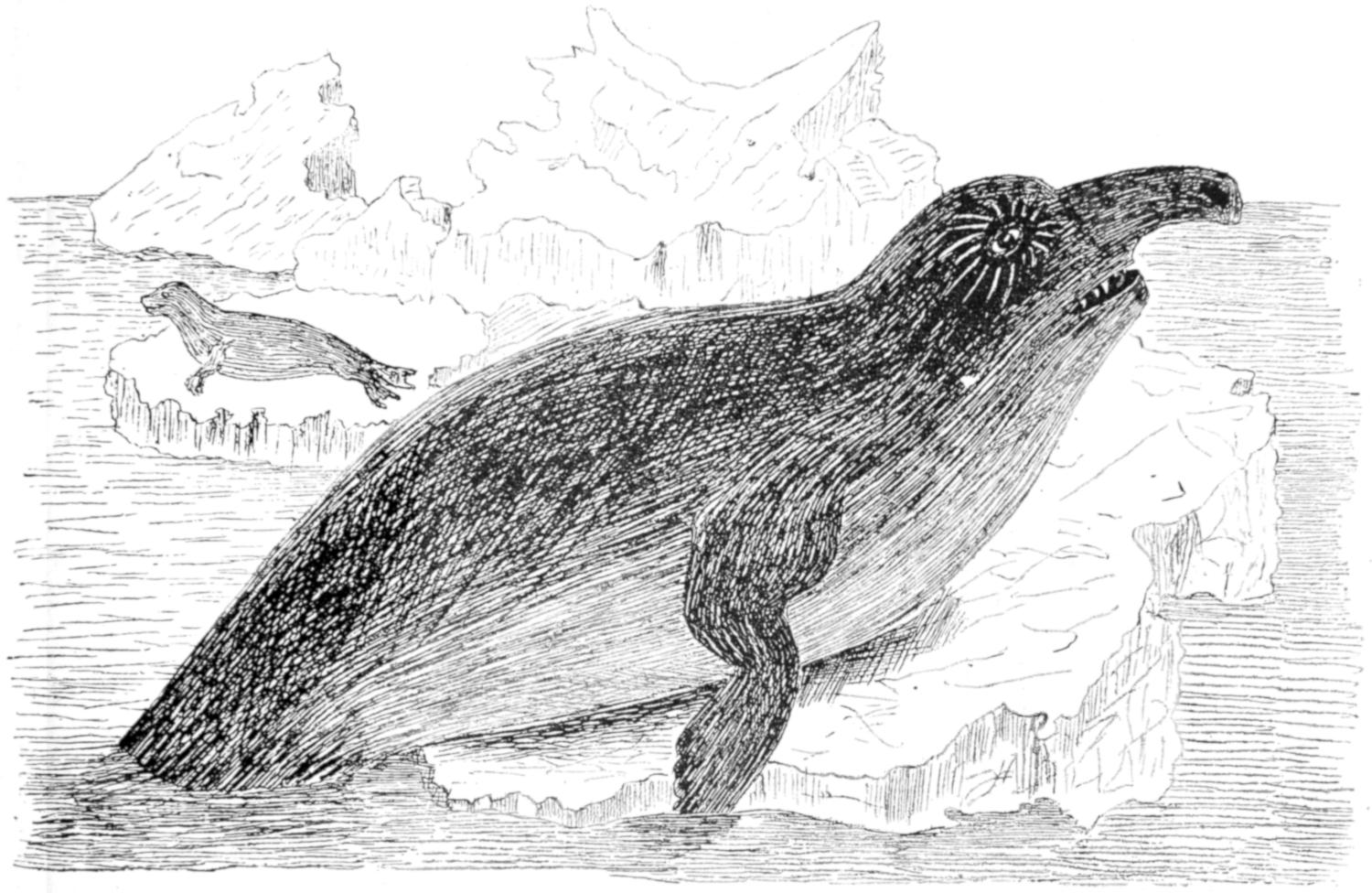
Fig. 69.—Macrorhinus leoninus (Linné).
Captain M’Quhae, on the contrary, at once rejects the idea of a seal. His letter is interesting enough to be read over again; I therefore refer my readers to it (no. 118).
Mr. Froriep, in his Notizen, Third Series, X. p. 97, of July, 1849, after having inserted in his columns extracts from the statement of Lieutenant Drummond, from that of Captain M’Quhae, from the hoax of the Daphne, from the suggestion of Mr. Mantell, from that of Prof. Owen, &c. &c. finally concludes:
“We therefore observe from all these articles that nothing is still fixed about the existence or non-existence of the great sea-serpent; yet so much seems inquestionable now, that there must be a large sea-animal, still unknown, and not quite unlike a snake; but whether this monster is a snake, nay even belongs to the family of the amphibians, this gets more and more doubtful after the objections of Prof. Owen.”
Mr. Gosse, in his Romance of Natural History treats of the seal-hypothesis in the following manner:
“Among animals, the Vertebrata are the only classes supposable. But of these, which? Birds are out of the question; but Mammalia, Reptilia, Pisces,—there is no antecedent absurdity in assigning it to either of these. Each of these classes contains species of lengthened form, of vast dimensions, of pelagic habit; and to each has the creature been, by different authorities, assigned.”
“Let us, then, look at the Mammalia. Here Professor Owen would place it; and his opinion on a zoological question has almost the force of an axiom. I trust I shall not be accused of presumption if I venture to examine the decision of one whom I greatly respect. It is true, his reasoning applies directly only to the creature seen from the Daedalus; but we are bound to consider the exigencies not only of that celebrated case, but of all the other well-authenticated cases.”
“Prof. Owen thus draws up the characters of the animal:—“Head with a convex, moderately capacious cranium, short obtuse muzzle, gape not extending further than the eye; eye rather small, round, filling closely the palpebral aperture; colour, dark brown above, yellowish white beneath; surface smooth, without scales, scutes, or other conspicuous modifications of hard and naked cuticle; nostrils not mentioned, but indicated in the drawing by a crescentic mark at the end of the nose or muzzle; body long, dark brown, not undulating, without dorsal or other apparent fins; “but something like the mane of a horse, or rather a bunch of sea-weed, washed about its back.”
“The earlier of these characters are those “of the head of a warm-blooded mammal; none of them those of a cold-blooded reptile or fish”. The comparison of the dimly-seen something on the back to a horse’s mane or sea-weed, seems to indicate a clothing of hair; and, guided by this interpretation, the Professor judges that the animal was not a cetacean, but rather a great seal.”
“Now, it is manifest that it was from the pictorial sketches, more than from the verbal description of Captain M’Quhae, that this diagnosis was drawn up. And if the drawings had been made from the life, under the direction of a skilful zoologist, nothing could be more legitimate than such a use of them. But surely it has been overlooked that they were made under no such circumstances. Only one of the published representations was original; and this was taken “immediately after the animal was seen”. That is, one of the officers, who could draw, went below immediately, and attempted to reproduce what his eye was still filled with. Now, what could one expect under such conditions? Of course, the artist was not a zoologist, or we should have had a zoologist’s report. Would the drawing so produced be of any value? Surely yes; of great value. It would doubtless be a tolerably faithful representation of the general appearance of the object seen, but nothing more; its form, and position, and colour, and such of the details as the observer had distinctly noticed, and marked down, so to speak, in his mind, would be given; but a great deal of the details would be put in by mere guess. When a person draws from an object before him, he measures the various lines, curves, angles, relative distances, and so on, with his eye, one by one, and puts them down seriatim; ever looking at the part of the original on which he is working, for correction. But no possibility of doing this was open to the artistic midshipman; he had merely his vivid, but necessarily vague, idea of the whole before him as the original from which he drew. Who is there that could carry all the details of an object in the memory, after a few minutes’ gaze, and that, too, under strong excitement? This was not the case even of a cool professional artist, called in to view an object for the purpose of depicting it; in all probability the officer had not thought of sketching it till all was over, and had made no precise observations, his mind being mainly occupied by wonder. He sits down, pencil in hand; he dashes in the general outline at once; now he comes to details,—say the muzzle, the facial angle;—of course, his figure must have some facial angle, some outline of muzzle; but probably he had particularly noticed that point. What shall he do? there is no original before him, a glance at which would decide; he sketches on a scrap of paper by his side two or three forms of head; perhaps he shows the paper to a brother officer, with a question, “Which of these do you think most like the head?” and then he puts the one selected in his sketch, and so of other details.”
“Those who are not used to drawing will think I am making a caricature. I am doing no such thing. I have been accustomed for nearly forty years to draw animals from the life; and the public are able to judge of my power of representing what I see; but I am quite sure that if I were asked to depict an object unfamiliar to me, which I had been looking at for a quarter of an hour, without thinking that I should have to draw it, I should do, in fifty points of detail, just what I have supposed the officer to have done. Let my reader try it. Get hold of one of your acquaintances, whom you know to be a skilful, but non-professional artist, whose attention has never been given to flowers; take him into your greenhouse, and show him some very beautiful thing in blossom; keep him looking at it for some ten minutes without a hint of what you are thinking of; then take him into your drawing-room, put paper and colours before him, and say, “Make me a sketch of that plant you have just seen!” When it is done, take it to a botanist, and ask him to give you the characters of the genus and species from the sketch; or compare it yourself with the original, and note how many and what ludicrous blunders had been made in details, while there was a fair general correctness.”
“Viewed in this light, it will be manifest how inefficient the sketch made on board the Daedalus must be for minute characters; and particularly those which in the diagnosis above I have marked with italics. Yet these are the characters mainly relied on to prove the mammalian nature of the animal. Some of these characters could not possibly have been determined at two hundred yards’ distance. I say “mainly relied on”; because there is the manelike appendage yet to be accounted for. This is a strong point certainly in favour of a mammalian, and of a phocal nature; whether it decides the question, however, I will presently examine.”
“The head in either of the large sketches (those, I mean, in which the creature is represented in the sea) does not appear to me at all to resemble that of a seal; nor do I see a “vaulted cranium”. The summit of the head does not rise above the level of the summit of the neck; in other words, the vertical diameter of the head and neck are equal, while there are indications that the occiput considerably exceeds the neck in transverse diameter. This is not the case with any seal, but it is eminently characteristic of eels, of many serpents, and some lizards. Let the reader compare the lower figure (Illustrated London News, Oct. 28, 1848) with that of the Broadnosed Eel in Yarrell’s British Fishes (ed. ii. Vol. ii. p. 396). The head of some of the scincoid lizards (the Jamaican Celestus ociduus, for instance) is not at all unlike that represented; it is full as vaulted, and as short, but a little more pointed, and with a flatter facial angle. On this point the Captain’s assertion corrects the drawing; for, in reply to Professor Owen, he distinctly asserts that “the head was flat, and not a capacious vaulted cranium;” and the description of Lieutenant Drummond, published before any strictures were made on the point, says, “the head.... was long, pointed, and flattened at the top, perhaps ten feet in length, the upper jaw projecting considerably.”
“With regard to the “mane”. The great Phoca proboscidea is the only seal which will bear comparison with the Daedalus animal in question, reaching from twenty to thirty feet. H. M. officers declare that upwards of sixty feet of their animal were visible at the surface; but Mr. Owen supposes, not improbably, that the disturbance of the water produced by progression induced an illusive appearance of a portion of this length. But how much? Suppose all behind thirty feet, the extreme length of the elephant seal. Then it is impossible the animal could have been such a seal, for the following reason. The fore paws of the seal are placed at about one-third of the total length from the muzzle; that is, in a seal of thirty feet long, at ten feet behind the muzzle. But twenty feet of the “serpent” were projected from the water, and yet no appearance of fins was seen. Lieutenant Drummond judges the head to have been ten feet in length (with which the lower figure, assuming sixty or sixty-five feet as the total length drawn; well agrees); and besides this, at least an equal length of neck was exposed.”
“But the great Phoca proboscidea has no mane at all. For this, we must have recourse to other species, known as sea-lions. Two kinds are recognized under this name, Otaria jubata and Platyrhynchus leoninus; though there is some confusion in the names. Neither of these ever exceeds sixteen feet in total length, of which, about five feet would be the utmost that could project from the water in swimming. Suppose, however, the eyes of the gallant officers to have magnified the leonine seal to sufficient dimensions; I fear even then it will not do. For the mane in these animals is a lengthening and thickening of the hair on the occiput and on the neck, just as in the lion. But the “serpent’s” mane was not there, but “perhaps twenty feet in the rear of the head” says Lieutenant Drummond; it “washed about its back”, says Captain M’Quhae.”
“I do not hesitate to say, therefore, that on data we at present possess, the seal hypothesis appears to me quite untenable.”
I think that the reader will easily see that Mr. Gosse in discussing the mammalian character of the sea-serpent, and we may add: especially of the sea-serpent seen by Captain M’Quhae, was prepossessed with his idea of the sea-serpent being an Enaliosaurian.—Mr. Gosse points out that the vertical diameter of the head and neck are equal; but he does not fix the reader’s attention to the fact that if this were really the case, the estimation of the length of the head by Lieutenant Drummond at “ten feet” and that of the diameter of the neck by Captain M’Quhae at “sixteen inches” don’t agree at all!—In none of the reports of the animal of the Daedalus there is question of the “serpent” being “twenty feet projected from the water”; it is only stated that the head was kept four feet above the water.—Neither do the reports mention how much of the neck was exposed, besides the head: Mr. Gosse says “an equal length”.—Lieutenant Drummond did not say that the mane was “perhaps twenty feet in the rear of the head”: the gallant officer, on the contrary, did not mention the mane at all!—
Prof. Owen relying upon the descriptions of Captain M’Quhae and drawings of one of the midshipmen, and admitting all their statements to be true and their sketches to be as accurate as possible, absolutely rejects the estimation of the length of the animal at “sixty-feet at least”; in doing so he of course could not possibly come to another conclusion than that the animal was a mammal, and to the question: “which mammal could it have been? his reply could not be otherwise than: “a large seal”. It is evident that for this reason he recalled to his mind all the sea-mammals known to him, but he seems to have totally overlooked the possibility of the existence of sea-mammals unknown to him!!! The conclusion: “the animal was a large seal” leads the Professor to write: “A larger body of evidences from eye-witnesses might be got together in proof of ghosts than of the sea-serpent”. The Professor would never have expressed such an opinion, if he had examined all the reports about the animal, and all that had been written about it up to his time. It is evident that, without a thorough investigation a sceptic must remain a sceptic.
I need not say, why the sea-serpent cannot be a sea-elephant. The latter has a proboscis, the sea-serpent has none, the sea-elephant has no long neck, no long tail, no mane, whereas these characters are very prominent in the sea-serpent.
The seventeenth explanation is the following: the sea-serpent is nothing else but a gigantic sea-weed, detached from the bottom of the sea. In 1849 we meet for the first time with this suggestion. In the Zoologist of that year, p. 2541, we read the following statement of Captain Herriman:
“Mr. J. A. Herriman, commander of the ship Brazilian, now lying near the principal entrance of the London Dock, makes the following curious and interesting statement:—
“He left the Cape on the 19 of February, running with a strong south-easterly wind for four days. On the morning of the 24th. the ship was becalmed in latitude 26° South, longitude 8° East, being about forty miles from the place in which Captain M’Quhae, R. N., is said to have seen the Great Sea-Serpent. About eight o’clock on that morning, whilst the captain was surveying the calm, heavy, rippleless swell of the sea through his telescope, the ship at the same time heading N. N. W., he perceived something right abeam, about half a mile to the westward, stretched along the water to the length of about twenty-five or thirty feet, and perceptibly moving from the ship with a steady, sinuous motion. The head, which seemed to be lifted several feet above the waters, had something resembling a mane, running down to the floating portion, and within about six feet of the tail it forked out into a sort of double fin. Having read at Colombo the account of the monster said to have been seen by Captain M’Quhae in nearly the same latitude, Mr. Herriman was led to suppose that he had fallen in with the same animal, or one of the genus; he immediately called his chief officer, Mr. Long, with several of the passengers, who, after surveying the object for some time, came to the unanimous conclusion that it must be the sea-serpent seen by Captain M’Quhae. As the Brazilian was making no headway, Mr. Herriman, determining to bring all doubts to an issue, had a boat lowered down, and taking two hands on board, together with Mr. Boyd, of Peterhead, near Aberdeen, one of the passengers, who acted as steersman under the direction of the captain, they approached the monster, Captain Herriman standing on the bow of the boat armed with a harpoon, to commence the onslaught. The combat, however, was not attended with the danger which those on board apprehended; for on coming close to the object it was found to be nothing more than an immense piece of sea-weed, evidently detached from a coral reef, and drifting with the current, which sets constantly to the westward in this latitude, and which, together with the swell left by the subsidence of the gale, gave it the sinuous, snake-like motion.”
“But fore the calm, which afforded Captain Herriman an opportunity of examining the weed, we should have had an other “eye-witness” account of the great sea-serpent,—Mr. Herriman himself admitting that he should have remained under the impression that he had seen it. What appeared to be the head, crest, and mane of the immensum volumen, was but the large root which floated upwards, and to which several pieces of the coral reef still adhered. The Captain had it hauled on board, but as it began to decay, was compelled to throw it over. He now regrets that he had not preserved it in a water-butt for the purpose of exhibition in the Thames, where the conflicting motion produced by the tide and steamers would in all probability give it a like appearance.”
Again we read in the Times of February 13th., 1858, republished also in the Zoologist for 1858, p. 5990:
“In your paper of the 5th. inst. is a letter from Captain Harrington, of the ship Castilian, stating his belief that he had seen the great sea-serpent near St. Helena. His confidence is strengthened by the fact of something similar having been seen by H. M. Ship Daedalus near the same position. The following circumstance which occurred on board the ship Pekin, then belonging to Mrrs. T. & W. Smith, on her passage from Moulmein, may be of some service respecting this “queer fish.” On December 28th., 1848, being then in lat. 26° S., long. 6° E., nearly calm, saw, about half a mile on port beam, a very extraordinary looking thing in the water, of considerable length. With the telescope we could plainly discern a huge head and neck, covered with a long shaggy-looking kind of mane, which it kept lifting at intervals out of the water. This was seen by all hands, and declared to be the great sea-serpent. I determined on knowing something about it, and accordingly lowered a boat, in which my chief officer and four men went, taking with them a long small line in case it should be required. I watched them very anxiously, and the monster seemed not to regard their approach. At length they got close to the head. They seemed to hesitate, and then busy themselves with the line, the monster all the time ducking its head, and showing its great length. Presently the boat began pulling towards the ship, the monster following slowly. In about half an hour they got alongside; a tackle was got on the mainyard and it was hoisted on board. It appeared somewhat supple when hanging, but so completely covered with snaky-looking barnacles, about eighteen inches long, that we had it some time on board before it was discovered to be a piece of gigantic sea-weed, twenty feet long, and four inches diameter; the root end appeared when in the water like the head of an animal, and the motion given by the sea caused it to seem alive. In a few days it dried up to a hollow tube, and as it had rather an offensive smell, was thrown overboard. I had only been a short time in England when the Daedalus arrived and reported having seen the great sea-serpent,—to the best of my recollection near the same locality, and which I have no doubt was a piece of the same weed. So like a huge living monster did this appear, that, had circumstances prevented my sending a boat to it, I should certainly have believed I had seen the great sea-snake.” Frederic Smith, New-castle-on-Tyne, February 10, 1858.”—
The Editor of the Zoologist adds the following quotation from Harvey’s British Algae, p. 27, however, not as an explanation of the appearances of the sea-serpent, for he was a firm believer in its existence, but only as a note to the statement of Captain Smith and to increase the knowledge of his readers as to the existence of these large weeds. We do the same.
“The plants of this family (Laminariaceae) are almost all of large size, and many of them gigantic, greatly exceeding in bulk any other marine vegetables. The Oarweeds and Tangles of our own coasts have frequently stems six or eight feet long, and fronds expanding from their summits to as great a length; and the Seathong (Chorda) often measures forty feet in length. But these dimensions are small, compared with their kindred on the shores of the Pacific ocean. The Nereocystis, a plant of this family inhabiting the north-western shores of America, has a stem, no thicker than whipcord, but upwards of 300 feet in length, bearing at its apex a huge vesicle, six or seven feet long, shaped like a barrel, and crowned with a tuft of upwards of fifty forked leaves, each from 30 to 40 feet in length. The vesicle being filled with air, buoys up this immense frond, which lies stretched along the surface of the sea: here the sea-otter has his favoured lair, resting himself upon the vesicle, or hiding among the leaves while he pursues his fishing. The cord-like stem which anchors this floating tree must be of considerable strength; and, accordingly, we find it used as a fishing-line by the natives of the coast.”
As soon as this suggestion was published, “an officer of H. M. S. Daedalus” and Captain Harrington repeated their assurances that the creatures they saw were living animals. Nay, even Rear-Admiral Hamilton took up the cudgels for Captain Harrington, upon which Captain Frederic Smith wrote the following paper (The Times of 23 February 1858):
“Sir,—I beg to explain, in answer to Rear-Admiral Hamilton, that in the water, before being divested of its extraordinary-looking appendages, the diameter of my marine capture was above three feet. Some buckets full of splendidly-coloured blue and crimson crabs, varying from the size of a shilling to that of a man’s hand, were collected from it, and that this quantity of such animal life could be furnished with a refuge in the mats of snaky-looking creatures which constituted the moving monstrous-looking external will assist those who read my account in believing what I before stated that even when the object was laid on deck we had difficulty in making out what it was. Now, sea-weeds of gigantic growth abound near the islands of the group of Tristan d’Acunha. From decay or other causes, these will from time to time be detached at the roots, and with their living attachment will then, floating horizontally, be carried by the well-known currents, into the very positions where the sea-serpent delights in exhibiting himself. It is not disputed that such was the monster picked up by the boat’s crew of my ship. I do not doubt that more monstrous specimens may be seen from time to time, and I expect that your insertion of this correspondence will cause more attention to be given to their capture than, as on board of Her Majesty’s Ship Daedalus, to the forming of “sundry guesses”, causing the observers to “settle down” to the conclusion: “This must be the animal called the sea-serpent.” Had the monster I described not been taken, I should have believed, as firmly as Captain Harrington does, that I could confirm the statement of the commander of the Daedalus and that “the animal belonged to the serpent tribe.””
“Everybody knows what different notions are generated by momentary and unexpected appearances of things as compared with the things themselves when examined. Perhaps the nostril of the Daedalus sea-serpent was seen in the recollection of one spectator, the mouth in that of another, and so on. I take leave to question the possibility of these being “most distinctly visible”, when the object at its “nearest position” was 200 yards distant, the sea getting up, and the observers travelling in an opposite direction, the passing of the two being apparently at the rate of 20 miles an hour. Naturalists will say whether an animal to answer to the habits and attributes of that in question would have a nostril.”
“I am sure that Captain Harrington, of the Castilian, saw an extraordinary object, and described it according to his impression, and having a great respect for “a first-class certificate in the mercantile marine” (as I hold a “first-class extra” myself), and also for “Sir Colin Campbell, now in the East”, to whom Capt. Harrington is so well known, I feel equally sure that, so accredited, he has published his account with no other than a good object. Nevertheless, these circumstances do not prove to me that Captain Harrington saw the sea-serpent, because that “queer fish” so very nearly and completely took me in until I took him in.”
“I am, Sir, your most obedient servant “Fred. Smith.”
Mr. Gosse, in his Romance of Natural History, p. 320, inquiring whether the sea-serpent is an animal at all, treats of the sea-weed hypothesis. We will let him reason himself.
“To which of the recognised classes of created beings can this huge rover of the ocean be referred? And, first, is it an animal at all? That there are immense algae in the ocean, presenting some of the characters described, has been already shown; and on two occasions an object supposed to be the “sea-serpent” proved on examination to be but a sea-weed floating; the separated and inverted roots of which, projecting in the role of the swell, seemed a head, and the fronds (in the one case), and (in the other) a number of attached barnacles, resembled a shaggy mane washed about in the water.”
“But surely it must have been a very dim and indistinct view of the floating and ducking object, which could have mistaken this for a living animal; and it would be absurd in the highest degree to presume that of such a nature could be the creatures, going rapidly through the water at ten or twelve miles an hour, with the head and neck elevated, so distinctly seen by Captain M’Quhae and Mr. Davidson, the former at two hundred, the latter at thirty five yards’ distance. We may fairly dismiss the sea-weed hypothesis.”
Again in Nature of the 12th. of September, 1872, appears the following passage which also clearly shows that by some unbelievers the sea-weed hypothesis is admitted.
“The “dead season” has brought up its usual crop of reports of the reappearance of the sea-serpent, mostly easily resolvable into masses of floating sea-weed.”
Mr. Andrew Wilson in his Leisure Time Studies speaking of this hypothesis says:
“That a long and connected string of sea-weed, extending for some fifty or sixty feet along the surface of a sea, slightly disturbed by a rippling breeze, may be moved by the waves in a manner strongly suggestive of the movements of a snake in swimming, is a statement to the correctness of which I can bear personal testimony, and to the truth of which even observant sea-side visitors may testify. The movements of an unusually long frond or group of fronds of tangle, attached to a rock, and set in motion at low water, by a light swell, has before now, and when seen indistinctly, suggested the idea of the existence at the spot of some large denizen of the sea, browsing on the sea-weeds, with the fore part of its body, represented by the tangle fronds, occasionally appearing at the surface of the water.”
Though the writer of the following story which originally appeared in the Madras Mail, but which I take from Nature of 13th. October, 1881, does not assert that the sea-serpent may be explained in this way, I firmly believe that such was, indeed, his purpose. I also think that this was the intention of the contributor who inserted it in the columns of Nature, of the man who sent a Dutch translation of it to the Nieuws van den Dag, of 26th. Nov., 1881, and of Professor P. Harting who republished this translation in the Album der Natuur, of 1882, p. 66.
“In a letter to the Madras Mail of September 8, on the use of gigantic sea-weed as a protective agent for shores, Capt. J. H. Taylor, the Master-superintendent of Madras, gives the following interesting “sea-serpent”-story:—“A notable incident connected with this sea-weed, is recalled to my recollection, by Dr. Furnell’s letter. About fifteen years ago, while I was in my ship at anchor in Table Bay, an enormous monster, as it appeared, was seen drifting, or advancing itself round Green Point, into the harbour. It was more than one hundred feet in length, and moved with an undulating snake-like motion. Its head was crowned with what appeared to be long hair, and the keen-sighted among the affrighted observers declared they could see its eyes and distinguish its features. The military were called out, and a brisk fire poured into it at a distance of about five hundred yards. It was hit several times, and portions of it knocked off. So serious were its evident injuries, that on its rounding the point it became quite still, and boats went off to examine it and complete its destruction. It was found to be a specimen of the sea-weed above mentioned, and its stillness after the grievous injuries inflicted was due to its having left the ground swell and entered the quiet waters of the Bay.”
It will not be necessary to point out that this hypothesis is not deserving of any notice on our part.
The eighteenth explanation is attempted by Mr. A. G. More (see Zoologist for 1856, p. 4948). He writes as follows:
“The sea-serpent having again risen phoenix-like from the deep, in the pages of the “Zoologist”, it may perhaps be pardonable to sollicit insertion for the following attempt at explaining his reality, in some at least of the many instances of his reported appearance. Any one who has looked at the preserved remains of the great ribband or scabbard fishes, or who has ever read the striking accounts of the huge size they sometimes attain, as well as their extreme rarety, may, like myself, have been thus reminded of those mysterious sea-monsters which are occasionally observed by the unlearned to be no less a puzzle to learned opinion. When, too, we know that these fishes are supposed often to swim at the surface, and thus to be driven ashore more readily, when the only example of whose healthy life we have a credible account, is described as advancing head above water, and by the undulating movement of his body (Yarrell, Vol. 1. p. 177), may we not reasonably suppose that there exists other and more gigantic forms of this most interesting race as yet uncaptured, and such as might easily simulate, in the waving of their long dorsal fin, the so called “mane” of the great sea-snake.”