IV. The various accounts and reports concerning observations of Sea-Serpents, chronologically arranged and thoroughly discussed; and criticisms of the papers written about the subject. (continued 3)
Reading edition
“To this account I am willing to make oath.” “Robert Bragg.”
“I, William Somerby of the Schooner Laura, testify and say: That on thursday last about 10 o’clock, A. M. as I was coming in said schooner from Newburyport, bound to Boston, off Brace’s cove, a little eastward of Eastern Point, (Cape Ann) about two miles from land, the sea calm, I was at helm. Robert Bragg, one of the crew, asked me if that was not the snake coming, pointing out a break in the water, south of us; a strange animal of the serpent form passed very swiftly by us—the nearest distance I should judge to be between 30 and 40 feet—the upper part of his head and back was above water—the length that appeared was about 12 or 15 feet, his head was like a serpent’s tapering off to a point. He threw out his tongue a number of times, extended about two feet from his jaws—the end of it resembled a harpoon—he threw his tongue backwards several times over his head, and let it fall again—I saw one of his eyes as he passed; it appeared very bright, and about the size of the eye of an ox. The colour of all that appeared was very dark, almost black. He did not appear to take any notice of the vessel, and made no noise. There appeared a bunch above the eye.—Should judge him to be about two and a half feet in circumference. Have often seen whales at sea. The motion of this animal was much swifter than that of any whale. The motion of the body was rising and falling as he advanced, the head moderately vibrating from side to side. The colour of his tongue was a light brown.”
“To this account I am willing to make oath.” “William Somerby.”
“Commonwealth of Massachusetts, August 30, 1817. Then appeared Robert Bragg and William Somerby, and made oath to the truth of the above declarations, by them respectively subscribed.”
“Before me, Jos. May, Jus. Pacis.”
In these three depositions we find the same observation. As the head was moving moderately sideways, we may conclude that the animal, though it was also moving up and down, used its flappers too, so that with the use of the right fore-flapper its head went a little to the left; and otherwise went a little to the right by the motion of the left fore-flapper.—For Robert Bragg’s “larger” in “the head was rather larger than the body”, we don’t hesitate to read “broader”.—It is the third time that the animal’s tongue was observed. The tongue most probably was rather pointed, which led the two mariners to compare it with a harpoon.—Remarkable is the statement of the animal having a small bunch on each side of the head just above its eyes. This is the heavy eye brow figured by Bing (fig. 19) and so often described afterwards.
In a letter from Col. T. H. Perkins dated Oct. 13, 1820, and published in the Boston Daily Advertiser of Nov. 25, 1848, we read:
“Captain Tappan, a person well known to me saw him with his head above water two or three feet, at times moving with great rapidity, and at others slowly. He also saw what explained the appearance which I have described, of a horn on the front of the head. This was doubtless what was observed by Captain Tappan to be the tongue, thrown in an upright position from the mouth, and having the appearance which I have given to it.”
I quite agree with Col. T. H. Perkins as to the explanation of the horn (see no. 44, p. 180.)—In the Report of 1817 the name is spelt Toppan, whilst Col. Perkins writes Tappan; but as the details of the two accounts of the prong, or spear, or horn, or tongue are the same, I am convinced that these two names identify the same person. So the statement of Captain Toppan, William Somerby and Robert Bragg is substantiated by Col. Perkin’s letter.
49.—1817, August 30?—In the same letter from Col. Perkins we read:
“One of the revenue cutters, whilst in the neighbourhood of Cape Ann, had an excellent view of him at a few yards’ distance; he moved slowly; and upon the approach of the vessel, sank and was seen no more.”
50.—1817, October 3.—In a letter from Mr. Thos. Herttell to Mr. Silvanus Miller, printed in the Report of a Committee, 1817, a passage runs as follows:
“Understanding that Mr. James Guion, a gentleman of character and respectability, had seen what was supposed to be the same animal, I yesterday conversed with him on the subject. He states that on Friday the 3d. inst. while on the point of land on the east side of the mouth of Mamaroneck harbour, he saw a little distance from the rocks, usually called the Scotch Caps, which lie at the extremity of Rye Point, a large marine animal, going with great rapidity up sound. He judged his speed to be little or no less than a mile in a minute. He describes the irregularity and unevenness of his back, about fifty feet of which appeared above the surface of the water, much in the way in which I have done.”
51.—1817, October 5.—The abovesaid letter runs as follows:
“Rye-Neck, Oct. 21, 1817”
“Silvanus Miller, Esq.”
“Sir, I observed in the Columbian of the 15th. inst. a paragraph stating that an animal had been seen in Long Island sound, corresponding with the description of the serpent lately seen in Gloucester harbour. That communication probably resulted from some observations which I made to you, and several other gentlemen, on the subject alluded to. When I spoke on that occurrence, I had no idea that it would become the subject of a newspaper remark; but since it has been publicly noticed, perhaps a more particular detail of the circumstances may not be deemed improper.”
“On Sunday, the 5th. inst. at 10 o’clock A. M. while standing a few rods from my house on Rye-Neck, I observed at a small distance to the southward and eastward of Mr. Ezekiel Halsted’s dwelling on Rye Point, and perhaps not more than a half mile from the shore, a long, rough, dark looking body, progressing rapidly up sound (towards New York) against a brisk breeze, and a strong ebb tribe. Viewing it with my glass convinced me it was a large living animal.—His back, forty to fifty feet of which was seen above the surface of the water, appeared to be irregular, uneven, and deeply indented. I did not at this time remark that his head was more elevated above the water than the ridges or humps on his back. Some trees standing near the water, Rye Point soon intercepting my view of him, I hastened to a situation from which I obtained another sight of him as he passed that part of the sound opposite Hempstead bay. At this time he appeared to be nearly in the middle of the sound—his body more depressed below and his head more elevated above the water, going with increased velocity in the direction of Sand’s point, creating a swell before him not unlike that made by a boat towed rapidly at the stern of the vessel. From the time I first saw him till I lost sight of him perhaps could not have exceeded ten minutes, in which short time he had gone probably not less than six or seven miles.”
“I was yesterday informed on creditable authority, that on the day on which I saw the above mentioned animal, he was seen by some persons at or in the vicinity of the light house on Sand’s Point.”
“That it was a sea animal of great bulk, to me is certain.—That it is what is usually called a Sea-Serpent, and the same which appeared in Gloucester harbour, is only probable.”
“With much respect, Sir, yours, &c.” “Thos. Herttell.”
Though the usual statement that the animal had bunches on its back is here expressed in other terms, viz.: that its back was irregular, uneven, deeply indented, it may be seen at a glance that no new feature gave rise to these terms. The animal may moreover have had a mane, extending all over the back.
No. 20 of the Report is, as we have seen above (p. 161), an account of a serpent said to have been frequently seen in the North-Sea, extracted from the “History of Norway” written by the Right Rev. Erich Pontoppidan. Here is an extract from the matter given by that Bishop about the sea-serpent, and the whole affidavit of Capt. von Ferry.
After this the Committee goes on:
“We have seen and heard sundry other statements of various authority relating to similar animals, said to have been seen at sea by different persons, but do not insert them in our report, because we consider the foregoing testimony sufficient to place the existence of the animal beyond a doubt; and because they do not appear so minute and so well authenticated as the preceding documents.”
Poor Committee! Could they have foreseen that seventy years afterwards the existence of the sea-serpent was not beyond a doubt, at least among learned persons, they would not only have published all those sundry other statements, but have exerted themselves more in the matter than they did now. They would have gone to have a look at the animal and made an affidavit of their observations, and—even then they would not have been believed!
I would kindly beg the Linnaean Society of Boston, or that learned Society which has inherited its archives, either to publish all reports, accounts and letters in their hands, or to send them all to me, that I may enlarge, correct and rectify this work in case a second edition is called for.
The Committee, after having published the various exceedingly interesting reports, was of course morally bound to explain the phenomenon. What kind of beast could it be!? And before the question had become embarrassing, a deus ex machina in the form of a sick, illformed and lame little snake presented itself suddenly in a field near Loblolly Cove. It was killed by a labourer at that place. And as the people believed that this was a spawn of the great sea-serpent, it was bought by a certain Dr. and presented to the Committee to examine it. The Committee really examined and dissected it, and gave a full account of their experience in their Report. They considered the little snake to be new to science, closely allied to the Coluber constrictor or Black Snake, a species common in those regions, and gave it the name of Scoliophis atlanticus. This account is followed by “two documents relating to the appearance of the Scoliophis, while living, and to the circumstance under which it was killed.”
Next they gave “a few remarks on the question” (raised by the public) “whether the great Serpent, seen in the Harbour of Gloucester, be the Scoliophis atlanticus”. These “few remarks” fill three pages and a half, and end with their conclusion that this is indeed the case, “until a more close examination of the great Serpent shall have disclosed some differences of structure, important enough to constitute a specific distinction.”
Now, my readers will probably say that I have not yet explained why none of the eye-witnesses of the animal seen near Cape Ann saw a mane. I hope my readers will be satisfied when I tell them that I am convinced that the female Sea-Serpent has no mane, and that the mane is only a character of full grown males. So most of the eye-witnesses saw a female. It is only the individual witnessed by Messrs. James Guion and Thos. Herttell which was most probably a male and had a mane. Seen from a distance its back was uneven, and deeply indented.
Dr. Hamilton in his Amphibious Carnivora, 1839, “Groep III”, devoted a few pages to the “Report of a Committee”, giving a very short extract from it.
I will insert here an extract from a letter written by Edward Everett, Esq., Nov. 13, 1817, then in Paris, to the “Obermedicinalrath und Ritter” Blumenbach in Göttingen. This extract, here printed for the first time, is preserved in the Library of the Royal University of Göttingen; it runs as follows:
“With Respect to the monstrous Serpent, of which I furnished you some account, before leaving Göttingen, I am sorry to say that the Reports, which circulated in the newspapers of his capture, were incorrect, and that he has escaped. Great attempts were made, and large sums of money offered, in Vain. I begun to collect a full account of him out of 300 American Newspapers, which I intended for You, but as I hear that a pamphlet, on the subject, is preparing by our Linnaean Society, which will contain depositions made on Oath, I have prefered waiting, till this appears, and I shall have it sent to you immediately. I have received to-day a letter of Oct. 25 from my brother, in which he informs me, that—a few days after the Serpent disappeared—a Young Serpent, 3 feet long, corresponding with the large one in appearance, was taken. This was brought to Boston, has been dissected, and pronounced a Non-descript, by the Connoisseurs there. This will also be described in the pamphlet of the Linnaean Society. Upon the subject of the Serpent four letters have been written by Gen. Humphreys of Boston—a member of the Royal Society—to Sir Joseph Banks; so that it is possible something may appear in the Philosophical Transactions about it.”
Afterwards we shall read more of the attempts to catch the Sea-Serpent. It is a pity that Mr. Everett never published his collection! Most probably it has gradually disappeared in the paper-basket! Apparently Mr. Everett and Mr. Blumenbach corresponded much about the serpent: I also found a list of ancient works in which the sea-serpent and large snakes are mentioned, forwarded by the former to the latter, and in the above-mentioned letter Everett calls the Sea-Serpent “Our old friend the Serpent.”
As soon as the Report reached Europe, Mr. H. M. Ducrotay de Blainville made an extract from it in his Journal de Physique, de Chimie et d’Histoire Naturelle, Vol. 86, (Paris, 1818). Apparently he too believed the little snake to be a new species, and therefore paid more attention to it than to the large marine animal, which he doubtlessly could not explain, and about which he did not trouble himself much. In one respect Mr. De Blainville tried to throw ridicule on two reports, viz. those of Robert Bragg and William Somerby: “and the imagination of some sailors is cause that they saw a tongue or spear coming out of his mouth, to which they gave a length of twelve feet, a circumference of 6 inches at the bottom and a termination as a lancet.” As we saw, the two sailors only mentioned a tongue of two feet; they did not use the expression of spear, they neither gave the circumference at the bottom, nor did they describe the termination as a lancet’s but as a harpoon’s. It was Mr. Foster who saw a prong or spear, but only of twelve inches and terminating in a small point. At all events Mr. De Blainville has read badly!
But on the other hand he is a believer. His extract ends thus:
“If we were now to scrutinize the existence of the Great Sea-Serpent, we must confess that it would be difficult to deny the appearance of an animal of very great length, very slender, and swimming with rapidity, in the sea near Cape Ann, but that it is a true snake, this is doubtful; that it is of the same genus as the Scoliophis, this assertion is still more doubtful, and finally that it is of the same species, here the number of probabilities still diminishes, and becomes totally null, if one believes that such an immense animal, as that which is observed in the sea has gone ashore to lay its eggs.”
For this is firmly believed by the Committee!
Prof. W. D. Peck in his dissertation on the Sea-Serpent (Mem. Am. Acad. Arts Sc. Vol. IV. Pt. I, 1818) says:
“The testimony is ample of the existence of such a serpent, in the portion of the Atlantic which washes our shores.”
After having mentioned some early accounts Prof. Peck says:
“These are the earliest notices I can find of this animal on our shores, and their truth is rendered undubitable by the evidence lately brought together by the Committee of the Linnaean Society, of men of fair and unblemished character in Gloucester.”
After having given an extract from these evidences, Prof. Peck says:
“The accounts of all these persons are very consistent; to the greater part it appeared to be straight, or without gibbosities or protuberances on the back; one person thought it had protuberances, but it seems probable that the upper flexures of its undulations occasioned this opinion.”
“Its velocity is variously estimated; by some it was thought to move a mile in a minute, by others in three, four, or five minutes. It has great lateral flexibility, as is shewn by its turning short and moving in an exactly contrary direction, advancing the head in a line parallel with the body; hence its undulations when under water and equally surrounded by the medium, may be either vertical or horizontal at the will of the animal. The judgment of its velocity, however, without knowing its precise distance and without instruments to observe it, is extremely liable to err.”
“In the testimonies above referred to, the imagination seems to have had no influence, and we certainly know from them, that the existence of the animal to which they relate is indisputable; we know that it moves by vertical undulations, at least while near the surface of the sea; that it is laterally as flexible as other serpents; and that its motion, at times, is very swift; but our knowledge is circumscribed by these limits. It is to be hoped, that if it again visits our shores, some successful means may be devised of taking it and presenting an opportunity of completing our knowledge of so interesting a link in the chain of animated beings.”
“It has been seen in Long Island sound, progressing southward; it seems from this circumstance to be migratory, like the Coluber natrix in Hungary, and may pass the winter season in Mexico or South America.”
A remarkable fact is it that Prof. Peck really believes that it was a sea-snake of enormous dimensions!
The Journal of Science and the Arts, edited at the Royal Institution of Great Britain, republished in its fourth Vol. (London, 1818) the affidavits of Messrs. Lonson Nash and William B. Pearson, (no. 41, p. 170, and no. 44, p. 177) and the writer of the article declares: “the existence of the animal is placed beyond doubt.” Now we are in 1892, and yet it is doubted!
52.—1818 June.—(Quart. Journ. Sc. Litt. Arts R. Inst. Gr. Britt. VI, 1818.)
“The Commercial Advertiser of June 9th. contains a letter from a Captain of the brig Wilson, of Salem, bound to Norfolk, wherein he states, that during his passage, off Cape Henry, he fell in with, as he at first supposed, the wreck of a vessel, when he ordered his boat to be lowered; but to his great astonishment he found it to be the sea-serpent; he says, he then examined it, and such an object he never before witnessed; he believed it to be 190 feet in length, and its mouth and head were of an enormous size. After returning to the ship they bore off, fearing the consequences that might result from its coming in contact with the vessel.”
The only characters mentioned here are the enormous head and the length of about 190 feet. Both may be exaggerated though greater dimensions are mentioned in later trustworthy reports.
53.—1818, June 19.—(Quart. Journ. Sc. Litt. Arts R. Inst. Gr. Brit. VI, 1818).—
“On the 19th of June he appeared in Sag-Harbour, and rewards were offered to the whalers to secure it.”
54.—1818, June 21.—(Ibidem).
“S. West, of Hallowell, master of the Packet Delia, describes it as seen on the 21st. of June, engaged with a whale.”
The writer does not mean to say that it was a whale-bone-whale or a sperm-whale, but a whale of the smaller kind, viz. a dolphin, a grampus, or a porpoise. We shall come across an account stating that the eye-witnesses saw a panic amongst a shoal of porpoises, evidently caused by a sea-serpent pursuing them (no. 97); and across another account, stating that a sea-serpent was seen seizing a porpoise in one of its lateral fins (no. 151). It is evident that when the opportunity offers, a sea-serpent also preys on the grampuses, porpoises and dolphins.
55.—1818 July 2.—(Ibidem).
“and on July 2d. two persons, J. Webber and R. Hamilton, saw it about seven miles from Portland, between Cranch Island point and Marsh-Island.”
56.—1818 July.—(Phil. Mag. LIV, 1819). The second Sea Serpent described by Mr. Rafinesque Schmaltz (for he believes there are several species) is called by him:
“Capt. Brown’s Sea-Serpent. This fish was observed by Capt. Brown in a voyage from America to St. Petersburg, in July 1818, near 60° N. latitude and 8° W. longitude, or north of Ireland. In swimming the head, neck and forepart of the body stood upright like a mast: it was surrounded by porpoises and fishes. It was smooth, without scales, and had eight gills under the neck; which decidedly evinces that it is not a snake, but a new genus of fish! belonging to the eighth order Tremapnea, 28th. family Ophictia, and 3d. subfamily Catremia, along with the genera Sphagebranchus and Symbranchus of Bloch, which differ by having only one or two round gills under the neck. I shall call this new genus Octipos (meaning eight gills beneath); head depressed, mouth transverse, large, eight transverse gills under the neck, and its specific name and definition will be Octipos bicolor. Dark brown above, muddy white beneath: head obtuse. Capt. Brown adds, that the head was two feet long, the mouth fifteen inches, and the eyes over the jaws, similar to the horse’s; the whole length might be 58 feet.”
Immediately we recognize our well-known Sea-Serpent, an individual of which the length is estimated at 58 feet, which held its head and very long neck upright whilst swimming. Captain Brown says: “and the forepart of the body”; of course, for he thought to see a snake; if he had really seen the forepart of the body, (trunk) he would have seen the shoulders and the fore-flappers. It was surrounded by porpoises and fishes. Evidently the animal swam between them with the purpose to snatch one of them. It had a smooth skin, no scales, and eight gills under its neck. Dark brown above (i. e. on the dorsal part of head and neck), muddy white beneath (i. e. on its throat); head obtuse (read rather obtuse, seen from above or from below, or in front; just from aside it is rather pointed). The head was two feet long, the mouth fifteen inches (of course estimated dimensions), and the eyes over the jaws similar to those of a horse (this definition was caused by the heavy eye-brows and by the little bunch above each eye). The whole description is exactly that of our animal in the above-mentioned position and seen from a certain direction. For “eight gills” we may safely read “eight gillsplits”, or eight splits caused by and lying between nine folds or wrinkles, which in their turn are caused by the animal bending its head rectangularly towards the throat. Such folds or wrinkles are also seen in sea-lions, when they make the same motion, and stout corpulent persons will know what is meant by a double chin!
57.—1818, July?—Mr. A. de Capell Brooke in his Travels through Sweden in 1820, p. 187, says:—
“The fishermen at Sejerstad said a sea-serpent was seen two years ago in the Folden Fjord, the length of which, as far as it was visible was 60 feet. This had been told them by those who had seen it in the Folden.”
58.—1818, August?—At p. 203 the same author mentions:
“On being asked (viz. the merchant of Fieldvigen) his opinion respecting the serpent, he said he had never seen it himself, though others had in that neighbourhood.”
59.—1818, August 19.—In 1818 in the United States many rewards were offered to whalers to catch the animal, and many attempts were made to do this, and to bring it home, dead or alive. Amongst others this was the case at Boston. In the copy of the Report of a Committee of 1817, which I borrowed from the Library of the Royal University of Göttingen, there was a paragraph from a newspaper of August 21, 1818, the head or title of which was not noted down; the cutting runs as follows:
“Boston Aug. 21.”
“Transmitted by our N. Y. correspondents.”
“Capt. Rich, who went from here a few days since, in pursuit of the sea-serpent, writes the concern as follows:
“Squam River, Aug. 20th., 12 o’clock.—After several unsuccessful attempts, we have at length fastened to this strange thing called the sea-serpent. We struck him fairly, but the harpoon soon drew out. He has not been seen since, and I fear the wound he received will make him more cautious how he approaches these shores. Since my last, yesterday, we have been constantly in pursuit of him; by day he always keeps a proper distance from us, to prevent our striking oars. But a few hours since, I thought we were sure of him, for I hove the harpoon into him as fairly as ever a whale was struck; took from us about 20 fathoms of warp before we could wind the boat, with as much swiftness as a whale. We had but a short ride when we were all loose from him to our sore disappointment.”
“Rich’d. Rich.”
“Gloucester, Aug. 20.—As I thought it would be interesting to you to hear from Capt. Rich, and as he is at some distance, I will give you some particulars of his cruise. On Monday last he sailed from this in a large whale boat, and two smaller ones well manned. My brother commanded one of the boats. Yesterday they met the Serpent off Squam, and chased him about seven hours, when they closed with him. He passed directly under the bows of Capt. Rich’s boat; he immediately threw the harpoon, which pierced him about two feet; he drew the boat a considerable distance but went with such a velocity that he broke that part of the boat through which the rope passed and drew out the harpoon. I hope they will have another opportunity before they give up the chase.”
“He has no scales on him, and no bunches on his back, but his skin is smooth, and looks similar to an eel. In the attack, Capt. Rich had one of his hands wound. These particulars I have in a letter from my brother.”
“Saml. Dexter.”
As far as I can judge after having read what I could find about the Sea-Serpent, this is the only time that the animal was struck with a harpoon. Evidently the animal then swam with its body in a straight line. Interesting to us are the words: “He has no scales on him, and no bunches on his back, but his skin is smooth, and looks similar to an eel”.
The attempts mentioned above were continued, and, as my readers already read in my Chapter on hoaxes, ended with a hoax; at last a large tunny was brought in, and many persons believed it to be the animal! Among those who were present there was a Mr. Andrews Norton; he wrote, Sept. 11, 1818, a letter about this affair to Mr. George Bancroft, an extract from which is also inserted in our Chapter on hoaxes. I will repeat here his last words:
“I have only to add that if you should learn that any one of the German literati is writing a volume upon Sea-Serpents, I beg you will assure him that we” (Mr. Norton and Prof. Peck) “do not consider the circumstance connected with the deception just mentioned, as affecting the evidence before obtained for their real existence.”—
The Quarterly Journal of Literature, Science and the Arts R. Inst. Gr. Brit. repeats in its Vol. VII, London, 1819, the whole paper of Prof. Peck, and a translation into German appeared in Oken’s Isis of 1819.
The well-known Rafinesque Schmaltz, when in America, made the sea-serpent a subject of study and inquiry as Prof. Peck had done. He too wrote a paper about it, entitled: Dissertation on Water-Snakes, Sea-Snakes, and Sea-Serpents. It seems that his dissertation appeared in an American Journal or in American Transactions, and that it was afterwards reprinted in the Philosophical Magazine, Vol. LIV, 1819. He is a believer in Sea-Serpents, is evidently convinced that several species exist, belonging to the family of the Hydrophidae, or real Sea-Snakes.
After having mentioned 9 species of real Sea-Snakes, of which the last was 8 to 10 feet long, he goes on:
“This last species appears to be the largest real Sea-Snake which has fallen under the personal observation of naturalists as yet. But larger species still have been noticed at different periods. If I had the time and opportunity of perusing all the accounts of travellers and historians, I could probably bring many into notice; but this tedious labour must be postponed, and I must warn those who may be inclined to inquire into the subject, not to be deceived by the imperfect and exaggerated accounts of ancient and unknown writers. Whenever they mention neither the scales nor tail of their Sea-Serpents, or when they assert they had no scales, or had gills or fins, you must in all those instances be certain that they are real fishes rather than serpents. There might, however, be found some Sea-Snakes without scales, since there are such land snakes; and there are fishes with scales and yet without fins: but there are no fishes without gills, and no snakes or serpents with gills!—in that important character the classical distinction consists.”
“Nearly all the writers whom I can remember, have been unacquainted with that obvious distinction; and they have, in imitation of the ancient Greek and Roman writers, given the name of Sea-Snakes to the large eels or fishes they happened to observe. This I apprehend is the case with Pontoppidan, in his Natural History of Norway; with Mongitore in his Remarkable Objects of Sicily; with Leguat, in his Travels to Rodriguez Island, &c. Their observations, and the facts they record, are notwithstanding equally valuable, since they relate to monstrous unknown fishes, which seldom fall under the observation of men. The individuals of huge species are not numerous in nature, either on land or in water, and it is probable they often become extinct for want of food or reproduction.”
“Among the four different animals which have lately been observed by Americans, and named Sea-Serpents, only one (the Massachusetts Serpent) appears to be such; another is evidently a fish, and two are doubtful. I shall refer a few remarks on each.”
“1. The Massachusetts Sea Serpent. From the various and contradictory accounts given of this monster by witnesses, the following description may be collected.—It is about 100 feet long; the body is round and nearly two feet in diameter, of a dark brown, and covered with large scales in transverse rows; its head is scaly, brown mixed with white, of the size of a horse’s and nearly the shape of a dog’s; the mouth is large with teeth like a shark; its tail is compressed, obtuse, and shaped like an oar. This animal came in August last into the bay of Massachusetts in pursuit of shoals of fishes, herrings, squids, &c. on which it feeds. Its motions are very quick: it was seen by a great many; but all attempts to catch it have failed, although 5000 dollars have been offered for its spoils. It is evidently a real Sea Snake, belonging probably to the genus Pelamis, and I propose to call it Pelamis megophias, which means Great Sea Snake Pelamis. It might however be a peculiar genus, which the long equal scales seem to indicate and which a closer examination might have decided: in that case the name of Megophias monstrosus might have been appropriated to it.”
We observe that Mr. Rafinesque gives here some characters to the Massachusetts’s Sea-Serpent, with which we have met nowhere else, apparently only for the purpose of rendering his supposition more plausible: 1. “The scales”. It is true that some of the eye-witnesses have declared the skin to be rough and scaly, but against one who says so, there are twenty who deny it, describing the skin to be smooth and having no scales. 2. “The scales are in transverse rows.” This assertion is made nowhere else. 3. “Its head brown mixed with white.” A new statement. The head is only described as white on its throat and lower jaws. 4. “The head of the shape of a dog’s.” I did not find this expression any where else; on the contrary all agree in its resembling a serpent’s or a snake’s head. 5. “The teeth like a shark’s, the tail compressed, obtuse, shaped like an oar.” Nobody saw either teeth or tail! Indeed a splendid description after the reports given of the animal’s external features!
60.—1819, June 6.—(Silliman’s American Journal of Science and the Arts, Vol. II, Boston 1820.)
“I, Hawkins Wheeler, of Fairfield, in the County of Fairfield, and state of Connecticut, mariner, Commander of the sloop Concord, of said Fairfield, in her late passage from New York to Salem, in the County of Essex and Commonwealth of Massachusetts, on oath declare, that during the said passage from New York to Salem, to wit, on Monday, the 6th. day of June instant, at about five o’clock in the morning, the sloop being as near as I could judge, 15 miles N. W. of Race Point, and within sight of Cape Ann, I was at the helm of the sloop, and saw directly a-head, (the course of the vessel being N. W.) something that resembled a snake, about 100 yards distance from the sloop, moving in a S. W. direction. The animal moved in that direction, till he had passed athwart the course of the sloop, and appeared directly over the weather bow, when he altered his course to S. E. At this time he had been visible about five minutes, when he sunk, and in about six or eight minutes after, appeared again directly over the weather quarter, about the same distance from the sloop—he continued in that course about five or six minutes, when he sunk again, and I saw him no more. His motion was at the rate of about four miles an hour, when he passed ahead; but after he appeared again on the quarter, his motion was less rapid. To the best of my judgment he was not more than 100 yards of the vessel—the weather was good and clear—it was almost calm, with a light air of wind from the S., the vessel was going about two knots—I had a fair and distinct view of the creature, and from his appearance am satisfied that it was of the serpent kind. The creature was entirely black; the head, which perfectly resembled a snake’s, was elevated from four to seven feet above the surface of the water, and his back appeared to be composed of bunches or humps, apparently about as large as, or a little larger than a half barrel; I think I saw as many as ten or twelve, but did not count them; I considered them to be caused by the undulatory motion of the animal—the tail was not visible, but from the head to the last hump that could be seen, was, I should judge, 50 feet. The first view I had of him appeared like a string of empty barrels tied together, rising over what little swell of the sea there was. What motion I could discern in the body of the animal was undulatory, but he evidently moved his tail under water, and the ripples produced by it indicated a sweeping motion, making a wake as large as that made by the sloop.”
“Hawkins Wheeler.”
“Essex, ss. June 9th. 1819.—Then Hawkins Wheeler personally appeared, and made oath that the foregoing affidavit by him subscribed, contains the truth, the whole truth, and nothing but the truth. Before me
“Theodore Eames, Justice of the Peace.”
“I, Gersham Bennet, of Fairfield, in the County of Fairfield, and State of Connecticut, mariner, on oath declare, that I was mate of the sloop Concord, Hawkins Wheeler, master, in her late passage from New York to Salem, Mass., that on Monday, the 6th. day of June inst., at seven o’clock in the morning, I was on the deck of the sloop, sitting on the hatches—the vessel was steering N. W. and was then about eighteen miles from Race Point—the man at the helm made an outcry, and said there was something alongside that he wanted me to look at. I looked, and saw something on the larboard side of the vessel, about twelve rods, certainly not exceeding fourteen, from the vessel, that resembled a serpent or snake. I immediately arose and went to the side of the vessel, and took a position on the rough tree, holding on by the shrouds; I there saw a serpent of an enormous size and uncommon appearance, upon the water; his head was about the length of the anchor stock above the surface of the water, viz. about seven feet. I looked at the anchor stock at the time, and formed my opinion by comparing the two objects. The weather was very clear and good and the water almost calm; and I had, I think, as good a view of the animal as if I had been within two rods of him. The colour of the animal throughout, as far as could be seen, was black, and the surface appeared to be smooth, without scales—his head was about as long as a horse’s and was a proper snake’s head—there was a degree of flatness, with a slight hollow on the top of his head—his eyes were prominent, and stood out considerably from the surface, resembling in that respect the eyes of a toad, and were nearer to the mouth of the animal than to the back of the head. I had a full view of him for seven or eight minutes. He was moving in the same direction with the sloop, and about as fast. The back was composed of bunches about the size of a flour barrel, which were apparently about three feet apart—they appeared to be fixed, but might be occasioned by the motion of the animal, and looked like a string of casks or barrels tied together—the tail was not visible, but the wake of his tail which he evidently moved under water, showed a horizontal or sweeping motion, producing a wake as large as the vessel made. He turned his head two or three times slowly round towards and from the vessel, as if taking a view of some object on board. I went up on the rigging, for the purpose of taking a view of him from above; but before I had reached my station, he sunk below the surface of the water, and did not appear again. Gersham Bennett.”
“Essex ss. June 9th. 1819.—Then Gersham Bennett personally appeared and made oath that the foregoing affidavit by him subscribed, contains the truth, the whole truth, and nothing but the truth. Before me,
“Theodore Eames, Justice of the Peace.”
It is probable that Mr. Bennett is right in considering the “wake as large as the vessel made” was produced by a horizontal or sweeping motion of the tail, but it is far more probable that it was caused by the motion of the hind-flappers, supposed the animal nearly touched the surface of the water with the hinder part of the body.
New characters to us are these: that there is a slight hollow on the top of its head, that its eyes are prominent, and stand out considerably from the surface, resembling in that respect the eyes of a toad, and that they are nearer to the mouth of the animal than to the back of the head.
61.—1819, July.—A. de Capell Brooke in his Travels through Sweden, in the Summer of 1820, says at p. 187:
“As I had determined, on arriving at the coast, to make every inquiry respecting the truth of the accounts, which had reached England the preceeding year, of the sea-serpent having recently seen off this part of Norway, I shall simply give the different reports, I received of it during my voyage to the North Cape, leaving others to their own conclusions, and without expressing, at least for the present, any opinion respecting them.”
and at p. 198:
“From him (the postmaster Mr. Schilderup) I learned some curious particulars respecting the sea-serpent, which had caused so much alarm and wonder in Norway, and the report of which, as I have said, had even reached England. From having formerly been in the Norwegian sea service, he was called Captain Schilderup; and seemed a quick intelligent man. It appeared, that the serpent had actually been off the island for a considerable length of time during the preceding summer, in the narrow part of the Sound, between this island (Ottersum) and the continent; and the description he gave of it was as follows.”
“It made its appearance for the first time in the month of July, 1819, off Ottersum, in the sound above mentioned. Previous to this he had often heard of the existence of these creatures, but never before believed it. During the whole of that month the weather was excessively sultry and calm; and the serpent was seen every day, nearly in the same part of the Sound. It continued there while the warm weather lasted, lying motionless, and as if dozing in the sun-beams.—This part of his account reminded me of the monster of the deep, so finely described by Milton.”
“The number of persons living on the island, he said, was about thirty; the whole of whom, from motives of curiosity, went to look at it while it remained. This was confirmed to me by subsequent inquiries among the inhabitants, who gave a similar account of it. The first time that he saw it, he was in a boat, at a distance of about 200 yards. The length of it he supposes to have been about 300 ells, or 600 feet. Of this he could not speak accurately; but it was of very considerable length; and longer than it appeared, as it lay in large coils above the water to the height of many feet. Its colour was greyish. At the distance at which he was, he could not ascertain whether it were covered with scales; but when it moved, it made a loud crackling noise, which he distinctly heard. Its head was shaped like that of a serpent, but he could not tell whether it had teeth or not. He said it emitted a very strong odour, and that the boatmen were afraid to approach near it, and looked on its coming as a bad sign, as the fish left the coast in consequence. Such were the particulars he related to me. Thanking him for his information, I took my leave of him, and proceeded on my voyage.”
And at p. 200:
“Near Ottersum is the small Island of Krogoën”, (upon which a merchant lived, who hearing that Mr. Brooke was an Englishman, who travelled to North-Cape, put to him numberless questions.) “Having answered all these questions as well as I could, and a momentary pause ensuing I seized the opportunity now to have my turn; and wishing to hear something still farther respecting the sea-monster, I began to overwhelm him with interrogations, as to its length, colour, appearance, time it staid, by whom seen, and many others that occurred to me. However ludicrous the earnest loquacity on both sides might have been, I had the satisfaction of hearing him confirm, in every particular, the account of Capt. Schilderup at Ottersum; and that many of the people at Krogoën had also witnessed it. It did not appear, however, that any one had ventured very near it, from the dread that was entertained of it.”
Of course the length of the animal, estimated from a distance of 200 yards, is exaggerated. The greyish colour is that which the animal obtains when drying in the sunshine, as I have already explained before. For the first time we meet with the statement that the animal emits a very strong odour, which is twice stated here. As we shall once more come across this statement, we must needs believe it. In my last chapter I will return to this fact, proving that it is not an impossible character of sea-serpents.
62.—1819, August 12?—Mr. Smith informed us the sea-serpent had been seen the evening before at Nahant-beach. (Part of the following report.)
63.—1819, August 13?—There appeared an interesting account of an eye-witness about a sea-serpent in the Boston Daily Advertiser of 19th. August, 1819. I have not been able to consult this journal. The report was translated in Oken’s Isis of 1819, p. 1754, accompanied by the figure, made by the eye-witness. Happily I found the same in Silliman’s American Journal Sc. Arts, Vol. II, Boston, 1820, but without the figure. It runs as follows:
“The recent appearance of this animal at Nahant, in the view of several hundred persons, has furnished, perhaps, more conclusive proof of his existence, than any that has before been made public. For the satisfaction of our readers, we have procured a copy of the following letter, which gives a very clear and intelligible description of his appearance and movements. We have heard verbal statements from a great number of gentlemen, all of whom agree in substance with what is here related.”
“Copy of a letter from James Prince, Marshal of the District, to the Hon. Judge Davis, dated”:
“Nahant, Aug. 16th., 1819.”
“Dear Sir,”
“I presume I may have seen what is generally thought to be the sea-serpent—I have also seen my name inserted in the evening newspaper printed at Boston on Saturday, in a communication on this subject. For your gratification, and from a desire that my name may not sanction any thing beyond what was presented and passed in a review before me, I will now state that which, in the presence of more than two hundred other witnesses, took place near the long beach of Nahant, on Saturday morning last.”
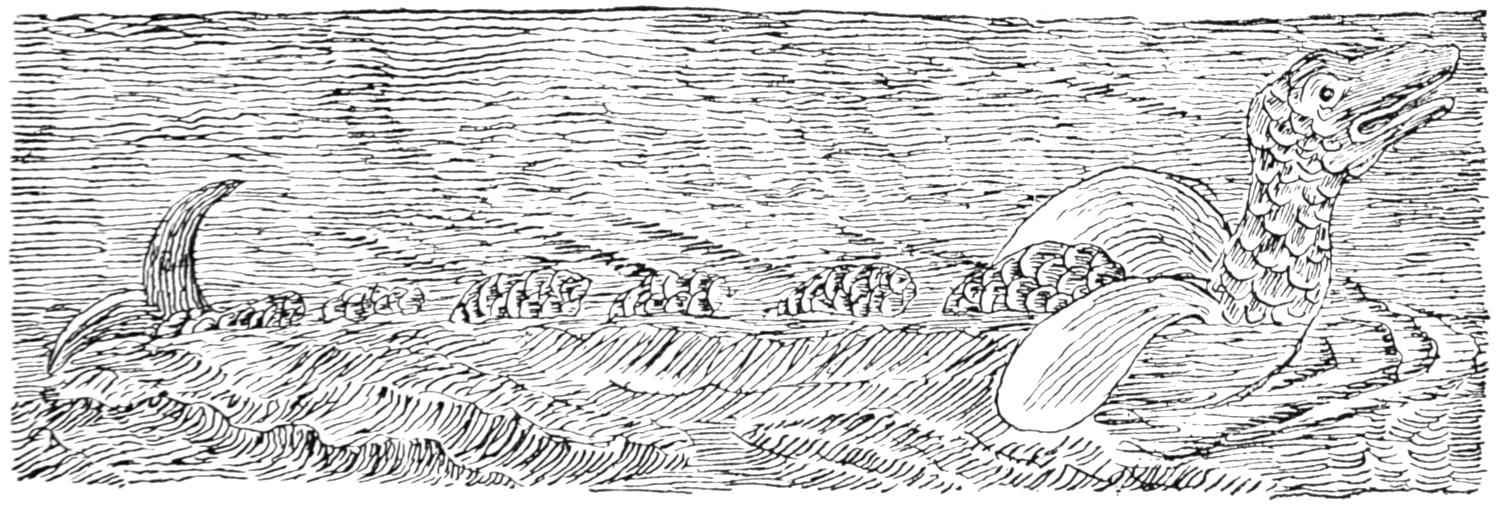
Fig. 26.—The sea-serpent as delineated by Mr. Prince.
“Intending to pass two or three days at Nahant, with my family, we left Boston early on Saturday morning. On passing the halfway house, on the Salem turn pike, Mr. Smith informed us the sea-serpent had been seen the evening before at Nahant-beach, and that a vast number of people from Lynn, had gone to the beach that morning, in hopes of being gratified with a sight of him: This was confirmed at the hotel. I was glad to find I had brought my famous mast-head spy-glass with me, as it would enable me, from its form and size, to view him to advantage, if I might be so fortunate as to see him. On our arrival on the beach, we associated with a considerable number of persons, on foot and in chaises, and very soon an animal of the fish-kind made his appearance. His head appeared about three feet out of water; I counted thirteen bunches on his back: my family thought there were fifteen—he passed three times at a moderate rate across the bay, but so fleet as to occasion a foam in the water—and my family and myself, who were in carriage, judged he was fifty feet in length, and, at the extend, not more than sixty; whether, however, the wake might not add to the appearance of his length; or whether the undulation of the water, or his peculiar manner of propelling himself, might not cause the appearance of protuberances, I leave for your better judgment. The first view of the animal occasioned some agitation, and the novelty perhaps prevented that precise discrimination which afterwards took place—as he swam up the bay, we and the other spectators moved on, and kept abreast of him; he occasionally withdrew himself under water, and the idea occurred to me that this occasionally raising his head above the level of the water, was to take breath, as the time he kept under water was of an average about eight minutes; after being accustomed to view him, we became more composed; and made the annexed figure of his outlines. Mrs. Prince and the coachman having better eyes than myself, were of great assistance to me in marking the progress of the animal; they would say he is now turning, and by the aid of my glass I saw him distinctly in this movement; he did not turn without occupying some space, and taking into view the time and space which he found necessary for his ease and accommodation, I adopted it as a criterium to form some judgment of his length—I had seven distinct views of him from the long beach so called, and at some of them the animal was not more than a hundred yards distance. After being on the long beach about an hour, the animal disappeared, and I proceeded on towards Nahant; but on passing the second beach, I met Mr. James Magee, of Boston, with several ladies in a carriage, prompted by curiosity to endeavor to see the animal, and we were again gratified beyond even what we saw in the other bay; which I concluded he had left in consequence of the number of boats in the offing in pursuit of him—the noise of whose oars must have disturbed him, as he appeared to us to be a harmless timid animal. We had more than a dozen different views of him, and each similar to the other; one however so near, that the coachman exclaimed: “Oh, see his glistening eye”. Thinking I might form some calculation of his length by the time and distance of each turn; and taking an angle with my two hands of the length he exhibited, that is to say, from his head to his last protuberance, and applying the same angle to other objects, I feel satisfied of the correctness of my decision that he is sixty feet long, unless the ripple of his wake deceived me—nor my dear sir, do I undertake to say he was of the snake or eel kind, though this was the general impression on my family, the spectators and myself. Certainly it is a very strange animal. I have been accustomed to see whales, grampuses, porpoises, and other large fishes, but he partook of the appearance of none of these. The whale and the grampus would have spouted—the shark never raises his head out of water, and the porpoise skips and plays; neither of these has such appearances on the back or such a head as this animal. The shark it is true, has a fin on his back, and often the fluke of his tail is out of water; but these appendages would not display the form, and certainly not the number of protuberances, which this animal exhibited; nor is it the habit of the shark to avoid a boat. The water was extremely smooth, and the weather clear: we had been so habituated to see him, that we were cool and composed—the time occupied was from a quarter past eight to half past eleven—a cloud of witnesses exceeding two hundred, brought together for a single purpose, were all alike satisfied and united as to appearances, and as to the length and size of the animal; but you must deduct the influence which his passage through the water and the manner he propelled himself might have as to the apparent protuberances on his back, and the ripple occasioned by his motion on his real length, of all which you can judge equally well and better than myself. I must conclude there is a strange animal on our coast—and I have thought an unvarnished statement might be gratifying to a mind attached to the pursuit of natural science, and aid in the inquiries on a controverted question, which I knew to have interested you. I have ventured on the description, being also induced to hope, that if anything on the marvellous is stated as coming from me, you will correct it.
“Accept the respects and attention of “Dear Sir, yours sincerely “James Prince.”
We see that Mr. Prince uses many words to give a very short description of the animal. Yet we are able to gather the following details. Its head appeared about three feet out of the water, there were 13 or 15 bunches on its back, sometimes the rapidity was moderate, occasioning, however, a foam in the water; length 50 to 60 feet; the animal left behind it a wake; sometimes it withdrew itself under water; it appeared to be a harmless timid animal; its eyes were glistening. All these characters, external features and habits are long known to us. Mr. Prince first said the animal belonged to the fish-kind; afterwards, however, he dared not say whether it was of the snake or eel-kind; yet his figure shows large scales and a fish-tail. It is astonishing that the person who is so careful in his expressions, is so inaccurate when handling the pencil. The head of the animal in his figure is more that of a young duck than of a serpent or snake, which the head of the sea-serpent is said to resemble closely. The coils are badly drawn, and though 13 to 15 bunches were seen, only six are delineated. The rippling of the water on the animal’s left side and before it is well represented, on its right side, however, it is quite wrong. The two racked-formed wings are certainly the representation of the foam, caused in the water by the animal’s rapid motion. And finally the scales and the fish-tail are drawn by Mr. Prince though he has not seen them! I am obliged to state again that this figure is a facsimile of that which I found in Oken’s Isis; the very one of the Boston Daily Advertiser I have had no opportunity to see.
The letter from Mr. Prince is translated into Dutch in the Vaderlandsche Letteroefeningen voor 1820, Tweede Stuk, Mengelwerk.
On the same day it was seen by Mr. Cabot, who wrote the following letter (Silliman’s Am. Journ. Sc. Arts, II, 1820) to our well known
“Col. T. H. Perkins”
“Brookline, August 19, 1819.
“Dear Sir”
“I very willingly comply with your request to state what I saw of the Sea-Serpent at Nahant, on Saturday last, particularly as I happened to see it under favourable circumstances to form a judgment, and to considerable advantage in point of position and distance.”
“I got into my chaise about seven o’clock in the morning to come to Boston, and on reaching the long Beach observed a number of people collected there and several boats pushing off and in the offing. I was speculating on what should have occasioned so great an assemblage there without any apparent object, and finally had concluded that they were embarking in those boats on a party of pleasure to Egg Rock, or some other point.”
“I had not heard of the Sea-Serpent being in that neighbourhood, and I had not lately paid much attention to the evidences which had been given of its existence, the idea of this animal did not enter my mind at the moment.”
“As my curiosity was directed towards the boats to ascertain the course they were taking, my attention was suddenly arrested by an object emerging from the water at the distance of about one hundred or one hundred and fifty yards, which gave to my mind at the first glance the idea of a horse’s head. As my eye ranged along I perceived at a short distance eight or ten regular bunches or protuberances, and at a short interval three or four more. I was now satisfied that the Sea-Serpent was before me, and after the first moment of excitement produced by the unexpected sight of so strange a monster taxed myself to investigate his appearance as accurately as I could.”
“My first object was the Head, which I satisfied myself was serpent shaped, it was elevated about two feet from the water, and he depressed it gradually, to within six or eight inches as he moved along. I could always see under his chin, which appeared to hollow underneath or to curve downward. His motion was at that time very slow along the Beach, inclining towards the shore; he at first moved his head from side to side as if to look about him. I did not see his eyes, though I have no doubt I could have seen them if I had thought to attend to this. His bunches appeared to be not altogether uniform in size, and as he moved along some appeared to be depressed, and others brought above the surface, though I could not perceive any motion in them. My next object was to ascertain his length. For this purpose I directed my eye to several whale boats at about the same distance, one of which was beyond him, and by comparing the relative length, I calculated that the distance from the animal’s head to the last protuberance I had noticed, would be equal to about five of those boats. I felt persuaded by this examination that he could not be less than eighty feet long; as he approached the shore and came between me and a point of land which projects from the eastern end of the Beach, I had another means of satisfying myself on this point.”
“After I had viewed him thus attentively for about four or five minutes, he sunk gradually into the water and disappeared; he afterwards again made his appearance for a moment at a short distance.”
“My first reflection after the animal was gone, was, that the idea I had received from the description you gave of the animal you saw at Gloucester, in 1817, was perfectly realized in this instance; and that I had discovered nothing you had not before described. The most authentic testimony given of his first appearance there seemed to me remarkably correct; and I felt as if the appearance of this monster had been already familiar to me.”
“After remaining some two or three hours on the Beach, without again seeing him, I returned towards Nahant; and in crossing the small beach, had another good view of him, for a longer time, but at a greater distance. At this time he moved more rapidly, causing a white foam under the chin, and a long wake, and his protuberances had a more uniform appearance. At this time he must have been seen by two or three hundred persons on the beach and on the heights each side, some of whom were very favourable situated to observe him.”
“I am very respectfully” “your obedient servant” “Samuel Cabot.”
The Editor of the American Journal, Prof. Benjamin Silliman, adds:
“It is almost superfluous to add, that Mr. Cabot and his friend Col. Perkins, are gentlemen of the first standing and consideration.”
On Oct. 13, 1820, Col. T. H. Perkins, when on board the Ann Marie, wrote a letter to his friend Mr. Jno. P. Cushing; he published it in the Boston Daily Advertiser of 1848, Nov. 25; a passage of it runs as follows:
“Besides the instances I have mentioned, there were many others reported of his having been seen the same year. In that year, 1817, although there were several reports of his having been seen, yet they were not well authenticated, nor do I place any confidence in them.”
“In the month of August, in the last year, he again made his appearance in our vicinity, and under very satisfactory circumstances. The weather being hot, many of our citizens resorted to Nahant to pass a few weeks. On the number were Mr. and Mrs. Cabot and their children. Mr. Cabot had a view of him for more than half an hour at one time. He was in a chair, and had reached what is termed the long beach, when he saw several persons collected half a mile from him, which called his attention to the object which occupied them. Mr. C. had heard me often describe the view I had had of the serpent in 1817, and recognized in what was visible just without the breakers, and within a quarter of a mile, the monster which was supposed by many to exist nowhere but in the imaginations of those who had reported to have seen him. Mr. Cabot immediately rode back to Nahant; took Mrs. Cabot into his chair and returned to the beach; but the animal was no longer visible. By this time the inhabitants of Lynn had assembled to the number of some hundreds, on and near the beach, and all the visitors of Nahant were upon the alert. Having given over the hope of seeing him, Mr. Cabot was returning to leave his wife at her lodgings, when, to their mutual delight, he came in view just without the surf of the little beach, and within a quarter of a mile or less of where they stood.”
“Marshal Prince, James Magee, and many persons of my acquaintance had a fine sight of him, and all agreed in their account of him in the principal particulars. They all agreed as to the rapidity of his movements, being very much beyond anything living they had ever seen. The apparent bunches on his back they consider as arising from the construction of his body, and that the movement was vertical and not horizontal. At one time his head was about two or three feet above water, but soon depressed to the level of the sea. When not swimming to be in pursuit of his prey, his motion was not rapid. They saw him turn and bring his body into a letter S, the head being at right angles with the tail. From fifteen to twenty three bunches, or apparent bunches, were counted by the different persons who saw him, and his size round they thought to be that of a common firkin or half barrel”.
“No one thought they saw the whole of the body at a time, the tail seeming always to be considerably under water. The greatest length given to him was one hundred feet and no one who had a good sight of him thought him less than eighty feet in length. If the number of protuberances is twenty-three (and it seems there are at least this number), and calculating them to be distant from centre to centre four feet (and I think, considering their thickness, they cannot be less than this), he would be ninety two feet long. They all agreed, too, as to the colour being quite dark, approaching to black.”
In a letter from Dr. Boott to Dr. Hooker, dated London, Nov. 4, 1826, part of which was published in the Edinb. Journ. of Sc., we read that he visited Boston to gather testimony from eye-witnesses. He then says:
“During this visit I distinctly remember the news coming from Nahant one morning, of the Serpent being in the bay of that place, distant about sixteen miles from Boston. Many hurried down to see it, and among them my brother Mr. James Boott. I was prevented from some cause leaving Boston. My brother reported that he distinctly saw a large serpent, about a mile from the shore; and that thousands were watching its motion on the beach and rocks. The first idea that occurred to my brother was that it was a horse swimming, its head at the time bearing a resemblance to that of the latter creature. He afterwards saw the undulating line of its back, and remained several hours watching the animal. Colonel Perkins of Boston, his wife, and family, were present at this time, as far as I recollect.”
So we have of this appearance three different statements of respectable persons, who distinctly saw the animal on the same spot.
This appearance of the sea-serpent near Nahant is also mentioned in Dr. Hamilton’s Amphibious Carnivora, 1839.
64.—1819, August.—Mr. A. De Capell Brooke says in his Travels through Sweden, &c., at p. 207:
“I there” (Stenesöen) “obtained from his” (Peder Greger’s) “son John Greger, a young man, who employed himself in the fishery, still further information respecting the sea-serpent; it was in August of the preceding year, while fishing with others in the Vieg or Vegfjord, that he saw it; at that time they were on shore, hauling in their nets, and it appeared about sixty yards distant from them, at which they were not a little alarmed, and immediately retreated. What was seen of it above water, he said, appeared six times the length of their boat, of a grey colour, and lying in coils a great height above the surface. Their fright prevented them from attending more accurately to other particulars. In fact they all fairly took to their heels, when they found the monster so near them. The weather at the time was very hot and calm. Farther to the south (at Stenesöen) he said it was seen several times, and it remained there for a considerable period.”
65.—1819, August.—The same author at p. 216 of his volume relates:
“My honest boatmen who had brought me all the way from Leköe, a distance of near sixty miles, now left me. Previous to their departure they gave me the following account of the sea-serpent, which is here inserted as they related it, without the least variation. They were fishermen and had been up at the North Cape. During the time they remained there they saw the serpent twice, once at no very great distance from them. It was of a grey colour; the head blackish, with teeth. What they discerned of it they judged to be at least five times the length of their boat, which is about thirty feet. It moved in large folds on the water; and when they saw it, they rowed away from it as fast as they could. The weather was very calm at the time.”
This is the most northern appearance of the sea-serpent. The teeth are mentioned here, though not described.
66.—1819? August?—The same author at p. 222 of his Travels tells us:
“To the testimony of others respecting the existence of the sea-serpent, I shall now add that of the bishop” (of the Nordlands and Finmark) “himself, who was eye-witness to the appearance of two in the bay of the Shuresund, or Sorsund, in the Drontheim fjord, about eight Norway miles from Drontheim. He was but a short distance from them, and saw them plainly. They were swimming in large folds, part of which was seen above the water, and the length of what appeared the largest he judged to be about 100 feet. They were of a darkish grey colour; the heads hardly discernable, from their being almost under water; and they were visible for only a short time. Before that period he had treated the account of them as fabulous; but it was now impossible, he said, to doubt their existence, as such numbers of respectable people, since that time had likewise seen them on different occasions.”
Not a single fact that need astonish us. That two were seen together is not reported for the first time, as the reader will remember. The swimming “in large folds, part of which was seen above water”, is a very accurate description of the effect made by the swimming animals. The colour is described as a darkish grey, which is exactly the colour of the animal, when seen at a short distance. Their holding their heads very low, only just above the surface of the water, is a common habit of them too.
67.—1819? August?—The same author relates (p. 403):
“The last account respecting the existence of the sea-serpent I received from him” (the sexton of Maasöe) “during our journey. He was fishing, as he said, with others in the Mageröe-Sund, when they discerned the monster of the deep, stretching out his bulk in many a spiral fold, and basking on the surface of the water. Its colour was dark and as to its length, he assured me, with looks of wonder and almost of alarm, that it nearly reached from the Mageröe side to the mainland opposite. In this measurement fear, doubtless, was the principal agent; for as to any accurate observations made by himself, they were out of the question. My friend the sexton was much too prudent a man, to hazard any at such a juncture. A glance was sufficient for him to commence his flight forthwith, as fast as his arms would enable him.”
Of course I agree with Mr. de Capell Brooke as to the exaggerated dimensions attributed to the animal by the sexton of Maasöe. The words “spiral folds”, of course, are wrong, the author meant the sinuosities in which the animal moves. Its colour is here described dark, which corresponds with so many other testimonies.
68.—1819? August?—At page 406 of the volume of this author we read in a note:
“The account of the serpent, received by him” (Prösten Deinbolt of Vadsöe) “from several persons on that part of the coast, agreed with those which have been already given.”
This, of course, is only a report of the appearance of the sea-serpent near Vadsöe.
69.—1819, Aug. 26.—“Extract of a letter from Mr. Cheever Felch, Chaplan to the United States’ ship Independance of 74 guns, to the Editor of the Boston Centinel.” (Silliman’s Am. Journ. Sc. Arts, Vol. II).
“Gloucester, August 26, 1819.
“Dear Sir.
“Others having taken in hand to give some account of the Sea-Serpent, I know not why I should not have the same liberty. Being on this station, in the United States’ schooner Science, for the purpose of surveying this harbor, we were proceeding this morning down the harbor, in the schooner’s boat; when abreast of Dallivan’s Neck, William T. Malbone, Esq. Commander of the Schooner, seeing some appearance on the water, said—“there is your sea-serpent”, meaning it as a laugh on me, for believing in its existence; but it prooved to be no joke. The animal was then between thirty and forty yards distance from us. Mr. Malbone, Midshipman Blake, myself, and our four boatmen, had a distinct view of him. He soon sunk; but not so deep but we could trace his course. He rose again within twenty yards distance of us, and lay sometime on the water. He then turned, and steered for Ten Pound Island; we pulled after him; but finding that he was not pleased with the noise of our oars, they were laid in, and the boat skulled. We again approached very near him. He continued some length of time, playing between Ten Pound Island and Stage Point. As he often came near the Point, we thought we could get a better view of him there, than from the boat, of which he seemed conspicuous. Mr. Malbone and myself landed; and the boat was sent to order the schooner down, for the purpose of trying what effect a twelve pound carronade would have upon him. He did not remain long after we landed, so that I was unable to effect my intention, of ascertaining, accurately, his length, with my instruments. From my knowledge of aquatic animals, and habits, and intimacy with marine appearances, I could not be deceived. We had a good view of him, except the very short period while he was under water, for half an hour.—His colour is a dark brown, with white under the throat. His size, we could not accurately ascertain, but his head is about three feet in circumference, flat and much smaller than his body. We did not see his tail; but from the end of the head to the fartherest protuberance, was not far from one hundred feet. I speak with a degree of certainty, from being much accustomed to measure and estimate distances and length. I counted fourteen bunches on his back, the first one, say ten or twelve feet from his head, and the others about seven feet apart. They decreased in size towards the tail. These bunches were sometimes counted with, and sometimes without a glass. Mr. Malbone counted thirteen, Mr. Blake thirteen and fourteen, and the boatman about the same number. His motion was sometimes very rapid, and at other times he lay nearly still. He turned slowly, and took up considerable room in doing it. He sometimes darted under water, with the greatest velocity, as if seizing prey. The protuberances were not from his motion, as they were the same whether in slow or rapid movement. His motion was partly vertical and partly horizontal, like that of fresh water snakes. I have been much acquainted with the snakes in our interior waters. His motion was the same. I have given you in round numbers, one hundred feet, for his length, that is, what we saw; but I should say he must be one hundred and thirty feet in length, allowing for his tail. There were a considerable number of birds about the sea-serpent as I have seen them about a snake on shore. That there is an aquatic animal in the form of a snake, is not to be doubted. Mr. Malbone, till this day, was incredulous. No man would now convince him, there was not such a being. The sketch or picture of Marshal Prince, is perfectly correct. I could not, with my own pencil, give a more correct likeness.”
“With respect” “Your obedient servant” “Cheever Felch”
“Major B. Russell.”
I will not contest Mr. Felch’s opinion about Mr. Prince’s figure! As to the letter itself there is not a single statement which can detract from or add to our present notions of the sea-serpent.
In 1846 Col. T. H. Perkins, of whom we have spoken more than once, requested Mr. Bolton, who was first Lieutenant of the Independence in 1819, to send him some particulars about this appearance. Mr. Bolton promptly replied under date of July 14, 1846. This letter, published by Col. Perkins in the Boston Daily Advertiser of Nov. 25, 1848, runs as follows:
“In the year 1817 I was the first lieutenant of the Independence, of 74 guns, then lying in the harbour of Boston.”
“In the course of the spring or summer a party of officers were detailed, by order of Commodore Bainbridge, to survey the coast of the bay, to a limited extent northeastward and outside of the light-house.”
“The officers selected for this duty were the sailingmaster of the ship, Wm. T. Malbone, and the Rev. Cheever Fetch, the instructor of the midshipmen.”
“To assist in the service several of the most competent and elder midshipmen were designated. As they alternated periodically with other gentlemen of the same grade, I cannot with any degree of precision venture to name them. I hope that some of them are yet living, and, further, that they have advanced in professional distinction. There were also added a sufficient number of seamen and boys.”
“Commodore Bainbridge, Mr. Malbone and Mr. Felch died some years ago.”
“I recollect that on the first occasion, when the Lynx returned to the Independence, of which ship she was the tender, that Mr. Malbone reported as having seen a monstrous sea-animal, not before known to him, of the snake species; the length doubtful, but estimated at some eighty or more feet; and added as an accident, that the officers and men employed in a small boat to carry out the soundings had returned in haste, and indeed alarm, to the Lynx, which was at anchor.”
“These statements were corroborated by Mr. Felch, the officers and crew.”
“Subsequently it was seen several times, by some of the party, who, being soon satisfied that it was harmless approached comparatively near, and no doubt gave me a minute description of its appearance as it presented itself to them; but if so, the particular details have escaped my memory.”
“These facts are all that I can with distinctness and certainty mention. Wm. Compton Bolton, Captain in the Navy of the United States, Saratonga Springs, July 14, 1846; to Hon. T. H. Perkins, Boston.”—
It cannot surprise us that in some particulars, as “in the year 1817”, and in some others this letter does not agree with the foregoing letter from the Rev. Cheever Felch himself, as twenty-seven years had since elapsed.
70.—1819, September?—Dr. Francis Boott in a letter to Dr. Hooker, dated London, Nov. 4, 1826, and published in the Edinb. Journ. Sc., VI, 1827, says:
“I remember also that a letter appeared in the Boston Centinel, soon after, published by an officer in the American Navy, who reported that, on his return from a survey of some part of the coast, he saw, when out of sight of land, a large serpent. He was so near that he drew an outline of it, and that outline accompanied the paragraph. When you showed me Mr. Warburton’s figure on the card, I at first thought it was a copy of that of the Centinel. I can only add, for your own satisfaction, that I have no doubt of the existence of this remarkable animal.”
As Dr. Boott is speaking of a visit at Boston in August 1819, the words “soon after” of course signify in the latter part of August or in the beginning of September. As the officer was “on his return” and published his encounter in the Boston Centinel, the appearance most probably occurred not far from Boston. The reader will find Mr. Warburton’s drawing further on (n°. 83).
71.—1819, September 13?—(Phil. Mag. LIV, 1819).
“The great Sea-Snake has been seen again towards the middle of September, in the bay of Massachusetts, and three yellow collars observed on his neck, which has led some to believe it might be another individual and species; but this circumstance might have been overlooked before. It is not stated whether it had streaks of a lighter hue on the body, as the first was represented to have by some witnesses. It is therefore likely that the two characters of “streaks of a lighter hue on the body and three yellow collars on the neck”, may be added to its description. The collars are described as about two inches broad, and one foot apart.”
The three yellow collars observed on its neck may be explained as follows: The animal has a hairy skin, as we have already seen, like a seal-skin. Now, when the neck is wet and contracted by the animal, its skin gets wrinkles, of course running round the neck, as is also the case in sea-lions. Those parts of these wrinkles, which are deepest, remain wet for a very long time, because they are not exposed to the air; those, however, which are highest, if we may use this expression, are not only most exposed to the air, but the hairs on those parts diverge and dry as soon as possible; and—when dry, they have a yellow greyish colour. If the animal now stretches its neck, it may show one, two, &c., even eight or more yellow-coloured collars round its dark brown neck, which may have a breadth of about two inches and a distance of one foot between them. This phenomenon or appearance, as already stated, is often to be seen in our zoological gardens on sea-lions and seals.
In the Philosophical Magazine, Vol. LIV, 1819, Dr. Rafinesque says:
“Dr. Mitchill informs me that General Hawkins has written a memoir on the sea-serpent of Massachusetts, which he has sent, with a drawing, to Sir Joseph Banks; it is a paper of some length, and much interest, as it relates facts, and all the circumstances attending the appearance and natural history of those huge animals, taken upon oath of eye-witnesses. He attempts to prove, with much probability, that several individuals have been seen, and two at least, if not three species; one with three collars, another without any, and a smaller one.”
In Silliman’s Am. Journ. Sc. Arts, Vol. II, 1820, I have found the following extract from a letter to the Editor, dated Boston, April 8, 1820:
“I have lately received a letter from Sir Joseph Banks, written by his own hand, in which he expresses his full faith in the existence of our Serpent in the Sea, and not only as it regards himself, but his friends, and he is grateful for every new communication I have given him on that subject, and writes with the same enthusiasm that he did several years ago. Although he is now very infirm.”
Evidently this was a letter from General Hawkins.
Professor Benjamin Silliman, the Editor of this journal adds:
“Sir Joseph Banks, President of the Royal Society of London, the Companion of Capt. Cook, is now at a very advanced age but still vigourous in his intellectual powers, and ardent in the promotion of every species of useful knowledge.”
In Mr. A. de Capell Brooke’s Travels through Sweden, we find at p. 411:
“For a length of time the most extraordinary accounts were circulated relating to it, till at last the whole story was generally considered as the fabric of American invention; and there are many, I believe, in this country” (Great Britain) “who do not consider it in any other light than that of a hoax. Judging, however, from the detailed accounts of the circumstance which are preserved among the papers of sir Joseph Banks, the principal facts appear to be these.”
And at p. 413:
“The repeated accounts of the serpent’s appearance having attracted the attention of the Linnaean Society at Boston, one of its members was deputed to visit the spot and to examine into the truth of them. This was accordingly done; and the above is the general substance of the various depositions sworn to before General Humphreys. This gentleman, who was a corresponding member of the Society, despatched to Sir Joseph Banks copies of the whole of these, which are still preserved in his library. Sir Joseph entered with warmth into this curious investigation; and the minuteness, with which every particular was supplied, showed how greatly he felt interested in the question.”
In Nov. 4, 1826, Dr. Francis Boott wrote a letter to Dr. Hooker, a part of which was published in the Edinburgh Journal of Science, Vol. VI, 1827. Dr. Boott, after some general remarks, goes on to express himself in the following terms:
“All that I could collect upon the subject was sent to Sir Joseph Banks, with whom I had repeated conversations about the animal, and the respectability of the individuals who affirmed to the sight of him. The great mass of evidence is to be found in the pamphlet published by the Linnaean Society of New England. The question as to the real appearance of a large serpent off the coast of Massachusetts, was put to rest by that publication. There could be no doubt of the fact, and the testimony of thousands who saw the animal for one or two years afterwards, must have been sufficient to satisfy the most incredulous.”
“I believe I was one of the first who mentioned to Sir Joseph Banks, that a large serpent had been seen on the American coast; at all events, I distinctly remember that when I first spoke to him on the subject, he was incredulous, and showed me a Plate of a similar animal in Pontoppidan’s History of Norway. I myself had no doubt of the truth of the assertions of the early observers of it, for many of them were known to me, and I was anxious to convince Sir Joseph of the discovery of a new and remarkable animal. I therefore was in the habit of sending him every information I could collect respecting it. In one of my last visits to Boston, I gathered testimony from individuals, and from the public papers, and was happy to find on my return to Europe, that Sir Joseph was satisfied of the existence of the serpent, though he continued doubtful of the relationship between the small snake (figure 1 of the Linnaean pamphlet) and the large serpent.”
In October, 1828, Mr. Mitchill read a paper before the New York Lyceum, which paper will be found in our Chapter on Hoaxes. As we have already observed, this paper also contains a particular account concerning the letters addressed by General Humphreys to Sir Joseph Banks.
Again Dr. Hamilton, in his Amphibious Carnivora, 1839, asserts:
“General Humphreys, by whom the affidavits were taken, transmitted a copy of them, and a detail of the whole circumstance, to the late Sir Joseph Banks, in whose Library the documents are still preserved.”
Remarkable fact! Nowhere I have found a paper of Sir Joseph Banks himself, neither in the Transactions of the Royal Society of London, nor anywhere else. I beg the present members of this Very Learned Body to give me the loan of all the papers about the subject, or to publish them in their next volume.
72.—1820, July?—Mr. A. de Capell Brooke in his Travels through Sweden, during the Summer of 1820, relates at p. 263:
“During the time I remained at Hundholm a curious circumstance occurred: One day when at dinner at Mr. Blackhall’s house, and thinking little of the sea-serpent, concerning which I had heard nothing for some time, a young man, the master of a small fishing yacht, which had just come in from Drontheim, joint our party; in the course of conversation, he mentioned that a few hours before, whilst close to Hundholm, and previous to his entering the harbour, two sea-snakes passed immediately under his yacht. When he saw them he was on the deck, and, seizing a handspike, he struck at them as they came up close to the vessel on the other side, upon which they disappeared. Their length was very great, and their colour greyish; but from the very short time they were visible, he could not notice any other particulars. He had no doubt of their being snakes as he called them, and the circumstance was related entirely of his own accord.”
73.—1820, August.—In the Zoologist of 1849, p. 2361, we read:
“He was several times seen in the month of August, 1820, from the piazza of the house of Col. Perkins, at Nahant.”
74.—1820?—The following report was published in the Zoologist of 1849, p. 2460.
“What degree of confidence the following story may gain is to me a subject of very little consideration; for as I can have no view of gaining anything by it, so it certainly will appear that it would hardly be worth the trouble of invention; but as a story of this sort has made its appearance among our transatlantic friends, without being at all credited, it is as likely in Europe this may have the same fate; yet if it can afford any amusement or information for intelligent and scrutinizing minds, for their gratification I freely give it to the press, assuring them, on my sacred honour, of the truth of what I am about to describe. On Sunday, about 5. P. M., being then in latitude 46, longitude 3, by dead reckoning, observed an immense body on the surface of the water, apparently without motion, but water spouting from it, not unlike the blowing of a whale. I immediately got my glass; and, from its rugged appearance and showing nothing where the water issued from, I began to entertain some doubts, that this must have been the vigia laid down for Barenethy’s rocks or the three chimneys, and, so prepared in my own mind, I directed the steering sails to be taken in and the ship prepared for going about. Some of my ship’s company were of opinion it was a ship-bottom up: this I thought not unlikely, and went into the main cat harpens to look more distinctly at it: the appearance then was still steady, but irregular. I saw neither head nor tail above the water, but a hump from one extreme resembling the rise or point of rather a triangular rock: this tapered to a distance,—I certainly believe 70 or 100 feet, and the water broke over it, a little beyond it: it discharged the spout; but nothing showing itself, undetermined in mind what it could be, or whether I should tack the ship, it all at once disappeared, and, to my great astonishment, a head and neck—resembling something of a serpent’s—made its appearance, erected about six feet above the surface of the water. After taking a survey towards the vessel, it all at once vanished, leaving us full of conjecture and surprise. It gives me more confidence in making the above statement, as one of the seamen, whose name is Jonathan Townsend, was in the main top, and saw the creature I have described, and would feel no hesitation in taking an oath to it.—George Sanford, Lieutenant R. N.”
[“Copied from a memorandum-book of Lieut. Sanford, and communicated by Dr. Scott, of Exeter. There is no date to the above statement, but it is presumed to have been written about the year 1820. Lieut. Sanford then commanded a merchant-ship, the Lady Combermere.—E. N.”]
No doubt the latitude of 46 degrees is northern lat., so that the appearance occurred in the Bay of Biscay.—The act of breathing of the sea-serpent, after having remained for some time under the surface of the water, just as in whales, has an appearance generally called “spouting”. Apparently the animal held its head just at water-level, and so it showed “nothing where the water issued from”. The rugged appearance may have been caused by the animal lying with several bunches on its back, as afterwards was also reported by the Lloydsteamer Kätie (n°. 154) or by its having a mane, extending all along the neck and back. The “hump from one extreme resembling the rise or point of rather a triangular rock” must have been the animal’s head which it lifted up just above the surface. Nearly the same appearance will be observed in the figure of one of the officers of H. M. S. Plumper (fig. 31). Let the dimensions moreover be somewhat exaggerated, the “head and neck resembling something of a serpent’s erected about six feet above the surface of the water”, the “taking a survey towards the vessel”, and the vanishing at once, makes all comment superfluous; all these characters have more than once been reported of this creature.
In the Philosophical Magazine and Journal, Vol. LVII, 1821, we find an extract from the numerous reports communicated by Prof Bigelow in Silliman’s American Journal of Science and the Arts, Boston, Vol. II, 1820, May.
We have already quoted Milton, who in his Paradise Lost, printed in 1667, compares Satan with some huge monsters, amongst others the sea-serpent. Parts of these verses have been more than once cited by writers of articles on the sea-serpent. I cannot but express my surprise at this custom, for there is not one single word or expression in Milton’s verses, which is taken from accounts, reports, or tales of the sea-serpent itself. Walter Scott, however, in his Pirate: which was published in 1821, vol. I, chapt. II, says a few words about the animal, which are so correct, that they must have been taken from some or other report:
“The Ocean also had its mysteries, etc.”
“The Sea-Snake was also known, which arising out of the depths of Ocean, stretches to the skies his enormous neck, covered with a mane like that of a war-horse, and with its broad glittering eyes, raised mast-head high, looks out, as it seems, for plunder or for victims.”
The large glittering eyes, the enormous neck, covered with a mane are known characters, and the rising from the depths high into the air, standing nearly upright and viewing for a moment all around, evidently taking a survey, is a habit observed more than once.
75.—1821, Summer.—Col. T. H. Perkins on the 13th. of Oct. 1820, when on board the Ann Marie, wrote a letter to his friend Jno P. Cushing, which he published in the Boston Daily Advertiser of 25th. Nov. 1848, after the excitement caused by the appearance of an individual on the 6th. of August, 1848. The different parts of this letter are inserted partly in our Chapter on Hoaxes (p. 20, 21) and partly in no. 44, 45, 47, 48, 49, 63. The Editor of the Boston Daily Advertiser now goes on:
“In addition to this interesting narrative our venerable correspondent gives letters from several members of his family, who the next summer had opportunity to see the sea-serpent, in which the appearance of the animal is minutely described. This correspondence is very interesting; the description of the animal agrees entirely with that given above, and we regret that want of space must prevent the insertion of it.”
It is a great pity that all these letters have not been published. Perhaps they are now lost for ever!
76.—1821.—In a letter from William Warburton to Robert Barclay, Esq. printed in the Edinburgh Journal of Science, Vol. VI, 1827, p. 130, and dated 20th. September 1826, we read:
“I dined one day at the Hôtel of New York with Sir Isaak Coffin, who discredited the existence of such an animal, which was reported to have been seen by Captain Bennett of Boston, about five years back.”
Of course the occurrence took place near the coast of the U. S.
77.—1821, September 25? In Froriep’s Notizen of Jan. 1822, I, we read:
“The Sea-Serpent, of which much has been spoken of late years, has been clearly seen again this year by many persons with spy-glasses, and it is described by all of them and the descriptions agree pretty well with each other: on Sept. 27 last a distinguished merchant of Nantucket, Mr. Francis Joy, jun. made a declaration of it on oath before the justice of the peace.”
78.—1821?—Dr. Hibbert in his Description of the Shetland Islands says at p. 565:
“I have heard, in Shetland, of a sea-serpent being seen off the Isle of Stenness, Vailey Island and Dunrossness.”
This report is also quoted by Dr. R. Hamilton in his Amphibious Carnivora, 1839.
79.—1822.—Mr. A. de Capell Brooke in his Travels through Sweden, &c., 1823, says in a note, p. 416:
“In some very recent accounts I have received from Finmark, founded on respectable authority, the sea-serpent is stated to have appeared off Soröe this last summer (1822) and to have been seen by many of the inhabitants of that Island. The length of the animal is described as about a fourth of an English mile, its size that of a full grown ox; the colour of a greyish brown; and the weather when it made its appearance, calm and fine.”