V. The various explanations hitherto given. (continued 3)
Reading edition
The ribband or scabbard fish theory is briefly treated of by Mr. Gosse in his Romance of Natural History in the following terms:
“There are, however, the ribbon-fishes; and some of these, as the hair-tail, the Vaegmaer, and the Gymnetrus, are of large size, and slender sword-like form. Several kinds have been found in the North Atlantic, and, wherever seen, they invariably excite wonder and curiosity. All of these are furnished with a back-fin; but in other respects they little correspond with the descriptions of the animal in question. One of their most striking characteristics, moreover, is, that their surface resembles polished steel or silver.”
In 1860 a ribbon-fish of large dimensions was captured on Bermudas Isles. Mr. Trimingham, the captor, placed it at the disposal of Mr. J. Matthew Jones, a naturalist living there. This gentleman described the animal for the Zoologist, in which his paper appeared in the volume of that year (p. 6986). Now Mr. Jones ended his article as follows:
“The most notable fact however, in connection with the capture of the present specimen, will doubtless be the interest and attraction it will produce on the scientific world, for most assuredly we have in the specimen now before us many of the peculiarities, save size, with which the appearance of that hitherto apocryphal monster “The Great Sea-Serpent”, as detailed by navigators, is invested. The lengthened filaments crowning the caput, joined anteriorly by the connecting membrane, and extending to the shoulders, would, viewed from a vessel’s deck, present to the spectator the mane so accurately described as a singular feature in the gigantic specimen seen by Capt. M’Quhae, R. N., and officers of H. M. S. Daedalus. Then again, the rapidity with which that individual specimen moved through the water, would coincide with the capabilities of a member of this genus, for the motive power produced by such an extent of tail, coupled with the extremely compressed form of body from the head throughout, must be immense.”
“Here then we have a partial elucidation of the various statements which have at intervals appeared in the columns of the united presses of England and America, emanating from the pens of travelers, and usually headed—“Occurrence of the Sea-Serpent”—criticised, however, in an ungenerous manner, and always exposed to an unmerited ridicule at the hands of the many, but, nevertheless, firmly believed in by the few, who have patiently waited to see the day when the mystic cloud which has hitherto veiled the existence of the maned denizen of the deep should vanish with the suspicion of the sceptic, and exhibit more clearly the truth of the assertions of those ill-used men, who, endeavouring like useful members of society to extend the cause of natural knowledge by publishing candid accounts of what their eyes have seen, have always met with an amount of contempt and reproach, sufficient to silence for ever the pen of many a truthful writer.”
“I am sorry I have not the numero of the Illustrated London News at hand in which Capt. M’Quhae’s graphic statement appeared, as it would have afforded me an opportunity of particularising other features in connection with his specimen and the present one. The facts, however, regarding the mane-like appendage, and the rapidity of motion to which I have alluded, are still fresh in my memory.”
Mr. Newman, the Editor of the Zoologist, thinking this ribbon-fish a new species, gave a detailed description of it, and honoured it with the name of Regalecus Jonesii, but to our great astonishment, he, who firmly believed the sea-serpent to be an Enaliosaurus (as we have observed above) now seems to be in doubt about the matter, for he ends his article with the following words:
“In reference to the last question mooted by Mr. Jones, the similarity of Regalecus Jonesii to Capt. M’Quhae’s sea-serpent, I do not consider myself competent to express an opinion. I am quite willing for the present to allow every sea-serpent to hold on its own course; hereafter a better opportunity may be afforded on comparing and arranging the conflicting evidence already published in the “Zoologist”.”
The ribbon-fish hypothesis gradually takes a firmer hold on the unbelievers, no doubt, as it seems more plausible than the Plesiosaurus-one. An inhabitant of Cape Town wrote the following note which I have found in Nature of the 1st. August, 1872:
“The South-African Museum, Cape Town, recently received a specimen of the Ribbon Fish (Gymnoterus) fifteen feet long without the tail. It appears that this fish is known to distant inland fishermen as being forty feet long, and from its slender shape and snake-like movement is probably the “sea-serpent” of late years so minutely described by navigators. From its head there is erected a plume of flexible, rose-coloured spines, and from head to tail along its back there is a conspicuous mane-like fin. Its general colour is like burnished silver. The eye is large and silvery, and the profile of the head comports well with that of the horse. The specimen could not be preserved, but there are two smaller specimens in the Museum.”
Mr. Andrew Wilson in his turn believes (see Nature of Sept. 12, 1878) that:
“A long tape-fish” (which is the same as a ribbon-fish) “might do duty in the eyes of non zoological observers for a sea-serpent.”
In his Leisure Time Studies he returns to his idea:
“A visit paid to the Newcastle Museum of Natural History, on which occasion I had the pleasure of inspecting a dried and preserved ribbon or tape-fish of large size, forcibly confirmed an idea that such an animal, developed to a gigantic size, and beheld from a distance by persons unskilled in natural history,—and who would, therefore, hardly dream of associating the elongated being before them with their ordinary ideas of fish-form and appearance,—might account for certain of the tales of sea-serpents which have been brought under our notice. I had been specially struck with the mention, in several accounts of sea-serpents, of a very long back fin, sometimes termed a “mane”, and of a banded body covered with tolerably smooth skin; whilst in several instances the description given of the heads of the sea-monsters closely correspond with the appearance of the head of the tape-fishes. These fishes have further been described by naturalists as occasionally having been seen swimming with an undulating or serpentine motion close to the surface of the water, the head being somewhat elevated above the surface,—this latter feature, as we have observed, forming a remark of frequent occurrence in sea-serpent tales. I found, on making inquiry into the history of these fishes, that their serpentine form had struck previous observers, but, as far as I could ascertain, their merits as representatives of sea-serpents had never before been so persistently advocated.”
“These views and the dimensions of the specimen at Newcastle, I communicated to the Scotsman and Courant newspapers in June, 1876. The measurements of the ribbon-fish at Newcastle are given as 12 feet 3 inches in length, the greatest depth being 11¹⁄₄ inches, and the greatest thickness only 2³⁄₄ inches; the small dimensions in thickness, and the relatively long length and depth, giving to these fishes the popular names of ribbon and tape-fishes. The species was the well-known Gymnetrus or Regalecus Banksii of naturalists; and by the Museum attendant at Newcastle, I was informed that a still larger specimen of the same species was recently obtained of the Northumberland coast, the length of this latter being 13¹⁄₂ feet, the depth 15 inches, and the thickness 5 inches. These fishes possess a greatly compressed body. The breast fins are very small, and the ventral or belly fins are elongated and spine-like. The first rays of the dorsal or back fin are very long, whilst the fin itself extends the whole length of the back, and obtains an average breadth of about three inches.”
“Curiously enough, the publication of these views regarding the ribbon-fishes drew forth from the head of a well-known firm of fish merchants in Edinburgh, a remarkable confirmation of the idea that gigantic specimens of these fishes might be occasionally developed. The gentleman in question wrote to inform me that about thirty years ago he engaged the smack Sovereign, of Hull, Baillie commander, to trawl in the Frith of Forth for Lord Norbury, then residing at Elie Lodge, Fifeshire. Whilst engaged in their trawling operations, the crew of the Sovereign captured a giant tape-fish, which, when spread out at length on the deck, extended beyond the limits of the vessel at stem and stern. The smack was a vessel of forty tons burthen; and the length may therefore be safely estimated at sixty feet,—this measurement being exceeded by the ribbon-fish. The breadth of the fish measured from five to nine inches, and the dorsal fin was from six to seven inches in depth. Unfortunately, Lord Norbury seemed inclined to view the giant he had captured with distrust and ordered the fish to be cut in pieces and thrown overboard; but it is also worthy of remark that the trawlers seemed to express no great surprise at the size of Lord Norbury’s specimen, since they asserted that they had met with one much larger, this latter being coloured of a dirty-brown hue.”
He also explains the animal of the Osborne (no. 148) by reference to a ribbon-fish in the following terms:
“I thought the opportunity a favourable one for offering a reasonable explanation of the circumstance, and I communicated my views to the Times in the following terms, the letter appearing in that journal for June 15, 1877:—“About a year ago I ventilated in the columns of several journals the idea that the “sea-serpents” so frequently seen, were in reality giant tape-fishes or ribbon-fishes. While not meaning by this statement to exclude the idea that other animals,—such as giant sea-snakes themselves,—may occasionally personate the “sea-serpent”, I am, as a zoologist, fully convinced that very many of the reported appearances of sea-serpents are explicable on the supposition that giant tape-fishes—of the existence of which no reasonable doubt can be entertained—have been seen. The report of Captain Pearson, of the royal yacht Osborne, appears, as far as zoological characters are concerned, to be fully explained on the “ribbon-fish” theory. The long back fins, the scale-less skin, the rounded head, and lastly, the two great side (or pectoral) fins, each measuring many feet in length, all form so many details corresponding exactly to the appearance of a great tape-fish. I offer these observations with the view of showing that, given a recital founded, as I believe the present narrative to be, on fact, we possess in the lists of living and of well-known animals adequate representatives of the great unknown.”
“The imperfect view obtained of the body renders the expression contained in the report, that the body was “like that of a gigantic turtle”, somewhat problematical as to its correctness; and in the absence of more defined information, does not necessarily invalidate the views expressed above as to the personality of this strange tenant of the Mediterranean Sea.”
“In an article entitled “Strange Sea Creatures,” which appeared in the Gentleman’s Magazine for March, 1877, Mr. R. A. Proctor, speaking of my views regarding the sea-serpent, remarks that I offer “as an alternative only the ribbon-fish. This observation being hardly correct, I may point out that in the article in Good Words, from which Mr. Proctor quotes my views, I distinctly refer to the probability of giant sea-snakes being occasionally developed and appearing as the modern sea-serpent. The use of the word “only” in Mr. Proctor’s remark is misleading; since I offer the ribbon-fishes simply as explanatory of certain sea-serpent narratives, and not as a sole and universal representative of the modern leviathan.”
“Thus, then, with the ribbon-fishes at hand, and with the clear proof before us that these and other animals may be developed to a size which, compared with their ordinary dimensions, we can only term enormous, I think the true and valid explanation of the sea-serpent question is neither far to seek nor difficult to find. To objectors of a practical turn of mind, who may remind me that we have not yet procured even a single bone of a giant serpent, I would point out that I by no means maintain the frequent development of such beings. The most I argue for and require is their occasional production; and I would also remind such objectors of the case of the giant cuttle-fishes which, until within the past few years, remained in the same mysterious seclusion affected at present by the great serpentine unknown. I need only add that I have as firm faith in the actual discovery of a giant serpent of the sea, as that in the giant tape-fish we find its representative, or that in the huge development of ordinary forms we discover the true and natural law of its production.”
“To sum up my arguments by way of conclusion, I respectfully submit, as does a pleading counsel to his jury,—”
“Firstly: That many of the tales of sea-serpents are amply verified, when judged by the ordinary rules of evidence; this conclusion being especially supported by the want of any prima facie reason for prevarication;”
“Secondly: That, laying aside appearances which can be proved to be deceptive and to be caused by inanimate objects or by unusual attitudes on the part of familiar animals, there remains a body of evidence only to be explained on the hypothesis that certain gigantic marine animals, at present unfamiliar or unknown to science, do certainly exist; and”
“Thirdly: That the existence of such animals is a fact perfectly consistent with scientific opinion and knowledge, and is most readily explained by recognizing the fact of the occasional development of gigantic members of groups of marine animals already familiar to the naturalist.”
Mr. Lee, in his Sea Monsters Unmasked, too, supposes that “the dorsal fins.... of ribbon-fishes, as suggested by Dr. Andrew Wilson, may have furnished the “ridge of fins”.
I have only to direct my readers’ attention to the fact that a ribbon-fish has only one connected dorsal fin, and not a ridge of fins, (compare fig. 13 with fig. 44). The dorsal fin of a ribbon-fish is quite red, the mane of the sea-serpent is dark brown, nearly black; the colour of the fish is silvery, that of the sea-serpent dark brown above, nearly black, and when having swum for a long time in the sun on the surface of the water, a greyish yellow; the under parts are of a dirty white. The fish has no flappers, which are the organs of locomotion of the sea-serpent. The breadth of a ribbon-fish is only a few inches, while that of the sea-serpent, as is clearly pointed out in the animal of the Osborne (no. 148), may grow to more than fifteen feet. But I need not sum up the differences between ribbon-fishes and sea-serpents. We have only to ask the opinion of one of the most able ichthyologists of our days, and the whole hypothesis has not a leg to stand upon:
Mr. Günther says in his Introduction to the study of Fishes, 1880, p. 520:
“The “Ribbon-fishes” are true deep-sea fishes, met with in all parts of the oceans, generally found when floating dead on the surface, or thrown ashore by the waves.....”
“When these fishes reach the surface of the water, the expansion of the gases within their body has so loosened all parts of their muscular and bony system, that they can be lifted out of the water with difficulty only, and nearly always portions of the body and fins are broken and lost..... At what depths ribbon-fishes live is not known; probably the depths vary for different species; but although none have been yet obtained by means of the deep-sea dredge, they must be abundant at the bottom of all oceans, as dead fishes or fragments of them are frequently obtained. Some writers have supposed from the great length and narrow shape of these fishes that they have been mistaken for “Sea-Serpents”; but as these monsters of the sea are always represented by those who have had the good fortune of meeting with them as remarkably active, it is not likely that harmless Ribbon fishes, which are either dying or dead, have been the objects described as “Sea-Serpents”.”
The nineteenth explanation is that of Mr. Arthur Adams (see Zoologist, 1860, p. 7237) who believes that a floating dead tree “might have become a source of error, and given rise to yet another sea-serpent”. His article runs as follows:
“An incident occurred on board the vessel of which I am surgeon, which, I think, deserves to be recorded as an illustration of optical delusion that might have become a source of error, and given rise to yet another sea-serpent. We were sailing among the Islands of the Miatan group, at the entrance of the Gulf of Pe-Chili. There was little wind, and the gentle ripples covered the surface of the sea. I was sipping my Congo at the open port of the ward room on the main deck, admiring the setting sun, and watching the rounded outlines of the blue mountains and distant islands against the sky, and the numbers of sea-birds “wheeling rockwards to their nests”, when my eye rested on a long dark object apparently making its way steadily through the water. After observing it some time in silence I was sorely puzzled and could make nothing of it. It was neither a seal nor a diver nor a fishing cormorant, for with their forms I was familiar; so I went on deck and consulted other eyes than mine. Sundry glasses were brought to bear on the suspicious object, and the general scrutiny seemed to decide that it was a large snake, about ten feet long (or much longer according to some), working its way vigorously against the tide by lateral undulations of the body. So strong was this conviction that the course of the ship was altered, and a boat got ready for lowering. With a couple of loaded revolvers, some boathooks and a fathom or so lead-line, I made ready for the encounter, intending to range up alongside, shoot the reptile through the head, make him fast by a clove-hitch, and tow him on board in triumph! By this time, however, a closer and more critical inspection had taken place, and the supposed sea-monster turned himself into a long dark root, gnarled and twisted, of a tree, secured to the moorings of a fishing net, with the strong tide passing it rapidly, and thus giving it an apparent life-like movement and serpentine aspect.”
After Mr. Drew had published in Nature a case, in which he and many others were deceived by a large mass of flying shags, another contributor Mr. E. H. Pringle wrote the following (Nature, September 12, 1878):
“If you have space for the following, it is so confirmatory of Dr. Drew’s experience of an opera-glass dispelling “fond deceits” concerning a sea-serpent, that it may be worth recording.”
“One morning in October, 1869, I was standing amid a small group of passengers on the deck of the ill-fated P. and O. ss. Rangoon, then steaming up the straits of Malacca to Singapore. We were just within sight, so far as I remember, of Sumatra. One of the party suddenly pointed out an object on the port bow, perhaps half a mile off, and drew from us the simultaneous exclamation of “The sea-serpent!” And there it was, to the naked eye, a genuine serpent, speeding through the sea, with its head raised on a slender curved neck, now almost buried in the water, and anon reared just above its surface. There was the mane, and there were the well-known undulating coils stretching yards behind.”
“But for an opera-glass, probably all our party on board the Rangoon would have been personal witnesses to the existence of a great sea-serpent, but, alas for romance! one glance through the lenses and the reptile was resolved into a bamboo, root upwards, anchored in some manner to the bottom—a “snag” in fact. Swayed up and down by the rapid current, a series of waves undulated beyond it, bearing in their crests dark coloured weeds or grass that had been caught by the bamboo stem.”
“Ignorance of the shallowness of the straits so far from land, and of the swiftness of the current, no doubt led us to our first hasty conclusion, but the story, with Dr. Drew’s shows how prone the human mind is to accept the marvellous, and how careful we should be in forming judgments even on the evidence of our senses.”
Mr. Andrew Wilson, in his Leisure Time Studies, speaking of this hypothesis says:
“Floating trunks and roots of trees, serving as a nucleus around which sea-weed has collected, and to which barnacles and sea-acorns—producing a variegated effect by reason of their light colour—have attached themselves in great numbers, have also presented appearances closely resembling those of large marine animals, swimming slowly along at the surface of the water. In one instance of this latter kind, related to me by a friend who was an actual spectator, the floating piece of timber assumed a shape imitating in the closest and most remarkable manner the head of some reptile,—by the same rule, I suppose, that in the gnarled trunks and branches of trees one may frequently discern likenesses to the human face and to the forms of other living things. In this latter instance, the floating object was perceived at some miles’ distance from the deck of a yacht; and even when seen through a telescope, and carefully scrutinized by men accustomed to make out the contour and nature of objects at sea, the resemblance to the head of some animal was so close that the course of the vessel was changed and the object in due time overhauled. This latter, therefore, presents an example of a case, the details of which, when related, tempt people to maintain without further parley, that sea-serpents always resolve themselves into inanimate objects of one kind or another.”
The extreme rapidity which is reported of the sea-serpent, banishes at once the idea of a dead organism.
The twentieth explanation is: a mass of flying birds, of Mr. Joseph Drew, who wrote in Nature of the 5th. of September, 1878:
“On Monday, August 5, a number of geologists crossed in the Folkestone boat to Boulogne, to study the interesting formations of that neighbourhood, and, when about three or four miles from the French coast, one of these gentlemen suddenly exclaimed, “Look at that extraordinary object passing across the bow of the steamer about a mile or a mile and a-half in advance of us!” On turning in this direction there was seen an immense serpent apparently about a furlong in length, rushing furiously along at the rate of fifteen or twenty miles an hour; it was blackish in front and paler behind; its elongated body was fairly on the surface of the water and it progressed with an undulating or quivering motion, mirum erat spectaculum sane.”
“Of course many suppositions were immediately started to account for this extraordinary phenomenon, but they quickly changed and settled into the fixed idea that the object before them could be nothing less than the great sea-serpent himself; for—
“Prone on the flood, extended long and large, “Lay floating, many a rood, in bulk as huge “As whom the fables name of monstrous size, “Leviathan, which God of all his works “Created hugest, that swim the ocean stream.”
“The writer fortunately had with him one of Baker’s best opera-glasses, and, after a few moment’s use of this little instrument, the wonder was satisfactorily resolved. The first half of the monster was dark and glittering and the remainder of fainter hue, gradually, fading towards the tail. The glass did not determine the matter until the extreme end was reached, and then it was seen to consist of a mass of birds in rapid motion; those that were strong on the wing were able to keep well up with the leaders, and to make the head appear thicker and darker by their numbers, whilst those that had not such power of flight were compelled to settle into places nearer and nearer the tail. Doubtless these birds were shags (Pelecanus cristatus) returning to their homes for the night from the distant waters in which they had been fishing, during the day; perchance it may be wrong to assert positively as to the variety of bird, but in as much as the writer has often seen shags on the Cornish coast in smaller numbers returning in single or double file to their roosting places, and since it is stated in works of natural history that they have been noticed occasionally flying in this peculiar manner to the number of a thousand or more, it does not appear an unwarranted liberty in supposing that they really were Pelecani cristati.”
“It is to be feared some of the geological gentlemen still doubt the interpretation of the lorgnette, preferring the fond deceit of a large and unknown serpent; but as in this case individual birds (scores of them) were distinctly seen flapping their wings, the writer has thought it his duty to report the circumstance to you that your readers who voyage across the seas may keep their opera-glasses in their pockets and verify for themselves, on the first opportunity this interpretation of the great sea-serpent.”
This story induced Mr. Bird (Nature, of 12th. September, 1878) to make a similar avowal:
“Dr. Drew’s letter in Nature, Vol. XVIII, p. 489, recalls to my mind a similar phenomenon witnessed by myself and a friend on August 8, while crossing from Grimsby to Rotterdam. It was towards evening, when, looking ahead, we saw a low, black hull, without masts or funnel, moving through the water at enormous speed. After a minute or two it undulated and rose from the surface, and we saw that it was a flight of birds.”
“The deception was so complete that I can well believe that at least many of the stories of the sea-serpent have so originated, though I doubt whether all can be explained in this manner.”
Mr. Andrew Wilson, on the contrary wrote the following against this supposition (Nature, in the same number):
“The communication of Dr. Joseph Drew in your issue of yesterday regarding the serpentine appearance of a flock of shags in the English Channel is extremely interesting even as a mere fact regarding the habits of these birds. Will you kindly permit me, however, to point out that Dr. Drew’s statement cannot be regarded as explanatory of the sea-serpent’s personality? At the most the incident only explains one of a number of serpentine appearances of which porpoises and sunfishes swimming in line, pieces of wood with trains of sea-weed, &c., are also good examples. There have been placed on record numerous incidents of serpentine forms having been closely expected (as in the well-known case of the Daedalus, or later still of H. M. S. Osborne) where the hypothesis of the serpentine appearances assumed by flocks of birds or fishes could not be held as explanatory in any sense. It is with the view of showing that the exact personality of the “sea-serpent” cannot be accounted for by such an incident as Dr. Drew relates, that I venture to pen these remarks; and as a firm believer from the standpoint of zoology that the large development of the marine ophidians of warm seas offers the true explanation of the “sea-serpent” mystery, I would also ask your readers to distinguish carefully between cases in which serpentine appearances have been assumed by ordinary animals, and those in which one animal form has presented itself in the guise of the “great unknown”. I am far from contending that a sea-snake developed in the ratio of a giant “cuttle-fish”, presents the only solution of this interesting problem. A long tape-fish, or even a basking shark of huge dimensions, might do duty in the eyes of non-zoological observers for “a sea-serpent.”........ “At the same time zoologists cannot but feel indebted to Dr. Drew, and to those who, like that gentleman, note unwonted appearances in ordinary animal life, and communicate such incidents to your columns.”
A week afterwards the following article bearing upon the foregoing descriptions of flying sea-birds, appeared in the same journal from the pen of Mr. C. M. Ingleby:
“The letters of Dr. Drew and others remind me of what I witnessed at Sandgate twenty four years ago. I was staying at a cottage on an elevation which commanded an extensive sea-view. One morning my attention was called to a large, dark, undulating body, which moved rapidly through the sea. As it was some way out from shore, I naturally concluded it to be of enormous length. I lost no time in making inquiries as to the nature of this phenomenon, and was so fortunate as to discover a fisherman who had witnessed it. He told me it was a flight of petrels. But for this I should certainly have believed that I had seen the Great Unknown. I have often seen a similar phenomenon, but nothing nearly so striking as this.”
In Nature of January 25, 1883, an alleged appearance of a sea-serpent is published. In the following number of Febr. 1st., a correspondent says that he often has witnessed a row of porpoises in the same locality; “I never, however, saw the head”. Now another correspondent thinking that he had solved the problem, wrote the following article in the next issue of the same journal:
“In the summer of 1881 I was staying for some weeks at Veulettes, on the coast of Normandy. While there, on several occasions, several members of my party, as well as myself, saw, at a distance of three or four miles out at sea, what had the appearance of a huge serpent. Its length was many times that of the largest steamer that ever passed, and its velocity equally exceeded that of the swiftest. What seemed its head was lifted and lowered, and sometimes appeared to show signs of an open mouth. The general appearance of the monster was almost exactly similar to that of the figure in your correspondent’s letter published on the 25th. ult. Not the slightest appearance of this continuity in its structure could be perceived by the eye, although it seemed incredible that any muscular mechanism could really drive such an enormous mass through the water with such a prodigious velocity. I carefully watched all that any of us caught sight of, and one day, just as one of these serpent forms was nearly opposite our hotel, it instantaneously turned through a right angle, but instead of going forward in the new direction of its length, proceeded with the same velocity broad side forward. With the same movement it resolved itself into a flock of birds.”
“We often saw the sea-serpent again without this resolution being effected, and, knowing what it was, could with difficulty still perceive that it was not a continuous body; thus having a new illustration of Hershell’s remark, that it is easier to see what has been once discovered than to discover what is unknown. Possibly this experience may afford the solution of your correspondent’s difficulty.”—W. Steadman Aldis.—
As to the figure, it is our fig. 51.—In the next issue of Nature again another correspondent asserts:
“On reading the letter of W. Steadman Aldis in Nature yesterday, I was reminded by a person present that some years ago, when in Orkney, I pointed out an appearance that most people unaccustomed to witness it might have taken for a great sea-monster. This was nothing more or less than some hundred of cormorants or “skarps” flying in a continuous line close to the water, the deception being increased by the resemblance of a head caused by several “skarps” in a cluster heading the column, and by the “lumpy” seas of a swift tideway frequently intervening and hiding for an instance part of the black lines, causing the observer to—not unnaturally—imagine that the portions so hidden had gone under water. The speed of the cormorant on the wing may be fairly estimated at thirty miles an hour or more.”—J. Rae.
It would be superfluous to compare the sea-serpent with a mass of flying birds. The descriptions and figures of the former are the most striking proofs against this hypothesis.
The twenty-first explanation was proposed by Dr. Andrew Wilson in his Leisure Time Studies, 1879. He presents a frontispiece to his work “embodying the chief representations of the various theories of the sea-serpent question.” On the left side of the foreground is delineated a large turtle. Of this supposition Mr. Lee says in his Sea Monsters Unmasked:
“A giant turtle may have done duty, with its propelling flippers and broad back.”
The largest sea-turtle does not surpass the length of six feet, including the neck and head when stretched as much as possible. The breadth of the shell of such an individual may be about three and a half in diameter. It is impossible that sea-faring people would have been deceived by a swimming turtle. They know this animal well enough. Even a giant turtle would immediately be recognized by its broad shell. No sea-turtles occur near the Norwegian shore.
The twenty-second explanation. I don’t know whether the note p. 106 of the third edition, 1884, of Mr. Andrew Wilson’s Leisure Time Studies, also appeared in the first edition, January, 1879, and so I don’t know whether this author, or Mr. Lee, (1883), has a superior claim to the supposition that the great sea-serpent might be in some or in most instances a giant cuttle-fish or calamary.
Mr. Andrew Wilson, quoting the report of Messrs. Webster and Anderson (no. 146), in which the latter says: “the creature was apparently of a gelatinous (that is flabby) substance”, writes in a note:
“It is just possible that the “flabby” or “gelatinous” creature mentioned in this narrative was a giant cuttle-fish, whose manner of swimming, colour, absence of limbs, etc., would correspond with the details of the narrative. The “immense tail” might be the enormous arms of such a creature trailing behind the body as it swam backwards, propelled by jets of water from the breathing “funnel.””
Mr. Lee in his Sea Monsters Unmasked tries to explain all accounts of the sea-serpent by reference to large calamaries. Of one of the figures of Olaus Magnus’ work (our fig. 14) he says: “the presumed body of the serpent was one of the arms of the squid” (which snatched the man from the vessel) “and the two rows of suckers thereto belonging are indicated in the illustration by the medial line traversing its whole length (intended to represent a dorsal fin) and the double row of transverse septa, one on each side of it.” I have discussed this explanation in its right place (see p. 106).
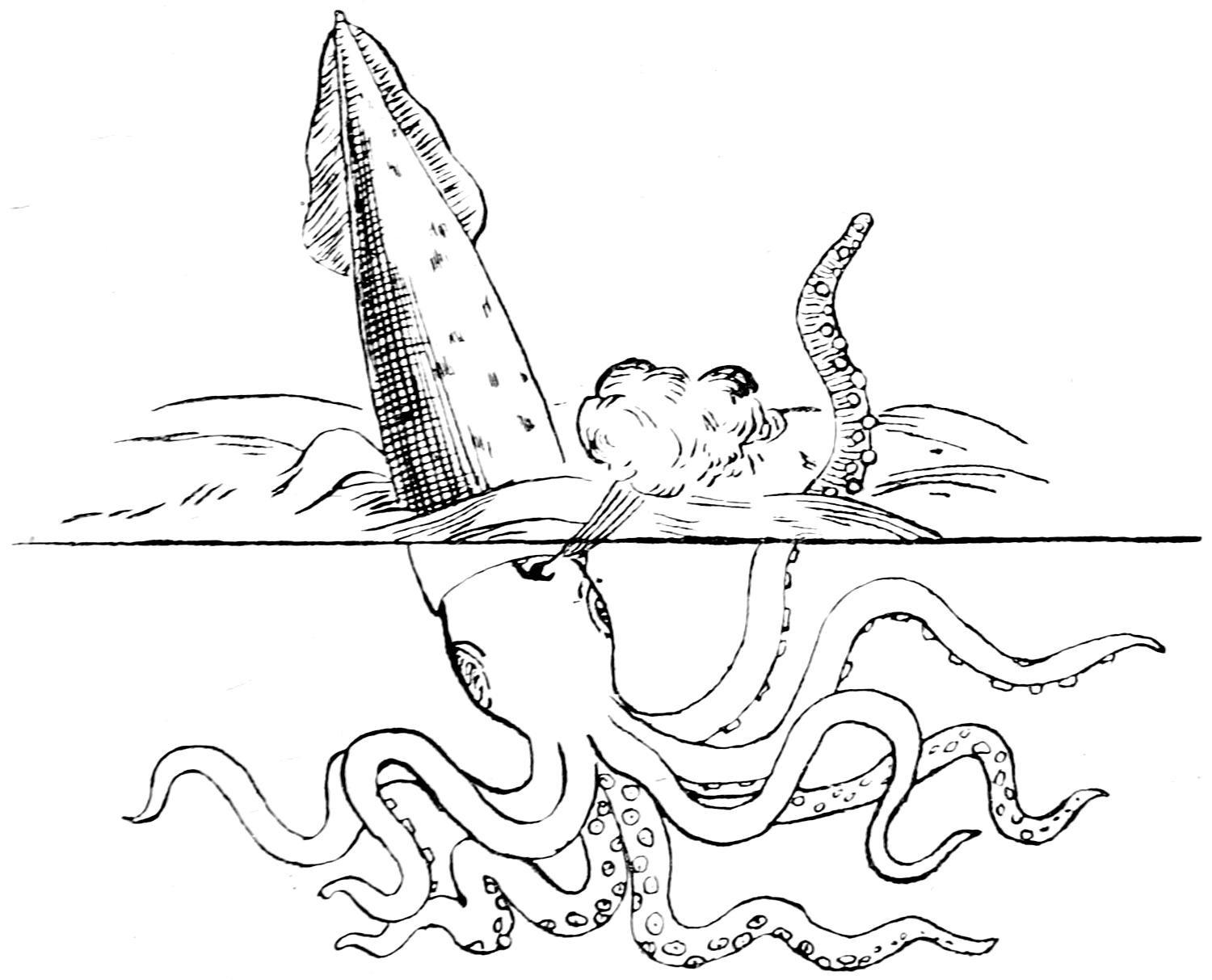
Fig. 70.—Position of a gigantic calamary, by which Mr. Henry Lee explains Mr. Bing’s drawing.
The “monster of Egede” he also explained by reference to a great calamary. Mr. Lee does not doubt of the accuracy of Egede’s description, but as to Mr. Bing’s figure he says: “The high character of the narrator would lead us to accept his statement that he had seen something previously unknown to him (he does not say it was a sea-serpent) even if we could not explain or understand what it was that he saw. Fortunately however, the sketch made by Mr. Bing, one of his brother-missionaries, has enabled us to do this”. And Mr. Lee has the boldness to figure a large calamary, with the words: “the animal which Egede probably saw”, of which figure I give a facsimile in fig. 70.—
Well! It looks convincing enough, and there is a savour of ingenious acuteness of wit in it, that might lull the suspicions of a doubting zoologist! What more could be required? And yet, the whole fabric falls to pieces as soon as we compare Egede’s description and Bing’s drawing with the greater part of descriptions and figures given as well before as after Egede. His idea is far fetched and thereby impossible: 1. When a calamary propels itself with great velocity to the surface and raises its tail high out of the water, all its arms are turned and stretched downwards; not one is visible above the surface. 2. When a calamary is in this position and falls down in consequence of its weight, it will fall to the side where its body is nearest the water, in our figure to left, and not to right, as Mr. Egede saw very distinctly; he says: “backwards” that is towards the tail; and 3. A calamary in the position above delineated, spouting through its locomotor tube, spouts in a direction contrary to that which Mr. Lee has figured. The locomotor tube may be somewhat flexible, when at rest; it is stretched by its own muscular wall towards the head, and not towards the tail, nor in a direction perpendicularly to the body, when the act of spouting takes place. Moreover Hans Egede saw the sea-serpent spouting (exhaling) through its nostrils or its mouth, and not on or below the surface of the water, as the calamary of Mr. Henry Lee!
Of Mr. Maclean’s report (no. 31) he says: “His description of it is exceedingly vague, but is strongly indicative of a great calamary”. If I may beg my readers to read Mr. Maclean’s report again, they will observe that nothing in it indicates a calamary!
About the report of Mr. J. C. Lund (no. 115) he writes:
“We may at once accept most fully and frankly the statements of all the worthy people mentioned in this series of incidents. There is no room for the shadow of a doubt that they all recounted conscientiously that which they saw. The last quoted occurrence, especially, is most accurately and intelligently described—so clearly, indeed, that it furnishes us with a clue to the identity of the strange visitant.”
“Here let me say—and I wish it to be distinctly understood—that I do not deny the possibility of the existence of a great sea-serpent, or other great creatures at present unknown to science, and that I have no inclination to explain away that which others have seen, because I myself have not witnessed it. “Seeing is believing”, it is said, and it is not agreeable to have to tell a person that, in common parlance, he “must not trust his own eyes”. It seems presumptuous even to hint that one may know better what was seen than the person who saw it. And yet I am obliged to say, reluctantly and courteously, but most firmly and assuredly, that these perfectly credible eye-witnesses did not correctly interpret that which they witnessed. In these cases, it is not the eye which deceives, nor the tongue which is untruthful, but the imagination which is led astray by the association of the thing seen with an erroneous idea. I venture to say this, not with any insolent assumption of superior acumen, but because we now possess a key to the mystery which Archdeacon Deinbolt and his neighbours had not access to, and which has only within the last few years been placed in our hands. The movements and aspect of their sea-monster are those of an animal with which we are now well acquainted, but of the existence of which the narrators of these occasional visitations were unaware; namely, the great calamary, the same which gave rise to the stories of the Kraken, and which has probably been a denizen of the Skandinavian seas and fjords from time immemorial. It must be remembered, as I have elsewhere said, that until the year 1873, notwithstanding the adventure of the Alecton in 1861, a cuttle measuring in total length fifty or sixty feet was generally looked upon as equally mythical with the great sea-serpent. Both were popularly scoffed at, and to express belief in either was to incur ridicule. But in the year above mentioned, specimens of even greater dimensions than those quoted were met with on the coasts of Newfoundland, and portions of them were deposited in museums, to silence the incredulous and interest zoologists. When Archdeacon Deinbolt published in 1846 the declaration of Mr. Lund and his companions of the fishing excursion he and they knew nothing of there being such an animal. They had formed no conception of it, nor had they the instructive privilege, possessed of late years by the public in England, of being able to watch attentively, and at leisure, the habits and movements of these strangely modified mollusks living in great tanks of sea-water in aquaria. If they had been thus acquainted with them, I believe they would have recognized in their supposed snake the elongated body of a giant squid.”
“When swimming, these squids propel themselves backwards by the outrush of a stream of water from a tube pointed in a direction contrary to that in which the animal is proceeding. The tail part, therefore, goes in advance, and the body tapers towards this, almost to a blunt point. At a short distance from the actual extremity two flat fins project from the body, one on each side, so that this end of the squid’s body somewhat resembles in shape the government “broad arrow”. It is a habit of these squids, the small species of which are met with in some localities in teeming abundance, to swim on the smooth surface of the water in hot and calm weather. The arrow-headed tail is then raised out of water, to a height which in a large individual might be three feet or more; and, as it precedes the rest of the body, moving at the rate of several miles an hour, it of course looks, to a person who has never heard of an animal going tail first at such a speed, like the creature’s head. The appearance of this “head” varies in accordance with the lateral fins being seen in profile or in broad expanse. The elongated, tubular-looking body gives the idea of the neck to which the “head” is attached; the eight arms trailing behind (the tentacles are always coiled away and concealed) supply the supposed mane floating on each side; the undulating motion in swimming, as the water is alternately drawn in and expelled, accords with the description, and the excurrent stream pouring aft from the locomotor tube, causes a long swirl and swell to be left in the animal’s wake, which, as I have often seen, may easily be mistaken for an indefinite prolongation of its body. The eyes are very large and prominent, and the general tone of colour varies through every tint of brown, purple, pink, and grey, as the creature is more or less excited, and the pigmentary matter circulates with more or less vigour through the curiously moving cells.”
“Here we have the “long marine animal” with “two fins on the forepart of the body near the head”, the “boiling of the water”, the “moving in undulations”, the “body round, and of a dark colour”, the “waving motion in the water behind the animal”, from which the witnesses concluded that “part of the body was concealed under water”, the “head raised, but the lower part not visible”, the “sharp snout”, the “smooth skin”, and the appearance described by Mr. William Knudtzon, and Candidatus Theologiae Bochlum, of “the head being long and small in proportion to the throat, the latter appearing much greater than the former”, which caused them to think “it was probably furnished with a mane”. Not that they saw any mane, but as they had been told of it, they thought they ought to have seen it. Less careful and conscientious persons would have persuaded themselves, and declared on oath, that they did see it.”
“I need scarcely point out how utterly irreconcileable is the proverbially smooth, gliding motion of a serpent, with the supposition of its passage through the water causing such frictional disturbance that “white foam appeared before it, and at the side, which stretched out several fathoms”, and of “the water boiling around it on both sides of it”. The cuttle is the only animal that I know of that would cause this by the effluent current from its “syphon tube.” I have seen a deeply laden ship push in front of her a vast hillock of water, which fell off on each side in foam as it was parted by her bow; but that was of man’s construction. Nature builds on better lines. No swimming creature has such unnecessary friction to overcome. Even the seemingly unwieldy body of a porpoise enters and passes through the water without a splash, and nothing can be more easy and graceful than the feathering action of the flippers of the awkward-looking turtle.”
Again I beg my readers to read the above-mentioned account, that they may decide for themselves, whether the animal was a sea-serpent or a great calamary. Mr. Lee’s last views of the motion of sea-animals is also wrong; I make bold to contradict here all his assertions; for instance, he says: “Nature builds on better lines”. I say: If nature built on better lines, men would long ago have imitated them. All creatures, when swimming rapidly on the surface, cause a splash. Swans, when moving as rapidly as possible, cause heavy undulations before the chest, and I have observed myself the common porpoises in the Zuider Zee, which when coming to the surface to breathe, caused a splash and a rushing of water, which all who were on board distinctly saw and heard.
The sea-serpent of Mr. Morries Stirling (no. 113) appeared, according to Mr. Henry Lee also “to have been, like the others from the same locality, a large calamary.”
Of the sea-serpent seen by Captain M’Quhae and his officers he says:
“Of course neither Professor Owen, nor any one else, doubted the veracity or bona fides of the captain and officers of one of Her Majesty’s ships; and their testimony was the more important because it was that of men accustomed to the sights of the sea. Their practised eyes would, probably, be able to detect the true character of anything met with afloat even if only partially seen, as intuitively as the Red Indian reads the signs of the forest or the trail; and therefore they were not likely to be deceived by any of the objects with which sailors are familiar. They would not be deluded by seals, porpoises, trunks of trees, or Brobdingnagian stems of Algae; but there was one animal with which they were not familiar, of the existence of which they were unaware, and which, as I have said, at that date was generally believed to be as unreal as the sea-serpent itself—namely, the great calamary, the elongated form of which has certainly in some other instances been mistaken for that of a sea-snake. One of these seen swimming in the manner I have described, and endeavoured to portray, would fulfil the description given by Lieutenant Drummond, and would in a great measure account for the appearances reported by Captain M’Quhae. “The head long, pointed and flat on the top”, accords with the pointed extremity and caudal fin of the squid. “Head kept horizontal with the surface of the water, and in rather a raised position, disappearing occasionally beneath a wave for a very brief interval, and not apparently for purposes of respiration.” A perfect description of the position and action of a squid swimming. “No portion of it perceptibly used in propelling it through the water, either by vertical or horizontal undulations.” The mode of propulsion of a squid—the outpouring stream of water from its locomotor tube—would be unseen and unsuspected, because submerged. Its effect, the swirl in its wake, would suggest a prolongation of the creature’s body. The numerous arms trailing astern at the surface of the water would give the appearance of a mane. I think it not impossible that if the officers of the Daedalus had been acquainted with this great sea-creature the impression on their mind’s eye would not have taken the form of a serpent. I offer this, with much diffidence, as a suggestion arising from recent discoveries; and by no means insist on its acceptance; for Captain M’Quhae, who had a very close view of the animal, distinctly says that “the head was, without any doubt, that of a serpent”, and one of his officers subsequently declared that the eye, the mouth, the nostril, the colour, and the form were all most distinctly visible.”
And of the sea-serpent of Mr. R. Davidson (no. 93) he asserts: “The features of this incident are consistent with his having seen one of the, then unknown, great calamaries.”
The sea-serpent, seen by Lieutenant Sanford (no. 74) is also explained by him to be “evidently a great squid seen under circumstances similar to those described by Hans Egede”.
Captain Harrington’s sea-serpent (no. 131), according to Mr. Lee, “was evidently, again, a large calamary raising its caudal extremity and fin above the surface, and discolouring the water by discharging its ink.”
Considering and weighing various explanations hitherto given, Mr. Lee concludes: “I am convinced that, whilst naturalists have been searching amongst the vertebrata for a solution of the problem, the great unknown, and therefore unrecognized, calamaries by their elongated cylindrical bodies and peculiar mode of swimming, have played the part of the sea-serpent in many a well-authenticated incident.”
In answering, again, Mr. Gosse’s question: “To which of the recognized classes of created beings can this huge rover of the ocean be referred?” he says: “I reply: To the Cephalopoda. There is not one of the above judiciously summarized characteristics that is not supplied by the great calamary, and its ascertained habits and peculiar mode of locomotion.”
With these “above summarized characteristics” are meant those which Mr. Gosse enumerates in his Romance of Natural History (see p. 318 of the present volume), but which, as we know, are taken by him from only six reports of true sea-serpents, and from a report of a would-be sea-serpent!
The reader will remember that, on one occasion, I explained a would-be sea-serpent by reference to a large calamary, because the head was described “acute” and the colour “crimson”. All true sea-serpents are brownish black, and only in case the animal had swum for a long time in the sun and partly above the surface of the water, the colour is yellowish, grey or greyish. It is true that this colour partly agrees with that of a calamary, when quite at rest or when dead; but generally, when the animal is in motion, and especially in emotion, the colour becomes a reddish-purple or crimson-red. Moreover the long neck, the mane, the extraordinary long tail, the four flappers, are not explained by reference to a calamary.
The twenty-third explanation is proposed by Mr. Searles V. Wood, Jun. in Nature of November 18th., 1880. His article on the “Order Zeuglodontia” closes with the following parenthesis:
“[The animal seen from the Osborne, and figured in the Graphic of June 30th., 1877, as “the sea-serpent”, is quite a different thing from the one in question, and may have been a manatee.]”
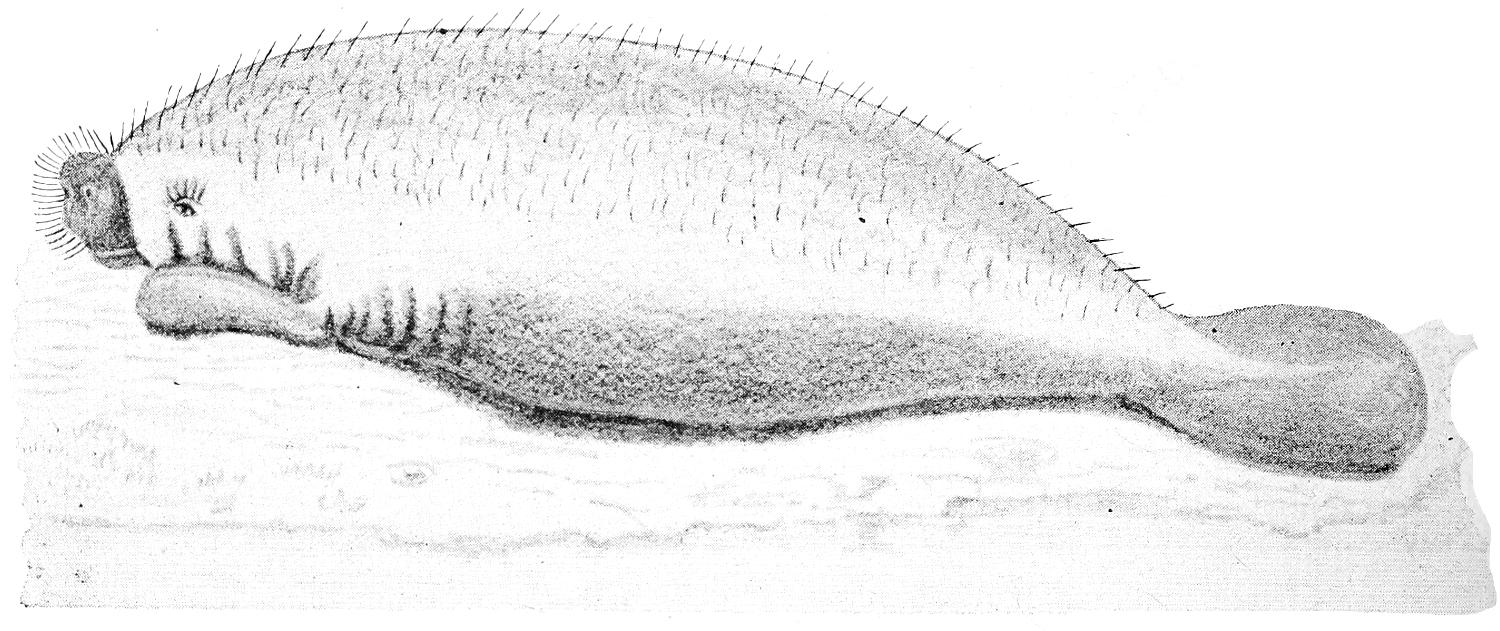
Fig. 71.—Thrichechus manatus Linné.
This figure is our figure 45. Evidently Mr. Wood did not read the account accurately, and so came to a hasty supposition based on a figure only. The length of the visible part of the animal seen from the Osborne, i. e. “from its crown or top to just below the shoulders, where it became immersed”, was “about fifty feet”, and the length of the flappers “each about fifteen feet”. So this animal had an enormous neck. Now the manatee or sea-cow has a total length of ten feet, the length from the crown or top to just below the shoulders is not more than four feet and there is no question of a neck, as our figure will show. Mr. Wood committed the mistake, like so many others, that he explained one sea-serpent, instead of first comparing all the reports of it before giving an opinion.
Let us now place all these explanations side by side. According to different authorities, the sea-serpent may be:
1. A row of porpoises. (Rev. Alden Bradford, 1803).
2. Scoliophis atlanticus, a new species of snake with bunches on its back. (Hon. John Davis, Prof. Jacob Bigelow, Mr. C. F. Gray, 1817).
3. A large tunny. (Prof. Thomas Say, 1818).
4. A true sea-snake (Hydrophis) of very large size. (Mr. Constant Samuel Rafinesque Schmaltz, 1819).
5. A gigantic individual of the eel-tribe. (Mr. Constant Samuel Rafinesque Schmaltz, 1819).
6. A fable, arisen from Northern Mythology. (Dr. Percy, 1820?).
7. A basking shark, or a row of sharks. (Mr. Samuel L. Mitchill, 1828).
8. A balaenopterous whale, or a row of them. (Mr. Samuel L. Mitchill, 1828).
9. An Ichthyosaurus, or a saurian allied to it. (Mr. R. Bakewell, 1830?).
10. A Plesiosaurus, or a saurian allied to it. (Professor Benjamin Silliman, 1830?).
11. Not a saurian. (Prof. Benjamin Silliman, 1835).
12. A row of spermwhales. (Professor Hermann Schlegel, 1837).
13. A Basilosaurus. (Professor Matthias Jacob Schleiden, 1847).
14. A Saccopharynx or an Ophiognathus. (Anonymous writer in one of the daily papers, 1848, Nov. 6?).
15. A large boa. (Anonymous writer in one of the daily papers, 1848, Nov. 6?).
16. A Macrorhinus leoninus, or sea-elephant. (Professor Richard Owen, 1848, Nov. 9).
17. A large sea-weed. (Commander J. A. Herriman, of the Brazilian, 1849).
18. A large ribbon-fish, Gymnetrus or Regalecus. (Mr. A. G. More, 1856).
19. A floating dead tree, or bamboo, or a weed-laden log of wood. (Mr. Arthur Adams, 1860).
20. A mass of flying birds. (Mr. Joseph Drew, 1878).
21. A large sea-turtle. (Mr. Andrew Wilson, 1879).
22. A gigantic calamary. (Mr. Andrew Wilson, 1879? or Mr. Henry Lee, 1883).
23. A manatee. (Mr. Searles Valentine Wood Jun., 1880).
I have bracketed the names of the authors who, as far as I could discover, were the first to express the supposition to which their name is added. The dates are those at which they published their supposition.
Of all these explanations those are the best, which are not the result of reading one single report (1, 3, 4, 5, 11, 14, 15, 16), which are not mere suppositions without any foundation (6, 7, 8, 12, 13, 21, 23), which are not offered by persons who a moment ago saw a deceitful object or animal (17, 18, 19, 20, 22), but which are the result of a study of several accounts and reports. They are those marked 2, 9 and 10. And of these no. 10 is the most admissible, because the Plesiosaurus in its outlines most resembles the sea-serpent. Why, however, is the sea-serpent not a Plesiosaurus? I have already summed up some reasons, when treating of this explanation, but the principal reasons are the mammalian characters, habits and behaviour of the sea-serpent; I will try to prove this in the next chapter.