Chapter V · THE LEADING VARIETIES OF AMERICAN GRAPES
Reading edition
ADIRONDAC. (Labrusca, Vinifera?)
1. Mag. Hort., 27:490. 1861. 2. Horticulturist, 17:94, 132, 518. 1862. fig. 3. Mag. Hort., 28:447, 540. 1862. 4. Am. Pom. Soc. Rpt., 1862:160. 5. U. S. D. A. Rpt., 1863:127. 6. Mag. Hort., 30:25, 62, 140, 150, 208. 1864. 7. Mead, 1867:164. 8. Fuller, 1867:216. 9. Thomas, 1867:399. 10. Am. Pom. Soc. Cat., 1867:44. 11. Grape Cult., 1:115. 1869. 12. Gar. Mon., 16:249. 1874. 13. Bush. Cat., 1883:67. 14. Am. Pom. Soc. Rpt., 1883:56. 15. Montreal Hort. Soc. Rpt., 1885:82. 16. N. Y. Sta. An. Rpt., 10:493. 1891.
Adirondac is an old variety now nearly or quite obsolete. It is probably a seedling of Isabella which it greatly resembles in vine and fruit characters. It is of the Labrusca type, belonging to the southern group of this species, and like most of the southern Labruscas lacks in hardiness and vigor though it surpasses its parent in the first quality. The vine makes a slow, weak growth and is particularly susceptible to fungi. The quality of the fruit is very good, juicy and vinous, with the slight foxy flavor peculiar to Isabella. Its earliness, a week or ten days earlier than Concord, is one of its chief points of merit. The Adirondac did not attain favor because of the many faults of the vine and in the time of its cultivation was seldom found except in the vineyard of the amateur. The claim is often made for this variety that it is nearer the Black Hamburg in quality than any other American grape.
Adirondac was first exhibited by J. W. Bailey of Plattsburg, New York, at the Montreal Horticultural Society Exhibition in Montreal in 1861. The original vine was found in 1852 by J. G. Witherbee in his garden a short distance from the shore of Lake Champlain in the town of Port Henry, Essex County, New York. The variety was introduced by Bailey. On account of its resemblance in vine to Isabella it is supposed by many to be a seedling of that variety. Adirondac was placed on the grape list of the American Pomological Society in 1867 and was dropped from it in 1883.
Vine variable in vigor and productiveness, injured in severe winters, subject to attacks of mildew in unfavorable seasons. Foliage dark green, thick. Flowers semi-fertile, open in mid-season or earlier; stamens upright. Fruit variable in season of ripening, usually in edible condition about ten days before Delaware, does not always keep well. Clusters above medium to small, usually rather compact, seldom shouldered. Berries not uniform in size averaging below Concord, roundish to slightly oval on account of compactness of cluster, dark purplish-black, persistent. Skin intermediate in thickness. Flesh unusually tender and melting, sweet, mild, good to very good but with an after flavor which is not altogether agreeable. Seeds rather large, few in number. Must 82-1/2°-83°.
ADVANCE. (Riparia, Labrusca, Vinifera.)
1. Mass. Hort. Soc. Rpt., 1872:94. 2. U. S. D. A. Rpt., 1875:386. 3. N. J. Hort. Soc. Rpt., 1881:11. 4. Bush. Cat., 1883:67, 152. 5. Va. Sta. Bul., 30:108. 1893.
Advance is an unimportant variety now to be found only in the vineyards of experimenters. At the time of its introduction (1872) it was of much interest as a hybrid between Riparia, Labrusca and Vinifera, Clinton being one parent and Duke of Magenta, a grape resembling Black Hamburg, the other. In quality of fruit it is an improvement over Clinton but unfortunately, as with so many primary hybrids of our native species with Vitis vinifera, the vine is tender and susceptible to fungi.
This variety was produced by J. H. Ricketts of Newburgh, New York, and was first exhibited at the grape show in New York City in 1870.
Vine vigorous, productive, not very hardy, subject to attacks of mildew. Canes long, covered with considerable blue bloom. Leaves rather large, thin, dark green. Fruit ripens in mid-season, appears to keep well. Clusters above medium size, usually single-shouldered, the shoulder being connected to the cluster by a rather long stem, medium in compactness and with many abortive fruits. Berries medium to large, oval, dark purplish-black, covered with heavy blue bloom, persistent. Flesh somewhat tender, flavor sweet and spicy with considerable resemblance to that of Clinton, quality good.
AGAWAM. (Labrusca, Vinifera.)
1. Mag. Hort., 23:86. 1857. (Rogers’ hybrids.) 2. Ib., 27:104, 489, 533. 1861. 3. Horticulturist, 17:26, 510. 1862. fig. 4. U. S. D. A. Rpt., 1863:130, 549. fig. 5. Horticulturist, 20:81. 1865. 6. Mag. Hort., 31:68, 106, 333. 1865. 7. Husmann, 1866:124. 8. Fuller, 1867:230. 9. Am. Pom. Soc. Cat., 1867:44. 10. Horticulturist, 24:126. 1869. 11. Grape Cult., 1:43, 153, 181, 262, 325. 1869. 12. Am. Jour. Hort., 5:263. 1869. fig. 13. Barry, 1872:421. 14. Mich. Pom. Soc. Rpt., 1875:387. fig. 15. Bush. Cat., 1883:69. fig. 16. Gar. and For., 3:490. 1890. 17. Can. Hort., 17:191. 1894. col. pl. 18. N. Y. Sta. An. Rpt., 15:433. 1896. 19. Ib., 17:526, 548, 552, 553. 1898. 20. W. N. Y. Hort. Soc. Rpt., 1899:91. 21. Mo. Sta. Bul., 46:37, 43, 44, 46, 47, 55. 1899.
Randall (20).[156] Rogers’ No. 15 (2, 3, 4, 5, 6, 7, 8, 9). Rogers’ No. 15 (10, 11, 12, 13, 14, 15).
AGAWAM

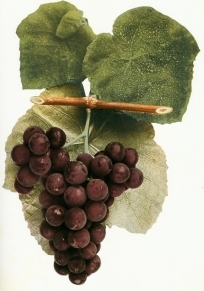
Agawam is the most largely grown of Rogers’ hybrids both in the United States and in New York, the qualities commending it being large size of bunch and berry, rich, sweet, aromatic flavor, attractive appearance, excellent keeping qualities, vigor of vine, and capacity for self-fertilization. It has the distinction of being the only self-fertile variety among Rogers’ named hybrids. For a grape having its proportion of European parentage the vine is vigorous, hardy and productive, though not equal to many pure-bred American sorts in these respects. In severe winters it is precariously hardy in New York. Its chief defects in fruit are a somewhat thick and tough skin, coarse solid texture of pulp, and, for the European palate, its decidedly foxy flavor. The vine is susceptible to the mildews and in many localities does not yield well. In some markets Agawam is highly esteemed and in making certain wines it is much sought for in blending because of the flavor it imparts. Although it ripens soon after Concord it can be kept much longer and really improves in flavor the first few weeks after picking. It may be kept in good condition in common storage until January. Not uncommonly it shrivels on the stem making a raisin. It seems to prefer somewhat heavy soils, doing better on clay than on sand or gravel. The Agawam is often sold in the markets as Salem which it resembles and by which it is surpassed in quality.
For an account of the parentage and origin of Agawam see “Rogers’ Hybrids” of which this is No. 15. It was first mentioned as a variety about 1861. In 1869 Rogers gave the fruit the name Agawam from the Indian name of a town in Hampden County, Massachusetts. It has become one of the most, if not the most, popular of Rogers’ hybrids and is in some sections raised to a considerable extent as a market sort. It is propagated and sold to-day by practically all nurserymen. It was placed on the grape list of the American Pomological Society fruit catalog in 1867 and is still retained there.
Vine vigorous, usually hardy, medium to productive, subject to mildew. Canes of average length, medium in number, rather thick, moderately dark brown; nodes enlarged, somewhat flattened; internodes short to medium; diaphragm nearly thick; pith of average size; shoots tinged with green, glabrous; tendrils intermittent to continuous, bifid to trifid.
Leaf-buds open in mid-season, of average size, long, somewhat thick, conical to nearly obtuse. Young leaves tinged with carmine on lower side and along margin of upper side, prevailing color pale green. Leaves of average size, thick; upper surface light green, dull, moderately smooth; lower surface pale green, slightly pubescent, flocculent; leaf not lobed, terminus somewhat acute; petiolar sinus deep, narrow, often overlapping; lateral sinus very shallow when present; teeth shallow, wide. Flowers occasionally on plan of six, nearly self-fertile, open medium late; stamens upright.
Fruit ripens soon after Concord, keeps until mid-winter. Clusters variable averaging medium to large, short, rather broad, tapering to somewhat cylindrical, sometimes single-shouldered, somewhat loose; peduncle medium to short, nearly thick; pedicel of average length, usually thick, covered with few warts, much enlarged at point of attachment; brush very short, pale green. Berries nearly large, roundish to slightly oval, dark and dull purplish-red somewhat resembling Catawba, covered with lilac bloom, very persistent. Skin thick, tough, adheres slightly to the pulp, contains no pigment, somewhat astringent. Flesh pale green, translucent, tough, slightly stringy, rather solid, foxy, good in quality. Seeds somewhat adherent, two to five averaging four, large, rather narrow, long, often with slightly enlarged neck, blunt, brownish; raphe usually distinct, shows as a ridge in the bottom of a broad groove; chalaza rather large, distinctly above center, not obscure.
ALEXANDER. (Labrusca, Vinifera?)
1. Dom. Enc., 1804:291. 2. McMahon, 1806:235. 3. Johnson, 1806:164. 4. Adlum, 1823:139. 5. Ib., 1823:140. 6. Dufour, 1826:5, 9, 24, 55, 116, 207, 247, 255. 7. Adlum, 1828:173. 8. Ib., 1828:174. 9. Prince, 1830:173, 216, 219. 10. Ib., 1830:174. 11. Ib., 1830:200. 12. Downing, 1845:253. 13. U. S. Pat. Off. Rpt., 1847:462. 14. Ib., 1847:468. 15. Ib., 1856:434. 16. Bush. Cat., 1883:68.
Alexander’s (7, 15). Alexandria (15). Black Grape (16). Buck Grape (11). Cape (6, 15). Cape grape (12, 13, 16). Cape of Good Hope grape (9, 10). Clifton’s Constantia (4, 8, 10). Clifton’s Constantia (12, 16). Columbian (11). Constantia (6, 16). Madeira of York, Pa. (12). Rothrock of Prince (16). Schuylkill Muscadel (5, 7, 13). Schuylkill Muscadel (9, 12, 14, 15, 16). Schuylkill Muscadine (12). Spring Mill Constantia (9, 12, 16). Tasker’s grape (1, 2, 3, 7, 9, 12, 16). Vevay (13, 15, 16). Winne (11). Winne (12, 16). York Lisbon (16).
Alexander is now a grape of the past but no other of our American varieties better deserves historical record. We have seen in the preceding chapters how important a part it had in the evolution of our native grapes, being one of the first wild grapes to be domesticated. The Alexander was a coarse grape with so much foxiness of flavor that it did not please the early growers, who had been accustomed to European sorts, as a table-grape, but it made a very good wine of the claret type and was grown for this purpose until displaced by the Catawba. It was wine made from this variety that Thomas Jefferson[157] pronounced “worthy of the best vineyards of France.” The early writers differ so in their estimates of the good and bad qualities of this grape that it is hard to give its true characters at this late date.
The early history of Alexander is really the history of two varieties: the Schuylkill Muscadel and the Clifton Constantia. The first of these varieties was, according to Bartram, found growing in the vicinity of Philadelphia on the hills bordering the Schuylkill River in the neighborhood of an old vineyard of European grapes. The finder, John Alexander, was gardener to Governor Penn of Pennsylvania, into whose garden he introduced it a few years before the American Revolution. It was later known as Tasker’s grape from a Mr. Tasker of Maryland who cultivated it largely. The Clifton Constantia, according to Adlum, originated with William Clifton of Southwark, Philadelphia, who states that it was a chance seedling in his garden. Adlum says that the two varieties had been confused, that “they are much alike in the growth of the vine and the color of the grape but the Schuylkill has rather the largest berries and is sweeter, and generally has a small shoulder or branch with four or five grapes on it growing out from the top of the bunch.” Prince also describes the varieties as separate, but he says “they are generally cultivated and considered as synonymous.” Later writers consider the two grapes identical.
Peter Legaux, the promoter of a vineyard company at Spring Mill, about fourteen miles from Philadelphia, secured some vines of the Clifton Constantia from Clifton and later introduced it under the name of Cape grape stating that he had secured it from the Cape of Good Hope. Whether he did this purposely and with intent to defraud or whether he had accidentally mixed the cuttings secured from Clifton with some of a large number of cuttings which had come from abroad will never be known. When reproached for his deception he denied that this variety was a native and continued to assert that he had secured it from the Cape of Good Hope. In this he was strongly supported by Dufour who says: “I will also try to save the character of our Cape grapes from being merely wild grapes, because some are now found in the woods.” Legaux’s advertisement of this variety had the effect of making it known at least and it is the opinion of writers of that day that many were induced to try this grape under the supposition that it was from the Cape of Good Hope who would have scorned it had they supposed it to be a native. It came to be considerably planted in all parts of the United States; was early introduced into the West and preceded the Catawba as the popular grape around Cincinnati. It was found worthless in New England and New York, the season not being long enough to mature the fruit. With the introduction and dissemination of Catawba it was gradually dropped from cultivation, the Catawba being superior in quality, more resistant to rot and mildew and slightly earlier. It is now unknown and it is doubtful if there are any living vines in cultivation.
Alexander is generally considered a variety of Labrusca but there is much evidence to show that it is a hybrid of Labrusca and Vinifera. This was the opinion of some of the earlier writers but later it was discredited. Bartram gives as one of the distinguishing characters of Vinifera and American vines that the first show oval berries while the latter do not, but he makes an exception of Alexander. Why this should be an exception does not seem apparent unless it be credited to hybridity. Furthermore, the season of Alexander, which is very late, would also indicate foreign blood; a grape native of the vicinity of Philadelphia would supposedly be able to ripen itself in that locality, a thing that the Alexander seldom did perfectly, and it is spoken of in southern Indiana as being very late. Its place of origin (“in the vicinity of an old vineyard of European kinds”) would indicate that there was an opportunity for hybridization to take place. The descriptions strongly suggest some of the coarser-textured of Rogers’ hybrids.
This solution, if it be accepted, would account for the difference of opinion as to its origin. Bartram and Prince could see enough of the characters of the native in a hybrid so that they could be deceived into claiming it as a native, and Dufour on the other hand could see enough of the Vinifera characters so that he felt there was no question as to its being of foreign origin.
Downing gives what is probably the most complete description of this variety we now have, although it was made from fruit raised some distance farther north than where the variety matures properly. He says: “It is quite sweet when ripe and makes a very fair wine but it is quite too pulpy and coarse for table use. The bunches are more compact and the leaves much more downy than those of the Isabella. Bunches rather compact, not shouldered. Berries of medium size, oval. Skin thick, quite black. Flesh with a very firm pulp, but juicy, and quite sweet and musky, when fully ripe, which is not till the last of October.” Dufour speaks of the berries ripening unevenly, requiring the green ones to be picked out before sending to the wine press.
ALEXANDER WINTER. (Labrusca, Vinifera?)
1. N. Y. Sta. An. Rpt., 11:613. 1892. 2. Ib., 14:275. 1895. 3. Ib., 17:526, 548, 553. 1898.
Alexander Winter is chiefly valuable because of the length of time it will keep. As its name implies it is a winter grape. The flavor is most excellent and when well grown the appearance of bunch and grape is attractive. Another desirable quality is that the average number of seeds to the berry is small, being only two. The great defect of the variety is that, even with cross-pollinization, perfect clusters do not form. There are many green berries, and when ripe there are always some small seedless berries indicating imperfect fertilization. Vine and foliage indicate Labrusca parentage but the fruit suggests an admixture of Vinifera. Although rarely found in the gardens and vineyards of New York, Alexander Winter is well worth a place in the garden of the amateur and of the grape-breeder because of its excellent keeping qualities.
Alexander Winter was originated by S. R. Alexander, Bellefontaine, Ohio, from a lot of mixed seed planted in 1884. It was received at this Station in 1892. It seems not to have been tested elsewhere and is not generally handled by nurserymen.
Vine vigorous, injured in severe winters, productive. Foliage irregularly roundish, dark green. Flowers open in mid-season or earlier; stamens reflexed. It cannot be relied upon to set perfect clusters when standing alone and even when growing in a mixed vineyard fails to set fruit well. Fruit ripens about with Salem, keeps a long time in edible condition. Clusters above medium to small, very heavily shouldered, loose, contain many small seedless fruits. Berries variable in size, the fully developed fruits averaging medium to large, roundish, dull, light and dark red, covered with thin lilac bloom or at times with faint tinge of grayish-blue, persistent. Skin covered with scattering dark-colored dots, rather thick but tender. Flesh tender, vinous, with indications of Vinifera parentage, sweetish to agreeably tart, flavor pleasing, good to very good in quality. Seeds large, few in number; raphe sometimes shows as a raised cord.
(I) ALICE. (Labrusca.)
1. Bush. Cat., 1894:84.
Alice is one of two New York seedlings of this name offered grape-growers, neither of which is worth a permanent place in viticulture. This grape is a white seedling of Martha, and much resembles that variety. It was originated by J. A. Putnam, Fredonia, New York, who writes that the vine was first fruited in 1890. On account of its close resemblance to Martha it was generally considered unworthy of perpetuation and is now practically obsolete.
(II) ALICE. (Labrusca, Aestivalis?, Vinifera?)
1. Rural N. Y., 46:36. 1887. fig. 2. Ib., 47:161. 1888. 3. Amer. Gard., 9:7. 1888. fig. 4. N. Y. Sta. An. Rpt., 11:613. 1892. 5. Amer. Gard., 16:423. 1895. fig. 6. Mass. Hort. Soc. Rpt., 1895:233. 7. N. Y. Sta. An. Rpt., 14:275. 1895. 8. Minn. Hort. Soc. Rpt., 1896:134. fig. 9. Rural N. Y., 56:662, 679. 1897. 10. N. Y. Sta. An. Rpt., 17:526, 548, 553. 1898.
A brief record of the origin, history and gross characters of Alice is herewith given. The grape is of little value in New York.
This variety was found growing near an old stone wall by Ward D. Gunn of Clintondale, Ulster County, New York, and was transplanted into his vineyard in the spring of 1884. It was introduced by F. E. Young of Rochester. This is a Labrusca, with a few characters that indicate Aestivalis and Vinifera blood.
Vine vigorous to medium, hardy, produces fair crops. Leaves medium to large, sometimes strongly rugose, with lower surface heavily pubescent. Flowers self-fertile or nearly so, open in mid-season; stamens upright. Fruit ripens with Concord or slightly earlier, the different clusters varying in season of ripening, ships well and keeps in good condition far into the winter. Clusters intermediate in size, usually with a small single shoulder, medium to compact. Berries above medium to small, roundish although frequently strongly compressed on account of compactness of cluster, rather dull, pale red, somewhat lighter than Catawba, covered with thin lilac bloom, persistent. Skin very thick. Flesh tender, vinous, somewhat foxy, sweet at skin to agreeably tart at center, good in quality, resembling Diana or Catawba. The seeds, which are few in number, often show a rough granular, warty surface around the chalaza.
ALLEN’S HYBRID. (Labrusca, Vinifera.)
1. Mag. Hort., 20:474. 1854. 2. Ib., 21:182. 1855. 3. Essex Inst. Proc., 1:195. 1856. 4. Mag. Hort., 26:66. 1860. 5. Am. Pom. Soc. Cat., 1862:90. 6. Strong, 1866:330. 7. Mead, 1867:176, 187, 194. fig. 8. Ga. Sta. An. Rpt., 13:320. 1900. 9. Ga. Sta. Bul., 53:40. 1901.
A half century ago Allen’s Hybrid was the vine of promise in America. It was the first named hybrid between Vitis labrusca and Vitis vinifera to be disseminated and as such awakened the slumbering hopes of the horticulturists of a continent. American grape-growers had all but given up the expectation of ever growing the European grape in the New World when Allen announced this hybrid. Auspicious hope! Grape-growers everywhere hybridized grapes and the growing of the vine received an impetus surpassed only by that of the introduction of the Concord. Botanists and horticulturists had doubted the possibility and the practicability of crossing the Old World grape with the New World species, when this variety removed the doubt and led them to hope that we were to have varieties of grapes in America possessing many of the coveted characters of the grapes of Europe.
After its introduction the variety was tested wherever grapes were grown in the United States and Canada,—and for a generation. Its high quality, entirely free from what was then considered objectionable foxiness, handsome appearance, with some other qualities of its Vinifera parent, at first indicated that it was a most valuable acquisition; but it soon developed the tenderness of vine and susceptibility to fungi and insects which have come to be the distinguishing marks of the primary hybrids of native species and the European grape. Its cultivation has long since ceased and it has now a place only in the history of American grape-growing. It has been one of the parents of a number of other grapes, chief of which is Lady Washington, produced from a cross between Allen’s Hybrid and Concord. The grape is lost to cultivation but the name should be perpetuated as commemorating one of the great events in American viticulture.
Allen’s Hybrid was originated by John Fiske Allen of Salem, Massachusetts. In the winter of 1843-44 he fertilized the blossoms of an Isabella vine growing in a greenhouse with pollen from Chasselas de Fontainbleau. Seeds were produced and planted the next year the vines of which began to fruit in 1853 and 1854. One of these seedlings of greater merit than the others was saved and named Allen’s Hybrid; the others were destroyed.
“The vine is not hardy, and requires winter protection, but is vigorous and productive, ripening quite early, and in sheltered situations is a desirable variety. Bunch medium to large, shouldered, compact; berry medium to large, round, sometimes depressed; skin thin, white, changing to pale yellow when fully ripe; flesh tender, juicy, sweet, rich, with a delicate slightly vinous flavor, and one of the best in quality.”[158]
AMBER QUEEN. (Vinifera, Riparia, Labrusca.)
1. Mass. Hort. Soc. Rpt., 1870:33. 2. Ib., 1873:101. 3. Bush. Cat., 1883:70. 4. N. Y. Sta. An. Rpt., 8:342. 1889. 5. Ib., 17:548, 552. 1898. 6. Mo. Sta. Bul., 46:42, 44, 46, 76. 1899. 7. Ga. Sta. Bul., 53:40. 1901.
Amber Queen is interesting chiefly as having sprung from three species, Vitis vinifera, Vitis labrusca and Vitis riparia, and as showing the characters of all in some degree. The fruit strongly indicates the Vinifera parentage, the continuous tendrils Labrusca, and the vine, in vigor of growth and several botanical characters, shows its descent from Riparia. The variety has never been much grown, and when cultivated could be best characterized by its faults—of not setting fruit well, susceptibility to mildew and black-rot and of unproductiveness. It is, however, reasonably successful in especially favorable localities.
The variety was first exhibited at a meeting of the Massachusetts Horticultural Society in 1870. It was originated by N. B. White, Norwood, Massachusetts, from seed of Marion fertilized with Black Hamburg. Bush questions this parentage owing to the fact that Amber Queen frequently shows continuous tendrils. In the vineyard of this Station, however, Marion shows continuous as well as intermittent tendrils, indicating that it would be quite possible for the Amber Queen to have inherited its aberrant tendrils from that source.
Vine a strong grower, usually hardy, produces light crops except in favored locations, both leaves and fruit subject to attacks of fungal diseases. Leaves above medium size, roundish, rather thick. Flowers sterile or nearly so, practically incapable of setting fruit when self-fertilized, open about in mid-season and bloom a long time; stamens reflexed. Fruit variable in season of ripening, sometimes before, at other times after Concord, usually requires more than one picking to secure the fruit at its best, does not keep well as the berries soon wither. Clusters variable in size but not large, usually loose and open but sometimes compact. Berries not uniform in size, roundish to oval, dark red covered with more or less lilac bloom, somewhat resembling Catawba in color, not very firm as the berries soon shrivel, persistent. Flesh very juicy, soft and tender, mildly sweet at skin to acid at center, good to very good in quality. Seeds variable in size, frequently with enlarged neck; chalaza distinctly above center.
AMBROSIA. (Labrusca, Vinifera.)
1. N. Y. Sta. An. Rpt., 10:494. 1891. 2. Ib., 11:614. 1892. 3. Ib., 17:526, 545, 547, 553. 1898.
Ambrosia is a New York seedling which, though introduced nearly twenty years ago, has not found favor with grape-growers. In quality, while hardly worthy of its name, it ranks high and for this reason may be worth a place in the vineyard of the amateur. On the Station grounds it shells badly, differing in this respect from its supposed parent Salem.
The variety was originated by Alfred Rose of Penn Yan, New York, from seed of Salem, planted in 1884. It was received for testing by this Station in 1888. There are no records of its having been tested elsewhere.
Vine vigorous, healthy, usually hardy, moderately productive. Leaves intermediate in size; lower surface heavily tinged with bronze. Flowers occasionally on plan of six, fertile, open in mid-season or earlier; stamens upright. Fruit ripens about with Concord or Delaware, appears to keep well. Clusters large to medium, broadly and irregularly tapering, sometimes blunt at ends, usually not shouldered or shoulder when present small and short, compact to medium. Berries large to above medium, slightly oblate, attractive green changing to a yellow tinge, covered with a more or less gray bloom, drop from clusters easily. Flesh rather transparent and tender, mild, sweetish from skin to center, pleasant-flavored but somewhat variable in flavor and quality, ranking from medium to very good. Seeds separate readily from the pulp, quite large; raphe often shows as a partly submerged cord.
AMERICA. (Lincecumii, Rupestris.)
1. N. Y. Sta. An. Rpt., 11:614. 1892. 2. An. Hort., 1892:176. 3. Husmann, 1895:116, 125. 4. N. Y. Sta. An. Rpt., 14:276. 1895. 5. Ib., 17:526, 548, 553, 1898. 6. Tex. Sta. Bul., 48:1149, 1152. 1898. fig. 7. Am. Pom. Soc. Cat., 1899:29. 8. Mo. Sta. Bul., 46:43, 45, 46, 47. 1899. 9. Ga. Sta. An. Rpt., 13:320. 1900. 10. Tex. Sta. Bul., 56:263, 274. 1900. fig. 11. Rural N. Y., 60:614. 1901. 12. Mo. Hort. Soc. Rpt., 1904:305.
America is illustrated and described in The Grapes of New York chiefly because of its possible value in breeding work. It may also be worth growing in a limited way in this State for wine-making as it is reputed by all who have tried it to be one of the best native grapes for a dark red wine and to make a very good port. The notable qualities of the variety as it grows at Geneva are: Vigor of growth, health of foliage, persistence of berries, high sugar content and the peculiar flavor of the fruit, liked by some and not by others. At least it can be said that the taste of America is new to northern grape-growers; and, since it wholly lacks the foxy taste and aroma of Labrusca, it offers possibilities for breeding varieties lacking the distinguishing flavor of Concord and Niagara. This variety would probably be somewhat objectionable in northern markets as a table fruit because of the highly colored juice, which stains the hands and the lips. The flavor is decidedly that of Vitis rupestris.
Its originator claims for America great resistance to heat and cold; and our experience, though limited, confirms the claim. So, too, it is said to be a suitable stock upon which to graft Vinifera varieties to resist phylloxera, a matter concerning which our experience in this region offers nothing, though the parentage strongly suggests such resistance to be the case. The vigor of the vine and the luxuriance of the foliage, probably still more marked farther south, cannot but make it an excellent sort for arbors. But the fact must be emphasized that America is preeminently of interest to the northern grape-grower because it gives him an opportunity to make use in breeding work, of the qualities of Rupestris and Lincecumii, southern species combined in this variety and thriving in the combination in northern conditions.
AMERICA
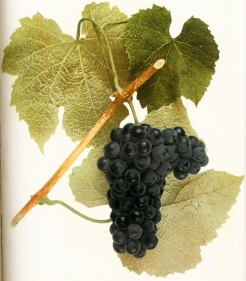
The grape described here was originated by Munson from seed of Jaeger No. 43 pollinated by a male Rupestris. It was received at this Station in 1892 which was practically the date of its introduction. America has been widely tested by experiment stations and the reports of its behavior are generally favorable.
Vine vigorous to very vigorous, usually hardy, produces heavy crops. Canes long, numerous, of medium size, dark reddish-brown, covered with heavy blue bloom; nodes enlarged, strongly flattened; internodes of average length; diaphragm medium in thickness; pith rather large; shoots glabrous, covered with blue bloom; tendrils intermittent; long, bifid.
Leaf-buds open in mid-season, medium to small, of average length, rather thick, conical to obtuse. Young leaves tinged on both sides, making the prevailing color rose-carmine. Leaves healthy, inferior in size, rather thin; upper surface attractive medium green, glossy, smooth; lower surface light green, hairy; veins indistinct; lobes lacking or faintly showing, terminal lobe acute; petiolar sinus moderately deep and wide; teeth of average depth and width. Flowers sterile, usually on plan of six, open late; stamens reflexed.
Fruit ripens with Concord or later, keeps well. Clusters nearly large, above medium length, broad, tapering, somewhat cylindrical, irregular, usually single-shouldered, averaging two or three bunches per shoot, usually compact; peduncle of medium length, rather thick; pedicel short, slender, covered with few, small, inconspicuous warts; brush short, thick, with reddish tinge. Berries medium to small, variable in size, roundish, attractive black or purplish-black, glossy, covered with heavy blue bloom, persistent, somewhat soft. Skin thin, very tender, adheres slightly to the pulp, contains an unusually large amount of purplish-red pigment, slightly astringent. Flesh dull white with faint reddish tinge, translucent, not very juicy, tender, not stringy, melting, spicy, vinous, sweet, good in quality. Seeds separate easily, two to five, average four, above medium size, long, of moderate width, pointed, yellowish-brown; raphe prominent, cord-like; chalaza large, slightly above center, irregularly circular, distinct.
There is a second variety under the name America, as Ricketts years ago introduced an America which has probably passed from cultivation.
AMETHYST. (Labrusca, Vinifera, Bourquiniana.)
1. Am. Pom. Soc. Rpt., 1903:82.
Amethyst is one of Munson’s hybrids as yet unknown to the grape-growers of New York. It is a most excellent table grape, coming after the Delaware which it much resembles in habit of growth and in fruit. It is a stronger grower than Delaware, has proved to be as hardy, is seemingly not attacked readily by black-rot, but like the Delaware is susceptible to mildew. In quality it ranks with Delago, Brilliant, Goethe, Lindley and Delaware, all parents one or two generations removed. According to Munson it makes a good white wine. It is at least an amateur’s grape, to be sought because of high quality. It was originated by T. V. Munson of Denison, Texas, being first fruited in 1898. It is a cross of Delago and Brilliant and was introduced in 1902.
Vine moderately vigorous, hardy, medium to productive, susceptible to attacks of mildew. Canes intermediate in length, number and thickness, light and dark brown deepening in color at the nodes. Leaves medium to nearly large, light green; lower surface pale green, pubescent. Flowers nearly fertile to slightly sterile, open rather late; stamens upright. Fruit ripens after Delaware, keeps well. Clusters medium to large, intermediate in length and width, usually single-shouldered, compact. Berries above medium to small, roundish to oval, strongly narrowing toward the pedicel on account of compactness of cluster, rather attractive dark red, covered with lilac bloom, usually persistent. Skin thick, of average toughness. Flesh rather tough, solid, vinous, sweetish at skin to agreeably tart at center somewhat resembling Brilliant, good to very good in quality. Seeds intermediate in size and length, often with enlarged neck.
AMINIA. (Labrusca, Vinifera.)
1. Mag. Hort., 31:333. 1865. 2. Mass. Hort. Soc. Rpt., 1865:40. 3. N. Y. Agr. Soc. Rpt., 1870:276. 4. Mich. Pom. Soc. Rpt., 1875:341. 5. Bush. Cat., 1883:70. 6. Ill. Sta. Bul., 28:252. 1893. 7. N. Y. Sta. An. Rpt., 17:526, 548, 553. 1898. 8. Mo. Sta. Bul., 46:42, 44, 46, 48, 54. 1899. 9. Ga. Sta. An. Rpt., 13:320. 1900.
Rogers’ No. 39 (1, 2, 3, 4). Rogers’ No. 39 (5).
Aminia is deserving the recognition of a color-plate and a full description in this work because in quality it is one of the best early grapes for New York. Besides being early and of good quality it keeps well. It ripens with or a little after Moore Early and Hartford, producing berries of high quality and attractive appearance but the bunches are small, variable in size, not well formed as a rule, and the berries ripen unevenly. The vine is vigorous, not as hardy as might be wished for in New York, nor as productive as a commercial variety must be, and shows the weaknesses characteristic of all of Rogers’ hybrids.
AMINIA
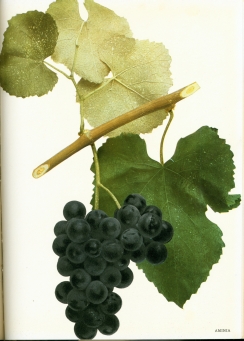
For an account of the origin of the Aminia see page 390 under “Rogers’ Hybrids.” In 1867 Bush secured vines of Rogers’ No. 39 from several different sources. When these came into bearing he found he had three different varieties. The original vine of Rogers’ No. 39 having been destroyed it was impossible to determine which was the correct one. Bush selected the best of these and to avoid further confusion, with the consent of Rogers, named it Aminia. But in spite of Bush’s care there are still at least two different varieties cultivated under this name. Although the Aminia is found in many varietal vineyards, an examination of over forty of the leading grape nurserymen’s catalogs shows only three who offer vines for sale.
Vine vigorous, not always hardy, lacking somewhat in productiveness. Canes slightly rough, long, medium in number, thickish, dark brown to reddish tinge; nodes enlarged, usually not flattened; internodes medium to long; diaphragm somewhat thick; pith large; shoots pubescent; tendrils intermittent, long to medium, trifid to bifid, persistent.
Leaf-buds open in mid-season, about medium in size and length, above average thickness, prominent, obtuse to conical. Young leaves colored on both sides, prevailing color rather bright carmine. Leaves large, of average thickness; upper surface medium green, rather dull, nearly smooth; lower surface light green, slightly pubescent; veins distinct; lobes usually three, terminal lobe acute; petiolar sinus rather deep, narrow, often closed and overlapping; basal sinus usually lacking; lateral sinus nearly shallow, narrow; teeth somewhat shallow, inclined to wide. Flowers open in mid-season, sterile; stamens reflexed.
Fruit ripens early, just after Hartford, keeps well. Clusters medium to small, of average length, broad, irregular, somewhat conical, sometimes with a long shoulder, rather loose; peduncle long, thick; pedicel longish, not slender, broad at point of attachment, covered with few warts; brush short, thick, brownish-red. Berries range from large to small, decidedly variable, roundish, dull black, covered with blue bloom, persistent, firm. Skin rather thick, somewhat tender, adheres considerably to the pulp, contains a large amount of purplish-red pigment, slightly astringent. Flesh greenish, translucent, moderately tender, rather solid and coarse, foxy, sweet at skin but somewhat acid at center; quality good. Seeds adherent, one to six, average three and four, very large, long, fair width, sharply pointed, light brown with yellow tinge; raphe obscure; chalaza large, above center, irregularly circular to oval, distinct.
ANTOINETTE. (Labrusca.)
1. N. J. Hort. Soc. Rpt., 1881:10. 2. Rural N. Y., 48:801. 1889. fig. 3. Bush. Cat., 1894:86. 4. N. Y. Sta. An. Rpt., 15:294. 1896. 5. Ib., 17:526, 545, 547, 553. 1898. 6. Kan. Sta. Bul., 110:235. 1902.
Antoinette is a white seedling of Concord which, on the Station grounds, and in the State at large, has not shown sufficient merit to warrant its recommendation. It is very similar to the several other white seedlings of Concord, all of which have a decided varietal resemblance and which, except in color of fruit, have the general characters of Concord.
T. B. Miner, of New Jersey, produced Antoinette from Concord seed over thirty years ago.
Vine medium to vigorous, usually hardy, fairly productive. Canes medium to short, usually roughened. Leaves of average size and thickness with lower surface heavily pubescent. Flowers open in mid-season or earlier, fertile; stamens upright. Fruit ripens with Concord or slightly earlier, keeps well. Clusters medium to small, cylindrical to tapering, usually not shouldered, variable in compactness. Berries large to below medium, roundish, dark dull green or whitish, often with a tinge of yellow, covered with heavy gray bloom, inclined to drop from pedicel, not firm. Skin usually covered with small scattering dark dots, thin, variable in toughness. Flesh rather tough, sweetish next the skin, tart at center, slightly foxy, good to very good in quality. Seeds separate from the pulp with difficulty, not numerous, rather large, dark brown.
AUGUST GIANT. (Labrusca, Vinifera.)
1. Mass. Hort. Soc. Rpt., 1872:95. 2. Bush. Cat., 1883:72. 3. Ill. Sta. Bul., 28:252. 1893. 4. Col. Sta. Bul., 29:18. 1894. 5. Bush. Cat., 1894:86. 6. Del. Sta. An. Rpt., 7:134, 136. 1895.
The originator of August Giant has managed to secure a hybrid of Vitis labrusca and Vitis vinifera in which the fruit characters are decidedly those of the latter species. In appearance of berry and in taste, when well grown, August Giant greatly resembles Black Hamburg. The vine is unusually vigorous and, considering its parentage, is quite hardy. The foliage is thick and luxuriant, though somewhat subject to mildew. The vigor of vine, beauty of foliage, and the high quality of the fruit make the variety a desirable one for the amateur, especially where an ornamental vine is wanted. The variety needs to be grown where the fruit can have a long and favorable maturing season.
August Giant was originated by N. B. White of Norwood, Massachusetts, in 1861 from seed of an early, large-berried red grape of the Labrusca type, pollinated by Black Hamburg.
AUGUST GIANT
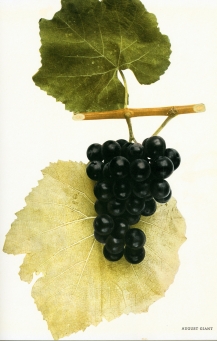
Vine very vigorous, usually hardy, not a heavy bearer, somewhat subject to mildew. Canes medium to long, numerous, thick, light to dark brown; nodes enlarged, slightly flattened; internodes below average length; diaphragm rather thick; pith large to medium; shoots slightly pubescent; tendrils continuous, medium to long, bifid to trifid.
Leaf-buds open in mid-season, of average size, short, rather thick, conical to obtuse. Young leaves tinged with carmine on lower side extending beyond border of upper side. Leaves medium to very large, thick; upper surface dark green, glossy, smooth, slightly rugose on older leaves; lower surface pale green to indistinct bronze, pubescent; veins rather indistinct; lobes usually three, terminal lobe acute; petiolar sinus medium to deep, narrow, frequently closed and overlapping; lateral sinus shallow to a mere notch; teeth shallow, narrow. Flowers open in mid-season, sterile; stamens reflexed.
Fruit ripens about a week later than Moore Early, keeps well. Clusters of average size or sometimes larger, medium to short, rather broad, irregularly tapering, not uniform, usually single-shouldered, loose to nearly compact; peduncle long to medium in length, somewhat thick; pedicel longish, thick, wide at attachment to berry, covered with numerous large warts; brush short, thick, greenish or with brown tinge. Berries resemble Black Hamburg in general appearance but somewhat variable, averaging large, oval to roundish, dark purplish-red or black, dull, covered with thick blue bloom, hang well to pedicel, firm. Skin of average thickness, tough, adheres slightly to pulp, contains a small amount of bright red pigment, strongly astringent. Flesh greenish, translucent, somewhat tough, stringy, agreeably tart at skin but acid at center, good in quality, resembling Black Hamburg. Seeds adherent, one to four, averaging three, large, rather broad, long, plump, somewhat blunt, light brown; raphe usually obscure; chalaza somewhat large, above center, irregularly circular, distinct.
AUTUCHON. (Riparia, Labrusca, Vinifera.)
1. Downing, 1869:530. 2. Grape Cult., 1:325, 334, 368. 1869. fig. 3. Horticulturist, 24:19, 1869. 4. Ib., 25:74. 1870. 5. Grape Cult., 2:265. 1870. 6. Barry, 1872:424. 7. Horticulturist, 27:14. 1872. 8. Montreal Hort. Soc. Rpt., 1881:159. 9. Bush. Cat., 1883:71. fig. 10. Minn. Hort. Soc. Rpt., 1884:249. 11. Can. Cen. Exp. Farms Rpt., 1891:134. 12. Traité gen. de vit., 5:200. 1903.
Arnold’s No. 5 (3). Arnold’s No. 5 (1, 2, 4, 5, 6, 8, 9, 10, 12).
Autuchon was introduced about 1870 with great éclat. It was heralded as the “best white grape in America—a veritable treasure.” Later it was grown and somewhat widely tested in France. But in neither country has it come up to expectations. In America it has proved to be somewhat tender to cold, an unreliable bearer and subject to rot and mildew. In France it shows the same weaknesses and is not as resistant to phylloxera as are other and better American sorts. The quality of Autuchon is excellent, being that of its European parent with the agreeable sprightliness of its American ancestor. According to the reports regarding it from France it makes a “wine remarkably white, vinous and fresh, slightly musky and agreeable, and of a beautiful yellow color.”[159]
Autuchon was originated by Charles Arnold of Paris, Canada, from seed planted in 1859, The parents are Clinton pollinated by Golden Chasselas. It is not in the Station collection, and the following description is taken from the Bushberg Catalogue.[160]
“Leaves dark green, very deep lobed and sharp pointed serratures; the unripe wood is very dark purple, nearly black. Bunches very long, not heavily shouldered, rather loose; berries medium size, round, white (green), with a moderately firm, but readily melting flesh, and an agreeable sprightly flavor, resembling the White Chasselas. Skin thin, without astringency. Ripens with the Delaware.”
BACCHUS. (Riparia, Labrusca.)
1. Am. Pom. Soc. Rpt., 1879 (cited by 2). 2. Gar. Mon., 22:176. 1880. 3. Mass. Hort. Soc. Rpt., 1880:238. 4. Bush. Cat., 1883:72. fig. 5. N. Y. Sta. An. Rpt., 9:326. 1890. 6. Ill. Sta. Bul., 28:252. 1893. 7. Tenn. Sta. Bul., Vol. 9:167. 1896. 8. Rural N. Y., 59:7. 1900.
Bacchus is a wine grape deemed worthy by its originator to bear the name of the god of wine. It is an offspring of Clinton which it much resembles in vine and leaf characters but surpasses in quality of fruit and in productiveness. In New York Bacchus has very generally superseded Clinton though neither is extensively grown. It is vigorous, productive, hardy, free from mildew and adapted to a variety of soils; it requires a long season for full maturity and cannot therefore be well grown in northern locations though the seasons in the grape regions of New York are usually sufficiently long. The wine-makers of the State mention it as one of the most desirable grapes for a dark red wine. While it is generally too tart for a dessert grape, yet if left on the vine until frost, as late as it can hang, it becomes a good late table grape. Bacchus is one of the best, if not the best, cultivated types of Riparia, or of the Clinton group of Riparia. Its special points of merit from a broad standpoint are: Resistance to cold, resistance to phylloxera, value for wine-making, freedom from fungi and insects, productiveness, ease of multiplication, and capacity to bear grafts. For the above qualities it offers exceptional opportunities to the plant-breeder. Its most prominent limitations are: Poor quality for table use, inability to withstand dry soils or droughts and non-adaptability to soils containing much lime.
BACCHUS
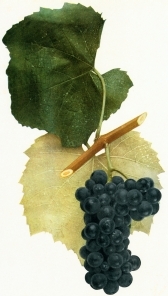
There is no question about the origin of Bacchus. It is a seedling of Clinton which, as mentioned above, it greatly resembles in every character. The variety was originated by J. H. Ricketts of Newburgh, New York, and was first exhibited by him before the American Pomological Society in 1879. It is well known in eastern United States and, as in New York, is highly thought of as a wine grape.
Vine very vigorous, hardy, healthy, productive. Canes average in length, numerous, of medium size, rather light to dark brown with some bloom at nodes which are somewhat enlarged and flattened; internodes intermediate in length; diaphragm below average thickness; pith large to medium; shoots nearly glabrous; tendrils continuous, of mean length, bifid.
Leaf-buds open early, of average size, rather short, thick, obtuse to conical. Young leaves faintly tinged with carmine on lower side only, prevailing color pale green with faint carmine tinge. Leaves medium to small, thin; upper surface dark green, glossy, smooth; lower surface dull green, not pubescent; veins indistinct; lobes three in number, terminal lobe acuminate; petiolar sinus medium to shallow, narrow sometimes nearly overlapping; basal sinus lacking; lateral sinus shallow, wide; teeth of average depth and width. Flowers open early, sterile; stamens upright.
Fruit ripens late and keeps well, hanging a long time on the vine. Clusters small to medium, below average length, rather slender, uniform, cylindrical, often single-shouldered, compact; peduncle almost short, intermediate in size; pedicel short to medium, slender, covered with a few small warts; brush short, wine-colored. Berries variable in size, below medium to small, roundish, black, glossy, covered with a moderate amount of blue bloom, hang well to pedicels, firm. Skin thin, of average toughness, adheres only slightly to the pulp, contains much wine-colored pigment, slightly astringent. Flesh dark green, translucent, fine-grained, somewhat tough, vinous, sweet at skin to tart near seeds, with slight Riparia spiciness, of medium quality, improving as the season advances. Seeds cling to pulp, one to four, average two, often many abortive, above medium size, rather short and wide, usually plump, sharply pointed, brownish; raphe obscure; chalaza above center, pear-shaped, distinct. Must registers 95°-110°.
BAILEY. (Lincecumii, Labrusca, Vinifera.)
1. Rural N. Y., 50:221, 222. 1891. fig. 2. Bush. Cat., 1894:159. 3. N. Y. Sta. An. Rpt., 14:276. 1895. 4. N. Y. Sta. An. Rpt., 17:526, 548, 553. 1898. 5. Tex. Sta. Bul., 48:1149, 1153. 1898. fig. 6. Am. Pom. Soc. Cat., 1899:29. 7. Tex. Sta. Bul., 56:275. 1900. 8. Rural N. Y., 60:614. 1901.
In the Bailey are combined characters of three species, Vinifera, Labrusca and Lincecumii—characters attained in three widely separated regions, Europe, Massachusetts, and Texas. Moreover the characters of Vinifera and Labrusca have been transmitted to Bailey through Triumph, in which variety they are as well combined as in any other hybrid of the two species. The Lincecumii parent, Big Berry, is at the head of Munson’s “Big Berry Family” of hybrids; brought in from the wild, it is one of the best representatives of its species. Bailey, therefore, has royal blood and if parentage counts in grapes, it should prove valuable. Unfortunately New York, at least the Station vineyard, is a little too far north for the fruit to mature well. In cold winters the vine is liable to winter injury. In seasons when the grapes have matured the appearance and quality of the fruit have been such as to recommend it. Its vigor of vine and productiveness give it additional value, and if not to be recommended for commercial plantings in this State, it can surely be named as valuable for breeding purposes. The name of the variety was bestowed upon it by its originator in honor of L. H. Bailey, known by all grape-growers for his services to viticulture.
Bailey was originated by Munson from seeds of a wild Post-oak grape called Big Berry, fertilized with pollen of Triumph. The seed was planted in 1887 and the original vine came into fruiting in 1889-90. The variety is now very generally disseminated throughout the East, and the reports of its behavior, in the North at least, generally accord with that from this Station given above.
Vine vigorous, injured in severe winters, produces good crops of fruit. Canes dark reddish-brown, of good length, of medium size and number. Leaves average in size, light green, dull to slightly glossy, with very distinct veins on lower surface which is cobwebby. Flowers open late, fertile; upright stamens.
Fruit ripens unevenly almost as late as Catawba, keeps well. Clusters rather large and long, not very broad, often blunt at ends, cylindrical to irregularly tapering, usually not shouldered but sometimes with a small, short shoulder, compact. Berries persistent, medium to large, vary in shape from roundish to ovate on account of compactness of clusters, change in color from purplish-black to black, covered with a heavy blue bloom. Skin medium to thin, strongly astringent, tough, adheres somewhat to the pulp, contains a large amount of purplish-red pigment. Flesh moderately juicy and tender, coarse, vinous, good in quality, releases the seeds rather easily. Seeds numerous, medium to above in size, moderately broad, above medium to medium length, blunt, brownish; raphe buried in a shallow, narrow groove; chalaza large, above center, circular to oval, distinct.
BANNER. (Labrusca, Vinifera, Bourquiniana?)
1. U. S. D. A. Yr. Bk., 1906:361. col. pl.
Banner is one of the newer offerings for pomological honors. The Station was not able to secure vines until 1906 and these have not yet fruited. So far as is known it is not grown elsewhere in the State. Since the variety has been well spoken of by horticulturists who have seen it, and since it has been deemed worthy a place among the promising new fruits illustrated and described in the Year Book of the United States Department of Agriculture for 1906, the variety is discussed here. The technical description of it is quoted from the above reference.
The variety was originated by Joseph Bachman of Altus, Arkansas, from seed of Lindley pollinated by Delaware. The seed was planted in 1898. The originator states that he suspects a Stark-Star vine growing alongside also furnished pollen as the Lindley blossoms were unprotected.
“Cluster large, broad conical, heavily shouldered, very compact; stem short; berries globular, of medium size, adhering tenaciously to the small green peduncles; skin moderately thick, and rather tough; amber red and glossy, but covered with a profuse bloom; flesh translucent, juicy, and rather meaty; seeds few, very small, brown; flavor refreshing subacid to sweet and aromatic; quality good to very good. Season late August and early September in Franklin county, Arkansas, ten days or two weeks later than Delaware.”
BARRY. (Labrusca, Vinifera.)
1. U. S. D. A. Rpt., 1864:136. 2. Mass. Hort. Soc. Rpt., 1865:40. 3. Mag. Hort., 34:345. 1868. 4. Am. Jour. Hort., 5:11. 1869. fig. 5. Horticulturist, 24:126. 1869. 6. Am. Pom. Soc. Cat., 1869:42. 7. Grape Cult., 1:182, 326. 1869. 8. Bush. Cat., 1883:74. fig. 9. Mich. Bd. Agr. Rpt., 24:133. 1885. 10. Ill. Sta. Bul., 28:252. 1893. 11. Rural N. Y., 52:671. 1893. 12. Tenn. Sta. Bul., Vol. 9:191. 1896. 13. N. Y. Sta. An. Rpt., 17:526, 548, 549, 552, 553. 1898. 14. Tex. Sta. Bul., 48:1149, 1153. 1898. 15. N. Y. Sta. An. Rpt., 18:370, 395. 1899.
Rogers’ No. 43 (1, 2, 3, 4). Rogers’ No. 43 (5, 6, 7, 8, 11, 12).
Barry, first known as Rogers’ No. 43, was dedicated in 1869, by Rogers, to Patrick Barry, distinguished nurseryman, pomologist and viticulturist. Happily the variety is such that it should long honor the name it bears. The Barry is one of our best black grapes, resembling in berry and somewhat in flavor and keeping quality its European parent, Black Hamburg. The flavor is delicate and sweet, the flesh tender, with thin skin and unobjectionable seeds. The appearance of berry and bunch is attractive. The fruit keeps splendidly, and as this is written, on the twenty-ninth of February, leap-year, there are before the writer bunches of the Barry, kept in common storage without wrapping or other special care, which are in perfect condition. The vine is vigorous, hardy, and productive, but susceptible to mildew. The ripening season is usually said to be that of the Concord but, while it may color with the Concord it requires a longer time to ripen thoroughly and it is not at its best, or even good, unless properly matured. For the table, for winter keeping, and for an amateur grape in general the Barry may be highly recommended.
For an account of the origin of Barry see page 390 under “Rogers’ Hybrids.” It is first mentioned separately from the rest of Rogers’ hybrids in 1864, though not named until 1869. Barry was placed on the list of the American Pomological Society in 1869 where it is still retained. It is known and grown in the garden throughout the grape regions of eastern America.
BARRY
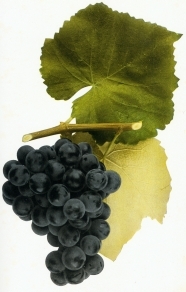
Vine vigorous, usually hardy, productive, somewhat susceptible to mildew. Canes long to very long, numerous, usually thick, dark brown to slightly reddish-brown covered with a small amount of blue bloom; nodes not enlarged, very slightly flattened; internodes intermediate in length; diaphragm of average thickness; pith medium to above in size; shoots nearly glabrous; tendrils intermittent, fair length, bifid to trifid.
Leaf-buds open early, of average size, short, of medium thickness, obtuse to conical. Young leaves heavily tinged with carmine on lower surface, faintly tinged along margin of upper surface, prevailing color bright carmine. Leaves large to medium, of average thickness; upper surface light green, slightly glossy, nearly smooth; lower surface pale green, somewhat pubescent; veins rather indistinct; lobes vary from none to three, terminus acute; petiolar sinus deep, narrow, sometimes closed and overlapping; basal sinus usually lacking; lateral sinus shallow and narrow; teeth shallow to medium, of average width. Flowers open in mid-season, sterile; stamens reflexed. Fruit ripens with Concord or later, keeps very late. Clusters variable in size, medium to short, very broad, slightly tapering to nearly cylindrical, upper part of cluster often subdivides into several parts making compound clusters, frequently double-shouldered, usually compact; peduncle short, medium to rather stout; pedicel above average length, moderately thick, covered with few small warts, enlarged at point of attachment with fruit. Berries large, oval to spherical, dark purplish-black to black, glossy, covered with heavy blue bloom, adhere well to pedicel. Skin rather thin, tough, adheres strongly to pulp, contains but little pigment, not very astringent. Flesh pale green, translucent, tender when ripened under favorable conditions, stringy, vinous, pleasant-flavored, sweet next the skin, agreeably tart at center, above average quality. Seeds slightly adherent, one to five, average three, nearly large to medium, usually long, of mean breadth, deeply notched, rather blunt but often with slightly enlarged neck, brownish; raphe usually obscure, sometimes showing as a faint ridge in a broad groove; chalaza nearly small, pear-shaped or circular, above center, distinct.
BEACON. (Lincecumii, Labrusca.)
1. Ga. Sta. An. Rpt., 13:312, 321. 1890. 2. An. Hort., 1892:176. 3. Bush. Cat., 1894:159. 4. Husmann, 1895:126. 5. Rural N. Y., 55:592. 1896. 6. Tex. Sta. Bul., 48:1149, 1153. 1898. fig. 7. N. Y. Sta. An. Rpt., 17:526, 548. 1898. 8. Am. Pom. Soc. Cat., 1899:29. 9. Mo. Sta. Bul., 46:48, 76. 1899. 10. Tex. Sta. Bul., 56:275. 1900. fig. 11. Ga. Sta. Bul., 53:40, 51, 53. 1901. fig.
Big B Con (7).
Beacon is another of Munson’s hybrids, a cross between Labrusca and Lincecumii. It was received at this Station in 1892 and has borne fruit many times since so that there has been abundant opportunity to see grapes and vine. The variety is not especially well adapted to New York as the fruit is dull in color, lacking in quality, and shells somewhat badly. The vine is very vigorous, bearing a handsome, compact mass of foliage which retains its color and freshness throughout drouths and the heat of summer. In New York it must compete with Concord in commercial vineyards and since it does not equal that variety, taking its character as a whole, it cannot be recommended as a market grape. Its quality and appearance are such that it will never be largely grown by the amateur in the North. The variety, however, is of much interest and of possible value to the grape-breeder.
Munson produced Beacon in 1887 from seed of Big Berry (a variety of Lincecumii) pollinated by Concord, securing the first fruit in 1889. The variety has been generally disseminated among grape specialists and experiment stations and is now well known by grape-growers in general.
Vine a medium to very strong grower, not always hardy, productive. Canes short, medium to rather slender, light brown. Leaves healthy, variable in size, rather thick, inclined to dark green, sometimes rugose, with veins showing indistinctly through the slight pubescence of the lower surface. Flowers open in mid-season, on plan of five or six, nearly fertile.
Fruit ripens with Concord or later and keeps fairly well. Clusters are attractive in general appearance, of good size, rather long, medium to slightly slender, cylindrical to somewhat tapering, usually single-shouldered, compact to medium. Berries medium but variable in size, roundish, purplish-black to black, dull in appearance, covered with heavy blue bloom, inclined to shell in some localities, moderately firm. Skin medium to thin, tough, adheres strongly to pulp, contains a large amount of purplish-red pigment, astringent. Flesh moderately tender, slightly aromatic, spicy, vinous, mildly subacid to agreeably tart, often with a noticeable Concord flavor, about as good as Concord in quality. Seeds separate easily from the pulp, large to above medium, of average length, broad, blunt to medium, slightly notched; raphe obscure; chalaza above center, irregularly circular to slightly oval.
BEAUTY. (Labrusca, Vinifera, Bourquiniana?)
1. Downing, 1881:165 app. 2. Ill. Hort. Soc. Rpt., 1881:163. 3. Mo. Hort. Soc. Rpt., 1883:43. 4. Kan. Sta. Bul., 14:85. 1890. 5. Bush. Cat., 1894:89. 6. Tex. Sta. Bul., 48:1149, 1153. 1898.
The grape which bears the name Beauty is an Aestivalis hybrid with Labrusca, one of Jacob Rommel’s seedlings. It had the honor, according to the Bushberg Catalogue,[161] of receiving at the Exposition at Bordeaux, France, in 1880, the praise of having produced “the best American white wine on exhibition.” According to the above authority Rommel stopped its propagation and dissemination because of its susceptibility to fungi. The variety is now practically lost to cultivation and was never largely grown in New York.
Beauty is a cross between Delaware and Maxatawney originated by Jacob Rommel of Morrison, Missouri, over thirty years ago. Bush questions the parentage as given by Rommel and thinks it more likely Catawba and Maxatawney. Rommel’s Beauty should not be confused with the Beauty of Minnesota, a grape from the State for which it was named, which has been discarded because of poor quality.
Vine fairly vigorous, usually healthy and hardy, produces medium to good crops. Canes long to medium, numerous, dark reddish-brown often with a strong ashy-gray tinge, surface covered with slight blue bloom. Leaves medium to rather large, dark green; lower surface covered with considerable pubescence. Stamens upright. Fruit ripens between Delaware and Catawba, keeps and ships well. Clusters intermediate in size, strongly tapering, often not shouldered, rather compact. Berries small to medium roundish to slightly oval, dull dark red somewhat darker than Catawba, covered with a large amount of dark lilac bloom, persistent, firm. Flesh tender, slightly foxy, sweet, good to very good in quality. Chalaza very distinct.
BELL. (Riparia, Labrusca, Bourquiniana, Vinifera.)
1. Rural N. Y., 45:733. 1886. fig. 2. Mich. Pom. Soc. Rpt., 1893:118. 3. Ill. Sta. Bul., 28:263. 1893. 4. Va. Sta. Bul., 30:106. 1893. 5. Ga. Sta. Bul., 28:290. 1895. 6. Tenn. Sta. Bul., Vol. 9:168. 1896. 7. Kan. Sta. Bul., 73:181, 182. 1897. 8. Tex. Sta. Bul., 48:1149, 1153. 1898. 9. Va. Sta. Bul., 94:142. 1898. 10. Am. Pom. Soc. Cat., 1899:31. 11. Ga. Sta. Bul., 53:40, 52, 53. 1901.
Munson’s No. 21 (1, 2, 4). Willie Bell (4, 9).
Bell is still another of Munson’s hybrids, its parents being Elvira crossed with Delaware. Its characters are chiefly those of Elvira and in particular it has the Elvira flavor, which is somewhat against it for a table grape. As to its value for wine-making there are no records though it may be assumed that it has the same value for this purpose as the Elvira, which it so greatly resembles in flavor. From its behavior here, this Station does not recommend Bell for New York.
Munson produced Bell in 1881 from seed of Elvira pollinated by Delaware. After having tested it thoroughly the originator disseminated it and continues to offer it in his catalog; proof of its value for some of the grape regions.
Vine a strong grower, hardy, usually produces full crops although a shy bearer in some localities. Leaves vigorous, healthy, medium to very large. Flowers open before mid-season, nearly fertile; stamens upright. Fruit ripens in mid-season or later, keeps well. Clusters intermediate in size and length, frequently shouldered, compact to medium. Berries medium to small, roundish, dull green sometimes with yellow tinge, covered with rather heavy gray bloom, persistent. Skin thin, very tender, adheres considerably to the pulp. Flesh moderately juicy and tender, sweetish at skin to tart at center, ranks about the same as Elvira in quality.
BERCKMANS. (Riparia, Labrusca, Bourquiniana.)
1. Am. Pom. Soc. Rpt., 1871:114. 2. Ib., 1877:43. 3. Gar. Mon., 23:308. 1881. 4. Bush. Cat., 1883:75. 5. Am. Pom. Soc. Cat., 1889:24. 6. Ala. Sta. Bul., 10:8. 1890. 7. Ark. Sta. Bul., 39:27. 1896. 8. Rural N. Y., 56:823. 1897. 9. N. Y. Sta. An. Rpt., 17:526, 545, 547, 553. 1898. 10. Tex. Sta. Bul., 48:1149, 1153. 1898. 11. Mo. Sta. Bul., 46:37, 43, 44, 46, 48. 1899. 12. Kan. Sta. Bul., 110:245. 1902.
Delaware and Clinton No. 1 (1).
In Berckmans, generally speaking, we have the fruit of Delaware on the vine of Clinton. Berckmans was disseminated nearly forty years ago and though the fruit is seemingly better adapted for the market than Delaware, and the vine much more vigorous, as hardy and as productive as its better known parent, yet the variety is seldom grown other than as an amateur grape. The berry and bunch resemble Delaware in shape; the fruit is of the same color; bunch and berry are larger, but the vine is not quite as productive; the flesh is firmer, making it a better shipper and it keeps better; the quality is not so good, the flesh lacking tenderness, sweetness and richness in comparison with Delaware. The vine of Berckmans is much more vigorous and is less subject to mildew than that of Delaware, but there are many reports that it suffers from leaf-hoppers and the rose bug, insects which seem inordinately fond of its foliage. The vine characters are not as good as those of Clinton. The variety seems illy adapted to some soils and in particular does not color well if not suited in this respect. In spite of its many good qualities, popular verdict has decreed that Berckmans is but an amateur’s grape. The name commemorates the viticultural labors of P. J. Berckmans, a contemporary and friend of Dr. A. P. Wylie of Chester, South Carolina, who originated the variety and christened it Berckmans.
Berckmans was produced by Dr. A. P. Wylie[162] of Chester, South Carolina, from Delaware seed fertilized by Clinton. The seed was planted in 1868 and the plant bore its first fruit in 1870, the variety being introduced some years later.
BERCKMANS
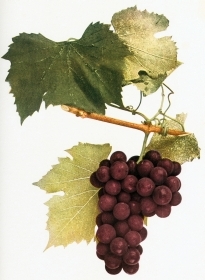
Vine similar to Clinton in growth and foliage, vigorous to very vigorous, hardy, produces average to good crops. Canes long, numerous, rather slender, light to dark brown; nodes prominent, flattened; internodes short; diaphragm below medium thickness; pith medium to above in size; shoots not pubescent; tendrils intermittent, long, bifid.
Leaf-buds intermediate in size, short, of average thickness, conical to nearly obtuse, open very early. Young leaves decidedly pale green with faintest trace of carmine, prevailing color green on both sides. Leaves medium to small, thin; upper surface light green, smooth; lower surface pale green, not pubescent; veins inconspicuous; lobes vary from none to three, terminal lobe acute; petiolar sinus medium to shallow, wide; basal sinus usually lacking; lateral sinus shallow; teeth intermediate in depth and width. Flowers open rather early, fertile; stamens upright.
Fruit ripens with Delaware and keeps unusually well. Clusters attractive, much like Delaware in shape and size but slightly longer and more often shouldered, compact to medium, averaging slightly looser than either parent; peduncle rather short, slender; pedicel longish, slender, covered with but few warts; brush short, light green. Berries intermediate in size, slightly larger than Delaware, roundish to slightly oval, resemble Delaware in color but somewhat darker when well ripened, covered with lilac bloom, persistent, of average firmness. Skin thin, somewhat tough, slightly adhering to pulp, contains no pigment, nearly astringent. Flesh pale yellowish-green, translucent, fine-grained, tender, inclined to melting, vinous, sweet to agreeably tart, sprightly, very good in quality. Seeds separate easily from the pulp, one to four, average three, slightly below medium in size, rather broad and blunt, brownish; raphe obscure; chalaza of average size, slightly above center, irregularly oval, distinct.
BERTRAND. (Bourquiniana.)
1. Am. Pom. Soc. Rpt., 1885:17. 2. Rural N. Y., 45:653, 660. 1886. fig. 3. Gar. Mon., 28:305. 1886. fig. 4. Bush. Cat., 1894:90. fig. 5. Texas Farm and Ranch, Feb. 8, 1896:11. 6. Ala. Sta. Bul., 110:78. 1900.
Blue Seedling (1, 3). Blue Seedling (4, 5).
Bertrand is a southern variety, almost without question an offspring of Herbemont, and so far as can be judged from the descriptions of others, we not having seen the fruit, not nearly equal to its parent. The variety is hardy only as far north as Maryland and even in that State must be planted in sheltered situations.
Judge J. B. Jones, Herndon, Burke County, Georgia, found Bertrand as an accidental seedling, which had germinated in the spring of 1878. Judge Jones gives the species as being Cordifolia but Berckmans says it looks like an Aestivalis; it is now generally classed in the Bourquiniana group. The following description of this variety is compiled from various sources:
Vine vigorous. Cluster above medium to rather large, usually conical, most often shouldered, moderately compact; peduncle long. Berries below medium in size, round, black with blue bloom; flesh melting, juicy, very high flavored. Skin thin, tough. Ripens late. Seeds few. Very productive in the South. Of value only for wine.
BLACK DEFIANCE. (Labrusca, Vinifera.)
1. Mass. Hort. Soc. Rpt., 1868:10. (No name given.) 2. Bush. Cat., 1883:75. 3. Okla. Sta. Bul., 14:6. 1895. 4. Husmann, 1895:31. 5. Mo. Sta. Bul., 46:37, 43, 76. 1899. 6. Ga. Sta. Bul., 53:41. 1901.
Underhill’s 8-8 Hybrid (2).
Black Defiance is one of Stephen Underhill’s Vinifera-Labrusca hybrids, at one time quite popular as a late table grape, but now superseded by thriftier varieties. It ripens too late to be of much value in New York. When phylloxera had driven French grape-growers to look to America for varieties of grapes, and before grafting on resistant stocks was practiced in that country, Black Defiance was looked upon with much favor in France where it succeeded very well. The fruit is distinguished by the size, lustrous blackness and handsome bloom of the berry. It is now rarely cultivated in New York having been replaced by varieties more certain to mature in this State.
Stephen Underhill of Croton-on-Hudson, New York, produced Black Defiance from seed of Concord fertilized by Black Prince. It first fruited in 1866. The variety was introduced without the originator’s consent.
Black Defiance is described as follows:[163]
BLACK EAGLE
“Growth medium, shoots smooth; leaves large, more or less three-lobed, with uneven margin; bunches large, oblong with large base, frequently branched; berries black, decidedly acid, pulp rather firm, ripe July 22nd; defoliated on October 6, 1896. Not good for table use.”
BLACK EAGLE. (Labrusca, Vinifera.)
1. Mass. Hort. Soc. Rpt., 1868:10. (No name given.) 2. Ohio Hort. Soc. Rpt., 1875-6:22. 3. Ib., 1876-7:32. 4. Bush. Cat., 1883:75. fig. 5. N. Y. Sta. An. Rpt., 12:618. 1893. 6. Tenn. Sta. Bul., Vol. 9:168. 1896. 7. N. Y. Sta. An. Rpt., 17:527, 548, 553, 559. 1898. 8. Tex. Sta. Bul., 48:1149, 1153. 1898. 9. Mo. Sta. Bul., 46:37, 42, 44, 46, 48, 76. 1899. 10. N. Y. Sta. An. Rpt., 18:370, 386, 396. 1899. 11. Kan. Sta. Bul., 110:240. 1902.
Underhill’s 8-12 (4).
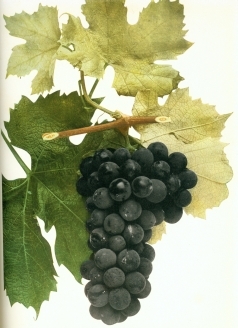
Black Eagle is a full brother of Black Defiance which it much resembles but surpasses for New York because it is fully three weeks earlier in ripening. On our grounds its season is about with Concord. The quality of Black Eagle is of the best, but the vine lacks in vigor, hardiness and productiveness and the fruit is susceptible to black-rot. As the color-plate shows, bunch and berry are large and attractive; bunches weighing nearly two pounds have been grown for exhibition purposes and probably there are few if any showier hybrid grapes than this when at its best. The leaf is that of Vitis vinifera, deeply lobed, of a beautiful green, and with firm texture, making with thrifty vines one of the most attractive grape plants to be found in our vineyards. The variety is self-sterile. Black Eagle has wholly failed as a commercial variety and its several weaknesses will prevent amateurs from growing it largely, yet it is far too good a grape to give up altogether and lovers of grapes should keep it in cultivation.
The variety originated with Stephen W. Underhill, Croton-on-Hudson, New York, from seed of Concord pollinated by Black Prince. It first fruited in 1866. The variety was sent out by Underhill for testing and was introduced without the originator’s consent.
Vine medium to vigorous, not always hardy, not productive. Canes rather rough, medium to long, of average number, thick, approaching dark reddish-brown, covered with slight blue bloom; nodes strongly enlarged, slightly flattened; internodes above medium length; diaphragm thick; pith of average size; shoots pubescent; tendrils continuous, long, bifid to trifid.
Leaf-buds intermediate in size, short, rather thick, pointed to conical, open very late. Young leaves tinged with carmine on the under surface and along margin of upper surface making the prevailing color a light rose-carmine. Leaves of average size, medium to thick; upper surface dark green, slightly glossy, smooth to rugose; lower surface pale grayish-green, somewhat pubescent; veins not distinct; lobes five in number, terminal lobe acute; petiolar sinus deep to narrow, often closed and overlapping; basal sinus very wide and deep; lateral sinus wide at bottom narrowing towards top, deep; teeth intermediate in depth and width. Flowers open in mid-season or later, fully self-sterile; stamens reflexed.
Fruit ripens in mid-season, keeps well if picked before overripe. Clusters of large to average size, rather long, tapering, varying from single-to double-shouldered, loose to compact; peduncle longish, rather thick; pedicel long to medium, somewhat slender, covered with very few warts, enlarged at point of attachment to fruit; brush short, pale green. Berries variable in size averaging large, slightly oval, black, glossy, covered with a moderate amount of blue bloom, do not shatter, somewhat soft. Skin thin, rather tender, adheres strongly to pulp, with slight amount of wine-colored pigment, not astringent. Flesh pale green, translucent, somewhat tender, vinous, not foxy, sweet at skin to agreeably tart at center, quality good. Seeds separate easily, one to four, average two or three, rather large and broad, nearly long.
BLACK HAMBURG. (Vinifera.)
1. Speechly, 1791:11,179. 2. London Hort. Soc. Cat., 1830:75. 3. Hoare, 1840:142. 4. Mag. Hort., 9:245. 1843. 5. Ib., 13:43. 1847. 6. Am. Pom. Soc. Cat., 1852:54. (For culture under glass.) 7. Horticulturist, 15:125. 1860. 8. Mag. Hort., 26:110. 1860. 9. Can. Hort., 11:59. 1888.
Admiral (4). Black Gibralter (4). Black Hamburgh (2). Black Portugal of some (4). Black Teneriffe (4). Blue Trollinger (4). Bocksaugen (4). Bommerer (4). Brown Hamburgh (4). Dutch Hamburgh (4). Fleish Traube (4). Frakenthaler (4). Frankendale (4). Frankenthaler gros noir (4). Gelbholziger Trollinger (4). Gibralter (4). Hampton Court Vine (4, 8). Hudler (4). Languedoc (4). Lugiana nera (4). Malvasier of some (4). Mohrendutte (4). Pale Wooded Trollinger (4). Purple Hamburgh (4). Red Hamburgh (4, of some 2). Richmond Villa Hamburgh (8). Salisbury Violet (4). Schwarzeblauer Trollinger (4). Schwarzer Gutedel of some (4). Schwarzwelscher (4). Troller (4). Trollinger (4). Valentines (4). Victoria (4). Warner’s (2, 4). Warner’s Black Hamburgh (2). Warner’s Black Hamburgh (4). Warner’s Hamburgh (8). Weissholziger Trollinger (4). Welscher (4).
BLACK HAMBURG (Reduced Size)
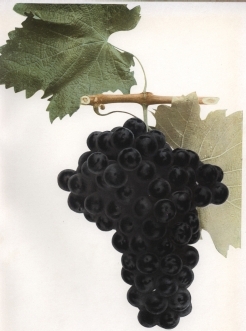
Black Hamburg is a variety of Vitis vinifera, impossible to grow out of doors in eastern America, but illustrated and described here because it is one of the parents of many hybrids with American species and because it represents, in fruit characters at least, about all that is desirable in a good grape. Since it is a standard of excellence which American breeders of table grapes have long sought to attain, we may name its points of superiority over the table grapes now grown in our vineyards. 1st. Bunch and berry are large, well formed, and uniform. 2nd. The fruits have a higher sugar and solid content than most American grapes and keep better, ship better, make better wine and will make raisins. 3d. The flavor, to most palates, is richer, more delicate, and lacks the acidity of some American grapes and the foxiness of others. 4th. The pulp and skin of Black Hamburg are more tender than the varieties of the species of this country and the seeds are readily separated from the pulp. 5th. The berries do not shell from the stem readily. 6th. The vines are more compact in habit, make a shorter and stouter annual growth, and hence require less pruning and training. 7th. The fruit is borne in greater quantity, vine for vine or acre for acre. Added to the above qualities which make it desirable as a parent when crosses are made between the grapes of this country and Vitis vinifera, are comparative hardiness among its kind, a short seasonal cycle of vegetation giving early maturity to fruit, ability to stand more hardships than most of its species, and especially ability to mature its fruit with as small amount of solar heat as any of its species. Its weaknesses when planted out of doors in eastern America are those of its species, which wholly prevent its successful cultivation in the vineyards of this region and make it of interest and value only in breeding and as an ideal toward which to breed.
The origin of Black Hamburg is apparently unknown. It was sent from Hamburg, Germany, to England sometime in the early part of the eighteenth century and it was in the latter country that it was given the several variations of the name Hamburg. In the north of Europe it is known as Frankendale or Frankenthal. Black Hamburg is grown in Europe chiefly as a forcing grape. It is doubtful if all the synonyms refer to one seed variety, but if not the same, they are so similar as to be difficult if not impossible to distinguish from each other.
Vine vigorous, tender, productive. Canes long, numerous, rather thick to medium, light brown but darker at nodes, covered with faint pubescence; nodes enlarged, slightly flattened; internodes short to medium; diaphragm thick; pith large; shoots slightly pubescent; tendrils intermittent, frequently several nodes with no tendrils, long, bifid to trifid, dehisce early.
Leaf-buds large to medium, rather long, somewhat thick, conical to obtuse. Leaves good size, thin; upper surface light green, rather dull, of average smoothness; lower surface slightly lighter than upper surface, with small amount of pubescence, hairy; veins moderately distinct; lobes vary from none to five, terminal lobe nearly acute; petiolar sinus often strongly urn-shaped, of average depth, nearly narrow, sometimes closed and overlapping; basal sinus shallow to narrow; lateral sinus rather deep to narrow, often notched; teeth very irregular in depth and width.
Fruit ripens early in October, keeps well. Clusters large, long to medium, rather broad, cylindrical to tapering, inclined to irregular, usually single-shouldered, nearly compact; peduncle medium to short, somewhat thick; pedicel long, slender, covered with small, numerous, prominent warts; brush short, thick, tinged with red. Berries rather large, oval to nearly roundish, dark purple to nearly black, slightly glossy, covered with faint blue or lilac bloom, do not drop from pedicel, moderate in firmness. Skin thin, tender, adheres to the pulp, contains no pigment, not astringent. Flesh pale green, tender, fine-grained, vinous, sprightly, rather sweet and refreshing, very good to best. Seeds separate easily, one to four averaging two or three, above medium size, long, rather narrow, sharply pointed, brownish; raphe obscure; chalaza intermediate in size, decidedly above center, distinct, circular to oval.
BLACK HAWK. (Labrusca.)
1. U. S. D. A. Rpt., 1865:197. 2. Fuller, 1867:236. 3. Gar. Mon., 9:147, 214. 1867. 4. Ill. Hort. Soc. Rpt., 1868:175. 5. Downing, 1869:531. 6. Grape Cult., 1:14, 15. 1869. 7. Mich. Pom. Soc. Rpt., 1878:482. 8. Bush. Cat., 1883:75. 9. Mo. Sta. Bul., 46:37, 42, 44, 46. 1899.
Miller’s No. 4 (1, 6).
Black Hawk is a seedling of Concord which it greatly resembles but all in all does not nearly equal. It is chiefly remarkable because of its very dark green foliage which at a little distance seems almost black. It is rarely or almost never cultivated in New York.
Samuel Miller of Calmdale, Lebanon County, Pennsylvania, in the fifties produced Black Hawk from Concord seed sent to him by E. W. Bull. The stock was bought and the variety introduced by a Mr. Knox of Pittsburg.
The following description was compiled from various sources:
Vine hardy, resembles Concord except for foliage being much darker. Bunch medium to sometimes large; berry medium to above, nearly round, black, of tender flesh but hardly good in quality; sometimes shatters. Ripens with Concord or slightly before. Self-sterile. Rather late in blooming.
BLACK IMPERIAL. (Labrusca, Bourquiniana, Vinifera.)
1. Mo. Hort. Soc. Rpt., 1891:127. 2. Bush. Cat., 1894:93. 3. Ga. Sta. Bul., 53:41. 1901.
Black Imperial is one of Dr. J. Stayman’s grapes. It has high quality and is handsome in appearance but is so susceptible to fungi as to be almost worthless and has now passed from cultivation.
Dr. J. Stayman of Leavenworth, Kansas, produced Black Imperial from seed of Dutchess some time in the eighties. The variety was first called Black’s Imperial. There was another variety preceding this which is mentioned by Prince[164] and Fuller[165] in the sixties by the name of Black Imperial.
The following description is taken largely from that of the originator:
Vine usually moderately vigorous and productive. Cluster large, shouldered, compact. Berries of medium size, black, tender, juicy; flavor sweet, vinous; quality good to very good. Flowers self-fertile. Quite subject to mildew and black-rot.
BLACK PEARL. (Riparia, Labrusca?)
1. Mich. Pom. Soc. Rpt., 1875:459. 2. Ohio Hort. Soc. Rpt., 1876-7:90. 3. Ib., 1882-3:49. 4. Bush. Cat., 1883:75. 5. Mo. Hort. Soc. Rpt., 1884:215. 6. Mo. Sta. Bul., 46:37, 43, 45, 46. 1899.
Schraidt’s Seedling (1, 2). Schraidt’s Seedling (3, 4).
Viticulturists agree that Black Pearl is but an improved Clinton, notwithstanding the originator’s statement that it came from seed of Delaware. Unfortunately the vine is not in the Station vineyard and our estimate of its vine characters is taken from the descriptions of others. According to the Bushberg Catalogue,[166] “The vine is a vigorous healthy grower similar in appearance of growth and foliage to Elvira and Noah.” The bunches and berries, as they have been sent to this Station, are larger than Clinton and of better quality though of small value as a table fruit. It seems well agreed among wine-makers that Black Pearl makes an exceptionally good red wine equalling or surpassing any other of our northern varieties for this purpose. Without doubt, from the many testimonials as to its value for wine-making, it can be highly recommended for this purpose and as a good starting point from which to breed wine grapes. So far, though grown for more than thirty years, its culture is confined to the islands in Lake Erie devoted to grape-growing and the variety can hardly be said to be known in New York. It is probably too late for most parts of New York as it ripens with Catawba.
Black Pearl was originated by Casper Schraidt of Put-in-bay, Ohio, over thirty years ago. The originator states that it is a seedling of Delaware but this has generally been discredited, as the vine is evidently of the Riparia type. Bush says it is probably a seedling of Clinton or Taylor.
Vine a strong grower, does not winter-kill, usually a good yielder, susceptible to attacks of mildew. Canes are long, numerous, and of average thickness. Leaves are intermediate in size. Flowers open in mid-season or before, sterile or nearly so; stamens reflexed.
Fruit ripens with Catawba, keeps fairly well. Clusters small to medium, larger than Clinton, medium to rather slender, tapering to cylindrical, often single-shouldered, intermediate to compact. Berries below medium to very small, roundish, oblate or frequently compressed on account of compactness of cluster, black, glossy, covered with a moderate amount of blue bloom, persistent, firm. Skin thin, tender, adheres strongly to the pulp, contains an unusually large amount of purplish-red pigment, astringent. Flesh moderately juicy, usually with a decided red tinge, nearly tender, slightly spicy, tart, medium to below in flavor and quality. Seeds, which adhere but little to the pulp, are medium to below in size, short to medium, broad, slightly notched, blunt, dark brown; raphe obscure; chalaza central, oval to circular, distinct.
BRANT. (Riparia, Labrusca, Vinifera.)
1. Downing, 1869:532. 2. Am. Jour. Hort., 6:91. 1869. fig. 3. Mich. Hort. Soc. Rpt., 1872:553. 4. Bush. Cat., 1883:77. fig. 5. Kan. Sta. Bul., 44:119. 1893. 6. Tex. Sta. Bul., 48:1149, 1154. 1898.
Arnold’s No. 8. (1, 2, 4).
Brant and Canada are full brothers and so near alike that the two are often confounded with each other. Neither has ever become popular in North America because of their susceptibility to fungi. As Riparia and Vinifera hybrids, the best of Arnold’s seedlings from crosses of these two species, they are of interest and of possible value in grape-breeding. Since Brant and Canada are so nearly alike a discussion of one will suffice for both and this is reserved for Canada, the better known and more valuable of the two varieties.
Charles Arnold of Paris, Canada, produced this variety sometime in the sixties. It is a seedling of Clinton pollinated by Black St. Peters. The following description of it is taken from Downing’s Fruits and Fruit-Trees of America:[167]
“Vine strong, healthy grower. Foliage of a dark reddish green, deeply lobed. Smooth on both sides. Bunch and berry medium, black. Flesh free from pulp, very juicy, sweet, and, when perfectly ripe, rich and aromatic. Ripens early.”
BRIGHTON. (Labrusca, Vinifera.)
1. Mich. Hort. Soc. Rpt., 1872:548. 2. Gar. Mon., 16:344. 1874. 3. Am. Pom. Soc. Cat., 1881:24. 4. Downing, 1881:165 app. 5. Bush. Cat., 1883:78. fig. 6. Rural N. Y., 45:622. 1886. 7. Ill. Sta. Bul., 28:258. 1893. 8. N. Y. Sta. An. Rpt., 17:527, 540, 543, 545, 546, 548, 549, 552, 553, 559. 1898. 9. Ib., 18:367, 371, 386, 396. 1899. 10. Mo. Sta. Bul., 46:37, 42, 44, 45, 48, 54. 1899. 11. Mich. Sta. Bul., 169:164. 1899. 12. W. N. Y. Hort. Soc. Rpt., 1899:91. 13. Mo. Hort. Soc. Rpt., 1900:364. 14. Can. Hort., 27:345, 392. 1904.
Trask (12).
Brighton is one of the few Labrusca-Vinifera hybrids which have attained prominence in commercial vineyards. It has the distinction, too, of being one of the first, if not the first, secondary or attenuated hybrid of Labrusca with Vinifera, i. e., the offspring of a hybrid crossed with one of the original parents or with a variety of the same species. The parents of Brighton were Diana Hamburg, a hybrid of Vinifera crossed with Labrusca, and Concord, a pure-bred Labrusca. As we have seen, the first or primary hybrids of Vinifera with Labrusca have given grapes of high quality, but lacking in vigor, in resistance to fungi and phylloxera, and for most part infertile in bloom. The secondary hybrids have not shown the weaknesses of the primary hybrids in nearly so marked a degree but have given, in many instances, as in Brighton, Diamond and probably Delaware, varieties of nearly as high quality. It is now generally recognized by viticulturists that the secondary hybrids with Vinifera promise much more than do the primary ones and it is no mean distinction that Brighton has of being the first secondary hybrid brought about by the hand of man.
Brighton ranks as one of the leading amateur grapes in New York and is among the ten or twelve chief commercial sorts of the State. Its good points are: High quality, handsome appearance, certainty of ripening, being earlier than Concord, vigorous growth, productiveness, adaptability to various soils, and, for a hybrid, ability to withstand fungi. It is thus seen that the infusion of foreign blood has given the fruit of Brighton some of the excellencies of Vitis vinifera while the preponderance of Vitis labrusca blood has preserved the vigor and hardiness of the native species. Brighton has two serious defects which no doubt have kept it from taking higher rank as a commercial variety: It deteriorates in quality very quickly after maturity so that it cannot be kept for more than a few days at its best, hence cannot be well shipped to distant markets; and it is self-sterile to a more marked degree than any other of our commonly grown grapes. To have it at its best the fruit should be thinned.
This grape is a signal example of a variety resulting from careful and skilful work in grape-breeding. Its originator, Jacob Moore,[168] possessed of a high degree of intelligence and an unusually keen sense of the latent possibilities in plants, with unwearied perseverance spent years in the attempt to produce grapes combining the good characters of the Old and the New World grapes. As a result of his zeal and patience we have Brighton and Diamond, the most valuable grapes of their class. Jacob Moore’s demonstration of the value of the secondary hybrid, and these two grapes, must serve to commemorate a life spent in self denial, imposed poverty and comparative obscurity that horticulture might be enriched.
Brighton is a seedling of Diana Hamburg pollinated by Concord, raised by the late Jacob Moore at Brighton, New York. The original vine fruited for the first time in 1870 and fruit was first exhibited at the meeting of the New York Horticultural Society in 1872.
BRIGHTON
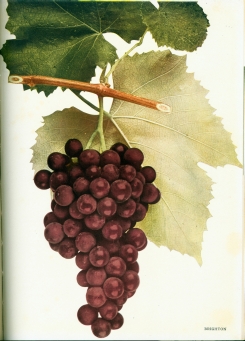
Vine vigorous and hardy, producing average to good crops, often subject to mildew. Canes long, numerous, thick, rather light brown; nodes slightly enlarged, usually flattened; internodes long to medium; diaphragm thick; pith nearly large; shoots glabrous, slightly pubescent; tendrils continuous, long, bifid.
Leaf-buds of average size, short, stout, conical to pointed, sometimes slightly compressed, open moderately early. Young leaves lightly tinged with rose-carmine on lower surface, strongly tinged along margin of upper surface. Leaves medium to large, thick; upper surface dark green, dull, moderately smooth; lower surface pale green, slightly pubescent; veins not distinct; lobes three when present, terminal lobe acute to acuminate; petiolar sinus nearly intermediate in depth and width; lateral sinus shallow to medium in depth and width; teeth of average depth, narrow. Flowers open somewhat late, sometimes on plan of six, sterile; stamens reflexed.
Fruit ripens somewhat unevenly about mid-season, keeps fairly well for a short time but deteriorates rapidly after ripening. Clusters very large to medium, usually long, broadish, tapering, often heavily shouldered, loose to compact; peduncle quite long; pedicel of average length, somewhat thick, covered with few indistinct warts, broad at point of attachment to berry; brush pale green with brown tinge, thick, short. Berries irregular, medium to rather large in size, roundish to slightly oval, light and dark red, somewhat glossy, covered with dark lilac bloom, handsome, persistent, not firm. Skin thickish, very tender, adheres considerably to the pulp, contains no pigment, astringent. Flesh greenish, rather transparent, tender, slightly stringy, melting, aromatic, vinous, sweet or agreeably tart to center of berry, very good in quality. Seeds separate easily, number one to five, average three or four, above mean size, rather broad and sharply pointed, light brown with yellow tinge; raphe shows as a narrow obscure groove; chalaza large, above center, irregularly circular, distinct.
BRILLIANT. (Labrusca, Vinifera, Bourquiniana.)
1. An. Hort., 1889:101. 2. Rural N. Y., 49:602. 1890. fig. 3. Am. Pom. Soc. Rpt., 1891:151, 159. 4. Am. Pom. Soc. Cat., 1891:32. 5. Kan. Sta. Bul., 28:162. 1891. 6. Ill. Sta. Bul., 28:259. 1893. 7. N. Y. Sta. An. Rpt., 12:618. 1893. 8. Bush. Cat., 1894:96. fig. 9. Husmann, 1895:124. 10. Can. Hort., 18:3, 4, 58. 1895. fig. 11. Ga. Sta. Bul., 28:290. 1895. 12. Tenn. Sta. Bul., Vol. 9:170, 171, fig., 195. 1896. 13. Kan. Sta. Bul., 73:183. 1897. 14. Rural N. Y., 58:22. 1899. 15. Mo. Sta. Bul., 46:43, 48. 1899. 16. N. Y. Sta. An. Rpt., 18:396. 1899. 17. Tex. Sta. Bul., 56:275. 1900.
In Brilliant, one of Munson’s grapes, from Lindley crossed with Delaware, we have a fine red grape in which the characters of the two parents are so nearly equally combined that it cannot be said which it most resembles. In cluster and size of berry, Brilliant resembles Lindley; in color and quality of fruit it is about the same as Delaware, differing from it chiefly in having more astringency in the skin and therefore not quite equal to Delaware as a table grape. The vine is strong and hardy; season about with Delaware. Brilliant does not crack or shell and therefore ships well, and has very good keeping qualities, especially on the vine, where it will often hang for weeks. The defects which have kept it from becoming one of the standard commercial sorts in New York are: Marked susceptibility to fungi but not more susceptible than Delaware; variable in size of cluster; uneven in ripening; and lack of productiveness. Brilliant is well known by amateur grape-growers in New York and is grown somewhat for the market. All in all it is probably the best known and most widely grown of Munson’s varieties in this State. In favorable situations, this variety may always be expected to please the amateur, and the commercial grower will often find it a profitable sort.
The seed which produced Brilliant was planted by Munson in 1883 and the variety was introduced by him in 1887. It has been widely tested by experimenters and grape-growers and is highly spoken of, whether in the East, West, North or South.
Vine variable in growth averaging vigorous, usually hardy, not always productive. Canes long, numerous, thick, darkish-brown; nodes enlarged, usually flattened; internodes long to medium; diaphragm thick; pith large, shoots pubescent; tendrils intermittent, long, bifid.
Leaf-buds somewhat large, short, thick, obtuse to conical, open late. Young leaves heavily tinged on both sides with mahogany-red changing to light carmine. Leaves medium to large, thick; upper surface dark green, dull, rugose; lower surface grayish-green, downy; veins well defined; entire or obscurely three-lobed with terminal lobe blunt to acute; petiolar sinus deep, narrow, V-shaped; basal and lateral sinuses obscure and shallow when present; teeth intermediate in depth and width. Flowers open medium late, fertile; stamens upright.
Fruit ripens unevenly, in season about with Delaware, keeps a long time. Clusters average larger than Delaware, intermediate in length and breadth, often blunt, cylindrical to somewhat conical, usually slightly shouldered, medium to compact; peduncle rather thick; pedicel medium to short, thick, covered with few small warts, wide at point of attachment to berry; brush short, thick, pale green with reddish-brown tinge. Berries average larger than Delaware, roundish to very slightly oval, attractive dark red, not so brilliant as Delaware but more so than Brighton, rather glossy, covered with abundant lilac bloom, adhere strongly to pedicel, firm. Skin rather thin and tough, adheres considerably to pulp, contains no pigment, slightly astringent. Flesh pale green, rather transparent, juicy, slightly stringy, inclined to tenderness when fully ripe, fine-grained, vinous, sweetish at skin but tart next the seeds, good but not equal to Delaware. Seeds cling somewhat to pulp, one to four in number, average three, rather large and broad, slightly elongated, plump, light brown; raphe obscure; chalaza large, slightly above center, irregularly circular to slightly oval, distinct.
BRILLIANT
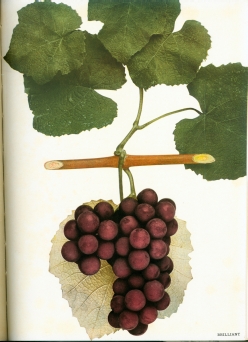
BROWN. (Labrusca, Vinifera?)
1. N. Y. Sta. An. Rpt., 12:619. 1893. 2. Bush. Cat., 1894:96. 3. N. Y. Sta. An. Rpt., 14:277. 1895. 4. Ib., 17:527, 548, 554. 1898. 5. Am. Pom. Soc. Rpt., 1899:90. 6. Rural N. Y., 59:722. 1900. 7. Ib., 65:914. 1906. 8. Ib., 65:937. 1906. 9. Ib., 66:24. 1907.
Brown’s Early (7, 9). Brown Seedling (5, 6, 8).
Wm. B. Brown of Newburgh gives the history of the grape bearing his name as follows:[169] “Brown’s seedling came up in my yard at Newburgh, New York, about fifteen years ago [this statement was made in 1899] near an Isabella vine. There was not and never had been any other vine in the yard at that time.” The statement is further made that Charles Downing examined the vine several times and said “there was no doubt but that it was a seedling of the Isabella.” Brown was exhibited at the New York State Fair in 1892 and was given a first prize. It was again exhibited at the World’s Columbian Exposition in 1893 and was awarded a diploma and honorable mention. The originator states that the variety “has been exhibited in at least twenty-five fairs and has always received first prize.” Since 1892 Brown has been several times described with favorable mention in the horticultural press. This variety was distributed in 1907 to the subscribers of the Rural New Yorker as Brown’s Early. In spite of the encomiums of fairs and newspapers during the past fifteen or twenty years, Brown has not received favorable recognition from the grape-growers of New York. As the variety grows on the Station grounds the quality is only good, not high, and the berries shatter badly.
Vine vigorous to medium, hardy, very productive. Canes medium to short, intermediate in number, medium to slender, moderately dark brown. Leaves of average size and thickness, healthy, rather light green, slightly glossy; veins well defined, distinctly showing through the thick bronze pubescence of the lower surface. Flowers open medium early, nearly fertile; stamens upright. Tendrils continuous; diaphragm below medium to thin.
Fruit ripens about with Hartford or a little earlier, appears to keep fairly well, inclined to shatter. Clusters variable in size, averaging medium to small, of mean length, slender to medium, cylindrical to slightly tapering, usually single-shouldered, loose to medium in compactness. Berries intermediate in size, roundish to slightly oval, black, covered with rather thick blue bloom, inclined to shatter from cluster soon after ripening, of average firmness. Skin intermediate in thickness and toughness, adheres slightly to the pulp, contains a small amount of wine-colored pigment, astringent. Flesh juicy, rather tough, fine-grained, foxy, mild next the skin to slightly tart at center, good in quality but not equal to the best varieties. Seeds intermediate in size, medium to short, rather blunt, light brown; raphe buried in a shallow groove; chalaza small, central to slightly above center, circular, moderately distinct.