Chapter V · THE LEADING VARIETIES OF AMERICAN GRAPES (continued 4)
Reading edition
Vine moderately vigorous to vigorous, not very hardy, healthy, produces smaller crops than Concord. Canes intermediate in length and number, covered with slight blue bloom; tendrils intermittent to continuous, bifid to trifid. Leaves medium in size, light green; lower surface grayish-white, pubescent. Flowers nearly sterile to partly fertile, open medium late; stamens upright. Fruit ripens soon after Niagara, ships well and keeps into the winter. Clusters medium to above in size, of average width, often blunt at ends, usually not shouldered, intermediate in compactness, with many abortive fruits. Berries medium to large, slightly oval or obovate, dull green changing to a faint yellow tinge, covered with thin gray bloom. Flesh pale green, tender and soft, vinous, nearly sweet at skin to tart at center, fair to good in quality but not equal to some other white grapes of the same season. Seeds intermediate in size and length.
GLENFELD.[189] (Labrusca.)
1. N. Y. Sta. An. Rpt., 11:624. 1892. 2. Am. Pom. Soc. Cat., 1897:19. 3. N. Y. Sta. An. Rpt., 17:530, 548, 555. 1898.
Grown in the Station vineyard since 1889, Glenfeld has made a somewhat favorable impression because of its excellent quality but it seems not to have been well received throughout the State and it is doubtful if it has more than a local reputation about the place of its origin. It is equaled or surpassed, however, by many other varieties of its season in vine characters and there is therefore little need that it should be longer perpetuated, though it may be worthy a place in the garden.
Glenfeld was found on the place of George J. Magee of Watkins, New York. Mr. Magee reports that the vine was on the place when he purchased it and the former owner knew nothing of it. The variety was locally supposed to be a seedling of Concord. It was sent to this Station for testing in 1889. For some reason it was placed upon the grape list of the American Pomological Society fruit catalog for 1897. Such action was hardly justified, as the variety had never been tested except in one or two neighborhoods, and it was taken off at the next meeting.
Vine vigorous, hardy except in severe winters, produces good crops. Canes long, numerous to medium, intermediate in thickness; tendrils continuous to intermittent, bifid to trifid. Leaves often very large, variable in color, medium to thick; lower surface tinged with bronze, strongly pubescent. Flowers nearly fertile, open in mid-season or earlier; stamens upright. Fruit ripens early in October, keeps fairly well. Clusters large to below medium, variable in shape, usually with a medium-sized single shoulder, not uniform in compactness. Berries nearly large to below medium, roundish, unique in color being a rather dull olive green covered with ash-gray bloom, somewhat inclined to shatter. Flesh tender, vinous, with an agreeable flavor, sweet at skin to tart at center, good in quality. Seeds medium to below in size, broad.
GOETHE. (Vinifera, Labrusca.)
1. Am. Pom. Soc. Rpt., 1860:86. 2. Mass. Hort. Soc. Rpt., 1861:68. 3. Horticulturist, 18:98, 99. 1863. 4. U. S. D. A. Rpt., 1867:160. 5. Am. Pom. Soc. Cat., 1867:44. 6. Horticulturist, 24:126. 1869. 7. Am. Jour. Hort., 5:261. 1869. 8. Grape Cult., 1:43, 150, 180, 239, 241, fig., 242, 296. 1869. 9. Am. Pom. Soc. Rpt., 1881:38, 162. 10. Bush. Cat., 1883:101, fig., 102. 11. Tex. Sta. Bul., 48:1150, 1157. 1898. 12. Mo. Sta. Bul., 46:39, 43, 44, 45, 50, 54. 1899. 13. Miss. Sta. Bul., 56:14. 1899.
Rogers’ No. 1 (1, 2, 3, 4, 5). Rogers’ No. 1 (6, 7, 8, 10).
Of all Rogers’ hybrids Goethe shows most of the Vinifera characters, resembling in appearance to a marked degree the White Malaga of European fame and not falling far short of the best Old World grape in quality. This is when it is well grown; but here lies the fault with Goethe, for it is most difficult to grow well especially in the North where the seasons are usually not long enough for its full maturity. When it does ripen in northern latitudes it is unsurpassed in flavor by any other of the grapes of its class. The vine is hardy in New York; vigorous to a fault, for in very rich soils it makes too great a growth; it does best in sands or gravels; it is fairly immune to mildew, rot and other diseases; and where it succeeds often bears so freely that thinning becomes a necessity. Added to its high quality, which makes it a splendid table grape, Goethe keeps well, lasting long into the winter. It is excellent for wine though it is too difficult to grow to make it profitable for this purpose. Unfortunately this variety ripens so late that it cannot be recommended for New York. The accompanying color-plate does not do the variety full justice as good specimens could not be obtained for illustration in the unfavorable season of 1907. Neither size, nor shape of cluster, nor color of fruit are quite as we should like to have them shown.
GOETHE

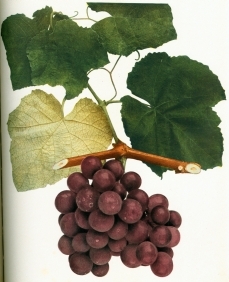
E. S. Rogers of Salem, Massachusetts, produced Goethe as one of his famous Labrusca-Vinifera hybrids and for its early history the reader is referred to “Rogers’ Hybrids.” It is first mentioned separately from others of these productions in 1858 under the name Rogers’ No. 1. It was placed upon the grape list of the American Pomological Society fruit catalog in 1867, where it still remains. In 1869 Mr. Rogers named the grape Goethe after the great German poet and naturalist. While highly esteemed in the North, it succeeds better and is therefore more commonly grown in the Middle and South Atlantic States and in the valleys of the Ohio and of the lower Missouri.
Vine vigorous to medium, hardy, variable in productiveness, somewhat subject to mildew in unfavorable locations. Canes above medium to short, of average number and thickness, rather dark brown; nodes enlarged, slightly flattened; internodes very short; diaphragm thick; pith below medium in size; shoots strongly pubescent; tendrils continuous with tendency to intermittent, rather long, bifid to trifid.
Leaf-buds intermediate in size, length and thickness, conical to nearly obtuse, open very late. Young leaves tinged lightly on under side and along margin of upper side with rose-carmine. Leaves variable in size, irregularly roundish, medium to somewhat thin; upper surface light green, glossy, of average smoothness; lower surface pale green to bronze, pubescent, veins very distinct; leaf usually not lobed, with terminus broadly acute; petiolar sinus of average depth, narrow, closed and frequently overlapping; basal sinus usually lacking; lateral sinus shallow, often a mere notch; teeth shallow to medium, rather narrow. Flowers partly fertile, open in mid-season; stamens upright.
Fruit ripens considerably later than Concord, keeps unusually well. Clusters intermediate in size, short to medium, rather broad, widely tapering, frequently single-shouldered, usually two bunches to a shoot, intermediate in compactness; peduncle short to medium, of average thickness; pedicel nearly long, thick, covered with numerous, conspicuous warts, wide at point of attachment to berry; brush long, slender to stout, pale green to yellowish-brown. Berries very large to above medium, oval to nearly roundish, pale red, covered with thin gray or slightly lilac bloom, persistent, of average firmness. Skin thin, tender to medium, adheres slightly to the pulp, contains no pigment, faintly astringent. Flesh pale green, translucent, inclined to tenderness, rather coarse, nearly sweet at skin but decidedly tart at center, with some Vinifera sprightliness, ranking good to very good in quality, does not reach its best flavor in many localities in this State. Seeds separate from the pulp with difficulty unless fully ripe, one to three, average two, large, long, of average thickness, very slightly notched, inclined to bluntness, brownish; raphe obscure; chalaza of fair size, decidedly above center, pear-shaped, distinct. Must 78°.
GOFF. (Labrusca, Vinifera, Aestivalis.)
During the quarter century the New York Agricultural Experiment Station has been in existence, the breeding of grapes has been one of the chief lines of horticultural work. Professor E. S. Goff, the first Station horticulturist, began this work as early as 1885 and produced a number of seedling grapes which were numbered but not named. In continuing this work, Professor S. A. Beach, successor to Professor Goff, planted seed from some of the original seedlings and from one of these came a somewhat remarkable grape to which we have given the name Goff. This new variety first bore fruit in 1898 and at once attracted attention. In 1901 it was awarded a silver medal as a meritorious seedling at the Pan-American Exposition. Specimens of it sent to several viticultural experts were highly spoken of and in the years it has been in fruit on the Station grounds it has made a most excellent record.
Unfortunately the pedigree of this grape can never be known. Not only were the parents of the original seedling unknown, but the immediate parent was open to cross-pollination in a vineyard of many varieties. All who have examined the fruit and vines of Goff are well agreed that the variety shows very distinctly Labrusca and Vinifera characters and some maintain that there are indications of Aestivalis as well. As to the proportion of these three species, if all be present, no one would care to hazard a guess.
The general appearance of Goff is well shown in the accompanying color-plate though the cylindrical shape and enlarged lower end of the bunch are more pronounced than in typical specimens. Because of the peculiar shape of both bunch and berry the fruit cannot be called handsome though the color is sufficiently attractive. The quality of Goff is of the highest, being hardly surpassed by any of the commonly grown grapes of this country. The flavor is sweet, rich and vinous and the pulp, while firm, is tender and readily parts from the seeds. In general the flavor is that of a Labrusca-Vinifera hybrid though there is a spiciness in it that suggests an admixture of Aestivalis; the flesh characters are better than those of the average hybrid of the two first named species, being less pulpy and coarse. Probably the most valuable character of Goff is the long keeping quality of the fruit in which respect it far surpasses the several commercial varieties of this State and equals the best keeping American grapes known. In a test during the winter of 1907-08 of the keeping qualities of 255 varieties of grapes from the Station vineyards, kept in eight-pound baskets in common storage, unwrapped, Goff was one of the four best keepers, Canandaigua, Wilder and Vergennes being the other three. These four varieties kept in very good condition until April 16, and under circumstances not altogether favorable.
GOFF
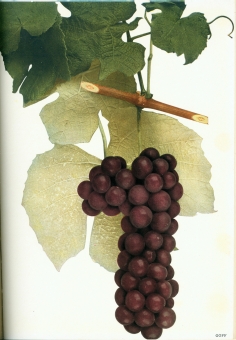
The vine characters of Goff are exceptionally good on the Station grounds. The vines are vigorous, hardy, very productive, and the foliage is healthy. All of the above characters are developed to an extent seldom found in a variety showing the specific blood indicated in the Goff. In these respects, taking all of them, this variety surpasses any of Rogers’ hybrids, grapes with which it can be best compared. The variety is now distributed for testing in the various grape regions of the State and if the reports of its behavior are satisfactory, it will be generally distributed within a few years.
Vine vigorous to very vigorous, hardy, very productive. Canes medium to long, numerous, often rather thick, dark brown with slight reddish tinge; nodes enlarged, flattened; internodes intermediate in length; diaphragm thick to medium; pith of average size; shoots pubescent; tendrils continuous, sometimes intermittent, long, bifid to trifid.
Leaf-buds intermediate in size and thickness, short to medium, plump, conical to roundly obtuse, open in mid-season. Young leaves tinged on lower side and along margin of upper side with light rose-carmine. Leaves healthy, medium to large, of average thickness; upper surface light green; smooth to rugose, dull; lower surface pale green, slightly cobwebby; veins fairly distinct; lobes three to five in number with terminal lobe obtuse to acute; petiolar sinus deep, narrow; basal sinus medium to shallow, rather wide; lateral sinus deep, wide; teeth shallow, of average width. Flowers fertile, open in mid-season or later, sometimes on plan of six; stamens upright.
Fruit ripens a little later than Concord, keeps unusually well. Clusters variable in size, long to medium, frequently very slender, cylindrical, surface of cluster often irregular with blunt end larger than the part above, usually not shouldered, or with a small single shoulder, compact; peduncle usually short, intermediate in thickness; pedicel rather short, of average thickness, covered with few, if any warts, wide at point of attachment to fruit; brush short, slender, pale green with faint brown tinge. Berries variable in size, averaging about the size of Concord, frequently misshapen, strongly flattened, not uniform, dark reddish-purple, covered with heavy lilac or bluish bloom, persistent, firm. Skin thick, intermediate in toughness, adheres slightly to the pulp, with bright red pigment, slightly astringent. Flesh pale green, translucent, juicy, tender, a little coarse, somewhat vinous, sweet from skin to center, very good in quality. Seeds separate easily from the pulp, one to five, average three, intermediate in size, variable in breadth, of medium length, rather sharp-pointed, light brownish; raphe obscure; chalaza of fair size, above center, distinct.
GOLD COIN. (Aestivalis, Labrusca.)
1. Kan. Sta. Bul., 28:162. 1891. 2. Ill. Sta. Bul., 28:264. 1893. 3. Bush. Cat., 1894:128. 4. Husmann, 1895:129. 5. Kan. Sta. Bul., 73:183. 1897. 6. Am. Pom. Soc. Cat., 1899:28. 7. Tex. Sta. Bul., 56:267, 277. 1900. 8. Rural N. Y., 61:722. 1902.
Gold Coin is at the head of Munson’s “Gold Coin Family”[190] having been produced by crossing Norton and Martha. Unfortunately the variety is only of general interest in New York as it does not succeed so far north, the summer seasons being too short. Where it succeeds it is a handsome market variety of very good quality and makes an excellent white wine. The vines are productive and are reported to be unusually free from attacks of fungal diseases.
As indicated in the preceding paragraph, this variety was originated by T. V. Munson of Denison, Texas. It sprung from seed of Cynthiana or Norton[191] pollinated by Martha which was planted in 1883 and was introduced by the originator in 1894. Gold Coin was placed on the grape list of the American Pomological Society fruit catalog in 1899.
Vine medium to vigorous, hardy, produces heavy crops. Canes intermediate in length and number, rather slender; tendrils continuous and sometimes intermittent, trifid to bifid. Leaves medium to above in size, moderately light green, slightly rugose; lower surface pale green, tinged with bronze, heavily pubescent. Flowers nearly fertile; stamens upright. Fruit ripens after mid-season, keeps long in good condition. Clusters medium to small, not very long, usually single-shouldered, variable in compactness. Berries large to below medium, roundish to slightly oval, yellowish-green with a distinct trace of reddish-amber, covered with a medium amount of gray bloom, usually persistent. Skin covered with small scattering brown dots, thin, inclined to toughness. Flesh somewhat tough, faintly aromatic, tart from skin to center, good in quality. Seeds separate easily from the pulp, somewhat numerous, above medium to medium in size, not notched; raphe shows as a distinct cord.
GOLDEN DROP. (Labrusca, Vinifera, Bourquiniana.)
1. Montreal Hort. Soc. Rpt., 1880:112. 2. Bush. Cat., 1883:102. fig. 3. Barry, 1883:447. 4. W. N. Y. Hort. Soc. Rpt., 28:17. 1883. 5. Ga. Sta. Bul., 53:44, 51. 1901.
Golden Drop is an early white grape now nearly lost to cultivation but once somewhat popular because of its high quality. Its hardiness and earliness might make it a valuable grape for northern latitudes where more commonly cultivated varieties do not mature with certainty. It is somewhat susceptible to fungal diseases, mildew especially, and needs more than ordinary care.
This variety was originated by C. G. Pringle of Charlotte, Vermont, from seed of Adirondac fertilized with Delaware, planted in 1869 and introduced by B. K. Bliss of New York, about 1880. It has never been popular but is still sold by an occasional nurseryman.
Vine vigorous to weak, not productive, inclined to mildew. Canes long to medium, numerous, dark brown; tendrils continuous to intermittent, bifid. Leaves intermediate in size, light green; lower surface pale green, very slightly pubescent. Flowers sterile or nearly so, open in mid-season; stamens upright. Fruit ripens shortly before Niagara, keeps well. Clusters small, of medium length, slender, rather cylindrical, loose. Berries medium to small, roundish to slightly oval, light green with dull yellowish-red tinge in the sun, covered with thin gray bloom, persistent. Flesh tender and soft, not foxy, sweet, very mild, good in quality. Seeds medium to small, short.
GREEN EARLY. (Labrusca, Vinifera?)
1. Ill. Hort. Soc. Rpt., 1902:223. 2. Ib., 1905:296.
Green Early is a white grape coming in season with Winchell which surpasses it in most characters, quality in particular. This variety is not to be confused with “Chas. A. Green,” also a white grape, which was originated by F. W. Loudon of Janesville, Wisconsin, and was introduced by Chas. A. Green of Rochester. We have not been able to get a complete description of the latter variety.
Green Early was found growing by the side of a ditch near a Concord vineyard, on land belonging to O. J. Greene of Portland, Chautauqua County, New York. The vine was transplanted into a nursery in 1887. The parentage of the variety is unknown but it is credited to Concord owing to its resemblance to that variety. It was introduced in the late nineties by J. H. Greene of Portland, New York, and H. W. Blowers of Westfield, New York.
Vine medium to very vigorous, usually hardy, productive. Canes variable in length and thickness, dark-reddish brown; tendrils continuous, sometimes intermittent, bifid to trifid. Leaves variable in size, medium green; lower surface pale green, pubescent; stamens upright. Fruit ripens about with Moore Early or with Concord in some locations, does not keep long and is only a fair shipper. Clusters variable in size, length and breadth, sometimes single-shouldered, variable in compactness. Berries above medium to nearly small, oval to slightly roundish, light green tinged with yellow, covered with thin gray bloom, moderately persistent, rather soft. Skin nearly thin, tender, inclined to crack. Flesh slightly tough and aromatic, almost sweet at skin to acid at center, fair flavor and quality. Seeds medium to below in size, intermediate in length and breadth, sharp-pointed.
GREIN GOLDEN. (Riparia, Labrusca.)
1. Am. Pom. Soc. Rpt., 1881:33. 2. Ill. Hort. Soc. Rpt., 1881:162, 164. 3. Bush. Cat., 1883:103. 4. Kan. Hort. Soc. Rpt., 1889-90:20. app. 5. Gar. and For., 3:290, 490, 599. 1890. 6. Ala. Sta. Bul., 10:10. 1890. 7. Ill. Sta. Bul., 28:264. 1893. 8. N. Y. Sta. An. Rpt., 15:294. 1896. 9. Ib., 17:531, 548, 555. 1898.
Grein’s No. 2 (3).
Grein Golden ranks with Missouri Riesling as the best of Nicholas Grein’s several seedlings of Taylor, both being improvements over the parent variety. It is very similar to Missouri Riesling but is, on the Station grounds, and in general, a much stronger grower. For a variety of the Taylor group, both cluster and berry are large and uniform, which, with the attractive golden color of the berries, make it a most handsome fruit. But as the variety grows in New York the flavor is not at all pleasing, being an unusual commingling of sweetness and acidity quite disagreeable to most palates; and so while its habit of growth, hardiness, health of vine and productiveness are such as would make the variety acceptable the quality of the fruit condemns it for table use. In fact the last remark applies in a greater or less degree to all of the varieties of the Taylor group for this State—they fall so far short in quality that they can never be of value as market or table grapes. All are suitable for wine and Grein Golden in particular is said to make a very good white wine. The fruit of this variety cracks badly in wet weather and does not keep nor ship well, skin and flesh being very tender.
GREIN GOLDEN
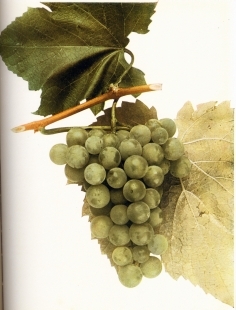
Nicholas Grein of Hermann, Missouri, produced Grein Golden over thirty years ago. It is generally supposed to be from seed of Taylor. Grein states that he planted seed of the European Riesling and of Taylor at the same time, and that the Taylor did not germinate but that the European Riesling did, one of the seedlings being Grein Golden. As the Grein Golden shows Riparia very plainly, with no trace of Vinifera, it is generally supposed that the seeds were mixed and that Grein Golden is a Taylor seedling. The variety has been and still is a commercial sort in the wine districts of the middle West.
Vine vigorous, hardy, productive. Canes long to medium, numerous, somewhat slender, rather dark reddish-brown; nodes slightly enlarged, usually flattened; internodes long to medium; diaphragm of average thickness; pith intermediate in size; shoots pubescent; tendrils intermittent, of fair length, trifid to sometimes bifid.
Leaf-buds of average size, short to medium, intermediate in thickness, conical to pointed, open in mid-season. Young leaves faintly tinged on lower side only with faintest rose carmine. Leaves large to medium, thick; upper surface dark green, dull, moderately smooth; lower surface pale green, slightly pubescent; veins not conspicuous; lobes none to three with terminus acute; petiolar sinus deep, medium to narrow; basal sinus usually lacking; lateral sinus shallow, wide, frequently obscure; teeth medium to deep, of average width. Flowers sterile, open in mid-season; stamens reflexed.
Fruit ripens about with Niagara, does not keep nor ship well. Clusters large, long to medium, somewhat broad, tapering, irregular, often heavily single-shouldered, loose to moderately compact; peduncle above average length, thickish; pedicel intermediate in length and thickness, covered with few, inconspicuous warts; brush slender, medium in length, pale green. Berries uniform in size, rather large, roundish, attractive light green often with tinge of golden yellow or pinkish-yellow, glossy, covered with thin gray bloom, persistent, intermediate in firmness. Skin very thin, tender, often inclined to crack, does not adhere to the pulp, contains no pigment. Flesh greenish, translucent, very juicy, tender, vinous, slightly sweet next the skin but decidedly acid at center, medium to good in quality, better than Elvira. Seeds separate easily from the pulp when mature, two to four in number, average two and three, above medium in size, broad, intermediate in length, plump, light to dark brown; raphe shows as a small but prominent cord; chalaza rather large, at center or slightly above, oval, usually distinct.
HARTFORD. (Labrusca, Vinifera?)
1. Mag. Hort., 18:114. 1852. 2. Am. Pom. Soc. Rpt., 1856:36, 165. 3. Mag. Hort., 24:131. 1858. 4. Horticulturist, 13:122, 166. 1858. 5. Am. Pom. Soc. Cat., 1862:90. 6. Am. Pom. Soc. Rpt., 1862:136, 140. 7. Ib., 1881:117, 119, 123, 136, 138, 153, 154, 158, 162, 168. 8. Bush. Cat., 1883:103. 9. N. Y. Sta. An. Rpt., 9:327. 1890. 10. Va. Sta. Bul., 94:135. 1898. 11. N. Y. Sta. An. Rpt., 17:531, 541, 544, 548, 552, 555. 1898. 12. Mo. Sta. Bul., 46:39, 42, 44, 46. 1899.
Hartford Prolific (1, 2, 3, 4, 5, 6, 8). Steele’s Seedling (4).
For many years Hartford was looked upon as one of the standard early black grapes, if not the standard. It is now being very largely superseded, and greatly to the betterment of viticulture, by other grapes of its season of better quality, though it is still quite commonly grown in New York at least. It is probable that for many years there will be locations in which Hartford may be profitably cultivated (some in which it alone will be worth growing), and purposes for which it may be recommended. The many good characters of the vine make it a desirable grape for breeding work.
The vine of Hartford can be well characterized by its good qualities but the fruit is best described through its faults. The plants are vigorous, prolific, healthy, and the fruit is borne early in the season, ripening from a week to two weeks in advance of the Concord. After Concord the Hartford is one of the most fruitful of American grapes. The canes are remarkable for their stoutness and for the crooks at the joints. The bunches are not unattractive (the color-plate fails to do them justice as to size and color), but the quality of the fruit is low, even for an early grape where the highest quality is hardly expected. The flesh is pulpy and unpleasant to eat while the flavor is both too insipid and too foxy to be good. Because of its poor quality, now that there are so many really good early grapes, Hartford should be discarded. But there is another reason for ceasing its culture. The berries shell badly either on the vine or when packed for shipping, so that the fruit neither ships, packs, nor keeps well. The competition of the southern states from which later and better varieties can be shipped to northern cities to compete with Hartford is still another reason for the passing of this variety from commercial cultivation. Still other faults are that it colors a long while before it is ripe; and it is only partly self-fertile so that in seasons when there is bad weather during blooming time the clusters are usually loose and straggling.
HARTFORD
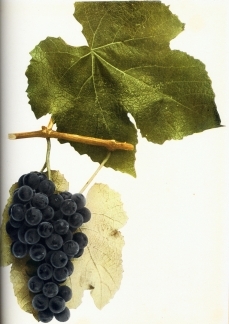
The original vine of Hartford was a chance seedling in the garden of Paphro Steele of West Hartford, Connecticut. It fruited for the first time in 1849. This seedling was supposed by those familiar with the surroundings at the time to be a cross of Isabella and the wild fox grape. It was named Hartford Prolific by the Hartford County Horticultural Society. The American Pomological Society placed it in their fruit catalog in 1862 and it has never been removed. The word “Prolific” appears to have been dropped from this name by common consent about 1890.
Vine medium to vigorous, injured in severe winters, very productive as an early grape. Does not require as close pruning as many other varieties. Canes above medium in length, intermediate in number, not thick, dark brown, covered with considerable pubescence; nodes enlarged, flattened; internodes medium to short; diaphragm medium to below in thickness; pith of average size; shoots very pubescent; tendrils continuous, long, bifid.
Leaf-buds of average size, short, thick to medium, obtuse to conical. Leaves nearly large, thick; upper surface dark green, dull, rugose; lower surface pale green, often with trace of bronze, thinly pubescent; veins indistinct; lobes variable with terminus blunt to acute; petiolar sinus medium to deep, narrow; basal sinus usually lacking; lateral sinus shallow, narrow, often a mere notch; teeth shallow, of average width. Flowers fertile, open in mid-season; stamens upright.
Fruit ripens early, does not keep well. Clusters above average size, nearly long, slender except when shouldered, slightly tapering, irregular, often with a long, large, single shoulder, loose; peduncle long to medium, of fair size; pedicel short, intermediate in thickness, covered with few small warts; brush greenish with dull tinge of reddish-brown. Berries regular in size averaging above medium, roundish to oval, black, not glossy, covered with blue bloom, drop badly from pedicel, of average firmness. Skin thick, tough, adheres considerably to the pulp, contains much purplish-red pigment, somewhat astringent. Flesh greenish, translucent, juicy, toughish, stringy and foxy, rather sweet at skin but somewhat tart at center, resembles Concord but ranks below that variety in flavor and quality. Seeds separate rather easily, one to four, average three or four, intermediate in size, almost broad, of fair length, dark brown; raphe obscure; chalaza intermediate in size, at center or slightly above, irregularly circular, rather distinct. Must 71°.
HAYES. (Labrusca, Vinifera?)
1. Gar. Mon., 21:340. 1880. 2. Bush. Cat., 1883:106. fig. 3. Mass. Hort. Soc. Rpt., Pt. 1, 1884:22, 23. 4. Ohio Hort. Soc. Rpt., 1885-6:169. 5. Am. Pom. Soc. Cat., 1889:24. 6. N. Y. Sta. An. Rpt., 9:331. 1890. 7. Rural N. Y., 53:616, 645. 1894. 8. N. Y. Sta. An. Rpt., 17:531, 541, 548, 552. 1898.
F. B. Hayes (7). Francis B. Hayes (3, 4). Francis B. Hayes (2, 6). Moore’s No. 31 (2).
In 1880 the Massachusetts Horticultural Society awarded a first class certificate of merit to Hayes and it was very favorably spoken of by many expert grape-growers in New England and the East. These recommendations brought it prominently before grape-growers and for a time it was a somewhat popular variety, but as it became better known several defects became apparent and its popularity waned. The vine is hardy and vigorous but the growth is slow and in New York at least the variety is a shy or precarious bearer and both bunches and berries are too small and variable to make it an attractive grape. Besides it comes at a time, a week or ten days earlier than Concord, when there are many other really good green grapes. Excellent though it is in quality, it is hardly worth giving a place in this State for any purpose. The foliage is tender to the heat of summer and the variety is not therefore adapted to southern or western localities.
John B. Moore of Concord, Massachusetts, is the originator of Hayes. It is said to be a seedling of Concord and one of the same lot of seedlings as Moore Early. It was first fruited in 1872 and was exhibited at Boston two years later. The variety was not introduced, however, until the fall of 1884. It is a somewhat remarkable seedling of Concord for it shows no foxiness of flavor and has tender, delicate flesh, which taken together make it of high quality. Hayes illustrates well the fact mentioned under Concord that the light colored seedlings of that variety are usually of high quality. The intermittent tendrils and certain characters of the seeds indicate that there is some species present besides Labrusca, probably Vinifera.
Vine variable in vigor and productiveness, usually hardy and healthy. Canes intermediate in length, numerous, rather slender; tendrils intermittent, bifid to trifid. Leaves not uniform in size, nearly dark green; lower surface considerably pubescent. Flowers almost sterile, open medium late; stamens upright. Fruit ripens from a week to ten days earlier than Concord, keeps well. Clusters variable in size and length, often single-shouldered, not uniform in compactness. Berries above medium to small, roundish, greenish-yellow to slightly golden yellow, covered with thin gray bloom, persistent. Skin thin, tender, covered with few small reddish-brown dots. Flesh fine-grained, tender, vinous, sweet at skin to agreeably tart at center, rather mild, good in quality. Seeds few, of average size, medium to short, often plump.
HEADLIGHT. (Vinifera, Labrusca, Bourquiniana.)
1. Rural N. Y., 60:637. 1901. 2. Am. Pom. Soc. Rpt., 1903:82. 3. U. S. D. A. Yr. Bk., 1903:276. col. pl. 4. Mo. Hort. Soc. Rpt., 1904:301, 306.
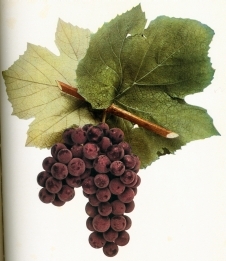
Headlight is one of the most promising of Munson’s many valuable grapes. Possibly it is more valuable for southern vineyards than for northern ones, yet it is worthy of trial in the North. Its meritorious characters are: Productiveness, outyielding Delaware with which it would compete in New York; disease-resistant foliage and vines little affected by mildew and rarely attacked by black-rot even in the South; more than average vigor of vine, though it has fallen short of expectations in this respect in the Station vineyard; high quality of the fruit, being almost the equal of Delaware in flavor and having tender melting pulp which readily parts from the seeds; and earliness, ripening before Delaware and hanging on the vines or keeping after being picked for some time without deterioration in either quality or appearance. Though a southern grape it has proved perfectly hardy here and were it not that it must compete in the North with many other good grapes, Delaware in particular, it might take high place in northern viticulture. Even with such competition it is well worth a trial in either the amateur or commercial vineyards of New York. It would seem that for the South its resistance to disease should make it a valuable commercial variety.
The originator of Headlight, T. V. Munson, states in a personal letter that it came from Moyer seed fertilized by Brilliant. The seed from which the variety came was planted in 1895 and the new grape was introduced in 1901 by the producer. While Headlight is as yet comparatively little known, it is being tested in many of the grape regions of the country and its value should soon be known. Such reports of its behavior as have been made are in the main very favorable.
Vine at this Station medium to weak, hardy, very productive. Canes short to medium, few in number, slender, dark brown to reddish-brown with small amount of bloom at nodes, which are enlarged and usually not flattened; internodes short; diaphragm thick; pith below medium to nearly small; shoots more or less pubescent; tendrils continuous, short, bifid, very persistent.
Leaf-buds small and short, inclined to slender, pointed to conical, open late. Young leaves heavily tinged on under side and lightly on the upper side with bright carmine. Leaves medium to small, thick; upper surface light green, dull, smoothish; lower surface pale green, with some pubescence; veins obscure; lobes none to three with terminus obtuse to acute; petiolar sinus intermediate in depth and width; basal sinus usually lacking; lateral sinus shallow, narrow; teeth shallow, of average width. Flowers sterile, open in mid-season; stamens reflexed.
Fruit ripens before Delaware, keeps well. Clusters small, short, of average breadth, tapering, frequently single-shouldered, compact; peduncle short to medium, slender; pedicel short, slender, covered with a few small, inconspicuous warts; brush yellowish-brown. Berries medium to very small, roundish, dark red to almost purplish-black, not glossy, covered lightly with blue bloom, persistent, very firm. Skin of average thickness, tough, adheres slightly to the pulp, contains more or less light-red pigment, astringent. Flesh greenish, translucent, very juicy, tender, fine-grained, vinous, sweet from skin to center, good to very good in quality. Seeds separate easily from the pulp, one to three, average two, below medium in size, intermediate in length, light brown; raphe obscure; chalaza above center, circular, distinct.
HERBEMONT. (Bourquiniana.)
1. Amer. Farmer, 6:369. 1825. 2. Ib., 10:211, 324. 1828. 3. Prince, 1830:154. 4. Ib., 1830:154, 339. 5. Mag. Hort., 9:373. 1843. 6. U. S. Pat. Off. Rpt., 1845:937, 940. 7. Downing, 1845:258. 8. Horticulturist, 1:98. 1846. 9. U. S. Pat. Off. Rpt., 1847:464, 465, 469. 10. Horticulturist, 12:459. 1857. 11. Downing, 1857:339. 12. Horticulturist, 20:40. 1865. 13. Am. Pom. Soc. Cat., 1867:44. 14. Grape Cult., 1:17, 59, 69, 98, 173, 179, 257, fig., 258, 260, 296, 302. 1869. 15. Ib., 2:76, 181, 195, 266. 1870. 16. Am. Pom. Soc. Rpt., 1881:39. 17. Bush. Cat., 1883:104, 105. fig. 18. Husmann, 1895:183. 19. Tenn. Sta. Bul., Vol. 9:181, fig., 182, 195. 1896. 20. Tex. Farm and Ranch, Feb. 8, 1896:11. 21. Tex. Sta. Bul., 48:1150, 1157. 1898. 22. Mo. Sta. Bul., 46:39, 43, 45, 46, 50. 1899. 23. Traité gen. de vit., 6:256. 1903.
Bottsi (20,?23). Brown French (20, 23). Dunn (20). Herbemont Madeira (4, 5, 6). Herbemont’s Madeira (10, 11, 14, 17, 19, 20, 23). Hunt (1). Kay’s Seedling (20). McKee (20, 23). Neal grape (11, 23). Neil grape (17, 19, 23). Warren (2, 7, 10). Warren (2, 4, 6, 11, 14, 17, 19, 20, 23). Warrenden (6). Warrenton (1, 2, 3, 5). Warrenton (4, 10, 11, 14, 17, 19, 20, 23). White Herbemont (20).
HEADLIGHT
In the South Herbemont has the same relative rank among cultivated grapes that the Concord holds in the North. The variety is injured by cold below zero or thereabouts and cannot be grown north of the Ohio River and fails somewhat in Missouri and Arkansas because of its tenderness. It requires, too, a long season for perfect maturity. Herbemont is also fastidious as to soil and its cultivation is somewhat limited by this factor. It requires a well-drained warm soil and one which is abundantly supplied with humus; though the variety often thrives on the comparatively poor hill-land of the South. Despite these limitations, this variety is grown in an immense territory, extending from Virginia and Tennessee to the Gulf and westward through Texas. The synonyms given above are many of them allusions to the localities in which it has been grown, while most of the others pertain to its origin, but all show to some extent the wide dissemination of this grape and indicate in a measure its merit.
Herbemont is known and widely grown in Europe as well as in the southern United States. In southwestern France where the demands of the variety seem to be particularly well fulfilled, it is firmly established and is highly regarded as a direct producer. In northern and central France, however, the winters are too cold and the seasons too short for its profitable culture. Its use as a stock in France is limited for it has been found to be but medium in its resistance to phylloxera; does not grow well from cuttings and is therefore propagated with difficulty; the wood does not bear grafts well and is worked with difficulty in either field or bench grafting; and lastly the French find it very subject to chlorosis, especially in calcareous soils.
The vine is, according to all accounts, a remarkably vigorous, rapid and healthy grower, being hardly surpassed in these characters by any of our native grapes. The wood is strong, abundant and very hard, the latter a serious difficulty in grafting. The fruits are attractive because of the size of the bunch and the glossy black of the berries, which are small as compared with northern grapes. Fruit is borne abundantly and with certainty year in and year out in suitable localities. The flesh characters of the fruit are good for a small grape, neither flesh, skin nor seeds being especially objectionable in eating; the pulp is tender and juicy; rich, sweet and highly flavored, the combination of flesh and flavor characters giving a grape of high quality. Herbemont is greatly esteemed as a table grape and is said to make a very good light red wine. The ample, lustrous green foliage makes the variety one of the attractive ornamental plants of the South.
Herbemont has been much used in grape-breeding and to advantage, for probably no other species offers as many desirable characters for the South and Southwest as the one to which this variety belongs and best represents. There are now several pure-bred seedlings of Herbemont under cultivation and a greater number in which it is one of the parents. Of the former Black Herbemont and the Onderdonk are good representatives and Jaeger, Delicious, Muench, Vinita, Perry, Mrs. Munson and Neva Munson, all from Munson of Texas, are Herbemont cross-breeds.
The history of Herbemont, as it must be written from such information as can now be obtained, is scarcely more than a collection of mythical stories. The variety is known to have been in cultivation in Georgia before the Revolutionary War, when it was generally known under the name of Warrenton or Warren. In the early part of the last century it came to the hands of Nicholas Herbemont of Columbia, South Carolina, who gave it the name Madeira under a temporary supposition that it came from the island of that name. This name was generally changed to Herbemont’s Madeira. Herbemont made the variety known to the public, sending it to William R. Prince of Flushing, Long Island, and Nicholas Longworth of Cincinnati, the two most prominent viticulturists of that time who, in turn, aided in its distribution.
There have been many contradictory accounts of the origin of the grape, crediting it to Georgia, the Carolinas, or Europe. None is supported by sufficient evidence to make it creditable and most of them arose at so late a date that it was impossible for the writers to know anything about the facts of the case except by hearsay evidence. The early idea of many that it is a Vinifera was soon dropped. Later this variety and others of its class were known as southern Aestivalis; however, it was admitted that they were unlike other southern Aestivalis. Munson gave these grapes the name Bourquiniana, a name that has been accepted as a convenient designation for the group by some who do not accept his account of its origin. The Herbemont and Lenoir are the two varieties commonly referred to as typical of this so-called species.
The history of the culture of Herbemont in the North has been the same everywhere. It was early introduced around Cincinnati, Ohio, and Hermann, Missouri, and for a time the growers had high hopes of its value. It winter-killed slightly but they overcame this by covering the vines; then the variety showed itself susceptible to rot and its culture was soon dropped. In 1867 the Herbemont was placed on the grape list of the American Pomological Society fruit catalog and it has never been removed.
We have no vines of Herbemont growing in the Station vineyard and the following description has been collected from a variety of sources.
Vine vigorous to very vigorous. Canes rather long and strong, bright green, with more or less purple, with considerable bluish-white bloom; internodes short; tendrils intermittent, of medium size, bifid or trifid. Leaves large, roundish, sometimes entire, or three- to seven-lobed, nearly glabrous above and below; upper surface clear green; lower surface lighter green, slightly glaucous; veins prominent and covered with rather abundant hair. Flowers self-fertile. Fruit ripens very late. Clusters large, long, tapering to cylindrical, prominently shouldered, compact; peduncle long and strong; pedicels somewhat short with few rather large warts; brush pinkish. Berries round, below medium in size, uniform, reddish-black or brown with abundant blue bloom. Skin thin, rather tough, with considerable pigment below. Flesh tender, very juicy; juice colorless or slightly pink; rather sweet, sprightly to slightly acid. Seeds two to four, usually two, small, reddish-brown, slightly glossy; chalaza round, prominent; raphe distinct.
HERBERT. (Labrusca, Vinifera.)
1. Mag. Hort., 31:106. 1865. 2. Horticulturist, 24:126. 1869. 3. Grape Cult., 1:180, 182. 1869. 4. Am. Pom. Soc. Cat., 1869:42. 5. Am. Pom. Soc. Rpt., 1881:32, 43, 121, 123, 136. 6. Bush. Cat., 1883:109. 7. N. Y. Sta. An. Rpt., 11:625. 1892. 8. Ill. Sta. Bul., 28:260. 1893. 9. N. Y. Sta. An. Rpt., 17:531, 548, 549, 555. 1898.
Rogers’ No. 44 (1). Rogers’ No. 44 (2, 3, 4, 5, 6, 7).
Although Rogers’ hybrids have not made a great impression upon the commercial grape culture of the country, all will agree that they are hardly surpassed for the home vineyard and, among them, at least none of the black varieties is superior for this purpose to Herbert. Barry equals it and possibly surpasses it to the taste of most grape connoisseurs in delicacy of flavor but Herbert is the handsomer fruit, is a little earlier and if anything its vine characters are somewhat better. When at its best, Herbert, and Barry too, nearly equal Black Hamburg in the characters that constitute high quality. They lack the richness of the Old World variety but they are more sprightly and refreshing and do not cloy the appetite as does the Vinifera variety. In all that constitutes a fine table grape Herbert is about as near perfection as we have yet reached in the evolution of American grapes. As is the case with most black grapes the fruit colors long before it is ripe and when thus picked there is an astringency in its taste that wholly disappears when the fruit is fully ripe. For a Vinifera-Labrusca hybrid the Herbert is vigorous, hardy and fruitful ranking in these respects above many pure-bred Labruscas. While the fruit ripens with Concord it keeps long after and is a very good winter grape. It keeps, packs and ships well. It is unable to fertilize itself and must be set near other varieties. Herbert is well deserving attention from commercial growers who supply a discriminating market and its many good qualities will give it a high place in the esteem of grape connoisseurs.
For an account of the origin and early history of Herbert the reader is referred to “Rogers’ Hybrids.” The Herbert is first mentioned separately from the rest of Rogers’ seedlings in 1865, under the designation Rogers’ No. 44. In 1869 Rogers gave names to several of his seedlings and the Rogers’ No. 44 received the name Herbert. The same year it was placed on the grape list of the American Pomological Society fruit catalog. It has never been cultivated extensively but has always been a favorite with amateur growers. The differences in the descriptions furnished by different growers leads one to suspect that there are two or more varieties passing under this name.
Vine medium to very vigorous, injured in severe winters, productive. Canes very long, numerous, unusually thick, dark brown; nodes enlarged, somewhat flattened; internodes long to medium; diaphragm thick; pith medium to large; shoots pubescent; tendrils intermittent, long, bifid to trifid.
Leaf-buds above medium in size, shortish, plump, obtuse, open early. Young leaves strongly tinged on under side and along margin of upper side with bright carmine. Leaves very large to medium, roundish, of average thickness; upper surface dark green, dull, smooth; lower surface pale green with some pubescence; veins numerous and quite prominent; leaf not lobed, with terminus obtuse; petiolar sinus very deep, narrow, closed and overlapping; basal and lateral sinuses lacking; teeth shallow to medium. Flowers sterile, open in mid-season; stamens reflexed.
HERBERT
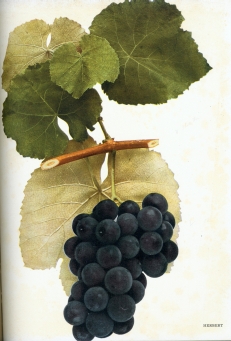
Fruit comes in season with Concord, keeps unusually well. Clusters medium to large, variable in length, rather broad, slightly tapering, two or three clusters per shoot, often heavily single-shouldered, loose to medium; peduncle of average length, thick; pedicel intermediate in length, thick, covered with small russet warts; brush yellowish-green. Berries irregular in size but usually above medium, roundish to slightly flattened, rather dull black, covered with thick blue bloom, persistent, moderately firm. Skin variable in thickness and toughness, adheres somewhat to the pulp, contains a small amount of wine-colored pigment, astringent. Flesh light green, translucent, juicy, tender, fine-grained, with a little foxiness or muskiness, nearly sweet at skin but quite acid at center, quality good to very good. Seeds separate from the pulp with difficulty, three to six in number, average three, large, broadish, notched, quite long, with swollen neck, blunt, light brown with yellowish tips; raphe obscure; chalaza intermediate in size, decidedly above center, circular to pear-shaped, distinct.
HERCULES. (Labrusca, Vinifera.)
1. N. Y. Sta. An. Rpt., 11:625. 1892. 2. Ill. Hort. Soc. Rpt., 1893:89. 3. N. Y. Sta. An. Rpt., 12:620. 1893. 4. Bush. Cat., 1894:135. 5. N. Y. Sta. An. Rpt., 17:531, 548, 555. 1898.
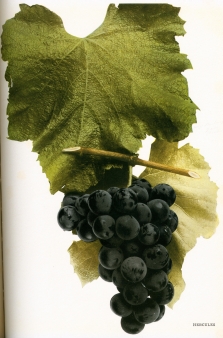
Hercules is characterized by its extremely large berries, the size being as great, if not greater, than that of any of our native grapes, and approaching that of the largest Old World grapes. The fruit is handsomely colored and the cluster, when at its best, is large and well-formed with a striking resemblance to Black Hamburg. The flavor, while not of the best, is good. But large size, handsome appearance, and good flavor cannot make up for the several defects of the variety. The fruit drops and cracks badly and the pulp is too tough and adheres too firmly to the seed for a dessert grape. These faults are so marked as to make Hercules almost worthless except for breeding purposes. Added to the desirable characters of the fruit given above, the vines are hardy, vigorous and productive so that this variety offers an unusual array of valuable qualities for the grape-breeder.
At one time it was claimed that Hercules was a seedling of a California grape but later it was said to have come from seed of one of Rogers’ hybrids. This opinion was based solely upon the characters of the plant, as the originator, the late G. A. Ensenberger of Bloomington, Illinois, gave no satisfactory account of the parentage of the grape. Hercules was exhibited at the Columbian Exposition at Chicago, where, on account of its large size and showy appearance, it attracted much attention. It is unfortunate that the parentage of this grape is not known as it is likely to be used not a little in the grape-breeding of the future in producing large-fruited varieties.
Vine vigorous to very vigorous, hardy except in extreme winters, very productive. Canes long to medium, intermediate in number and thickness, brown or dark reddish-brown; nodes slightly enlarged, flattened; internodes medium to long; diaphragm thick; pith large to medium; shoots slightly pubescent; tendrils continuous, of average length, bifid.
Leaf-buds medium in size, short, thickish, pointed to conical, open in mid-season. Young leaves lightly tinged on lower side and along margin of upper side with rose carmine. Leaves large, intermediate in thickness; upper surface light green, slightly glossy, smoothish; lower surface grayish-green, pubescent; veins distinct; lobes none to three, with terminus acute; petiolar sinus deep to medium, intermediate to narrow; basal sinus usually absent; lateral sinus shallow to a mere notch; teeth medium to shallow, intermediate in width. Flowers sterile, open in mid-season; stamens reflexed.
Fruit comes in season about with Concord, somewhat subject to rot, keeps fairly well. Clusters attractive, somewhat resembling Black Hamburg, very large to medium, of average length, broad to medium, slightly tapering to nearly cylindrical below the single shoulder, one to three clusters per shoot, medium to rather compact; peduncle short and thick; pedicel inclined to shortness, thickish, much enlarged at point of attachment to the fruit; brush of average length, pale green. Berries unusually large but somewhat variable, roundish, black, glossy, covered with more or less blue bloom, not persistent, firm. Skin cracks badly in some seasons, intermediate in thickness and toughness, adheres slightly to the pulp, contains some wine-colored pigment, astringent. Flesh decided green, slightly translucent, juicy, very tough, coarse, stringy, somewhat foxy, sweet near skin but acid at center, fair to good in quality. Seeds very adherent to the pulp, one to five in number, average three, large to medium, above usual length, broad to medium, deeply notched, blunt, brownish; raphe buried in a broad, deep groove; chalaza small, plainly above center, circular to oval, distinct.
HERMANN. (Aestivalis, Labrusca.)
1. Ill. Hort. Soc. Rpt., 1868:168. 2. Grape Cult., 1:17, 104, fig., 105, 239, 260, 326, 330. 1869. 3. Bush. Cat., 1883:107. fig. 4. Mo. Hort. Soc. Rpt., 1883:41. 5. Ib., 1891:128. 6. Husmann, 1895:174. 7. Tex. Sta. Bul., 48:1150, 1157. 1898. 8. Mo. Sta. Bul., 46:39, 43, 45. 1899. 9. Kan. Sta. Bul., 110:246. 1902.
Hermann is a southern grape, a true Aestivalis in all characters, and is not adapted to the North. When the variety was introduced, fifty or more years ago, it was considered a valuable addition to the list of wine grapes but it has not grown in favor nor popularity nor been extensively planted in any of the grape regions of the South. It is said to be vigorous, hardy and productive; to defy all attacks of phylloxera; and to make a very superior wine. But the berries are very small, ripen very late, in some localities crack badly and in others rot.
HERCULES
The variety was originated by F. Langendoerfer of Hermann, Missouri, from seed of Norton planted in 1860. The first fruit was borne in 1863. At one time it was considerably planted in Missouri as a wine grape but it did not become popular nor spread from varietal vineyards to any extent on account of its lack of quality for either the table or wine. It is of interest chiefly as a seedling of Norton and for its very good vine characters. The following description has been taken from a number of sources, chiefly from the Bushberg Catalogue:
Vine vigorous, somewhat tender, resembling Norton in foliage except that the leaves are of a lighter color and somewhat more deeply lobed. Stamens erect. Clusters long and narrow, rather compact, rarely shouldered. Berries small, round, black with blue bloom; pulp tender, juicy, and of the characteristic spicy Aestivalis flavor. Must heavy and very fragrant, brownish-yellow making a wine the color of Brown Sherry or Madeira, of great body and fine flavor; registers 94°-105°.
HICKS. (Labrusca.)
1. Mo. Hort. Soc. Rpt., 1898:46. 2. Am. Pom. Soc. Rpt., 1899:89. 3. Ill. Hort. Soc. Rpt., 1904:228. 4. Iowa Hort. Soc. Rpt., 1904: 228, 240, 241. 5. Mich. Sta. Sp. Bul., 30:11. 1905.
Hicks has proved itself a remarkably good grape in the vineyard of this Station, and were it not for the fact that the fruit is almost identical with that of Concord, ripening with it or but a little earlier, there certainly would be a place for it in the viticulture of the State. The fact that it was introduced some years ago and has not found great favor with growers is assumptive evidence that it cannot make headway against Concord with which it must compete. On the Station grounds it is more prolific than Concord and its vines are of stronger growth. The variety is well worthy a trial.
The origin of the Hicks is apparently unknown. It was introduced in 1898 by Henry Wallis of Wellston, Missouri, who states that it is a chance seedling sent from California about 1870 to Richard Berry, a well-known nurseryman of St. Louis County, Missouri. After Berry’s death it passed into the hands of Wallis, who named it Hicks. It is supposed from its characters to be of Concord parentage.
Vine vigorous to very vigorous, hardy, very productive. Canes medium to long, numerous, of average thickness, moderately dark brown to reddish-brown, surface covered with thin blue bloom; tendrils continuous, bifid to trifid. Leaves large, medium to thick; upper surface dark green, slightly glossy, of average smoothness; lower surface whitish, changing to a rather heavy bronze, strongly pubescent; veins well defined. Flowers fertile or nearly so, open early; stamens upright.
Fruit ripens with Concord or slightly earlier, keeps fairly well. Clusters large to medium, long to medium, broad, tapering, often single-shouldered, medium in compactness. Berries large, roundish, dark purplish-black to black, covered with heavy blue bloom, inclined to shatter somewhat when overripe, firm. Skin intermediate in thickness, tender, contains a small amount of very dark wine-colored pigment. Flesh greenish, juicy, rather tough, fine-grained, faintly foxy, sweet at skin to acid at center, mild when fully ripe, good in quality. Seeds somewhat adherent, above medium in size, short, broad, blunt, brownish; raphe buried in a rather broad groove; chalaza of average size, slightly above center, oval to circular.
HIDALGO. (Vinifera, Labrusca, Bourquiniana.)
1. Rural N. Y., 60:637. 1901. 2. Mo. Hort. Soc. Rpt., 1904:306.
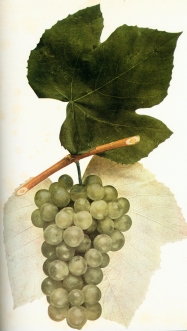
Hidalgo is a comparatively recent addition to the list of grapes for table use. While it has not been tried generally, and is not widely known as yet, it is accorded a color-plate and a full description in this work chiefly because of its remarkably fine quality. It is rich and sweet, delicately flavored, yet sprightly, and with color, size and form of berry and bunch so well combined as to make it a singularly handsome fruit. The skin is thin but firm and the variety keeps well and ships well. The vine characters for this State are not well known. On the grounds of this Station it is doubtfully hardy, variable in vigor, and not always fruitful. While Hidalgo may not prove of value for the commercial vineyard, in favorable situations it may be expected to give a supply of choice fruit for the amateur.
The parentage of Hidalgo as given by its originator, T. V. Munson, is Delaware, Goethe and Lindley. The variety was introduced by the originator in 1902 and is now being tested in various parts of the country. The reports that come from those who have seen or grown Hidalgo agree in the main with the characterization given above and bespeak for it a high degree of popularity, at least as a table grape for the garden and possibly for the vineyard.
HIDALGO
Vine variable in vigor, not always hardy, somewhat uncertain in bearing. Canes intermediate in length and number, above average thickness, dark reddish-brown; nodes enlarged and flattened; internodes of fair length; diaphragm thick; pith medium to below in size; shoots slightly pubescent to nearly glabrous; tendrils intermittent to continuous, intermediate in length, bifid to trifid.
Leaf-buds rather small and short, medium to slender, conical to pointed, open late. Young leaves faintly tinged on the under side only with rose-carmine. Leaves medium to large, often irregularly roundish, thick; upper surface light green, dull, medium to slightly rugose; lower surface pale green to bronze, heavily pubescent; veins distinct; lobes three when present with angle at terminus variable; petiolar sinus not uniform in depth, narrow, sometimes closed and overlapping; basal sinus usually none; lateral sinus shallow, narrow, often a mere notch; teeth very shallow, narrow to medium. Flowers semi-fertile, open after mid-season; stamens upright.
Fruit ripens about with Concord, keeps and ships well. Clusters large but smaller than Niagara, long to medium, inclined to slender, cylindrical to slightly tapering, often blunt, usually not shouldered, one to two bunches per shoot, medium to compact; peduncle long and slender; pedicel long, moderately slender, covered with numerous small warts; brush of average size, not thick, yellowish-green with brown tinge. Berries above medium in size, inclined to oval, attractive greenish-yellow, rather glossy, covered with thin gray bloom, persistent, firm. Skin thin to medium, tough, adheres slightly to the pulp, contains no pigment, astringent. Flesh greenish-white, somewhat transparent, juicy, tender and melting, aromatic, sweet from skin to center, very good to best. Seeds separate easily from the pulp, two to four in number, average two, above medium in size, intermediate in length and breadth, plump, light brown; raphe obscure; chalaza large, slightly above center, irregularly circular, distinct.
HIGHLAND. (Vinifera, Labrusca.)
1. Gar. Mon., 16:375. 1874. 2. Horticulturist, 29:329. 1874. 3. Gar. Mon., 21:149. 1879. 4. W. N. Y. Hort. Soc. Rpt., 27:29. 1882. 5. Ohio Hort. Soc. Rpt., 1882-3:46. 6. Bush. Cat., 1883:109. 7. N. Y. Sta. An. Rpt., 11:626. 1892. 8. Ib., 17:531, 548, 552. 1898. 9. Kan. Sta. Bul., 110:241. 1902.
Ricketts’ No. 37 (2). Ricketts’ No. 37 (1, 6).
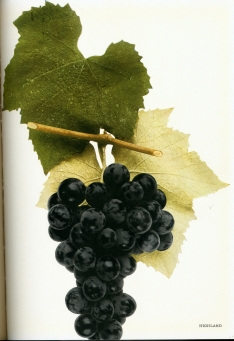
Highland has been on trial in New York for at least thirty years but has not become widely distributed, though few varieties of black grapes surpass it or equal it in appearance or in quality. The chief trouble has been that the variety is too late for New York, ripening with, or a little later than Catawba. When given good care and under favorable conditions the bunches are unusually large and handsome in appearance, sometimes attaining a weight of two pounds and having beautiful bluish-black berries with something of the fine flavor and tender texture of the Jura Muscat, one of its parents. The flesh is solid, and while the skin is thin, yet it is firm and the fruit keeps and ships well. The vine is fairly vigorous but doubtfully hardy and productive to a fault. In all localities where the climate is sufficiently temperate and the season sufficiently long for vine and fruit of Highland to develop perfectly, it is one of the choicest of grapes for the amateur.
This fine grape was originated at about the close of the Civil War by James H. Ricketts of Newburgh, New York, from seed of Concord fertilized by Jura Muscat. It was introduced by Messrs. Asher Hance & Sons, who bought it of the originator. It is very common in varietal vineyards but it has not become popular as a commercial sort; it is a popular grape for exhibitions where, when well grown, it is hardly surpassed in appearance by any other American grape.
Vine variable in vigor, productive, healthy, often inclined to overbear. Canes long, numerous, medium to thick, light and dark brown, often with a dull, ash-gray tinge, covered with thin bloom; nodes strongly enlarged, not flattened; internodes medium to very long; diaphragm thick; pith large to medium; shoots usually pubescent; tendrils intermittent, of average length, bifid to trifid.
Leaf-buds large to medium, rather short and thick, obtuse to conical. Leaves large, intermediate in thickness, upper surface often dark green, dull, medium to rugose; lower surface grayish-green, pubescent; veins rather indistinct; lobes none to five, with terminal lobe acute to obtuse; petiolar sinus rather deep, variable in width; basal sinus shallow, narrow; lateral sinus of average depth and width, sometimes a mere notch; teeth rather deep and wide. Flowers fertile or nearly so, open in mid-season; stamens upright.
Fruit ripens with Catawba or after, keeps fairly well. Clusters large, rather long and broad, tapering, usually single-shouldered but sometimes with a double shoulder, usually two bunches per shoot, intermediate in compactness; peduncle of average length and thickness; pedicel long to medium, moderately thick, nearly smooth; brush below average length, green with yellowish-brown tinge. Berries large, roundish-oval, dark purplish-black to bluish-black, rather dull, covered with dark lilac or slightly blue bloom, persistent, moderately firm. Skin intermediate in thickness, tough, nearly free from the pulp, contains little, if any, pigment, not astringent. Flesh greenish, translucent, juicy, somewhat tender, slightly vinous, good in quality. Seeds separate rather easily from the pulp, one to six, average three, above medium to large, nearly long, intermediate in breadth, slightly notched with a one-sided tendency, riper seeds brownish; raphe obscure; chalaza of average size, above center, variable in shape, not distinct.
HIGHLAND
HOSFORD. (Labrusca.)
1. Can. Hort., 11:287. 1888. 2. Rural N. Y., 49:737, fig., 739, 856. 1890. 3. U. S. D. A. Rpt., 1892:264. 4. Bush. Cat., 1894:138. 5. Am. Pom. Soc. Rpt., 1894:75. 6. Mich. Sta. Bul., 169:171. 1899. 7. Ga. Sta. Bul., 53:45. 1901.
Hosford’s Mammoth Seedling (2). Hosford’s Seedling (1).
Hosford is an offspring of Concord, differing from the parent chiefly in the greater size of bunch and berry and in being less fruitful. The variety is surpassed by Worden and Eaton, of the same type, and is probably not worth cultivation. It is claimed by some that this variety is identical with Eaton. It is true that Hosford has a marked resemblance to Eaton but there are noticeable differences in both vine and fruit characters and the pure seedlings of the two varieties are entirely different, those of Eaton being much darker in color and more vigorous. Hosford was sent out several years before Eaton. The vine of this variety looks very much like Concord except that the indentations along the margins of the leaves are deeper.
As a rule the black seedlings of Concord which have been introduced are larger in cluster and berry than the parent and either not as high in quality or no higher, differing materially from Concord’s light-colored seedlings, which are usually smaller in bunch and berry, or at least not larger, and of distinctly better quality. Hosford is a typical black seedling in the above respects.
This variety originated in the garden of George Hosford of Ionia, Michigan. It was found by the owner about 1876 as a chance seedling growing between two Concord vines.
Vine not very vigorous, nearly hardy, unproductive. Canes short, few in number, rather slender; tendrils continuous, bifid to trifid. Leaves medium to below in size, intermediate in thickness; lower surface grayish-white to bronze, heavily pubescent. Flowers semi-fertile, open in mid-season; stamens upright. Fruit ripens shortly before Concord, does not keep very well. Clusters medium to large, tapering, slightly shouldered, moderately compact. Berries large to medium, roundish to slightly oval, dull black covered with abundant blue bloom, persistent. Skin medium to thick, tender. Flesh very pale green, unusually juicy, fine-grained, rather tender, vinous, sweet, good in quality. Seeds not numerous, nearly large, very broad, blunt, plump.
HYBRID FRANC. (Vinifera, Rupestris.)
1. Am. Vines, 1903:190.
Franc’s Hybrid (1).
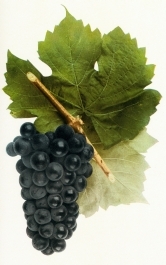
Hybrid Franc is illustrated and described in full in The Grapes of New York because it is the best known cross between Rupestris and Vinifera. It is one of the few varieties used in Europe as a resistant stock now recommended for a direct producer. The vine characters are seemingly all good,—hardy, vigorous and very productive. The fruit is fit only for wine being too acid for a table grape. The coloring matter in the fruit is very intense and it might be used for giving color to wines. Hybrid Franc is of much interest to the grape-breeder, and experiments with it as a parent are desirable for New York. The variety is of French origin.
Vine vigorous, hardy, productive. Canes variable in length, numerous, thick to medium, light brown, covered with slight blue bloom; nodes enlarged, roundish; internodes very short; diaphragm thin; pith unusually large; shoots glabrous; tendrils intermittent, often rather long, bifid to trifid.
Leaf-buds large to medium, short, above average thickness, obtuse to conical, open moderately late. Young leaves tinged on upper and lower sides with carmine; the tips of the buds in opening show strongly the leaf serrations. Leaves very small to medium, rather thin; upper surface light green, decidedly glossy, smooth; lower surface greenish, showing Riparia characters, quite hairy along ribs and larger veins; lobes usually three to five with terminal lobe acute to acuminate; petiolar sinus intermediate in depth, narrow to medium, sometimes closed and overlapping; basal sinus of average depth and width; lateral sinus medium in depth to a mere notch; teeth intermediate in depth and width. Flowers semi-fertile, open early; stamens upright.
Fruit ripens before mid-season, does not always keep well. Clusters medium to below in size, short, intermediate in breadth, tapering to cylindrical, usually single-shouldered, average three bunches per shoot, medium to compact; peduncle below medium length, rather slender; pedicel long, slender, covered with few, small, inconspicuous warts; brush short, wine-colored. Berries below medium to small, uniform, slightly oblate to roundish, black, glossy, covered with thick, blue bloom, persistent, firm. Skin thin, tender, does not adhere to the pulp, contains a very dark wine-colored pigment, not astringent. Flesh pale green, often with a slight reddish tinge, translucent, juicy, fine-grained, somewhat tender, spicy, tart to acid, fair in quality. Seeds separate easily from the pulp, one to five, average three and four, medium to small, rather short, intermediate in breadth, light brown; raphe obscure; chalaza of average size, slightly above center, oval to pear-shaped, distinct.
HYBRID FRANC
IDEAL. (Labrusca, Vinifera, Bourquiniana.)
1. Kan. Hort. Soc. Rpt., 1886:187. 2. Mo. Hort. Soc. Rpt., 1890:155. 3. Ib., 1891:128. 4. Bush. Cat., 1894:140. 5. Ill. Hort. Soc. Rpt., 1897:16. 6. Va. Sta. Bul., 94:137. 1898. 7. Mo. Sta. Bul., 46:39, 42, 44, 46, 55. 1899. 8. Budd-Hansen, 2:380. 1902.
Burr No. 9 (1).
Ideal is a handsome seedling of the Delaware, from which it differs chiefly in being much larger in bunch and berry, attaining in both of these characters nearly the size of Catawba. In Kansas and Missouri it is most highly recommended, not only for the high quality of the fruit, ranking with Delaware in quality, but because of vigorous, healthy, productive vines. But in New York, on the Station grounds at least, the vines are precariously hardy and not sufficiently fruitful, healthy nor vigorous to warrant a very high recommendation for the variety. Were the variety of recent introduction it might be recommended for trial but it has been grown for more than twenty years and has, therefore, been well tried and has not proved of general value. It may be worth planting for home use.
Originated by John Burr of Leavenworth, Kansas, over thirty years ago from seed of Delaware, the attention of the public was attracted to Ideal about 1890, first by glowing descriptions of the variety from the originator and his friend and co-worker, Dr. Stayman, and later by reports from various persons who had tested the variety. It does not appear to have ever been regularly introduced but was sent to various persons for testing by whom it was distributed. It is now found only in the occasional variety vineyard and apparently not offered for sale by any nurserymen. Ideal is better known, and possibly succeeds better in the West than in the East.
Vine medium to vigorous, not always hardy, productive, but yielding smaller crops than Concord; tendrils intermittent, bifid to trifid. Canes long, numerous, rather slender. Leaves medium to large, variable in color; lower surface pale green, slightly pubescent and cobwebby. Fruit ripens about with Delaware, keeps only fairly well. Clusters large to above medium, long to medium, often rather broad and heavily shouldered, intermediate in compactness. Berries large, roundish, attractive dark red, covered with abundant lilac bloom, often with tinge of blue, usually persistent, firm. Flesh greenish, moderately tender, aromatic, nearly sweet next the skin to acid at center, good to very good in quality. Seeds adherent, large, plump.
IMPERIAL. (Vinifera, Labrusca.)
1. Horticulturist, 29:328. 1874. 2. Am. Pom. Soc. Rpt., 1875:114. 3. W. N. Y. Hort. Soc. Rpt., 1891:45. 4. Bush. Cat., 1894:140.
No. 93 A (1).
Although introduced nearly forty years ago, Imperial is still little known and does not appear to have especial value. Perhaps its most valuable character is hardiness as it is reputed to be as hardy as Concord which, for a grape having its proportion of Vinifera blood, is the exception. In appearance and quality Imperial is very good and were its vine characters better, and were there not so many excellent green grapes of its season with which it must compete, the variety would be more generally cultivated.
Imperial is a seedling of Iona fertilized by Sarbelle Muscat and was raised by J. H. Ricketts of Newburgh, New York, over thirty years ago. The following description has been compiled from various sources:
Vine vigorous, healthy, hardy. Leaves large, attractive green. Fruit ripens late. Clusters large, symmetrical, slightly shouldered, rather compact. Berries large, greenish-white, covered with considerable bloom. Flesh tender, juicy, vinous, sprightly, not high in flavor but agreeable, good to very good in quality. Seeds small, not numerous.
IONA. (Labrusca, Vinifera.)
1. Horticulturist, 18:313. 1863. 2. Mag. Hort., 29:420. 1863. 3. Grant, Descript. Cat., 1864:8, 9, 18, 19, 21, 32. 4. Grant, Grape Vines, 1864:1, 2, 3, 5, 11, 12. 5. Am. Pom. Soc. Cat., 1867:44. 6. Am. Pom. Soc. Rpt., 1867:105. 7. Iowa Hort. Soc. Rpt., 1867:108. 8. Am. Jour. Hort., 5:15, 187, 298, 299. 1869. 9. Horticulturist, 25:186. 1870. 10. Am. Pom. Soc. Rpt., 1871:69. 11. Horticulturist, 29:20, 245. 1874. 12. Mich. Pom. Soc. Rpt., 1875:355. 13. Am. Pom. Soc. Rpt., 1881:39. 14. Mich. Pom. Soc. Rpt., 1881:222. 15. W. N. Y. Hort. Soc. Rpt., 31:120. 1886. 16. N. Y. Sta. An. Rpt., 9:328. 1890. 17. Col. Sta. Bul., 29:21. 1894. 18. Bush. Cat., 1894:140. 19. N. Y. Sta. An. Rpt., 17:531, 548, 552, 555, 559. 1898. 20. Va. Sta. Bul., 94:137. 1898. 21. Miss. Sta. Bul., 56:15. 1899. 22. Mo. Sta. Bul., 46:39, 43, 44, 45, 51, 76. 1899.
IONA
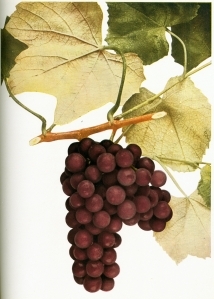
Iona is probably surpassed in delicacy and sprightliness of flavor, in keeping quality, and for making certain wines, as champagne, by few, if any, other American grapes. In spite of these several good qualities it has never been very generally grown, chiefly for the reason that it requires more care than commercial grape-growers are willing to give grapes, though, beside requiring the best of care, its cultivation is hindered by several serious faults. Iona rivals Delaware as the standard in quality of American grapes, though if flavor alone be considered, grape connoisseurs generally agree that it surpasses Delaware and is the finest flavored of all our grapes.
In flavor Iona has a rare combination of sweetness and acidity, pure, delicate and vinous. The flesh is transparent, melting, tender, juicy, and of uniform consistence quite to the center. The seeds are few and small and part readily from the flesh. The color is a peculiar dark-red wine with a tint of amethyst, somewhat variable and not always attractive. The bunch, at its best, is large but rather loose with berries varying somewhat in size and ripening unevenly. It cannot be called a particularly handsome grape. The fruit does not decay readily and may be kept in a good fruit room until late winter without loss of flavor and with the berries adhering to the bunch. Beside being a most excellent table grape, it is much sought for by wine-makers for champagne and for making finely-flavored white wines.
The vine characters of Iona are not nearly as good as those of the fruit. To do well it must have a soil exactly suited to its wants. Seemingly it does best in deep, dry, sandy or gravelly clays and cannot be grown in damp, rich, black soils on the one hand nor poor sands or gravels on the other. Vergil’s lines as to the treatment of soils for vines are especially applicable to the Iona.
“A free loose earth is what the vines demand, Where wind and frost have help’d the lab’rer’s hand, And sturdy peasants deep have stirr’d the land.”
This variety does especially well when trained against walls or buildings, attaining under such conditions rare perfection. It is not hardy in any but favored localities in New York and in many parts of the State must have careful winter protection. The vines are not vigorous and are inclined to overbear, to remedy which it must have close pruning, or be grafted on a strong growing stock. In localities where mildew and rot thrive Iona is badly attacked by these diseases. The vines bear early and the fruit ripens at mid-season or shortly after. Iona is a grape for the amateur and for the careful vineyardist. Few varieties are more desirable or satisfactory for the garden when planted in soils to which it is adapted, when given good care, properly protected from cold, and the vines restrained from overbearing.
Iona was originated by Dr. C. W. Grant[192] of Iona Island, Westchester County, New York, and the name commemorates the scene of the viticultural labors of one of the founders of American viticulture. Grant states that Iona is from seed of Diana planted in 1855, the plant from which fruited for the first time four years later. Caywood, however, says that Grant informed him that it was found growing as a chance seedling under a Catawba vine. Since Diana is a seedling of Catawba there is too little difference in the character of the older varieties to enable one to tell from which Iona came. This variety[193] was awarded the Greeley prize of $100, offered by Horace Greeley during the Civil War for a grape adapted to general cultivation in the Eastern and Middle States. The requirements which a variety had to possess to secure this prize were certainly sufficiently high; it was asked that the vine should be as hardy, healthy and vigorous as the strongest American vine and the fruit of a quality equal to the best European. Such a grape would be a boon to European as well as to American grape-growers. Though the prize went to Iona it must not be thought that it meets these requirements.
Iona was introduced by the originator in 1864. It was overpraised, extensively advertised, and for some time the prices of vines were kept at an exorbitant figure from which there was a reaction detrimental to the variety. It was placed on the grape list of the American Pomological Society fruit catalog in 1867. Probably no American variety has been the subject of more caustic discussions than this one and it is only within the last few years that its merits could be impartially estimated. Iona was extensively tried in all the grape regions of America but has been generally dropped as a commercial grape. It is still to be found in all varietal vineyards, in occasional commercial plantings and somewhat commonly in gardens.
Vine medium to weak, precariously hardy, unproductive, often susceptible to attacks of mildew. Canes short to medium, of average number and size, light brown; nodes enlarged, roundish; internodes short; diaphragm thick; pith nearly intermediate in size; shoots show some pubescence; tendrils intermittent, of average length, bifid.
Leaf-buds about medium in size, short to medium, thick, conical to pointed, open very late. Young leaves tinged on under side and along margin of upper side with carmine; often heavily coated with thick, whitish pubescence. Leaves of average size, thick; upper surface light green, dull, smooth to medium; lower surface grayish-green, heavily pubescent, somewhat cobwebby; veins indistinct; lobes three to five with terminal lobe acute; petiolar sinus intermediate in depth and width; basal sinus shallow, medium to wide; lateral sinus shallow, wide; teeth not deep, of average width. Flowers nearly fertile, open late; stamens upright.
Fruit ripens later than Concord, keeps well. Clusters above medium to small, sometimes double-shouldered, intermediate in length, somewhat slender, slightly tapering to conical, medium to loose; peduncle short and slender; pedicel intermediate in length, slender, nearly smooth, enlarged at point of attachment to fruit; brush of average length, not thick, pale green. Berries intermediate in size, uniform, oval to nearly roundish, dull, light and dark red, covered with thin lilac bloom, persistent, firm. Skin of medium thickness, tough, adheres considerably to the pulp, contains no pigment, slightly astringent. Flesh greenish, translucent, juicy, fine-grained, tender and melting, vinous, very good in quality. Seeds separate easily, one to four in number, average three, small and broad, plump, brownish; raphe usually obscure but sometimes distinct; chalaza small, nearly central, circular, distinct. Must 88°-100°.
IRONCLAD. (Riparia, Labrusca.)
1. Ohio Hort. Soc. Rpt., 1882-3:131. 2. Gar. and For., 5:597. 1892. 3. Ill. Sta. Bul., 28:254. 1893. 4. Gar. and For., 7:509. 1894. 5. Bush. Cat., 1894:140.
Ash (1, 4, 5). Diogenes (5). Pearson’s Ironclad (4). Pearson’s Ironclad (5). Scott (4, 5).
Ironclad is of interest because of its history, and because of its possible value for breeding purposes. If the history given below is correct, this variety is one of the oldest of our cultivated grapes. From the accounts of those who have grown it, Ironclad is as free from mildew and rot, in fruit at least, as any of our cultivated native grapes. It is also very resistant to phylloxera and has been used somewhat in France and Spain as a resistant stock for Vinifera. It is also extremely vigorous and hardy and is very productive. The fruit is not of sufficiently high quality nor attractive enough in appearance to make a good table grape but it is said to make very excellent wine, the juice having color and body enough to make it of value for adding color to lighter colored musts. Ironclad is a very capricious bearer and especially so on rampant growing vines, one of the faults of the variety being that it makes too rank a growth.
The history of this grape, as given by A. W. Pearson of Vineland, New Jersey, is as follows: In 1873 Pearson secured from Colonel Scott, then president of the Pennsylvania Railroad Company, cuttings of a vine growing on the latter’s grounds, near Darby about seven miles west of Philadelphia. Scott’s gardener reported the vine to be free from rot and Pearson, who had named the variety Scott, changed the name to Ironclad when he found the gardener’s report as to rot verified. On investigation Pearson found that the variety was over two hundred years old, and that it had been cultivated locally under the name of Ash, from a former owner of the Scott place and an ancestor of Pearson. This account is not fully corroborated by early horticultural writers but appears to be sufficiently accurate to give the variety historical interest. Ironclad is said to be a hybrid between Labrusca and Riparia and its botanical characters justify such a supposition.
IRONCLAD
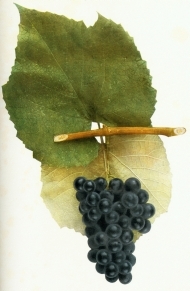
Vine a rank grower, hardy, productive. Canes long, numerous, thick to slender, dark reddish-brown; nodes of average size, flattened; internodes medium to long; diaphragm thin; pith large to medium; shoots glabrous; tendrils continuous, of fair length, bifid to sometimes trifid.
Leaf-buds small, short, slender to medium, conical to pointed. Leaves of medium size, intermediate in thickness; upper surface dark green, somewhat glossy, smoothish; lower surface pale green, slightly pubescent; veins rather distinct; lobes none to three with terminal lobe acute to acuminate; petiolar sinus intermediate in depth and width; basal sinus usually lacking; lateral sinus shallow, usually wide; teeth intermediate in depth and width. Flowers open early; stamens reflexed.
Fruit ripens about with Concord but colors early, appears to keep well. Clusters small and short, slightly tapering, sometimes single-shouldered, variable in compactness; peduncle short, inclined to slender; pedicel short, slender to medium, covered with numerous inconspicuous warts; brush short, of average thickness, dark wine color. Berries irregular in size, averaging small, roundish to slightly oblate, jet-black, glossy, covered slightly with blue bloom, usually persistent, firm. Skin intermediate in thickness, tough, adheres slightly to the pulp, contains a large amount of dark purplish-red pigment, not astringent. Flesh greenish, with distinct tinge of red, rather transparent, moderately juicy, somewhat tender, fine-grained, spicy, sweet to agreeably tart at center, not good enough in quality for dessert purposes. Seeds separate from the pulp somewhat easily, one to four in number, average two, intermediate in size and breadth, short to medium, sharp-pointed, dark brownish; raphe buried in a shallow, narrow groove; chalaza large with surface roughened and warty, central to slightly above, irregularly pear-shaped, distinct.
ISABELLA. (Labrusca, Vinifera.)
1. Amer. Farmer, 5:241. 1823. 2. Ib., 9:221, 294, 309, 325. 1827. 3. Sou. Agr., 2:552. 1829. 4. Prince, 1830:165. 5. Spooner, 1846:13, 29, 49. 6. Horticulturist, 6:410, 412. 1851. 7. U. S. Pat. Off. Rpt., 1851:48-51. 8. Am. Pom. Soc. Cat., 1852:54. 9. Horticulturist, 15:73. 1860. 10. Gar. Mon., 2:156, 265. 1860. 11. Ib., 5:73, 74. 1863. 12. N. Y. Agr. Soc. Rpt., 1864:42, 45, 141. 13. Mag. Hort., 31:107, 157. 1865. 14. Husmann, 1866:18, 79, 122. 15. Downing, 1869:542. 16. Grape Cult., 2:76. 1870. 17. Ib., 3:67, 103. 1871. 18. Gar. Mon., 14:105, 167, 296. 1872. 19. Horticulturist, 29:20, 245. 1874. 20. Am. Pom. Soc. Rpt., 1883:57, 124, 128. 21. Bush. Cat., 1883:110. 22. Rural N. Y., 50:418, 482. 1891. 23. Ill. Sta. Bul., 28:255. 1893. 24. Kan. Sta. Bul., 44:116. 1893. 25. N. Y. Sta. An. Rpt., 15:432, 433. 1896. 26. N. Y. Sta. An. Rpt., 17:531, 541, 544, 548, 552. 1898. 27. Ala. Sta. Bul., 110:83. 1900. 28. Rural N. Y., 59:719, 722. 1900. fig. 29. Traité gen. de vit., 5:203. 1903.
Alexander (29). Black Cape (29). Cape (29). Captraube (29). Champania (29). Cherokee? (11). Christie’s Improved Isabella (15, 21, 29). Conckling’s Wilding (11). Constantia (29). Dorchester (1). Framboisier (29). Garber’s Red-Fox (29). Gibb’s grape (4, 11, 18). Hanover (southern) (11). Hensell’s Long Island (11). Isabella (1). Isabelle d’Amerique (29). Lespeyre (2, 10, 11, 18). New Hanover (11). Paign’s Isabella (15, 21, 29). Payne’s Early (11, 15, 21, 29). Raisin de Cassis (29). Raisin du Cap (29). Raisin Fraise (29). Raisin Framboise (29). Sainte-Helene (29). Saluda (11). Sanbornton? (15, 21, 29). Schuylkill? (29). Uva Fragola (29). Vernet (6, 11, 18). Woodward (15, 21, 29).
Isabella is now of little more than historical interest yet for a half century after its introduction, about 1816, it and Catawba were the mainstays of American viticulture. In the early days of grape-growing in this country Isabella was the grape of the North Atlantic and New England States while the vineyards of the South were planted with Catawba, the latter requiring too long a season and being too susceptible to fungal diseases for a northern grape. Isabella has been almost wholly replaced in the North by Concord, because the latter is earlier, hardier and more productive, and the older variety can now hardly be found except in the collections of experimenters and amateurs.
In appearance Isabella is quite as attractive as any of the black grapes, having large, well-formed clusters and a deep black color with thick bloom. The flavor is good but the thick skin and muskiness in taste are objectionable. The fruit keeps and ships well and seldom rattles or cracks but the variety is surpassed in vine characters by many other standard kinds, notably Concord, which, as stated above, has taken its place. The lustrous green, ample foliage which remains late in the season, and the vigor of Isabella, make it an attractive ornamental, well adapted for growing on arbors, porches and trellises. Individual vines of this variety growing in New York, the Middle States, and New England, realize more than any other grape that ideal of peace and plenty for which the grape has been the symbol since the vines of Judah and of Israel. While it is of small commercial importance, Isabella is still worthy a place in the garden and as an ornamental.
The origin of Isabella is not certainly known. It was secured by William Prince of Flushing, Long Island, from Mrs. Isabella Gibbs, the wife of Geo. Gibbs, a merchant then living in Brooklyn, New York. Prince states that he first saw this grape in 1816 and was so struck with its appearance that he considered it worthy of a name and introduction to the public. It was consequently named in honor of Mrs. Gibbs and introduced shortly after 1816. In answer to a request from Prince as to the place of its origin, Mrs. Gibbs reported that it had come originally from the vicinity of Dorchester, South Carolina. This account of its origin was published at the time in several agricultural periodicals and later in Prince’s Treatise on the Vine. The whole question was thoroughly discussed in the agricultural press of that day but without a satisfactory solution of the place of its nativity.
ISABELLA
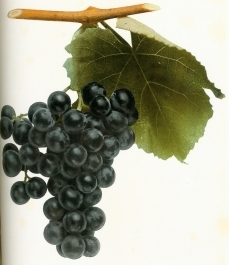
Nicholas Herbemont[194] who sought the history of the variety in the neighborhood of Dorchester, South Carolina, doubted its having originated there, as he found it known only as a cultivated sort with a tradition of its having been introduced years before by a gentleman then dead. There were various accounts published of its having originated in North Carolina, Virginia, Delaware and Europe, none of which are worthy of any credence. All that can be said is that it originated some time in the eighteenth century, probably in one of the Carolinas and that it was cultivated in many widely separated neighborhoods prior to 1800.
In 1852 Isabella was placed on the grape list of the American Pomological Society fruit catalog, for general cultivation. In 1864, on account of its susceptibility to mildew it was transferred to a list for cultivation in special localities. It was soon, however, restored to the original list where it still remains. After the introduction of Concord, as noted above, the popularity of Isabella waned but it is still to be found in many sections as one of the less planted of the market sorts and is in practically all varietal vineyards. It was introduced into Europe before 1830 where it was quite extensively cultivated for the manufacture of a low grade wine, and it is quite probable that the phylloxera, which later became such a pest, was introduced on roots of the Isabella.
Isabella is generally classed as a pure Labrusca but there are many who think there is a strain of Vinifera present. This is indicated by the shape of the berries, certain characters of the seeds, the susceptibility of the vine to mildew and of the fruit to black-rot. The characters of Isabella can be traced in a great number of offspring though comparatively few of them have outlived the parent in usefulness. Pure-bred progeny of the Isabella differ but little from the parent and are classed as strains of the original rather than as new varieties. Hybrids of it with pure Vinifera are usually worthless, lacking in vigor and hardiness, and so much more so than in the case of hybrids of Vinifera and known pure American grapes as to further suggest Vinifera blood in Isabella. Such hybrids, too, usually bear a stronger resemblance to the Old World grape than offspring of pure-bred parents of the two species.
Vine vigorous to medium, usually hardy, variable in productiveness, but sometimes producing heavy crops, somewhat subject to mildew in certain locations. Canes short to above medium, numerous, covered with heavy pubescence, thick, light to dark brown; nodes enlarged, strongly flattened; internodes short to medium; diaphragm thick; pith intermediate to below in size; shoots covered with heavy pubescence; tendrils continuous, long, bifid to trifid.
Leaf-buds small, short, thickish, conical, open very late. Young leaves tinged on lower side and along margin of upper side with light rose carmine. Leaves intermediate in size, often roundish, thick; upper surface dark green, smooth to medium, glossy; lower surface whitish-green, heavily pubescent; veins distinct; lobes three when present with terminal lobe obtuse to acute; petiolar sinus shallow to medium, narrow, often closed and overlapping; basal sinus usually none; lateral sinus shallow, narrow, frequently notched; teeth shallow, medium to wide. Flowers usually strongly self-fertile, open in mid-season; stamens upright.
Fruit usually ripens with Catawba or earlier, keeps and ships well. Clusters large to medium, intermediate in length, nearly cylindrical to conical, frequently single-shouldered, variable in compactness; peduncle short to medium, thick; pedicel variable in length, slender, almost smooth, much enlarged at point of attachment to fruit; brush long, yellowish-green. Berries variable in size, medium to large, oval, deep black, color long before ripe, covered with considerable blue bloom, usually persistent, soft. Skin thick to medium, very tough, adheres considerably to the pulp, contains no pigment, astringent. Flesh pale green, sometimes with yellowish tinge, translucent, juicy, fine-grained, tender but meaty, somewhat stringy, inclined to foxiness, sweet to agreeably tart at center, slightly astringent when not mature, ranks good in quality. Seeds separate from the pulp with some difficulty unless fully ripe, one to three in number, average two, large to medium, broad, distinctly notched, above medium to short, brownish with yellow tips; raphe obscure; chalaza small, above center, circular, rather distinct. Must 60°-79°.
ISABELLA SEEDLING. (Labrusca, Vinifera.)
1. N. Y. Sta. An. Rpt., 11:636. 1892. 2. Ib., 13:604. 1894. 3. Bush. Cat., 1894:141. 4. N. Y. Sta. An. Rpt., 17:531, 548, 555, 559. 1898.
Isabella Seedling is an early, vigorous, productive offspring of Isabella. In fruit characters it greatly resembles its parent but is much earlier, ripening shortly after Moore Early, and has a more compact bunch. Like its parent, the fruit is of good quality and keeps remarkably well for so early a grape. It is now grown in New York more than Isabella and while not of any considerable commercial importance, is far more deserving attention as a market grape than some of the poorly flavored kinds more generally grown.
There are several varieties under this name. Two are mentioned by Warder; one of Ohio and one of New York origin. The Isabella Seedling here described was originated by G. A. Ensenberger, Sr., of Bloomington, Illinois, who sent it to this Station for testing in 1889. Full details of the origin and history of this grape are not known, Mr. Ensenberger having died soon after its dissemination, without leaving a record of his work.
Vine vigorous to very vigorous, usually hardy, healthy, productive. Canes long to medium, intermediate in number, thickish, dark brown, often with a tinge of red, surface covered with thin bloom; tendrils intermittent to continuous, bifid. Leaves healthy, medium to large, rather thick; upper surface medium green, dull, of average smoothness; lower surface pale green or grayish-green, occasionally with tinge of bronze, pubescent; veins distinct. Flowers nearly fertile; stamens upright.
Fruit ripens early but later than Moore Early, keeps well. Clusters large to medium, long, slender to medium, cylindrical to slightly tapering, usually single-shouldered, loose to medium but more compact than Isabella. Berries large to medium, distinctly oval, often pear-shaped, dull black, covered with a moderate amount of blue bloom, persistent, rather soft. Skin medium to thick, intermediate in toughness, contains some red pigment. Flesh pale green, juicy, somewhat tender, slightly coarse, vinous, sweet next the skin to acid at center, good in quality. Seeds numerous, separate rather easily from the pulp, inclined to large, of medium length, broad, notched, plump, dark brown; raphe buried in a groove of average width; chalaza large, above center, circular to slightly oval, somewhat obscure.
ISRAELLA. (Labrusca, Vinifera?)
1. Horticulturist, 18:313, 314. 1863. 2. Grant, Descript. Cat., 1864:5, 8, 18, 19, 21, 32. 3. Grant, Grape Vines, 1864:1, 2, 13. 4. Mag. Hort., 33:70, 148, 337. 1867. 5. Fuller, 1867:225. 6. Am. Pom. Soc. Cat., 1867:44. 7. Mag. Hort., 34:6, 103, 138, 140, 309, 350. 1868. 8. Grape Cult., 1:42, 116, 262, 302, 326. 1869. 9. Am. Pom. Soc. Rpt., 1881:40. 10. Bush. Cat., 1883:111. 11. Tex. Sta. Bul., 48:1150, 1158. 1898. 12. Ga. Sta. Bul., 53:45. 1901.
Israella came from Dr. C. W. Grant contemporaneously with Iona, and was heralded far and wide as the earliest good grape in cultivation. For several years after its introduction it was widely tried and almost everywhere discarded because of the poor quality and unattractive appearance of the fruit and lack of vigor, hardiness and productiveness of the vine.
Dr. Grant grew the Israella from seed of Isabella planted in 1855. In 1859 or 1860, Peter B. Mead, then editor of the Horticulturist, selected this variety from several thousand seedlings of the same parentage and named it in honor of Dr. Grant’s wife. The first fruit was borne in 1859. It was placed on the grape list of the American Pomological Society fruit catalog in 1867 and was dropped from their list in 1881. It has been gradually dropped from cultivation although it is still to be found in many varietal vineyards and is listed for sale by an occasional nurseryman.
Vine intermediate in vigor, usually hardy, hardly productive. Canes of average length, not numerous, slender, medium to dark brown; tendrils continuous, bifid. Leaves large to medium, intermediate in thickness; upper surface light green, dull, medium to rugose; lower surface pale green to grayish-green, faintly pubescent. Stamens upright.
Fruit ripens a little later than Concord, appears to keep well. Clusters above average size, intermediate in length and breadth, strongly tapering, often single-shouldered, usually compact, frequently with many abortive fruits. Berries small to medium, roundish to oval, black or purplish-black, not glossy, covered with a fair amount of bloom, inclined to drop somewhat from the pedicel, not firm. Skin thick, tough, contains a large amount of purplish-red pigment. Flesh pale green, juicy, tender, stringy, mild, sweet from skin to center, appears to lack character, not so good in flavor or quality as Concord, ranks no more than fair in quality. Seeds separate easily from the pulp, medium to below in size, intermediate in length, broad to medium, decidedly notched, blunt, light brown, seed-coat often covered with numerous grayish warts; raphe buried in a shallow, wide groove; chalaza small, at center or above, irregularly circular, obscure.
IVES. (Labrusca, Aestivalis?)
1. U. S. Pat. Off. Rpt., 1856:433. 2. Am. Pom. Soc. Rpt., 1858:176. 3. Horticulturist, 21:327. 1866. 4. Grape Cult., 1:10, 12, 42, 80, 116. 1869. 5. Am. Pom. Soc. Cat., 1869:42. 6. Grape Cult., 2:171, fig., 172, 297. 1870. 7. Mich. Pom. Soc. Rpt., 1875:403. fig. 8. Bush. Cat., 1883:111, 112. fig. 9. Am. Pom. Soc. Rpt., 22:166. 1889. 10. Ala. Sta. Bul., 10:10. 1890. 11. Va. Sta. Bul., 30:100, 108. 1893. 12. Mo. Sta. Bul., 46:39, 42, 45, 46, 54, 76. 1899. 13. Ga. Sta. Bul., 28:289, 291. 1895. 14. Tenn. Sta. Bul., Vol. 9:182. 1896. 15. Traité gen. de vit., 6:183. 1903.
Ives’ Madeira (6, 8, 15). Ives’ Madeira Seedling (3). Ives’ Seedling (1, 3, 4, 7). Ives’ Seedling (6, 8, 14, 15). Ives’ Seedling Madeira (15). Kittredge (3, 6, 8, 15).
IVES
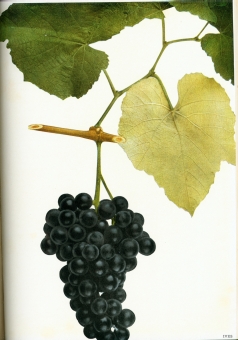
A number of years ago Ives attained a high reputation as a grape for the making of red wines and was held to be surpassed only by Norton for this purpose. It is hardy, healthy, vigorous, and fruitful, but poor in quality as a table grape, not ranking above Hartford, with which it sometimes competes in the market though wrongfully, as it is a much later grape. Ives colors long before it is ripe and is often sent to market before sufficiently matured, at which stage of development it is barely edible. Even when ripe it has a foxy odor objectionable to nearly all; moreover, its flesh is tough and pulpy. The bunches are compact with well-formed, jet-black grapes, which make it an attractive fruit. It is easily propagated and is adapted to any good grape soil. It is so rampant in growth that it is difficult to manage in the vineyard. The good characters of the vine, as well as one or two of the fruit, indicate that Ives might be desirable for breeding purposes, but its special value is for the making of red wines of the claret type, in which it is said to have a fine red color but a foxy taste and odor which, however, improve with age. Ives is hardly as widely grown as formerly, having been most popular at the time when the Catawba along the Ohio River was succumbing to fungal diseases and a more healthy and productive grape was wanted. It has never been very largely grown elsewhere.