Chapter V · THE LEADING VARIETIES OF AMERICAN GRAPES (continued 7)
Reading edition
Unfortunately, this dissemination led to the confusion of some of the numbers, a confusion which has never been satisfactorily straightened out.
In 1867, No. 22, or 53, was given the name Salem. Two years later at the earnest request of a committee from the Lake Shore Grape Growers’ Association, Rogers gave names to several of his hybrids, as listed below. He stated that the names selected were either those of persons noted for scientific or literary attainments, or else of counties and towns in Massachusetts. There was some criticism at the time from those who thought there were other numbers as well deserving of names as those which were so distinguished. And it must be admitted that the vines of this collection are remarkably equal in their possession of good and bad characters. About 1870, Bush of Bushberg, Missouri, received three sorts as Rogers’ No. 39. One of these which was particularly promising, he, with Rogers’ consent, named Aminia. None of the others has ever been named, although several of them are still cultivated to a minor extent. The named varieties, with the corresponding numbers, are as follows: 1. Goethe. 3. Massasoit. 4. Wilder. 9. Lindley. 14. Gaertner. 15. Agawam. 19. Merrimac. 28. Requa. 39. Aminia. 41. Essex. 43. Barry. 44. Herbert. 53 or 22. Salem (but not the Salem now known).
For some years, many grape-growers believed that these hybrids were nothing more than seedlings of the wild Labrusca mother but it was soon generally accepted that they were genuine hybrids. To those who are familiar with Rogers’ work, this was evident from the first, as the Carter or Mammoth Globe is a self-sterile sort, and the sacks enclosing the blossoms would prevent the introduction of other pollen than that intentionally placed on the stigmas by Rogers himself. A. D. Rogers, a brother of E. S. Rogers, in a communication to the Horticulturist, in 1858, says that “many of these seedlings had upright stamens,” but of the ones which were later named, Agawam alone is thus characterized. This is important in considering the value of these varieties, as no variety has ever become popular as a market sort which is self-sterile.
Rogers’ Hybrids are unique in that the standard of excellence was so high in all of the forty-five seedlings produced. Some have credited this to the manner in which he did his work and in particular to the excess of pollen applied to the stigmas; others consider it more likely due to his choice of parent vines. Unfortunately the evidence bearing on this point is not sufficient to form definite conclusions.
After the production of the seedlings mentioned above Rogers continued the work, recrossing the varieties already produced with various Vinifera varieties. None of these ever showed sufficient promise to be introduced.
ROMMEL

ROMMEL. (Labrusca, Riparia, Vinifera.)
1. An. Hort., 1889:101. 2. Ia. Hort. Soc. Rpt., 1890:117. 3. N. Y. Sta. An. Rpt., 13:606. 1894. 4. Bush. Cat., 1894:174. fig. 5. Husmann, 1895:125. 6. Kan. Sta. Bul., 73:182. 1897. 7. N. Y. Sta. An. Rpt., 17:535, 548, 556. 1898. 8. Tex. Sta. Bul., 48:1151, 1162. 1898. fig. 9. Mo. Sta. Bul., 46:41, 42, 44, 45, 53, 76. 1899. 10. Am. Pom. Soc. Cat., 1899:31. 11. Tex. Sta. Bul., 56:271, 280. 1900.
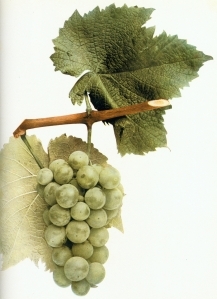
Rommel is rarely found under cultivation in New York, lacking somewhat in robustness, hardiness and productiveness, and being very susceptible to the leaf-hopper. The variety comes from Munson of Denison, Texas, and is seemingly too far removed from the warm climate in which it originated to be profitable in New York. Besides the defects named above, it does not attain its natural high quality in this latitude and the grapes crack badly as they ripen. The bunch and berry are attractive in form, size and color as shown in the color-plate, though the illustration does not do justice to the size of the bunch, the season of 1908, in which the fruit was produced, having been cold and wet and therefore very unfavorable to this variety. At its best, Rommel is a very good table grape and the authorities say makes a very fine white wine. The variety is of interest to the student of grapes from the standpoint of its breeding, having very largely the vine characters of its maternal parent, Elvira, with somewhat better fruit. The name commemorates the service to viticulture of Jacob Rommel of Morrison, Missouri.
T. V. Munson originated Rommel in 1885 and introduced it in 1889. The parents are Elvira pollinated by Triumph. Rommel was placed on the grape list of the American Pomological Society fruit catalog in 1899.
Vine medium to vigorous, not always hardy, medium to productive, susceptible to injury by leaf-hoppers. Canes medium to long, moderately numerous, thick to medium, light to dark reddish-brown, surface somewhat rough; nodes enlarged, often flattened; internodes medium to short; diaphragm thick or nearly so; pith medium to large; shoots slightly glabrous; tendrils intermittent, medium to long, bifid to trifid.
Leaf-buds intermediate in size and thickness, short to medium, prominent, obtuse to conical, open very late. Young leaves tinged on under side and along margin of upper side with light rose-carmine. Leaves medium to above in size, roundish, thick; upper surface light green, dull, rugose; lower surface pale green, nearly free from pubescence but slightly hairy; leaf usually not lobed with terminus acute to acuminate; petiolar sinus medium to deep, narrow, often closed and overlapping; basal sinus lacking; lateral sinus very shallow when present; teeth medium to deep, of average width. Flowers semi-fertile, open moderately late; stamens upright.
Fruit ripens in mid-season, ships and keeps fairly well. Clusters variable in size, above medium to short, moderately broad, cylindrical to slightly tapering, usually single-shouldered, compact to medium; peduncle long to medium, thick; pedicel of average length, slender, usually smooth; brush short, pale green. Berries large to medium, oblate to roundish, frequently compressed on account of compactness of cluster, light green with yellow tinge, glossy, covered with a moderate amount of gray bloom, persistent, firm, but breaking easily under pressure. Skin thin, cracks badly, medium to tender, adheres very slightly to the pulp, contains no pigment, without astringency. Flesh greenish, translucent, juicy, tender and melting, slightly stringy, sweet to agreeably tart at center, variable in quality but ranks fair to good, appears to be better in some locations. Seeds separate easily from the pulp, one to four, average two, medium in size and length, rather broad, sharp-pointed, very plump, brownish; raphe buried in a somewhat wide groove; chalaza intermediate in size, above center, oval to circular, indistinct.
R. W. MUNSON. (Lincecumii, Labrusca, Vinifera.)
1. Mich. Hort. Soc. Rpt., 1893:118. 2. Husmann, 1895:126. 3. Tex. Sta. Bul., 56:280. 1900. 4. Ga. Sta. Bul., 53:49. 1901. 5. Rural N. Y., 60:614, 726. 1901. 6. Ib., 62:790, 886. 1903. 7. Ia. Hort. Soc. Rpt., 1904:239.
R. W. Munson, from Texas, is a somewhat promising variety for the North for its intrinsic value, and is certainly interesting from the standpoint of its breeding as it gives Northern growers a grape with a generous admixture of Lincecumii blood. Its several essential vine characters are very good though it is self-sterile and needs a companion variety which produces an abundance of pollen. Concord and Brilliant are recommended by the originator as notable pollenizers. R. W. Munson is particularly resistant to black-rot, making it valuable for regions where this fungus is a scourge. The fruit is sweet, juicy and very pleasantly flavored, with tender pulp, and while not of the highest quality yet a most pleasing and particularly refreshing grape. The variety is well worthy more extensive trial in New York.
T. V. Munson of Denison, Texas, raised the original vine of R. W. Munson from seed of Big Berry (a variety of Post-oak) pollinated by Triumph. The seed was planted in 1887 and the resulting variety introduced by the originator in the fall of 1894.
Vine vigorous, doubtfully hardy, productive, healthy. Canes medium to nearly long, intermediate in number, thick to medium, dark red; internodes medium to long; tendrils intermittent, bifid. Leaves healthy. Flowers sterile or nearly so, open late; stamens upright.
Fruit ripens about with Concord, does not keep well. Clusters below medium to small, rather short, often single-shouldered, compact to medium. Berries medium to large, slightly oblate, dull black covered with a medium amount of blue bloom, inclined to shatter considerably, not very firm. Skin thin, variable in toughness, not astringent. Flesh pale green, rather tender when fully ripe, peculiarly vinous, nearly sweet at skin to agreeably tart at center, slightly spicy and with some Post-oak flavor, good in quality. Seeds separate easily from the pulp, rather numerous, intermediate in size, length, and width. Raphe obscure in a very shallow groove; chalaza slightly above center, oval; obscure.
SAGE. (Labrusca.)
1. Allen, 1848:134. 2. Horticulturist, 6:575. 1851. Ib., 7:87, 108. 1852. 4. U. S. Pat. Off. Rpt., 1853:300, 301. 5. Mag. Hort., 24:91. 1858. 6. U. S. Pat. Off. Rpt., 1859:48, 55, 66. 7. U. S. D. A. Rpt., 1864:134. 8. N. Y. Ag. Soc. Rpt., 1865:337. fig. 9.(?) Bush. Cat., 1894:151.
Mammoth (7, 8). ?Mammoth Sage (9). Sage (7, 8). Globe (8).
This variety, which is variously known under the names Sage, Mammoth Sage, Mammoth, and Globe, is of interest because it represents a type of large-fruited, early-ripening Labruscas which have been used frequently by breeders as the native parent in a Vinifera cross. A variety similar to this was used in particular by E. S. Rogers as the mother plant in making his notable crosses. They have also been used by White and others.
The original vine was a chance seedling found by Henry E. Sage about 1811 on the banks of a small stream near Portland, Connecticut. The variety was first brought to public notice by John Fiske Allen in 1848 through a very laudatory description which was much criticised by those who objected to the foxy aroma of the Sage but as warmly defended by others who liked the foxiness. The variety was later advertised and sent out by the Shaker community at Harvard, Worcester County, Massachusetts. Within a few years it seems to have been disseminated throughout eastern New England, and was particularly acceptable in those sections where Isabella failed to ripen. There is no evidence that it was ever planted except in gardens. With the introduction of Concord and other early varieties of higher quality the cultivation of the Sage was dropped. It is probably now obsolete.
The best description we have of Sage is the following, copied from the United States Department of Agriculture Report for 1864:
“It is much like most of the wild Fox grapes of this vicinity, [Massachusetts] but the berries are much larger, light chestnut or mahogany color, and they have a flattened or compressed shape, instead of being round, frequently an inch in diameter. The bunch is small with three to six berries in a round, ball-like cluster, with sometimes a side stem with one berry at the end of it for a shoulder. The stem of the bunch is not very long. The leaves usually are ‘entire’ with a short pointed termination at the end of the midrib, and two other points of the other divisions into which all American leaves are divided, making always either plainly, or in the rudimental state, five lobes. Thus the leaves are not much lobed, scarcely toothed, and have a rusty, woolly appearance. The young wood, last season’s growth, is hard and wiry and covered with bristles. The grape itself is sweet, but has a hard pulp, that some compare to a piece of India-rubber when eating it. It is early, and perfectly hardy, as much so as any wild grape in this vicinity.”
ST. LOUIS. (Labrusca.)
1. Mo. Hort. Soc. Rpt., 1899:54. 2. Ia. Hort. Soc. Rpt., 1905:166. 3. Mich. Sta. Sp. Bul., 30:11. 1905.
As St. Louis grows on the Station grounds it is so similar to Worden and Concord that it would seem to be superfluous in the grape list of the State. But the variety is so highly recommended in the West, especially in the states from which the above references come, that it is possibly worthy of trial in the grape regions of New York as an early type of Concord.
St. Louis was introduced by Henry Wallis of Wellston, Missouri, about 1897. In 1900, he states that it is a seedling of Concord, was originated in St. Louis, and that it had created a sensation for twenty years in the St. Louis markets. The general character of both fruit and vine corroborates the Concord parentage though the frequently intermittent tendrils indicate there is a strain of other than Labrusca blood present.
Vine vigorous, hardy, medium to productive. Canes long to medium, intermediate in number, often rather thick, medium brown to nearly dark reddish-brown deepening in color at the nodes, covered with considerable pubescence; tendrils continuous to intermittent, bifid to trifid. Leaves very large to medium, variable in color, thick; lower surface grayish-white tinged with bronze; heavily pubescent. Flowers fertile or nearly so, open medium early; stamens upright. Fruit ripens about with Concord, or slightly earlier, keeps and ships well. Clusters large to medium, intermediate in length, rather broad, usually single-shouldered but occasionally with a double shoulder, medium to compact. Berries nearly large to medium, roundish, dull black, covered with thick blue bloom, persistent. Skin of average thickness and toughness. Flesh tough, foxy, sweet at skin to slightly acid at center, good in quality with a slight resemblance to Concord. Seeds do not separate easily from the pulp, medium to above in size and width, intermediate in length.
SALEM. (Labrusca, Vinifera.)
1. Am. Pom. Soc. Rpt., 1862:148. 2. U. S. D. A. Rpt., 1865:16. 3. Am. Pom. Soc. Rpt., 1867:114. 4. Mead, 1867:222. 5. Rec. of Hort., 1868:46. 6. N. Y. Ag. Soc. Rpt., 1868:228. 7. Mag. Hort., 34:7. 1868. 8. Horticulturist, 24:138. 1869. fig. 9. Grape Cult., 1:150, 181, 327. 1869. 10. Am. Jour. Hort., 5:264. 1869. 11. Am. Pom. Soc. Cat., 1869:42. 12. Grape Cult., 2:148, 149, fig., 298. 1870. 13. Mich. Pom. Soc. Rpt., 1877:205. 14. Am. Pom. Soc. Rpt., 1881:42, 138. 15. N. Y. Sta. An. Rpt., 9:329. 1890. 16. Ill. Sta. Bul., 28:261. 1893. 17. Tenn. Sta. Bul., Vol. 9:187. 1896. 18. N. Y. Sta. An. Rpt., 17:535, 542, 543, 544, 548, 553. 1898. 19. Mich. Sta. Bul., 169:175. 1899.
Rogers’ No. 22 (1, 2). Rogers’ No. 22 (3, 5, 6, 9, 11, 12, 13, 15). Rogers’ No. 53 (4, 9, 10, 11, 12, 13, 15, 17).
Salem is the one of Rogers’ hybrids of which the originator is said to have thought most and to which he gave the name of his place of residence. Taking all of its characters, the variety is as close an approximation to the ideal Rogers had in mind of a European grape and an American vine as any one of the score or more of his hybrids. Salem ranks among the best of these hybrids for either the garden or the commercial vineyard, and while commonly found in both it has not been sufficiently recognized by those who grow grapes for the market. It is difficult to say why it is not more largely grown as a market fruit in New York. The two chief faults, unproductiveness and susceptibility to mildew, are not found in all localities, and in these at least and especially near good markets, Salem ought to take high rank as a commercial fruit.
As compared with other hybrids of Vinifera and Labrusca, Salem is early, hardy, vigorous and fairly productive of handsome fruit of high quality both for table and for wine-making. Though the color-plate does not show it, there is a suggestion in bunch and berry of Black Hamburg, the paternal parent. So, too, there is such a suggestion in the flavor and the keeping quality and, as with the parent, the fruit neither cracks nor shatters and therefore ships well. To the two faults named above must be added that of pulpiness of berry, a defect common to many hybrids of the two species represented in Salem. It is useless to recommend for testing varieties that have been known as long and as widely grown as Salem but it is worth while, is almost a duty, in a work of this kind to urge further trials of some of the grapes of highest quality, as Salem, on a commercial basis. Such fruit properly grown, packed, and placed in the market ought to bring remunerative prices.
This one of Rogers’ hybrids is No. 22 of his Vinifera-Labrusca crosses. It early attracted favorable attention from the various cultivators who had received vines from the originator for testing. It was christened Salem by Rogers in 1867, two years earlier than his other hybrids were named. At about this time, owing to a confusion of this variety with some other, and charges that certain parties were sending out a black grape under the name Rogers’ No. 22, Rogers changed the number of Salem to 53.
Salem was placed on the grape list of the American Pomological Society fruit catalog in 1869 and was removed in 1871, reinstated in 1873, and has since been retained. It is possible that the dropping of the name from the catalog for the one year was a printer’s oversight as there is nothing in the body of the text to indicate a reason for such action. Salem has always been one of the most popular of Rogers’ hybrids and it is offered for sale to-day by practically all grape nurserymen.
Vine medium to vigorous, unusually hardy, variable in productiveness, susceptible to severe attacks of mildew. Canes long, of average number, intermediate in thickness, light to dark brown; nodes enlarged, usually not flattened; internodes medium to above in length; diaphragm thick; pith medium to above in size; shoots slightly pubescent; tendrils continuous to intermittent, long to medium, bifid to trifid.
Leaf-buds rather large, of average size, thick to medium, often compressed, roundish, obtuse to conical, open early. Young leaves faintly tinged on lower side with slight rose-carmine. Leaves variable in size, medium to thin; upper surface dark green, dull, of medium smoothness; lower surface pale green with slight bronze tinge, pubescent; veins moderately distinct; lobes none to three with terminus acute; petiolar sinus deep, narrow, often closed and overlapping; basal sinus lacking; lateral sinus shallow, narrow, often notched; teeth intermediate in depth and width. Flowers sterile, open in mid-season; stamens reflexed.
SALEM
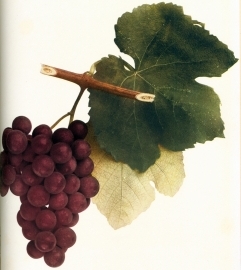
Fruit ripens slightly before Concord, keeps and ships well. Clusters medium to large, rather short and broad, tapering to cylindrical, frequently heavily single-shouldered, compact; peduncle short to medium, thick; pedicel medium to short, thick, covered with few small warts, enlarged at point of attachment to berry; brush short, pale green. Berries large to medium, roundish, very dark red, dull, covered with a medium amount of blue bloom, decidedly persistent, soft. Skin thick, intermediate in toughness, adheres strongly to the pulp, contains no pigment, astringent. Flesh slightly translucent, juicy, tender, somewhat stringy, moderately fine-grained, inclined to vinous, sprightly, sweet at skin but acid at center, good to very good in quality. Seeds one to six, average four, large, long and broad, blunt, brownish; raphe shows as a distinct cord-like ridge; chalaza small, roughened and frequently with radiating furrows, much above center, variable in shape, distinct.
SCUPPERNONG.[210] (Rotundifolia.)
1. Amer. Farmer, 1:317. 1819. 2. Ib., 3:332. 1822. 3. Ib., 9:29, 30. 1827. 4. Ib., 9:139. 1827. 5. Prince, 1830:167. 6. Ib., 1830:170. 7. Downing, 1845:258. 8. Horticulturist, 12:457. 1857. 9. U. S. Pat. Off. Rpt., 1857:231. 10. Gar. Mon., 5:73, 74. 1863. 11. Grape Cult., 1:38, 280, 292. 1869. 12. Ib., 3:60. 1871. 13. Am. Pom. Soc. Cat., 1871:16. 14. Am. Pom. Soc. Rpt., 1881:40, 68, 147, 153, 155. 15. Gar. Mon., 28:140, 173. 1886. 16. Ala. Sta. Bul., 29:18. 1891. 17. Bush. Cat., 1894:177. fig. 18. Am. Gard., 20:688. 1899. 19. Ga. Sta. Bul., 53:49, 59. 1901. 20. N. C. Sta. Bul., 187:58, 60. 1903. 21. S. C. Sta. Bul., 132:18. 1907.
American Muscadine (5, 10, of the South 7). Bull (9, 17, of the South 7). Bullace (9, 17). Bullet (17, of the South 7). Fox grape of the South (7). Green Scuppernong (6). Green Muscadine (6). Hickman (3). Hickman (5, 10). Muscadine (9). Roanoke (4). Roanoke (5, 10, 17, of the South 7). Scuppernong (3, 4, 5). White Muscadine (11, 17). White Scuppernong (5). Wild green Muscadine (6). Yellow Muscadine (17).
The Scuppernong is preeminently the grape of the South. It is the chief representative of the great species Vitis rotundifolia, which runs riot in natural luxuriance from Delaware and Maryland to the Gulf, and westward from the Atlantic to Arkansas and Texas. The name Scuppernong was taken from the Indians and is now common in the geography of North Carolina; a river, a town, a lake, and a swamp all bear this appellation. Calvin Jones, an agriculturist of note in North Carolina during the early part of the last century, gives the following history of the name as applied to the grape it now distinguishes:[211] “This grape & wine had the name of Scuppernong given to them by Henderson & myself, in compliment to James Blount of Scuppernong, who first diffused a general knowledge of it in several well written communications in our paper—and it is cultivated with more success on that river than in any other part of the state, perhaps, except the Island of Roanoke.”
Scuppernong is said to have been found on Roanoke Island at the time of the landing of Sir Walter Raleigh’s colony. There is a tradition that an old vine now growing on this island is the original vine. At an early day it was quite common to propagate Scuppernong by seed, pulling out all vines bearing black fruit as soon as the color of the fruit could be determined. Because of this practice it is probable that there are many seminal varieties under the general name Scuppernong. All that seems to be required for a grape to pass under this name is that the vine should be a Rotundifolia and the fruit white.
In the horticultural accounts of the history of Scuppernong it is commonly spoken of as having been found wild during the latter part of the eighteenth century. But Lawson, writing about 1700, in the account quoted on page 37 of this work, describes with sufficient accuracy a white Rotundifolia which could hardly be any other than the Scuppernong. It is, thus, in a sense, a botanical as well as a horticultural variety. Its close relationship to the black form of Rotundifolia is attested by the fact that its seedlings are as often, probably more often, black than white. That Scuppernong is more distinct than the other varieties of Rotundifolia is indicated by the fact that of the ten cultivated varieties of Rotundifolia now grown in the South, James, Thomas, Eden, Meisch, Flowers, Memory, Seedlin, Tenderpulp, Jeter, and Scuppernong as given by Newman,[212] all are black but the last named.
Scuppernong vines are to be found on arbors, in gardens, or half wild, on trees and fences on nearly every farm in the South Atlantic States. As a rule, these vines receive little cultivation, are unpruned, and are given no care of any kind, but even under neglect they produce large and sure crops, are almost immune to mildew, rot, phylloxera, or other fungal or insect pests. The plants give not only an abundance of fruit but on arbors and trellises are much prized for their shade and beauty. The growth of the vine is prodigious; seemingly well authenticated reports state that vines are known which cover an acre of land; other tales, having at least the semblance of truth, are equally marvellous. Thus there are accounts of vines of this variety over a hundred years old and which bear 500 bushels of fruit and make 2000 gallons of wine.
The fruit, to a palate accustomed to other grapes, is not very acceptable, having a musky flavor and a somewhat repugnant odor, which, however, becomes with familiarity, it is said, quite agreeable. The pulp is sweet and juicy but is lacking in sprightliness. From the Scuppernong are made several very good wines and it would seem that the future of this and other varieties of Rotundifolia, from a commercial standpoint, lies largely in their value for wine. Quite aside from the quality of the fruit as a table grape, they are not suitable for the market from the fact that the berries drop from the bunch in ripening and become more or less smeared with juice so that as they are brought into market in quantity, their appearance is not at all appetizing.
Vine vigorous to rank, not hardy in the North, very productive. Canes long, numerous, slender, vary from ash-gray to grayish-brown; surface smooth, thickly covered with small, light brown dots; pith greenish; tendrils intermittent, simple. Leaves small, thin; upper surface light green, smooth; lower surface very pale green, slightly pubescent along the ribs, otherwise smooth; veins inconspicuous. Flowers open very late; stamens reflexed.
Fruit ripens late, even in the South, often ripening unevenly, appears to keep well but berries drop as they mature. Clusters small, roundish, not shouldered, loose. Berries very few per cluster, large, roundish, dull green often with brown tinge, not persistent, firm. Skin very thick and tough, covered with many small russet dots; no pigment. Flesh pale green, juicy, tender and soft, fine-grained, very foxy, sweet to agreeably tart, fair to good in quality. Seeds slightly adherent to pulp, large, medium to short, often very broad, not notched, quite blunt, plump, surface unusually smooth, brownish; raphe buried in a narrow, shallow groove; chalaza small, nearly central, elongated, rather obscure. Must 88°.
SECRETARY. (Vinifera, Riparia, Labrusca.)
1. Grape Cult., 2:158. 1870. 2. Am. Pom. Soc. Rpt., 1871:41, 112. 3. Mass. Hort. Soc. Rpt., 1872:94. 4. Horticulturist, 29:328. 1874. 5. Ohio Hort. Soc. Rpt., 1876-7:32. 6. N. J. Hort. Soc. Rpt., 1881:11. 7. W. N. Y. Hort. Soc. Rpt., 27:21. 1882. 8. Bush. Cat., 1883:135. fig. 9. Mass. Hatch Sta. Bul., 37:11, 16. 1896. 10. Tex. Sta. Bul., 48:1151, 1162. 1898. 11. Mich. Sta. Bul., 169:176. 1899. 12. Mo. Sta. Bul., 46:41. 1891.
Injured by mildew and rot which nearly every year attack leaves, fruit and young wood, Secretary is able only in exceptional seasons and in favored localities to produce a crop of good grapes. Nevertheless it has many excellent qualities as an amateur grape and should not be lost to cultivation. The fact that it is the result of the fecundation of a Riparia by a Vinifera, both parents being excellent varieties, gives Secretary added interest and value and makes its perpetuation still further worth while.
There is no question as to the rank of the fruit characters of Secretary. Taken together they make it a grape of exceptionally high quality, the berries being meaty yet juicy, fine-grained and tender with a sweet, spicy, vinous flavor. The bunches are large, well formed with medium-sized, purplish-black berries covered with thick bloom, making a very handsome cluster. While the vine and foliage somewhat resemble those of Clinton, one of its parents, the variety is not nearly as hardy, vigorous or productive nor as healthy, falling short in all of these respects and making its culture in New York precarious. Moreover, in any but favored localities in this State, its maturity is somewhat uncertain. These defects of vine have kept Secretary from becoming of commercial importance and make it of value only to the amateur.
Secretary is one of the first productions of Ricketts of Newburgh. He grew the original vine from seed of Clinton fertilized by Muscat Hamburg. Planted in 1867, it is said to have borne a little fruit when one year old from the seed. Specimens of the variety were exhibited before the American Pomological Society in 1871. Ricketts sold the variety about 1875 to S. W. Underhill of Croton Point, New York, who introduced it a few years later. On account of its many weak points it has never been popular and it is apparently not offered for sale by any of the nurserymen to-day.
SENASQUA
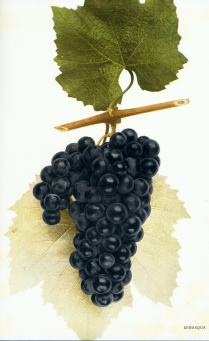
Vine not uniform in vigor, doubtfully hardy, quite variable in productiveness, inclined to be an uncertain bearer, subject to attacks of fungi. Canes medium to below in length, numerous, intermediate in thickness, light brown but conspicuously darker at nodes, surface covered with thin blue bloom; tendrils intermittent, bifid. Leaves small to medium, thin; upper surface light green, nearly dull, smooth; lower surface pale green, almost glabrous; veins indistinct. Flowers semi-fertile, open early; stamens upright.
Fruit ripens soon after Concord, keeps and ships well. Clusters medium to large, long to medium, of average width, cylindrical to tapering, frequently with a medium to large single shoulder, variable in compactness but often loose and with many abortive fruits. Berries large to medium, roundish to oval, somewhat flattened at point of attachment to pedicel, dark purplish-black, glossy, covered with thick blue bloom, persistent, firm. Skin intermediate in thickness, tough with wine-colored pigment. Flesh greenish, juicy, fine-grained, tender, vinous, sweet, good in quality. Seeds separate readily from the pulp, medium to nearly large, broad to medium, slightly notched, long to above medium, dark brown; raphe shows as a moderately distinct cord; chalaza small, above center, distinctly oval. Must 93°.
SENASQUA. (Labrusca, Vinifera.)
1. Mass. Hort. Soc. Rpt., 1868:10. 2. Downing, 1872:120 app. 3. Am. Jour. Hort., 8:9. 1870. fig. 4. U. S. D. A. Rpt., 1875:384. 5. Bush. Cat., 1883:138. fig. 6. N. Y. Sta. An. Rpt., 9:327. 1890. 7. Ib., 11:636. 1892. 8. Ib., 17:535, 546, 547. 1898. 9. Ga. Sta. Bul., 53:49. 1901.
It is almost a sufficient characterization of Senasqua to say that it is a Labrusca-Vinifera hybrid. The merits and demerits of the cross-breeds of these two species are so similar in the varieties of them now in cultivation that they can be placed in a group having as few variations as can be found in the parent species. The characters of these hybrid grapes have been well discussed in writing of the varieties sent out by Rogers and the place of Senasqua is well designated when the statement is made that it is very similar to Rogers’ hybrids. The vine lacks somewhat in vigor, hardiness, productiveness and health. The grapes are of good quality and when well grown the variety is up to the average of such hybrids in fruit characters so far as the palate is concerned. Unfortunately the berries have a tendency to crack which is aggravated by the fact that the bunches are so compact as to crowd the berries and thus add to the cracking. Senasqua is one of the latest to open its buds and is therefore seldom injured by late frosts. This variety is hardly as well adapted for commercial viticulture as several other such hybrids and can be recommended only for the garden for the sake of variety.
Stephen W. Underhill of Croton Point, New York, originated Senasqua from seed of Concord pollinated by Black Prince. The seed was planted in 1863 and the resulting variety introduced about 1870. This variety, although it attracted much attention at the time of its introduction, was never popular. It was rather widely tested but was soon dropped and is to-day practically obsolete. The foliage and vines of Senasqua show little trace of Vinifera but the descent from the foreign species is plainly marked in the fruit.
Vine variable in vigor, sometimes weak and tender, medium to unproductive, somewhat susceptible to attacks of mildew. Canes short, few in number, above average size, light to dark reddish-brown; nodes enlarged, flattened; internodes short to medium; diaphragm thick; pith of medium size; shoots slightly pubescent; tendrils intermittent, long to medium, trifid to bifid.
Leaf-buds below average size, short, of medium thickness, conical, open very late, tinged on under side and slightly along margin of upper side with light rose-carmine. Leaves intermediate in size and thickness, light green, slightly glossy, medium to somewhat rugose; lower surface whitish-green, pubescent; veins distinct; leaf usually not lobed with terminus acute; petiolar sinus of average depth, medium to narrow; basal and lateral sinuses shallow and narrow when present; teeth intermediate in depth and width. Flowers fertile, open late; stamens upright.
Fruit ripens a little later than Concord, keeps well. Clusters large to medium, intermediate in length, broad to medium, irregularly tapering, usually with a small single shoulder, very compact with uneven surface; peduncle short to medium, thick; pedicel intermediate in length, thick, usually smooth, enlarged at point of attachment to fruit; brush short to medium, green with slight red tinge. Berries above medium in size, roundish, reddish-black to black, covered with heavy blue bloom, persistent, firm. Skin medium to thick, tender, inclined to crack, adheres strongly to the pulp, contains a fair amount of light wine-colored pigment, without astringency. Flesh greenish, translucent, very juicy, tender, meaty, vinous, somewhat spicy, sprightly, good in quality. Seeds separate readily from the pulp, one to five, average two, intermediate in size, rather long, narrow, usually one-sided, light brown; raphe buried in a narrow groove; chalaza small, above center, oval, obscure.
SHELBY. (Labrusca, Riparia.)
1. Vineyardist, Oct. 15, 1893. 2. Rural N. Y., 53:683. 1894. 3. Bush. Cat., 1894:180. 4. Rural N. Y., 55:638, fig., 642. 1896. 5. N. Y. Sta. An. Rpt., 17:535, 546, 547, 557. 1898. 6. Ga. Sta. Bul., 53:49. 1901.
Shelby is hardly worth cultivating in New York. It ripens at a time when there are many other grapes which surpass it in flavor and appearance. It has, however, been somewhat highly spoken of and grape experimenters may want to try the variety. The name is from Shelby, Ohio, the birthplace of the originator.
D. S. Marvin of Watertown, New York, originated the Shelby about 1880. It was introduced in the fall of 1894. The originator writes that the parentage of this variety is not positively known but it is supposed to be a Labrusca-Riparia cross. The botanical characters of the fruit and vine as it grows on the Station grounds verify this supposition.
Vine vigorous, variable in hardiness, medium to productive. Canes long, numerous, medium to slender; tendrils intermittent, sometimes continuous, bifid to trifid. Leaves uniform in size, green, often thin; lower surface grayish-green with tinge of bronze, strongly pubescent. Flowers fertile or nearly so, open in mid-season or earlier; stamens upright. Fruit ripens early, sometimes before Winchell, does not keep nor ship well. Clusters medium to below in size, short, frequently with a single shoulder, shorter and more compact than Winchell. Berries medium to small, roundish, light green to yellowish-green, covered with thin gray bloom, somewhat inclined to shatter. Skin thin, variable in toughness, peculiarly astringent. Flesh tough, stringy, foxy, sweet from skin to center, mild, fair to good in quality. Seeds do not separate readily from the pulp, not very numerous, medium to below in size, short, broad, plump.
STANDARD. (Labrusca, Vinifera, Bourquiniana?)
1. Kan. Hort. Soc. Rpt., 1886:187. 2. Mo. Hort. Soc. Rpt., 1892:266. 3. N. Y. Sta. An. Rpt., 11:637. 1892. 4. Bush. Cat., 1894:180. 5. Va. Sta. Bul., 94:136. 1898. 6. N. Y. Sta. An. Rpt., 17:535, 548, 557. 1898. 7. Mo. Sta. Bul., 46:41. 1899.
Burr’s No. 2 (1).
Standard is said to be a full sister of Jewel, but it is not equal to the sister nor nearly equal to the reputed parent, Delaware. The variety seems to be thought highly of in the West and it is possible that it has greater value there than in New York. The quality of the grape is high and it is said to make a light-colored wine of good body, taste and aroma, but taking it all and all it does not rise above mediocre and cannot be recommended unless for trial.
The variety was originated by John Burr of Leavenworth, Kansas, from seed of Delaware planted about 1874. It was introduced in 1887 by Stayman & Black of Leavenworth, Kansas. There are few characters of either vine or fruit that show evidence of having come from Delaware.
Vine variable in vigor, usually hardy in ordinary seasons, productive. Canes short to medium, few in number, rather slender; tendrils continuous to intermittent, bifid to trifid. Leaves not very healthy, medium to small, moderately light green; lower surface tinged with bronze, pubescent. Flowers partly fertile, open in mid-season; stamens upright. Fruit ripens about with Concord, usually keeps fairly well. Clusters not uniform in size, short, frequently with a small single shoulder, compact to medium. Berries small to above medium, roundish, very dark reddish-black covered with a large amount of lilac bloom, sometimes shatter considerably from pedicel. Skin thin, rather tender. Flesh unusually pale green, somewhat stringy, vinous, tender, sweet from skin to center, good in quality. Seeds slightly adherent, medium to small, intermediate in width; chalaza oval, often distinctly above center.
STARK-STAR. (Labrusca, Vinifera, Aestivalis.)
1. National Nur., 10:128, 133. 1902. 2. Rural N. Y., 62:788. 1903. 3. Ill. Hort. Soc. Rpt., 1903:65, 208, 274, 276. 4. Mo. Hort. Soc. Rpt., 1904:301.
Stark-Star is receiving careful attention in the South and Southwest but unfortunately it does not ripen early enough to promise well for this latitude. On the Station grounds it ripens after Catawba, which does not always mature. If the variety fulfills the high expectations of it in the region of its origin it is worthy a trial in the regions of this State where the Catawba ripens.
The variety was originated by Joseph Bachman of Altus, Arkansas, from seed of Catawba fertilized by Norton or Hermann. The seed was planted about 1892. Stark-Star was introduced by Stark Brothers, of Louisiana, Missouri.
Vine vigorous, hardy, healthy, productive. Canes medium to short, numerous, often slender, roughened; tendrils continuous to intermittent, bifid to trifid. Leaves large to medium, dark green, frequently thin; lower surface pale green, slightly pubescent, cobwebby. Fruit ripens later than Catawba, appears to be an excellent keeper. Clusters large, medium to long, inclined to broadness, frequently with a well marked short single shoulder, very compact. Berries medium to below in size, oval to roundish but frequently compressed on account of compactness of cluster, black when ripe, covered with blue bloom, persistent. Skin intermediate in thickness, tender. Flesh pale green, not very juicy, tough and solid, slightly aromatic and spicy, almost sweet, fair to good in quality. Seeds adhere somewhat to the pulp, numerous, medium to small, intermediate in length and width, plump; raphe shows as a distinct cord; chalaza distinctly above center to nearly central.
SUPERB. (Labrusca, Vinifera, Aestivalis.)
1. Am. Pom. Soc. Rpt., 1891:126. 2. Mo. Hort. Soc. Rpt., 1891:126. 3. Rural N. Y., 52:636. 1893. fig. 4. Bush. Cat., 1894:180. 5. Husmann, 1895:38. 6. N. Y. Sta. An. Rpt., 18:396. 1899. 7. Am. Pom. Soc. Cat., 1899:28, 8. Ga. Sta. Bul., 53:49. 1901.
The quality of Superb ranges from good to very good but the appearance of the fruit is against the variety. It resembles Eumelan, the reputed parent, in size, shape, and color but is not as attractive. The vine on the Station grounds is not such as to recommend it highly, and since it has been known for at least twenty years without having become at all popular with grape-growers, it may be assumed that the grape has weaknesses elsewhere as well as here.
A. F. Rice of Griswoldville, Georgia, originated this variety, it is said, from seed of Eumelan. The seed was planted in 1880 near South Weymouth, Massachusetts. Superb was placed on the grape list of the American Pomological Society fruit catalog in 1899.
Vine medium to vigorous, usually hardy, healthy, productive. Canes short to medium, few in number, often tapering, ash-gray changing to light or dark brown; tendrils continuous, bifid. Leaves healthy, medium to large, moderately light green; lower surface grayish-green, thinly pubescent, the pubescence being distributed in flecks. Flowers strongly self-fertile, open in mid-season or later; stamens upright. Fruit ripens before Concord, keeps and ships well. Clusters intermediate in size and width, medium to long, frequently with a long, loose single shoulder, compact. Berries medium to below in size, roundish to oval, dark purplish-black covered with thin blue bloom, persistent, not very firm. Skin thick, tough, without astringency. Flesh juicy, tender, aromatic, sweet from skin to center, spicy, good to very good in quality. Seeds separate readily from the pulp, medium to small, medium to long, sharp-pointed; raphe occasionally shows as a partially submerged cord in a broad groove; chalaza distinctly above center.
TAYLOR. (Riparia, Labrusca.)
1. Valley Farmer, 1858:122. 2. Horticulturist, 14:486. 1859. 3. Ib., 15:34. 1860. 4. Gar. Mon., 2:68, 119, 163. 1860. 5. Am. Pom. Soc. Rpt., 1860:78. 6. Horticulturist, 19:156. 1864. 7. Husmann, 1866:104. 8. Fuller, 1867:231. 9. Grape Cult., 1:44, 74, 242, 291, 296. 1869. 10. Ill. Hort. Soc. Rpt., 1881:161. 11. Am. Pom. Soc. Rpt., 1883:133. 12. Bush. Cat., 1883:20, 138. 13. Tex. Sta. Bul., 48:1151, 1162. 1898. 14. Mo. Sta. Bul., 46:41, 43, 45, 46, 76. 1899. 15. Ga. Sta. Bul., 53:49. 1901.
Bullitt (1, 4). Bullitt (3, 5, 7, 9, 11, 12). Taylor (2, 5). Taylor (4, 11). Taylor Bullit (13, 14). Taylor’s Bullitt (8, 11). Taylor’s Bullitt (12).
Taylor is hardly known in New York nor, indeed, is it now much grown elsewhere. It is of interest for the part it has played in the grape culture of the past and especially for its worthy offspring. Many of these now outrank the parent in the regions and for the purposes for which Taylor is grown. In truth, the most valuable quality of Taylor seems to be its capacity for transmitting its good characters to its seedlings; some of course fall much below it, as a table or wine grape, but a considerable number quite equal it, and a few surpass it, but all resemble the parent vine much more than is common among grapes. While it is from the species to which Taylor belongs that we must look for our hardiest vines yet this grape and its offspring, though not particularly tender to cold, do best in southern regions as they require a long, warm summer and fall to mature properly. Taylor was long grown in both Europe and California as a grafting stock for the Old World varieties as a protection against phylloxera, and is still somewhat cultivated in these regions for that purpose.
The quality of the fruit of Taylor is from fair to good, the flavor being sweet, pure, delicate and spicy and the flesh tender and juicy, but the bunches are small, the flowers infertile so that the berries do not set well and give very imperfect and unsightly clusters. The skin is such, too, that it cracks badly, a defect that is seemingly transmitted to many of the seedlings of the variety. The vine is strong, healthy, hardy but not very productive. Taylor is essentially a wine grape, and it is not likely that it or many of the varieties bred from it will make table grapes. The wine is said to be exceptionally good, of great body and high flavor.
The original vine of Taylor was a wild seedling found in the early part of the last century on the Cumberland Mountains near the Kentucky-Tennessee line by a Mr. Cobb who planted the vine on his farm in Shelby County, Kentucky. Later the farm was sold to Cuthbert Bullitt. About 1840, the grape came to the attention of Judge John Taylor of Jericho, Henry County, Kentucky, an enthusiastic amateur horticulturist who secured the vine from Bullitt and sent cuttings to many grape-growers for testing. It was early introduced into the grape region of the middle West where it was widely tested but was never extensively planted owing to its lack of productiveness. Its culture has been on the wane for many years and only an occasional nurseryman in that section handles the variety to-day. This variety has, at different times, passed under the names Bullitt, Taylor, Taylor’s Bullitt, with various spellings of the name Bullitt.
The following description has been compiled from various sources:
Vine vigorous to rank, healthy, hardy, variable in productiveness. Leaves small, attractive in color, smooth. Flowers bloom early; stamens reflexed. Fruit ripens about two weeks before Isabella. Clusters small to medium, shouldered, loose to moderately compact. Berries small to medium, roundish, pale greenish-white, sometimes tinged with amber. Skin very thin. Pulp sweet, spicy, fair to good in quality.
TELEGRAPH. (Labrusca, Aestivalis.)
1. U. S. D. A. Rpt., 1863:549. 2. Gar. Mon., 9:51. 1867. 3. Ib., 10:19, 344. 1868. 4. Am. Pom. Soc. Cat., 1869:42. 5. Am. Pom. Soc. Rpt., 1869:56. 6. Grape Cult., 1:44, 115, 296. 1869. 7. Gar. Mon., 11:83. 1869. 8. Horticulturist, 30:73. 1875. 9. Bush. Cat., 1883:82, 139. 10. W. N. Y. Hort. Soc. Rpt., 36:43. 1891. 11. N. Y. Sta. An. Rpt., 11:637. 1892. 12. Tenn. Sta. Bul., Vol. 9:187. 1896. 13. N. Y. Sta. An. Rpt., 17:535, 546, 547, 557. 1898. 14. Mo. Sta. Bul., 46:41, 42, 44, 45. 1899. 15. Kan. Sta. Bul., 110:237. 1902. 16. Mo. Hort. Soc. Rpt., 1906:65, 67.
Christine (2, 3, 7). Christine (4, 8, 9, 10, 12). Telegraph (2, 3).
The characters of Telegraph are not such as to give it high rank among grapes and now that nearly forty years have passed since its origin, and many better varieties have come into cultivation, the variety is worth mentioning only as a matter of record. Its most remarkable character is compact, well shouldered bunches, making them attractive in appearance though somewhat small for a commercial variety. Telegraph is susceptible to rot and the birds are particularly fond of its fruit. It ripens very early and is of better quality than Hartford—not high praise. The variety is peculiar in that the ripening season seems to vary from a few days after Hartford to as late as Concord. It is earlier, comparatively, in the South than in the North; that is, in cool summers it matures slowly.
Telegraph, or Christine, as it appears to have first been called, is a chance seedling which appeared about the middle of the last century in the yard of a Mr. Christine, Hestonville, near Westchester, Chester County, Pennsylvania. About 1860 P. R. Freas, editor of the Germantown Telegraph, to whom fruit was sent, bestowed upon it the name of his paper, which finally supplanted the original name. It was placed on the grape list of the American Pomological Society fruit catalog in 1869 and removed in 1899. Telegraph is apparently a Labrusca with a strain of Aestivalis.
Vine vigorous, hardy, usually healthy, very productive. Canes unusually long, medium to numerous; tendrils continuous, trifid to bifid. Leaves healthy, medium to large, inclined to roundish, light green; lower surface grayish-white, pubescent. Flowers fertile, open in mid-season or earlier; stamens upright. Fruit usually ripens soon after Hartford but sometimes later, a fair shipper and keeper. Clusters medium to small, often short, broad, cylindrical, blunt at ends, single-shouldered, very compact. Berries intermediate in size, roundish to slightly oval on account of compactness of cluster, dull black covered with a large amount of blue bloom, persistent. Skin intermediate in thickness, tough, does not adhere to the pulp, astringent. Flesh greenish, tough and solid, slightly foxy, pleasant flavor, sweet at skin to tart at center, fair to good in quality. Seeds somewhat adherent and numerous, medium to above in size, variable in shape and size.
TO-KALON. (Labrusca, Vinifera.)
1. Mag. Hort., 1:459. 1835. 2. N. Y. Ag. Soc. Rpt., 1847:353. 3. Mag. Hort., 21:42, 1855. 4. Ib., 22:507. 1856. 5. Am. Pom. Soc. Rpt., 1856:163. 6. Downing, 1857:345. 7. Am. Pom. Soc. Rpt., 1858:72. 8. Horticulturist, 14:299. 1859. fig. 9. Am. Pom. Soc. Rpt., 1860:81. 10. Ib., 1862:146. 11. Am. Pom. Soc. Cat., 1862:90. 12. Gar. Mon., 5:73, 74. 1863. 13. Grant, 1864:11. 14. Gar. Mon., 8:362. 1866. 15. Grape Cult., 1:327. 1869. 16. Downing, 1869:556. 17. Bush. Cat., 1883:139.
The Beautiful (16). Carter (4). Carter (7, 10, 16, 17, of Boston 12). Spofford Seedling (16, 17). Wyman (3). Wyman (10, 12, 16, 17).
The fruit characters of To-Kalon are so similar to those of Catawba that it was hardly worthy of introduction. Beside duplicating the Catawba in fruit the vines are not healthy, being very susceptible to mildew and rot, the fruit drops badly, and the crop does not ripen well. The quality of the fruit is very good, once it can be secured. A point in its favor is that it ripens a little before Catawba. The variety long since ceased to be of commercial importance and can now be found but rarely in collections.
To-Kalon was originated in the early part of the last century by Dr. Spofford of Lansingburg, New York. The originator states that it is a seedling of a European grape, but from its resemblance to Catawba it is supposed by many to have been a seedling of that variety. Wyman and Carter are two varieties of later introduction which are said to be identical with To-Kalon, but as the origin of each is apparently authentic and distinct it appears more probable that they are merely similar sorts. To-Kalon was placed on the list of sorts recommended by the American Pomological Society in 1862 but was dropped from this list in 1871.
The following description has been compiled from various sources:
Vine vigorous to rank, variable in productiveness, hardy, often mildews badly. Foliage large, abundant. Flowers do not always set well. Fruit ripens somewhat earlier than Catawba. Clusters large, shouldered. Berries large, oval to oblate, darker than Catawba, covered with heavy bloom, shells. Pulp sweet, of pure flavor, melting, very good in quality.
TRIUMPH. (Labrusca, Vinifera.)
1. Grape Cult., 2:295. 1870. 2. Am. Jour. Hort., 9:84. 1871. 3. Am. Pom. Soc. Rpt., 1881:33, 40, 162. 4. Downing, 1881:169 app. 5. Am. Pom. Soc. Cat., 1883:26. 6. Bush. Cat., 1883:140, fig., 141. 7. Mo. Hort. Soc. Rpt., 1884:217. 8. Am. Pom. Soc. Rpt., 1885:104. 9. N. Y. Sta. An. Rpt., 11:637. 1892. 10. Va. Sta. Bul., 94:142. 1898. 11. N. Y. Sta. An. Rpt., 17:535, 548, 557. 1898. 12. Miss. Sta. Bul., 56:17. 1899. 13. Mich. Sta. Bul., 169:176. 1899. 14. Ala. Sta. Bul., 110:89. 1900. 15. Ga. Sta. Bul., 53:49, 52, 59. 1901. 16. Kan. Sta. Bul., 110:243. 1902. 17. Traité gen. de vit., 5:186. 1903.
Campbell’s Concord Hybrid No. 6 (6). Campbell’s Seedling No. 6 (17). Hybride de Concord No. 6 (17).
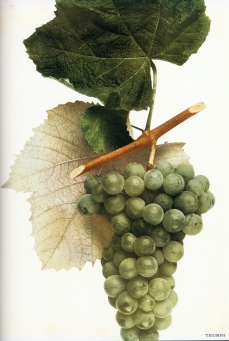
When quality, color, shape and size of bunch and berry are all considered, Triumph is one of the finest dessert grapes of America. When at its best it is a magnificent bunch of golden grapes of highest quality, esteemed even in southern Europe where it must compete with the best of the Viniferas, though unfortunately it is nearly as susceptible in that region to phylloxera as the Old World varieties, a defect which has caused its relegation there from commercial vineyards to the collections of experimenters and amateurs. In America its commercial importance is curtailed by the fact that it requires a long season for its proper development and the variety justifies its name only in the South and more particularly in the Southwest. In the latitude of New York it is doubtfully hardy and the short summer season never permits it to attain the quality and beauty which characterize it further south.
Triumph has, in general, the vine characters of the Labrusca parent Concord, especially its habit of growth, vigor, productiveness and foliage characters, falling short in hardiness, resistance to fungal diseases and earliness of maturity. Even in New York the vines are as vigorous and set nearly as much fruit as Concord; but they are injured in cold winters unless protected, and suffer in particular from the mildews. The fruit matures with or a little later than the Catawba. It proves, in regions where it is largely grown, to be quite adaptable to different soils and locations and the small amount of data at hand on this point in New York suggests that this adaptability holds for the grape regions of this State as well. It prefers, if anything, a deep soil to a shallow one and alluvial or clayey soils to lighter lands.
While the vine characters of Triumph are those of Labrusca there is scarcely a suggestion of the coarseness, or of the foxy odor and taste of Labrusca; and the objectionable seeds, pulp, and skin of the native grape give way to the far less objectionable structures of Vinifera. Grapes of this variety do not have the firm and often disagreeable pulpiness of many other similar hybrids, as for instance most of Rogers’ hybrids. The flesh is tender and melting and the flavor rich, sweet, vinous, pure and delicate, giving the variety high rank among the best American grapes. In the North, as would be expected from its lack of proper maturity, the flavor is insipid as compared with the same character in the South. The skins of the berries are faulty being more apparent in eating than those of Vinifera and under unfavorable conditions crack badly; because of the tenderness of the skin the variety neither ships nor keeps remarkably well. Triumph is not only one of the best dessert grapes but it is said to make a very good white wine.
TRIUMPH
There are numerous pure-bred and cross-bred offsprings of Triumph in America which indicate that this variety may be very successfully used in grape-breeding. Munson of Texas, in particular, among other viticulturists, has used it to advantage in breeding work, his Bailey, Big Extra, Big Hope, Carman, Early Golden, Fern Munson, Governor Ross, Newman, Ragan, Rommel, R. W. Munson, W. B. Munson, all having been bred with Triumph as an ancestor.
When all of its qualities and characters are considered, and for all parts of America, it can hardly be disputed that Triumph is the best of the hybrids of the two species from which it comes that has been produced by artificial fertilization. That it does not succeed better in New York is a distinct loss to the viticulture of the State.
Triumph was originated nearly a half century ago by George W. Campbell of Delaware, Ohio, from seed of Concord fertilized by Chasselas Musque (Joslyn’s St. Albans). The originator considered it of no value in his vineyard but sent it to Samuel Miller of Bluffton, Missouri, who gave it the name Triumph. It was placed on the grape list of the American Pomological Society fruit catalog in 1883.
Vine vigorous, doubtfully hardy, medium to very productive, somewhat subject to attacks of mildew. Canes medium to long, intermediate in number and thickness, moderately dark brown, surface covered with a slight amount of bloom; nodes enlarged, variable in shape; internodes medium to above in length; diaphragm thick; pith medium in size; shoots slightly pubescent; tendrils intermittent, medium to long, trifid, sometimes bifid.
Leaf-buds large to medium, long and thick, obtuse to conical, open late. Young leaves tinged on under side and along margin of upper side with brownish-carmine. Leaves large, of average thickness; upper surface light green, dull, medium to slightly rugose; lower surface grayish-white, pubescent; veins distinct; leaf usually not lobed with terminus obtuse to acute; petiolar sinus medium to deep, narrow, often closed and overlapping; basal sinus absent; lateral sinus shallow and narrow when present; teeth deep, wide to medium. Flowers fertile, open late; stamens upright.
Fruit ripens with Catawba or later, does not rank among the best keepers. Clusters very large to medium, long, broad, tapering to cylindrical, sometimes single-shouldered, compact; peduncle short to medium, above average thickness; pedicel medium to short, slender, smooth, considerably enlarged at point of attachment to fruit; brush short, pale yellowish-green. Berries medium to above in size, oval, pale green or golden yellow, glossy, covered with heavy gray bloom, persistent, firm. Skin thin, variable in toughness, sometimes inclined to crack, adheres considerably to the pulp, contains no pigment, slightly astringent. Flesh light green, translucent, juicy, fine-grained, tender, somewhat vinous, good to very good. Seeds separate easily from the pulp, one to five, average three, below medium to small, intermediate in width, long, brownish; raphe sometimes visible being partly submerged in the short shallow groove; chalaza of average size, above center, oval to circular, distinct.
ULSTER. (Labrusca, Vinifera.)
1. Bush. Cat., 1883:141. 2. Am. Pom. Soc. Rpt., 1885:104. 3. Ohio Hort. Soc. Rpt., 1885-6:224. 4. Am. Pom. Soc. Cat., 1889:24. 5. Mo. Hort. Soc. Rpt., 1891:128. 6. Rural N. Y., 50:691. 1891. 7. Ib., 51:170, 681. 1892. 8. N. Y. Sta. An. Rpt., 11:637. 1892. 9. Ill. Sta. Bul., 28:262. 1893. 10. Bush. Cat., 1894:183. 11. W. N. Y. Hort. Soc. Rpt., 39:26. 1894. 12. N. Y. Sta. An. Rpt., 17:536, 548, 553, 557. 1898. 13. Kan. Sta. Bul., 110:240. 1902. 14. Mich. Sta. Bul., 205:41. 1903.
Ulster Prolific (1, 2, 3, 5, 9, 11, 13). Ulster Prolific (8, 10).
The accompanying color-plate does not do justice to Ulster as to size and beauty of the fruit but it well illustrates one of the chief faults of the variety. The vines usually set too much fruit in spite of efforts to control the crop by pruning, and two undesirable results follow: The bunches are small and the vines, lacking vigor at best, fail to fully recover from the over-fruitfulness. Over-productiveness and lack of vigor are the two defects in Ulster that have kept it from becoming of more importance commercially and a greater favorite as a garden grape. The quality of the fruit is very good, being much like that of Catawba both in flesh characters and in flavor. The color of the berries seems to vary greatly, sometimes being nearly as red as Catawba and under other conditions an unattractive green with a reddish tinge. As a rule the fruit keeps well but there are exceptions especially when the variety is not grown under the conditions best suited to it. Ulster has many good qualities but its deficiency in vigor and capriciousness in both vine and fruit characters prevent its becoming a grape of value for either vineyard or garden.
Ulster was originated by A. J. Caywood of Marlboro, New York, and was introduced by the originator about 1885. It was included in the list of sorts recommended by the American Pomological Society in 1899. Its parents are said to be Catawba pollinated by a wild Aestivalis. Both vine and fruit show unmistakable traces of Labrusca and Vinifera, but the Aestivalis characters, if present, are not apparent.
ULSTER
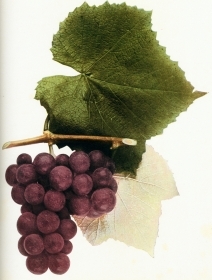
Vine medium to weak, usually hardy, productive, often overbears, sometimes susceptible to attacks of mildew. Canes medium to short, not numerous, slender, moderately dark brown, surface roughened and covered with faint pubescence; nodes enlarged and flattened; internodes short; diaphragm of average thickness; pith intermediate in size; shoots pubescent; tendrils usually intermittent, of medium length, bifid, dehisce early.
Leaf-buds intermediate in size, short to medium, thick, plump, conical to pointed, open rather late. Young leaves faintly tinged on under side and along margin of upper side, which is rather glossy, prevailing color pale green with considerable rose-carmine tinge. Leaves small to medium, thick; upper surface light green, glossy, somewhat smooth; lower surface grayish-white, pubescent; veins distinct; leaf usually not lobed with terminus acute to acuminate; petiolar sinus of average depth, medium to wide; basal sinus absent; lateral sinus a mere notch when present; teeth shallow to medium, above medium width. Flowers fertile or nearly so, open rather early; stamens upright.
Fruit usually ripens with Concord or a little later, keeps and ships well. Clusters intermediate in size, above average length, intermediate in breadth, cylindrical to slightly tapering, often single-shouldered, compact; peduncle short, slender; pedicel intermediate in length, slender to medium, covered with numerous warts; brush short, yellowish-green. Berries above medium to medium in size, roundish to roundish-oval, rather dark dull red but do not always color well, covered with thin light to dark lilac bloom, persistent, of average firmness. Skin thick, tough, adheres slightly to the pulp, contains no pigment, somewhat astringent. Flesh pale green, translucent, juicy, tender, fine-grained, faintly aromatic, slightly foxy, sweet next the skin to tart at center, good to very good in quality. Seeds separate easily from the pulp, one to six, average three, medium to above in size, variable in length and breadth, somewhat plump, brownish; raphe obscure; chalaza intermediate in size, above center, oval to circular, not distinct; surface of seeds slightly roughened.
UNION VILLAGE. (Labrusca, Vinifera?)
1. Elliott, 1854:247. 2. U. S. Pat. Off. Rpt., 1856:433. 3. Am. Pom. Soc. Rpt., 1856:39, 165. 4. Downing, 1857:346. 5. Am. Pom. Soc. Rpt., 1858:69. 6. Am. Pom. Soc. Cat., 1858:235. 7. Mag. Hort., 24:92, 94. 1858. 8. Horticulturist, 14:74. 1859. fig. 9. Mass. Hort. Soc. Rpt., 1860:49. 10. Am. Pom. Soc. Rpt., 1860:89. 11. Mag. Hort., 27:533. 1861. 12. Horticulturist, 16:234. 1861. fig. 13. Am. Pom. Soc. Rpt., 1862:146. 14. Mag. Hort., 29:422. 1863. 15. Ib., 31:103. 1865. 16. Mead, 1867:198. 17. Grape Cult., 1:43, 44, 151, 239, 262, 327. 1869. 18. Bush. Cat., 1883:142. 19. Am. Pom. Soc. Rpt., 1883:59.
Imitation Hamburg (1). Ontario (8, 9, 10, 14). Ontario (13, 15, 16, 17, 18, 19). Shaker (2). Shaker (4, 17, 18).
Rampant in vine, with thick wood, large coarse leaves, bunches and berries, Union Village is marked by grossness in all of its characters. Its vigor of vine and showiness of fruit attracted the attention of the viticulturists of a half century ago and it was then quite commonly grown but has now been almost wholly discarded because of poor quality, susceptibility to disease, and lack of hardiness. It ripens somewhat late and quite unevenly. It might prove of some value in breeding for the characters for which, even among the largest and most vigorous grapes of to-day, it is distinguished.
This variety was originated by the Shakers at Union Village, Warren County, Ohio. It was introduced by Nicholas Longworth of Cincinnati about the middle of the last century. In 1858 it was placed on the American Pomological Society’s list of grapes that promise well and in 1862 was placed on the regular list of recommended sorts. Here it remained until 1883, when it was dropped. Ontario, another grape of this type, which was originated by W. H. Read of Port Dalhousie, Ontario, was considered by many synonymous with Union Village but the evidence seems to show that, though very similar, it had a distinct origin. Union Village is said to be a seedling of Isabella. The characters generally indicate Labrusca although the lobing of the leaves and the susceptibility to fungi may indicate a strain of Vinifera.
The following description has been compiled from various sources:
Vine vigorous to rank, usually productive, somewhat tender, subject to attacks of fungi. Canes large, long; internodes short. Leaves coarse and large. Fruit ripens about one week before Isabella, matures unevenly. Clusters large to very large, often shouldered, compact. Berries large to very large, roundish, dark purplish-black covered with heavy bloom, shell badly. Skin moderately thin. Flesh tart, resembling Isabella somewhat in flavor, quality fair to good.
VERGENNES. (Labrusca.)
1. Am. Pom. Soc. Rpt., 1881:34, 117. 2. Barry, 1883:450. 3. Am. Pom. Soc. Cat., 1883:26. 4. W. N. Y. Hort. Soc. Rpt., 29:19, 112. 1884. 5. Am. Pom. Soc. Rpt., 1885:103, 105. 6. Ohio Hort. Soc. Rpt., 1886-7:172. 7. N. Y. Sta. An. Rpt., 9:330. 1890. 8. Ill. Sta. Bul., 28:262. 1893. 9. Bush. Cat., 1894:184. fig. 10. Gar. and For., 8:487. 1895. 11. N. Y. Sta. An. Rpt., 17:536, 542, 543, 544, 548, 553. 1898. 12. Ib., 18:383, 389, 396. 1899. 13. Mo. Sta. Bul., 46:41, 43, 44, 45, 53, 76. 1899. 14. Mich. Sta. Bul., 169:176. 1899. 15. Kan. Sta. Bul., 110:237. 1902. 16. Ont. Fr. Gr. Assoc. Rpt., 34:99. 1902.
VERGENNES
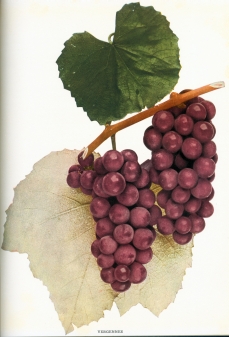
While not one of the leading commercial varieties in New York, Vergennes has steadily increased in popularity during the thirty years since its introduction. One of the most valuable attributes of Vergennes is that it seldom fails to bear a crop though it has a tendency to overbear which causes it to be variable in size of fruits and in time of ripening; with a moderate crop it ripens with Concord but with a heavy load of grapes the crop matures from one to two weeks later. Vergennes is somewhat unpopular with vineyardists because of the sprawling habit of the vine making a vineyard of this grape untractable for vineyard operations. This fault is obviated somewhat by grafting it on other vines. In some of the grape regions of New York the vines are precariously hardy though tenderness to cold can hardly be said to be a serious fault of the variety.
The appearance of the fruit is attractive and while the quality is not high, yet it is good; the flavor is agreeable, the flesh is tender and seeds and skin are not objectionable. Considering all of its fruit characters, Vergennes may be said to be more than an ordinary grape—much better than several better known commercial varieties. The variety is somewhat remarkable in being probably the best shipper and the best keeper among the pure Labrusca varieties. Nearly all of the grapes which ship and keep well have more or less Vinifera blood, but if Vergennes has any foreign blood it shows it only in its keeping and shipping qualities. At present Vergennes is the standard late-keeping grape for this region being very commonly found in the markets as late as January and sometimes February. A number of seedlings of Vergennes, pure-bred and cross-bred, growing on the Station grounds, show that this variety transmits its characters well to its offspring indicating that it has value for grape-breeding. Vergennes may be recommended for its intrinsic value for the vineyard and the garden and to the experimenter as one of the best pure Labruscas for the production of new and improved varieties.
The original vine of this variety was a chance seedling found in the garden of William E. Greene, Vergennes, Vermont. It fruited for the first time in 1874. It was placed on the list of sorts recommended by the American Pomological Society in 1883 and is still retained.
Vine variable in vigor, not always hardy, medium to very productive depending upon amount of winter injury, usually healthy. Canes long to medium, intermediate in number and size, dark dull brown; nodes enlarged, strongly flattened; internodes of average length; diaphragm thick; pith medium in thickness; shoots pubescent; tendrils continuous, long to medium, bifid or sometimes trifid.
Leaf-buds large to medium, long, thick; open very late. Young leaves tinged on under side and along margin of upper side with rose-carmine. Leaves large to medium, thin; upper surface light green, glossy, somewhat rugose; lower surface pale green, very pubescent; veins indistinct; leaf usually not lobed with terminus broadly acute; petiolar sinus of average depth, medium to wide; teeth shallow, often wide. Flowers nearly sterile, open in mid-season; stamens upright.
Fruit variable in season but usually ripens one to two weeks later than Concord, keeps and ships well. Clusters intermediate in size and length, broad, cylindrical to tapering, sometimes single-shouldered, variable in compactness but inclined to be loose; peduncle short to medium, thick; pedicel intermediate in length and thickness, covered with numerous small warts, enlarged at point of attachment to fruit; brush slender, short, pale green. Berries large to below medium, oval to roundish, light and dark red, covered with lilac bloom, persistent, medium in firmness. Skin does not crack, thick, tough, adheres considerably to the pulp, contains no pigment, astringent. Flesh pale green, juicy, fine-grained, somewhat stringy, tender, vinous, sweet next the skin, agreeably tart at center, good to very good in quality. Seeds separate easily from the pulp, one to five, average three, variable in size, length and breadth, not notched, usually blunt, brownish; raphe distinct; chalaza small, plainly above center, usually roundish, often with shallow radiating furrows, distinct.
VICTORIA. (Labrusca, Vinifera.)
1. Am. Pom. Soc. Rpt., 1883:92. 2. Ib., 1885:104. 3. Mo. Hort Soc. Rpt., 1891:129. 4. Rural N. Y., 50:691, 847. 1891. 5. N. Y. Sta. An. Rpt., 11:637. 1892. 6. Del. Sta. An. Rpt., 7:135, 139. 1895. 7. Rural N. Y., 56:822. 1897. 8. N. Y. Sta. An. Rpt., 17:536, 548, 557. 1898. 9. Mich. Sta. Bul., 169:176. 1899. 10. Ga. Sta. Bul., 53:49. 1901.
As a green seedling of Concord, Victoria has much in common with others of its kind that have come from this parent. In particular it resembles Hayes but does not equal it, being of poorer quality and having smaller and less attractive fruits; neither does it equal Martha. Victoria is marked by having more foxiness in flavor than do most of the white seedlings of Concord. In view of the many good green grapes, there is little about Victoria to recommend it,—there are many commonplace grapes of its color and season quite its equal.
This variety was originated by T. B. Miner of Linden, Union County, New Jersey, about 1871.
Vine of medium vigor, usually hardy, productive, subject to attacks of mildew in unfavorable locations. Canes medium to short, not numerous, slender; tendrils continuous, trifid to bifid. Leaves medium in size, dark green; lower surface pale green with tinge of bronze, covered with short down. Flowers nearly fertile, open in mid-season; stamens upright. Fruit ripens about with Concord, does not keep well. Clusters average in size, long, inclined to slender, often single-shouldered, compact. Berries intermediate in size, roundish, light green with pale yellow tinge, covered with thin gray bloom, persistent. Skin thin, tender. Flesh pale green, slightly tough, foxy, sweet at skin to acid at center, good in quality. Seeds do not separate readily from the pulp, medium to below in size, of average width and length.
WALTER. (Vinifera, Labrusca, Bourquiniana.)
1. Mag. Hort., 31:120. 1865. 2. Ib., 33:7, 54. 1867. 3. Horticulturist, 23:359, 360. 1868. fig. 4. Grape Cult., 1:307, 327, 329. 1869. 5. Am. Jour. Hort., 6:342. 1869. fig. 6. Ib., 8:144, 299. 1870. 7. Am. Pom. Soc. Cat., 1871:16. 8. Am. Pom. Soc. Rpt., 1875:39. 9. Ib., 1883:59, 154. 10. Bush. Cat., 1894:185. fig. 11. Tex. Sta. Bul., 48:1151, 1163. 1898. 12. Ga. Sta. Bul., 53:49. 1901. 13. Kan. Sta. Bul., 110:243. 1902.
Were it not almost impossible to grow healthy vines of Walter it would take rank among the best of our American grapes. But stunted by fungi which nearly every year attack leaves, young wood and fruit, it is only possible in exceptionally favorable seasons to produce a crop of grapes with this variety. Not infrequently the attacks of mildew are so severe that the vines are defoliated before mid-season. Besides its susceptibility to cryptogamic diseases the variety is fastidious as to soils and even in localities to which it seems adapted it is variable in growth. While not to be classed among the tender grapes yet it is injured in severe winters, and is almost certain to suffer some injury after defoliation by fungi. There are several reports at hand which seem to show that it is hardier and more vigorous on the roots of hardy, strong-growing varieties.
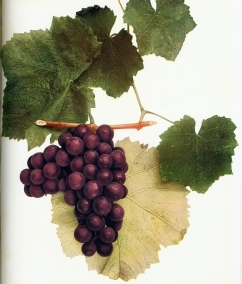
As if to atone for the faults of the vine the fruit of Walter is almost perfect, lacking only in the size of bunch and berry. The bunch and berry resemble Delaware, one of its parents, while it has the peculiar flavor of Diana, the other parent. Well grown, the fruit is more attractive than that of Delaware but it cannot be said that the quality is quite the equal of that of either of its parents. It does not have the fault of ripening its berries unevenly, one of the defects which debars Diana from profitable cultivation. Though more fastidious, Walter is usually adapted to conditions under which Delaware thrives. The variety has been cultivated for nearly half a century but is seemingly less and less grown, a fact to be regretted; for there are few American grapes of more exquisite flavor and aroma and more dainty appearance. It is said that when protected from dew by walls or other shelter the vines are not so badly attacked by fungi, if at all, and that Walter may thus be grown to perfection. If this be true grape-lovers should see that the variety is long retained in collections and for the garden.
A. J. Caywood originated this variety about 1850 from seed of Delaware pollinated by Diana. It was placed on the grape list of the American Pomological Society fruit catalog in 1871. Walter is still to be found in an occasional varietal vineyard but it is seldom offered for sale by nurserymen.
Vine moderately vigorous, not hardy in exposed locations, variable in productiveness, subject to attacks of fungi. Canes medium to above in length and size, dark reddish-brown, surface covered with thin blue bloom; nodes enlarged, flattened; internodes medium to above in length; diaphragm thick; pith of fair size; shoots pubescent; tendrils intermittent, medium to above in length, bifid.
Leaf-buds small, intermediate in length and thickness, pointed to conical. Foliage of average size, thick; upper surface dark green, glossy, smooth; lower surface tinged with bronze, heavily pubescent; lobes none to three with terminus acute; petiolar sinus of average depth, narrow to medium; basal sinus lacking; lateral sinus usually a notch if present; teeth intermediate in depth and width. Flowers open in mid-season; stamens upright.
Fruit somewhat variable in season of ripening, averaging about with Delaware, keeps and ships well. Clusters medium in size and length, broad, cylindrical to tapering, usually single-shouldered, compact; peduncle short to medium, of average thickness; pedicel medium in length, slender, covered with small scattering warts; brush short, slender, green with brownish tinge. Berries small to medium, often strongly ovate, red, much like Delaware, glossy, covered with a moderate amount of lilac bloom, persistent, firm. Skin intermediate in thickness, very tough, adheres but slightly to the pulp, contains no pigment, without astringency. Flesh pale green, translucent, juicy, tough, somewhat foxy, vinous, quite strongly aromatic, sweet next the skin to tart at center, good to very good in quality. Seeds do not separate easily from the pulp, one to four, average three, below medium in size and length, intermediate in width, medium to sharp-pointed, light brown; raphe obscure; chalaza large, above center, irregularly circular, distinct. Must 100°.
WALTER
WAPANUKA. (Labrusca, Riparia, Vinifera, Bourquiniana.)
1. Tex. Sta. Bul., 56:280. 1900. 2. Rural N. Y., 60:637. 1901. 3. Ib., 62:790. 1903. 4. Iowa Hort. Soc. Rpt., 1904:228. 5. Mo. Hort. Soc. Rpt., 1904:305. 6. Ill. Hort. Soc. Rpt., 1905:302.
Though there are many qualities to commend Wapanuka, yet it is not as popular in the North as was expected it would become at the time of its introduction. The chief reason for its failure is that it does not ship well, seemingly a prime requisite for a commercial grape in New York, though the markets are seldom far distant. It is probable, too, that the flavor is not quite as high in this latitude as in the South, or it may be that the grapes with which we compare it here are better flavored than in the South. At any rate it does not have the comparatively high quality in New York that it is reported to have elsewhere, being too insipid. There is a tendency, too, for the grapes to shatter. The fruits when well grown are attractive and the quality is from fair to good. Wapanuka is worthy a trial in commercial vineyards; and because of the handsome appearance and distinct flavor of the fruit it deserves a place in the garden.
Munson of Texas, originated Wapanuka from seed of Rommel fertilized by Brilliant. It was introduced by the originator in the fall of 1898.
Vine vigorous, usually hardy, productive. Canes medium to short, intermediate in number and size, dark reddish-brown, often with ash-gray tinge; tendrils continuous, bifid to trifid. Leaves large, moderately light green, somewhat rugose on older leaves; lower surface dull green tinged with bronze, pubescent. Flowers fertile or nearly so, open before mid-season; stamens upright. Fruit ripens about with Concord, does not keep well. Clusters intermediate in size, long to medium, frequently with a long-peduncled single shoulder, compact. Berries large, roundish, very pale yellowish-green, covered with thin gray bloom, with a tendency to shatter, soft. Skin covered with few, small, dark dots, very thin and tender. Flesh unusually pale green, tender, somewhat foxy, sweet and mild, good in quality. Seeds separate easily from the pulp, intermediate in size, broad, distinctly notched, short.
WHITE IMPERIAL. (Vinifera, Labrusca, Bourquiniana.)
1. Mo. Hort. Soc. Rpt., 1883:78. 2. Ib., 1892:270. 3. Bush. Cat., 1894:186. 4. Va. Sta. Bul., 94:142. 1898. 5. Mich. Sta. Bul., 169:177. 1899. 6. Ga. Sta. Bul., 53:50. 1901.
White Imperial is one of Stayman’s[213] numerous productions. The originator thought it one of the most valuable, if not the most valuable, of his white grapes. As the variety grows in the Station vineyard the fruit is neither especially attractive in appearance nor of very high quality though better in the latter respect than the average. White Imperial is one of a somewhat large number of offspring of Dutchess now known to viticulture in which the good qualities of the parent have been transmitted in a large measure to the progeny. White Beauty, described in the next chapter, is of the same parentage and is similar in general characters of vine and fruit, though berries and bunches are a little larger and the vines a little more vigorous. White Imperial was introduced with great expectations in the West, but, especially in the vineyards of Missouri, while still grown somewhat is not holding its own with better known grapes of its class.
White Imperial was produced by Dr. J. Stayman of Leavenworth, Kansas, from seed of Dutchess. The variety was introduced about twenty-five years ago by Stayman & Black.
Vine medium to very vigorous, hardy, variable in productiveness, susceptible to attacks of fungi under unfavorable conditions. Canes intermediate in length, rather numerous, inclined to slender; tendrils continuous to intermittent, bifid to trifid. Leaves above average size, intermediate in color and thickness; lower surface pale green, often with considerable pubescence, slightly cobwebby. Flowers partly sterile, open early; stamens upright. Fruit ripens about a week before Delaware, keeps well. Clusters variable in size, intermediate in length, slender, frequently single-shouldered, variable in compactness. Berries medium to small, oval to roundish, light green, sometimes with a yellow tinge, covered with thin gray bloom, persistent. Skin sprinkled with reddish-brown dots, thin, tender, without astringency. Flesh pale green, fine-grained, tough, sweet at skin to agreeably tart at center, somewhat sprightly, good to best in quality. Seeds not numerous, medium to small, sharp-pointed.
WILDER. (Labrusca, Vinifera.)
1. Mass. Hort. Soc. Rpt., 1861:68. 2. Horticulturist, 18:98. 1863. 3. Ib., 21:325. 1866. fig. 4. Mead, 1867:205, 207. 5. Am. Pom. Soc. Cat., 1867:44. 6. Horticulturist, 24:126. 1869. 7. Grape Cult., 1:181. 1869. 8. Ib., 2:29, fig., 30. 1870. 9. Am. Pom. Soc. Rpt., 1881:40, 42, 123, 138, 153, 162, 168. 10. Ill. Hort. Soc. Rpt., 1883:81. 11. Bush. Cat., 1894:187, fig., 188. 12. Va. Sta. Bul., 94:136. 1898. 13. N. Y. Sta. An. Rpt., 17:537, 548, 553. 1898. 14. Mo. Sta. Bul., 46:41, 43, 44, 46, 64, fig. 1899. 15. Ala. Sta. Bul., 110:70, 89. 1900. 16. Kan. Sta. Bul., 110:243. 1902.
Rogers’ No. 4 (1, 2, 3, 4, 5). Rogers’ No. 4 (6, 7, 8, 9, 10, 11, 15).
The accompanying color-plate scarcely does Wilder justice as to size of bunch and berry but were the illustration somewhat enlarged it would be very typical of the variety. The berries when fully ripe are quite similar in size and color to Black Hamburg but the bunches have fewer berries than the European parent and the quality, as would be expected, is not so good, falling short chiefly in flesh characters. While Wilder is surpassed in quality, and, as usually grown, in appearance by other of Rogers’ hybrids, it is one of the most reliable of all of them for vineyard culture, the vines being vigorous, hardy, fairly productive, and, though somewhat susceptible to mildew, as healthy as any of the hybrids of Labrusca and Vinifera. Wilder is not as well known in the markets as it should be, and now that fungal diseases can be controlled by spraying, this, with other such hybrids, should be more generally planted in commercial vineyards and especially for local and special markets. The wine from this, and for that matter from any of Rogers’ grapes, is not of quality such as recommends it and neither are the grapes suitable for grape juice. Surplus fruit would often, therefore, be a loss in large plantations.
Wilder is one of the forty-five Labrusca-Vinifera hybrids raised by E. S. Rogers of Salem, Massachusetts. For an account of its origin and parentage, see Rogers’ Hybrids. The first notes as to the qualities of this variety were published in 1858. The variety was placed on the American Pomological Society list of recommended sorts in 1867 and has never been removed. In 1869, Rogers expressing a desire to name one of his seedlings after Marshall P. Wilder, Mr. Wilder selected this one as in his estimation the best of all Rogers’ hybrids and it was given his name.
Vine medium to very vigorous, hardy, productive, somewhat susceptible to attacks of mildew. Canes long, moderately numerous, often below average thickness, ash-gray to dark reddish-brown with darker tinge at the nodes which are usually not flattened; internodes long; diaphragm of average thickness; pith intermediate in size; shoots thinly pubescent; tendrils intermittent, medium in length, bifid to trifid.
Leaf-buds of average size, short, thick, roundly obtuse to conical, open early. Young leaves tinged on lower side and along margin of upper side with rose-carmine. Leaves large, often irregularly roundish, of average thickness; upper surface dark green, glossy, smooth; lower surface pale green, pubescent; veins distinct; usually not lobed with terminus acute to obtuse; petiolar sinus deep, narrow, often closed and overlapping; basal sinus lacking; lateral sinus shallow, narrow, or a mere notch when present. Flowers sterile, open mid-season or earlier; stamens reflexed.
Fruit ripens with Concord or earlier, keeps and ships fairly well. Clusters variable in size but are not large, short and broad, irregularly tapering, heavily single-shouldered, sometimes double-shouldered, loose; peduncle of average length, thick; pedicel long, thick, covered with numerous, prominent warts; brush of fair length, thick, green with tinge of light red. Berries large, slightly oval, purplish-black to black, not glossy, covered with heavy blue bloom, persistent, firm. Skin thick, variable in toughness, adheres somewhat to the pulp, with bright red pigment, astringent. Flesh greenish, translucent, juicy, tender, has some Vinifera sprightliness, sweet at skin to tart at the seeds, good in quality. Seeds adherent to the pulp, one to five, average three, above medium in size, often long, intermediate in breadth, light brown; raphe sometimes shows as a partially submerged cord; chalaza small, above center, oval, distinct.
WILDER
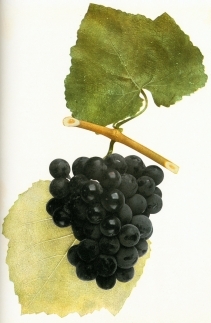
WINCHELL. (Labrusca, Vinifera, Aestivalis.)
1. N. Y. Sta. An. Rpt., 4:224. 1885. 2. Am. Pom. Soc. Rpt., 1887:91. 3. N. Y. Sta. An. Rpt., 7:105, 108. 1888. 4. Rural N. Y., 47:675. 1888. fig. 5. Gar. and For., 2:24, 432. 1889. 6. Ohio Hort. Soc. Adv. Rpt., 1890:21. 7. N. Y. Sta. An. Rpt., 9:331. 1890. 8. Am. Pom. Soc. Rpt., 1891:151. 9. Rural N. Y., 50:691, 705. 1891. 10. Ib., 51:19, 63, 633, 681. fig. 1892. 11. Bush. Cat., 1894:130, 131, fig., 188. 12. Wis. Sta. An. Rpt., 13:223. 1896. 13. Am. Pom. Soc. Cat., 1897:19. 14. Mo. Sta. Bul., 46:39, 42, 45, 46, 50, 54, 76. 1899. 15. Rural N. Y., 58:23. 1899. 16. Mich. Sta. Bul., 169:177. 1889. 17. Ala. Sta. Bul., 110:82. 1900. 18. Kan. Sta. Bul., 110:236, 238. 1902.
Green Mountain (3, 4, 5, 6, 7, 8, 9, 10, 11, 14, 15, 17, 18). Green Mountain (10, 11, 12, 13, 16). Winchell (6, 9, 14, 17, 18).
Winchell is at once very early and of very good quality, characters seldom found combined in grapes. But this is not all that can be said; the vines are vigorous, hardy, healthy, productive, and the fruit keeps and ships well, altogether making a most admirable early grape. Unfortunately the berries, and under some conditions the bunches, are small, and this, combined with the fact that green grapes are not as popular as black and red ones, has kept Winchell from being as largely planted as it otherwise would have been. Then, too, as has been noted before, the competition from the South, in which larger, cheaper and as good grapes compete with early northern crops of this fruit, is limiting the production of early varieties of grapes in the North.
There are some minor faults, too, which under some conditions become drawbacks to the culture of Winchell. At best the bunch of this variety is loose and characterized by a large shoulder. Sometimes this looseness becomes so pronounced as to give a straggling, poorly-formed cluster; so, too, the shoulder when as large as the cluster itself, which often happens, makes the cluster unsightly. There is a tendency, under some conditions, for the grapes to shell when fully ripe and this is often a serious fault. Again, while the crop usually ripens evenly yet there are seasons when two pickings are needed because of unevenness in ripening. Lastly the skin is thin and there is danger in unfavorable seasons, or in shipping, of the berries cracking though this is seldom a serious fault. These defects do not begin to offset the several good characters of Winchell and it is, for New York at least, the standard early green grape and deserving to rank with the best early grapes of any color.
The original vine of this variety was raised by James Milton Clough of Stamford, Bennington County, Vermont, about the middle of the last century from seed of an unknown purple grape. For some years it had a local reputation and was propagated by some of Clough’s neighbors. By what name it was then known does not appear. In December, 1885, according to their statements, Ellwanger & Barry of Rochester, New York, received this variety from C. E. Winchell, then of Stamford. In 1888, this firm introduced the variety to the trade. The same year there was introduced by Stephen Hoyt’s Sons of New Canaan, Connecticut, a variety under the name Green Mountain. This firm states that they bought the variety from James M. Paul, of North Adams, Massachusetts, in December, 1885. Previous to his sale Paul had sent a vine of the grape to this Station; he exhibited fruit of Green Mountain before the American Pomological Society in 1887, but without any name.
Later grape-growers found that Winchell and Green Mountain were very similar or identical. Unfortunately, in the meantime, Paul had died and no one knows positively where he secured his vines although there is every reason to believe they were from Mr. Clough. Those who consider the Winchell and Green Mountain separate varieties say the Winchell has larger berries and is somewhat later in ripening than the Green Mountain. Though unable to make a close comparison of vines and fruits of the two supposed varieties, the authors of The Grapes of New York choose to consider them so nearly identical, if not identical, as to pass under one name which should be the one first published, Winchell.
Although the botanical characters of this variety are chiefly Labrusca, the thin bloom which sometimes shows on the canes, the occasional intermittent tendrils, and the lobing of the leaf, indicate slight admixtures of Vinifera and Aestivalis.
WINCHELL
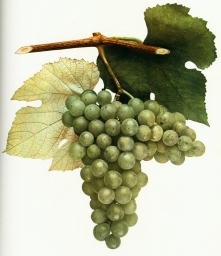
Vine vigorous, hardy, healthy, very productive. Canes long to medium, numerous, slender, medium dark brown, surface covered with very thin bloom; nodes enlarged, flattened; internodes above medium to short; diaphragm thick; pith medium to below in size; shoots pubescent; tendrils continuous, sometimes intermittent, of average length, bifid.
Leaf-buds medium to below in size, short to medium, thick, open early. Young leaves faintly tinged on under side only with faint rose-carmine. Leaves large to medium, of average thickness; upper surface light green, glossy, smooth to medium; lower surface dull green, tinged with bronze, faintly pubescent; lobes three to five with terminal lobe acute to acuminate; petiolar sinus deep, of medium width; basal sinus shallow, intermediate in width; lateral sinus variable in depth and width; teeth shallow, moderately wide. Flowers fertile, open about mid-season or somewhat earlier; stamens upright.
Fruit ripens very early, sometimes before Moore Early, keeps and ships well for an early grape. Clusters large to below medium, long, slender, cylindrical to slightly tapering, often with a long single shoulder, loose to moderately compact; peduncle long, moderately slender; pedicel short, slender, covered with few, small, inconspicuous warts; brush greenish-white. Berries above medium to small, roundish, light green, covered with thin white bloom, usually persistent, soft. Skin often marked with small reddish-brown spots, thin, tender, adheres very slightly to the pulp, contains no pigment, slightly astringent. Flesh greenish, translucent, juicy, tender, fine-grained, sweet; very good to best in quality. Seeds separate fairly well from the pulp, one to four, average two, small, plump, moderately wide and long, blunt, brownish; raphe obscure, chalaza small, slightly above center, circular, not distinct.
WOODRUFF. (Labrusca, Vinifera?)
1. Am. Pom. Soc. Rpt., 1881:44, 65. 2. Ib., 1885:107, 108. 3. Ohio Hort. Soc. Rpt., 1887-8:87, 209. 4. Ib., 1888-9:16. 5. Am. Pom. Soc. Cat., 1889:24. 6. Gar. and For., 3:490, 599. 1890. 7. W. N. Y. Hort. Soc. Rpt., 1890:179. 8. N. Y. Sta. An. Rpt., 11:638. 1892. 9. Ill. Sta. Bul., 28:262. 1893. 10. Bush. Cat., 1894:188. fig. 11. N. Y. Sta. An. Rpt., 17:537, 545, 546, 548, 553. 1898. 12. Mich. Sta. Bul., 169:177. 1899. 13. Ib., 194:59. 1901. 14. Kan. Sta. Bul., 110:238. 1902. 15. Kan. Hort. Soc. Rpt., 1904-05:228.
Woodruff Red (1, 2, 3, 4, 5, 6, 7, 8, 9, 14). Woodruff Red (10).
Woodruff is a handsome, showy, brick-red grape with large clusters and berries. While very attractive in appearance its taste belies its looks, for the flesh is coarse and the flavor foxy. In spite of its attractive appearance, Woodruff would scarcely be worth attention were it not for its excellent vine characters. The vines are hardy, vigorous, productive and fairly healthy. In appearance it is a typical strong-growing Labrusca with the varied adaptabilities of that species for soils and ability to withstand adverse conditions. It ripens a little before or with Concord and comes on the market at a good time, especially for a red grape. When introduced Woodruff promised to be a valuable commercial grape but its poor quality, the fact that it does not keep well, and a pronounced tendency to crack and shatter, have kept the variety from becoming prominent for either vineyard or garden. While it is worthy of attention under some conditions because of hardiness and possibly other vine characters, yet it is hardly worth growing where other varieties of its color and season can be had.
Woodruff, or as it was first known, Woodruff Red, came from C. H. Woodruff of Ann Arbor, Michigan. He reported it as a chance seedling which came up in 1874 and fruited for the first time in 1877. It was supposed to be a cross of Catawba and Concord. It was introduced in 1885 and placed on the grape list of the American Pomological Society fruit catalog in 1889.
Vine very vigorous, hardy, produces as heavy or heavier crops than Concord, inclined to mildew in unfavorable locations. Canes intermediate in length, number and thickness, dark brown; nodes slightly enlarged, flattened; internodes medium to short; diaphragm medium to above in thickness; pith below average size; shoots pubescent; tendrils continuous, of mean length, bifid to trifid.
Leaf-buds small, short to medium, slender, pointed to conical. Leaves intermediate in size, of average thickness, somewhat roundish; upper surface light green, dull, rugose; lower surface greenish-white to bronze, pubescent; veins indistinct; leaf usually not lobed with terminus acute to obtuse; petiolar sinus intermediate in depth, medium to wide; basal sinus lacking; lateral sinus shallow and narrow when present; teeth very shallow and narrow. Flowers semi-fertile, open moderately early; stamens upright.
Fruit variable in season of ripening, usually shortly before Concord but sometimes slightly later, does not always keep well. Clusters variable in size, of fair length, broad, often widely tapering, usually single-shouldered or with largest clusters sometimes double-shouldered, compact; peduncle medium to long, variable in thickness; pedicel medium to short, thick, smooth, with scarcely any enlargement at point of attachment to fruit; brush long, pale green. Berries large to below medium, roundish to oval, dark red, dull, covered with thin lilac to faint blue bloom, sometimes drop badly from pedicel, firm. Skin thin, medium to tender, adheres strongly to the pulp, contains no pigment, slightly astringent. Flesh very pale green to nearly white, translucent, juicy, tough, coarse, very foxy, sweet at skin but quite tart at center, fair in quality. Seeds do not separate easily from the pulp, one to five, average, three or four, intermediate in size, medium to broad, short, rather plump, blunt, brownish; raphe obscure; chalaza small, slightly above center, oval, not distinct.
WOODRUFF
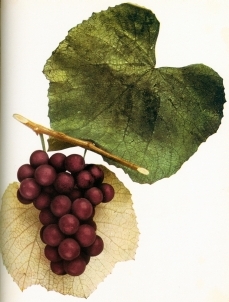
WORDEN. (Labrusca.)
1. Am. Hort. An., 1870:95. 2. Wis. Hort. Soc. Rpt., 1873:71. 3. Mich. Pom. Soc. Rpt., 1874:258. 4. Am. Pom. Soc. Cat., 1881:24. 5. Am. Pom. Soc. Rpt., 1881:42, 115, 121, 123, 136, 144, 168. 6. W. N. Y. Hort. Soc. Rpt., 27:30, 97. 1882. 7. Am. Pom. Soc. Rpt., 1885:103, 106. 8. Wis. Hort. Soc. Rpt., 1885:176. 9. Ohio Hort. Soc. Rpt., 1886-7:171. 10. Ill. Hort. Soc. Rpt., 1887:91. 11. Wis. Sta. An. Rpt., 5:162. 1888. 12. N. Y. Sta. An. Rpt., 9:328. 1890. 13. Miss. Sta. Bul., 22:12, 13. 1892. 14. Bush. Cat., 1894:190. 15. Col. Sta. Bul., 29:20. 1894. 16. Tenn. Sta. Bul., Vol. 9:189. 1896. 17. Gar. and For., 9:300. 1896. 18. N. Y. Sta. An. Rpt., 17:537, 542, 543, 544, 545, 547, 553, 557. 1898. 19. Ev. Nat. Fruits, 1898:75. 20. Ont. Fr. Exp. Stas. Rpt., 8:11, fig., 49. 1901. 21. Mich. Sta. Sp. Bul., 27:10. 1904.
Worden’s Seedling (1, 6). Worden’s Seedling (12, 14).
Worden possesses most of the good qualities of Concord and lacks some of its bad ones. Of all the offspring of Concord, this variety is best known and is most meritorious. It is of the type into which nearly all of the black seedlings of Concord fall and surpasses all of these in quality though it does not equal the best of the green seedlings of the parent in fruit characters, especially in flavor. It differs chiefly from Concord in having larger berries and bunches, in having better quality and in being from a week to ten days earlier. It is equally hardy, healthy, vigorous and productive. It is more fastidious in its adaptations to soil and other conditions than its parents but now and then it is found to do even better under some conditions.
Worden is not as good a grape in many minor characters as the Concord and this is the chief reason why it is not grown as much as its distinguished parent. Its chief fault is that the fruit cracks badly, often preventing the profitable marketing of a crop. The Concord cracks also in unfavorable weather but the cracked berries often, or nearly always, partly or wholly recover from the injury through the growing over of the wounds. The Worden lacks the power of overcoming the cracking. Beside this tenderness of skin, the pulp of Worden is softer than that of Concord, there is more juice and the keeping qualities are not as good, so that the variety hardly ships as well as the more commonly grown grape. In some seasons there is a decided tendency to shell or shatter if the fruit is overripe. Worden is very popular in New York and the North both for commercial plantations and the garden. It is a more desirable inhabitant of the garden and for nearby markets, because of higher quality, than Concord, and under conditions well suited to it, is better as a commercial variety, as it is handsomer as well as of better quality. In the markets it ought to sell for a higher price than Concord if desired for immediate consumption and if it can be promptly harvested, as it does not hang well on the vines. In many markets Worden is sold as Concord and has the effect of extending the Concord season. Its earlier season is against it for a commercial variety in the great Chautauqua Grape Belt of New York and with the defects mentioned will prevent its taking the place of Concord to a great degree.