Chapter IV · SPECIES OF AMERICAN GRAPES. (continued 2)
Reading edition
Vine vigorous, climbing or shrubby if left without support; wood on mature canes cylindrical or slightly angled; diaphragm thin; tendrils intermittent, bifid, rather weak. Leaves medium in size, broadly cordate, notched or lobed and with a triangular apex; petiolar sinus medium in depth, usually narrow; margins with rather large, notched-like teeth; upper surface of a peculiar bluish-green, frequently somewhat rugose with more or less tomentum; lower surface usually with a dense whitish pubescence which shows also on shoots. Cluster medium to small. Berries variable in size, average medium, black with a thick bloom. Seeds somewhat resembling Labrusca but with shorter beak and more distinct chalaza; has characteristic groove extending from chalaza to beak.
Doaniana is quite variable, some specimens being nearly glabrous at maturity while others are densely covered with white pubescence. Munson has separated the species into two forms which he calls the early Doaniana and the late Doaniana. The species was described and named by Munson in 1890.
It is found chiefly in northwest Texas but it ranges from Oklahoma to beyond the Pecos River in New Mexico. It is considered by Bailey and Viala to be a probable hybrid with Vitis candicans as one of the parents. Doaniana is exceedingly hardy, withstanding great cold as well as great heat. It apparently prefers rather light soils as it is indigenous to sandbanks along rivers and the beds of sandy ravines.
Munson states that in cultivation it does well in any but very limy soils. The fruit is of comparatively good quality but the skin possesses some of the pungency of Candicans. The berries are quite persistent, hanging to the pedicel some time after ripe. The vines are not productive. The character of the must is apparently unknown. The roots are hard, penetrate deeply into the soil, and are resistant to phylloxera though somewhat variable in this respect. Doaniana grows readily from cuttings and grafts well in the vineyard. The species blossoms with or just before Labrusca. It is of doubtful value to the southern grape-growers and is of no value in the North.
18. VITIS AESTIVALIS Michx.
1. (?) Marshall, 1785:165. V. vinifera americana; American grape vine. 2. (?) Walter, 1788:242. V. Labrusca. 3. Michaux, 2:230. 1803. 4. Bartram, Dom. Enc., 5:289. 1804. V. sylvestris; V. occidentalis; Common Blue grape; Bunch grape. 5. Muhlenberg, 1813:27. V. intermedia; V. aestivalis; Summer grape. 6. Pursh, 1:169. 1814. V. vulpina; V. labrusca; Summer grape. 7. Nuttall, 1:143. 1818. 8. Elliott, 2:688. 1824. 9. Torrey, Fl. of N. & M. Sta., 1826:121. 10. Rafinesque, 1830:9. V. bracteata; V. labrusca; V. aestivalis; Sour grape. 11. Prince, 1830:199. V. intermedia; V. sylvestris; V. occidentalis; Summer grape; Little grape; Bunch grape; Blue grape. 12. Torrey, Fl. of N. Y., 1:146. 1843. V. intermedia; Summer grape. 13. Darlington, 1853:50. Little grape; Summer grape. 14. Le Conte, Phil. Acad. Nat. Sci., 6:272. 1853. V. araneosus. 15. Ib., Ib., 6:271. 1853. V. bracteata; V. aestivalis; Duck-shot grape; Swamp grape. 16. Buckley, U. S. Pat. Off. Rpt., 1861:481, 482. Frost grape; Chicken grape. 17. Stayman, Gar. Mon., 11:37, 38, 40. 1869. Summer grape. 18. Grape Cult., 1:4, 7, 113. 1869. 19. Engelmann, Mo. Ent. Rpt., 1872:61. Summer grape. 20. Engelmann, Bush. Cat., 1883:10, 11, 12, 14, 16. Summer grape. 21. Bush, Ib., 1883:22. 22. Munson, Am. Hort. Soc. Rpt., 1885:134. Summer grape. 23. Ib., Am. Pom. Soc. Rpt., 1885:97, 98. Summer grape. 24. Planchon, De Candolle’s Mon. Phan., 5:323, 334. 1887. Summer grape; Chicken grape; Little grape. 25. Munson, Gar. and For., 3:474. 1890. 26. Ib., U. S. D. A. Pom. Bul., 3:11. 1890. 27. Ib., Bush. Cat., 1894:20, 22, 27, 28. Summer grape. 28. Bailey, Gray’s Syn. Fl., 1:427. 1897. Summer grape; Bunch grape; Pigeon grape; V. sylvestris; V. occidentalis; V. Americana; V. Nortoni; V. labrusca, var. aestivalis; V. bracteata; V. araneosus. 29. Britton and Brown, 2:409. 1897. Summer grape; Small grape. 30. Munson, Tex. Sta. Bul., 56:231, 234, 266. 1900. 31. Viala and Ravaz, Am. Vines, 1903:42, 59.
Vine very vigorous; shoots slightly pubescent or smooth when young; diaphragms medium to rather thick; tendrils intermittent, usually bifid. Leaves with short, broad stipules; leaf-blade medium to very large, rather thin when young but becoming rather thick; petiolar sinus deep, usually narrow, frequently overlapping; margin rarely entire, usually three- to five-lobed; teeth dentate, shallow, medium wide; upper surface rather dark green; lower surface with more or less reddish or rusty pubescence which, in mature leaves, usually shows in patches on the ribs and veins; petioles frequently pubescent. Clusters medium to large, usually long, not much branched, with long peduncle. Berries small to medium, with moderate amount of bloom, usually somewhat astringent. Seeds two to three, of medium size to above, plump, usually smooth, not notched; chalaza oval, distinct; raphe a distinct cord-like ridge. Leafing and ripening fruit late to very late. (See Plate.)
Vitis aestivalis is variable, particularly in its leaf characters, such as quantity of pubescence, size, shape and thickness of leaf. Those who are most familiar with it are of the opinion that in a general way the leaves increase in thickness southward and that the pubescence diminishes in quantity and becomes stiffer on dry, poor soils.
SHOOT OF VITIS AESTIVALIS

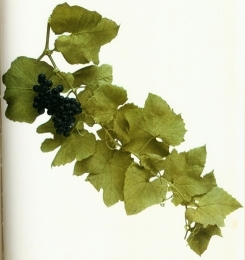
Aestivalis was probably described by some of the botanists before Michaux’s day but, if so, none of the descriptions is sufficiently definite and comprehensive to be recognized with certainty. Michaux was the first to describe it under the name of Aestivalis. It seems to have been generally known, as Bartram described it a short time later under the name of Vitis sylvestris with Vitis occidentalis as a synonym. He says: “This is the most common grape.” Owing to the great variation in the different forms of the species as it was then understood, many of the later botanists gave descriptions of it which did not agree. This uncertainty and the difficulty of giving a description which would fit all of the forms has been relieved in a measure; first, by the new species which have been created, such as Bicolor, Monticola and Cinerea, from what would have once been regarded as Aestivalis; and second, by the description and general acceptance of well-known varietal forms, such as Lincecumii and Bourquiniana.
The division of the original species has also reduced the habitat materially, confining it to the southeastern portion of the United States from southern New York to Florida and westward to the Mississippi River. Aestivalis grows in thickets and openings in the woods and shows no such fondness for streams as Riparia or for thick timber as Labrusca, but is generally confined to uplands. Under favorable circumstances the vines grow to be very large.
Aestivalis is preeminently a wine grape. The fruit usually has a tart, acrid taste, due to the presence of a high percentage of acid, but there is also a large amount of sugar, the scale showing that juice from this species has a much higher percentage of sugar than the sweeter tasting Labruscas. The wine made from varieties of Aestivalis is very rich in coloring matter, and is used by some European vintners to mix with the must of European sorts in order to give the combined product a higher color. The berries are destitute of pulp, have a comparatively thin, tough skin, and a peculiar spicy flavor. The berries hang to the bunch after becoming ripe much better than do those of Labrusca.
The species thrives in a lighter and shallower soil than Labrusca and appears to endure drouth better, although not equaling in this respect either Riparia or Rupestris. A southern or southeastern exposure gives better results for Aestivalis or Aestivalis hybrid vines than a northern one. The French growers report that Aestivalis is very liable to chlorosis on soils which contain much lime. The leaves are never injured by the sun, and they resist the attacks of insects, such as leaf-hoppers, better than any other American species under cultivation. Aestivalis is rarely injured by rot or mildew, according to American experience, but French growers speak of its being susceptible to both.
The hard roots of Aestivalis enable it to resist phylloxera, and varieties with any great amount of the blood of this species are seldom seriously injured by this insect. An objection to Aestivalis, from a horticultural standpoint, is that it does not root well from cuttings. Many authorities speak of it as not rooting at all from cuttings, but this is an overstatement of the facts, as many of the wild and cultivated varieties are occasionally propagated in this manner, and some southern nurseries, located in particularly favorable situations, make a practice of propagating it by this method. It is doubtful, however, if it could be successfully propagated from cuttings in New York. Varieties of this species bear grafting well, especially in the vineyard. Aestivalis blooms just after Labrusca. As might be inferred from its habitat, most cultivated varieties of this species require a longer season to mature their fruit than that of New York. On this account it is probable that Bicolor, once known as a northern form of Aestivalis, is more promising horticulturally for the North than the true Aestivalis of the Southeast.
VITIS AESTIVALIS LINCECUMII[145] Munson.
1. (?) Rafinesque, 1830:9. V. Multiloba; Dissected vine. 2. (?) Prince, 1830:183. V. diversifolia. 3. U. S. Pat. Off. Rpt., 1847:199. Post oak grape. 4. Buckley, Ib., 1861:485. V. Linsecomii; Post-oak grape; Pine-wood grape. 5. Ib., Proc. Phil. Acad. Nat. Sci., 1861:450. V. Linsecomii. 6. Engelmann, Mo. Ent. Rpt., 1874:74. 7. Ib., Bush. Cat., 1883:16, 23. Post-oak grape. 8. Munson, Am. Hort. Soc. Rpt., 1885:135. V. Lincecumii; Post-oak. 9. Planchon, De Candolle’s Mon. Phan. 5:323, 338. 1887. V. Lincecumii; Post-oak grape; Vine Wood grape; V. aestivalis, var. Lincecumii; V. incisifolia; V. multiloba? 10. Munson, U. S. D. A. Pom. Bul., 3:12. 1890. V. Lincecumii. 11. Ib., Gar. and For., 3:474. 1890. V. Lincecumii. 12. Ib., Am. Gard., 12:585. 1891. V. Lincecumii; Post-oak grape. 13. Ib., Mich. Hort. Soc. Rpt., 1893:116. V. Lincecumii; Post Oak grape. 14. McCluer, Ill. Sta. Bul., 28:257. 1893. V. Lincecumii; Post-oak grape. 15. Munson, Bush. Cat., 1894:20, 22, 27. fig. V. Lincecumii; Texas Post-oak grape. 16. Husmann, 1895:110. V. Lincecumii; Summer grape; Post Oak grape. 17. Munson, Rural N. Y., 56:610. 1897. V. Lincecumii; Post-oak grape. 18. Mo. Sta. Bul., 46:62. 1899. V. Lincecumii; Texas Post Oak grape. 19. Munson, Tex. Sta. Bul., 56:218, 231, 234, 235, 240, 261, 264. 1900. fig. V. Lincecumii; Post-oak grape. 20. Bailey, Cyc. Am. Hort., 4:1954. 1902. V. diversifolia; Post-oak; Pine-wood; Turkey grape. 21. Viala and Ravaz, Am. Vines, 1903:42, 57. V. Lincecumii; Post Oak.
Vine vigorous, sometimes climbing high upon trees, sometimes forming a bushy clump from two to six feet high; canes cylindrical, much rusty wool on shoots; tendrils intermittent. Leaves very large, almost as wide as long; entire or three-, five-, or rarely seven-lobed; lobes frequently divided; sinuses, including petiolar sinus, deep; smooth above, and with more or less rusty pubescence below. (The north-Texas, southwestern Missouri and northern Arkansas form shows little or no pubescence but has fine prickly spines at base of shoots and shows much blue bloom on shoots, canes and the under side of the leaves.) Fruit small to large, usually larger than typical Aestivalis, usually black with heavy bloom. Seeds larger than Aestivalis, pear-shaped; chalaza roundish.
Lincecumii seems to have been first described by Rafinesque, in 1830 under the name Vitis multiloba. His description fits fairly well, and as the source from which the vines were secured is within the habitat of the species, there appears but little doubt as to its correctness. In the same year Prince gives a very brief description of a grape from Texas under the name Vitis diversifolia which is probably this grape. The first description of the variety (or species) in such detail that it could not be mistaken was that of Buckley in 1861, as Vitis linsecomii.
It inhabits the eastern half of Texas, western Louisiana, Indian Territory, Arkansas and southern Missouri on high sandy land, frequently climbing post-oak trees, hence the name, Post-oak grape, by which it is locally known.
Lincecumii has attracted considerable attention through the work of H. Jaeger and T. V. Munson in domesticating it, both of whom considered it one of the most, if not the most, promising form from which to secure cultivated varieties for the Southwest. The qualities which recommended it to them are: First, its vigor; second, its capacity to withstand rot and mildew; third, its hardiness and capacity to endure hot and dry summers without injury; and fourth, the large cluster and berry which were found on certain of the wild vines. It requires a longer season to mature than that of New York and is, consequently, of but little interest to grape-growers in this State. The fruit is characteristic because of its dense bloom, firm, yet tender texture and the peculiar so-called Post-oak flavor. The cultivated varieties have given satisfaction in many sections of the central western and southern states. Like Aestivalis, it is difficult to propagate from cuttings.
The north-Texas glaucous form of this variety mentioned in the technical description above is the Vitis aestivalis glauca of Bailey. This is the type of Lincecumii that Munson has used in his breeding work.
VITIS AESTIVALIS BOURQUINIANA Bailey.[146]
1. Garber, Gar. Mon., 1:75. 1859. 2. Engelmann, Bush. Cat., 1883:16. (Varieties of southern origin). 3. Bush, Ib., 1883:23. Southern Aestivalis. 4. An. Hort., 1889:101. V. Bourquina. 5. Munson, Gar. and For., 3:474, 475. 1890. V. Bourquiniana; Southern Aestivalis. 6. Ib., U. S. D. A. Pom. Bul., 3:12. 1890. V. Bourquiniana. 7. Ib., Am. Gard., 12:584. 1891. V. Bourquiniana; Southern Aestivalis. 8. Popenoe and Mason, Kan. Sta. Bul., 44:117. 1893. V. Bourquiniana. 9. Munson, Bush. Cat., 1894:20, 22, 27. V. Bourquiniana; Southern Aestivalis. 10. Husmann, 1895:6, 8. V. Bourquiniana. 11. Munson, Tex. Farm and Ranch, Feb. 8, 1896:10. V. Bourquiniana; Southern Aestivalis. 12. Bailey, Gray’s Syn. Fl., 1:428. 1897. 13. Ib., Ev. Nat. Fr., 1898:81, 83, 114. 14. Munson, Am. Gard., 20:1688. 1899. V. Bourquiniana. 15. Ib., Tex. Sta. Bul., 56:231, 240, 261. 1900. V. Bourquiniana; Southern Aestivalis. 16. Viala and Ravaz, Am. Vines, 1903:178. V. Bourquiniana.
Bourquiniana greatly resembles Aestivalis and differs chiefly from this species in having thinner leaves and in that the shoots and under side of the leaves are only slightly reddish-brown in color and the pubescence usually disappears at maturity; this pubescence is mostly of an ashy or dun color. The leaves on some of the vines are more deeply lobed than is at all common in Aestivalis. The fruit is considerably larger than that of Aestivalis, sweeter and more juicy.
The botanical variety, Bourquiniana, is known only in cultivation. It is mentioned by Garber in 1859 and by Engelmann in 1883. Speaking of Aestivalis the latter says: “Unfortunately the typical forms cannot be propagated by cuttings and there are a number of varieties which, originating from a southern home, are not quite hardy here but on the other hand have the advantage of being readily propagated by slips in some favorable localities. * * * Unfortunately no wild plant from which these varieties might have sprung is yet known but must be looked for in the mountains and hills of the Carolinas and Georgia and only when found in a wild state can we correctly judge of their botanical status.”
The name Bourquiniana was given by Munson, who ranks the group as a species. He includes therein many southern varieties the most important of which are: Herbemont, Bertrand, Cunningham, and Lenoir, these he groups in the Herbemont section; and Devereaux, Louisiana and Warren, he puts in the Devereaux section. Munson has traced the history of this interesting group and states that it was brought from southern France to America over 150 years ago by the Bourquin family of Savannah, Georgia. Many botanists have been of the opinion that Bourquiniana is a hybrid. Engelmann says: “I will only state here that a slight suspicion exists of their being hybrids between V. aestivalis and some form of vinifera though the seeds are entirely those of the former and also the resistance to phylloxera.” Millardet considers Bourquiniana to be a mixed hybrid of Aestivalis, Cinerea and Vinifera. The hybrid supposition is certainly corroborated to a degree at least by the characters being more or less intermediate between the parent species and also by the fact that up to date no wild form of Bourquiniana has been found.
Munson’s derivation of the origin has not been accepted by either French or American botanists. In this connection Bailey says: “It is unassumable that a native grape distributed through the Mediterranean region could have escaped for centuries the critical search of European botanists and the knowledge of hundreds of generations of vignerons to be discovered at last transplanted in the new world.” Bush says: “This reminds us forcibly of the ‘Pedro Ximenes’ (called also White Green Riesling), which was believed to have been brought to Spain from the banks of the Moselle by the man whose name it bears.” Count Odart, a celebrated ampelograph, wittily said: “If he (Ximenes) took any he took ALL, for no such vine grows now north of the Pyrenees.’ Thus we also think: If Mr. Bourquin took any of the above grapes he took ALL, for no Herbemont or Lenoir can now be found native in Europe.”
The only northern variety of grape of any importance that is supposed to have Bourquiniana blood is the Delaware,[147] and in this case only a fraction of Bourquiniana blood is presumably present.
Bourquiniana can be propagated from cuttings more easily than the typical Aestivalis but not so readily as Labrusca, Riparia or Vinifera. Many of the varieties of Bourquiniana show a marked susceptibility to mildew and black-rot; in fact, the whole Herbemont group is much inferior in this respect to the Norton group of Aestivalis. The roots are somewhat hard, branch rather freely and are quite resistant to phylloxera.
19. VITIS BICOLOR Le Conte.[148]
1. Le Conte, Proc. Phil. Acad. Nat. Sci., 6:272. 1853. V. aestivalis (Darlington). 2. Ib., U. S. Pat. Off. Rpt., 1857:230. Two-colored-leaved vine. 3. Munson, Soc. Prom. Ag. Sci. Rpt., 1887:59. V. Argentifolia; Blue grape. 4. An. Hort., 1889:101. 5. Munson, Gar. and For., 3:474. 1890. 6. Munson, U. S. D. A. Pom. Bul., 3:12. 1890. 7. Ib., Am. Gard., 12:585. 1891. Blue grape; Northern Summer grape. 8. Ib., Mich. Hort. Soc. Rpt., 1893:116. Blue grape; Northern aestivalis. 9. Bailey, Gray’s Syn. Fl., 1:428. 1897. Blue grape; Northern Summer grape. 10. Britton and Brown, 2:409. 1897. Blue grape; Winter grape; V. aestivalis, var. bicolor. 11. Munson, Tex. Sta. Bul., 56:231, 234, 240, 266. 1900. Blue grape. 12. Viala and Ravaz, Am. Vines, 1903:42, 59.
Vine vigorous, climbing; shoots cylindrical or slightly angled, with rather long internodes, generally perfectly glabrous, usually showing much blue bloom, sometimes spiny at base; diaphragms medium to thick; tendrils intermittent, long, usually bifid. Leaves with short, broad stipules; leaf-blade medium to very large; roundish-cordate, usually three-, sometimes on older growth shallowly five-lobed, rarely entire; petiolar sinus variable in depth, usually rather narrow; margin irregularly dentate; teeth acuminate; glabrous above, usually glabrous below and showing much blue bloom which sometimes disappears late in the season; young leaves sometimes slightly pubescent; petioles very long. Cluster of medium size, compact, usually simple; peduncle long. Berries small to medium, black with much blue bloom, rather acid but pleasant tasting when ripe. Seeds small, plump, broadly oval, very short beak; chalaza oval, raised, distinct; raphe distinct, showing as a cord-like ridge.
Bicolor is readily distinguished from Aestivalis by the absence of the reddish pubescence, and by the bloom on the under side of the leaves and is distinguished from the glaucous form of Lincecumii by the smaller fruit and seeds. The species blooms slightly later than Aestivalis and Lincecumii. It was named and described by Le Conte in 1853 and has been generally recognized as a distinct species by later botanists.
The habitat of Bicolor is to the north of that of Aestivalis, occupying the northeastern, whereas Aestivalis occupies the southeastern quarter of the United States. Like Aestivalis it is not confined to streams and river-banks but frequently grows on higher land also. It is found in north Missouri, Illinois, southwestern Wisconsin, Indiana, southern Michigan, Ohio, Kentucky, Pennsylvania, New York, southwestern Ontario, New Jersey and Maryland, and is by some botanists reported as far south as western North Carolina and west Tennessee.
The horticultural characters of Bicolor are much the same as those of Aestivalis. About the only points of difference are that it is much hardier (some of the Wisconsin vines stand a temperature as low as 20 degrees below zero); it is said to be slightly less resistant to mildew and more resistant to phylloxera. Like Aestivalis, Bicolor does not thrive on limy soils and it is difficult to propagate from cuttings. The horticultural possibilities of Bicolor are probably much the same as those of Aestivalis, though many believe it to be more promising for the North. It is as yet cultivated but little. Its chief defect for domestication is the small size of the fruit.
20. VITIS CARIBÆA De Candolle.[149]
1. De Candolle, Prodr., 1:634. 1824 (cited by Watson). 2. Chapman, Fl. Sou. States,—:71. (cited by Watson). 3. Buckley, U. S. Pat. Off. Rpt., 1861:483. 4. Engelmann, Bush. Cat., 1883:10, 12, 14, 15. 5. Munson, Am. Hort. Soc. Rpt., 1885:136. Caloosa. 6. (?) Ib., Soc. Prom. Ag. Sci. Rpt., 1887:59. Prof. Curtis’ grape. 7. Planchon, De Candolle’s Mon. Phan., 5:323, 330. 1887. 8. Munson, U. S. D. A. Pom. Bul., 3:14. 1890. 9. Ib., Gar. and For., 3:474. 1890. 10. Ib., Mich. Hort. Soc. Rpt., 1893:116. 11. Bailey, Gray’s Syn. Fl., 1:428. 1897. 12. Viala and Ravaz, Am. Vines, 1903:42, 52.
Vine slender, climbing; shoots more or less woolly, or rarely nearly glabrous; diaphragms medium to thick; tendrils intermittent, rarely continuous, bifid or frequently trifid. Leaves cordate, usually entire when mature, frequently acuminate pointed; teeth shallow, wide, mucronate, slightly rugose above, thick whitish or rusty pubescence below; stipules small. Clusters large, long, with long, slender peduncle. Berries small to very small, purple or black with thin bloom, intensely acid until very ripe. Seeds usually but one or two to the berry, small to very small (Engelmann states that the Florida forms give larger seeds than those from the West Indies), notched; chalaza more or less circular, depressed, usually distinct; raphe a groove or slightly distinct. Very variable.
Caribæa was first described by De Candolle and later by many other botanists but the species is not yet well known owing to its habitat. Caribæa is an inhabitant of the West Indies, middle and southern Florida, Louisiana, eastern Mexico, Yucatan, and various portions of tropical America. It is said to grow largely on lowlands.
The species is of no practical interest as it does not thrive and soon dies in temperate climates. Its horticultural characters are unknown.
21. VITIS CANDICANS Engelm.
1. Engelmann, Gray’s Pl. Lindh., 2:166. 1845. 2. U. S. Pat. Off. Rpt., 1847:198. Mustang grape. 3. Engelmann, Gray’s Pl. Wright., 1:32. 1852. 4. Vanzandt, Gar. Mon., 1:166. 1859. Mustang grape. 5. Affleck, Mag. Hort., 26:98. 1860. Mustang grape. 6. Buckley, U. S. Pat. Off. Rpt., 1861:482. V. Mustangensis; Mustang grape. 7. Engelmann, Am. Nat., 2:321. 1868. Mustang grape. 8. Koch, Ill. Hort. Soc. Rpt., 1868:82. V. Mustangensis; Mustang grape. 9. Engelmann, Mo. Ent. Rpt., 1874:76. V. Mustangensis; Mustang grape. 10. Ib., Bush. Cat., 1883: 10, 11, 12, 14, 15. V. Mustangensis; Mustang grape. 11. Munson, Am. Hort. Soc. Rpt., 1885: 137. V. Mustangensis. 12. Ib., Am. Pom. Soc. Rpt., 1885:97, 98. Mustang grape. 13. Planchon, De Candolle’s Mon. Phan., 1887:323, 326. V. Mustangensis; Mustang grape. 14. Munson, Soc. Prom. Ag. Sci. Rpt., 1887:59. Mustang grape. 15. Ib., U. S. D. A. Pom. Bul., 3:10. 1890. 16. Ib., Bush. Cat., 1894:20, 22, 25. Mustang grape. 17. Ib., Rural N. Y., 56:610. 1897. Mustang. 18. Bailey, Gray’s Syn. Fl., 1:428. 1897. Mustang grape. 19. Munson, Tex. Sta. Bul., 56:232, 234, 240, 267. 1900. Mustang grape. 20. Viala and Ravaz, Am. Vines, 1903:42, 54.
Vine very vigorous, climbing; shoots and petioles densely woolly, whitish or rusty; diaphragm thick; tendrils intermittent (according to Munson, rarely four continuous). Leaves with medium to large stipules; blade small to medium, broadly cordate to reniform ovate, frequently resembling those of a poplar, entire or in young shoots and on young vines and sprouts usually deeply from three- to five-, or even seven-lobed; teeth shallow, sinuate; petiolar sinus shallow, wide, sometimes lacking; dull, slightly rugose above, dense whitish pubescence below. Clusters small. Berries medium to large, black, purple, green, or even whitish, thin blue bloom or bloomless. Seeds usually three or four, large, short, plump, blunt, notched; chalaza oval, depressed, indistinct; raphe a broad groove.
Candicans was described and named by Engelmann in his account of certain plants sent from Texas by Lindheimer. In 1861 it was described by Buckley who seems to have been unaware of the species having been previously named.
The habitat of this grape extends from southern Oklahoma, as a northern limit, southwesterly into Mexico. The western boundary is the Pecos River. It is found on dry, alluvial, sandy or limestone bottoms or on limestone bluff lands and is said to be especially abundant along upland ravines. Candicans grows well on limestone lands enduring as much as 60 per ct. of carbonate of lime in the soil. The species blooms shortly before Labrusca and a week later than Riparia. It requires the long hot summers of its native country and will stand extreme drouth but is not hardy to cold, ten or fifteen degrees below zero killing the vine outright unless protected; and a lesser degree of cold injuring it severely. The berries, which are large for wild vines, have thin skins under which there is a pigment which gives them, when first ripe, a fiery, pungent taste but which partly disappears with maturity. The berries are very persistent, clinging to the pedicel long after ripe. Candicans is difficult to propagate from cuttings. Its roots resist phylloxera fairly well. It makes a good stock for Vinifera vines in its native country but owing to the difficulty of propagation is seldom used for that purpose. In the early days of Texas it was much used for the making of wine but as it is deficient in sugar, and as the must retains the acrid, pungent flavor, it does not seem to be well adapted for this purpose. It is not regarded as having great promise for southern horticulture and certainly has none for the North.
VITIS CANDICANS CORIACEA Bailey.
1. Shuttleworth Mss., Herb. Boiss. 2. Chapman, Fl. Sou. States,—:71 (cited by Watson, Planchon and Bailey). V. caribea, var. CORIACEA. 3. Engelmann, Bush. Cat., 1883:15. V. CANDICANS, Florida form. 4. Munson, Am. Hort. Soc. Rpt., 1885:136. V. Caribea; Caloosa. 5. Planchon, De Candolle’s Mon. Phan., 5:323, 345. 1887. V. coriacea. 6. Munson, Soc. Prom. Ag. Sci. Rpt., 1887:59. V. coriacea; Leather-Leaf grape. 7. Ib., Gar. and For., 3:474. 1890. V. coriacea. 8. Ib., U. S. D. A. Pom. Bul., 3:10, 11. 1890. V. coriacea. 9. Ib., Am. Gard., 12:661. 1891. V. coriacea; Leather-leaf grape. 10. Bailey, Gray’s Syn. Fl., 1:429. 1897. Leather-leaf grape; Calloosa grape. 11. Munson, Tex. Sta. Bul., 56:232, 240. 1900. V. coriacea; Leather-Leaf grape. 12. Viala and Ravaz, Am. Vines, 1903:42, 52. V. coriacea.
Coriacea is a Florida variety of Candicans, differing from the Texas form, in having a shorter, somewhat smaller and comparatively thicker seed; small stipules; quite variable leaves, intermediate in shape between Labrusca and Candicans; and an absence of the fiery flavor. The blossoming period is two or three weeks later than the Texas form.
This form of Candicans was named and described by Shuttleworth in a manuscript now in the Herbarium Boissier at Geneva, Switzerland. Botanists seem divided as whether to regard it as a separate species or as a botanical variety. Its habitat is central and southern Florida.
Coriacea is more tender than the regular forms of Vitis candicans and this alone would make it worthless to the northern cultivator even were it otherwise valuable.
22. VITIS SIMPSONI Munson.
1. Munson, Soc. Prom. Ag. Sci. Rpt., 1887:59. Simpson’s grape. 2. Ib., Gar. and For., 3:474, 475. 1890. 3. Ib., U. S. D. A. Pom. Bul., 3:12. 1890. 4. Ib., Am. Gard., 12:586, 661. 1891. 5. Ib., Mich. Hort. Soc. Rpt., 1893:116. Palmetto-leaved grape. 6. Bailey, Gray’s Syn. Fl., 1:429. 1897. 7. Munson, Tex. Sta. Bul., 56:232, 234, 240, 267. 1900. fig. Simpson’s grape. 8. Viala and Ravaz, Am. Vines, 1903:167.
Vine very vigorous, climbing; shoots cylindrical with much brownish pubescence; diaphragms very thick; tendrils intermittent. Leaves with stipules short and broad; leaf-blade rather thin, large, broadly cordate, usually considerably lobed; petiolar sinus of medium width and depth; margin coarsely toothed; upper surface slightly rugose and of a dark-green; lower surface with rusty white pubescence sometimes becoming almost a blue green; the shape of leaf and amount of pubescence vary widely. Clusters large, loose; peduncle long; pedicel thick. Berries small to medium, more tender in pulp and less astringent than Vitis aestivalis, black with moderate amount of bloom. Leafing, blooming, and ripening fruit late.
Vitis simpsoni was named and briefly described by Munson in 1887. In 1891 he stated that the species is a hybrid of Vitis coriacea (here considered a variety of Vitis candicans) crossed with Vitis cinerea. Bailey states that it is probably a hybrid of Aestivalis crossed with Coriacea. Some forms of Simpsoni are said to be very difficult to distinguish from Vitis labrusca.
Simpsoni prefers warm, sandy soils and is found in central and southern Florida. It roots from cuttings with great difficulty; it is tender and will not withstand cold winters. While it is very resistant to phylloxera and also to mildew and black-rot, its leaves are said to be much attacked by leaf-rollers. The blossoming period is just after Aestivalis. The berries are of good flavor and might be of some value for the country along the Gulf Coast but it is of no value for the North.
1. Linnaeus, Sp. Pl., 1:203. 1753. V. sylvestris Virginiana; V. vinifera sylvestris americana. 2. Marshall, 1785:165. V. vulpina; Fox grape vine. 3. Walter, 1788:242. V. taurina. 4. Michaux, 2:230. 1803. V. taurina. 5. Bartram, Dom. Enc., 5:289. 1804. V. vulpina; Fox grape. 6. Muhlenberg, 1813:27. Fox grape. 7. Pursh, 1:169. 1814. V. taurina. 8. Nuttall, 1:143. 1818. 9. Elliott, 2:689. 1824. V. taurina. 10. Torrey, Fl. of N. & M. Sta., 1826:120. 11. Rafinesque, 1830:10. V. latifolia; V. taurina; V. Labrusca; Fox grape. 12. Ib., 1830:11. V. luteola; Variable grape. 13. Prince, 1830:180. V. Labrusca, var. NIGRA; Black Fox; Purple Fox; V. taurina; V. vulpina. 14. Ib., 1830:181. V. Labrusca, var. ALBA; White Fox. 15. Ib., 1830:182. V. Labrusca, var. ROSEA; Red Fox. 16. Torrey, Fl. of N. Y., 1:146. 1843. Fox grape. 17. Darlington, Fl. Cest., 1853:50. Fox grape of the Northern States, not of Va. 18. Le Conte, Proc. Phil. Acad. Nat. Sci., 1853:270. V. sylvestris; Fox grape; V. occidentalis; V. vulpina; V. latifolia; V. canina; V. luteola; V. rugosa; V. ferruginea; V. labruscoides; V. blanda; V. prolifera; V. obovata. 19. Ib., U. S. Pat. Off. Rpt., 1857:228. Fox grape; V. sylvestris; V. occidentalis; V. vulpina; V. latifolia; V. canina; V. luteola; V. rugosa; V. ferruginea; V. labruscoides; V. prolifica; V. obovata. 20. Buckley, Ib., 1861:481. Frost grape. Fox grape of the Northern States. 21. Stayman, Gar. Mon., 11:37, 38, 39, 40. 1869. Northern Fox Grape. 22. Engelmann, Mo. Ent. Rpt., 1872:61. Fox grape; Northern Fox grape. 23. Ib., Bush. Cat.., 1883:9, 10, 11, 12, 13, 14, 19. Fox grape; Northern Fox grape. 24. Munson, Am. Hort. Soc. Rpt., 1885:136. Fox grape. 25. Ib., Am. Pom. Soc. Rpt., 1885:97, 98, 101. 26. Planchon, De Candolle’s Mon. Phan., 5:322, 324. 1887. Fox grape; Northern Fox grape; V. vinifera sylvestris americana; V. latifolia; V. canina; V. luteola. 27. Munson, Soc. Prom. Ag. Sci. Rpt., 1887:59. Fox grape. 28. Pearson, Gar. and For., 2:584. 1889. 29. Munson, U. S. D. A. Pom. Bul., 3:11. 1890. 30. Ib., Gar. and For., 3:474. 1890. 31. Britton and Brown, 2:408. 1897. Northern Fox grape; Plum grape. 32. Bailey, Gray’s Syn. Fl., 1:429. 1897. Fox grape; Skunk grape; V. vulpina; V. blandi. 33. Munson, Tex. Sta. Bul., 56:232, 240. 1899. Northern Fox grape. 34. Viala and Ravaz, Am. Vines, 1903:42, 45.
Vine moderately vigorous, stocky, climbing; shoots cylindrical, densely pubescent; diaphragms medium to rather thick; tendrils continuous, strong, bifid or trifid. Leaves with long, cordate stipules, leaf-blade large, thick, broadly cordate or roundish; entire to three-lobed, frequently notched; sinuses rounded; petiolar sinus variable in depth and width, V-shaped; margin with rather shallow, acute pointed, scalloped teeth; upper surface more or less rugose, dark green, on young leaves pubescent, becoming glabrous when mature; lower surface covered with dense pubescence, more or less whitish on young leaves, becoming rusty or dun-colored when mature. Clusters small to medium, more or less compound, usually shouldered, compact; pedicels thick; peduncle short to medium. Berries medium to large; skin thick, covered with considerable bloom, strong musky or foxy aroma. Seeds two to four, large, distinctly notched, beak short; chalaza oval in shape, indistinct, showing merely as a depression; raphe, a groove. (See Plate.)
SHOOT OF VITUS LABRUSCA
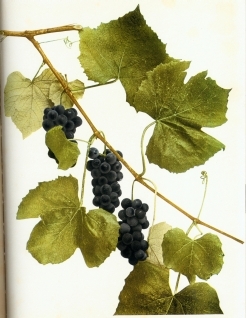
Vitis labrusca, the northern Fox grape, is mentioned in many of the early writings of this country, particularly in those describing New England. It was probably described by other botanists before Linnaeus but if so their descriptions are so meager that it cannot be definitely recognized. Linnaeus in 1753, under Vitis labrusca, says: “Leaves cordate, slightly tri-lobed, dentate, downy below.” Marshall in 1785 under the name Vitis vulpina, or Fox grape, says: “This in manner of growth hath much the appearance of the other kinds. The leaves are generally larger, and smooth, but whitish underneath. The fruit or grapes are about the size of a common cherry and have a strong scent, a little approaching to that of a Fox, whence the name of Fox-grape. There are also varieties of this, some with whitish or reddish fruit which is generally most esteemed, and others with black, of which are our largest grapes.” From the time of Marshall on all of the botanists give more or less complete descriptions of this species and except for the brief misunderstanding at first as to the name, its identity has never been questioned. At one time it was supposed to grow in the Mississippi Valley but Engelmann demonstrated that what were taken for Labrusca vines in Missouri were in reality strongly pubescent forms of Aestivalis.
Labrusca is indigenous to the eastern part of North America, including the region between the Atlantic Ocean and the Alleghany Mountains. It is sometimes found in the valleys and along the western slopes of the Alleghanies. Many botanists say it is never found in the Mississippi Valley; Munson reports specimens, however, from Indiana and Tennessee. In the first-named area it ranges from Maine to Georgia. It has the most restricted habitat of any American species of horticultural importance, being much exceeded in extent of territory by Vitis rotundifolia, Vitis aestivalis, and Vitis riparia.
Labrusca has furnished more cultivated varieties, either pure-breeds or hybrids, than all other American species together. The reason for this is partly, no doubt, due to the fact that it is native to the portion of the United States first settled and is the most common grape in the region where agriculture first advanced to the condition where fruits were desired. This does not wholly account for its prominence, however, which must be sought elsewhere. In its wild state Labrusca is probably the most attractive to the eye of any of our American grapes on account of the size of its fruit, and this undoubtedly turned the attention of those who were early interested in the possibilities of American grape-growing to this species rather than to any other.
The southern Labrusca is quite different from the northern form and probably demands different conditions for its successful growth; in the North at least two types of the species may be distinguished. Vines are found in the woods of New England, which resemble Concord very closely in both vine and fruit, excepting that the grapes are much smaller in size and more seedy. There is also the large-fruited, foxy Labrusca, usually with reddish berries, represented by such cultivated varieties as Northern Muscadine, Dracut Amber, Lutie and others. Labrusca is peculiar amongst American grapes in showing black-, white- and red-fruited forms of wild vines growing in the woods. Because of this variability it is impossible to give the exact climatic and soil conditions best adapted to the species. It is reasonable to suppose, however, that the ideal conditions for this or any other species are not widely different from those prevailing where the species is indigenous. In the case of Labrusca this means that it is best adapted to humid climates and that the temperature desired varies according to whether the variety comes from the southern or northern form of the species.
The root system of Labrusca does not penetrate the soil deeply,[152] but it is said to succeed better in deep and clayey soils than Aestivalis.[153] In the Southern and Middle States it does better on eastern and northeastern slopes. As would be suspected from its original marshy home, it endures an excess of water in the soil, and on the other hand requires more water for successful growing than Aestivalis or Riparia. In spite of its ability to withstand clayey soils, it seems to prefer loose, warm, well-drained sandy lands to all others. The French growers report that all varieties of this species show a marked antipathy to a limestone soil, the vines soon becoming affected with chlorosis when planted in soils of this nature. In corroboration of this Stayman reports that it is not found growing native in clayey, limestone soils. The Labruscas succeed very well in the North and fairly well in the middle West, as far south as Arkansas, where they are raised on account of their fruit qualities but here the vines are not nearly so vigorous and healthy as are those of other species. In Alabama they are reported to be generally unsatisfactory, and in Texas the vines are short-lived, unhealthy, and generally unsatisfactory, particularly in the dry regions. There are some exceptions to this, as, for instance, in the Piedmont region of the Carolinas, where, owing to elevation or other causes, the climate of a southern region is semi-northern in its character.
SHOOT OF WYOMING
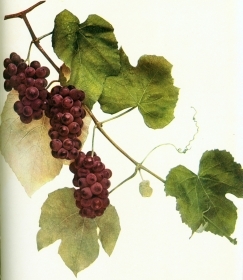
The fruit of Labrusca is large and usually handsomely colored. The skin is thick, covering a layer of adhering flesh, which gives the impression of its being thicker than it actually is; it is variable in tenderness, sometimes tough, but in many of our cultivated varieties it is so tender as to be a detriment in that it is inclined to crack on the vines in case of rain at ripening time, and the berries to crush in transportation. The skin of this species usually has a peculiar aroma, generally spoken of as foxy, and a slightly acid, astringent taste. Beneath the skin there is a layer of juicy pulp, quite sweet and never showing much acidity in ripe fruit. The center of the berry is occupied by rather dense pulp, more or less stringy, with considerable acid close to the seeds. Many people object to the foxy aroma of this species, but, nevertheless, the most popular American varieties are more or less foxy. Analyses have shown that Labrusca fruit is generally characterized by a low percentage of sugar and acid, the very sweet tasting fox grapes not showing as high a sugar content as some of the disagreeably tart Aestivalis and Riparia sorts. This, in addition to the foxiness which furnishes an excess of aroma in the wine, has prevented Labrusca varieties from becoming favorites with the wine-makers. Must from these varieties is adapted only for the making of dry wines, and when making wines of any other class it is necessary to add sugar and water, the quantities being governed by the final product desired.
In addition to the strong points already enumerated, it may be said that Labrusca submits well to vineyard culture, is fairly vigorous and generally quite productive. It grows readily from cuttings and in point of hardiness is intermediate between Riparia, the hardiest of our American species, and Aestivalis. The roots are soft and fleshy (for an American grape) and in some localities quite subject to attacks of phylloxera. None of the varieties of Labrusca have ever been popular in France on this account. In the wild vines the fruit is inclined to drop from the vine when ripe. This defect is known as “shattering” or “shelling” among grape-growers and it is a serious weakness in certain varieties of Labrusca. It is said to be more sensitive in its wild state to mildew and rot than any other American species[154] but the evidence on this point does not seem to be wholly conclusive. In the South and in some parts of the middle West the leaves of all varieties of Labrusca sunburn and shrivel in the latter part of the summer. The vines do not endure drouth as well as Aestivalis or Riparia and not nearly so well as Rupestris. Pearson[155] reports that the Labruscas can be sprayed with copper sulphate mixtures with much less danger to the leaves than can Aestivalis.
24. VITIS VINIFERA Linn.
1. Linnaeus, Sp. Pl., 1:202. 1753. 2. Speechly, 1791:1. 3. Willdenow, Sp. Pl., 1:1180. 1797. 4. Bartram, Dom. Enc., 5:289. 1804. 5. Rafinesque, 1830:7. Wine Grape. 6. Darlington, Fl. Cest., 1853:49. Wine grape; Foreign grape. 7. Buckley, U. S. Pat. Off. Rpt., 1861:480. European grape. 8. Stayman, Gar. Mon., 11:38. 1869. European grape. 9. Bush, Grape Cult., 1:140. 1869. European grape. 10. Engelmann, Mo. Ent. Rpt., 1874:74. 11. Moore, Mich. Pom. Soc. Rpt., 1875:36. 12. Engelmann, Bush. Cat., 1883:11, 12, 13, 14, 19. 13. Munson, Am. Hort. Soc. Rpt., 1885:137. 14. De Candolle, Or. Cult. Pl., 1885:191. 15. Onderdonk, U. S. D. A. Rpt., 1887:652. 16. Planchon, De Candolle’s Mon. Phan., 5:324, 355. 1887. 17. Am. Pom. Soc. Rpt., 1889:107, 109. 18. Husmann, 1895:29, 187. 19. Munson, Rural N. Y., 56:610. 1897. 20. Ib., Tex. Sta. Bul., 56:231, 233, 240. 1900. Asiatic Wine grape. 21. Bailey, Cyc. Am. Hort., 4:1956. 1902. fig. of leaves. Wine grape; European grape. 22. Viala and Ravaz, Am. Vines, 1903:42, 115.
Quite variable in vigor, not so high climbing as most American species. Tendrils intermittent. Leaves rounded-cordate, rather thin, rather-smooth, and when young, shining, frequently more or less deeply three-, five-, or even seven-lobed; usually glabrous but in some varieties the leaves and young shoots are hairy and even downy when young; lobes rounded or pointed; teeth variable; petiolar sinus deep, narrow, usually overlapping. Fruit, of cultivated varieties at least, very variable in size and color. Berries of cultivated varieties usually oval though many varieties are globular fruited. Seeds variable in size and shape, usually notched at upper end and characterized always by bottle-necked, elongated beak; a rather broad, usually rough, slightly distinct chalaza situated rather high up on the seed; raphe indistinct. Flowers soon after Labrusca. The roots are large, soft and spongy. A very variable species.
SHOOT OF VITIS VINIFERA
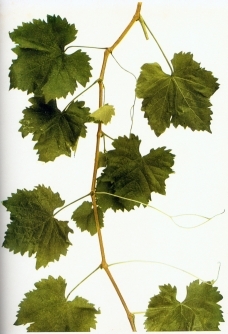
Botanists have never agreed as to whether Vitis vinifera is a single species or a combination of two or more species which has been cultivated for so long that it is impossible to discover the original forms. The name, Vitis vinifera, is usually credited to Linnaeus though it was used for this grape before Linnaeus’ time by Bauhin and possibly by others. The description of Linnaeus accompanying the name is very short, as follows: Leaves sinuately lobed, glabrous. Many of the earlier botanists, Tournefort for one, described numerous varieties as though they were species. As a natural corollary of the uncertainty of the botanical status of Vitis vinifera the original habitat of the species is not positively known. De Candolle, as noted in the first part of this work, considered the region about the Caspian Sea as the probable habitat of the Old World grape. There is but little doubt that the original home of Vitis vinifera is some place in western Asia. There is strong corroborative evidence of this in the fact that the climatic conditions under which the species flourishes are such as are there found.
The first chapter in The Grapes of New York has been devoted to this, the Old World grape, and for a discussion of the horticultural characters of the species and of the efforts to cultivate it in America, the reader is referred to that chapter.
Neither American nor European writers agree as to the exact climate desired by Vinifera for the reason, probably, that all of the varieties in this variable species do not desire the same conditions. There are certain phases of climate, however, that are well agreed upon, as follows: The species requires a warm, dry climate, and is more sensitive to change of temperature than our American species. Stayman, who had had considerable experience in raising Vinifera grapes in different places, says: Vinifera “will not endure much rain or grow on wet land. It is only in a dry climate and on high rolling situations that it will succeed, where there is not more than 31 inches of an annual rainfall and for the growing and maturing season 15 inches.” So far as soil alone is concerned, the French growers tell us that it can be grown successfully in a wide variety of soils, being much less particular in this respect than our American species. They state that it will withstand and grow successfully in soils so strongly impregnated with lime that any of the American sorts would succumb to chlorosis.
There are certain characters connected with the fruit of this species which are peculiar to it and are not found in any of our American sorts. First, the skin, which is attached very closely to the flesh and which is never astringent or acid, is of good flavor and can be eaten with the fruit. Second, the flesh is firm, yet tender, and uniform throughout, differing in this respect from any of our American sorts, which frequently show a sweet, watery and tender pulp close to the skin with a tough and more or less acid core at the center. Third, the flavor is peculiarly sprightly, a quality known as vinous, because it characterizes this species. It may be said in this connection, however, that many Americans, accustomed to American grapes, prefer the flavor of our native sorts to the vinous flavor of the Old World grape. Europeans invariably, and Americans who live in Vinifera raising sections, usually, deem the Vinifera flavor greatly superior. Fourth, a strong adherence of the berry to the pedicel, the fruit never “shattering” or “shelling” from the cluster.
Varieties of Vinifera have been selected for the making of wine through so many centuries that this species has become the first and great wine-making grape. Whatever the future may hold in store for American grapes, there is no question but that at present the Viniferas are far superior to any native Americans for wine-making purposes, both as to quality in general and the number of kinds of wine which can be made.
The weak points of Vinifera are: First, an inability to withstand the cold of our winters. The different varieties of Vinifera undoubtedly vary considerably as to the exact amount of cold they will stand without injury. All of them tried at this Station freeze to the ground even in the mildest winters. Second, foliage particularly susceptible to the attack of mildew and fruit susceptible to the attack of black-rot. Third, they generally require a ripening season much longer than our climate affords. Fourth, the roots are soft and spongy and very liable to the attack of phylloxera, though they apparently penetrate more readily in dense clays and hard dry soils than any of our American species.
In the various hybrids that have been made between American and Vinifera varieties it is usually found that the desirable qualities of Vinifera are taken in about the same proportion as the undesirable ones. The fruit is improved in the hybrid but the vine is weakened. Quality is purchased at the expense of hardiness and disease-resisting power. Vinifera may be grown very readily from cuttings. This is of little cultural importance, however, as both in Europe and America varieties of the species are usually grafted on phylloxera-resistant stock.