Chapter V · THE LEADING VARIETIES OF AMERICAN GRAPES (continued 2)
Reading edition
1. Ohio Hort. Soc. Rpt., 1892-3:48. 2. Rural N. Y., 52:829. 1893. fig. 3. Ib., 53:666. 1894. 4. Bush. Cat., 1894:98. fig. (Frontispiece). 5. Rural N. Y., 55:419, 658. 1896. fig. 6. Am. Pom. Soc. Rpt., 1897:11, 48. 7. Rural N. Y., 57:182, 642. 1898. 8. Ib., 58:546, 786. 1899. 9. Mich. Sta. Sp. Bul., 27:9. 1904.
Campbell (9).
Probably no American grape has ever been more favorably received than Campbell Early, or after introduction has been disseminated more rapidly. The fact that it came from a grape-breeder who had already given viticulture several valuable varieties, with the statement that this was the result of years of experimenting and the greatest triumph of a life devoted to improving grapes, gave warrant for the enthusiasm with which it was received. Nor did first impressions belie the oft-made statement that Campbell Early represented a phenomenal advancement in grape culture. Bunch, berry and vine seemed to indicate that this was the best black American grape under cultivation. Nearly two decades have passed since Campbell Early was introduced, and though admitted by all to be a good grape, yet it has hardly met the expectations of the grape-growers who from almost every state and territory welcomed the newcomer.
CAMPBELL EARLY

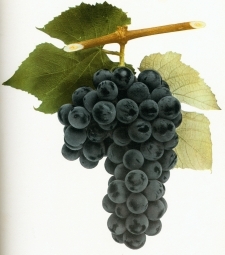
The preeminently meritorious qualities of Campbell Early are: High quality when mature; freedom from foxiness and from acidity about the seeds; small seeds which easily part from the flesh; earliness of maturity, ripening nearly a fortnight before Concord; large size and attractive appearance of bunch and berry (the color-plate does not do the Campbell Early justice as to size of berry and bunch); comparative hardiness of the vine; and good shipping and keeping qualities. Campbell Early falls short chiefly in not being adapted to as many soils and conditions as are some of the varieties with which it must compete and in all but localities well adapted to it the variety lacks productiveness. In other words it is somewhat lacking in that elasticity of constitution so characteristic of Concord. Its reputation for quality has suffered, and to the detriment of the variety, because it attains its full color before it is ripe and is therefore often marketed in an unripe condition. The fruit is quite variable in size as grown under different conditions and somewhat so as grown in the same vineyard, ranging in size of bunch from very large to small, differing somewhat in shape and with some compact and with some loose clusters. The color of the berry is not as attractive as that of Concord as it has less of the waxy bloom which makes the last named sort so handsome.
But the weaknesses attributed to Campbell Early do not wholly explain why so good a variety has seemingly failed to meet expectations. Can it be that the fault is with the American grape-grower more than with the grape? American growers are not yet willing to give varieties of grapes the particular care that each may need for its best development, but seemingly prefer to grow those sorts which are cosmopolitan as to environment and which will thrive under a general treatment. It cannot be that the consumers of this fruit care for less than a dozen of the several hundred American grapes; or that under the varied conditions of half a continent over which grow a score of species of wild grapes but a meager half dozen varieties can be grown for commercial purposes. If our grape-growers were willing to give the Campbell Early, and a score of other sorts of superior merit, the special care that European vineyardists give the hundreds of varieties they successfully grow, our viticulture would not long remain confined to the culture of a few grapes of mediocre quality.
The name commemorates the services to viticulture of the originator of the variety, Geo. W. Campbell[170] of Delaware, Ohio, who devoted a long and active life to the improvement of the grape. The variety is a seedling of Moore Early pollinated by another production of Campbell’s, which was a seedling of Belvidere pollinated by Muscat Hamburg. Campbell Early bore for the first time in 1892, and was soon after introduced by George S. Josselyn of Fredonia, New York. It is now known and grown throughout the grape regions of eastern America.
Vine vigorous to medium, hardy, productive to very productive. Canes of average length and number, somewhat thick, dark reddish-brown, surface often roughened with small warts; nodes intermediate in size, flattened; internodes medium to short; diaphragm of mean thickness; pith of average size; shoots pubescent; tendrils intermittent, rather short, trifid to bifid.
Leaf-buds intermediate in size, inclined to long, slender to medium, pointed to conical, open early. Young leaves heavily tinged on lower surface and along margin of upper surface with bright carmine. Leaves medium to large, thick to medium; upper surface green, slightly glossy, intermediate in smoothness; lower surface bronze to pale green, heavily pubescent; veins distinct; lobes often three in number but usually entire, terminal lobe acute; petiolar sinus rather shallow, medium to wide; basal sinus usually pubescent; lateral sinus varying from medium wide to a mere notch, frequently dentate; teeth shallow to medium, narrow. Flowers fertile, open in mid-season; stamens upright.
Fruit variable in season, extending through a long period, becomes marketable somewhat earlier than Worden, keeps and ships unusually well. Clusters variable in size ranging from very large to medium, rather long and broad, tapering to cylindrical, frequently single-shouldered, usually two bunches per shoot, compact to slightly loose; peduncle short to medium, thick; pedicel below average in length and thickness, covered with small numerous warts; brush long, light wine color. Berries somewhat variable in size, usually large, roundish to slightly oval, dark purplish-black, rather dull as the season advances, covered with heavy blue bloom, persistent, moderately firm. Skin medium to thin, tough, does not crack, adheres slightly to the pulp, contains a small amount of dark red pigment, somewhat astringent. Flesh greenish, translucent, juicy, varying from rather tough to nearly soft, slightly coarse, not foxy, somewhat vinous, nearly sweet from skin to center, quality good and improves by hanging on the vines, superior to Concord. Seeds separate readily from the flesh, one to four, average three, of medium size and length, rather broad, light brown, often with yellowish tips; raphe obscure; chalaza intermediate in size, slightly above center, oval, obscure.
CANADA. (Riparia, Labrusca, Vinifera.)
1. Horticulturist, 22:363, 365. 1867. fig. 2. Rec. of Hort., 1868:44. 3. Downing, 1869:533. 4. Bush. Cat., 1883:79. fig. 5. N. Y. Sta. An. Rpt., 10:494. 1891. 6. Ib., 17:527, 548, 554, 559. 1898. 7. Traité gen. de vit., 5:182. 1903.
Arnold’s No. 16 (1, 2, 5). Arnold’s No. 18 (3, 4, 7).
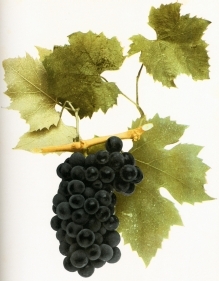
Canada is justly considered the most desirable of Arnold’s several hybrids of Riparia and Vinifera and is well known in Europe as well as in America. In France when American varieties were being largely used in the reconstruction of the vineyards destroyed by phylloxera, Canada was one of the prime favorites, because of its short period for fruit development and maturity and the comparatively high quality of the wine which could be made from it. In America it has never gained great popularity on account of its susceptibility to fungal diseases. In this respect as in some others, it shows Vinifera more than Riparia parentage; thus in shape, color and texture of foliage, in the flavor of the fruit, and in the seeds there are decided indications of Vinifera while the vine, especially in the slenderness of the shoots, and the bunch and berry, shows Riparia. If, as is surmised, there is some Labrusca in Clinton, the Riparia parent of Canada, there are no discernible traces of the first named species in this variety. Canada and Brant, its full brother, are often confused with each other but there are numerous minor differences in buds, foliage, canes, in the shape of the bunch, in the seeds and in the time of ripening which a reading of the descriptions of the two varieties will reveal. Canada has little value as a dessert fruit but makes a very good red wine, having, according to the French, a most agreeable bouquet, but in America it is surpassed by other wine grapes in so many characters that it can probably never attain a place in this country for other than breeding purposes.
The grape to which Arnold[171] gave the name Canada is a seedling of Clinton, a Labrusca-Riparia hybrid, fertilized by Black St. Peters, a variety of Vitis vinifera. Arnold planted the seed which produced Canada and its brother Brant about 1860. During the decade that followed the variety was sent out as Arnold No. 16, but as it became more widely distributed the name was changed to Canada.
Vine medium to very vigorous, hardy, not always healthy, usually productive. Canes long, numerous, variable in size but averaging slender, nearly ash-gray at internodes to reddish-brown at nodes, covered with a slight blue bloom; nodes enlarged, not flattened; internodes above medium to short; diaphragm of average thickness, rather large; shoots strongly pubescent; tendrils intermittent, nearly short, trifid to bifid.
Leaf-buds intermediate in size, short, of average thickness, conical to obtuse, open rather late. Young leaves pale green with faintest trace of carmine, prevailing color green on upper and lower sides. Leaves intermediate in size, medium to thin; upper surface light green, nearly smooth; lower surface pale green, hairy; veins obscure; lobes five in number, often obscure, terminal lobe acute to acuminate; petiolar sinus deep, medium to narrow; basal sinus variable in depth and width; lateral sinus usually deep and narrow when well defined; teeth deep, wide. Flowers occasionally on plan of six, somewhat fertile to partly sterile, open moderately early; stamens upright.
Fruit ripens in mid-season or later, keeps fairly well. Clusters intermediate in size, long to medium, rather slender, uniform, often strongly cylindrical, sometimes single-shouldered, very compact; peduncle short, slender; pedicel long, slender, nearly smooth; brush short, light brown. Berries not uniform, average medium to small, roundish when not compressed by compactness of cluster, attractive purplish-black to black, glossy, covered with heavy dark blue bloom, persistent, firm. Skin thin, does not crack, rather tough, adheres but slightly to the pulp, contains a slight amount of pigment, not astringent. Flesh rather dark green, very juicy, fine-grained, somewhat tender when fully ripe, spicy, pleasant vinous flavor, nearly sweet to agreeably tart, ranking medium to above in quality. Seeds separate readily from pulp, one to three, average two, intermediate in size and breadth, of average length, blunt, light brown; raphe completely obscure; chalaza intermediate in size, slightly above center, oval, distinct, somewhat obscure.
CANADA
CANANDAIGUA. (Labrusca, Vinifera.)
Canandaigua has not been generally distributed and would not be mentioned here were it not for its exceptional keeping qualities. To test the keeping qualities of grapes in common storage, 265 varieties were put in the fruit house at this Station in the fall of 1907. The test ended April 16, 1908, when it was found that Canandaigua was in the best condition of all varieties. Its quality is very good at picking time but seems, if anything, to improve in storage, and it was as good at the end of the test as at the beginning. Its vine characters are those of Labrusca-Vinifera hybrids and such, as the variety grows on the Station grounds, as make it the equal of the average cultivated hybrid of these two species. The characters of the fruit, too, show plainly an admixture of Vinifera and Labrusca so combined as to make the grapes very similar to the best of such hybrids. The variety is quite worthy of trial.
Canandaigua is a chance seedling found by E. L. Van Wormer of Canandaigua, New York, growing among wild grapes. Its high quality and handsome appearance attracted his attention and the vine was put under cultivation, after which its long-keeping qualities were discovered. Vines were sent to this Station for testing in 1897. All of its characters indicate that it is a hybrid between Labrusca and Vinifera.
Vine vigorous, doubtfully hardy, medium to productive. Tendrils semi-continuous to semi-intermittent, bifid, dehisce early. Leaves large to medium, thin. Flowers sterile or sometimes partly fertile, open in mid-season; stamens reflexed. Fruit ripens after mid-season, keeps unusually well. Clusters variable in size, usually heavily single-shouldered, loose to medium. Berries large to medium, slightly oval to roundish, black, covered with a fair amount of blue bloom, persistent. Flesh firm, sweet and rich, good in quality, improving as the season advances. Seeds often long, with enlarged neck; raphe shows as a partially obscured cord in a medium deep groove; chalaza above center, distinctly pear-shaped.
CAPTAIN. (Lincecumii, Rupestris, Labrusca, Vinifera.)
1. Rural N. Y., 60:637. 1901. 2. Mo. Hort. Soc. Rpt., 1904:306. 3. Munson Cat., 1906-7:16.
Captain has not made a good showing in the Station vineyard and we have no reports of it from other parts of the State. The clusters are large and long but very loose and unattractive in appearance, and the fruit ranks low in quality. We are forced to conclude, judging from the several seasons the variety has fruited on these grounds, that it is of little value in New York. The breeding of Captain is such that it could hardly be expected to thrive in this latitude.
Captain was produced by T. V. Munson from seed of America fertilized with R. W. Munson.
Vine vigorous, hardy, moderately productive. Canes long to medium, numerous, covered with rather thick blue bloom; tendrils intermittent, bifid and trifid. Leaves very large to medium, thick, not pubescent but very hairy along ribs. Flowers semi-fertile, open rather late; stamens upright. Fruit ripens later than Concord, does not keep long although it ships well. Clusters large to above medium, long, slender, sometimes double-shouldered, very loose. Berries very large to below medium, inclined to roundish, black, covered with heavy blue bloom, persistent. Skin contains a large amount of purplish-red pigment. Flesh medium juicy, coarse, tender, lacks character, tart from skin to center, fair in quality. Seeds numerous, separate easily from the pulp.
CARMAN. Lincecumii, Vinifera, Labrusca, Bourquiniana?
1. Gar. Mon., 28:304. 1886. 2. Rural N. Y., 50:221, fig., 643, 690. 1891. 3. Ib., 51:147, 607, 774. 1892. fig. 4. Husmann, 1895:127. 5. Am. Pom. Soc. Cat., 1897:20. 6. N. Y. Sta. An. Rpt., 17:548, 554. 1898. 7. Tex. Sta. Bul., 48:1149, 1154. 1898. fig. 8. Mo. Sta. Bul., 46:38, 43, 45, 49. 1899. 9. Rural N. Y., 59:674, 690, 752, 770, 802, 819. 1900. 10. Ga. Sta. Bul., 53:41, 51, 52, 54. 1901.
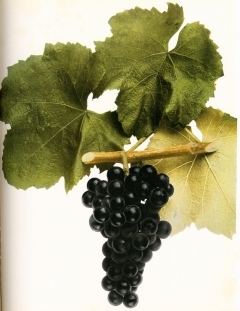
The Carman is another grape having the characters of three species—Vitis lincecumii, V. labrusca and V. vinifera—and hence of interest to grape improvers at least. In the twenty-three years it has been known in New York it has not become popular with grape-growers chiefly because it ripens too late for this region and when ripe does not attain the high quality ascribed to it elsewhere. Its most valuable character is that of long keeping, whether while hanging on the vine or after harvesting.
CARMAN
T. V. Munson of Denison, Texas, raised Carman from seed of a wild Post-oak grape taken from the woods, pollinated with mixed pollen of Triumph and Herbemont. It was introduced in 1892 and placed on the American Pomological Society fruit catalog list in 1897. The variety was named in honor of E. S. Carman, for many years editor of the Rural New Yorker, and a plant-breeder of note.
Vine very vigorous to medium, hardy, lacking in productiveness. Canes long, numerous, thick, brown to reddish-brown; nodes but slightly enlarged, flattened; internodes long to medium; diaphragm somewhat thick; pith above medium size; shoots very pubescent; tendrils intermittent, long, trifid.
Leaf-buds rather large, nearly short, thick, conical to obtuse, open rather late. Young leaves slightly tinged with rose on upper and lower sides. Leaves in good condition until injured by frost, large, thick; upper surface light to dark green, somewhat glossy, older leaves rugose; lower surface pale green, pubescent; veins indistinct; terminal lobe acute to obtuse; petiolar sinus deep to narrow; basal sinus often absent or shallow; lateral sinus medium to shallow when present; teeth intermediate in depth and width. Flowers on plan of five or six, fertile or nearly so, open very late; stamens upright.
Fruit ripens just before Catawba, an excellent keeper. Clusters variable in size, of average length and breadth, tapering to cylindrical, frequently single-shouldered, usually compact; peduncle above medium length and thickness; pedicel short, slender, smooth with very slight swelling at point of attachment to berry; brush short, slender, wine-colored. Berries inferior in size, roundish to slightly oblate, dark purplish-black to black, glossy, covered with a fair amount of blue bloom, persistent, firm. Skin rather thin, tough, nearly free from pulp, contains little or no pigment, not astringent. Flesh yellowish-green, not juicy, somewhat tender when fully ripe, has some Post-oak flavor, vinous, spicy, sweetish at skin to tart next the seeds, good to very good. Seeds separate easily from pulp, one to four, average two or three, small, of mean length and breadth, blunt, brownish; raphe sometimes cord-like; chalaza intermediate in size, slightly above center, oval to pear-shaped, distinct.
CATAWBA. (Labrusca, Vinifera.)
1. Adlum, 1823:109, 139. 2. Ib., 1828:173. 3. Ib., 1828:176. 4. Prince, 1830:175. 5. Ib., 1830:180. 6. U. S. Pat. Off. Rpt., 1845:312, 938, 939. 7. Ib., 1847:462, 463, 464, 465, 466, 467, 469. 8. Mag. Hort., 15:513. 1849. 9. West. Hort. Rev., 1:15. 1850. 10. U. S. Pat. Off. Rpt., 1851:48, 49, 51. 11. Am. Pom. Soc. Cat., 1852:54. 12. Buchanan, 1852:23, 71, 96, 106. 13. Elliott, 1854:244. 14. Hooper, 1857:274. 15. Horticulturist, 16:120. 1861. 16. Mag. Hort., 28:506. 1862. 17. Ib., 29:73. 1863. 13. Gar. Mon., 5:73, 74, 184. 1863. 19. N. Y. Ag. Soc. Rpt., 1864:42. 20. Am. Pom. Soc. Rpt., 1867:43. 21. Fuller, 1867:220, 241, 248. 22. Gar. Mon., 9:214. 1867. 23. Horticulturist, 23:298. 1868. fig. of leaf. 24. Downing, 1869:533. 25. Barry, 1872:421. 26. Gar. Mon., 14:167. 1872. 27. Ohio Hort. Soc. Rpt., 1875-6:72, 73. 28. Bush. Cat., 1883:80. fig. 29. Am. Pom. Soc. Rpt., 1883:118. 30. Am. Gard., 12:581. 1891. 31. Gar. and For., 8:487. 1895. 32. N. Y. Sta. An. Rpt., 15:432. 1896. 33. Ib., 17:527, 540, 543, 544, 548, 552. 1898. 34. Ev. Nat. Fruits, 1898:53. 35. N. Y. Sta. An. Rpt., 18:367, 374, 386, 396. 1899. 36. Mo. Sta. Bul., 46:38, 43, 44, 45. 1899. 37. Kan. Sta. Bul., 110:235. 1902. 38. Rural N. Y., 61:722. 1902. 39. Traité gen. de vit., 6:282. 1903.
Arkansas (13). Catawba Tokay (4, 13, 18, 24, 39). Cherokee (15). Fancher (?24, 39). Keller’s White (39). Lebanon Seedling (13, 18). Lincoln (9). Mammoth Catawba (39). Mead’s Seedling (39). Merceron (39). Michigan (16, 17). Michigan (24, 39). Muncy (3). Muncy Pale Red (5). Muncy, pale red? (4). Omega (39). Red Muncy (4?, 13, 18, 24, 28, 39). Rose of Tennessee (18). Saratoga (?24, 39). Singleton (13, 18, 28,?39). Tekomah (39). Tokay (1). Tokay (4, 28, 39). Virginia Amber (18). White Catawba (39).
From many points of view the Catawba is the most interesting of our American grapes. The elasticity of constitution which enables it to adapt itself to many environments and therefore to succeed in a vast region; its possible existence for centuries in the wild state, for the records of a century have not divulged the secret of its origin, of its ancestry, or of its introduction; its high quality and attractive appearance which give it intrinsic value as a table grape and for making wine; the fact that it was our first great American grape and that after a century it is still one of the four leading varieties of grapes cultivated in eastern America and that after this lapse of time it is the chief of all northern varieties for wine-making; all these make Catawba of prime interest to the grower of American grapes. The Catawba, too, has had the rare distinction of having a poet, Longfellow, sing its praises:
“Very good in its way is the Verzenay Or the Sillery, soft and creamy, But Catawba wine has a taste more divine, More dulcet, delicious and dreamy. There grows no vine, by the haunted Rhine, By the Danube or Guadalquiver, Nor island or cape, that bears such a grape As grows by the beautiful River.”
CATAWBA
In Chapter II, American Grapes, we have seen how important a part the Catawba played in the first grape regions of this country. It is still the leading grape along the shores of Lake Erie in northern Ohio, and about the Central Lakes of New York. In the latter region immense areas are devoted to this variety, the product going to the general market and to the wine-cellars where it is the chief sort used in the making of champagne. Its characters are such that it is not too much to say that did it but ripen two weeks earlier in the other grape regions of New York, the Chautauqua, Hudson and Ontario regions, the Catawba would rival the Concord. Because of late ripening in New York this variety is at its best only about the Central Lakes and on land extending back from the water to an altitude of one hundred feet above the lake surface; here as fine Catawbas are grown as anywhere in the world. As to soil, it thrives in sand, gravel or clay provided there be an abundance of food and humus, good drainage and plenty of bottom heat.
Of all the commercial grapes grown in New York Catawba is the best keeper, lasting until March or later. Because of its fine quality it often brings a higher price than other varieties and its reputation as a dessert grape would be still better were it not too often picked before fully ripe and therefore sour and unpalatable. The Catawba is the standard red grape in the markets, and other red varieties are often sold under its name. It makes a good light-colored wine, which as has been said, is largely used as a base for champagne. The vine is vigorous, hardy and productive but the foliage and fruit are susceptible to fungi and this constitutes the chief defect of the variety and accounts for the decline and the passing out of Catawba in many of the grape regions of the past in the United States and its unpopularity in some of the grape regions of the present. In its botanical characters, in its adaptation, and in its susceptibilities it suggests Vitis vinifera crossed with Vitis labrusca, a possibility to be discussed in a later paragraph.
The characters of Catawba seem readily transmissible to its offspring and, beside having a number of pure-bred descendants which more or less resemble it, it is one of the parents of a still greater number of cross-breeds which, as a rule, inherit many of its characters. As with Catawba, most of its progeny show Vinifera characters; as intermittent tendrils, the Vinifera color of foliage, a vinous flavor wholly or nearly free from foxiness, and the susceptibilities of Labrusca-Vinifera hybrids to certain insects, fungi, and environmental conditions.
Catawba was introduced by John Adlum of the District of Columbia about 1823. Adlum secured cuttings of this variety from a Mrs. Scholl of Clarksburgh, Montgomery County, Maryland, in the spring of 1819. This vine had been planted by Mrs. Scholl’s husband, who had since died. He had always called it Catawba, but the family did not know from what source it had been secured. Owing to the statement of a German priest that it was the same as the Tokay of Hungary, Mr. Adlum called it by that name. Some years later, when he found this to be a mistake, he changed the name back to Catawba. Adlum found the same variety on a trellis on land belonging to a Mr. J. Johnston, near Fredericktown, Maryland. He also found a similar variety on a farm of his in Lycoming County, Pennsylvania, which he introduced under the name of Muncy. Later these two varieties were judged to be identical. Neither Adlum nor Prince was able to trace the origin of Catawba, though both were among the chief viticulturists of their day, were instrumental in distributing this variety, and had correspondents in all parts of the Union.
In 1850, S. Mosher of Saloma Springs, Kentucky, wrote an article in the Western Horticultural Review, giving an account of the finding of the original vine by Dr. Solomon Beach, in 1821, on the farm of William Murry, about ten miles from Asheville, Buncombe County, North Carolina. The Murrys informed Beach that the grape was an old variety in the neighborhood and that cuttings and roots had been sent to various places. This story was later confirmed by Ravenel, who talked with a son of the original Murry and was told that General Davy, in 1807, then United States Senator from South Carolina, had secured some of the vines and had carried some of them to Washington. This would account for its falling into the hands of Adlum. It must be said, however, that it appears strange that none of the many correspondents of Adlum or Prince, some of whom lived not very far from where the Catawba was supposed to have been found, had heard of this variety. That the Murrys had a vine growing on their farm of peculiar excellence, is probable; that it was Catawba is by no means certain. All that can be said is that the origin of Catawba is not positively known.
Catawba was introduced into the grape region around Cincinnati by Longworth in 1825. The favorable reports of the variety from this region undoubtedly did much to secure its early and wide distribution. In most sections it was compared with the Alexander or Cape grape, and proved itself easily the superior in both vine and fruit characters. Up to the time of the introduction of Concord, Catawba was the most popular American grape cultivated. After that time, the earlier season and superior vine of the former variety enabled it to supplant Catawba in many sections. The Catawba was placed on the grape list in the first American Pomological Society fruit catalog in 1852.
The species to which Catawba belongs is uncertain. It is generally classed as Labrusca, but practically all of those who have raised large numbers of seedlings of the variety are of the opinion that it has some Vinifera blood in its composition. The general appearance of the vine would indicate Labrusca, but the vinous flavor of the fruit, the susceptibility to mildew, the appearance of occasional seeds, and the character of the seedlings, many of which resemble Vinifera more than the parent, all indicate that there is a strain of Vinifera present.
Vine vigorous to medium, hardy, productive, subject to mildew in unfavorable seasons. Canes of average length, numerous, rather thick, moderately dark brown with slight ash-gray tinge; nodes enlarged, sometimes slightly flattened; internodes of mean length; diaphragm rather thin; pith rather large; shoots slightly pubescent; tendrils continuous, of fair length, bifid to trifid.
Leaf-buds intermediate in size and thickness, short, conical to nearly obtuse, open moderately late. Young leaves tinged rose carmine on upper and lower sides. Leaves large, of average thickness; upper surface rather light green, dull, moderately smooth; lower surface grayish-white, heavily pubescent; veins well defined; lobes sometimes three, terminal lobe acute; petiolar sinus deep, narrow to medium; basal sinus often lacking; lateral sinus of average depth, narrow; teeth rather shallow, narrow. Flowers fertile, open rather late; stamens upright.
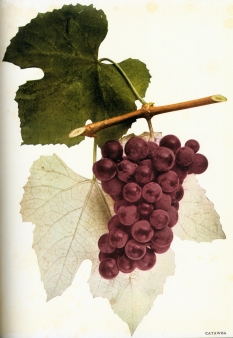
Fruit late, one of the best keepers, lasting until March or later. Clusters large to medium, rather long, usually broad, nearly cylindrical to tapering, single-shouldered to sometimes double-shouldered, rather loose to compact; peduncle of average length, rather slender; pedicel variable in length, intermediate in thickness, covered with but few small, inconspicuous warts, considerably swollen at point of attachment to berry; brush short, pale green. Berries intermediate in size, oval to roundish, dull purplish-red, covered with a moderate amount of lilac bloom, not inclined to drop from pedicel, firm. Skin rather thick, variable in toughness, slightly adheres to pulp, with no pigment, somewhat astringent. Flesh green, translucent, juicy, fine-grained, slightly tough to soft, depending upon age, vinous, often sprightly with some foxiness, sweet and rich, very good in quality. Seeds separate easily from flesh, frequently abortive, average two, medium size, broad, often with a short prominent neck, distinctly notched, blunt, brownish; raphe obscure; chalaza large, above center, oval to nearly roundish, rather distinct.
CAYUGA. (Labrusca, Vinifera?)
1. Rural N. Y., 45:265. 1886. fig. 2. N. Y. Sta. An. Rpt., 11:617. 1892. 3. Bush. Cat., 1894:100. 4. Ga. Sta. Bul., 53:41, 54. 1901. fig.
Sharon (3).
Cayuga is probably a descendant of Isabella through Adirondac. It resembles its parent in both its good qualities and its faults. The first are beauty, quality and earliness of fruit; the second lack of vigor, susceptibility to fungi and lack of hardiness. Although known since 1886, the Cayuga was never widely distributed in New York and is now rarely found.
The variety was originated by D. S. Marvin, Watertown, New York, from seed of Adirondac. Marvin, in a personal letter, says that the usually imputed parentage of Eumelan crossed with Adirondac is a mistake, and refers to another variety. Bush gives Sharon as a synonym of Cayuga but this appears to be an error.
Vine not vigorous, lacks in hardiness, an uncertain bearer, unproductive. Tendrils continuous, bifid. Leaves medium to small, inclined to dark green, thick. Flowers vary from nearly fertile to almost sterile, open in mid-season; stamens upright. Fruit ripens as early as Champion. Clusters variable in size, usually short and not shouldered, not uniform in compactness. Berries medium to large but some years often small and seedless, much like Isabella in shape, unattractive in color, ranging from dull reddish-purple to blackish, covered with blue bloom. Flesh tender, vinous, mild from skin to center, variable in flavor and quality, ranking from fair to very good. The seed-coat is often rough and warty.
CENTENNIAL. (Labrusca, Aestivalis, Vinifera.)
1. Am. Pom. Soc. Rpt., 1881:66. 2. Bush. Cat., 1883:81. 3. N. Y. Sta. An. Rpt., 9:330. 1890. 4. Ill. Sta. Bul., 28:263. 1893. 5. Bush. Cat., 1894:101. fig. 6. Mass. Hatch. Sta. Bul., 37:12, 15. 1896. 7. Ark. Sta. Bul., 39:28. 1896. 8. N. Y. Sta. An. Rpt., 17:527, 548, 552. 1898. 9. Tex. Sta. Bul., 48:1149, 1154. 1898. 10. Mo. Sta. Bul., 46:38, 45, 46. 1899. 11. Ga. Sta. Bul., 53:41. 1901. 12. Kan. Sta. Bul., 110:247. 1902.
Continental (1) but incorrectly.
Centennial is now scarcely heard of though at the time of its introduction, shortly after the Centennial of 1876, it was looked upon as a valuable acquisition. Its chief meritorious attributes are high quality and attractive appearance; while its faults, which greatly outweigh its merits, are lack of vigor, susceptibility to fungi, and lack of hardiness. Centennial is much like Delaware and is surpassed by it in nearly all respects.
The variety was originated by D. S. Marvin, of Watertown, New York. It is a cross between a Labrusca seedling of Marvin’s and a seedling of Eumelan. It was first fruited in 1875, and was introduced in 1882 by the originator. Vines were received by this Station in 1883. The tenderness and lateness of ripening of Centennial, as well as its botanical characters, indicate Vinifera blood.
The following description is a compilation from several sources:
Vine vigorous, somewhat tender, fairly productive. Leaves rounded, slightly three-lobed, smooth. Clusters medium to small, compact, tapering or cylindrical, sometimes slightly shouldered. Berries medium to small, pale red or amber color with thin white bloom, adhere firmly to pedicel. Skin rather thick, tough. Flesh tender, juicy, sweet, resembling Delaware in flavor, good to very good. About the same season as Concord.
CHALLENGE. (Labrusca, Vinifera?)
1. Am. Jour. Hort., 4:72. 1868. 2. Ib., 7:102. 1870. 3. Bush. Cat., 1883:82. 4. Ill. Sta. Bul., 28:259. 1893. 5. Mo. Sta. Bul., 46:38, 43, 45, 46. 1899. 6. Ga. Sta. Bul., 53:41. 1901. 7. Kan. Sta. Bul., 110:238. 1902.
Some years ago Challenge was considered an excellent dessert grape, being of good quality, hardy, and fairly healthy. Small plantations of it still exist in New York, but it is rapidly passing out of cultivation.
Challenge was originated about 1860 by Archer Moore, of Hammonton, New Jersey. He supposed it to have come from seed of Concord fertilized by Royal Muscadine. The variety was introduced by William F. Bassett of the same place. We do not have a vine of Challenge growing on the Station grounds, and the description written below is compiled from various sources.
Vine very vigorous; shoots slender, long. Leaf of medium size, dark green. Clusters rather large, compact, tapering, usually shouldered. Berries medium in size, round, pale red to reddish-purple in color with very thin bloom and inconspicuous dots, juicy, slightly acid; quality medium to good; not separating readily from the seeds. Season shortly after Concord.
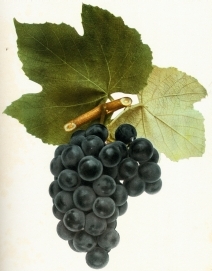
CHAMPION. (Labrusca.)
1. Am. Pom. Soc. Rpt., 1871:69. 2. Am. Hort. An., 1871:83. 3. Horticulturist, 30:151. 1875. 4. Mich. Pom. Soc. Rpt., 1875:88, 295. 5. Gar. Mon., 20:47. 1878. 6. Montreal Hort. Soc. Rpt., 1879:93. 7. Am. Pom. Soc. Cat., 1879. 8. Am. Pom. Soc. Rpt., 1881:36. 9. Bush. Cat., 1883:82. 10. Ib., 1883:138. 11. Tenn. Sta. Bul., Vol. 9:172. 1896. 12. N. Y. Sta. An. Rpt., 17:527, 528, 548, 552, 554. 1898. 13. Miss. Sta. Bul., 56:11. 1899. 14. Budd-Hansen, 2:374. 1902.
Beaconsfield (6, 8, 9, 11). Champion (10). Early Champion (5). Early Champion (9, 11). Tallman? (5). Tallman Seedling (1, 2). Talman’s Seedling (10). Talman’s Seedling (9, 11). Talman’s Seedling (4). Talman (10).
Champion is still a favorite early grape with some commercial growers after having been grown for a generation, though its poor quality should have driven it from cultivation years ago. Champion and Hartford are rivals as early market grapes and for the distinction of being the poorest in quality of all commonly cultivated grapes. The variety under consideration is sourer and less agreeable to the taste than many wild grapes. The characters which have kept it in cultivation are earliness, good shipping qualities, though it does not keep well, productiveness, attractive appearance, and a vigorous hardy vine. The hardiness of the vine and its short season of fruit development and maturity make it a good variety for northern and cold climates. This grape is best, in appearance of fruit, in quality, and in the quantity produced, on a comparatively light sandy soil. As grape consumers become more appreciative of quality, Champion will be grown less and less.
The origin of Champion is unknown. It was first grown about 1870 in New York. In 1871 Elliott acknowledged receipt of specimens of this variety from William Chorlton of Staten Island. It was at that time generally known as Tallman or Tallman’s Seedling. At about the same time it was being propagated and sold by R. J. Donnelly and J. I. Stone of Charlotte, Monroe County, as Champion. Although many efforts have been made, no one has succeeded in tracing the variety to the original vine. At one time it was stated to have originated in the vicinity of New Orleans, Louisiana, but later the southern Champion was found to be a different variety. This variety was early introduced into Canada where it was known as Beaconsfield, owing to its being first planted in that country in a large vineyard owned by a gentleman of that name.
CHAMPION
Vine vigorous to very vigorous, hardy, productive to very productive. Canes intermediate in length and number, of average size, rather dark brown; nodes enlarged, flattened; internodes medium to below in length; diaphragm thick; pith nearly large; shoots pubescent; tendrils continuous, inclined to long, bifid.
Leaf-buds of medium size, short, rather thick, obtuse to conical, open in mid-season. Young leaves strongly tinged on lower side and along margin of upper side with carmine, making the prevailing color rose carmine. Leaves medium to large, intermediate in thickness; upper surface dark green, dull, rugose; lower surface dull gray often with trace of bronze, slightly downy; veins indistinct; lobes usually three, often obscurely five, terminal lobe acute; petiolar sinus deep to medium, of average width; teeth of fair depth, shallow. Flowers fertile, open medium early; stamens upright.
Fruit ripens early, three weeks or more before Concord and about a week before Hartford, ships well but does not keep well, as its season is very short. Clusters medium to small, of mean length and breadth, blunt, cylindrical to slightly tapering, usually not shouldered, medium to compact; peduncle short, rather thick; pedicel inclined to short, covered with small inconspicuous warts; brush whitish tinged with brown. Berries medium to above in size, roundish, dull black covered with a moderate amount of blue bloom, not always persistent, somewhat soft. Skin thick, tender, adheres considerably to the pulp, contains a fair amount of light purplish pigment, astringent. Flesh light green, translucent, juicy, fine-grained, tender, foxy, rather sweet next the skin, agreeably tart at center, poor in quality. Seeds slightly adherent, one to five, average three, large, somewhat broad and long, blunt, light brown; raphe obscure; chalaza of fair size, slightly above center, circular, obscure.
CHAUTAUQUA. (Labrusca.)
1. N. Y. Sta. An. Rpt., 11:618. 1892. 2. Ib., 13:602. 1894. 3. Bush. Cat., 1894:102. 4. N. Y. Sta. An. Rpt., 17:528, 548, 554. 1898.
In appearance Chautauqua is very similar to Concord, its parent, but it ripens a few days earlier and is of slightly better quality though it does not differ in these respects sufficiently to make it more than an easily recognized strain of Concord. Inasmuch as it originated, and for fifteen years has been known, in the region where the Concord reigns supreme, and has not yet come into prominence, it is fair to assume that it has some weakness and that the parent will remain dominant.
Chautauqua is a volunteer seedling of Concord found in a Concord vineyard near Brocton, Chautauqua County, New York, by H. T. Bashtite who sent vines of it to this Station in 1892.
Vine medium to vigorous, not always hardy, not productive. Tendrils continuous, mostly trifid. Leaves large, irregularly roundish, dark green; lower surface tinged with bronze. Flowers semi-fertile to nearly fertile, open in mid-season or earlier; stamens upright. Fruit ripens in mid-season or a few days earlier. Clusters medium to large, rather broad, sometimes single-shouldered, intermediate in compactness. Berries unusually large, roundish to slightly oval, dark purplish-black, covered with abundant blue bloom, shatter badly. Skin thin, very astringent. Flesh rather tough, vinous, sweet at skin to acid at center, good to very good in quality. The pulp separates readily from the few broad and plump seeds.
CLEVENER. (Labrusca, Riparia, Aestivalis?)
1. N. Y. Sta. An. Rpt., 10:494. 1891. 2. Ib., 11:618. 1892. 3. Rural N. Y., 52:381. 1893. 4. Bush. Cat., 1894:103. 5. N. Y. Sta. An. Rpt., 17:528, 548, 554. 1898.
There are two Cleveners discussed in American viticultural literature, the origin and history of both of which are briefly set forth below. In these general observations we need to consider but the northern one of the two grapes. This variety has long been grown in New Jersey and in New York and in both States is highly esteemed as a wine grape, the resulting wine being well flavored and of a dark inky-red color. The fruit is remarkable in coloring very early and in ripening very late. The vine is hardy, very vigorous, succeeds in various soils and since it bears grafts well it seems an excellent sort upon which to graft varieties which do not thrive on their own roots. It is self-sterile and must be planted with some other variety to set fruit well. Clinton makes an excellent pollenizer because it blooms at the same time, and because two wine grapes may be thus grown together. In spite of its good qualities, Clevener is hardly holding its own in the commercial vineyards of the State and it is not a desirable fruit for the amateur who wants a table grape.
The Clevener here described has been raised in the vicinity of Egg Harbor, New Jersey, for about forty years, but its place and time of origin are unknown. It is generally considered to be a Riparia but the continuous tendrils and other botanical characters indicate a strong admixture of Labrusca blood and possibly Aestivalis or Bicolor as the shoots and canes show considerable bloom.
The other variety under the name Clevener is a southern grape strongly resembling Rulander or Louisiana. Opinions differ as to whether it be of Aestivalis or Bourquiniana blood. This variety is unknown in New York and of its origin and history there is no information.
Vine a rampant grower, hardy, medium to productive, somewhat subject to attacks of leaf-hoppers. Canes long, numerous, rather thick, dark reddish-brown, covered with a slight amount of bloom; tendrils continuous, bifid. Foliage very healthy; leaves unusually large, intermediate in thickness, dark green with well defined ribs showing through the thin pubescence of the under surface. Flowers sterile, open very early; stamens reflexed.
Fruit ripens late, and appears to keep well. Clusters do not always fill well, small to medium, rather short and slender, irregularly tapering, often with a medium-sized single shoulder, variable in compactness. Berries small to medium, roundish to slightly flattened, black, rather glossy, covered with blue bloom, persistent, firm. Skin rather tough, thinnish and inclined to crack, adheres slightly to the pulp, contains an unusually large amount of dark purplish-red pigment. Flesh reddish-green, moderately juicy, rather tender and soft, fine-grained, very slightly aromatic, spicy, neither so sprightly nor so high-flavored as other varieties of the same season, not good enough in flavor and quality in general for dessert purposes. Seeds separate rather easily from the pulp, intermediate in size and length, medium to above in width, notched, nearly sharp-pointed, dark brown; raphe shows as a very small cord; chalaza large, at center or slightly above, irregularly oval, distinct.
CLINTON. (Riparia, Labrusca.)
1. Adlum, 1823:140. 2. Ib., 1828:176. 3. Prince, 1830:179. 4. Rafinesque, 1830:11. 5. N. Y. Ag. Soc. Rpt., 1841:388. 6. Horticulturist, 2:121, 341. 1847. 7. Ib., 8:120. 1853. fig. 8. Am. Pom. Soc. Rpt., 1860:82. 9. Am. Pom. Soc. Cat., 1862:90. 10. Gar. Mon., 5:335. 1863. 11. Strong, 1866:332. 12. Husmann, 1866:50, 102. 13. Fuller, 1867:219. 14. U. S. D. A. Rpt., 1869:85. fig. 15. Bush. Cat., 1883:82. 16. Can. Hort., 11:43. 1888. 17. Bush. Cat., 1894:103, 104. fig. 18. Ev. Nat. Fruits, 1898:75. 19. N. Y. Sta. An. Rpt., 17:528, 540, 544, 548, 554, 559. 1898. 20. Rural N. Y., 59:7, 306. 1900.
Worthington (1, 2, 3, 4). Worthington (15, 17).
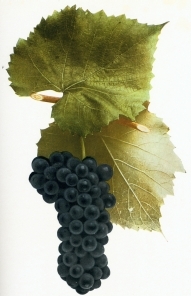
Clinton is now but little grown, its place having been taken by better varieties of its type. It has historical interest if not intrinsic value, for it played an important part in the beginning of American viticulture. Most viticulturists have ascribed to Clinton the distinction of being the first cultivated “variety of Vitis riparia” but without question this honor belongs to the Worthington of Adlum and Prince, with a strong probability that Clinton may be Worthington renamed. But it was as Clinton that Vitis riparia was disseminated for general culture and it is the name Clinton that stands at the parental head of the long list of grapes now under cultivation from this species; and so, in spite of its being the usurper of Worthington’s honor, and whether or not it be the older variety under an assumed name, it is probably best that Clinton continue to be considered the first of its race.
Clinton came into prominence, and brought the species to which it belongs to the notice of grape-growers, because of its vigor, hardiness and fruitfulness; and, later, its popularity was added to because of its immunity to phylloxera. The vine is so vigorous that its growth is rank and because of this and the straggling habit of growth it is very difficult to keep under control on trellises and in most situations needs a great deal of room. It can be grown in as high a latitude as any of our native grapes but it blooms so early in the spring that the blossoms are often caught by late frosts in northern climates. The immunity of Clinton to phylloxera led to its being planted very largely in France some years ago but it has now been discarded for better direct producers in that country. The defects of the variety are: The fruit is too small and sour and the seeds and skins too prominent for a market grape and the wine is not of high quality, being too raucous, though the harshness disappears somewhat with age. The fruit colors early in the season but does not ripen until late and therefore suffers greatly from birds. A slight touch of frost is supposed to improve its flavor. This variety is so sensitive to calcareous soils that where lime or chalk abounds the vines often die out after a few years. Clinton bears grafts well, making a quick and firm union with Labruscas and Viniferas, and roots very freely from cuttings.
This variety has been much used in grape-breeding and its blood can be traced in many valuable varieties, among which are most of the desirable wine grapes for the North. The offspring of Clinton are usually very hardy and this, taken with other desirable characters, makes it an exceptionally good starting-point for breeding grapes for northern latitudes. Its seedlings often show intermittent characters and otherwise indicate a strong strain of Labrusca.
CLINTON
Clinton began to attract attention in New York about 1840. J. W. Bissell, of Rochester, in the Horticulturist of January, 1848, writes that the vine from which cuttings were taken was found by L. B. Langworthy, in the garden of a Mr. Peebles above Waterford on the Hudson. The name Clinton was given by Langworthy, who introduced it to the trade around Rochester about 1835. There were other cultivated varieties growing in the Peebles garden and the Clinton was not supposed to be a seedling. Although this account of the origin of the Clinton was published in the then most popular horticultural publication in the United States, there were no denials nor corrections made in any of the succeeding numbers. In 1863 there appeared in the Elmira Advertiser an account of the origin of this variety in which it was stated that the seed from which this variety had sprung was planted by Hugh White, then a member of Congress, in his father’s garden in Whitesboro, in 1819. Two years later, so the story runs, when he was a junior in Hamilton College, Clinton, New York, White transplanted the vine east of the house of Dr. Noyes, with whom he then boarded. There were no denials of this report, probably on account of the fact that the introducer at Rochester was dead; and the account and Whitesboro as the place of origin were later generally accepted by horticultural writers. In 1852 the Ohio Pomological Society determined that the Worthington and the Clinton grapes were identical. Later this was generally accepted by viticulturists as being correct. The Worthington is an old sort known to Adlum and Prince, and was said by the latter to have originated in the vicinity of Annapolis, Maryland.
Clinton was placed on the grape list of the American Pomological Society fruit catalog in 1862, where it has since been retained.
Clinton is usually considered a Riparia, as most of the botanical characters indicate this species. However, occasional canes with continuous tendrils are characteristic of Labrusca.
Vine a rank grower, healthy, hardy, productive. Canes long, numerous, slender to medium, brown to reddish-brown; nodes enlarged, slightly flattened; internodes of average length; diaphragm thick to medium; pith large; shoots smooth; tendrils usually intermittent but sometimes continuous, bifid.
Leaf-buds rather large and short, thick, obtuse to conical, open early. Young leaves very faintly tinged with carmine on lower side only. Leaves hang until very late in the season, medium to small, thin; upper surface dark green, smooth; lower surface pale green, not pubescent; veins indistinct; petiolar sinus deep, medium to narrow, often urn-shaped; basal and lateral sinuses shallow to medium when present; teeth of average depth, rather wide. Flowers fertile, open early; stamens upright.
Fruit colors early but is not edible until after mid-season. Clusters medium to small, of fair length, slender, cylindrical, uniform, usually single-shouldered, compact; peduncle medium to short, intermediate in thickness; pedicel nearly short, very slender, almost smooth; brush tinged with red. Berries small to medium, roundish to slightly oval, dark purplish-black to black, glossy, covered with rather thick blue bloom, adhere well to pedicel, firm. Skin very thin, tough, nearly free from pulp, contains considerable wine-colored pigment, somewhat astringent. Flesh darkish green, very juicy, fine-grained, slightly tough and solid, with some Riparia flavor, spicy, vinous, too tart for dessert use. Seeds adherent, average two in number, intermediate in size, short, blunt, brownish; raphe obscure; chalaza of average size, above center, pear-shaped to long oval, distinct. Must, 93°-98°.
CLOETA. (Lincecumii, Rupestris, Labrusca, Vinifera.)
1. Rural N. Y., 60:637. 1901. 2. Am. Pom. Soc. Rpt., 1903:83. 3. Mo. Hort. Soc. Rpt., 1904:306.
Cloeta comes from T. V. Munson and is of the same parentage as Captain. Munson says of it:[172] “Probably the best of all American black grapes.” But it does not sustain this high standard on the Station grounds nor would it do so, we think, in other parts of the North. Munson further states that it “requires hot, dry weather to acquire high quality” and this explains why it does not succeed in this latitude as it does in Texas.
The variety was produced from seed of America pollinated by R. W. Munson and was introduced by the originator in 1902.
Vine very vigorous, hardy, produces fair to good crops, susceptible to attacks of mildew. Canes long, numerous, covered with considerable blue bloom; tendrils intermittent, bifid. Leaves small to above medium, rather thick. Flowers bloom in mid-season; stamens upright. Fruit ripens after mid-season, does not keep well. Clusters medium to small, not uniform, frequently single-shouldered, intermediate in compactness. Berries medium to small, oval to roundish, black, covered with a fair amount of blue bloom, very persistent, not firm. Skin very thin and tender, contains a large amount of wine-colored pigment. Flesh somewhat tough and solid, sweet at skin to acid at center, spicy, medium to above in quality. The numerous small seeds are usually not notched.
COLERAIN. (Labrusca.)
1. Rural N. Y., 47:759. 1888. fig. 2. Bush. Cat., 1894:105. 3. Rural N. Y., 53:616. 1894. 4. N. Y. Sta. An. Rpt., 14:278. 1895. 5. N. Y. Sta. An. Rpt., 17:528, 548, 554. 1898. 6. Rural N. Y., 58:23. 1899. 7. Mich. Sta. Bul., 169:165. 1899.
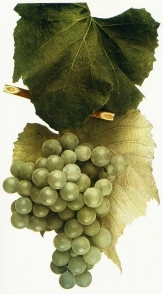
Colerain is one of the numerous white seedlings of Concord and one of the few of these seedlings of sufficient merit to be kept in cultivation. It has the characteristic foliage and habit of growth of its parent but is earlier by at least a week, is of much higher quality and lacks somewhat the foxiness of most Labruscas. Colerain is sprightly and vinous and neither seeds nor skins are as objectionable as in the parent variety; the fruit hangs well to the vine and keeps as well as most of the varieties of its class but owing to its tender pulp does not ship well. It is reported to be more or less unproductive in some localities. While Colerain has not attained commercial importance, it is recognized as well worthy a place in home vineyards, and for this reason and because it is one of the best if not the best of the white seedlings of Concord it is given the honor of a color-plate and full description in The Grapes of New York.
David Bundy of Colerain, Belmont County, Ohio, produced Colerain from seed of Concord planted in 1880. The variety was soon after introduced by the Colerain Grape Company of Colerain, Ohio.
Vine medium to vigorous, usually hardy, healthy, not always productive. Canes intermediate in length and number, slender, dark reddish-brown; nodes of average size, flattened; internodes medium to below; diaphragm thick; pith rather large; shoots pubescent; tendrils continuous, rather short, bifid.
Leaf-buds small, short, slender, pointed to nearly conical, open moderately late. Young leaves lightly tinged on lower side and along margin of upper side with a faint trace of carmine. Leaves of average size, nearly thick; upper surface light green, dull, moderately smooth; lower surface slightly bronze, downy; veins rather distinct; leaf not lobed, terminus acute; petiolar sinus shallow to medium, usually wide; basal and lateral sinuses very shallow when present; teeth shallow, of average width. Flowers fertile, opening in mid-season or earlier; stamens upright.
Fruit ripens a week or more earlier than Concord, keeps fairly well but does not ship well. Clusters attractive, averaging medium in size and length, somewhat slender, blunt, tapering to nearly cylindrical, irregular, usually strongly shouldered, moderately compact; peduncle medium in length and thickness; pedicel intermediate in length, inclined to slender, nearly smooth; brush of average length, green. Berries usually below Niagara in size but somewhat variable, roundish to slightly oval, light green, slightly glossy, covered with thin gray bloom, usually rather persistent. Skin unusually thin, tender, adheres to pulp, contains no pigment, slightly astringent. Flesh pale green, translucent, juicy, fine-grained, tender and soft when fully ripe, somewhat foxy, vinous, sweet, good in quality. Seeds separate easily from the pulp, few in number, usually one to three, averaging two, rather small and broad, notched, short to medium, nearly plump, brownish; raphe obscure; chalaza of average size, slightly above center, circular to nearly oval, showing only as a depression.
COLUMBIAN IMPERIAL. (Labrusca, Riparia.)
1. Ohio Hort. Soc. Rpt., 1893-4:30. 2. Bush. Cat., 1894:105. 3. Ohio Hort. Soc. Rpt., 1894-5:67, 70. 4. N. Y. Sta. An. Rpt., 18:374, 387, 395. 1899. 5. Mo. Sta. Bul., 46:38, 43, 44, 45, 49. 1899. 6. Mich. Sta. Bul., 169:166, 169. 1899. 7. Mo. Hort. Soc. Rpt., 1899:57. 8. Ga. Sta. Bul., 53:42. 1901.
Columbian (3, 6). Imperial (3). Jumbo (1). Jumbo (2, 3).
Columbian Imperial is a showy, reddish-black, Labrusca-Riparia hybrid chiefly remarkable for the great size of its berries; though the vine is so exceptionally healthy and vigorous as to give it prominence for these characters. The variety has remarkably thick, leathery leaves which seem almost proof against either insects or fungi. The quality of the fruit, however, is very inferior and the clusters are uneven as to the number of berries and these shell off readily. The only possible value of the variety is for exhibition purposes and for breeding to secure the desirable characters named above. Columbian Imperial is a frequent adornment of the salesbook of the fruit tree agents and the panegyrics heaped upon it by misinformed or unscrupulous salesmen have given it a rather wide distribution in the gardens of the amateur where it has no place whatever.
The parentage of Columbian Imperial is unknown. The fruit was originated by J. S. McKinley, Morgan, Orient P. O., Ohio, in 1885. It was introduced by the Columbian Grape Company, of Kingston, Ohio, under the name Columbian, also by J. R. Johnson of Dallas, Texas, under the name Columbian Imperial. Supposed by many to be of Labrusca-Riparia blood. The Labrusca shows plainly; the Riparia little, if at all.
Vine vigorous to very vigorous, healthy, hardy, variable in productiveness. Canes long, numerous, thick to medium, dark reddish-brown, unusually heavily pubescent and spiny; tendrils continuous, long, bifid.
COLERAIN
Leaves healthy, variable in size, green, very thick; lower surface of young leaves pale green shading into bronze on older leaves with little, if any, pubescence. Flowers, strongly self-fertile; upright stamens. Fruit ripens late. Clusters medium in size, sometimes shouldered, and of average compactness. Berries large, roundish to slightly oval, dull reddish-black covered with thin lilac or faint blue bloom, not very persistent, firm. Skin thick, tough, contains no pigment. Flesh moderately juicy, tough, nearly sweet at skin to decidedly acid at center, with no pronounced aroma, fair to good in quality. Seeds adhere to the pulp, large to medium, plump, broad to medium, intermediate in length, rather blunt.
CONCORD. (Labrusca.)
1. Mag. Hort., 18:490, 522. 1852. 2. Ib., 19:524, 542. 1853. 3. Horticulturist, 9:124, 188, 236, 399, 515. 1854. 4. Mag. Hort., 20:63, fig., 431, 553. 1854. 5. Am. Pom. Soc. Cat., 1854. 6. Ib., 1858:233. 7. Grant, 1864:7, 12. 8. Gar. Mon., 11:39. 1869. 9. Mich. Pom. Soc. Rpt., 1872:47. 10. Bush. Cat., 1883:83, 84, fig., 147. 11. Mo. Hort. Soc. Rpt., 1891:335. 12. Meehan’s Mon., 4:47. 1894. 13. N. Y. Sta. An. Rpt., 17:528, 540, 543, 544, 548, 552. 1898. 14. Ev. Nat. Fruits, 1898:72. 15. Mo. Hort. Soc. Rpt., 1900:360. 16. Traité gen. de vit., 6:178. 1903.
Bull’s Seedling (1).
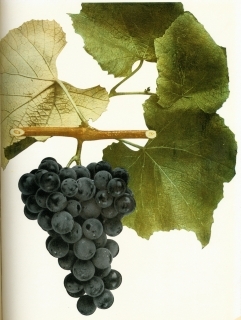
The Concord is known by all. The most widely grown of the grapes of this continent, it also represents the dominant type of our native species and with its offspring, pure-bred and cross-bred, furnishes seventy-five per ct. or more of the grapes of eastern America. In New York, approximately seventy-five per ct. of all the grapes grown are Concords alone. The preeminently meritorious character of Concord, which has enabled it to take first place in American viticulture, is the elasticity of its constitution whereby it adapts itself to varying conditions; thus the Concord is grown with more or less profit in every grape-growing State in the Union and to an extent not possible with any other grape. It succeeds on a greater number of soils than any other variety. In the Chautauqua grape region there are six distinct types of soil upon which grapes are grown and the Concord is the leading grape on each of them.
A second character which commends Concord as a commercial variety is its high degree of fruitfulness, as it gives large crops year in and year out. Added to the above points of superiority are hardiness; ability to withstand the ravages of both diseases and insects; comparative earliness and therefore certainty of maturity in northern regions; fair size of bunch and berry, good color, and an abundance of bloom, making a most handsome grape. The Concord leaves out and blossoms somewhat late in the spring and does not therefore often suffer from spring frosts and the fruit is not easily injured by late frosts and hangs well on the vine.
The Concord is not, however, without faults. Its quality is not high, the grapes lack richness, delicacy of flavor and aroma, and have a foxy taste disagreeable to many; on the other hand, the fruit is sprightly and refreshing and does not cloy the appetite as do richer grapes. The seeds and skin of Concord are objectionable, the seeds being large and abundant and difficult to separate from the flesh and the skin is tough and unpleasantly astringent. The Concord does not keep nor ship well as compared with grapes having Vinifera blood and it rapidly loses flavor after ripening; the skin is inclined to crack and the berries to shell from the stems after picking. Concord is but slightly resistant to phylloxera and in calcareous soils is subject to chlorosis. It requires a rich soil and thrives best on a virgin soil; thus, in the Chautauqua region of this State, much concern is now felt because of the failing vineyards, most of which should not as yet have reached their prime. While Concord is grown in the South, it is essentially a northern grape, becoming susceptible to fungi in southern climates and suffering from phylloxera in dry, warm soils.
Concord is a table grape and, to use an oft quoted expression coined by Horace Greeley, it is “the grape for the millions.” It can be produced so cheaply that no other grape can compete with it in the markets. The dominance of Concord is not wholly desirable for viticulture, as by keeping out better varieties, the consumer is prevented from obtaining grapes high in quality; and by giving the grower a feeling of sufficiency in having this sort, other varieties do not receive the consideration they deserve. The variety is used somewhat for making red wines and a white wine as a base for champagne but it is a poor wine grape, as much sugar must be added to attain the amount of alcohol necessary for a good wine and the foxy taste is not a pleasant flavor. Grape juice is made almost entirely from Concords and during the past few years many carloads of grapes have been used in the Chautauqua region for this purpose.
CONCORD
The botanical characters of Concord indicate that it is a pure-bred Labrusca; thus the seed with obscure raphe and chalaza, the pubescence on the under surface of the leaf, the flesh characters of the fruit, the continuous tendrils, the diaphragm, all belong to Vitis labrusca. There are those, however, who maintain that it is possibly a Labrusca-Vinifera hybrid, basing their claim upon the upright stamens, the characters of some of the seedlings, and the opinion expressed by Bull that a Catawba vine growing near by had fertilized the seed from which Concord was raised.
Concord is a virile variety, having begotten a great number of valuable offspring, both as pure-breeds and as cross-breeds. To these it has seemingly transmitted its characters to a high degree. The reader who takes the pains to look them up will find that many of these, even of the pure-breeds, are white and that they are usually of higher quality than the parent, indicating a white ancestor of Concord in which high quality was possibly correlated with the light color.
The seed of a wild grape was planted in the fall of 1843 by E. W. Bull[173] of Concord, Massachusetts, from which fruit was borne in 1849. The wild grape from which the seed came had been transplanted from beside a field fence to the garden in which there was at least another grape, the Catawba, and the wild vine was open to cross-pollination. One of these seedlings was named Concord and the variety was exhibited before the Massachusetts Horticultural Society in the fall of 1852. The new grape was introduced in the spring of 1854 by Hovey & Co., of Boston. From the time of its introduction the growth of this variety in popularity was phenomenal. In 1854, the year of its introduction, it was placed on the grape list of the American Pomological Society fruit catalog as one of the “new varieties which promise well.” In 1858 it was placed on the regular list of recommended sorts where it has since been retained. Husmann states, in the winter of 1855, that he secured buds at Hermann, Missouri, from Soulard of Galena, Illinois. In other words, its culture had spread halfway across the continent in the brief period of a year. Before 1860, vineyards of Concord had been planted in Chautauqua County, this State. In 1865 it was awarded a prize by the American Institute known as the Greeley prize, from its donor, Horace Greeley, as the best grape for general cultivation.
Vine vigorous to very vigorous, hardy, healthy, usually productive of heavy crops. Canes above medium length, of average number, above mean thickness, rather dark reddish-brown to brown; nodes enlarged, flattened; internodes medium to long; diaphragm rather thick; pith large to medium; shoots pubescent; tendrils continuous, long, bifid, sometimes trifid.
Leaf-buds medium to nearly large, short, below average thickness, conical to pointed, open in mid-season. Young leaves lightly tinged on lower side and along margin of upper side, prevailing color rose-carmine. Leaves large to medium, thick; upper surface dark green, slightly glossy, rather smooth; lower surface light bronze, heavily pubescent; veins distinct; lobes three when present, terminal lobe acute; petiolar sinus variable averaging medium in depth and width; basal sinus usually lacking; lateral sinus obscure and frequently notched; teeth shallow, medium to narrow. Flowers fertile, open in mid-season or earlier; stamens upright.
Fruit ripens about mid-season, keeps from one to two months. Clusters rather uniform, large to medium, intermediate in length, wide, broadly tapering, usually single-shouldered, sometimes double-shouldered, medium to rather compact; peduncle short to medium, thick; pedicel of average length, thick, nearly smooth; brush intermediate in length, pale green. Berries medium to large, roundish, slightly glossy, black covered with abundant blue bloom, not always persistent, firm. Skin of average thickness, moderately tough, slightly adherent to pulp, contains a small amount of wine-colored pigment, somewhat astringent. Flesh pale green, translucent, juicy, rather fine-grained, somewhat tough and solid, slightly foxy, sweet at skin, inclined to tartness next the seeds, good in quality. Seeds rather adherent, one to four in number, average three, nearly large, broad, distinctly notched, plump, blunt, brownish; raphe obscure; chalaza of fair size, slightly above center, oval, nearly obscure. Must 70°-80°.
COTTAGE. (Labrusca.)
1. Am. Jour. Hort., 4:327, 334. 1868. 2. Horticulturist, 26:22. 1871. 3. Am. Pom. Soc. Cat., 1879. 4. Am. Pom. Soc. Rpt., 1881:36. 5. Rural N. Y., 52:655. 1893. 6. Ill. Sta. Bul., 28:253. 1893. 7. Bush. Cat., 1894:108. 8. Ill. Hort. Soc. Rpt., 1895:131. 9. N. Y. Sta. An. Rpt., 17:528, 545, 547, 554. 1898. 10. Mich. Sta. Bul., 169:169. 1899.
COTTAGE
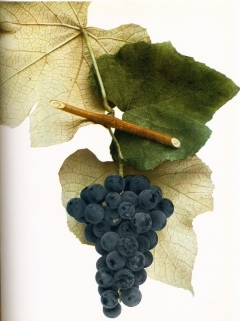
In vine and fruit Cottage greatly resembles its parent, Concord, having, however, remarkably large, thick, leathery leaves well shown in the color-plate. It is noted, too, for its strong, branching root system. With good foliage and good roots it is not surprising that it is a vigorous, thrifty grower—if anything surpassing its parent in vigor of growth. The canes are so rough as to be almost spiny indicating, seemingly, outbursts of growth-force. The Cottage is of better quality than its parent having far less foxiness and a richer, more delicate flavor. It is given credit, too, of being a better shipper and a better keeper and is from one to two weeks earlier. Its good qualities are offset, however, by the fact that it lacks in soil adaptability, is comparatively unproductive, and ripens unevenly. It blooms much earlier than Concord. Cottage is recommended as an early grape of the Concord type for the garden and a standard variety for northern localities. The variety is widely distributed in varietal vineyards.
Cottage is another of E. W. Bull’s seedlings, having been produced by him from seed of Concord. It was introduced in 1869 and in 1879 it was placed on the grape list of the American Pomological Society fruit catalog, where it has since been retained.
Vine vigorous, healthy, hardy, produces average crops. Canes often rough and hairy, long to medium, numerous, of fair thickness, rather dark brown, nodes slightly enlarged, not usually flattened; internodes intermediate in length; diaphragm thinnish; pith of average size; shoots very pubescent; tendrils continuous, of mean length, usually bifid.
Leaf-buds small to medium, short, of fair thickness, conical to pointed, open moderately early. Young leaves tinged on lower side and faintly at the margin with red, making the prevailing color pale green with light carmine tinge. Leaves large, thick; upper surface dark green, glossy, smooth to slightly rugose; lower surface tinged with heavy bronze, with some pubescence; veins distinct; leaf usually not lobed, with terminus acute to acuminate; petiolar sinus usually deep and wide; teeth shallow, wide. Flowers fertile, open medium early; stamens upright.
Fruit ripens one or two weeks earlier than Concord, does not keep well. Clusters above medium to small, below average length, moderately broad, cylindrical to slightly tapering, sometimes single-shouldered, rather compact; peduncle somewhat long, intermediate in size; pedicel short, thick, covered with few, inconspicuous, small warts, wide at point of attachment to berry; brush dark red. Berries of average size, roundish, dull black, not glossy, covered with heavy blue bloom, drop badly from pedicel, firm. Skin rather thick, somewhat tender, slightly adherent to pulp, contains considerable dark purplish-red pigment, slightly astringent. Flesh juicy, tough, rather solid, foxy, agreeably sweet next the skin, tart at seeds, good to medium. Seeds separate somewhat readily from pulp, numerous, one to four, often four, above medium in size, rather broad, intermediate in length, blunt, light brown; raphe does not show; chalaza rather large, usually at center, irregularly circular, obscure.
CREVELING. (Labrusca, Vinifera?)
1. Am. Pom. Soc. Rpt., 1858:225. 2. Ib., 1860:79. 3. Horticulturist, 15:538. 1860. fig. 4. Mag. Hort., 27:103. 1861. 5. Horticulturist, 17:141. 1862. 6. Mag. Hort., 29:72. 1863. 7. Mead, 1867:163. 8. Am. Pom. Soc. Cat., 1867:45. 9. Am. Jour. Hort., 4:60. 1868. 10. Downing, 1869:536. 11. Am. Jour. Hort., 8:143. 1870. 12. Gar. Mon., 13:214, 279. 1871. 13. Bush. Cat., 1883:90. 14. N. Y. Sta. An. Rpt., 17:528, 540, 544, 548, 554. 1898. 15. Ib., 18:374, 387, 395. 1899. 16. Kan. Sta. Bul., 110:240. 1902.
Bloom (2, 3, 5, 13). Bloomburg (10). Catawissa (5). Catawissa (2, 6, 13). Catawissa Bloom (10). Columbia Bloom (2, 4). Columbia County (10). Laura Beverly (9, 12). Laura Beverly? (10).
Creveling was long a favorite early black grape for the garden, where, if planted in good soil and kept well trained, it produces fine clusters of large, handsome, very good grapes of the Isabella type. Under any but the best of care, however, it is unproductive and sets loose, straggling bunches. The wood is soft, long-jointed, reddish in color, with a large pith and producing but few laterals. It is markedly self-sterile.
The origin of the Creveling is uncertain. It was first introduced to the public about 1857 by F. F. Merceron of Catawissa, Pennsylvania. It is said to have been in cultivation in Columbia County, Pennsylvania, some years previous to the date given. The name Creveling came from a family of that name, who cultivated the variety and may possibly have originated it. It was placed upon the grape list of the American Pomological Society fruit catalog in 1867 and dropped from their list in 1899. It is still widely cultivated in varietal vineyards.
Vine vigorous, not quite hardy, usually not very productive. Canes long, above medium in number, rather thick, dark reddish-brown; nodes slightly enlarged, flattened; internodes medium to long; diaphragm thick; pith large; shoots glabrous; tendrils usually continuous, long, trifid to bifid.
Leaf-buds rather large, short, thick, obtuse, open in mid-season. Young leaves tinged on upper and lower sides with rose-carmine. Leaves below medium to large, thick; upper surface dark green, dull, slightly rugose; lower surface pale green, rather pubescent; veins somewhat prominent; lobes usually three, sometimes obscurely five, terminal lobe acute to blunt; petiolar sinus deep to narrow, closed and sometimes overlapping; basal sinus very shallow when present; lateral sinus rather shallow, narrow; teeth shallow, of average width. Flowers sometimes on plan of six, sterile, open in mid-season or earlier; stamens reflexed.
CREVELING
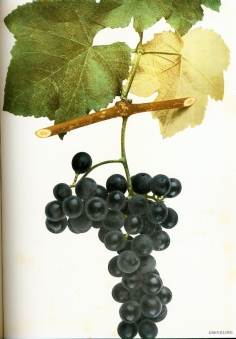
Fruit ripens a few days later than Hartford, does not keep well. Clusters resemble Isabella in general appearance, good size, medium to long, rather broad, irregularly tapering, usually single-shouldered the shoulder often being connected to the cluster by a long stem, loose; peduncle long, rather slender, often with a distinct reddish tinge; pedicel variable in length, thick, usually with no warts, wide at point of attachment to berry; brush intermediate in length, thick, dark wine-color. Berries medium to large, oval, dull black, covered with heavy blue bloom, persistent, rather firm. Skin thick, tough, adheres considerably to the pulp, with a moderate amount of wine-colored pigment, astringent. Flesh pale green, translucent, juicy, very stringy, tender, coarse, somewhat foxy, sweet at skin to tart at center, good in quality. Seeds separate rather easily, one to five in number, average two or three, above medium in size, broad, slightly notched, intermediate in length, blunt, light brown; raphe shows as a narrow groove; chalaza of fair size, at center or slightly above, oval, obscure.
CROTON. (Vinifera, Labrusca, Bourquiniana.)
1. Am. Jour. Hort., 5:223, 224. 1869. fig. 2. Am. Hort. An., 1870:91, 92. fig. 3. Horticulturist, 25:275. 1870. 4. Am. Pom. Soc. Cat., 1871:16. 5. Mich. Pom. Soc. Rpt., 1872:546. fig. 6. Am. Pom. Soc. Rpt., 1883:57. 7. Bush. Cat., 1883:87. fig. 8. N. Y. Sta. An. Rpt., 17:528, 545, 547, 554. 1898. 9. Ga. Sta. Bul., 53:42, 51. 1901.
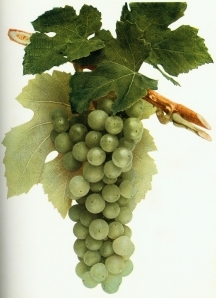
The Croton is a feast both to the eye and the palate. The accompanying color-plate does not do it justice as grown at its best, as it shows a loose, straggling bunch, a characteristic of the variety only when poorly grown. Unfortunately it has the fault of being difficult to grow well, being adapted to but few soils and proving unfruitful, weak in growth, precariously tender, and somewhat subject to mildew and rot in unfavorable situations. But when well grown the consensus of opinion among viticulturists is that it has few superiors among white grapes. It has a sweet, delicate Vinifera flavor, with melting flesh which readily separates from the few seeds. The fruit hangs on the vines until frost, and keeps well into the winter. The Croton is among green grapes what its parent, the Delaware, is among red grapes. In spite of its high quality it has never become widely distributed, failing utterly as a commercial variety, quality counting for but little in grape markets. If this delicious fruit is to be saved to cultivation it must be by the hands of the amateur.
Croton came from Stephen W. Underhill[174] of Croton Point, New York, from seed of Delaware pollinated by Chasselas de Fontainbleau. The seed was planted in the spring of 1863 and the vine fruited for the first time in 1865. The grape was first exhibited at the Massachusetts Horticultural Society meeting in 1868. It was placed on the grape list of the American Pomological Society fruit catalog in 1871 but was dropped in 1883, chiefly on account of its susceptibility to fungal diseases.
Vine medium to vigorous, often somewhat tender, usually productive, subject to disease in unfavorable locations. Canes long, numerous, thick, rather dark reddish-brown; nodes enlarged, usually not flattened; internodes medium to short; diaphragm very thick; pith large; shoots glabrous; tendrils intermittent, long, bifid.
CROTON
Leaf-buds large, prominent, long, of average thickness, conical, open late. Young leaves tinged on lower side and at margin of upper side with faint carmine. Foliage remains until late in the season; leaves of medium size, intermediate in thickness; upper surface light green, dull, nearly smooth to rugose; lower surface pale green, slightly cobwebby or hairy; veins indistinct; lobes five in number, terminal lobe blunt to acute; basal sinus of average depth, rather narrow; lateral sinus inclined to deep and nearly narrow; petiolar sinus medium deep, narrow, often closed and overlapping; teeth inclined to shallow, wide. Flowers fertile, open late; stamens upright.
Fruit ripens in mid-season or later, keeps fairly well. Clusters not uniform, very large to medium, longish, rather slender, irregularly tapering, often with an unusually heavy single shoulder, very loose to medium; peduncle long, thick; pedicel somewhat long, thick, covered with few, small, inconspicuous warts; brush intermediate in length, greenish. Berries irregular in size averaging about medium, roundish to slightly elongated, light green, changing to yellowish-green, covered with thin gray bloom, persistent, slightly soft. Skin thin, rather tough, adheres very slightly to the pulp, contains no pigment. Flesh green, somewhat transparent, very juicy, melting, vinous, pleasant flavor, agreeably sweet, good to very good in quality. Seeds separate very easily from the flesh, one to three, above medium in size, slightly elongated, fair breadth, notched, rather sharply pointed, light brown; raphe obscure; chalaza small, above center, irregularly circular to oval, indistinct.
CUNNINGHAM. (Bourquiniana.)
1. Prince, 1830:191. 2. U. S. Pat. Off. Rpt., 1845:939. 3. Gar. Mon., 3:83. 1861. 4. Am. Jour. Hort., 3:301. 1868. 5. Grape Cult., 1:34, 75. 1869. 6. Bush. Cat., 1883:87, 88. fig. 7. Texas Farm and Ranch, Feb. 8, 1896:11. 8. Tex. Sta. Bul., 48:1149, 1155. 1898. 9. Mo. Sta. Bul., 46:38, 43, 45, 46, 50, 54. 1899. 10. Traité gen. de vit., 6:268. 1903.
Long (4, 6, 7, 9). Long No. 2 (9). Prince Edward (1).
The Cunningham is not known in New York and in fact has been cultivated but little in America, but in France at one time it was one of the best known American grapes, both as a direct producer and as a stock for European varieties. It is not now largely grown in France, however, having been superseded by better American varieties for the uses for which it was formerly cultivated. It was much sought for by the French as a stock for large Vinifera cions, the size of the vine giving an opportunity for making a good graft. In the South, Cunningham is not largely grown as there are several other varieties of its class superior to it in quality of fruit and in vine characters as well. It seems everywhere to have been an exceedingly capricious grower and very particular as to soil and climate. It is said to make a deep yellow wine of very good quality. It has little or no value as a table grape.
Cunningham originated in the garden of Jacob Cunningham of Prince Edward County, Virginia, about the year 1812. Cuttings of this vine were sent by Dr. D. N. Norton of Richmond to Prince in 1829. Prince introduced it to the public. Its botanical characters mark it as an offshoot of the Herbemont group of Bourquiniana.
The following description is a compilation from several sources:
Vine very vigorous, spreading, rather productive, somewhat suceptible to mildew. Canes large and long, with stiff reddish hairs at base; shoots showing considerable bloom; tendrils intermittent, usually trifid. Leaves large, rather thick, roundish, entire or slightly lobed; smooth and dark green above, yellowish-green below and slightly pubescent; petiolar sinus narrow, frequently overlapping. Clusters of medium size, long, sometimes shouldered, very compact; peduncle short, strong; pedicel long, slender. Berries small, purplish-black with thin, grayish bloom. Skin thin, tough with considerable underlying pigment. Flesh tender, juicy, sprightly or somewhat acidly sweet. Seeds two to five, rather oval; beak short; chalaza distinct; raphe showing as a ridge.
CYNTHIANA. (Aestivalis, Labrusca.)
1. U. S. D. A. Rpt., 1863:548. 2. Husmann, 1866:103. 3. Ib., 1866:104. 4. Gar. Mon., 11:149. 1869. 5. Grape Cult., 1:20, 239. 1869. 6. Ib., 3:2. 1871. 7. Am. Pom. Soc. Cat., 1881:24. 8. Bush. Cat., 1883:88. fig. 9. Mo. Hort. Soc. Rpt., 1891:127, 131. 10. Ill. Sta. Bul., 28:253. 1893. 11. Mo. Sta. Bul., 46:38, 43, 45, 46, 50. 1899. 12. Kan. Sta. Bul., 110:246. 1902. 13. Traité gen. de vit., 6:274. 1903.
Arkansas (3). Arkansas (8). Norton (13). Norton Virginia (13). Norton’s Virginia Seedling (13). Red River (2, 5, 6, 8, 13). Vitis Nortoni (13).
Cynthiana is another southern grape impossible to grow in the North and therefore of but general interest for this work. There has long been a heated controversy as to whether this variety differs from Norton. The botanical differences between the two varieties are not greater than might be attributed to environment, soil, climate and culture; but side by side the two grapes ripen at different times, and the quality of the fruit, and more particularly of the wine, is such that the varieties must be considered as distinct. The distinction should be maintained for Cynthiana is the better grape of the two. It has been much grown in France for its intrinsic value and in the reconstruction of vineyards destroyed by phylloxera.
CYNTHIANA
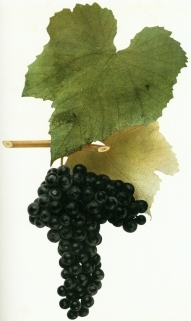
As the history given below shows, the variety is an old one but it, with Norton, was condemned by the early vineyardists because it could be propagated from cuttings only with the greatest difficulty. Like most of its species, Cynthiana is somewhat particular as to soil and location, preferring sandy or gravelly loams and not thriving on clays or limestones. While very resistant to phylloxera, it is not now much used as a resistant stock because of the superiority of varieties of Rupestris and because it is not easily propagated. It is very resistant to cryptogamic diseases, mildew, black-rot and anthracnose, and is a strong, vigorous grower. Its cycle of vegetation is long, the buds bursting forth early and the fruit maturing very late. It has no value as a table grape but according to the Bushberg Catalogue[175] it is the best American grape for red wine. So, too, according to Viala,[176] the wine from Cynthiana is the best of all the red wines produced from American vines. It is said by French wine-makers[177] to contain “an excess of all the elements which constitute the best ordinary wines, color, tannin, acidity, and bouquet,” and therefore to make a splendid base for blending with wine from varieties lacking in the above elements.
Cynthiana was received, some time in the fifties by Prince of Flushing, Long Island, from Arkansas where it is said to have been found growing in the woods. It was sent by Prince to Husmann at Hermann, Missouri, where it did so well and was so highly spoken of by Husmann and his neighbors that it soon became known to grape-growers. It was placed upon the grape list of the American Pomological Society fruit catalog in 1881, where it still remains. Like Norton, Cynthiana is often considered pure Aestivalis, although a strain of some other blood, probably Labrusca, is apparent. Because of the similarity of this variety and Norton the one is often grown as the other.
Vine vigorous, healthy, hardy, usually a good yielder. Canes medium to nearly long, numerous, of average size, dark brown to reddish-brown, sometimes with faint ash-gray tinge, surface covered with thick blue bloom; nodes enlarged, flattened; internodes short to medium; diaphragm rather thin; pith of medium size; shoots slightly glabrous; tendrils intermittent to continuous, above medium in length, bifid.
Leaf-buds small, short, slender, pointed to conical. Leaves variable in size, thick, firm; upper surface dark green, dull, rugose; lower surface slightly tinged with blue, faintly pubescent, cobwebby; veins distinct; lobes variable in number, terminal lobe acute; petiolar sinus deep, narrow, closed and sometimes overlapping; basal sinus shallow; lateral sinus rather shallow and narrow; teeth shallow, of average width; stamens upright.
Fruit ripens very late and keeps well. Clusters medium to small, rather long, intermediate in breadth, tapering to cylindrical, not very uniform, often single-shouldered, compact; peduncle above medium length, small; pedicel rather short and slender, covered with numerous warts, enlarged at point of attachment to berry; brush short, thick, wine-colored. Berries small, roundish, black, covered with a moderate amount of blue bloom, persistent, firm. Skin thin, tough, rather adherent to the pulp, contains a slight amount of purple pigment, astringent. Flesh darkish green, translucent, juicy, tough and solid, spicy, rather tart, poor in quality as a dessert grape. Seeds separate with difficulty from the pulp, one to six, average three, small, of mean breadth, short, blunt, dark brown; raphe distinct, cord-like; chalaza small, slightly above center, circular, distinct. Must 98°-118°.
DAISY. (Labrusca, Vinifera.)
1. Kan. Hort. Soc. Rpt., 1886:187. 2. N. Y. Sta. An. Rpt., 10:495. 1891. 3. Ib., 13:602. 1894. 4. Bush. Cat., 1894:111. 5. N. Y. Sta. An. Rpt., 17:528, 548, 554. 1898.
Daisy is an unimportant seedling of Goethe. The only reason for its distribution was its delicate, spicy, pleasant flavor. It is probably not worth perpetuating.
Dr. J. Stayman, Leavenworth, Kansas, is supposed to have originated Daisy from seed of Goethe. On account of the fruit characters, Bush questions the parentage but as it grows at this Station the reputed parentage appears to be quite probably correct.
Vine intermediate in vigor, not hardy nor productive, an uncertain bearer. Tendrils continuous, bifid to sometimes trifid. Leaves small to medium, light green; lower surface slightly pubescent. Flowers nearly self-sterile, open in mid-season; stamens upright. Fruit ripens with Concord or soon after, does not keep well. Clusters of medium size, rather loose. Berries medium to small, distinctly oval, somewhat darker red than Agawam, covered with thin lilac bloom, persistent, not firm. Flesh soft and tender, vinous, sweet, of pleasant flavor, good in quality. Seeds few, medium in length, usually with a slightly enlarged neck; chalaza above center, often with radiating ridges.
DELAWARE. (Labrusca, Bourquiniana, Vinifera.)
1. Horticulturist, 8:492. 1853. fig. 2. Ib., 9:98. 1854. 3. Am. Pom. Soc. Cat., 1856:214. 4. Horticulturist, 12:562. 1857. 5. Downing, 1857:336. fig. 6. Horticulturist, 13:58, 179. 1858. 7. Am. Pom. Soc. Cat., 1858:233. 8. Am. Pom. Soc. Rpt., 1858:65. 9. Gar. Mon., 1:75, 164. 1859. 10. Ib., 2:13, 26, 117, 176. 1860. 11. Horticulturist, 16:16, 21, 33, 119. 1861. 12. Fuller, 1867:221. 13. Mich. Pom. Soc. Rpt., 1872:48. 14. Ib., 1873:64. 15. Ohio Hort. Soc. Rpt., 1882-3:28. 16. Bush. Cat., 1883:91. fig. 17. Am. Hort. Soc. Rpt., 1885:139. 18. Amer. Gard., 12:584. 1891. 19. Ill. Sta. Bul., 28:259. 1893. 20. N. Y. Sta. An. Rpt., 15:430, 431, 432, 433. 1896. 21. Ib., 17:528, 540, 543, 544, 545, 547, 554. 1898. 22. Amer. Gard., 20:622. 1899. 23. Mich. Sta. Bul., 169:169. 1899. 24. Amer. Gard., 22:481. 1901. 25. Traité gen. de vit., 6:186. 1903.
French Grape (10, 14). Gray Delaware (25). Heath (5). Italian wine grape (5, 8, 13, 14, 16). Ladies Choice (8, 11). Powell (1, 14). Red Riesling, incorr. (5). Rose Colored Delaware (25). Ruff (9, 14). Traminer, incorr. (5). Wine Grape (11).
Delaware is the American grape par excellence. Its introduction raised the standard of quality in our viticulture to that of the Old World, for there is no variety of Vitis vinifera more richly or more delicately flavored or with a more agreeable aroma than the Delaware. This variety is rightly used wherever American grapes are grown as the standard whereby to gauge the quality of other grapes. Added to high quality it is endowed with a constitution which enables it to withstand climatic conditions to which all but the most hardy varieties will succumb, and so elastic as to adapt it to many soils and conditions, and to bear under most situations an abundant crop. All of this makes it, next to the Concord, the most popular grape for garden, vineyard and wine-press, now grown in the United States. As with the Concord, its introduction gave American grape-growing a great impetus and it is a question whether or not, with its high quality, it has not had a more beneficial effect on the viticulture of the country than the Concord.
Beside the qualities named above for the Delaware, it matures sufficiently early to make its crops certain, is attractive in appearance, keeps well on the vine and in the package, ships well and is more immune than other commercial varieties to black-rot. Its faults are: The small size of the vine, slowness of growth, susceptibility of the foliage to mildew, its capriciousness in certain soils, and the small size of the berries. The first two faults make it necessary to plant the vines more closely than other commercial varieties stand. It succeeds best in deep, rich, well-drained, warm soils but even on these it must receive good cultivation, close pruning, and in some cases the fruit must be thinned. It is, too, a necessity, where mildew is abundant, to spray with bordeaux mixture which keeps the disease well in check. Birds are very fond of this variety and it suffers in particular from the depredations of robins.
Delaware is the best American table grape and as such commands a premium in all of the markets, selling oftentimes for double the price of Concord. It is also much sought for by wine-makers both for Delaware wine and for blending in making champagne or other wines of high quality. It is grown North and South and westward to the Rocky Mountains, and is now proving especially profitable in many southern locations as an early grape to ship to northern markets. The Delaware is an especially desirable grape to cultivate in small gardens because of its delicious and handsome fruit, its compact habit of growth, and when in health, its ample and lustrous green, delicately formed leaves which make it one of the most ornamental of the grapes.[178]
Delaware is the parent of an interesting but not particularly valuable progeny; none of the pure-bred offspring nearly equal the parent though many of them inherit its fine color and high quality. Among its cross-bred offspring are some notable varieties, all of which are described in their proper places in this work. An interesting fact regarding the pure-bred progeny of Delaware is that, so far as we have records, it seems to have given very few black grapes though there are often white or rose-colored seedlings among them. Even in its cross-bred offspring, red, or some tint of it greatly predominates, indicating power in the transmission of color and suggesting the value of this variety in breeding red grapes.
DELAWARE
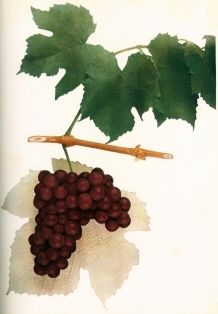
The Delaware grape was first brought to notice by Abram Thompson, editor of the Delaware Gazette of Delaware, Ohio. In the summer of 1849 he saw fruit of this variety which had been brought into town from one of the neighboring farms. An investigation disclosed that the variety was being raised on the farms of a Mr. Warford and of a Mr. Heath, near the banks of the Scioto River, a few miles from the town of Delaware, and that Warford had brought the variety from the State of New Jersey more than twenty years before. It was known in this neighborhood under the name of Heath, or Powell. Thompson sent fruit of the variety to A. J. Downing who gave it the name Delaware, after the town from which the samples had been sent. Thompson also brought it to the notice of the Ohio Pomological Society in the autumn of 1851. It was found that the Delaware vines secured by Warford could be traced back to the garden of Paul H. Provost, a Swiss of Frenchtown, Kingswood Township, Hunterdon County, New Jersey. Provost, at this time, was dead, and definite information was very difficult to secure as to where he had obtained his vines. One account was that they had been received from a brother residing in Italy, and in deference to this story, the variety was locally known as the Italian wine grape. Another story was to the effect that they had been brought to Provost’s place by a German who had been in this country only a short time but who had spent this interval with Hare Powell of Philadelphia. Whether the German secured the vines from the Old Country or from Powell is uncertain. There was a report that they had been secured from Powell and that he in turn had received them from Bland of Virginia. All of the stories as to how the vines came into Provost’s garden lack supporting evidence and some were of the opinion that it had grown in the garden as a seedling.
The Delaware at once attracted great attention and the horticultural journals were full of conflicting accounts of its history and of warm discussions as to its botany. In 1856 it was placed on the grape list of the American Pomological Society fruit catalog as “a new variety which promises well;” two years later it was placed on the list of recommended sorts.
There is still a difference of opinion as to the botany of this variety. The theory advanced by many when it was first introduced, that it is a pure Vinifera, has been abandoned. Millardet and others considered the Delaware a hybrid between Vinifera, Labrusca, Cinerea and Aestivalis. Munson holds that it is of Labrusca-Bourquiniana origin with a probable slight admixture of Vinifera. He further states that he considers Elsinburgh probably one of the parents. Historically this is corroborated by the fact that Elsingburgh originated in New Jersey not far from where Provost lived.
Vine not a strong grower, hardy except in unfavorable locations, fairly productive, somewhat subject to leaf-hoppers and mildew. Canes medium to below in length, numerous, slender, rather light to medium dark brown; nodes slightly enlarged, not flattened; internodes rather short; diaphragm intermediate in thickness; pith small; shoots glabrous; tendrils intermittent, somewhat short, bifid.
Leaf-buds rather small, of average length, slender, pointed to conical, prominent, open early. Young leaves tinged on lower side and along margin of upper side with a faint golden hue but the prevailing color is light rose-carmine. Foliage not always healthy; leaves medium to small, intermediate in thickness; upper surface dark green, dull, smoothish; lower surface pale green, slightly pubescent; veins inconspicuous; lobes three to five in number, terminal lobe acute to acuminate; petiolar sinus of average depth, narrow to medium; basal sinus shallow and narrow when present; lateral sinus moderately deep, narrow; teeth shallow, of fair width. Flowers fertile, open somewhat late; stamens upright.
Fruit ripens a few days earlier than Concord, keeps well. Clusters medium to small, of average length, slender, rather blunt, often cylindrical, regular, usually shouldered, compact; peduncle medium to short, slender; pedicel short, slender, smooth; brush intermediate in size, light brown. Berries uniform in size and shape, small to medium, roundish, light red, covered with thin lilac bloom, persistent, firm. Skin thin, moderately tough, adheres somewhat to the pulp, contains no pigment, slightly astringent. Flesh light green, translucent, juicy, tender, aromatic, vinous, sprightly and refreshing, sweet to agreeably tart from skin to center, best in quality. Seeds separate easily from the pulp, one to four, average two, intermediate in size, rather broad, notched, short, blunt, light brownish; raphe obscure; chalaza of medium size, above center, circular. Must 100°-118°.
DELAWBA. (Labrusca, Vinifera, Bourquiniana.)
1. Am. Pom. Soc. Rpt., 1891:126. 2. U. S. D. A. Rpt., 1891:393. 3. Bush. Cat., 1894:114, 115. fig. 4. Ga. Sta. Bul., 53:42. 1901.
Of Delawba we can say but little, not having vines of it on the Station grounds. It is an offspring of Delaware crossed with Catawba, as the name indicates, and was introduced with the expectation that it would take the place of one or the other or both of its parents. However, it has made no impress upon the viticulture of this State though it has been tested here and there in the several grape regions during the past ten years. The fruit resembles Catawba, though not as attractive, the berries averaging smaller, but it ripens almost as early as Delaware, a great point in its favor. The vine, too, is more like Catawba than the Delaware, being more vigorous and productive than the latter. The reports of this variety indicate that it is very promising but it seems not to be making headway as either a fancy or a commercial fruit probably because of characters lacking in the fruit.
Dr. L. C. Chisholm of Spring Hill, Tennessee, produced the Delawba some time about 1880 from seed of Delaware fertilized by Catawba. The variety was introduced in 1895, after having received high encomiums from various horticultural authorities. The following is a compiled description:
Vine usually vigorous and productive, resembling Catawba very closely, blooming with Concord. Cluster above medium to large, moderately compact, cylindrical or slightly tapering, sometimes slightly shouldered. Berries variable in size, ranging from above medium to below, of amber color with lilac bloom; skin quite tough. Not attractive in appearance. It is self-fertile and ripens its berries evenly. Quality good to very good. Ripens shortly after Delaware.
DEVEREAUX.[179] (Bourquiniana.)
1. Mag. Hort., 9:373. 1843. 2. U. S. Pat. Off. Rpt., 1853:299. 3. Horticulturist, 12:458. 1857. 4. Gar. Mon., 2:265. 1860. 5. Downing, 1869:531. 6. Grape Cult., 1:17, 326. 1869. 7. (?) Bush. Cat., 1883:118. 8. Ib., 1894:116. 9. (?) Texas Farm and Ranch, Feb. 8, 1896:11.
Black July (5). Black July (8, 9). Blue Grape (5, 8, 9). Devereux (5). Hart (4, 5, 8). Husson (5, 8, 9). Lenoir (9, incorr. 5, 8). Lincoln (4, 7). Lincoln (5,? 8, 9). McLean (4, 5, 8, 9). Sherry (5, 8, 9). Sumpter (5, 9). Thurmond (5, 8, 9). Tuley (5, 8, 9).
The Devereaux is an old southern grape now nearly obsolete because of its capriciousness as to location. When it can be grown it is of high quality and makes a very good wine. The variety is of only historical and botanical interest. In France the Devereaux was at one time considered a valuable wine grape.