Chapter V · THE LEADING VARIETIES OF AMERICAN GRAPES (continued 3)
Reading edition
An article in the Horticulturist[180] for 1857 states that the Devereaux was found in the woods over forty years before that date by Samuel M. Devereaux, who lived near Sparta, Georgia. It has been considerably confused with varieties which resemble it. The name Lincoln, in particular, is a questionable synonym which Dr. Curtis of Hillsboro, North Carolina, in a letter to the Gardener’s Monthly for 1860,[181] states was found near the junction of the South Fork and Catawba Rivers by Dr. William McLean. It was known locally under the names of McLean and Hart. Later it was sent to Longworth, who gave it the name Lincoln.
The descriptions of this variety from various sources are conflicting. That given below is copied from the Bushberg Catalogue.[182]
“Bunch long, loose, slightly shouldered; berry black, below medium, round; skin fine, tender; flesh meaty, juicy without pulp, and vinous; quality best. Vine a strong grower, and, when free from mildew, moderately productive; wood long-jointed, purplish brown at first, of deeper purplish red when ripe; with bi-forked, intermittent tendrils—these, as also the leaf stalk, are tinged on their base with a purplish brown hue, like the young canes; the buds are covered with a russet down, unfolding with that rosy complexion peculiar to the young, downy leaves of most Aestivalis. The developed foliage is of medium size, entire (not lobed), considerably wrinkled, turgid, with somewhat abundant hair tufts on the lower veins.”
DIAMOND. (Labrusca, Vinifera.)
1. Gar. Mon., 26:336. 1884. 2. Ib., 28:333. 1886. 3. Ohio Hort. Soc. Rpt., 1887-8:85. 4. Mich. Hort. Soc. Rpt., 1889:328. 5. N. Y. Sta. An. Rpt., 9:332. 1890. 6. Kan. Sta. Bul., 28:161. 1891. 7. Rural N. Y., 50:691, 787. 1891. 8. Kan. Sta. Bul., 44:118, 127. 1893. 9. Rural N. Y., 53:616, 645, fig., 646. 1894. 10. Gar. and For., 8:96, 377, 487. 1895. 11. N. Y. Sta. An. Rpt., 15:432, 433. 1896. 12. Tenn. Sta. Bul., Vol. 9:175, 176. 1896. fig. 13. Am. Pom. Soc. Cat., 1897:19. 14. N. Y. Sta. An. Rpt., 17:529, 538, 540, 543, 544, 547, 549, 554. 1898. 15. Va. Sta. Bul., 94:139. 1898. 16. Mo. Sta. Bul., 46:38, 44, 45, 50. 1899. 17. Can. Hort., 25:125, 190. 1902. fig.
Diamond, Moore (13). Moore’s Diamond (1, 2, 3, 4, 5, 6, 9.) Moore’s Diamond (15, 17).
DIAMOND

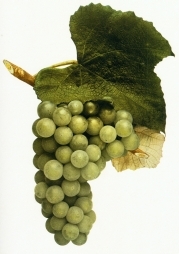
Diamond is surpassed in quality and beauty by few other grapes. When to its desirable fruit characters are added its earliness, hardiness, productiveness and vigor it is surpassed by no other green grape. Niagara is more productive and therefore more profitable in most localities but in many essential characters it falls short of Diamond and the difference in productiveness is not marked. We usually accord Niagara first place among green grapes but Diamond rivals it for the honor. The former attained high rank not only through merit but by much advertisement while Diamond has made its way by merit alone. If we consider the wants of the amateur and of the wine-maker as well as those of the commercial vineyardist, unquestionably Diamond must be accorded a high place among the best all-around grapes.
Diamond is a diluted hybrid between Vitis labrusca and Vitis vinifera; the touch of the exotic grape given by the Vinifera parents has been just sufficient to give it the richness in flavor of the Old World grape and not overcome the refreshing sprightliness of our native fox grapes. It is without the insipid sweetness of the first or the foxiness of the latter. The Vinifera characters are wholly recessive in vine and foliage, the plant resembling very closely its American parent, Concord. Diamond is not as highly esteemed as a commercial variety as it deserves to be, for beside being of high quality the fruit packs, carries and keeps well. Were it known by consumers the demand for it would be such that it would command a fancy price and thereby more than make up for its lack in fruitfulness, but through the unfortunate condition of American fruit markets it is, more often than not, sold as Niagara and has not therefore established the reputation it should have in the markets. Diamond is in demand among wine-makers and especially for the making of champagnes. For the amateur it has few superiors, the chief drawback for the small garden being that robins prefer it to most other varieties and greatly reduce the crop. Diamond is well established in Canada and can be grown in as great a range of latitude as the Concord. The vine is as free from the attacks of fungi as the Concord but the fruit is a little more susceptible to cryptogamic diseases and especially to black-rot, though not attacked by fungi so much as Niagara.
The late Jacob Moore of Brighton, New York, originated Diamond about 1870 from Concord seed fertilized by Iona. It was introduced about 1885. It has gained in favor somewhat slowly, and was not placed on the grape list of the American Pomological Society fruit catalog until 1897.
Vine medium to vigorous, hardy, productive in most locations. Canes medium to short, not very numerous, of average thickness, brownish or with a slight reddish tinge; nodes slightly enlarged, not flattened; internodes medium to short; diaphragm intermediate in thickness; pith of medium size; shoots pubescent; tendrils intermittent, bifid.
Leaf-buds small, short, pointed to conical, open in mid-season. Young leaves tinged on lower side and along the edges with red. Leaves of average size, thick; upper surface light green, dull, nearly smooth; lower surface light bronze, downy; veins distinct; lobes usually three in number, indistinct; petiolar sinus very shallow; teeth shallow, of mean width. Flowers fertile, open early to somewhat late; stamens upright.
Fruit usually ripens slightly earlier than Niagara, keeps well. Clusters variable in size, medium to short, rather broad, somewhat blunt, cylindrical to slightly tapering, often single-shouldered, compact; peduncle short to medium, moderately thick; pedicel short and thick, covered with a few, inconspicuous warts, wide at point of attachment to berry; brush slender, of average length, pale green. Berries above medium to medium size, roundish to strongly ovate on account of compactness, green with tinge of yellow on riper berries but less yellow than Niagara, glossy, covered with thin gray bloom, persistent, rather firm. Skin thin, toughish, adheres somewhat to the pulp, contains no pigment, astringent. Flesh pale green, rather transparent, juicy, tender, inclined to melting, fine-grained, slightly aromatic, sprightly, nearly sweet next the skin to agreeably tart at center, quality very good. Seeds separate easily from the pulp, one to four, average two or three, intermediate in size, rather broad and long, moderately sharp-pointed, yellowish-brown; raphe shows as a narrow obscure groove; chalaza small, slightly above center, oval, rather obscure.
DIANA. (Labrusca, Vinifera, Aestivalis?)
1. Mag. Hort., 10:242. 1844. 2. Horticulturist, 4:224, 535. 1849. 3. Mag. Hort., 16:28, 306, 546. 1850. 4. Am. Pom. Soc. Cat., 1854. 5. Mag. Hort., 27:6, 262, 490, 523, 531. 1861. 6. My Vineyard at Lakeview, 1866:78. 7. N. Y. Ag. Soc. Rpt., 1866:803, 881. 8. Horticulturist, 22:356. 1867. 9. Am. Jour. Hort., 5:15, 297. 1869. 10. Mich. Pom. Soc. Rpt., 1873:60. 11. Am. Pom. Soc. Rpt., 1881:37, 119, 123, 136, 153. 12. Mass. Hort. Soc. Rpt., Pt. 1:96. 1883. 13. Bush. Cat., 1883:93. fig. 14. N. Y. Sta. An. Rpt., 17:540, 543, 544, 545, 547, 554. 1898. 15. Va. Sta. Bul., 94:137. 1898. 16. Mo. Sta. Bul., 46:38, 43, 45. 1899. 17. Rural N. Y., 61:719, fig., 722. 1902.
DIANA
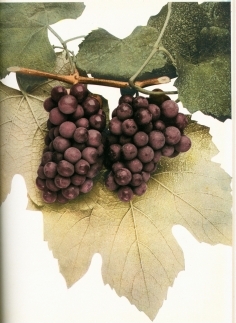
When introduced Diana promised to be the popular grape of the North and especially of New England. Its many good qualities warranted the high hopes of those who first grew it but time revealed so many defects that the variety never became widely distributed although few grapes surpass it, or even equal it, in high quality and handsome appearance when at its best. Diana is a seedling of Catawba and was hailed as superior to its parent in quality, appearance and earliness. It was the last named character that especially commended it to northern grape-growers. Catawba can be grown in New York only in the most favored locations and hardly at all in New England even in its southern parts. It fails in the North because the seasons are too short for the fruit to mature. Diana is about two weeks earlier than Catawba and it was therefore thought that the offspring, lacking the defect of the parent, would take the rank in the North that the older variety held in the South.
Diana bears a strong resemblance to Catawba, differing chiefly in having a lighter color, a delicate pale red or rose, and in being less pulpy and more juicy. Usually the bunches, too, are more compact, those of Catawba as grown in the North being as a rule loose and sometimes straggling. The flavor resembles that of Catawba but when well grown and fully ripe it is more delicate and has less of the wild taste. The grapes keep exceptionally well. But its great point of superiority over Catawba is its earliness; it ripens from ten days to a fortnight earlier, making possible, as said above, its culture far to the north. The defects of Diana are as marked as its good qualities. It is precariously tender in cold winters and in regions where Concord goes without protection Diana must be favored. The grapes ripen unevenly, many being green when others are mature, and berries and foliage are both susceptible to fungi. Lastly it is in many localities a shy bearer and is almost always capricious. During the first few years in bearing, the fruit of Diana is very imperfect in flavor and deficient in size, true of many grapes but particularly so of this one. The best qualities of Diana are not brought out until the vines are seven or eight years of age.
Perhaps no grape better illustrates the importance of local influences and of knowledge of the peculiarities of varieties than Diana. All grapes have their likes and dislikes but this one is capricious beyond most others. It wants, for instance, comparatively poor, dry, gravelly soil without any considerable amount of humus or nitrogen. On clays, loams, or rich soils, the vines make a rank growth and the fruits are few, late and of poor quality. So, too, it needs to be long pruned, and to have all surplus bunches removed leaving a comparatively small crop to mature, and these should hang until frost. To the fact that Diana is so easily influenced must be attributed the great diversity of opinion as to its worth, some holding it to be a most excellent variety while in a nearby vineyard it is considered worthless.
In favorable situations Diana may be expected to make a most satisfactory grape for the amateur and where it does especially well it will prove a profitable variety for the local market. Its splendid keeping qualities make it a very desirable grape for late winter. It is even better in this respect than Catawba, one of the best keepers. While the pulp of Diana has the meaty structure which adapts it for long keeping its pulpiness is not objectionable as in some grapes and its thick skin has a rich, spicy flavor. Wine made from Diana is said to be second to none from our native grapes, equalling or surpassing that made from Catawba.
To Mrs. Diana Crehore of Milton, Massachusetts, is due the honor of having originated Diana. The variety was produced from seed of the Catawba open to cross-pollination, planted about 1834. It was exhibited before the Massachusetts Horticultural Society in 1843. The Pomological Congress at their second meeting in 1850 placed Diana on their list as a “new variety which promises well,” and in 1854 it was included in the American Pomological Society list of sorts recommended for general cultivation. The demand for this grape was so keen that in 1850 it was sold for $15 a vine.
The species of Diana is usually given as Labrusca but the Vinifera-like berries and the intermittent tendrils indicate Vinifera and the bloom on the shoots suggests a strain of either Bicolor or Aestivalis.
Vine vigorous, not always hardy, produces light to medium crops, somewhat susceptible to attacks of leaf-hoppers and fungi. Canes pubescent, long, of average number, thick to medium, light brown to reddish-brown, covered with thin blue bloom; nodes enlarged, slightly flattened; internodes medium to long; diaphragm thick; pith medium to large; shoots pubescent; tendrils intermittent, long, bifid.
Leaf-buds large, of average length, thickish, obtuse to conical, open in mid-season. Young leaves colored on lower side and along margin of upper side with faint carmine, the smaller leaves usually heavily coated with thick silvery down. Leaves medium to large, inclined to thick; upper surface variable in color ranging from light to dark green, usually rather dull, nearly smooth to slightly rugose; lower surface pale green, heavily pubescent; lobes vary from three to five, terminal lobe acute; petiolar sinus moderately deep, wide to medium, often closed and overlapping; basal sinus shallow, not wide; lateral sinus not deep, medium to narrow; teeth shallow, intermediate in width. Flowers fertile, open in mid-season; stamens upright.
Fruit ripens earlier than Catawba, keeps unusually well. Clusters medium to large, intermediate in length, rather broad, tapering to slightly cylindrical, occasionally shouldered, the shoulder being attached to the cluster by a rather long stem, compact to medium; peduncle short to medium, slender; pedicel above average length, covered with small scattering warts; brush of fair length, rather slender, pale green. Berries somewhat irregular in size, above medium to small, roundish to slightly ovate in compact clusters, rather light red covered with thin lilac bloom, persistent, firm. Skin very thick, tough, adheres slightly to the pulp, contains no pigment, with but little astringency. Flesh pale green, translucent, juicy, tough, fine-grained, vinous, with a little foxiness, sweet at skin to agreeably tart at center, good in quality. Seeds do not separate readily from the pulp unless fruit is fully ripe, one to three, average two, intermediate in size, breadth and length, light brown; raphe buried in a rather wide, shallow groove; chalaza large, above center, circular, distinct. Must 88°-90°.
DIANA HAMBURG. (Vinifera, Labrusca, Aestivalis?)
1. N. Y. Ag. Soc. Rpt., 1864:38. 2. Mag. Hort., 31:105, 331, 364. 1865. 3. Thomas, 1867:403. 4. Am. Jour. Hort., 2:328, 329. 1867. fig. 5. N. Y. Ag. Soc. Rpt., 1868:224. 6. Bush. Cat., 1883:90.
Diana Hamburg has long since passed from cultivation and was never widely grown. Its parentage is indicated in its name. It is worth discussion here only because it is an illustration of what can be done in grape-breeding and because it was one of the parents of several better known sorts chief of which is Brighton. The fruit of Diana Hamburg is that of the European parent, while the vine is more nearly that of Diana in appearance but quite that of Black Hamburg in constitution, being very susceptible to disease, somewhat tender, unproductive in our climate and ripening its fruit late.
Diana Hamburg was the first of Jacob Moore’s productions, having been raised from seed of Diana fertilized by pollen of Black Hamburg about 1860. It was first exhibited at the New York Agricultural Society meeting in September, 1864. For a few years it attracted some attention but soon passed from cultivation. The following description is compiled from various sources:
Vine vigorous when not diseased; canes short-jointed. Leaves of medium size, somewhat concave. Fruit-clusters large, compact, shouldered. Berries above medium, slightly oval, dark red, tender, free from pulp. Except in color, which shows a more reddish tinge, it very closely resembles Black Hamburg. The vine is tender and very susceptible to mildew.
DON JUAN. (Vinifera, Labrusca.)
1. Horticulturist, 29:329. 1874. 2. Am. Pom. Soc. Rpt., 1875:114. 3. U. S. D. A. Rpt., 1875:386. 4. Bush. Cat., 1883:92. 5. W. N. Y. Hort. Soc. Rpt., 36:45. 1891.
In spite of many good characters, as high quality, attractive appearance, and a vine above the average in vigor and hardiness, Don Juan has not become established in American viticulture. It has been tested by grape collectors for forty years and is now passing from even the collections. Its chief fault in this State is that it ripens too late.
Don Juan was originated by J. H. Ricketts of Newburgh, New York, over thirty years ago from seed of Iona pollinated by General Marmora. The originator claimed that Don Juan was a better grape than its parent, Iona, but it has fallen far short of this in the vineyards of the State. The connection of the name with the grape is not apparent.
Vine intermediate in vigor, appears hardy and productive. Canes short, rather brittle, slightly roughened; tendrils intermittent, bifid. Leaves medium to thin, not very large, light green. Fruit ripens rather late, keeps well. Clusters medium to large, rather broad, shouldered, strongly tapering, very loose. Berries large to medium, distinctly oval, dark red, covered with dark lilac or slightly blue bloom, strongly persistent, somewhat soft. Flesh tender and nearly melting, vinous, resembles Black Hamburg somewhat in flavor, good in quality.
DOWNING. (Vinifera, Aestivalis, Labrusca.)
1. Am. Hort. An., 1871:79. 2. Am. Pom. Soc. Rpt., 1875:113. 3. Bush. Cat., 1883:92. 4. Gar. Mon., 26:366. 1884. 5. Am. Pom. Soc. Rpt., 1885:17. 6. Kan. Sta. Bul., 28:160. 1891. 7. N. Y. Sta. An. Rpt., 11:619. 1892. 8. Tenn. Sta. Bul., Vol. 9:176. 1896. 9. Mich. Sta. Bul., 169:169. 1899. 10. U. S. D. A. Yr. Bk., 1901:388. col. pl.
Chas. Downing (1). Charles Downing (3, 10). Ricketts’ No. 1 (2). Ricketts’ No. 1 (10).
Little known in cultivation, although it has been grown since 1870 and has had the recommendations of our most expert horticulturists, Downing is well worthy a place in the garden of grape-growers at least.
DOWNING
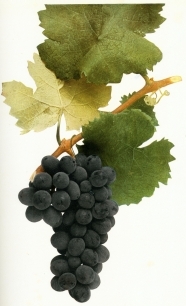
Its high quality, handsome appearance, and excellence as a keeper, make it desirable in all regions where the climate is sufficiently temperate to allow it to withstand the winter and to develop in full its admirable fruit characters. Added to the above qualities are fair vigor and health of vine, while with its defects must be mentioned late ripening and susceptibility to mildew in unfavorable seasons. When grown in most parts of New York the vine of Downing should be laid down in the winter or receive other protection. In most seasons, too, unremitting warfare must be kept up with bordeaux mixture to check mildew. In appearance of bunch and berry Downing is one of the most distinct of our varieties, the clusters being large and well formed and the berries having the long oval shape of a Malaga with a delicate light bloom. The flesh, too, shows Vitis vinifera in texture as well as quality while neither seeds nor skins are as objectionable as in the best of our pure-bred American varieties. Few amateurs realize the richness of our cultivated grape-flora or the garden would be supplied by other varieties than Concord, Niagara and Delaware and of these Downing would be one.
J. H. Ricketts of Newburgh, New York, originated Downing some time about 1865. It is one of the first of Ricketts’ hybrids and was first known as Ricketts’ No. 1. The parentage is variously given as Isabella fertilized by Muscat Hamburg, Croton fertilized by Black Hamburg, and Israella fertilized by Muscat Hamburg.[183] The last combination is that given by J. G. Burrows of Fishkill, New York, who was connected with J. H. Ricketts in his work and who introduced Downing in 1883; hence it is probably correct. Ricketts thought highly of this variety and gave it the name of America’s great pomologist, Charles Downing.
Vine variable in vigor, usually winter-kills somewhat, not very productive, especially where it winter-kills. Canes short, few, rather slender, nearly dark green to slightly ash-gray tinge, surface covered with thin blue bloom, often roughened with few small warts; nodes much enlarged, strongly flattened; internodes medium to short; diaphragm rather thick; pith large to medium; shoots glabrous; tendrils intermittent, of average length, bifid to trifid.
Leaf-buds intermediate in size and thickness, short, obtuse to nearly conical, open very late. Leaves medium to small, roundish, thick; upper surface dark green, slightly glossy, rugose; lower surface rather deep green with almost no pubescence; veins somewhat distinct; lobes none to five, terminal lobe acute; petiolar sinus of medium depth, very narrow, closed and overlapping; basal sinus usually lacking but shallow and narrow when present; lateral sinus shallow to medium, narrow; teeth above average in width and depth. Flowers open late; stamens upright.
Fruit ripens a little later than Concord, often keeps until spring. Clusters large, long, rather slender, cylindrical to slightly tapering, uniform, sometimes loosely shouldered, variable in compactness; peduncle short to medium, inclined to thick; pedicel intermediate in length, slender, covered with numerous warts; brush long, slender, greenish. Berries large to medium, distinctly oval, dark purplish-black, glossy, covered with light blue bloom, strongly persistent, almost firm. Skin very thick, tender, adheres considerably to the pulp, contains almost no pigment, without astringency. Flesh greenish or with slight yellow tinge, translucent, very juicy, tender, fine-grained, vinous, mild, very good in quality. The few seeds separate easily from the pulp, one to three, average two, intermediate in size and breadth, strongly notched, rather long, brownish; raphe obscure; chalaza of mean size, surface frequently roughened, above center, circular to oval, variable in distinctness.
DRACUT AMBER. (Labrusca.)
1. U. S. Pat. Off. Rpt., 1859:48, 66. 2. Gar. Mon., 3:26. 1861. 3. Am. Pom. Soc. Cat., 1883:26. 4. N. Y. Sta. An. Rpt., 11:620. 1892. 5. Iowa Hort. Soc. Rpt., 1893:161. 6. Bush. Cat., 1894:117. 7. N. Y. Sta. An. Rpt., 17:548, 554. 1898. 8. Am. Pom. Soc. Cat., 1899:28.
Early Amber (6).
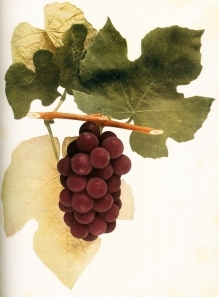
Dracut Amber receives the attention given it here chiefly because it is a representative variety of the northern Labrusca and of the red type of Labrusca. The fruit has no particular merit, its thick skin, coarse pulp, seeds and rank foxy taste all being objectionable. But the vine is very hardy and productive, and the fruit ripens early making it valuable in the northern limits of viticulture and in other locations where a vigorous, hardy early grape is wanted. It is of no value for the market or for wine-making and therefore of use only for the home in the far North, though the fact that it does not keep well is still further against it for this purpose. The variety is of interest to the breeder who desires a red Labrusca of the northern type.
DRACUT AMBER
Asa Clement of Dracut, Massachusetts, originated Dracut Amber from seed of a native reddish Labrusca that grew near a Catawba vine. The seed was planted about 1855 and Mr. Clement called the resulting vine the Amber grape. Later the new variety was introduced by Jacob W. Manning under the name Dracut Amber. Catawba is supposed by Clement to have been the male parent, but this is wholly conjectural and doubtful as the botanical and horticultural characters are those of a northern Labrusca. It was placed on the grape list of the American Pomological Society fruit catalog in 1883 and was dropped, probably inadvertently, in 1897, as it was replaced in 1899 and has since remained.
Vine vigorous, hardy, productive, somewhat susceptible to attacks of leaf-hoppers. Canes long, rather numerous, medium to below in size, darkish-brown; nodes slightly enlarged, usually flattened; internodes medium to below in length; diaphragm of average thickness; pith above medium size; shoots pubescent; tendrils continuous, long, bifid to sometimes trifid.
Leaf-buds decidedly variable in size, length, and thickness, prominent, obtuse to conical. Young leaves tinged on lower side with bright carmine and very strongly colored along margin of upper side with carmine. Leaves large to medium, rather thick; upper surface dark green, dull, smoothish; lower surface pale green or grayish, faintly cobwebby; veins indistinct; lobes three or sometimes five in number with terminal lobe obtuse to acute; petiolar sinus moderately deep, rather narrow to medium; basal sinus shallow to narrow; lateral sinus usually shallow, medium to rather wide; teeth shallow, of average width. Flowers sometimes on plan of six, slightly sterile to fertile, open in mid-season; stamens variable in length.
Fruit ripens earlier than Concord, does not keep well, as the berries soon shrivel. Clusters not especially satisfactory in general appearance, variable in size, short to medium, rather broad, somewhat cylindrical, irregular, rarely shouldered, compact to medium; peduncle short, slender; pedicel nearly short, of average thickness, covered with numerous warts, enlarged at point of attachment to berry; brush rather long, light yellowish-green. Berries medium to large, variable in shape ranging from oval to roundish, dull pale red or dark amber, covered with thin lilac or faint blue bloom, often inclined to drop when overripe, soft. Skin unusually thick, somewhat tender, adheres slightly to pulp, contains no pigment, slightly astringent. Flesh greenish, translucent, juicy, rather fine-grained and tough, very foxy, moderately sweet to decidedly acid at center, inferior in quality. Seeds adherent, two to five in number averaging three, large to below medium, broad to medium, light brown; raphe shows only as a groove; chalaza intermediate in size, oval, above center, rather distinct and in a depression.
DUTCHESS.[184] (Vinifera, Labrusca, Bourquiniana? Aestivalis?)
1. Am. Pom. Soc. Rpt., 1877:36. 2. Gar. Mon., 22:176. 1880. 3. Mass. Hort. Soc. Rpt., 1880:239. 4. Downing, 1881:166 app. 5. Am. Pom. Soc. Cat., 1881:24. 6. Am. Pom. Soc. Rpt., 1883:124. 7. Ib., 1885:103, 107. 8. Kan. Hort. Soc. Rpt., 1891:126. 9. Kan. Sta. Bul., 14:87. 1890. 10. Ala. Sta. Bul., 10:9. 1890. 11. Gar. and For., 5:512. 1892. 12. Can. Hort., 17:253, 267. 1894. 13. Bush. Cat., 1894:117, 118. fig. 14. Husmann, 1895:32, 95, 102. 15. Tenn. Sta. Bul., Vol. 9:176, 195. 1896. 16. N. Y. Sta. An. Rpt., 15:432. 1896. 17. N. Y. Sta. An. Rpt., 17:529, 538, 541, 544, 548, 549, 552. 1898. 18. Miss. Sta. Bul., 56:12. 1899. 19. Mo. Sta. Bul., 46:38, 43, 45, 46, 76. 1899. 20. W. N. Y. Hort. Soc. Rpt., 44:91. 1899. 21. Mo. Hort. Soc. Rpt., 1900:365.
Dutchess is a variety for the amateur, always to be sought for because of its delicious flavor, its handsome appearance, and its long-keeping qualities. It has never been largely grown in commercial vineyards because the vine is tender to cold and capricious as to soil and other conditions. Moreover the berries do not ripen quite evenly and berries and foliage are very susceptible to fungi. In soils to which it is not adapted berries and bunches are small and the latter are loose and straggling. But in spite of its defects Dutchess should not be discarded by the grape-lover for there are few grapes better for the table and that will take its place as a pure-flavored, refreshing, juicy grape. It is sweet and rich and yet does not cloy the appetite; the flesh is translucent, sparkling, fine-grained and tender; the seeds are small, few and part readily from the pulp; the skin is thin yet tough enough for good keeping but not so much so as to be objectionable in eating. The bunches are large and compact when well grown and the berries, though but medium sized, are attractive because of their translucency, the touch of amber when fully ripe, and the distinctive dots so well shown in the color-plate. Dutchess does not want an extremely rich soil nor close pruning and the bunches should be thinned and as soon as ripe ought to be picked as there is a tendency to crack when overripe or exposed to the wet. Dutchess is self-fertile and therefore desirable where only a few vines are wanted, obviating the trouble of mixed planting for cross-pollination. The clusters are especially fine when bagged.
DUTCHESS
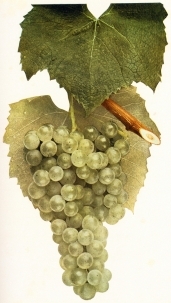
Dutchess is another variety from A. J. Caywood[185] of Marlboro, New York, from seed of a white Concord seedling pollinated by mixed pollen of Delaware and Walter planted in 1868. The white fruited maternal vine was an offspring of Concord pollinated by Montgomery. Dutchess was introduced by its originator about 1880. The variety was placed on the grape list of the American Pomological Society fruit catalog in 1881 where it has since been retained.
Vine vigorous to weak, depending upon amount of winter injury, often not hardy, an uncertain bearer, susceptible to mildew in some localities. Canes intermediate in length and number, medium to below in size, moderately dark brown, covered with a slight amount of bloom, surface usually somewhat roughened; nodes slightly enlarged and flattened; internodes short to very short; diaphragm unusually thick; pith below average size; shoots slightly pubescent; tendrils intermittent, short, bifid to trifid.
Leaf-buds large to medium, short, thick to medium, conical to obtuse. Young leaves faintly tinged on lower side and along margin of upper side with light rose-carmine. Leaves above medium to below, irregular in outline, of average thickness; upper surface light green, slightly glossy, moderately smooth; lower surface pale green, pubescent; veins not distinct; leaf usually not lobed, with terminus slightly acute; petiolar sinus of average depth, medium to narrow; basal sinus shallow when present; lateral sinus varies from medium in depth to a mere notch; teeth intermediate in depth and width. Flowers fertile or nearly so, open somewhat late; stamens upright.
Fruit ripens in mid-season, keeps and ships well. Clusters large to medium, long, rather slender, below average width, not very uniform, slightly tapering to cylindrical, with prominent single shoulder, medium to compact; peduncle short to medium, not very thick; pedicel inferior in length, quite slender, nearly smooth, enlarged at point of attachment to fruit; brush amber-colored. Berries of medium size, roundish to oval, pale yellowish-green verging on amber, some berries showing a decided bronze tinge, covered with thin gray bloom, persistent, firm. Skin sprinkled with small dark dots, rather thin, tough, adheres to the pulp, contains no pigment, without astringency. Flesh very pale green, translucent, juicy, fine-grained, tender, vinous, sweet, of pleasant flavor, quality high; on heavy clay soils the quality is not fully developed. The seeds, which are tender and easily crushed, separate readily from the pulp, one to two or occasionally three, rather small, wide, short to medium, plump, moderately sharp-pointed, brownish; raphe obscure; chalaza of average size, roundish, above center, distinct.
EARLY DAISY. (Labrusca.)
1. Pa. Sta. Rpt., 1892:121. 2. Bush. Cat., 1894:119. 3. Amer. Gard., 15:392, 445. 1894. 4. Ill. Hort. Soc. Rpt., 1904:228. 5. Can. Cen. Exp. Farms Rpt., 1905:107, 108.
The variety has been tried thoroughly in various grape regions and though it seemingly has no serious faults, on the other hand its good qualities are not such as to make it more than commonplace. Its earliness ought to commend it somewhat as the ripening period is eight or ten days earlier than Champion or Moore Early, making it one of the very earliest varieties. For a grape maturing at its season it both keeps and ships well. It would seem to be as desirable, or more so, than Hartford or Champion.
Early Daisy was originated by Mr. John Kready of Mount Joy, Pennsylvania, in 1874, as a chance seedling in his garden. It is supposed by many, from its general characters, to be a seedling of Hartford.
Vine vigorous, hardy, produces fair crops. Tendrils continuous, bifid. Leaves medium to small, light green; lower surface slightly pubescent, cobwebby. Flowers nearly sterile. Fruit ripens as early or earlier than Hartford and is a good shipper and keeper for an early grape. Clusters small to medium, often blunt at ends, slightly cylindrical, sometimes single-shouldered, compact. Berries of medium size, roundish, rather dull black, covered with abundant blue bloom, persistent. Skin tough, contains a large amount of purplish-red pigment. Flesh tough, solid, slightly aromatic, rather tart at skin to acid at center, inferior in flavor and quality. Seeds numerous, of average size. Not good enough for dessert purposes.
EARLY OHIO
EARLY DAWN. (Labrusca, Vinifera, Aestivalis.)
1. Am. Pom. Soc. Rpt., 1875:67. 2. Ib., 1881:43. 3. Downing, 1881:166, app. 4. Bush. Cat., 1883:94. 5. Va. Sta. Bul., 30:108. 1893.
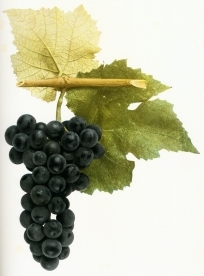
Early Dawn is a black Labrusca-Vinifera hybrid of fine quality and attractive appearance but so lacking in necessary vine characters in New York as to be practically worthless. Although it originated in New York it was never widely grown in this State. It is now, so far as records show, nearly obsolete.
Dr. Wm. A. M. Culbert of Newburgh, New York, is the originator of Early Dawn, the date of its origin being some time about 1870. It is reported to have come from seed of Israella fertilized by Black Hamburg.
Vine a fair to strong grower, not very hardy, medium to very productive. Canes rather long, covered with thin blue bloom; tendrils intermittent, bifid to trifid. Leaves medium to small; lower surface very pubescent and slightly hairy. Flowers sterile or nearly so, open in mid-season; stamens reflexed. Fruit ripens about two weeks earlier than Concord, keeps and ships well. Clusters medium to large, nearly cylindrical, irregular in outline, vary from not shouldered to a heavy single shoulder or sometimes with a double shoulder, medium in compactness. Berries rather small, roundish, attractive purplish-black, covered with heavy blue bloom, persistent. Flesh very juicy, tender, slightly vinous, sprightly, agreeably tart, variable in flavor and quality, ranging from fair to very good. Seeds not numerous, broad, plump.
EARLY OHIO. (Labrusca.)
1. An. Hort., 1892:176. 2. N. Y. Sta. An. Rpt., 12:619. 1893. 3. Rural N. Y., 53:645. 1894. fig. 4. Bush. Cat., 1894:119, 120. fig. 5. Wis. Sta. An. Rpt., 13:226. 1896. fig. 6. Rural N. Y., 56:627, fig., 630, 823. 1897. 7. N. Y. Sta. An. Rpt., 17:529, 548, 554. 1898.
Early Ohio is remarkable, chiefly, in being one of the earliest commercial grapes. The fruit resembles that of Concord, of which it is probably a seedling. The claims made for this variety that it is hardy, vigorous and productive, have not been borne out on the Station grounds; but on the contrary the vine is somewhat tender, is not a strong grower, and does not bear large crops. The quality is very poor. Now that the South is sending many grapes of high quality to northern markets at the time Early Ohio and other grapes of its season are ripening it is doubtful if a grape having only earliness to commend it should have a place in our viticulture. Notwithstanding its defects Early Ohio is grown somewhat commonly in New York though its culture is on the wane.
The original seedling of Early Ohio was found in the year 1882 in the vineyard of R. A. Hunt, at Euclid, Ohio, between rows of Delaware and Concord. It was introduced in 1892 by the C. S. Curtice Company, of Portland, New York.
Vine medium to weak, often tender, usually produces medium crops. Canes short to very short, few in number, rather slender, brownish with a slight reddish tinge; nodes somewhat enlarged, flattened; internodes short; diaphragm thick; pith intermediate in size; shoots pubescent; tendrils continuous, usually short, bifid.
Leaf-buds rather small and short, inclined to slender, pointed to conical, open in mid-season. Young leaves lightly tinged on under side and along margin of upper side with rose-carmine. Leaves intermediate in size, of average thickness; upper surface light green, dull, smoothish; lower surface varies from pale green to slight bronze, pubescent; veins fairly distinct; lobes vary from none to three, with terminal lobe acute; petiolar sinus medium to shallow, rather wide; basal sinus usually absent; lateral sinus nearly shallow, wide to rather narrow; teeth shallow to sometimes medium, somewhat narrow. Flowers fertile, open in mid-season; stamens upright.
Fruit ripens two or three weeks earlier than Concord, some seasons a few days earlier than Moore Early, does not keep well. Clusters medium in size, intermediate to long, below average in thickness, tapering, frequently not shouldered, moderately compact; peduncle short to medium, of fair thickness; pedicel intermediate in length, medium to rather slender, covered with few, small warts; brush above average length, slender, tinged with red. Berries not very uniform in size, averaging medium, roundish, purplish-black, slightly glossy, covered with rather heavy blue bloom, persistent, firm. Skin intermediate in thickness and toughness, adheres slightly to the pulp, contains a moderate amount of reddish pigment, astringent. Flesh greenish, translucent, juicy, somewhat tough, slightly aromatic, sweet at skin but slightly acid at center, inferior in quality. Seeds do not separate easily unless fully ripe, one to four, average three, intermediate in size, length, and breadth, notched, light brown with yellowish-brown tips; raphe obscure; chalaza of fair size, slightly above center, circular to oval, rather obscure.
EARLY VICTOR. (Labrusca, Bourquiniana?)
1. Am. Pom. Soc. Rpt., 1877:44. 2. Downing, 1881:166, app. 3. Am. Pom. Soc. Rpt., 1881:34. 4. N. J. Hort. Soc. Rpt., 1881:13. 5. Bush. Cat., 1883:96. 6. Am. Pom. Soc. Cat., 1883:26. 7. Am. Pom. Soc. Rpt., 1885:103, 105. 8. Rural N. Y., 45:622, 653. 1886. 9. Kan. Hort. Soc. Rpt., 1886:187. 10. Can. Hort., 11:287. 1888. 11. Mo. Hort. Soc. Rpt., 1889:361, 373. 12. W. N. Y. Hort. Soc. Rpt., 36:40. 1891. 13. Bush. Cat., 1894:121. 14. Mich. Sta. Bul., 169:170. 1899. 15. N. Y. Sta. An. Rpt., 18:395. 1899. 16. Can. Hort., 23:217. 1900.
EARLY VICTOR
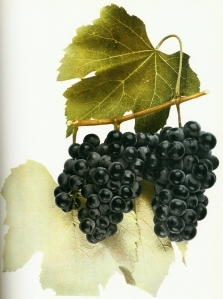
Early Victor is especially worthy of notice because it is highest in quality of the very early black grapes. When one tastes this variety at the beginning of the grape season, he has no palate for Hartford, Champion, Ives, Janesville, or even Moore Early, and he will be conscious of defects in the flavor of many of the later grapes which are supposed to have high quality. Early Victor is especially pleasing to those who want a pure-flavored grape and object to the foxiness of our native varieties so marked in Hartford and Champion but almost wholly lacking in this variety. Were it but a few days earlier and bunch and berry a little larger and more attractive, Early Victor might be the grape par excellence for home and market to begin the grape season. The vines are hardy, healthy, vigorous, and productive, with growth and foliage greatly resembling Hartford, which is probably one of its parents, Delaware being the other. The bunches are small and compact and somewhat variable in shape; the berries are about the size and shape of those of Delaware. Its season is that of Moore Early and Hartford, or a little later, though, like many black grapes, it colors before it is ripe and is often picked much too green. Unfortunately the fruit is susceptible to black-rot and a little inclined to shrivel after ripening. Although introduced into American viticulture in 1881, Early Victor is still little known and deserves far more general recognition both by the amateur and the commercial grape-grower.
John Burr,[186] of Leavenworth, Kansas, originated Early Victor about 1871 and sent it out for testing in 1881. It was placed on the grape list of the American Pomological Society fruit catalog in 1883 and is still retained. Early Victor is said to be a seedling of Delaware pollinated by Hartford. This, however, is mere surmise, as nothing is known positively as to its parentage, and the statement was made frequently by the Kansas Horticultural Society, of which Burr was a member, that it was a seedling of Concord. It was introduced, probably about 1887, by Stayman & Black of Leavenworth.
Vine vigorous, healthy, hardy, productive. Canes long, numerous, rather slender, dark brown to slightly reddish-brown, surface pubescent; nodes enlarged, usually not flattened; internodes long to medium; diaphragm nearly thin; pith intermediate in size; shoots pubescent; tendrils continuous, of average length, bifid to sometimes trifid.
Leaf-buds of average size, short to medium, rather thick, often strongly compressed, nearly obtuse to conical, open in mid-season. Young leaves tinged lightly on upper and lower sides with rose-carmine. Leaves medium to above in size, rather thick; upper surface dark green, moderately smooth; lower surface nearly whitish, heavily pubescent; veins well defined; lobes three to five in number, terminal lobe acute; petiolar sinus intermediate in depth and width; basal sinus shallow and moderately wide when present; lateral sinus medium to above in depth, narrow to medium in width; teeth of average depth and width. Flowers nearly fertile to somewhat sterile, open in mid-season; stamens upright.
Fruit ripens with Moore Early or a little later, does not keep well. Clusters medium to small, below average length, variable in shape, cylindrical to tapering, frequently single-shouldered, compact; peduncle intermediate in length and thickness; pedicel medium to short, covered with numerous small warts; brush wine-colored or pinkish-red. Berries small to medium, roundish to slightly oblate, dark purplish-black, rather dull, covered with heavy blue bloom, persistent, not very firm. Skin rather thin, medium to tough, adheres but slightly to the pulp, contains much red pigment, astringent. Flesh greenish-white, nearly opaque, fine-grained, of medium toughness, aromatic, slightly vinous, not foxy, sweet at skin but slightly acid at center, good in quality. Seeds do not separate easily from the pulp unless the fruit is thoroughly ripe, one to four, average three, of medium size, broad, notched, below mean length, usually somewhat blunt, dark brown; raphe obscure; chalaza of fair size, slightly above center, circular, somewhat obscure.
EATON. (Labrusca.)
1. Mass. Hort. Soc. Rpt., 1879:161. 2. Ib., 1880:231. 3. Gar. Mon., 27:335. 1885. 4. U. S. D. A. Rpt., 1887:633. 5. Rural N. Y., 48:639, 641. 1889. fig. 6. N. Y. Sta. An. Rpt., 9:326. 1890. 7. W. N. Y. Hort. Soc. Rpt., 36:42. 1891. 8. Ill. Sta. Bul., 28:254. 1893. 9. Bush. Cat., 1894:123. 10. Mass. Hatch Sta. Bul., 37:11, 14. 1896. 11. N. Y. Sta. An. Rpt., 17:529, 548, 552, 559. 1898. 12. Mo. Sta. Bul., 46:39, 42, 44, 45, 50, 54, 76. 1899.
Eaton’s Seedling (1, 2).
EATON
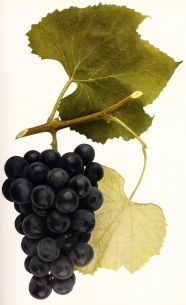
Eaton is a pure-bred seedling of Concord which it surpasses in appearance but does not equal in flavor. In appearance of bunch it is one of the handsomest of our native grapes but as a table grape it ranks low. Its flesh is tough and stringy and, though sweet at the skin, is acid at the seeds. It has the same foxiness that characterizes Concord but with more juice and less richness than its parent so that it is well described as a “diluted Concord”. The skin is very similar to that of Concord, neither thicker nor thinner, and the fruit packs, ships and keeps about the same, though if any thing less well because of the greater amount of juice. The season is a few days earlier than Concord. The vine is healthy, vigorous, hardy and productive and very similar in all botanical characters to its parent. The grapes ripen unevenly, the flowers are self-sterile and in some locations it is a shy bearer. Eaton has been grown for nearly forty years and has not found favor with either the grower or the consumer and is being less and less grown, remaining in our viticulture only as a handsome exhibition grape and an interesting seedling of Concord.
This mammoth Concord, the Eaton, originated with Calvin Eaton of Concord, New Hampshire, about 1868 from seed of Concord. Mr. Eaton states that this was the best vine out of a lot of two thousand seedlings. The new variety was purchased by John B. Moore & Son of Concord, Massachusetts, in 1882, and was introduced by them in 1885. Owing to Mr. Moore’s death it soon passed into the hands of the T. S. Hubbard Company, of Fredonia, New York. It at once attracted much attention on account of its fine appearance and for a time was very popular, its popularity declining chiefly because of the poor quality of the fruit.
Vine vigorous, healthy, hardy, usually productive. Canes intermediate in length and number, thick to medium, light brown changing to darker brown at the nodes, covered with a small amount of blue bloom; nodes enlarged, slightly flattened; internodes short to medium; diaphragm of average thickness; pith large to medium; shoots pubescent; tendrils continuous, rather long, bifid to trifid.
Leaf-buds medium to below in size, short, of nearly mean thickness, conical to pointed, open in mid-season. Young leaves lightly tinged on under side and along margin of upper side with carmine. Leaves healthy, large, often roundish, thick; upper surface dark green, of average smoothness; lower surface tinged with bronze, heavily pubescent; veins distinct; lobes three when present, with terminal lobe acute; petiolar sinus medium to shallow, rather wide; basal sinus usually lacking; lateral sinus shallow, narrow, often notched; teeth shallow to medium, not very wide. Flowers partly fertile to somewhat sterile, open early; stamens upright.
Fruit ripens slightly before Concord, keeps and ships only fairly well. Clusters large to medium, short to above medium, often very broad, blunt, slightly tapering, usually single-shouldered but sometimes double-shouldered, compact to medium; peduncle short to medium, thick; pedicel medium to rather long, thick, nearly smooth, wide at point of attachment to berry; brush slender, pale green. Berries rather uniform in size, averaging large, roundish, black, not glossy, covered with heavy blue bloom, persistent, firm. Skin intermediate in thickness, rather tough, adheres considerably to the pulp, contains much purplish-red pigment, slightly astringent. Flesh greenish, translucent, juicy, rather tough, slightly stringy and foxy, nearly sweet at skin but quite acid at center, fair in quality, ranking below Concord. Seeds rather adherent, one to four in number, average two or three, above mean size, inclined to broad, notched, intermediate in length, plump, somewhat blunt, light brown; raphe buried in a rather wide, shallow groove; chalaza nearly large, slightly above center, irregularly circular to oval, obscure.
(I) ECLIPSE. (Labrusca.)
1. Ill. Hort. Soc. Rpt., 1899:216. 2. Ib., 1904:228. 3. Rural N. Y., 65:852. 1906. 4. Ib., 66:24, 344, 412. 1907.
Riehl’s New Early Grape (3). Riehl’s No. 10 (1, 2). Riehl’s No. 10 (4).
There are two grapes bearing the name Eclipse, the origin and history of both of which are briefly set forth below. Of the two, Riehl’s Eclipse alone is deemed worthy of general discussion, the other, a green variety of this name, having passed out of cultivation if it were ever grown in New York.
ECLIPSE
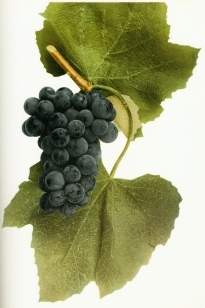
The grape under consideration, known for some years as Riehl’s No. 10, is a comparatively new candidate for pomological honors, not having been named and introduced as Eclipse until 1906. It has not been grown largely in New York and the East and we can therefore say but little of it other than to describe it as it grows on the Station grounds and to state that in the West, Illinois in particular, it is most highly recommended. At Geneva the Eclipse is very like the Concord, one of its grandparents, it being a seedling of Niagara, differing chiefly in being earlier and of better quality. Bunches and berries are a little smaller than Concord. The vines are hardy, healthy and productive, promising well for commercial plantations. In Illinois it is said to hang on the vines long after it is ripe without deterioration and not to crack in wet weather. The color-plate and the description given below show the Eclipse as it grows at this Station and if the grape-grower wishes a variety answering to the general characters so depicted, the Eclipse is certainly worthy a trial in New York.
E. A. Riehl of Alton, Illinois, is the originator of Eclipse, the date of its origin being about 1890. He states that this is one of the seedlings from a lot of Niagara seed which was probably cross-pollinated by other varieties. The variety was introduced in 1906 by the Stark Brothers Nurseries and Orchards Company, Louisiana, Missouri.
Vine vigorous, hardy, productive. Canes medium to above in length and number, intermediate in size, rather dark reddish-brown; nodes slightly enlarged; internodes of average length; diaphragm thick; pith large to medium; shoots pubescent; tendrils continuous, somewhat long, bifid.
Leaf-buds medium to nearly small, short, inclined to slender, pointed to conical, open in mid-season. Young leaves colored on lower side only, prevailing color pale green with slight rose-carmine tinge. Leaves medium to large, of average thickness; upper surface dark green, intermediate in smoothness; lower surface whitish with slight bronze tinge, heavily pubescent, veins well defined; lobes none to three with terminal lobe acute to acuminate; petiolar sinus deep, medium to narrow; basal sinus usually lacking; lateral sinus of average depth, rather narrow, often notched; teeth medium to shallow, nearly narrow. Flowers sterile, open in mid-season; stamens reflexed.
Fruit ripens slightly earlier than Concord, keeps fairly well. Clusters intermediate in size, below average length, medium to rather broad, tapering to cylindrical, frequently single-shouldered, moderately compact; peduncle nearly short, thick to medium; pedicel short, somewhat thick, covered with numerous small warts; brush long, pale green. Berries large to medium, slightly oval, rather dull black, covered with abundant blue bloom, persistent, firm. Skin intermediate in thickness, tender, adheres but slightly to the pulp, contains a small amount of wine-colored pigment, somewhat astringent. Flesh pale green, translucent, juicy, tender, rather fine-grained, foxy, sweet next the skin to agreeably tart at center, resembles Concord very closely in flavor, good in quality. Seeds separate very easily from the pulp, one to four, average two or three, of mean size, somewhat short, broad to medium, distinctly notched, rather blunt, brownish; raphe buried in a deep groove; chalaza of average size, slightly above center to nearly central, circular to nearly pear-shaped, distinct.
(II) ECLIPSE. (Labrusca, Vinifera.)
1. Mo. Hort. Soc. Rpt., 1889:372. 2. Ib., 1892:269. 3. Bush. Cat., 1894:123. 4. Va. Sta. Bul., 94:139. 1898. 5. Mo. Sta. Bul., 46:39. 1899.
This Eclipse was produced by John Burr of Leavenworth, Kansas, about 1880, from mixed seed. It attracted some attention in the Middle West, where the fruit was exhibited at various meetings but failed to attain favor in the vineyard. It is now practically obsolete.
Vine vigorous, injured in severe winters, variable in productiveness, somewhat susceptible to mildew. Canes long to medium, of average number, thick; internodes long; tendrils continuous to intermittent, bifid to sometimes trifid. Leaves not healthy, large to medium, of average greenness; lower surface grayish-white. Flowers partly sterile; stamens upright. Fruit ripens a little later than Diamond, keeps well. Clusters medium to small, of average length, frequently single-shouldered, medium to broad, compact to medium. Berries large to medium, roundish to oblate, light green often with tinge of yellow, covered with thin gray bloom, persistent. Skin thin, of average toughness, covered with scattering, small, reddish-brown dots. Flesh tender, vinous, sprightly, less sweet than Niagara, good to very good in quality. Seeds separate easily from the pulp, one to four, average three, above medium in size, intermediate in length and width; raphe obscure.
ELDORADO. (Labrusca, Vinifera.)
1. Am. Pom. Soc. Rpt., 1881:33. 2. Rural N. Y., 45:622. 1886. 3. Ib., 51:681, 726. 1892. 4. N. Y. Sta. An. Rpt., 11:621. 1892. 5. Bush. Cat., 1894:123. 6. Col Sta. Bul., 29:22. 1894. 7. Rural N. Y., 56:822. 1897. 8. N. Y. Sta. An. Rpt., 17:530, 541, 544, 548, 554. 1898. 9. Ib., 18:375, 387, 396. 1899. 10. Ill. Hort. Soc. Rpt., 1902:224.
Eldorado is one of the best flavored of all early green grapes but unfortunately it has defects which have kept it from becoming popular and it is now rapidly passing from cultivation. It is delicately flavored, with a very distinct aroma and taste; the flesh is tender, melting and sweet from skin to seeds, all qualities rarely found in an early grape. The season is about that of Moore Early, a time when there are few other really good white grapes. Eldorado is a full sister of Lady Washington and is if anything better flavored than that most excellent variety. These two grapes are secondary hybrids of Labrusca and Vinifera, Concord being the native parent. The vines inherit most of the good qualities of Concord but Eldorado does not inherit Concord’s ability to set fruit well; even with cross-pollination it sometimes fails to bear and is not worth growing unless planted in a mixed vineyard. The clusters are so often small and straggling under the best possible conditions that the variety cannot be highly recommended to the amateur yet its delightful flavor and its earliness may commend it to some.
J. H. Ricketts of Newburgh, New York, produced Eldorado some time about 1870 from seed of Concord fertilized by Allen’s Hybrid. It was introduced by the originator about 1881 and is still offered for sale by a few nurserymen. Eldorado has been somewhat commonly grown in gardens and collections in the East but does not succeed in the West.
Vine usually a strong grower, hardy except in severe winters, an uncertain bearer. Canes long, not very numerous; tendrils intermittent to rarely continuous, bifid to trifid. Leaves below medium to large, irregularly roundish, dark green, rugose on older leaves; lower surface tinged with bronze, pubescent. Flowers sterile, open medium late; stamens reflexed. Fruit ripens earlier than Concord, keeps well. Clusters do not always set perfectly and are quite variable in size, frequently single-shouldered, not uniform in compactness. Berries large to medium, roundish, yellowish-green changing to a golden yellow, covered with thin gray bloom. Flesh tender, slightly foxy, sweet from skin to center, mild, high flavored, good to very good in quality. Seeds intermediate in size and length, blunt.
ELSINBURGH. (Vinifera, Aestivalis.)
1. Amer. Farmer, 9:221. 1827. 2. Prince, 1830:176. 3. Downing, 1845:255. 4. Elliott, 1854:245. 5. Horticulturist, 12:458. 1857. 6. Phin, 1862:254. 7. Am. Pom. Soc. Cat., 1862:90. 8. Husmann, 1866:120. 9. Am. Pom. Soc. Rpt., 1881:38. 10. Bush. Cat., 1883:94. 11. N. Y. Sta. An. Rpt., 13:603. 1894. 12. Ib., 17:530, 548, 554. 1898.
Blue Elsingburg (2). Elsenburgh (2). Elsinboro (4, 10, 11). Elsingburg (7). Elsinburg (6). Elsinborough (6). Elsinborough (2, 3, 4). Missouri Bird’s Eye (8). Smart’s Elsinburgh (3, 4). Smart’s Elsingborough (2, 10, 11).
Elsinburgh dates back nearly a century and is now rarely cultivated, having long since been replaced by better varieties. It is certainly not known in New York now and it is doubtful if it was ever much grown as it fruits very sparingly in the North and is but half hardy in the latitude of this State. In quality it is one of the best of the Aestivalis grapes, having a pure, rich, vinous, spicy flavor without a trace of foxiness. It would undoubtedly add variety to any amateur’s vineyard and might prove of value in grape-breeding, otherwise it is not worth growing; it undoubtedly makes a very good red wine.
The origin of Elsinburgh is very uncertain. It was named after the township, Elsinborough, Salem County, New Jersey. In this neighborhood it was much raised at an early day. From here it was sent to various parts of the country. Whether it originated in this section or whether it was introduced at a still earlier date from elsewhere is unknown. It was brought into notice by a Dr. Hulings. Although Elsinburgh has long since ceased to be of importance, it is still offered for sale by an occasional nurseryman. It was placed on the grape list in the American Pomological Society fruit catalog in 1862 and removed in 1891. Elsinburgh is of especial interest as being the probable parent of Delaware. The variety shows Bourquiniana or Aestivalis in flavor and texture of fruit, in texture and pubescence of leaf, and the bloom on young canes; its tenderness and susceptibility to mildew suggest Vinifera.
Vine weak to moderately vigorous, not very hardy, produces light crops. Canes short to medium, slender, covered with thin blue bloom; tendrils intermittent, bifid to trifid. Leaves small to medium, variable in color; lower surface hairy and slightly pubescent. Flowers nearly fertile, open very late; stamens upright. Fruit ripens early in October. Clusters medium to large, usually single-shouldered, loose to medium. Berries small, roundish, black, covered with blue bloom, contain but little pulp. Flesh vinous, sweet, quality good. Seeds few, small.
ELVICAND. (Candicans, Riparia, Labrusca.)
1. An. Hort., 1892:176. 2. Bush. Cat., 1894:123. 3. Am. Pom. Soc. Cat., 1897:19. 4. Tex. Sta. Bul., 48:1149, 1156. 1898. 5. Ib., 56:276. 1900.
Introduced some twenty years ago, Elvicand has not found a place in the viticulture of the North. It is interesting because of its parentage, having in it the blood of three species: Riparia, Labrusca and Candicans, and might prove valuable in breeding work, as starting a new and somewhat distinct group of grapes. There has been much complaint of this variety being unproductive but Munson states that this is due to short pruning and that it will bear heavily with very long pruning. It is too late in season for New York.
The variety was originated by T. V. Munson of Denison, Texas, from seed of Elvira accidentally fertilized by pollen of Vitis candicans. It was introduced by the originator in 1893, and was placed on the grape list in the American Pomological Society fruit catalog in 1897, where it has since been retained. It was dropped from the originator’s catalog eight years ago.
Vine vigorous and hardy. Shoots and under side of leaves showing much white cottony pubescence. Leaves large to medium, shallowly three-lobed. Flowers self-fertile. Clusters small, rather open. Berries of medium size, round, dark purple, somewhat sweet to subacid with slight Candicans flavor. Seeds large. Season late. Not a table grape.
ELVIRA. (Riparia, Labrusca.)
1. Mo. Hort. Soc. Rpt., 1873:53. 2. Am. Pom. Soc. Rpt., 1875:40, 67. 3. Mass. Hort. Soc. Rpt., 1880:237. 4. Am. Pom. Soc. Rpt., 1881:38. 5. Am. Pom. Soc. Cat., 1881:24. 6. Ill. Hort. Soc. Rpt., 1883:75. 7. Bush. Cat., 1883:97. col. pl. and fig. 8. Husmann, 1895:83, 93, 175. 9. N. Y. Sta. An. Rpt., 17:530, 548, 555, 559. 1898. 10. Tex. Sta. Bul., 56:270. 1900. 11. Mo. Hort. Soc. Rpt., 1902:82. 12. Ib., 1906:65, 66, 67.
Though it has never attained great popularity in New York or in the North, Elvira, soon after its introduction in Missouri about thirty-five years ago, was carried to the very pinnacle of popularity as a wine grape. The qualities which commended it were its great productiveness, in which character it is hardly surpassed in favorable locations by any other of our native grapes; its earliness, ripening in the North with Concord; its exceedingly good health, being almost free from cryptogamic diseases and having almost no touch of black-rot in the average season even in the Southwest; its great vigor as shown by a strong stocky growth and ample foliage; and, lastly, almost perfect hardiness even as far north as Canada. Its good qualities are offset by one or two defects which have caused it to lose in popularity as time has gone by until now it is not as widely grown as some of its seedlings. The most noticeable of its defects is its thin skin which bursts easily, thus wholly debarring it from distant markets. Beside this, its flavor and appearance, as it grows here, are not sufficiently good to make it a table grape and it can be used only for wine for which purpose it is much valued, though its habit of cracking in the bunch is sometimes much against it as a wine grape. The wine made from Elvira is light, containing comparatively little alcohol, and by those wine-makers who do not dislike a slight foxiness in flavor, it is considered very good, improving with age and being well adapted for blending with more highly flavored wines.
At the beginning of the reconstruction period in France, Elvira was used more or less as a resistant stock and somewhat as a direct producer but within a few years it was condemned and abandoned for either purpose and is now known in France[187] only in varietal vineyards.
Elvira is a seedling of Taylor, a Riparia-Labrusca hybrid, and shows well the peculiarities and general characters of the group of which Taylor is supposed to be the parent. Of the numerous hybrid Riparia grapes, Elvira seems to have given the best coign of vantage for breeding work and is the parent of a number of worthy pure-bred and cross-bred varieties. While it is to the species to which Elvira belongs that we must look for our hardiest grapes, this variety and most of its progeny are not suited to northern conditions, not because of tenderness to cold, but because they must have a long season for maturity and to attain their best quality. Riparia is largely used as a resistant stock in combating phylloxera, and Elvira and other similar hybrid offspring are almost proof against this pest.
Elvira was originated by Jacob Rommel of Morrison, Missouri, from seed of Taylor which some say was pollinated by Martha. It was planted in 1863 and fruited for the first time in 1869. Bush & Son & Meissner introduced the variety in 1874. It was placed on the grape list of the American Pomological Society fruit catalog in 1881 where it is still retained. Its great popularity in Missouri was largely due to the energy with which it was advertised by certain prominent viticulturists, they having been most favorably impressed with it because of its withstanding the severe cold of the winter of 1873 without protection. Husmann, in particular, spoke of Elvira in the highest terms and recommended its cultivation. Its popularity spread from Missouri to the islands and the Ohio shore of Lake Erie but scarcely reached New York. In all of these regions its culture is now on the wane.
ELVIRA
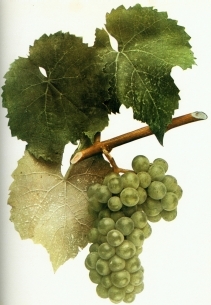
Vine vigorous, hardy, healthy, produces very heavy crops, more productive than Concord. Canes of average length, numerous, medium to below in thickness, rather dark brown, deepening in color at the enlarged and flattened nodes; internodes short to medium; diaphragm rather thin; pith intermediate in thickness; shoots slightly pubescent; tendrils continuous, of average length, trifid to bifid.
Leaf-buds nearly medium in size, short to medium in length, thick, conical to nearly obtuse, open in mid-season. Young leaves tinged faintly with carmine on the lower side only. Leaves rather large, medium to somewhat thin; upper surface light green, older leaves dull but younger leaves glossy, smooth to medium; lower surface pale green, slightly pubescent, hairy. Veins rather distinct; lobes none to three with terminus acute to acuminate; petiolar sinus deep to medium, inclined to narrow, sometimes closed and overlapping; basal sinus usually lacking; lateral sinus shallow, often notched; teeth medium to rather deep, somewhat wide. Flowers fertile or nearly so, open moderately early; stamens upright.
Fruit ripens about with Concord, does not keep well. Clusters intermediate in size, above medium to short, of average breadth, cylindrical, usually single-shouldered, compact; peduncle short to medium, rather thick; pedicel not long, of average thickness, nearly smooth; brush short, greenish-yellow with brownish tinge. Berries average medium in size, roundish to slightly oblate, often misshapen on account of compactness, greenish with yellow tinge, rather dull, covered with a fair amount of gray bloom, not always persistent, rather firm. Skin very thin, tender, adheres slightly to the pulp, contains no pigment, somewhat astringent. Flesh greenish, juicy, fine-grained, tender, slightly foxy, sweet, not acid at the center, somewhat flat in flavor, of fair quality. Seeds separate easily from the pulp, one to four, average three, medium to nearly large, medium to broad, intermediate in length, blunt, often plump, medium to dark brown; raphe obscure or nearly so; chalaza of average size, slightly above center, pear-shaped, rather distinct. Must 88°.
EMPIRE STATE. (Riparia, Labrusca, Vinifera?)
1. Am. Pom. Soc. Rpt., 1881:66. 2. Mass. Hort. Soc. Rpt., 1882:227. 3. Ohio Hort. Soc. Rpt., 1882:46. 4. Bush. Cat., 1883:99. 5. Gar. Mon., 26:272, 364. 1884. 6. W. N. Y. Hort. Soc. Rpt., 31:110. 1886. 7. Rural N. Y., 46:20, 495. 1887. 8. Am. Pom. Soc. Rpt., 1887:97, 125. 9. Ohio Hort. Soc. Rpt., 1887-8:85, 169. 10. Mo. Hort. Soc. Rpt., 1889:370. 11. Am. Pom. Soc. Cat., 1889:24. 12. N. Y. Sta. An. Rpt., 13:603. 1894. 13. Bush. Cat., 1894:125. 14. Col. Sta. Bul., 29:22. 1894. 15. Ohio Hort. Soc. Rpt., 1894-5:11. 16. Tenn. Sta. Bul., Vol. 9:180. 1896. 17. N. Y. Sta. An. Rpt., 17:530, 541, 544, 548, 552. 1898.
Empire State competes with Niagara, Diamond and Pocklington for supremacy among green grapes in commercial vineyards, probably taking fourth place the country over. The variety is equally vigorous in growth, just as free from predaceous parasites, whether fungi or insects, and upon vines of the same age it is as productive but is a little less hardy and the grapes are not as attractive in appearance as the other varieties named. In particular the clusters are small in some localities, a defect which can be overcome only by severe pruning or by thinning. The quality is very good, much better than Niagara, somewhat better than Pocklington and nearly as good as Diamond. It approaches the flavor of the Old World grapes, its slight wild taste suggesting one of the Muscats rather than the foxiness of the Niagara. Empire State is esteemed for the table wherever known and is in demand for wine-making, the wine from it being most excellent for champagne according to reports from the Keuka champagne-makers. Empire State ripens a little earlier than Niagara, hangs long upon the vine and keeps well after picking and without losing flavor. The variety is quite distinct in its horticultural as well as its botanical characters.
This somewhat remarkable white grape was originated by James H. Ricketts of Newburgh, New York. The variety was fruited for the first time in 1879. The originator says that it came from seed of Hartford pollinated by Clinton but this parentage has been questioned by many viticulturists as it does not show characters of either of the reputed parents. A very general supposition is that the variety is a hybrid between Clinton and some variety of Vinifera, the characters of the fruit in particular indicating such breeding. Empire State was bought from the originator by George A. Stone of Rochester for $4,000, a record price for an American grape. It was introduced about 1884 and was placed on the grape list of the American Pomological Society fruit catalog in 1889, where it still remains.
Vine a fair to good grower, usually healthy, in some locations appears somewhat tender, moderately productive to productive. Canes short, medium to few, nearly slender, brownish; nodes slightly enlarged, not flattened; internodes short to medium; diaphragm of average thickness; pith of medium size; shoots pubescent; tendrils intermittent, intermediate in length, bifid.
Leaf-buds small to medium, of average length, rather slender, pointed to conical, open moderately late. Young leaves tinged with faint trace of red on under side, prevailing color greenish. Leaves small to medium, of fair thickness; upper surface light green, slightly glossy, smooth to somewhat rugose; lower surface tinged with bronze, heavily pubescent; veins distinct; lobes three to five when present, with terminal lobe acuminate; petiolar sinus medium to deep, narrow, often closed and overlapping; basal sinus variable in depth and width; lateral sinus deep, narrow to medium, often distinctly enlarged at base; teeth medium to deep, above average width. Flowers fertile, open moderately late; stamens upright.
EMPIRE STATE
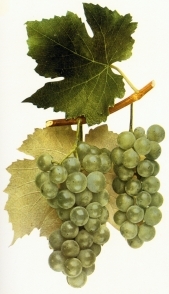
Fruit somewhat variable in season of ripening averaging a few days earlier than Niagara, keeps well. Clusters large to below medium, long, rather slender, cylindrical to slightly tapering, frequently single-shouldered, medium to compact; peduncle variable, often characteristically long, rather thick; pedicel not uniform in length, slender, covered with numerous small warts; brush short, light green. Berries variable in size averaging medium to below, inclined to roundish, pale yellowish-green, covered with some gray bloom, persistent, moderately firm. Skin medium to thick, variable in toughness, adheres but slightly to the pulp, contains no pigment, with slight astringency. Flesh pale yellowish-green, translucent, very juicy, fine-grained, rather tender, sweet next the skin but somewhat acid at center, agreeably flavored, good to very good in quality. Seeds adhere slightly to the pulp, one to four, average two, small, broad, notched, rather short, blunt, plump, brownish; raphe obscure; chalaza small, roundish to ovate, slightly above center, distinct.
ESSEX. (Labrusca, Vinifera.)
1. U. S. D. A. Rpt., 1864:127, 136. 2. Mass. Hort. Soc. Rpt., 1865:40. 3. Strong, 1866:341. 4. Am. Jour. Hort., 3:146. 1868. 5. Horticulturist, 24:126. 1869. 6. Am. Pom. Soc. Cat., 1869:42. 7. Grape Cult., 1:181. 1869. 8. Ill. Sta. Bul., 28:254. 1893. 9. N. Y. Sta. An. Rpt., 17:530, 548, 555. 1898.
Rogers’ No. 41 (1, 2, 3, 4). Rogers’ No. 41 (5, 6, 7).
When well grown Essex is so similar to Barry, Wilder and Herbert, all being Rogers’ hybrids, that it is doubtful if it is worth cultivation more especially as it is not as easily grown as the above sorts. Its fruit is almost identical with Barry, though the bunches do not equal that variety in size, but the vine is not as desirable, being only half-hardy, not productive, with sterile flowers and not setting fruit well even in mixed vineyards.
For an account of the origin and parentage of Essex see “Rogers’ Hybrids.” Essex, then known as Rogers’ No. 41, is first mentioned separately from the other hybrids about 1865. There appears to have been some confusion in the numbers, as some of the early describers speak of the grape as red, others black. The name Essex was given by Mr. Rogers in 1869, in honor of Essex County, Massachusetts. The same year it was placed on the grape list of the American Pomological Society fruit catalog, where it was retained until 1895, when it was dropped. It is still to be found in many varietal vineyards but is now offered for sale by but few nurserymen.
Vine vigorous, not always hardy, produces good crops. Canes vigorous, intermediate in number and thickness; tendrils continuous to intermittent, trifid to bifid. Leaves medium to above in size, irregularly roundish; lower surface thinly pubescent. Flowers sterile or nearly so, open in mid-season or slightly later; stamens reflexed. Fruit ripens about with Concord or slightly later, an excellent keeper, in good condition some seasons until February. Clusters medium to nearly large, broad with a rather small, short, single shoulder, usually compact. Berries large to above medium, roundish to oval, frequently compressed, dark purplish-black, covered with abundant blue bloom, not firm. Flesh moderately tender and soft, vinous, sweet next the skin to acid at center, agreeable in flavor, good to very good in quality. Seeds large, long, often with enlarged neck; chalaza small, frequently with shallow, radiating furrows, strongly above center.
ESTER. (Labrusca.)
1. An. Hort., 1889:101. 2. Rural N. Y., 51:686, 863. 1892. 3. Bush. Cat., 1894:125. 4. N. Y. Sta. An. Rpt., 14:279. 1895. 5. Ib., 17:530, 548, 555. 1898. 6. Mich. Sta. Bul., 194:57. 1901. 7. Kan. Sta. Bul., 110:239. 1902.
Ester is a white seedling of Concord, whether pure-bred or cross-bred is not known, which resembles its parent in vine and in flavor of fruit. It has several defects which make it less valuable than many other better known white grapes and is therefore not recommended for New York. Its defects appear in the description given below.
The variety was originated by E. W. Bull of Concord, Massachusetts, from seed of Concord. It was introduced by George S. Josselyn of Fredonia, New York, in 1889. Bull named this variety in honor of his mother who spelled her name Ester, in the old New England way, and not “Esther” as commonly found in grape literature.
Vine variable in vigor and productiveness, usually hardy. Canes short to medium, slender, covered with considerable pubescence; tendrils continuous, rarely intermittent, bifid to trifid. Leaves small, light green; lower surface tinged with bronze, pubescent. Flowers nearly fertile, open in mid-season; stamens upright. Fruit ripens about with Concord, not a good keeper. Clusters medium to above in size and compactness. Berries medium to large, roundish, pale yellowish-white, covered with thin gray bloom, inclined to drop considerably from pedicel. Skin covered with scattering brown dots, thin, somewhat tender, inclined to crack. Flesh moderately tender and vinous, sweet, variable in flavor and quality ranging from fair to very good.
ETTA. (Riparia, Labrusca.)
1. Am. Pom. Soc. Rpt., 1881:33. 2. Mo. Hort. Soc. Rpt., 1883:43. 3. Bush. Cat., 1883:98. fig. 4. Kan. Hort. Soc. Rpt., 1890:23, app. 5. N. Y. Sta. An. Rpt., 10:496. 1891. 6. Ill. Sta. Bul., 28:263. 1893. 7. Ark. Sta. Bul., 39:30. 1896. 8. N. Y. Sta. An. Rpt., 17:530, 545, 547, 555, 559. 1898. 9. Tex. Sta. Bul., 48:1149, 1156. 1898. 10. Mich. Sta. Bul., 177:44. 1899. 11. Ga. Sta. Bul., 53:43. 1901. 12. Kan. Sta. Bul., 110:244. 1902.
Elvira Seedling No. 3 (3). Rommel’s Etta (4, 12). Rommel’s No. 3 (1).
In appearance, taste and texture of flesh Etta is very similar to Elvira of which it is a seedling. The small yellowish clusters which characterize Elvira are almost exactly reproduced in Etta differing chiefly in often having a shoulder quite as large as the main bunch itself, and in having, for most palates, a better flavor, lacking the slight foxiness of Elvira. The vine is very vigorous, hardy, and productive to a fault. The fruit ripens late, at the time of Catawba, and too late to make the variety of value for New York. Etta is not a good table grape and, as with its parent, makes only a fair grade of white wine but this can be produced in such quantity as to give the variety value in producing a wine for blending with more highly flavored products.
The tendency of Elvira to crack and overbear caused the originator of that variety, Jacob Rommel of Morrison, Missouri, to try for a grape without these faults and the result was Etta from seed of Elvira. It was first exhibited in 1879 as Elvira Seedling No. 3 and was awarded the premium as a seedling wine grape at the Mississippi Valley Horticultural Society meeting in St. Louis in 1880. It has never become popular in the East, probably on account of its late ripening. In Missouri Etta is generally considered to be, all characters taken into account, a better grape than Elvira, falling below it in but one particular, resistance to black-rot.
Vine vigorous to very vigorous, hardy except in severe winters, productive. Canes long, rather numerous, about average size, nearly light to medium dark brown; tendrils continuous, bifid. Leaves healthy, above medium to large, thickish; upper surface dark green, slightly glossy, nearly smooth; lower surface pale green, somewhat cobwebby; veins rather distinct. Flowers fertile or nearly so, open medium early; stamens upright.
Fruit ripens late, two or three weeks after Concord, keeps fairly well. Clusters medium to small, rather short and broad, irregularly cylindrical, usually with a short, medium-sized single shoulder but sometimes so heavily shouldered as to form a double bunch, very compact. Berries medium to small, roundish to frequently compressed on account of compactness of cluster, rather pale green, sometimes with a faint yellow tinge, dull, covered with thin gray bloom, shatter considerably when overripe, firm. Skin thin, tender, contains no pigment. Flesh juicy, fine-grained, somewhat tough and stringy, slightly foxy, neither rich nor high-flavored, sweet at skin to tart at center, mild, intermediate in flavor and quality. Seeds separate from the pulp quite easily, medium to above in size and width, long to medium, somewhat plump and blunt, brownish; raphe buried in a broad, shallow groove; chalaza of medium size, oval, nearly central, moderately distinct.
EUMELAN. (Labrusca, Vinifera, Aestivalis.)
1. Rec. of Hort., 1866:38. 2. Mead, 1867:220. 3. Fuller, 1867:241. 4. Am. Jour. Hort., 8:144, 299. 1870. 5. Barry, 1872:418. 6. Mich. Pom. Soc. Rpt., 1872:543, 555. 7. Ill. Hort. Soc. Rpt., 1875:393. 8. Am. Pom. Soc. Cat., 1875:24. 9. Bush. Cat., 1883:99. fig. 10. Wis. Hort. Soc. Rpt., 1885:174. 11. W. N. Y. Hort. Soc. Rpt., 36:43. 1891. 12. Va. Sta. Bul., 94:134. 1898. 13. N. Y. Sta. An. Rpt., 17:530, 545, 546, 548, 549, 552. 1898. 14. Tex. Sta. Bul., 56:271. 1900.
Washington (1). Washington (3).
Eumelan was introduced about forty years ago, with the general opinion among the leading viticulturists of the time that it was one of the best black grapes that had been brought to the notice of grape-growers. It seems now, as one studies its characters, to show an association of as great a number of valuable good qualities and as few objectionable ones as almost any other of our black grapes, yet the variety is now but little grown. Briefly summarized, its good qualities are: Vines above the average in vigor, hardiness and productiveness, remarkable for their short-jointed wood; clusters and berries well-formed, of good size and the latter a handsome black with fine bloom, making a very attractive cluster of grapes; flesh tender, seemingly dissolving into wine-like juice under slight pressure; the flavor is pure without a trace of foxiness, rich, sweet, and vinous, making a very delicious and refreshing fruit, though the large seeds are somewhat objectionable. Eumelan makes a very good red wine. The season of ripening is such that the variety may be called early, yet it keeps much better than most of the other grapes maturing with it and becomes, therefore, a mid-season and late grape as well as an early one. It neither cracks nor shells badly, and ships very well.
EUMELAN
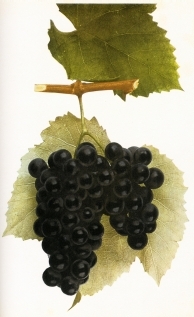
It is more difficult to name its defects. So far as we can discover, these are susceptibility to mildew, sterile flowers, and difficulty in propagation. Unquestionably the latter character has greatly hindered its culture, as the vines can be had only at extra expense and nurserymen are loath to grow it at all. Eumelan can at least be recommended to amateur growers and for the garden and it is well worth further trial by grape-growers.
Eumelan is a chance seedling which grew from seed about 1847 in the yard of a Mr. Thorne at Fishkill Landing, New York. About 1860 it fell into the hands of Dr. C. W. Grant of Iona Island and was introduced by him in 1867. By some it is supposed to be a seedling of Isabella. Bush gives the species as Aestivalis. Munson states, however, that he can see nothing in it but Labrusca and Vinifera. Labrusca seems to be indicated very plainly by the texture of the fruit and by the seeds, Vinifera possibly by a general appearance of the vine difficult to define and also by the tendency to mildew. Besides this, however, there are the bluish bloom on shoots and canes, the pigment beneath the skin, the spicy taste in the berries, and the difficulty of propagation from cuttings, all of which are difficult to account for except by recognizing the presence of Aestivalis or Bicolor blood.
Vine vigorous to medium, hardy, medium to productive, inclined to mildew. Canes intermediate in length, numerous, of average thickness, covered with considerable blue bloom; nodes enlarged, flattened; internodes short to medium; diaphragm thick; pith about medium size; shoots glabrous; tendrils intermittent, rather long, trifid to bifid.
Leaf-buds large, long, rather thick, conspicuous, obtuse to conical, open in mid-season. Young leaves heavily tinged on under side and lightly tinged along margin of upper side with bright carmine. Leaves medium to large, of average thickness; upper surface rather dark green, glossy, smooth to medium; lower surface pale green, not pubescent; veins distinct; lobes usually three in number with terminal lobe acute to acuminate; petiolar sinus medium to deep, variable in width; basal sinus usually lacking; lateral sinus shallow to medium, rather narrow or often a mere notch; teeth inclined to shallow, usually above medium in width. Flowers sterile, open in mid-season; stamens reflexed.
Fruit ripens before mid-season, keeps frequently until late winter. Clusters of average size, long to medium, rather slender, slightly tapering to cylindrical, often with a long, loose, single shoulder, variable in compactness; peduncle medium to long, of average size; pedicel somewhat short, rather slender, covered with few small warts, wide at point of attachment to fruit; brush short, stubby, pale green. Berries medium in size, roundish to frequently compressed, black, glossy, covered with abundant blue bloom, persistent, firm. Skin intermediate in thickness, tough, rather adherent to the pulp, contains a moderate amount of wine-colored pigment, slightly astringent. Flesh somewhat dark green, juicy, fine-grained, nearly tender, stringy, not foxy, rather spicy and aromatic with Aestivalis flavor, sweet, ranks good or higher in quality. Seeds adhere slightly to the pulp, one to four, average three, above medium to large, rather wide, intermediate in length, somewhat blunt, plump, brownish; raphe obscure; chalaza oval to circular, slightly above center, rather distinct. Must 93°-100°.
(I) EUREKA. (Labrusca.)
1. Mag. Hort., 27:6. 1861. 2. Gar. Mon., 6:371. 1864. 3. Mag. Hort., 33:205. 1867. 4. Am. Hort. An., 1871:80. 5. Bush. Cat., 1883:98.
Bogue’s Eureka (2).
No good descriptions of this variety are extant, and it does not appear to have been widely tested. Eureka resembles the Isabella very closely in both fruit and vine. The fruit ripens about two weeks earlier, is somewhat more tender in pulp, more compact in the bunch, and with the vine of greater vigor.
Eureka was originated by S. Folsom of Attica, Wyoming County, New York, some time in the fifties, and was introduced a few years later by Bogue & Son, nurserymen, of Genesee County. It is said to be a seedling of Isabella, resembling the parent very closely, except for being earlier in ripening. It is now practically out of cultivation, and was never superior to its reputed parent in desirable characters.
(II) EUREKA. (Bourquiniana, Labrusca, Vinifera.)
1. Mo. Hort. Soc. Rpt., 1889:372. 2. Ib., 1890:156. 3. Ib., 1891:128. 4. Ib., 1892:268. 5. Am. Gard., 13:85. 1892. 6. Husmann, 1895:33.
The second variety to receive the name Eureka is said to be a seedling of Delaware raised by Dr. Stayman some time about 1880. It does not appear ever to have been disseminated except to a few of Dr. Stayman’s personal friends. It is very rare in varietal vineyards and hardly known to nurserymen. The variety as it grows in New York is surpassed by its parent in practically all desirable horticultural characters.
Vine a strong grower, usually rather tender, produces medium to good crops. Canes long, numerous, slender; tendrils intermittent, bifid to trifid. Leaves medium to above in size, variable in color; lower surface pale green; pubescence often distributed in flecks. Fruit ripens soon after Concord, does not keep well. Clusters above medium to medium in size and length, single-shouldered to sometimes double-shouldered, of average compactness. Berries intermediate in size, roundish, attractive dark red, covered with heavy lilac or slightly blue bloom, inclined to shell somewhat from pedicel. Skin thin, rather tender, inclined to crack. Flesh moderately juicy and tough, aromatic, nearly sweet next the skin to acid at center, vinous, desirable in flavor, good in quality. Seeds small to medium, of average width and length, nearly sharp-pointed.
EXCELSIOR. (Vinifera, Labrusca.)
1. Mass. Hort. Soc. Rpt., 1880:237. 2. Bush. Cat., 1883:100. 3. Miss. Sta. An. Rpt., 3:36. 1890. 4. Tex. Sta. Bul., 48:1150, 1156. 1898.
According to the originator, James H. Ricketts, Excelsior was “the finest grape in his collection.” The grapes are delicious, having the flavor of Black Hamburg; the flesh characters are good, the pulp being melting and juicy yet holding together and having sugar enough to give keeping quality; neither seeds nor skins are objectionable; the grapes are handsome in appearance; but unfortunately the variety ripens too late to make it of much value in New York. At best it is suitable only for the amateur and, as with all of the varieties which Ricketts sent out, it is adapted to few localities and must have the best care in all respects.
Excelsior came from seed of Iona fertilized with pollen of some unknown Vinifera. The variety was introduced in the autumn of 1882. Excelsior is to-day rather rare in varietal vineyards and is apparently not offered for sale by any nurserymen.
Vine moderately vigorous, not always hardy, medium to productive. Canes long, numerous, rather thick; tendrils intermittent, bifid. Leaves large to below medium, sometimes rugose; lower surface pubescent. Fruit ripens later than Concord, keeps well. Clusters unusually large, long, broad, frequently with a heavy double shoulder, loose. Berries large to medium, oval to nearly roundish, dark red covered with thin lilac bloom, very persistent, rather soft. Skin thick, tough, adheres considerably to the pulp. Flesh very juicy, rather soft, granular, sweet and sprightly, high in flavor, good to best in quality, closely resembling Black Hamburg in many characters. Seeds medium in size, rather blunt, sometimes with a short enlarged neck.
FAITH. (Riparia, Labrusca.)
1. Ill. Hort. Soc. Rpt., 1881:164. 2. Bush. Cat., 1883:100. 3. Mo. Hort. Soc. Rpt., 1883:43. 4. Rural N. Y., 45:622, 640. 1886. 5. Ind. Hort. Soc. Rpt., 1889:85. 6. N. Y. Sta. An. Rpt., 11:623. 1892. 7. Ill. Sta. Bul., 28:263. 1893. 8. Tenn. Sta. Bul., Vol. 9:180. 1896. 9. N. Y. Sta. An. Rpt., 17:530, 548, 555. 1898.
Though spoken of as a desirable grape in many other regions Faith is of little or no value in New York. It is very unattractive in appearance as it grows in this State, both in cluster and in berry, the clusters being small and variable and the berries small and of unattractive color. The quality of the fruit is not high and there are many other white sorts which surpass it as a table grape, more especially Diamond which ripens at the same time. If it has any preeminently good character for this region it is productiveness but this cannot offset its mediocre characters. Another fault is that the blossoms put forth so early that they often suffer from spring frosts.
Faith is of the same breeding and from the same originator, Jacob Rommel of Morrison, Missouri, as Etta, both having come from seed of Elvira. This seedling was introduced to the public about 1881 and though an excellent grape it is hardly the equal of Etta and has never been able to compete with that variety. It was named in honor of Jacob Faith, a prominent Missouri viticulturist.
Vine medium to vigorous, hardy except in severe winters, usually healthy, variable in productiveness. Canes long to medium, numerous; tendrils continuous, bifid. Leaves large to medium, dark green; lower surface grayish-green, thinly pubescent. Flowers sterile to partly fertile, open medium early; stamens upright. Fruit ripens about with Diamond or slightly earlier, does not keep well. Clusters above medium to small, variable in length, usually slender, often heavily single-shouldered, loose. Berries quite small, roundish, dull green, frequently with yellow tinge changing to pale amber, covered with abundant gray bloom, persistent, rather soft. Flesh moderately juicy, nearly tender, agreeably flavored, sweet next the skin to somewhat tart at center, fair to good in quality. Seeds numerous, of average size, broad.
FERN MUNSON. (Lincecumii, Vinifera, Labrusca.)
1. N. Y. Sta. An. Rpt., 11:623. 1892. 2. Bush. Cat., 1894:127. 3. Husmann, 1895:130. 4. Kan. Sta. Bul., 73:182, 184. 1897. 5. Ill. Hort. Soc. Rpt., 1897:206. 6. Va. Sta. Bul., 94:134. 1898. 7. Tex. Sta. Bul., 48:1150, 1157. 1898. 8. N. Y. Sta. An. Rpt., 17:530, 548, 555. 1898. 9. Am. Pom. Soc. Cat., 1899:29. 10. Tex. Sta. Bul., 56:277. 1900. 11. Kan. Sta. Bul., 110:247. 1902. 12. Mo. Hort. Soc. Rpt., 1904:302, 305.
Admirable (11). Fern (2, 5). Fern Munson (2). Hilgarde (4). Munson’s No. 76 (4).
Fern Munson is not adapted to northern regions, forty degrees north latitude being its limit of adaptation according to Munson,[188] its originator. Nevertheless when it has ripened in New York the fruit has shown some very good characters, as attractive appearance, agreeable quality, and unobjectionable seeds and skin. The vines are vigorous and productive but the foliage is not remarkably healthy in the Station vineyard though it has been very abundant.
This variety was originated by T. V. Munson of Denison, Texas, from seed of Post-oak which has been variously stated to have been pollinated by Triumph, mixed pollen of Triumph and Herbemont, and by Catawba. Which of these is correct we cannot say. The seed was planted in 1885 and the variety was introduced by the originator in 1893. It was placed on the grape list of the American Pomological Society fruit catalog in 1899, where it still remains. Dickens, of Kansas, states that this variety was formerly disseminated under the name of Admirable but this appears to be a mistake as Admirable is invariably given as having recurved stamens while the stamens of Fern Munson are erect.
Vine vigorous, not always hardy, usually produces as good or sometimes better crops than Concord. Canes long, medium or above in number, medium to thick, rather dark brown with faint red tinge; tendrils intermittent, bifid. Leaves large and thick; upper surface rugose and often heavily wrinkled; lower surface dull, pale green with slight bronze tinge, faintly pubescent; veins quite obscure. Flowers semi-fertile, open very late; stamens upright.
Fruit ripens later than Concord, appears to keep well. Clusters medium to large, not very long, variable in width, irregularly tapering to rather cylindrical, usually single-shouldered, variable in compactness, often with many abortive fruits. Berries medium to large, roundish to slightly flattened, dark purplish-black, rather glossy, covered with thin blue bloom, strongly persistent, firm. Skin thin, tough, contains a small amount of wine-colored pigment, rather astringent. Flesh juicy, tough and solid, becoming tender as it reaches maturity, fine-grained, vinous, briskly sub-acid to acid, ranking good in quality when properly ripened. Seeds adhere somewhat to the pulp, medium in size, rather broad, of average length; raphe shows as a small cord; chalaza central to slightly above center, obscure.
FLORENCE. (Labrusca, Vinifera, Bourquiniana?)
1. Bush. Cat., 1894:127.
The fact that the Florence here described has been discarded by all vineyardists is presumptive evidence that the variety has little intrinsic value and this proves to be the case in New York. Neither fruit nor vine characters are such that the Station can recommend it. It is doubtful if the variety is longer worthy of preservation.
Florence is one of the productions of A. J. Caywood of Marlboro, New York, from seed of Niagara pollinated by Dutchess. But little is known of its time of origin or of its introduction. It is very rare in varietal vineyards and not known to nurserymen.
Canes medium to above in length, often somewhat slender, slightly roughened and pubescent; tendrils intermittent, bifid. Stamens upright. Fruit ripens slightly earlier than Niagara, does not keep well. Clusters above medium in size, rather long to medium, sometimes slightly single-shouldered, loose. Berries large to above medium, roundish, green often with tinge of yellow, covered with thin gray bloom, nearly persistent. Flesh slightly tough and solid, aromatic, agreeably sweet next the skin to rather tart at center, good to very good in quality. Seeds few, intermediate in size and length, plump.
GAERTNER. (Vinifera, Labrusca.)
1. U. S. D. A. Rpt., 1863:548. 2. Horticulturist, 24:126. 1869. 3. Am. Jour. Hort., 5:263. 1869. 4. Bush. Cat., 1894:127. 5. Tenn. Sta. Bul., Vol. 9:180. 1896. 6. Va. Sta. Bul., 94:137. 1898. 7. N. Y. Sta. An. Rpt., 17:530, 548, 555, 559. 1898.
Rogers’ No. 14 (1). Rogers’ No. 14 (2, 3, 4, 5).
When at its best Gaertner is probably surpassed in appearance and in quality by no other one of Rogers’ hybrids. Fruit and clusters are large and handsomely colored making a showy grape which attracts attention wherever shown and which sells in fancy fruit stores at the highest price. The plant is vigorous, productive, and as hardy as any of the primary hybrids between Labrusca and Vinifera. In view of its good qualities Gaertner has not received the attention it deserves from either the amateur or the commercial grape-grower, probably because it is more capricious as to soils than some others of its related hybrids and that to have it in perfection it must have the very best care. As a market grape it has the faults of ripening somewhat unevenly and of shipping rather poorly because of a thin tender skin. As with nearly all of the hybrids of its kind it keeps well and this, with the desirable qualities above noted, makes it a splendid grape for the home vineyard where in favorable situations it may be expected to bear annual crops of most excellent grapes. Gaertner is often compared with Massasoit, the two varieties being very similar in fruit characters, but Gaertner is of distinctly better quality than Massasoit.
Gaertner was originated by E. S. Rogers of Salem, Massachusetts, and the early history of the variety will be found under “Rogers’ Hybrids.” It was first mentioned separately from the other seedlings of Rogers about 1865 under the name Rogers’ No. 14. In 1869, at the request of the Lake Shore Grape Association, Rogers gave names to certain of his productions which had previously been known by numbers only. One of the varieties then named was Gaertner, in honor of the German botanist of this name. It has never been as popular as some of the other Rogers’ hybrids and is to-day offered for sale by but few nurserymen.
Vine medium to vigorous, usually hardy except in severe winters, produces fair to good crops. Canes rather long; intermediate in number, medium to below in size, vary in color from dark reddish-brown to ash-gray tinge, surface covered with thin blue bloom; tendrils continuous, bifid to trifid. Leaves medium to above in size, often rather roundish; upper surface moderately dark green, intermediate in thickness; lower surface pale green, pubescent; veins distinct. Flowers sterile, open moderately late; stamens reflexed.
Fruit ripens about with Concord, matures unevenly, keeps only fairly well. Clusters above medium to medium in size, short to medium, cylindrical to slightly tapering, usually with a fair-sized single shoulder but sometimes double-shouldered, rather loose, with many abortive fruits. Berries large to below medium, roundish to sometimes slightly oval, light to dark red, rather glossy, covered with a moderate amount of lilac bloom, persistent, intermediate in firmness. Skin medium to thin, inclined to tender, contains no pigment. Flesh very pale green, juicy, fine-grained, somewhat tough, slightly stringy, agreeably vinous, sweet at skin to tart at center, good to very good in quality. Seeds separate from the pulp rather easily, large to above medium, intermediate in length, broad to medium, distinctly notched, sometimes with a very short enlarged neck, brownish; raphe obscured in a deep groove; chalaza of average size, above center to nearly central, oval to roundish, somewhat obscure.
GENEVA. (Vinifera, Labrusca.)
1. An. Hort., 1889:101. 2. Rural N. Y., 48:49, 50, fig., 165. 1889. 3. W. N. Y. Hort. Soc. Rpt., 35:180. 1890. 4. N. Y. Sta. An. Rpt., 9:330. 1890. 5. Rural N. Y., 50:691. 1891. 6. Ib., 51:607, 655. 1892. 7. N. Y. Sta. An. Rpt., 11:623. 1892. 8. Rural N. Y., 52:71, 122, 655. 1893. 9. Bush. Cat., 1894:128. 10. N. Y. Sta. An. Rpt., 17:530, 548, 555. 1898. 11. Mich. Sta. Bul., 169:170. 1899.
Jacob Moore’s Geneva is another secondary hybrid between Labrusca and Vinifera in which the Labrusca blood predominates. In quality it is somewhat below any of the other grapes put out by Moore and is surpassed by so many other grapes of its season that it has never become popular though it has much to recommend it. Thus it is vigorous, though not quite hardy, only fairly productive, with ample foliage which is very healthy. The berries and clusters are attractive. The color is more nearly transparent than any other of our grapes and there is so little bloom that the grapes are a beautiful lustrous green often becoming iridescent in sunlight. It is pure in flavor but somewhat insipid. The berries cling well to the stem and the fruit keeps exceptionally well.
Geneva was originated by Jacob Moore, Brighton, Monroe County, New York, from seed planted in 1874 of a hybrid vine fertilized by Iona. The maternal vine was from seed of a wild Labrusca fertilized with Muscat Alexandria. The variety was introduced by the R. G. Chase Company, of Geneva. It is still quite commonly found in varietal vineyards and is listed by a few grape nurserymen. Geneva seems to have succeeded somewhat better to the south of New York and is notably better in quality when grown in lower latitudes.