Chapter V · THE LEADING VARIETIES OF AMERICAN GRAPES (continued 8)
Reading edition
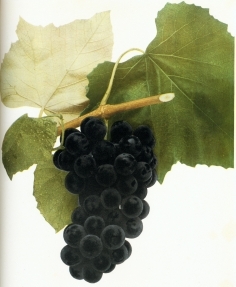
The Worden was originated by Schuyler Worden of Minetto, Oswego County, New York, from seed of Concord planted about 1863. It bore its first fruit when four years old. Its history is peculiar in that it was for many years unappreciated, being confused with Concord, which was frequently sent out as Worden. It was placed on the grape list of the American Pomological Society fruit catalog in 1881, where it still remains. The variety was given its name by J. A. Place of Oswego, New York, a local horticulturist of some note and a friend of Worden.
Vine vigorous, hardy, healthy, productive, yielding as heavy crops as Concord. Canes above medium in size and number, thick, dark brown with reddish tinge; nodes enlarged, flattened; internodes intermediate in length; diaphragm thick; pith of fair size; shoots pubescent; tendrils continuous, somewhat slender, bifid, sometimes trifid.
Leaf-buds small, short, slender, pointed, open in mid-season. Young leaves tinged on under side and along extreme margin of upper side with light rose-carmine. Leaves healthy, large, thick; upper surface dark green, glossy, smooth; lower surface light bronze, pubescent; leaf usually not lobed; petiolar sinus of average depth, medium to wide, often urn-shaped; teeth shallow, medium in width. Flowers fertile, open in mid-season or earlier; stamens upright.
Fruit ripens one or two weeks earlier than Concord, does not keep long. Clusters large, medium to long, broad, tapering to cylindrical, usually single-shouldered, somewhat compact; peduncle short, thick; pedicel of medium length, slender, covered with few small warts; brush long, light green. Berries large, roundish to oval, dark purplish-black to black, glossy, covered with heavy blue bloom, not always persistent, moderately firm. Skin of average thickness, somewhat tender, cracks badly, adheres slightly to the pulp, contains considerable dark red pigment, astringent. Flesh greenish, translucent, juicy, fine-grained, tough, slightly foxy, sweet at skin to tart at center, mild, good to very good in quality. Seeds adherent, one to five, average three, large, broad, medium to short, blunt, brownish; raphe buried in a shallow groove; chalaza of average size, slightly above center, oval, somewhat obscure.
WORDEN

WYOMING. (Labrusca.)
1. N. Y. Ag. Soc. Rpt., 1868:230. 2. Downing, 1869:558. 3. Am. Hort. An., 1871:83. 4. Horticulturist, 29:339. 5. Bush. Cat., 1883:145. 6. Am. Pom. Soc. Rpt., 1885:103. 7. W. N. Y. Hort. Soc. Rpt., 30:89. 1885. 8. Am. Pom. Soc. Cat., 1889:24. 9. Am. Gard., 12:48. 1891. 10. Ill. Sta. Bul., 28:262. 1893. 11. Va. Sta. Bul., 94:139. 1898. 12. N. Y. Sta. An. Rpt., 17:537, 548, 557. 1898. 13. Mo. Sta. Bul., 46:41, 42, 44, 46, 54. 1899. 14. Mich. Sta. Bul., 169:178. 1899. 15. Kan. Sta. Bul., 110:238. 1902.
Hopkins Early Red (2). Wilmington Red (3, 5). Wyoming Red (1, 2, 4, 6, 8, 9, 10, 11, 13, 14, 15). Wyoming Red (5).
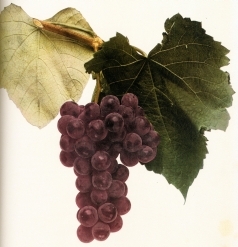
Such value as Wyoming has lies in its hardiness, productiveness, healthiness and earliness. The general appearance of the fruit of the variety is very good; the bunches are well-formed and composed of rich amber-colored berries of medium size. But the quality is poor, being that of the wild Labrusca in foxiness of flavor and in the flesh characters. It is not nearly as valuable as some other of the red Labruscas hitherto described and can hardly be recommended for either the garden or the vineyard. It may be of value in breeding work and possibly for localities in which grapes are precariously hardy or in which more fastidious varieties cannot be grown. Wyoming is illustrated in The Grapes of New York chiefly because it is a typical red Labrusca though in times past it has been of commercial importance and hence has some historical interest.
Wyoming was introduced to public notice by Dr. S. J. Parker of Ithaca, New York, who states that it came from northern Pennsylvania in 1861. About 1870 it was fruited in central New York where it immediately attracted attention and was exhibited at various fairs and horticultural society meetings. It was named after the Wyoming Valley, beyond which place it could not be traced, and where it presumably originated. The variety was first known as Wyoming Red but later the Red was dropped. Another variety under the name Wyoming preceded this. It was a black-fruited sort of apparently no value and seems now to be obsolete. The name Wilmington Red has been used to designate this variety, by what authority does not appear, as it was apparently first described under the name Wyoming Red. The Wyoming was placed on the grape list of the American Pomological Society fruit catalog in 1889 and removed in 1899. In spite of the fact that this variety has been discarded by the American Pomological Society, it is still offered for sale by many grape nurserymen.
Vine vigorous, hardy, healthy, productive to very productive. Canes medium to below in length, numerous, slender, dark reddish-brown, surface covered with a slight amount of blue bloom; nodes enlarged, frequently flattened; internodes short to medium; diaphragm medium to below in thickness; pith medium in size; shoots thinly pubescent; tendrils continuous, rather short, bifid.
Leaf-buds small, short, slender, pointed to conical, open late. Young leaves slightly tinged on under side only with faint rose-carmine. Leaves medium in size, of average thickness; upper surface light green, dull, smooth; lower surface dull green with tinge of bronze, slightly pubescent; lobes none to three with terminus acute to acuminate; petiolar sinus medium to shallow, wide to medium; basal sinus usually none; lateral sinus shallow and wide when present; teeth shallow, of average width. Flowers sterile, open in mid-season; stamens reflexed.
Fruit usually ripens from a week to ten days earlier than Concord, keeps and ships well for a grape of its species. Clusters medium to small, frequently below average length, medium to rather slender, slightly cylindrical to tapering, usually not shouldered but sometimes with a small single shoulder, compact to medium. Peduncle short to medium, slender; pedicel short, slender, covered with few small warts; brush slender, medium in length, pale green with brownish tinge. Berries above medium to small, roundish, dark dull red to rich amber red, covered with thin lilac bloom, persistent, firm. Skin medium in thickness, tender, adheres slightly to the pulp, contains no pigment, astringent. Flesh pale green, translucent, juicy, tough and solid, strongly foxy, vinous, sweet at skin to tart at center, poor in quality. Seeds do not separate easily from the pulp, one to three, average two and three, intermediate in size, breadth and length, slightly notched, usually rather blunt, light brown; raphe buried in a narrow, shallow groove; chalaza of average size, slightly above center, irregularly circular to oval, obscure.
WYOMING