Chapter V · THE LEADING VARIETIES OF AMERICAN GRAPES (continued 6)
Reading edition
Leaf-buds of average size, short, thick, conical to obtuse, open in mid-season. Young leaves tinged on under side and along margin of upper side with light brownish-carmine. Leaves intermediate in size, thick to medium; upper surface light green, dull, smooth to medium; lower surface grayish-white, pubescent; veins well defined; lobes three when present with terminus acute to acuminate; petiolar sinus of average depth, medium to wide; basal sinus lacking; lateral sinus very shallow and narrow when present; teeth deep to medium, intermediate in width. Flowers self-sterile to imperfectly self-fertile, open in mid-season; stamens upright.
Fruit ripens about with Concord or later, keeps well. Clusters medium to small, rather short, of average width, tapering to cylindrical, frequently single-shouldered, the shoulder being connected to the bunch by a long stem, compact; peduncle medium to short, intermediate in size; pedicel short, slender, nearly smooth; brush of fair length, tinged with red. Berries medium to small, oval to roundish, often compressed, black, glossy, covered with abundant blue bloom, persistent, firm. Skin medium to thin, tough, adheres slightly to the pulp, with wine-colored pigment, astringent. Flesh medium green, translucent, juicy, fine-grained, tender and melting, vinous, sweet to agreeably tart, fair to good in quality. Seeds separate easily from the pulp, one to five, average three, small, broad, faintly notched, short, plump, brownish; raphe obscure; chalaza intermediate in size, slightly above center to central, oval to nearly circular, somewhat obscure. Must 90°.
MONTEFIORE

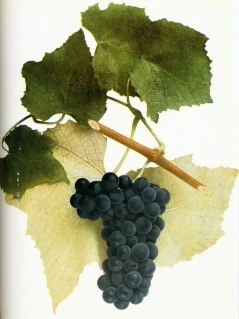
MOORE EARLY
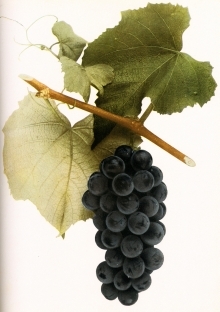
MOORE EARLY. (Labrusca.)
1. Mass. Hort. Soc. Rpt., 1871:43. 2. Ib., 1872:94. 3. Ib., 1873:101. 4. Ib., Pt. 2:81, 82, 109. 1877. 5. Am. Pom. Soc. Rpt., 1881:32, 40, 41. 6. Am. Pom. Soc. Cat., 1881:24. 7. Mich. Pom. Soc. Rpt., 1886:225. 8. Am. Pom. Soc. Rpt., 1887:97. 9. N. Y. Sta. An. Rpt., 9:327. 1890. 10. Can. Hort., 15:95. 1892. col. pl. 11. Ia. Hort. Soc. Rpt., 1893:161. 12. Bush. Cat., 1894:158. fig. 13. Col. Sta. Bul., 29:19. 1894. 14. Tenn. Sta. Bul., Vol. 9:184, 195. 1896. 15. N. Y. Sta. An. Rpt., 15:430, 431, 432, 433. 1896. 16. Vt. Sta. Bul., 62:41. 1898. 17. N. Y. Sta. An. Rpt., 17:533, 541, 543, 544, 545, 547, 552. 1898. 18. Mich. Sta. Bul., 169:173. 1899. 19. Rural N. Y., 66:173. 1907.
Moore Early is the standard grape of its season in New York. It cannot be better described than as an early Concord. It comes in season from two to three weeks earlier than Concord and the last fruits of it are sent to market before those of the later grape are picked. The vines are readily recognizable from those of Concord, differing chiefly in being less productive and more precarious bearers. To grow the variety satisfactorily the soil must be rich, well drained and loose, must be frequently cultivated and the vines should be carefully pruned and cared for in every way. The bunches of Moore Early are not as large as those of Concord and are more inclined to looseness, and the berries sometimes shell rather badly. The berries are larger and, as with Concord, crack under unfavorable conditions. The flesh characters and the flavor are essentially those of Concord, though the quality, representing all of the characters which make a fruit pleasant to the palate, is not as high as in the older variety; it is however much higher than that of Champion and Hartford, its chief competitors in this State and varieties which it should replace. Moore Early is by no means an ideal grape for its season but until something better is introduced it will probably remain the best early commercial grape for New York.
Captain John B. Moore of Concord, Massachusetts, is said to have originated this variety from seed of Concord. In 1871 it was exhibited before the Massachusetts Horticultural Society with fifty other seedlings of the same parentage. It was awarded a first class certificate of merit by this Society in 1877, and was introduced by the originator the same year. In 1881 Moore Early was placed on the grape list of the American Pomological Society fruit catalog where it still remains.
Vine medium to vigorous, hardy, not a heavy yielder. Canes medium to short, of average number, medium to below in thickness, rather dark reddish-brown, surface slightly roughened; nodes enlarged, flattened; internodes short to medium; diaphragm thinnish; pith intermediate in size; shoots pubescent; tendrils continuous, of fair length, bifid to trifid.
Leaf-buds small and slender, short, pointed to conical, open medium early. Young leaves tinged on lower side and along margin of upper side with rose-carmine. Leaves large to medium, thick; upper surface medium dark green, dull, of average smoothness; lower surface tinged with bronze, heavily pubescent; veins distinct; leaf usually not lobed, with terminus acute; petiolar sinus of average depth, wide to medium; basal sinus lacking; lateral sinus a notch when present; teeth shallow, narrow to medium. Flowers fertile, open in mid-season; stamens upright.
Fruit ripens from two to three weeks earlier than Concord, does not keep well. Clusters intermediate in size, length, and breadth, irregularly cylindrical to tapering, sometimes single-shouldered, inclined to looseness; peduncle short to medium, thick; pedicel short, thick, nearly smooth; brush short, pale green. Berries large to above medium, roundish, dark purplish-black to black, covered with abundant blue bloom, not very persistent, nearly firm. Skin intermediate in thickness, tender, adherent to the pulp, contains dark purplish-red pigment, not astringent. Flesh greenish, translucent, juicy, fine-grained and tough, with slight foxiness, sweet next the skin but somewhat acid at center, fair to good in quality. Seeds adherent, one to four, average two and three, large, often irregular in shape, broad and plump, blunt, brown with yellow tinge at tips; raphe buried in a small and indistinct groove; chalaza of average size, obscure, often showing as a faint, irregular depression.
MOYER. (Labrusca, Bourquiniana.)
1. Columbus Hort. Soc. Rpt., 1887:218. 2. Ib., 1887:218. 3. Can. Hort., 11:265. 1888. col. pl. 4. W. N. Y. Hort. Soc. Rpt., 35:176. 1890. 5. Ib., 36:42. 1891. 6. Ill. Sta. Bul., 28:261. 1893. 7. Bush. Cat., 1894:159. 8. Can. Hort., 22:386. 1899. fig. 9. Mo. Sta. Bul., 46:40, 42. 1899. 10. Ont. Fr. Exp. Stas. Rpt., 6:20. 1899. fig. 11. Am. Pom. Soc. Cat., 1899:29.
Jordan (2). Jordan (5, 7). Moyer’s Early Red (1).
MOYER
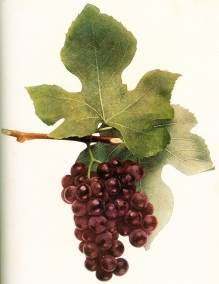
Moyer at its best is almost a counterpart of its parent Delaware. It has all of the faults of Delaware and some added ones. Were it not for the fact that the variety is from one to two weeks earlier than its parent, and somewhat hardier, hence better adapted for colder regions, it could not have received the recognition given it by viticulturists. As compared with Delaware, it is hardly as vigorous and is less productive. It is reputed to be more free from rot and mildew, the latter especially. The bunches are much like those of Delaware but with the fault of setting fruit imperfectly oftentimes even when cross-pollination is insured. The berries are a little larger but of much the same color and of like flavor, rich, sweet, and with pure vinousness without a trace of foxiness but withal not of so high quality as Delaware. The fruit keeps well, ships well, and does not crack nor shell in New York. Moyer is well established in Canada, where it originated, and is highly thought of, proving perfectly hardy wherever the Concord is grown and possibly standing even more cold. Its place is as an early Delaware for northern regions.
W. H. Read of Port Dalhousie, Lincoln County, Ontario, raised the original vine of Moyer about 1880, from seed of Delaware fertilized by Miller’s Burgundy. It was named after Allan Moyer of St. Catharines, Ontario, who introduced the variety in 1888. Moyer was placed on the grape list of the American Pomological Society fruit catalog in 1899.
Vine vigorous to medium, hardy, healthy, not productive. Canes intermediate in length, numerous, medium to slender, rather dull dark reddish-brown; nodes slightly enlarged, flattened; internodes short to medium; diaphragm thin; pith medium to below in size; shoots pubescent; tendrils continuous, medium to rather long, bifid to trifid.
Leaf-buds of about average size and thickness, short, conical to rather obtuse, open very late. Young leaves tinged on under side and along margin of upper side with rose-carmine. Leaves small to medium, of average thickness; upper surface dark green, dull and smooth; lower surface very pale green or with faint blue tinge, heavily pubescent; lobes two to five with terminus acute; petiolar sinus shallow to medium, not narrow; basal sinus usually lacking, but shallow when present; lateral sinus shallow, narrow; teeth very shallow, medium to narrow. Flowers sterile, open early; stamens reflexed.
Fruit ripens from one to two weeks earlier than Delaware, keeps well but loses its color if kept too long. Clusters medium to small, short and slender, irregularly tapering, sometimes single-shouldered, medium in compactness; peduncle intermediate in length, somewhat slender; pedicel inclined to short, of average thickness, covered with very small warts; brush yellowish-green. Berries medium to small, oblate, dark red covered with dark lilac to faint blue bloom, persistent, rather firm. Skin intermediate in thickness, not tender, does not adhere to the pulp, astringent. Flesh light green, translucent, juicy, rather tender, fine-grained, somewhat vinous, good to very good. Seeds separate easily from the pulp, one to four, average two or three, intermediate in size, broad, short, very blunt, brown with yellow tinge at tips; raphe obscure; chalaza of fair size, slightly above center, irregularly circular, obscure.
MUSCAT HAMBURG. (Vinifera.)
1. Gar. Chron., 1857:645. 2. Horticulturist, 13:167. 1858. 3. Ib., 14:95. 1859. 4. Am. Pom. Soc. Rpt., 1862:92. 5. Gar. Mon., 9:285. 1867.
As one of the parents of a number of valuable hybrids cultivated in American vineyards, Muscat Hamburg is illustrated and described in The Grapes of New York. It is described below in detail that grape-breeders may detect any of its characters transmitted to its offspring. The grapes and vines described here were grown under glass, as the variety cannot be grown out of doors in eastern America.
Muscat Hamburg is a forcing grape only and is apparently unknown in the grape-growing districts of Europe. It is said to grow better grafted on Black Hamburg than on its own roots.
Seward Snow of Wrest Park, Bedfordshire, England, originated Muscat Hamburg more than a half century ago from seed of Black Hamburg fertilized by White Muscat of Alexandria. It was placed on the grape list of the American Pomological Society fruit catalog for 1862 as an exotic recommended for growing under glass.
Vine very vigorous, tender, productive. Canes long, numerous, slender to medium, light brown, slightly darker at nodes which are enlarged and somewhat flattened; internodes short to medium; diaphragm thick; pith nearly large; shoots glabrous; tendrils inclined to dehisce early, intermittent or frequently with only one tendril present with vacancy on either side, long, bifid to trifid.
Leaf-buds large, long to medium, inclined to thick. Leaves medium to large, intermediate in thickness; upper surface light green, dull, somewhat smooth; lower surface slightly lighter green than upper surface, faintly pubescent, densely hairy; lobes usually five with terminus acute to acuminate; petiolar sinus of average depth, medium to narrow, rarely closed or overlapping; basal sinus intermediate in depth; lateral sinus deep; teeth very irregular in depth and width, some teeth approaching a tendency to lobing.
MUSCAT HAMBURG (Reduced Size)
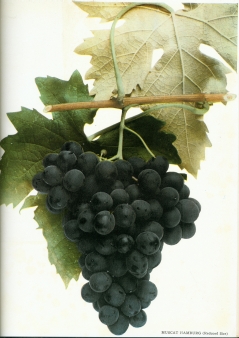
Fruit ripens the latter part of October under glass, keeps unusually well. Clusters very large to medium, long, broad, tapering, frequently single-shouldered but sometimes double-shouldered, rather loose; peduncle intermediate in length, medium to rather thick; pedicel of average length and thickness, very much enlarged at point of attachment to fruit. Berries large to below medium, oval, dark red, rather dull, covered with lilac bloom, very persistent, of average firmness. Skin medium to thick, adheres strongly to the pulp, contains no pigment, not astringent. Flesh pale green, translucent, very juicy, fine-grained, tender, vinous, sweet, very good to best in quality. Seeds separate easily from the pulp, one to four, average two, large to medium, long and broad, sharply pointed, brownish; raphe hidden in a shallow, broad groove; chalaza intermediate in size, decidedly above center, pear-shaped, distinct.
NAOMI. (Vinifera, Riparia, Labrusca.)
1. Gar. Mon., 22:176. 1880. 2. Ohio Hort. Soc. Rpt., 1882-3:46. 3. Bush. Cat., 1883:124. fig. 4. Can. Hort., 11:287. 1888. 5. Kan. Sta. Bul., 14:90. 1890. 6. Tex. Sta. Bul., 48:1151, 1160. 1898.
Naomi is one of Ricketts’ seedlings and, according to the originator, one of the finest of all his score or more of worthy grapes. But viticulturists have never agreed with the producer of Naomi in his estimate of it and the variety is now scarcely known. So far as New York is concerned, Naomi has been discarded because it ripens too late for this latitude and is very subject to mildew. Moreover, grapes of its color are not as highly esteemed as red or black grapes and the demand for green grapes does not sustain the varieties we have of this color.
This variety was originated by J. H. Ricketts of Newburgh, New York, from seed of Clinton fertilized with Muscat Hamburg. It was first exhibited before the American Pomological Society in 1879. It has not been widely disseminated.
Vine vigorous, hardy, variable in productiveness. Canes very long to medium, numerous, not uniform in size, medium dark brown deepening in color at the nodes; tendrils intermittent, bifid. Leaves large to below medium, thin, frequently inclined to be torn by heavy winds, medium green; lower surface pale green, slightly pubescent. Stamens upright. Fruit ripens late. Clusters large to above medium, above average in length, broad to medium, single-shouldered to sometimes double-shouldered, compact. Berries intermediate in size, roundish to oval, light green, occasionally with reddish-yellow tinge, glossy, covered with thin gray bloom, persistent. Skin moderately thick, tough, not astringent. Flesh greenish, juicy, slightly tough and solid, aromatic, sweet at skin to tart at center, good in quality when fully ripened. Seeds medium to below in size, elongated, sharp-pointed.
NECTAR. (Labrusca, Bourquiniana, Vinifera?)
1. Am. Pom. Soc. Rpt., 1883:92. 2. Ib., 1885:108. 3. Ohio Hort. Soc. Rpt., 1888-9:107. 4. Ohio Hort. Soc. Adv. Rpt., 1890:22. 5. Bush. Cat., 1894:160. 6. Ohio Hort. Soc. Rpt., 1894-5:12. 7. Del. Sta. An. Rpt., 7:134, 136. 1895. 8. Husmann, 1895:94. 9. Mass. Hatch Sta. Bul., 37:11, 14. 1896. 10. N. Y. Sta. An. Rpt., 17:533, 548, 556, 559. 1898. 11. Am. Pom. Soc. Cat., 1899:29. 12. Miss. Sta. Bul., 56:16. 1899. 13. Kan. Sta. Bul., 110:242. 1902. 14. Rural N. Y., 61:685, fig., 690. 1902.
Black Delaware (1, 2, 5, 6, 7, 9).
There are either two varieties under the supposedly synonymous names, Nectar and Black Delaware, or else this variety varies greatly in different localities. Reports from different sources give the vigor as from weak to vigorous, the hardiness from hardy to tender, the season from earlier than Moore Early to later than Concord, the size of berry from small to large, the productiveness from unproductive to productive to a fault.
The Nectar vines at this Station were secured from Caywood, the originator, in 1888, and from the T. S. Hubbard Company, in 1883. Vines from both sources are vigorous, small-leaved, bearing medium-sized black berries of good but not high quality. These vines are nearly worthless on account of their susceptibility to mildew. The resemblance to Delaware is not apparent.
We have received from Massachusetts, under the name Black Delaware, and there is described in several publications, a grape which is strikingly like Delaware except that the color is black. It is a grape of high quality, and the vine is described as being resistant to mildew. This variety may be worth something. The Nectar on the Station grounds is not. Possibly Nectar and Rommel’s Black Delaware have been confused.
The variety here described was originated by Caywood. It is said to be from seed of Concord fertilized by Delaware. Nectar first became known to the public about 1880 under the name Black Delaware, which was afterward changed by Caywood to Nectar. It was placed on the grape list of the American Pomological Society fruit catalog in 1899, as a recommended variety.
NECTAR
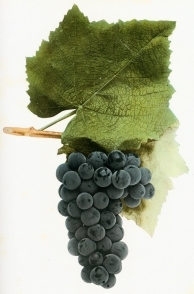
Vine medium to vigorous, not always hardy, usually produces light crops, very susceptible to attacks of mildew. Canes long, of average number, thick, surface roughened, dark reddish-brown; nodes enlarged, flattened; internodes variable in length, of medium thickness; pith intermediate in size; shoots pubescent; tendrils intermittent to continuous, long, trifid.
Leaf-buds medium to above in size, short and thick, open in mid-season. Young leaves faintly tinged on under side and along margin of upper side with rose-carmine. Leaves small to medium, thick; upper surface dark green, rugose, often heavily wrinkled; lower surface dull whitish or light gray, strongly pubescent; veins distinct; lobes three to five with terminus obtuse to acute; petiolar sinus medium in depth, wide; basal sinus shallow and open when present; lateral sinus medium to deep, often wide; teeth very shallow, medium to narrow. Flowers partly self-fertile, open moderately late; stamens upright.
Fruit ripens about with Concord, does not keep long in good condition. Clusters intermediate in size, length, and thickness, irregularly cylindrical to tapering, often single-shouldered but sometimes double-shouldered, medium to compact; peduncle variable in length, slender to medium; pedicel medium to short, slender, smooth; brush yellowish-green. Berries intermediate in size, roundish, dark purplish-black, dull, covered with heavy blue bloom, not very persistent, soft. Skin of average thickness, medium to somewhat thin, adheres considerably to the pulp, with wine-colored pigment, slightly astringent. Flesh pale yellowish-green, translucent, juicy, tough, fine-grained, vinous, sweet next the skin but quite acid at the center, good to very good in quality. Seeds rather adherent, one to four, usually three, intermediate in size, medium to long, brownish; raphe obscure; chalaza of average size, much depressed, strongly above center, circular, obscure.
NIAGARA. (Labrusca, Vinifera.)
1. Mass. Hort. Soc. Rpt., 1879:161. 2. Mich. Pom. Soc. Rpt., 1879:194, 323. fig. 3. Mass. Hort. Soc. Rpt., 1880:240, 254. 4. N. J. Hort. Soc. Rpt., 1881:9. 5. Am. Pom. Soc. Rpt., 1881:46. 6. Bush. Cat., 1883:124. 7. Am. Pom. Soc. Cat., 1885:26. 8. Minn. Hort. Soc. Rpt., 1886:134, 136. 9. Mo. Hort. Soc. Rpt., 1889:370. 10. Rural N. Y., 48:18, 19. 1889. figs. 11. Kan. Sta. Bul., 14:90. 1890. 12. Minn. Hort. Soc. Rpt., 1891:220. 13. Rural N. Y., 50:66, 230. 1891. 14. Ill. Sta. Bul., 28:265. 1893. 15. Bush. Cat., 1894:161. 16. N. Y. Sta. An. Rpt., 15:430, 431, 432, 433. 1896. 17. Ib., 17:533, 547, 552. 1898. 18. Mo. Sta. Bul., 46:40, 44, 45. 1899. 19. Mich. Sta. Bul., 169:173. 1899. 20. Ala. Sta. Bul., 110:70, 87. 1900. 21. N. C. Sta. Bul., 187:60. 1903. 22. Mich. Hort. Soc. Rpt., 1903:30.
Niagara is the leading American green grape, holding the rank among grapes of this color that Concord does among the black varieties. It is, however, a less valuable grape than Concord, and all in all, it is doubtful if it should be ranked much if any higher than several others of the green grapes with which it must compete. Much of the popularity of Niagara is due to the novel way in which the variety was sold to the public. For many years after its origin, the entire stock of this grape was owned by the Niagara Grape Company, who retained all of the propagating wood, and in many instances well guarded interests in the vineyards of this variety. The advantages gained by this method of distribution enabled the promoters of the variety to advertise it to an extent not equaled in the dissemination of any other grape. As is likely to be the case with new fruits, Niagara was overpraised by the company selling it and for a time by the horticultural press and viticulturists as well. When vineyards of the variety came into bearing, a reaction set in, and Niagara lost in popularity; many who had planted it condemned it and oftentimes unjustly. For years the reports for and against it were more or less colored by personalities and it has not been until a comparatively recent day that a just estimate of the variety could be obtained from grape-growers.
Since one of the parents of Niagara is Concord, and since the two grapes are largely grown in the same regions and for the same general markets, and chiefly as table grapes, we may best arrive at the status of Niagara by comparing it with Concord.
In vigor and productiveness, where the two grapes are upon equal footing as to adaptability, Niagara and Concord rank the same. In these respects both are standards scarcely surpassed among our cultivated native grapes. In hardiness of root and vine Niagara falls somewhat short of Concord; practically all grape-growers who have tested the two varieties in cold climates agree as to the greater hardiness of Concord. In some of the grape regions of New York Niagara is not grown profitably because of its susceptibility to cold. The variety cannot be relied upon without winter protection where the thermometer falls much below zero. Like Concord the Niagara has much of the foxiness of the wild Labrusca, distasteful to many palates. On the other hand there are many Americans who really like the foxy taste and aroma and count it an asset in these varieties. The foxiness of Niagara is most marked just after the fruit is picked, and it is usually better flavored after having stood for a few days. The flavor is not at its best unless the grapes be fully ripe. Both bunches and berries of Niagara are larger than those of Concord and are better formed, making a handsomer fruit if the colors are liked equally well. The skin of Niagara does not crack as easily as that of Concord. The fruit shells as badly and does not keep much, if any, longer. Both vines and fruits of Niagara are more susceptible to fungal diseases than are those of Concord and especially to black-rot, which proves a veritable scourge with this variety in unfavorable seasons and localities.
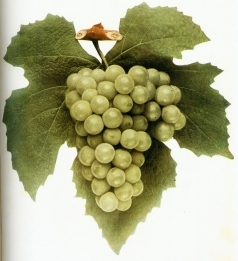
NIAGARA
It is likely that Niagara will continue for some time to be the leading green grape for the market. As long as grape consumers demand a showy grape to be had at a low price, and without much regard as to quality, if the grape be passably good, Niagara will be popular. For those who rank quality first, with appearance and reasonable cost as secondary consideration, there are other green grapes superior.
Niagara was produced by C. L. Hoag and B. W. Clark of Lockport, Niagara County, New York. The originators state that the variety was grown from seed of Concord fertilized by Cassady, planted in 1868, and that it fruited for the first time in 1872. It was introduced about 1882 by the Niagara Grape Company. In 1885 it was placed on the grape list of the fruit catalog of the American Pomological Society. Niagara has attained its greatest popularity and is most grown in New York and in the North. In the grape regions of the South and Southwest, it is too susceptible to fungi especially the mildews and black-rot. It is said that the quality of the variety, however, is improved as grown to the southward and that where comparatively free from diseases, or when they are controlled by spraying, it becomes a profitable early market grape. In Ohio, Niagara is grown more or less for wine. This variety is a typical white seedling of Concord showing little trace of any other variety.
Vine vigorous to medium, less hardy than Concord, productive to very productive, somewhat subject to mildew and black-rot in unfavorable locations. Canes medium to long, of average number, thick, dark reddish-brown deepening in color at the nodes which are strongly enlarged and slightly flattened; internodes medium to long, thick; pith large to medium; shoots pubescent; tendrils continuous, long, bifid to trifid.
Leaf-buds medium in size and thickness, short, slightly compressed, conical to pointed, open in mid-season. Young leaves lightly tinged on under side and along margin of upper side with rose-carmine. Leaves medium to large, thick; upper surface glossy, medium dark green, rather smooth; lower surface pale green, pubescent; veins distinct; lobes three to five with terminus acute to acuminate; petiolar sinus intermediate in depth and width; basal sinus shallow, wide, often toothed; lateral sinus of mean depth, wide, frequently toothed; teeth shallow, variable in width. Flowers fertile, open in mid-season; stamens upright.
Fruit ripens about with Concord, keeps fairly well. Clusters large to medium, long to medium, somewhat broad, tapering to often cylindrical, frequently single-shouldered, moderately compact; peduncle short to medium, thick; pedicel intermediate in length, thick, covered with few, small, inconspicuous warts; brush pale green, medium to long. Berries above medium to large, slightly oval, light green changing to a pale yellowish-green tinge as the ripening season advances, covered with thin gray bloom, persistent, firm. Skin thin, tender, adheres somewhat to the pulp, contains no pigment, slightly astringent. Flesh light green, translucent, juicy, fine-grained, moderately tender, foxy, sweet next the skin to agreeably tart at center, as good or better than Concord in quality. Seeds separate rather easily from the pulp, one to six, average three, intermediate in size, length and breadth, deeply notched, brownish; raphe buried in a deep groove; chalaza of fair size, above center, circular to oval, moderately distinct.
NOAH. (Riparia, Labrusca.)
1. Gar. Mon., 22:176. 1880. 2. Am. Pom. Soc. Cat., 1881:24. 3. Am. Pom. Soc. Rpt., 1883:58. 4. Mo. Hort. Soc. Rpt., 1883:40, 185. 5. Ib., 1884:217. 6. N. Y. Sta. An. Rpt., 11:631. 1892. 7. Ill. Sta. Bul., 28:265. 1893. 8. Bush. Cat., 1894:162. fig. 9. N. Y. Sta. An. Rpt., 17:548, 556, 559. 1898. 10. Tex. Sta. Bul., 48:1151, 1160. 1898. 11. Mo. Sta. Bul., 46:40, 43, 44, 45. 1899. 12. Traité gen. de vit., 5:171. 1903.
For some years after its introduction in 1876, Noah was quite popular on account of its vigor, supposed health, productiveness, and the high alcoholic content of its wine. It is now, however, but little grown outside of Missouri where it is still used somewhat in wine-making. In France Noah was largely grown for a time both as a stock for grafting and as a direct producer for the making of wine and brandy. Probably no other American grape has caused more general discussion, or received more praise and more condemnation in France, with the result that it is now but little grown. The name was given the variety on account of the alcoholic strength of its wine, the originator holding that the lamentable accident which befell the patriarch Noah could easily have happened had he partaken of the wine of this grape.
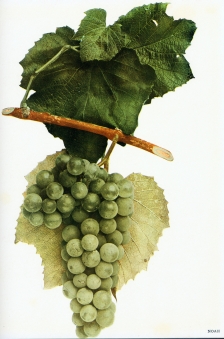
NOAH
Noah is so like Elvira that the two are often confused. There are, however, very marked differences in the vine characters; and the clusters of Elvira are smaller, the berries more foxy in taste and the skins more tender and crack much more than do those of Noah. The large, dark, glossy green leaves make the vines of this variety very handsome and a vineyard of them is a pleasing sight. As with Elvira, Othello, Rommel, and other varieties of this group of grapes, Noah is of little value in New York. These grapes are fit only for wine but the wine-makers in this State seem not to have found them desirable for their wants. Noah shatters badly and does not keep nor ship at all well, and buyers therefore do not care for it.
Noah was originated by Otto Wasserzieher of Nauvoo, Illinois, from seed of Taylor planted in 1869, and fruited for the first time in 1873. It was exhibited before the American Pomological Society in 1879. It was placed on the grape list of the American Pomological Society fruit catalog in 1881. Noah shows, like its parent, characters of both Riparia and Labrusca. The vine characters are markedly those of Riparia and, among others of these, the healthiness of the foliage is an asset of the variety; the Labrusca shows more plainly in the fruit of Noah than in that of Taylor, the berries being larger and having more of the foxiness than the last named variety.
Vine medium to sometimes vigorous, not hardy in severe winters, productive, susceptible to attacks of mildew. Canes long, of average number, thick to medium, dark brown, surface roughened; nodes enlarged, flattened; internodes intermediate in length; diaphragm of mean thickness; pith medium in size; shoots slightly pubescent; tendrils usually continuous, of average length, bifid to trifid.
Leaf-buds medium to small, very short, thick to medium, somewhat compressed, obtuse, open very late. Young leaves faintly tinged on under side and along margin of upper side with rose-carmine. Leaves large to medium, of average thickness; upper surface dark green, glossy, smooth; lower surface pale green, thinly pubescent; veins distinct; leaf usually not lobed, with terminus acuminate; petiolar sinus deep to medium, rather wide; basal sinus lacking; lateral sinus very shallow when present; teeth somewhat shallow, moderately wide. Flowers sterile to semi-fertile, open early; stamens upright.
Fruit ripens with Concord or later, does not ship nor keep well. Clusters variable in size and length, above average breadth, cylindrical to nearly tapering, usually single-shouldered, medium to compact; peduncle intermediate in length, thick; pedicel short to medium, covered with few, small warts; brush medium to short, brownish. Berries small, usually roundish, light green tinged with yellow, somewhat dull, covered with thin gray bloom, not persistent, nearly firm. Skin variable in thickness and tenderness, adheres to the pulp, contains no pigment, not astringent. Flesh yellowish-green, translucent, juicy, tough, fine-grained, vinous, tart at skin to acid at center, sprightly, good in quality. Seeds separate with difficulty from the pulp, one to four, average two or three, intermediate in size and breadth, rather dark brown; raphe buried in a shallow groove; chalaza of average size, slightly above center, oval, obscure. Must 100°.
NORFOLK. (Labrusca, Vinifera.)
1. Mass. Hort. Soc. Rpt., 1872:95. 2. Ib., Pt. 2:120. 1875. 3. Kan. Sta. Bul., 28:164. 1891. 4. Ill. Sta. Bul., 28:261. 1893. 5. Bush. Cat., 1894:163, 186. 6. Del. Sta. An. Rpt., 7:135, 139. 1895. 7. N. Y. Sta. An. Rpt., 17:533, 548. 1898. 8. Va. Sta. Bul., 94:138. 1898. 9. Mo. Sta. Bul., 46:40, 42, 44, 46, 51. 1899.
Norfolk Muscat (1, 2).
Norfolk was disseminated as an early Catawba and it resembles that variety very much in appearance and somewhat in flavor, but ripens much earlier. Unlike the Catawba too, the fruit does not keep well, nor is the flavor quite up to the high quality of the older variety, more nearly resembling, as it grows here, that of Agawam. It is not, however, the fruit characters so much as those of the vine that have kept Norfolk from becoming popular. It falls short in several vine characters, chiefly in productiveness, and after having been known for many years is now scarcely cultivated.
N. B. White[203] of Norwood, Massachusetts, originated this variety some time in the sixties from seed of a native Labrusca fertilized with Black Hamburg.
Vine medium to vigorous, usually hardy, variable in productiveness. Canes long, numerous, thick; tendrils usually intermittent, bifid to trifid. Leaves large to medium, moderately light green, thick; lower surface grayish-white with tinge of bronze, pubescent. Flowers nearly fertile, open early; stamens upright. Fruit ripens earlier than Concord, does not keep very well. Clusters medium to small, often broad, tapering, usually with a long single shoulder, loose. Berries large to medium, oval to roundish, dark purplish-red somewhat resembling Catawba, covered with a fair amount of dark lilac or faint blue bloom, shatter, rather soft. Skin thin, inclined to tender, astringent. Flesh somewhat tough, stringy, rather coarse, vinous, sweet at skin to acid at center, fair in quality. Seeds adhere to the pulp, numerous, quite large, long to medium, distinctly notched.
NORTHERN MUSCADINE. (Labrusca.)
1. Horticulturist, 9:518. 1854. 2. U. S. Pat. Off. Rpt., 1854:315. 3. Mag. Hort., 22:25. 1856. 4. Am. Pom. Soc. Rpt., 1856:166. 5. Ib., 1862:143. 6. Am. Pom. Soc. Cat., 1862:90. 7. Phin, 1862:259. 8. Minn. Hort. Soc. Rpt., 1877:59. 9. Bush. Cat., 1883:126. 10. N. Y. Sta. An. Rpt., 17:533, 548, 556. 1898. 11. Tex. Sta. Bul., 48:1151, 1160. 1898. 12. Mo. Sta. Bul., 46:40, 42, 44, 46. 1899.
Early Northern Muscadine (2, 7).
To those who profess to like a foxy grape, the Northern Muscadine should be the grape par excellence. Many of the differences in opinion to be found in grape literature regarding the quality of grapes have hinged upon whether foxiness in taste and aroma is liked or not. Thus some horticulturists put Northern Muscadine, both for the table and for wine, well toward the head of the list of American grapes, while others condemn it as unfit to eat. The fact that this variety, with Lucile, Lutie, and others with the foxy taste strongly marked, has not become popular, in spite of particularly good vine characters, is presumptive evidence that the American public do not want such grapes. In appearance of fruit Northern Muscadine is much like Lutie, and much like it in quality, the two being distinguished from most other grapes by an unmistakable odor. A serious defect of the fruit is that the berries shatter badly as soon as the grape reaches maturity. Taken as a whole, the vine characters of this variety are very good and it offers possibilities for the grape-breeder because of them. It cannot be recommended for either the vineyard or the garden.
This variety originated at New Lebanon, Columbia County, New York. It was first brought to notice by D. J. Hawkins and Philemon Stewart of the United Society of Shakers at that place about 1852. It was placed on the grape list of the American Pomological Society fruit catalog in 1862 and dropped in 1871. It is a typical red Labrusca in all of its characters.
Vine variable in vigor and productiveness, healthy, not always hardy. Canes intermediate in length and number, medium to slender, dark brown, sometimes with a a slight red tinge, heavily pubescent; tendrils continuous, bifid, dehisce early. Leaves medium to very large and of distinct Labrusca type, inclined to roundish, thick; upper surface of medium greenness, dull, medium to rugose; lower surface dark bronze, heavily pubescent; veins well defined. Flowers fertile to sterile, open in mid-season or earlier; stamens upright.
Fruit ripens about with Worden, does not keep well. Clusters medium to small, short, of average width, frequently oval but sometimes roundish, occasionally single-shouldered, medium to compact. Berries medium to large, roundish to oval, dark amber to dull brownish-red, covered with thin gray bloom, drop badly from pedicel. Skin variable in thickness, medium to tough, adheres considerably to the pulp, contains little or no pigment, slightly astringent. Flesh very pale green, juicy, fine-grained, tender and soft, unusually foxy, sweet, poor in quality. Seeds separate easily from the pulp, often numerous, large, broad, faintly notched, long, not blunt, brownish; raphe obscure; chalaza of average size, slightly above center, variable in shape, often showing as an obscure depression.
NORTON. (Aestivalis, Labrusca.)
1. Prince, 1830:186. 2. U. S. Pat. Off. Rpt., 1845:939. 3. Horticulturist, 12:461. 1857. 4. Am. Pom. Soc. Rpt., 1858:68. 5. Ib., 1860:88. 6. Horticulturist, 16:16, 286. 1861. 7. U. S. Pat. Off. Rpt., 1865:197. 8. Horticulturist, 20:39. 1865. 9. Husmann, 1866:19, 48, 85, 87, fig., 98. 10. Horticulturist, 22:355. 1867. 11. Am. Pom. Soc. Cat., 1867:44. 12. Am. Pom. Soc. Rpt., 1867:111. 13. Grape Cult., 1:5, 74, 98, 122, 138, 150, 212, 296. 1869. 14. Bush. Cat., 1883:126. 15. Am. Pom. Soc. Rpt., 1885:100. 16. Ib., 1889:109. 17. Mo. Hort. Soc. Rpt., 1891:131. 18. Am. Gard., 20:688. 1899. 19. Mo. Sta. Bul., 46:40, 43, 45, 51, 54. 1899. 20. N. Y. Sta. An. Rpt., 18:397. 1899. 21. Mo. Hort. Soc. Rpt., 1905:59.
Norton’s Seedling (9). Norton’s Virginia (3, 5, 6, 7, 8, 9, 10, 11, 12, 13, 15, 21). Norton’s Virginia (14, 18). Norton’s Virginia Seedling (1, 2, 4). Virginia Seedling (9, 13).
Norton is the leading wine grape in eastern America, and, if we except Cynthiana, which can hardly be told from it, the wine made from it is the best of its class made in the regions in which the variety will grow. The fruit is of small value for any other purpose than wine. Norton is fairly hardy but requires a long warm season to reach maturity. While it is said that it may be grown wherever Catawba thrives, this has not proved to be the case in New York; Norton in this State is far more precarious than Catawba in maturity, so much so that it is now scarcely grown even in the most favored parts of New York. It has great adaptability to soils and thrives in rich alluvials or clays, gravels or sands, the only requisite seemingly being a fair amount of fertility and soil warmth. The vines are robust, very productive, especially on fertile soils, as free, or more so, from fungal diseases than any others of our native grapes, and very resistant to phylloxera.
NORTON
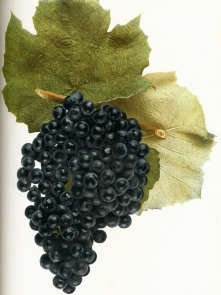
The bunches of Norton are of medium size, not averaging nearly as large as the one shown in the illustration, and the berries are small; the fruit is not at all attractive in appearance. The grapes are pleasant eating when fully ripe, rich and spicy, and pure-flavored but tart if not quite ripe; but still are in no sense table grapes. The fruit keeps well. The cluster usually ripens evenly and the berries neither shatter nor crack. The variety is difficult to propagate from cuttings and to transplant, and the vines do not bear grafts readily.
Norton has been used to quite an extent in breeding work and the blood may be found in a number of desirable grapes but it is not a prolific parent of worthy grapes as has been the case with so many of its contemporary varieties. Like Concord, Norton gives, in experimental work, many white seedlings.
The origin of Norton is rather uncertain. In 1830 Prince writes that he received the grape from Dr. D. N. Norton, one of the pioneer grape-growers of Richmond, Virginia, who had originated it from the seed of Bland with Miller’s Burgundy growing nearby. This parentage, it appeared later, was undoubtedly an error as the Norton shows none of the characters of either Bland or Miller’s Burgundy. Prince’s description leaves little doubt but that his Norton was the Norton of to-day. In 1861 there was an article published in the Horticulturist[204] by a Mr. Lemosy saying that the original Norton vine had been discovered in 1835 by his father, Dr. F. A. Lemosy of Richmond, Virginia, on an island in the James River and that Dr. Norton secured the variety from this source. Since Norton had sent this variety to Prince prior to 1830, this story is evidently wrong as to dates and is suspicious as to facts. It is probable that the true history of the variety will never be known. Many grapes of the Norton class have been found at the South, a fact which has led to much confusion as to the origin of varieties as well as in the varieties themselves. Grapes of the Norton type were not looked upon with favor by the early viticulturists and it was not until some years after its introduction that the variety was widely planted—and then in Missouri and not in the region of its origin. The Norton was placed on the grape list of the American Pomological Society fruit catalog in 1867, and is yet retained.
This variety has been usually classed as Aestivalis, which is approximately correct although most viticulturists agree that there is a strain of Labrusca present as indicated by the occasional continuity of tendrils. Millardet, of France, believes that the variety may contain a strain of Cinerea as well. But in fruit at least, Norton is essentially a variety of Aestivalis.
Vine very vigorous, healthy, usually hardy but sometimes half-hardy, an uncertain bearer at this Station but producing heavy crops in more southern localities. Canes long, of average number, thick to medium, dark brown to reddish-brown, surface covered with considerable blue bloom; nodes much enlarged; internodes medium to long; diaphragm thick; pith large to medium; shoots pubescent; tendrils intermittent, occasionally continuous, long, bifid to sometimes trifid.
Leaf-buds above average size and thickness, short to medium, often compressed, obtuse to conical, open late. Young leaves considerably tinged on upper and under sides with bright carmine. Leaves medium to large, irregularly roundish, of average thickness; upper surface green, dull, rugose on older leaves; lower surface pale green, slightly pubescent; veins indistinct; leaf usually not lobed with terminus acute to sometimes obtuse; petiolar sinus deep to medium, narrow, sometimes closed and overlapping; basal sinus usually absent; lateral sinus shallow to a mere notch when present; teeth variable in depth and width. Flowers self-fertile, open late; stamens upright.
Fruit ripens too late for this locality, keeps well when properly matured. Clusters medium to small, inclined to short, moderately broad, tapering, usually single-shouldered, medium to compact; peduncle short to medium, thick, sometimes flattened; pedicel intermediate in length, slender, covered with few warts; brush dull, wine-colored. Berries medium to small, roundish to oblate, black, somewhat glossy, covered with heavy blue bloom, persistent, soft. Skin thin, of average toughness, does not adhere to the pulp, contains a large amount of dark red pigment, no astringency. Flesh greenish, translucent, juicy, tender, spicy, tart and somewhat astringent. Seeds separate fairly easily from the pulp, two to six, average three, numerous, medium to small, intermediate in breadth and length, not notched, brownish; raphe distinct; chalaza small, above center, circular, obscure. Must 105°-110°.
NORWOOD. (Vinifera, Labrusca.)
1. Mass. Hort. Soc. Rpt., 1880:231. 2. Am. Pom. Soc. Rpt., 1881:43. 3. Ill. Sta. Bul., 28:256. 1893. 4. Bush. Cat., 1894:164. 5. N. Y. Sta. An. Rpt., 13:605. 1894. 6. Col. Sta. Bul., 29:19. 1894. 7. N. Y. Sta. An. Rpt., 17:533, 545, 546, 548, 552. 1898. 8. Kan. Sta. Bul., 110:242. 1902.
Norwood is a Labrusca-Vinifera cross-breed of the same specific parentage as Rogers’ hybrids which it greatly resembles. It is rather more hardy than most other grapes of its breeding and is preeminently a long keeper, surpassing most of the similar hybrids in this respect, though all of these are notable for their keeping quality. But the variety is incapable of self-fertilization and does not set its fruit well even in a mixed vineyard, which fault should debar it from either the commercial or the amateur list. The quality is from good to very good.
N. B. White originated Norwood from seed of Concord fertilized with Black Hamburg. It was introduced about 1880 and has been rather widely tested but has never been popular, and is now seldom seen in varietal vineyards.
Vine vigorous, subject to winter injury in unfavorable locations, variable in productiveness. Canes intermediate in length and number, slender; tendrils continuous to intermittent, bifid. Leaves large, not uniform in color, thin; lower surface grayish-green, thinly pubescent. Flowers sterile to imperfectly self-fertile, open late; stamens short. Fruit ripens a little earlier than Concord, keeps and ships well. Clusters large to medium, often long and broad, irregularly tapering, sometimes heavily single-shouldered, intermediate in compactness. Berries large, roundish to oval, purplish-black covered with heavy blue bloom, very persistent, firm. Skin thick, rather tough, adheres considerably to the pulp, decidedly astringent. Flesh greenish, tough, stringy, slightly foxy, sweet at skin to acid at center, good to very good in quality. Seeds adherent, rather large, long, sharp-pointed.
(I) OHIO. (Bourquiniana.)
1. Mag. Hort., 8:168. 1842. 2. Ib., 9:191, 430. 1843. 3. Downing, 1845:251, 257. 4. U. S. Pat. Off. Rpt., 1845:937, 940. 5. Ib., 1847:465. 6. N. Y. Ag. Soc. Rpt., 1848:366. 7. Thomas, 1849:398. 8. Mag. Hort., 16:546. 1850. 9. Horticulturist, 6:224. 1851. 10. Bush. Cat., 1883:127. 11. Tex. Farm and Ranch, Feb. 8, 1896:11. 12. Traité gen. de vit., 6:374. 1903.
Alabama (12). Black Spanish (12). Black Spanish Alabama (12,?10). The Black (12). Blue French (12). Burgundy (12). Cigar Box (2, 8, 9, 11, 12). Devereaux (12). El Paso (12). Jack (9, 10, 12). Jacques (10, 12). Jacquez (12). Jac (12). Jacquet (12). Lenoir (12). Longworth’s Ohio (4, 8). Longworth’s Ohio (3, 7, 10, 11, 12). MacCandless (12). Ohio (12). Segar Box (3, 6, 7, 10, 12).
At one time Ohio attracted a great deal of attention in southern grape regions as a wine grape of the Lenoir group but was discarded as inferior to other similar grapes, lacking chiefly in hardiness and in health of vine. The grape is somewhat interesting from its singular history.
In 1834 some grape cuttings in a cigar-box were left at the home of Nicholas Longworth of Cincinnati, Ohio, during Mr. Longworth’s absence from home. The man who left them did not return and Longworth could not succeed in tracing the donor’s identity. From these came Ohio.
The Ohio has, at different times, been said to be the same, in turn, as Herbemont, Lenoir and Norton. In regard to the first, Longworth had Herbemont in cultivation before he received the Ohio and neither he nor his vineyardists failed to see distinct and constant differences between the two varieties. The last two are disposed of in the Cincinnati Horticultural Society Report given on the next page. Longworth and others corroborated these statements from their own comparisons of the varieties growing in the vineyards around Cincinnati. Many grape-growers, and Longworth of the number, have been of the opinion that Ohio might be the same as the variety cultivated in Mississippi under the name Jack or Jacques, both names being corruptions of Jacquez, an old Spaniard who had introduced the grape into the section around Natchez. The Ohio is probably now obsolete. It did not succeed north of Cincinnati and its culture was dropped in the place of its origin on account of its susceptibility to mildew and black-rot.
The following description of Ohio is taken from a report to the Cincinnati Horticultural Society:[205] “Very fine specimens of the grape cultivated under this name, were presented by N. Longworth and J. E. Mottier, some of the bunches measuring nine inches in length. As there has been some belief expressed by eastern cultivators, that this grape is the same as Norton’s Seedling, of Virginia, the committee took pains to examine them together, in Mr. Longworth’s garden, where both were pointed out to us by Mr. Sleath, the gardener. The difference between the two was at once apparent and striking. In the grape shown as the Norton’s Seedling, said by Mr. Sleath to have been obtained from Mr. Norton himself, the wood is not so bright a red as in the Ohio, and the leaf is large and entire, whereas that in the Ohio is three-lobed; the bud is also much less prominent and not so pointed as in the Ohio. The bunches of fruit in the Norton’s Seedling were shorter and more compact, with a thick pulp. In the Ohio, the bunches were long, very much shouldered, conical or sharp-pointed, and the fruit without pulp—sweeter, more juicy and vinous in flavor, and the seeds smaller, darker colored and less numerous than in the Norton’s Seedling.
“The Committee think the grape brought into notice here, by N. Longworth, Esq., under the names of the Ohio or Cigar box, a valuable and distinct variety, and well worthy of cultivation. This grape has a stronger resemblance to the Le Noir which was also growing near; but its bunches were more shouldered, more pointed, and less compact.”
(II) OHIO. (Labrusca.)
1. U. S. D. A. Rpt., 1892:264. 2. Am. Pom. Soc. Rpt., 1895:75.
Another Ohio originated with R. H. Hunt of Euclid, Ohio, about twenty years ago. Of this variety Van Deman says:
“Cluster large, tapering, slightly shouldered. Berry rather large, round, black with slight bloom; skin rather thick, tender; pulp moderately juicy, tender. Seeds small, three or four in number. Flavor mild, slightly subacid; quality medium. Season early.”
This variety is not in the collection of this Station and we have not been able to find either vines or fruit.
ONEIDA. (Vinifera, Labrusca.)
1. Bush. Cat., 1883:128. 2. Mass. Hatch Sta. Bul., 2:21. 1888. 3. Ill. Sta. Bul., 28:261. 1893. 4. N. Y. Sta. An. Rpt., 17:533, 548, 556. 1898. 5. Mich. Sta. Bul., 169:174. 1899. 6. Ga. Sta. An. Rpt., 13:328. 1900. 7. N. Y. Sta. An. Rpt., 21:396. 1902.
Oneida is a New York seedling, interesting as an offspring of the Vinifera-Labrusca hybrid Merrimac. It was sold by subscription in 1884 and thereby somewhat widely distributed but has not generally been reported upon with favor and is of doubtful value. There are many complaints of its being unfruitful and some of its being unhealthy and in consequence a weak grower. In some sections, however, it is fairly satisfactory. While it keeps well it is said to lose flavor soon after picking. Oneida is one of the rare sorts with erect stamens and yet self-sterile.
H. Thacher of Oneida County, New York, originated Oneida from seed of Merrimac planted in 1871. It bore its first fruit in 1875 and was introduced by A. M. Purdy of Palmyra in 1884. The vine characters are largely those of Labrusca but the fruit shows very strongly the descent from Vinifera. Unlike the berries of Labrusca there is no disagreeable taste near either skin or seeds and the texture of skin and flesh is much like that of the European Malaga.
Vine medium in vigor, not hardy, variable in productiveness, somewhat subject to attacks of fungi. Canes medium to long, numerous, often rather slender, roughened; tendrils continuous, bifid. Leaves large to medium, moderately light green; lower surface pale green, pubescent. Flowers sterile, open medium late; stamens upright. Fruit ripens later than Concord, keeps well. Clusters small to medium, tapering, usually single-shouldered, loose. Berries variable in size, roundish, handsome red in color, almost equal to Delaware although in some seasons the berries have an unattractive greenish-red color. Skin thick, adheres considerably to the pulp. Flesh somewhat stringy, tender, vinous, sweet from skin to center, with some Vinifera sprightliness, fair to good in quality. Seeds separate easily from the pulp, not numerous, rather large, broad, short, plump, usually with a small enlarged neck; chalaza large, distinct, roughened.
OPORTO. (Riparia, Labrusca.)
1. Mag. Hort., 26:552. 1860. fig. 2. U. S. Pat. Off. Rpt., 1861:477. 3. Am. Pom. Soc. Cat., 1862:90. 4. Am. Pom. Soc. Rpt., 1862:157. 5. Strong, 1866:352. 6. Husmann, 1866:124. 7. Fuller, 1867:247. 8. Am. Jour. Hort., 4:275. 1868. 9. Am. Pom. Soc. Rpt., 1871:108. 10. Mich. Pom. Soc. Rpt., 1872:540. fig. 11. Bush. Cat., 1883:128.
Blue Tart (2). Blue Vine Grape (2). Oporto (2).
Oporto was at one time somewhat sought for as a wine grape from the fact that its wine resembled in color and flavor that from Oporto. The name has given many the idea that the grape is a European variety—a misnomer in this respect, as its botanical characters show it to be a cross between Riparia and Labrusca. The variety is now scarcely known, being inferior in most of its horticultural characters to others of its species, but it might be valuable in breeding work for some of its characters. Oporto is very hardy, unusually free from fungal diseases, and its must is very thick and dark, even staining the hands a deep purple, hence suitable for adding color to wines. The variety is very resistant to phylloxera and has been used in France as a phylloxera-resistant grafting stock.
The origin of this variety is unknown. It was introduced into cultivation about 1860 by E. W. Sylvester of Lyons, New York. The Oporto was placed on the American Pomological Society list in 1862 and removed in 1867. The botanical characters indicate that this variety is a Riparia-Labrusca cross-breed. It has much the same vine characters as Clinton, but is, if anything, more rampant in growth than that vigorous variety.
Vine vigorous to very vigorous, unusually hardy, healthy, variable in productiveness. Canes above medium to long, of medium thickness, dark brown to reddish-brown, surface covered with thin blue bloom; tendrils continuous, bifid. Stamens reflexed.
Fruit ripens with Concord, ships and keeps well. Clusters medium to small, inferior in length, intermediate in width, cylindrical to oval, often single-shouldered, variable in compactness. Berries below medium in size, roundish to oblate, frequently compressed on account of compactness of cluster, black, glossy, covered with abundant blue bloom, persistent, firm. Skin very thin, tender, contains a large amount of dark wine-colored pigment. Flesh nearly white, or sometimes with purplish tinge, moderately juicy, fine-grained, inclined to solid, sweet to somewhat acid, decidedly spicy, of fair quality. Seeds separate somewhat easily from the pulp, often numerous, below medium to small, of average length, inclined to broad, faintly notched, often sharply pointed, plump, dark brown; raphe sometimes shows as a partly submerged cord in the shallow groove; chalaza of average size, above center, oval, nearly obscure.
ORIENTAL. (Vinifera, Labrusca.)
1. Barry, 1883:449. 2. Kan. Hort. Soc. Rpt., 1889-90:95. 3. Ill. Sta. Bul., 28:256. 1893. 4. Col. Sta. Bul., 29:19. 1894. 5. Bush. Cat., 1894:165.
Oriental is an excellent dark red Vinifera-Labrusca hybrid resembling Rogers’ red hybrids but not in any way surpassing them. While a good grape, it is doubtful if it can take the place of the better known varieties of Rogers. Like many grapes of this class its fruit is of high quality but the vine is of only moderate vigor and is susceptible to mildew and black-rot. Oriental is more satisfactory in the dry portions of the middle West than in New York.
This variety was produced by N. B. White of Norwood, Massachusetts, from seed of a wild Labrusca fertilized with Black Hamburg pollen.
Vine vigorous, not always hardy, averages with Concord in productiveness. Canes unusually long, above medium in number and thickness, surface slightly roughened; tendrils continuous, sometimes intermittent, bifid to trifid. Leaves large, green; lower surface grayish-green, pubescent. Fruit ripens about ten days before Concord, keeps well. Clusters intermediate in size and length, broad, vary from single-shouldered to double-shouldered, loose. Berries large to medium, oval to roundish, dull dark red, covered with lilac bloom, inclined to drop somewhat from pedicel, soft. Skin thick, tough, with but little astringency. Flesh somewhat tough, stringy, coarse, vinous, sweet from skin to center, good in quality. Seeds adherent to the pulp, often numerous, large, long, medium to broad, blunt; chalaza central to distinctly above center, frequently with shallow radiating furrows.
OTHELLO. (Vinifera, Riparia, Labrusca.)
1. Gar. Mon., 9:22, 23. 1867. fig. 2. Am. Pom. Soc. Rpt., 1867:173. 3. Downing, 1869:552. 4. Grape Cult., 2:24, 25. 1870. fig. 5. Bush. Cat., 1894:167. 6. Tenn. Sta. Bul., Vol. 9:185. 1896. 7. Tex. Sta. Bul., 48:1151, 1161. 1898. 8. Mo. Sta. Bul., 46:40, 43, 44, 45, 76. 1899. 9. Ga. Sta. Bul., 53:47. 1901. 10. Kan. Sta. Bul., 110:246. 1902. 11. Traité gen. de vit., 5:160. 1903.
Arnold’s Hybrid No. 1 (4). Arnold’s No. 1 (1). Arnold’s No. 1 (3, 5, 6, 11). Arnold’s Hybrid (2). Arnold’s Hybrid (11). Canadian Hamburg (3, 11). Canadian Hybrid (3, 11). Challenge? (11).
Othello is interesting as being so far the most valuable hybrid between Vinifera and Riparia, having attracted much attention in Europe as well as in America. The significance of the name is not apparent unless, because of its dark color, it was christened after Shakespeare’s dusky Moor. In France, Othello does remarkably well as a direct producer and is used somewhat for a resistant stock. While most of its characters are spoken of in the superlative by the French, in America it is not so highly thought of chiefly because of its susceptibility to fungi, though it shows other weaknesses which seem inherent to hybrids of Vinifera and native species when grown in this country. The fruit of Othello matures so late that it could never become a valuable variety for any considerable portion of New York. It is in no sense a table grape nor does it make, according to the French,[206] a high grade of wine, but rather a well-colored, pleasant, ordinary wine of considerable alcoholic strength.
OTHELLO
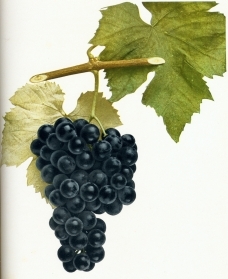
Charles Arnold of Paris, Brant County, Ontario, produced Othello from seed of Clinton fertilized by Black Hamburg. The seed was planted in 1859 and the variety was sent out for testing about ten years later. There seems considerable doubt whether Arnold’s Clinton was the same as the variety known under that name in the United States, but if not, it was similar. Assuming that Arnold’s is the well known Clinton, Othello is descended from Labrusca, Riparia and Vinifera. The characters of the three species are shown in the variety. The foxy flavor, the tomentum of the leaf, the pulpy flesh, and the usually continuous tendrils are all from Labrusca. Riparia is revealed in the long, slender canes, the resistance to phylloxera and the shallow, spreading root system. There are but few of the characters of Black Hamburg, the Vinifera parent, to be found and yet the much lobed leaf, the cluster, the oval berry and the flavor indicate the Old World grape and make fairly certain the triple origin.
Vines vigorous, hardy, usually productive, slightly susceptible to attacks of mildew in some localities. Canes long, intermediate in number and size, light to dark brown; nodes enlarged, frequently strongly flattened; internodes medium to below in length; diaphragm of average thickness; pith intermediate in size; shoots pubescent; tendrils continuous, sometimes intermittent, of medium length, bifid to trifid.
Leaf-buds intermediate in size, length and width, conical to nearly obtuse. Leaves of average size and thickness; upper surface light green, dull and smooth; lower surface pale green, pubescent; lobes three to five with terminal lobe acute to obtuse; petiolar sinus deep to medium, very narrow, frequently closed and overlapping; basal sinus shallow, narrow; lateral sinus deep to medium, not wide; teeth medium to very deep, rather wide; stamens upright.
Fruit ripens late, keeps fairly well. Clusters very large to above medium, long, broad, tapering, frequently with a loose single shoulder, two to three bunches per shoot, compact; peduncle medium to long, intermediate in thickness; pedicel nearly long, medium to slender, covered with numerous small warts, enlarged at point of attachment to fruit; brush very short, wine-colored. Berries large to medium, oval to roundish, black, glossy, covered with abundant blue bloom, very persistent, intermediate in firmness. Skin thin, tough, adheres strongly to the pulp, contains a moderate amount of bright colored red pigment, without astringency. Flesh dark green, very juicy, fine-grained, slightly tough, sprightly, low in quality for table use. Seeds separate somewhat easily from the pulp, one to three in number, medium to below in size, of average length and breadth, with neck sometimes slightly swollen, brownish; raphe usually distinct; chalaza small, above center, oval to circular, not obscure.
OZARK. (Aestivalis, Labrusca.)
1. Mo. Hort. Soc. Rpt., 1889:374. 2. Ib., 1890:156. 3. Ib., 1891:128. 4. Ib., 1892:267. 5. Bush. Cat., 1894:167. 6. Va. Sta. Bul., 94:135. 1898. 7. Mo. Sta. Bul., 46:40, 43, 44, 45, 52. 1899. 8. Mich. Sta. Bul., 169:174. 1899. 9. Ky. Sta. Bul., 92:95. 1901. fig. 10. Ga. Sta. Bul., 53:47. 1901. 11. Mo. Hort. Soc. Rpt., 1905:213.
Ozark belongs to the South and to Missouri, and the Ozarks in particular, and cannot be ripened in the average New York season. Its merits and demerits have been threshed out by the Missouri grape-growers with the result that its culture is somewhat increasing. It is a wine and not a table grape, of low quality, partly, perhaps, from overbearing which it habitually does unless the fruit is thinned. It is healthy and a very strong grower; but is self-sterile, which is against it as a market sort. In spite of self-sterility and low quality, however, it is a promising sort for the country south of Pennsylvania.
Ozark was originated by Dr. J. Stayman of Leavenworth, Kansas, from seed which he states was from an unknown source. The variety was introduced by Stayman & Black about 1890. The variety apparently is of Aestivalis descent with a slight admixture of Labrusca. There was another Ozark[207] raised by Frederick Muench of Marthasville, Warren County, Missouri, in 1851. It has probably long been obsolete.
Vine vigorous to very vigorous, usually hardy, medium to very productive. Canes rather long, often somewhat thick, intermediate in number, covered with thin blue bloom, surface slightly roughened; tendrils intermittent, usually bifid. Leaves unusually healthy and attractive, dense, medium to large, light green; lower surface pale green, thinly pubescent and cobwebby. Flowers sterile or nearly so, open late; stamens reflexed. Fruit ripens late, keeps well. Clusters medium to large, long to medium, usually with a long and loose single shoulder, very compact. Berries variable in size, dull black, covered with abundant blue bloom, persistent. Skin variable in thickness, tough, contains a large amount of wine-colored pigment. Flesh not very juicy, tender when fully ripe, mild, fair in quality. Seeds separate somewhat easily from the pulp, medium to small, not notched; raphe shows as a distinct cord-like ridge; chalaza plainly above center, very distinct.
PEABODY. (Riparia, Labrusca, Vinifera.)
1. Bush. Cat., 1883:129. 2. Am. Pom. Soc. Rpt., 1883:92. 3. Mass. Hatch Sta. An. Rpt., 6:22. 1893. 4. Va. Sta. Bul., 30:108. 1893. 5. Can. Cen. Exp. Farms Rpt., 1894:139. 6. Mich. Sta. Bul., 169:174. 1899. 7. Ib., 194:58. 1901.
Peabody is a comparatively unimportant offspring of Clinton produced by Ricketts. The grapes are too small for dessert purposes and their value for wine seems not to have been determined though from its parentage it would be called a wine grape. In general appearance Peabody resembles Ricketts’ Advance but is later, not so strong a grower, nor so prolific nor hardy. It appears to do better in the northern tier of states or in Canada than farther south.
This variety is supposed to be a seedling of Clinton grown by J. H. Ricketts about 1870 and introduced in 1882. The fruit is distinctly different in several characters from Clinton or other seedlings of that variety suggesting that Peabody is not a pure-bred seedling.
Vine vigorous, hardy, produces medium crops. Canes long, numerous, often thick, light brown with ash-gray tinge, considerably darker at nodes, covered with thin blue bloom; tendrils intermittent, bifid to trifid. Leaves medium to above in size, dark green, thin, lower surface pale green, nearly glabrous. Flowers semi-fertile, open in mid-season; stamens upright. Fruit ripens rather early, keeps well. Clusters large to medium, medium to long, usually with a fair-sized shoulder connected to the bunch by a long stem, compact to medium. Berries intermediate in size, distinctly oval to roundish, black, glossy, covered with abundant blue bloom, persistent. Skin thick, tough, not astringent. Flesh very juicy, tender, vinous, spicy, agreeably sweet at skin to tart at center, good in quality. Seeds usually separate from the pulp easily when fully mature, intermediate in size, broad; raphe sometimes shows as a partially submerged cord in the bottom of a rather wide, deep groove; chalaza distinctly above center, often roughened.
PERFECTION. (Labrusca, Bourquiniana, Vinifera.)
1. Mo. Hort. Soc. Rpt., 1889:372. 2. Ib., 1892:268. 3. Bush. Cat., 1894:168. 4. Va. Sta. Bul., 94:138. 1898. 5. Ga. Sta. Bul., 53:48. 1901.
Perfection is a seedling of Delaware, which it greatly resembles but does not equal in New York, being hardly as high in quality, does not keep as well, shrivels before ripening, and shells badly. In its vine characters it is much more like a Labrusca than Delaware, suggesting that it is a Delaware cross. In the Southwest it is considered a valuable early red grape.
Dr. J. Stayman of Leavenworth, Kansas, originated Perfection from seed of Delaware; sent out for testing about 1890.
Vine medium to vigorous, healthy, injured in severe winters, productive. Canes intermediate in length and number, slender; tendrils intermittent, trifid to bifid. Leaves healthy, medium in size and color; lower surface grayish-white with tinge of bronze, heavily pubescent. Flowers fertile or nearly so, open in mid-season; stamens upright. Fruit ripens before Delaware, does not keep well. Clusters intermediate in size, averaging slightly larger than Delaware, of fair length, usually single-shouldered, compact. Berries medium to small, nearly roundish when not misshapen by compactness of cluster, attractive red but slightly less brilliant than Delaware, covered with thin gray or faint lilac bloom, inclined to drop from pedicel, soft. Skin thin, variable in toughness, not astringent. Flesh medium in juiciness and tenderness, vinous, mild, moderately sweet, good in quality but inferior to Delaware. Seeds adherent to the pulp, quite numerous, below medium to small, of average length, often with slightly enlarged neck.
PERKINS. (Labrusca, Vinifera.)
1. Horticulturist, 14:246. 1859. 2. Mag. Hort., 27:523, 532. 1861. 3. Am. Pom. Soc. Rpt., 1862:147. 4. Am. Pom. Soc. Cat., 1875:24. 5. Ill. Hort. Soc. Rpt., 1878:8. 6. Am. Pom. Soc. Rpt., 1883:58. 7. Mo. Hort. Soc. Rpt., 1883:40. 8. Neb. Hort. Soc. Rpt., 1890:93. 9. Ill. Sta. Bul., 28:261. 1893. 10. Bush. Cat., 1894:168, 169. fig. 11. N. Y. Sta. An. Rpt., 17:534, 548, 556. 1898. 12. Mich. Sta. Bul., 169:174. 1899. 13. Ala. Sta. Bul., 110:69, 70, 88. 1900. 14. S. C. Sta. Bul., 58:7, 8. 1901. fig.
Perkins was at one time grown largely as an early grape but has been very generally discarded on account of its poor quality. Its pulp is hard and its flavor is that of Wyoming, Northern Muscadine and their like, all easily identified and best characterized by their disagreeable foxiness. As with nearly all Labruscas it is a very poor keeper. Notwithstanding the faults of its fruit, Perkins may have value in regions where grape-growing is precarious; for it is one of the most reliable grapes cultivated, being hardy, vigorous, productive, and very free from fungal diseases. Added to the above qualities, it is early, thus making a plant well worthy the attention of the grape-breeder.
This variety is said to be an accidental seedling found about 1830 in the garden of Jacob Perkins of Bridgewater, Massachusetts. For many years it had only a local reputation and became known to viticulturists about 1860. It was placed on the grape list of the American Pomological Society fruit catalog in 1875 and although several efforts have been made to have it removed it still remains. It was suspected by some of those familiar with its early history to be a seedling of Isabella or Catawba but there is little or nothing in the vine or fruit to substantiate such a supposition.
Vine vigorous, healthy, hardy, productive. Canes long to medium, numerous, thick to medium, rather dark brown, deepening in color at the nodes, surface heavily pubescent; tendrils continuous, bifid to trifid. Leaves above medium to small, thick; upper surface medium green, medium to slightly rugose; lower surface grayish-white, heavily pubescent; veins distinct. Flowers nearly fertile, open medium early; stamens upright.
Fruit ripens earlier than Delaware, ships well for an early grape. Clusters intermediate in size and length, broad to medium, cylindrical to slightly tapering, often with a short single shoulder, compact. Berries large to medium, distinctly oval, dull green changing to an attractive pale lilac or light red when fully ripe, covered with rather abundant gray or lilac bloom, inclined to drop considerably from the pedicel, somewhat soft. Skin thin, tough, contains no pigment. Flesh nearly white, medium juicy, stringy, fine-grained, firm and meaty, very foxy, sweet at skin to nearly acid at center, poor to fair in quality. Seeds decidedly adherent, numerous, medium to above in size, width and length, somewhat blunt, light brown with yellow tips; raphe buried in a narrow, nearly deep groove; chalaza small, distinctly above center, oval to pear-shaped, rather distinct.
POCKLINGTON. (Labrusca.)
1. Gar. Mon., 21:207, 362. 1879. 2. Mass. Hort. Soc. Rpt., 1880:238. 3. Gar. Mon., 22:176. 1880. 4. Am. Pom. Soc. Rpt., 1881:32, 44. 5. Am. Pom. Soc. Cat., 1881:24. 6. Am. Pom. Soc. Rpt., 1883:58. 7. Rural N. Y., 45:622, 653. 1886. 8. Ohio Hort. Soc. Rpt., 1886-87:171. 9. Ill. Sta. Bul., 28:266. 1893. 10. Bush. Cat., 1894:169. 11. N. Y. Sta. An. Rpt., 13:605. 1894. 12. Ib., 15:432, 433. 1896. 13. Ib., 17:534, 542, 544, 545, 547, 552, 556. 1898. 14. Ga. Sta. Bul., 53:48, 52, 58. 1901. 15. Kan. Sta. Bul., 110:237. 1902.
Golden Pocklington (10).
Before the advent of Niagara, Pocklington was, all things considered, the leading white grape, having very generally displaced Martha. The variety had the fatal fault, however, of ripening late in the latitude of New York which, with some minor defects, has caused it to fall below Niagara in value for the grape districts of this region if not for the whole country. It is now being grown less and less, and though still commonly found, must soon become largely a grape for the amateur and the collector.
Pocklington is a seedling of Concord and resembles its parent in most of its vine characters, fully equaling or surpassing it in hardiness, but of slower growth and not quite as healthy, vigorous or productive. In quality it is as good if not better than either Concord or Niagara, being sweet, rich and pleasant flavored, though as with the other two grapes it has a little too much foxiness for critical consumers of grapes. It is a handsome fruit, a delicate golden yellow in color, being often called the Golden Pocklington, and with finely formed bunches and berries making it one of the most attractive of all green grapes. Pocklington keeps and ships better than Concord or than any of the latter’s seedlings, having a tough, though comparatively thin, skin. Under some conditions, it ripens unevenly and in some localities it is unfruitful. Pocklington is not equal to several other of the grapes of its season in quality, as, for instance Iona, Jefferson, Diana, Dutchess and Catawba, but it is far above the average as a table grape and for this reason and because of its handsome appearance, one of the most attractive of all green grapes, it should be retained in our list of grapes for the garden.
John Pocklington of Sandy Hill, Washington County, New York, originated Pocklington from seed of Concord about 1870. The variety was first exhibited at the New York State fair in Rochester, in 1877, and was exhibited before the American Pomological Society two years later. It was introduced by John Charlton of Rochester, New York, about 1880. In 1881 it was placed on the grape list of the American Pomological Society fruit catalog. In spite of its general failure as a commercial sort, it is still offered for sale by many nurserymen.
Vine medium in vigor, hardy, variable in productiveness, somewhat subject to mildew in the Hudson River and Central Lakes districts. Canes intermediate in length, number, and size, very dark reddish-brown; nodes enlarged, flattened; internodes medium to below in length; diaphragm thin; pith slightly above average size; shoots pubescent; tendrils continuous, of fair length, bifid to trifid.
POCKLINGTON
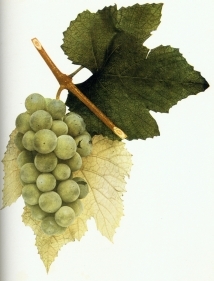
Leaf-buds small, very short, slender, pointed, open late. Young leaves tinged on lower side only, prevailing color light rose-carmine. Leaves variable in size, medium to rather thick; upper surface light green, glossy, of average smoothness; lower surface tinged with bronze, pubescent; veins distinct; lobes none to three with terminus acuminate to acute; petiolar sinus medium to deep, rather wide; teeth of average depth, medium to rather narrow. Flowers fertile, open in mid-season; stamens upright.
Fruit not uniform in season of ripening but averaging later than Concord, keeps and ships fairly well. Clusters medium to large, intermediate in length and breadth, cylindrical to slightly tapering, often single-shouldered, medium to compact; peduncle medium to short, of average thickness; pedicel short to medium, thick, covered with few small warts; brush short, greenish. Berries large to above medium, slightly oblate, attractive yellowish-green or with tinge of amber, covered with thin gray bloom, variable in adhesion to pedicel, nearly firm. Skin covered with scattering russet dots, thin and tender, adheres slightly to the pulp, contains no pigment, faintly astringent. Flesh light green, often with yellow tinge, translucent, juicy, tough, fine-grained, slightly foxy, nearly sweet at skin to tart at center, good in quality. Seeds do not separate easily from the pulp, one to six, average three, intermediate in size, length and breadth, brownish; raphe obscure; chalaza of medium size, slightly above center, usually oval, obscure.
POUGHKEEPSIE. (Bourquiniana, Labrusca, Vinifera.)
1. Gar. Mon., 22:176. 1880. 2. Am. Pom. Soc. Rpt., 1881:144. 3. N. Y. Sta. An. Rpt., 9:329. 1890. 4. Ib., 11:632. 1892. 5. Bush. Cat., 1894:170. 6. N. Y. Sta. An. Rpt., 17:534, 547. 1898. 7. Mo. Sta. Bul., 46:41, 43, 44, 45, 53. 1899. 8. Mich. Sta. Bul., 169:175. 1899. 9. Ga. Sta. Bul., 53:48. 1901. 10. Kan. Sta. Bul., 110:239. 1902.
Poughkeepsie Red (1, 2, 4, 5, 7, 9).
Poughkeepsie has been known on the Hudson River for nearly a half century yet it is now but little grown there and has not been widely disseminated elsewhere. There is no doubt as to its quality, both as a table grape and for wine; in this respect it is considered by many as equal to the best of our American varieties and quite the equal of some of the finer European sorts. But the vine characters are practically all poor and the variety is thus effectually debarred from common cultivation. Both vine and fruit greatly resemble Delaware but it is not the equal of the latter variety in vine characters and does not surpass it in fruit. In particular, it is more easily winter-killed and is less productive than Delaware. It ripens with us a little earlier than the last named sort and this with its beauty and fine quality is sufficient to recommend it for the garden at least.
A. J. Caywood of Marlboro, New York, originated Poughkeepsie, it is said, from seed of Iona fertilized by mixed pollen of Delaware and Walter. The original seedling was raised in the sixties but the variety was only known locally until about 1880 when it was brought before the public. It has never been popular in any section and is now nearly obsolete.
Vine intermediate in vigor, doubtfully hardy, variable in productiveness, some seasons producing such heavy crops that the vine is weakened, and on this account a somewhat uncertain bearer. Canes medium to short, intermediate in number, thick to medium, dark reddish-brown; tendrils intermittent, frequently three in line, bifid to trifid. Leaves not healthy, medium to small, of average thickness; upper surface medium green, glossy, somewhat rugose on older leaves; lower surface pale green to grayish-green, thinly pubescent. Flowers fertile, open medium late; stamens upright.
Fruit ripens about with Delaware, keeps and ships fairly well. Clusters medium to below in size, intermediate in length and width, tapering to cylindrical, usually single-shouldered, very compact. Berries small, roundish, pale red to attractive red when properly ripened, covered with a medium amount of dark lilac bloom, persistent, firm. Skin thin and tender but does not crack, contains no pigment. Flesh pale green, very juicy, tender, nearly melting, fine-grained, vinous, sweet or nearly so from skin to center, refreshing, very good to best in quality. The flesh characters closely resemble Delaware. Seeds separate easily from the pulp, small, of medium length, medium to broad, usually plump with slightly enlarged neck, brownish; raphe obscure; chalaza of average size, distinctly above center, circular, obscure.
PRENTISS. (Labrusca, Vinifera.)
1. Mich. Pom. Soc. Rpt., 1878:357. 2. Ib., 1879:191, 194, 320, fig., 321. 3. Am. Pom. Soc. Cat., 1881:24. 4. Am. Pom. Soc. Rpt., 1883:59, 61. 5. Mo. Hort. Soc. Rpt., 1884:343, 345. 6. Am. Pom. Soc. Rpt., 1885:103, 106, 144. 7. N. Y. Sta. An. Rpt., 9:332. 1890. 8. Ill. Sta. Bul., 28:266. 1893. 9. Bush. Cat., 1894:171. fig. 10. Husmann, 1895:93. 11. N. Y. Sta. An. Rpt., 17:534, 542, 545, 547, 552. 1898. 12. Mich. Sta. Bul., 169:175. 1899.
Prentiss is a green grape of good quality, once well known and generally recommended, but now going out of cultivation. If popular preference turned upon quality, we should still grow this variety, but consideration must be given to other characters and in these Prentiss fails. Those who have grown it in the several grape districts of New York accredit the vines with about all the faults a grape can have. Thus, it is almost universally considered tender to cold, lacking in vigor and being unproductive, while in some localities it is looked upon as uncertain in bearing, and subject to rot and mildew. On the other hand, there are vineyards in which it does very well and in such it is a remarkably attractive green grape, especially in form of cluster and in form and color of berry, in these respects resembling the one-time favorite Rebecca though never so high in quality as that variety. Its season is given as both before and after Concord. It must always remain a variety for the amateur and for special localities.
This variety is said to have been originated by J. W. Prentiss of Pulteney, Steuben County, New York, about forty years ago, from seed of Isabella.[208] It was introduced about 1880 by T. S. Hubbard of Fredonia, New York. In 1881 it was placed on the catalog of the American Pomological Society and is still retained.
Vine medium to weak, with a tendency to winter injury, unfruitful, capricious in bearing, somewhat subject to attacks of mildew. Canes intermediate in length and number, thick, light to dark brown; tendrils continuous, bifid.
Leaves above medium to small, thick; upper surface light green, smooth to rugose in the older leaves; lower surface pale green, pubescent; veins obscure. Flowers self-fertile, open in mid-season; stamens upright.
Fruit variable in season of ripening averaging about with Concord, keeps well. Clusters not large, medium to short, of average width, tapering to cylindrical, sometimes with a slight single shoulder, compact. Berries above medium to small, vary in shape from roundish to oval, light green with strong yellowish tinge covered with thin gray bloom, persistent, firm. Skin of medium thickness, somewhat tough, contains no pigment. Flesh pale green, juicy, medium in tenderness, slightly foxy, sweet next the skin to agreeably tart at center, good in quality. Seeds adherent, sometimes numerous, intermediate in size, variable in width, very slightly notched, short to medium, sharp-pointed, dark brown; raphe buried in a shallow, narrow groove; chalaza large, slightly above center, irregularly circular to oval, surface often roughened, obscure.
REBECCA. (Labrusca, Vinifera.)
1. Mag. Hort., 22:458, 484, 502. 1856. 2. Horticulturist, 11:528. 1856. 3. Am. Pom. Soc. Rpt., 1856:39, 162, 201. fig. 4. Am. Pom. Soc. Cat., 1856:214. 5. Am. Pom. Soc. Rpt., 1858:67. 6. Gar. Mon., 2:200. 1860. 7. Am. Pom. Soc. Cat., 1862:90. 8. Grant’s Descrip. Cat., 1864:5. 9. Mag. Hort., 33:70, 148. 1867. 10. Grape Cult., 1:43, 150, 327. 1869. 11. Am. Pom. Soc. Rpt., 1883:59. 12. Bush. Cat., 1883:132. 13. Kan. Sta. Bul., 110:237. 1902.
During the middle and latter part of the last century, when grape-growing was more in the hands of connoisseurs than now, Rebecca was one of the sterling green varieties. It is wholly unsuited for commercial vineyards and for years has gradually been disappearing from cultivation. The fruit of Rebecca is exceptionally fine, consisting of well-formed bunches and berries, the latter a handsome yellowish-white and semitransparent. In quality it is of the best, with a rich, sweet flavor and pleasing aroma. But the vine characters condemn it for any but the amateur and even in the garden it must have exceptionally good care to succeed. The vines lack in hardiness and vigor, are susceptible to mildew and other fungi, and are productive only under the best conditions. It is recommended as being especially desirable to plant on south walls where it seems to succeed much better than in exposed situations.
The original vine of this variety was an accidental seedling found in the garden of E. M. Peake at Hudson, New York. It bore its first fruit in 1852 when the vine was four years old and was brought to the notice of the public four or five years later. The Massachusetts Horticultural Society awarded the variety their silver medal in 1856 and it was exhibited before the American Pomological Society the same year. Here it made so favorable an impression that it was placed with Concord and Delaware under “new varieties which promise well.” In 1862 it was placed on the regular list where it remained till 1891, when it was removed. It was introduced by W. Brooksbank of Hudson.
Vine weak to vigorous, not always hardy, not productive, somewhat susceptible to attacks of mildew. Canes long to below medium, numerous, above medium to slender, inclined to dull brown, deepening in color at the nodes; tendrils continuous to intermittent, bifid to trifid. Leaves variable in size, of average thickness; upper surface dark green, dull, medium to rugose; lower surface grayish-green, pubescent; veins variable in distinctness. Flowers fertile or nearly so; stamens upright.
Fruit ripens with Concord or later, ships and keeps well. Clusters medium to small, medium to short, of average width, cylindrical to roundish, rarely with a small single shoulder, compact. Berries intermediate in size, oval, green with yellowish tinge sometimes verging on amber, not glossy, covered with thin gray bloom, persistent, firm. Skin intermediate in thickness and toughness, contains no pigment. Flesh pale green, very juicy, tender, nearly melting, vinous and a little foxy, sweet from skin to center, good to very good in quality. Seeds separate easily from the pulp, medium to below in size, medium to short, above medium to narrow, blunt, medium brown; raphe obscure; chalaza of average size, above center, circular to oval, not distinct. Must 69°.
RED EAGLE
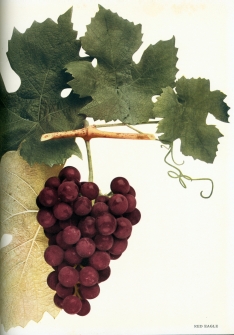
RED EAGLE. (Labrusca, Vinifera.)
1. Kan. Sta. Bul., 28:162. 1891. 2. N. Y. Sta. An. Rpt., 10:498. 1891. 3. Ib., 11:633. 1892. 4. Va. Sta. Bul., 30:106. 1893. 5. N. Y. Sta. An. Rpt., 17:525, 534, 548, 556. 1898. 6. Va. Sta. Bul., 94:138. 1898. 7. Ga. Sta. Bul., 53:48. 1901.
Munson No. 47 (4).
Red Eagle is a pure-bred seedling of Black Eagle which it resembles in all characters except color of fruit. It is one of comparatively few pure-bred offspring of Vinifera-Labrusca crosses of the second generation and therefore of interest to grape-breeders. Munson, the originator of the variety, does not include Red Eagle in his last catalog but on the grounds of this Station it takes high rank as a grape of quality and at least can be recommended to the amateur. In general it shows the characters found in Rogers’ first generation hybrids and ranks with them in fruit and vine.
The variety was originated by T. V. Munson, from whom it was received at this Station in 1888.
Vine medium in vigor, injured in severe winters, moderately productive. Canes of average length, medium to few, slender, dark brown, surface covered with a small amount of blue bloom; nodes prominent, slightly flattened; internodes of fair length; diaphragm intermediate in thickness; pith medium in size; shoots pubescent; tendrils continuous to intermittent, long to medium, bifid.
Leaf-buds medium to below in size, short, of average thickness, conical to obtuse, open late. Young leaves heavily tinged on under side and lightly along margin of upper side with rose-carmine. Leaves intermediate in size, thick; upper surface light green, dull, medium to slightly rugose; lower surface grayish-green, slightly pubescent; veins well defined; lobes three to five with terminus obtuse to acute; petiolar sinus deep, medium to narrow, sometimes closed and overlapping; basal sinus variable in depth, wide; lateral sinus often very deep, somewhat wide; teeth medium to deep, wide. Flowers sterile to fertile, open moderately late; stamens reflexed.
Fruit ripens a little before Concord, keeps fairly well. Clusters medium to small, variable in length, broad, slightly tapering, usually single-shouldered but sometimes double-shouldered, loose to medium with many abortive berries; peduncle nearly long to medium, inclined to slender; pedicel very long, slender; brush pale green with brown tinge, short to medium, rather slender. Berries variable in size, roundish, light to very dark red, not glossy, covered with heavy lilac or faint blue bloom, persistent, rather soft. Skin medium to thick, tender, adheres slightly to the pulp, contains a small amount of red pigment, without astringency. Flesh greenish, transparent, juicy, very tender and melting, slightly foxy, agreeably tart next the skin to slightly acid at center, very good in quality. Seeds separate easily from the pulp, one to five, average three or four, often rather large, of mean breadth, long, somewhat blunt, light brown; raphe buried in a narrow, shallow groove; chalaza large, above center, irregularly circular to oval, distinct.
REGAL. (Labrusca, Vinifera.)
1. Rural N. Y., 62:436. 1903. 2. Am. Pom. Soc. Rpt., 1903:82. 3. N. Y. State Fr. Gr. Assoc. Rpt., 1904:41.
As was the case with the preceding grape, Regal is also a second generation hybrid of Vinifera and Labrusca, the parent of this variety being Lindley, which, as the technical description shows, it much resembles. The fact is again demonstrated in this variety that the characters of grape-hybrids, at least of these two species, are passed to subsequent generations much as they were found in the first generation. The fruit of Regal is attractive in appearance and in quality, its characters being much the same as those of Lindley. A seemingly insignificant fault might make it somewhat undesirable in a commercial vineyard; it is that the clusters are borne so close to the wood that it is difficult to harvest the fruit, and especially to avoid injury to the berries next to the wood. The variety is worthy of extensive trial in the vineyards and gardens of the State.
Regal was originated in Rockford, Illinois, in 1879 by A. W. Woodward. It was introduced some years later by M. Crawford of Cuyahoga Falls, Ohio. The original vine was one of a lot of Lindley seedlings. Some vines of this variety were sent out by the introducer under the title Crawford No. 99.
Vine vigorous, hardy, healthy, very productive. Canes intermediate in length and size, rather numerous, medium dark reddish-brown. Tendrils intermittent, bifid to trifid. Leaves healthy, medium to nearly large, of average thickness; upper surface green, slightly glossy and rugose; lower surface pale green with bronze tinge, strongly pubescent. Flowers fully self-fertile, open in mid-season; stamens upright.
Fruit ripens with Lindley or later; keeps well. Clusters small to medium, shorter than Lindley, medium to broad, cylindrical to tapering with sometimes an inclination to oval, usually with a short single shoulder, sometimes double-shouldered, very compact. Berries above medium to below, averaging larger than Brighton, roundish but frequently compressed on account of compactness of cluster, purplish-red to dark red, covered with lilac bloom, persistent, of average firmness. Skin thin, medium to tough, contains no pigment. Flesh pale green, very juicy, fine-grained, slightly stringy and solid until fully ripe when it becomes rather tender, sweet at skin to acid at center, slightly musky, good in quality but not equal to Lindley. Seeds separate easily from the pulp, rather numerous, intermediate in size, long to below medium, above medium to narrow, slightly notched, inclined to blunt, frequently with a short enlarged neck, brownish; raphe buried in a medium-sized groove; chalaza small, above center, circular to oval, distinct.
REQUA. (Labrusca, Vinifera.)
1. U. S. D. A. Rpt., 1864:136. 2. Horticulturist, 24:126. 1869. 3. Grape Cult., 1:181. 1869. 4. N. Y. Sta. An. Rpt., 11:633. 1892. 5. Ib., 17:534, 548, 556. 1898. 6. Mo. Sta. Bul., 46:41, 43, 44, 45. 1899. 7. Mich. Sta. Bul., 169:175. 1899. 8. Ga. Sta. Bul., 53:48. 1901. 9. Can. Hort., 24:261. 1901. fig. 10. Kan. Sta. Bul., 110:243. 1902.
Rogers’ No. 28 (1). Rogers’ No. 28 (2, 3, 4, 9).
Requa is one of Rogers’ hybrids hardly equaling others of its color and season. It is an attractive grape in cluster and berry and of very good quality but quite subject to rot and ripening too late for the grape regions of this latitude, being as late as Catawba. In giving his grapes names, Rogers used those of English or German horticultural or botanical celebrities and of some of the Indian names of counties and towns of Massachusetts. Requa was dedicated by Rogers to a Mr. Requa, a horticulturist of local note, of Salem-on-Erie, Massachusetts.
For an account of the parentage and early history of this variety see Rogers’ Hybrids. In 1869 this variety was named Requa, it having been previously known as Rogers’ No. 28. There appear at present to be two varieties passing under this name. Georgia, Texas and Missouri report this variety as having erect stamens but in our vineyard it shows only recurved stamens.
Vine medium to vigorous, hardy except in severe winters, medium in productiveness, not always healthy. Canes medium to long, intermediate in number and thickness; tendrils continuous to intermittent, trifid to bifid. Leaves large to medium, dark green, often thick and rugose; lower surface grayish-green, pubescent. Flowers sterile to partly fertile, open late; stamens reflexed. Fruit ripens about with Catawba or earlier, keeps a long time in good condition. Clusters large to medium, intermediate in length and width, nearly cylindrical, often with a long single shoulder, compact. Berries medium to large, slightly oval to roundish, dark dull red covered with thin gray or lilac bloom, strongly adherent, not firm. Skin thin, nearly tough, adheres considerably to the pulp. Flesh very pale green, somewhat tender, rather stringy, vinous, slightly foxy, almost sweet from skin to center, good to very good in quality. Seeds slightly adherent to the pulp, above medium to medium in size and length, often rather broad, somewhat blunt.
ROCHESTER. (Labrusca, Vinifera.)
1. W. N. Y. Hort. Soc. Rpt., 23:60. 1878. 2. Ib., 27:22. 1882. 3. Barry, 1883:442. 4. N. Y. Sta. An. Rpt., 9:329. 1890. 5. Ib., 11:634. 1892. 6. Bush. Cat., 1894:173. 7. Va. Sta. Bul., 94:138. 1898. 8. N. Y. Sta. An. Rpt., 17:534, 546, 547, 552. 1898. 9. Mo. Sta. Bul., 46:41, 43, 44, 45, 53. 1899. 10. Mich. Sta. Bul., 169:175. 1899. 11. Kan. Sta. Bul., 110:240. 1902.
Barry’s No. 19 (1).
Rochester, as the color-plate shows, is a large-clustered, red grape, very handsome in appearance. It is also very good in quality. The vine is a particularly strong grower and very productive and in the locality in and about Rochester at least, very free from diseases. It is so very vigorous that it needs much room and long pruning. The variety is difficult to propagate and therefore not in favor with nurserymen, and is to be had, if at all, usually at extra expense. The grapes are sweet, rich, and vinous, ranking from good to very good in quality. The fruit, however, should be used as soon as ripe, as it does not keep well and the berries quickly shatter from the bunch. As an attractive early red grape Rochester is well worth a place in the garden and possibly in favored locations for a special market.
Ellwanger & Barry of Rochester, Monroe County, New York, in 1867 fruited over one hundred seedling grapes which they had raised from mixed seed of Delaware, Diana, Concord, and Rebecca. Only two of these seedlings were finally saved, the Rochester and the Monroe. The Rochester was introduced by the originators about 1880.
Vine medium to vigorous, usually hardy, medium to productive. Canes long, intermediate in number and size, dark reddish-brown; nodes moderately enlarged, slightly flattened; internodes short; diaphragm thick; pith small, shoots pubescent; tendrils intermittent, long, bifid or trifid.
ROCHESTER
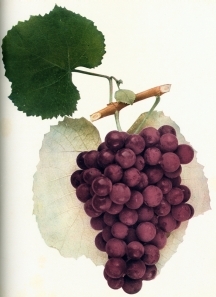
Leaf-buds medium to below in size, short, of average thickness, conical, open in mid-season. Young leaves tinged on upper and under sides with dull rose-carmine. Leaves medium to large; upper surface light green, slightly glossy, nearly smooth; lower surface grayish-green, pubescent; veins distinct; lobes none to three with terminus acute; petiolar sinus deep to medium, variable in width; basal sinus absent; lateral sinus shallow to a mere notch when present; teeth shallow, of average width. Flowers fertile, open mid-season; stamens upright.
Fruit ripens earlier than Concord, does not always ripen evenly, does not keep well. Clusters large to medium, about average length, broad, tapering, usually single-shouldered but sometimes heavily double-shouldered, very compact; peduncle short, intermediate in thickness; pedicel short, slender, covered with few warts; brush of medium length, slender, yellowish-brown. Berries above medium to small, oval, dark red to purplish-red but the berries do not color uniformly, dull, covered with thin, lilac bloom, inclined to drop from pedicel, soft. Skin thick to medium, somewhat tough, inclined to crack sometimes on account of compactness of cluster, does not adhere to pulp, contains no pigment, astringent. Flesh pale green, transparent, juicy, tender, fine-grained, somewhat vinous and foxy, sweet, good to very good in quality. Seeds separate easily from the pulp, one to three, average two, large, medium to short, rather broad but often blunt, quite variable, however, in general characters, medium to dark brown; raphe buried in a slight groove; chalaza of average size, above center, circular to oval, obscure.
ROCKWOOD. (Labrusca.)
1. Mass. Hort. Soc. Rpt., 1874:154. 2. An. Hort., 1889:101. 3. N. Y. Sta. An. Rpt., 14:279. 1895. 4. Bush. Cat., 1894:107. 5. N. Y. Sta. An. Rpt., 17:534, 548, 556. 1898. 6. Mich. Sta. Bul., 169:175. 1899. 7. Ala. Sta. Bul., 110:74, 88. 1900. 8. Ga. Sta. Bul., 53:49. 1901. 9. Kan. Sta. Bul., 110:237. 1902. 10. Mich. Hort. Soc. Rpt., 1903:30.
Rockwood is a comparatively unimportant black seedling of Concord and from the originator of Concord. It is of higher quality than its parent and since it is earlier, coming with Moore Early or just after, it is worthy a place in garden collections as an early black grape. It has been thoroughly tested and discarded as unprofitable by commercial vineyardists probably on account of its vine characters which on our grounds are not as good as those of Concord and would disqualify it for a market variety. In appearance the fruit is much like Concord.
The variety was originated by E. W. Bull of Concord, Massachusetts, from seed of Concord. It was introduced in 1889 by George S. Josselyn of Fredonia, New York.
ROGERS’ HYBRIDS.
1. Mag. Hort., 23:86. 1857. 2. Horticulturist, 13:86, 119. 1858. 3. Am. Pom. Soc. Rpt., 1860:35, 85. 4. Ib., 1862:148. 5. U. S. Pat. Off. Rpt., 1864:135, 136, 137. figs. 6. N. Y. Ag. Soc. Rpt., 1865:338. figs. 7. Horticulturist, 20:81. 1865. 8. Strong, 1866:31, 339. 9. Mead, 1867:204. 10. Fuller, 1867:228, 246. 10. Rec. of Hort., 1868:46. 11. Horticulturist, 24:126. 1869. 12. Grape Cult., 1:153, 193, fig., 194, 262. 1869. 13. Am. Jour. Hort., 5:261. 1869. 14. Am. Pom. Soc. Rpt., 1875:39. 15. Bush. Cat., 1894:173. fig. 16. Meehan’s Mon., 9:94. 1899. 17. Am. Pom. Soc. Rpt., 1901:166.
The forty-five seedlings known as Rogers’ Hybrids were originated by Edward S. Rogers of Salem, Massachusetts.[209] Rogers states that the suggestion which started him in this work was an article by Dr. Lindley of the University of London, originally printed in the London Horticulturist and reprinted in Downing’s Horticulturist for September, 1847. This article, which is entitled “Remarks on Hybridizing Plants,” is a general discussion of the results of this practice so far as they were then known.
The female parent used by Rogers was a four or five year old, large-fruited Labrusca known locally as Carter or Mammoth Globe, and very similar to, but not identical with Sage. The pollen for fertilizing the blossoms of this vine was secured from vines of Black Hamburg and White Chasselas growing in a cold grapery near by. In the summer of 1851, clusters of the Carter were fertilized with pollen from the Vinifera vines both at the time of emasculation and later, and small cotton bags were tied on the blossoms to prevent the interference of foreign pollen. In addition to the repeated applications of pollen to the stigmas, Rogers placed clusters of blossoms of the Vinifera sorts in the enclosing sacks. As a result of these pollinations, he secured about one hundred and fifty seeds which were planted in the garden that fall. In the spring of 1852 practically every seed germinated, but cut worms and other accidents reduced the number to forty-five which finally fruited. These were left to grow on poles where they were originally planted for three years, when, because of crowding, twenty-five of them were removed to another part of the garden. The untransplanted vines began to bear fruit in 1856 and the transplanted ones a few years later. The seedlings were numbered by Rogers from one to forty-five and for a long time they were known under these numbers. Of these, one to five inclusive were of the Carter-Black Hamburg cross; six to fourteen inclusive were of the Carter-White Chasselas cross; and all of the numbers from fifteen to forty-five were of Hamburg parentage. As will be noted under Salem, this was later given a number higher than forty-five, owing to the confusion of the sort with some other after being sent out. With this exception, the original crosses were all included in these numbers. In 1858 and 1859, Rogers sent many of these varieties, under the original numbers, to various people for testing. He was compelled to do this, owing to lack of room in the half acre which comprised the Rogers’ garden, to properly test the sorts himself. Of this garden Marshall P. Wilder says: “It is 150 years old; a cold matted soil, filled with old apple and pear trees, currant bushes, flax, and everything mingled in together. It is in a close, hived up place in the city of Salem, and it is a wonder that he ever had a bunch of grapes to show.”