Chapter V · THE LEADING VARIETIES OF AMERICAN GRAPES (continued 5)
Reading edition
Ives was grown by Henry Ives from seed planted in 1840 in his garden in Cincinnati, Ohio. It was exhibited in 1844 before the Cincinnati Horticultural Society. Ives insisted that it came from seed of Madeira grapes which had been sent him from abroad. As the variety is evidently largely, if not wholly Labrusca, it has always been supposed that his Madeira seedlings became accidentally mixed with a chance seedling. Because of some of its characters the parentage of Ives has been variously credited to Isabella, Alexander, Hartford and others, but nothing is positively known as to this phase of its origin. It was placed on the grape list in the American Pomological Society fruit catalog in 1869 where it is still retained. Ives was awarded in 1868 the premium offered by the Longworth Wine House of Cincinnati for the best wine grape for the United States. It is still cultivated to a considerable extent although not nearly so popular as forty years ago.
Vine vigorous, hardy, healthy, productive to very productive. Canes long to medium, of average number, thick, dark brown to reddish-brown, surface covered with thin blue bloom; nodes enlarged, slightly flattened; internodes short; diaphragm thick; pith medium to below in size; shoots pubescent; tendrils continuous, of average length, bifid to trifid.
Leaf-buds medium to large, short, thick, obtuse to conical, sometimes strongly compressed. Leaves large to medium, of average thickness; upper surface dark green, dull, medium to slightly rugose; lower surface very pale green, pubescent; veins distinct; lobes three to five when present, with terminal lobe acute to acuminate; petiolar sinus deep, narrow, sometimes closed and overlapping; basal sinus shallow, medium in width; lateral sinus of average depth, rather narrow; teeth shallow to medium, intermediate in width. Stamens upright.
Fruit ripens about with Concord or slightly later, keeps well. Clusters of fair size, intermediate in length and breadth, tapering to nearly cylindrical, three or four bunches per shoot, frequently single-shouldered, compact to medium, often with numerous abortive berries; peduncle long to medium, of average thickness; pedicel above medium in length, slender, covered with numerous, small warts; brush short, slender, pale green with reddish-brown tinge. Berries intermediate in size, oval to roundish, jet-black, covered with a moderate amount of blue bloom, very persistent, firm. Skin of medium thickness, tough, adheres slightly to the pulp, contains a fair amount of wine-colored pigment, slightly astringent. Flesh pale green, translucent, juicy, fine-grained, very tough, foxy, sweet at skin to tart at center, hardly good in quality. Seeds separate with difficulty from the pulp, one to four, average three, below medium to small, often abortive, medium to broad, rather short, usually blunt and plump, brownish; raphe obscure; chalaza a small circular depression, nearly central, usually obscure. Must 80°.
JAEGER. (Lincecumii, Bourquiniana.)
1. Ia. Hort. Soc. Rpt., 1890:117. 2. Va. Sta. Bul., 30:107. 1893. 3. Bush. Cat., 1894:137, fig., 138. 4. Rural N. Y., 55:591. 1896. 5. Ark. Sta. Bul., 39:31. 1896. 8. Am. Pom. Soc. Cat., 1897:20. 7. Tex. Sta. Bul., 48:1150, 1158. 1898. 8. Mo. Sta. Bul., 46:39, 43, 45, 76. 1899. 9. Tex. Sta. Bul., 56:277. 1899. 10. Ala. Sta. Bul., 110:83. 1900.
Hermann Jaeger (1, 2, 3, 4, 5, 7, 9, 10). Jaeger (3). Jaeger, Hermann (6). Munson No. 81 (2).
Jaeger is a large-clustered, small-berried grape from Munson of Texas.[195] It is said to be very successful in the South and Southwest both as a table and a wine grape. Its meritorious qualities are vigorous, productive vines with foliage free from mildew and rot, and well-flavored, tender-fleshed berries with thin tough skins. It requires too long a season for maturity for successful cultivation in New York.
JAMES

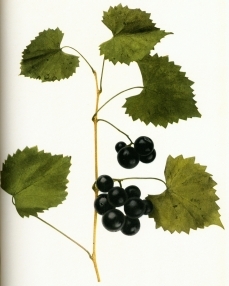
Munson grew Jaeger from seed of a selected wild Post-oak vine pollinated by Herbemont. The seed was planted in 1885 and the variety was introduced by the originator in 1890. The culture of Jaeger seems to be slowly spreading. It was placed on the grape list of the American Pomological Society fruit catalog in 1897 and is still retained there.
Vine vigorous, doubtfully hardy, an uncertain bearer in New York on account of winter injury but yielding good crops farther south. Canes variable in length, intermediate in number and thickness, covered with considerable blue bloom; tendrils intermittent, bifid to trifid. Leaves large, not uniform in color; lower surface grayish-green, slightly pubescent; stamens upright. Fruit ripens soon after Concord, matures evenly, keeps and ships well. Clusters medium to large, frequently single-shouldered, strongly compact. Berries below medium to small, roundish, frequently compressed on account of compactness of cluster, attractive black, covered with abundant blue bloom, persistent. Skin thin, tough. Flesh medium juicy, fine-grained, tender, spicy, somewhat tart from skin to center, good in quality. Seeds separate very easily from the pulp, not numerous, long, intermediate in size, sometimes with enlarged neck.
JAMES. (Rotundifolia.)
1. Am. Pom. Soc. Rpt., 1889:136. 2. Bush. Cat., 1894:178. 3. Am. Pom. Soc. Cat., 1899:30. 4. Ga. Sta. Bul., 53:45. 1901. 5. N. C. Sta. Bul., 187:61. 1903. 6. S. C. Sta. Bul., 132:16, 18. 1907.
James is the only variety of Rotundifolia possible to illustrate in this work. The accompanying color-plate, while not wholly satisfactory, yet shows characteristic fruit and foliage somewhat reduced in size. James is one of the largest of the Rotundifolia grapes and probably the best general purpose variety of this species. It cannot be grown north of Maryland.
The variety was originated by J. Van Lindley of Pitt County, North Carolina. It was introduced about 1890 and was placed on the grape list of the American Pomological Society fruit catalog in 1899. It is not known in the North but is cultivated more or less throughout the habitat of Vitis rotundifolia in the South.
The following description of the variety is a compilation:
Vine vigorous, healthy, productive. Flowers open very late; stamens reflexed. Fruit ripens late, hangs on the vines for three weeks, keeps well. Clusters small, containing from four to twelve berries, irregular, loose. Berries large, three-fourths to one and one-quarter inches in diameter, roundish, black or blue-black. Skin very thin. Pulp juicy, sweet, good to best in quality.
JANESVILLE. (Labrusca, Riparia.)
1. Rec. of Hort., 1868:45. 2. Horticulturist, 24:52, 203. 1869. fig. 3. Montreal Hort. Soc. Rpt., 1879:65. 4. Wis. Hort. Soc. Rpt., 1881-2:141. 5. Am. Pom. Soc. Cat., 1883:26. 6. Rural N. Y., 45:622. 1886. 7. Wis. Sta. An. Rpt., 5:161. 1888. 8. Mass. Hatch Sta. Bul., 2:20. 1888. 9. Wis. Hort. Soc. Rpt., 1889:117. 10. N. Y. Sta. An. Rpt., 10:496. 1891. 11. Bush. Cat., 1894:143. 12. Del. Sta. An. Rpt., 7:135, 138. 1895. 13. N. Y. Sta. An. Rpt., 17:531, 545, 547, 555. 1898.
Endowed with a constitution which enables it to withstand a degree of cold to which most other varieties of grapes would succumb, Janesville has made a place for itself in far northern localities. Moreover, it ripens very early, being one of the first to color though not ripe until some time after fully colored; and earliness is another requisite for a northern location. The vine, too, is generally healthy, vigorous and productive. But the fruit is worthless where better sorts can be grown. The clusters and berries are small, or of only medium size, while the grapes are pulpy, tough, seedy, with a thick skin and a disagreeable acid taste. Janesville has so many good vine characters that it may be of value for breeding purposes. It is fit for cultivation only in northern localities where better grapes cannot be grown or where fruit for a cheap red wine is wanted.
JANESVILLE
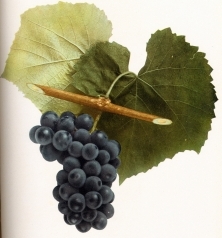
Janesville was grown by F. W. Loudon, of Janesville, Wisconsin, from seed secured at the Rock County Fair in 1858. It fruited for the first time in 1861 and was introduced several years later by C. H. Greenman of Milton, Wisconsin, who had bought the variety from the originator for $1000. It was named by the Wisconsin Horticultural Society in 1868. Janesville was placed on the grape list in the American Pomological Society fruit catalog in 1883 and is still retained. It is said by many to be a cross of Hartford and Clinton but this is a surmise and nothing is positively known as to its parentage. Its botanical characters are plainly those of a Labrusca-Riparia cross but with what admixture of the two species cannot be told. The early blooming season, and sometimes intermittent tendrils, indicate Vitis riparia, while foliage and fruit show both this species and Vitis labrusca.
Vine vigorous to very vigorous, healthy, hardy, productive to very productive. Canes spiny, intermediate in length, numerous, medium to below in size, dark brown; nodes flattened; internodes long to medium; diaphragm thick; pith intermediate in size; shoots thinly pubescent; tendrils intermittent to continuous, long, bifid to trifid.
Leaf-buds medium to below in size, short, thick, conical, prominent, open early. Young leaves tinged on under side and faintly along margin of upper side with rose carmine. Leaves small to medium, somewhat thin; upper surface variable in color, glossy and smooth; lower surface pale green, slightly pubescent; veins indistinct; leaf usually not lobed with terminus acute; petiolar sinus intermediate in depth, narrow, often closed and overlapping; basal and lateral sinuses lacking; teeth shallow, of average width. Flowers fertile, open very early; stamens upright.
Fruit ripens slightly earlier than Concord although it colors much earlier, keeps well. Clusters medium to small, short, of average breadth, cylindrical to tapering, usually single-shouldered, compact; peduncle short, slender; pedicel short, slender, covered with small scattering warts; brush dark wine color. Berries intermediate in size, roundish to slightly oval, dull black, covered with rather heavy blue bloom, usually persistent, firm. Skin thick, medium to nearly tough, adheres slightly to the pulp, contains considerable dark wine-colored pigment, astringent. Flesh pale reddish-green, translucent, juicy, very tough, rather coarse, vinous, sweet next the skin but quite acid at the center, fair in quality. Seeds adhere to the pulp, one to six, average three, above medium in size, broad, often angular, rather blunt, dark brown; raphe obscure; chalaza large, ovate, moderately distinct.
JEFFERSON. (Labrusca, Vinifera.)
1. Gar. Mon., 21:362. 1879. 2. Ib., 22:142, 176, 191. 1880. 3. Am. Pom. Soc. Rpt., 1881:33, 44. 4. Downing, 1881:167 app. 5. Am. Pom. Soc. Cat., 1881:24. 6. Am. Pom. Soc. Rpt., 1885:83, 103, 105. 7. Ohio Hort. Soc. Rpt., 1885-6:171. 8. Gar. and For., 3:178, 290. 1890. 9. Bush. Cat., 1894:143. fig. 10. N. Y. Sta. An. Rpt., 17:531, 548, 552. 1898. 11. Va. Sta. Bul., 94:137. 1898. 12. Kan. Sta. Bul., 110:239. 1902.
Jefferson is the offspring of Concord crossed with Iona, resembling in vigor, productiveness and healthiness the Concord, though not equal to it; and in color and quality of fruit the Iona. It falls considerably short of being an Iona fruit on a Concord vine, however, which would have made it one of the most valuable of American grapes. The vine produces its fruit two weeks later than Concord and is not nearly as hardy, faults that debar it from taking high rank as a commercial grape in New York. In its botanical characters and in immunity from diseases it is almost identical with Concord. Fortunately the vines yield readily to “laying down” for winter protection so that even in commercial plantations it is not difficult to cover the vines and so prevent winter injury.
The fruit of Jefferson is handsomer than that of Iona and of almost equal quality. The accompanying color-plate shows the large, well-formed, compact bunch, with berries of uniform size and color, which, taken together, make it one of the most attractive of red grapes. The flesh is firm, yet tender and juicy with a rich, vinous flavor and a delicate aroma which persists even after the berries have dried into raisins. The fruit ships and keeps well, the berries adhering to the cluster and the fruit retaining its freshness into late winter. The vine characters, with the exceptions of late bearing and tenderness to cold, are in the main good.
Jefferson is widely distributed and is well known by viticulturists in eastern America. It is not particular as to localities, if the season be long and the climate temperate, and thrives in nearly all grape soils though it does not flourish in a soil strongly impregnated with lime. This variety is deserving greater recognition as a commercial grape than it now receives. In a discriminating market it should command a sufficiently high price to make it a profitable variety to grow in this State despite its need of protection. Few grapes, and probably no red grape, are more desirable inhabitants of the garden than Jefferson; it not only furnishes an abundance of the best long-keeping fruit, but is also very ornamental throughout the season.
This variety is one of J. H. Ricketts’[196] grapes from seed of Concord pollinated with Iona. It fruited for the first time in 1874 and was introduced about 1880. In 1881 it was placed on the grape list of the American Pomological Society fruit catalog and has never been removed. Of all the remarkable seedlings raised by Ricketts the Jefferson is best known and most widely disseminated. The variety won for its originator the Wilder silver medal and as grown by him seldom failed to take premiums at exhibitions where shown. It is greatly to be regretted that the variety does not have all of the characters requisite to adapt it to culture in commercial vineyards.
Vine normally vigorous, healthy, not always hardy, medium in productiveness. Canes short, numerous, about medium in thickness, light to dark brown; nodes enlarged, roundish; internodes short; diaphragm thick; pith medium to below in size; shoots heavily pubescent; tendrils intermittent, medium to short, bifid to trifid.
Leaf-buds small, short, slender, pointed to conical, open very late. Young leaves tinged on under side and along margin of upper side with rose carmine. Leaves healthy, above medium to small, of average thickness; upper surface light green, medium to rugose on older leaves; lower surface very pale green, strongly pubescent; veins distinct; leaf usually not lobed with terminus acute; petiolar sinus of mean depth, narrow to wide, sometimes closed and overlapping; basal sinus usually absent; lateral sinus shallow, often a mere notch; teeth regular, shallow, of average width. Flowers nearly fully self-fertile, open late; stamens upright.
Fruit ripens late, usually about with Catawba, keeps and ships well. Clusters large to medium, intermediate in length and width, cylindrical to slightly tapering, usually single-shouldered, but sometimes double-shouldered, medium to compact; peduncle short, slender; pedicel medium to short, slender, covered with a few, small, inconspicuous warts, enlarged at point of attachment to fruit; brush rather long, slender, pale yellowish-green. Berries medium in size, oval to nearly roundish, light and dark red, glossy, covered with a moderate amount of lilac bloom, persistent, very firm. Skin somewhat thick, tough, nearly free from pulp, contains no pigment, slightly astringent. Flesh light yellowish-green, translucent, very juicy, coarse-grained, tender, vinous, sweet at skin to agreeably tart at center, good to best in quality. Seeds separate easily from the pulp, one to four, average three, intermediate in size, broad, medium to short, blunt, usually plump, brownish; raphe obscure; chalaza of medium size, slightly above center, circular to pear-shaped, distinct.
JESSICA. (Labrusca, Vinifera.)
1. Gar. Mon., 24:339. 1882. 2. W. N. Y. Hort. Soc. Rpt., 29:19. 1884. 3. Can. Cen. Exp. Farms Rpt., 1891:135. 4. Col. Sta. Bul., 29:22. 1894. 5. Bush. Cat., 1894:144. 6. N. Y. Sta. An. Rpt., 17:531, 548, 552. 1898. 7. Mich. Sta. Bul., 169:171. 1899. 8. Ont. Fr. Exp. Stas. Rpt., 8:10, fig., 48. 1901. 9. Can. Hort., 24:447. 1901. fig.
Jessica is an early, hardy green grape from Canada. In flavor it is very good for so early a variety, being sweet, rich yet sprightly and almost free from foxiness. But the fruit lacks in attractiveness and keeping quality, and shells badly when overripe. The clusters and berries are small, and the color is too green and the cluster too loose for a good grape. Jessica may be commended for earliness and hardiness and is therefore desirable, if at all, in northern regions.
William H. Read of Port Dalhousie, Ontario, grew Jessica from seed planted some time between 1870 and 1880. It was introduced in 1884 by D. W. Beadle of St. Catharines, Ontario. Jessica has been quite thoroughly tested in different parts of the United States but has never become popular and is to be found only in varietal vineyards. The parentage of the variety is unknown but it is generally considered to be of mixed Labrusca and Vinifera blood, the tendrils, foliage, fruit characters and the weaknesses of the grape all showing a Vinifera hybrid.
Vine medium in vigor, usually healthy, hardy, variable in productiveness. Canes medium to long, numerous, thickish, moderately dark brown with red tinge changing to ash-gray on some canes; tendrils continuous to intermittent, bifid or trifid. Leaves small to medium, intermediate in thickness; upper surface medium to dark green, glossy, often somewhat rugose; lower surface pale green, very pubescent; veins indistinct. Flowers nearly fertile, open in mid-season; stamens upright.
JEWELL
Fruit ripens among the earliest of the white grapes, keeps only fairly well. Clusters medium to small, not long, slender, tapering, usually single-shouldered, intermediate in compactness. Berries small to medium, roundish, light green, often tinged with yellow, covered with thin grayish-white bloom, rather persistent unless overripe, moderately soft. Skin rather thin, of average toughness, adheres but slightly to the pulp, contains no pigment, faintly astringent. Flesh pale green, almost transparent, juicy, tender, soft, sprightly, sweet, good to above in flavor and quality. Seeds adhere somewhat to the pulp, about average in size and length, medium to broad, notched, brownish; raphe buried in a narrow groove; chalaza small, above center, circular, nearly distinct.
JEWEL. (Labrusca, Bourquiniana, Vinifera.)
1. Mo. Hort. Soc. Rpt., 1883:78. 2. Ill. Hort. Soc. Rpt., 1885:280. 3. Ohio Hort. Soc. Rpt., 1885-6:128. 4. Kan. Hort. Soc. Rpt., 1886:187. 5. Ohio Hort. Soc. Rpt., 1886-7:205. 6. Rural N. Y., 46:607. 1887. fig. 7. Am. Pom. Soc. Rpt., 1887:98. 8. Ohio Hort. Soc. Rpt., 1888-9:107. 9. Mo. Hort. Soc. Rpt., 1889:373. 10. N. Y. Sta. An. Rpt., 11:627. 1893. 11. Bush. Cat., 1894:144. 12. N. Y. Sta. An. Rpt., 17:531, 548, 555. 1898. 13. Mo. Sta. Bul., 46:39, 42, 46, 51, 76. 1899.
Burr’s Early (1, 2). Burr No. 1 (4). Jewell (2).
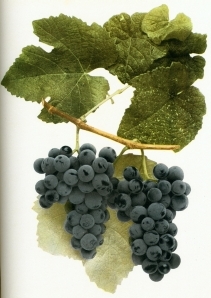
Jewel has much to recommend it, yet it has been grown since 1874 without having become widely distributed or well known. Its strong characters are earliness and high quality, though as compared with Delaware, its parent, it is not lacking in vigor, health, or hardiness, the vine characters that contribute most to a desirable variety. For a grape of this parentage, it is remarkably free from fungal diseases. In form and size of bunch and berry it closely resembles Delaware but is a deep black in color. The flesh characters and flavor are much like those of Delaware, the pulp being tender, yet firm, and the flavor having the same rich, sprightly, vinous taste found in the parent, though it can hardly be said to equal the Delaware in the characters which make high quality. The seeds are few and small. The skin is thin but tough, and the fruit, considering the tenderness of the flesh, ships remarkably well. It keeps long and does not shell, and though an early grape, will hang until frost if the robins, one of the worst pests of the grape-grower, can be kept from them.
Jewel is a most excellent little grape, almost worthy the place among black grapes that Delaware has among red ones. In particular it is recommended for its earliness and for those localities to the North where standard varieties, as Concord, do not ripen. Our list of early grapes is large, but most of them are poor in quality, while Jewel is deserving in this respect to stand well toward the head of the list.
John Burr of Leavenworth, Kansas, grew Jewel from seed of Delaware planted about 1874. The blossoms being open to cross-pollination, the male parent is unknown. It was introduced in 1887 by Stayman & Black of Leavenworth. Jewel has been quite widely tested in varietal vineyards but has never become popular and in the East, in particular, is hardly known.
Vine medium to vigorous, healthy, hardy except in exposed locations, medium to productive. Canes intermediate in length and number, slender, light to dark reddish-brown; nodes enlarged, flattened; internodes medium to short; diaphragm thickish; pith medium to below in size; shoots thinly pubescent; tendrils continuous, of average length, bifid.
Leaf-buds of medium size, short, thick, conical, open early. Young leaves heavily tinged on under side and along margin of upper side with rose-carmine. Leaves scant, intermediate in size, thick; upper surface light green, dull, medium to rugose; lower surface tinged with bronze, heavily pubescent; veins well defined; lobes three when present, with terminus acute; petiolar sinus of average depth, narrow to medium; basal sinus usually lacking; lateral sinus shallow, wide; teeth shallow, of ordinary width. Flowers sterile, open in mid-season or somewhat earlier; stamens reflexed.
Fruit ripens about with Moore Early, keeps and ships well. Clusters medium to small, slender to medium, tapering to cylindrical, single-shouldered, medium to compact; peduncle inferior in length, of average size; pedicel short to medium, slender; brush short, wine-colored. Berries medium in size, roundish to oval, dark purplish-black, dull, covered with heavy, blue bloom, persistent, moderately firm. Skin inclined to thin, tough, adheres to the pulp, contains dark, wine-colored pigment, not astringent. Flesh pale green, translucent, juicy, fine-grained, usually tender, sprightly, vinous, sweet from skin to center, not foxy, good to very good in quality. Seeds do not separate readily from the pulp, one to four, average two, intermediate in size and breadth, frequently one-sided, blunt, light brown; raphe hidden in a deep groove; chalaza small, above center, circular to oval, distinct.
KENSINGTON. (Vinifera, Riparia, Labrusca.)
1. Can. Cen. Exp. Farms Rpt., 1891:135. 2. Bush. Cat., 1894:144. 3. Can. Cen. Exp. Farms Rpt., 1897:63. 4. N. Y. Sta. An. Rpt., 18:395. 1899.
Kensington is chiefly interesting as a cross between Riparia and Vinifera, though it has several very meritorious fruit and vine characters.
KENSINGTON
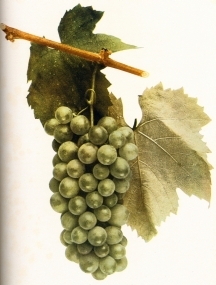
It resembles Clinton, its Riparia parent, in vigor, hardiness, growth, and productiveness of vine and in the botanical characters of vine and foliage; but the fruit has many of the characters of the European parent, Buckland Sweetwater. The grape is a handsome yellowish-green with large oval berries in a somewhat loose cluster of medium size. As it grows on the grounds of this Station, the clusters contain many undeveloped berries and are not as uniform in size and shape as might be desirable. While the quality is not equal to that of Buckland Sweetwater, it is much better than Clinton, ranking among good to best grapes. The flesh is tender and juicy, though slightly stringy, with a rich, sweet, vinous flavor. The seeds are markedly those of Vinifera. The hardiness of the vine and the high quality of the fruit should make Kensington a favorite green grape in northern gardens. It is doubtful if its good characters are sufficient in number or degree to make it of value for commercial vineyards.
This variety was produced by William Saunders of London, Ontario, from seed of Clinton pollinated by Buckland Sweetwater. It was sent out for testing sometime between 1870 and 1880 and since that time has been carefully tried at the Canadian Experiment Station and this Station, and with very favorable results. For some reason it seems not to have been very generally introduced into cultivation and nurserymen scarcely handle it though it ought to be found in gardens and in northern vineyards at least.
Vine vigorous, hardy, usually productive but sometimes an uncertain bearer, somewhat susceptible to attacks of mildew and leaf-hoppers. Canes medium to long, of average number, somewhat slender, light brown; nodes enlarged, flattened; internodes short to medium; diaphragm intermediate in thickness; pith of medium size; shoots thinly pubescent; tendrils persistent, intermittent to continuous, rather long, bifid to sometimes trifid.
Leaf-buds medium to below in size, variable in length, slender, conical to pointed, open very late. Young leaves tinged with faint rose-carmine on lower side only; upper side heavily pubescent, prevailing color pale green with faintest trace of carmine. Leaves small to medium, thin; upper surface light green, glossy, smooth to medium; lower surface pale green, pubescent, somewhat hairy; lobes none to three with terminus obtuse to acute; petiolar sinus of average depth, moderately narrow; basal sinus shallow when present; lateral sinus shallow, usually a notch; teeth deep and wide. Flowers strongly self-fertile, open medium early; stamens upright.
Fruit ripens about with Concord, does not keep very long in good condition. Clusters medium to large, intermediate in length and breadth, cylindrical to tapering, often heavily single-shouldered, sometimes double-shouldered, loose to medium, frequently with many undeveloped berries; peduncle long to medium, slender; pedicel long and slender, covered with numerous small, inconspicuous warts, wide at point of attachment to fruit; brush short, pale green. Berries variable in size, distinctly oval, attractive green changing to yellowish-green as the fruit matures, glossy, covered with thin gray bloom, persistent, moderately firm. Skin thin, somewhat tough, adheres to the pulp, contains no pigment, faintly astringent. Flesh greenish, transparent, juicy, tender, stringy, vinous, sweet, good in quality. Seeds separate easily from the pulp when fully ripe but frequently leave some flesh attached to the seed, two to four, average three, heavily wrinkled, large and long, broad to medium, somewhat sharp pointed, yellowish-brown; raphe buried in a shallow groove; chalaza of average size, above center, very irregular in shape, rather distinct.
KING. (Labrusca?)
1. Ill. Hort. Soc. Rpt., 1905:602. 2. Ib., 1906:215.
King has not fruited on the grounds of this Station, but one of the authors of this work was a committeeman from the Michigan Horticultural Society to name and describe the variety as it grew on the grounds of the originator. The following was the estimate of it made at that time:
“The King is more vigorous and prolific than the Concord, time of ripening and length of season the same, clusters are one-fourth larger, grapes are more persistent in pedicels, pulp is more tender, flavor nearly the same, but more sprightly, seeds fewer in number, wood harder and of shorter joints and the pedicels are larger.”
This variety was found growing in the Concord vineyard of W. K. Munson, Grand Rapids, Michigan, in 1892. The vine was set for a Concord, and is either a bud-sport of that variety or is some other sort that became accidentally mixed with the Concord vines. Mr. Munson believes it to be the former. King is thought by some to be Eaton on account of its close resemblance to that variety but the grape-growers who have examined it, generally hold it to be distinct. It is in all respects a typical black offspring of Concord, whether superior remains to be determined. It has been widely disseminated and its place in viticulture should soon be known. In seeking the origin of the grapes described in this work, an effort has been made to determine whether any could be said with certainty to have arisen from bud-sports. King is the best authenticated bud-sport among the grapes here listed and yet there is, as the above history shows, some doubt as to its having originated in this way.
LADY
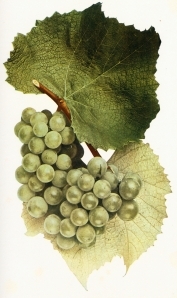
The description of King given below was made from vines and fruit from Ellwanger & Barry’s vineyards, Rochester, New York.
Vine vigorous to very vigorous, hardy, productive. Canes medium to above in length, intermediate in number and thickness, medium to dark reddish-brown; tendrils continuous to intermittent, trifid to bifid. Leaves unusually large, thick; upper surface medium green, dull, of average smoothness; lower surface grayish-white changing to slight bronze, considerably pubescent; veins fairly distinct.
Fruit ripens between Worden and Concord, appears to keep well. Clusters large to above medium, above average length, broad to medium, irregularly tapering to slightly cylindrical, usually single-shouldered, compact to medium. Berries unusually large averaging slightly below McPike in size, roundish, reddish-black to black as the fruit fully matures, covered with heavy blue bloom, persistent, firm. Skin medium to thick, tough, adheres considerably to the pulp, contains a moderate amount of reddish pigment, astringent. Flesh pale green, very juicy, somewhat tough, stringy and with some foxiness, sweet at skin to agreeably tart at center, good in quality. Seeds adherent, not numerous, above average in size, short, broad, slightly notched if at all, blunt to medium, plump, light brown; raphe hidden in a shallow groove; chalaza large, at center or above, obscure.
LADY. (Labrusca, Vinifera.)
1. Horticulturist, 29:48. 1874. 2. Ib., 30:84, fig., 367. 1875. 3. Mich. Pom. Soc. Rpt., 1875:295, 411. fig. 4. Am. Pom. Soc. Rpt., 18:40, 135, 136, 143, 162. 1881. 5. Am. Pom. Soc. Cat., 1881:24. 6. N. J. Hort. Soc. Rpt., 1881:12. 7. Bush. Cat., 1883:114. 8. Ill. Hort. Soc. Rpt., 1883:81. 10. Rural N. Y., 45:234, 622. 1886. 12. Gar. and For., 3:178, 214, 490, 599. 1890. 13. Ill. Sta. Bul., 28:264. 1893. 14. N. Y. Sta. An. Rpt., 17:532, 548, 552. 1898.
Lady is generally accredited with being the highest in quality of all the seedlings of Concord and, added to its high quality, it is early, fairly vigorous, hardy, and nearly as free from fungal diseases as its parent. It is not, however, without faults, one of which, a thin, tender skin which cracks badly, wholly debars it from ever making a commercial variety for other than nearby markets. The vine is much like that of Concord, though not as vigorous nor as productive, but ripening its fruit fully two weeks earlier. The fruit is much superior to Concord in quality, being richer, sweeter, and having less foxiness. It hangs on the vines well but deteriorates rapidly after picking. The term “ironclad” used by grape-growers to express hardiness and freedom from diseases, is probably as applicable to Lady as to any other of our Labrusca grapes. The foliage is dense and of a deep glossy green color, neither scalding under a hot sun, nor freezing until heavy frosts, making it an attractive ornament in the garden. It is deservedly popular as an amateur grape and should be planted more for nearby markets. It may be expected to succeed wherever Concord is grown, and because of its early ripening is especially adapted to northern latitudes where Concord does not always mature. Though it ripens early it starts its buds late and blossoms late, thereby often escaping late spring frosts.
When Lady was first heard of, it was in the hands of a Mr. Imlay of Muskingum County, Ohio. He had received it as a premium from an agricultural paper with others, all represented to be pure Concord seedlings. This was during the Civil War. Later the variety was sold to George W. Campbell of Delaware, Ohio, who introduced it in 1874. Lady was placed on the grape list of the American Pomological Society fruit catalog in 1881 where it is still retained. The Lady is another example of a green seedling of Concord which excels its parent in quality. Among several of such seedlings, this variety is one of the highest in quality.
Vine weak to moderately vigorous, hardy, medium in productiveness, healthy. Canes short, medium in number, slender, dark reddish-brown; nodes of fair size, flattened; internodes short; diaphragm thick; pith intermediate in size; shoots pubescent; tendrils intermittent, of average length, bifid to trifid.
Leaf-buds small, short, pointed to conical. Leaves medium to below in size, of average thickness; upper surface light green, glossy, medium to somewhat rugose; lower surface pale green; pubescent; veins rather indistinct; lobes none to five, with terminal lobe acuminate; petiolar sinus shallow to medium, wide; basal sinus of average width; lateral sinus variable in depth and width; teeth medium to shallow, intermediate in width. Flowers fertile, open in mid-season; stamens upright.
Fruit ripens with Winchell, does not keep well. Clusters not uniform, small to above medium, short, slender, cylindrical, sometimes single-shouldered, compact to straggling; peduncle medium to short, of average size; pedicel intermediate in length, thick and smooth, wide at point of attachment to fruit; brush slender, long, greenish-white. Berries variable in size, large to below medium, roundish, light green, often with tinge of yellow, glossy, covered with thin gray bloom, persistent, firm. Skin covered with small, scattering, dark dots, inclined to crack, thin, tender, adheres slightly to the pulp, contains no pigment, slightly astringent. Flesh greenish-white, translucent, juicy, tender, aromatic, agreeably sweet from skin to center, very good in quality. Seeds separate from the pulp rather easily, few in number, intermediate in size and length, medium to broad, blunt, light brown; raphe obscure; chalaza large, above center, circular to oval, not distinct.
LADY WASHINGTON
LADY WASHINGTON. (Labrusca, Vinifera.)
1. Gar. Mon., 19:336. 1877. 2. Ib., 20:47. 1878. 3. Ib., 21:147. 1879. 4. Am. Pom. Soc. Rpt., 1881:33, 46. 5. Am. Pom. Soc. Cat., 1881:24. 6. Gar. Mon., 26:14, 334. 1884. 7. N. Y. Sta. An. Rpt., 5:167, 168. 1886. 8. Ib., 9:331. 1890. 9. Ala. Sta. Bul., 10:11. 1890. 10. Kan. Sta. Bul., 28:164. 1891. 11. Col. Sta. Bul., 29:22. 1894. 12. Bush. Cat., 1894:147. 13. N. Y. Sta. An. Rpt., 17:532, 541, 544, 545, 547, 552. 1898.
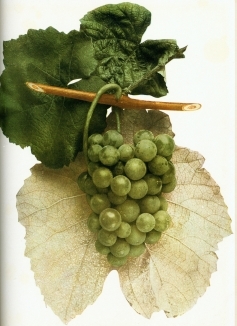
Were there not so many really fine green grapes, and were they sought for by grape-buyers, more might be said commendatory of Lady Washington. It is in many respects a most excellent grape but it falls short in quality for a green grape and does not excel greatly in vine characters; it cannot therefore be highly recommended to grape-growers except to give variety in the vineyard and for locations where it does preeminently well. The fruit makes an excellent appearance, keeps well and ships well, and is fairly tender, juicy and sweet, with a delicate aroma. The vine is very luxuriant,—too much so,—hardy for a grape with Vinifera blood, and healthy, though slightly susceptible to mildew. As an exhibition grape few green varieties show better when grown with all possible care and in a favorable location, for the variety is somewhat capricious as to soils and locations. It appears to be a desirable variety for home use. In the West and Southwest it is said to succeed better than most others of Ricketts’ grapes.
Lady Washington is another of J. H. Ricketts’ fine seedlings, this variety having come from seed of Concord fertilized by Allen’s Hybrid. It was introduced in 1878, placed on the grape list of the American Pomological Society fruit catalog in 1881, and is still retained there. The vine characters of Lady Washington are mostly those of Vitis labrusca but the fruit plainly shows the admixture of Vinifera.
Vine usually more vigorous than Concord, sometimes sustains winter injury, productive, susceptible to mildew. Canes long, few, thick, moderately dark brown; nodes greatly enlarged, variable in shape; internodes medium to long; diaphragm thick; pith large to medium; shoots strongly pubescent; tendrils continuous, long, bifid to trifid.
Leaf-buds large to medium, short, thick, open late. Young leaves lightly tinged on under side and along margin of upper side with light rose-carmine. Leaves medium to large, rather thick; upper surface dark green, older leaves strongly rugose, glossy; lower surface pale green, strongly pubescent; veins distinct; leaf not lobed, with terminus acute; petiolar sinus medium to deep, narrow, frequently closed and overlapping; basal sinus usually none; lateral sinus shallow, often a mere notch; teeth shallow to medium, rather narrow. Flowers fully self-fertile, open in mid-season; stamens upright.
Fruit ripens after mid-season, keeps and ships well. Clusters large to medium, broad to medium, irregularly cylindrical, single-shouldered to frequently double-shouldered, loose to medium; peduncle long, slender to medium; pedicel inclined to short, not thick, covered with numerous conspicuous warts, distinctly enlarged at point of attachment to fruit; brush very short, greenish. Berries variable in size, roundish to oblate, dark green changing to yellowish-amber, glossy, covered with thin gray bloom, persistent, of medium firmness. Skin thin, tender, adheres considerably to the pulp, contains no pigment, not astringent. Flesh pale green, transparent, juicy and tender, somewhat stringy, aromatic, sweet, ranks above Concord in quality. Seeds separate fairly well from the pulp, one to four, average three, intermediate in size and length, broad to medium, brown with yellowish tinge; raphe obscure; chalaza intermediate in size, above center, irregularly circular, obscure.
LENOIR. (Bourquiniana.)
1. Amer. Farmer, 11:237, 412. 1829-30. 2. Downing, 1845:256. 3. U. S. Pat. Off. Rpt., 1847:469. 4. Horticulturist, 12:460. 1857. 5. Ib., 14:487. 1859. 6. U. S. Pat. Off. Rpt., 1859:35. 7. Gar. Mon., 5:74. 1863. 8. Ib., 5:73. 1863. 9. Fuller, 1867:226. 10. U. S. D. A. Rpt., 1887:652. 11. Am. Pom. Soc. Cat., 1889:24. 12. Bush. Cat., 1894:148. fig. 13. Husmann, 1895:83, 183. 14. Ib., 1895:121, 122. 15. Tex. Farm and Ranch, Feb. 8, 1896:10, 11. 16. Tex. Sta. Bul., 48:1150, 1159. 1898. 17. U. S. D. A. Yr. Bk., 1898:557. 18. Kan. Sta. Bul., 110:246. 1902. 19. Traité gen. de vit., 6:374. 1903.
Alabama (19). Archer? (8). Black Souvignon (7) but incorr. Black El Paso (15). Black July (7). Black Lenoir (19). Black Spanish (14). Black Spanish (8, 12, 15, 19). Blue French (15, 19). Blue Grape of the South (7). Burgundy (12, 15, 19). Cigar Box Grape (19). Clarence (?2, 7). Devereaux of “Gardening for the South” (4). Devereaux (19). Devereux (5, 7,?9). Early Black (4). El Paso (6). El Paso (12, 19). Harris? (7, 9). Jack (8). Jack (12, 15, 19). Jacques (12, 15, 16, 19). Jacquez (19). Jacquez (15). Jac (19). Jacquet (19). July Sherry (4). Lenoir (14, 19). Long? (9). Longworth’s Ohio (19). Louisville Seedling? (9). MacCandless (19). Ohio (8, 19). Ohio Cigar Box? (9). Oldhouse? (7). Pungo of N. C.? (7). Segar Box (8, 19). Sherry of the South (7). Springstein (7). St. Genevieve? (9). Sumpter (?2, 4, 7). Thurmond (4, 5, 7,?9). Warren (8). Wylie? (9).
Lenoir is a southern grape, too tender and too late in ripening for even the Middle States. This variety has been largely used in France, both as a resistant stock and as a direct producer, but for some years has been losing favor for either purpose. It has also been grown more or less in California as a resistant stock. It is highly valued for its dark red wine, is considered a very good table grape, is very resistant to phylloxera, and withstands drouths well.
The origin of Lenoir is unknown. It was in cultivation in the South as long ago as the early part of the last century. Nicholas Herbemont[197] states in 1829 that its name was given it from a man named Lenoir who cultivated it near Stateburg, South Carolina, in the vicinity of the Santee River. There are traditions of its being imported from Europe, of its being found by Lenoir alongside a hedge, and so on, but none of them seem in any way authoritative. All that can be said is that Lenoir originated probably in one of the Carolinas or Georgia some time in the Eighteenth Century. This variety was tried at an early day in the northern and middle states, by Longworth at Cincinnati, by the Germans in Missouri, and in other places. On account of its being only semi-hardy and somewhat susceptible to rot, its cultivation was soon abandoned. It was early introduced into Texas and cultivated in the vicinity of El Paso, from which it derived one of its synonyms. It was placed on the grape list of the American Pomological Society fruit catalog in 1889 and is still retained. Lenoir differs from Herbemont, with which it is often confused, in having wood of a darker color, larger and darker leaves and slight differences in the fruit.
The following description is taken from various accounts of the variety:
Vine vigorous, thrifty, semi-hardy, usually quite productive. Canes rather numerous with some bloom at the nodes; tendrils intermittent. Leaves from two to seven-lobed, usually five, and of a characteristic bluish-green color above and a more pale green below. Clusters quite variable, medium to very large, tapering, usually shouldered. Berries small to medium, round, of a dark bluish-purple, nearly black, with lilac bloom. Skin rather thick, tough. Flesh slightly juicy, tender, subacidly sweet, very rich in coloring matter.
LINDLEY. (Labrusca, Vinifera.)
1. U. S. D. A. Rpt., 1862:215. 2. Am. Pom. Soc. Cat., 1867:44. 3. Horticulturist, 24:126, 312. 1869. 4. Mich. Hort. Soc. Rpt., 1881:221. 5. Am. Pom. Soc. Rpt., 1881:40. 6. Mo. Hort. Soc. Rpt., 1882:75. 7. Bush. Cat., 1883:117. fig. 8. Gar. and For., 5:547. 1892. 9. N. Y. Sta. An. Rpt., 9:329. 1890. 10. Ill. Sta. Bul., 28:260. 1893. 11. Can. Hort., 17:254, 405. 1894. 12. Va. Sta. Bul., 94:137. 1898. 13. N. Y. Sta. An. Rpt., 17:532, 541, 543, 545, 546, 548, 552, 558. 1898. 14. Miss. Sta. Bul., 56:15. 1899. 15. Mich. Sta. Bul., 169:172. 1899. 16. Tex. Sta. Bul., 56:223, 271. 1900. 17. Can. Hort., 26:51, 96, 298, fig., 299. 1903.
Rogers’ No. 9 (1, 2). Rogers’ No. 9 (3, 7, 9, 11, 17).
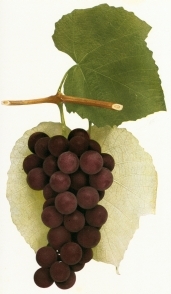
To Lindley, less productive than several others of its class, but when cross-fertilized usually bearing a crop of excellent grapes, is due much of the popularity of Rogers’ hybrids. By common consent it is the best of the red grapes originated by Rogers in his crosses between Labrusca and Vinifera. Unfortunately the color-plate does not do the variety justice. Both berry and bunch should be shown a little larger, even for average-sized specimens.
When well grown Lindley is a very handsome grape. The bunches are of only medium size and are somewhat loose but the berries are well-formed, of uniform size, and of an attractive dark red color. The flesh is firm, fine-grained, juicy and tender without pulpiness and with a peculiarly rich aromatic flavor. The skin is thick and rather tough but is not objectionable in fully ripe fruit. The fruit keeps well and ships well and the berries neither crack nor shatter. The vine is vigorous, comparatively hardy for a Vinifera hybrid, fairly healthy, but as with most of its kind, susceptible to mildew. The chief defects of Lindley are its self-sterility and precariousness in bearing, and its lack of adaptation to many soils. Lindley has long been a favorite grape in the garden and should continue to be such, and might well be grown in commercial plantations as a fancy product.
For an account of the origin and parentage of Lindley see “Rogers’ Hybrids.” Rogers’ No. 9, or Lindley, is first mentioned separately from the others of Rogers’ hybrids about 1862. In 1869 Rogers gave this grape the name Lindley in honor of John Lindley, the English botanist. The variety has been used by a number of breeders, Munson in particular, as a parent for improved pure-bred or cross-bred offspring. Lindley was placed on the American Pomological Society fruit catalog list in 1867 and has not been removed.
LINDLEY
Vine vigorous to rank, usually hardy but sometimes injured in exposed locations, not a heavy yielder, somewhat susceptible to mildew, often subject to attacks of leaf-hoppers. Canes very long, intermediate in number, of medium thickness, dark reddish-brown, covered with thin blue bloom; nodes enlarged, usually flattened; internodes medium to long, thick; pith of medium size; shoots pubescent; tendrils continuous, medium to long, bifid to trifid.
Leaf-buds large, of average length, above medium in thickness, obtuse to conical, open in mid-season. Young leaves heavily tinged on upper and under sides with mahogany-red. Leaves medium to large, thickish; upper surface light green, dull, slightly rugose; lower surface grayish-white, pubescent; obscurely three-lobed with terminus acute; petiolar sinus deep, narrow, often closed and overlapping; teeth shallow, intermediate in width. Flowers sterile, open in mid-season; stamens reflexed.
Fruit ripens in mid-season, keeps and ships well. Clusters medium in size, long, inclined to broad, tapering to nearly cylindrical, frequently single-shouldered, the shoulder being connected to the bunch by a rather long stem, somewhat loose; peduncle medium to long, thick; pedicel short to medium, slender, nearly smooth, strongly enlarged at point of attachment to fruit; brush short, stubby, pale green. Berries large to medium, roundish to slightly oval, dark brick-red, covered with lilac or faint blue bloom, do not usually drop from the pedicel, of average firmness. Skin variable in thickness, tough, adheres considerably to the pulp, contains no pigment, strongly astringent. Flesh very pale green, translucent, juicy, fine-grained, nearly tender, vinous, sweet at skin to tart at center, good to best in quality. Seeds do not separate easily from the pulp unless fully ripe, two to five, average three, intermediate in size and length, distinctly notched, brownish; raphe buried in a deep, broad groove; chalaza small, nearly central, oval to pear-shaped. Must 80°.
LOUISIANA. (Bourquiniana.)
1. Husmann, 1866:110. 2. Am. Jour. Hort., 3:301. 1868. 3. Grape Cult., 1:22, 42, 100, 244, 326. 1869. 4. Bush. Cat., 1883:118. 5. Husmann, 1895:183. 6. Texas Farm and Ranch, Feb. 8, 1896:10, 11. 7. Ga. Sta. Bul., 53:46. 1901.
Amoreaux (6). Burgunder (1). Clevener? (6). Red Elben (6). Rulander (6). St. Genevieve (6). (N. B. Reference number 6 is to a red grape. Louisiana is black.)
The grape here discussed is of cultural value in the South and is of interest from the standpoint of grape-breeding and, historically, to northern grape-growers. Louisiana first came to notice in Missouri. It was received about 1860 or before by Frederick Muench of Marthasville, Warren County, Missouri, from a Mr. Theard of New Orleans, Louisiana, under the name White and Red Burgundy. Both supposed varieties proved to be alike. Theard informed Muench that the varieties had been imported from France about the first of the century by his (Theard’s) father. There has been much difference of opinion as to whether this imputed origin is correct or not. Munson classes it with the Devereaux section of the Bourquiniana. It is undoubtedly closely related to Herbemont, Lenoir, and others of that class.
The variety has been much confused with Rulander and some are of the opinion that the two varieties are identical. Those who cultivated it earliest and most extensively were, however, of the opinion that they were very similar but distinct. The vine is too tender in the North for cultivation and there are complaints from some sections in the South of the fruit rotting badly.
The following description is taken from various sources:
Vine very vigorous, stocky, short-jointed; leaves cordate, not lobed. Cluster medium to small, shouldered, compact. Berry small, round, black with blue bloom, without pulp, juicy, spicy, sweet.
LUCILE. (Labrusca.)
1. N. Y. Sta. An. Rpt., 18:395. 1899. 2. Rural N. Y., 60:167. 1901. 3. Ga. Sta. Bul., 53:46. 1901. 4. Budd-Hansen, 2:384. 1902.
Lucile is of interest and of value because of its truly remarkable vine characters. In vigor, health, hardiness and productiveness it is not surpassed by any of the cultivated native grapes. It is probably a seedling of Wyoming but the vine is much more vigorous than even that variety, which is considered a very strong grower. Yet with all of its great growth Lucile ripens its wood almost perfectly. It is very productive, as much so as any other of our native grapes, often bearing four bunches to the shoot, its crops exceeding those of Concord. It has never been known to winterkill in the grape regions of New York and is probably as hardy as any other of our Labruscas. Its fruit and foliage are very nearly immune to the fungal diseases of the grape.
Unfortunately the fruit characters of Lucile are not as desirable as the vine characters. The size, form, and color of bunches and berries are all good, making a very attractive fruit, but it has an obnoxious, foxy taste and odor objectionable to those who know good grapes though even in flavor it is better than its supposed parent and is on a par with some of the other varieties of its season. A further objection to the berries is that they are both pulpy and seedy. It is earlier than Concord, coming about with Worden or preceding it a few days. For so early a variety the fruit keeps very well and in spite of its somewhat thin skin ships very well. It is not at all capricious as to soils, seemingly thriving in all good grape soils.
LUCILE
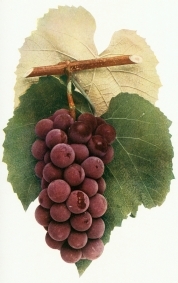
Lucile may be recommended where an extra hardy grape is desired, for localities where the season is short, and as a variety for breeding purposes, should it prove capable of transmitting its vine characters, and for those who do not object to foxiness of taste and aroma in grapes.
J. A. Putnam of Fredonia, Chautauqua County, New York, is the producer of Lucile. The vine fruited for the first time in 1890, it being then two years old, and was introduced by Lewis Roesch of Fredonia in 1899. It is supposed to be a seedling of Wyoming which it resembles very much in both fruit and vine characters and surpasses in both. It is a typical red Labrusca in all of its characters.
Vine vigorous, hardy, very productive, yielding as good or better crops than Concord. Canes medium to long, rather numerous, intermediate in thickness, light brown; nodes strongly enlarged, usually flattened; internodes medium to short; diaphragm moderately thick; pith about medium in size; shoots slightly pubescent; tendrils continuous, of average length, bifid to trifid.
Leaf-buds below medium to small, short, moderately thick, pointed to conical, open in mid-season. Young leaves heavily tinged on lower side and along margin of upper side with bright carmine. Leaves healthy, medium to large, of average thickness, firm; upper surface light green, glossy, moderately smooth; lower surface pale green or with tinge of bronze, pubescent; veins distinct; leaf usually not lobed, with terminus acute; petiolar sinus shallow, narrow to medium, sometimes closed and overlapping; basal sinus usually absent; lateral sinus a mere notch when present; teeth very shallow, of average width. Flowers fertile, open early; stamens upright.
Fruit ripens earlier than Concord or in some seasons about with Worden, keeps fairly well. Clusters medium to large, above average length, slender, cylindrical to tapering, usually single-shouldered, very compact; peduncle intermediate in length, large; pedicel short, thick, covered with few, small, inconspicuous warts; brush light brown. Berries large to medium, roundish to somewhat oval when strongly compacted, dark red, duller than Wyoming, covered with thin lilac bloom, persistent, firm. Skin medium to thin, somewhat tender, contains a small amount of light red pigment and some astringency. Flesh pale green, translucent, juicy, rather tough, sometimes stringy, foxy, sweet next the skin to slightly tart at center, fair to good in quality, not equal to Concord but superior to Wyoming. Seeds separate with difficulty from the pulp, one to four, average three, small, broad, short to medium, blunt, dark brown; raphe obscure; chalaza intermediate in size, slightly above center, oval, distinct.
LUTIE. (Labrusca.)
1. Gar. Mon., 26:307. 1884. 2. Ib., 27:304. 1885. 3. Am. Pom. Soc. Rpt., 1885:85. 4. Ib., 1889:120, 136. 5. N. Y. Sta. An. Rpt., 13:605. 1894. 6. Bush. Cat., 1894:150. 7. Tenn. Sta. Bul., Vol. 9:192. 1896. 8. N. Y. Sta. An. Rpt., 17:532, 545, 547, 555. 1898. 9. Mich. Sta. Bul., 169:172. 1899. 10. Am. Pom. Soc. Cat., 1899:29. 11. Kan. Sta. Bul., 110:236. 1902.
As with the preceding variety, Lutie is chiefly valuable for its vine characters. It is vigorous, hardy, healthy, and fruitful, though scarcely equaling Lucile in any of these characters. Pomologists differ widely as to the merits of the fruit, some claiming high qualities for it and others declaring that it is no better than the average wild Labrusca. The difference in opinion is partly due to a peculiarity of the fruit. If eaten fresh from the vines, the quality, while far from being of the best, is not wholly bad, but after being picked for several days it develops so much foxiness of flavor and aroma that it is scarcely edible. As Lutie grows on the Station grounds its fruit has little merit, though somewhat attractive in appearance, and the variety can be recommended only for vigor, hardiness, resistance to disease and fruitfulness. It is given the prominence of an illustration in The Grapes of New York out of respect for the opinions of others rather than for its merits as it grows here. It makes a better showing in other grape regions.
Lutie is a chance seedling found on the grounds of Dr. L. C. Chisholm of Spring Hill, near Nashville, Davidson County, Tennessee. It was introduced in 1885 by Messrs. Coleman, Webber and Newson of Nashville. Lutie was placed on the grape list of the American Pomological Society fruit catalog in 1899 where it has since been retained. Its gross characters are much the same as those of Dracut Amber, Lucile, Wyoming, and Woodruff, all typical red Labruscas and worthy of cultivation only where better-flavored varieties cannot be grown.
Vine vigorous, hardy, healthy, productive. Canes short, of average number, slender, dark reddish-brown; nodes enlarged, roundish; internodes short; diaphragm thin; pith inclined to small; shoots pubescent; tendrils continuous, short to medium, bifid.
LUTIE
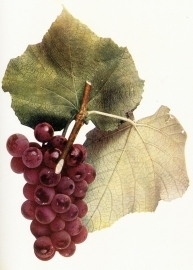
Leaf-buds small, short to medium, slender, open in mid-season. Young leaves tinged on lower side and along margin of upper side with bright carmine. Leaves medium to small, of average thickness; upper surface dark green, often rugose; lower surface bronze to whitish-green, pubescent; veins somewhat distinct; leaf usually not lobed, with terminus acute to acuminate; petiolar sinus moderately deep, medium to sometimes wide; basal sinus lacking; lateral sinus rather shallow and narrow when present; teeth shallow, narrow. Flowers fertile, open somewhat early; stamens upright.
Fruit ripens earlier than Concord, some seasons about with Worden, does not keep nor ship well. Clusters medium to small, short and broad, blunt at end, cylindrical to sometimes conical, usually not shouldered, compact; peduncle intermediate in length, rather thick; pedicel short, of average thickness, covered with small, scattering, inconspicuous warts; brush slender, of average length, pale green. Berries large to below medium, roundish, light to dark red, dull, covered with thin, whitish or lilac bloom, drop badly from pedicel, nearly firm. Skin intermediate in thickness somewhat tender, adheres to the pulp, contains no pigment, astringent. Flesh pale green, translucent, moderately juicy, somewhat tough, strongly foxy, sweet next the skin to slightly tart at center, fair to possibly good in quality. Seeds adhere to the pulp unless the fruit is fully ripe, one to four, average two, usually above medium size, broad, often rather short and blunt, dark brown; raphe buried in a small, rather indistinct groove; chalaza large, at center or slightly above, irregularly circular, rather distinct.
McPIKE. (Labrusca.)
1. Rural N. Y., 55:622, fig., 627. 1896. 2. Am. Pom. Soc. Rpt., 1897:13. 3. Nat. Nurs., 7:119. 1899. 4. Ib., 8:93. 1900. 5. Rural N. Y., 60:170, 226, 290, 614, 710. 1901.
McPike is noteworthy chiefly because of the large size of the berries, though the bunches, too, average large. The accompanying illustration shows the size of the berry accurately but the bunch, as shown here, is too small.[198]
McPike in vine and fruit characters is very similar to its parent, Worden, differing in having fewer but larger berries per bunch, grapes not as high in flavor, and fewer and smaller seeds. Because of a thin, tender skin the berries crack somewhat, shell more or less, and the vines are less productive than those of Worden. The faults just named seem to debar it pretty effectually from becoming a commercial grape in New York and it is not high enough in quality and is lacking in too many other fruit characters to make it of value for the amateur. It should be said, however, that the variety has not been largely tested in New York and further experience with it is needed to fully determine its value in this State.
This variety was originated by H. G. McPike of Mount Lookout Park, Alton, Illinois, from seed of Worden planted in 1890. It was introduced in 1897 by Silas Wilson of Atlantic, Iowa. McPike is a typical black descendant of Concord, bearing a strong resemblance in its gross characters to Eaton, Hosford, Chautauqua, King, and its parent, Worden.
Vine vigorous to medium, hardy, productive to very productive. Canes intermediate in length, number and thickness, dull dark reddish-brown; nodes enlarged, flattened; internodes very short; diaphragm thick to medium; pith large; shoots thinly pubescent; tendrils continuous, of average length, bifid to trifid.
Leaf-buds about average size, short, thick to medium, obtuse to conical, compressed. Leaves large, thick; upper surface light green, dull, medium to slightly rugose; lower surface grayish-white to bronze, heavily pubescent; veins fairly distinct; leaf not lobed, with terminus acute to obtuse; petiolar sinus deep to medium, rather wide; basal and lateral sinuses lacking; teeth intermediate in depth and width. Flowers fertile or nearly so.
Fruit ripens about with Concord or earlier, appears to keep well. Clusters variable in size, medium to short, rather broad, irregularly tapering with slight tendency to cylindrical, often blunt at ends, usually not shouldered, two to three bunches per shoot, of average compactness; peduncle medium to above in length, thick; pedicel long to medium, thick, quite brittle, nearly smooth; brush long, slender, greenish with brown tinge. Berries unusually large, roundish, purplish-black to black, covered with blue bloom, firm. Skin of medium thickness, variable in toughness, sometimes cracks, adheres considerably to the pulp, contains a large amount of purplish-red pigment, astringent. Flesh pale green, translucent, very juicy, rather tender, stringy, vinous, nearly sweet at skin to rather acid at center, fair to good in quality. Seeds moderately adherent to the pulp, one to four, average two, medium to below in size, short, broad, blunt, rather plump, light brown; raphe buried in a wide, shallow groove; chalaza rather large, at center or slightly above, somewhat obscure.
MAGNATE. (Labrusca, Vinifera?)
1. Mo. Hort. Soc. Rpt., 1891:130. 2. Ib., 1892:270. 3. Bush. Cat., 1894:151. 4. Va. Sta. Bul., 94:141. 1898. 5. Ga. Sta. Bul., 53:46. 1901.
McPIKE
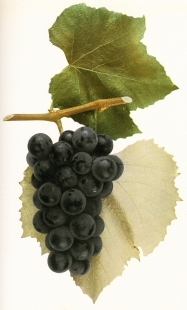
Magnate is a green seedling of Concord and, like several others of Concord’s light-colored offspring, as Lady and Martha, it is better in quality than the parent though the flesh characters are not as good. It does not compare favorably with the best green grapes of its season, either in appearance or quality and is not recommended for New York.
The variety was originated by either John Burr, or Dr. Stayman of Leavenworth, Kansas, from seed of Concord. It was introduced by Stayman & Black in 1891 but has not been widely grown. It is better known in the West than in the East.
Vine medium to vigorous, hardy except in severe winters, medium to productive. Canes intermediate in length, number and size; tendrils continuous, bifid to trifid. Leaves not always healthy, large to medium, variable in color; lower surface grayish-white, pubescent. Flowers nearly fertile, open in mid-season or earlier; stamens upright. Fruit ripens about with Concord, keeps well. Clusters medium to large, sometimes rather broad, occasionally with a medium-sized single shoulder, usually compact and with many abortive fruits. Berries variable in size, roundish, pale green with trace of yellow, covered with a medium amount of gray bloom, persistent. Flesh pale green, slightly tough, vinous, somewhat musky, nearly sweet at skin to acid at center, fair to good in quality. Seeds below medium to small, short, broad, plump.
MANITO. (Labrusca, Vinifera, Bourquiniana, Lincecumii, Rupestris.)
1. Tex. Sta. Bul., 56:279. 1900. 2. Ga. Sta. Bul., 53:46. 1901. 3. Rural N. Y., 60:614. 1901. 4. Ib., 62:790. 1903. 5. Mo. Hort. Soc. Rpt., 1904:305. 6. Can. Cen. Exp. Farms Rpt., 1905:107.
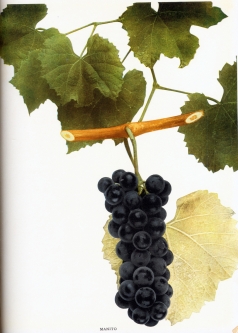
Manito is one of Munson’s grapes recommended for both the North and the South. It is remarkable in having for its immediate ancestors five species, Lincecumii, Rupestris, Labrusca, Vinifera, and Bourquiniana. As Manito grows at this Station, its vine characters are all good and the fruit is passably so. According to the originator, the variety endures extremes of climate very well and has stood the cold of the New York winter and the heat of summer without any perceptible injury. The fruit is not sufficiently handsome nor of high enough quality to recommend the variety highly for this State, but it keeps well, ships well, is said to make good wine, and is worthy a trial in experimental vineyards at least. A point of merit is earliness, as it ripens just before Moore Early.
The variety was produced from seed of America pollinated by Brilliant. The seed of Manito was planted in 1895 and the variety was introduced by the originator in 1899.
Vine medium to vigorous, hardy, medium to productive. Canes long, rather numerous and thick, dark reddish-brown, surface covered with blue bloom, nodes enlarged, often flattened; internodes intermediate in length; diaphragm thick; pith large to medium; shoots thinly pubescent; tendrils medium to above in length, bifid to trifid.
Leaf-buds large, of average length, thickish, conical to obtuse, open very late. Young leaves tinged on under side and along margin of upper side with rose-carmine. Leaves medium to below, of average thickness; upper surface dark green, glossy, smooth to medium; lower surface duller than upper surface, thinly pubescent; veins moderately distinct; lobes usually three in number, with terminal lobe variable; petiolar sinus medium to deep, inclined to narrow; basal sinus usually lacking; lateral sinus shallow, narrow, often a mere notch; teeth of average depth, wide. Flowers semi-fertile, open in mid-season or later; stamens upright.
Fruit ripens about with Moore Early, keeps and ships well. Clusters large to below medium, often quite long, slender to medium, cylindrical, sometimes with enlarged end, usually not shouldered, loose; peduncle intermediate in length, slender; pedicel short, slender, nearly smooth; brush light green with faint reddish tinge. Berries intermediate in size, roundish to slightly oval, dull purplish-black, covered with a medium amount of blue bloom, persistent, moderately firm. Skin thin, tender, adheres considerably to the pulp, contains a large amount of wine-colored pigment, slightly astringent. Flesh pale green, with slight pink tinge, translucent, moderately juicy, tender and almost melting, not very aromatic, sweet next the skin to agreeably tart at center, good in quality. Seeds separate easily from the pulp, one to four, average two, surface often rough and warty, intermediate in size, length and breadth, darkish brown; raphe obscure; chalaza of fair size, oval to rather pear-shaped, often indistinct.
MARIE LOUISE. (Labrusca, Vinifera?)
1. U. S. D. A. Rpt., 1887:634. 2. Bush. Cat., 1894:151. 3. N. Y. Sta. An. Rpt., 15:295. 1896. 4. Ib., 17:532, 548, 555. 1898. 5. Va. Sta. Bul., 94:141. 1898. 6. Ga. Sta. Bul., 53:46. 1901.
The parentage of Marie Louise is unknown but it seems to be a typical green seedling of Concord and, as tested at this Station, is of no especial merit. It is surpassed by Diamond, Lady, Martha, and nearly a score of other green grapes.
The vine characters here are not satisfactory. It is only moderately productive and for some years has been affected with chlorosis.
MANITO
Marie Louise was originated by Theophile Huber of Illinois City, Illinois, about 1880. Besides the characters of the variety, the work of the originator would indicate that it is a Concord seedling. There are no records of its ever having been widely disseminated.
Vine intermediate in vigor, not hardy nor productive. Canes short, not numerous, dark brown; tendrils continuous, bifid. Leaves small to medium, intermediate in thickness and smoothness; lower surface tinged with bronze, heavily pubescent. Flowers nearly fertile, open in mid-season; stamens upright. Fruit ripens about with Worden, does not keep well. Clusters small to medium, short, slender, cylindrical, usually with a small single shoulder, rather loose. Berries small to medium, roundish to oval, pale green with tinge of yellow, covered with thin gray bloom, shatter badly, not very firm. Skin thin, of medium toughness. Flesh pale green, tender, sprightly, somewhat vinous, sweet at skin to tart at center, good to very good in quality. Seeds separate easily from the pulp, not numerous, small, short and broad, plump.
(I) MARION. (Riparia, Labrusca.)
1. Horticulturist, 13:13. 1858. 2. Mag. Hort., 26:100. 1860. 3. Am. Pom. Soc. Rpt., 1860:83. 4. Fuller, 1867:244. 5. Bush. Cat., 1883:120. 6. Kan. Sta. Bul., 14:89. 1890. 7. N. Y. Sta. An. Rpt., 10:497. 1891. 8. Ill. Sta. Bul., 28:255. 1893. 9. N. Y. Sta. An. Rpt., 17:532, 545, 546, 548, 555, 559. 1898.
Black German (2). Marion Port (2, 4).
Marion is an old variety of unknown parentage but so closely resembling Clinton in both botanical and horticultural characters as to be clearly of the type of that variety. In many grape regions it is held that this variety surpasses Clinton as both a table and a wine grape. The growth of Marion is vigorous, the vine is hardy but hardly sufficiently productive, and is susceptible to mildew and to leaf-hoppers. The fruit is pleasantly sweet and spicy though not of high enough quality for a table grape, but making, according to the following, from a French authority, a very good dark red wine.[199]
“With regard to intense coloring, without any foxy taste, nothing equals the wine made of the Marion grape; one-twentieth part is sufficient to give to water even a superior wine color; the somewhat violet shade is easily transformed into a lively red by adding some acid wine or a very small quantity of tartaric acid.”
The fruit colors early in the season but ripens very late, hanging well on the vines and improving with a light touch of frost. Marion is not much grown in New York as a wine grape, though it might prove of value because of its coloring properties for the making of some wines.
This variety was brought to notice by a Mr. Shepherd of Marion, Ohio, over fifty years ago. It was first known as Black German but this name was changed to Marion Port. At about the same time, Nicholas Longworth received a variety resembling the Isabella from Marion, Ohio, probably also from Shepherd, which he disseminated under the name Marion. Owing to the similarity of the names, the two varieties became badly confused. The true Marion, which many believed to be identical with York Madeira, was soon dropped from cultivation and the Marion Port assumed the name of Marion. Shepherd did not know where the Marion Port had originated but stated that it had come originally from Pennsylvania. It is quite possible that it is some old variety reintroduced under this name. The species of the variety is usually given as Riparia but as the tendrils are often continuous, there is evidently an admixture of Labrusca blood.
Vine vigorous, usually hardy, medium to productive, susceptible to injury from leaf-hoppers. Canes very long, intermediate in number and thickness, dark reddish-brown, surface covered with blue bloom; nodes slightly enlarged, flattened; internodes very long to medium; diaphragm thin; pith of average size; shoots glabrous, younger shoots tinged with reddish-purple; tendrils continuous, sometimes intermittent, long, bifid.
Leaf-buds nearly medium in size and thickness, short, conical, often strongly compressed, open early; young leaves tinged on under side and along margin of upper side with carmine. Leaves unusually large, of average thickness; upper surface dark green, glossy; lower surface pale green, somewhat cobwebby to nearly smooth; veins well defined; leaf not lobed with terminus acuminate; petiolar sinus very deep, narrow, often closed and overlapping; basal and lateral sinuses lacking; teeth shallow, rather wide. Flowers sterile, open very early; stamens reflexed.
MARION
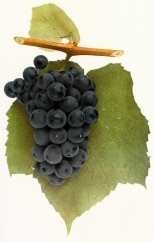
Fruit ripens in mid-season, keeps fairly well. Clusters medium to below, short and slender, cylindrical to tapering, single-shouldered, compact; peduncle short, intermediate in thickness; pedicel short, slender, covered with few, inconspicuous warts; brush very short, wine-colored. Berries medium to small, roundish, black, slightly glossy, covered with abundant blue bloom, persistent, firm. Skin medium to thin, rather tough, adheres slightly to the pulp, contains much dark wine-colored pigment, slightly astringent. Flesh dark green, translucent, juicy, fine-grained, tough, sprightly, spicy, agreeably tart but free from astringency, no more than fair in quality. Seeds adhere somewhat to the pulp, one to five, average four, above medium in size, broad, short, usually not notched, very plump, brownish; raphe buried in a narrow, shallow groove; chalaza small, nearly central, oval, obscure.
(II) MARION. (Labrusca, Vinifera?)
1. U. S. Pat. Off. Rpt., 1856:433. 2. Downing, 1857:341. 3. Am. Pom. Soc. Rpt., 1860:83. 4. Mag. Hort., 26:100. 1860. 5. (?) Gar. Mon., 3:52. 1861. 6. Fuller, 1867:244. 7. Rural N. Y., 53:793. 1894.
German Grape (7).
This variety much resembles Isabella and was said by some to be identical with it. It is probably the same as York Maderia. Downing[200] discusses it as follows:
“Origin unknown. Sent to Mr. Longworth from Marion, Ohio, and by him disseminated. It much resembles the Isabella in shape and size of berry and form of bunch, but more uniform in its ripening and more delicate in flavor, ripening about the same time. Growth healthy, making firm and short-jointed wood, with strong, red tendrils; a good bearer.
“Bunches large, regular, seldom shouldered. Berries large, round, inclining to oval, dark purple with a bloom, juice abundant, pulp thin, not sufficiently tested for wine, a promising variety.”
MARTHA. (Labrusca, Vinifera?)
1. Mag. Hort., 30:26. 1864. 2. U. S. D. A. Rpt., 1865:196. 3. Fuller, 1867:227. 4. Mag. Hort., 34:236. 1868. 5. Grape Cult., 1:10, 14, 15, 42, 129, fig., 130. 1869. 6. Am. Pom. Soc. Cat., 1869:42. 7. Bush. Cat., 1883:119. fig. 8. Kan. Sta. Bul., 14:89. 1890. 9. Ill. Sta. Bul., 28:265. 1893. 10. Mo. Sta. Bul., 46:40, 42, 44, 46. 1899. 11. N. Y. Sta. An. Rpt., 18:396. 1899.
Miller No. 1 (2, 5).
Martha was at one time the most popular of the green grapes but the introduction of many other green varieties of superior fruit and vine characters has gradually reduced its popularity until it is now but little grown. It is a seedling of Concord and resembles its parent greatly, differing from it chiefly in the following particulars: Fruit green, a week or more earlier, bunch and berries smaller, quality far better, being sweeter, more delicate, and with less foxiness and less pulp. About the only difference in the vines is a lighter shade of green in Martha and less robustness, with blossoms opening a few days earlier than Concord. Martha is often sold in the markets as Niagara, though the resemblance between the two is not strong, the Niagara being larger in bunch and berry and not as high in quality. One of the defects of Martha, and the chief cause of its going out of favor, is that it does not keep nor ship well. A very good white wine is made from Martha. The variety is still being planted in some parts of the South, but is generally abandoned in the North.
Samuel Miller, then of Calmdale, Lebanon County, Pennsylvania, grew Martha from seed of Concord sent him by E. W. Bull. The variety was introduced about 1868 by J. Knox of Pittsburg, Pennsylvania. It was placed on the American Pomological Society fruit catalog list in 1869 and dropped from that list in 1899.
Vine variable in vigor, hardy, intermediate in productiveness, somewhat susceptible to attacks of mildew in unfavorable seasons. Canes medium to long, of average number and size, rather dark reddish-brown, surface covered with thin bloom, slightly roughened; tendrils continuous to intermittent, bifid. Leaves large to medium, rather thick; upper surface light green, intermediate in smoothness; lower surface light bronze, heavily pubescent; veins well defined. Flowers self-fertile, open in mid-season; stamens upright.
Fruit ripens somewhat earlier than Concord, does not keep nor ship well. Clusters medium in size, often below average length, intermediate in width, tapering to cylindrical, usually single-shouldered, inclined to be loose. Berries medium in size, roundish, light green with tinge of yellow, covered with thin gray bloom, persistent, medium in firmness. Skin thin, very tender, does not usually crack, adheres considerably to the pulp, contains no pigment, with scarcely any astringency. Flesh pale yellowish-green, juicy, moderately tough, fine-grained, slightly foxy, sweet at skin to somewhat tart at center, mild, good to very good in quality but not as good as Lady. Seeds few in number, rather adherent, intermediate in size and length, broad, rather blunt, dark brown; raphe obscure; chalaza small, slightly above center, oval, frequently shows as a mere depression. Must 85°-90°.
MASSASOIT
MASSASOIT. (Labrusca, Vinifera.)
1. Am. Pom. Soc. Rpt., 1862:148, 152. 2. Horticulturist, 18:99. 1863. 3. Am. Pom. Soc. Cat., 1867:44. 4. Horticulturist, 24:126. 1869. 5. Grape Cult., 1:180, 326. 1869. 6. Ind. Sta. Bul., 33:34. 1890. 7. Gar. and For., 3:214, 255, 490. 1890. 8. Kan. Sta. Bul., 28:164. 1891. 9. N. Y. Sta. An. Rpt., 10:497. 1891. 10. Bush. Cat., 1894:154. 11. N. Y. Sta. An. Rpt., 17:533, 548, 555. 1898.
Rogers’ No. 3 (1, 2, 3). Rogers’ No. 3 (4, 5, 6, 10).
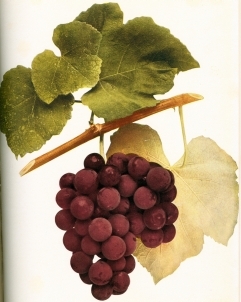
Massasoit is distinguished as being the earliest of Rogers’ hybrids though it is not, as some viticulturists say, as early as Hartford, ripening rather with Delaware or a little later. It has the peculiarity or defect of being at its best before full maturity, and of developing after ripening a degree of foxiness which impairs its quality. In shape and size of berry, and sometimes in bunch, there is a striking resemblance to Isabella, another suggestion of Vinifera in the latter sort, but the color is that of Catawba. The texture of the fruit is especially good, firm but tender and juicy, while the flavor, as with all of Rogers’ grapes, is rich and sweet, though in the case of Massasoit, hardly as good as others of these hybrids. The vine is vigorous, hardy and productive but very subject to mildew and rot. Massasoit is well worth a place in the home vineyard, and as an early grape, of fine quality for the local market.
For an account of the early history and parentage of Massasoit the reader is referred to Rogers’ Hybrids. The variety attracted considerable attention even while it was known only as Rogers’ No. 3 and was placed on the American Pomological Society’s list of recommended sorts as early as 1867. In 1869 it was named by Rogers after Massasoit, the Indian chief who was so intimately connected with the early history of Massachusetts.
Vine vigorous to very vigorous, hardy in all but unusually cold winters, often very productive, very subject to rot and mildew. Canes long, intermediate in number, thick, inclined to dark brown with slight reddish tinge; nodes enlarged, flattened; internodes long to medium; diaphragm of average thickness; pith large; shoots thinly pubescent; tendrils continuous, long, trifid to bifid.
Leaf-buds large to medium, long, unusually thick, obtuse to conical, heavily coated with brownish pubescence. Young leaves tinged on upper and under sides with rose-carmine. Leaves variable in size, medium to thin, upper surface light green, dull, smooth to medium; lower surface pale green, slightly pubescent; veins well defined; lobes three to sometimes obscurely five with terminus acute; petiolar sinus deep, narrow to medium; basal sinus shallow, narrow, often obscure; teeth very shallow, of average width. Flowers sterile, open moderately late; stamens reflexed.
Fruit ripens about with Delaware, keeps well. Clusters variable in size, of medium length, often rather broad, cylindrical to tapering, frequently single-shouldered, variable in compactness; peduncle short to medium, thick; pedicel of average length, slender to medium, covered with few, indistinct warts, enlarged at point of attachment to fruit; brush of fair length, pale green. Berries large to medium, roundish to oval, dark brownish-red, dull, covered with lilac bloom, very persistent, moderately firm. Skin thin, tender, adheres considerably to the pulp, contains no pigment, astringent. Flesh pale green, translucent, juicy, fine-grained, somewhat soft, stringy, foxy, sweet next the skin but acid at center, good to very good in quality, somewhat resembling Salem. Seeds slightly adherent, one to five, average three, large to medium, somewhat broad, distinctly notched, above medium in length, plump, blunt; raphe buried in a deep, broad groove; chalaza small, slightly above center, circular to nearly oval, often showing only as a depression.
MAXATAWNEY. (Labrusca, Vinifera.)
1. Horticulturist, 15:134, 191, 538. 1860. 2. Gar. Mon., 3:341. 1861. col. pl. 3. Am. Pom. Soc. Rpt., 1862:135, 152. 4. Am. Pom. Soc. Cat., 1862:90. 5. Grape Cult., 1:10, 42, 141, 149, 296, 368. 1869. 6. Ib., 2:76, 85, fig., 86, 297. 1870. 7. Bush Cat., 1883:120, 121. fig. 8. Ala. Sta. Bul., 10:11. 1890. 9. N. Y. Sta. An. Rpt., 11:630. 1892. 10. Tenn. Sta. Bul., Vol. 9:184. 1896. 11. N. Y. Sta. An. Rpt., 17:533, 548, 556. 1898.
At one time very popular, grape-growers now seldom hear of Maxatawney. At best it is not a northern grape, ripening its fruit in New York only occasionally, and is much subject to fungal diseases. It is an interesting variety historically as being one of the first good green grapes and as showing almost unmistakable Vinifera characters, probably another example of the fortuitous hybridization which gave us so many valuable varieties before artificial hybridization of Vinifera with native grapes had been tried.
In 1843, a man living in Eagleville, Montgomery County, Pennsylvania, received several bunches of grapes from a friend in Maxatawney, Berks County, Pennsylvania. The seeds of these grapes were planted and the following spring one seed grew. This was the original vine of what was later named Maxatawney. It attracted no more than local attention until about 1860 when, through the efforts of Peter Crans of Philadelphia, it received several favorable notices in the horticultural press and cuttings were disseminated for testing. The man who had originated the variety, for fear of being besieged by amateur grape cultivators, never allowed his name to become known. Maxatawney was placed on the American Pomological Society list of sorts recommended for cultivation in 1862, but was dropped in 1897. From the first it has been recognized that Maxatawney shows Vinifera blood. Some have even gone so far as to say that it is a derivative, in part, from Malaga. It does not appear, however, that such preciseness is justified. The vine shows the continuous tendrils and the thick, pubescent leaf of Labrusca. In the lobing of the leaves, the susceptibility to mildew, the oval berries, the vinous flavor, and the appearance of occasional seeds, one can detect the characters of Vinifera.
Vine medium to vigorous, not always hardy, variable in productiveness. Canes medium to above in length, of average number, slender to medium; tendrils continuous, bifid. Leaves medium to large, dark green, thick; lower surface grayish-white with tinge of bronze, heavily pubescent. Flowers sterile or nearly so, some blossoms imperfectly self-fertile, open in mid-season; stamens upright. Fruit ripens after Concord, in some seasons fully as late as Catawba, keeps fairly well. Clusters small to above medium, often short and slender, cylindrical, occasionally with a small single shoulder, rather open to fairly compact. Berries variable in size, oval, not uniform in color, pale red or dull greenish with amber tinge, covered with thin gray bloom, persistent. Skin medium in thickness, often very tough, astringent. Flesh slightly tender, foxy, sweet at skin to tart at center, good to very good in quality. Seeds few, separate easily from the pulp, large, of medium length, very broad, blunt. Must 76°.
MERRIMAC. (Labrusca, Vinifera.)
1. Am. Pom. Soc. Rpt., 1860:86. 2. Gar. Mon., 6:23, 140, 276, 277. fig. 1864. 3. Mass. Hort. Soc. Rpt., 1865:40. 4. N. Y. Ag. Soc. Rpt., 1865:339. fig. 5. Am. Pom. Soc. Cat., 1867:44. 6. Fuller, 1867:229, 230. 7. Horticulturist, 24:126. 1869. 8. Am. Jour. Hort., 5:263. 1869. 9. Grape Cult., 1:181, 239, 327. 1869. 10. Mich. Pom. Soc. Rpt., 1875:397. fig. 11. Bush. Cat., 1883:121. 12. Mich. Sta. Bul., 7:133. 1885. 13. Ark. Sta. Bul., 39:32. 1896. 14. Tenn. Sta. Bul., Vol. 9:184. 1896. 15. Tex. Sta. Bul., 48:1150, 1159. 1898. 16. N. Y. Sta. An. Rpt., 17:533. 541, 544, 548, 556. 1898.
Rogers’ No. 19 (1, 2, 3, 4, 5, 6). Rogers’ No. 19 (7, 8, 9, 10, 11, 13).
Merrimac is accredited by some grape-growers as the best black grape among Rogers’ hybrids, but an analysis of the characters of the several black varieties produced by Rogers seems to show that it is surpassed at least by Wilder and Herbert and possibly by Barry. The attributes of Merrimac are so nearly those given for the several others of these grapes hitherto described, that there need be no general discussion of it here other than to state its chief points of difference. It is stronger in growth, slightly more productive, possibly hardier, and more exempt from fungal diseases than the average of Rogers’ hybrids. Its season is about that of Concord, a little earlier than that of most of its kindred hybrids. It is not as high in quality, and its flesh, skin and seed characters are such that it is not as pleasant to eat as the black varieties named above. Merrimac is worthy a place in collections and in the gardens for the sake of variety.
For a full account of the parentage and details of the origin of the variety see “Rogers’ Hybrids.” Merrimac was first known as No. 19, and was considered by those to whom Rogers sent his grapes of peculiar excellence, and was granted a premium by the Essex Agricultural Society in 1859. In 1867, Merrimac, with five others of Rogers’ numbered varieties, was placed on the grape list of the American Pomological Society fruit catalog, where it is still retained. In 1869, Rogers gave this variety the name Merrimac after the historic New England river.
Vine vigorous, usually hardy but subject to injury in severe seasons, moderately productive to productive. Canes intermediate in length and number, medium to slender, dark brown, surface slightly roughened; nodes somewhat enlarged, usually flattened; internodes medium to short; diaphragm thick; pith of average thickness; shoots nearly glabrous; tendrils intermittent, short, bifid.
Leaf-buds intermediate in size, short to medium, thick, obtuse to conical, open in mid-season. Young leaves tinged on lower side and along margin of upper side with rose-carmine. Leaves large to medium, thin; upper surface very light green, glossy, nearly smooth; lower surface pale green, slightly pubescent and cobwebby; veins distinct; lobes usually three with terminal lobe obtuse; petiolar sinus medium to deep, narrow, sometimes closed and overlapping; basal sinus usually lacking; lateral sinus shallow, narrow; teeth shallow to medium, of average width. Flowers sterile, open in mid-season; stamens reflexed.
MERRIMAC
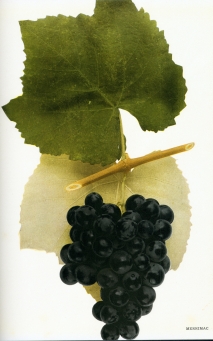
Fruit ripens with or later than Concord, ships and keeps well. Clusters variable in size, intermediate in length, often broad, tapering to cylindrical, variable in compactness; peduncle short to medium, of average thickness; pedicel intermediate in length, slender, covered with numerous, small, inconspicuous warts; brush wine-colored. Berries large to medium, roundish, black, glossy, covered with abundant blue bloom, persistent, firm. Skin thick, tough, adheres slightly to the pulp, contains a small amount of wine-colored pigment, astringent. Flesh light green, translucent, juicy, moderately fine-grained, medium tender, stringy, with little or no aroma, good in quality. Seeds rather adherent, one to five, average four, somewhat large and broad, long to medium, frequently with enlarged neck, brownish; raphe sometimes shows as a narrow cord; chalaza of average size, plainly above center, distinct.
MILLS. (Labrusca, Vinifera.)
1. Horticulturist, 30:93. 1875. 2. Rural N. Y., 47:144, 146. fig. 1888. 3. Can. Hort., 11:102, 103. fig. 1888. 4. Ohio Hort. Soc. Rpt., 1888-9:107. 5. Kan. Sta. Bul., 14:89. 1890. 6. Ib., 28:160. 1891. 7. N. Y. Sta. An. Rpt., 12:621. 1893. 8. Rural N. Y., 53:6. 1894. 9. Bush. Cat., 1894:155. 10. Rural N. Y., 54:715, 779, 795. 1895. 11. Am. Pom. Soc. Cat., 1897:19. 12. N. Y. Sta. An. Rpt., 17:533, 548, 556, 559. 1898. 13. Mich. Sta. Bul., 169:173. 1899. 14. Ga. Sta. Bul., 53:46, 51. 1901.
Probably none of the commonly cultivated grapes varies more under different cultural conditions than Mills. It is chiefly from this fact that viticulturists are so diverse in their opinions of it, some claiming that it is among our best grapes and others pronouncing it almost worthless. Mills grown in the vineyards of this Station is one of the half dozen best out of 270 varieties in its fruit characters. The bunches and berries are large and well-formed, the berries being a handsome black with bluish bloom and adhering so firmly to the stem that the fruit may be left until April without shelling. The berries are firm and solid, with the skin adherent to the pulp almost as in the Viniferas, and with the same texture of flesh as in Black Hamburg. The flesh, despite the solidity, is juicy and parts readily from the seeds. Its flavor is rich, sweet, vinous, with a trace of muskiness. The grapes are hardly surpassed in keeping quality and seldom if ever crack or shatter. The season is a little earlier than Concord.
But when we have described its fruit characters, practically all that can be is said in its favor. The vines are of only medium vigor, are not hardy, are fruitful only under the most favorable conditions, and are very subject to mildew. In New York neither wood nor roots ripen well in the average season and the variety is a most difficult one for nurserymen to handle. That it succeeds only on certain soils is known but data are not at hand to determine what conditions of soil suit it best. The soil on which the vines of this Station are growing is a rather heavy, rich clay and Mills makes a very fair growth here. The variety is of doubtful commercial value, unless it be for a special market, but for the garden or the amateur viticulturist it is undoubtedly one of the best if adapted to the soil and location. It is possible that the commercial grower may be able to graft it to advantage on some variety with better vine characters.
William H. Mills of Hamilton, Ontario, produced the Mills grape about 1870 from seed of Muscat Hamburg fertilized by Creveling. It was not introduced to the public, however, until 1888, when it was offered for sale by Ellwanger & Barry of Rochester, New York. Mills was placed on the grape list of the American Pomological Society fruit catalog in 1897 but was dropped from the list two years later. The variety has been widely tested but as yet has not become of commercial importance in any of the grape regions of the country.
Vine medium to above in vigor, not hardy, productive unless injured by the winter, somewhat subject to mildew. Canes long, of medium size, rather thick, light brown; nodes slightly enlarged and flattened, internodes medium to large; diaphragm rather thick; pith quite large; shoots slightly pubescent; tendrils intermittent, of average length, bifid to trifid.
Leaf-buds small to medium, short, somewhat slender, conical to pointed, open very late. Young leaves tinged with carmine slightly on under side and along margin of upper side, which is heavily coated with whitish pubescence. Leaves medium to large, thick; upper surface dark green, dull, medium to rugose; lower surface pale green, cobwebby; lobes three to five with terminus acute to acuminate; petiolar sinus intermediate in depth and width; basal and lateral sinuses quite deep and wide; teeth deep, of average width. Flowers nearly fertile, open in mid-season; stamens upright.
Fruit ripens somewhat later than Concord, an unusually good shipper and keeper. Clusters large to medium, long, slender to medium, cylindrical to slightly tapering, often single-shouldered but sometimes double-shouldered, compact; peduncle short, thick; pedicel intermediate in length, medium to slender, covered with numerous, small warts, much enlarged at point of attachment to fruit; brush moderately long, wine-colored. Berries large, oval to roundish, very dark red to jet-black when fully ripe, covered with abundant blue bloom, very persistent, firm. Skin thick and somewhat tough, strongly adherent to the pulp, not astringent. Flesh light green, translucent, juicy, not tough but meaty, with a rich, sprightly flavor, vinous, sweet, very good to best. Seeds separate easily from the pulp, one to three, average two, medium to large, variable in length and bluntness, brownish, frequently with enlarged neck; raphe obscure; chalaza small, above center, irregularly oval to pear-shaped, distinct.
MILLS
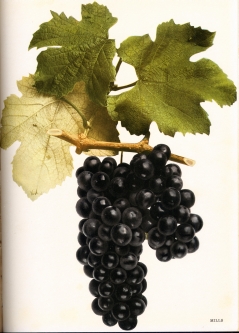
MISSOURI RIESLING.[201] (Riparia, Labrusca.)
1. Am. Pom. Soc. Rpt., 1881:33, 149. 2. Ill. Hort. Soc. Rpt., 1883:76. 3. Bush. Cat., 1883:103, 132. 4. Am. Pom. Soc. Cat., 1889:24. 5. Gar. and For., 3:290, 599. 1890. 6. Kan. Sta. Bul., 14:89. 1890. 7. Ill. Sta. Bul., 28:265. 1893. 8. N. Y. Sta. An. Rpt., 13:605. 1894. 9. Bush. Cat., 1894:5, 156. 10. N. Y. Sta. An. Rpt., 17:533, 548, 556, 1898. 11. Ala. Sta. Bul., 110:86. 1900.
Riesling (3). Grein’s No. 1 (3, 9).
Unfortunately the Southern Riparia seedlings, Missouri Riesling, Elvira, Noah, Grein Golden, and others, do not attain perfection in New York. The vines are sufficiently hardy, vigorous, productive, and healthy, as a rule, but the fruit is lacking in quality and not acceptable for table use nor wholly desirable in wine-making. It is only in the long seasons and under the sunny skies of the South that the varieties of this group of Riparias are well grown. As one of these grapes, Missouri Riesling is not adapted to New York; as it grows here it is not of high quality and does not mature. The variety is illustrated and described not because of intrinsic value in this region but as of interest as representing a somewhat distinct and important group of native grapes. It is a beautiful fruit when well grown and has many good qualities as a wine grape, and should it prove adapted to some favored nook or corner of the State, its culture would probably prove profitable.
Missouri Riesling was originated by Nicholas Grein about 1870, probably from seed of Taylor. Grein planted seeds of the European Riesling and of Taylor at the same time and he always supposed that none of the Taylor seeds grew and that the Missouri Riesling was a seedling of the Riesling of Germany. Since the Missouri Riesling is evidently of Riparia-Labrusca lineage and shows no Vinifera whatever, it is to be presumed that Grein’s labels were confused. It was placed on the grape list of the American Pomological Society fruit catalog in 1889 and is still retained there.
Vine variable in vigor, usually hardy, medium to productive. Canes very long, numerous, thick, dark brown; nodes enlarged, not flattened; internodes long; diaphragm below average thickness; pith medium to above in size; shoots pubescent; tendrils continuous, long, trifid to bifid.
Leaf-buds medium in size, short, thick, obtuse to conical, open in mid-season. Young leaves slightly tinged on under side only with faint brownish-carmine. Leaves large, thick to medium; upper surface dark green, glossy, nearly smooth; lower surface pale green, thinly pubescent; veins distinct; lobes usually five with terminal lobe acuminate; petiolar sinus deep, narrow to medium; basal sinus shallow and wide; lateral sinus deep, above average width; teeth deep to medium, wide. Flowers fertile to semi-fertile, open in mid-season; stamens upright.
Fruit usually ripens later than Concord and a little before Catawba, does not keep nor ship well. Clusters variable in size, medium to short, of average width, sometimes cylindrical, frequently single-shouldered, variable in compactness; peduncle medium to long, slender; pedicel above average length, covered with few small warts; brush green with tinge of yellow. Berries intermediate in size, roundish to oval, pale or yellowish-green changing to light red or with tinge of pink when fully ripe, not glossy, covered with thin gray bloom, persistent, firm. Skin sprinkled with small brown dots, thin, tough, adheres to the pulp, contains no pigment, slightly astringent. Flesh pale green, translucent, moderately juicy, tender, fine-grained, lacking somewhat in aroma, sweet at skin to agreeably tart at center, mild, of fair quality. Seeds adherent, one to four, average two, with surface somewhat roughened, intermediate in size and breadth, medium to long, not blunt, dark brown; raphe obscure; chalaza of fair size, above center, ovate, very distinct.
MONROE. (Labrusca, Bourquiniana?)
1. Gar. Mon., 22:176. 1880. 2. Am. Pom. Soc. Rpt., 1881:40, 43. 3. Bush. Cat., 1883:122. 4. N. Y. Sta. An. Rpt., 9:327. 1890. 5. Bush. Cat., 1894:156. 6. Va. Sta. Bul., 94:135. 1898. 7. N. Y. Sta. An. Rpt., 17:533, 546, 547, 552. 1898. 8. Mich. Sta. Bul., 169:173. 1899.
It is now about thirty years since Monroe was offered to the grape-growers of this State, and as a New York seedling, yet it can now scarcely be found under cultivation. It has failed because it is lacking in quality and because its vine characters are not sufficiently good to attract either the commercial or the amateur grape-grower.
MISSOURI RIESLING
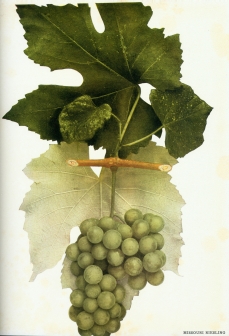
This variety was raised by Ellwanger & Barry of Rochester, New York, from mixed seed of Delaware, Diana, Concord, and Rebecca, and was first fruited in 1867. Patrick Barry at one time stated that it was a cross of Delaware and Concord. This, while evidently a surmise, appears quite probable. It was tested by the originators for many years and was finally introduced in 1880 but was dropped some years ago from the list of recommended sorts in Ellwanger & Barry’s catalog.
Vine vigorous to medium, hardy, variable in productiveness, somewhat susceptible to attacks of mildew and rot. Canes medium to long, often numerous, medium to slender, covered with considerable blue bloom; tendrils continuous, bifid. Leaves intermediate in size and color; lower surface pale green, thinly pubescent. Flowers fertile, open in mid-season; stamens upright. Fruit ripens soon after Hartford, keeps well. Clusters above medium to medium in size and length, often broad and cylindrical, rather blunt at ends, usually single-shouldered, the shoulder being attached to the bunch by a long stem, nearly compact, sometimes with a number of abortive fruits. Berries medium to above in size, roundish, black or purplish-black, covered with heavy blue bloom, persistent. Skin thick, tough, adheres considerably to the pulp, contains a large amount of purplish-red pigment, not astringent. Flesh pale green with a tinge of yellow, rather transparent, tender and almost melting, nearly sweet, lacks character, no more than fair in quality. Seeds separate easily from the pulp, intermediate in length, size, and width.
MONTEFIORE. (Riparia, Labrusca.)
1. Am. Pom. Soc. Rpt., 1881:44. 2. Mo. Hort. Soc. Rpt., 1883:44, 182. 3. Ib., 1884:216. 4. Kan. Sta. Bul., 14:89. 1890. 5. N. Y. Sta. An. Rpt., 11:630. 1892. 6. Ill. Sta. Bul., 28:256. 1893. 7. Col. Sta. Bul., 29:19. 1894. 8. Bush. Cat., 1894:156. fig. 9. Husmann, 1895:36. 10. N. Y. Sta. An. Rpt., 17:533, 548, 556. 1898.
Rommel’s Taylor Seedling No. 14 (8). Taylor’s Seedling No. 14 (1).
Montefiore, named in honor of the Jewish philanthropist, Moses Montefiore, is one of Rommel’s seedlings of Taylor. The variety has been largely grown in Missouri and the Southwest as a claret wine grape but is almost unknown in New York and the East. Montefiore is reported as succeeding in the Lake District of Ohio and, with the exception that it is somewhat uncertain in bearing and not always productive on the grounds of this Station, it has grown well in this section of New York. While Montefiore is essentially a wine grape, yet it is pleasing in taste and texture of fruit and is far better in quality than many of the coarser Labruscas so commonly cultivated. It keeps and ships well and presents an attractive appearance as a table grape. Were it not that the variety has been under cultivation for thirty years or more and therefore probably tested and discarded in New York, we should recommend it for extensive trial, especially as a red wine grape.
Jacob Rommel[202] of Morrison, Missouri, produced this variety from seed of Taylor said to have been fertilized with Ives. It was exhibited by Rommel at the American Pomological Society meeting in 1879, where it attracted the attention of Isadore Bush, of Bush & Son & Meissner, who named it Montefiore and introduced it the following year.
Vine medium to vigorous, hardy, an uncertain bearer. Canes long, of average number, thick, dark brown with slight reddish tinge, surface covered with thin blue bloom; nodes enlarged, flattened; internodes long to medium; diaphragm thick; pith medium to above in size; shoots thinly pubescent; tendrils continuous, long, bifid.