Front matter
Reading edition
E-text prepared by Richard Hulse, Graeme Mackreth, and the Online Distributed Proofreading Team (http://www.pgdp.net) from page images generously made available by Internet Archive (https://archive.org)
Note: Images of the original pages are available through Internet Archive. See https://archive.org/details/frenchrevolution00abborich

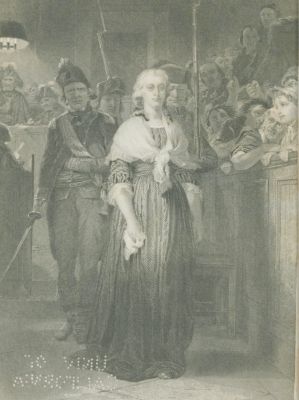
MARIE ANTOINETTE.
THE
FRENCH REVOLUTION
OF 1789
AS VIEWED IN THE LIGHT OF REPUBLICAN INSTITUTIONS.
BY
JOHN S. C. ABBOTT.
With One Hundred Engravings.
NEW YORK: HARPER & BROTHERS, PUBLISHERS,
FRANKLIN SQUARE. 1859.
Entered, according to Act of Congress, in the year one thousand eight hundred and fifty-nine, by HARPER & BROTHERS, in the Clerk's Office of the District Court of the Southern District of New York.
PREFACE.
For some years the author of this work has been collecting materials for writing the history of the French Revolution. With this object in view he has visited Paris, wishing also to become familiar with the localities rendered immortal by the varied acts of this drama—the most memorable tragedy, perhaps, which has as yet been enacted upon the theatre of time. In addition to the aids which he has thus derived from a brief sojourn in Paris, he has also found the library of Bowdoin College peculiarly rich in all those works of religious and political philosophizings which preceded and ushered in these events, and in the narratives of those contemporary historians who recorded the scenes as they occurred, or which they themselves witnessed. Governor Bowdoin, whose library was the nucleus of the present college library, seems to have taken a special interest in collecting all the writings of the French philosophers and all the works of contemporary authors bearing upon the French Revolution, including—the most important of all—full files of the Moniteur.
The writer would not take up his pen merely to repeat the story which has so often and so graphically been told before. But it is expecting too much of human nature to imagine that the struggles of an oppressed people to emancipate themselves from feudal despotism can be impartially narrated in the castles of nobles or in the courts of kings. It is inevitable that the judgment which is pronounced upon the events which such a struggle involves will be biased by the political principles of the observer. Precisely the same transaction will by one be condemned and by another applauded. He who believes in the divine right of kings to reign and in the divine obligation of the people unquestioning to obey, must condemn a people who endeavor to break the shackles of despotic power, and must applaud kings and nobles who, with all the energies of bomb-shells, sabres, and iron hoofs, endeavor to crush the spirit of democratic freedom. On the contrary, he who accepts the doctrine that sovereignty resides in the people must commend the efforts of an inthralled nation to sever the chains of servitude, and must condemn the efforts of kings and nobles to rivet those chains anew. Thus precisely the same facts will be regarded with a very different judgment according as the historian is influenced by political principles in favor of equality of rights or of aristocratic privilege. The author of this work views the scenes of the French Revolution from a republican stand-point. His sympathies are strongly with an oppressed people struggling for political and religious liberty. All writers, all men profess to love liberty.
"Despots," says De Tocqueville, "acknowledge that liberty is an excellent thing. But they want it all for themselves, and maintain that the rest of the world is unworthy of it. Thus there is no difference of opinion in reference to liberty. We differ only in our appreciation of men."[1]
To commence the history of the French Revolution with the opening of the States-General in 1789 is as unphilosophical as to commence the history of the American Revolution with the battle of Lexington. No man can comprehend this fearful drama who does not contemplate it in the light of those ages of oppression which ushered it in. It is in the horrible despotism of the old monarchy of France that one is to see the efficient cause of the subsequent frantic struggles of the people.
"The Revolution," says De Tocqueville, "will ever remain in darkness to those who do not look beyond it. Without a clear view of society in the olden time, of its laws, its faults, its prejudices, its sufferings, its greatness, it is impossible to understand the conduct of the French during the sixty years which have followed its fall."[2]
There is often an impression that the Revolution was a sudden outbreak of blind unthinking passion—a tempest bursting from a serene sky; or like a battle in the night—masses rushing blindly in all directions, and friends and foes in confusion and phrensy smiting each other. But, on the contrary, the Revolution was of slow growth, a storm which had been for centuries accumulating. The gathering of the clouds, the gleam of its embosomed fires, and the roar of its approaching thunders arrested the attention of the observing long before the storm in all its fury burst upon France. A careful historic narrative evolves order from the apparent chaos, and exhibits, running through the tumultuous scene of terror and of blood, the operation of causes almost as resistless as the operation of physical laws.
The writer has freely expressed his judgment of the transactions which he has narrated. "The impartiality of history," says Lamartine, "is not that of a mirror which merely reflects objects; it should be that of a judge who sees, listens, and decides."[3] The reader will not be surprised to find that some occurrences which historians caressed in regal courts and baronial halls have denounced as insolent and vulgar are here represented as heroic and noble.
Every generous heart will respond to the sentiment uttered, in this connection, by Thiers. "I have endeavored to stifle," he says, "within my own bosom every feeling of animosity. I alternately figured to myself that, born in a cottage, animated with a just ambition, I was resolved to acquire what the pride of the higher classes had unjustly refused me; or that, bred in palaces, the heir to ancient privileges, it was painful to me to renounce a possession which I regarded as a legitimate property. Thenceforth I could no longer harbor enmity against either party. I pitied the combatants, and I indemnified myself by admiring generous deeds wherever I found them."[4]
One simple moral this whole awful tragedy teaches. It is, that the laws must be so just as to command the assent of every enlightened Christian mind, and the masses of the people must be trained to such intelligence and virtue as to be able to appreciate good laws and to have the disposition to maintain them. Here lies the only hope of our republic.
The illustrations which embellish these pages are from the artistic pencil of Mr. C.E. Doepler, who went to Paris that he might with more historical accuracy delineate both costumes and localities. To the kindness of Messrs. Goupil & Co. we are indebted for the privilege of copying the exquisite engraving of Marie Antoinette at the Revolutionary tribunal, which forms the Frontispiece.
John S. C. Abbott.
Brunswick, Maine, Nov., 1858.
FOOTNOTES:
CONTENTS.
CHAPTER I.
ORIGIN OF THE FRENCH MONARCHY.
Extent of France.—Character of its early Inhabitants.—Conquest of Gaul.—Barbarian Invasion.—The Franks.—Pharamond.—Clovis.—Introduction of Christianity.—Clotilda.—Merovingian Dynasty.—Fields of March.—Anecdote of Clovis.—The Parisii.—Strife with the Nobles.—Moorish Invasion.—Charles Martel.—Pepin.—Fields of May.—Charlemagne.—His Policy.—Feudal System.—The Church.—Rolls.—Louis V.—Hugh Capet.—Parliament established by Philip the Fair Page 17
CHAPTER II.
THE HOUSES OF VALOIS AND BOURBON.
The House of Valois.—Luxury of the Court and the Nobles.—Insurrection.—Jaques Bonhomme.—Henry III.—Henry IV., of Navarre.—Cardinal Richelieu.—French Academy.—Regency of Anne of Austria.—Palaces of France.—The Noble and the Ennobled.—Persecution of the Protestants.—Edict of Nantes.—Its Revocation.—Distress of the Protestants.—Death of Louis XIV. 25
CHAPTER III.
THE REGENCY AND LOUIS XV.
State of France.—The Regency.—Financial Embarrassment.—Crimes of the Rulers.—Recoining the Currency.—Renewed Persecution of the Protestants.—Bishop Dubois.—Philosophy of Voltaire.—Anecdote of Franklin.—The King's Favorites.—Mademoiselle Poisson.—Her Ascendency.—Parc aux Cerfs.—Illustrative Anecdote.—Letter to the King.—Testimony of Chesterfield.—Anecdote of La Fayette.—Death of Pompadour.—Mademoiselle Lange.—Power of Du Barry.—Death of Louis XV. 34
CHAPTER IV.
DESPOTISM AND ITS FRUITS.
Assumptions of the Aristocracy.—Molière.—Decay of the Nobility.—Decline of the Feudal System.—Difference between France and the United States.—Mortification of Men of Letters.—Voltaire, Montesquieu, Rousseau.—Corruption of the Church.—Diderot.—The Encyclopedists.—Testimony of De Tocqueville.—Frederic II. of Prussia.—Two Classes of Opponents of Christianity.—Enormity of Taxation.—Misery of the People.—"Good old Times of the Monarchy!" 45
CHAPTER V.
THE BASTILLE.
Absolute Power of the King.—Lettres de Cachet.—The Bastille.—Cardinal Balue.—Harancourt.—Charles of Armanac.—Constant de Renville.—Duke of Nemours.—Dungeons of the Bastille.—Oubliettes.—Dessault.—M. Massat.—M. Catalan.—Latude.—The Student.—Apostrophe of Michelet 53
CHAPTER VI.
THE COURT AND THE PARLIAMENT.
Death of Louis XV.—Education of Louis XVI.—Maurepas, Prime Minister.—Turgot; his Expulsion from Office.—Necker.—Franklin.—Sympathy with the Americans.—La Fayette.—Views of the Court.—Treaty with America.—Popularity of Voltaire.—Embarrassment of Necker.—Compte Rendu au Roi.—Necker driven into Exile.—Enslavement of France.—New Extravagance.—Calonne 57
CHAPTER VII.
THE ASSEMBLY OF THE NOTABLES.
Measures of Brienne.—The Bed of Justice.—Remonstrance of Parliament.—Parliament Exiled.—Submission of Parliament.—Duke of Orleans.—Treasonable Plans of the Duke of Orleans.—Anxiety of the Queen.—The Diamond Necklace.—Monsieur, the King's Brother.—Bagatelle.—Desperation of Brienne.—Edict for abolishing the Parliaments.—Energy of the Court.—Arrest of D'Espréménil and Goislard.—Tumults in Grenoble.—Terrific Hail-storm 67
CHAPTER VIII.
THE APPEAL TO THE PEOPLE.
Recall of Necker.—Reassembling the Notables.—Pamphlet of the Abbé Sièyes.—Vote of the King's Brother.—His supposed Motive.—The Basis of Representation.—Arrangements for the Meeting of the States.—Statement of Grievances.—Mirabeau; his Menace.—Sympathy of the Curates with the People.—Remonstrance of the Nobles.—First Riot.—Meeting of the States-General.—New Effort of the privileged Classes 77
CHAPTER IX.
ASSEMBLING OF THE STATES-GENERAL.
Opening of the States-General.—Sermon of the Bishop of Nancy.—Insult to the Deputies of the People.—Aspect of Mirabeau.—Boldness of the Third Estate.—Journal of Mirabeau.—Commencement of the Conflict.—First Appearance of Robespierre.—Decided Stand taken by the Commons.—Views of the Curates.—Dismay of the Nobles.—Excitement in Paris.—The National Assembly.—The Oath 85
CHAPTER X.
THE NATIONAL ASSEMBLY.
First Acts of the Assembly.—Confusion of the Court.—Hall of the Assembly closed.—Adjournment to the Tennis-court.—Cabinet Councils.—Despotic Measures.—The Tennis-court closed.—Exultation of the Court.—Union with the Clergy.—Peril of the Assembly.—The Royal Sitting.—Speech of the King 92
CHAPTER XI.
REVOLUTIONARY MEASURES.
Speech of Mirabeau.—Approach of the Soldiers and Peril of the Assembly.—Elation of the Queen.—Triumph of Necker.—Embarrassment of the Bishops and the Nobles.—Letter of the King.—The Bishops and Nobles join the Assembly.—Desperate Resolve of the Nobles.—The Troops sympathizing with the People 99
CHAPTER XII.
THE TUMULT IN PARIS.
Marshal Broglie.—Gatherings at the Palais Royal.—Disaffection of the Soldiers.—Imprisonment and Rescue.—Fraternization.—Petition to the Assembly.—Wishes of the Patriots.—Movement of the Troops.—Speech of Mirabeau.—New Menaces.—Declaration of Rights.—Dismissal of Necker.—Commotion in Paris.—Camille Desmoulins.—The French Guards join the People.—Terror in Paris.—Character of the King 103
CHAPTER XIII.
STORMING THE BASTILLE.
The Assembly petitions the King.—Resolves of the Assembly.—Narrative of M. Dumont.—Scenes in Paris.—The People organize for Self-defense.—The new Cockade.—The Abbé Lefebvre d'Ormesson.—Treachery of the Mayor, Flesselles.—Character of De Launey, Governor of the Bastille.—Sacking the Invalides.—The Bastille Assailed.—Assassination of De Launey and of Flesselles 112
CHAPTER XIV.
THE KING RECOGNIZES THE NATIONAL ASSEMBLY.
Rout of the Cavalry of Lambesc.—Tidings of the Capture of the Bastille reach Versailles.—Consternation of the Court.—Midnight Interview between the Duke of Liancourt and the King.—New Delegation from the Assembly.—The King visits the Assembly.—The King escorted back to his Palace.—Fickleness of the Monarch.—Deputation sent to the Hôtel de Ville.—Address of La Fayette.—La Fayette appointed Commander of the National Guard 122
CHAPTER XV.
THE KING VISITS PARIS.
Views of the Patriots.—Pardon of the French Guards.—Religious Ceremonies.—Recall of Necker.—The King visits Paris.—Action of the Clergy.—The King at the Hôtel de Ville.—Return of the King to Versailles.—Count d'Artois, the Polignacs, and others leave France.—Insolence of the Servants.—Sufferings of the People.—Persecution of the Corn-dealers.—Berthier of Toulon.—M. Foulon.—Their Assassination.—Humane Attempts of Necker.—Abolition of Feudal Rights 127
CHAPTER XVI.
FORMING THE CONSTITUTION.
Arming of the Peasants.—Destruction of Feudal Charters.—Sermon of the Abbé Fauchet.—Three Classes in the Assembly.—Declaration of Rights.—The Three Assemblies.—The Power of the Press.—Efforts of William Pitt to sustain the Nobles.—Questions on the Constitution.—Two Chambers in one?—The Veto.—Famine in the City.—The King's Plate melted.—The Tax of a Quarter of each one's Income.—Statement of Jefferson 141
CHAPTER XVII.
THE ROYAL FAMILY CARRIED TO PARIS.
Waning Popularity of La Fayette.—The King contemplates Flight.—Letter of Admiral d'Estaing.—The Flanders Regiment called to Versailles.—Fête in the Ball-room at Versailles.—Insurrection of the Women; their March to Versailles.—Horrors of the Night of October 5th.—The Royal Family conveyed to Paris 155
CHAPTER XVIII.
FRANCE REGENERATED.
Kind Feelings of the People.—Emigration receives a new Impulse.—The National Assembly transferred to Paris.—The Constituent Assembly.—Assassination of François.—Anxiety of the Patriots.—Gloomy Winter.—Contrast between the Bishops and the laboring Clergy.—Church Funds seized by the Assembly.—The Church responsible for the Degradation of the People.—New Division of France.—The Right of Suffrage.—The Guillotine.—Rabaud de St. Etienne 165
CHAPTER XIX.
THE KING ACCEPTS THE CONSTITUTION.
The King visits the Assembly.—His Speech.—The Priests rouse the Populace.—The King's Salary.—Petition of Talma.—Views of Napoleon.—Condemnation and Execution of the Marquis of Favrus.—Spirit of the New Constitution.—National Jubilee.—The Queen sympathizes with the Popular Movement.—Writings of Edmund Burke 175
CHAPTER XX.
FLIGHT OF THE KING.
Riot at Nancy.—Prosecution of Mirabeau.—Issue of Assignats.—Mirabeau's Interview with the Queen.—Four political Parties.—Bishops refuse to take the Oath to the Constitution.—Character of the Emigrants.—The King's Aunts attempt to leave France.—Debates upon Emigration.—Embarrassment of the Assembly.—Death of Mirabeau.—His Funeral.—The King prevented from visiting St. Cloud.—Duplicity of the King.—Conference of the Allies.—Their Plan of Invasion.—Measures for the Escape of the King.—The Flight 188
CHAPTER XXI.
ARREST OF THE ROYAL FUGITIVES.
Arrival at Varennes.—The Party arrested.—Personal Appearance of the King.—The Guards fraternize with the People.—Indignation of the Crowd.—The Captives compelled to return to Paris.—Dismay of M. de Bouillé.—Excitement in Paris.—The Mob ransack the Tuileries.—Acts of the Assembly.—Decisive Action of La Fayette.—Proclamation of the King.—The Jacobin Club.—Unanimity of France 200
CHAPTER XXII.
RETURN OF THE ROYAL FAMILY FROM VARENNES.
Proclamation of Marat.—Three Commissioners sent to meet the King.—Address to the Nation from the Assembly.—The slow and painful Return.—Conversation between Barnave and the Queen.—Brutality of Pétion.—Sufferings of the Royal Family.—Reception of the King in Paris.—Conduct of the Queen.—Noble Avowal of La Fayette.—Statement of the King.—Menace of Bouillé 214
CHAPTER XXIII.
COMMOTION IN PARIS.
The Remains of Voltaire removed to the Pantheon.—Decision of the Assembly on the Flight of the King.—Thomas Paine.—Views of the Constitutional Monarchists.—Message from La Fayette to the King of Austria.—The Jacobins summon the Populace to the Field of Mars.—Mandate of the Jacobins.—The Crowd on the Field of Mars dispersed by the Military.—Completion of the Constitution.—Remarkable Conversation of Napoleon.—The King formally accepts the Constitution.—Great, but transient, Popularity of the Royal Family 222
CHAPTER XXIV.
THE APPROACH OF WAR.
Sentiments of the King and Queen upon the Constitution.—The Legislative Assembly.—Its democratic Spirit.—The King's Speech.—Painful Scene.—The Queen plans Escape.—Riot in the Theatre.—Infatuation of the Aristocrats.—Insult to the Duke of Orleans.—Embarrassment of the Allies.—Replies to the King from the European Powers.—The Emigrants at Coblentz.—The King's Veto.—Letters of the King to his Brothers.—Their Replies.—Cruel Edicts.—Pétion chosen Mayor.—The King visits the Assembly.—Rise of the Republican Party 236
CHAPTER XXV.
AGITATION IN PARIS, AND COMMENCEMENT OF HOSTILITIES.
Death of Leopold.—Assassination of Gustavus.—Interview between Dumouriez and the Queen.—Discussion in the Assembly.—The Duke of Brunswick.—Interview of Barnave with the Queen.—Interview between Dumouriez and the King.—Dismissal of M. Roland.—The Palace invaded.—Fortitude of the King.—Pétion, the Mayor.—Affecting Interview of the Royal Family.—Remarks of Napoleon 246
CHAPTER XXVI.
THE THRONE ASSAILED.
Angry Interview between the King and the Mayor.—Decisive Action of La Fayette.—Expectations of the Queen.—Movement of the Prussian Army.—Efforts of the Priests.—Secret Committee of Royalists.—Terror in the Palace.—The Queen's View of the King's Character.—Parties in France.—Energetic Action of the Assembly.—Speech of Vergniaud 262
CHAPTER XXVII.
THE THRONE DEMOLISHED.
The Country proclaimed in Danger.—Plan of La Fayette for the Safety of the Royal Family.—Measures of the Court.—Celebration of the Demolition of the Bastille.—Movement of the Allied Army.—Conflicting Plans of the People.—Letter of the Girondists to the King.—Manifesto of the Duke of Brunswick.—Unpopularity of La Fayette.—The Attack upon the Tuileries, Aug. 10th.—The Royal Family take Refuge in the Assembly 271
CHAPTER XXVIII.
THE ROYAL FAMILY IMPRISONED.
Tumult and Dismay in the Assembly.—Storming the Tuileries.—Aspect of the Royal Family.—The Decree of Suspension.—Night in the Cloister.—The second Day in the Assembly.—The Royal Family Prisoners.—Third Day in the Assembly.—The Temple.—The Royal Family transferred to the Temple 286
CHAPTER XXIX.
THE MASSACRE OF THE ROYALISTS.
Supremacy of the Jacobins.—Their energetic Measures.—The Assembly threatened.—Commissioners sent to the Army.—Spirit of the Court Party in England.—Speech of Edmund Burke. —Triumphant March of the Allies.—The Nation summoned en masse to resist the Foe.—Murder of the Princess Lamballe.—Apology of the Assassins.—Robespierre and St. Just.—Views of Napoleon 295
CHAPTER XXX.
THE KING LED TO TRIAL.
Assassination of Royalists at Versailles.—Jacobin Ascendancy.—The National Convention.—Two Parties, the Girondists and the Jacobins.—Abolition of Royalty.—Madame Roland.—Battle of Jemappes.—Mode of Life in the Temple.—Insults to the Royal Family.—New Acts of Rigor.—Trial of the King.—Separation of the Royal Family.—The Indictment.—The King begs for Bread 308
CHAPTER XXXI.
EXECUTION OF LOUIS XVI.
Close of the Examination.—The King's Counsel.—Heroism of Malesherbes.—Preparations for Defense.—Gratitude of the King.—The Trial.—Protracted Vote.—The Result.—The King solicits the Delay of Execution for three Days.—Last Interview with his Family.—Preparation for Death.—The Execution 318
CHAPTER XXXII.
THE REIGN OF TERROR.
Charges against the Girondists.—Danton.—The French Embassador ordered to leave England.—War declared against England.—Navy of England.—Internal War.—Plot to assassinate the Girondists.—Bold Words of Vergniaud.—Insurrection in La Vendée.—Conflict between Dumouriez and the Assembly.—Flight of Dumouriez.—The Mob aroused and the Girondists arrested.—Charlotte Corday.—France rises en masse to repel the Allies.—The treasonable Surrender of Toulon 331
CHAPTER XXXIII.
EXECUTION OF MARIE ANTOINETTE AND MADAME ELIZABETH.
Marie Antoinette in the Temple.—Conspiracies for the Rescue of the Royal Family.—The young Dauphin torn from his Mother.—Phrensy of the Queen.—She is removed to the Conciergerie.—Indignities and Woes.—The Queen led to Trial.—Letter to her Sister.—The Execution of the Queen.—Madame Elizabeth led to Trial and Execution.—Fate of the Princess and the Dauphin 345
CHAPTER XXXIV.
THE JACOBINS TRIUMPHANT.
Views of the Girondists.—Anecdote of Vergniaud.—The Girondists brought to Trial.—Suicide of Valazé.—Anguish of Desmoulins.—Fonfrede and Ducos.—Last Supper of the Girondists.—Their Execution.—The Duke of Orleans; his Execution.—Activity of the Guillotine.—Humane Legislation.—Testimony of Desodoards.—Anacharsis Cloots.—The New Era 353
CHAPTER XXXV.
FALL OF THE HEBERTISTS AND OF THE DANTONISTS.
Continued Persecution of the Girondists.—Robespierre opposes the Atheists.—Danton, Souberbielle, and Camille Desmoulins.—The Vieux Cordelier.—The Hebertists executed.—Danton assailed.—Interview between Danton and Robespierre.—Danton warned of his Peril.—Camille Desmoulins and others arrested.—Lucile, the Wife of Desmoulins.—Letters.—Execution of the Dantonists.—Arrest and Execution of Lucile.—Toulon recovered by Bonaparte 361
CHAPTER XXXVI.
FALL OF ROBESPIERRE.
Inexplicable Character of Robespierre.—Cécile Regnault.—Fête in honor of the Supreme Being.—Increase of Victims.—The Triumvirate.—Suspicions of Robespierre.—Struggle between Robespierre and the Committee of Public Safety.—Conspiracy against Robespierre.—Session of the 27th of July.—Robespierre and his Friends arrested.—Efforts to save Robespierre.—Peril of the Convention.—Execution of Robespierre and his Confederates 375
CHAPTER XXXVII.
THE THERMIDORIANS AND THE JACOBINS.
The Reign of Committees.—The Jeunesse Dorée.—The Reaction.—Motion against Fouquier Tinville.—Apotheosis of Rousseau.—Battle of Fleurus.—Brutal Order of the Committee of Public Welfare.—Composition of the two Parties.—Speech of Billaud Varennes.—Speech of Légendre.—The Club-house of the Jacobins closed.—Victories of Pichegru.—Alliance between Holland and France.—Advance of Kleber.—Peace with Prussia.—Quiberon.—Riot in Lyons 389
CHAPTER XXXVIII.
DISSOLUTION OF THE CONVENTION.
Famine in Paris.—Strife between the Jeunesse Dorée and the Jacobins.—Riots.—Scene in the Convention.—War with the Allies.—A new Constitution.—Insurrection of the Sections.—Energy of General Bonaparte.—Discomfiture of the Sections.—Narrative of the Duchess of Abrantes.—Clemency of the Convention.—Its final Acts and Dissolution, and Establishment of the Directory 398
CHAPTER XXXIX.
THE DIRECTORY.
Constitution of the Directory.—Distracted State of Public Affairs.—New Expedition to La Vendée.—Death of the Dauphin.—Release of the Princess.—Pacification of La Vendée.—Riots in London.—Execution of Charette.—Napoleon takes command of the Army of Italy.—The first Proclamation.—Triumphs in Italy.—Letter of General Hoche.—Peace with Spain.—Establishment of the Cispadane Republic.—Negotiations with England.—Contemplated Invasion of Ireland.—Memorials of Wolfe Tone.—Deplorable State of Public Affairs.—Description of Napoleon.—Composition of the Directory 411
CHAPTER XL.
THE OVERTHROW OF THE DIRECTORY AND THE ESTABLISHMENT OF THE CONSULATE.
Proclamation of Napoleon.—March into Austria.—Letter to the Archduke Charles.—Preliminaries of Peace.—Union of Parties against the Directory.—Triumph of the Directory.—Agency of Napoleon.—Severe Measures of the Directory.—Indignation of Napoleon.—Dictatorship of the Directory.—Dismay of the Royalists.—Treaty of Campo Formio.—Napoleon's Address to the Cispadane Republic.—Remarks of Napoleon.—Plan for the Invasion of India.—Expedition to Egypt.—New Coalition.—Rastadt 421
THE FRENCH REVOLUTION.
CHAPTER I.
ORIGIN OF THE FRENCH MONARCHY.
Extent of France.—Character of its early Inhabitants.—Conquest of Gaul.—Barbarian Invasion.—The Franks.—Pharamond.—Clovis.—Introduction of Christianity.—Clotilda.—Merovingian Dynasty.—Fields of March.—Anecdote of Clovis.—The Parisii.—Strife with the Nobles.—Moorish Invasion.—Charles Martel.—Pepin.—Fields of May.—Charlemagne.—His Policy.—Feudal System.—The Church.—Rolls.—Louis V.—Hugh Capet.—Parliament established by Philip the Fair.
Could one have occupied some stand-point in the clouds fifty years before the birth of our Savior, and have looked down upon that portion of ancient Gaul which has since been called France, he would have seen an immense undulating plain about six hundred and fifty miles square, bounded on the north by the Rhine, on the east by the craggy cliffs of the Alps, on the south by the almost impassable barriers of the Pyrenees, and on the west by the ocean. This beautiful realm, most admirably adapted in its physical features, its climate, and its soil to be inhabited by man, was then mostly covered with forest. Vast rivers, with their innumerable branches flowing in every direction, beautified the landscape and rendered the soil exuberantly fertile. About twenty millions of people, divided into more than a hundred independent tribes, inhabited this fair land. Life was with them all a scene of constant battle. They ever lived with weapons of war in their hands, seeking to encroach upon the rights of others or to repel those who were crowding upon them.
In this state of affairs imperial Rome cast a glance over the Alps upon Gaul, and resolved upon its conquest and annexation to the empire. Julius Cæsar, at the head of forty thousand men, descended through the defiles of the mountains and entered Gaul between the Lake of Geneva and Mount Jura. After a series of campaigns extending through ten years, and after sweeping with his invincible legions nearly two millions of men from his path, he succeeded in the entire subjugation of the country. Roman governors were appointed over the several provinces, and fortresses were reared and garrisoned by twelve hundred Roman soldiers, who enforced the laws of the empire. The arts, the civilization, and the refinements of Rome were gradually extended over the semi-barbaric Gauls, and for nearly four hundred years the country enjoyed general peace and prosperity. The southern portion of the province became distinguished for its schools, its commerce, and its elegance.
Toward the close of the third century the Roman Empire, enervated by luxury and vice, was visibly on the decline. Then commenced that mighty flood of invasion from the north which finally overran the whole of southern Europe, sweeping before it almost every vestige of the power and grandeur of the Cæsars. Army after army of skin-clad warriors, in aspect savage as wolves and equally merciless, crossed the Rhine, and in fierce and interminable battle fought their way over the plains of Gaul. For nearly four hundred years barbarian hordes from the shores of the North Sea, from the steppes of Tartary, even from far-off China, were pouring down upon southern Europe. Those in the rear crowded forward those in the advance. These clannish tribes, every where victorious, were slow to amalgamate. Each retained its distinctive laws, language, customs, and manners. For more than two centuries this cruel war continued, and all Gaul presented but a scene of tumult, terror, and carnage.
Among the marshes of the Lower Rhine there dwelt a fierce tribe called Franks, or Freemen. Early in the fifth century, Pharamond, the sovereign chief of this tribe, a man of extraordinary energy and sagacity, formed a confederacy with several other adjacent tribes, crossed the Rhine at various points, and after a series of terrific conflicts, which were protracted through many years, overpowered the Gauls under their Roman leaders, and took possession of the country nearly as far as the River Somme. Being the leading chief of the confederated tribes, he exerted a kind of supremacy over the rest, which may perhaps be considered as the first dawning of the French monarchy. The successors of Pharamond retained his conquests, and gradually extended their dominions until they were in possession of all the country between the Rhine and the Loire.
In the year 480 Clovis succeeded to the chieftainship of the confederation. Ambitious, unscrupulous, and energetic, he pushed his invading armies toward the Pyrenees, and for thirty years nearly all the south of France was a volcano of smoke and flame. His march, though attended with many reverses, was triumphant, and at the close of his career in the year 511 nearly all Gaul was partially subjected to his sway.
Christianity had previously entered Gaul from Rome. Clovis married Clotilda, the daughter of a Christian bishop. In the heat of one of his battles, as the tide of victory was setting against him, Clovis, raising his hands and eyes to heaven, exclaimed,
"O God of Clotilda! if thou wilt interpose and grant me this victory, I will renounce idols forever and become a Christian."
He gained the victory, and on the next Christmas-day Clovis was baptized. But a man more thoroughly wicked never played the hypocrite. By treachery the most loathsome, he caused all the chiefs to be assassinated who could be regarded in the least degree as his rivals, and, placing chiefs subject to his will at the head of all the different tribes, he attained such a supremacy as has led historians to speak of Clovis as the first monarch of the conquered realm. The dynasty thus established has been called the Merovingian, from Merovius, the grandfather of Clovis. From this successful invasion of the Franks all Gaul received the name of France. The leaders of these victorious bands occasionally had general assemblies, held in the open air, to deliberate respecting important movements. These meetings were very large, as all the chiefs and sub-chiefs came in battle array, surrounded by an ostentatious and well-armed retinue. As these assemblies were usually held in the month of March they received the name of Fields of March, Champs de Mars. The interests of the confederation rendered it not unfrequently necessary that these assemblies should be convened. This was the origin of the States General of France, which, twelve centuries later, opened the drama of that terrible revolution, which is universally regarded as the most awful tragedy of time.
An incident which occurred during one of these assemblies held by Clovis interestingly illustrates the character of that barbaric chief and the state of the times. A silver vase was included in the plunder taken from the church of Rheims after the conquest of that city. The plunder was divided at Soissons. The bishop of the church earnestly solicited that the vase might be restored to him. Clovis advocated the wishes of the bishop. One of the Frank warriors, jealous of his chief's interference, with one blow of his battle-axe crushed the vase, sternly declaring that Clovis was entitled to his share of the plunder and to no more. The chieftain, though glowing with rage, ventured not to utter a word.
At the next review of his troops, Clovis, approaching the soldier, took his weapon as if to inspect it. Pronouncing it to be unfit for use, he threw it disdainfully upon the ground. As the soldier stooped to pick it up, Clovis with one blow of his battle-axe crushed his skull, exclaiming, "Thus didst thou strike the vase at Soissons."[5]
The monarchy, thus established by usurpation, treachery, and blood, was very precarious and shadowy in its power. There was no acknowledged metropolis, no centralization of authority, no common laws. The whole country was occupied by the various tribes of invaders, each, under its own local chiefs, claiming independence, governed by its own customs, and holding the province upon which it chanced to have taken possession. Thus the supremacy of Clovis was neither precisely defined nor boldly claimed.
When Cæsar, five hundred years before the rise of Clovis, invaded Gaul, he found a tribe, called the Parisii, dwelling upon the banks of the Seine, with their principal village—which consisted of a few barbarian huts of mud, with straw roofs, and without chimneys—upon a small island embraced by the river. From the name of the tribe the village itself was subsequently called Paris. Such was the origin of that world-renowned metropolis which for ages has been the focal point of literature, science, art, and bloody revolutions. During the sway of the Romans the city had increased very considerably in population and importance, and Clovis selected it as his capital.
For about three hundred years the successors of Clovis maintained their supremacy. During all this period there was a constant conflict between the king and the heads of the other tribes, or the nobles as they gradually began to be called. An energetic monarch would occasionally arise and grasp extended power. But he would perhaps be succeeded by a feeble ruler, and the nobles would again rally and make vigorous encroachments upon the royal assumptions. The only contest, however, was between the king and the nobles. The mass of the people were in abject servitude, with no recognized rights.
In the year 732 the Moors, who had crossed the sea from Africa and had overrun Spain, began to crowd down in battle array through the defiles of the Pyrenees upon the plains of France. A successful general, Charles Martel (the hammer), so called from the tremendous blows he dealt the enemy, met them and drove them back with prodigious slaughter. By his achievements he acquired immense popularity and renown. As a very feeble prince then occupied the throne, Charles Martel collected the reins of power into his own hands, and, though nominally but an illustrious general, became in reality the ruler of France. Satisfied with the possession of power he was not ambitious of the kingly title, or thought it not prudent to grasp at too much at once.
At the death of Charles Martel, his son Pepin, a man of great energy and ambition, drove the imbecile king, Childeric III., into a cloister, and took his seat unresisted upon the throne. The dynasty thus established is called the Carlovingian, from Charlemagne, the most illustrious of this line of kings. The nation cordially approved of the act. As Pepin could not claim the throne by right of hereditary descent, he founded his title to reign upon the regal power which his father had in reality exercised, and upon the well-known assent of the nation. To confirm his authority still more, he appealed to the Pope. The Church was now in the plenitude of its power; and the Pope, grateful for the service which Charles Martel had rendered the Church by driving back the infidels, with alacrity consented to establish Pepin upon the throne by the august rites of religion.
Pepin, as his leading warriors had now become horsemen, changed the time of the general assemblies from the month of March to May, as the latter month was more convenient for forage, and the Assembly hence received the name of Fields of May, Champs de Mai. At these meetings the king presided, and the body was composed of the higher clergy and the nobility. Occasionally, a small delegation of the most distinguished of the people, who were called the Third Estate, Tiers Etat, had been admitted. Pepin called together only the clergy and the nobility, declining to admit the Third Estate to the Assembly. Subsequently some kings admitted the Third Estate, and others excluded them, according to their caprice. Questions relating to war, peace, and the enactment of general laws were submitted to this body, and decided by the majority. The chiefs only could speak. The assembled warriors clamorously and with clashing of arms expressed assent or dissent.
The world-renowned Charlemagne, succeeding his father Pepin, ascended the throne in the year 768. France at that time presented every where an aspect of decay and wild disorder. This monarch, illustrious both as a warrior and a statesman, fused the heterogeneous and warring tribes into a compact nation. Still, the mass, though consolidated, was conglomerate, its component parts distinctly defined. All France bowed submissive to his sway. Like a whirlwind he traversed Spain with his armies. Italy speedily acknowledged his supremacy. The vast empire of Charlemagne soon vied with that of ancient Rome, embracing nearly the whole of Europe.
It was an important point in the policy of Charlemagne to humble the nobles. He wished to surround his throne with an aristocracy enjoying privilege and splendor, but deprived of all political power. He wished himself to appoint the rulers of the provinces, and not to allow those offices to be hereditary with the counts and the dukes. Therefore he endeavored to ally the people with himself in resisting the powerful barons. He also, with the same object in view, sedulously courted the affections of the Church, conferring many of the most important offices of the state upon the high ecclesiastics.
Charlemagne ordered the Assembly to meet twice every year. Every count was commanded to bring to this congress thirteen of the most influential of the people within his jurisdiction. They usually met in two bodies, the ecclesiastical leaders in one spot, the military in another. Sometimes, by order of the king, they both met together. The king held his court at a little distance, and by messengers received constant reports from the two bodies. Weighing the result of their deliberations, he issued his decree, which all recognized as law. Such was the germ of deliberative assemblies in France.
Charlemagne established several schools. In these he assembled for severe study many of the young men of the empire, selecting the low-born as well as the sons of the nobles. As he was very desirous that his reign should be embellished by the attainments of men of letters, he frequently examined these schools himself. One of the historians of those days writes:
"When, after a long absence, Charlemagne returned to Gaul, he ordered the children to be brought to him, to show him their exercises and verses. Those belonging to the lower classes exhibited works beyond all hope, but those of noble descent had only trifles to show. The wise monarch, imitating the Eternal Judge, placed those who had done well on his right hand, and thus addressed them:
"'A thousand thanks, my sons, for your diligence in laboring according to my orders and for your own good. Proceed. Endeavor to perfect yourselves, and I will reward you with magnificent bishoprics and abbeys, and you shall be ever honorable in my sight.'
"Then he bent an angry countenance upon those on his left hand, and, troubling their consciences with a lightning look, with bitter irony, and thundering rather than speaking, he burst upon them with this terrible apostrophe:
"'But for you, nobles, you sons of the great—delicate and pretty minions as you are, proud of your birth and your riches—you have neglected my orders and your own glory, and the study of letters, and have given yourselves up to ease, sports, and idleness.'
"After this preamble, raising on high his august head and his invincible arm, he fulminated his usual oath:
"'By the King of Heaven I care little for your nobility and beauty, however others may admire you. You may hold it for certain that, if you do not make amends for your past negligence by vigilant zeal, you will never obtain any thing from Charles.'"[6]
Wherever Charlemagne led his legions, he baptized the vanquished; and the conquered tribes and nations called themselves Christians. The ignorant barbarians eagerly accepted the sacrament for the sake of the white baptismal robe which was given to each proselyte.
The vast empire of Charlemagne under his effeminate successors rapidly crumbled to pieces. In ceaseless conflicts and fluctuations the chiefs of the tribes, or nobles, gradually regained the power which had been wrested from them by Charlemagne. Upon the ruins of the empire arose the feudal system, and France became a monarchy but in name. The throne, shorn of its energies, retained but the shadow of power. Haughty dukes, surrounded by their warlike retainers, and impregnable in massive castles which had been the work of ages, exercised over their own vassals all the prerogatives of royalty, and often eclipsed the monarch in wealth and splendor. The power of the duke became so absolute over the serfs who tilled his acres, and who timidly huddled for protection beneath the ramparts of the castle, that, in the language of the feudal code, the duke "might take all they had, alive or dead, and imprison them when he pleased, being accountable to none but God."
France again became but a conglomeration of independent provinces, with scarcely any bond of union. The whole landscape was dotted with castles strongly built upon the river's bluff, or upon the craggy hill. These baronial fortresses, massive and sombre, were flanked by towers pierced with loop-holes and fortified with battlements. A ditch often encircled the walls, and an immense portcullis or suspended gate could at any moment be let down, to exclude all entrance. The apartments were small and comfortless, with narrow and grated windows. There was one large banqueting-hall, the seat of baronial splendor, where the lord met his retainers and vassals in intercourse in which aristocratic supremacy and democratic equality were most strangely blended. Every knight swore fealty to the baron, the baron to the duke, the duke to the king. The sovereign could claim military service from his vassals, but could exercise no power over their serfs, either legislative or judicial. It not unfrequently happened that some duke had a larger retinue and a richer income than the king himself.
A poor knight implored of the Count of Champagne a marriage-portion for his daughter. A wealthy citizen who chanced to be present said, "My lord has already given away so much that he has nothing left." "You do not speak the truth," said the count, "since I have got yourself;" and he immediately delivered him up to the knight, who seized him by the collar, and would not liberate him until he had paid a ransom of twenty-five hundred dollars. A French knight relates this story as an instance of the count's generosity.
These lords were often highway robbers. Scouts traversed the country, and armed men who filled their castles watched for travelers. The rich merchant who chanced to fall into their hands was not only despoiled of all his goods, but was often thrown into a dungeon, and even tortured until he purchased his ransom at a price commensurate with his ability.
Under this feudal sway the eldest son was the sole possessor. "As for the younger children," exclaims Michelet, with indignant sarcasm, "theirs is a vast inheritance! They have no less than all the highways, and over and above, all that is under the vault of heaven. Their bed is the threshold of their father's house, from which, shivering and ahungered, they can look upon their elder brother sitting alone by the hearth where they too have sat in the happy days of their childhood, and perhaps he will order a few morsels to be flung to them notwithstanding the dogs do growl. 'Down, dogs, down, they are my brothers! they must have something as well as you.'"
The Church was the only asylum for the younger sons of these great families. In her bosom ambitious ecclesiastics, as bishops, archbishops, and cardinals, often attained a degree of splendor and of authority which the baron, the count, or the duke in vain strove to emulate. The unmarried daughters took refuge in the monasteries, or were shut up, in seclusion which was virtual imprisonment, in the corners of the old chateaux. Thus the convents, those castles of the Church, were reared and supported mainly to provide for the privileged class. The peasant in the furrow looked with equal dread upon the bishop and the baron, and regarded them equally as his oppressors.
These proud bishops assumed the character and the haughty air of feudal lords. They scorned to ride upon the lowly mule, but vaulted upon the back of the charger neighing for the battle. They were ever ready for a fray, and could strike as sturdy blows as ever came from the battle-axe of a knight. The vows of celibacy were entirely disregarded. Some took wives; others openly kept concubines. These younger sons of the nobles, dressed in the garb of the Church, were found to be such dangerous characters that there was a general demand that they should be married. "Laymen are so convinced," says one of the ancient writers, "that none ought to be unmarried, that in most parishes they will not abide a priest except he have a concubine." The lords spiritual endeavored to fashion the Church upon the model of the feudal system. Abbeys and bishoprics, with all their rich endowments, passed by descent to the children of the bishops.[7]
An incident which occurred in the year 911 throws much light upon the rudeness of those barbaric times. Rollo, the chieftain of a band of Norman pirates, entered the Seine, committing fearful ravages. Charles IV., appropriately called Charles the Simple, alarmed by his progress and unable to raise a force sufficient to check him, sent an archbishop to offer him the possession of Normandy, with the title of hereditary duke, if he would peaceably take possession of this territory and swear allegiance to the king. Rollo eagerly accepted the magnificent offer. In performing the ceremony of swearing fealty, it was necessary, according to custom, for Rollo to prostrate himself before the king and kiss his feet. The haughty Norman, when called upon to perform the ceremony, indignantly drew himself up, exclaiming,
"Never, never will I kiss the foot or bow the knee to mortal man."
After some delay it was decided that the act of homage should be performed by proxy, and Rollo ordered one of his stalwart soldiers to press his lip upon the foot of the king. The burly barbarian strode forward, as if in obedience to the command, and, seizing the foot of the monarch, raised it high above his head, and threw the monarch prostrate upon the floor. The Norman soldiers filled the hall with derisive shouts of laughter, while the king and his courtiers, intimidated by barbarians so fierce and defiant, prudently concealed their chagrin.
The Carlovingian dynasty held the throne for two hundred and thirty-five years. Louis V., the last of this race, died in 987. He was called, from his indolence and imbecility, the Idler. As he sank into an inglorious grave, an energetic and powerful noble, Hugh Capet, Duke of the Isle of France, with vigorous arm thrust the hereditary claimant into a prison and ascended the throne. Thus was established the third dynasty, called the Capetian.
For two hundred and fifty years under the Capets, France could hardly be called a kingdom. Though the name of king remained, the kingly authority was extinct. The history of France during this period is but a history of the independent feudal lords, each of whom held his court in his own castle. None of these kings had power to combine the heterogeneous and discordant elements. The fragile unity of the realm was broken by differences of race, of customs, of language, and of laws. But in this apparent chaos there was one bond of union, the Church, which exerted an almost miraculous sway over these uncultivated and warlike men. The ecclesiastics were strongly in favor of the Capets, and were highly instrumental in placing them upon the throne.
With the Capets commenced a royal line which, in its different branches, running through the houses of Valois and of Bourbon, retained the throne for eight hundred years, until the fall of Louis XVI. in 1793.
About the year 1100 we begin to hear the first faint murmurs of the people. Some bold minds ventured the suggestion that a man ought to be free to dispose of the produce of his own labor, to marry his children without the consent of another, to go and come, sell and buy without restriction. Indeed, in Normandy the peasants broke out in a revolt. But steel-clad knights, in sweeping squadrons, cut them down mercilessly and trampled them beneath iron hoofs. The most illustrious of the complainants were seized and hung to the trees, as a warning to all murmurers. The people were thus taught that trees made good gibbets. When their turn came they availed themselves of this knowledge.
In the year 1294 Philip the Fair established a court in Paris called the Parliament. This was purely an aristocratic body, and was, in general, entirely subservient to the king's wishes. Similar parliaments were established by the great feudal princes in their provinces. There were occasional contentions between the parliaments and the king, but the king usually succeeded in compelling them to obedience. The Parliament enjoyed only the privilege of registering the royal edicts. In the reign of Louis XIV. the Parliament ventured to express a little objection to one of the tyrannical ordinances of the monarch.
The boy-king, eighteen years of age, was astounded at such impudence. He left the chase, and, hastening to the hall, entered it whip in hand. He could send them one and all to the Bastille or the block, and they knew it, and he knew it. The presence of the king brought them to terms, and they immediately became as submissive as fawning spaniels.
FOOTNOTES:
CHAPTER II.
THE HOUSES OF VALOIS AND BOURBON.
The House of Valois.—Luxury of the Court and the Nobles.—Insurrection.—Jaques Bonhomme.—Henry III.—Henry IV., of Navarre.—Cardinal Richelieu.—French Academy.—Regency of Anne of Austria.—Palaces of France.—The Noble and the Ennobled.—Persecution of the Protestants.—Edict of Nantes.—Its Revocation.—Distress of the Protestants.—Death of Louis XIV.
In the year 1328 the direct line of the Capets became extinct by the death of Charles IV., who left no male descendant. The nobles, assembled in parliament at Paris, assigned the crown to Philip, Count of Valois, a nephew of the former king. He was crowned at Rheims, in May, 1328, as Philip VI. The nobles, having thus obtained a king according to their wishes, complained to him that they had borrowed large sums of money from wealthy merchants and artisans, which it was inconvenient for them to pay, and that it was not consistent with the dignity of the French nobility that they should be harassed by debts due to the low-born. The king promptly issued a decree that all these debts should be cut down one fourth, that four months grace should be allowed without interest, and then, that these plebeian creditors might be reduced to a proper state of humility, he ordered them all to be imprisoned and their property to be confiscated. The merciless monarch doubled the taxes upon the people, and created a court at Paris of such magnificence that the baronial lords abandoned their castles and crowded to the metropolis to share its voluptuous indulgences. Even neighboring kings, attracted by the splendor of the Parisian court, took up their abode in Paris. The nobles needed vast sums of money to sustain them in such measureless extravagance. They accordingly left stern overseers over their estates, to drive the peasants to their toil and to extort from them every possible farthing.
The king, to replenish his ever-exhausted purse, assumed the sole right of making and selling salt throughout the realm. Each family, always excepting the nobles, who were then exempted from every species of tax, was required to take a certain quantity at an exorbitant price.
Vincennes was then the great banqueting-hall of Europe. In its present decay it exhibits but little of the grandeur it presented four hundred years ago, when its battlements towered above the forest of oaks, centuries old, which surrounded the castle—when plumed and blazoned squadrons met in jousts and tournaments, and when, in meteoric splendor, hunting bands of lords and ladies swept the park. Brilliant as was this spectacle, no healthy mind can contemplate it but with indignation. To support this luxury of a few thousand nobles, thirty millions of people were plunged into the extreme of ignorance, poverty, and misery.
Again the king and the nobles had empty purses, and were greatly in debt. By an arbitrary decree all the coin of the kingdom was called in. It was then passed through the mint greatly debased. With this debased coin the debts were paid, and then an order was issued that the coin should be regarded at its depreciated value.
With the lapse of centuries intelligence had gradually increased, and there was now quite a growing middling class between the peasants and the nobles—artisans, merchants, manufacturers, and literary and professional men. These outrages had at length become intolerable. Human nature could endure no more. This middle class became the leaders of the blind and maddened masses, and hurled them in fury upon their foes. The conspiracy spread over the kingdom, and in all the towns and throughout the country the signal for revolt was simultaneously given. It was a servile insurrection, accompanied by all the horrors inevitable to such a warfare. The debased populace, but little elevated above the brute, were as merciless as the hyena or the wolf. Phrensied with rage and despair, in howling bands they burst upon the castles, and the wrongs of centuries were terrifically avenged. We need not tell the story. Violence, torture, flame, and blood exhausted their energies. Mothers and maidens suffered all that mortals can endure in terror, brutal indignities, shame, and woe. In war even the refined and courteous often become diabolical; but those who have been degraded by ages of ignorance and oppression, when they first break their fetters, generally become fiends incarnate.
The nobles so thoroughly despised the peasants that they had not dreamed that the starving, cringing boors would dare even to think of emerging from their mud hovels to approach the lordly castle of rock, with its turrets and battlements and warlike defenders. The sheep might as well conspire against the dogs and the wolves. The peasant had hardly individuality enough even to receive a name. He was familiarly called Jack Goodman, Jacques Bonhomme. This insurrection of the Jacks, or of the Jacquerie as it is usually called, was, after much devastation and bloodshed, quelled. Barbaric phrensy can seldom long hold out against disciplined valor. One half of the population of France fell a prey to the sword, or to the pestilence and famine which ensued.
This was the first convulsive movement made by the people. Defeated though they were, and with their fetters riveted anew, they obtained new ideas of power and right which they never forgot. Already we begin to hear many of the phrases which four hundred years later were upon all lips, when the monarchy and the feudal aristocracy were buried in one common grave.
The house of Valois retained the throne for two hundred and sixty-one years. During these two and a half centuries, as generations came and went, storms of war and woe were incessantly sweeping over France. The history of the kingdom during these dreary ages is but the record of the intrigues of ecclesiastics, the conflicts between monarchs and nobles, and the sweep of maddened armies. The Third Estate, the people, continued to be deprived of almost all social and political rights. They were debased by ignorance and depressed by intolerable burdens. The monarchy was gradually centralizing power. The chiefs and sub-chiefs of the conglomerated tribes were losing their feudal authority and lapsing into nobles of higher and lower rank, whose splendor was obtained by exemption from all the burdens of the state, and by enormous taxation of the people. The Roman Catholic Church, under the Popes, blazed with almost supernatural splendor over Europe; and the high dignitaries of the Church, as lords spiritual, were as luxurious, haughty, and domineering as were any of the lords temporal.
Henry III., the last of the Valois race, was stabbed by a friar in 1589, and died leaving no issue. Henry of Bourbon, King of Navarre, as the nearest relative, claimed the crown. He ascended the throne as Henry IV., and after several years of civil war put down all opposition. He was the first of the Bourbon family who swayed the sceptre, and by far the most able and energetic. Under his vigorous sway the kingdom became consolidated, the throne attained a great supremacy over the nobles, and the resources of the realm were greatly developed. Henry IV. was sincerely devoted to the interests of France. He encouraged commerce, manufactures, and the arts; endeavored to enforce equitable laws, and under his wise administration the people made decided advances in wealth and intelligence. He retained the throne for twenty-one years, until 1610, when he died beneath the dagger of an assassin. Though Henry governed for the people, he did not admit them to any voice in public affairs. During his long reign no assembly was convened in which the people had any representation.
Henry IV. at his death left a son, Louis, nine years of age. The mother of this child, Mary of Medicis, was invested with the regency. When this prince was fourteen years of age he was considered by the laws of France as having attained his majority. He accordingly, while thus but a boy, marrying a bride of fifteen, Anne of Austria, ascended the throne as Louis XIII. For twenty-eight years this impotent prince sat upon the throne, all the time in character a bashful boy devoid of any qualities which could command respect. Cardinal Richelieu was during this reign the real monarch of France. Measurelessly ambitious, arrogant, and cruel, he consolidated the despotism of the throne, and yet, by far-reaching policy, greatly promoted the power and grandeur of the kingdom. This renowned minister, stern, vindictive, cruel, shrinking from no crime in the accomplishment of his plans, with the dungeons of the Bastilles of France and the executioner's axe at his command, held the impotent king and the enslaved kingdom for nearly thirty years in trembling obedience to his will.
The Chateau of Versailles was commenced by Richelieu. He also, in the year 1635, established the French Academy, which has since exerted so powerful an influence upon literature and science throughout Europe. Richelieu died in December, 1642, and six months after, in May, 1643, Louis XIII., who, during his reign, had been but a puppet in the hands of the cardinal, followed him to the tomb. As the monarch was lying upon his dying bed, he called his little son, five years of age, to his side, and said to him, "What is your name?" "Louis Fourteenth," answered the proud boy, already eager to grasp the sceptre. "Not yet, not yet," sadly rejoined the dying father.
Anne of Austria held the regency for nine years, until her son, having attained the age of fourteen, had completed his minority and assumed the crown. Under this powerful prince the monarchy of France, as an unlimited despotism, became firmly established. The nobles, though deprived of all political power, were invested with such enormous privileges, enabling them to revel in wealth and luxury, that they were ever ready to unite with the king in quelling all uprising of the people, who were equally robbed by both monarch and noble. During the long reign of this monarch, for Louis XIV. sat upon the throne for seventy-two years, if we consider his reign to have commenced when he was proclaimed king upon the death of his father, France made vast strides in power, wealth, and splendor. Palaces arose almost outvying the dreams of an Oriental imagination. The saloons of Marly, the Tuileries, the Louvre, and Versailles, were brilliant with a splendor, and polluted with debaucheries, which Babylon, in its most festering corruption, could not have rivaled. The nobles, almost entirely surrendered to enervating indulgence, were incapacitated for any post which required intellectual activity and energy. Hence originated a class of men who became teachers, editors, scientific and literary writers, jurists, and professional men. In the progress of commerce and manufactures, wealth increased with this class, and the king, to raise money, would often sell, at an enormous price, a title of nobility to some enriched tradesman.
A numerous and powerful middle class, rich and highly educated, was thus gradually formed, who had emerged from the people, and whose sympathies were entirely with them. The nobles looked upon all these, however opulent, or cultivated in mind, or polished in manners, with contempt, as low-born. They refused all social intercourse with them, regarding them as a degraded caste. They looked with even peculiar contempt upon those who had purchased titles of nobility.
They drew a broad line of distinction between the nobles and the ennobled. The hereditary aristocracy, proud of a lineage which could be traced through a hundred generations, and which was lost in the haze of antiquity, exclaimed with pride, instinct to the human heart:
"You may give a lucky tradesman, in exchange for money, a title of nobility, but you can not thus make him a nobleman; you can not thus constitute him a lineal descendant of the old Frank barons; you can not thus constitute him a Lorraine, a Montmorency, a Rohan. God alone can create a nobleman."
Thus they regarded a man who had been ennobled by a royal decree, or who had descended from a father or a grandfather thus ennobled, as a new man, an upstart, one hardly redeemed from contempt. The doors of their saloons were closed against him, and he was every where exposed to mortifying neglect. A noble whose lineage could be traced for two or three centuries, but whose origin was still distinctly defined, was considered as perhaps belonging to the aristocratic calendar, though of low estate. The fact that the time once was, when his ancestors were known to be low-born, was a damaging fact, which no subsequent ages of nobility could entirely efface. He only was the true noble, the origin of whose nobility was lost in the depths of the past, the line of whose ancestry ran so far back into the obscurity of by-gone ages that no one could tell when it commenced.
It has generally been said that there were three estates in the realm; the clergy composing the first, the nobles the second, and the people the third. But the higher class of the clergy, luxuriating in the bishoprics and the abbacies, with their rich emoluments, were the sons of the nobility, and shared in all the privileges and popular odium pertaining to that class. The lower clergy, devoted to apostolic labors and poverty, belonged to the people, and were with them in all their sympathies. Thus there were in reality but two classes, the privileged and the unprivileged, the patrician and the plebeian, the tax payer and the tax receiver. The castle, whether baronial or monastic in its architecture, was the emblem of the one, the thatched cottage the symbol of the other. Louis XIV., as Madame de Maintenon testifies, was shocked to learn that Jesus Christ associated with the poor and the humble, and conversed freely with them.
Soon after the succession of Louis XIV. to the throne he became convinced that the maintenance of the Romish hierarchy was essential to the stability of his power. He consequently commenced a series of persecutions of the Protestants, with the determination of driving that faith entirely from France. In 1662 he issued a decree that no Protestant should be buried except after sunset or before sunrise. Protestant mechanics or shop-keepers were not allowed to have apprentices. Protestant teachers were permitted to instruct only in the first rudiments of letters, and not more than twelve Protestants were allowed to meet together for the purposes of worship. No Protestant woman could be a nurse in the chamber of infancy; no Catholic could embrace Protestantism or marry a Protestant woman under pain of exile. Catholic magistrates were empowered to enter the dying chambers of the Protestants to tease them, when gasping in death, to return to the Catholic faith. In four years, between 1680 and 1684, more than twenty royal edicts were issued against the Protestants, decreeing, among other things, that no Protestant should be a lawyer, doctor, apothecary, printer, or grocer. Children were often taken by violence from Protestant parents, that they might be trained in the Catholic faith.
Madame de Maintenon, the unacknowledged wife of Louis XIV., wished to bring back into the fold of Rome a young lady, Mademoiselle de Murgay. She consequently wrote to her brother:
"If you could send her to me you would do me a great pleasure. There are no other means than violence, for they will be much afflicted in the family by De Murgay's conversion. I will send you a lettre de cachet (secret warrant) in virtue of which you will take her into your own house until you find an opportunity of sending her off."[8]
Such outrages as these were of constant occurrence. Zeal for the conversion of the Protestants never rose to a higher pitch. At the same time Louis XIV. could bid defiance to God's commands, and insult the moral sense of the nation by traveling with his wife and his two guilty favorites, Madame de Montespan and Madame la Vallière, all in the same carriage. The profligacy of the ecclesiastics and the debauchery of the court and the nobles, though less disguised during the wild saturnalia of the succeeding regency, was never more universal than during this reign. This was the golden age of kings. Feudality had died, and democracy was not born. The monarchy was absolute. The nobles, deprived of all political power, existed merely as a luxurious appendage and embellishment to the throne, while the people, unconscious of either power or rights, made no movements to embarrass the sovereign.[9]
In the year 1681 Louis XIV. commenced his system of dragooning the Protestants into the Catholic faith. He sent regiments of cavalry into the provinces, quartered them in the houses of the Protestants, placing from four to ten in each family, and enjoined it upon these soldiers to do every thing they could to compel the Protestants to return to the Catholic faith. Scenes ensued too awful to be narrated. He who has nerves to endure the recital can find the atrocities minutely detailed in "L'Histoire de l'Édit de Nantes, par Elias Benoît."
The brutal soldiery, free from all restraint, committed every conceivable excess. They scourged little children in the presence of their parents, that the shrieks of agony of the child might induce the parents to abjure their faith. They violated the modesty of women and girls, and mangled their bodies with the lash. They tortured, mutilated, disfigured. And when human nature in its extreme of agony yielded, the exhausted victim was compelled to sign a recantation of his faith, declaring that he did it of his own free will, without compulsion or persuasion. In their terror the Protestants fled in all directions, into the fields, the forests, to caves, and made desperate endeavors to escape from the kingdom. Multitudes died of exhaustion and famine by the way-side and on the sea-shore. Large tracts of country were thus nearly depopulated. Madame de Maintenon wrote to her brother, sending him a present of a large sum of money:
"I beseech you employ usefully the money you are to have. The lands in Poitou are sold for nothing. The distresses of the Protestants will bring more into market. You can easily establish yourself splendidly in Poitou."
The Protestant countries, England, Switzerland, Holland, and Denmark, issued proclamations to these persecuted Christians offering them an asylum. The court was alarmed, and interdicted their leaving the kingdom under penalty of condemnation to the galleys, confiscation of their property, and the annulling of all contracts they should have made for a year before their emigration.[10]
The condition of the Protestants was now miserable in the extreme. It was the determination of the court utterly to exterminate the reformed faith. The Archbishop of Paris made out a list of the works of four hundred authors who were considered as assailing Catholicism, and all the libraries, public and private, of the kingdom were searched that the condemned books might be burned.
There were between two and three millions of Protestants in France.[11] The dragoons were sent in every direction through the kingdom, enjoined by the court, to secure, at whatever expense of torture, a return to Catholicism. One of the tortures which these merciless fanatics were fond of applying was to deprive their victim of sleep. They kept the sufferer standing, and relieved each other in their cruel work of pinching, pricking, twitching, pulling with ropes, burning, suffocating with offensive fumes, until after successive days and nights of torture the victim was driven to madness, and to promise any thing to escape from his tormentors. By these means, it was boasted that in the district of Bordeaux, where there were one hundred and fifty thousand Protestants, one hundred and forty thousand were converted in a fortnight. The Duke of Noailles wrote to the court that in the district to which he had been sent with his dragoons there had been two hundred and forty thousand Protestants, but he thought that by the end of the month none could be left.
In the year 1598 Henry IV., by the Edict of Nantes, had granted freedom of conscience and of worship to the Protestants. Louis XIV. now issued a decree revoking this edict. The revocation, which was signed the 18th of October, 1685, states in the preamble that "since the better and the greater part of our subjects of the pretended reformed religion have embraced the Catholic faith, the maintenance of the Edict of Nantes remains superfluous." It then declares that no more exercise of the reformed worship is to be tolerated in the realm. All the Protestant pastors were to leave the kingdom within fifteen days, and were forbidden to exercise their office under pain of the galleys. Parents were forbidden to instruct their children in the reformed faith, and were enjoined to send them to the Catholic church to be baptized and to be instructed in the Catholic schools and catechism, under penalty of a fine of five hundred livres. The Protestant laity were prohibited from emigrating under pain of the galleys for the men, and imprisonment for life for the women.
Notwithstanding the penalty, vast numbers escaped from the kingdom. No vigilance could guard such extended frontiers. In one year after the revocation, Vauban wrote that France had lost one hundred thousand inhabitants, twelve thousand disciplined soldiers, six hundred officers, and her most flourishing manufactures. The Duke of St. Simon records that "a fourth part of the kingdom was perceptibly depopulated."
These crimes perpetrated against religion filled the land with infidelity. There were even Catholics of noble name and note, as Fénélon and Massillon, who energetically remonstrated. Montesquieu, Voltaire, Rousseau, and Mirabeau, not distinguishing between Christianity and the Papal Church, uttered cries of indignation which thrilled upon the ear of Europe and undermined the foundations of Christianity itself.
The edict of revocation was executed with the utmost rigor. The pastors in Paris were not allowed even the fifteen days which the edict granted, but were ordered to leave in forty-eight hours. Those pastors who had children over seven years of age had those children taken from them. Fathers and mothers, thus robbed of their children, in poverty and heart-broken, were driven into exile. "Old men of eighty or ninety years were seen gathering up the last remains of their life to undertake distant journeys, and more than one died before reaching the asylum where he was to rest his weary foot and drooping head."[12]
The court became alarmed by the magnitude of emigration. Guards were posted at the gates of towns, at the fords of rivers, on the bridges, on the highways, and at all points of departure upon the frontiers. Still the fugitives, hiding in caverns by day and traveling by night through by-paths, in great numbers eluded their foes. Every conceivable disguise was adopted, as of shepherds, pilgrims, hunters, valets, merchants. Women of rank—for there were not a few such among the Protestants, who had been accustomed to all the delicacies and indulgences of life—traveled on foot, exposed to hunger and storms, two or three hundred miles. Girls of sixteen, of all ranks in life, incurred the same hardships and perils. They disfigured their faces, wore coarse and ragged garments, and trundled wheel-barrows filled with manure, or carried heavy burdens, to elude suspicion. Some assumed the disguise of men or boys and took the office of servants; others feigned insanity or to be deaf and dumb. In these ways large numbers escaped to Rotterdam.[13]
Those near the sea-shore concealed themselves in ships among bales of merchandise, and in hogsheads stowed away among the freight. There were children who passed whole weeks in such lurking places without uttering a cry. Some desperately pushed out to sea in open boats, trusting to winds and waves to bear them to a place of safety. Thousands perished of cold, exposure, and starvation. Thousands were seized, loaded with chains, and dragged through the realm in derision and contempt, and were then condemned to pass the remainder of their days as galley-slaves. The galleys of Marseilles were crowded with these victims, among whom were many of the noblest men who have ever dwelt on earth. The prisons were crowded with women arrested in their flight and doomed to life-long captivity.
It is estimated that five hundred thousand found a refuge in foreign lands. Thirteen hundred passed through the city of Geneva in one week. England formed eleven regiments out of the refugees. One of the faubourgs of London was entirely peopled by these exiles. M. de Sismondi estimates that as many perished in the attempt to escape as escaped. A hundred thousand in the Province of Languedoc died prematurely, and of these ten thousand perished by fire, the gallows, or the wheel.[14] We can not but sympathize with the indignation of Michelet as he exclaims:
"Let the Revolutionary Reign of Terror beware of comparing herself with the Inquisition. Let her never boast of having, in her two or three years, paid back to the old system what it did for us for six hundred years! The Inquisition would have good cause to laugh. What are the twelve thousand men guillotined of the one, to the millions of men butchered, hung, broken on the wheel—to that pyramid of burning stakes—to those masses of burnt flesh which the other piled up to heaven. The single inquisition of one of the provinces of Spain states, in an authentic monument, that in sixteen years it burned twenty thousand men!
"History will inform us that in her most ferocious and implacable moments the Revolution trembled at the thought of aggravating death, that she shortened the sufferings of victims, removed the hand of man, and invented a machine to abridge the pangs of death.
"And it will also inform us that the Church of the Middle Ages exhausted itself in inventions to augment suffering, to render it poignant, intense; that she found out exquisite arts of torture, ingenious means to contrive that, without dying, one might long taste of death; and that, being stopped in that path by inflexible Nature, who, at a certain degree of pain, mercifully grants death, she wept at not being able to make man suffer longer."[15]
Louis XIV. died in 1715. He did not allow any assembly of the states to be convened during his reign. Every body began to manifest discontent. The nobility were humbled and degraded, and hungered for more power. The people had become very restive. The humbler class of the clergy, sincere Christians and true friends of their parishioners, prayed earnestly for reform. The Jesuits alone united with the monarch and his mistresses to maintain despotic sway. The court was utterly corrupt; the king a shameless profligate. Every thing was bartered for money. Justice was unknown. The court reveled in boundless luxury, while the mass of the people were in a state almost of starvation. The burden had become intolerable.
The monarchy of France attained its zenith during the reign of Louis XIV. Immense standing armies overawed Europe and prevented revolt at home. Literature and art flourished, for the king was ambitious to embellish his reign with the works of men of genius. Great freedom of opinion and of utterance was allowed, for neither king nor courtiers appear to have had any more fear of a rising of the peasants than they had of a revolt of the sheep. Vast works were constructed, which the poor and the starving alone paid for. Still there were not a few who perceived that the hour of vengeance was at hand. One of the magistrates of Louis XIV. remarked, "The conflict is soon to arrive between those who pay and those whose only function is to receive." The Duke of Orleans, who was regent after the death of Louis XIV., said, "If I were a subject I would most certainly revolt. The people are good-natured fools to suffer so long."
Louis XIV. left the throne to his great-grandchild, a boy five years of age. The populace followed the hearse of the departed monarch with insults and derisive shouts to the tomb. The hoary despot, upon a dying bed, manifested some compunctions of conscience. He left to his successor the words:
"I have, against my inclination, imposed great burdens on my subjects; but have been compelled to do it by the long wars which I have been obliged to maintain. Love peace, and undertake no war, except when the good of the state and the welfare of your people render it necessary."
These words were not heeded, until the people were, in their terrible might, inspired by fury and despair.
There is nothing more mournful to contemplate than the last days of Louis XIV. He was the victim of insupportable melancholy, dreading death almost with terror. His children and his grandchildren were nearly all dead. The people were crushed by burdens which they could no longer support. The treasury was in debt over eight hundred millions of dollars. Commerce was destroyed, industry paralyzed, and the country uncultivated and in many places almost depopulated. The armies of France had been conquered and humiliated; a disastrous war was threatening the realm, and the king from his dying bed could hear the execrations of the people, rising portentously around his throne.
FOOTNOTES:
CHAPTER III.
THE REGENCY AND LOUIS XV.
State of France.—The Regency.—Financial Embarrassment.—Crimes of the Rulers.—Recoining the Currency.—Renewed Persecution of the Protestants.—Bishop Dubois.—Philosophy of Voltaire.—Anecdote of Franklin.—The King's Favorites.—Mademoiselle Poisson.—Her Ascendency.—Parc aux Cerfs.—Illustrative Anecdote.—Letter to the King.—Testimony of Chesterfield.—Anecdote of La Fayette.—Death of Pompadour.—Mademoiselle Lange.—Power of Du Barry.—Death of Louis XV.
The reign of Louis XIV. was that of an Oriental monarch. His authority was unlimited and unquestioned. The people had two powerful foes, the king and the nobles. The nobles, as the most numerous, were the most dreaded. The people consequently looked to the kings to protect them against the nobles, as sheep will look to their natural enemy, the dogs, to defend them from their still worse enemies, the wolves. The king had now obtained a perfect triumph over the nobles, and had gathered all the political power into his own hands. He had accomplished this by bribery, as well as by force. The acquiescence of the nobles in his supremacy was purchased by his conferring upon them all the offices of honor and emolument, by exempting them from all taxes, and by supporting them in indolence, luxury, and vice, from the toil of the crushed and starving masses. There were now in the nation two classes, and two only, with an impassable gulf between them. On the one side were eighty thousand aristocratic families living in idleness and luxury; on the other were twenty-four millions of people, who, as a mass, were kept in the lowest poverty, maintaining by their toil the haughty nobles, from whom they received only outrage and contempt.
Louis XIV. just before his death drew up an edict appointing a council of regency during the minority of his great-grandson, the young king. The Parliament of Paris, however, declared the will null, and appointed the Duke of Orleans, who was considered favorable to the nobles, regent! For eight years, from 1715 to 1723, the regent, by shameless profligacy and extravagance, was but filling up the measure of wrath which had been accumulating for ages. Nothing was done to promote the welfare of the people, and, notwithstanding the misery which was actually depopulating the provinces, the gorgeous palaces of France exhibited scenes of voluptuousness which the wealth of the Orient had never paralleled.
Louis XIV. had expended upon the single palace of Versailles more than two hundred millions of dollars. The roofs of that vast pile would cover a surface of twenty-five French acres. Thirty thousand laborers were frequently employed simultaneously in embellishing the magnificent park sixty miles in circuit.[16] Marly, with its fountains, its parks, and gardens, had also been constructed with equal extravagance. Both of these palaces exhibited scenes of measureless profligacy gilded by the highest fascinations of external refinement and elegance. Louis XIV. left the nation in debt eight hundred and fifty millions of dollars. For several years the expenditure had exceeded the income by nearly thirty millions of dollars a year. The regent during the seven years of his profligate administration had added to this debt a hundred and fifty millions of dollars.
There was now fearful embarrassment in the finances. All the measures for extorting money seemed to be exhausted, and it was found impossible to raise the sums necessary to meet the expenses of the court and to pay the interest upon the debt. Taxation had gone to its last extremity; and no more money could be borrowed. The Duke of St. Simon proposed that the treasury should declare itself bankrupt.
"The loss," said he, "will fall upon the commercial and moneyed classes, whom no one fears or pities. The measure," he continued, "will also be a salutary rebuke to the ignoble classes, teaching them to beware how they lend money to the king which will enable him to gain the supremacy over the nobles."
The Duke of Orleans, who was regent only, not king, could sympathize in these views. The general discontent, however, was such, that he did not dare to resort to so violent a measure. The end was accomplished in a more circuitous way. A commission of courtiers was appointed to examine the accounts of the public creditors. Three hundred and fifty millions of francs ($76,000,000) were peremptorily struck from their claims. There was no appeal. This mode of paying debts seemed so successful that the commission established itself as an inquisitorial chamber, and summoned before it all those who had been guilty of lending money to the king. Most of these were thrown into prison, and threatened with death unless they purchased pardon for the crime with large sums of money. The regent and the nobles made themselves merry with the woes of these low-born men of wealth, and filled their purses by selling their protection.
A wealthy financier was perishing in one of the dungeons of the Bastille. A count visited him and offered to procure his release for sixty thousand dollars. "I thank you, Monsieur le Comte," was the reply, "but Madame, your countess, has just been here, and has promised me my liberty for half that sum."
The reign of the regent Duke of Orleans was the reign of the nobles, and they fell eagerly upon the people, whom Louis XIV. had sheltered from their avarice that more plunder might be left for him. The currency was called in and recoined, one fifth being cut from the value of each piece. By this expedient the court gained nearly fifteen millions of dollars.
Soon this money was all gone. The horizon was darkening and the approaching storm gathering blackness. Among the nobles there were some who abhorred these outrages. A party was organized in Paris opposed to the regent. They sent in a petition that the States-General might be assembled to deliberate upon the affairs of the realm. All who signed this petition were sent to the Bastille. There had been no meeting of the States-General called for more than one hundred years. The last had been held in 1614. It consisted of 104 deputies of the clergy, 132 of the nobles, and 192 of the people. The three estates had met separately and chosen their representatives. But the representatives of the people in this assembly displayed so much spirit that the convention was abruptly dismissed by the king, and neither king nor nobles were willing to give them a hearing again.
A bank was now established with a nominal capital of six millions of francs ($1,200,000). The shares were taken up by paying half in money and half in valueless government bills. Thus the real capital of the bank was $600,000. Upon this capital bills were issued to the amount of three thousand millions of francs ($600,000,000). Money was of course for a time plenty enough. The bubble soon burst. This operation vastly increased the financial ruin in which the nation was involved. Five hundred thousand citizens were plunged into bankruptcy.[17] The Parliament of Paris, though composed of the privileged class, made a little show of resistance to such outrages and was banished summarily to Pontoise.
Dubois, one of the most infamous men who ever disgraced even a court, a tool of the regent, and yet thoroughly despised by him, had the audacity one morning to ask for the vacant archbishopric of Cambray. Dubois was not even a priest, and the demand seemed so ridiculous as well as impudent that the regent burst into a laugh, exclaiming,
"Should I bestow the archbishopric on such a knave as thou art, where should I find a prelate scoundrel enough to consecrate thee?"
"I have one here," said Dubois, pointing to a Jesuit prelate who was ready to perform the sacrilegious deed. Dubois had promised Rohan that if he would consecrate him he would bring back the favor of the court to the Jesuit party. One of the mistresses of the regent had been won over by Dubois, and the bloated debauchee was consecrated as Archbishop of Cambray. Dubois was now in the line of preferment. He soon laid aside his mitre for a cardinal's hat, and in 1722 was appointed prime minister. The darkness of the Middle Ages had passed away, and these scandals were perpetrated in the full light of the 18th century. The people looked on with murmurs of contempt and indignation. It was too much to ask, to demand reverence for such a church.[18]
The infamous Jesuit, Lavergne de Tressan, Bishop of Nantes, who consecrated Dubois, revived from their slumber the most severe ordinances of Louis XIV. Louis XV. was then fourteen years of age. Royal edicts were issued, sentencing to the galleys for life any man and to imprisonment for life any woman who should attend other worship than the Catholic. Preachers of Protestantism were doomed to death; and any person who harbored such a preacher, or who should neglect to denounce him, was consigned to the galleys or the dungeon. All children were to be baptized within twenty-four hours of their birth by the curate of the parish, and were to be placed under Catholic instructors until the age of fourteen. Certificates of Catholicity were essential for all offices, all academical degrees, all admissions into corporations of trade. This horrible outrage upon human rights was received by the clergy with transport. When we contemplate the seed which the king and the court thus planted, we can not wonder at the revolutionary harvest which was reaped.
The Catholic Church thus became utterly loathsome even to the most devout Christians. They preferred the philosophy of Montesquieu, the atheism of Diderot, the unbelief of Voltaire, the sentimentalism of Rousseau, to this merciless and bloody demon, assuming the name of the Catholic Church, and swaying a sceptre of despotism which was deluging France in blood and woe. The sword of persecution which had for a time been reposing in its scabbard was again drawn and bathed in blood. Many Protestant ministers were broken upon the wheel and then beheaded. Persecution assumed every form of insult and cruelty. Thousands fled from the realm. Religious assemblies were surrounded by dragoons, and fired upon with the ferocity of savages, killing and maiming indiscriminately men, women, and children. Enormous sums of money were, by the lash, torture, the dungeon, and confiscation, extorted from the Protestants. Noblemen, lawyers, physicians, and rich merchants were most eagerly sought.
The seizure of Protestant children was attended with nameless outrages. Soldiers, sword in hand, headed by the priests, broke into the houses, overturned every thing in their search, committed brutal violence upon the parents, and, reckless of their lamentations and despair, seized the terrified children, especially the young girls, and forced them into the convents.
Fanaticism so cruel was revolting to the intelligence and to the general conscience of the age. Maddened priests could easily goad on a brutal and exasperated populace to any deeds of inhumanity, but intelligent men of all parties condemned such intolerance. It is, however, worthy of note that few of the philosophers of that day ventured to plead for religious toleration. They generally hated Christianity in all its forms, and were not at all disposed to shield one sect from the persecutions of another. Voltaire, however, was an exception. He had spent a year and a half in the Bastille on the charge of having written a libel against the government, which libel he did not write. When it was proved to the court that he did not write the libel he was liberated from prison and banished from France. Several years after this, Voltaire, having returned to France, offended a nobleman, the Chevalier de Rohan. The chevalier disdainfully sent his servant to chastise the poet. Voltaire, enraged by the degradation, sent a challenge to De Rohan. For the crime of challenging a noble he was again thrown into the Bastille. After six months he was released and again exiled. Soon after his Lettres Philosophiques were condemned by the Parliament to be burned, and an order was issued for his arrest. For many years he was compelled to live in concealment. He thus learned how to sympathize with the persecuted. In his masterly treatise upon toleration, and in his noble appeals for the family of the murdered Protestant, Jean Calas, he spoke in clarion tones which thrilled upon the ear of France. When Franklin in Paris called upon Voltaire, with his grandson, he said, "My son, fall upon your knees before this great man." The aged poet, then over eighty years of age, gave the boy his blessing, with the characteristic words, "God and freedom." The philosophy of Voltaire overturned the most despicable of despotisms. His want of religion established another despotism equally intolerable.
The miserable regent died in a fit in the apartment of his mistress in 1723. The young king was now fourteen years of age. He was a bashful boy, with no thought but for his own indulgence. When a child he was one day looking from the windows of the Tuileries into the garden, which was filled with a crowd.
"Look there, my king," said Villeroi, his tutor; "all these people belong to you. All that you see is your property; you are lord and master of it."
Louis XV. carried these principles into vigorous practice during his long reign of fifty-nine years. When fifteen years of age he married Maria, daughter of Stanislaus, the exiled King of Poland. Maria was not beautiful, but through a life of neglect and anguish she developed a character of remarkable loveliness and of true piety. There is but little to record of France during these inglorious years which is worthy of the name of history. The pen can only narrate a shameful tale of puerility, sin, and oppression. Weary and languid with worn-out excitements, the king at one time took a sudden freak for worsted-work, and the whole court was thrown into commotion as imitative nobles and ecclesiastics were busy in the saloons of Versailles with wool, needles, and canvas.
The king at one of his private suppers noticed a lady, Madame de Mailly, whose vivacity attracted him. Simply to torture the queen he took her for his favorite, and received her into the apartment from which he excluded his meek and virtuous wife. Maria could only weep and look to God for solace. Madame de Mailly had a sister, a bold, spirited girl, Mademoiselle de Nesle. She came to visit the court, and after vigorous efforts succeeded in supplanting her sister, and took her degrading place. She was suddenly cut off in her sins by death; but there was another sister of the same notorious family, Madame Tournelle, who endeavored to solace the king by throwing herself into his arms. The king received her, and she became his acknowledged favorite, and for some time maintained the position of sultana of the royal harem. Wherever she went a suite of court-ladies followed in her train. All were compelled to pay homage to the reigning favorite of the day, for all power was in her hands, and she was the dispenser of rewards and punishments. The king conferred upon this guilty woman, who was as cruel as she was guilty, the title of Duchess of Chateauroux. Madame de Tencin, one of the ladies of the court, in a confidential letter to Richelieu, written at this time, says:
"What happens in his kingdom seems to be no business of the king's. It is even said that he avoids taking any cognizance of what occurs, averring that it is better to know nothing than to learn unpleasant tidings. Unless God visibly interferes, it is physically impossible that the state should not fall to pieces."
Even Madame Chateauroux, herself one of the most corrupt members of that court of unparalleled corruption, remarked to a friend,
"I could not have believed all that I now see. If no remedy is administered to this state of things, there will, sooner or later, be a great overthrow."[19]
Though the Duchess of Chateauroux was the reigning favorite, she had another younger sister who was a member of the royal harem. The princess of the blood, Mademoiselle Valois, and the Princess of Conti were also in this infamous train. These revolting facts must be stated, for they are essential to the understanding of the French Revolution. Up to this time the king, of whom the people knew but little, was regarded with affection. They looked upon him as the only barrier to protect them from the nobles. Soon after this Madame Chateauroux was taken sick and died in remorse, crying bitterly for mercy, and promising, if her life could be spared, amendment and penance. She was so detested by the people that an armed escort conducted her remains to the grave to shield them from popular violence.
The king, for a time, was quite chagrined by the death of this woman, who had obtained a great control over him. While profligacy and boundless extravagance were thus rioting in the palace, bankruptcy was ruining merchants and artisans, and misery reigned in the huts of the peasants.
A citizen of Paris by the name of Poisson had a daughter of marvelous grace and beauty. Mademoiselle Poisson married a wealthy financier, M. Etoilles. She then, conscious of her beauty and of her unrivaled powers of fascination, formed the bold and guilty resolve to throw herself into the arms of the king. When the king was hunting in the forest of Senart she placed herself in his path, as if by accident, in an open barouche, dressed in a manner to shed the utmost possible lustre upon her charms. The voluptuous king fixed his eye upon her and soon sent for her to come to the palace of Versailles. The royal mandate was eagerly obeyed. She immediately engrossed the favor of the king, was established in the palace, and henceforth became the great power before which all France was constrained to bow. Her disconsolate husband, who had loved her passionately, entreated her to return to him, promising to forgive every thing. Scornfully she refused to turn her back upon the splendors of Versailles. Receiving from the king as the badge of her degradation the title of Marchioness of Pompadour, Jeannette Poisson was enthroned as the real monarch of France. She was a woman of vast versatility of talent, brilliant in conversation, and possessed unrivaled powers of fascination. For twenty years she held the king in perfect subjection to her sway. She never for one moment lost sight of her endeavor to please and to govern the monarch. "Sometimes she appeared before him clad as a peasant-girl, assuming all the simplicity and rustic grace of this character. She took with equal ease the appearance of a languishing Venus or the proud beauty of a Diana. To these disguises often succeeded the modest garb of a nun, when, with affected humility and downcast eyes, she came to meet the king."
Her power soon became unlimited and invincible, for her heart was of iron, and even her feminine hand could wield all the terrors of court banishment, confiscation, exile, and the Bastille. It is said that a witticism of Frederic II. of Prussia, at her expense, plunged France into all the horrors of the Seven Years' War. The most high-born ladies in the land were her waiting-women. Her steward was a knight of the order of St. Louis. When she rode out in her sedan-chair, the Chevalier d'Hénin, a member of one of the noblest families of the kingdom, walked respectfully by her side, with her cloak upon his arm, ready to spread it over her shoulder whenever she should alight.
She summoned embassadors before her, and addressed them with the regal we, assuming the style of royalty. She appointed bishops and generals, and filled all the important offices of Church and State with those who would do her homage. She dismissed ministers and created cardinals, declared war and made peace. Voltaire paid court to her, and devoted his muse to the celebration of her beauty and her talents. Montesquieu, Diderot, and Quesnay waited in her antechamber, imploring her patronage. Those authors who pleased her she pensioned and honored; those who did not were left in poverty and neglect. Even the imperial Maria Theresa, seeking the alliance of France, wrote to her with her own hand, addressing her as her "dear friend and cousin." "Not only," said Madame de Pompadour one day to the Abbé de Bernis, "not only have I all the nobility at my feet, but even my lap-dog is weary of their fawnings." Rousseau, strong in the idolatry of the nation, refused to join the worshipers at the shrine of Pompadour. She dared not send him to the Bastille, but vexatiously exclaimed "I will have nothing more to do with that owl."
As Madame de Pompadour found her charms waning, she maintained her place by ministering to the king's appetites in the establishment of the most infamous institution ever tolerated in a civilized land. Lacretelle, in his History of France, thus describes this abomination:
"Louis XV., satiated with the conquests which the court offered him, was led by a depraved imagination to form an establishment for his pleasures of such an infamous description that, after having depicted the debaucheries of the regency, it is difficult to find terms appropriate to an excess of this kind. Several elegant houses, built in an inclosure called the Parc aux Cerfs, near Versailles, were used for the reception of beautiful female children, who there awaited the pleasure of their master. Hither were brought young girls, sold by their parents, and sometimes forced from them. It was skillfully and patiently fostered by those who ministered to the profligacy of Louis; whole years were occupied in the debauchery of girls not yet in a marriageable age, and in undermining the principles of modesty and fidelity in young women."