Front matter (continued 10)
Reading edition
The Royalists were exceedingly exasperated by the condemnation of the king. A noble, Lepelletier St. Fargeau, who had espoused the popular cause, voted for the king's death. The Royalists were peculiarly excited against him, in consequence of his rank and fortune. On the evening of the 20th of January, as Louis was being informed of his sentence, a life-guardsman of the king tracked Lepelletier into a restaurateur's in the Palais Royal, and, just as he was sitting down to the table, stepped up to him and said,
"Art thou Lepelletier, the villain who voted for the death of the king?"
"Yes," replied Lepelletier, "but I am not a villain. I voted according to my conscience."
"There, then," rejoined the life-guardsman, "take that for thy reward," and he plunged his sword to the hilt in his side. Lepelletier fell dead, and his assassin escaped before they had time to arrest him.
This event created intense excitement, and increased the conviction that the Royalists had conspired to rescue the king, by force of arms, at the foot of the scaffold.
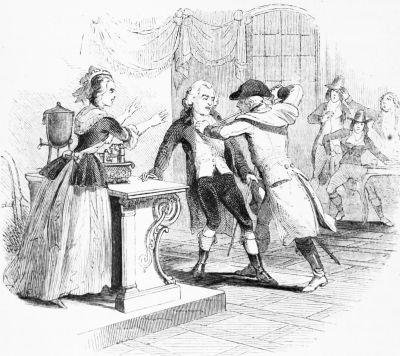
ASSASSINATION OF LEPELLETIER DE ST. FARGEAU.
FOOTNOTES:
CHAPTER XXXII.
THE REIGN OF TERROR.
Charges against the Girondists.—Danton.—The French Embassador ordered to leave England.—War declared against England.—Navy of England.—Internal War.—Plot to assassinate the Girondists.—Bold Words of Vergniaud.—Insurrection in La Vendée.—Conflict between Dumouriez and the Assembly.—Flight of Dumouriez.—The Mob aroused and the Girondists arrested.—Charlotte Corday.—France rises en masse to repel the Allies.—The treasonable Surrender of Toulon.
The execution of the king roused all Europe against republican France. The Jacobins had gained a decisive victory over the Girondists, and succeeded in turning popular hatred against them by accusing them of being enemies of the people, because they opposed the excesses of the mob; of being the friends of royalty, because they had wished to save the life of the king; and of being hostile to the republic, because they advocated measures of moderation.[389]
Danton was now the acknowledged leader of the Jacobins. He had obtained the entire control of the mob of Paris, and could guide their terrible and resistless energies in any direction. With this potent weapon in his hand he was omnipotent, and his political adversaries were at his mercy. The Reign of Terror had now commenced. The Girondists made a heroic attempt to bring to justice the assassins of September, but the Jacobins promptly stopped the proceedings.
The aristocracy of birth was now effectually crushed, and the Jacobins commenced a warfare against the aristocracy of wealth and character. An elegant mansion, garments of fine cloth, and even polished manners, exposed one to the charge of being an aristocrat, and turned against him the insults of the rabble. Marat was particularly fierce, in his journal, against the aristocracy of the burghers, merchants, and statesmen.
Upon the arrival of the courier in London conveying intelligence of the execution of the king, M. Chauvelin, the French embassador, was ordered to leave England within twenty-four hours.
"After events," said Pitt, "on which the imagination can only dwell with horror, and since an infernal faction has seized on the supreme power in France, we could no longer tolerate the presence of M. Chauvelin, who has left no means untried to induce the people to rise against the government and the laws of this country."
The National Convention at once declared war against England.[390] Pitt, with almost superhuman energy, mustered the forces of England and Europe for the strife. In less than six months England had entered into a treaty of alliance with Russia, Prussia, Austria, Naples, Spain, and Portugal, for the prosecution of the war; and had also entered into treaties by which she promised large subsidies to Hesse Cassel, Sardinia, and Baden. England thus became the soul of this coalition, which combined the whole of Europe, with the exception of Venice, Switzerland, Sweden, Denmark, and Turkey, against France. These combined armies were to assail the Republic by land, while the invincible fleet of England was to hurl a storm of shot and shells into all her maritime towns.
France, at this time, had but one hundred and fifty-nine vessels of war all told. England had four hundred and fifteen, and her ally, Holland, one hundred. Most of these were large ships, heavily armed; and, consequently, England had but little fear that any French armies could reach her isles.[391] Parliament voted an extraordinary supply of £3,200,000 ($16,000,000). One hundred and thirty-one thousand Austrians, one hundred and twelve thousand Prussians, and fifty thousand Spaniards were speedily on the march to assail France at every point on the frontier.[392]
The Royalists in La Vendée rose in arms against the Republic, and unfurled the white banner of the Bourbons. France was now threatened more fearfully than ever before with external and internal war. The Convention, controlled by the Jacobins and appalled by the danger, decreed a levy of three hundred thousand men to repel the assailants, and also organized an extraordinary revolutionary tribunal, invested with unlimited powers to arrest, judge, and punish any whom they should deem dangerous to the Republic. Violence filled the land, terror reigned every where, and even Robespierre was heard to exclaim, "I am sick of the Revolution."
Dumouriez had driven the Austrians out of Belgium and the Netherlands, and was at the head of an army of about seventy-five thousand men. Disgusted with the anarchy which reigned in France, he formed the bold design of marching upon Paris with his army, dispersing the Convention, abolishing the Republic, reinstituting a constitutional monarchy by establishing the Constitution of 1791, and by placing a king, probably the son of the Duke of Orleans, subsequently Louis Philippe, upon the throne. The Jacobins, goaded by these accumulating dangers—all Europe assailing France from without, and Royalists plotting within—were prepared for any measures of desperation. The Girondists, with unavailing heroism, opposed the frantic measures of popular violence, and the Jacobins resolved to get rid of them all by a decisive blow. The assassins of September were ready to ply the dagger, under the plea that murder was patriotism. A plan was formed to strike them all down, in the Convention, on the night of the 10th of March. But the Girondists, informed of the plot, absented themselves from the meeting and the enterprise failed. The bold spirit of the Girondists was avowed in the words of Vergniaud:
"We have witnessed," said he, "the development of that strange system of liberty in which we are told 'You are free, but think with us, or we will denounce you to the vengeance of the people; you are free, but bow down your head to the idol we worship, or we will denounce you to the vengeance of the people; you are free, but join us in persecuting the men whose probity and intelligence we dread, or we will denounce you to the vengeance of the people.' Citizens! we have reason to fear that the Revolution, like Saturn, will devour successively all its children, and only engender despotism and the calamities which accompany it."
The Province of La Vendée contained a population of about three hundred thousand. It was a rural district where there was no middle class. The priests and the nobles had the unlettered peasantry entirely under their influence. Three armies were raised here against the Republic, of about twelve thousand each. Royalists from various parts of the empire flocked to this region, and emigrants were landed upon the coast to join the insurgents. For three years a most cruel and bloody war was here waged between the Royalists and the Republicans.
The intelligence of this formidable insurrection increased the panic of the Convention. A law was passed disarming all who had belonged to the privileged class, and declaring those to be outlaws who should be found in any hostile gathering against the Republic. The emigrants were forbidden to land in France under the penalty of death. Every house in the kingdom was to inscribe upon its door the names of all its inmates, and was to be open at all times to the visits of the Vigilance Committee.
Dumouriez sullied his character by surrendering to the Austrians several fortresses, and agreeing with them that he would march upon Paris and restore a monarchical government to France. The Austrians trusted that he would place upon the throne the young son of Louis XVI., though it was doubtless his intention to place there the young Duke of Chartres (Louis Philippe), who would be the representative of popular ideas.
The Jacobin Club sent a deputation of three of its members to the camp, to sound the views of Dumouriez. The general received them with courtesy, but said, with military frankness,
"The Convention is an assembly of tyrants. While I have three inches of steel by my side that monster shall not exist. As for the Republic, it is an idle word. I had faith in it for three days. There is only one way to save the country; that is, to re-establish the Constitution of 1791 and a king."
"Can you think of it!" one of the deputation exclaimed; "the French view royalty with horror. The very name of Louis is an abomination."
"What does it signify," replied Dumouriez, "whether the king be called Louis, or Jacques, or Philippe?"
"And what are your means to effect this revolution?" they inquired.
"My army," Dumouriez proudly replied. "From my camp or from the stronghold of some fortress they will express their resolve for a king."
"But your plan will peril the lives of the rest of the royal family in the Temple."
"If every member of that family in France or at Coblentz should perish," Dumouriez replied, "I can still find a chief. And if any farther barbarities are practiced upon the Bourbons in the Temple I will surround Paris with my army and starve the Parisians into subjection."
The deputation returned to Paris with their report, and four commissioners were immediately dispatched, accompanied by the Minister of War, to summon Dumouriez to the bar of the Convention. Dumouriez promptly arrested the commissioners and sent them off to the Austrians, to be retained by them as hostages.
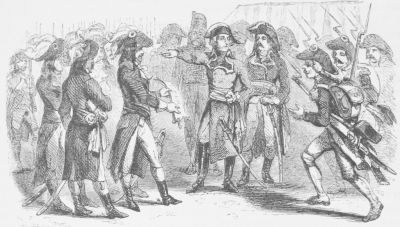
DUMOURIEZ ARRESTING THE ENVOYS.
The Convention immediately offered a reward for the head of Dumouriez, raised an army of forty thousand men to defend Paris, and arrested all the relatives of the officers under Dumouriez as hostages.
Dumouriez now found that he had not a moment to lose. Perils were accumulating thick around him. There were many indications that it might be difficult to carry the army over to his views. On the 4th of April, as he was repairing to a place of rendezvous with the Austrian leaders, the Prince of Coburg and General Mack, a battalion of soldiers, suspecting treachery, endeavored to stop him. He put spurs to his horse and distanced pursuit, while a storm of bullets whistled around his head. He succeeded, after innumerable perils, in the circuitous ride of a whole day, in reaching the head-quarters of the Austrians. They received him with great distinction, and offered him the command of a division of their army. After two days' reflection, he said that it was with the soldiers of France he had hoped to restore a stable government to his country, accepting the Austrians only as auxiliaries; but that as a Frenchman he could not march against France at the head of foreigners. He retired to Switzerland. The Duke of Chartres (Louis Philippe), in friendlessness and poverty, followed him, and for some time was obliged to obtain a support by teaching school.
The Jacobins now accused their formidable rivals, the Girondists, of being implicated in the conspiracy of Dumouriez. Robespierre, in a speech of the most concentrated and potent malignity, urged that France had relieved herself of the aristocracy of birth, but that there was another aristocracy, that of wealth, equally to be dreaded, which must be crushed, and that the Girondists were the leaders of this aristocracy. This was most effectually pandering to the passions of the mob, and directing their fury against the Girondists. The Girondists were now in a state of terrible alarm. They knew the malignity of their foes, and could see but little hope for escape. They had overturned the throne of despotism, hoping to establish constitutional liberty: they had only introduced Jacobin phrensy and anarchy. Immense crowds of armed men paraded the streets of Paris, surrounded the Convention, and demanded vengeance against the leaders of the Gironde.[393]
The moderate Republicans, enemies of these acts of violence, striving to stem the torrent, endeavored to carry an act of accusation against Marat. He was charged with having encouraged assassination and carnage, of dissolving the National Convention, and of having established a power destructive of liberty.
Marat replied to the accusation by summoning the mob to his aid. They assembled in vast, tumultuous throngs, and the tribunal, overawed, after the trial of a few moments, unanimously acquitted him. This was the 24th of April. The mob accompanied him back to his seat in the Convention. He was borne in triumph into the hall in the arms of his confederates, his brow encircled by a wreath of victory.
"Citizen President," shouted one of the burly men who bore Marat, "we bring you the worthy Marat. Marat has always been the friend of the people, and the people will always be the friends of Marat. If Marat's head must fall, our heads must fall first."
As he uttered these words he brandished a battle-axe defiantly, and the mob in the aisles and crowded galleries vehemently applauded. He then demanded permission for the escort to file through the hall. The president, appalled by the hideous spectacle, had not time to give his consent before the whole throng, men, women, and boys, in rags and filth, rushed pell-mell into the hall, took the seats of the vacant members, and filled the room with indescribable tumult and uproar, shouting hosannas to Marat. The successful demagogue could not but boast of his triumph. Ascending the tribune, he said,
"Citizens! indignant at seeing a villainous faction betraying the Republic, I endeavored to unmask it and to put the rope about its neck. It resisted me by launching against me a decree of accusation. I have come off victorious. The faction is humbled, but not crushed. Waste not your time in decreeing triumphs. Defend yourselves with enthusiasm."
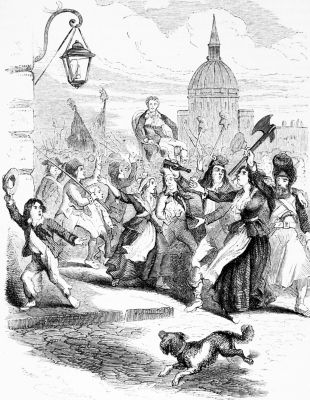
MARAT'S TRIUMPH.
Robespierre now demanded an act of accusation against the Girondists. Resistance was hopeless. The inundation of popular fury was at its flood, sweeping every thing before it. The most frightful scenes of tumult took place in the Convention, members endeavoring by violence to pull each other from the tribune.[394]
The whole Convention was now in a state of dismay, eighty thousand infuriate men surrounding it with artillery and musketry, declaring that the Convention should not leave its hall until the Girondists were arrested. The Convention, in a body, attempted to leave and force its way through the crowd, but it was ignominiously driven back. Under these circumstances it was voted that the leaders of the Girondists, twenty-two in number, should be put under arrest. This was the 2d of June, 1793.[395]
The Jacobins, having thus got rid of their enemies, and having the entire control, immediately decided to adopt a new Constitution, still more democratic in its character; and a committee was appointed to present one within a week. But the same division which existed in the Convention between the Jacobins and the Girondists existed all over France. In many of the departments fierce battles rose between the two parties.
In the mean time the Allies were pressing France in all directions. The Austrians and Prussians were advancing upon the north; the Piedmontese threading the passes of the maritime Alps; the Spaniards were prepared to rush from the defiles of the Pyrenees, and the fleet of England threatened every where the coast of France on the Mediterranean and the Channel.[396]
With amazing energy the Convention aroused itself to meet these perils. A new Constitution, exceedingly democratic, was framed and adopted. Every Frenchman twenty-one years of age was a voter. Fifty thousand souls were entitled to a deputy. There was but a single Assembly. Its decrees were immediately carried into execution.[397]
Danton, Robespierre, and Marat were now the idols of the mob of Paris and the real sovereigns of France. All who ventured opposition to them were proscribed and imprisoned. Members of the Republican or Girondist party every where, all over France, were arrested, or, where they were sufficiently numerous to resist, civil war raged.
At Caen there was a very beautiful girl, Charlotte Corday, twenty-five years of age, highly educated and accomplished. She was of spotless purity of character, and, with the enthusiasm of Madame Roland, she had espoused the cause of popular constitutional liberty. The principles of the Girondist party she had embraced, and the noble leaders of that party she regarded almost with adoration.
When she heard of the overthrow of the Girondists and their imprisonment, she resolved to avenge them, and hoped that, by striking down the leader of the Jacobins, she might rouse the Girondists scattered over France to rally and rescue liberty and their country. It was a three days' ride in the diligence from Caen to Paris. Arriving at Paris on Thursday the 11th of July, she carefully inspected the state of affairs, that she might select her victim, but confided her design to no one.
Marat appeared to her the most active, formidable, and insatiable in his proscription. She wrote him a note as follows:
"Citizen: I have just arrived from Caen. Your love for your country inclines me to suppose you will listen with pleasure to the secret events of that part of the Republic. I will present myself at your house. Have the goodness to give orders for my admission, and grant me a moment's private conversation. I can point out the means by which you can render an important service to France."
She dispatched this note from her hotel, the Inn de la Providence in the Rue des Vieux Augustins, went to the Palais Royal and purchased a large sheath knife, and, taking a hackney-coach, drove to the residence of Marat, No. 44 Rue de l'Ecole de Médecine. It was Saturday night. Marat was taking a bath and reading by a light which stood upon a three-footed stool. He heard the rap of Charlotte, and called aloud to the woman who, as servant and mistress, attended him, and requested that she might be admitted.
Marat was a man of the most restless activity. Eagerly he inquired respecting the proscribed at Caen and of others who were opposed to Jacobin rule. Charlotte, while replying coolly, measured with her eye the spot she should strike with the knife. As she mentioned some names, he eagerly seized a pencil and began to write them down, saying,
"They shall all go to the guillotine."
"To the guillotine?" exclaimed Charlotte, and, instantly drawing the knife from her bosom, plunged it to the handle directly in his heart.
The miserable man uttered one frantic shriek of "Help!" and fell back dead into the water. The paramour of Marat and a serving-man rushed in, knocked Charlotte down with a chair, and trampled upon her. A crowd soon assembled. Without the slightest perturbation she avowed the deed. Her youth and beauty alone saved her from being torn in pieces. Soldiers soon arrived and conveyed her to prison.
"The way to avenge Marat," exclaimed Robespierre from the tribune in tones which caused France to tremble, "is to strike down his enemies without mercy."
The remains of the wretched man, whom all the world now execrates, were buried with the highest possible honors. His funeral at midnight, as all Paris seemed to follow him to his grave in a torch-light procession, was one of the most imposing scenes of the Revolution.
On Wednesday morning Charlotte was led to the Revolutionary Tribunal in the Palace of Justice. She appeared there dignified, calm, and beautiful. The indictment was read, and they were beginning to introduce their witnesses, when Charlotte said,
"These delays are needless. It is I that killed Marat."
There was a moment's pause, and many deplored the doom of one so youthful and lovely. At last the president inquired, "By whose instigation?"
"By that of no one," was the laconic reply.
"What tempted you?" inquired the president.
"His crimes," Charlotte answered; and then, continuing in tones of firmness and intensity which silenced and overawed all present, she said,
"I killed one man, to save a hundred thousand; a villain, to save the innocent; a savage wild beast, to give repose to my country. I was a Republican before the Revolution. I never wanted energy."[398]
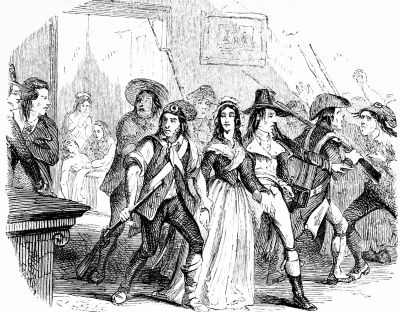
CHARLOTTE CORDAY ARRESTED.
She listened to her doom of immediate death with a smile, and was conducted back to the prison, to be led from thence to the guillotine. A little after seven o'clock on this same evening a cart issued from the Conciergerie, bearing Charlotte, in the red robe of a murderess, to the guillotine. A vast throng crowded the streets, most of whom assailed her with howls and execrations. She looked upon them with a serene smile, as if she were riding on an excursion of pleasure. She was bound to the plank. The glittering axe glided through the grove, and the executioner, lifting her severed head, exhibited it to the people, and then brutally struck the cheek.
Robespierre and Danton, the idols of the mob, now divided the supreme power between them. The organization of a revolutionary government was simply the machine by means of which they operated.
On the 10th of August there was another magnificent festival in Paris to commemorate the adoption of the Jacobin Constitution. The celebrated painter David arranged the fête with great artistic skill, and again all Paris, though on the verge of ruin, was in a blaze of illumination and in a roar of triumph. The Austrian armies were now within fifteen days' march of Paris, and there was no organized force which could effectually arrest their progress. But the fear of the old Bourbon despotism rallied the masses to maintain, in preference, even the horrors of Jacobin ferocity. The aristocrats crushed the people; the Jacobins crushed the aristocrats. The populace naturally preferred the latter rule.
And now France rose, as a nation never rose before. At the motion of Danton it was decreed on the 23rd of August,
"From this moment until when the enemy shall be driven from the territory of the French Republic, all the French shall be in permanent requisition for the service of the armies. The young men shall go forth to fight. The married men shall forge the arms and transport the supplies. The women shall make tents and clothes, and attend on the hospitals. The children shall make lint out of rags; the old men shall cause themselves to be carried to the public places, to excite the courage of the warriors, to preach hatred of kings and love of the Republic."
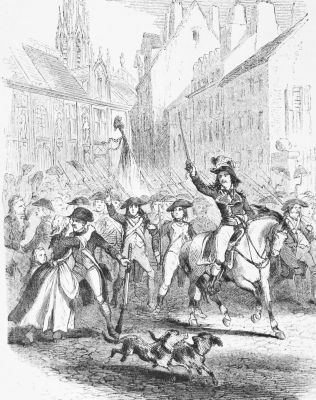
MARCH OF VOLUNTEERS.
All unmarried men or widowers without children, between the ages of eighteen and twenty-five, were to assemble at appointed rendezvous and march immediately. This act raised an army of one million two hundred thousand men. The men between twenty-five and thirty were to hold themselves in readiness to follow. And those between thirty and sixty were to be prepared to obey orders whenever they should be summoned to the field. There is sublimity, at least, in such energy.
All France was instantly converted into a camp, resounding with preparations for war. In La Vendée the friends of the Bourbons had rallied. The Convention decreed its utter destruction, the death of every man, conflagration of the dwellings, destruction of the crops, and the removal of the women and children to some other province, where they should be supported at the expense of the government. It was sternly resolved that no mercy whatever should be shown to Frenchmen who were co-operating with foreigners to rivet anew upon France the chains of Bourbon despotism. These decrees were executed with merciless fidelity. The illustrious Carnot, who, to use his own words, "had the ambition of the three hundred Spartans, going to defend Thermopylæ," organized and disciplined fourteen armies, and selected for them able leaders.
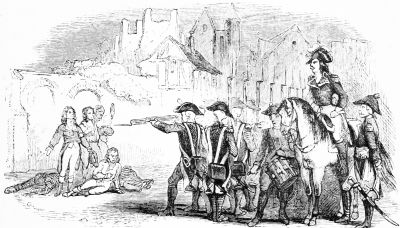
EXECUTION IN LA VENDÉE.
While matters were in this condition, the inhabitants of Marseilles, Lyons, and Toulon rose, overpowered the Jacobins, and, raising the banner of the Bourbons, invited the approach of the Allies. Toulon was the naval arsenal of France, a large French fleet crowded its port, and its warehouses were filled with naval stores. Lord Hood, with an English squadron, was cruising off the coast. The Royalists, Admiral Troyoff at their head, gave the signal to the English, and basely surrendered to them the forts, shipping, and stores. It was a fearful loss to the Revolutionists. Lord Hood, the British admiral, immediately entered with his fleet, took possession, and issued a proclamation in which he said,
"Considering that the sections of Toulon have, by the commissioners whom they have sent to me, made a solemn declaration in favor of Louis XVII. and a monarchical government, and that they will use their utmost efforts to break the chains which fetter their country, and re-establish the Constitution as it was accepted by their defunct sovereign in 1789, I repeat by this present declaration that I take possession of Toulon, and shall keep it solely as a deposit for Louis XVII., and that only till peace is re-established in France."[399]
An army of sixty thousand men was sent against rebellious Lyons. The city, after a prolonged siege and the endurance of innumerable woes, was captured. The Convention decreed that it should be utterly destroyed, and that over its ruins should be reared a monument with the inscription, "Lyons made war upon Liberty: Lyons is no more!" The cruelties inflicted upon the Royalists of this unhappy city are too painful to contemplate. The imagination can hardly exaggerate them. Fouché and Collot d'Herbois, the prominent agents in this bloody vengeance, were atheists. In contempt of Christianity, they ordered the Bible and the Cross to be borne through the streets on an ass; the ass was compelled to drink of the consecrated wine from the communion-cup. Six thousand of the citizens of Lyons perished in these sanguinary persecutions, and twelve thousand were driven into exile. The Revolutionary Tribunal was active night and day condemning to death. One morning a young girl rushed into the hall, exclaiming,
"There remain to me, of all our family, only my brothers. Mother, father, sisters, uncles—you have butchered all. And now you are going to condemn my brothers. In mercy ordain that I may ascend the scaffold with them."
Her prayer of anguish was refused, and the poor child threw herself into the Rhone.
The Royalist insurrection in La Vendée, after a long and terrible conflict, was crushed out. No language can describe the horrors of vengeance which ensued. The tale of brutality is too awful to be told. Demons could not have been more infernal in mercilessness.
"Death by fire and the sword," writes Lamartine, "made a noise, scattered blood, and left bodies to be buried and be counted. The silent waters of the Loire were dumb and would render no account. The bottom of the sea alone would know the number of the victims. Carrier caused mariners to be brought as pitiless as himself. He ordered them, without much mystery, to pierce plug-holes in a certain number of decked vessels, so as to sink them with their living cargoes in parts of the river.
"These orders were first executed secretly and under the color of accidents of navigation. But soon these naval executions, of which the waves of the Loire bore witness even to its mouth, became a spectacle for Carrier and for his courtiers. He furnished a galley of pleasure, of which he made a present to his accomplice Lambertye, under pretext of watching the banks of the river. This vessel, adorned with all the delicacies of furniture, provided with all the wines and all the necessaries of feasting, became the most general theatre of these executions. Carrier embarked therein sometimes himself, with his executioners and his courtesans, to make trips upon the water. While he yielded himself up to the joys of love and wine on deck, his victims, inclosed in the hold, saw, at a given signal, the valves open, and the waves of the Loire swallow them up. A stifled groaning announced to the crew that hundreds of lives had just breathed their last under their feet. They continued their orgies upon this floating sepulchre.
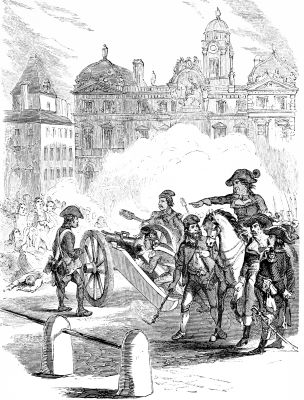
MASSACRES IN LYONS.
"Sometimes Carrier, Lambertye, and their accomplices rejoiced in the cruel pleasure of this spectacle of agony. They caused victims of either sex, in couples, to mount upon the deck. Stripped of their garments, they bound them face to face, one to the other—a priest with a nun, a young man with a young girl. They suspended them, thus naked and interlaced, by a cord passed under the shoulders through a block of the vessel. They sported with horrible sarcasms on this parody of marriage in death, and then flung the victims into the river. This cannibal sport was termed 'Republican Marriages.'"
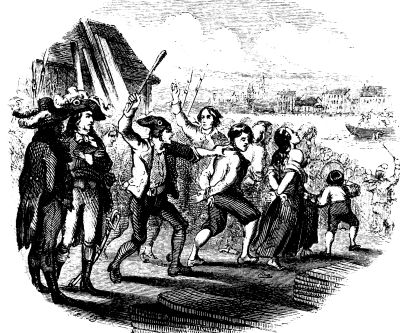
DROWNING VICTIMS IN THE LOIRE.
Robespierre, informed of these demoniac deeds, recalled Carrier, but he did not dare to bring an act of accusation against the wretch, lest he should peril his own head by being charged with sympathy with the Royalists. It is grateful to record that Carrier himself was eventually conducted, amid the execrations of the community, to the scaffold.[400]
The prisons of Paris were now filled with victims. Municipal instructions, issued by Chaumette, catalogued as follows those who should be arrested as suspected persons: 1. Those who, by crafty addresses, check the energy of the people. 2. Those who mysteriously deplore the lot of the people, and propagate bad news with affected grief. 3. Those who, silent respecting the faults of the Royalists, declaim against the faults of the Patriots. 4. Those who pity those against whom the law is obliged to take measures. 5. Those who associate with aristocrats, priests, and moderates, and take an interest in their fate. 6. Those who have not taken an active part in the Revolution. 7. Those who have received the Constitution with indifference and have expressed fears respecting its duration. 8. Those who, though they have done nothing against liberty, have done nothing for it. 9. Those who do not attend the sections. 10. Those who speak contemptuously of the constituted authorities. 11. Those who have signed counter-revolutionary petitions. 12. The partisans of La Fayette, and those who marched to the charge in the Champ de Mars.
There were but few persons in Paris who were not liable to be arrested, by the machinations of any enemy, upon some one of these charges. Many thousands were soon incarcerated. The prisons of the Maire, La Force, the Conciergerie, the Abbaye, St. Pelagie, and the Madelonettes were crowded to their utmost capacity. Then large private mansions, the College of Duplessis, and finally the spacious Palace of the Luxembourg were converted into prisons, and were filled to suffocation with the suspected. In these abodes, surrendered to filth and misery, with nothing but straw to lie upon, the most brilliant men and women of Paris were huddled together with the vilest outcasts. After a time, however, those who had property were permitted to surround themselves with such comforts as their means would command. From these various prisons those who were to be tried before the Revolutionary Tribunal were taken to the Conciergerie, which adjoined the Palace of Justice, where the tribunal held its session. A trial was almost certain condemnation, and the guillotine knew no rest. Miserable France was now surrendered to the Reign of Terror. The mob had become the sovereign.
FOOTNOTES:
CHAPTER XXXIII.
EXECUTION OF MARIE ANTOINETTE AND MADAME ELIZABETH.
Marie Antoinette in the Temple.—Conspiracies for the Rescue of the Royal Family.—The young Dauphin torn from his Mother.—Phrensy of the Queen.—She is removed to the Conciergerie.—Indignities and Woes.—The Queen led to Trial.—Letter to her Sister.—The Execution of the Queen.—Madame Elizabeth led to Trial and Execution.—Fate of the Princess and the Dauphin.
The populace now demanded the head of Marie Antoinette, whom they had long been taught implacably to hate.[401] We left her on the 21st of January in the Temple, overwhelmed with agony. Swoon succeeded swoon as she listened to the clamor in the streets which accompanied her husband to the guillotine. The rumbling of the cannon, on their return, and the shouts of Vive la République beneath her windows announced that the tragedy was terminated. The Commune cruelly refused to allow her any details of the last hours of the king, and even Clery, his faithful servant, was imprisoned, so that he could not even place in her hands the lock of hair and the marriage ring which the king had intrusted to him.
Many conspiracies were formed for the rescue of the royal family, which led to a constant increase of the rigors of their captivity. The queen refused to resume her walks in the garden as she could not endure to pass the door of the king's apartment. But, after long seclusion, for the sake of the health of her children she consented to walk with them each day, for a few moments, on the platform of the tower. The Commune immediately ordered the platform to be surrounded with high boards, so that the captives might not receive any tokens of recognition from their friends.
For four months Marie Antoinette, Madame Elizabeth, and the children had the consolation of condoling with each other in their misery. But on the night of the 4th of July the clatter of an armed band was heard ascending the tower, and some commissioners tumultuously entered her chamber. They read to her a decree announcing that her son, the dauphin, was to be taken from her and imprisoned by himself. The poor child, as he listened to the reading of this cruel edict, was frantic with terror. He threw himself into his mother's arms and shrieked out,
"Oh! mother, mother, do not abandon me to those men. They will kill me as they did papa."
The queen, in a delirium of agony, grasped her child and placing him upon the bed behind her, with eyes glaring like a tigress, bade defiance to the officers, declaring that they should tear her in pieces before they should take her boy. Even the officers were overcome by her heart-rending grief, and for two hours refrained from taking the child by violence. The exhausted mother at length fell in a swoon, and the child was taken, shrieking with terror, from the room. She never saw her son again.
A few weeks of woe passed slowly away, when, early in August, she was awakened from her sleep just after midnight by a band of armed men who came to convey her to the prison of the Conciergerie, where she was to await her trial. The queen had already drained the cup of misery to the dregs, and nothing could add to her woe. She rose, in the stupor of despair, and began to dress herself in the presence of the officers. Her daughter and Madame Elizabeth threw themselves at the feet of the men, and implored them not to take the queen from them. They might as well have plead with the granite blocks of their prison.
Pressing her daughter for a moment convulsively to her heart, she covered her with kisses, spoke a few words of impassioned tenderness to her sister, and then, as if fearing to cast a last look upon these objects of her affection, hurried from the room. In leaving she struck her forehead against the beam of the low door.
"Did you hurt yourself?" inquired one of the men.
"Oh no!" was her reply, "nothing now can farther harm me."
A carriage was waiting for her at the door. Escorted by gens d'armes she was conducted, through the gloom of midnight, to the dungeon where she was to await her condemnation.
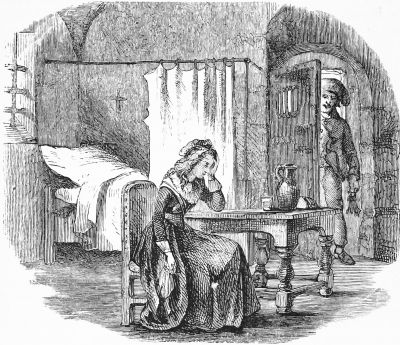
MARIE ANTOINETTE IN THE CONCIERGERIE.
The world-renowned prison of the Conciergerie consists of a series of subterranean dungeons beneath the floor of the Palais de Justice. More gloomy tombs the imagination can hardly conceive. Down the dripping and slimy steps the queen was led, by the light of a tallow candle, until, through a labyrinth of corridors, she approached the iron door of her dungeon. The rusty hinges grated as the door was opened, and she was thrust in. Two soldiers accompanied her, with drawn swords, and who were commanded, in defiance of all the instincts of delicacy, not to allow her to be one moment absent from their sight. The one candle gave just light enough to reveal the horrors of her cell. The floor was covered with mud, and streams of water trickled down the stone walls. A miserable pallet, with a dirty covering of coarse and tattered cloth, a small pine table, and a chair constituted the only furniture. So deep was the fall from the saloons of Versailles.
Here the queen remained for two months, her misery being slightly alleviated by the kind-heartedness of Madame Richard, the wife of the jailer, who did every thing the rigorous rules would admit to mitigate her woes. With her own hand she prepared food for the queen, obtained for her a few articles of furniture, and communicated to her daily such intelligence as she could obtain of her sister and her children. The friends of the queen were untiring in their endeavors, by some conspiracy, to effect her release. A gentleman obtained admittance to the queen's cell, and presented her with a rose, containing a note hidden among its petals. One of the gens d'armes detected the attempt; and the jailer and his wife, for their suspected connivance, were both arrested and thrown into the dungeons.
Other jailers were provided for the prison, M. and Madame Bault; but they also had humane hearts, and wept over the woes of Marie Antoinette. The queen's wardrobe consisted only of two robes, one white, one black, and three chemises. From the humidity of her cell these rapidly decayed, with her shoes and stockings, and fell into tatters. Madame Bault was permitted to assist the queen in mending these, but was not allowed to furnish any new apparel. Books and writing materials were also prohibited. With the point of her needle she kept a brief memorandum of events on the stucco of her walls, and also inscribed brief lines of poetry and sentences from Scripture.
On the 14th of October the queen was conducted from her dungeon to the halls above for trial. Surrounded by a strong escort, she was led to the bench of the accused. Her accusation was that she abhorred the Revolution which had beheaded her husband and plunged her whole family into unutterable woe.
The queen was dressed in the garb of extreme poverty. Grief had whitened her hair, and it was fast falling from her head. Her eyes were sunken, and her features wan and wasted with woe.
"What is your name?" inquired one of the judges.
"I am called Marie Antoinette of Lorraine, in Austria," answered the queen.
"What is your condition?" was the next question.
"I am widow of Louis, formerly King of the French," was the reply.
"What is your age?"
"Thirty-seven."
The long act of accusation was then read. Among other charges was the atrocious one of attempting, by depravity and debauchery, to corrupt her own son, "with the intention of enervating the soul and body of that child, and of reigning, in his name, over the ruin of his understanding."
The queen recoiled from this charge with a gesture of horror, and, when asked why she did not reply to the accusation, she said,
"I have not answered it because there are accusations to which nature refuses to reply. I appeal to all mothers if such a crime be possible."
The trial continued for two days. When all the accusations had been heard, the queen was asked if she had any thing to say. She replied,
"I was a queen, and you took away my crown; a wife, and you killed my husband; a mother, and you deprived me of my children. My blood alone remains. Take it; but do not make me suffer long."
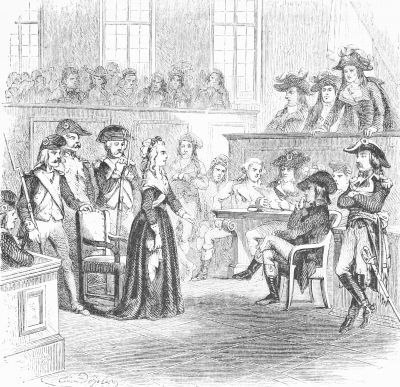
TRIAL OF MARIE ANTOINETTE.
At four o'clock on the morning of the 16th she listened to her sentence condemning her to die. In the dignity of silence, and without the tremor of a muscle, she accepted her doom. As she was led from the court-room to her dungeon, to prepare for her execution, the brutal populace, with stampings and clappings, applauded the sentence. Being indulged with pen and paper in these last hours, she wrote as follows to her sister:
"October 16th, half past four in the morning.
"I write you, my sister, for the last time. I have been condemned, not to an ignominious death—that only awaits criminals—but to go and rejoin your brother. Innocent as he, I hope to show the same firmness as he did in these last moments. I grieve bitterly at leaving my poor children; you know that I existed but for them and you—you who have, by your friendship, sacrificed all to be with us. In what a position do I leave you. I have learned, by the pleadings on my trial, that my daughter was separated from you. Alas! my poor child. I dare not write to her. She could not receive my letter. I know not even if this may reach you. Receive my blessing for both.
"I hope one day, when they are older, they may rejoin you and rejoice in liberty at your tender care. May their friendship and mutual confidence form their happiness. May my daughter feel that, at her age, she ought always to aid her brother with that advice with which the greater experience she possesses and her friendship should inspire her. May my son, on his part, render to his sister every care and service which affection can dictate. Let my son never forget the last words of his father. I repeat them to him expressly. Let him never attempt to avenge our death."
Having finished the letter, which was long, she folded it and kissed it repeatedly, "as if she could thus transmit the warmth of her lips and the moisture of her tears to her children." She then threw herself upon the pallet and slept quietly for two or three hours. A few rays of morning light were now struggling in through the grated bars of the window. The daughter of Madame Bault came in to dress her for the guillotine. She put on her white robe. A white handkerchief covered her shoulders, and a white cap, bound around her temples by a black ribbon, covered her hair.
It was a cold autumnal morning, and a chill fog filled the streets of Paris. At eleven o'clock the executioners led her from her cell. She cordially embraced the kind-hearted daughter of the concierge, and, having with her own hands cut off her hair, allowed herself to be bound, without a murmur, and issued from the steps of the Conciergerie. Instead of a carriage, the coarse car of the condemned awaited her at the gateway of the prison. For a moment she recoiled from this unanticipated humiliation, but immediately recovering herself she ascended the cart. There was no seat in the car, and, as her hands were bound behind her, she was unable to support herself from the jolting over the pavement. As she was jostled rudely to and fro, in the vain attempt to preserve her equilibrium, the multitudes thronging the streets shouted in derision. They had been taught to hate her, to regard her not only as the implacable foe of popular liberty, which she was, but as the most infamous of women, which she was not. "These," they cried, "are not your cushions of Trianon."
It was a long ride to the scaffold, during which the queen suffered all that insult, derision, and contumely can inflict. The procession crossed the Seine by the Pont au Change, and traversed the Rue St. Honoré. Upon reaching the Place of the Revolution the cart stopped for a moment near the entrance of the garden of the Tuileries. Marie Antoinette for a few moments contemplated in silence those scenes of former happiness and grandeur. A few more revolutions of the wheels placed her at the foot of the guillotine. She mounted to the scaffold, and inadvertently trod upon the foot of the executioner.
"Pardon me," said the queen, with as much courtesy as if she had been in one of the saloons of Versailles. Kneeling, she uttered a brief prayer, and then, turning her eyes to the distant towers of the Temple, she said,
"Adieu, once again, my children; I go to rejoin your father."
She was bound to the plank, and as it sank to its place the gleaming axe slid through the groove, and the head of the queen fell into the basket. The executioner seized the gory trophy by the hair, and, walking around the scaffold, exhibited it to the crowd. One long cry of Vive la République! arose, and the crowd dispersed.
While these fearful scenes were passing, Madame Elizabeth and the princess remained in the tower of the Temple. Their jailers were commanded to give them no information whatever. The young dauphin was imprisoned by himself.
Six months of gloom and anguish which no pen can describe passed away, when, on the night of the 9th of May, 1794, as Madame Elizabeth and the young princess, Maria Theresa, were retiring to bed, a band of armed men, with lanterns, broke into their room, and said to Madame Elizabeth,
"You must immediately go with us."
"And my niece?" anxiously inquired the meek and pious aunt, ever forgetful of self in her solicitude for others. "Can she go too?"
"We want you only now. We will take care of her by-and-by," was the unfeeling answer.
The saint-like Madame Elizabeth saw that the long-dreaded hour of separation had come, and that her tender niece was to be left, unprotected and alone, exposed to the brutality of her jailers. She pressed Maria Theresa to her bosom, and wept in uncontrollable grief. But still, endeavoring to comfort the heart-stricken child, she said,
"I shall probably soon return again, my dear Maria."
"No, you won't, citoyenne," rudely interrupted one of the officers. "You will never ascend these stairs again. So take your bonnet, and come down."
The soldiers seized her, led her down the stairs, and thrust her into a carriage. It was midnight. Driving violently through the streets, they soon reached the gateway of the Conciergerie. The Revolutionary Tribunal was, even at that hour, in session. The princess was dragged immediately to their bar. With twenty-four others of all ages and both sexes, she was condemned to die. Her crime was that she was sister of the king, and in heart hostile to the Revolution. She was led to one of the dungeons to be dressed for the scaffold. In this hour Christian faith was triumphant. Trusting in God, all her sorrows vanished, and her soul was in perfect peace.
With her twenty-two companions, all of noble birth, she was placed in the cart of the condemned, her hands bound behind her, and conducted to the guillotine. Madame Elizabeth was reserved to the last. One by one her companions were led up the scaffold before her, and she saw their heads drop into the basket. She then peacefully placed her head upon the pillow of death, and passed away, one of the purest and yet most suffering of earthly spirits, to the bosom of her God.
The young dauphin lingered for eighteen months in his cell, suffering inconceivable cruelties from his jailer, a wretch by the name of Simon, until he died on the 9th of June, 1795, in the tenth year of his age. Maria Theresa now alone remained of the family of Louis XVI. She had now been in prison more than two years. At length, so much sympathy was excited in behalf of this suffering child, that the Assembly consented to exchange her with the Austrian government for four French officers.
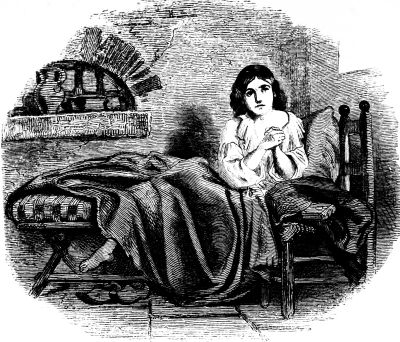
LOUIS XVII. IN PRISON.
On the 19th of December, 1795, she was led from the Temple, and, ample arrangements having been made for her journey, she was conducted, with every mark of respect and sympathy, to the frontiers. In the Austrian court, love and admiration encircled her. But this stricken child of grief had received wounds which time could never entirely heal. A full year passed before a smile could ever be won to visit her cheek. She subsequently married her cousin, the Duke of Angoulême, son of Charles X. With the return of the Bourbons she returned to her ancestral halls of the Tuileries and Versailles. But upon the second expulsion of the Bourbons she fled with them, and died, a few years ago, at an advanced age, universally respected. Such was the wreck of the royal family of France by the storm of revolution.
FOOTNOTES:
CHAPTER XXXIV.
THE JACOBINS TRIUMPHANT.
Views of the Girondists.—Anecdote of Vergniaud.—The Girondists brought to Trial.—Suicide of Valazé.—Anguish of Desmoulins.—Fonfrede and Ducos.—Last Supper of the Girondists.—Their Execution.—The Duke of Orleans; his Execution.—Activity of the Guillotine.—Humane Legislation.—Testimony of Desodoards.—Anacharsis Cloots.—The New Era.
The Jacobins now resolved to free themselves from all internal foes, that they might more vigorously cope with all Europe in arms against them. Marie Antoinette was executed the 16th of October. On the 22d, the Girondists, twenty-two in number, were brought before the Revolutionary Tribunal. They were the most illustrious men of the most noble party to which the Revolution had given birth. They had demolished a despotic throne that they might establish a constitutional monarchy upon the model of that of England.[402] With great generosity they had placed Louis XVI. on that throne, and he had feigned to accept the Constitution. But with hypocrisy which even his subsequent woes can not obliterate, he secretly rallied his nobles around him, or rather allowed them to use him as their leader, and appealed to the armies of foreign despotisms to overthrow the free Constitution and re-establish the old feudal tyranny.
"The question thenceforth was, whether their sons should, as in times past (as in Mr. Burke's splendid Age of Chivalry), be sent to manure Europe with their bodies, in wars undertaken at the nod of a courtesan—whether their wives and daughters, cursed with beauty enough to excite a transient emotion of sensuality, should be lured and torn from them and debauched—whether every man who dared to utter a manly political thought or to assert his rights against rank should be imprisoned at pleasure without a hearing—whether the toiling masses, for the purpose of supporting lascivious splendor, of building Parcs aux Cerfs, of pensioning discarded mistresses, of swiftly enriching corrupt favorites and minions of every stamp, should be so taxed that the light and air of heaven hardly came to them untaxed, and that they should be so sunk by exactions of every kind in the dregs of indigence that a short crop compelled them to live on food that the hounds, if not the swine, of their task-masters would reject; and, finally, whether, when, in the bloody sweat of their agony, they asked some mitigation of their hard fate, they should be answered by the bayonets of foreign mercenaries; and a people—stout manhood, gentle womanhood, gray-haired age, and tender infancy, turned their pale faces upward and shrieked for food, fierce, licentious nobles should scornfully bid them eat grass."[403]
In this terrible dilemma, the Girondists felt compelled to abandon the newly-established Constitutional monarchy, which had proved treacherous to its trust, and to fall back upon a republic, as their only asylum from destruction, and as the only possible refuge for French liberty. But the populace of France, ignorant and irreligious, were unfitted for a republic. Universal suffrage threw the power into the hands of millions of newly-emancipated slaves. Violence and blood commenced their reign. The Girondists in vain endeavored to stem the flood. They were overwhelmed. Such is their brief history.
The Girondists had been for some time confined in the dungeons of the Conciergerie. They were in a state of extreme misery. Vergniaud, one of the most noble and eloquent of men, was their recognized leader. His brother-in-law, M. Alluaud, came to the prison to bring him some money. A child of M. Alluaud, ten years of age, accompanied his father. Seeing his uncle with sunken eyes and haggard cheeks and disordered hair, and with his garments falling in tatters around him, the child was terrified, and, bursting into tears, clung to his father's knees.
"My child," said Vergniaud, taking him in his lap, "look well at me. When you are a man you can say that you saw Vergniaud, the founder of the Republic, at the most glorious period, and in the most splendid costume he ever wore—that in which he suffered the persecution of wretches, and in which he prepared to die for liberty."
The child remembered these words, and repeated them fifty years after to Lamartine. At ten o'clock in the morning of the 26th of October the accused were brought before the Revolutionary Tribunal. Two files of gens d'armes conducted them into the hall of audience and placed them on the prisoners' bench.[404] The act of accusation, drawn up by Robespierre and St. Just,[405] from an exceedingly envenomed pamphlet written by Camille Desmoulins, entitled History of the Faction of the Gironde, was long and bitter. The trial lasted several days.
On the 30th of October, at eight o'clock in the evening, the debate was closed. At midnight they were summoned to the bar to hear the verdict of the jury. It declared them all guilty of treason, and condemned them to die in the morning. One of the condemned, Valazé, immediately plunged a concealed poniard into his heart, and fell dead upon the floor. Camille Desmoulins, on hearing the verdict, was overwhelmed with remorse, and cried out,
"It is my pamphlet which has killed them. Wretch that I am, I can not bear the sight of my work. I feel their blood fall on the hand that has denounced them."
There were two brothers, Fonfrede and Ducos, among the condemned, sitting side by side, both under twenty-eight years of age. Fonfrede threw his arms around the neck of Ducos, and bursting into tears said,
"My dear brother, I cause your death; but we shall die together."
Vergniaud sat in silence, with an expression of proud defiance and contempt. Lasource repeated the sententious saying of one of the ancients, "I die on the day when the people have lost their reason. You will die when they have recovered it." As they left the court to return to their cells, there to prepare for the guillotine, they spontaneously struck up together the hymn of the Marseillais:
"Allons, enfans de la patrie, Le jour de gloire est arrivé; Contre nous de la tyrannie L'étendard sanglant est levé."[406]
As they passed along the corridors of the prison, their sublime requiem echoed along the gloomy vaults, and awoke the sleepers in the deepest dungeons. They were all placed in one large room opening into several cells. The lifeless body of Valazé was deposited in one of the corners; for, by a decree of the Tribunal, his remains were to be taken in the cart of the condemned to be beheaded with the rest. A sumptuous banquet was sent in to them by their friends as their last repast. The table was richly spread, decorated with flowers, and supplied with all the delicacies which Paris could furnish. A Constitutional priest, the Abbé Lambert, a friend of the Girondists, had obtained admission to the prison, to administer to them the last supports of religion and to accompany them to the guillotine. To him we are indebted for the record of these last scenes.
Vergniaud, thirty-five years of age, presided. He had but little to bind him to life, having neither father nor mother, wife nor child. In quietness and with subdued tones they partook of their repast. When the cloth was removed, and the flowers and the wine alone remained, the conversation became more animated. The young men attempted with songs and affected gayety to disarm death of its terror; but Vergniaud, rallying to his aid his marvelous eloquence, endeavored to recall them to more worthy thoughts.
"My friends," said he, sorrowing more over the misfortunes of the Republic than over his own, "we have killed the tree by pruning it. It was too aged. The soil is too weak to nourish the roots of civic, liberty. This people is too childish to wield its laws without hurting itself. It will return to its kings as babes return to their toys. We were deceived as to the age in which we were born and in which we die for the freedom of the world."
"What shall we be doing to-morrow at this time?" asked Ducos. Each answered according to his skepticism or his faith. Vergniaud again spake. "Never," says the Abbé Lambert, "had his look, his gesture, his language, and his voice more profoundly affected his hearers." His discourse was of the immortality of the soul, to which all listened deeply moved, and many wept.
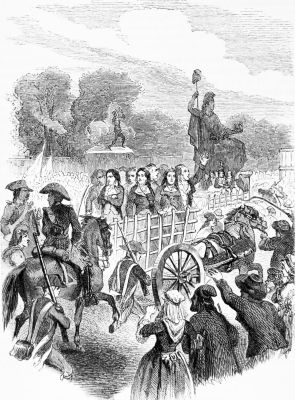
THE GIRONDISTS ON THEIR WAY TO EXECUTION.
A few rays of morning light now began to struggle in at their dungeon windows. The executioners soon entered to cut off their hair and robe them for the scaffold. At ten o'clock they were marched in a column to the gate of the prison, where carts, surrounded by an immense crowd, awaited them. As they entered the carts they all commenced singing in chorus the Marseilles Hymn, and continued the impassioned strains until they reached the scaffold. One after another they ascended the scaffold. Sillery was the first who ascended. He was bound to the plank, but continued in a full, strong voice to join in the song, till the glittering axe glided down the groove and his head dropped into the basket. Each one followed his example. The song grew fainter as head after head fell, till at last one voice only remained. It was that of Vergniaud. As he was bound to the plank he commenced anew the strain,
"Allons, enfans de la patrie, Le jour de gloire est arrivé."
The axe fell, and the lips of Vergniaud were silent in death. In thirty-one minutes the executioner had beheaded them all. Their bodies were thrown into one cart, and were cast into a grave by the side of that of Louis XVI.[407]
On the 6th of November the Duke of Orleans was taken from prison and led before the Tribunal. As there was no serious charge to be brought against him, he had not apprehended condemnation. But he was promptly doomed to die. As he was conducted back to his cell to prepare for immediate death, he exclaimed, in the utmost excitement of indignation,
"The wretches! I have given them all—rank, fortune, ambition, honor, the future reputation of my house—and this is the recompense they reserve for me!"
At three o'clock he was placed in the cart with three other condemned prisoners. The prince was elegantly attired and all eyes were riveted upon him. With an air of indifference he gazed upon the crowd, saying nothing which could reveal the character of his thoughts. On mounting the scaffold the executioner wished to draw off his boots.
"No, no," said the duke, "you will do it more easily afterward."
He looked intently for a moment at the keen-edged axe, and, without a word, submitted to his fate. Madame Roland and others of the most illustrious of the friends of freedom and of France soon followed to the scaffold. And now every day the guillotine was active as the efficient agent of government, extinguishing all opposition and silencing every murmur. The prisons were full, new arrests were every day made, and dismay paralyzed all hearts. Four thousand six hundred in the prisons of Paris alone were awaiting that trial which almost surely led to condemnation.
The Jacobin leaders, trembling before Europe in arms, felt that there was no safety for France but in the annihilation of all internal foes. Danton, Marat, Robespierre, were not men who loved blood and cruelty; they were resolute fanatics who believed it to be well to cut off the heads of many thousand reputed aristocrats, that a nation of thirty millions might enjoy popular liberty. While the Revolutionary Tribunal was thus mercilessly plying the axe of the executioner, the National Convention, where these Jacobins reigned supreme, were enacting many laws which breathed the spirit of liberty and humanity. The taxes were equally distributed in proportion to property. Provision was made for the poor and infirm. All orphans were adopted by the Republic. Liberty of conscience was proclaimed. Slavery and the slave-trade were indignantly abolished. Measures were adopted for a general system of popular instruction, and decisive efforts were made to unite the rich and the poor in bonds of sympathy and alliance.[408]
We can not give a better account of the state of Paris at this time than in the words of Desodoards, a calm philosophic writer, who had ardently espoused the cause of the Revolution, and who consequently will not be suspected of exaggeration.
"What then," says he, "was this Revolutionary government? Every right, civil and political, was destroyed. Liberty of the press and of thought was at an end. The whole people were divided into two classes, the privileged and the proscribed. Property was wantonly violated, lettres de cachet re-established, the asylum of dwellings exposed to the most tyrannical inquisition, and justice stripped of every appearance of humanity and honor. France was covered with prisons; all the excesses of anarchy and despotism struggling amid a confused multitude of committees; terror in every heart; the scaffold devouring a hundred every day, and threatening to devour a still greater number; in every house melancholy and mourning, and in every street the silence of the tomb.
"War was waged against the tenderest emotions of nature. Was a tear shed over the tomb of father, wife, or friend, it was, according to these Jacobins, a robbery of the Republic. Not to rejoice when the Jacobins rejoiced was treason to freedom. All the mob of low officers of justice, some of whom could scarcely read, sported with the lives of men without the slightest shame or remorse. Often an act of accusation was served upon one person which was intended for another. The officer only changed the name on perceiving his error, and often did not change it. Mistakes of the most inconceivable nature were made with impunity. The Duchess of Biron was judged by an act drawn up against her agent. A young man of twenty was guillotined for having, as it was alleged, a son bearing arms against France. A lad of sixteen, by the name of Mallet, was arrested under an indictment for a man of forty, named Bellay.
"'What is your age?' inquired the president, looking at him with some surprise.
"'Sixteen,' replied the youth.
"'Well, you are quite forty in crime,' said the magistrate; 'take him to the guillotine.'
"From every corner of France victims were brought in carts to the Conciergerie. This prison was emptied every day by the guillotine, and refilled from other prisons. These removals were made in the dark, lest public sympathy should be excited. Fifty or sixty poor creatures, strait bound, conducted by men of ferocious aspect, a drawn sabre in one hand and a lighted torch in the other, passed in this manner through the silence of night. The passenger who chanced to meet them had to smother his pity. A sigh would have united him to the funeral train.
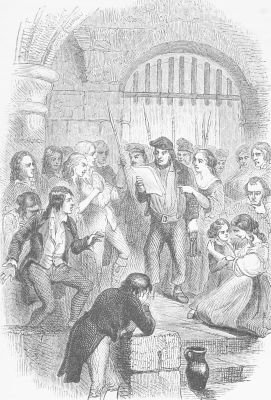
READING THE LIST OF THE VICTIMS IN THE PRISONS OF PARIS.
"The prisons were the abode of every species of suffering. The despair which reigned in these sepulchres was terrific: one finished his existence by poison; another dispatched himself by a nail; another dashed his head against the walls of his cell; some lost their reason. Those who had sufficient fortitude waited patiently for the executioner. Every house of arrest was required to furnish a certain number of victims. The turnkeys went with these mandates of accusation from chamber to chamber in the dead of night. The prisoners, starting from their sleep at the voice of their Cerberuses, supposed their end had arrived. Thus warrants of death for thirty threw hundreds into consternation.[409]
"At first the sheriffs ranged fifteen at a time in their carts, then thirty, and about the time of the fall of Robespierre preparations had been made for the execution of one hundred and fifty at a time. An aqueduct had been contrived to carry off the blood. In these batches, as they were called, were often united people of the most opposite systems and habits. Sometimes whole generations were destroyed in a day. Malesherbes, at the age of eighty, perished with his sister, his daughter, his son-in-law, his grandson, and his granddaughter. Forty young women were brought to the guillotine for having danced at a ball given by the King of Prussia at Verdun. Twenty-two peasant women, whose husbands had been executed in La Vendée, were beheaded."
Such was the thraldom from which, at last, the empire of Napoleon rescued France. Nothing less than the strength of his powerful arm could have wrought out the achievement.
In the midst of such scenes it is not strange that all respect should have been renounced for the Gospel of Jesus Christ. The Jacobins of Paris crowded the Convention, demanding the abjuration of all forms of religion and all modes of worship. They governed the Convention with despotic sway. The Commune of Paris, invested with the local police of the city, passed laws prohibiting the clergy from exercising religious worship outside the churches. None but friends and relatives were to be allowed to follow the remains of the dead to the grave. All religious symbols were ordered to be effaced from the cemeteries, and to be replaced by a statue of Sleep. The following ravings of Anacharsis Cloots, a wealthy Prussian baron, who styled himself the orator of the human race, and who was one of the most conspicuous of the Jacobin agitators, forcibly exhibits the spirit of the times:[410]
"Paris, the metropolis of the globe, is the proper post for the orator of the human race. I have not left Paris since 1789. It was then that I redoubled my zeal against the pretended sovereigns of earth and heaven. I boldly preached that there is no other god but Nature, no other sovereign but the human race—the people-god. The people is sufficient for itself. Nature kneels not before herself. Religion is the only obstacle to universal happiness. It is high time to destroy it."
The popular current in Paris now set very strongly against all religion. Infidel and atheistic principles were loudly proclaimed. The unlettered populace, whose faith was but superstition, were easily swept along by the current. The Convention made a feeble resistance, but soon yielded to the general impulse. In the different sections of Paris, gatherings of the populace abjured all religion. The fanaticism spread like wild-fire to the distant departments. The churches were stripped of their baptismal plate and other treasures, and the plunder was sent to the Convention. Processions paraded the streets, singing, derisively, Hallelujahs, and profaning with sacrilegious caricature all the ceremonies of religion. The sacrament of the Lord's Supper was administered to an ass.
The Convention had appointed a committee of twelve men, called the Committee of Public Safety, and invested them with dictatorial power. The whole revolutionary power was now lodged in their hands. They appointed such sub-committees as they pleased, and governed France with terrific energy. The Revolutionary Tribunal was but one of their committees. In all the departments they established their agencies. The Convention itself became powerless before this appalling despotism. This dictatorship was energetically supported by the mob of Paris; and the city government of Paris was composed of the most violent Jacobins, who were in perfect fraternity with the Committee of Public Safety. St. Just, who proposed in the Convention the establishment of this dictatorship, said,
"You must no longer show any lenity to the enemies of the new order of things. Liberty must triumph at any cost. In the present circumstances of the Republic the Constitution can not be established; it would guarantee impunity to attacks on our liberty, because it would be deficient in the violence necessary to restrain them."
This Committee, overawing the Convention, constrained the establishment of a new era. To obliterate the Sabbath, they divided the year into twelve months of thirty days each, each month to consist of three weeks of ten days each. The tenth day was devoted to festivals. The five surplus days were placed at the end of the year, and were consecrated to games and rejoicing. Thus energetically were measures adopted to obliterate entirely all traces of the Sabbath. There were thousands in France who looked upon these measures with unutterable disgust, but they were overwhelmed by the powers of anarchy. Anxiously they waited for a deliverer. In Napoleon they found one, who was alike the foe of the despotism of the Bourbons and the despotism of the mob.
FOOTNOTES:
CHAPTER XXXV.
FALL OF THE HEBERTISTS AND OF THE DANTONISTS.
Continued Persecution of the Girondists.—Robespierre opposes the Atheists.—Danton, Souberbielle, and Camille Desmoulins.—The Vieux Cordelier.—The Hebertists executed.—Danton assailed.—Interview between Danton and Robespierre.—Danton warned of his Peril.—Camille Desmoulins and others arrested.—Lucile, the Wife of Desmoulins.—Letters.—Execution of the Dantonists.—Arrest and Execution of Lucile.—Toulon recovered by Bonaparte.
The leaders of the Girondists were now destroyed, and the remnants of the party were prosecuted with unsparing ferocity. On the 11th of November, Bailly, the former mayor, the friend of La Fayette, the philanthropist and the scholar, was dragged to the scaffold. The day was cold and rainy. His crime was having unfurled the red flag in the Field of Mars, to quell the riot there, on the 17th of July, 1791. He was condemned to be executed on the field which was the theatre of his alleged crime. Behind the cart which carried him they affixed the flag which he had spread. A crowd followed, heaping upon him the most cruel imprecations. On reaching the scaffold, some one cried out that the field of the federation ought not to be polluted with his blood. Immediately the mob rushed upon the guillotine, tore it down, and erected it again upon a dunghill on the banks of the Seine. They dragged Bailly from the tumbril, and compelled him to make the tour of the Field of Mars on foot. Bareheaded, with his hands bound behind him, and with no other garment than a shirt, the sleet glued his hair and froze upon his breast. They pelted him with mud, spat in his face, and whipped him with the flag, which they dipped in the gutters. The old man fell exhausted. They lifted him up again, and goaded him on. Blood, mingled with mire, streamed down his face, depriving him of human aspect. Shouts of derision greeted these horrors. The freezing wind and exhaustion caused an involuntary shivering. Some one cried out, "You tremble, Bailly." "Yes, my friend," replied the heroic old man, "but it is with cold."[411] After five hours of such a martyrdom, the axe released him from his sufferings.
Pétion and Buzot wandered many days and nights in the forest. At length their remains were found, half devoured by wolves. Whether they perished of cold and starvation, or sought relief from their misery in voluntary death, is not known.
The illustrious Condorcet, alike renowned for his philosophical genius and his eloquent advocacy of popular rights, had been declared an outlaw. For several months he had been concealed in the house of Madame Verney, a noble woman, who periled her own life that she might save that of her friend. At last Condorcet, learning from the papers that death was denounced against all who concealed a proscribed individual, resolved, at every hazard, to leave the roof of his benefactress. For some time he wandered through the fields in disguise, until he was arrested and thrown into prison. On the following morning, March 28, 1794, he was found dead on the floor of his room, having swallowed poison, which for some time he carried about with him.
"It would be difficult in that or any other age to find two men of more active or, indeed, enthusiastic benevolence than Condorcet and La Fayette. Besides this, Condorcet was one of the most profound thinkers of his time, and will be remembered as long as genius is honored among us. La Fayette was no doubt inferior to Condorcet in point of ability, but he was the intimate friend of Washington, on whose conduct he modeled his own, and by whose side he had fought for the liberties of America; his integrity was, and still is, unsullied, and his character had a chivalrous and noble turn which Burke, in his better days, would have been the first to admire. Both, however, were natives of that hated country whose liberties they vainly attempted to achieve. On this account Burke declared Condorcet to be guilty of 'impious sophistry,' to be a 'fanatic atheist and furious democratic republican,' and to be capable of the 'lowest as well as the highest and most determined villainies.' As to La Fayette, when an attempt was made to mitigate the cruel treatment he was receiving from the Prussian government, Burke not only opposed the motion made for that purpose in the House of Commons, but took the opportunity of grossly insulting the unfortunate captive, who was then languishing in a dungeon. So dead had he become on this subject, even to the common instincts of our nature, that in his place in parliament he could find no better way of speaking of this injured and high-souled man than by calling him a ruffian. 'I would not,' says Burke, 'debase[412] my humanity by supporting an application in behalf of so horrid a ruffian.'"[413]
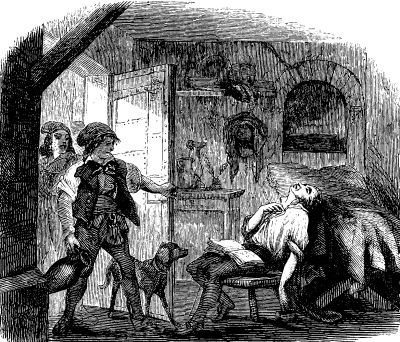
DEATH OF CONDORCET.
Madame Roland was led to the guillotine, evincing heroism which the world has never seen surpassed. Her husband, in anguish, unable to survive her, and hunted by those thirsting for his blood, anticipated the guillotine by plunging a stiletto into his own heart.
Danton and Robespierre were both opposed to such cruel executions, and especially to the establishment in France of that system of atheism which degraded man into merely the reptile of an hour. When Robespierre was informed of the atrocities which attended the execution of Bailly, in shame and grief he shut himself up in his room, saying, with prophetic foresight, to his host Duplay, "It is thus that they will martyrize ourselves."
Hebert[414] and the atheists were now dominant in the Commune of Paris, and Danton and Robespierre organized a party to crush them. Hebert soon saw indications of this movement, and began to tremble. He complained in the Jacobin Club that Robespierre and Danton were plotting against him. Robespierre was present on the occasion, and, with his accustomed audacity, immediately ascended the tribune and hurled his anathemas upon the heads of these blood-crimsoned fanatics.
"There are men," said he, "who, under the pretext of destroying superstition, would fain make a sort of religion of atheism itself. Every man has a right to think as he pleases; whoever would make a crime of this is a madman. But the legislator who should adopt the system of atheism would be a hundred times more insane. The National Convention abhors such a system. It is a political body, not a maker of creeds. Atheism is aristocratic. The idea of a great Being who watches over oppressed innocence and who punishes triumphant guilt is quite popular. The people, the unfortunate, applaud me. If God did not exist, it would behoove man to invent him."
One of the last evenings in the month of January, Danton, Souberbielle, one of the members of the Revolutionary Tribunal, and Camille Desmoulins came from the Palace of Justice together. It was a cold gloomy winter's night. It had been a day of blood. Fifteen heads had fallen upon the guillotine and twenty-seven were condemned to die on the morrow. These three men were all appalled by the progress of events, and for some time walked along in silence. On reaching Pont Neuf, Danton turned suddenly round to Souberbielle and said,
"Do you know that, at the pace we are now going, there will speedily be no safety for any person? The best patriots are confounded with traitors. Generals who have shed their blood for the Republic perish on the scaffold. I am weary of living. Look there; the very river seems to flow with blood."
"True," replied Souberbielle, "the sky is red, and there are many showers of blood behind those clouds. Those who were to be judges have become but executioners. When I refuse an innocent head to their knife I am accused of sympathy with traitors. What can I do? I am but an obscure patriot. Ah, if I were Danton!"
"All this," replied Danton, "excites horror in me. But be silent. Danton sleeps; he will awake at the right moment. I am a man of revolution, but not a man of slaughter. But you," he added, addressing Camille Desmoulins, "why do you keep silence?"
"I am weary of silence," was Desmoulins's reply. "My hand weighs heavily, and I have sometimes the impulse to sharpen my pen into a dagger and stab these scoundrels. Let them beware. My ink is more indelible than their blood. It stains for immortality."
"Bravo!" cried Danton. "Begin to-morrow. You began the Revolution; be it you who shall now most thoroughly urge it. Be assured this hand shall aid you. You know whether or not it be strong."
The three friends separated at Danton's door. The doom of the miserable Hebert and his party was now sealed. Robespierre, Danton, and Camille Desmoulins were against him. They could wield resistless influences. The next day Camille Desmoulins commenced a series of papers called the Vieux Cordelier. He took the first number to Danton and then to Robespierre. They both approved, and the warfare against Hebert and his party was commenced. The conflict was short and desperate; each party knew that the guillotine was the doom of the vanquished.[415] Robespierre and Danton were victors. Hebert, Cloots, and their friends, nineteen in number, were arrested and condemned to death. On the 24th of March, 1794, five carts laden with the Hebertists proceeded from the Conciergerie to the guillotine. Cloots died firmly. Hebert was in a paroxysm of terror, which excited the contempt and derision of the mob.
The bold invectives against the Reign of Terror in the Vieux Cordelier, written by Desmoulins, began to alarm the Committee of Public Safety. Danton and Robespierre were implicated. They were accused of favoring moderate measures, and of being opposed to those acts of bloody rigor which were deemed necessary to crush the aristocrats. Danton and Desmoulins were in favor of a return to mercy. Robespierre, though opposed to cruelty and to needless carnage, was sternly for death as the doom of every one not warmly co-operating with the Revolution. To save himself from suspicion he became the accuser of his two friends. And now it came the turn of Danton and Desmoulins to tremble. For five years Danton and Robespierre had fought together to overthrow royalty and found the Republic. But Danton was disgusted with carnage, and had withdrawn from the Committee of Public Safety.
"Danton, do you know," said Eglantine to him one day, "of what you are accused? They say that you have only launched the car of the Revolution to enrich yourself, while Robespierre has remained poor in the midst of the monarchical treasures thrown at his feet."
"Well," replied Danton, "do you know what that proves? that I love gold, and that Robespierre loves blood. Robespierre is afraid of money lest it should stain his hands."
Robespierre earnestly wished to associate Danton with him in all the rigor of the Revolutionary government, for he respected the power of this bold, indomitable man. They met at a dinner-party, through the agency of a mutual friend, when matters were brought to a crisis. They engaged in a dispute, Danton denouncing and reviling the acts of the Revolutionary Tribunal, and Robespierre defending them, until they separated in anger. The friends of Danton urged him either to escape by flight or to take advantage of his popularity and throw himself upon the army.
"My life is not worth the trouble," said Danton. "Besides, I am weary of blood. I had rather be guillotined than be a guillotiner. They dare not attack me. I am stronger than they."
A secret meeting of the Committee of Public Safety was convened by night, and Danton was accused of the "treason of clemency." A subaltern door-keeper heard the accusation, and ran to Danton's house to warn him of his peril and to offer him an asylum. The young and beautiful wife of Danton, with tears in her eyes, threw herself at his feet, and implored him, for her sake and for that of their children, to accept the proffered shelter. Danton proudly refused, saying,
"They will deliberate long before they will dare to strike a man like me. While they deliberate I will surprise them."
He dismissed the door-keeper and retired to bed. At six o'clock gens d'armes entered his room with the order for his arrest.
"They dare, then," said Danton, crushing the paper in his hand. "They are bolder than I had thought them to be."
He dressed, embraced his wife convulsively, and was conducted to prison. At the same hour Camille Desmoulins and fourteen others, the supposed partisans of Danton, were also arrested. It was the 31st of March. Danton was taken to the Luxembourg. Here he found Desmoulins and his other friends already incarcerated. As Danton entered the gloomy portals of the prison he said,
"At length I perceive that, in revolutions, the supreme power ultimately rests with the most abandoned."[416]
A crowd of the detained immediately gathered around him, amazed at that freak of fortune which had cast the most distinguished leader of the Jacobins into the dungeons of the accused. Danton was humiliated and annoyed by the gaze, and endeavored to veil his embarrassment under the guise of derision.
"Yes," said he, raising his head and forcing loud laughter, "it is Danton. Look at him well. The trick is well played. We must know how to praise our enemies when they conduct adroitly. I would never have believed that Robespierre could have juggled me thus." Then softening, and growing more sincere, he said, "Gentlemen, I hoped to have been the means of delivering you all from this place; but here I am among you, and no one can tell where this will end."
The accused Dantonists—accused of advocating moderate measures in the treatment of the enemies of the Revolution—were soon shut up in separate cells. The report of the arrest of men of such acknowledged power, and who had been so popular as patriots, spread anxiety and gloom through Paris. The warmest friends of the arrested dared not plead their cause; it would only have imperiled their own lives.
Even in the Assembly great excitement was produced by these important arrests. The members gathered in groups and spoke to each other in whispers, inquiring what all this meant and where it was to end. At last, Légendre ventured to ascend the tribune, and said,
"Citizens, four members of this Assembly have been arrested during the night. Danton is one. I know not the others. Citizens, I declare that I believe Danton to be as pure as myself; yet he is in a dungeon. They feared, no doubt, that his replies would overturn the accusations brought against him. I move, therefore, that, before you listen to any report, you send for the prisoners and hear them."
Robespierre immediately ascended the tribune and replied,
"By the unusual agitation which pervades this Assembly—by the sensation the words of the speaker you have just heard have produced, it is manifest that a question of great interest is before us—a question whether two or three individuals shall be preferred to the country. The question to-day is whether the interests of certain ambitious hypocrites shall prevail over the interests of the French nation. Légendre appears not to know the names of those who have been arrested. All the Convention knows them. His friend Lacroix is among the prisoners. Why does he pretend to be ignorant of it? Because he knows that he can not defend Lacroix without shame. He has spoken of Danton, doubtless because he thinks that a privilege is attached to this name. No! we will have no privilege. No! we will have no idols. We shall see to-day whether the Convention will break a false idol, long since decayed, or whether in its fall it will crush the Convention and the French people.
"I say, whoever now trembles is guilty, for never does innocence dread public surveillance. Me, too, have they tried to alarm. It has been attempted to make me believe that the danger which threatens Danton might reach me. I have been written to. The friends of Danton have sent me their letters; have besieged me with their importunities. They have thought that the remembrance of a former acquaintance, that a past belief in false virtues, might determine me to relax in my zeal and my passion for liberty. Well, then, I declare that none of these motives have touched my soul with the slightest impression; my life is for my country, my heart is exempt from fear.
"I have seen in the flattery which has been addressed to me, in the concern of those who surrounded Danton, only signs of the terror which they felt, even before they were threatened. And I, too, have been the friend of Pétion; as soon as he was unmasked I abandoned him. I have also been acquainted with Roland; he became a traitor and I denounced him. Danton would take their place, and in my eyes he is but an enemy to his country."
Légendre, appalled, immediately retracted, and trembling for his life, like a whipped spaniel, crouched before the terrible dictator. At that moment St. Just came in, and read a long report against the members under arrest. The substance of the vague and rambling charges was that they had been bought up by the aristocrats and were enemies to their country. The Assembly listened without a murmur, and then unanimously, and even with applause, voted the impeachment of Danton and his friends. "Every one sought to gain time with tyranny, and gave up others' heads to save his own."[417]
The Dantonists were men of mark, and they now drank deeply of that bitter chalice which they had presented to so many lips. Camille Desmoulins, young, brilliant, enthusiastic, was one of the most fascinating of men. His youthful and beautiful wife, Lucile, he loved to adoration. They had one infant child, Horace, their pride and joy. Camille was asleep in the arms of his wife when the noise of the butt end of a musket on the threshold of his door aroused him. As the soldiers presented the order for his arrest, he exclaimed, in anguish, "This, then, is the recompense of the first voice of the Revolution."
Embracing his wife for the last time, and imprinting a kiss upon the cheek of his child asleep in the cradle, he was hurried to prison. Lucile, frantic with grief, ran through the streets of Paris to plead with Robespierre and others for her husband; but her lamentations were as unavailing as the moaning wind. In the following tender strain Camille wrote his wife:
"My prison recalls to my mind the garden where I spent eight years in beholding you. A glimpse of the garden of the Luxembourg brings back to me a crowd of remembrances of our loves. I am alone, but never have I been in thought, imagination, feeling nearer to you, your mother, and to my little Horace. I am going to pass all my time in prison in writing to you. I cast myself at your knees; I stretch out my arms to embrace you; I find you no more. Send me the glass on which are our two names; a book, which I bought some days ago, on the immortality of the soul. I have need of persuading myself that there is a God more just than man, and that I can not fail to see you again. Do not grieve too much over my thoughts, dearest; I do not yet despair of men. Yes! my beloved, we will see ourselves again in the garden of the Luxembourg. Adieu, Lucile! Adieu, Horace! I can not embrace you; but in the tears which I shed it appears that I press you again to my bosom.
Thy Camille."
Lucile, frantic with grief, made the most desperate efforts to gain access to Robespierre, but she was sternly repulsed. She then thus imploringly wrote to him,
"Can you accuse us of treason, you who have profited so much by the efforts we have made for our country? Camille has seen the birth of your pride, the path you desired to tread, but he has recalled your ancient friendship and shrunk from the idea of accusing a friend, a companion of his labors. That hand which has pressed yours has too soon abandoned the pen, since it could no longer trace your praise; and you, you send him to death. But, Robespierre, will you really accomplish the deadly projects which doubtless the vile souls which surround you have inspired you with? Have you forgotten those bonds which Camille never recalls without grief? you who prayed for our union, who joined our hands in yours, who have smiled upon my son whose infantile hands have so often caressed you? Can you, then, reject my prayers, despise my tears, and trample justice under foot? For you know it yourself, we do not merit the fate they are preparing for us, and you can avert it. If it strike us, it is you who will have ordered it. But what is, then, the crime of my Camille?
"I have not his pen to defend him. But the voice of good citizens, and your heart, if it is sensible, will plead for me. Do you believe that people will gain confidence in you by seeing you immolate your best friends? Do you think that they will bless him who regards neither the tears of the widow nor the death of the orphan? Poor Camille! in the simplicity of his heart, how far was he from suspecting the fate which awaits him to-day! He thought to labor for your glory in pointing out to you what was still wanting to our republic. He has, no doubt, been calumniated to you, Robespierre, for you can not believe him guilty. Consider that he has never required the death of any one—that he has never desired to injure by your power, and that you were his oldest and his best friend. And you are about to kill us both! For to strike him is to kill me—"
The unfinished letter she intrusted to her mother, but it never reached the hands of Robespierre. The prisoners were soon taken to the Conciergerie and plunged into the same dungeon into which they had thrown the Girondists. The day of trial was appointed without delay. It was the 3d of April. As the prisoners, fourteen in number, were arrayed before the Tribunal, the president, Hermann, inquired of Danton, in formal phrase, his name, age, and residence.
"My name," was the proud and defiant reply, "is Danton, well enough known in the Revolution. I am thirty-five years old. My residence will soon be void, and my name will exist in the Pantheon of history."
To the same question Camille Desmoulins replied, "I am thirty-three, a fatal age to revolutionists,—the age of the sans culotte Jesus when he died."
The trial lasted three days. Danton, in his defense, struggled like a lion in the toils. An immense crowd filled the court and crowded the surrounding streets. The windows were open, and the thunders of his voice were frequently heard even to the other side of the Seine. The people in the streets, whom he doubtless meant to influence, caught up his words and transmitted them from one to another. Some indications of popular sympathy alarmed the Tribunal, and it was voted that the accused were wanting in respect to the court, and should no longer be heard in their defense. They were immediately condemned to die.
They were reconducted to their dungeon to prepare for the guillotine. The fortitude of Camille Desmoulins was weakened by the strength of his domestic attachments. "Oh, my dear Lucile! Oh, my Horace! what will become of them!" he incessantly cried, while tears flooded his eyes. Seizing a pen, he hastily wrote a few last words to Lucile, which remain one of the most touching memorials of grief.
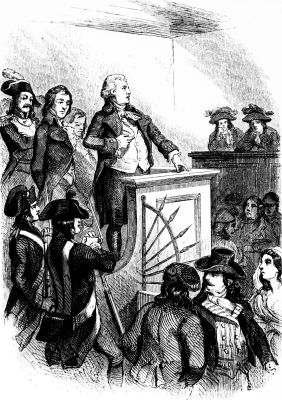
DANTON'S DEFENSE.
"I have dreamed," he wrote, "of a republic which all the world would have adored. I could not have believed that men were so cruel and unjust. I do not dissimulate that I die a victim to my friendship for Danton. I thank my assassins for allowing me to die with Philippeaux. Pardon, my dear friend, my true life which I lost from the moment they separated us. I occupy myself with my memory. I ought much rather to cause you to forget it, my Lucile. I conjure you do not call to me by your cries. They would rend my heart in the depths of the tomb. Live for our child; talk to him of me; you may tell him what he can not understand, that I should have loved him much. Despite my execution, I believe there is a God. My blood will wash out my sins, the weakness of my humanity; and whatever I have possessed of good, my virtues and my love of liberty, God will recompense it. I shall see you again one day.
"O my Lucile, sensitive as I was, the death which delivers me from the sight of so much crime, is it so great a misfortune? Adieu, my life, my soul, my divinity upon earth! Adieu, Lucile! my Lucile! my dear Lucile! Adieu, Horace! Annette! Adèle! Adieu, my father! I feel the shore of life fly before me. I still see Lucile! I see her, my best beloved! my Lucile! My bound hands embrace you, and my severed head rests still upon you its dying eyes."
As Danton re-entered the gloomy corridor of the prison he said, "It was just a year ago that I was instrumental in instituting the Revolutionary Tribunal. I beg pardon of God and men. I intended it as a measure of humanity, to prevent the renewal of the September massacres, and that no man should suffer without trial. I did not mean that it should prove the scourge of humanity."