Front matter (continued 4)
Reading edition
Near by there was a museum of wax figures. Some men ran to the spot and brought out busts of Necker and of the Duke of Orleans, who was also, it was said, threatened with exile. Decorating these busts with crape they bore them aloft through the streets with funeral honors. As the procession, rapidly increasing to many thousands, approached the Place of Louis XV., a detachment of German troops were marched up to charge them. But these soldiers had but little spirit for their work, and they were speedily put to flight by a shower of stones. A company of dragoons then made a charge. The unarmed procession was broken and put to flight in all directions. The busts were hacked to pieces by the sabres of the soldiers, and one man, a French guardsman, who disdained to run, was cut down and killed.
The French Guards were all this time locked up in their barracks, and the Prince of Lambesc had stationed a squadron of German dragoons in front of their quarters to prevent them coming to the aid of the people. But nothing now could restrain them. They broke down and leaped over the iron rails, and fiercely attacked the hated foreigners. The dragoons fled before them, and the Prince of Lambesc, who commanded, fell back upon the garden of the Tuileries, and, entering the gates, charged upon the people who were there. One old man was killed and the rest were put to flight.
The French Guards, however, immediately drew up in battle array, and placed themselves between the citizens and the royal troops. In the mean time a formidable array of Swiss and German troops had been collected in the Field of Mars. They received orders to march to the Place Louis XIV. and dislodge the French Guards. In obedience to the command they marched to the spot, and then reversing their arms, positively refused to fire upon their comrades.[148]
The populace, however, unconscious of the support which they were receiving from the soldiers, were in a state of phrensy. The women and children, who had been passing the pleasant day in the recreations of the Elysian Fields, and who had fled shrieking before the horses and the sabres of the dragoons, speedily carried the tidings of the assault to every part of the city. An indescribable scene of tumult ensued. The multitude were running to and fro in search of arms. Upon all the steeples every bell rang the alarm. A population of nearly a million of souls was agitated by the most intense emotions of indignation and terror.[149]
"It would be difficult," writes Bertrand de Moleville, "to paint the disorder, fermentation, and alarm that prevailed in the capital during this dreadful day. A city taken by storm and delivered up to the soldiers' fury could not present a more dreadful picture. Imagine detachments of cavalry and dragoons making their way through different parts of the town at full gallop to the posts assigned them; trains of artillery rolling over the pavements with a monstrous noise; bands of ill-armed ruffians and women, drunk with brandy, running through the streets like furies, breaking the shops open, and spreading terror every where by their howlings, mingled with frequent reports of guns or pistols fired in the air; all the barriers on fire; thousands of smugglers taking advantage of the tumult to hurry in their goods; the alarm-bells ringing in almost all the churches; a great part of the citizens shutting themselves up at home, loading their guns and burying their money, papers, and valuable effects in cellars and gardens; and during the night the town paraded by numerous patrols of citizens of every class, and even of both sexes, for many women were seen with muskets or pikes upon their shoulders. Such is the exact picture of the state of Paris on the 12th of July."
To add to the alarm, a letter which had been intercepted from Marshal Broglie was printed and circulated through the city, in which the marshal wrote to the Prince of Condé that the greater part of the National Assembly were hungry wolves, ready to devour the nobility; that with fifty thousand troops he would quickly disperse them and the crowd of fools who applauded them.[150]
As the sun went down and darkness enshrouded the city, the tumult increased, and the night was passed in sleeplessness, terror, and bewilderment. All were apprehensive that the dawn would usher in a dreadful day. A report of the agitated state of the metropolis was carried to the Assembly at Versailles, exciting very great anxiety in the minds of the patriots deliberating there. The nobles rejoiced. They earnestly desired such violence on the part of the people as should compel the king to restore the ancient order of things by the energies of grapeshot and the bayonet.[151]
M. Bailly, a man of unblemished character, whose purity and whose patriotism never can be questioned, gives the following testimony to the integrity of Louis XVI.:
"Despotism is what never entered into the head of the king. He never had any wish but the happiness of his people, and this was the only consideration that could be ever employed as a means of influencing him. If any acts of authority were to be resorted to, he was never to be persuaded but by showing him that some good was to be attained or some evil avoided. I am convinced that his authority was never considered by him, nor did he wish to maintain it but as the best means of supporting and securing the tranquillity and peace of the community. As we are now speaking of the causes that produced this regeneration of the country, let us state the first to be the character of Louis XVI. A king less of a good man and ministers more adroit, and we should have had no revolution."
FOOTNOTES:
CHAPTER XIII.
STORMING THE BASTILLE.
The Assembly petitions the King.—Resolves of the Assembly.—Narrative of M. Dumont.—Scenes in Paris.—The People organize for Self-defense.—The new Cockade.—The Abbé Lefebvre d'Ormesson.—Treachery of the Mayor, Flesselles.—Character of De Launey, Governor of the Bastille.—Sacking the Invalides.—The Bastille Assailed.—Assassination of De Launey and of Flesselles.
It will be remembered that in the election of deputies to the States-General Paris had been divided into sixty sections, each of which chose two electors. These hundred and twenty electors, composed of the most wealthy and influential citizens of Paris, immediately met and passed the night deliberating respecting the anarchy into which the city was so suddenly plunged. There were two foes whom the city had now equally to dread—the court and the mob; the princes, bishops, and nobles of the realm, with the armies and the resources of the kingdom, on the one hand, and the starving multitude, infuriated by misery and brutalized by ages of misrule, on the other. These were the two foes against which the Revolution ever had to struggle. The mob triumphed in the Reign of Terror. Napoleon rescued the Revolution from their bloody hands. The princes, with the aid of all the despotisms of Europe, triumphed at Waterloo, and the Revolution was crushed for a time.
Early on Monday morning, July 12th, the electors sent a deputation to the National Assembly at Versailles soliciting the establishment of a citizens' guard for the preservation of order. They gave a true and of course a terrible description of the tumult prevailing in the city.[152]
The Assembly immediately sent a committee of twenty-four members to the king, entreating him to withdraw the foreign troops from the capital. But the queen and the court had now obtained such an ascendency over the feeble-minded king that he was constrained to send a reply that he should make no change whatever in his measures, and that the Assembly could accomplish no useful purpose by interfering with matters in the metropolis.
This was the day on which it was supposed armed bands were to march to disperse the Assembly. It was publicly stated at Versailles that a parliament composed of the nobles was to be suddenly organized at Versailles, that all the deputies of the Third Estate were to be tried for treason, that those members of the clergy and of the nobility who had declared in their favor were to be consigned to perpetual imprisonment, and that those who had been particularly active in the cause of popular liberty were to be sent to the scaffold.[153]
In preparation for this event, the day before (Sunday, 12th), the new ministry, bitterly hostile to the popular cause, had taken their seats in the king's cabinet; Necker, a fugitive, was hastening into the Netherlands; fifty thousand troops under Marshal Broglie, the most determined advocate of aristocratic privilege, crowded the environs of Paris and Versailles; and the troops on the 12th had been ordered to those movements which were preliminary to the great event.[154]
Under such perilous circumstances the Assembly, with a heroism which was truly sublime, determined, if they must perish, to perish in the discharge of duty. No impartial man can read the record of these days without paying the tribute of admiration to those men who thus periled liberty and life in the cause of popular rights. "I have studied history extensively," says De Tocqueville, "and I venture to affirm that I know of no other revolution at whose outset so many men were imbued with a patriotism as sincere, as disinterested, as truly great."[155]
When the Assembly received the answer of the king refusing to withdraw the troops, the only response it could make was in the passing of resolutions. Unintimidated by menaces which might well appal the stoutest heart, they resolved,
1. That M. Necker carried with him the regrets of the nation.
2. That it was the duty of the king immediately to remove the foreign troops.
3. That the king's advisers, of whatever rank, were responsible for present disorders.
4. That to declare the nation bankrupt was infamous.[156]
These were bold resolves. The third, it was well understood, referred to the queen and to the two brothers of the king. The fourth branded with infamy the measure which the court had already adopted in virtually proclaiming bankruptcy and in making payments only in paper.[157] After passing these resolutions the members of the Assembly were in such peril that they deemed it best to keep together for mutual protection. They voted their session permanent, and for seventy-two hours, day and night, continued in their seats, one half deliberating while the other half slept upon their benches. La Fayette, who was one of the most resolute of this Spartan band, relieved the venerable president in the labors of the chair.[158]
During the whole of Monday, even the king knew not what was passing in Paris; and the Assembly, all communication being cut off between Versailles and the metropolis, were in a state of most painful suspense. Every moment they dreaded receiving the news that the city was attacked, and the clangor of martial bands and arms around them led them momentarily to expect the entrance of a military force for their arrest. During the night of the 13th but little business was done, and the wearied members remained talking in groups or dozing in their seats.
Tuesday morning, July 14th, dawned—ever-memorable day. The Assembly, in the most perplexing anxiety, resumed its labors of preparing a constitution. During the whole day no definite tidings could be received from the city, and yet the booming of cannon was heard proclaiming serious and sanguinary trouble. M. Dumont, who wrote under the nom de plume of Groenvelt,[159] thus describes the scene of which he was an eye-witness:
"But it was in the evening (of July 14th) that the spectacle exhibited by the Assembly was truly sublime. I shall not attempt to describe the various emotions of joy, grief, and terror which at different moments agitated those who were merely spectators and strangers in the Assembly. But the expression is improper; we were none of us strangers. For myself, I felt as a Frenchman, because I felt as a man. Nothing could be more distracting than our uncertainty concerning the state of Paris, from whence no person was suffered to stir. The Viscount de Noailles[160] after repeated interruptions had contrived at last to get away; but the intelligence which he brought served only to quicken our impatience and increase our alarms.
"He knew that a multitude of people in search of arms had forced their way into the Hospital for Military Invalids; that the Bastille was besieged; that there had been already much bloodshed; that the troops encamped in the Field of Mars were expected every moment to march to the relief of that fortress, which could not be effected without deluging all Paris in blood.
"At this dreadful news the Assembly was penetrated with horror. A number of the members started from their seats by a kind of involuntary impulse, as if determined to hasten to the defense of their fellow-citizens. Others were for immediately bursting into the king's presence to remonstrate with him on what had happened; to say to him 'Behold the fruits of your counsels; hear the cries of your victims; see the destruction which is about to overwhelm your capital; say, are you the king or the murderer of your people?'
"But these tumultuous emotions gave place to the more temperate measure of sending a numerous deputation to the king, to represent to him the calamities which threatened Paris, and again to conjure him to remove the army. A long time elapsed, and the deputation did not return. No one could account for the delay. In the mean time there came a message that two deputies from the body of electors at Paris desired admittance. They were instantly ordered in. Not a breath was heard; every ear was attentive: every eye was strained; every mind was upon the rack. From some unaccountable mistake it was some time before they entered. Never was impatience wrought up to a higher pitch. At last they appeared at the bar."[161]
But let us leave the Assembly listening at midnight of the 14th to the narrative of the deputies from Paris, while we enter the city to witness the transactions there. At three o'clock Monday morning tumultuous masses of men were filling the streets. The barriers, at which a tax had been levied upon all articles of food and other merchandise which entered the city, had been seized, set on fire, and were now blazing. It was expected every moment that the troops would enter to sweep the streets with grapeshot; and from every steeple the tocsin was pealing, summoning the people to arms. Thousands of those who thronged the city, houseless wanderers, were haggard and wan with famine, and knew not where to get a mouthful of bread.
There was a rumor that in the convents of the Lazarites a vast amount of wheat was hoarded up. Resistless, like an inundation, the hungry multitude poured in at the doors and filled the convent from attic to cellar. They found vast quantities of wine in the vaults and more than fifty cart-loads of wheat. They drank the wine freely, fed themselves, and sent the wheat to the market to be distributed. But they would allow no stealing. One wretch who was detected as a thief was immediately hung by the populace![162]
They then ransacked the city in pursuit of arms. Every sword, musket, and pistol from private residences was brought forward. The shops of the gunsmiths furnished a small supply. The royal arsenal, containing mainly curiosities and suits of ancient armor, was ransacked, and, while all the costly objects of interest were left untouched, every available weapon was taken away. The prison of La Force was filled with debtors. The populace broke down the doors and liberated these unfortunate men, incarcerated for no crime. The prison of the Chatelet was filled with convicts. These felons, hearing of the tumult and of the release of the prisoners of La Force, rose upon their keepers and endeavored to batter down their doors. The same populace, called upon by the keepers of the Chatelet, entered the court-yard of the prison, and, with pike and bayonet, drove the convicts back again to their cells.
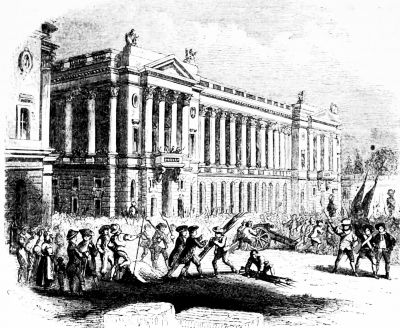
SACKING THE ROYAL ARSENAL.
Crowds were assembled around the Hôtel de Ville, where the electors had met, demanding arms and the immediate establishment of a citizen's guard. But the electors moved with great caution. They did not feel authorized to establish the guard without the approval of the Assembly; and the Assembly had not ventured to adopt the measure without the consent of the king.
The excitement at last became so intense, and the importunity so pressing, that the electors referred the people to the mayor of the city. Flesselles, the mayor, was an officer of the crown, but he immediately obeyed the summons of the people, and came to the Hôtel de Ville. Here he feigned to be entirely on their side, declared that he was their father, and that he would preside over their meetings only by the election of the people. This announcement was received with a burst of enthusiasm. It was immediately decided that a citizen's guard should be established.
Paris then contained nearly a million of inhabitants, and almost every able-bodied man was eager to mount guard for the protection of the city. There was no want of men, but as yet there was no efficient organization, and there were no arms. The electors were very anxious to avoid insurrection, and at first wished only for a guard simply strong enough to protect the city. They therefore decreed that each of the sixty districts should elect and arm two hundred of its most respectable citizens. These twelve thousand men would constitute a very admirable police, but a very poor army. Matters, however, were so rapidly approaching a crisis, and the peril so fast increasing, that on the afternoon of the same day it was decided that this citizen's guard should consist of forty-eight thousand men, and that the colors of the cockade should be blue and red. La Fayette proposed that they should add white, the old color of France, saying, "I thus give you a cockade which will go round the world."
The electors then appointed a committee to watch day and night over the safety of the city. Thus a new and independent government, with its strong army of defense, entirely detached from the throne, was established in a day. It was the sudden growth of uncontrollable events, which no human wisdom had planned. "But to whom," said the mayor, Flesselles, "shall the oath of fidelity be taken?" "To the Assembly of the citizens," an elector promptly replied.
Every thinking man saw clearly that matters were approaching a fearful crisis. Marshal Broglie, proud and self-confident, was at Versailles in constant conference with the court, and having at his command fifty thousand men, abundantly armed and equipped, all of whom could in a few hours be concentrated in the streets of Paris. Bensenval had assembled his force of several thousand Swiss and German troops, cavalry and artillery, in the Field of Mars. The enormous fortress of the Bastille, with its walls forty feet thick at its base and ten at the top, rising with its gloomy towers one hundred and twenty feet in the air, with cannon, charged with grapeshot, already run out at every embrasure to sweep the streets, commanded the city. It was garrisoned by about eighty French soldiers; but, as it was feared that they could not be wholly relied upon, forty Swiss troops were thrown in as a re-enforcement who would be as blindly obedient as the muskets they shouldered. Every moment rumors were reaching the city that Marshal Broglie was approaching with all his troops. Still no arms or ammunition could be obtained.
In this state of things a report was brought that a large quantity of powder had been embarked in a boat from the Hôtel des Invalides, and was floating down the Seine to be conveyed to Versailles. The people immediately ran to the Electors, and obtained an order to have the powder seized and brought to the hotel. It was promptly done. A heroic clergyman, the Abbé Lefebvre, who had great influence over the populace, assumed the perilous task of guarding the powder in one of the lower rooms of the Hôtel de Ville and distributing it among the people. For forty-eight hours this brave man guarded his dangerous treasure in the midst of fire-arms and the surging of the multitude. A drunken man at one time staggered in smoking amid the casks.[163]
Guns only were wanting now. It was well known that there were large stores of them somewhere in the city, but no one knew where to find them.
The mayor, Flesselles, who the people now began to suspect was deluding them merely to gain time for the royal troops to enter the city, being urged to point out the dépôt, said that the manufactory at Charleville had promised to send him thirty thousand guns, and that twelve thousand he was momentarily expecting. Soon a large number of boxes were brought, marked "guns." The mayor ordered them to be stored in the magazine till he should have time to distribute them. But the impatient people so urged the electors that they broke open the boxes and found them filled with rubbish. Was the mayor deceiving them? many anxiously inquired. Flesselles, much embarrassed, sent the people to two monasteries where he said guns were concealed; but the friars promptly threw open the doors, and no arms were to be found.
It soon became evident that Flesselles was trifling with the people, hoping to keep them unarmed until the troops should arrive to crush them mercilessly. He was well known as a dissolute man, hostile to popular liberty, and was undoubtedly a traitor, and a spy at the Hôtel de Ville, acting in communication with the court.[164]
The electors now ordered thirty thousand pikes to be manufactured. Every smith was immediately employed, every forge was glowing, and for thirty-six hours, day and night, without intermission, the anvils rang till the pikes were finished. All this day of Monday the people thought only of defending themselves, but night again came, another night of terror, tumult, and sleeplessness.
The Bastille was the great terror of Paris. While that remained in the hands of their enemies, with its impregnable walls and heavy guns commanding the city, there was no safety. As by an instinct, during the night of the 13th, the Parisians decided that the Bastille must be taken. With that fortress in their hands they could defend themselves and repel their foes. But how could the Bastille be taken? It was apparently as unassailable as Gibraltar's rock. Nothing could be more preposterous than the thought of storming the Bastille. "The idea," says Michelet, "was by no means reasonable. It was an act of faith."
The Bastille stood in the very heart of the Faubourg St. Antoine, enormous, massive, and blackened with age, the gloomy emblem of royal prerogative, exciting by its mysterious power and menace the terror and the execration of every one who passed beneath the shadow of its towers. Even the sports of childhood dare not approach the empoisoned atmosphere with which it seemed to be enveloped.
M. de Launey was governor of the fortress, He was no soldier, but a mean, mercenary man, despised by the Parisians. He contrived to draw from the establishment, by every species of cruelty and extortion, an income of twenty-five thousand dollars a year. He reduced the amount of fire-wood to which the shivering inmates were entitled; made a great profit on the wretched wine which he furnished to those who were able to buy, and even let out the little garden within the inclosure, thus depriving those prisoners who were not in dungeon confinement of the privilege of a walk there, which they had a right to claim. De Launey was not merely detested as Governor of the Bastille, but he was personally execrated as a greedy, sordid, merciless man. Linguet's Memoirs of the Bastille had rendered De Launey's name infamous throughout Europe. Such men are usually cowards. De Launey was both spiritless and imbecile. Had he not been both, the Bastille could not have been taken.[165]
Still the people had no guns. It was ascertained that there was a large supply at the Hôtel des Invalides, but how could they be taken without any weapons of attack? Sombrueil, the governor, was a firm and fearless man, and, in addition to his ordinary force, amply sufficient for defense, he had recently obtained a strong detachment of artillery and several additional cannon, showing that he was ready to do battle. Within fifteen minutes march of the Invalides, Bensenval was encamped with several thousand Swiss and German troops in the highest state of discipline, and provided with all the most formidable implements of war. Every moment rumors passed through the streets that the troops from Versailles were on the march, headed by officers who were breathing threatenings and slaughter.
With electric speed the rumor passed through the streets that there was a large quantity of arms stored in the magazine of the Hôtel of the Invalides. Before nine o'clock in the morning of the 14th, thirty thousand men were before the Invalides; some with pikes, pistols, or muskets, but most of them unarmed. The curate of St. Etienne led his parishioners in this conflict for freedom. As this intrepid man marched at the head of his flock he said to them, "My children, let us not forget that all men are brothers." The bells of alarm ringing from the steeples seemed to invest the movement with a religious character. Those sublime voices, accustomed to summon the multitude to prayer, now with their loudest utterance called them to the defense of their civil and religious rights.[166]
Sombrueil perceived at once that the populace could only be repelled by enormous massacre, and that probably even that, in the phrensied state of the public mind, would be ineffectual. He dared not assume the responsibility of firing without an order from the king, and he could get no answer to the messages he sent to Versailles. Though his cannon charged with grapeshot could have swept down thousands, he did not venture to give the fatal command to fire. The citizens, with a simultaneous rush in all directions, leaped the trenches, clambered over the low wall—for the hotel was not a fortress—and, like a resistless inundation, filled the vast building. They found in the armory thirty thousand muskets. Seizing these and six pieces of cannon they rushed, as by a common instinct, toward the Bastille to assail with these feeble means one of the strongest fortresses in the world—a fortress which an army under the great Condé had in vain besieged for three and twenty days![167]
De Launey, from the summit of his towers, had for many hours heard the roar of the insurgent city. As he now saw the black mass of countless thousands approaching, he turned pale and trembled. All the cannon, loaded with grapeshot, were thrust out of the port-holes, and several cart-loads of paving-stones, cannon-balls, and old iron had been conveyed to the tops of the towers to be thrown down to crush the assailants. Twelve large rampart guns, charged heavily with grape, guarded the only entrance. These were manned by thirty-two Swiss soldiers who would have no scruples in firing upon Frenchmen. The eighty-two French soldiers who composed the remainder of the garrison were placed upon the towers, and at distant posts, where they could act efficiently without being brought so immediately into conflict with the attacking party.
A man of very fearless and determined character, M. Thuriot, was sent by the electors at the Hôtel de Ville to summon the Bastille to surrender. The draw-bridge was lowered, and he was admitted. The governor received him at the head of his staff.
"I summon you," said Thuriot, "in the name of the people, in the name of honor, and of our native land."
The governor, who was every moment expecting the arrival of troops to disperse the crowd, refused to surrender the fortress, but replied that he was ready to give his oath that he would not fire upon the people, if they did not fire upon him. After a long and exciting interview, Thuriot came forth to those at the Hôtel de Ville who had sent him.
He had hardly emerged from the massive portals, and crossed the draw-bridge of the moat, which was immediately raised behind him, ere the people commenced the attack. A scene of confusion and uproar ensued which can not be described. A hundred thousand men, filling all the streets and alleys which opened upon the Bastille, crowding all the windows and house-tops of the adjacent buildings, kept up an incessant firing, harmlessly flattening their bullets against walls of stone forty feet thick and one hundred feet high.[168]
The French soldiers within the garrison were reluctant to fire upon their relatives and friends. But the Swiss, obedient to authority, opened a deadly fire of bullets and grapeshot upon the crowd. While the battle was raging an intercepted letter was brought to the Hôtel de Ville, in which Bensenval, commandant of the troops in the Field of Mars, exhorted De Launey to remain firm, assuring him that he would soon come with succor.[169] But, fortunately for the people, even these foreign troops refused to march for the protection of the Bastille.
The French Guards now broke from their barracks, and, led by their subaltern officers, came with two pieces of artillery in formidable array to join the people. They were received with thunders of applause which drowned even the roar of the battle. Energetically they opened their batteries upon the fortress, but their balls rebounded harmless from the impregnable rock.
Apparently the whole of Paris, with one united will, was combined against the great bulwark of tyranny.[170] Men, women, and boys were mingled in the fight. Priests, nobles, wealthy citizens, and the ragged and emaciate victims of famine were pressing in the phrensied assault side by side.[171] The French soldiers were now anxious to surrender, but the Swiss, sheltered from all chance of harm, shot down with deliberate and unerring aim whomsoever they would. Four hours of the battle had now passed, and though but one man had been hurt within the fortress, a hundred and seventy-one of the citizens had been either killed or wounded. The French soldiers now raised a flag of truce upon the towers, while the Swiss continued firing below. This movement plunged De Launey into despair. One hundred thousand men were beleaguering his fortress. The king sent no troops to his aid; and three fourths of his garrison had abandoned him and were already opening communications with his assailants. He knew that the people could never pardon him for the blood of their fathers and brothers with which he had crimsoned their streets—that death was his inevitable doom. In a state almost of delirium he seized a match from a cannon and rushed toward the magazine, determined to blow up the citadel. There were a hundred and thirty-five barrels of gunpowder in the vaults. The explosion would have thrown the Bastille into the air, buried one hundred thousand people beneath its ruins, and have demolished one third of Paris.[172] Two subaltern officers crossed their bayonets before him and prevented the accomplishment of this horrible design.
Some wretches seized upon a young lady whom they believed to be the governor's daughter, and wished, by the threat of burning her within view of her father upon the towers, to compel him to surrender. But the citizens promptly rescued her from their hands and conveyed her to a place of safety. It was now five o'clock, and the assault had commenced at twelve o'clock at noon. The French soldiers within made white flags of napkins, attached them to bayonets, and waved them from the walls. Gradually the flags of truce were seen through the smoke; the firing ceased, and the cry resounded through the crowd and was echoed along the streets of Paris, "The Bastille surrenders." This fortress, which Louis XIV. and Turenne had pronounced impregnable, surrendered not to the arms of its assailants, for they had produced no impression upon it. It was conquered by that public opinion which pervaded Paris and which vanquished its garrison.[173]
The massive portals were thrown open, and the vast multitude, a living deluge, plunging headlong, rushed in. They clambered the towers, penetrated the cells, and descended into the dungeons and oubliettes. Appalled they gazed upon the instruments of torture with which former victims of oppression had been torn and broken. Excited as they were by the strife, and exasperated by the shedding of blood, but one man in the fortress, a Swiss soldier, fell a victim to their rage.
The victorious people now set out in a tumultuous procession to convey their prisoners, the governor and the soldiers, to the Hôtel de Ville. Those of the populace whose relatives had perished in the strife were roused to fury, and called loudly for the blood of De Launey. Two very powerful men placed themselves on each side of him for his protection. But the clamor increased, the pressure became more resistless, and just as they were entering the Place de Grève the protectors of the governor were overpowered—he was struck down, his head severed by a sabre stroke, and raised a bloody and ghastly trophy into the air upon a pike.
In the midst of the great commotion two of the Swiss soldiers of the Bastille, whom the populace supposed to have been active in the cannonade, were seized, notwithstanding the most strenuous efforts to save them, and hung to a lamp-post. A rumor passed through the crowd that a letter had been found from the mayor, Flesselles, who was already strongly suspected of treachery, directed to De Launey, in which he said,
"I am amusing the Parisians with cockades and promises. Hold out till the evening and you shall be relieved."[174]
Loud murmurs rose from the crowd which filled and surrounded the hall. Some one proposed that Flesselles should be taken to the Palais Royal to be tried by the people. The clamor was increasing and his peril imminent. Pallid with fear he descended from the platform, and, accompanied by a vast throng, set out for the Palais Royal. At the turning of the first street an unknown man approached, and with a pistol shot him dead. Infuriate wretches immediately cut off his head, and it was borne upon a pike in savage triumph through the streets.
The French Guards, with the great body of the people, did what they could to repress these bloody acts. The French and Swiss soldiers took the oath of fidelity to the nation, and under the protection of the French Guard were marched to places of safety where they were supplied with lodgings and food. Thus terminated this eventful day. The fall of the Bastille broke the right arm of the monarchy, paralyzed its nerves of action, and struck it a death blow. The monarch of France, from his palace at Versailles, heard the distant thunders of the cannonade, and yet inscribed upon his puerile journal "Nothing!"[175]
FOOTNOTES:
CHAPTER XIV.
THE KING RECOGNIZES THE NATIONAL ASSEMBLY.
Rout of the Cavalry of Lambesc.—Tidings of the Capture of the Bastille reach Versailles.—Consternation of the Court.—Midnight Interview between the Duke of Liancourt and the King.—New Delegation from the Assembly.—The King visits the Assembly.—The King escorted back to his Palace.—Fickleness of the Monarch.—Deputation sent to the Hôtel de Ville.—Address of La Fayette.—La Fayette appointed Commander of the National Guard.
While these scenes were transpiring in Paris, the court, but poorly informed respecting the real attitude of affairs, were preparing, on that very evening, with all the concentrated troops of the monarchy, to drown the insurrection in Paris in blood, to disperse the Assembly, consigning to the dungeon and the scaffold its prominent members, and to rivet anew those shackles of despotism which for ages had bound the people of France hand and foot.
M. Berthier, one of the high officers of the crown, aided by his father-in-law, M. Foulon, under minister of war, was intensely active marshaling the troops, and giving orders for the attack. Conscious of the opposition they must encounter, and regardless of the carnage which would ensue, they had planned a simultaneous assault upon the city at seven different points. Entertaining no apprehension that the Bastille could be taken, or that the populace, however desperate, could present any effectual resistance to the disciplined troops of the crown, they were elated with the hope that the decisive hour for the victory of the court had arrived.
The queen could not conceal her exultation. With the Duchess of Polignac, one of the most haughty of the aristocratic party, and with others of the court, she went to the Orangery, where a regiment of foreign troops were stationed, excited the enthusiasm of the soldiers by her presence, and caused wine and gold to be freely distributed among them. In the intoxication of the moment the soldiers sang, danced, shouted, clashed their weapons, and swore eternal fidelity to the queen.[176]
But these bright hopes were soon blighted. A cloud of dust was seen, moving with the sweep of the whirlwind through the Avenue of Paris. It was the cavalry of Lambesc flying before the people. Soon after a messenger rushed breathless into the presence of the court, and announced that the Bastille was taken, and that the troops in Paris refused to fire upon the people. While he was yet speaking another came with the tidings that De Launey and Flesselles were both slain. The queen was deeply affected and wept bitterly. "The idea," writes Madame Campan, "that the king had lost such devoted subjects wounded her to the heart." The court party was now plunged into consternation. The truth flashed upon them that while the people were exasperated to the highest pitch, the troops could no longer be depended upon for the defense of the court.
The masses, enraged by the insults and aggressions of the privileged classes, still appreciated the kindly nature of the king, and spoke of him with respect and even affection. Efforts were made by the court to conceal from Louis the desperate state of affairs, and at his usual hour of eleven o'clock he retired to his bed, by no means conscious that the sceptre of power had passed from his hands.
The Duke of Liancourt, whose office as grand master of the wardrobe, allowed him to enter the chamber of the king at any hour, was a sincere friend of Louis. He could not see him rush thus blindly to destruction, and, accordingly, entering his chamber and sitting down by his bedside, he gave him a truthful narrative of events in Paris. The king, astonished and alarmed, exclaimed, "Why, it is a revolt!" "Nay, sire," replied Liancourt, "it is a revolution!"
The king immediately resolved that he would the next morning, without any ceremony, visit the National Assembly, and attempt a reconciliation. The leading members of the court, now fully conscious of their peril, were assembled in the saloons of the Duchess of Polignac, some already suggested flight from the realm to implore the aid of foreign kings. The Assembly was still, during these midnight hours, deliberating in great anxiety. Many of the members, utterly exhausted by their uninterrupted service by day and by night, were slumbering upon the benches. It was known by all that this was the night assigned for the great assault; and a rumor was passing upon all lips that the hall of the Assembly had been undermined that all the deputies might be blown into the air.
Paris at this hour presented a scene of awful tumult. It was momentarily expected that the royal troops would arrive with cavalry and artillery, and that from the heights of Montmartre bomb-shells would be rained down upon the devoted city. Men, women, and children were preparing for defense. The Bastille was guarded and garrisoned. The pavements were torn up, barricades erected, and ditches dug. The windows were illuminated to throw the light of day into the streets. Paving stones and heavy articles of furniture were conveyed to the roofs of the houses to be thrown down upon the assailing columns. Every smith was employed forging pikes, and thousands of hands were busy casting bullets. Tumultuous throngs of characterless and desperate men swept through the streets, rioting in the general anarchy. The watch-words established by the citizen patrols were "Washington and Liberty." Thus passed the night of the 14th of July in the Chateau of Versailles, in the hall of the Assembly, and in the streets of Paris.
At two o'clock in the morning of the 15th the Assembly ceased its deliberations for a few hours, and the members, though the session was still continued, sought such repose as they could obtain in their seats. At eight o'clock the discussions were resumed. It was resolved to send a deputation of twenty-four members, again to implore the king to respect the rights of the people, and no longer to suffer them to be goaded to madness by insults and oppression. As the deputation was about to leave, Mirabeau rose and said, "Tell the king that the foreign hordes surrounding us received yesterday the caresses, encouragement, and bribes of the court; that all night long these foreign satellites, gorged with money and wine, in their impious songs have predicted the enslavement of France, and have invoked the destruction of the National Assembly; tell him that in his very palace the courtiers have mingled dancing with these impious songs, and that such was the prelude to the massacre of St. Bartholomew."
He had hardly uttered these words ere the Duke of Liancourt entered and announced that the king was coming in person to visit the Assembly. The doors were thrown open, and, to the astonishment of the Assembly, the king, without guard or escort and accompanied only by his two brothers, entered. A shout of applause greeted him. In a short and touching speech the king won to himself the hearts of all. He assured them of his confidence in the Assembly; that he had never contemplated its violent dissolution; and that he sincerely desired to unite with the Assembly in consulting for the best interests of the nation. He also declared that he had issued orders for the withdrawal of the troops both from Paris and Versailles, and that, hereafter, the counsels of the National Assembly should be the guide of his administration.[177]
This conciliatory speech was received by the mass of the deputies with rapturous applause. The aristocratic party were, however, greatly chagrined, and, retiring by themselves, with whispers and frowns gave vent to their vexation; but the general applause drowned the feeble murmurs of the nobles. Nearly the whole Assembly rose in honor of the king as he left, and, surrounding him in tumultuous joy, they escorted him back to his palace. A vast crowd from Paris and Versailles thronged the streets, filling the air with their loyal and congratulatory shouts. The queen, who was sitting anxiously in her boudoir, heard the uproar and was greatly terrified. Soon it was announced to her that the king was returning in triumph: she stepped out upon a balcony and looked down upon the broad avenue filled with a countless multitude. The king was on foot; the deputies encircled him, interlacing their arms to protect him from the crowd, which was surging tumultuously around with every manifestation of attachment and joy.
The people really loved the kind-hearted king; but they already understood that foible in his character which eventually led to his ruin. A woman of Versailles pressed her way through the deputies to the king and, with great simplicity, said,
"Oh, my king! are you quite sincere? Will they not make you change your mind again?"
"No," replied the king, "I will never change."
The feeble Louis did not know himself. He was then sincere; but in less than an hour he was again wavering, being undecided whether to carry out his pacific policy of respecting the just demands of the people, or to fly from the realm, and invoke the aid of foreign despots, to quench the rising flame of liberty in blood. It was well known that the queen, the brothers of the king, and the Polignacs, were the implacable foes of reform, and that it was through their councils that the Assembly and the nation were menaced with violence.[178]
As soon as the queen was seen upon the balcony, with her son and daughter by her side, the shouts of applause were redoubled. But now murmurs began to mingle with the acclaim. A few execrations were heard against the obnoxious members of the court. Still the general voice was enthusiastic in loyalty; and when the queen descended to the foot of the marble stairs and threw herself into the arms of the king, every murmur was hushed, and confidence and happiness seemed to fill all hearts.[179]
A cabinet council was immediately held in the palace to deliberate respecting the next step to be taken. The Assembly returned to their hall and immediately chose a deputation of one hundred members, with La Fayette at their head, to convey to the municipal government at the Hôtel de Ville in Paris the joyful tidings of their reconciliation with the king. A courier was sent in advance to inform of the approach of the delegation.
It was now two o'clock in the afternoon. The deputation left Versailles accompanied by an immense escort of citizen-soldiers, and followed by a crowd which could not be numbered. They were received in Paris with almost delirious enthusiasm. Throughout the whole night the citizens, men, women, and children, had been at work piling up barricades, tearing up the pavements, and preparing with every conceivable weapon and measure of offense and defense to meet the contemplated attack from the artillery and cavalry of the crown. Fathers and mothers, pallid with terror, had anticipated the awful scenes of the sack of the city by a brutal soldiery. Inexpressible was the joy to which they surrendered themselves in finding that the king now openly avowed himself their friend and espoused the popular cause. Windows and balconies were crowded, the streets were strewn with flowers, and the deputies were greeted with waving of handkerchiefs and cheers.
At the Place Louis XV. the deputies left their carriages and were conducted through the garden of the Tuileries, greeted by the music of martial bands, to the vestibule of the palace. There they were met by a committee of the municipality, with one of the clergy, the Abbé Fauchet, at its head, who accompanied them to the Hôtel de Ville.
La Fayette addressed the electors, informing them of the king's speech, and describing the monarch's return to his palace in the midst of the National Assembly and of the people of Versailles, "protected by their love and their inviolable fidelity." Lally Tollendal, who was remarkable for his eloquence, then addressed the electors and the assembled multitude. He spoke of the king, whom he loved, in the highest terms of eulogy, and in a strain so persuasive and spirit-stirring that he was immediately crowned with a wreath of flowers, and, in a tumult of transport, was carried in triumph to the window to receive the applause of the thousands who filled the streets. Love for the king seemed to be an instinct with the populace. Shouts of "Vive le Roi!" rose from the vast assembly, which were reverberated from street to street through all the thronged thoroughfares of the metropolis.
The king had authorized the establishment of the National Guard, but the guard was yet without a commander-in-chief. The government of Paris also, by the death of Flesselles, had no head. There was in the hall of the Assembly a bust of La Fayette which had been presented by the United States to the city of Paris. It stood by the side of the bust of Washington. As the momentous question was discussed, who should be intrusted with the command of the National Guard, a body which now numbered hundreds of thousands and was spread all over the kingdom, Moreau de St. Mèry, Chairman of the Municipality, rose, and, without uttering a word, silently pointed to the bust of La Fayette. The gesture was decisive. A general shout of acclaim filled the room. He who had fought the battles of liberty in America was thus intrusted with the command of the citizen-soldiery of France. M. Bailly was then chosen successor of Flesselles, not with the title of Prévôt des Marchands, but with the more comprehensive one of Mayor of Paris.
On the 27th of September the banners of the National Guard, each one of which had been previously consecrated in the church of its district, were all taken to the Cathedral of Nôtre Dame, and there, with the utmost pomp of civil, military, and religious ceremonies, were consecrated to the service of God and the nation.
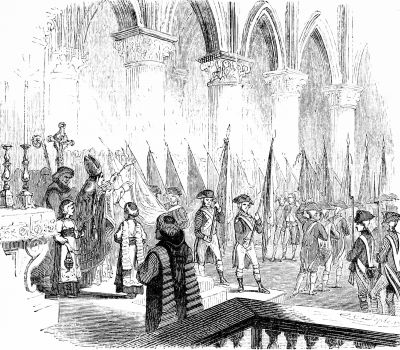
BLESSING THE BANNERS.
FOOTNOTES:
CHAPTER XV.
THE KING VISITS PARIS.
Views of the Patriots.—Pardon of the French Guards.—Religious Ceremonies.—Recall of Necker.—The King visits Paris.—Action of the Clergy.—The King at the Hôtel de Ville.—Return of the King to Versailles.—Count d'Artois, the Polignacs, and others leave France.—Insolence of the Servants.—Sufferings of the People.—Persecution of the Corn-dealers.—Berthier of Toulon.—M. Foulon.—Their Assassination.—Humane Attempts of Necker.—Abolition of Feudal Rights.
The new government was now established, consolidated with power which neither the court nor the people as yet even faintly realized. The National Assembly and the municipality of Paris were now supreme. A million of men were ready to draw the sword and spring into the ranks to enforce their decrees. The king was henceforth but a constitutional monarch; though by no means conscious of it, his despotic power had passed away, never to be regained. The Revolution had now made such strides that nothing remained but to carry out those plans which might be deemed essential for the welfare of France. The Revolution thus far had been almost bloodless. And had it not been for the interference of surrounding despots, who combined their armies to rivet anew the chains of feudal aristocracy upon the French people, the subsequent horrors of the Revolution, in all probability, never would have occurred. Men of wisdom and of the purest patriotism were at the head of these popular movements. Every step which had been taken had been wisely taken. The object which all sought was reform, not revolution—the reign of a constitutional monarchy, like that of England, not the reign of terror.
A republic was not then even thought of. A monarchy was in accordance with the habits and tastes of the people, and would leave them still in sympathy with the great family of governments which surrounded them. La Fayette, Talleyrand, Sièyes, Mirabeau, Bailly, and all the other leaders in this great movement, wished only to infuse the spirit of personal liberty into the monarchy of France.
But when all the surrounding despotisms combined and put their armies in motion to invade France, determined that the French people should not be free, and when the aristocracy of France combined with these foreign invaders to enslave anew these millions who had just broken their chains, a spirit of desperation was roused which led to all the woes which ensued. We can not tell what would have been the result had there not been the combination of these foreign kings, but we do know that the results which did ensue were the direct and legitimate consequence of that combination.
It will be remembered that the French Guards, espousing the popular side, had refused to fire upon the people. This disobedience to the royal officers was, of course, an act of treason. The Duke of Liancourt, speaking in behalf of the king, said, "The king pardons the French Guards." At the utterance of the obnoxious word pardon, a murmur of displeasure ran through the hall. Some of the guards who were present immediately advanced to the platform, and one, as the organ of the rest, said, firmly and nobly,
"We can not accept a pardon. We need none. In serving the nation we serve the king; and the scenes now transpiring prove it."
The laconic speech was greeted with thunders of applause, and nothing more was said about a pardon. The lower clergy, who were active in these movements, were not unmindful of their obligations to God. The whole people seemed to sympathize in this religious sentiment. At the suggestion of the Archbishop of Paris a Te Deum was promptly voted, and the electors, deputies, and new magistrates, accompanied by an immense concourse of citizens, and escorted by the French Guards, repaired to the Cathedral of Nôtre Dame, where the solemn chant of thanksgiving was devoutly offered. La Fayette and Bailly then took the oath of office.
Upon the return of the deputation to the Assembly at Versailles, Lally Tollendal reported that the universal cry of the Parisians was for the recall of Necker, with which minister the popular cause was held to be identified. A motion was immediately introduced to send a deputation to the king soliciting his recall. They had but just entered upon the discussion of this question when a message was received from Louis announcing the dismissal of the obnoxious ministers, accompanied by an unsealed letter addressed to Necker, summoning him to return to his post. Inspired by gratitude for this act, the Assembly immediately addressed a vote of thanks to the king.
The populace of Paris had expressed the earnest wish that the king would pay them a visit. During the afternoon and evening of the 16th, the question was earnestly discussed by the court at Versailles, whether the king should fly from the kingdom, protected by the foreign troops whom he could gather around him, and seek the assistance of foreign powers, or whether he should continue to express acquiescence in the popular movement and visit the people in Paris. The queen was in favor of escape. She told Madame Campan that, after a long discussion at which she was present, the king, impatient and weary, said, "Well, gentlemen, we must decide. Must I go away, or stay? I am ready to do either." "The majority," the queen continued, "were for the king's stay. Time will show whether the right choice has been made."[180]
The king was very apprehensive that in going powerless to Paris he might be assassinated. In preparation of the event, he partook of the sacrament of the Lord's Supper, and nominated his brother, subsequently Louis XVIII., Lieutenant of France, in case of his detention or death. Early the next morning, the 17th of July, he took an affecting leave of his weeping, distracted family, to visit the tumultuous metropolis. His pale and melancholy countenance impressed every observer. The queen, who was bitterly hostile to the movement, was almost in despair. She immediately retired to her chamber, and employed herself in writing an address to the Assembly, which she determined to present in person in case the king should be detained a prisoner.[181]
It was ten o'clock in the morning when the king left Versailles. He rode in an unostentatious carriage, without any guards, but surrounded by the whole body of the deputies on foot.[182]
It was three o'clock in the afternoon before the long procession arrived at the gates of the city. Thus far they had proceeded in silence. M. Bailly, the newly-appointed mayor, then, met him and presented him with the keys of the city, saying "These are the keys presented to Henry the Fourth. He had reconquered his people. Now the people have reconquered their king."
Two hundred thousand men, now composing the National Guard, were marshaled in military array to receive their monarch. They lined the avenue four or five men deep from the bridge of Sevres to the Hôtel de Ville. They had but 30,000 muskets and 50,000 pikes. The rest were armed with sabres, lances, scythes, and pitchforks. The Revolution thus far was the movement, not of a party, but of the nation. Even matrons and young girls were seen standing armed by the side of their husbands and fathers. The clergy, lower clergy, and some of the bishops, not forgetting that they were men and citizens, were there also in this hour of their country's peril, consecrating all their influence to the cause of freedom. They did not ingloriously take refuge beneath their clerical robes from the responsibilities of this greatest of conflicts for human rights. Shouts were continually heard swelling from the multitude of "Vive la Nation!" As yet not a voice had been heard exclaiming "Vive le Roi!" The people had again become suspicious. Rumors of the unrelenting hostility of the court had been circulating through the crowd, and there were many fears that the ever-vacillating king would again espouse the cause of aristocratic usurpation. Passing through these lines of the National Guard, with the whole population of Paris thronging the house-tops, the balconies, and the pavements, the king at length arrived, at four o'clock in the afternoon, at the Hôtel de Ville, the seat of the new government. He alighted from his carriage and ascended the stairs beneath a canopy of steel formed by the grenadiers crossing their bayonets over his head. This was intended not as a humiliation, but as a singular act of honor.[183]
The king took his position in the centre of the spacious hall, which presented an extraordinary aspect. It was crowded with the notabilities of the city and of the realm, and those near the centre with true French politeness dropped upon their knees, that those more remote might have a view of the king. Bailly then presented the king with the tricolored cockade. He received it, and immediately pinned it upon his hat. This was the adoption of the popular cause. It was received with a shout of enthusiasm, and "Vive le Roi!" burst from all lips with almost delirious energy. Tears gushed into the eyes of the king, and, turning to one of his suite, M. de Cubieres, he said, "My heart stands in need of such shouts from the people."
"Sire," replied Cubieres, "the people love your majesty, and your majesty ought never to have doubted it."
The king rejoined, in accents of deep sensibility, "The French loved Henry the Fourth; and what king ever better deserved to be beloved?"
The king could not forget that the affection of the people did not protect Henry from the dagger of the assassin. Moreau de St. Mèrry, president of the Assembly of Electors, in his address to the king, said, "You owed your crown to birth; you are now indebted for it only to your virtues."[184] The minutes of the proceedings of the municipality were then read, and the king, by silence, gave his assent to the appointment of La Fayette as Commander of the National Guard, of Bailly as Mayor of Paris, and to the order for the utter demolition of the Bastille. It was also proposed that a monument should be erected upon its site to Louis XVI., "the Regenerator of public liberty, the Restorer of national prosperity, the Father of the French people." These were, to the monarch, hours of terrific humiliation. He bore them, however, with the spirit of a martyr, struggling in vain to assume the aspect of confidence and cordiality.
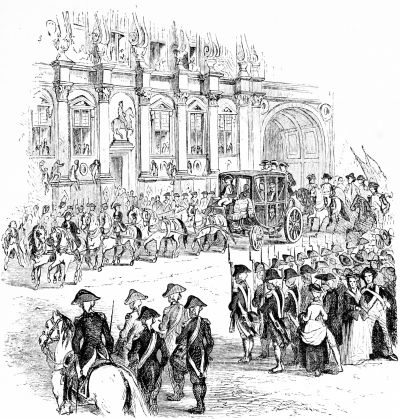
ARRIVAL OF THE KING AT THE HÔTEL DE VILLE, JULY 17, 1789.
When Bailly led him to the balcony, to exhibit him to the people with the tricolored cockade upon his hat, and shouts of triumph, like thunder-peals, rose from the myriad throng, tears flooded the eyes of the king, and he bowed his head in silence and sadness, as if presenting himself a victim for the sacrifice. Some one whispered to the monarch that it was expected that he would make an address. Two or three times he attempted it, but his voice was choked with emotion, and he could only, in almost inarticulate accents, exclaim, "You may always rely upon my affection!"
As the king returned through the vast throng to Versailles, the tide of enthusiasm set strongly in his favor. Shouts of "Vive le Roi!" almost deafened his ears. The populace bore him in their arms to his chariot. A woman threw herself upon his neck and wept with joy. Men ran from the houses with goblets of wine for his postillions and his suite. A few words from his lips then would have re-echoed through the crowd, and might have saved the monarchy. But Louis was a man of feeble intellect, and of no tact whatever. He was pleased with the homage which was spontaneously offered him, and, stolid in his immense corpulence, sat lolling in his chariot, with a good-natured smile upon his face, but uttered not a word. It was after nine o'clock in the evening when he returned to the palace at Versailles. The queen and her children met him on the stairs, and, convulsively weeping, threw themselves into his arms. Clinging together, they ascended to the saloon. There the queen caught sight of the tricolored cockade, which the king had forgotten to remove from his hat. The queen recoiled, and looking upon it contemptuously, exclaimed, "I did not think that I had married a plebeian." The good-natured king, however, forgot all his humiliations in his safe return, and congratulated himself that no violence had been excited.
"Happily," he said, "no blood has been shed; and it is my firm determination that never shall a drop of French blood be spilled by my order."[185]
While these scenes were transpiring on this the 17th of July, the Count d'Artois, second brother of the king, the Condés, the Polignacs, and most of the other leaders of the aristocratic party fled from France. The conspiracy they had formed had failed, the nation had risen against them, and no reliance could be placed on the vacillating king. Their only hope now was to summon the combined energies of foreign despotisms to arrest the progress of that liberty in France which alike threatened all their thrones. The palace was now forsaken and gloomy as a tomb. For three days the king sadly paced the deserted halls, with none of his old friends to cheer or counsel him but Bensenval and Montmorin. His servants, conscious that he had fallen from his kingly power, became careless even to insolence. Even the French Guard mounted guard at Versailles only on orders received from the Electors at Paris.[186]
On the 19th Bensenval presented an order for the king to sign. A footman entered the cabinet, and looked over the king's shoulder to see what he was writing. Louis, amazed at such unparalleled effrontery, seized the tongs to break the head of the miscreant. Bensenval interposed to prevent the undignified blow. The king clasped the hand of his friend, and, bursting into tears, thanked him for the interposition. Thus low had fallen the descendant of Louis XIV. in his own palace at Versailles.[187]
There was now, in reality, no government in France. The kingly power was entirely overthrown, and the National Assembly had hardly awoke to the consciousness that all power had passed into its hands. Even in Paris, the municipality, now supreme there, had by no means organized an efficient government. Famine desolated the kingdom. Ages of misrule had so utterly impoverished the people that they were actually dying of starvation. "Bread! bread!" was every where the cry, but bread could not be obtained. Many boiled grass and fern-roots for sustenance. Every where the eye met wan and haggard men in a state of desperation. The king, constitutionally humane, felt deeply these woes of his subjects. With a little apparent ostentation, quite pardonable under the circumstances, he occasionally walked out and administered relief with his own hands to the haggard beggary he every where met. He was by nature one of the kindest of men, but he had hardly a single quality to fit him to be the ruler of a great people. A nation was on the brink of famine, and the monarch was giving gold to beggars instead of introducing vigorous measures for relief.
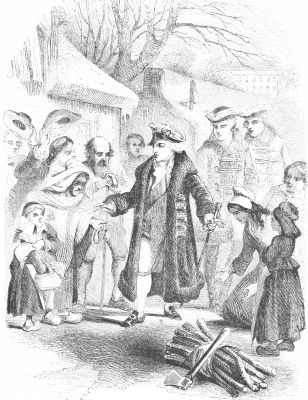
LOUIS XVI. GIVING MONEY TO THE POOR.
As the National Assembly met on the morning of the 18th of July, reports were brought from all parts of violence and riots. The most vigorous efforts were adopted by the Electors in Paris to supply the city with food. Nearly a million of people were within its walls. Vast numbers had crowded into the city from the country, hoping to obtain food. No law could restrain such multitudes of men, actually dying of hunger. As it was better to die by the bullet or the bayonet than by starvation, they would, at all hazards, break into the dwellings of the wealthy, and into magazines, to obtain food, unless food in some other way could be provided for them. The disorders of the times had put a stop to all the enterprises of industry, and thus the impoverished millions were left without money, without employment, and without food.
In one of the villages near Paris it was reported that a rich farmer had concealed a large quantity of grain, to enrich himself by its sale at an exorbitant price. A haggard multitude of men, women, and children surrounded his dwelling, and threatened to hang the farmer unless he delivered up his stores. The Assembly hastily sent a deputation of twelve members to attempt to save the unfortunate corn-dealer's life.[188] While engaged in this business, a delegation entered from the Faubourg San Antoine, stating that the wretched inhabitants of that faubourg had for the last five days been without work and without bread, and entreating that some measure might be devised to save them from starvation. Nine thousand dollars were immediately subscribed by the deputies for their relief. Four thousand of this sum were given by the Archbishop of Paris.
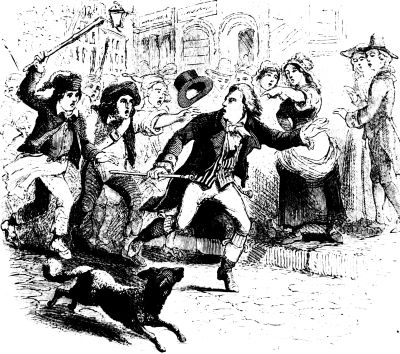
PERSECUTION OF THE CORN-DEALERS.
The rage of the people, during these days of distress, was particularly directed against those whom they deemed monopolists, who were accused of keeping from the market the very sources of life. The sufferings of the people and their desperation were so intense that it was necessary to send military bands from the city of Paris to convoy provisions through the famishing districts. The peasants, who saw their children actually gasping and dying of hunger, would attack the convoys with the ferocity of wolves, and, though it seemed absolutely necessary to resist them even unto death, no one could severely blame them.
There were two men, M. Foulon and M. Berthier, who were conspicuous members of the court, and who had both been very active in their hostility to the popular cause. Upon the overthrow of the Necker ministry, these men were called into the new ministry, antagonistic to the people. It was reported that M. Foulon, who was the father-in-law of M. Berthier, had frequently said, "If the people are hungry, let them eat grass. It is good enough for them; my horses eat it."[189] He is also stated to have uttered the terrible threat, "France must be mowed as we mow a meadow." He was reputed to be a man of great wealth, and had long been execrated by the people. These brutal remarks, which have never been proved against him, but which were universally believed, and which were in entire harmony with his established character, excited the wrath of the people to the highest pitch.[190]
Berthier, his son-in-law, even the Royalists confess to have been a very hard-hearted man, unscrupulous and grasping.[191] Though fifty years of age he was an atrocious libertine, and seemed to exult in the opportunity of making war upon the Parisians, by whom he was detested. He showed "a diabolical activity," says Michelet, "in collecting arms, troops, every thing together, and in manufacturing cartridges. If Paris was not laid waste with fire and sword it was not his fault."[192]
Both Berthier and Foulon were now at the mercy of the people. Neither the court nor the royal army had any power to protect them, and murmurs loud and deep fell upon their ears. Berthier attempted to escape from France to join the Royalists who had already emigrated. Fleeing by night and hiding by day, in four nights he reached as far as Soissons. Foulon adopted the stratagem of a pretended death. He spread the report that he had died suddenly of apoplexy. He was buried by proxy with great pomp, one of his servants having by chance died at the right moment. He then repaired to the house of a friend, where he concealed himself. He would have been forgotten had he not been so utterly execrated by all France. Those who knew him best hated him the worst. His servants and vassals detected the fraud, and, hunting him out, found him in the park of his friend.
"You wanted to give us hay," said they; "you shall eat some yourself."
The awful hour of blind popular vengeance had come. They tied a truss of hay upon his back, threw a collar of thistles over his neck, and bound a nosegay of nettles upon his breast. They then led him on foot to Paris, to the Hôtel de Ville, and demanded that he should be fairly tried and legally punished. At the same time Berthier was arrested as he was hastening to the frontier.
The municipality were in great perplexity. They had no power to sit in judgment as a criminal court. The old courts were broken up and no new ones had as yet been established. It was six o'clock in the morning when he was presented at the Hôtel de Ville. The news of his arrest spread rapidly through Paris, and the Place de Grève was soon thronged with an excited multitude. Foulon was universally known as well as execrated. La Fayette was anxious to send him to the protection of a prison, that he might subsequently receive a legal trial for his deeds of inhumanity.
"Gentlemen," said La Fayette to the people, "I can not blame your indignation against this man. I have always considered him a great culprit, and no punishment is too severe for him. He shall receive the punishment he merits. But he has accomplices, and we must know them. I will conduct him to the Abbaye, where we will draw up charges against him, and he shall be tried and punished according to the laws."[193]
The people applauded this speech, and Foulon insanely joined with them in the applause. This excited their suspicion that some plot was forming for his rescue. A man from the crowd cried out,
"What is the use of judging a man who has been judged these thirty years?"
This cry was Foulon's death-warrant. It kindled anew the flame of indignation and it now burned unquenchably. The enraged populace clamored for their victim. The surgings of the multitude were like the tumult of the ocean in a storm. The countless thousands pressed on, sweeping electors, judges, and witnesses before them, and Foulon was seized, no one can tell by whom or how, till at last he was found in the street with a cord around his neck, while the mob were attempting to hang him upon a lamp-post. Twice the iron cut the cord, and the old man on his knees begged for mercy. But the infuriated populace were unrelenting. A third rope was obtained, and the poor man was soon dangling lifeless in the air.
While these scenes were transpiring Berthier was brought into the city. He was in a cabriolet, that the people might have a sight of their inhuman persecutor. A frightful mob surrounded him, filling the air with menaces and execrations. A placard was borne before him with this inscription in large letters:
"He has devoured the substance of the people; he has been the slave of the rich and the tyrant of the poor; he has robbed the king and France; he has betrayed his country."[194]
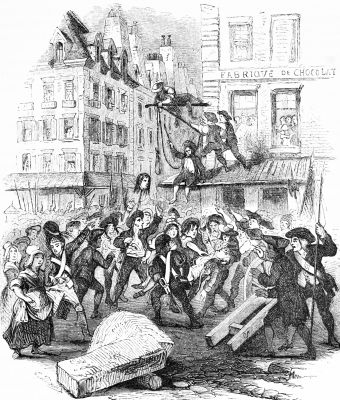
THE ASSASSINATION OF BERTHIER.
The miserable wretch was dragged up the steps of the Hôtel de Ville. But the mob was now in the ascendency. There was no longer law or even semblance of authority. An attempt was made by the National Guard to convey him to the Abbaye; but the moment they appeared with their prisoner in the street the crowd fell irresistibly upon him. Seizing a gun, he fought like a tiger; but he soon fell, pierced with bayonets.[195] A dragoon tore out his heart, and carried it dripping with blood to the Hôtel de Ville, saying, "Here is the heart of Berthier!"[196] The man attempted an extenuation of his ferocity by declaring that Berthier had caused the death of his father. His comrades, however, deemed such brutality a disgrace to their corps. They told him that he must die, and that they would all fight him in turn until he was killed. He was killed that night.[197]
These deeds of violence excited the disgust of Bailly, the mayor, and La Fayette. Having such evidence that both the municipality and the National Guard were impotent, both La Fayette and Bailly tendered their resignations.
They were, however, prevailed upon to continue in office by the most earnest solicitations of the friends of France.[198]
A report was spread throughout the kingdom that the fugitive princes and nobles were organizing a force on the frontiers for the invasion of France, that the armies of foreign despots were at their command, and that all the Royalists in France were conspiring to welcome them. The panic which pervaded the kingdom was fearful. France, just beginning to breathe the atmosphere of liberty, was threatened with chains of slavery more heavy than had ever been worn before. The energies of a semi-enfranchised people were roused to the utmost vigor. Every city, and every village of any importance, organized a municipal government in sympathy with the municipality in Paris. The peasantry in the rural districts, hating the nobles who had long oppressed them, attacked and burned their castles. There was a universal rising of the Third Estate against the tyranny of the privileged classes, assailing that tyranny with the only instrument at its command—blind brutal force. In one week three millions of men assumed the military character, and organized themselves for the defense of the kingdom. The tricolored cockade became the national uniform.
The National Assembly, intently occupied in framing a constitution, was greatly disturbed by reports of these wide-spread acts of violence; yet daily delegations arrived with vows of homage from the different provinces, and with their recognition of the authority of the national representatives.
Necker was in exile at Basle. He had left the Polignacs in pride and power at Versailles; they now were fugitives. One morning one of the Polignacs hastened to Necker's apartment and informed him of the overthrow of the court and the triumph of the people. Necker had just received these tidings when a courier placed in his hand the letter of the king recalling him to the ministry. The grandest of triumphs greeted him from the moment his carriage entered France until he was received with a delirium of joy in the streets of Paris. The people, who had with lawless violence punished Foulon and Berthier, who had conspired so inhumanly for the overthrow of their liberties, were determined that others, who with equal malignity had conspired against them, should also be condemned. Necker humanely resolved that an act of general amnesty should be passed. Many of his friends assured him that it was not safe to attempt to secure the passage of such a measure; that the crimes of the leaders of the court were too great to be thus easily forgotten; that the indignant nation, finding Necker pleading the cause of the court, would think that he had been bought over; and that thus he would only secure his own ruin. But Necker, relying upon his popularity, resolved to make the trial. On the 29th of July he repaired to the Hôtel de Ville. As he passed through the streets and entered the spacious hall, he was received with rapturous applause. Deeming his popularity equal to the emergence, he demanded a general amnesty. In the enthusiasm of the moment it was granted by acclamation. Necker retired to his apartments delighted with his success; but before the sun had set he found himself cruelly deceived. The Assembly, led by Mirabeau, remonstrated peremptorily against this usurpation of power by the Municipality of Paris, asserting that that body had no authority either to condemn or to pardon. The measure of amnesty was annulled by the Assembly, and the detention of the prisoners confirmed.
The great question which now agitated the Assembly was, what measures were to be adopted to bring order out of the chaos into which France was plunged. All the old courts were virtually annihilated. No new courts had been organized with the sanction of national authority. The nobles and all their friends, in conference with the emigrants and foreign despots, were conspiring to reinstate the reign of despotic power. The people were in a state of terror. The degraded, the desperate, the vicious, in banditti hordes, were sweeping the country, burning and pillaging indiscriminately. It was proposed to publish a decree enjoining upon the people to demean themselves peaceably, to pay such taxes and duties as were not yet suppressed, and to yield obedience for the present to the old laws of the realm, obnoxious and unjust as they undeniably were.
While this question was under discussion, the Viscount de Noailles and the Duke d'Aguillon, both distinguished members of the nobility, ascended the tribune and declared that it was vain to attempt to quiet the people by force, that the only way of appeasing them was by removing the cause of their sufferings. They then, though both of them members of the privileged class, nobly avowed the enormity of the aggressions under which, by the name of feudal rights, the people were oppressed, and voted for the repeal of those atrocities.
It is a remarkable fact that in this great revolution the boldest and ablest friends of popular rights came out from the body of the nobles themselves. Some were influenced by as pure motives as can move the human heart. With others, perhaps, selfish and ambitious motives predominated. Among the most active in all these movements, we see La Fayette, Talleyrand, Sièyes, Mirabeau, and the Duke of Orleans. But for the aid of these men, whatever may have been the motives which influenced the one or the other, the popular cause could not have triumphed. And now we find, in the National Assembly, two of the most distinguished of the nobles rising and themselves proposing the utter abolition of all feudal rights.
It was the 4th of August, 1789, when this memorable scene was enacted in the National Assembly, one of the most remarkable which ever transpired on earth. The whole body of the nobles seems to have been seized with a paroxysm of magnanimity and disinterestedness. One of the deputies of the Tiers Etat, M. Kerengal, in the dress of a farmer, gave a frightful picture of the sufferings of the people under feudal oppression.[199] There was no more discussion. No voice defended feudality. The nobles, one after another, renounced all their prerogatives. The clergy surrendered their tithes. The deputies of the towns and of the provinces gave up their special privileges, and, in one short night, all those customs and laws by which, for ages, one man had been robbed to enrich another were scattered to the winds. Equality of rights was established between all individuals and all parts of the French territory. Louis XVI. was then proclaimed the restorer of French liberty. It was decreed that a medal should be struck off in his honor, in memory of that glorious night. And when the Archbishop of Paris proposed that God's goodness should be acknowledged in a solemn Te Deum, to be celebrated in the king's chapel, in the presence of the king and of all the members of the National Assembly, it was carried by acclamation. During the whole of this exciting scene, when sacrifices were made such as earth never witnessed before; when nobles surrendered their titles, their pensions, and their incomes; when towns and corporations surrendered their privileges and pecuniary immunities; when prelates relinquished their tithes and their benefices; not a solitary voice of opposition or remonstrance was heard. The whole Assembly—clergy, nobles, and Tiers Etat—moved as one man. "It seemed," says M. Rabaud, "as if France was near being regenerated in the course of a single night. So true it is that the happiness of a people is easily to be accomplished, when those who govern are less occupied with themselves than with the people."[200]
It subsequently, however, appeared that this seeming unanimity was not real. "The impulse," writes Thiers, "was general; but amid this enthusiasm it was easy to see that certain of the privileged persons, so far from being sincere, were desirous only of making matters worse." This was the measure which the unrelenting nobles adopted to regain their power. Finding that they could not resist the torrent, they endeavored to swell its volume and to give impulse to its rush, that it might not only sweep away all the rubbish which through ages had been accumulating, but that it might also deluge every field of fertility, and sweep, in indiscriminate ruin, all the abodes of industry and all the creations of art. It was now their sole endeavor to plunge France into a state of perfect anarchy, with the desperate hope that from the chaos they might rebuild their ancient despotism; that the people, plunged into unparalleled misery, might themselves implore the restoration of the ancient régime.
This combination of the highest of the aristocracy and of the clergy to exasperate the mob immeasurably increased the difficulties of the patriots. The court party, with all its wealth and influence—a wealth and influence which had been accumulating for ages—scattered its emissaries every where to foster discord, to excite insurrection, to stimulate the mob to all brutality, that the Revolution might have an infamous name through Europe, and might be execrated in France. In almost every act of violence which immediately succeeded, the hand of these instigators from palaces and castles was distinctly to be seen. Indeed, it was generally supposed that even Berthier and Foulon were wrested from the protection of La Fayette by emissaries of the court. And the British government was so systematically assailed for exciting disturbances in France, that the Duke of Dorset, British embassador at the time, found it necessary to present a formal contradiction of the charge.
FOOTNOTES:
CHAPTER XVI.
FORMING THE CONSTITUTION.
Arming of the Peasants.—Destruction of Feudal Charters.—Sermon of the Abbé Fauchet.—Three Classes in the Assembly.—Declaration of Rights.—The Three Assemblies.—The Power of the Press.—Efforts of William Pitt to sustain the Nobles.—Questions on the Constitution.—Two Chambers in one?—The Veto.—Famine in the City.—The King's Plate melted.—The Tax of a Quarter of each one's Income.—Statement of Jefferson.
An utterly exhausted treasury compelled Louis XVI. and the court of France to call together the States-General. The deputies of the people, triumphing over the privileged classes, resolved themselves into a National Assembly, and then proceeded to the formation of a constitution which should limit the hitherto despotic powers of the crown. Though there were a few individuals of the nobles and of the higher clergy who cordially espoused the popular cause, the great mass of the privileged class clung firmly together in desperate endeavors to regain their iniquitous power. Many of these were now emigrants, scattered throughout Europe, and imploring the interference of foreign courts in their behalf. The old royalist army, some two hundred thousand strong, amply equipped and admirably disciplined, still retained its organization, and was still under its old officers, the nobles; but the rank and file of this army were from the people, and their sympathies were with the popular cause.
The nobles were now prepared for the most atrocious act of treason. They wished to surrender the naval arsenals of France to the English fleet, so that England, in possession of the great magazines of war, could throw any number of soldiers into the kingdom unresisted, while the Prussians and Austrians, headed by the emigrant noblesse, should invade France from the east. The English government, however, which subsequently became an accomplice in the conspiracy of the French nobles, by accepting the surrender of Toulon, was not yet prepared to take the bold step of invading France simply to rivet the chains of despotism upon the French people.
The English embassador, Dorset, who was residing at Versailles, revealed the plot to the ministers of the king. They, however, kept the secret until it was disclosed by an intercepted letter from Dorset to the Count d'Artois (subsequently Charles X). This discovery vastly increased the alarm of the nation. Perils were now multiplying on every side. The most appalling rumors of invasion filled the air. Bands of marauders, haggard, starving, brutal, swept over the country, burning, devouring, and destroying. It was supposed at first that they were the advance battalions of the invaders, sent by the emigrants to chastise France into subjection. Alarm increased to terror. Mothers in almost a delirium of fear sought places of concealment for their children. The peasant in the morning ran to his field to see if it had been laid waste. At night he trembled lest he should awake to behold conflagration and ruin. There was no law. The king's troops were objects of especial dread. The most insolent of the nobles were in command, and with money and wine they sought to bribe especially the Germans and the Swiss to be obedient to their wishes.
It was this peril which armed France. Villages, peasants, all were united to defend themselves against these terrible brigands. The arsenals of the old castles contained arms. Nerved by despair, the roused multitudes simultaneously besieged all these castles, and demanded and seized the weapons necessary for their defense. It was as a movement of magic. A sudden danger, every where menacing, every where worked the same result. In one short week France sprung up armed and ready for war. Three millions of men had come from the furrow and the shop, and fiercely demanded "Where are the brigands? Lead us to meet our foes, whoever and wherever they may be."[201]
The lords in an hour found themselves helpless. The peasants, hitherto so tame and servile, were now soldiers, roused to determination and proud of their newly discovered power. Awful was the retribution. The chateaux blazed—funeral fires of feudality—on every hill and in every valley. One can only be surprised that the hour of retribution should have been delayed for so many ages, and that when it came the infuriated, degraded, brutalized masses did not proceed to even greater atrocities. Though deeds of cruelty were perpetrated which cause the ear that hears to tingle, still, on the whole, mercy predominated.
In many cases lords who had treated their serfs kindly were protected by their vassals, as children would protect a father. The Marquis of Montfermail was thus shielded from harm. In Dauphiné a castle was assailed during the absence of the lord. His lady was at home alone with the children. The peasants left the castle and its inmates unharmed, destroying only those feudal charters which were the title-deeds of despotism.
These titles, engrossed on fine parchment and embellished with gorgeous seals, were the pride of the noble family—the evidence of their antiquity. They were preserved with great reverence, deposited in costly caskets, which caskets, enveloped in velvet, were safely placed in oaken chests, and those chests, iron-ribbed and with ponderous locks, were guarded in a strong part of the feudal tower. The peasants ever gazed with awe upon the tower of the archives. They understood the significancy of those title-deeds—the badges of their degradation, the authority to which the lords appealed in support of their tyranny, insolence, and nameless outrages.
"Our country-people," writes Michelet, "went straight to the tower. For many centuries that tower had seemed to sneer at the valley, sterilizing, blighting, oppressing it with its deadly shadow. A guardian of the country in barbarous times, standing there as a sentinel, it became later an object of horror. In 1789 what was it but the odious witness of bondage, a perpetual outrage to repeat every morning to the man trudging to his labor the everlasting humiliation of his race? 'Work, work on, son of serfs! Earn for another's profit. Work, and without hope.' Every morning and every evening, for a thousand years, perhaps more, that tower had been cursed. A day came when it was to fall.
"O glorious day, how long have you been in coming! How long our fathers expected and dreamed of you in vain! The hope that their sons would at length behold you was alone able to support them, otherwise they would have no longer consented to live. They would have died in their agony. And what has enabled me, their companion, laboring beside them in the furrow of history and drinking their bitter cup, to revive the suffering Middle Ages, and yet not die of grief? Was it not you, O glorious day, first day of liberty? I have lived in order to relate your history!"
Thus far the religious sentiment of France, as expressed by nearly all the pastors and the great proportion of their Christian flocks, was warmly in favor of the Revolution. The higher clergy alone, bishops, archbishops, and cardinals, who were usually the younger sons of the nobles, and were thus interested in the perpetuation of abuses, united with the lords. As in the National Assembly so it was in the nation itself, that the working clergy were among the most conspicuous of the sons of freedom. Religious services were held in the churches in grateful commemoration of the fall of the Bastille.[202] The vast cathedral of Nôtre Dame was thronged to listen to a sermon from the Abbé Fauchet, who consecrated to the memory of those who fell on that occasion the homage of his extraordinary eloquence. He selected for his text the words of St. Paul, "For, brethren, ye have been called unto liberty."—Gal. v. 13.
"The false interpreters of the divine oracle," said the abbé, "have wished, in the name of heaven, to keep the people in subjection to the will of their masters. They have consecrated despotism. They have rendered God an accomplice with tyrants. These false teachers exult because it is written, 'Render unto Cæsar the things that are Cæsar's.' But that which is not Cæsar's, is it necessary to render to him that? And liberty does not belong to Cæsar. It belongs to human nature."[203]
The abbé unquestionably read the divine oracles aright. The corner-stone of true democracy can only be found in the word of God. The revelation there presented of God as a common father, and all mankind as his children, made of one blood, brethren—it is that revelation upon which is founded the great fundamental principle of democracy, equality of rights. The very highest attainment of political wisdom is the realization of the divine word, "Whatsoever ye would that others should do unto you, do ye even so unto them."
The whole audience were transported with the clear and eloquent enunciation of the politics of the gospel of Christ. As the orator left the sacred cathedral he was greeted with the loudest plaudits. A civic crown was placed upon his brow, and two companies of the National Guard escorted him home, with the waving of banners and the clangor of trumpets, and through the acclamations of the multitudes who thronged the streets.[204]
While France was in this state of tumult and terror, threatened with invasion from abroad, and harassed by brigands at home, the nobles plotting treason, law powerless, and universal anarchy reigning, the National Assembly was anxiously deliberating to restore order to the country and to usher in the reign of justice and prosperity. The old edifice was destroyed. A new one was to be erected. But there were now three conspicuous parties developing themselves in the Assembly.
The first was composed of the nobles and the higher clergy, who still, as a body, adhered to the court, and who eagerly fomented disorders throughout the kingdom, hoping thus to compel the nation, as the only escape from anarchy, to return to the old monarchy.
The second was composed of the large proportion of the Assembly, sincere, intelligent, patriotic men, earnest for liberty, but for liberty restrained by law. They were almost to a man monarchists, wishing to ingraft upon the monarchy of France institutions similar to those of republican America. The English Constitution was in the main their model.
A third party was just beginning to develop itself, small in numbers, of turbulent, visionary, energetic men, eager for the overthrow of all the institutions and customs of the past, and for the sudden introduction of an entirely new era. Making no allowance for the ignorance of the masses, and for the entire inexperience of the French in self-government, they wished to cut loose from all the restraints of liberty and of law, and to plunge into the wildest freedom.
The first and the third classes, the Aristocrats and the ultra-Democrats, joined hand in hand to overthrow the Moderates, as the middle party were called, each hoping thus to introduce the reign of its own principles. Thus they both were ready to exasperate the masses and to encourage violence. These were the two implacable foes against whom the Revolution, and subsequently the Empire under Napoleon, had ever to contend. Despotism and Jacobinism have ever been the two allied foes against rational liberty in France.
The patriots of the middle, or moderate party, who had not as yet assumed any distinctive name, for the parties in the Assembly were but just beginning to marshal their forces for the fight, earnestly deplored all scenes of violence. Such scenes only thwarted their endeavors for the regeneration of France.
The Assembly now engaged with great eagerness in drawing up a declaration of rights, to be presented to the people as the creed of liberty. It was thought that if such a creed could be adopted, based upon those self-evident truths which are in accordance with the universal sense of right, the people might then be led to rally around this creed with a distinct object in view.
For two months, from the 1st of August till the early part of October, the Assembly was engaged in discussing the Bill of Rights and the Constitution. But it was found that there had now suddenly sprung up three Assemblies instead of one, each potent in its sphere, and that between the three a spirit of rivalry and of antagonism was very rapidly being engendered.
The first was the National Assembly at Versailles, originally consisting of twelve hundred deputies, but now dwindled down by emigration and other absence to about eight hundred.
The second was the municipal government of Paris, consisting of three hundred representatives from the different sections or wards of the city, and which held its sessions at the Hôtel de Ville. As Paris considered itself France, the municipality of Paris began to arrogate supreme power.