Front matter (continued 12)
Reading edition
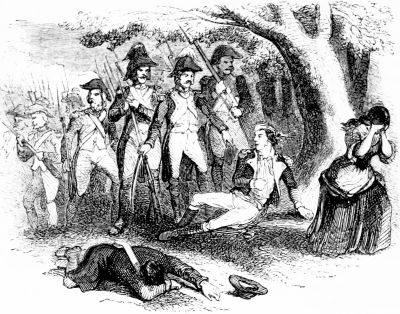
LA CHARETTE TAKEN PRISONER.
About thirty thousand French soldiers, in rags, destitute of the munitions of war, and almost famished, were ineffectually struggling against their foes on the southern slopes of the Apennines. Napoleon was placed in command of these starving troops, but the government was unable to supply him with any funds for the prosecution of the war. On the 27th of March he placed himself at the head of these enfeebled and discouraged battalions. Young generals, who subsequently obtained great renown—Angereau, Massena, Laharpe, Serrurier, and Berthier—composed the officers of his staff. The levy en masse had filled the ranks with young men from good families, well informed, distinctly understanding the nature of the conflict, detesting the old feudal despotism which allied Europe was striving to impose upon them anew, and enthusiastically devoted to the principles of liberty and equal rights which the Revolution was endeavoring to implant. Though most of them were young, they had many of them spent years in the field, had seen many bloody battles, and, inured to the hardships of war, were veteran soldiers. Sixty thousand Piedmontese and Austrians, under Colli and Beaulieu, crowded the northern slopes and the crest of the mountains, endeavoring to force their way through the defiles upon France. Napoleon's first words to his troops roused them as with electric fire.
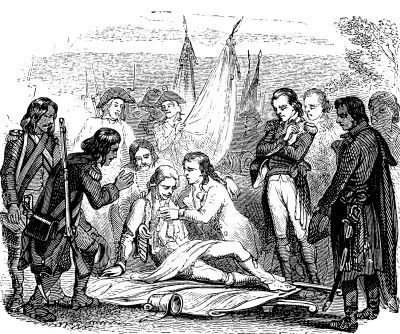
DEATH OF GENERAL MARCEAU.
"Soldiers," said he, "you are ill fed, almost naked. The government owes you much, but can do nothing for you. Your patience, your courage, do you honor, but procure you neither glory nor advantage. I am about to lead you into the most fertile plains in the world. You will there find large cities, rich provinces; you will there find honor, glory, and wealth. Soldiers of Italy, will your courage fail you?"
On the 12th of April his troops were in motion. A series of desperate battles and of resplendent victories ensued. At the close of two weeks Napoleon issued the following proclamation:
"Soldiers, in a fortnight you have gained six victories, taken twenty-one pairs of colors, fifty-five pieces of cannon, several fortresses, and conquered the richest part of Piedmont. You have made fifteen thousand prisoners, and killed or wounded more than ten thousand men. You had hitherto been fighting for barren rocks, rendered glorious by your courage, but useless to the country. You now rival, by your services, the army of Holland and the Rhine. Destitute of every thing, you have supplied all your wants. You have gained battles without cannon, crossed rivers without bridges, made forced marches without shoes, bivouacked without brandy and often without bread. The Republican phalanxes, the soldiers of liberty alone, could have endured what you have endured. Thanks be to you for it, soldiers. Your grateful country will owe to you its prosperity; and if your conquest at Toulon foreboded the glorious campaign of 1793, your present victories forbode one still more glorious. The two armies which so lately attacked you boldly, are fleeing affrighted before you. The perverse men who laughed at your distress, and rejoiced in thought at the triumph of your enemies, are confounded and trembling.
"But, soldiers, you have done nothing, since more remains to be done. Neither Turin nor Milan is yours. The ashes of the conquerors of Tarquin are still trampled upon by the murderers of Basseville."[457]
Napoleon now summoned all his energies to drive the Austrians out of Italy. In two months the work was done; and Paris, France, Europe was electrified by the narrative of deeds of daring and success, such as war had never recorded before. In all the towns and cities of Italy the French armies were received as deliverers, for the subjugated Italians were eager to throw off the hateful yoke of Austrian despotism. Napoleon, having unbounded confidence in himself, and but very little respect for the weak men who composed the Directory, took all matters of diplomacy, as well as war, into his own hands, and, sustained by the enthusiasm of his soldiers, settled the affairs of Italy according to his own views of expediency.
The Royalists, hoping for the overthrow of the Republic and for the return of Louis XVIII., were exceedingly chagrined by these victories. They left no means of calumny untried to sully the name of Napoleon. Europe was filled with falsehoods respecting him, and reports were circulated that General Hoche was to be sent from Paris to arrest him in the midst of his army. These rumors assumed such importance that the government wrote a letter to Napoleon contradicting them; and General Hoche, with the magnanimity of a man incapable of jealousy, over his own name published a letter expressing his admiration of the commander of the Army of Italy.
"Men," he wrote, "who, concealed or unknown during the first years of the foundation of the Republic, now think only of seeking the means of destroying it, and speak of it merely to slander its firmest supporters, have, for some days past, been spreading reports most injurious to the armies, and to one of the general officers who commanded them. Can they, then, no longer attain their object by corresponding openly with the horde of conspirators resident at Hamburg? Must they, in order to gain the patronage of the masters whom they are desirous of giving to France, vilify the leaders of the armies? Why is Bonaparte, then, the object of the wrath of these gentry? Is it because he beat themselves and their friends in Vendémiaire?[458] Is it because he is dissolving the armies of kings, and furnishing the Republic with the means of bringing this honorable war to a glorious conclusion? Ah! brave young man, where is the Republican soldier whose heart does not burn with the desire to imitate thee? Courage, Bonaparte! lead our victorious armies to Naples, to Vienna; reply to thy personal enemies by humbling kings, by shedding fresh lustre over our armies, and leave to us the task of upholding thy glory."
Still the Royalists were busy with incessant plots and intrigues for the overthrow of the government. The treasury was utterly bankrupt, paper money, almost utterly worthless, flooded the land, and the finances were in a state of inextricable embarrassment. The Jacobins and the Royalists were equally eager to demolish the Directory by any conceivable measures of treason and violence. Never was a nation in a more deplorable state, harassed by a foreign war which demanded all its energies, and torn by domestic dissensions which no human wisdom seemed capable of healing.
The Jacobins adopted even the desperate measure to feign a Royalist insurrection; to scatter white cockades, the emblem of Bourbon power; to shout Vive le Roi! and to discharge musketry and throw petards into the streets, that the people, alarmed by the peril of Bourbon restoration, might throw themselves into the arms of the Jacobins for protection.[459] A mob of nearly a thousand most determined men marched, in the night of the 10th of September, upon the camp at Grenelle, hoping to fraternize with the soldiers in this treasonable endeavor to overthrow the government. Several hundreds fell dead or wounded in this frantic attempt.
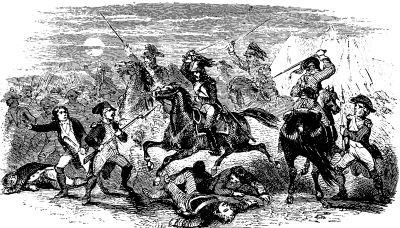
NIGHT OF SEPTEMBER 10, 1796.
The Directory now attempted to enter into peaceful relations with other powers, and effected a treaty of alliance, offensive and defensive, with Spain. Envoys were also sent to the Ottoman Porte and to Venice for the same purpose. Piedmont had sued for peace and obtained it. The Italians of Upper Italy, exulting in their emancipation from the Austrians, under the protection of Napoleon established the Cispadane Republic. Without the support of his strong arm they could not for a day resist the encroachments of the surrounding despotisms. The first National Assembly of this infant republic met at Modena, October 16, 1796. The people were electrified with delight at this unexpected achievement of freedom. The Assembly sent an address to Napoleon, informing him of the principles of their new government.
"Never forget," said Napoleon, in his reply, "that laws are mere nullities without the force necessary to support them. Attend to your military organization, which you have the means of placing on a respectable footing. You will then be more fortunate than the people of France, for you will arrive at liberty without passing through the ordeal of revolution."
The Directory had for some time been attempting to effect peace with England. On the 18th of December the British government stated on what terms it would consent to sheathe the sword. M. Thiers expresses the feelings of France in reference to this offer in the following terms:
"Thus France, having been iniquitously forced into war, after she had expended enormous sums, and from which she had come off victorious—France was not to gain a single province, while the northern powers had just divided a kingdom between them (Poland), and England had recently made immense acquisitions in India. France, who still occupied the line of the Rhine, and who was mistress of Italy, was to evacuate the Rhine and Italy at the bare summons of England! Such conditions were absurd and inadmissible. The very proposal of them was an insult, and they could not be listened to."[460]
To conquer a peace, the Directory now meditated a direct attack upon England. The Catholic Irish, over three millions in number, hating implacably their English conquerors, were ardent to rise, under the guarantee of France, and establish a republican government. They had sent secret agents to Paris to confer with the Directory. Wolfe Tone, one of the leaders of the Irish revolutionists, addressed memorials to the French Directory soliciting aid.
"The Catholics of Ireland," said he, "are 3,150,000, all trained from their infancy in an hereditary hatred and abhorrence of the English name. For these five years they have fixed their eyes most earnestly on France, whom they look upon, with great justice, as fighting their battles, as well as that of all mankind who are oppressed. Of this class I will stake my head there are 500,000 who would fly to the standard of the Republic if they saw it once displayed in the cause of liberty and their country.
"The Republic may also rely with confidence on the support of the Dissenters, actuated by reason and reflection, as well as the Catholics impelled by misery and inflamed by detestation of the English name. In the year 1791 the Dissenters of Belfast first formed the Club of United Irishmen, so called because in that club, for the first time, Dissenters and Catholics were seen together in harmony and union. Corresponding clubs were rapidly formed, the object of which was to subvert the tyranny of England, establish the independence of Ireland, and frame a free republic on the broad basis of liberty and equality.
"The Catholics also have an organization, commencing about the same time with the clubs last mentioned, but composed of Catholics only. In June last it embraced the whole peasantry of the provinces of Ulster, Leinster, and Connaught, three fourths of the nation, and I have little doubt that it has since extended into Munster, the remaining province. The eyes of this whole body, which may be said, almost without a figure, to be the people of Ireland, are turned with the most anxious expectation to France for assistance and support. The oath of their union recites that they will be faithful to the united nations of France and Ireland."[461]
An expedition to Ireland was secretly resolved upon. A fleet of fifteen sail of the line, twenty frigates, six luggers, and fifty transports, containing sixteen thousand troops, sailed on the 16th of December to land in Bantry Bay, on the coast of Ireland. But the very night after the squadron left port a heavy storm arose, in which one ship foundered and the fleet was widely dispersed. A singular series of casualties ensued. Some of the ships entered the bay, but not finding their companions, after waiting a short time, returned to France. Other ships of the expedition soon after entered, but, finding the bay deserted, they also returned. The expedition thus proved a total failure.[462]
The inefficient Directory was quite unable to rectify the disorders into which the internal affairs of the state were plunged. They uttered loud complaints, which did but increase discontent and disgust. The press, being entirely free, indulged in the utmost violence; Royalists and Jacobins assailing the feeble government without mercy and thwarting its operations in every possible way. The army of Italy was triumphant—almost miraculously so. Every where else the Republic was in disgrace. The Directory endeavored to throw the blame of the public calamities upon the two Councils, and published the following message, which was as true as it was ill-advised:
"All departments are distressed. The pay of the troops is in arrear; the defenders of the country, in rags and enervated by want, in disgust are led to desertion. The hospitals are destitute of furniture, fire, and drugs. The charitable institutions, utterly impoverished, repel the poor and infirm. The creditors of the state, the contractors who supply the armies, with difficulty obtain but a small portion of the sums that are their due. Distress keeps aloof men who could perform the same services better and cheaper. The roads are cut up; the communications interrupted. The public functionaries are without salary; from one end of the Republic to the other judges and administrators may be seen reduced to the horrible alternative either of dragging on, with their families, a miserable existence, or of being dishonored by selling themselves to intrigue. The evil-disposed are every where busy. In many places murder is being organized, and the police, without activity, without energy, because it is without pecuniary means, can not put a stop to these disorders."
All eyes were directed to the achievements of Napoleon, who, with superhuman energy, was destroying army after army of the Allies, astounding Europe by his exploits, and exciting the admiration of his countrymen. Thiers thus describes the position he then occupied in the public mind:
"Sickness, together with the excessive fatigues of the campaign, had weakened him extremely. He could scarcely sit on horseback; his cheeks were hollow and livid. His whole appearance was deplorable. His eyes alone, still bright and piercing as ever, indicated that the fire of his soul was not extinguished. His physical proportions formed a singular contrast with his genius and his renown, a contrast amusing to soldiers at once jovial and enthusiastic. Notwithstanding the decline of his strength, his extraordinary energy supported him and imparted an activity which was applied to all objects at once.
"He had begun what he called the war against robbers. Intriguers of all kinds had thronged to Italy for the purpose of introducing themselves into the administration of the armies and profiting by the wealth of that fine country. While simplicity and indigence pervaded the armies of the Rhine, luxury pervaded that of Italy—luxury as great as its glory. The soldiers, well clothed and well fed, were every where cordially received, and lived in pleasure and abundance. The officers, the generals, participated in the general opulence, and laid the foundations of their fortunes.
"Bonaparte, who had within him all the passions, but who, at that moment, was engrossed by one passion, that of glory, lived in a simple and austere manner, seeking relaxation only in the society of his wife, to whom he was tenderly attached, and who had come, at his desire, to his head-quarters. Indignant at the disorders of the administration, he strictly scrutinized the minutest details, verified by personal inspection the accounts of the companies, denounced the dishonest administrators without mercy, and caused them to be prosecuted."
Among the Directors, Carnot was one of the noblest of men. The purity of his character slander has never attempted to taint. Barras was a fearless soldier and a shameless debauchee. He boasted of the profligacies in which he openly indulged, and he rioted in boundless extravagance, which he supported through corruption and bribes. Rewbel was a lawyer, a man of ability and integrity.[463] These three men had belonged to different political parties during the Revolution, and each detested the others. Lareveillère was an honest man, but destitute of those commanding qualities so essential to the post he occupied. Le Tourneur was a vain, good-natured man who merely echoed the voice of Carnot. All the Directors but Barras occupied, with their families, apartments in the Palace of the Luxembourg. In the public mind this discordant Directory consisted of two parties, Barras, Rewbel, and Lareveillère in the majority, and Carnot and Le Tourneur in the opposition.
FOOTNOTES:
CHAPTER XL.
THE OVERTHROW OF THE DIRECTORY AND THE ESTABLISHMENT OF THE CONSULATE.
Proclamation of Napoleon.—March into Austria.—Letter to the Archduke Charles.—Preliminaries of Peace.—Union of Parties against the Directory.—Triumph of the Directory.—Agency of Napoleon.—Severe Measures of the Directory.—Indignation of Napoleon.—Dictatorship of the Directory.—Dismay of the Royalists.—Treaty of Campo Formio.—Napoleon's Address to the Cispadane Republic.—Remarks of Napoleon.—Plan for the Invasion of India.—Expedition to Egypt.—New Coalition.—Rastadt.
It was now the month of March, 1797, and Napoleon, having driven the Austrians out of Italy, issued the following proclamation, an unexaggerated statement of facts which amazed and appalled hostile Europe:
"Soldiers! the capture of Mantua has put an end to the war of Italy. You have been victorious in fourteen pitched battles and seventy actions. You have taken 100,000 prisoners, 500 field-pieces, 2000 heavy cannon, and four pontoon trains. The contributions laid on the countries you have conquered have fed, maintained, and paid the army; besides which, you have sent thirty millions ($6,000,000) to the Minister of Finance for the use of the public treasury. You have enriched the Museum of Paris with three hundred master-pieces of ancient and modern Italy, which it had required thirty centuries to produce. You have conquered for the Republic the finest countries in Europe. The kings of Sardinia and Naples, the Pope, and the Duke of Parma are separated from the coalition. You have expelled the English from Leghorn, Genoa, and Corsica. Still higher destinies await you. You will prove yourselves worthy of them. Of all the foes who combined to stifle our Republic in its birth the emperor alone remains."
On the 16th of March the little army of Bonaparte crossed the Tagliamento to march upon Vienna, there to compel Austria to cease the iniquitous war which now for six years had desolated Europe. Battle after battle ensued, and the Austrians met the French only to be vanquished. On the 31st of March Napoleon wrote to the Archduke Charles, who was brother of the emperor and commander-in-chief of the Austrian forces, as follows:
"General-in-Chief: brave soldiers make war and desire peace. Has not this war lasted six years? Have we not slain men enough and inflicted calamities enough on suffering humanity? It cries out on all sides. Europe, which had taken up arms against the French Republic, has laid them down. Your nation alone is left, and yet blood is about to be spilled more abundantly than ever.
"The Executive Directory of the French Republic communicated to his majesty the emperor its desire to put an end to the war which afflicts both nations. The intervention of the Court of London has opposed this wish. Is there, then, no hope of arrangement? And must we continue to slaughter one another for the interests and the passions of a nation which knows nothing of the calamities of war? You, general, who are by birth so near to the throne, and above all the petty passions which so frequently actuate ministers and governments, are you determined to merit the title of benefactor of the whole human race and the real savior of Germany?
"Imagine not, general, that I mean by this that it is not possible to save her by the force of arms. But, even supposing that the chances of war turn in your favor, Germany will not, on that account, be the less ravaged. As for me, general, if the overture which I have the honor to make to you can save the life of a single man, I shall be prouder of the civic crown which I shall feel that I have deserved than of the melancholy glory which can result from military successes."[464]
The archduke replied that he was commanded to prosecute the war, and had no authority to enter into conference upon terms of peace.[465] The war was now prosecuted with renewed vigor, as the French drove the Austrians through the defiles of the Tyrol, and entered the plains of Germany. But a few days passed ere Napoleon arrived within sight of the steeples of Vienna. The capital was in consternation; the people demanded peace; the archduke urged it, declaring himself quite unable to protect the city. The Austrian court now implored the clemency of the conqueror, and sent commissioners to Napoleon, at his head-quarters at Leoben, with full powers to settle the basis of peace. The preliminaries were signed at Leoben on the 18th of April, which put a stop to the effusion of blood.
By the election in May of one third of the two legislative bodies, the counter-revolutionists had obtained a majority in both chambers. This exceedingly elated the Royalists. The two Councils now commenced a furious war against the Republican Directory, seeking to overthrow it, and to re-establish, not the old Bourbon despotism, but the constitutional monarchy of 1791. There were now four parties in the field. The old Bourbon party, the friends of constitutional monarchy, the Republicans, and the Jacobins. Three of these parties united against the Directory, each hoping, in the overthrow of the Directors, to establish its own principles. One of the Directors was to leave. The Royalists succeeded in placing Barthélemy, a counter-revolutionist, in his place. The conflict which now arose was whether the Republican Directory should be abolished or maintained. A stern conflict was evidently rising. The Directory headed one party, the two Councils the other. In accordance with the disastrous temper of the times, both parties began to count bayonets instead of votes, that the question might be settled on a field of blood. The emigrants and the priests returned in great numbers, forged passports being transmitted to them from Paris.
The Councils had a legislative guard of fifteen hundred men, and hoped to avail itself of the National Guard, not then fully reorganized. They also placed great reliance on Pichegru, who was treasonably plotting the restoration of the Bourbons. The Constitution did not allow any of the standing army to approach within thirty-six miles of Paris. In defiance of this provision, the Directory, under pretense of sending a fresh expedition to Ireland, assembled twelve thousand veteran troops under the walls of the metropolis. General Bonaparte, aware of the peril of the Directory, and of the danger of the restoration of royalty, had sent the intrepid Augereau to Paris to assist the Directory in any emergency. The Directory was the established government of the nation, and, imbecile as it was, its overthrow by violence at that time could only lead to anarchy and blood.[466]
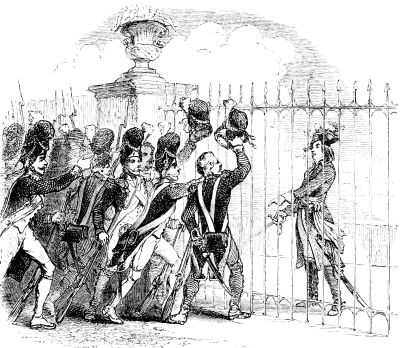
AUGEREAU AT THE PONT TOURNANT.
At midnight on the 17th Fructidor (September 3d), twelve thousand men, with forty pieces of cannon, were silently marched into the city, and surrounded the Tuileries. A body of the Legislative Guard was stationed at the Pont Tournant, the entrance-passage to the garden. Augereau approached them at the head of a numerous staff. "Are you Republicans?" said he. The soldiers immediately lowered their arms, and shouted "Vive Augereau! Vive le Directoire!" They fraternized at once with the troops of the Directory. The victory was gained; no blood was shed. At six o'clock in the morning, when the citizens awoke, they were surprised to find that a revolution had taken place during the night.
The three victorious directors condemned to banishment their two colleagues, Carnot and Barthélemy, forty-two members of the Council of Five Hundred, eleven of the Council of Ancients, several Royalist agents, and forty-two editors, publishers, and proprietors of counter-revolutionary journals. It is but a wretched extenuation for these deeds of violence, to assert that, had the Councils gained the victory, they would have treated the Directory in the same way. The Directory thus assumed the dictatorship over unhappy, distracted France; but even that was better than anarchy, and almost any thing was better than a return to the old Bourbon despotism.[467] This signal defeat crushed the hopes of the Royalists. The minority of the Councils, who were in the interests of the Directory, were reassembled in the Odeon and the School of Medicine, and with this organization the government attempted to carry on the distracted affairs of the nation.[468]
On the 12th of August Augereau had written to General Bonaparte,
"Nothing is more certain than that, if the public mind is not essentially changed before the approaching elections, every thing is lost, and a civil war remains as our last resource."
On the 23d of September Napoleon wrote to Augereau, "The whole army applauds the wisdom and energy which you have displayed in this crisis, and has rejoiced sincerely at the success of the patriots. It is only to be hoped, now, that moderation and wisdom will guide your steps. That is the most ardent wish of my heart."[469]
But Napoleon was indignant when he heard of the excessive severity adopted by the Directory. "It might have been right," he wrote, "to deprive Carnot, Barthélemy, and the fifty deputies of their appointments, and put them under surveillance in some cities in the interior. Pichegru, Willot, Imbert, Colonne, and one or two others might justly have expiated their treason on the scaffold.[470] But to see men of great talent, such as Portalis, Ducoudray, Fontanes; tried patriots, such as Boissy d'Anglas, Dumolard, Murinais; supreme magistrates, such as Carnot and Barthélemy, condemned without either trial or accusation, is frightful. What! to punish with transportation a number of writers of pamphlets, who deserved only contempt and a trifling correction, was to renew the proscriptions of the Roman triumvirs. It was to act more cruelly than Fouquier Tinville; since he, at least, put the accused on their trial, and condemned them only to death. All the armies, all the people were for a Republic. State necessity could not be alleged in favor of so revolting an injustice, so flagrant a violation of the laws and the rights of the citizens."[471]
The Royalists were dismayed by this sudden disaster. The priests and emigrants, who had returned in great numbers, fled again to the frontiers. Those who were advancing toward France retreated back to Switzerland and Germany. M. Merlin and M. François—the one a lawyer, the other a man of letters, and both upright Republicans—were chosen in the place of Carnot and Barthélemy. The guilt of Pichegru was fully established. Moreau, in crossing the Rhine, had taken the papers of General Klinglin, in which he had found the whole treasonable correspondence of Pichegru with the Prince of Condé.
The Directors now pushed the measures of government with Revolutionary energy. The British government, finding themselves deprived of every ally, sent Lord Malmesbury to Paris to negotiate for peace. The British ministry were willing to give up the colonies which they had wrested from France, but would not give up the colonies they had wrested from the allies of France, Spain and Holland. It is difficult to see how the Directory, with any sense of honor whatever, could, under such circumstances, have abandoned its allies. Upon this point there was a rupture, and war with England continued to rage.[472]
On the 28th of October the treaty of Campo Formio was signed, which secured peace with the Emperor of Germany. The Directors had sent to Napoleon an ultimatum which would have prevented the possibility of peace. Napoleon boldly rejected their demands, and made peace on his own terms. The nation hailed the peace with such joy, and Napoleon was now so boundlessly popular, that the Directors did not dare to refuse their ratification. Napoleon was now prepared to return to France. He had established the Cisalpine Republic, and compelled its recognition by the only powers which could endanger its existence. Before leaving Italy he thus addressed this state in the infancy of its freedom:
"You are the first people in history who have become free without factions, without revolutions, without convulsions. We have given you freedom; take care to preserve it. To be worthy of your destiny, make only discreet and moderate laws; cause them to be executed with energy; favor the diffusion of knowledge, and respect religion. Compose your army, not of disreputable men, but of citizens imbued with the principles of the Republic and closely linked to its prosperity. You have, in general, need to impress yourselves with the feeling of your strength, and with the dignity which befits the freeman. Divided, and bowed down for ages by tyranny, you would not, unaided, have conquered your liberty. In a few years, if left to yourselves, no power on earth will be strong enough to wrest it from you. Till then France will protect you against the attacks of your neighbors; its political system will be united with yours."[473]
The blessings of the Italians were showered upon Napoleon as he departed. As he entered France he was every where greeted with love, admiration, and enthusiasm. His progress through the departments was a triumphal march. In Paris he was received with salvos of artillery, ringing of bells, illuminations, and the huzzas of the multitude. In the laconic address of Napoleon to the authorities of government in their grand reception, he uttered sentiments in perfect accordance with his whole precedent and subsequent career.
"The French people," said he, "in order to be free had kings to combat. To obtain a Constitution founded on reason it had the prejudices of eighteen centuries to overcome. The Constitution of the year III. and you have triumphed over all obstacles. Religion, feudality, royalty, have successively, for twenty centuries past, governed Europe. But from the peace which you have just concluded dates the era of representative governments. You have succeeded in organizing the great nation whose vast territory is circumscribed only because Nature herself has fixed its limits. You have done more. The two finest countries in Europe, formerly so renowned for the arts, the sciences, and the great men whose cradle they were, see with the greatest hopes genius and freedom issuing from the tomb of their ancestors. These are two pedestals on which destiny is about to place two powerful nations. I have the honor to deliver to you the treaty signed at Campo Formio, and ratified by his majesty the emperor. Peace secures the liberty, the prosperity, and the glory of the Republic. When the happiness of the French people shall be seated on better organic laws, all Europe will become free."
Napoleon, having returned to Paris, sought seclusion, laid aside his military dress, and devoted himself with great assiduity to studies of natural and political science. He was chosen a member of the Institute, and took his seat between the distinguished philosophers Lagrange and Laplace. He wrote the following note in acceptance of his election:
"The suffrage of the distinguished men who compose the Institute honors me. I feel sensibly that before I can become their equal I must long be their pupil. The only true conquests, those which awaken no regret, are those we obtain over ignorance. The most honorable, as the most useful pursuit of nations, is that which contributes to the extension of the human intellect. The real greatness of the French Republic ought henceforth to consist in not permitting the existence of one new idea which has not been added to the national stock."
When subsequently speaking of this period of his life he remarked, "Mankind are, in the end, always governed by superiority of intellectual qualities, and none are more sensible of this than the military profession. When, on my return to Paris from Italy, I assumed the dress of the Institute and associated with men of science, I knew what I was doing. I was sure of not being misunderstood by the lowest drummer of the army."
He was frequently consulted by the Directory on important questions. He had no confidence in the government of the Directory, and only lent it his support so far as to prevent the restoration of royalty. The Directory wished him to take command of a new army, to try to conquer, on the shores of England, a peace with that government which now alone continued the war. With that object in view he visited the coast and carefully scrutinized the resources at command for the invasion of England. He, however, pronounced the project too hazardous, and convinced the Directory that the only vulnerable point which England presented was in India. In accordance with this suggestion a secret expedition was fitted out to invade India by the way of Egypt.
On the 19th of May, 1798, the Egyptian expedition sailed from Toulon. To settle innumerable minor affairs in reference to the Germanic States, a Congress of Embassadors, from Austria, France, and Germany had now for some months been in session at Rastadt. The British government in the mean time vigorously commenced endeavors to ally the monarchies of Europe in a new war against France. It appealed to the fears of all the sovereigns by showing them that the toleration of any republican institutions in Europe endangered all their thrones.
"England," says Thiers, "with a view to foment this fear had filled all the courts with her emissaries. She urged the new king of Prussia to relinquish his neutrality, and to preserve Germany from the inundation. She endeavored to work upon the wrong-headed and violent emperor Paul. She strove to alarm Austria, and offered her subsidies if she would renew the war. She excited the silly passions of the Queen of Naples."[474]
All over Europe war began again to menace France. While the commissioners were negotiating at Rastadt, the armies of the new coalition commenced their march. There was no alternative before them. Principles of liberty were spreading rapidly through Europe; and the despotic monarchs could only maintain their thrones by quenching that spirit in blood. They were compelled either to fight or to surrender. "The monarchs did right to defend their thrones," say the Royalists. "The people did right to defend their liberties," say the Republicans. So long as there are in the world advocates of aristocratic assumption and advocates of popular rights so long will these points be controverted. The Queen of Naples commenced hostilities, without any declaration of war, by sending an army of fifty thousand men to drive the French out of Italy, in November, 1798. The French armies now crossed the Rhine and entered Germany. The Russian and the Austrian armies were immediately on the move. The French embassadors at Rastadt received orders to leave in twenty-four hours. At nine o'clock in the evening of the 28th of April the three ministers, Debry, Bonnier, and Roberjeot, set out with their families. They occupied three carriages. They had hardly left the town, when, in the darkness, a troop of Austrian hussars rushed upon them, and, dragging the helpless embassadors from their coaches, cut them down in the presence of their wives and children. The ruffians plundered the carriages and carried off all the papers. Debry, though left senseless and supposed to be dead, revived, and, covered with wounds and blood, crawled back to Rastadt. This execrable violation of the law of nations, so unheard of among civilized people, excited the detestation of Europe. War, ferocious and implacable, was again renewed in all its horrors.[475]
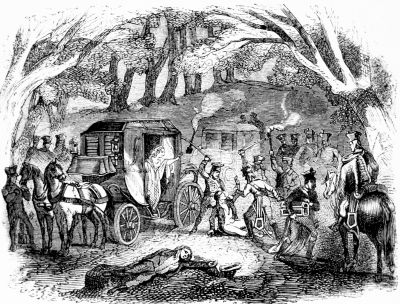
ASSASSINATION OF THE EMBASSADORS AT RASTADT.
Every thing was now in confusion, and universal discontent rose up around the Directory. France was distracted by hostile parties, while triumphant armies were crowding her frontiers. All social ties were dissolved. Unprincipled rapacity characterized the measures of government. Religion was abolished and the administration of justice seemed a farce. The laws were disregarded; violence reigned unchecked; intriguing factions succeeded each other, while Jacobins, Royalists, and Republicans were struggling for the supremacy. The people, disgusted with this state of anarchy, were longing for a deliverer who would rescue the government from disgrace and at the same time save France from falling back under the despotism of the Bourbons.
Napoleon, in Egypt, informed of this state of affairs, decided immediately to return to France. He landed at Frejus on the 9th of October, 1799, and traversed France, from the Mediterranean to Paris, through a constant scene of rejoicing. Such universal enthusiasm awaited him, that without the shedding of a drop of blood he overthrew the imbecile government of the Directory and established the Consulate. The nation received this change with almost universal applause. For the narrative of these events and the subsequent career of the Revolution the reader must be referred to the History of Napoleon Bonaparte.
FOOTNOTES:
INDEX.
Abbaye, butchery at the, 302. Abrantes (Duchess of), statement of, 400. Allies, condition and force of the, 295; vanquished at Valmy, 306. American War, its influence upon France, 61. Amnesty, a general, obtained by Necker, 139; opposed by Mirabeau, 139. Anecdote of Verginaud in the prison, 354. Anne (of Austria), her regency, 27. Anniversary of destruction of Bastille, preparation for the, 181. Aristocracy, destroyed by universal education, 46; of wealth warred against, 331. Arms taken by the people, 119. Army, desertion of the officers of the, 241; (of the interior), formation of the, 412. Arrangement between king and exiled Parliament, 69. Arrest of the royal family in their flight, 202. Assembly (of Notables) meet and overthrow Calonne, 67; dissolution of the, 68; National, the name chosen, 91; hall of the, closed, 93; shut out of tennis-court, 96; ordered by the king to dissolve, 98; good advice of, to the people, 105; petition to the, for a removal of the foreign troops, 112; declares itself permanent, 113; reconciliation of, to the king, 125; recognized government of France, 127; three parties in the, 144; Marat's opinion of the, 146; members of the, threatened, 149; change of name, 167; (Constituent), vote themselves the Church treasures, 170; resolve of, concerning the king's escape, 210; preparations for defense by the, 211; address of, to the French nation, 215; threatened by Marquis Bouillé, 222; decree of, declaring journey of the king faultless, 224; influence of the, declining, 226; denounced as traitors, 226; receives the mandate of the Jacobins, 228; Constitution completed by the, 230; decree of, dissolving itself, 234; dissolution of the, 235; (Legislative), sends forces to the frontier, 247; sends the king's troops to the frontier, 276; unpopularity of, 280; the king seeks refuge with the, 285; the, stormed by the mob, 286; decrees the suspension of the king, 289; overawed by the Jacobins, 295; decree of, that two thirds of their own number should be elected to the new legislative bodies, 403. See also Convention. Assignats, how secured, 170. Augereau, bloodless victory of, 423. Austria, reply of, to the French embassador, 245; Francis II. ascends the throne of, 246; demands of, that France should restore despotic power, 249. Autun (Bishop of), answer of Napoleon to the, 231. Bagatelle, pleasure-house of the Count d'Artois, 72. Bailly (Mons.), attempt to eject him from Assembly, 101; resigns presidency of the Assembly, 105; testimony of, regarding the king, 111; resigns his post as Mayor of Paris, 243; execution of, 362. Banishment of Parliament to Troyes, 69; result of, in Paris, 69. Bank, establishment of a, 36. Bankruptcy in France, 36; the national, described 63; a partial, 76. Barnave, character of, 216; influence of conversation of, on queen, 217; speech of, on governments, 225; his last interview with the queen, 252. Baronial times, France during the, 22. Barras, assumes the command of the National Guard, 384; nominates Napoleon as commander of the army, 404. Barry (Madam du), character of, 43. Bastille, storming of the, decided upon, 118; attack on the, 120; surrendered by its garrison, 121; garrisoned by the people, 123; influence of the fall of, upon the court, 123; the, ordered to be demolished, 130; description of the, 53; anniversary of destruction of, 182; site of the, converted into a ball-room, 186. Beaurepaire (General), suicide of, 299. Bed of justice, the custom, 68. Beggary now becoming universal, 169. Bensenval exhorts De Launey to be firm, 120. Berthier, character of, 135; death of, 137. Bertrand de Moleville, interview of, with the king, 236. Bible, how used by the Papists, 48; reason of its rejection by corrupt men, 49. Bill of Rights and Constitution, 145. Billaud Varennes, speech of, 392. Birth, in the minds of the nobility, superior even to genius, 45. Bohemia, war declared against, by France, 249. Boissy d'Anglas, heroism of, 400. Bonaparte (Napoleon), his boyhood, 76; eloquence of, 230; opinion of, touching discipline of troops, 231; confers the cross of the Legion of Honor upon a tragedian, 178; remarks of, upon the riot, 301; his first action in the Revolution, 374; intrusted with the defense of Paris, 405; receives the thanks of the Convention, 409; his support of the Directory, 413; ill health of, 420; letter of, to Archduke Charles, 421; reply to the same, 422; return of, to Paris, 426; return of, from Egypt, 429. Bouillé (Marquis de), plans and executes the escape of the royal family, 196; attempt of, to rescue the king, 209; letter of, to the Assembly, 222. Bourrienne, statement of, in regard to the mob of 20th of June, 260. Bread, scarcity of, 152. Brézé, his attempt to enforce orders of the king, 99; receives orders not to neglect the Assembly, 100. Brienne (Archbishop), succeeds Calonne, 67; his measure for the preservation of the national credit, 68; dissolves the Assembly of Notables, 68; his fall, 68; his perplexity, 73; determines to break down Parliament, 73; his plan, 73; desires Necker to take controllership of finances, 76; resigns and goes to Italy, 77. Brissot (Mons.), speech of, against the king, 270. Broglie (Marshal) commands in Versailles, 103; letter of, to Prince of Condé, 111. Brunswick (Duke of), proclamation of the, 279. Burke (Edmund), "Reflections" by, 187; his speech on the imprisonment of La Fayette, 298. Buzot, death of, 362. Cæsar, subjugation of Gaul by, 17. Calonne, his appointment as minister of finance, 65; his measures, popularity, and success, 65; recommends an assembly of notables, 66; his banishment from office, 67. Camille Desmoulins. See Desmoulins. Campan (Madame), her account of the queen's troubles, 72; statement of, concerning the king, 238. Capetian dynasty, extent of the, 24. Carlovingian dynasty (the), 20; end of the, 24. Carlyle, statement of, 402. Carmelites, butchery at the, 302. Carnot, energy of, in organizing armies, 341; purity of, 420; banishment of, 424. Carrier, horrible brutality of, 342. Catalan (Monsieur), imprisonment of, in the Bastille, 56. Catherine (of Russia), letter of, to Leopold, 245. Catholics incited by the ecclesiastics against the Protestants, 174. Cécile Regnault arrested on suspicion of being an assassin, 376. Champagne (Count of), generosity of the, 23. Champs de Mai, change of the name of Champs de Mars to, 20. Champs de Mars, meetings on the, 19. Charette, arrest and execution of, 413. Charlemagne, policy of the government of, 20; Christianity during the reign of, 21. Charles X. See D'Artois. Charles Martel, power and death of, 20. Charlotte Corday, character of, 337; assassinates Marat, 338; execution of, 339. Chateauroux (Duchess of), death of, 39. Chatelet, convicts of, driven into cells by the people, 115. Choiseul (Duke de), boldness of, 205. Christianity, corruptions of the Catholic Church imputed to, 47; confounded with its corruptions, 47; the corner-stone of democracy, 48; two classes of assailants, 49; decrees advocating the existence of the Supreme Being, 375; state of, during Charlemagne's reign, 21; renunciation of, 360. See also Supreme Being. Church, decrepitude of the, invites attack, 48; its protection of vice in high places, 48; the, deprived of its property by the vote of the Assembly, 170; members of the, deprived of their position for refusing to take the oath, 191; the, affected by the Constitution, 242. Cispadane Republic, the first Assembly of the, 417. Citizens of Paris placed under surveillance, 296. Citizens' Guard organized, 116. See also Guard. Clergy, their opposition to Calonne's measures, 67; character of the, 23; endeavor of the, to use religion against the Revolution, 173; vast wealth of the, 170. Clermont, danger of the king at, 200. Clery, his faithful devotion to the royal family, 313; shrewd expedient of, to ascertain news, 314. Clovis, character of, illustrated, 18; the reign of, 19. Coblentz, preparations for war at, 241. Cockade of the Revolution chosen, 117; accepted by Louis XVI., 130; the queen's idea of its meaning, 132; the tricolor, the uniform of France, 138. Committee of Public Safety, establishment of the, 361. Commune of Paris, efforts of the, to break up the conspiracy of the Royalists, 295. "Compte Rendu au Roi," effect of the publication of, 63. Condorcet, death of, 362. Conspiracy of nobles to overturn Assembly, 102. Constitution, assent of the king to the, 232; notice of the, by the European powers, 240; accepted by the king, 175; and Bill of Rights, 145; a new Jacobin, enacted, 337; proclamation of the, 233; presentation of the, to the king, 231; formation of, by the Assembly, 230. Constitutional party, cause of the decline of the, 268. Convention (National), the, declares war against England, 331; liberal laws enacted by the, 358; attack on the, by Henriot, 384; stormy meeting at the, between the Jacobins and Thermidorians, 393; decrees of, against the insurrection, 400; session of the, 409; remarks of Thiers on the, 410; elections for the, 408; spirit of the, 409. Corn-dealers, attack upon the, 134. Council (of the Ancients), formation of the, 403; (of Five Hundred), the, 403. Count d'Artois (Charles X.) placed in command of an army from England, 412; letter of Napoleon to, 421; his reply, 422. Court, extravagance of the, 49; haste of, to leave Versailles, 58; more feared by the people than the Parliament, 71; the, driven to the importation of Swiss troops, 104; how affected by capture of the Bastille, 123; employs emissaries to buy up and destroy the bread, 152; its plans, 156; exultation of, at the arrival of the Flanders regiment, 157; the, prosecutes Mirabeau and the Duke of Orleans, 188. Courtiers' reasons for unbelief, 49. Credit, public, condition of, in France at this time, 65. Crown, policy of the officers of the, in keeping the nobles poor, 46; salary of the, fixed, 177. Currency, recoining of the, 35. D'Agoust (Captain) turns the Parliament of Paris into the street, 75. D'Aguillon (Duke), services of the, 139. D'Artois (Count), accused of adultery with the queen, 72. D'Aumont (Duke), defense of, by La Fayette, 211. D'Espréménil obtains the edict establishing the courts, 73; discovers Brienne's plan to the Parliament, 74. D'Estaing (Admiral), commander of the National Guards of Versailles, 156; letter of, to Marie Antoinette, 157. Danton appointed minister of justice, 290; remarkable prediction of, to Louis Philippe, 307; arrested and executed, 366. Dauphin, imprisonment of the, 351; death of the, 412. De Launey, conduct of, at the storming of the Bastille, 119; attempts to blow up the Bastille, 121; death of, 122. De Tocqueville, his reasons for the bad odor of Christianity, 48; explanation of, concerning the blindness of the ruling classes to their danger, 49. Death, how regarded by revolutionary writers, 47. Debts of France at the death of Louis XIV., 35. Decisions (judicial), bought and sold, 49. Declaration of Louis XVI. of the object of his leaving Paris, 221. Decree establishing the courts a perfect failure, 75, 76. Deséze, appeal of, for the king, 324. Desmoulins (Camille), incites to rebellion, 108; his oratory, 149; speech of, on the ten dollar decree, 172; interview of, with La Fayette, 213; remorse of, on the condemnation of the Girondists, 354; letter of, to his wife, 368; terror of, at the prospect of death, 371; execution of, 372. Desmoulins (Lucile), letter of, to Robespierre, 368; heroism and condemnation of, 371; execution of, 373. Desodoards, his description of the state of Paris, 358. Despotism of the Court more oppressive than that of the Parliament, 71. Dessault, his "crime" and sufferings, 55; years of, in prison, 56. Diamond Necklace, the, 72. Diderot, his connection with the "Encyclopedia," 48; commences by attacking Christianity, 48; imprisonment of, 48. Directory, formation of the, 411; Napoleon's agency in supporting the, 413; message of the, 419; the two parties in the, 420. Drouet discovers the king, 200; arrests the royal family at Varennes, 201. Dubois, character of, 36. Duke of Orleans regent, 34; character of the regency, 35; death of the, 36; insult of, at the Tuileries, 240. Dumont, description of affairs by, 114; account of Mirabeau's influence, 149. Dumouriez, interview of, with the queen, 247; entreats the king to sanction the decree of the Assembly, 253; his traitorous surrender of fortresses to the Austrians, 333; retires to Switzerland, 334. Ecclesiastics superseded in office for refusing the oath, 191. Edgeworth (Monsieur), visits the king at the Temple, 325. Edict of Nantes, proclamation of, by Henry IV., 31; revocation of, by Louis XIV., 31. Edicts issued against Protestants by Louis XIV., 29. Education removes the superiority of the hereditary nobility, 46. Electors of Paris solicit the organization of Citizens' Guard, 112; deputation of, 115; by their acts become a new government, 117. Elizabeth (Madame, sister of the queen), execution of, 351. England, war declared against, by the National Convention, 331; determination of, to crush the Republic, 396; energy of, in prosecuting the war against France, 402; expedition from, to rouse the Royalists, 411; her price for peace, 418. Enthusiasm in France awakened by American Revolution, 60. Equality, universal, origin of inquiry into, 47. Etiquette, want of, on the part of the Assembly toward the king, 238. Europe, reply of the powers of, to the French Constitution, 240. Executions, rapid increase of, 377. Extravagance of Court, effect of, on nation, 49. Famine in Paris, 398. Fanaticism excited by the ecclesiastics, 174. Fauchet (Abbé), sermon of, 144. Favorites of the king accustomed to obtain blank and sealed lettres de cachet, 53. Favrus (Marquis of), accused of attempt to assassinate La Fayette and Bailly, 175; trial and sentence of, 179. Fersen (Count), aids the royal family in their flight, 199. Feudal system, rise of the, from the remains of Charlemagne's empire, 22; period of the, 24; state of society to which it is adapted, 46; like darkness before light, is dispersed by popular intelligence, 46; its decline, 46; privileges of the, surrendered, 140. Field of Mars, assemblage of the people at the, 301. Flesselles (Mayor), cheats the people, 118; death of, 122. Fleurus, battle of, 391. Food, want of, begins to be felt, 133. Foulon, account of, 135; death of, 136. Fouquier Tinville, fall of, 391. France, origin of the name of, 18; condition of, during reign of Louis XIV., 34; the sources of peril of, 264; the three parties in, 267; invaded by the Allies in 1792, 276; utter confusion in, 428. Francis II. ascends the throne of Austria, 246. François, a baker, hung by the mob, 167. Franklin (Benjamin), effect of his simplicity upon the French, 61. Fraternity the watch-word of the masses, 47; this principle the soul of the Revolution, 47. Frederick II. of Prussia, friendship of, for Voltaire, 49. Free institutions supported by education, 46. French Academy established, 27. Gamin, master blacksmith to the king, 65; account by, of the king's character, 65. Garde du Corps, conflict of, with the people, 161. Gaul, its appearance in ancient times, 17; subjugation of, by Cæsar, 17; the home of war and tumult, 18. Generosity of the king and others, 152. Genius, inability of, to efface ignoble birth, 45. Girondists, cause of the name of, 246; joy of the, on the Republic being proclaimed, 309; plot to assassinate the, 332; the, arrested, 337; brought before the Revolutionary tribunal, 353; condemnation of the, 354; last supper of the, 355; execution of the, 356. Goguelat (M. de), shot by the National Guard, 206. "Golden age of kings," the, 29. Government, its desire to keep the people poor, 50; the, of the National Assembly established, 127. Grenelle, attack on the camp at, 417. Grenoble, Parliament at, refuses to surrender to the lettres de cachet, 75. Guard, National, formed and placed under command, 126. Guards, the French, protect the people, 110; refuse to accept pardon, 128. Guillotin (Dr.), proposes the use of his instrument, 173. Gustavus III. (of Sweden), assassination of, 247. Hebert, the leader in Paris, 364; downfall and death of, 365. Hebertists, execution of the, 365. Henriot, arrest of, 383. Henry (of Bourbon), death of, 27. Henry III., the last of the Valois, death of, 27. Henry IV. ascends the throne, 27; character of his reign, 27; death of, 27. Holland, the Allies driven from, 394. Hugh Capet seizes the French throne, 24. Hungary, war declared against, by France, 249. Imprisonment, horrors of, in the Bastille, 54. Infidel writers during reign of Louis XV., 42. Infidelity becomes the fashion, and why, 48. Insult to the deputies of the people, 86. Insurrection, cause of failure of the, 46; reason for, 46; planned against the National Convention, 400. Intellect, if of the lower class, thought lightly of, 45. Invasion, the fear of, arms France, 142. Ireland, hatred of the people of, against England, 418; expedition to, 419. Iron chest, building of the, 252. Isnard (Monsieur), speech of, on the Austrian war, 249. Italian campaign, the victories of the, 421. Italy, the campaign in, 415. Jacobin Club, demand of, for the deposition of the king, 227; present their mandate to the Assembly, 228; their resolve to dethrone the king, 277; become the dominant power in France, 295; club-house of the, closed, 394. Jacobins, origin of the, 75; arrive at the summit of their power, 214; the influence of the, 225. Jacquerie, insurrection of the, 26. Jefferson (Thomas), opinion of, on the condition of the French, 52; letter of, to Mr. Jay, on the States-General, 81; probably aided in composition of Bill of Rights, 107; assists in preparing the Declaration of Rights, 147; remarks of, upon the questions of the day, 154; opinion of, concerning Louis XVI., 329. Jemappes, battle of, 310. Jeunesse Dorée, rise of the band of, 390. Joseph II. of Austria, reply of, upon the subject of the American War of Independence, 61. Josephine Beauharnais imprisoned in Paris, 378. Judges bought their offices and sold their decisions, 49. King. See Louis XVI. Kleber, victories of, on the Upper Rhine, 395. Laclos, editor of the Jacobin Journal, 225. La Fayette (Marquis de), advocates the American War of Independence, 61; his boldness at the Assembly of Notables, 67; joins the National Assembly, 101; vice-president of National Assembly, 106; presents the Assembly with the Bill of Rights, 107; made commander of the National Guard, 126; informs the Parisians of the king's speech, 126; attempt of, to save Foulon, 136; makes the Declaration of Rights, 147; danger of, 150; popularity of, declines, 155; his knowledge of the royalist plots, 156; saves the palace from destruction, 161; presents and reconciles the queen to the people, 163; ensures the safety of the queen's guard, 163; confidence of, in the people, 183; takes the oath of fidelity, 183; accused by the people of treason, 210; issues an order for arrest of the king, 210; assumption of power by, 210; boldness of, in rescuing d'Aumont, 211; interview of, with Desmoulins, 213; insult to, by the queen, 220; unpopularity of, 226; dispersion of the Jacobin mob by, 228; aversion of the queen toward, 240; resigns the command of the National Guard, 243; his speech to the Assembly on the outrages of 20th of June, 263; burned in effigy, 264; his plan for saving the king, 271; calumniated by orders of the queen, 273; denounced as a traitor, 280; arrested and imprisoned at Olmutz, 297. La Force, prison of, broken open, 115. La Pérouse, instructions for his voyage framed, 58. La Vendée, rise of the Royalists in, 332; insurrection at, crushed, 342; horrible executions in, 343. Lamballe (Princess), trial and execution of, 303. Lamotte, Comtesse, 72. Land, proportion owned by the tax-payers, 50; difficulty of purchasing, 52. Latude, his imprisonment, 56; account of his captivity, 57. Launey (M. de), character of, 118. Lebrun appointed minister of foreign affairs, 290. Lefebvre (Abbé), distributes powder to the people, 117. Légendre, attempt of, to save Danton, 367. Legislative Assembly, formation of the, 237; measures of the, against the non-conforming priests, 243. See also Assembly. Legislature, how should it be constituted? 148. Leopold, death of, 246. See also Austria. Lepelletier, assassination of, 330. Letters, anonymous, to Louis XV., 41; men of, regarded as curiosities, 46. Lettres de cachet, blank, filled up by the king's favorites, 53; number issued during the reign of Louis XV., 55; ease with which they were obtained, 55; abolished by the National Assembly, 236. Liancourt (Duke of), midnight interview of, with the king, 123. Libertines still infidels, but not openly, 47. Literature and art, state of, during reign of Louis XIV., 33. Loan, one hundred millions of dollars on people alone, 69. Louis Capet. See Louis XVI. Louis Philippe, poverty of, 334; prediction of Danton to, 507. Louis XIII., his reign, 27. Louis XIV., death of, 33; state of society during his reign, 25; character of, 29. Louis XV., marriage of, 38; length of the reign of, 38; political reasons of, for countenancing Voltaire, 49; one hundred and fifty thousand lettres de cachet during the reign of, 55; death of, 57. Louis XVI., absolute power of, 53; character of, 58; commencement of, as king, 58; appointment of his ministers, 59; love of, for blacksmiths' work, 65; orders Parliament to register decree taxing all lands alike, 68; banishes Parliament to Troyes, 69; banishes the Duke d'Orleans, 70; decrees an equal representation in States-General, 79; orders Brézé not to molest the National Assembly, 100; character of, by M. Bailly, 111; midnight interview of Duke of Liancourt with, 123; visits and explains himself to the Assembly, 124; conducted in triumph to the palace, 125; his loss of power, 127; recalls Necker, 128; visits the Parisians, 129; accepts the acts of the people, 130; accepts the tricolored cockade, 130; reception of, by the French people, 131; gives money to the poor, 133; decides to obey the people, 162; walks alone among the people, 166; rumors of attempts to carry off, 175; visit of, to the Assembly, 175; speech of, at the Assembly, 176; takes the oath to the people, 184; effect of the death of Mirabeau upon, 195; intentions of, relating to flight, 196; surrounded by the National Guards, 197; flight of, 198; discovered by Drouet, 200; arrested at Varennes, 201; appearance of, after arrest, 204; influence of the appearance of, 207; carried back to Paris, 208; prophetical exclamation of, 208; injudicious memorial of, 212; return of, to Paris from Varennes, 215; entrance of, into Paris, 218; offers a declaration of the object of his leaving Paris, 221; presentation of the Constitution to, 231; cordial assent of, to the Constitution, 232; takes the oath to support the Constitution, 232; reception of, by the Assembly, 234; experience of, in the variableness of the mob, 234; remarks of, to Bertrand de Moleville, 236; the Assembly addressed by, 238; proclamation of, to the emigrants at Coblentz, 242; letter of, to Louis Stanislas Xavier, 242; his protection of the non-conforming priests, 243; speech of, to the Assembly, 244; declares war against Austria, 246; speech of, to the Assembly on the demands of Austria, 249; deplorable dejection of, 254; character of, described by the queen, 267; plans for the escape of, 271; his silk breast-plate, 275; petitions for his dethronement, 280; insulted in the garden, 283; takes refuge with the National Assembly, 285; suspended by the National Assembly, 289; a prisoner, 292; taken to the Temple, 294; insults of, at the Temple, 311; summoned to appear before the Revolutionary Tribunal, 315; trial of, 316; anecdote concerning, 317; informed of his condemnation, 324; his last interview with his family, 325; his bequests, 326; his execution, 329. Louis XVII. See Dauphin. Louis XVIII. (Count of Provence), reply of, to the letter of the king to, 242. Lourtalot (Monsieur), incites to the rescue of the soldiers, 104. Lyons captured by the Revolutionists, 342; rising of the Royalists at, 398. Maillard, his judicial labors at the prison of Abbaye, 303. Mailly (Madame de), favorite of Louis XV., 38. Malesherbes, execution of, 360. Marat (Jean Paul), his advice to the people, 105; opinion of, concerning National Assembly, 146; desires to abrogate the death penalty, 173; speech of, to the Jacobin Club, 214; trial and victory of, 335; assassination of, 338; bust of, thrown into the mud, 398. Marceau, death of, 414. Maria, wife of Louis XV., 38. Maria Theresa a prisoner, 292; taken to the Temple, 294; liberation of, 351; marriage and death of, 352. Marie Antoinette, education of, 58; her position, 71; at Trianon, her troubles, 72; accused of adultery with the Count d'Artois, 72; involved with Comtesse Lamotte in the public estimation, 72; intrusts her son to the nobility, 100; effect of seeing the tricolor worn by the king, 132; takes the oath of fidelity, 185; plans the escape of the king, 197; flight of, 198, 199; arrested at Varennes, 201; indignation of, at the disrespect shown to the king, 203; pleads with the mayor's wife, 206; insult of, to La Fayette, 220; respect of, for popular rights, 234; anguish of, at the disrespect shown the king, 238; her hatred of La Fayette, 240; attempt to assassinate, 266; her opinion of the king's character, 267; adventures of, in the mob of 20th of June, 287; the dauphin ordered to be taken from, 346; taken to the Conciergerie, 347; trial of, 348; condemnation and letter of, to her sister, 349; execution of, 350. Marly, palace of, 35. Massat, imprisonment of, in the Bastille, 56. Masses, wretchedness of the, 47; their condition during the reign of Louis XV., 52. Memorial of the king on leaving Paris, 212. Mercenaries, foreign, collected in Paris, 104. Merovingian dynasty, the, 18. Mirabeau, his course to identify himself with the people, 80; character of, 80; his expulsion from the Parliament, 80; his aspect at the States-General, 86; his formal "Letters to my Constituents," 87; speech of, upon the dissolution, 99; compares American and English revolutions with that of France, 102; speech of, concerning the movements of the army, 106; his position in the Assembly, 107; instruction to, of the deputy to the king, 124; opposes the amnesty, 139; how regarded by the Parisians, 149; his motives explained, 152; supports the confiscation of church property, 171; defends the Convention from the charge of usurpation, 174; physical condition of, 189; interview of, with the queen, 189; plans of, to overturn the Constitution, 190; opposition of, to law against emigration, 191; plot of, for the king's escape, 192; death of, 193; funeral of, 194. Mob becomes fast and furious, 168; actions of the, on the20th of June, 1792, 255. Moleville (Bertrand de), remarks of, on the Assembly, 235. Molière, his reception at the Courtiers' table, 45. Monarchy supported by the Papacy, 48. Monge appointed minister of the marine, 290. Monopolists, hatred of the people against, 134. Montesquieu explains the national policy to the people, 47. Moors, incursions of the, into France, 20. Napoleon. See Bonaparte. National bankruptcy described, 63. National Guard formed, 126; losing influence, 150; dispersion of a mob by the, 229. Necker, appointment of, as minister of finance, 60; policy of, 60; his position and struggles, 62; his "Compte rendu au Roi" and its effect, 63; recommends formation of provincial parliaments, 63; his measures and their reception, 64; recalled, 77; effects upon the people of his recall, 77; applauded by the people for refusing to attend the royal sitting, 100; remarks of, on the conspiracy of the nobles against the National Assembly, 102; his advice disregarded, 107; dismissal of, 108; recalled, 128; return of, to Paris, 138; resignation of, 189. Nemours (Duke of), his accusation and punishment, 54. Noailles (Viscount de), services of, 139; arm of the, rejected by the queen, 220. Nobility, their doctrine regarding the lower class, 45; hereditary, state of society which abolishes, 46; much dissatisfied with the decree of equality of representation, 79; triumph of the, 96, 97; ordered by the king to join the National Assembly, 101; dissatisfaction of the, with the Assembly, 101; conspiracy of the, to overturn Assembly, 102; yield their feudal rights, 140; plots of the, 156; religion of the, 170; plans of the, 191. See also Nobles. Nobles obliged to unite with the king, and to promise to submit to all the taxes, 90; abandonment of their chateaux for a metropolitan residence, 45; income of, in province of Limousin, according to Turgot, 45; position of the, in the days of feudal grandeur, 46; now hated by the peasants, 46; all taxation steadily opposed by the, 65-68; every where resist the decree of Brienne, 75; their plan for managing the States-General, 84; exult in their supposed victory, 100; forty-seven join the National Assembly, 101; obstruct the action of the Assembly, 105; plan of, to regain their ascendency, 141. Normandy, revolt in, 24. Notables (Assembly of), recommended by Calonne, 66; the meeting, 67; meeting of, called to settle questions about the States-General, 78. Oath of fidelity taken, 184. Orleans (Duke of), enters his protest in Parliament against the king's commands, 70; banished by the king, 70; contemplates usurpation, 71; joins the National Assembly, 101. Orleans, massacre of the Royalists of, 308. Oubliettes, description of, 55. Paine (Thomas), one of the Jacobins, 224. Papacy the right arm of monarchy, 48. Parc aux Cerfs, institution of, 40. Paris, from what it sprung, 19; state of, on July 12, 1789, 111; garrisoned by the people, 124; municipal government of, arrogates supreme power, 145; events at, on the king's escape, 209; a new mayor of, chosen, 243; mob in, on the 9th of August, 1792, 281; arrest of the Royalists of, 300; festival in, to celebrate the Jacobin Constitution, 339; famine in, 398. Parliament asserts that it has no power to register decrees, 68; custom of, to register king's decrees, 68; passes resolution concerning States-General, 69; its desire to obtain feudal privileges, 73; forced to surrender D'Espréménil and De Monsabert, 74; meets and declares its session permanent, 74; method of the, in receiving the king's commissioners, 76; its condemnation of La Fayette, 298; of the provinces abolished, 172. Parties, number of, in France, 190. Patronage of men of letters by nobility, nature of, 46. Paupers, numbers of, 169. Peasants, their hatred of the nobility and crowd, 46; call them "vultures," 46; their fear of tax-collectors, 50; their difficulties, 52. "Pensées Philosophiques" burned by execution, 48. People side with the Parliament, 71; support their enemies, the Parliaments, 73; enjoined to send in account of grievances to the States-General, 79; condition of the, 83; send in requests to the Assembly, 105; bear the busts of Necker and Orleans in triumph, 109; sack the convents for wine and wheat, 115; arm and garrison the Bastille, 123; escort the king to the palace, 125; of Paris desire the king to visit them, 129; becoming soldiers from fear of invasion, 142; demand of the, that the king shall go to Paris, 162; influence of the king's appearance upon the, 207; enthusiasm of the, at the reading of the Constitution, 234. Pepin ascends the throne, 20. Persecution of Protestants renewed, 37; the argument of the Church, 48. Pétion chosen Mayor of Paris, 244; dilatory conduct of, in the mob of 20th of June, 259; his dismissal from the Tuileries, 262; petitions the Assembly for the dethronement of the king, 280; found dead in the forest, 362. Pharamond, chief of the Franks, 18; obtains supremacy over Gaul, 18. Philip (the Fair) establishes his Parliament in Paris, 24. Philip VI. crowned at Rheims, 25; luxury of the court of, 25. Philosophy, of the writers on, 47; of Revolutionary writers, results of, 47. Pichegru appointed commander of the Parisian forces, 401. Piety, its rarity forms an admirable foil to show up the corruption surrounding, 48. Pitt (William), his approval of Burke's book, 187; statement of, to the French envoy, 240; his opinion of La Fayette, 298. Political economy simplified for the masses, 47. Politics superior in influence to religion over Louis XV., 49. Pompadour (Madame de), character of, 39; death of, 43. Popular sovereignty, when legitimated in France, 62. Poverty of nobles in every thing but pride, 45. Power of France in the hands of nobility, 64; aid of foreign, to the noblesse, 196. Priests, attempts of, to rouse the populace, 177. Prisons, for what purposes used by Jesuits, 55; number of, in Paris, 55; terrible suffering in the, 359. Privileged class, number of, in France during the reign of Louis XV., 45; dissatisfied with Turgot's measures, 60; calculation of numerical strength of, 64. Privileges (feudal). See Feudal. Protestants, persecution of, by Louis XIV., 29; number of, in France, 30; "dragooned into Catholic faith," 30; escape of, from France, 32; persecution of, renewed, 37. Province of Vendée, religious troubles in, 243. See La Vendée. Provinces, France divided into, 171. Provincial Parliaments, formation of, recommended by Necker, 63. See also Parliament. Prussia, desire of, to withdraw from the coalition, 396. Public credit, condition of, in France now, 65. Rastadt, assassination of the embassadors at, 428. Rebellion, people incited to, by Camille Desmoulins, 108. "Reflections," by Edmund Burke, 187. Reform, few of the nobility in favor of, 79. Reign of Terror, France surrendered to the, 345; more endurable than the old dominion, 402. Religion, how represented by Revolutionary writers, 47; becomes the policy of the nobles, 170; the aid of, brought to bear, by the clergy, 173. See also Christianity. Renville (Constant de), confinement of, in the Bastille, 53. Republicans, increase of the, 246. Revolution, its outbreak and failure explained, 46; list of the victims of the, 379. Revolutionary Tribunal, origin of the, 296; trial of the king before the, 322. Richelieu (Cardinal), his character and influence as a politician, 27; his death, 27; cruelty of, to Dessault, 55; iron-hearted firmness of, 56. Riot, description of the first, 82; fomented to prevent meeting of the States-General, 82. Robespierre (Maximilian), first appearance of, 88; desires to abolish the death penalty, 173; demands an act of accusation against the Girondists, 336; turns against Danton and Desmoulins, 365; speech of, against Danton, 367; inexplicable character of, 375; decrees of, in favor of the existence of the Supreme Being, 375; supposed attempt to assassinate, 396; dawning opposition to, 377; urged to assume the dictatorship, 378; defeat of, in the Convention, 380; arrest of, with his brother, 383; assassination and rearrest of, 386; condemnation of, 387; execution of, 388. Roederer (Monsieur), interview of, with the royal family, 284. Rohan (Cardinal), involved with Comtesse Lamotte, 72. Roland (Monsieur), dismissal of, from the office of minister of the interior, 254; death of, 363. Roland (Madame), her letter to the king, 254; anecdote concerning, 309; death of, 363. Rollo, an incident related of, 23. Roman empire, decline of the, 17. Romeuf (M. de), arrest of the king by, 208. Rousseau employs his eloquence for Revolution, 47. Royal decree, customs regarding it, 68. Royal family, flight of the, 198; their mode of life in the Temple, 311. See also Louis XVI. and Marie Antoinette. Sabbath, attempts to obliterate the, 361. Salt, duty on, abolished, 172. Santerre appointed to the command of the National Guard, 296. Sausse (Madame), answer of, to the applications of the queen, 206. Schools established by Charlemagne, 21. Sermon of the Bishop of Nancy, 86; of Abbé Fauchet, 144. Sheriff obliged to have a guard, 50. Sièyes (Abbé), his pamphlet, 78; his motion in the States-General, 89; its success, 90; second pamphlet of, 90. Societies, the jealousy with which they were regarded, 46. Society, state of, during the reign of Louis XIV., 28; state of, at the death of Louis XIV., 33. Soldiers, brutal conduct of, 30; become discontented, 103; coalesce with the people, 103; arrested for their oath, 104; scatter the first mob, 109; a loyal regiment from Flanders ordered to Paris, 157. Sombrueil, governor of Hôtel des Invalides, character of, 119. Spain, treaty of France with, 396. Speech of Marat to the Jacobin Club, 215. St. Etienne, curate of, heads the people, 119. St. Huruge, account of him, 150. States-General convened for May, 76; debates which arose upon the summoning of, 78; representation in, how to be determined, 79; equal representation in, decreed by the king, 79; the people enjoined to send in account of their grievances to the, 79; number of members of, 81; convened, 83; delegates to, received by the king, 83; opening of the, 85, 86; boldness of the third estate, 87; Necker's reception at the, 87; attempt of, to ensnare the third estate, 87; the conflict in the, 88. See also Assembly and Convention. Supreme Being, decrees in favor of the, 375; festival in honor of the, 376. Suspected persons, schedule of those liable to arrest, 344. Suspensive veto, the, approved, 151. Swiss, the, refuse to fire upon their comrades, 110. Talleyrand, his remark concerning the diamond necklace, 72. Tallien, speech of, against Robespierre, 381. Talma, incident connected with the marriage of, 178. Taxation so universal that the inventor of a new one was regarded as a man of genius, 49; the burden of, fell upon unprivileged classes solely, 49; artifices used by the peasants to elude, 50; proportion of land owned by the payers of, 50; expedients of the collector of, to obtain the, 50; burden of, computed, 51; equality of, when nobles would permit it, 98. Temple, description of the, 293. Tennis-court, celebration of the meeting at, 255. Texel, capture of the fleet at, 395. Theatre, Jacobin riot in the, 239. Thermidorians, origin of the, 379; supremacy of the, 389. Thiers, remarks of, on the National Convention, 410. Third estate triumphant, 101. Thouret (Monsieur), presents Constitution to the king, 231. Thuriot (Monsieur), summons Bastille to surrender, 120. Title-deeds destroyed by the peasantry, 143. Titles of noble blood sold, 50. Tollendal, Lally, speech of, 126. Toulon surrendered to the Allies, 341. Tree of feudalism, burning of the, 275. Trials ordered to be public, 172. Tribune, a military, advised by Marat, 215. Tricolor worn by the king, 132. Tuileries besieged, 286. Turgot (Monsieur), his appointment and career as minister of finance, 59, 60; his measures, how accepted, 60. Unbelief among the courtiers, reasons for, 49. United States, Revolution of, compared with that of France, 46. Valmy, battle of, 306. Valois, history of the house of, 26. Varennes (the), king and royal family arrived at, 201; municipality of, request the king to wait, 205. Vaublanc (M. de), speech of, to the king, 244. Vergniaud (Monsieur), charges of, against the king, 269; prophetic solicitude of, 309; sentences the king to death, 323; spirit of the Girondists avowed by, 332; remark of, in the prison to the son of M. Alluaud, 354. Versailles, chateau of, commenced by Richelieu, 27; palace of, 35. Veto, struggle on the part of the nobility to make it absolute, 149. Vice protected by the Church, 48. Victims, list of the, of the Revolution, 379. Vienne, Archbishop of, president of National Assembly, 106. Vincennes, brilliant festivities and spectacles at, 25. Voltaire applies his force to assailing the corruption of the Church, 47; unfairness of his criticisms on Christianity, 47; befriended by Frederick II. of Prussia, 49; revisits Paris, 62; his reception, 62; his death, 62; removed to the Pantheon in Paris, 222. Voting for the deputies in Paris, 79. Wars, why waged by princes, 51. Women of Paris, their march to Versailles, 159; deputation of, to the king, 160. Writers, revolutionary, views of, on religion, 47; their influence in brutalizing the people, 47; the leading, were infidels, 47. Xavier (Louis Stanislas), letter of the king to, 242.