Front matter (continued 3)
Reading edition
It was a shrewd measure, but one which required the strictest secrecy in its execution. Such a coup d'état must come as a sudden stroke, or so powerful a body as the Parliament would be able to ward off the blow. The whole kingdom was then divided into a number of provinces, over each of which a governor, called an intendant, presided, appointed by the king. The royal edict was to be placed secretly in the hands of each of these intendants, with minute directions how to act, and they were promptly and secretly to organize the courts, so that upon an appointed day all should be accomplished, the new machinery in motion, and the power of the parliaments annihilated. So important was it that profound secrecy should be observed that printers were conveyed in disguise by night to one of the saloons of Versailles, where they brought their type and put up their press to print the royal edict. Sentries stood at the doors and the windows of their work-room and their food was handed in to them. M. d'Espréménil, one of the most active and influential members of Parliament, suspecting some stratagem, succeeded, through a bribe of twenty-five hundred dollars, in obtaining a copy of the edict. In the greatest excitement he hastened back to Paris and presented himself in Parliament with the edict in his hand. It was the 3d of May, 1788. The members listened with breathless eagerness to the reading of the paper, which was to their body a death-warrant. The edict required all the military to be assembled on the appointed day, ready for action. The intendants were to march an armed force to those cities of the provinces where parliaments had been in session, and, when the new courts were to be organized, to enforce the decree. None of the intendants or commanders of the troops knew what was to be done, but confidential agents of the king were to be sent to all these places, that at the same day and on the same hour the order might be received and executed all over France.
There succeeded this reading at first a universal outbreak of indignation. They then took an oath to resist, at the peril of their lives, all measures tending to the overthrow of the old French parliaments. The tidings that the plot had been detected were borne speedily to the court at Versailles. Fierce passion now added fury to the battle. Two lettres de cachet were issued to seize D'Espréménil and another active member of the opposition, Goislard, and silence them in the Bastille. Warned of their danger they escaped through scuttles and over the roofs of houses to the Palace of Justice, dispatched runners in every direction to summon the members, and then, laying aside their disguise, assumed their robes of office. An hour had not elapsed ere Parliament was in session and all Paris in commotion. Parliament immediately voted that the two members should not be given up, and that their session was permanent and subject to no adjournment until the pursuit of the two victims was relinquished. All the avenues of the Palace of Justice were inundated with a throng of excited citizens, bewildered by this open and deadly antagonism between the Parliament and the court. All the day and all the night and all the next day, for thirty-six hours, the session of stormy debate and fierce invective continued. Again gloomy night settled down over sleepless Paris. But suddenly there was heard the roll of drums and the bugle-blast and the tramp of armed men. Captain d'Agoust, at the head of the royal troops, marched from Versailles with infantry, cavalry, and artillery. Sternly and rapidly by torch-light the soldiers advanced, clearing their way through the multitudes crowding the court-yards and avenues of the Palace of Justice.[73]
At the head of a file of soldiers with gleaming bayonets and loaded muskets, D'Agoust, a soldier of cast-iron face and heart, mounted the stairs, strode with the loud clatter of arms into the hall, and demanded, in the name of the king, M. Duval d'Espréménil and M. Goislard de Monsabert. As he did not know these persons he called upon them to come forward and surrender themselves. For a moment there was profound silence, and then a voice was heard, "We are all D'Espréménils and Monsaberts." For a time there was great tumult, as many voices repeated the cry.
Order being restored, the president inquired whether D'Agoust will employ violence. "I am honored," the captain replies, "with his majesty's commission to execute his majesty's order. I would gladly execute the order without violence, but at all events I shall execute it. I leave the senate for a few minutes to deliberate which method they prefer." With his guard he left the hall.
After a brief interval the sturdy captain returned with his well-armed retinue. "We yield to force," said the two counselors, as they surrendered themselves. Their brethren gathered around their arrested companions for a parting embrace, but the soldiers cut short the scene by seizing them and leading them down, through winding passages, to a rear gate, where two carriages were in waiting. Each was placed in a carriage with menacing bayonets at his side. The populace looked on in silence. They dared not yet speak. But they were learning a lesson. D'Espréménil was taken to an ancient fortress on one of the Isles of Hieres, in the Mediterranean, about fourteen miles from Toulon. Goislard was conveyed to a prison in Lyons.
D'Agoust, having dispatched his prisoners, returned to the Hall of Assembly, and ordered the members of Parliament to disperse. They were compelled to file out, one hundred and sixty-five in number, beneath the bayonets of the grenadiers. D'Agoust locked the doors, put the keys into his pocket, and, with his battalions, marched back to Versailles.
The Parliament of Paris was now turned into the street. But still there was no money in the treasury. The provincial parliaments were roused, and had matured their plans to resist the new courts. The 8th of May arrived, when the decree, now every where promulgated, was to be put into execution. The intendants and the king's commissioners found, at all points, organized opposition. The provincial noblesse united with the parliaments, for it was now but a struggle of the nobility against the unlimited power of the crown. A deputation of twelve was sent from the Parliament of Breton, with a remonstrance, to Versailles. They were all consigned to the Bastille. A second deputation, much larger, was sent. Agents of the king met them, and, by menaces, drove them back. A third, still more numerous, was appointed, to approach Versailles by different roads. The king refused to receive them. They held a meeting in Paris, and invited La Fayette and all patriotic Bretons in Paris to advise with them.[74] This was the origin of the Jacobin Club.
Eight parliaments were exiled. But at Grenoble they refused to surrender themselves to the lettres de cachet. The tocsin pealed forth the alarm, and booming cannon roused the masses in the city and upon the mountains to rush, with such weapons as they could seize, to protect the Parliament. The royal general was compelled to capitulate and to retire, leaving his commission unexecuted. The nobles had appealed to the masses, and armed them to aid in resisting the king, and thus had taught them their power. It seems as though supernatural intelligence was guiding events toward the crisis of a terrible revolution. Four of the parliaments were thus enabled to bid defiance to the kingly power.
The attempt to establish the new courts was a total failure. The clergy, the nobility, and the people were all against it. A universal storm of hatred and contempt fell upon all who accepted offices in those courts. The Plenary Court held but one session, and then expired amid the hisses of all classes. The king seemed suddenly bereft of authority.
"Let a commissioner of the king," says Weber, "enter one of these parliaments to have an edict registered, the whole tribunal will disappear, leaving the commissioner alone with the clerk and president. The edict registered and the commissioner gone, the whole tribunal hastens back to declare such registration null. The highways are covered with deputations of the parliaments, proceeding to Versailles to have their registers expunged by the king's hand, or returning home to cover a new page with new resolutions still more audacious."[75]
Still there was no money, and Brienne was in despair. Wistfully he looked to his embowered chateau at Brienne, with its silent groves and verdant lawn. There, while these scenes were transpiring, had sat, almost beneath the shadow of his castle, "a dusky-complexioned, taciturn boy, under the name of Napoleon Bonaparte." This boy, forgetful of the sports of childhood, was gazing with intensest interest upon the conflict, and by untiring study, night and day, was girding himself with strength to come forth into the arena. He had already taken his side as the inexorable foe of feudal privilege and the friend of popular rights. He had already incurred the frown of his teachers for the energy with which he advocated in his themes the doctrine of equality. "The themes of Napoleon," said one of his teachers, "are like flaming missiles ejected from a volcano."
In these fearful scenes, ominous of approaching floods and earthquakes, God, in the awful mystery of his providence, took an energetic part. On the 13th of July of this year, 1788, the whole country, for one hundred and twenty miles around Paris, was laid waste by one of the most frightful hail-storms which ever beat down a harvest. Not a green blade was left. Gaunt famine was inevitably to stride over distracted, impoverished France. Consternation oppressed all hearts. It was now hastily decided that the States-General should be assembled in the following month of May. The queen was that day standing at one of the windows of Versailles, pallid, trembling, and lost in gloomy thought. She held in her hand a cup of coffee, which, mechanically, she seemed to sip. Beckoning to Madame Campan, she said to her,
"Great God! what a piece of news will be made public to-day. The king grants States-General. 'Tis a first beat of the drum of ill omen for France. This noblesse will ruin us."[76]
Brienne, who now occupied the post of prime minister, wrote to M. Necker entreating him to return to the post of Controller of the Finance. Necker refused. He was not willing to take charge of the finances with Brienne prime minister. Bankruptcy, with its national disgrace and wide-spreading misery, was at hand. On the 16th of August an edict was issued that all payments at the royal treasury should be made three fifths in cash, and the remaining two fifths in promissory notes bearing interest. As the treasury was without credit the notes were comparatively valueless. This was virtual bankruptcy, in which the state offered to pay sixty cents on the dollar. The announcement of this edict rolled another surge of excitement and consternation over the kingdom.
Count d'Artois called upon the queen and informed her of the terrible agitation pervading the public mind. She sat down in silence and wept. Brienne, pale, haggard, and trembling, frightened by the storm now raging, having contrived to secure for himself property to the amount of one hundred and fifty thousand dollars a year, gave in his resignation, entered his carriage and drove off to Italy, leaving the king to struggle alone against the Revolution.[77]
During these conflicts for power between the king and the nobles the moan of twenty-five millions crushed beneath the chariot-wheels of feudal aristocracy ascended, not unheeded, to the ear of Heaven. The hour of retribution if not of recompense approached. For weary ages the people had waited for its coming with hope ever deferred. Generation after generation had come and gone, and still fathers and mothers, sons and daughters were toiling in the furrows and in the shop, exclaiming, "O God, how long!" The dawn after the apparently interminable night was now at hand, but it was the dawn not of a bright but of a lurid day. France at this time presented the spectacle of millions in misery, of some thousands obtaining by the severest toil the bare necessaries of life, and of a few hundred rioting in wealth and luxury.
FOOTNOTES:
CHAPTER VIII.
THE APPEAL TO THE PEOPLE.
Recall of Necker.—Reassembling the Notables.—Pamphlet of the Abbé Sièyes.—Vote of the King's Brother.—His supposed Motive.—The Basis of Representation.—Arrangements for the Meeting of the States.—Statement of Grievances.—Mirabeau: his Menace.—Sympathy of the Curates with the People.—Remonstrance of the Nobles.—First Riot.—Meeting of the States-General.—New Effort of the privileged Classes.
The king again turned to Necker, as one strong in the confidence of the people. The announcement of his recall filled France with enthusiasm. Guns were fired, bells rung, and masses of people surged through the streets of Paris and of Versailles, shouting exultingly. It was the 24th of August, 1788. Necker's first exclamation, at the intimation of his recall, was, "Ah! that I could recall the fifteen months of the Archbishop of Toulouse." He found but two hundred and fifty thousand francs ($50,000) in the treasury. Though disorder and ruin had made rapid progress, the reputation of Necker was such that he immediately had loans offered him, and the public funds rose thirty per cent.[78]
Preparations were immediately made for the assembling of the States-General, and the public announcement was given that it was to be convened on the 27th of April. There had been no meeting of the States-General for one hundred and seventy-five years, and the question now rose, How shall the members be elected? who shall be voters? of how many shall the body be composed? what proportion shall be from the privileged and what from the unprivileged class? The learned bodies and popular writers were invited to express their views upon these points. Thousands of political pamphlets immediately appeared, and every mind in the nation was roused.[79] The all-important and most agitating question was, What proportion shall the people occupy in this assembly? The unprivileged class composed ninety-eight hundredths of the nation; the privileged class two hundredths. And yet the privileged class demanded inexorably that they should have two thirds of the representatives, and the people one third. This would place the people in a hopeless minority, and leave them entirely at the mercy of the privileged class.
To settle these agitating questions the Notables were again summoned on the 6th of September, 1788. It was the same body which Calonne had called together. Parliament had firmly declared in favor of allowing the people a representation of but one third, giving the nobles a third and the clergy a third. The king and Necker were fully assured that such an arrangement could by no means satisfy the nation—that it would be a mockery of the people which would only exasperate them. They hoped that these Notables, carefully selected, though from the aristocracy, would be willing to give ninety-eight of the people at least an equal voice with two of the aristocracy.
The Abbé Sièyes had written a pamphlet which had produced a profound impression throughout France. He thus asked, and answered, three questions: "What is the Third Estate? The whole people. What has it hitherto been in our form of government? Nothing. What does it want? To become something."
But the Notables were now alarmed, and a warm discussion ensued between the advocates of ancient traditions and of national justice. One alone of the several committees into which the Notables were divided voted in favor of allowing the people an equal representation with the privileged classes. Monsieur, afterward Louis XVIII., was chairman of that committee. When the king was informed of this vote he remarked, "Let them add my vote: I give it willingly."[80] After a month's session, the Notables, on the 12th of December, having accomplished nothing, vanished, to appear no more forever.
The question was still unsettled, and the clamor was growing louder and more exciting. It was a vital struggle. To give the people an equal voice was death to aristocratic usurpation. To give the privileged class two votes, to the people one, hopelessly perpetuated abuses. The question could only be settled by the authority of the king. On the 27th of December Necker made a report to the king recommending that the unprivileged class should send the same number of delegates as the privileged.[81] In accordance with this report, on the 24th of January, 1789, the royal edict was issued.[82] The dissatisfaction on the part of the nobles amounted almost to rebellion. In Brittany the nobles, who had sent in a strong protest, refused to send any delegates to the States-General, hoping probably that the nobles and the clergy generally would follow their example, and that thus the measure might be frustrated.
But events ran onward like the sweep of ocean tides. Nothing could retard them. Preparations were made for the elections. Among the people every man over twenty-five years of age who paid a tax was allowed to vote.[83] A more sublime spectacle earth has rarely witnessed. Twenty-five millions of people suddenly gained the right of popular suffrage. Between five and six millions of votes were cast. The city of Paris was divided into sixty districts, each of which chose two electors, and these electors were to choose twenty deputies. The people were also enjoined to send in a written statement of their grievances, with instructions to the deputies respecting the reforms which they wished to have introduced. These statements of grievances, now existing in thirty-six compact folio volumes, present appalling testimony to the outrages which the people had for ages been enduring. With propriety, dignity, and marvelous unanimity of purpose the people assembled at the polls.[84]
There were a few of the nobles who were in favor of reform. In Provence the nobility in their provincial parliament protested against the royal edict, declaring that such innovations as were contemplated tended to "impair the dignity of the nobility." One of their number, Count Mirabeau, ventured to remonstrate against this arrogance, and to advocate the rights of the people. He was a man of extraordinary genius and courage, and before no mortal or assemblage of mortals could his eye be compelled to quail. He persisted and stood at bay, the whole Parliament, in a tumult of rage, assailing him. With amazing powers of vituperative eloquence he hurled back their denunciations, and glared upon them fiercely and unconquerably. He was a man of Herculean frame, with a gigantic head, thickly covered with shaggy locks, and he would have been an exceedingly handsome man had not his face been horribly scarred with the small-pox. He was a man of iron nerve and soul, and knew not what it was to fear any thing. Like most of the noblesse and the higher clergy, he had lived a dissolute life. The parliamentary assembly, in a storm of wrath, expelled him from their body. He left the house, but in departing, in portentous menace, exclaimed:
"In all countries and in all times the aristocrats have implacably pursued every friend of the people; and with tenfold implacability if such were himself born of the aristocracy. It was thus that the last of the Gracchi perished by the hands of the Patricians. But he, being struck with the mortal stab, flung dust toward heaven and called on the avenging deities; and from this dust there was born Marius—Marius, not so illustrious for exterminating the Cimbri, as for overturning in Rome the tyranny of the nobles."[85]
Mirabeau now threw himself into the arms of the Third Estate. That he might more perfectly identify himself with them, he hired a shop, it is said, in Marseilles, and put up his sign—Mirabeau, Woolen-draper. By such influences he was elected deputy by the Third Estate both at Aix and at Marseilles. With enthusiasm was he elected—with ringing of bells, booming of cannon, and popular acclaim. He decided to accept the election of Aix. His measureless audacity was soon called into requisition to repel the haughtiness of the court.[86]
The nobles had obtained the decision that the people should not be allowed the secret ballot, but should vote with an audible voice. They cherished the hope that inferior people so dependent upon the higher and wealthy classes, would not venture openly to vote in opposition to the wishes of their superiors.[87] It was thought that the nobles might thus be able to control the popular election. To render this more certain, the people, in their primary assemblies, were only to choose electors; and these electors were to choose the delegates. Thus then was a double chance for intimidation and bribery.
But the people had made progress in intelligence far beyond the conceptions of the nobles. They had an instinctive perception of their rights, and, in the presence of their frowning lords, unawed, yet respectfully, they chose electors who would be true to the popular cause.[88] Thus the nobles not only failed in introducing an aristocratic element into the popular branch, but, much to their chagrin, they found a very powerful popular party thrown into the order of the clergy.[89] The higher offices in the ecclesiastical hierarchy, which gave the possessor vast revenue and no labor, were generally in the hands of nobles, haughty, intolerant, united in all their sympathies with their brethren of the privileged class. But the curates, the pastors of the churches, who preached, and visited the rich, and instructed the children, working hard and living in penury, came from the firesides of the people. They were familiar with the sufferings of their parishioners, and their sympathies were warmly with them. Many of these curates were men of unaffected piety. Nearly every writer upon the Revolution is compelled to do them justice.[90]
It had been decided that the States-General should consist of twelve hundred members. The people were consequently to choose six hundred, and the clergy and nobility six hundred. But, as the three orders held their elections separately, the two privileged classes were entitled to three hundred each. Two hundred curates were chosen as representatives of the clergy. And though these parish ministers were much overawed by their ecclesiastical superiors, and would hardly venture openly to vote in contradiction to their wishes, still both nobles and bishops understood that they were in heart with the people. There was also a very small minority among the nobles who were advocates of the popular cause, some from noble impulses, like La Fayette, and some from ignoble motives, like the Duke of Orleans. Thomas Jefferson, who was at this time in Paris, wrote four days after the opening of the States-General to Mr. Jay, "It was imagined the ecclesiastical elections would have been generally in favor of the higher clergy; on the contrary, the lower clergy have obtained five sixths of these deputations. These are the sons of peasants, who have done all the drudgery of the service for ten, twenty, and thirty guineas a year, and whose oppressions and penury, contrasted with the pride and luxury of the higher clergy, have rendered them perfectly disposed to humble the latter."
These facts, and the harmony with which the inexperienced multitude took this first great step toward national regeneration, excited throughout aristocratic Europe amazement and alarm. Kings and nobles alike trembled. All the states of Europe, like France, were oppressed by feudal despotism. All the people of Europe might, like the French, demand reform. The formidable aspect which this popular unity of thought and action presented struck such terror that many of the leading nobles of France combined, among whom was Count d'Artois, brother of the king, afterward Charles X., and wrote a menacing letter to the king, to induce him to break his pledge and forbid the meeting of the States.[91]
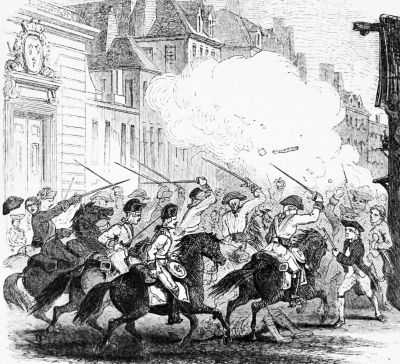
FIRST RIOT IN THE FAUBOURG ST. ANTOINE.
It was now, however, too late to retract. The train was in motion and could not be stopped. The meeting had been appointed for the 27th of April, but was postponed until the 4th of May. Another effort, and one still more desperate, was now made to prevent the meeting. By bribery, secret agents, and false rumors, a riot was fomented in Paris. It was apparently judged that if fifty thousand men could be turned loose into the streets, starving and without work, to pillage and destroy, it would authorize the concentration of the army at Paris; the deluded rioters could be easily shot down, and it could plausibly be affirmed that public tranquility required the postponement of the meeting of the States. The mob was roused by secret instigators. Guns were skillfully placed here and there, which they could seize. Two cart-loads of paving-stones were placed in their way. For twenty-four hours a tumultuous mass of people were left to do as they pleased, apparently waiting for the tumult to gain strength.
But the effort was a failure; it proved but an artificial mob, and the outbreak almost died of itself. One house, that of M. Reveillon, was sacked, and the wine-bottles from his cellar distributed through the streets. At length the soldiers were called in, and at the first discharge of the guns the riot was quelled. How many were shot down by the discharge of grapeshot is uncertain. The court made a foolish endeavor to exaggerate the disturbance, and represented that the people were ferocious in violence. Others, on the popular side, represented that multitudes were assembled from curiosity to see what was going on, that the streets were swept with grapeshot, and that hundreds of innocent spectators were cut down. M. Bailly, on the contrary, says, that the rioters fled as soon as the soldiers appeared, and that no one was injured.
The court did not venture to prosecute inquiries respecting the outbreak.[92]
The cold winds of winter were now sweeping over France. All the industrial energies of the nation were paralyzed. The loss of the harvest had created a general famine, and famine had introduced pestilence. Men, women, and children, without number, wandered over the highways, and by a natural instinct flocked to Paris. The inhabitants of the city looked appalled upon these multitudes, with haggard faces and in rags, who crowded their pavements. They could not be fed, and starving men are not willing to lie down tranquilly and die when they have strong arms to seize that food which the rich can obtain with money. The eloquent and impassioned writers of the day had fully unveiled to the nation the abuses which it had for ages endured, and yet the people, with wonderful patience and long-suffering, were quietly waiting for the meeting of the States-General, as the only means for the redress of their grievances.
On the 4th of May, 1789, the States-General were convened at Versailles. The clergy and the nobility appeared, by royal decree, magnificently attired in purple robes emblazoned with gold, and with plumed hats. The deputies of the Third Estate were enjoined to present themselves in plain black cloaks and slouched hats, as the badge of their inferiority.[93] On Saturday, the 2d of May, the king gave a reception, in the magnificent audience-chamber of the palace, to the delegates. When one of the nobles or of the high clergy presented himself both of the folding doors were thrown open as his name was announced; but when one of the Third Estate was presented one door only was thrown back. This studied indignity was of course annoying to men who were really the most distinguished in the realm, and who were conscious of their vast superiority to the corrupt and decaying aristocracy.[94]
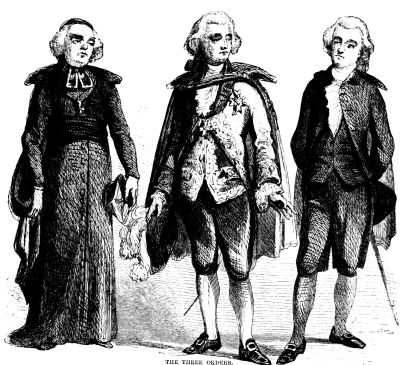
THE THREE ORDERS.
On the Paris Avenue at Versailles there was an immense hall called the Salle des Menus, which no longer exists. It was sufficiently large to contain the twelve hundred deputies, and in whose spacious galleries and wide side-aisles four thousand spectators could be assembled. It was a magnificent hall, and was ornamented for the occasion with the highest embellishments of art. Here the king could meet all the deputies of the three orders. But the nobles and the clergy had already formed the plan still to keep the power in their own hands by insisting that the States should meet in three separate chambers and give three separate votes. Thus three hundred nobles and three hundred clergy would give two votes, and six hundred of the people but one. This was the last chance for the privileged class to retain their domination, and this battle they would fight to desperation. The people were equally determined not to be thus circumvented. The privileged class, resolved upon the accomplishment of their plan, had prepared for themselves two smaller halls, one for the nobility and one for the clergy.
FOOTNOTES:
CHAPTER IX.
ASSEMBLING OF THE STATES-GENERAL.
Opening of the States-General.—Sermon of the Bishop of Nancy.—Insult to the Deputies of the People.—Aspect of Mirabeau.—Boldness of the Third Estate.—Journal of Mirabeau.—Commencement of the Conflict.—First Appearance of Robespierre.—Decided Stand taken by the Commons.—Views of the Curates.—Dismay of the Nobles.—Excitement in Paris.—The National Assembly.—The Oath.
On the 4th of May, 1789, the day of the opening of the States-General, a solemn procession took place. Nearly all Paris flocked out to Versailles, which is but ten miles from the metropolis, and countless thousands from the surrounding regions crowded the avenues of the city of the court. The streets were decorated with tapestry. The pavements, balconies, and house-tops were covered with spectators. Joy beamed from almost every face,[95] for it was felt that, after a long night, a day of prosperity was dawning. The court, the clergy, and the nobles appeared in extraordinary splendor; but, as the procession moved along, it was observed that the eyes of the multitude, undazzled by the pageant of embroidered robes and nodding plumes, were riveted upon the six hundred deputies of the people, in their plain garb—the advance-guard of freedom's battalions. They were every where greeted, as they moved along, with clapping of hands and acclaim which seemed to rend the skies.
"Rapturous, enchanting scene!" exclaims Ferrières, "to which I faintly strive to do justice. Bands of music, placed at intervals, filled the air with melodious sounds. Military marches, the rolling of the drums, the clang of trumpets, the noble chants of the priests, alternately heard without discordance, without confusion, enlivened this triumphal procession to the temple of the Almighty."
On their arrival at the church, the three orders were seated on benches placed in the nave. The king and queen occupied thrones beneath a canopy of purple velvet sprinkled with golden fleur de lis. The princes and princesses, with the great officers of the crown and the ladies of the palace, occupied conspicuous positions reserved for them by the side of their majesties. After the most imposing ceremonies, and music by a majestic choir, "unaccompanied by the din of instruments," the Bishop of Nancy preached a sermon enforcing the sentiment that religion constitutes the prosperity of nations.[96]
It was a noble discourse, replete with political wisdom and Christian philosophy. The two can never be dissevered. In glowing colors he depicted the vices of the financial system, and showed the misery and demoralization which it necessarily brought upon the people. "And it is," said he, "in the name of a good king, of a just and feeling monarch, that these miserable exactors exercise their acts of barbarism." This sentiment, so complimentary to the personal character of the king, so denunciatory of the institutions of France, was received with a general burst of applause, notwithstanding the sacredness of the place, and the etiquette of the French court, which did not allow applause in the presence of the king even at the theatre.[97] With these religious ceremonies the day was closed.
The next day, May 5th, the court and all the deputies of the three orders were assembled in the great hall, to listen to the instructions of the king. And here, again, the deputies of the people encountered an insult. A particular door was assigned to them, a back door which they approached by a corridor, where they were kept crowded together for several hours, until the king, the court, the nobles, and the clergy had entered in state at the great door, and had taken their seats. The back door was then opened, and the deputies of the people, in that garb which had been imposed upon them as a badge of inferiority, were permitted to file in and take the benches at the lower end of the hall which had been left for them.[98]
As they entered, the galleries were filled with spectators. The king and queen were seated upon a throne gorgeously decorated. The court, in its highest splendor, nearly encircled the throne. The nobility and the clergy, with plumes and robes of state, occupied elevated seats. All eyes were fixed upon the deputies as they entered one by one, plainly dressed, with slouched hat in hand. Mirabeau, in particular, attracted universal observation. He was not only by birth and blood an aristocrat, but he was an aristocrat in taste and manners. The spirit of revenge had driven him into the ranks of the people. As he strode along the aisle to his seat, he turned a threatening glance to the plumed and embroidered noblesse, from whose seats he had been driven, and a smile, haughty and bitterly menacing, curled his lips.[99]
The king's speech was favorably received. He appeared before the representatives with dignity, and recited very appropriately the cordial and conciliatory words which Necker had placed in his mouth. On finishing his speech, he sat down and put on his plumed hat. The clergy and the nobles, in accordance with custom, did the same. But to their astonishment, the Third Estate also, as by an instinctive simultaneous movement, placed their slouched hats upon their heads. The nobles, amazed at what they deemed such insolence of the people, shouted imperiously, "Hats off, hats off!" But the hats remained, as if glued to the head. The king, to appease the tumult, again uncovered his head. This necessitated the nobles and the clergy to do the same. Immediately the Third Estate followed their example, and, for the remainder of the session, all sat with uncovered heads.[100] When the last States-General met, the Third Estate were compelled to throw themselves upon their knees in the presence of the king, and to address him only upon their knees.[101]
When Necker arose to speak, all eyes were riveted and all ears were on the alert. As the organ of the king and his council, the minister was to communicate the real opinions and intentions of the court. The clergy and the nobility were agreeably disappointed; but the people, on their back benches, listened silent and sorrowful. They heard none of those noble ideas of equality and liberty which they were ready to receive with enthusiastic acclaim. Necker was evidently trammeled by the king, the court, and the nobles, now uniting in the feeling that the rising power of the Third Estate must be repressed. Thus ended the second day.
Mirabeau had commenced a journal, to contain, for popular information, a record of the proceedings of the States-General. The court promptly issued a decree prohibiting the publication of this journal, and also prohibiting the issuing of any periodical without permission of the king. A rigid censorship of the press was thus re-established, and the deputies were excluded from all effectual communication with their constituents. This was another measure of folly and madness. It led individual members to issue written journals, which were read in the saloons, the clubs, and at the corners of the streets to excited multitudes, and it induced thousands to crowd the spacious galleries of the hall to listen to the debates. Thus the speakers were animated by the presence of four thousand of the most earnest of the people, eager to applaud every utterance in behalf of popular liberty. The public mind was also increasingly irritated by the petty persecution; so much so, that at length the king thought it not safe to enforce the decree, and the defiant Mirabeau soon resumed the publication of his journal, under the title of Letters to my Constituents.[102]
The next day the deputies of the Third Estate at the appointed hour repaired to the hall; but they found there none either of the clergy or of the nobles. These two parties, resolved to perpetuate the division of orders, had met in their respective halls and had organized as distinct bodies. The Third Estate, assuming the name of the Commons, abstained from any organic measures and waited to be joined by their colleagues. Thus matters continued for several days. Every effort was made on the part of the clergy and nobles to ensnare the Commons into some measure which would imply their organization as the Third Estate, but all was in vain. Assuming that they were a meeting of citizens assembled by legitimate authority to wait for other citizens that they might organize a political assembly, they merely chose a temporary chairman for the preservation of order, and waited.[103]
Here, then, the vital question was to be decided whether the States-General should compose one body where the majority should rule, or three separate bodies where two could unite, a perpetual majority, against one. Upon this question the whole issue of reform was suspended. All equally understood the bearings of the question, and all equally saw that there was no room for compromise. It was a death-struggle. If united in one assembly the people would have a majority, and could maintain popular rights. If there were three bodies the people would be in a hopeless minority, having two against them. The attention of all France was engrossed by the conflict, and the nation, with all its interests paralyzed, began to grow impatient of the delay. "The nobles," M. Bailly writes, "decreed that the deliberation by order, and the power of each order to put a veto on the proceedings of the other two, were part of the very constitution of the monarchy, and that they must maintain them as the defenders of the throne and freedom. What a strange decree! The representatives of about two hundred thousand individuals, or more, who are nobles take upon themselves to decide, and in their own favor, a question that concerns twenty-five millions of men. They assume for themselves the right of the veto; they declare the powers and the principles of the constitution; and who are they more than others who thus declare?"[104]
During this protracted conflict the higher clergy cunningly devised the following plan to place the Commons in a false position: They sent an imposing delegation, headed by the Archbishop of Aix, with a pathetic allusion to the miseries of the people, and entreated the Commons to enter into a conference to assuage their sufferings. The snare was shrewdly contrived. If the Commons assented, it was the commencement of business with three chambers; if they refused, the clergy would apparently be those alone who regarded the starving population. For a moment there was much embarrassment.
A young man rose in the Assembly, who was unknown to nearly all the members, and in a calm, distinct, deliberate voice, which arrested universal attention, said:
"Go, tell your colleagues that we are waiting for them here to aid us in assuaging the sorrows of the people; tell them no longer to retard our work; tell them that our resolution is not to be shaken by such a stratagem as this. If they have sympathy for the poor, let them, as imitators of their Master, renounce that luxury which consumes the funds of indigence, dismiss those insolent lackeys who attend them, sell their gorgeous equipages, and with these superfluities relieve the perishing. We wait for them here."[105]
The snare was adroitly avoided. There was a universal hum of approval, and all were inquiring the name of the young deputy. This was the first public appearance of Maximilian Robespierre.[106]
At last, on the 27th of May, twenty-two days after the convening of the States, the Commons sent a deputation to the halls of the clergy and of the nobility, urging them, in the name of the God of peace, to meet in the hall of the Assembly to deliberate upon the public welfare. This led to a series of conferences and of suggested compromises from the king and the court which continued for a fortnight, and all of which proved unavailing. At last, on the 10th of June, Mirabeau arose, and said,
"A month is passed.[107] It is time to take a decisive step. A deputy of Paris has an important motion to make. Let us hear him."
The Abbé Sièyes[108] then rose and proposed to send a last invitation to the other orders to join them; and, if they refused, to proceed to business, not as a branch of the convention, but as the whole body. The proposition was received with enthusiasm. This was on Wednesday. As the next day, Thursday, was appropriated to religious solemnities, Friday, the 12th, was fixed upon as the day in which this important summons was to be sent.[109]
This last appeal was sent in the following words, which the committee from the Commons were charged to read to the clergy and the nobles, and a copy of which they were to leave with them:
"Gentlemen, we are commissioned by the deputies of the Commons of France to apprise you that they can no longer delay the fulfillment of the obligation imposed on all the representatives of the nation. It is assuredly time that those who claim this quality should make themselves known by a common verification of their powers, and begin at length to attend to the national interest, which alone, and to the exclusion of all private interests, presents itself as the grand aim to which all the deputies ought to tend by one general effort. In consequence, and from the necessity which the representatives of the nation are under to proceed to business, the deputies of the Commons entreat you anew, gentlemen, and their duty enjoins them to address to you, as well individually as collectively, a last summons to come to the hall of the States, to attend, concur in, and submit like themselves to the common verification of powers. We are, at the same time, directed to inform you that the general call of all the bailliages convoked will take place in an hour; that the Assembly will immediately proceed to the verification, and that such as do not appear will be declared defaulters."
This summons, so bold and decisive, excited not a little consternation in both of the privileged bodies. The curates among the clergy received the message with applause, and were in favor of immediate compliance. But their ecclesiastical superiors held them in check, and succeeded in obtaining an adjournment.
The Commons waited the hour, and then proceeded to the examination of the credentials of the deputies. This occupied three days. On the first day three of the curates came from the clergy and united with them. They were received with enthusiasm. On the second day six came, on the third ten, and then it was announced that one hundred and forty were coming in a body. This excited thorough alarm with all the high dignitaries of Church and State. "The aristocracy," says Thiers, "immediately threw itself at the feet of the king. The Duke of Luxembourg, the Cardinal de la Rochefoucault, the Archbishop of Paris, implored him to repress the audacity of the Tiers Etat and to support their rights which were attacked. The Parliament proposed to him to do without the States, promising to assent to all the taxes. The king was surrounded by the princes and the queen. This was more than was requisite for his weakness. They hurried him off to Marly in order to extort from him a vigorous measure."
This state of things had secured perfect reconciliation between the court and the aristocracy. The lines were now distinctly drawn; the king, nobles, and clergy on one side, the people on the other. The excitement in Paris during this protracted conflict was very great. A large wooden tent was erected in the garden of the Palais Royal, where a crowd was almost constantly gathered to receive the news brought by couriers from Versailles. At every street corner, in every café, the subject was discussed. Almost every hour produced a pamphlet. "There were thirteen issued to-day," writes Arthur Young, "sixteen yesterday, ninety-two last week." In the mean time the court was concentrating the troops from all parts of the kingdom around Paris and Versailles, and a hundred pieces of field artillery menaced the two cities.
It was now necessary to give the Assembly a name, a name which should define its functions. The assumption that they were the nation would be bold and defiant. The admission that they were but a branch of the national representation would be paralyzing. The Assembly was impelled to prompt and decisive action by the apprehension, universally entertained, that the court might employ the army, now assembled in such force, to arrest the principal deputies, dissolve the States, and, if the people of Paris manifested any opposition, to surround the city and starve them into subjection. Sièyes, in a celebrated pamphlet which he had issued to prepare the public mind for this movement, had said, "The Third Estate alone, they affirm, can not form the States-General. Well! so much the better; it shall compose a National Assembly." A body which, by universal admission represented ninety-six hundredths of the nation, might with propriety take the name of National.[110]
Upon the morning of the 17th of June, after a long and animated discussion of the preceding day, the Commons met to decide this all-important question. The king, the court, and the aristocracy were greatly alarmed. If this bold, resolute body were the nation, what were they? Nothing. The people were intensely excited and animated. Thousands in every conceivable vehicle flocked out from Paris to Versailles. The galleries of the vast hall, rising like an amphitheatre, were crowded to their utmost capacity. The building was surrounded and the broad avenues of Versailles thronged with the excited yet orderly multitude.
The members had but just assembled when the president, Bailly, was summoned to the chancellor's office to receive a message from the king. It was well understood that this message would be a regal prohibition for them to do any thing without the concurrence of the three orders. The Assembly immediately, with firmness, postponed the reception of the message until the vote then before them was taken. Again they were interrupted by a communication from the nobles, who in their alarm made a desperate endeavor to thwart the proceedings. But the Assembly calmly and firmly proceeded, and by a vote of four hundred and one against ninety declared themselves the National Assembly.
In the presence of four thousand spectators the deputies then arose, and with uplifted hands took the oath of fidelity. As with simultaneous voice they pronounced the words "We swear," a burst of acclamation rose from the galleries, which was caught by those outside the door and rolled along the streets like reverberating thunder. "Vive le Roi! Vive l'Assemblée Nationale!" was the cry which came from gushing hearts, and thousands in intensity of emotion bowed their heads and wept.
A more heroic deed than this history has not recorded. It was a decisive movement. It gave the people an organization and arrayed them face to face against royalty and aristocracy. The king, the court, the nobles, and the higher clergy were all against them. They were surrounded with armies. They were unarmed and helpless, save in the righteousness of their cause. They were menaced with all the terrors of exile, the dungeon, and the scaffold; but, regardless of all these perils, faithful to the sacred cause of popular liberty, they pledged in its support their lives, their fortunes, and their sacred honor. Even Alison, the unrelenting foe of popular rights, the untiring advocate of aristocratic assumption, is constrained to say,
"It is impossible to refuse a tribute of admiration to those intrepid men, who, transported by a zeal for liberty and the love of their country, ventured to take a step fraught with so many dangers, and which, to all appearance, might have brought many to prison or the scaffold. Few situations can be imagined more dignified than that of Bailly, crowning a life of scientific labor with patriotic exertion, surrounded by an admiring assembly, the idol of the people, the admiration of Europe."
FOOTNOTES:
CHAPTER X.
THE NATIONAL ASSEMBLY.
First Acts of the Assembly.—Confusion of the Court.—Hall of the Assembly closed.—Adjournment to the Tennis-court.—Cabinet Councils.—Despotic Measures.—The Tennis-court closed.—Exultation of the Court.—Union with the Clergy.—Peril of the Assembly.—The Royal Sitting.—Speech of the King.
The first measure adopted by the National Assembly was worthy of itself. It was voted that the taxes already decreed, though not legally assessed by the consent of the nation, should be punctiliously paid. Instead of repudiating the enormous public debt, they appropriated it as their own and placed it under the safeguard of the nation. They then appointed a committee immediately to attend to the distresses of the people, and to devise measures for their relief. How vast the contrast between this magnanimity of the people and the selfishness and corruption of the court, as developed through ages! Thus terminated the eventful 17th of June, 1789, which may almost be considered the birthday of the nation of France. Before this event the people had hardly a recognized existence. Though the cradle of its infancy has been rocked with storms, and though in its advancing manhood it has encountered fearful perils and the sternest conflicts, yet its progress is surely onward to dignity and repose.
At an early hour the Assembly adjourned. Couriers from the hall hastened to expectant Paris with the glad tidings. The most fervid imagination can not conceive the joyful enthusiasm which the intelligence excited in the metropolis and throughout France. The king and his court were at this time a few miles from Versailles, in the Palace of Marly. The clergy and the nobles, in consternation, sent a committee of their most prominent members to implore the interposition of the royal power.[111] But the king had not sufficient nerve for so decisive an act. It was urged that the nobility and the clergy should immediately combine in forming a united body which should constitute an upper house; and thus naturally the kingdom would have fallen into a monarchy like that of England, with its House of Lords and its House of Commons. This would have been a most salutary reform, and would have prepared the way for the gradual and safe advance of the nation from servitude to freedom. But, with madness almost inconceivable, the high nobility with contempt repelled all idea of union.[112] They deemed it a degradation to form a permanent association with the lower clergy and with men who had been within a few centuries ennobled by a decree of the king. Thus the formation of two separate chambers was rendered impossible by the folly of those very men whose existence depended upon it. Thus all was confusion and dismay with the nobles and the clergy, while unanimity and vigor pervaded every movement of the Assembly.[113]
In this state of affairs a large proportion of the clergy, composing nearly all the parish ministers, were in favor of uniting with the Assembly. The Duke of Orleans also, among the nobility, led a small minority of the nobles in advocacy of the same measure. But the court generally entreated the king immediately to dissolve the Assembly, by violence if needful. The popular excitement in Paris and in Versailles became intense. The only hope of the people was in the Assembly. Its dissolution left them hopeless and in despair. The king was vacillating, intensely anxious to crush the popular movement, now become so formidable, but still fearing to adopt those energetic measures by which alone it could be accomplished. He at length decided, in accordance with that system of folly with which the court seems to have been inspired, to resort to the very worst measure which could have been adopted. On Friday the 17th of June the majority of the clergy, consisting of a few prelates and about one hundred and forty curates, resolved to withdraw from the dignitaries of the Church and unite with the people, in the Assembly, the next day. The prospect of such an accession to the popular branch struck consternation into the ranks of the privileged classes. A delegation of bishops and nobles in the night hastened to the king at Marly, and persuaded him to interfere to prevent the junction.
Yielding to their importunities he consented to shut up the hall of Assembly the next day, and to guard the entrance with soldiers, so that there might be no meeting. As an excuse for this act of violence it was to be alleged that the hall was needed for workmen to put up decorations, in preparation for a royal sitting which was to be held on Monday. The king thus gained time to decide upon the measures which he would announce at the royal sitting.[114]
At six o'clock in the morning of Saturday, placards were posted through the streets of Versailles announcing this decree. At seven o'clock, M. Bailly, president of the Assembly, received a note from one of the officers of the king's household, informing him of the decision. The Assembly had adjourned the evening before to meet at eight o'clock in the morning. It was, of course, proper that such a communication should have been made, not to the president at his lodgings, but to the assembled body. It was a stormy morning; sheets of rain, driven by a fierce wind, flooded the streets. At the appointed hour the president, accompanied by several deputies, approached the hall. They found the door guarded by a detachment of the royal troops, and a large number of the representatives assembled before it. Admission was positively refused, and it was declared that any attempt to force an entrance would be repelled by the bayonet.[115]
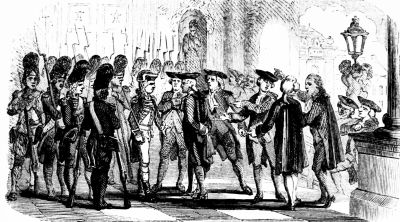
THE DOORS OF THE ASSEMBLY CLOSED AND GUARDED.
The Assembly and the people were greatly alarmed: measures of violence were already commenced. Their immediate dissolution was menaced, and thus were to perish all hopes of reform. The rain still fell in torrents. There was no hall in Versailles to which they could resort. Some proposed immediately adjourning to Paris, where they could throw themselves upon the protection of the masses. This measure, however, was rejected as too revolutionary in its aspect. One suggested that there was in the city an old dilapidated tennis-court, and it was immediately resolved to assemble upon its pavements. The six hundred deputies, now roused to the highest pitch of excitement and followed by a vast concourse of sympathizing and applauding people, passed through the streets to the unfurnished tennis-court. Here, with not even a seat for the president, the Assembly was organized, and Bailly, in a firm voice, administered the following oath, which was instantly repeated in tones so full and strong, by every lip, as to reach the vast concourse which surrounded the building:
"We solemnly swear never to separate, and to assemble wherever circumstances shall require, until the constitution of the kingdom is established, and founded on a solemn basis."
Every deputy then signed this declaration excepting one man; and this Assembly so nobly respected private liberty as to allow him to enter his protest upon the declaration.
It was now four o'clock in the afternoon, and the Assembly, having immortalized the place as the cradle of liberty, adjourned.
The next day was the Sabbath, and Monday had been appointed for the royal sitting. The excitement of the court at Marly now amounted almost to a tumult of consternation. Necker, the minister, was proposing measures of conciliation, and had drawn up a plan which would probably have been accepted by the people, for none then wished for the overthrow of the monarchy.[116] All the leaders in the Assembly were united in the desire to preserve the monarchical form of government. Surrounded as they were by thrones, England, not America, was their model. They wished for a constitutional monarchy where the voice of the people should be heard, and where all the citizens should live in the enjoyment of equal rights. Their wishes were wise and noble. Necker, closeted in council with the king and his cabinet, had at last brought the king and the majority of the cabinet over to his views, when an officer of the household came in and whispered to the king. The king immediately arose, and, requesting the council to await his return, left the room.
"This can only be a message from the queen," said M. de Montmorin to Necker; "the princes of the blood have got her to interfere, and persuade the king to adjourn his decision."
It was so. After half an hour the king returned, declined giving his assent to the plan till after another meeting, and dismissed the council. The royal sitting was also postponed until Tuesday.
On Monday, the 22d, the king held another council at Versailles. His two brothers, Count of Provence (Louis XVIII.) and Count d'Artois (Charles X.), with four other dignitaries of the privileged class, met with the council and took an active part in their deliberations. The project of Necker was here discussed and almost indignantly rejected. And yet the most earnest Royalists admit that it was extremely favorable to the privileged class, and no Republican can read it without being surprised that so much could then have been yielded by the people to aristocratic assumption.[117] But still this plan, in which Necker had gone to the utmost extreme of concession to propitiate the court, was peremptorily rejected, and another, insulting in its tone, imperious in its exactments, and utterly despotic in its principles, was adopted, and the Assembly was to be sternly dissolved. Necker remonstrated in vain, and at last, in mortification and despair, declared that he could not countenance such a message by his presence, and that he should be under the necessity of resigning his ministry. The feeble, vacillating king was in judgment and in heart with Necker, as were also one or two other of the ministers; but the queen, inheriting the spirit of Austrian despotism, acting through the two brothers of the king and the majority of the court, carried her point. This agitated discussion continued until midnight of Sunday, and then it was too late to propose the defiant message for the next day. The royal sitting was consequently postponed until Tuesday.[118]
To prevent the Assembly from meeting in the tennis-court on Monday, where the curates could join them, the Count d'Artois sent word to the keeper that he wished for the tennis-court on that day to play. On Monday morning, when the Assembly, according to its adjournment, met at the door, they found the entrance guarded, and they were excluded under the plea that the Count d'Artois wished for the room for his own amusement. Thus an Assembly, now consisting of seven or eight hundred of the most illustrious men of France, the representatives of twenty-five millions of people, were driven again into the streets, because a young nobleman wished for their room that he might play a game of ball.
Some of the younger deputies, exasperated by such treatment, were in favor of forcing an entrance. But armed bands, all under aristocratic officers, were parading the streets, bayonets glittered around the hall, and fifty thousand troops were within summons. The court did not disguise its merriment as it again contemplated the Assembly wandering houseless like vagabonds in the street. The nobles now felt exultant. They had compelled the king to adopt their plan. The Assembly was to be dismissed in disgrace, and an ample force of infantry, cavalry, and artillery was at hand to carry out their arrogant decree. They no longer feared the Assembly. They no longer hesitated openly to deride them.[119]
These representatives of the people, thus insulted beyond all endurance, were for a time in great perplexity. It so happened, however, that the curates who had voted to unite with the Third Estate, about one hundred and forty in number,[120] with the Archbishop of Vienne at their head, had met in the Church of St. Louis, intending to go from there in procession to join the Assembly. They immediately sent to the Commons an invitation to repair to the church where they were assembled, and, taking themselves the choir, left the nave for their guests. The clergy then descended and united with the Commons, where they were received with shouts, embracings, and tears. It was a solemn hour, and emotions too deep for utterance agitated all hearts. Fearful perils were now accumulating. Rumors had reached the ears of the deputies that the court intended the violent dissolution and dispersion of the Assembly. Thus would end all hopes of reform. The troops marching and countermarching, the new regiments entering the city, the hundred pieces of field artillery approaching, the cannon frowning before the door of their hall, the exultant looks and defiant bearing of their foes, all were portents of some decisive act.[121]
The morning of the 23d of June arrived. It was dark and stormy. At the appointed hour, ten o'clock, the members repaired to the hall of the Assembly to meet the king and court. In various ways they had received intimations of the measures which were to be adopted against them, and anxiety sat upon every countenance. As they approached the hall they found that the same disrespect which they had received on the 5th of May was to be repeated with aggravations. The court wished to humiliate the Commons; they did but exasperate them. The front entrance was reserved as before for the clergy and the nobles. The Commons were guided to a side door not yet opened, where they were left crowded together in the rain. They made several endeavors to gain admission, but could not, and at last sought refuge from the storm in an adjoining shed.[122]
In the mean time the two privileged classes approached with an unusual display of pompous carriages and gorgeous liveries. Files of soldiers protected them, bands of music greeted them, and with the most ostentatious parade of respect they were conducted to their seats. Then the side door was thrown open, and the Commons, with garments drenched and soiled, filed in to take the back benches left for them. They found the aristocracy in their seats, as judges awaiting the approach of criminals. The nobles and the high clergy could not repress their feelings of exultation. The Commons were now to be rebuked, condemned, and crushed.[123]
Military detachments patrolled the streets and were posted around the hall. Four thousand guards were under arms, and there were besides several regiments in the vicinity of Versailles, within an hour's call. A tumultuous mass of people from Paris and Versailles surged around the building and flooded all the adjoining avenues. As the carriage of the king and queen, surrounded by its military retinue, approached, no voice of greeting was heard. The multitude looked on silent and gloomy. The king was exceedingly dejected, for his judgment and heart alike condemned the measures he had been constrained to adopt. The queen was appalled by the ominous silence, and began to fear that they had indeed gone too far. When a few voices shouted "Vive le Duc d'Orleans!" she correctly interpreted this greeting of her implacable foes as an intended insult, and was observed to turn pale and almost to faint.
The king entered the hall with the queen, his two brothers, and his ministers, excepting Necker. The absence of Necker so exclusively arrested all thoughts, that the royal pageant was disregarded. Here again the monarch was received in silence, interrupted only by faint applause from the nobles.
The king hardly knew how to utter the arrogant, defiant words which had been put into his mouth. It was the lamb attempting to imitate the roar of the lion. He addressed a few words to the Assembly, and then placed his declaration in the hands of one of his secretaries to be read.[124]
It declared his intention to maintain the distinction of the three orders, and that they should vote separately; that they might occasionally meet together, with the consent of the king, to vote taxes. The decree of the Commons, constituting a National Assembly, was pronounced illegal and null. The deputies were forbid to receive any instructions from their constituents. No spectators were allowed to be present at the deliberations of the States-General, whether they met together or in different chambers. No innovation was to be allowed in the organization of the army. Nobles, and nobles only, were to be officers. The old feudal privileges were to remain unaltered. No ecclesiastical reforms were to be allowed, unless sanctioned by the clergy.[125]
Such were the prohibitions. Then came the benefits. The king promised to sanction equality of taxation, whenever the clergy and the nobles should consent to such taxation. The king promised to adopt any measures of finance and expenditure which the States-General should recommend, if he judged such measures compatible with the kingly dignity. He invited the States—which, be it remembered, were to be assembled in three chambers, the clergy and the nobility being thus able to outvote the Commons by two votes to one—to propose measures for abolishing lettres de cachet, measures which should not interfere with the power of repressing sedition, and of secretly punishing those whose relatives would be dishonored by their being brought to trial. They were also invited to seek the means of reconciling liberty of the press with the respect due to religion and to the honor of the citizens. In conclusion, the king threatened that if the Commons refused obedience to these declarations he would immediately dissolve the States, and again take the reins of government entirely into his own hands. This address was closed with the following words:
"I command you, gentlemen, immediately to disperse, and to repair to-morrow morning to the chambers appropriate to your order."[126]
The king then, with his attendant court, left the hall. A large part of the nobility and nearly all the bishops followed him. Exultation beamed upon their faces, for they supposed that the National Assembly was now effectually crushed.
FOOTNOTES:
CHAPTER XI.
REVOLUTIONARY MEASURES.
Speech of Mirabeau.—Approach of the Soldiers and Peril of the Assembly.—Elation of the Queen.—Triumph of Necker.—Embarrassment of the Bishops and the Nobles.—Letter of the King.—The Bishops and Nobles join the Assembly.—Desperate Resolve of the Nobles.—The Troops sympathizing with the People.
As the king, followed by the nobles and the clergy, left the hall, the Commons remained in their seats. The crisis had now arrived. There was no alternative but resistance or submission, rebellion or servitude. For a moment there was an entire silence. But the spirit of indomitable determination glowed on every cheek. Mirabeau was the first to rise. In a few of those impassioned sentences, which pealed over France like clarion notes, he exclaimed,
"Why this dictatorial language, this train of arms, this violation of the national sanctuary? Who is it who gives commands to us—to us to whom alone twenty-five millions of men are looking for happiness? Let us arm ourselves with our legislative authority, remember our oath—that oath which does not permit us to separate until we have established the constitution!"[127]
While he was yet speaking the Marquis of Brézé, one of the officers of the king, perceiving that the Assembly did not retire, advanced into the centre of the hall, and, in a loud authoritative voice, a voice at whose command nearly fifty thousand troops were ready to march, demanded,
"Did you hear the commands of the king?"
"Yes, sir," responded Mirabeau, with a glaring eye and a thunder tone which made Brézé quail before him, "we did hear the king's command; and you, who have neither seat nor voice in this house, are not the person to remind us of his speech. Go, tell those who sent you that we are here by the power of the people, and that nothing shall drive us hence but the power of the bayonet."[128]
The officer, the marquis, turned to the president, as if inquiring his decision.
"The Assembly," said M. Bailly, "resolved yesterday to sit after the royal session. That question must be discussed."
"Am I to carry that answer to the king?" inquired the marquis.
"Yes, sir," replied the president. The marquis departed. Armed soldiers now entered the hall accompanied by workmen to take away the benches and dismantle the room. Soldiers surrounded the building and the life-guard advanced to the door. But a word from the president arrested the workmen, and they stood with their tools in their hands contemplating with admiration the calm majesty of the Assembly. The body-guard had now formed a line in front of the hall, and the position of its members was full of peril. It was expected that all the prominent deputies would be arrested. A vote was then passed declaring the person of each member of the Assembly inviolable, and pronouncing any one guilty of treason who should attempt to arrest any one of the representatives of the nation.
In the mean time the nobility were in exultation. They deemed the popular movement now effectually crushed. In a crowd they hastened to the residences of the two brothers of the king, the Count of Provence and Count d'Artois, with their congratulations. They then repaired to the queen and assured her that the work was done and that all was safe. The queen was much elated, and received them with smiles. Presenting to them her son, the young dauphin, she said, "I intrust him to the nobility."
But at this very moment loud shouts were heard in the streets, swelling in a roar of tumult from countless voices, which penetrated the inmost apartments of the Palace of Versailles. All were eager to ascertain the cause. The whole body of the people by a simultaneous movement had gathered around the apartments of M. Necker, and were enthusiastically applauding him for refusing to attend the royal sitting.
This manifestation of popular feeling was so decisive, that alarm took the place of joy. Even the fears of the queen were aroused, and Necker was promptly sent for. He entered the palace accompanied by a crowd of many thousands who filled the vast court-yard. Both king and queen entreated Necker to withdraw his resignation, the king good-naturedly saying, "For my part I am not at all tenacious about that declaration."
Necker willingly complied with their request.[129] As he left the palace he informed the multitude that he should remain at his post. The announcement was received with unbounded demonstrations of joy. As the exultant shouts of the populace resounded through the castle, Brézé entered to inform the king that the deputies still continued their sitting, and asked for orders. The king impatiently walked once or twice up and down the floor, and then replied hastily, "Very well! leave them alone."
The next day, Wednesday, June 24th, the Assembly met in its hall and transacted business as quietly as if there had been no interruption. The clergy, who had joined them in the Church of St. Louis, still resolutely continued with them, notwithstanding the prohibition, and this day one half of the remaining clergy joined the Assembly. A few individuals from the nobles had also gone over. These two bodies thus broken were now quite powerless, and were fast sinking into insignificance. Thousands continually thronged the galleries and the aisles of the National Assembly, while no one seemed to turn a thought to the two chambers where the few remaining clergy and the nobles were separately lingering.
The next day, June 26th, after a long and exciting debate, in which the overwhelming majority of the nobles resolved to remain firm in opposition to union, forty-seven of their number, led by the Duke of Orleans and La Fayette, and embracing many of the most eminent for talent and virtue, repaired to the Assembly, where they were received with hearty demonstrations of joy. One of the nobles, Clermont Tonnere, speaking in behalf of the rest, said,
"We yield to our conscience, but it is with pain that we separate from our colleagues. We have come to concur in the public regeneration. Each of us will let you know the degree of activity which his mission allows him."[130]
The king now wrote a letter to his "faithful clergy" and his "loyal nobility," urging them to join the Assembly without further? delay. In compliance with this request, the next day, June 27th, the remaining portion of the nobility and of the clergy entered the hall and united with the Third Estate. The Marquis of Ferrières, who was one of the nobles who at this time united with the Assembly, records,
"It was now a grievous mortification and affliction to the nobility to join the Third Estate. The Vicomte de Noailles assured the nobles that the union would be but temporary; that the troops were coming up, and that in fifteen days every thing would be changed. The king sent a second letter assuring the nobles that the safety of the state and his own personal security depended upon the union. The assembly of nobles rose in a tumultuous manner, they were joined by the minority of the clergy, and entered in silence the hall of the Tiers Etat."
But the nobles and the dignitaries of the Church had hardly entered the hall of the Assembly ere they regretted the step. The Assembly was proceeding energetically in the formation of a constitution which would sweep away abuses. "Many of the nobles," says Ferrières, with wonderful frankness, "would have quitted the Assembly, but a partial secession would have done nothing. They were assured that the troops were coming up, were praised for the resistance they had already made, and were urged that they must dissemble a little longer. And, indeed, thirty regiments were now marching upon Paris. The pretext was public tranquillity; the real object the dissolution of the Assembly." Many petty artifices were resorted to still to keep up the appearance of distinct orders. The very day of the junction they endeavored to eject M. Bailly, a citizen, from the presidency, and to place a clerical noble, the Cardinal de la Rochefoucault, in the chair. The movement was promptly checked.[131] They for some time entered in a body after the openings of the sittings, and stood together, declining to sit down with the deputies. But M. Bailly, by his prudence and firmness, upheld the rights of the Assembly, and maintained the dignity of his post. It was indeed a strange spectacle for France to see a plain citizen, illustrious only in virtue and talent, presiding over the proudest nobles and the highest dignitaries of the Church.
The leading members of the Assembly were patriots seeking reform, not revolution. It was expected that this union would promote harmony.
"How honorable," said Mirabeau, "will it be for France that this great revolution has cost humanity neither offenses nor crimes." After describing the sanguinary scenes which accompanied the revolutions in England and America, he continued, "We, on the contrary, have the happiness to see a revolution of the same nature brought about by the mere union of enlightened minds with patriotic intentions. Our battles are only discussions. Our enemies are only prejudices that may indeed be pardoned. Our victories, our triumphs, so far from being cruel, will be blessed by the very conquered themselves.
"History too often records actions which are worthy only of the most ferocious animals; among whom, at long intervals, we can sometimes distinguish heroes. There is now reason to hope that we have begun the history of man, the history of brothers, who, born for mutual happiness, agree even when they vary, since their objects are the same and their means only are different."
This triumph of the Third Estate exasperated the privileged classes, and they were eager for revenge. It was evident that their exclusive power was imperiled, and they resolved, at whatever expense of bloodshed, to secure the dissolution of the Assembly. It soon became manifest to all that violence was meditated; that a secret conspiracy was ripening; that the nobles had united with the Assembly merely to subserve a momentary purpose, and that the Assembly was to be dispersed by force, the leaders punished, and that all who should interfere for their protection were to be shot down.[132]
"I could never ascertain," writes Necker, "to what lengths their projects really went. There were secrets upon secrets; and I believe that even the king himself was far from being acquainted with all of them. What was intended was probably to draw the monarch on, as circumstances admitted, to measures of which they durst not at first have spoken to him. With me, above all others, a reserve was maintained, and reasonably, for my indisposition to every thing of the kind was decided."
The nobles again became arrogant and defiant. Openly they declared their intentions to crush the Assembly, and boasted that with an army of fifty thousand men they would bring the people to terms.[133] Loaded cannon were already placed opposite the hall, and pointed to the doors of the Assembly. This state of menace and peril excited the Parisians to the highest pitch, and united all the citizens high and low to defend their rights. The French soldiers, who came from the humble homes of the people, sympathized in all these feelings of their fathers and brothers. The women, as they met the soldiers in the streets, would ask, "Will you fire upon your friends to perpetuate the power of your and our oppressors?" Ere long there came a very decisive response, "No! we will not." Thus the soldiers who had been collected to overawe the capital were soon seen in most friendly intercourse with the citizens, walking with them arm in arm, comprehending the issues which now agitated the nation, and evidently ready to give their energies to the defense of the popular cause.
FOOTNOTES:
CHAPTER XII.
THE TUMULT IN PARIS.
Marshal Broglie.—Gatherings at the Palais Royal.—Disaffection of the Soldiers.—Imprisonment and Rescue.—Fraternization.—Petition to the Assembly.—Wishes of the Patriots.—Movement of the Troops.—Speech of Mirabeau.—New Menaces.—Declaration of Rights.—Dismissal of Necker.—Commotion in Paris.—Camille Desmoulins.—The French Guards join the People.—Terror in Paris.—Character of the King.
Notwithstanding the National Assembly was thus organized, rumors filled the air that the junction was but transient, and that the court was making preparation for some deed of violence. The citizens of Paris were in a great ferment, all business was at a stand, the poorer classes had no employment, and their families were actually perishing from hunger. Troops were continually parading the streets, and an army of fifty thousand men, now placed under the command of the veteran Marshal Broglie, encircled the city of Versailles. The spacious garden of the Palais Royal in Paris, surrounded by the most brilliant shops in Europe, was the general rendezvous of the populace anxiously watching the progress of events. The people in their misery had nothing to do but to meet together to hear the news from Versailles. Often ten thousand men were assembled in the garden, where impassioned orators harangued them upon their rights and upon their wrongs. The Duke of Orleans, with his boundless wealth, encouraged every insurrectionary movement. He was willing so far to renounce aristocratic privileges as to adopt a constitution like that of England, if he, as the head of the popular party, could be placed upon the throne, from which he hoped to eject his cousin Louis XVI.
It soon became evident that there was a Tiers Etat in the army as well as in the state. The French Guards, consisting of three thousand six hundred picked men, in the highest state of discipline and equipment, were stationed at Paris. They began to echo the murmurs of the populace. The declaration of the king had informed them that no reform whatever was to be tolerated in the army; that the common soldier was to be forever excluded from all promotion. The privates and subalterns were doomed to endure all the toil of the army and its most imminent perils, but were to share none of its honors or emoluments. The troops were governed by young nobles, generally the most dissolute and ignorant men, who merely exhibited themselves upon the field on parade days, and who never condescended even to show themselves in the barracks.
The discontent of the soldiers reached the ears of their officers. Apprehensive that by association with the people the troops might become allied to them by a common sympathy, the officers commanded the guards no longer to go into the streets, and consigned them to imprisonment in their barracks. This of course increased their exasperation, and, being left to themselves and with nothing to do, they held meetings very much like those which they had attended in the Palais Royal, and talked over their grievances and the state of the monarchy.[134] Patriotic enthusiasm rapidly gained strength among them, and they took an oath that they would not fire upon the people. The colonel of the regiment arrested eleven of the most prominent in this movement and sent them to the prison of the Abbaye, where they were to await a court-martial and such punishment as might be their doom. This was the 30th of June.[135] On the evening of that day, as a vast and agitated multitude was assembled at the Palais Royal, listening to the speakers who there, notwithstanding reiterated municipal prohibitions, gave intelligence of all that was passing at Versailles, tidings came of the arrest of the soldiers. A young man, M. Lourtalot, editor of a Parisian paper, mounted a chair and said,
"These are the brave soldiers who have refused to shed the blood of their fellow-citizens. Let us go and deliver them. To the rescue!"
There was an instantaneous cry, rising from a thousand voices in the garden and reverberating through the streets, "To the Abbaye!" The throng poured out of the gate, and, seizing axes and crowbars as they rushed along, every moment increasing in numbers, soon arrived at the prison, six thousand strong. There was no force there which could for a moment resist them. The doors were speedily battered down, the soldiers liberated and conducted in triumph to the Palais Royal. Here they were provided with food and lodging, and placed under the protection of a citizens' guard.
While on their way to the Palais Royal a squadron of cavalry was ordered to charge upon the people. They approached at full gallop, and then, regardless of their officers, reined in their horses, and, lifting their caps, with true French politeness saluted their citizen-friends. There was then a scene of fraternization such as the French metropolis alone can exhibit. Men and women ran out from the houses and the shops presenting to the dragoons goblets of wine, shouting "Vive le Roi! Vive la Nation!"[136]
The people were still disposed to love their king. They instinctively felt that his sympathies were with them. Thus far they desired only reform, not the overthrow of the monarchy. The court, however, were instructed by these scenes that they could not rely upon the French Guards to execute the bloody mandates they were about to issue. Hence vigorous efforts were immediately adopted to concentrate in the metropolis an efficient force of foreign mercenaries, Swiss and German troops, who would be less scrupulous in shooting down and trampling under iron hoofs the French people. The Parisians distinctly understood this movement, and one can hardly conceive of a measure more exasperating. It is worthy of record that the citizens, ascertaining that they had liberated one soldier who was accused of what they deemed a crime, immediately sent that one back to his prison cell.
The next day, July 1st, the populace at the Palais Royal, who were thus far under the guidance of the most virtuous, intelligent, and influential citizens, sent a committee to the National Assembly at Versailles urging them to interpose with the king for a pardon for the soldiers. This was a movement quite unexampled. The citizens, heretofore deprived of all political rights, had never before ventured to make their wishes known to their rulers. Even then it was considered by the privileged classes in the Assembly very impudent.[137] The Assembly very prudently sent back word to the Parisians, exhorting them to refrain from all acts of violence, and assuring them that the maintenance of good order was essential to the prosperity of their cause.[138] At the same time the Assembly sent a deputation to the king imploring his clemency for the soldiers.
Troops were, however, still rapidly approaching the city from different parts of the kingdom. The nobles and the higher clergy were throwing every possible obstruction in the way of either deliberation or action by the Assembly, and it was manifest to all that a conspiracy was in progress for its violent dissolution.[139]
The courtiers could not conceal their exultation, and began openly to boast that their hour of triumph was at hand. Fifteen regiments of Swiss and German troops were now between Paris and Versailles. It was supposed that they, without reluctance, would fire upon French citizens. It was very evident that the court was studiously endeavoring to foment disturbances in Paris, that an appeal to the military might be necessary. On the other hand, the leaders of the revolution were doing every thing in their power to keep the people calm. A very able pamphlet was circulated through the city, containing the following sentiments:
"Citizens! the ministers, the aristocrats, are endeavoring to excite sedition. Be peaceful, tranquil, submissive to good order. If you do not disturb the precious harmony now reigning in the National Assembly, a revolution the most salutary and the most important will be irrevocably consummated, without causing the nation blood or humanity tears."
One is bewildered in learning that these sentiments came from the pen of Jean Paul Marat![140]
The next day, the 2d of July, the king returned an answer to the deputation from the Assembly, that the soldiers should be pardoned as soon as order was re-established in the capital. Upon the receipt of the message at the Palais Royal, the guards were taken back to prison, from whence they were speedily released by a pardon from the king.
On the 3d of July, M. Bailly having resigned the presidency of the Assembly, the Archbishop of Vienne, one of the high clergy, who had warmly espoused the popular cause, was chosen president, and the Marquis de la Fayette, equally devoted to popular rights, was elected vice-president. Thus the two most important offices of the Assembly were conferred upon men selected from the highest ranks of the privileged class. But this act of conciliation did not in the least degree conciliate men who were determined at every hazard to perpetuate despotism.
The aspect of affairs was every hour becoming more threatening. New regiments of foreigners were continually marching into the metropolis, and occupying all the avenues which conducted to Paris and Versailles. Squadrons of horse were galloping through the streets and heavy artillery rumbling over the pavements of both the cities. The Elysian Fields, the Place Louis XV., the Field of Mars, presented the aspect of an encampment. Sentinels were placed around the French Guards, who were confined in their barracks, to prevent them from holding any intercourse with the citizens or with the other soldiers.[141] Versailles was encompassed by armies, and a battery of artillery was pointed at the very doors of the Assembly.
On Friday, the 10th of July,[142] Mirabeau rose in the Assembly, and proposed that the discussion of the Constitution should be suspended while a petition was sent to the king urging the removal of these menacing armies.
"Fresh troops," said he, "are daily advancing; all communications are intercepted. All the bridges and promenades are converted into military posts. Movements, public and secret, hasty orders and counter-orders, meet all eyes. Soldiers are hastening hither from all quarters. Thirty-five thousand men are already cantoned in Paris and Versailles. Twenty thousand more are expected. They are followed by trains of artillery; spots are marked for batteries; every communication is secured, every pass is blocked up; our streets, our bridges, our public walks are converted into military stations. Events of public notoriety, concealed facts, secret orders, precipitate counter-orders—in a word, preparations for war strike every eye and fill every heart with indignation."
At the same time a pamphlet was circulated through Paris, stating that the king was to hold another royal sitting on the 13th; that he had determined to enforce his declarations of the 23d of June; that the National Assembly was to be dissolved by violence, its leaders arrested, and Necker to be driven from the kingdom.
The tidings excited great consternation in the city, and the crowd in the Palais Royal began to talk of arming in self-defense. In the evening of that day an artillery company, which had been posted at the Hôtel des Invalides, came to the Palais Royal to fraternize with the people there. The citizens gave them a supper in the Elysian Fields, where they were joined by many troops from other regiments, and the friendly festivities were continued late into the hours of the warm summer night.[143]
This speech of Mirabeau was received with applause, and a deputation of twenty-four members was sent with a petition to the king. The address was drawn up by Mirabeau, and is of world-wide celebrity.[144]
"It is not to be dissembled," says Bailly, "that Mirabeau was in the Assembly its principal force. Nothing could be more grand, more firm, more worthy of the occasion than this address to the king. The great quality of Mirabeau was boldness. It was this that fortified his talents, directed him in the management of them, and developed their force. Whatever might be his moral character, when he was once elevated by circumstances he assumed grandeur and purity, and was exalted by his genius to the full height of courage and virtue."
Though Necker earnestly advised the removal of the troops, the king, now in the hands of his worst counselors, returned to the Assembly almost an insulting answer. He affirmed that the troops were mustered for the maintenance of public order and for the protection of the Assembly; and that if the members of the Assembly were afraid of their protectors, they might adjourn to Noyon or to Soissons, cities some fifty or sixty miles north of Paris, where, removed from the protection of the capital, they would have been entirely at the mercy of their enemies.[145]
"We have not," Mirabeau indignantly retorted, "asked permission to run away from the troops, but have requested that the troops may be removed from the capital."
Upon the reception of this answer from the king, La Fayette presented the Assembly a declaration of rights based upon that Declaration of American Independence which is almost the gospel of popular liberty. It is probable that Thomas Jefferson, who was then in Paris, aided La Fayette in preparing this paper. It affirmed that nature has made all men free and equal, that sovereignty resides in the nation, and that no one can claim authority which does not emanate from the people.
On the evening of this day, Saturday, July 11th, as Necker was dressing for dinner, he received a note announcing his dismissal. A confidential letter from the king at the same time informed him that the monarch was unable to prevent his removal, and urged the minister to leave the kingdom without delay, and not to communicate to any one the knowledge of his dismissal lest it should excite public disturbance.[146] Necker, true to the confidence thus reposed in him, quietly dined, and then taking his carriage, as if for an evening drive with his wife, took the direction to the Netherlands, the nearest frontier, and pressed on rapidly through the night.
The next day was the Sabbath, July 12th. Early in the morning an extraordinary degree of activity was observed among the troops. Infantry and artillery were marching and countermarching through the streets of Paris and Versailles. The next day, Monday, was secretly appointed for the great coup d'état, in which the National Assembly was to be dispersed, and the citizens of Paris, if they manifested any resistance, were to be mown down by grapeshot. Redoubts were thrown up upon the heights of Montmartre, where cannon could be placed which would command the metropolis. Enormous placards were posted, enjoining the people to remain at home and not to assemble in the streets. The numerous staff of Marshal Broglie were galloping in all directions, disgusting the people with their insolent and consequential airs.[147] A battery of cannon was placed at the Sevres bridge, cutting off all direct communication between Versailles and Paris. The Place of Louis XV. was filled with troops, presenting the aspect of an encampment. In the adjoining Elysian Fields the Swiss Guards, with four pieces of artillery, were drawn up in battle array.
The people wondered what all this meant. At an early hour the garden of the Palais Royal was filled with an anxious and inquiring crowd. About ten o'clock an unknown person announced that Necker was dismissed, and that a new ministry was organized, composed of members of most determined hostility to popular reform. These tidings explained the formidable military display, and excited universal alarm and indignation. A young man, Camille Desmoulins, sprung upon a table, his dress disarranged, his hair disheveled, his face flushed, his eyes gleaming with indignation and tears, and, with a pistol in each hand to protect himself from the police, shouted,
"To arms! to arms! This dismissal is but the precursor to another St. Bartholomew. This night the Swiss and German troops are to march to our massacre. We have but one resource; it is to defend ourselves."
The impassioned cry was immediately echoed by the multitude, "To arms! to arms!" A rallying sign was needed. Desmoulins plucked a green leaf from a tree and attached it to his hat. Instantly all the chestnut-trees which embellished the garden were stripped of their foliage, and the leaf became the pledge of union. The flash of a moment had brought the whole body of the populace into a recognized uniform and a rude organization.
An army of more than a hundred thousand souls was in an hour enlisted, inspired with deathless enthusiasm, and crying out for leaders and for weapons. The movement was now in progress which was to scatter like chaff the battalions of foreign mercenaries, and to prostrate in dust and ashes the court and the throne. But alas for man! the flame which cheers the fireside may lay palaces and temples and happy homes in ruins. A new power had arisen, and it proved to be as blind and ignorant as it was resistless. Had the populace been imbued with Christian principles and intelligence, blessings only would have resulted from their sway.
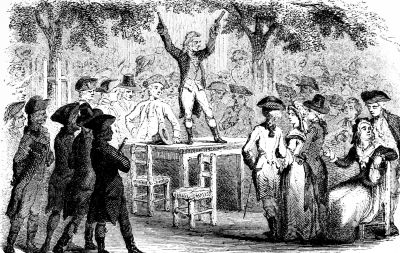
CAMILLE DESMOULINS IN THE PALAIS ROYAL.
In this wild hour of turmoil the multitude were bewildered, and knew not what to do. They had no arms, and no recognized leaders except the National Assembly at Versailles, from whom they were now cut off by detachments of troops.