Front matter (continued 9)
Reading edition
"I am, then, a prisoner, gentlemen. Charles I. was more fortunate than myself. His friends were permitted to accompany him to the scaffold."
Another morning dawned upon this unhappy family, and again they were led to the hall of the Assembly, where they passed the weary hours of another day in the endurance of all the pangs of martyrdom.
It was at length decided that the royal family, for safe keeping, should be imprisoned in the tower of the Temple. This massive, sombre building, in whose gloomy architecture were united the palace, the cloister, the fortress, and the prison, was erected and inhabited by the Knights Templar of the Middle Ages. Having been long abandoned it was now crumbling to decay. It was an enormous pile which centuries had reared near the site of the Bastille, and with its palace, donjon, towers, and garden, which was choked with weeds and the débris of crumbling walls, covered a space of many acres.
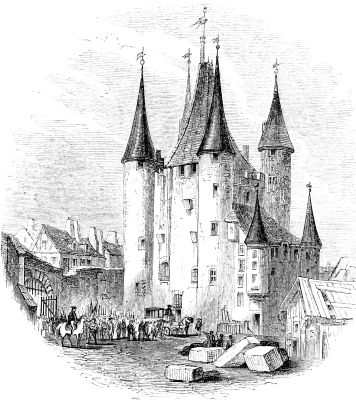
THE TEMPLE.
The main tower was one hundred and fifty feet high, nine feet thick at the base, surrounded by a wide, deep ditch, and inclosed by an immensely high wall. This tower was ascended by a very narrow flight of circular stairs, and was divided into four stories, each containing a bare, dismal room about thirty feet square. The iron doors to these rooms were so low and narrow that it was necessary to stoop almost double to enter them. The windows, which were but slits in the thick wall, were darkened by slanting screens placed over them, and were also secured by stout iron bars.
Such were the apartments which were now assigned to the former occupants of the Tuileries, Versailles, and Fontainebleau. It was a weary ride for the royal captives through the Place Vendôme and along the Boulevards to the Temple. An immense crowd lined the road. All the royal family, with Pétion, the mayor, occupied one carriage, and the procession moved so slowly that for two hours the victims were exposed to the gaze of the populace before the carriages rolled under the arches of the Temple. It was late in the afternoon when they left the Assembly, and the shades of night darkened the streets ere they reached the Temple.
The Assembly had surrendered the safe-keeping of the king to the Commune of Paris, and appropriated one hundred thousand dollars to meet the expenses of the royal family until the king should be brought to trial. Conscious that an army of nearly two hundred thousand men was within a few days' march of Paris, hastening to rescue the king, and that there were thousands of Royalists in the city, and tens of thousands in France, who were ready at any moment to lay down their lives to secure the escape of the monarch, and conscious that the escape of the king would not only re-enslave France, but consign every friend of the Revolution to the dungeon or the scaffold, they found it necessary to adopt the most effectual measures to hold the king securely. They, therefore, would no longer allow the friends of the king to hold free communication with him.
The Temple itself, by outworks, had been promptly converted into a fortress, and was strongly garrisoned by the National Guard. Twelve commissioners were without interruption to keep watch of the king's person. No one was allowed to enter the tower of the Temple without permission of the municipality. Four hundred dollars were placed in the hands of the royal family for their petty expenses. They were not intrusted with more, lest it might aid them to escape. A single attendant, the king's faithful valet Clery,[358] was permitted to accompany the captives. It does not appear that the authorities wished to add unnecessary rigor to the imprisonment. Thirteen cooks were provided for the kitchen, that their table might be abundantly supplied. One of these only was allowed to enter the prison and aid Clery in serving at the table, the expenses of which for two months amounted to nearly six thousand dollars.[359]
It was an hour after midnight when the royal family were led from the apartments of the Temple to which they had first been conducted to their prison in the tower. The night was intensely dark. Dragoons with drawn sabres marched by the side of the king, while municipal officers with lanterns guided their steps. Through gloomy and dilapidated halls, beneath massive turrets, and along the abandoned paths of the garden, encumbered with weeds and stones, they groped their way until they arrived at the portals of the tower, whose summit was lost in the obscurity of night. As in perfect silence the sad procession was passing through the garden, a valet-de-chambre of the king inquired in a low tone of voice whither the king was to be conducted.
"Thy master," was the reply, "has been used to gilded roofs. Now he will see how the assassins of the people are lodged."
The three lower rooms of the tower were assigned to the captives. They had been accompanied by several of their friends who adhered to them in these hours of adversity. All were oppressed with gloom, and many shed bitter tears. Still they were not in despair. Powerful armies were marching for their rescue, and they thought it not possible that the French people, all unprepared for war, could resist such formidable assailants. A week thus passed away, when on the 19th the municipal officers entered and ordered the immediate expulsion of all not of the royal family. This harsh measure was deemed necessary in consequence of the conspiracies which were formed by the Royalists for the rescue of the king. Unfeeling jailers were now placed over them, and, totally uninformed of all that was passing in the world without, they sank into the extreme of woe.
FOOTNOTES:
CHAPTER XXIX.
THE MASSACRE OF THE ROYALISTS.
Supremacy of the Jacobins.—Their energetic Measures.—The Assembly threatened.—Commissioners sent to the Army.—Spirit of the Court Party in England.—Speech of Edmund Burke.—Triumphant March of the Allies.—The Nation summoned en masse to resist the Foe.—Murder of the Princess Lamballe.—Apology of the Assassins.—Robespierre and St. Just.—Views of Napoleon.
The majestic armies of the Allies were now rapidly on the march toward France, and there was no force on the frontiers which could present any effectual resistance. La Fayette was at Sedan, about one hundred and fifty miles northwest of Paris, at the head of twenty thousand troops who were devoted to him. His opposition to the Jacobins had already caused him to be denounced as a traitor, and it was feared that he might go over to the enemy, and by his strong influence carry not only his own troops, but those of General Luckner with him. The condition of the Patriots was apparently desperate. The Allies were confident of a triumphant and a rapid march to Paris, where all who had sacrilegiously laid hands upon the old despotism of France would be visited with condign punishment.
The Jacobin Club was now the sovereign power in France. It was more numerous than the Legislative Assembly, and its speakers, more able and impassioned, had perfect control of the populace. The Jacobins had, by the insurrection, or rather revolution of the 10th of August, organized a new municipal government. Whatever measure the Jacobin Club decided to have enforced it sent to the committee which the club had organized as the city government at the Hôtel de Ville. This committee immediately demanded the passage of the decree by the Legislative Assembly. If the Assembly manifested any reluctance in obeying, they were informed that the tocsin would be rung, the populace summoned, and the scenes of the 10th of August renewed, to make them willing. Such was now the new government instituted in France.
The Commune of Paris, as this municipal body at the Hôtel de Ville was called, immediately entered upon the most vigorous measures to break up the conspiracy of the Royalists, that they might not be able to rise and join the invading armies of the Allies. The French Patriots had two foes equally formidable to dread—the emigrants with the Allies marching upon the frontiers, composing an army nearly two hundred thousand strong, and the Royalists in France, who were ready, as soon as the Allies entered the kingdom, to raise the standard of civil war, and to fall upon the Patriots with exterminating hand. There was thus left for the leaders of the Revolution only the choice between killing and being killed. It was clear that they must now either exterminate their foes or be exterminated by them. And it must on all hands be admitted that the king and the court, by refusing to accept constitutional liberty, had brought the nation to this direful alternative.
To prevent suspected persons from escaping, no one was allowed to leave the gates of Paris without the most careful scrutiny of his passport. A list was made out of every individual known to be unfriendly to the Revolution, and all such were placed under the most vigilant surveillance. The citizens were enjoined to denounce all who had taken any part in the slaughter of the citizens on the 10th of August. All writers who had supported the Royalist cause were ordered to be arrested, and their presses were given to Patriotic writers. Commissioners were sent to the prisons to release all who had been confined for offenses against the court. As it was feared that the army, influenced by La Fayette, might manifest hostility to the revolutionary movement in Paris, which had so effectually demolished the Constitution, commissioners were sent to enlighten the soldiers and bring them over to the support of the people. It was at first contemplated to assign the palace of the Luxembourg as the retreat of the royal family. The Commune of Paris, however, decided that the public safety required that they should be held in custody where escape would be impossible, and that their safe-keeping should be committed to the mayor, Pétion, and to Santerre, who had been appointed commander of the National Guards.
The Assembly, alarmed at the encroachments of the self-constituted Commune of Paris, ordered a re-election of a municipal government to take the place of that which the insurrection had dissolved. The Commune instantly dispatched a committee to inform the Assembly that if they made any farther move in that direction the tocsin should again be rung, and that the populace, who had stormed the Tuileries, should be directed against their hall. The deputies, overawed by the threat, left the Commune in undisputed possession of its power. The Commune now demanded of the Assembly the appointment of a special tribunal to punish the Royalists who had fired upon the people from the Tuileries, and those who "as conspirators and traitors" were ready to join the Allies as soon as they should enter France. The Assembly hesitated. The Commune sent Robespierre at the head of a deputation to inform them in those emphatic terms which he ever had at his command, that the country was in danger, that the Allies and emigrants were on the march, that no delay could be tolerated, and that if the decree were not immediately passed the tocsin should be rung. The appalling threat was efficient, and the decree, though some heroically opposed, was passed.[360] Such was the origin of the first revolutionary tribunal.
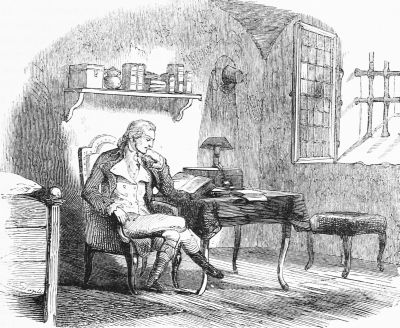
LA FAYETTE IN PRISON AT OLMUTZ.
As soon as the commissioners from Paris arrived at the camp of La Fayette they were by his orders arrested and imprisoned, and the soldiers took anew the oath of fidelity to the law and the king. The news of their arrest reached Paris on the 17th, and excited intense irritation. La Fayette was denounced more vehemently than ever, and a fresh deputation was dispatched to the army. La Fayette was now ruined. The court was ready to hang him for his devotion to liberty. The Jacobins thirsted for his blood because he thwarted their plans. Every hour his situation became more desperate, and it was soon evident that he could do no more for his country, and that there was no refuge for him but in flight. On the 20th, accompanied by a few friends, he secretly left his army, and took the road to the Netherlands. When he reached the Austrian outposts at Rochefort, he was arrested as a criminal in defiance of all law. With great secrecy he was taken into the interior of Austria, and thrown into a dungeon in the impregnable fortress of Olmutz. His only crime was that he had wished to introduce constitutional liberty to his country. This, in the eye of despots, was an unpardonable sin. Here we must leave him to languish five years in captivity, deprived of every comfort. Many efforts were made in vain for his release. Washington wrote directly to the Emperor of Austria in his behalf, but without effect. It was not till Napoleon, thundering at the walls of Vienna with his invincible legions, demanded the release of La Fayette, in 1797, that the doors of his dungeon were thrown open.[361]
The British people sympathized deeply with La Fayette, but the British government assailed him with unrelenting ferocity. On the 17th of March, 1794, General Fitzpatrick moved an address in the House of Commons, to his majesty, requesting his interference with the King of Prussia in behalf of La Fayette. Mr. Fox advocated the measure in a speech of great eloquence and power. Nothing can more clearly show the spirit of the court party in England at this time than the speeches made by them on this occasion. William Pitt assailed La Fayette in the most unfeeling manner, declaring that "he would never admit that La Fayette was a true friend of liberty or deserved well of his country or of Europe." "He said," writes Prof. Smyth, "every thing that it is painful to read—he was rendered insensible on this occasion to all the better notions of his education and natural intuitions of his understanding. There is no pleasure in reading the abstract of his speech. It might have been made by the most vulgar minister that ever appeared." Edmund Burke followed in a speech of unmeasured abuse. In glowing colors he depicted all the scenes of violence which had occurred in France, and, declaring La Fayette responsible for them all, concluded with the words, "I would not debauch my humanity by supporting an application like the present in behalf of such a horrid ruffian."[362] Mr. Windham followed in the same strain. He expressed exultation in view of the calamities which had fallen upon this great patriot. "La Fayette," said he, "has brought himself into that state into which all fomenters of great and ruinous revolutions must necessarily fall; he has betrayed and ruined his country and his king. I am not sorry. I rejoice to see such men drink deep of the cup of calamity which they have prepared for the lips of others; and I never will consent to do an act which will put a premium on revolution, and which will give the example of sanction to treason, and of reward to rebellion."
Such was the spirit of the court of St. James at this time. These speeches were made after La Fayette had been languishing for two years in the dungeons of Olmutz, exposed to almost every conceivable indignity, the particulars of which Mr. Fox had affectingly narrated. The debate was concluded by Mr. Dundas, who thanked Mr. Windham for his admirable speech. When the vote was taken but fifty were found in sympathy with La Fayette, while one hundred and thirty-two voted against him.
The two sovereigns of Prussia and Austria were now at Mayence. Sixty thousand Prussians were marching in single column by Luxembourg upon Longwy, flanked on the right by twenty thousand Austrians, and on the left by twenty-six thousand Austrians and Hessians. This majestic force was strengthened by several co-operating corps of French emigrants, destined to attack exposed positions, and to afford rallying points for treason. The invaders crossed the frontiers unimpeded, and after a short and bloody strife captured Longwy. Onward they rushed. The feeble, undisciplined patriots, could make no resistance, and fled rapidly before them. Thionville and Verdun were surrounded, and after a short but terrific storm of balls and shells capitulated. There were many Royalists in each of these towns, and they received the invaders with every demonstration of joy. Their daughters in congratulatory procession met the King of Prussia at the gates and strewed his path with flowers.
The garrison of Verdun might have held out for several days, though they would have eventually been compelled to surrender. General Beaurepaire urged very strenuously that they should maintain the siege to the last possible moment. But the defensive council of the city, with whom rested the decision, voted an immediate capitulation.
"Gentlemen," said Beaurepaire, "I have sworn never to surrender but with my life. You may live in disgrace, since you wish it; but as for me, faithful to my oath, behold my last words: I die free."
Immediately he discharged a pistol-shot through his brain, and fell dead before them. The Convention decreed to him the honors of the Pantheon, and granted a pension to his widow.
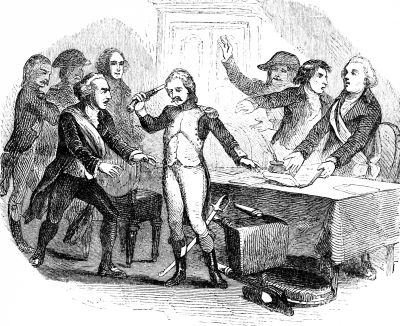
SUICIDE OF BEAUREPAIRE.
The victorious allies, having surmounted these first obstacles, now plunged into the defiles of the Argonne, and in fierce and bloody assaults drove before them the troops of Dumouriez, who had hoped in these forest-encumbered passes to present effectual resistance to the foe. The invaders were now triumphantly marching on the high-road to Paris, and fugitives were continually arriving in the metropolis, declaring that the army of the north was destroyed, and that there was no longer any obstacle to the advance of the enemy. No language can describe the consternation which pervaded the capital. The exultation in the enemy's camp was immense. The "cobblers and tailors," as the emigrants contemptuously called the Patriots, were running away, it was said, like sheep.[363]
As each day brought tidings of the fearful strides which the Allies were making toward the capital, indescribable terror was enkindled. The Constitutionalists and the Girondists were utterly paralyzed. But the leaders of the Jacobins—Danton, Robespierre, and Marat—resolved that, if they were to perish, their Royalist enemies should perish with them. It was known that the Royalists intended, as soon as the Allies should be in Paris, to rise, liberate the king, and with the immense moral force they would attain by having the king at their head, join the invaders. Nothing would then remain for the Revolutionists but exile, death, and the dungeon.[364]
It was now with them but a desperate struggle for life. They must either destroy or be destroyed. The first great peril to be apprehended was the rising of the Royalists in Paris. The barriers were immediately ordered to be closed, and guard-boats were stationed on the river that no one might escape. At the beat of the drum every individual was enjoined to repair to his home. Commissioners then, accompanied by an armed force, visited every dwelling. Party lines were so distinctly drawn that the Royalists could not easily escape detection. At the knock of the commissioners they held their breath with terror. Many attempted concealment in chimneys, in cellar-vaults, beneath the floors, and in recesses covered by pictures of tapestry. But workmen, accustomed to all such arts, accompanied the commissioners. Chimneys were smoked, doors burst open, and cellars, floors, and walls sounded. In one short night five thousand suspected persons were torn from their homes and dragged to prison. Every man was deemed guilty who could not prove his devotion to the popular cause.[365]
Still the enemy was approaching. "In three days," rumor said, "the Prussians will be in Paris." The whole city was in a state of phrensy, and ready for any deed of desperation which could rescue them from their peril. Danton entered the Assembly and ascended the tribune with pallid face and compressed lips. Silence, as of the grave, awaited his utterance.
"The enemy," said he, "threatens the kingdom, and the Assembly must prove itself worthy of the nation. It is by a convulsion that we have overthrown despotism; it is only by another vast national convulsion that we shall drive back the despots. It is time to urge the people to precipitate themselves en masse against their enemies. The French nation wills to be free, and it shall be."
There was lurking beneath these words a terrible significance then little dreamed of. Jacobins and Girondists were now united by the pressure of a common and a terrible danger. A decree was immediately passed for every citizen in Paris capable of bearing arms to repair to the Field of Mars, there to be enrolled to march to repel the Allies. It was the morning of the Sabbath. The générale was beat, the tocsin rung, alarm-guns fired, and placards upon the walls, and the voice of public criers, summoned every able-bodied man to the appointed rendezvous. The philosophic Vergniaud, in a word, explained to Paris the necessity and the efficacy of the measure.[366]
"The plan of the enemy," said he, "is to march directly to the capital, leaving the fortresses behind him. Let him do so. This course will be our salvation and his ruin. Our armies, too weak to withstand him, will be strong enough to harass him in the rear. When he arrives, pursued by our battalions, he will find himself face to face with our Parisian army drawn up in battle array under the walls of the capital. There, surrounded on all sides, he will be swallowed up by the soil which he has profaned."
In the midst of the uproar of the multitudes surging through the streets, as the bells were ringing, drums beating, and the armed citizens hurrying to the Field of Mars, the rumor was widely circulated that the Royalists had formed a conspiracy to strike down their jailers, break from their prisons, liberate the king, take possession of the city, rally all their confederates around them, and thus throw open the gates of Paris to the Prussians. It was manifest to all that, in the confusion which then reigned, and when the thunders of the Prussian and Austrian batteries were hourly expected to be heard from the heights of Montmartre, this was far from an impracticable plan. It was certain that the Royalists would attempt it, whether they had already formed such a plan or not.
It is, however, probable that shrewd men, foreseeing this peril, had deliberately resolved to hurl the mob of Paris upon the prisons for the assassination of all the Royalists, before emptying the city of its defenders to march to meet the foe. While the bewildered masses were in this state of terrific excitement, six hackney-coaches left the Hôtel de Ville, conducting twenty-four Royalist priests, who had refused to take the oath, to the prisons of the Abbaye. The people crowding around and following the carriages began to murmur. "Here are the traitors," said they, "who intend to murder our wives and children while we are on the frontiers."
The first carriage reached the door of the prison. One priest alighted. He was instantly seized, and fell pierced by a thousand poniards. It was the signal for the slaughter of the whole. The murderers fell upon every carriage, and in a few moments all but one, who miraculously escaped, were slain. This hideous massacre roused the populace as the tiger is roused when he has once lapped his tongue in blood. The cry was raised, "To the Carmelites, to the Carmelites." In this prison two hundred priests were confined. The mob broke in and butchered them all.
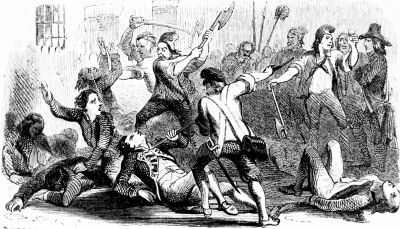
BUTCHERY AT THE CARMELITES.
A man by the name of Maillard headed this mob, which consisted of but a few hundred men. Having finished the work at the Carmelites and gorged themselves with wine, Maillard exclaimed, "Now to the Abbaye." The blood-stained crew rushed after him through the streets, and dashed in the doors of the prison. The Abbaye was filled with debtors and ordinary convicts as well as suspected aristocrats. As the mob rushed into the corridor one of the jailers mounted a stool, and, addressing the assassins, said, "My friends, you wish to destroy the aristocrats, who are the enemies of the people, and who meant to murder your wives and children while you were at the frontiers. You are right no doubt; but you are good citizens; you love justice; and you would be very sorry to steep your hands in innocent blood."
"Yes, certainly," one of the leaders replied.
"Well, then," continued the jailer, "when you are rushing like furious tigers upon men who are strangers to you, are you not liable to confound the innocent with the guilty?"
These thoughts seemed to impress them, and it was immediately decided that Maillard should judge each prisoner. He took his seat at a table; the prison list was placed in his hands, and the prisoners, one by one, were brought before his prompt and terrible tribunal. It was agreed, in order to spare unnecessary suffering, that when the judge should say, "Sir, you must go to the prison of La Force," as soon as the prisoner was led out into the court-yard he should be cut down.
A Swiss officer was first brought forward. "It was you," said Maillard, "who murdered the people on the 10th of August."
"We were attacked," the unfortunate man replied, "and only obeyed our superior officers."
"Very well," said Maillard, "we must send you to the prison of La Force."
He was led into the court-yard and instantly slain. Every Swiss soldier in the prison met the same fate. Thus the work went on with terrible expedition until one hundred and eighty were put to death. All the women were left unharmed. Many who were brought before the tribunal were acquitted, and the crowd manifested great joy in rescuing them as their friends. Amid these horrid scenes there were some gleams of humanity. The Governor of the Invalides was doomed to death. His daughter clasped her father in her arms and clung to him so despairingly that the hearts of the assassins were melted. One, in a strange freak, presented her with a cup of blood, saying, "If you would save your father drink this blood of an aristocrat." She seized the cup and drained it. Shouts of applause greeted the act, and her father was saved.[367]
All the night long these horrid scenes were continued. Every prison in Paris witnessed the same massacres, accompanied with every conceivable variety of horrors.
The unfortunate Princess Lamballe, bosom friend of Marie Antoinette, was confined in the prison of La Force. She was brought before the revolutionary judge, and after a brief interrogation she was ordered to "swear to love liberty and equality; to swear to hate the king, the queen, and royalty." "I will take the first oath," the princess replied; "the second I can not take; it is not in my heart." One of the judges, wishing to save her, whispered in her ear, "Swear every thing or you are lost." But the unhappy princess was now utterly bewildered with terror, and could neither see nor hear. Her youth and beauty touched the hearts even of many of these brutal men. They desired her rescue, and endeavored to lead her safely through the crowd. Cry out, said they, 'long live the nation,' and you will not be harmed. But as she beheld the pavement strewn with corpses of the slain, she could not utter a word. Her silence was taken for defiance. A sabre blow struck her down. The murderers fell upon her like famished wolves upon a lamb. Her body was cut into fragments, and a band of wretches, with her head and heart upon pikes, shouted "Let us carry them to the foot of the throne." They rushed through the streets to the Temple, and shouted for the king and queen to look out at the windows. A humane officer, to shield them from the awful sight, informed them of the horrors which were transpiring. The queen fainted. As the king and Madame Elizabeth bent over her, for hours they were appalled by the clamor of the rabble around the walls of the Temple.
At last the prisons were emptied, and the murderers themselves became weary of blood. It is impossible to ascertain the numbers who perished. The estimate varies from six to twelve thousand. The Commune of Paris, which was but the servant of the Jacobin Club, issued orders that no more blood should be shed. Assuming that the assassination was demanded by the public danger, and that the wretches who had perpetrated it had performed a patriotic though a painful duty, they rewarded them for their work. Nothing can more clearly show the terrible excitation of the public mind, produced by a sense of impending danger, than that a circular should have been addressed to all the communes of France, giving an account of the massacre as a necessary and a praiseworthy deed. In this extraordinary memorial, signed by the Administrators of the Committee of Surveillance, the writers say,
"Brethren and Friends,—A horrid plot, hatched by the court, to murder all the Patriots of the French empire, a plot in which a great number of members of the National Assembly are implicated, having, on the ninth of last month, reduced the Commune of Paris to the cruel necessity of employing the power of the people to save the nation, it has not neglected any thing to deserve well of the country.
"Apprised that barbarous hordes are advancing against it, the Commune of Paris hastens to inform its brethren in all the departments that part of the ferocious conspirators confined in the prisons have been put to death by the people—acts of justice which appear to it indispensable for repressing by terror the legions of traitors encompassed by its walls, at the moment when the people were about to march against the enemy; and no doubt the nation, after the long series of treasons which have brought it to the brink of the abyss, will eagerly adopt this useful and necessary expedient; and all the French will say, like the Parisians, 'We are marching against the enemy, and we will not leave behind us brigands to murder our wives and children.'"
The instigators of these atrocious deeds defended the measure as one of absolute necessity. "We must all go," it was said, "to fight the Prussians, and we can not leave these foes behind us, to rise and take the city and assail us in the rear." "If they had been allowed to live," others said, "in a few days we should have been murdered. It was strictly an act of self-defense." Danton ever avowed his approval of the measure, and said, "I looked my crime steadfastly in the face and I did it." Marat is reproached as having contributed to the deed.[368] Robespierre appears to have given his assent to the massacre with reluctance, but it is in evidence that he walked his chamber through the whole night in agony, unable to sleep.
At eleven o'clock at night of this 2d of September Robespierre and St. Just retired together from the Jacobin Club to the room of the latter. St. Just threw himself upon the bed for sleep. Robespierre exclaimed in astonishment,
"What, can you think of sleeping on such a night? Do you not hear the tocsin? Do you not know that this night will be the last to perhaps thousands of our fellow-creatures, who are men at the moment you fall asleep, and when you awake will be lifeless corpses?"
"I know it," replied St. Just, "and deplore it; and I wish that I could moderate the convulsions of society; but what am I?" then, turning in his bed, he fell asleep. In the morning, as he awoke, he saw Robespierre pacing the chamber with hasty steps, occasionally stopping to look out of the window, and listening to the noises in the streets. "What, have you not slept?" asked St. Just.
"Sleep!" cried Robespierre; "sleep while hundreds of assassins murdered thousands of victims, and their pure or impure blood runs like water down the streets! Oh no! I have not slept. I have watched like remorse or crime. I have had the weakness not to close my eyes, but Danton, he has slept."[369]
Paris was at this time in a state of such universal consternation, the government so disorganized, and the outbreak so sudden and so speedy in its execution, that the Legislative Assembly, which was not in sympathy with the mob, and which was already overawed, ventured upon no measures of resistance.[370]
But there can be no excuse offered in palliation of such crimes. Language is too feeble to express the horror with which they ever must be regarded by every generous soul. But while we consign to the deepest infamy the assassins of September, to equal infamy let those despots be consigned who, in the fierce endeavor to rivet the chains of slavery anew upon twenty-five millions of freemen, goaded a nation to such hideous madness. The allied despots of Europe roused the people to a phrensy of despair, and thus drove them to the deed. Let it never be forgotten that it was despotism, not liberty, which planted the tree which bore this fruit. If the government of a country be such that there is no means of redress for the oppressed people but in the horrors of insurrection, that country must bide its doom, for, sooner or later, an outraged people will rise. While, therefore, we contemplate with horror the outrages committed by the insurgent people, with still greater horror must we contemplate the outrages perpetrated by proud oppressors during long ages, consigning the people to ignorance and degradation. They who brutalize a people should be the last to complain that, when these people rise in the terribleness of their might, they behave like brutes. There is no safety for any nation but in the education, piety, and liberty of its masses.[371]
The Duke of Brunswick, urging resistlessly on his solid columns, battering down fortresses, plunging through defiles, anticipated no check. But on the 20th of September, to his great surprise, he encountered a formidable army intrenched upon the heights of Valmy, near Chalons, apparently prepared for firm resistance. Here Dumouriez, with much military skill, had rallied his retreating troops. All France had been roused and was rushing eagerly to his support. Paris, no longer fearing a rise of the Royalists, was dispatching several thousand thoroughly-armed men from the gates every day to strengthen the camp at Valmy, which was hardly a hundred miles from Paris. Dumouriez, when first assailed, had less than forty thousand troops in his intrenchments, but the number rapidly increased to over seventy thousand.
These were nearly all inexperienced soldiers, but they were inspired with intense enthusiasm, all struggling for national independence, and many conscious that defeat would but conduct them to the scaffold. Macdonald,[372] who afterward so gloriously led the columns at Wagram, and Kellerman, who subsequently headed the decisive charge at Marengo, were aids of Dumouriez. Louis Philippe also, then the Duke of Chartres and eldest son of the Duke of Orleans, signalized himself on the patriot side at the stern strife of Valmy.
The Duke of Brunswick brought forward his batteries and commenced a terrific cannonade. Column after column was urged against the redoubts. But the young soldiers of France, shouting Vive la Nation, bravely repulsed every assault. The Prussians, to their inexpressible chagrin, found it impossible to advance a step. Here the storm of battle raged with almost incessant fury for twenty days. The French were hurrying from all quarters to the field; the supplies of the invaders were cut off; dysentery broke out in their camp; autumnal rains drenched them; winter was approaching; and they were compelled, in discomfiture and humiliation, to turn upon their track and retire.
On the 15th of October the Allies abandoned their camp and commenced a retreat. They retired in good order, and recrossed the frontier, leaving behind them twenty-five thousand, who had perished by sickness, the bullet, and the sword. Dumouriez did not pursue them with much vigor, for the army of the Allies was infinitely superior in discipline to the raw troops under his command.
Winter was now at hand, during which no external attack upon France was to be feared. All government was disorganized, and the question which agitated every heart was, "What shall be done with the king?"
The Duke of Chartres, subsequently Louis Philippe, King of the French, then a young man but seventeen years of age, after vigorously co-operating with Dumouriez in repelling the invaders, returned to Paris. He presented himself at the audience of Servan, Minister of War, to complain of some injustice. Danton was present, and, taking the young duke aside, said to him,
"What do you do here? Servan is but the shadow of a minister. He can neither help nor harm you. Call on me to-morrow and I will arrange your business."
The next day Danton, the powerful plebeian, received the young patrician with an air of much affected superiority. "Well, young man," said he, "I am informed that your language resembles murmurs; that you blame the great measures of government; that you express compassion for the victims and hatred for the executioners. Beware; patriotism does not admit of lukewarmness, and you have to obtain pardon for your great name."
The young prince boldly replied, "The army looks with horror on bloodshed any where but on the battle-field. The massacres of September seem in their eyes to dishonor liberty."
"You are too young," Danton replied, "to judge of these events; to comprehend these you must be in our place. For the future be silent. Return to the army; fight bravely; but do not rashly expose your life. France does not love a republic; she has the habits, the weaknesses, the need of a monarchy. After our storms she will return to it, either through her vices or necessities, and you will be king. Adieu, young man. Remember the prediction of Danton."[373]
In reference to these scenes Napoleon remarked at St. Helena, on the 3d of September, 1816, "To-day is the anniversary of a hideous remembrance; of the massacres of September, the St. Bartholomew of the French Revolution. The atrocities of the 3d of September were not committed under the sanction of government, which, on the contrary, used its endeavors to punish the crime. The massacres were committed by the mob of Paris, and were the result of fanaticism rather than of absolute brutality. The Septembriseurs did not pillage, they only wished to murder. They even hanged one of their own party for having appropriated a watch which belonged to one of their victims.
"This dreadful event arose out of the force of circumstances and the spirit of the moment. We must acknowledge that there has been no political change unattended by popular fury, as soon as the masses enter into action. The Prussian army had arrived within one hundred miles of Paris. The famous manifesto of the Duke of Brunswick was placarded on all the walls of the city. The people had persuaded themselves that the death of all the Royalists in Paris was indispensable to the safety of the Revolution. They ran to the prisons and intoxicated themselves with blood, shouting Vive la Revolution. Their energy had an electric effect, from the fear with which it inspired one party, and the example which it gave to the other. One hundred thousand volunteers joined the army, and the Revolution was saved.
"I might have preserved my crown by turning loose the masses of the people against the advocates of the restoration. You well recollect, Montholon, when, at the head of your faubouriens, you wished to punish the treachery of Fouché and proclaim my dictatorship. I did not choose to do so. My whole soul revolted at the thought of being king of another mob. As a general rule no social revolution can take place without terror. Every revolution is in principle a revolt, which time and success ennoble and render legal, but of which terror has been one of the inevitable phases. How, indeed, can we say to those who possess fortune and public situations, 'Begone and leave us your fortunes and your situations,' without first intimidating them, and rendering any defense impossible. In France this point was effected by the lantern and the guillotine."[374]
FOOTNOTES:
CHAPTER XXX.
THE KING LED TO TRIAL.
Assassination of Royalists at Versailles.—Jacobin Ascendency.—The National Convention.—Two Parties, the Girondists and the Jacobins.—Abolition of Royalty.—Madame Roland.—Battle of Jemappes.—Mode of life in the Temple.—Insults to the Royal Family.—New Acts of Rigor.—Trial of the King.—Separation of the Royal Family.—The Indictment.—The King begs for Bread.
The massacre of the Royalists in Paris was not followed by any general violence throughout the kingdom, for it was in Paris alone that the Patriots were in imminent danger. In Orleans, however, there were a number of Royalists imprisoned under the accusation of treason. These prisoners were brought to Versailles on the night of the 9th of September to be tried. A band of assassins from Paris rushed upon the carriages, dispersed the escort, and most brutally murdered forty-seven out of fifty-three.[375] They then went to the prison, where twelve were taken out, and, after a summary trial, assassinated.
In the mean time elections were going on for the National Convention. The Jacobin Clubs, now generally dominant throughout France, almost every where controlled the elections. Some sober Patriots hoped that the Convention would be disposed and able to check the swelling flood of anarchy. But others, when they saw that the most violent Revolutionists were chosen as deputies, and that they would be able to overawe the more moderate Patriots by the terrors of the mob, began to despair of their country. Paris sent to the Convention Robespierre, Danton, Marat, Chabot, and others who have attained terrible notoriety through scenes of consternation and blood. The Girondists in the Convention, Vergniaud, Condorcet, Barbaroux, Gensonné, though much in the minority, were heroic men, illustrious in intelligence and virtue. There was no longer a Royalist party, not even a Constitutional Royalist party, which dared to avow itself in France. The court and the Allies had driven France to the absolute necessity of a Republic.
On the 20th of September the Legislative Assembly was dissolved, and at the same hour and in the same hall the National Convention commenced its session. The spirit of the Girondists may be seen in their first motion.
"Citizen representatives," said M. Manuel, "in this place every thing ought to be stamped with a character of such dignity and grandeur as to fill the world with awe. I propose that the President of the Assembly be lodged in the Tuileries, that in public he shall be preceded by guards, that the members shall rise when he opens the Assembly. Cineas, the embassador of Pyrrhus, on being introduced to the Roman senate, said that they appeared like an assembly of kings."
This proposition was contemptuously voted down by the Jacobins. Collot d'Herbois, one of the leading Jacobins, then proposed the immediate abolition of royalty. "The word king," said he, "is still a talisman, whose magic power may create many disorders. The abolition of royalty therefore is necessary. Kings are in the moral world that which monsters are in the natural. Courts are always the centre of corruption and the work-houses of crime."
No one ventured to oppose this, and the president declared that by a unanimous vote royalty was abolished. It was then voted the 22d of September, 1792, should be considered the first day of the first year of the Republic, and that all documents should follow the date of this era. It was on the eve of this day that intelligence arrived of the cannonade of Valmy, in which the Patriot armies had beaten back the foe. For one short night Paris was radiant with joy.
The most illustrious of the Girondists met that evening in the saloon of Madame Roland, and celebrated, with almost religious enthusiasm, the advent of the Republic. Madame Roland, in the accomplishment of the most intense desire of her heart, appeared radiant with almost supernatural brilliance and beauty. It was observed that M. Roland gazed upon her with a peculiar expression of fondness. The noble and gifted Vergniaud conversed but little, and pensive thoughts seemed to chasten his joy.
At the close of the entertainment he filled his glass, and proposed to drink to the eternity of the Republic.
"Permit me," said Madame Roland, "after the manner of the ancients, to scatter some rose-leaves from my bouquet in your glass."
Vergniaud held out his glass, and some leaves were scattered on the wine. He then said, in words strongly prophetic of their fate, "We should quaff, not roses, but cypress-leaves, in our wine to-night. In drinking to a republic, stained at its birth with the blood of September, who knows that we do not drink to our own death? No matter; were this wine my blood, I would drain it to liberty and equality."
To this all responded with the words Vive la République. But a few months elapsed ere almost every individual then present perished on the scaffold.
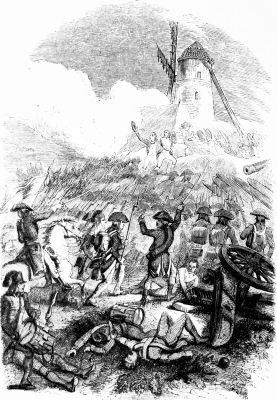
BATTLE OF JEMAPPES.
In the mean time Dumouriez, with thirty-five thousand men, was pursuing a division of the retreating Allies, consisting of twenty-five thousand Austrians, under General Clairfayt, through Belgium. On the 4th of November he overtook them strongly intrenched upon the heights of Jemappes. One day was consumed in bringing up his forces and arranging his batteries for the assault. Sixty thousand men were now arrayed for a deadly strife. One hundred pieces of cannon were in battery to hurl into the dense ranks destruction and death. On the morning of the 6th the storm of war commenced. All the day long it raged with pitiless fury. In the evening ten thousand of the dying and the dead covered the ground, and the Austrians were every where retreating in dismay. This new victory caused great rejoicing in Paris, and inspired the revolutionary party with new courage.
The day at length arrived for the trial of the king. It was the 11th of December. For four months the royal family, with ever-alternating hopes and fears, which had been gradually deepening into despair, had now endured the rigors of captivity. The king, with that wonderful equanimity which distinguished him through all these days of trial, immediately upon taking possession of his gloomy abode introduced system into the employment of his time.
His room was on the third story. He usually rose at six o'clock, shaved himself, and carefully dressed his hair. He then entered a small room or closet, which opened from his sleeping-room, and engaged in devotional reading and prayer for an hour. He was not allowed to close the door, for a municipal officer ever stationed in his room was enjoined never to allow the king to leave his sight. He then read till nine o'clock, during which time his faithful servant, Clery, put the room in order, and spread the table for the breakfast of the royal family. At nine o'clock the queen, the children, and Madame Elizabeth came up from the rooms which they occupied below to breakfast.
The meal occupied an hour. The royal family then all descended to the queen's room, where they passed the day. The king employed himself in instructing his son, giving him lessons in geography, which was a favorite study of the king; teaching him to draw and color maps, and to recite choice passages from Corneille and Racine. The queen assumed the education of her daughter, while her own hands and those of Madame Elizabeth were busy in needle-work, knitting, and working tapestry.
At one o'clock, when the weather was fine, the royal family were conducted by four municipal officers into the spacious but dilapidated garden for exercise and the open air. The officials who guarded the king were frequently changed. Sometimes they chanced to be men of humane character, who, though devoted to the disinthrallment of France from the terrible despotism of ages, still pitied the king as the victim of circumstances, and treated him with kindness and respect. But more generally these men were vulgar and rabid Jacobins, who exulted in the opportunity of wreaking upon the king the meanest revenge. They chalked upon the walls of the prison, "The guillotine is permanent and ready for the tyrant Louis." "Madame Veto shall swing." "The little wolves must be strangled." Under a gallows, to which a figure was suspended, was inscribed the words, "Louis taking an air-bath." From such ribald insults the monarch had no protection.
A burly brutal wretch, named Rocher, was one of the keepers of the Tower. He went swaggering about with a bunch of enormous keys clattering at his belt, seeming to glory in his power of annoying, by petty insults, a king and a queen. When the royal family were going out into the garden he would go before them to unlock the doors. Making a great demonstration in rattling his keys, and affecting much difficulty in finding the right one, all the party would be kept waiting while he made all possible delay and noise in drawing the bolts and swinging open the ponderous doors. At the side of the last door he not unfrequently stationed himself with his pipe in his mouth, and puffed tobacco-smoke into the faces of the king, the queen, and the children. Some of the guards stationed around would burst into insulting laughter in view of these indignities, which the king endured with meekness which seems supernatural.
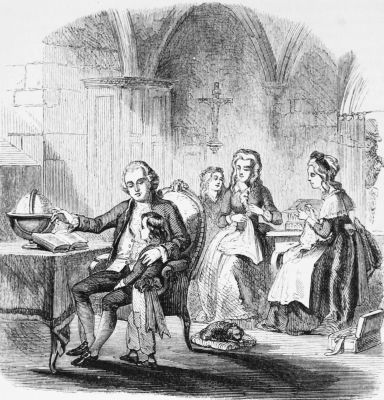
LOUIS XVI. AND THE ROYAL FAMILY IN THE TEMPLE.
The recital of such conduct makes the blood boil in one's veins, and leads one almost to detest the very name of liberty. But then we must not forget that it was despotism which formed these hideous characters; that, age after age and century after century, kings and nobles had been trampling upon the people, crushing their rights, lacerating their heart-strings, dooming fathers and mothers, sons and daughters, by millions upon millions, to beggary, degradation, and woe. It was time for the people to rise at every hazard and break these chains. And while humanity must weep over the woes of Louis XVI. and his unhappy household, humanity can not forget that there are other families and other hearts who claim her sympathies, and that this very Louis XVI. was at this very time doing every thing in his power, by the aid of the armies of foreign despots, to bring the millions of France again under the sway of the most merciless despotism. And it can not be questioned that, had kings and nobles regained their power, they would have wreaked a more terrible vengeance upon the re-enslaved people than the people wreaked upon them.
For an hour the royal family continued walking in the garden. From the roofs of the adjacent houses and the higher windows they could be seen. Every day at noon these roofs and windows were crowded by those anxious to obtain a view of the melancholy group of captives. Frequently they were cheered by gestures of affection from unknown friends. Tender words were occasionally unrolled in capital letters, or a flower to which a pebble was attached would fall at their feet. These tokens of love, slight as they were, came as a balm to their lacerated hearts. So highly did they prize them, that regardless of rain, cold, and snow, and the intolerable insults of their guards, they looked forward daily with eagerness to their garden walk. They recognized particular localities as belonging to their friends, saying, "such a house is devoted to us; such a story is for us; such a room is loyal; such a window friendly."
At two o'clock the royal family returned to the king's room, where dinner was served. After dinner the king took a nap, while the queen, Madame Elizabeth, and the young princess employed themselves with their needles, and the dauphin played some game with Clery, whose name should be transmitted with honor to posterity as faithful in misfortune. When the king awoke from his nap he usually read aloud to his family for an hour or two until supper-time. Soon after supper, the queen, with her children and Madame Elizabeth, retired to their rooms for the night. With hearts bound together by these terrible griefs, they never parted but with a tender and sorrowful adieu.[376]
Such was the monotonous life of the royal family during the four months they occupied the Temple before the trial of the king. But almost every day of their captivity some new act of rigor was enforced upon them. As the armies of the Allies drew nearer, and city after city was falling before their bombardments, and Paris was in a phrensy of terror, apprehensions of a conspiracy of the king with the Royalists, and of their rising and aiding the invaders with an outburst of civil war, led to the adoption of precautions most irksome to the captives.
Municipal officers never allowed any member of the royal family to be out of their sight, except when they retired to bed at night. They then locked the doors, and placed a bed against the entrance to each apartment, and there an officer slept, so as to prevent all possibility of egress. Every day Santerre, commander of the National Guard, made a visit of inspection to all the rooms with his staff. At first the royal family had been allowed pen, ink, and paper, but this privilege was soon withdrawn, and at last the cruel and useless measure was adopted of taking from them all sharp instruments, such as knives, scissors, and even needles, thus depriving the ladies not only of a great solace, but of the power of repairing their decaying apparel. It was not the intention of the Legislative Assembly that the royal family should be exposed to needless suffering. Four hundred dollars were placed in their hands at the commencement of their captivity for their petty expenses, and the Governor of the Temple was ordered to purchase for them whatever they might need, five hundred thousand francs ($100,000) having been appropriated by the Convention for their expenses.[377]
They were not allowed to see the daily journals, which would have informed them of the triumphant march of the Allies, but occasionally papers were sent to them which recorded the victories of the Republic. Clery, however, devised a very shrewd expedient to give them some information of the events which were transpiring. He hired a newsman to pass daily by the windows of the Temple, under the pretense of selling newspapers, and to cry out the principal details contained in them. Clery, while apparently busy about the room, was always sure to be near the window at the appointed hour, listening attentively. At night, stooping over the king's bed to adjust the curtains, he hastily whispered the news he had thus gathered. All this required the greatest caution, for a municipal officer was always in the room, watching every movement.
Early in the morning of the 11th of December all Paris was in commotion to witness the trial of the king, which was to commence on that day. The beating of drums in the street, the mustering of military squadrons at their appointed places of rendezvous, the clatter of hoofs, and the rumbling of artillery over the pavements penetrated even the gloomy apartments of the Temple, and fell appallingly upon the ears of the victims there.
The royal family were at breakfast as they heard these ominous sounds, and they earnestly inquired the cause. After some hesitation the king was informed that the Mayor of Paris would soon come to conduct him to his trial, and that the troops gathering around the Temple were to form his escort. He was also required immediately to take leave of his family, and told that he could not be permitted to see them again until after his trial. Expressions of heart-rending anguish and floods of tears accompanied this cruel separation. The king pleaded earnestly and with gushing eyes that, at least, he might enjoy the society of his little son, saying,
"What, gentlemen! deprive me of even the presence of my son—a child of seven years!"
But the commissioners were inexorable. "The Commune thinks," said they, "that, since you are to be au secret during your trial, your son must necessarily be confined either with you or his mother; and it has imposed the privation upon that parent who, from his sex and courage, was best able to support it."
The queen, with the children and Madame Elizabeth, were conducted to the rooms below. The king, overwhelmed with anguish, threw himself into a chair, buried his face in his hands, and, without uttering a word, remained immovable as a statue for two hours. At noon M. Chambon,[378] the Mayor of Paris, with Santerre, commander of the National Guard, and a group of officers, all wearing the tricolored scarf, entered the king's chamber.
Chambon, with solemnity and with a faltering voice, informed the king of the painful object of their mission, and summoned him, in the name of the Convention, as Louis Capet, to appear before their bar.
"Gentlemen," replied the king, "Capet is not my name. It is the name of one of my ancestors. I could have wished that my son, at least, had been permitted to remain with me during the two hours I have awaited you. However, this treatment is but a part of the system adopted toward me throughout my captivity. I follow you, not in obedience to the orders of the Convention, but because my enemies are more powerful than I."
Immediately rising, he put on his great-coat, took his hat, and, following the mayor, and followed by the staff of officers, descended the stairs of the tower.
Before the massive portal of the Temple the carriage of the mayor was drawn up, surrounded by a guard of six hundred picked men. A numerous detachment of cavalry, as an advance-guard, dragging six pieces of cannon, led the melancholy procession which was conducting a monarch to the judgment-bar and to death. A similar body of cavalry followed in the rear with three pieces of cannon. These precautions were deemed necessary to guard against any possible rescue by the Royalists. Every soldier was supplied with sixteen rounds of cartridges, and the battalions marched in such order that they could instantly form in line of battle. The National Guard lined the streets through which they passed, one hundred thousand men being under arms in Paris that day.
The cavalcade passed slowly along the Boulevards. The house-tops, the windows, the side-walks, were thronged with countless thousands. The king, deprived of his razor, had been unable to shave, and his face was covered with shaggy hair; his natural corpulence, wasted away by imprisonment, caused his garments to hang loose and flabby about him; his features were wan through anxiety and suffering. Thus, unfortunately, every thing in his personal appearance combined to present an aspect exciting disgust and repulsion rather than sympathy. The procession passed down the Place Vendôme and thence to the Monastery of the Feuillants. The king alighted. Santerre took his arm and led him to the bar of the Convention. There was a moment of profound silence. All were awe-stricken by the solemnity of the scene. The president, Barrere,[379] broke the silence, saying,
"Citizens! Louis Capet is before you. The eyes of Europe are upon you. Posterity will judge you with inflexible severity. Preserve, then, the dignity and the dispassionate coolness befitting judges. You are about to give a great lesson to kings, a great and useful example to nations. Recollect the awful silence which accompanied Louis from Varennes—a silence that was the precursor of the judgment of kings by the people." Then, turning to the king, Barrere said, "Louis, the French nation accuses you. Be seated, and listen to the Act of Accusation." It was then two o'clock in the afternoon.
The formidable indictment was read. The king was held personally responsible for all the acts of hostility to popular liberty which had occurred under his reign. A minute, truthful, impartial recapitulation of those acts, which we have recorded in the previous pages, constituted the accusation. The king listened attentively to the reading, and without any apparent emotion. The accusation consisted of fifty-seven distinct charges. As they were slowly read over, one by one, the president paused after each and said to the king, "What have you to answer?" But two courses consistent with kingly dignity were open for the accused. The one was to refuse any reply and to take shelter in the inviolability with which the Constitution had invested him. The other was boldly to avow that he had adopted the measures of which he was accused, believing it to be essential to the welfare of France that the headlong progress of the Revolution should be checked. Neither would have saved his life, but either would have rescued his memory from much reproach. But the king, cruelly deprived of all counsel with his friends, dragged unexpectedly to his trial, and overwhelmed with such a catalogue of accusations, unfortunately adopted the worst possible course. The blame of some of the acts he threw upon his ministers; some facts he denied; and in other cases he not only prevaricated but stooped to palpable falsehood. When we reflect upon the weak nature of the king and the confusion of mind incident to an hour of such terrible trial, we must judge the unhappy monarch leniently. But when the king denied even the existence of the iron chest which the Convention had already found, and had obtained proof to demonstration that he himself had closed up, and when he denied complicity with the Allies, proofs of which, in his own handwriting, were found in the iron safe, it is not strange that the effect should have been exceedingly unfavorable to his defense.[380]
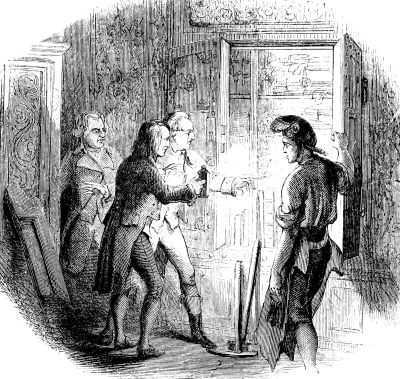
DISCOVERY OF THE IRON SAFE.
This interrogation was continued for three hours, at the close of which the king, who had eaten nothing since his interrupted breakfast, was so exhausted that he could hardly stand. Santerre then conducted him into an adjoining committee-room. Before withdrawing, however, the king demanded a copy of the accusation, and counsel to assist him in his defense. In the committee-room the king saw a man eating from a small loaf of bread. Faint with hunger, the monarch approached the man, and, in a whisper, implored a morsel for himself.
"Ask aloud," said the man, retreating, "for what you want." He feared that he should be suspected of some secret conspiracy with the king.
"I am hungry," said Louis XVI., "and ask for a piece of your bread."
"Divide it with me," said the man. "It is a Spartan breakfast. If I had a root I would give you half."
The king entered the carriage eating his crust. The same cavalcade as in the morning preceded and accompanied him. The same crowds thronged the streets and every point of observation. A few brutal wretches, insulting helplessness, shouted Vive la Révolution! and now and then a stanza of the Marseillaise Hymn fell painfully upon his ear. Chambon, the mayor, and Chaumette, the public prosecutor, were in the carriage with the king. Louis, having eaten as much of the half loaf of bread as he needed, had still a fragment in his hand.
"What shall I do with it?" inquired the simple-hearted monarch. Chaumette relieved him of his embarrassment by tossing it out of the window.
"Ah," said the king, "it is a pity to throw bread away when it is so dear."
"True," replied Chaumette; "my grandmother used to say to me, 'Little boy, never waste a crumb of bread; you can not make one.'"[381]
"Monsieur Chaumette," Louis rejoined, "your grandmother appears to me to have been a woman of great good sense."
It was half-past six o'clock, and the gloom of night enveloped the Temple, when Louis was again conducted up the stairs of the tower to his dismal cell. He piteously implored permission again to see his family. But Chambon dared not grant his request in disobedience to the commands of the Commune.
The most frivolous things often develop character. It is on record that the toils and griefs of the day had not impaired the appetite of the king, and that he ate for supper that night "six cutlets, a considerable portion of a fowl, two eggs, and drank two glasses of white wine and one of Alicante wine, and forthwith went to bed."[382]
During these dreadful hours the queen, with Madame Elizabeth and the children, were in a state of agonizing suspense, not even knowing but that the king was being led to his execution. Clery, however, late in the evening, went to their room and informed them of all the details he had been able to gather respecting the king's examination.
"Has any mention been made of the queen?" asked Madame Elizabeth. "Her name was not mentioned," Clery replied, "in the act of accusation."
"Ah," rejoined the princess, "perhaps they demand my brother's life as necessary for their safety; but the queen—these poor children—what obstacle can their lives present to their ambition?"
FOOTNOTES:
CHAPTER XXXI.
EXECUTION OF LOUIS XVI.
Close of the Examination.—The King's Counsel.—Heroism of Malesherbes.—Preparations for Defense.—Gratitude of the King.—The Trial.—Protracted Vote.—The Result.—The King solicits the Delay of Execution for three Days.—Last Interview with his Family.—Preparation for Death.—The Execution.
As soon as the king had withdrawn from the Assembly, that body was thrown into great tumult in consequence of the application of Louis for the assistance of counsel. It was, however, after an animated debate, which continued until the next day, voted that the request of the king should be granted, and a deputation was immediately sent to inform the king of the vote, and to ask what counsel he would choose. He selected two of the most eminent lawyers of Paris—M. Tronchet and M. Target. Tronchet heroically accepted the perilous commission. Target, with pusillanimity which has consigned his name to disgrace, wrote a letter to the Convention stating that his principles would not allow him to undertake the defense of the king.[383] The venerable Malesherbes, then seventy years of age, immediately wrote a letter to the president, imploring permission to assume the defense of the monarch. This distinguished statesman, a friend of monarchy and a personal friend of the monarch, had been living in the retirement of his country-seat, and had taken no part in the Revolution. By permission of the Commune he was conducted, after he had been carefully searched, to the Temple. With a faltering step he entered the prison of the king. Louis XVI. was seated reading Tacitus. The king immediately arose, threw his arms around Malesherbes in a cordial embrace, and said,
"Ah, is it you, my friend! In what a situation do you find me! See to what my passion for the amelioration of the state of the people, whom we have both loved so much, has reduced me! Why do you come hither? Your devotion only endangers your life and can not save mine."
Malesherbes, with eyes full of tears, endeavored to cheer the king with words of hope.
"No!" replied the monarch, sadly. "They will condemn me, for they possess both the power and the will. No matter; let us occupy ourselves with the cause as if we were to gain it. I shall gain it in fact, since I shall leave no stain upon my memory."
The two defenders of the king were permitted to associate with them a third, M. Deséze, an advocate who had attained much renown in his profession. For a fortnight they were employed almost night and day in preparing for the defense. Malesherbes came every morning with the daily papers, and prepared for the labors of the evening. At five o'clock Tronchet and Deséze came, and they all worked together until nine.
In the mean time the king wrote his will; a very affecting document, breathing in every line the spirit of a Christian. He also succeeded in so far eluding the vigilance of his keepers as to open a slight correspondence with his family. The queen pricked a message with a pin upon a scrap of paper, and then concealed the paper in a ball of thread, which was dropped into a drawer in the kitchen, where Clery took it and conveyed it to his master. An answer was returned in a similar way. It was but an unsatisfactory correspondence which could thus be carried on; but even this was an unspeakable solace to the captives.
At length the plan of defense was completed. Malesherbes and the king had furnished the facts, Tronchet and Deséze had woven them all into an exceedingly eloquent and affecting appeal. Deséze read it aloud to the king and his associates. The pathetic picture he drew of the vicissitudes of the royal family was so touching that even Malesherbes and Tronchet could not refrain from weeping, and tears fell from the eyes of the king. At the close of the reading, the king turned to Deséze, and, in the spirit of true majesty of soul, said,
"I have to request of you to make a painful sacrifice. Strike out of your pleading the peroration. It is enough for me to appear before such judges and show my entire innocence. I will not move their feelings."[384]
Deséze was very reluctant to accede to this request, but was constrained to yield. After Tronchet and Deséze had retired that night, the king, left alone with Malesherbes, seemed to be troubled with some engrossing thought. At last he said,
"I have now a new source of regret. Deséze and Tronchet owe me nothing. They devote to me their time, exertions, and perhaps their life. How can I requite them? I possess nothing; and were I to leave them a legacy it would not be paid; besides, what fortune could repay such a debt?"
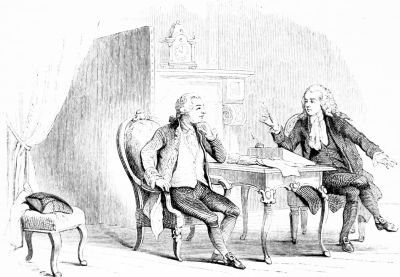
LOUIS XVI. AND MALESHERBES.
"Sire," replied Malesherbes, "their consciences and posterity will reward them. But it is in your power to grant them a favor they will esteem more than all those you had it in your power to bestow upon them formerly."
"What is it?" added the king.
"Sire, embrace them," Malesherbes replied.
The next day, when they entered his chamber, the king approached them and pressed each to his heart in silence. This touching testimonial of the king's gratitude, and of his impoverishment, was to the noble hearts of these noble men an ample remuneration for all their toil and peril.
The 26th of December had now arrived, the day appointed for the final trial. At an early hour all Paris was in commotion, and the whole military force of the metropolis was again marshaled. The sublimity of the occasion seemed to have elevated the character of the king to unusual dignity. He was neatly dressed, his beard shaved, and his features were serene and almost majestic in their expression of imperturbable resignation. As he rode in the carriage with Chambon, the mayor, and Santerre, the commander of the National Guard, he conversed cheerfully upon a variety of topics. Santerre, regardless of the etiquette which did not allow a subject to wear his hat in the presence of his monarch, sat with his hat on. The king turned to him, and said, with a smile,
"The last time, sir, you conveyed me to the Temple, in your hurry you forgot your hat; and now, I perceive, you are determined to make up for the omission."
On entering the Convention the king took his seat by the side of his counsel, and listened with intense interest to the reading of his defense, watching the countenances of his judges to see the effect it was producing upon their minds. Occasionally he whispered, and even with a smile, to Malesherbes and Tronchet. The Convention received the defense in profound silence.
The defense consisted of three leading divisions. First, it was argued that by the Constitution the king was inviolable, and not responsible for the acts of the crown—that the Ministers alone were responsible. He secondly argued that the Convention had no right to try the king, for the Convention were his accusers, and, consequently, could not act as his judges. Thirdly, while protesting, as above, the inviolability of the king, and the invalidity of the Convention to judge him, he then proceeded to the discussion of the individual charges. Some of the charges were triumphantly repelled, particularly that of shedding French blood on the 10th of August. It was clearly proved that the people, not Louis XVI., were the aggressors. As soon as Deséze had finished his defense, the king himself rose and said, in a few words which he had written and committed to memory,
"You have heard the grounds of my defense. I shall not repeat them. In addressing you, perhaps for the last time, I declare that my conscience reproaches me with nothing, and that my defenders have told you the truth. I have never feared to have my public conduct scrutinized. But I am grieved to find that I am accused of wishing to shed the blood of my people, and that the misfortunes of the 10th of August are laid to my charge. I confess that the numerous proofs I have always given of my love for the people ought to have placed me above this reproach."
He resumed his seat. The President then asked if he had any thing more to say. He declared he had not, and retired with his counsel from the hall. As he was conducted back to the Temple, he conversed with the same serenity he had manifested throughout the whole day. It was five o'clock, and the gloom of night was descending upon the city as he re-entered his prison.
No sooner had the king left the hall than a violent tumult of debate commenced, which was continued, day after day, with a constant succession of eager, agitated speakers hurrying to the tribune, for twelve days. Some were in favor of an immediate judgment, some were for referring the question to the people; some demanded the death of the king, others imprisonment or exile. On the 7th of January all seemed weary of these endless speeches, and the endless repetition of the same arguments. Still, there were many clamorous to be heard; and, after a violent contest, it was voted that the decisive measure should be postponed for a week longer, and that on the 14th of January the question should be taken.
The fatal day arrived. It was decreed that the subject should be presented to the Convention in the three following questions: First, Is Louis guilty? Second, Shall the decision of the Convention be submitted to the ratification of the people? The whole of the 15th was occupied in taking these two votes. Louis was unanimously pronounced to be guilty, with the exception of ten who refused to vote, declaring themselves incapable of acting both as accusers and judges. On the question of an appeal to the people, 281 voices were for it, 423 against it.[385] And now came the third great and solemn question, What shall be the sentence? Each member was required to write his vote, sign it, and then, before depositing it, to ascend the tribune and give it audibly, with any remarks which he might wish to add.
The voting commenced at seven o'clock in the evening of the 16th, and continued all night, and without any interruption, for twenty-four hours. All Paris was during the time in the highest state of excitement, the galleries of the Convention being crowded to suffocation. Some voted for death, others for imprisonment until peace with allied Europe, and then banishment. Others voted for death, with the restriction that the execution should be delayed. They wished to save the king, and yet feared the accusation of being Royalists if they did not vote for his death. The Jacobins all voted for death. They had accused their opponents, the Girondists, of being secretly in favor of royality, and as such had held them up to the execration of the mob. The Girondists wished to save the king. It was in their power to save him. But it required more courage, both moral and physical, than ordinary men possess, to brave the vengeance of the assassins of September who were hovering around the hall.
It was pretty well understood in the Convention that the fate of the king depended upon the Girondist vote, and it was not doubted that the party would vote as did their leader. It was a moment of fearful solemnity when Vergniaud ascended the tribune. Breathless silence pervaded the Assembly. Every eye was fixed upon him. His countenance was pallid as that of a corpse. For a moment he paused, with downcast eyes, as if hesitating to pronounce the dreadful word. Then, in a gloomy tone which thrilled the hearts of all present, he said, Death.[386] Nearly all the Girondists voted for death, with the restriction of delaying the execution. Many of the purest men in the nation thus voted, with emotions of sadness which could not be repressed. The noble Carnot gave his vote in the following terms: "Death; and never did word weigh so heavily on my heart."
When the Duke of Orleans was called, deep silence ensued. He was cousin of the king, and first prince of the blood. By birth and opulence he stood on the highest pinnacle of aristocratic supremacy. Conscious of peril, he had for a long time done every thing in his power to conciliate the mob by adopting the most radical of Jacobin opinions. The Duke, bloated with the debaucheries which had disgraced his life, ascended the steps slowly, unfolded a paper, and read in heartless tones these words:
"Solely occupied with my duty, convinced that all who have attempted, or shall attempt hereafter, the sovereignty of the people, merit death, I vote for death."
The atrocity of this act excited the abhorrence of the Assembly, and loud murmurs of disapprobation followed the prince to his seat. Even Robespierre despised his pusillanimity, and said,
"The miserable man was only required to listen to his own heart, and make himself an exception. But he would not or dare not do so. The nation would have been more magnanimous than he."[387]
At length the long scrutiny was over, and Vergniaud, who had presided, rose to announce the result. He was pale as death, and it was observed that not only his voice faltered, but that his whole frame trembled.
"Citizens," said he, "you are about to exercise a great act of justice. I hope humanity will enjoin you to keep the most perfect silence. When justice has spoken humanity ought to be listened to in its turn."
He then read the results of the vote. There were seven hundred and twenty-one voters in the Convention. Three hundred and thirty-four voted for imprisonment or exile, three hundred and eighty-seven for death, including those who voted that the execution should be delayed. Thus the majority for death was fifty-three; but as of these forty-six demanded a suspension of the execution, there remained but a majority of seven for immediate death. Having read this result, Vergniaud, in a sorrowful tone, said, "I declare, in the name of the Convention, that the punishment pronounced against Louis Capet is death."[388]
The counsel of Louis XVI., who, during the progress of the vote, had urged permission to speak, but were refused, were now introduced. In the name of the king, Deséze appealed to the people from the judgment of the Convention. He urged the appeal from the very small majority which had decided the penalty. Tronchet urged that the penal code required a vote of two thirds to consign one to punishment, and that the king ought not to be deprived of a privilege which every subject enjoyed. Malesherbes endeavored to speak, but was so overcome with emotion that, violently sobbing, he was unable to continue his speech, and was compelled to sit down. His gray hairs and his tears so moved the Assembly that Vergniaud rose, and, addressing the Assembly, said, "Will you decree the honors of the sitting to the defenders of Louis XVI.?" The unanimous response was, "Yes, yes."
It was now late at night, and the Convention adjourned. The whole of the 18th and the 19th were occupied in discussing the question of the appeal to the people. On the 20th, at three o'clock in the morning, the final vote was taken. Three hundred and ten voted to sustain the appeal; three hundred and eighty for immediate death. All the efforts to save the king were now exhausted, and his fate was sealed. A deputation was immediately appointed, headed by Garat, Minister of Justice, to acquaint Louis XVI. with the decree of the Convention.
At two o'clock in the afternoon of the 20th, Louis heard the noise of a numerous party ascending the steps of the tower. As they entered his apartment he rose and stepped forward with perfect calmness and dignity to meet them. The decree of the Convention was read to the king, declaring him to be guilty of treason, that he was condemned to death, that the appeal to the people was refused, and that he was to be executed within twenty-four hours.
The king listened to the reading unmoved, took the paper from the hands of the secretary, folded it carefully, and placed it in his portfolio. Then turning to Garat, he handed him a paper, saying,
"Monsieur Minister of Justice, I request you to deliver this letter to the Convention."
Garat hesitated to take the paper, and the king immediately rejoined, "I will read it to you," and read, in a distinct, unfaltering voice, as follows:
"I demand of the Convention a delay of three days, in order to prepare myself to appear before God. I require, farther, to see freely the priest whom I shall name to the commissaries of the Commune, and that he be protected in the act of charity which he shall exercise toward me. I demand to be freed from the perpetual surveillance which has been exercised toward me for so many days. I demand, during these last moments, leave to see my family, when I desire it, without witnesses. I desire most earnestly that the Convention will at once take into consideration the fate of my family, and that they be allowed immediately to retire unmolested whithersoever they shall see fit to choose an asylum. I recommend to the kindness of the nation all the persons attached to me. There are among them many old men, and women, and children, who are entirely dependent upon me, and must be in want."
The delegation retired. The king, with a firm step, walked two or three times up and down his chamber, and then called for his dinner. He sat down and ate with his usual appetite; but his attendants refused to let him have either knife or fork, and he was furnished only with a spoon. This excited his indignation, and he said, warmly,
"Do they think that I am such a coward as to lay violent hands upon myself? I am innocent, and I shall die fearlessly."
Having finished his repast, he waited patiently for the return of the answer from the Convention. At six o'clock, Garat, accompanied by Santerre, entered again. The Convention refused the delay of execution which Louis XVI. had solicited, but granted the other demands.
In a few moments M. Edgeworth, the ecclesiastic who had been sent for, arrived. He entered the chamber, and, overwhelmed with emotion, fell at the monarch's feet and burst into tears. The king, deeply moved, also wept, and, as he raised M. Edgeworth, said,
"Pardon me this momentary weakness. I have lived so long among my enemies that habit has rendered me indifferent to their hatred, and my heart has been closed against all sentiments of tenderness; but the sight of a faithful friend restores to me my sensibility, which I believed dead, and moves me to tears in spite of myself."
The king conversed earnestly with his spiritual adviser respecting his will, which he read, and inquired earnestly for his friends, whose sufferings moved his heart deeply. The hour of seven had now arrived, when the king was to hold his last interview with his family. But even this could not be in private. He was to be watched by his jailers, who were to hear every word and witness every gesture. The door opened, and the queen, pallid and woe-stricken, entered, leading her son by the hand. She threw herself into the arms of her husband, and silently endeavored to draw him toward her chamber.
"No, no," whispered the king, clasping her to his heart; "I can see you only here."
Madame Elizabeth, with the king's daughter, followed. A scene of anguish ensued which neither pen nor pencil can portray. The king sat down, with the queen upon his right hand, his sister upon his left, their arms encircling his neck, and their heads resting upon his breast. The dauphin sat upon his father's knee, with his arm around his neck. The beautiful princess, with disheveled hair, threw herself between her father's knees, and buried her face in his lap. More than half an hour passed during which not an articulate word was spoken; but cries, groans, and occasional shrieks of anguish, which pierced even the thick walls of the Temple and were heard in the streets, rose from the group.
For two hours the agonizing interview was continued. As they gradually regained some little composure, in low tones they whispered messages of tenderness and love, interrupted by sobs, and kisses, and blinding floods of tears. It was now after nine o'clock, and in the morning the king was to be led to the guillotine. The queen implored permission for them to remain with him through the night. The king, through tenderness for his family, declined, but promised to see them again at seven o'clock the next morning. As the king accompanied them to the staircase their cries were redoubled, and the princess fainted in utter unconsciousness at her father's feet. The queen, Madame Elizabeth, and Clery carried her to the stairs, and the king returned to the room, and, burying his face in his hands, sank, exhausted, into a chair. After a long silence he turned to M. Edgeworth and said,
"Ah! monsieur, what an interview I have had! Why do I love so fondly? Alas! why am I so fondly loved? But we have now done with time. Let us occupy ourselves with eternity."
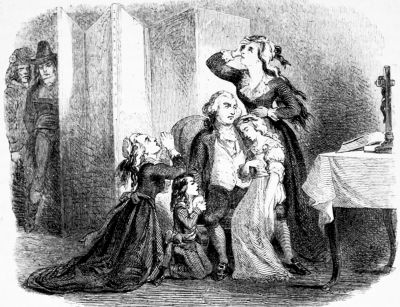
LAST INTERVIEW BETWEEN LOUIS XVI. AND HIS FAMILY.
The king passed some time in religious conversation and prayer, and, having arranged with M. Edgeworth to partake of the sacrament of the Lord's Supper in the earliest hours of the morning, at midnight threw himself upon his bed, and almost immediately fell into a calm and refreshing sleep.
The faithful Clery and M. Edgeworth watched at the bedside of the king. At five o'clock they woke him. "Has it struck five?" inquired the king. "Not yet by the clock of the tower," Clery replied; "but several of the clocks of the city have struck." "I have slept soundly," remarked the king. "I was much fatigued yesterday."
He immediately arose. An altar had been prepared in the middle of the room composed of a chest of drawers, and the king, after engaging earnestly in prayer, received the sacrament of the Lord's Supper. Then leading Clery into the recess of a window, he detached from his watch a seal, and took from his finger a wedding-ring, and handing them to Clery, said,
"After my death you will give this seal to my son, this ring to the queen. Tell her I resign it with pain that it may not be profaned with my body. This small parcel contains locks of hair of all my family: that you will give her. Say to the queen, my dear children, and my sister, that I had promised to see them this morning, but that I desired to spare them the agony of such a bitter separation twice over. How much it has cost me to depart without receiving their last embraces!"
He could say no more, for sobs choked his utterance. Soon recovering himself, he called for scissors, and cut off his long hair, that he might escape the humiliation of having that done by the executioner.
A few beams of daylight began now to penetrate the gloomy prison through the grated windows, and the beating of drums, and the rumbling of the wheels of heavy artillery were heard in the streets. The king turned to his confessor, and said,
"How happy I am that I maintained my faith on the throne! Where should I be this day but for this hope? Yes, there is on high a Judge, incorruptible, who will award to me that measure of justice which men refuse to me here below."
Two hours passed away, while the king listened to the gathering of the troops in the court-yard and around the Temple. At nine o'clock a tumultuous noise was heard of men ascending the staircase. Santerre entered, with twelve municipal officers and ten gens d'armes. The king, with commanding voice and gesture, pointed Santerre to the door, and said,
"You have come for me. I will be with you in an instant. Await me there."
Falling upon his knees, he engaged a moment in prayer, and then, turning to M. Edgeworth, said,
"All is consummated. Give me your blessing, and pray to God to sustain me to the end."
He rose, and taking from the table a paper which contained his last will and testament, addressed one of the municipal guard, saying, "I beg of you to transmit this paper to the queen." The man, whose name was Jacques Roux, brutally replied, "I am here to conduct you to the scaffold, not to perform your commissions."
"True," said the king, in a saddened tone, but without the slightest appearance of irritation. Then carefully scanning the countenances of each member of the guard, he selected one whose features expressed humanity, and solicited him to take charge of the paper. The man, whose name was Gobeau, took the paper.
The king, declining the cloak which Clery offered him, said, "Give me only my hat." Then, taking the hand of Clery, he pressed it affectionately in a final adieu, and, turning to Santerre, said, "Let us go." Descending the stairs with a firm tread, followed by the armed escort, he met a turnkey whom he had the evening before reproached for some impertinence. The king approached him and said, in tones of kindness,
"Mathey, I was somewhat warm with you yesterday; excuse me for the sake of this hour."
As he crossed the court-yard, he twice turned to look up at the windows of the queen's apartment in the tower, where those so dear to him were suffering the utmost anguish which human hearts can endure. Two gens d'armes sat upon the front seat of the carriage. The king and M. Edgeworth took the back seat. The morning was damp and chill, and gloomy clouds darkened the sky. Sixty drums were beating at the heads of the horses, and an army of troops, with all the most formidable enginery of war, preceded, surrounded, and followed the carriage. The noise of the drums prevented any conversation, and the king sat in silence in the carriage, evidently engaged in prayer. The procession moved so slowly along the Boulevards that it was two hours before they reached the Place de la Révolution. An immense crowd filled the place, above whom towered the lofty platform and blood-red posts of the guillotine.
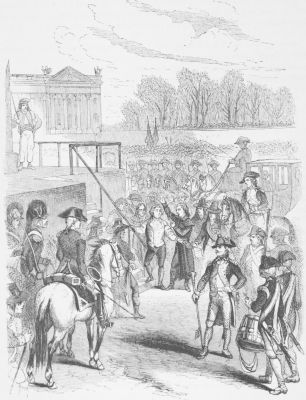
EXECUTION OF LOUIS XVI.
As the carriage stopped the king whispered to M. Edgeworth, "We have arrived, if I mistake not." The drums ceased beating, and the whole multitude gazed in the most solemn silence. The two gens d'armes alighted. The king placed his hand upon the knee of the heroic ecclesiastic, M. Edgeworth, and said to the gens d'armes,
"Gentlemen, I recommend to your care this gentleman. Let him not be insulted after my death. I entreat you to watch over him."
"Yes, yes," said one, contemptuously; "make your mind easy, we will take care of him. Let us alone."
Louis alighted. Two of the executioners came to the foot of the scaffold to take off his coat. The king waved them away, and himself took off his coat and cravat, and turned down the collar of his shirt, that his throat might be presented bare to the knife. They then came with cords to bind his hands behind his back.
"What do you wish to do?" said the king, indignantly.
"Bind you," they replied, as they seized his hands, and endeavored to fasten them with the cords.
"Bind me!" replied the king, in tones of deepest feeling. "No, no; I will never consent. Do your business, but you shall not bind me."
The executioners seized him rudely, and called for help. "Sire," said his Christian adviser, "suffer this outrage, as a last resemblance to that God who is about to be your reward."
"Assuredly," replied the king, "there needed nothing less than the example of God to make me submit to such an indignity." Then, holding out his hands to the executioners, he said, "Do as you will! I will drink the cup to the dregs."
With a firm tread he ascended the steep steps of the scaffold, looked for a moment upon the keen and polished edge of the axe, and then, turning to the vast throng, said, in a voice clear and untremulous,
"People, I die innocent of all the crimes imputed to me! I pardon the authors of my death, and pray to God that the blood you are about to shed may not fall again on France."
He would have continued, but the drums were ordered to beat, and his voice was immediately drowned. The executioners seized him, bound him to the plank, the slide fell, and the head of Louis XVI. dropped into the basket.
No one has had a better opportunity of ascertaining the true character of the king than President Jefferson. Speaking of some of the king's measures he said, "These concessions came from the very heart of the king. He had not a wish but for the good of the nation; and for that object no personal sacrifice would ever have cost him a moment's regret; but his mind was weakness itself, his constitution timid, his judgment null, and without sufficient firmness even to stand by the faith of his word. His queen, too, haughty and bearing no contradiction, had an absolute ascendency over him; and round her were rallied the king's brother, D'Artois, the court generally, and the aristocratic part of his ministers, particularly Breteuil, Broglio, Vauguyon, Foulon, Luzerne—men whose principles of government were those of the age of Louis XIV. Against this host, the good counsels of Necker, Montmorin, St. Priest, although in unison with the wishes of the king himself, were of little avail. The resolutions of the morning, formed under their advice, would be reversed in the evening by the influence of the queen and the court."