Front matter (continued 7)
Reading edition
Thus the king pledged himself anew to support the Constitution. The Assembly received these asseverations in respectful silence, though it was no longer possible for them to give the king credit for sincerity. While the king was thus apologizing, Bouillé, who had fled to the protection of foreign armies, sent a menacing letter to the Assembly, in the name of the allied sovereigns of Europe, containing the following declarations:
"I know your means of defense," he wrote. "They are nothing; and your chastisement shall be an example to other people. Listen to the words of a man who regards you and your people but with indignation and horror. I know the roads. I will guide the foreign armies which will assail you. There shall not rest one stone upon another in Paris, if you dare to touch a hair of the head of my king."[287]
If Bouillé had wished to provoke the nation to throw down the head of the king as a gauntlet of defiance to the foes of the liberties of France, he could have done nothing more effectual than the utterance of such a menace. Both parties were now preparing vigorously for war. The emigrants at Coblentz, proclaiming that the king was a prisoner, and could no longer have any will of his own, declared monsieur the king's elder brother (Louis XVIII.) to be Regent of France. The most vigorous measures were adopted for accumulating troops and munitions of war for the great invasion.
FOOTNOTES:
CHAPTER XXIII.
COMMOTION IN PARIS.
The Remains of Voltaire removed to the Pantheon.—Decision of the Assembly on the Flight of the King.—Thomas Paine.—Views of the Constitutional Monarchists.—Message from La Fayette to the King of Austria.—The Jacobins summon the Populace to the Field of Mars.—Mandate of the Jacobins.—The Crowd on the Field of Mars dispersed by the Military.—Completion of the Constitution.—Remarkable Conversation of Napoleon.—The King formally accepts the Constitution.—Great, but transient, Popularity of the Royal Family.
In the midst of these stormy scenes the Assembly voted to remove the remains of Voltaire, which had slumbered for thirteen years in the obscure abbey of Scellières in Champagne, to the Pantheon in Paris. On the 11th of July his coffin was received with great pomp at the barriers, and conducted to a pedestal on the ancient site of the Bastille, constructed from one of the foundation-stones of the fortress. Voltaire had once been imprisoned in that gloomy citadel. Upon the pedestal which supported the coffin were engraved the words,
"Receive on this spot, where despotism once fettered thee, the honors decreed thee by thy country."
The next day a brilliant sun invited the whole population of Paris to the fête. The car which bore the coffin to the Pantheon was drawn by twelve white horses, harnessed four abreast. They were very richly caparisoned, and led by postillions in antique attire. An immense body of cavalry headed the procession. The wail of requiems and the roar of muffled drums blended with the booming of minute guns from the adjacent heights. The sarcophagus was preceded, surrounded, and followed by the National Assembly, the municipal authorities of the city, and by deputations from all the illustrious and dignified bodies of France. Scholars, laborers, artists, and, conspicuously, all the actors and actresses of Paris, took part in the pageant. Arches, with garlands of leaves and wreaths of roses, spanned the streets. Groups of beautiful girls, dressed in white, carpeted the path with flowers. At intervals, bands of music were placed, saluting the car as it approached with bursts of melody. Before each of the principal theatres the procession stopped, and a hymn was sung in commemoration of the achievements of the great dramatist. It was ten o'clock at night before the immense procession reached the Pantheon. The coffin was deposited between those of Descartes and Mirabeau.
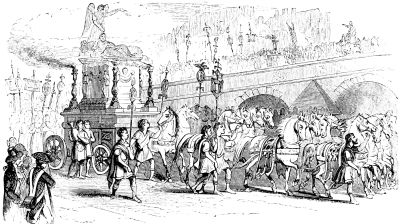
THE REMAINS OF VOLTAIRE TRANSFERRED TO THE PANTHEON.
It was the pen of Voltaire which overthrew despotism in France. It was also the pen of Voltaire which banished for so long from human hearts thoughts of God and of future responsibility. Thus then sprung up, in the place of the despotism he had overthrown, another despotism a thousand fold more terrible. With consummate genius and utter destitution of all moral principle, he was the demon of destruction, sweeping the good and the bad alike into indiscriminate ruin. He could fawn upon the infamous Frederic, and palliate his vices. He was ever ready to bow the knee to the paramours of Louis XV. There was no prostitution of genius which could cause him to blush. The venomous spirit with which he pursued the religion of Christ is fully expressed by his motto, "Crush the wretch." The genius of Voltaire induced France to attempt to establish liberty without religion. The terrific result will probably dissuade from any future repetition of that experiment.
The club of the Jacobins was greatly roused by the moderation of the Assembly, and began to clamor for the entire overthrow of the monarchy and the establishment of a republic. On the evening of the 15th of July a meeting of the club was held at which four thousand persons were present. It was a scene of wild enthusiasm. La Fayette, Barnave, and others who were in favor of a constitutional monarchy were denounced as traitors. Robespierre and Danton were the orators of the evening, and they were greeted with thunders of applause. A petition was sent to the Assembly, which assumed the tone of an order, demanding that the king should be deposed as a perfidious traitor to his oaths. It was a meeting of the mob virtually repudiating the Assembly, and assuming for itself both legislative and executive power. The tumultuous gathering was not dispersed until after midnight. Here originated that spirit of lawless violence which subsequently transformed Paris into a field of blood.
On the 16th the commissioners made their report to the Assembly on the flight of the king. Both the commissioners and the Assembly were disposed to be lenient. They were already very anxious in view of popular tumult and menacing anarchy. They had still no wish to overthrow the monarchy and establish a republic. Such a measure would be full of danger to France in its distracted state, and would exasperate a thousand fold the surrounding monarchies. There was no one for whom they wished to exchange their present king. He was the legitimate monarch, which gave him vast power over all the aristocracy of Europe. He had sworn to defend the Constitution, and it was so manifestly for his interest now to consent to be a constitutional monarch that it was hoped that he would sincerely accept that popular cause which would secure for him popular support. Though no one doubted that it had been the intention of the vacillating monarch to throw himself into the midst of foreign armies, and by the aid of their artillery and swords to force the Old Régime again upon France, a very generous report, exculpating the king from blame, was presented and adopted.
Influenced by these views, it was argued that the king had committed no crime. He surely had a right, if he wished, to take a journey to Montmedy. There was no proof that he intended any thing more, he had violated no law. The Assembly therefore decreed that "in the journey there was nothing culpable."[288]
The Jacobin press now became very bold. "No more king," exclaimed Brissot in the Patriot; "let us be Republicans. Such is the cry at the Palais Royal, and it does not gain ground fast enough."
"No king! no protector! no regent!" shouted Fauchet in the Bouche de Fer (the Mouth of Iron).
An address was read to the Jacobin Club openly demanding the annihilation of royalty; and though this address was received at first with murmurs—for the majority, even of the Jacobins, were not then prepared for such a step—the new doctrine with marvelous rapidity spread through the lower orders of Paris, and very speedily gained the ascendency in the club. Danton mounted the tribune of the Jacobin Club on the 23d of June, and demanded the forfeiture of the throne. "Your king," said he, "is either a knave or an idiot. If we must have one of the two, who would not prefer the latter?"
The Jacobin Club had now become very formidable. It already numbered eighteen hundred members in Paris alone, each of whom was admitted to its meetings by a ticket. Two hundred and fifty affiliated clubs were scattered throughout the principal cities. It occupied the large chapel of the Convent, and had its president, its secretaries, its tribune, its regular order of business, and its journal, in which its debates and resolutions were published. Many of the ablest members of the Assembly were members of the club, and their most powerful efforts of eloquence were addressed to the club, regarding its voice as beginning to be more potent than that of the Assembly. The Jacobin Club was rapidly becoming the great power of the kingdom, with an excitable mob ever at its disposal as its military arm.
The Journal of the Jacobins, edited by Laclos, a confidant of the Duke of Orleans, overwhelmed the monarch with a torrent of insults and objurgations. Thomas Paine, the notorious reviler of Christianity, was then in Paris, and one of the most violent of the Jacobin Club. He wrote an inflammatory address, which was posted on all the walls of Paris, urging the peremptory dethronement of the king.
The views entertained by La Fayette and the Constitutional Monarchists can not be better conveyed than in the eloquent language of Barnave, in a speech addressed to the Assembly on this occasion.
"I will not dilate," said he, "on the advantages of monarchical government. You have proved your conviction by establishing it in your country. Some men, whose motives I shall not impugn, seeking for examples to adduce, have found in America a people occupying a vast territory with a scanty population, nowhere surrounded by very powerful neighbors, having forests for their boundaries, and having for customs the feelings of a new race, and who are wholly ignorant of those factitious passions and impulses which effect revolutions of government. They have seen a republican government established in that land, and have thence drawn the conclusion that a similar government was suitable for us.
"But if it be true that in our territory there is a vast population; that we have a multitude of men exclusively devoted to those intellectual speculations which excite ambition and the love of fame; that powerful neighbors compel us to form one compact body in order to resist them—if these circumstances are wholly independent of ourselves, then it is undeniable that the sole existing remedy lies in a monarchical government.
"When a country is populous and extensive, there are but two modes of assuring to it a solid and permanent existence. Either you must organize those parts separately, placing in each section of the empire a portion of the government, thus maintaining security at the expense of unity, strength, and all the advantages which result from a great and homogeneous association, or else you will be forced to centralize an unchangeable power, which, never renewed by the law, presenting incessant obstacles to ambition, resists with advantage the shocks, rivalries, and rapid vibrations of an immense population, agitated by all the passions engendered by long-established society.
"These facts decide our position. We can only be strong through a federative government, which no one here has the madness to propose, or by a monarchical government such as you have established. You have intrusted to an inviolable king the exclusive function of naming the agents of his power, but you have made those agents responsible.
"Immense damage is done us when that revolutionary impetus, which has destroyed every thing there was to destroy, and which has urged us to the point where we must at last pause, is perpetuated. The Revolution can not advance one step farther without danger. In the line of liberty the first act which follows is the annihilation of royalty. In the line of equality the first act which must follow is an attempt on all property. It is time to end the Revolution. It ought to stop when the nation is free, and all men have equal rights. If it continue in trouble it is dishonored, and we with it. Yes! all the world ought to agree that the common interest is involved in now closing the Revolution.
"Those who have lost ought to perceive that it is impossible to make the Revolution retrograde. Those who fashioned the Revolution should see that it has attained its consummation. Kings themselves—if from time to time profound truths can penetrate the councils of kings, if occasionally the prejudices which surround them will permit the sound views of a great and philosophical policy to reach them—kings themselves must learn that there is for them a wide difference between the example of a great reform in government and that of the abolition of royalty; that if we pause here, where we are, they are still kings! But, be their conduct what it may, let the fault come from them and not from us. Regenerators of the empire, follow straightly your undeviating line. You have been courageous and potent—be to-day wise and moderate. In this will consist the glorious termination of your efforts. Then again returning to your domestic hearths you will obtain, if not blessings, at least the silence of calumny."
Though these views of moderation were opposed alike by the aristocrats and the Jacobins, they were accepted with applause by the great majority of the Assembly. Aristocrats and Jacobins now combined to disturb in every possible way the action of the Assembly. They both hoped through tumult and anarchy to march into power. Mobs began to reassemble in the streets of Paris, and cries of treason were uttered against La Fayette and his fellow-constitutionalists. Already in the market-place, at the Palais Royal, and in the hall of the Jacobins, individuals denounced that Constitution as tyrannical which the nation had so recently, with unutterable enthusiasm, sworn to support.[289]
La Fayette, Barnave, the Lameths, Talleyrand, and other illustrious friends of a constitutional monarchy, sent a confidential note to the Emperor of Austria, assuring him that the Constitution conferred as much power upon the king as it was possible now to obtain from the French nation; that any invasion of France by the allies would only exasperate the people, bring the Jacobins into power, endanger the life of the king, and that it could not be successful in restoring the Old Régime. The king was consulted upon this measure, and gave it his approval.[290]
Notwithstanding these warnings, the monarchs of Europe, who were trembling lest the spirit of liberty, rising in France, should undermine their despotic thrones, resolved to crush the patriots beneath the tramp of their dragoons. Leopold of Austria, Frederick William of Prussia, and Count d'Artois, with Bouillé and other of the emigrants, met at Pilnitz, and on the 27th of August signed an agreement that the French Revolution was an "open revolt," "a scandalous usurpation of power," and that all the governments of Europe were bound to unite to abate the nuisance.[291]
The Jacobin Club, it will be remembered, in a stormy midnight debate, had drawn up a petition to the Assembly demanding the deposition of the king as a perjured traitor. They wished, by a demonstration of popular enthusiasm, to terrify the Assembly into obedience to their mandate. Accordingly, the whole populace of Paris were summoned to meet on the Field of Mars, to sign, with much parade, the petition on the Altar of Federation, which had not yet been taken down.
At an early hour on the morning of the 17th of July the multitude began to congregate. It was the Sabbath-day. Every scene in the drama of the Revolution seems to have been arranged on the sublimest scale. Soon from fifty to one hundred thousand, including the lowest of the population of Paris, were thronging the field, and clambering over the gigantic altar.[292] Two men were seized, under the absurd accusation that they were intending to blow up the altar and all upon it by means of a barrel of gunpowder. The cry of "Aristocrats!" which passed like a tornado through the crowd, precluded any trial, and settled their doom. The two unhappy men were literally torn to pieces, and their heads were borne about on pikes by brutal wretches who were now beginning to emerge from dens of obscurity into confidence and power.
The rumor of these murders and of the threatening attitude of the mob spread through the city and reached the ears of the Assembly. The principal ringleaders of the Jacobins were nowhere to be found, and it was asserted and generally believed that they were in a secret place, that they might escape responsibility, while, through their agents, they were rousing the mob to a demonstration which should overawe the Assembly. In the midst of the wildest imaginable scene of tumult and uproar, the mandate of the Jacobins—for it could with no propriety be called a petition—was placed upon the altar upon many separate sheets of paper, and speedily received six thousand signatures. This was a new order, drawn up at the moment, for the original document could not be found. It read as follows:
"Representatives of the people! your labors are nearly ended. A great crime has been committed. Louis has fled, abandoning his post. The country is on the verge of ruin. The king has been arrested, brought back to Paris, and the people demand that he be tried. You declare that he shall be king. The people do not wish it, and therefore annul your decree. The king has been carried off by the two hundred and ninety-two aristocrats who have themselves declared that they have no longer a voice in the National Assembly. Your decree is annulled, because it is in opposition to the voice of the people, your sovereign. Repeal it. The king has abdicated by crime. Receive his abdication."
Nothing could be more execrable than this usurpation of authority by the mob. The Assembly was composed of the representatives of twenty-five millions of people, acting under the calm deliberation which the forms of law exacted. And here six thousand men, women, and boys, belched forth perhaps from the dens of infamy in Paris, and arming themselves with a mob of fifty thousand of the most degraded of the populace of a great city, assumed to be the nation—the law makers and the law executors of the kingdom of France.[293]
The municipality ordered La Fayette, with a detachment of the National Guard, to proceed to the scene of tumult and disperse the rioters. The moment the soldiers appeared they were received with hisses, shouts, and a shower of stones from the populace. Several of the stones struck La Fayette, and he narrowly escaped death from a pistol-shot fired at him. The attitude of the mob was so threatening that La Fayette retired for a stronger force. He soon returned, accompanied by Bailly, the mayor of the city, and all the municipal authorities, and followed by ten thousand of the National Guard. The red flag, which proclaimed that the city was placed under martial law, was now floating from the Hôtel de Ville. The tramp of ten thousand men,[294] with the rolling of artillery and the beating of four hundred drums, arrested the attention of the throng. The troops, debouching by three openings which intersected the glacis, were, as by magic, drawn up facing the throng. M. Bailly, upon horseback, displayed the red flag, in accordance with the Riot Act law, and ordered the mob to disperse.[295]
The response was a shout from fifty thousand men, women, and boys of "Down with the red flag! Down with Bailly! Death to La Fayette!" The clamor became hideous, and a shower of mud and stones fell upon La Fayette and the mayor, and several pistol-shots from a distance were discharged at them. The crowd, accustomed to lawlessness, did not believe that the municipal government would dare to order the soldiers to fire.
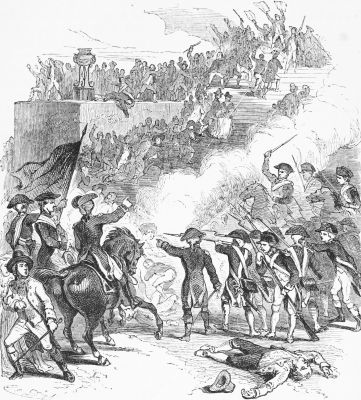
PUBLICATION OF MARTIAL LAW ON THE FIELD OF MARS, JULY 17, 1791.
La Fayette, with mistaken humanity, ordered the advance guard to fire into the air. The harmless volley was followed by shouts of derision and defiance. It now became necessary to give the fatal order. One volley swept the field. The crash was followed by a shriek, as four hundred dead or wounded fell upon the plain, and as the smoke passed away the whole tumultuous mass was seen flying in terror over the embankments and through the avenues. The artillerymen, with the coolness of trained soldiers, were just upon the point of opening their fire of grapeshot upon the panic-stricken fugitives, when La Fayette, unable to make his voice heard through the uproar, heroically threw himself before the cannon, and thus saved the lives of thousands. The National Guard, saddened by the performance of a duty as painful as it was imperious, returned in the evening through the dark streets of Paris and dispersed to their homes.[296]
The next day M. Bailly appeared before the Assembly, and, in terms of dignity and manly sorrow, reported the triumph of the law. Both the National Assembly and the municipality of Paris voted their cordial approval of the conduct of Bailly and La Fayette. The Jacobin press, however, gave utterance to the fiercest invectives. Bailly and La Fayette were denounced as murderers, and every effort was made to exasperate the passions of the populace.
Amid such scenes of agitation and violence the Assembly concluded its task of forming a constitution. The important document, which was but partially finished at the great celebration on the 14th of July, 1790, was now completed. None were, however, fully satisfied with the Constitution. The aristocratic party abhorred the democratic spirit with which it was pervaded, and yet wished to make it still more obnoxiously democratic, that monarchical Europe might be more thoroughly exasperated. The Jacobins held it up to derision and execration because it was not democratic enough. The moderate party, represented by such men as La Fayette and Barnave, wished to invest the king with more power, but dared not attempt any revision of the Constitution, with the aristocrats and the Jacobins both ready to combine against them.
Napoleon was at this time a young officer in the army, twenty-three years of age. His brother Joseph was studying law in Italy. The whole family had warmly espoused the popular cause. From the beginning Napoleon was the ardent advocate of equal rights, and the determined foe of mob violence. At this early period of the Revolution, he expressed the views to which he adhered through the whole of his career.
There was about this time a large party given by M. Necker. All the illustrious men and women of Paris were present. The youthful Napoleon, then quite a boy in appearance, and almost a stranger in Paris, was introduced to this brilliant assembly by his friend the Abbé Raynal. The genius of Napoleon, and his commanding conversational eloquence, soon drew around him quite a group.
"Who is that young man," inquired the proud Alfieri, "who has collected such a group around him?"
"He is," replied the abbé, "a protégé of mine, and a young man of extraordinary talent. He is very industrious, well read, and has made remarkable attainments in history, mathematics, and all military science."
The Bishop of Autun commended the soldiers for having refused to obey their officers, who had ordered them, on a certain occasion, by a discharge of musketry, to disperse a mob.
"Excuse me, my lord," said Napoleon, in tones of earnestness which arrested general attention, "if I venture to interrupt you, but, as I am an officer, I must claim the privilege of expressing my sentiments. It is true that I am young, and it may appear presumptuous in me to address so many distinguished men. But during the past three years I have paid intense attention to our political troubles. I see with sorrow the state of our country, and I will incur censure rather than pass unnoticed principles which are not only unsound, but which are subversive of all government.
"As much as any I desire to see all abuses, antiquated privileges, and usurped rights annulled. Nay, as I am at the commencement of my career, it will be my best policy, as well as my duty, to support the progress of popular institutions, and to promote reform in every branch of the public administration. But as, in the last twelve months, I have witnessed repeated alarming popular disturbances, and have seen our best men divided into factions which threaten to be irreconcilable, I sincerely believe that now, more than ever, a strict discipline in the army is absolutely necessary for the safety of our constitutional government and for the maintenance of order.
"Nay, if our troops are not compelled unhesitatingly to obey the commands of the executive, we shall be exposed to the blind fury of democratic passions which will render France the most miserable country on the globe. The ministry may be assured that, if the daily-increasing arrogance of the Parisian mob is not repressed by a strong arm and social order rightly maintained, we shall see not only this capital but every other city in France thrown into a state of indescribable anarchy, while the real friends of liberty, the enlightened patriots now working for the best good of our country, will sink beneath a set of demagogues who, with louder cries for freedom on their tongues, will be in reality but a horde of savages, worse than the Neros of old."[297]
The whole future career of Napoleon was in consistency with the spirit of these remarks. "I frankly declare," said Napoleon, subsequently, "that if I were compelled to choose between the old monarchy and Jacobin misrule, I should infinitely prefer the former."
On the 3d of September the Constitution was presented to the king for his acceptance with imposing ceremonies.[298] At nine o'clock in the evening a deputation left the chamber of the Assembly, and, escorted by a numerous and brilliant guard of honor, entered the Chateau of the Tuileries. The multitudes who thronged the way applauded loudly. The king, surrounded by his ministers and other high officers of the kingdom, received the deputation in his council-chamber. M. Thouret, president of the commission, presented the Constitution to the king, saying,
"Sire! the representatives of the nation come to present to your majesty the constitutional act which consecrates the indefeasible rights of the French people, which gives to the throne its true dignity, and regenerates the government of the empire."
The king, with a countenance expressive of satisfaction, received the document, and replied that he would examine it, and, after the shortest possible delay, communicate his decision to the Assembly. On the 13th he sent a message to the Assembly, which Barnave had assisted him in drawing up, and which contained the following conciliatory and noble sentiments:
"I have examined the Constitution. I accept it and will carry it into execution. The will of the people is no longer doubtful to me, and therefore I accept the Constitution. I freely renounce the co-operation I had claimed in this work, and I declare that when I have renounced it no other but myself has any right to claim it. Let the absent who are restrained by the fear of persecutions return to their country in safety. Let us consent to a mutual forgiveness of the past and obliterate all accusations arising from the events of the Revolution in a general reconciliation. I do not refer to those which have been caused by an attachment to me. Can you see any guilt in them? I will present myself to-morrow at noon to the National Assembly, and take oath to the Constitution in the very place where it has been drawn up."
This frank and cordial assent was unanticipated. It created a burst of extraordinary joy. La Fayette, in response to the suggestion of the king, immediately proposed a general amnesty for all acts connected with the Revolution. The motion was carried by acclaim. For a moment all parties seemed again to be united, prisons were thrown open, captives liberated, and shouts of fraternity and happiness resounded through Paris.
The next day the king went to the Assembly and took his seat by the side of the president. He was received by all the members standing, and they remained standing while he addressed them. With the most earnest expression of sincerity and satisfaction, the king said,
"I come to consecrate solemnly here the acceptance I have given to the Constitutional Act. I swear to be faithful to the nation and the law, and to employ all the powers delegated to me for maintaining the Constitution and carrying its decrees into effect. May this great and memorable epoch be that of the re-establishment of peace, and become the gage of the happiness of the people and the prosperity of the empire."
As the king withdrew the whole Assembly enthusiastically escorted him to his palace. But it was a bitter trial for the once absolute monarch to lay aside his unlimited power and become a constitutional king. The monarch, though feeling humiliated, was still enabled to maintain his aspect of smiles and composure until he reached the privacy of his own apartment. He then threw himself into a chair, and, losing all control, burst into tears.[299] A weeping king excites universal sympathy. The heroic struggles of twenty millions of people to gain their liberties also secure the sympathy and the admiration of every noble heart.
On the 18th of November the Constitution was proclaimed in the streets of Paris. Every thing was done which art could devise to invest the scene with splendor.
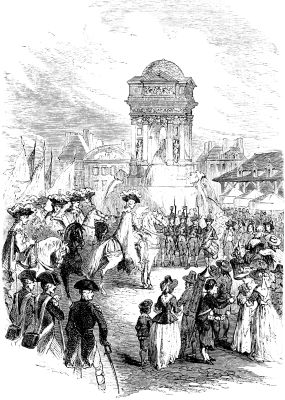
PROCLAMATION OF THE CONSTITUTION IN THE MARKET-PLACE.
Paris was again in a delirium of joy. The bells rang, salvos of artillery were fired, and the acclamations of hundreds of thousands, blending with peals of music from martial bands, filled the air with a confusion of all the sounds of exultation. The people were never weary of calling the king, the queen, the children, to the windows of the palace, and whenever they appeared they were greeted with outbursts of love and joy.[300]
On the 18th there was another magnificent festival on the Field of Mars. The Constitution was read to the people. It was accepted by them with the simultaneous shout from three hundred thousand voices of "Vive la Nation! Vive le Roi!" No discordant cry was heard. "After the tempest, those who have been beaten by it, as well as those who have not suffered, enjoy in common the serenity of the sky." In the evening Paris and all France blazed with illuminations and resounded with the shout of enfranchised millions. Balloons rose, from which copies of the Constitution were scattered as snow-flakes upon the multitude. The Elysian Fields, from the Arc de l'Etoile to the Tuileries, was brilliant with garlands and stars and pyramids of flame. Every tree blazed with quivering tongues of fire. Majestic orchestras pealed forth the notes of national triumph, and a multitude which no man could number filled that most magnificent avenue of Europe with plays, dances, shouts, and songs of exultation.
La Fayette, on his well-known white charger, rode at the head of his staff through the almost impenetrable throng, accompanied by the king, the queen, and their children. Enthusiasm now reached its culminating point. Hats were thrown into the air, and from the whole mighty mass, as by electric sympathy, rose the cry "Vive le Roi! Vive la Reine! Vive le Dauphin!"
The king and queen were overjoyed in view of the happiness of the people, and of the love thus spontaneously and enthusiastically manifested for the royal family. The queen was bewildered by so marvelous a change. But four weeks before the royal family were conducted as captives through that same avenue, surrounded by the same countless throng, and not a voice bade them welcome. They could then read in every eye the expression of hatred and defiance. The contrast led the queen to exclaim, "They are no longer the same people." Even her proud heart was touched, and she, for the first time, began to feel some respect for popular rights. Returning to the palace, of her own accord she stepped out upon the balcony, and presented her children to the crowd who thronged the terrace. They received such greeting as can only come from hearts glowing with sincerity and joy. These days of rejoicing were terminated by an offering of thanksgiving to God, as the sublime chant of the Te Deum was sung in the cathedral of Nôtre Dame.
The Constituent Assembly, having now completed its task, prepared to dissolve. As a conclusive reply to all who had accused it of ambitious designs to perpetuate its powers, and as a magnanimous display of patriotic disinterestedness, it decreed that none of its members should be re-eligible to the next Legislature.
At three o'clock in the afternoon of the 30th of September, the king, surrounded by his ministers, entered the Assembly. He was no longer the hostage of the nation, but its recognized sovereign; the guard which the law assigned him being now placed under his own command. Upon his entrance the applause was so enthusiastic and prolonged that for some time he was unable to commence speaking. He then said,
"Gentlemen, after the completion of the Constitution, you have resolved on to-day for the termination of your labors. I will exercise all the power confided to me in assuring to the Constitution the respect and obedience which is its due. For you, gentlemen, who, during a long and painful career, have evinced an indefatigable zeal in your labors, there remains a last duty to fulfill, when you are scattered over the face of the empire. It is to enlighten your fellow-citizens as to the spirit of the laws you have made; to purify and unite opinions by the example you will give to the love of order and submission to the laws. Be, on your return to your homes, the interpreters of my sentiments to your fellow-citizens. Tell them that the king will always be their first and most faithful friend; that he desires to be loved by them, and can only be happy with them and by them."
The king left the hall amid the loudest acclamations. They were the last with which he was greeted. Thouret, the president of the Assembly, as soon as the king had retired, said in a loud voice, "The Constituent Assembly pronounces its mission accomplished, and that its sittings now terminate." Thus closed the truly patriotic Assembly. It had accomplished the greatest and the most glorious revolution ever achieved in so short a time, and with so little violence. Repressing alike the despotism of aristocracy and the lawlessness of the mob, it established a constitution containing the essential elements of liberty protected by law. Under this constitution France might have advanced in prosperity. But the aristocrat and the Jacobin combined in its overthrow. They were fatally successful in their efforts.
It is interesting to observe how differently the same events were regarded by different minds. Bertrand de Moleville, a warm partisan of the aristocracy, says,
"Thus terminated this guilty Assembly, whose vanity, ambition, cupidity, ingratitude, ignorance, and audacity have overturned the most ancient and the noblest monarchy of Europe, and rendered France the theatre of every crime, of every calamity, and of the most horrible catastrophe. Can these treacherous representatives ever justify themselves in the eyes of the nation for having so unworthily abused their confidence and their powers?"
On the other hand, the democratic historians, the "Two Friends of Liberty," while regretting that the Constitution was not more thoroughly democratic, say,
"The Constitution of 1791, with all its faults, forever deserves the gratitude of the French people, because it has destroyed, never to return, every trace of feudalism, imposts the most fatal to agriculture, the privileges of particular persons, the usurpations of the priesthood over the civil power, and the proud pretensions of ancient corporations; because it has realized what philosophy for ages has in vain wished, and what monarchs the most absolute have never dared to undertake; and because it has established that uniformity which no one could have ever hoped for in an empire formed by gradual accretions from time to time, and with which, under a good government, there is no prosperity which France may not realize."
But whatever may be the estimate which political partisans may place upon the labors of the Assembly, no intelligent man will now deny that the great majority of that body were true patriots, sincerely desiring the welfare of their country. It will be admitted by all that they abolished judicial torture, placed all men upon the basis of equality in the eye of the law, annulled obnoxious privileges, introduced vast reform into commercial jurisprudence, established liberty of worship and of conscience, suppressed monastic vows, abolished the execrable system of lettres de cachet, rendered personal liberty sacred, introduced equality of taxation, and swept away those provincial jealousies and that interior line of custom-houses which had for ages seriously embarrassed the internal trade of the kingdom. All feudal rights were abrogated, industry encouraged, and the citizens of the kingdom were enrolled into a National Guard, for the preservation of domestic peace and to resist aggression.
This most noble reform combined Europe assailed with all its marshaled bayonets. The crime deluged the Continent in woe. After nearly a quarter of a century of conflagration and carnage, French liberty was trampled into the bloody mire of Waterloo, and the Old Régime was reinstated.
FOOTNOTES:
CHAPTER XXIV.
THE APPROACH OF WAR.
Sentiments of the King and Queen upon the Constitution.—The Legislative Assembly.—Its democratic Spirit.—The King's Speech.—Painful Scene.—The Queen plans Escape.—Riot in the Theatre.—Infatuation of the Aristocrats.—Insult to the Duke of Orleans.—Embarrassment of the Allies.—Replies to the King from the European Powers.—The Emigrants at Coblentz.—The King's Veto.—Letters of the King to his Brothers.—Their Replies.—Cruel Edicts.—Pétion chosen Mayor.—The King visits the Assembly.—Rise of the Republican Party.
The monarch of France, though deprived of absolute power, was still in the enjoyment of extensive prerogatives. The Assembly had conferred upon him the title of King of the French, an annual income of five millions of dollars, the command of the armies, and the right of suspending the national decrees. The king and queen were probably at this time sincere in their resolve to be resigned to the change, and to accept the Constitution. In the first interview which Bertrand de Moleville, a Royalist whom the king had appointed Minister of Marine, had with the king, the following remarks were made by the monarch:
"In my opinion the Constitution has serious defects, and if I had been at liberty to address some observations to the Assembly, very beneficial reforms might have resulted from them. But now it is too late, and I have accepted it, such as it is. I have sworn to cause it to be executed, and I ought to be, and will be, strictly faithful to my oath."
"But may I be permitted," inquired the minister, "to ask your majesty if the queen's opinion on this point agrees with the king's?"
"Yes, precisely," said the king; "she will tell you so herself."
"I went down stairs," continues Bertrand de Moleville in his interesting narrative, "to the queen, who, after declaring with extreme kindness that she, as well as the king, felt under much obligation to me for having accepted the ministry under such critical circumstances, added these words:
"'The king has acquainted you with his intentions relative to the Constitution. Do you think that the only plan he has to follow is to adhere to his oath?'
"'Most certainly, madam,' I replied.
"'Well, then,' said the queen, 'be assured that nothing shall induce us to change. Come, M. Bertrand, courage! I hope that with patience, firmness, and perseverance, all is not yet lost.'"[301]
Just before the dissolution of the Constituent Assembly, elections had been held, in accordance with the provisions of the Constitution, to choose the first Legislative Assembly. This legislature was to be renewed every two years. No member of the Constitutional Assembly was eligible. The Legislative Assembly, consequently, was composed mostly of obscure men with but little political experience. They numbered seven hundred and forty-five.
The Legislative Assembly was convened the 1st day of October, the day after the dissolution of the Constituent Assembly, and in the hall which had been occupied by that body.[302] At its first sitting it was observed that the exterior aspect of the Assembly had greatly changed; that nearly all the white heads had disappeared; and that France had fallen into the hands of young men. Sixty of the deputies were under twenty-six years of age. The spirit of the new Assembly was developed in its first decrees. A deputation was sent to inform the king that the Assembly was organized. The president of the deputation, in conformity with court etiquette, approached the king, and, when at four paces distance, bowed and said,
"Sire, the Assembly is formed, and has deputed us to inform your majesty."
Upon reporting the result of their mission, some of the deputies were offended that the ancient titles of royalty had been retained.
"I demand," cried one, "that this title of majesty be no longer employed."
"I demand," exclaimed another, "that this title of Sire be abolished. It is only an abbreviation of Seigneur, which recognizes a sovereignty in the man to whom it is given. There is no other majesty here than that of the law and the people. Let us leave the king no other title than that of King of the French."
In the room there was a gilded chair, raised above the seat of the president, which was occupied by the king when he attended the Assembly. It had always been a respectful custom for the members to remain uncovered when the king was present, and to stand while he addressed them. It was the custom for the king, in addressing the Assembly, to be seated and to wear his hat.
"Let this scandalous gilded chair be removed," another said. "Let an equality exist between us and the king as regards ceremony. When he is uncovered and standing, let us stand and uncover our heads. When he is covered and seated, let us sit and wear our hats."
These decrees, abolishing the respect due to rank, and the courtesies so essential to mitigate the ferocity of political strife, were promptly passed. The Constitutional party throughout France were generally mortified and alarmed, and the king was deeply wounded. He declared that the Constitution did not require of him to expose the monarchical dignity to insult, and that he would not preside at the opening of the legislative body in person, but would assign the duty to his ministers.[303] Alarmed by the decision of the king and by the indications of public disapproval, the Assembly, after a debate of two days, repealed the obnoxious decrees.
The Jacobins regarded the repeal as a defeat, and in the Assembly, in their clubs, and in their journals, did what they could to rouse the indignation of the populace. The royalist journals also united with them in the attempt to overwhelm this return to moderation with derision. "See," they cried, "how contemptible is this revolution; how conscious of its own weakness. See, in two days, how often it has given itself the lie." The Royalists still persisted in their endeavor to goad the revolutionary party to every conceivable outrage, that Europe might be more effectually roused to crush the Revolution.[304]
On the 7th the king proceeded to the Assembly. He was received, apparently, with unanimous applause, some shouting energetically "Vive le Roi!" and others, still more energetically, "Vive sa majesté!" The king's speech was conciliatory, and was received with warm approval. The members of the Assembly, however, retained their seats while the king was addressing them. Louis regarded this as an insult, and it wounded him most keenly.
The queen attended the sitting in a private box. The disrespect with which the king was treated pierced her very soul. She sat as in a stupor of silence, her countenance, pallid and wan, betraying the bitterness of her anguish. The king, upon leaving the Assembly, hastened immediately to the private apartment of the queen. He was so pale and agitated that the queen uttered an exclamation of surprise. The unhappy monarch threw himself upon a sofa, and, pressing a handkerchief to his eyes, said,
"All is lost! Ah! madam, and you are witness to this humiliation. What! you are come to France to see—"
"These words," writes Madame Campan, "were interrupted by sobs. The queen threw herself upon her knees before him, and pressed him in her arms. I remained with them, not from any blamable curiosity, but from a stupefaction which rendered me incapable of determining what I ought to do. The queen said to me, 'Oh go, go,' with an accent which expressed, 'Do not remain to witness the dejection and despair of your sovereign.' I withdrew, struck with the contrast between the shouts of joy without the palace, and the profound grief which oppressed the sovereigns within."
The queen resolved immediately to leave Paris and to return to her friends in Vienna, that from the heart of Austria she might plan for the recovery of the throne. The king so far fell in with this plan as to write a letter which M. Goguelat was to take to the emperor. During the whole day the garden and court-yard of the Tuileries were thronged, and the rejoicing shouts of the people filled the air. The ignorant populace, believing that the king and the queen shared their joy, called loudly for them to take an airing in their carriage in the Elysian Fields. It was not deemed prudent to decline. With heavy hearts they entered their carriage, and rode slowly along the magnificent avenue, escorted by the officers of the Parisian army. Here a new insult awaited them. Though they were repeatedly greeted with shouts of "Vive le Roi!" a gigantic man, with stentorian voice, kept near the carriage window, ever interrupting those shouts with the cry, "No, don't believe them. Vive la Nation!" This one ill-omened voice, incessantly reiterated, sank deep into their hearts, and obliterated all impressions of public acclaim. In the deepest dejection they returned to the palace.[305]
That night Paris blazed with illuminations, and the shouts of joyful revelry filled all the streets; but in these resounding plaudits the queen heard but the death-knell of the monarchy, and, in the retirement of her boudoir, she was at midnight planning her escape from France.
It was deemed by the king and queen of the utmost importance to assume publicly the appearance of content. A few evenings after this, the royal family attended the Théâtre Italien. As Madame Duguzon sang the words, "Ah! how I love my mistress," she turned to the royal box, and gracefully courtesied to the queen. Immediately many Jacobins in the pit shouted, "No mistress! no master! liberty!" This caused others to shout, "Long live the king! long live the queen!" Still more energetically the Jacobins replied, "No king! no queen!" In an instant the theatre was thrown into a Babel of tumult. The infuriated antagonists from words proceeded to blows, and a fierce fight took place under the eyes of the royal family. News of the affray spread rapidly through Paris, and the excitable mob was rapidly gathering, when the royal guards surrounded the king and queen and bore them safely to the palace. This was the last time the royal family ventured into the theatre.[306]
The queen was all this time carrying on a private correspondence with the foreign powers in cipher, and through her agents was conferring with William Pitt in London. "The queen told me," writes Madam Campan, "that her secret envoy was returned from London, and that all he had been able to wring from Pitt, whom he found alarmingly reserved, was, that he would not suffer the French monarchy to fall; that to suffer the revolutionary spirit to erect an organized republic in France would be a great error as regarding the tranquillity of Europe."[307]
The queen complained that she herself was greatly embarrassed by the arrogance of the nobles. "When I do any thing," she said to Madame Campan, "which the noblesse do not like, I am treated with marked neglect. No one will come to my card-parties, and the king is left in solitude."[308]
The Royalists, indeed, seem to have been abandoned to utter infatuation. They did every thing in their power to insult and exasperate those who were not their political confederates. The Duke of Orleans went to the Tuileries to attend the king's levee. The courtiers who thronged the anterooms, as soon as he entered, crowded around him, hustled him about, trod on his toes, and punched him with their elbows. "Gentlemen," they shouted to each other, "watch the dishes!" implying that the duke was provided with poison to sprinkle upon the refreshments. The duke was at last compelled to retire without seeing the royal family. The crowd followed him to the staircase, and, as he descended, spit upon him, covering his head and clothes with saliva. The duke supposed, though erroneously, that the king and queen instigated this unpardonable outrage. It is not strange that this man, when his hour of power came, voted to send the king to the guillotine.[309]
The queen was unrelenting in her hostility to La Fayette, and often treated him with the most irritating rudeness. "Her aversion," says Madame Campan, "for the general increased daily, and grew so powerful that when, toward the end of the Revolution, he seemed willing to support the tottering throne she could never bring herself to incur so great an obligation to him."[310] On one occasion La Fayette met the queen in a private interview, while his aids waited for him in the saloon. Some of the ladies of the court, to insult La Fayette and his aids, said loudly, "It is very alarming to see the queen alone with a rebel and a brigand."
The feelings of the king were now so outraged that he could not cheerfully persevere in his resolves to maintain the new order of affairs. The allied sovereigns were, however, so embarrassed by the acceptance of the Constitution by the king, and by the reiterated declaration of the king that he accepted and adopted the whole system of governmental reform, that they hesitated for a time to carry into execution the declaration of Pilnitz. Louis XVI. notified all the courts of Europe of the change which had been introduced into the government of France, and sent to them all, with much ceremonial pomp, a copy of the Constitution elegantly engrossed upon satin paper. The allies could no longer pretend that they were waging war against a revolted people. It was now necessary, if they continued hostile, to assail the legitimate king, and to deny, in the face of the world, that the government of France had any right to mitigate the severity of its despotism.
The courts of Europe were quite bewildered by the new aspect which affairs thus assumed. It was necessary for them to take some notice of the courteous communication which had been transmitted to them. Leopold of Austria seemed disposed to give up the conflict, thinking that the safety of his sister Marie Antoinette would be promoted by peace. He therefore returned a pacific answer. Prussia and England sent back courteous replies with assurances of their amicable intentions. Holland, the Italian principalities, and Switzerland assumed a friendly attitude. Russia was cold, haughty, and reserved. Gustavus of Sweden returned the insulting reply that the King of France was a prisoner, and that his assent to the Constitution was obtained upon compulsion, and therefore deserved no respect from the foreign powers.[311] The Electors of Treves and of Mentz, in whose territories the emigrants had mostly taken refuge, returned evasive and unsatisfactory replies. Spain, also, while declaring that she had no wish to disturb the internal tranquillity of France, could not conceal her displeasure that free institutions were established so near her borders.
The emigrants, however, were still rallying at Coblentz and making formidable preparations for war. The king was vacillating. It is certain that he sent, apparently, the most sincere injunctions to the emigrants at Coblentz to disband and to return to France, accepting the new order of things. It is equally certain that he kept up a private correspondence with the emigrants, encouraging them to persevere and to march to his rescue.[312]
This hostile gathering at Coblentz, ever threatening the kingdom with invasion, kept France in a continual state of ferment. The Minister of War reported to the Assembly that nineteen hundred of the officers of the army had deserted their posts and joined the menacing foe. After a long and very anxious debate, a decree was passed declaring that the French emigrants assembled at Coblentz were believed to be conspiring against France; that if, on the 1st of January next, they still continued assembled, they should be declared guilty of conspiracy, prosecuted as such, and punished with death; and that the revenues of those who refused to comply with this decree should be levied, during their lives, for the benefit of the nation, without prejudice to the rights of wives, children, and lawful creditors.[313]
The king, on the 10th of November, returned this law with his veto. It was an imposing scene. All the ministers of the king, in a body, went to the Assembly. It was generally understood that the power of the veto was to be exercised. Breathless silence pervaded the Assembly. The bill was returned to the president with the official formula, "The king will examine it." Loud murmurs immediately rose from all parts of the house, and the ministers retired, leaving the Assembly in deep irritation. The conviction was strengthened that the king was in sympathy with the conspirators.
To efface this impression the king the next day issued a proclamation to the emigrants exhorting them to cease to harass France by their threatening attitude, and like good citizens to return and respect the established laws of their country. He entreated them not to compel him to employ severe measures against them. As to the charge that he was deprived of his liberty, he said that the veto which he had just interposed in their favor was sufficient proof of the freedom of his actions. At the same time he published two very decisive letters to his two brothers. To Louis he wrote as follows:
"Paris, November 11, 1791.
"To Louis Stanislas Xavier, French Prince, the King's Brother,—I wrote to you, my brother, on the 16th of October last, and you ought not to have had any doubt of my real sentiments. I am surprised that my letter has not produced the effect which I had a right to expect from it. In order to recall you to your duty I have used all the arguments that ought to touch you most. Your absence is a pretext for all the evil disposed; a sort of excise for all the deluded French, who imagine that they are serving me by keeping all France in an alarm and agitation, which are the torment of my life.
"The Revolution is finished. The Constitution is completed. France wills it; I will maintain it. Upon its consolidation now depends the welfare of the monarchy. The Constitution has conferred rights upon you; it has attached to them one condition which you ought to lose no time in fulfilling. Believe me, brother, and repel the doubts which pains are taken to excite in you respecting my liberty. I am going to prove to you, by a most solemn act, and in a circumstance which interests you, that I can act freely. Prove to me that you are my brother and a Frenchman by complying with my entreaties. Your proper place is by my side; your interests, your sentiments alike urge you to come and resume it. I invite you, and, if I may, I order you to do so. (Signed), Louis."
In a similar strain he wrote to his brother Charles. But neither the proclamation to the emigrants nor the letters to his brothers produced any effect. The Count of Provence (Louis XVIII.), in his reply, said,
"The order which the letter contains for me to return and resume my place by your majesty's person is not the free expression of your will. My honor, my duty, nay, even my affection alike forbid me to obey."
The Count of Artois (Charles X.) replied,
"The decisions referred to in this letter have furnished me with a fresh proof of the moral and physical captivity in which our enemies dare to hold your majesty. After this declaration your majesty will think it natural that, faithful to my duty and the laws of honor, I should not obey orders evidently wrung from you by violence."
Another very serious difficulty now arose. The Constitution established freedom of conscience and of worship. It, however, justly required that all governmental officers should take the oath of allegiance to the Constitution. The Church had been so long in intimate alliance with the State, that that alliance was not severed, and the clergy, as public functionaries who received their salaries from the national treasury, were consequently required to take the oath. Any one was at liberty to refuse to take this oath. By so doing he merely forfeited employment by the nation. He was still permitted to perform the functions of the ministry for any who were disposed to support him as their pastor.
In the Province of Vendée the majority of the clergy refused to take the oath, and carried with them the immense majority of the simple and superstitious peasants. The churches in which they had ministered were immediately assigned to other priests who had taken the oath. The great mass of the people abandoned the churches and followed their nonjuring pastors to private houses, barns, and into the fields. Great enthusiasm was excited, and the nonjuring priests endeavored to excite the people against their colleagues who had taken the oath, and against the people who accepted their ministrations. Acts of violence were frequent and civil war was imminent.
The Legislative Assembly was alarmed, and endeavored to meet the difficulty by adopting measures totally hostile to the free spirit of the Constitution. They resolved that the nonjuring priests should again be called upon to take the oath of allegiance to the Constitution; that, if they refused, they should be not only deprived of all salary, but should be removed from their parishes, and even imprisoned, if need be, that they might not excite their former parishioners to civil war. They were also forbidden to exercise the privilege of private worship. The administrative bodies were required to transmit a list of such priests to the Assembly, with notes relative to the conduct of each one.
These decrees were surely unconstitutional. The bishops and the priests who were endangered by them sent to the king an earnest remonstrance against them. Many of the most influential of the Constitutionalists were opposed to them as both tyrannical and cruel. The king was so moved that he said to his ministers, who coincided with him in opinion, "They shall take my life before they shall compel me to sanction such decrees."
The king returned the bill with his veto, and aggravated the odium this would naturally excite by retaining, contrary to the solicitations of his best friends, nonjuring ecclesiastics to perform the religious services of his chapel. Though we can not commend the prudence we must respect the spirit which impelled him to say,
"The Constitution decrees freedom of religious worship for every body. The king is surely entitled to that liberty as much as his subjects."
All argument was on one side, but peril, more powerful than argument, on the other. "The nonjuring priests," it was exclaimed, "are exciting civil war. The law of self-defense renders it imperative that we should strike them down."
Upon the completion of the Constitution, La Fayette, emulating the character of Washington, resigned the command of the National Guard and retired to his estates. Bailly also resigned his post as mayor of Paris. The command of the Guard was intrusted to six generals, who were to exercise it in rotation. A new mayor of Paris was to be chosen. La Fayette was the candidate of the Constitutionalists, and Pétion of that radical portion of the Republicans who were termed Jacobins. The aristocracy, with their accustomed infatuation, supported Pétion with their influence and with a large outlay of money. They feared that a constitutional monarchy might be sustained, but they believed that the Jacobins would introduce such anarchy as might secure the recall of the old monarchy.
"The Marquis de la Fayette," said the queen, "only desires to be Mayor of Paris that he may be mayor of the palace. Pétion is a Jacobin and a Republican; but he is a fool, incapable of ever being the leader of a party. He will be a nullity of a mayor. Besides, it is possible that the knowledge of the interest we take in his election may bring him over to the king."[314]
Pétion was chosen by a large majority. Bitterly did the king and queen afterward bewail his election. But thus through all this tragedy did they spurn those who alone had the heart and the ability to help them.
In the midst of these troubles the most alarming rumors were every day reaching Paris respecting the threatening aspect of the emigrants. All along the Germanic frontiers, at Strasbourg, Coblentz, Worms, they were marshaling their battalions and collecting munitions of war. Exasperated by these persistent and audacious threats, the Assembly sent a deputation of twenty-four members to the king with a decree declaring that the Electors of Treves and Mentz, and other princes of the Germanic empire should be required to break up these hostile assemblages formed within their territories for the invasion of France. M. de Vaublanc, who headed the deputation, said to the king,
"Sire, if the French who were driven from their country by the revocation of the Edict of Nantes had assembled in arms on the frontiers, and had been protected by Germanic princes, we ask you, sire, what would have been the conduct of Louis XIV.? Would he have suffered these assemblages? That which he would have done for the sake of his authority, your majesty can not hesitate to do for the maintenance of the Constitution."
The king, anxious to regain the ground he had lost by his veto, decided to go to the Assembly and reply in person to their message. On the evening of the 14th of December, his coming having been previously announced, he entered the hall. He was received with the most frigid silence. His speech, however, soon enkindled enthusiasm and applause.
He assured the Assembly that he warmly sympathized with them in all their solicitude for the honor of France, that he had already signified to the Electors of Treves and Mentz that the continued assemblage of troops within their borders for the invasion of France would be deemed cause for war. He said that he had written to Leopold, the Emperor of Germany, demanding his interference to prevent the gathering of troops, hostile to France, within the limits of the Germanic empire, and concluded with the declaration that he would faithfully guard the Constitution, and that he appreciated the glory of being the king of a free people.[315]
This speech was received with great applause, and it was immediately voted that it should be sent to each of the eighty-three departments of the empire. Immediately upon the king's retiring, the Count Louis de Narbonne, minister of war, entered, and informed the Assembly that one hundred thousand men were immediately to be assembled, by order of the king, upon the Rhine, to repel invasion; that three generals were appointed to command them—Luckner, Rochambeau, and La Fayette; that he was about to set out immediately to inspect the fortresses on the frontiers. At the same time all the diplomatic agents who were accused of favoring the aristocratic party were removed, and more democratic officers were appointed in their place. These measures were so popular, and gave such evidence that the king sincerely intended to defend the Constitution, that even the obnoxious vetos were accepted without farther murmurs.
These measures were prosecuted with vigor. Luckner and Rochambeau, having been appointed marshals of France, hastened to the frontiers. La Fayette soon followed them. Battalions of the National Guard escorted him as he left Paris, and he was greeted every where with shouts of applause.
The emigrants were unanimous in their desire for the invasion of France, for the entire overthrow of the Constitution, and the restoration of the Old Régime. Leopold of Austria, however, anxious for the safety of his sister Marie Antoinette, and embarrassed by the king's acceptance of the Constitution, was desirous of effecting some compromise by which a constitution should be permitted to France, but one much more aristocratic in its provisions. Gustavus of Sweden and Catherine of Russia were eager for prompt and energetic war. Catherine wrote a strong letter to Leopold to rouse him to action.
"The King of Prussia," she wrote, "for a mere incivility offered to his sister, sent an army into Holland to punish the affront. And will the Emperor of Austria patiently suffer insults and affronts to be heaped upon his sister, the Queen of France, the degradation of her rank and dignity, and the overthrow of the throne of a king who is his brother-in-law and his ally?"[316]
Under this state of affairs, the French embassador, in January, 1792, was instructed to inform the Austrian government that there was reason to apprehend that a coalition was being formed against the sovereignty and independence of France, and to inquire of Leopold whether he did or did not intend to interfere against the French Revolution. Thus pressed, the Austrian cabinet returned an answer containing the following avowal:
"When France gave to Europe the spectacle of a lawful king forced by atrocious violence to fly, protesting solemnly against the acquiescence which they had extorted from him, and a little afterward stopped and detained prisoner by his subjects—yes, it then did concern the brother-in-law and the ally of the king to invite the other powers of Europe to join with him in a declaration to France that they all view the cause of his most Christian majesty as their own; that they demand that this prince and his family be set at liberty and have power to go where they please; and they require for these royal personages inviolability and due respect, which by the law of nature and nations are due from subjects to their princes; that they will unite to avenge in the most signal manner every farther attempt that may be committed, or may be suffered to be committed, against the liberty, the honor, and the safety of the king, the queen, and the royal family; and that, finally, they will not acknowledge as constitutional and legally established in France any laws but those which shall have the voluntary acquiescence of the king, enjoying perfect liberty. But if, on the other hand, these demands are not complied with, they will in concert employ all the means in their reach to put a stop to the scandalous usurpation of power which bears the appearance of an open rebellion, and which, from the dangers of the example, it concerns all the governments of Europe to repress."
The Republican party in the Legislative Assembly were called the Girondists because their leaders were generally from the department of the Gironde. The evidence to them was conclusive, and is now universally admitted, that the king, instead of sustaining the Constitution, was conspiring with the emigrants and the foreign powers for its overthrow. The Girondists, thus assured that the king was hostile to constitutional liberty while pretending that he was its friend that he might more effectually assail it, were anxious for his dethronement and for the establishment of a republic. Candor surely can not censure them. Twenty-five millions of men were not bound to place their liberties in the hands of a monarch who was conspiring with foreign foes to enslave them anew.
The Republican party increased so rapidly and swayed such an influence that the king was compelled early in 1792 to dismiss his Royalist ministers, and to call into his cabinet the leaders of the Republicans, Dumouriez, Roland, and others. He was compelled very reluctantly to take this step, and soon by them he was compelled, with still greater reluctance, to declare war against Austria.
FOOTNOTES:
CHAPTER XXV.
AGITATION IN PARIS, AND COMMENCEMENT OF HOSTILITIES.
Death of Leopold.—Assassination of Gustavus.—Interview between Dumouriez and the Queen.—Discussion in the Assembly.—The Duke of Brunswick.—Interview of Barnave with the Queen.—Interview between Dumouriez and the King.—Dismissal of M. Roland.—The Palace invaded.—Fortitude of the King.—Pétion, the Mayor.—Affecting Interview of the Royal Family.—Remarks of Napoleon.
On the 1st of March, 1792, the Emperor Leopold died. His son, Francis II., a young man twenty-four years of age, ascended the throne. The court of Leopold had been a harem of unblushing sensuality and sin. He did not condescend to spread any veil over his amours. His attachments were numerous and fugitive, and his guilty favorites associated with each other and braved the frowns of the humiliated queen amid the voluptuousness of the palace. At the time of his death there dwelt with him Donna Maria, a young girl from Tuscany, whose surpassing charms had given her celebrity throughout Europe as "the beautiful Florentine;" a Polish girl of great attractions, Mademoiselle Prokache; and the Countess of Walkenstein, whose charms of person and fascination of manners gave her celebrity through all the European courts. Upon this latter favorite alone he lavished gifts, in drafts on the Bank of Vienna, to the amount of two hundred thousand dollars. There were also various other of these favorites of infamy, inferior in notoriety and rank. The annals of Roman story may be searched in vain to find a monarch more utterly profligate. Immediately after his death his widow said to her son Francis,
"My son, you have before you the sad proofs of your father's disorderly life and of my long afflictions. Remember nothing of them except my forgiveness and his virtues. Imitate his great qualities, but beware lest you fall into the same vices, in order that you may not, in your turn, put to the blush those who scrutinize your life."
Marie Antoinette doubted not that her cousin Francis would be as devoted to her interests as her brother Leopold had been. Fifteen days after the death of Leopold, Gustavus III. of Sweden was assassinated at a masked ball by the nobles of his court. His death momentarily embarrassed the movements of the emigrants, for he was actively engaged in raising an army for the invasion of France.[317]
The allies were now vigorously raising troops and directing their march towards the frontiers of France. Some hoped that the demonstration would overawe the French and frighten them into submission. Others were eager, by prompt invasion, to submit the question to the arbitrament of battle. The Assembly speedily dispatched to the threatened frontier three armies of defense. Rochambeau was placed in command of the army of the north, at Flanders, consisting of 63,000 men; La Fayette was sent to the army of the centre, at Metz, which was 52,000 strong; Luckner occupied Alsace, with 48,000 troops.[318]
In calling the Girondists into the ministry, General Dumouriez, a brave and veteran soldier, was appointed to the ministry of foreign affairs. With great vigor he prosecuted arrangements for the defense of France. In addition to the troops, amounting to 163,000, stationed along the northwestern frontier from Dunkirk to Besançon, he raised a fourth army to repel invasion from Spain through the passes of the Pyrenees.
Dumouriez had acquired great popularity in the club of the Jacobins by frequenting their meetings, and by wearing the red cap of liberty, an emblem borrowed from the Phrygians. The queen was highly indignant that one in sympathy with the Jacobins should be called into the ministry, and, as she was now heartily in sympathy with the emigrants and the allies, she was provoked by the vigorous measures adopted to repel them. Dumouriez was a soldier, not a statesman; a man of heroic character, brave, impulsive, and generous. He had great power over the mind of the king; and the queen, anxious to see him, appointed an audience. In the memoirs of Dumouriez we find a narrative of this interview. Upon being ushered into her apartment, he found the queen, with flushed cheeks, rapidly pacing the floor, and giving every indication of extreme excitement. Dumouriez, embarrassed by this aspect of affairs, advanced in silence to a corner of the fire-place, when the queen turned toward him and abruptly said, with an air and tone of anger,
"Sir, you are all-powerful at this moment, but it is through the favor of the people, who soon break their idols in pieces. Your existence depends upon your conduct. It is said that you possess great abilities. You must be aware that neither the king nor myself can endure these innovations, nor the Constitution. This I tell you frankly. Choose your side."
"Madame," Dumouriez replied, "I am deeply pained by the secret which your majesty has just imparted to me. I will not betray it. But I stand between the king and my nation, and I belong to my country. Permit me to say that the welfare of the king, your own, and that of your children, are linked with the Constitution. You are surrounded by enemies who are sacrificing you to their private interests. The Constitution, when once in vigor, so far from bringing misery upon the king, will constitute his happiness and glory. It is absolutely necessary that he should concur in establishing it solidly and speedily."
The queen could never endure contradiction. Losing all self-control, she exclaimed, in a loud and angry tone, "The Constitution will not last. Take care of yourself."
Dumouriez quietly and firmly replied, "Madame, I am past fifty; my life has been crossed by many perils; and, in accepting the ministry, I was thoroughly sensible that responsibility was not the greatest of my dangers."
The queen, in the blindness of her passion, saw fit to interpret this remark as an insinuation that she might cause him to be assassinated. With inflamed cheeks and tears gushing into her eyes, she replied,
"Nothing more was wanting but to calumniate me. You seem to think me capable of causing you to be murdered."
The scene had now become painful in the extreme, and Dumouriez, greatly agitated, answered,
"God preserve me, madame, from doing you so cruel an injury. The character of your majesty is great and noble. You have given heroic proofs of it which I have admired, and which have attached me to you. Believe me, I have no interest in deceiving you. I abhor anarchy and crime as much as you do. But this is not a transient popular movement, as you seem to think. It is an almost unanimous insurrection of a mighty nation against inveterate abuses. Great factions fan this flame. In all of them there are villains and madmen. In the Revolution I keep in view only the king and the entire nation; all that tends to part them leads to their mutual ruin. I strive as much as possible to unite them. If I am an obstacle to your designs, tell me so. I will instantly send my resignation to the king, and hide myself in some corner to mourn over your fate and that of my country."[319]
This conversation restored Dumouriez to the confidence of the queen, and she conversed frankly and with a friendly spirit with him upon her griefs and perils.
"You see me," she said, "very sad. I dare not approach the window which looks into the garden. Yesterday evening I went to the window toward the court just to take a little air. A gunner of the guard addressed me in terms of vulgar abuse, adding, 'How I should like to see your head on the point of my bayonet!' In this horrid garden you see on one side a man, mounted on a chair, reading aloud the most abominable calumnies against us; on the other, a military man or an abbé dragged through one of the basins, overwhelmed with abuse, and beaten, while others are playing at ball, or quietly walking about. What an abode! what a people!"
The Austrian monarchy, supported by the other powers of Europe, now sent to France the insolent demand that the French monarchy should be restored almost to its pristine despotic power; that the three estates of the realm—the clergy, the nobles, and the tiers état, should be re-established, and that there should be the restitution of Church property. It is not surprising that an independent nation of twenty-five millions should have resented such impertinence. There was a general cry of indignation from the Assembly, which was re-echoed by the people, and new vigor was infused on both sides into the preparations for the war.
The king was sorely perplexed. In the event of war, victory would but strengthen the Revolutionary party; defeat would expose him to the charge of treason in feebly conducting hostilities. But France would not yield to this insulting foreign dictation, and the pressure of public opinion fell so strong upon the king that he was constrained, much against his will, to issue a declaration of war. Pale and care-worn the king entered the Assembly, and, after presenting through his minister a report of the demands of Austria, with a faltering voice read his speech.
"Gentlemen," said he, "you have heard the result of the negotiation in which I have been engaged with the court of Vienna. The conclusions of the report have been unanimously adopted by my council. I have myself adopted them. All would rather have war than see the dignity of the French people any longer insulted and the national security threatened. Having employed all possible means to obtain peace, I come now, agreeably to the terms of the Constitution, to propose to the National Assembly war against the King of Hungary and Bohemia."[320]
The proposal was received with shouts of "Vive le Roi," and the decree was passed by a great majority.[321] In the debates which the question of war had excited, great eloquence was displayed in the Assembly. M. Isnard spoke in terms of enthusiasm which brought the whole Assembly to their feet.
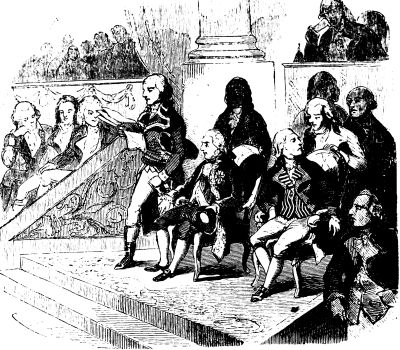
LOUIS XVI. IN THE NATIONAL ASSEMBLY.
"Capitulations," said he, "are proposed to you. It is proposed to increase the power of the king—of a man whose will can paralyze that of a whole nation—of a man who receives thirty millions ($6,000,000) while thousands of citizens are perishing from want. It is proposed to bring back the nobility. Were all the nobles on earth to attack us, the French, holding their gold in one hand, and their sword in the other, would combat that haughty race, and force it to endure the punishment of equality.
"Tell Europe that you will respect the Constitutions of all other countries, but that, if a war of kings is raised against France, you will raise a war of people against kings. The battles which nations fight at the command of despots are like the blows which two friends, excited by a perfidious instigator, strike at each other in the dark. The moment a light appears they embrace and take vengeance on him who deluded them. In like manner, if, at the moment when the hostile armies shall be engaged with ours, the light of philosophy bursts upon their sight, the nations will embrace each other before the face of dethroned tyrants, of consoled earth, and of delighted heaven."[322]
Vergniaud, the illustrious leader of the Gironde, said eloquently, "Our resolution has spread alarm among all thrones, for it has given an example of the destruction of the despotism which sustains them. Kings hate our Constitution because it renders men free, and they would reign over slaves. This hate has been manifested on the part of the Emperor of Germany by all the measures he has adopted to disturb us or to strengthen our enemies and encourage those Frenchmen who have rebelled against the laws of their country.
"Let us demand that the emigrants be dispersed. I might demand that they be given up to the country they insult and to punishment. But no. If they have been greedy for our blood, let us not show ourselves greedy for theirs. Their crime is having wished to destroy their country. Let them be vagrants and wanderers on the face of the earth, and let their punishment be never to find a country."
The most vigorous preparations were now made on both sides for the prosecution of the war. Francis of Austria and Frederick of Prussia met the Duke of Brunswick, Generallissimo of the Confederation, at Frankfort. The duke, who had married a sister of George III. of England, was an energetic, veteran soldier, fifty years of age. His head-quarters were at Coblentz, a town at the confluence of the Moselle and the Rhine, in the state of the Elector of Treves. Twenty-two thousand French emigrants had assembled there in arms. Seven French princes of the House of Bourbon were marshaling them for battle against their native land—to crush the people struggling for liberty—to rivet anew the fetters of the most execrable despotism. These princes were the two brothers of the king, Louis and Charles, the one subsequently Louis XVIII., the other Charles X.; the Duke of Berri and the Duke of Angoulême, sons of Charles; the Prince of Condé, cousin of the king, his son, the Duke of Bourbon, and his grandson, the Duke d'Enghien. All the military noblesse of the kingdom, with the exception of the few who had accepted the Constitution, had deserted their garrisons and united in the most atrocious act of treason. They were not only ready to march themselves, but were combining despotic Europe to march with them to crush the liberties of their country.
The peril of the king was now hourly increasing, for he was playing a double part. While publicly declaring war he was secretly carrying on a correspondence with the emigrants and with the foreign powers, encouraging them to make war upon France. This was known by some, and suspicions of the king's sincerity were spreading rapidly among the people. He had many papers in his possession, which, if discovered, would cause his ruin. To conceal them he had an iron chest built into the thick wall of one of his apartments. This was done by the confidential locksmith who had been his companion at the forge for ten years. The wall was painted to resemble large stones. The openings of the panel were masked in the brown grooves. But after constructing this safe the king was apprehensive that his locksmith would betray him, and he consequently intrusted a portfolio containing many of his most important papers to the care of Madame Campan.
On the 28th of April, one week after the declaration of war, a very ill-advised attack was made by the French in three detachments upon three separate positions of the Austrians. But the Austrians, minutely informed of the plan, were prepared, in stronger numbers, to meet their foes. The undisciplined French troops were driven back in confusion and shame. They thought that the king had treacherously ordered them to be led into a snare. The populace generally adopted the same belief. After this the troops, on both sides, widely dispersed and poorly provided with ammunition, provisions, and camp-equipage, could only observe each other for several weeks, and make preparation for the opening of the campaign.
Suspicions of the insincerity of the king were rapidly spreading among the people, while those acquainted with the royal family saw plainly that they were placing all their reliance in hopes of assistance from the armed emigrants. Barnave, who, since the return from Varennes, had periled his influence and his life in his endeavor to save the royal family, finding all his efforts rejected, and that the king and queen were rushing to ruin, solicited a last audience with the queen.
"Your misfortunes," said he, "and those which I anticipate for France determined me to sacrifice myself to serve you. I see that my advice does not agree with the views of your majesties. I augur but little advantage from the plan you are induced to pursue; you are too remote from your succors; you will be lost before they reach you. Most ardently do I wish I may be mistaken in so lamentable a prediction. But I am sure to pay my head for the interest your misfortunes have raised in me and the services I have sought to render you. I request for my sole reward the honor of kissing your hand."
The queen, her eyes suffused with tears, presented her hand to Barnave, and he, with much emotion imprinting a kiss upon it, took his leave. His devotion to the queen, however, cost him his life. Hardly a year elapsed ere he was led to the scaffold.
Two decrees had been passed by the Assembly which were quite obnoxious to the king. One decree enacted that any nonjuring priest who should be denounced by twenty citizens as endeavoring to excite faction should be banished the kingdom. The other established a camp of twenty thousand men[323] under the walls of Paris for its protection. The king, expecting that the foreign armies would soon arrive and rescue him, put his veto upon both of these measures. Dumouriez entreated the king to sanction these decrees, but in vain, and he was compelled to resign his post in the ministry. He was immediately commissioned to the frontiers to aid in the war against the invaders. As he entered the cabinet of the king to render in his accounts and to take leave, the king said,
"You go, then, to join the army of Luckner?"
"Yes, sire," replied Dumouriez, "and I am delighted to leave this tumultuous city. I have but one regret—your majesty is in danger."
"Yes," replied Louis, with a sigh, "I certainly am."
"Ah! sire," returned the minister, "you can no longer suppose that I spoke from any interested motive. Let me implore you not to persist in your fatal resolution."
"Speak no more of it," said the king, "my part is taken."
"Ah! sire," rejoined Dumouriez, "you said the same when in this very chamber in the presence of the queen you gave me your word."
"I was wrong then," replied the king, "and I repent that I did so."
"It is now, sire, that you are wrong," continued Dumouriez, "not then. I shall see you no more. They abuse your religious scruples. They are leading you to a civil war. You are without force, and you will be overpowered. History will accuse you of having caused the calamities of France."
"God is my witness," said Louis in tones of the deepest affliction, and at the same time placing his hands affectionately upon those of Dumouriez, "that I wish the happiness of France."
Tears gushed into the eyes of Dumouriez, and his voice was broken with emotion as he replied, "I do not doubt it, sire; but you are answerable to God, not only for the purity but for the enlightened direction of your intentions. You think that you are protecting religion, and you are destroying it. The priests will be massacred. You will lose your crown, perhaps your wife, your children."
There was a moment of silence, during which the king pressed the hand of his faithful friend; Dumouriez then continued:
"Sire, if all the French knew you as I know you, our calamities would soon be at an end. You wish the happiness of France. You have been sacrificing yourself to the nation ever since 1789. Continue to do so, and our troubles will soon cease, the Constitution will be established, the French will return to their natural character, and the remainder of your reign will be happy."
"I expect my death," the king rejoined mournfully, "and I forgive my enemies. I thank you for the sensibility you have shown. You have served me well, and you have my esteem, and you shall have proofs of it if I am ever to see a better day."
The king then rose, and, to conceal his emotion, went hastily to a window. Dumouriez gathered up his papers slowly that he might have time to regain his composure. As he was leaving the room the king again approached him, and in a tremulous tone said "Adieu! may all happiness attend you." They parted, both in tears.[324]
M. Roland, Minister of the Interior, presented a letter to the king, urging him to sanction the decrees, and to adopt a course more in accordance with the spirit of constitutional liberty. This letter has obtained world-wide celebrity. It was written by Madame Roland, the wife of the minister, one of the most extraordinary women of that or any other age. She was, in fact, the soul of the Republican party. The leaders of that party met every evening in her saloon, and her sagacity originated the measures which they adopted. She was a woman of heroic mould, and endowed with wonderful powers of intellect and eloquence. The letter contained a lively exposition of the peril to which the king was exposed by opposing the establishment of constitutional liberty in France. The indignation of the king was aroused by its plain utterance, and he instantly dismissed the Republican minister, Roland, with his associates, Servan and Clavieres. Roland presented to the Assembly the letter which had caused his dismission. It roused the indignation of the Assembly against the king, and fanned Paris into almost a flame of fury. The letter was printed and copies sent to the eighty-three departments, and a vote was passed that the three ministers whom the king had rejected retained the entire confidence of the nation. This was another accusation against the king, which greatly increased his unpopularity.
The vetos of the king and the dismissal of the popular ministers roused a new storm of indignation. Neither the king nor queen could appear at the windows of the palace without exposing themselves to the most atrocious insults of language and gesture from the brutal men who ever thronged the garden.[325]
The king lost all heart, and sank into the most deplorable condition of mental and physical weakness. For ten days he wandered restlessly through his apartments with a bewildered, vacant stare, without uttering a single word even to his wife and children, and scarcely making any reply to questions addressed to him. His sister, Madame Elizabeth, endeavored to interest him in a game of backgammon. He sat listlessly at the board, mechanically throwing the dice, and simply repeating the words which belong to the game.
"The queen," says Madame Campan, "roused him from this state, so fatal at a critical period, when every minute increased the necessity for action, by throwing herself at his feet, urging every idea calculated to excite alarm, and employing every affectionate expression. She represented, also, what he owed to his family, and went so far as to tell him that, if they were doomed to fall, they ought to fall honorably, and not to wait to be both smothered upon the floor of their apartment."[326]
On the 20th of June there was an immense gathering of the populace of Paris, and of delegates from other parts of the kingdom, to celebrate the anniversary of the meeting in the tennis-court, and to present a petition to the king urging him to withdraw his vetos. Deep apprehensions were felt in several quarters respecting the results of the day. Pétion, who was then mayor of the city, did not venture to prohibit the celebration, but adopted the precaution of doubling the guard of the Tuileries.
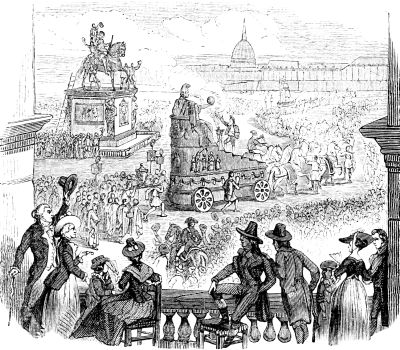
FESTIVAL IN HONOR OF LIBERTY.
Early in the morning the whole city was in commotion, and vast crowds were hurrying to the various points of concentration. The Assembly met at eleven o'clock, and was alarmed in view of the possible issues of the day, and agitated by discordant councils. The session soon became tumultuous, the Constitutionalists wishing to repress the disorder which the Jacobins were ready to foment. In this state of affairs a letter was brought into the Assembly from Santerre, a brewer, who had become notorious as a leader of the populace.[327] It stated that the citizens were merely celebrating the anniversary of the 20th of June; that they were calumniated in the Assembly; and that they beg to be admitted to the bar of the Assembly that they might confound their slanderers.
The reading of this letter vastly increased the tumult. In the midst of cries of order, and a scene of indescribable confusion, it was announced that the petitioners, with arms and banners, in a prolonged procession of thirty thousand men, were approaching the hall. All power of law seemed paralyzed, and bewilderment and consternation reigned. Soon the head of the procession, like a lava-flood, crowded in at the door, and, pressed by the resistless mass behind, was forced slowly through the hall, and made its egress at an opposite portal. They bore enormous tables, upon which were placed the Declaration of Rights. Around these tables danced women and boys waving olive-branches and brandishing pikes, thus emblematically declaring themselves ready for peace or war.
The enormous procession filed slowly through the hall, shouting in deafening chorus the famous "Ça ira" (bravely it goes), armed with every conceivable weapon, and waving banners inscribed with revolutionary devices. Several bore ragged breeches upon poles, while the crowd around shouted, "Vivent les sans culottes!" One man bore on the point of a pike a calf's heart, with the inscription beneath, "The heart of an aristocrat."[328]
For three hours this extraordinary scene continued. The Assembly, agitated with grief and indignation, had no resource but submission. The mob, having passed through the hall of the Assembly, now attempted to enter the garden of the Tuileries, but the gates were closed and defended by numerous detachments of the National Guard. The king, however, perhaps hoping, by a show of confidence, to disarm the mob, ordered the garden gates to be thrown open. The mob, like an inundation, rushed in, and with their mighty mass soon filled the whole inclosure. Some cried out for the king to show himself. Others shouted, "Down with the veto!" A few voices kindly gave utterance to the old excuse, "The king means well, but he is imposed upon."
The mob, which now appeared countless and almost limitless, flowing out from the garden by the gate leading to the Pont Royal, proceeded along the quay and through the wickets of the Louvre into the Place du Carrousel. They were soon gathered in a dense mass before the royal gate of the palace. A strong guard there refused them admittance. Santerre brought up two pieces of cannon to blow down the gate. Two municipal officers then strangely ordered the gates to be thrown open.