Front matter (continued 2)
Reading edition
When some one spoke to Madame de Pompadour of this establishment, she replied,
"It is the king's heart that I wish to possess, and none of these little uneducated girls will deprive me of that."
If the king in his rides chanced to see a pretty child who gave promise of unusual beauty, he sent his servants to take her from her parents to be trained in his harem. The parents had their choice to submit quietly at home, or to submit in the dungeons of the Bastille. One incident, related by Soulavie, in his "Anecdotes of the Reign of Louis XV.," illustrates the mode of operation:
"Among the young ladies of very tender age with whom the king amused himself during the influence of Madame de Pompadour or afterward, there was also a Mademoiselle Treicelin, whom his majesty ordered to take the name of Bonneval the very day she was presented to him. The king was the first who perceived this child, when not above nine years old, in the care of a nurse, in the garden of the Tuileries, one day when he went in state to his good city of Paris; and having in the evening spoken of her beauty to Le Bel, the servant applied to M. de Sartine, who traced her out and bought her of the nurse for a few louis. She was the daughter of M. de Treicelin, a man of quality, who could not patiently endure an affront of this nature. He was, however, compelled to be silent; he was told his child was lost, and that it would be best for him to submit to the sacrifice unless he wished to lose his liberty also."
The expense of the Parc aux Cerfs alone, according to Lacretelle, amounted to 100,000,000 francs—$25,000,000.
These were not deeds of darkness. They were open as the day. France, though bound hand and foot, saw them, and exasperation was advancing to fury. An anonymous letter was sent to Louis, depicting very vividly the ruinous state of affairs and announcing the inevitable shock. Madame de Hausset, in her memoirs, gives the following synopsis of this letter:
"Your finances are in the greatest disorder, and the great majority of states have perished through this cause. Your ministers are without capacity. Open war is carried on against religion. The encyclopedists, under pretense of enlightening mankind, are sapping the foundations of Christianity. All the different kinds of liberty are connected. The philosophers and the Protestants tend toward republicanism. The philosophers strike at the root, the others lop the branches, and their efforts will one day lay the tree low. Add to these the economists, whose object is political liberty, as that of others is liberty of worship, and the government may find itself in twenty or thirty years undermined in every direction, and it will then fall with a crash. Lose no time in restoring order to the state of the finances. Embarrassments necessitate fresh taxes, which grind the people and induce toward revolt. A time will come, sire, when the people will be enlightened, and that time is probably near at hand."
The king read this letter to Madame de Pompadour, and then, turning upon his heel, said,
"I wish to hear no more about it. Things will last as they are as long as I shall."
On another occasion, Mirabeau the elder remarked in the drawing-room of Madame de Pompadour,
"This kingdom is in a deplorable state. There is neither national energy nor money. It can only be regenerated by a conquest like that of China, or by some great internal convulsion. But woe to those who live to see that. The French people do not do things by halves."
Madame de Pompadour herself was fully aware of the catastrophe which was impending, but she flattered herself that the storm would not burst during her life. She often said, "Après nous le déluge"—"After us comes the deluge."
The indications of approaching ruin were so evident that they could not escape the notice of any observing man. Even Louis XV. himself was not blind to the tendency of affairs, and only hoped to ward off a revolution while his day should last.
Lord Chesterfield visited France in 1753, twenty years before the death of Louis XV., and wrote as follows to his son:
"Wherever you are, inform yourself minutely of, and attend particularly to the affairs of France. They grow serious, and, in my opinion, will grow more so every day. The French nation reasons freely, which they never did before, upon matters of religion and government. In short, all the symptoms which I have ever met with in history previous to great changes and revolutions now exist and daily increase in France."
The great difficulty of raising money and the outrages resorted to for the accomplishment of that purpose alarmed the courtiers. One night, an officer of the government, sitting at the bedside of the king conversing upon the state of affairs, remarked,
"You will see, sire, that all this will make it absolutely necessary to assemble the States-General."
The king sprang up in his bed, and, seizing the courtier by his arm, exclaimed,
"Never repeat those words. I am not sanguinary; but, had I a brother, and did he dare to give me such advice, I would sacrifice him within twenty-four hours to the duration of the monarchy and the tranquillity of the kingdom."
It is not strange that in such a court as this Christianity should have been reviled, and that infidelity should have become triumphant.
"When I was first presented to his majesty Louis XV.," La Fayette writes, "I well remember finding the eldest son of the Church, the King of France and Navarre, seated at a table between a bishop and a prostitute. At the same table was seated an aged philosopher, whose writings had conveyed lustre upon the age in which he flourished; one whose whole life had been spent in sapping the foundation of Christianity and undermining monarchy. Yet was this philosopher, at that moment, the object of honor from monarchs and homage from courtiers. A young abbé entered with me, not to be presented to royalty, but to ask the benediction of this enemy of the altar. The name of this aged philosopher was Voltaire, and that of the young abbé was Charles Maurice Talleyrand."
Nearly all the infidel writers of the day—Voltaire, Rousseau, Diderot, D'Alembert—were men hopelessly corrupt in morals. Many of them were keen-sighted enough distinctly to perceive the difference between Christianity and the lives of debauched ecclesiastics. But most of them hated Christianity and its restraints, and were glad to avail themselves of the corruptions of the Church that they might bring the religion of Christ into contempt. But there were not wanting, even then, men of most sincere and fearless piety, who advanced Christianity by their lives, and who with heroism rebuked sin in high places.
The Bishop of Senez was called to preach before the king. With the spirit of Isaiah and Daniel he rebuked the monarch for his crimes in terms so plain, direct, and pungent as to amaze the courtiers. The king was confounded, but God preserved his servant as Daniel was preserved in the lions' den.
At length Madame de Pompadour died, in 1764, and the execrations of France followed her to her burial. It was a gloomy day of wind and rain when the remains of this wretched woman were borne from Versailles to the tomb. The king had now done with her, and did not condescend to follow her to her burial. As the funeral procession left the court-yard of the palace he stood at a window looking out into the stormy air, and chuckled at his heartless witticism as he said, "The marchioness has rather a wet day to set out on her long journey." This remark is a fair index of the almost inconceivable heartlessness of this contemptible king.
Madame de Pompadour breathed her last at Versailles in splendid misery. She was fully conscious of the hatred of the nation, and trembled in view of the judgment of God. "My whole life," said she, in a despairing hour, "has been a continual death."
"Very different indeed," beautifully writes Julia Kavanagh, "were the declining years of Maria Lecsinska and those of the Marchioness of Pompadour. The patient and pious queen laid her sufferings at the foot of the cross. Insulted by her husband and his mistresses, neglected by the courtiers, deeply afflicted by the loss of her children, whom she loved most tenderly, she still found in religion the courage necessary to support her grief, and effectual consolation in the practice of a boundless benevolence."[20]
The old king was now utterly whelmed in the vortex of dissipation; character, and even self-respect, seemed entirely lost. He looked around for another female to take the place of Jeannette Poisson. In one of the low haunts of Parisian debauchery, the courtiers of the king found a girl of extraordinary beauty, calling herself Mademoiselle Lange. She had been sewing in the shop of a milliner, but was now abandoned to vice. She was introduced as a novelty to the voluptuous monarch, and succeeded in fascinating him. She received the title of Countess du Barry, and was immediately installed at Versailles as the acknowledged favorite of the king. Vice never rises, but always descends in the scale of degradation. The king had first selected his favorites from the daughters of nobles, he then received one from the class whom he affected to despise as low-born; and now a common prostitute, taken from the warehouses of infamy in Paris, uneducated, and with the manners of a courtesan, is presented to the nation as the confidant and the manager of the despicable sovereign. All the high-born ladies, accustomed as they were to the corruptions of the court, regarded this as an insult too grievous to be borne. The nobles, the clergy, the philosophers, and the people, all joined in this outcry. But Madame du Barry, wielding the authority of the king, was too strong for them all. She dismissed and banished from the court the Duke of Choiseul, the king's minister, and to his post she raised one of her own friends. She then, with astounding boldness, suppressed the Parliaments, thus leaving to France not even the shadow of representative power. Thus she proceeded, step by step, removing enemies and supplanting them by friends, until the most noble of the land were emulous of the honor of admission to the saloon of this worthless woman.
It is an appalling and a revolting fact that for half a century before the revolution France was governed by prostitutes. The real sovereign was the shameless woman who, for the time being, kept control of the degraded and sensual king. "The individual," says De Tocqueville, "who would attempt to judge of the government by the men at the head of affairs and not by the women who swayed those men, would fall into the same error as he who judges of a machine by its outward action and not by its inward springs."
The king was now so execrated that he dared not pass through Paris in going from his palace at Versailles to Compiègne. Fearing insult and a revolt of the people if he were seen in the metropolis, he had a road constructed which would enable him to avoid Paris. As beautiful female children were often seized to replenish his seraglio at the Parc aux Cerfs, the people received the impression that he indulged in baths of children's blood, that he might rejuvenate his exhausted frame. The king had become an object of horror.[21]
Such was the state of affairs when the guilty king was attacked by the small-pox, and died at Versailles in 1774, in the sixty-fourth year of his age and the fifty-ninth of his reign. Such in brief was the career of Louis XV. His reign was the consummation of all iniquity, and rendered the Revolution inevitable. The story of his life, revolting as it is, must be told; for it is essential to the understanding of the results which ensued. The whirlwind which was reaped was but the legitimate harvest of the wind which was sown. Truly does De Tocqueville say, "The Revolution will ever remain in darkness to those who do not look beyond it. It can only be comprehended by the light of the ages which preceded it. Without a clear view of society in the olden time, of its laws, its faults, its prejudices, its sufferings, its greatness, it is impossible to understand the conduct of the French during the sixty years which have followed its fall."
FOOTNOTES:
CHAPTER IV.
DESPOTISM AND ITS FRUITS.
Assumptions of the Aristocracy.—Molière.—Decay of the Nobility.—Decline of the Feudal System.—Difference between France and the United States.—Mortification of Men of Letters.—Voltaire, Montesquieu, Rousseau.—Corruption of the Church.—Diderot.—The Encyclopedists.—Testimony of De Tocqueville.—Frederic II. of Prussia.—Two Classes of Opponents of Christianity.—Enormity of Taxation.—Misery of the People.—"Good old Times of the Monarchy!"
Having given a brief sketch of the character of Louis XV., let us now contemplate the condition of France during his long reign. It has been estimated that the privileged class in both Church and State consisted of but one hundred and fifty thousand. It was their doctrine, enforced by the most rigorous practice, that the remaining twenty-five millions of France were created but to administer to their luxury; that this was the function which Providence intended them to perform. Every office which could confer honor and emolument in the Church, the army, the State, or the Court, was filled by the members of an aristocracy who looked with undisguised contempt upon all those who were not high-born, however opulent or however distinguished for talents and literary culture. Louis XV., surrounded by courtesans and debauched courtiers, deemed it presumption in Voltaire to think of sitting at the same table with the king. "I can give pensions to Voltaire, Montesquieu, Fontinelle, and Maupertius," said the king, "but I can not dine and sup with these people."[22]
The courtiers of Louis XIV. manifested in the most offensive manner the mortification which they felt in being obliged to receive Molière, the most distinguished comic dramatist of France, to their table. No degree of genius could efface the ignominy of not being nobly born.[23] But, notwithstanding the arrogance of the nobles, they, as a class, had fallen into contempt. All who could support a metropolitan establishment had abandoned their chateaux and repaired to Paris. The rural castle was shut up, silence reigned in its halls, and grass waved in its court-yard. The bailiff only was left behind to wring the last farthing from the starving tenantry. Many of the noble families were in decay. Their poverty rendered their pride only the more contemptible. Several of the provinces contained large numbers of these impoverished aristocratic families, who had gradually parted with their lands, and who were living in a state of very shabby gentility. They were too proud to work and too poor to live without working. Turgot testifies that in the Province of Limousin there were several thousand noble families, not fifteen of whom had an income of four thousand dollars a year.[24] One of the crown officers wrote in 1750:
"The nobility of this section are of very high rank, but very poor, and as proud as they are poor. The contrast between their former and their present condition is humiliating. It is a very good plan to keep them poor, in order that they shall need our aid and serve our purposes. They have formed a society into which no one can obtain admission unless he can prove four quarterings. It is not incorporated by letters patent, but it is tolerated, as it meets but once a year and in the presence of the intendant. These noblemen hear mass, after which they return home, some on their Rosinantes, some on foot. You will enjoy this comical assembly."
In days of feudal grandeur the noble was indeed the lord and master of the peasantry. He was their government and their sole protector from violence. There was then reason for feudal service. But now the noble was a drone. He received, and yet gave nothing, absolutely nothing, in return. The peasant despised as well as hated him, and derisively called him the vulture.
The feudal system is adapted only to a state of semi-barbarism. It can no more survive popular intelligence than darkness can exist after the rising of the sun. When, in the progress of society, nobles cease to be useful and become only drones; when rich men, vulgar in character, can purchase titles of nobility, so that the nobles cease to be regarded as a peculiar and heaven-appointed race; when men from the masses, unennobled, acquire opulence, education, and that polish of manners which place them on an equality with titled men; when men of genius and letters, introduced into the saloons of the nobles, discover their own vast superiority to their ignorant, frivolous, and yet haughty entertainers; and when institutions of literature, science, and art create an aristocracy of scholarship where opulence, refinement, and the highest mental culture combine their charms, then an hereditary aristocracy, which has no support but its hereditary renown, must die. Its hour is tolled.
Such was the state of France at the close of the reign of Louis XV. It is estimated that there were in France at that time five hundred thousand well-informed citizens.[25] This fact explains both the outbreak of the Revolution and its failure. They were too many to submit to the arrogance of the nobles; hence the insurrection. They were too few to guide and control the infuriated masses when the pressure was taken from them, and hence the reign of terror, the anarchy and blood. The United States, with a population about the same as that of France in the morning of her Revolution, has four or five millions of intelligent and well-educated men. These men support our institutions. But for them, the republic would be swept away like chaff before the wind.
As we have before said, men of letters were patronized by the king and the court, but it was a patronage which seemed almost an insult to every honorable mind. The haughty duke would look down condescendingly, and even admiringly, upon the distinguished scholar, and would admit him into his saloon as a curiosity. High-born ladies would smile upon him, and would condescend to take his arm and listen to his remarks. But such mingling with society stung the soul with a sense of degradation, and none inveighed with greater bitterness against aristocratic assumption than those men of genius who had been most freely admitted into the halls of the great. They were thus exasperated to inquire into the origin of ranks, and their works were filled with eulogiums of equality and fraternity.
It was this social degradation which was one of the strongest incentives to revolution. This united all the industrial classes in France, all who had attained wealth, and all men of intellectual eminence, in the cry for reform. Equality of rights was the great demand thus forced from the heart of the nation. Fraternity became the watch-word of the roused and rising masses.[26]
Thought was the great emancipator. Men of genius were the Titans who uphove the mountains of prejudice and oppression. They simplified political economy, and made it intelligible to the popular mind. Voltaire assailed with keenest sarcasm and the most piercing invectives the corruptions of the Church, unjustly, and most calamitously for the interests of France, representing those corruptions as Christianity itself. Montesquieu popularized and spread before the nation those views of national policy which might render a people prosperous and happy; and Rousseau, with a seductive eloquence which the world has never seen surpassed, excited every glowing imagination with dreams of fascinating but unattainable perfection. Nearly all the revolutionary writers represented religion not merely as a useless superstition, but as one of the worst scourges of the state. Thus they took from the human heart the influence which alone can restrain passion and humanize the soul.
They represented man but as a lamb, meek and innocent, dumb before his shearers, and seeking only to live harmlessly and happily in the outflowings of universal benevolence and love. This lamb-like man needed no more religion than does the butterfly or the robin. He was to live his joyous day, unrestrained by customs, or laws, or thoughts of the future, and then was to pass away like the lily or the rose, having fulfilled his function. Death an eternal sleep, was the corner-stone of their shallow and degrading philosophy. The advocates of this sentimentalism were amazed when they found the masses, brutalized by ignorance and ages of oppression, and having been taught that there was no God before whom they were to stand in judgment, come forth into the arena of the nations, not as lambs, but as wolves, thirsting for blood and reckless in devastation. Libertines in France are still infidels, but they have seen the effect of their doctrines, and no longer dare to proclaim them. "Where is the Frenchman of the present day," says De Tocqueville, "who would write such books as those of Diderot or Helvetius?"[27]
Unfortunately, fatally for the liberties of France, the leading writers were infidels. Mistaking the corruptions of Christianity for Christianity itself, they assailed religion furiously, and succeeded in eradicating from men's souls all apprehensions of responsibility to God. Nothing could more effectually brutalize and demonize the soul of man. And yet the Papal Church, as a towering hierarchy, had become so corrupt, such an instrument of oppression, and such a support of despotism, that no reform could have been accomplished but by its overthrow.[28] It was the monarch's right arm of strength; it was the rampart which was first to be battered down.
The Church had no word of censure for vice in high places. It spread its shield before the most enormous abuses, and, by its inquisitorial censorship of the press, protected the most execrable institutions. The Church, enervated by wealth and luxurious indulgence, had also become so decrepit as to invite attack. No man could summon sufficient effrontery to attempt her defense. The only reply which bloated and debauched ecclesiastics could make to their assailants was persecution and the dungeon. There were a few truly pious men in the Church; they did, however, but exhibit in clearer contrast the general corruption with which they were surrounded.
Diderot, though educated by the Jesuits—perhaps because he was educated by the Jesuits—commenced his career by an attack upon Christianity in his Pensées Philosophiques. He was sent to prison, and his book burned by the public executioner. Still, multitudes read and so warmly applauded that he was incited to form the plan of the celebrated Encyclopedia which was to contain a summary of all human knowledge. In this grand enterprise he allied with him the ablest scholars and writers of the day—Mably, Condillac, Mercier, Raynal, Buffon, Helvetius, D'Alembert, and others. Nearly all these men, despising the Church, were unbelievers in Christianity. They consequently availed themselves of every opportunity to assail religion. The court, alarmed, laid a prohibition upon the work, but did not dare to punish the writers, as they were too numerous and powerful. Thus infidelity soon became a fashion. Notwithstanding the prohibition, the work was soon resumed, and became one of the most powerful agents in ushering in the Revolution.
"Christianity was hated by these philosophers," writes De Tocqueville, "less as a religious doctrine than as a political institution; not because the ecclesiastics assumed to regulate the concerns of the other world, but because they were landlords, seigneurs, tithe-holders, administrators in this; not because the Church could not find a place in the new society which was being established, but because she then occupied a place of honor, privilege, and might in the society which was to be overthrown."
Christianity is the corner-stone of a true democracy. It is the unrelenting foe of despotism, and therefore despotism has invariably urged its most unrelenting warfare against the Bible. When papacy became the great spiritual despotism which darkened the world, the Bible was the book which it hated and feared above all others. With caution this corrupt hierarchy selected a few passages upon submission and obedience, which it allowed to be read to the people, while the majestic principles of fraternity, upon which its whole moral code is reared, were vigilantly excluded from the public mind. The peasant detected with a Bible was deemed as guilty as if caught with the tools of a burglar or the dies of a counterfeiter.
It was impossible, however, to conceal the fact that the Bible was the advocate of purity of heart and life. Its teachings created a sense of guilt in the human soul which could not be effaced. Corrupt men were consequently eager to reject the Bible, that they might appease reproachful conscience. Frederick II., of Prussia, an atheist and a despiser of mankind, became the friend and patron of Voltaire in his envenomed assaults upon Christianity. Louis XV., anxious to maintain friendly political relations with Prussia, hesitated to persecute the recognized friend of the Prussian king. The courtiers, generally with joy, listened to those teachings of unbelief which relieved them from the restraints of Christian morality. Thus Christianity had two classes of vigorous assailants. The first were those who knew not how to discriminate between Christianity and its corruptions. They considered Christianity and the Papal Church as one, and endeavored to batter the hateful structure down as a bastille of woe. Another class understood Christianity as a system frowning upon all impurity, and pressing ever upon the mind a final judgment. They were restive under its restraints, and labored for its overthrow that guilt might find repose in unbelief.
Astonishment is often expressed at the blindness with which the upper classes of the Old Régime allowed their institutions to be assailed. "But where," asks De Tocqueville, "could they have learned better. Ruling classes can no more acquire a knowledge of the dangers they have to avoid, without free institutions, than their inferiors can discern the rights they ought to preserve in the same circumstances."[29]
The measureless extravagance of the court had plunged the nation into a state of inextricable pecuniary embarrassment. The whole burden of the taxes, in myriad forms, for the support of the throne in Oriental luxury, for the support of the nobles, who were perhaps the most profligate race of men the world has ever known; for the support of the Church, whose towering ecclesiastics, performing no useful functions, did not even affect the concealment of their vices, and who often vied with the monarch himself in haughtiness and grandeur; for the support of the army, ever engaged in extravagant wars, and employed to keep the people in servitude—all these taxes so enormous as to sink the mass of the people in the lowest state of poverty, debasement, and misery, fell upon the unprivileged class alone.
Taxes ran into every thing. The minister who could invent a new tax was applauded as a man of genius. All the offices of the magistracy were sold. Judges would pay an enormous sum for their office, and remunerate themselves a hundred-fold by selling their decisions. Thus justice became a farce. Titles of nobility were sold, which, introducing the purchaser into the ranks of the privileged class, threw the heavier burden upon the unprivileged. All the trades and professions were put up for sale. Even the humble callings of making wigs, of weighing coal, of selling pork, were esteemed privileges, and were sold at a high price. There was hardly any thing which a man could do, which he was not compelled to buy the privilege of doing. A person who undertook to count the number of these offices or trades for which a license was sold, growing weary of his task, estimated them at over three hundred thousand.[30]
An army of two hundred thousand tax-gatherers devoured every thing. To extort substance from the starving people the most cruel expedients were adopted. All the energies of galleys, gibbets, dungeons, and racks were called into requisition. When the corn was all absorbed, the cattle were taken. The ground, exhausted for want of manure, became sterile. Men, women, and children yoked themselves to the plow. Deserts extended, the population died off, and beautiful France was becoming but a place of graves.
The people thus taxed owned but one third of the soil, the clergy and the nobles owning the other two thirds. From this one third the people paid taxes and feudal service to the nobles, tithes to the clergy, and imposts to the king. They enjoyed no political rights, could take no share in the administration, and were ineligible to any post of honor or profit. No man could obtain an office in the army unless he brought a certificate, signed by four nobles, that he was of noble blood.
The imposition of the tax was entirely arbitrary. No man could tell one year what his tax would be the next. There was no principle in the assessment except to extort as much as possible. The tax-gatherers would be sent into a district to collect one year one million of francs, perhaps the next year it would be two millions. No language can describe the dismay in the humble homes of the peasants when these cormorants, armed with despotic power, darkened their doors. The seed-corn was taken, the cow was driven off, the pig was taken from the pen. Mothers plead with tears that food might be left for their children, but the sheriff, inured to scenes of misery, had a heart of rock. He always went surrounded by a band of bailiffs to protect him from violence. Fearful was the vengeance he could wreak upon any one who displeased him.
The peasant, to avoid exorbitant taxation, assumed the garb of poverty, dressed his children in rags, and carefully promoted the ruin and dilapidation of his dwelling. "Fear," writes de Tocqueville, "often made the collector pitiless. In some parishes he did not show his face without a band of bailiffs and followers at his back. 'Unless he is sustained by bailiffs,' writes an intendant in 1764, 'the taxables will not pay. At Villefranche alone six hundred bailiffs and followers are always kept on foot.'"[31]
Indeed, the government seemed to desire to keep the people poor. Savages will lop off the leg or the arm of a prisoner that he may be more helplessly in their power. Thus those despotic kings would desolate their realms with taxation, and would excite wars which would exhaust energy and paralyze industry, that the people thus impoverished and kept in ignorance might bow more submissively to the yoke. The wars which in endless monotony are inscribed upon the monuments of history were mostly waged by princes to engross the attention of their subjects. When a despot sees that public attention is directed, or is likely to be directed, to any of his oppressive acts, he immediately embarks in some war, to divert the thoughts of the nation. This is the unvarying resource of despotism. After a few hundred thousand of the people have been slaughtered, and millions of money squandered in the senseless war, peace is then made. But peace brings but little repose to the people. They must now toil and starve that they may raise money to pay for the expenses of the war. Such, in general, has been the history of Europe for a thousand years. Despots are willing that billows of blood should surge over the land, that the cries of the oppressed may thus be drowned.
So excessive was the burden of taxation, that it has been estimated by a very accurate computation that, if the produce of an acre of land amounted to sixteen dollars, the king took ten, the duke, as proprietor, five, leaving one for the cultivator.[32] Thus, if we suppose a peasant with his wife and children to have cultivated forty acres of land, the proceeds of which, at sixteen dollars per acre, amounted to six hundred and forty dollars, the king and the duke and the Church took six hundred of this, leaving but forty dollars for the support of the laborers.
Let us suppose a township in the United States containing twenty square miles, with five thousand inhabitants. Nearly all these are cultivators of the soil, and so robbed by taxes that they can only live in mud hovels and upon the coarsest food. Clothed in rags, they toil in the fields with their bareheaded and barefooted wives and daughters. The huts of these farmers are huddled together in a miserable dirty village. In the village there are a few shop-keepers, who have acquired a little property, and have become somewhat intelligent. There is also a physician, and a surgeon, and a poor, dispirited, half-starved parish priest. Upon one of the eminences of the town there is a lordly castle of stone, with its turrets and towers, its park and fish-pond. This massive structure belongs to the duke. Weary of the solitude of the country, he has withdrawn from the castle, and is living with his family in the metropolis, indulging in all its expensive dissipations. His purse can only be replenished by the money which he can extort from the cultivators of the land who surround his castle; and his expenses are so enormous that he is ever harassed by an exhausted purse.
For a few weeks in the summer he comes down to his castle, from the metropolis, with his city companions, to engage in rural sports. Wild boars, deer, rabbits, and partridges abound in his park. The boars and the deer range the fields of the farmers, trampling down and devouring their crops; but the farmer must not harm them, lest he incur the terrible displeasure of the duke. The rabbits and the partridges infest the fields of grain; but the duke has issued a special injunction that the weeds even must not be disturbed, lest the brooding partridges should be frightened away, to the injury of his summer shooting.
Perhaps one half of the land in the township belongs to the duke, and the farmers are mere tenants at will. During past ages, about half of the land has been sold and is owned by those who till it. But even they have to pay a heavy ground-rent annually to the duke for the land which they have bought. If a farmer wishes to purchase a few acres from his neighbor, he must first pay a sum to the duke for permission to make the purchase. For three or four days in the week the farmer is compelled, as feudal service, to work in the fields of the duke, without remuneration. When he has gathered in the harvest on his own land, a large portion of it he must cart to the granaries of the duke as a tax. If he has any grain to be ground, or grapes to press, or bread to bake, he must go to the mill, the wine-press, and the oven of the duke, and pay whatever toll he may see fit to extort. Often even the use of hand-mills was prohibited, and the peasant had to purchase the privilege of bruising his grain between two stones. He could not even dip a bowl of water from the sea, and allow it to evaporate to get some salt, lest he should interfere with the monopoly of the king. If he wishes to take any of his produce to market, he must pay the duke for permission to travel on the highway. Thus robbed under the name of custom and law, the farmer toils joylessly from the cradle to the grave, with barely sufficient food and shelter to keep him in respectable working order; and when he dies, he leaves his children to the same miserable doom. Such was the condition of the great mass of the French people during the long reign of Louis XV.
This intolerable bondage spread all through the minutiæ of social life. It was, of course, impossible but that the masses of the people should be in the lowest state of ignorance and indigence. Their huts, destitute of all the necessities of civilized life, were dark and comfortless, and even the merriment with which they endeavored at times to beguile their misery was heartless, spasmodic, and melancholy.[33]
In the year 1785, Thomas Jefferson wrote from Paris to Mrs. Trist, of Philadelphia, "Of twenty millions of people supposed to be in France, I am of opinion that there are nineteen millions more wretched, more accursed in every circumstance of human existence, than the most conspicuously wretched individual of the whole United States."[34]
Again he writes, in the same year, to M. Bellini, a Florentine gentleman who was professor in William and Mary College, "I find the general state of humanity here most deplorable. The truth of Voltaire's observation offers itself perpetually, that every man here must be either the hammer or the anvil."
FOOTNOTES:
CHAPTER V.
THE BASTILLE.
Absolute Power of the King.—Lettres de Cachet.—The Bastille.—Cardinal Balue.—Harancourt.—Charles of Armanac.—Constant de Renville.—Duke of Nemours.—Dungeons of the Bastille.—Oubliettes.—Dessault.—M. Massat.—M. Catalan.—Latude.—The Student.—Apostrophe of Michelet.
The monarchy was now so absolute that the king, without any regard to law, had the persons and the property of all his subjects entirely at his disposal. He could confiscate any man's estate. He could assign any man to a dungeon for life without trial and even without accusation. To his petted and profligate favorites he was accustomed to give sealed writs, lettres de cachet, whose blanks they could fill up with any name they pleased. With one of these writs the courtiers could drag any man who displeased them to one of the dungeons of the Bastille, where no light of the sun would ever gladden his eyes again. Of these sealed writs we shall speak hereafter. They were the most appalling instruments of torture despotism ever wielded.
The Bastille. At the eastern entrance of Paris stood this world-renowned fortress and prison. In gloomy grandeur its eight towers darkened the air, surrounded by a massive wall of stone nine feet thick and a hundred feet high. The whole was encircled by a ditch twenty-five feet deep and one hundred and twenty feet wide. The Bastille was an object exciting universal awe. No one could ever pass beneath its shadow without thinking of the sighs which ceaselessly resounded through all its vaults. It was an ever-present threat, the great upholder of despotic power, with its menace appalling even the boldest heart. It is easy to brave death from the bullet or the guillotine; but who can brave the doom of Cardinal Balue, who, for eleven years, was confined in an iron cage, so constructed that he could find no possible position for repose; or the fate of Harancourt, who passed fifteen years in a cage within the Bastille, whose iron bars required in their riveting the labors of nineteen men for twenty days? To be thus torn from wife, children, and home, and to be consigned for life to the unearthly woe of such a doom must terrify even the firmest soul. It is painful to dwell upon these details, but they must be known in explanation of the scenes of violence and blood to which they finally gave birth.
Charles of Armanac, for no crime whatever of his own, but because his brother had offended Charles XI., was thrown into prison. For fourteen years he lingered in the dungeon, until his reason was dethroned and his spirit was bewildered and lost in the woes of the maniac. Constant de Renville, a Norman gentleman, was accused, while in exile in Holland, of writing a satirical poem against France. For eleven years he was immured in one of the most loathsome dungeons of the Bastille. He appears to have been a man of true piety, and upon his release wrote an account of the horrors of his prison-house, which thrilled the ear of Europe.
The Duke of Nemours was accused of an intrigue against Louis XI. He was dragged from the presence of his wife, exciting in her such terror that she fell into convulsions and died. After two years' imprisonment he was condemned to be executed. A scaffold was erected with openings beneath the planks, and his three children were placed beneath the planks, bareheaded, clothed in white robes, and with their hands bound behind their backs, that the blood of their beheaded father might drop upon them, and that his anguish might be increased by witnessing the agony of his children. The fearful tragedy being over, these tender children, the youngest of whom was but five years of age, were again locked up in one of the gloomiest vaults of the Bastille, where they remained for five years. Upon the death of Louis XI. they were released. The two eldest, however, emaciate with privation and woe, soon died. The youngest alone survived.
Imagination can not conceive of an abode more loathsome than some of these horrible dens. The cold stone walls, covered with the mould of ages, were ever dripping with water. The slimy floor swarmed with reptiles and all kinds of vermin who live in darkness and mire. A narrow slit in the wall, which was nine feet thick, admitted a few straggling rays of light, but no air to ventilate the apartment where corruption was festering. A little straw upon the floor or upon a plank supported by iron bars fixed in the wall afforded the only place for repose. Ponderous double doors, seven inches thick and provided with enormous locks and bolts, shut the captive as effectually from the world and from all knowledge of what was passing in the world as if he were in his grave. His arrest was frequently conducted so secretly that even his friends had no knowledge of what had become of him; they could make no inquiries at the gloomy portals of the Bastille, and the unhappy captive was left to die unknown and forgotten in his dungeon. If by any happy chance he was liberated, he was first compelled to take an oath never to repeal what he had seen, or heard, or suffered within the walls of the Bastille.
Thus any person who became obnoxious to the king or any of his favorites was immediately transferred to these dungeons of despair. Cardinal Richelieu filled its cells with the victims of his tyranny. The captive immediately received the name of his cell, and his real name was never uttered within the precincts of the Bastille.
The Bastille was often full to overflowing, but there were other Bastilles in France sufficiently capacious to meet all the demands of the most inexorable tyranny.
It is the more necessary to dwell upon these details since the Bastille was the mailed hand with which aristocratic usurpation beat down all resistance and silenced every murmur. The Bastille, with its massive walls and gloomy towers and cannon frowning from every embrasure, was the terrific threat which held France in subjection. It was the demon soul of demoniac despotism. So awful was the terror inspired, that frequently the victim was merely enjoined by one of the warrants bearing the seal of the king to go himself to the dungeon. Appalled and trembling in every nerve, he dared not for one moment disobey. Hastening to the prison, he surrendered himself to its glooms, despairingly hoping, by prompt obedience, to shorten the years of his captivity.
There were vaults in the Bastille and other prisons of France called oubliettes, into which the poor victim was dropped and left to die forgotten. These were usually shaped like a bottle, with a narrow neck and expanding beneath. In one of these tombs of massive stone, twenty-two feet deep and seventeen or eighteen feet in diameter, with a narrow neck through which the captive could be thrust down, the inmate was left in Egyptian darkness amid the damp and mould of ages, and, trampling upon the bones of those who had perished before him, to linger through weary hours of starvation and woe until death came to his relief. Sometimes he thus lingered for years, food being occasionally thrown down to him.
There were twenty bastilles in France. In Paris, besides the Bastille, there were thirty prisons, where people might be incarcerated without sentence, trial, or even accusation. The convents were amply supplied with dungeons. All these prisons were at the disposal of the Jesuits. They were instruments of torture. The wretched victim, once consigned to those cells, was enshrouded by the oblivion of the tomb. The rich man was robbed of his wealth and taken there to be forgotten and to die. Beauty, whose virtue bribes could not destroy, was dragged to those apartments to minister to the lust of merciless oppressors. The shriek of despair, smothered by walls of stone and doors of iron, reached only the ear of God.[35]
During the reign of Louis XV. one hundred and fifty thousand of these lettres de cachet were issued, making an average of two thousand five hundred annually.[36] The king could not refuse a blank warrant to his mistress or to a courtier. All those who had influence at court could obtain them. They were distributed as freely as in this country members of Congress have distributed their postage franks. St. Florentin alone gave away fifty thousand. These writs were often sold at a great price. Any man who could obtain one had his enemy at his disposal. One can hardly conceive of a more awful despotism. Such were "the good old times of the monarchy," as some have insanely called them. Even during the mild reign of Louis XVI. fourteen thousand lettres de cachet were issued. Let us enter the prison and contemplate the doom of the captive.
A gentleman by the name of Dessault offended Richelieu by refusing to execute one of his atrocious orders. At midnight a band of soldiers entered his chamber, tore him from his bed, and dragged him through the dark streets to the Bastille, and there consigned him to a living burial in one of its cold damp tombs of iron and stone. Here in silence and solitude, deprived of all knowledge of his family, and his family having lost all trace of him, he lingered eleven years.
"Oh, who can tell what days, what nights he spent Of tideless, waveless, sailless, shoreless woe!"
At last his jailer ventured to inform him that Richelieu was on a dying bed. Hoping that in such an hour the heart of the haughty cardinal might be touched with sympathy, he wrote to him as follows:
"My lord, you are aware that for eleven years you have subjected me to the endurance of a thousand deaths in the Bastille—to sufferings which would excite compassion if inflicted even upon the most disloyal subject of the king. How much more then should I be pitied, who am doomed to perish here for disobeying an order, which, obeyed, would have sent me to the final judgment with blood-stained hands, and would have consigned my soul to eternal misery. Ah! could you but hear the sobs, the lamentations, the groans which you extort from me, you would quickly set me at liberty. In the name of the eternal God, who will judge you as well as me, I implore you, my lord, to take pity on my woe, and, if you wish that God should show mercy to you, order my chains to be broken before your death-hour comes. When that hour arrives you will no longer be able to do me justice, but will persecute me even in your grave."
The iron-hearted minister was unrelenting, and died leaving his victim still in the dungeon. There Dessault remained fifty years after the death of Richelieu. He was at length liberated, after having passed sixty-one years in a loathsome cell but a few feet square. The mind stands aghast in the contemplation of such woes. All this he suffered as the punishment of his virtues. The mind is appalled in contemplating such a doom. Even the assurance that after death cometh the judgment affords but little relief. Michelet, an unbeliever in Christian revelation, indignantly exclaims, "though a sworn enemy to barbarous fictions about everlasting punishment, I found myself praying to God to construct a hell for tyrants."
When we remember that during a single reign one hundred and fifty thousand were thus incarcerated; that all the petted and profligate favorites of the king, male and female, had these blank warrants placed in their hands, which they could fill up with any name at their pleasure; that money could be thus extorted, domestic virtue violated, and that every man and every family was thus placed at the mercy of the vilest minions of the court, we can only wonder that the volcano of popular indignation did not burst forth more speedily and more desolatingly. It is true that in many other countries of Europe the state of affairs was equally bad, if not worse. But in France wealth and intelligence had made great advances, while in central and northern Europe the enslaved people were so debased by ignorance that they had no consciousness of the rights of which they were defrauded.
The court demanded of a rich man, M. Massat, six hundred thousand livres ($120,000). Stunned by the ruinous demand, he ventured to remonstrate. He was dragged to the Bastille, where the vermin of his dungeon could alone hear his murmurs. M. Catalan, another man of wealth, after experiencing the horrors of such an imprisonment for several months, was glad to purchase his ransom for six millions of livres ($1,200,000).[37]
The money thus extorted was squandered in the most shameless profligacy. The king sometimes expended two hundred thousand dollars for a single night's entertainment at Versailles. The terrors of the Bastille frowned down all remonstrances. A "stone doublet" was the robe which the courtiers facetiously remarked they had prepared for murmurers.
On the 1st of May, 1749, a gentleman of the name of Latude was arrested by one of these lettres de cachet, and thrown into the Bastille. He was then but twenty years of age, and had given offense to Madame de Pompadour, by pretending that a conspiracy had been formed against her life. For thirty-five years he remained in prison enduring inconceivable horrors. In 1784, several years after the death of both the mistress and her subject king, he was liberated and wrote an account of his captivity. It was a tale of horror which thrilled the ear of Europe. Eloquently, in view of the letters of Latude, Michelet represents the people as exclaiming,
"Holy, holy Revolution, how slowly dost thou come! I, who have been waiting for thee a thousand years in the furrows of the Middle Ages, what! must I wait still longer? Oh, how slowly time passes! Oh, how have I counted the hours! Wilt thou never arrive?"
A young man, in a Jesuit College, in a thoughtless hour, composed a satirical Latin distich, making merry with the foibles of the professors and of the king. A lettre de cachet was immediately served upon him, and for thirty-one years, until youth and manhood were giving place to old age, he remained moaning in living burial in one of the dungeons of the Bastille. One of the first acts of the Revolution was to batter down these execrable walls and to plow up their very foundations.
In view of the facts here revealed one can not but be amazed at the manner in which many have spoken of the French Revolution, as if it were merely an outburst of human depravity. "Burke had no idea," writes De Tocqueville, "of the state in which the monarchy, he so deeply regretted, had left us." Michelet, glowing with the indignation which inflamed the bosoms of his fathers, exclaims, "Our fathers shivered that Bastille to pieces, tore away its stones with bleeding hands, and flung them afar. Afterward they seized them again, and, having hewn them into a different form, in order that they might be trampled under foot by the people forever, built with them the Bridge of Revolution."[38]
FOOTNOTES:
CHAPTER VI.
THE COURT AND THE PARLIAMENT.
Death of Louis XV.—Education of Louis XVI.—Maurepas, Prime Minister.—Turgot; his Expulsion from Office.—Necker.—Franklin.—Sympathy with the Americans.—La Fayette.—Views of the Court.—Treaty with America.—Popularity of Voltaire.—Embarrassment of Necker.—Compte Rendu au Roi.—Necker driven into Exile.—Enslavement of France.—New Extravagance.—Calonne.
As the clock of Versailles tolled the hour of twelve at midnight of the 10th of May, 1774, Louis XV., abandoned by all, alone in his chamber, died. In the most loathsome stages of the confluent small-pox, his body had for several days presented but a mass of corruption. Terror had driven all the courtiers from the portion of the palace which he occupied, and even Madame du Barry dared not approach the bed where her guilty paramour was dying. The nurse hired to attend him could not remain in the apartment, but sat in an adjoining room. A lamp was placed at the window, which she was to extinguish as soon as the king was dead. Eagerly the courtiers watched the glimmering of that light that they might be the first to bear to Louis, the grandson of the king, the tidings that he was monarch of France.
Louis was then hardly twenty years of age.[39] His wife, Marie Antoinette, daughter of Maria Theresa, Queen of Austria, was scarcely nineteen. They had been married four years. Marie Antoinette was one of the most beautiful of women, but from infancy she had been educated in the belief that kings and nobles were created to illustrate life by gayety and splendor, and that the people were created only to be their servants.[40]
The taper was extinguished, and the crowd of courtiers rushed to the apartment of the Dauphin to hail him as Louis XVI. The tidings, though expected, for a moment overwhelmed them both, and, encircled in each other's arms, they fell upon their knees, while Louis exclaimed, "O God! guide us, protect us, we are too young to govern."[41] They then entered the grand saloon, where they received the congratulations of all the dignitaries of the Church and the State. All were anxious to escape from the palace whose atmosphere was tainted, and hardly an hour elapsed ere the new court, in carriages and on horseback, left Versailles and were passing rapidly to the Chateau of Choisy, one of the favorite rural palaces of Louis XV. The loathsome remains of the king were left to the care of a few under-servants to be hurried to their burial.
It was not yet four o'clock in the morning. The sleepless night, the chill morning air, the awful scene of death from which they had come, oppressed all spirits. Soon, however, the sun rose warm and brilliant; a jocular remark dispelled the mental gloom, and in two hours they arrived at the palace a merry party exulting in the new reign. The education of Louis XVI. had been such that he was still but a boy, bashful, self-distrusting, and entirely incompetent to guide the kingdom through the terrific storm which for ages had been gathering. He had not the remotest idea of the perils with which France was surrounded. He was an exceedingly amiable young man, of morals most singularly pure for that corrupt age, retiring and domestic in his tastes, and sincerely desirous of promoting the happiness of France. Geography was the only branch of learning in which he appeared to take any special interest. He framed, with much sagacity, the instructions for the voyage of La Pérouse around the world in 1786, and often lamented the fate of this celebrated navigator, saying, "I see very well that I am not fortunate."[42] How mysterious the government of God, that upon the head of this benevolent, kind-hearted, conscientious king should have been emptied, even to the dregs, those vials of wrath which debauched and profligate monarchs had been treasuring up for so many reigns!
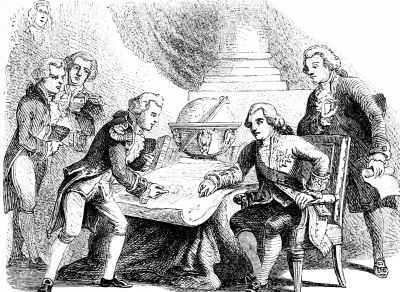
LOUIS XVI. AND LA PÉROUSE.
Louis had no force of character, and, destitute of self-reliance, was entirely guided by others. At the suggestion of his aunt, Adelaide, he called to the post of prime minister Count Maurepas, who was eighty years of age, and who, having been banished from Paris by Madame de Pompadour, had been living for thirty years in retirement. Thus France was handed over in these hours of peril to a king in his boyhood and a prime minister in his dotage. Was it chance? Was it Providence? Clouds and darkness surround God's throne!
M. Turgot was appointed to the post of utmost difficulty and danger—the administration of the finances. He had acquired much reputation by the skill with which, for twelve years, he had administered the government of the Province of Limousin. The kingdom of France was already in debt more than four thousand millions of francs ($800,000,000).[43] As the revenue was by no means sufficient to pay the interest upon this debt and the expenses of the government, new loans had been incessantly resorted to, and national bankruptcy was near at hand. To continue borrowing was ruin; to impose higher taxes upon the people impossible. There were but two measures which could be adopted. One was to introduce a reform of wide-sweeping and rigid economy, cutting down salaries, abolishing pensions and sinecures, and introducing frugality into the pleasure-haunts of the court. Turgot was too well acquainted with the habits of the courtiers to dream that it was in the power of any minister to enforce this reform. There remained only the plan to induce the clergy and the nobles to allow themselves to be taxed, and thus to bear their fair proportion of the expenses of the state. Turgot fully understood the Herculean task before him in attempting this measure, and in a letter to the king he wrote:
"We will have no bankruptcies, no augmentation of the taxes, no loans. I shall have to combat abuses of every kind, to combat those who are benefited by them, and even the kindness, sire, of your own nature. I shall be feared, hated, and calumniated; but the affecting goodness with which you pressed my hands in yours, to witness your acceptance of my devotion to your service, is never to be obliterated from my recollection, and must support me under every trial."[44]
Several of Turgot's measures of reform the privileged class submitted to, though with reluctance and with many murmurs; but when he proposed that a tax should be fairly and equally levied upon proprietors of every description, a burst of indignant remonstrance arose from the nobles which drowned his voice. To suggest that a high-born man was to be taxed like one low-born was an insult too grievous to be borne. The whole privileged class at once combined, determined to crush the audacious minister thus introducing the doctrine of equal taxation into the court of aristocratic privilege.
Madame du Barry, in a pet, four years before, had abolished the Parliament of Paris, which was entirely under the control of the aristocracy. Louis XVI., seeking popularity, restored the Parliament. Unfortunately for reform, the nobles had now an organized body with which to make resistance. The Parliament, the clergy, the old minister Maurepas, and even the young queen, all united in a clamorous onset upon Turgot, and he was driven from the ministry, having been in office but twenty months.[45] The Parliament absolutely refused to register the obnoxious decree. The inexperienced and timid king, frightened by the clamor, yielded, and abandoned his minister. Had the king been firm, he might, perhaps, have carried his point; but want of capacity leads to results as disastrous as treachery, and the king, though actuated by the best intentions, was ignorant and inefficient. Though the king held a bed of justice,[46] and ordered the edicts registered, they remained as dead letters and were never enforced.
There was in Paris a wealthy Protestant banker, born in Geneva, of great financial celebrity, M. Necker. He was called to take the place of Turgot. Warned by the fate of his predecessor and seeing precisely the same difficulties staring him in the face, he resolved to try the expedient of economy, cutting off pensions and abolishing sinecures. But the nobles, in Church and State, disliked this as much as being taxed, and immediately their clamor was renewed.[47]
Just at this time the American war of independence commenced. All France was in a state of enthusiasm in view of a heroic people struggling to be free. And when the American delegation appeared in Paris, headed by Franklin, all hearts were swept along by a current which neither king nor nobles could withstand. The republican simplicity of Franklin in his attire and manners produced an extraordinary impression upon all classes. The French ladies in particular were lavish in their attentions. Several fêtes were given in his honor, at one of which the most beautiful of three hundred ladies crowned him with a laurel wreath, and then kissed him on both cheeks. Almost every saloon was ornamented with his bust, bearing the inscription, "Eripuit cœlo fulmen, sceptrumque tyrannis."
All the latent spirit of freedom which had so long been slowly accumulating burst forth with a power which alarmed the court. Not a few of the nobles, disgusted with the aristocratic oppression which was ruining France, gave their sympathies to the American cause. The Marquis la Fayette, then but eighteen years of age, openly and enthusiastically applauded the struggle of the colonists. Marie Antoinette, instinctively hating a war in which the people were contending against royalty, expressed much indignation that La Fayette should utter such sentiments in the Palace of Versailles. Joseph II. of Austria, brother of Marie Antoinette, then on a visit to the French court, was asked by a lady his opinion of the subject which was now engrossing every mind. He replied, "I must decline answering; my business is to be a Royalist" (Mon métier à moi c'est d'être Royaliste).[48]
It is hardly possible for one now to realize the enthusiasm with which the American war, at that time, inspired France. Even the court hated England, and wished to see that domineering power humbled. The mind of the nation had just awakened and was thoroughly aroused from the lethargy of ages. Theories, dreams, aspirations had exhausted themselves, and yet there was in France no scope whatever for action. America opened a theatre for heroic enterprise. France had given the theory of liberty, America was illustrating that theory by practice. The popular cry so effectually drowned every other voice that even the king was compelled to yield. A treaty with America was signed which drew from the treasury of France twelve hundred millions of francs ($240,000,000), in support of American independence.[49] But for the substantial aid thus rendered by the fleet and the army of France it can hardly be doubted that the American Revolution would have been crushed, Washington and Franklin would have been hanged as traitors, and monarchical historians would elegantly have described the horrors of the great American rebellion.[50]
The king, however, had sufficient intelligence to appreciate the suicidal act he was thus compelled to perform. With extreme reluctance he signed the treaty which recognized the right of nations to change their government. The doctrine of the sovereignty of the people was thus legitimated in France. That one sentiment unresisted would sweep Europe of its despotic thrones. As the king signed the treaty, Feb. 8, 1778, he remarked to his minister, "You will remember, sir, that this is contrary to my opinion."[51] The same weakness which constrained Louis XVI. to abandon Turgot to his enemies, compelled him to perform this act which his views of state policy condemned. "How painful," he writes, in his private correspondence, "to be obliged, for reasons of state, to sign orders and commence a great war contrary alike to my opinions and my wishes."[52]
In the midst of these transactions Voltaire, after an absence of twenty-seven years, much of which time he had passed in his retreat at Ferney, about five miles from Geneva, revisited Paris. He was then eighty-four years of age. The court hated the bold assailer of corruptions, and refused to receive him. But the populace greeted him with enthusiasm unparalleled. He attended the theatre where his last play, "Irene," was acted. Immediately upon his appearance the whole audience, rising, greeted him with long and tumultuous applause. As, overpowered with emotion, he rose to depart, with trembling limbs and with flooded eyes, men of the highest rank and beautiful women crowded around him and literally bore him in their arms to his carriage. He could only exclaim, "Do you wish to kill me with joy?" A crowd with lighted torches filled the streets, making his path brilliant as day, and shouts of triumph arose which appalled the courtiers in the saloons of the palace. A few weeks after this, May 30, 1778, Voltaire died. The Archbishop of Paris refused to allow him Christian burial, and the court forbade his death to be mentioned in the public journals. His corpse was taken from the city and buried secretly at an old abbey at Scellières. This petty persecution only exasperated the friends of reform. A month after the death of Voltaire, Rousseau also passed away to the spirit-land.
The situation of Necker was now deplorable. The kingdom was involved in an enormously expensive war. The court would not consent to any diminution of its indulgences, and the privileged class would not consent to be taxed. Necker was almost in despair. He borrowed of every one who would lend, and from the already exhausted people with sorrow, almost with anguish, gleaned every sou which the most ingenious taxation could extort.
"Never shall I forget," he wrote, in 1791, "the long, dark staircase of M. Maurepas, the terror and the melancholy with which I used to ascend it, uncertain of the success of some idea that had occurred to me, likely, if carried into effect, to produce an increase of the revenue, but likely at the same time to fall severely though justly on some one or other; the sort of hesitation and diffidence with which I ventured to intermingle in my representations any of those maxims of justice and of right with which my own heart was animated."
For a time Necker succeeded by loans and annuities in raising money, but at last it became more difficult to find lenders, and national bankruptcy seemed inevitable. And what is national bankruptcy? It is the paralysis of industry, and wide-spreading consternation and woe. Thousands of widows and orphans had all their patrimony in the national funds. The failure of these funds was to them beggary and starvation. The hospitals, the schools, the homes of refuge for the aged and infirm—all would lose their support. The thousands in governmental employ and those dependent upon them would be left in utter destitution. The bankruptcy of a solitary merchant may send poverty to many families—the bankruptcy of a nation sends paleness to the cheeks and anguish to the hearts of millions.
In this exigence Necker adopted the bold resolve to publish an honest account of the state of the finances, that the nation, nobles, and unennobled might see the destruction toward which the state was drifting. Necker thought that, if the facts were fairly presented, the privileged class, in view of the ruin otherwise inevitable, would consent to bear their share of taxation, manifestly the only possible measure which could arrest the disaster. He consequently, in 1781, published his celebrated Compte Rendu au Roi. The impression which this pamphlet produced was amazing. Two hundred thousand copies were immediately called for, and the appalling revelation went with electric speed through the whole length and breadth of the land. It was read in the saloon, in the work-shop, and in the hamlet. Groups of those who could not read were gathered at all corners to hear it read by others.
"We wetted with our tears," writes M. Rabaud de St. Etienne, who acted an illustrious part in those days, "those pages which a citizen minister had imprinted with luminous and comfortable reflections, and where he was turning all his attention to the prosperity of the French with a sensibility deserving of their gratitude. The people blessed him as its savior. But all those nourished by abuses formed a confederacy against the man who seemed about to wrest their prey from them."
Necker was desirous of introducing some popular element into the government. There was now a numerous body of men belonging to the unprivileged class, energetic and enlightened, whose voice ought to be heard in the administration of affairs as representatives of the people. He therefore recommended that there should be provincial parliaments in the different departments of France, somewhat corresponding with the present legislatures in the United States. In a few of the provinces there were already parliaments, but they were composed exclusively of the privileged class. Turgot also had contemplated provincial legislatures, which he desired to constitute as the organ of the people, and to be composed only of members of the Tiers Etat.[53] Necker, however, hoped to conciliate the nobles by giving the privileged body an equal representation with the unprivileged in these assemblies. One half were to be representatives of the clergy and the nobility, and the other half of the people, though the people numbered millions, while the clergy and nobles numbered but thousands.
Necker's report showed that the interest upon the public debt absorbed one third of the revenues; that the remaining two thirds were by no means sufficient for carrying on the government, and that, consequently, the burden was continually growing heavier by loans and accumulations.[54] The suggestions of Necker, to give the people a voice in the administration of affairs and to tax high-born men equally with low-born, created intense opposition. The storm became too fierce to be resisted. Both the king and the prime minister yielded to its violence, and Necker, like Turgot, was driven with contumely from the ministry and into exile. The hearts of the people followed the defeated minister to his retreat. These outrages were but making the line which separated the privileged from the unprivileged more visible, and were rousing and combining the masses. The illustrious financier, in his retirement, wrote his celebrated work upon the administration of the finances, a work which contributed much to the enlightenment of the public mind.[55] The intellect of the nation was roused, as never before, to the discussion of the affairs of state. In the parlor, the counting-room, the work-shop, the farm-house, and the field, all were employed in deliberating upon the one great topic which engrossed universal attention. And yet the nobles and their partisans, with infatuation inexplicable, resisted all measures of reform; a singular illustration of the Roman adage, "Quem Deus vult perdere priusquam dementat" (whom God would destroy he first makes mad).
Indeed, the opposition was sufficiently formidable to appal any minister. There were eighty thousand nobles, inheriting the pride and prestige of feudal power, with thousands, dependent upon their smiles, rallying around them as allies. There were the officers in the army, who were either hereditary nobles or, still worse, men of wealth who had purchased titles of nobility. There were a hundred thousand persons who, in various ways, had purchased immunity from the burdens of state, and were thus within the limits of the privileged class, and hated by the people, though despised by the nobles. There were two hundred thousand priests bound by the strongest of possible ties to the hierarchy, the humble class depending for position and bread upon their spiritual lords and obliged by the most solemn oaths to obey their superiors. And these priests, intrusted with the keys of heaven and of hell, as was supposed by the unenlightened masses, held millions in subjection by the most resistless powers of superstition. There were sixty thousand in the cloisters of the monasteries, many of them dissolute in the extreme, and who were necessarily subservient to the ecclesiastics. There were the farmers general, the collectors of the revenue, and all the vast army of office-holders, who were merely the agents of the court.
"This formidable mass of men," says M. Rabaud de St. Etienne, "were in possession of all France. They held her by a thousand chains. They formed, in a body, what was termed la haute nation. All the rest was the people."[56]
Though the privileged class and their dependents, which we have above enumerated, amounted to but a few hundred thousand, perhaps not five hundred thousand in all, and the people amounted to some twenty-five millions, still all the power was with the aristocracy. The mass of the people were merely slaves, unarmed, unorganized, uneducated. They had been degraded and dispirited by ages of oppression, and had no means of combining or of uttering a united voice which should be heard.
Immediately succeeding M. Necker in the ministry of finance came M. Fleury and M. d'Ormesson. They were both honest, well-meaning men, but were promptly crushed by a burden which neither of them was at all capable of bearing. Their names are hardly remembered. Maurepas was now dead. The Americans, aided by France, had achieved their independence, and France and England were again at peace. The king now selected M. de Calonne from the Parliament, as Minister of Finance. He was a man of brilliant genius, of remarkably courtly manners, but licentious and extravagant. The king hoped, by his selecting Calonne, to diminish that opposition of the Parliament which was daily growing more inveterate against the crown. For a time the new minister was exceedingly popular. His high reputation for financial skill and his suavity enabled him to effect important loans; and by the sale and the mortgage of the property of the crown he succeeded for a few months in having money in abundance. The court rioted anew in voluptuous indulgence. The beautiful palace of St. Cloud was bought of the Duke of Orleans for the queen, and vast sums were expended for its embellishment. The Palace of Rambouillet was purchased as a hunting-seat for the king. Marie Antoinette gave innumerable costly entertainments at Versailles, and rumor was rife with the scenes of measureless extravagance which were there displayed. The well-meaning, weak-minded king, having no taste for courtly pleasure and no ability for the management of affairs, either unconscious of the peril of the state or despairing of any remedy, fitted up a work-shop at Versailles, where he employed most of his time at a forge, under the guidance of a blacksmith, tinkering locks and keys. This man, Gamin, has recorded:
"The king was good, indulgent, timid, curious, fond of sleep. He passionately loved working as a smith, and hid himself from the queen and the court to file and forge with me. To set up his anvil and mine, unknown to all the world, it was necessary to use a thousand stratagems."[57]
There is a secret power called public credit which will speedily bring such a career to its close. Public credit was now exhausted. No more money could be borrowed. The taxes for some time in advance were already pledged in payment of loans. The people, crushed by their burdens, could not bear any augmentation of taxes. The crisis seemed to have come. Calonne now awoke to the consciousness of his condition, and was overpowered by the magnitude of the difficulties in which he was involved. There was but one mode of redress—an immediate retrenchment of expenses and the including of the privileged class in the assessment of taxes. Whoever had attempted this had been crushed by the aristocratic Parliament. Could Calonne succeed? After long and anxious deliberation he became conscious that it would be impossible to induce the Parliament to consent to such a reform, that it would be very hazardous to call a meeting of the States-General, where the people could make their voice to be heard, and yet it was essential to have some public body upon which he could lean for support. He therefore recommended that the king should convene an assembly of the notables, to be composed of such individuals as the king should select from the clergy, the nobles, and the magistracy, they all belonging to the privileged class. Such an assembly had never been convened since Richelieu called one in 1626.
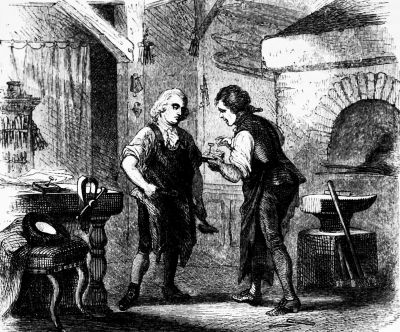
LOUIS XVI. AS LOCKSMITH.
FOOTNOTES:
CHAPTER VII.
THE ASSEMBLY OF THE NOTABLES.
Measures of Brienne.—The Bed of Justice.—Remonstrance of Parliament.—Parliament Exiled.—Submission of Parliament.—Duke of Orleans.—Treasonable Plans of the Duke of Orleans.—Anxiety of the Queen.—The Diamond Necklace.—Monsieur, the King's Brother.—Bagatelle.—Desperation of Brienne.—Edict for abolishing the Parliaments.—Energy of the Court.—Arrest of D'Espréménil and Goislard.—Tumults in Grenoble.—Terrific Hail-storm.
The Notables, one hundred and forty-four in number, nearly all ecclesiastics, nobles, or ennobled, met at Versailles, Jan. 29, 1787. Calonne expected that this body, carefully selected by the king, would advise that all orders should make common cause and bear impartially the burden of taxation. Sustained by the moral power of this advice he hoped that the measure could be carried into execution. He presented his statement of affairs. Though he endeavored to conceal the worst, the Notables were appalled. Three hundred and fifty millions of dollars had been borrowed within a few years, and the annual deficit was thirty-five millions of dollars.[58] Cautiously he proposed his plan of impartial taxation. It was the signal for a general assault upon the doomed minister. He was literally hooted down. Not only the Assembly of Notables, but the clergy, the Parliament, the nobles all over the realm pounced upon him, led even by the queen and the Archbishop of Paris; and Calonne, without a friend, was compelled to resign his office and to fly from France.[59]
The clergy were exceedingly exasperated against Calonne, for they deemed the proposition to tax the possessions of the Church as sacrilegious. The most active of the opponents of Calonne was Brienne, Archbishop of Toulouse. He was a bold, resolute, ambitious man, and by the influence of the queen was appointed to succeed Calonne. "As public credit was dead," said a wag, "an archbishop was summoned to bury the remains."[60] The spirit of discontent and of menace was now becoming every day more extended and alarming, and the Revolution was gaining strength.
Among the Notables thus assembled there were some warm advocates of popular liberty. La Fayette was perhaps the most conspicuous of these. He spoke boldly against lettres de cachet and other abuses. The Count d'Artois, afterward Charles X., reproved him for this freedom. La Fayette firmly, yet with caution, responded, "When a Notable is summoned to speak his opinion he must speak it."[61]
One of the first acts of Brienne was to abolish the Assembly of Notables.
Their session continued but nine weeks, being dissolved May 25, 1787. He then struggled for a time in the midst of embarrassments inextricable until he was compelled to propose the same measure which had already been three times rejected with scorn, and which had driven three ministers in disgrace from Paris—the taxing of the nobles. He did every thing in his power to prepare the way for the suggestion, and connected the obnoxious bill with another less objectionable, hoping that the two might pass together. But the clergy and the nobles were on the alert.
Two thirds of the territory of the kingdom had been grasped by the Church and the nobles. One third only belonged to the people. Brienne proposed a territorial tax which should fall upon all landed proprietors alike. There was an instantaneous shout of indignation from the whole privileged class, and the cry "Away with him," "Hustle him out," spread from castle to castle, and from convent to convent.
It was a custom, rather than a law, that no royal decree could pass into effect until it had been registered by Parliament; and it was a custom, rather than a law, that, if the Parliament refused to register a decree, the king could hold what is called a bed of justice; that is, could summon the Parliament into his presence and command the decree to be registered. As the king could banish, or imprison, or behead any one at his pleasure, no Parliament had as yet ventured to disobey the royal command.
The Parliament declined registering the decree taxing the property of the clergy and the nobles. The king peremptorily summoned the whole refractory body to appear before him. It was the 6th of August, 1787. In a vast train of carriages, all the members, some one hundred and twenty in number, wheeled out from Paris to the Palace of Versailles. There the king with his own lips ordered them to register the decree. Obedient to the royal order it was registered, and the Parliament, sullen and exasperated, was rolled back again to the metropolis. The people contemplated the scene in silent expectation, and by thousands surrounded the Parliament on its return, and greeted them with acclamations.
Emboldened by the sympathy of the people in this conflict with the court, the Parliament ventured to enter upon its records a remonstrance against the violent procedure; and, to gain still more strength from popular approval, they made the strange assertion that Parliament was not competent to register tax edicts at all; that for this act the authority of the three estates of the realm was essential, convened in the States-General. This was, indeed, unheard of doctrine, for the Parliament had for centuries registered such decrees. It, however, answered its purpose; it brought the masses of the people at once and enthusiastically upon their side.
This call for the States-General was the first decisive step toward bringing the people into the field. Tumultuous crowds surrounded the palace where the Parliament held its session, and with clapping of hands and shouts received the tidings of the resolutions adopted. The king, indignant, issued letters de cachet on the night of the 14th, and the next morning the whole body was arrested and taken in carriages into banishment to Troyes, a dull city about one hundred miles from Paris. The blessings of the people followed the Parliament;[62] "for there are quarrels," says Carlyle, "in which even Satan, bringing help, were not unwelcome."
Paris was now in a state of commotion. Defiant placards were posted upon the walls, and there were angry gatherings in the streets. The two brothers of the king, subsequently Louis XVIII. and Charles X., entered Paris in state carriages to expunge from the records of the Parliament the obnoxious protests and resolutions. They came with a well-armed retinue. The stormy multitudes frowned and hissed, and were only dispersed by the gleam of the sword.
For a month Parliament remained at Troyes, excessively weary of exile. In the mean time Brienne had no money, and could raise none. Both parties were ready for accommodation. The crown consented to relinquish the tax upon the nobles, and to summon the States-General in five years. Parliament consented to register an edict for a loan of one hundred millions of dollars, the burden of which was to fall upon the people alone. With this arrangement the exiled Parliament was brought back on the 20th of September. "It went out," said D'Espréménil, "covered with glory. It came back covered with mud."
On the 20th of September the king appeared before the Parliament in person, to present the edict for the loan and the promise to convoke the States-General at the close of five years.
There was at that time in Parliament a cousin of the king, the Duke of Orleans, one of the highest nobles of the realm.[63] Inheriting from his father the enormous Orleans property, and heir, through his wife, to the vast estates of the Duke of Penthièvre, he was considered the richest man in France, enjoying an income of seven million five hundred thousand francs a year ($1,500,000). For years he had been rioting in measureless debauchery. His hair was falling off, his blood was corrupted, and his bronzed face was covered with carbuncles.[64] Sated with sensual indulgence, the passion for political distinction seized his soul. As heir to the dukedom of Penthièvre, he looked forward to the office of high admiral. In preparation he ventured upon a naval campaign, and commanded the rear guard of M. d'Orvilliers' fleet in the battle off Ushant. Rumor affirmed that during the battle he hid in the hold of the ship. The court, exasperated by his haughtiness, and jealous of his power, gladly believed the story, and overwhelmed him with caricatures and epigrams. Some time after this he ascended in a balloon, and as he had previously descended a mine, where he had shown but little self-possession, it was stated that he had shown all the elements his cowardice.[65] The king withheld from him, thus overwhelmed with ridicule, the office of admiral, and conferred it upon his nephew, the son of the Count d'Artois.
The Duke of Orleans was envenomed by the affront, and breathed vengeance. While in this state of mind, and refusing to present himself at court, he received another indignity still more exasperating. A matrimonial alliance had been arranged between the eldest daughter of the Duke of Orleans and the son of Count d'Artois, the Duke d'Angoulême. An income of four hundred thousand francs ($80,000) per annum had been settled upon the prospective bride. She had received the congratulations of the court, and the foreign ministers had been authorized to communicate to their respective courts the approaching nuptials, when Marie Antoinette, alarmed by the feeble health of her two sons, and thinking that the son of the Count d'Artois might yet become heir to the throne of France, broke off the match, and decided that her daughter, instead of the daughter of the Duke of Orleans, should marry the young Duke d'Angoulême.[66]
The Duke of Orleans was now ready to adopt any measures of desperation for the sake of revenge. Though one of the highest and most opulent of the aristocrats of Europe, he was eager to throw himself into the arms of the popular party, and to lead them in any measures of violence in their assaults upon the crown.[67]
When Louis XVI. met the Parliament to secure the registry of the edict for a new loan, a strong opposition was found organized against him, and he encountered silence and gloomy looks. The king had not intended to hold a bed of justice with his commands, but merely a royal sitting for friendly conference. But the antagonism was so manifest that he was compelled to appeal to his kingly authority, and to order the registry of the edict. The Duke of Orleans rose, and with flushed cheek and defiant tone, entered a protest. Two members, his confederates, ventured to sustain him. This insult royalty could not brook. The duke was immediately sent into exile to one of his rural estates, and the two other nobles were sent to prison.
A fierce conflict was now commenced between the king and the Parliament. The Parliament passed a decree condemning arbitrary arrests. The king, by an order in council, canceled the decree. The Parliament reaffirmed it. The king was exasperated to the highest degree, but, with the united Parliament and the popular voice against him, he did not dare to proceed to extreme measures. Louis XIV. would have sent every man of them to the Bastille or the scaffold. But the days of Louis XIV. were no more.
It may at first thought seem strange that in this conflict the people should have sided with the Parliament. But the power of the crown was the great power they had to dread, and which they wished to see humbled. It was to them a matter of much more moment that the despotism of the court should be curtailed than that the one act of taxation should be passed in their favor. Men of far-reaching sagacity must have guided the populace to so wise a decision. Inequality of taxation was but one of the innumerable wrongs to which the people were exposed. What they needed was a thorough reform in the government which should correct all abuses. To attain this it was first indispensable that despotism should be struck down. Therefore their sympathies were with the Parliament in its struggle against the crown, though it so happened that the conflict arose upon a point adverse to the popular interest.
The Duke of Orleans began seriously to contemplate the dethronement of his cousin and the usurpation of the crown. With almost boundless wealth at his command, and placing himself at the head of the popular party, now rising with such resistless power, he thought the plan not difficult of accomplishment. He had traveled in England, had invested large sums there, had formed friendship with the sons of the king, the Prince of Wales and the Duke of York. The court of St. James was bitterly exasperated against the court of Louis XVI. for aiding in the emancipation of America. The Duke of Orleans consequently doubted not that he could rely upon the friendship of England in the introduction of a new dynasty to France.[68]
And now the parliaments which had been organized in many of the provinces made common cause with the Parliament of Paris, and sent in their remonstrances against the despotism of the crown. Gloom now pervaded the saloons of Versailles. Marie Antoinette, with pale cheek and anxious brow, wandered through the apartments dejected and almost despairing. Groves and gardens surrounded her embellished with flowers and statues and fountains. The palace which was her home surpassed in architectural grandeur and in all the appliances of voluptuous indulgence any abode which had ever before been reared upon earth. Obsequious servants and fawning courtiers anticipated her wishes, and her chariot with its glittering outriders swept like a meteor through the enchanting drives which art, aided by the wealth of a realm, had constructed, and yet probably there was not a woman in the whole realm, in garret or hut or furrowed field, who bore a heavier heart than that which throbbed within the bosom of the queen. The king was a harmless, inoffensive, weak-minded man, spending most of his time at the forge. It was well understood that the queen, energetic and authoritative, was the real head of the government, and that every act of vigor originated with her. She consequently became peculiarly obnoxious to the Parliament, and through them to the people; and Paris was flooded with the vilest calumnies against her.
There was at that time fluttering about Versailles a dissolute woman of remarkable beauty, the Countess Lamotte. She forged notes against the queen, and purchased a very magnificent pearl necklace at the price of three hundred thousand dollars. Cardinal Rohan was involved in the intrigue. The transaction was noised through all Europe. The queen was accused of being engaged in a swindling transaction with a profligate woman to cheat a jeweler, and was also accused of enormous extravagance in wishing to add to the already priceless jewels of the crown others to the amount of three hundred thousand dollars. The queen was innocent; but the public mind exasperated wished to believe all evil of her. Men, haggard and hungry, and without employment; women ragged and starving, and with their starving children in their arms, were ever repeating the foul charge against the queen as a thief, an accomplice with a prostitute, one who was willing to see the people starve if she might but hang pearls about her neck. The story was so universally credited, and created such wide-spread exasperation, that Talleyrand remarked, "Mind that miserable affair of the necklace. I should be nowise surprised if it should overturn the French monarchy."
In addition to all this the report was spread abroad that the children of Marie Antoinette were illegitimate; that the king had not sufficient capacity to reign; that his next brother, called Monsieur, subsequently Louis XVIII., was engaged in a conspiracy with the Parliament to eject Louis XVI. from the throne, and to establish a government of the nobles, of which Monsieur should be the nominal head. It is by no means improbable that this plan was formed. It will account for many of the actions of the nobles during the first stages of the Revolution.[69]
The second brother of the king, Count d'Artois, a very elegant and accomplished man of fashion, fond of pleasure, and with congenial tastes with the young and beautiful queen, was accused, though probably without foundation, of being her paramour and the father of her children. He had erected, just outside the walls of Paris, in the woods of Boulogne, a beautiful little palace which he called Bagatelle. This was the seat of the most refined voluptuousness and of the most costly indulgence.
The queen now knew not which way to turn from the invectives which were so mercilessly showered upon her. It was in vain to attempt an answer. Her lofty spirit so far sustained her as to enable her in public to appear with dignity. But in her boudoir she wept in all the anguish of a crushed and despairing heart. "One morning at Trianon," writes Madame Campan, "I went into the queen's chamber when she was in bed. There were letters lying upon her bed and she was weeping bitterly. Her tears were mingled with sobs, which she occasionally interrupted by exclamations of 'Ah! that I were dead. Wretches! monsters! what have I done to them?' I offered her orange-flower-water and ether. 'Leave me, if you love me; it would be better to kill me at once.' At this moment she threw her arm over my shoulder and began weeping afresh."[70]
Parliament had registered the edict for a loan of one hundred millions of dollars. It would be no burden to them. The people alone were to be taxed for the debt. But public credit was dead. No one would lend. Brienne was also assailed with lampoons and caricatures and envenomed invectives, until, baited and bayed from every direction, he became almost distracted.[71] Burning with fever and with tremulous nerves, he paced his chamber-floor, ready for any deed of desperation which could extricate him from his woe. All this the Parliament in Paris and the twelve parliaments in the departments enjoyed, for it was the object of the nobles, who mainly formed these bodies, to wrest back from the monarchy that feudal power which energetic kings had wrested from them. The people were ready to sustain the nobles, though their enemies, in their attack upon the crown, and the nobles were also eager to call in the people to aid them in their perilous conflict. Some of the nobles, however, more far-sighted, strongly opposed the calling of the States-General. The majority, however, prevailed, and decreed to call a meeting of the states, but with the proviso that five years were to elapse before they should be convened.
Brienne was now goaded to desperation. He determined to break down the parliaments. Secretly he matured a plan for the formation of a series of minor courts, where all small causes could be tried, and a superior court for registering edicts. Thus there would be absolutely nothing left for the parliaments to do, and they could be abolished as useless. These courts, the superior to be called the Plenary Court and the others Grand Bailliages, were to be composed of courtiers carefully selected, who would be subservient to the wishes of the king.[72]