Front matter (continued 5)
Reading edition
The third was the colossal assembly of the Parisian populace, an enormous, tumultuous, excitable mass, every day gathered in the garden of the Palais Royal. This assembly, daily becoming more arrogant, often consisted of from ten to twelve thousand. It was continually in session. Here was the rendezvous for all of the lower orders, men and women. Impassioned orators, of great powers of popular eloquence, but ignorant and often utterly unprincipled, mounted tables and chairs, and passionately urged all their crude ideas.
Reflecting men soon began to look upon this assembly with alarm. Its loud murmurs were echoed through the nation, boding only evil; but emancipated France could not commence its career by prohibiting liberty of speech. La Fayette anxiously looked in upon this portentous gathering, and listened to the falsehood, the exaggerations, and the folly with which its speakers deluded the populace, but he could not interfere. Indeed, it soon became perilous for any one in that assembly to plead the cause of law and order. He was at once accused as an aristocrat, and was in peril of the doom of Berthier and Foulon.
And now suddenly there uprose another power which overshadowed all the rest—the power of a free press. Newspapers and pamphlets deluged the land. They were read universally; for the public mind was so roused that those who could not read themselves eagerly listened to the reading from others, at the corners of the streets, in shops and hovels.[205]
France was now doomed to blood and woe. It is easy to say that if the populace had been virtuous and enlightened all would have gone well; or if the nobles and the higher clergy would have united with the true patriots freedom might have been saved. But the populace were not virtuous and enlightened, and the nobles were so inexorably hostile to all popular rights that they were resolute to whelm France in ruin rather than relinquish their privileges. France, as France then was, could have been saved by no earthly wisdom. The Royalists openly declared that the only chance of restoring the old system of government was to have recourse to civil war, and they were eager to invoke so frightful a remedy.
One of the most popular of the journals was "The Friend of the People," by Marat. This journal already declared that the National Assembly was full of aristocrats, and that it must be dissolved to make way for a better.[206] "We have wrested power," wrote Marat, "from the nobles but to place it in the hands of the moneyed class. What have we gained? The people are still poor and starving. We need another revolution." "Yes," echoed the mob of Paris, "we need another revolution."
The roar from the Palais Royal fell ominously upon the ears of the Assembly at Versailles, and of the municipality at the Hôtel de Ville. And now all the starving trades and employments began to congregate by themselves for discussion and combined action. First came the servants, destitute of place, of shelter, of bread, whose masters had fled from insurgent Paris into the country or had emigrated. The court-yard of the Louvre was their rendezvous. The soldiers debated at the Oratoire, the hair-dressers in the Elysian Fields, and the tailors at the Colonnade.[207] These bodies soon became, as it were, committees of the great central congress of the populace ever gathered at the Palais Royal.
The noblest men in the National Assembly were already beginning to despond. Firmly, however, they proceeded in the endeavor to reconstruct society upon the basis of justice and liberty. The measure to which their attention was now chiefly devoted was to adopt a Constitution, which was to be prefaced by a Bill of Rights. La Fayette was active in this movement, and was unquestionably assisted by Thomas Jefferson, then American minister at Paris.
This celebrated declaration of rights, adopted on the 18th of August, 1789, was a simple enunciation of those principles which are founded in nature and truth and which are engraven on all hearts. They were axioms upon which every intelligent legislator must proceed in forming a just code of laws. It declares that all mankind are born free and equal; that the objects to be gained by human governments are liberty, the security of property, and protection from oppression; that sovereignty resides in the nation and emanates from the people; that law is the expression of the will of the people; that the expenses of government should be assessed upon the governed in proportion to their property; that all the adult male inhabitants are entitled to vote; that freedom consists in the liberty to do any thing which does not injure another, and should have no limits but its interference with the rights of others.[208]
These were noble sentiments nobly expressed; and, though execrated in monarchical Europe, were revered in republican America. These were the principles against which despotic Europe, coalesced by the genius of William Pitt, rose in arms.[209] The battle was long and bloody. Millions perished. The terrible drama was closed, for a season, by the triumph of despots at Waterloo.[210]
The Assembly now turned its attention to the organization of the legislative body of the nation. The all-absorbing question was whether the National Congress or Parliament should meet in one chamber or in two; if in two, whether the upper house should be an aristocratic, hereditary body, like the House of Lords in the British Parliament, or an elective republican Senate, as in the American Congress. The debate was long and impassioned. The people would not consent to an hereditary House of Lords, which would remain an almost impregnable fortress of aristocratic usurpation. They were, however, inclined to assent to an upper house to be composed exclusively of the clergy and the nobles, but to be elected by the people. To this arrangement the haughty lords peremptorily refused their assent. They were equally opposed to an election to the upper house even by the nobles and the clergy, for the high lords and great dignitaries of the Church looked down upon the lower nobility and upon the working clergy with almost as much contempt as they regarded the people. Finding the nobles hostile to any reasonable measure, the masses of the people became more and more irritated. The vast gathering at the Palais Royal soon became unanimous in clamoring for but one chamber. The lords were their enemies, and in a house of lords they could see only a refuge for old and execrable feudality and an insurmountable barrier to reform.[211]
When the vote was taken there were five hundred for a single chamber and but one hundred for two chambers.[212] It was unquestionably a calamity to France that two chambers could not have been organized. But the infatuation of the nobles now for the second time prevented this most salutary check upon hasty legislation.
The next question to be decided was the royal veto. All were united that the laws should be presented to the king for his sanction or refusal. The only question was whether the veto should be absolute or limited. That of the King of England is absolute. That of the President of the United States is limited. All France was agitated by this question. Here the aristocracy made their last desperate stand and fought fiercely. Many of the popular party, alarmed in view of the rapid progress of events, advocated the absolute veto. Its inconsistency, however, with all enlightened principles of liberty was too apparent to be concealed. That the caprice of a single man, and he perhaps weak or dissolute, should permanently thwart the decrees of twenty-seven millions of people appeared so absurd that the whole nation rose against it.
The fate of liberty seemed to depend upon this question, as the absolute veto would enable the court, through the king, to annul every popular measure. The crowds in Paris became turbulent and menacing. Threatening letters were sent to members of the National Assembly. The Parisian mob even declared its determination to march to Versailles, and drive from the Assembly those in favor of the veto. The following letter, addressed to the Bishop of Langres, then president of the Assembly, may be presented as a specimen of many with which the hall was flooded:
"The patriotic assembly of the Palais Royal have the honor to make it known to you, sir, that if the aristocratic faction, formed by some of the nobility and the clergy, together with one hundred and twenty ignorant and corrupt deputies, continue to disturb the general harmony, and still insist upon the absolute veto, fifteen hundred men are ready to enlighten their country seats and houses, and particularly your own."[213]
"I shall never forget," writes Dumont, "my going to Paris one of those days with Mirabeau, and the crowd of people we found waiting for his carriage about Le Say the bookseller's shop. They flung themselves before him, entreating him, with tears in their eyes, not to suffer the absolute veto."
"They were in a phrensy. 'Monsieur le Comte,' said they, 'you are the people's father. You must save us. You must defend us against those villains who are bringing back despotism. If the king gets this veto, what is the use of the National Assembly? We are all slaves! All is undone.'[214] There was as much ability in the tumultuous gathering at the Palais Royal as in the National Assembly, and more of impassioned, fiery eloquence. This disorderly body assumed the name of the Patriotic Assembly, and was hourly increasing in influence and in the boldness of its demands. Camille Desmoulins was one of its most popular speakers. He was polished, keen, witty, having the passions of his ever-varying, ever-excitable audience perfectly at his command. He could play with their emotions at his pleasure, and though not an earnest man, for jokers seldom are, he was eager and reckless."[215]
St. Huruge was, however, the great orator of the populace, the Mirabeau of the Palais Royal. A marquis by birth, he had suffered long imprisonment in the Bastille by lettre de cachet. Oppression had driven him mad, and he was thoroughly earnest. Every day he uttered the most fierce and envenomed invectives against that aristocratic power by whose heel he had been crushed. He was a man of towering stature, impassioned gesticulation, and with a voice like the roar of a bull.
On Monday, August 30th, there was a report at the Palais Royal that Mirabeau was in danger of arrest. St. Huruge immediately headed a band of fifteen hundred men, and set out for Versailles for his protection. It was a mob threatening violence, and La Fayette, at the head of a detachment of the National Guard, stopped them and drove them back. Murmurs now began to arise against La Fayette and the National Guard. Rumors were set in circulation that La Fayette was in league with the aristocrats. Excitement was again rapidly increasing, as the people feared that, after all, they were to be betrayed and again enslaved.
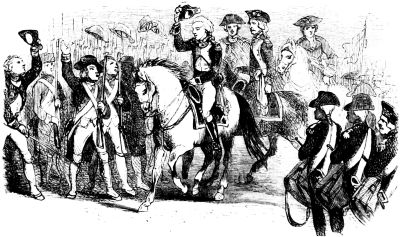
LA FAYETTE REVIEWING THE NATIONAL GUARD.
The agitated assembly at the Palais Royal sent a deputation to Versailles to Mounier, one of the most influential and truly patriotic of the deputies, announcing to him that twenty thousand men were ready to march to Versailles to drive the aristocrats out of the Assembly. At the same time an address was received by the president from the citizens of Rennes, declaring that those who should vote for the absolute veto were traitors to their country. Under these circumstances, the king sent a message to the National Assembly, stating that he should be satisfied with a limited, or, as it was then called, a suspensive veto. In taking the question the absolute veto was rejected, and the suspensive veto adopted by a vote of 673 to 355. By this measure the veto of the king would suspend the action of any legislative enactment during two subsequent sessions of the Legislature. If, after this, the Legislature still persisted, the king's veto was overruled and the act went into effect. This was giving the king much greater power than the President of the United States possesses. A two-thirds vote of both houses can immediately carry any measure against the veto of the President. Freedom of opinion, of worship, and of the press were also decreed.
These questions being thus settled, it was now voted that the measures thus far adopted were constitutional, not legislative; and that, consequently, they were to be presented to the king, not for his sanction, but for promulgation. It was also voted by acclaim that the crown should be hereditary and the person of the king inviolable, the ministers alone being responsible for the measures of government. To republican eyes these seem like mild measures of reform, though they have been most severely condemned by the majority of writers upon the French Revolution in monarchical Europe. If the nobles had yielded to these reasonable reforms, the horrors which ensued might have been avoided. If combined Europe had not risen in arms against the Revolution, the regeneration of France might, perhaps, have been peacefully achieved.[216]
In every nation there are thousands of the ignorant, degraded, miserable, who have nothing to lose and something to hope from anarchy. The inmates of the dens of crime and infamy, who are only held in check by the strong restraints of law, rejoice in the opportunity to sack the dwellings of the industrious and the wealthy, and to pour the tide of ruin through the homes of the virtuous and the happy. This class of abandoned men and women was appallingly increasing. They flocked to the city from all parts of the kingdom, and Paris was crowded with spectres, emaciate and ragged, whose hideous and haggard features spoke only of vice and misery. Sièyes expressed to Mirabeau his alarm in view of the portentous aspect of affairs.
"You have let the bull loose," Mirabeau replied, "and now you complain that he butts with his horns."[217]
Much has been said respecting the motives which influenced Mirabeau.
Whatever his motives may have been, his conduct was consistent. All his words and actions were in favor of liberty sustained by strong law. He wished for the overthrow of aristocratic insolence and feudal oppression, from which he had so severely suffered. He wished to preserve the monarchical form of government, and to establish a constitution which should secure to all the citizens equality of rights.[218]
Feudality was now destroyed, and a free constitution adopted. Still, business was stagnant, the poor destitute of employment and in a state of starvation. As an act of charity, seventeen thousand men were employed by the municipality of Paris digging on the heights of Montmartre at twenty sous a day. The suffering was so great that the office of the municipality was crowded with tradesmen and merchants imploring employment on these terms. "I used to see," writes the mayor, Bailly, "good tradespeople, mercers and goldsmiths, who prayed to be admitted among the beggars employed at Montmartre in digging the ground. Judge what I suffered."
The city government sunk two thousand dollars a day in selling bread to the poor at less than cost; and yet there were emissaries of the court buying up this bread and destroying it to increase the public distress.[219] On the 19th day of August the city of Paris contained food sufficient but for a single day. Bailly and La Fayette were in an agony of solicitude. So great was the dismay in Paris, that all the rich were leaving. Sixty thousand passports were signed at the Hôtel de Ville in three months.[220]
Armed bands were exploring the country to purchase food wherever it could be found, and convey it to the city. Six hundred of the National Guard were stationed by day and by night to protect the corn-market from attack. It is surprising that when the populace were in such distress so few acts of violence should have been committed.[221]
The kind heart of the king was affected by this misery. He sent nearly all his plate to be melted and coined at the mint for the relief of the poor. This noble example inspired others. General enthusiasm was aroused, and the hall of the National Assembly was crowded with the charitable bringing voluntary contributions for the relief of the poor. Rich men sent in their plate, patriotic ladies presented their caskets of jewelry, and the wives of tradesmen, artists, and mechanics brought the marriage gifts which they had received and the ornaments which embellished their dwellings. Farmers sent in bags of corn, and even poor women and children offered their mites. A school-boy came with a few pieces of gold which his parents had sent to him for spending-money. This overflowing of charity presented a touching display of the characteristic magnanimity and impulsiveness of the French people.[222]
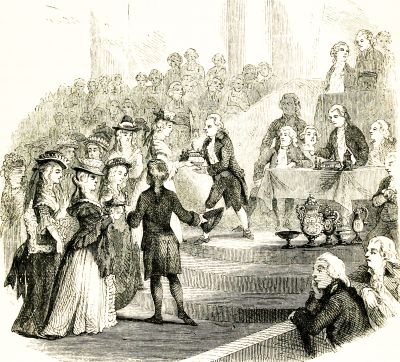
PATRIOTIC CONTRIBUTIONS.
But private charity, however profuse, is quite inadequate to the wants of a nation. These sums were soon expended, and still the unemployed poor crawled fasting and emaciated about the streets. Necker's plans for loans were frustrated. No one would lend. To whom should he lend? The old régime was dying; the new not yet born. In this terrible emergency Necker proposed the desperate measure of imposing a tax of one quarter of every man's income, declaring that there was no other refuge from bankruptcy. The interest upon the public debt could no longer be paid, the wages of the soldiers were in arrears, and the treasury utterly empty. The proposal frightened the Assembly, but Mirabeau ascended the tribune, and in one of his most impassioned appeals carried the measure by acclamation.[223] The distracted state of the kingdom, however, prevented the act thus enthusiastically adopted from being carried into effect.[224]
Thomas Jefferson was at this time, as we have before mentioned, the American minister in Paris, and was constantly consulted by the leaders of the Revolution. In his memoirs, speaking of these events, he writes,
"The first question, whether there should be a king, met with no opposition, and it was readily agreed that the government of France should be monarchical and hereditary.
"Shall the king have a negative on the laws? Shall that negative be absolute, or suspensive only? Shall there be two chambers of legislation, or one only? If two, shall one of them be hereditary, or for life, or for a fixed term; and named by the king or elected by the people?
"These questions found strong differences of opinion, and produced repulsive combinations among the patriots. The aristocracy was cemented by a common principle of preserving the ancient régime, or whatever should be nearest to it. Making this their polar star, they moved in phalanx, gave preponderance on every question to the minorities of the patriots, and always to those who advocated the least change. The features of the new constitution were thus assuming a fearful aspect, and great alarm was produced among the honest patriots by these dissensions in their ranks.
"In this uneasy state of things I received one day a note from the Marquis de la Fayette, informing me that he should bring a party of six or eight friends to ask a dinner of me the next day. I assured him of their welcome. When they arrived, they were La Fayette himself, Dupont, Barnave, Alexander Lameth, Blacon, Mounier, Maubourg, and Dagout. These were leading patriots of honest but differing opinions, sensible of the necessity of effecting a coalition by mutual sacrifices; knowing each other, and not afraid therefore to unbosom themselves mutually. This last was a material principle in the selection. With this view the marquis had invited the conference, and had fixed the time and place, inadvertently as to the embarrassment under which he might place me.
"The cloth being removed and wine set on the table, after the American manner, the marquis introduced the objects of the conference by summarily reminding them of the state of things in the Assembly, the course which the principles of the Constitution were taking, and the inevitable result, unless checked by more concord among the patriots themselves. He observed that though he also had his opinion, he was ready to sacrifice it to that of his brethren of the same cause; but that a common opinion must now be formed, or the aristocracy would carry every thing, and that, whatever they should now agree on, he, at the head of the national force, would maintain.
"The discussions began at the hour of four, and were continued till ten o'clock in the evening, during which time I was a silent witness to a coolness and candor of argument unusual in the conflicts of political opinion; to a logical reasoning and chaste eloquence disfigured by no gaudy tinsel of rhetoric or declamation, and truly worthy of being placed in parallel with the finest dialogues of antiquity, as handed to us by Plato, by Xenophon, and Cicero. The result was that the king should have a suspensive veto on the laws, that the Legislature should be composed of a single body only, and that to be chosen by the people. This concordat decided the fate of the Constitution. The patriots all rallied to the principles thus settled, carried every question agreeably to them, and reduced the aristocracy to insignificance and impotence."[225]
FOOTNOTES:
CHAPTER XVII.
THE ROYAL FAMILY CARRIED TO PARIS.
Waning Popularity of La Fayette.—The King contemplates Flight.—Letter of Admiral d'Estaing.—The Flanders Regiment called to Versailles.—Fête in the Ball-room at Versailles.—Insurrection of the Women; their March to Versailles.—Horrors of the Night of October 5th.—The Royal Family conveyed to Paris.
The press now began to assail Bailly and La Fayette as in league with the aristocrats. The Assembly at the Palais Royal was becoming paramount, a terrific power, threatening ruin to all who should advocate measures of moderation. The most violent harangues roused the populace, and it was evident that they could be easily turned by their leaders into any path of destruction. Threatening letters flooded the National Assembly, and one of great ferocity was signed by St. Huruge. Though he declared it a forgery, he was arrested and imprisoned. The municipal authority also forbade farther meetings in the Palais Royal, and La Fayette, with the National Guard, dispersed the gatherings.
The king now seriously contemplated flight, that, at a safe distance from Paris and surrounded by chosen troops, he might dictate terms to his people, or, if they refused, prepare, by the aid of foreign arms, for war. About one hundred and eighty miles northeast of Paris, on the frontiers of France, was the city of Metz. The city contained about fifty thousand inhabitants, and its fortifications, constructed by Vauban, were of the most extensive and formidable kind. The Marquis de Bouille, one of the most devoted servants of the king, and subsequently one of the most active agents in urging the foreign powers to march against France, commanded, in garrison there, thirty thousand picked troops, resolute Royalists, and who had been taught to regard the popular movement with contempt.
The plan was well matured for the king to escape to Metz. There he was to be joined by the court, the nobles with all their retainers, the ancient parliaments of the provinces, all composed of the aristocratic class, and by all the soldiers whom the Royalist officers could induce to follow them to that rendezvous. Then, by the employment of all the energies of fire and blood, France was to be brought back into subjection to the old régime.
La Fayette knew of this plan, and yet he did not dare to divulge it to the people, for he knew that it would provoke a fierce and terrible outbreak. He saw the peril in which the royal family was involved, and he wished for their protection. He saw the doom with which the liberties of France were menaced, and the liberty for which he was struggling was dearer to him than life. If the king had been either a merciless despot or a reliable friend of liberty, then would La Fayette's path of duty have been plain. But the king was an amiable, kindly-intentioned, weak-minded, vacillating man, quite the tool of the inexorable court.
It is difficult to conceive of a situation more embarrassing than that in which La Fayette was now placed. He was at the head of the National Guard and was informed of all the plots of the court. He wished to be faithful to his sovereign, and wished also to be true to his country. Without the connivance, or at least secret assent of La Fayette, it was hardly possible for the king to escape.
The old admiral D'Estaing was commander of the National Guard at Versailles. He was a man of noble birth, of magnanimous character, and, though with true patriotism he espoused the popular cause, he was, like La Fayette, in favor of a monarchy, and was sincerely friendly to the king. On the 13th of September he dined with La Fayette at Paris. Here the marquis unfolded to the amazed admiral the terrible secret in all its details; that the Baron Breteuil, one of the most implacable enemies of the Revolution, was arranging with the Austrian embassador for the co-operation of Austria; that eighteen regiments had already taken the oath of fidelity to the court; that the Royalists, in large numbers, were already congregating at Metz; that the nobles and the clergy had combined in raising funds, so that fifteen hundred thousand francs ($300,000) a month were secured; that measures were already adopted to besiege Paris, cut off all supplies, and starve the city into subjection; and that more than sixty thousand of the clergy and nobility were pledged to rally around the king.
D'Estaing was appalled by the tidings. He knew that if the populace were informed of the conspiracy it would rouse them to phrensy, that no earthly power could protect the royal family from their fury, and that instantly the fiercest civil war would blaze from the Rhine to the Pyrenees. Aware of the imbecility of the king, and that the queen was the author of every vigorous measure, he immediately addressed a very earnest letter to her. He wrote as follows in a letter long, earnest, and imploring:
"It is necessary—my duty and my loyalty require it—that I should lay at the feet of the queen the account of the visit which I have paid to Paris. I am praised for sleeping soundly the night before an assault or a naval engagement. I venture to assert that I am not timorous in civil matters, but I must confess to your majesty that I did not close my eyes all night.
"I was told—and, gracious heaven! what would be the consequence if this were circulated among the people—I was told that the king was to be carried off to Metz. La Fayette told me so in a whisper at dinner. I trembled lest a single domestic should overhear him. I observed to him that a word from his lips might become the signal of death. I implore your majesty to grant me an audience some day this week."[226]
Such a secret could not long be kept. It soon began to be openly spoken of in the streets as a suspicion, a rumor. Under pretense of protecting the National Assembly from any violence by the mob from Paris, the king called a regiment to Versailles from Flanders. This was a regiment in whose officers and soldiers he could rely, and which was to aid him in his flight. The troops marched into the city with an imposing array of artillery and infantry, exciting increasing suspicion, and were assembled as a guard around the palace.
It was on the 23d of September that this Flanders regiment entered Versailles, and were stationed around the regal chateau, thus doubling the body-guard of the king. It was also observed that a very unusual number of officers crowded the streets of Versailles, estimated at from a thousand to twelve hundred.[227] A dinner was given to these officers on the 1st of October, in the hall of the Opera at the palace. No expense was spared to add splendor to the fête, to which all were invited who could probably be led to co-operate with the court. Wine flowed freely, and, deep in the hours of the night, when all heads were delirious, the king and queen, with the young dauphin, entered the banqueting-hall. They were received with almost phrensied acclaim. The boxes of the Opera were thronged with ladies of the court, adding to the enthusiasm. The king, the queen, the dauphin, were toasted with delirious shouts. When some one proposed "the nation," the toast was scornfully rejected. As the royal family made the tour of the tables, the band struck up the air, "O Richard, O my king, the world is all forsaking thee." The officers leaped upon the chairs and the tables, drew their swords, and vowed eternal fidelity to the king. And now ensued a scene which no language can describe. The officers clambered into the boxes, and received the cordial greetings of the ladies; the revolutionary movement was cursed intensely; the tricolored cockade, the badge of popular rights, was trampled under foot, and the white cockade, the emblem of Bourbon power, was accepted in its stead from the hands of the ladies. The next day there was another similar entertainment in the palace, to which a still larger number of guests were invited, and the convivialities were still more exciting and violent. The courtiers, with that fatuity which ever marked their conduct, were now so encouraged, that they began with insolent menaces to manifest their exultation.
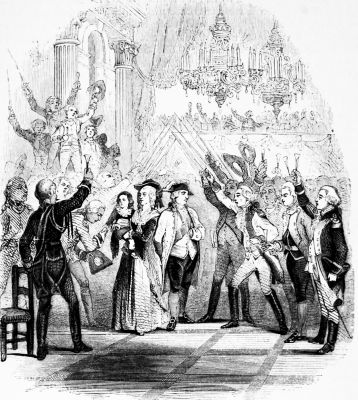
FESTIVAL IN THE BALL-ROOM AT VERSAILLES, OCT. 1, 1789.
The tidings of these fêtes spread rapidly through Versailles and Paris, exciting intense indignation. The court was feasting; the people starving. Versailles was filled with rejoicing; Paris with mourning. Despotism was exulting in its anticipated triumph, while the nation was threatened with the loss of its newly-acquired rights. The king had thus far delayed giving his assent to the Constitution. Disquietude pervaded the National Assembly, and confused murmurs filled the thoroughfares of Paris—terrible rumors of the approaching war, of the league with the German princes, of the increasing famine, and the threatened blockade of Paris. "We must bring the king to Paris," all said, "or the court will carry him off, and war will immediately be commenced."
The morning of the 5th of October dawned, dark, cold, and stormy. A dismal rain flooded the streets. There were thousands in Paris that morning who had eaten nothing for thirty hours.[228] The women, in particular, of the humbler class, were in an awful state of destitution and misery. The populace of Paris were actually starving. An energetic woman, half delirious with woe, seized a drum, and strode through the streets beating it violently, occasionally shrieking, "Bread! bread!" She soon collected a crowd of women, which rapidly increased from a few hundred to seven or eight thousand. The men gazed with wonder upon this strange apparition, such as earth had, perhaps, never seen before. Like a swelling inundation the living flood rolled through the streets, and soon the cry was heard, "To Versailles!" As by a common instinct, the tumultuous mass rushed along by the side of the Tuileries and through the Elysian Fields toward Versailles. A few of the more fierce and brutal of the women had guns or pistols. Chancing to find a couple of cannon, they seized them, and also horses to drag the ponderous engines, upon which female furies placed themselves astride, singing revolutionary songs.
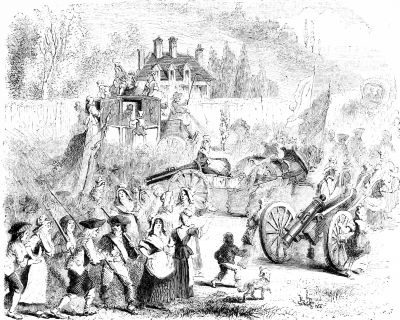
THE WOMEN OF PARIS MARCHING TO VERSAILLES.
La Fayette gazed appalled upon the strange phenomenon. The troops of the National Guard refused to arrest their course, declaring that they could not resist starving women, who were going to implore bread of their king. La Fayette was powerless. He had under arms that morning thirty-five thousand troops, cavalry, infantry, and artillery. He could only follow the women, to watch the opening of events. Behind these troops advancing in all the glittering panoply of war, followed a straggling mass of, no one can tell how many thousands of the populace of Paris, of all classes, characters, conditions. The city seemed emptied of its inhabitants, as the road to Versailles, ten or twelve miles in length, was filled with the tumultuous multitude. No one, apparently, had any definite object, but each one was going to see what the others would do.
Couriers were sent forward to warn the king and queen of the impending peril. The good-natured, silly king had gone to Meudon to amuse himself in chasing hares. Nothing can more conclusively show his utter incapacity to govern a great kingdom, than that he should have been so employed at such an hour. The king was sent for, and speedily returned to Versailles. Marie Antoinette had all the energy and heroism of her mother, Maria Theresa. When entreated immediately to secure her escape with her two children, she replied,
"Nothing shall induce me to be separated from my husband. I know that they seek my life; but I am the daughter of Maria Theresa, and have learned not to fear death."
The king was entreated to escape, but he was fearful that his flight might embolden the Assembly to declare the throne vacant, and to place the crown upon the head of the Duke of Orleans, who had, with that object probably in view, vociferously espoused the popular cause. From the windows of Versailles the royal family soon descried the vast multitude plodding along through the mud and the rain as they approached Versailles. It is said that there were some men in the mob, disguised as women, who gave impulse and direction to the mass. A man by the name of Maillard, of gigantic stature, and possessed of wonderful tact, succeeded in obtaining the post of leader. In this alarming state of affairs, the king sent to the Assembly a partial acceptance of the Constitution. As the Assembly were discussing this question, the women arrived at the hall. Maillard entered, and the women crowded after him. Respectfully, but earnestly, on behalf of the women, he represented the starving condition of Paris, and complained of the insult which the nation had received in the fête at the palace.
It was now three o'clock in the afternoon. The rain was still falling. A dark, stormy night was at hand, and the streets of Versailles were filled with countless thousands of the most desperate men and women, utterly destitute of shelter. The Assembly, in alarm, requested their president, M. Mounier, to go to the palace and petition for fresh measures of relief. M. Mounier was compelled to allow twelve women to accompany him. The king received them kindly. The women had adroitly selected, as the leader of their deputation, a very beautiful young flower-girl, but seventeen years of age, of remarkably graceful form and lovely features. The girl, overcome by her sensations, endeavored in vain to speak, and fainted. The king took her in his arms, embraced her as if she had been his child, and was so paternal that he completely won the hearts of all the women. They left the palace with such enthusiastic accounts of the goodness of the king, that the Amazons on the outside accused them of having been bribed, and, in their rage, were ready to tear them in pieces. The poor flower-girl would have been hanged with garters to a lamp-post had not the soldiers rescued her.
The king now summoned a council, which continued in session until ten o'clock. Still, by some unpardonable neglect, no measures were adopted to provide for the wants of the famished mob. It was nearly seven o'clock in the evening before La Fayette arrived with the National Guard.[229] The soldiers of the guard, intelligent citizens, were only to be controlled by the personal influence of their general. Authority is only established by time and consolidated institutions. La Fayette hastened to the palace to assure the royal family that every thing in his power should be done to secure their safety. The king, however, would not intrust the guard of the palace to La Fayette, as he thought he could place more reliance in the Flanders regiment, the Swiss mercenaries, and his own Life-Guard, than in the National Guard, who were all devoted to the popular cause.
In the confusion of those dreadful hours, all the entrances to the palace had not been defended. La Fayette, however, stationed an effectual guard at all the outposts which had been assigned to him. Through all the hours of the night, until five o'clock in the morning, La Fayette was sleeplessly engaged sending out patrols and watching over the public peace. Then, finding all tranquil, he threw himself upon a sofa for rest, having been constantly and anxiously employed for the last twenty-four hours. Groups of shivering, famished people were gathered around large fires, which they had built in the streets, and in one place they were devouring the half-roasted flesh of a horse which they had killed. The queen, worn out with sleeplessness, had retired to her chamber. The king had also gone to his chamber, which was connected with that of the queen by a hall, through which they could mutually pass. Two soldiers guarded the door of the queen's chamber. Some of the mob, prowling around the palace, found a gate unguarded, and, entering the palace without any obstruction, ascended the stairs, and, pressing blindly on, came to the door of the queen's apartment. The soldiers heroically resisted them, and shouted to others to save the queen. She heard the cry, and, springing from her bed, rushed in her night-clothes to the king's room. The brigands pushed resolutely forward, and found the royal bed forsaken. A number of the Life-Guards hastened to the spot, and arrested their farther progress; and the soldiers of La Fayette, who had been stationed at a little distance, hearing the tumult, hastened to their aid.
The noise roused the mob, and a conflict immediately ensued between the soldiers and the phrensied multitude. La Fayette, who had not yet fallen asleep, sprung from his couch, and, hastening to the palace, found several of the king's troops on the point of being slaughtered. One of the brigands aimed a musket at La Fayette, but the mob seized him and dashed out his brains upon the pavement. The Life-Guards and the Grenadiers of La Fayette soon cleared the palace; and the whole court acknowledged that they were indebted to La Fayette for their lives. Madame Adelaide, the queen's aunt, threw her arms around him, exclaiming "General, you have saved us."[230]
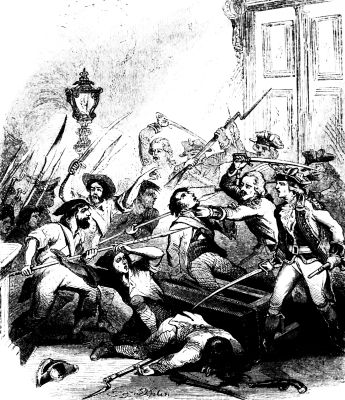
HEROIC DEFENSE OF THE ROYAL APARTMENTS BY THE GARDE DU CORPS, OCT. 5, 1789.
The morning of the 6th was now dawning, and the whole multitude, swarming around the palace, demanded as with one voice that the king should go to Paris. A council was held, and it was decided by the court that the king should comply. Slips of paper announcing the decision were thrown to the people from the windows. Loud shouts now rose of "Long live the King!" But threatening voices were raised against the queen, who was hated as an Austrian, and as one who was endeavoring to bring the armies of Austria to crush liberty in France.
"Madame," said La Fayette to the queen, "the king goes to Paris; what will you do?"
"Accompany the king," was the queen's undaunted reply.
"Come with me, then," rejoined the general.
He led the queen upon a balcony, from whence she looked out upon the multitude, agitated like the ocean in a storm. All eyes were speedily fixed upon her as she stood by the side of La Fayette, and held by the hand her little son, the dauphin. The murmurs of the crowd were immediately succeeded by expressions of admiration. La Fayette took her hand, and, raising it to his lips, respectfully kissed it. An almost universal shout of "Long live the Queen!" was the response of the multitude to this graceful and well-timed act. The queen then stepped back into the room, and said to La Fayette, "My guards, can you not do something for them?" "Give me one," said La Fayette, and, leading the soldier to the balcony, he presented him to the people, and handed him the tricolored cockade. The guard kissed it, and placed it on his hat. The people were satisfied, reconciled, and cheered with hearty plaudits. Many of the garde du corps had been taken prisoners, and they all would have been murdered by the mob but for the vigorous efforts of La Fayette to rescue them from their hands.
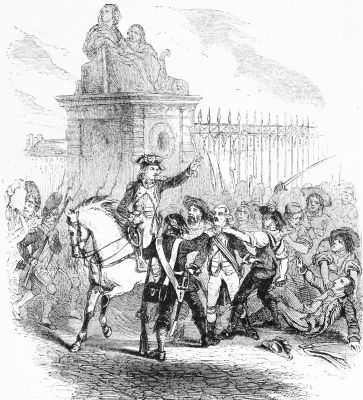
LA FAYETTE RESCUING THE GARDE DU CORPS, OCT. 6, 1789.
The Assembly, being apprised of the king's intention to go to Paris, passed a resolution that the Assembly was inseparable from the person of the king, and nominated a hundred deputies to accompany him to the metropolis. Two of the king's body-guard had been killed, and some wretches had cut off their heads, and were parading them about on pikes.[231]
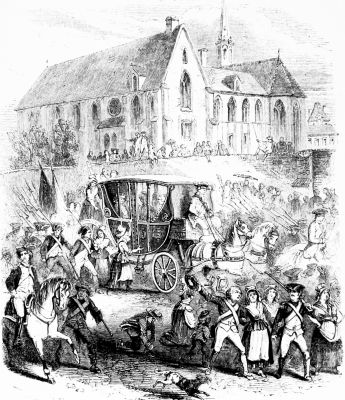
THE ROYAL FAMILY CONVEYED TO PARIS, OCT. 6, 1789.
It was one o'clock when the carriages containing the royal family left Versailles.[232] The whole mob of Paris, men and women, a tumultuous, clamorous multitude, went in advance. Following immediately the carriages of the court came the hundred deputies, also in coaches. Then came the National Guard. Carts laden with corn and flour, escorted by Grenadiers, followed the immense train. None were so malignant and merciless as the degraded women who composed so large a part of this throng. "We shall now," they exclaimed, "have bread, for we have with us the baker, the baker's wife, and the baker's boy."
It required seven hours for this unwieldy mass to urge its slow progress to Paris. The king was conducted to the Hôtel de Ville, where he was received by M. Bailly, the mayor. The royal family descended from their carriages by torch-light, and entered the great hall, where they were received with acclamations. After the ceremony of reception by the municipality of Paris was over, the king and his family were conducted to the Tuileries. The vast palace had not been the residence of the royal family for a hundred years, and its spacious and poorly-furnished apartments presented but a cheerless aspect. The National Guard were stationed around the palace, and thus La Fayette was made responsible for the safe-keeping of the person of the king. Thus terminated the eventful days of the 5th and 6th of October, 1789. The king was now virtually a prisoner, and the nobles could no longer avail themselves of his name in enforcing, by the aid of foreign armies, despotism upon France.
FOOTNOTES:
CHAPTER XVIII.
FRANCE REGENERATED.
Kind Feelings of the People.—Emigration receives a new Impulse.—The National Assembly transferred to Paris.—The Constituent Assembly.—Assassination of François.—Anxiety of the Patriots.—Gloomy Winter.—Contrast between the Bishops and the laboring Clergy.—Church Funds seized by the Assembly.—The Church responsible for the Degradation of the People.—New Division of France.—The Right of Suffrage.—The Guillotine.—Rabaud de St. Etienne.
The royal family was now in Paris. The poor were, however, still perishing of famine. The night of the 6th of October passed without disturbance. It was dark even to blackness, and torrents of rain deluged the streets. Early in the morning of the 7th a vast multitude thronged the garden of the Tuileries, eager to catch a glimpse of the king. They all seemed animated by the kindest feelings toward their sovereign. The king, in response to reiterated calls, showed himself upon the balcony, and was received with universal acclamations. All the members of the royal family appeared to share in this popularity. Madame Elizabeth, sister of the king, a princess of rare loveliness both of person and character, caused her window to be opened, and sat partaking of refreshments in the presence of thousands of spectators. Men, women, and children, a vast multitude, gathered around the window, and words of kindness, love, and joy were on all lips.
"We have now our king restored to us," they said. "He is taken away from his bad advisers, and will now be, as he has always wished to be, our good father."
This generous, confiding spirit had taken such full possession of the public mind—the people, notwithstanding the intolerable wrongs they had endured for so many ages, were so ready to forgive—that not a word of disrespect was uttered, even to the foreign body-guard of the king, or to the haughty lords and aristocratic ladies who had accompanied the court to Paris. The people even cheered these nobles, against whom they had been so long contending, and addressed them in words of kindness.[233]
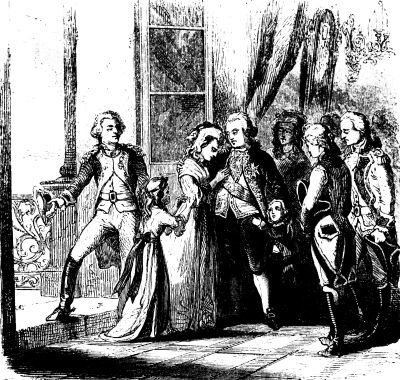
THE ROYAL FAMILY ABOUT TO EXHIBIT THEMSELVES TO THE PEOPLE.
The nobles were, however, so alarmed by this triumph of the people that emigration received a new impulse. One hundred and fifty of the Royalist deputies of the National Assembly immediately obtained passports and left the kingdom. Some of the nobles repaired to Turin. The Comte d'Artois (Charles X.) took up his residence with his father-in-law, the King of Sardinia. The emigrants, thus scattered through all the courts of Europe, were busy in endeavors to rally the aristocratic courts to crush popular liberty in France. The emigration throughout the country was so extensive that sixty thousand, it was said, went to Switzerland alone.
The king, on the contrary, appeared pleased with the affection of his people. He walked, without guards, through the crowds which thronged the Elysian Fields, and was every where treated with respect. On the 9th of October, three days after his arrival in the city, he sent a letter to the Assembly at Versailles, informing that body that the testimonials of affection and fidelity which he had received from the city of Paris had determined him to fix his ordinary residence there.[234] He accordingly invited the Assembly to transfer its sitting to Paris. Incredible as it may seem, the imbecile king sent for his smith tools, put up his forge, and amused himself with file and hammer tinkering at locks.[235]
The Archbishop of Paris had fled with the emigrants. On the 19th of October the National Assembly left Versailles and held its first sitting in Paris, in a room of the archbishop's palace, from which room it soon removed to the riding-hall of the Tuileries, a much more commodious apartment which had been prepared for its accommodation.[236] As the great object of the Assembly was now to reorganize the government upon the basis of a free constitution, it dropped the name of National Assembly on leaving Versailles, and assumed in Paris the name of Constituent Assembly. Thus the same body in the course of five months was called by three different names. It was first the States-General, from the period of its meeting on the 5th of May until the union of the three orders on the 27th of June. It was then the National Assembly until its removal from Versailles to Paris, on the 19th of October. It then took the name of the Constituent Assembly, and continued in existence for nearly two years, until the 30th of September, 1791, when it expired, and a new body, the Legislative Assembly, commenced its session.
The storm of revolution for a time seemed to lull, and there were but few acts of violence. The people of Paris were still in a state of fearful suffering from famine, and on the 21st of October a few half-starved wretches seized a baker named François, whom they accused of holding back his bread, and in a moment of phrensy, before the police could interfere, strung him up at a lamp-post, and then cut off his head.
The deed was denounced by even the most violent of the revolutionists, and the Assembly took advantage of the feeling which the outrage excited to pass a martial law against tumultuous assemblies of the people. This law, which was almost a repetition of the English riot act, was assailed by many of the journals as a gross infringement of the rights of the people. Robespierre in the Assembly and Marat in his wide-spread journal were conspicuous in denouncing it.
The atrocious murder of François, who was a generous and a charitable man, and entirely innocent of the crime of which he was accused, produced a profound impression. It was indicative of the rapid and fearful rise of mob violence. The king and queen sent to his young widow a letter of condolence, with a gift in money amounting to about twenty-five hundred dollars. The city government of Paris sent a committee of its members to visit and console her. La Fayette, mortified and indignant at the outrage, scoured the faubourgs in search of the miscreants who perpetrated the deed. Two of the ringleaders were arrested and handed over to immediate trial.
They were condemned to death, and the next morning were hanged in the same Place de Grêve which had been the scene of the outrage. This was the only murder, perpetrated by a Parisian mob, during the Revolution, which the law was sufficiently powerful to punish.[237]
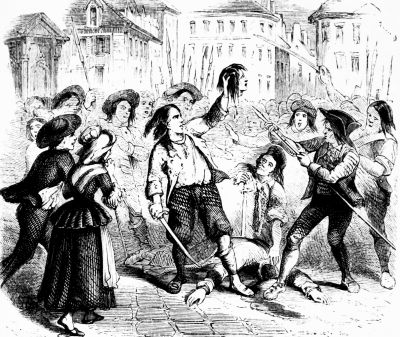
ASSASSINATION OF FRANÇOIS THE BAKER.
In other parts of the kingdom there were occasional acts of violence. Bread was so enormously dear that the corn-dealers were accused of hoarding up immense stores for the sake of speculation. The ignorant mob in some instances seriously maltreated those suspected of this crime. The innocent were thus often punished, for the violence of the mob is as likely to fall upon the innocent as upon the guilty.
Many of the most intelligent friends of reform began now to fear that the nation was going "too fast and too far." The scenes of the 5th of October, and the omnipotence of the mob as evinced on that day, had inspired fearful apprehensions for the future. Even La Fayette felt that the salvation of the cause of liberty depended upon strengthening the power of the king. He induced the king to send the Duke of Orleans from Paris, and when the duke wished to return he sent him word that, the day after his return, he would have to fight a duel with him.
Mirabeau united with La Fayette in these endeavors to stop the nation in its headlong rush, and to secure constitutional liberty by giving strength to the monarchical arm. They were both of the opinion that France, surrounded by powerful and jealous monarchies, and with millions of peasants unaccustomed to self-government, who could neither read nor write, and who were almost as uninstructed as the sheep they tended, needed a throne founded upon a free constitution.[238] Even in the Assembly Mirabeau ventured to urge that it was necessary to restore strength to the executive power.[239] But the court hated both La Fayette and Mirabeau, and were opposed to any diminution of their own exclusive privileges. They would accept of no compromise, and all the efforts of the moderate party were unavailing.
Gloomy winter now commenced, and there was no money, no labor, no bread. The aristocratic party all over the realm were packing their trunks, and sending before them across the frontiers whatever funds they could collect. They wished to render France as weak and miserable as possible, that the people might be more easily again subjugated to the feudal yoke by the armies of foreign despots. Hence there was a frightful increase of beggary. In Paris alone there were two hundred thousand. It is one of the greatest of marvels that such a mass of men, literally starving, could have remained so quiet. The resources of the kingdom were exhausted during the winter in feeding, in all the towns of France, paupers amounting to millions. All eyes were now directed to the National Assembly for measures of relief.
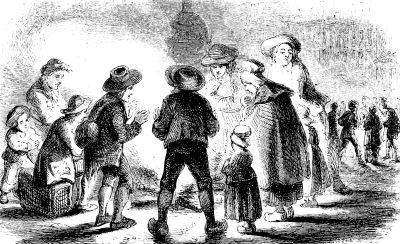
FIRES IN THE STREETS FOR THE POOR.
The wealth of the clergy was enormous. Almsgiving, which has filled Europe with beggary, has ever been represented by the Catholic Church as the first act of piety. During long ages of superstition, the dying had been induced, as an atonement for godless lives, to bequeath their possessions to the Church, to be dispensed in charity to the people. Thus many a wealthy sinner had obtained absolution, and thus the ecclesiastics held endowments which comprised one fifth of the lands of the kingdom, and were estimated at four thousand millions of francs ($800,000,000).[240]
Notwithstanding this immense opulence of the Church, nearly all the parish pastors, the hard and faithful workers for Christianity—and there were many such, men of true lives and of unfeigned religion—were in the extreme of poverty. The bishops were all nobles, for even Louis XVI. would elect no other. These bishops were often the most dissolute and voluptuous of men, and reveled in incomes of a million of francs ($250,000) a year. The working clergy, on the contrary, who were from the people, seldom received more than two hundred francs ($40) a year. They were so poor as to be quite dependent upon their parishioners for charity.[241]
The Assembly assumed that these treasures had been intrusted to the Church for the benefit of the people; that the luxurious ecclesiastics, by unfaithfulness to their trust, had forfeited the right of farther dispensing the charity. After a very fierce strife, a motion was made by Mirabeau, that the possessions of the Church were at the disposal of the state. Many of the lower clergy voted for the resolution, and it was adopted by a majority of 568 against 346. Forty deputies refused to vote. This measure placed at once immense resources in the hands of the Assembly, and necessarily exasperated tenfold the privileged classes, and rolled a wave of alarm over the whole wide-spread domain of the Pope. It was the signal for Catholic Europe to rise in arms against the Revolution. As it was impossible, under the pressure of the times, to force the sale of the enormous property of the Church without an immense sacrifice, bonds were issued, called assignats, assigned or secured on this church property.
Thus was the haughty Gallican Church deprived of its ill-gotten and worse used wealth. The dignitaries of this Church had ever been the most inveterate foes of popular elevation. Treasure which had been wrested from the poor and extorted from the dying, as a gift to God for the promotion of human virtue, they were using to forge chains for the people, and were squandering in shameless profligacy.
Nearly all the nobles were infidels, disciples of Voltaire. For years, while reveling in wine and debauchery, they had held up religion to contempt. But they now suddenly became very devout, espoused the cause of their boon companions, the bishops, and remonstrated against laying unholy hands upon the treasury of the Lord. All over Europe the two most formidable forces, secular and religious aristocracy, were now combined against popular reform. It was this principle which led the Protestant English noble and the papal Austrian bishop to make common cause against the regeneration of France.
There were some French nobles and French bishops who recognized, whatever may have been their motives, the rights of the people, and espoused their side. Talleyrand, the Bishop of Autun, introduced the measure, and Mirabeau supported it with all the energy of his eloquence.
The degradation of the people is the condemnation of the papal Church. For many centuries the office of elevating the people had devolved upon the clergy. Instead of instructing their congregations, the forms of worship had been converted into a senseless pantomime; the prayers were offered in an unknown tongue; the word of God was excluded from their sight. The rich became infidels and atheists, and by robbing the poor luxuriated in profligacy. The poor became brutalized and savage, and were held under restraint only by the terrors of a soul-hardening superstition.
There is no hope of peace for the world but in that doctrine of Christ which promotes the brotherhood of man. Where this fraternity is recognized and its sympathies circulate, there is peace. The aristocratic Church in France had been the tool of the court in degrading and enslaving the people. The awful day of retribution was but the inevitable progress of the divine law. Man, crushed and trampled upon by his brother man, may endure it for an age, for a century, but the time will come when he will endure it no longer, and the ferocity of his rising will be proportionate to the depth and the gloom of the dungeon in which he has been immured.[242] The progress of the world is toward justice, equality, and nature. If that progress be not peaceful it will be violent and bloody. The vital energies of the soul of man can not forever be repressed.
France had for some time been divided into thirteen large provinces, incorporated at different periods and possessing different immunities and a diversity of customs and laws. The Assembly broke down all these old barriers that a character of unity might be given to the nation. The kingdom was divided into eighty-three departments, each department being about fifty-four miles square. These departments were divided into districts, and the districts into communes. This division somewhat resembled that of the United States, into states, counties, and towns.
The right of suffrage was extended to all male citizens twenty-five years of age, who had resided in the electoral district one year, who had paid a direct tax amounting to the value of three days' labor, about sixty cents, who were not in the condition of servants, and who were enrolled in the National Guard. These were called active citizens. The rest of the population were deemed passive citizens. To be eligible to office either as a magistrate or a representative, it was required that one should pay a direct tax of about ten dollars, and also be a landholder. The aristocrats considered this extension of the right of suffrage as awfully radical and democratic. On the other hand the democracy, from its lower depths, exclaimed with the utmost vehemence and indignation against the restriction of the right of suffrage and of office to tax-payers and property-holders.
"There is but one united voice," cried Camille Desmoulins, "in the city and in the country, against this ten-dollar decree (le décret du marc d'argent). It is constituting in France an aristocratic government, and it is the most signal victory which the aristocrats have yet gained in the Assembly. To demonstrate the absurdity of the decree it is necessary but to mention that Rousseau, Corneille, Mably, under it could not have been eligible. As for you, ye despicable priests, ye lying cheating knaves, do you see that you make even your God ineligible?[243] Jesus Christ, whom you recognize as divine, you thrust out into the ranks of the mob. And do you wish that I should respect you, ye priests of an ignominious God (d'un Dieu proletaire), who is not even an active citizen? Respect that poverty which Jesus Christ has ennobled."[244]
Such fierce appeals produced a profound and exasperating impression upon the army of two hundred thousand beggars in Paris and upon the millions utterly impoverished in France. "We have overthrown the aristocracy of birth," the orators of the populace exclaimed, "only to introduce the still more hateful aristocracy of the purse." The working clergy, who were among the foremost in favor of reform, were almost to a man efficient members of the moderate party, and cordially co-operated with La Fayette in the endeavor to prevent liberty from being whelmed in lawlessness. The clergy had great influence, and hence the venom of the popular speakers and writers was perseveringly directed against them.[245]
The Assembly then abolished the oppressive duty upon salt.[246] The old parliaments of the old provinces, as corrupt bodies as have perhaps ever existed, and the subservient instruments of aristocratic oppression, were suppressed, and new courts of a popular character substituted in their place. All trials were ordered to be public; no punishment, on accusation for crime, could be inflicted unless by a vote of two thirds of the court. The penalty of death required a vote of four fifths. The revocation of the Edict of Nantes was blotted out, and thus some thousands of Protestants who had long been banished from France were permitted to return and to enjoy all their political rights. It was decreed that all citizens, of whatever condition, should be subject to the same laws and judged by the same tribunals. Those accused of crime were to be tried by jury, but not till a court had previously determined that the evidence against them was sufficiently strong to warrant their arrest. It is remarkable that both Robespierre and Marat were most earnest in their endeavors to abrogate the death-penalty. During this discussion Dr. Guillotin urged the adoption, in capital punishment, of a new machine which he had invented.
"With my machine," said the doctor, "I can clip off your head in the twinkling of an eye without your feeling it."
These words, most earnestly uttered, caused a general burst of laughter in the Assembly. But a few months passed ere many of those deputies were bound to the plank and experienced the efficiency of the keen blade. The introduction of the guillotine was intended as a measure of humanity. The unfortunate man doomed to death was thus to be saved from needless suffering.[247]
The measures adopted by the Constituent Assembly seem to republican eyes just and moderate. Experience, it is true, has proved that it is safer to have two houses of legislation, a senate and a lower house, than one, but the subsequent decrees passed by this one house were manifestly dictated, not by passion, but by patriotism and a sense of right.[248]
The clergy now made immense efforts to rouse the peasantry all over the kingdom to oppose the Revolution. Religious fanaticism exhausted all its energies. The parliaments also of the old provinces, composed exclusively of the nobles, roused themselves anew and were vehement in remonstrances and protests. They became active agents in organizing opposition, in maligning the action of the Assembly, and in inciting the credulous multitude to violence. The Assembly punished the parliaments by abolishing them all.
The court bitterly accused the Assembly of a usurpation of power, which called from Mirabeau a reply which electrified France.
"You ask," he said, "how, from being deputies, we have made ourselves a convention. I will tell you. The day when, finding our assembly-room shut, bristling and defiled with bayonets, we hastened to the first place that could contain us, and swore that we would perish rather than abandon the interests of the people—on that day, if we were not a convention, we became one. Let them now go and hunt out of the useless nomenclature of civilians the definition of the words National Convention! Gentlemen, you all know the conduct of that Roman who, to save his country from a great conspiracy, had been obliged to outstep the powers conferred upon him by the laws. A captious tribune required from him the oath that he had respected them. He thought, by that insidious proposal, to leave the consul no alternative but perjury or an embarrassing avowal. 'I swear,' said that great man, 'that I have saved the republic.' Gentlemen, we also swear that we have saved the commonwealth."
This sublime apostrophe brought the whole Assembly to its feet. The charge of usurpation was not repeated.
A great effort was at the same time made to compel the Assembly to adopt the resolution that the "Catholic, Apostolic, and Roman religion is, and shall ever be, the religion of the nation, and that its worship is the only one authorized." As one of the court party was urging this resolve, and quoting, as a precedent, some intolerant decree of Louis XIV., Mirabeau sent dismay to the heart of the court by exclaiming,
"And how should not every kind of intolerance have been consecrated in a reign signalized by the revocation of the Edict of Nantes?"
Then, pointing to a window of the Louvre, he continued, in deep and solemn tones which thrilled through every heart,
"Do you appeal to history? Forget not that from this very hall I behold the window whence a king of France, armed against his people by an execrable faction that disguised personal interest under the cloak of religion, fired his musket and gave the signal for the massacre of St. Bartholomew!"
The effect was electric, and the spirit of intolerance was crushed.
The true Christian charity which the Assembly assumed was cordially accepted by the mass of the nation. We love to record the fact that the great majority of the Catholic population were delighted to see the Protestants restored to their civil and religious rights. Even Michelet, hostile as he is to all revealed religion, testifies: "The unanimity was affecting, and one of the sights the most worthy to call down the blessing of God upon earth. In many parts the Catholics went to the temple of the Protestants, and united with them to return thanks to Providence together. On the other hand the Protestants attended at the Catholic Te Deum. Far above all the altars, every temple and every church, a divine ray had appeared in heaven."[249] In every place where the Protestants were in the majority they presented the most affecting spectacle of fraternity.
A Protestant, M. Rabaud de St. Etienne, was chosen president of the Assembly—a position at that time higher than that of the throne. He was the son of the celebrated Protestant martyr of Cevennes, who for long years had been hunted like a wild beast, as he hid in dens in the forest, escaping from the ferocity of religious persecution. The venerable parent was still living, and received from his son a letter containing the declaration, "The president of the National Assembly is at your feet."
The higher ecclesiastics were, however, exasperated by this triumph of religious liberty. They succeeded, in Montauban and in Nimes, in exciting a Roman Catholic mob against the Protestants. The ignorant populace, roused by superstition, seized their arms, shouted "Down with the nation!" and fell with the most cruel butchery upon the Protestants. The violent insurrection was, however, soon quelled, and without any acts of retaliatory vengeance.[250] The bishops anathematized every priest friendly to the Revolution, and designated all such to the hatred and contempt of the fanatic populace. The bishop who, under the old régime, had enjoyed an income of eight hundred thousand francs ($160,000), and was rejoicing in his palaces, horses, and concubines, invoked the wrath of God upon the curate who was now receiving twelve hundred francs ($240) from the nation. The power of the papal ecclesiastics was so strong that most of the humble curates were eventually compelled to abandon the Revolution and rally again around the sceptre of the Pope.
The air was still filled with rumors of plots to disperse the Assembly and carry the king off to the protection of the royalist army at Metz, where he could be forced by the nobles to sanction their course, in invading France with foreign armies. On the 25th of December the Marquis of Favrus was arrested, accused of forming a plot to seize the king with an army of thirty thousand men, and to assassinate La Fayette and Bailly. It was said that twelve hundred horse were ready at Versailles to carry off the king, and that a powerful force, composed of Swiss and Piedmontese, was organized to march upon Paris. The king's brother, the Count of Provence, subsequently Louis XVIII., was reported as in the plot, and to have supplied the conspirators with large sums of money. Louis was willing to be abducted as if by violence, but was not willing to assume any responsibility by engaging in measures for escape. He assumed the attitude of contentment, and with such apparent cordiality professed co-operation in the measures of the Assembly for the regeneration of France that many supposed that he had honestly espoused the popular cause.
FOOTNOTES:
CHAPTER XIX.
THE KING ACCEPTS THE CONSTITUTION.
The King visits the Assembly.—His Speech.—The Priests rouse the Populace.—The King's Salary.—Petition of Talma.—Views of Napoleon.—Condemnation and Execution of the Marquis of Favrus.—Spirit of the New Constitution.—National Jubilee.—The Queen sympathizes with the Popular Movement.—Writings of Edmund Burke.
On the 4th of February the king, without any previous announcement, to the surprise of all, entered the hall of the Assembly. A burst of welcome greeted his entrance. The tidings of this movement spread with electric speed through Paris, and thousands of spectators speedily filled all parts of the hall to listen to the king's speech. The king stood upon the platform, and addressed the Assembly with words of dignity and eloquence which seemed above his nature. There was such an air of sincerity pervading every sentence that no one could doubt that he was giving utterance to his real opinions. This remarkable speech contained the following expressions:[251]
"Gentlemen, the critical circumstances in which France is placed bring me among you. A grand goal is presented to your view, but it is requisite that it be attained without any increase of agitation, and without any new convulsions. It was, I must say, in a more agreeable and a more quiet manner that I had hoped to lead you to it, when I formed the design of assembling you, and of bringing together for the public welfare the talents and the opinions of the representatives of the nation; but my happiness and my glory are not the less connected with the success of your labors.
"I think that the time is come when it is of importance to the interests of the state that I should associate myself, in a more express and manifest manner, in the execution and success of all that you have planned for the benefit of France. I can not seize a more signal occasion than when you submit to my acceptance decrees destined to establish a new organization in the kingdom, which must have so important and so propitious an influence on the happiness of my subjects and on the prosperity of this empire.
"You know, gentlemen, it is more than ten years ago, at a time when the wishes of the nation relative to provincial assemblies had not yet been expressed, I began to substitute that kind of administration for the one which ancient and long habit had sanctioned. You have improved upon these views in several ways, and the most essential, no doubt, is that equal and wisely-calculated subdivision which, by breaking down the ancient partitions between province and province, and establishing a general and complete system of equilibrium, more intimately unites all parts of the kingdom in one and the same spirit, in one and the same interest. This grand idea, this salutary design, is all your own. I will promote, I will second, by all the means in my power, the success of that vast organization on which depends the welfare of France.
"Let it be known every where that the monarch and the representatives of the nation are united in the same interest, in the same wish. Some day, I fondly believe, every Frenchman, without exception, will acknowledge the benefit of the total suppression of the differences of order and condition. No doubt those who have relinquished their pecuniary privileges—those who will no longer form, as of old, an order in the state, find themselves subjected to sacrifices, the importance of which I fully appreciate; but I am persuaded that they will have generosity enough to seek an indemnification in all the public advantages of which the establishment of national assemblies holds out a hope.
"I will defend, therefore, I will uphold constitutional liberty, the principles of which the public wish, in accordance with mine, has sanctioned. I will do more, and, in concert with the queen, who shares all my sentiments, I will early adapt the mind and heart of my son to the new order of things which circumstances have brought about. I will accustom him from his very first years to seek happiness in the happiness of the French, and ever to acknowledge that, in spite of the language of flatterers, a wise constitution will preserve him from the dangers of inexperience, and that a just liberty adds a new value to the sentiments of affection and loyalty of which the nation has, for so many ages, given such touching proofs to its kings."
These noble words, which were uttered with as much sincerity as a weak and vacillating mind was capable of cherishing, were received with the most enthusiastic expressions of pleasure and gratitude. Thunders of applause filled the house, in which the galleries tumultuously joined. All past jealousies seemed forgotten forever, and the queen and the dauphin shared in the transporting acclaim. The multitude, with shouts of applause, conducted the king back to the Tuileries, while the Assembly voted thanks to him and to the queen.
The king had thus publicly accepted the Constitution even before it was completed, and promised to support it. Each deputy took the oath to uphold the "Constitution decreed by the National Assembly and accepted by the king." The example was contagious, and the oath was repeated, with festivities and illuminations, in every district of Paris, and through all the cities and villages of France.
Thus far the reforms adopted had been, on the whole, most eminently wise, and such as the welfare of the nation imperiously demanded. Had the privileged classes acceded, as they ought to have done, to these measures of justice, and contributed their influence in favor of law and order, all might have been well, and the Iliad of woes which succeeded might never have been known. But the nobles and the higher clergy did every thing in their power to stimulate the mob to violence, to fill France with lawlessness and blood, that they might more effectually appeal to religious fanaticism at home and to despotism abroad to forge chains and rivet them anew upon the enfranchised people.
Every effort was now made to combine the clergy against the Revolution—to rouse the ignorant and superstitious masses with the cry that religion was in danger, and to march the armies of surrounding monarchies in a war of invasion upon France. The nobles of the Church and the State were responsible for that terrific outburst of the mob, which might easily have been repressed if they would have united with the true patriots in favor of liberty and of law.[252]
In many of the rural districts the priests roused the fanatic populace to forcible resistance. Many of the priests had been in a condition of almost compulsory subservience to the higher clergy. Trained to obedience as the primal law of the Church, they combined their efforts with those of the exasperated nobility, and thus, in several of the remote sections of France, mobs were instigated against the Revolution. Here commenced the conflict between the people and the clergy. Pure democracy and true Christianity meet and embrace. They have but one spirit—fraternity, charity. Despotism and ecclesiasticism are also natural congenial allies. The pope and the king, the cardinal and the duke, all over Europe became accomplices.
The Assembly, with much delicacy, invited the king himself to fix the income necessary for the suitable support of the crown. He fixed it at twenty-five millions of francs ($5,000,000). This enormous salary, two hundred times as much as the President of the United States receives, was instantly voted by acclamation. There were but four votes in opposition. Nothing can more conclusively show than this the kindly feelings of the people toward the monarch, and the then desire merely to ingraft the institutions of liberty upon the monarchy.
The Revolution had humanely extended its helping hand to all the debased and defrauded classes, to the Protestants, the Jews, the negroes, the slaves, the play-actors. The relentless proscription of play-actors is one of the most remarkable of the contradictions and outrages of the old régime. They were doubtless a very worthless set of men and women; but that the Church should have refused them either marriage or burial is indeed extraordinary. "Oh, barbarous prejudices!" exclaimed Michelet. "The two first men of England and France, the author of Othello and of Tartufe, were they not comedians?"
Notwithstanding the general decree of democratic enfranchisement pronounced by the Assembly, the world-renowned Talma, having applied to the Church for the rite of marriage, which the Church alone could solemnize, met with a peremptory refusal. He sent the following characteristic petition to the National Assembly:
"I implore the succor of the constitutional law, and claim the rights of a citizen, from which rights the Constitution does not exclude me because I am a member of the theatrical profession. I have chosen a companion to whom I wish to be united by the ties of marriage. My father has given his consent. I have called upon the curé of St. Sulpice for the publication of the banns. After a first refusal I have served upon him a judicial summons. He replies to the sheriff that he has referred the matter to his ecclesiastical superiors, and is instructed by them that the Church refuses to perform the rites of marriage for a play-actor unless he first renounces that profession. I can, it is true, renounce my profession, be married, and resume my profession again the next day. But I do not wish to show myself unworthy of that religion which they invoke against me, and unworthy of the Constitution in thus accusing your decrees of error and your laws of powerlessness."[253]
It was in such ways as these that the Romish Church began to throw every possible obstacle in the way of liberty, and to exasperate the people, rejoicing in their new enfranchisement.
It was a long stride which Napoleon took when he subsequently conferred the Cross of the Legion of Honor upon an illustrious tragedian. "My object," says Napoleon, "was to destroy the whole of the feudal system as organized by Charlemagne. I sought for true merit among all ranks of the great mass of French people, and was anxious to organize a true and general system of equality. I was desirous that every Frenchman should be admissible to all the employments and dignities of the state, provided he was possessed of talents and character equal to the performance of the duties, whatever might be his family. In a word, I was eager to abolish to the last trace the privileges of the ancient nobility, and to establish a government which, at the same time that it held the reins of government with a firm hand, should still be a popular government. The oligarchs of every country in Europe soon perceived my design, and it was for this reason that war to the death was carried on against me by England. The noble families of London, as well as those of Vienna, think themselves prescriptively entitled to the occupation of all the important offices in the state. Their birth is regarded by them as a substitute for talents and capacities."
Soon after Napoleon's attainment of the consulship he restored to France the Christian religion, which revolutionary fury had swept away. In consistency with his unvarying principles, he established perfect freedom of opinion and of worship. Some of the reinstated priests began to assume much of their former arrogance. A celebrated actress died in Paris. A priest, adopting the intolerance of the old régime, refused her remains Christian burial. Napoleon caused the following article to be inserted the next day in the Moniteur, expressive of his emphatic denunciation:
"The curate of St. Roche, in a moment of hallucination, has refused the rites of burial to Mademoiselle Cameroi. One of his colleagues, a man of sense, received the procession into the church of St. Thomas, where the burial service was performed with the usual solemnities. The Archbishop of Paris has suspended the curate of St. Roche for three months, to give him time to recollect that Jesus Christ commanded us to pray even for our enemies. Being thus called by meditation to a proper sense of his duties, he may learn that all these superstitious observances, the offspring of an age of credulity or of crazed imaginations, tend only to the discredit of true religion, and have been proscribed by the recent Concordat of the French Church."
The trial of Marquis Favrus was continued. On the 18th of February he was adjudged guilty of plotting the crime of assassinating Bailly and La Fayette, of seizing and abducting the king, and of exciting insurrection and civil war. He was sentenced to be taken by the executioner to the principal door of the Cathedral of Nôtre Dame, in a tumbrel, barefooted, bareheaded, and dressed simply in his night-robe, with a rope round his neck, a blazing torch in his hands, and with a label on his breast and back inscribed with the words "Conspirator against the State." After having on his knees asked pardon of God, the nation, the king, and justice, he was to read aloud his own death-warrant, and then to be taken to the Place de Grève and hanged. This cruel sentence was immediately executed, the court, conscious of its powerlessness, making no attempts to save him.
This was the first time that a nobleman had been hanged, and the mob, deeming him an infamous conspirator against the rights of the people, rejoiced in his execution. They witnessed with delight this indication that the reign of equality had really commenced; that the sword of retribution would hereafter fall as surely upon the head of the high-born as upon that of the low-born offender.
It was now nearly a year since the fall of the Bastille, and France, even in the midst of famine, and almost starvation, had passed from the reign of the most execrable despotism to the reign of constitutional liberty. Never before had so vast a revolution been effected so peaceably. The enslaved people had broken and thrown away their fetters, and were enfranchised. Instead of falling upon their past oppressors in indiscriminate massacre, they had spared them, wresting from them only the exclusive privileges of tyranny. The Assembly sought only constitutional liberty and peace with all the world. The decrees enacted by the Constituent Assembly were essentially the same with those adopted by republican America.
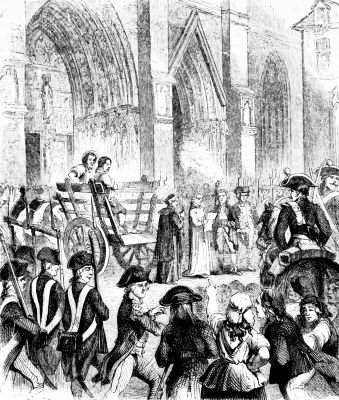
THE MARQUIS OF FAVRUS READING HIS DEATH-WARRANT.
Free principles had been infused into the government; lettres de cachet, the most infamous instruments of oppression the world has ever known, abolished; feudal impediments and oppressions of every kind removed; the right of suffrage established and made almost universal; the offices of honor and emolument in the state thrown open to merit, with but the slightest limitations; religious liberty proclaimed, the Protestant, the Jew, the negro, and the play-actor enfranchised; law made uniform, criminal jurisprudence reformed, monasteries, those haunts of indolence and vice, abolished, and the military force of the country intrusted to the citizens of the country. Such a transformation from the slavery, corruption, and horror of the old régime was translation from the dungeon to the blaze of day. All this was done almost without violence. The court here and there shot down a few hundred, some chateaux were burned, and there were a few acts of mob violence; but that a nation of twenty millions of people should have been able to accomplish so vast a change so bloodlessly must ever be a marvel.
But the armies of aristocratic opposition were gathering to crush this liberty, which threatened to spread to other states. Despotic Europe combined, and with all her accumulated armies fell upon the people of France. The recently emancipated people fought to protect themselves from new chains with all the blind fury and ferocity of despair. Then ensued scenes of blood and woes which appalled the world.[254]
The French people, unconscious of the terrific storm which was gathering, prepared for a great national jubilee. It was to be held on the 14th of July, the anniversary of the fall of the Bastille. All France was to be represented at the festival. The Field of Mars, a vast parade-ground in Paris, a mile in length and half a mile in width, extending from the military school to the banks of the Seine, was the selected theatre for this national festivity. The centre was made smooth as a floor, and the removed earth was placed on the sides so as to create slopes in the form of an amphitheatre capable of accommodating nearly half a million of spectators. But so immense was the work to be performed, that at length apprehensions were felt that the field could not be in readiness in season for the appointed fête. No sooner was this idea suggested than all Paris, in a flame of enthusiasm, volunteered to aid in the toil.
A more extraordinary scene of enthusiasm earth has never witnessed. All heads and hearts were electrified. Men, women, and children, of all ages and ranks, spread over the field and shared in the toil. The Carthusian monk and the skeptical philosopher, the hooded nun and the brawny fish-woman, merchants, lawyers, students, scholars, gray-haired patriots, and impetuous boys, matrons and maidens, delicate ladies and the rugged daughters of toil, blended harmoniously together in immense groups, ever varied, incessantly moving, yet guided by engineers with almost military order and precision. Moving tents and portable restaurants, decorated with tricolored ribbons, added to the gayety of the spectacle. Trumpets sounded the charge against banks of earth, and willing hands wielded energetically all the potent enginery of wheel-barrows, hoes, and spades. Bands of music animated and enlivened the scene, blended with shouts of joy and songs of fraternal sympathy. Three hundred thousand persons were thus seen at once laboring upon this spacious arena to rear an altar for the great sacrament of French liberty. It was a work of love. The long twilight allowed them to labor until the clock struck nine. Then the groups separated. Each individual repaired to the station of his section, and marched in procession, accompanied by triumphal music and with the illumination of torches, to his home. Even the Marquis of Ferrières, inveterate Royalist as he was, can not withhold his tribute of admiration in view of this astonishing drama. "The mind felt sinking," says he, "under the weight of a delicious intoxication at the sight of a whole people who had descended again to the sweet sentiments of a primitive fraternity."
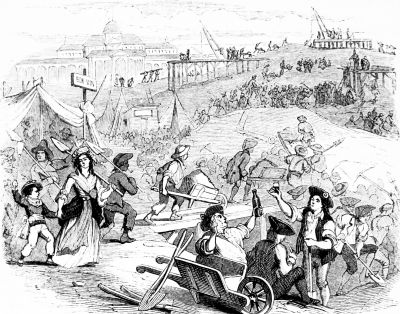
PREPARATION FOR THE FESTIVAL ON THE FIELD OF MARS.
The field was thus prepared, and the long-expected day arrived. Numerous delegates from all the eighty-three departments of France had come up to Paris to share in the celebration of the nation's enfranchisement. The morning of the 14th dawned dark and stormy. Heavy clouds curtained the sky and the rain fell in torrents. Regardless of the unpropitious weather, at an early hour four hundred thousand spectators had taken their seats in the vast amphitheatre three miles in circuit.
The delegates, twenty thousand in number, ranged beneath eighty-three banners, emblematic of the departments of France, formed in line on the site of the demolished Bastille, and, with a very magnificent array of troops of the line, sailors of the royal navy, and the National Guard, marched through the thronged and garlanded streets of St. Martin, St. Denis, and St. Honoré, and by the Cours la Reine to a bridge of boats constructed across the river. All the way they were greeted with acclamations, and the ladies regaled them sumptuously by letting down in baskets from the windows wine, ham, and fruits. The country members shouted "Long live our Parisian brothers!" and the Parisians responded with accordant greetings and with exuberant hospitality and loving-kindness.
To the patriot La Fayette this was an hour of inexpressible triumph. As he rode along the lines on a noble charger he was every where greeted with shouts of heartfelt affection. A man whom nobody knew pressed through the crowd, and, approaching the general, with a bottle in one hand and a glass in the other, said,
"General, you are hot. Take a glass."
Raising the bottle he filled the tumbler and presented it to La Fayette. The marquis took the glass, fixed his eye for a moment upon the stranger, and drank the wine at a draught. This confidence of La Fayette in the multitude gave rise to a burst of applause.[255]
Just as the procession had entered the field, and the shouts of the congregated thousands were ringing through the air, the rain ceased to fall, the clouds broke, and the sun came out in glorious brilliance. The spectacle now assumed an aspect of unparalleled sublimity. Near the centre of the field there was constructed an immense altar of imposing and antique architecture, upon whose spacious platform, twenty-five feet high, three hundred priests were assembled, in white surplices and broad tricolored sashes. Near this altar a majestic throne was reared, where the king sat, the acknowledged sovereign of France, attended by the queen, the court, and all the deputies of that Constituent Assembly which had conferred the inestimable boon of a free constitution upon France.
An awning, decorated with golden fleurs de lis, embellished and protected the throne. Fifty thousand of the National Guard, in new and brilliant uniform, with waving banners, martial bands, glittering arms, and richly-caparisoned horses, filled the spaces around the altar and the throne. Then four hundred thousand spectators crowded the ascending seats which, in thirty concentric rows, encircled this vast inclosure. Every house-top and steeple in the vicinity swarmed with the rejoicing multitude; and even the distant heights of Montmartre, St. Cloud, Meudon, and Sevres, seemed alive with the masses assembled to witness the magnificent spectacle. Tear-drops from the passing storm, pendent from the leaves, and trembling on every blade of grass, glittered in the sun, as if betokening that the day of darkness and sorrow had passed, and that light had dawned, in which tears were to be dried from every eye.
All hearts thrilled with emotion. Mass was performed, and the oriflamme, the national banner of France, and the banners of the eighty-three departments, were blessed by Talleyrand, Bishop of Autun. Gratitude to God was then expressed in the majestic Te Deum, chanted by twelve hundred musicians. A peal of thunder from the assembled cannon uttered the national Amen to these solemn services.
La Fayette, as the representative of the military forces of the kingdom, both by land and sea, now ascended the altar, and, in the presence of more than half a million of spectators, in behalf of the army and of the navy, took the oath of allegiance. Breathless silence pervaded the assembly, and every eye was riveted upon this patriot of two continents, while he uttered the solemn words,
"We swear eternal fidelity to the nation, the law, and the king; to maintain, to the utmost of our power, the Constitution decreed by the National Assembly and accepted by the king, and to remain united with every Frenchman by the indissoluble ties of fraternity."
When he closed, every banner waved, every sabre gleamed, and sixty thousand voices shouted, as with thunder peal, "We swear it!"
The president of the National Assembly then repeated the oath, and all the deputies and the four hundred thousand spectators responded, "We swear it."
The king then rose in front of his throne. In a loud, distinct voice, which seemed to vibrate through the still air to the remotest part of the vast and thronged amphitheatre, he repeated the solemn oath,
"I, King of the French, swear to the nation to employ all the powers delegated to me by the constitutional law of the state in maintaining the Constitution decreed by the National Assembly and accepted by me."
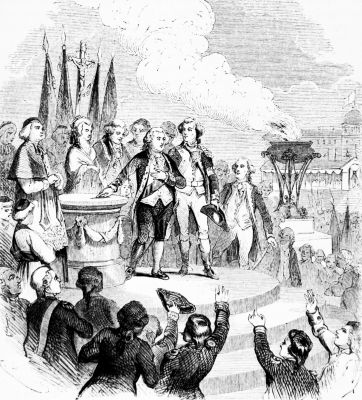
GRAND CELEBRATION ON THE FIELD OF MARS.
A more sublime moment never occurred in a nation's history. Every heart throbbed, and thousands of eyes were dimmed with tears. Even the queen was roused by the enthusiasm of the scene. Inspired by the impulse which glowed in every bosom, she rose, stepped forward into the presence of the people, and, raising her beautiful boy, the little dauphin, in her arms, said, in a loud voice,
"See my son! he joins, as well as myself, in the same oath."
Every eye beheld the act, and the words she uttered were repeated with electric speed along the lines. Enthusiasm burst all bounds. The spectators rose from their seats, and the air was filled with the roar of five hundred thousand voices, as every man, woman, and child shouted, "Vive le Roi! Vive la Reine! Vive le Dauphin!" The crowds on Montmartre, St. Cloud, Sevres, and Meudon caught the shout, and re-echoed it in tumultuous reverberations. And then came another peal still louder, as battery after battery of artillery, on the field, on the bridges, in the streets, and on the heights, simultaneously mingled their majestic voices with the clash of martial bands and the acclaim of regenerated France.
God seemed to smile upon this jubilee of his enfranchised children. The clouds had all disappeared. The sun shone brilliantly, and the Majesty of heaven apparently condescended to take a prominent part in the ceremonies of the eventful day. In conclusion, the Te Deum was again chanted by the vast choir, and the deep-voiced cannon proclaimed "Peace to the nation and praise to the Lord."
At the same hour all France, assembled in the eighty-three departments, took the same oath of fidelity to the nation, the law, and the king. Discord seemed to have passed away. No murmurs were heard. No man raised a voice of opposition. The general tide of rejoicing swept resistlessly over the land. From mountain to mountain the roar of cannon transmitted the tidings, from valley to valley chimes from the church bells caught and re-echoed the joyful sound, and from central Paris to the ocean, to the Rhine, to the Alps, and to the Pyrenees, twenty-four millions of people in one hour raised the shout of emancipation. Such a shout never before or since has ascended from earth to the ear of God.
For a week these rejoicings were continued in Paris. The Field of Mars was converted into an immense ball-room, where thousands listened to enchanting music, and with the overflowings of fraternal love engaged in feasting, dancing, and all manner of games. At night the city blazed with illuminations, and the flame of fireworks turned darkness into day. The trees of the Elysian Fields were festooned with brilliant lamps, shedding a mild light upon the most attractive of scenes. There was no intoxication, no tumult, no confusion. All classes intermingled, with kind words on every lip and kind looks beaming from every face. No carriages were permitted to enter these avenues, that the rich and the poor might share the festivities alike. Pyramids of fire were placed at intervals in the midst of the mass of foliage. The white dresses of the ladies who were sauntering through those umbrageous alleys, the music, the dances, the games, the shouts of laughter, led almost every one to the delusive hope that the old world of care and sorrow had vanished to give place to a new era of universal love and joy.[256]
The site of the Bastille was converted into an open square, and at the entrance of the inclosure was an inscription "Ici l'on danse" (Dancing here). For centuries the groans of the captive had resounded through the vaults of that odious prison. The groans had now ceased, and happy hearts throbbed with the excitement of the song and the dance.