Front matter (continued 11)
Reading edition
Then, pressing his capacious brow between his hands, he said, "They think that they can do without me. They deceive themselves. I was the statesman of Europe. They do not suspect the void which this head leaves."
"As to me," he continued, in cynical terms, "I have enjoyed my moments of existence well. I have made plenty of noise upon earth. I have tasted well of life. Let us go to sleep," and he made a gesture with head and arms as if about to repose his head upon a pillow.
After a short pause he resumed, "We are sacrificed to the ambition of a few dastardly brigands. But they will not long enjoy the fruit of their villainy. I drag Robespierre after me. Robespierre follows me to the grave." At four o'clock the executioners entered the Conciergerie to bind their hands and cut off their hair.
"It will be very amusing," said Danton, "to the fools who will gape at us in the streets, but we shall appear otherwise in the eyes of posterity."
When the executioners laid hold of Camille Desmoulins, he struggled in the most desperate resistance. But he was speedily thrown upon the floor and bound, while the prison resounded with his shrieks and imprecations. The whole fourteen Dantonists were placed in one cart. Desmoulins seemed frantic with terror. He looked imploringly upon the crowd, and incessantly cried,
"Save me, generous people! I am Camille Desmoulins. It was I who called you to arms on the 14th of July. It was I who gave you the national cockade."
He so writhed and twisted in the convulsions of his agony that his clothes were nearly torn from his back. Danton stood in moody silence, occasionally endeavoring to appease the turbulence of Desmoulins.
Herault de Séchelles first ascended the scaffold. As he alighted from the cart he endeavored to embrace Danton. The brutal executioner interposed.
"Wretch," said Danton, "you will not, at least, prevent our heads from kissing presently in the basket."
Desmoulins followed next. In his hand he held a lock of his wife's hair. For an instant he gazed upon the blade, streaming with the blood of his friend, and then said, turning to the populace,
"Look at the end of the first apostle of liberty. The monsters who murder me will not survive me long."
The axe fell, and his head dropped into the basket. Danton looked proudly, imperturbably on as, one after another, the heads of his thirteen companions fell. He was the last to ascend the scaffold. For a moment he was softened as he thought of his wife.
"Oh my wife, my dear wife," said he, "shall I never see you again?" Then checking himself, he said, "But, Danton, no weakness." Turning to the executioner, he proudly remarked, "You will show my head to the people; it will be well worth the display."
His head fell. The executioner, seizing it by the hair, walked around the platform, holding it up to the gaze of the populace. A shout of applause rose from the infatuated people. "Thus," says Mignet, "perished the last defenders of humanity and moderation, the last who sought to promote peace among the conquerors of the Revolution and pity for the conquered. For a long time after them no voice was raised against the dictatorship of terror, and from one end of France to the other it struck silent and redoubled blows. The Girondists had sought to prevent this violent reign, the Dantonists to stop it. All perished, and the conquerors had the more victims to strike, the more the foes arose around them."
The Robespierrians, having thus struck down the leaders of the moderate party, pursued their victory, by crushing all of the advocates of moderation from whom they apprehended the slightest danger. Day after day the guillotine ran red with blood. Even the devoted wife of Camille Desmoulins, but twenty-three years of age, was not spared. It was her crime that she loved her husband, and that she might excite sympathy for his fate. Resplendent with grace and beauty, she was dragged before the Revolutionary Tribunal. Little Horace was left an orphan, to cry in his cradle. Lucile displayed heroism upon the scaffold unsurpassed by that of Charlotte Corday or Madame Roland. When condemned to death she said calmly to her judges,
"I shall, then, in a few hours, again meet my husband. In departing from this world, in which nothing now remains to engage my affections, I am far less the object of pity than are you."
Robespierre had been the intimate friend of Desmoulins and Lucile. He had often eat of their bread and drunk of their cup in social converse. He was a guest at their wedding. Madame Duplessis, the mother of Lucile, was one of the most beautiful and accomplished women of France. In vain she addressed herself to Robespierre and all his friends, in almost frantic endeavors to save her daughter.
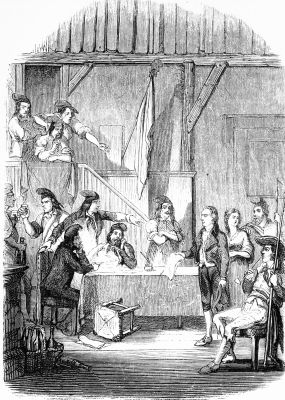
INTERIOR OF THE REVOLUTIONARY TRIBUNAL.
"Robespierre," she wrote to him, "is it not enough to have assassinated your best friend; do you desire also the blood of his wife, of my daughter? Your master, Fouquier Tinville, has just ordered her to be led to the scaffold. Two hours more and she will not be in existence. Robespierre, if you are not a tiger in human shape, if the blood of Camille has not inebriated you to the point of losing your reason entirely, if you recall still our evenings of intimacy, if you recall to yourself the caresses you lavished upon the little Horace, and how you delighted to hold him upon your knees, and if you remember that you were to have been my son-in-law, spare an innocent victim! But, if thy fury is that of a lion, come and take us also, myself, Adèle [her other daughter], and Horace. Come and tear us away with thy hands still reeking in the blood of Camille. Come, come, and let one single tomb reunite us."
To this appeal Robespierre returned no reply. Lucile was left to her fate. In the same car of the condemned with Madame Hebert she was conducted to the guillotine. She had dressed herself for the occasion with remarkable grace. A white gauze veil, partially covering her luxuriant hair, embellished her marvelous beauty. With alacrity and apparent cheerfulness she ascended the steps, placed her head upon the fatal plank, and a smile was upon her lips as the keen-edged knife, with the rapidity of the lightning's stroke, severed her head from her body.
While these cruel scenes were transpiring in Paris, and similar scenes in all parts of France, the republican armies on the frontiers were struggling to repel the invading armies of allied Europe. It was the fear that internal enemies would rise and combine with the foreign foe which goaded the Revolutionists to such measures of desperation. They knew that the triumph of the Bourbons was their certain death. The English were now in possession of Toulon, the arsenal of the French navy, which had been treasonably surrendered to an English fleet by the friends of the Bourbons. A republican army had for some months been besieging the city, but had made no progress toward the expulsion of the invaders.
Napoleon Bonaparte, then a young man about twenty-five years of age and a lieutenant in the army, was sent to aid the besiegers. His genius soon placed him in command of the artillery. With almost superhuman energy, and skill never before surpassed, he pressed the siege, and, in one of the most terrific midnight attacks which ever has been witnessed, drove the British from the soil of France. This is the first time that Napoleon appears as an actor in the drama of the Revolution. The achievement gave him great renown in the army. On this occasion the humanity of Napoleon was as conspicuous as his energy. He abhorred alike the tyrannic sway of the Bourbons and the sanguinary rule of the Jacobins. One of the deputies of the Convention wrote to Carnot, then Minister of War, "I send you a young man who distinguished himself very much during the siege, and earnestly recommend you to advance him speedily. If you do not, he will most assuredly advance himself."
At St. Helena Napoleon said, "I was a very warm and sincere Republican at the commencement of the Revolution. I cooled by degrees, in proportion as I acquired more just and solid ideas. My patriotism sank under the political absurdities and monstrous domestic excesses of our legislatures."[418]
FOOTNOTES:
CHAPTER XXXVI.
FALL OF ROBESPIERRE.
Inexplicable Character of Robespierre.—Cécile Regnault.—Fête in honor of the Supreme Being.—Increase of Victims.—The Triumvirate.—Suspicions of Robespierre.—Struggle between Robespierre and the Committee of Public Safety.—Conspiracy against Robespierre.—Session of the 27th of July.—Robespierre and his Friends arrested.—Efforts to save Robespierre.—Peril of the Convention.—Execution of Robespierre and his Confederates.
Robespierre, who was now apparently at the height of his power, is one of the most inexplicable of men. His moral character was irreproachable; no bribes could corrupt him; he sincerely endeavored to establish a republic founded upon the basis of popular liberty and virtue; and self-aggrandizement seems never to have entered into his aims. He was not a blood-thirsty man; but was ready, with frigid mercilessness, to crush any party which stood in the way of his plans. His soul appears to have been almost as insensible to any generous emotion as was the blade of the guillotine.[419] He seems to have mourned the apparent necessity of beheading Danton. Repeatedly he was heard to say, perhaps hypocritically,
"Oh, if Danton were but honest! If he were but a true Republican! What would I not give for the lantern of Diogenes to read the heart of Danton, and learn if he be the friend or the enemy of the Republic?"
Robespierre would gladly have received the aid of Danton's powerful arm, but, finding his old friend hostile to his measures, he pitilessly sent him to the guillotine. And yet there is evidence that he at times was very weary of that work of death which he deemed it necessary to prosecute.[420]
"Death," said he, "always death; and the scoundrels throw all the responsibility upon me. What a memory shall I leave behind me if this lasts! Life is a burden to me."
On the 7th of May, 1794, Robespierre made a very eloquent speech in the Convention advocating the doctrines of a Supreme Being and the immortality of the soul. He presented the following decrees, which were adopted by acclamation:
"Art. 1. The French people recognize the existence of the Supreme Being and the immortality of the soul.
"Art. 2. They acknowledge that the worship worthy of the Supreme Being is one of the duties of man."
There were some unavailing attempts now made to assassinate Robespierre; one, very singular in its character, by a beautiful girl, Cécile Regnault, but seventeen years of age. She called at Robespierre's house and asked to see him. Her appearance attracted suspicion, and she was arrested. In her basket a change of clothes was found and two knives. She was led before the Tribunal.
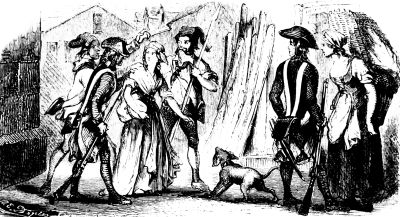
CÉCILE REGNAULT ARRESTED.
"What was the object of your visit to Robespierre?" the president inquired.
"I wished," she replied, "to see what a tyrant was like."
"Why did you provide yourself with the change of clothes?"
"Because," she calmly replied, "I expected to be sent to prison and then to the guillotine."
"Did you intend to stab Robespierre?"
"No," she answered, "I never wished to hurt any one in my life."
"Why are you a Royalist?" the president continued.
"Because," she replied, "I prefer one king to sixty tyrants."
She was sent to the guillotine with all her family relations. The conduct of this girl is quite inexplicable, and it is doubted whether she seriously contemplated any crime. When she called to see Robespierre she left her knife in her room in a basket! Eight carts were filled with victims to avenge this crime.[421]
Robespierre was now so popular with the multitude that all Paris rallied around him with congratulations.
The 8th of May was appointed as a festival in honor of the Supreme Being. Robespierre, the originator of the movement, was chosen President of the Convention, that he might take the most conspicuous part on the occasion. The morning dawned with unusual splendor. For that one day the guillotine was ordered to rest. An amphitheatre was erected in the centre of the garden of the Tuileries, and the spacious grounds were crowded with a rejoicing concourse. The celebrated painter David had arranged the fête with the highest embellishments of art. At twelve o'clock Robespierre ascended a pavilion and delivered a discourse.
"Republican Frenchmen," said he, "the ever fortunate day which the French people dedicated to the Supreme Being has at length arrived. Never did the world which he created exhibit a spectacle so worthy of his attention. He has beheld tyranny, crime, and imposture reigning on earth. He beholds at this moment a whole nation, assailed by all the oppressors of mankind, suspending the course of its heroic labors to lift its thoughts and its prayers toward the Supreme Being who gave it the mission to undertake and the courage to execute them."
Having finished his brief address, he descended and set fire to a colossal group of figures representing Atheism, Discord, and Selfishness, which the idea of a God was to reduce to ashes. As they were consumed, there appeared in their place, emerging from the flames, the statue of Wisdom. After music, songs, and sundry symbolic ceremonies, an immense procession was formed, headed by Robespierre, which proceeded from the Tuileries to the Champ de Mars. Here, after the performance of pageants as imposing as Parisian genius could invent and Parisian opulence execute, the procession returned to the Tuileries, where the festival was concluded with public diversions.[422]
The pre-eminence which Robespierre assumed on this occasion excited great displeasure, and many murmurs reached his ears. Robespierre, the next day, entered complaints against those who had murmured, accused them of being Dantonists and enemies of the Revolution, and wished to send them to the guillotine. Each member of the Convention began to feel that his head was entirely at the disposal of Robespierre, and gradually became emboldened to opposition.
The legal process by which victims were arrested and sent to the guillotine had now become simple and energetic in the extreme. Any man complained to the Committee of Public Safety of whom he would, as suspected of being unfriendly to the Revolution. The committee immediately ordered the arrest of the accused. The eighteen prisons of Paris were thus choked with victims. Each evening Fouquier Tinville, the public accuser, received from the Committee of Public Safety a list of those whom he was to take the next day to the Revolutionary Tribunal. If the committee, for any reason, had not prepared a list, Fouquier Tinville was allowed to select whom he pleased. To be suspected was almost certain death. From the commencement of this year (1794) the executions had increased with frightful rapidity. In January eighty-three were executed; in February, seventy-five; in March, one hundred and twenty-three; in April, two hundred and sixty-three; in May, three hundred and twenty-four; in June, six hundred and seventy-two; in July, eight hundred and thirty-five.[423]
Carts were continually passing from the gates of the Conciergerie loaded with prisoners, who were promptly condemned and sent immediately to the scaffold. Malesherbes, the intrepid and venerable defender of Louis XVI., living in retirement in the country, was dragged, with all his family, to the scaffold. If a man were rich, he was suspected of aristocracy and was sent to the guillotine. If he were learned, his celebrity exposed him to suspicion, and his doom was death. If he were virtuous, he was accused of sympathy for the victims of the guillotine, and was condemned to the scaffold. There was no longer safety but in vice and degradation. The little girls who had been led by their fathers to attend a ball given by the King of Prussia at Verdun were all arrested, brought to Paris, and condemned and executed. "The eldest," says Lamartine, "was eighteen. They were all clothed in white robes. The cart which carried them resembled a basket of lilies whose heads waved to the motion of the arm. The affected executioners wept with them." Josephine Beauharnais, afterward the bride of Napoleon, was at this time in one of the dungeons of Paris, sleeping upon a wretched pallet of straw, and expecting daily to be led to execution.
Robespierre, St. Just, and Couthon were the three leading men in the Committee of Public Safety, and were hence called the Triumvirate. All began now to be weary of blood, and yet no one knew how to stem the torrent or when the carnage would cease. The Reign of Terror had become almost as intolerable as the tyranny of the old kings, but not fully so; the Reign of Terror crushed thousands who could make their woes heard; despotism crushed millions who were dumb. There was no hope for France but in some energetic arm which, assuming the dictatorship, should rescue liberty from the encroachments of kings and from being degraded by the mob. Robespierre was now the most prominent man in France and the most popular with the multitude. His friends urged him to assume the dictatorship.
Jealousy of Robespierre's ambition now began to arise, and his enemies rapidly increased. Whispers that he had become a traitor to the Republic and was seeking kingly power began to circulate. Popular applause is proverbially fickle. Robespierre soon found that he could not carry his measures in the Committee of Public Safety, and, disgusted and humiliated, he absented himself from the sittings. He attempted to check the effusion of blood, but was overruled by those even more pitiless than himself. He now determined to crush the committee. Political defeat was death. He must either send the committee to the scaffold or bow his own head beneath the knife. It was a death-struggle short and decisive. Pretended lists were circulated of the heads Robespierre demanded. Many in the Convention were appalled. Secret nightly councils were held to array a force against him. The mob of Paris he could command. Henriot, the chief of the military force, was entirely subservient to his will. He reigned supreme and without a rival in the Jacobin Club. His power was apparently resistless. But despair nerved his foes.
Three very able men, accustomed to command—Tallien, Barras, and Fréron—headed the conspiracy against Robespierre. The party thus organized was called the Thermidorien, because it was in the month of Thermidor (July) that they achieved their signal victory, and, trampling upon the corpse of Robespierre and of his adherents, ascended to power. But nearly all these men, of all these parties, seem to have had no sense whatever of responsibility to God, or of Christianity as the rule of life. They had one and all rejected the Gospel of our Savior, and had accepted human philosophy alone as their guide. They were men, many of them, great in ability, illustrious in many virtues, sincerely loving their country, and too proud to allow themselves to be degraded by bribes or plunder. As the general on the battle-field will order movements which will cut down thousands of men, thus did these Revolutionists, without any scruples of conscience, send hundreds daily to the guillotine, not from love of blood, but because they believed that the public welfare demanded the sacrifice. And yet there was a cowardly spirit impelling these massacres. No one dared speak a word in behalf of mercy, lest he should be deemed in sympathy with aristocrats. He alone was safe from suspicion who was merciless in denunciation of the suspected. It is, however, remarkable that nearly all the actors in these scenes of blood, even in the hour of death, protested their conscientiousness and their integrity.
Robespierre was now involved in inextricable toils. He was weary of blood. The nation was becoming disgusted with such carnage.[424] He was universally recognized as the leading mind in the government, and every act was deemed his act. His enemies in the Committee of Public Safety plied the guillotine with new vigor, knowing that the public responsibility would rest on Robespierre. Robespierre was strongly opposed to that reckless massacre, and yet dared not interfere to save the condemned. His own dearest friends were arrested and dragged to the guillotine, and yet Robespierre was compelled to be silent. Earnestly he was entreated to assume the dictatorship, and rescue France from its measureless woe. Apparently he could have done it with ease. He refused; persistently and reiteratedly refused. What were his motives none now can tell. Some say cowardice prevented him; others affirm that true devotion to the Republic forbade him. The fact alone remains; he refused the dictatorship, saying again and again, "No! no Cromwell; not even I myself."
Robespierre retired for some weeks from the Committee of Public Safety, while blood was flowing in torrents, and prepared a very elaborate discourse, to be delivered in the Convention, defending himself and assailing his foes.
On the morning of the 26th of July Robespierre appeared in the Convention, prepared to speak. His Jacobin friends, forewarned, crowded around him, and his partisans thronged the galleries. His foes were appalled, and trembled; but they rallied all their friends. It was a decisive hour, and life or death was suspended on its issues. The speech, which he read from a carefully-prepared manuscript, was long and exceedingly eloquent. His foes felt that they were crushed, and a silence as of death for a moment followed its delivery. The printing of the speech was then voted, apparently by acclamation, and the order for its transmission to all the Communes of the Republic.
The foes of Robespierre were now emboldened by despair. Their fate seemed sealed, and consequently there was nothing to be lost by any violent struggle in self-defense. Cambon ventured an attack, boldly declaring, "One single man paralyzes the National Convention, and that man is Robespierre." Others followed with more and more vigorous blows. Robespierre was amazed at the audacity. The charm of his invincibility was gone. It soon appeared that there was a strong party opposed to Robespierre, and by a large majority it was voted to revoke the resolution to print the speech.
Robespierre, mute with alarm, left the Convention, and hastened to his friends in the Club of Jacobins. He read to them the speech which the Convention had repudiated. They received it with thunders of applause and with vows of vengeance. Robespierre, fainting with exhaustion, said, in conclusion,
"Brothers, you have heard my last will and testament. I have seen to-day that the league of villains is so strong that I can not hope to escape them. I yield without a murmur! I leave to you my memory; it will be dear to you, and you will defend it."
Many were affected even to tears, and, crowding around him, conjured him to rally his friends in an insurrection. Henriot declared his readiness to march his troops against the Convention. Robespierre, knowing that death was the inevitable doom of the defeated party, consented, saying,
"Well, then, let us separate the wicked from the weak. Free the Convention from those who oppress it. Advance, and save the country. If in these generous efforts we fail, then, my friends, you shall see me drink hemlock calmly."
David, grasping his hand, enthusiastically exclaimed, "Robespierre, if you drink hemlock, I will drink it with you." "Yes," interrupted a multitude of voices, "all! we all will perish with you. To die with you is to die with the people."
One or two of Robespierre's opponents had followed him from the Convention to the Hall of the Jacobins. Couthon pointed them out and denounced them. The Jacobins fell upon them and drove them out of the house wounded and with rent garments. With difficulty they escaped with their lives. Robespierre witnessed this violence, and dreading the effects of a general insurrection, withdrew his consent to adopt means so lawless and desperate. He probably felt that, strongly supported as he was, he would be able the next day to triumph in the Convention.
"At this refusal," says Lamartine, "honest, perhaps, but impolitic, Coffinhal, taking Payan by the arm and leading him out of the room, said,
"'You see plainly that his virtue could not consent to insurrection. Well! since he will not be saved, let us prepare to defend ourselves and to avenge him.'"
The night was passed by both parties in preparing for the decisive strife of the next day. The friends of Robespierre were active in concerting, in all the quarters of Paris, a rising of the people to storm the Convention. Tallien, Barras, Fréron, Fouché, slept not. They were informed of all that had passed at the Jacobins, and their emissaries brought them hourly intelligence through the night of the increasing tumult of the people. They made vigorous preparations for the debate within the walls and for the defense of the doors against the forest of pikes with which it was about to be assailed. Barras was intrusted with the military defense. It was resolved that Robespierre should be cried down and denounced by internal tumult and not permitted to speak. Each party, not knowing the strength of its opponents, was sanguine of success.
The morning of the 27th of July dawned, and as Robespierre entered the Convention, attired with unusual care, and with a smile of triumph upon his lips, silence and stillness reigned through the house. St. Just, in behalf of Robespierre, commenced the onset. A scene of tumult immediately ensued of which no adequate description can be given. Robespierre immediately saw that his friends were far outnumbered by his foes, and was in despair. Pale and excited, he attempted to ascend the tribune. Tallien seized by the coat and dragged him away, while cries of Down with the tyrant filled the house.[425]
"Just now," shouted Tallien, taking the tribune from which he had ejected Robespierre, "I demanded that the curtain should be withdrawn; it is so; the conspirators are unmasked and liberty will triumph. Up to this moment I had preserved utter silence because I was aware that the tyrant had made a list of proscriptions. But I was present at the sitting of the Jacobins. I beheld the formation of the army of this second Cromwell, and I armed myself with this poniard, with which to pierce his heart if the National Convention had not the courage to order his arrest."
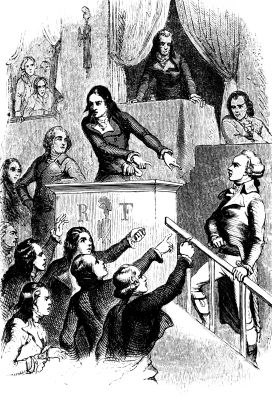
ROBESPIERRE ATTEMPTING HIS DEFENSE.
With these words he drew a dagger and pointed it menacingly at the breast of Robespierre. At the same time he moved the arrest of Henriot and others of the leading men of that party. The motion was tumultuously carried. In vain Robespierre attempted to gain a hearing. Cries of "Down with the tyrant" filled the house, and menaces, reproaches, and insults were heaped upon him without measure. The wretched man, overwhelmed by the clamor, turned pale with indignation, and shouted "President of assassins, will you hear me?" "No! no! no!" seemed to be the unanimous response. In the midst of the uproar Louchet moved the arrest of Robespierre. The proposition was received with thunders of applause.[426] The brother of Robespierre, a young man of gentle, affectionate nature and many virtues, who was universally esteemed, now rose, and said,
"I am as guilty as my brother. I have shared his virtues, I wish to share his fate."
Robespierre instantly interposed, saying, "I accept my condemnation. I have deserved your hatred. But, crime or virtue, my brother is not guilty of that which you strike in me."
Shouts and stamping drowned his voice. As cries of Vive la République rose on all sides, Robespierre quietly folded his arms, and, with a contemptuous smile, exclaimed, "The Republic! it is destroyed; for scoundrels triumph." It was now three o'clock in the afternoon. The two Robespierres, Couthon, St. Just, and Lebus were led by gens d'armes from the Convention across the Place du Carrousel to the Hôtel de Brionne, where the Committee of General Safety were in session. A crowd followed the prisoners with derision and maledictions. As they entered the Carrousel a procession of carts, containing forty-five victims on their way to the guillotine, met them.
After a very brief examination Robespierre was sent to the Luxembourg. His confederates were distributed among the other prisons of Paris. The Mayor of Paris and Henriot were in the mean time active in endeavors to excite an insurrection to rescue the prisoners. The following proclamation was issued from the Hôtel de Ville:
"Brothers and friends! the country is in imminent danger! The wicked have mastered the Convention, where they hold in chains the virtuous Robespierre. To arms! to arms! Let us not lose the fruits of the 18th of August and the 2d of June."
Henriot, waving his sword, swore that he would drag the scoundrels who voted the arrest of Robespierre through the streets tied to the tail of his horse. This brutal man was now in such a state of intoxication as to be incapable of decisive action. Flourishing a pistol, he mounted his horse, and, with a small detachment of troops, galloped to the Luxembourg to rescue his friend. He was met on the way by the troops of the Convention, who had been ordered to arrest him. They seized him, dragged him from his horse, bound him with their belts, and threw him into a guard-house, almost dead-drunk. In the mean time the populace rescued all the prisoners, and carried them in triumph to the mayor's room at the Hôtel de Ville. Robespierre, however, notwithstanding the most earnest entreaties of the Jacobins and the municipal government, refused to encourage or to accept the insurrection, or to make escape from arrest. "Made prisoner," writes Lamartine, "by command of his enemies, he resolved either to triumph or fall submissive to the law only; added to which, he firmly believed the Revolutionary Tribunal would acquit him of all laid to his charge; or, if not, and if even condemned to death, 'the death of one just man,' said he, 'is less hurtful to the Republic than the example of a revolt against the national representation.'"
News was brought to the Hôtel de Ville of the arrest of Henriot. Coffinhal, Vice-president of the Revolutionary Tribunal, immediately rallied the mob, rushed to the Tuileries, released Henriot, who was by this time somewhat sobered, and brought him back to the Hôtel de Ville. Henriot, exasperated by his arrest, placed himself at the head of his troops and marched with a battery against the Convention. At this stage of the affair no one could judge which party would be victorious. The city government, with the populace at its disposal, was on one side; the Convention, with its friends, on the other.[427]
It was now seven o'clock in the evening, and the deputies of the Convention, fully conscious of their peril, seemed almost speechless with terror. Robespierre and his confederates were rescued and protected by the city government; the mob was aroused, and the National Guard, under their leader, Henriot, were marching against the Convention. The Revolutionary Tribunal, which alone could condemn Robespierre, it was feared would acquit him by acclamation. He would then be led back in triumph to the Convention, and his foes would be speedily dragged to the guillotine. The dismal tolling of the tocsin now was heard; in the Jacobin Club the oath was taken to live or die with Robespierre; the rallying masses were crowding in from the faubourgs; cannon were pointed against the Convention; and three thousand young students seized their arms and rendezvoused as a body-guard for Robespierre.
In this critical hour the Convention, nerved by despair, adopted those measures of boldness and energy which could alone save them from destruction. As they were deliberating, Henriot placed his artillery before their doors and ordered them to be blown open. The deputies remained firmly in their seats, saying, "Here is our post, and here we will die." The friends of the Convention, who crowded the galleries, rushed out and spread themselves through the streets to rally defenders for the laws. Several of the deputies also left the hall, threw themselves among the soldiers, and, remonstrating with them, pointed to Henriot, and said,
"Soldiers! look at that drunken man! who but a drunkard would ever point his arms against his country or its representatives? Will you, who have ever deserved so much from your country, cast shame and dishonor on her now?"
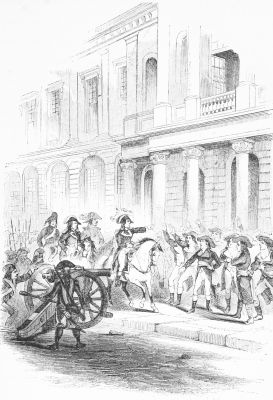
DEMONSTRATION AGAINST THE CONVENTION, HEADED BY HENRIOT.
The Convention had outlawed Henriot and appointed Barras to the command of the National Guard in his place. The soldiers began to waver. Henriot, affrighted, put spurs to his horse and fled. Barras, an energetic man, was now in command, and the tide had thus suddenly and strongly turned in favor of the Convention. It was now night, and the gleam of ten thousand torches was reflected from the multitudes surging through the streets. Barras, on horseback, with a strong retinue, traversed the central quarters of Paris, rallying the citizens to the defense of the Convention. Eighteen hundred bold, well-armed men were soon marshaled before the doors. With two other bands he marched along parallel streets to the Place de Grève, where he drove off the disorderly crowd and secured all the approaches to the Hôtel de Ville. Robespierre was still in one of the rooms of the Hôtel de Ville, surrounded by his confederates and by the members of the city government. They implored him to authorize an insurrection, assuring him that his name would rally the populace and rescue them all from inevitable death. But Robespierre persistently refused, declaring that he would rather die than violate the laws established by the people.
A detachment of soldiers, sent by Barras, cautiously ascended the steps, and entered the Salle de l'Egalité to rearrest the rescued prisoners. As they were ascending the stairs Lebas discharged a pistol into his heart and fell dead. The younger Robespierre leaped from the window into the court-yard, breaking his leg by his fall. Coffinhal, enraged in contemplating the ruin into which the drunken imbecility of Henriot had involved them, seized him and threw him out of a window of the second story upon a pile of rubbish, exclaiming,
"Lie there, wretched drunkard! You are not worthy to die on a scaffold!"
Robespierre sat calmly at a table, awaiting his fate. One of the gens d'armes discharged a pistol at him. The ball entered his left cheek, fracturing his jaw and carrying away several of his teeth. His head dropped upon the table, deluging with blood the papers which were before him. The troops of the Convention now filled the Hôtel de Ville, arresting all its inmates. The day was just beginning to dawn as the long file of prisoners were led out into the Place de Grève to be conducted to the hall of the Convention.[428]
First came Robespierre, borne by four men on a litter. His fractured jaw was bound up by a handkerchief, which was steeped in blood. Couthon was paralytic in his limbs. Unable to walk, he was also carried in the arms of several men. They had carelessly let him fall, and his clothes were torn, disarranged, and covered with mud. Robespierre the younger, stunned by his fall and with his broken limb hanging helplessly down, was conveyed insensible in the arms of two men. The corpse of Lebas was borne next in this sad train, covered with a table-cloth spotted with his blood. Then followed St. Just, bareheaded, with dejected countenance, his hands bound behind him. Upward of eighty members of the city government, bound two and two, completed the melancholy procession.
It was five o'clock in the morning when the captives were led to the Tuileries. In the mean time Légendre had marched to the assembly-room of the Jacobins, dispersed them, locked their doors, and brought the keys to the President of the Convention.[429]
Robespierre was laid upon a table in an anteroom, while an interminable crowd pressed in and around to catch a sight of the fallen dictator. The unhappy man was overwhelmed with reproaches and insults, and feigned death to escape this moral torture. The blood was freely flowing from his wound, coagulating in his mouth, and choking him as it trickled down his throat. The morning was intensely hot; not a breath of pure air could the wounded man inhale; insatiable thirst and a burning fever consumed him; and thus he remained for more than an hour, enduring the intensest pangs of bodily and mental anguish. By order of the Convention, he and his confederates were then removed to the Committee of General Safety for examination; from which tribunal they were sent to the Conciergerie, where they were all thrown into the same dungeon to await their trial, which was immediately to take place before the Revolutionary Tribunal.
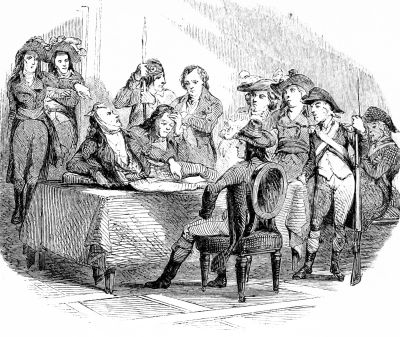
ROBESPIERRE LYING WOUNDED ON THE TABLE OF THE CITY HALL.
A few hours of pain, anguish, and despair passed away, when at three o'clock in the afternoon the whole party were conveyed to that merciless court which was but the last stepping-stone to death. The trial lasted but a few moments. They were already condemned, and it was only necessary to prove their identity. The Convention was victorious, and no man of the Revolutionary Tribunal dared to resist its will. Had the Commune of Paris conquered in this strife, the obsequious Tribunal, with equal alacrity, would have consigned the Deputies to the guillotine.
At five o'clock the carts of the condemned received the prisoners.[430] The long procession advanced through the Rue St. Honoré to the Place de la Révolution. The fickle crowd thronged the streets, heaping imprecations upon the man to whom they would have shouted hosanna had he been a victor. Robespierre, his brother, Couthon, Henriot, all mangled, bleeding, and with broken bones, were thrown into the first cart with the corpse of Lebas. As the cart jolted over the pavement shrieks of anguish were extorted from the victims. At six o'clock they reached the steps of the guillotine. Robespierre ascended the scaffold with a firm step; but, as the executioner brutally tore the bandage from his inflamed wound, he uttered a shriek of torture which pierced every ear. The dull sullen sound of the falling axe was heard, and the head of Robespierre fell ghastly into the basket. For a moment there was silence, and then the crowd raised a shout as if a great victory had been achieved and the long-sought blessings of the Revolution attained.[431]
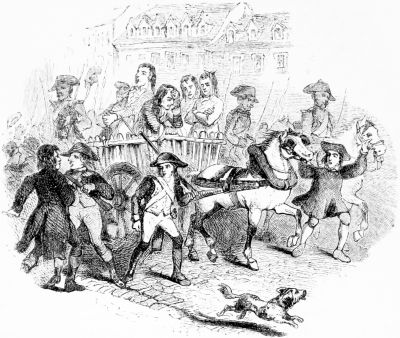
ROBESPIERRE AND HIS COMPANIONS LED TO EXECUTION.
Thus died Robespierre, in the thirty-fifth year of his age. His character will probably ever remain a mystery. "His death was the date and not the cause of the cessation of terror. Deaths would have ceased by his triumphs, as they did by his death. Thus did Divine justice dishonor his repentance, and cast misfortune on his good intentions, making of his tomb a gulf filled up. It has made of his memory an enigma of which history trembles to pronounce the solution, fearing to do him injustice if she brand it as a crime, or to create horror if she should term it a virtue. This man was, and must ever remain, shadowy and undefined."[432]
Twenty-two were beheaded with Robespierre. The next day seventy who were arrested at the Hôtel de Ville were sent to the guillotine. The following day twelve more bled upon the scaffold. In three days one hundred and fourteen perished, untried, by that tyranny which had supplanted the tyranny of Robespierre.[433]
FOOTNOTES:
CHAPTER XXXVII.
THE THERMIDORIANS AND THE JACOBINS.
The Reign of Committees.—The Jeunesse Dorée.—The Reaction.—Motion against Fouquier Tinville.—Apotheosis of Rousseau.—Battle of Fleurus.—Brutal Order of the Committee of Public Welfare.—Composition of the two Parties.—Speech of Billaud Varennes.—Speech of Légendre.—The Club-house of the Jacobins closed.—Victories of Pichegru.—Alliance between Holland and France.—Advance of Kleber.—Peace with Prussia.—Quiberon.—Riot in Lyons.
The fall of Robespierre was hailed with general enthusiasm, for he was believed to be the chief instigator of that carnage which, in reality, at the time of his fall, he was struggling to repress. There were now in the Convention the headless remains of four parties, the Girondists, Hebertists, Dantonists, and Robespierrians. The able leaders of all these parties had, each in their turn, perished upon the scaffold. There now arose from these ruins a party, which was called, as we have before remarked, Thermidorians, from the month Thermidor (July), in which its supremacy commenced. A new government was immediately and noiselessly evolved, the result of necessity. The extreme concentration of power in the Committee of Public Safety, over which Robespierre had been supposed to rule as a dictator, was now succeeded by a dissemination of power, wide and ineffective. Sixteen committees became the executive of France; one Assembly its legislative power. These committees were composed of members numbering from twelve to fifty. The Committee of Public Welfare contained twelve, and superintended military and diplomatic operations; that of General Safety sixteen, and had the direction of the police; that of Finance forty-eight. Such was the new government, under which, after the fall of Robespierre, the Republic struggled along.
The horrors of the Reign of Terror were now producing a decided reaction. Many of the young men of Paris, who abhorred the past scenes of violence, organized themselves into a band called the Jeunesse Dorée, or Gilded Youth, and commenced vigorous opposition to the Jacobins. They wore a distinctive dress, and armed themselves with a short club loaded with lead. Frequent conflicts took place in the streets between the two parties, in which the Jeunesse Dorée were generally victorious. The Terrorists having become unpopular, and being in the decided minority, the guillotine was soon allowed to rest. Mercy rapidly succeeded cruelty. The captives who crowded the prisons of Paris were gradually liberated, and even the Revolutionary Tribunal was first modified and then abolished.
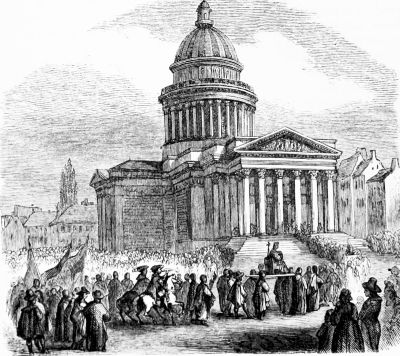
APOTHEOSIS OF ROUSSEAU, OCTOBER 11, 1794.
The reaction was so strong, annulling past decrees, liberating suspected Loyalists, and punishing violent Revolutionists, that even many of the true friends of popular rights were alarmed lest the nation should drift back again under the sway of old feudal despotism. M. Fréron, in the following terms, moved, in the Convention, an act of accusation against the execrable Fouquier Tinville, who had been public accuser:
"I demand that the earth be at length delivered from that monster, and that Fouquier be sent to hell, there to wallow in the blood he has shed."
The decree was passed by acclamation. In the space of eight or ten days after the fall of Robespierre, out of ten thousand suspected persons not one remained in the prisons of Paris.[434] For many weeks nothing of moment occurred in the Convention but the petty strife of factions. On the 11th of October the remains of Rousseau were transferred to the Pantheon with all the accompaniments of funeral pageantry. They were deposited by the side of the remains of Voltaire. Upon his tomb were inscribed the words, "Here reposes the man of nature and of truth."
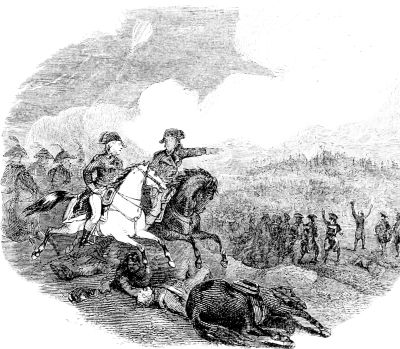
BATTLE OF FLEURUS.
About a month before the fall of Robespierre, on the 26th of June, the celebrated battle of Fleurus was fought. The sanguinary engagement extended along a semicircle nearly thirty miles in extent. The French had brought up about eighty thousand troops, to oppose an equal number of the Allies. The French, under Pichegru, were victorious at every point, and the Allies were compelled to retreat. They rallied for a short time in the vicinity of Brussels, but were soon again compelled to retire, and all Belgium fell into the hands of the Republicans.
About the middle of July two armies of the French, amounting to one hundred and fifty thousand, effected a junction in the city of Brussels. The Committee of Public Safety had passed an inhuman decree that no quarter should be given to the English. The soldiers refused obedience to this decree. A sergeant, having taken some English prisoners, brought them to an officer.
"Why did you spare their lives?" the officer inquired.
"Because," the sergeant replied, "it was saving so many shots."
"True," rejoined the officer, "but the Representatives will oblige us to shoot them."
"It is not we," retorted the sergeant, "who will shoot them. Send them to the Representatives. If they are barbarous enough, why, let them kill and eat them if they like."[435]
While the French armies were gaining these signal victories all along the Rhine, war was raging with almost equal ferocity in the ravines of the Alps and at the base of the Pyrenees, as the Republicans struggled to repel the invading hosts of Austria, England, and Spain.
The Thermidorians and the Jacobins were now the two great parties struggling for power all over France. The Thermidorians were the moderate conservative party, and the Jacobins called them Aristocrats. The Jacobins were the radical, progressive, revolutionary party, and the Thermidorians called them Terrorists. The more intelligent and reputable portion of the community were with the Thermidorians; the women, weary of turmoil and blood, were very generally with them; and the very efficient military band of young men called the Jeunesse Dorée (gilded youth), who belonged to the rich and middle classes, were very efficient supporters of this party, hurling defiance upon the Jacobins, and ever ready for a street fray with their clubs. The Jacobins were composed of the mob, generally headed by those vigorous, reckless, determined men who usually form what Thiers calls "the ferocious democracy." Fréron's journal, The Orator of the People, was the eloquent advocate of the Thermidorians, now rising rapidly to power, and it launched incessant and merciless anathemas against the revolutionary canaille. The females who advocated Jacobinism were called the furies of the guillotine, because they had frequently formed circles around the scaffold, assailing the victims with ribald abuse. These two parties were so equally divided, and the strife was so fierce between them, that scenes of fearful uproar frequently took place not only in the Convention but throughout all France. The spirit of the Jacobins at this time may be seen in the following brief extract from a speech of Billaud Varennes:
"People talk," said he, "of shootings and drownings, but they do not recollect that the individuals for whom they feel pity had furnished succors to the banditti. They do not recollect the cruelties perpetrated on our volunteers, who were hanged upon trees and shot in files. If vengeance is demanded for the banditti, let the families of two hundred thousand Republicans, mercilessly slaughtered, come also to demand vengeance. The course of counter-revolutionists is known. When, in the time of the Constituent Assembly, they wanted to bring the Revolution to trial, they called the Jacobins disorganizers and shot them in the Field of Mars. After the 2d of September, when they wanted to prevent the establishment of the Republic, they called them quaffers of blood and loaded them with atrocious calumnies. They are now recommencing the same machinations; but let them not expect to triumph. The Patriots have been able to keep silence for a moment, but the lion is not dead when he slumbers, and when he awakes he exterminates all his enemies. The trenches are open, the Patriots are about to rouse themselves and to resume all their energy. We have already risked our lives a thousand times. If the scaffold awaits us, let us recollect that it was the scaffold which covered the immortal Sidney with glory."
This speech, reported in the journal of the Jacobins, called the Journal de la Montagne, created great excitement, and gave rise to one of the stormiest debates in the Convention. The Jacobins were accused of wishing to direct the mob against the Convention. They, on the other hand, accused the Thermidorians of releasing well-known Royalists from prison, and of thus encouraging a counter-revolution. Légendre, speaking in behalf of the Thermidorians, in reply to the Jacobins, said,
"What have you to complain of, you who are constantly accusing us? Is it because citizens are no longer sent to prison by hundreds? because the guillotine no longer dispatches fifty, sixty, or eighty persons per day? Ah! I must confess that in this point our pleasure differs from yours, and that our manner of sweeping the prisons is not the same. We have visited them ourselves; we have made, as far as it was possible to do so, a distinction between the Aristocrats and the Patriots; if we have done wrong, here are our heads to answer for it. But while we make reparation for crimes, while we are striving to make you forget that those crimes are your own, why do you go to a notorious society to denounce us, and to mislead the people who attend there, fortunately in no great numbers? I move that the Convention take measures to prevent its members from going and preaching up rebellion at the Jacobins'."
The conflict extended from the Convention into the streets, and for several days there were serious riots. Angry groups in hostile bands paraded the gardens of the Tuileries and the Palais Royal—the partisans of the Thermidorians shouting "Down with the Terrorists and Robespierre's tail." Their opponents shouted "The Jacobins forever! Down with the Aristocrats!"
On the 9th of November there was a battle between the two parties in the Rue St. Honoré, in and around the hall of the Jacobins, which lasted for several hours. A number of the women, called Furies of the Guillotine, who mingled in the fray, were caught by the Jeunesse Dorée, and, in defiance of all the rules of chivalry, had their clothes stripped from their backs and were ignominiously whipped. It was midnight before the disturbance was quelled. A stormy debate ensued next day in the Convention.
"Where has tyranny," said Rewbel, "been organized? At the Jacobins'. Where has it found its supporters and satellites? At the Jacobins'. Who have covered France with mourning, carried despair into families, filled the country with prisons, and rendered the Republic so odious that a slave, pressed down by the weight of his irons, would refuse to live under it? The Jacobins. Who regret the frightful government under which we have lived? The Jacobins. If you have not now the courage to declare yourselves, you have no longer a Republic, because you have Jacobins."
Influenced by such sentiments, the Convention passed a decree "to close the door of places where factions arise and where civil war is preached."
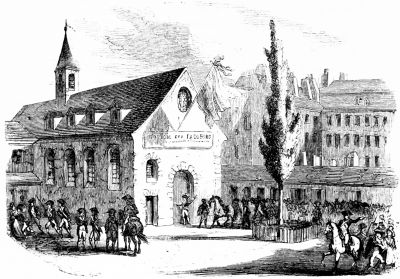
THE CLUB-HOUSE OF THE JACOBINS CLOSED.
Thus terminated the long reign of the Jacobin Club. The act was greeted with acclaim by the general voice of France.[436]
The French, who had twelve hundred thousand men under arms, were now in possession of all the important points on the Rhine, and every where held their assailants at bay.[437] The latter part of December, Pichegru, driving the allied Dutch, English, and Austrians before him, crossed the Meuse on the ice and entered Holland. The Republican party in Holland was numerous and detested their rulers. They immediately prepared to rise and welcome their friends, the French. In this desperate situation the Stadtholder implored a truce, offering as a condition of peace neutrality and indemnification for the expenses of the war.[438] Pichegru refused the truce; but sent the terms of peace for the consideration of the government in Paris. The proffered terms were refused, and Pichegru was ordered to press on and restore the Dutch Republic. At the head of two hundred thousand troops he spread, like a torrent, over all Holland. He was every where received with open arms and as a deliverer. The Allies, with the emigrants, fled in all directions, some by land and some by sea. A portion of the Dutch fleet, at anchor near the Texel, was frozen in by the unparalleled severity of the winter. A squadron of horse-artillery galloped across the ice and summoned it to surrender. The fleet was compelled to strike its flags to these novel assailants. On the 20th of January, 1795, Pichegru entered Amsterdam in triumph. The inhabitants crowded from the walls to meet him, shouting "The French Republic forever! Liberty forever!"
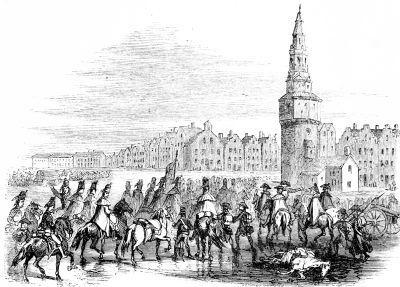
THE FRENCH ENTERING AMSTERDAM ON THE ICE.
Holland, organizing as the Republic of the United Provinces, on the 16th of May entered into an alliance offensive and defensive with the French Republic, to be perpetual during the continuance of the war. The two infant republics needed mutual support to resist the combined monarchies of England and the Continent.[439]
While Pichegru was gaining such victories on the Lower Rhine and in Holland, Kleber was also, on the Upper Rhine, driving the Austrians before him. He boldly crossed the river in the impetuous pursuit, and carried the horrors of war into the enemies' country. Soon, however, he was crowded with such numbers of antagonists that he was compelled, in his turn, to commence a retreat. Again, re-enforcements arriving, he assumed the offensive. Thus the tide of war ebbed and flowed.
Prussia, alarmed by these signal victories of the Republican troops, and threatened with invasion, was anxious to withdraw from the coalition. The king sent a commissioner to Pichegru's head-quarters to propose peace. The commissioners from the two countries met at Basle, and on the 5th of April a treaty of peace was signed. The French agreed to evacuate the Prussian provinces they had occupied on the right bank of the Rhine, and the Prussian monarchy agreed that there should be peace, amity, and a good understanding between the King of Prussia and the French Republic.
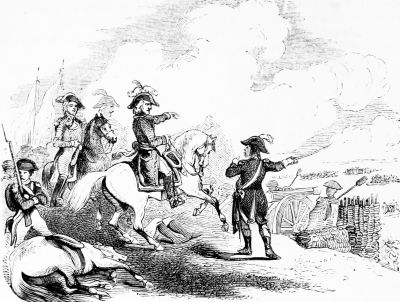
THE FRENCH CROSSING THE RHINE UNDER KLEBER.
Spain, also, trembling in view of the triumphant march of Dugommier through the defiles of the Pyrenees, made proposals of accommodation, promising to acknowledge the Republic and to pay indemnities for the war. Peace with the Peninsula was signed at Basle on the 12th of July. This peace, which detached a Bourbon from the coalition, was hailed throughout France with transports of joy.[440]
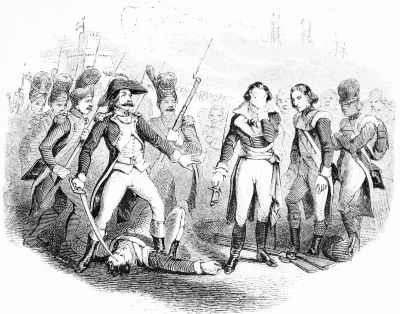
VICTORY OF QUIBERON.
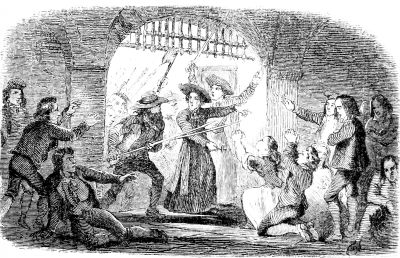
MASSACRE IN LYONS LED BY THE PRIESTS.
England, Austria, and Naples still remained firm in their determination to crush the Republic. William Pitt led the ministry with his warlike measures, and triumphed over the peaceful policy of Sheridan and Fox. He thus, for a quarter of a century, converted all Europe into a field of blood. Roused by the energies of Pitt, the English government organized a very formidable expedition, to be landed in La Vendée, to rouse and rally the Royalists all over France, and thus to reinvigorate the energies of civil war. A squadron was fitted out, consisting of three 74-gun ships, two frigates of 44 guns, four frigates of 30 to 36 guns, and several gun-boats and transports. This was the first division, which, as soon as it was established in France, was to be followed by another. The fleet came to anchor in the Bay of Quiberon on the 25th of June. A motley mass of about seven thousand men were speedily landed; the Royalists soon joined them, making an army of some thirteen thousand. General Hoche, who had for some time been valiantly and most humanely struggling for the pacification of La Vendée, marched to repel them. A few bloody battles ensued, in which the unhappy invaders were driven into a narrow peninsula, where, by a midnight assault, they most miserably perished. A few only escaped to the ships; many were drowned, and a large number were mercilessly put to the sword. The Convention had decreed the penalty of death to any Frenchman who should enter France with arms in his hands.
At Lyons there was a general rising of the Royalists and the reactionary party against the Revolutionists. The Royalists proved themselves not one whit behind the Jacobins in the energy with which they could push their Reign of Terror. Led by the priests, the Royalist mob broke into the prisons and murdered seventy or eighty prisoners who were accused of revolutionary violence. One prison was set on fire, and all its inmates perished miserably in the flames.
The disturbances in Lyons were soon quelled, and Hoche, having annihilated the force which the English had landed in the Bay of Quiberon, gradually succeeded in introducing tranquillity into La Vendée. Many of the Royalists came to his camp to seek terms of reconciliation with the Republic.
FOOTNOTES:
CHAPTER XXXVIII.
DISSOLUTION OF THE CONVENTION.
Famine in Paris.—Strife between the Jeunesse Dorée and the Jacobins.—Riots.—Scene in the Convention.—War with the Allies.—A new Constitution.—Insurrection of the Sections.—Energy of General Bonaparte.—Discomfiture of the Sections.—Narrative of the Duchess of Abrantes.—Clemency of the Convention.—Its final Acts and Dissolution, and Establishment of the Directory.
Let us return to Paris. The unprecedented severity of the winter had caused fearful suffering among the populace of Paris. The troubled times had broken up all the ordinary employments of peace. The war, which had enrolled a million and a half of men under arms, had left the fields uncultivated and deserted. A cruel famine wasted both city and country. The Jacobins, who, though their clubs were closed, still met at the corners of the streets and in the coffee-houses, took advantage of this public misery to turn popular indignation against the victorious Thermidorians. Tumults were again renewed, and hostile partisans met in angry conflicts. The young men of the two parties had frequent encounters in the pits of the theatres, bidding each other defiance, and often proceeding to blows.
At the Théâtre Feydean, as in many other places, there was a bust of Marat, who was still idolized by the Jacobins. The young men of the Jeunesse Dorée, in expression of their detestation of Marat, and as an insult to the Jacobins, climbed the balcony, threw down the bust, and with shouts of execration dragged it through the mire of the streets.
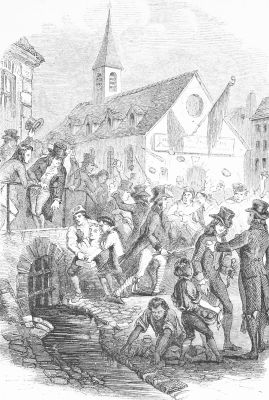
THE JEUNESSE DOREÉ THROWING THE BUST OF MARAT INTO THE GUTTER.
The Jacobins, exasperated, swore to avenge the insult. Strongly armed, they paraded the streets, carrying a bust of Marat in triumph, and swearing bloody vengeance upon any who might attempt to disturb their march. The firmness of the Convention alone averted a sanguinary conflict. The public distress, intense and almost universal, embarrassed and overwhelmed the Convention with the most difficult questions in the endeavor to afford relief. On the 15th of March the supply of food in Paris was so small that it was deemed necessary to put the inhabitants upon rations, each individual being allowed but one pound of bread per day. Agitation and tumults were now rapidly increasing, and there were daily riots. The Convention was continually besieged and insulted by haggard multitudes with petitions which assumed the tone of fiercest threats. Scenes of confusion ensued which bade defiance to all law, and which there was no authority to repress.
On the 20th of May there was one of the most fearful tumults which the Revolution had yet witnessed. At five in the morning the générale was beating in the public squares and the tocsin ringing in the faubourgs. The populace were rapidly mustering for any deeds of violence to which their leaders might conduct them. At eleven o'clock the Convention commenced its sitting. One of the members brought in a plan, which he had secretly obtained, of a very efficiently-organized insurrection. A crowd, mostly of women, filled the galleries. As the plan was read, which appalled the deputies, the galleries vociferously applauded. The Convention passed a few harmless decrees, such as, 1st, that the city government was responsible for any attack upon the Convention; 2d, that all the citizens were bound to receive orders from the Convention; and 3d, that there should be no insurrection. These decrees but provoked the derision of the galleries. The tumult now became so great, the women shouting "Bread!" and shaking their fists at the president and the deputies, that all business was at a stand, and not a word of debate could be heard.
At length, some soldiers were sent into the galleries with bayonets, and the women were driven into the streets. They soon, however, returned, aided by their friends. They battered down all the doors and broke in and filled the hall with an armed, shouting, brutal mob. Some of the citizens rallied for the defense of the Convention, and a fierce battle raged within the hall and around the doors. Pistols and muskets were discharged, swords clashed, bayonet crossed bayonet, while yells and shrieks and imprecations deafened the ear. Drunken women strode over the benches and clambered to the president's chair. A young deputy, Feraud, was stabbed, then shot; his head was cut off, and, pierced by a pike, was thrust into the face of the president, Boissy d'Anglas, who most heroically maintained his post and his composure through all these perilous scenes. For six hours the tumult raged unabated. It was now seven o'clock in the evening, and the mob drove all the deputies, like a flock of sheep, into the centre of the hall, surrounded them with bristling bayonets and pikes, and ordered them to issue decrees for the relief of the people. At length, near midnight, a detachment of the National Guard arrived, dispersed the crowd around the palace, and, entering the hall with fixed bayonets, scattered the rioters. Tranquillity being restored, one of the members rose and said,
"It is then true that this Assembly, the cradle of the Republic, has once more well nigh been its tomb. Fortunately, the crime of the conspirators is prevented. But, Representatives, you would not be worthy of the nation if you were not to avenge it in a signal manner."
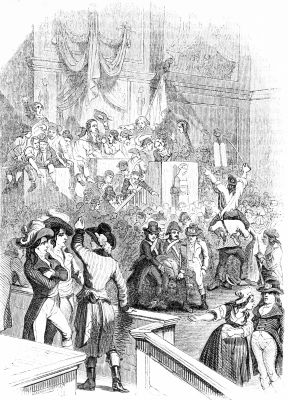
SCENE IN THE NATIONAL CONVENTION.
The rest of the night was passed in devising schemes to crush the Jacobin power which had organized this insurrection. The Duchess of Abrantes, who was then in Paris, thus alludes to these events: "While the most frightful scenes," she writes, "were passing in the Convention, the respectable inhabitants of Paris shut themselves up in their houses, concealed their valuables, and awaited, with fearful anxiety, the result. Toward evening my brother, whom we had not seen during the day, came home to get something to eat; he was almost famished, not having tasted food since the morning. Disorder still raged, and we heard the most frightful noise in the streets, mingled with the beating of drums. My brother had scarcely finished his hasty repast when General Bonaparte arrived to make a similar claim upon our hospitality. He also had tasted nothing since the morning, for all the restaurateurs were closed. He soon dispatched what my brother had left, and as he was eating he told us the news of the day. It was most appalling; my brother had informed us but of part. He did not know of the assassination of the unfortunate Feraud, whose body had been cut almost piecemeal. 'They took his head,' said Bonaparte, 'and presented it to poor Boissy d'Anglas, and the shock of this fiend-like act was almost death to the president in his chair. Truly,' added he, 'if we continue thus to sully our Revolution, it will be a disgrace to be a Frenchman.'"[441]
Alarmed by the advance of anarchy, the Convention immediately instituted proceedings against several prominent Jacobin members, who were known to be ringleaders of the insurrection. They were arrested and consigned to imprisonment in the Castle of Ham. Paris was declared to be in a state of siege, and Pichegru, then in the full lustre of his glory, was appointed commander of the armed force. The carriages which conveyed the arrested deputies to the Castle of Ham had to pass through the Elysian Fields. The Jacobins assembled in strong numbers and endeavored to rescue them. The energy of Pichegru repelled the attempt. A fight ensued, with cannon and small arms, in which several lives were lost.
While these melancholy scenes were transpiring in Paris, the combined fleets and armies of England, Austria, and Naples were fiercely assailing the Republic at every vulnerable point. England, being undisputed mistress of the sea, had nothing to fear from the conflagration which she was kindling all over Europe. To stimulate impoverished Austria to the war, the British government loaned her $23,000,000 (£4,600,000). She augmented her own naval force to a hundred thousand seamen, put into commission one hundred and eight ships of the line, and raised her land forces to one hundred and fifty thousand men.[442]
The question to be decided was, whether France had a right to abolish monarchy and establish a republic. It is in vain for the Allies to say that they were contending against the outrages which existed in France, for their hostile movements preceded these scenes of carnage, and were the efficient cause of nearly all the calamities that ensued. And, deplorable as was the condition of France during the Reign of Terror, even that reign was far more endurable by the masses of the people than the domination of the old feudal despotism.
Carlyle makes the following appalling statement, the truth of which will not be denied by any careful student of the Old Régime:
"History, looking back over this France through long times—back to Turgot's time, for instance, when dumb Drudgery staggered up to its king's palace, and, in wide expanse of sallow faces, squalor, and winged raggedness, presented hieroglyphically its petition of grievances, and, for answer, got hanged on a new gallows forty feet high—confesses mournfully that there is no period in which the general twenty-five millions of France suffered less than in this period which they named the Reign of Terror!
"But it was not the dumb millions that suffered here; it was the speaking thousands, and hundreds, and units, who shrieked and published, and made the world ring with their wail, as they could and should; that is the grand peculiarity. The frightfulest births of time are never the loud-speaking ones, for these soon die; they are the silent ones, which live from century to century."[443]
The Royalist emigrants, taking advantage of the clemency of the Thermidorians, began now to return to France in great numbers, and were very active every where in trying to promote a counter-revolution, and in forming conspiracies to overthrow the Republic and re-establish the Bourbons. They were supplied with immense sums of money to expend as bribes.
A new Constitution was formed to meet the new emergencies of the country. Instead of one General Assembly, they had two legislative bodies. The Senate, called the Council of the Ancients, consisted of two hundred and fifty members, of at least forty years of age, and all were to be either widowers or married; one third to be renewed every year. The lower house, called the Council of the Five Hundred, was to be composed of members of at least thirty years of age, to be renewed also annually by one third. Instead of an executive of sixteen committees, five Directors were intrusted with the executive power, to be renewed annually by one fifth. Thus organized, the ship of state was again launched upon its stormy voyage, to encounter tempests without and mutiny within. This Constitution was the work of the moderate Republican party, and restored the ascendency of the middle class. As such it was obnoxious to the Jacobins.[444] France was now so rent by hostile parties that no Constitution could long stand.
The old Constituent Assembly had, by a decree which was intended to be very patriotic and self-denying, excluded itself from the Legislative Assembly which was to succeed it. This act, however, proved to be injudicious and disastrous. The Legislative Assembly, wishing to secure a majority friendly to moderate Republicanism in the two bodies to be elected under the new Constitution, decreed that two thirds of their own members should be elected to the two new legislative bodies. This decree, which was accepted with great unanimity by France as a whole, was exceedingly obnoxious to the Royalists and to the Jacobins of Paris, both of whom hoped to obtain a majority under the new Constitution. These two extremes now joined hands, and, as usual, appealed for support to insurrection and the terrors of the mob. There was no excuse for this violence, for the Constitution was accepted almost unanimously by France, and the decrees by an immense majority. It was in Paris alone that there was any opposition, and even there the opposition was only to the decrees. Still, Royalists and Jacobins united to crush the will of the nation by a Parisian mob.
Paris was divided in forty-eight electoral sections or wards. The section of Lepelletier was the focus of the gathering storm. The tocsin was rung, drums beat, and armed bands collected. The Convention sent General Menou, a kind-hearted man, to surround this section and disarm it. Overawed by the high rank of the leaders, Menou parleyed with them, and, at length, alarmed by their numbers, their strength, and their determination, by a sort of capitulation disgracefully retreated.
Napoleon Bonaparte was then in Paris, out of employment, and was that evening at the Théâtre Feydeau. Some friends came and informed him of the scenes which were transpiring. He immediately left the theatre and hastened to the gallery of the Assembly, to witness the effect which would be produced upon that body by the tidings of the retreat of Menou.[445]
He found the Assembly in great commotion. Some one had moved the arrest of Menou, and his trial for treason. It was a scene of tumult and alarm, many speaking at once. Barras, who had acquired some reputation for intrepidity and energy, was appointed as chief of the forces in the place of Menou. Barras, who was well acquainted with the energetic character of Napoleon, and who probably saw him in the gallery, immediately requested that General Bonaparte should be appointed as his second in command. Barras knew his man, and was willing to surrender to the young brigadier-general the entire superintendence of the military arrangements to quell the revolt.
The Convention had five thousand troops at its command. The sections now, with clamor and tumult, were marching upon them with forty-five thousand. Barras was a man of commanding stature and of powerful frame. Napoleon, though he had acquired at Toulon a high reputation in the army, was but little known in Paris. When Barras introduced to the Convention the young general, a small, slender, pale-faced, smooth-cheeked youth, who seemed to be not more than eighteen years of age, all were surprised.
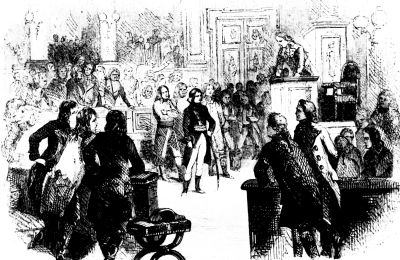
NAPOLEON BEFORE THE CONVENTION.
"Are you willing," inquired the president, "to undertake the defense of the Convention?"
"Yes," was the laconic reply.
The president hesitated, and then continued, "But are you aware of the magnitude of the undertaking?"
Napoleon fixed that eagle eye upon him which few could meet without quailing, and replied, "Perfectly; and I am in the habit of accomplishing that which I undertake. But one condition is indispensable. I must have the unlimited command, entirely untrammeled by any orders from the Convention."
There was no time for debate; and even the most stupid could see that in such an hour the public safety could only be secured by the prompt, concentrated action of a single mind, sufficiently powerful to meet the emergency. The characteristic traits of Napoleon's character were perhaps never more conspicuously displayed than on this occasion—his self-reliance, his skill in the choice of agents, his careful preparation against the possibility of defeat, and his fortitude in doing whatever might be necessary for the accomplishment of his plans.
Not a moment was lost. At Sablons, a few miles from Paris, there was a park of forty pieces of artillery. Napoleon dispatched a young soldier, whom he well knew, of most chivalrous daring and impetuosity, Joachim Murat, to secure the guns. At the head of three hundred horse he was almost instantly on the gallop, and arrived at Sablons just in time to rescue the artillery from a smaller band of the insurrectionists, who had also been dispatched to secure it. The guns were brought to the Tuileries. They were promptly ranged to sweep all the avenues leading to the Tuileries. The cavalry and a part of the infantry were placed in reserve in the garden of the palace and in the Carrousel. The Convention awoke fully to a sense of its danger and to the energy of its commander when soldiers brought eight hundred muskets into the hall, with which the deputies were to arm themselves and advance to battle if necessary. Detachments of troops were dispatched to seize by surprise all the provisions and ammunition in Paris, and convey them to a safe dépôt in the Tuileries. A hospital for the wounded was established in the palace, provided with necessaries for every emergency. The troops of all kinds at Napoleon's disposal, variously estimated at from five to eight thousand, were strongly posted in the leading streets, at the bridges, in the Place Vendôme, and in the Place de la Révolution. A strong detachment was sent to occupy the heights of Meudon, Napoleon intending to retreat there, with the Convention, in case of defeat. One section in Paris had voted with the immense majority of the nation for the decrees. Chests of arms were sent to that section to arm the voters in defense of the laws. A detachment was sent to the road to St. Germain, to intercept any cannon from being brought from that direction.
All this was accomplished in one short night, the 4th of October, Napoleon seeming to infuse his own energy into every one around him. In the mean time the sections, though by no means aware of the spirit they were doomed to encounter, were not idle. They had organized a kind of insurrectionary government, outlawed the committees of the Convention, and had established a tribunal to punish those who should resist its sovereignty. Several energetic generals, Jacobins, and also Royalists, creeping from their retreats, offered their services to lead the attack upon the Convention. General Danican, a Royalist, who had been a general of brigade in the civil war which had desolated La Vendée, was appointed commander-in-chief of the forces of the insurrection. He had the National Guard, forty thousand strong, well armed, officered, and disciplined, under his command. The morning of the 5th dawned.
The alarm-bells were now ringing and the générale beating. The armed hosts of the sections were mustering at their appointed rendezvous and preparing to march upon the Convention. The members, in their seats, in silence and awe awaited the assault, upon the issue of which their lives were suspended. Napoleon, pale, solemn, and perfectly calm, was waiting, resolved that the responsibility of the first blow should fall upon his assailants, and that he would take the responsibility of the second.
Soon the enemy were seen advancing from every direction, in masses which filled the narrow streets of the city. With music and banners they marched to attack the besieged on every side, confident, from their numbers, of an easy victory. They did not believe that the few and feeble troops of the Convention would dare to resist the populace of Paris, but cherished the delusion that a few shots from their own side would put all opposition to flight. Thus unhesitatingly they came within sweep of the grapeshot with which Napoleon had charged his guns. The troops of the Convention stood firm. The insurgents opened a volley of bullets upon them. It was the signal for an instantaneous discharge, direct, sanguinary, merciless, from every battery. A storm of grape swept the streets. The columns of the assailants wavered, turned, fled, and still the storm pursued them. One of the strongest battalions of the insurgents had posted itself on the steps of the Church of Saint Roche, where it occupied a commanding position for firing upon the gunners of the Convention. Napoleon directed his artillery to advance upon them by the cul de sac Dauphin, and immediately threw into their crowded ranks a storm of grapeshot. The insurgents fought manfully for a time, but were soon compelled to retreat, leaving the steps of the church covered with the slain. As they fled, Napoleon pushed his artillery up the street, and, wheeling to the right and the left, swept the whole length of the Rue St. Honoré. In two hours the victory was achieved, forty thousand men were vanquished by five thousand, the streets were cleared, and Napoleon returned in calm triumph to the Tuileries.[446]
It is interesting to catch a glimpse of Napoleon in his domestic life at this time. The Duchess of Abrantes writes, "My parents arrived in Paris on the 4th of September. Two days after my father was very ill. Bonaparte, apprised by my brother, came immediately to see us. He appeared to be affected by the state of my father, who, though in great pain, insisted on seeing him. He came every day, and in the morning he sent or called himself to inquire how he had passed the night. I can not recollect his conduct at that period without sincere gratitude.
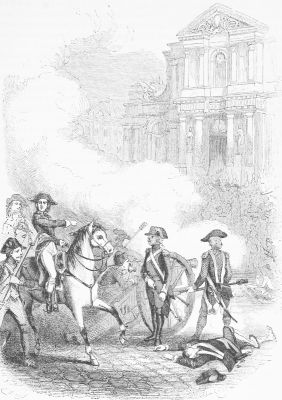
THE SECTIONS AT SAINT ROCHE.
"He informed us that Paris was in such a state as must necessarily lead to a convulsion. The sections were in, if not open, at least almost avowed insurrection. The section Lepelletier, which was ours, was the most turbulent, and, in fact, the most to be dreaded. Its orators did not scruple to deliver the most incendiary speeches. They asserted that the power of the assembled people was above the laws. 'Matters are getting from bad to worse,' said Bonaparte; 'the counter-revolution will shortly break forth, and it will, at the same time, become the source of disasters.'
"As I have said, he came every day; he dined with us and passed the evening in the drawing-room, talking in a low tone beside the easy-chair of my mother, who, worn out with fatigue, dozed for a few moments to recruit her strength, for she never quitted my father's pillow. I recollect that, one evening, my father being very ill, my mother was weeping and in great tribulation. It was ten o'clock. At that time it was impossible to induce any of the servants of the hotel to go out after nine. Bonaparte said nothing. He ran down stairs and posted away to Duchannais, whom he brought back with him in spite of his objections. The weather was dreadful; the rain poured in torrents. Bonaparte had not been able to meet with a hackney coach to go to M. Duchannais; he was wet through. Yes, indeed, at that period Bonaparte had a heart susceptible of attachment.
"Meanwhile we became more and more alarmed every day by the dangers which manifested themselves around us. Paris rung with the tumult of the factions, each of which drew the sword and hoisted its standard. Against the Convention, then the only real authority, were arrayed the sections, which for some days past again declared war against it. Paris resembled a garrison town. At night we heard the sentries calling to and answering one another, as in a besieged town. The strictest search was made for arms and ammunition.
"For some years my mother had been subject to nervous paroxysms. At such times she disliked to have any body about her. On reaching the drawing-room I found her all in tears and in one of the most violent spasms. General Bonaparte was with her, endeavoring to soothe her. He told me that on his arrival he found her on the point of attacking the adjunct of the section to prevent his entering my father's chamber. 'I should be glad to spare your mother such scenes,' said he; 'I have not much influence, nevertheless I will go myself to the section. I will see the president if possible and settle the business at once. Paris is all on fire, especially since this morning. It is necessary to be very cautious in every thing one does and in all one says. Your brother must not go out any more. Attend to all this, for your mother is in a sad state.'
"This was a dreadful night for my father. The next morning the générale was beat. The streets were already very unsafe, though people were still passing to and fro in Paris, as though they were not going to cut one another's throats a few hours afterward. The tumult became very great at dusk; the theatres were nevertheless open. Indeed, we are a nation of lunatics!
"On the morning of the 12th Vendémiaire (October 4) Bonaparte, who had called according to custom, appeared to be lost in thought. He went out, came back, went out again, and again returned when we were at our dessert. 'I breakfasted very late,' said he, 'at Bourrienne's. They talked politics there till I was quite tired of the subject. I will try to learn the news, and if I have any thing interesting I will come and tell you.'
"We did not see him again. The night was tumultuous, especially in our section. The whole Rue de la Loi was bristling with bayonets. Barricades were already set up in our streets. On the morning of the 13th (October 5) my father was very ill. For some hours we flattered ourselves that matters would be adjusted between the Convention and the rebels; but about half past four the firing of the cannon began. The effect on my poor father was terrible. He gave a piercing shriek, calling for assistance, and was seized with the most violent delirium. All the scenes of the Revolution passed in review before him, and every discharge that he heard was a blow struck at him personally. What a day! what an evening! what a night! Every pane of glass was broken in pieces. Toward evening the section fell back upon us. The fighting was continued almost under our window, but when it had come to St. Roche we imagined that the house was tumbling about our ears.
"My father was in the agonies of death; he shouted, he wept. Never, no, never, shall I suffer what I did during that terrible night. Next day tranquillity was restored, we were told, in Paris. I can scarcely give any account of the 14th. Toward evening Bonaparte came for a moment; he found me dissolved in tears. When he learned the cause his cheerful and open countenance suddenly changed. My mother entered at that moment. She knew no more than I how important a part Bonaparte had played on that great day. 'Oh!' said my mother, 'they have killed my husband. You, Napoleon, can feel for my distress. Do you recollect that on the first Prairial, when you came to sup with me, you told me that you had just prevented Barras from bombarding Paris? Do you recollect it? For my part I have not forgotten it.'
"Many persons have alleged that Napoleon always regretted that day. Be that as it may, he was always exceedingly kind to my mother in these moments of affliction, though himself in circumstances that could not but outweigh all other interests. He was like a son—like a brother."[447]
The Convention treated the insurrectionists, who had thus been so severely punished, with the utmost clemency.[448] Napoleon received the thanks of the Convention and a brilliant reception. The Convention united Belgium with France; decreed that the punishment of death should be abolished as soon as a general peace with Europe could be effected; changed the name of the Place of the Revolution to the Place of Concord; pronounced an amnesty for all acts connected with the Revolution, excepting one person implicated in the last revolt; and then, on the 26th of October, 1795, the President of the Convention pronounced these words,
"The National Convention declares that its mission is accomplished, and its session is closed."
With one united shout—The Republic forever!—the deputies left the hall and dispersed to their homes.
To the States-General fell the task, after a terrific struggle with king and nobles, to create the Constituent Assembly, a great national congress, whose function it was to moderate the despotism of the throne by conferring upon a nation of twenty-five millions of people, after ages of oppression, constitutional liberty. The Constituent Assembly, which succeeded the States-General, abolished those old institutions of feudal servitude which had become utterly unendurable, and established a constitutional monarchy, taking as a model, in the main, the British Constitution. The Legislative Assembly then took the place of the Constituent, to enact laws in harmony with this Constitution. It soon, however, found that the king was in league with despotic Europe to overthrow constitutional liberty and restore the old despotism. It consequently suspended the king, and the Constitution with which his power was inseparably interwoven, and dissolved itself.[449] The National Convention, which succeeded, commenced its deliberations on the 21st of September, 1792.
"The Convention," says Thiers, "found a dethroned king, an annulled Constitution, an administration entirely destroyed, a paper money discredited, old skeletons of regiments worn out and empty. Thus it was not liberty that it had to proclaim in presence of an enfeebled and despised throne, it was liberty that it had to defend against all Europe—a very difficult task. Without being for a moment daunted, it proclaimed the Republic in the face of the hostile armies; it then sacrificed the king, to cut off all retreat from itself; it subsequently took all the powers into its own hands, and constituted itself a dictatorship. Voices were raised in its bosom which talked of humanity, when it wished to hear of nothing but energy; it stifled them. This dictatorship, which the necessity of the general preservation had obliged it to arrogate to itself over all France, twelve of its members soon arrogated to themselves over it, for the same reason, and on account of the same necessity. From the Alps to the sea, from the Pyrenees to the Rhine, these twelve dictators seized upon all, both men and things, and commenced the greatest and the most awful struggle with the nations of Europe ever recorded in history. They spilt torrents of blood, till, having become useless from victory, and odious by the abuse of strength, they fell.
"The Convention then took the dictatorship again into its own hands, and began, by degrees, to relax the springs of that terrible administration. Rendered confident by victory, it listened to humanity, and indulged its spirit of regeneration. It aimed at every thing good and great, and pursued this purpose for a year; but the parties crushed under its pitiless authority revived under its clemency. Two factions, in which were blended, under infinite variety of shades, the friends and the foes of the Revolution, attacked it by turns. It vanquished the one and the other, and, till the last day, showed itself heroic amid dangers. Lastly, it framed a Republican Constitution, and, after a struggle of three years with Europe, with the factions, with itself, mutilated and bleeding, it dissolved itself, and transmitted the government of France to the Directory."[450]
FOOTNOTES:
CHAPTER XXXIX.
THE DIRECTORY.
Constitution of the Directory.—Distracted State of Public Affairs.—New Expedition to La Vendée.—Death of the Dauphin.—Release of the Princess.—Pacification of La Vendée.—Riots in London.—Execution of Charette.—Napoleon takes command of the Army of Italy.—The first Proclamation.—Triumphs in Italy.—Letter of General Hoche.—Peace with Spain.—Establishment of the Cispadane Republic.—Negotiations with England.—Contemplated Invasion of Ireland.—Memorials of Wolfe Tone.—Deplorable State of Public Affairs.—Description of Napoleon.—Composition of the Directory.
The government of the Directory went into operation on the 27th of October, 1795. The two legislative bodies, the Council of the Ancients and the Council of the Five Hundred, met and chose for the five directors Lareveillère Lepeaux, Le Tourneur, Rewbel, Carnot, and Barras. "Among these," says Thiers, "there was not a man of genius, nor even any man of high reputation, excepting Carnot. But what was to be done at the end of a sanguinary revolution which, in a few years, had devoured several generations of men of genius of every description? In the Assemblies there was not left one extraordinary orator; in diplomacy there remained not one celebrated negotiator."[451] The state of public affairs at this time was deplorable in the extreme. Innumerable factions disturbed the state. A very sanguinary war was raging around the frontiers. The embers of civil war were still smoldering and frequently bursting out into flame. Three powerful parties were struggling almost with the energies of despair for the supremacy—the old Royalists, the Thermidorians or moderate Republicans, and the Jacobins, who wielded, as the great instrument of terror, the energies of the Parisian mob. Many of the most intelligent men already foresaw that there was no hope for distracted France but in the action of some mighty mind which could mould the tumultuous elements and evolve order from the confusion.[452]
The British government, undismayed by the disaster of Quiberon, now sent another expedition to the shores of La Vendée to rouse the Royalists to insurrection. The expedition consisted of two thousand English infantry, five hundred horse, several regiments of French emigrants, a great number of officers to take command of the marshaled peasantry, and arms, ammunition, provisions, clothing, and gold in abundance. Should this expedition successfully land and rally around it the Royalist insurgents in promising numbers, it was immediately to be followed by another still more powerful. The Count d'Artois (Charles X.) was placed in command of this force. Charette, a very intrepid Royalist chieftain, had raised some ten thousand peasants, and was in command of the coast to welcome the invaders. But General Hoche fell upon the insurgent Vendeeans and scattered them; and the English fleet, after hovering for some time along the coast, being unable to effect a landing, and disappointed in the support they hoped to have met, abandoned the enterprise and returned to England.[453]
While the coast of France was thus threatened the Allies on the Rhine gained some very decisive victories, and drove the routed Republicans before them. There was no money in the treasury of the Directory. The paper money, which had been freely issued, had become almost worthless, and the armies were now in destitution and rags. Such were the difficulties with which the new government had to grapple.[454]
On the 8th of June the dauphin died in the Temple. While he lived he was considered by the Royalists the legitimate King of France, under the title of Louis XVII. Upon his death the emigrants declared the Count of Provence king, and he assumed the title of Louis XVIII. It will be remembered that the Convention sent some deputies to arrest Dumouriez, and that he seized these commissioners and handed them over to the Austrians as hostages. The Directory now exchanged the young princess, who still survived in woeful captivity, for these commissioners and a few other distinguished prisoners held by the Austrians. It was the 19th of December when this unhappy child left her cell, where she had endured agonies such as few on earth had known, to be conveyed back to the palaces of her maternal ancestors.
The guns of Napoleon, quelling the insurgent sections, had established the government of the Directory. To secure Paris and France from similar scenes of violence, an imposing force was organized, called the Army of the Interior, and Napoleon was placed in command. As by magic, under his efficient command, this body was organized into the highest discipline and efficiency, and, overawing the discontented, maintained public order. A formidable camp of these troops was established at Grenelle. But for Napoleon the Directory could not have come into being. But for Napoleon it could not have lived a year, struggling against the conspiracies which ever crowded it.[455] General Hoche, operating with singular wisdom and humanity, succeeded in the pacification of the inhabitants of La Vendée. They surrendered their arms, and peace was restored to that distracted region. Still William Pitt clamored for war against the French Republic. The English people were indignant at these unjust assaults against a neighboring nation struggling to throw off the chains of intolerable servitude, and demanded peace with France. The liberty-loving Englishmen met in immense gatherings in the open air, and denounced the war system in the most bold and decisive resolves. As the king rode to Parliament the populace pursued him, pelted his carriage with stones, broke the windows, and it was asserted that an air-gun was fired at him. Pitt, riding on horseback, was recognized by the populace, and with difficulty escaped from their hands covered with mud. Fox and Sheridan in Parliament were loud and eloquent in the denunciation of the war measures of the ministry.[456] Pitt endeavored to defend himself against the assaults of the opposition by saying that English blood had not been shed. "True," replied Sheridan, "English blood has not been shed, but English honor has oozed from every pore."
The Allies, exhilarated by their successes on the Rhine, prepared to press the war with new vigor. Pitt obtained from Parliament a new loan of thirty-five millions of dollars. General Bonaparte was promoted from the command of the Army of the Interior to that of the Army of Italy. He immediately entered upon that Italian campaign which gave him renown throughout the world.
Though the Vendeeans had surrendered their arms and were rejoicing in the enjoyment of peace, Charette wandered about the country, refusing all overtures at reconciliation, and striving, with great energy, to rouse new forces of insurrection. The entire pacification of La Vendée now depended upon the capture of Charette. With almost unparalleled energy and bravery he succeeded for several months in eluding his foes. At last, on the 24th of March, 1796, he fell into an ambuscade. He was armed to the teeth, and fought with the ferocity of a tiger at bay. He received several sabre-blows before he fell and was secured. At his examination he with dignity averred his detestation of republicanism and his devotion to royalty. He had deluged the land with the blood of civil war, and, as a traitor, was doomed to die. On the 30th of March he was led out to execution. A platoon of soldiers was drawn up but a few paces before him. He stood erect, with his eyes unbandaged, and, apparently without the tremor of a nerve, gave the command to fire. He fell dead, pierced by many bullets. He had displayed marvelous heroism in a bad cause. Refusing to submit to laws established by the overwhelming majority of his countrymen, he was deluging the land in blood in the endeavor to rivet again upon France the chains of the most intolerable despotism. The Royalists all over Europe mourned his death. But France rejoiced, for the fall of Charette terminated the civil war.
One hundred thousand men had been under the command of General
Hoche in the strife of La Vendée. These were now at liberty to march to repel the foreign invader. Two powerful armies, of eighty thousand each, were collected on the Rhine. But they could not hold their ground against the outnumbering Austrians. In one of these engagements the distinguished young general Marceau was killed. He was struck by a ball fired by a Tyrolean marksman, and fell from his horse mortally wounded. His soldiers, on the rapid retreat, were unable to rescue him, and he was left in his blood to the humanity of the victors. The Austrians generously did every thing in their power for his relief, but he died, three days after, in the twenty-seventh year of his age.