Front matter (continued 8)
Reading edition
The multitude rushed impetuously into the court, filling it in an instant, and crowding into the vestibule of the palace. It was now four o'clock in the afternoon. They clambered the magnificent staircase, even dragging a piece of cannon up to the first floor, and poured in locust legions into every part of the palace. Wherever they found a door barred against them they speedily, with swords and hatchets, hewed it down.
The king was in one of the interior apartments, surrounded by some of the servants of his household and by several officers of the National Guard. His sister, Madame Elizabeth, happened to be with him; but the queen, who was in another room with her children, had not been able to join her husband, so sudden had been the irruption. The crowd arrested her in her flight in the council-chamber. She begged earnestly to be led to her husband, but the throng pouring by was so dense that it was impossible. Her friends placed her in a corner, and rolled the council-table before her as a barrier.
There she stood stupefied with horror, and her eyes suffused with tears, while the low and brutal masses, with no apparent exasperation, end, or aim, crowded by. Her daughter clung to her side, terrified and weeping. Her son, but seven years of age, too young to understand the terrible significance of such an inundation, gazed upon the spectacle with half alarmed, half pleased wonder. Some of the palace-guard gathered around the group for its protection. Occasional scowls and mutterings of defiance and insult alarmed the queen in behalf of her children rather than herself. Some one handed her son the red cap of the Jacobins. The queen, hoping that it might appease the mob, placed it upon his head.
Just then Santerre came along, forcing his way with the crowd. He spoke kindly to the queen, repeating the only excuse which could be made for her, "Madame, you are imposed upon." Seeing the red cap upon the head of the dauphin, he, with a sense of delicacy hardly to be expected in so coarse a man, took it and threw it aside, saying, "The child is stifling." He then urged the people to treat the queen with respect.
A young girl stopped before the queen and assailed her with an incessant volley of imprecations.
"Have I ever," said the queen, calmly, "done you any wrong?"
"No," replied the girl, "not me personally; but you are the cause of the misery of the nation."
"You have been told so," answered the queen; "but you are deceived. As the wife of the King of France and mother of the dauphin, I am a Frenchwoman. I shall never see my own country again. I can be happy only in France. I was happy when you loved me."
These words touched the heart of the passionate but not hardened girl, and she began to weep, saying,
"I ask your pardon. It was because I did not know you. I see that you are good."
While these scenes were transpiring in the council-chamber, the cries of the mob were heard at the door of the king's apartment, and blows from a hatchet fell heavily upon the panels. As a panel, driven by a violent blow, fell at the king's feet, he ordered the door to be thrown open. A forest of pikes and bayonets appeared, and the crowd rushed in. The king, with that courage of resignation which never forsook him, stepped forward with dignity to meet the rabble, and said, "Here I am."
His friends immediately threw themselves around him, forming a rampart with their bodies. The mob, who seemed to have no definite object in view, fell back, and the friends of the king placed him in the embrasure of a window, where he could more easily be protected from the pressure. There was a moment's lull, and then came renewed clamor and uproar. Some said that they had a petition which they wished to present to the king. Others shouted, "No veto! No priests! No aristocrats! The camp near Paris."
The king stood upon a bench, and with marvelous serenity gazed upon the unparalleled spectacle. Légendre, the butcher, one of the leaders of the mob, stepped up, and with a firm voice demanded in the name of the people the sanction of the two decrees which the king had vetoed.[329]
"This is not the place, neither is this the time," answered the king, firmly, "to grant such a request. I will do all the Constitution requires."
This bold answer seemed to exasperate the crowd, and they shouted, as it were defiantly, "Vive la Nation!"
"Yes," replied the king, heroically, "Vive la Nation! and I am its best friend."
"Prove it, then," cried one of the rabble, thrusting toward him, on the end of a pike, the red cap of the Jacobins.
The king took the cap and placed it upon his head. The mob responded with shouts of applause. The day was oppressively hot, and the king, who was very corpulent, was almost suffocated with the heat and the crowd. A drunken fellow, who had a bottle and a glass, staggered up to the king, and offered him a tumbler of wine, saying, "If you love the people, drink to their health."
Though the king had long been apprehensive of being poisoned, he took the glass and without hesitation drank its contents. Again he was greeted with shouts of applause. Some of the crowd, as they caught sight of Madame Elizabeth, cried out, "There is the Austrian woman!" The unpopularity of the queen excited murmurs and imprecations, and the princess was in great danger of violence. Some of her friends around her endeavored to undeceive the mob.
"Leave them," said the generous and heroic princess, "leave them to think that I am the queen, that she may have time to escape."
The Assembly was immediately informed of the invasion of the palace. The Constitutionalists were indignant. The Jacobins were satisfied, for they wished to see the king and the king's party frightened into obedience. An angry and almost furious altercation ensued in the Assembly. A deputation of twenty-four members was, however, immediately sent to surround the king, and this deputation was renewed every half hour. But the deputies could not force their way through the crowd. Hoisted upon the shoulders of the grenadiers they endeavored in vain to harangue the mob to order. It was half past five o'clock, an hour and a half after the attack upon the Tuileries had commenced, before Pétion, the Mayor of Paris, made his appearance in the presence of the king. He attempted an apology for coming so late, saying,
"I have only just learned the situation of your majesty."
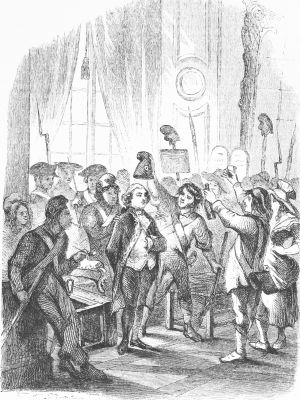
THE CAP OF LIBERTY PLACED UPON THE KING.
"That is very astonishing," replied the king, "for it is a long time that it has lasted."
"It was half past four," Pétion rejoined, "when I heard of the attack. It took me half an hour to get to the palace; and I could not overcome the obstacles which separated me from your majesty until the present moment. But fear nothing, sire; you are in the midst of your people."
Louis XVI., taking the hand of a grenadier who stood by his side, placed it upon his heart, saying, "Feel whether it beats quicker than usual."
This noble answer again elicited applause. The mayor then, mounting the shoulders of four grenadiers, addressed the mob, urging them to retire.
"Citizens, male and female," said he, "you have used with moderation and dignity your right of petition. You will finish this day as you begun it. Hitherto your conduct has been in conformity with the law, and now, in the name of the law, I call upon you to follow my example and to retire."
The crowd obeyed and slowly moved off through the long suite of apartments of the chateau. As soon as they began to retire the king and his sister threw themselves into each other's arms, and neither was able to repress a flood of tears. Locked in an embrace they left the room to find the queen. She, with her children, had just regained her apartment. The meeting of the royal family, after these scenes of violence, insult, and terror, drew tears into the eyes of all the beholders. One of the deputies, Antoine Merlin of Thionville, though one of the most virulent of the Jacobins, could not refrain from weeping. Marie Antoinette observing it, and knowing his bitter hostility to the court, said,
"You weep to see the king and his family treated so cruelly by a people whom he has always wished to render happy."
"It is true, madam," replied Merlin, "I weep over the misfortunes of a beautiful, tender-hearted woman and mother of a family. But do not mistake; there is not one of my tears for the king or the queen; I hate kings and queens."
At this moment the king, from the reflection of a mirror, saw the red bonnet still upon his head. A crimson glow flushed his face and he hastily threw the badge of the Jacobin from him. Sinking into a chair he for a moment buried his face in his handkerchief, and then, turning a saddened look to the queen, said,
"Ah, madame, why did I take you from your country to associate you with the ignominy of such a day!"
It was eight o'clock in the evening before the apartments and corridors of the palace ceased to echo with the voices and the footsteps of the barbarian invaders. Detachments of the National Guard gradually assembled, the court-yard and the garden were cleared, and night with its silence and darkness again settled down over the wretched royal family in the halls of their palace, and the wretched famishing outcasts wandering through the streets. Such was the 20th of June, 1792.
Napoleon Bonaparte, then twenty-two years of age, was in Paris, and with indignation witnessed this spectacle of lawlessness. Bourrienne thus describes the event: "In the month of April, 1792, I returned to Paris, where I again met Bonaparte, and renewed the friendship of our youthful days. I had not been fortunate, and adversity pressed heavily upon him. We passed our time as two young men of three and twenty may be supposed to have done who had little money and less occupation. At this time he was soliciting employment from the Minister of War, and I at the office of foreign affairs.
"While we were thus spending our time the 20th of June arrived, a sad prelude of the 10th of August. We met by appointment at a restaurateur's, in the Rue St. Honoré, near the Palais Royal. On going out we saw a mob approaching in the direction of the market-place, which Bonaparte estimated at from five to six thousand men. They were a parcel of blackguards, armed with weapons of every description, and shouting the grossest abuse, while they proceeded at a rapid rate toward the Tuileries. This mob appeared to consist of the vilest and most profligate of the population of the suburbs.
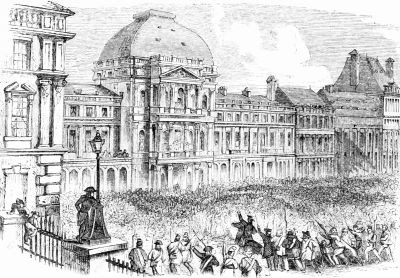
THE ATTACK UPON THE TUILERIES.
"'Let us follow the rabble,' said Bonaparte. We got the start of them, and took up our station on the terrace bordering on the river. It was there that he was an eye-witness of the scandalous scenes which ensued, and it would be difficult to describe the surprise and indignation which they excited in him. Such weakness and forbearance, he said, could not be excused. But when the king showed himself at the window which looked out upon the garden, with the red cap which one of the mob had just placed upon his head, he could no longer repress his indignation.
"'What madness!' he loudly exclaimed. 'How could they have allowed that rabble to enter? Why did they not sweep away four or five hundred of them with the cannon? The rest would then have speedily taken to their heels.'"
FOOTNOTES:
CHAPTER XXVI.
THE THRONE ASSAILED.
Angry Interview between the King and the Mayor.—Decisive Action of La Fayette.—Expectations of the Queen.—Movement of the Prussian Army.—Efforts of the Priests.—Secret Committee of Royalists.—Terror in the Palace.—The Queen's View of the King's Character.—Parties in France.—Energetic Action of the Assembly.—Speech of Vergniaud.
The next day after the fearful scenes of the 20th of June, the Assembly held a very tumultuous sitting. Various measures were proposed to prevent a repetition of armed petitions, and the filing of processions through the hall. The Jacobins were, however, in sympathy with the mob; and the Royalists, waiting the approach of foreign armies, had no wish to introduce order but by the sword of invasion. It was apprehended that the mob, who had now risen above the power of law, might again invade the palace. In the afternoon of the 21st, crowds began to assemble at various points, but the mayor, Pétion, succeeded in inducing them to disperse. He then hastened to the king, and said to him,
"Sire, there is no longer cause for alarm. Order is restored. The people have become tranquil and satisfied."
The king, who now appreciated the peril of his position, was exasperated, and replied, with suppressed emotion, "That is not true."
"Sire—" rejoined Pétion.
"Be silent," said the king sternly, interrupting him.
"It befits not the magistrate of the people," replied Pétion, "to be silent when he does his duty and speaks the truth."
"The tranquillity of Paris rests on your head," added the king.
"I know my duty," Pétion replied, "and shall perform it."
The king could no longer restrain himself, and passionately exclaimed, "Enough; go and perform it. Retire."
Pétion, thus summarily turned out of doors, bowed and left. The report of the angry interview was speedily spread through Paris. It was rumored through the palace that the mob were preparing to rise to murder the king and all the royal family. It was rumored through the streets that the Royalists were endeavoring to provoke the people to rise, that they might shoot them down with artillery. The mayor issued a proclamation urging the people not to allow themselves to be excited to fresh commotions. The king issued a proclamation, spirited and defiant in its tone, and yet calculated only to exasperate those whom he had no power to restrain.[330]
La Fayette, who was at this time with his division of the army on the frontiers, heard these tidings from Paris with intense alarm. Had the court not prevented his election as mayor, the outrages of the 20th of June could not have occurred. His only hope for France was in the Constitution. The invasion of the Legislative Assembly by the mob, the irruption into the palace, and the outrages inflicted upon the royal family, impressed him with shame and horror. He saw the terrific reign of anarchy approaching, and was fully conscious that no one could attempt to resist the popular torrent but at the peril of his life. He wrote a very earnest letter of remonstrance to the Assembly, and resolved to hasten immediately to Paris, and to brave every possible danger in endeavoring to restore to his country the dominion of law. Making all the arrangements in his power, that his temporary absence might not be detrimental to the military operations then in progress, he set out for the capital, and arrived there on the 28th of June.[331] He thought that he might rely upon the National Guard to aid him in maintaining the Constitution, and that, throwing himself into the breach to save the monarchy and the king, he might place some reliance upon the co-operation of the court. But the court hated La Fayette and constitutional liberty, and wished for no assistance but from the armies of the allies, through whom they might dictate terms to the re-enslaved people.
La Fayette, immediately upon his arrival in Paris, sent a message to the Assembly that he wished for permission to address them. At half-past one of the 28th of June, he entered the hall. The Constitutionalists received him with plaudits. The Republicans, both the Girondists and the Jacobins, were silent. The general, in his bold and spirited address, spoke of the disgrace which the outrages of the 20th of June had brought upon the nation, and the indignation which it had excited in the army, and urged that the instigators of the riot should be prosecuted; that the Jacobin Club, ever urging violence and revolution, should be suppressed; and that the Constitution and the laws should be maintained by all the armed force of the government.
This speech introduced an angry debate, in which La Fayette was reproached with neglecting his own duties in the army to meddle with matters in which he had no concern. La Fayette left the Assembly in the midst of the debate, and repaired to the palace to see what assistance he could render to the king and queen. The courtiers surrounding the monarch, with their wonted infatuation, assailed La Fayette with the most abusive epithets. The king and queen received him with great coldness, and refused to accept from him of any sympathy or aid.
"If the court and the people attached to the king," writes the Marquis de Ferrières, a decided Royalist, "had but resolved to support La Fayette, there was force to have annihilated the two factions. But the queen recoiled from any idea of owing her safety to a man whom she had resolved to ruin. They refused to enter into his views, and they thus rejected the only means of safety that Providence offered them. Inexplicable blindness, if an explanation were not afforded by the approaching entry of the foreign troops and the confidence reposed in them."
The historian Toulongeon, describing these events, says, "Retired to his hotel, La Fayette set himself to consider what was the force of which he could avail himself. A review of the first division of the National Guard was fixed for the next morning at break of day. The king was to pass along the line, and La Fayette was then to harangue the troops. But the mayor, Pétion, was advertised of their movements by the queen, who feared the success of La Fayette even more than that of the Jacobins, and a counter-order was given, and the review did not take place."
La Fayette returned to the army thwarted and disheartened. His retirement in despair from Paris was the last expiring sigh of the Constitutional party. From this moment the Jacobins resolved upon his destruction, and that very evening his effigy was burned at the Palais Royal. Bertrand de Moleville, one of the most false and envenomed of the Royalist writers, condemns La Fayette for thus leaving Paris. But even Professor Smyth, whose English sympathies are strongly with the court, exclaims,
"M. Bertrand de Moleville may surely be asked, on this occasion, what resource was left for La Fayette but to move away from Paris, if the king and the court, for whom he was hazarding both his fame and his safety, would not honor him with the slightest countenance? Was it to be endured that they were to seem neutral and indifferent, at the least, and sitting with folded arms, while he was to be left to rush into a combat in the Assembly and in the streets of Paris with their furious and murderous enemies, and with the men who had just been assailing the king in his palace, and who evidently only waited for an opportunity to rob him of his crown and take away his life; was this, I repeat, to be endured? Many are the sensations by which the heart of man may be alienated and imbittered, but there are few more fitted for that purpose than to find indifference to services offered, and ingratitude for sacrifices made."[332]
Both the king and the queen knew that Prussia had already combined with Austria, and was secretly marching an army of eighty thousand men under the Duke of Brunswick to unite with the emigrants at Coblentz. The queen thought that the allies would be in Paris in six weeks. She was minutely informed of their contemplated movements; when they would be at Verdun, when at Lille; and she, in confidence, informed her ladies that she expected to be rescued in a month.[333]
The peril of France was now truly great, and the patriots were deeply agitated. Foreign armies were approaching. The king not only was taking no effectual measures for the defense of the kingdom, but had vetoed the decrees of the Assembly raising an army for the protection of the capital, and was also believed to be in sympathy and in traitorous correspondence with the foe. France was threatened with invasion, and the court of France was virtually guiding the march of the invading armies, weakening every point of defense, and striving to betray the patriot forces into the hands of the enemy. The only excuse which history can offer for the king is, that he was the tool of others, and so weak and characterless that he was unconscious of the enormity of his crime. But this excuse, which ought to have commended him to pity, could not be an argument for maintaining him upon his throne.
Though it was well known to all intelligent men that the Prussian armies were marching to unite with the Austrian for the invasion of France, yet the king, in grossest violation of duty, had made no communication of the fact to the Legislative Assembly. All the great roads were crowded with priests, nobles, and their partisans, hastening to join the emigrants at Coblentz. Couriers were every where traversing Europe, from St. Petersburg to Rome, from Stockholm to Madrid, from Berlin to Naples, openly announcing the coalition of all Europe to crush the revolution in France, and declaring that the armies would move in such force that the French would not be able to resist them for a single month. The allies were not unwilling to have their plans known and even exaggerated, for some of them hoped that the terror of the threat might be sufficient to drive the French patriots to submission.[334]
It was consequently proclaimed, not officially, but with great soundings of trumpets, that Spain was to indemnify herself for the war by taking possession of the four beautiful southern provinces of France which lean against the Pyrenees—Navarre, Roussillon, Languedoc, and Guienne. The King of Sardinia was to receive the provinces adjacent to his kingdom, whose romantic valleys penetrated the lower Alps—Dauphiny, Provence, Lyonnois, and Bretagne. The Stadtholder of Holland was to extend his sway over the Provinces of Flanders and Picardy. Austria was to grasp the provinces adjoining the Rhine—Alsace, Lorraine, Champagne. The Swiss were offered Franche Comte if they would join the coalition. And, finally, England was to regain her old possession of Normandy, and was to seize all the colonial possessions of France in the two Indies.[335]
Though the British government was at this time strongly in sympathy with the coalition, it did not venture openly to join the alliance, for the masses of the British people were cordially with the French patriots and rejoiced in the establishment of constitutional liberty in France. These extravagant threats filled Europe. It was every where assumed that only a small minority of the French people were opposed to the Old Régime, and that the mass of the nation would at once arise and welcome the invading armies.
With this terrific storm from without menacing the liberties of France, a large number of priests who had refused to accept the Constitution were plying all the energies of the most potent superstition earth has ever known to rouse the ignorant peasantry against civil and religious liberty. They were told that eternal damnation was their inevitable doom if they were not willing to lay down their lives in defense of the king and the Pope; and that eternal blessedness was the sure inheritance of all who should labor and pray for holy mother Church. The queen, it was well known, was in constant conference with the enemy, counseling, encouraging, and aiding with all the pecuniary means she could obtain from the revenues of France. The king was a weak-minded, fickle man, with no decision of his own, and entirely at the disposal of those who surrounded him. Being quite in subjection to the imperial mind of the queen, he delayed adopting any vigorous measure to repel the approaching foe, thwarted the decrees of the Assembly, and allowed his own enormous salary of six millions of dollars to be appropriated by the queen and her counselors to hasten the march of foreign invaders upon Paris.
In the very palace of the Tuileries a secret committee of old Royalists were in session every day, planning for the enemy, informing them of all the movements in Paris, advising them as to the best points of attack, and organizing, in different parts of the empire, their partisans to rise in civil war the moment the first thunderings of hostile artillery should be heard upon the plains of France. Here surely was a combination of wrong and outrage sufficient to drive any people mad.[336]
During the whole month of July the interior of the palace was the abode of terror. The inmates, apprehensive every hour of attack, had no repose by day or night. Almost daily there was an alarm that the mob was gathering. "During the whole month," writes Madame Campan, "I was never once in bed. I always dreaded some night attack. One morning, about one o'clock, footsteps were heard in the anteroom of the queen's chamber, and then a violent struggle and loud outcries, as the groom of the chambers grasped a man who was stealthily approaching with a dagger, apparently to assassinate the queen."
"I begin to fear," said the queen one day, "that they will bring the king to a trial. Me they will assassinate. But what will become of our poor children? If they assassinate me, so much the better; they will rid me of an existence that is painful."
"One morning, at about four o'clock, near the close of July," writes Madame Campan, "a person came to give me information that the Faubourg St. Antoine was preparing to march against the palace. We knew that at least an hour must elapse before the populace, assembled upon the site of the Bastille, could reach the Tuileries. It seemed to me sufficient for the queen's safety that all about her should be awakened. I went softly into her room. She was asleep. I did not awaken her.
"The king had been awakened, and so had Madame Elizabeth, who had gone to him. The queen, yielding to the weight of her griefs, slept till nine o'clock on that day, which was very unusual with her. The king had already been to know whether she was awake. I told him what I had done, and the care I had taken not to disturb her rest. He thanked me, and said,
"'I was awake, and so was the whole palace. She ran no risk. I am very glad to see her take a little rest. Alas! her griefs double mine.'
"What was my chagrin, when the queen, awaking and learning what had passed, began to weep bitterly from regret at not having been called. In vain did I reiterate that it was only a false alarm, and that she required to have her strength recruited.
"'My strength is not exhausted,' said she; 'misfortune gives us additional strength. Elizabeth was with the king, and I was asleep! I, who am determined to perish by his side. I am his wife. I will not suffer him to incur the smallest risk without my sharing it.'"
The queen appears to have understood very perfectly the character of her dejected, spiritless, long-suffering husband. "The king," said she, "is not a coward. He possesses abundance of passive courage, but he is overwhelmed by an awkward shyness, a mistrust of himself, which proceeds from his education as much as from his disposition. He is afraid to command, and, above all things, dreads speaking to assembled numbers. He lived like a child, and always ill at ease, under the eyes of Louis XV., until the age of twenty-one. This constraint confirmed his timidity. Circumstanced as we are, a few well-delivered words addressed to the Parisians would multiply the strength of our party a hundred-fold. He will not utter them. What can be expected from those addresses to the people which he has been advised to post up? Nothing but fresh outrages. As for myself, I could do any thing, and would appear on horseback if necessary; but, if I really were to begin to act, that would be furnishing arms to the king's enemies. The cry against the Austrian, and against the sway of a female, would become general in France, and, moreover, by showing myself I should render the king a mere nothing. A queen who is not regent ought, under these circumstances, to remain passive or to die."[337]
There were now three prominent parties in France. First, the Royalists, with the queen and the court, controlling the ever-vacillating king, at their head. They were plotting, through foreign armies and civil war, to restore the political and ecclesiastical despotism of the Old Régime. This party would have been utterly powerless but for the aid of foreign despots. Second came the Constitutional party, with La Fayette at its head. The king professed to belong to this party, and at times, perhaps, with sincerity, but, overruled by others, he conducted with a degree of feebleness and fickleness which amounted to treachery. This party had originally embraced nearly the whole nation. Never did a nobler set of men undertake national reform than were the leaders of the French Revolution. They sought only the happiness of France, were anxious for peace with all nations, were decidedly conservative in their views. They had no desire to overthrow the French monarchy, but wished only to limit that monarchy by a Constitution which should secure to the nation civil and religious liberty.
But the Constitutional party was now daily growing weaker, simply because its best friends saw that it was impossible to maintain the Constitution while the king himself was co-operating with foreign armies for its overthrow. Why should the people sustain a king, and furnish him with a salary of five millions of dollars a year, only to enable him to overthrow the Constitution and reinstate the rejected despotism? Thus were thousands of the purest men in France driven with great reluctance to the conviction that constitutional liberty could only be preserved by dethroning the king and establishing a republic. They were originally decidedly in favor of a constitutional monarchy. They felt that the transition was altogether too great and too sudden from utter despotism to republican freedom. The vast mass of the peasant population in France could neither read nor write. They were totally unacquainted with the forms of popular government. They were as ignorant as children, and almost entirely under the tutelage of the priests, to whom they believed that the keys of heaven and of hell had been intrusted. The establishment of republican forms would render France still more obnoxious to surrounding monarchies, and therefore they had wished to maintain the monarchy, and they took the British Constitution and not the American republic as their model, wishing, however, to infuse more of the popular element into their Constitution than has been admitted into the aristocratic institutions of England.
But now they found, to their surprise and grief, that all Europe was combining against their liberties, and that the king, instead of being grateful that his throne was preserved to him, was lamenting his loss of despotic power, and was co-operating with combined Europe for the re-enslavement of France. This left the friends of liberty no alternative. They must either hold out their hands to have the irons riveted upon them anew, or they must dethrone the king, rouse the nation to repel invasion, and attempt the fearful experiment of a republican government with a nation turbulent, unenlightened, and totally unaccustomed to self-control. In the old despotism there was no hope. It presented but poverty, chains, and despair. In republicanism, with all its perils, there was at least hope. Hence arose republicanism. It was the child of necessity. In the Constituent Assembly not an individual was to be found who advocated a republic.[338] But after the flight of the king to Varennes, republican sentiments, as the only hope of the nation, rapidly gained ground, and at the very commencement of the Legislative Assembly we see that a republican party is already organized. From the beginning there were two divisions of this party—the conservative republicans, called Girondists, because their leaders were from the department of the Gironde; and the radical democrats, called Jacobins from the hall where the club held its meeting.
All France was now in a state of alarm. The Assembly passed a very solemn decree announcing that the country is in danger. It declared its sitting to be permanent, that the king might not dissolve it. All the citizens were required to give up their arms that they might be suitably distributed to the defenders of the country. Every man, old and young, capable of bearing arms was ordered to be enrolled in the National Guards for the public defense. M. Vergniaud, the leader of the Girondists, a man of exalted virtue and of marvelous powers of eloquence, concluded a speech which roused the enthusiasm of the whole Assembly by proposing a firm but respectful message to Louis XVI., which should oblige him to choose between France and foreigners, and which should teach him that the French were resolved to perish or triumph with the Constitution.
"It is in the name of the king," said Vergniaud, "that the French princes have endeavored to raise up Europe against us. It is to avenge the dignity of the king that the treaty of Pilnitz has been concluded. It is to come to the aid of the king that the sovereign of Hungary and Bohemia makes war upon us, and that Prussia is marching toward our frontiers. Now, I read in the Constitution,
"'If the king puts himself at the head of an army and directs its forces against the nation, or if he does not oppose by a formal act an enterprise of this kind, that may be executed in his name, he shall be considered as having abdicated royalty.'
"What is a formal act of opposition? If one hundred thousand Austrians were marching toward Flanders, and one hundred thousand Prussians toward Alsace, and the king were to oppose to them ten or twenty thousand men, would he have done a formal act of opposition? If the king, whose duty it is to notify us of imminent hostilities, apprised of the movements of the Prussian army, were not to communicate any information upon the subject to the National Assembly; if a camp of reserve necessary for stopping the progress of the enemy into the interior were proposed, and the king were to substitute in its stead an uncertain plan which it would take a long time to execute; if the king were to leave the command of an army to an intriguing general (La Fayette) of whom the nation was suspicious. If another general (Luckner) familiar with victory were to demand a re-enforcement, and the king were by a refusal to say to him, I forbid thee to conquer, could it be asserted that the king had performed a formal act of opposition.
"If while France were swimming in blood the king were to say to you, 'It is true that the enemies pretend to be acting for me, for my dignity, for my rights, but I have proved that I am not the accomplice. I have sent armies into the field; these armies were too weak, but the Constitution does not fix the degree of their force. I have assembled them too late; but the Constitution does not fix the time for collecting them. I have stopped a general who was on the point of conquering, but the Constitution does not order victories. I have had ministers who deceived the Assembly and disorganized the government, but their appointment belonged to me. The Assembly has passed useful decrees which I have not sanctioned, but I had a right to act so. I have done all that the Constitution enjoined me. It is therefore impossible to doubt my fidelity to it.'
"If the king were to hold this language would you not have a right to reply, 'O king, who, like Lysander, the tyrant, have believed that truth was not worth more than falsehood, who have feigned a love for the laws, merely to preserve the power which enabled you to defy them—was it defending us to oppose to the foreign soldiers forces whose inferiority left not even uncertainty as to their defeat? Was it defending us to thwart plans tending to fortify the interior? Was it defending us not to check a general who violated the Constitution, but to enchain the courage of those who were serving it? No! no! man, in whom the generosity of the French has excited no corresponding feeling, insensible to every thing but the love of despotism, you are henceforth nothing to that Constitution which you have so unworthily violated, nothing to that people which you have so basely betrayed.'"
This was the first time any one had ventured to speak in the Assembly of the forfeiture of the crown, though it was a common topic in the journals and in the streets. The speech of Vergniaud was received with vehement applause. The king, alarmed, immediately sent a message to the Assembly informing them that Prussia had allied her troops with those of Austria in their march upon France. This message, thus tardily extorted, was received by the Assembly with a smile of contempt.
It was now manifest, beyond all dispute, that the foe of French liberty most to be dreaded was the king and the court. M. Brissot, who had been the bosom friend and the ardent eulogist of La Fayette, could no longer sustain the king. Ascending the tribune he gave bold utterance to the sentiment of the nation.
"Our peril," said he, "exceeds all that past ages have witnessed. The country is in danger, not because we are in want of troops—not because those troops want courage. No! it is in danger because its force is paralyzed. And who has paralyzed it. A man—one man, the man whom the Constitution has made its chief, and whom perfidious advisers have made its foe. You are told to fear the Kings of Prussia and Hungary; I say the chief force of those kings is at the court, and it is there we must first conquer them. They tell you to strike at the dissentient priests. I tell you to strike at the Tuileries, and fell all the priests with a single blow. You are told to persecute all factious and intriguing conspirators. They will all disappear if you knock loud enough at the door of the Cabinet of the Tuileries; for that cabinet is the point to which all these threads tend, where every scheme is plotted, and whence every impulse proceeds. This is the secret of our position; this is the source of the evil, and here the remedy must be applied."[339]
FOOTNOTES:
CHAPTER XXVII.
THE THRONE DEMOLISHED.
The Country proclaimed in Danger.—Plan of La Fayette for the Safety of the Royal Family.—Measures of the Court.—Celebration of the Demolition of the Bastille.—Movement of the Allied Army.—Conflicting Plans of the People.—Letter of the Girondists to the King.—Manifesto of the Duke of Brunswick.—Unpopularity of La Fayette.—The Attack upon the Tuileries, Aug. 10th.—The Royal Family take Refuge in the Assembly.
The danger to which the country was exposed had now united Constitutionalists and Republicans, or rather had compelled most of the Constitutionalists to become Republicans. A patriotic bishop, whose soul was glowing with the spirit of true Christian fraternity, addressed the Assembly in an appeal so moving, that, like reconciled brothers, the two parties rushed into each other's arms to unite in the defense of that liberty which was equally dear to them all.
On the 11th of July the solemn proclamation was made with great pomp through the streets of Paris and of France, that the country was in danger. Minute guns were fired all the day. The bells tolled, and the reveille was beat in all quarters of the city summoning the National Guard to their posts. A cavalcade of horse paraded the streets with a large banner containing the inscription, Citizens, the country is in danger. At all the principal places the cortège? halted and the legislative decree was read. Rendezvous were established in all parts of the city for the enlistment of volunteers. Unparalleled enthusiasm pervaded all classes. In Paris alone fifteen thousand were enrolled the first day.
Petitions were poured in upon the Assembly from all parts of the empire declaring that the king had forfeited the crown, and demanding his dethronement. This sudden change, these bold utterances, threw the court into consternation. The king's life now was in imminent peril, and he resolved if possible to effect his escape. Several plans were suggested which seemed to him, with his constitutional feebleness of purpose, too hazardous to be undertaken. La Fayette, with generous credulity, still tried to believe the king sincere in his acceptance of constitutional liberty, and he proposed a plan which would have saved the king and would have saved France had there been a particle of sincerity in the bosom of the monarch. It was most noble in La Fayette thus to forget the insults he had received from the court, and to peril his life in the endeavor to save a family who had only loaded him with injuries. His plan, boldly conceived, was as patriotic as it was humane, and needed but sincerity on the part of the king to secure its triumphant execution. It was an amiable weakness on the part of La Fayette still to believe that the king could by any possibility be led to espouse the Revolution. His proposition was briefly this:
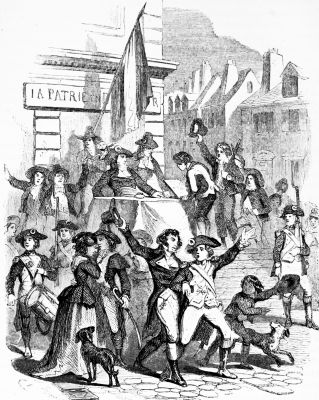
THE COUNTRY PROCLAIMED IN DANGER.
"General Luckner and I," said he to the king, "will come to Paris to attend the celebration of the demolition of the Bastille on the 14th of July. In company with us, the next day, the king with his family shall visit Compiègne, fifty miles north of Paris. The people will have sufficient confidence in us to make no opposition. Should there be opposition we will have a sufficient force of dragoons at hand to strike by surprise and release you. Ten squadrons of horse-artillery shall there receive the monarch and conduct him to the army on the frontiers. The king shall then issue a decided proclamation forbidding his brothers and the emigrants to advance another step toward the invasion of France, declaring, in terms which can not be misinterpreted, his determination to maintain the Constitution, and announcing his readiness to place himself at the head of the army to repel the enemy. This decisive measure will satisfy France that the king is its friend not its foe. The allies can make no headway against France united under its monarch. The king can then return triumphant to Paris, amid the universal acclamations of the people, a constitutional monarch beloved and revered by his subjects."[340]
This was the wisest course which, under the circumstances, could possibly have been pursued. It was constitutional. It would have been the salvation of the king and of France. Many of the king's personal friends entreated him, with tears, to repose confidence in La Fayette, and to comply with the counsels of the only man who could rescue him from destruction. But the fickle-minded king was now in the hands of the queen and the courtiers, and was guided at their pleasure. All their hopes were founded in the re-establishment of despotism by foreign invasion. The generous plan of La Fayette was rejected with a cold and almost insulting repulse.
"The best advice," replied the king, "which can be given to La Fayette is to continue to serve as a bugbear to the factions by the able performance of his duty as a general."
The queen was so confident that in a few weeks the allied armies would be in Paris, and that any acts of disrespect on the part of the people would only tend to hasten their march, that when Colombe, the aid-de-camp of La Fayette, remonstrated against the infatuation of so fatal a decision, she replied, "We are much obliged to your general for his offer, but the best thing which could happen to us would be to be confined for two months in a tower."
When La Fayette was thus periling his life to save the royal family he knew that, by the queen's orders, pamphlets filled with calumny were composed against him, and were paid for out of the king's salary.[341]
The court was secretly and very energetically recruiting defenders for the approaching crisis. They had assembled at the Tuileries a regiment of Swiss mercenaries, amounting to about a thousand men, who, under rigid military discipline, would be faithful to the king. A large number of general and subaltern officers, strong royalists, were provided with lodgings in Paris, awaiting any emergence. Several hundred royalist gentlemen from the provinces, in chivalrous devotion to the monarchy, were residing in hotels near the Tuileries, always provided with concealed weapons, and with cards which gave them admission at any hour into the palace. Secret bodies of loyalists were organized in the city, who were also ready to rush, at a given signal, to the defense of the inmates of the Tuileries. The servants in the chateaux were very numerous, and were all picked men. There were also in garrison in Paris ten thousand troops of the line who were devoted to the king.
With such resources immediately at hand, and with nearly all the monarchies of Europe in alliance to march to their rescue, it is not surprising that the king and queen should have felt emboldened to brave the perils which surrounded them.[342] The Royalists were exultant, and already, in the provinces of La Vendée and on the Rhone, they had unfurled the white banner of the Bourbons, were rallying around it by thousands, and had commenced the slaughter of the patriots who, in these provinces, were in the minority.
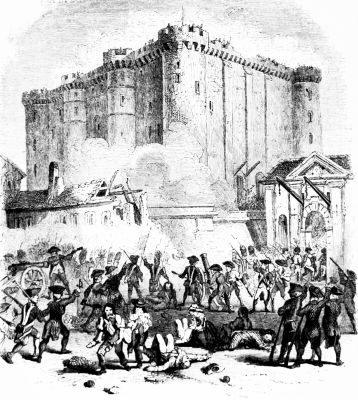
STORMING THE BASTILLE.
Such was the state of affairs when the 14th of July arrived, the day for the great celebration of the demolition of the Bastille. The king and queen could not avoid participating in the ceremonies, though it was greatly feared that attempts might be made for their assassination. A breast-plate, in the form of an under waistcoat, was secretly made for the king, consisting of fifteen folds of Italian silk, strongly quilted, which was found, upon trial, to be proof against dagger or bullet. Madame Campan wore it for three days before an opportunity could be found for the king to try it on unperceived. The king, as he drew it on, said,
"It is to satisfy the queen that I submit to this inconvenience."
A corset of similar material was also prepared for the queen. She, however, refused to wear it, saying, "If the rebels assassinate me it will be a most happy event. It will release me from the most sorrowful existence, and may save from a cruel death the rest of the family."
The Field of Mars was the site for the festival. Eighty-three gorgeous tents were reared, representing the eighty-three departments of France. Before each of these was planted a tree of liberty, from the tops of which waved the tricolored banner. On one side of this vast parade-ground there was an immense tree planted, called the tree of feudalism. Its boughs were laden with memorials of ancient pride and oppression—blue ribbons, tiaras, cardinals' hats, St. Peter's keys, ermine, mantles, titles of nobility, escutcheons, coats of arms, etc. It was in the programme of the day that the king, after taking anew the oath of fidelity to the Constitution, was to set fire to the tree of feudalism with all its burden of hoary abuses.
The king and royal family joined the procession at the Tuileries, and with saddened hearts and melancholy countenances performed their part in the ceremonies. "The expression of the queen's countenance," says Madame de Staël, "on this day will never be effaced from my remembrance. Her eyes were swollen with tears, and the splendor of her dress and the dignity of her deportment formed a striking contrast with the train that surrounded her."
When the procession arrived at the Field of Mars, where an immense concourse was assembled, the queen took her station upon a balcony which was provided for her, while the king was conducted slowly through the almost impenetrable throng to the altar where the oath was to be administered. The queen narrowly and anxiously watched his progress with a glass. In ascending the altar the monarch took a false step, and seemed to fall. The queen, thinking he had been struck by a dagger, uttered a shriek of terror, which pierced the hearts of all around her. The king, however, ascended the altar, and took the oath.
The people wished him then to set fire to the feudal tree. But he declined, very pertinently remarking that there was no longer any feudalism in France. Some of the deputies of the Assembly then lighted the pile, and as it was wreathed in flames the shoutings of the multitude testified their joy. The partisans of the king succeeded in raising a few shouts of Vive le Roi, which lighted up a momentary smile upon the wan face of the king. But these were the last flickering gleams of joy. The royal family returned in deepest dejection to the palace. They were conscious that they had but performed the part of captives in gracing a triumph, and they never again appeared in the streets of Paris until they were led to their execution.
The alarming decree of the Assembly that the country was in danger, and the call for every man to arm, had thrown all France into commotion. The restless, violent, and irresponsible are ever the first to volunteer for war. These were rapidly organized in the departments into regiments and battalions, and sent on to Paris. Thus, notwithstanding the veto of the king, an immense force was fast gathering in the capital, and a force who felt that the king himself was the secret treacherous foe from whom they had the most to fear. The Assembly, dreading conspiracy at home more than open war from abroad, now sent the king's troops, upon whose fidelity to the nation they could not rely, to the frontiers. The court opposed this measure, as they did not wish to strengthen even the feeble resistance which they supposed the allies would have to encounter, and also wished to retain these troops for their own protection against any desperate insurrection of the people. The king consequently wished to interpose his veto, but was advised that he could not safely adopt that measure in the then exasperated state of the public mind. The removal of these troops very decidedly weakened the strength of the Royalists in Paris.
Such was the state of affairs on the 28th of July, when the allied army, amounting in its three great divisions to one hundred and thirty-eight thousand men, commenced its march upon France.
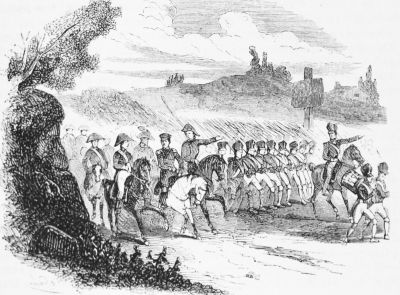
THE PRUSSIANS CROSSING THE FRONTIERS OF FRANCE.
The Duke of Brunswick was to pass the Rhine at Coblentz, ascend the left bank of the Moselle, and march upon Paris by the route of Longwy, Verdun, and Chalons. His immense force of cavalry, infantry, and artillery, with its enormous array of heavy guns and its long lines of baggage and munition wagons, covered a space of forty miles. The Prince of Hohenlohe, marching in a parallel line some twenty miles on his left, led a division of the emigrants and the Hessian troops. His route led him through Thionville and Metz. The Count de Clairfayt, an Austrian field-marshal, who has been esteemed the ablest general opposed to the French during the Revolutionary war, conducted the Austrian troops and another division of the emigrants along other parallel roads upon the right, to fall upon La Fayette, who was stationed before Sedan and Mézieres. It was supposed that he would easily scatter the feeble forces which Louis XVI. had permitted to be stationed there; and then he was to press rapidly upon Paris by Rheims and Soissons.[343]
The friends of liberty now saw no possible way of rescuing France from its peril and of saving themselves from the scaffold, but by wresting the executive power from the king and the court, who were in co-operation with the foe. This could only be done by a revolution, for the Constitution conferred no right upon the Assembly to dethrone the king. The Girondists or moderate Republicans, detesting the Jacobins and appalled in view of the anarchy which would ensue from arming the mob of Paris, wished to have the Assembly usurp the power and dethrone the king. The Jacobins, who hoped to ride into authority upon the waves of popular tumult, deliberately resolved to demolish the throne by hurling against it the infuriate masses of the people. It was calling into action the terrible energies of the earthquake and the tornado, knowing that their ravages, once commenced, could be arrested by no earthly power.
The plan first formed was to rouse the people in resistless numbers, march upon the Tuileries, take the king a prisoner, and hold him in the Castle of Vincennes as a hostage for the good conduct of the emigrants and the allies. The appointed day came, and Paris was thrown into a state of terrible confusion. But the court had been admonished of the movement. The palace was strongly defended, and in consequence of some misunderstanding it was found that there was not sufficient concert of action to attempt the enterprise.
A new scheme was now formed, energetic and well-adapted to the effectual accomplishment of its purpose. At the ringing of the tocsin forty thousand men were to be marshaled in the faubourg St. Antoine. Another immense gathering of the populace was to rally in the faubourg St. Marceau. All the troops in the metropolis from the provinces were to be arrayed at the encampment of the Marseilles battalion. They were then to march simultaneously to the palace, fill the garden and the court of the Carrousel, and invest the Tuileries on all sides. Here they were to encamp with all the enginery of war, and fortify their position by ditches, barricades, and redoubts. No blood was to be shed. There was to be no assault upon the palace, and no forcible entry. The king was to be blockaded, and the Assembly was to be informed that the populace would not lay down their arms until the king was dethroned, and the Legislature had adopted measures to secure the safety of the country.[344] In this plan there was something generous and sublime. It endeavored to guard carefully against disorder, pillage, and blood. It was the majestic movement of the people rising in self defense against its own executive in combination with foreign foes. Barbaroux, the leader of the Marseillese, sketches this plan in pencil. It was copied by Fournier, and adopted by Danton and Santerre.[345]
Several of the leaders of the Girondists, anxious to avert the fearful crisis now impending, wrote a noble letter to the king containing considerations just and weighty, which ought to have influenced him to corresponding action. The letter was written by Vergniaud, Gaudet, and Gensonné, three of the brightest ornaments of the Legislative Assembly.
"It ought not to be dissembled," said these men to the king, "that it is the conduct of the executive power that is the immediate cause of all the evils with which France is afflicted, and of the dangers with which the throne is surrounded. They deceive the king who would lead him to suppose that it is the effervesence of the clubs, the manœuvres of particular agitators and powerful factions that have occasioned and continued those disorderly movements, of which every day increases the violence, and of which no one can calculate the consequences. Thus to suppose is to find the cause of the evil in what are only the symptoms. The only way to establish the public tranquillity is for the king to surround himself with the confidence of his people. This can only be done by declaring, in the most solemn manner, that he will receive no augmentation of his power that shall not be freely and regularly offered him by the French nation without the assistance or interference of any foreign powers.
"What would be, perhaps, sufficient at once to re-establish confidence would be for the king to make the coalesced powers acknowledge the independence of the French nation, cease from all farther hostilities, and withdraw the troops that menace our frontiers. It is impossible that a very great part of the nation should not be persuaded that the king has it in his power to put an end to the coalition; and while that coalition continues and places the public liberty in a state of peril, it is in vain to flatter the king that confidence can revive."
The court regarded this letter as insolent, and the king returned an answer which declared that he should pay no attention whatever to its suggestions.
On the 30th of July the troops from Marseilles had arrived, five hundred in number, composed of the most fiery and turbulent spirits of the South. The clubs and journals and shouts of the people had for some time been demanding of the Assembly the suspension of the king. But the Assembly, restrained by respect for the Constitution, hesitated in the adoption of a measure so revolutionary and yet apparently so necessary. The insurrection now planned, unless it could be quelled by the king's forces, was sure to accomplish its end. If the Assembly did not in its consternation pronounce the throne vacant, or if the king did not in his terror abdicate, the whole royal family was to be held in a state of blockade, and it could not be disguised that they were in danger of falling victims to the rage of the ungovernable mob. This was the plan deliberately formed and energetically executed. It was patriotism's last and most terrible resort. Humanity is shocked by the measure. Yet we must not forget that foreign armies were approaching, and the king was in complicity with them, and thwarting all measures for effectual resistance. The court was organizing the partisans of the king to unite with the foreigners in all the horrors of civil war. A nation of twenty-five millions of freemen were again to be enslaved. All the patriots who had been instrumental in securing liberty for France were to be consigned to exile, the dungeon, and the scaffold. If ever a people were excusable in being thrown into a state of blind ungovernable fury, it was the people of France in view of such threats.
Paris was in this state of panic when the atrocious proclamation of the Duke of Brunswick reached the city. The king had sent a secret embassador, Mallet du Pan, to the allies, suggesting the tone of the manifesto he wished them to issue. Some of his suggestions they adopted, and added to them menaces as cruel and bloody as any deeds ever perpetrated by a mob.
"Their majesties," said the duke in this manifesto, "the emperor, and the king of Prussia, having intrusted me with the command of the combined armies, assembled by their orders on the frontiers of France, I am desirous to acquaint the inhabitants of that kingdom with the motives which have determined the measures of the two sovereigns, and the intentions by which they are guided."
He then stated that one object which the sovereigns had deeply at heart was "to put an end to the anarchy in the interior of France; to stop the attacks directed against the throne and the altar, to re-establish the regal power, to restore to the king the security and liberty of which he is deprived, and to place him in a condition to exercise the legitimate authority which is his due."
He then declared, in violation of all the rules of civilized warfare, that "such of the national guards as shall have fought against the troops of the two allied courts, and who shall be taken in arms, shall be punished as rebels against their king." This doomed every French patriot who should resist the invaders to be shot or hanged.
"The inhabitants of cities, towns, and villages," continued this savage declaration, "who shall dare to defend themselves against the troops of their imperial and royal majesties, and to fire upon them either in the open field or from their houses, shall be instantly punished with all the rigor of the laws of war, and their houses demolished or burned.
"The city of Paris and all its inhabitants without distinction, are required to submit immediately to the king, to set him at entire liberty, to insure to him, as well as to all the royal personages, the inviolability and respect which subjects owe their sovereigns. Their imperial and royal majesties hold the members of the National Assembly, of the department, of the district, of the municipality, and of the National Guard of Paris, the justices of the peace, and all others whom it may concern, personally responsible with their lives for all that may happen; their said majesties declaring, moreover, on their faith and word as emperor and king, that if the palace of the Tuileries is forced or insulted, that if the least violence, the least outrage is offered to their majesties the king and queen and to the royal family, if immediate provision is not made for their safety, their preservation, and their liberty, they will take an exemplary and ever-memorable vengeance, by giving up the city of Paris to military execution and total destruction, and the rebels guilty of outrages to the punishments they shall have deserved."[346]
This ferocious document was printed in all the Royalist papers in Paris on the 28th of July. The king immediately issued a message disavowing any agency in the manifesto. But the people no longer had any confidence in the word of the king. Paris was thrown into a state of terrible agitation. The forty-eight sections of Paris met, and commissioned the mayor, Pétion, to appear before the General Assembly, and petition, in their name, the dethronement of the king. On the 3d of August, Pétion, at the head of a numerous deputation, presented himself before the Assembly. In an address, calm, unimpassioned, but terrible in its severity, he retraced the whole course of the king from the commencement of the Revolution, and closed with the solemn demand for the dethronement of Louis XVI., as the most dangerous enemy of the nation. The Assembly was embarrassed by its desire to adhere to the Constitution which it had sworn to obey. The dethronement of the king was not a constitutional but a revolutionary act. A long and stormy debate ensued, during which the hall was flooded with petitions against the king. The king's friends were again intensely anxious to secure his escape. But the king would not listen to their plans, for he was so infatuated as to believe that the Duke of Brunswick would soon, by an unimpeded march, be in Paris for his rescue.
The sympathy which La Fayette had manifested for the royal family had now ruined him in the esteem of the populace. He was every where denounced as a traitor, and a strong effort was made to compel the Assembly to indite a bill of accusation against him. But La Fayette's friends in the chamber rallied, and he was absolved from the charge of treason by a vote of four hundred and forty-six against two hundred and eighty. The populace was so exasperated by this result that they heaped abuse upon all who voted in his favor, and several of them were severely maltreated by the mob. The National Assembly had now become unpopular. It was ferociously denounced in the club of the Jacobins and in all the corners of the streets. In the mean time the insurrectionary committee, formed from the Jacobin club, were busy in preparation for the great insurrection. All hearts were appalled, for all could see that a cloud of terrific blackness was gathering, and no one could tell what limit there would be to the ravages of the storm.
At midnight, on the 9th of August, the dismal sound of the tocsin was heard. From steeple to steeple the boding tones floated through the dark air. A thousand drums beat the alarm at the appointed rendezvous, and the booming of guns shook the city. In an hour all Paris was in tumult. The clatter of iron hoofs, the rumbling of heavy artillery, the tramp of disciplined battalions, and the rush and the clamor of a phrensied mob, presented the most appalling scene of tumult and terror. A city of a million and a half of inhabitants was in convulsions. The friends of the king hurried to the palace, announcing with pale lips that the terrible hour had come. The event needed no announcement, for the whole city was instantly trembling beneath earthquake throes. The king, the queen, the two children, and Madame Elizabeth had assembled tremblingly in one of the rooms of the palace, as lambs huddle together when wolves are howling round the fold. Marie Antoinette was imperially brave, but she could not in that hour look upon her helpless son and daughter and not feel her maternal heart sink within her. Louis XVI. had the endurance of a martyr, but he could not, unmoved, contemplate the woes of his family.
The friends of the king speedily rallied, and brought up all their forces for his defense. The apartments of the palace were filled with Royalist gentlemen armed with swords, pistols, and even with shovels and tongs. Nine hundred Swiss guards, upon whom it was thought reliance could be reposed, were placed on the stairs, in the halls, and the large saloons. Six or eight hundred mounted dragoons were in one of the court-yards. Several battalions of the National Guard, who were most friendly to the king, were stationed in the garden with twelve pieces of artillery.[347] The defenders of the palace amounted in all to about four or five thousand men. But many of these were very lukewarm in their loyalty, and might at any moment be expected to fraternize with the populace.[348]
Pétion, the mayor, was sent for. He came, and after an awkward interview retired, leaving Mandat, who was general-in-chief of the National Guard, commander of the troops at the Tuileries. It was a sultry night. Every window at the Tuileries was thrown open, and the inmates listened anxiously to the uproar which rose from every part of the city. The queen and Madame Elizabeth ascended to a balcony opening from one of the highest stories of the palace. The night was calm and beautiful, the moon brilliant in the west, and Orion and the Pleiades shining serenely in the east.[349] There the queen and the princess stood for some time, trembling and in silence as the peal of bells, the clangor of drums, the rumbling of artillery wheels, and the shouts of the advancing bands, filled the air. From every direction, the east, the west, the north and the south, the portentous booming of the tocsin was heard, and infuriated insurgents, in numbers which could not be counted, through all the streets and avenues, were pouring toward the palace. The bridges crossing the river echoed with their tread, while the blaze of bonfires and the gleam of torches added to the appalling sublimities of the scene.[350]
The queen broke the silence. Pointing to the moon she said, "Before that moon returns again, either the allies will be here and we shall be rescued, or I shall be no more. But let us descend to the king."
The spectacle seemed but to have aroused the energies of Marie Antoinette. The spirit of her imperial mother glowed in her bosom.[351] Her cheeks were pale as death, her lips were compressed, her eyes flashed fire, and, as she returned to the room where her husband stood bewildered and submissive to his lot, she approached a grenadier, drew a pistol from his belt, and, presenting it to her husband, said,
"Now, sire! now is the time to show yourself a king."
But Louis XVI. was a quiet, patient, enduring man, with nothing imperial in his nature. With the most imperturbable meekness he took the pistol and handed it back to the grenadier. The mayor, Pétion, an active member of the Jacobin Club, had manifested no disposition to render effectual aid in the defense of the palace. But lest it should seem that he was heading the mob, he had reluctantly signed an order, as he left the Tuileries, authorizing the employment of force to repel force.
The insurgents had organized an insurrectional committee at the Hôtel de Ville, and immediately sent a summons for Mandat to present himself before them. Mandat, misinformed, understood that the summons came from the municipal government, and, as in duty bound, promptly obeyed. He had hardly left the palace ere word was brought back to the king that he had been assassinated by the mob. There was no longer any leader at the palace; no one to organize the defense; no one to issue commands. The soldiers in the court of the Tuileries and in the Garden were looking listlessly about and bandying jokes with the mob who were crowding against the iron railing.[352]
It was, however, now decided that the king should descend into the courts of the Carrousel, in the rear of the palace, and into the Garden, in front, to review the troops and ascertain the spirit with which they were animated.
The king was very fat, had an awkward hobbling gait, and a countenance only expressive of a passionless nature. He was dressed in a plain mourning-suit, with silk stockings, and buckles in his shoes. His dress was quite disarranged. In the early part of the night he had thrown himself upon a sofa for rest, and thus his hair, which was powdered and curled on one side, was without powder and in disorder on the other. Apprehensive that he might be assassinated before morning, he had spent some time in devotional exercises with his confessor, and his cheeks deathly pale, his swollen eyes and his trembling lips, plainly showed that he had been weeping. Thus he presented the aspect but of a king in his degradation. Had he been a spirited man, in uniform, mounted on horseback, he might, perhaps, have rallied the enthusiasm of the troops. As it was he could excite no other emotion than that of compassion, blended, perhaps, with contempt.
It was five o'clock of one of the most brilliant of summer mornings as the king, followed by the queen and his children, and accompanied by six staff officers, descended the marble stairs of the Tuileries and entered the royal court. The music of martial bands greeted him, the polished weapons of the soldiers gleamed in the rays of the sun as they presented arms, and a few voices rather languidly shouted Vive le Roi. Others, however, defiantly shouted Vive la Nation, thus showing that many of those who were marshaled for his defense were ready to unite with his assailants. The king stammered out a few incoherent words and returned to the palace.
The appearance of the queen in this terrible hour riveted every eye and excited even the enthusiasm of her foes. Her flushed cheek, dilated nostril, compressed lip, and flashing eye invested her with an imperial beauty almost more than human. Her head was erect, her carriage proud, her step dignified, and she looked around her upon applauding friends and assailing foes with a majesty of courage which touched every heart. Even the most ardent patriots forgot for the moment their devotion to liberty in the enthusiasm excited by the heroism of the queen. Re-entering the palace, the queen, in despair, ascended the stairs to the saloon, saying,
"All is lost. The king has shown no energy. A review like this has done us more harm than good."
The king, however, instead of ascending to his apartment, passed through the palace into the Garden to ascertain the disposition of the troops stationed there. With his small retinue he traversed the whole length of the Garden. Some of the battalions received him with applause, others were silent, while here and there voices in continually increasing numbers cried, "Down with the veto; down with the tyrant." As the king turned to retrace his steps, menaces and insults were multiplied. Some of the gunners even left their guns and thrust their fists in his face, assailing him with the most brutal abuse. The clamor penetrated the interior of the palace and the queen, turning pale as death, sank into a chair, exclaiming,
"Great God! they are hooting the king. We are all lost."
The king returned to the palace, pale, exhausted, perspiring at every pore, and overwhelmed with confusion and shame. He immediately retired to his cabinet. Roederer,[353] chief magistrate of the Department of the Seine, who had witnessed the hostile disposition of the troops, now hastened to the chateau and asked permission to speak to his majesty in private, with no witnesses but the royal family. He entered the royal cabinet and found the king with his elbows resting on his knees and his face buried in his hands. All retired but the royal family and the king's ministers.
"Sire," said M. Roederer, "you have not a moment to lose. Neither the number nor the disposition of the men here assembled can guarantee your life or the lives of your family. There is no safety for you but in the bosom of the Assembly."
The hall of the Assembly was in the old monastery of the Feuillants, situated on the western side of the Garden, where the Rue de Rivoli now runs. The royal family could consequently descend into the Garden, which was filled with troops collected there for their defense, and crossing the Garden could enter the hall with but little exposure.
But such a refuge to the high-spirited queen was more dreadful than death. It was draining the cup of humiliation to its dregs.
"Go to the Assembly!" exclaimed the queen; "never! never will I take refuge there. Rather than submit to such infamy I would prefer to be nailed to the walls of the palace."
"It is there only," M. Roederer replied, "that the royal family can be in safety. And it is necessary to escape immediately. In another quarter of an hour, perhaps, we shall not be able to command a retreat."
"What," rejoined the queen, "have we no defenders? Are we alone?"
"Yes, madame," replied Roederer, "we are alone. The troops in the Garden and in the court are fraternizing with your assailants and turning their guns against the palace. All Paris is on the march. Action is useless. Resistance is impossible."
A gentleman present, who had been active in promoting reform, ventured to add his voice in favor of an immediate retreat to the Assembly. The queen turned upon him sternly, and said,
"Silence, sir, silence! It becomes you to be silent here. When the mischief is done, those who did it should not pretend to wish to remedy it."[354]
M. Roederer resumed, saying, "Madame, you endanger the lives of your husband and your children. Think of the responsibility which you take upon yourself."
The king raised his head, fixed a vacant stare of anguish for a moment on M. Roederer, and then, rising, said, "Marchons" (Let us go).
The queen, unable any longer to shut her eyes to the fatality, turning to M. Roederer, eagerly added, "You, sir, are answerable for the life of the king and for that of my son."
"Madame," M. Roederer replied, "we undertake to die by your side, but that is all we can promise." It was then eight o'clock in the morning.
A guard of soldiers was instantly called in, and the melancholy cortège left the palace. The Swiss troops and the loyalist gentlemen, who filled the apartments, looked on in consternation and despair. There was no apparent escape for them, and they seemed to be abandoned to their fate. As the king was crossing the threshold he thought of his friends, and his heart seemed to misgive him. He hesitated, stopped, and, turning to M. Roederer, said, "What is to become of our friends who remain behind?" M. Roederer pacified the king by assuring him, though falsely, that by throwing aside their arms and their uniform they would be able to escape in safety.
They then entered the Garden and crossed it, unopposed, between the two files of bayonets. The leaves of autumn strewed the paths, and the young dauphin amused himself in kicking them as he walked along. It is characteristic of the mental infirmities of the king that in such an hour he should have remarked, "There are a great many leaves. They fall early this year."
When they arrived at the door at the foot of the staircase which led to the hall of the Assembly, they found an immense crowd of men and women there blocking up the entrance. "They shall not enter here," was the cry; "they shall no longer deceive the nation. They are the cause of all our misfortunes. Down with the veto! Down with the Austrian woman! Abdication or death!"
"Sire," said one, in compassionate tones to the king, "Don't be afraid. The people are just. Be a good citizen, sire, and send the priests and your wife away from the palace."
The soldiers endeavored to force their way through the crowd, and, in the struggle, the members of the royal family were separated from each other. A stout grenadier seized the dauphin and raised him upon his shoulders. The queen, terrified lest her child was to be taken from her, uttered a piercing shriek. But the grenadiers pressed forward through the crowd, and, entering the hall with the king and queen, placed the prince royal on the table of the Assembly.
The illustrious Girondist M. Vergniaud was in the chair. The king approached him and said,
"I have come hither to prevent a great crime. I thought I could not be safer than with you."
"You may rely, sire," Vergniaud replied, "on the firmness of the Assembly. Its members have sworn to die in supporting the rights of the people and the constituted authority."
The king took his seat. There were but few members present. A mournful silence pervaded the hall as the deputies, with saddened countenances and sympathetic hearts, gazed upon the king, the queen, Madame Elizabeth, the beautiful young princess, and the dauphin, whom the queen held by the hand. All angry feelings died in presence of the melancholy spectacle, for all felt that a storm was now beating against the throne which no human power could allay.
FOOTNOTES:
CHAPTER XXVIII.
THE ROYAL FAMILY IMPRISONED.
Tumult and Dismay in the Assembly.—Storming the Tuileries.—Aspect of the Royal Family.—The Decree of Suspension.—Night in the Cloister.—The Second Day in the Assembly.—The Royal Family Prisoners.—Third Day in the Assembly.—The Temple.—The Royal Family Transferred to the Temple.
But few of the excited thousands who crowded all the approaches to the Tuileries were conscious that the royal family had escaped from the palace. The clamor rapidly increased to a scene of terrific uproar. First a few gun-shots were heard, then volleys of musketry, then the deep booming of artillery, while shouts of onset, cries of fury, and the shrieks of the wounded and the dying filled the air. The hall of the Assembly was already crowded to suffocation, and the deputies stood powerless and appalled. A tumultuous mass pressed the door. Blows, pistol-shots, and groans of death were heard beneath the windows, and it was every moment apprehended that the assassins would break into the hall, and that the royal family and all their defenders would be cut down. Several bullets shattered the windows, and one or two cannon-balls passed through the roof of the building. Every one was exposed to fearful peril.
There was no longer any retreat for the king. By the side of the president's chair there was a space inclosed by an iron railing, appropriated to the reporters. Several of the members aided the king in tearing down a portion of this railing, and all the royal family sought refuge there. At this moment the door of the hall was attacked, and tremendous blows seemed to shake the whole building. "We are stormed!" shouted one of the deputies. There was, however, no escape for any one in any direction, and for some moments there was witnessed a scene of confusion and terror which no language can describe.
At the same time there was a frightful conflict raging in and around the palace. Immediately upon the departure of the king, all the Swiss troops, who were hated as foreign mercenaries hired to shoot down the French, were drawn into the palace from the court-yard, and were mingled in confusion through its apartments with the loyalist gentlemen, the officers, and the domestics. Notwithstanding the vast dimensions of the palace, it was so crowded that there was scarcely space to move.
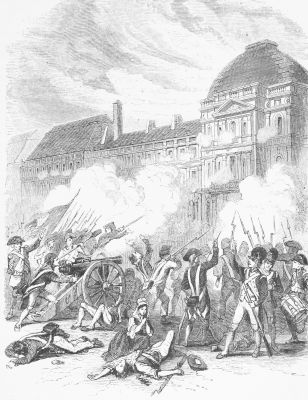
STORMING THE TUILERIES, AUGUST 10, 1792.
The throng in the Carrousel attacked one of the gates, broke it down, and rushed into the royal court, which was nearly vacated by the retirement of the Swiss. The companies of the National Guard in the Carrousel, instead of opposing, looked approvingly on, and were evidently quite disposed to lend the assailants a helping hand. A large piece of timber was placed at the foot of the staircase of the palace in the form of a barrier, and behind this were intrenched in disorder, crowding the steps, the Swiss and some of the National Guard who adhered to the king.[355]
Just then the whole Faubourg St. Antoine came marching along in solid column. They marched through the Carrousel, entered the court, and placed six pieces of cannon in battery to open a fire upon the palace. It was to avoid, if possible, a conflict, that the guards had been withdrawn from the court into the palace. The shouts of a countless multitude applauded this military movement of the mob. The Swiss had received command from the king not to fire. The crowd cautiously pressed nearer and nearer to the door, and at length, emboldened by the forbearance of the defenders of the palace, seized, with long poles to which hooks were attached, one after another of the sentinels, and, with shouts, captured and disarmed them. Thus five of the Swiss troops were taken prisoners.
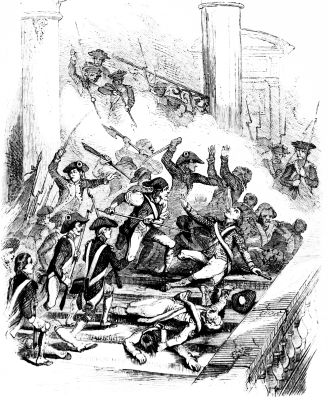
MASSACRE OF THE ROYAL GUARD, AUGUST 10, 1792.
At last a single shot was fired, no one can tell on which side. It was the signal for blood. The Swiss, crowded upon the magnificent marble stairs, rising one above another, occupied a very formidable position. They instantly opened a deadly fire. Volley succeeded volley, and every bullet told upon the dense mass crowding the court. At the same moment, from every window of the palace, a storm of shot was showered down upon the foe. In a moment the pavement was red with blood, and covered with the dying and the dead. The artillerymen abandoned their pieces, and the whole multitude rushed pell-mell, trampling the dead and wounded beneath them in frantic endeavors to escape from the court into the Carrousel. In a few moments the whole court was evacuated, and remained strewed with pikes, muskets, grenadiers' caps, and gory bodies.
The besiegers, however, soon rallied. Following the disciplined troops from Marseilles, who were led by able officers, the multitude returned with indescribable fury to the charge. Cannon-balls, bullets, and grapeshot dashed in the doors and the windows. Most of the loyalist gentlemen escaped by a secret passage through the long gallery of the Louvre, as the victorious rabble, with pike, bayonet, and sabre, poured resistlessly into the palace and rushed through all its apartments. The Swiss threw down their arms and begged for quarter. But the pitiless mob, exasperated by the slaughter of their friends, knew no mercy. Indiscriminate massacre ensued, accompanied with every conceivable act of brutality. For four hours the butchery continued, as attics, closets, cellars, chimneys, and vaults were searched, and the terrified victims were dragged out to die. Some leaped from the windows and endeavored to escape through the Garden. They were pursued and mercilessly cut down. Some climbed the marble monuments. The assassins, unwilling to injure the statuary, pricked them down with their bayonets and then slaughtered them at their feet. Seven hundred and fifty Swiss were massacred in that day of blood.
The Assembly during these hours were powerless, and they awaited in intense anxiety the issue of the combat. Nothing can more impressively show the weak and frivolous mind of the king than that, in such an hour, seeing the painter David in the hall, he inquired of him,
"How soon shall you probably have my portrait completed?"
David brutally replied, "I will never, for the future, paint the portrait of a tyrant until his head lies before me on the scaffold."[356]
The queen sat in haughty silence. Her compressed lip, burning eye, and hectic cheek indicated the emotions of humiliation and of indignation with which she was consumed. The young princess wept, and her fevered face was stained with the dried current of her tears. The dauphin, too young to appreciate the terrible significance of the scene, looked around in bewildered curiosity.
At eleven o'clock reiterated shouts of victory, which rose from the Garden, the palace, the Carrousel, and all the adjoining streets and places, proclaimed that the triumph of the people was complete. The Assembly, now overawed, unanimously passed a decree suspending the king, dismissing the Royalist ministers, recalling the Girondist ministry, and convoking a National Assembly for the trial of the king. As Vergniaud read, in accents of grief, this decree to which the Assembly had been forced, the king listened intently, and then said satirically to M. Coustard, who was standing by his side,
"This is not a very constitutional act."
"True," M. Coustard replied; "but it is the only means of saving your majesty's life."
The Assembly immediately enacted the decrees, which the king had vetoed, banishing the refractory priests and establishing a camp near Paris. Danton,[357] whose tremendous energies had guided the insurrection, was appointed Minister of Justice. Monge, the illustrious mathematician, by the nomination of his equally illustrious friend Condorcet, was placed at the head of the Marine. Lebrun, a man of probity and untiring energy, was appointed Minister of Foreign Affairs.
Thus was the whole government effectually revolutionized and reorganized. During all the long hours of this day the royal family sat in the crowded Assembly almost suffocated with heat, and enduring anguish which no tongue can tell. The streets were filled with uproar, and the waves of popular tumult dashed against the old monastery of the Feuillans, even threatening to break in the doors. The regal victims listened to the decrees which tore the crown from the brow of the king, and which placed his sceptre in the hands of his most envenomed foes. In the conflict with the defenders of the palace, between three and four thousand of the populace had perished, in revenge for which nearly eight hundred of the inmates of the Tuileries had been massacred. The relatives of the slain citizens, exasperated beyond measure, were clamorous for the blood of the king as the cause of the death of their friends. There was no possible covert for the royal family but in the Assembly. Fifty armed soldiers, with bayonets fixed, surrounded them in their box, and yet it was every moment feared that the populace would break in and satiate their rage with the blood of the monarch and his family.
The king was ever famed for his ravenous appetite. Even in the midst of these terrific scenes he was hungry and called for food. Bread, wine, and cold viands were brought to him. He ate and drank voraciously to the extreme mortification of the queen, who could not but perceive how little respect the conduct of the king inspired. Neither she, Madame Elizabeth, nor the children could taste of any food. They merely occasionally moistened their fevered lips with iced water.
It was now ten o'clock in the evening. The night was calm and beautiful. The tumult of the day was over, but the terrific excitement of the scene had brought the whole population of Paris out into the promenades. Fires were still blazing beneath the trees of the Tuileries, consuming the furniture which had been thrown from the windows of the chateau. Lurid flames flashed from the barracks of the Swiss in the court-yard, which had been set on fire, streaming over the roof of the palace, and illuminated both banks of the Seine.
The whole number slain during the day, Royalists and Revolutionists, amounted to over four thousand. Many of the dead had been removed by relatives, but the ground was still covered with the bodies of the slain, who were entirely naked, having been stripped of their clothing by those wretches who ever swarm in the streets of a great city, and who find their carnival in deeds of violence and blood. By order of the insurrectional committee at the Hôtel de Ville, who had deposed the municipal government and usurped its authority, these dead bodies were collected and piled in vast heaps in the court-yards, in the Garden, in the Place Louis XV., and in the Elysian Fields. Immense quantities of wood were thrown upon them, and the whole city was illuminated by the glare of these funeral fires. The Swiss and the Marsellais, the Royalists and the Jacobins, were consumed together, and the ashes were swept clean from the pavement into the Seine.
As these scenes at midnight were transpiring in the streets, the Assembly sent a summary of its decrees to be read by torch-light to the groups of the people. It was hoped that these decrees would satisfy them, and put a stop to any farther acts of violence on the morrow. It was two o'clock in the morning before the Assembly suspended its sitting. For seventeen hours the royal family had sat in the reporters' box, enduring all of humiliation and agony which human hearts can feel.
In the upper part of the old monastery, above the committee-rooms of the Assembly, there was a spacious corridor, from which opened several cells formerly used by the monks. These cells, with walls of stone and floors of brick, and entirely destitute of furniture, were as gloomy as the dungeons of a prison. Here only could the king and his family find safety for the night. Some articles of furniture were hastily collected from different parts of the building, and four of these rooms were prepared for the royal party. Five nobles, who had heroically adhered to the king in these hours of peril, occupied one, where, wrapped in their cloaks and stretched out upon the floor, they could still watch through the night over the monarch. The king took the next. It was furnished with a table, and a plain wooden bedstead. He bound a napkin around his head for a night-cap, and threw himself, but partially undressed, upon his uncurtained bed. The queen, with her two children, took the next cell. Madame Elizabeth, with the governess of the children, Madame de Tourzel, and the Princess Lamballe, who had joined the royal family in the evening, took the fourth. Thus, after thirty-six hours of sleeplessness and terror, the royal family were left to such repose as their agitated minds could attain.
The sun had long arisen when the queen awoke from her fevered slumber. She looked around her for a moment with an expression of anguish, and then, covering her eyes with her hands, exclaimed,
"Oh, I hoped that it had all been a dream!"
The whole party soon met in the apartment of the king. As Madame Tourzel led in the two royal children, Marie Antoinette looked at them sadly, and said,
"Poor children! how heart-rending it is, instead of handing down to them so fine an inheritance, to say, it ends with us!"
"I still see, in imagination," writes Madame Campan, "and shall always see, that narrow cell of the Feuillans, hung with green paper; that wretched couch where the dethroned queen stretched out her arms to us, saying that our misfortunes, of which she was the cause, aggravated her own. There, for the last time, I saw the tears, I heard the sobs of her whom her high birth, the endowments of nature, and, above all, the goodness of her heart, had seemed to destine for the ornament of a throne and for the happiness of her people."
The tumult of the streets still penetrated their cells, and warned them that they had entered upon another day of peril. The excited populace were still hunting out the aristocrats, and killing them pitilessly wherever they could be found. At ten o'clock the royal family were conducted again to the Assembly, probably as the safest place they could occupy, and there they remained all day. Several of the Swiss had been taken prisoners on the previous day, and by humane people had been taken to the Assembly that their lives might be saved. The mob now clamored loudly at the door of the hall, and endeavored to break in, demanding the lives of the Swiss and of the escort of the king, calling them murderers of the people. Vergniaud, the president, was so shocked by their ferocity that he exclaimed, "Great God, what cannibals!"
At one time the doors were so nearly forced that the royal family were hurried into one of the passages, to conceal them from the mob. The king, fully convinced that the hour of his death had now come, entreated his friends to provide for their safety by flight. Heroically, every one persisted in sharing the fate of the king. Danton hastened to the Assembly, and exerted all his rough and rude energy to appease the mob. They were at length pacified by the assurance that the Swiss, and all others who had abetted in the slaughter of the people on the preceding day, should be tried by a court-martial and punished. With great difficulty the Assembly succeeded in removing the Swiss and the escort of the king to the prison of the Abbaye.
At the close of this day the king and his family were again conducted to their cells, but they were placed under a strict guard, and their personal friends were no longer permitted to accompany them. This last deprivation was a severe blow to them all, and the king said bitterly,