Front matter (continued 6)
Reading edition
La Fayette gave a splendid review of the National Guard. The king, the queen, and the dauphin attended the review, and were warmly greeted by the people. The queen assumed the attitude of reconciliation, and graciously presented her hand to the delegates to kiss.
The delegates from the departments, before they left Paris, went in a body to present their homage to the king. With one voice they expressed to him their respect, gratitude, and affection. The chief of the Bretons dropped on his knee and presented to the monarch his sword.
"Sire," said he, "I deliver to you, pure and sacred, the sword of the faithful Bretons. It shall never be stained but with the blood of your enemies."
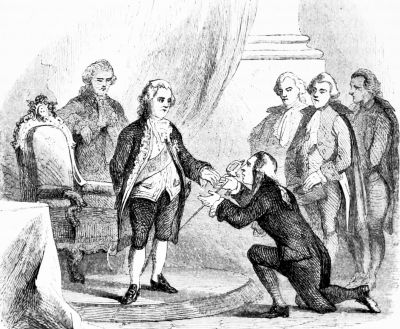
LOUIS XVI. AND THE DEPUTATION OF THE BRETONS.
The heart of the kind-hearted king was touched. He returned the sword, and, throwing his arms around the neck of the chief of the Bretons, said, in tones broken with emotion,
"That sword can not be in better hands than those of my dear Bretons. I have never doubted their fidelity and affection. Assure them that I am the father, the brother, the friend of all the French."
For a moment there was silence, and all alike were moved by the affecting scene. The chief of the Bretons then rejoined,
"Sire, all the French, if I may judge from our hearts, love and will love you because you are a citizen-king."
Many of the most influential men in England contemplated with admiration this immense reform, in which, to use the language of Professor William Smyth, one of the most candid of English writers, "the Constituent Assembly was supposed to have freed the country from temporal and spiritual thraldom; the government had been rested on free principles; the Bastille had been destroyed, lettres de cachet abolished, feudal impediments and oppressions of every kind removed, religious liberty established, the system of law made uniform, the criminal jurisprudence reformed, monasteries abolished; and by making the military force consist of the citizens of the country, freedom, and all those new and weighty advantages, seemed to be forever secured from the machinations of arbitrary power."
The aristocracy, however, of England and Europe were struck with alarm. The emancipation of the people in France threatened their emancipation throughout the civilized world. Edmund Burke espoused the cause of the aristocracy. With eloquence quite unparalleled he roused England and Europe to war. In view of his fierce invectives Michelet exclaims, in language which will yet be pronounced by the world as not too severe,
"Mr. Pitt, feeling sure of the European alliance, did not hesitate to say in open parliament that he approved of every word of Burke's diatribe against the Revolution and against France—an infamous book, full of calumny, scurrilous abuse, and insulting buffoonery; in which the author compares the French to galley-slaves breaking their chains, treads under foot the declaration of the rights of man, tears it in pieces and spits upon it. Oh! what a cruel, painful discovery. Those whom we thought our friends are our most bitter enemies."[257]
Thirty thousand copies of Burke's memorable "Reflections" were sold almost in a day. The sovereigns of Europe were so highly elated that they transmitted to him their thanks. The nobles and the higher clergy of France wrote to him letters of acknowledgment, and the nobility of England lavished upon him their applause. These "Reflections" combined aristocratic Europe against popular rights, and the people had no resource left them but to defend their liberties with the sword.
FOOTNOTES:
CHAPTER XX.
FLIGHT OF THE KING.
Riot at Nancy.—Prosecution of Mirabeau.—Issue of Assignats.—Mirabeau's Interview with the Queen.—Four political Parties.—Bishops refuse to take the Oath to the Constitution.—Character of the Emigrants.—The King's Aunts attempt to leave France.—Debates upon Emigration.—Embarrassment of the Assembly.—Death of Mirabeau.—His Funeral.—The King prevented from visiting St. Cloud.—Duplicity of the King.—Conference of the Allies.—Their Plan of Invasion.—Measures for the Escape of the King.—The Flight.
The grand gala days, in the Field of Mars, celebrating the formation of the Constitution, soon passed. The twenty thousand delegates, having been fêted even to satiety, returned to their homes; the Constituent Assembly resumed its labors.[258] The cares and toils of life again pressed heavily upon the tax-exhausted and impoverished millions of France.
The Belgians, in imitation of France, had commenced a struggle for freedom. The King of France permitted Austria to send her troops across the French territory into Belgium to crush the patriots. Many of the most influential of the opponents of the Revolution were still leaving France and uniting with the armed emigrants on the frontiers. England, Austria, Sardinia, and Prussia were manifestly forming an alliance to punish the French patriots, and to restore the tyranny of the execrable old régime. The court, emboldened by these proceedings, were boasting of the swift destruction which was to overwhelm the advocates of reform, and commenced a prosecution of Mirabeau, the Duke of Orleans, and others of the popular party, for instigating the movement of the 5th and 6th of October, when the royal family were taken from Versailles to Paris. These movements created much alarm, and even the royal troops at Metz and Nancy, who were mostly composed of Swiss and Germans, fraternized with the populace.
A new issue of eight hundred millions of bonds or assignats was decreed, which quite abundantly replenished the treasury. There was never a paper currency created upon so valuable a pledge, or sustained by security more ample and undoubted. The assignats represented the whole public domain, and could at any time be exchanged for the most valuable landed property. Still, Talleyrand with singular precision predicted the confusion which eventually resulted from these issues.
In the majestic march of events, Necker had for some time been passing into oblivion. The king had been forced to recall him. Hated by the court, neglected by the Assembly, forgotten by the people, he soon found his situation insupportable, and, sending in his resignation, retired to Switzerland, from which safe retreat he watched the terrific gatherings of the revolutionary storm.
Civil war was sure to break out the moment the court could obtain possession of the person of the king. The pliant nature of the monarch would immediately yield to the influences which surrounded him, and the court, under such circumstances, could find no difficulty in inducing him to sanction any acts of violence to regain their power. But while the king was in Paris, in the hands of the Assembly, he would sanction the decrees of the Assembly, and thus the aristocrats could not wage war against the patriots without at the same time waging war against the king. Foreign monarchies could not be induced to take this step. Thus the retention of the king was peace; his escape, civil war. The court were plotting innumerable plans to effect his escape. La Fayette, at the head of the National Guard, was fully awake to the responsibility of guarding him with the utmost vigilance. The king was apparently left at perfect liberty, but he was continually watched. The queen was exceedingly anxious for flight. The king was ever vacillating, but generally, influenced by such advisers as Mirabeau and La Fayette, inclined to accept the Revolution. He was also haunted with the idea that his cousin, the Duke of Orleans, wished to frighten him into flight, that the Assembly might declare the throne vacant, and place the sceptre in the duke's hand as the sworn friend and supporter of the Revolution.
Mirabeau had commenced his career as one of the most ardent advocates of reform, but he now wished to arrest the progress of the revolutionary chariot, as he affirmed that it had passed beyond its proper goal. His course was attributed by some to bribery on the part of the court. His friends say that he was only influenced by his own patriotic intelligence. At St. Cloud there is a retired summer-house, embowered in foliage, at the summit of a hill which crowns the highest part of the park. The queen appointed an interview with Mirabeau at this secluded spot.
The statesman of gigantic genius, who seemed to hold in his hand the destinies of France, left Paris on horseback one evening, under pretense of visiting a friend. Avoiding observation, he turned aside into a by-path until he reached a back gate of the park. Here he was met in the dark by a nobleman, who conducted him to the retreat of the queen, who was waiting to receive him. His constitution was already undermined by dissipation and unintermitted labors. His cheeks were sunken, his eyes inflamed, his complexion sallow, and a flabby corpulency announced the ravages of disease; but, notwithstanding all these defects, his genial spirit and courtly bearing made him one of the most fascinating of men.[259]
The queen was then thirty-five years of age. Care and grief had sadly marred her marvelous beauty. Her proud spirit was chagrined in being compelled to look for support to one of the leaders of the people. But little is known respecting what passed at this private interview. At its close Mirabeau said to the queen,
"Madam, when your august mother admitted one of her subjects to the honor of her presence, she never dismissed him without allowing him to kiss her hand."
The queen, responding to the gallantry, graciously presented her hand. Mirabeau, bowing profoundly, kissed it, and then, raising his head, said proudly,
"Madam, the monarchy is saved."[260]
Suddenly Mirabeau became rich, set up a carriage, furnished his house sumptuously, and gave magnificent entertainments. He immediately commenced a course of cautious but vigorous measures to overthrow the Constitution and establish one less democratic, which should give more stability and efficiency to the royal power. He affirmed that this was essential to the peace and prosperity of France, and that, instead of being bought over by the court, he had bought the court over to his views.
"But suppose the court refuses," said one of his friends, "to adopt your plans?"
"They have promised me every thing," Mirabeau replied.
"But suppose they should not keep their word?" it was rejoined.
"Then," said Mirabeau, "I will overthrow the throne and establish a republic."
It can hardly be denied that the Constitution was too democratic for a monarchy and hardly democratic enough for a republic. In the natural course of events public opinion would sway either to strengthening the throne or to diminish still more its prerogatives. There were now four parties in France. The first consisted of the old aristocratic classes of the clergy and the nobles, now mostly emigrants, and busy in effecting a coalition of surrounding monarchies to quell the Revolution, and by fire and sword to reinstate the rejected despotism of the Bourbons.
The second class was composed of the king and Mirabeau, with the queen reluctantly assenting to its principles, and others of the nobles and priests who were disposed, some from choice and others from the consciousness of necessity, partially to accept the Revolution. They were willing to adopt a constitution which should seriously limit the old prerogatives of the crown. But they wished to repudiate the constitution now adopted, and to form one less democratic, which would still grant many prerogatives to the king.
The third party consisted of the great majority of the Assembly, headed by sincere and guileless patriots like La Fayette, and sustained probably by the great majority of the purest and best men in the kingdom, who were in favor of the constitution which the nation had accepted. While they did not regard it as perfect, they felt that it was a noble advance in the right direction, and that the salvation of the liberties of France now depended upon allegiance to this constitution.
There was a fourth class, restless, tumultuous, uninformed, composed of the lowest portion of the populace, who could ever be roused to phrensy by the cry of "Aristocracy," who were ripe for any deeds of violence, and who regarded that firmness of law which protected order, property, and life as tyranny. They occupied the lowest possible platform of democracy.
Such was the condition of France as the Constituent Assembly now endeavored to consolidate the new institutions and to bring harmony from the chaos into which the nation had been plunged. While in these circumstances of unparalleled peril, combined Europe was watching for an opportunity to pounce upon the distracted nation.
All public functionaries were required to take oath to the new constitution. The clergy, as bound by the laws of the Romish Church, appealed to the Pope for instructions. At the same time the opposing bishops and nobles wrote to the Pope urging him to withhold his assent.[261] The king had sanctioned the decrees. The Pope, under various pretexts, postponed an answer. Many of the bishops and curates consequently refused to take the oath. The Assembly was not disposed to wait for the decision of a foreign potentate, and, accepting those bishops and curates who took the oath, immediately nominated new bishops and curates to take the place of those who refused. Justly and frankly the Assembly declared that it wished to do no violence to conscience, but that it could not appoint as public functionaries those men who refused to take the oath of allegiance to the Constitution of the kingdom. This increased exasperation, and enabled many of the bishops to appeal to the fanatic populace to rise in defense of the endangered Church.
The emigrants now made a general rendezvous at Coblentz, in the territory of the Elector of Treves, and at other points of the frontier.[262] These men, composing what was called the court, consisted mainly of the higher nobles who had long been pampered with the favors of the monarchy, and who looked with contempt upon the nobles of the rural districts. Haughty, dissolute, and frivolous, they scorned any appeal to the popular arm, even to popular fanaticism for support. The only recourse to which they would condescend were the armies of England, Austria, and Prussia. The rural nobles, on the other hand, and the rural bishops, were secretly organizing their friends within the kingdom to fall fiercely in civil war upon the patriots so soon as the solid battalions of the allies should cross the frontiers.[263]
In this state of things the king's aunts decided to leave France. They had proceeded in their carriage on the way to Rome as far as Arnay-le-Duc, when they were arrested. The feverish state of the public mind led to suspicions that their emigration might accelerate impending perils. The Assembly took the matter into deliberation whether the ladies should be permitted to depart. The question was settled by a keen sally of Menou.
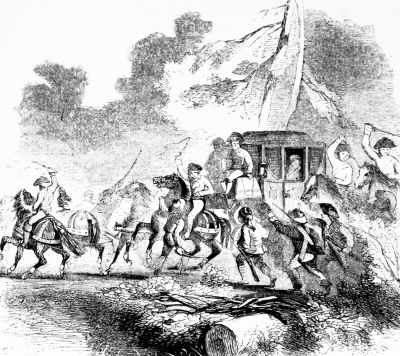
MOB OPPOSING THE FLIGHT OF THE KING'S AUNTS.
"All Europe," said he, "will be astonished to learn that a great Assembly has spent several days in deciding whether two old ladies shall hear mass at Paris or at Rome."
The worthy ladies continued the journey without interruption. The king's next elder brother, usually called Monsieur, subsequently Louis XVIII., remained with the king in Paris. The next brother, however, the Count d'Artois, subsequently Charles X., was actively participating with the emigrants at Coblentz. The very difficult question respecting emigration was now brought forward in the Assembly. It seemed to be a gross act of tyranny to prohibit French citizens from withdrawing from or entering France at their pleasure. On the other hand the enemies of regenerated France were daily leaving the kingdom with all the resources they could collect; and from the frontier, where they were plotting foreign and civil war, they were continually entering the kingdom to make preparations for the invasion.
Mirabeau, who was at this time conspiring for the escape of the king, with his accustomed vehemence and his overpowering audacity, opposed any law against emigration.[264]
"I admit," said he, "that a bad use is made of this liberty at the present moment. But that by no means authorizes this absurd tyranny. I beg you to remember that I have all my life combated against tyranny, and that I will combat it wherever I find it. That popularity to which I have aspired, and which I have enjoyed, is not a feeble reed. I will thrust it deep into the earth, and will make it shoot up in the soil of justice and of reason. And I now solemnly swear, if a law against emigration is voted, I swear to disobey you."[265]
The Assembly was truly in a dilemma. They could not prohibit emigration without grossly violating that declaration of rights which they had just adopted with solemnities which had arrested the attention of the world. They could not permit this flood of emigration without exposing France to ruin; for it was well known that the nobles, with all the wealth they could accumulate, were crossing the frontiers merely to organize themselves into armies for the invasion of France.
Mirabeau never displayed more power than on this occasion, in overawing and commanding the Assembly. He succeeded in arresting the measure. This, however, was his last triumph. Disease was making rapid ravages, his frame was exhausted, and death approached. A sudden attack of colic confined him to his chamber, and soon all hope of recovery was relinquished. He was still the idol of the people, and crowds, in breathless silence, thronged around his abode, anxious to receive bulletins of his health. The king and the people alike mourned, for both were leaning upon that vigorous arm.
He could not repress an expression of satisfaction in view of his labors and his accomplishments. To his servants he said, "Support this head, the greatest in France." "William Pitt," he remarked, "is the minister of preparations. He governs with threats. I would give him some trouble if I should live."[266] On the morning of his death he said to an attendant,
"Open the window. I shall die to-day. All that can now be done is to envelop one's self in perfumes, to crown one's self with flowers, to surround one's self with music, that one may sink quietly into everlasting sleep."
Soon, in a paroxysm of extreme agony, he called for opium, saying, "You promised to save me from needless suffering."
To quiet him a cup was presented, and he was deceived with the assurance that it contained the desired fatal opiate. He swallowed the draught, and in a moment expired, in the forty-second year of his age. It was the 2d of April, 1791. His death caused profound grief. All parties vied alike in conferring honor upon his remains. The nation went into mourning, a magnificent funeral was arranged, and the body was deposited in the tomb with pomp surpassing that which had accompanied the burial of the ancient kings of France. Suspicions are still cherished that Mirabeau died the victim of poison.[267]
The funeral of Mirabeau was the most imposing, popular, and extensive of any recorded in history, always excepting that unparalleled display of a nation's gratitude and grief which accompanied the transfer of the remains of Napoleon from St. Helena to the Invalides. It is estimated that four hundred thousand men took a part in the funeral pageant of Mirabeau. The streets were draped in mourning, and pavements, windows, balconies, and house-tops were thronged with sad and silent spectators.
La Fayette headed the immense procession, and was followed by the whole Constituent Assembly, and by the whole club of Jacobins, who, in a dense mass, assumed to be chief mourners on the occasion, though Mirabeau had for some time held himself aloof from their tumultuous meetings. It was eight o'clock in the evening before the procession arrived at the Church of Saint Eustache, where a funeral oration was pronounced by Cérutti. The arms of twenty thousand of the National Guard were then discharged at once. The crash caused the very walls of the church to rock, shivering to atoms every pane of glass.
It was now night, and, by the light of a hundred thousand torches, the procession resumed its course. New instruments of music had been invented, which were then heard for the first time—the trombone and the tamtam. As the vast procession traversed the streets through the gloomy shades of night, illumined by the glare of flickering torches, with the tolling of bells, blending, now with the wail of the chant and now with the pealing requiems of martial bands, all the elements of sublimity seemed combined to affect the heart and overawe the soul. It was near midnight when the sarcophagus was deposited in its tomb at the Church of Saint Geneviève, over whose portal was inscribed these words,
"AUX GRANDS HOMMES LA PATRIE RECONNAISSANTE."
Mirabeau was the master-spirit of the Revolution. After his death there were multitudes struggling for the leadership, with no man of sufficient prominence to attain and retain it. The funeral of Mirabeau was the funeral of emancipated France. From that hour the Revolution was on the rush to ruin.
"Time," writes Michelet, "which reveals every thing, has revealed nothing that really proves the reproach of treason to be well founded. Mirabeau's real transaction was an error, a serious, fatal error, but one that was then shared by all in different degrees. At that time all men, of every party, from Cazalès and Maury down to Robespierre, and even to Marat, believed France to entertain Royalist opinions. All men wanted a king. The number of Republicans was truly imperceptible. Mirabeau believed that it was necessary to have a king with power, or no king at all. It is true that Mirabeau appears to have received sums to defray the expense of his immense correspondence with the Departments—a sort of ministry that he was organizing at his own house. He makes use of this subtle expression—this excuse which does not excuse him—that he had not been bought; that he was paid, not sold."[268]
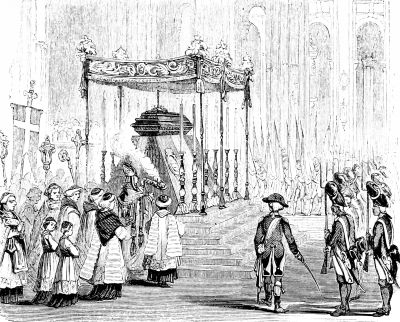
FUNERAL OF MIRABEAU.
The death of Mirabeau seemed to paralyze the hopes of the king, and he now resolved to spare no endeavors to secure his escape. On the 18th of April the king took his carriage at Versailles, intending to ride to St. Cloud. A rumor spread through the city that he was contemplating flight. The populace collected and stopped the horses. La Fayette immediately hastened to the spot with a company of the guards, dispersed the mob, who offered no other violence than to obstruct the departure of the king, and cleared a passage. The king, however, who now wished to have it appear that he was held a prisoner, as most certainly he virtually was, refused to go, and returned indignantly into the palace.
By the advice of his ministers he repaired to the Assembly, and complained warmly of the insult he had encountered. The king was received with the utmost kindness by the Assembly, cordially greeted, and was assured that every thing should be done to prevent the possible occurrence of another similar outrage.
To disarm suspicion and appease the public mind the king, on the 23d of April, sent a letter to the foreign embassadors declaring that he had no intention of leaving France, that he was resolved to be faithful to the oath which he had taken to the Constitution, and that all those who intimated any thing to the contrary were his enemies and the enemies of the country. He soon after, however, declared to an envoy sent to him from the Emperor Leopold, that this letter by no means contained his real sentiments, but that it was wrung from him by the peril of his situation.[269]
A conference of the foreign powers was held on the 20th of May, 1791, at Mantua, in Italy, where Leopold, Emperor of Austria, and brother of Marie Antoinette, then chanced to be. At this conference Count d'Artois appeared in behalf of the emigrants. Prussia was represented by Major Bischofverder, England by Lord Elgin, and Louis XVI. by the Count de Durfort. Several other of the kingdoms and principalities of Europe were represented on the occasion. The Count de Durfort returned from this conference to Louis XVI. in Paris, and brought him the following secret declaration in the name of the Emperor Leopold:[270]
Austria engaged to assemble thirty-five thousand men on the frontiers of Flanders. At the same time fifteen thousand men from the smaller German States would attack Alsace. Fifteen thousand Swiss troops were to be marched on Lyons, and the King of Sardinia, whose daughter the Count d'Artois had married, was to assail Dauphiné. The king of Spain, cousin of Louis XVI., was to gather twenty thousand troops upon the slopes of the Pyrenees, to fall like an avalanche down upon southern France. Prussia engaged to co-operate cordially. The King of England, notwithstanding the eloquence of Burke's pamphlet, could not yet venture to call upon the liberty-loving English to engage in this infamous crusade against the independence and the liberty of a sister kingdom. But the king, as Elector of Hanover, engaged to take an active part in the war. A protest against the Revolution was to be drawn up in the name of the whole house of Bourbon, whose divine right to despotism in France had been questioned by the French people, and this protest was to be signed by those branches of the Bourbons who were occupying the thrones of Spain, Naples, and Parma.[271]
Plans for the invasion having been thus arranged, Louis XVI. resolved immediately to effect his escape to the frontier. He could then place himself at the head of these foreign armies, and lash France into obedience, and consign those patriots who had been toiling for liberty to the dungeon and the scaffold.
Never was the condition of a nation more full of peril, or apparently more hopeless. This impending destruction was enough to drive any people into the madness of despair. It is hard to wear the fetters of bondage even when one has never known any thing better. But, after having once broken those chains and tasted the sweets of liberty, then to have the shackles riveted anew is what few human spirits can endure.
It was not the intention of the king immediately to leave France. He arranged to go to Montmedy, about two hundred miles from Paris, taking the very retired Chalons road through Clermont and Varennes. The Marquis of Bouillé, a general entirely devoted to the court party, formed a camp at Montmedy to receive the king, under the pretense of watching hostile movements on the frontiers. Small detachments of cavalry were also very quietly posted at different points on the road to aid in the flight. All the arrangements were made for starting on the 20th of June.[272]
The king, though on the whole a worthy man, and possessing some excellent traits of character, was in some points weak almost to imbecility. All the energy of the family was with the queen, and she, with the Marquis of Bouillé, planned the escape. They were often thwarted, however, in their wishes by the obstinacy of the king. La Fayette was entirely deceived, and but few even of the court were intrusted with the secret. Still, rumors of flight had been repeatedly circulated, and the people were in a state of constant anxiety lest the court should carry off the king. They hardly believed that the king himself wished to join the emigrants, and to urge war against the Constitution which he had sworn to accept.
The Swiss Guards still surrounded the Tuileries. They were stationed, however, only at the exterior posts. The interior of the palace, the staircases, and the communications between the rooms were occupied by the National Guard, in whom the nation could place more reliance. It was a long-established custom that troops should be thus stationed throughout the palace, that the royal family might be protected from impertinence or from any irruption of popular violence. Since the terrible scenes of the 5th and 6th of October it became more important than ever that a strong guard should encircle the royal family. But while the ostensible duty of this guard was only to protect the king from insult, it had also a secret mission to prevent the king's escape.
La Fayette, to whom the whole business was intrusted, oppressed with the responsibility of his office, was continually, by night and by day, visiting the posts. To the officers who had charge of the night-watch he had given secret orders that the king was not to be permitted to leave the palace after midnight. Thus the king was truly a prisoner, and he was fully conscious of it, though every possible effort was adopted to conceal from him the humiliating fact.
M. Bouillé and the queen were compelled to yield to the whims of the king, and to adopt measures which threatened to frustrate the plan. The king insisted upon having an immense carriage constructed which could take the whole party, though the unusual appearance of the carriage would instantly attract all eyes; he insisted upon traveling a very unfrequented route, which would excite the curiosity of every one who should see the carriage pass; he insisted upon stationing military detachments along the route, though Bouillé urged that such detachments if small could render no service, and if large would excite suspicion; he insisted upon taking the governess of the children, because the governess said that she loved the children too much to be separated from them, though Bouillé urged that instead of the incumbrance of a governess they should take in the carriage an officer accustomed to traveling, and who could aid in any unexpected emergency. The king, though fickle as the wind upon questions of great moment, was, like all weak men, inflexible upon trifles.[273]
At midnight of the 20th of June, the king, the queen, Madame Elizabeth, the sister of the king, the two royal children, and Madame Tourzel their governess, carefully disguised themselves in one of the interior rooms of the Tuileries. Creeping cautiously down, in three successive parties, an obscure flight of stairs, and emerging by a gate which was contrived to be left unguarded, the fugitives, mingling with the groups of people who ever at that time were leaving the chateau, crossed the Carrousel, and, taking different streets, groped along through the darkness until they all met on the Quai des Théatins, where two hackney-coaches awaited them. In breathless silence they took their seats. The Count de Fersen, a Prussian noble, young, handsome, enthusiastic, who was inspired with a chivalric admiration of Marie Antoinette, had made all the arrangements for the escape from the city. Disguised as a coachman, he conducted the king, who led the young dauphin by the hand. The count immediately mounted the box of the coach which contained the royal family, and drove rapidly some twelve miles to the little town of Bondy, where the capacious carriage constructed for the king was waiting before the door of an Englishman, Mr. Crawford. At the same hour in a similar manner the king's brother, Monsieur the Count of Provence, subsequently Louis XVIII., left the Palace of the Luxembourg, and with his family traveled all night toward Flanders, where he crossed the frontiers in safety.
At Bondy the king, the queen, Madame Elizabeth, the two children, Maria Theresa being about ten years of age and Louis seven, with their governess, took their seats in the large carriage. One of the body-guard of the king, disguised as a servant, sat on the box, and another, as footman, sat behind. M. de Vallory rode on horseback, that he might gallop forward and order the relays of horses. The waiting women of the queen, who, by the strangest infatuation, had been included in the party, took the other carriage.
The Marquis of Bouillé, an energetic, heroic man, finding that he could not control the arrangements of the king, did every thing in his power to avert the suspicion which the strange-looking cortège would be likely to excite. He had a passport prepared, in which the governess was represented as a German baroness, Madame de Korff, traveling with her two children. The king was her valet-de-chambre, the queen her waiting-maid. The proverbial wealth of the German barons and the peculiar style of the equipage to which they were accustomed happily favored this idea.[274]
The morning was just beginning to dawn as Count Fersen kissed the hands of the king and queen and left them to prosecute their perilous journey, while he took flight for the frontier through Flanders. The coach was drawn by six horses, who were driven at the utmost speed, relays of horses having been established at short stages. The sun at length rose bright and cheerful. The country was smiling in all the verdure of blooming June. Every revolution of the wheels was bearing them farther from Paris. It was hardly possible that their flight could be discovered until a late hour in the morning. There were no telegraphs in those days to send intelligence with lightning speed to arrest their flight. Having six or eight hours the start of their pursuers, and being abundantly supplied with fresh horses, escape seemed now almost certain. Hope began to cheer their hearts.
Some slight interruptions had retarded their progress, and it was about three o'clock in the afternoon when they entered Chalons, some ninety miles from Paris. The queen, with an exultant smile, exclaimed, "All goes well. If we were to have been stopped at all it would have been before now."
At Chalons they exchanged horses. The king now felt that he was safe, for the Marquis of Bouillé had posted detachments of troops at every important point between Chalons and Montmedy. With characteristic imprudence, as the carriage was surrounded with idlers at Chalons, the king put his head out of the window, showing his well-known face to the crowd. The postmaster instantly recognized the king, but, being himself an ardent Royalist, divulged not his secret, but aided in putting in the fresh horses, and ordered the postillions to drive on.
About ten miles from Chalons is the bridge of Sommeville, which crosses a narrow stream, where the Duke of Choiseul and M. Goguelat were stationed with fifty hussars. They were to secure the king's passage, and then to remain and block up the road against all pursuers. Faithful to the plan, they were at the bridge, with the mounted hussars, at the appointed hour. The strange assemblage of a military force at that spot excited the curiosity of the peasants, and a great crowd was gathered. Every mind throughout France was then in a very sensitive state. The crowd increased, and in the adjoining villages the alarm-bells were beginning to ring. As the royal carriages did not appear for five or six hours later than they were expected, the Duke of Choiseul, to appease the ferment, left the spot, and the people then dispersed.
Soon after the detachment had left the king arrived, and was surprised to find no troops. It was then between four and five o'clock in the evening. In great perplexity and anxiety he drove rapidly on two hours farther to St. Menehould, where he was to find another detachment of troops; but the Duke of Choiseul had sent forward to St. Menehould and Chalons, informing the detachments there that he had waited six hours for the arrival of the king; that the plan had probably miscarried; that excitement was rapidly rising among the people; and that the detachments had better retire.
The king, unaware of all this, was astonished and bewildered in still finding no troops, and naturally, but imprudently, again looked out of the window. The excited crowd which was gathered around the carriages suspected that they contained the royal family. A young man named Drouet, son of the postmaster, instantly recognized the king, from his resemblance to the imprint on the coins in circulation. Without communicating his discovery to any one, he mounted a horse, and, taking a cross road, galloped some twelve or fifteen miles to Varennes, to inform the municipality and cause the arrest of the party.
FOOTNOTES:
CHAPTER XXI.
ARREST OF THE ROYAL FUGITIVES.
Arrival at Varennes.—The Party arrested.—Personal Appearance of the King.—The Guards fraternize with the People.—Indignation of the Crowd.—The Captives compelled to return to Paris.—Dismay of M. de Bouillé.—Excitement in Paris.—The Mob ransack the Tuileries.—Acts of the Assembly.—Decisive Action of La Fayette.—Proclamation of the King.—The Jacobin Club.—Unanimity of France.
The carriages were driven rapidly forward, while the royal family sat perplexed and silent, yet quite unprepared for the doom which was impending. An hour's drive brought them to Clermont. Here the king found two squadrons of horse, under Count de Dumas. But the detachments of dragoons moving to and fro had excited suspicion, and the populace of Clermont had been roused, and gathered alarmingly around the carriages.
The municipal authorities examined the passports of the travelers, and, finding all apparently correct, allowed them to proceed, but, calling out a detachment of the National Guard, forbade the Dragoons to leave the town. The Dragoons, whose sympathies were with the people, and who knew not on what mission they had been led by their officers, immediately fraternized with the Guards, and their commander, Count Dumas, was indebted to the fleetness of his horse for his escape from arrest. It was midnight when the carriages arrived at Varennes. This little town is situated on both banks of a narrow stream united by a bridge. A tower is at one end of the bridge, supported by a massive and gloomy arch, which arch must be traversed with care to enter upon the bridge, and where a very slight obstacle would prevent any advance; "a relic," says Lamartine, "of the feudal system, in which the nobles captured the serfs, and where, by a strange retribution, the people were destined to capture the monarchy."
The royal family, entirely exhausted with sleeplessness, anxiety, and the travel of twenty-four hours, were all asleep, when the few scattering lights of the town were perceived. They were to change horses here, and the king was distinctly informed that they would find the horses before crossing the river. It was, however, afterward decided, without communicating the change to the king, that the fresh horses should be stationed on the other side of the bridge. Thus the carriages could cross the bridge at full speed, and, in case of any popular tumult, could more easily effect a change of horses and departure on the other side.
The king and queen, greatly alarmed in finding no relay of horses, themselves left the carriage, and groped about through the darkened streets seeking for them in vain. A few lights burned dimly here and there in the houses, but all else was the silence and gloom of midnight. The king even knocked at a few doors where lights were seen, and inquired for the relays. The half-roused sleepers could give him no intelligence.
In thus traveling by relays of horses in Europe, each relay has its postillions, who go their appointed stage only. The postillions who had drawn the carriage from the last post-house, entirely unconscious of the dignity of their passengers, having fulfilled their appointed task, weary of waiting, threatened to unharness their horses and leave the carriage in the street until the relay should arrive. By dint of bribes the king induced them to cross the bridge and continue the journey.
Just as they entered the arch beneath the tower to cross the bridge, and when enveloped in almost Egyptian darkness, the horses were stopped by a cart which obstructed the way. Some men seized the bridles of the leaders, and one man on horseback shouted at the window of the carriage the appalling words,
"In the name of the nation, stop! You are driving the king."
Drouet had effectually accomplished his design. Taking a shorter road than that which the carriage pursued, he rode directly to a stable, communicated his secret to the inn-keeper and sent him to give the alarm, while he, with a few comrades whom he hastily gathered, barricaded the bridge with the cart and such other heavy articles as they could lay their hands upon. The delay upon the other side just gave them time to do this before the carriage entered the vaulted archway.
The king and queen were thunderstruck, and their hearts sank in dismay. Immediately they perceived the signs of a great tumult. The village bells were ringing. Lights were flashing through the gloom. An undefined uproar seemed to increase in the streets, while crowds were collecting on the bridge. One man with a lantern in his hand half entered the carriage and cast the light full upon the faces of each one of the inmates. The travelers were then commanded to alight and exhibit their passports. Drouet, taking the passports, conducted the captives in their carriage back again from the bridge to the door of the mayor of the little town, a grocer by the name of Sausse.
Here there was quite a debate. The passports were made out correctly. The party corresponded with the description. They all declared that they were the Baroness de Korff with her attendants. Sausse appeared to be satisfied. But Drouet, a young man of unusual intelligence and energy, demanded,
"Why is not the passport signed by the President of the National Assembly? And if you are foreigners, how is it that you have influence to procure fifty dragoons to escort you at St. Menehould, and as many more at Clermont? And why is there a detachment of hussars waiting for you at Varennes?"
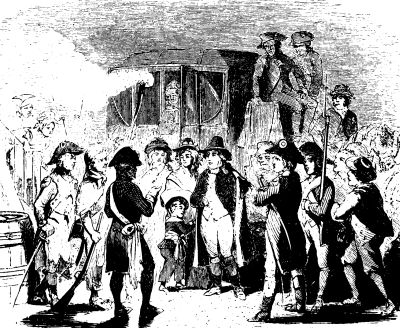
LOUIS XVI. ARRESTED AT VARENNES.
In the eagerness of the altercation it became very evident that the counterfeit servants were not menials, and that the assumed baroness was not accustomed to exercise authority over her pretended maid-servant and valet de chambre. By this time a sufficient number of the National Guard had assembled to prevent the possibility of the rescue of the captives by the Hussars. The queen, seeing that all farther attempts at deception were useless, and indignant at the disrespect with which her husband was treated, exclaimed,
"Since you acknowledge him to be your king, speak to him with the respect which you owe him!"
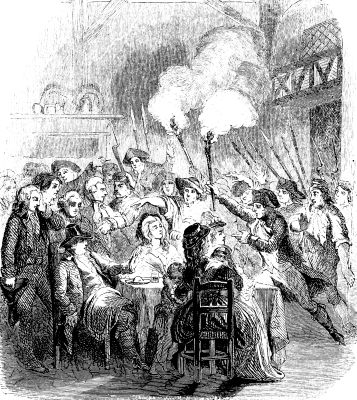
SCENE AT VARENNES.
The whole party had thus far remained in the carriage. The tumult was rapidly increasing. The bells were ringing, guns firing, drums beating, and a crowd of men and women, in disordered dresses and eagerly vociferating, was fast gathering around the captives. Lights in the distance were seen hurrying to and fro, and armed men in tumultuous bands of excitement and consternation were rushing from all directions. Respectfully Sausse, who appears to have been a very humane man, urged them to alight, and for their own protection to enter the door of the grocery. They did so, and sat down upon the boxes, barrels, and bags which were scattered around. The king now, to save himself from farther insults, appealed to the loyalty of his subjects. He rose, and with dignity said to the crowd,
"Yes! I am your king. Behold the queen and my children. We entreat you to treat us with the respect which the French have always shown to their sovereigns."
With the exception of that courtliness of manners which is almost the inheritance of high birth, there was nothing in the king's personal appearance to inspire deference. Though a somewhat educated and accomplished man, he was totally destitute of any administrative skill or of any initiative powers. He would have embellished almost any situation in private life, as a kind-hearted, conscientious, exemplary man. The costume of a servant, a steward, a tutor, a clerk, was far more in accordance with his abilities and his character than the insignia of royalty. His figure was swollen by a flabby obesity, the result of a ravenous appetite and indolent habits. His legs were too short for his body; the expression of his countenance unintellectual and stolid.
As he appeared before the peasants and townsmen of Varennes that night, exhausted with fatigue and terror, in the mean dress of a valet, in a disordered wig, his fat cheeks pale and shrunken, with livid lips aghast and speechless, he excited first emotions of surprise, then of contempt, then of unfeigned pity. "What, that the king! that the queen!" the crowd exclaimed in amazement. The piteous spectacle brought tears into the eyes even of many of the most hostile and obdurate.
Varennes was but thirty miles from Montmedy, which, though in France, was directly on the Germanic frontier. Thus the citizens of Varennes were at but a few hours' march from those terrible armies of the Continent which were threatening to sweep over France with flame and blood. Knowing that their town might be one of the first to encounter the horrors of war, they had been living in the midst of the most terrific alarms. They had hoped that the king was, in heart, in sympathy with the nation, and would place himself at the head of the nation to resist the invaders. Surprise, grief, and indignation struggled in their hearts as they found that the king was actually endeavoring to escape from France to join their enemies. None but those who live on the frontier at such a time can fully realize the terrible significance of the words the enemy.
"What!" exclaimed the multitude, "the king running away, abandoning us, his children, and becoming a traitor to the nation; going over to the enemy, to aid them to burn our homes and massacre us all!"
Some wept; others execrated; others threatened to shoot the king upon the spot. The simple-hearted peasants were, in intelligence, mere children. They had been educated to regard the monarchy as paternal and the king as their father. Choiseul and Goguelat, who, it will be remembered, were stationed at the bridge of Sommeville with fifty hussars, now came clattering into the streets of Varennes with their detachment. At the same time Count Dumas arrived, who had escaped alone from his dragoons, they having abandoned him at St. Menehould.
The grocer's shop was surrounded with a crowd armed with muskets, pitchforks, and axes. Notwithstanding many fierce threats, the officers forced their way through the crowd and entered the shop. There they found the royal family in a deplorable condition. The little boy, Louis, the dauphin, was happily asleep on a low cot bed. His sister, Maria Theresa, three years older, in great terror, was sitting on a bench between her governess and her aunt Elizabeth, clinging tremblingly to their hands. The king and queen were standing by the side of M. Sausse, imploring him to permit them to continue on their way.
Choiseul, grasping significantly the hilt of his sword, said boldly to the king, "Sire, please give immediate orders to depart. I have forty hussars. No time is to be lost. In one hour they will be gained over by the people."
This was true. The hussars were Germans. Blindly obeying their officers, they had no idea of the commission upon which they had been sent. They were now surrounded by the populace, and were listening, with surprise and sympathy, to their narrative of the events. At this critical moment the municipality of Varennes, accompanied by the officers of the National Guard in that place, entered the shop. Accustomed as they had long been to revere and almost to adore royalty, for the rural districts had by no means kept pace with Paris in disregard of the throne, the officers threw themselves upon their knees before the king and said,
"In God's name, sire, do not forsake us; do not quit the kingdom."
"It is not my intention," the king replied, "to leave France. The insults I have suffered force me to leave Paris. I am going only to Montmedy, and I invite you to accompany me thither; only give orders, I pray you, for my carriages to be got ready."
The municipal authorities departed to deliberate, begging the king to wait till the light should dawn. It was now two o'clock in the morning. The chances of escape were every moment diminishing. The crowd, armed with such weapons as they could on the moment seize, had become formidable; the bridge was so barricaded that it could not be passed; and but little reliance could be placed in the fidelity of the hussars. There was, however, a ford near by, where the stream could be passed on horseback. Choiseul and Goguelat entreated the king and queen, with the ladies, immediately to mount on horseback, the king holding the dauphin on the saddle, and, protected by the forty hussars, to cross the stream, and attempt to effect their escape.
The queen, whose personal heroism never forsook her, looked at her children, thought of the bullets which might be showered upon them, and, yielding to a mother's love, hesitated. The king also, who never dishonored himself by an act of cowardice, thought only of the peril of those who were dearer to him than life, and said,
"But can you assure me that in this struggle a shot may not strike the queen, my sister, or the children? Besides, the municipality does not forbid to let us pass; it merely requests me to wait till daybreak. Moreover, the Marquis de Bouillé is at Stenay, but twenty-four miles distant. He can not fail to learn of my detention, and he will be here with his troops in the morning."
Another weary hour of agitation, tumult, and gathering excitement passed away, and the clock struck three. The hussars were now completely gained over by the people, and were drinking with them "To the Nation."
The municipal authorities, having briefly deliberated, returned to the king with this short but terrible announcement,
"The people, being absolutely opposed to the king continuing his journey, have resolved to dispatch a courier to the National Assembly in order to be informed of its intentions."
M. de Goguelat now went out into the surging crowd to judge if it were possible to fight their way through. Mounting his horse he rode slowly around, when Drouet approached him and said, "You want to carry off the king, but you shall not have him alive."
The carriage was surrounded by a body of the National Guard. Goguelat approached the carriage with a few hussars who still hesitatingly obeyed his orders, when the major in command of the detachment of the National Guard said to him, "One step farther, and I shoot you."
Goguelat spurred his horse on, when a pistol was discharged. Two bullets struck him, and he fell bleeding to the ground. He was, however, able to rise and enter the shop, but the hussars immediately with acclaim avowed themselves the soldiers of the nation. Goguelat had observed also that at the end of the street there were two cannons planted which seemed ready to fire upon them. There was no longer the possibility of escape by force, unless M. de Bouillé should chance to arrive in season with his well-trained dragoons.
As Goguelat, wounded and covered with blood, again entered the presence of the royal family, they presented a heart-rending spectacle. The queen was sitting upon a bench between two boxes of candles, piteously pleading with the grocer's wife to intercede with her husband in their behalf.
"You are a mother, madame," said the queen; "you are a wife; the fate of a wife and mother is in your hands. Think what I must suffer for these children, for my husband. At one word from you I shall owe them to you. The Queen of France will owe you more than her kingdom, more than life."
There is an instinct, unreflecting, in the human heart, which says that it would have been noble in the woman to have periled every thing to save the queen. The universal heart does homage to disinterested benevolence, even when it is unthinking and mistaken. But in this case the good woman, with very natural and prosaic common sense, said,
"I wish it were in my power to help you. But bless me! you are thinking of your husband and I am thinking of mine. Every woman for her own husband."
This speech certainly did not indicate a heroic nature. But it is obvious that M. Sausse had now no power to save the king. Matters had proceeded far beyond his control. If he could by any stratagem have facilitated the flight, his own life would have been the inevitable forfeit. It would have been treason to the nation. Humanity also seemed imperiously to demand that the king should be stopped. His escape would place him at the head of foreign and hostile armies to ravage France with the horrors of war, and to quench the kindling flame of liberty in blood.
The queen, whose energetic mind foresaw the awful future, was overwhelmed and burst into tears. The king had now lost all self-possession, and was bewildered as a child. The people, who began to be apprehensive that the troops of Bouillé might come to the rescue, were crowding the door and shouting, "Back, back to Paris."
The king was urged to show himself, that he might tranquilize the people. He went to a window and looked out upon the excited multitude, over whom a few torches shed a lurid light. The sight of the king at first produced profound silence. The people then, as versatile as children, were so affected by the appearance of the king in his servile dress, and with his woe-worn countenance, that many wept; and while not one word of insult was heard, many cried out, in compassionate tones, Vive le Roi!
The day was then just beginning to dawn. Gradually the sun rose, and shone upon a strange spectacle. The guns, the drums, the alarm-bells had roused the whole country around. Ten thousand men had already assembled in Varennes, choking the narrow street where the grocery stood. From all directions the country people were seen hurrying to the town, as the strange tidings of the attempted flight and arrest were spreading far and wide. As the crowd increased in the streets, and the gloom of night was dispelled by the bright blaze of day, the tumult rose higher and higher. All sympathy for the royal family seemed to give place to a feeling of indignation, that they should be stealing away to lead foreign armies to make war upon the liberties of France.
At seven o'clock the door opened, and the king beheld, to his surprise, an officer of the National Guard of Paris. His dress was disordered, and he was dusty and worn with hurried travel. The man was greatly agitated when he found himself in the presence of the king, and could only stammer, in broken and almost incoherent phrase, the words,
"Sire, all Paris is being murdered; our wives and children are perhaps assassinated; you shall not go any farther; sire, the interests of the state; yes, sire, our wives and our children."
The queen seized the hand of the officer, and, leading him to a humble bed in the corner, where the two royal children, Maria and Louis, utterly exhausted, were sleeping, said to him, as she pointed to the children,
"Am I not a mother also?"[275]
The king, interrupting her, turned abruptly to the officer, and said,
"What do you want?"
"Sire," he replied, "I have a decree of the Assembly."
"Where is it?" inquired the king.
"My comrade has it," was the reply.
Just then the door opened, and M. de Romeuf entered. He was an aide-de-camp of the Marquis de la Fayette and a true patriot, while at the same time he was well known by the royal family as a friend of the king. He entered, holding the decree in his hand, greatly agitated; and, as he beheld the humiliating condition of the sovereign of France, and was conscious of the most painful duty devolving upon himself, he could not restrain his emotions, but bowed his head and wept bitterly. There is not a generous heart on earth which will not be in sympathy with that grief.
As the queen raised her eyes and saw M. de Romeuf enter, she exclaimed, with surprise and indignation,
"What, sir, is it you? Oh! I could never have believed it possible." Romeuf replied sadly, "We have done only our duty; but we hoped not to have overtaken your majesties."[276]
The king took from the hand of Romeuf the decree of the Assembly and hastily read it. It was an order enjoining upon all public functionaries "to stop, by all the means in their power, the abduction of the king, and to prevent the continuance of the journey."
The king indignantly threw the decree upon the bed where the children were sleeping, and exclaimed, in words whose truth he then by no means fully realized,
"There is no longer any King in France."
The queen, with pardonable but very injudicious passion, picked up the decree of the National Assembly and threw it upon the floor, saying vehemently,
"It shall not defile my children."
"Madame," said Romeuf sorrowfully to the queen, to whom he was much attached, "in the name of your safety, your glory, I entreat you to control your grief. Would you rather have any one but me witness these passions?"
The gentle reproach recalled the queen to herself, and she nerved herself to endurance, calmness, and dignity. The mental agony of that dreadful night had already turned her hair from auburn into the whiteness of snow.
It was greatly feared that the troops of Bouillé might come and rescue the king. Preparations for the departure were therefore hastened. Six horses were harnessed into the carriage, and the royal family, notwithstanding they did every thing in their power to cause delay, were forced to take their seats. The queen would not allow any one to touch her son, but carried him in her own arms to the carriage.
The melancholy cortège now commenced its slow progress toward Paris, escorted by four thousand of the National Guard.
M. de Bouillé, as we have mentioned, was at Stenay, at but the distance of eight leagues from Varennes, with several regiments of soldiers under his command, waiting the arrival of the king. Had the king but reached that stage he would have been safe. Bouillé was in a state of great anxiety, and during the night had rode forward to within six miles of Varennes, hoping to meet the king. Perplexed by the delay, and anxious lest he should be abandoned by his soldiers, in whom he could place but little confidence, he rode back to Stenay, and had just arrived there, at half past four in the morning, when he received the intelligence that the king was arrested, that the alarm-bells were ringing, that the whole country was aroused, and the National Guard in Stenay, Metz, and Verdun were rapidly forming in defense of the Nation.
Under these circumstances there was but one regiment in whom M. Bouillé could repose any confidence—the Royal German—and but one officer, his own son, in whom he could confide.
Bouillé was an energetic and brave man. He immediately called out the German regiment, and by the influence of impassioned language and enormous bribes to every man induced them to start for the rescue. Almost with the speed of the whirlwind these strongly mounted dragoons swept the space intervening between Stenay and Varennes. It was a quarter of nine o'clock before they reached the town. The National Guard, anticipating this movement, was strongly posted to repel them. As Bouillé was reconnoitring in preparation for an attack, he was informed that the king had been gone more than an hour and a half; that the bridge was broken down, the streets barricaded; that M. de Choiseul, M. de Goguelat, and M. de Dumas were prisoners; that their hussars had fraternized with the people; that the garrisons of Metz and Verdun were rapidly approaching to attack him, and that the whole country around was swarming with troops and National Guards roused by the peril of the nation.
The horses of the dragoons were entirely exhausted by the forced drive of twenty-four miles; the soldiers themselves gave manifest symptoms of hesitation. All hope was gone. Bouillé slowly, sadly, silently retraced his steps. At Stenay popular enthusiasm had gained all hearts. His soldiers abandoned him, and he narrowly escaped with his life across the frontier to Luxembourg.
We must now return to Paris to record the scenes which transpired there after the flight of the king. At seven o'clock in the morning of the 21st of June the servants at the Tuileries, on entering the apartments of the king and queen, found the beds undisturbed and the rooms deserted. The alarm was speedily spread through the palace, and flew from the chateau like wild-fire through the streets and into the faubourgs. "The king has escaped!" was upon all lips. The crowd, in countless thousands, rushed to the Tuileries. They pressed in at the doors and up the stairs, and explored all the mysterious interior of the palace. The most vile and degraded of the population of the city are always foremost on such occasions. The awe which they at first felt soon gave place to derision.
A portrait of the king was taken from his bed-chamber and hung up at the gate of the chateau. A fruit-woman emptied her basket of cherries upon the queen's bed, and sat down upon the bed to sell her venture, saying "It is the Nation's turn to-day to take their ease." Some one placed a cap from the queen's wardrobe upon the head of a young girl. She threw it contemptuously on the floor and trampled upon it, saying "It will sully my forehead."
For several hours the whole city was in a state of intense consternation. The departure of the king was associated in all minds with the approach of foreign armies, the bombardment of Paris, the sweep of dragoons through the streets, the assassination of the patriots, and the extinction of liberty. The alarm-bells rang, drums beat to arms, minute-guns were fired, and the National Guard rallied at all their rendezvous. But in the midst of these alarms there appeared an apparition which excited intense alarm in the bosoms of all the friends of enlightened liberty and order.
It consisted of vast gatherings of haggard, wretched-looking men, the most worthless and abandoned of the population of a great city, under their own fierce leaders, armed with pikes and all wearing a red cap, the bonnet rouge. Santerre, a brewer, an uneducated man, of vast energies, and of great power to lead the passions of the populace, led a band of two thousand of these red-caps through the streets. The indignation of the people was now roused to the highest pitch against the king, and against all who were supposed to have connived at his flight. La Fayette was loudly accused of treason in having allowed the king to escape. His coolness and presence of mind alone saved him from the fury of the mob.
At nine o'clock the Constituent Assembly met, calm, yet fully conscious of the momentous state of affairs. The president immediately informed them that M. Bailly, the Mayor of Paris, had come to acquaint them that the king and royal family had been carried off, during the night, by some enemies of the nation. These noble men conducted, in this crisis, with their accustomed moderation and dignity. Hesitating to assume that the king had perjured himself by violating the oath he had so solemnly taken to sustain the Constitution, they adopted the more generous idea of his abduction.
La Fayette, at eight o'clock, had been informed of the escape, and immediately hastened to the Tuileries, where he found M. Bailly, the Mayor of Paris, and M. Beauharnais, President of the National Assembly. They were both oppressed in view of the momentous posture of affairs, and were lamenting the hours which must elapse before the Assembly could be convoked and a decree issued authorizing pursuit. The course pursued by La Fayette upon this occasion was worthy of his heroic and noble nature. He proved himself a consistent disciple of his great friend and model, Washington.
"Is it your opinion," inquired La Fayette, "that the arrest of the king and royal family is absolutely essential to the public safety, and can alone preserve us from civil war?"
"No doubt can be entertained upon that subject," both replied.
"Well, then," returned La Fayette, "I take upon myself all the responsibility of this arrest."
He immediately issued an order to the National Guard throughout France for the arrest of the king.[277] It was placed in the hands of two of his officers, who set out instantly on the pursuit.
Leaving the Tuileries, La Fayette hastened on horseback to the Hôtel de Ville. He passed excited crowds, who inveighed bitterly against him, accusing him of traitorous complicity in the king's flight. Arriving at the Place de Grève, in front of the Hôtel de Ville, he found one of his officers, the Duke d'Aumont, in the hands of the infuriate mob, who were on the point of massacring him.
La Fayette instantly plunged into the crowd, by his authoritative voice and gesture overawed them, and at the imminent peril of his own life rescued his friend. A moment's hesitation, an emotion of cowardice, and both would inevitably have perished. An infuriate man, almost delirious with rage, approached La Fayette, and, shaking his fist in his face, exclaimed,
"You are a traitor. You have permitted the king to escape, and now France is ruined."
"How ruined?" La Fayette replied, serenely smiling. "France has twenty-five millions of inhabitants; the salary of the king is twenty-five millions of francs. Every one of us gains twenty sous by Louis XVI. relieving us of this payment."
This pleasantry created a general laugh, and the words, repeated through the crowd, soon restored good-nature. The heroism of La Fayette also struck their imaginations, and he was greeted with applause as he rode away.
He then hastened to the Assembly, which was now convened. Some of the deputies had suspected him as conniving at the flight, and as he entered a few murmurs arose. He, however, ascended the tribune and gained a hearing. He proposed that his second officer in command, M. de Gouvion, to whom had been especially intrusted the guard of the Tuileries, should be examined by the Assembly.
"I will answer for this officer," said he, "and take upon myself the responsibility of his acts."
M. de Gouvion was summoned to their bar, and testified that all the ordinary outlets from the palace were carefully guarded. The king could only have escaped in disguise and through some unusual mode of egress. M. Bailly confirmed this testimony, and La Fayette was reinstated in the confidence of the patriots.
The people, who had suspected La Fayette, refused to allow the aides whom he had dispatched to pass the barriers. The Assembly immediately issued an order sanctioning the measures of La Fayette, and the officers were permitted to depart. The ministers of the king were then summoned, and a decree passed that all orders were to be received from the Assembly alone. With calmness truly majestic, and with unanimity which apparently pervaded every act, thought, and resolution, preparations were adopted to meet the fearful invasion which was impending.
It was decreed at every hazard to defend the Constitution. The Assembly assumed the Regency. Couriers were dispatched on every road toward the frontiers to arrest every individual leaving the kingdom. Guns were ordered from the arsenals more effectually to arm the National Guard. These measures were so manifestly just and vital, that the most interested partisans of the old despotism ventured no opposition.
While engaged in passing these decrees, M. de la Porte, superintendent of the civil list, entered, bringing with him a private note and a memorial which he had received from the king. The memorial was dated the 20th of June, and was written and signed by the king. It was entitled "Proclamation of the King to all the French upon his Departure from Paris."
In this long recital of his grievances the king complained that he had only a suspensive veto; that his salary was cut down to five millions of dollars annually, which was not sufficient to support him comfortably; that he was very badly lodged in the palace of the Tuileries; that he had been incessantly annoyed by the National Assembly, the clubs, and the journals, and that he was not properly applauded when he appeared in public. He bitterly censured the decrees of the National Assembly, and avowed that of his own free will he left Paris, that he might at a safe distance from Paris regain his lost power.[278]
M. de la Porte placed this memorial and the private note to him, which accompanied it, upon the table, stating, however, his wish that the private note might not be read. With delicacy and honor worthy of commemoration it was returned to him unopened. The memorial was read and was listened to in respectful silence. The Assembly pitying the weakness of the king took no action upon it whatever.
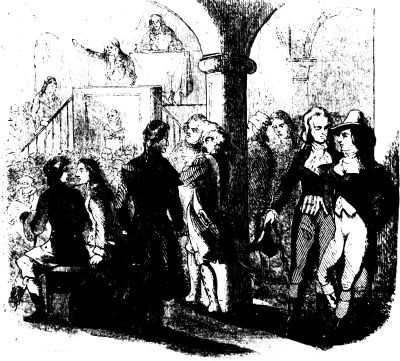
INTERIOR OF THE JACOBIN CLUB.
When the National Assembly was in session at Versailles there was a club organized by the deputation from Bretaigne, called the Breton Club. It was composed of the patriotic members of the Assembly. After the removal of the Assembly to Paris this club held its meetings in an old smoky convent of the Jacobin monks, and was hence called the Jacobin Club. It rapidly increased, admitting members not belonging to the Assembly, until it numbered twelve hundred members in Paris alone. Its affiliated clubs were established all over the kingdom, and were filled with the most ardent advocates of reform. In less than two years they numbered two thousand four hundred societies in as many towns.
The Jacobin Club soon became so intensely and fiercely democratic, that La Fayette, who was one of its original members, and others of the more conservative of the patriots, withdrew from its tumultuous gatherings. This club was now rapidly assuming the reins of government, and marshaling the mob as its resistless and terrific arm of defense, a weapon wielded by the Revolution of incalculable and terrible power. It soon became the relentless and despotic sovereign of France, more relentless and more despotic than any single sovereign who ever sat upon a throne.
La Fayette, upon leaving the Assembly, hastened to the club of the Jacobins, which already in numbers and influence rivaled the Assembly. He was here also successful in stemming the torrent of obloquy which was beginning to roll against him. As he left the club he met, on the Quai Voltaire, Camille Desmoulins. The impetuous journalist, in a state of intense excitement, hastened toward the white horse on which La Fayette rode, and exclaimed:
"Monsieur de la Fayette, for more than a year I have constantly spoken ill of you. This is the moment to convict me of falsehood. Prove that I am a calumniator. Cover me with infamy by saving the state."
La Fayette grasped the hand of Desmoulins, whose patriotism he respected, and replied,
"I have always recognized you as a good citizen. You will see that you have been deceived. Our common oath is to live free or to die. All goes well. There is but one feeling in the Assembly. The common danger has united all parties."
"But why," rejoined Desmoulins, "does the Assembly affect to speak of the carrying off (enlévement) of the king in its decrees, when the king himself writes that he escaped of his own free will? What baseness or what treason in the Assembly to use such language, when we are threatened by three millions of bayonets!"
"The word carrying off," La Fayette replied, "is a mistake in dictation, which the Assembly will correct. This conduct of the king is infamous."
The news of the flight of the king created consternation through all the departments of France. It was regarded as the signal for both foreign and civil war, and all expected immediately to hear the tramp of hostile legions. With singular unanimity the people of France rallied to meet the crisis. From the Gironde a message was sent to the Assembly, saying,
"We have eighty thousand men enrolled in the National Guard, who are all ready to march. But we have not as many guns as we have intrepid and patriotic men. Send us arms."
The municipality of Villepaux sent word, "We are all ready to be torn into ribbons rather than allow the integrity of the Constitution to be violated."
"Our fields," wrote the citizens of Allier and Nivernais, "are covered with harvests and men. Men and harvests are alike at the service of the country, if she needs them."
"We are but few, but we are determined," wrote the inhabitants of a little town in Normandy. "We have but two hundred men capable of bearing arms, but they are young, strong, and courageous. They are all ready to rush upon any foe who shall invade the soil of France."
Bordeaux assured the Assembly that it would immediately send two thousand four hundred men to meet the foe. The whole kingdom was in this blaze of patriotic enthusiasm. The ladies, ever participating in devotion to a noble cause, sent in their jewelry to the Assembly, saying,
"Change these ornaments into arms. It is not in our power to combat for our country; but we can at least aid in arming our brave defenders."
Merchants left their shops, artisans their benches, and laborers the fields, to toil as volunteers in throwing up fortifications around the exposed towns. All hearts seemed to vibrate with the same hopes and fears, and all hands united in the same patriotic toils. The partisans of the court, few in numbers, were silent, waiting for the approach of foreign armies before they should throw off the mask and avow their treason.
FOOTNOTES:
CHAPTER XXII.
RETURN OF THE ROYAL FAMILY FROM VARENNES.
Proclamation of Marat.—Three Commissioners sent to meet the King.—Address to the Nation from the Assembly.—The slow and painful Return.—Conversation between Barnave and the Queen.—Brutality of Pétion.—Sufferings of the Royal Family.—Reception of the King in Paris.—Conduct of the Queen.—Noble Avowal of La Fayette.—Statement of the King.—Menace of Bouillé.
Almost immediately after the flight of the king the club of the Jacobins became the most formidable power in France. It embraced all the desperate and the reckless advocates of reform. Marat, one of its most popular and energetic members, the morning after the flight of the king, issued the following proclamation to the populace of Paris:[279]
"People! behold the loyalty, the honor, the religion of kings. Remember Henry III. and the Duke of Guise. At the same table with his enemy did Henry receive the sacrament, and swear on the same altar eternal friendship. Scarcely had he quit the table than he distributed poniards to his followers, summoned the duke to his cabinet, and there saw him fall, pierced with wounds. Trust then to the oaths of princes!
"On the morning of the 19th, Louis XVI. laughed at his oath and enjoyed beforehand the alarm his flight would cause you. The Austrian woman has seduced La Fayette. Louis XVI., disguised in a priest's robe, fled with the dauphin, his wife, his brother, and all the family. He now laughs at the folly of the Parisians, and will soon swim in their blood. Citizens! this escape has been long prepared by the traitors of the National Assembly.
You are on the brink of ruin; hasten to provide for your safety. Instantly choose a dictator. Let your choice fall upon the citizen who has, up to the present, displayed most zeal, activity, and intelligence, and do all he bids you to do to strike at your foes. This is the time to lop off the heads of Bailly, La Fayette, and all the scoundrels of the staff, all the traitors of the Assembly. A tribune, a military tribune, or you are lost without hope."
Similar impassioned appeals were issued from all the Jacobin journals, and the nation was roused to phrensy. The popularity of the king was now gone, and he was almost universally regarded as a traitor, plotting to deluge the kingdom in blood.
At ten o'clock in the evening of the 22d of June a courier arrived in Paris with a letter from the municipality of Varennes announcing the arrest of the king. The cry resounded from street to street, "He is arrested! he is arrested!" Three commissioners were immediately appointed, Latour Maubourg, Pétion, and Barnave, invested with authority to secure the return of the king and the royal family, and they were enjoined to observe all the respect due to their rank. The Assembly also issued an address to the French nation, containing the following sentiments:
"The king swore, on the 14th of July, to protect the Constitution; he has therefore consented to perjure himself. The changes made in the Constitution of the kingdom are attributed to a few of the factious. We are twenty-six millions of factious. We have preserved the monarchy because we believe it useful to France. We have doubtless reformed it, but it was to save it from its abuses and its excesses. We have granted the yearly sum of fifty millions of francs ($10,000,000) to maintain the legitimate splendor of the throne. We have reserved to ourselves the right of declaring war, because we would not that the blood of the people should belong to the ministers.[280] Frenchmen, all is organized. Every man is at his post. The Assembly watches over all. You have naught to fear save from yourselves, should your just emotion lead you to commit any violence or disorders. The people who seek to be free should remain unmoved in great crises.
"Behold Paris, and imitate the example of the capital. All goes on as usual. The tyrants will be deceived. Before they can bend France beneath their yoke, the whole nation must be annihilated. Should despotism venture to attempt it, it will be vanquished; or even though it triumph, it will triumph over naught but ruins."
Let us now return to Varennes, and accompany the royal family on their melancholy route to Paris. We left the royal carriages, under the escort of the National Guard, just starting from Varennes on their return. It was eight o'clock in the morning. The progress toward Chalons was slow, for the carriages could only keep pace with the guards. The heat was intense, and clouds of dust almost suffocated the captives. For a time emotions were too deep for utterance, and not a word was spoken. But often torrents of abuse fell upon the ears of the king from the crowds who seemed to line the way. At times the crowd was so dense that with some difficulty the guards forced their way through. But for the protection of their bayonets, the whole royal family would probably have fallen victims to the popular fury.
The commissioners from the Assembly met the carriages between Dormans and Epernay, and immediately assumed the command of the troops, and took the royal family under their charge. The whole populace, excited as it was, respected the orders of the Assembly. Latour Maubourg, a gentleman of noble character and an intimate friend of La Fayette, was ardently attached to the Constitution, while at the same time he was anxious to save the monarchy. The tendencies of both of his colleagues were to a more radical democracy. Hoping to excite their sympathy in behalf of fallen greatness, he yielded to his companions the honor of being with the royal family in their carriage, while he took the second coach, with Madame de Tourzel and some other ladies of the party. Barnave and Pétion entered the king's carriage to share his danger and to shield him from insult. Barnave sat on the back seat, between the king and the queen. Pétion sat in front, between Maria Theresa, the daughter of the king, and Madame Elizabeth, his sister. The little dauphin, seven years of age, sat on the lap now of one, then of another.
Barnave was a young lawyer of distinguished abilities and generous impulses. He was a man of polished manners, of attractive person, and of accomplished education. His generous heart was saddened by the pitiable condition of his captives. He did every thing he could, by kindness and respectful attentions, to mitigate their woe. An obnoxious priest at one time approached the carriage with an ostentatious demonstration of his attachment to the court party, now threatening France with invasion. The exasperated people fell upon him, and he would probably have been massacred but for the energetic interposition of Barnave.
"Frenchmen!" he exclaimed, "will you, a nation of brave men, become a nation of murderers?"
He would have sprung out of the carriage to have rescued the priest had not Madame Elizabeth, who had already appreciated his noble character, held him in by the skirt of his coat. She feared that he also, now almost their sole defender, might be torn in pieces. At first the queen sat closely veiled and maintained unbroken silence. But gradually the character of Barnave won the esteem of the whole party. The king entered calmly into conversation with Barnave upon the momentous questions of the day. Barnave replied with courtesy and sympathy, though still faithful in his devotion to liberty and sincere in his advocacy of a constitutional throne. The queen, much mollified, at length withdrew her veil and gradually became social and almost confiding.
Barnave spoke of the great mistakes which the Royalists had made in refusing to accept a constitutional monarchy, thus exposing the throne to entire overthrow and the nation to democratic anarchy.
"What were the means," inquired the queen, "which you would have advised me to resort to?"
"Popularity, madam," was the reply.
"But how," continued the queen, "could I have obtained popularity? It was all taken from me."
"Ah, madam," said Barnave, "it was much easier for you to conquer it than for me to obtain it."[281]
The queen subsequently remarked to Madame Campan that Barnave "was a young man full of intelligence and noble sentiments, and one every way worthy to inspire esteem. A feeling of pride," she continued, with candor which honors her memory, "has caused him to applaud all that tends to smooth the way to honors and glory for the class in which he was born. If power should ever again fall into our hands the pardon of Barnave is written before in our hearts."
The royal family only occasionally alighted for a moment at an inn as the horses were being changed. By day and by night they continued their slow progress, taking all their refreshments in the carriage. Barnave, with that delicacy which is instinctive in noble natures, never for a moment forgot the rank of his august captives. Being pressed by the queen to take some refreshment, he replied,
"Madam, the deputies of the National Assembly, under circumstances so solemn, ought to trouble your majesty solely with their mission, and by no means with their wants."
Pétion was a very different character. He was one of those coarse and vulgar demagogues who have done so much to cast dishonor upon the word democracy. His brutality disgusted the whole party. Equality of rights was with him but social insolence. He affected a rude familiarity with the royal family, munching his food like a boor and throwing the rind of fruit and the bones of fowls out of the window, at the risk of hitting the king in the face. The king made a slight attempt, by introducing conversation with him, to awaken some sympathy.
"It was my wish," said the king, "to increase the force of the executive power. I did not think that this constitutional act could be maintained without more power being placed in the hands of the sovereign, since France does not wish to be a republic."
"Not yet, to be sure," Pétion brutally replied; "the French are not yet quite ripe enough for a republic."
No more conversation was held with Pétion. The movement of the carriages, encumbered by the escort and the immense crowds who thronged the way, was very slow. Four days were occupied in the return. It was seven o'clock in the evening of the 25th when the long procession entered Paris. As the carriages approached the suburbs the crowd increased in density. It had been a day of intense heat. The blaze of the sun, reflected by the pavements and by the bayonets which surrounded the carriage, was almost intolerable. The carriages were continually enveloped in a dense cloud of dust. The inmates panted for breath and were bathed in perspiration. One of the children suffered so much that the queen, alarmed, appealed to the compassion of the crowd.
"See, gentlemen," she said, letting down one of the windows, "in what a state my poor children are; one is choking."
A brutal wretch exclaimed, in an under tone, "We will soon choke you, after another fashion."
Generally the crowd looked on in amazement and silence. Feelings of pity and humanity triumphed over indignation. Great eagerness was of course manifested to catch a sight of the king and queen, but well-armed guards on horseback surrounded the carriages. La Fayette came out of the city to meet the cortège at a few miles distance and to assume the command. Apprehensive of violence from the infuriate populace of Paris, if the immense cortège, now numbering nearly three hundred thousand and rapidly increasing, were to pass through the narrow streets of the city, the carriages were ordered to take a circuit and enter by the broad avenue of the Elysian Fields, which conducted directly to the Tuileries. As an additional precaution he placed troops in a deep line on both sides of the avenue from the Barrier de l'Etoile to the palace.
It was resolved that the king should be received in silence, without applause and without abuse. Placards were posted every where with the laconic announcement,
"Whoever applauds the king shall be flogged; whoever insults him shall be hanged."[282]
The procession now entered the city amid the clashing of sabres, the trampling of horses, and the confused, suppressed murmurs of half a million of men. It was another sublime act in that most terrible tragedy of time. It can not be described; it can not be fully conceived; it has never been paralleled.
The crowd-encompassed, dust-enveloped carriages entered the city at the close of one of the most lovely of June afternoons. The cloudless sun, still an hour above the horizon, shone brilliantly upon the spectacle, gilding steeples and domes as with rejoicing light. The whole military array of Paris, horsemen, artillery, and infantry, lined that majestic avenue. Behind them the whole population of Paris seemed to flood the field, filling windows, balconies, house-tops, steeples, trees, and every point of observation.
La Fayette and his staff first made their appearance as the vast procession commenced its entrance. A numerous cavalcade of mounted guards then succeeded. These were followed by the two royal carriages, each drawn by six horses, and surrounded by dragoons whose sabres gleamed in the rays of the setting sun. Several regiments of artillery and infantry, in compact order, ensued, and then came a motley mass of three hundred thousand stragglers, men, women, and children, whom the strange event had gathered from all the suburbs of the metropolis.
Almost perfect silence reigned. It was like a procession of the shades of the departed in the spirit land. There was no ringing of bells, no explosion of cannon, no plaudits of the multitude, no bursts of martial bands in requiems or jubilata. The king, humiliated, sunk back in his carriage, and concealed himself as far as possible from observation. The bayonets of the soldiers held in check the ferocious and brutal wretches who would gladly have assailed the monarch with execrations. The same power closed the lips of the Royalists, who would have greeted their sovereign with applause.
Thousands gazed upon the scene in silent sympathy, with their eyes bathed in tears. They loved the cause of constitutional liberty; they wept over the infatuation and folly of the king. The reception was sublime in its appropriateness. No honors were conferred upon the king, for surely he deserved none. No abuse assailed him, for that would but have degraded those who offered it.
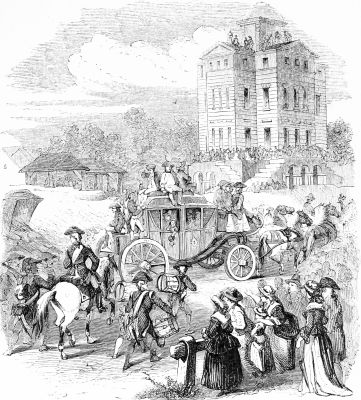
RETURN OF THE ROYAL FAMILY FROM VARENNES.
The crowd grew more and more dense as the carriages entered the garden of the Tuileries, and the way became so obstructed by the throng that it was with no little difficulty that a passage was secured. As soon as the carriages arrived at the door of the palace, near the end of the terrace, the royal family alighted and passed through a double file of the National Guard drawn up for their protection. In this hour of misfortune, those who had been most hostile to the despotism of the court vied with each other in their endeavors to protect fallen royalty from indignities. The Viscount of Noailles, a warm friend of reform, and a humane, magnanimous man, approached the queen, who was the last to alight from the carriage, and offered her his arm to conduct her into the palace. The queen, with imprudent but perhaps pardonable pride, haughtily rejected the aid of the friend of the people, and, seeing one of the partisans of the court near by, asked his arm.
The hall of the Assembly, since destroyed, looked out upon the garden of the Tuileries. The excitement of the hour suspended the sitting, but it was immediately resumed when the king had safely entered the palace. The king seemed perfectly calm. La Fayette, with profound respect and with his sympathies most deeply moved, presented himself at the king's apartment, and, making no allusion to the unprecedented scene which had transpired, said, "Has your majesty any orders to give me?"
"It appears to me," replied the king with a smile, "that I am much more under your orders than you are under mine." The conduct of the queen in this trying hour was peculiarly unfortunate. The royal family then needed every friend it could win. But the queen, losing the control of her passions, seemed to bid defiance to all who were not the partisans of the court, and endeavored to gratify her resentment in goading those she deemed her foes by those taunts of action which are even more exasperating than words.
Assuming that La Fayette was her jailer, she approached that noble patriot, who was willing to shed the last drop of his blood to save her from indignities, and handed him the keys of her trunks. La Fayette, wounded by conduct so ungenerous, and commiserating the condition of the queen, bowed, refusing to receive them, and, in tones saddened by pity and sorrow, declared that no one would think of interfering with her private property.
The unhappy queen so far forgot herself as peevishly to throw the keys into La Fayette's hat, which was upon the table. This was the conduct of a spoiled child. Such was Marie Antoinette. It was this spirit which accelerated her passage to the scaffold. The compassion of La Fayette triumphed over resentment. Overlooking the insult, he calmly replied,
"Madam, you must pardon me the trouble I give you in returning these keys. I certainly can not touch them."
"Well, then," replied the queen, pettishly, "I shall find other persons less scrupulous than you are."[283]
Such conduct on the part of the queen was ever adding to her unpopularity. The king was much more considerate. Though by no means equal to the queen in energy, he had a far more comprehensive view of the real attitude of affairs. Had the spirit of the queen been dominant, it is possible that the Revolution in its infancy might have been crushed with an iron hand. All the disciplined armies of Europe were ready to fall upon the unorganized and unarmed populace of France, and to chastise them into submission. Had the moderate and humane spirit of the king prevailed, the Constitution might have been accepted; the king might have been revered and beloved as a constitutional monarch, and France might have passed from despotism to free institutions without bloodshed. But the discordant union of the defiant energies of the one and the yielding moderation of the other rendered ruin inevitable.
The king entered into a brief conversation with La Fayette, in which the devoted patriot said to his monarch,
"Your majesty is well aware of my attachment to your royal person, but at the same time, you were not ignorant that, if you separated yourself from the cause of the people, I should side with the people."
"This is true," replied the king. "You follow your principles. And I tell you frankly that until lately I had believed you had surrounded me by a turbulent faction of persons of your own way of thinking, but that yours was not the real opinion of France. I have learned during my journey that I was deceived, and that the general wish is in accordance with your views."
The conduct of the Assembly in this momentous crisis, when the liberties of France were so fearfully imperiled, was firm and noble. On the day of the king's return they passed decrees suspending him from his functions, until they should have heard, through a committee of three, the declarations of the king and queen. With that delicacy which had ever, thus far, characterized the action of the Assembly, these decrees were passed in terms of studied decorum, and the king and queen were shielded from answering before the whole Assembly, which would have been required of any offenders of less exalted rank. A guard was placed over the royal family, and was made responsible for its safe custody.[284]
Barnave, covered with the dust of his journey, hastened to the Assembly, and gave the official announcement of the return of the king. Both the king and the queen had learned to repose great confidence in this noble young man, and Barnave assisted the king in composing the declaration to be presented to the commissioners of the Assembly in extenuation of his flight.[285] The king could hardly have expected that the assertions which he made in this document could be credited by the Assembly. "Never was it my intention," said he, "to leave the kingdom. I had no concert either with foreign powers, or with my relatives, or with any of the French emigrants. I had selected Montmedy, because, being near the frontiers, I should have been better able to oppose every kind of invasion of France, had a disposition been shown to attempt any. One of my principal motives for quitting Paris was to set at rest the argument of my non-freedom, which was likely to furnish occasion for disturbances."
He concluded this declaration in words characteristic of his whole course. "I have ascertained during my journey that public opinion is decidedly in favor of the Constitution. I did not conceive that I could fully judge of this public opinion in Paris. As soon as I had ascertained the general will, I hesitated not, as I have never hesitated, to make a sacrifice of every thing that is personal to me. I will gladly forget all the crosses that I have experienced, if I can but ensure the peace and felicity of the nation."[286]