Part 2 — CHAPTER IX
Reading edition
CHELONIA–ATHECAE–THECOPHORA
Sub-Class IV.–CHELONIA.
There is no mistaking a tortoise. The shell and the horn-covered toothless jaws separate them from all other four-footed creatures.
They may be described as terrestrial or aquatic, pentadactyle reptiles, with walking limbs or with paddles; ribs with capitular portions only, two sacral vertebrae, humerus with entepicondylar foramen, pubes and ischia forming symphyses, quadrate bones fixed, jaws without teeth, but with cutting horny sheaths. Trunk encased in a bony shell, composed of numerous dorsal and ventral dermal bones, forming a carapace and a plastron, which may or may not be covered with horny shields. Copulatory organ unpaired, cloacal opening more longitudinal than round, never transverse. Oviparous.
It is customary to distinguish the marine, paddle-limbed kinds as Turtles, the others as Land- and Water-tortoises.
Tortoises occur already in the Trias. They reached their greatest development towards the end of the Mesozoic and in the earlier Tertiary periods. They are now comparatively reduced in the number of families and genera, although they are still represented by about 200 species. The sub-class as a whole is cosmopolitan, but does not occur in the colder regions.
Their origin is quite unknown. Of recent groups only the Crocodilia and the Rhynchocephalia come into consideration. Combination of these groups with the Chelonia leads to some unknown forms whence also the Theromorpha have arisen. Palaeontology does not help us, all the leading, main groups of Chelonia having been in existence in the earlier Mesozoic ages, and Palaeozoic Chelonia are still unknown. We can, however, to a certain extent, reconstruct an ideal primordial Chelonian by assigning to it all the ancestral characters actually observed in recent and fossil kinds, and by reducing to simpler conditions those features which we know to be more or less exaggerated specialisations. It is reasonable to assume that originally each metamere, except those of the anterior half of the neck and the posterior half of the tail, carried a transverse series of dermal plates, covered with horny shields, while the trunk, according to the greater bulk of the body, increased in size, converging towards the root of the neck and tail. By concentration, reduction of the number, and increase in the size of some of the remaining plates and shields, the skull assumed its characteristic box-like shape, the neck and tail becoming at the same time free. Chelonia are without doubt descendants of terrestrial, or at least semi-aquatic reptiles, and the marine paddled forms subsequently developed from terrestrial kinds.
Classification of Chelonia.–After many vicissitudes it was recognised that the Chelonia cannot naturally be divided according to the modification of their feet. The Trionychoidea were clearly separated from the rest by Stannius in 1854. Cope, in 1870, was the first to emphasise the important character of the mode in which the neck is either bent sidewards (Pleurodira) or withdrawn in an S-shaped curve in a vertical plane (Cryptodira); and he also separated Sphargis as Athecae from all the other Chelonians, for which Dollo in 1886 proposed the term Thecophora. The division of the latter into recognisable families, based upon reliable, chiefly internal, skeletal, characters, has been effected by Boulenger;[127] and his classification has been adopted in the present volume, after intercalation of the more important fossil forms. The relationships between these various families may perhaps be indicated as follows:–
Chelonia Athecae . . . . Sphargidae

Thecophora Pleurodira Pelomedusidae


Chelydidae–Carettochelydidae
Cryptodira Chelydridae–Dermatemydidae–Cinosternidae

Platysternidae
Testudinidae–Chelonidae
Trionychoidea Trionychidae
The guiding taxonomic characters are fully mentioned at the head of the different families, and are mostly internal. The following "key," adapted from Boulenger, and based upon external characters, is preferable for practical purposes.
For the position and names of the horny shields see Fig. 61 on p. 315.
Shell covered with horny shields.
Digits distinct, with 5 or 4 claws.
Pectoral shields separated from the marginals by inframarginals.
Tail long and crested. Plastron small and cruciform. North America .......... Chelydridae, p. 338.
Tail long, covered with rings of shields. Plastron large. Indo-China .......... Platysternidae, p. 345.
Tail short. North and Central America .......... Dermatemydidae, p. 341. Cinosternidae, p. 342.
Pectoral shields in contact with the marginals.
Plastral shields 11 or 12, without an intergular. Neck retractile in an S-shaped vertical curve .......... Testudinidae, p. 345.
Plastral shields 13, an intergular being present. Neck bending sideways under the shell .......... Chelydidae, p. 399. Pelomedusidae, p. 390.
Limbs paddle-shaped, with one or two claws .......... Chelonidae, p. 378.
Shell without horny shields, covered with soft, leathery skin.
Digits distinct, broadly webbed, but with only three claws .......... Trionychoidea, p. 404.
Limbs paddle-shaped.
Shell composed of regular series of bony plates. Two claws .......... Carettochelydidae, p. 404.
Shell composed of very many small plates arranged like mosaic. No claws .......... Sphargidae, p. 333.
The vertebrae are, sometimes in the various regions of the same individual, amphi-, opistho- or pro-coelous, or even biconvex. Traces of the chorda remain longest in the middle of the centra. Intercentra occur regularly on the first two or three cervicals, and then again in the tail as paired or unpaired nodules, or as short chevrons. The latter occasionally fuse with the caudal end of their centra. Intercentral discs of fibrous cartilage occur regularly in the neck and tail. The ribs develop originally in the same transverse level with these discs, and frequently the anterior thoracic vertebrae retain this intercentral or intervertebral position throughout life. Farther back they often show a gradual change from the intercentral to a more central and ultimately remarkable to a purely neural attachment. In all the Chelonia the ribs are devoid of the tubercular portion.
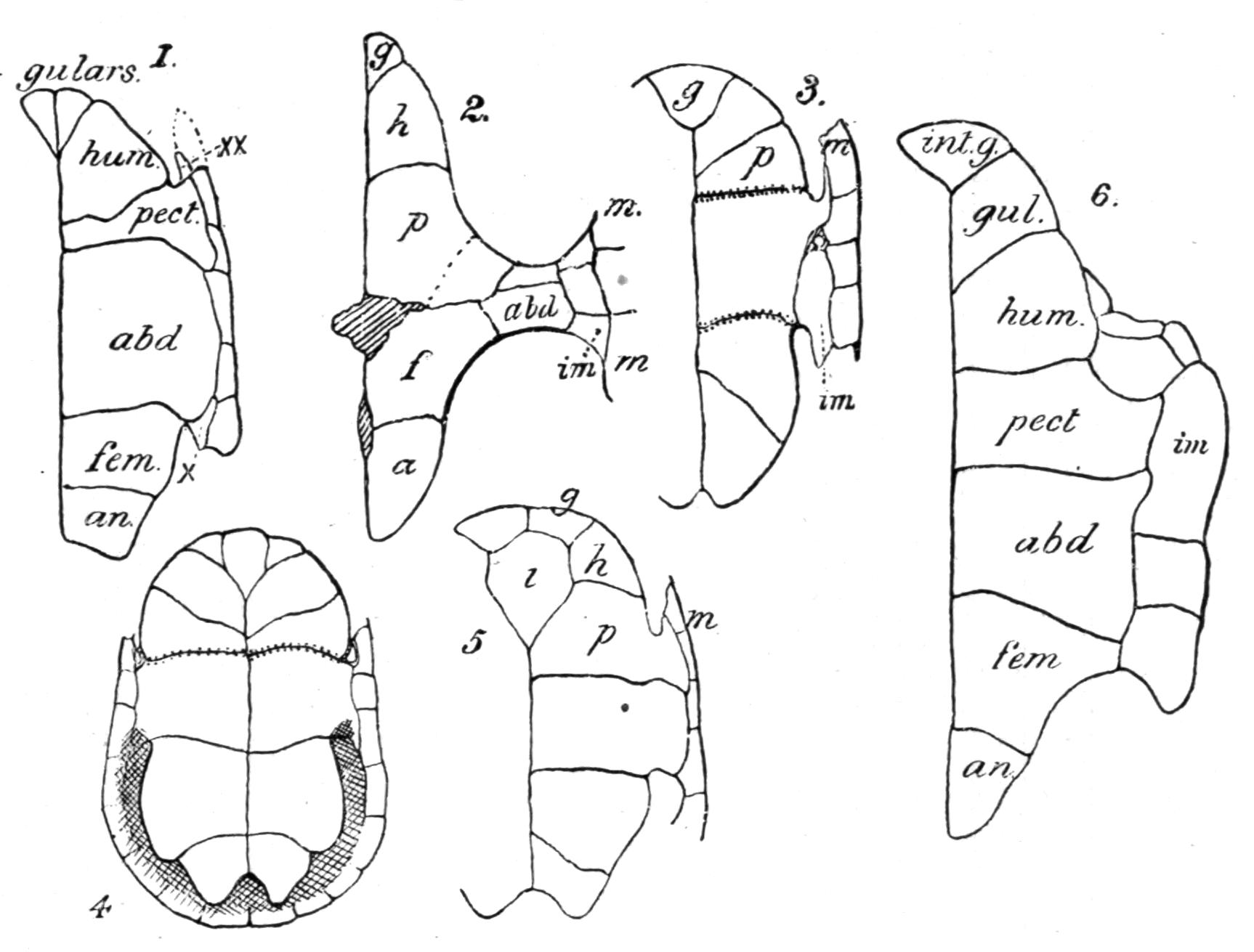
Fig. 61.–Various plastra and their horny shields. 1, Testudo ibera; 2, Macroclemmys temmincki; 3, Cinosternum odoratum; 4, Sternothaerus nigricans; 5, Chelodina longicollis; 6, Chelone mydas. a or an, Anal shield; abd, abdominal shield; f or fem, femoral; g or gul, gular, unpaired in Fig. 3; h or hum, humeral shield; i or. int.g, intergular; im, infra-marginals; m, marginals; p or pect, pectoral; x, in Fig. 1, inguinal shield constituting, with the axillary xx, the last trace of infra-marginals.
The cervical vertebrae have no ribs, except mere traces in the shape of small nodules. On the tail the ribs are often large, and, when fused with their neural supports, look like transverse processes; the whole arrangement exactly resembles that of Crocodilia. The first pair of thoracic ribs, those borne by the ninth vertebra, are peculiar. They arise from the anterior portion of the centrum, are much reduced, sometimes to mere threads of bone, and lean against the anterior rim of the second pair of ribs, in many cases without reaching the carapace. The next following ribs, those of the tenth to the sixteenth vertebra, are intimately involved in the formation of the first to seventh costal plates. The ribs of the two sacral vertebrae sometimes remain quite distinct throughout life, just touching the upper ends of the iliac bones; but since these find a much more effective support in the shell, the distal ends of the sacral vertebrae fuse with the eighth, or so-called last, pair of costal plates.
The neural arch of the ninth vertebra rests upon its centrum; but the neural arches of the other trunk-vertebrae, although long, rest upon two centra; retaining, like the ribs, their original intercentral position; and in most cases the neuro-central sutures remain throughout life. The atlas and the last cervical vertebra deserve special attention. In many tortoises, e.g. Trionyx, Clemmys, Testudo, the three constituent parts of the atlas, namely, the neural arch, the centrum, and the intercentrum or first pair of united basiventralia, do not ankylose, but remain loosely connected; and the first centrum, instead of forming an odontoid process, remains movably attached to the second centrum, although it sometimes carries, and fuses with, the second intercentral piece. In other tortoises, e.g. Platemys and Chelys, however, all the parts of the atlas co-ossify and form a complete, solid vertebra which articulates by a concavo-convex joint with the centrum of the second vertebra. The normal number of cervical vertebrae is eight in all Chelonians. The first spinal nerve issues between occiput and atlas, all the others behind the neural arches of their vertebrae. The last, or eighth cervical, owing to the retractility of the neck, forms elaborate joints; its centre fits with a knob into a cup of the ninth, and its post-zygapophyses form broad, curved articulating concave facets for the reception of the anterior zygapophyses of the fixed ninth vertebra. In the Trionychidae the zygapophyses are most elaborate, and they alone articulate with the ninth vertebra, while the centra do not join, but remain, or rather become, separated by partial resorption. In the Chelonidae, in conformity with the non-retractile and short neck, all the cervical joints are much reduced.
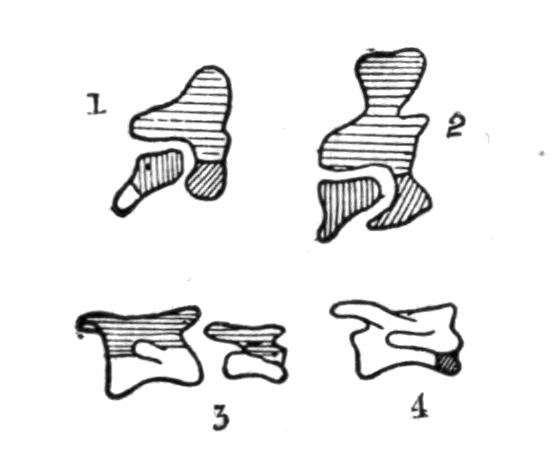
Fig. 62.–1, The complete atlas of an adult Trionyx hurum. The second basiventral (white) is attached to the posterior end of the first centrum, which, not being fused with the second centrum, is not yet an odontoid process. 2, The complete atlas of an adult Trionyx gangeticus, still typically temnospondylous. 3, The first and second cervical vertebrae of an adult Platemys. 4, The complete atlas of a Chelys fimbriata.
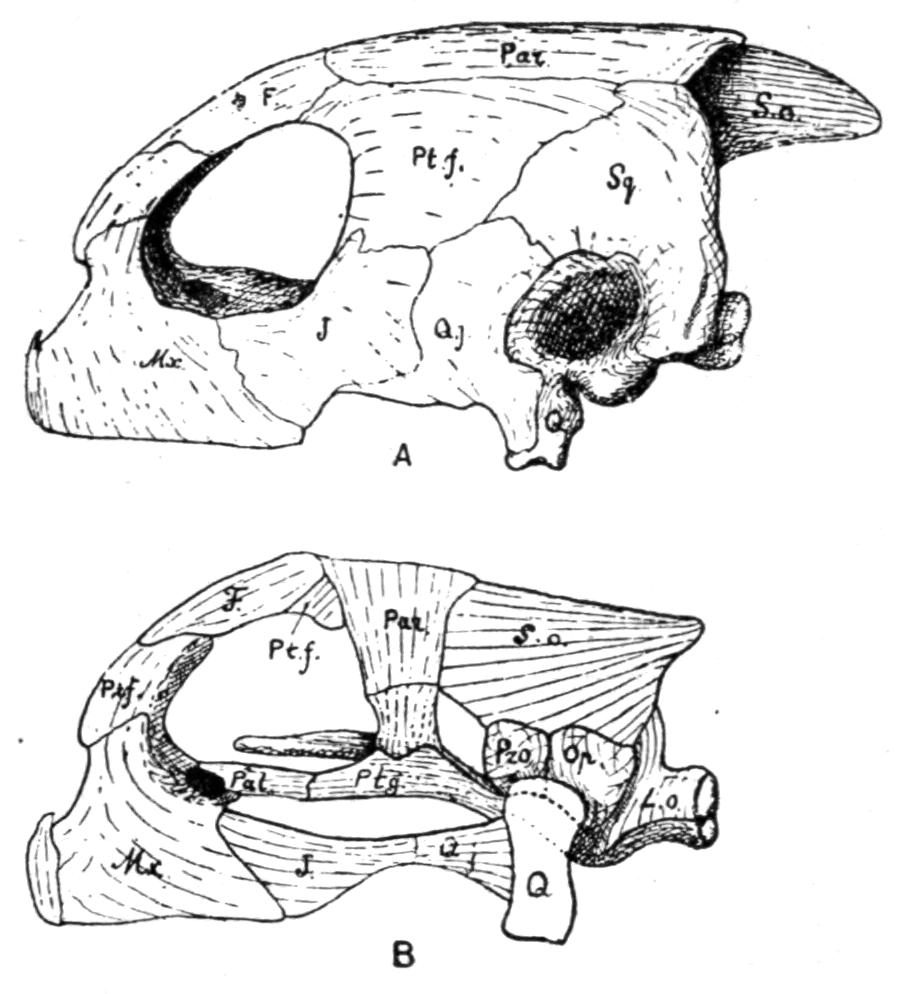
Fig. 63.–Skull of Chelone mydas. A, from the left side; in B, the postfrontal and squamosal bones have been removed, and the broad expansions of the jugal, quadrato-jugal, parietal, and quadrate bones have been reduced in order to reduce the skull to more primitive conditions. F, Frontal; J, jugal; L.o, lateral occipital; Mx, maxillary; Op, opisthotic; Pal, palatine; Par, parietal; Prf, prefrontal; Pro, pro-otic; Pt.f, postfrontal; Ptg, pterygoid; Q, quadrate; Qj, quadrato-jugal; S.o, supra-occipital; Sq, squamosal.
The skull (cf. Fig. 54, H, I, K, p. 280) agrees fundamentally with that of Sphenodon and of the Crocodilia, but it is characterised by several special features. There are no ectopterygoids or ossa transversa; no lacrymal bones, no interparietal or pineal foramen; the vomer is unpaired and the nasal bones are mostly absent, unless they are fused with the prefrontals. The premaxillae are very small. The single vomer forms a septum between the choanae; and these are, except in Sphargis, ventrally roofed over by wings sent out by the palatines. The latter form a continuous bony roof to the mouth with the pterygoids, and these diverge posteriorly, being connected suturally with the quadrates, lateral and basi-occipital bones, and with the unpaired basi-sphenoid, which appears between the basi-occipital and the diverging pterygoids, but is in most cases to a great extent overlapped by the latter. The occipital condyle is distinctly triple; the basi-occipital sometimes helps to border the foramen magnum. The supra-occipital sends out a long vertical blade, directed backwards and generally projecting far over the neck, for the attachment of the powerful cranio-cervical muscles. The quadrate is very peculiar. Firmly attached, and hemmed in on nearly all sides by the neighbouring bones, it stands nearly vertically and forms a broad articulating surface for the mandible. Its posterior side shows either a transverse, horizontal groove, in which lies the columella auris, or the groove is transformed into a more or less closed canal. Moreover, the hinder lateral margin of the quadrate forms most of the tympanic frame; its margins being curved backwards, leaving in the Cryptodira, however, a wide notch behind; in the Pleurodira this part of the quadrate is transformed into a trumpet, the wide rim of which, forming a complete ring, carries the tympanic membrane. The tympanic cavity thus formed often leads into a deep recess which extends beneath the squamosal towards the opisthotic and bears some resemblance to the intricate tympanic recesses which pervade that region of the Crocodilian skull.
Dorsally the quadrate is broadly overlaid by the squamosal, which frequently forms an arch with the parietal. Anteriorly the quadrate is connected through a variably sized quadrato-jugal with the jugal; and this, by joining the maxilla and postfrontal, helps normally to form the posterior rim of the orbit. All the bones which border the temporal fossa vary much in extent in the different groups of Chelonia. The extremes are represented by Cistudo and Geoemyda, in which the bony infratemporal arch is absent, owing to the loss of the quadrato-jugal; and on the other hand by the Chelonidae and by Sphargis, in which the whole temporal region is covered over by an additional "false cranial" roof. This roof is produced chiefly by lateral wing-like expansions of the parietal and postfrontal bones, which meet the likewise much expanded jugal, quadrato-jugal, and squamosal bones. In the lower diagram of Fig. 63 (Chelone mydas) the squamosal has been removed, and the other bones have been reduced to their normal, or rather primitive condition, for comparison with the external view of the complete skull of the same animal. The lower diagram shows also the connexion of the pterygoid with a descending process of the parietal; this column, paired of course, usually contains a separate bone, the epipterygoid, the portion between Ptg and Par.
The hyoidean apparatus is well developed, and sometimes assumes large dimensions, especially in Chelys. The two pairs of "horns" are the first and second branchial arches, whilst the hyoid arches are reduced to a pair of small, frequently only cartilaginous, nodules attached near the anterior corners of the basis linguae, which generally fuses with the os entoglossum in the tip of the tongue.
The pectoral arch consists of a pair of long coracoids sloping obliquely backwards, the distal cartilages of which scarcely touch each other in the middle line, and the scapulae. The upper end of the scapula frequently touches the inside of the first costal plate, protected by a cartilaginous pad. Near the glenoid cavity arises a long process (PC in Fig. 65), placed transversely and approaching its fellow. The distal end is connected with that of the coracoid by a fibro-cartilaginous band. The homology of this scapular process is not quite clear. The band just mentioned favours the idea that the process represents the precoracoid, but its being an outgrowth from the scapula suggests that it is merely the much enlarged acromion. It certainly does not represent the clavicle, which forms part of the plastron: and this is not in contact with the shoulder-girdle at all.
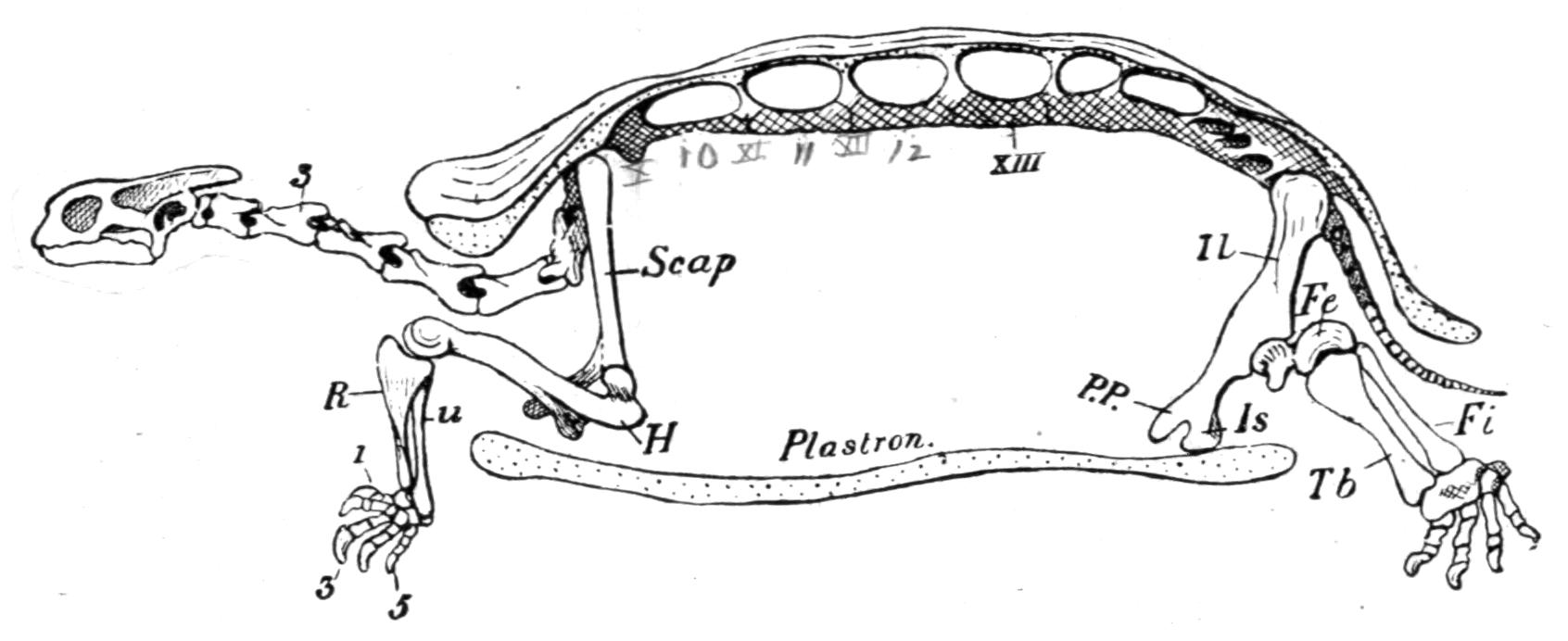
Fig. 64.–Diagram of the skeleton of Testudo elephantopus, after removal of the left half of the carapace. The plastron is roughly indicated by a section through the middle line. Fe, Femur, foreshortened; Fi, fibula; H, humerus; Il, ilium; Is, ischium; P.P., pubis; R, radius; Scap, scapula; Tb, tibia; u, ulna; 3, third cervical vertebra; 1, 3, 5, first, third, and fifth fingers; XIII, thirteenth (fifth thoracic) vertebra.
The pelvis is strong. Ilium, pubis, and ischium meet at the acetabulum. The dorsal end of the ilium is generally broadened, and is attached to one or both sacral vertebrae, but it is also in contact with the superimposed last costal plate. This additional connexion often becomes predominant and the sacral vertebrae are partly or completely relieved of the iliac support, fusing in this case more or less with the costal plates. The pubes have strong lateral processes, directed obliquely forwards and downwards. The pubes and the ischia, which latter are much smaller, form broad symphyses, and these are connected with each other by a longitudinal cartilaginous band (Chelone, Trionyx); or the connecting bridge is broad and quite ossified (Testudo), forming in the latter case two roundish obturator-foramina. Cartilage frequently remains at the anterior end of the pubic symphysis, and a smaller, longer, and narrow piece of cartilage extends sometimes backwards from the ischiadic symphysis, as the so-called hypo-ischium. In the Pleurodira the ends of the ilia, and those of the lateral processes of the pubes, are much broadened and firmly ankylosed with the posterior costal plates and with the xiphiplastron respectively.
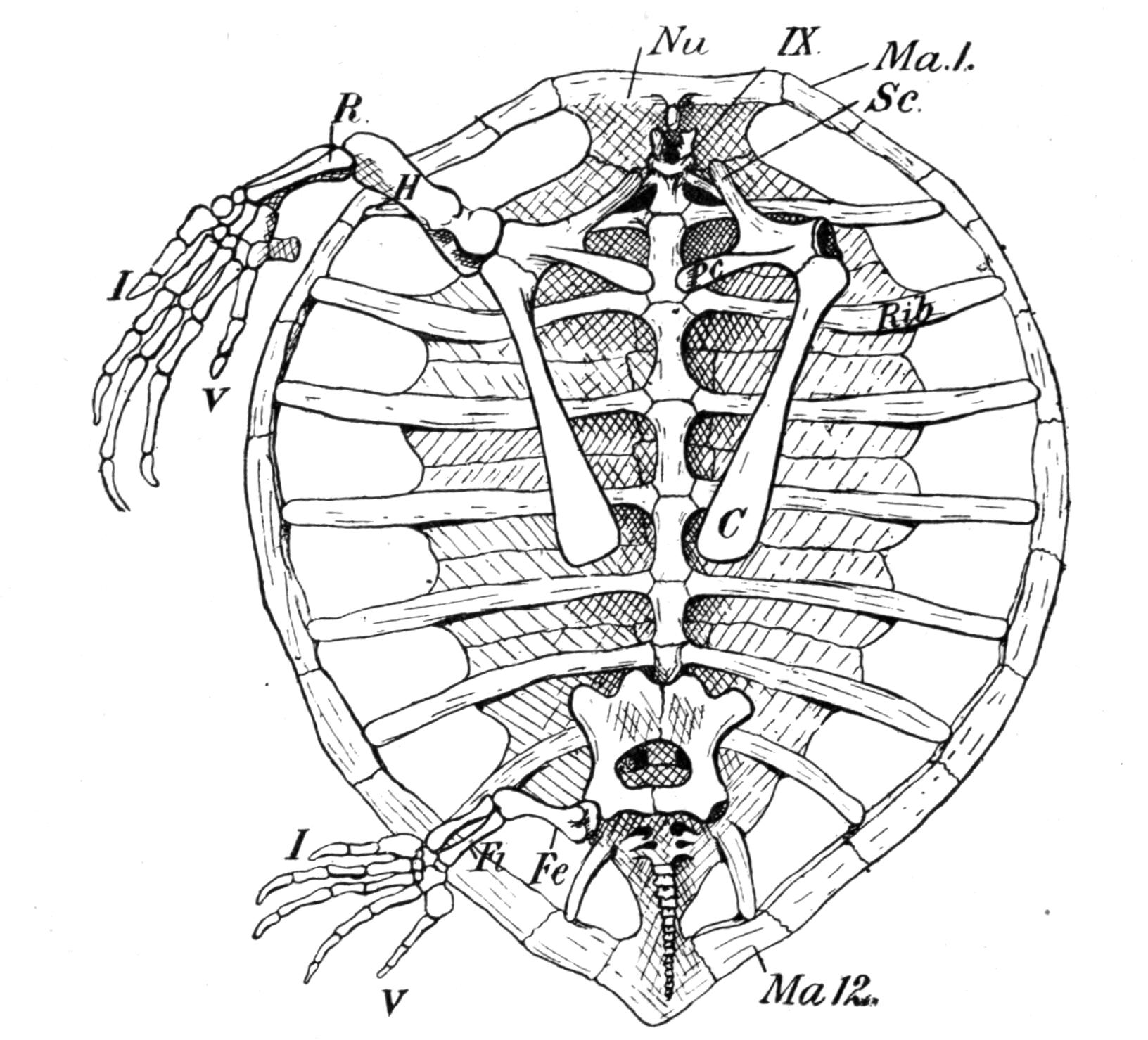
Fig. 65.–Ventral view of the bony shell of Chelone mydas, the Green Turtle, after removal of the plastron (Fig. 66). The costal plates are marked by cross lines to distinguish them from the ribs. C, coracoid; Fe, femur; Fi, fibula; H, humerus; Ma.1-Ma.12, marginal plates, some of which are fused together; Nu, nuchal plate; PC, "precoracoid"; R, radius; Sc, scapula; I, V, first and fifth digits; IX, Ninth vertebra or first thoracic.
The limbs are typically pentadactyle and complete, and are most primitive in water-tortoises, e.g. Chelydra and Emys, in which the carpus consists of the typical ten separate elements, including the pisiform. In Testudo the centrale is fused with the intermedium, and the first three distal carpals are also fused together. In the marine turtles the limbs are transformed into paddles, but all the bones retain their independence; the pisiform and the first metacarpal are enlarged and flattened, thereby giving additional width to the paddle. The tarsus remains less primitive; the centrale and the proximal elements have a tendency to fuse together, most completely in land-tortoises; the fifth distal carpal is enlarged, and stands out hook-like from the rest. The number of the phalanges of the fingers and toes varies slightly. It is noteworthy that none of the Chelonia possess more than three phalanges. The three middle fingers and toes have mostly three phalanges; the pollex and hallux have always two; the number of phalanges of the fifth finger varies from three to one, of the fifth toe from two to none. The greatest reduction occurs in Testudo and its allied genera of typical land-tortoises, Homopus, Pyxis, and Cinixys, the formula for the fingers being 2, 2, 2, 2, 2 or 1, and 2, 2, 2, 2, 0 for the toes. In Pelomedusa all the fingers possess two phalanges only, owing to fusion of the first and second phalanges with each other.
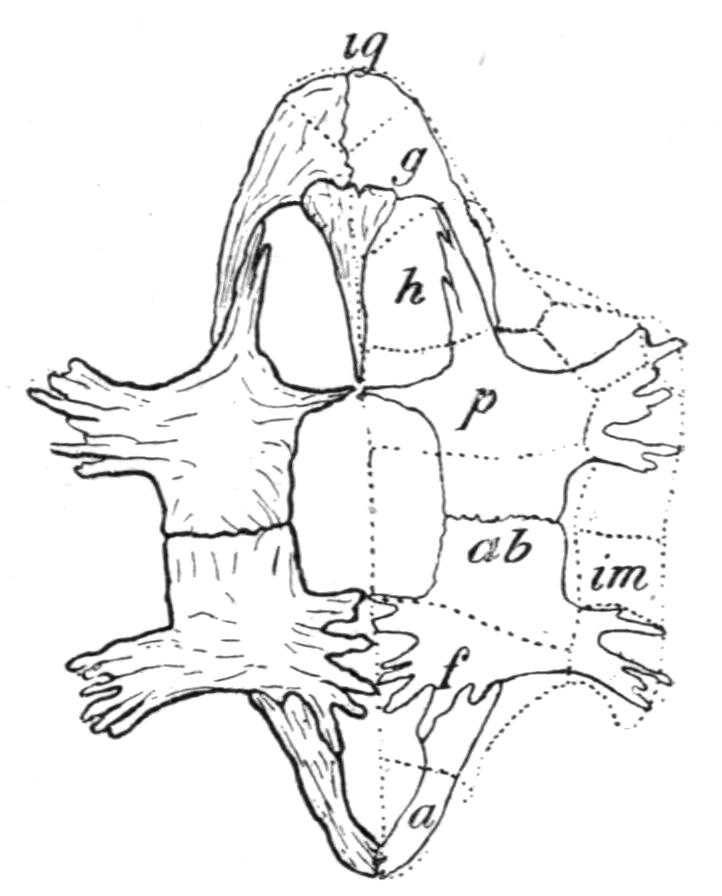
Fig. 66.–The bones composing the plastron of Chelone mydas. On the right side the position of the covering horny shields[128] is indicated by dotted lines. a, Anal horny shield; ab, abdominal; f, femoral; g, gular; h, humeral; ig, intergular; im, infra-marginals; p, pectoral.
The shell, which is the most characteristic feature of the Chelonia, consists of the dorsal "carapace" and the ventral "plastron." Each is composed of a considerable number of bony plates which arise as ossifications of nearly the whole thickness of the cutis, only a thin layer of subcutaneous connective tissue remaining soft and lining the inside of the shell. We restrict ourselves to a description of the shell of the Thecophora, leaving the discussion of the peculiar shell of Sphargis to p. 336 f. Very young tortoises are still soft, and the plates which are beginning to ossify are not yet suturally united. The plastron (Figs. 66 and 67) consists of the paired epi-, hyo-, hypo-, and xiphi-plastral plates, and the unpaired endo-plastral plate.
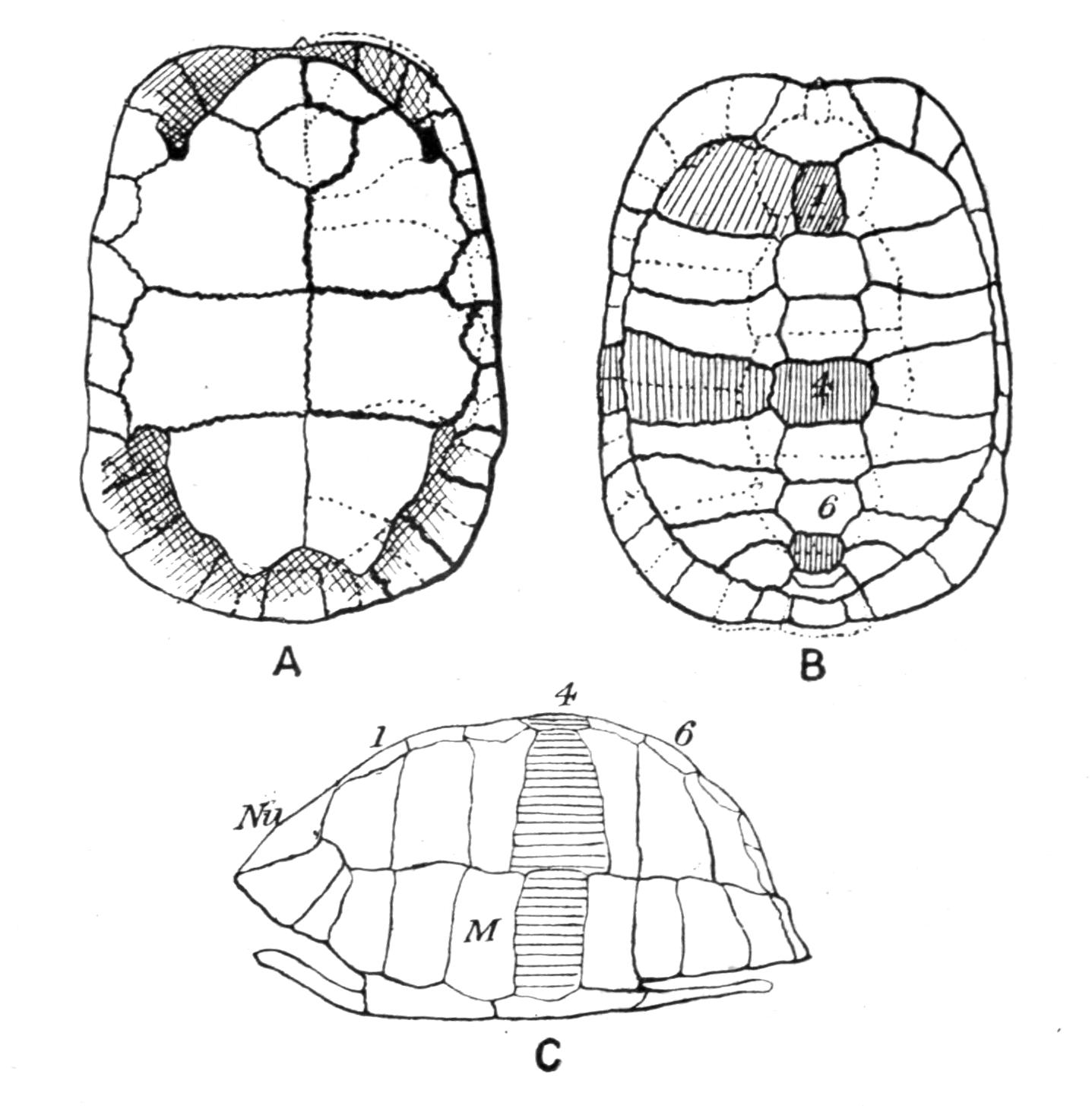
Fig. 67.–Bony shell of Testudo ibera. A, Ventral; B, dorsal; C, left-side view. In B, and on the right half of A, the position of the horny shields is indicated by dotted lines. The underlying bony plates are marked by strong lines. In B the 1st neural and costal plates, the 4th neural, costal, and 6th marginal plates, and the 7th neural plate are shaded. 1, 4, 6, First, fourth, and sixth neural plate; M, in C, fifth left marginal plate; Nu, nuchal plate.
The latter is homologous with the interclavicle, the epi-plastra are homologous with the clavicles of other Reptiles, while the other pieces are genetically derived from, and are further modifications of, the so-called abdominal ribs of the Crocodilia and Prosauria, These plastral plates are never in direct contact with the shoulder-girdle or with any other parts of the internal skeleton. In the young of all tortoises, and in the adult of the Chelonidae and Trionychidae, the several plastral plates enclose large, irregularly-shaped fontanelles. These are more or less filled up in the other groups; and in the Testudinidae especially the whole plastron forms one continuous mass. The navel is situated between the hyo- and hypo-plastrals. Both these pairs are broader than the others, and are connected with the carapace by means of several marginals. The connecting region is called the bridge. In several tortoises, e.g. Emys, the connexion with the marginals is formed by ligaments only and remains movable. In others, transverse, more or less perfect hinges are formed across the plastron. A rather imperfect joint between the hypo- and xiphi-plastrals develops with age in Testudo ibera. In Cistudo and Cyclemys a very effective hinge lies below the hyo- and hypo-plastrals, just in front of the bridge; and the anterior and posterior lobes of the plastron can be closed against the inner rim of the box, fitting tightly in Cistudo. In Pyxis the front lobe only is movable.
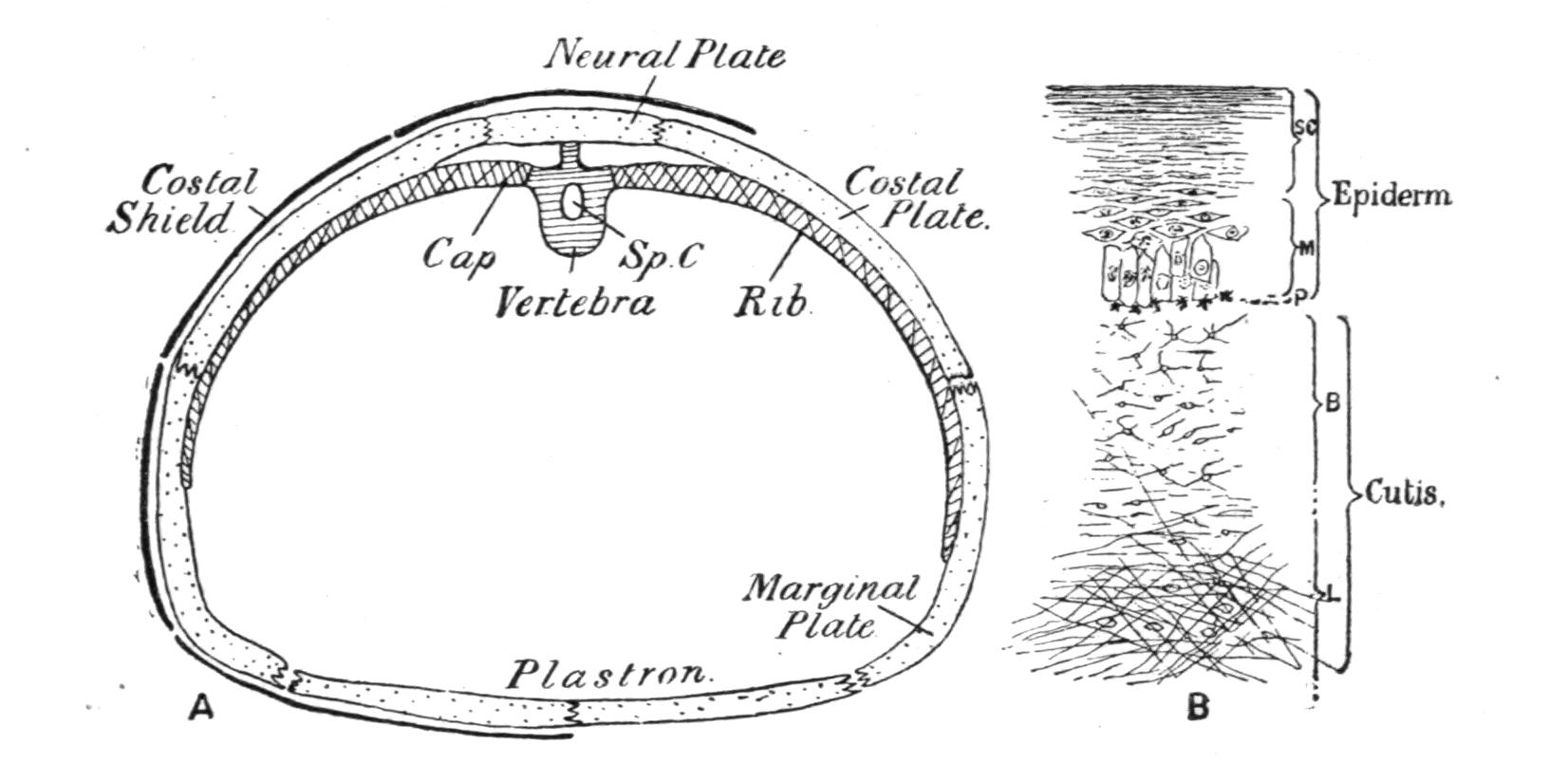
Fig. 68.–A, Diagrammatic transverse section through the shell of Testudo. On the right side the horny shields have been removed, on the left are shown the neural, costal, marginal, and pectoral shields. The bony dermal plates are dotted. Cap, Capitular portion of rib; Sp.C, position of spinal cord. B, Vertical section through part of the shell, magnified and diagrammatic. B, Bony layer of the cutis; L, leathery layer of the cutis; M, cells of the Malpighian layer; P, star-shaped pigment-cells; SC, stratum corneum, composing the horny shields.
The carapace is composed of one median series, a right and left lateral series of costal plates, and a series of marginals which surround the whole. The median series consists of one large nuchal plate, normally eight neurals and one to three supracaudal plates. The characteristic feature of the neural plates is that they are firmly fused with the broadened neural spinous processes of the underlying vertebrae. The nuchal plate lies in front of the first thoracic or ninth vertebra; it overlies the last cervical vertebrae, with the eighth of which it is connected by ligament only; but the posterior corner of the plate often fuses with the spine of the ninth vertebra. In the Chelydridae, and still more in the Trionychidae, the nuchal sends out a pair of long rib-like processes, which either extend to below some of the neighbouring marginals, or their ends overlap those of the ribs of the second thoracic vertebra (e.g. Trionyx), or, lastly, they are in turn overlapped by the first costal plates (e.g. Cyclanorbis). Such rib-like processes are also present, well developed in the young, shorter in the adult, in the Dermatemydidae and Cinosternidae. It is possible that the nuchal plate represents the fused neural of the eighth and the costal plates of the ninth vertebrae. An indication of the compound nature of the nuchal may be found in the fact that two nuchals have been described in Chelydropsis carinata, a Miocene relation of Chelydra. Somewhat similar modifications have taken place in the post-sacral region. The one to three supracaudal plates are, namely, neurals which have lost their connexion with, or perhaps have never been fused with, the spinous processes of the movable tail-vertebrae. The number of neural plates is mostly eight, but there are sometimes individually nine or ten, the gradual suppression taking place first in the sacral region. When such a plate is suppressed the neighbouring costal plates usually close up and meet in the median line. In Cistudo, for instance, there are only seven normal neurals, the eighth pair of costals meet, and the original eighth neural is transformed into a supracaudal. In Cinosternum the sixth to eighth costals meet, separating the one supracaudal widely from the remaining five neurals. The meeting of the last pair of costals, with co-ordinate reduction of the neurals to seven, is almost universal in the Pleurodira; and this tendency is carried out to an extreme in the Brazilian Platemys and in the Australian Chelodina and its allies, in which all the costals meet in the middle line, and the neurals are completely suppressed. Every stage intermediate between complete neurals (Sternothaerus) and interrupted, vestigial, and vanished neurals, is still represented by some genus. This process takes place independently, both in America and in Australia, and is one of the most recently introduced modifications.
The costal plates arise, like the neurals, independently in the cutis, but they soon come into contact with the underlying cartilage of the ribs, which are long enough to reach the marginals. The ribs flatten, become surrounded by the growing membrane-bone of the plates, and the cartilage of the ribs, instead of ossifying, undergoes a process of calcification. Ultimately this is more or less absorbed, its place is taken by the dermal bone, which forms so to speak a cast of the rib, preserving in many cases the shape of the vanished rib, only the capitular portions of which remain unaffected. The number of costal plates is very constant, namely eight on each side, but some fossils have nine or ten, and there are still individual variations in recent forms, indicative of that number. In a large Chrysemys concinna I find the last pair of costals clearly composed of at least two pairs, and this same specimen has nine distinct neural plates.
The marginal plates are originally paired, almost always eleven pairs, very rarely ten or twelve; an unpaired posterior plate, the pygal, is always present, and is probably the result of fusion. In the Chelonidae large fenestrae remain between the costal and marginal plates, only covered by leathery unossified cutis, and of course by the horny shields. In the Indian fresh-water genus Batagur similar windows are gradually filled up with age, and the horny shields become extremely thin and almost confluent. On the other hand, in Testudo polyphemus, the bony shell, always very thin, becomes still thinner with age and finally fenestrated by absorption.
Great reduction has taken place in the carapace of the Trionychidae. The American species of Trionyx have only seven pairs of costal plates; in Cyclanorbis the neurals are reduced to two. The whole dorsal shell is much smaller than the body, and marginal plates are absent or merely vestigial. It is doubtful if the ossifications in the posterior half of the marginal flap of some genera are homologous with true marginals.
Externally the whole shell is covered, except in the Trionychidae, in Sphargis and Carettochelys with horny, epidermal shields. These are phylogenetically older than the dermal plates, and they do not correspond with them either in numbers or in position, although there exists a general resemblance in their arrangement. On the plastron we distinguish an unpaired or paired gular, and a pair of gular, humeral, pectoral, abdominal, femoral, and anal shields (Fig. 66). Sometimes there are also intergulars, paired in Macroclemmys and Chelys, unpaired in Chelone; in many of the Pleurodira an unpaired intergular lies behind the gulars.
The carapace of most Chelonians is covered with five neural, four pairs of costal and twelve pairs of marginal shields, the last of which often forms an unpaired pygal. In front of the first neural lies the nuchal shield, very variable in size, often absent. The Chelydridae, Dermatemydidae, Platysternidae, and Cinosternidae possess moreover several inframarginals, intercalated on the bridge between the marginal and some of the plastral shields. In many of the other families these inframarginals are restricted to the anterior and posterior corners of the bridge, as the so-called axillaries and inguinals, mostly small and variable. Lastly, Macroclemmys has several small supramarginals.
There are consequently eleven longitudinal rows of shields in all; by elimination of the supra- and infra-marginals they are reduced to seven rows. It is absolutely certain that the number of transverse rows also was originally much greater than it is now. The mode of reduction of the number of the neural and costal shields has been studied in Thalassochelys caretta (cf. p. 388.) The accompanying illustration (Fig. 69) shows some of the main stages actually observed in the reduction of these shields. The chief point is that certain shields are squeezed out, or suppressed by their enlarging neighbours. The ultimate result is the formation of fewer, but larger shields.
Each shield grows individually as follows. Every year, or rather during every periodically recurring period of growth, the area of the Malpighian layer belonging to each shield increases peripherally in size, and at the same time produces a new layer of horn. The original little shield, with which the tortoise is born, remains for years, often throughout life, as the so-called "areola;" it increases in thickness owing to the new layer of horn added from below, and peripherally the increase in size is indicated by the overlapping concentric rings. Each ring represents a year's growth, at least in tortoises which live in temperate zones, where hibernation means a complete suspension of growth. It is not known if the same applies to tropical species, which grow either throughout the year, or which undergo one or more periods of rest. The areola does not remain central; the growth is uneven. With age the oldest layers of the areola are frequently rubbed off, and the areola then appears enlarged.
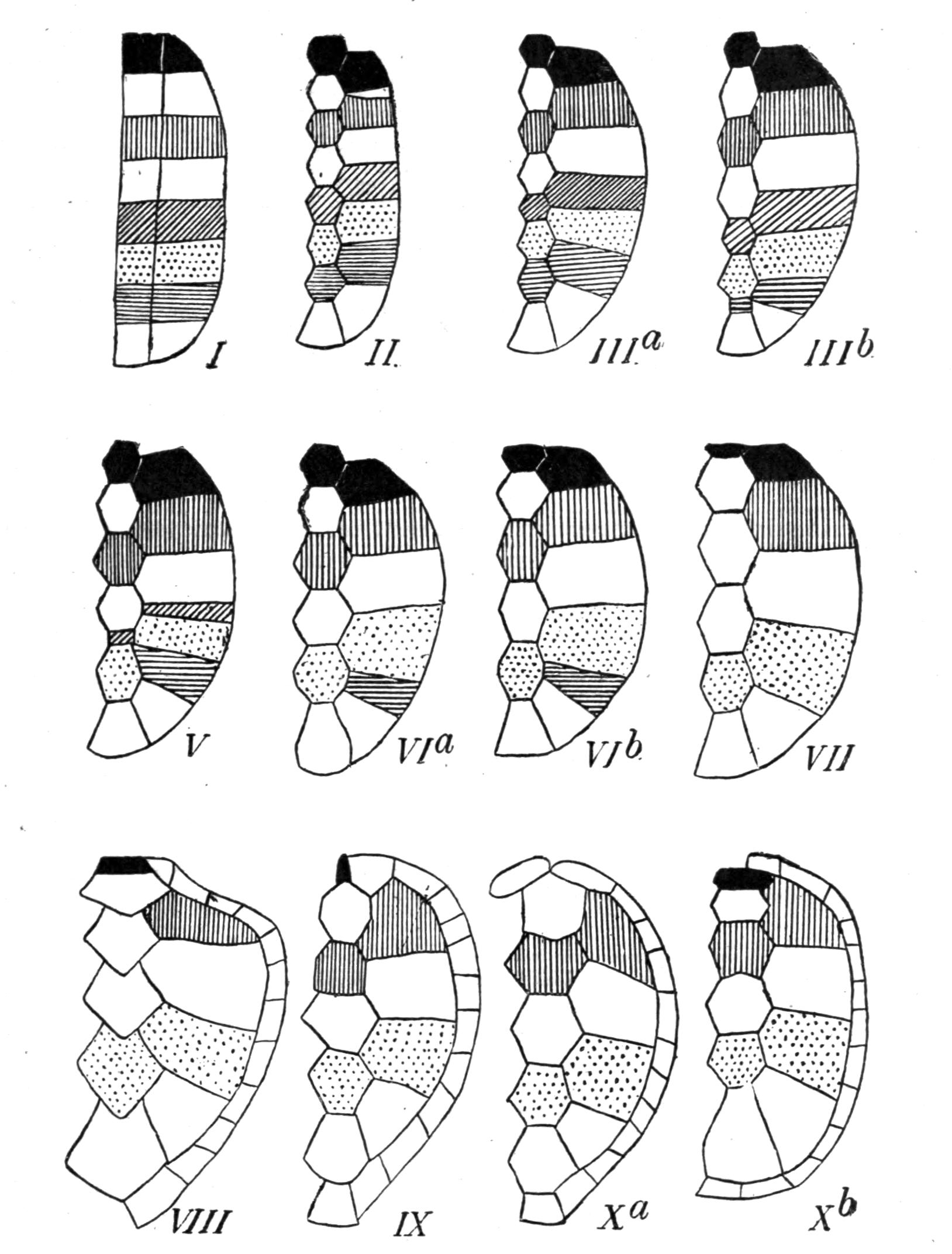
Fig. 69.–Diagrams illustrating the progressive reduction of the horny shields in various Chelonians. The shields, the fate of which it is desired to follow, are indicated by distinctive shading. I. Hypothetical, primitive stage. Eight neural (including the nuchal) and eight costal shields. Both neurals and costals lie in the same transverse planes. II.-VII. Successive stages in the reduction and suppression of various shields, observed in specimens of Thalassochelys, the normal condition of which is represented by VII. VIII. Six neurals and only four costals. The normal condition of Chelone. IX. The nuchal shield has become very small and the resulting gap has been filled up by an enlargement of the first pair of marginals. This is the normal condition of most Cryptodirous tortoises. X. The first marginals meet in front and the nuchal is either suppressed (Xa[Xa in diag]), e.g. in several species of Testudo, or it is surrounded by the marginals (Xb), e.g. in Sternothaerus. (From Willey's Zool. Results, 1899.)
For the first dozen years or so the annual rings can be easily followed, but when the creature approaches maturity each shield adds very little to its growth, and the rings become very fine, crowded and irregular. Only by careful counting and comparison of the rings on the costals, marginals, and plastrals, can a reliable average be arrived at. In some tortoises, e.g. Chrysemys, the whole outer layer of the shields peels off periodically; only a thin smooth layer like mica or tracing-paper remains, of course without any indication of rings. The pigment is formed in the Malpighian layer, but it frequently diffuses into the horny shields themselves, notably in Chelone imbricata, which yields the beautiful "tortoise-shell." The colour of the pigment is either black, yellow, or red, with resulting combinations. The green colour, often so beautiful in baby-specimens of Chrysemys, is optical, produced, according to Agassiz, by a network of black pigment, spread over a layer of yellow oil.
Horny scales, sometimes forming spines, and covering a nodule of dermal ossification, are also common on other parts of the skin, especially on the limbs of land-tortoises, and also on the tail of Chelydra. Sometimes the end of the tail is protected by a claw-like nail, for instance in Pyxis. In some of the gigantic land-tortoises, and in Chelone mydas, this nail assumes large dimensions, and several of the terminal caudal vertebrae are fused together into a regular urostyle. In some subfossil specimens of Mauritian tortoises, these ankylosed complexes are 12 cm. long and more than 5 cm. broad!
Before leaving the description of the shell, it is worth while to draw attention to the enormous correlative changes in other organs produced by this case. Nearly the whole organism has been altered. The hard, firm carapace has partly rendered the supporting functions of the vertebral column unnecessary or impossible. In many tortoises, especially in the large land-tortoises, the vertebrae and the capitular portions of the ribs are reduced to mere bony outlines; the reduction to thin paper-like bony lamellae proceeds with age. The iliac bones find a better support in the costal plates; the contact with the sacral ribs is given up, and these ribs fuse partly with the costal plates, or they are absorbed. The whole mass of muscles of the trunk is completely lost in the region of the shell, but traces of them exist in young specimens. Neck, limbs, and tail can in most cases be withdrawn and hidden in the shell. When this is not possible it is due to secondary changes. The neck is withdrawn either by being tucked away sideways (Pleurodira[129]), or by being bent in an S-shaped curve in a vertical plane. In a left-sided profile-view of the animal, the head represents the tail of the S. The neck is withdrawn by long muscles, which are inserted into the ventral side of the middle of the neck, and extend in the shape of vertical ribbons far back into the shell, arising from the centra of some of the middle or even more posterior thoracic vertebrae.
Lastly, a few remarks on the partial regeneration, or the mending of injuries to the shell. If part of the horny covering is badly bruised, torn off, or rubbed through, or if part of the shell is crushed, the underlying portion of the bony plate becomes necrotic, and the horny covering also dies so far as its Malpighian layer is destroyed. Soon, however, the uninjured Malpighian cells, around the margin of the wound, multiply, grow into and beneath the injured portion of the bone, and form a new horny layer, casting off the necrotic portion. After several months the deficiency is patched up; new bone has grown in the deeper remaining strata of the cutis, and the outside is covered by a continuous horny layer, without, however, reproducing the original concentric moulding of the shields. In badly crushed shells sometimes almost one-third of the whole shell is thus cast off and mended within one or two years. The regeneration of the forcibly stripped-off shields of Chelone imbricata is described on p. 386. Bitten-off tails and limbs, rather frequent occurrences in water-tortoises, are of course not reproduced, but the wounds are healed and covered again with scaly skin.
Sense-organs.–The EYE is by far the best developed sense-organ. It is comparatively small. The pupil is round. The iris is mostly dark in terrestrial forms, while in water-tortoises it is often brightly coloured, for instance pale yellow in Chelodina, greenish and mottled with black, pale grey, brown, etc., in various species of Chrysemys. Cistudo presents a curious sexual dimorphism; the males have red, the females brown, eyes. The sclerotic wall contains a ring of numerous small ossified plates. There is no trace of a pecten. The eye is protected externally by the two lids and the nictitating membrane. In some water-tortoises, notably in Chelodina, the lower lid is transparent. Lacrymal and Harderian glands are present.
The SENSE OF HEARING is apparently not very acute, although tortoises and turtles are frightened by noise, and can distinguish sounds; otherwise they would have no voice, which is very tiny and piping in most tortoises during the pairing season. In most water-tortoises the tympanic membrane is thin and quite exposed; in land-tortoises it is often thick and covered by the ordinary skin; lastly, in Chelone the tympanic cavity is filled with a plug of the much-thickened skin, possibly in adaptation to the water-pressure when these creatures dive to considerable depths. The ossicular chain is mostly reduced to a long, bony, columellar rod.
The SENSE OF SMELL is well developed. All Chelonians carefully smell their food, in the air as well as under water. The individual predilection shown by many species for different kinds of animal and vegetable food,–since they are, for instance, able to distinguish between the various sorts of cabbage, cauliflower, sprouts, etc.,–proves that they possess a considerable amount of smell and taste.
Tortoises have a fine sense of touch; even the slightest tap on the shell is noticed, and the skin of the soft parts is extremely sensitive. Tickling of the sides of the tail, or of the hinder surface of a thigh, produces ridiculous scratching actions of the same or of the opposite foot.
The digestive apparatus is simple. Only a few peculiarities need be mentioned. The tongue is mostly broad and soft; it cannot be protruded. The oesophagus of the Chelonidae is covered with many conical projections pointing towards the stomach. The latter is simple, except in Sphargis. The intestine is devoid of a caecum, but the difference between the small intestine and the rectum is very marked and often abrupt. The cloaca is very roomy. It contains the large copulatory organ, which is unpaired, grooved on its dorsal side, and is altogether constructed like that of the Crocodilia. The large bladder opens ventrally into the urodaeum, a recess of the cloaca; near its base open the urinary and genital ducts. Many water-tortoises possess also a pair of lateral thin-walled sacs, the so-called anal sacs, dorso-lateral diverticula of the walls of the urodaeum. These sacs, which have highly vascularised walls, are incessantly filled and emptied with water through the vent, and act as important respiratory organs. When such a water-tortoise, for instance an Emys or a Clemmys, is suddenly taken out of the water, it squirts out a stream of this water, which is not, as is generally supposed, the urine from the bladder.
The mode of respiration is interesting. The lungs are very complicated, highly-developed, spongy structures. They are attached by their whole dorsal surface to the inner lining of the shell. As they cannot expand through their own initiative, and since the shell has made costal and abdominal expansion impossible, the tortoise has to resort to other means of producing the necessary vacuum. This is done partly by the neck and the limbs, which act like pistons in being drawn in and out; partly by the greatly developed hyoidean apparatus, by which, when the neck is stretched out, the throat is alternately inflated and emptied, the air being swallowed, or pumped into the lungs. Additional respiration, besides that of the anal sacs mentioned above, is effected in various aquatic tortoises by slightly vascularised recesses of the pharyngeal region. Most Chelonians can exist for a very long time without breathing; sulky individuals remain for hours or days under water. Cistudo can shut itself up for an equally long time. Nevertheless this and other land-tortoises easily get drowned.
All Chelonians lay white eggs, round or oval, according to their kind, but the shape of the eggs of one set sometimes varies within the greatest limits. The shell varies from a parchment-like, flexible, scarcely calcareous cover to a hard, well-polished case. As a rule the eggs, imbedded in the ground, are hatched after a few months, but in some of the northern kinds, e.g. Emys orbicularis, the hatching is deferred until the next spring, the embryo's development being arrested during the winter. How such eggs, buried a few inches only below the surface, withstand the often very severe North German and Russian winter is a mystery. Whilst the plastron is generally flat, it is more or less concave in the males of many species, notably in Testudo, Cistudo, and Emys.
The general conclusions which can be drawn from the present geographical distribution of the Chelonia are as few and unsatisfactory as those applying to the Crocodilia, since all the main groups of Chelonians, and many more extinct families, occurred together in bygone ages in the same countries, for instance in Europe.
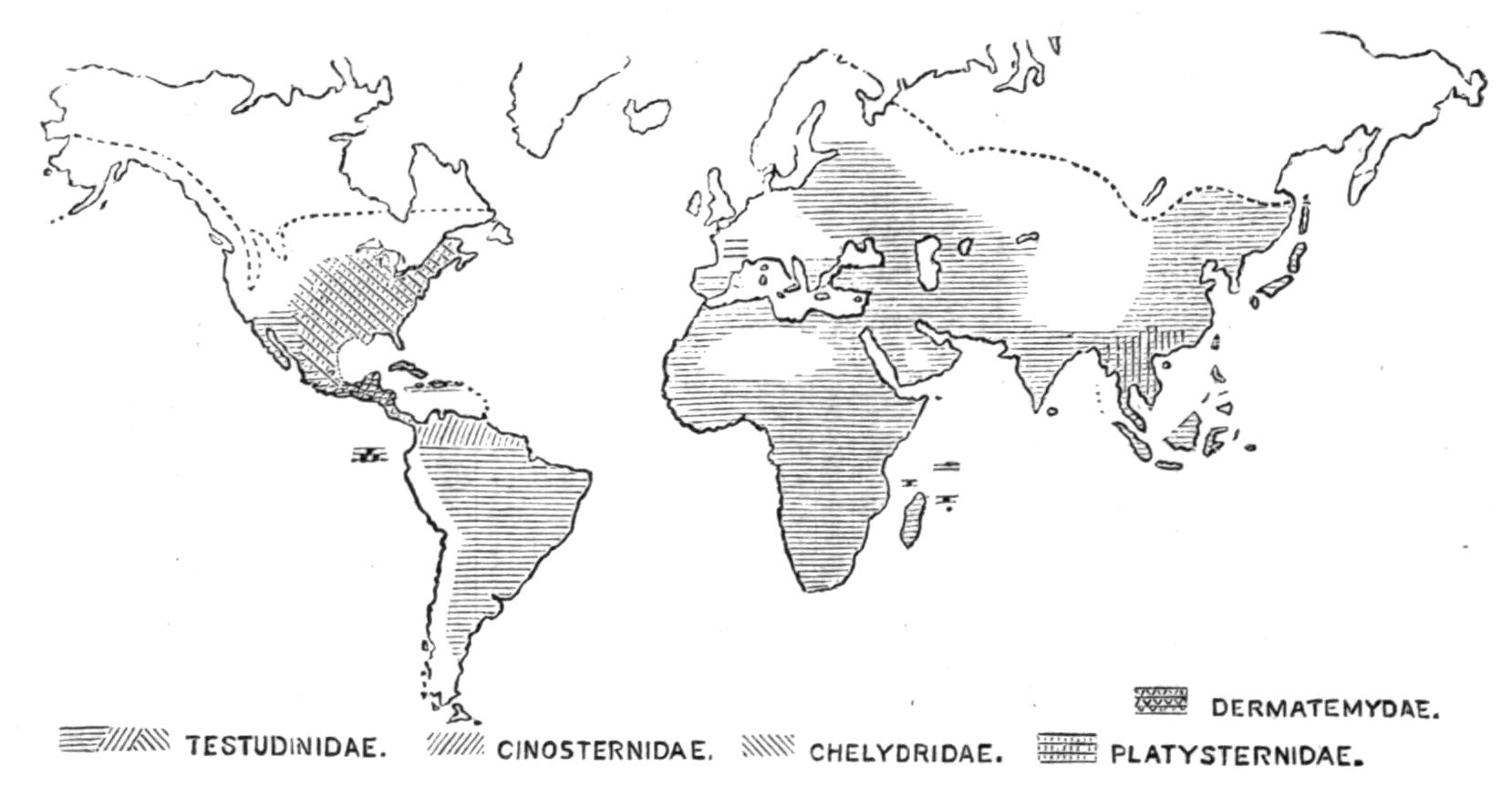
Fig. 70.–Geographical distribution of Cryptodirous tortoises.
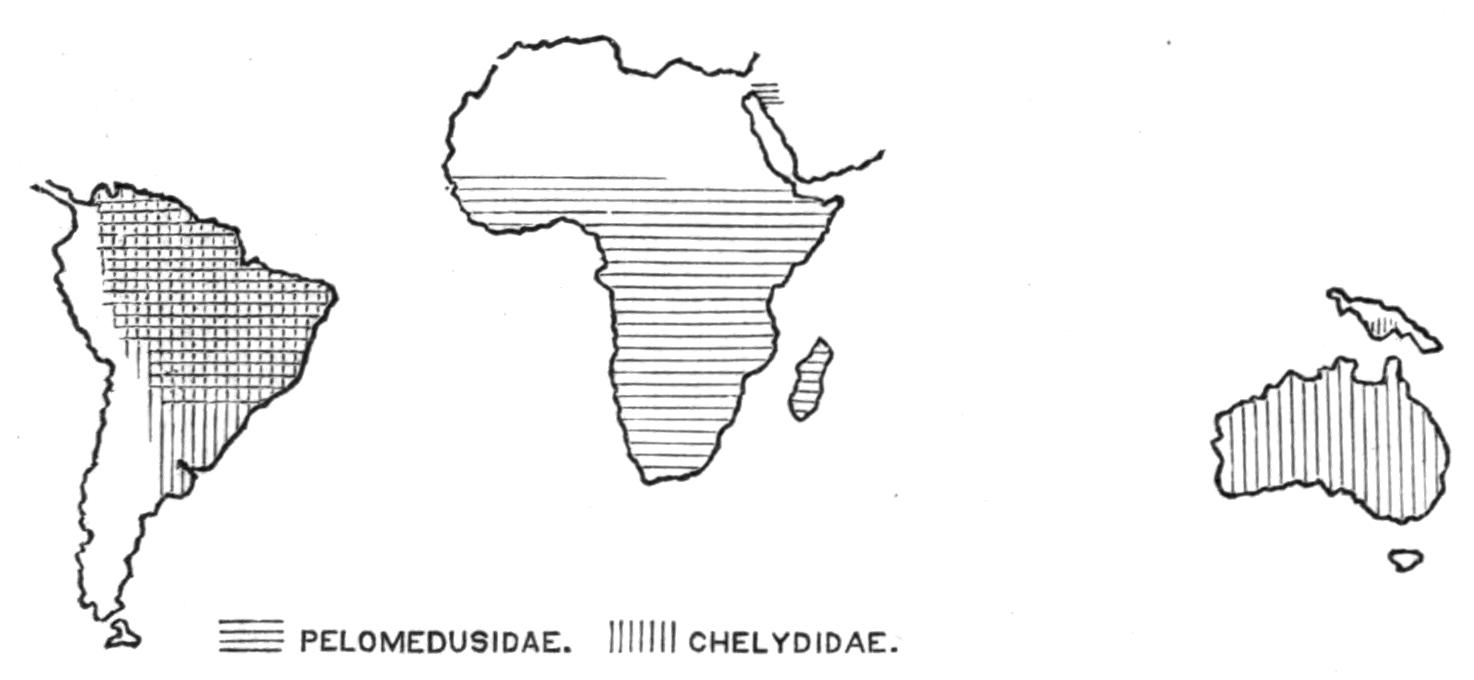
Fig. 71.–Geographical distribution of Pleurodirous tortoises.
The marine forms are naturally cosmopolitan, but the Testudinidae are likewise cosmopolitan, except in the Australian region. The Chelydridae, now restricted to North and Central America, occurred formerly also in Europe. The Pleurodira, in Mesozoic times plentiful in Europe, India, and North America, are now restricted to South America, Australia, and Africa; the Pelomedusidae to Africa, Madagascar, and South America; the Chelydidae to South America and Australia. In the latter country all the Chelonians belong to the Chelydidae. The Trionychoidea, occurring since the Cretaceous epoch in North America, in Early and Mid-Tertiary times in Europe, are now restricted to North America, Asia, and Africa. The country richest in Chelonians is America; North and Central America together possessing representatives of all the families except the Pleurodira, and these we know to have died out there. The Dermatemydidae, Cinosternidae, and Chelydridae are now restricted to the Nearctic sub-region (including Central America). Poorest in genera and species, all of them Chelydidae, is the Australian region, where no fossils of other families have yet been discovered. Europe, with its few Testudinidae, does not come into consideration; Asia has at least Testudinidae and Trionychidae, and in addition the solitary Platysternum in Indo-China, representative of a family whose affinities with the Chelydridae again proclaim the validity of the Periarctic region.
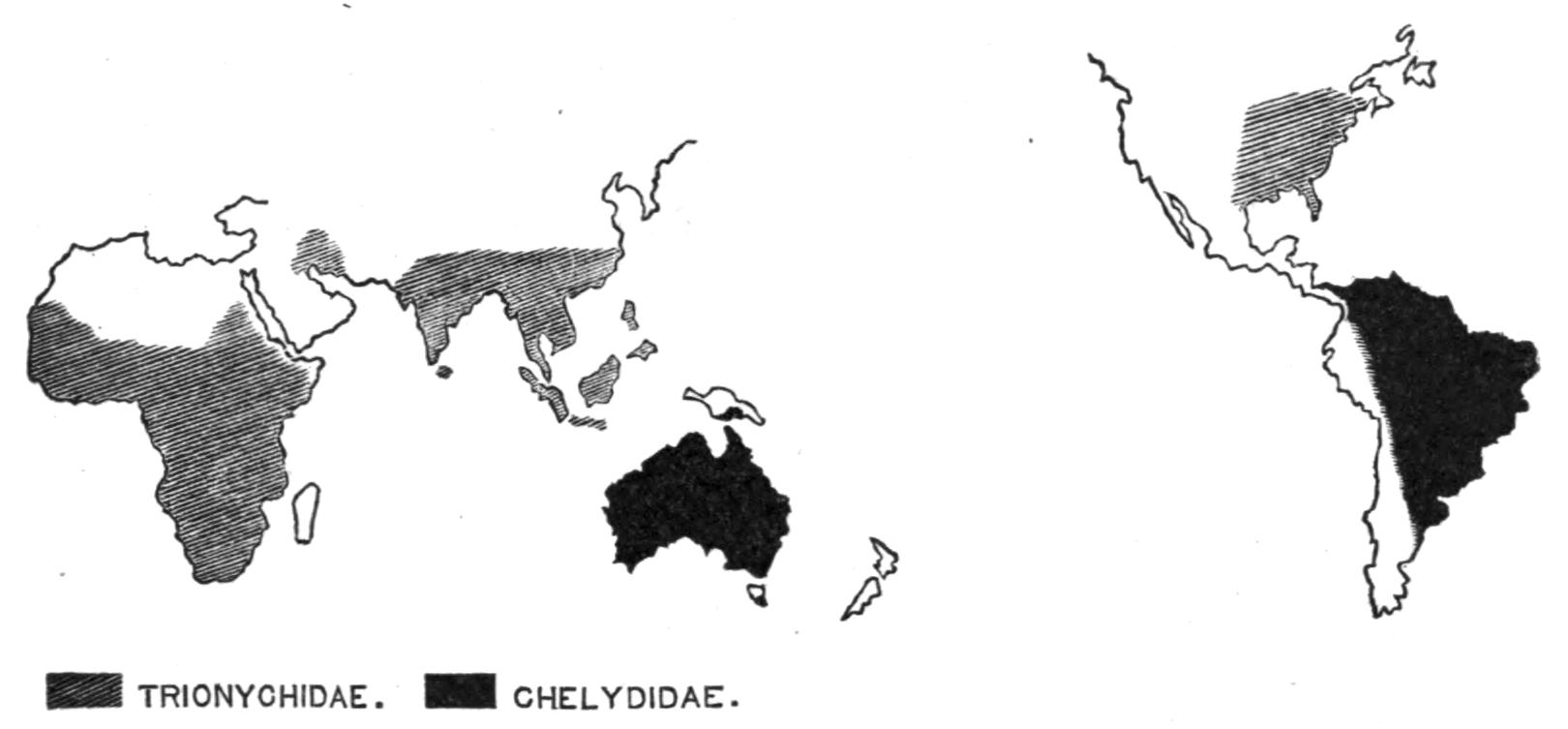
Fig. 72.–Geographical distribution of Trionychidae and Chelydidae.
Order I. ATHECAE.
The vertebrae and ribs are not fused with, but are free from, the carapace, which consists of numerous small polygonal plates and is covered with leathery skin without any epidermal shields. The limbs are transformed into paddles. The neck is not retractile. Marine.
Fam. Sphargidae.–Sphargis s. Dermatochelys coriacea, the Leathery Turtle or Luth, is the only recent species and is the largest of all recent Chelonians. The biggest specimen in the national collection is about six feet and a half long, from the nose to the end of the shell, which latter is about four feet long; such a specimen may weigh half a ton. Agassiz, however, says that he has seen some "weighing over a ton." The general colour is dark brown, either uniform or with yellow spots. The Leathery Turtle has a wide distribution, ranging over all the intertropical seas, but it is rare everywhere; least so perhaps in the Western Atlantic from Florida to Brazil and in the Indian Ocean.
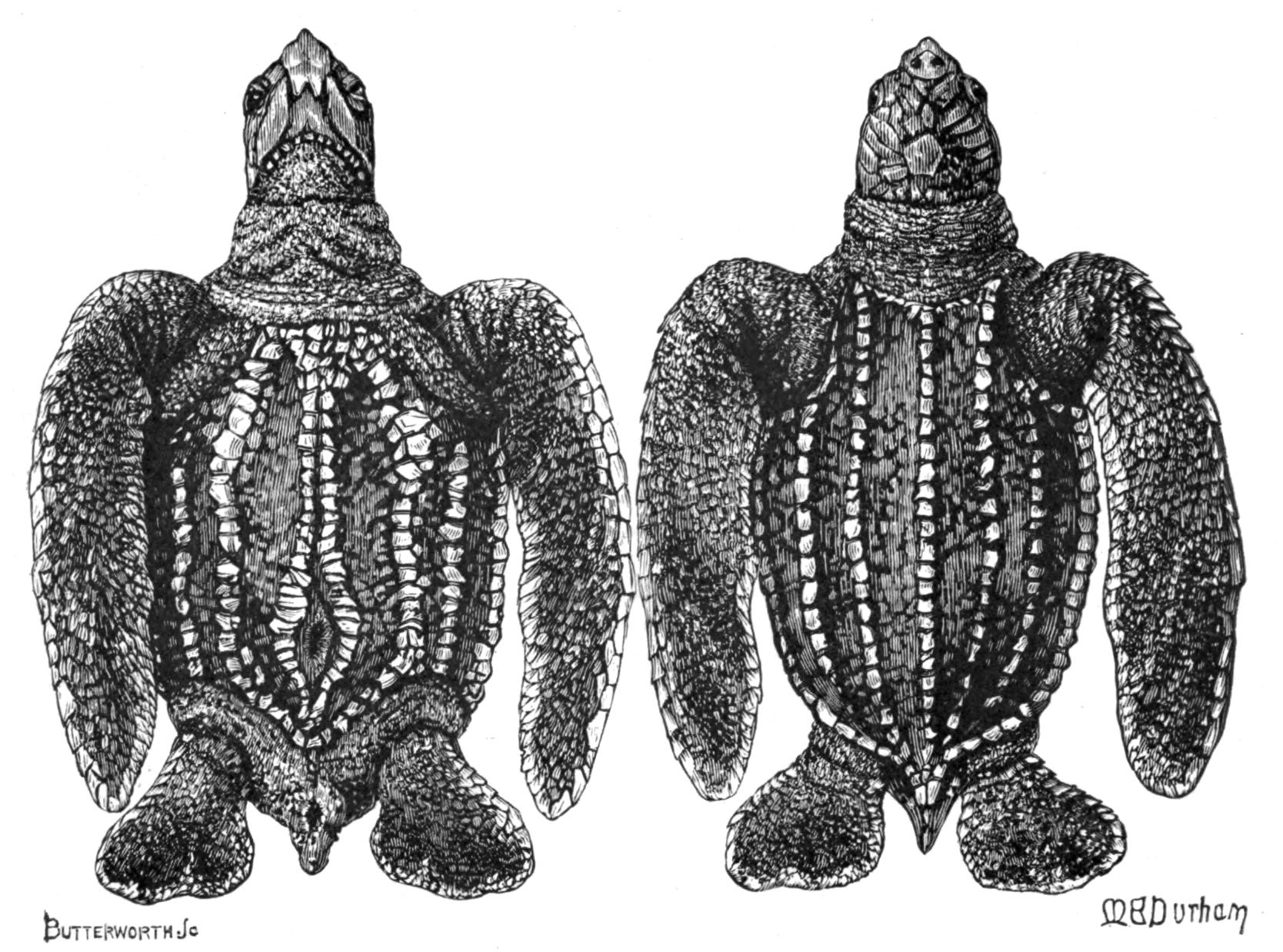
Fig. 73.–Sphargis coriacea, the "Leathery Turtle," young specimens, ventral and dorsal views. × 1.
According to Agassiz it breeds regularly every year in the spring on the Bahamas, on the Tortugas, and on the coast of Brazil, depositing its many eggs on the sandy shore like other turtles. Accidentally it visits the northern coast up to Long Island, and specimens, perhaps carried with the Gulf Stream, have been caught on the coasts of Europe, for instance off Dorsetshire. One was caught near Nantes in 1729, and is said to have made a terrible noise when being killed. This is perhaps the reason why Merrem in 1820 invented the generic name Sphargis, supposed to be derived from σφαραγέω (I make a noise). It has also been recorded from the Mediterranean. It seems to be entirely carnivorous, living upon Molluscs, Crustacea, and fish. The flesh is supposed to be unwholesome. It is a very curious fact that of this rare species only large specimens, besides a very few baby-turtles, are known or preserved in collections, while individuals of intermediate size, say from four inches to three feet in length, have never been recorded. If it were not for the fact that they are still known to breed, it would look as if the species were dying out. Perhaps they are very shy, leading a pelagic life, diving at the least sign of danger, and coming near the land only for the sake of breeding.
The structure of Sphargis is so peculiar in many respects that it deserves a somewhat full account. The neuro-central sutures persist on all the vertebrae. The eight cervicals are short. All the ten trunk-vertebrae carry ribs, and these, with the exception of the last, articulate between the centra and with the neural arches; the first and tenth ribs are short, the others are long and flattened, but not broad, with wide spaces between them. The tail is short, although it consists of about twenty vertebrae; these are devoid of chevrons.
The skull superficially resembles that of Chelone, chiefly owing to the completely roofed-in temporal region. The supraoccipital crest is rather short, covered completely by the parietals, the posterior margin of which is rounded off instead of forming, as in the Chelonidae, a long projecting triangular crest with the supra-occipital. The parietals are in broad contact with the postfrontals, posteriorly they are just reached by the squamosals. The quadrato-jugal is small, separated from the postfrontal by the meeting of the squamosal with the jugal. The quadrate is notched behind, and it separates the opisthotic from the squamosal. The basisphenoid is large and broad, extending far forwards so as to separate the pterygoids widely from each other except in their anterior portions, which, instead of sending a lateral arm to the jugal and maxillary, as in Chelone, are widely separated from these bones by the palatines. The choanae lie on either side of the anterior half of the vomer, and are not roofed over by ventral vomero-palatine wings.
The limbs and their girdles are essentially like those of the Chelonidae, but are not derivable from them. The most remarkable feature is the shell. The dorsal and ventral halves are directly continuous, forming one unbroken case all round, which is composed of many hundreds of little bony plates, irregularly polygonal, fitting closely into each other with their sutural edges, and giving the shell a beautiful mosaic appearance. On the dorsal side are a median row and three pairs of lateral rows of larger plates, and these form seven longitudinal blunt ridges which all converge towards the triangularly pointed tail-end of the shell. The ridges are not so much produced by thickened or spine-like edges of the plates, but by the right and left halves of the plates being actually bent at an angle. This is most conspicuous at the sides of the shell where it passes into the ventral portion. The latter has two pairs of lateral and one median ridge. The whole shell has consequently twelve ridges. The mosaic plates are deeply imbedded in the cutis, being externally as well as internally covered or lined with dense leathery skin. The epiderm is thin, and shows no indications of horny scales. In young specimens the whole shell is soft and very imperfectly ossified, later on it is quite rigid, although comparatively thin. It is nowhere in contact with the internal skeleton, except by a nuchal bone, which by a descending process articulates with the neural arch of the eighth cervical vertebra.
The affinities of the Sphargidae and their position in the system are still debatable. Whilst some authorities, e.g. Cope, Dollo, and Boulenger look upon Sphargis as the sole remnant of a primitive group in opposition to all the other recent Chelonia, Baur considered it the most specialised descendant of the Chelonidae. Dames agreed with him. Van Bemmelen has modified this view in so far as he regards Sphargis as the most specialised Chelonian, but considers the differences between it and the Chelonidae great enough to conclude that both Sphargidae and Chelonidae represent two independent, partly parallel, branches which have arisen from two different groups of terrestrial tortoises. Case,[130] from the study of Protostega and other fossil forms, tends towards Baur's view. He believes that Sphargis is the culminating form of a branch which through Psephophorus and with Eosphargis has sprung from some creature like Lytoloma, which at the same time is the starting-point of another branch which culminates in the genera Thalassochelys and Chelone, while lastly a third branch contains Protostega, Protosphargis, and Pseudosphargis. In other words, he considers them all Chelonidae. If he is right we have of course no business to separate Sphargis with its fossil allies from the rest of the Chelonia as "Athecae."
However, Case has not proved his point. It is easy enough to understand that the characters of the cranium and plastron of Sphargis are in a condition which by partial reduction can be derived from that of typical Chelonidae. The structure of the cervical vertebrae, the absence of the marginal plates and the peculiar articulation of the nuchal with the last cervical vertebra can be explained as convergent analogies, just like the paddles of Carettochelys. But the shell of Sphargis is fundamentally different from and not homologous with that of the others. Cope was therefore quite justified in distinguishing the Sphargidae as "Athecae" in opposition to the others which Dollo later on, by contrast, named "Thecophora." Unfortunate names, since both groups are undeniably in possession of a θήκη or shell. Both authors meant, however, by Theca the epidermal shields, but even this distinction is rendered invalid by Carettochelys.
The most reasonable explanation has been suggested by Hay.[131] The mosaic polygonal components of the shell of Sphargis are, so to speak, an earlier generation of osteodermal plates than the later generation of longer and broader bony plates which in the Thecophora come into contact, and fuse with, the neural arches and ribs. The osteoderms of Sphargis belong to the same category as the dermal ossifications in the scutes of Crocodilia, whilst the plates of the carapace and plastron of the Thecophora belong to the category of the abdominal ribs. Sphargis has the first kind in its peculiar shell, the second kind in the deeper lying plastron and in its nuchal plate. But it has lost, or perhaps had never developed, the horny shields. The only difficulty is, however, the presence of a plastron and of a typical neural plate in Sphargis. This difficulty is not very serious. The plastron is a very old institution. It occurs together with the more superficial osteoderms in Caiman, and the nuchal plate may be the oldest of all dorsals. We can scarcely imagine that the direct ancestors of Sphargis had developed both kinds of shells, and that comparatively recently the inner shell of the carapace was lost, leaving only the nuchal plate. Fossils do not support such an assumption. Undoubted ancestral forms of Sphargis are very rare. Psephophorus of the Oligocene and Miocene of Europe had a continuous mosaic shell much resembling that of Sphargis; Eosphargis is represented by a well-preserved skull from the London clay. Then follows a wide gap until we come to Psephoderma of the Rhaetic, or Upper Trias of Bavaria; the large fragment of whose dorsal shell is composed of about 200 mosaic pieces. If this fragment really formed part of the shell of a Chelonian, its age would speak greatly in favour of the Athecae being a very primitive and independent group.
Order II. THECOPHORA.
Thoracic vertebrae and ribs united with a series of median or neural and a paired series of lateral or costal plates. Parietals prolonged downwards, meeting the pterygoids directly or by interposition of an epipterygoid.
Sub-Order 1. Cryptodira.–The carapace is covered with horny shields. The neck, if retractile, bends in an S-shaped curve in a vertical plane. The pelvis is not fused with the shell.
Fam. 1. Chelydridae.–The plastron is small and cross-shaped (Fig. 61, 2, p. 315); the bridge is very narrow, and the displaced abdominal shields are widely separated from the marginals by a few irregularly shaped inframarginals. The tail is long. The limbs, neck, and head are so stout that they cannot be completely withdrawn into the shell. Snout with a powerful hooked beak. American; only two genera, each with one species.
The temporal region is roofed very incompletely and only anteriorly by the expanded parietals and postfrontals, which form a long suture. The plastron consists of nine bony plates, a small entoplastron being present; there are lacunae in the middle line, the plates meeting imperfectly, and the horny abdominal shields are likewise separated by soft skin. The carapace has a nuchal with long rib-like processes which underlie the marginals; the neural plates form a continuous series. There are twenty-three marginal plates. The pubic and ischiadic symphyses remain separate, enclosing one large heart-shaped foramen. The five fingers and toes are webbed and are protected by claws except the outer toe, the nail of which is usually suppressed.
Chelydra serpentina, the Snapping Turtle, attains a large size, namely, a shell-length of more than one foot, and a total length from the nose to the tip of the tail of more than three feet. Its range extends from the Canadian lakes east of the Rocky Mountains, through the United States and Central America. The carapace of young specimens has three very marked series of keels, which gradually disappear with age, until in very old individuals the shell becomes quite smooth. The skin is very warty, especially on the neck, and there is a pair of minute barbels on the chin. The tail carries three series of originally triangular horny crests, which with age are transformed into blunt knobs. The general colour of this rather ugly creature is olive, mottled with dark brown above and with yellowish below.
According to Holbrook the Snapping Turtle is found in stagnant pools, or in streams where the waters are of sluggish motion. Generally they prefer deep water, and live at the bottom of rivers; at times, however, they approach the surface, above which they elevate the tip of their pointed snout, all other parts being concealed; and in this way they float slowly with the current, but if disturbed they descend speedily to the bottom. They are extremely voracious, feeding on fish, reptiles, or any animal substance that falls in their way. They take the hook readily, whatever may be the bait, though most attracted by pieces of fish; in this way many are caught for the market. It is, however, necessary to have strong hooks and tackle, otherwise they would be broken, for the animal puts forth great strength in his struggles to escape, both with his firm jaws and by bringing his anterior extremities across the line. When caught they always give out an odour of musk, which in very old animals is sometimes disagreeably strong.
Occasionally the Snapping Turtle leaves the water, and is seen on the banks of rivers or in meadows, even at a distance from its accustomed element. On land his motions are awkward; he walks slowly, with his head, neck, and long tail extended, elevating himself on his legs like the Alligator, which at that time he greatly resembles in his motions; like the Alligator also, after having walked a short distance, he falls down to rest for a few moments, and then proceeds on his journey. In captivity they prefer dark places, and are exceedingly ferocious; they will seize upon and bite severely anything that is offered them, and their grasp upon the object with their strong jaws is most tenacious.
The Snapping Turtles, or "Snappers," are feared on account of the ferocious bites which they inflict, and they are hated because of the destruction of valuable fish and water-fowl. They in turn atone for this damage by being eaten, especially the younger half-grown individuals, the flesh of the older ones being too much tainted with the odour of musk. The round eggs, which are laid to the number of twenty to thirty in the summer (in the Northern States about June), are likewise good to eat. The first act of the young creature on leaving the shell is said to be snapping and biting. In captivity they are often very sulky, and refuse food stubbornly for many months, perhaps for a whole year, and apparently without much harm to themselves, since they lie quietly in the distant corner of the tank, now and then slowly rising to the surface to breathe. Fresh-water algae grow on the shell and in the mud which settles on it, and since this happens also in the wild state, they are rendered as inconspicuous as old rotten logs. In order to attract fishes they protrude a pair of worm-like, pale pink filaments from the tip of the tongue.
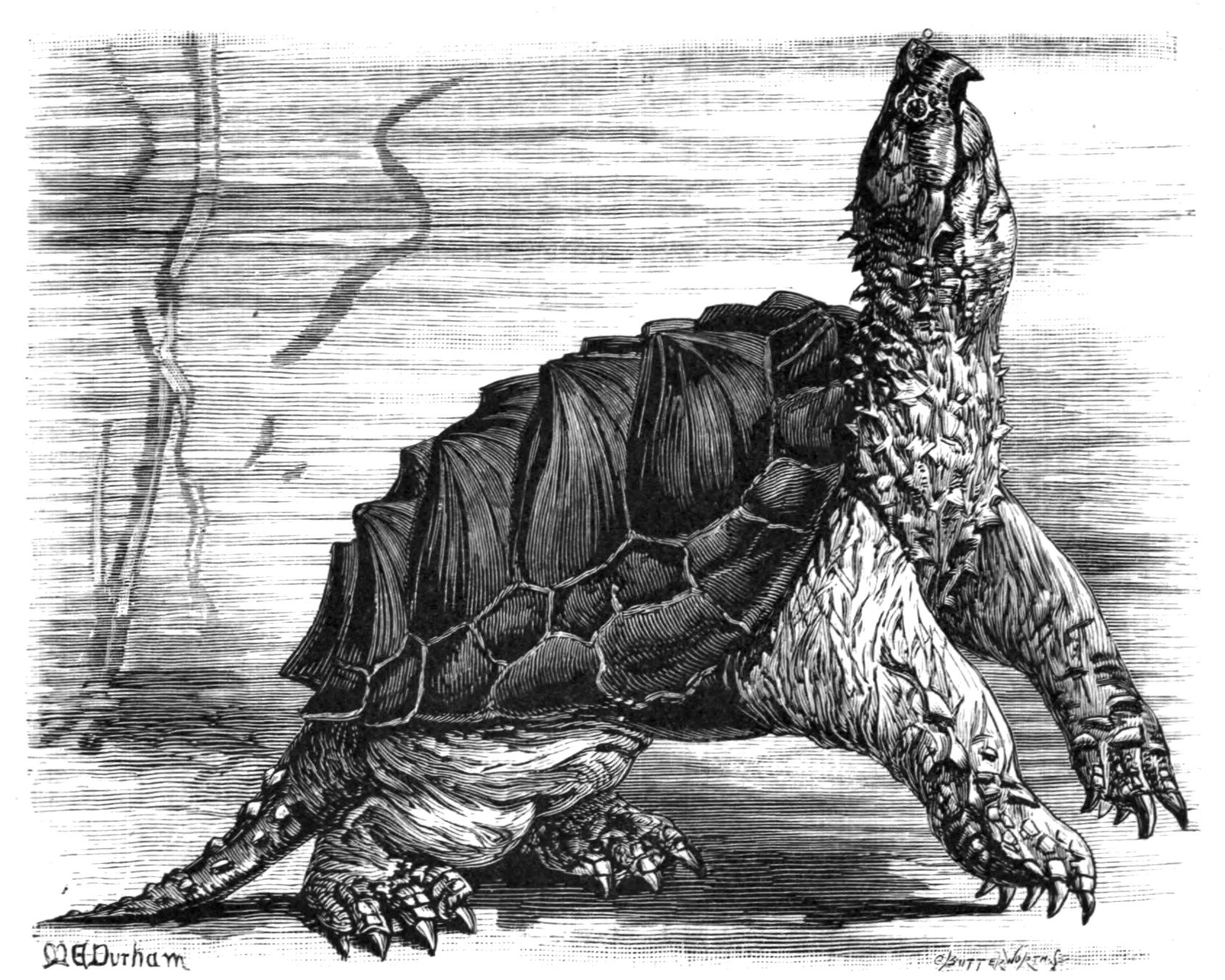
Fig. 74.–Macroclemmys temmincki, "Alligator Turtle." × ⅙.
Macroclemmys temmincki, the "Alligator Turtle."–In size and general appearance much like the other Snapping Turtle, but the dorsal shields have each a strong and prominent keel, and these three series increase in size with age. The costal shields are separated from the marginals by an additional series of about four supramarginals, well shown in the illustration. The shields of the cross-shaped plastron are subject to much individual variation, small shields being frequently intercalated, or rather retained, between the usual ones, especially between the pectorals and abdominals, in the gular region, and on the narrow bridge, where the inframarginals number one to three or even more. This species inhabits, broadly speaking, the whole basin of the Mississippi and Missouri rivers.
This beast is as vicious as the other Snapping Turtle. According to Agassiz it does not withdraw its head and limbs on the approach of danger, but resorts to more active defence. It raises itself upon the legs and tail, highest behind, opens the mouth widely, and throwing out the head quickly as far as the long neck will allow, snaps the jaws forcibly upon the assailant, at the same time throwing the body forward so powerfully as often to come down to the ground when it has missed its object.
It lives mostly in the water, but makes considerable journeys overland. Both in the water and on dry land the limbs move nearly perpendicularly, and the body is raised high. On dry land a considerable part of the weight of the body is borne by the long, strong tail.
"They are as ferocious as the wildest beast of prey, but the slowness of their motions, their inability to repeat the attack immediately, their awkwardness in attempting to recover their balance when they have missed their object, their haggard look, and the hideous appearance of their gaping mouth, constitute at such times a picture as ludicrous as it is fearful and revolting. Their strength is truly wonderful. I have seen a large specimen bite off a piece of a plank more than an inch thick. They take hold of a stick with such tenacity that they may be carried for a considerable distance suspended to it free above the ground. Fishes and young ducks are their ordinary prey. They lay from twenty to forty or more round eggs only about the size of a small walnut in holes which they dig in sloping banks not far from the water" (Agassiz).
Fam. 2. Dermatemydidae.–The pectoral shields are widely separated from the marginals by inframarginals, the gular shields are very small or absent, and the tail is extremely short. Only two or three genera, with three or four species in Central America.
The plastron is composed of nine plates. In Dermatemys mawi it is large, firmly joined to the carapace, covered with eleven or more shields, and there are four inframarginals; in Staurotypus salvini of Mexico the plastron is cruciform, with the anterior lobe movable, covered with seven or more shields, according to the fusion of the anal shields and the presence or absence of the gulars; there are only two inframarginals. The pubic and ischiadic symphyses remain separate; the temporal fossa remains widely open, the postfrontals scarcely touching the parietals. There are 23 marginal shields in Staurotypus, 25 in Dermatemys, including the unpaired nuchal. The nuchal plate has a pair of rib-like processes like those of the Chelydridae, but some of the posterior costal plates, sometimes only one pair, meet in the middle line, overlying or suppressing the corresponding neural plates. The shell of these aquatic tortoises is rather flat, more or less keeled, especially in young specimens, and in the fully adult condition is about one foot in length.
Fam. 3. Cinosternidae, represented by the single genus Cinosternum, with about ten species in North and Central America, and one in Guiana. Closely allied to the two previous families, with which it agrees by the separation of the pubic and ischiadic symphyses, the presence of an ento-plastral plate, the possession of inframarginal shields (Fig. 61, 3, p. 315), the widely open temporal fossae, and the rib-like pair of processes to the nuchal plate. It agrees with the Dermatemydidae in the interruption of the neural plates by the meeting of several pairs of the costal plates. There are 23 marginal shields; five or four shields, according to the presence or absence of the gular on the plastron, and in some species these plastral shields become, with age, more and more separated from each other by soft skin (see Fig. 75). The shape and size of the plastron differ considerably in the various species; in most of them, e.g. in C. pennsylvanicum and C. leucostomum, but not in C. odoratum, the anterior and posterior lobes are movable, with transverse soft hinges, so that the animal can completely close its shell. The skin of the legs and neck is so baggy and loose that these parts slip in, the skin rolling off, when the creature withdraws into its shell. They lay only a few–from three to five–elliptical eggs, which have a shining, glazed, and thick, but very brittle shell.
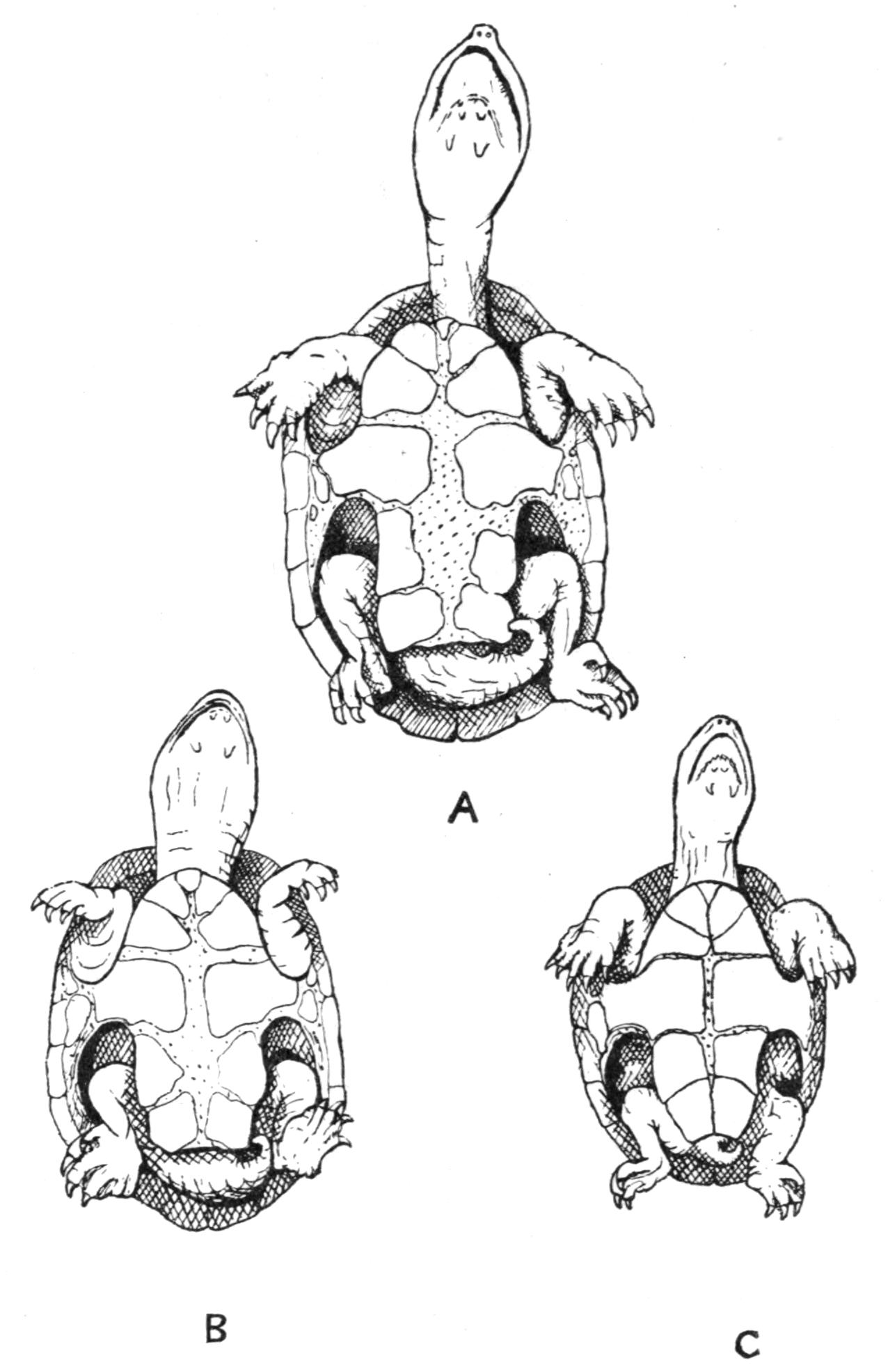
Fig. 75.–Cinosternum odoratum, young specimens. × ⅔. A and B, males; C, female.
Cinosternum odoratum, the Mud-Turtle, or Stinkpot Terrapin, so called on account of the disagreeable smell which exudes from the inguinal glands. The head is disproportionately large, with the snout rather compressed laterally, and pointed underneath, with several short barbels. The neck is long and slender. The carapace of the young is keeled, each of the neural shields being raised in the middle line; but in full-grown specimens the shell becomes quite smooth and rounded. The horny shields of the plastron are relatively largest in the young, but they soon leave ever-increasing spaces between them, which are then filled with soft skin only, which thinly covers the underlying bone. The fore- and hind-limbs, especially the latter, are extensively webbed, and are provided with five short claws. The general colour of the shell is horny brown, either uniform or with darker spots or streaks. The neck and limbs are mottled brown. The only ornamental colouring is a pair of clear yellow broad lines on each side of the head, and a similar streak on each side of the lower jaw. On the chin and upper throat are two pairs of small tentacles. The tail of the male is of about the length of the hind-limbs, while that of the female is so short that its tip scarcely reaches beyond the hinder margin of the carapace. Length of the shell of full-grown specimens between four and five inches. Very young specimens have a rather droll appearance, owing to the long and slender neck with the large head, and the humpy back.
This species is common in the eastern half of North America, from Canada to Texas. It is mainly aquatic, and is one of the dullest and shyest species. My own specimens spend most of their time in the water, invariably in the darkest corners, preferably under a stone or a log, and they do not leave their hiding places until dark, in search of worms, meat, and all sorts of animal food. For months I could never induce them to take food from a stick, or even to eat in my presence, and it was not until after many weeks that one of them at last protruded its head far enough to exhibit the yellow stripes. When taken out of the water they draw in their heads, just allowing the vicious little eyes to be visible, and opening the sharp-edged mouth widely to bite deliberately and furiously at the unwary finger. Some spent the winter in the water, in the greenhouses, feeding as usual, others crept on land, hiding under moss, half buried in the soil, where they slept for several months, but with interruptions in order to soak and to drink. When spring is well advanced they prefer the water for their regular sojourn. Some which had been sent over from New York arrived in a deplorably dried-up condition, the skin being quite flabby and shrivelled, but after a few hours' soaking they came round, and increased considerably in weight, the limbs and neck becoming turgid.
C. pennsylvanicum of Eastern North America has a larger, more oval plastron. The head is not so strikingly large as in the other species and, like the neck, is brown with yellowish spots, and often has streaks on the sides. The tail of the male ends in a nail-like horny point. The lobes of the plastron are well hinged in the adult.
C. leucostomum of Central America is larger, with a shell-length of six inches. The plastron is not at all cruciform, but has a broad bridge, and fills the box, moreover it has an anterior and a posterior hinge, so that the box can be completely closed. Hence the vernacular name of the Box-Terrapin.
Fam. 4. Platysternidae, represented by the single species Platysternum megacephalum in Burma, Siam, and Southern China.
The pectoral shields are widely separated from the marginals by inframarginals, the plastron is large, oblong, not cruciform, and the tail is long.
The plastron consists of nine plates, and is covered with six pairs of shields, the most anterior of which are the broad gulars. The nuchal plate has no rib-like processes. The neurals form a continuous series, and there are twenty-three marginal scutes. The temporal fossae are completely roofed over, owing to the long sutures formed by the parietals with the postfrontals, moreover the postfrontals expand laterally so much that they posteriorly come into broad contact with the quadrato-jugals and squamosals, anteriorly with the maxillaries, so that the jugals are completely surrounded by bones, and are shut off from the orbits and from the temporal fossae. This is a unique arrangement, found nowhere else in Tortoises. The pubic and ischiadic symphyses are connected with each other by ligaments only.
The general appearance of this water-tortoise is rather curious, since the carapace is much depressed, looking, especially in younger specimens, as if it had been crushed in. The head, provided with very strong hooked jaws, is strikingly heavy and large, and is covered above with one single large shield. The tail is longer than the shell, which, in full-grown specimens, reaches about six inches in length; it is, throughout its length, covered with rings of squarish shields. A large specimen measures 14 inches in total length, of which only five fall to the shell.
Fam. 5. Testudinidae.–The shell is always covered with well-developed horny shields. Those which form the plastral bridge are in direct contact with the marginals. The plastron is composed of nine bones. The digits have four or five claws. The neck is completely retractile. The skull is devoid of parieto-squamosal arches.
This large family is cosmopolitan, with the exception of the Australian and the adjoining Austro-Malayan countries. It contains genera which form a continuous gradation between absolutely terrestrial and thoroughly aquatic tortoises; and many are truly amphibious. As a general rule the typically terrestrial kinds have a more curved or arched shell, the digits are short, the eggs are more oval or round, and they are chiefly herbivorous; the essentially aquatic kinds have a flatter or depressed shell, webbed feet, with longer, often slender claws, the eggs are more cylindrical, and they live on animal diet. About 20 genera, with more than 110 species, are recognised by Boulenger, but their essential characters are nearly all internal, and therefore of no avail for the determination of live or entire specimens.
Chrysemys.–One of the most typical and widely distributed genera of American Terrapins or water-tortoises. The carapace is flat; the plastron is quite immovable, with a strongly developed bridge. Feet well webbed. Tail short. Skull with a broad, complete, lateral, temporal arch. About one dozen species, mostly in the eastern half of the United States, but the whole genus ranges from Canada to Argentina.
Most of the young Chrysemys are very pretty, the ground-colour of the upper shields being green, variegated with yellowish-brown or blackish markings, which often form exquisitely delicate patterns, either concentrical (Ch. concinna, Ch. rubriventris), or more longitudinal (Ch. elegans), or apparently quite irregular. The ground-colour of the plastron is yellow, but the various species are best distinguished, at least in very young individuals, by the arrangement of the dark brown spots and patches. There are, for instance, several pairs of bold lateral and several median patches in Ch. rubriventris; five pairs of ocellated spots in Ch. elegans; only small median patches, where four plastral shields meet, in Ch. concinna; while the plastron of Ch. picta is uniformly yellow.
These water-tortoises are very lively and shy, most so perhaps Ch. picta, which is very quick and active. The food varies, often according to individual fancy. Most of them eat fish. Ch. picta is partial to insects, but it also takes worms. Some of my specimens refused meat for a long time, but ultimately they became so fond of it and of worms, that they came out of the pond to take the food from the fingers; those in the Zoological Gardens of London have developed a taste for biscuits. One of my largest Ch. concinna fasted deliberately for eight months, refusing worms, insects, meat, and frogs, only occasionally sniffing at the food, until it was tempted with whitebait, which it took greedily. It refused, however, smelts and pieces of soles, but after another month it condescended to take meat regularly. Very young individuals live chiefly on flies, which they watch for near the surface of the water; and they are fond of smooth caterpillars, maggots, the larvae of humble-bees, and similar soft creatures. They all spend most of their time in the water, preferably floating near the surface, hidden between weeds; and they are fond of basking. Some of them spend the night in the water, lying motionless on the bottom, with heads and limbs turned in. Others prefer hiding under moss. Those species, which, like Ch. concinna and Ch. picta, are common in the North, are of course perfectly hardy. For the winter they dig themselves holes in the banks near the water, and they do not come out again until the spring is well advanced. The eggs are hard-shelled, mostly long and oval, and they are hatched before the end of the summer. The larger species of Terrapin are eaten.
Ch. picta (Fig. 76), the "Painted Terrapin," of the Eastern United States, e.g. of New York and Long Island, is easily recognised by the much depressed shell, which is absolutely smooth, and without a trace of a keel. The colour above is dark olive-brown or blackish, with broad yellow bands across the anterior ends of the neural and costal shields. Three or four of these transverse bands are very conspicuous. The marginals are red, with more or less concentric black and yellow markings. The pretty red colour, with some black stripes, extends over the bridge, but the plastron itself is uniformly yellow. The soft parts are likewise prettily marked, the ground-colour is black-brown, with delicate bright yellow and red stripes on the sides of the neck, limbs, and tail. The stripes are originally yellow, but they develop an orange or red line in the middle, so that each red stripe is ultimately narrowly edged with yellow; or the yellow and red stripes alternate, for instance on the tail, which is short, narrow, and pointed. The head is further adorned with a pair of conspicuous bright yellow patches behind the eyes, and a smaller pair on the occiput. The black and yellow stripes run across the gape of the mouth, some of the lines even looking as if they had been painted across. The nuchal shield is elongated and very narrow, its anterior edge and that of the neighbouring marginals are finely serrated. Very young individuals are at once recognised by the prominent longitudinal median stripe of bright orange extending over the nuchal and neural shields; the yellow transverse bands are still absent; they appear when the longitudinal line vanishes.
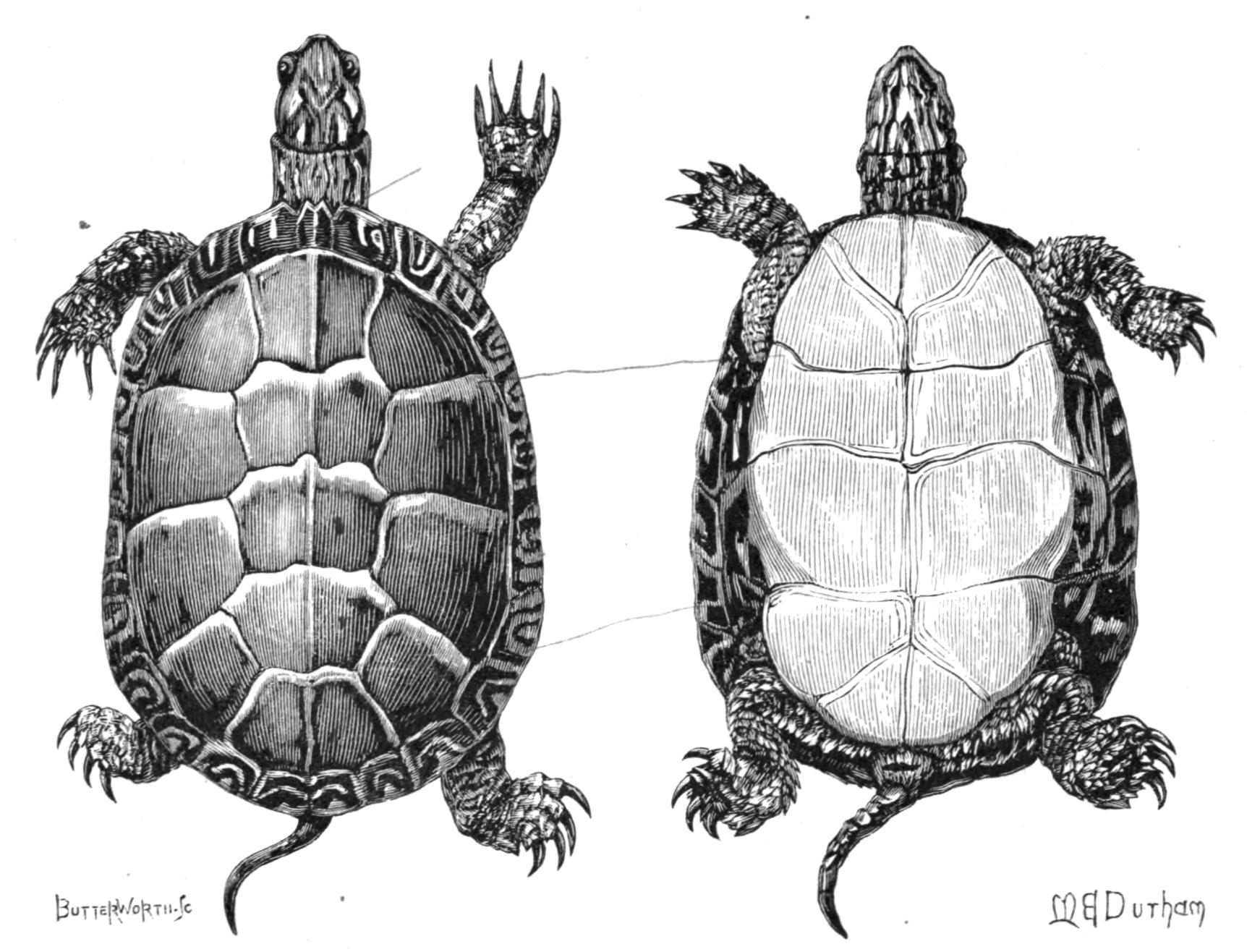
Fig. 76.–Chrysemys picta, "Painted Terrapin." × ½.
The "Painted Terrapin" is one of the few species of which, thanks to L. Agassiz,[132] complete data of growth from the new born to old age are known. During the first six or seven years the rate of growth is so uniform that numerous specimens collected at the same time are readily arranged in sets of the same age, simply by the differences they show in their size. The successive lines of growth on the shields indicate the number of years. After the seventh year the age is much more difficult to distinguish in those tortoises, which, like Ch. picta, have a perfectly smooth epidermis. This smoothness is due to the fact that the shields undergo a process of moulting. An upper, quite transparent layer of each shield peels off completely like a piece of mica. I have been able to confirm Agassiz' statement on Ch. concinna in their third and fourth springs, and on a number of adult Ch. picta. The latter were not allowed to hibernate, being kept in a warm tank; they peeled completely during the late autumn, and then the red and yellow colours underlying the newly formed shields appeared very vividly; others moult at midsummer.
Growth of Ch. picta, after Agassiz.
Year. Length of carapace. Breadth of carapace. Height of box. Length of tail.
millim. millim. millim. millim.
Third 042 039.5 017 017.5
Fourth 051 049 021.5 020.5
Fifth 054 051 023.5 021.5
Sixth 059 056 025 023.5
Seventh 066 060 026.5 026
Eighth (♂) 072.5 061 028 027.5
Ninth (♂) 074 062 028 027.5
Tenth (♂) 077 064 030 028
Eleventh (♂) 080 067 030 028.5
Fourteenth (♂) 092 074.5 033 028.5
Twenty-fifth (♀) 121 092 043 034
Old ♀ 129 096 047 037
Very old ♀ 163 113 059 053
The size of the eggs varies considerably, from 26 by 17 to 30 by 16 millimeters; sometimes they are perfectly round, 17 mm. in diameter.
Ch. concinna.–The specific character by which this Terrapin may be easily recognised is a pair of orange-red broad streaks, which extend from above the eye to the sides of the neck. The general colour is olive-brown above, variegated with yellowish dark-edged lines, which, together with numerous rugosities, radiate from the middle field of each shield. The plastron is yellow, often with blackish symmetrical patches, and sometimes these become confluent and preponderant. Very young specimens are extremely pretty, the ground-colour of the carapace being green, each shield with darker, somewhat concentric markings, most conspicuous and regular on the upper surface of the marginals, where the marks of the adjoining shields form one pattern-system across the dividing lines. The plastron is either uniform yellow or has a few pairs of blackish spots which stand so closely together that they form almost median patches.
The carapace is rough. The horny shields become very thin with age. The anterior margin of the small nuchal and the neighbouring marginals is faintly serrated. The posterior marginals form slight notches or indentations between their edges. The plastron is almost square behind. The edges of the jaws are nearly smooth, without hook and receiving-notch. The tail is short.
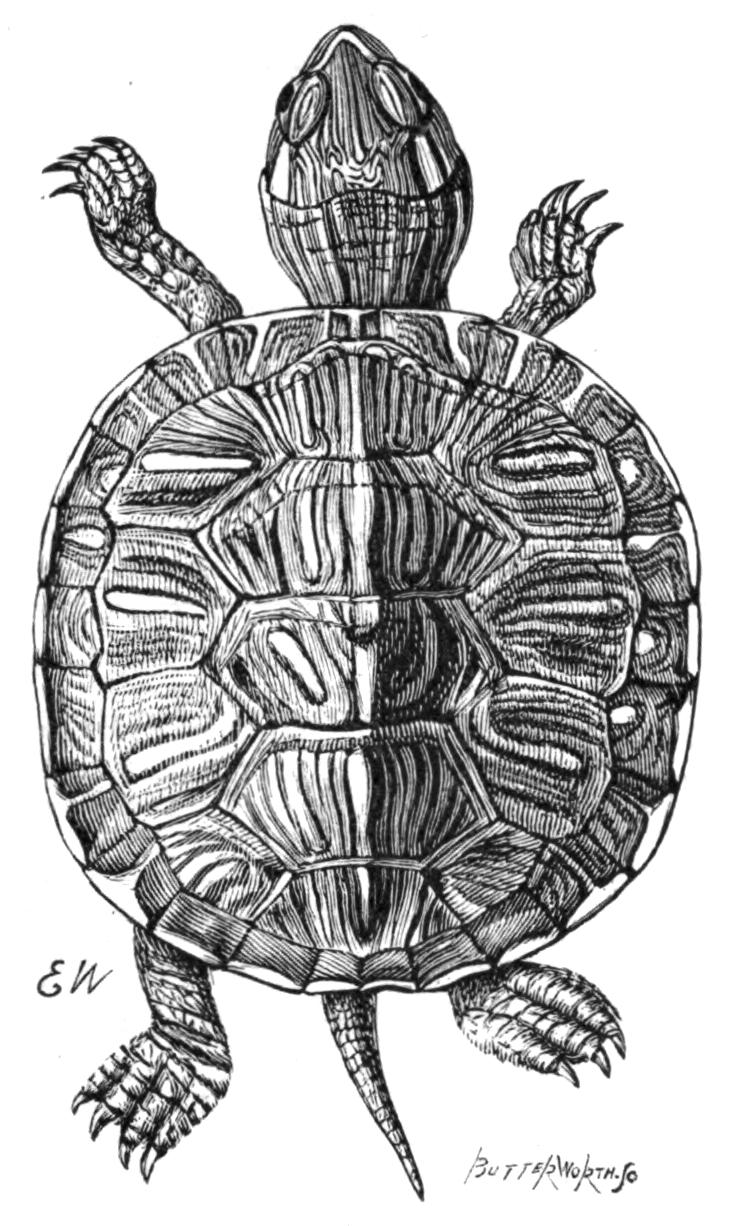
Fig. 77.–Chrysemys concinna, in its third summer, × 1.
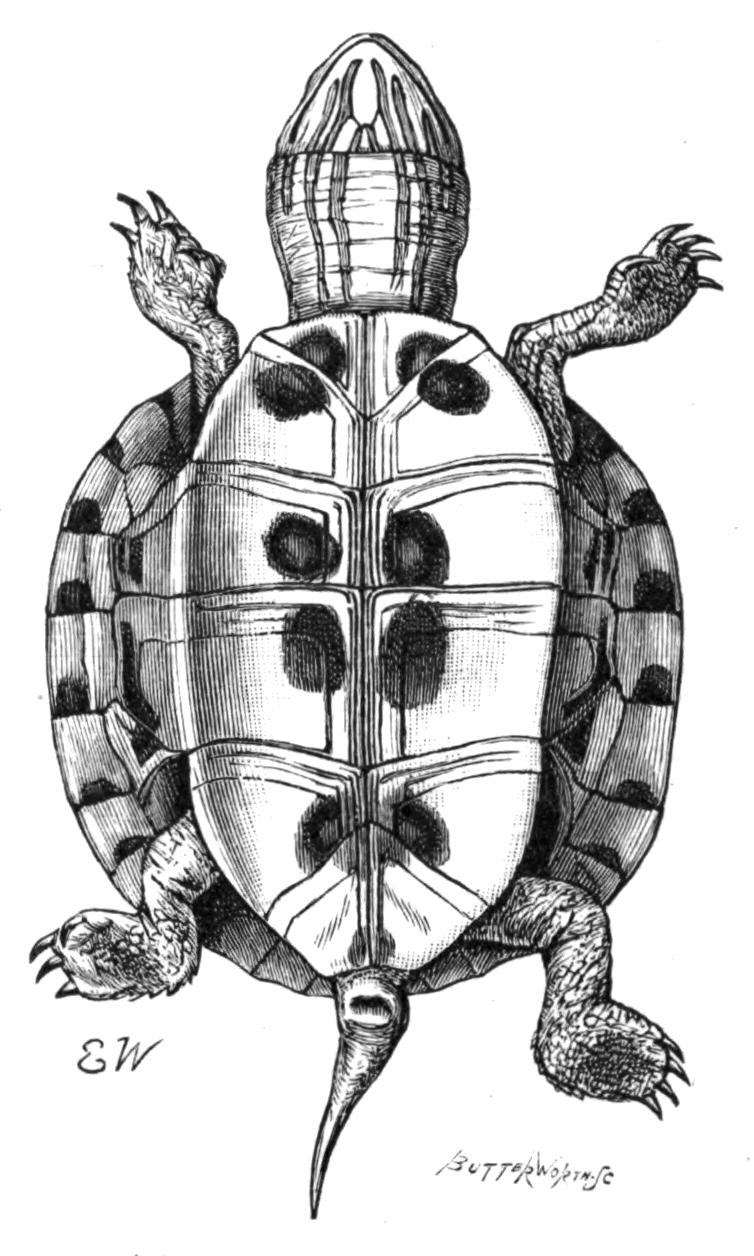
Fig. 78.–Chrysemys concinna, in its third summer, × 1.
This species inhabits the South-Eastern States of North America, from Missouri and North Carolina to the Gulf of Mexico. Very large female specimens have a shell sixteen inches in length. The eggs measure from 33 by 25 to 39 by 25 mm. or about 1½ inch in the long diameter.
Emys.–The plastron is movably united to the carapace by ligament, and in the adult has a slightly flexible hinge across the middle, between the hyo- and hypo-plastral plates and the pectoral and abdominal shields. The plastron is large, but does not quite close the box. Besides the small nuchal there are twelve pairs of marginal shields. The head is covered with smooth skin; the temporal arch is complete. The limbs are extensively webbed. The tail of the very young is nearly as long as the shell, but it becomes relatively shorter with age, being reduced in the males to about two-thirds, in the females to half the length of the shell. Only two species are found in Europe, the other, E. blandingi, in Canada and north-eastern U.S.A.
E. orbicularis s. europaea s. lutaria, the European Pond-tortoise.–The shape and coloration of the shell change likewise much with age. In the very young the shell is round, and the shields are rough and slightly keeled, uniform dark brown above, black below, with a yellow spot on each marginal and plastral shield. When half grown the dorsal shields become quite smooth, and are striated or spotted, with yellow upon a dark ground. The head, limbs, and tail are dark, with yellow or light brown spots and small dots. In very old specimens all these yellow marks disappear on the shell, which then becomes uniform brown or almost black. The coloration is subject to much local and individual variation, and there are two main types, the spotted and the radiate. It is difficult to say which of the two is the prettier. One male which I caught in the Alemtejo was very beautiful. The shell was almost black with a greenish shine when in the water, and had many bright yellow and whitish spots. In the radiate type the yellow is sometimes preponderant, so that each shield becomes a study of delicately painted yellow, brown, and blackish lines radiating from the centre. This variety seems to prevail in the south of Spain, decidedly so in the Marismas, also in Northern Italy, whence most of the European markets are supplied. The largest shell in the British Museum is 19 cm. = 7½ inches long. Fischer Sigwart received one from Naples which was about 9 inches long, and this seems to have been kept as a pet, since its shell had been gilt. Specimens about 5 inches in length may be considered as fully adult. There are very few reliable observations on the growth of individuals. One of F. Sigwart's grew in eleven years only about 2.5 cm. = 1 inch, when its shell was 13.4 cm. = 5¼ inches long–total weight of the tortoise 491 grammes, about 1 lb. One of my own grew from 11 to 13.2 cm. shell-length, and 8.3 to 10.6 cm. in width within eight years, but this was one of the specimens which, living in a greenhouse, did not hibernate. This European pond-tortoise is now restricted to Southern and Middle Europe, extending eastwards towards St. Petersburg and into Asia Minor, southwards into Algeria. Formerly it had a much wider range, having been found in post-glacial deposits in Southern Sweden, Denmark, the Netherlands, and in East Anglia. Specimens have been found in the peat of the fens of Norfolk and Cambridgeshire, contemporary with bones of the Beaver, Roe-deer, and Pelican. The same applies to North Germany, where its gradual disappearance from the western and central parts is obvious. Except in Central France it is now practically unknown to the west of the Elbe river. The country between the Elbe and Oder is now debatable ground, Emys being exceedingly rare. Some fifty years ago this seems to have been different, to judge from the fact that farmers were rather fond of keeping a tortoise in the water-troughs of the cattle to keep the water free from worms and other impurities. Hence arose a silly superstitious custom. It was considered equally conducive to the health of the pigs to keep a tortoise in the foul tub into which all the dish-water and kitchen-refuse–as potato-peels, sour milk, etc.,–were collected before the mess was given to the pigs.
A specimen is still occasionally caught in the Havel and Spree rivers. I myself have heard of one or two in the backwaters of the Oder near Frankfurt, but they are vanishing, and it is difficult to say exactly why. The universal lowering of the water-level owing to better drainage cannot quite account for it, since there are thousands of suitable ponds, swamps, and backwaters left. In Poland and in Eastern Prussia the tortoise is still common.
This creature lives on a strictly animal diet. Worms, insects, frogs, fishes form its main sustenance. Fishes are regularly stalked. The tortoise watches its opportunity, slowly it half crawls, half swims along the bottom, rises imperceptibly by a few gentle movements of the widely spread-out webbed feet, then opens its sharp cutting jaws wide, and makes a grab at the belly of the fish. Frogs are most easily stalked when they sit upon a floating leaf. The tortoise rises from below, and often waits with the nostrils and eyes just above the water and close to the frog. After a while it sinks, and rises again, this time actually touching the toes of the non-suspecting frog, smelling at them and deliberately biting with a sideward turn of the head.
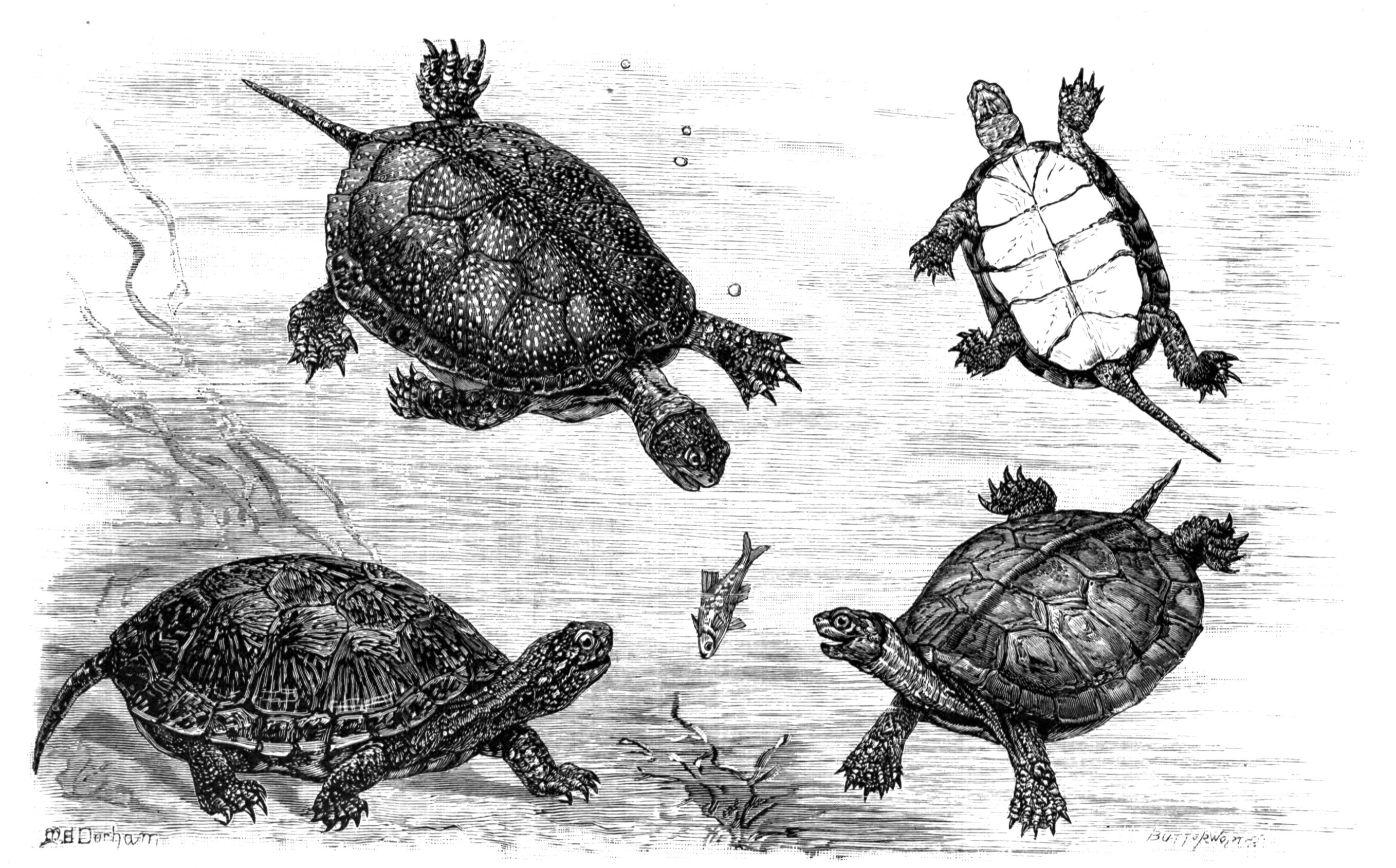
Fig. 79.–Emys orbicularis, European Pond-tortoise (left), and Clemmys leprosa, Iberian Water-tortoise (right). × ½.
What the jaws have got hold of is not allowed to escape again. The tortoise holds on and tears the prey to pieces with the sharp-clawed fingers. This takes a long time, only the scraped-off flesh and the intestines being eaten. The skeleton remains and sinks to the bottom, while in the case of a fish, the air-bladder floats away on the surface, and remains there as one of the surest signs of the existence of tortoises in that locality. The bones are cleaned with wonderful neatness. Some of my grass-snakes shared this fate, their backbones, with the hundreds of pairs of ribs, being picked or rather scraped clean, scarcely less well than if they had been prepared for a museum.
As a rule the prey must be in motion to be seized, unless the tortoise has watched it before, and even then the latter prefers to smell it before biting. In captivity they soon learn to eat meat, and they become very tame, but in their native haunts they are extremely shy and cautious. Fond of basking upon a stone or on the banks, with the four limbs sprawling, or with the hind-limbs stretched backwards, and with the webs spread out so as to offer as large a surface as possible to the rays of the sun, they lie motionless for hours and appear fast asleep. But the slightest noise, or any other sign of our approach, is sufficient to send them plumping into the water, and to make them scuttle along with unsuspected agility. Nothing but the audible plump of the flat body and the widening rings of the disturbed water indicate their presence. After a long time of waiting we give it up, and turn away. That very instant we see a little ripple, caused by the withdrawing of the tortoise, which had come to the surface and had been watching us, with only the nose and eyes peeping out of the water, the rest being concealed between the floating vegetation. Apparently they cannot see us well with their eyes still under water, owing to the difference of refraction, otherwise they would not peep out and then at once turn back. It is certainly not for the want of air, since they can remain below for many hours without breathing.
Although they generally feed in the water, they come on land when tame and hungry enough to take the offered food. Sometimes they make long migrations, perhaps because their old home is dried up or does not yield food enough. They hibernate during the cold season, buried in the mud, and they do not appear until the spring is well advanced. During the pairing season, on warm spring nights, they emit short piping sounds, and when they have found each other, the couple swim about together. The white, hard-shelled, long, oval eggs, averaging 25 to 15 mm., and about ten in number, are laid on land. This is a very laborious and curious business. The female having selected a suitable spot, not loose sand, but rather hard soil free from grass and other dense vegetation, prepares the ground by moistening it from the bladder and the anal water-sacs. Then it stiffens the tail and bores a hole with it, moving the tail but not the body. The hind-limbs then scoop out the hole, the broad feet moving alternately and heaping up the soil on the side, until the hole is about five inches deep, that is as far as the hind legs will reach. The eggs are laid at the bottom in one layer, divided and distributed by the feet. Lastly, the soil is put in again, and the tortoise, by repeatedly raising its body and falling down, stamps the soil firm and flat, roughens the surface a little with its claws, and leaves the nest to its fate. Nothing but an accident leads to its discovery. The young are hatched, according to locality and the kind of season, either in the same autumn or not until the next spring. Eggs laid in a garden at Kieff, in Russia, were hatched eleven months later. This implies hibernation of the embryo within the egg, and this is probably the usual course of events, resembling the conditions of the development of Sphenodon (cf. p. 299). The pretty little creatures, scarcely larger than a shilling-piece, are exceedingly difficult to rear. They require a tank with green vegetation, stones to bask on and to hide under, and also dry ground and moss for a change. They eat flies, tiny worms, tadpoles, etc., greedily enough, but for some occult reasons they do less well than many another kind of water-tortoise. Miss Durham has, however, succeeded in rearing one, which is now in its fourth year; the shell is 2 inches long, and each shield shows three annual rings around the areola. This specimen spent the winters in an unheated room under moss, not in the water.
E. blandingi, the North American species, has a more elongated and decidedly higher carapace than its smaller European relation. The carapace is dull black with many pale yellowish spots; the plastron is yellow, with a large dark patch on the outer and hinder corner of each shield. The head is dark brown above, bright yellow below and on the throat, a contrast which gives this tortoise a striking appearance. This species is extremely voracious, becomes easily tame, and spends a great part of the day on land, hiding under grass to avoid great heat, and withdrawing into the water for the night.
Clemmys.–The plastron is immovably united with the carapace, and is devoid of any transverse hinge. The skull has a complete bony temporal arch. This genus, consisting of eight species, is otherwise very much like Emys, and is truly Periarctic.
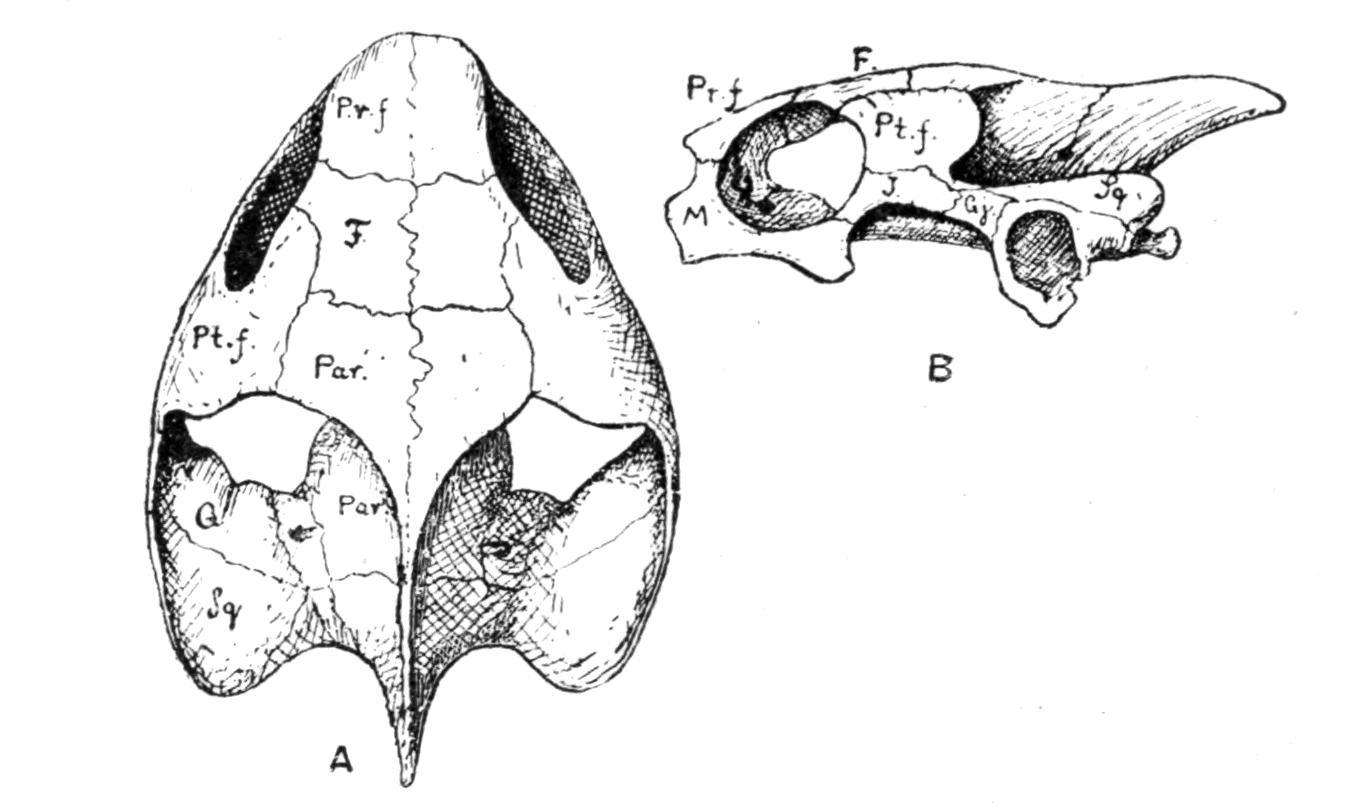
Fig. 80.–Skull of Clemmys leprosa. × 3⁄2. A, dorsal view; B, from the left side; F, frontal; J, jugal; M, maxillary; Par, parietal; Pr.f, prefrontal; Pt.f, postfrontal; Q, quadrate; Qj, quadrato-jugal; Sq, squamosal.
C. leprosa s. sigris (Fig. 79).–The upper jaw has a median notch for the reception of the upturned point of the lower jaw; the cutting edges of the powerful beak are smooth. The shell is flat and long-oval, nowhere serrated. The plastron does not quite fill the box. In the young the shell is nearly round, and the horny shields form three series of keels, of which the lateral pair disappear early; the shields are olive-brown, each with an orange spot or streak; the plastron is dark brown, with a yellowish margin. The adult looks very different. The shell has become much more oval, with the greatest width behind the bridge. The long shields are smooth, and in elderly specimens are without any trace of the original connective rings of growth. The general colour of the shell is uniform pale olive-grey, inclining to yellow on the plastron. The ground-colour of the soft parts is olive-grey, but the sides of the head are adorned with orange-red or yellow marks, the patch between the eye and ear and three or four stripes on the neck being especially conspicuous. The limbs have pale yellowish streaks. All these markings are, however, subject to much individual variation. While, for instance, the half-grown creatures are distinctly agreeably coloured, often with a rich brown, nicely sculptured shell, and with conspicuous orange and yellow marks on the skin, the very old ones become rather ugly, the prevailing colour varying more and more into dull uniform pale olive-grey.
The "Iberian Water-tortoise" is typical of the Iberian Peninsula, and extends through Morocco and Algeria far into North-Western Africa. Unknown to the north of the Cantabrian range, decidedly scarcer than its cousin Emys in the northern half of the Peninsula, it becomes common in the south. In the Alemtejo, in the lower parts of Andalucia and in Morocco, there is scarcely a pool, stream, or river in which it is not found, feeding on any living thing it can master, although fishes and frogs are its principal prey. When the streams and watercourses run dry, during the hot and dry season, the tortoises crowd together into the remaining pools, which soon become stagnant and filthy. But even these havens of refuge are not of lasting avail. They are soon cleared of anything edible, and the stinking water becomes dirtier and hotter day by day. Ultimately the tortoises leave the pool to hide under ledges of rocks, where they aestivate for months. This life in the muddy, slimy pools renders these tortoises peculiarly liable to the attacks of a certain fresh-water alga, which enters through the cracks in the horny shields and then flourishes in the Malpighian layer, and even in the underlying bone itself. This becomes gangrenous in patches, and the whole shell assumes a leprous appearance, hence the specific name of leprosa. Everything combines in favour of this destructive little alga. The tortoise, covered with mud, basks in the hot sun, the horny shields become brittle and crack, often peeling off in thin flakes. But those happy individuals which inhabit permanent rivers, or pools which do not dry up, are, and remain, as clean as other water-tortoises.
C. leprosa has a most disagreeable, offensive smell, something like concentrated essence of fish, due to the secretion of a pair of large glands situated beneath the skin of the inguinal region, and opening behind the bridge. Freshly caught specimens stink horribly, but when they have become accustomed to being handled, they no longer void these glands. They always withdraw into the water for the night, and the cold season is spent in the mud. Their time of propagation is still somewhat doubtful. Very young tortoises are met with in the Peninsula in March, when they are already in the rivers. Those which I imported in the summer and autumn invariably dug their nests and laid their long, oval eggs (28 to 33 mm. long) in the month of November, pairing having taken place some two or three months previously. The mode of making the nest is exactly the same as that described for Emys. As most of my specimens were kept in a greenhouse with a permanent current of warm water through their tanks, they never hibernated, nor did they pass through a torpid time in the summer, but they showed an irresistible love for the hot-water pipes, huddling together by the dozen, so that the pipes had to be screened off to prevent the creatures from getting burnt. Until this precaution was taken, they heated themselves so much that the shields and even the bones of the plastron were injured. The artificial warm temperature and the complete suppression of seasonal rest had no bad influence, most of the tortoises living with undiminished appetite for more than twelve years, but the sexual period became disturbed, pairing occurring ultimately at all times of the year. The eagerness of the males, however, had a peculiar evil secondary influence upon the females. The male tries to fasten on to its mate by biting into the collar-like fold of the neck into which the head is withdrawn, and this repeated irritation produces sores and swellings, which latter in their turn prevent the female from wiping the eyes with the back of the fore-limbs, a habit common to most, if not all, tortoises. Ultimately the eyes fester, and the tortoise, becoming practically blind, falls off its feed, leaves the water, which makes matters worse, and is very difficult to cure.
In other respects they are very hardy, and they stand acclimatisation in England perfectly. Some, thriving in a deep concreted pond, passed through the very severe winters of several years ago, hiding in the mud below the ice, and appeared in the spring in perfect health. They can also successfully pass the winter under moss and a heap of loose garden-rubbish.
C. caspica is closely allied to C. leprosa, which it represents in the Balkan Peninsula and in Asia Minor. It differs from the south-western species chiefly by having the cutting edges of the upper jaw finely denticulated, and by its prettier coloration, each shield being ornamented with yellowish streaks which form a kind of ∞ on the costals, and a ring on the marginals. The plastron is black in the young, with yellow and black patches in the adult. The head and sides of the neck are striped with yellow lines, narrowly edged with black, and the rest of the soft parts is marbled dark olive and yellow. A few other species occur in China, Japan, and North America.
Clemmys insculpta, one of the American species, ranging from Maine to Pennsylvania and New Jersey, is easily recognised by the peculiar reddish-brown and brick-dust colour of the soft parts. The strongly keeled, posteriorly emarginate carapace is reddish brown, with radiating yellow lines. Each shield is delicately sculptured. The plastron, which is notched behind, is yellow, with a large black patch on the outer corner of each shield. Length of a full-grown specimen 8 inches. They frequent the rivers and ponds, but are also very fond of leaving the water, sometimes remaining for months in dry places.
Malacoclemmys of North America, with three species only, is closely allied to Clemmys, from which it differs chiefly by the very broad alveolar surface of the upper jaw, and by the more forward position of the entoplastron, this being placed anteriorly to the humero-pectoral suture. We mention this genus since one of its species, M. terrapin, is so extensively eaten in the Eastern United States. The shell is oval, slightly emarginate behind, obtusely carinated along the middle line. The upper parts of the shell are brown or greenish, with dark concentric lines; the marginals are yellow below, each with a ring of dark grey, and forming a peculiarly up-turned rim. The plastron is yellowish, either with concentric stripes and dusky lines or uniform yellow. But it is the colour of the soft parts which gives this otherwise dull-looking creature its delicately pretty appearance. The skin is, namely, greenish white with countless small black dots. The males remain much smaller than the females, and have the concentric stripes more pronounced. This species, the choicest of the edible Terrapins, frequents the salt marshes of the east coast of North America, from Rhode Island to the Gulf of Mexico, being most abundant around Charleston.
The following is a condensed account of an article which appeared in the New York Sun, 18th September 1898, the data of which were supplied by the manager of the terrapin-farm at Beaulieu, Georgia. The continued hunting and the unfailing demand for them are making them very scarce, so that enterprising men have established terrapin-farms or "crawls" for the keeping and breeding of terrapins. The "crawls" in question are near the river. The larger is 310 by 60 feet, and is divided into three compartments for three sizes. The smaller "crawl" is for the babies, and is 100 by 8 feet. Through both "crawls" runs a ditch connected with the river and making a circuit of the farm. The bottom of the "crawls" is on a level with the low tide, and is covered with a layer of mud about six inches deep. Into this the terrapins burrow in the winter. The average population of terrapins is about 40,000, one half "bulls" and the other half "heifers." The latter are much better eating, and grow to a much larger size, namely, eight inches on the plastron, while the "bulls" rarely grow over five inches long. When a female reaches six to eight inches it is called a "count." Those between five-and-a-half to six inches long are known as "two-for-threes," while those from five to five-and-a-half inches are known as "halves." They are fed exclusively on shrimps and crabs on account of the flavour, although they will eat almost anything. The 40,000 consume on an average twenty bushels of crustaceans a day. They are quite indifferent to cold. The manager saw some placed in a block of ice and frozen fast to it; after four or five days they were chopped out, thawed, and were soon as lively as ever. The statement that it takes these terrapins only seven years to attain full commercial growth is surprising, and is probably an underestimate. At the end of the large "crawl" is a board to enable the females to creep into a sand-pit, where they lay the eggs from April to June, eight to twelve forming a set. It is necessary to get the babies away from their parents as soon as they hatch, else they will be eaten. The young must not be exposed to the cold. The old ones have a large amount of curiosity. The best way of catching them is for two men to go out in a boat with a net. They row carefully along until they come to a likely spot. Then one man raps several times sharply on the boat with a stick, and if there are any terrapin about they will come to the surface just as fast as they can get there to see what is going on, and the other man scoops them up with a little net. Another way, used in the salt marshes, is for the negroes to go tramping through the mud and water. If they pass any terrapin these will rise out of the mud to see what the disturbance is. The captives are then fattened in the "crawl." When the men go in to feed them they whistle, and terrapin from all over the "crawl," thousands of them, come swimming through the water, piling over each other in their efforts to get close to the man with the shrimps and crabs.