Part 1 — CHAPTER VI (continued 4)
Reading edition
It may here be mentioned that small tadpoles of any kind can with advantage be used as cleaners of delicate and small skeletons. The object is put into a vessel, and the tadpoles will soon nibble and rasp away all the edible portions, leaving the skeletal framework beautifully cleaned. But they require attention lest they rasp away the cartilage.
The tadpole stage lasts three to four months; but cold, absence of sunshine, and scarcity of food delay the metamorphosis well into the end of summer, or force them to hibernate in the unfinished condition. They are very gregarious, and when the tadpoles of several families combine, they make imposing shows. By the time that their hind-limbs begin to sprout, they frequently combine into large shoals, and instead of always feeding they swim about in their tens of thousands, all moving in the same direction, and making almost regular evolutions. Mill-ponds with steep banks are good places for watching these peculiar habits. The tadpoles reach a considerable size, the total length averaging 2½ inches, or some 60 mm. the tail taking up ⅔ of the whole length. Specimens which measure more than 3 inches are rare. The baby-frogs hop on land while still provided with a stumpy tail; when this is resorbed the little creature is scarcely half-an-inch long, and for the rest of the available season leads a rather more terrestrial life than ever after.
Ex Africa semper aliquid novi! Quite recently Boulenger has received a consignment of Anura from the French Congo, amongst which were several new, remarkable genera, notably Trichobatrachus and Gampsosteonyx. Both are true Ranidae. Pupil vertical, with vomerine teeth. Omosternum with a bony style. The outer metatarsals are bound together. In Trichobatrachus robustus the toes are webbed, and both sexes have the flanks and corresponding portions of the thighs covered with numerous darkly pigmented, filamentous, cutaneous excrescences; these are several millimeters in length, giving the flanks and thighs a "hairy" appearance. Mr. F. F. Laidlaw has examined these structures. Their most remarkable feature is the presence in them of a great number of ordinary flask-shaped cutaneous glands, whilst such glands are scarce on the surrounding skin. They differ in no way from those seen in sections of the skin of the Common Frog. The fibrous connective tissue is dense and vascular; the pigment-cells are most plentiful at the base. Contrary to expectation no nerve-endings were found in these filaments.
Gampsosteonyx has free toes. The terminal joints of the digits stand out beyond the skin, and end in sharp, bony claws, like those of a cat.
Sub-Fam. 3. Dendrobatinae.–About one dozen arboreal little frogs have been separated from the Raninae proper on account of the entire absence of teeth. This mere loss of teeth, and the geographical distribution suggest that these frogs do not form a natural group, but have been developed independently from other Ranidae, the Neotropical Dendrobates from some likewise Neotropical genus like Prostherapis, the Malagasy Mantella from an African form like Megalixalus.
The sacral diapophyses are cylindrical. The omo- and meta-sternum are well developed. The fingers and toes are free, their terminal phalanges are T-shaped and carry regular, round, adhesive discs. The tympanum is distinct, although sometimes, in Dendrobates, very small. The pupil is horizontal.
Dendrobates.–The tongue is elongate, entire and free behind. The omosternum has a weak, semi-ossified style, but the metasternum remains cartilaginous. The males have a subgular vocal sac. Seven closely-allied species inhabit tropical America.
D. tinctorius.–This pretty little species, scarcely 1½ inch in length, is quite smooth, varies much in coloration, and forms local races to a certain extent. Some are quite black, others are grey above, black on the sides and under parts; or they are grey with large black patches. A fourth variety is black above with several white or pink longitudinal stripes, while the under parts are grey, spotted with black. In others, again, the ground-colour is black, with white stripes and spots above, marbled below. But this enumeration does not exhaust the list, since living specimens are sometimes much more conspicuously coloured, some being black with large patches of saturated yellow on the head and back, while the limbs are orange red and black. This species has a wide range, from Panama to Ecuador and to the mouth of the Amazon. It owes its specific name to the peculiar use made by man of the strongly poisonous secretion of the tiny glands of the otherwise smooth skin. Other species are doubtless employed in the same way. The poison is mainly used for "dyeing" the green Amazon-parrots. This is done as follows:–The green and blue feathers on the head and neck, or other parts, according to the fancy of the operator, are plucked out, and these places are rubbed with the poison, often simply with the living frog, certainly not with its blood, as is sometimes asserted. This operation may be repeated when the new, young feathers begin to bud. The result is that these appear yellow instead of green, and since the Brazilians, and to a certain extent the Portuguese, are rather partial to these artificially-produced freaks or "contrafeitos" as they call them, the industry is kept up. That the poison is also used for arrows has been mentioned on p. 38.
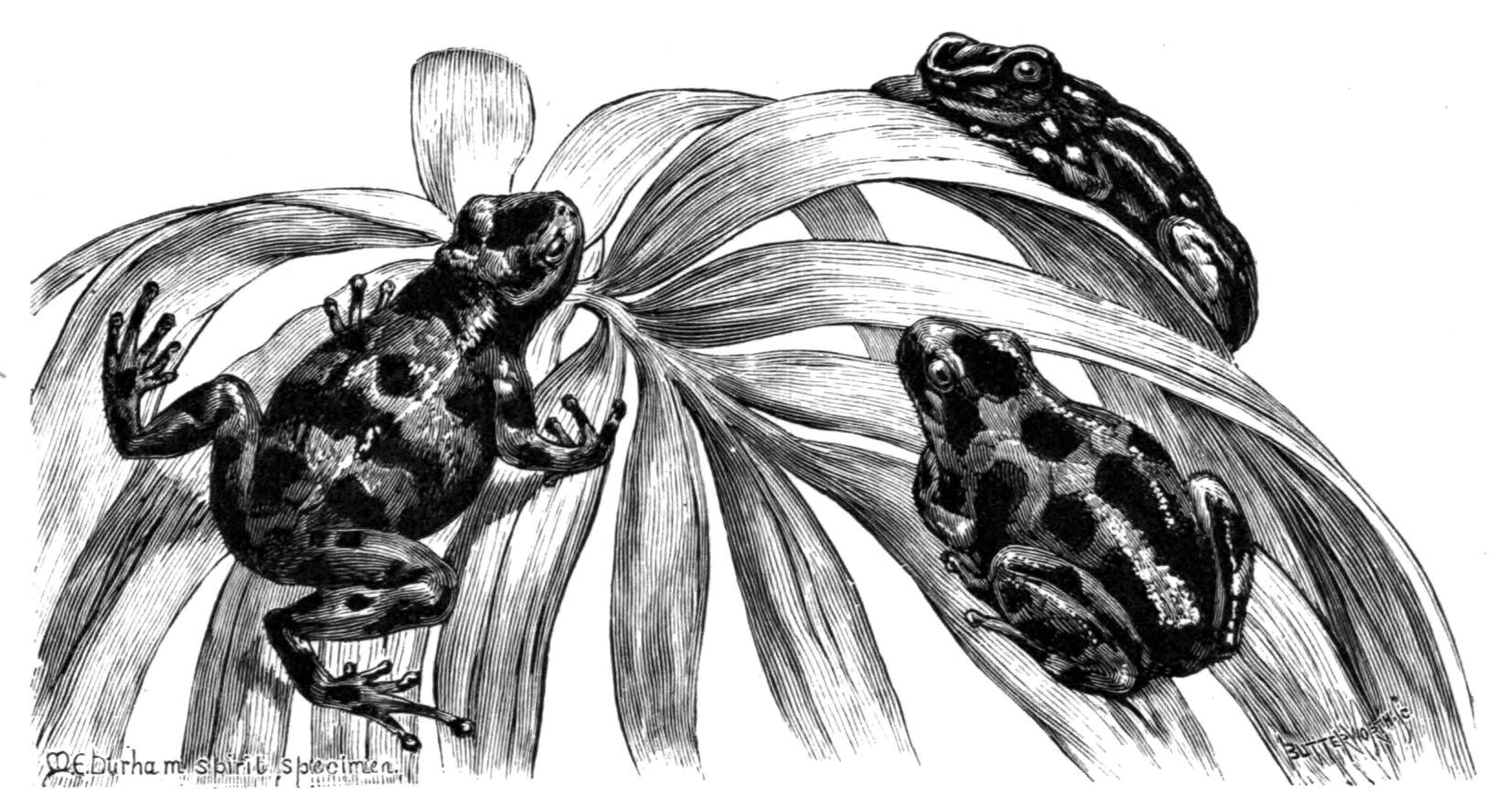
Fig. 53.–Dendrobates tinctorius, three colour-variations. × 1.
D. trivittatus, chiefly in Northern Brazil, has the first finger slightly longer than the second. It likewise varies considerably in its coloration, being either quite black, or spotted with white and brown, or with a whitish forehead and several white patches on the back and hind-limbs. D. typographus of Central America is vermilion red, with small dark marks on the back; the legs are black.
The various species of Dendrobates take remarkable care of their young. D. braccatus lives in Brazil in "varzeas," i.e. moist but waterless places, and carries its tadpoles on its back, to which they are attached by a peculiar secretion. The same is said to be true of D. trivittatus, which sits down in a drying-up puddle, lets the little tadpoles, when they are only 6-7 mm. long, fasten themselves on, and conveys them to a safer locality, where the water is calculated not to evaporate before the metamorphosis is completed.
Mantella.–Both omo- and meta-sternum possess a bony style. The tongue is free and distinctly mitred or cut out behind. The skin is very granular. Several species, in Madagascar, were formerly put into the same genus as the American forms, until Boulenger established the genus Mantella for them. The coloration is strikingly pretty. M. madagascariensis is a rare instance of difference in colour between the two sexes. The male is bluish black, with light blue spots on the belly, while the thighs and the inner sides of the legs are beautifully red. The female is deep black, with a light green spot at the base and in front of the limbs; the rest is coloured like the male.
Cardioglossa gracilis, quite recently discovered at the Gaboon, has likewise to be added to the Dendrobatinae, on account of the absence of teeth. It is a small, slender, arboreal frog, bearing an unmistakable resemblance to the other genera by its general appearance and conspicuous, contrasting coloration of black and white.