Part 2 — CHAPTER XIII
Reading edition
SAURIA, continued–OPHIDIA–SNAKES
Order II. OPHIDIA–SNAKES.
Saurians which have the right and left halves of the lower jaw connected by an elastic band.
The Snakes are the most highly specialised branch of the Sauria, from which they do not differ in any fundamental characters. The chief modifications consist in the absence of the limbs and limb-girdles (a feature intimately correlated with the much-elongated body), and in the swallowing apparatus. The reduction of the limbs and the elongation of the body also occurs in many Lacertilia; in several of the older families of Snakes (e.g. Typhlopidae and Boidae) vestiges of the hind-limbs and even of the pelvis are still in existence. Even the peculiar suspensorial apparatus of the lower jaw approaches that of the Lacertilia in the burrowing Ilysiidae and in Xenopeltis.
In the majority of the Snakes the quadrate is very loosely suspended from the squamosal (by some authorities homologised with the supratemporal bone of other reptiles), and this again is loosely attached to the lateral parietal region of the skull, placed horizontally, and elongated so far backwards that the vertically placed quadrate lies in a plane behind the skull. In most Snakes the elongated pterygoids are loosely attached to the inner side of the distal end of the quadrates, and they also often touch the mandibles. The whole palatal apparatus is movably attached to the skull, except in some burrowing families. The right and left pterygoids and palatines are widely separated from each other. The pterygoids and maxillaries, connected by the ectopterygoids, are absent, owing to reduction, in the Typhlopidae and Glauconiidae only. The premaxilla is unpaired and small, and is rarely furnished with teeth. The latter are always sharp and recurved, and are lodged in sockets upon the edge of the supporting bone, with which they become firmly ankylosed. There is a perpetual succession of teeth. In the majority of Snakes teeth are carried by the maxillaries, palatines, pterygoids, and dentaries, rarely by the premaxillaries. The palatal teeth are restricted to the palatines in Oligodon, Dasypeltis, and Atractaspis only.
Peculiar modifications prevail in the poisonous Snakes. Those maxillary teeth which are at their base in connexion with the openings of poison-glands (modified upper labial glands), either have a furrow on the anterior side (Proteroglypha if the anterior teeth are grooved, e.g. the Cobras; Opisthoglypha if some of the posterior teeth are grooved), or the groove is converted into a canal, as in the Solenoglypha or Viperidae. The special modification of the maxillaries of the vipers with their long poison-fangs is described on pp. 587 and 637.
The orbit is generally closed behind by the postfrontal. Quadrato-jugal, postfronto-squamosal, and other arches are absent, so that the temporal fossa is quite open (see Fig. 156, p. 597, and Fig. 155, p. 596). The occipital condyle is distinctly triple. The mandibles are composed of several bones, but the coronoid is absent in the Xenopeltidae, Colubridae, Amblycephalidae, and Viperidae; it is large in the Boidae, reduced to a nodule in the Ilysiidae.
The parietals are always fused into a large unpaired bone, which generally forms a sharp crest and partly overlaps the occipitals; there is no interparietal or pineal foramen.
The vertebral column consists of many, often nearly three hundred vertebrae, and these skeletal segments correspond in number with those of the ventral and transverse scales of the skin. The vertebrae are procoelous; in addition to the anterior and posterior zygapophyses they have a pair of accessory articulations on the neural arches, dorsally to the zygapophyses;–the "zygantrum" carried by the posterior end of the neural arches, its articular surfaces looking upwards; and the "zygosphene" carried by the anterior end and looking downwards. Such accessory articulations occur also in a few Lizards, e.g. Iguanidae. The vertebrae of many Snakes have unpaired vertical, blade-like haemapophyses on their centra for the more effective attachment of the muscles. All the vertebrae, except the atlas, carry ribs. These articulate by their capitular portions only, and are very movable in a head- and tail-ward direction. The ribs being long, and fitting with their ventral ends into the connective tissue of the sides of the ventral transverse scales, are the principal agents in pushing the body forwards, the posterior edges of these scales being sharp and imbricating.
The skin is covered with scales, absolutely devoid of osteoderms. When the scales are enlarged they are called shields. The keel, a common feature, is caused by a slight ridge of the cutaneous part of the scale. The whole skin is covered with a thin layer of horny epidermis, which is shed frequently, at least several times in one year; the shedding begins at the lips, and the whole outer skin is turned inside out from head to tail, retaining every minute detail of the cutaneous scales; even the watch-glass-like covering of the eyes is preserved.
The eyes are peculiar in so far as they possess no lids. The latter are still present in a vestigial condition in the embryo, but their place is taken by what is probably a modification of the nictitating membrane, which is drawn over the eye and covered with a single transparent scale of the horny skin, like a watch-glass. The eyes themselves are quite movable. The "tears," which of course cannot appear on the outside, are drained off into the nasal cavities by the naso-lacrymal ducts.
The ear is likewise peculiar. There is a long columellar rod with a fibrous or cartilaginous pad at the outer end, which plays against the middle of the shaft of the quadrate, an arrangement which, we must assume, produces a thundering noise in the internal ear, since every motion of the quadrate during the act of swallowing conveys the vibrations directly to the fenestra ovalis. The tympanic cavity, the Eustachian tubes, and the tympanum are abolished, and no external traces of the ear are visible. However, in spite of all this, Snakes can hear very well.
The nose is well developed, and many Snakes, for instance the Grass-Snake, are guided to their prey as much by the sense of smell as by the eyes and ears. The tongue is slender, very protractile and bifid, always moist, and furnished with many sensory corpuscles. It acts entirely as an additional sense-organ, hence the incessant play of the tongue of a snake which wants to investigate anything. In spite of the protractility of the tongue, the hyoid apparatus is very small; the hyoid arches themselves are reduced to mere vestiges near the base of the first and only branchial arches, which are thread-like and extend backwards down the throat.
The trachea is very long, and opens far forwards in the mouth; it can be slightly protruded between the two halves of the lower jaw so as not to be blocked during the act of swallowing. This is a laborious process. The snake, having got hold of its prey with its teeth, generally shifts it into the most convenient position, in order to swallow the head first. One half of the mandible is then pushed forwards, then the other half; the recurved teeth afford the necessary hold, and the snake, little by little, draws its mouth-cavity, and later on itself, over the prey. In fact, it literally gets outside it. Sometimes with a large victim this process may last for hours; the whole mouth and head become painfully distended and the veins swollen almost to bursting. The snake pushes the prey against a stone or other obstacle, rests awhile quite exhausted, and begins afresh. At last the bulk of the prey has passed the mouth, the skin of the neck is stretched to the utmost, the scales being separated by wide interstices, the ribs work spasmodically, the victim is pressed into the shape of a sausage, and the deed is done. In order to assist deglutition there is a great amount of salivation, but the often-heard story that Snakes cover their prey with saliva before they swallow it, is a fable, or based upon faulty observation, snakes sometimes being forced to disgorge the half-swallowed prey, which, in such a case, is covered with slime. One of my tame snakes had swallowed a frog on my table when a friend entered the room. The snake was frightened, jumped on to the ground, striking it with its full belly, and thereby hurting the frog, which squeaked loudly, whereupon the snake reversed its mechanism and the frog hopped away, none the worse for its terrible experience.
In correlation with the elongated narrow space of the body-cavity the lungs are not equally developed, the right being much smaller than the left. The latter is a very thin-walled, hollow bag, and the posterior half or third scarcely contains any of the honey-comb-like respiratory "cells," but acts merely as a reservoir of air.
The cloacal arrangement is essentially the same as that of the Lacertilia, but Snakes possess no urinary bladder. The copulatory organs are stowed away beneath the skin in recesses of the posterior lateral corners of the shallow cloacal vestibulum. Each organ is generally bifurcated at the free end, and furnished with little spike-shaped, but scarcely horny, excrescences. On each side of the outer cloacal chamber, in both sexes, lies a roundish gland with an offensive, strongly-scented secretion; that of various Boas smells disagreeably sweet and musky. The majority of Snakes lay eggs, but most of the Viperidae and the thoroughly aquatic kinds, besides a few terrestrial forms, are viviparous. The egg-shells are like parchment, with very little or no calcareous deposit, so that they are always soft; many embryos are, however, provided with a little "egg-tooth" on the tip of the snout.
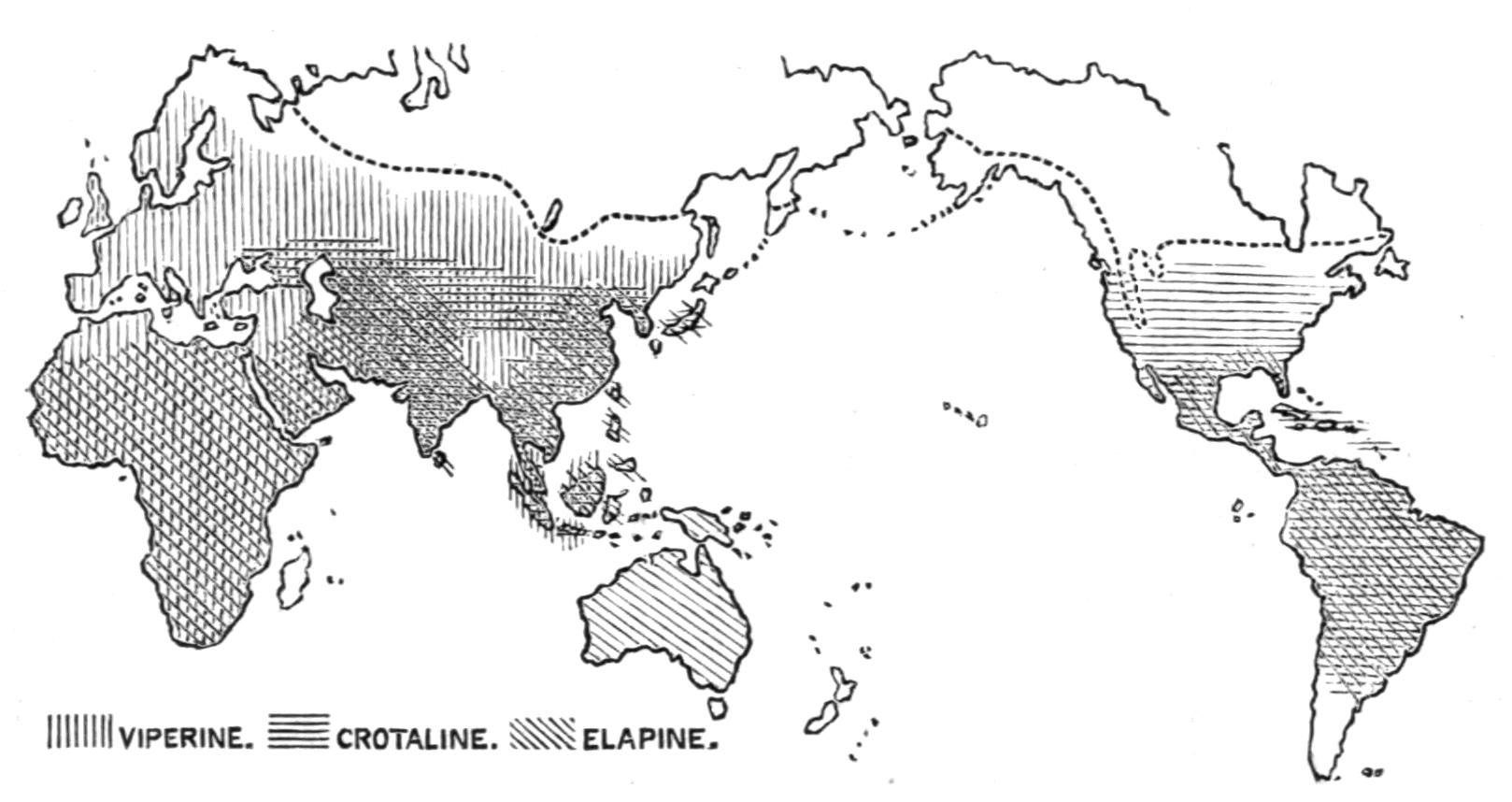
Fig. 153.–Map showing the distribution of dangerously poisonous snakes.
Snakes are intelligent creatures; some become quite affectionate in captivity, but most of them are of a morose disposition, and do not care for company.
The geographical distribution of Snakes has been dealt with in detail in connexion with the various families. Unfortunately very few fossils are known. One of the oldest is Palaeophis, of the London clay (Lower Eocene). Remains of Elapine and of innocuous Colubrine snakes have been found in the Lower Miocene of Germany; Crotaline forms are known from the Miocene of Turkey and North America. All the Plistocene remains belong to recent genera. There are indications that the Ophidia are a relatively young branch of Reptilia, essentially of Tertiary date, but the foundations of the distribution of most of the older families were laid in Miocene times. The older families, notably those which still possess vestiges of hind-limbs or of the pelvis, are circumtropical, e.g. Typhlopidae, Boidae. The few survivors of the Glauconiidae are likewise circumtropical, with the exception of Australia. The Ilysiidae occur in South-Eastern Asia and in tropical South America; their offshoot the Uropeltidae are restricted to India and Ceylon. The Colubridae and even many of their sub-families are cosmopolitan. It is quite possible that the Opisthoglypha and Proteroglypha are not natural groups, but that their respective conditions have been developed on various occasions and in different countries. The same applies more strongly to the Viperidae, a further development of the Opisthoglyphous type. To judge from their distribution, the Crotaline snakes were possibly developed in the Palaearctic sub-region; they spread all over America, but they were debarred from entering either Australia or Africa. The Viperidae, on the other hand, are restricted entirely to the Palaeotropical region and to the Palaearctic sub-region. The fact that no separating belt of water existed for them between Europe and Africa, indicates their being the most recently developed of poisonous snakes. Madagascar is the only large country which, besides snakeless New Zealand, enjoys a total absence of poisonous snakes of any kind, while the Oriental is the only sub-region which suffers from the presence of numerous species of every sub-family of poisonous Elapine, Crotaline, and Viperine snakes.
Snake-Poison.–Many Snakes, belonging to different families, are poisonous, and unfortunately there is no external character, easily ascertained, by which every poisonous snake can be distinguished from a harmless kind. If the head is very broad, this is probably due to the pair of poison-glands on the sides of the head; but many harmless snakes can flatten and broaden their heads in a suspicious way, and, what is much worse, many of the most poisonous snakes, for instance the Cobras, have a head as smooth and as sleek-looking as the Grass- or Ring-Snake, the most harmless of species. It so happens that, with a few exceptions, for instance among the Crotalines and Vipers, no badly poisonous snake has loreal shields, i.e. a pair of shields intercalated between the nasals and the preoculars, but this character is obviously no good for any practical purposes. Therefore, unless you know a snake well enough when you see it, leave it alone, because a mistake may be fatal.
The poison is secreted in modified upper labial glands, or in a pair of large glands which are the homologues of the parotid salivary glands of other animals.[174] A duct passes from the gland forwards along the side of the upper jaw. Just in front of the fang it doubles on itself, so as to open by a small papilla on the anterior wall of the sheath of mucous membrane which embraces the base of the tooth like a pocket. As mentioned before (p. 582), the poison is conveyed either along a furrow on the anterior side of the tooth, or the growing substance of the tooth partly converts the furrow into a canal which opens only near the end of the tooth. This is a perfectly devilish contrivance, ensuring the conveyance of the poison into the very deepest part of the wound. The Elapinae have relatively short fangs, while those of the Vipers, and especially those of the Crotaline snakes, are much longer, sometimes measuring nearly an inch in length. The most formidable apparatus is that of the Viperidae, since in them the maxillaries, each provided with only one acting fang, and without any other teeth behind, can be erected. The mechanism is explained in Fig. 154 and Fig. 179 (p. 647). The apparatus of the upper jaw is so constructed that the pushing forwards of the horizontal pterygoid bar will, by acting on the ectopterygoid, rotate and erect the short maxillary. The pulling forwards is effected by contraction of the spheno-pterygoid muscle, which arises far forwards from the basal orbito-sphenoid region, and is inserted on to the inner dorsal surface of the pterygoid. The principal closing muscles of the mouth are the temporo-masseteric muscles (Fig. 179, T.a. and T.p.) and the inner and outer pterygoid muscles, which latter arise from the outer surface of the pterygoid bone, or from the maxillary, and are inserted on to the articular region of the mandible.
A strong ligament arises from the squamoso-quadrate junction, and spreads fan-shaped upon the connective tissue wall of the poison-gland; the anterior and posterior ends of the gland are held by another strong band, which stretches from the maxilla to the mandibular joint. The whole is so arranged that the acts of opening the jaws (by the digastric muscles) and the erection of the fang-bearing maxillaries are enough to mechanically squeeze the contents out of the poison-gland. A portion of the anterior temporal muscle is attached to the capsule of the poison-gland.
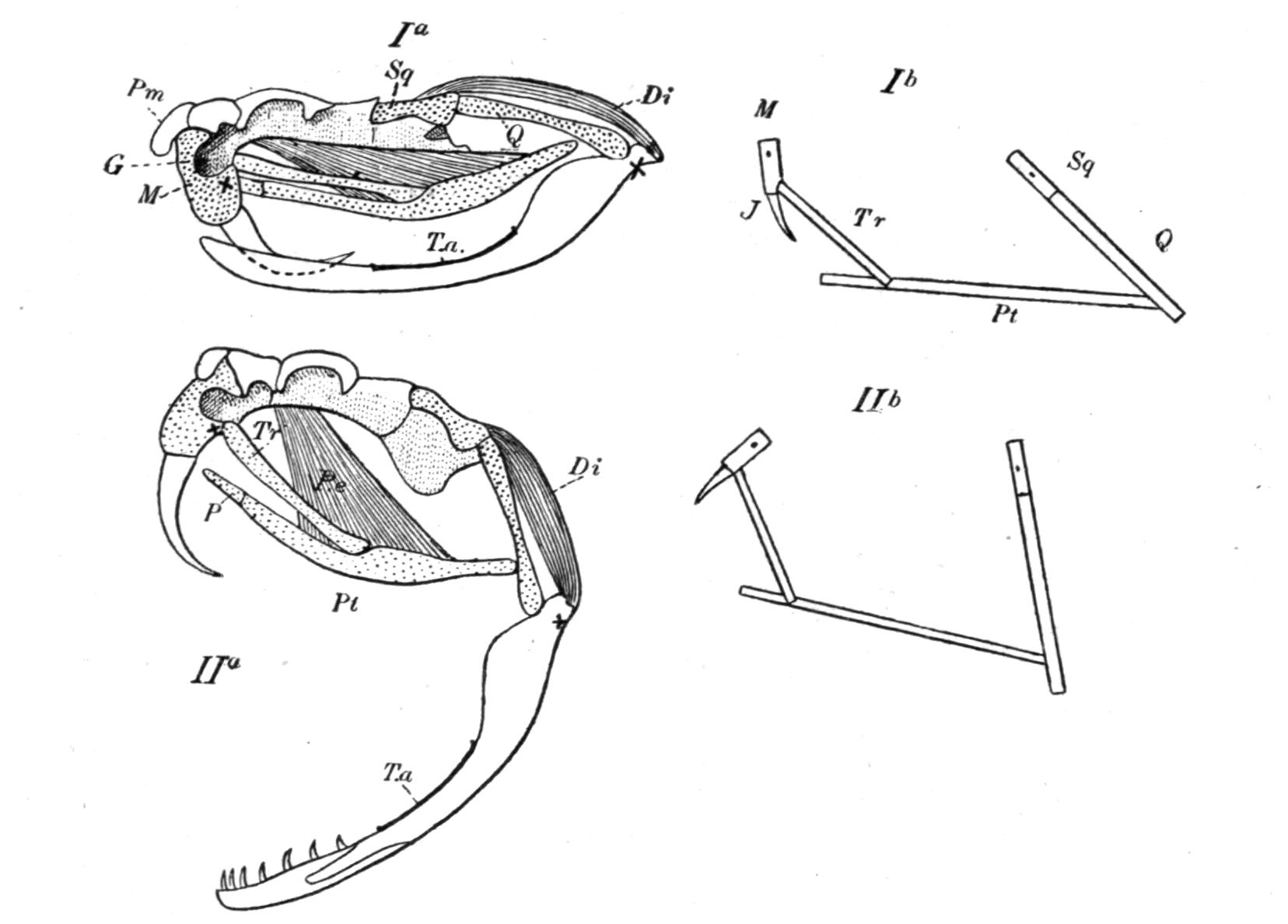
Fig. 154.–Explanation of the biting mechanism of a rattlesnake. Ia and Ib, position of the apparatus when the mouth is shut. IIa and IIb, position of the apparatus when the mouth is opened widely; the spheno-pterygoid muscle (P.e) is contracted, the pterygoid (Pt) is pulled forwards, the transverse bone or ectopterygoid (Tr) pushes the maxillary (M), rotates it and thereby causes the poison-fang (J) to assume an erect position. Di, Digastric muscle, contraction of which lowers, or opens, the lower jaw; G, the groove or pit characteristic of the Crotaline snakes; J, poison-fang; M, maxillary; P, palatine; P.e, spheno-pterygoid muscle; Pm, premaxillary; Pt, pterygoid; Q, quadrate; Sq, squamosal; T.a, insertion of the anterior temporal muscle, by contraction of which the mouth is shut; cf. Fig. 179 (p. 647); Tr, transversum or ectopterygoid; X, origin and insertion of a muscle and a strong ligament, contraction of which draws the maxillary and its tooth back into the position of rest and assists in shutting the mouth.
An excellent account of the nature and of the effect of the venom of Snakes has been written by Charles J. Martin.[175] The following condensed account has been abstracted from it:–
"The poison is a clear, pale yellow, or straw-coloured fluid, which reacts acid, and contains about 30 per cent of solids, but this varies much according to the state of concentration. Most venoms are tasteless, but Cobra poison is said to be disagreeably bitter. Dried venom keeps indefinitely, and dissolves readily in water. It keeps also in glycerine. It contains albuminous bodies in solution. The venom is, in fact, a pure solution of two or more poisonous proteids, which are the active agents, with a small quantity of an organic acid or colouring matter. The venom is destroyed by reagents which precipitate proteids in an insoluble form, or which destroy them, e.g. silver nitrate or permanganate of potash. Hypochlorites have the same effect. Carbolic acid and caustic potash destroy it only after a day or two.
"The venom is generally introduced into the subcutaneous tissue, whence it reaches the general circulation by absorption through the lymph and blood-vessels. When introduced directly into a vein, the effects are instantaneous. It is absorbed by the conjunctiva, but, excepting Cobra poison, not by the mouth or alimentary canal, provided there be no hollow teeth or no abrasions. The venom of the various kinds of Snakes acts differently.
"The symptoms of Cobra poison. Burning pain, followed by sleepiness, and weakness in the legs after half an hour. Then profuse salivation, paralysis of the tongue and larynx, and inability to speak. Vomiting. Incapability of movement. The patient seems to be conscious, but is unable to express himself. The breathing becomes difficult. The heart's action is quickened. The pupil remains contracted and reacts to light. At length breathing ceases, with or without convulsions, and the heart slowly stops. Should the patient survive, he returns rapidly to complete health.
"The symptoms of Rattle-snake poison. The painful wound is speedily discoloured and swollen. Constitutional symptoms appear as a rule in less than fifteen minutes: prostration, staggering, cold sweats, vomiting, feeble and quick pulse, dilatation of the pupil, and slight mental disturbance. In this state the patient may die in about twelve hours. If he recovers from the depression, the local symptoms begin to play a much more important part than in Cobra poisoning: great swelling and discoloration extending up the limb and trunk, rise of temperature and repeated syncope, and laboured respiration. Death may occur in this stage. The local haemorrhagic extravasation frequently suppurates, or becomes gangrenous, and from this the patient may die even weeks afterwards. Recovery is sudden, and within a few hours the patient becomes bright and intelligent.
"Symptoms of bite from the European Viper. Local burning pain; the bitten limb soon swells and is discoloured. Great prostration, vomiting, and cold, clammy perspiration follow within one to three hours. The pulse is very feeble, with slight difficulty in breathing, and restlessness. In severe cases the pulse may become imperceptible, the extremities may become cold, and the patient may pass into coma. In from twelve to twenty-four hours these severe constitutional symptoms usually pass off, but in the meantime the swelling and discoloration have spread enormously. Within a few days recovery usually occurs somewhat suddenly, but death may occur from the severe depression, or from the secondary effects of suppuration.
"Symptoms of bite from the Daboia or Vipera russelli. These resemble the effects of Rattle-snake poison, but sanious discharges from the rectum, etc., are an additional and prominent feature. The recovering patient suffers from haemorrhagic extravasations in various organs, besides from the lungs, nose, mouth, and bowels. Kidney haemorrhage and albuminuria is a constant symptom. The pupil is always dilated and insensitive to light.
"Symptoms of bite of Australian Elapine snakes. Pain and local swelling. The first constitutional symptoms appear in fifteen minutes to two hours. First faintness, and an irresistible desire to sleep. Then alarming prostration and vomiting. The pulse is extremely feeble and thread-like, and uncountable. The limbs are cold, and the skin is blanched. Respiration becomes shallow with the increasing coma. Sensation is blunted. The pupil is widely dilated, and insensible to light. There is sometimes passing of blood. If the patient survives the coma, recovery is complete and as a rule rapid, without secondary symptoms. The Australian venom and that of all viperine snakes, perhaps also that of the Cobra, if introduced rapidly into the circulation, occasions extensive intravascular clotting. If the venom is slowly absorbed, the blood loses its coagulability, owing to the breaking down of the red blood-corpuscles, most so with vipers, less with Australian snakes, least so with the Cobra. The Cobra venom is supposed to extinguish the functions of the various nerve-centres of the cerebro-spinal system, the paralysation extending from below upwards, and it has a special affinity for the respiratory centre. The toxicity or relative strength of the Cobra venom has been calculated to be sixteen times that of the European Viper. Snakes can poison each other, even those of the same kind.
"Treatment.–Apply a ligature above, not on the top of the situation of the bite; twist the string tightly with a stick. Then make a free incision into the wound. Sucking out is dangerous! Then bandage the limb downwards, progressing towards the wound; repeat this several times. Direct application into the widened wound of calcium hypochlorite, i.e. bleaching powder, is very good, or of a 1 per cent solution of permanganate of potash, or Condy's fluid. Amputation of the finger is the best remedy of all if a large snake has bitten it. Do not keep the ligature longer than half an hour. Then let the circulation return, and apply the ligature again. In any case, do not keep the ligature on for more than one hour for fear of gangrene.
"Internal remedies.–The administration of enormous doses of alcohol is to be condemned strongly; small stimulating doses are good, but stimulation can be more effectively produced by ammonia or strychnia. Hypodermic injection of strychnine, in some cases as much as one to two grains (but not into a vein!) has in some cases had good results; but injection of ammonia, instead of doing any good, has disastrous sloughing results. There is only one fairly reliable treatment, that by serum therapeutics, the injection of considerable quantities of serum of animals which have been partially immunised by repeated doses of snake-venom. Unfortunately this treatment will not often be available."
Several well-known Mammals and Birds are immune by nature against snake-venom, but most of them avoid being bitten. Some birds induce the snake to strike and bite frequently into their spread-out wings. Such more or less immune creatures are the Mongoose, the Hedgehog, and the Pig, the Secretary bird, the Honey Buzzard, the Stork and probably other snake-eaters.
Classification of Ophidia.–Duméril and Bibron[176] divided Snakes according to their teeth into Opotérodonts, Aglyphodonts, Solenoglypha, Proteroglypha, and Opisthoglypha.
J. E. Gray[177] divided Snakes into two sub-orders: Viperina and Colubrinia. Günther[178] distinguished between Ophidii colubriformes, O. colubriformes venenosi (Elapidae and Hydrophidae) and O. viperiformes. Cope[179] laid stress upon the modifications of the squamosal, ectopterygoid, and ectopterygoid bones, and also upon the condition of the vestigial limbs. He divided the snakes into Scolecophidia (Typhlopidae), Catodonta, Tortricina, Asinea (the harmless snakes without limb-vestiges), Proteroglypha, and Solenoglypha.
Boulenger[180] has accepted Cope's principles, and, mainly by combining the Asinea with the Proteroglypha as Colubridae, has produced a logically conceived system, by far the best hitherto proposed. It has been followed in the present work. Boulenger's phylogenetic system stands as follows:–
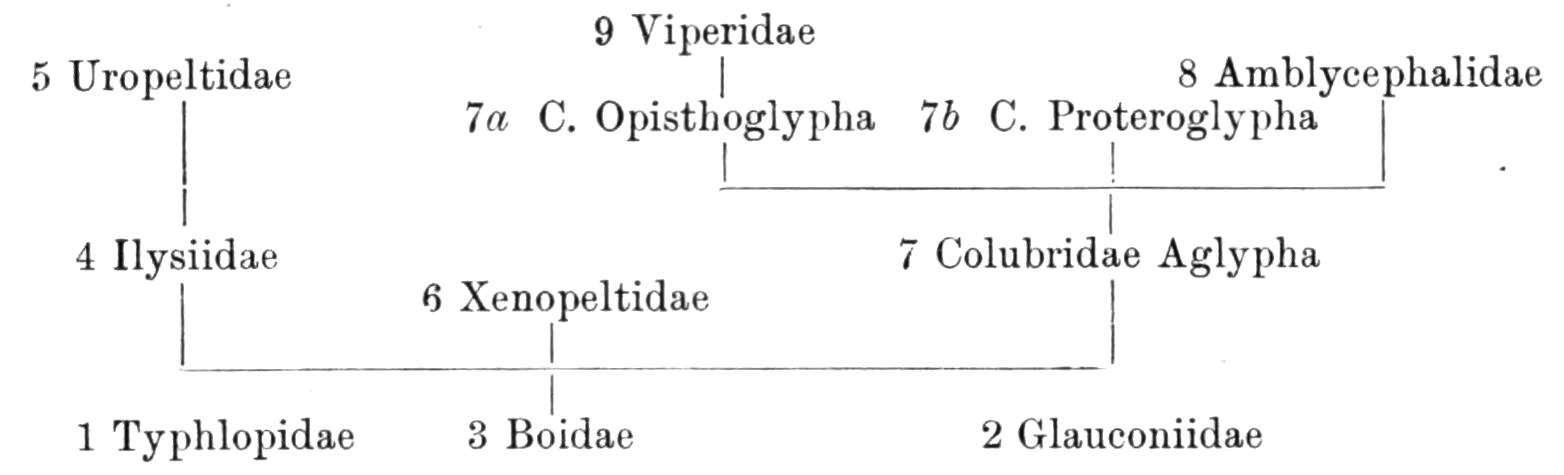
I. No ectopterygoid; pterygoid not extending to quadrate or to mandible; no supratemporal (squamosal); prefrontal forming a suture with nasal; coronoid present; vestiges of pelvis.
Maxillary vertical, loosely attached, toothed; mandible edentulous; a single pelvic bone. .......... Typhlopidae, p. 593.
Maxillary bordering mouth, forming a suture with premaxillary, prefrontal, and frontal, toothless; lower jaw toothed; pubis and ischium present, latter forming a symphysis. .......... Glauconiidae, p. 594.
II. Ectopterygoid present; both jaws toothed.
A. Coronoid present; prefrontal in contact with nasal.
1. Vestiges of hind-limbs; supratemporal (squamosal) present.
Squamosal large, suspending quadrate. .......... Boidae, p. 596.
Squamosal small, intercalated in the cranial wall. .......... Ilysiidae, p. 594.
2. No vestiges of limbs; squamosal absent. .......... Uropeltidae, p. 595.
B. Coronoid absent; squamosal present.
1. Maxillary horizontal; pterygoid reaching quadrate or mandible.
Prefrontal bone in contact with nasal. .......... Xenopeltidae, p. 605.
Prefrontal not in contact with nasal. .......... Colubridae, p. 606.
2. Maxillary horizontal; pterygoid not reaching quadrate or mandible. .......... Amblycephalidae, p. 637.
3. Maxillary vertically erectile, perpendicularly to ectopterygoid; pterygoid reaching quadrate or mandible. .......... Viperidae, p. 637.
For ordinary practical purposes this synopsis is useless, being based entirely upon anatomical characters, not all easily ascertained. The following characterisation of families may therefore be preferred:–
Eyes vestigial; no teeth in the lower jaw; without enlarged ventral scales. .......... Typhlopidae.
Eyes vestigial; teeth restricted to the lower jaw; without enlarged ventral scales. .......... Glauconiidae.
Eyes very small; head not distinct; ventral scales scarcely enlarged; tail extremely short, ending obtusely and covered with peculiar scales. .......... Uropeltidae.
With vestiges of the hind-limbs appearing as claw-like spurs on each side of the vent; ventral scales transversely enlarged; eyes functional, free.
Ventral scales scarcely enlarged. .......... Ilysiidae.
Ventral scales transversely enlarged. .......... Boidae.
With a pair of poison-fangs in the front part of the mouth, carried by the otherwise toothless, much shortened, and vertically erectile maxillaries; ventral scales transversely enlarged; eyes free. .......... Viperidae.
All the remaining Snakes combine the following characters: the maxillaries are typical, not separately movable, horizontal, with a series of teeth.[181] The mandible is toothed but has no coronoid bone. There are no vestiges of limbs or of their girdles. The eyes are free.
Dentary movably attached to the tip of the articular bone of the mandible; skin beautifully iridescent. .......... Xenopeltidae.
Without a mental groove; the ends of the pterygoids are free, not reaching the quadrates. .......... Amblycephalidae.
With a median longitudinal groove between the shields of the chin; the squamosal is horizontally elongated, movable; the pterygoid reaches the quadrate. .......... Colubridae.
Fam. 1. Typhlopidae.–Burrowing snakes which have the whole body covered with uniform cycloid scales, and with the teeth restricted to the small and transversely placed maxillary bones. The pterygoids do not extend backwards to the quadrates, and there are no endopterygoids. The quadrates slant obliquely forwards, and are attached directly to the pro-otics, owing to the absence of squamosal bones. The prefrontals are in lateral contact with the nasals. There are vestiges of the pelvis, reduced to a single bone on each side. The eyes are hidden by shields of the skin.
The Typhlopidae, mainly composed of the genus Typhlops, with about one hundred species, are undoubtedly the last living descendants of formerly cosmopolitan, rather archaic, snakes, which in adaptation to their burrowing life and insectivorous diet have undergone degradation. They are still widely distributed in all tropical and sub-tropical countries, some on the solitary Christmas Island, but not in New Zealand. One species, T. vermicularis, inhabits the Balkan Peninsula and South-West Asia. It is brown above, yellowish below, and reaches a length of about 10 inches. The tail is extremely short and ends in a horny spine. T. braminus is widely distributed in Southern Asia, the Malay Islands, the islands in the Indian Ocean and in Southern Africa.
Fam. 2. Glauconiidae.–In most respects resembling the Typhlopidae, but the maxillaries retain their normal position and are toothless, teeth being restricted to the lower jaw, which is stout and short. The pelvic girdle and the hind-limbs show the least reduction found in any recent Snakes; in the pelvis the ilia, pubes, and ischia can still be distinguished, the last even retaining their symphysis; there are also vestiges of femurs. About thirty species, nearly all belonging to the genus Glauconia, are found in South-Western Asia, Africa, and the warmer parts of America, including the West Indies.
Fam. 3. Ilysiidae.–The scales of the cylindrical body are smooth and small, those on the ventral side are scarcely larger. The tail is extremely short and blunt. The head is very small, not distinct from the neck. The gape of the mouth is very narrow. Teeth are carried by the mandibles, the pterygoids, palatines, maxillaries, and one or two or more by the premaxillae. The endopterygoids are short. An important cranial feature is the short quadrates, which stand rather vertically and are connected with the cranium by the squamosals; these are very small and are firmly wedged in between the upper ends of the quadrates and the pro-otic, lateral, and supra-occipital bones; now forming part of the cranial wall. Vestiges of the pelvis and hind-limbs are very incomplete, and terminate in claw-like spurs, protruding between the scales on either side of the vent. The eyes are very small, and are either free or covered by transparent shields. The few, scarcely half-a-dozen, species are found in South America (Ilysia) and in Ceylon, the Malay Islands, and Indo-China.
Ilysia (Tortrix) scytale, the Coral-Snake of Tropical South America, is a beautiful coral-red with black rings. On account of its beauty, perfectly harmless nature, and for "cooling purposes," this snake, which grows to nearly a yard in length, is sometimes worn as a necklace by native ladies. All the Ilysiidae lead a partly burrowing life, live chiefly upon worms, insects, and little Typhlopidae, and are viviparous.
Fam. 4. Uropeltidae.–Burrowing snakes of Ceylon and Southern India, with a short and rigid cylindrical body and a very short tail, which ends in a large peculiar shield, often obliquely truncated. The scales of the body are smooth, and are little larger on the belly; the coloration is mostly very beautiful. The eyes are very small.
The Uropeltidae are somewhat intermediate between the Ilysiidae, Glauconiidae, and Boidae. The pterygoids do not reach the quadrates; but ectopterygoids are present; the quadrates are very small and directly attached to the skull, squamosals being absent. Teeth are carried by the mandibles and by the maxillaries, which are normal in their position. There are no vestiges of hind-limbs or of the pelvis. The Uropeltidae, of which about forty species are known, are viviparous, burrow in the ground, and frequent damp localities, preferring mountain-forests. The use of the characteristic tail-shield is not clear; perhaps it assists these rather rigid creatures in digging, by being pressed against the ground.
Uropeltis.–The tail is obliquely truncated, ending in a roundish, flat shield.
U. grandis s. philippinus.–The latter name seems to have misled W. Marshall[182] into including the Philippine Islands in the range of the family, a mistake which is sure to be propagated. The species, the only one of the genus, is confined to Ceylon; it is blackish above, yellow below, frequently with small yellow spots above and brown spots on the under surface. It grows to about 18 inches in length.
Rhinophis.–The tail-shield is convex and the snout is pointed. Rh. sanguineus of Southern India is black above with a bluish gloss, sometimes with small pale specks; the belly and several of the lateral series of scales are bright red, spotted with black. The tail-shield is black and red.
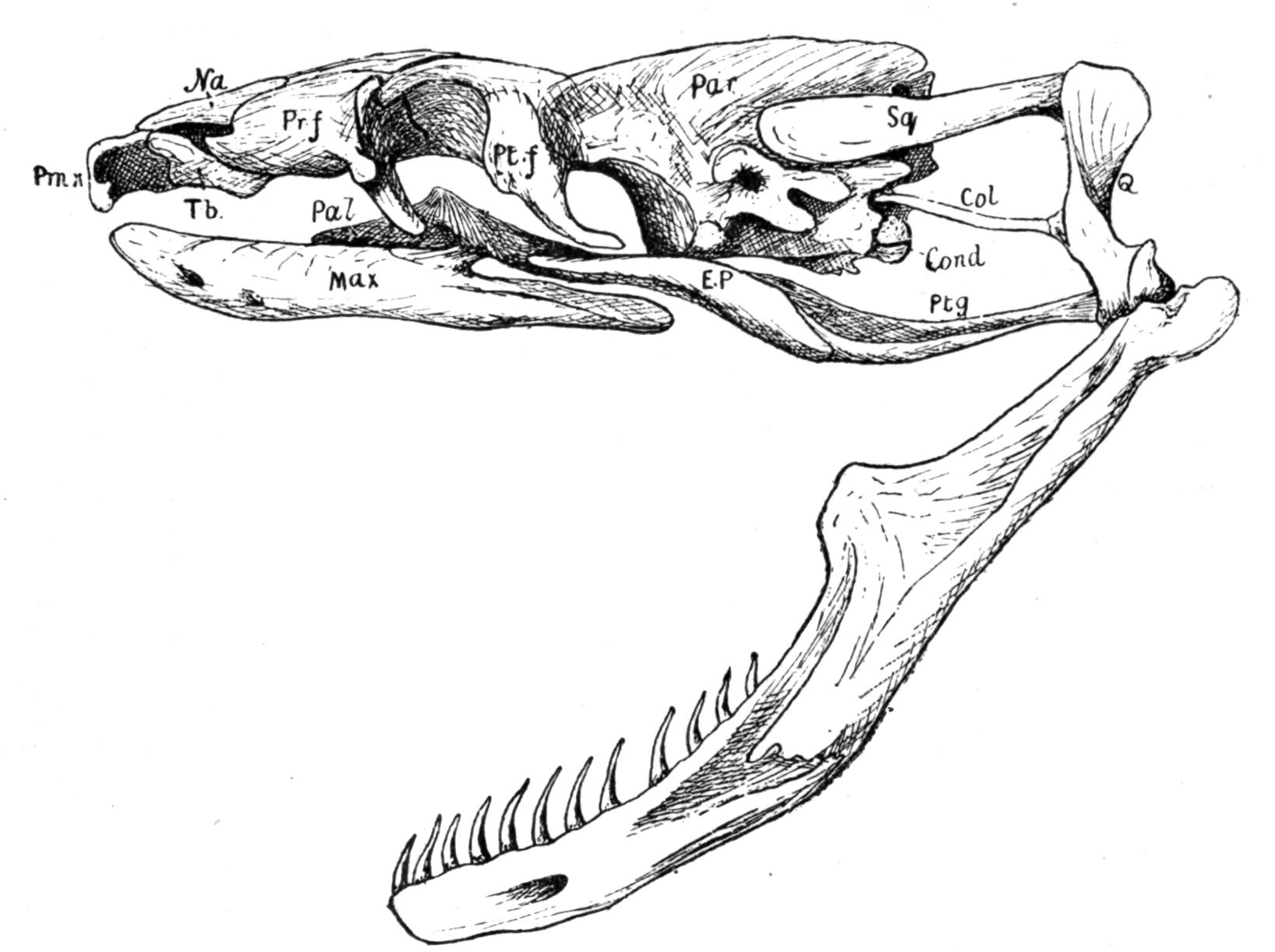
Fig. 155.–Skull of Eunectes murinus. × 1. The teeth on the maxillary, palatine, and pterygoid have been omitted. Col, Columella auris; Cond, occipital condyle; E.P. and E.Ptg, ectopterygoid or transverse bone; F, frontal; Mand, mandible; Max, maxillary; Na, nasal; Pal, palatine; Par, parietal; Pmx, premaxillary; Pr.f, prefrontal; Pt.f, postfrontal; Ptg, pterygoid; Q, quadrate; Sq, squamosal; Tb, turbinal.
Fam. 5. Boidae.–Typical Snakes, usually large, and with vestiges of pelvis and hind-limbs, appearing externally as claw-like spurs on each side of the vent. The scales of the upper surface are usually small and smooth, while those of the ventral surface form one broad series on the belly, and one or two rows on the tail. The quadrate is carried by the horizontally elongated squamosal, which rests loosely upon the lateral occipital region. The prefrontal is in contact with the nasal. Teeth are carried by the mandibles, the pterygoids, palatines, maxillaries, and, in the Pythoninae, by the premaxillaries also. For further details see Figs. 155, 156.
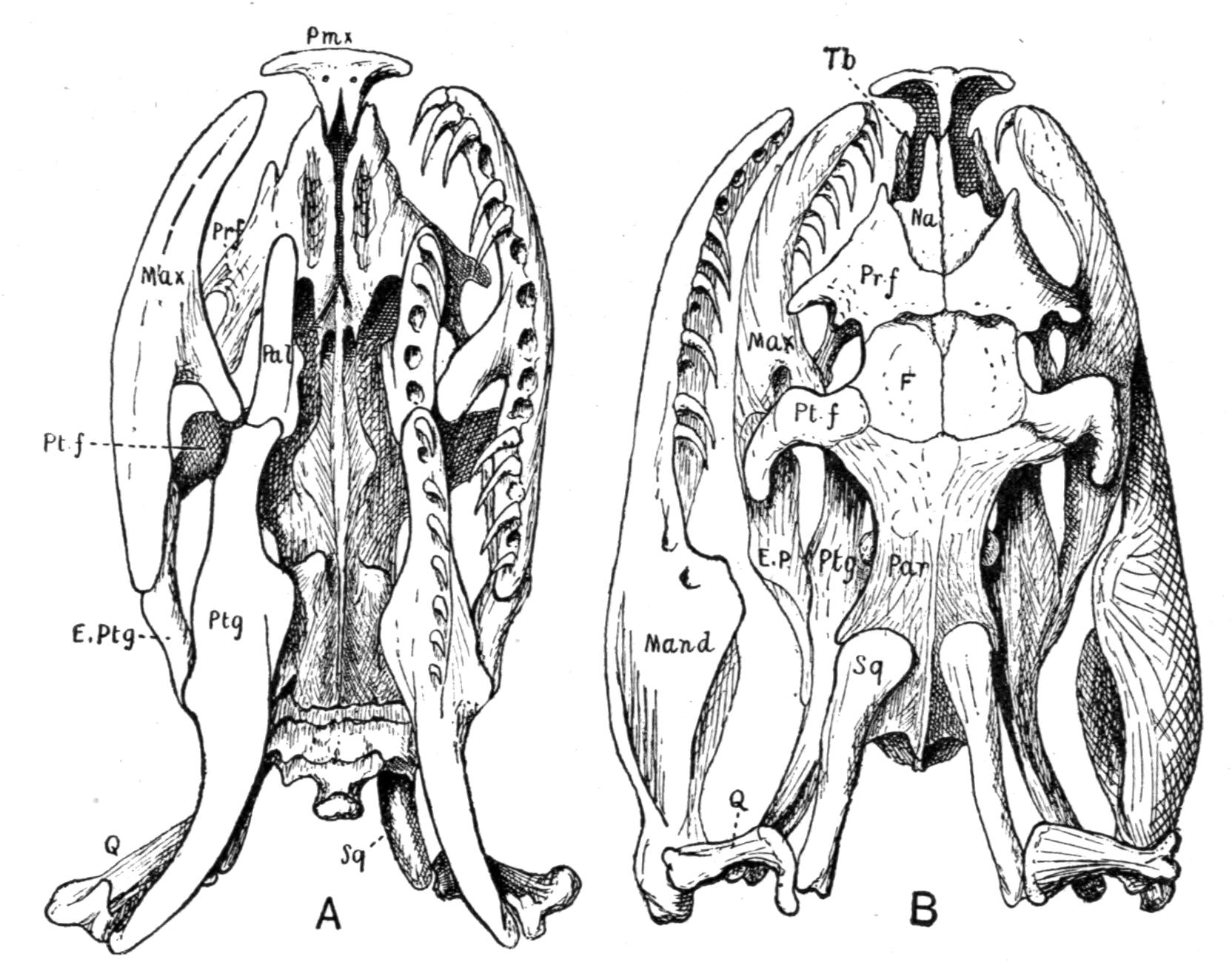
Fig. 156.–A, Ventral, B, dorsal, view of the skull of Eunectes murinus. Lettering as in Fig. 155. × 1.
The Boidae comprise between sixty and seventy species, which have been grouped into many genera, on unimportant characters, referring to the scales and shields of the head. It is doubtful if they are natural groups, a consideration which detracts much from their value in the study of geographical distribution. Even the two sub-families are not free from this reproach. The range of the family is world-wide, Boidae occurring in all tropical and sub-tropical countries, including islands, except New Zealand. A few species live in South-Eastern Europe (Eryx) and in North-Western America. They mostly prefer wooded districts, especially forests; climbing trees, assisted by the short and partly prehensile tail. Others are semi-aquatic, and a few live in sandy localities. They are all rapacious, and by preference feed on warm-blooded creatures, which they constrict by coils of the body in order to hold, kill, and crush the victim before swallowing it. Exaggerated notions are entertained about their swallowing capacity. It is obvious that a large snake, 20 feet long, half a foot thick, and weighing several hundred pounds, can crush a tiger, a stag, or even a cow; but common sense tells us where to draw the line when it comes to the swallowing of the prey. Small game, although of a bulk apparently far too big for the snake, is so crushed and mangled that it is turned into the shape of a sausage preparatory to the long process of swallowing. The Boidae lay eggs, and some species incubate them, or rather the female coils herself round them for the sake of protection. No appreciable amount of extra warmth is developed. Unfortunately the observations of one of the best cases on record[183] were conducted so imperfectly that they are of little value.
Sub-Fam. 1. Pythoninae.–With a pair of supra-orbital bones, intercalated between the prefrontal, frontal, and postfrontal bones. The sub-caudal scales are mostly in two rows. The premaxilla often carries a few small teeth.
The Pythoninae, comprising about twenty species, are restricted to the Palaeotropical and Australian regions, with the sole exception of Loxocemus bicolor in Southern Mexico.
Python, the principal genus, has teeth on the premaxilla. The rostral, each of the anterior upper labials, and some of the lower labial shields, contain a deep, probably sensory, pit. The maxillary and mandibular teeth are long, but decrease from before backwards. The head is distinct from the neck, and is covered with symmetrical shields or with small scales. The scales of the body are small and smooth. The tail is short and prehensile; below with two rows of scales. The pupil of the eye is vertical. The range of the genus extends over the whole of the Palaeotropical and Australian regions, excepting Madagascar and New Zealand.
P. spilotes, the "Carpet Snake" of Australia and New Guinea, is mostly beautifully marked, but is subject to much variation in colour. The more typical specimens are black above, each scale with a yellowish dot, with yellow spots or combinations of dots, more or less arranged in rows. The under parts are yellow. It reaches a length of about two yards, and spends a great part of its time in trees.
P. reticulatus is the commonest species in Indo-China and in the Malay Islands. Four upper labial shields of each side are pitted. The specific name refers to the bold, dark, lozenge-shaped markings upon the lighter yellowish or brown ground. A black line extends over the head from the nose to the neck, and another on each side from the eye to the angle of the mouth. The under parts are mostly yellowish, with small brown spots on the sides.
This is one of the largest species of Python, some specimens being known which measured about 30 feet in length.
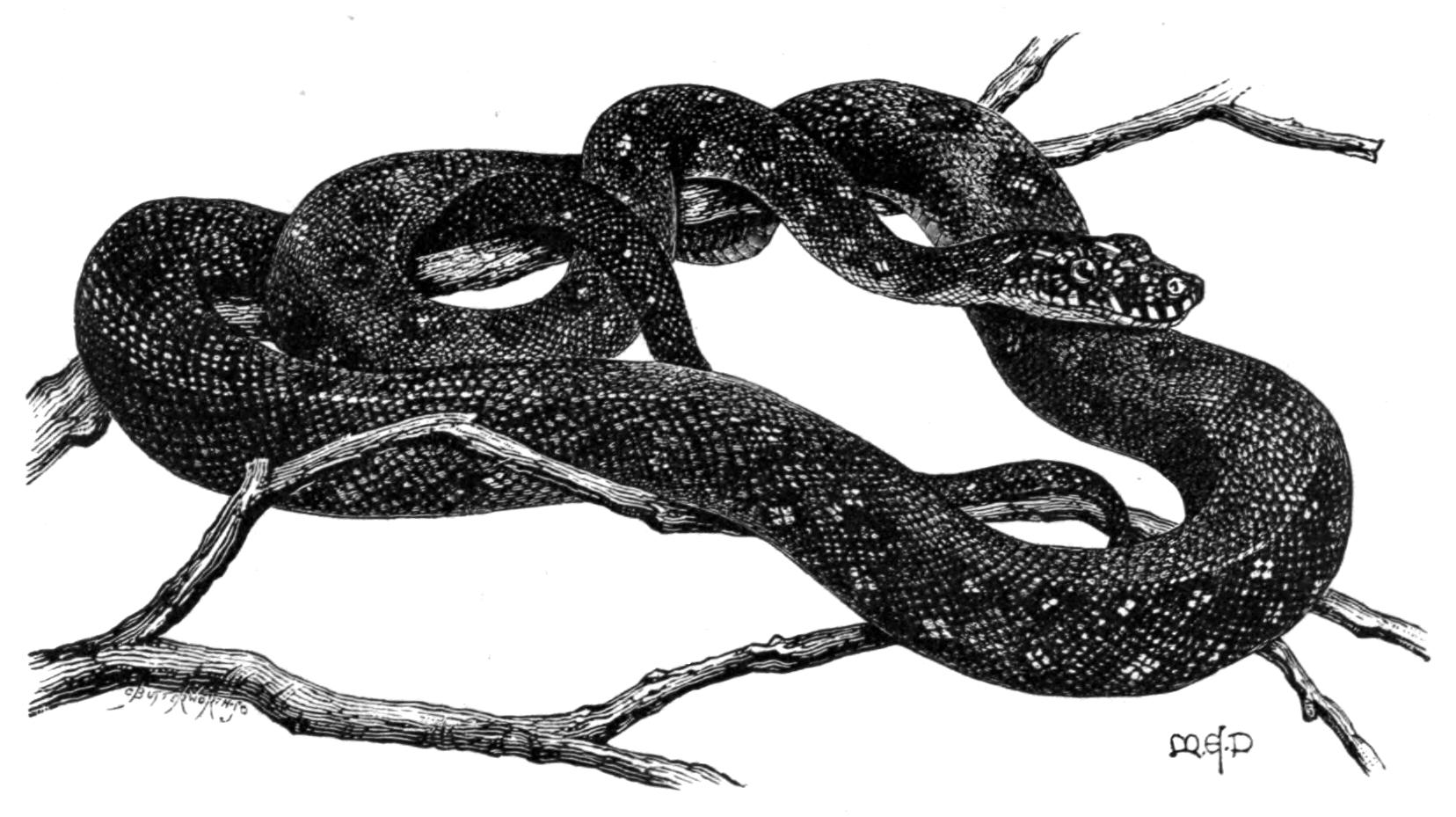
Fig. 157.–Python spilotes (the Carpet Snake). × ⅛.
As a sample of folk-lore connected with this monstrous snake the following Burmese fable has been recorded by Mason:–[184]
"According to a Karen legend all the poisonous serpents derive their virulence from the Python, which, though innocuous now, was originally the only one that was venomous. In those days he was perfectly white, but having seduced away a man's wife, Aunt Eu (Eve), he made her, while she was in his den, weave figures on his skin in the forms which are now seen. At that time, if he bit the footstep of a man in the road, such was the virulence of his poison that the man died, how far soever that man might have passed from the bitten track. The Python had not, however, an ocular demonstration of the fact, so he said to the Crow: 'Crow, go and see whether people die or not when I bite the foot-track.' The Crow went to the neighbourhood of a Karen cabin, and found the people, as is their custom at funerals, laughing, singing, dancing, jumping, and beating drums. He therefore returned to the Python, and told him that so far from his efforts producing death, on the contrary they produced joy. The Python was so angry when he heard this that he ascended a tree and spit up all his venom, but other creeping things came and swallowed it, and people die of their malignancy to this day. The tree, therefore, from which the Python spat up his venom became deadly, and its juice is used to this day for the purpose of poisoning arrows. The Python made the other creatures promise not to bite without provocation. The Cobra said: 'If there be transgression so as to dazzle my eyes, to make my tears fall seven times in one day, I will bite.' So said the Tiger (whose bite the Karens esteem as virulent as a serpent's) and others, and they were allowed to retain their poison. But the Water Snake and Frog said they would bite with or without cause as they liked; so the Python drove them into the water, where their poison melted away and their bite became harmless."
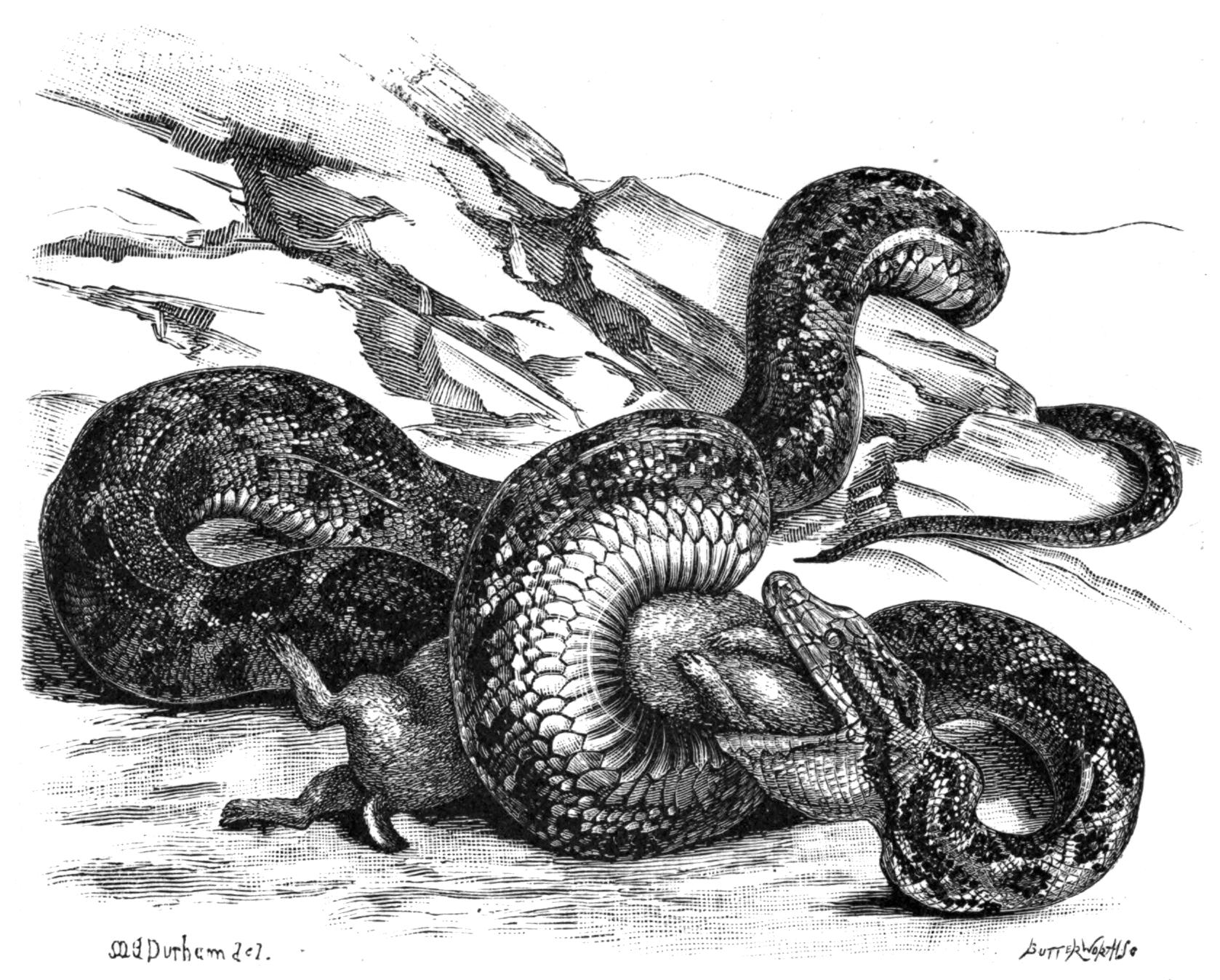
Fig. 158.–Python molurus. × ⅒.
P. molurus is the species of India and Ceylon, ranging, however, also into Indo-China. Boulenger quotes W. Elliot[185] as the authority for the statement that this species grows to the length of 30 feet. Only two pairs of upper labials are pitted. The general colour above is greyish or yellowish brown with a dorsal series of large reddish-brown, black-edged patches, and on the sides of the body with a series of smaller spots with light centres. On the head is a lance-shaped marking; a brown stripe passes from the eye backwards. The under parts are yellowish.
P. sebae and P. regius are African species. The former has two pairs of upper labials pitted, the latter four pairs. P. sebae is generally pale brown above with dark brown, black-edged cross-bars, which are usually connected by a sinuous dark stripe along each side of the back. The upper surface of the tail has a light stripe between two black stripes. The belly is spotted and dotted with dark brown. P. sebae ranges over the whole of Tropical and Southern Africa, perhaps with the exception of Eastern Africa. P. regius of West Africa is beautifully marked, and may be recognised by the dark brown, black-edged band along the back, sending down triangular or Y-shaped processes on the sides, which are pale brown. This dorsal band encloses a light streak on the neck and another on the tail. The belly is yellowish.
These African Pythons grow to a length of about 15 feet, but specimens so large as this are not often met with. The negroes of certain parts of the coast of Guinea are said to worship them and to keep them in special temples, where they are regularly attended to. Their food consists chiefly of small Mammals, notably rats, and of Birds. A couple of these snakes paired in the Zoological Gardens of London in the month of June. The female laid nearly one hundred eggs in the following January, and incubated them until April, when the embryos were found to be still unripe.
Sub-Fam. 2. Boinae.–Without supra-orbital bones. The premaxilla is toothless. The subcaudal scales form mostly a single row.
The Boinae comprise between forty and fifty species. Most of them are American, but the genus Eryx inhabits North Africa, Greece, and South-Western Asia; the genus Enygrus inhabits New Guinea and many of the Pacific Islands, for instance New Britain (Neu Pommern), the Solomon, Loyalty and Fiji Islands, and the New Hebrides. Casarea dussumieri is found on Round Island near Mauritius; and two species of Boa and one of Corallus represent the Boidae in Madagascar, while all the others live in Central and South America.
Boa.–The maxillary and mandibular teeth gradually decrease in size. The scales of the upper parts of the body and tail are smooth and very small. The rostral shield is enlarged. The nostrils are placed between two or three nasals, and these are separated from those of the other side by small scales. The tail is short and prehensile. The pupil is vertical.
B. constrictor, of South America, has the head covered with small scales, one of the pre-oculars being enlarged. The eye is separated from the labials by several series of tiny scales. The general colour is a delicate "pale brown above, with fifteen to twenty dark brown cross-bars widening on each side, and, if connected by a dark dorso-lateral streak, enclosing large elongate oval spots.... On each side is a series of large dark brown spots with light centres, most of which alternate with the cross-bars. On the tail the markings become much larger, brick-red, edged with black, and separated by narrow, yellowish interspaces." Under parts yellowish with black dots. Boa constrictor, a name applied in popular parlance to many species, reaches a length of more than 10 feet; the largest specimen in the British Museum measures exactly 11 feet. A few other species inhabit Central America and the West Indies. B. dumerili and B. madagascariensis, both of Madagascar, cannot be separated from the genus Boa.
A. D. Bartlett[186] has described the following incident:–
"In the evening of 5th October 1892 two pigeons were put into the cage in which two fine specimens of Boa constrictor had been living on friendly terms since the beginning of the year. The larger snake seized one of the pigeons and the keeper left the house. The next morning only one of the snakes, the larger specimen, was visible, and from its enormously extended body it was evident that it had swallowed its companion, which was about 9 feet in length. It had no longer the power of curling itself round, but remained extended nearly to its full length in a straight line, and appeared to be at least three times its normal circumference. It was almost painful to see the distended skin, which had separated the scales all over the middle of the body. By 2nd November, twenty-eight days later, the snake had not only digested its companion but had regained its appetite as well as its normal size, and it immediately swallowed a pigeon put into its den."
This peculiar case is not one of ordinary cannibalism. It is rather an unintentional accident. When two snakes happen to get hold of the same animal (in the present case a pigeon) and begin to swallow it, the action of swallowing becomes almost mechanical, the snakes continuing to push their jaws over the prey–which in the case of a bird or mammal they cannot taste, nor can they see it–so long as they feel something in the mouth. After the original prey has been mastered, it is the turn of the opposite snake's head, and if the weaker snake does not give way it is swallowed by its stronger mate. Grass-Snakes will swallow several frogs if these are tied together in a string, and other snakes do the same with mice. There are instances on record in which a Python swallowed its blanket, which, being absolutely indigestible, caused its death.
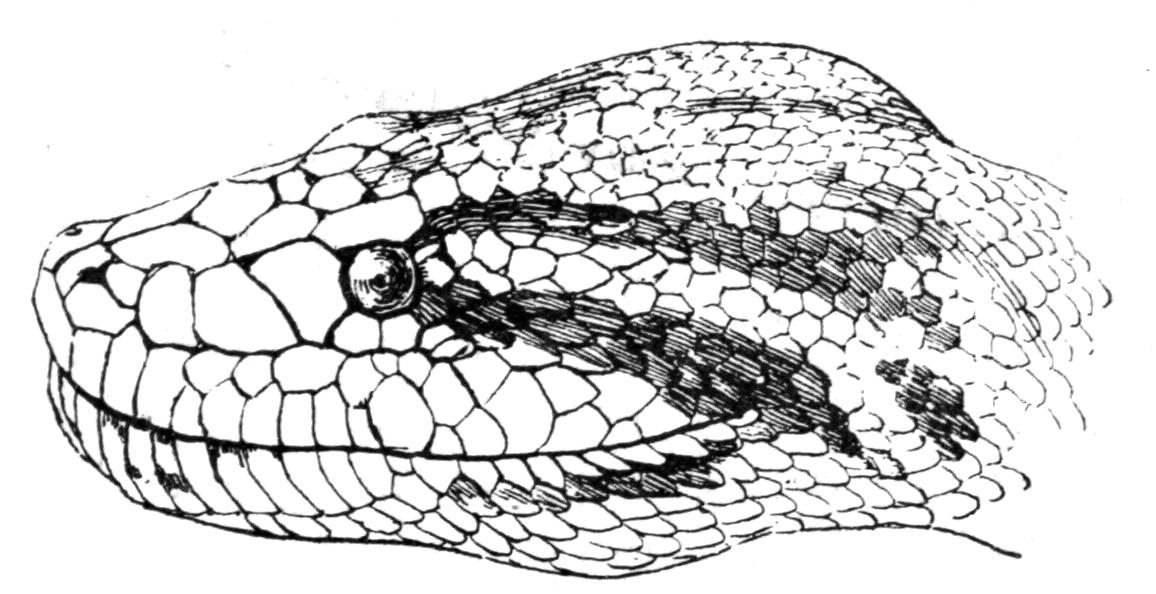
Fig. 159.–Head of Eunectes murinus. × 1.
Casarea, the "Round-Island Snake," differs from Boa chiefly by the rough and strongly keeled scales, and by the relatively much longer tail.
Eunectes murinus, the "Anaconda," is an aquatic Boa. It differs from this genus mainly by the inner of the three nasal shields being in contact with that of the other side (see Fig. 159), and by the absence of the little scales between the eye and the labials; the snout is, moreover, covered with shields instead of small scales. The pupil of the eye is normally vertical, but it had contracted into a round pinhole in the dead but still fresh specimen from which the figure was drawn. The general colour is dark olive-brown, with large oval black spots arranged in two more or less alternating rows along the back, and with smaller black, white-eyed spots along the sides. The under parts are whitish, spotted with black. The upper parts of this and of many other dark-coloured species of Boidae are often shiny, with an iridescent lustre.
The Anaconda combines an arboreal with an aquatic life, a kind of existence eminently in harmony with the well-watered, dense forests of Tropical South America, which are the home of this, the largest of all modern Snakes. It is said to attain a length of as much as 33 feet. There is no inherent impossibility in such statements, but the giant specimens seem to have a knack of keeping out of the naturalist's way.
The Anaconda feeds chiefly upon Birds and Mammals, which it catches either on land, mostly during the night-time, or in the water. For the latter purpose it lies submerged in the rivers or floats about leisurely, only the head being above the surface, and anything suitable is attacked. In other localities the snake, if so inclined, establishes itself upon the branches of a tree which overhangs the water, or the track of the game. These aquatic Snakes seem to be viviparous.
Eryx has the head not distinct from the neck and covered entirely with small scales. Those of the body are likewise small, and are either smooth or keeled. The tail is very short. The anterior maxillary and mandibular teeth are longer than the posterior teeth. These snakes, most of which are less than 3 feet in length, inhabit the sandy districts of North Africa, Arabia, and South-Western Asia, extending into Central Asia. One species, E. jaculus, extends into Greece and the Ionian Islands. Like the other species it is an ugly creature, pale grey or yellowish above, with darker patches and spots. The under parts are whitish. The scales are smooth on the front half of the body, becoming keeled further back and on the tail. Total length under 2 feet. The pupil is vertical.
According to Zander[187] and Werner[188] this snake lives in sandy localities, digging itself into the sand, or covering the body lightly with sand and leaving only the eyes and nostrils free. The whole body is very flabby, and presses itself into any irregularity of the ground over which the snake creeps. Some specimens live on lizards, others prefer mice. The prey is caught by the head, and further secured by several turns of the body of the captor, whose tail is then turned forwards, round the head of the victim, so as to form a kind of knot.
Not less striking than their agility is their jealousy, which is so strong that a snake will occasionally leave the mouse which it has just strangled in order to seize another snake's mouse. Sometimes several snakes fight for the same mouse, coiled together into one inextricable lump so that the mouse itself is quite invisible. The snakes poke their heads about in search of the hidden prey, and every attempt of one of the snakes to free itself, causes the others to squeeze it firmer and firmer, thinking apparently that the motion was caused by the lost prey.
Occasionally one of Werner's captives caught several mice in succession. With these it crawled into a corner, dropped the mice, and then proceeded quietly to swallow one after another. After a fortnight the whole repast was digested, and the snake was ready for more.
Fam. 6. Xenopeltidae.–The single species, Xenopeltis unicolor, of South-Eastern Asia, including the Malay Islands, has been raised to the dignity of family-rank on account of the following combination of characters. The prefrontal bones are still in contact with the nasals as in the previous families, but the coronoid bones of the mandibles are absent as in the remaining families. The whole suspensorial apparatus and the lower jaw itself are peculiar. The dentary bone is movably attached to the end of the much-elongated articular bone, the movability being enhanced by the absence of the coronoid element.[189] The quadrate is short and thick, and is carried by the short and broad squamosal, which lies flat against the skull, resembling in this respect that of some of the Ilysiidae. Boulenger rightly considers Xenopeltis to be in various ways intermediate between this family, the Boidae and the Colubridae. The head is small and not distinct from the neck. The eyes are small and have a vertical pupil. The body is cylindrical, covered above with smooth black or brown and highly iridescent scales, hence the generic name. The ventral scales are white and transversely enlarged as in the majority of snakes. The tail is short, but not stunted, measuring about 4 inches in full-grown specimens of a total length of 3 feet.
Fam. 7. Colubridae.–This family comprises those snakes (about nine-tenths of all recent species) which combine the following characters:–ectopterygoids are present: the squamosals are loosely attached to the skull, and carry the quadrates, which are not reached by the pterygoids: the prefrontals are not in contact with the nasals: the maxillaries are horizontal and form the greater portion of the upper jaws: the mandibles lack the coronoid process or element: both jaws are toothed.
The best arrangement of this enormous cosmopolitan family with terrestrial, arboreal, and aquatic forms, is that by Boulenger, who, adopting Duméril's terms, has divided them into three parallel series.
A. Aglypha.–All the teeth are solid and not grooved.
B. Opisthoglypha.–One or more of the posterior maxillary teeth are grooved.
C. Proteroglypha.–The anterior maxillary teeth are grooved or "perforated."
The Aglypha are harmless, non-poisonous. Most of the Opisthoglypha are poisonous, although few of them are dangerously so. The Proteroglypha, which comprise the "Cobras" and their allies, are deadly poisonous.
Series A. AGLYPHA.
Sub-Fam. 1. Acrochordinae.–The postfrontal bones, besides bordering the orbits posteriorly, are extended forwards so as to form the upper border of the orbits, separating the latter from the frontals. The few genera and species of this sub-family are mostly aquatic, inhabiting rivers, or estuaries with brackish water, and they have been known to swim far out into the sea. The body is covered with small, frequently granular scales; in the typically aquatic forms the body is slightly compressed laterally, and the ventral scales are scarcely larger than the others. Most of these ugly snakes inhabit the rivers of coasts of South-Eastern Asia and Papuasia; one, Stoliczkaia, is found in the Khasia Hills of North-Eastern India; another, Nothopsis, lives far from its supposed allies, on the Isthmus of Darien, Central America.
Acrochordus javanicus has no ventral shields. The head is flat, covered with small granules, with the eyes and nostrils on the upper surface. The general colour is dull olive-brown, lighter and spotted beneath. The food consists of fishes. Total length up to 4 feet.
Chersydrus granulatus ranges from the coast of Madras to New Guinea. The body and tail are compressed, and form a ventral fold, covered with tiny scales like the rest of the body. General colour grey above, yellow below.
Sub-Fam. 2. Colubrinae.–The postfrontal bones are restricted to the posterior border of the orbits. The maxillary and dentary bones carry teeth on their whole length. The scales are usually imbricating. This sub-family contains the overwhelming majority of snakes, about 1000 species, all of them harmless so far as poison is concerned. None of them reach a great size, species of 6 or 7 feet in length being rare, e.g. Zamenis mucosus, but a few species of the Indian genus Zaocys s. Coryphodon grow to 10 feet. Most of the Colubrine snakes are oviparous, but some, e.g. Coronella, are viviparous. Some are aquatic, or semi-aquatic, others are absolutely arboreal, others again prefer dry, sandy, or rocky localities, according to their food. The distribution of the sub-family is cosmopolitan, finding its natural limits only in the permanently frozen under-ground, a condition which makes hibernation impossible. Most of them love warmth and like to bask, although many are not fond of the broiling sun. In the temperate regions they hibernate. As a rule they are intelligent and some of them become even affectionate.
Tropidonotus.–The teeth form closely set series on the whole length of the maxillaries, palatines, pterygoids, and the greater portion of the dentaries. The premaxilla is toothless. The teeth of the maxillaries gradually increase in length, the posterior teeth being the longest. The pupil is round. There is a pair of internasal shields. The scales covering the body have each an apical, sensory pit, are mostly keeled, and are arranged in longitudinal series. The ventral shields are broad; the sub-caudals form two rows. This genus, with more than seventy species, has a wide range, practically over the whole world with the exception of New Zealand and the southern half of Australia.
T. natrix, the common Grass-Snake, has a divided, or double, anal shield. The strongly keeled scales of the body form nineteen rows. There are normally seven upper labials, the third and fourth of which border the eye. The usual colour of the Grass-Snake is olive-grey or brown above, with black spots and narrow cross-bands. The labials are white or yellowish, with black sutures. The belly is checkered black and white, more or less suffused with grey. There are several colour-varieties. The typical or northern form has a white, yellow, or orange collar, bordered behind by a black collar; the pale collar is sometimes faint or absent. The second variety, rather common in Spain and Portugal, although not the only form in the Peninsula, has no collar whatever, and these specimens are sometimes almost uniformly grey-green above. The third variety, common in South-Eastern Europe and in Asia Minor, has a well-marked collar and a yellowish streak along each side of the back. But there are also almost black specimens.
The usual length of an adult female Grass-Snake is about 3 feet, but very exceptional cases of more than 6 feet are on record; the males are smaller and more slenderly built. The range extends over the whole of Middle Europe, Algeria, West and Central Asia. It does not, however, occur in Ireland or Scotland. Its northern limit is the southern part of Sweden.
The Grass-Snake prefers moist, grassy localities, with the neighbourhood of water, chiefly on account of the food, which consists entirely of fishes and Amphibia, notably of frogs; tree-frogs are preferred to anything else; toads are occasionally eaten, but mice are never taken.
The Grass-Snake can climb trees or rather shrubs and is an accomplished swimmer, often spending much of its time in water for fishing purposes. The fish is caught by the belly and then generally swallowed on land. The Grass-Snakes appear in the spring and disappear in the autumn to hibernate in the ground. They pair, in England, in the month of May or June, usually on warm and sunny mornings. The eggs are laid from July to the end of August, mostly in rich vegetable soil, in heaps of weeds or in manure-heaps. Young snakes lay fewer eggs than old specimens, which sometimes produce more than three dozen at a time. The eggs are soft, whitish yellow, about one inch long, and soon stick together, so that the whole clump can be taken up at once. As a rule the new-laid eggs do not contain any visible sign of the embryo, but it often happens that the snake has to delay oviposition, and then the embryos are more or less advanced. This is especially the case with recently caught specimens. The young are hatched in the late summer or in the autumn, and seem to live at first upon soft insects and worms. Curiously enough they are easily drowned when they fall into the water, even in a shallow tank. My tame snakes have often laid eggs between the stones in the greenhouse; the young throve well upon unknown food, but most of them met their fate in the water. When they are a few weeks old they are strong enough to take baby-frogs.
The Grass-Snake becomes very tame, learns to distinguish between different people, allows itself to be handled without hissing or without voiding the obnoxiously smelling contents of its cloaca and anal glands, will in time take the offered food from the hand, and will even crawl up the arm or sleeve and coil itself up contentedly. One of the finest specimens, quite green, without a trace of a collar, and with brownish-red eyes, I caught in the Guadiana, where it had been fishing in midstream. It swam towards the bank, dived, and hid itself at the bottom between rocks. This snake, a female, became very tame. It never hibernated, shed its skin regularly every few months, and grew within nine years from 35 inches to 42 inches in length.
The Grass-Snake is perfectly harmless: although hissing, and striking out furiously with its head, it never bites, not even when it is severely handled. Its only defence consists of the awful contents of the cloaca and the anal glands, the secretion of which smells of concentrated essence of garlic mixed with other indescribable odours. The wildest specimens I have ever met with inhabited a swamp with a little stream to the north of Oporto close to the coast. To my utter surprise some of them actually made for me, swimming along rapidly with the head erect, about 6 inches above the water, and darting forwards with widely opened jaws, but they did not bite. These and other kinds of allied snakes require to drink much and often. Occasionally they drink milk when this is offered them, but that they suck the udders of cows or the breasts of women is an idle fable.
T. viperinus.–The scales are strongly keeled and form twenty-one to twenty-three longitudinal rows. The third and fourth labials border the eye. The anal shield is divided. The eyes and nostrils are directed upwards instead of sidewards, in adaptation to the essentially aquatic habits of this species, which lives upon fishes and Amphibia. The general colour is grey to reddish brown, with a black zigzag band along the back and a lateral series of black, yellow-eyed spots. The belly is yellow or red, checkered with black.
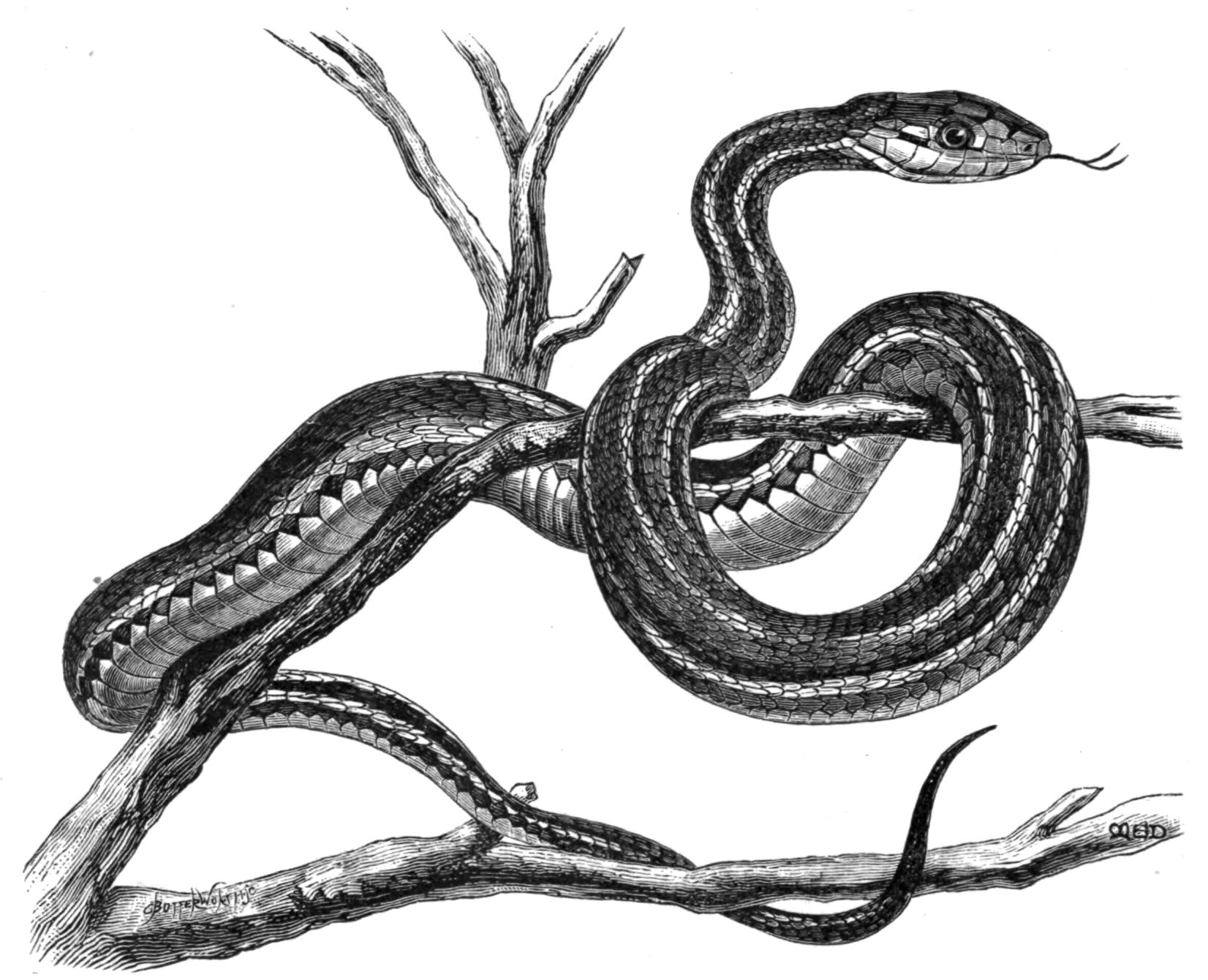
Fig. 160.–Tropidonotus sirtalis. × ½.
The Viperine Snake bears a general resemblance to the common viper. It inhabits France, Italy, Spain and Portugal, and Morocco. Very large specimens attain a length of nearly 3 feet, but the ordinary size of adults is 2 feet. This snake spends most of its time in the water, but it is often found on land, basking on the top of a low wall or on a low shrub. It is exceedingly common in Spain and Portugal, where it inhabits almost every ditch, any standing water or slow river. In the Alemtejo, when during the rainless and hot summer the small rivers have nearly dried up, these snakes collect in great quantities in the remaining stagnant and muddy pools, and as the stock of suitable fish gets exhausted, are often reduced to a deplorably emaciated condition. By the month of August they have become so thoroughly aquatic that they cannot be kept alive in dry surroundings for twenty-four hours. Those which I collected generally died, apparently from some kind of cutaneous suffocation, during the night following their capture. Taken under other conditions they are very easily kept and tamed.
I once caught a Viperine Snake in a ditch whilst it was swallowing an eel of nearly its own length. Both were separated, and then put into a small bag together with other creatures, and no more attention was paid to them for several hours. When I opened the bag again, the snake, undisturbed by my incessant walking about, was again busily engaged in trying to get outside that same eel!
T. sirtalis (Fig. 160) is one of the almost endless varieties of what is now known by the name T. ordinatus, of North and Central America.
T. tesselatus is closely allied to T. viperinus, which it represents in South Germany, Italy, South-Eastern Europe, and Asia; but the scales form only nineteen rows, and the fourth, or fourth and fifth labials, border the eye. The usual colour is olive-grey with dark little spots, and with a dark chevron-shaped band behind the occiput. The lower parts are yellow or red checkered with black, hence the specific name.
Zamenis.–The maxillary teeth are not closely packed; they increase slightly in size backwards, and the last two are often a little larger and separated from the rest by a diastema. The mandibular teeth rather decrease in size from before backwards, inversely with the upper teeth. The scales are smooth with apical pits; the sub-caudals form two rows. The eye is large, and has a round pupil. The range of this genus, with about thirty species, extends over the whole of the Periarctic region.
Z. (Ptyas) mucosus (Fig. 161), the Rat Snake of India, extending from Transcaspia to Java, is a very common species, often seen in menageries. Its general colour is brown above, often with black cross-bands on the hinder part of the body and tail. The under parts are yellowish. The fourth and fifth labials border the eye. The scales on the body form only seventeen rows. Another feature of this species is the prominent ridge of the back-bone, not only in half-starved but in well-conditioned specimens. The Rat Snake grows to a length of more than 7 feet, and is as ill-tempered as most species of this genus.
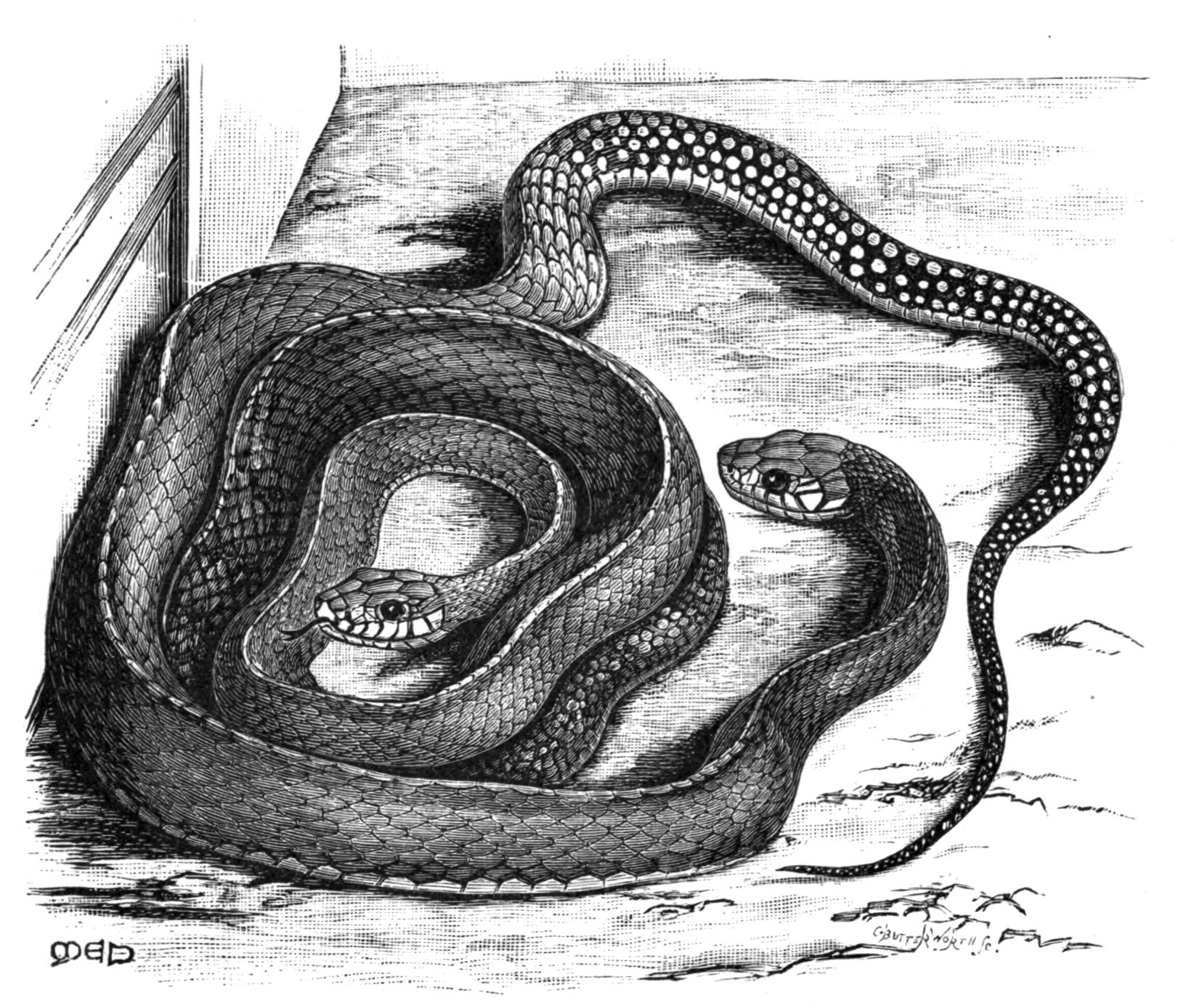
Fig. 161.–Zamenis mucosus (Rat Snake). × ⅕.
Z. gemonensis s. viridiflavus inhabits France, Italy, the Balkan Peninsula, and Asia Minor. Its coloration is very variable. In general it is either green above and yellow below, hence the appropriate name viridiflavus, or the ground-colour of the back is greyish or olive-yellow with brownish spots, which form more or less longitudinal rows on the trunk, but gradually pass into blackish continuous lines on the tail; the under parts are yellow or greenish white, often with many very small, dark specks. The scales form seventeen or nineteen rows; the anal shield is divided. There are two small postocular scales and one subocular; of the eight labials, the fourth and fifth border the eye. This species is very lively, attacks and bites furiously, climbs well, and when suspended from branches can protrude half of its length in a horizontal direction. It eats any kind of Reptile, Bird, or Mammal it can master; small animals are swallowed directly, rats and moles are first killed by constrictions. Large specimens reach perhaps 6 feet in length.
Z. hippocrepis is the representative species in the Iberian Peninsula and in North-Western Africa. It is rarely more than 4 feet long, and is very pretty, the ground-colour being reddish or olive-yellow with a row of large, dark brown, yellow-edged spots along the back. Two rows of smaller spots adorn the sides; where the dark spots are large, the pale ground-colour is restricted to forming rings around the spots, producing a pretty appearance. The under parts are yellow or orange, with black spots. On the head is a dark, pale-edged patch in the shape of a horse-shoe, a feature alluded to by the specific name. Structural characters are the possession of a row of little subocular scales, which completely separate the eye from the labials, the double anal shield, and the small and smooth scales on the body, which form generally as many as twenty-seven rows.
Z. constrictor.–The American Black Snake. The scales are smooth, and arranged in seventeen rows; the anal shield is divided. The general colour above is uniform bluish-black; below slaty, tinged with blue; the chin and throat are silvery white, sometimes with a black spot. Large specimens attain a total length of 6 feet.
Holbrook gives the following exhaustive account of this species, about which many sensational stories are current even in would-be scientific periodicals:–
The "Black Snake" is one of the commonest of North American species. It is extremely active, climbing with facility, and running with great rapidity, whence it is not uncommonly called the "Racer." It frequents shady places, covered with thick shrubs, on the margins of water. It feeds on mice, toads, or small birds; and, as it is an excellent climber, is frequently seen on trees in search of birds' nests. It is a bold and daring serpent, enters barns and out-houses without fear, and has been known to destroy young chickens. Its specific name constrictor would imply that it suffocates or crushes its prey, but this according to Holbrook is at least doubtful. In the breeding season it is extremely irascible, and will frequently attack persons passing at a distance of several steps; the tail then quivers with rage, making a quick vibrating motion, which in forests and among dead leaves sounds not unlike the Rattle-Snake; it now elevates the head one or two feet from the ground, and darts upon its adversary; luckily its bite is harmless, and not more painful than the scratch of a pin.
"It will even descend from trees to attack its enemy if teazed, yet it does not twine itself around the legs, as is commonly supposed.
"The same power of charming its prey has been attributed to the Black as to the Rattle-Snake, and with still less appearance of reason; for this is a nimble animal, and can pursue its prey, while the Rattle-Snake must lie in wait for his. It is remarkable that the birds most commonly found 'charmed' are the Cat-bird (Turdus carolinensis) or red-winged Black-bird (Icterus phoeniceus). These birds choose thick and shady places on the margins of streams for their residence, and generally build their nests on such shrubs as the alder; the latter bird not unfrequently takes the precaution to select such bushes as are on small islands, or such as have their roots surrounded by water, and thus their home is more secure. Now the Black Snake chooses precisely the same localities, knowing probably the haunts of its prey. The serpent begins the war by besieging the nest; the old bird, aware of its intention, attacks it with fluttering and uncertain motions, accompanied by a plaintive cry of distress, and is then said to be 'charmed.' The snake is at last either driven off, or it captures the young and not unfrequently the old bird too.
"Sometimes the old bird, by her cries, calls in the assistance of her neighbours to drive away the aggressor. I have seen more than a dozen birds thus engaged with a large Black Snake that had probably just committed some depredation, but was now quietly stretched on a rock, basking in the sun; and it was not a little singular that birds of very different genera, and those seldom seen together, all united in this warfare against a common enemy, and finally compelled him to seek shelter among some low, thick shrubs, by the violence of their assault."
Zaocys, with about half-a-dozen species in South-Eastern Asia, is closely allied to Zamenis. Z. carinatus, of the Malay Islands, grows to 10 feet in length; it is consequently one of the largest harmless Colubrine snakes. The scales form only sixteen to eighteen rows. The sub-caudals are double. The general colour above is dark olive, passing into greenish brown farther back. The under parts are yellowish; black and yellow posteriorly. The fifth and sixth labials border the eye.
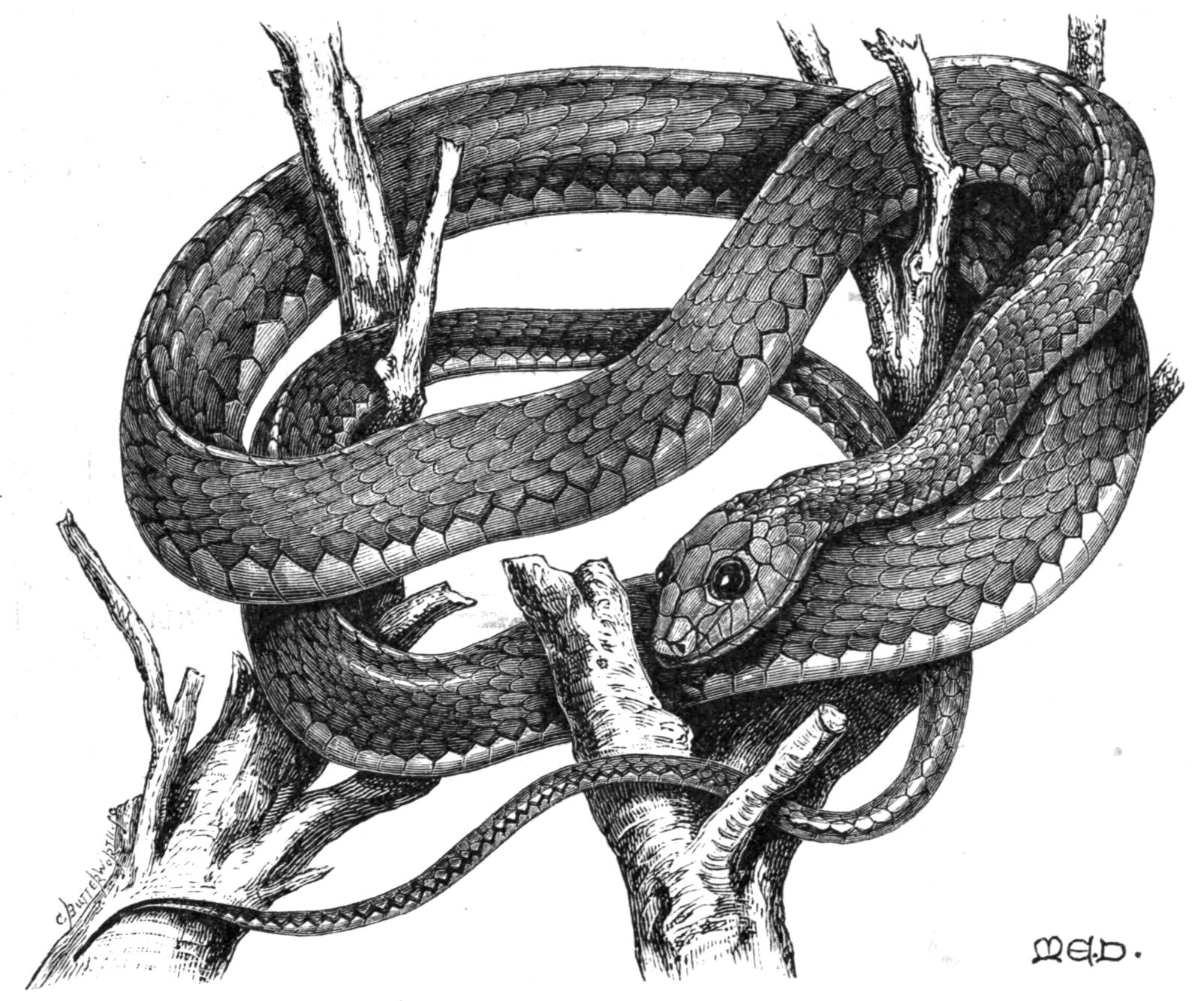
Fig. 162.–Zaocys carinatus. × ¼.
Coluber.–The maxillary teeth are of equal size, but the anterior mandibular teeth are the longest. The head is distinct from the neck. The nasals are distinct; not fused with the loreals. The eye is rather large, with a round pupil. The scales, smooth or keeled, have apical pits; the ventrals are rounded or angulate laterally; the sub-caudals are double. They all lay eggs and constrict their food. Nearly fifty species in the Periarctic region.
C. (Elaphis) quatuorlineatus s. quaterradiatus inhabits Italy and South-Eastern Europe. It occurs also in the Southern Tyrol. The scales of this large snake, which grows to nearly 6 feet in length, are arranged in twenty-five rows, and are feebly keeled. The anal is divided. Adult specimens have a yellowish-brown ground-colour with a pair of black streaks on each side of the back. A black line extends from the eye to the angle of the mouth; the under parts are yellow, mostly closely spotted with brown. This snake is good-tempered, and keeps well in captivity. They live on sparrows, mice, lizards, etc., and are very fond of eggs. Large specimens can swallow several fowls' eggs in succession; the crushed remains of the shells are later disgorged. This handsome snake climbs extremely well in search of birds and their eggs, and it is not afraid of the water. The prey is caught either with the teeth or by a rapid twist of the tail; in any case, the prey is always strangulated by the constriction of coils thrown round it. A sparrow thus secured is literally passed through the moving coils along the snake's body into a position convenient for swallowing. Hungry snakes catch and secure several birds or mice before eating them. My own specimens became almost affectionately tame, never attempted to bite, and took food from the hand.
C. leopardinus is smaller, but is one of the handsomest snakes of Southern Italy, South-Eastern Europe, and Asia Minor. It is closely allied to the previously described species. The ground-colour is pale brown with a dorsal series of dark brown or reddish, black-edged, transverse spots, and a lateral alternating series of smaller black spots, or with two dark brown, black-edged stripes bordering a yellowish vertebral stripe; usually with a forked black mark on the occiput and nape. The under parts are white, checkered with black, sometimes with the latter colour prevailing.
C. flavescens s. aesculapii is the Aesculap-Snake, for which the almost unknown name of longissimus has now been unearthed in deference to the fetish of priority. This snake is of an extremely graceful and slender build, with a very long tail. Its home is the South of France, Italy, and South-Eastern Europe. It occurs sporadically in the Tyrol, for instance near Bozen, in Austria, at Baden near Vienna, in Germany only in the Taunus, especially at Schlangenbad, which has received its name from the frequent occurrence of this snake. This sporadic distribution favours the idea that these snakes were introduced by the Romans as inmates of the temples erected to Aesculapius at such watering-places. Specific characters are the smooth and shiny scales, which are arranged in twenty-one to twenty-three rows, the distinctly angulate ventrals and the double anal and sub-caudals; the fourth and fifth of the upper labials border the eye, which has a round pupil. The coloration is very variable, as a rule olive-brown above with a dark streak behind the eye; the upper lips and a triangular patch on the temples are yellow; the under parts are uniform pale yellow. Some specimens are pale golden brown; others are very dark, almost black; while some have four darker stripes along the body, and lastly whitish specks occur on the upper surface. Large Aesculap snakes grow to a length of 5 feet. Their food consists chiefly of mice. They become very tame, although many of them at first bite furiously. Their climbing capacities are astonishing, the snakes being able to scale high and vertical walls provided there is the slightest "foothold." Some of my specimens escaped in the room and were at last found near the ceiling, resting on the rods of the curtains, up the folds of which they had managed to wriggle. Boulenger kept one for many years in a glass cage, where the snake entwined himself round the branches of a stick and allowed us to take him with the stick out of its socket and to inspect him. Being kept in an inhabited room, the snake did not exactly hibernate, creeping into the moss at the bottom of the cage; but it refused to feed, and remained in a rather drowsy condition coiled up on its favourite stand. During the pairing season they frequently resort to the water, at Schlangenbad at least; the few eggs are deposited under dry moss or in dry, decayed wood, and are hatched in about six weeks.
C. (Rhinechis) scalaris has the smooth scales disposed in twenty-seven rows. The snout is strongly projecting, and has a V-shaped dark mark on the top; a black streak runs through the eye, and another black spot lies below the eye. Young specimens are pale brown with a series of dark H-shaped marks on the back, suggesting a ladder, hence the specific name. In the adult these marks are replaced by a pair of brown stripes running along the back; the under parts are always uniform yellow. Total length about 3 feet. This snake is restricted to the Iberian Peninsula and to the South of France. Most specimens are very ill-tempered. The young live upon locusts and small lizards, the old eat mice and small birds. In captivity they also take dead animals–a rare habit with snakes.
Dendrophis with about ten species inhabits South-Eastern Asia and Australia. They are typical Tree-Snakes. The scales are keeled, and form only thirteen or fifteen rows; those of the vertebral row are enlarged; the ventrals have a pair of suture-like lateral keels and a notch on each side, arrangements which are of great assistance in climbing, these snakes being able to slide up the branches of trees in almost straight lines instead of having to twist and undulate their way up.
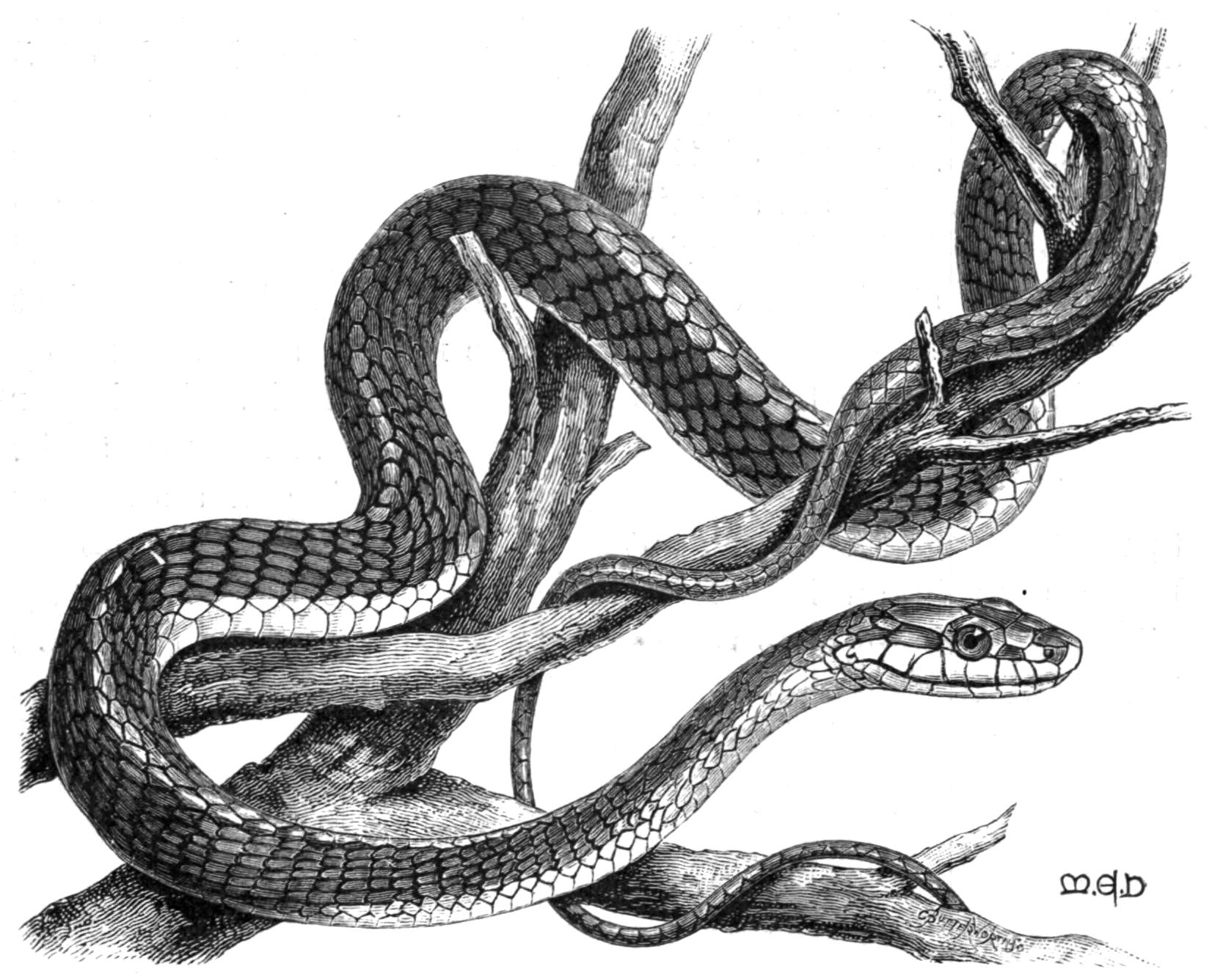
Fig. 163.–Dendrophis punctulatus. × ½.
D. punctulatus, of Northern and Eastern Australia, is olive-brown above, uniform or with black edges and yellow outer borders to the scales. The upper lips, the throat and anterior ventrals, are yellowish. Total length up to 6 feet.
Leptophis is a Neotropical genus of Tree-Snakes. The body and the extremely long, whip-like tail are very slender. The head is very distinct from the neck; the eye is large, with a round pupil. The scales form thirteen or fifteen rows; the ventrals are sometimes angulate laterally; the sub-caudals are double. L. (Ahaetulla) liocerus is a beautiful snake, green above with a golden lustre, while the under parts are yellow or white. The total length of this species amounts to 6 feet, the tail then being nearly 2 feet long. These graceful Tree-Snakes live upon small reptiles and birds and their eggs. When shaken out of a tree or frightened off they let themselves fall down from considerable heights, coiling body and tail like a watch-spring, and alighting on the ground upon the spiral, which breaks the fall.
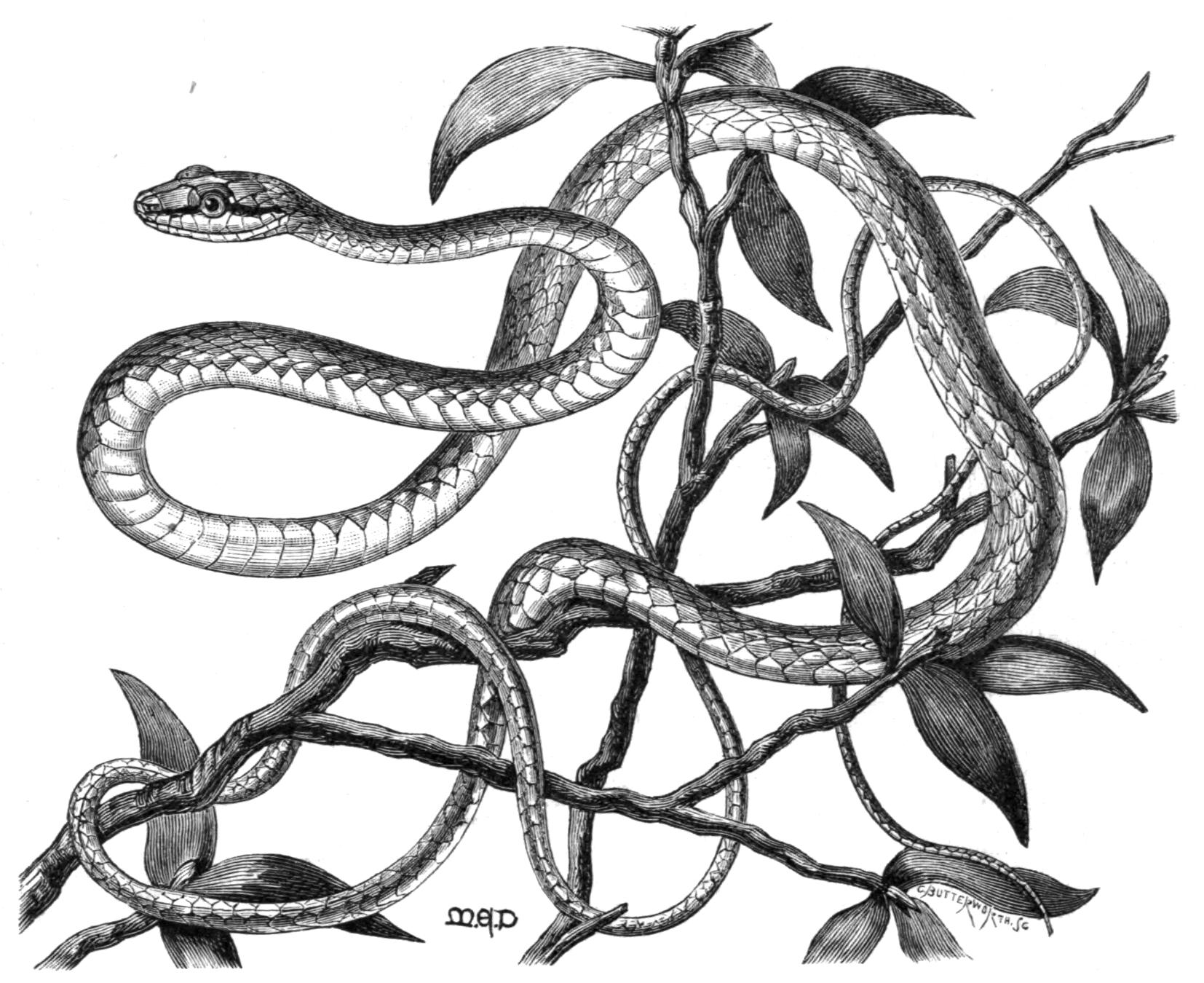
Fig. 164.–Leptophis liocerus. × ½.
Coronella.–The teeth are nearly all of equal size and form continuous series. The scales are smooth and have apical pits; the sub-caudals are double. The head is scarcely distinct from the neck. The pupil is round. This genus, with nearly twenty species, is widely distributed except in the Australian region, the northern half of Asia, and South America. We can mention only the two European species, one of which occurs in England.
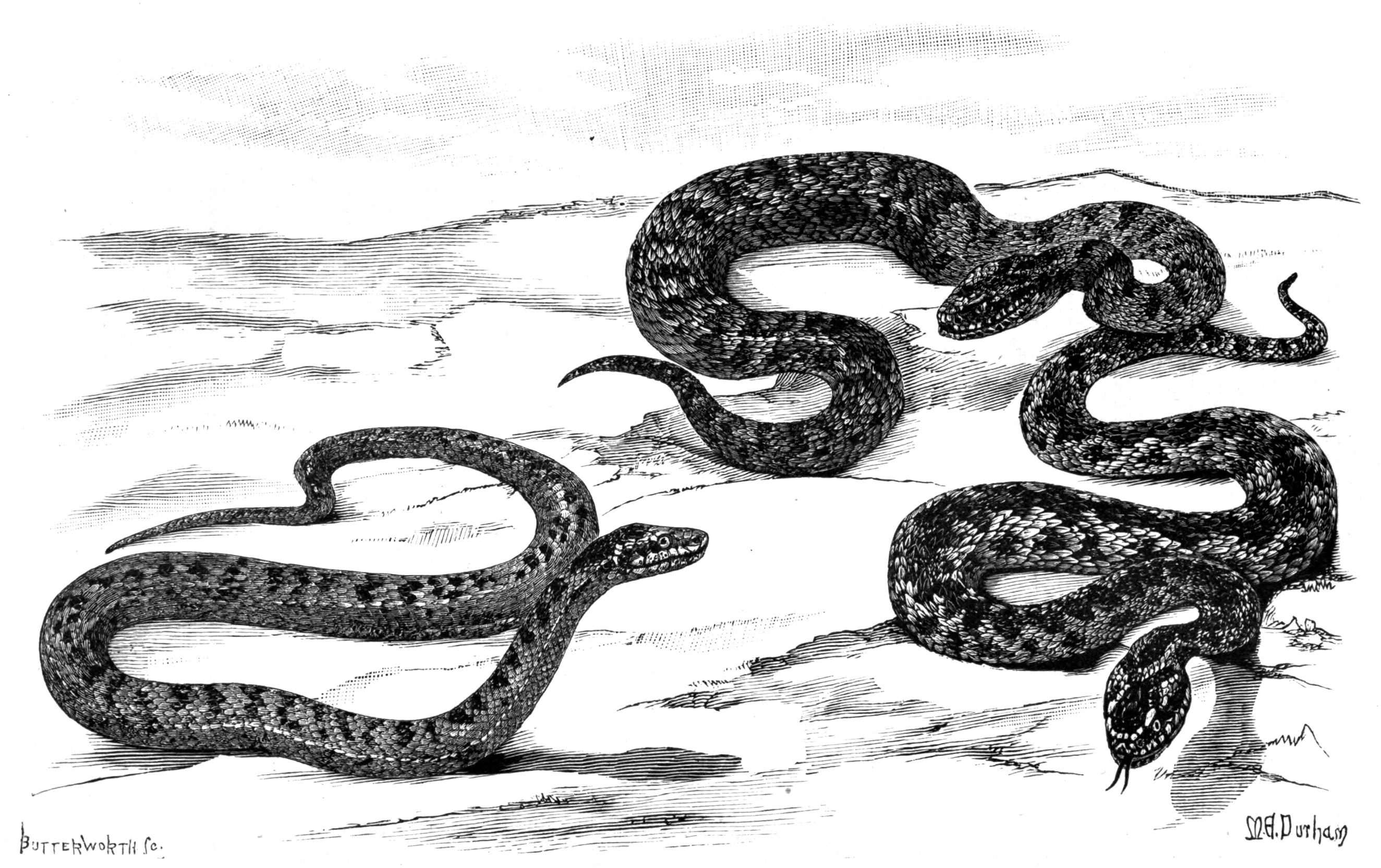
Fig. 165.–Coronella laevis, Smooth Snake (left), and two Vipera berus, Common Viper (right). × ½.
C. austriaca s. laevis, the Smooth Snake. The scales are arranged in nineteen rows. Mostly the third and fourth labials border the eye. The anal shield is divided. The general colour is brown or reddish above, often with one or two lighter stripes, with small dark brown or red spots; two dark brown or red stripes on the nape, usually confluent with a large dark patch on the occiput; a dark streak extends from the nostril through the eye to the angle of the mouth. The under parts are red, orange, brown, grey or blackish, either uniform or speckled with black and white. The coloration is, however, subject to much variation, and some specimens strikingly resemble some of the Common Viper, which is also very variable in its coloration. The resemblance is enhanced when the Smooth Snake broadens its head by widening the jaws, as it is in the habit of doing. Two such similarly coloured specimens are represented in Fig. 165. On closer inspection the differences are great enough, the harmless snake having smooth scales, and the top of the head being covered with large shields; while the Viper has keeled scales, the top of the head being covered mostly with scales, a vertical (not round) pupil, and, moreover, when attacked, usually coils itself into a spiral disc with the head standing out in the middle, ready to strike. However, these two species are sometimes mistaken for each other.–The Smooth Snake prefers lizards as food to anything else, but it also takes mice. The prey is hunted chiefly in the late afternoon and in the evening, and is constricted by the coils of the snake. When caught or even when handled after months of captivity, the Smooth Snake bites deliberately and firmly, selecting a suitable spot, for instance a finger, opens the mouth widely and almost chews the spot. The bite is of course quite harmless, and scarcely draws blood, few of these snakes attaining a length of more than 2 feet. They are viviparous, bringing forth about half-a-dozen young at a time. The range of the Smooth Snake extends over the greater part of temperate Europe, from England and the Iberian Peninsula to Berlin, and south-eastwards to Asia Minor. In England it occurs in a few counties only, for instance in Hampshire and in Dorsetshire.
C. girondica, of the South of France, Italy, the Iberian Peninsula and North-Western Africa, much resembles the English Smooth Snake, from which it differs in a few points only. The scales are arranged in twenty-one, rarely in nineteen, rows; usually the fourth and fifth labials border the eye; and the rostral shield, covering the end of the snout, is much broader than high. The coloration is variable, but there is always a pair of elongated blackish spots or a U-shaped mark on the nape.
Sub-Fam. 3. Rhachiodontinae.–With only a few teeth on the posterior part of the maxillaries, on the palatines and dentaries. Some of the vertebrae in the region of the lower neck have strongly developed hypapophyses, which are directed forwards and pierce the oesophagus. They are used for filing through or breaking the birds' eggs which seem to be the chief food of these snakes.
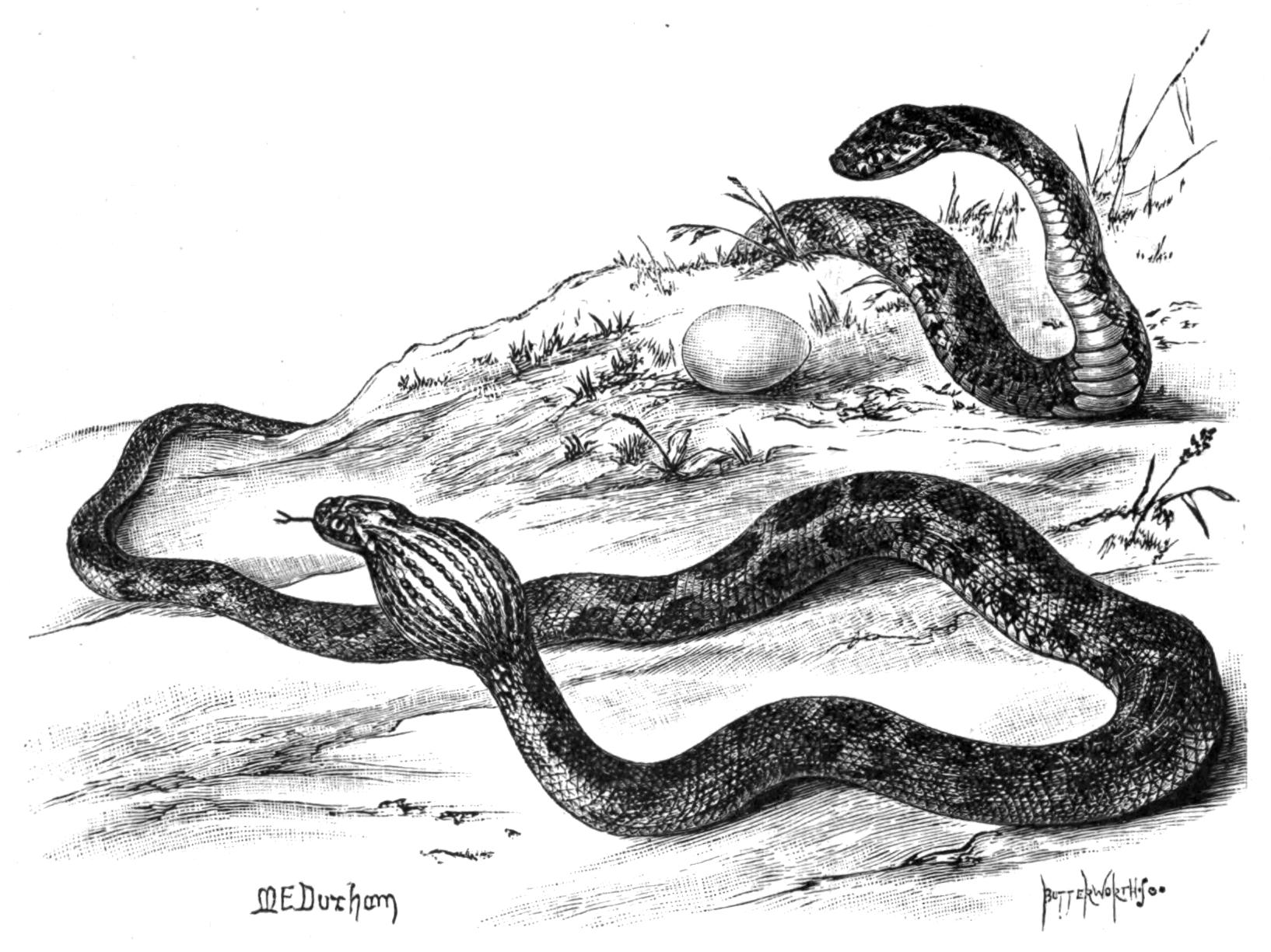
Fig. 166.–Dasypeltis scabra. × ½.
Dasypeltis scabra, the only species, inhabits Tropical and South Africa; although it reaches scarcely more than two feet and a half in length, such a specimen is able to swallow an ordinary fowl's egg. Pigeons' eggs are swallowed by snakes little more than one foot in length, which seems at first sight quite impossible. The swallowed egg distends the skin to its utmost capacity; it then slides down further, the snake makes some slight contortions and the swelling collapses; after a while the broken and sucked-out shell is vomited out as a crumpled up mass. Miss Durham has illustrated this curious process in a series of drawings.[190]
Series B. OPISTHOGLYPHA.
One, or a few, of the posterior maxillary teeth have a groove or furrow in front, which conducts the secretion of the enlarged upper labial glands. Apparently all these snakes are more or less poisonous, paralysing their prey before or during the act of deglutition. So far as man is concerned they are rather harmless, since the poison is not very strong, not available in large quantities, and above all because the small poison-teeth stand so far back that the snakes cannot easily inflict wounds with them.
The Opisthoglypha are of considerable morphological interest, since they connect the Colubridae with the Viperidae, the characteristic poisonous apparatus of which seems to have been derived from that of the Opisthoglypha by the reduction or shortening of the anterior portion of the maxillaries and the harmless teeth, so that the posterior or poison-fangs come to the front.
The Opisthoglypha comprise about three hundred species and are cosmopolitan, including Madagascar but excepting New Zealand. They contain truly terrestrial, arboreal, and thoroughly aquatic forms.
Sub-Fam. 1. Dipsadomorphinae.–The nostrils are lateral and the dentition is well developed. Long-tailed, terrestrial, and arboreal forms. Most of the arboreal species are green above, often with white or yellow longitudinal bands, while the under parts are white or yellow. They feed chiefly upon lizards, birds and their eggs.
Dipsadomorphus s. Dipsas (part).–Typical, very long-bodied and long-tailed Tree-Snakes, with a vertical pupil. The median or vertebral row of smooth scales is enlarged; the broad ventral scales are bent at an obtuse angle on the sides, the resulting ridge assisting in climbing. The sub-caudals are arranged in two rows. Ten to fourteen maxillary teeth are followed by two or three enlarged, grooved fangs.
D. trigonatus, of India, grows to one yard in length. Yellowish olive or pale grey above, with a white, black-edged zigzag band along the back, or with a series of white, black-edged spots.
D. cyaneus, of Northern India, Assam, etc., is a beautiful Tree-Snake, green above, with the skin between the scales black, uniform greenish yellow below. Total length up to 4 or 5 feet.
Dipsas e.g. D. bucephala.–Maxillaries with eleven or more teeth. Pterygoids toothless. Body strongly compressed, with thirteen rows of smooth scales; the vertebral row enlarged; sub-caudals double; tail very long. Tropical South America.
Leptognathus with many species in Central and South America, like Dipsas, but with teeth on the pterygoids.
Coelopeltis.–Terrestrial and diurnal, with a round pupil. The row of small maxillary teeth is followed by one or two much larger, grooved fangs situated at a level below the posterior border of the eye. The first half-a-dozen mandibular teeth are much larger than the rest. The scales of the adult are more or less distinctly grooved longitudinally, hence the generic name, and are arranged in seventeen or nineteen rows. The sub-caudals form two rows; the ventrals are rounded off laterally. Two species in the Mediterranean countries and in South-Western Asia.
C. monspessulana s. lacertina is one of the largest snakes in Europe, reaching a length of 6 feet, of which the tail takes up 18 inches. Olive-brown or yellowish or reddish above, frequently with small, dark, light-edged spots. The sides are often blackish, with whitish specks. The under parts are yellowish white, with or without brownish markings. Some specimens are very green, with a dull blackish neck. One of the specific names of this terrestrial snake is the latinised form of Montpellier; the other refers to the shape of the head, which is not unlike that of a lizard, partly owing to the concave forehead. This species inhabits rather dry localities studded with shrubs, where it hunts for lizards, birds, and mice. It is sure to attract notice by its loud hissing when it is disturbed. When driven into a corner it strikes out furiously, but does not, as a rule, bite. I have caught some which after a few days became quite gentle. Small animals become torpid a few minutes after they have been bitten.
Macroprotodon cucullatus occurs in Andalucia, the Balearic Islands, and in North Africa. The dentition is peculiar. The fourth and fifth maxillary teeth are enlarged, followed by an interspace, then follow several small teeth, and lastly the two enlarged, grooved teeth. The sixth mandibular tooth is very long, separated by a space from the much smaller posterior teeth. The general colour of this sand-loving snake is pale brown or grey above with small spots or streaks on the trunk, and with a large black patch behind the head extending over the sides of the neck, hence the specific name. The under parts are bright red or yellowish, sometimes spotted with black. Total length under 2 feet.
Sub-Fam. 2. Elachistodontinae.–With only a few teeth on the posterior part of the maxillary and dentary bones, and on the palatines and pterygoids. Some of the vertebrae in the thoracic region have much-developed unpaired hypapophyses, which are directed forwards and pierce the dorsal wall of the gullet. In this respect Elachistodon westermanni, of Bengal, the only species, bears a striking resemblance to the South African Aglyphodont Dasypeltis (see p. 622), and it is probable that this apparently very rare Indian snake also swallows eggs. It is brown above, with a yellowish vertebral stripe; yellowish below.
Sub-Fam. 3. Homalopsinae.–The nostrils of these absolutely aquatic and viviparous snakes are valvular, and are situated on the upper surface of the snout. The eyes are small with vertical pupils. The two dozen species, mostly very ugly, inhabit the rivers and estuaries of the East Indies from Bengal to North Australia. Some species have very small and narrow ventral scales, recalling the Hydrophinae, or the burrowing snakes, none of which use their ventral scales for locomotory purposes.
Homalopsis buccata, Cerberus rhynchops and Hypsirhina, e.g. H. plumbea, have well-developed ventral scales; the other scales of the first two genera are keeled, those of the third are smooth. In Hipistes the whole head is covered with very small scales; all the scales of the body are smooth except the very narrow ventrals, which have double keels. H. hydrinus, of Siam and the Malay Peninsula, has a compressed body, and in its general appearance much resembles the Hydrophinae. It lives, like its allies, upon fishes, and it swims far out into the sea.
Series C. PROTEROGLYPHA.
The anterior maxillary teeth are deeply grooved, or so folded as to appear hollow or perforated. Behind these enlarged poison-fangs the maxilla carries a series of smaller, solid teeth; hence the term "proteroglyphous," which means that the anterior teeth are grooved, in opposition to "opisthoglyphous." Both series have been developed independently.
The Proteroglypha are all extremely poisonous, mostly viviparous, and widely distributed over the whole of the Australian, Palaeotropical and Neotropical regions, with the exception of Madagascar and New Zealand; they extend northwards into the warmer parts of North America, and they also range over a great portion of the Palaearctic sub-region, being found in North Africa and South-Western Asia. They form two natural sub-families: Elapinae, with cylindrical tails, and Hydrophinae or Sea-Snakes, with laterally compressed tails.
Sub-Fam. 1. Elapinae.–The tail is cylindrical. The Elapinae comprise nearly 150 species, which have been grouped into a great number of, mostly somewhat imaginary, genera. In Australia they constitute the great majority of Snakes, there being besides the deadly Elapinae only a few Pythons and Typhlopidae, and very few Colubrinae.
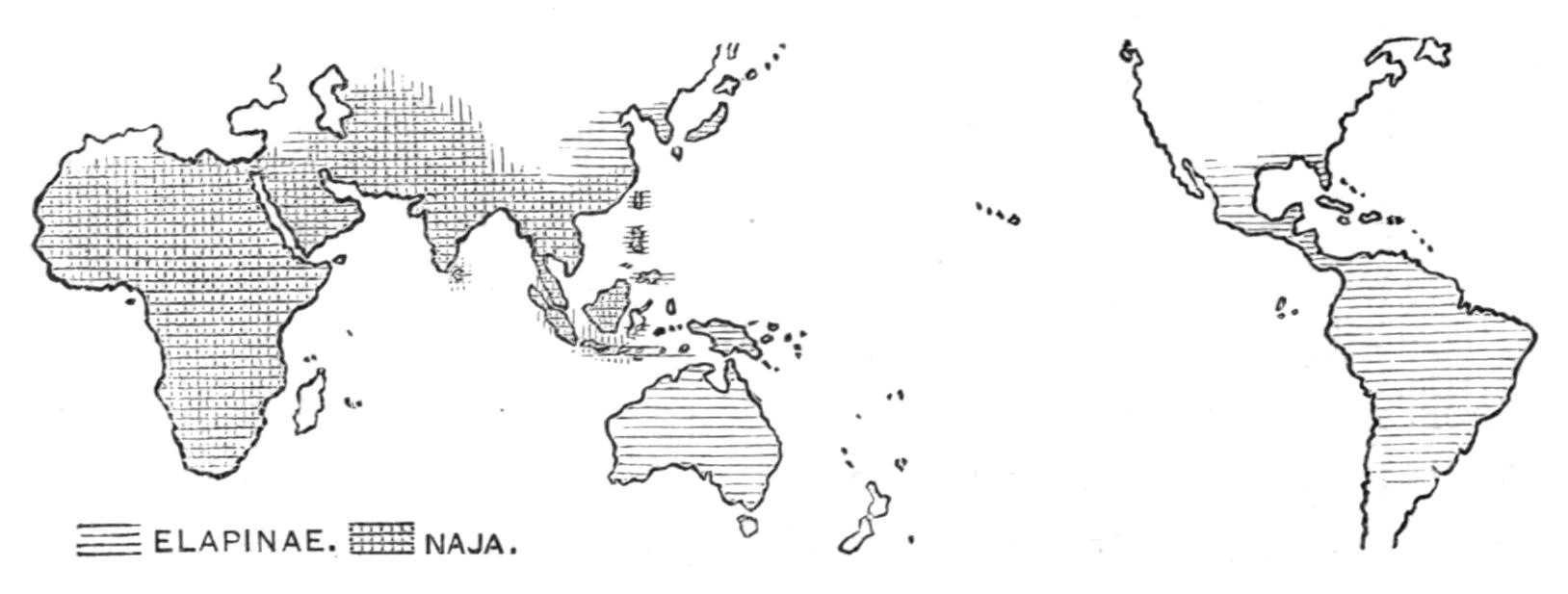
Fig. 167.–Map showing the distribution of the Elapine Snakes.
Naja.–The pair of large and grooved poison-fangs are separated by an interspace from one to three small, faintly grooved teeth near the posterior end of the maxillaries. The scales are smooth and without pits, and are arranged in fifteen to twenty-five oblique rows on the trunk, although more occur in the region of the neck; the vertebral row is not enlarged. The head is but slightly distinct from the neck. Each nostril lies between two nasals and the internasal. The sub-caudals form two rows. The pupil is round. The neck-region can be expanded into a hood by the spreading and moving headwards of the ribs. Several species in Southern Asia and in Africa.
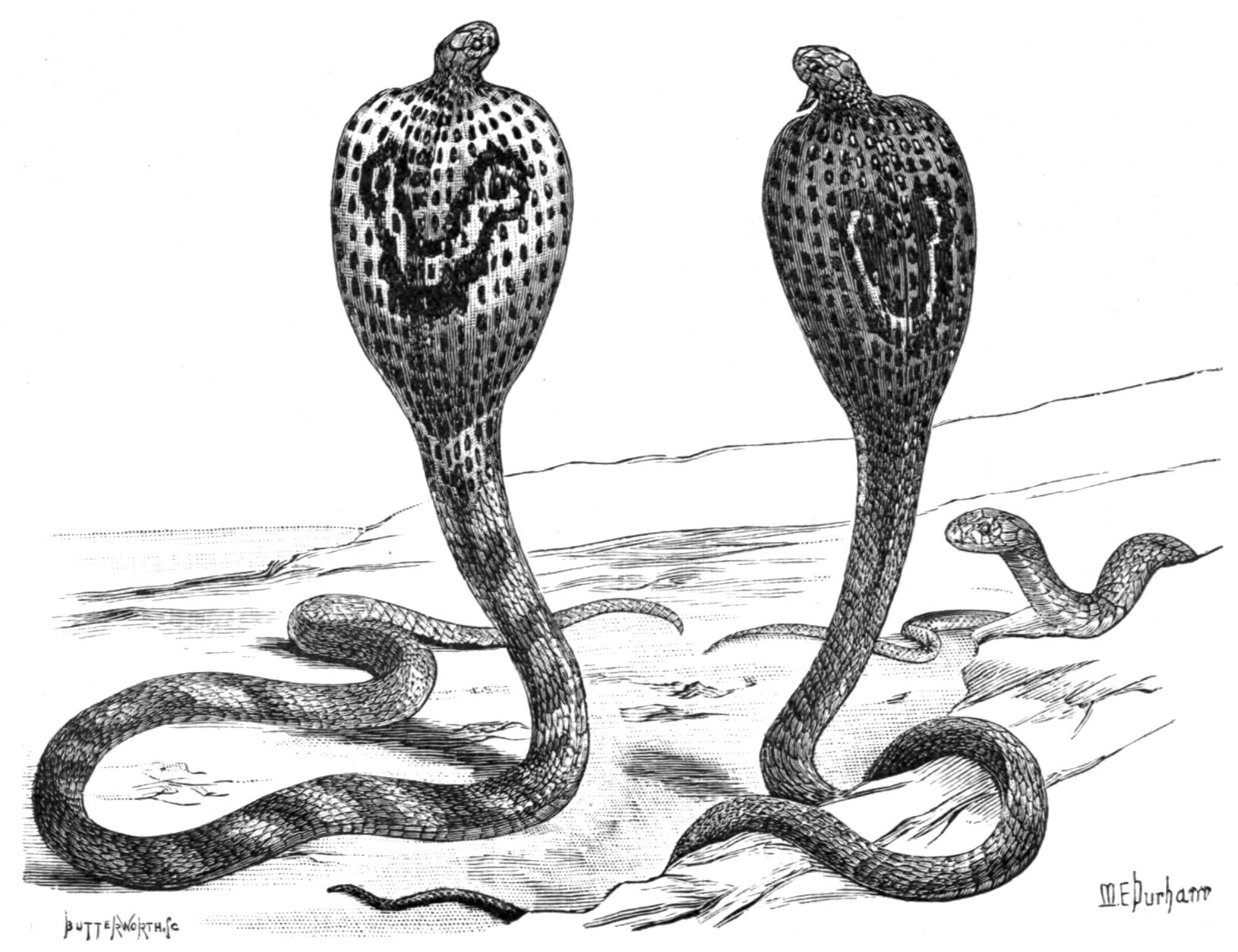
Fig. 168.–Naja tripudians (the Cobra). × ⅕.
N. tripudians (the "Cobra").–The coloration varies much. The typical form is yellowish to dark brown with a black and white spectacle-mark on the dorsal side of the hood, and with a large black and white spot on each side of the corresponding under surface. Other specimens are uniform pale brown to blackish grey, without any markings on the hood. The Cobra is widely distributed, from Transcaspia to China and to the Malay Islands; in the Himalayas it ascends to about 8000 feet above the level of the sea. Very large specimens are said to attain more than 6 feet in length, but a cobra of 5 feet, inclusive of the tail of 9 inches, is considered large. The Cobra prefers places which afford it a convenient hole to retire into; for instance, deserted hills of termites, ruins, heaps of stones and stacks of wood, and it has the disagreeable habit, like the harmless Rat-snake, Zamenis mucosus, of making itself at home in inhabited houses, probably attracted by the rats. Its chief food consists of small Vertebrates;–frogs, lizards, rats, occasionally fishes and small birds. It drinks much, and hunts chiefly in the late afternoon and in the evening, although it possesses a round pupil. It avoids hot sunshine. Many observations show that the cobras live in pairs, otherwise they do not take much notice of each other or of other kinds of snakes. The female lays about a dozen soft-shelled eggs as large as those of pigeons.
This cobra is used by Indian conjurers. The "dance" is the habit of these snakes of erecting themselves, when agitated, upon the hinder third or quarter of their length, whilst they spread out the hood and sway the head and neck to the right and left, always in an attitude ready for striking. They are docile and by nature not vicious. Most of the performing cobras have their teeth drawn, and they then know well that they cannot bite. They only strike at the hand, just as uninjured specimens soon avoid biting into the iron rod with which they are lifted up in menageries. The drawing of the teeth is an operation which has to be repeated, since reserve-teeth soon take the place of the lost pair.
I cannot refrain from relating an abstract of a ridiculous episode which happened in the Munich Aquarium in the year 1882. One of six specimens of the African species Naja haje was missing. The police closed the establishment, which during the following eight days was turned inside out without any other effect than that two other, harmless, snakes were discovered. Twice the building was fumigated with sulphur, until the Cobra was at last found suffocated, fifteen days after the beginning of the search. This snake caused the owner of the Aquarium a loss of nearly £1500. But the cruel joke was, that during the commotion the man who had collected and sold the six snakes declared upon oath that their teeth had been so well drawn and the germs of possible reserve-teeth had been so thoroughly destroyed that the snakes were rendered absolutely harmless. But he was not believed, in spite of a commission of professors and doctors appointed, who experimented upon the remaining five Cobras with sulphur and did not find any poison-fangs, "although the mouth was probed and poked into as far down as the larynx."
Cobras have quite a number of enemies. Peafowl and Jungle-cocks are said to be partial to young snakes; pigs eat them greedily, and are to a certain extent immune against their bite. The same applies, according to the most recent observations, to the famous Mongoos. Sir E. Tennent, in his Natural History of Ceylon, quoted several times in the present book, makes the following remarks about the immunity of this little creature:–
"I have found universally that the natives of Ceylon attach no credit to the European story of the Mongoos (Herpestes griseus) resorting to some plant, which no one has yet succeeded in identifying, as an antidote against the bite of the venomous serpents on which it preys. There is no doubt that, in its conflicts with the cobra and other poisonous snakes, which it attacks with as little hesitation as the harmless ones, it may be seen occasionally to retreat, and even to retire into the jungle, and, it is added, to eat some vegetable.... A number of plants, such as the Ophioxylon serpentinum and Ophiorhiza mungos, the Aristolochia indica, the Mimosa octandria, and others, have each been asserted to be the Ichneumon's specific.... If the Ichneumon were inspired by that courage which would result from the consciousness of security, it would be so indifferent to the bite of the serpent, that we might conclude that, both in its approaches and its assault, it would be utterly careless as to the precise mode of attack. Such, however, is far from being the case; and next to its audacity, nothing can be more surprising than the adroitness with which it escapes the spring of the snake under a due sense of danger, and the cunning with which it makes its arrangements to leap upon the back and fasten its teeth in the head of the cobra. It is this display of instinctive ingenuity that Lucan celebrates where he paints the Ichneumon diverting the attention of the Asp by the motion of his bushy tail, and then seizing it in the midst of its confusion. See Pharsalia, lib. iv. verses 729-734."
There is a widespread belief in the efficacy of "Snake-stones," which are generally pieces of charred bone, well polished, occasionally pieces of chalk or some similar porous substance, which, if pressed upon the bleeding wound, are supposed to absorb the poison. Snake-charmers profess to prepare such "stones," and to preserve the composition as a secret. The manufacture is a lucrative trade. The Boers bought them, imported from India, at high prices. Mr. Selous saw one, or heard of one, that was kept as an heirloom. Snake-stones are also made, and used, in Mexico, of charred hartshorn; they are called "piedras ponsonas."
The use of the Snake-stone, called "Pamboo-Kaloo," has probably been communicated to the Singhalese by the itinerant snake-charmers who resort to the island from the coast of Coromandel.
Although Sir E. Tennent describes several instances of the successful application of snake-stones as well authenticated, he has never himself been an eye-witness. Although two cases have been fully described, they do not at all exclude the possibility, nay the probability, that the Tamils imposed upon the Europeans in order to sell the snake-stones.
"No doubt the snake-stones, owing to their porous nature, adhered to the bleeding wound, became saturated with blood, and then fell off. Very likely, in case of a poisonous bite, some of the venom would be sucked up too, but we do not know if those snakes were still in the possession of their poison-fangs. Properly conducted experiments with snake-stones have proved as little efficacious as the application of dry cup.
"Theoretically snake-stones as quick absorbent agents of the blood with the poison are good; they will certainly prevent some of the poison from entering the system, but that would, at best, be a partial cure only.
"In March 1854 a friend of mine was riding, with some other civil officers of the Government, along a jungle path in the vicinity of Bintenne, when he saw one of two Tamils, who were approaching the party, suddenly dart into the forest and return, holding in both hands a Cobra de capello, which he had seized by the head and tail. He called to his companion for assistance to place it in their covered basket, but in doing this, he handled it so inexpertly that it seized him by the finger, and retained its hold for a few seconds, as if unable to retract its fangs. The blood flowed, and intense pain appeared to follow almost immediately; but with all expedition the friend of the sufferer undid his waist-cloth, and took from it two snake-stones, each of the size of a small almond, intensely black and highly polished, though of an extremely light substance. These he applied, one to each wound inflicted by the teeth of the serpent, to which they attached themselves closely; the blood that oozed from the bites being rapidly imbibed by the porous texture of the article applied. The stones adhered tenaciously for three or four minutes, the wounded man's companion in the meanwhile rubbing his arm downwards from the shoulders towards the fingers. At length the snake-stones dropped off of their own accord; the suffering of the man appeared to subside; he twisted his fingers till the joints cracked, and went on his way without concern. Whilst this had been going on, another Indian of the party, who had come up, took from his bag a small piece of white wood, which resembled a root, and passed it gently near the head of the cobra, which the latter immediately inclined close to the ground; he then lifted the snake without hesitation, and coiled it into a circle at the bottom of his basket. The root by which he professed to be enabled to perform this operation with safety he called the "Naya-thalic kalanga" (the root of the snake-plant), protected by which he professed his ability to approach any reptile with impunity."