Part 2 — CHAPTER X (continued 2)
Reading edition
In the dry season, when the tanks become exhausted, the Marsh Crocodiles have occasionally been encountered in the jungle, wandering in search of water. During a severe drought, in 1844, they deserted a tank near Kornegalle, and traversed the town during the night, on their way to another reservoir in the suburb; two or three fell into the wells; others, in their trepidation, laid eggs in the street, and some were found entangled in garden fences and killed.
Generally, however, during the extreme drought, when unable to procure their ordinary food from the drying up of the watercourses, they bury themselves in the mud and remain in a state of torpor till released by the recurrence of rains.
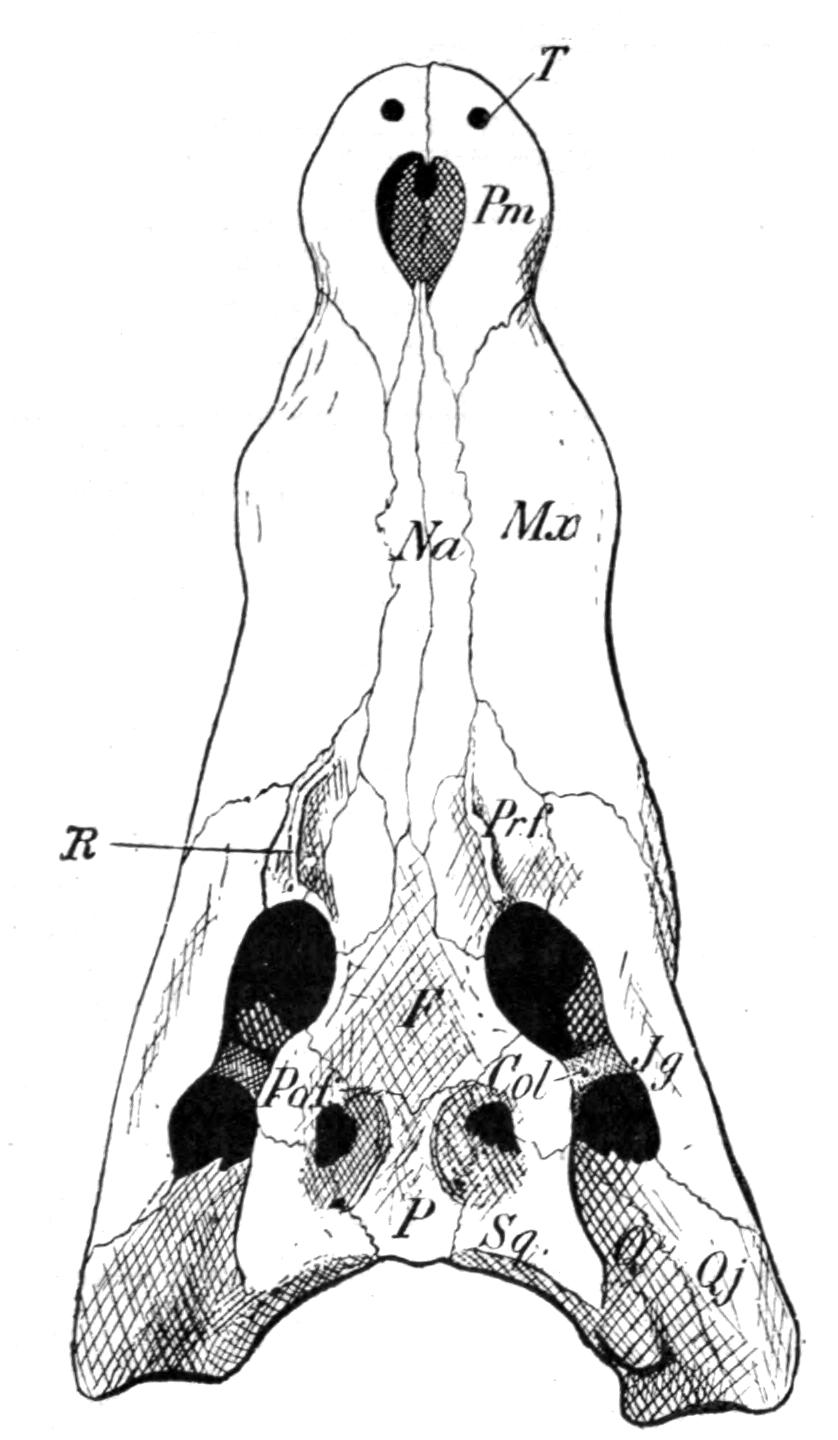
Fig. 108.–Dorsal view of the skull of Crocodilus porosus. × about ⅙. Col, buttress connecting the postfrontal with the jugal and ectopterygoid; F, frontal; Jg, jugal; Mx, maxillary; Na, nasal; P, parietal; Pm, premaxilla; Pof, postfrontal; Pr.f, prefrontal; Q, quadrate; Qj, quadrato-jugal; R, the characteristic ridge on the prefrontal bone; Sq, squamosal; T, perforations in the premaxilla caused by a pair of lower incisor teeth.
C. porosus s. biporcatus.–The premaxillo-maxillary suture on the palate does not form a transverse line, but is W-shaped, and extends backwards as in the rest of the species of Crocodiles to be described. This Indian species is easily recognised by the prominent longitudinal ridge which extends in front of each eye, over the prefrontal bones, and by the absence of sub-occipital scutes. The nuchal scutes consist of four large ones, which form a square, and one or two smaller scutes on each side. The dorsal shield contains four to eight principal longitudinal rows. The digits, webs, and the serrated fringe of the legs are like those of C. palustris. The head and snout, however, are distinctly longer, and more slender in proportion, and the adult has only four teeth in each premaxilla. The general colour is dark olive-brown. Young specimens, as usual, are much paler and are spotted with black.
This species attains a much larger size than the Marsh Crocodile. Specimens of 15 to 20 feet in length are not uncommon, and there is a record of one monster of 33 feet. Consequently this is, both in bulk and length, undoubtedly the largest species of recent reptiles. It is essentially an inhabitant of tidal waters or estuaries, frequently entering salt water and going out to sea. Herewith corresponds its wide distribution, namely, the whole coast of the Gulf of Bengal, extending to Southern China, and across the Malay Archipelago to the northern coasts of Australia. Eastwards it ranges to the Solomon Islands and even to Fiji. Curiously enough, it does not seem to occur on the west coast of India.
According to Tennent it is ready to assail man when pressed by hunger, and the same authority mentions the following serio-comic incident. A man was fishing, seated on the branch of a tree overhanging the water, and to shelter himself from the drizzling rain he covered his head and shoulders with a bag folded into a shape common with the natives. While in this attitude, a leopard sprang upon him from the jungle, but missing its aim, seized the bag and not the man, and fell with it into the river. Here a crocodile, which had been eyeing the angler in despair, seized the leopard as it fell, and sank with it to the bottom.
I have had some personal experience in the bringing up of the young of this species. Two dozen of them had come from Ceylon when quite young, only one foot long. At first they were very shy, and huddled together in their tank, but they took food greedily–strips of fish and, later on, sheep's heart. When frightened they emitted peculiar, high-pitched, half-croaking sounds. Some of them snapped at the finger when touched; others were of a more gentle disposition; the shy ones were undoubtedly the most vicious. Within one year they grew to 18 or 20 inches, and added much to their bulk. Then they were transferred to a deeper and larger tank in a greenhouse, in which they could roam about at liberty. In the daytime they dozed on the margins of their pond, mostly in such a position that, at the slightest alarm, they could plunge back into the water. The strongest specimen left the tank entirely, and took up its favourite place for basking on the stump of a tree, to reach which it had to climb up a rough wall of stones. After three years, several had grown to the length of three and a half, and even four feet, and had by this time become formidable pets. Although handled frequently, they never became tame, the only change in their behaviour being that, instead of rushing off in a fright, and hiding for half an hour at the bottom of the tank, they became more vicious and confident, making for and snapping at the hand which fed them. The nights were spent regularly in the water, either floating with just the nostrils exposed, or in search of food, frogs being their favourite prey, while their main sustenance consisted of "lights," with an occasional mouse, or a piece of solid meat by way of an entrée. Small pieces were bolted. The tough "lights," namely lungs with the windpipe and blood-vessels, were causes of great quarrels. Two or three would get hold of a lump of this kind, tearing at it, and twisting and rolling over in opposite directions. The supply of warm water came through a stout pipe of red india-rubber, and this was an irresistible attraction to the crocodiles. On many a morning the tube was found twisted into a knot, one of the creatures having spent hours in chewing it and in trying to wrench it off. In order to aid digestion they swallowed pebbles. The most favourable temperature of the water was 85° F.; if below 75° F. they refused to eat, but a continued exposure to 60° F. did not hurt them. When the temperature rose above 95° F. they left the water, although means had to be taken to prevent them from lying on the hot-water pipes.
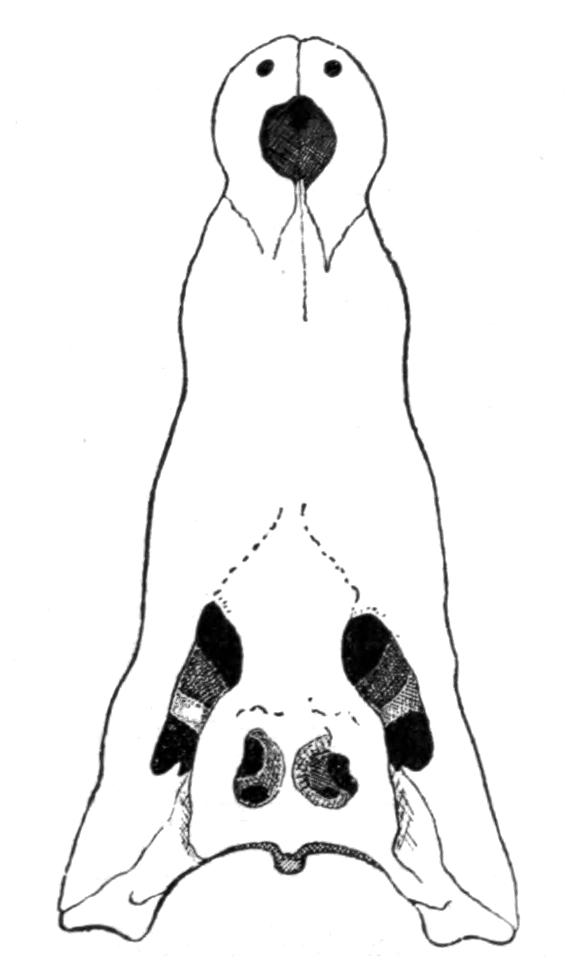
Fig. 109.–Dorsal view of the skull of a very old specimen of Crocodilus niloticus, in which most of the bony sutures are obliterated, × about ⅒.
C. niloticus s. vulgaris.–The premaxillo-maxillary suture on the palate is W-shaped. The nasal bones form only a small part of the posterior border of the nasal groove. There are eighteen or nineteen upper and fifteen lower teeth on each side. In old specimens some of the anterior mandibular teeth perforate the premaxillae, as indicated in Fig. 109, and they even pierce through the integument so as to be visible from above. The nuchals are composed of four large scutes, with a smaller one on each side and sometimes one behind, and there is a row of smaller pieces across the occiput. The dorsal shield contains six to eight principal longitudinal rows. The fingers are webbed at the base; the outer toes are very broadly webbed; and there is a serrated fringe on the outer side of the leg. The general colour of the adult is dark olive-brown; the young are paler, with black spots and vermiculations. The under parts are yellowish white.
The Nile Crocodile is essentially African, ranging from the Senegal to the Cape and to Egypt. It is also very common in Madagascar. Nothing is known about its occurrence in Arabia, but a few specimens of rather small size seem still to exist in Syria, in the Wadi Zerka, an eastern tributary of the Jordan.
Even in historical times the Crocodile must have been very common in lower Egypt, to judge from the number of mummies preserved by the old Egyptians. Now it is practically exterminated, and there are scarcely any left below Wadi Halfa.
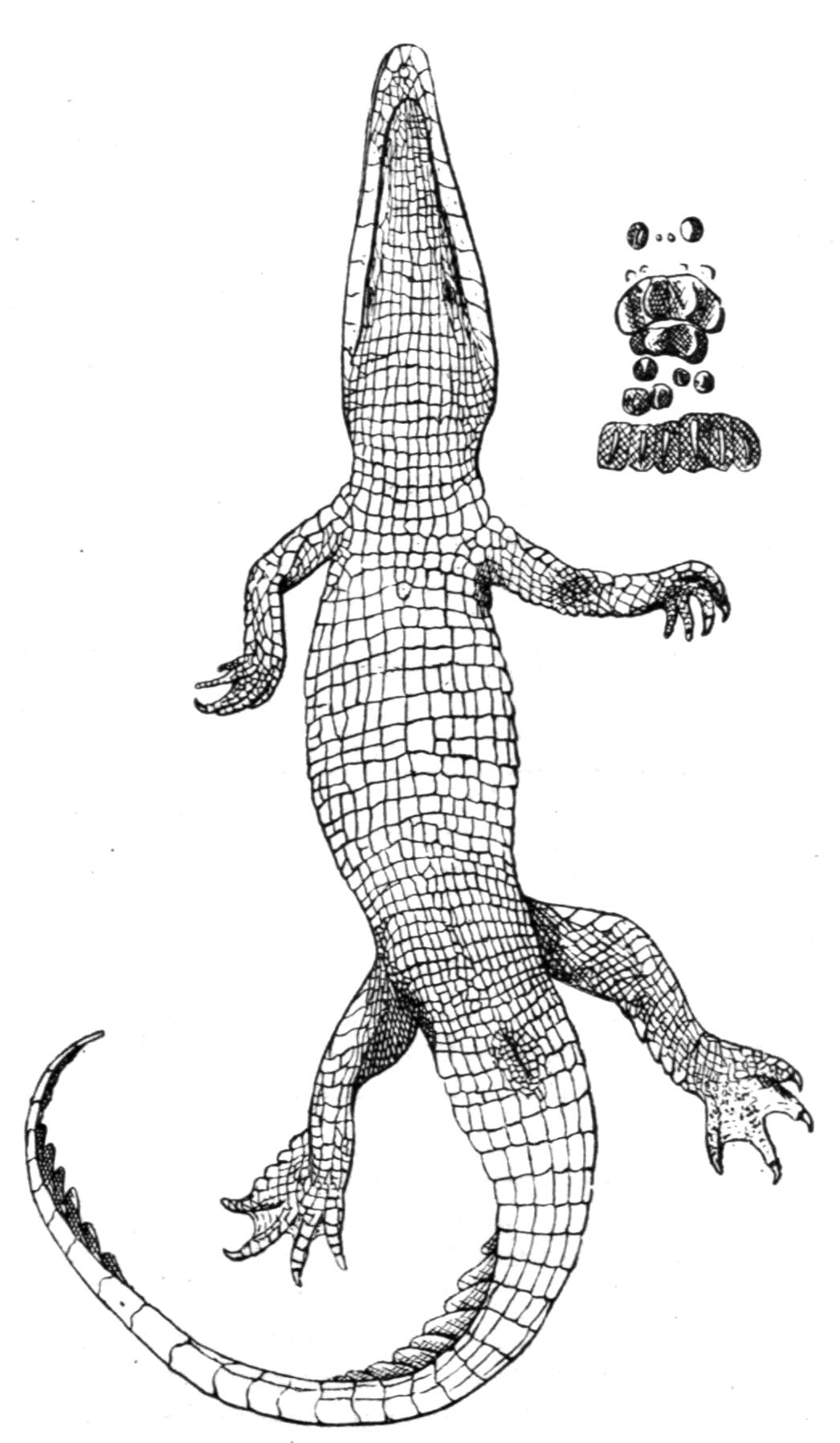
Fig. 110.–Ventral view of a young Crocodilus niloticus, showing the arrangement of the bony scutes and the two openings of the musk-glands on the lower jaw. The upper right-hand figure shows on a larger scale the disposition of the nuchal scutes and the first row of dorsal scutes.
Such a conspicuous and dangerous creature has naturally always enjoyed notoriety. It is well described in one of the oldest writings of the world, the Book of Job. "Canst thou draw out leviathan with an hook? or his tongue with a cord which thou lettest down?... His scales are his pride, shut up together as with a close seal. One is so near to another, that no air can come between them. They are joined one to another, they stick together, that they cannot be sundered.... Lay thine hand upon him, remember the battle, do no more." Bows and arrows, spears and clubs, are of little avail against such a monster; the dragging out of a hooked, full-grown specimen requires many men and is a formidable task. Of course firearms have changed all this, and its invulnerability to bullets is nonsense. It is true that a bullet sent into the head is generally ineffective, since it is a hundred to one that the bullet does not hit the small brain, and even if it does, the creature sinks to the bottom and is lost to view until decomposition sets in and the gases developing in the body cause it to float.
Herodotus has quaint stories about these crocodiles and their worship. Amongst other stories he mentions that the bird Trochilus, supposed to be the Pluvianus aegyptius, a kind of Plover, slips into the gaping mouth to pick off the leeches which infest the reptile's gums. "In Egypt it is called Champsa, but the Ionians call them κοκοδρίλοι on account of the resemblance to the lizards which live on their garden walls." This is in fact the origin of the name crocodile, κόρδυλος being the ancient Greek for lizard and newt. With reduplication κορκόρδυλος and by metathesis ultimately κροκόδειλος. The Arabic name is ledschun.
The story about the Plover seems to be true. These birds are sometimes seen sitting upon basking crocodiles, and since the latter are in the habit of resting, perhaps half asleep, with the mouth wide open, it is possible that these agile birds do pick their teeth, and that they, being also very watchful, by their own cry of warning and by fluttering off on the approach of danger, give the alarm to the crocodiles and thus benefit them in more than one way.
But the equally old story about the Ichneumon or Mongoose is an idle invention. Mongooses are partial to eggs, but they certainly prefer those of hens and other birds to those of the crocodile, which are far too hard and strong to be broken by such a little animal. Moreover, as we shall see presently, the eggs are far too well concealed.
The best account of the habits of these crocodiles is the one given recently by Voeltzkow,[142] who has spent a long time in Madagascar to collect material for the study of their development.
He says that C. niloticus is not only the most common reptile, but perhaps the most common vertebrate in Madagascar. It occurs in every pool and river in great numbers, especially upon the sandbanks of the Betsiboka River, where one may see more than one hundred within one hour's paddling down stream. The largest specimen measured by Voeltzkow was 13 feet long; the largest in the National Collection is a little less than 15 feet.
The crocodiles are caught in various ways. The simplest apparatus consists of two pointed sticks, which are fastened cross-wise within the bait to which is attached a rope, and this is made fast on the bank of the river or lake. The animal, when it has once swallowed this spiked bait, keeps its jaws firmly closed, so that it can be dragged out of the water. Another method is more reliable. A long and strong rope is made into an easily slipping noose, with an opening of about 18 inches. The bait is attached to the upper part of the noose, while the lower portion is kept open by a springy branch, the whole thing being so balanced that it will float upright. When a crocodile seizes the bait, which it does with a side jerk of the head, the branch falls out of the noose and the latter closes around the upper or lower jaw.
These crocodiles dig long subterranean passages of 30 to 40 feet in length; the passage opens in the bank below the level of the water, and gradually ascending ends in a somewhat wider compartment, which allows the creature to turn round. Two or three air-holes are pierced through the ceiling of the burrow, in which bones and other remains of food are often found, so that the natives' belief, that the crocodiles retire into these chambers in order to devour their prey in undisturbed secrecy, appears very probable. When suddenly disturbed or frightened they take to these lairs, and since their position is clearly marked by the air-holes, the natives block the passage and then dig the animal out from above.
Eggs are laid, in Madagascar, from the end of August to the end of September; the number of one set varies from twenty to thirty. They are deposited in a nest. This is in the ground, mostly in white sand, and consists of a hollow 18 inches to 2 feet deep. The walls are rather vertical, but near the bottom they are undermined, and here the eggs are placed. The centre of the pit being somewhat higher, the eggs roll by themselves into the undermined peripheral region. The laying takes place during the night, mostly a little before daybreak. After one half of the eggs has been laid, they are covered up with sand, whereupon the other half is deposited. Then the hole is completely filled up and no visible traces are left behind; but the mother sleeps upon the nest and thus leads to its discovery. The position of the nest is so chosen that it cannot be reached by moisture from below; the eggs are most susceptible to moisture, a very slight amount of which causes them to turn bad.
The shape of the eggs of one and the same clutch varies much, some being elliptical, others cylindrical with rounded off ends. Their size varies from 5.5 to 9 cm. in length, and 4 to 5 cm. in width. The shell is white and glossy, thick and hard, either roughly granular or smooth. They are hatched in about twelve weeks.
Voeltzkow feels certain that the mother returns to the nest at the proper time in order to dig the young ones out and to conduct them to the water. To test this story he had a nest surrounded with a fence; the mother returned several times and partly destroyed the fence, which was then replaced by a stronger one. One day, when the young had been hatched, the nest was found to be filled with sand, the shells and one dead little crocodile being at the bottom of the hole. The mother had dug a deep ditch below the fence, but had not succeeded in reaching the nest, although she had received and conducted her offspring away. As a rule, when the young are hatched, the sand and the shells are found to be scraped out of the nest. The mother is probably warned by the hiccough-like sound which the young emit while still within the unbroken shell. Voeltzkow heard them piping from the other end of his room, the eggs being covered with a layer of sand two feet high. The sounds were heard when he walked past the nest, or knocked against the box. Possibly the young hear the mother when she retires to the nest to sleep on it, and give her warning to remove the eggs out of the groove. However, they do not break the shell until several days later.
The hatching is not caused by the rainy season, since it took place a fortnight before the first showers. The "egg-tooth" of the newly hatched young is 0.5 to 0.75 mm. high, bicuspid, and acts like a borer or auger. It is still visible on the tip of the upper jaw, in front of the nose, when the creature is two weeks old. The newly hatched crocodile is of an astonishing size, so that it is rather puzzling to understand how it was stowed away in the egg. For instance, an egg of 8 cm. length and 5 cm. width, sends forth a crocodile 28 cm. or 11 inches in length. Even at this early age they snap at the finger.
The egg is covered by a hard shell, within which is a thicker outer and a thinner inner membrane. The "white" is jelly-like, sometimes of a greenish tinge, and is so consistent that it will not flow. The yolk is round, and so large that it nearly reaches the shell-membrane in the short diameter. The yolk itself is surrounded by a very thin but strong membrane.
The embryo begins to develop long before the egg is laid. When laid the germ is about 4 mm. long and shows about twelve somites. The cephalic bend begins at the end of the second week, the tail grows longer and the embryo becomes curled up. At the end of the third week it measures 10 mm. in a straight line from brain to vent. The limbs begin to bud in the fourth week. With the sixth week the final shape begins to reveal itself, and is completed at the age of eight weeks; but a third month is necessary to ripen the embryo.
C. cataphractus is the Common Crocodile of West Africa, from the Senegal to the Congo. In opposition to C. niloticus it does not enter brackish water. It is easily recognised by the very slender snout, which rather resembles that of the Gavial; but the mandibular symphysis, although extending to the level of the eighth tooth, does not reach the splenial bones. The premaxillo-maxillary suture on the palate is not transverse, but extends backwards. In conformity with the length of the snout the maxillaries meet in the dorso-medial line behind the nasal opening, thus excluding the nasals from the latter. The nuchal scutes consist of two large pairs, almost in contact with the dorsals, six of which form the principal longitudinal rows. The gular and ventral scutes ossify in the adult, hence the specific name. The fingers and toes are slightly webbed. General colour above, dark olive-brown; yellowish below. The young are olive with large black spots.
The natives of the Lower Congo catch the crocodiles with two pointed sticks tied together cross-wise, surrounded with entrails by way of a bait. The whole is fastened to a pole or a strong rope and thrown into the river; and a narrow line, with a float attached to the cross-sticks, indicates the whereabouts of the crocodile when it has taken the bait and has sunk to the bottom.
C. johnstoni, of Northern Australia and Northern Queensland, and C. intermedius, of the Orinoko, are allied to C. cataphractus, at least so far as the configuration of the bones of the slender and long snout is concerned. The former is small, scarcely reaching the length of 7 feet, while the South American species grows to 13 feet.
C. americanus s. acutus.–This species, which inhabits the West Indian Islands, being there the only representative of the order, occurs also in Florida, and extends through the warmer parts of Central America into Venezuela, Colombia, and Ecuador. Its characteristic feature is a median ridge or swelling on the snout. The length and relative width of the latter varies considerably. The maxillaries sometimes meet dorsally, or they remain separated by the narrow nasals, which in this case reach the posterior corner of the nasal groove. The nuchal scutes vary likewise; there being often a smaller pair on the side of and another behind the four principal scutes, which, as usual, form a square. A transverse row of little suboccipital scutes is also common. Largest size about 12 feet long.
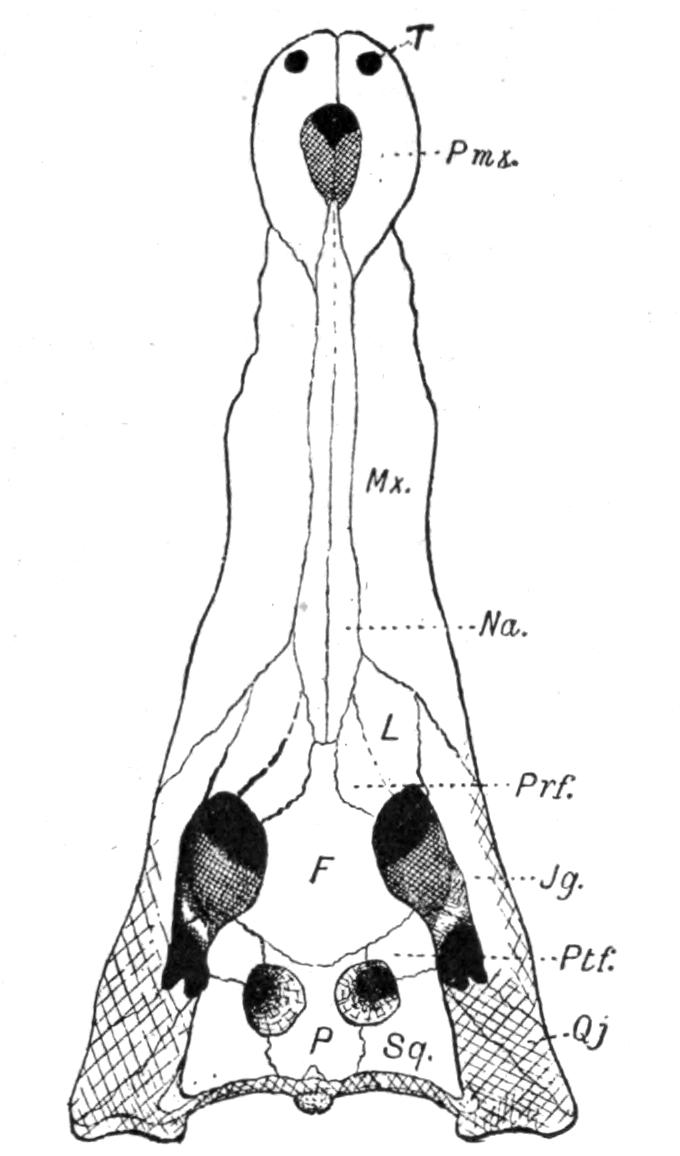
Fig. 111.–Dorsal view of the skull of Crocodilus americanus. × ⅙. F, Frontal; Jg, jugal; L, lacrymal; Mx, maxillary; Na, nasal; P, parietal; Pmx, premaxillary; Prf, prefrontal; Ptf, postfrontal; Qj, quadrato-jugal; Sq, squamosal; T, tooth-perforation.
Osteolaemus tetraspis s. frontatus.–The only species of this genus inhabits the rivers of the west coast of Africa, from Sierra Leone to the Ogowai. It differs from Crocodilus chiefly by the bony septum of the nasal groove, produced by forward extension of the nasal bones. The snout is rather short and stout; the upper surface very rugose and deeply pitted, but without ridges. The gular and ventral scutes are ossified, hence the generic name. Total length about 5 feet.
Alligator.–The fourth mandibular tooth fits into a pit in the upper jaw, and this pit is in some adult specimens transformed into a hole, the tip of the tooth appearing on the upper surface through the perforation. Most of the other teeth of the lower jaw are overlapped by those of the upper jaw. The number of teeth on either side amounts to seventeen to twenty in the upper and eighteen to twenty in the lower jaw. The nasal bones form not only the posterior border of the nasal groove, but they divide the latter by a median bony septum. The dorsal shield is formed by six or eight longitudinal series of keeled bony scutes, which, although standing close together, do not articulate with each other. Ossification of the gular and ventral scutes is absent or very slight.
Alligators occur in the fluviatile deposits of the age of the Upper Chalk in Europe, where they did not die out until the Pliocene age; they are now restricted to two species, one in the Southern States of North America, the other in China.
A. mississippiensis.–The much-depressed and broadly rounded snout bears some resemblance to that of a pike, hence the now discarded specific name of lucius. The neck is protected by two pairs of large scutes, which form a square, interrupted in the middle line, with a pair of small scutes in front and another behind. Of the eighteen transverse dorsal rows of scutes eight are broad and prominent. The fingers are about half webbed, the outer toes about two-thirds webbed. The general colour is greenish black or dark brown above, yellowish below. Young specimens have yellowish cross-bands on a darker brown ground.
The Alligator's northern limit is the mouth of the river Neuss in North Carolina, 35° N. lat. From this point they abound near the mouths of all the creeks and rivers as far south as the Rio Grande, ascending the Mississippi to the entrance of the Red River in 33° 50' N. lat.
The habits and the embryology of the American Alligator have been described by S. F. Clarke,[143] who gives the following vivid and minute account:–
"Usually one finds them in the waters of the smaller streams and ponds, lying with only the tip of the nose and the eyes exposed, or lying on an exposed place on the bank where the grass and other plants are beaten down, and the black, rich mud of the river bank is smoothed by the repeated movements of the alligators in climbing up and down. There they bask in the sunlight until disturbed by the hunter or the desire for food. When aroused they make for the bottom, and I have never waited long enough to see one return unless he were vigorously stimulated with a long pole. They frequently dig a cave for themselves in the bottom of the pond or stream, or in the bank beneath the water. Oftentimes one can start them out of the cave by using a pole, but if very obstinate, the hunters dig them out with spades.
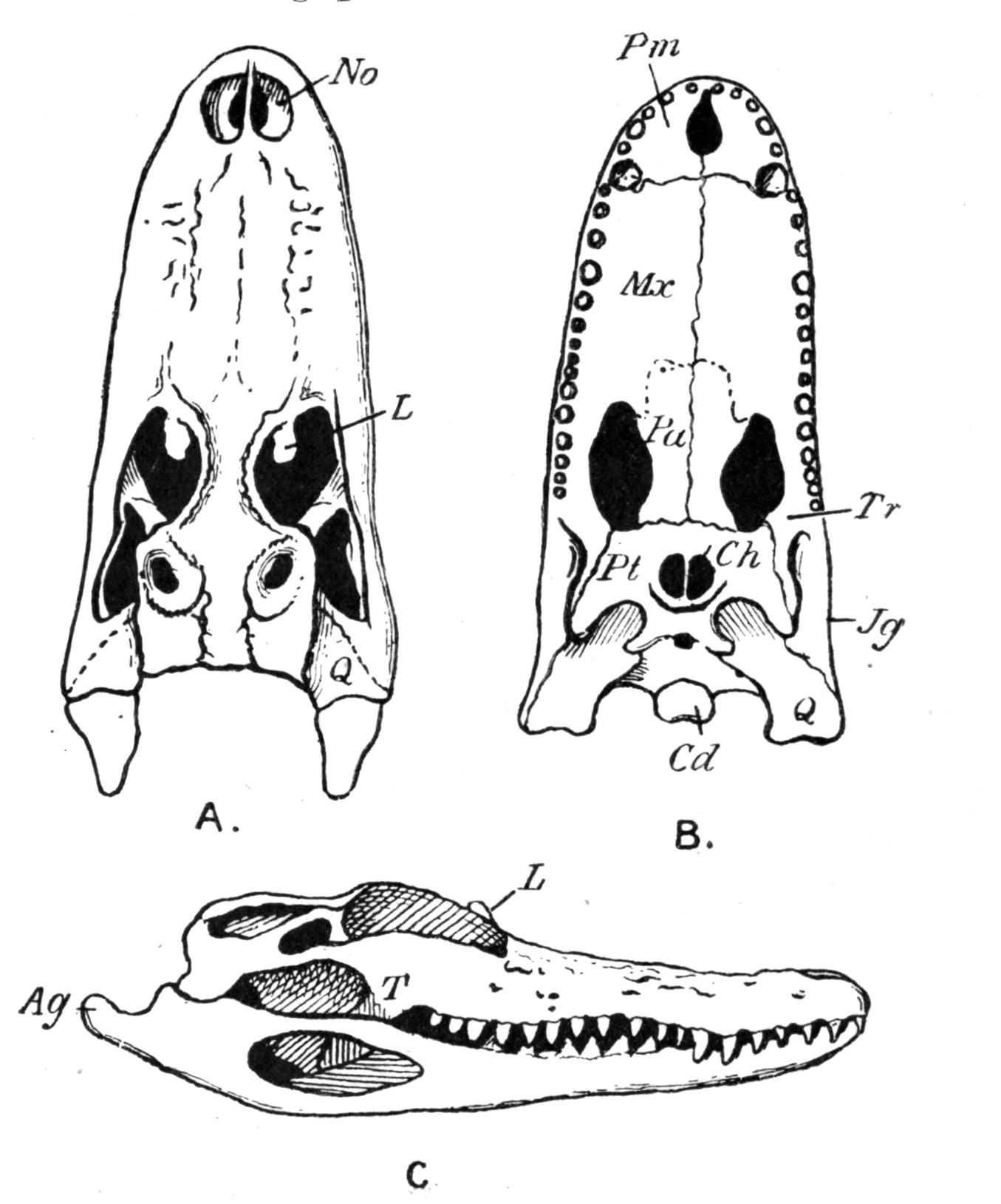
Fig. 112.–Skull of Alligator mississippiensis. A, Dorsal; B, ventral; C, lateral view. Ag, Angular bone of mandible; Cd, occipital condyle; Ch, choanae or posterior narial openings–the median small hole behind them indicates the position of the opening of the Eustachian tubes; Jg, jugal; L, lacrymal; Mx, maxillary; No, nostrils; Pa, palatine; Pm, premaxillary; Pt, pterygoid; Q, quadrate; T, Tr, transverse bone or ectopterygoid.
"As the water decreases in the streams and ponds with the summer heat, the alligators travel to the larger bodies of water. During the breeding season, from the end of May to the beginning of July, the males are very active, wandering about to various ponds and rivers in search of the females. Fierce battles are said to take place during this time between the excited males; and the mutilated specimens that one sees are weighty evidence for the truth of this assertion.... It is in the breeding season also that their bellowing is mostly heard, and more in the night than during the day. I have frequently heard them, while lying in the swamps at night, when they were in ponds fully a mile distant.
"The largest specimen I saw measured 12 feet in length; and none of the many hunters and other natives of Florida I have met have seen any longer than 13 feet. All the hunters agree that it is only the males that acquire the great size; no one had ever seen a female that measured over 8 feet, and the majority are not over seven.
"The male has a heavier, more powerful head, and during the breeding season especially is more brilliantly coloured. The more brilliant colour occurs in patches and streaks on the sides of the head and body; it is generally a light yellow, or even whitish, and on one large male I saw a fairly bright red spot over each eye.
"The alligators are rapidly diminishing in numbers under the stimulus of the high prices offered to the hunters for their hides. Both Whites and Indians make increasing war upon them. Several thousand skins were brought into the little station of Fort Pierce in 1890. The pioneers and settlers always destroy the nests and eggs, because the alligators eat their pigs; and the cleaned eggs and young alligators are sold by hundreds in the curio shops farther north. As their numbers diminish in Florida it is noticed that the Moccasin snakes increase. In Louisiana also the alligators are disappearing; and there the musk-rats are at the same time increasing, and are doing much damage by burrowing in the levees along the Mississippi. While the alligator can make a very stout fight, I have never seen one offer fight if there was any chance of retreat. They never offered to molest us, even when we waded through the ponds where they were.
"The nest of the alligator is very large, and is built by the female. A great quantity of dead leaves and twigs, together with much of the finely divided humus underlying them, is scraped together into a low mound about 3 feet high; this varies considerably in its other dimensions, being in some instances 8 feet in diameter at the base. The nests are built on the bank of a stream or pool, and the female digs a cave under water in the bank close to the nest. Careful examination, of the largest nest found showed a root of a neighbouring palmetto-tree, nearly an inch in diameter, running through it at about a foot above the ground; there were also roots of a grape vine growing near, which extended nearly through the nest. This furnishes strong support to the statement of many of the hunters, that the nests are used for more than one season. I could get no evidence whatever that the nests are used more than once a year.
"The eggs are laid near the top of the nest, within 8 inches of the surface, are four or five layers deep, and have no regular arrangement or uniform position of their axes in relation to the nest. The number of eggs to a nest varies from twenty to thirty, and averages twenty-eight; the maximum found was forty-seven.
The eggs are white, elliptical, and vary in length from 50 to 90 mm. or 2 to 3½ inches, and in the shorter diameter from 28 to 45 mm. Generally there is only slight variation in the eggs of one nest, but occasionally a nest is found in which most of the eggs are about the average size, while from two to five are very much smaller.
"The shell is much rougher than that of a hen's egg, and much thicker. The shell membrane consists of an outer and an inner layer, in both of which the fibres are arranged spirally about the egg, but at right angles to one another.
"The white of the egg has the consistency of a very thick jelly, is very clear and transparent, and is so firm that the whole egg, when perfectly fresh, may be turned out of the shell and shell membrane, and transferred from one hand to the other without breaking, and with but slight change of form. The white lies mostly at either end of the shell, but extends also in a thin layer between the yolk and the sides of the shell. The yolk holds a median position in the egg, is spherical, of a very light pale yellow, and so large that it almost touches the shell membrane about the midline."
According to Holbrook the young as soon as they are disengaged from the shell seek the water and shift for themselves, the parents taking no care of them, though they may remain for some weeks in the same locality. In the spring and early summer months, and during the time of incubation, and especially on cloudy days or in the evening, alligators make a great noise; their croak is not unlike that of the bullfrog, but louder and less prolonged. On the approach of winter they select holes in the ground, where they remain torpid until spring. In this state of hibernation many are dug out by the negroes, who esteem the tail as an article of food.
A. sinensis.–The first intimation of the existence of a Crocodilian in the Yang-tse-kiang was made by Swinhoe in 1870, but it was not until nine years later that Fauvel[144] described the creature as A. sinensis. The same gentleman gave also an exhaustive account of the former records of this species in Chinese literature. According to Boulenger its nearest ally is A. mississippiensis, but it approaches the Caimans by the presence of ossifications in the ventral shields, which ossifications are, however, wide apart from each other. There are three pairs of large nuchal scutes in contact in the median line, besides smaller scutes in front of the nuchals and behind the occiput. The dorsal shield contains six rows of larger scutes. The fingers are not webbed. The general colour is greenish black above, speckled with yellow; greyish below. Total length only about six feet.
Caiman.–The five species of this genus, confined to Central America or to the East Andesian parts of South America, resemble the Alligators in most features, but differ from them in the following points. The nasals, although bordering the nasal groove, do not form a bony nasal septum. The supratemporal fossae are very small; or closed up, as in C. trigonatus and C. palpebrosus of Guiana. The ventral armour is composed of overlapping bony scutes, each of which is formed of two parts united by a suture.
C. sclerops has the widest distribution, from Southern Mexico to the northern half of Argentina. The upper eyelid is rugose, although only incompletely ossified, and is often more or less produced into a small horn. C. niger has flat upper eyelids.
According to Bates, Caimans exist in myriads in the waters of the Upper Amazons. One species, C. trigonatus, the Jacaré-tinga of the natives, reaches only six feet in length and has a slender muzzle and a black-banded tail. Another species, C. niger, the Jacaré-nassu or large Caiman, attains an enormous bulk and a length of 20 feet. They migrate annually, retreating to the flooded forests in the wet season and descending to the main rivers in the dry season.