Part 1 — CHAPTER VI (continued 3)
Reading edition
Key to the genera:–
I. American. A. with omosternum .......... Rhinoderma, p. 228.
B. without omosternum.
a. Pupil horizontal. Precoracoids present.
Sacrals strongly dilated. .......... Oreophrynella.
Sac"als moderately "dla .......... Phryniseus, p. 230.
Sac"als feebly moel"dla .......... Brachycephalus, p. 231.
b. Pupil vertical.
α. Precoracoids feeble. .......... Hypopachus.
β. Precor"coids absent. .......... Engystoma, p. 231.
c. Pupil round. Precoracoids present .......... Stereocyclops, p. 231.
II. Palaeotropical. a. Pupil horizontal.
α. Precoracoids present.
With palatal teeth. Madagascar. .......... Rhombophryne.
Palate with dermal papillae. Africa. .......... Breviceps, p. 232.
With palatal dermal folds. Madagascar. .......... Scaphiophryne.
With serrated palatal folds. Madagascar and India. .......... Calophrynus.
Palate smooth. New Guinea. .......... Sphenophryne and Liophryne.
β. Precoracoids absent.
Malacca .......... Phrynella, p. 233.
New Guinea .......... Mantophryne.
Africa .......... Cacosternum.
b. Pupil vertical.
α. Precoracoids present. India. .......... Melanobatrachus.
Africa. Hemisus, p. 232.
β. Precoracoids absent.
Tongue oval. India. .......... Cacopus.
Tongue elliptical. India. .......... Microhyla.
Tongue divided by a longitudinal furrow. India. .......... Glyphoglossus, p. 233.
Fingers and toes with discs. Africa and Amboina. .......... Phrynomantis.
New Guinea. .......... Callulops.
c. Pupil round. Precoracoids absent. Tongue round. India. Callula, p. 234.
Tongue long, oval, with a deep groove. New Guinea. .......... Xenorhina.
Note.–Xenobatrachus ophiodon, New Guinea. Palatine bones, each with two large curved teeth. Otherwise imperfectly known.
Rhinoderma.–Omosternum and precoracoids present. Palate without teeth. Tympanum indistinct. Terminal phalanges simple, and not dilated. Tongue heart-shaped, and free behind. Pupil horizontal. Habitat, Chili.
Rh. darwini, the only species, was discovered by Darwin, during the voyage of the Beagle. Its total length is only 3 cm., or little more than one inch. The shape is grotesque, as the skin is prolonged, beyond the very small triangular mouth, into a false nose, i.e. a nose-shaped projection, while the nostrils remain at their original place. The skin is smooth above, granular on the under parts, and forms a triangular flap or spur-shaped appendage on the heel. A glandular fold extends along the sides of the body. The general colour is brown above, black below, with large white patches, the latter colour being sometimes predominant on the throat and chest. The male has a pair of internal vocal sacs, and the use of these as nurseries for the young has made this species famous.
Espada[99] has given an elaborate account of this species, which lives on the ground in shady woods. Its voice sounds like a little bell, and before taking its short jumps, it erects itself vertically upon the hind-limbs. The gular sac of the male opens by two slits, one on each side of the tongue. Generally this sac does not extend beyond the middle of the chest, but during the breeding time the eggs are put into it, whereupon it becomes greatly distended, so much so indeed that it reaches back as far as the groins; dorsalwards around the flanks, almost to the vertebral diapophyses; ventrally and forwards it reaches the chin. The walls of the sac are of the same structure as the buccal lining, of which they are in fact continuations. They adhere, at intervals, to the cutis and to the pectoral and abdominal muscles.
The effect of the distension of the sac upon neighbouring organs is twofold. First, the viscera are pressed back within the abdomen; this disturbance is temporary and does not apply to all specimens; the feeding in no way impeded. Secondly, a permanent change is produced in the direction of the precoracoid bars, in such a way that each bar is curved tailwards and rests with its ventral half upon the coracoid; owing to this forcible bending the clavicles do not meet each other. There is, of course, not so much space gained by this slight rearrangement of the shoulder-girdle as Espada implies, but we have here, perhaps, an illustration of direct correlation between two originally independent organs, namely, shoulder-girdle and vocal sacs. Repeated distension of the throat-bag during every breeding season, while the whole organisation of the male is in a highly excitable condition, has pressed the clavicular bars back, or rather has staved them in, and this at first pathological and abnormal condition has at last become a fixed feature. It is to be regretted that we know next to nothing about the habits, especially the mode of breeding, of the other genera which likewise have reflected or very feeble precoracoids and clavicles. Their weakness or even complete absence must have a reason, or rather must have had a cause.
The pairing and oviposition, and the manner in which the eggs are conveyed into the gular sac, have not yet been observed. Espada examined five males with young, the number of which varied from five to fifteen. In one male with eleven embryos the most developed tadpoles measured 13.5 mm. from the snout to the end of the tail, and they were lying within the chest of the father, the less advanced in the farther recesses of the bag. Three of the tadpoles had already completely-formed fore- and hind-limbs, while the arms were still hidden. The least developed were still globular, a proof that the eggs are conveyed into the bag. Another male with fifteen embryos looked as if it had gorged itself with the almost fully-formed tadpoles, which measured 14 mm. They were quite irregularly distributed, and nowhere attached to the walls of the bag. None of them had horny jaw-armaments, and not even the smallest specimens showed any traces of gills, resembling in this latter character those in the female brood-pouch of Nototrema. The intestine of the tadpoles is short and thick, coiled up spirally and filled with yolk, certainly not with vegetable or other foreign matter. Consequently the entire development from the egg to the complete stump-tailed little creature is undergone within the pouch; and this, after the young have escaped, probably shrinks back to its original size and acts as a gular vocal sac.
Phryniscus.–About ten species of this tropical American genus are known; they extend from Costa Rica to Buenos Aires. They differ not inconsiderably in various details. The tongue is elliptical, entire, and free behind. The palate is smooth. The tympanic disc is absent. Fingers and toes more or less webbed, sometimes with swollen tips, without, however, forming adhesive discs. In a few species the first toe is quite indistinct. The male has a subgular vocal sac. The mouth is small, and there is a short snout. The general appearance varies much. Ph. nigricans of Uruguay, etc., is stout and has very short hind-limbs; the skin of the upper parts is black, spotted with white, and covered with warts. Most of the other species are slender, with larger hind-limbs and a perfectly smooth skin, the coloration of which ranges from dull uniform brown, or black with crimson markings, to bright green with purple spots. The under parts are, as a rule, conspicuously coloured, a rare feature in Anura, the favourite colours being orange, yellow, or even crimson, with or without black patches.
Phryniscus nigricans has been observed in Paraguay by Budgett,[100] who gives the following account. This is a brilliantly coloured frog of toad-like appearance, and about 33 mm. in length. The ground-colour is black, with yellow spots or patches on the upper parts, the under parts are black, with scarlet blotches, the palms of the hands and soles of the feet are scarlet. At the breeding season both sexes utter a call-note which consists of two clear musical "rings," followed by a long descending "trill," like that of our British Greenfinch. This frog, which at ordinary times is the slowest and boldest of frogs, is now active and excessively shy. Swimming rapidly between the blades of grass, it climbs a tuft, and dilating its throat, repeats its call; but if in the least disturbed, it is suddenly gone. The eggs are laid in quite temporary pools in grassy ground, and form separate globules of jelly, which float on the surface of the water, and are heavily pigmented. The development is excessively rapid. The segmentation beginning at 10 A.M., they were hatched and wriggling about by 7 A.M. the following day. They are probably washed down into deeper pools by the retreating waters, and for this purpose the manner in which the eggs are laid, namely, in separate globules of jelly, seems especially suited.
Brachycephalus ephippium in Brazil, the only species, is remarkable for the development of a broad dorsal shield of bone, which is fused with the processes of the second to seventh vertebrae, an ossification which strongly resembles that of several species of the likewise Brazilian Ceratophrys, a genus of the Cystignathinae.
Stereocyclops is remarkable for the peculiar formation and protection of the eyeballs. The anterior portion of the sclerotic is ossified into a ring, which surrounds the transparent cornea. Another peculiarity lies in the metasternum, which is so much broadened out that its cartilage is in wide contact with the posterior edge of the coracoids. The epidermis is everywhere "thickened by a chitin-like deposit." The only species, S. incrassatus, found near Rio Janeiro, is an altogether aberrant creature. Its general appearance recalls that of Pipa. The gape is large, with a slightly projecting muzzle; the limbs are so short that the upper arms and the thighs scarcely stand out from the broadened and flattened body, which is leathery brown, with a narrow white median line extending dorsally from the nose to the vent.
Engystoma, with about five species in the Southern States, Central and South America, is the type-genus of the whole family, chiefly on account of priority of name. It is fairly characteristic in so far as the mouth forms a narrow, somewhat projecting snout; the precoracoids, the clavicles, and the omosternum are absent, the palate is devoid of teeth, the lining of the mouth forms a dermal ridge across the palate and another in front of the oesophagus, the tympanum is hidden, the sacral diapophyses are moderately dilated, and the tongue is elliptical and free behind. The pupil is vertical. The fingers and toes are free, ending in slightly dilated or blunt tips; the terminal phalanges are simple and the hind-limbs are short. The male has a subgular vocal sac.
The most northern species is E. carolinense, living in the Southern United States, concealed under the bark of fallen trees or in old fences. The skin is smooth, but forms a fold across the head, behind the eyes. The general colour is brown, with light, whitish dots on the under parts. Total length 1 inch.
Breviceps is a South African genus with three species. The coracoids are very strong and directed backwards, but so broadened that they form a long and strong symphysis, touching in front that of the precoracoids, which stand transversely and are well developed. The metasternum is cartilaginous and decidedly small. The sacral vertebra has much dilated diapophyses and is co-ossified with the coccyx. The general appearance is extremely stout and short, the head being almost drawn into the nearly globular body, and ending in a short snout with a small mouth-opening. The tongue is long and oval, not nicked, but slightly free behind. B. mossambicus is about 2 inches long, and looks like an overstuffed round bag, out of which the short arms and legs project from the elbows and knee-joints only. The tarsus is provided with a strong horny, spade-like tubercle, which enables the creature to dig into the ground, and into the nests of termites, which seem to be its chief food. Peters found this species in enormous numbers, during the tropical rains, coming out of the ground, whither they withdraw again completely for the dry season. The skin is smooth, reddish brown above, with darker patches; the under parts are dull white, with a large black patch on the throat.
Hemisus is another African genus, with two species, H. guttatum in Natal, and H. sudanense in East and West Africa. This genus is so exceptional in its shoulder-girdle, that Cope separated it from all the other Anura as a special sub-order Gastrechmia. The precoracoids are extremely strong, and form a broad symphysis from which springs the long cartilaginous omosternum; the coracoids are slender, very long, and converge backwards to a narrow symphysis, and there is no metasternum. The two symphyses are connected by a narrow cartilaginous median bar, probably produced by the much modified epicoracoid cartilages. However, except for the reverse development shown by the omo- and meta-sternum, it is easy to connect this apparently quite anomalous shoulder-girdle of Hemisus with that of Breviceps. (cf. Fig. 5, 5 and 6, p. 25). The sacral diapophyses are slightly dilated; the fingers and toes are free and end in points. The tongue is triangular, broader in front. The lining of the mouth forms a transverse ridge across the palate, and another in front of the oesophagus. The male has a subgular sac. The general shape is stout, the head small and ending in a pointed snout. Colour brown above, with whitish spots. Total length about 2 inches.
Glyphoglossus has a peculiar tongue. It is elongated, notched behind and in front, divided into two lateral halves by a deep groove; moreover, the tongue is not only extensively free behind, but also slightly so in front. The skin of the palate forms a transverse serrated ridge. The precoracoids and the omosternum are absent; the metasternum is a well-developed cartilaginous plate. The sacral diapophyses are moderately dilated; the terminal phalanges are simple. G. molossus, the only species, is olive-brown above, marbled on the sides; the under parts are uniformly whitish. This creature, about 2 inches in length, looks like a roundish bag, with a ridiculous, short face. The type-specimen, still the only one known, was taken by Dr Theobald under the following circumstances:–"I had halted one day within the tidal portion of the Irawaddy delta, to enable my boatmen to prepare their dinner. One of my servants, having cooked his rice, poured out the hot water as usual on the ground, and some of it went down a hole that happened to be near the spot. No sooner, however, had the hot water disappeared than out scrambled in great haste a fine Glyphoglossus, only, alas! to be transferred to a collecting jar."
Phrynella.–The tongue is heart-shaped, free behind. The palate is smooth and toothless. The fingers and toes end in small discs, supported by T-shaped phalanges; the fingers are free, the toes extensively webbed. Precoracoids absent; metasternum cartilaginous. Pupil horizontal. Malay Peninsula.
Ph. pollicaris is dark olive brown above; an oblique yellow line runs from the eye to the angle of the mouth; a pale yellow mark, across the forehead, through the eyes, and down the sides of the body. A dark-centred yellow patch on the anal region. The limbs are banded yellow and brown. The under parts are brown, with paler specks, dark on the throat. Iris red brown. The whole coloration changes considerably.
"They inhabit the hills of Perak from 3000 feet upwards, and live in holes in trees, which are so situated as to contain more or less rain-water. They have a loud flute-like, musical note, which they utter at irregular intervals, principally during the night. The form and size of the hole in which they are seem to have a great deal to do with the loudness of the note, as specimens when extracted from their holes have far more feeble vocal powers than they had when in them. These frogs blow themselves out with air, and look more like bladders than anything else. When inflated they float on the surface of the water, and will remain motionless for a long time, with legs and arms stretched out."[101]
Callula.–The tongue is round, entire, and free behind. The palatine bones form an acute, sometimes toothed ridge across the palate; two dermal serrated ridges in front of the oesophagus. Fingers free, sometimes with dilated tips, supported by T-shaped phalanges. Precoracoids and omosternum absent; metasternum cartilaginous. Pupil round. About seven species in the Indian region.
C. pulchra.–The following account has been extracted from Mr. S. S. Flower's observations:[102]–
This pretty creature inhabits most of the warm portions of the continental Indian region, from India and Ceylon to South China and Malacca. The back is a rich dark brown, divided from the yellow of the head by a narrow black line which extends from eye to eye and forwards to each nostril. A conspicuous yellow band runs from the eyes to the hind-limbs. The sides of the body and the limbs are mottled yellow and brown. The under parts are dirty buff; the throat of the male is black. The intensity of colouring varies individually and from time to time, the contrast between the brown and yellow being occasionally very brilliant. Total length up to 3 inches, the male being the smaller sex.
"I have been told by both English and natives that this frog was unknown in Singapore until some nine or ten years ago, when it was introduced by a half-caste (why, it is not known), and that it rapidly spread about the island. It is now well known as the 'Bullfrog' by the English in Singapore, and detested for the noise it makes at night. The voice of these rotund animals can be heard every night after heavy rain; it is a deep guttural croak, 'wau-auhhhh,' very strident and prolonged. The males croak while floating on the surface of the water, the single vocal sac under the mouth inflated like a globe, and the arms and legs extended. They can hop well on land and are good swimmers. The skin is excessively slimy; the secretion comes off profusely, and dries on the hand into a sort of white gum, with a faint aromatic smell. This gum dissolves in hot water and coagulates in cold. The general appearance of these frogs is very stout, their girth being about twice the length from snout to vent. The tongue, which is oblong in spirit specimens, in life is very elastic, assuming, when extended, a vermiform shape and reaching about 4 cm. in length. They appear after sunset, crawling on old wood and feeding on white ants."
Sub-Fam. 2. Dyscophinae.–With teeth in the upper jaw.
This small group of nine genera, with scarcely more than one dozen species, all with one exception living in Madagascar, has been separated by Boulenger from the Engystomatinae merely on account of the presence of teeth on the upper jaw and on the vomerine margin of the palatine bones. He himself remarks that Calluella may be considered a toothed Hypopachus, and Plethodontohyla a toothed Callula. These are obvious cases of convergent analogy. Except for the teeth, the Indian Calluella would be merged into the American Hypopachus, and this would present an instance of the most puzzling geographical distribution. In the case of the other two genera, one Indian and Malayan, the other Malagasy, no such suspicion would arise, since there are many other instances of such a coincidence of distribution. There is the same divergence or unsettled condition in the modification of various parts in the Dyscophinae as in the Engystomatinae. The precoracoid bars are weak and curved backwards, and closely pressed against the strong coracoids, in Dyscophus, Calluella and Platypelis, while these elements are reduced to unossified bars, and the clavicular portions completely lost, in Plethodontohyla and in Phrynocara. The omosternum is absent and the metasternum is small in all except Dyscophus, in which both these parts are exceptionally well developed and large, although remaining unossified. The palate of Dyscophus and Calluella is provided with curious, serrated dermal folds like those which are so common in the Engystomatinae; and well-developed discs on the fingers and toes, supported by T-shaped phalanges, are possessed by Platypelis, Cophyla and others. The sacral diapophyses are dilated. The pupil is either horizontal or vertical. Those which are provided with discs to the fingers and toes are climbers, and mostly slender and long-legged, sometimes of very small size, for instance Cophyla, the body of which is scarcely one inch in length.
The genera can be determined by means of the following key:–[103]
A. Pupil vertical. Palatine teeth in long transverse series.
a. Precoracoids ossified. Tips of fingers and toes not dilated.
Sternum very large. Madagascar .......... Dyscophus.
Sternum small. Burmah .......... Calluella.
b. Precoracoids not ossified. Tips dilated .......... Plethodontohyla.
B. Pupil horizontal.
a. Palatine teeth in long transverse series.
α. Precoracoids ossified. Tips dilated.
Fingers and toes free. Precoracoids entirely ossified .......... Mantipus.
Fingers and toes webbed at the base. Precoracoids semi-ossified .......... Platyhyla.
β. Precoracoids not ossified. Tips not dilated .......... Phrynocara.
b. Palatine teeth in one or two small groups.
Precoracoids ossified. Tips dilated.
Two small groups of palatine teeth .......... Platypelis.
One single group in the middle of the palate .......... Cophyla.
No teeth on the palate .......... Anodontohyla.
Dyscophus antongili.–Madagascar. General appearance stout, with short legs and a wide mouth. Total length about 3 inches. The skin is mostly smooth, and forms a broad glandular fold which extends from the eye to the groin. The upper parts are beautiful magenta red, with a purplish streak beneath the lateral folds; the under parts are yellowish white, with minute grey specks. Red or pink colours, and the lateral folds, occur also in most of the other members of this family, for instance in the Indian genus Calluella.
Sub-Fam. 3. Genyophryninae.–With very small teeth on the anterior portion of the lower jaw.
Genyophryne thomsoni.–Pupil horizontal. Tongue oblong and entire. With teeth on the palatine bones, and a serrated transverse dermal ridge in front of the oesophagus. Sternum cartilaginous. Precoracoids absent. Sacral diapophyses moderately dilated. Tympanum hidden. Head large and much depressed. Heel with a triangular dermal flap. The smooth skin is pink brown above, with blackish marks; a light line extends on each side from the eye along the back. Under parts black. About 32 mm. in length. Sudest Island, between New Guinea and the Louisiade Archipelago.
Fam. 7. Ranidae.–Frogs, in the true sense, are all well diagnosed as Firmisternia, with cylindrical sacral diapophyses. According to the presence or absence of teeth in the jaws they can be subdivided as follows:–
Sub-Fam. 1. Ceratobatrachinae, with teeth in the upper and in the lower jaws. The sole representative is the genus Ceratobatrachus.
Sub-Fam. 2. Raninae, with teeth in the upper, but none in the lower jaw. These are the Ranidae of Boulenger in the Catalogue of Batrachia Salientia.
Sub-Fam. 3. Dendrobatinae, without teeth in the upper and lower jaws.
Sub-Fam. 1. Ceratobatrachinae.–Teeth present in both jaws. Those of the lower jaw, between 20 and 30 in number in Ceratobatrachus, the only genus, are nearly all inserted upon the articular bone; only 2 or 3 are carried by the dentary element, which, although large, enters into the formation of the upper border of the jaw at the anterior end only. In the small extent of the share of the dentary in the formation of the edge of the lower jaw, and in its anterior "toothlike" process, Rana adspersa of Africa bears unmistakable resemblance to this genus. The tongue is deeply notched, and free behind. Pupil horizontal. Vomers furnished with teeth. Tympanum distinct and large. Precoracoids present. Omosternum and presternum with a bony style. Sacral diapophyses cylindrical. Fingers and toes free, with swollen tips. Outer metatarsals united. Male with two internal vocal sacs.
G. guentheri, Solomon Islands, the only species, has an enormous mouth and a triangular head not much smaller than the rest of the body. The skull is furnished with prominent ridges and a small curved spine at the angle of the jaws. The hind-limbs are rather short. The skin of the upper parts shows linear ridges, variously arranged; that of the belly is granular. A triangular dermal flap on the tip of the muzzle, one on the upper edge of the eyelids, others on the heel and above the vent. The colour and markings are very variable, the ground-colour is yellowish to pink, brown, grey or olive, with darker and lighter markings. Total length of the males 3 inches, of females 3½ inches.–Guppy, the discoverer of this peculiar creature, remarks that "horned Frogs are very numerous in these islands, and so closely do they imitate their surroundings in colour and pattern, that on one occasion I captured one by accidentally placing my hand on it when clasping a tree."
Sub-Fam. 2. Raninae.–The vertebrae are procoelous and devoid of ribs. The precoracoids are always present and ossified from the clavicles, and are parallel with the much stronger and ossified coracoids. The omosternum usually possesses a bony style, but in the Indian genera Nannobatrachus and Nannophrys and in Phyllodromus of Ecuador it remains cartilaginous, and in Colosthetus of Colombia it is absent. The metasternum also possesses a bony style, but it remains cartilaginous in the Indian genera Oxyglossus, Nannophrys, Nannobatrachus and Phyllodromus, in the last two genera rather reduced and slender, while in the Ecuadorian and Colombian genera Hylixalus, Prostherapis and Colosthetus, it is reduced to a membranous piece. In quite a number of genera the normal number of phalanges is increased by one owing to the intercalation of an extra phalanx between the terminal and the otherwise penultimate phalanx.[104] This is the case in all the species of Cassina, Hylambates, Rappia, Megalixalus, Rhacophorus, Chiromantis, Ixalus and Nyctixalus, but it is doubtful if all these genera are thereby more nearly related to each other than to the rest of the Raninae. The structure of the tips of the fingers and toes exhibits more variety. The terminal phalanges are mostly simple, with slight swellings at the ends, or they are Y- or T-shaped in conformity with more or less developed adhesive discs; in the African genus Hylambates only they are claw-shaped, as in the Hylidae.
Gampsosteonyx batesi, recently described by Boulenger from the Gaboon, shows a unique modification of the terminal phalanges of the second to the fifth toes. They are transformed into sharp and curved claws, like those of a cat, but instead of horny sheaths, it is the bone itself which is thus sharpened and perforates the skin, an anomaly reminding us of the ribs of Triton waltli. Total length of the type-specimens, about 3 inches.
Adhesive discs are common, and are best developed in Rhacophorus, Ixalus, Rappia, and Megalixalus. In the Neotropical genera, excepting Colosthetus, the discs are very peculiar, being provided on the upper side with leathery scales which are separated by a fissure. The fourth and fifth metatarsals either diverge and are connected by a distinct web, or they lie close together with only a groove between them, or lastly they appear externally united.
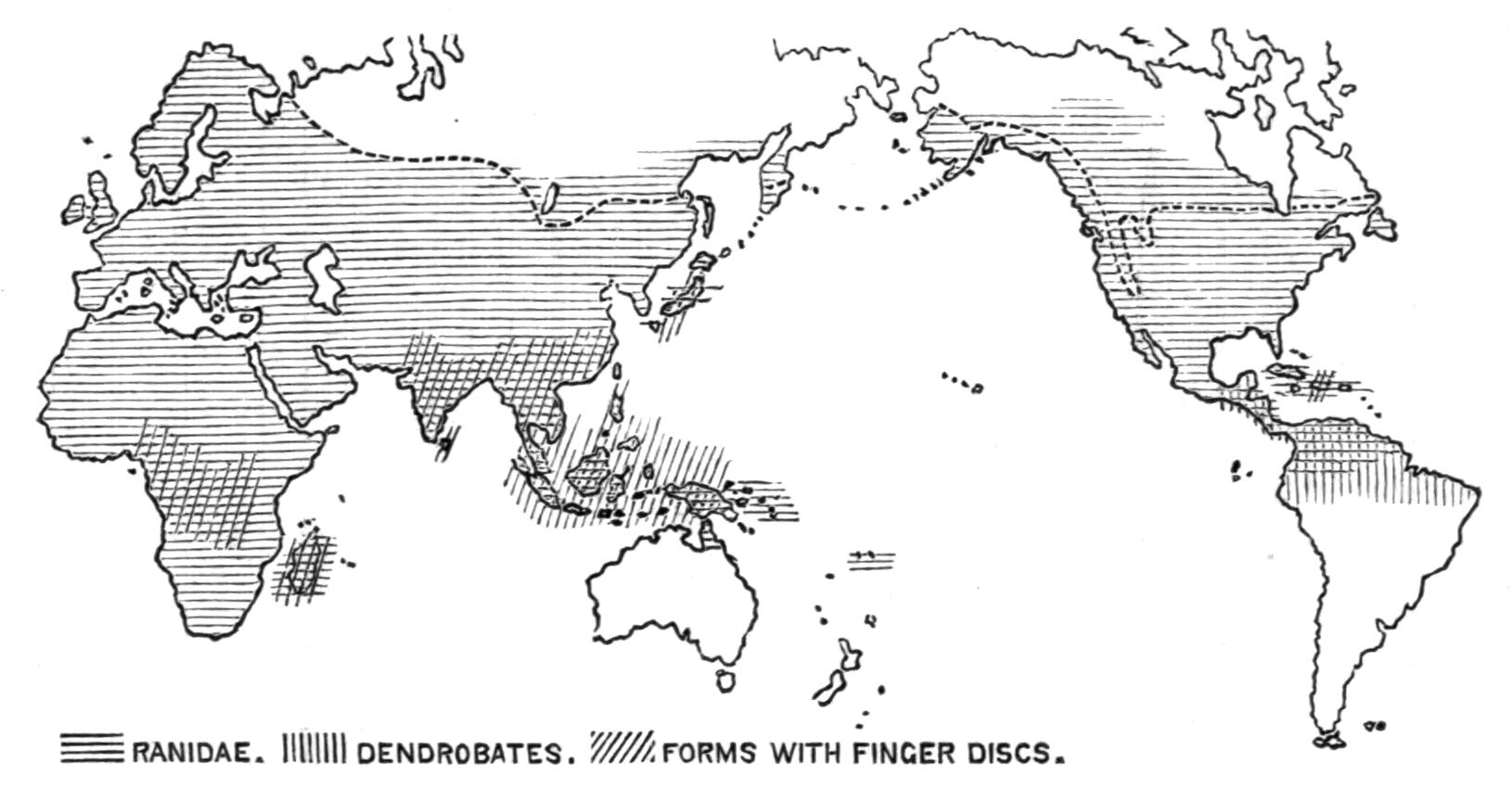
Fig. 46.–Map showing distribution of the Ranidae.
The tympanic disc is very variable, large, small or quite hidden. Vomerine teeth are present or absent. The pupil contracts into a horizontal slit except in some Palaeotropical genera. The tongue is universally free behind, mostly deeply notched, and can be well protruded; only in the Indian Oxyglossus and in the Neotropical genera, excepting Hylixalus, its posterior margin is entire.–There are terrestrial, arboreal, and aquatic members in this large sub-family. The geographical distribution of the Raninae, which comprise about twenty genera with at least some 270 species, is almost entirely Arctogaean. None, with the exception of three species in the Papuan subregion, occur in the Australian region; and only four genera, with one or two species each, inhabit the tropical Andesian district, the remainder of South America being without any Raninae. All the species of the whole Periarctic region belong to the genus Rana except in Eastern Asia, where the closely allied genus Rhacophorus occurs also. The entire sub-family of Raninae is, in its fulness and diversity of development, essentially Palaeotropical.
Many of the genera, even in the present more liberal sense as interpreted by Boulenger, are based upon unimportant characters, and in reality run into each other. This is for instance the case with Rana and Rhacophorus.
The following tabular arrangement is merely a key for determination and does not necessarily express relationships. The presence or absence of vomerine teeth is a character easily ascertained, but it separates closely allied genera, for instance, Rhacophorus from Ixalus and Micrixalus from Rana.
The genera with extra, interpolated phalanges are marked *.
Key for the Determination of the genera of Raninae.
I. Pupil vertical.
A. With vomerine teeth.
a. Omosternum very slender and cartilaginous. Small discs. India and Ceylon, 3 species .......... Nannobatrachus.
b. Omosternum with a bony style.
α. Outer metatarsals webbed. Small discs. South India, 2 species .......... Nyctibatrachus.
β. Outer metatarsals close together. Africa.
Fingers and toes with interpolated phalanges.
Without terminal discs. 2 species .......... Cassina.*
With discs supported by claw-shaped phalanges, 10 species .......... Hylambates.*
Fingers and toes without interpolated phalanges; without discs.
Toes webbed .......... Trichobatrachus robustus, p. 271.
Toes free, with sharp claws .......... Gampsosteonyx batesi, p. 272.
B. Without vomerine teeth. Discs well developed. Outer metatarsals united. Tropical Africa and Madagascar, 7 species .......... Megalixalus.*
II. Pupil horizontal.
A. With vomerine teeth.
a. Outer metatarsals webbed together.
Fingers free, toes webbed .......... Rana, p. 249.
Fingers and toes more or less webbed. Always with discs .......... Rhacophorus,* p. 245.
Two fingers opposed to the others. Africa .......... Chiromantis,* p. 244.
b. Outer metatarsals united, or separated by a groove only.
Omo- and meta-sternum with a bony style .......... Cornufer, p. 243.
Omo- and meta-sternum slender and cartilaginous.
Ceylon, 2 species .......... Nannophrys.
Mozambique .......... Phrynopsis boulengeri.
B. Without vomerine teeth.
a. Palaeotropical.
α. Tongue narrow and entire. No discs. Outer metatarsals webbed. India, 3 species .......... Oxyglossus.
β. Tongue oval, feebly nicked. Large discs. Solomon Islands .......... Batrachylodes vertebralis.
Karin Hills .......... Phrynoderma asperum.
γ. Tongue deeply notched. Outer metatarsals united by a web.
Discs none or very small.
Africa, 3 species .......... Phrynobatrachus.
Borneo .......... Oreobatrachus baluensis.
With regular discs.
Number of phalanges normal. India, 5 species .......... Micrixalus.
With an extra, interpolated phalanx. India, 18 species .......... Ixalus.*
Two fingers opposed to the others. Karin Hills .......... Chirixalus doriae.*
δ. Tongue heart-shaped. Outer metatarsals united.
Fingers and toes free, tips blunt. Africa, 8 species .......... Arthroleptis, p. 242.
Fingers and toes more or less webbed, with regular discs. Africa and Madagascar, 23 species .......... Rappia.*
b. Neotropical. Metasternum small, cartilaginous or membranous. With discs.
1. With a pair of dermal scales on the discs. Omosternum with a bony style.
Tongue heart-shaped. Ecuador, 2 species .......... Hylixalus.
Toes free. 5 species .......... Phyllobates, p. 242.
Tongue entire. Ecuador and Colombia, 3 species .......... Prostherapis.
Omosternum cartilaginous. Ecuador .......... Phyllodromus pulchellus.
2. Discs without scales. Omosternum absent. Colombia .......... Colosthetus latinasus.
Phyllobates.[105]–This is one of the few Neotropical genera, and like nearly all of these has peculiar adhesive discs on the fingers and toes, each disc bearing on its upper surface two dermal scales. The tympanum is distinct. Vomerine teeth are absent. The general appearance of the five species is that of tree-frogs. One species, Ph. bicolor, yellowish above, dark brown beneath, lives in Cuba. The others inhabit Central America and Venezuela. They seem to have peculiar nursing habits. Ph. trinitatis of Venezuela and Trinidad carries its tadpoles on its back, on to which the young fix themselves by means of their suckers. Nothing is known about their breeding habits, for instance whether the young are hatched on the back, or, as seems more likely, if the parents (the specimen described by Boulenger[106] is a male) only give their offspring a temporary lift in order to convey them from a drying-up pool to a healthier place. It is remarkable that several species of Dendrobatinae, which inhabit the same countries, have precisely the same habits.[107]
Arthroleptis.–Slender and long-limbed little frogs, about one inch in length. The fingers and toes are free, very slender, and end in slightly dilated tips, the supporting phalanges being simple. The tympanum is variable. The skin is smooth or finely granulated. The colours are inconspicuous, brown or grey tones usually prevailing. About ten species are known, mostly from Continental Africa, a few from Madagascar and the islands in the Indian Ocean.
A. seychellensis.–Brauer[108] has discovered the mode of nursing of this frog. He found a specimen of A. seychellensis which carried nine tadpoles on its back, in the month of August, in the Seychelles, about 1500 feet above sea-level, upon an old tree-fern. The little ones were already provided with long tails, the hind-limbs were partly free, the fore-limbs still covered by the skin, and they held on by their bellies; not, like the young of Phyllobates, by their "suckers." Another specimen carried young which were still further developed. He also found an old frog, near which was lying a little heap of eggs, not enveloped in a common mass of jelly. The old frog escaped, but the eggs were taken care of in a vessel with moist sand at the bottom. By the following morning the eggs were hatched and the tadpoles were clinging by their bellies on to the walls of the glass. Brauer concludes that the young, when hatched, creep on to the parent's back, he or she waiting near the heap of eggs until the latter are ready. Curiously enough, he did not find out the sex of the nurse, nor are we told if the young are taken to the nearest water to finish their metamorphosis, or if they remain upon the parent's back until they hop off as baby-frogs. The yolk is very large. When the four limbs are already developed, the gill-cavity possesses no gills and no outer opening; and since the lungs are only just beginning to sprout, the tadpole must needs breathe by means of its skin. The jaws have no horny coverings. The adults live on the ground between moist leaves, and eat chiefly termites.
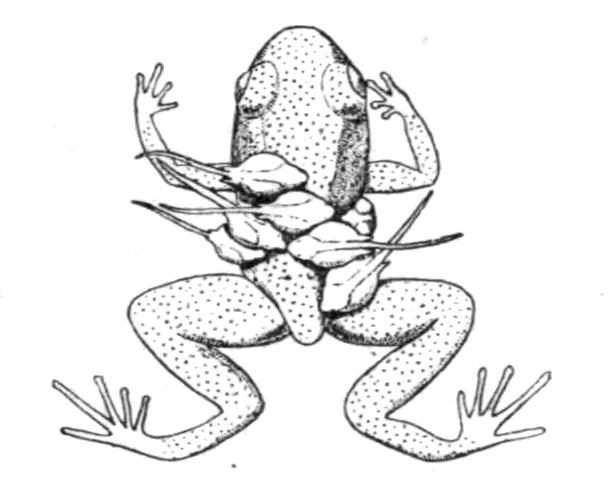
Fig. 47.–Arthroleptis seychellensis, carrying Tadpoles. × 1. (After Brauer.)
Cornufer, with about twelve species, is an essentially Austro-Malayan and Polynesian genus, but one species, C. johnstoni, has been found in the Cameroons. The fingers and toes are free, and their T-shaped phalanges support adhesive discs. The tympanum is distinct. The general shape is frog-like, usually with slender and very long hind-limbs and toes, the discs of the latter being much smaller than those of the fingers. The coloration is dull, mostly brown, more or less marbled, whitish below. The upper eyelid of some species, e.g. of G. unicolor of New Guinea, has a small tubercle, hence the generic name. The skin of the back is glandular and granular, forming slight folds on the back and on the sides of the head in some species. The male has one or two internal vocal sacs.
C. corrugatus is one of the most widely distributed species, inhabiting the Philippines, New Guinea, and Duke of York Island. The granular skin forms longitudinal folds on the back, one of which reaches from the eye to the shoulder. Brownish above with darker markings, below yellowish, with or without brown spots on the throat.–Three species inhabit the Fiji Islands.
Of C. solomonis of the Solomon Islands little is known about the propagation, although the large size of the egg, which measures 5 mm. in diameter, suggests that the young undergo most or the whole of their metamorphosis within the egg.
Chiromantis is distinguished by the peculiar arrangement of the fingers, the first and second being opposed to the others; their terminal phalanges are obtuse and support small knobs or discs. The general shape is that of a frog with long and slender hind-limbs. The tympanum is distinct.
Ch. xerampelina, the type-species, was discovered by Peters at Mozambique; it is a middle-sized frog, about 2 inches in length, brown above with reddish spots on the sides; the male is devoid of vocal sacs.
Ch. petersi, a native of East Africa, differs from the preceding by the possession of an internal vocal sac. Ch. rufescens = guineensis shows very little of the typical grasping arrangement of the fingers; the two inner ones are separated from the two outer fingers by a wide gap, but they all lie in the same plane, are much webbed and possess large discs, so that by the latter two characters a link is formed with Rhacophorus, to which the present genus is closely allied. Total length about 2½ inches.
Buchholz[109] has observed the peculiar breeding habits of this rather large, brown, and slender tree-frog in the Cameroons. In the month of June he found on the leaves of a low tree, standing in the water, a white foamy mass, like the froth of a broken egg, containing a number of newly hatched larvae and quite transparent eggs. Within three or four days this mass became fluid, and the larvae, provided with external gills and a long tail, swam about in the slime. In the natural course of events the larvae are probably washed down into the water by the rain. He found that the female deposits the eggs in the foamy mass at night, during the months of June and July, on various kinds of trees, either between the roots or in a cavity formed by gluing together several leaves, sometimes 10 feet and more above the water, or near the margin. On one occasion the mother was seen sitting upon the foamy mass, clasping the same with its four limbs.
Rhacophorus.–This large genus, containing more than forty species, has a curious distribution. At least one dozen species are found in Madagascar, eight or nine in Ceylon, the rest in Southern India, the Himalayas, the Malay Islands and Philippines, extending northwards through China and Southern Japan. Therefore this genus, with the three species of the African Chiromantis, extends over the whole of the Palaeotropical region. The generic name has reference to the possession by many species of little dermal flaps, especially at the inner side of the heel, and it has nothing to do with the parachute-like use of the hands and feet of certain species, to be mentioned presently.
The terminal phalanges are generally bifurcated, rarely obtuse, and support well-developed adhesive discs. The fingers and toes are webbed to a variable extent. The two outer metatarsals are likewise connected by a web. The tympanum is distinct. The general appearance is that of tree-frogs, and many of them are green. The males have one or two internal vocal sacs. Not all the species have dermal appendages. Rh. maximus, for instance, the largest of all, living in the Himalayan forests, has none. A heel-flap occurs in some half-dozen Indian species; and Rh. madagascariensis has these flaps on the heels and on the elbows. Some have queer little lappets above the vent, or on the edges of the arms and legs; in others the bend of the arm is fringed. The small size of these appendages, in comparison with the webs and discs, makes them practically useless so far as increase of surface is concerned, and they have most likely some other, although unknown meaning, especially the flaps over the vent. Lastly, in the majority of species the fingers are not more than half-webbed, or even less, and in a few only, the webs reach down to the discs.
Several species of this genus are remarkable for two reasons. First, the great enlargement of the fully-webbed hands and feet, which are then used as parachutes; secondly, the mode of propagation.
Greatly exaggerated notions are, however, entertained about the parachutes, ever since Wallace's description[110] of the first "flying frog." The creature was brought to him in Borneo by a Chinese workman. "He assured me that he had seen it come down, in a slanting direction, from a high tree, as if it flew.... The body was about four inches long, while the webs of each hind-foot, when fully expanded, covered a surface of four square inches, and the webs of all the feet together about twelve square inches."
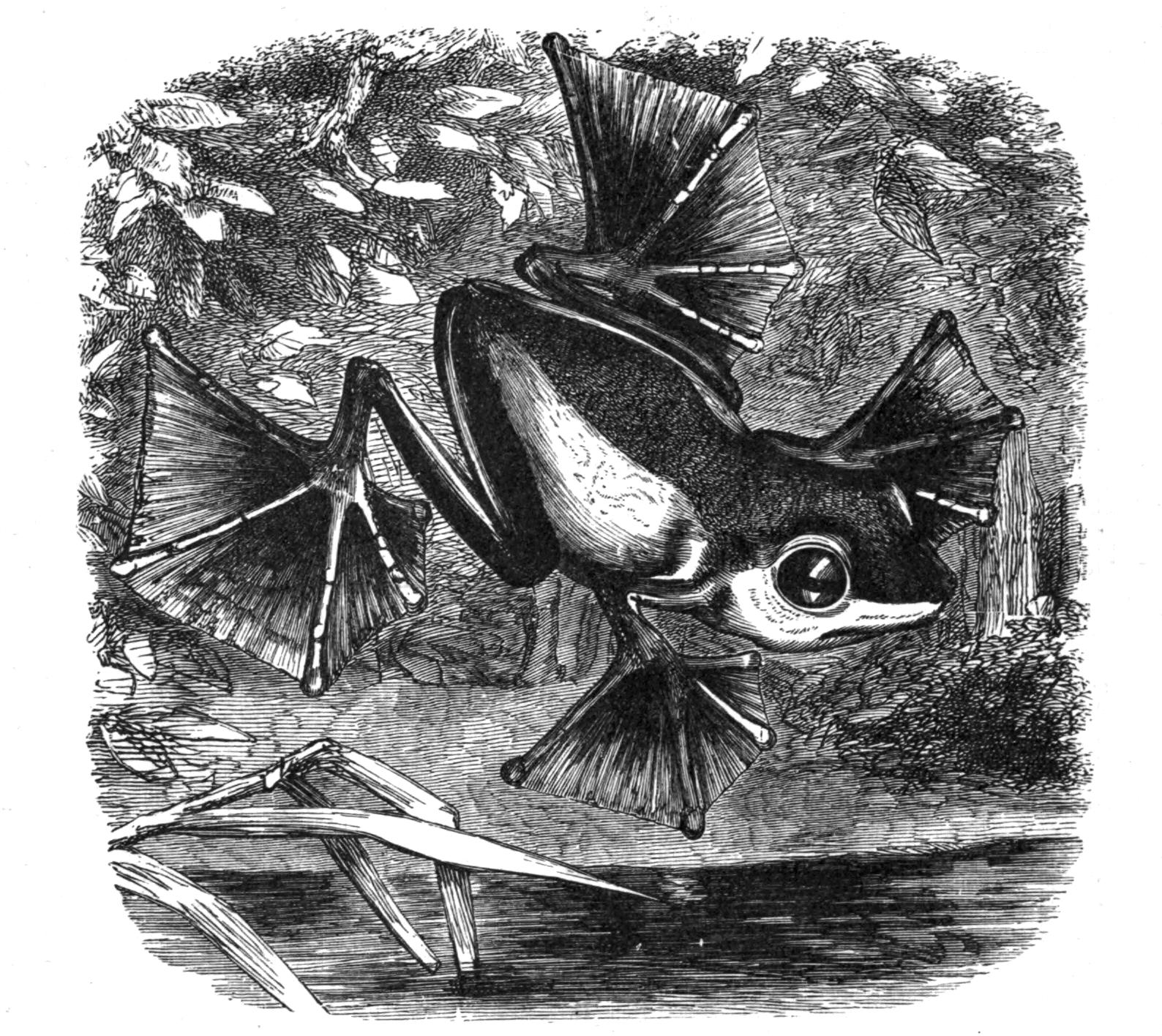
Fig. 48.–Rhacophorus pardalis, × about 1. (From Wallace, Malay Archipelago.)
The species in question is Rh. pardalis, an inhabitant of Borneo and of the Philippine Islands. Specimens from Wallace's Collection are in the National Collection and the largest specimen shows the following measurements. Total length 6.5 cm. or 2½ inches, not 4 inches.
Area covered by one fully-expanded hand 3.4 square cm.
Area"covered by"one fully-e"panded foot 6.0 sq"are c"
---
9.4 square cm.
i.e. for the four limbs 18.8 square cm. = about 3 square inches, and not 78 square cm. or 12 square inches. By some unfortunate oversight Wallace must have mixed up the total expanded area with that of the four hands and feet! In Brehm's Thierleben the 78 square cm. have increased to 81 cm., and the artist has in the somewhat larger species Rh. reinwardti improved upon this, and has produced a truly startling picture by a further exaggeration based upon the figure given by Wallace.
Rh. reinwardti lives in the forests of the mountains of Java and Sumatra. It reaches 3 inches in length, and is grass-green above, yellow below. Younger specimens are further adorned with large blue patches on the webs of the hands and feet and behind the armpits. Besides the flap on the heel and the curious cutaneous fringe on the forearm, suggestive of an incipient flying-membrane, the skin forms a projecting fringe on the inner side of the fifth toe and a transverse flap above the vent.
Of Rh. leucomystax, Annandale, who accompanied the Skeat Expedition to Malacca, gives the following account:–"This frog, which is called by the Malays of Lower Siam either 'Berkata Pisang' (banana-frog) or 'Berkata Rhumah' (house-frog), lays its eggs either on leaves of branches overhanging the water, or on the mud surrounding buffalo-wallows. The ova are enclosed in a round mass of yellow froth, which afterwards becomes steel-grey, about as large as a cricket-ball. Should they be placed judiciously in a position sheltered from the sun, the tadpoles may either hatch, and reach a considerable degree of development, before the mass is washed into the water, or the froth may be melted almost as soon as it is formed and the eggs be carried into a pool by a shower of rain. Very often, however, the whole mass is dried up by the heat of the sun before the rain comes. During the breeding season, which seems to occur as often as the land is flooded under the trees, for I have never seen the eggs of this frog on the bank of a river, the males croak loudly, producing a sound which can hardly be distinguished from the chattering of the large black and yellow squirrel, Sciurus bicolor."
These arboreal frogs have a peculiar mode of nursing the young and taking care of the eggs. Rh. maculatus of Ceylon, Malacca, etc., and Rh. schlegeli of Japan, lay their eggs in a foamy mass, the size of a fist, on the margins of ponds, and the whole process has recently been described by Ikeda.[111] He observed the Japanese Rh. schlegeli depositing the eggs in soft, muddy ground covered with grass, and in wet, muddy banks of paddy-fields, ponds, and similar localities near Tokyo. Sometimes they are deposited between the leaves of trees, near the ground. The breeding season extends from the middle of April to the middle of May. Towards the evening the female, bearing the much smaller male on her back, retires underground for the deposition of the eggs. The spots chosen are 10-15 cm. above the surface of the water; the female digs a spherical hole 6-9 cm. wide. Sitting thus concealed underground, the frogs assume a dark colour and the spawning takes place during the night, whereupon the parents leave the nest. The eggs are enveloped in a white mass of jelly full of air-bubbles, the whole frothy lump looking like the well-beaten white of a hen's egg, with the yellowish eggs scattered through it, and measuring some 6 cm. in diameter. The air-bubbles are 2-3 mm. large. The froth is originally very elastic and sticky, but it gradually sinks down, becomes liquid and ultimately runs out of the hole. It is produced in the following peculiar manner. During and after the deposition of the eggs the female puts her feet upon the sticky jelly, part of which adheres and is then pulled out as a thin, transparent membrane stretching between both feet. The latter are then thrust backwards, the membrane is folded downwards and becomes a vesicle of 5 to 10 mm. in width. By repeated working of the limbs the successively formed bubbles are trodden and kneaded into froth, which ultimately surrounds and at the same time separates the eggs.
The female of Rh. reticulatus of Ceylon attaches the eggs, about twenty in number, to the under surface of her belly, on the skin of which they leave little cellular impressions. What becomes of the tadpoles is not known.
Rh. leucomystax is found in the Malay Archipelago, Farther India, and the Philippine Islands.
S. S. Flower[112] found the tadpoles about Singapore, from January to April, in small ponds and in rain-water butts. The spiracle lies on the left side, directed backwards and upwards, nearer the anus than the end of the snout. The anus opens on the right side. Exceptionally large tadpoles measured 46 mm. in total length, the recently transformed young only 14-18 mm.
"A cheerful little frog of most graceful build. It comes out from its hiding-places shortly before sunset, and remains abroad all night. The males are easily found as they sit on shrubs or trees, or on the edges of the rain-water butts under the verandahs of the houses, and from time to time utter a single, rather musical, short croak. In March and April they can be found both by day and night in embrace, in the ponds. This species changes both its colour and markings very rapidly and frequently, but dark bands across the legs can always be more or less distinguished; the lower parts are some shade or other of buff, but the principal variations of the upper part are as follows: pale bronze, either uniform or with four longitudinal dark-brown or black lines; uniform, almost orange, bright bronze; chocolate, with darker mottling; pale brownish green or olive, with irregular dark spots; yellowish green, mottled with darker or brown." The females are considerably larger than the males; the largest male caught was 48 mm. from snout to vent, and the largest female 68 mm.
Rana.–The following combination of characters should be a sufficient diagnosis: pupil horizontal; tongue deeply notched and free behind; vomers with teeth; fingers free, toes webbed, fourth and fifth metatarsals diverging and webbed together.
In conformity with the great number of species and the wide distribution of this genus some of the organs vary considerably, indeed so much so that many of these modifications have been deemed sufficient to be of generic importance. Fortunately the species are so numerous that these characters mostly form an uninterrupted series from one extreme to the other.
The terminal phalanges are mostly simple and pointed; sometimes transversely dilated or T-shaped, according to the presence of more or less developed discs. Such discs are, for instance, present in the Malay species R. erythraea and R. chalconota and in the Indian R. corrugata. The tympanum occurs in every stage from a conspicuous, free disc to being quite hidden by the skin. The vomerine teeth either form a pair of tiny, mostly transverse rows, between the choanae, or they are arranged in two oblique series which extend beyond the hinder edges of the choanae.
The vocal sacs vary greatly. Many species, e.g. R. agilis, have none at all. Most species have a pair of internal sacs, and in comparatively few, about a dozen, these sacs have become external, a feature which indicates no relationship of the species thus distinguished, for instance the European R. esculenta, the Japanese R. rugosa, the Indian R. hexadactyla, R. cyanophlyctis and R. Chloronota, the Bornean R. glandulosa, the African R. oxyrhynchus and R. mascareniensis, the Mexican R. montezumae. In R. esculenta, and perhaps in a few others, even the female has some traces of these otherwise male organs, indicated by slit-like folds of the outer skin below the angles of the lower jaw.
Nuptial excrescences on the inner metacarpal tubercle and on the inner fingers of the male are common; they reach their greatest development in the Himalayan R. liebigi, the male of which is "remarkable for the extreme thickness of its arms, the inner sides of which are studded with small conical black spines, each supported on a rounded base produced by a swelling of the skin. A large patch of similar spines exists on each side of the breast."[113]
Specific glandular complexes in the skin are mostly restricted to a pair of lateral or dorso-lateral folds; they are often absent, but a few species, e.g. R. glandulosa of Borneo, R. temporalis of Ceylon, R. elegans and R. albolabris of West Africa, have a pair of large flat glands at the base or inner side of the arms.
All the species of Rana, except those in the Solomon Islands, spawn in the water, where the development of the tadpoles takes its course. Those of some Indian species, notably R. alticola and R. afghana of the Himalayas, and R. curtipes of Malabar, are very peculiar, being provided on either side of the shoulders with a large oval parotoid-like gland, well defined and crowded with pores; R. alticola possesses in addition an unpaired, sharply marked glandular complex on the top of the root of the tail, or rather upon the future coccyx. These complexes gradually disappear with age.
The genus Rana, with about 140 species and subspecies, is distributed over the whole of Arctogaea so far as this is available for Amphibian life, while there are only a few stragglers in Notogaea, namely, a few species in Ecuador and in the Peruvian or Upper Amazon district. None exist in the rest of the Neotropical region, including the Antilles, and practically none in Australia; but R. arfaki and R. papua inhabit New Guinea and the northern corner of Australia, R. kreffti the Solomon Islands. A few species are restricted to Madagascar, and a few others live there and on the continent of Africa.
So far as number of species is concerned, the home of the genus Rana is the Palaeotropical region; about one dozen (some of them with a very wide range) live in the Palaearctic sub-region, scarcely more in the Nearctic sub-region, and a few in Central America.
R. temporaria (the common European Brown Frog or Grass-frog).–The tympanum is distinct, two-thirds the diameter of the eye in size. The first finger is slightly longer than the second, which is shorter and weaker than the others, whilst the fourth is the longest. All the fingers are quite free. When the hind-limbs are laid forwards along the body, the ankle-joint reaches to a point between the eye and the tip of the snout. The five toes, which are about half webbed, increase in length from the first to the fourth, while the fifth is about equal to the third. The sole of the foot has a small, blunt, inner metatarsal tubercle; the outer one is scarcely visible. The skin is smooth, always moist, owing to the minute mucous glands; but a series of larger glands forms a pair of folds along the upper sides of the back; beginning behind the eyes they converge slightly beyond the shoulders, diverge a little in the sacral region, and converge again towards the vent. Another, much feebler, Λ-shaped ridge lies between the shoulders.
The male has two internal vocal sacs, which, when in use, bulge out the skin of the throat beneath the angles of the mouth like a pair of globes. It is further distinguished from the female by the stronger muscles of the arms and by a pair of swollen pads on the inner side of the first finger. During the pairing season these pads are enlarged into cushions covered with black horny rugosities.
The iris is golden, with dark specks. The coloration is, generally speaking, brown above, with black-brown irregular spots, especially on the sides of the body, and with cross-bands on the legs. The under parts of the male are white or pale yellow, with a bluish tinge on the throat, while the female is more yellow instead of white, inclining to orange. In both sexes the under parts are mostly spotted with darker colours. A large dark-brown patch, extending from behind the eye over the tympanum towards the shoulder, is always present and has given this frog its specific name. Otherwise the coloration varies considerably; more or less according to the locality and nature of the surroundings, and to individual variation and temporary change of colour.
Some specimens are almost spotless above and of a rich brown, or almost yellow colour, the spots being restricted to the sides below the lateral folds. Others have very few spots, but these are then arranged in two interrupted streaks on the back. The under parts, especially the flanks, may be lemon yellow instead of whitish, and the darker markings may be almost absent. Boulenger has figured a beautiful specimen, almost orange red, with red spots and vermiculations on the yellow under surface. I have found similar red specimens of unusually striking appearance between Berlin and Spandau in a forest-glade, through which run little streams with banks of red ferruginous soil. Specimens which live in woods with rich black soil are often very dark, all the brown and reddish tints being absent. The variations are, however, really endless, and it is difficult to find two individuals exactly alike, even amongst a great number collected in the same locality. Moreover, they change colour. Warmth makes them paler, cold causes the chromatophores to expand and the whole frog appears darker. During the breeding season the males assume a delicate bluish hue, especially on the throat, but this film quickly fades away when they are taken out of the water. It is caused by the swelling of the cutaneous lymph-spaces which extend their ramifications into the epidermal layer, and it is not a question of pigmentation or of chromatophores, but a case of interference-colours, blue being frequently the result of the light passing through a cloudy, colourless, but not quite transparent and thin stratum, in this case the turgid epidermis.
The habits of the Grass-frog are essentially terrestrial. It spends most of its time on land, preferably in damp places, but local fashion permits of a great deal of freedom, as these frogs are sometimes found not only in very wet, naturally irrigated places, but also in the water itself. However, the Grass-frog when pursued rarely takes to the water for safety. It trusts to flight, first by a few long and fast jumps, and then to concealment by squatting down between grass, under leaves; it rarely creeps into a hole, even if there be one near. The jumps soon become shorter and shorter after a few dozen repetitions. It swims well, but cannot climb. The food, which consists chiefly of insects, snails, and worms, must be moving to excite interest; then the frog, whose favourite position is half squatting, half supported by the arms, erects itself, and, facing the insect, turns round upon its haunches, adjusts its position anew by a shifting of the legs, and betrays its mental agitation by a few rapid movements of the throat. All this time the prey is watched intently until it moves; then there follows a jump, a flap of the tongue and the insect is seen no more. As a rule these frogs do not crawl, they jump or hop, even whilst stalking, and this takes place at any time of the day; in fact they are very diurnal, although they become more active towards the evening. When caught they are at first very wild and, like all true frogs, very impetuous, committing acts of astonishing stupidity without any apparent sense or appreciation of distance or height. The captive will not only jump off the table, whilst a toad stops at the edge and looks carefully down, but without hesitation he jumps out of the window, regardless of the height above the ground. This is due to sheer fright; he loses his head. When at large in his native surroundings, nothing will induce him, although hotly pursued, to commit suicide by jumping down a precipice. But all this wildness calms down wonderfully soon. The captive no longer dashes his head against the glass, he does not struggle or twist when taken up; on the contrary, he makes himself at home, watches your coming with intense expectation, and without hesitation accepts the proffered mealworm, maggot, butterfly or earthworm; in short, he shows what a jolly and intelligent fellow he really is.
The Grass-frog has many more obvious enemies than perhaps any other Amphibian, and it is not even slightly protected by any appreciable poisonous secretion. Nevertheless it is extremely common. A whole host of birds eat it–for instance, buzzards, harriers, and above all storks. Foxes, polecats, and stoats are not averse to it, and the Grass-snake derives its main sustenance from it. In fact the enemies of the little frog are legion, one of the worst being Man. In France, Italy, and other parts of the Continent, the skinned fleshy hind-limbs are turned into a by no means disagreeable ragoût, or into dainty morsels when fried in butter and encrusted with bread-crumbs. This frog, together with its cousin the Water-frog, also suffers from the distinction of being one of the chief martyrs to science. Perhaps the story is true that Galvani was led to his investigations into animal magnetism and electricity by observing that the legs of a number of skinned frogs, strung up by his wife upon the bronze railings of the balcony, jumped whenever the scissors, which cut off the feet, touched the other metal. Frogs have suffered ever since. Easily procured and of a convenient size, they are used in every biological laboratory, and the young student is supposed to be initiated into the mysteries of Vertebrate structure by the careful dissection and study of this, the worst of all the so-called types. Next to Man there is no animal which has been studied so minutely, and has had so many primers and text-books written on it, as this frog. In spite of all this it is very little understood, thanks to its rather aberrant and far from generalised structure.
However, the frog, by reason of its fertility, holds its own. Early in the year, sometimes while there is still ice and snow, the frogs leave their hibernating places (mostly holes in the ground, under moss, or in the mud), and they begin to pair in standing or slowly flowing, mostly shallow, waters.
They are not always very careful in the selection of the spawning locality, many of them lay their eggs in a ditch, or even in the shallowest puddle, which is sure to dry up, and thus to cause the destruction of the whole brood. This carelessness is all the more surprising when there are large pools or lakes in the immediate vicinity, perhaps only one hundred yards to the other side of the road. The Natterjack is, by the way, equally careless, while other toads and the tree-frogs are very circumspect.
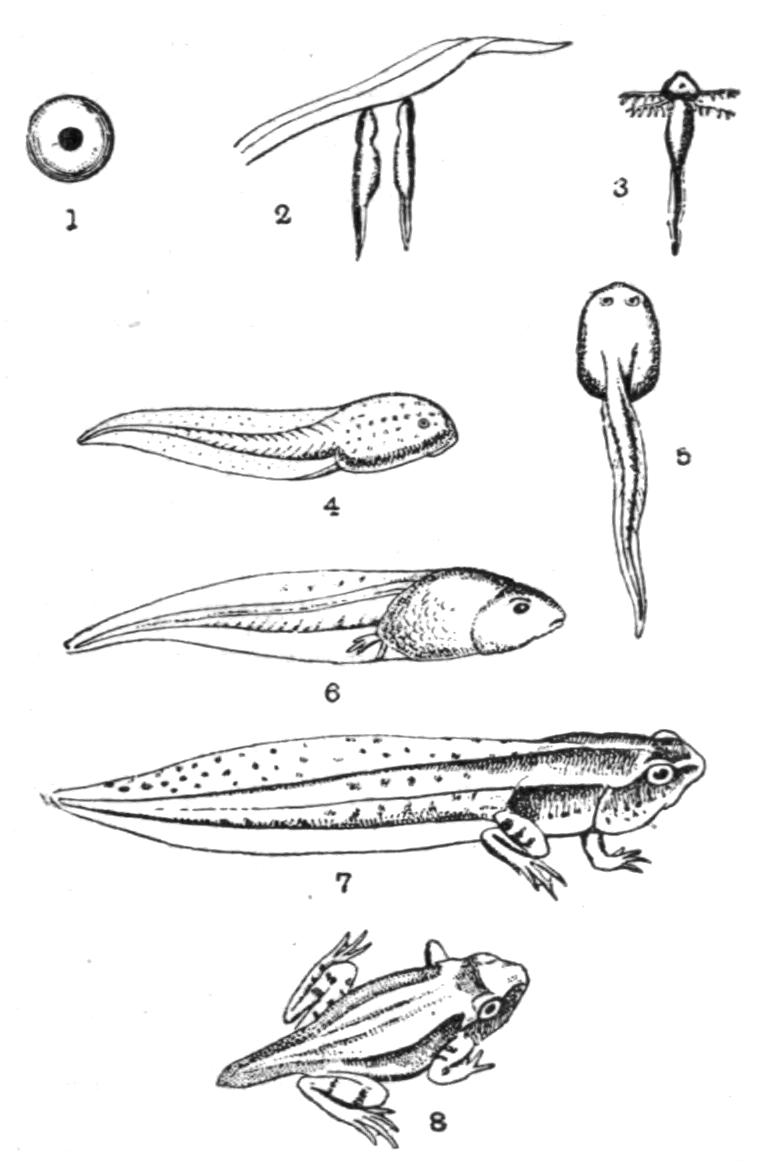
Fig. 49.–Rana temporaria. Eight successive stages in the development from the egg to the almost complete Frog, × 1.
Both sexes can croak, and this sound is frequently produced under water; but there are no regular concerts, although many collect in the same pond or spring, which is perhaps the only suitable place for miles around. The male puts its arms around the chest of the female, behind her arms, and the embrace is so firm that nothing will induce him to loosen his hold. The process becomes an involuntary reflex-action, a cramp which may last for days, or even for weeks, if sudden cold weather sets in, until the female is ready to expel the eggs, an act which is quick and soon over. The usual time of spawning in Middle Europe is the month of March, earlier in warm, later in cold seasons; in southern countries, February or even January, but in Norway not until May. Although the males of this species are not more numerous than the females, and therefore should be able to mate without much trouble, their ardour is so great that they occasionally get hold not only of the wrong kind of frogs, but of toads or even fishes, and, if taken off by force, they fasten on to anything else, a log or on to your own fingers. The eggs measure 2-3 mm. in diameter, are black with a whitish spot on the lower pole, number from 1000 to 2000, and sink at first to the bottom. Their gelatinous cover soon swells to a large globe more than 10 cm. in width, and the whole mass, as large as a man's head, floats on the surface, often stained with mud and other impurities. During the cold weather which often prevails in the spring, the dark brown larvae are slow in their development; and provided with rather large branched external gills and a well-developed tail, they wriggle about in the dissolving slime for three or four weeks. Fischer Sigwart[114] has timed and measured them as follows.–The eggs were laid on the 10th of March. On the 15th the larvae were 4 mm. long and began to leave the eggs. On the 19th they measured, body 4, tail 9, total 13 mm.; on the 5th of April 10, 16, and 26 mm. respectively. On the 13th of May they were 40 mm. long and the hind-limbs appeared; the fore-legs burst through on the 25th, when the tadpoles had reached their greatest length, namely 45 mm., the body measuring 15 mm. On the 31st of May they left the water, still provided with a rather long tail of 20 mm., the total length being reduced to 35 mm. The larvae of this set developed unusually fast, perhaps owing to artificial conditions. The whole development is, however, mostly finished in three months, so that the little stump-tailed baby-frogs swarm about well before midsummer, and have time enough to grow to the size of 20 mm. or ¾ inch before they begin to hibernate in October.
In higher localities and in northern countries the tadpoles are sometimes obliged to winter in the unfinished condition.
In spite of the unusually hot summer of 1899 I found plenty of tadpoles on the 10th of September in the tarns of the hills of North Wales, 1500 feet above the level of the sea; while thousands of little frogs, with and without stumpy tails, were hopping about in the surrounding bogs. The water of these tarns is always very cool. Cold and rainy weather set in by the middle of the month, and on the 26th the tadpoles, all rather small, measuring only 35 mm., with the four limbs developed, but still with a broad fin on the tail, had all settled down under stones at the bottom of the now very cold water, prepared for hibernation. A few were taken home and kept in a glass vessel with water, cool, but less so than that of their native tarns. Within two days they lost the fins on their tails; before the end of a week they left the water, and crawled on to the moss, and the tails were reduced to little stumps. By the 10th of October the metamorphosis was complete, the little frogs measured only 13 mm. in length and showed no desire to hibernate in the genial atmosphere of the greenhouse.
This species has a very wide distribution. It ranges from the west of Ireland to the islands of Saghalin and Yezzo, being found everywhere in the enormous stretch of intervening countries, practically the whole of Central and Northern Europe and the middle belt of Asia. Its most northern extent is the whole of Sweden and Norway. I have found it to the east of the Dovrefjeld, at an elevation of 4000 feet, well-nigh the snow-line. In conformity herewith it ascends the Italian Alps up to 10,000 feet. The southern limit in Europe is the Cantabrian range and the hilly province of Galicia. In the rest of the peninsula, in Italy and Lombardy, Greece and Turkey, and on the Mediterranean islands it is absent.
R. arvalis is often confounded with R. temporaria, as it differs from the latter only by the following characters. The snout is rather more pointed and is narrower; the inner metatarsal tubercle is large, compressed, and hard; the dorso-lateral glandular folds are more prominent and the belly is white and immaculate; lastly, it scarcely reaches 3 inches in length, a size which is not rarely surpassed by the other species. There are also some differences in habits. R. arvalis prefers moist, boggy, open localities, and does not ascend beyond 2000 feet in Central Europe. It pairs as a rule later in the spring and the eggs are smaller, only 1½-2 mm. in diameter; they do not swell up so much, and the whole mass does not float but remains at the bottom of the shallow water. The coloration much resembles that of R. temporaria, and is likewise subject to much variation, except that the pale vertebral stripe is perhaps more common. This species is distributed over the whole of Central Europe, Russia, and Western Siberia, south of the 60th degree of latitude, living side by side with R. temporaria. Between the rivers Elbe and Rhine it becomes decidedly rare, and the latter river is practically its western boundary, while the Bavarian Alps and the Danube form its southern limits.
R. agilis is still more frequently confounded with both the two former species. It differs from either by the absence of the two internal vocal sacs of the male, and by the decidedly longer hind-limbs, the tibio-tarsal joint reaching often a little beyond the tip of the snout. The inner metatarsal tubercle is as prominent as in R. arvalis. Total length up to 3 inches. The prevailing colour of the upper parts is rather yellow or pink-brown with few and small blackish spots; a Λ-shaped dark mark on the neck is often present, and the large dark patch on the temporal regions is always conspicuous. The under parts are white, inclining to lemon yellow on the flanks and thighs. The iris is golden yellow in its upper half, dark brown in the lower half.
This species has a much smaller range than the first two:–from France through Middle and Southern Germany, Switzerland, and Lombardy to Hungary and Greece. The specific name refers to the quick and long leaps of this pretty, or rather delicately coloured frog, which prefers woods and wooded glens to large open places. Their voice differs much from the croak of the common Brown Frog, and agrees with that of R. arvalis, which is transcribed by Boulenger, who has kept them alive, as a rapidly uttered "co-co-co," or "cor-cor-cor." According to the same authority, the pairing takes place as in R. temporaria, but is of much shorter duration, the females usually resorting to the water only at night and when quite ready to spawn. Specimens in embrace are therefore seldom found in the daytime. The eggs resemble those of R. temporaria in size, but they do not swell up so much and they do not float.
These three species of European brown frogs, difficult enough to distinguish, have of late been increased by three more, thanks to the sagacity of Boulenger. These latter inhabit South Europe, and the males all lack the internal vocal sacs.
R. iberica has a very small range, namely the north-western portion of the Iberian peninsula, from the Tagus northwards into Galicia, but south of the main extension of the Cantabrian chain. The rest of the Peninsula south of these mountains has no brown frogs, the only species of Rana being R. esculenta. R. iberica is rather local, being restricted to those hilly and mountainous districts which are well watered. A favourite haunt is the numerous streams in the wooded parts of the Serra Gerez, the red, disintegrated granite of which suits this little, extremely active, and reddish frog to perfection. The prevailing ground-colour varies according to the district, from pale to dark reddish or orange brown, with red specks and larger, dark brown spots, which in some specimens begin with the Λ-shaped mark between the shoulders. Dark spots on the flanks are very variable; the hind-limbs show the usual darker cross-bars, and the temporal region has the conspicuous dark patch. The ground-colour of the under parts is whitish, suffused with a pink tinge, and the throat is much speckled with brown; the toes are pink. The size of this pretty frog amounts to 2 inches. The breeding time is the month of March. When caught and squeezed they emit a slight "co-co-co."
R. graeca inhabits Italy and the Balkan peninsula from Rosina to Morea, together with R. agilis, from which it is very difficult to distinguish except that it is a little smaller, remaining below 2½ inches, and is generally more uniformly pale grey brown to yellowish and pinkish brown above, with scarcely any, or only a few, small dark specks on the back and limbs. The temporal patch is likewise paler than in the other species. The flanks are spotless, their colour gradually passing into the light buff of the under parts, which are more or less marbled with grey. The iris is golden, speckled with dark brown.
R. latastei of Lombardy and Northern Italy down to Florence is the last of these closely allied frogs. Its affinities lie with R. iberica and R. agilis. The latter and R. latastei, although living side by side in the same locality, for instance near Turin, are said not to interbreed. The voice is a rapidly uttered "keck-keck-keck;" the length remains below 2½ inches. The ground colour is greyish or reddish brown with a dark brown Λ-shaped mark between the shoulders, and a few red, orange, or blackish spots on the back. The flanks are without definite dark spots. The under parts are whitish, with a strong pink tinge, especially along the middle of the throat and on the chest, the paler portions being mottled with pale grey brown.
Perhaps the least unsatisfactory way of distinguishing between R. agilis, R. graeca, and R. latastei (R. iberica need not be confounded with them on account of its distribution) is the size of the tympanum, and its distance from the eye. The tympanum is smallest in R. graeca, its diameter being about half that of the eye and from ¾ to the whole of its width distant from the eye. In R. latastei the tympanum is a little larger, and about ½ to ⅔ its own width distant from the eye. R. agilis has the largest tympanum, measuring about ¾ of the diameter of the eye, and the distance between the two organs amounts to only ⅓ of the size of the tympanum.
Brown land-frogs of the R. temporaria group are found in most countries of nearly the whole Periarctic and Oriental regions, and by the time their races and varieties have been studied as minutely as those of Europe are now being scrutinised, the number of species will indeed be great.
R. silvatica is the chief representative in North America. It closely resembles R. agilis, but is smaller, only 2 inches in length, and possesses a pair of internal vocal sacs. Its specific name refers to its predilection for forests of oak, among the dried leaves of which it conceals itself so successfully that it is discovered with difficulty. R. japonica of Eastern Asia is almost indistinguishable from this American species and from the European R. agilis.
R. opisthodon of the Solomon Islands has the vomerine teeth in two oblique series entirely behind the level of the choanae. The general shape of this large frog is stout, the type specimen of the male measuring 78, that of the female 125 mm. = 5 inches. The upper surface of the female is covered with small, flat warts, that of the male is much smoother. The upper parts are dark brown, while the under surface is brownish white. The male has two internal vocal sacs.
This species is interesting as affording another instance of shortened development, the whole metamorphosis being gone through within the egg. Mr. Guppy, its discoverer, has supplied the following notes: "During a descent from one of the peaks of Faro Island I stopped at a stream some 400 feet above the sea, where my native boys collected from the moist crevices of the rocks close to the water a number of transparent gelatinous balls, rather smaller than a marble. Each of these balls contained a young frog, about 4 inches in length, apparently fully developed, with very long hind-legs and short fore-legs, no tail, and bearing on the sides of the body small tufts of what seemed to be branchiae. On my rupturing the ball or egg in which the little animal was doubled up the tiny frog took a marvellous leap into its existence, and disappeared before I could catch it. On reaching the ship an hour after, I found that some of the eggs which I had put in a tin had been ruptured on the way by the jolting, and the liberated frogs were leaping about with great activity. On placing some of them in an open-mouthed bottle, 8 inches long, I had to put the cover on, as they kept leaping out."
Boulenger[115] has figured and further described the eggs and young. The egg measures 6-10 mm. in diameter, and is a transparent capsule in which the young frog is coiled up in the same way as figured by Peters in Hylodes martinicensis; but none of the specimens, which are in an advanced stage of development, show anything of a tail. There are no gills, but on each side of the abdomen are several regular transverse folds, the function of which is probably that of breathing organs, like the tail of Hylodes. The tip of the snout is furnished with a small conical protuberance projecting slightly through the delicate envelope of the egg, and evidently used to perforate that envelope.
R. guppyi, likewise an inhabitant of the Solomon Islands, is a giant among frogs. It was discovered by Mr. Guppy on the Shortland Islands. The type-specimen measures 165 mm. = 6½ inches in length! The skin of the upper parts is covered with minute warts, and forms a strong fold above the distinct, but small, tympanum. General colour dark olive brown above, dirty white below.
R. tigrina is a common species of Eastern Asia, including the Malay Islands. On account of the strength of its voice, and its size, which is said to reach 7 inches, it is called the "Indian Bullfrog." Mainly aquatic, it has a strong cutaneous fringe along the outer side of the fifth toe. The skin of the back is thrown into longitudinal folds, and a strong fold marks the upper border of the tympanum. The general colour above is olive brown, with dark spots, often with a light vertebral line; the under parts are white. The male has a pair of large external vocal sacs.
R. gracilis has the same distribution, but it remains much smaller, and the toes are only half, instead of fully, webbed.
R. catesbiana is now the settled name of the "Bullfrog" of North America, the much more appropriate name of mugiens having been sacrificed to the fetish of priority. The tympanum is extraordinarily large, at least equal to the size of the eye, largest in the male. The first finger does not extend beyond the second; the toes are connected by a broad web down to the ends, and there is a small inner, but no outer, metatarsal tubercle. The upper parts are olive brown, clouded with dark brown or blackish spots; the under parts are yellowish white, often marbled with brown, especially on the throat. The iris is reddish, with an outer yellow ring. The male possesses two internal vocal sacs. Total length of adult specimens about 5 inches, but there are giants on record 7 inches in length, while the stretched hind-limbs measure another 9 or 10 inches. Its home extends over the whole of the United States, East of the Rocky Mountains, southwards into Mexico, northwards into Canada.
According to Holbrook the Bullfrogs are solitary in their habits, only collecting together in the breeding season, when hundreds may be seen in the same small pond; and then the croak uttered by the males is so loud as to resemble the distant roaring of a bull, and can be heard on still evenings at a distance of half a mile. The voice is a hoarse bass "brwoom," playfully translated into "more rum." "They cannot be said to abound, but are found commonly enough sitting half immersed in water, or on the banks of ponds, waiting for their prey. If alarmed they hop suddenly into the water, but do not conceal themselves at once, frequently skimming along the surface for several yards before they dive below." They are the most aquatic of all the North American frogs, and Holbrook has known specimens to live in wells for years, where they could not rest a moment on solid ground above the water.
The Bullfrog is voracious, and takes almost anything that lives or gets into his own pond–Mollusca, Crustacea, fishes and, above all, frogs. There is no doubt that they drag down and swallow a good many ducklings and the young of other water-fowl, but certainly not the half-grown birds which have a way of disappearing from the farms wherever there are negroes and other farm-hands about. In turn the bullfrog has sufficient enemies to keep its numbers down, in fishes, birds, otters, and snakes, and, in the South, alligators. Although easily kept and growing comparatively tame, they are dull, having to be kept in solitary confinement on account of their greediness, which knows no limits. Two of our specimens each swallowed a full-grown Salamandra maculosa, and died within the same night, probably not understanding the meaning of the conspicuous black and yellow warning colours of the European.
E. clamata s. fontinalis, likewise an inhabitant of Eastern North America, may be called a smaller edition of the Bullfrog, its usual full-grown size being about 3½ inches. The tympanum is conspicuously large, but the toes are webbed to a lesser extent, and the skin forms a glandular fold which extends from the shoulder in a curve to the flank. This species is partial to the neighbourhood of running streams; it is said to be exceedingly timid, and to utter a short cry when disturbed and making its enormous leaps.
Another North American relation is R. halecina s. palustris, frequenting the neighbourhood of ponds and rivers, very lively and capable of jumping 8 to 10 feet. The tympanum is smaller than the eye, but there is the same glandular lateral fold as in R. clamata. The vocal sacs are internal and decidedly small.
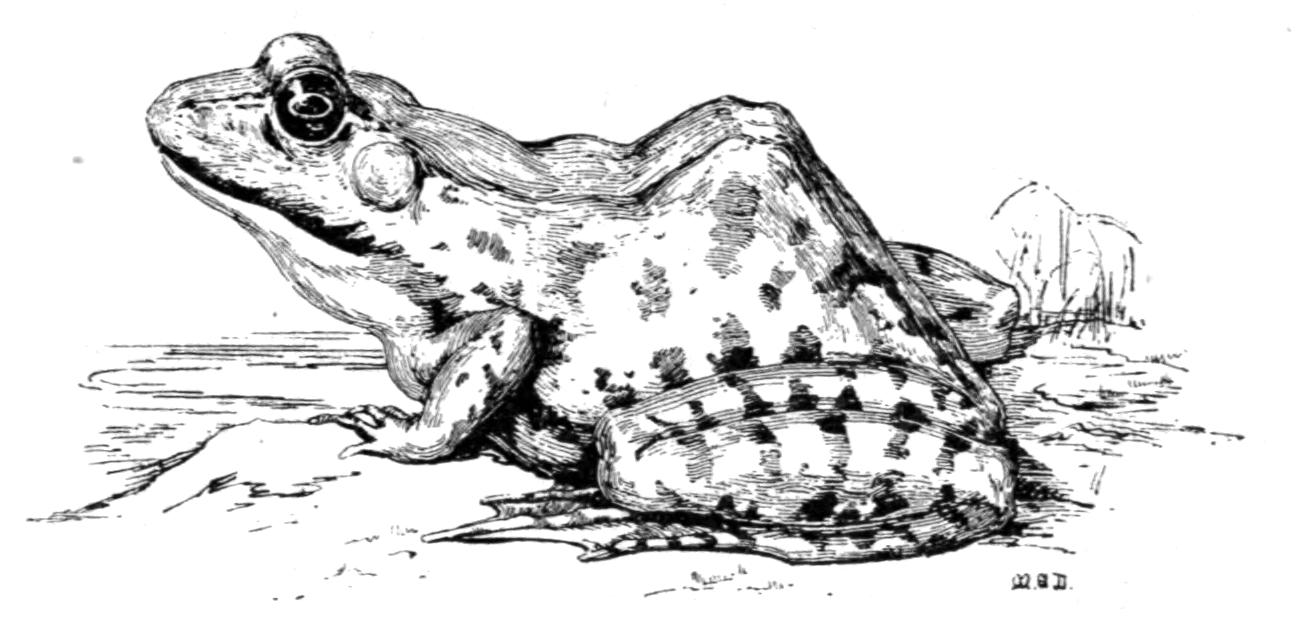
Fig. 50.–Rana clamata, × ⅔.
R. esculenta.–The common Water-frog of nearly the whole Palaearctic region is closely allied to the American Water-frogs described above, and, like most of them, has the vomerine teeth in two small oblique rows between the choanae and extending a little beyond their posterior border. But the males have a pair of external vocal sacs. The tympanum is distinct, about two-thirds the size of the eye. The first finger is slightly longer than the second. The toes are entirely webbed. Besides the usual subarticular phalangeal tubercles, the sole of the foot is provided with two metatarsal tubercles, the outer of which is very small, while the inner is much larger, although varying in size from a soft oval to a long, curved, shovel-shaped structure. The skin is smooth, except for a pair of prominent glandular folds which extend from behind the eye along the dorso-lateral line. The coloration varies considerably. The upper parts are mostly greenish brown, with black brown spots on the back, and larger patches on the limbs. Most specimens have three lighter stripes along the back, the middle one mostly green, the two lateral bronzy brown and coinciding with the glandular folds. The tympanum is brown, and there is occasionally a dark temporal patch. The posterior aspect of the thighs is invariably spotted with black and white or yellow, in opposition to the R. temporaria group, where these parts are never spotted.
The total length of this species varies much. Specimens 2½ inches in length are certainly mature, those of 4 inches are unusually large, and Boulenger has received a giant from Damascus, which measured 125 mm., or nearly 5 inches. The females are larger than the males.
The variations in colour are not only local but also individual, moreover the colours are changeable. The ground-tint ranges from dull brown through olive to bright green, the dark spots being more or less pronounced and numerous; the light vertebral line is olive-yellowish, bright green, or altogether absent.
Those which inhabit waters with plentiful vegetation, like water-lilies and other luxuriant plants, are generally prettier and more vividly coloured than those which live in swamps and ponds with dark mud, or where the prevailing vegetation has a sombre aspect. Cold and dull, warm and sunny days also influence the water-frogs, and those which have been kept in a dark tank look very different from the bright assembly which had been put in some weeks before.
Various attempts have been made at subdividing R. esculenta of Linnaeus into sub-species, and Boulenger has now, after the attentive study of an enormous material, arranged them in four principal and recognisable races. The chief differences are the relative length of the femur to the tibia and the size of the metatarsal tubercles.
1. Var. ridibunda, Pallas.–The right and left heels overlap each other when the thighs are stretched out at right angles to the vertebral column, and the tibia is closely folded up against the thighs. When stretched forwards, the heel reaches the eye or even the tip of the snout. The inner metatarsal tubercle is feebly developed, very small and blunt; the outer tubercle is absent.
That part of the thighs which is concealed by the legs when the animal is at rest is whitish or pale greenish, marbled with dark olive, or bronze, or of the latter colour with or without small light spots. No trace of yellow is ever to be detected on that region, nor at the axillae or on the groin. The vocal sacs are strongly pigmented with black, when inflated they are pale grey. The iris is a mixture of black and gold.
This form or race has the widest distribution, namely, all over Europe with the exception of England, the northern half of France, the Rhine countries, Denmark, and Italy. Southwards it extends from France through Spain and Portugal into the Sahara, eastwards into Turkestan. It attains a larger size than the others, but only in certain localities in various countries, where circumstances favour its development. Eastern countries produce the largest of all; those of the Volga are said to be very large. German physiological laboratories prefer those from the Danube, from Bohemia, and from the lakes and broad expansions of the Spree, to specimens from other localities.
2. Var. typica (esculenta, Linnaeus).–The heels just meet, but do not overlap. The inner metatarsal tubercle is strong, compressed, and prominent. A small outer tubercle is present. The heel reaches to the eye or a little further; the hinder surface of the thighs is "marbled with black, usually with more or less bright yellow pigment" in the living specimens; the vocal sacs are white or feebly pigmented. This race inclines to rather more green than the others, the males especially are often dark grass-green, with scarcely any markings. The vertebral stripe is then yellowish, and the lateral stripes almost golden. The range extends over the whole of Central Europe and the kingdom of Italy. Its northern limit is the southern end of Sweden. In the greater portion of Germany, Poland, and Austria it overlaps the var. ridibunda, with which it does not seem to pair, owing to a difference in the time of spawning; the var. typica being about a fortnight later, and beginning to spawn when the other has finished.
3. Var. lessonae, Camerano.–Except that the inner tubercle is stronger, while the outer one is near the vanishing point, and that the fourth toe is proportionally longer, this variety is really not distinguishable from the typical form, and Boulenger himself confesses that the distinction is arbitrary. The var. lessonae seems to have a rather sporadic distribution. It has been found in Piedmont and other parts of Italy, in Hungary and Transylvania, near Vienna, Halle, Upper Bavaria, on the Rhine, near Brussels, Paris, and what is of especial interest to us, in a few places in the eastern counties of England.
According to Boulenger's "Notes on the Edible Frog in England,"[116] the individuals of R. esculenta which live in Foulmire Fen in Cambridgeshire, near Stow Bedon, and between Thetford and Scoulton in Norfolk, and are generally supposed to have been introduced from France, belong to the Italian form of var. lessonae. "It used to be found in Cambridgeshire, in Foulmire Fen, where it was discovered in 1844; and Bell[117] assures us that his father, who was a native of Cambridgeshire, had noticed the presence of these frogs many years before at Whaddon and Foulmire, where they were known from their loud croak as 'Whaddon organs' and 'Dutch nightingales.' The species was afterwards rediscovered in Norfolk, between Thetford and Scoulton, where it is now still very abundant, and from inquiries made by Lord Walsingham, must have existed for the last seventy (80) years at least. These frogs belong to the var. lessonae, and differ widely (by the much stronger inner metatarsal tubercle) from those found in a few other places in Norfolk, which are undoubtedly the descendants of a number imported from France and Belgium in 1837, 1841, and 1842, and turned loose in the Fens at Foulden and in the neighbourhood.... Within the last ten years large numbers of all the three forms have been imported from Brussels, Berlin, and Italy, and liberated in various localities in West Surrey and Hampshire. Berlin specimens of the var. ridibunda have also been introduced in Bedfordshire, and Italian ones in Oxfordshire."[118]
Leaving aside the question whether the so-called var. lessonae is merely sporadically developed out of the typical form, the inquiry of the possible origin of the English specimens of the var. lessonae is of special interest. Have they been introduced, as has been suggested, from Lombardy, or are they the last lingering descendants of native English frogs? The suggestion as to their Italian origin has naturally lost in value since similar specimens have been found in Belgium and near Paris; but we must remember that there existed considerable intercourse between East Anglia and the monks of Lombardy, who, to mention only one instance, came regularly to the old Priory of Chesterton, near Cambridge, in order to collect their rents. If the frogs were introduced by them for culinary purposes into various suitable localities their descendants would remain as local as they, and as the undoubtedly introduced French typical specimens actually are. On the other hand, if we assume the lessonae specimens to be the last living descendants of English natives, it is inconceivable why they should now be restricted to that eastern corner while there are hundreds of other suitable places in England and Wales which, if on the Continent, would be perfect paradises for Water-frogs. The same vegetation, the same insects, the same climate, and–an enormous advantage to the frogs–no storks.
These English specimens are "olive-brown or bronzy-brown above, with black spots, strongly marked on the flanks, where a light longitudinal area remains unspotted; glandular folds lighter; the sides of the head and the ground colour of the flanks are sometimes green; tympanum chestnut-brown; a pale yellow or pale green vertebral line, frequently edged with black; the dark cross-bands on the limbs usually very irregular, sometimes absent; lower surfaces more or less profusely spotted with blackish; iris golden. Length of a male from Stow Bedon, 64 mm. or 2½ inches; of a female, 78 mm. or 3 inches."[119]
4. Var. chinensis, Osb.–Distinguished by short glandular folds along the back, in addition to the long dorso-lateral pair. The metatarsal tubercle is large and shovel-shaped. Distribution from Corea and Japan to Siam.
All these Water-frogs are decidedly aquatic. They make short excursions on land when their homes are dried up, but as a rule they remain in the lake, pond, river, morass, or ditch in which they were born. Their favourite resorts are the broad floating leaves of water-plants, for instance water-lilies, or a prominent stone, a tussock of grass, or the banks of their homes, where they sit motionless, basking for hours in a half-erect, alert position, watching for insects and other small fry, which are secured by a jump, and then lapped up. Sunshine is sure to bring them out, and on our approach they make straight for the water, either by one tremendous leap or with quick bounds, but without the slightest hesitation or stopping on the way. With folded arms they take a header, swim, with the arms still folded, for some distance under water, and conceal themselves in the mud, between stones, or in the vegetation. We perhaps have not seen them at all, whilst their watchful eyes and keen ears have noticed our approach, and the pond might appear uninhabited if we had not heard the plumping noise. If we keep quite still, and they have not been disturbed previously, one after another will wriggle out of the mud, rise slowly to the surface under cover of the plants, and, without causing a ripple, rise just enough for the prominent eyes and the nose to clear the surface. Then one scrambles partly on to a leaf, but the sight of the huge human figure strikes him as uncanny, as it certainly does not belong to the scenery, and he doubles back, the broadly-webbed feet making a little splash. But another appears, jumps on to a leaf in the middle, or at the farther end of the pond, settles down, and utters a little croak, somewhat like "ooaar," and soon the whole company appear one after another, each taking up its favourite position. After all, their observing powers cannot be very great. If we ourselves keep still we may wield a rod and fish for them. There is no need of a hook, a piece of red cloth tied to the end of the line and skimmed over the water causes a lively commotion. The new bait is noticed at once, and arouses their curiosity; several jump at it, and the one which swallows the bait can be lifted out before it has time to let go. However, this is after all poor sport; the game is too eager. When a boy I have often caught them with a noose of slender wire at the end of a long hazel rod. They do not mind the rod at all, their attention being fixed on the person; they allow the noose to be slipped over their heads, and a sudden jerk secures the captive. In this way they can be singled out individually. Old frogs are more wary and experienced than the younger members; they take up safer positions, and by their sudden plunges give the alarm.
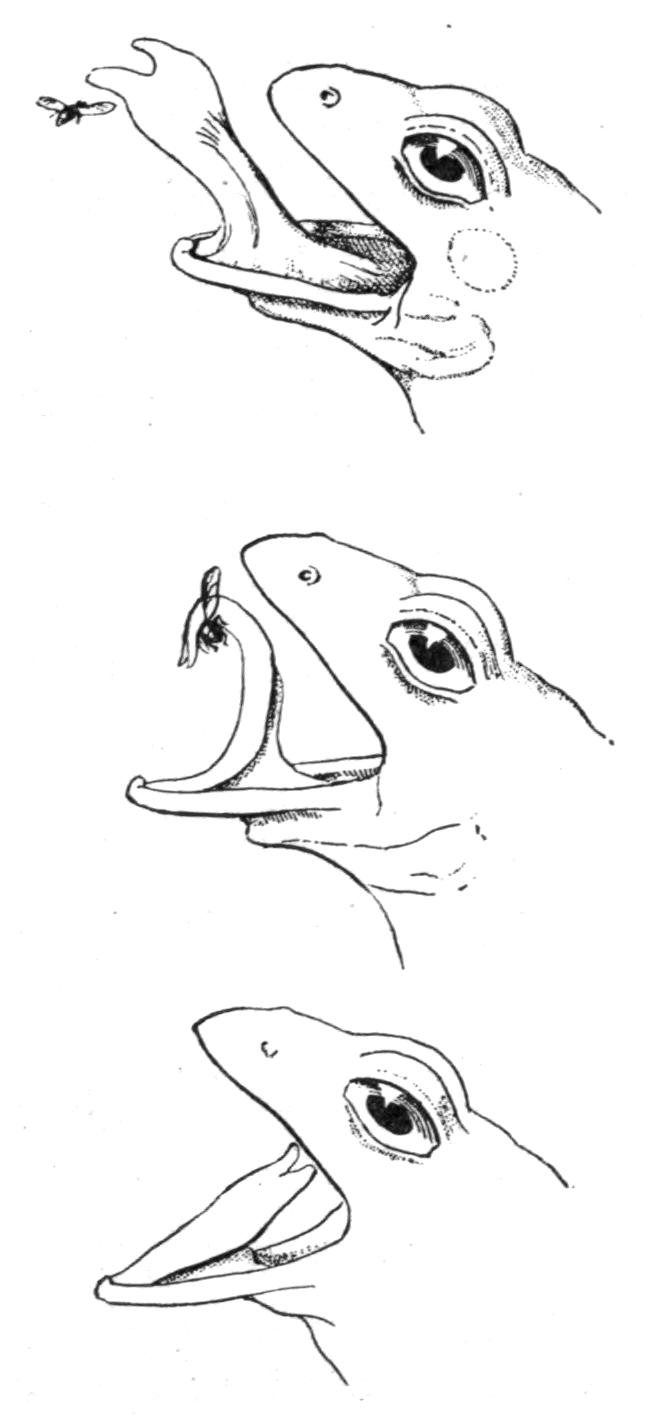
Fig. 51.–Rana esculenta. × 1. Three stages of the movement of the tongue.
The males are great musicians, singing for sheer enjoyment not only during the pairing time, but throughout the months of June and July. Warm moonlit nights are the favourite times for the concert, which takes place in the water, beginning at sunset, and continuing until the early dawn. A few individuals here and there utter a single note, "gwarr, oo-arr," or "coarx," but these are only preliminaries. The precentor–the country-folk in North Germany firmly believe that in each pond one old male holds the dignified position of choir-master–begins with a sharp-sounding "brekeke," and this is the signal for all the others to chime in with the same notes, varied with all sorts of other sounds, bass, tenor, and alto, each performer filling its resounding vocal sacs to bursting size, and these bags then look as if they acted as floats. When there are several hundred of these sociable creatures, the din is continuous, and may be heard more than a mile off. There can be too much of this, just as there can be too many nightingales; and a well-stocked pond in the neighbourhood may become a perfect nuisance. There are accounts of servants having been employed in the Middle Ages for the sole purpose of keeping the noise down by beating the pond, throwing stones into the water, or otherwise disturbing the frogs. Sometimes more vigorous and lasting measures seem to have been taken; the monks exorcised them in order not to be disturbed in their vigils. Near the former monastery of Chorin, in the province of Brandenburg, the frogs have still the reputation of keeping very quiet on account of some powerful abbot who threatened them with awful consequences if they did not forego their concerts.
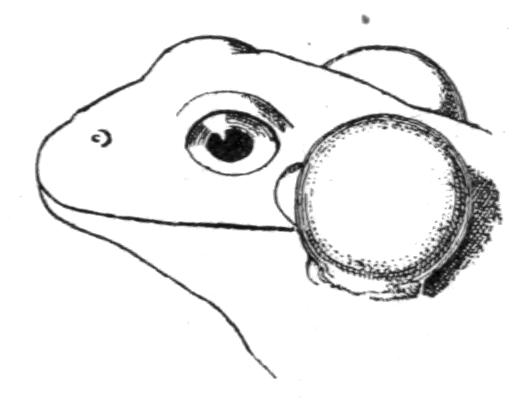
Fig. 52.–Rana esculenta. Male with inflated external vocal sacs. × 1.
The length of life which these frogs can attain is quite unknown. They do not reach maturity until the fourth or fifth year, but this is long before they stop growing, and it is no exaggeration to say that few, if any, frogs die of old age, since they have so many enemies. The stork is their king in the fable, and his daily visits to his realm strike dire distress amongst his subjects, which soon learn to know his conspicuous white and black garb, and seek imperfect safety at the bottom of shallow ponds and ditches, not too deep for the long-legged and long-billed despot. Numbers are taken by birds of prey; snakes and tortoises hunt them up in the water, and they are good bait for pike and other voracious fishes. The specific name esculenta needs no comment, and this species is as much a martyr to science as the brown Grass-frog. The destroyers of tadpoles and young frogs are unlimited. In their turn the frogs themselves, especially the old ones, are very rapacious, and eat any living creature they can master,–insects, worms and snails, other frogs, especially the brown kind, and the young brood of fishes.
Recently caught Water-frogs are wild beyond description, much more so than the Grass-frog, but even they calm down after some time, learn to know their keeper, and allow him to handle them without trying to commit suicide by jumping on to, into, and down anything. However, they do not thrive well in captivity, and it is rare that they can be induced to breed, unless their enforced new home affords them ample freedom, and plenty of water and fresh air.
The Water-frogs appear in Germany rather late in the year, not before the middle of April, first the younger, then the adult members. In Southern Europe they show themselves earlier, and still further south they do not hibernate at all. The breeding season begins in Germany towards the end of May and continues well into June, the var. ridibunda beginning mostly a fortnight earlier. The male clasps the female under the arms, throwing its own round her breast, the nuptial grey excrescences on his inner fingers pressing against her skin, the palms being turned outwards. The embrace does not last long, rarely extending over a few days. The eggs, to the astonishing number of 5000 to 10,000 in full-grown specimens, are expelled in several masses, which sink down and remain at the bottom. The eggs measure only 1.5 mm. and are yellowish-grey above, pale yellow below; their gelatinous cover swells to 7-8 mm. in width. The embryo escapes on the fifth or sixth day as a very small larva, in which, however, the mouth, eyes, and beginnings of the external gills are already discernible. At the age of two weeks the gills have shrunk away, the left-sided "spiracle" is completed, and the well-tailed tadpoles, olive brown above, yellowish white below, still hang with their suckers on to plants and stones, or lie at the bottom, nibbling away at any rotting animal matter or scraping off the green algae.