Part 2 — CHAPTER XII (continued 2)
Reading edition
Fam. 6. Helodermatidae.–Pleurodont, poisonous lizards of North America. The teeth are fang-like, recurved, with slightly swollen bases, rather loosely attached to the inner edge of the jaws. Each tooth has a groove on its anterior and posterior surface, and a series of labial glands which secrete the poison open near the bases of the teeth of the lower jaw. The skull has strong postorbital but no postfronto-squamosal arches. The pre- and post-frontals are in contact, separating the frontal from the orbit; the premaxillaries are fused into one; the nasals and frontals remain separate. The limbs are short, but strong and well developed. The tongue is villose, with an anterior smooth portion, which is bifid and protractile, resembling the tongue of the Anguidae and of Aniella. The skin of the upper surface is granular, with many irregular bony tubercles, which give it an ugly warty look. The under parts are covered with flat scales.[161]
Heloderma, the only genus, with H. horridum in Mexico and H. suspectum in New Mexico and Arizona, reaches about 2 feet in length. The animal, stout, depressed, thick-tailed, looks rather repulsive when it squats down in its usual lethargic way. The whole skin is blackish brown and yellow or orange, these two "warning" colours being distributed unevenly, except on the thick, peculiarly-shaped tail, where they are arranged in alternate rings. The specific differences are rather imaginary. The New Mexican form is supposed to be more orange and yellow than black, with a somewhat smoother skin and with shorter toes and tail.
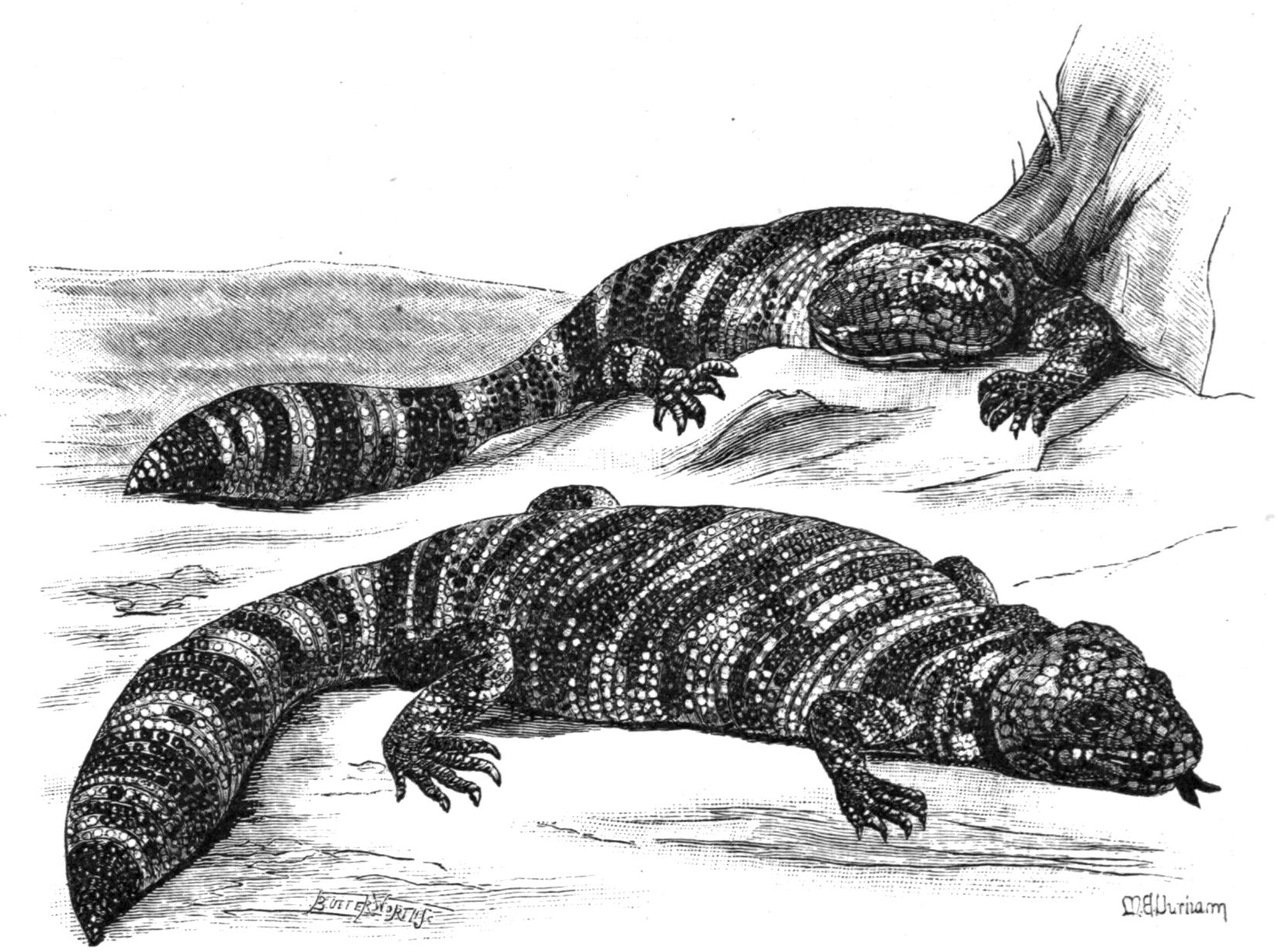
Fig. 137.–Heloderma suspectum (the Gila Monster). × ⅕.
The "Gila Monster" inhabits dry localities, spends most of the daytime in concealment between the roots of trees, and crawls about in the evening in search of worms, centipedes, frogs, and the eggs of large lizards. Frogs are probably paralysed or killed by the bite which, although not so dangerous as that of poisonous snakes, is effective enough to produce severe symptoms even on man, and a few cases of death of people who had been bitten are on record. In captivity they are very partial to eggs, which they break and then lap up. During the dry and hot season they aestivate.
Fam. 7. Lanthanotidae.–Lanthanotus borneensis, of which only two specimens are known, one in the Vienna Museum, the other in the Sarawak Museum, was described by Steindachner as the type of a distinct family, near the Helodermatidae. Boulenger,[162] after examination of the Sarawak specimen by means of a sciagraph, has come to the conclusion "that the affinity of Lanthanotus to the Helodermatidae is fully confirmed." The teeth of Lanthanotus show, however, no traces of grooves; poison-glands are probably absent, and there are no osteoderms. The skin is covered with wart-like tubercles, each with a horny, peeled scale. The eyes are very small, the ears are concealed. The general colour is reddish brown above, yellowish, with brownish bands, below. Total length about one foot, a little more than half of which belongs to the roundish tail.
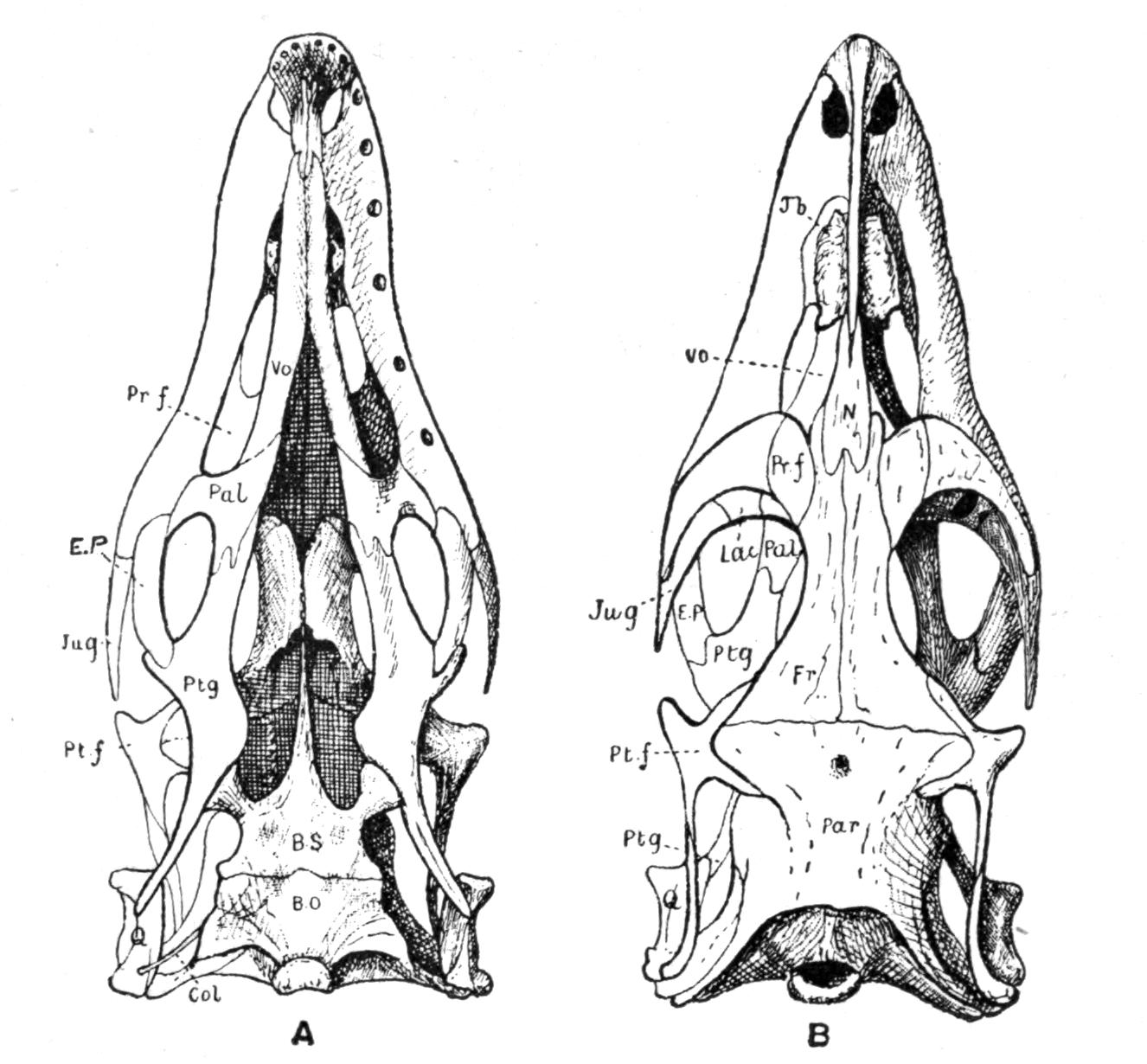
Fig. 138.–A, Ventral, B, dorsal view of the skull of Varanus griseus. × 1. B.O, Basi-occipital; B.S, basisphenoid; Col, columella auris or stapedial rod; E.P, ectopterygoid; Fr, frontal; Jug, jugal; Lac, lacrymal; N, nasals; Pal, palatine; Par, parietals; Pr.f, prefrontal; Pt.f, postfrontal, fused with postorbital; Ptg, pterygoid (endopterygoid); Q, quadrate; Tb, turbinal; Vo, vomer.
Fam. 8. Varanidae.–Pleurodont Old-World Lizards, with a long, deeply bifid and protractile smooth tongue. They reach a large size, and the neck is relatively much longer than that of other lizards. The limbs are well developed. The skin is covered with very small juxtaposed scales and tubercles above, while the ventral scales are squarish and arranged in transverse rows. Osteoderms are entirely absent. The tail is very long, often laterally compressed. The teeth are large and pointed, dilated at the base. The premaxilla is unpaired and dorsally extends backwards to the likewise unpaired nasal. There is a pair of small supra-orbital bones, easily lost during maceration. The orbit is open behind, the jugal being short and not meeting the postfrontal; the postorbital forms a slender arch with the supratemporal. The vomers are long and diverge posteriorly. The palatines, pterygoids, and ectopterygoids enclose on either side an oval infra-orbital foramen. The Varanidae contain only one genus, Varanus, with nearly thirty species in Africa, Southern Asia, and Australia, but not in Madagascar.
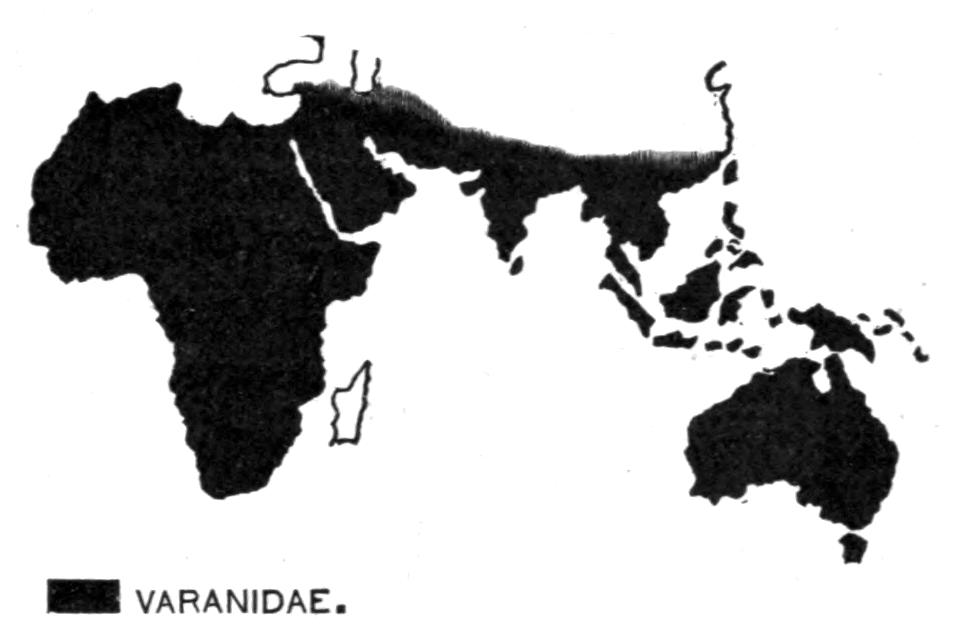
Fig. 139.–Map showing the distribution of the Varanidae.
Varanus.–The name of "Monitor" bestowed upon these creatures has a curious origin, owing to a ridiculous etymological mistake. The Arabic term for Lizard is "Ouaran"; this has been wrongly taken to mean warning lizard, hence the Latin Monitor, one of the many synonyms of this genus, e.g. Hydrosaurus and Psammosaurus. Many of the "Monitors" are semi-aquatic, others inhabit dry, sandy districts, while others are at home in well-wooded localities. They are all rapacious, taking whatever animals they can master according to their size, which in some species amounts to 6 or 7 feet.
V. niloticus inhabits the whole of Africa, except the north-western part. It reaches a length of more than 5 feet. The colour of the adult is brownish or greenish grey above, with darker reticulations and yellowish ocellated spots on the back and limbs. The under parts are yellowish with blackish cross-bands. The ground-colour of the young is black above with yellow lines on the head and neck, and with yellow spots on the back and limbs; the tail has black and yellow bars.
V. salvator ranges from Nepal to Ceylon, Cape York, and Southern China, inclusive of the Malay Islands and the Philippines. This is the largest species, specimens of 7 feet in length being on record. The general colour is dark brown or blackish above, with yellow spots or ocelli. The snout and chin have transverse black lines on a lighter ground. A black band, bordered with yellow, extends from the eye along the side of the neck. The under parts are yellow.
Mr. Annandale has favoured me with the following observations:–"Varanus salvator is common in Lower Siam, where it is equally at home on land, in water, and among the branches of trees. The eggs are laid in hollow tree-trunks. When in the water the lizard swims beneath the surface, the legs being closely applied to the sides, and the tail functioning both as oar and as rudder. Their food is very varied. In the states of Patalung and Singora, in which the Siamese practise a form of tree-burial, these great lizards are accused, probably with justice, of eating the flesh of the corpses in the aërial coffins. I have disturbed a large Monitor devouring the body of one of its own species, which had evidently been dead for some days. Another, which was chased by some men, dropped from its mouth a small flying squirrel (Sciuropterus); a third, which I dissected, had lately swallowed a small tortoise, the hard shell of which had been broken into innumerable fragments. The stomachs of several others contained nothing but dung-beetles, for which Varanus may often be seen hunting, turning over the dung of elephants and buffaloes with its fore-feet. The Malay name of these lizards is Biawak."
According to Mason and Theobald[163] all the Varanidae and their eggs are highly esteemed for food, and are sought for in hollow trees with the aid of dogs. If not wanted at once, the wretched creature has its fore-feet bent over its back, a few of its toes are broken and the sinews drawn out and tied into a knot, rendering the animal helpless. The Karens, who are extravagantly fond of the flesh, steal up the tree with a noose at the end of a bamboo, and often noose them while leaping for the water, or catch them in a boat which is brought under the tree. The head, the natives say, is venomous, and they discard it altogether, but the flesh of the other parts, which smells most odiously, is deemed preferable to that of fowls.
Sir J. G. Tennent[164] gives the following account of V. salvator:–
"The 'Kabara-goya' of the Singhalese is partial to marshy ground, and when disturbed upon land will take refuge in the nearest water. From the somewhat eruptive appearance of the yellow blotches on its scales, a closely allied species, similarly spotted, obtained the name of Monitor exanthematicus, and it is curious that the native appellation of this one, Kabara, is suggestive of the same idea. The Singhalese, on a strictly homoeopathic principle, believe that its fat, externally applied, is a cure for cutaneous disorders, but that taken inwardly it is poisonous. The skilfulness of the Singhalese in their preparation of poisons and their addiction to using them are unfortunately notorious traits in the character of the rural population. Amongst these preparations the one which above all others excites the utmost dread, from the number of murders attributed to its agency, is the potent kabara-tel, a term which Europeans sometimes corrupt into cobra-tel, implying that the venom is obtained from the hooded-snake; whereas it professes to be extracted from the Kabara-goya.
"In the preparation of this mysterious compound, the unfortunate Kabara-goya is forced to take a painfully prominent part. The receipt, as written down by a Kandyan, was sent to me from Kornegalle by Mr. Morris, the civil officer of that district; and in dramatic arrangement it far outdoes the cauldron of Macbeth's witches. The ingredients are extracted from venomous snakes by making incisions in the head of these reptiles and suspending them over a basin to collect the poison as it flows. To this, arsenic and other drugs are added, and the whole is boiled in a human skull, with the aid of three Kabara-goyas, which are tied on three sides of the fire, with their heads directed towards it, and tormented by whips to make them hiss so that the fire may blaze. The froth from their lips is then added to the boiling mixture, and so soon as an oily scum rises to the surface, the kabara-tel is complete. Before commencing the operation of preparing the poison, a cock has to be sacrificed to the demons.
"This ugly lizard is itself regarded with such aversion by the Singhalese that if one enter a house or walk over the roof, it is regarded as an omen of ill-fortune, sickness, or death; and in order to avert the evil, a priest is employed to go through a rhythmical incantation."
Captain Robinson, renowned as a hunter of tigers on foot in the old days of muzzle-loading rifles, has told me the following unique use to which these large lizards are put by ingenious thieves in India. In order to be able to get over a wall too high for climbing without assistance, the thief provides himself with a strong lizard, ties a rope round its waist and lets the animal go, when it at once scales the mud wall by its strong and sharp claws, and jumps down on the other side. The weight of the lizard, which, moreover, holds vigorously on to the ground, and the friction of the rope on the top of the wall, are sufficient to help the man over!
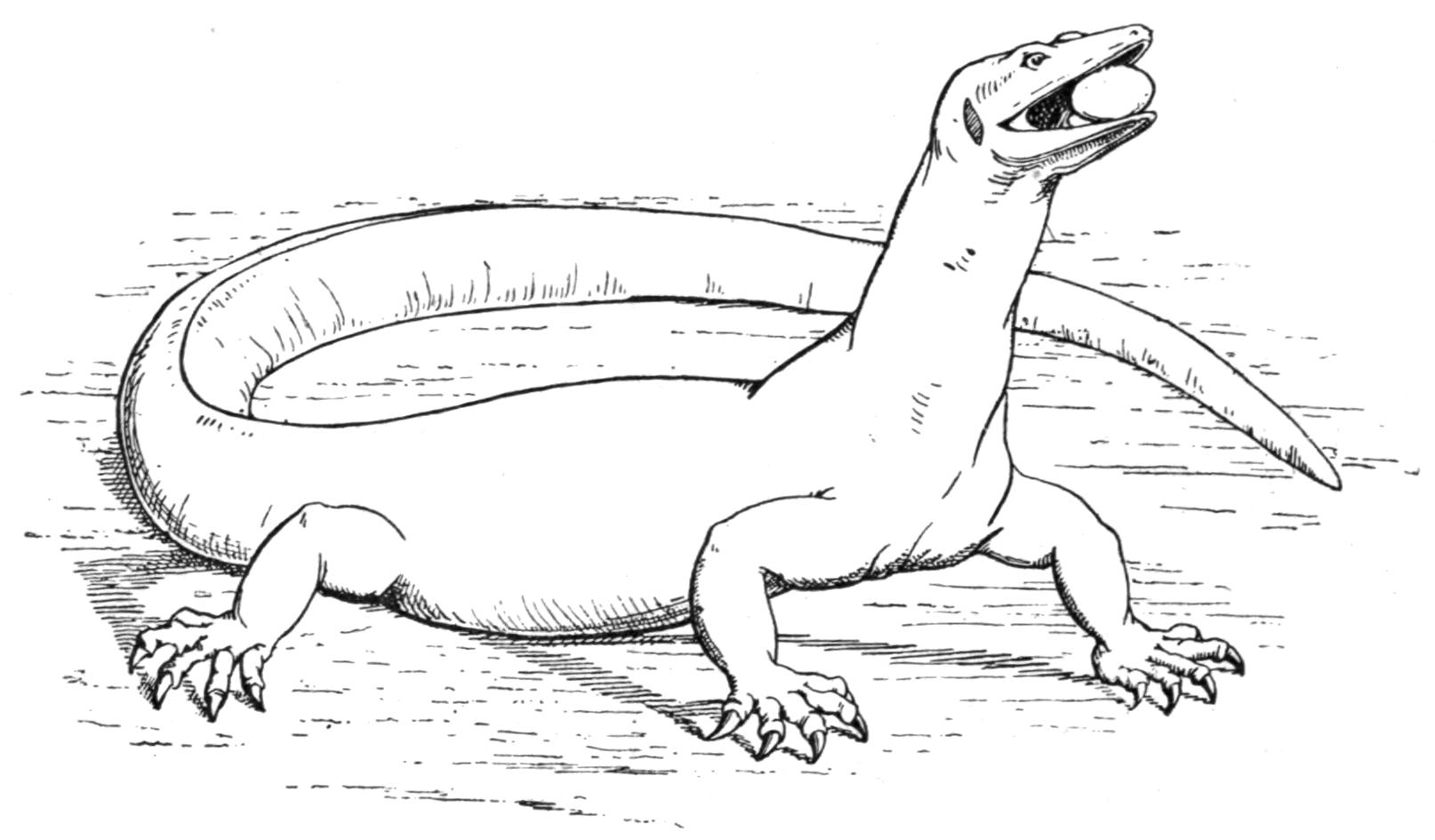
Fig. 140.–Varanus salvator swallowing a Fowl's egg. × ⅛.
It is a sight, never failing in its attraction to the visitors of the Zoological Gardens in London, to see one of the big Monitors fed with an egg. The lizard knows the treat well that is in store for it. It raises itself up high in expectation, then examines the egg with the long tongue, takes it up gingerly and swallows it entire, crushing it by the contraction of the muscles of its gullet. On one occasion it was given a rotten egg which burst in its mouth, and the lizard refused for a long time to take another.
V. gouldi is common in Australia and in New Guinea. It reaches a length of about 4 feet. Its colour is brown above with yellow spots on the back and limbs, and with yellow rings on the tail. Two yellow streaks separated by a black band extend from the temples along the side of the neck. The under parts are yellowish, sometimes with black spots.
Fam. 9. Xantusiidae.–Three Californian, or West-Indian genera, with less than half-a-dozen species. Pleurodont with a short tongue and with the supratemporal fossa roofed over by bone. The tongue is scarcely extensible, with oblique overlapping folds which converge towards the median line, and with scale-like imbricate papillae towards the tip. The skull possesses complete postorbital and postfronto-squamosal arches, the latter meeting the parietals and roofing over the supratemporal fossa. The palatines are in contact with each other, and there are no infra-orbital fossae. There are no osteoderms; the body is covered above with small granular scales, below with larger scales. The eyes are devoid of movable lids. The tympanum is exposed. Femoral pores are present. Limbs and tail well developed. Xantusia and Lepidophyma.
Fam. 10. Tejidae.–American Lizards with a long and bifid tongue. The greater portion of the tongue is covered with scale-like papillae; the anterior forked and pointed ends are smooth. The teeth are solid and implanted almost upon the edge of the jaw, being therefore intermediate between the acrodont and pleurodont condition. The shape of the posterior teeth shows several modifications; they are conical or tricuspid, or molar-like in the adult Tejus; in Dracaena they are transformed into large, oval crushers. The palatines are in contact anteriorly. The infra-orbital fossae are surrounded by the palatine, pterygoid, and ectopterygoid bones, the maxillary being excluded from the fossa, as in Varanus (see Fig. 138, p. 542). The skull has no supra-temporal arch. Osteoderms are absent; the body is covered with small scales, or the skin is simply granular above; the under surface is covered with larger scales, generally arranged in transverse rows.
This large family, which comprises nearly forty genera with more than a hundred species, exhibits great diversity of form. Some are inhabitants of forests and are arboreal, while others are strictly terrestrial, preferring hot and sandy plains, or they dwell below the surface and are transformed into almost limbless and blind-worm-shaped creatures. The range of the family extends over the whole of the South American continent, over the West Indian Islands, and through Central America into the warmer parts of the United States.
Tupinambis ("Teju").–The skin of the back is smooth, covered with small scales; with large scales on the top of the head. The skin on the neck is generally thrown into two irregular transverse folds. The long and narrow tongue is capable of being telescoped into a sheath at its base. The lateral teeth are compressed and tricuspid in the young, but the later generations of teeth have obtuse crowns in the adult. T. teguixin is the largest member of the whole family; it reaches a length of a yard, most of which, however, belongs to the tail. The general colour is bluish black, with pale or whitish-yellow spots on the back, flanks, and tail, combining into more or less transversely arranged bands. The limbs are black, with many and tiny yellow dots. The ground-colour of the under parts is reddish yellow, with irregular black bars. This species inhabits the greater part of South America, east of the Andes, from Uruguay to the West Indies. T. nigropunctatus is confined to the Continent, and lacks the dark cross-bands on the belly, which is uniformly yellowish or speckled with black.
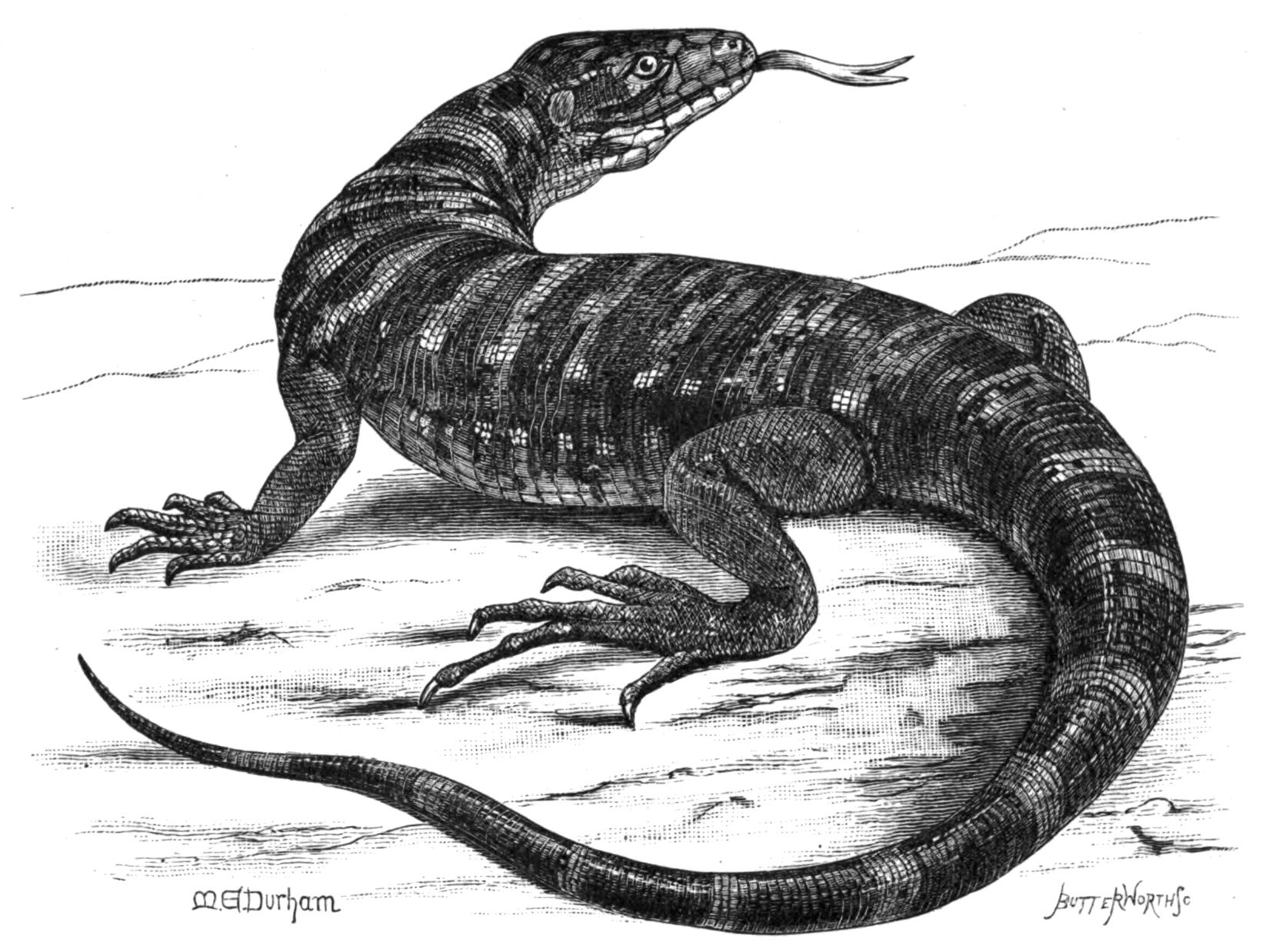
Fig. 141.–Tupinambis nigropunctatus. × ⅙.
The "Tejus" frequent forests and plantations, and are carnivorous. Their strength and swiftness enable them to catch all kinds of animals, from insects and worms to frogs, snakes, mice, and birds. As they take chickens and eggs from the farms they are considered noxious, and they are frequently hunted down with dogs for the sake of their flesh, which is regarded as good to eat. They defend themselves with lashing strokes of their long tail and with their powerful jaws. They retire into burrows, and they deposit their hard-shelled eggs in the ground. In captivity they can easily be kept on meat.
Dracaena guianensis of the Guianas and the basin of the Amazon has the lateral teeth transformed into regular large molars, with broad and rounded crowns. The tail is strongly compressed, with a double, denticulated keel. It seems to be semi-aquatic, and, to judge from the teeth, herbivorous.
Ameiva and Cnemidophorus, with many species chiefly in tropical America, have laterally compressed bi- or tri-cuspid teeth. The skin forms a double fold on the neck, and is covered on the upper surface of the body with very small scales; those on the ventral surface are large, and arranged in regular rows. Most of the species are small, under one foot in length, and are extremely pretty, very active, timid, and mainly insectivorous.
C. sexlineatus is one of the few species of Cnemidophorus which inhabits the southern half of North America. Like all its relations it has the appearance of an ordinary lizard (Lacerta). The head is dark brown. A purple or brownish band extends over the back and tail, bordered on either side with three golden-yellow longitudinal lines. The flanks are brown, the under parts bluish white. The iris is golden, and the inner margins of the lids are bordered with a narrow band of bright yellow. This species is a very fast runner, and frequents dry and sandy places. Its total length amounts to about 10 inches.
Fam. 11. Lacertidae.–Pleurodont Old-World Lizards, without osteoderms on the body, and with the supratemporal regions roofed over by osteoderms.
The limbs are always well developed, and have five fingers and five toes, always provided with sharp claws. The skin covering the head forms large shields, mixed with small scales; most of which, especially the shields, contain dermal ossifications. These frequently fuse with the underlying bones of the top of the skull.
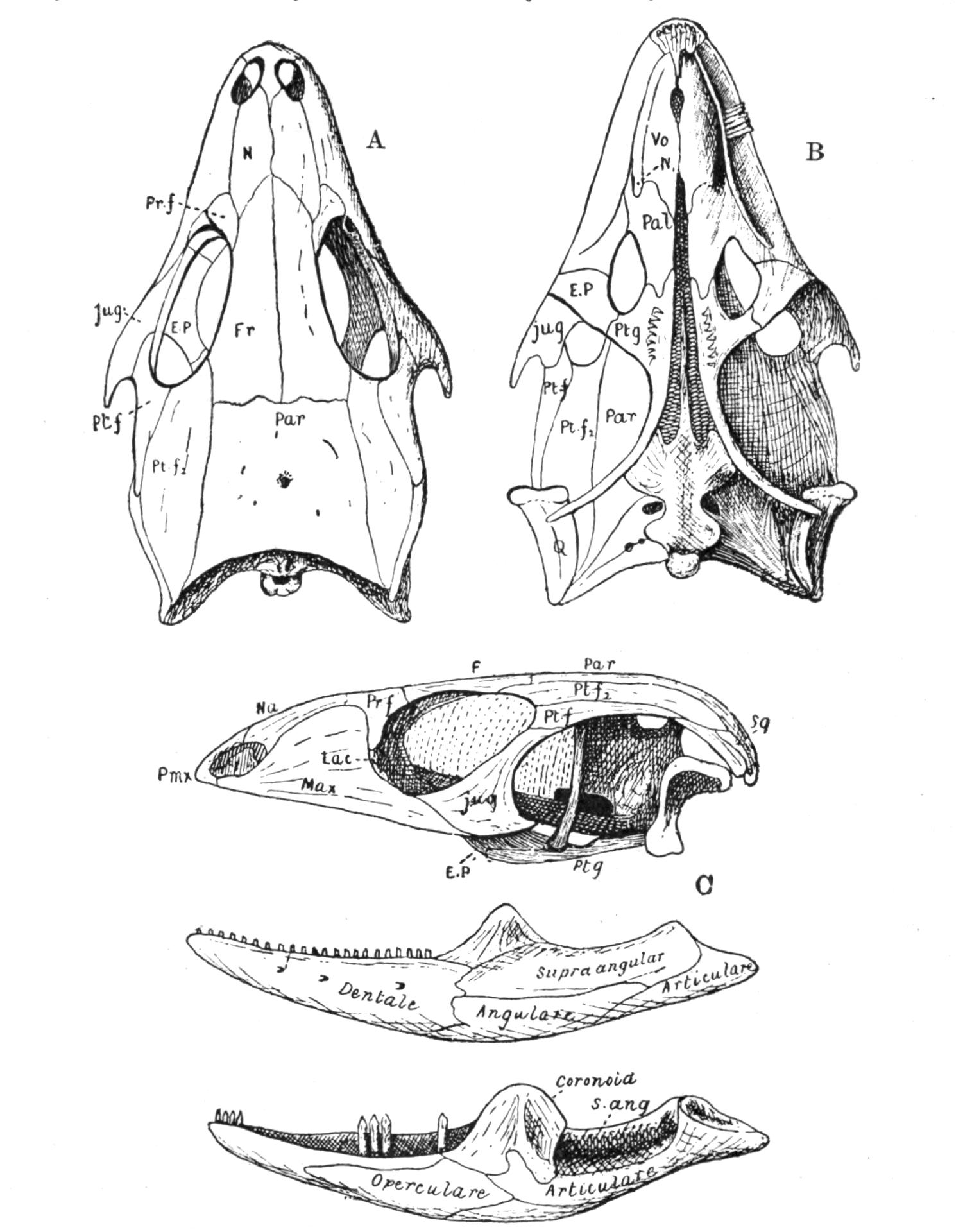
Fig. 142.–Skull and lower jaw of Lacerta viridis. A, Dorsal view; B, ventral view; C, from the left side; D, right half of the lower jaw, from the inner side, with some of the pleurodont teeth. E.P, Ectopterygoid; F, Fr, frontal; jug, jugal; Lac, lacrymal; Max, maxillary; N, Na, nasal; N1, in B, inner narial opening; Pal, palatine; Par, parietal; Pmx, premaxillary; Pr.f, prefrontal; Pt.f, postorbital; Pt.f2, postfrontal; Ptg, pterygoid; Q, quadrate; S.ang, supra-angular; Sq, squamosal; Vo, vomer.
The latter is always well marked off from the neck. The postorbital arch is complete. The temporal region is completely roofed over by bones dorsally, chiefly owing to the size of the postfrontal (Fig. 142, pt.f2) which fills the space between the parietal and the squamoso-postorbital bridge, thus abolishing the supra-temporal fossa. The squamosal is very small, placed between the postfrontal (pt.f2), the lateral occipital and the supratemporal. The large jugal and the quadrate are not connected with each other. The columella cranii is well developed. The infra-orbital fossae are surrounded by the palatines, pterygoids, ectopterygoids, and maxillaries. The palatines and pterygoids remain separated in the middle line. The pterygoids frequently carry little teeth. The other teeth are typically pleurodont, hollow, slightly curved, and bi- or tri-cuspid.
The skin covering the body, the legs, and the tail is devoid of osteoderms. The scales on the dorsal surface vary much in size, from large, strongly keeled scales to tiny granulations. Those of the ventral surface are large, broader than long, and are frequently arranged in regular transverse and longitudinal rows. The tail, generally long and pointed, is very brittle. All the sense-organs are well developed. The tympanum is exposed. The tongue is deeply bifurcated, narrow, flat, and covered with scale-like papillae.
Various Lacertidae, especially some of those genera which live and dig in the sand, have a transparent disc in the middle of the lower eyelid, so that they can see while the eye itself is protected. This is for instance the case in some specimens of the Indian and African Eremias. In the Indian genus Cabrita the transparent disc is very large, and in Ophiops, which inhabits sandy stretches from North Africa to India, the lower eyelid is fused with the rim of the much-reduced upper lid, and forms a large transparent window.
The Lacertidae or True Lizards comprise nearly twenty genera, with about one hundred species, and are typical of the Old World, being found in Europe, Asia, and Africa, but not in Madagascar nor in the Australian region. They are most abundant in Africa. Their northern limit coincides fairly closely with the limit of the permanently frozen under-ground. This is indicated in the map (Fig. 143) by the dotted line. All the Lacertidae live upon animal food, chiefly insects, and after them worms and snails; but the larger lizards take what they can master, frequently other lizards, and even younger members of their own kind. Many of them love sugar, which they lick, and all require water. They are all terrestrial, preferring, according to their kind, such localities as yield them their particular food.
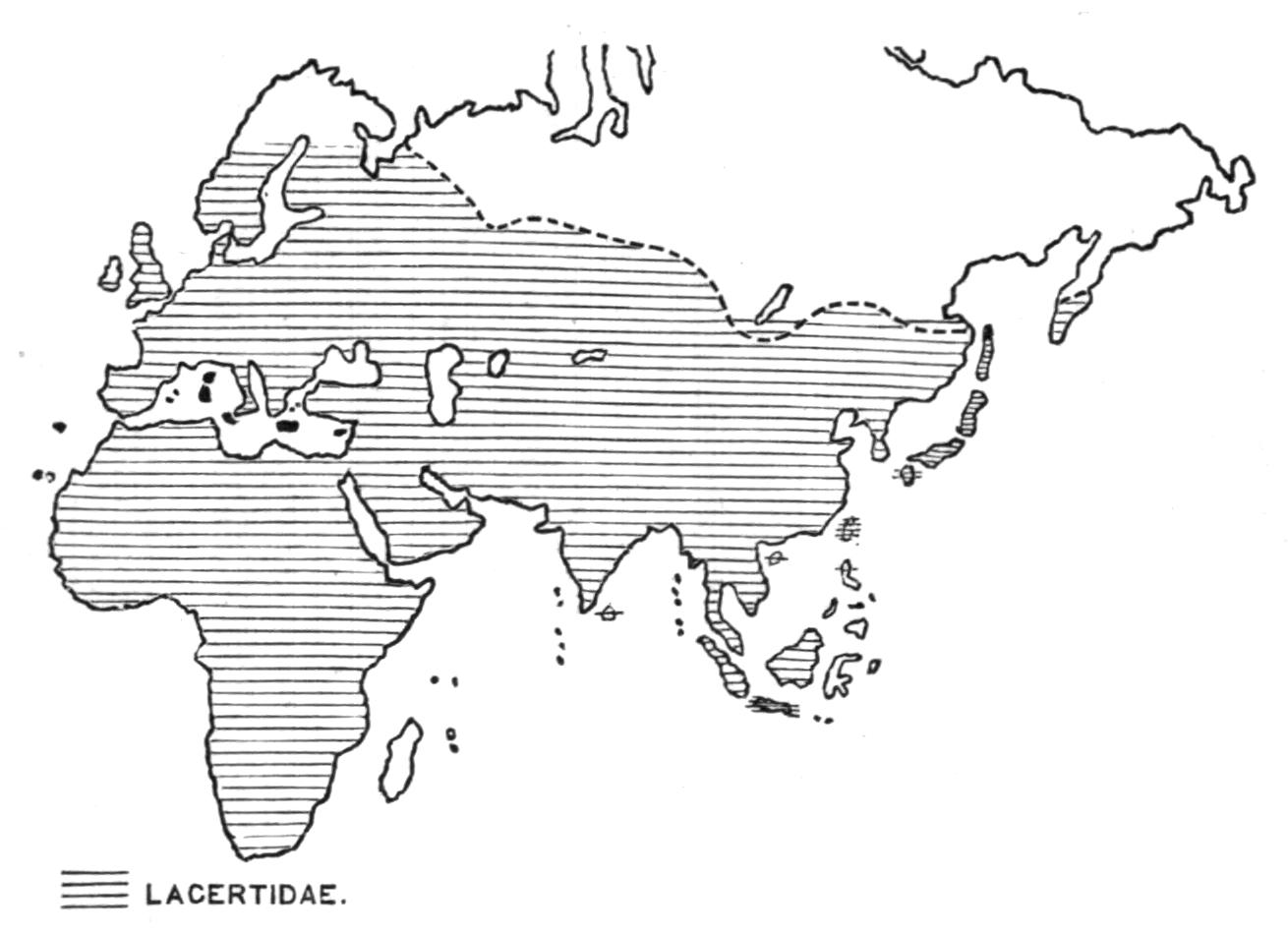
Fig. 143.–Map showing the distribution of the Lacertidae.
Sunshine and warmth make a marvellous change in the same individual, which on dull, rainy, or cold days lies in its hole, or shows only sluggish movements. Their sense of locality is great, or rather each individual inhabits one place, of which it knows every nook and corner, cranny, tree, and bush. It has its favourite hole to sleep in, a stone, the branch of a tree, or a wall to bask upon, and when disturbed or chased it makes with unerring swiftness for a safe spot to retire into. The same lizard, when once driven away from its own locality, seems to lose all its presence of mind, flounders about, and is comparatively easily caught. Most lizards are extremely curious, although shy, and this state of their mind can be made use of by those who want to catch them without injury, and above all without getting the animal minus the brittle tail. This safe way of catching lizards consists in taking a thin rod with a running noose of thread at the end, in drawing the latter over the lizard's head, and then raising it. The little creature does not mind the rod in the least; on the contrary, it watches it carefully, and often makes for the thread. The boys in Southern Italy have improved upon and simplified this mode of catching lizards by bending the end of a wisp of grass into a noose, and covering the latter over with a thin film of saliva. The shiny film, like a soap-bubble, is sure to excite the curiosity of the creature. The late Professor Eimer[165] refers to this practice as carried out by the children of two thousand years ago, and he sagaciously explains that the beautiful statue of the so-called Apollo Sauroctonos represents a boy who is in the act of noosing the little lizard on the tree.
Lacerta.–A row of enlarged scales forms a distinct collar across the ventral half of the neck, in front of the chest. The scales on the back are much smaller than those on the tail, which is long, round, and pointed. The digits have smooth, tubercular lamellae on the under surface. Femoral pores are well marked. This genus, with about twenty species, ranges through Europe, Northern and Western Asia, and Africa north of the Equator.
L. vivipara, the Common English Lizard, has a very wide range, through Northern and Central Europe and Siberia to the Amoor country and the Island of Saghalien. It occurs throughout Great Britain, even in Ireland, where it is the only species of reptile, occurring, for instance, in the County of Meath and in the south-eastern counties, e.g. Waterford. It does not occur south of the Pyrenees or south of the Alps. The supra-ocular and the supraciliary scales are in contact with each other, not being separated by a series of little granules. Normally there is a single postnasal and a single anterior loreal shield. The ventral scales are arranged in six or eight longitudinal series, of which the second series on each side from the median ventral line is the largest. The coloration of this species is subject to much variation. The general colour of the adult is brown or reddish above, with small darker and lighter spots; many specimens have a blackish vertebral streak and a dark lateral band edged with yellow. The under parts are orange to red in the male, with conspicuous black spots; yellow or pale orange in the female, either without or with scanty black spots. The newly-born specimens are almost black. The males are slightly smaller than the females; males of a total length of 6 inches, and females 7 inches long, may be considered rather large specimens.
This lizard is, as the specific name implies, viviparous, i.e. the six to twelve young burst the eggs immediately after they have been laid; sometimes the mother has to retard the laying, in which case the young are born free. The female does not make a nest, but simply deposits her offspring on the ground and leaves the young to their fate. For the first few days the little ones, which scarcely measure three-quarters of an inch in length, remain almost motionless between leaves or in cracks of the ground, and they do not take any food. They grow, however, quickly, living upon the remains of the yolk which has slipped into their body. Their first food consists of Aphides and similar tiny insects.
The Common Lizard prefers moist localities and is very hardy. It extends northwards to Archangel, and in the Alps it ascends to nearly 10,000 feet above the level of the sea. However, on the approach of the cold season, in the month of October, it withdraws into its winter quarters, frequently in company with many of its own kind.
L. agilis, the Sand-Lizard, has nearly the same wide range as L. vivipara, except that it does not go so far north and does not extend eastwards beyond Central Siberia. It is absent in Ireland and Scotland, while in England it is restricted to the southern half.
The characters which distinguish the Sand-Lizard from L. vivipara are few, although the majority of the specimens of either kind are very distinct in their coloration, and L. agilis is strictly oviparous, depositing its eggs in the ground, under leaves, in heaps of weeds and similar places. The Sand-Lizard has usually a single postnasal and two superposed anterior loreals, the three shields forming a triangle. The temples are covered with flat scales, two or three of which are enlarged and in contact with the parietals, but there is no tympanic scale.
The coloration is subject to much variation, local as well as individual. As a rule the Sand-Lizard gives the impression of being striped longitudinally, the striation being caused by rows of dark and white spots and patches along the sides of the back, flanks, and tail. In the male a more or less pronounced green, in the female brown and grey are the prevailing ground-colours. A typically coloured male during the breeding season is grass-green on the sides and suffused with green on the yellow under parts; the sides are dotted with black, with whitish eye-spots. The under parts are spotted with black. The adult female is brown or grey above, with large dark brown, white-centred spots, which are arranged in three rows on each side. The under parts are cream-coloured, with or without black specks. The young are grey-brown above with white, black-edged spots; the under parts are whitish. Total length of the adult up to 8 inches. The male is a little smaller than the female but has a relatively longer tail, a little less than half the total length.
The Sand-Lizard is easily kept in captivity, and lives for years if allowed a variety of food and proper places to hibernate in. It pairs in the spring, in England in May or June; the white, parchment-like eggs, numbering five to eight, are hatched in the following July or August.
L. viridis, the Green Lizard, inhabits Southern and Middle Europe and South-Western Asia. The general colour of this beautiful lizard is emerald-green above, changing into greenish yellow on the flanks and into yellow on the belly. The throat, especially in the males during the breeding season, is blue. The upper parts are frequently speckled with black. The young are brown or green above with one or two yellowish lateral stripes, which persist in some adult females. There are usually two superposed postnasal shields. The semilunar collar on the neck is well pronounced, and there is usually a distinct gular fold. The tail is often very long, especially in the males, sometimes nearly three-quarters of the total length, which in very large males reaches 16 or 17 inches. The females do not quite reach this length.
The Green or Emerald-Lizard prefers rocky localities, from the sea-level, as for instance in Jersey, up to a height of several thousand feet. It is extremely swift and can climb trees, which it sometimes resorts to when chased. When hard pressed it takes tremendous leaps down to the ground, marvellously enough without injury to body or tail, which latter is otherwise very brittle. They pair in the spring or early summer after much fighting between the males; the eggs, to the number of about ten, are whitish and are deposited a month later. The young are hatched after another four weeks.
This beautiful lizard does not keep well in captivity, although it becomes very tame; it eats meal-worms, snails, earth-worms, and insects, especially butterflies, but it sickens after the first winter even if it has been allowed to hibernate.
In Portugal and Spain L. viridis is represented by a slightly different kind, L. schreiberi, the chief interest of which lies in the fact that it approaches L. ocellata in several respects. The occipital shield is large and is usually broader than the interparietal. The dorsal scales are smaller, and there are eight well-developed rows of ventral scales. Instead of being uniformly green, the upper parts are usually spotted and vermiculated with black; sometimes, especially in the females, the black spots have a white ocellus in the centre. The under parts are yellowish, with or without black spots. The throat is blue. The young look very different. They are olive-brown above with large yellow, or bluish-white, black-edged ocelli on the side of the head and body.
Other forms, perhaps of sub-specific rank, approaching L. ocellata, occur in the Balkan Peninsula, where, for instance in Dalmatia, the typical L. viridis attains its most beautiful development.
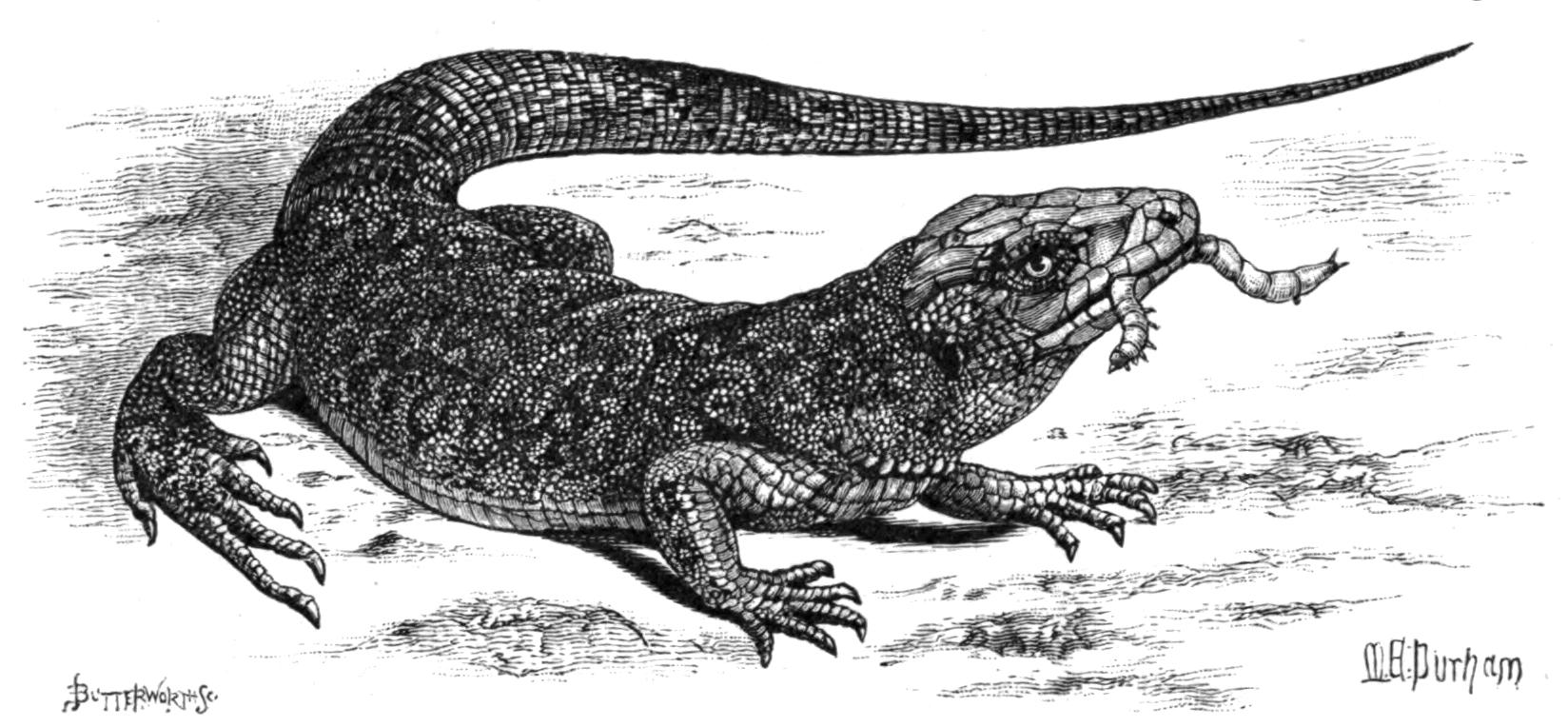
Fig. 144.–Lacerta ocellata (the Eyed Lizard). × ⅓.
L. ocellata, the Eyed Lizard, inhabits Spain and Portugal, extending northwards into the South of France and into the Riviera, southwards into Morocco and Algeria; these southern forms (L. pater and L. tangitana) approach L. viridis. The Eyed Lizard is green or dark olive above, with black or yellowish dots, which are sometimes combined into a kind of network pattern. The under parts are uniformly greenish yellow. The sides of the body are adorned with about two dozen blue, black-edged spots or "eyes." The intensity of the blue and the depth of the green ground-colour vary much according to sex, time of the year, and state of health. Males during the breeding season are most beautiful and brilliant. The occipital shield is broad; there are two superposed nasal but no tympanic shields. The supraoculars are separated from the supraciliaries by a series of granules. The collar is well marked, but not the gular fold. The dorsal scales are minute and granular; the ventral shields are arranged in eight or ten longitudinal rows.
The "Eyed Lizard" reaches a considerable size, especially the males, which develop a very strong and thick head, and are much more robust and powerful than the more slender females. Old males reach a length of 2 feet, two-thirds of which length belong to the tail; but the latter varies much, even if it has never been broken and renewed.
The Eyed Lizard keeps extremely well in captivity, and in this respect is unlike the Green Lizard. A case has been recorded of its living thirteen years. This species is very intelligent. Although at first ferociously wild and biting furiously, these lizards soon become tame and take food regularly. One of my own, a half-grown male from Northern Spain, about one foot in length, made its home in a little niche of the greenhouse-wall, whence it emerged regularly to take the offered food from my hand. It soon knew the whole place thoroughly, making use of the creepers whilst scaling up to its retreat, jumping over certain gaps, descending to the ground at certain spots, basking on certain stones, invariably in the same methodical way. In the month of October it retires into the ground on the coolest side of the greenhouse, and although the latter is well warmed, the lizard remains invisible until the next February or March, when on some fine day it is rediscovered basking upon exactly the same stone where it had been seen five months before. The only drawback in connexion with keeping this kind of lizard in company with other creatures is their voraciousness; since large, fully adult specimens attack and eat any other small lizard, slow-worm, or snake they can find. They also take mice. The eggs are often deposited in hollow trees.
L. muralis, the Wall-Lizard, is very common in Southern Europe, Asia Minor, and Northern Africa. Northward it extends into Belgium and into South Germany. In the Iberian Peninsula it ascends up to 5000 or 6000 feet above the level of the sea. This graceful little creature, with an average length of 6 to 8 inches, is easily recognised by the series of granules between the supraocular and supraciliary scales and usually by having only six rows of ventral scales. The great variety in coloration has given rise to the establishment of many races, varieties, and sub-species. In the typical forms the upper parts are brown or greyish, with blackish spots or streaks, sometimes with a bronzy greenish sheen. The under parts are white, yellow, pink, or red, either uniform or, especially in the males, with large black spots. The lateral rows of ventral shields are frequently blue. The colour-varieties are almost endless. One of the most noteworthy is that described as var. coerulea by Eimer; this, confined to the Faraglione Rocks near Cápri, is blackish above, like the rock, and sapphire-blue below. Similarly coloured specimens, var. lilfordi, occur on some of the rocky islets of the Balearic Isles.
The Wall-Lizard deserves its name, since in the Mediterranean countries there is scarcely a wall on which these active lizards do not bask or run up and down, often head downwards, in search of insects. They are oviparous. The hibernation is short and not very deep, since these lizards can sometimes be seen basking on sunny winter days before their regular appearance in the early spring.
Psammodromus, with a few species in South-Western Europe, notably in the Iberian Peninsula and in North-Western Africa, has no distinct semilunar collar, but has a short fold in front of each arm. The back is covered with large, rhombic, strongly keeled and imbricating scales. The lateral scales pass gradually into the ventrals, which are smooth and arranged in six longitudinal rows.
P. hispanicus is bronzy brown above, with small black and white specks, and with one or two longitudinal streaks on each side. The under parts are white. Total length about 5 inches. Although also found inland, this species prefers sandy dunes, studded with prickly and scanty vegetation. It runs very fast and digs itself rapidly into the sand when pursued. When caught it either utters a faint cry like "tsi-tsi," or it feigns death. The pairing takes place in June; half-a-dozen eggs are laid about eighteen days later, deeply imbedded in the warm sand, and they are hatched in eight weeks. The eggs are said to grow[166] after they have been laid from 13 by 7 mm. to 17-20 by 10-11 mm. The newly hatched little creatures measure about 2 inches in length, more than half of which belongs to the tail.
P. (Tropidosaura) algirus has the same range as P. hispanicus, but grows to 10 inches in length, and is much more beautifully coloured. The upper parts are bronzy brown with one or two golden, dark-edged, lateral streaks; the under parts are whitish; the male has one or more blue-eyed spots above each shoulder.
Acanthodactylus is distinguished by the laterally fringed digits. This genus ranges throughout Northern Africa to the Punjab. One species, A. vulgaris, extends into Spain and Portugal. The dorsal scales are small and almost smooth, but those on the tail are strongly keeled; the ventrals are much broader than long, and are arranged in eight to ten rows. The fringes on the digits are but feebly developed in the shape of lateral denticulations. The adults are grey-brown with faint longitudinal stripes, and with more conspicuous black and pale spots; in the breeding season larger blue-eyed spots appear on the sides near the limbs. The tail is often pink, especially on the under surface. Total length about 7 inches.
Fam. 12. Gerrhosauridae.–Pleurodont African Lacertidae with osteoderms on the head and body.
This family is intermediate between the Lacertidae and the Scincidae. The tongue is constructed like that of the Lacertidae, but is only feebly nicked anteriorly. Dermal ossifications roof over the temporal region, and femoral pores are present. On the other hand, the osteoderms, which cover the whole body, are in their structure and arrangement typically Scincoid. The tail is long and fragile. A lateral fold is usually present. The limbs are sometimes reduced to useless stumps. The few genera and species of this family are strictly confined to the African sub-region, being found in the whole of Africa south of the Sahara, and in Madagascar.
Gerrhosaurus, with a strongly developed lateral fold and complete limbs, occurs in Africa. G. flavigularis, of South Africa, has a total length about one foot.
Tetradactylus, of South Africa, has also a strong lateral fold, but the limbs are either very short and pentadactyle (T. seps), or tetradactyle, or they are minute pointed stumps, as in T. africanus.
Fam. 13. Scincidae.–Pleurodont lizards with strongly developed osteoderms on head and body, with very feebly nicked, scaly tongue, with complete cranial arches, and with separated premaxillaries.
The temporal region is covered over, as in the Lacertidae, with strongly developed, bony, dermal ossifications. Similar osteoderms underlie the scales which cover the body and tail. The tongue is relatively short, not forked behind, and but very feebly nicked at the tip; it is covered with scale-like papillae. Femoral pores are absent.
All the Skinks prefer dry, sandy ground, in which they not only burrow, but move quickly about, either for protection or in search of their animal food. In connexion with this sand-loving and at least temporary subterranean life stands the frequent reduction of the limbs. Every stage from the fully developed and functional pentadactyle limb to complete absence of limbs is represented. There are species within the same genus with five, four, three, or two fingers or toes. There are Skinks without fore-limbs, but with vestigial hind-limbs, and vice versa. The interesting point is that these reductions do not indicate relationship within the family, but have happened independently. They are impressive illustrations of convergent retrogressive evolution.
Ablepharus, widely distributed in the Old World, has the lower eyelid transformed into a transparent cover, which is fused with the rim of the reduced upper lid, exactly as in the Lacertine genus Ophiops.
All the Scincidae seem to be viviparous, some of them, e.g. Trachysaurus, in the strict sense of the word, since the hard or parchment-like egg-shell has been dispensed with.
The family contains about four hundred species, which have been arranged in nearly thirty genera, many of them on fanciful grounds. The family is cosmopolitan, but reaches its greatest diversity in numbers and forms in the tropical parts of the Old World, especially in the Australian region, inclusive of the islands of the Pacific. America, notably South America, has the smallest number.
Trachysaurus, with one species, T. rugosus, inhabits the whole of the Australian continent. It is easily recognised by the large and rough scales, and the short and broad stump-like tail. It is dark brown above with yellowish irregular markings; the under parts are yellowish, marked with brown. Embryos of this species have yellow transverse bands on the back, but these often fade away before birth. The creature is strictly viviparous, the egg-membrane being very thin, and the two or three embryos are ripened in uterus-like dilatations of the oviducts. The period of gestation is about three months, and the birth takes place, in South Australia, about April. According to Fischer[167] this species, which is often in the market, is easily kept. It requires warmth, sand and stones for basking, and water, in which it soaks itself preparatory to the shedding of the skin, which takes place half-a-dozen times in the year, and is a slow process, requiring eight to ten days. The food consists chiefly of worms, lizards, and snakes, but meat, cabbage, and lettuce are also taken. The total length is about one foot.
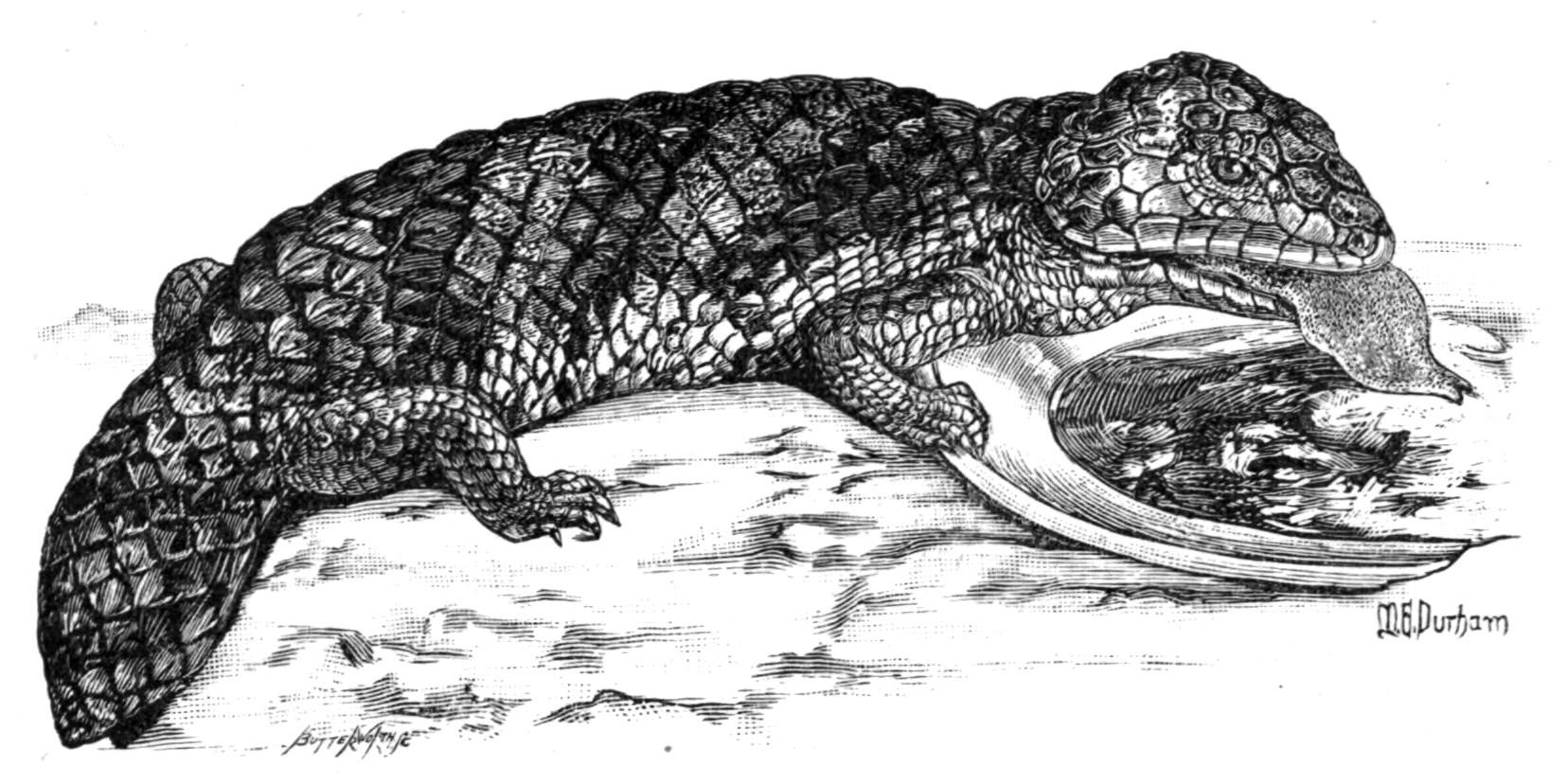
Fig. 145.–Trachysaurus rugosus. × ⅓.
Cyclodus s. Tiliqua, of Australia, Tasmania, and the Malay Islands, has stout lateral teeth with spherical crowns. The imbricating, cycloid scales of the body and the rather short but pointed tail are quite smooth and shiny. C. gigas, of New Guinea and the Moluccas, reaches a length of nearly 2 feet. The general colour is brownish yellow, with broad, dark bands across the body and tail.
Scincus, of North Africa, Arabia, Persia, and Sindh, has pentadactyle limbs, with laterally serrated digits. The eyelids are well developed, but the ear is hidden under scaly flaps. S. officinalis, of the Sahara and of Egypt, grows to about 8 inches in length. The snout is peculiarly shaped, cuneiform. The eyes are very small. The scales of the body are perfectly smooth; the sides of the belly are somewhat angular. The whole shape of the creature, the scales, and the digits are adapted to burrowing and moving quickly through the loose sand. The general colour is yellowish or brownish above, each scale with small brown and whitish spots; the under parts are uniform whitish. The young are quite beautiful, being uniform pale salmon-coloured above, silvery white below. When a little older, yellow spots appear on the flanks and grey bands across the back. These Skinks live in the absolutely dry reddish-yellow sand of the desert, in which they may almost be said to swim about, so swift and easy are their movements. They live on insects, while in their turn they are eaten by snakes, and above all by the Varanus lizards.
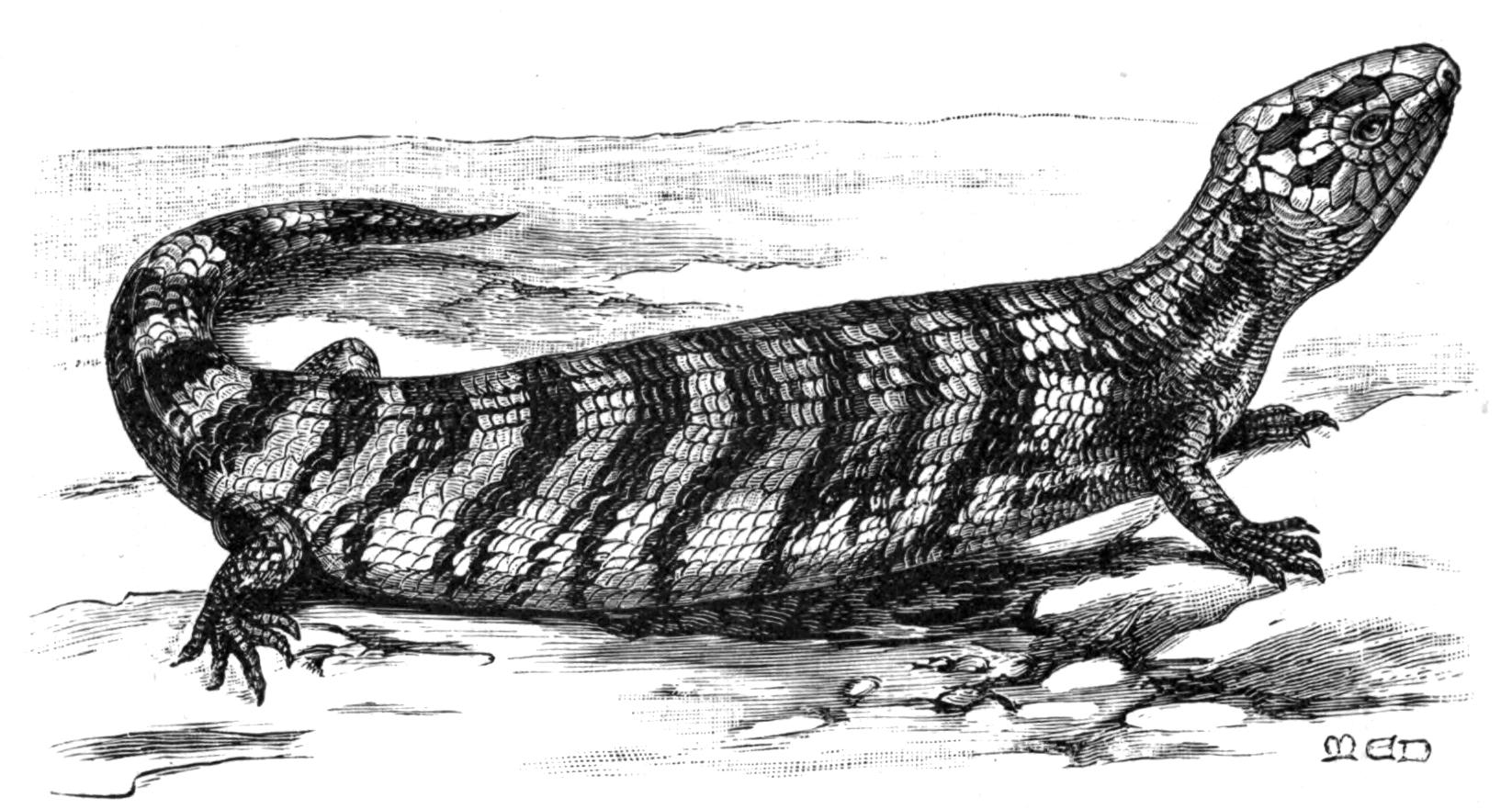
Fig. 146.–Cyclodus gigas. × ¼.
Of Mabuia with about forty species, in the whole of Africa, Southern Asia, and in Tropical America, we mention only M. (Euprepes) vittata, on account of its partly semi-aquatic life, a very rare condition among Scincidae. This creature, about 7 inches long when full grown, frequents damp localities in Tunis and Algeria, where the French call it "Poisson de sable." It often sits on the floating leaves of Nymphaea alba, and dives into the water in order to escape. Its proper element is, however, the sand, and for the night it retires under stones. The general colour is olive brown with a lighter vertebral band and two narrow whitish lines on each side, sometimes edged with black. The under parts are yellowish or greenish white.
Chalcides s. Seps s. Gongylus, of the Mediterranean countries also occurs in South-Western Asia. The lower eyelid has a transparent disc. The body is much elongated, and is covered with smooth shiny scales. The limbs are very short, or reduced to mere vestiges.
Ch. ocellatus, of the Southern Mediterranean countries, occurring also in Malta and Sardinia, reaches about 10 inches in length. The snout is conical, the ear-opening a small slit or hole. The limbs have five fingers and toes. The under parts are uniform silvery white, but the colour of the upper parts is very variable, mostly olive brown with black spots and irregular cross-bars, or with dark and light spots; sometimes uniform bronzy brown with a light upper and a black lateral band. This Skink seems to have no fixed abode, but digs itself into the sand wherever it wants to hide. The skin is not shed in flakes, but, as in most Skinks, it peels off by a process of gradual desquamation. Fischer's specimens paired towards the end of December. The gestation lasted 56 days, when nine young were born, which measured about 75 mm. or 3 inches; when three weeks old they had increased to nearly double this length.
Ch. lineatus, of Spain and Portugal, and of the South of France, like Ch. tridactylus of Italy and North-West Africa, has only three fingers and toes. The fore-limbs are only about one quarter of an inch in length in large specimens of 10 inches total length; the hind-limbs are a little longer. The general colour is bronzy olive or brown above, in the former species with nine or eleven darker longitudinal streaks; uniform, and with an even number of streaks in the latter species. Ch. bedriagae, of Spain and Portugal, has mostly five fingers and toes, and the limbs are relatively longer in this smaller species; but it is a question if these and other species of this genus are not to a great extent simply individual variations, since the reduction of the limbs and toes seems to be a very recent feature. Ch. guentheri, of Palestine, otherwise in every respect like Ch. tridactylus, but reaching a length of more than 14 inches, has the limbs reduced to tiny conical stumps without a trace of separate digits.
I have caught Seps accidentally under stones or pieces of bark in sandy districts. On the western coast of Galicia and Portugal, close to the sea, they frequent the gorse-bushes, on which they can be seen basking, provided they are approached stealthily. They disappear on the slightest alarm, almost swimming, as it were, with great agility through the prickly cover, and then hiding and wriggling through the loose sand between the roots.
The following five "families" are composed of degraded forms of various descent. Most of them lead a burrowing, subterranean life, in adaptation to which the body has become snake-shaped or worm-like. The fore-limbs are entirely absent, except in Chirotes; the hind-limbs are absent, or reduced to small flaps; the girdles are reduced correspondingly. The skull is devoid of postorbital, postfronto-squamosal, supratemporal, and jugal arches. The quadrate bone is mostly immovable. The eyes and ears are concealed, except in the Pygopodidae.
Fam. 14. Anelytropidae.–An artificial assembly of a few degraded Scincoids. The worm-shaped, limbless body is devoid of osteoderms. The tongue is short, slightly nicked anteriorly, and covered with imbricating papillae. Columellae cranii are present. Anelytropsis papillosus in Mexico. Typhlosaurus and Feylinia in South and West Africa.
Fam. 15. Dibamidae, consisting of the genus Dibamus, with D. novae-guineae, in New Guinea, the Moluccas, Celebes, and the Nicobar Islands. The tongue is arrow-shaped, undivided in front, covered with curved papillae. Columellae cranii are absent. The vermiform body is covered with cycloid imbricating scales without osteoderms. The limbs and even their arches are absent, but in the males the hind-limbs are represented by a pair of flaps. Total length of the animal about 6 inches.
Fam. 16. Aniellidae.–The genus Aniella comprises a few small worm- or snake-shaped species in California, which seem to be degraded forms of Anguidae. The eyes and ears are concealed, limbs are entirely absent, the body and tail are covered with soft, imbricating, more or less hexagonal scales. The tongue is villose, smooth, and bifid anteriorly. The teeth are relatively large, few in numbers, recurved, with short swollen bases. The skull, by reduction, approaches the Ophidian type; there is no columella cranii, the postorbital arch is ligamentous, the premaxillary is single, the nasals and frontals remain separate, the pre- and post-orbitals are in contact with each other, excluding the frontal from the orbit.
A. pulchra.–Silvery, the scales edged with brown; back and tail with a narrow, brown, median line. Total length, 7 to 8 inches.
Fam. 17. Amphisbaenidae.–Worm-shaped lizards with the soft skin forming numerous rings, each of which is divided into many little squares, the vestiges of scales which are otherwise restricted to the head. The eyes and ears are concealed. Limbs are absent except in Chirotes, which has short four-clawed fore-limbs. The pectoral arch, and still more so the pelvic arch, are reduced to minute vestiges. The tail is very short. The skull is small, compact, and strongly ossified, in adaptation to the burrowing life, and is devoid of postorbital and postfronto-squamosal arches and of columellae. The teeth are either acrodont or pleurodont. The tongue is slightly elongated, covered with scale-like papillae, and bifurcates into two long and narrow smooth points.
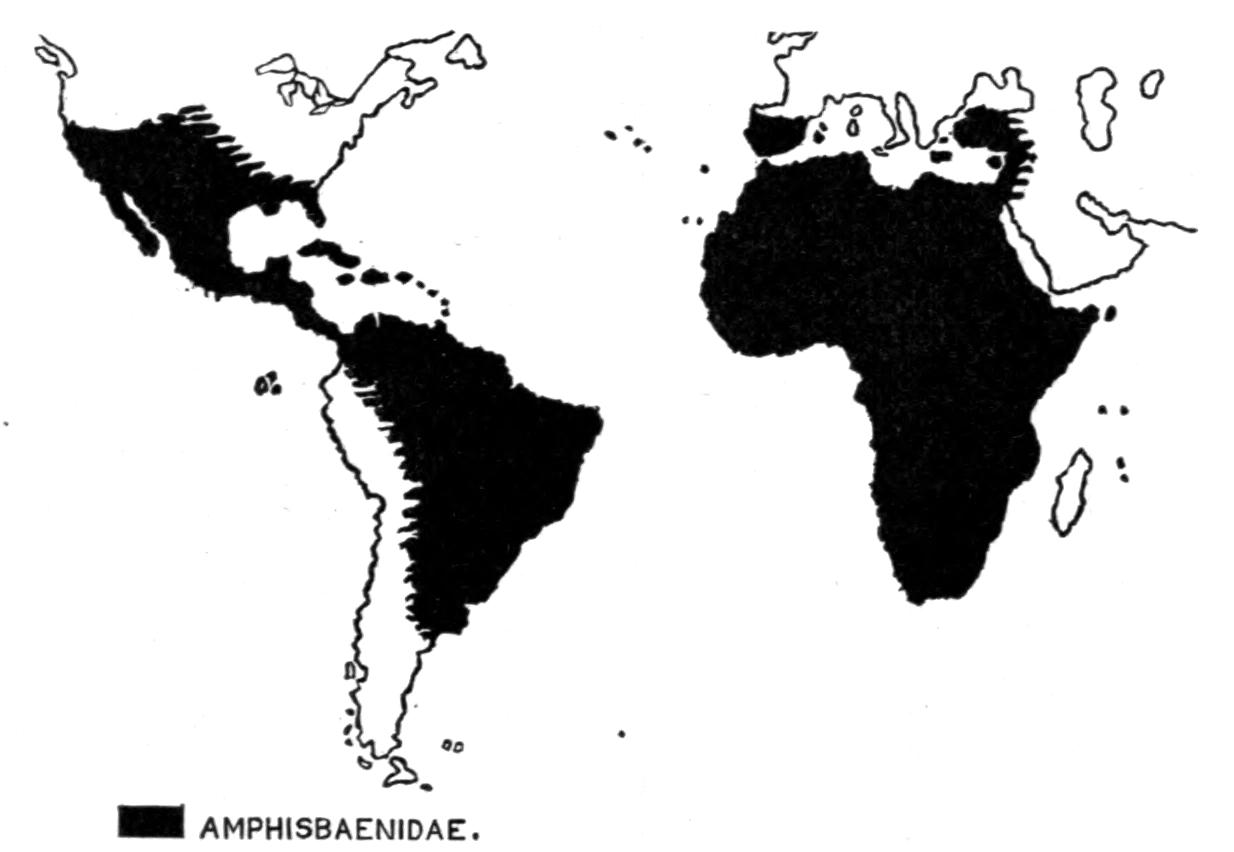
Fig. 147.–Map showing the distribution of Amphisbaenidae.
The Amphisbaenas lead an entirely subterranean, burrowing life, like earth-worms. They are frequently found in ants' nests or in manure-heaps. Their progression is very worm-like, their annulated soft skin enabling them to make almost peristaltic motions and to move backwards as well as forwards. They crawl in a straight line, with slight vertical waves, not, like other limbless lizards or snakes, by lateral undulations. The food consists of worms and small insects. About one dozen genera with more than sixty species are known, most of which inhabit the warmer parts of America, the West Indies, and Africa. Four inhabit Mediterranean countries.
If the tongue and the dentition be taken as indications of relationship, the Amphisbaenidae may perhaps be considered as degraded descendants of Iguanidae, a family which contains various limbless, burrowing, worm-shaped forms. But it is also possible that the Amphisbaenidae are not a natural group. This consideration applies with most force to the genera Amphisbaena and Anops, the various species of which occur in America and in Africa.
Chirotes canaliculatus, the only species of the genus, is the only Amphisbaenid which still possesses fore-limbs. These are short, stout, placed close behind the head, and are provided with four-clawed digits. This species occurs in Mexico and California, is brownish or flesh-coloured, and reaches a length of about 8 inches.
Amphisbaena, with nearly thirty species, in Tropical America and Africa. On account of the short rounded-off head and the almost equally blunt tail these creatures are called by the natives "cobras de dous cabezas," i.e. snakes with two heads, or they are known as "maes das formigas," i.e. mothers of ants, because of their predilection for taking up their quarters in the nests of ants or termites. The scientific name refers of course to their capability of moving forwards and backwards (ἀμφίς, at both ends, and βαίνω, walk).
A. fuliginosa, one of the commonest species in South America and in the West Indies, is chequered black and white. The skin of the body has about two hundred rings, the tail about thirty. Total length between one and two feet. A more or less distinct fold extends along each side of the body from the neck to the tail, at the level where the dorsal scales originally joined the ventral scales.
Blanus is the only genus of the Mediterranean province. B. cinereus, of Portugal, Spain south of the Cantabrian range, Morocco, and Algeria, reaches a length of 10 inches, but such large specimens are rather rare. The general colour of the living animal is pink with a brownish tinge and with minute grey specks. The lateral lines or folds are well marked, and a stronger transverse fold is placed behind the head. The body shows from one hundred and ten to one hundred and twenty-five rings, the tail from twenty to twenty-two; each body-ring contains about thirty little squares or remnants of scales. There are a few pre-anal pores.
I have sometimes found this species in Portugal whilst digging for earth-worms in manure-heaps and similar moist places, where they lead the same life as the worms except that they live upon them and upon insects. When kept dry they become very thin and shrunken, but when put back into moist soil they again become turgid and supple within a short time. Those which I have kept in glass jars filled with rich mould throve very well, living upon the tiny insects and worms which infest such compost soil; they dug long tortuous channels, in which they moved forwards and sometimes backwards, but they never came to the surface.
Fam. 18. Pygopodidae.–Pleurodont, snake-shaped lizards, without fore-limbs, but with the hind-limbs appearing as a pair of scaly flaps.
The shoulder-girdle is much reduced. The hind-limbs, although very small and hidden within the scaly, almost fin-like flaps, still possess five toes. The ischium appears externally as a small spur on either side of the anal cleft. The eyes are devoid of movable lids, remaining open and unprotected; the pupil is vertical. The ear is either concealed or exposed. The tongue is fleshy, slightly forked and extensible. The body is covered with roundish imbricating scales. The tail is very long and brittle. The few genera of this undoubtedly natural family of unknown relationship contain in all about ten species, restricted entirely to Australia, Tasmania, and perhaps New Guinea. Next to nothing is known about their habits, except that some of them eat other lizards.
Pygopus lepidopus is distributed over the whole of Australia. It reaches a total length of about 2 feet, 16 inches of which belong to the tail. General colour coppery grey above, sometimes with several longitudinal series of dark spots.
Lialis burtoni of nearly the same size and equally wide distribution has the hind-limbs reduced to extremely small, scarcely visible, narrow appendages.
Sub-Order 3. Chamaeleontes.–Acrodont Old-World Saurians with a laterally compressed body, prehensile tail, and well-developed limbs with the digits arranged in opposing, grasping, bundles of two and three respectively.
The Chameleons are an essentially African family. About half of the fifty species known inhabit Madagascar, the others the African continent. One, the common Chameleon, is North African, extending into Andalucia; two others occur in South Arabia and Socotra, and only one in Southern India and Ceylon.
This sub-order is well distinguished from all other Saurians by several, mostly unique, characters. The tongue is club-shaped and extremely projectile, to a length equal to that of the body. The head is usually described as forming a casque, with prominent crests and tubercles. There is no tympanum and no tympanic cavity. The parietal bones, united into one, extend backwards far beyond the occiput, and the tip of this projection is met by a much-elongated supratemporal bone, which, partly fused with the squamosal, helps to enclose a huge supratemporal fossa. The latter is widely open behind. The postfronto-squamosal arch and the postorbital arch are strong. The jugal is widely separated from the quadrate; the latter stands vertically and is not reached by the pterygoid. There is no columella cranii. The pre- and post-frontals often join to form a supra-orbital roof. The nasals are very small and are excluded from the nares, which are bordered entirely by the enlarged prefrontals and by the maxillaries. The premaxillaries are small and carry no teeth. The latter are acrodont, compressed and tricuspid, and are restricted to the maxillaries and mandibles.
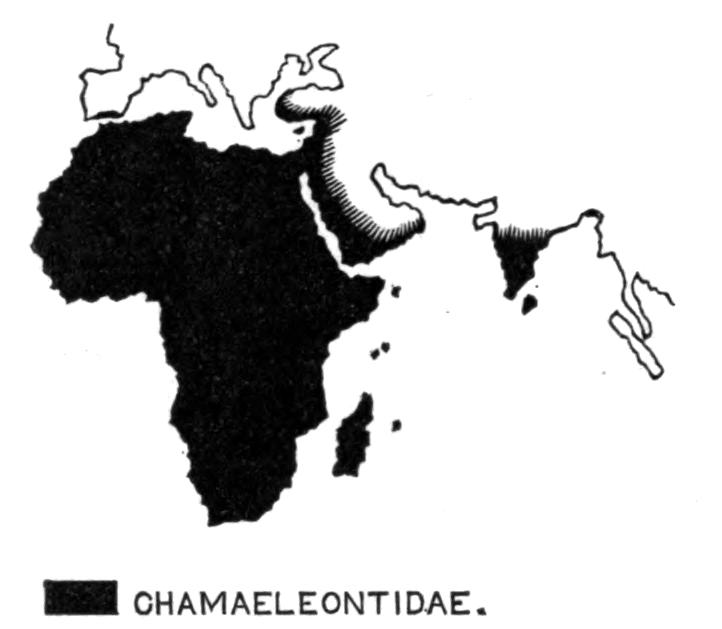
Fig. 148.–Map showing the distribution of Chameleons.
The limbs are peculiar. Not only are they relatively long and very slender, but two digits are permanently opposed to the other three. On the hand the first three fingers form an inner bundle opposed to the outer, or fourth and fifth fingers. On the foot the inner bundle is formed by the first and second, the outer by the other toes. The shoulder-girdle is of the ordinary Saurian type, but there are no clavicles and no interclavicle. The costal sternum is well developed; the ribs posterior to those which meet the sternum are very thin and elongated: they meet and fuse with their fellows in the medio-ventral line. These hoops are not connected with their neighbours in front or behind. The tail is prehensile by being rolled downwards; it is not brittle and is incapable of being renewed. The skin is not covered with scales, but with granules. The eyes are very remarkable. The eyeballs themselves are large, but the eyelids are united into one fold with a small central opening. However, when the Chameleon is asleep the margins of this opening sometimes become more slit-like. The right and left eye can be, and are incessantly, moved separately from each other, and the creature squints terribly. Each eyeball, together with the pin-hole eyelid, is rolled up and down, backwards and forwards, independently of the other eye. This is a unique feature, but it also occurs in people who squint badly. The question "What, and how, do these creatures see?" is therefore quite idle, especially since in reptiles binocular vision does not exist at all and, consequently, cannot be disturbed by squinting.
The tongue has attained an extraordinary development. The tongue proper (Fig. 152) is club-shaped, and is covered with a sticky secretion. The base or root of the tongue is very narrow, composed of extremely elastic fibres, and is supported by a much-elongated copular piece of the hyoid. The elastic part of the tongue is, so to speak, telescoped over the style-shaped copula, and the whole apparatus is kept in a contracted state like a spring in a tube.
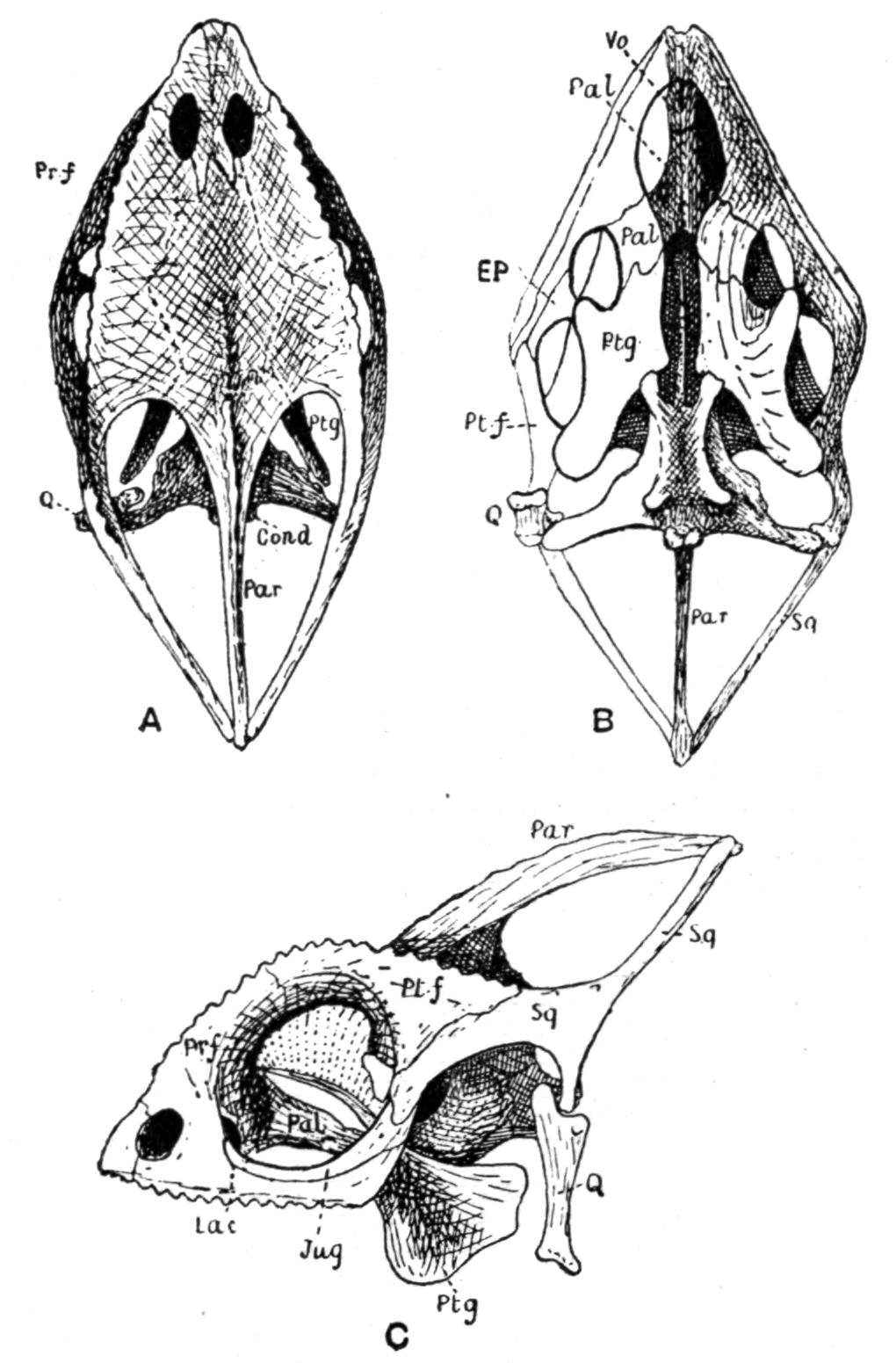
Fig. 149.–A, Dorsal, B, ventral, and C, lateral view of the skull of Chamaeleon vulgaris. × 1. Cond, occipital condyle; EP, ectopterygoid; Jug, jugal; Lac, lacrymal; Pal, palatine; Par, parietal; Prf, prefrontal; Pt.f, postfrontal; Ptg, pterygoid; Q, quadrate; Sq, squamosal; Vo, vomer.
A pair of wide, very elastic blood-vessels and special elastic bands extend from the base into the thick end of the tongue. By rapidly filling the apparatus with blood, and by the action of certain hyoid muscles, the spring is, so to speak, released, and the momentum gained by the thick and heavy club-shaped tongue proper projects it far out of the mouth. The sticky end of the club shapes itself into an upper and a lower flap, which partly envelop the prey, and the elastic bands of the far-stretched stalk withdraw the whole. The detailed working of this ingenious shooting apparatus is not easy to follow. An ordinary full-grown Chameleon can shoot a fly at the distance of 7 or 8 inches. The whole performance is very quick, lasting less than one second. When the desired object is very near, only 2 or 3 inches off, the Chameleon has a certain difficulty in shooting its prey. The tongue is at first put out slowly, tentatively, the following jerk is feeble, and it seems as if the apparatus refuses to work unless it is allowed to shoot out with full force.
Another remarkable and quite proverbial feature of Chameleons is their changing of colour. This is by no means restricted to Chameleons, which indeed are rivalled in this respect by various other lizards, for instance by the Indian Agamoid Calotes and by the American Ameiva.
The microscopical structure and mechanism of the colour-changing apparatus is, in Chamaeleon vulgaris, as follows:–
The epidermis is colourless, and the Malpighian layer is not particularly modified except that in it are imbedded some iridescent cells, with very minute wavy striation on their surface. The cutis contains in its leathery tissue a great number of small and closely packed cells, filled with strongly refractive granules, chiefly guanine-crystals. These cause the white colour by diffuse reflection of direct light. The cells nearer the surface are charged with oil-drops and appear yellow. Large chromatophores are imbedded in the white granular mass, most of them with blackish-brown, others with reddish pigment, the granules of which are shifted up and down, towards and away from the surface of the cutis, in ramified branches of the chromatophores. When these branches are contracted the pigment is conveyed back into the bulbous basal portion of the chromatophores and the skin appears yellow or white. When all the pigment is shifted towards the surface of the cutis, the animal looks dark, sometimes black. In intermediate conditions the light is changed into green by diffraction through the yellowish upper strata and by the finely striated iridescent cells of the Malpighian layer. Those parts into which the chromatophores do not send pigment appear as yellow spots. The chromatophores are to a great extent under control of the will of the Chameleon, but external stimuli, as heat and cold and other reflex actions, also play a great part in their movements.
For further information on this subject see Brücke,[168] P. Bert,[169] Pouchet,[170] Thilenius,[171] and lastly Keller,[172] who has written a very long but rather confused account.
The process of moulting is curious. When the Chameleon is in good health the whole process is accomplished within a few hours. The skin to be cast off becomes loose and assumes a blistered appearance. Sometimes the creature looks as if it were wrapped up in white, semi-transparent tissue paper. By rubbing against stones, or between the twigs of trees, the skin comes off in large flakes, first on the lips, then on the contorted body, and last on the under surface of the hands and feet. During a rapid and successful moult the changes of colour go on as usual in the new skin. Sometimes large flakes of the old skin remain adherent for days, especially on the top of the head. The moulting takes place several times in one year. One of my Ch. vulgaris moulted in January and September, and then not until June of the next following year. A Ch. pumilus moulted in the months of May, October, and March.
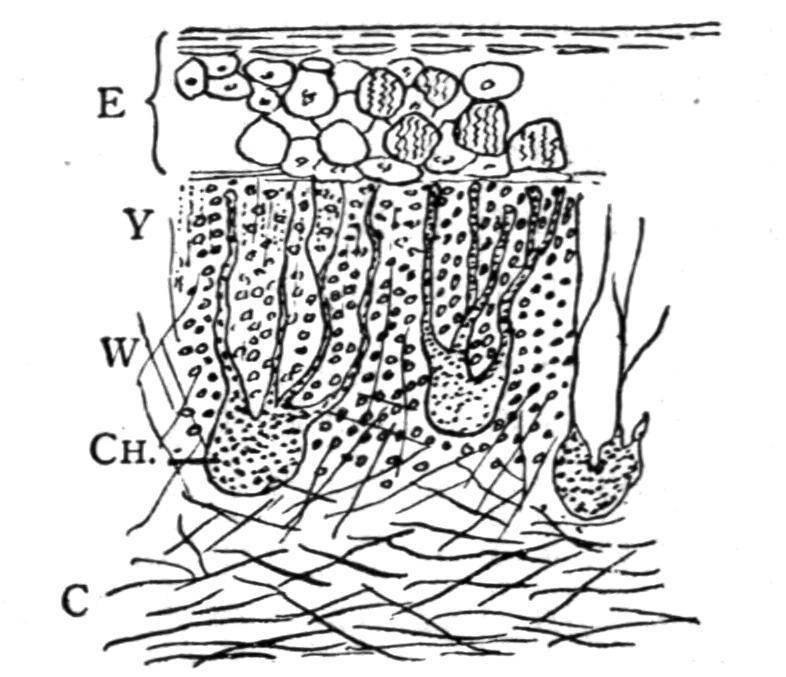
Fig. 150.–Diagrammatic section through the skin of a Chameleon. Highly magnified. C, deeper portion of the cutis; Ch, three chromatophores, in various stages of contraction, filled with black, brown, or reddish pigment; E, epidermis; W, white layer of granules; Y, yellow layer of cells.
When they know themselves to be discovered, Chameleons make themselves as thin as possible by compressing the body or rather the belly. This is done by means of the peculiarly elongated abdominal ribs described above. The whole body is then put into such a position that, by presenting only its narrow edge to the enemy, it has become as little visible as possible. At the same time the Chameleon turns round upon its twig, so that the latter comes to stand between the observer and its own body, which may thereby be completely hidden. When angry, the creature either presents its broadest surface, swaying to the right and left, or it blows itself up and hisses. The lungs are very capacious, and, instead of being bag-shaped, end in several narrow blind sacs which extend far down into the body-cavity, so that not only the chest but the whole body can be blown up.
The usual mode of propagation is by means of eggs, but a few species allied to Ch. pumilus are viviparous. The time of incubation and of gestation is long. For instance, the pairing of Ch. vulgaris takes place in the month of August. The eggs are laid in the last week of October, about fifty to sixty days later. Sometimes, however, the eggs are retained much longer, since I have received specimens with ripening eggs in July which did not lay until the end of October. The eggs are deposited in the ground and are not hatched until the following February or March, i.e. about 130 days later. The new-born little creatures are snowy white, and cannot change or rather assume colour until after the second week.
All Chameleons are insectivorous and require enormous quantities of food, which must be alive to be taken. Most of them prefer Orthoptera, e.g. Locusts and Grasshoppers, and Lepidoptera. They also eat flies, meal-worms, and cockroaches, but their tastes differ not only individually but also temporarily. They require change of diet. One individual will take cockroaches greedily, whilst another of the same kind will rather starve itself than touch one. The same applies to meal-worms. It is a great but common mistake to suppose that Chameleons do not require water. On the contrary they drink regularly and often, generally by licking up drops of water or by scooping them up with their lips, shoving the snout along the edges of wet leaves. It is not too much to say that most Chameleons are short-lived in captivity on account of the want of water. Those which are sold by the dealers are generally in a parched condition. Sprinkling the twigs or leaves of their cage with water works a wonderful change in them; the dull, apathetic-looking creatures drink and drink, revive, assume brighter colours, and will soon take food, which they have until then refused obstinately. Once I have even seen a Chameleon, when put into the greenhouse, make straight for a tank and actually drink in gulps.
After they have fattened themselves in the autumn, Chameleons, at least those of North Africa, withdraw to hibernate in the ground. But nothing is known about how, when, and where they do this, nor is it known if tropical species aestivate during the dry season.
Chameleons are notoriously difficult to keep successfully, whereby we do not mean the keeping for three to six months. This is easy enough, since it takes them several months to die of starvation. The difficulty is to keep them through the winter. To enable them to do this, it is absolutely necessary to fatten them up during the summer and autumn. Otherwise, although kept in a warm place, they are liable to lose their appetite in the autumn, when they become restless, probably with the desire to hibernate. Those few individuals which get over this critical period, say during the month of October, and do not refuse food, are probably safe. But those are doomed which refuse to eat meal-worms or cockroaches or such food as can be procured easily during the winter.
The origin of the Chameleons is unknown. They form only one family, Chamaeleontidae, with between fifty and sixty species, which, with a few exceptions, belong to the genus Chamaeleon.
Ch. vulgaris is the Common Chameleon of North Africa, Syria, and Asia Minor. It occurs also in a few parts of Southern Andalucia, for instance near Jerez, and near Nerja, to the east of Malaga, where it has possibly been introduced. A series of conical, slightly enlarged granules forms a little crest on the median line of the throat. A whitish line, which does not change colour, extends from the chin to the vent. The rest of the skin, with the exception of a median dorsal series of slightly enlarged tubercles on part of the back, is composed of small granules. A small but distinct lobe of leathery skin extends along either side of the occiput towards the posterior end of the median parietal crest. Dead or spirit-specimens are usually pale yellow; living ones are greenish, usually with differently coloured patches on the sides. Exceptionally large males reach a total length of about 9 inches, females reach the length of perhaps a foot, but about half of the total length belongs to the tail.
It is impossible to say what is the colour of this Chameleon, since the same specimen may within a few days appear in half-a-dozen different garbs, not counting minor combinations of colour. After it has been watched for several months, when all its possibilities seem to be exhausted, it will probably surprise us by a totally new combination. Not every specimen changes alike: some keep the same appearance for a long time, others change often; some are partial to specks, others to large patches. In the group of Chameleons shown in Fig. 152 several of the more usual arrangements of colour have been indicated by stippling and various kinds of cross-hatching.
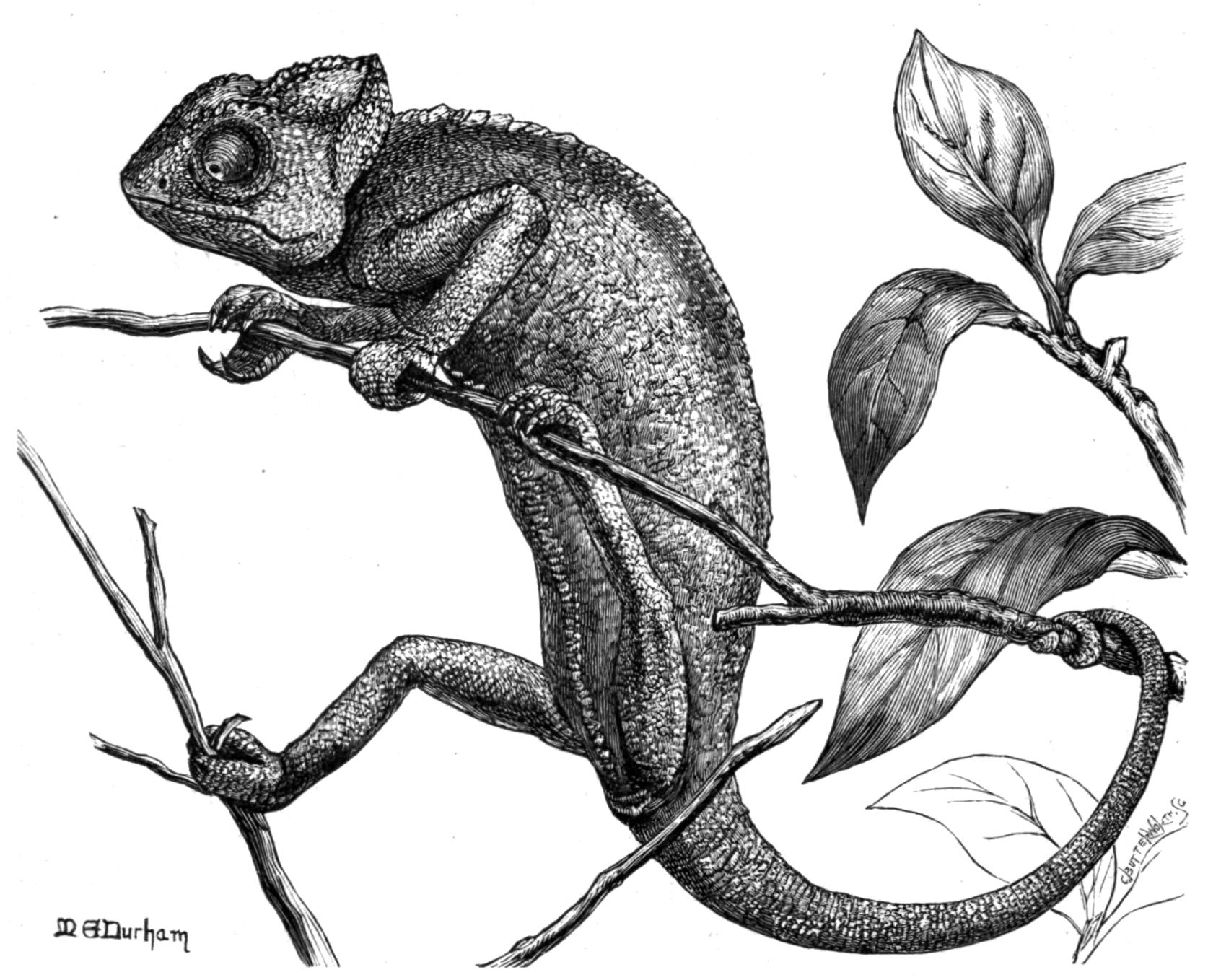
Fig. 151.–Chamaeleon vulgaris. × ⅔.
A represents the usual coloration at night. The whole animal, which has just been stirred up from its sleep in the dark, is cream-coloured, with irregular patches of yellow on the head, the back, the sides of the body, the legs, and the tail.
B has the usual coloration: grey-green, with innumerable small darker specks, with two series of pale brown patches on the sides of the body, and with one patch on the region of the ear.
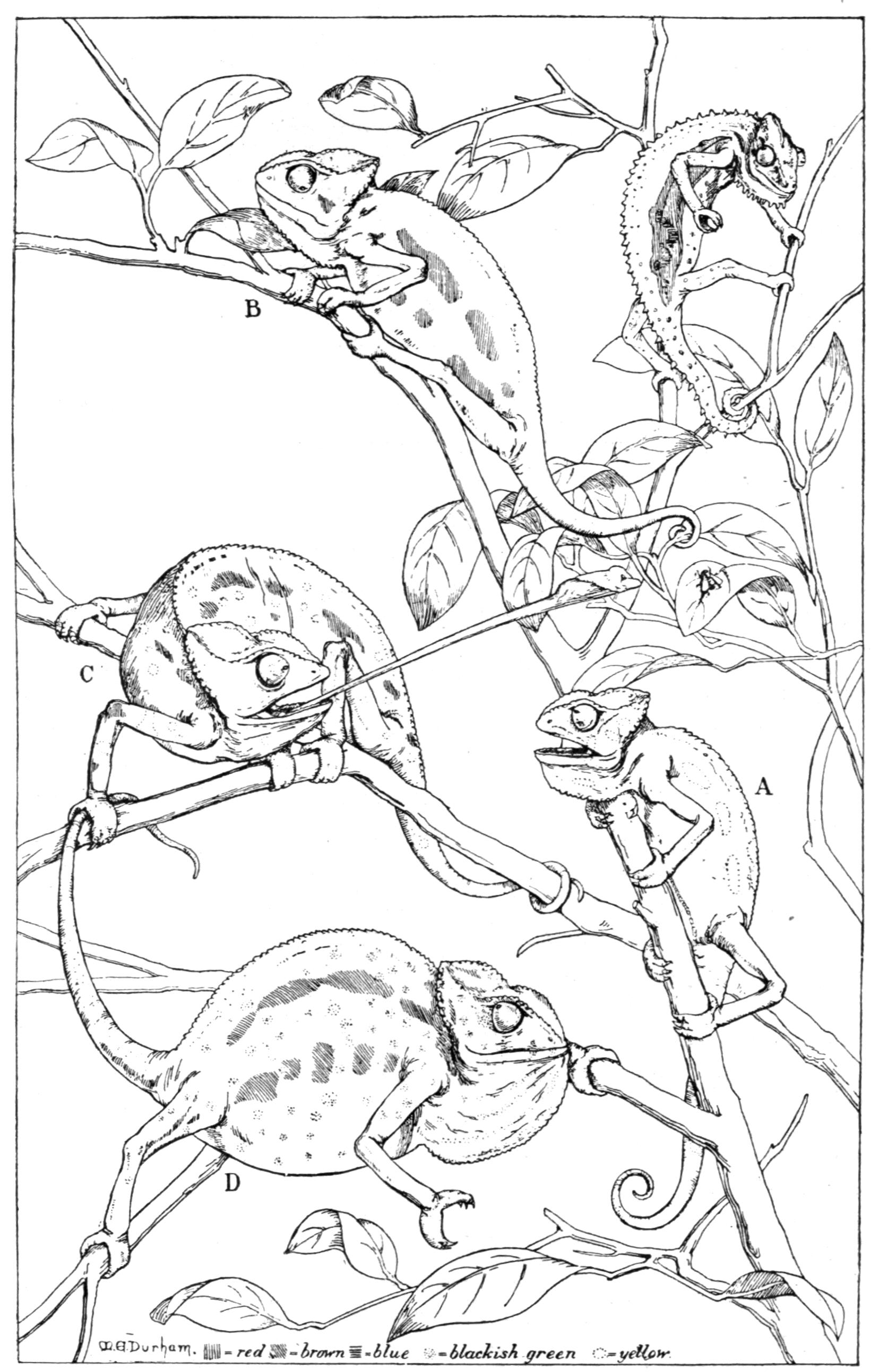
Fig. 152.–Showing changes of colour in Chameleons. A to D, Chamaeleon vulgaris (see p. 574). Chamaeleon pumilus in the right upper corner.
C is the same specimen in an excited frame of mind; it is represented in the act of shooting a fly. The light brown patches have changed to maroon brown; and many round golden yellow spots have appeared on the green parts.
D shows a specimen, coloured like C, within a few seconds after it has been put into an angry mood, in the present case by having its tail squeezed. The whole body is blown out, the thick tongue causes the throat to bulge out, and all the yellow spots have become blackish green.
Many small spots scattered over the body are usually a sign of anger. One of the specimens described above was, when fast asleep in a dark room, dirty white, with about two dozen large and small round spots of a rich yellow on each side of its body. Then a lighted lamp was brought into the room without in any way disturbing the animal. Within sixteen minutes the yellow spots had vanished completely; the whole body and tail had become suffused with greenish yellow, which gradually turned to pale yellowish green, and those parts which in Fig. B are pale brown, were just distinguishable as pale yellowish-white regions. The Chameleon was found to be fast asleep, and it kept this coloration during the rest of the evening. Other specimens behaved on similar occasions in the same way, but the greatest interest is attached to the fact that frequently only that side of the body "greened up" which happened to be exposed to the light, whilst the opposite side remained whitish. These changes are not absolutely unconscious; they are, after all, under the control of the creature. In order to test the possibility of direct action of the light, I have taken the precaution of throwing the light of a candle only upon the body, whilst the head was kept in darkness. No changes of colour took place whilst the animal was asleep, but when a little light was allowed to sweep across the closed eye, this soon began to twitch, and although the creature did not open the eye, the usual changes of colour began to take place. When the light was removed, the animal soon re-assumed its whitish appearance. Artificially coloured light, for instance green, red, or blue glass or paper, has apparently no influence upon the changes of colour. The Chameleons behave as they would behave under ordinary conditions. Direct and hot sunshine however causes them to darken, sometimes to turn uniform dull black, except for the white median ventral line. Occasionally I found one of the specimens described above deep maroon brown, with dozens of round orange spots. Blue and red do not seem to be within the range of Ch. vulgaris, but the combinations of green, yellow, brown, black, and white, with their various shades, are almost endless. Sometimes the Chameleons do not turn pale during the night, but remain more or less dull green, with or without brownish patches. Adaptation to their immediate surroundings takes place to a very moderate degree only, but as a rule they are brightest, especially in their green tints, when they are allowed to sit amongst green foliage. The introduction of a branch with fresh leaves generally has a brightening effect upon those which have previously been confined in a cage with dry twigs only. Cold does not necessarily make them pale, but they appear duller, and the changes take place more slowly. After all, Linnaeus has summed up the little we really know about the causes of these changes, in the following terse sentence: "Vivus varios colores assumit secundum animi passiones, calorem et frigus."
Chameleons are not very amiable. When taken up they blow themselves out or they bite painfully, and it is a long time before they are tame enough not to go through various antics of anger when one approaches them. When taken in the hand they produce a peculiar faint grunting noise, which, however, can be better felt than heard. They quarrel much amongst each other; and the males, during the pairing season, are particularly ill-tempered. Each individual selects its own particular branch to sleep on, if possible a horizontal one, upon which it crouches down lengthwise, with the head and belly resting upon the branch. The tail generally makes a turn round another branch, and the four legs, grasping some supporting branch, are put into any, sometimes into an almost incredibly, awkward position. Although they climb about a good deal during the daytime, they generally resort to their accustomed sleeping branch, and they defend this vigorously against would-be intruders.
Chameleons are most deliberate in their movements, sometimes provokingly slow. Each arm and foot leaves the firmly grasped branch with great hesitation, and makes with equal deliberation for some other foothold. It does not matter if the thigh appears almost twisted out of its joint. The creature will remain in the most uncomfortable position, forgetting, one might think, to put one or more of its limbs down, but keeping them instead in the air.
It is most interesting to watch them stalking their prey. Suppose we have introduced some butterflies into their roomy cage, which is furnished with living plants and with plenty of twigs. The Chameleons, hitherto quite motionless, perhaps basking with flattened-out bodies so as to catch as many of the sun's rays as possible, become at once lively. One of them makes for a butterfly which has settled in the farther upper corner of the cage. With unusually fast motions the Chameleon stilts along and across the branches and all seems to go well, until he discovers that the end of the branch is still 8 inches from the prey, and he knows perfectly well that 7 inches are the utmost limit to a shot with his tongue. He pauses to think, perhaps with two limbs in the air, but stability is secured by a judicious turn of the tail. After he has solved the puzzle, he retraces his steps to the base of the branch, climbs up the main stem, creeps along the next branch above, and when arrived at the 7 inch distance, he shoots the butterfly with unerring aim. The capacity of the mouth and throat is astonishing. A full-grown Chameleon will catch, chew, and swallow the largest moth, for instance a Sphinx ligustri. When large, the prey is chewed, but the wings and legs are swallowed with the rest. Occasionally these parts are bitten off, especially the prickly long legs of large locusts.
In water Chameleons are quite helpless. Sometimes they inflate themselves, but they always topple over on to the side, and the movements of their limbs are absolutely without any definite purpose.
When the eggs are ripe, and this happens with the Common Chameleon about the end of October, the female refuses to take food, and becomes restless. One of my specimens searched about probing the ground for about a week before she dug a hole in some more solid soil. This took two days. In the evening I found her sitting in the hole to the middle of her body. On the following morning she was still there, but busy filling the hole with soil and covering it with dry leaves. A few eggs were lying about outside, two of which at least I saw her taking up by the hand and putting them on the nest, which was found to contain some thirty soft-shelled eggs closely packed upon each other. During the whole process she was very snappy, and hissed much when approached. After that she crept into the twigs as usual, but refused to eat, vomited at once the artificially introduced food, became restless on the sixth day, crawling about at the bottom of the cage, and died on the following day. This is the usual fate, almost without exception, of females after they have deposited their eggs in captivity. The great number of eggs and their deposition naturally exhausts them, and they probably want to hibernate at once. The eggs, which are yellowish, long-oval, about half an inch long and covered with a parchment-like shell, are very difficult to rear, chiefly on account of the difficulty of regulating the moisture. They shrink up when too dry, and they are very liable to become mouldy. According to Fischer[173] the eggs can be hatched in a large flower-pot with a layer of horse-droppings at the bottom, then a layer of 6 inches of slightly moist soil, then the eggs, then another 6 inches of loose soil, with a glass plate covering the top, securing at the same time ventilation. In this way he succeeded in hatching several sets of eggs after 125 and 133 days respectively.
Ch. calcaratus, the Indian Chameleon, is found in the southern half of the Peninsula and in Ceylon, but it is far from common. It much resembles Ch. vulgaris, but the male is distinguished by a tarsal process or "spur," covered with skin, on the inner side of the foot.
Ch. pumilus, the Dwarf Chameleon of South Africa, reaches a total length of 5 to 6 inches. It has a well-marked, serrated gular crest, which extends from the chin to the end of the neck. The chest and belly are without a toothed line, but a strongly serrated series extends from the occiput over the back and tail (see the right upper corner of Fig. 152 on p. 575). A row of enlarged tubercles or scales extends along the sides of the body. The general colour is green, with a large and long patch of brick-red on the sides; small dots and spots of intense red are scattered over various parts of the body. The changes of colour are rather limited. At night the Dwarf Chameleon does not turn pale, but generally keeps its colour. When they are very well the green is quite saturated, and the large red patch on the side is interrupted by several blue spots. When they are angry or unhappy the red turns into dirty brown, and the green becomes quite dull. Sometimes the whole animal turns dull black.
This pretty little species is relatively hardy, being, as a native of South Africa, accustomed to cold nights. It does well in an ordinary temperate greenhouse, where it will live for several years, provided it has an ample supply of flies and meal-worms. It is viviparous, the young being probably born in the month of March or April.
Ch. bifidus, of Madagascar, shows an extraordinary difference between the sexes. The male reaches the great length of 16 inches, and develops two long rostral processes, which extend forwards beyond the snout; these processes are formed of dense connective tissue, which ossifies in the adult, and they are covered with scaly skin.
Ch. parsoni, likewise of Madagascar, is the giant amongst Chameleons, reaching a total length of 2 feet. The male has two large rostral processes which diverge upwards and outwards.
Brookesia, with several species in Madagascar, may be mentioned on account of its stunted appearance. The tail is much shorter than the body and scarcely prehensile; the scales on the soles are spinous. Total length only about 3 inches.
Rhampholeon, of tropical continental Africa, with several species, is likewise remarkable for the stunted and dwarfed appearance, and for the peculiar claws, each of which is furnished with a second cusp which is directed downwards. The tail is much shorter than the body. The total length of Rh. spectrum of the Camaroons is about 3 inches.