Part 2 — CHAPTER XII
Reading edition
SAURIA–AUTOSAURI OR LACERTILIA–LIZARDS
Sub-Class XI.–SAURIA.
Reptiles with movable quadrate bones, with a transverse, external, cloacal opening, near the posterior lateral corners of which open the eversible, paired (right and left) copulatory organs.
The Sauria, which comprise the Autosauri or Lacertilia in the wider sense and the Ophidia or Snakes, are the most recently developed groups of Reptiles. No fossils are known from strata earlier than those of the Cretaceous epoch. Their origin has probably to be looked for among the Prosauria, of which Sphenodon, cf. p. 294, is the only surviving member. The Sauria have attained their great development within the Tertiary period. They, both Autosauri and Ophidia, are now the two dominant Reptilian groups, and they have, so to speak, a future before them, being apparently still on the increase in numbers and species, but certainly not in size.
Order I. AUTOSAURI or LACERTILIA–LIZARDS.
Saurians which have the right and left halves of the mandibles connected by a sutural symphysis.
The overwhelming majority possess well-developed limbs, movable eyelids and cutaneous scales, covered by the mostly thin and horny epidermis. But there are many kinds of Autosauri, especially those belonging to the degraded, burrowing families, which have lost not only one or both pairs of limbs, but even the limb-girdles, while the eyes have become concealed beneath the skin, and in some cases the scales have been lost, or reduced to mere vestiges. Moreover in some of these burrowing and limbless forms the quadrate bones have become more or less immovable.
We divide the Autosauri into three sub-orders:–I. Geckones, p. 502; II. Lacertae, p. 513; III. Chamaeleontes, p. 567, with about 270, 1500, and 50 species respectively.
The Autosauri are of great interest, since they exhibit a great, almost endless variety in shape, size, and structure in direct adaptation to their surroundings. Most of these modifications are restricted to the external organs, or rather to those which come into direct contact with the outer world, namely the skin, the limbs, the tail, or the tongue. The majority of the Autosauri are terrestrial, but there are also semi-aquatic forms. There are climbing, swiftly running, and even flying forms, while others lead a subterranean life like earthworms. Most of them live on animal food, varying from tiny insects and worms to Birds and Mammals, while others live upon vegetable diet. According to this diet, the teeth and the whole digestive tract are modified. The intestine is relatively short in the carnivorous, long in the herbivorous species. But swiftness, the apparatus necessary for climbing, running, and digging, the mechanism of the tongue, the armament and the muscles of the jaws (hence modifications of the cranial arches, etc.), stand also in correlation with the kind of food and with the way in which it has to be procured.
A very interesting study of the influence of the climate and the nature of the country upon Reptiles has been made by Boettger[147] with especial reference to the Transcaspian desert-region. The winter is there short, but very severe, and there is a considerable amount of snowfall, while the summer is intolerably hot. The spring arrives suddenly. Lilies and tulips, which have been asleep for nine or ten months, sprout towards the end of February, and a carpet of flowers covers the ground for a short time. Then everything shrivels up during the rainless and fierce heat of the summer, and the autumnal storms of dust and sand kill off the last remnants of vegetation. There are no trees, and even prickly shrubs are rare. Instead of broad leaves the plants have grass-like blades or needles. The little shrubs do not form coherent patches, but they are scattered about, and around the roots of each shrub the wind accumulates little mounds of sand and dust, a place of retreat for rodents, lizards, snakes, and even for the female tortoises. G. Kadde's "law of the steppe" is in full force;–there is little change of forms in a wide district, but all these forms are peculiar, and they congregate socially in great numbers. Most characteristic are those kinds of Geckos which, like Teratoscincus, cf. p. 507, have become inhabitants of sand instead of climbers of rocks and trees; various kinds of Phrynocephalus, cf. p. 521, and Varanus griseus; the four desert-species of Lacertidae are brownish-grey or sandy yellow, with conspicuous stripes or spots. Of snakes are to be mentioned Eryx jaculus, digging in the sand, and about ten other non-poisonous snakes. Tropidonotus is, of course, restricted to permanently watery places, where they can get frogs and fishes. Of poisonous snakes there is the Cobra and Echis arenicola. Of Amphibia only Bufo viridis and Rana esculenta var. ridibunda exist in suitable places, but there are neither Tree-frogs nor Newts.
Characteristic features of these inhabitants of the desert are the following:–
1. Velocity. The Lizards are slender. The Sand-snake, Tephrometopon, is whip-like; even the Cobra has a relatively narrower and longer tail than the Indian specimens, although the number of the vertebrae and of the scales is the same. All the desert-snakes are remarkable for the great number of their ventral shields, two hundred and more.
2. Hard, scaly covering, for instance in Agama, Echis, Gymnodactylus, Teratoscincus; the latter with its fish-like scales is exceptional among Geckos, resembling the likewise deserticolous Geckolepis and Homopholis of Africa.
3. Capacity for digging in the sand in order to escape great cold, or burning heat. All the Lizards and the Tortoise, Testudo horsfieldi, have strong claws. The snakes Typhlops and Eryx dig with their specially modified snouts, and their tails are very short and blunt. The Sand-viper, Echis, has the scales of the back arranged in very oblique rows, so that it can heap sand upon its body by wriggling, shaking, and up-and-down motions of the body. The Agamoid Phrynocephalus does this by means of lateral folds of the skin.
4. Arrangements for running on sand. The lizard Eremias has very large crural shields; Scapteira has the digits broadened out into shovels; others, e.g. Phrynocephalus and Teratoscincus, have long lateral fringes on the digits, a very rare arrangement among Geckos, occurring elsewhere among them only in Ptenopus and Stenodactylus, which are likewise inhabitants of the desert.
5. Protection against the everlasting, ubiquitous sand. In the digging species the nostrils are directed upwards instead of forwards; in most of the snakes they are protected by complicated valves, or they are reduced to small pin-holes. The eyes of Typhlops are overhung by the head-shields. In Agama and Phrynocephalus the margins of the lids are broadened into plates and are furnished with peculiar scales. In Teratoscincus the upper lid is enlarged. The lizard Mabuia has the lower lid much enlarged, with a transparent window in it, so that the eye can be closed without impeding sight, an arrangement carried to the extreme in Ablepharus, cf. p. 560. The ear-opening is either small, or protected by fringes of scales, or it is abolished, e.g. in Phrynocephalus.
6. Coloration. Pure green is quite absent, even in Bufo viridis and in Rana esculenta, since there is no green in that country, at least not of long duration. White, with grey and black spots, occurs only in the nocturnal Geckos. Yellow, brownish, reddish colours are common, in adaptation to the sand. The advantages of the carmine-red, and of the blue spots of Phrynocephalus, and the yellow or bright red under surface of its tail, are unknown. Striation is of frequent occurrence among the lizards and snakes, probably in adaptation to the dry grass heaped up around the scattered shrubs.
Concerning the various organic systems of the Autosauri only some of the more important features may here be mentioned.
Skeleton.–The vertebrae are procoelous, with the exception of most of the Geckones, in which they are amphicoelous. So-called intercentra, in the shape of unpaired nodules or wedges, persist between most of the cervical vertebrae. In the tail these wedges, the remnants of the basiventralia, are generally present, frequently in the shape of chevron-bones. Sometimes they fuse with the centra of the vertebrae; occasionally the axial or central portion of these basiventrals persists as a sort of fibrous disc, which may calcify separately, and is interposed between the caudal end of the centrum and the articulating knob. The caudal vertebrae of the Geckones and of most Lacertae are liable to break across, like those of Sphenodon. They are enabled to do this owing to a transverse split, which makes its appearance with the ossification of the vertebral bodies and extends later into and across the neural arch and the various lateral processes. The split is ultimately referable to a transverse septum of cartilage, wrongly called chordal cartilage, which develops in the shell of the body of the vertebra, destroys the chorda, and extends peripherally. The cells of this septum retain throughout life their juvenile quasi-embryonic character. When the tail is broken off–and this always happens at such a septum–the cells of the remaining half reproduce a new tail. The latter is, however, in reality a sham tail, since neither new centra nor arches, but only a non-segmented rod or tube of fibro-cartilage is produced by this process of regeneration. Reproduction of centra is precluded by the previous normal reduction of the chorda, around which alone proper bony centra could be formed. The regenerated tail is, however, invested with new muscles, and with skin, but the scales often differ considerably from those of the normal organ. Boulenger[148] has found that the new or aberrant scaling is in some cases a reversion to an ancestral form. This is, for instance, the case in Pseudopus, and in the Tejoid genus Gymnophthalmus; to a certain extent also in Geckos and Skinks. On the other hand, Lacertidae, Gerrhosauridae, and also Anguidae reproduce a caudal scaling true to their type. Injured or broken-off tails are often reproduced double, or even trifid; sometimes an additional little tail grows out from an injured spot, anywhere on the side of the old remaining but mended tail.
The ribs of the trunk articulate by their capitula only, while the reduced tubercula are attached to their vertebrae by ligaments. In the tail the capitular portion is much reduced, while the tuberculum is much stronger and lies behind, no longer above, the capitulum, fusing sometimes directly with the centrum. The ribs of the poststernal region of Geckos and Chameleons are very long, and meet each other in the middle line, forming thin cartilaginous hoops.
The limbs are of the typical pentadactyloid type. The distal tarsalia are often fused with the metatarsals, so that the chief bending of the foot is effected by truly intertarsal joints. The greatest modification occurs in the foot of the Chameleons, in which the proximal tarsalia are reduced in number, and form a globe for the articulation with the tibia and fibula.
The shoulder-girdle and sternum much resemble that of Sphenodon in their completeness. The coracoids articulate with the sternum; the precoracoids and the basal parts of the scapulae often send out several processes towards those of the other side, so that several fenestrae are formed. The clavicles are complete, but are absent in the Chameleons. The interclavicle is mostly T-shaped. A presternum is absent, but the sternum proper is well developed, often forming a rhomboid plate, usually cartilaginous, often diverging backwards into xiphisternal processes.
The pelvis is attached to two vertebrae by means of several ribs. The ischium and pubis form symphyses. The pubis carries a well-developed lateral process, and the obturator-nerve pierces the shaft of the pubis. Epipubic and hypo-ischial cartilages are of frequent occurrence.
The hyoid apparatus consists of a median, styliform rod, which extends forwards into the tongue; it is often bifid behind. The unpaired piece carries two pairs of horns. The posterior of these, the first pair of branchial arches, extends backwards along the gullet, and is very long if the tongue is very slender and protractile. The anterior pair, the hyoid arches, consists of two pieces on either side, one short and directed forwards, the other long, connected with the former at a sharp angle and continued upwards to the sides of the skull, often in direct continuity with the columellar chain of the ear.
The modifications of the skull concern chiefly the composition of the temporal arches, see Figs. 55, M, N, O, p. 281. The quadrate bone is movable, but it has become fixed in various degraded families, where the skull shows a great reduction and concentration; the postorbital and temporal arches, the interorbital septum, and with it the columellae cranii are lost. The columella cranii of the Chameleons, which is generally stated to be absent, is really present, although in a much reduced state, and is partly imbedded in the interorbital septum. The occipital condyle has become bifid in Amphisbaenidae.
Burrowing and living in sand are often correlated with partial or complete reduction or loss of the limbs and their girdles. This loss of limbs is as a rule correlated with an elongation of the trunk, not always at the expense of the tail, which in such cases is much shortened. The vestiges of the hind-limbs come to lie as near the vent as possible. This reduction of the limbs occurred in several families which are not directly related to each other. Moreover, it does not occur in all the members of the family, not always in those of the same genus, and there is a considerable amount of individual variation. In most cases of reduction the fore-limbs disappear before, or are smaller than, the hind-limbs. In the Amphisbaenidae (cf. Chirotes, p. 566), and in the Tejidae the reverse takes place. In extreme cases the reduction is so complete that even the pectoral girdle has disappeared, leaving scarcely any trace, e.g. in Dibamus, p. 564.
The skin is normally covered with scales, which are formed by the cutis and have a horny epidermal coating. The latter, thin and transparent, is shed periodically, peeling off in flakes, except in Anguis and perhaps other snake-shaped creatures, which shed the skin in one piece. In the Amphisbaenidae the scales have practically disappeared. When well developed the scales are prominent, and imbricate or overlap with their free posterior edges; but in many cases the scales are not "scale-like" at all, only like little tubercles, which give the skin a granular appearance. Frequently, for instance in the Scincidae and Anguidae, all the scales contain "osteoderms," or ossified portions of the cutis, and encase the whole body and tail. In other families, e.g. Lacertidae, such osteoderms are restricted to the scales or shields on the head, where they come into contact and fuse with the underlying cranial bones, and moreover roof in the supratemporal fossa.
The skin of the Autosauri is entirely devoid of glands. The femoral and pre-anal pores of many families, occurring especially in the males, are probably not glands. They are arranged in rows on the under surface of the thighs and in front of the anal opening. Each of these organs perforates a scale and leads into a tubular invagination, which is lined with epidermal cells, the proliferation of which produces a horny yellowish débris, and this fills the tube and appears above the surface in the shape of a little cone. The use of this "excretion" is unknown; it is possibly hedonic.
Most Autosauri are capable of changing colour. In most of them this faculty is restricted to the assumption of paler or darker tints owing to the shifting of the colouring matter contained in the chromatophores. In others new, often vivid colours are the result. The mechanism is described in detail in the Chameleon on pp. 570 and 574.
Pigment is deposited either directly in the upper strata of the cutis, just below the Malpighian layer, or it is contained in chromatophores. The latter are imbedded in the deeper layers of the cutis, and send out movable contractile processes, in which their pigmented protoplasm is conveyed towards or away from the surface. The only colours available are black, red, yellow, and white, with their combinations of grey and brown. The white pigment consists of guanin-salts. Blue and green are structural colours, not due to pigment. The same can no longer be said of the Ophidia, since Boulenger has observed accidentally that green Tree-snakes (e.g. Dryophis) give the alcohol in which they are kept the colour of green Chartreuse.
Digestive organs.–The tongue is very variably developed, and affords good taxonomic characters. It is always furnished with many tactile, or with gustatory, corpuscles. When the tongue is very long and narrow it is generally forked, and in these cases, for instance in the Varanidae, is almost entirely used as a sensory organ. In others, especially where it is broad, it assists in catching the food, and in the Chameleons it has attained a most elaborate development (see p. 569).
Salivary glands are restricted to labial glands. In Heloderma those of the lower jaw are transformed into poison-glands, an analogy to what prevails in the poisonous snakes. The intestinal canal is longest in the herbivorous forms; the rectum sometimes possesses a short blind sac or caecum.
The cloaca of the Sauria is somewhat modified; instead of the Coprodaeum, Urodaeum, and Proctodaeum forming three successive chambers, the urodaeum is practically reduced to its dorsal half, forming a dorsal recess between the two other chambers. The Coprodaeum is constricted into several successive chambers, and is always well shut off from the urodaeum by a strong sphincter. The urodaeum receives the urinary excretions, which are mostly chalky white and are rather consistent instead of being fluid. The right and left oviducts also open into it. The vasa deferentia open into the dorso-lateral portions of the walls of the urodaeum, but the sperma is conducted by folds of the lining of this chamber towards the bases of the copulatory organs, which, although arising from the lateral and posterior corners of the cloaca, where uro- and procto-daeum meet, are stowed away outside the cloaca. These organs are always paired. The proctodaeum or outermost cloacal chamber is shallow. Its inner opening is round and is furnished with a sphincter, but it is surrounded and covered by lips of the outer skin, which form a transverse slit. This is due to the peculiar arrangement of the copulatory organs.
Each organ consists of a tube of erectile tissue, and can be everted like the finger of a glove. To the apex of the tube is attached a long retractor muscle, which arises from the ventro-lateral surfaces of the caudal vertebrae and extends a considerable distance back. When at rest and withdrawn the organs form slight conical, longitudinal swellings on either side of the root of the tail, an external feature by which male specimens can generally be distinguished. Only one organ is inserted at one time.
The majority of Autosauri lay eggs, surrounded by a white or yellowish shell, which is either hard, for instance in Geckos, or parchment-like, e.g. in Chameleons, in Lacerta viridis and L. agilis, and in L. vivipara. Eggs with a thin and soft shell sometimes exhibit the paradoxical feature of increasing in size after they have been laid. This is explained by the growth of the embryo, which stretches the shell and does not merely live upon the white and yellow contents of the egg itself, but also takes in air and moisture. Many Lizards do not lay their eggs until they contain ripe embryos, which burst the shell shortly after deposition. Some, for instance Lacerta vivipara, Anguis fragilis, and Chamaeleo pumilus, are practically viviparous. The embryos, especially those which are enclosed in hard-shelled eggs, are provided with a sharp, calcareous "egg-tooth" on the top of the snout.
The lungs are thin-walled sacs, sometimes provided with lateral ex-sacculations, and these reach their greatest development in the Chameleons. The breathing is effected by the motion of the ribs. Inflatable sacs on the throat, or on the sides of the neck, for ornamental or sexual purposes, occur in various families. The lungs of much-elongated, snake-shaped Lizards are generally asymmetrical; the right being reduced in Amphisbaenidae; the left in other cases.
Several Autosauri, for instance the Geckos, Psammodromus, and various other Lacertidae have a weak voice.
The Fat-bodies are mysterious organs which are situated beneath the skin, and extend from the inguinal region forwards along the ventral sides of the belly. They are often of considerable dimensions; largest in the spring, in both sexes, at the time of propagation. Their colour is greyish-white or yellow, owing to the great accumulation of fat in the meshes of the connective tissue which composes the frame-work of these organs. An artery enters them, breaks up into capillaries, and these combine to form an efferent vein. After the time of propagation these organs are reduced to grey or reddish flaps, consisting mainly of very vascular connective tissue. G. W. Butler[149] has written a long paper on their morphology. The same author[150] has investigated the "sub-divisions of the body-cavity in Lizards, Crocodiles, and Birds," with reference to peritoneal diaphragmatic structures.
The geographical distribution of the Autosauri teaches few, but important lessons. We have to restrict ourselves to the principal families, leaving out those which are small and have a limited distribution; also those which, like the few Anelytropidae in Africa and in Mexico, are not natural groups.
The Geckones, which are probably the oldest of modern Autosauri, are practically cosmopolitan, being absent only in the cold and in the cooler temperate regions. They are common even in Oceanic Islands, for instance in New Zealand and in the Sandwich Islands. Although not at all aquatic, they are particularly fit to be transported accidentally on or in the trunks of floating trees, to which they cling firmly, and they can exist without food for months. I once received a little South American Gecko in perfect health from a grocer, who found it in a well-closed wooden box containing canned meat, two months after delivery of the box in Cambridge.
The Scincidae, likewise an old family, are equally cosmopolitan, but although many exist in the islands of the Pacific a few only occur in New Zealand. Many of the genera have a very wide distribution; for instance, Lygosoma, with its one hundred and sixty or more species, occurs in the Australian and Palaeotropical regions, and also in North and Central America, not extending, however, into South America. Mabuia, with more than sixty species, occurs in the Palaeotropical and the Neotropical regions. Whether these and other widely-distributed genera are all natural is another question.
The Agamidae, Varanidae, Lacertidae, and the Chamaeleontes are restricted to the Old World. The Agamidae and Varanidae have the widest distribution, occurring in the whole of the Old World with the notable exception of Madagascar and New Zealand. The Lacertidae are Palaearctic and Palaeotropical, being however absent in Madagascar, and, broadly speaking, not extending eastwards beyond Wallace's line. It is a most suggestive fact that most of those families of Reptiles, and even of other Vertebrates which have a wide distribution and are apparently debarred from transgressing Wallace's line, are also absent from Madagascar.
The Chameleons are essentially African, with their centre of greatest abundance and development in Madagascar, only one or two species occurring in Socotra, Southern Arabia, and in Ceylon and Southern India. Since they also exist, Ch. sechellensis, on various islands in the Indian Ocean, for instance in Mauritius and the Seychelles, the Chameleons are perhaps an indication of the former existence of a direct land-connexion between Southern India and Southern Africa.
The Iguanidae are essentially American, with the remarkable exceptions of Chalarodon and Hoplurus in Madagascar, and Brachylophus in the Fiji and Friendly Islands. This peculiar distribution finds some analogies in that of Dendrobatinae (p. 272), certain Boinae (p. 601), and Centetes and Solenodon among Insectivora. An Iguana (I. europaea) has, however, been described from the Eocene of France and England. The supposed relationship of the Iguanidae with the Agamidae makes the problem only more puzzling, since Agamidae are absent in Madagascar. If we have recourse to the Zonuridae, which are confined to Africa and Madagascar, and are supposed to be intermediate between Anguidae and Iguanidae, then we may have ultimately to conclude that the Malagasy Iguanoid genera and the American Iguanidae are a case of convergent evolution.
The Amphisbaenidae are distributed over America, including the West Indies, Africa exclusive of Madagascar, and the Mediterranean countries. This is very puzzling, considering that these subterranean, helpless creatures positively cannot travel. Boulenger regards them "as a degraded type of the Tejidae, with which they are to some extent connected by Chalcides and its allies," i.e. genera with reduced limbs, cf. p. 562.
However, this supposed relationship with a strictly American family does not explain the occurrence of Amphisbaenidae in Africa. Either they are not a natural group, or they had, as already degraded, limbless creatures, a much wider range; and this would imply their being a very old family, perhaps as old as we suppose the Coecilians to be.
Anguidae occur in North and South America, in Europe and the Mediterranean parts of North Africa, and in Trans-Gangetic India. Their older relations, the Zonuridae, inhabit Africa and Madagascar.
Madagascar is consequently devoid of Agamidae, Varanidae, Lacertidae, Anguidae, and Amphisbaenidae, while it possesses, besides the cosmopolitan Scincidae and Geckones, only Chameleons, Gerrhosauridae, and Zonuridae,–all three essentially African families,–and a few Iguanidae. This means that the Autosaurian fauna of Madagascar is intimately related to that of Africa, and that it possesses only old families so far as Sauria are concerned. But since this great island was separated from its continent not earlier than in Mid-Tertiary times, it follows that most of these "old" families are comparatively recent.
Australia possesses only Agamidae and Varanidae besides the ubiquitous Geckos and Skinks. Besides the latter two families it has nothing in common either with Madagascar (an analogy with the Anura) or with America. The Autosauri consequently do not support the idea of a Notogaea, cf. p. 74. This again indicates the comparatively recent age of Autosaurian families. The marked difference which exists between the Old and the New World points to the same conclusion. On the other hand, the Autosauri support the idea that the Palaeotropical region is but the tropical and therefore richer continuation of the now impoverished Palaearctic sub-region.
Sub-Order 1. Geckones.–The typical Geckos are characterised as follows. Four-footed Autosauri with amphicoelous vertebrae; skull without bony temporal arches; clavicles dilated and with a perforation near the ventral end; parietal bones separate; eyes (with few exceptions) without movable lids; pleurodont; tongue fleshy and broad, slightly nicked anteriorly, and capable of protrusion.
This definition does not apply to a few forms. In the Eublepharinae the vertebrae have advanced to the procoelous condition, and the parietals are fused together, while the eyes are provided with typical, movable lids. In the Uroplatinae the clavicles are not dilated, and the nasals are fused into one bone. The Geckos seem to be not only a very independent but also a very old branch of Saurians. Although fossil representatives are unknown, the resemblance of their vertebrae to those of the Palaeozoic Microsauri is at least remarkable. They are now practically cosmopolitan within the warmer zones, being found in abundance in all intertropical countries and islands, even in New Zealand. About two hundred and seventy species are known, which have been subdivided into about fifty genera. The generic differences are trivial with few exceptions, and refer mostly to the structure of the digits.
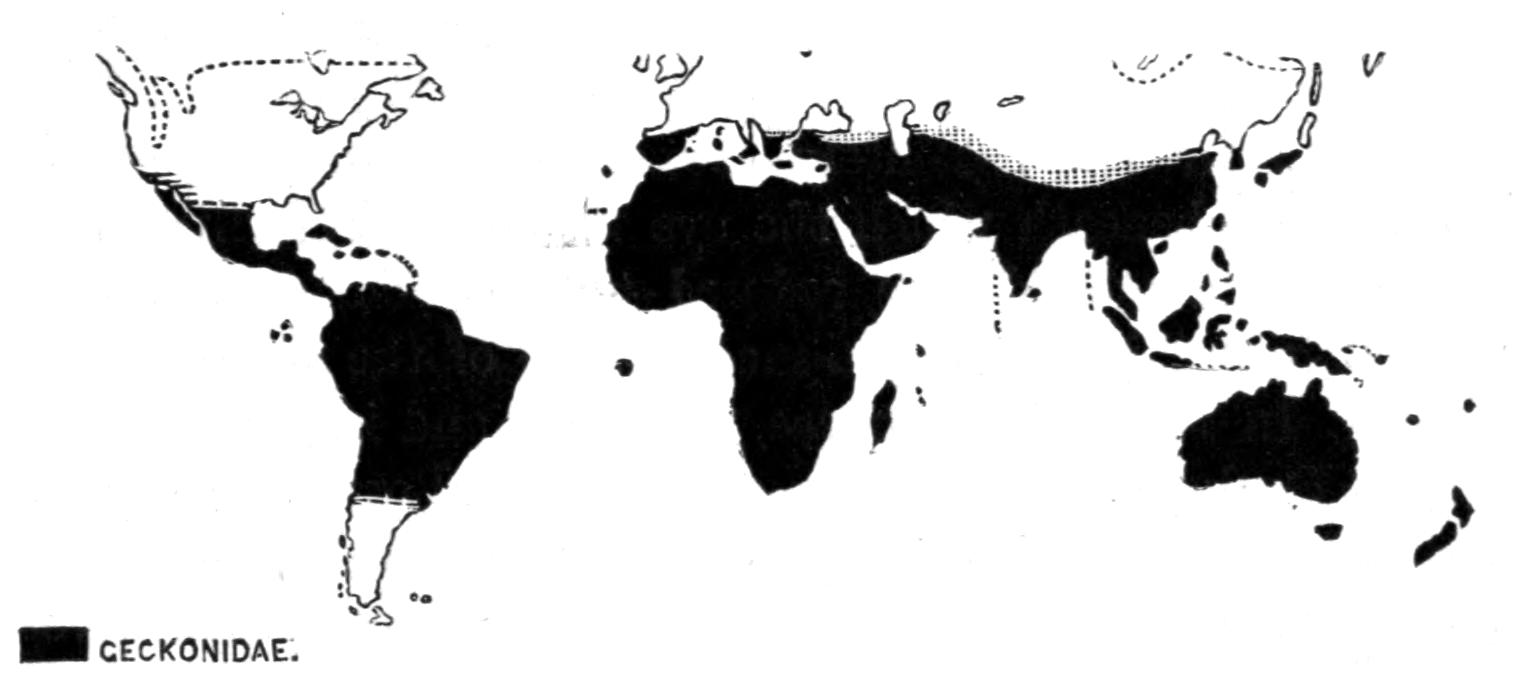
Fig. 118.–Map showing the distribution of Geckonidae.
The more important features of the vertebral column are the absence of axial joints and the persistence and life-long growth of the chorda dorsalis. Each vertebral centrum consists of a cartilaginous tube, more or less calcified or ossified, with a narrow waist and a cartilaginous septum in the middle. In the tail this septum, which is only slightly invaded by ossification, coincides exactly with the line of transverse division of the vertebrae into an anterior and a posterior half. This is the level where the tail breaks off and whence it is renewed. Between every two successive centra lies an intercentrum, broadest ventrally, crescent- or wedge-shaped. Dorsally it is continued as fibro-cartilage, and the whole ring acts as an articular pad instead of the joint. Chevron-bones are common in the tail.
The ribs are bifurcated, but the tubercular portion is frequently reduced. The post-thoracic ribs are usually very slender, and so long that they meet each other in the middle line, in this case bearing an extraordinary resemblance to the so-called "abdominal ribs" of other reptiles.
The bony frame of the skull is slender. There is a complete absence of bony arches spanning over the temporal fossae, or bordering the orbit, which is open posteriorly. The upper jaw, owing to the slender and flexible nature of the respective bones, is movable upon the rest of the skull; in this respect not unlike the upper jaw of a duck. The dentition is pleurodont and the teeth are minute. The eyes of the typical Geckos are peculiar. They are covered with an absolutely transparent skin, shaped like a watch-glass, beneath which the eye moves freely, while the true upper and lower lids are reduced to tiny folds. The covering "watch-glass" is probably a modification of the nictitating membrane. In the Eublepharinae, however, and in the few species of the Geckonine genera Aelurosaurus of Borneo and Australia, and Ptenopus of South Africa, the upper and lower lids are present and movable. The pupil contracts mostly into a vertical slit, except in the few diurnal kinds, e.g. Phelsuma, of the islands in the Indian Ocean, and the African Lygodactylus.
Another peculiarity of at least many Geckos is the extraordinary development of the endo-lymphatic sacs of the ear, which, being filled with the chalk-like otoconia or otolithic crystals, perforate the skull, and are stowed away in the shape of a pair of large bags behind the ears, or on the sides of the neck.
The skin exhibits considerable variety. It is mostly soft above, with little granular tubercles, sometimes containing small dermal ossifications or calcifications. The latter are most developed on the head, where they occasionally fuse with the underlying bones. A few species of Tarentola possess supra-orbital bones, independent remnants of such osteoderms. The ventral surface is generally covered with small imbricating scales, but in some genera, e.g. Homopholis, such scales occur also on the dorsal surface, reaching their highest development in Teratoscincus (p. 507). In a few forms, notably in Ptychozoon (p. 512), the skin of the sides of the body and tail is produced into a series of lobes and flaps, the object of which seems to assist adhesion. Many, perhaps the majority of Geckos, have adhesive digits, by means of which some kinds are enabled to climb absolutely smooth and vertical surfaces, for instance a window-pane; or, what is more startling, they run along the smooth, white-washed ceiling, back downwards. The apparatus is complicated in its minute detail, but is very simple in principle. The adhesion is effected neither by sticky matter, nor in the way described in the Anura (p. 187), but by small and numerous vacua. The under surface of each digit is furnished with many transverse lamellae. The pressing down of the foot upon a smooth surface causes the lamellae to spread asunder and to drive out the air; partial retraction lets them return to their original position by virtue of their elasticity; and little vacua are produced. Each lamella is further beset with tiny hair-like excrescences, which secure adpression to even the slightest irregularity of surface and at the same time enhance the elasticity of the pads. The arrangement of the lamellae and pads differs much in the various genera. For instance, the lamellae are either broad and entire, or they are divided into two parallel rows, with or without lateral hairy fringes; or the under surface of the digits is granular, but strongly fringed; or the lamellae are restricted to the dilated tips of the digits, etc. The fingers and toes are mostly furnished with sharp, curved claws, and these are in many cases retractile between some of the lamellae, or into a special sheath. Those Geckos which live on sandy, barren ground are as a rule devoid of adhesive pads, the digits being narrow. The typically padded, adhesive digits cause a peculiar sensation when a Gecko hangs on to one's finger, and this feeling has perhaps given rise to the erroneous notion of stickiness.
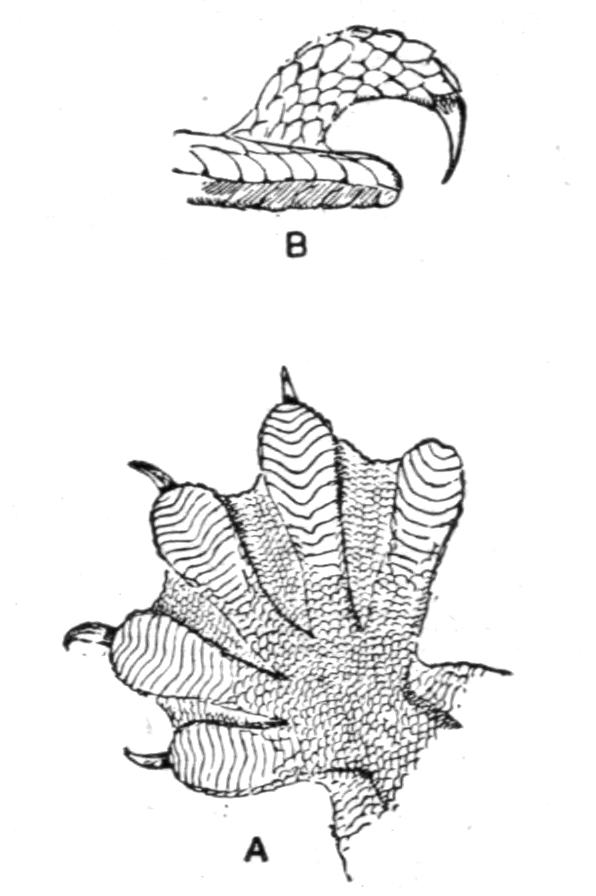
Fig. 119.–Ptychozoon homalocephalum. A, Ventral view of the right hand. × 2. B, Side view of a finger to show the peculiar arrangement of the claw-bearing joint.
The tail exhibits many kinds of shape and size. Mostly cylindrical and tapering to a point, it is leaf-like in Gymnodactylus platurus of Australia; provided with many lobes, and used as a parachute in the Malay Ptychozoon. In Nephrurus asper of Eastern Australia the tail is quite short, much shorter than the limbs, much swollen at the base, and very thin towards the end, which carries a round knob. The tail of all Geckos is very brittle and can be quickly regenerated, except the long rat-like tail of the Persian Agamura. In many other desert-forms the tail is long, slender, and laterally compressed, acting in such cases like that of desert-forms among the Lizards.
Many Geckos have a voice, mostly rather feeble, and sounding like a soft "click" or "chick" produced by our tongue. Repetition of this sound resembles in some species the word "gecko." They lay eggs, rather globular, or but slightly oval, hard-shelled, and white, mostly two in number. Naultinus elegans of New Zealand is said to be viviparous. The males are generally larger than the females, and they are further distinguished by the possession of femoral or pre-anal pores.
All Geckos feed upon animals, chiefly upon insects, but the larger forms take anything they can master. With few exceptions they are nocturnal, which, however, does not prevent them from occasionally baking themselves in the sun. They are capable of changing colour, but since their ground-colour is almost universally grey, yellow, or brown, the range of the colour-changes is restricted to the adoption of darker or lighter hues. The skin is shed in flakes and eaten.
Geckos are absolutely harmless; they cannot even inflict painful bites. However, in many countries they are feared as much or even more than the most poisonous snakes. In the south of Spain and Portugal, for instance, where Geckos are plentiful in and outside the houses, and are consequently objects of daily observation, the "osga" is considered a dreadfully poisonous creature. They become very tame, or rather confiding in their regular habits, provided they are not molested. If caught–and they have many enemies among other lizards and snakes–the only safety of these defenceless and mostly small creatures lies in their tail, which, being extremely brittle, is left in the claws or jaws of the pursuer. The remaining stump soon produces a new tail, in shape and size like the old one, but with a different and simpler scaling. I knew of several specimens of the Portuguese Platydactylus facetanus, which, having lost their tails in the act of being caught, were kept in a box for six weeks without food. On their arrival in England they had each grown a new stump nearly half an inch long!
Fam. Geckonidae. Sub-Fam. 1. Geckoninae.–Vertebrae amphicoelous; parietal bones separate; clavicles dilated and perforated. Hereto belong the overwhelming majority of Geckos, only a few of which can be mentioned.
Teratoscincus scincus.–This most peculiar creature, about six inches in length, inhabits the steppes of Turkestan and neighbouring desert-regions of Persia. It is a thorough desert-form. The digits are devoid of adhesive lamellae, but are granular inferiorly and strongly fringed laterally, an arrangement which is rare among Geckos, practically restricted to it with Ptenopus and Stenodactylus, which are likewise deserticolous. This is a beautiful illustration of adaptation to the surroundings. A Gecko, instead of climbing rocks and trees, has lost the climbing apparatus, or has transformed parts of it for running upon loose sand. The body is covered with imbricating, rather large and smooth scales. The tail is round at the base, compressed in its posterior half, covered below and on the sides with scales like those of the body, but on the upper side with a series of large, transverse, nail-like plates. By rubbing these plates upon each other, this Gecko produces a shrill, cricket-like noise, sitting at night in front of his house, perhaps in order to attract grasshoppers. The noise is made by both sexes.
Ptenopus, a Gecko of Damara Land, likewise adapted to desert-life, produces a similar chirping noise by its throat.
Phyllodactylus is a genus of world-wide distribution, occurring in tropical America, Africa, Madagascar, and Australia, extending to the Norfolk Islands and to Lord Howe's Island. One species, Ph. europaeus, occurs on the islands in the Western Mediterranean. The digits are furnished with transverse lamellae, the greater number of which are broken up into small scales forming three longitudinal series. The ends of the digits are dilated, with two large plates inferiorly, separated by a longitudinal groove into which the claw is retracted. The upper parts of the body are covered with juxtaposed scales intermixed with larger tubercles. The abdominal scales are small and imbricating. The cylindrical, tapering tail is slightly prehensile, covered with small scales arranged in verticils. This species is devoid of femoral or anal pores. General colour above grey-brown, with darker and lighter markings; a dark streak on the side of the head, passing through the eye. Under parts whitish. Total length up to 3 inches. The eggs are almost round, measuring 8.7 by 7 mm.
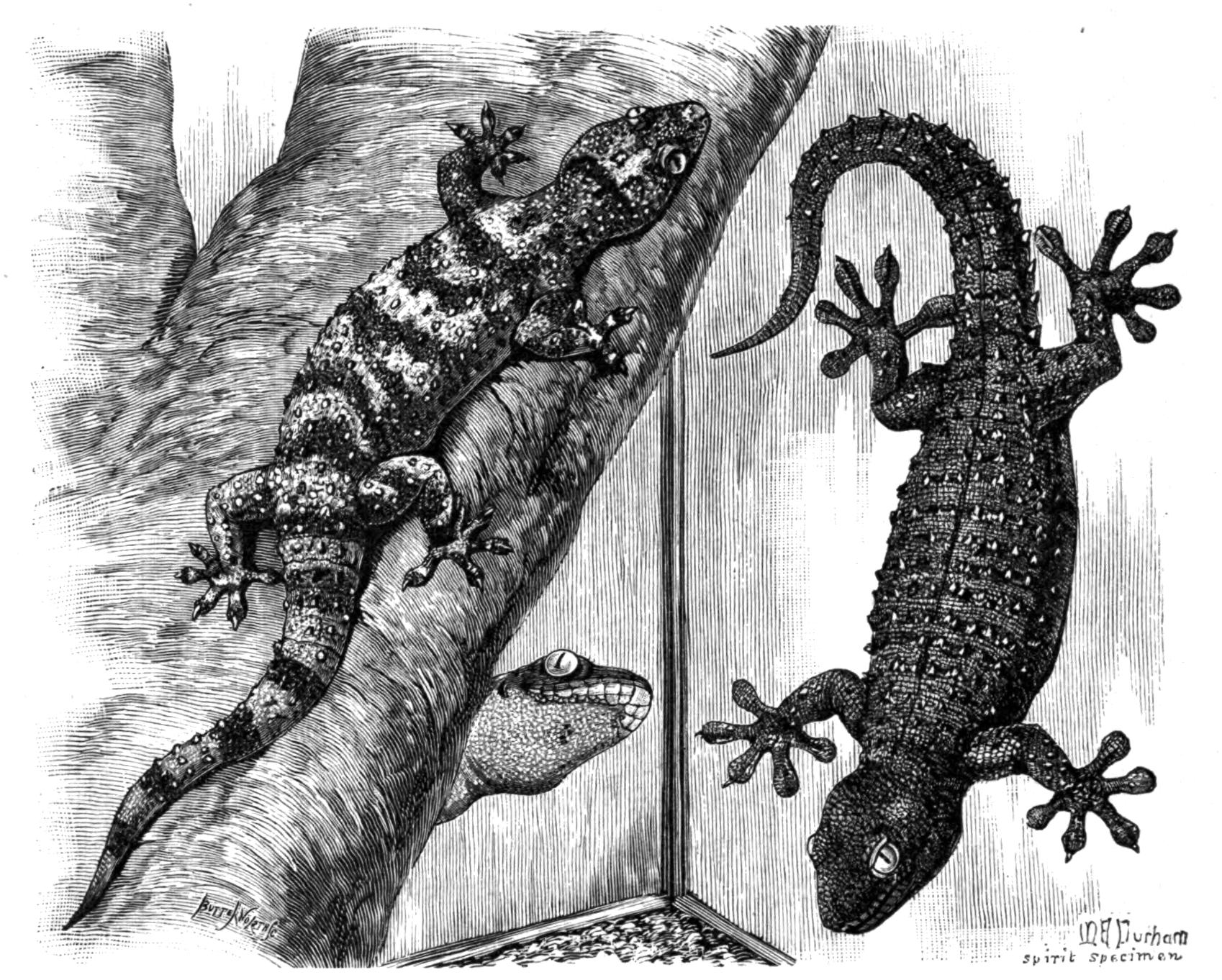
Fig. 120.–Hemidactylus turcicus (left), and Tarentola mauritanica (right). × 1.
Hemidactylus, likewise a widely distributed genus, with many species. The digits are dilated, inferiorly with two rows of lamellae; the clawed joints are slender, bent at an angle, and rising from within the extremity of the dilated portion. H. turcicus, between 3 and 4 inches long.–The upper parts of the body are covered with minute granules, mixed with larger tubercles. The abdominal scales are small and slightly imbricating. The male has several pre-anal pores. The tail is covered above with minute scales and tubercles, below with a series of large transversely dilated plates. The general colour is white below, brown above, with darker spots, and with white specks on many of the tubercles. This species extends from Southern Portugal and Spain to Karachi. Like Phyllodactylus and various other kinds of Geckos, the body is semi-transparent; so much so indeed that the white eggs shimmer through the body in certain lights.
Tarentola mauritanica s. Platydactylus facetanus.–The digits are strongly dilated, with undivided lamellae below, and a flat, nail-like scute on their upper surface near the tip. Only the third and fourth digits are clawed. Femoral or pre-anal pores are absent. The upper parts are covered with scales and granules, and bear several longitudinal rows of strongly keeled, large tubercles; the under parts have hexagonal scales. General colour above greyish-brown, with darker or lighter markings; with a dark streak through the eye. Total length of large males about 6 inches. This species is one of the commonest Geckos in the Southern Mediterranean countries. In Portugal it extends northwards to the Douro. It has been introduced by ships into the ports of Cette, Toulon, and Marseilles. It is easily kept in captivity, like most Geckos indeed, provided they are supplied with a variety of insect-food, water in the shape of drops, and suitable places to hide in. A female, which I had received from Algiers in a little tin box, with a lump of meat (presumably its food!), laid two eggs six weeks after its arrival. This was towards the end of April. Towards the end of June in the same year it again laid two eggs, measuring 13 × 10 mm. Another specimen laid in June in two successive years. These and other Geckos live very well in a greenhouse, or in a large glass cage. They change colour most adaptively. They hunt preferably at night for insects, which are stalked and then suddenly rushed at. Drops of water are taken by a lapping motion of the tongue. For sleeping-places they selected bits of hollow bamboo, but these had to be vacated when some tree-frogs crept into them for the daytime, and the Geckos took to some curved pieces of bark, on the under side of which they slept, with their backs downwards. This is, by the way, a favourite position of rest of most Geckos. But Stenodactylus guttatus of Egypt lies flat on its belly, tucks the fore-feet under and inwards like a cat, rests the head upon them, and stretches the hind-limbs out backwards. The little Geckos are rather intelligent. They take no notice of a finger put against the other side of the glass to which they happen to cling; but when the hand is put inside their cage and approaches them too near, they dart off suddenly. When driven into a corner they wriggle and wag their tails, or even raise the latter, perhaps as an invitation to grasp it, in which case it would of course break off. When caught, they emit feeble sounds, and attempt to bite with the mouth widely open. During the moulting, which takes place at least twice a year, in the spring and in the autumn, the skin peels off in flakes; if, as happens sometimes, the skin upon the lamellae is not stripped off neatly, these refuse to act, and the creature cannot climb until all the old skin has been rubbed off.
In their native haunts they are very regular in their habits. Favourite resorts of theirs are old olive trees or oak trees, the rough and cracked bark of which affords excellent places for hiding in. Hollow trees are of course preferred. Not a single specimen is seen during the early hours of the morning or in the forenoon; but when the sun has become broiling hot, and our own shadow passes over the stem of a tree, we become aware of flitting little shadows which jerk over its surface. These are Geckos which had been basking, motionless; very dark grey, almost blackish, just like the colour of the grey bark upon which the last wet season's moss has been scorched to a black cinder. It is difficult to espy a Gecko whilst it is glued on to such a tree. Only the little beady eyes betray it, watching you carefully. Nothing appears more easy than to catch that motionless thing. You put out your hand and it is gone; like a flash it has moved a foot higher up, or down, to the right or to the left, just where you least expected it to go, and there it clings on motionless as before. It does not seem to run; it glides along, dodging over to the other side of the stem and back again. There is system in its motions, since, taking a last leisurely look around, it gently disappears in a rent or hole. Towards the evening, or when the shadows become longer, the Geckos become lively. One after another appears on the surface, upon the tree, or at the entrance of the cave, and they all move about in their peculiar rushing jerks. Spiders, flies, mosquitoes, moths, form the principal diet, and the hunting goes on well into the night. Where a gecko has been seen once it is sure to reappear the next day at the same hour. Those which take up their abode inside a house become almost domesticated. They are strange sights when hunting for flies, running up and down the papered walls; but we fairly gasp when they come to the upper corner, calmly bend over, and with the next jerk slide along the white-washed ceiling. We are accustomed to flies performing such feats, but at animals five inches long, supple and fat, we are inclined to draw the line. However, that is the way of Geckos, and–be it confessed–the more we ponder over the mechanism of their fingers and toes, the less we comprehend how such little vacua can support or suspend such heavy creatures from a dry and often porous surface.
Gecko.–The digits are strongly dilated with undivided lamellae. All, except the pollex and hallux, have a very short compressed terminal phalanx with a retractile claw. Males with femoral or pre-anal pores. This Eastern genus includes some of the largest of all Geckos.
G. stentor of the Malay countries reaches a length of 15 inches. G. verticillatus s. verus s. guttatus ranges from Eastern Bengal to China and through the Indian archipelago. It grows to about one foot in length. The head is large; the back is covered with small granules and about a dozen rows of large tubercles. The tail, when intact, and the belly are covered with scales, those of the tail being arranged in transverse rows, several of which make up distinct rings. The upper parts of the body are grey or yellowish with red spots and vermiculations. According to Theobald[151] it lays about eight hard-shelled white eggs as big as a musket-ball, cementing them to trees, rocks, or secluded buildings. The cry is "touk-tay," several times repeated, and ending in a long-drawn out, diminuendo, guttural rumble. This animal does not confine itself to insects, but eats young rats also. Dr. Mason has seen it devour smaller species of house-lizards, and Theobald has seen it seize a bat flying round the room, and devour it.
Tennent[152] tells the following story about one of these creatures: "In an officer's quarter in the fort of Colombo, a Gecko had been taught to come daily to the dinner-table, and always made its appearance along with the dessert. The family were absent for some months, during which the house underwent extensive repairs, the roof having been raised, the walls stuccoed, and the ceilings whitened. It was naturally surmised that so long a suspension of its accustomed habits would have led to the disappearance of the little lizard; but on the return of its old friends, it made its entrance as usual at their first dinner the instant the cloth was removed."
Ptychozoon.–The digits have the same structure as described in the genus Gecko, but they are entirely webbed. The extraordinary feature of Ptychozoon is the membranous expansions on the sides of the head, body, limbs, and tail, which are said to act as parachutes. P. homalocephalum, the only species, inhabits the Malay Islands and the Malay Peninsula. It reaches a length of 8 inches. A specimen obtained by F. H. Bauer in Java, in the month of November, laid two eggs a few days after its capture. One young was hatched in the middle of the following May, and two days later another came out of the second egg. The characteristic folds of the skin were already clearly discernible.
Sub-Fam. 2. Eublepharinae.–Differing from the true Geckos by their procoelous vertebrae and the fusion of the two parietal bones into one. The eyelids are not reduced, but remain functional. This sub-family is undoubtedly a heterogeneous assembly, as indicated by the very scattered distribution of its few species (about seven), in India, West Africa, and Central America.
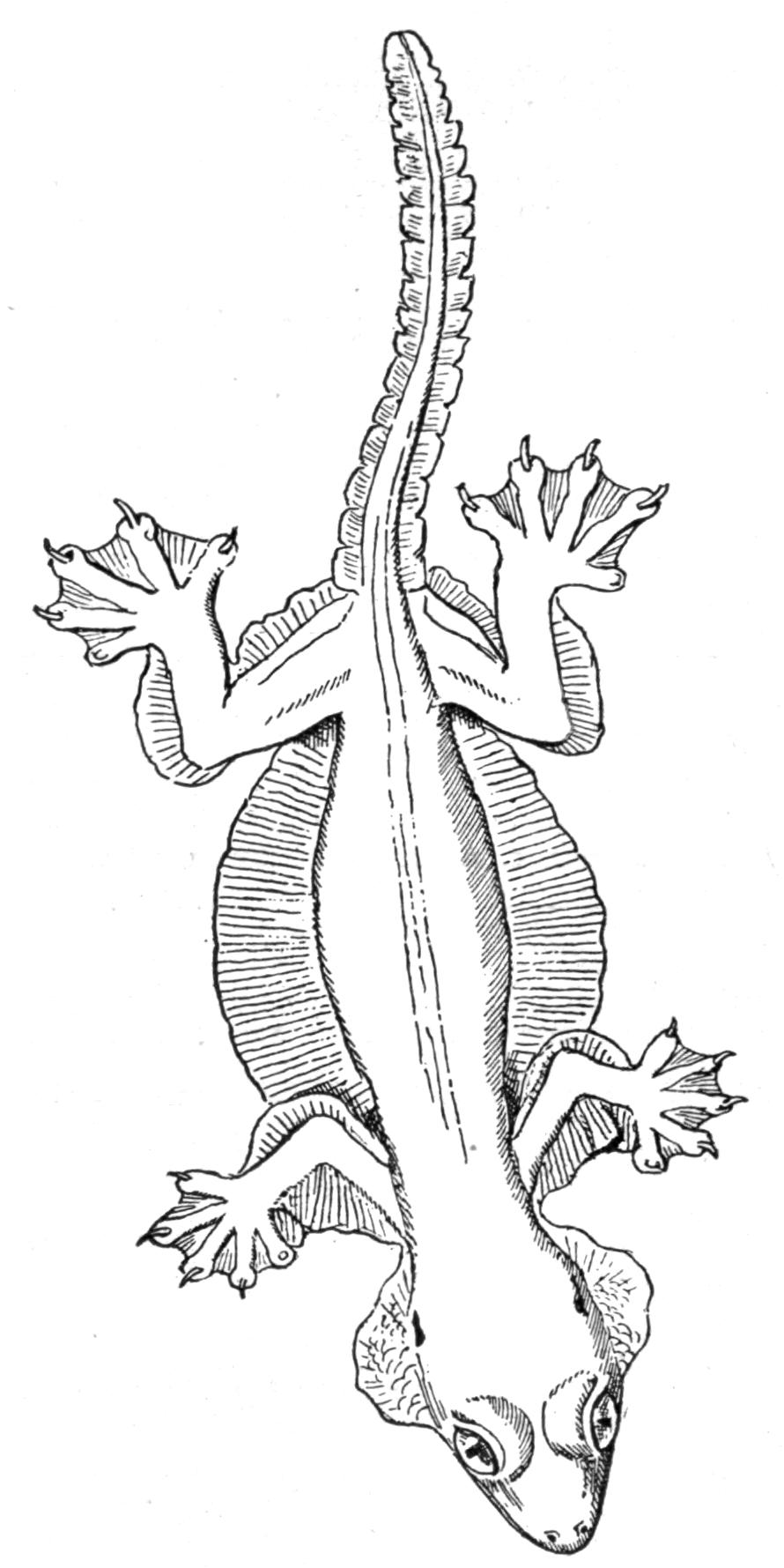
Fig. 121.–Ptychozoon homalocephalum. × ⅔.
Sub-Fam. 3. Uroplatinae, composed of a few species of the genus Uroplates in Madagascar. The distinctive characters of these otherwise typical Geckos are the fusion of the nasal bones into one, the small size of the interclavicle, and the non-dilated shape of the clavicles.
Neither the Eublepharinae nor the Uroplatinae are more nearly related to other Autosauri than are the other Geckos. They are modifications within the sub-order of the Geckones.
Sub-Order 2. Lacertae.–Autosauri with procoelous, solid vertebrae, and with the ventral portions of the clavicles not dilated.
Cope,[153] discarding outer appearances as deceptive in the classification of the Lacertae, laid stress upon internal characters, notably the presence or absence of osteoderms, the formation of the skull, and the structure of the tongue. Boulenger[154] has followed and improved upon Cope's arrangement, and has elaborated the classification, which, being used by himself in the three volumes of the Catalogue of Lizards in the British Museum, has also been followed in the present work, with slight alterations in the order of treatment of the families. For our present purpose we diagnose the families as follows, giving preference to such characters as are most easily ascertained:–
Synopsis of the Families of Lacertae.
Fam. 1. Agamidae. Acrodont. Tongue broad and thick. No osteoderms. Old World, p. 515.
Fam. 2. Iguanidae. Pleurodont. Tongue short and thick. No osteoderms. America, Madagascar, Fiji Islands, p. 528.
Fam. 3. Xenosauridae. Pleurodont, solid teeth. Anterior part of tongue retractile. No osteoderms on the body. Mexico, p. 536.
Fam. 4. Zonuridae. Pleurodont. Tongue short, not retractile. With osteoderms at least upon the skull, where they roof in the supratemporal fossae. African sub-region, p. 536.
Fam. 5. Anguidae. Pleurodont, solid teeth. Anterior part of tongue emarginate, retractile into the posterior portion. Osteoderms on body and head, roofing over the supratemporal fossae. Limbs mostly reduced. America, Europe, India, p. 537.
Fam. 6. Helodermatidae. Pleurodont, lower teeth grooved, with poison-glands. Tongue bifid. Osteoderms tiny. Postfronto-squamosal arch absent, p. 540.
Fam. 7. Lanthanotidae. Pleurodont. Tongue short and bifid. Postfronto-squamosal arch absent. No osteoderms. Borneo, p. 541.
Fam. 8. Varanidae. Pleurodont. Tongue very long, bifid, smooth, very protractile. No osteoderms. Postorbital and temporal arches incomplete. Old World, p. 542.
Fam. 9. Xantusiidae. Pleurodont. Tongue very short and scaly. No osteoderms. Supratemporal fossa roofed over by the cranial bones. No movable eyelids. Central America and Cuba, p. 547.
Fam. 10. Tejidae. Teeth solid, almost acrodont. Tongue long, deeply bifid, with papillae. No osteoderms. Limbs sometimes reduced. America, p. 547.
Fam. 11. Lacertidae. Pleurodont. Tongue long, bifid, with papillae or folds. With osteoderms on the head. Supratemporal fossae roofed over by the cranial bones. Old World, p. 549.
Fam. 12. Gerrhosauridae. Pleurodont. Tongue long, with papillae, but feebly nicked. With osteoderms on the head and body, roofing over the supratemporal fossae. African sub-region, p. 559.
Fam. 13. Scincidae. Pleurodont. Tongue scaly, feebly nicked. Osteoderms on the head and body. Limbs often reduced. Cosmopolitan, p. 559.
The following five "families" are much degraded in conformity with their usually subterranean life, see p. 496:–
Fam. 14. Anelytropidae. Without limbs. Body covered with scales. Mexico and Africa, p. 564.
Fam. 15. Dibamidae. Vermiform, limbless body covered with scales, without osteoderms. Australasia and Nicobar Islands, p. 564.
Fam. 16. Aniellidae. Without limbs; body covered with scales, without osteoderms. California, p. 564.
Fam. 17. Amphisbaenidae. The body is covered with soft skin, forming numerous rings with mere vestiges of scales. Without limbs, except Chirotes with four-clawed fore-limbs, p. 565.
Fam. 18. Pygopodidae. Snake-shaped, with scales. Fore-limbs absent, hind-limbs appearing as a pair of scaly flaps. Australia, p. 567.
These eighteen "families" of the Lacertae fall into four main groups. We naturally assume that the presence of osteoderms and of complete cranial arches indicate more archaic conditions than their absence, just as we conclude that limbless forms have been evolved from creatures with fully developed limbs. We arrange the four groups with their families as follows:–
Group I. Zonuridae and Anguidae assume a central position, with Iguanidae and Agamidae as two parallel families of highest development. Aniellidae as the most degraded forms. Helodermatidae and Lanthanotidae as rather primitive and solitary survivals.
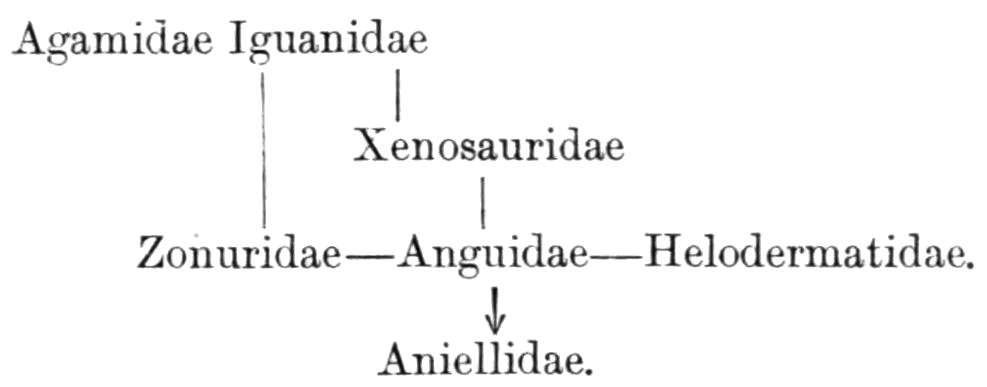
Group II. Xantusiidae–Tejidae–Amphisbaenidae.
Group III. Scincidae–Gerrhosauridae–Lacertidae.–Here also Anelytropidae and perhaps also Dibamidae as degraded Scincoids.
Group IV. Varanidae, which are in many respects the most highly developed of all.
Pygopodidae are of obscure relationship.
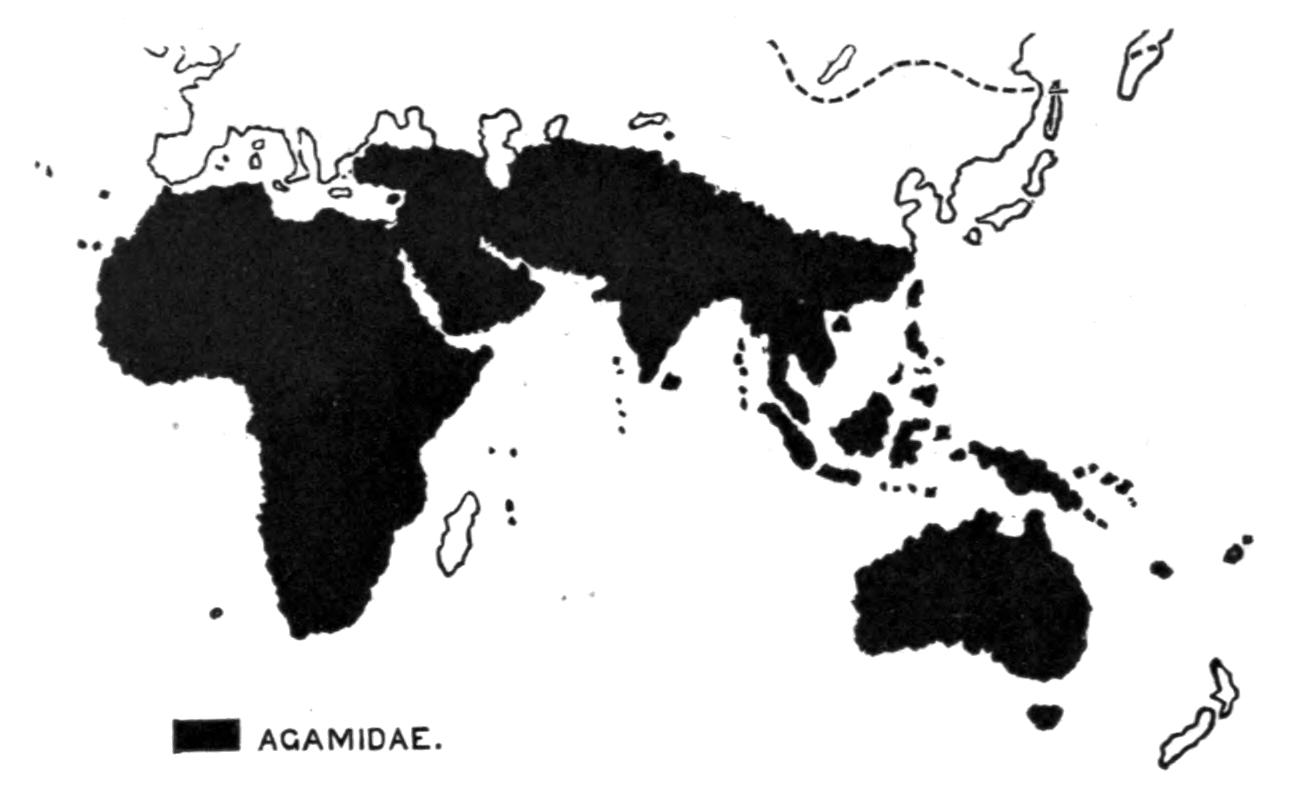
Fig. 122.–Map showing the distribution of the Agamidae.
Fam. 1. Agamidae.–Acrodont, Old-World Lizards, with a broad and short tongue. The teeth are usually differentiated into incisors, canines, and molars. The orbit is closed posteriorly; the temporal fossa is bridged over by an arch which is formed chiefly by the squamosal and the well-developed jugal; the postorbital mostly remaining small, and the postfrontal and supratemporal bones being either absent or not present as separate elements. The limbs are well developed. The eye, provided with complete eyelids, is distinctly small and has a round pupil. The skin is devoid of osteoderms, although large and numerous spines are often present, especially on the head and on the tail. The Agamidae, of which about two hundred species, arranged in about thirty genera, are known, exhibit a great diversity of mostly flat-bodied, terrestrial and more laterally compressed, arboreal forms. The majority are insectivorous, a few Agamas have a mixed diet, while Uromastix and some others are chiefly, if not entirely, frugivorous and herbivorous. They are an exclusively Old-World family, avoiding the cooler parts of the Palaearctic sub-region, and also, a very curious fact, Madagascar. The majority live in Australia and in the Indian and Malay countries, comparatively few in Africa, chiefly the genus Agama.
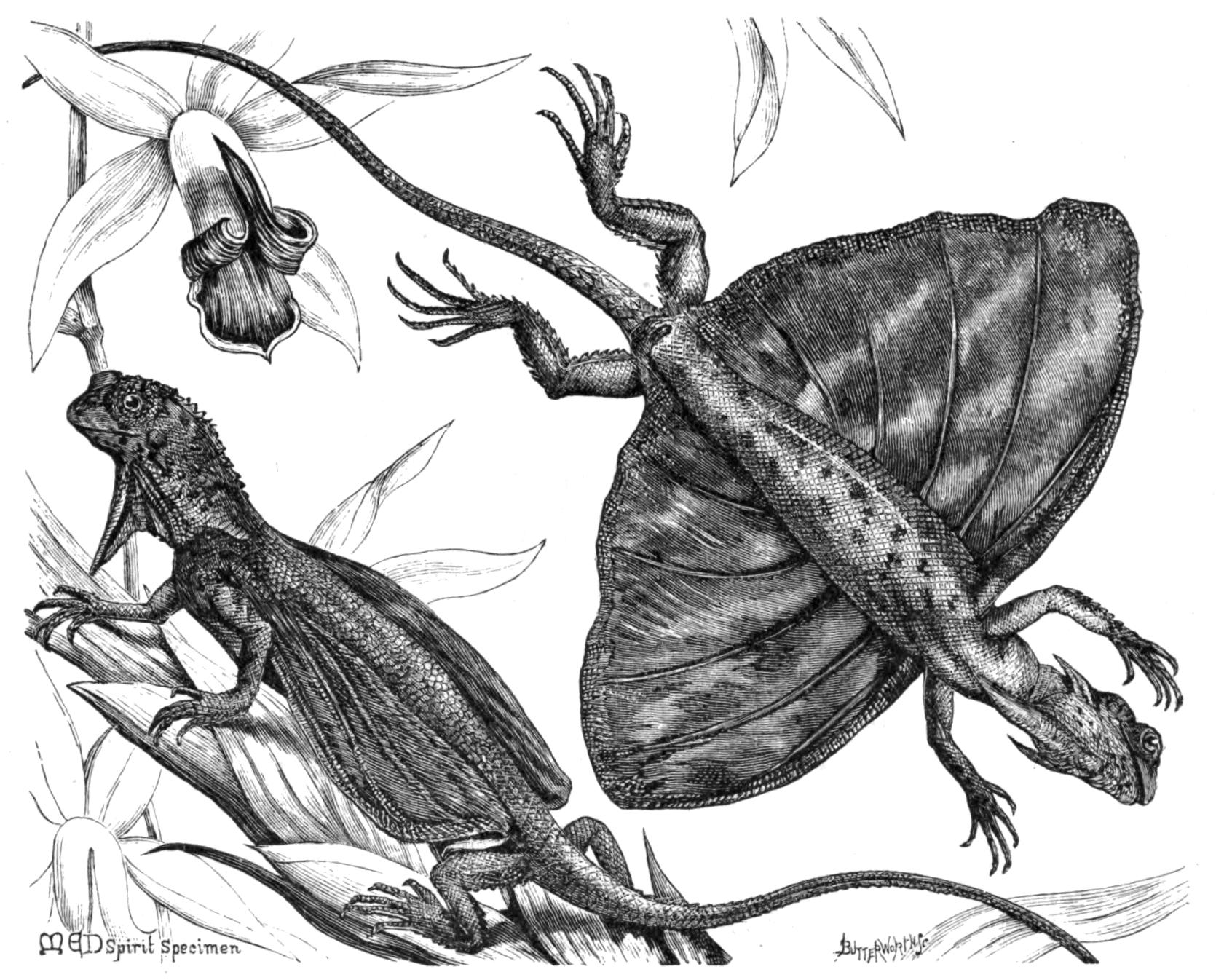
Fig. 123.–Draco volans. × ⅔.
Draco ("Flying Dragon").–The body is much depressed and the sides extend as a pair of large wing-like membranes, which are supported by five or six of the much-elongated posterior ribs, and can be folded up like a fan. On the throat are three pointed appendages, a short one on either side and a long one in the middle. The tail is very long and slender, but not brittle. About twenty species of this extraordinary genus inhabit the various Indo-Malayan countries; one, D. dussumieri, occurs in Madras. D. volans of the Malay Peninsula, Sumatra, Java, and Borneo is about 10 inches long, 5 of which are taken up by the tail. The male has a small nuchal crest. The upper parts of this pretty creature have a metallic sheen, with small dark spots and undulating cross-bands upon the rich brown ground-colour. The wings are orange with black markings. The gular sac of the male is orange, that of the female is blue.
The "Flying Dragons" use their wings as parachutes, but their sailing powers are said to be very moderate. Certainly they do not fly by moving the wings, but when at rest upon a branch, amidst the luxurious vegetation and in the immediate neighbourhood of gorgeously coloured flowers, which partly conceal them by their likeness, they greatly resemble butterflies, especially since they have the habit of opening and folding their pretty wings.
Ceratophora.–This exclusively Ceylonese genus is remarkable for a flexible, erect, and pointed appendage which arises from the top of the snout; it is best developed in the males, vestigial or absent in the females. Gular appendages are absent. The trunk is crestless, slightly compressed, and covered with partly keeled scales. The tail is slender and very long, about two-thirds of the total length of the animal. The general colour is olive-brown, with irregular darker markings and with light streaks on the head and thighs. C. stoddarti and C. tennenti are about 10 inches long, the former without, the latter with, little scales upon the rostral appendage.
Lyriocephalus, with L. scutatus (Fig. 124) of Ceylon as the only species, is remarkable for its Chameleon-like appearance. A splendid case of convergent evolution, but most improbably of mimicry. The tympanum is quite hidden. The head is raised into a pair of sharp bony edges. On the top of the nose is a thick globular lump, recalling the genus Ceratophora, and also various Malagasy Chameleons. The back and sides are covered with very small granular scales, intermixed with several rows of enlarged scales as in Chameleo pumilus, and there is a serrated crest along the back from neck to tail. The under parts are covered with large keeled scales with sharp points directed backwards, especially on the tail. The whole body is laterally compressed. The pollex and the fifth toe are strongly opposed to the other digits. The general colour is greenish above, whitish below. Total length about one foot.
Calotes, with many species in India and in the Malay Islands, is distinguished by a crest on the neck and back. Many of the males have a gular sac. The tail is extremely long. These lizards are remarkable for their changes of colour.
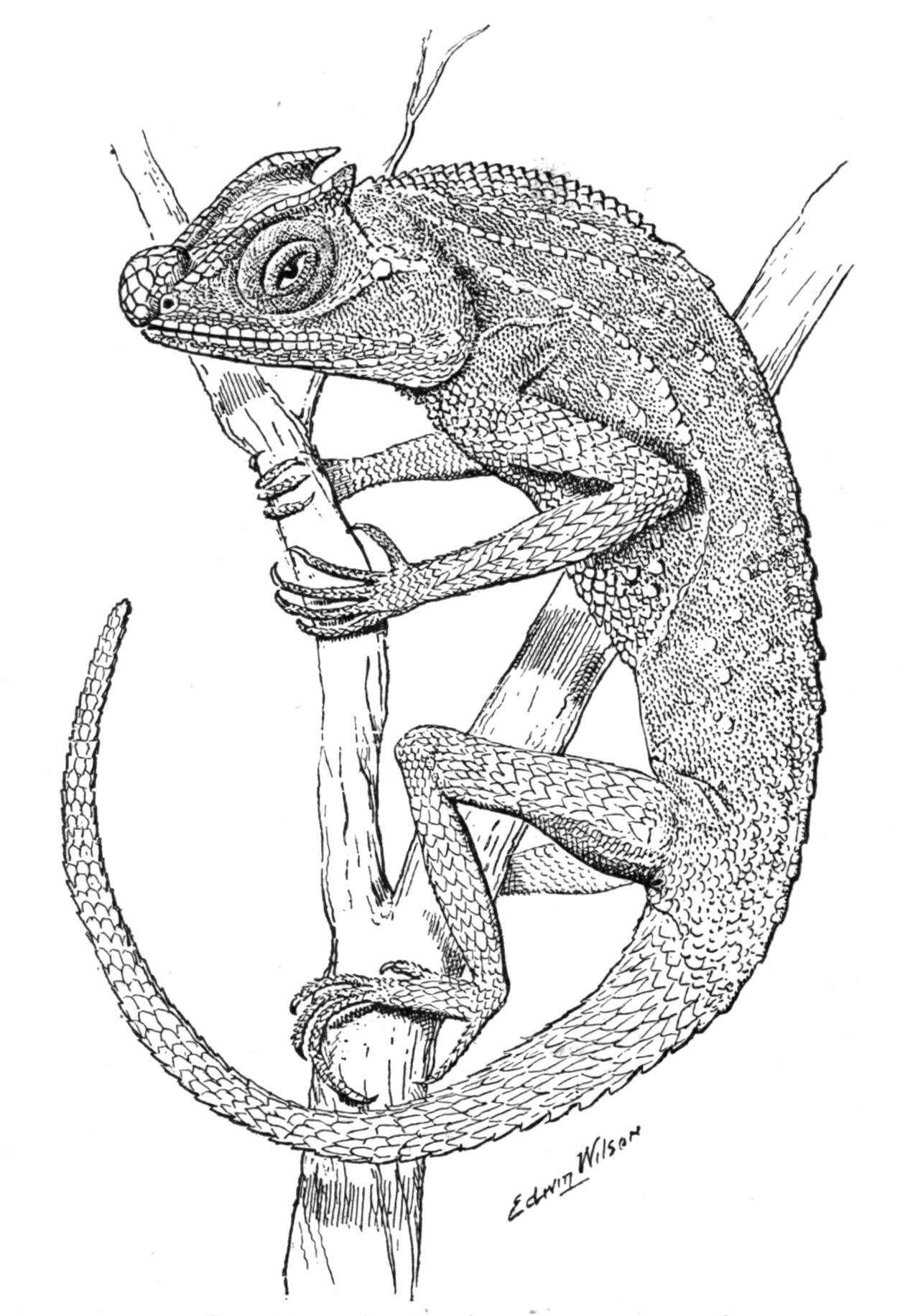
Fig. 124.–Lyriocephalus scutatus. × ⅔.
C. versicolor ranges from Afghanistan through the whole of India to Southern China, and attains a length of 14 inches, 11 of which are taken up by the tail. It possesses no gular sac, but has a well-developed crest. The whole body and tail are covered with strongly keeled scales. When the lizard is irritated, or swallowing its food, the head and neck become brilliant red, whilst the usually brownish tint of the body is converted into pale yellow. Mr. Annandale has favoured me with the following observations on C. emma:–"In the Malay Peninsula the Europeans misname this lizard Chameleon. The colour-changes appear to be brought about by emotions, although the lizard is often darker towards evening than it is at mid-day. The males are very pugnacious, and change colour as they fight. At the time of courtship a curious performance is gone through by the male, the female remaining concealed in the foliage hard by. He chooses some convenient station, such as a banana leaf or the top of a fence, and advances slowly towards the female. His colour is then pale yellowish flesh-colour, with a conspicuous dark spot on each of the gular pouches, which are extended to their utmost. He stands upright, raising the fore part of the body as high as possible, and nodding his head solemnly up and down. As he does so, the mouth is rapidly and repeatedly opened and shut, but no sound is emitted. When he is driven away, caught or killed, the dark spot disappears entirely from the neck. If one male is captured, another takes his place within a few hours."
C. ophiomachus of Southern India and Ceylon reaches 2 feet in length, has a fold of skin in front of each shoulder, and is generally known as the "blood-sucker" on account of the red colour displayed during excitement on the head and neck.
C. mystaceus, chiefly in Burma and Siam, but also in the Nicobar Islands and in Ceylon, has a small gular sac and an oblique fold in front of each shoulder. The specific name seems to refer to the yellowish lips. Mason[155] gives the following vivid account of it:–
"This is a very common species in gardens in Toung-ngoo. A pair made their home in the mango trees near my study window. The female blundered into the house a few days ago, but I found her a very unattractive animal of a uniform earth-brown colour. The male, however, is sometimes a beauty. He may be often seen jerking his head up and down, with the head, pouch, and whole front of the body a glowing ultramarine blue, contrasting beautifully with the reddish-brown of the hinder part of the body and tail. From the nose to the shoulders, below the eye, is a broad white band, which is interrupted by three reddish-brown patches, in line with the white band, before reaching the uniform reddish brown of the hinder part of the body. Occasionally the white band below the eye assumes a brownish colour, and the animal appears to have a brown band down each side. He does not always, however, appear in this gay dress. While I am writing, I see him coming down the trunk of one of the trees in a very faded garment. His skin suggests a bright calico after it has been washed, whose colours succumb to soap. The blue is there, but it is no longer the bright blue of yesterday. It has changed to a dull light indigo colour. He runs across the grass to the foot of another tree, and stops on the bare ground at its base, where for a minute or more he bites with great energy at a struggling grasshopper, and while thus exercising himself the blue fades out from his body altogether, and his whole body takes the colour of the brown earth on which he stands. After tarrying a minute or two he ran up the other tree, and the dull light blue colour seemed to return to him."
Agama with many species in Africa and Asia; some in South-Eastern Europe. The body is somewhat depressed. There is a fold across the throat and a pit on either side; the presence of a gular sac is variable. A dorsal crest is absent or but feebly developed. The males have pre-anal pores.
A. sanguinolenta.–The body is covered with strongly keeled and pointed scales. On the sides of the head are a few spine-like scales. The ear-opening is partly concealed by a fringe of spinous scales. The males have a gular pouch. This is a typical inhabitant of the deserts and steppes of Turkestan. Zander[156] has observed the habits and many changes of colour of this lizard. The usual garb is earthy brown above, with somewhat darker and rather indistinct markings. The under parts are whitish. Sometimes the creature changes to dirty white, at other times into blackish or grey brown. Bluish-red stripes may appear on the sides of the body; blue lines begin to show on the throat, and ultimately the whole belly, originally white, may become ultramarine blue. When the general tone happens to be sulphurous yellow, blue often appears on the tail and limbs. Brick red appears on four longitudinal rows of patches on the sides of the body. Sometimes the whole animal assumes a vinous tinge, or it is at first greenish before turning into blue. The change begins on the tail and limbs, extends over the head, and at length reaches the back. Red appears in both sexes, more frequently in the female; blue almost entirely in the male. Sunlight and warmth only intensify the colours. Adaptive coloration, besides the usual sandy garb, has not been observed. The lizards live on soil which is baked as hard as bricks, or in cavities of old walls, provided there is vegetation. They require vegetable food, besides insects, grazing on grass, and having a fondness also for Mesembryanthemum cardiforme. Very large males reach a total length of one foot. They are pugnacious, especially during the time of breeding. The male inflates its gular sac into the size of a walnut, stands up upon its four limbs, with its head slightly lowered and turned to one side. Then it darts upon the foe which it has been eyeing for some time.
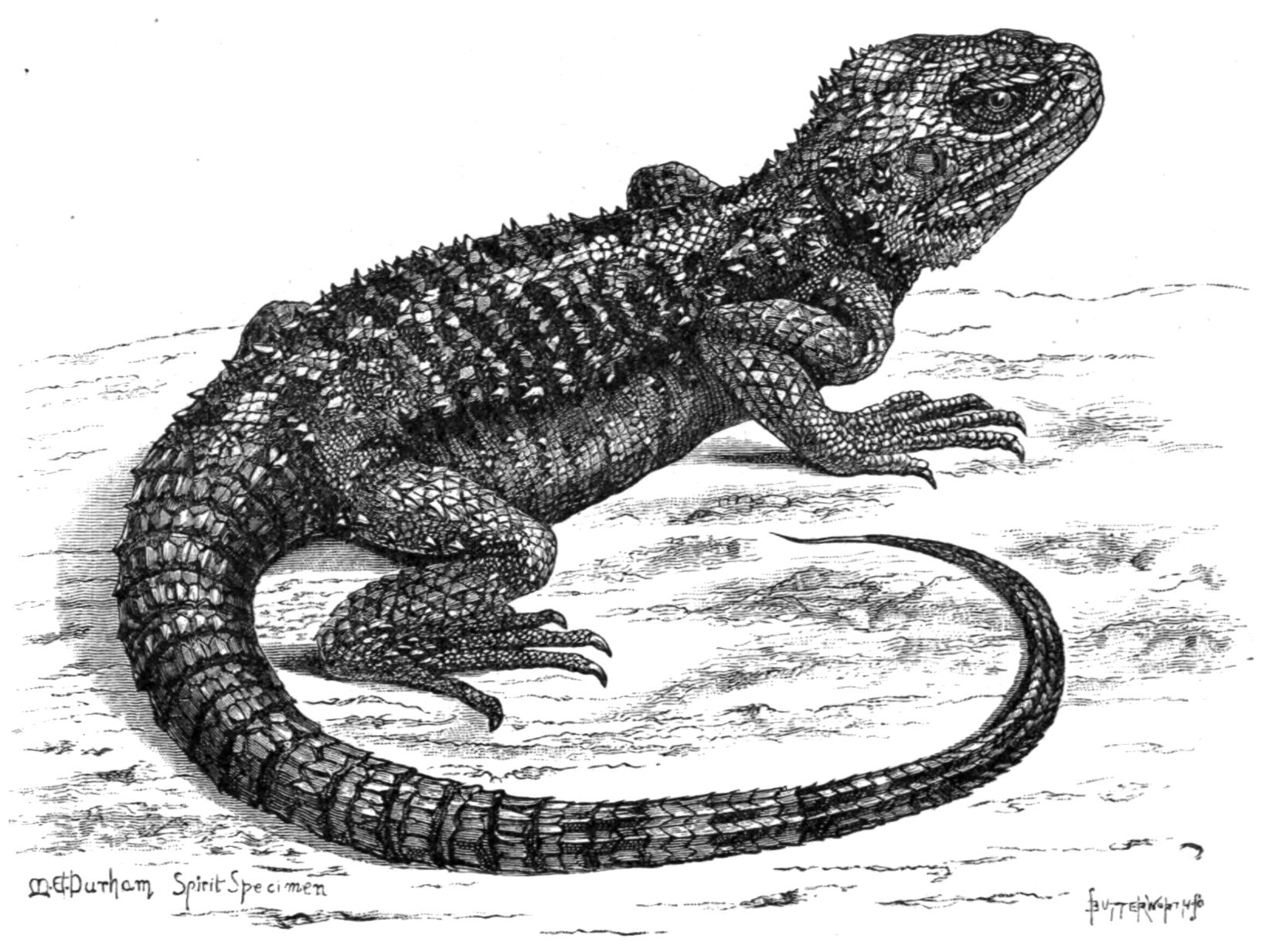
Fig. 125.–Agama stellio. × ½.
A. stellio is the commonest Agama in Egypt, Asia Minor, and in some of the Grecian Islands, where the Greeks still call it korkordilos, just as they did in the time of old Herodotus. The Arabic name is hardun. This lizard is easily recognised by the irregular folds on the neck, which are beset with spinous horny scales. It grows to a length of 15 inches. The general colour is brown, with dark patches on the back. When basking they become almost black; in the breeding season the male assumes red tints on the head and neck.
Phrynocephalus.–This is a typical Agamoid of the steppes and deserts of Asia. The head is short and thick, the ear is hidden. The body is depressed, devoid of a dorsal crest; on the throat is a transverse fold but no sac.
A. Zander[157] has made interesting observations upon the habits of several species.
Ph. helioscopus lives on hard stretches of soil, which are absolutely bare of vegetation, the soil being baked as hard as a paved road. The lizards live on any insects they can get hold of, chiefly, however, upon mining ants. When chased they run with short jerks, carrying the tail high or rolled up.
Ph. interscapularis occurs, in Transcaspia, on the shifting, loose sand. It runs so fast that one scarcely sees anything but its shadow. The tail is rolled upwards. With short jerks it suddenly changes its direction, stops behind a few blades of grass, or in the open, makes a few shaking, wavy movements, and covers itself lightly with sand. Shortly after that the top of the head appears, the grains of sand rolling off between the strong supraciliary ridges, and the little creature, only about 3 inches long, peeps out of its temporary hiding-place.
Ph. mystaceus, which inhabits Transcaspia and parts of Southern Russia, often faces its aggressor, raising itself upon its fore-limbs, curling and uncurling its tail in its excitement, and holding its mouth widely open. The creature, which attains a length of 9 inches, inclusive of the long tail, then assumes a markedly changed aspect. The flaps of skin at the corners of the mouth swell up into a half-moon-shaped transverse plate, the hinder surface of which is covered by the outer skin, while the front is a continuation of the rosy lining of the mouth, which thereby appears hugely enlarged. When biting it hangs firmly on to the finger. This frightening attitude is interesting, since it occurs in a much more developed condition in the following genus.
Chlamydosaurus kingi.–This peculiar Agamoid, which inhabits Queensland and Northern and North-Western Australia, is easily recognised by the large frill-shaped dermal expansion on either side of the neck. The two halves are confluent on the throat. The whole frill can be erected, and is worked by the much-elongated arches or horns of the hyoid apparatus, which extend into the flaps of skin, somewhat like the ribs of an umbrella. The specially modified hyoidean muscles spread out and fold the frill. When this curious creature is pursued it folds the frill and runs in a semi-erect position upon its hind-limbs, with its fore-limbs hanging down. However, it cannot keep up this peculiar gait for long, and it then suddenly turns to bay, frequently at the root of a tree, which it can climb with ease. When standing at bay it spreads out the shield to its full extent, in the middle of which appears the widely opened mouth, which is red inside and armed with powerful teeth. Altogether this lizard presents a formidable aspect, and is an enemy not to be despised, considering that it is strongly built and grows to nearly 3 feet in length. For a further account of the habits and of the mechanism of the frill see De Vis.[158]
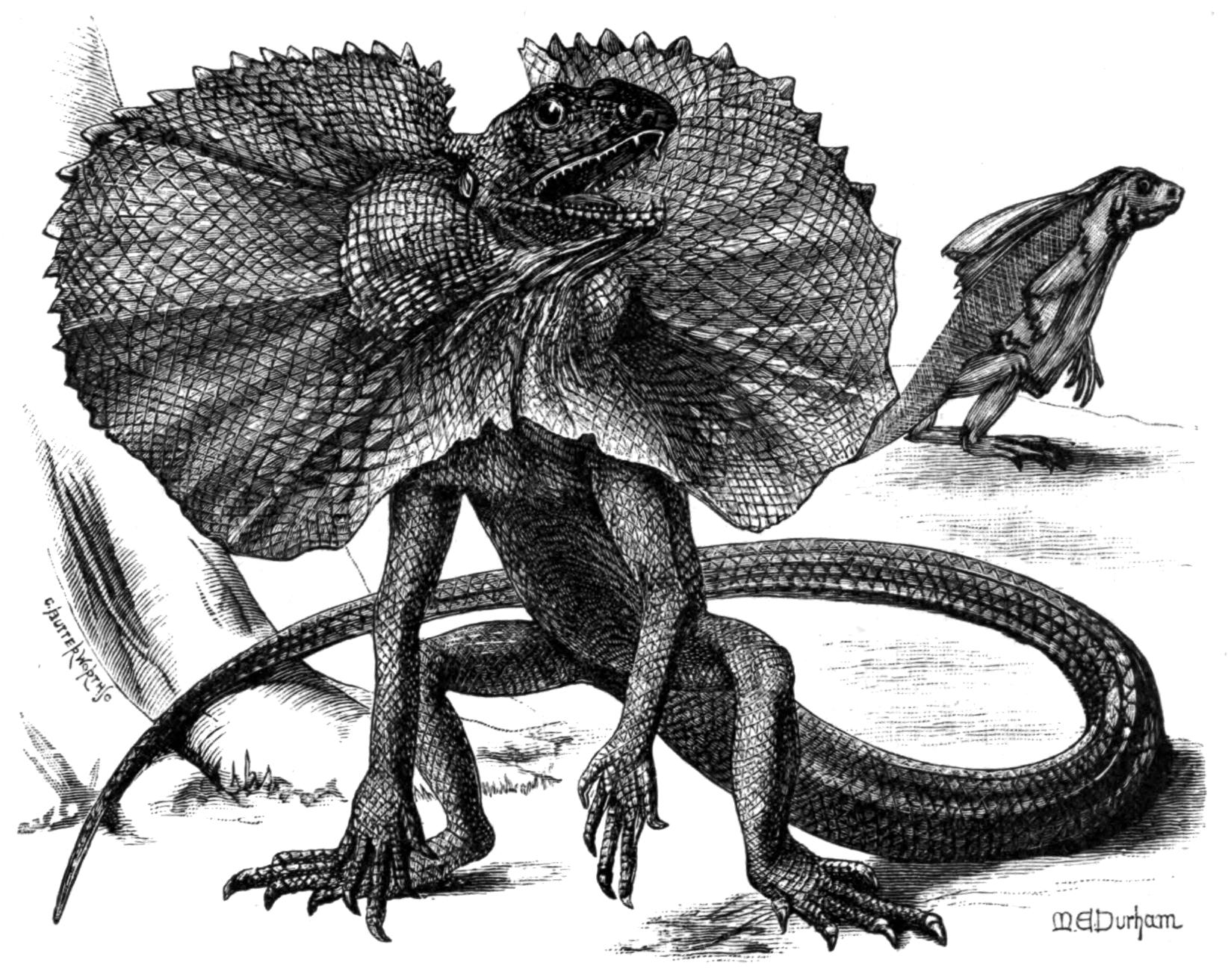
Fig. 126.–Chlamydosaurus kingi. × ¼.
Physignathus.–This is a water-loving genus, inhabiting well-watered districts with luxuriant vegetation in Australia, Papuasia, Siam, and Cochin China. The body and the very long tail are laterally compressed and furnished with a low, serrated crest. Ph. lesueuri of Queensland reaches a length of about 18 inches. The general colour is dark olive above, with darker and lighter cross-bands, and with a broad black band reaching from the eye to the shoulder. The under parts are pale olive, with small black dots. The throat, although devoid of a special sac, is frequently bulged out by the hyoid apparatus, as shown in Fig. 127, taken from a specimen in the Zoological Gardens in London.
Uromastix is a typical desert-form, inhabiting the dry and sandy tracts of North Africa, Arabia, Syria, Persia, and North-Western India. The genus is easily recognised by the short and thick tail, which is covered with whorls of large spinous scales, while the much-depressed body and head are almost smooth, being covered with very small scales. The tympanum of the ear is quite exposed. The incisors are large, uniting in the adult into one or two pairs of large cutting teeth, separated from the molars by a toothless space. There is a transverse fold on the throat. Pre-anal and femoral pores are well developed.
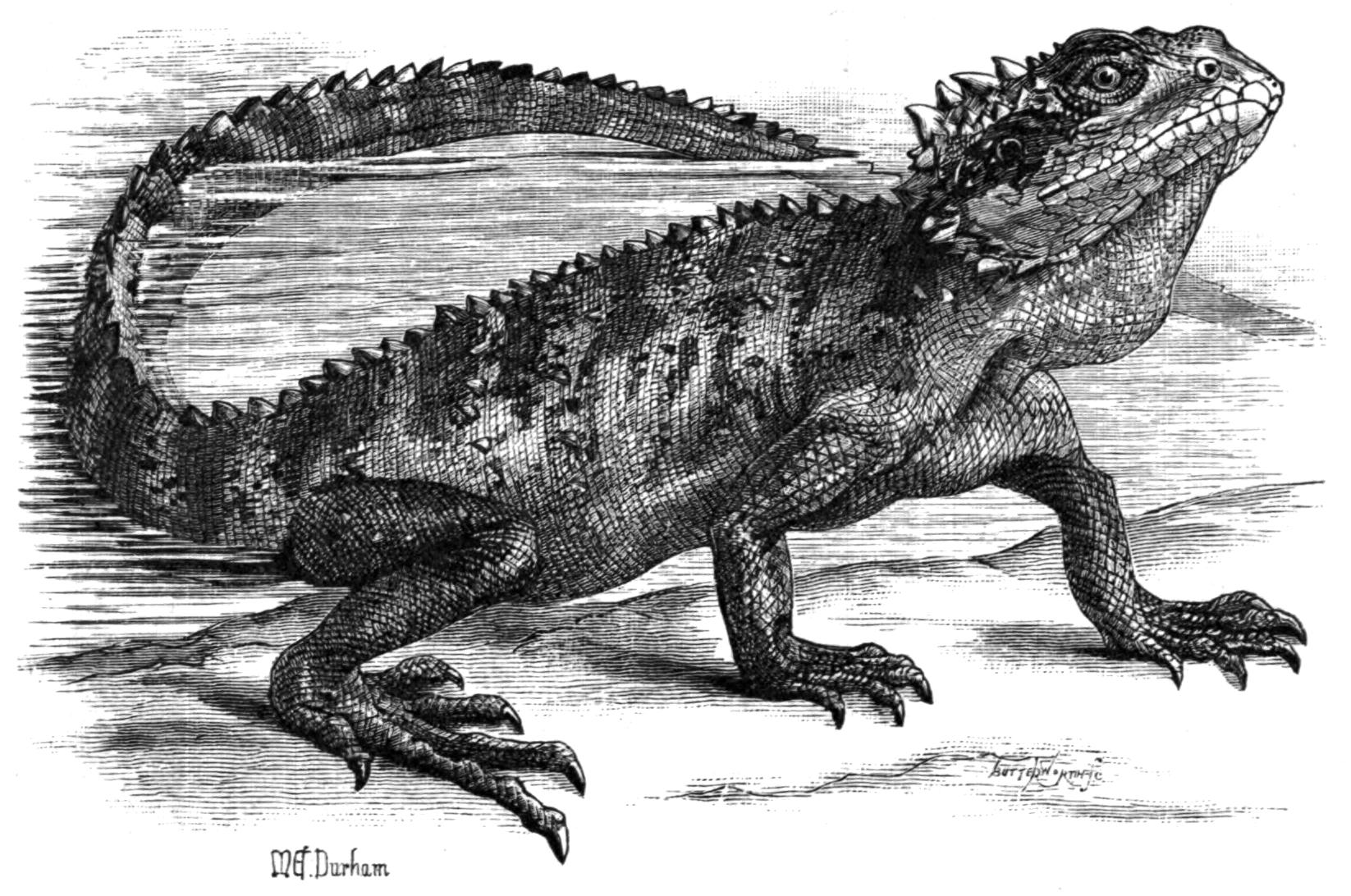
Fig. 127.–Physignathus lesueuri. × ⅓.
These "Spiny-tailed Lizards" live chiefly upon vegetable food, leaves, grass and fruit, but they vary this diet with insects, at least in captivity, where they become rather partial to meal-worms. They are absolutely terrestrial and diurnal, preferring sandy places, where they bask or rather roast themselves in the sun; for the night, at the approach of rain, or on dull and chilly days, they retire into their burrows, which they dig in the sand or in the hard ground, unless they hide in the cracks of rocks. They have a regular mania for digging with their strong limbs and short, curved claws. Although they love a great amount of heat, and become stiff when cooled down to about 16° C. = 60 F., they can stand several degrees of dry frost without injury. During the cold season they hibernate. The spiny tail is used for defence. The lizard lies as a rule in such a position in its hole that the tail blocks the narrow passage; when touched with the hand it deals out jerky side-blows with the tail. The bite is deliberate and very painful.
U. hardwicki is a native of North-Western India and Beluchistan, occurring especially in Sindh and Rajputana, for instance near Delhi and Agra. This species is of a delicate sandy colour, with dark dots or vermiculations, interspersed, occasionally, with pale blue specks. The under parts are whitish on the tail with a greenish hue. A distinctive and obvious mark is a large blackish patch on the anterior side of the thigh. Total length up to one foot.
I have several times received consignments of the Indian Spiny-tailed Lizard through the kindness of friends, but I must confess that they are far less easily kept than one is led to believe from certain exaggerated accounts. They are lovely, most interesting, and surprisingly tame creatures. I received one lot in the month of June. They made burrows in the dry soil, basked in the sun and on the grassy sods of their roomy cage, and showed great curiosity. When approached, they at first scrambled off or sank down flat, shut their eyes and feigned death. They then opened their tiny yellow eyes a little, while others peeped out of their retreats to see if all was safe, or attracted by some noise. Soon they became so tame that they crawled over my hand. But the difficulty consisted in feeding them. They greedily lapped up drops of water. Their dung consisted of the indigestible parts of some species of Equisetum or Mare's tail, mixed with fragments of beetles and ants. Lettuce, cabbage, cauliflower, grass, the flowers of red and white clover, Mare's tail, wheat, rice, and Indian corn were offered, but they only took a few blades of grass and the hard Indian corn, besides meal-worms. This is all the more astonishing since other specimens are known to partake freely of herbaceous food. None of them survived the late autumn, and most of them succumbed to a disease known as intussusception of the gut. They certainly could not complain of the want of heat, since the bottom of their cage was kept permanently warm by a lamp, and in the autumn they invariably slept in the warmest part of the soil, avoiding the cool regions which would have given them a chance of hibernating.
Another consignment arrived in the month of February. None of them ate anything or survived the early summer.
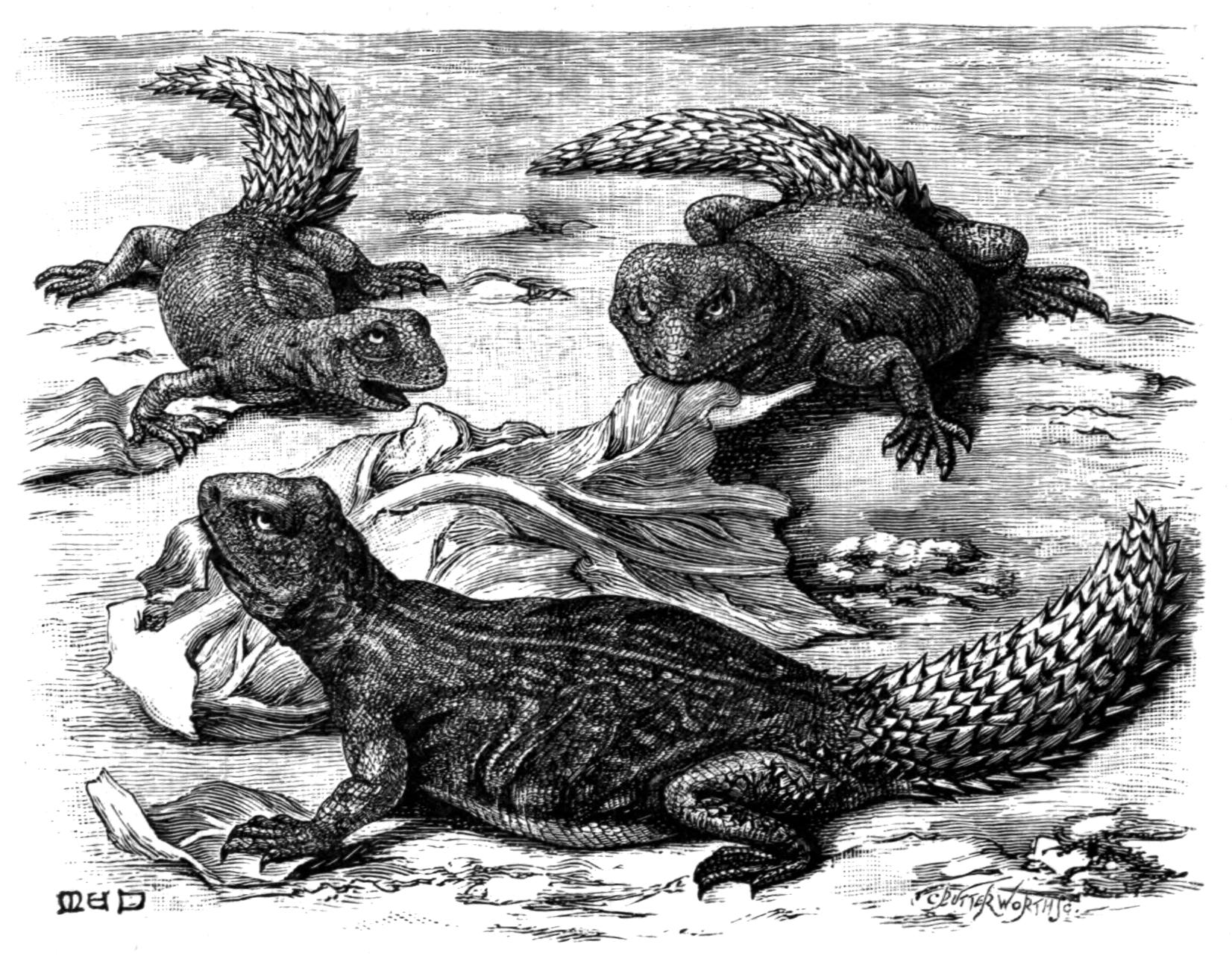
Fig. 128.–Uromastix acanthinurus. × ¼.
U. acanthinurus and U. spinipes are common in Algeria, Tunis, and Egypt, where they prefer sandy and rocky localities. Their Arabic name is Dab. In Algeria they are sometimes called "lézards des palmiers," perhaps because they eat dates, besides berries, grass, and various flowers. Very large specimens attain a length of 18 inches. Like the other species of Uromastix they have no voice. The African species can change colour to a great extent. At a low temperature they are mostly grey or brownish black above, dirty white below. When it is warmer they change to lighter shades of brown or even to orange yellow and to green, with black or brown specks and vermiculations. A young specimen of U. acanthinurus has been observed to grow within twelve months from 90 to 150 mm. in length.
Moloch.–The mouth of this peculiar-looking creature is very small; the lateral teeth of the upper-jaw are implanted horizontally and directed inwards. The body is much depressed, and, like the short tail and head, is covered with small scales or tubercles intermixed with large spines. M. horridus, the only species, inhabits the sandy districts of Western and Southern Australia. Nothing is known about its habits except that it seems to live upon ants. Its extremely rough skin is, according to an accidental observation by Dr. Willey, highly hygroscopic. He happened to put a live specimen into a shallow dish with water, when, to his surprise, the water was sucked up as by blotting-paper.
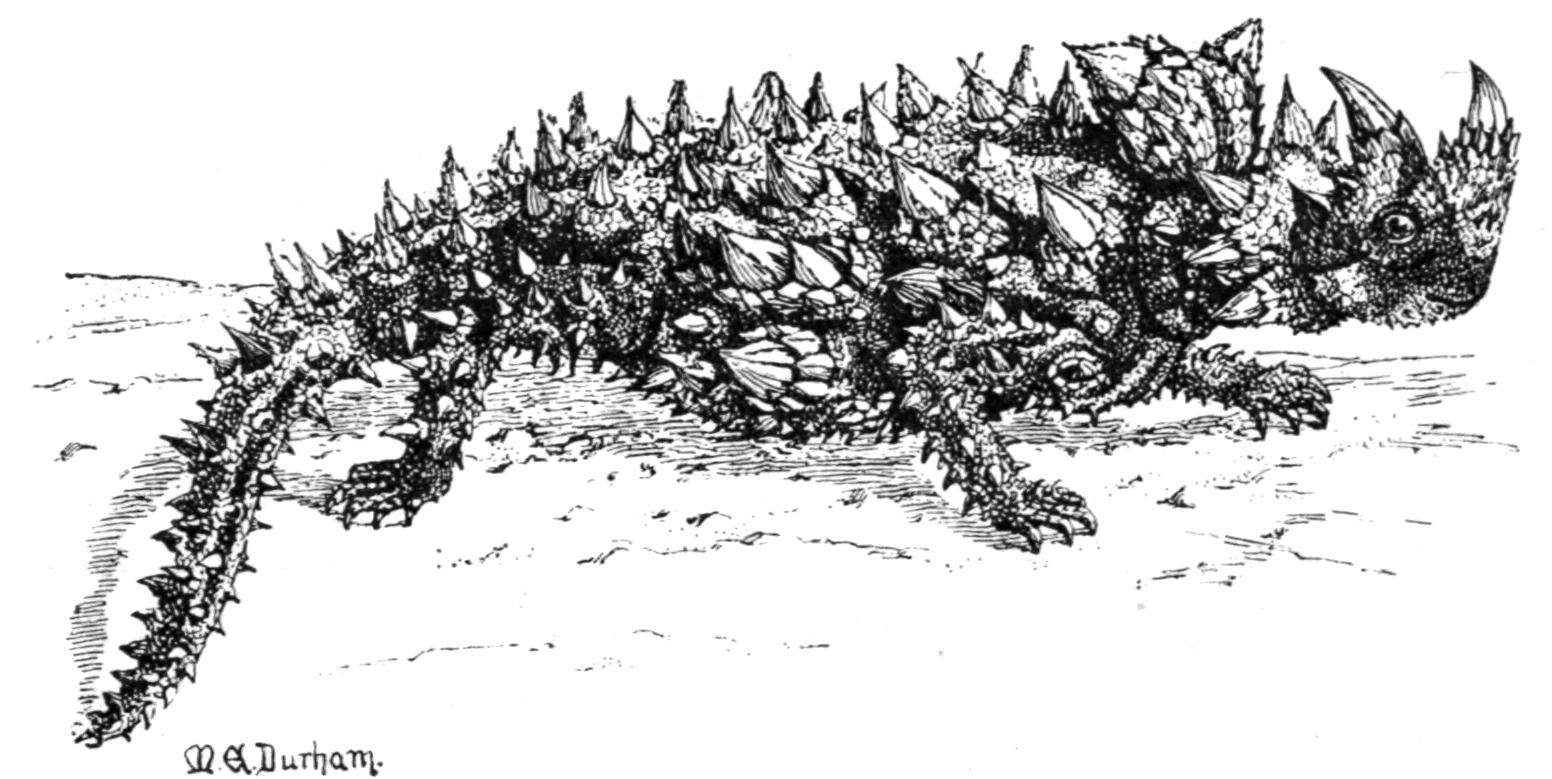
Fig. 129.–Moloch horridus. × ⅔.
Liolepis.–The body is depressed, without a crest, and is covered with minute granular scales. The tail is long, and has small keeled scales. There is a strong transverse gular fold, and a fold along the side of the body. The tympanum is distinct. Femoral, but no pre-anal, pores are present.
L. belli, the only species, about 18 inches long when full grown, is a native of South-Eastern Asia. The general colour is brownish, with pale black-edged spots along the back; the sides are marked with black and orange vertical bars; the under parts are orange, variegated with blue. Annandale remarks that this is perhaps the commonest lizard on the barren stretches of sand in Lower Siam, especially near the coast. It is exceedingly active and timid. Though its colour is brilliant, the green and grey eye-like spots which ornament its back, and the orange and purple stripes on its sides, are not conspicuous amidst the natural surroundings, the former harmonising with the shadows cast upon the sand by the scanty vegetation which it supports, and the latter being more or less concealed by the folds into which the skin that covers the ribs naturally falls. When the male is roughly handled and is unable to use its powerful jaws, it flattens its body in such a way that the stripes become most conspicuous. The female is unable to do this with such effect, as her ribs do not seem to be so mobile and her colours are less bright. Liolepis lives in holes in the ground, which often go down vertically for more than 2 feet before there is a bend in their course. Each burrow generally contains a pair of these lizards, which, according to the natives, are strictly monogamous.
Fam. 2. Iguanidae.–Pleurodont lizards with a short and thick, non-protractile tongue; almost entirely American, with the remarkable exception of two genera, Hoplurus and Chalarodon in Madagascar, and one, Brachylophus, in the Fiji Islands. Most of the Iguanidae are insectivorous, but some of the most striking forms are herbivorous, e.g. Iguana, Amblyrhynchus, and Basiliscus. In their general structure the Iguanidae closely resemble the Agamidae, from which they differ chiefly by the pleurodont dentition. The orbit is surrounded by bone, and the temporal fossa is bridged over by an arch which is formed by the junction of the squamosal chiefly with the postorbital, the jugal taking as a rule less share in the arch. Dermal ossifications are absent on the body.
There are about three hundred different species, which have been grouped into about fifty genera, representing arboreal, terrestrial, burrowing, semi-aquatic forms, and even one semi-marine species. Their external appearance varies consequently within wide limits.
Anolis is distinguished by the partial dilatation on the middle phalanges, which carry a series of transverse adhesive lamellae. In its general shape Anolis resembles slenderly built and long-tailed Lacertidae, which it may be said to represent in tropical and sub-tropical America, inclusive of the West Indian Islands. The males have a large gular appendage, which can be distended by the hyoid bones. Anolis is an expert climber, living in trees, or rushing about on fences or walls of houses in search of insects; most species can change colour to a great extent. More than a hundred species are known, of which we mention only one, very common in the Southern United States.
A. carolinensis of the South-Eastern United States and of Cuba is beautiful golden green on the whole upper surface; the gular sac becomes vermilion when stretched; when flaccid, it is white with occasional red lines and spots. The under parts are white. In cold weather and in confinement this little lizard, which is scarcely 6 inches in length, appears dark brown, sometimes with a white line along the back. The changes of colour are very sudden. They are thoroughly arboreal, leaping from leaf to leaf like Tree-frogs.
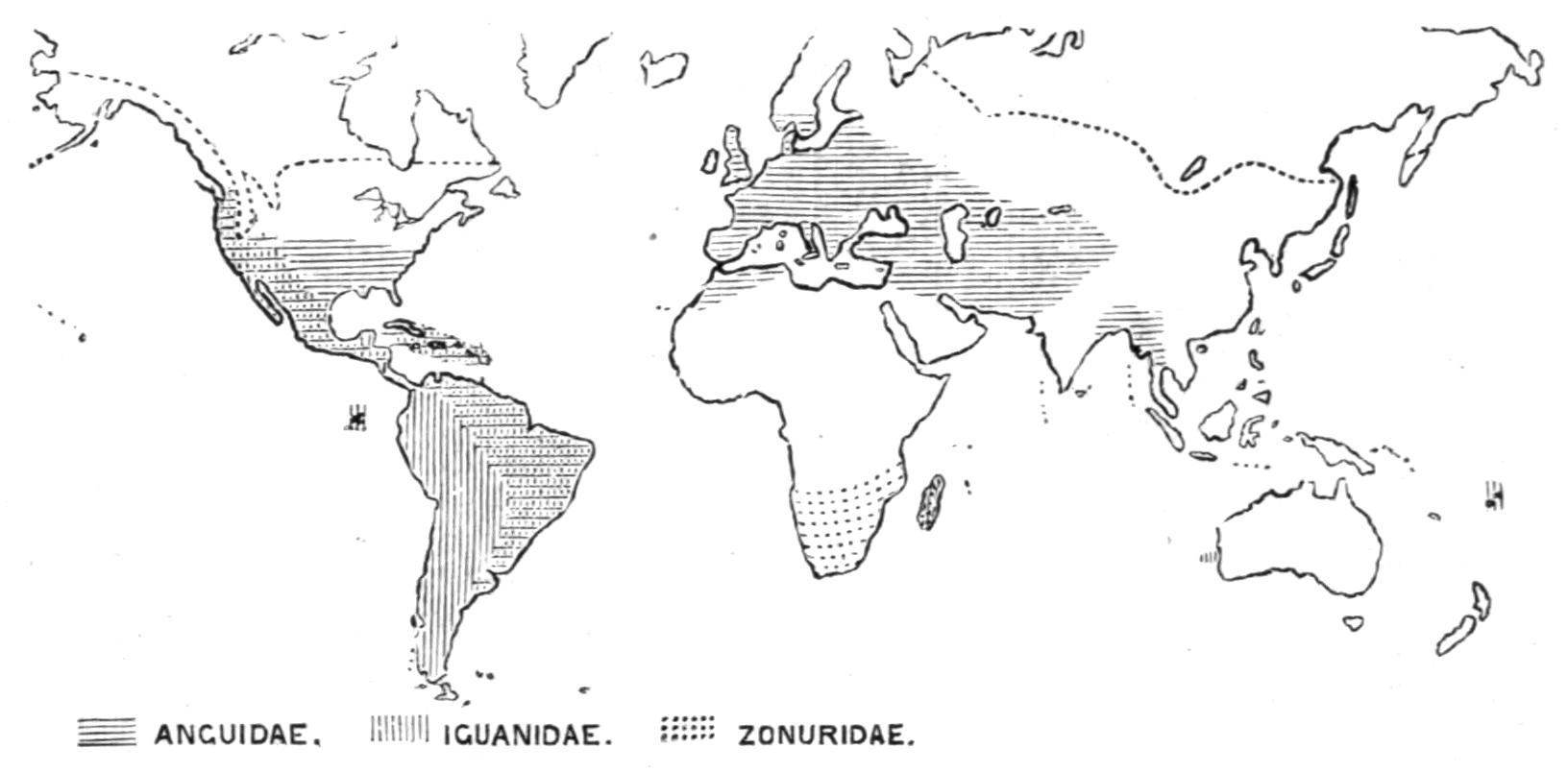
Fig. 130.–Map showing the distribution of Anguidae, Iguanidae, and Zonuridae.
In Anolis, Polychrus, Hoplurus, Chalarodon, Liosaurus, and a few others, the posterior ribs are much elongated and imbedded in the abdominal muscles, often reaching the medioventral line, a feature elsewhere known in the Geckos only.
Polychrus.–The body is laterally compressed, covered with small scales, but devoid of crests. The digits are likewise compressed, with keeled lamellae on the under surface and with four large scales at the base of each claw. Both sexes have femoral pores. The male possesses a small gular sac. A few species in Tropical America.
P. marmoratus in South America, where it is often called the Chameleon on account of its power of changing colour. The tail is nearly three times as long as the head and body, and is covered with keeled scales. The general colour of this arboreal creature, which reaches a length of 18 inches, is green, but the hues are very variable, and within a short time the creature can change into dull brown, with or without blackish spots and bands, or with whitish spots and black lines on the head and other parts of the body.
Basiliscus is remarkable for the high and erectile crests which are developed on the back and tail of the males. The toes are bordered on the outer side with small lobes. The limbs are long, the hind-limbs when stretched forwards reaching the tip of the snout. Several species in Central America and the adjoining countries to the south.
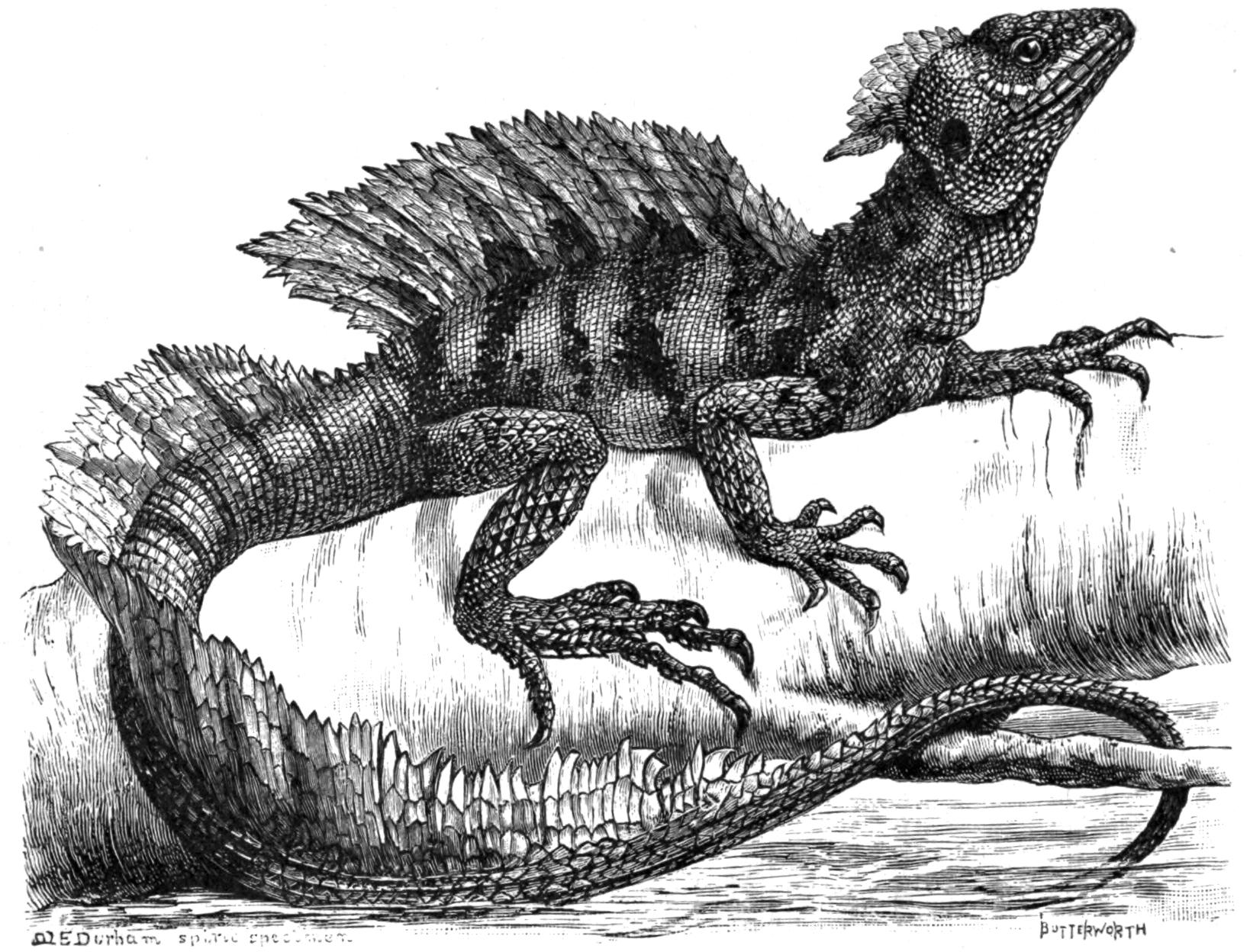
Fig. 131.–Basiliscus americanus (male). × ¼.
B. americanus reaches the considerable length of nearly 3 feet. The male has a crest on the top of the head, and this is produced backwards into a leathery lobe. The back is adorned with a very high crest; the folds and dark-coloured marks in which give, in the accompanying illustration, the impression that the crest is supported by spines. The long tail carries a similar crest. The general colour of the "Basilisc" is green and brown with dark cross-bars on the back. The crest of the male is said to be red. These creatures are very common amidst the luxuriant vegetation on the banks of the rivers of the Tierra Caliente of Mexico and in Guatemala. They lie upon the branches of trees, preferring those which overhang the water, into which they plunge at the slightest alarm. The high crests, being restricted to the male sex, are not essential to their swimming; they propel themselves by rapid strokes of the fore-limbs, letting the long rudder-like tail drag behind. The eggs, measuring 20 by 13 mm., are laid in April or May, and are hidden in a hole at the base of a tree. About one dozen make a set, and they are said to be hatched within a very short time. Owing to their being strictly herbivorous, these pretty and striking-looking creatures do not endure captivity in Europe, unless indeed their particular food can be procured.
Iguana.–The body and tail are laterally compressed and are covered with very small scales, while those on the top of the head are large. The neck and back carry a high crest, which is composed of separate, laterally compressed, soft spines. A similar but lower crest borders the anterior edge of the large gular sac, which is not dilatable. The lateral teeth are remarkable for their finely serrated or denticulated anterior and posterior edges. Both sexes have long rows of femoral pores. Only two species in Tropical America, absolutely herbivorous. Their delicate flesh is much esteemed as food.
I. tuberculata (Fig. 132), of South and Central America and the West Indies, reaches a length of 5 to 6 feet. The general colour of the upper parts is a mixture of green and blackish, frequently speckled with white or yellow, and there is usually a pale band in front of each arm. The flanks are marked with dark, light-edged bars. The under parts are pale greenish or whitish. The Iguanas live in the trees, and when there is danger they jump into the water whatever the height of the tree, coming down with violence. In going up some of the narrow, unfrequented creeks in the Mosquito country, according to Napier Bell,[159] the voyager often encounters quite a shower of falling Iguanas, and runs some risk of getting his neck broken. Large specimens, 6 feet long, weigh perhaps 30 lbs. They burrow deep horizontal holes in the sloping side of a bank. About two dozen eggs, nearly 2 inches long, are laid in a hole, where they are hatched in the month of May.
Iguanas are often brought to the markets, either lashed lengthwise to a branch of the tree on which the specimen happened to be surprised, or tied up with the long tendons of their own toes.
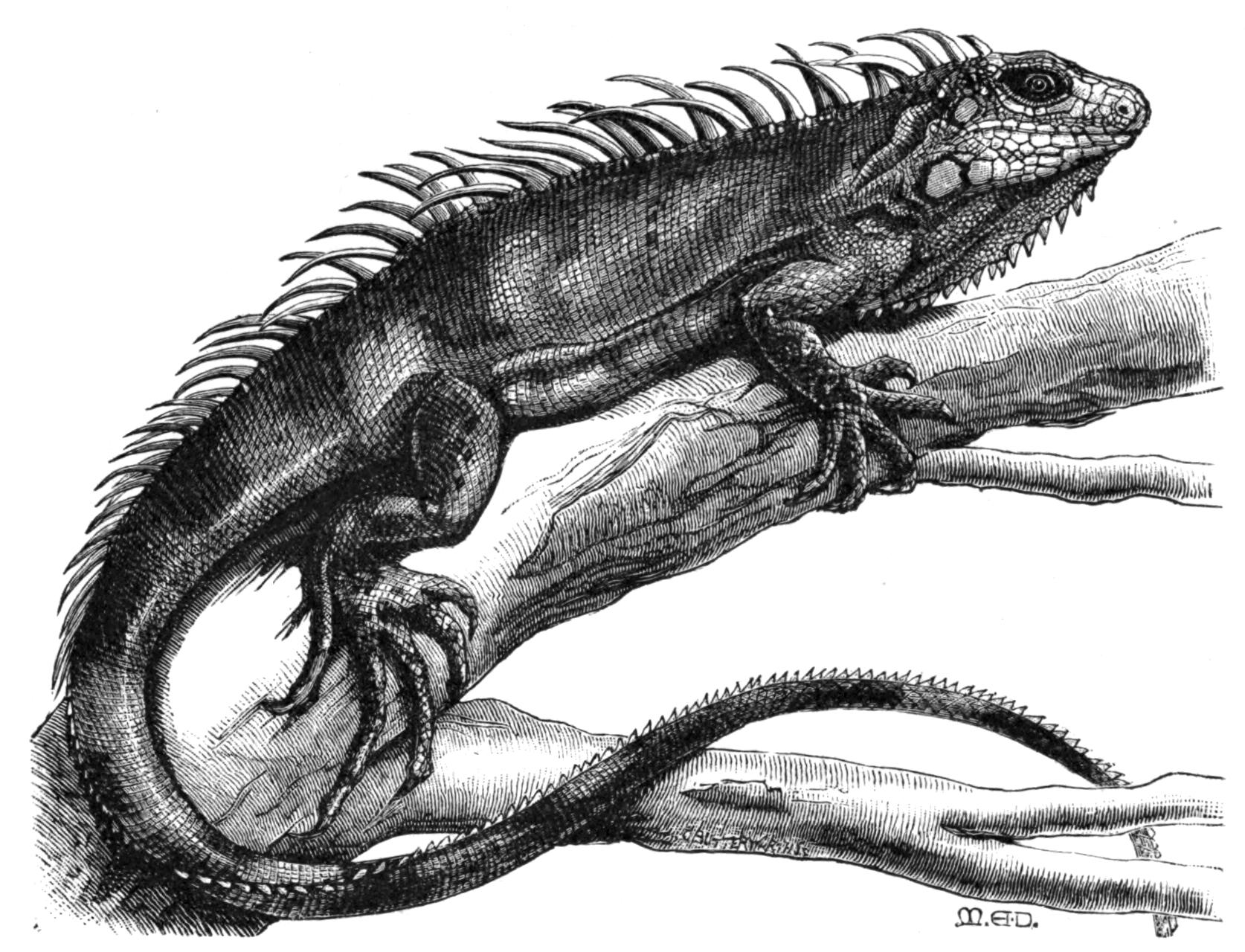
Fig. 132.–Iguana tuberculata. × ⅕.
Metopoceros cornutus of Hayti is closely allied to Iguana, but the male has three conical horn-like scales on its head. The general colour of the whole animal, which grows to more than one yard in length, is dull black.
The following two genera, each containing one species only, are restricted to the Galapagos Islands. Darwin[160] gives a long and vividly written account of their habits.
Conolophus subcristatus.–Fully grown specimens are a yard long. Their shape is stout, the head and fore part of the body appearing especially heavy. The head is covered, or rather paved, with large cobble-stone-like scales. On the neck is a low crest of recurved spines, while the median line of the back appears simply serrated. All the teeth are trilobate. A gular sac is absent. The coloration is striking. The head is lemon-yellow; the back is red, merging into dark brown on the flanks. The belly is dark yellow with a tinge of reddish brown.
This lizard was found by Darwin on some of the Galapagos Islands. On James' Island it was so common that the party found it difficult to pitch their tent, on account of the ground being undermined by the many burrows of the reptiles. They feed during the daytime upon the succulent cactus and the leaves of various trees. The perfectly harmless creatures are, or were, eaten by the inhabitants.
Amblyrhynchus cristatus is closely allied to Conolophus, of which it may be said to be an aquatic modification. The top of the blunt head is covered with low, conical, broad-based scales. Over the neck, back, and tail extends a continuous crest of low, recurved, spiny scales. All the teeth are trilobate. The body and even more so the tail are laterally compressed. The general colour is dark brown above, paler and inclining to whitish below. Younger specimens have pale grey spots and blackish cross-bands on the back and sides. Total length up to 4 feet. The remarkable feature of this Iguanoid is its semi-marine life. It inhabits the rocky and sandy strips of coast of most of the Galapagos Islands, feeding upon certain kinds of algae, which it has to dive for, since these plants grow below tide-marks.
Phrynosoma ("Horned Toads").–The body of these little creatures is much flattened and broadened, devoid of a dorsal crest, but covered with larger and smaller, strongly keeled scales. The head is bordered posteriorly by conspicuous osseous spines. The under parts are covered with small, very regular scales. Both sexes have a long row of pores on the under surface of the thighs. The general colour of the upper parts is a mixture of yellow, grey, brown, and black, the larger spiny scales causing the animal to look as if it were sprinkled with the dried husks of seeds, for instance those of Buckwheat. The object is concealment, by close adaptation to the arid, sandy localities which are the home of "Horned Toads." About one dozen species inhabit the western half of the United States and Central America. All the species are viviparous, almost the only instance among Iguanidae.
Ph. cornutum has five spikes on each side of the head: one postorbital, three temporal, and one occipital, the latter being by far the largest. The sides of the lower jaw project in the shape of prominent ledges, and are protected by a series of small spines. The ventral scales are keeled. The under parts are yellowish, frequently with a few brown spots. This species, which grows to a length of 5 inches, ranges from Illinois through Kansas and Texas to Northern Mexico.
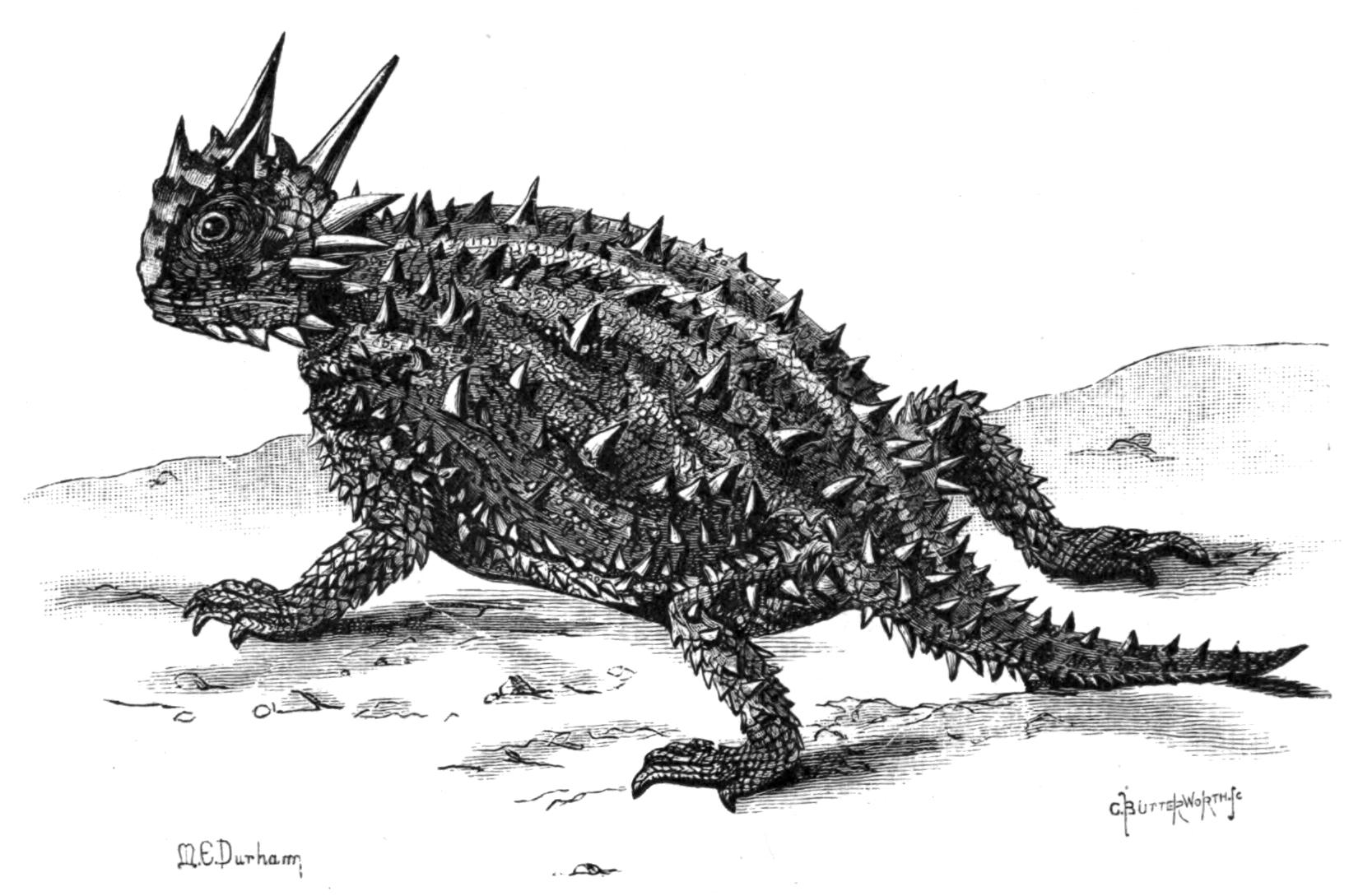
Fig. 133.–Phrynosoma cornutum ("Horned Toad"). × 1.
Ph. coronatum, an inhabitant of California, has an additional smaller spine between the two large occipitals. The scales of the belly are quite smooth.
These peculiar-looking and interesting creatures recall some of the extinct Dinosaurs in the curious configuration of their head: small miniatures indeed. In order to be kept in good health, and to be observed properly, they require, above all, warmth, sunshine to bask in, sand to burrow in, and proper food. The latter consists of all kinds of small insects, the necessary variety of which is best procured by making sweepings with a butterfly-net in a meadow. They take green-flies, house-flies, ants, smooth caterpillars, small moths, meal-worms, wood-lice, etc. The food is snapped up very quickly by a flash of the tongue, which can be turned out, almost like that of a frog, but only to the extent of half an inch. Water in the shape of dew, or drops, is absolutely necessary. When in good condition, they defaecate regularly every alternate day.
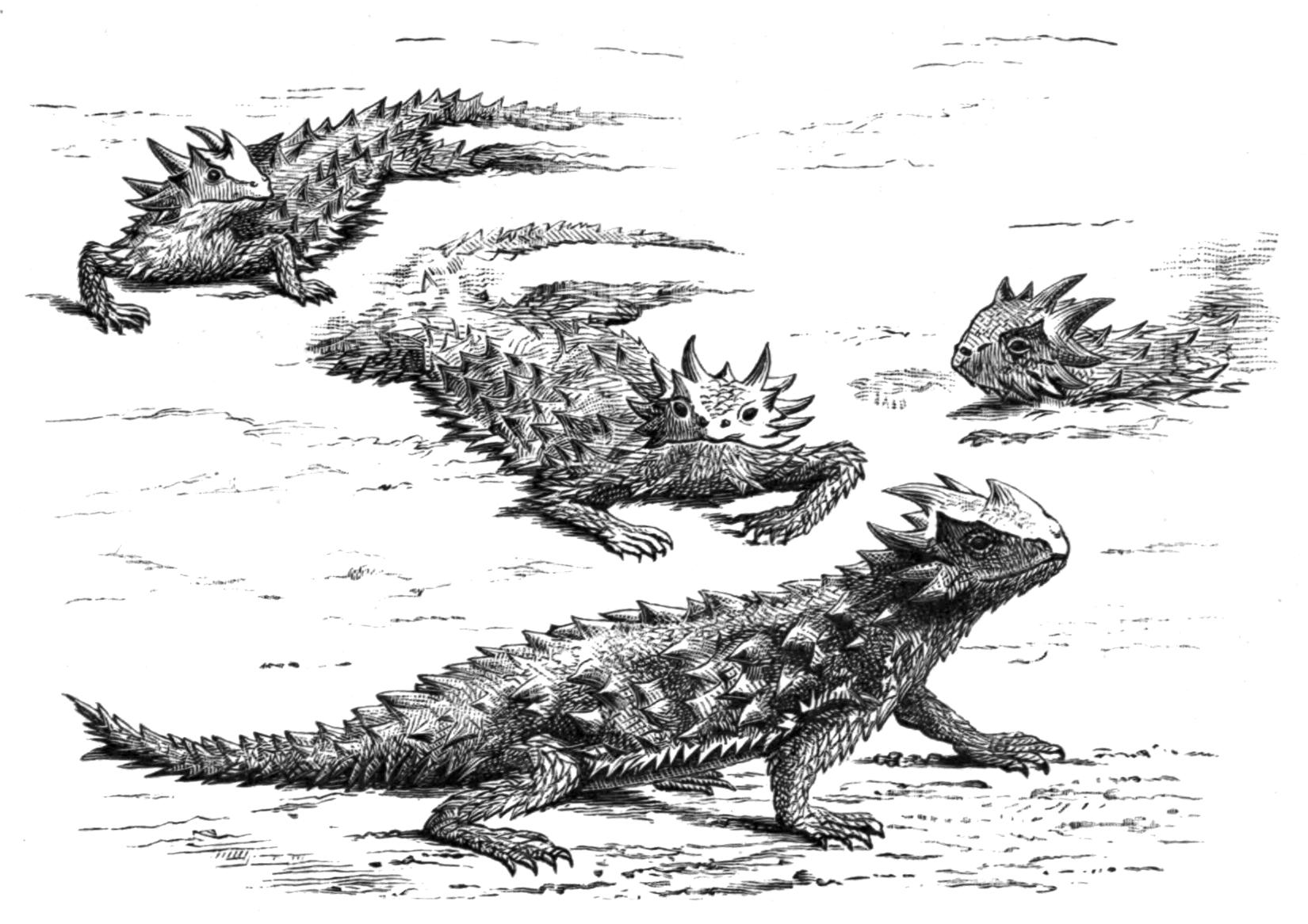
Fig. 134.–Phrynosoma coronatum ("Horned Toad"). × 1.
They love to bask in the broiling sun, heating themselves well through; and in the afternoon, long before sunset, when the sand is warmed up to 40° C., or fever-heat, they prepare to go to bed. For this they select a dry and soft spot, and within a few minutes manage to dig themselves in flat, literally sinking into the sand by pushing themselves forwards, and by shovelling the sand upon their backs with peculiar motions of the fringed sides of their flat bodies. Sometimes the spines of the head remain sticking out, looking like dry thorns scattered over the sand. To prevent the latter from getting into the nostrils, these are provided with closely-fitting valves. Thus they remain concealed during the night, and not until the sun is well up do they leave their hiding-place, first peeping out, and then raising their head and neck, letting the sand roll off between the spines. Still half concealed, the back covered with little pebbles, seeds, or bits of dry leaves, they wait for a long time before they feel lively enough to sally forth. Although mostly slow and deliberate in their movements, stalking about with arched back, and raised upon the fore-limbs, they can run fast enough for a few yards before they stop again and nod in a ridiculous way. When they see themselves observed, they shut their eyes and slowly sink down. On cool and dull days they do not appear at all, and during part of the cooler season they require artificial heat until they are ready to hibernate. Unless they are allowed to hibernate, they will keep on feeding through the winter, but in that case are sure to die in the following spring.
Fam. 3. Xenosauridae, with Xenosaurus grandis in Southern Mexico as the sole species, seems to connect the Iguanidae with the Anguidae. According to Boulenger, its affinity to the former is shown by the T-shaped interclavicle, the absence of symmetrical bony shields on the head and of osteodermal plates on the body. Affinity to the Anguidae is indicated first by the short tongue, which has a narrow, feebly incised, retractile anterior part, covered with flat papillae; secondly, by the teeth, which, instead of being hollow at the base, are solid; lastly, by the palatine bones, which are widely separated.
X. grandis, scarcely one foot in length. The body is depressed, covered above with minute granules and tubercles, below with smooth scales. A distinct fold of skin extends from the axilla to the groin, recalling the more strongly developed lateral fold of some of the Anguidae.
Fam. 4. Zonuridae.–This family, comprising four genera with about one dozen species in South and Tropical Africa, and in Madagascar, likewise seems to connect Iguanidae and Anguidae. It is distinguished from the former by dermal ossifications, which roof over the supratemporal fossa; from the latter by the tongue, the hollow teeth, and, in Zonurus at least, by the occurrence of dermal ossifications on the trunk and tail. The tongue is short, villose, scarcely protractile, entire, or but feebly nicked at the tip. The Zonuridae may therefore be defined as pleurodont African lizards with a short tongue, and with a bony roof to the supratemporal fossae.
Zonurus.–The whole head, back, and tail are covered with bony scales, the horny covering of which forms very sharp spikes, especially on the tail. The body is depressed. The ear-opening is large. South Africa, in dry and rocky localities; one species, Z. tropidosternum, in Madagascar.
Z. giganteus s. derbianus, with strong spikes on the occiput, neck, and tail. General colour yellowish brown. Total length about 15 inches.
Chamaesaura of South Africa closely approaches the Anguidae by its snake-shaped body, extremely long tail, and vestigial limbs. In Ch. aenea both pairs of limbs are still present and pentadactyle, but are very small; in Ch. anguina the limbs are reduced to little styliform stumps; and in Ch. macrolepis they are altogether absent. The scales of the body and tail are strongly keeled and imbricating, but are devoid of dermal ossifications. Total length up to 2 feet.
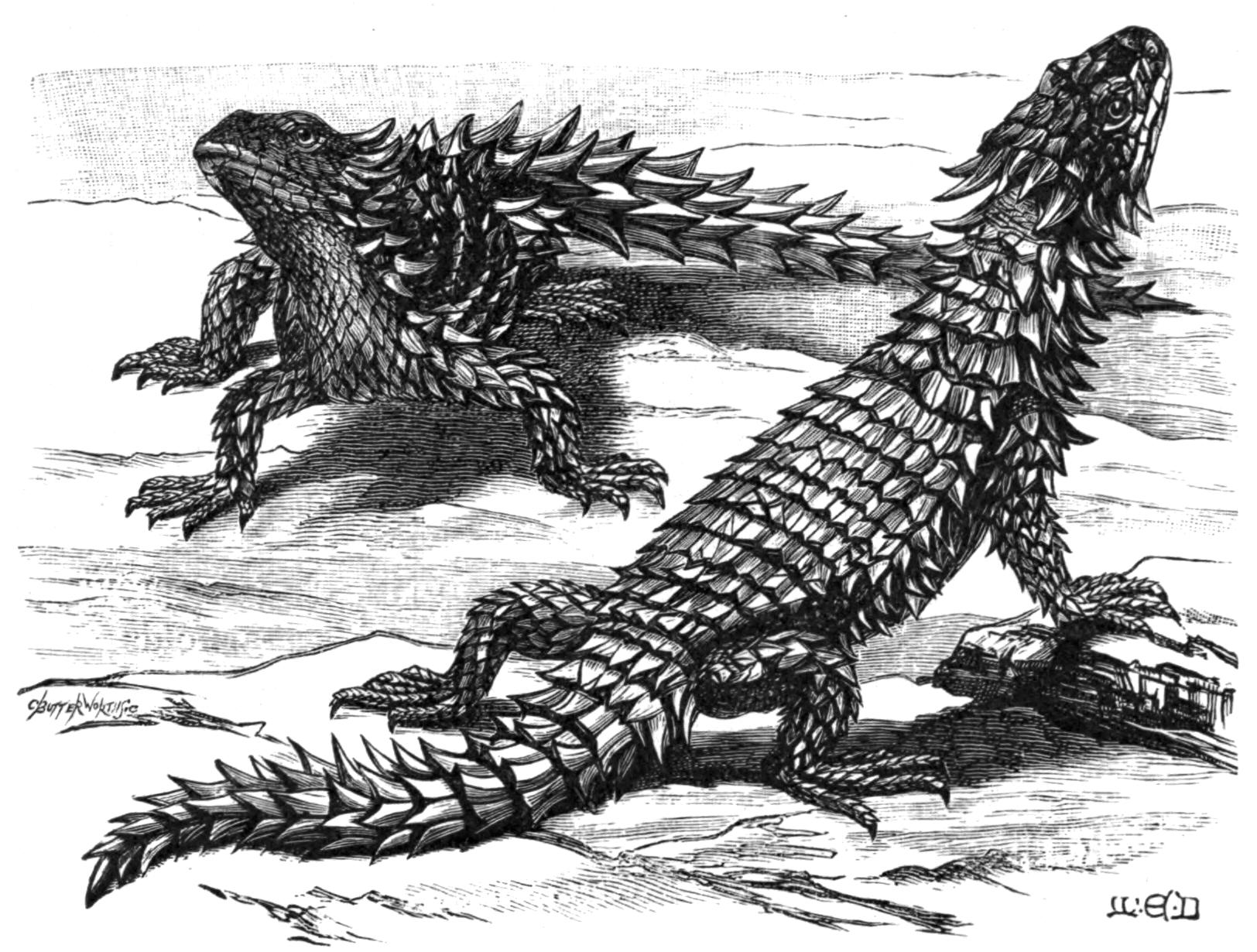
Fig. 135.–Zonurus giganteus. × ¼.
Fam. 5. Anguidae.–Pleurodont lizards with osteoderms, and with the tongue composed of two distinct portions, of which the anterior is thin, emarginate, extensible, and retractile into the posterior thicker portion. The supratemporal fossa is roofed in by dermal bones. The whole body is protected by bony plates underlying the imbricating scales. The teeth vary much in shape, but they are always solid, the new teeth not growing into the base of the old ones, but between them. The limbs are in a very unstable condition, there being in the family a general tendency to reduce and lose the limbs. The shoulder- and pelvic-girdle however remain, although sometimes merely vestigial. The tail is long, very brittle, and easily reproduced. All the Anguidae are strictly terrestrial, and live on animal diet. Some Anguis, at least, are viviparous. The distribution of the seven genera, with some forty species, is very scattered. The majority, chiefly Gerrhonotus, inhabit Central America, a few occur farther north and south–two, Anguis fragilis and Pseudopus pallasi, in Europe, and one in the Himalayas and in Burmah.
Gerrhonotus has a pair of deep longitudinal folds, each of which extends from the region of the neck along the side of the body towards the tail. The four limbs are well developed and pentadactyle. The teeth are conical. Many species, mostly in Central America. G. coeruleus has the widest range, extending from Costa Rica to Vancouver. It is also one of the largest species, reaching a length of more than one foot. The tail is nearly twice as long as the rest of the body. General colour above brown with blackish bars and spots, especially on the more yellowish flanks; under parts whitish with a greenish tinge, often with brown spots arranged in longitudinal rows.
Ophisaurus s. Pseudopus is closely allied to the previous genus, being possessed of the same kind of deep lateral folds; the limbs are, however, reduced to a pair of tiny spikes, half concealed at the sides of the anal cleft. The teeth are conical, and in the adult have somewhat flattened crowns. The body and tail are very long and snake-like, but the head is that of a typical Lizard.
O. apus s. Pseudopus pallasi, the Glass-Snake of the Balkan Peninsula, South Russia, Asia Minor, and Morocco, grows to more than one yard in length, of which about two-thirds belong to the tail. The general colour is brown above, paler below. Young specimens are olive-grey with dark brown cross-bands on the back. O. gracilis inhabits the Eastern Himalayas and Burmah, the others live in North America.
The "Glass-Snake" inhabits bushy localities, where it can hide under the fallen leaves and in the sand; it cannot climb, and avoids the water. Its movements resemble those of a snake, but are far less graceful, owing to the stiff armour in which the whole body is encased. The food consists chiefly of snails, the shells of which are crushed, and of mice, but nothing comes amiss which can be mastered, namely insects, worms, small lizards, young birds, and vipers. The prey, when caught, is rapidly twisted round and round, or shaken until it is giddy or stunned, whereupon the Glass-Snake proceeds to chew it with its powerful jaws, and then to swallow it in pieces. Although it can bite so well, it never does so when caught, but resorts to the much more disagreeable defence of twisting itself around one's hand and arm, and besmearing them with its disgustingly stinking excrements. Those who have observed Glass-snakes praise their tameness, and the intelligent way in which they hunt about in search of their food. They lay eggs under moss and leaves, and the young seem to require many years to grow up.
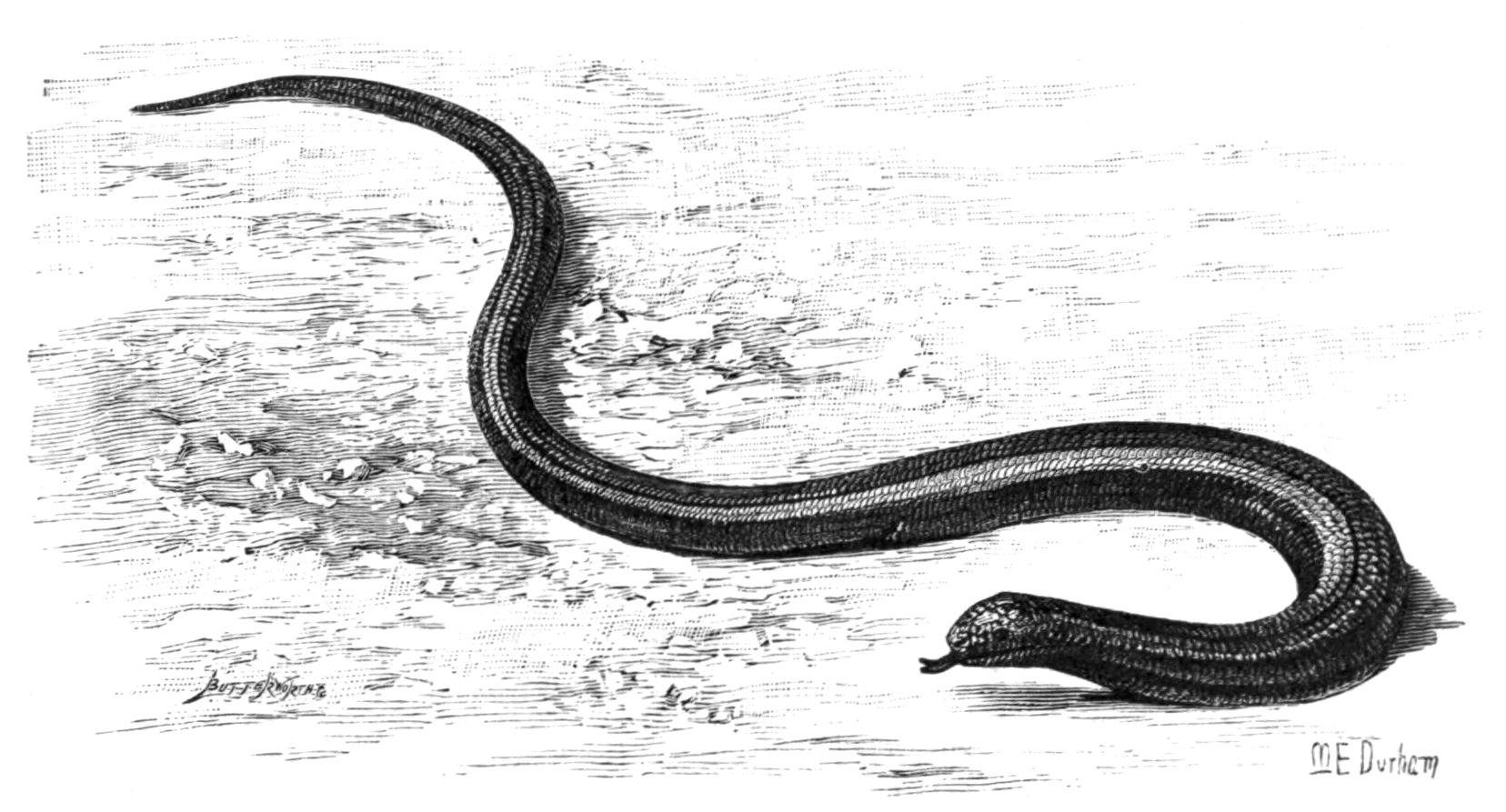
Fig. 136.–Anguis fragilis (the Slow-worm). × ½.
Anguis, with only one species, A. fragilis, the "Slow-worm" or "Blind-worm," is devoid of a lateral fold. Limbs are entirely absent. The whole body is covered with smooth roundish scales, with a substratum of dermal ossifications. The teeth are curved backwards, fang-shaped, and have a very faint longitudinal groove on their anterior surface. The ear-opening is very minute, more or less hidden by surrounding scales. The eyes are perfectly well developed, provided with movable lids, and it does not speak well for the power of observation of most people that this creature should generally be known as the "Blind-worm." The whole skin is shiny, metallic, quite smooth, brown above, blackish below. But the coloration is subject to much individual variation. Old specimens are sometimes adorned with blue specks. The very young are exquisitely beautiful, the upper surface being silvery white, with a median and two more lateral lines of deep black; the under parts are black. The iris is yellowish red. Very large specimens measure more than one foot in length, more than half of which belongs to the tail. One in the British Museum is 425 mm. = 17 inches long.
The Slow-worm is viviparous, i.e. the young are fully developed, and burst the transparent, soft, yellowish eggs immediately after these are laid. This takes place in the months of August or September, about one dozen making a litter. The little creatures are at first about one inch and a half long, and as thin as an ordinary match. They eat the smallest of spiders and delicate insects; later on earth-worms, which they bite into and then suck out before devouring them. When six weeks old and well fed they are about 3 inches long, but it is at least four or five years before they are mature. The little ones carefully avoid the hot sunshine, and the adults are likewise rather partial to the shade, although strictly diurnal. Their chief food consists of earth-worms and slugs. For the night they retire under moss, leaves, stones, or into the ground. In the autumn the Slow-worms dig passages or burrows, which often serve as the winter-quarters of many specimens, as if there were no other place available, or rather as if the spot selected were by far the best with regard to safety, dryness, and warmth.