Part 1 — CHAPTER VI (continued 2)
Reading edition
In Cambridgeshire they frequent certain clay-pits surrounded by high and steep walls of sand, the breeding places of large colonies of sand-martins. During the months of May and June they are found in the shallow water, running about on the mud, sometimes swimming, in which they are not very proficient, and rarely diving. But they spend most of the time on land. Early in October they climb up and enter the holes of the sand-martins, or they dig large, deep burrows for hibernation, and the old males are the first to disappear.
B. mauritanica s. pantherina.–The "Pantherine Toad" is one of the few African species, and is one of the prettiest of all toads. The skin is almost smooth, although provided with porous glands. The parotoids are large, but flat; large glandular complexes on the legs or arms are absent. The tympanum is very distinct. The upper parts are adorned with a delicate pattern of dark-edged, rich brown or olive patches upon a light, buff-coloured ground; the under parts are uniform white; the male has a subgular vocal sac. The total length is 3 to 4 inches. This beautiful species is one of the gentlest, and it becomes tame enough to lap up food whilst sitting on one's hand. It lives entirely upon insects, prefers shade and dusky light, and utters a sound like "kooh-rr." It is a native of North-Western Africa, Algiers, and Morocco. In the rest of Africa, from Egypt to the Cape, Senegambia to Abyssinia, it is represented by B. regularis. This species has often little spiny tubercles upon the warts, and occasionally a light vertebral line; the colour of the upper parts either closely resembles that of the previous species, or it is uniform light brown, while the under parts are whitish, or variegated with brownish patches. West African specimens are the smallest, only 2 inches long; those of the Cape are the largest, reaching 5 to 6 inches.
The next two genera approach the Engystomatinae, and thereby lead from the arciferous towards the firmisternal type. The epicoracoid cartilages are narrow, and they scarcely overlap, so that by a further step in this direction they could easily fuse into the firmisternal condition. Another bond between these two genera and the Engystomatinae is their habits, they being ant-eaters of an extremely stout appearance, with exclusively short limbs and very small heads.
Myobatrachus gouldi, living in Australia, has a smooth skin, brown above, lighter beneath, and is about 2 inches long.
Rhinophrynus dorsalis of Mexico is remarkable for its tongue, which is elongated, subtriangular and free in front, so that it can be protruded directly–not by reversion as in other toads–and can be used for licking up the termites which seem to be its principal food. The body of this ugly creature is almost egg-shaped, and the head is merged into this mass, only the narrow truncated snout protruding. The limbs are very short and stout. The toes are more than half webbed, and there is a large oval, shovel-like metatarsal tubercle, covered with horn and used for digging. The general colour is brown, with a yellow stripe along the spine and with irregular spots and patches on the flanks and limbs. Total length 2 to 2½ inches.
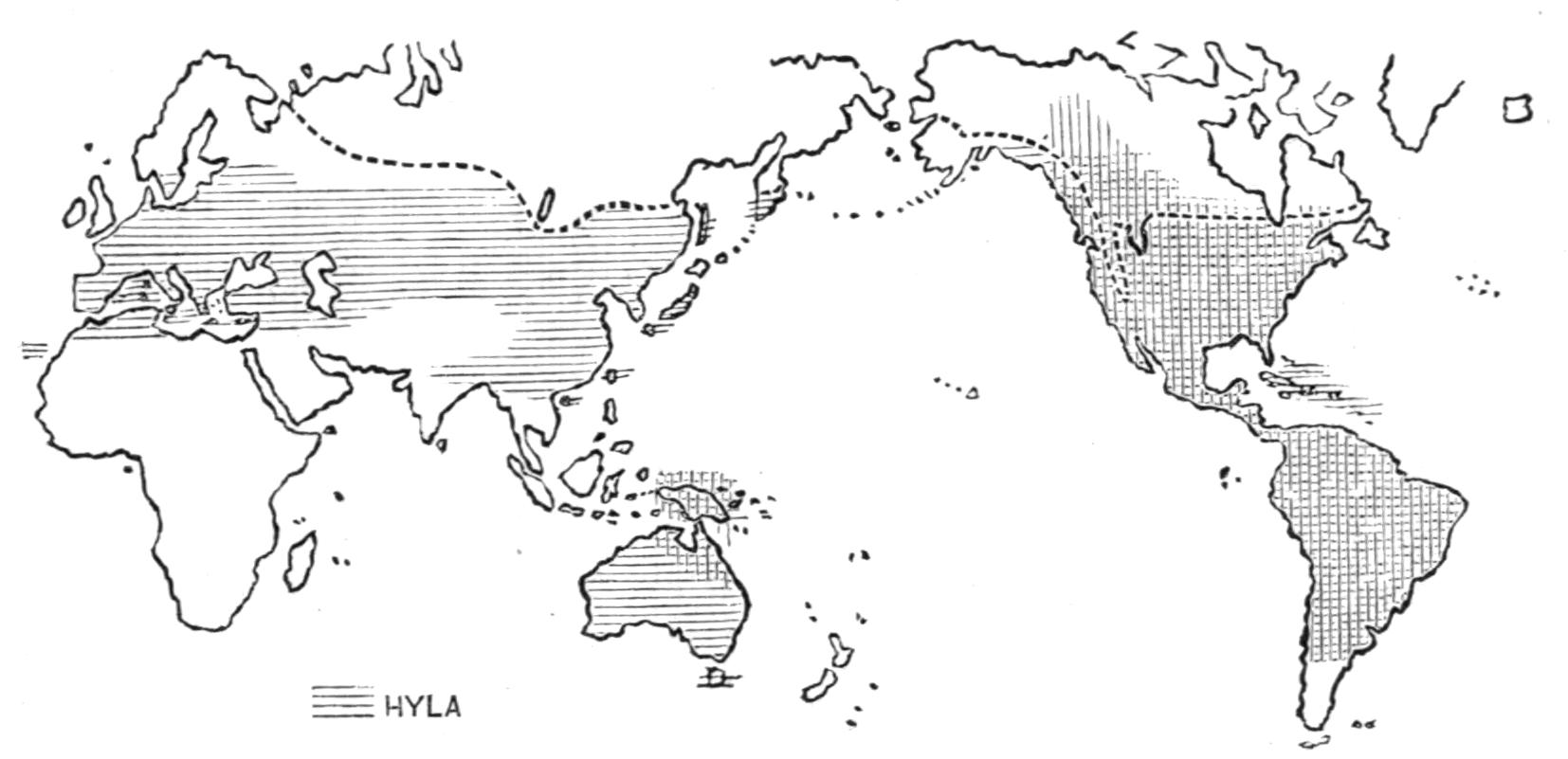
Fig. 36.–Map showing distribution of Hylidae. The vertically shaded countries are inhabited by Hyla and by other genera of Hylidae; the horizontally shaded countries only by Hyla.
Fam. 4. Hylidae (Tree-frogs).–The upper jaw–in Amphignathodon the lower jaw also–and the vomers carry teeth; Triprion and Diaglena alone have teeth on the parasphenoid also, and the latter genus is further distinguished by possessing palatine teeth. The vertebrae are procoelous and have no ribs; the sacral diapophyses are dilated. The omo- and meta-sternum are cartilaginous, the latter forming a plate with scarcely any basal or style-shaped constriction. The terminal phalanges are invariably claw-shaped and swollen at the base, and carry a flattened, roundish, adhesive cushion. The tympanic disc is variable in appearance, being either free, or more or less hidden by the skin. The tongue is also variable in its shape and in the extent to which it can be protruded.
Most, if not all, Hylidae are climbers, and many lead an arboreal life, but it does not follow that all the "Tree-frogs" are green.
Their distribution is very remarkable. To say that this family is cosmopolitan with the exception of the African region, is literally true, but very misleading. There are in all about 150 species, and of these 100 are Notogaean; one-half of the whole number, or 75, being Neotropical; 23 are Central American, 7 Antillean, and about 18 are found in North America. One species, Hyla arborea, extends over nearly the whole Palaearctic sub-region, and two closely allied forms occur in Northern India and Southern China. Consequently, with this exception of three closely allied species, the Hylidae are either American or Australian. We conclude that their original home was Notogaea, and that they have spread northwards through Central and into North America. The enormous moist and steamy forests of South America naturally suggest themselves as a paradise for tree-frogs, and it is in this country, especially in the Andesian and the adjoining Central American sub-regions, that the greatest diversity of generic and specific forms has been produced. It is all the more remarkable that similar forest-regions, like those of Borneo and other Malay islands, are absolutely devoid of Hylidae (while there are about a dozen species in Papuasia), whose place has however been taken for all practical purposes by correspondingly modified Ranidae, notably the genus Rhacophorus. Lastly, the fact that tropical evergreen forests of Africa and Madagascar possess no Hylidae, but are inhabited by several kinds of tree-climbing Rhacophorus, points with certainty to the conclusion that the origin of this large and flourishing family of Hylidae was not in Arctogaea.
The versatility and the wide distribution of the Hylidae has naturally produced cases of convergent analogy, and the various species of one "genus" may be in reality a heterogeneous assembly. Such an instance is probably the genus Hylella, of which four species live in the Andesian and Central American provinces, while the two others occur in New Guinea and Australia.
The two North American genera Chorophilus and Acris, and the Brazilian Thoropa, connect the Hylidae with the Cystignathidae, in so far as their finger-discs are very small, or even absent, and their sacral diapophyses are only slightly dilated. On the other hand, it has to be emphasised that the possession of adhesive discs on the fingers and toes does not necessarily constitute a member of the Hylidae. That requires the further combination of an arciferous sternum, with dilated sacral diapophyses and teeth in the upper jaw. Finger-discs are easily developed, and still more easily lost. Those of the typical Hylidae are constructed as follows. The terminal phalanx is elongated, claw-shaped, swollen at its base. Between it and the penultimate phalanx lies an interphalangeal cartilaginous disc which projects ventrally below the end-phalanx, thus assisting the formation of the ventral pad, and the turning upwards of the whole disc-like phalanx like the claw of a cat. This peculiar motion can be well observed in Tree-frogs which are at rest upon a horizontal leaf, or, better still, upon a rough stone, when the creatures take good care to adjust their discs into a safe and easy position. The pad or disc itself is furnished with unstriped, smooth muscular fibres, the contraction of which produces one or more longitudinal furrows on the under side. When the disc is in action or adhering, being flattened to a smooth surface, the end-phalanx sinks into the cushion; when not in action, the cushion swells and the phalanx appears as a slight dorsal ridge. The disc is rich in lymph-spaces, and its surface contains mucilaginous glands.
Various suggestions have been made to explain the function of these discs. Suction, adhesion, and glueing-on have been resorted to. Suction, through production of a vacuum, is quite imaginary and does not exist. The question has been thoroughly studied by Schuberg.[84] Adhesion is due to the molecular attraction of two closely appressed bodies. The less air remains between them the stronger it is. Consequently it can be increased by the interference of a thin layer of fluid, which as everyday observation shows, possesses both adhesion and cohesion. The more sticky the fluid, the more effective it is, as shown experimentally by Schuberg, who moistened the under surface of a glass plate, and pressed it against a little disc of glass from which was suspended a weight. A disc of 16 square millimetres, approximately equal to the aggregate surface of the 18 discs of a European tree-frog of 4 grammes in weight, carried with water-adhesion no less than 14 grammes, with glycerine-solution 20 grammes,–more than sufficient to suspend the frog. The sticky secretion of its glands greatly enhances the adhesive power. Tree-frogs, when hopping on to a vertical plane of clean glass, slide down a little, probably until the secretion stiffens, or dries into greater consistency. After a few days I find the glass-walls of their recently cleaned cage quite dirty, covered everywhere with their finger-marks. On the other hand, wet leaves or moist glass-walls afford no hold. The adhesion of these frogs is assisted in most cases by their soft and moist bellies, just as a dead frog will stick to a pane of glass.
All Hylidae have a voice, often very loud, and enhanced by vocal sacs, which are either internal, swelling out the throat, or external, paired or unpaired.
The various Hylidae resort to all kinds of modes of rearing their broods. Most of them lay many eggs, up to one thousand, in the water, not coherent in strings but in clumps; others lay only a few, attach them to various parts of the body, or, as in the genus Nototrema, the female receives them in a dorsal pouch. These modifications will be described in connexion with the different species.
Sub-Fam. 1. Amphignathodontinae.–Both upper and lower jaw with teeth.
Amphignathodon, of which only one species is known, A. guentheri of Ecuador, agrees with Nototrema in all important characters except that it possesses teeth in the lower jaw in addition to those in the upper. There are further differences, but they are of degree only. The sacral diapophyses are more strongly dilated and the omosternum is absent. The tympanum is distinct. The pupil is horizontal; the roundish tongue is slightly free behind. The terminal phalanges are claw-shaped and carry large discs. The female has a dorsal pouch opening backwards. The skin of the head is involved in the ossification of the cranial bones. The skin of the back is smooth, slightly tubercular, non-granular below. The middle of the upper eyelid carries a small, pointed, cutaneous appendage, and even this little character occurs also in some species of Nototrema, e.g. in N. longipes and in N. cornutum. The heel carries a triangular little flap. The upper parts are olive in spirit-specimens, probably green in life; the borders of the dorsal pouch are black. The sides of the body are adorned with a black, white-edged streak, the limbs are whitish, with black cross-bars. The total length of the female type-specimen is 3 inches.
Sub-Fam. 2. Hylinae.–Lower jaw toothless.
The Hylinae are divided by Boulenger into 13 genera, which can be recognised by the following key, without reference to their natural affinities:–
A. The contracted pupil forms a horizontal slit.
a. Tips of the fingers and toes with large discs,
α. With vomerine teeth.
Female without a dorsal pouch .......... Hyla, p. 189.
Female with a dorsal pouch .......... Nototrema, p. 202.
β. Without vomerine teeth .......... Hylella, p. 203.
γ. With parasphenoid teeth and peculiar helmet-shaped head.
Yucatan .......... Triprion, p. 207.
Ecuador and Mexico .......... Diaglena, p. 207.
b. Tips with very small discs. Tongue free behind.
Tympanum distinct. North America and Peru .......... Chorophilus, p. 208.
Tympanum indistinct. North America .......... Acris gryllus, p. 207.
c. Tips simply swollen, not dilated into discs. Brazil .......... Thoropa miliaris, p. 209.
B. The contracted pupil forms a vertical slit. Tropical America.
a. Tips with large discs.
α. Tongue extensively free behind.
Inner finger and toe opposable .......... Phyllomedusa, p. 203.
Inner finger and toe not opposable .......... Agalychnis, p. 206.
β. Tongue scarcely free behind. Ecuador .......... Nyctimantis rugiceps, p. 206.
b. Tips without discs. Without parasphenoid teeth, but head peculiar in shape. Mexico .......... Pternohyla fodiens, p. 207.
C. Pupil rhomboid. Without parasphenoid teeth. Large discs. Head helmet-shaped. Brazil .......... Corythomantis greeningi, p. 207.
Hyla.–The pupil is horizontal. The tympanum is distinct or hidden. The tongue is entire or slightly nicked in its hinder margin, which is more or less free behind. The fingers and toes are provided with typical adhesive discs.
This is the largest genus of all Amphibia, containing about 150 species, and its distribution coincides with that of the whole family. Many of the species are very closely allied to each other, differing only in small points, for instance in the extent of the webs to the fingers and toes, the configuration of the vomerine teeth, the size and appearance of the tympanic disc, and the relative length of the hind-limbs. In some of the West Indian, and in one Brazilian species, H. nigromaculata, the upper surface of the head is rough, owing to the cutis being involved in the cranial ossification. Bony or perhaps only calcareous deposits in other parts of the skin are rare, but are notably developed in H. dasynotus of Brazil, in which they extend from the head to the sacrum, rendering the skin immovable.
Many are capable of changing colour to a great extent, and it is a popular error to suppose that all tree-frogs are green, although this colour is perhaps the most common in the arboreal kinds.
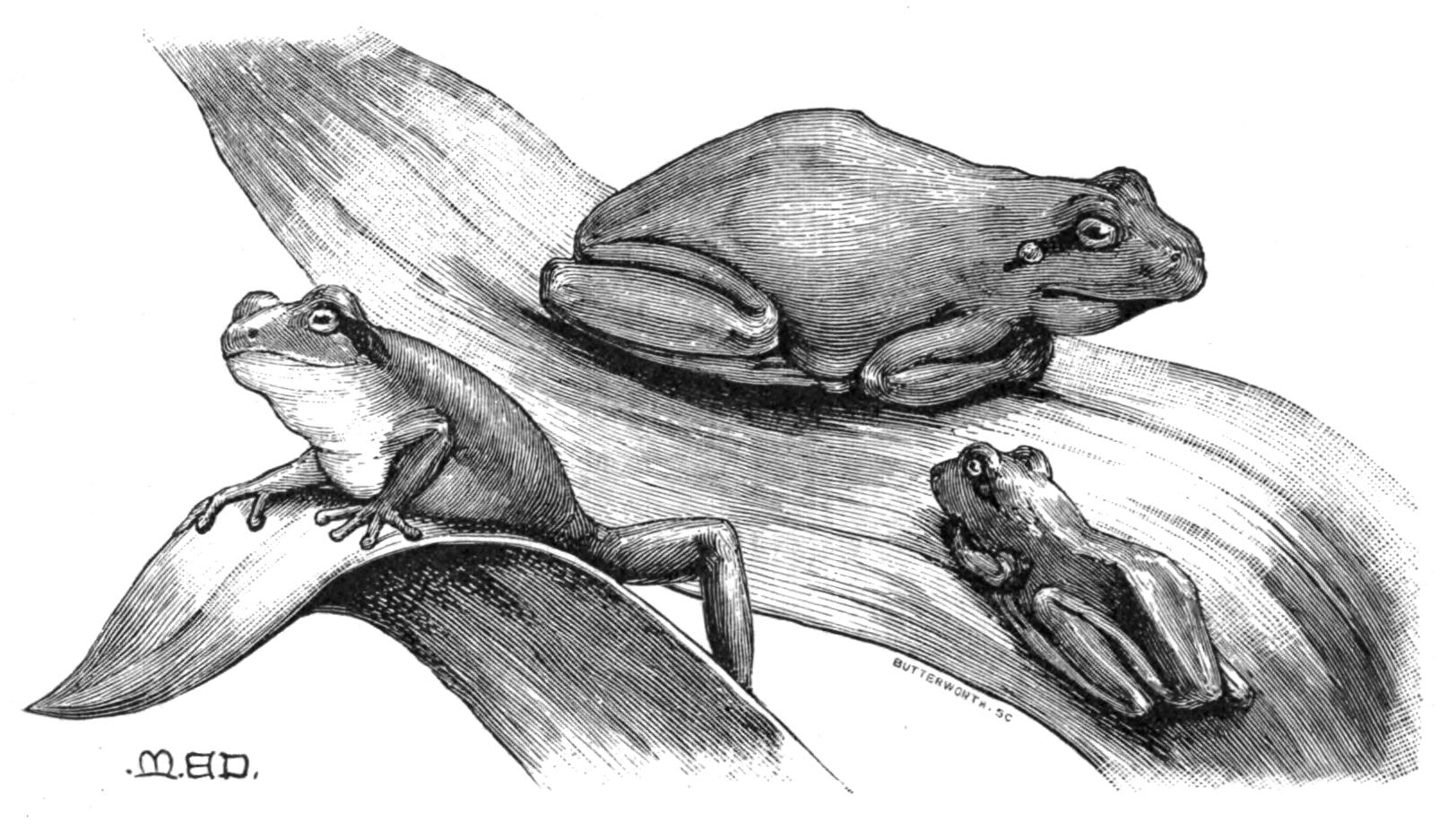
Fig. 37.–Hyla arborea, var. meridionalis. South European Tree-frog, × 1.
H. arborea.–The tongue is rather round, slightly nicked behind, and can be protruded but little. The tympanum is distinct, but small. The upper parts are grass-green, quite smooth and shiny owing to the skin being covered with a film of moisture; the under parts are yellowish-white and granular, flesh-coloured or rosy on the thighs. Total length of large females 2 inches. This, the Tree-frog of Europe, has an enormous range, namely, from Morocco, France, and the south of Sweden, across the whole of Europe and Asia Minor to Japan and Southern China.
Several varieties have been described: the typical or European form is ornamented with a narrow black stripe, which, beginning at the nose, extends backwards along the side of the body to the groin, where it generally forms a hook turned upwards. This black colour forms the ventral boundary of the green, and is itself narrowly seamed with white on its upper border.
In the south of France, the Iberian Peninsula, Morocco, and the Canary Islands the black lateral stripe is often absent; this is the var. meridionalis. In Spain and Portugal both forms are found in the same localities.
In the Asiatic, chiefly in the eastern specimens, the lateral stripes tend to break up into irregular spots, vanishing altogether towards the groins; this var. savignyi s. japonica occurs also on most of the Mediterranean islands.
H. arborea can change colour to a great extent, mostly in adaptation to its immediate surroundings, but ill health and moulting may also influence it. The change is slow. The usual colour is green, brightest on bright, sunny hot days, dull when the sky is overcast, or when it is windy and showery. Day and night have no influence upon the colour-changes. The hue of the green agrees mostly with that of the foliage on which the frog happens to take its rest, for instance a field of Indian corn, birch-trees, or oak-trees. I once received a consignment from Saxony. When the box with moss was unpacked, they were of the dullest greenish-grey; they were put into a wired-off corner of the yard and were given the freshly cut branches of a lime-tree to sit upon. On the following morning I at first looked for most of the frogs in vain. The leaves had withered and all those frogs which sat upon the dark brown branches had put on a light brown garb, mottled with darker patches.
Another specimen, one of several which were at liberty in a greenhouse, took to resting on the frame of the window-pane, in a corner where putty, glass, and discoloured white paint met; in the morning it was always of a mottled leaden colour, but during the nocturnal hunting it was green. In the winter, the window-corner being of course cold, the frog remained stationary for several months, but kept the leaden grey colour, until one day in the early spring it was mottled with green, and soon after it joined its green mates.
Liebe observed a half grown tree-frog which he kept in Gera during the winter in a glass with water-cress. While the temperature was near freezing the frog sat in the water, very lethargic, breathing perhaps once every quarter of an hour. Its colour was light green. When the water-cress was cut and removed, the frog darkened and became at last quite a discoloured grey. When the water-cress was put back, the creature reassumed the light yellowish-green colour, remaining in its lethargic condition until it became lively in the spring sunshine.
The European tree-frog spends most of its time in the summer, after the pairing is over, in trees, often in the very crowns; but the neighbourhood of even a small patch of Indian corn has still greater attractions. There are all sorts of green insects to be caught, there are fair chances of coming across the common Cabbage White, a butterfly which the tree-frog loves, and last not least the large luscious leaves afford a firm foothold, and the axillae between stalk and broad-based leaves are just the places for the frog to slip into, where nobody can find it. During the day they mostly sit still, on the keen look-out for passing insects, which, when they settle within reach, are jumped at; otherwise they have first to be stalked. The jump is quite fearless, regardless of the height above ground; there is the leaf upon which the prey sits, and even if this leaf be missed, there are others, and one of them is sure to be struck by some of the discs of either fingers or toes. If the fall is broken by the toes, and the new leaf or branch is very elastic and bends down, then there are some frantic antics to be gone through until the frog has settled itself again. Then the large blue-bottle, or the butterfly, is devoured at leisure, wings and all being poked in with the assistance of the little hands. But the real hunting-time is the night.
During a shower the frog shifts its position to the under side of the leaf, or into a less slippery position, and during continuous wet it descends into the grass, or it takes to the water. Its greatest enemy is the Grass Snake, which prefers it to anything else, not minding the poisonous secretion of the skin, which is sharp enough to produce sneezing or even temporary blindness when incautiously brought into the human eye.
The male has an internal vocal sac, which, when inflated, bulges out the whole throat into a globe, much larger than the head. The voice is a sharp and rapidly-repeated note, something like "epp-epp-epp," or "creck, creck, creck," with more or less of an a sound. It is uttered at any time of the day, more frequently at dusk, and of course chiefly during the pairing season. This tree-frog suffers from the reputation of being a good weather-prophet, and it is for this reason often kept in confinement, the orthodox abode being a muslin-covered glass jar, with a hole to put flies through, water and plants at the bottom, and a little ladder to sit upon. The prophesying is of the usual popular unreliable nature, although the little creature, provided it is a male, often sounds its voice on the approach of a shower, or when there is a thunderstorm in the air. During continuous fine weather it sits on the top of the ladder, or is glued on near the rim of the glass, while on wet and dull days it is less active, and may keep nearer the ground or in the water. There is a German rhyme which well expresses the prophet's reliability by its ambiguity:–
Wenn die Laubfrösche knarren, Magst du auf Regen harren.
When the tree-frogs croak, you may wait for rain. Sometimes it does come true.
Tree-frogs are not very intelligent, although they have a keen sense of locality; but they are nice pets, being easily kept, and have a pretty appearance. There is a record of one which lived for twenty-two years in confinement.
The pairing begins soon after the frogs reappear from their hibernation in the ground; in Germany in the month of May. The congregating males make a great noise and take to the water before the females, which join them when ready to spawn. The male grasps his mate near the shoulders, and the pair swim about together, sometimes for days, until the eggs are expelled. These are laid in small clumps of 800 to 1000, which soon swell up and remain at the bottom of the pond. The larvae are hatched in ten days; two days later the adhesive sucker below the throat appears, and after another two days a pair of thread-like external gills are developed. The tadpoles, which reach a length of 2 inches, owing to the long tail, which is nearly three times as long as the body, metamorphose in about twelve weeks, and the baby tree-frogs, scarcely half an inch in length, hide in the grass for the next two years, until they are about half grown, not reaching maturity until the fourth year.
Since many pairs congregate in the same pool, and each produces up to one thousand eggs, most of which are hatched, the neighbouring meadows sometimes literally swarm with tiny tree-frogs. Nevertheless the adults are comparatively rare and are very local.
H. carolinensis s. lateralis of the South-Eastern States of North America greatly resembles H. arborea in general appearance, size, and habits. But the head is more pointed, and the vivid green of the upper parts is separated from the yellowish white under surface by a conspicuous, pure white line, giving the little creature a very smart and neat appearance. According to Holbrook, it ascends trees, but most commonly lies upon broad-leaved water-plants, like Nymphaea, and in fields of Indian corn. Motionless during the daytime, they emerge in the morning and evening from their hiding-places, and become very brisk and noisy, often repeating their single note, which is not unlike that of a small bell. When one begins, hundreds take it up from all parts of the corn-field.
Among other tree-frogs of the South-Eastern States may be mentioned H. squirella, 1½ inch in length, which is very changeable in colour, generally olive above with darker spots and bars on the limbs, and with a white upper lip. It lives in trees, sheltering in the bark. H. femoralis of the same size, without the white lip, lives high up in the trees of the dense forests of Georgia and Carolina.
H. versicolor is one of the most delicately coloured species of Eastern North America, extending northwards into Canada. It is about 2 inches long. Its colour passes within a short time from dark brown or olive grey to pale delicate grey, almost white, occasionally retaining a few large darker patches on the back, and delicate cross-bars on the limbs. A small portion of the sides and the posterior part of the belly are bright yellow. The skin is granular, owing to the presence of small warts which produce an acrid secretion. It is said to be found in trees, or about old stone fences overgrown with lichens, the colour of which it resembles to perfection. It becomes very noisy towards the evening, in cloudy weather or before rain, the voice consisting of a liquid note, terminating abruptly, like "l-l-l-l-luk." My own captives fully bear out this statement of Holbrook's. Settled motionless during the day upon a piece of bark in a shady corner, but occasionally uttering the quaint and rather faint note, they become very lively in the evening, catching insects by long jumps, or investigating the hollows of decaying mossy stumps. Their general colour is then spotless, almost silvery grey. In the day-time they are sometimes suffused with delicate green.
The propagation has been studied by Miss M. H. Hinckley.[85] They pair in shallow pools, in Massachusetts, in May. On the 10th of that month eggs were attached singly, and in groups, on the grasses resting upon the surface of the water; first drab-coloured, they became lighter in a few hours. Some larvae escaped from the gelatinous envelopes on the following day, the others on the third day; they clung to the grasses by means of their prominent suckers. The head and body were cream-coloured, with olive dots, and averaged ¼ inch in length. Gills appeared on the fourth day, to disappear again during the four following days, first those of the right, then those of the left, side; the suckers became less conspicuous, and the general colour turned into deep olive-green, with fine golden dots on the upper and lower surfaces. The eyes were of a brilliant flame-colour. On the eleventh day the suckers or "holders" had disappeared, and the hind-limbs were indicated by small white buds. By June 5th, i.e. the twenty-seventh day, the toes developed the terminal discs; the mottling of gold had given way to a uniform olive or pea-green. Movements of the future arms beneath the skin appeared on the 28th of June, at the age of seven weeks. The arms, mostly the right one first, were thrust out on the 2nd of July; the fins of the tail were absorbed rapidly, and towards the end of the seventh week the nearly transformed creatures began to leave the water. The young frogs changed colour rapidly, in adaptation to their surroundings, but the four specimens which survived were never all found to be of the same colour during the next three months. They first lived upon Aphides, later upon flies, and they were alert nocturnally. About the beginning of October they left the fronds of their fernery and nestled away in the damp earth, which they left only when the temperature rose above 60° F.
H. vasta of Hayti is the giant of the tree-frogs, reaching a length of 5 inches. In order to support its great weight the adhesive discs of the fingers and toes are of a surprising size, about as large as a threepenny piece. The skin is covered with small warts, and forms a peculiar fold on the hinder surface of the fore-arm and on the tarsus, and small flaps near the vent. The colour is grey above, blackish on the head, with a brown band between the eyes; the under parts are flesh-coloured, the throat with black spots.
H. maxima, of the forests of British Guiana, is scarcely less gigantic, and is distinguished by a projecting rudiment of the pollex, while the adhesive discs are smaller than the tympanum. The skin forms folds on the arms and tarsus, like those of H. vasta, in addition to a triangular flap at the heel. The general colour is reddish-brown above, sometimes with a dark vertebral line, the under parts are whitish and covered with large granules; the throat of the male, which has an inner vocal sac, is brown.
H. faber of Brazil is closely allied to the last species, but the skin of its upper parts is quite smooth. There is a small tarsal fold, and one extending from the upper eyelid to the shoulder. It is light brown above, with darker marks which form a conspicuous vertebral line, transverse bars on the hind-limbs, and a few irregular, scattered, vermicular or linear marks on the head and body. The adult, when put into a strong light, will rapidly turn pale; at night the longitudinal stripe on the back and the bars on the hind-limbs become very distinct; the under parts are white, and exhibit a beautiful orange tinge. This is the famous "Ferreiro" or "smith." As will be seen from the following graphic account by Dr. Goeldi[86] of Para, this species doubly deserves its name of faber, not only in virtue of its voice, but also because of the marvellous nest-building habits recently discovered.
"The Ferreiro is common in the Province Rio de Janeiro, more frequently still in the mountain regions of the Serra dos Orgãos than in the hot lowland. Its voice is one of the most characteristic sounds to be heard in tropical South America. Fancy the noise of a mallet, slowly and regularly beaten upon a copper plate, and you will have a pretty good idea of the concert, given generally by several individuals at the same time and with slight variations in tone and intensity. When you approach the spot where the Tree-frog sits, the sound ceases. But keep quiet, and it will be resumed after a few moments. You will discover the frog on a grass-stem, on a leaf of a low branch, or in the mud. Seize it quickly, for it is a most wonderful jumper, and it will utter a loud and shrill, most startling cry, somewhat similar to that of a wounded cat."
The "Smith" makes very regular pools, in the shallow water of ponds, or nurseries for the tadpoles surrounded by a circular wall of mud. Dr. Goeldi has watched the building process during a moonlit night: "We soon saw a mass of mud rising to the surface carried by a Tree-frog, of which no more than the two hands emerged. Diving again, after a moment's time, the frog brought up a second mass of mud, near the first. This was repeated many times, the result being the gradual erection of a circular wall. From time to time the builder's head and front part of body appeared suddenly with a load of mud on some opposite point. But what astonished us in the highest degree was the manner in which it used its hands for smoothing the inside of the mud wall, as would a mason with his trowel. When the height of the wall reached about 4 inches, the frog was obliged to get out of the water. The parapet of the wall receives the same careful smoothing, but the outside is neglected. The levelling of the bottom is obtained by the action of the lower surface (belly and throat principally) together with that of the hands."
The male takes no active share in the construction of the nest, but will suddenly climb up the wall of his home, and then upon the back of his busy mate. The building operation may take one or two nights, and is performed in the most absolute silence; the croakers around are all males clamouring for a mate.
The eggs are laid during one of the following nights, and are hatched some four or five days later, the parents keeping hidden in the neighbourhood of the nursery. Heavy rains may destroy the walls, and thus prematurely release the tadpoles.
It is only owing to such keen observers and lovers of nature's fascinating ways that the breeding habits of some Brazilian Hylidae have become known.
H. nebulosa s. luteola also living in Brazil, is yellow above, with brown dots; the sides of the belly and thighs have transverse bluish bars, the under parts are whitish. Its size is under 2 inches. Goeldi has often found it in the sheaths of decaying banana-leaves. It glues the lumps of eggs on to the edges and to the inside of the withered leaves, where even during the hot hours of the day sufficient coolness and moisture are preserved. These lumps are enveloped in a frothy substance, in which the nearly metamorphosed tadpoles can be watched wriggling. If these are put into water, all will die in a few hours.
H. polytaenia deposits its eggs in free lumpy masses on water-plants. It is a small creature, little more than 1 inch in length, light olive above, with numerous brown parallel longitudinal bands on the body and limbs. A dark, white-edged band extends from the nose along the side of the body. The heel has a short flap of skin. The male has an internal vocal sac.
H. goeldii is a most interesting form, leading to the allied genus Nototrema. Boulenger[87] has described a female which was captured by Goeldi in January on the Serra dos Orgãos. It is about 1½ inch long. The whole surface of the back is occupied by a layer of twenty-six pale yellow eggs which are 4 mm. in diameter. The skin of the back is expanded into a feebly reverted fold, which borders and supports the mass of eggs on the sides, thus suggesting an incipient stage of a dorsal brood-pouch. Owing to the great amount of yolk, the young are probably able to remain upon the mother until they are nearly metamorphosed.
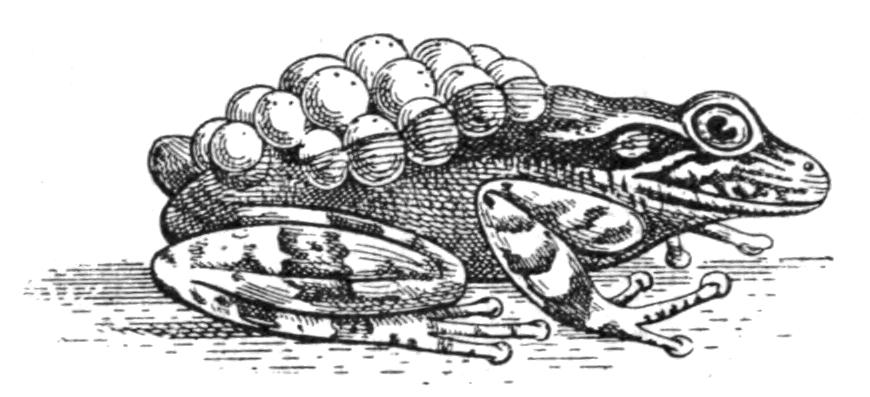
Fig. 38.–Hyla goeldii. × 1. Female with eggs in the incipient dorsal brood-pouch.
H. coerulea s. cyanea is one of the largest Australian green tree-frogs, ranging from the South to the very North of Australia. The discs are as large as the fully-exposed tympanum. There is no projecting rudiment of the pollex, but a slight cutaneous fold borders the inner side of the tarsus. The skin is smooth and shiny, always a little moist, and studded with numerous rather large pores on the nape and shoulders; this somewhat thickened region forms a prominent fold which begins behind the eyes. The belly and the under parts of the thighs are granular as in most Hylidae. The male has an internal vocal sac; and during the breeding season, which seems to occur during our autumn and winter, develops brown rugosities on the inner side of the first finger. The tongue is round, slightly notched behind and free enough to be protruded a little.
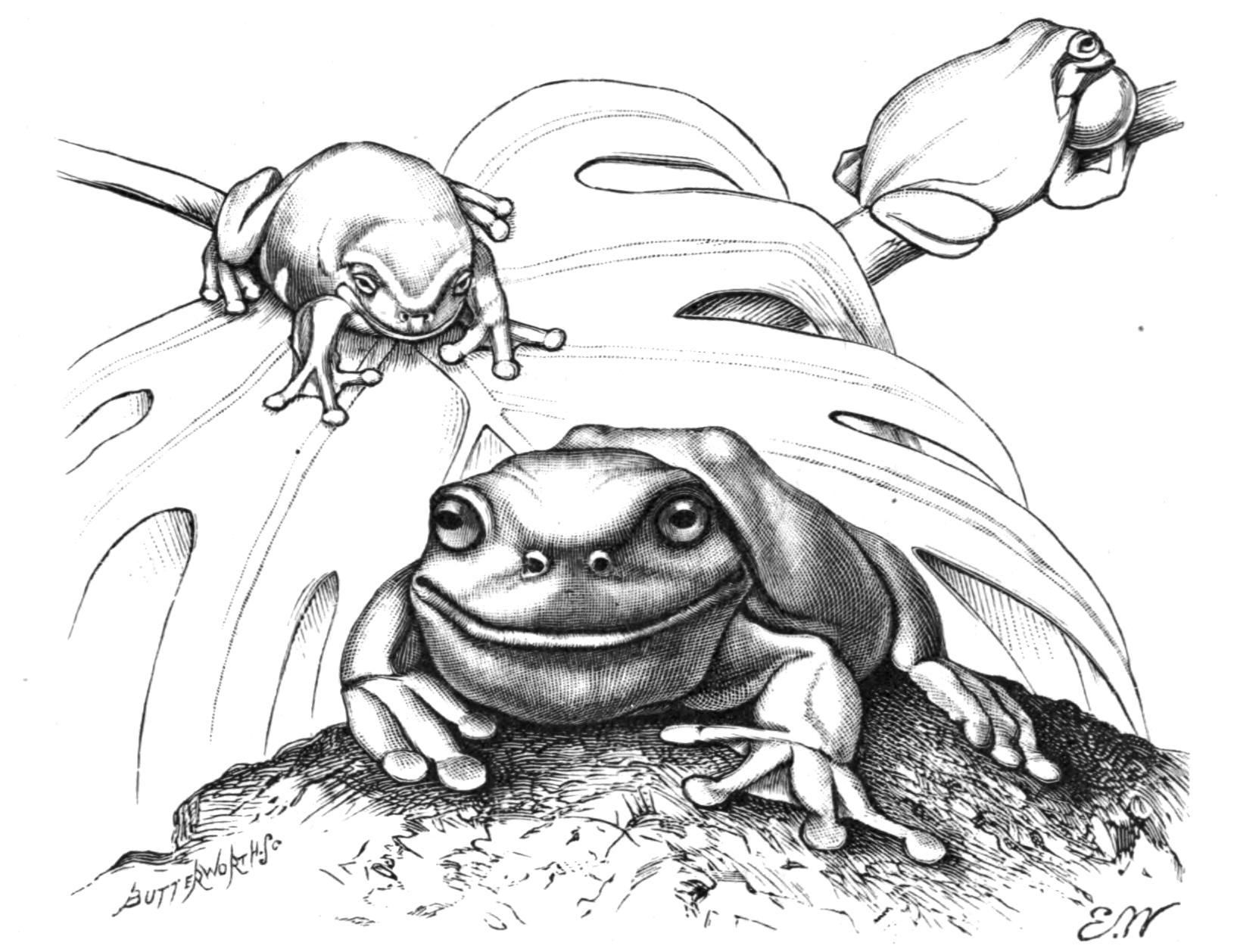
Fig. 39.–Hyla coerulea. Australian Tree-frog (from photographs). Length of the large specimen 4.2 inches. The upper right specimen with vocal sac inflated.
The alternative specific names are most unfortunately chosen, as they apply only to spirit-specimens. During life this tree-frog exhibits a considerable amount of colour-changes. The normal colour is bright green above, white below. A conspicuous feature of this species is the frequent occurrence of white specks or spots, which are probably due to the deposition of guanine, a peculiar white colouring matter. The spots appear in any part of the green skin, and are quite irregular in their distribution. Sometimes they remain for weeks in the same place, or they disappear after a few days and others appear. They are in no way connected with the shedding of the skin, nor do they indicate ill-health. H. coerulea lives well in confinement, and becomes tame enough to take food from one's fingers, even when sitting upon the hand. Some of mine took to living during the daytime in a small box, preferring a crowded condition in companionship with Natterjacks. Others squeeze themselves into the most uncomfortable cracks, while others again prefer the broad leaves of Philodendron. A favourite place for two or three at a time is the funnel-shaped spaces formed by Bromelia-plants. Those specimens which are hidden in the box or in the hollows of rotten stumps are, almost without exception, dull, very dark brownish olive, while those on the Bromelias assume exactly the sombre dull green of its leaves. Lastly, those which sit in the light, exposed places, no matter if upon a leaf, on a white stone, or upon a board, are emerald-green, especially beautiful on hot, sunny days;–and they are not always averse to the full glare of the sun. When squatting upon a flat surface, such as a broad leaf, they tuck the fore-paws under the head like a cat, and with half open eyelids, the pupil contracted to a tiny slit, so that the golden iris is exposed, they remain motionless during the day. They take food when offered, but at night they roam about, either hopping on the ground, or making enormous leaps from leaf to leaf, sometimes deliberately stalking some choice insect, and patiently climbing up a stem, hand over hand. At night their whole aspect is changed. The colour is saturated green, the eyes are transformed into round, projecting shiny black beads, and the head is erect. The ludicrously dreamy, complacent look has given way to wide-awake alertness. They take all kinds of living food. When they find an earthworm, they first look at it, bending the head sharply down, lift themselves upon the fore-limbs and then pounce upon it, nipping the prey with the jaws, and then poking it down deliberately with the hands. Cockroaches are simply lapped up, and disappear in the twinkle of an eye. Mealworms, wood-lice, butterflies and moths, flies and spiders are taken. The stomach of a specimen in the Dresden Museum, from the Aru Islands, contained some four or five young freshwater Crustaceans of the genus Sesarma. They fortunately do not molest smaller frogs of their own kind and of other species. Like many Amphibia they like a change of diet, and ultimately refuse their food if it is unvaried. To my surprise my largest specimen, which measures a little more than 4 inches, takes snails, Helix virgata, half-a-dozen at a time, and on the following day, not during the night, vomits the sucked-out shells in a lump, like the pellets of birds of prey. During this rather painful-looking procedure the whole tongue and about half an inch of the everted gullet are protruded out of the mouth, and are then slowly withdrawn. After having roamed about all night, they return to their respective resting-places, where each individual is sure to be found in exactly the same spot, day after day. They do not mind being looked at, but if taken up and put back they avoid that place for perhaps a week, taking shelter somewhere else.
Both sexes have a voice, but that of the female is only a grunting noise, while the male inflates its gular sac and sends forth a sharp cracking sound, which can turn into a regular bellowing like the gruff barking of an angry dog. They bellow at any time of the year, frequently on the approach of a shower or during a thunderstorm. Certain noises will also induce them to bark. The rattling produced by the syringing of the greenhouse, sawing of wood, hammering, the raking of the gravel, or even the scraping of boots on the gravel-path is liable to start one of the males, and the others are sure to chime in.
According to Fletcher, H. coerulea and H. aurea lay their eggs in round white frothy patches, which float in the water, chiefly during the months of August and September; but when the spring months are very dry, the pairing is delayed until the following January. Several other Australian species of Hyla, e.g. H. ewingi, spawn at any time of the year if the conditions are favourable. They attach their eggs to submerged blades of grass or to twigs.
H. aurea is one of the commonest and most beautiful species, occurring throughout Australia and Tasmania, excepting of course in the large deserts. It has the appearance and restlessness of a water-frog, is not unlike Rana esculenta, and grows to about three inches in length. The tympanum is very distinct, but rather small. The fingers are without a pollex-rudiment, the tarsus has a fold along its inner edge. The adhesive discs are decidedly small. The male has two internal vocal sacs, which bulge out sideways. The skin is smooth and shiny. The under parts are white; the upper parts are, speaking generally, a mixture of blue and olive, with blue or brown spots, but spirit-specimens give no idea of the beauty which this changeable species can assume. Sometimes the same individual is saturated blue and green, with several longitudinal stripes of burnished copper along the back; a few minutes later the stripes glitter like gold, and in other moods the whole upper surface is mottled blue, green, and brown. My specimens often went into the water and did not climb. The food is said to consist chiefly of other small frogs in preference to insects.
Nototrema differs from Hyla in so far as the female has a pouch on the back for the reception of the eggs. This bag is formed by an infolding of the skin; it opens backwards in front of the vent, it has a sphincter and is permanent, although it distends to larger dimensions when in use. An initial stage of such a pouch is possessed by Hyla goeldii (Fig. 38). The pupil is horizontal, the tongue can be protruded but little; the tympanum is free, and the adhesive discs of the fingers and toes are well developed. These "marsupial frogs," of which about half-a-dozen species are known, live chiefly in the tropical forest-region of South America, notably from Peru to Venezuela.
N. marsupiatum is green with darker blue-green spots, or with longitudinal patches which are each surrounded by a whitish or yellow seam of little dots. The limbs have cross-bars. Total length about 2½ to 3 inches. The eggs of this species are comparatively small and numerous. The very small tadpoles have no external gills, and escape from the pouch to finish their metamorphosis in the water.
N. testudineum, about 3 inches in length, is of a uniform lead-colour, but is lighter beneath. The skin of the back is studded with stellate calcareous deposits, a peculiarity which is alluded to in the specific name.
N. oviferum is brown above, with darker patches on the sides of the body and with cross-bars on the limbs. The last two species and N. fissipes of Brazil, near Pernambuco, carry their young in the pouch until the metamorphosis is completed. This long nursing-period necessitates a great amount of food-yolk in the eggs, and this enlargement in turn implies a considerable reduction in their number. The female's load consists of about fifteen eggs only, but these are of a great size, namely one-eighth of the length of the mother's body.
N. pygmaeum, in Venezuela, is a tiny creature. The female, just one inch in length, carries only from four to seven eggs. It looks then "as if it carried a sac filled with a few gigantic balls." This species is further worthy of note on account of the opening of the brood-pouch, which is a longitudinal slit, whence a kind of thin and slightly elevated ridge or fold of the skin extends on to the neck. The suggestion, that this seam is burst open, in order to set the full-grown young free, instead of their passing through the existing opening, is scarcely credible.
These Neotropical tree-frogs seem to be rare, and females with embryos are of course still more uncommon, so that the best account of their structure is still that given by Weinland[88] of N. oviferum. How the eggs get into the pouch has not yet been observed, but it is most likely with the help of the male, immediately after fertilisation. The pouch forms two blind sacs which extend forwards over the sides of the back. The eggs are large, 1 cm. in diameter, and the enclosed embryos, or rather tadpoles, had a length of 15 mm., with a large amount of yolk still contained in the spirally wound intestine. The first two gill-arches carried each a double thread, which expanded into a funnel-shaped membrane, not unlike the flower of a Convolvulus, and furnished with a capillary network; the stalk contained muscular fibres. These most peculiar structures are of course the much modified external gills. Those of N. testudineum and N. cornutum are likewise bell-shaped.
Hylella differs from Hyla chiefly by the absence of vomerine teeth, and consists of about half-a-dozen small species, about one inch in length. The fact that two species live in Queensland and New Guinea, while the others are natives of tropical America, suggests that this genus is not a natural but an artificial assembly, an instance of convergent evolution.
Phyllomedusa, composed of about one dozen species of tree-frogs, is characterised by the vertically contracted pupil, large adhesive discs, and the opposable nature of the inner finger and of the hallux, the last joints of which are like thumbs. The sacral diapophyses are strongly dilated. The range of the genus extends from tropical Central America to Buenos Aires. Most of the species are about 2 inches in length, blue-green to violet above, with white purple-edged patches on the sides of the body; the under parts uniform white, or with purple or brown patches. The male has a subgular vocal sac. Some have more or less distinct parotoid glands. Ph. dacnicolor of Mexico is uniform green above, whitish below, and attains a size of more than 3 inches. In Ph. bicolor of Brazil, the skin of the upper parts is studded with calcareous deposits, and the parotoids are large. It is blue-green above, purplish white below, the sides of the body and limbs with white purple-edged spots.
Ph. hypochondrialis has been found breeding freely in the Paraguayan Chaco by Budgett,[89] from whose account the following notes have been extracted. This brilliantly coloured frog is green above, which colour may become brown-grey or bluish at will; below, white and granular. The flanks are scarlet, with black transverse bars, and the plantar surfaces are deep purplish black. Total length about 1½ inch.
The "Wollunnkukk," as it is called by the Indians, from the call of both male and female at pairing time, is extremely slow in its movements, and is active only at night. At this time, if it is seen by the aid of a lantern as it slowly climbs over the low bushes and grass, it is very conspicuous. In the daytime, however, nothing is seen but the upper surface of the body as it lies on the green leaf of a plant. It has a remarkable power of changing its colour to harmonise with its surroundings, and can effect a change from the brightest green to light chocolate in a few minutes. The skin is also directly sensitive to light; for if the frog is exposed to the sun while in a tuft of grass in such a way that shadows of blades of grass fall across it, on removal it will be found that dark shadows of the grasses remain on the skin, while the general colour has been raised to a lighter shade. Its food consists largely of young locusts. The ovaries on each side are divided into five distinct clusters. The rectum has a large saccular diverticulum, which is very heavily pigmented.
In the breeding season–December to February–this beautiful frog collects in considerable numbers in the neighbourhood of pools. During the night-time they call incessantly to one another, and produce a sound as of a dozen men breaking stones, well imitated by the native name.
The eggs are enclosed in batches in leaves near the margin of the water. Budgett has been able to watch the whole process of oviposition and fertilisation. He found, at 11 P.M., a female carrying a male upon her back, wandering about in search of a suitable leaf. At last the female, climbing up the stem of a plant near the water's edge, reached out and caught hold of the tip of an overhanging leaf, and climbed into it. Both male and female held the edges of the leaf together, near the tip, with their hind-legs, while the female poured her eggs into the funnel thus formed, the male fertilising them as they passed. The jelly in which the eggs were laid was of sufficient firmness to hold the edges of the leaf together. Then moving up a little further, more eggs were laid in the same manner, the edges of the leaf being fastened together by the hind-legs, and so on up the leaf until it was full. As a rule, two briar-leaves were filled in this way, each containing about 100 eggs. The time occupied in filling one leaf was three-quarters of an hour.
Development proceeds rapidly. Within six days the embryo increases from the 2 mm. of the egg-diameter to 9 or 10 mm. When it leaves the leaf it is a transparent glass-like tadpole, whose only conspicuous parts are the eyes. These are very large and of a bright metallic green colour, so that when swimming in the water all that is seen is a pair of jewel-like eyes. The newly-hatched tadpole has also a bright metallic spot between the nostrils somewhat in front of the pineal spot. This is the point which touches the surface of the water when the tadpole is in its favourite position. Whether it is a protective coloration, or some mechanical arrangement for holding the surface, Budgett could not make out.
The egg contains a great amount of yolk; the rest of the jelly-like contents of the egg becomes fluid, so that towards the end of embryonic life the larva comes to lie quite freely within a membranous capsule. The external gills appear on the third day, and reach their greatest size on the fifth, when these bright red filamentous organs extend beyond the vent. By the time the tadpoles are ready to be hatched these gills have quite disappeared, there is a median spiracle, and the lungs are shining through the transparent body-wall. Five weeks later, i.e. six weeks after the eggs were laid, the tadpole is 8 cm. long, glossy green above, rosy and silvery below, and the hind-limbs protrude. The young frog at the close of its metamorphosis is two-thirds the length of the adult, and at this time acquires the red flanks barred with black.
The first account of the breeding of Phyllomedusa was given by v. Ihering[90] concerning Ph. iheringi of Southern Brazil.
"Phyllomedusa does not lay its eggs in the water, although the larva develops in that element, but in the open air in masses 50 millim. long by 15-20 broad, between leaves hanging over the water. Willows are frequently used for that purpose. The egg-mass contains rather large white ova, wrapped up between two or three leaves in such a way as to be completely enveloped save an inferior opening. My attempts at rearing the eggs failed owing to the leaves drying up; but I am assured that the tailed larvae may be seen wriggling in the gelatinous mass. As at a later period the latter is found empty, we must infer that the larvae drop into the water below. The eggs are found only on plants hanging over stagnant water."
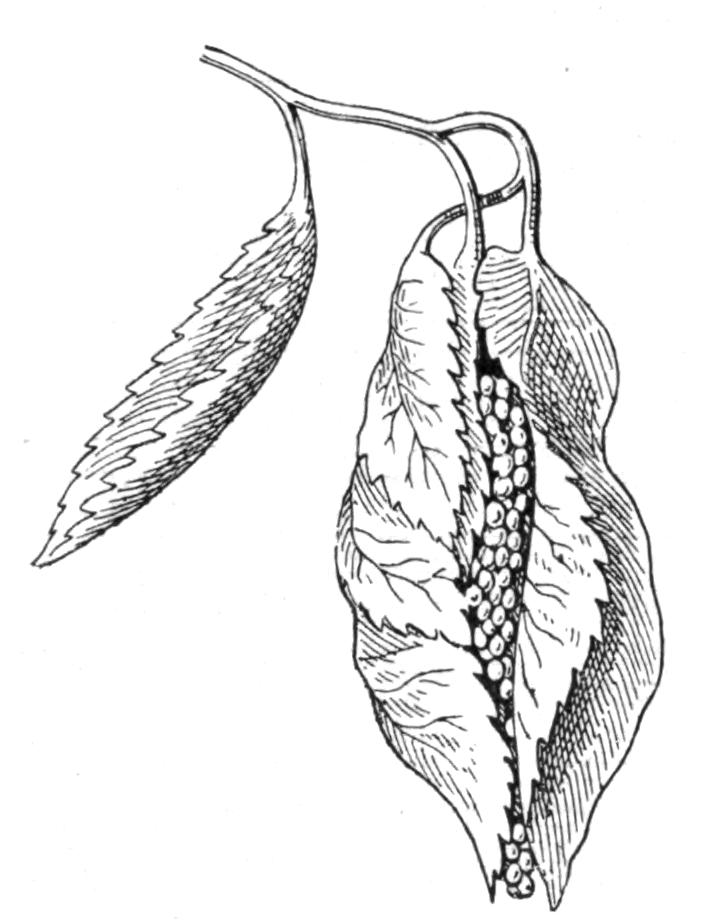
Fig. 40.–A branch with eggs of Phyllomedusa iheringi, × 1, enveloped in the leaves. (After v. Ihering.)
"The adult animal is a stupid creature, and will let itself be taken without attempting to escape. Their moderately loud voice resembles somewhat the sound produced by running the finger nail over the teeth of a comb. Only during the breeding season, in the month of January in Rio Grande do Sul, do these frogs make their appearance; at other times not one is to be seen, probably because they establish themselves high up in the trees."
Agalychnis, with two species in Central America, is practically like Hyla; but the pupil is vertical, and the tongue is extensively free behind.
Nyctimantis differs from either by its round tongue, which is not nicked behind, and is almost completely adherent, much resembling that of the Discoglossidae. The sacral diapophyses are but slightly dilated. The only species, N. rugiceps, lives in Ecuador, and grows to nearly three inches in length. The head is large and rough owing to the skin being involved in the cranial ossification. It is further peculiar in its coloration, the under parts being chestnut-brown instead of whitish. The upper parts are olive-grey or brown.
The following four genera, each represented by one or two species only, much resemble each other in the curious shape of the head, which forms a flat projecting snout, used probably for digging in rotten wood in search of insects. There is a peculiar degradation in the extent of dentition of the palatal region. Diaglena and Triprion are the only Hylidae which possess a longitudinal row of parasphenoid teeth. Diaglena petasata of Mexico and D. jordani of Ecuador have, moreover, a transverse row of teeth on the palatine bones in addition to those on the vomer.
Triprion petasatus of Yucatan has parasphenoid and vomerine teeth. The head is a bony casque, with strong superciliary ridges, the skin being extensively ossified. The mouth forms a flat snout, owing to the long projection of the upper over the lower jaw. The skin of the back is smooth brown with darker spots; the under parts are uniform whitish. The male has a subgular vocal sac. Like Diaglena and Corythomantis they possess adhesive discs on the fingers and toes, and climb trees. The total length of this curious creature is 2 inches.
Corythomantis greeningi of Brazil has a similar head. The vomers alone carry teeth, besides of course the maxillae. The pupil is rhomboid. The tongue, as in the two previous genera, is roundish, scarcely free. General colour above olive, with darker freckles; the sides are studded with whitish tubercles; the under parts are whitish. The male is devoid of vocal sacs. Total length 3 inches.
Pternohyla fodiens of Mexico approaches the previous three genera by the curious shape of the head and prominent upper jaw, although these features are not so exaggerated. The dentition agrees with that of Corythomantis and other normal tree-frogs. The fingers and toes are not provided with discs, in conformity with the burrowing, not climbing, habits of this creature. The next following three genera connect the Hylidae with the Cystignathidae. The sacral vertebrae are but slightly dilated.
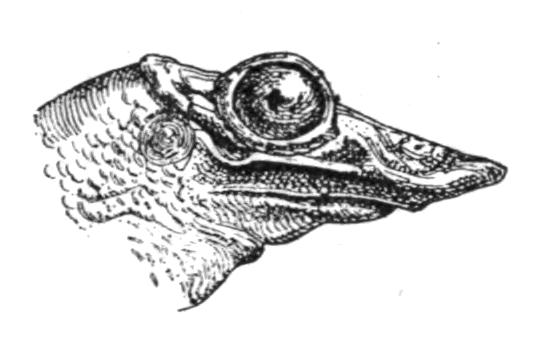
Fig. 41.–Head of Corythomantis greeningi. × 1. (After Boulenger, Cat. Batrach.)
Acris.–The adhesive discs are very small, the tympanum is indistinct. A. gryllus, the only species, inhabits the greater part of Eastern and Central North America, extending northwards into Canada. It attains a length of 1½ inch. The coloration is very changeable, in adaptation to the surroundings. As a rule it is brown, with a more or less reddish or grey ground-tone, ornamented with dark brown or blackish irregular, longitudinal patches,one of which is bordered with light green,and there is often a light vertebral streak. The legs are cross-barred, the under parts are whitish brown and yellowish. The male has a subgular vocal sac, and its most remarkable feature is the voice, which closely resembles the noise of a cricket or of certain grasshoppers. Holbrook describes it as a merry little frog, constantly chirping like a cricket, even in confinement. It frequents the borders of pools, and is often found on the leaves of aquatic plants, rarely on the branches of such low shrubs as overhang or dip into the water. When disturbed it takes long jumps, and hides at the bottom of the pond. Insects are secured by leaps. It can easily be domesticated, and takes food readily from the hand. Sprinkling them with water never fails to make them more lively and noisy. Appearing in April in great numbers, they are said to vanish early in the autumn for hibernation. The tadpoles are metamorphosed by the end of August.
Chorophilus.–The fingers and toes are provided with very small adhesive discs. The sacral diapophyses are very slightly dilated. About seven species occur in North America, chiefly in the Southern States, one, Ch. cuzcanus, in Peru. Ch. ocularis is the smallest of the frog-kind known, and lives in South Carolina, frequenting damp places, the vicinity of stagnant pools, water-plants or low shrubs, for instance the "myrtle," Myrica cerifera. I once had two of these tiny creatures less than three-quarters of an inch in length. They were very active, and took surprisingly long leaps, jumping distances of 2 feet, but could not be kept through the winter, although they took minute insects readily enough. The head is narrow, long and pointed; the upper parts are of a rich chestnut-brown with a bronzy gloss. The upper jaw is white; a black band extends along the sides of the head and body. The under parts are yellowish white.
Ch. ornatus is another inhabitant of the South-Eastern States; its name refers to the dark brown patches on the back and sides, bordered with golden yellow, upon a reddish-brown ground-tone, while the under parts are silvery white with fine grey spots. This frog, a little more than one inch in length, lives on land in dry places, preferably in corn-fields, has no voice, and, except during the pairing season, carefully avoids the water.
Thoropa.–The fingers and toes are free, the tips simply swollen and not dilated into discs. Closely allied to Chorophilus. Th. miliaris, of Brazil, the only species, has very long toes. The head is broad and flat. The upper, nearly smooth surface of the body is flesh-coloured, with brown marblings; the limbs are cross-barred; the under parts whitish, granular on the belly. The male is devoid of vocal sacs. The total length may be 2 inches. Hensel has published the following notes of this species, under the name of Hylodes abbreviatus. The tadpoles are quite flat, their bellies forming a kind of sucking disc, so that these creatures, even before the appearance of the hind-limbs, can quickly wriggle up vertical walls of stones, provided these are covered with a little water. In correlation with this habit, the root of the tail is not compressed laterally, but is as broad as it is high, and the usual vertical fin is restricted to its distal third. On the proximal portion of the tail the ventral fin is flattened and broadened out so as to form almost the continuation of the peculiar disc-like belly. The anal opening is not a projecting tube, but is a flattened transverse slit.
Fam. 5. Cystignathidae.–This is one of the largest families, and also one of the least satisfactory. Its numerous members, more than 150, exhibit such a versatility in adaptation to circumstances (there are aquatic, terrestrial, arboreal, and burrowing species), with a corresponding development or loss of anatomical characters which we should like to rely upon as taxonomic marks, that the numerous genera not only run into each other, but also get entangled with those of other families. In fact the whole family is ill defined. It can be characterised as follows:–The shoulder-girdle is arciferous; the sacral diapophyses are cylindrical or but slightly dilated; the metasternum has either a bony style or it forms a cartilaginous plate; the terminal phalanges, although they sometimes carry adhesive discs, are never claw-shaped.
The last statement is, of course, intended to separate the Cystignathidae from the Hylidae, of which, however, the three genera Thoropa, Chorophilus, and Acris stand on debatable ground (cf. p. 186, Hylidae), while, on the other hand, most of the Australian genera, notably Chiroleptes, have unmistakably dilated sacral diapophyses. The difference from the Pelobatidae can in this case be one of degree only.
The Cystignathidae may be said to represent the Ranidae in Notogaea. Some of them can be distinguished from the true, typical frogs solely by the arciferous type of the shoulder-girdle and sternum. There is in both families the same adaptive versatility, the same amplitude in the formation of the fingertips, the occasional slight dilatation of the sacral diapophyses, the same range in the configuration of the omo- and meta-sternum. In fact, young Ranidae, before the firmisternal character is assumed, are indistinguishable from Cystignathidae, and the latter would turn into Ranidae if they could be induced to consolidate their sternal apparatus.
The geographical distribution of the Cystignathidae is suggestive of their being an old family, most of whose members have reached a high stage of morphological development. The overwhelming majority inhabit the Neotropical region, a few forms extending into tropical Central America and into the Antilles; the rest, some twenty species only, are confined to the Continent of Australia and to Tasmania.
The family name is rather a misnomer. It is taken from the genus Cystignathus, which is, or rather was, characterised by the peculiarly broadened lower jaw, hollowed out by the vocal sacs; but this generic name had to give way to that of Leptodactylus, in obedience to the often senseless rule of priority. The family is composed of three subfamilies.
Sub-Fam. 1. Hemiphractinae.–Teeth are carried by both jaws, the vomers and the palatine bones; or by the palatines and parasphenoids in Amphodus. The vertebrae are opisthocoelous, devoid of ribs, and the sacral diapophyses are not dilated. The shoulder-girdle and sternum are strictly arciferous. The omosternum is very much reduced; the metasternum forms a cartilaginous plate. The tongue is slightly free behind. The tympanum is distinct. Three genera, with eight species, all inhabitants of South America.
Hemiphractus.–The head is large; the upper surface of all the cranial bones appears pitted, owing to most of the covering skin being involved in the ossification. The temporal fossa is bridged over or roofed in by the fronto-parietal and the squamosals, so that the orbit is completely encircled by bone, as in Pelobates cultripes. The terminal phalanges are simple and are not dilated into discs. The teeth of the lower jaw are very small and numerous. The tongue is round and very small. H. scutatus, the only species, living in Ecuador and Colombia, is a frog-like creature, with a large helmet-shaped head. Total length 2½ inches.
Ceratohyla has the same kind of helmet-shaped head, and the orbit is likewise enclosed by bone, but the terminal phalanges are claw-shaped and carry regular adhesive discs. This genus, the five species of which live in Ecuador, bears undoubted resemblances to the Hylidae. In C. proboscidea the upper eyelid is produced into a little upright fold, as in Amphignathodon and some species of Nototrema and Ceratophrys among Cystignathidae. The snout is produced into a long, compressed, bifid appendage, and the heel carries a triangular flap. In C. bubalus the partly ossified helmet sends out a pair of diverging processes, formed by the squamosals, extending backwards and sideways from the concave and ridged interorbital spaces. The tip of the snout and the tips of the divergent horns form an equilateral triangle, and the whole head bears a striking resemblance to some of the fossil Reptiles from the Elgin Sandstone, e.g. Triceratops. Total length 3 inches.
Amphodus wucheri.–The only species of this genus has been found near Bahia. It has teeth on the palatine bones and five series of small teeth on the parasphenoid, but none on the vomers. The teeth of the mandible number about eleven on each side and decrease in size towards the symphysis. The tympanum is distinct; the heart-shaped tongue is free behind. The cranial bones are only slightly pitted. The skin is smooth above, chocolate-brown, spotted with yellow, and with a yellow band on the sides of the body beginning with the upper eyelid and ending in a broad patch above the vent. The under parts are yellowish white.
Sub-Fam. 2. Cystignathinae.–The upper jaw alone is provided with teeth. Vertebrae procoelous. The twenty-seven genera of this sub-family have been arranged in the following key, merely for convenient determination.
I. American genera.
A. The metasternum forms a cartilaginous plate without a narrow handle. The pupil contracts into a horizontal slit.
a. The terminal phalanges are bifurcated, Y-shaped, and provided with large discs; the tympanum is distinct; the omosternum is absent .......... Centrolene geckoideum, Ecuador.
b. The terminal phalanges are T-shaped and carry discs. The omosternum is cartilaginous.
α. Discs divided by a dorsal groove.
With vomerine teeth .......... Elosia, 3 species in Brazil.
Without vom"r teeth .......... Syrrhopus,[91] 9 species, South America.
β. Discs undivided.
With vomerine teeth .......... Hylodes, p. 214.
Without vom"r teeth .......... Hylopsis.
c. Terminal phalanges simple, pointed, or with very small discs. First finger opposed to the others .......... Pseudis, p. 213.
d. Terminal phalanges simple, without discs.
α. Tympanum hidden. A large, flat gland on each side of the body .......... Cyclorhamphus fuliginosus, Brazil.
β. Tympanum distinct. Head rough, entirely bony. .......... Calyptocephalus, p. 215.
γ. Tympanum hidden or absent. Tongue roundish, not nicked, free behind. Toes webbed. .......... Telmatobius, 6 species in Western South America.
δ. Tongue heart-shaped, free. Toes webbed. .......... Ceratophrys, p. 215.
ε. Tongue round, free behind. Toes webbed. With two tooth-like projections in the lower jaw. .......... Lepidobatrachus, p. 218.
ζ. Tongue entire, or slightly nicked, free behind. Toes free. .......... Borborocoetes, 11 species in Western South America.
η Tongue entirely adherent Tympanum distinct. .......... Zachaenus parvulus, Brazil.
B. Metasternum with a bony style.
a. Pupil horizontal
α. Terminal phalanges T-shaped, with discs. Tympanum distinct. .......... Plectromantis, 2 species in Western South America.
β. Terminal phalanges simple; tips not dilated into regular discs.
1. Tympanum distinct.
Sacral diapophyses slightly dilated. .......... Edalorhina, 3 species in Ecuador and Peru.
Sacral diapophyses not dilated. .......... Leptodactylus, p. 218.
2. Tympanum indistinct or hidden, Paludicola, p. 220.
b. Pupil vertical. Terminal phalanges simple and not dilated. Chili.
α. Tongue slightly nicked .......... Limnomedusa macroglossa.
β. Tongue entire, but free behind. Digits very long. .......... Hylorhina silvatica.
II. Australian genera. The terminal phalanges are simple and not dilated. The omosternum and metasternum are cartilaginous, the latter forming a plate, semi-ossified only in Heleioporus.
A. Pupil contracted into a horizontal slit.
a. Omosternum rudimentary. Vomerine teeth present.
α. Tympanum distinct .......... Phanerotis fletcheri.
β. Tympanum hidden .......... Cryptotis brevis.
b. Omosternum present. Vomerine teeth vestigial. .......... Crinia, 4 species.
c. First finger opposed to the others .......... Chiroleptes, p. 221.
B. Pupil contracted into a vertical slit.
a. Omosternum rudimentary. Vomerine teeth absent. .......... Hyperolia marmorata.
b. Omosternum fully developed. Vomerine teeth present.
α. Tympanum distinct. Toes webbed. .......... Mixophyes fasciolatus.
β. Tympanum hidden. Toes webbed. .......... Heleioporus, p. 222.
γ. Tympanum indistinct. Toes free or slightly webbed. .......... Limnodynastes, p. 222.
Pseudis, widely distributed over South America, consists of four species which have the appearance of long-legged frogs. The fingers, of which the first is opposed to the others, are free; the long toes are fully webbed. The tympanum is exposed.
P. paradoxa is absolutely aquatic, floating in pools, and is extremely shy. In life it is most beautifully coloured with bronze, bright green, and black markings above; underneath it is shiny yellow, with brown spots on the body and stripes on the thighs. Within a few minutes after death all the brilliant colours of the smooth skin of the back turn into dull uniform brown, with indistinct darker spots. Total length of the adult from 2 to 2½ inches. The specific name refers to the peculiar shape and monstrous size of the larva or tadpole.
One of the larvae described and figured by Parker measures 10⅓ inches in length, the head and body taking up 3⅓ inches. The spiracle lies on the left side and the hind legs are ½ inch long, just breaking through the skin. The vent is median. The huge tail is very thick and muscular, and is furnished with a high, irregularly shaped dorsal and ventral fin, the whole organ measuring 4 inches dorso-ventrally. Another larva, or rather tadpole, in the national collection is older, and although still very large, namely, 7 inches long, has fully developed hind-limbs 3 inches long; the fore-limbs are less than half that size, the left protrudes through the spiracle, while the right has broken through the skin. The dorsal and ventral fins of the tail have much shrunk; the whole organ, 5 inches long, is gradually tapering to a point like the tail of ordinary tadpoles. By the time that the tadpole is nearly ready to leave the water, its whole bulk is reduced to less than one-fifth that of the largest tadpole. It measures from snout to vent only 1½ inch (in the 7-inch tadpole this distance is fully 2 inches), and the tail, devoid of fins, is reduced to 2 inches in length. Instead of the solitary left spiracle there are now two, one on the ventral side and a little in front of the base of each arm, the border of each hole being continued by a peculiar semilunar fold.
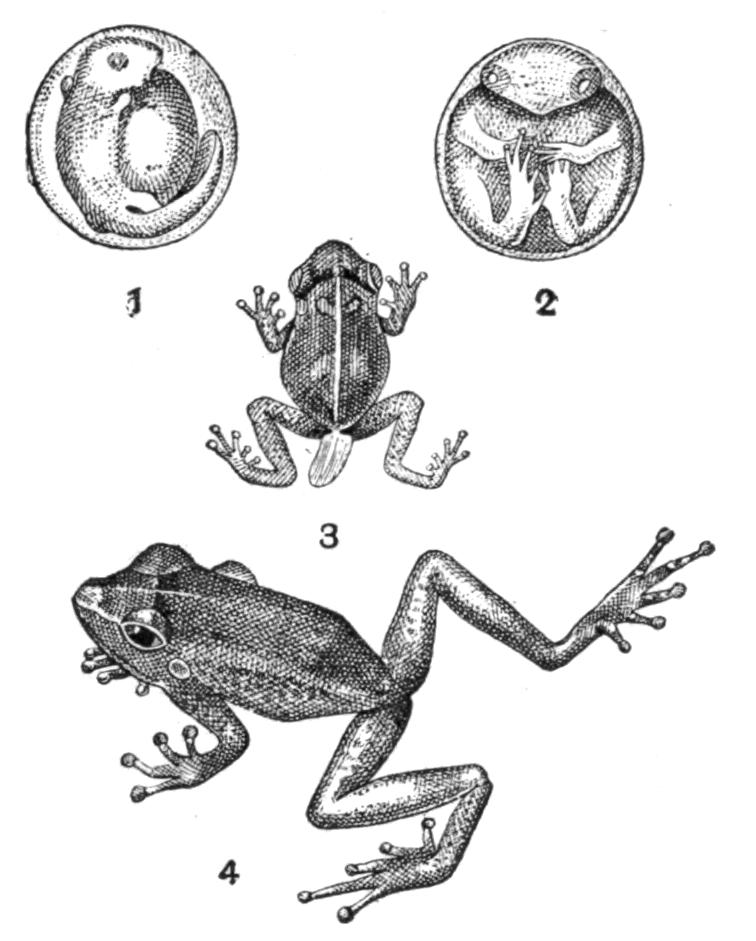
Fig. 42.–Hylodes martinicensis. 1, an egg with embryo about seven days old; 2, another, twelve days old; 3, the young Frog just hatched; all × ¾; 4, adult male × 1. (After Peters.)
Hylodes.–The numerous species, nearly fifty, of this tropical American genus exhibit several anatomical differences. The tympanum is sometimes indistinct or hidden, in which case the Eustachian tubes are generally very narrow. The fingers are free, and carry discs, like the toes, which are sometimes slightly webbed. The males have a subgular vocal sac, producing a loud, or whistling, voice. The general appearance is that of land- and tree-frogs; the size is small, mostly between 1 and 2 inches.
H. martinicensis is about 1½ inch in length. The ground-colour is pale yellow-grey, with a large brown patch on the nape, which colour is continued over the back in the shape of more or less coherent or dissolved patches. A dark brown stripe runs along the middle of the sides. The limbs are barred with brown, the under parts are whitish. This species, known by the vernacular name of "coqui" inhabits many of the West Indian islands, e.g. Barbadoes, Martinique, Porto Rico, and Hayti. It has become famous, as it was the first instance known of a frog which undergoes its whole metamorphosis within the egg. The pairing takes place on land, in the months of May and June, when the female lays about twenty eggs, which are enveloped in a foamy mass and glued on to a broad leaf, or hidden in the axillae of Iridaceous plants. The mother seems to remain in the neighbourhood watching the eggs, which are large, measuring 4-5 mm. in diameter. Dr. Gundlach, a resident in Porto Rico, was one day, in the month of May, attracted by sounds like those of a young bird, and found three males and one female of this species sitting between two large leaves of an orange-tree. He put them all into a glass vessel and soon saw a pair in embrace. The female laid about twenty-five pale straw-coloured eggs. The embryo develops neither gills nor gill-openings, but a large well-vascularised tail, by means of which, being immersed in the watery fluid contained within the egg, it seems to breathe. After twenty-one days the tadpole, having used up all the available yolk and fluid, and most of its own tail, bursts the egg-shell and hops away as a little frog of 5 mm. in length, but still with a stumpy white tail, which is quite absorbed within the same day.
This species has several times made its appearance in the tropical houses of Kew Gardens. It seems to have bred and vanished again.[92]
Calyptocephalus is remarkable for the dermal ossification of the cranium, which has assumed the greatest possible extent. It affords a curious parallelism to Triprion and other Hylidae, which are likewise Central American forms. Only two species are known; C. gayi of Chili, and C. testudiniceps of Panama. They are large, thoroughly aquatic creatures, 5 to 6 inches in length, with huge heads. The tadpoles grow to an enormous size. One specimen of C. gayi in the National Collection is more than 6 inches in length, the tail taking up more than half of the total: the spiracle lies on the left side, the vent on the right, and the hind-limbs are still half enveloped in a kind of fold of the skin.
Ceratophrys is a genus of some ten toad-like species, living in South America, from Guiana to Argentina. The generic name alludes to the peculiar modification of the eyelid, which in most species is developed into a triangular, upright, but flexible appendage. The head, in conformity with the huge mouth, is very large. The tympanum is rather indistinct, sometimes quite hidden. Several of the species have a large dorsal shield, which is produced by a thick ossification of the cutis, but is not fused with any of the vertebral processes. The male has a vocal sac. C. dorsata s. boiei of equatorial Brazil is a monster toad, reaching a length of 6 inches. The upper eyelid is transformed into a triangular horn, whence a cutaneous ridge extends all along the side of the back, meeting that of the other side above the vent. There is no osseous shield on the back. The tympanum is hidden. Ground-colours, orange or green, with sharply marked dark brown or blackish patches.
C. cornuta, in Northern Brazil, lacks the dorsal shield, but has horned eyelids and a visible tympanum. Its coloration renders it one of the most beautiful toad-like creatures known. The ground-colours are green, black and brown, with an orange-yellow stripe over the head and back. All these colours are most pleasingly blended and arranged in marbled patches or stripes radiating from various centres, as, for instance, from the eyes towards the circumference of the mouth, the slit of which they pass, the same line of the pattern being continued upon the lower jaw. The whole surface makes the impression of a gay but exquisitely harmonious carpet. The under parts are yellow, inclining to white towards the middle.
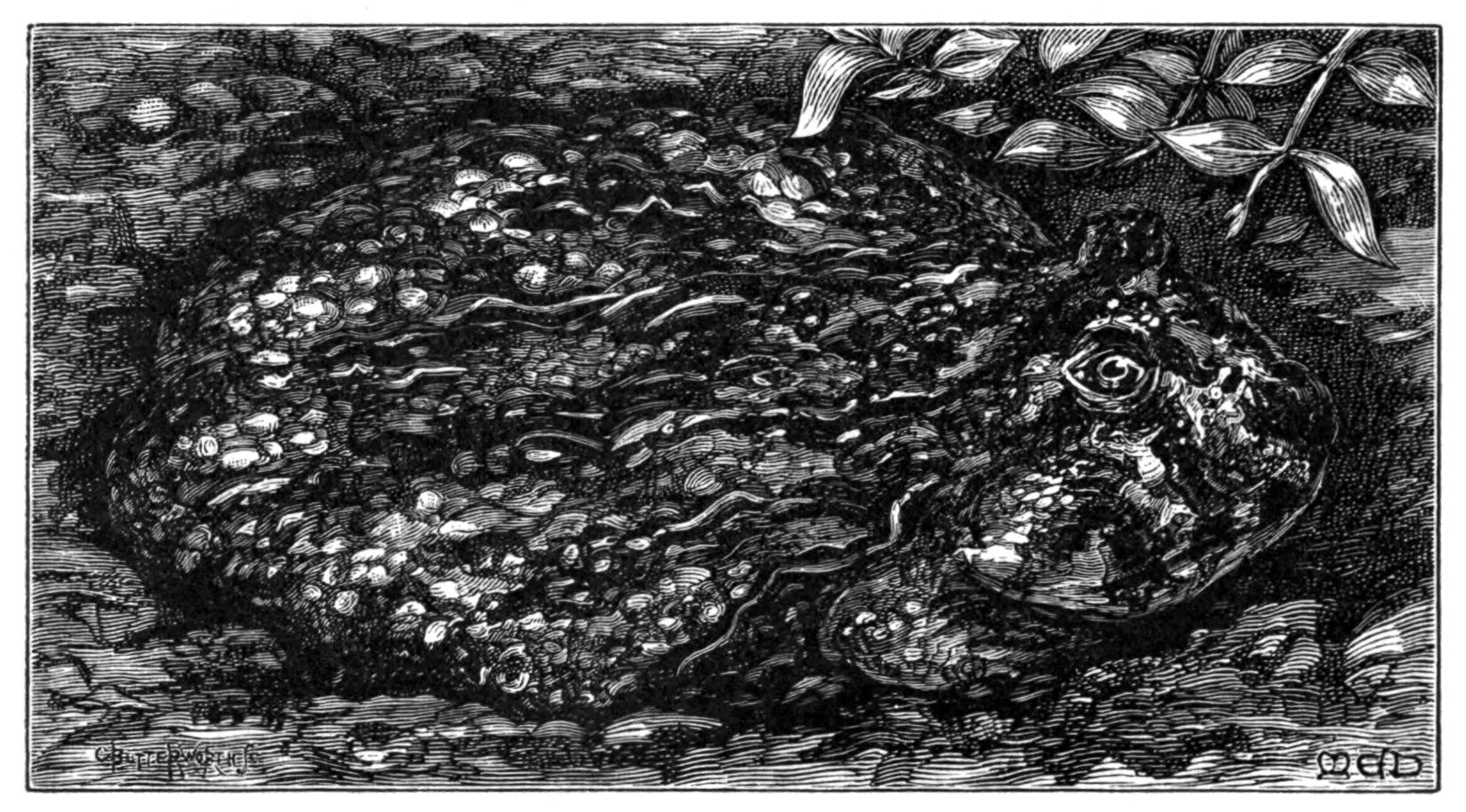
Fig. 43.–Ceratophrys ornata. Horned Toad. × ¾.
C. ornata has a dorsal shield. The tympanum is just visible, and the eyelids form only low but sharp-edged projections. This is likewise a beautiful toad, living chiefly in Uruguay, Northern Argentina, and Paraguay, where it is universally known as the "escuerzo," one of the Spanish words signifying a toad. Its size rarely surpasses 4½ inches. The ground-colours are greenish and yellow, with large dark green patches on the back, decreasing in size on the flanks.
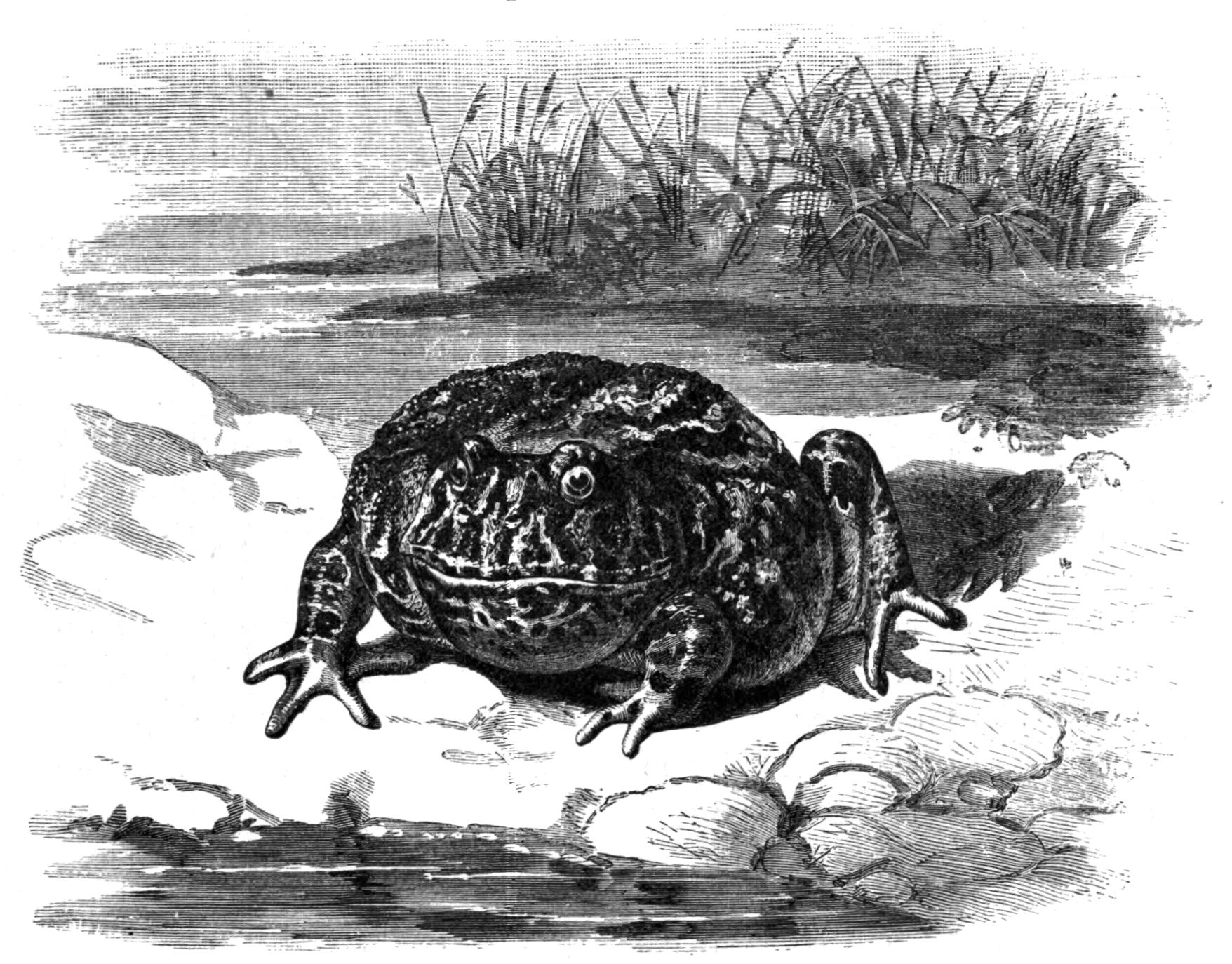
Fig. 44.–Ceratophrys ornata. (From Nature.)
Each of these insular patches is surrounded by a narrow line of white and yellow dots, interspersed here and there with lines of rusty brown or red. The object of this elaborate carpet-like pattern is concealment. These toads–and this applies to all the species,–bury themselves half in the ground, preferably in the grass, where they are well-nigh invisible. If there is not enough green vegetation, they throw, with their feet, little lumps of earth upon their backs, the skin of which becomes at the same time more crinkled and assumes duller tones. There the creature lies, perfectly concealed, betrayed only by the metallic glittering eyes, waiting for some unfortunate creature to pass into the trap represented by the enormous mouth, which opens and shuts with lightning-rapidity and with an audible snap. They seem to live chiefly on frogs, and sometimes they turn cannibals. Two specimens were brought over to me from Buenos Aires by a friend, in a well-closed basket with moist soil at the bottom, but only one was visible on arrival. The other was inside the larger one, and could still be felt through the soft body. This same cannibal took large-sized frogs greedily, one or two for a meal, swallowing them whole and then sinking back into its lair, which it scarcely ever left, except for an occasional soaking bath in its water-pan, especially before shedding its skin. It lived for many months in the same enclosure with a pantherine toad, Bufo mauritanica, of equal bulk, until one morning I found the Moroccan half swallowed and almost lifeless in the mouth of the American, whence it was rescued with difficulty. It came round after a few hours, but never fully recovered, lingering on for weeks; the skin was changed to a lead-colour so far as it had been swallowed and partly dissolved by the gastric juices, and soon began to develop festering ulcers.
These "horned toads" make a squeaking noise when teazed, not at all loud or strong in proportion to their size. Ill-tempered individuals jump at their aggressor and can inflict rather painful nips. They hibernate during the dry season in the ground.
Lepidobatrachus.–Large teeth in the upper jaw, and two large tooth-like projections in the lower jaw near the symphysis. Vomer toothless. Sacral diapophyses not dilated. Tongue round, and free behind. Tympanum distinct. Great development of the membrane-bones on the head, and a weaker ossification in the skin of the back, recalling that in Ceratophrys. The eyes are closely set together, and the nostrils take up the most elevated portion of the head. Pupil horizontal. The two species of this genus were discovered by Budgett[93] in the Paraguayan Chaco. L. asper lives continually in muddy pools, floating with just the eyes and nostrils above the surface. If disturbed it slowly sinks to the bottom, leaving no ripple. It feeds largely on Bufo granulosus. Total length from about 3 inches. The skin of the upper parts is tubercular, tough, and of a dull leaden colour; the tips of the toes are horny. L. laevis is smooth and slimy, "with the organs of the lateral line showing clearly upon it," a feature elsewhere known to exist in Xenopus and Leptobrachium only.
Leptodactylus = Cystignathus.–Some twenty species inhabit tropical America, from Central Mexico to Buenos Aires. The fingers and toes are not webbed and end mostly in points; only a few species, e.g. L. hylaeodactylus, having small adhesive discs. The legs are long and the general appearance is very much like that of an ordinary frog.
One of the commonest and prettiest Brazilian species is L. ocellatus, which is characterised by a number of longitudinal glandular folds on the back and flanks. The colour of the upper parts is olive-brown, that of the prominent folds is yellowish white, interspersed with black spots. The under parts are yellowish white, with blackish marblings on the throat. The males have a sharp black spur on the inner carpal edge and one on the rudiment of the thumb. Total length about 4 inches.
According to Hensel[94] the spawning takes place in Rio Grande do Sul after hibernation. The voice of the male is then very loud, resembling the sound made by a carpenter chopping a beam. They repair to ponds and produce a cup-shaped puddle, about 1 foot in width, by raising a wall of mud, which separates the inner water from that of the pond. The tadpoles remain in this nursery until the spring-rains demolish it and set the young ones free. Drought causes the drying up of these water-pans and subsequent destruction of the brood.
L. mystacinus is another Brazilian species, about 2 inches in length. Its specific name refers to the dark brown stripe which runs from the tip of the mouth through the eye to the tympanum. This species is thoroughly terrestrial, and never enters the water. It digs a cavity, the size of an ordinary tea-cup, under stones or rotten trunks, always in the neighbourhood of ponds and just so high above the water that the latter can rise up to the nest in the rainy reason. The straw-coloured eggs are laid in this cavity, and are enveloped in a foamy, sticky mass, like the well-beaten white of an egg. The young tadpoles seem to live on this froth until the rains set them free. When, however, the rains delay and a drought kills the broods of other less circumspect species, these tadpoles, still provided with gills and long tails, remain in their moist nest or withdraw further beneath the rotten stumps, huddled together in large numbers until the next rainy season.
Similar nursing habits have been recorded of L. albilabris, which inhabits Mexico, Cuba, and several other West Indian islands. The same applies to L. typhonius. Gundlach found eggs of this "Sapo" in Puerto Rico on the 4th of November; on the 25th the young showed the first signs of hind-limbs, on the 3rd of December of fore-limbs, and on the 7th of the same month they began to climb out of the water.
Paludicola is a semi-aquatic genus with some eighteen species, ranging from Mexico to Patagonia and across the Andes into Chili. Some of them have a peculiar gland on the lumbar region, or large, flat warts on the back, sometimes arranged in longitudinal folds. The toes are slightly webbed, or free, according to the more or less pronounced aquatic habits.
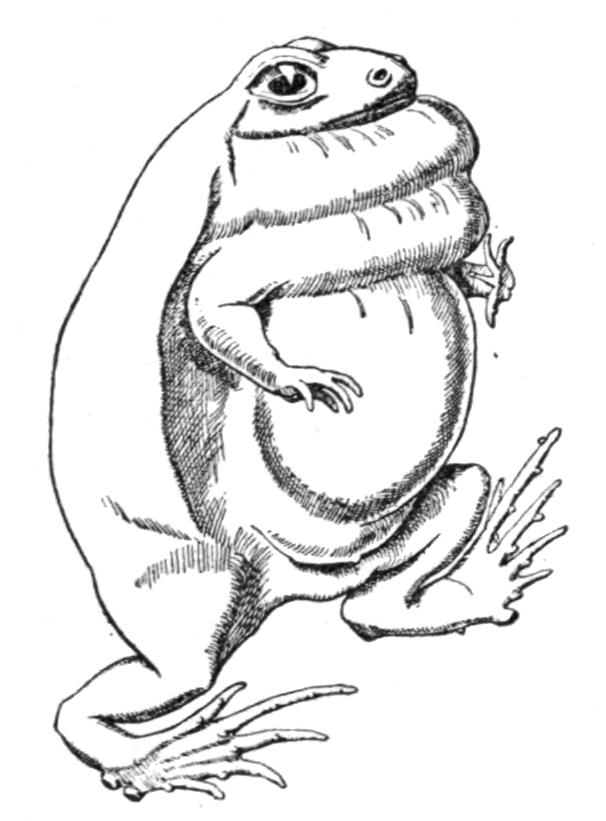
Fig. 45.–Paludicola fuscomaculata, × 1, with vocal sacs partly filled.
P. fuscomaculata, an inhabitant of Southern Brazil, Paraguay, and Uruguay, is a short-limbed frog, with spreading slender toes and a small head. There are shovel-shaped, black, horny tubercles on the metatarsus. The general colour is olive above, with darker markings and confluent white-edged spots; the limbs are cross-barred; the lumbar glands are black, with a white margin in front. The male has a vocal sac. Budgett[95] gives the following account of its habits:–
The peculiar cry, which is so constantly heard in the neighbourhood of shallow pools in the Paraguayan Chaco, and resembles that of a kitten, is produced by the alternate inflation of throat and abdomen. When fully inflated, the frog appears to be the size of a golf-ball, but, if startled, instantaneously shrinks to one-fifth of that size, so that it seems to have vanished. It has also the power of ventriloquising. The food consists largely of water-beetles. In the spawning time it was found at night floating on the surface of pools in the distended condition, and crying to the females in a most mournful way. On coming to the surface it fills its lungs with a few gasps, greatly distending the walls of the abdomen, and then drives the air into the vocal sacs, causing them to become distended as the body collapses, and giving rise to a kitten-like cry.
The eggs are chiefly laid in January, and are found embedded in a frothy mass floating upon the surface of the water. The eggs measure only 1 mm. and are without pigment, and with extremely little yolk. The larvae become free-swimming within from eighteen to twenty-four hours after the first segmentation. When ready for hatching they wriggle their way through the froth to the water below, and hang into it from the floating froth.
P. biligonigera s. notata, in Brazil, lacks the lumbar gland, the place of which is marked by a black spot. The upper parts are olive, with darker marblings and a dark lateral stripe. The male has a black throat and two external vocal sacs. Hensel found the eggs, in Rio Grande do Sul, in September, forming a frothy mass of the size of a fist, floating between grass upon the water near the margin.
The following three genera may serve as Australian examples, especially since we are indebted to Baldwin Spencer for interesting observations made on their habits in Central Australia.[96]
Chiroleptes, of which six species are known, is easily recognised by the first finger, which is opposed to the others. The sacral diapophyses are slightly dilated. The general shape is that of a thick-headed, rather stout land-frog or of a tree-frog. The tympanum is distinct, and the toes are only half webbed, or even less, except in Ch. platycephalus, in which the toes are entirely webbed and the tympanum is indistinct. This species is about 2 inches long, uniformly olive-green above, with a few tubercles on the otherwise smooth skin. Other species rather resemble the European Natterjack in coloration.
Spencer's account is as follows:–"In Central Australia Ch. platycephalus seems to prefer the hard clay pans rather than sandy creeks, as the sand-beds of the latter are too loose for the formation of the burrow. We came across the animal first when encamped by the side of a very shallow clay pan, the floor of which was deeply cracked with the sun's heat. Around the edge were withered shrubs of Chenopodium nitrariaceum, and it was at the base of these that the black fellows looked for the burrow. In the hard-baked clay were imprints made by the frog as it burrowed, and about a foot underground we came across the animal, puffed out into a spherical shape, and just filling up a cavity, the walls of which were moist but not wet. The ground was so hard that it had to be chipped away. When one side of the burrow was opened, the frog remained perfectly still; its lower eyelid was drawn up over the eye and was very opaque, giving rise to the belief amongst the blacks that the animal is blind. In the sunlight, after a short time, it opened its eyes.
"On squeezing the body, water was forced out of the cloaca; this was accumulated principally in the urinary bladder. On cutting the body open it was seen that there was a certain amount of water in the subcutaneous spaces, but that the greater portion, which caused the great swelling-out of the body, was contained in the body-cavity itself; and it was also observed that the lungs were considerably distended and lengthened, their apices lying right in the pelvic region. They contained air and not water, but their outer faces were bathed with the water in the body-cavity." The larvae and tadpoles probably develop with extreme rapidity, soon to aestivate as very small frogs.
Heleioporus has a calcified metasternal plate and slightly dilated sacral vertebrae. The two species have a toad-like appearance, owing to their stout bodies, short limbs and conspicuous parotoid glands. H. albopunctatus is mottled whitish red and brown above; it extends from Western into Central Australia. H. pictus is olive, with darker marblings, and is distinguished by a light vertebral line. It is likewise found in Central Australia, and it extends into Victoria and New South Wales. Spencer found it in swarms after heavy rains, the specimens being much swollen and distended with caterpillars and beetles. They looked as if they were simply gorging themselves with food preparatory to returning again to their long aestivating condition.
Limnodynastes is one of the commonest genera in Australia. The six species have the habits and appearance of stout frogs or smooth toads. L. dorsalis seems to range through the whole of Australia, from east to west, and looks like the European Pelobates. The skin is smooth, but with an elongated white gland extending from beneath the eye to the shoulder, and another glandular complex on the thigh. The upper parts are mottled olive-brown, often with a light vertebral line. The under parts are whitish, with brown spots. The male has a vocal sac. One of the specimens in the National Collection contained a half-grown Heleioporus albopunctatus in its stomach.
Concerning the pairing and the other habits of the Anura of New South Wales we have some valuable notes by J. J. Fletcher.[97] He observes that Australian frogs spawn whenever they are ready, and when the very irregular conditions of moisture will allow it, but that they are not all ready at the same time, i.e. they have no fixed period of the year. Limnodynastes, Hyla aurea, and H. coerulea deposit their spawn in the water, in more or less irregular floating patches, which look white and frothy. The period extends from July to May, and is at its height in August and September; but if there is a spring-drought vigorous spawning may be looked for about the middle of January, when heavy showers are likely to occur. Crinia and several Hyla, e.g. H. ewingi, spawn at any time of the year. The eggs form small submerged bunches, enclosed in a transparent jelly, attached to the blades of grass or twigs of dead branches in the water.
Pseudophryne, a genus closely resembling Crinia, but on account of the absence of teeth in the lower jaw relegated to the Bufonidae, spawns during the Australian summer and autumn. The numerous ova of P. australis and P. bibroni are laid separately, not in the water, but under stones, or in the débris of reed- and grass-tussocks, on the edge of a pool.
The larvae of Pseudophryne and others have often to depend upon the next following rain, sometimes waiting for months to be released from the eggs, wherein they have so far developed. But the tadpoles, once hatched, probably do not bury themselves; they either metamorphose or die.
The males of Mixophyes and Hyla, grasp the females in the axillary region; those of Limnodynastes, Hyperolia, Crinia, and Pseudophryne throw their arms round the inguinal or lumbar region.
For some three months during the winter, commencing about May, the frogs, like lizards and snakes, resort to shelter under logs and stones, beneath which they are then to be met with in a more or less sleepy condition. During the hot and very dry periods many bury themselves in the drying-up mud, which becomes very hard, and does not release them until the next rains. They croak during showery times of the year. There is no evidence that any Australian species live in the high Eucalyptus-trees.
Hylopsis platycephalus, of South America, is of importance as forming a link with the Dendrophryniscinae, owing to the very small size of the teeth in the upper jaw. There are no vomerine teeth. The fingers and toes are webbed, and furnished with discs. The very small omosternum and the metasternum are cartilaginous. The pupil is horizontal. Total length, about or under 1½ inch.
Sub-Fam. 3. Dendrophryniscinae.–The two Neotropical genera of this sub-family are characterised by the entire absence of teeth. The toothless condition of the upper jaw is really the sole character which separates them from the Cystignathinae, taken as a whole. The suppression of the tympanum and of the Eustachian tubes in Batrachophrynus, and the fully webbed toes of B. macrostomus indicate complete adaptation to aquatic life. The absence of the omosternum in Dendrophryniscus, the absence of vomerine teeth, the dilated phalangeal tips, the entire and quite adherent tongue, are all features which likewise occur in some of the Cystignathinae, and therefore cannot be urged against their affinity. Lastly, the recently discovered South American genus Hylopsis is, as pointed out by Werner,[98] an intermediate link, owing to the extremely small, scarcely visible teeth in the upper jaw.
Dendrophryniscus brevipollicatus has been found in the neighbourhood of Rio Janeiro. The head is depressed and triangular. The tongue is entire, but free behind. The tympanum is suppressed. The omosternum is absent; the metasternum forms a long bony style. The sacral diapophyses are cylindrical. The terminal phalanges are simple, but carry dilated tips. The first finger is rudimentary. The skin is nearly smooth, reddish brown above, whitish below; the limbs are cross-barred.
Batrachophrynus inhabits the mountains of Peru. The head is much depressed and small, with the eyes directed upwards, as is usual in essentially aquatic species. The tongue is large, circular, and entirely adherent. The tympanum and the Eustachian tubes are suppressed. The omosternum is cartilaginous, and the metasternum forms a cartilaginous plate. The sacral diapophyses are cylindrical. The terminal phalanges are simple, and carry no discs. The four fingers are short; the toes are webbed. The male has no vocal sac. B. brachydactylus has a smooth skin, olive-brown above with darker spots. B. macrostomus, 2 inches in length, is distinguished by its larger size, and by its completely webbed toes.
Fam. 6. Engystomatidae (Narrow-mouthed Toads).–Firmisternia with dilated sacral diapophyses.
Sub-Fam. 1. Engystomatinae.–Without teeth in the upper jaw.–Although there are only about 60 species known, these have been grouped into more than two dozen genera, many of which are represented by one or two species only. The range of this sub-family is peculiar, namely, Neotropical and Palaeotropical. Scaphiophryne and Rhombophryne are peculiar to Madagascar; Calophrynus occurs in the same island and in the Indian region; Xenobatrachus, Sphenophryne, Liophryne, Mantophryne, Callulops and Xenorhina live in New Guinea. Breviceps, Cacosternum and Hemisus are confined to Africa, while of Phrynomantis two species live in Africa, and the third in the Malay island of Amboina. Such freaks of distribution indicate either that many of these genera are not established upon very valid characters, or that their respective species are instances of convergent evolution, and do not form natural genetic groups.
Many of the members of this sub-family live upon ants and termites, and it is a well-known fact, not restricted to the Anura, that this kind of fare has a peculiar, modifying influence upon the structure of the mouth, teeth, tongue, limbs, and various other organs. In the present case the tongue is not much affected; it is, with few exceptions, more or less oval, not nicked, but free behind; in the Indian Glyphoglossus and in Rhombophryne of Madagascar only is it modified into a rather long and grooved, almost double, apparatus.
A very common feature is the small size of the mouth and the formation of a snout, which projects beyond the upper rim of the mouth and beyond the nostrils. Such a prominent and pointed snout is well developed in Rhinoderma, Phryniscus, Calophrynus, Stereocyclops, Hypopachus and Engystoma. The mouth is very narrow in Cacopus, Glyphoglossus, Breviceps, Rhombophryne, and Hemisus, all creatures which seem to be confirmed eaters of ants and termites. However, it must not be supposed that the mouth of all the genera is narrow, although this character, rather marked in Engystoma, is now embodied in the name of the family. A peculiar development of the palatal region is possibly correlated with this food. The palate is mostly toothless, but its skin is frequently raised into a transverse fold, between or behind the vomers, and into a second fold in front of the oesophagus; these folds are sometimes rather hard and serrated or denticulated. The palatine bones carry true teeth in Rhombophryne, and sometimes in Callula; in Xenobatrachus the teeth are reduced to two large pairs. The tympanum is usually hidden.
The shape of the body is generally very stout. The limbs are short, notably so in Glyphoglossus, Breviceps, Rhombophryne, Hemisus, Stereocyclops and Cacopus. Others, for instance most species of Microhyla, Phryniscus, Callula, and Sphenophryne, are of a very slender build; and their limbs, instead of being short and well adapted to digging, are long and may even be provided with typical adhesive discs, supported by T-shaped phalanges, especially in the two genera last named, and in Scaphiophryne and Phrynomantis. However, none of the forms provided with discs are known to be arboreal.
Exceptional diversity is shown in the shoulder-girdle and sternum. The omosternum occurs only in Rhinoderma and Hemisus. The metasternum is a cartilaginous plate, very large in Cacopus, distinctly small in Breviceps, and almost absent in Hemisus. The precoracoids and clavicles show all stages from a well-developed condition (Breviceps, Rhombophryne, Hemisus, Rhinoderma, Phryniscus and Brachycephalus) to complete absence. The circumstance that these bars are very weak in Melanobatrachus, Calophrynus, Scaphiophryne and Hypopachus, i.e. in Palæo- and Neo-tropical genera, indicates a widespread tendency towards complete suppression, a feature independently aimed at both in America (Engystoma) and in the Old World.
Until we know something about the habits of the members of this much diversified sub-family, it is idle to connect the various modifications with each other, and thus, by correlation, to find out their meaning. Those forms which possess well-developed discs on their fingers and toes are said not to be arboreal. What is the true meaning of the prominent snout which is not restricted to the digging forms? Most of the good diggers have well-developed precoracoid bars, and the coracoids are distinctly strengthened, but in Glyphoglossus and in Cacopus the precoracoids are entirely absent, and this loss is compensated for by exceptionally strong coracoids.
On the whole, those genera are to be considered as the most primitive which have undergone the fewest losses. Those with a complete shoulder-girdle, with an omo- and meta-sternum and with simple phalanges, are necessarily the older forms. One step farther back in another direction, the possession of teeth on the palate, and on the upper jaw, leads to those genera which have been separated off as Dyscophinae, while teeth in the lower jaw constitute the Genyophryninae. Lastly, the firmisternal type has necessarily been evolved from the arciferous condition, and there the two Bufonid genera Myobatrachus and Rhinophrynus, the former Australian, the latter Mexican, with their narrow and scarcely overlapping epicoracoid cartilages, seem to form a connecting link, although their ant-eating habits, with concomitant modifications in structure, may be nothing but cases of convergent evolution.