Part 2 — CHAPTER IX (continued 2)
Reading edition
Cistudo.–The plastron, without forming a bridge, is connected with the carapace by ligaments, and is divided into two movable lobes, the transverse hinge being so perfect that the box can be completely closed after head, legs, and tail have been withdrawn. The nuchal shield is very small; the first four neurals are large and broad, the fifth much broader than long. There are twelve pairs of marginal shields. The carapace is high and arched. The digits are almost completely free. The tail is very short. The skull is without a bony temporal arch, the quadrato-jugal and the jugal being absent. Only two species, in North America.
C. carolina of the Eastern United States is a very interesting species. Closely allied by its internal structure to the water-tortoises, it has become absolutely terrestrial; and the shape of the head, the convex shell which is coloured black and yellow or orange-brown, and the short webless fingers are all terrestrial features. But the rather long toes, provided with long and sharp claws, the broad and flat feet, enlarged by a broad fold of skin on the outer margin, the long oval eggs, the smooth covering of the head, and the preponderant animal diet, still proclaim the aquatic relationship of this tortoise. It is in fact a genus which has changed habits and features from aquatic to terrestrial life. The head is covered with a smooth skin, and the upper beak, especially in old specimens, is strongly and broadly hooked. The eyes of the males are red, those of the females are brown. The plastron of the males is concave, that of the females is flat. Large females reach a length of nearly six inches. The young are nearly round, with high, arched back and prominent keels. The keels of the middle line remain a long time, but they gradually flatten down with age, being prominent only at their posterior ends. Each dorsal shield is originally nicely sculptured, with a well-marked areola and concentric rings. Very old individuals become much flatter on the top of the shell, but the sides remain steep, so that the whole shell roughly resembles a somewhat oblong box with the corners rounded off, and the whole upper surface rubbed down quite smooth. The variations of colour are almost endless, and they occur in the same localities. I have a number of all ages from Long Island, near New York. The half-grown are beautifully reddish or orange-brown with dark patches, median keels prominent, plastron uniform black-brown. In others the dark-brown prevails over the lighter markings, which are yellower and more spotted or dotted than patched. Some of the oldest, with quite smooth shells, are black, with small, round, light yellow spots. Others are vermiculated or striped with yellow and black. The soft parts vary to the same extent, some showing on the neck a beautiful intricate pattern of yellow, reddish and brown, while in others these colours are arranged more or less in longitudinal stripes.
These "Box-tortoises" are often caught in the States and kept as pets in the gardens, and their owners mark them by cutting their initials into the plastron. These marks heal up and widen in time like letters cut into the bark of a tree. One of my specimens, certainly a very old one to judge from his hooked beak, perfectly smooth and flat shell, and from the condition of the marginals, which have the edges rubbed down quite smooth and rounded off, has two initials and the date 1837 on its plastron. Of course there is no proof that the date had been cut in that year, more than sixty-three years ago, but it was done a long time ago. The scars on those parts of the shell which touch the ground are almost effaced, and the letters and figures have become somewhat distorted owing to the usual unequal, not concentrical, peripheral growth. Moreover, this tortoise must have been already adult, although not quite fully grown, since the marks are large and were evidently put in such a size and position as to fit the available space. I may mention that this record tortoise was, when I got it, not kept in confinement, but had been picked up at large.
These Box-tortoises become very tame. Although fond of drinking quantities of water in long and slowly repeated draughts, they do not go into the water, and if they fall in accidentally they are liable to get drowned. They enjoy a mixed diet, but animal food predominates, consisting chiefly of snails, the shells of which are passed, slugs, earthworms, maggots, and soft caterpillars. Their fondness for slugs is all the more remarkable since scarcely any other Vertebrate eats these slimy, sticky molluscs; but a Box-tortoise will make a meal of two or more fat specimens of the black slug Arion, and it will eat dozens of small slugs. It first deliberately smells the prey, turns the head sidewards and gives a bite, whereupon first the intestines and then the rest are eaten. The slime is later on scraped off with the fore-limbs, or the head is rubbed against the grass. The favourite time of feeding is towards dusk or in the early dewy morning, and they are especially lively during a soft, warm rain. They also relish various kinds of fungi and fruit, for instance half-rotten bananas. Close observation of their habits gives us indications as to how the change from carnivorous to herbivorous habits may have taken place. Accidentally many a blade of grass is bitten off and swallowed together with the molluscs, also bits of rotten wood and moss, and their excrements are often full of such more or less digested matter. They are not very fond of basking, although they love warmth, creeping into the grass, where they make a shallow form by moving the shell backwards and forwards. During the cooler nights they frequently retire into a hole or under a log of wood. They require to hibernate. If kept in a warm house they become restless in the autumn, refuse food, drink and feed again after some weeks, but are liable to die during the winter. If they can find a cool place they bury themselves and sleep for several months. If left out of doors they dig into the ground, creep into a hole, at the bottom of which they half bury themselves, or they hide under a heap of garden-rubbish well out of the reach of frost. Warm April days bring them out, and the first requirement is a drink.
When walking about in search of food they assume a curious attitude, with the shell well above the ground, the long neck stretched out and raised high. Their temper varies individually. Some become tame readily and lose all shyness, and creep up to their friend to take food from his fingers. Others are decidedly shy and sulky, withdrawing with a hiss into the shell, which in some specimens shuts almost hermetically all round, and they do not come out until all imaginary danger is past. One of my males sulked thus for several months, at least we never saw anything of it except the closed shell, but it did not starve itself. Propagation takes place in the summer, the long oval hard-shelled eggs being laid in June and July.
The typical Land-tortoises are easily recognised by their feet. The digits are short, have not more than two joints, and are without any trace of webs; the metacarpals are scarcely longer than broad. The hind-feet are club-footed. The skin on the anterior side of the fore-limbs is covered with strong horny scales, frequently with dermal ossifications. The plastron is united suturally by a broad bridge with the usually strongly arched carapace. The skull has complete postorbital and temporal arches. The top of the head is covered with shields. The tail is short. There are only a few recent genera, modifications of the central and typical genus Testudo. The latter is cosmopolitan in the warmer temperate and tropical regions, except in the Australian and Austro-Malayan countries.
Cinyxis (Fig. 82) with a few species in Tropical Africa from the Gambia and from Abyssinia to the Equator is remarkable for the unique modification of its carapace, the posterior portion of which is movable, the hinge passing between the seventh and eighth marginal and the fourth and fifth costal plates, externally behind the seventh marginal and the second costal shields. In the middle of the back the hinge is imperfect, the parts being merely flexible enough to permit the posterior half of the box to be closed. The head is covered with shields.
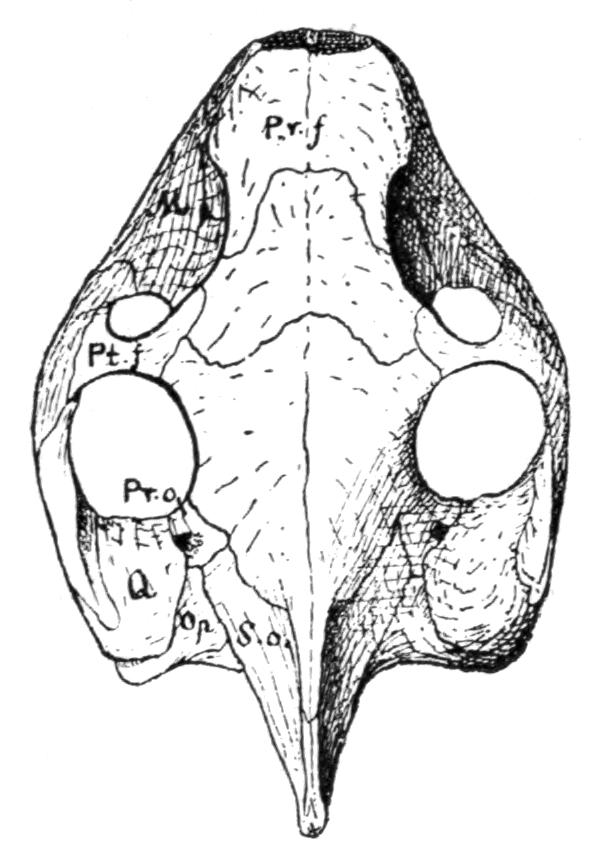
Fig. 81.–Skull of Testudo nigrita s. elephantopus, from the Galapagos Islands. × ½. M, maxillary; Op, Opisthotic; Pr.f, prefrontal; Pr.o, prootic; Pt.f, postfrontal; Q, quadrate; S.o, supra-occipital.
C. belliana, of Northern Tropical Africa, has a small nuchal shield, and the margin of the carapace is smooth. Length of shell up to seven or eight inches. C. homeana, of West Africa, has likewise a small nuchal shield, but the posterior portion of the carapace descends vertically, and the marginals are strongly reverted and serrated. C. erosa (Fig. 82), also from West Africa, has no nuchal shield; the marginals are reverted and serrated, but the posterior part of the carapace is sloping, and the anterior portion of the plastron is strongly forked in front, and projects beyond the anterior border of the carapace. This peculiar creature reaches a length of nine inches. When withdrawn within the shell, which is closed behind and depressed in front, with the jagged edges of the plastron and the anterior marginals protecting the drawn-in head, it has a very quaint appearance. It lives entirely on fruit and other vegetable matter, and is said to prefer to lie in the water, while C. belliana is supposed to be entirely terrestrial.
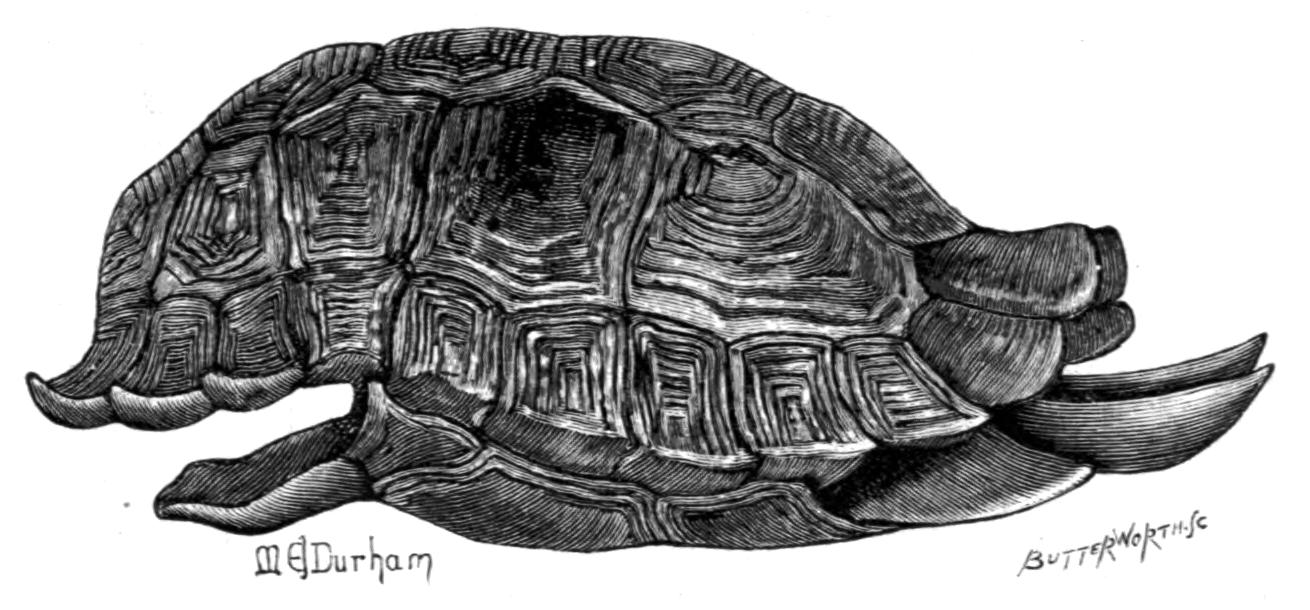
Fig. 82.–Cinyxis erosa. × ½.
Pyxis arachnoides, of Madagascar, a small land-tortoise, only four inches in length, has an immovable carapace, but the front lobe of the plastron is hinged.
Testudo.–The plastron is immovable, except that in old individuals of some species, e.g. T. ibera, the hinder lobe develops a transverse flexible hinge. They have existed since the Oligocene of North America and Europe; and are now represented by nearly forty species in all the tropical and warmer temperate countries excepting the Austro-Malayan and Australian region. Typically terrestrial, herbivorous and frugivorous, although occasionally varying their diet with worms, molluscs, and insects. The eggs are hard-shelled, mostly less oval than those of the aquatic and semi-aquatic tortoises. The males generally remain smaller than the females, have a slightly longer tail, and have a concave instead of a flat plastron. Most land-tortoises hibernate in the ground during the cool and cold seasons, or they aestivate during the hot and dry months of tropical countries, but this is not an invariable rule.
T. graeca, the common "Greek Tortoise." The shell is very convex, without keels, and has a smooth, not serrated margin. The nuchal shield is narrow. The fifth or last neural shield is much broader than the others. The supracaudal is usually divided in the median line, so that this is really the last pair of marginals. The plastron is notched behind; the axillary and inguinal shields are small. The scales on the anterior surface of the fore-limbs are small, and form from half-a-dozen to ten longitudinal rows. The hinder surface of the thigh is quite smooth. The tip of the tail ends in a conical, horny spur. The coloration of the shell varies somewhat, but the ground-colour is yellow, each shield with a dark brown centre and irregular patches or confluent spots towards the margin. The plastron has an irregular, broad black border. The soft parts are grey-yellowish. Some specimens are rather pale, almost lemon yellow with little black; others incline towards orange with more or less black. The middle fields of the shields of young specimens are granular, although this area is rubbed smooth with age; but the rest shows clearly marked concentric lines of growth. The eyes are dark, with a brown or bluish tinge, sometimes inclining to dark grey in very old specimens.
Full-grown females have a shell six inches in length. This species inhabits the northern half of the Balkan Peninsula, parts of Asia Minor and Syria, Italy, and most of the islands of the Mediterranean, from the Grecian Archipelago to the Balearic Islands.
T. ibera is closely allied to T. graeca, from which it differs chiefly in the following points. The last pair of marginal shields are fused into an unpaired supracaudal, the median line of division being almost obliterated. The fifth neural shield is not broader, and generally a little narrower than the others. The posterior lobe of the plastron develops with age a transverse ligamentous hinge, and is thus rendered slightly movable, especially in the females. The posterior margin of the carapace is slightly expanded in old specimens. The scales of the fore-limb are large and imbricating, and form only four or five longitudinal rows. On the middle of the exposed posterior surface of the thighs the skin carries a strong, conical, horny tubercle. The coloration is much like that of T. graeca, except that the yellow of the young inclines to pale olive. Some specimens are uniform brownish. This species reaches a much larger size than T. graeca, old females often measuring eight inches, rarely more than nine inches in length. Its home is Morocco and Asia Minor, extending into Persia. It also occurs in certain parts of Southern Andalucia, where it breeds regularly, for instance, in the sandy pine-forests of the Marismas, near the mouth of the Guadalquivir. Whether it has been introduced from Morocco, or is indigenous, is an open question. Its specific name refers to its Iberian home.
T. marginata is worth mentioning, since it is the Greek tortoise, although not that of the European markets, which are supplied by the other two species. T. marginata is restricted to Greece proper, where it is the only land-tortoise. It is less closely allied to T. graeca than to T. ibera, of which it may be called an exaggerated form. The posterior margin of the carapace is much expanded or flanged, and serrated. The supracaudal is undivided, the posterior lobe of the plastron is movable, but the large conical spur on the thighs is absent. The dorsal shields of adult specimens are black with a small yellowish patch; the ventral shields are yellowish, each with a large black triangular patch. The British Museum possesses a shell 28 cm. = 11 inches in length.
The habits of these Moorish and Greek tortoises are very much alike, and since they enjoy the distinction of frequently being kept as pets in gardens, where they are allowed to look after themselves, a great many incidental and odd observations have been made on them. They are essentially vegetable feeders, but their taste varies individually and with the season, also according to the vegetation of the country they happen to come from. Most of them enjoy juicy plants, for instance, lettuce and cabbage; the flowers of the dandelion attract them not merely by their bright colour; clover is also a favourite food, and an enclosure of grass-land with clover in it is soon cleared of the latter; grass is also taken, in default of anything better. Some of my specimens gradually bite large holes into gourds and pumpkins; and in Morocco I found them in the autumn feeding entirely on the terribly astringent green fruits of the dwarf palm Chamaerops humilis. The larger specimens bolted the fruit with the stones, passing the latter. In close captivity they often learn to take and to like bread soaked in milk or water. They drink slowly and at length, but scarcely ever when they have succulent food. There is one thing which they do not eat, namely, "black beetles," although they are warranted to do so by the men who hawk them in the streets. Worms, slugs, etc. are often mentioned as part of their occasional diet, but I am not aware that any of the hundreds which I have watched have taken such creatures, in spite of every opportunity. Their habits are very regular. They learn to know the geography of their domain thoroughly, and the spot selected for sleeping will be resorted to over and over again, be it underneath some broad leaves, under a bushy fir-tree, between a cluster of wallflowers, or between some tussocks, or even in an almost bare corner, the attractions of which are not at all obvious. Although their mental capacities cannot possibly be called brilliant, they soon learn to distinguish between different persons, and they will come up to be fed; but their memory for localities is surprising. Here is only one instance. A tortoise which had been put into an outhouse for hibernation was six months later taken to its usual large enclosure, and in the afternoon it tucked itself away on the top of a mound under precisely the same low bush where it used to sleep during the previous autumn. It could not see that spot from where it had been put down, and it did not meander about during the day, but after having enjoyed the warm sun it made straight for its favourite place. Dr. Girtanner of St. Gallen in Switzerland testifies to their appreciation of music. When the town-band began to play on the square adjoining his garden, all his tortoises crept as fast as possible towards the fence and remained there motionless with heads and necks erect. When the piece was finished they moved about, but when the next number began they were again spellbound. This he has observed, not on one but on many occasions. That they can hear, although their ears are not visible, but covered by the ordinary skin, is obvious enough from the fact that during the pairing season they emit feeble piping sounds.
They are extremely fond of basking in the hot sun, sometimes allowing themselves to be almost baked in it, but then again at other times they seem to be anxious to seek the shade. They rise late and go to bed early, being absolutely diurnal. In the summer they leave their quarters when the sun is well up, making for a sunny spot to graze. Then they lie still and bask, unless a shower causes them to retreat under shelter. After some hours' rest they feed again, and in the afternoon, long before sunset, they go to bed. Some winters in England are of course much more severe than any which these tortoises experience in their native countries. Still they manage to survive them, provided they find a place which they can burrow into, deep enough to be out of the reach of frost; and if there is a heap of mould, rotting weeds, and leaves, they are probably safe. Sometimes they are restless, coming out again in unusually mild winters without, however, taking food. If they appear too early in the spring, they run the risk of terrible colds on prolonged wet and cold days, but in the autumn they are hardier, and can stand several degrees of dry frost.
The pairing season begins in May, but lasts far into the summer. In Morocco I found them pairing as late as the month of September. The preliminaries extend over many days. The male becomes unusually active, makes a piping sound, runs after the female, draws in its head, and knocks with its shell against that of the female. This is repeated many times, until the female is excited enough to raise itself upon its hind-limbs. The eggs, only two to four in number, are laid several weeks later, and are buried in the ground. They are roundish-oval, hard-shelled, and vary according to the size of the female. Those of T. graeca measure on the average 30 by 24 mm.; those of a large specimen of T. ibera 32 to 36 by 30 mm. The newly-hatched little creatures are still quite flexible, and apparently soon bury themselves before beginning their active life in the ensuing spring.
The age which these tortoises can reach is quite unknown, but there are reliable data of individuals having been kept for many years. Rumpf[133] kept two T. graeca in his garden at Frankfort-on-the-Main, and let them hibernate in a box with hay in the cellar. One lived 33, the other 23 years. The most famous specimen of T. ibera is "Gilbert White's Tortoise,"[134] which had been kept for more than 40 years before it came into his possession. It used to bury itself in November and to come out in April. It died in 1794, having reached an age of fifty-four plus an unknown number of years, since there is no record of its size when it came to England. The same applies to every other specimen which has been, and is being, observed as a pet. My largest Morocco female, which has a shell 7 inches long, shows at least 25 concentric rings of growth on the shields; the last half-dozen rings are very narrow, while some of those of the central area have been rubbed down. This creature is not improbably 30 years old. A small female, which is only 5¼ inches long, has already 14 rings on its still perfect shields. Lastly, a little one, only 4 inches long, shows 7 rings. They grow fastest when they are about 6 to 7 inches long, and they then seem to be at their prime. White's tortoise, now enshrined in the National Collection, was unusually large, the shell measuring 25 cm., or nearly 10 inches; around the much-enlarged, rubbed-down areola of each shield are about 30 very narrow rings.
T. horsfieldi is easily recognised by its possessing only four claws on the fore- and hind-limbs. It is closely allied to the species last mentioned, which it seems to represent in the sandy districts of Transcaspia and the Kirghiz Steppes to Afghanistan.
T. elegans, the "Starred Tortoise" of the southern half of India and Ceylon, is easily recognised by the very convex carapace without a nuchal shield, and by the beautiful markings of the other shields, each of which has a yellow areola, whence radiate yellow streaks upon a black ground. Moreover, the dorsal shields often form humps. It reaches the length of one foot. Old specimens lose the beautiful yellow radiation, owing to a considerable amount of peeling off of the horny layers.
The habits have been carefully watched by Captain Thomas Hutton,[135] who gives the following account. The tortoises live in the grassy jungle at the base of the hills, but owing to their colour being so blended with the rocky nature of the ground, they are with difficulty distinguished. Moreover, they remain concealed beneath shrubs or grass during the heat of the day. In the rainy season they are most active, wandering about all day, feeding and pairing. At the approach of the cold weather they select a sheltered spot and conceal themselves by thrusting their shell into some thick tuft of grass, remaining there in a sort of lethargic, but not torpid, inactivity until the hot season, at which time they remain concealed only during the heat of the day, coming out about sunset to feed.
During the hot season Hutton's captives often soaked themselves in water, and they drank a great deal. Copulation lasted about ten minutes; the females received the males from the end of June to the middle of October. On the 11th of November a female dug a pit at the root of a tuft of grass, having previously watered the spot, then digging with the hind-limbs alternately, and continuing to water the soil. In two hours she had made a hole six inches deep and four wide; she then laid four pure white eggs, each about 1¾ inches or 45 mm. long, and filled the hole again with the prepared mud, pressing it well in with the feet and with the weight of the body. The whole operation took four hours. From December to the beginning of February these tortoises were listless, they then took water and some lucerne, but did not come out again until the middle of April, well in the hot season. Both males and females wrestled in a curious way. One confronted the other, with the head and fore-limbs drawn into the shell, and with the hind-limbs planted firmly on the ground, and in this manner shoving against each other in any narrow space. Sometimes, if one succeeded in placing its shell beneath the other, he tilted his adversary over on his back, from which position he had great difficulty in recovering himself.
T. polyphemus, the "Gopher Tortoise" of the south-eastern States of North America, is one of the few American species. It is characterised by the shape of the front lobe of the plastron, which is bent upwards, and extends beyond the carapace. The nuchal shield is present, not narrow; the supracaudal is undivided. The shell is much depressed, and flattened along the vertebral region, with rounded margins. The fore-limbs are armed with very strong claws. The general colour is very dark brown above, inclining to black; brownish yellow below, with blackish patches. The length of the shell is about one foot, or even eighteen inches.
The Gopher is interesting for its habits, which are described by Agassiz, Schnee, and others. Its domicile consists of an excavation, the mouth of which is just sufficient to admit the animal, the burrow running in an oblique direction to the depth of about four feet. The whole passage is sometimes more than two yards long. It expands from the entrance, and ends in a roomy space, sometimes with a few branches of fir trees which have been dragged in either for food or as a lining. The burrow is inhabited by one pair only. When the dew is on the grass, or after rain, they emerge in search of food, which consists of grass, succulent vegetables, fruit, etc. They also eat the gum that exudes from trees, especially the resin of the pine. The eggs are laid in June, not in their domicile, but in a separate cavity near the entrance; a set consists of five eggs, almost round, and very large, namely, 40 mm., or more than one inch and a half in diameter. To capture the Gopher a deep hole is dug at the mouth of their home, into which they fall as they emerge for food. In Southern Texas and neighbouring parts of Mexico they are represented by a smaller and lighter coloured species.
T. tabulata, widely spread over Tropical South America, whence it is often brought over as a curiosity, reaches a large size, specimens nearly two feet in length being not uncommon. The shell is flat on the top, and is very elongated, without a nuchal, but with an undivided supracaudal shield. The carapace is very dark brown or black, each shield with a yellow or orange centre; the plastron is brown and yellow, the dark colour being mostly confined to the middle portion. The ground-colour of the skin of the limbs is blackish, but the scales are orange or red. The head is yellow and black. This species inhabits the forests, and lives chiefly on the fruits of trees; in captivity they are said to take bread soaked in milk or water, lemons, apples, bananas, cabbage, gourds, and also meat, at least the males.
Gigantic Land-tortoises differ from the others in no essential points except their large size. The term gigantic is, however, applied to many of them by courtesy only, since they do not exceed the dimensions of large Turtles. A truly gigantic species, T. atlas, has left its remains in the Sivalik Hills of late Miocene or early Pliocene date. The skull is between seven and eight inches long, and is well preserved, but the correctness of the dimensions of the specimen, as it now stands, restored in the National Collection, is open to doubt. The shell was probably not more than six feet long. Miocene and Pliocene Europe was also inhabited by large tortoises, with shells about four feet long, e.g. T. perpigniana, whose bony plates are one inch thick; others have been found in North America. Such large tortoises are now restricted to two widely separated regions of the world, namely the Galapagos Islands (which have received their name from these creatures, galápago being one of the Spanish terms for tortoise), and the islands in the Western Indian Ocean, namely the Mascarenes (Bourbon, Mauritius, and Rodriguez), the Comoros, Aldabra, the Amirantes, and the Seychelles. When they became extinct in Madagascar is not known, but T. grandidieri was a very large species of apparently very recent date. Of the other islands the Comoros only were inhabited by man, the others were devoid of any but small and harmless Mammals. It was on these peaceful islands that large tortoises lived in incredible numbers, and, like the Dodo of Mauritius and the Solitaire of Rodriguez, grew to a size far beyond that of their less favourably placed continental relations. The same applies to the tortoises of the Galapagos Islands. Plenty of food, a congenial equable climate, and absence of enemies enabled them to enjoy existence to the fullest extent. There was nothing for them to do but to thrive, to feed, to propagate, to grow, and to vary. At least there was nothing to check variation within reasonable limits. Scattered over the many islands, they were prevented from inter-breeding, and thus it has come to pass that not only every group of islands, but in the case of the Galapagos almost every island, has or had its own particular kind, be these called varieties, races, forms, or species.
There are four features of special interest. First, these tortoises grow to a large size, and there are no small species on any of these islands. Secondly, they vary much individually. Thirdly, each island or group of islands has developed its own kind. Lastly, there is the widely spread tendency to reduce the thickness of the bony plates of the carapace, in spite of its size. In some cases, notably T. vosmaeri of Rodriguez, the bony shell is reduced to apparently the utmost limit compatible with mechanical safety. The horny shields are, or were, however, well developed, sometimes much more so than in other recent land-tortoises. Whatever were the original reasons for the development of a strong shell in tortoises, they cannot have prevailed in these islands.
Where did all these tortoises come from, and how did they get to these oceanic islands? Accidental transport or migration are out of the question. Land-tortoises are drowned within a few hours. Moreover, there are none of their kind on the continents of Africa, Asia, and South America, although they had a much wider distribution in past geological ages. Consequently we have to assume that they are descendants of tortoises once populating the land which, except the islands, lies now below the western Indian ocean. The existence of this, "Lemuria" or "Gondwana," came to an end in Mid-Tertiary times. The large tortoises on the remaining continents died out–in any case they are gone, while those which lived on, or retreated to, what became the present islands, survived and flourished.
The tortoises were not left in peace with the advent of man, who found that they were good to eat. They were first exterminated on the Mascarene Islands. In 1759 four small vessels were specially appointed for the service of bringing tortoises from Rodriguez to Mauritius; one vessel carried a cargo of 6000; and altogether more than 30,000 were imported into Mauritius within the space of eighteen months. Dr. Günther very properly remarks that many of these tortoises must have been small-sized specimens, and that many of them were probably used for provisioning passing Government vessels. Anyhow an inter-insular traffic was carried on, and there are records of superfluous tortoises having been turned loose, at the end of the voyage, in distant islands, even in Java. Importation and exchange of choice specimens, by way of presents, seems also to have taken place. All this makes it now actually impossible to trace the original habitat of the few surviving specimens with anything like certainty. At the beginning of this century the large tortoises had been nearly cleared off most of the islands, and at the present time only the south island of Aldabra enjoys the reputation of still possessing some really indigenous tortoises. The few survivors on the other islands are said to have been introduced. The small stock at Aldabra is now under Government protection. Representatives of various species will linger on for a little time to come, when they are kept as pets on some tropical islands, but those which have been brought to Europe are of course doomed.
We can mention only a few of the large tortoises which have become famous, not to say historical. A fascinating résumé of the whole complicated question has been given by Dr. Günther.[136]
Testudo gigantea s. elephantina s. hololissa s. ponderosa, originally confined to the North Island of Aldabra, where this kind has been completely exterminated, is now still to be found in the Seychelles in considerable numbers, introduced there by planters, and kept in a state of semi-domestication. A very large specimen was received by the Hon. Walter Rothschild, at Tring, in 1893. In 1897 its shell measured 40¼ inches in length, 52¼ over the curve, and 50 inches across the curve transversely; it weighed 358 lbs. The measurements taken in previous years are unfortunately not free from mistakes. "Whenever the temperature was over 60° F. this tortoise had a free run of 350 acres of grass park, and when the temperature showed permanently below 58°, it was kept in an orchid house from September to June. When at liberty in the park it lived entirely on grass, but in the hothouse it fed on carrots, cabbage, lettuce, and several other vegetables"; it was also very fond of rotten fruit. To this species belongs the large tortoise which has been living at St. Helena for more than the last hundred years.
T. daudini is the species of the South Island of Aldabra. Voeltzkow, in 1895, succeeded in carrying off seven specimens. He gives the following description:–The island is an atoll, cut through in three places, with a greatest length of about twenty miles. The chief hindrance in the search for the tortoises is the impenetrability of the island. The soil consists entirely of sharp water-worn corals, with their points uppermost, while the whole is covered with such thick masses of low scrub, that a way has to be cut with an axe, so that an extended search over a large area is out of the question. To land on the outside is dangerous, on account of the heavy surf; while landing from the inside of the atoll is much hindered by the dense thickets of mangrove trees. As drinking water, and that very bad, is only found in one place, rainwater has to be collected from the natural hollows, and carried along in tanks. Thousands of mosquitoes prevent one remaining over night in those places which the tortoises frequent. Then at last, when one has discovered, by a stroke of luck, one of these creatures, in the thick scrub, where they hide during the heat of the day, the real hard work begins, namely, the conveyance of the beast. Six reached Europe alive, two of them were sent to Frankfort, and the four others to Hamburg. Mr. Rothschild received a male of T. daudini, which, until its recent death, was the largest living tortoise known. The length of its shell was 55 inches, or 67½ inches over the curve; total weight 560 lbs. This specimen had a chequered career. Although its original home must have been the Aldabra atoll, it had been known for many years on Egmont Island, one of the Chagos Islands. According to tradition, it had been there some 150 years, but the first settlement on that island was formed from Mauritius only at the beginning of this century. The owner of the tortoise, M. Antelme, took it to Mauritius, whence it came to England. On the Egmont Island it used to bury itself for six months in the ground without eating anything.
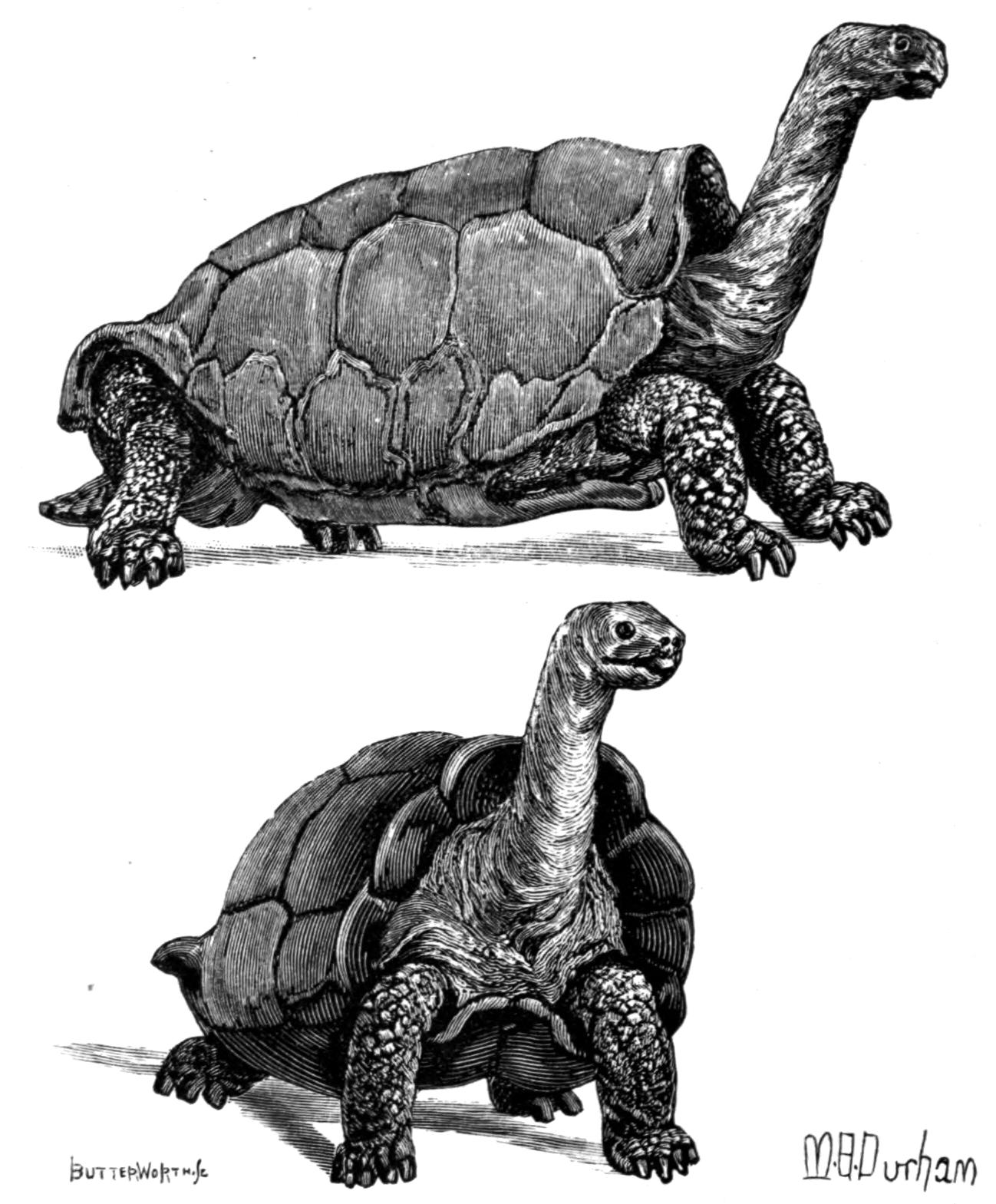
Fig. 83.–Testudo daudini (above) and T. abingdoni (below). × 1⁄20.
T. sumeirei.–This kind is supposed to have been the species peculiar to the Seychelles. In 1766 five large tortoises were brought from the Seychelles to Mauritius by Chevalier Marion de Tresne. Of these only three were alive in 1898, two in Mauritius and one in London; the latter specimen soon died in the Zoological Gardens. One of the two survivors, the last of their race, is famous. It was kept at Port Louis, and when Mauritius became a British possession in 1810, the tortoise was especially mentioned and taken over. It still lives there in the grounds of the barracks of the garrison. According to the proverbial oldest inhabitants it had in 1810 already reached its present size, namely, a shell-length of about 40 inches with a greatest circumference of 259 cm. = 8 feet 6 inches. Total weight 160 kilo = about 358 lbs. When walking it stands 63.5 cm. = 25.4 inches high, with the plastron about 15 cm. or 6 inches above the ground, and it can then carry with ease two full-grown men on its back. This old male is now nearly blind, but is otherwise of regular habits and in good health. Although it has been known for nearly 150 years it had to wait for its scientific name until the year 1892.
Another famous individual is the Colombo tortoise. It is supposed to have come to Colombo from the Seychelles in 1798. It died in 1897. To judge from photographs, this specimen, a male, may possibly belong to T. sumeirei, in spite of the very flat shell, which is 53½ inches in length.
Leaving aside the remains of sub-fossil tortoises, e.g. the thin-shelled T. vosmaeri of Rodriguez, and several kinds which have been dug out in the Mare-aux-songes of Mauritius, one of which had a markedly forked and prolonged anterior plastral lobe, rather resembling that of the Pliocene Sivalik T. atlas, we now turn to the tortoises of the Galapagos Islands. They existed in enormous numbers towards the end of the seventeenth century, when Dampier visited those islands. Hundreds were exported and scattered early in the nineteenth century. When the islands became a penal settlement of Ecuador, the introduction of convicts and pigs proved detrimental to them, but Darwin found them still present in 1835 on most of the islands. His classical account of these old giants is to be found in the Voyage of the Beagle. They lived on the succulent cactus plants, leaves of trees, berries, and a kind of Usnea, a lichen pendant from the trees. They collected regularly at certain pools and springs, leading to which were regular well-trodden paths, formed by the coming and going of the tortoises. He calculated that they could walk a distance of about four miles in one day. During the time of propagation the males emit a hoarse bark, which can be heard a hundred yards off. The round eggs measure about 5 cm. or 2 inches in diameter, and are laid in the month of October, about one dozen making a set.
Nearly every island had apparently its own kind. They are all remarkable for their small head and the length of their neck, which is decidedly longer and more slender than that of the Eastern tortoises. The most peculiar looking are or were T. ephippium and T. abingdoni, the shell of which is extremely thin, with large lacunae in the osseous plates. The profile of the shell is somewhat saddle-shaped, with the horny shields partly concave and turned upwards at the sides. The general colour of these and the other Galapagos tortoises is black. T. ephippium still survives on Duncan Island. Of T. elephantopus s. vicina Baur collected twenty-one specimens in 1893 on Albemarle Island. Some of them are still comparatively young, only 16 inches long. A large one was killed, and, being hard up for water, Baur and his companions drank the five cups full of fluid contained in the pericardial sac; they found it most refreshing, and tasting somewhat like the white of an egg. One monster is said to have measured 56 inches over the curve, with a skull 7.12 inches in length. Mr. Rothschild received one of this kind alive–a much-travelled specimen. It came to England from Sydney, whether it had been brought in 1880 from Rotuma Island, north of the Fiji group. There it had probably been left with others by Captain Porter, who, on his voyage from the Galapagos in 1813, distributed several young tortoises from his stock among the chiefs, and permitted a great many to escape into the bushes and among the grass. The shell of this specimen measured 49½ inches in length, 56 over the curve.
Fam. 6. Chelonidae (Turtles).–The limbs are paddle-shaped, and the shell is covered with horny shields. Only two recent genera, with three species, widely distributed in the seas.
The neck is short and incompletely retractile. The temporal region of the skull is completely roofed over above and laterally by the parietals, postfrontals, squamosals, quadrato-jugals and jugals. All these bones are much expanded, and form the additional or false roof. The parietals are especially large, and are in broad contact with the squamosals. Nasals are absent. The nares are bordered by the small premaxillaries, the maxillaries, and the prefrontals. The choanae are enclosed by the palatines, which are separated by the vomer, and are posteriorly in broad contact with the pterygoids. The latter are connected with descending processes of the parietals by epipterygoids. The foramen magnum is bounded not only by the supra-occipital and the lateral occipitals, but also by the basi-occipital. For the skeleton see Fig. 65, p. 320. The pubic and ischiadic symphyses are connected by a narrow cartilaginous band. The pubis has a large, broad, lateral process, but the ischium is devoid of such a process. The paddles of the fore- and hind-limbs are produced by an elongation of the metacarpal and metatarsal bones and of most of the phalanges, and these have no condyles; most of the carpal and tarsal elements are flattened, and additional width is given to the hands by the much enlarged pisiform bone. The number of phalanges of the five fingers is 2, 3, 3, 2, 2; that of the five toes, 2, 3, 3, 3, 2.
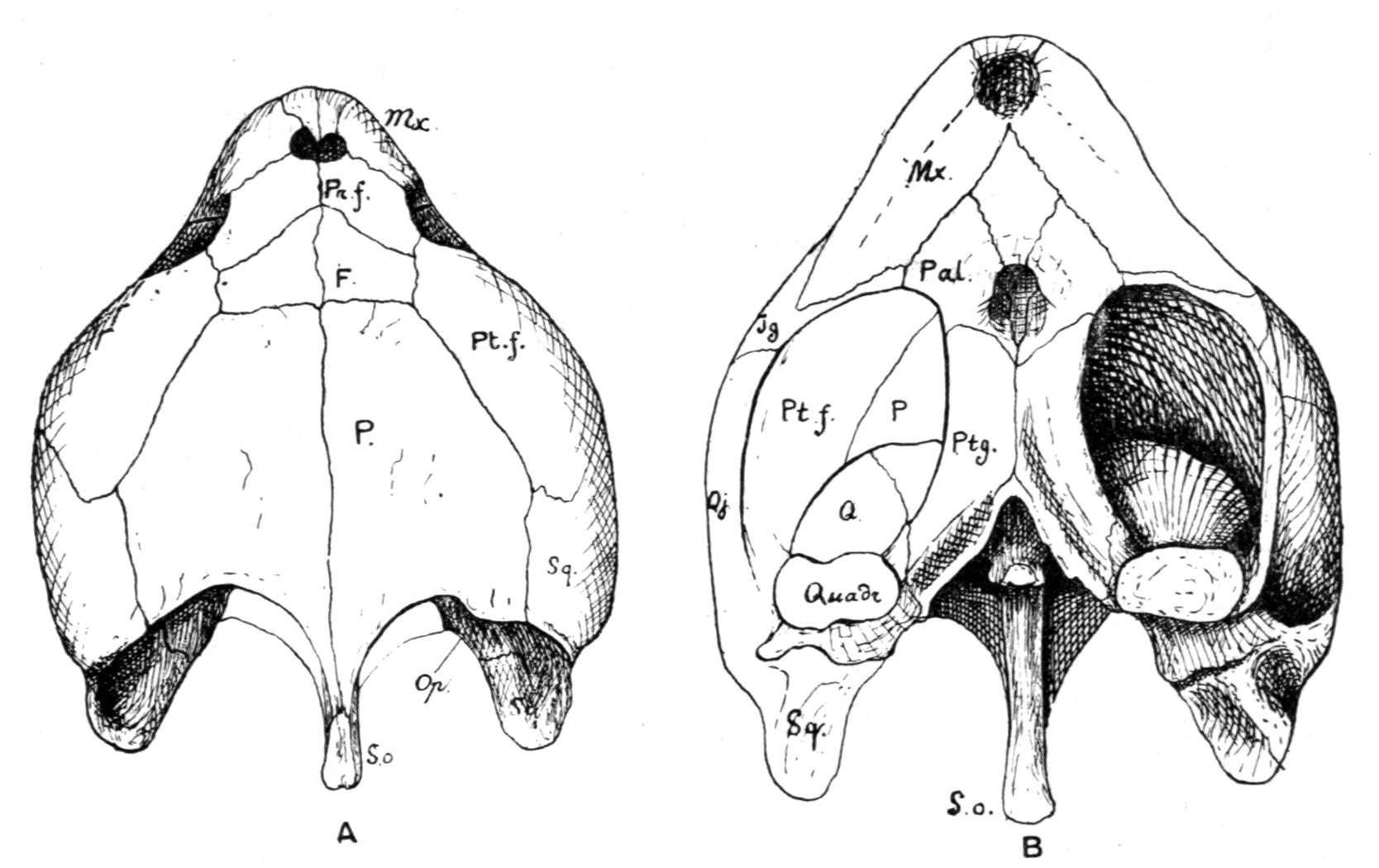
Fig. 84.–Skull of Thalassochelys caretta; cf. also Fig. 63, p. 317. A, Dorsal view; B, ventral view; F, frontal; Jg, jugal; Mx, maxillary; Op, opisthotic; P, parietal; Pal, palatine; Pr.f, prefrontal; Pt.f, postfrontal; Ptg, pterygoid; Q, quadrate; Quadr, articular surface of quadrate; Qj, quadrato-jugal; S.o, supra-occipital; Sq, squamosal.
The carapace is heart-shaped and very flat. The nuchal plate has no rib-like processes. The eight neurals form a continuous series, and the short tail is covered by two or three pygal plates besides the unpaired last marginal. The number of all the marginals is 23, sometimes 25 individually. The plastron (Fig. 66, p. 321) is composed of the usual nine plates, which, however, remain entirely free from the marginals, and are only loosely connected with each other, enclosing a very large unossified space. The horny shields covering the plastron number 13, and there is a series of about 5 inframarginals (Fig. 61, 6, p. 315). There are normally 12 pairs of marginal shields, a nuchal, 5 neural, and 5 or 7 costal shields. Whilst the number of these dorsal shields is pretty constant in Chelone, it is subject to an astonishing amount of individual variation in Thalassochelys.
The Chelonidae are a highly specialised offshoot of the Cryptodira adapted to marine life. Fundamentally they agree most with the Testudinidae, paradoxical as this may appear at first sight. There is nothing primitive about them except the complete series of inframarginal shields. Fossil forerunners of marine turtle-like creatures appear in the Upper Jurassic deposits of Europe and North America. The numerous genera have been grouped together as Thalassemydidae and Chelonemydidae. They are more or less intermediate between Chelonidae and Emys-like Testudinidae, the carapace being not too much flattened and broadened out, the fontanelles between the ribs are mostly small, the plastral bones are still broad, enclose a smaller ossified space, and there is still a bony bridge in most cases. The paddle-shape of the limbs is less pronounced, and sometimes only indicated. In some forms, especially Lytoloma, from the Upper Cretaceous and Eocene of North America and Europe, the anterior portion of the skull is much longer than in the Chelonidae, the vomer and the premaxillaries are elongated, and the anterior portion of the roof of the mouth, with the corresponding parts of the lower jaw, seems to have carried crushing pads. Some of the best-known Upper Jurassic genera are Eurysternum and Idiochelys; Plesiochelys from the Purbeck and Wealden; Allopleuron hofmanni from the Upper Cretaceous of Belgium approaches Chelone by the large fontanelles between the small marginal and the short costal plates. True Chelonidae are very rare and imperfect in the Mid-Tertiary strata, but both recent genera seem to have existed since Pliocene times.
The few recent Chelonidae are entirely marine, going on land only in order to deposit their eggs in the sands of unfrequented shores. Their distribution, in conformity with their oceanic life, is almost cosmopolitan within the warmer zones, but not a few find their way far into the temperate seas. They are all eagerly hunted by man either for food or for the sake of the tortoiseshell.
Chelone.–With only four pairs of costal shields. Carapace with large persisting fontanelles between the costal and marginal plates. Two species.
Ch. mydas (the "Green or Edible Turtle"), has when adult a nearly smooth shell, all the shields being juxtaposed, fitting closely into each other, and becoming quite smooth with age. The neural shields of younger specimens have a feeble keel. The twenty-five shields which surround the carapace form a smooth, or but indistinctly serrated rim. The head is covered with one pair of prefrontal shields, the others are small. The horny beaks of the upper and lower jaws have denticulated outer edges, those of the upper jaw having two pairs of strong denticulated ridges. The limbs have generally only one claw, namely on the first digit. This claw, although sometimes curved and thick, and more than an inch in length, is blunt. The general colour is olive or brown above, with yellowish spots or blotches; the under parts are pale yellowish. This species attains a large size, with a length of shell of nearly four feet, but the usual length of full-grown specimens is three feet, and these weigh, when in good condition, more than three hundredweight. Their home is in the Atlantic, Indian, and Pacific Oceans, but there are certain regions in which they are more common than in others. Famous centres are the Island of Ascension, the West Indies, and the coast of Mosquito, at least for commercial purposes. As they require sandy, easily accessible beaches for the deposition of their eggs, they congregate in certain parts of the world more than in others, and being strictly vegetable feeders, they are naturally bound to the coasts, although they are sometimes met with far out at sea. Their chief food consists of algae, and of Zostera marina, the edible "Dulce," which grows plentifully in the lagoons of the coast of Florida. When they have eaten their fill, they are said to chop off more of these plants, and roll them, together with the adherent mud, into balls of the size of a head, and these balls, receding with the tide, are followed by the Turtles.
Whilst in the water they are caught in various ways, with nets or harpoons. In some parts of the world the natives follow them in a boat, and when they espy a turtle crawling along the bottom, a man, attached to a rope, dives in, clasps it, and is brought up by his companions together with his prey. Turtles are fond of basking asleep, floating on the surface, and they are then harpooned from a stealthily approaching boat. The most original mode of catching them is that used by the natives of Torres Straits, Madagascar, and Cuba. The turtle-fishers go out in the boat to a spot frequented by grazing turtles; a long string is tied to the tail of a fish, Echeneis, a member of the Mackerel family, and the Echeneis, anxious to get away to protective shelter, makes for a turtle, and attaches itself to the turtle's plastron by means of the large sucking apparatus on the top of its head and neck-region. The men are guided by the string, and the turtle is gently coaxed up towards the surface or followed into shallow water, where it is either harpooned or dived for. It is curious that this use of the Echeneis exists in such widely separated parts of the world, the natives of which cannot have any knowledge of each other. These modes of catching turtles are sportsman-like, but the greatest and most wanton destruction is practised at their breeding places. In conformity with the wide distribution of these creatures, the time of breeding is not the same everywhere. In the West Indian region, and in the Straits of Malacca, it falls within the period of April to June; on the coast of West Africa it occurs from September to January. The females come to their breeding places from afar, reconnoitre the beach carefully, are extremely wary and shy, taking alarm at the slightest disturbance, and at last crawl on land. Well out of the reach of the tide the female scoops out a hole in the sand, deposits about one hundred or more of its round, rather parchment-shelled eggs, covers the nest carefully, obliterating all traces of the dug-out sand, and makes again for the sea by another route. At least they are said to make a sort of circuitous route so that nobody can tell the position of the nest, which may be anywhere beneath the broad trail left by the heavy creature on its way from and back to the sea. The nest is discovered by probing the sand with sticks. The time of incubation is not known, but according to Agassiz, lasts at least seven weeks.
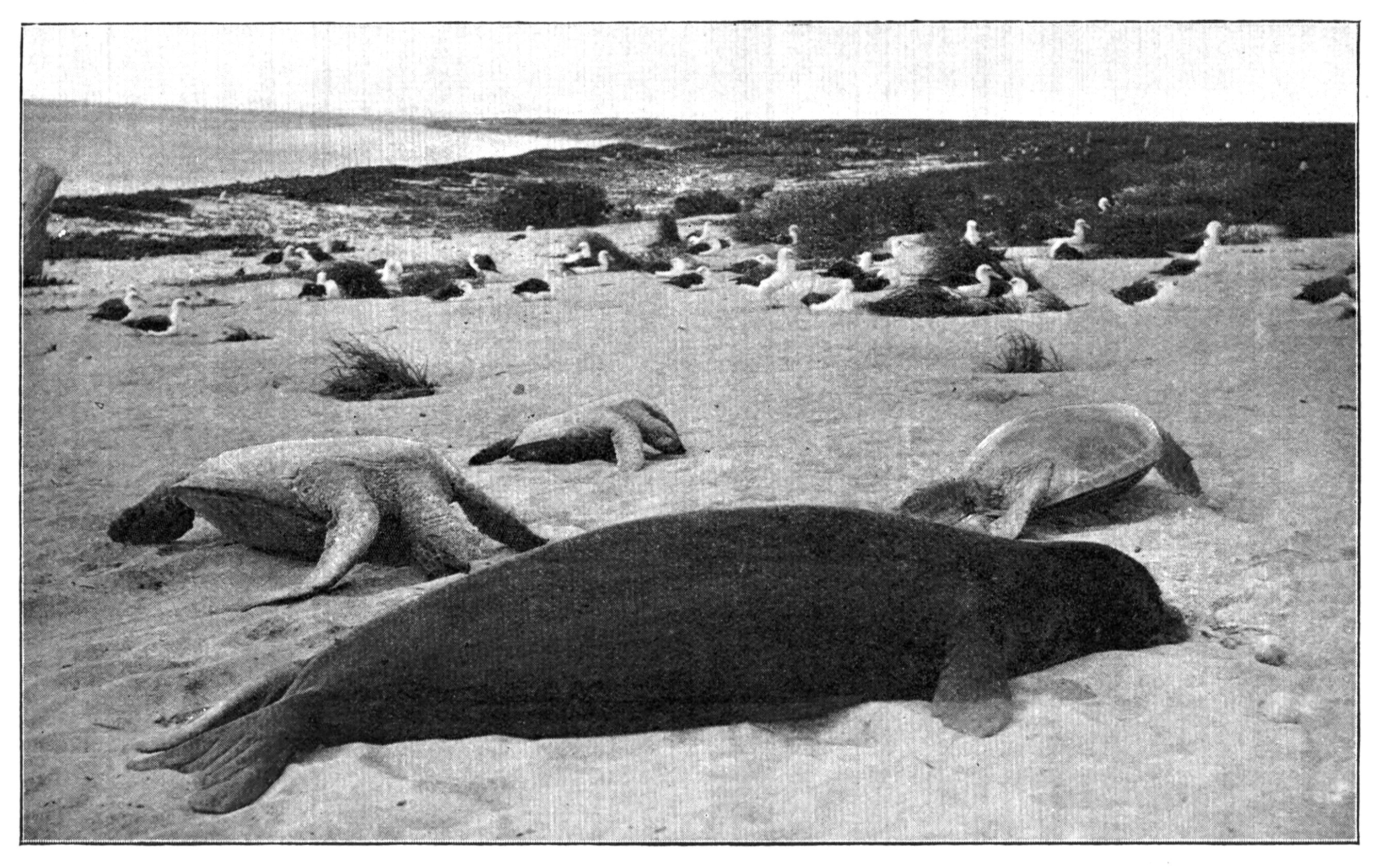
Fig. 85.–Three turned Turtles, a Seal, and Albatrosses, Laysan Islands, north-west of the Sandwich Islands. From a photograph belonging to the Hon. W. Rothschild.
The "turning" of turtles is a cruel and wanton operation, since frequently many more are turned over and left to perish than are taken away. Men lying in ambush watch the beast, or they approach the lonely sandy shore by boat, and rush the helpless creatures when these are surprised in sufficient numbers. It takes several men to lift a full-grown specimen. It is therefore necessary to secure them by turning them over with poles or by their flippers, lest they should crawl away. On board ship they are either put into tanks or tied with ropes on deck, covered with a moistened cloth; and occasionally a piece of bread, soaked in sea-water, is thrust into the parched mouth. In London they are kept in large tanks, often in considerable numbers, but since they take no food in captivity, or rather because it is difficult to supply them with the right sort, they are not kept long. After the head has been cut off, the body is suspended for a day or two, in order to drain it of the blood. It is not only the meat and the fat which are used for the making of the famous soup, but also the thick and dense layer of subcutaneous tissue which lines the inside of the shell.
Tennent describes a revolting spectacle exhibited in the markets of Jaffna, in Ceylon. The flesh of the turtles is sold piecemeal by the Tamil fishermen, while the animals are still alive. At certain seasons, says the same authority, the flesh of turtle on the south-west coast of Ceylon is usually avoided as poisonous, but some lamentable instances are recorded of neglect of this, and consequent sickness, followed by coma and death. In the Gulf of Manaar specimens are frequently found between four and five feet in length; and on one occasion, in riding along the seashore north of Putlam, he saw a man in charge of some sheep, resting under the shade of a turtle shell, which he had erected on sticks to protect him from the sun. In connexion with this curious sight, Tennent quotes Aelian's statements, copied by him from Megasthenes' Indica Frag. lix. 31, that in the Indian ocean turtles occur which measure fifteen ells, so that not a few people may find ample shelter beneath a single shell.
Ch. imbricata ("Hawksbill Turtle").–The number of shields covering the carapace is the same as in Ch. mydas, but they strongly imbricate, or overlap each other from before backwards, until the animal is very old, when the shields become juxtaposed.
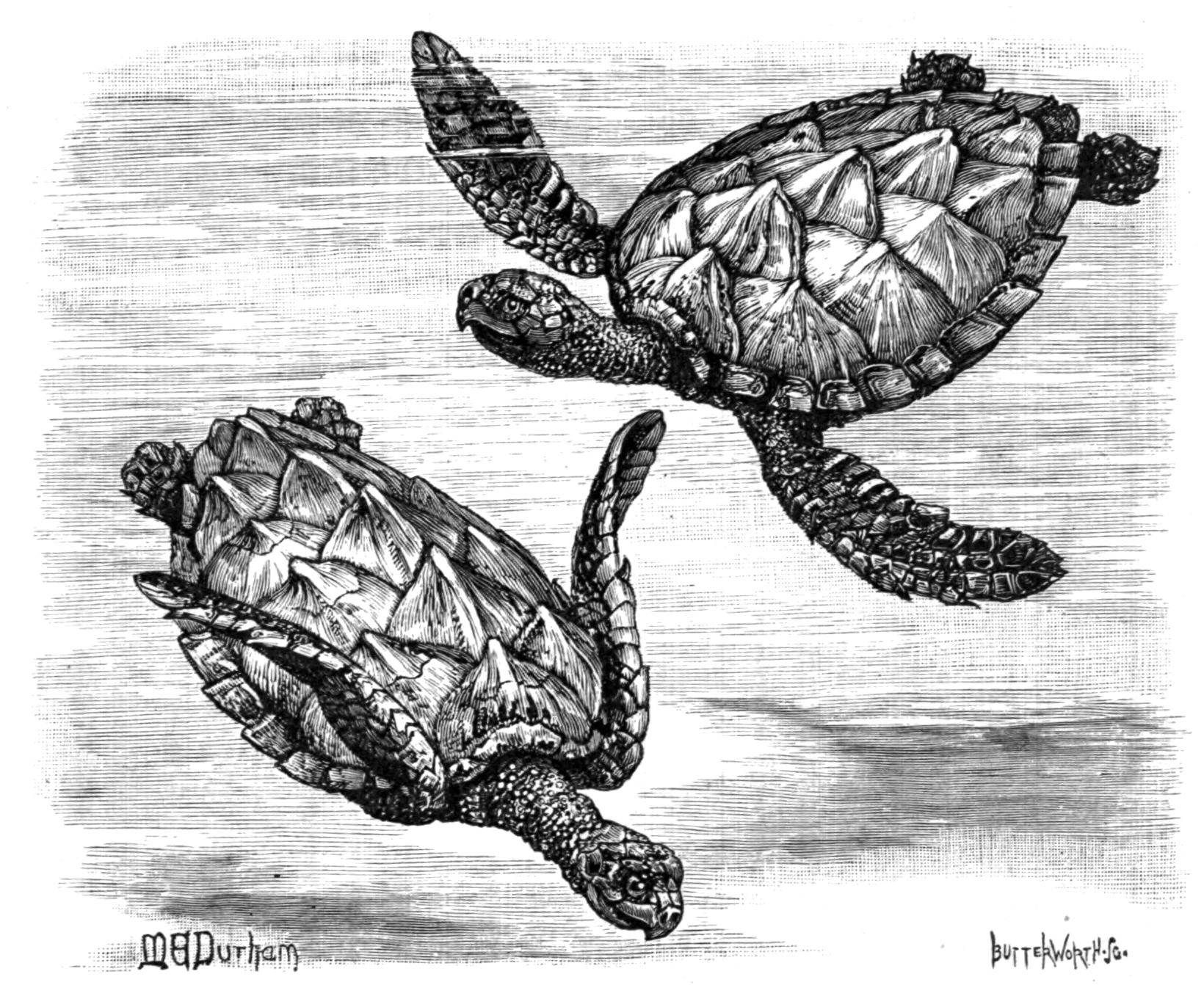
Fig. 86.–Chelone imbricata ("Hawksbill Turtle"), young. × ½.
In young specimens, under one foot in length, each of the neural and costal shields is strongly keeled, the three rows of keels converging towards the posterior end of the shell. The neural series of keels is almost continuous, and remains longest, even in half-grown specimens. The twelve pairs of marginal shields form at first a strongly serrated sharp edge; the serrations disappear gradually on the front portion, but remain on the posterior half of the shell. The horny covers of the jaws form a hooked beak, with sharp but smooth or feebly denticulated margins. The fore- and hind-flippers have two claws. The young are pale brown above, blackish below; the shell of the adult is beautifully marbled with yellow on a rich dark-brown ground; the plastron is yellow. The shields and scales of the head and limbs are dark brown, with yellow margins. The top of the head is covered by a large unpaired frontal and a pair of prefrontal or interorbital shields. This Turtle does not reach the size of the green or edible kind; the largest shell on record is in the National Collection, and measures 85 cm. = 34 inches in length. They range over all the tropical and subtropical seas. They are apparently strictly carnivorous, living upon fish and molluscs, the shells of which they crunch. Although not eaten, they are much persecuted on account of their shells, the horny shields of which are the "tortoiseshell" of commerce. A large specimen yields up to 8 lbs. Few of the shields are, however, thick enough to be manufactured into the larger articles which art and fashion delight in, but if heated in oil, or boiled, they can be welded together under pressure, and be given any desired shape. In genuine articles of Oriental manufacture these welds can generally be detected, or their compound nature is indicated by the beautiful pattern, which is too regular in the imitations now common. Even the shavings and leavings can be welded and moulded into large pieces. The stripping of the shields has been described by Sir E. Tennent. "If taken from the animal after death and decomposition, the colour of the shell becomes clouded and milky, and hence the cruel expedient is resorted to of seizing the turtles as they repair to the shore to deposit their eggs, and suspending them over fires till heat makes the plates on the dorsal shields start from the bone of the carapace, after which the creature is permitted to escape to the water. At Celebes, where the finest tortoise-shell is exported to China, the natives kill the turtles by blows on the head, and immerse the shell in boiling water to detach the shields. Dry heat is only resorted to by the unskilful, who frequently destroy the tortoise-shell in the operation." The cruel process described above is resorted to "for economy's sake," the Singhalese believing that such maltreated turtles regenerate the shields, to be caught and shipped again. Since none of them are actually re-caught in the mutilated condition, this is looked upon as a proof of the correctness of the treatment. It is more likely that they die.
New shields can be reproduced only if the underlying Malpighian layer of cells (cf. Fig. 68, B, p. 323) is not killed by the roasting. However, Dr. Charles Hose, with his long experience in Borneo, is positive that numerous individuals are there caught which have imperfectly mended shells, the shields of which do not imbricate, are thin, and almost worthless.
It is commonly believed that the same individuals return again and again to the same spot for laying. This is very likely the case. Tennent mentions that in the year 1826 a Hawksbill was taken near Hambangtotte, which bore a ring attached to one of its fins, that had been placed there by a Dutch officer thirty years before, with a view of establishing the fact of these recurring visits to the same beach. The same homing instinct has been observed in some females of the Green Turtle, which, having been brought from the Tortugas Keys to Key West off the south end of Florida, escaped, and were, a few days later, re-caught at the Tortugas. On the other hand, experiments made with turtles at Ascension are said to have had no result.
Thalassochelys, with five pairs of costal shields. The carapace is completely ossified in the adult, leaving no fontanelles between the ribs and the marginals.
Th. caretta (the "Loggerhead Turtle").–The shields of the carapace imbricate only in young specimens, in the adult they become smooth and juxtaposed. The margin is serrated posteriorly. The carapace of the young has three strong keels. The intergular shield is very small or absent. The marginals, including the nuchal, usually number 23, rarely 25. The large head is armed with hooked jaws, the crushing surface of the horny upper beak has a median prominent ridge. The top of the head has a pair of shields in front of the unpaired frontal. The flippers of the young have claws on the first and second digits; in the adult usually only that of the first digit remains. The general colour of the shell is uniform brown above, yellowish below. Very young specimens are uniform dark brown or blackish above and below.
Large individuals have a shell about three feet and a half in length. The Loggerhead is carnivorous, and is commercially of no value. Its habits seem to be the same as those of the other Turtles, but it has a much wider distribution. Besides all the tropical and intertropical seas, it inhabits the Mediterranean, and is an accidental visitor to the western coasts of Europe, especially Portugal and the Bay of Biscay. It has been caught several times on the coast of Belgium, and an old female containing 1150 eggs was captured in 1894 on the Dutch coast. In 1861 one was caught near Penman, on the coast of Banffshire, and a second in the completely land-locked Loch Lomond.[137] It has been more frequently recorded from the coast of Devon and Cornwall.
The most interesting feature of the Loggerhead is the astonishing variability in the number of the horny shields of the carapace. The normal number of shields of the carapace, leaving out the marginals and counting the nuchal as the first neural, is 6 neurals and 5 pairs of costals, in all 16. The greatest number of dorsal shields observed is 8 neurals and 8 pairs of costals, in all 24. Many of the intermediate combinations have been observed, there being, for instance, specimens with 8 neurals and 16, 14, 13, 12, or 11 costals, the latter not being always in pairs, but unequal on the right and left sides; or there are 7 neurals with 20 to 16 costals, or 6 neurals with 20, 19, 18, 17, or 16 costals. The interesting fact in connexion with these variations is, moreover, that some of the shields are much smaller than the others, sometimes mere vestiges in all stages of gradual suppression, and that the abnormalities are much more common in babies and small specimens than in adults. The importance of these "orthogenetic" variations has been discussed on p. 326.
Sub-Order 2. Pleurodira.–Neck bending laterally and tucked away in the niche formed between the anterior portion of the carapace and plastron. Pelvis ankylosed to the shell, the broadened tops of the ilia to the carapace, the distal ends of the pubes and ischia to the plastron.
Freshwater tortoises, almost entirely carnivorous, inhabiting South America, Australia, Africa, and Madagascar. Fossil forms are known from the Jurassic epoch onwards.
Owing to the strong connexion of the iliac bones with the costal plates the sacrum has become practically abolished, the sacral ribs being reduced to one pair (the posterior of the original two pairs) or being absent. The centra of the cervical vertebrae articulate by cup and ball joints. The formation of the temporal region of the skull varies considerably in the three families, some genera lacking the complete zygomatic arch, while others have a narrow parieto-squamosal arch bridging over the temporal fossa, or the latter is completely roofed over by the laterally expanded parietal, which meets the jugal and quadrato-jugal. The quadrate is always trumpet-shaped; the rim of the tympanum is complete, but the posterior part of the trumpet remains open. The basisphenoid, pterygoids, and palatines form a broad and flat roof to the mouth. The vomer is large, and separates the palatines in the Chelydidae; it is very much reduced or absent in the Pelomedusidae, in which the palatines meet. All the Chelydidae, except Chelys, have nasal bones which remain distinct from the prefrontals. The choanae lie in front of the palatines, divided by the vomer when this is present, but they are not roofed in ventrally.
The ilia are solidly ankylosed in the adult with the neighbouring costal plates, mostly with the last two pairs, sometimes also with the pygal plate. The lateral processes of the pubes fuse with the xiphiplastra. The ischia are also attached to the same plastral elements.
The carapace is flat and completely ossified. The nuchal plate is always conspicuous, much larger than the neurals, and these are often reduced by being encroached upon by the eight pairs of costal plates, which then meet in the dorsal line. In Sternothaerus all the eight neurals are present and form a continuous row. In most of the other genera they are reduced to seven, the last being squeezed out. In Rhinemys they are reduced to the second, third and fourth and an isolated fifth, and in Hydraspis they are all gone. The pygal plate is always, even in Sternothaerus, separated from the last neural by the eighth pair of costals. The marginals number 23, but in Carettochelys only 21.
The carapace is covered with horny shields, except in Carettochelys. The nuchal is absent in the Pelomedusidae and in a few Chelydidae (Elseya and a few species of Emydura). In Hydromedusa the nuchal is shut in by the anterior marginals, simulating a sixth neural. The plastron is composed of the usual nine elements, but the Pelomedusidae possess an additional pair, the meso-plastra, inserted between the hyo- and hypo-plastra. The bridge is strong, connected with the carapace by suture. In Sternothaerus the front lobe of the plastron is movable. The intergular shield is always present; it is terminal, forming part of the front margin, except in Chelodina, where this shield, although large, is shut in behind the gulars (cf. Fig. 61, 4 and 5, p. 315).
Although the Pleurodira are a peculiarly specialised group, one of the oldest Chelonian fossils known seems to belong to them. Proganochelys, represented by a complete shell, nearly 2 feet long, has been found in the Upper Keuper Sandstone of Würtemberg. Plesiochelys, of the Upper Jurassic of Switzerland, has eight neural and three supracaudal plates, but is without the ischiadic plastral ankylosis. Pleurosternum, of the English and Continental Purbeck beds, has meso-plastral plates like the recent Pelomedusidae. Rhinochelys, of the Cambridge Greensand, has a broad parieto-postfrontal roof, and large nasal bones. Forms like Podocnemis, now restricted to South America, occur in the Eocene of Europe. One of the most aberrant Chelonians is Miolania, from the Plistocene of Queensland and from Lord Howe's Island, remarkable for its huge size and the thick armour on the head and tail; the head especially carries large paired projections, one pair of which extends horizontally like powerful horns, recalling the queer Theromorphous Elginia.
We divide the recent Pleurodira into three families, of which that of Carettochelys stands apart by its paddle-shaped limbs and the absence of horny shields. The Pelomedusidae and Chelydidae are closely allied. The former are not Australian, and are externally distinguished by the absence of a nuchal shield.
Fam. 1. Pelomedusidae.–Neck completely retractile within the shell. Carapace without a nuchal shield. The plastron is composed of eleven plates, there being besides the unpaired endo-plastron a pair of meso-plastra, situated between the hyo- and hypo-plastra; but these meso-plastra meet in the middle line in Sternothaerus only, while in Podocnemis and Pelomedusa they are restricted to small pieces on the bridge, widely separated from each other by the usual hyo- and hypo-plastral suture. A nuchal shield is absent; there are twenty-four marginal and thirteen plastral shields, inclusive of the conspicuous intergular. The temporal fossa is widely open, except in Podocnemis, where it is partly roofed in by the meeting of the much-expanded quadrato-jugal with the parietal. The palatine bones are in median contact, not separated by the vomer. Nasal bones being absent, the large prefrontals meet in the middle line. The second cervical vertebra is biconvex.
This family is now represented by only three genera, with about fifteen species in Africa, Madagascar, and South America.
Sternothaerus.–Skull without a bony supratemporal roof. Meso-plastra large, extending right across the plastron. Anterior lobe of the plastron movable, the hinge passing between the hyo- and meso-plastral plates, and between the pectoral and abdominal shields. Fore- and hind-limbs with five short digits and claws. Several species in tropical and southern Africa, and in Madagascar. S. derbianus in West Africa, from the Gambia to Angola, is the largest species, with a shell nearly one foot in length.
Pelomedusa.–Skull with a slender parieto-squamosal arch. Meso-plastra small and lateral. Plastron without a hinge. Fore- and hind-limbs with five very short digits and five claws. Top of the head with one pair of shields between the eyes, and with a large interparietal and a pair of parietals behind.
P. galeata, the only species, occurs in Madagascar and nearly the whole of Africa south of the Sahara, from the Cape to Abyssinia, and in the Sinaitic peninsula. The shell, less than one foot in length, is much depressed and is obtusely keeled; brown above with black spots; brownish-yellow below. The short and broad head is coloured like the rest, without ornamentation. In Somaliland this species sleeps hidden on land during the dry seasons, from July to the end of September, and from January to March, and appears at once after the rains have set in.
Podocnemis.–With a supratemporal roof formed by the junction of the parietal with the quadrato-jugal. Meso-plastra small and lateral. Fore- and hind-limbs broadly webbed, with five and four claws respectively. The fore-arms and the outer edges of the hind-feet with several conspicuous shields, hence the generic name. Head with an interparietal, two parietals, and a narrow unpaired shield between the eyes. The tail is very short. The carapace is flat and broad, strongly serrated on the posterior margin. Chin with one or two short barbels. Several species in South America, chiefly in the basin of the Amazon, and one in Madagascar.
P. expansa.–Very common in Tropical South America, east of the Andes. The female, which is much larger than the male, has a shell nearly three feet in length. Olive-brown above with darker patches; yellowish below. With a few yellow spots above and behind the eyes, and on the parietal region. The "Arrau" turtle is of great commercial importance on account of the eggs, which are periodically collected in enormous quantities, chiefly for the oil. This is either eaten, like the eggs themselves, or used for burning in lamps, or as an addition to tar. The turtles are likewise eaten by man and beast. Thousands of the little creatures are snapped up by Jabiru storks, alligators, and fishes; the adults fall an easy prey to the prowling jaguar, which turns them over on to their backs and neatly cleans out the flesh with its sharp and powerful claws.
Fertilisation takes place in the water, the eggs are deposited on land, in sand-banks, the female digging a hole about two feet deep and covering up the numerous soft-shelled eggs with sand. The time of deposition is the early hours of the morning, but the season depends upon the beginning of the principal rains, since the young are hatched shortly before the torrential rains. This season differs considerably in the various countries. The hatching takes about forty days; the eggs are consequently laid in the Amazon countries during the months of September to November, in the Orinoco district in March. This species lives in the pools of the inundated forests, and when these are dried up, the animals retire into the rivers themselves. Their food consists mainly of the fruit dropping down from the trees.
Bates, in his delightful book, The Naturalist on the River Amazon, gives the following lively and exhaustive account of his experience with these turtles:–
"I accompanied Cardozo in many wanderings on the Solimoes, during which we visited the 'praias' (sand islands), the turtle pools in the forests, and the by-streams and lakes of the great desert river. His object was mainly to superintend the business of digging up turtle eggs on the sandbanks, having been elected commandant for the year by the municipal council of Ega, of the 'praia real' of Shimuni, the one lying nearest to Ega. There are four of these royal praias within the Ega district, a distance of 150 miles from the town, all of which are visited annually by the Ega people for the purpose of collecting eggs and extracting oil from their yolks. Each has its commander, whose business is to make arrangements for securing to every inhabitant an equal chance in the egg harvest, by placing sentinels to protect the turtles whilst laying, and so forth. The pregnant turtles descend from the interior pools to the main river in July and August, before the outlets dry up, and there seek in countless swarms their favourite sand-islands; for it is only a few praias that are selected by them out of the great number existing. The young animals remain in the pools throughout the dry season. These breeding places of turtles then lie 20 to 30 or more feet above the level of the river, and are accessible only by cutting roads through the dense forest....
"We found the two sentinels lodged in a corner of the praia, where it commences at the foot of the towering forest-wall of the island, having built for themselves a little rancho with poles and palm-leaves. Great precautions are obliged to be taken to avoid disturbing the sensitive turtles, who, previous to crawling ashore to lay, assemble in great shoals off the sand-bank. The men, during this time, take care not to show themselves, and warn off any fisherman who wishes to pass near the place....
"I rose from my hammock by daylight, shivering with cold; a praia, on account of the great radiation of heat in the night from the sand, being towards the dawn the coldest place that can be found in this climate. Cardozo and the men were already up watching the turtles. The sentinels had erected for this purpose a stage about fifty feet high, on a tall tree near their station, the ascent to which was by a roughly made ladder of woody lianas. They are enabled, by observing the turtles from their watch-tower, to ascertain the date of successive deposits of eggs, and thus guide the commandant in fixing the time for the general invitation to the Ega people.
"The turtles lay their eggs by night, leaving the water, when nothing disturbs them, in vast crowds, and crawling to the central and highest part of the praia. These places are, of course, the last to go under water when, in unusually wet seasons, the river rises before the eggs are hatched by the heat of the sand.... The hours between midnight and dawn are the busiest. The turtles excavate with their broad webbed paws deep holes in the fine sand; the first-comer, in each case, making a pit about three feet deep, laying its eggs (about 120 in number), and covering them with sand; the next making its deposit at the top of that of its predecessor, and so on until every pit is full. The whole body of turtles frequenting a praia does not finish laying in less than fourteen or fifteen days, even when there is no interruption. When all have done, the area (called by the Brazilians 'taboleiro') over which they have excavated is distinguishable from the rest of the praia only by signs of the sand having been a little disturbed.
"I mounted the sentinel's stage just in time to see the turtles retreating to the water on the opposite side of the sand-bank, after having laid their eggs. The sight was well worth the trouble of ascending the shaky ladder. They were about a mile off, but the surface of the sands was blackened with the multitudes which were waddling towards the river; the margin of the praia was rather steep, and they all seemed to tumble head first down the declivity into the water.... Placards were posted up on the church doors at Ega, announcing that the excavation on Shimuni would commence on the 17th of October, and on Catuá, sixty miles below Shimuni, on the 25th. By the morning of the 17th some 400 persons were assembled on the borders of the sand-bank, each family having erected a rude temporary shed of poles and palm-leaves to protect themselves from the sun and rain. Large copper kettles to prepare the oil, and hundreds of red earthenware jars, were scattered about on the sand.
"The excavation of the taboleiro, collecting the eggs, and purifying the oil, occupied four days. All was done on a system established by the old Portuguese governors, probably more than a century ago. The commandant first took down the names of all the masters of households, with the number of persons each intended to employ in digging; he then exacted a payment of 140 reis (about 4d.) a head towards defraying the expense of sentinels. The whole were then allowed to go to the taboleiro. They ranged themselves round the circle, each person armed with a paddle, to be used as a spade, and then all began simultaneously to dig on a signal being given–the roll of drums–by order of the commandant. It was an animating sight to behold the wide circle of rival diggers throwing up clouds of sand in their energetic labours, and working gradually towards the centre of the ring. A little rest was taken during the great heat of mid-day, and in the evening the eggs were carried to the huts in baskets. By the end of the second day the taboleiro was exhausted; large mounds of eggs, some of them four to five feet in height, were then seen by the side of each hut, the produce of the labour of the family.
"In the hurry of digging, some of the deeper nests are passed over; to find these out, the people go about provided with a long steel or wooden probe, the presence of the eggs being discoverable by the ease with which the spit enters the sand. When no more eggs are to be found, the mashing process begins. The egg, it may be here mentioned, has a flexible or leathery shell; it is quite round, and somewhat larger than a hen's egg. The whole heap is thrown into an empty canoe and mashed with wooden prongs; but sometimes naked Indians and children jump into the mass and tread it down, besmearing themselves with yolk, and making about as filthy a scene as can well be imagined. This being finished, water is poured into the canoe, and the fatty mass is then left for a few hours to be heated by the sun, on which the oil separates and rises to the surface. The floating oil is afterwards skimmed off with long spoons, made by tying large mussel-shells to the end of rods, and purified over the fire in copper kettles.
"The destruction of turtle eggs every year by these proceedings is enormous. At least 6000 jars, holding each three gallons of the oil, are exported annually from the Upper Amazons and the Madeira to Para, where it is used for lighting, frying fish, and other purposes. It may be fairly estimated that 2000 more jarfuls are consumed by the inhabitants of the villages on the river. Now, it takes twelve basketfuls of eggs, or about 6000, by the wasteful process followed, to make one jar of oil. The total number of eggs annually destroyed amounts, therefore, to 48 millions. As each turtle lays about 120, it follows that the yearly offspring of 400,000 turtles is thus annihilated. A vast number, nevertheless, remain undetected; and these would probably be sufficient to keep the turtle population of these rivers up to the mark, if the people did not follow the wasteful practice of lying in wait for the newly-hatched young, and collecting them by thousands for eating; their tender flesh, and the remains of yolk in their entrails, being considered a great delicacy. The chief natural enemies of the turtle are vultures and alligators, which devour the newly-hatched young as they descend in shoals to the water. These must have destroyed an immensely greater number before the European settlers began to appropriate the eggs than they do now. It is almost doubtful if this natural persecution did not act as effectively in checking the increase of the turtle as the artificial destruction now does. If we are to believe the tradition of the Indians, however, it had not this result; for they say that formerly the waters teemed as thickly with turtles as the air does now with mosquitoes. The universal opinion of the settlers on the Upper Amazon is, that the turtle has very greatly decreased in numbers, and is still annually decreasing.
"The principal object of another expedition was to search certain pools in the forest for young turtle. We started from the praia at sunrise on the 7th of October in two canoes, containing twenty-three persons, nineteen of whom were Indians. The pool covered an area of about four or five acres, and was closely hemmed in by the forest, which, in picturesque variety and grouping of trees and foliage, exceeded almost everything I had yet witnessed. The margins for some distance were swampy, and covered with large tufts of fine grass. The pool was nowhere more than five feet deep, one foot of which was not water, but extremely fine and soft mud.
"Cardozo and I spent an hour paddling about. The Indians seemed to think that netting the animals, as Cardozo proposed doing, was not lawful sport, and wished first to have an hour or two's old-fashioned practice with their weapons. I was astonished at the skill which they displayed in shooting turtles from little stages made of poles and cross pieces of wood. They did not wait for their coming to the surface to breathe, but watched for the slight movements in the water which revealed their presence underneath. These little tracts on the water are called the siriré; the instant one was perceived an arrow flew from the bow of the nearest man, and never failed to pierce the shell of the submerged animal. When the turtle was very distant, of course the aim had to be taken at a considerable elevation, but the marksmen preferred a longish range, because the arrow then fell more perpendicularly on the shell, and entered it more deeply.
"The arrow used in turtle-shooting has a strong lancet-shaped steel point fitted into a peg, which enters the tip of the shaft. The peg is secured to the shaft by twine, being some thirty or forty yards in length, and neatly wound round the body of the arrow. When the missile enters the shell the peg drops out, and the pierced animal descends with it towards the bottom, leaving the shaft floating on the surface. This being done the sportsman paddles in his canoe to the place, and gently draws the animal by the twine, humouring it by giving it the rein when it plunges, until it is brought again near the surface, when he strikes it with a second arrow. With the increased hold given by the two cords he has then no difficulty in landing his game.
"By mid-day the men had shot about a score of nearly full-grown turtles. Cardozo then gave orders to spread the net.... Three boat loads, or about eighty, were secured in about twenty minutes. They were then taken ashore and each one secured by the men tying the legs with thongs of bast.
"When the canoes had been twice filled we desisted after a very hard day's work. Nearly all the animals were young ones, chiefly, according to the statement of Pedro, from three to ten years of age; they varied from 6 to 18 inches in length, and were very fat. Cardozo and I lived almost exclusively on them for several months afterwards. Roasted in the shell they form a most appetising dish. These younger turtles never migrate with their elders on the sinking of the waters, but remain in the tepid pools, fattening on fallen fruits, and, according to the natives, on the fine nutritious mud. We captured a few full-grown mother turtles, which were known at once by the horny skin of their breast plates being worn, telling of their having crawled on the sand to lay eggs the previous year. They had evidently made a mistake in not leaving the pool at the proper time, for they were full of eggs, which, we were told, they would, before the season was over, scatter in despair over the swamp. We also found several male turtles, or capitaris, as they are called by the natives. These are immensely less numerous than the females, and are distinguishable by their much smaller size, more circular shape, and the greater length and thickness of their tails. Their flesh is considered unwholesome, especially to sick people having external signs of inflammation."
The most recent account of these water tortoises is that published by Dr. Goeldi from the MS. of João Martins da Silva Continho, a former resident at Manáos on the Middle Amazon. The "Tartaruga" (the Portuguese name for turtles) live from January to July in the inundated, quiet backwaters of the forest-region, feeding upon the various seeds of palms as these ripen and drop successively; rarely, and only when hard up, they are carnivorous. The creatures hide under water below the trees, when they are espied by the Indians, who dive down to a depth of twenty and more feet to catch them in their arms. The civilised Indians use a steel-pointed lance of hard wood, about 10 feet in length. A string connects the point with the shaft around which it is wound. When stuck into the tortoise the shaft and point part; the string is either tied to the boat or to a little float of light wood. In other districts an arrow with a string is employed.
In August, when the water subsides, the tortoises return to the rivers, and the entrance of the lagoon is closed with nets. A number of boats with long poles drive them with much noise towards the entrance. On their way to the rivers the tortoises always go up-stream, and this is called the "arribaçaõ das tartarugas," the ascent of the turtles. The fishermen post themselves at shallow spots or on sand-banks, and wait for the creatures which come up to find a place for landing and laying. The arrows employed are called sararaca, i.e. a thing which can be disjointed; they are about 4 feet long, and consist of a gomo or internodium of wood 9 inches long with a one- or two-barbed steel point, and the shaft into which the gomo fits loosely. The gomo is, moreover, connected with the shaft by a string made of palm-fibres about 30 feet in length, partly wound round the shaft, which ultimately acts as a float.
The laying takes place from the end of September into October. Some of the parents seem to reconnoitre on land for a few days. As a rule only females do this, and the natives say that they are led by a "mestra." The laying takes place early in the morning. The number of females is so great that they often block the way of the boats, and make a great noise by knocking against their neighbours' shells. Each digs a hole about 18 inches or 2 feet deep, and lays from 80 to 200 eggs. Sometimes the laying individual is entirely buried by its neighbours which are scraping their own holes.
In some districts the eggs are wanted for "manteiga" (Portuguese for butter); and the turning over, or viraçaõ of the tortoises takes place later. In other districts they are caught before the eggs are laid, and this barbaric and destructive custom was formerly forbidden by the people themselves. Although the provincial assembly tried to reinstitute the old reasonable customs, the inspectors are often got over by bribery.
There are two ways of extracting the oil from the eggs. To get the thick oil used, mixed with tar, for shipbuilding, caulking, etc., the eggs are heaped up for five days and then worked. The fluid oil for lighting is made from fresh eggs, which are put into a boat and then trampled out with the feet. The oil is drawn off into large earthen jars and put on the fire. Then it is rapidly cooled. The best oil, used for frying fish, is that which is gained from the roasted tortoises themselves. Fresh eggs are either fried or taken with sugar, or mixed with manioca-flour and water. The young, which are hatched in January, are likewise eaten fried, or they are preserved in the fat of the parents.
An average tortoise yields 5 lbs. of fat, costing on the spot two milreis. The whole full-grown animal, of one yard in length, costs the same, and its meat is sufficient to sustain a family of six people for three days. To make 24 lbs. of oil requires 3000 eggs. Two or three tortoises would yield the same amount from their fat. Consequently the destruction of the eggs causes an enormous waste, and is after all the least economical procedure. In the year 1719, 192,000 lbs. were exported from the Alto Amazonas, representing 24,000,000 eggs. In 1700 there were still plenty of tortoises 50 leagues above the mouth of the Para river. Now there is no assembly of more than fifteen tortoises to be found anywhere within 300 leagues from Para to the mouth of the Rio Negro. On the Rio Madeira, from the mouth to the first cataract, 186 leagues distance, there are now only two regular nesting localities. The upper Solimoes and the Rio Yapura are still rich. Near Ega are regular tortoise-ponds, called "curral," which yield sufficient support to their owners; the animals are fed with manioca-flour and leguminous plants.
Fam. 2. Chelydidae.–The neck bends under the margin of the carapace, but remains partly exposed. The nuchal shield is absent except in two Northern Australian species. There are twelve pairs of marginal shields. The plastron is composed of nine plates, and is covered with thirteen shields, one of which is the conspicuous intergular. The temporal region of the skull shows great diversity. It is quite open in Chelodina, covered in by broad expansions of the parietal bones in Platemys, Emydura, and Elseya, or bridged over by a parieto-squamosal arch, which is very slender in Rhinemys, strong in Chelys and Hydraspis. The palatine bones are separated by the vomer; the nasals are variable, mostly present, but the prefrontals are always small, and separated by the frontals. The fifth and eighth cervical vertebrae are biconvex.
This family, still represented by nearly thirty species, which are divided into eight genera, is restricted to Notogaea, namely, South America and Australia.
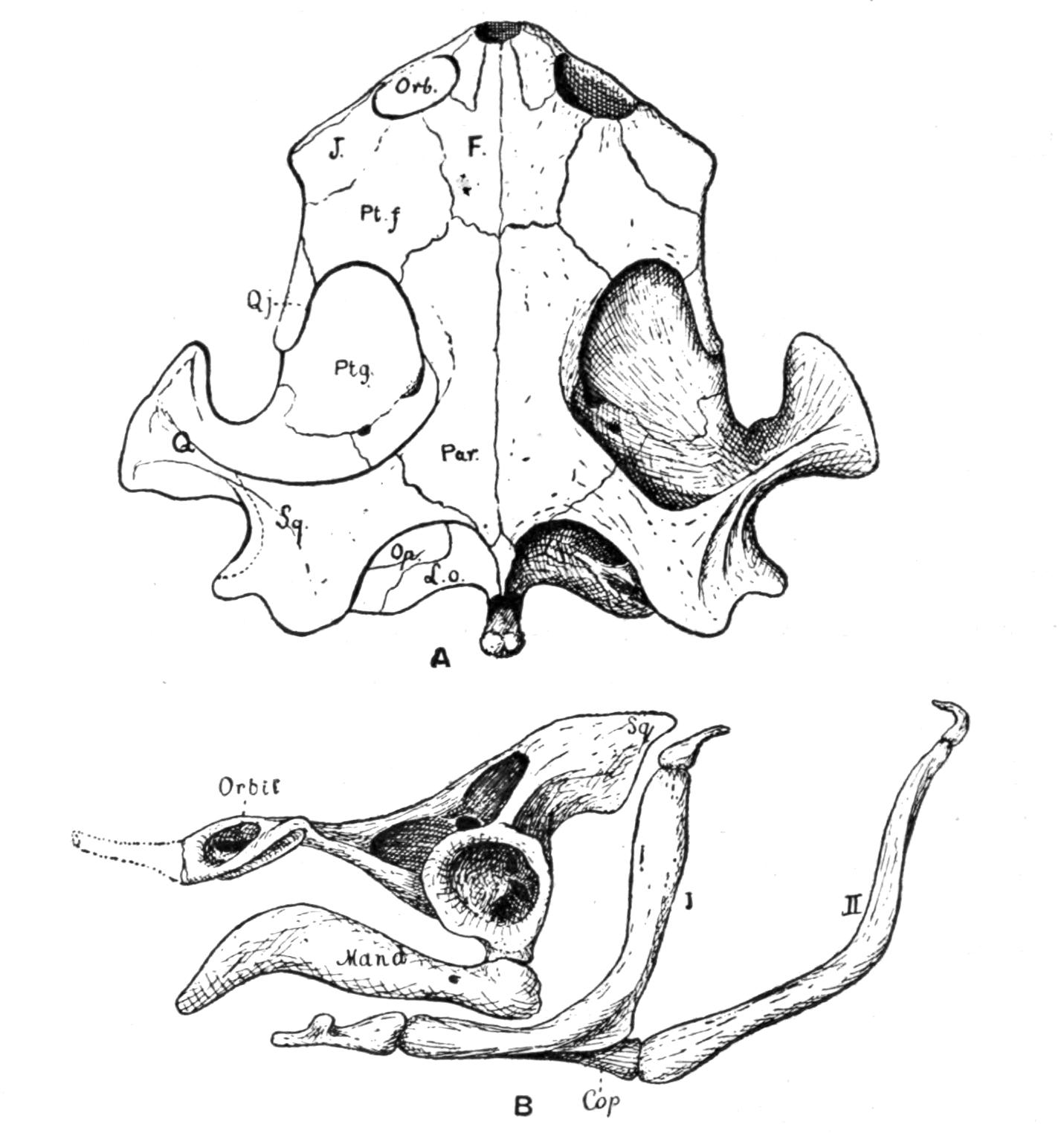
Fig. 87.–Skull of Chelys fimbriata. × 1. A, Dorsal view of skull; B, side view of skull and hyoid apparatus. Cop, copular piece; F, frontal; J, jugal; L.o, lateral occipital; Mand, mandible; Op, opisthotic; Orb, orbit; Par, parietal; Pt.f, postfrontal; Ptg, pterygoid; Q, quadrate; Qj, Quadrato-jugal; Sq, squamosal; I, II, First and second branchial arch.
Chelys fimbriata, the "Matamata," the only species of this genus, inhabits the rivers of Guiana and Northern Brazil. Besides the nuchal, there are seven neural plates; the last pair of costals form a median suture. Nasal bones are absent. The jaws are very weak. The Matamata has a very peculiar appearance. The nose is produced into a long, soft tube, at the end of which open the tiny nostrils. The eyes are very small, and the orbits are placed very near the anterior end of the skull, while the parietal region is broad and much elongated (Fig. 87, p. 400). The quadrates are drawn out into trumpet-shaped tubes. The hyoid apparatus is very large, with enormous anterior and posterior horns. The head and neck are as long as or even longer than the carapace, which is covered with thick, lumpy shields. The skin of the thick neck, of the sides and under parts of the head, is produced into many soft arborescent excrescences or fimbriae, those of the chin and throat and the large ear-flaps being movable at will, and probably used to attract fishes and other prey. The tail is very short. The fore- and hind-limbs are webbed, the former with five, the latter with four claws. Old specimens, which reach a total length of three feet, are uniformly dark brown, and look like a log covered with rough bark. The young are far less ugly, with black and yellow spots on the shell, and with dark stripes along the neck.
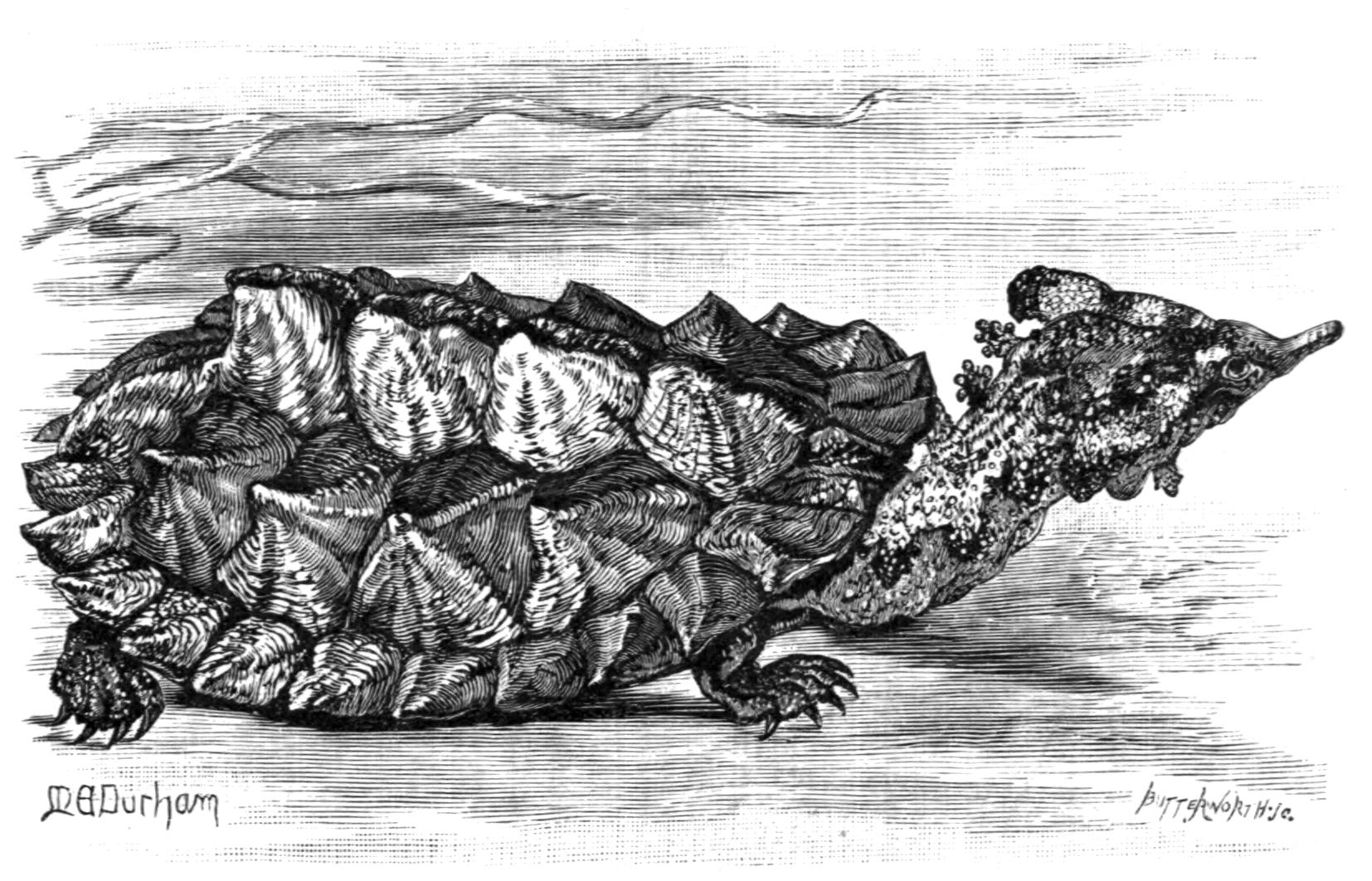
Fig. 88.–Chelys fimbriata ("Matamata"). × ⅒.
Very little is known about the habits of this peculiar creature. It is said to lie submerged in the water, waiting for fishes, frogs, or tadpoles, which are attracted by the playing motions of its cutaneous excrescences. The jaws being so weak, and being covered with a partly soft lip-like skin, it is probable that they are not used for seizing the prey, but that the latter is engulfed into the mouth with the inrush of water into the throat. That this can be widened enormously is indicated by the greatly developed hyoid apparatus.
Chelodina.–The neck is long and slender, the head small and smooth. The nuchal is terminal; the intergular is large. The neural plates are completely suppressed, all the eight pairs of costal plates meeting in the middle line. The shell is very flat. Anterior and posterior limbs entirely webbed, and with only four claws. The tail is very short. Three species in Australia, one in New Guinea.
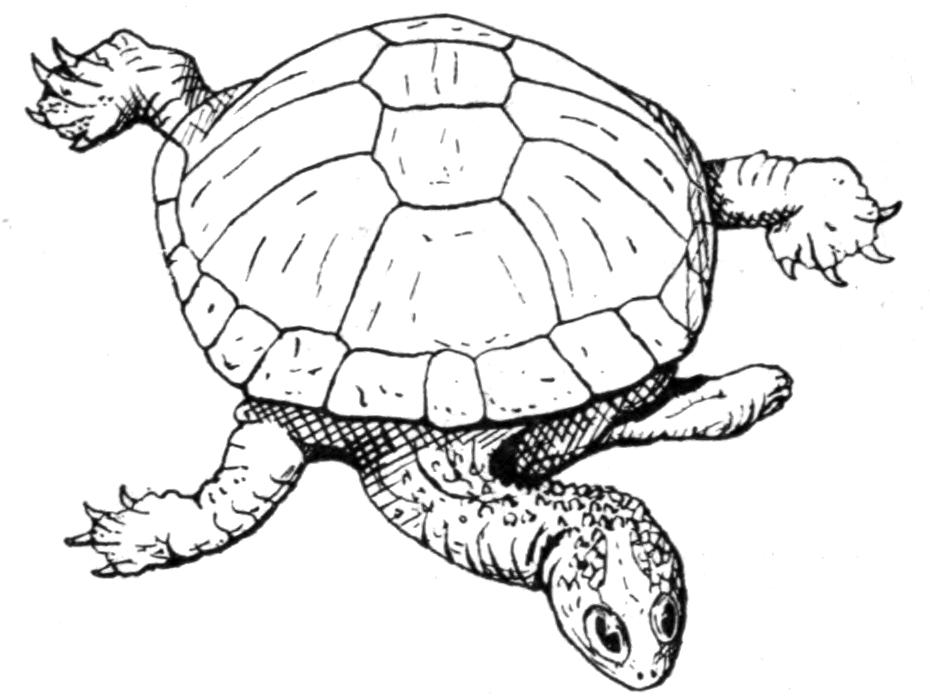
Fig. 89.–Chelodina longicollis. × ⅓.
Ch. longicollis reaches a shell-length of ten inches. It inhabits Southern Australia. The illustrations make a detailed description unnecessary. The colour of the dorsal shield is uniformly dark rich brown, while the shields of the under surface are yellow, with broad dark brown lines along the sutures. These "long-necked Chelodines" have a striking appearance, when they swim or creep about, with the neck either stretched out straight or bent horizontally in an S-shape. The whole creature looks neat and elegant; the iris is pale yellow, and gives the eye a very intelligent expression. They keep well in captivity, provided they are given the choice of land and water. My own prefer to spend most of the day on land, preferably under the ledge of a stone, or perched upon the stone itself if the latter is in the shade, and not too much exposed to view. There they lie motionless, with the neck neatly tucked under the shell, either to the right or to the left. Although the eyelids may be closed, they can see well enough, owing to the transparent condition of the lower lid. They feed in the water upon soft animals, as for instance worms, smooth caterpillars, cockroaches or little frogs; and they also take meat readily, provided this is moved about. The food is invariably taken with a quick sideward jerk of the neck and head.
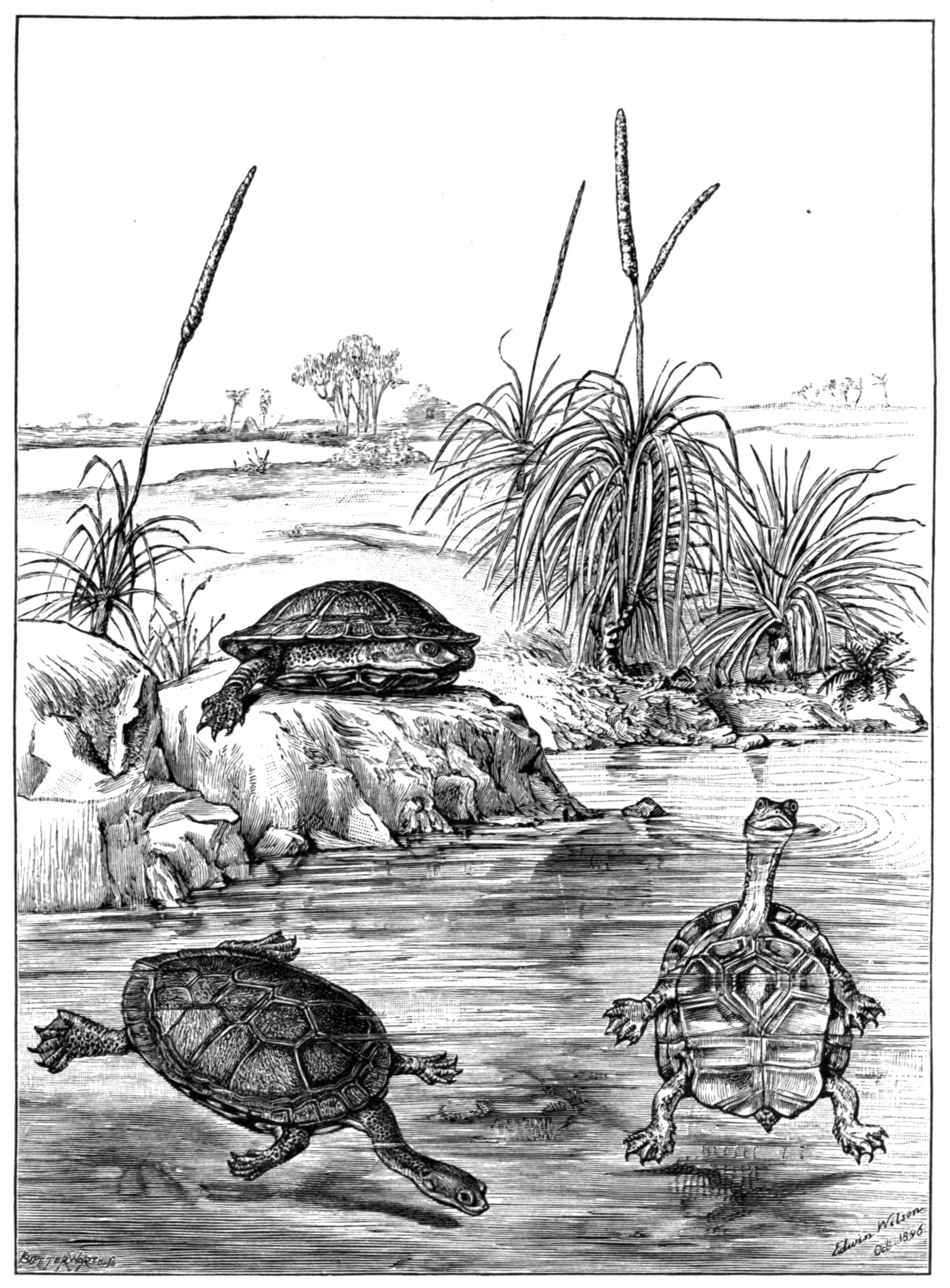
Fig. 90.–Chelodina longicollis (Australian long-necked Chelodines). × ¼.
My specimens soon became so tame that they left the water, and ran up to me with the necks stretched to their full length, then snatching the bit of food, and retiring into the pond to swallow it. When left to themselves they are rather nocturnal in their feeding habits. Now and then they tuck themselves away for weeks without feeding, for instance when they go through a regular term of aestivation in the summer. The last winter they spent buried in the moss, but occasionally, especially on bright and sunny days, they went into the water for a few hours, chiefly to drink, but sometimes also to take a little food.
Hydromedusa, a South American genus, has a neck even longer than that of Chelodina, which it much resembles externally. But the nuchal shield, large and broad transversely, is situated behind the anterior marginals, looking therefore like a sixth neural shield. The neural plates form a continuous row, only the last pair of costal plates meeting in the middle line. H. tectifera occurs in Southern Brazil, and in the La Plata. The shell is dark brown above; yellowish, with dark spots, below; the head and neck are olive-coloured, adorned with a broad white, black-edged band on either side. Fore- and hind-limbs broadly webbed, and with four claws. Total length of the shell about eight inches.
Fam. 3. Carettochelydidae.–The shell is covered with soft skin instead of horny shields. The limbs are transformed into paddles, with elongated digits, and have only two claws. The neck is short, and not retractile. In other respects the skeleton, notably the plastron, pelvis, and skull, conform with the Pleurodirous type. Only one species, Carettochelys insculpta, still imperfectly known, from the Fly River, New Guinea. Length of the shell of the only complete specimen about 18 inches. This peculiar creature seems to stand in the same relation to the typical Pleurodira, as do the Chelonidae to the Testudinidae, except for the complete reduction of the horny shields upon the shell, recalling in this respect Sphargis and Trionyx.
Sub-Order 3. Trionychoidea.–The shell is very flat, oval, or almost round, and is covered with soft, leathery skin instead of with horny shields. The limbs are broadly webbed, and only the three inner digits are provided with claws. Carnivorous, found in the rivers of Asia, Africa, and North America.
The head and neck are completely retractile, bending by a sigmoid curve in a vertical plane like that of the Cryptodira. The jaws are concealed by soft, lip-like flaps, and the nose forms a soft short proboscis. The ear is hidden. The skull, Fig. 91, is flat, with three long posterior processes, formed by the supra-occipital above, and the squamosals on either side. The whole temporal region forms a wide, shallow fossa, without any indication of being arched or bridged over. The premaxilla is extremely small, unpaired, not even reaching the nasal cavity or the vomer. The maxillaries are correspondingly enlarged, surrounding the choanae, which are separated by the narrow vomer. The palatines form a median suture, and are joined behind by the long basisphenoid, which separates the long pterygoids from each other. The quadrate is trumpet-shaped, with a posterior notch for the stapes. The zygomatic arch is complete, and is formed by the quadrato-jugal and the jugal; the latter joins the maxillary and postfrontal, mostly reaching the orbit; in some cases it also just meets the parietal, thereby adding to the strength of the postorbital arch. The prefrontals are large; nasals are absent. The mandible is remarkable for the great development of the coronoid process.