Chapter IX
Reading edition
THE PLAISANCE PROPHECY
Fanny had made the acquaintance of one of the ladies in charge of the educational exhibit of one of the states, and who occupied rooms on the grounds. This lady made arrangements for Fanny to remain over night with her and view a sunrise on the lake and over the "White City." It was to be an experience well in keeping with her emotional nature.
The morning came, and the two placed themselves where they could see through the columns of the peristyle across the lake in the direction of the sun. They were sitting on their camp stools on the bridge east of the statue in the basin with their cloaks drawn tightly around them, waiting in awe as they saw the suffusions of color spread upward into the grey sky.
Suddenly there is a flash of fire far out on the lake. The last pink curtain of mist rolled slowly away light and fleecy as cotton wool, and the sun, behind this lazy apparel of his rising, spreads a crimson glow over the sky and lake. Miles it comes across the rippling waves, stealing through each arch and pillared opening of the peristyle, creeping over the motionless waters of the basin and bringing brightness everywhere.
Slowly the great ball of fire rises higher. Now it flashes upon the statue of liberty, now on Diana, aiming her arrow down into the laughing waters. Under its rays the winged angels on the spires of the palace of mechanic arts seem to start into life, as if they had but paused for an instant in their flight toward the land of dawning.
Now the statues of the seasons, flanking the four corners of the Agricultural building, greet the day. Columbus, his face ever toward the west, rides onward with the sun in his triumphal car. He looks down on the work wrought out to his glory and honor, but his journey is westward still, out of the sunlight into the gloom. Against the dark western sky hangs the majestic dome of the Administration building, now a blaze of ivory and gold.
The sun lifts slowly out of the water. Its rays shine white and clear. The tired guards lean wearily over the parapets of the canals, throwing bread to hungry swans. Flocks of seabirds sweep up and down the canals like the first flurries of autumn snow. The water fowl greet the day with joyous clamor, adding a quaint, rural touch, almost startling in this city of silent palaces. They splash about the wooded island, screaming lustily when boys come in skiffs to steal their eggs. Swallows and frowsy little sparrows flit from their nests, built in the very hands of the golden goddess of Liberty.
From the roofs of every building there is a sudden flash of color. A thousand flags float in the morning breeze. Ten thousand workmen hurry through the sunny park.
The mystical city of dreamland is again the workshop of the world.
Three hours later our family were together in the art gallery glancing at the famous paintings and statues which the nations had given to show what subtle art can achieve on canvas and stone.
Aunt said she always knew those French people were the most shocking people in the world. How different their section of paintings from those of the United States. Fanny had no time for any thought outside of the overwhelming beauty of all she saw. She had begun to paint a little and to do some molding, and she knew how to appreciate the marvelous skill before her. She saw very few people who saw anything in them but a show. Uncle was positively disgusted, and went through only as if it was his duty to see everything. But among the statuary he found some things of more interest.
"Why, Grandpa, how solemn you look. Now, I can't feel solemn at this piece of statuary. Let's see what is its name. Here it is—'The Struggle for Bread.' That makes it more interesting. The people are starving and the factories can give work only to a few. Every day they throw out tickets from the windows, and whoever brings a ticket to the office window is employed. Look at that strong young man. He has secured one and the old man is pleading for it, and the woman with her little child has been knocked down in the struggle of the people for the ticket."
"Yes, yes, child, you can appreciate only the romance and sentiment of it. You have never struggled in despair for bread, and may God keep you! but Sarah and me have seen many sad, weary days of struggles to live."
Johnny had little care for the sentiment or the romance. He was much amused, but it was a dull place for him. At last a thought struck him. He struggled with it several minutes in a very deep study before he ventured to reveal his perplexity. At last it became too great to be borne longer.
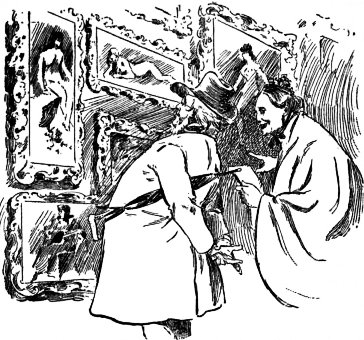
"Say, Grandpa, I kin see why the sculpture can't sculpture clothes on their folks; but I don't see why the painters can't paint their folks up some more decent."
That same thing puzzled Uncle, and he could not answer. He thought a great deal, but he only muttered something about pictures not fit to be stuck on his horse-lot gate posts.
It was nearly eleven o'clock when Fanny and Aunt found Uncle and Johnny sitting disconsolately on the steps of the south entrance awaiting their appearance.
John was patriotic and he wanted to see the liberty bell over in the Pennsylvania building. A great crowd was gathering as they came up and Johnny found out that the interest came from the fact that the Duke of Varagua, the representative of Spain at the Fair and the descended of Columbus, was visiting the bell. It was a sight to awaken memory for the representative of the fifteenth century discovery to be paying respects to the representative of nineteenth century liberty.
"NOT FIT TO STICK ON OUR HORSE-LOT GATE POST."
City folks were not there alone. Many country people were enjoying the pulses of freedom, liberty and patriotism. An honest looking plow boy standing near Fanny asked his father what he thought of the "Dook," a real live "Dook."
"I think the dook ort to be proud of hevin' been kin to Columbus, but I'll be blamed ef I don't think Columbus would be proud too, if he wuz yer, and could tech hands 'ith his forty-eleventh grandson. It takes a purty good man to stand all the honors levished 'pon him that the dook's a-gittin' 'ithout his head a-bein' turned, an' I jes' say good fur the dook."
"It's all right to hev smart kin folks afore you, but it takes lots o' hustlin' in these days an' lots o' hard work in order to stand fust; an I vote the dook is a fine represen'tive o' his Columbus grandfather. Now lets git closer to the old lib'ty bell."
As the rural philosopher looked upon the bell hanging there in the Pennsylvania State building he said, unconscious of the crowd around him:
"When thet bell kep' a ringin' out lib'ty, the folks thet wuz they didn't know thet in a little mor'n a hundred years the hull world would be a bowin' to thet bell; an' they never hed no idee it would be carried away out yere in a place called Chicago, covered over 'ith flowers an' gyarded by perlice to keep folks from a techin' it, a fearin' harm might cume to it—an' it a standin' as a symbol o' great faith an' courage. I'm powerful glad I kin stand yere to-day with my fam'ly and look at thet bell. I jes' wisht they'd let it ring onct."
But there were others too ignorant or stupid to be patriotic before such a scene.
John became indignant, almost to the fighting point, at the amazing stupidity of some of the remarks concerning the bell. To him it was more than an emblem, it was a hero.
He heard comments which are past belief. Of course, there are patriots who approach with reverence and understanding and who are only restrained by the police from chipping off pieces of the bell, but many enter and gaze and depart in bland ignorance.
"By jinks! but that's an old feller," exclaimed one inspired ignoramus. "Wonder where it came from." Another, a stout, prosperous, business-looking party, observed that it was cracked. "Reckon that was done bringing it here," he said. "The railroads are fearful careless about handling freight."
Still another intelligent communicator, and it seemed as if nothing short of positive inspiration could justify his views, spoke of the bell slightingly as a poor exhibit, and wondered what the Pittsburg foundries meant by sending such stuff to an international exhibition.
It was now noon lunch time, and our happy family went over to a table in one of the cafes. At one o'clock Uncle and Aunt were to occupy rolling chairs in spending the afternoon sight-seeing around Midway Plaisance. They had heard a great deal about the sights there, and concluded it best to see the outside first and prepare a campaign of sight-seeing based on information received from the chair pushers.
Across the table from them sat a man eating his meal in a fatigued sort of way that caught their attention.
"Good evening, Colonel," said a gentleman, coming up to him. The colonel was not himself, that was plain. His eyes looked dreamy, and he had the appearance of a man who was under the influence of some strong and very pleasurable excitement. When the friend saluted him he did not reply with marked courtesy. He did not even look at him. He continued to gaze unmeaningly at his plate, and to murmur "Irene-te-raddle, fol de-rol. I'll niver go there anny more."
"What's the matter with you?" asked the gentleman, testily.
"Well, sir, it do beat the dickens," said the colonel, irreverently, "I've lived a long toime an' seen manny a queer soight in circuses an' dime musooms an' hanky-panky shows, but niver till to-day—oh! Naha-a, it's a bright eyes an'—a bonny locks—" here the colonel began to thrum the table.
The friend came over impatiently and shook his fist under the colonel's nose.
"You weak-minded old gazabo, is it to hear ye singin' topical songs thot Oi came down from Archery road? What ails ye?"
The colonel remarked easily: "Don't git gay, George; don't git gay. Because Oi chuse to sing a little is no reason why ye should take liberties." Then he went on, half-musing: "Oi don't give annything for the Fair itsilf. O'Connor tuk me in there first, but what do Oi ca-are for show cases full uv dhried prunes, ould r-rocks an' silk handkerchers? I was f'r goin' over to see Buffalo Willie shootin' Injuns an' rescuin' Annie Oakley frum the red divvels, but O'Connor sez: 'No,' he sez, 'come on an' see the Midway,' he sez. 'So over we goes to the Midway, an', George, Oi haven't been well since. There'll be a trolley in me hed to me dhyin' dhay, there will, there will. We had no more than got in the strate when a nigger in a mother Hubbard comes up an' sez: 'Little mon.'
"'Yis,' sez I, 'an' dom ye little mon till ye do go home an' put on ye're pants, ye bould thing.'
"'Hugh-h!' sez O'Connor; 'that's a Turk.'
"'Thin there's a pair of us,' I sez; 'let's go.'
"'Well,' he sez, 'come into the Turkish village.'
"'An' see more niggers? I'll not,' I sez.
"'Will you go to the Irish village, thin?'
"'No,' I sez, 'aint I seen you?'
"'Well, where will you go?'
"'If you know a place where they keep beer,' I sez, 'I'm convenient.'
"Dom ye, little mon," says I, "Till ye do go home an' put on yer pants."
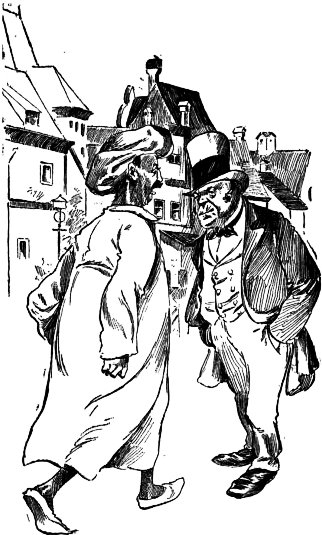
"He shoots me into a hole in the ground. George, ye should a seen it! At one table sat a lot of black fellows with red towels around their heads an' knives stickin' out of their yellow cloaks. At another table was half-a-dozen gurrls with earrings as big as barrelhoops in their ears.
"'Come on back,' sez O'Connor.
"'No,' I sez, 'this is good enough for a poor man,' an' we sat down at the next table to th' gurrls. Well, sir, from that time my mind's a blank. I was like the feller in the story-books. I knew no more. I dunno what happened at all, at all, with dancin' gurrls an' snake cha-armers an' Boolgarian club swingers an' foreign men goin' around with their legs in mattesses. All I know is this, that I was carried to a ca-ar in a seedin' chair by two men with room enough in the seat of their pants to dhrive a street sweeper. Did y'r never ride in a seedin' chair, George? Then, faith, ye're not in my class. Fol-der-rol, de-rol de raddle, fol——"
"An' what did ye do with O'Connor?"
"How do I know? The last time I remimber him he was askin' a girl in the Turkish theayter whether she liked vanilla or rawsburry in her soda wather, the droolin jackanapes. Ah, na-ha, the girls of Limerick city——." The colonel resumed his thrumming.
"And is that all you see of the fair."
"Yis," said the colonel, "an" faith! if you had me hed you'd think it was enough. An', George, to be in earnest wid ye, that I've known since you was a little dirty boy, go to the fair, ride around in the boats, luk at the canned tomatties an' the table-clothes, ride in the electric cars, but beware of that Midway. It'll no do for young men at all, at all. You'd lose your head. You would, you would. Oh, fol-de-rol, de raddle rol."
After this amusing experience just related before them, Uncle thought it very advisable to give Johnny "a good talkin' to about doin' nothin' wrong in that heathen exhibition of furriners."
But Johnny could afford to finish that Saturday walking demurely around with the rest, for the next Monday morning Louis, the train-boy, was to be guard and guide through the mysteries of Midway Plaisance.