Chapter VII
Reading edition
ON BOARD THE "ILLINOIS"
"Now for the battleship," said Johnny, "that's what I want to see." As they came on board the brick ship, the first words they heard were quite nautical.
"It's eight bells."
"Aye, aye, sir!"
The bos'un, or whoever it was that received the order from the Lieutenant, climbed up and tapped out eight strokes on the big brass bell. About twenty people, with lunch baskets and camp-chairs, ran after him and watched the performance.
"What's that for?" asked a young woman.
"That tells the time of day," answered her escort.
"But it's after 12 o'clock by my watch and he struck it only eight times."
"Well, they—ah—they have a system of their own. It's very complicated."
"Look at that crooked thing there," said one of the visitors, pointing to the air-tube leading to the stoker. "Is that their foghorn I've heerd about?"
"They don't need no foghorns on warships. I jedge it's a shootin'-iron of some kind or other, maybe a gattlin' gun what jest blows the shot out. You see it's pointin' out like at an enemy."
An elderly woman stepped up to the Lieutenant and said: "I'd like mighty well to see some of the Gatling guns."
"Yes, ma'am, you will find them at the foretop."
"How's that?"
"At the turret in the fore-top."
"MAYBE ITS A FOG HORN, OR A GATLING GUN."
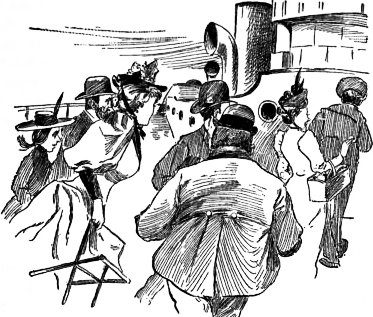
"Do you mean up in the little round cupola?"
"Cupola, great heavens," murmured the officer under his breath. Then he called a marine and had him show the woman to the fore-top. It is the experience of a lifetime for a naval officer who has cruised in the Mediterranean and rocked over the high waves of the south Atlantic to be placed in command of a brick battleship, which rests peacefully alongside a little pier and is boarded by hundreds of reckless sight-seers every day. The conning towers are of sheet-iron and some of the formidable guns are simply painted wood. It is said that if anything larger than a six-inch gun should be fired from the deck of the mimic battleship the recoil would upset the masonry and jolt the whole structure into a shapeless mass.
Below the water line the Illinois is a hollow mockery, but the two decks, the turrets and the heavy battery are made so realistic that any one who had not seen the brick laid and the plating put on might suppose it was a real war vessel that had stranded well in toward the beach. As a matter of fact, about one-third of the visitors are deceived, which fact may be vouched for by any one of the marines parading the deck. A man who looked as though he read the newspapers, called a sergeant of marines "Cap," and remarked that it was a very fine vessel.
"Yes, indeed, sir," replied the sergeant.
"She'll be here all summer, will she?"
"Oh, yes."
"Did this boat take part in the review at New York?"
"No, sir; this battleship is stuck fast here. It is a shell of brick, built up from a stone foundation, and is intended to represent a model battleship."
"You don't tell me. Made of brick, eh?" Uncle, listening to the talk, shared the countryman's disgust.
"There, Fanny, how do you excuse them for that piece of mockery? Everybody getting fooled as if they were in a cheap dime show. It's too bad the government should be a partner to sich deceptions. And then just hear them fellows making fun o' the likes o' us. It's a shame. Of course we hev to ask questions when they use all the art in the world to make deceiving things and then make fun if they do such good work as to fool us. We don't know any more about their work than they do about our farm. I guess they couldn't tell a Jersey from a short-horn, nor a header from a clover-huller."
One of the sailors was telling of the questions asked by the public. Some person asked him if the gulls flying around the ship were sea-gulls, and whether they had been brought on especially for the Fair. Another asked why the guns were plugged up at the end with pieces of wood. A marine said the plugs of wood made them air-tight, so that they wouldn't sink if they fell overboard. Maybe the man believed it. He didn't say anything.
From sight-seeing at the ship they came over to the Fisheries building.
The throng of visitors here at first detracted their sight from the wall of fish and wonders of the sea around them.
"Oh," said Aunt when she looked about, "I nearly have to gasp to make sure I'm not at the bottom of the sea. Just look at them fish swimming around on both sides of you."
"Well I feel sorry for these poor fish, they look so tired," said Fanny, "but it's very evident they can't keep lively all the time."
One of the big scaly-backed tarpons in the fountain was fanning his tail and moving slowly through the water. On the railing at the edge of the pool sat a tired man with a baby hanging over his arm. If the tarpon had stuck his nose out of the water he could have grabbed the man by the coat-tail and pulled him backward. The mother was standing a few feet away. She turned around and saw two beady eyes shining up through the water.
"Hold tight to that child," she said. "If you ever drop him that big pike would gobble him right up."
"He don't eat babies," replied the husband, calmly. "Besides, it ain't a pike; it's a sturgeon."
"Well, he looks awful mean, anyway." The husband, merely to reassure her, moved a few feet further along and let the baby lie over his shoulder and watch the little fish chase one another. The aisles were crowded full of people, who had found that a visit to the east end of the Fisheries building was almost as good as a dive to the bottom of the ocean.
It is in this place where you may stand with coral reefs and ring-tailed shells on either side and watch strange fish with spikes on their backs open their mouths and gape until each one looks like the letter O. The sea turtles stand on their heads and wave yellow flippers at the wide-eyed crowd, and a devil crab makes all the women shiver and pull the children away from the glass. In one aquarium there are so many catfish that they make the water cloudy.
In front of one of the cases there was a learned discussion. The label simply said "Anemone." On the rocks and shells were some things shaped like stars and mushrooms, except that they were moss-colored and had whiskers floating out in the water. "Annymone, what the dickens are they?" asked a man with a linen duster.
"Some kind of sea-weed, I believe," said an elderly gentleman in a patronizing manner.
"No, they ain't they're animals, broke in a third.
"But, sir, they are stuck fast there and can't move," said the elderly gentleman.
"I know that but they reach out with those whiskers and grab stuff and feed themselves that way."
"Well, that's the first time I ever heard of anything feedin' itself with its whiskers."
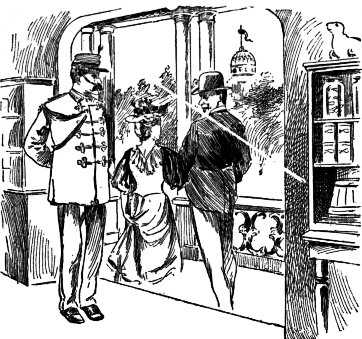
One of the young women looked at the sheepshead aquarium and murmured: "What long bills they have." Her escort smiled in a knowing way and said: "That is not a bill; that is a proboscis, I believe. I wish I had a hook and line."
A Columbian guard said he was tired of hearing the same old jokes, for nearly every young man who came in with a girl said: "When I come back here I'll bring a hook and line."
They finished the day here, and wearied with the noise and tumult of the streets were glad to find rest in their rooms when evening came.
"NEXT TIME I'LL BRING A HOOK AND LINE."
The sweetness of this rural family was nowhere better to be seen than when they were resting at home in the evening after the fatiguing experiences of the day.
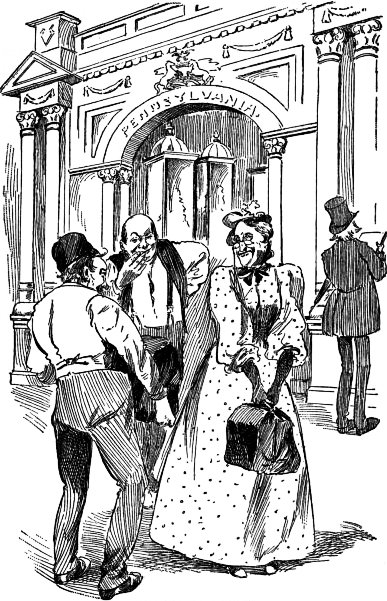
"Grandpa," said Fanny, when they were comfortably at rest, "I can't help but get angry at the women as I walk about, for I do see them do so much foolishness. Why, to-day I saw one crazy for souvenirs, and I believe she thought everything was a souvenir. I saw her pick up a nail and put it into her handbag, and when she came up to the Pennsylvania coal monument in the Mining building, she commenced putting pieces of the coal in her pocket. Then one of the working men played really a mean joke on her. He came up with a lump as big as a water bucket. Then he asked her if she wouldn't like to have that to remember the Fair by. And what do you think, she just said she thought he was very kind, but she didn't believe she could take it, for it was so big. But she would like awfully to have it. I saw the man shut one eye and say to the other man that the woman was crazy, because it was just the same kind of coal that she put into the stove every day at home."
"Now the only thing I've got to grumble about," said Uncle, "is what's models and what's facts. There is no use of scaring people to death with things that ain't so. Now over in the Government building I saw some hop plant lice that was not less than a foot long; there was a potato bug nine inches long, and there was a chinch bug two feet long, for I out with my rule and measured it. When I seen them I said, the Lord help the people who live where them things do, and then some city folks laughed at me, when at last Fanny came along and said they was models. Then we went into another room and there was soldiers from everywhere and army things that made me believe I was back again with Sherman, but there again they were wax, excepting the wagons and guns. I went up to one of the officers when I fust come in and I says, says I, "Are you regular army folks or Illinois militia?" and he didn't answer, and I turned to one of the privates and I asked why there was so many of them bunched together, then I seed some folks a laughing at me and I slunk away. I say the government is in poor business when it makes sport of its own defenders."
"A souvenir for her."
"Over there in the Transportation building I seen what it said was the boat Columbus sailed in; but after all, Fanny said it was a model. Right close to it was the boat what Grace Darling rowed out into the storming sea and saved so many lives. I thought it was a model, but Fanny said it was the very boat she used. I jest thought ef that was really the boat, we could all be sure that Grace Darling didn't stand o' Sunday mornins afore the glass a paintin' and a powderin'." He was getting himself worked up to the belief that he was a very much abused old soldier, when Fanny said:
"Grandpa, I have just cut a splendid piece of poetry out of the paper about the Fair. The man who wrote it don't live far from us, for his address says at the bottom, 'Mr. Matthews, from Effingham County,' and I'm going to keep it in my scrap-book. Let me read it to you:
The City of the Workers of the World
THE BUILDING OF IT
In a wilderness of wonders they are piling up the stores Gathered by the hands of labor on a hundred happy shores; In a palpitating plexus of white palaces they heap The marvels of the earth and air—the treasures of the deep; They have reached their restless fingers in the pockets of the past, And robbed the sleeping miser of the wealth he had amassed— To the festival of nations—to the tournament of toil, They have garnered in the offerings of every sun and soil; They have levied on the genius of the age, and it replies Full handed, with the blessed light of heaven in its eyes; In honor of old Spain they have taxed the brawn and brain Of a planet, for the glory of that Master of the Main, Whose fortitude is written on each flag that is unfurled Above the great white city of the world.
THE MEETING OF THE NATIONS
They are climbing over mountains, they are sailing over seas, From the artics, from the tropics, from the dim antipodes; In the steamship, in the warship, under banners loved the best, They are laughing up the waters from the east and from the west; From the courts of Andalusia, from the castles of the Rhone, To the meeting of the brotherhood of nations they are blown; From the kraals beside the Congo, from the harems of the Nile, They are thronging to the occident in never-ending file; From the farthest crags of Asia, from the continents of snow, The long-converging rivers of mankind begin to flow; In the twilight of the century, its wars forever past, The nations of the universe are clasping hands at last By Columbia's inland waters, where in beauty lies impearled The imperial white city of the workers of the world.
THE PASSING OF THE PAGEANT
When the roses of the summer burn to ashes in the sun, When the feast of love is finished, and the heart is overrun; When the hungry soul is sated and the tongue at last denies Expression to the wonders that are wearing out the eyes, Then the splendor it will wane like a dream that haunts the brain, Or the swift dissolving beauty of the bow above the rain; And the summer domes of pleasure that bubble up the sky Will tumble into legends in the twinkling of an eye; But the art of man endureth, and the heart of man will glow With reanimated ardor as the ages come and go. The pageants of the present are but pledges of a time When strifes shall be forgotten in a cycle more sublime When the fancies of the future into golden wreaths are curled O'er the dim, remembered city of the workers of the world.