Chapter XVII
Reading edition
CAIRO STREET
"And so you call this the Anthropological building?" said Uncle. "What kind of things has it got inside to have such a name?"
"Well, Grandpa, if you desire to be enlightened scientifically, I may say that it is a subject beginning with Adam and including the whole human race. It is divided into five parts: zoological anthropology, showing the differences and similarities between men and brutes; descriptive anthropology, showing the differences and similarities between the races; general anthropology, which is the descriptive biology of the human race; theological anthropology, which concerns the divine origin and the destiny of man; and ethical anthropology, which discusses the duties of man to the world and his creator."
"Do tell! it's a pretty big subject, and no wonder it has a house to itself."
Inside they found skulls, skeletons, bones, savage relics consisting of dress, utensils, ornaments and weapons with amulets, charms, idols and everything pertaining to early religions the world over.
On the eastern border of south pond was to be found the outdoor ethnographical exhibit. Indian groups, Indian schools and everything illustrating their primitive life and material progress.
There were objects, shell heaps, village sites, burial places, mounds, cliff houses and the ruins of Mexico, Central and South America. To see the same thing, and to only very little better advantage, would require thousands of dollars and years of perilous travel.
"The more I go through these places," said Uncle "the more I feel ashamed that I did not do my share in bringing of relics. Now I could have brought the old nightcap that sister Susan's dead husband's grandfather brought over from England; and I have a gridiron that my great aunt gave me to remember her by. And there's the snuffers and the old wood-yard rake that my grandfather made himself way back in New England, and the dress in which my aunt Harriet was married, and the horseshoe from the foot of the horse that killed cousin John's boy Tom, and sister Hanner's gold fillin' of her tooth, which was the first gold fillin' in our parts, and it came out just afore she died, and I don't know how much more. Ain't they anthropological, ethnographic biology or something like that?"
"I think, Grandpa, they would have been more useful in some kind of a cabinet in the old settler's cabin, but we needn't to fret about it any."
From here they went over to the Midway Plaisance. The "Street in Cairo" was to be opened with a great parade of some kind and they wanted to see it. The natives call it Mars-al-Kabia. In fact the Street in Cairo was all the curiosities of Egyptian Cairo's streets crowded into one Chicago Cairo Street. It was a splendid sight with its gardens and squares, its temples, its towers and minaret made in the most Arabesque architecture and ornamented with the most fantastic draperies. The inhabitants had been directly transported from old Cairo across the sea to Midway Plaisance. There were the importunate street venders, the donkey boys begging and pulling at the clothing of the visitors, the pompous drivers of camels beseeching the visitors to try their "ship of the desert;" tom-tom pounders, reed blowers, fakirs, child acrobat beggars, Mohammedans, Copts, Jews, Franks, Greeks, Armenians, Nubians, Soudanese, Arabs, Turks, and men and women from all over the Levant, all in the gorgeous apparel of the East, filling the booths or strolling about the street. They were the happiest lot of Orientals that ever got so far away from home. Drums were beating, camel drivers singing merry songs, and a curious medley of voices which the earth beneath them never heard before. At eleven o'clock somebody blew a strange kind of horn, which made the small boy almost kill himself in his frenzy to get near to see what it meant.
Musicians mounted the camels and began grinding out music that was enough to frighten even a North American Indian to death. At the first glimpse of the camels a team of steady old horses, that probably were never frightened before, ran away with the gravel wagon which they had been patiently dragging along. Little Arabs and Soudanese ran ahead of the procession turning somersets and clapping their hands in hilarious glee. There were warriors hopping about and clashing shields and swords together in mimic battle. In front of Hagenbeck's show the lions were aroused from their slumber in the den above the entrance, and they stood before the bars and roared at the procession. Then the dancing girls came skipping along, followed by a bride and her maids, for at last it was seen to be a bridal procession that was celebrating the opening of "Cairo street" in Chicago.
"Hurrah! It humps in front, jumps behind, and paces in the middle."
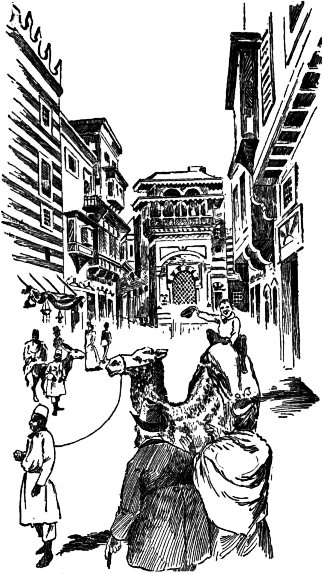
Here is the circus of the "Plaisance," where the visitors are the actors and the clowns. Every hour can be seen a bevy of pretty girls escorted by a brother or some dapper young man. The camel drivers hail them. What a chance for a lark! "Let's have a ride on the back of the queer creature," says one maiden. "Oh! you wouldn't dare," replies brother. "Wouldn't I, though? Just watch me," is the modern maiden's response. She approaches the dromedary, which opens one eye by way of recognition. She passes silver to the hand of the dark-skinned menial. The other girls giggle. A great crowd gathers round to see the fun which experience has taught is coming. Now the bold young woman is in the saddle, and holding tightly, as advised, to the strap which hangs near by. The dromedary opens the other eye, shuffles his rear and longest legs in the dust with a sound that resembles the hum of an approaching cyclone, gathers himself for an effort, and suddenly presents to the gaze of all beholders a rear elevation notable for its suddeness and its altitude, if not for its architectural beauty. Though catapulted about ten feet higher than she had had any idea of going, the American young woman does not scream. That would be unbecoming woman in this woman's era. She merely presses her lips tighter together, lets her smile fade away at the corners of her pretty mouth and grasps the strap as if her life depended upon it. The crowd, of course, laughs.
By this time the dromedary has shuffled himself some more along the brick pavement and opened the ugliest mouth ever seen this side the Nile. Now he shows his front elevation, and the smile which had returned to the lips of his fair rider fades again as the other end of the animated catapult is put into operation. But only for a moment. The bystanders have only begun their second laugh when the American young woman is seen to be herself again. She is out for a good time, and she is having it. The dromedary winks three times and puts a sinuous, swaying sort of motion into his body. His fat feet and angular legs begin to describe semi-circles. The saddle and its rider twist and gyrate and revolve and stop short, only to start quickly off again in some other direction, and the triumphant journey through the "Street in Cairo" has begun.
It is a very narrow thoroughfare, this oriental street, and it has no sidewalks. The crowd falls to either side. As the courier of the desert humps through the lane made open for him, his rider is seen smiling and happy. She knows she has a pretty foot, and that it is neatly clad in red shoes with tapering points and the most becoming of hosiery. She knows her figure is trim, and that her cheeks are bright and her eyes flashing. Applause follows her from the mosque to the temple of Luxor, and rolls back again as her beast turns for the homeward march.
She has had a ride on a real dromedary, caused palpitations in a hundred masculine hearts, and made 500 of her sex envy her the possession of such feet, figure and nerve. But these are not her sweetest triumphs. The consciousness to her most grateful and satisfying is that the courage and the independence of the modern young woman of America have been exemplified and vindicated.
They must get their fortunes told. There were no gypsies in this Cairo such as camp along the country roads or in the edges of the villages and tell sighing swains about their loves. Here was a seer imported direct from the banks of the Nile.
His father studied the stars and read lives from the palms of men's hands. His grandfather did the same. He came from a race of wise men. The first seers of his family sat in the shade of the early sphinxes and told Egyptian maidens to beware of young men who came up from the Red sea with false promises.
But his fortune-telling was of the same kind as one finds everywhere. A young man paid the price and held out his hand. The wise man took hold of the fingers, bent them back from the hand and pushed the cuff half way back to the elbow. He traced the course of the veins, ran his coal-black finger along each wrinkle of the palm, and all the time muttered to himself. Sometimes he nodded his head and gurgled approvingly. Again he hesitated and groaned feebly, as if the signs were sad. The young man had a scared look in his eyes. Then the interpreter began to tell what the aged seer had to say:
"He says that you had sickness. It was not long ago. You were afraid. But it's all right. You won't be sick any more. Have health, good health. Feel good all time. Don't be afraid."
"I'm glad to hear it," said the young man.
"Before you worked where you do now you had another kind of work. You did something else. You will change. Not the same kind of work next time. No, no. You will have good time. A man will give you work. It is different from what you do now. He is short, fat, very rich man. Go with him. You will do well, make money—lots of money. Fat man will make you have better clothes."
"Well, what's the matter with these I've——," began the young man, but the interpreter hushed him.
"He says you must stay in Chicago, good place. If you travel you will not have as much money as you will have when you get with the fat man. You must stay here if you want to be rich and have good clothes. Aha! this is very good. Put your head near. He says you are very warm-hearted, like all of the women. Yes, yes, that's it, you love one in particular, your wife or some one. He wants to know who it is you love."
"I am not married," said the young man.
"He says," resumed the interpreter, "that it's all right."
"All right, eh?"
"Yes, you will marry her, but not this year."
"How long do you think you will live?"
"Give it up."
"You will live to be 87. He says so."
That was all, and the puzzled young man arose to go away.
"How was it? How was it?" asked all the women who had been looking on and marveling.
"I'll tell you," said the young man. "The past and present are both a little cloudy, but the future is all that any one could ask."
Then he started away, keeping a sharp lookout for a fat man who seemed to be rich.
At the end of the street is the Temple of Luxor, where the curious pass under the deity-covered portal, and gaze upon the reproduced wonders of ancient Egypt. They bend over withered mummies of kings dead 5,000 years ago, and listen to music that has not been played for ages.
Near here is the passage way outside, and, as Fanny came out with her ears ringing with the strange jargon that everywhere met her, she was at once relaxed from the tension of sights and sounds she had just been in by seeing two country people rush together just before her. One said:
"Well, what in the world are you doin' here?"
"I swan, is that you? What are you doin' here?"
"Oh-h-h, we had to see the Fair, couldn't miss it, you know, not if it took a leg."
"That's right, that's right. Bring your folks?"
"Oh, yes, they're around here somewhere. Mother's about fagged. Says she'd rather cook for harvest hands than walk all day. Going to stay long?"
"Calculate on being here all next week if body and soul stick together. 'Spose you'll be here sometime."
"Can't tell yet. Just about give up seeing it all. Half the time don't know whether I'm on my head or my heels. Blamedest place I ever struck."
"That's right, that's right."
It was enough to cause her to smile at their homely enthusiasm, and the striking contrast of language. It was a relief to hear intelligible language once more, and in the rural dialect so familiar to her ears.
The soft, balmy days of June were now in their glory, and Uncle and Aunt sometimes spent nearly the whole day sitting around on Wooded Island imagining they could hear their cattle lowing in the pasture across the creek, and dreaming their lives over again from their early happy days. It was so peaceful there. Then they loved to go over by the lake and look upon it as a painted ocean, as calm and quiet as a pond of Raphael. It was something to see the stretch of blue go on till it touched the low-hung clouds at the edge of the world. Beyond the mists and the smoke of the white steamers were dimly outlined streaks of yellow and light, which turned the whole heavens into a softened sky of good promise. In the foreground of the vista the giant figures of victory, with charging horses and chariot, and all the Apollos and Neptunes, stood out like silhouettes. There was no noise save the ripple of the water down the cascade at Columbia's feet. Gentle winds lapped the waves along the beach, the furious breakers of other days were toned into a delicate murmur, which sounded very like some sweet symphony or the hymn of a winged choir. Waves which had for weeks been tangled masses of white caps and had thrashed with frantic anger the bases of the towering pillars dropped to the dainty ripples of a summer breeze. There was no crash, no roar, no splashing spray, driven on by a gale that snorted and snapped. So delicately and silently did the waters kiss the shore that sparrows and wrens and a flock of wandering doves walked to the very edge and filled their crops with the pure white sand. Then this, the best great work of any race of any age, comes over the spirits of worshipful men like heavenly benedictions of good-will and peace.
Sometimes as they sat in some quiet place alone saying nothing but thinking joy, the music of holy melodies came floating across the waters of the basin and re-echoed from the heaving lake to the Administration dome. They were sitting at the feet of that human genius which God had hallowed for the sake of those who revere His holy name.
They were everywhere thrilled with the supremely gifted achievements of their fellow men, inspired by the living canvass from every clime, and amazed to know that the lumps of Parian stone could be made to speak the heroism of the world.