Chapter V
Reading edition
COLUMBIA AVENUE
"THERE WAS A MEDLEY OF EXCITED VOICES."
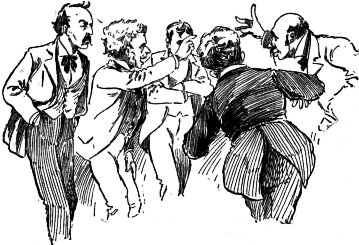
Several unnoteworthy days were spent by Uncle and his family in which they saw through the official buildings of the states and nations; through the Forestry building, showing the forestry wealth of the world; through the leather exhibits, showing the wonders done to the skins of beasts; all over Wooded Island, with its curiosities of Davy Crockett's cabin and the Javanese Hooden; through the clam bakes and the Casino, with the miscellaneous objects of interest about them. Uncle thought he was entering the Liberal Arts building when he walked past the guard at the southeast entrance of the Casino. He wandered into a labyrinth of side-rooms, where he heard an amazing medley of excited voices in as many different languages. They were evidently quarreling over something that displeased them very much. Presently a guard caught him by the arm.
"Are you a musician, sir?"
"Well, I used ter play a Jew's harp a leetle."
"The Casino will open again at three o'clock. You are not allowed in here."
The rest of the family had remained on the outside, suspicious of Uncle's venture. As he returned, led out in rather an undignified way by the guard, Uncle did not relish the amused looks of his family and the casual observers.
"Ah, ha," yelled Johnny in glee, "Grandpa's the first of us to get took by the cop. I'll tell everybody at Villaville about you getting led out."
From here they went on around to the north end of the greatest building on the grounds where were stored the miscellaneous educational achievements of the world.
As they entered the Manufacturers and Liberal Arts building through one of the small entrances on the north, the greatness of that more than forty-four acres of exhibits did not impress itself upon them. The first objects that met their gaze were the graphophones or phonographs. Some nickles were soon in the slots and the family for the first time listening to music coming from some where by singers unseen. Johnny had a face covered with smiles as he listened to some loud-mouthed artist singing "Throw him down McClosky." Between each verse Johnny told the boy who stood in open-mouthed wonder near him that the "feller is a singer from way back." He could not realize that he was not in a concert hall and that all standing about were not hearing what he heard. When the music ceased and he withdrew the tubes from his ears he said to the boy, "Wasn't that out of sight?"
"They listened to melodies by musicians unseen, and from somewhere unknown."
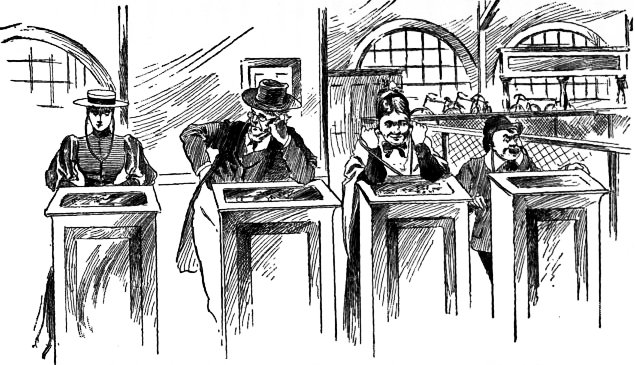
"Sure, and out of my hearing too, but I guess I got a nickle to try it on," and his nickle disappeared in the slot and the unwearied singer hid away in the machine told again his story of the great fight.
When Uncle took the tubes from his ears his eyes were full of tears.
"Why, Grandpa, what's the matter?" asked Fanny who had just listened to some selection by the Marine band.
"Well, you see, I heard something that I used to hear long time ago, and I couldn't tell just who was a singin' it to me. It was some woman, though, and I let myself think it was somebody else, and I was a thankin' God for lettin' me hear her once more. I thought it was Mary singin' "Old Folks at Home" for me, jest like she used to, and I thought for a while that she had come back to me. I wanted to talk to her, and it hurt me when I seed that I couldn't."
There was a stairway near by, and Fanny suggested that they should first go above. They came to the place where they could look out into the main floor. They were near the great clock tower just as the chimes began to peal forth their weird melodies.
"What's that?" cried Aunt, in awe-struck tones.
"It's the chime of the bells," cried Fanny, in delight, "listen! listen!"
Clear and plain through the vast building and to the streets on the outside came the slow measured notes of that nation-thrilling air, "My Country, 'tis of Thee."
All stood entranced before a scene never before reached by human means. When the chimes were done, Uncle said: "Let us go down to the main floor. I want to walk from end to tother of that aisle."
Johnny held in each hand a camp-stool for Uncle and Aunt, and he arranged the stools for them to sit awhile before that wonderful scene. Not long after, they were marching down that aisle called Columbia avenue. They felt themselves every inch as citizens of a great republic. It is not a very long thoroughfare—only a third of a mile—but they were two hours on the way. Uncle was a common, everyday American citizen when he started. At each step it seemed to him he swelled in his own estimation. At the clock tower he was proud enough to ascend that structure and make a Fourth of July speech. At the end of his walk he wanted to wear an eagle on his hat and shout till his throat should be stiff. It was not solely as an American that he was filled with exultation but as a member of the human race. He was lifted up with pride in the achievements of his fellow-man and in satisfaction that his own country was the host of such a splendid company.
Columbia avenue is the broad thoroughfare which traverses the center of the greatest building that ever was. It runs through the Manufactures and Liberal Arts building from the grand court to the plaza at the northern end. A walk down this thoroughfare is like a tour of the world in sixty minutes. Though, if you are to do it in sixty minutes, you must fifty times repress an impulse to linger beside some new marvel in the handiwork of man and go marching on. You cannot beat the record in a trip around the world and stop and see all the grand cathedrals and picturesque ruins and beautiful women and inviting galleries of art.
Columbia avenue is a picture never to be surpassed. It is a cleanly and an attractive thoroughfare for the world of tourists who throng the way. The path is no longer littered with lumber and boxes and kegs of paints. The horizon—for this vast enclosure has its horizon—is no more filled with a fine, white mist rising from the efforts of workmen to push and chisel blocks of staff into their appropriate places. It is a colossal field of process and a panorama of result. The world can not produce a more noble and inspiring place. It is the avenue down which the man on whom fate has fallen and whose steps in this world are few should choose to expend the last remaining atoms of his strength.
Uncle, as an American citizen, came in pride and exultation into the avenue from the central court. He had not been there before. The first thing he did was to stand fully five minutes gazing at the immensity of the enclosure trying to comprehend it, instinctively but vainly seeking adjectives with which to characterize it, and finally giving it all up, as a man gives up trying to measure the ocean or count the stars, conceding it to be too vast and wonderful for the range alike of his vision and his mind. No one told him which way to go, but away over his head, he couldn't guess how many hundred feet, was a line of pendent stars and stripes extending so far in a perspective of red and white that he could not see the fartherest. For aught he knew to the contrary the line led away to the sunny South. But knowing that where the stars and stripes led the way, he could go as he had done in the years of war, he passed on through a maze of wonders greater than even a Solomon could dream.
Not a word had been spoken for some time. Fanny had stopped at a millinery booth.
"Well, now come on Fanny, you wouldn't let me look at them harrows to my heart's content so come on, for you might get ideas into your head that would cost me lots of money and you know these times are expensive enough anyhow."
At the south end of the hall they ascended to the galleries again and soon, came past the educational exhibits that cover every department of human training. There was a booth of educational temperance. Here they read:
The Star of Hope of the Temperance Reform stands over the School House
These letters were on a banner of beautifully wrought silk, and near by was a map of the United States, with seven states distinguished from the rest by being in the darkest black.
"Those states," explained the ladies in charge, "have no school legislation for teaching temperance."
"Yes," soliloquized Uncle, "the school house, the pulpit and the press, are the three forces of freedom and progress in our welfare, but our lives and our natures are not alone molded by these. The fathers and mothers in the home holds greater destinies for the world than all the rest of the forces of the earth together." Then they went through a modeling department. Uncle could not see any use of these things.
"Now, Fanny, I'm tired of these mixing wax and realities together. Here's a man's head four feet across in this glass case. What does it mean?"
"O, that's just an enlarged figure to show the anatomy."
"Well, I didn't come here to see 'natomy, so let's pass on and leave it to other folks that like sich."
Just then some good country people came up and they were almost wild for knowledge as to where the Exposition people dug up that awful giant, and as to how long he lived before the flood, and if it might not be Goilah. Fanny could not stand such an error, and she pointed out to the little girl the card below explaining what the figure intended to show.
They went on past states and foreign countries, and booth after booth of books and papers of the great publishing companies.
"Come here, come this way, all of ye!"
Johnny was wildly motioning to his folks, who had stopped to examine some books in a booth near the north end of the Liberal Arts hall. As they came up to him, he said: "Say, you remember the Century plant, don't you, down in the Horticultural hall, wot's jest bloomed? Well, I've found a Century company, an' I want Fanny to go in thar an' ask the gurl wot hes charge if we kin see it bloomin'."
"They are the people who publish so much about the war and about Lincoln. Let us go in and I'll take some notes about what they have."
Fanny took out her pencil and notebook as they approached the entrance of the booth. All went in together, and the lady in charge, seeing Fanny with a notebook in her hand, came over to her from the opposite side of the room with a rush that almost took the young observer's breath away.
"Are you a reporter, Miss?"
"No, no," said Fanny.
"Oh! Just taking notes for your own amusement."
"Well, not exactly that. I may use them some time."
Fanny had in mind the things she would have to tell to her less fortunate friends at home.
"O I see, going to weave them into a book or a lecture. Just come this way;" and, followed by Johnny, Uncle and Aunt, Fanny went the rounds of the place listening attentively to the interesting talk of the lady in charge as she explained the processes in detail of making a great magazine, the evolution of the English dictionary and of dictionary making in all its phases. She showed them many interesting relics and among them the original letters and documents of the company's great war articles and their life of the martyred president. The lady never had more interested listeners or people more grateful for the trouble she had taken to instruct them.
"UNCLE DID NOT RECOGNIZE HIM."
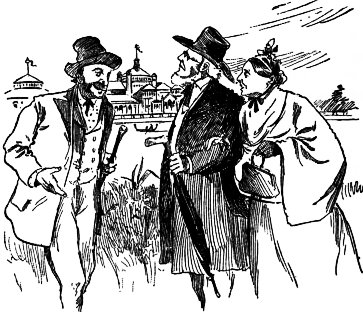
"No, don't go till you have registered."
Fanny went over and registered for all of them and Uncle went away feeling as if he now had a literary education and could write anything from a war article to a dictionary.
They passed on down and out of the building more impressed than ever concerning the greatness of the world. Aunt rarely said much but now she remarked that she loved their farm and their Jerseys more than ever but she could see that God's mercies and blessings did not rest alone on them and their neighbors. There was indeed a world beyond what she had ever seen or been able to dream.
As they passed on to the gate a family evidently from off the farm passed them.
The eyes of Uncle and the farmer happened to meet and the farmer nodded to him.
"Now look at that," exclaimed Uncle. "How cityfied I'm getting. I didn't nod to that feller. The fust few days I was here I nodded to everybody who looked at me but when they stared back at me like I was an idiot, I quit."
As they came by the Administration building a gentleman passed near them and politely lifted his hat. Without response Aunt and Fanny went on but Uncle grasped the gentleman by the hand and said, "Mr. Moses, I am so glad to see you. I ain't been tuck up yet by the perlice nor lost any money but I guess I would if you hadn't give me such good advice."
"Uncle, I must tell you that my name is Warner, as you have it on my card and not Moses. I told you that name just for a joke because I didn't expect to see you again and you know we don't often tell our names and business to people we meet on the trains."
Uncle was very much troubled. He could not see any joke in a false name being given. He remembered then that Fanny said a young man on the train was shadowing Mr. Moses, and this false name made it look bad for Mr. Warner.
"Well Mr. Warner I am sorry you deceived me for I liked you very much and I aimed to call on you, but maybe I hadn't orter not."
Without another ward Uncle went on to join his waiting family, sadly shaking his head as he thought of the misplaced confidence he had bestowed.
"There," said Mr. Warner, "I have estranged the good opinion of the old man and in his mind made the words of the confidence man seem true. But somehow I feel sure that I shall meet her in a different way."
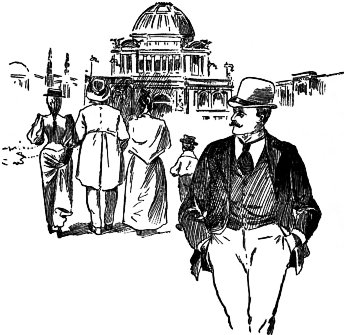
As he looked after her he said, "There goes the dearest girl on earth to me."
"HE LOOKED AROUND AFTER HER."
It was arranged that the next day the old people should rest at their hotel all day and at two o'clock Fanny would go to one of the big retail stores to do some needful shopping with Johnny as an escort.